Article

Diagnosing Institutional Resilience in Aging Critical Infrastructure: The VILDE Framework and AHP-Based Governance Priority Structure Under Climate Stress


1
National Crisisonomy Institute, Chungbuk National University, 1 Chungdae-ro, Seowon-gu, Cheongju 28644, Chungbuk, Republic of Korea
2
Institute of Science and Development, Chinese Academy of Sciences, Beijing 100190, China
3
Defense AX Hub Center Project Team, Hanam University, Daejeon 34430, Republic of Korea
4
Department of Public Administration, College of Social Sciences, Chungbuk National University, 1 Chungdae-ro, Seowon-gu, Cheongju 28644, Chungbuk, Republic of Korea
*
Author to whom correspondence should be addressed.
Appl. Sci. 2026, 16(15), 7682; https://doi.org/10.3390/app16157682
Submission received: 15 June 2026 / Revised: 17 July 2026 / Accepted: 29 July 2026 / Published: 2 August 2026

Abstract

This study diagnoses institutional resilience in aging critical infrastructure under climate stress by developing the VILDE framework and deriving an AHP-based governance priority structure. Although climate-induced infrastructure failures are often attributed to physical vulnerability, cascading breakdowns are fundamentally shaped by institutional governance constraints, which existing engineering-oriented resilience frameworks cannot systematically diagnose. The study operationalizes five governance dimensions—Values, Institutions, Leadership, Devotion, and Expertise (VILDE)—through the Analytic Hierarchy Process (AHP), using pairwise evaluations from 20 purposively selected experts in infrastructure management, disaster governance, and public administration. Expertise (w = 0.452) and Devotion (w = 0.276) received the highest priority weights, together accounting for 72.8% of the aggregated governance weight, and sensitivity analysis indicates that this ranking remains robust under ±30% perturbation. A documentary-based application to the Zhengzhou July 2021 urban infrastructure failure yielded a Governance Capacity Index (VILDE-GCI) of 0.414, with deficiencies concentrated in technical maintenance expertise, resilience enhancement expertise, and financial commitment. Under a simplified equal-resource assumption, scenario simulations suggest that weight-guided interventions generate greater diagnostic improvement per resource unit than politically visible but lower-priority alternatives. The framework reconceptualizes resilience as institutional governance capacity and supports prioritizing governance investments under escalating climate risks.

1. Introduction

Climate-induced disruptions are intensifying in frequency, severity, and systemic complexity, exposing critical weaknesses in the governance of infrastructure systems worldwide. Evidence from major disaster events, including Hurricane Katrina, Typhoon Haiyan, the 2011 Tohoku triple disaster, and the 2022 Pakistan floods, suggests that catastrophic infrastructure failures rarely result from hazard intensity alone. Rather, disaster outcomes are shaped by the capacity of institutions to anticipate emerging risks, coordinate across organizational boundaries, mobilize resources under uncertainty, and sustain response and recovery over time [1,2]. As climate-related hazards become increasingly compound and interconnected, critical infrastructure (CI) resilience can no longer be understood only as a matter of physical robustness or technical recovery. It must also be examined as a governance capacity problem involving preparedness, coordination, institutional learning, and adaptive decision-making [3].
This challenge is particularly acute for aging critical infrastructure. Many CI systems were designed for earlier climate conditions, lower service demands, and more stable risk environments. Today, they operate under intensifying environmental volatility, deferred maintenance cycles, fiscal constraints, and dense cross-sector interdependencies [4,5]. Failures in power, drainage, transport, water, or telecommunications systems can rapidly propagate across urban networks, generating cascading disruptions that exceed the scope of conventional engineering-based assessment [5,6,7,8]. Such failures are rarely purely technical. They often reflect institutional deficits, including fragmented authority, policy inertia, insufficient technical expertise, weak interagency coordination, and inadequate long-term investment in resilience [1,2,9]. In this respect, aging CI under climate stress represents a socio-technical governance problem in which physical degradation, institutional capacity, and urban resilience are closely intertwined [10].
Despite growing recognition of the governance foundations of infrastructure resilience, existing assessment approaches remain limited in diagnosing institutional resilience capacity. Engineering-centered resilience frameworks have provided important tools for evaluating physical robustness, structural reliability, and recovery performance, but they often treat governance as an external or contextual factor rather than as a measurable source of resilience or failure [11,12]. Conversely, many governance-oriented assessments rely on the formal presence of agencies, plans, policies, or regulations as proxies for institutional capacity, without determining whether these arrangements generate functional capacity under crisis conditions [13]. Crisis governance scholarship has shown that institutional resilience depends on coordination, authority, learning, and sustained commitment, yet this insight has not been sufficiently translated into an operational diagnostic structure for aging CI systems under climate stress [14,15].
A further limitation concerns prioritization. Existing frameworks often identify broad governance principles but provide limited guidance on which governance functions constitute binding constraints when resources, time, and administrative attention are limited [16,17]. Multi-criteria decision methods, including the Analytic Hierarchy Process (AHP), offer a structured means of comparing qualitative criteria and deriving priority weights from expert judgment [18]. However, their application to infrastructure resilience has rarely been anchored in a theoretically specified and CI-specific governance typology [19,20]. This creates a diagnostic gap: existing research increasingly acknowledges that governance matters, but it has not yet provided a systematic way to determine which institutional capacities matter most for strengthening the resilience of aging CI under climate stress.
To address this gap, this study develops and operationalizes the Values–Institutions–Leadership–Devotion–Expertise (VILDE) framework, a governance-based diagnostic model for institutional resilience in aging critical infrastructure systems. VILDE is not an established standard term; rather, it is the acronym used in this study to denote these five governance dimensions, conceptually derived from the Core System Model and operationalized here for critical infrastructure resilience. The framework disaggregates governance capacity into five theoretically specified dimensions: Values, Institutions, Leadership, Devotion, and Expertise. These dimensions respectively capture normative orientation and climate-risk awareness, formal regulatory and interagency arrangements, strategic coordination and crisis responsiveness, sustained institutional commitment across administrative cycles, and specialized technical knowledge. The VILDE framework is conceptually grounded in the Core System Model, originally developed through a diagnostic analysis of the Sewol Ferry disaster, and has subsequently been applied in studies of disaster governance, SDG implementation, and pandemic response [21,22,23]. Its dimensions are also broadly aligned with international resilience agendas that emphasize disaster-risk reduction, institutional coordination, infrastructure resilience, and sustainable development, including the Sendai Framework and SDG 9 [24,25]. These conceptual alignments provide a basis for further comparative evaluation but should not be interpreted as evidence of cross-national validity.
Building on this theoretical foundation, the study combines the VILDE framework with expert-based AHP analysis. This methodological combination is appropriate because institutional resilience involves multiple qualitative and theoretically differentiated governance dimensions whose relative importance cannot be captured through a single observable indicator. AHP enables structured pairwise comparison among domain specialists and translates expert judgment into a priority weight structure, thereby supporting systematic comparison among governance dimensions and sub-criteria [26,27,28]. Rather than using AHP as a stand-alone technical procedure, this study embeds it within the VILDE governance typology so that priority weights are theoretically interpretable and directly linked to institutional resilience capacity.
The study therefore asks how institutional governance capacity in aging critical infrastructure can be diagnosed and prioritized under climate stress. More specifically, it examines which VILDE dimensions represent the most critical governance constraints on infrastructure resilience, how structured expert judgment can be used to derive their relative priorities, and how weighted diagnostic results can inform strategic governance interventions under resource constraints. To answer these questions, the study first specifies the VILDE framework as a CI-oriented governance typology, then derives expert-based AHP priority weights for the five dimensions and their sub-criteria, and finally illustrates the operational use of the framework through a documentary-based application to the Zhengzhou July 2021 urban infrastructure failure.
The study contributes to crisis governance and infrastructure resilience research in three ways. Conceptually, it reframes the resilience of aging CI as an institutional governance capacity problem rather than a purely engineering problem. Methodologically, it links a theoretically grounded governance typology with expert-based AHP prioritization, producing a weighted diagnostic structure capable of identifying binding institutional constraints. Practically, it translates the VILDE-AHP structure into a Governance Capacity Index that can support the identification of governance weaknesses and guide resilience-oriented investment decisions. By doing so, the study provides a structured decision-support framework for strengthening institutional resilience in aging critical infrastructure systems facing escalating climate risks.

2. Theoretical Background

2.1. From Climate Hazard to Governance Failure

The resilience of critical infrastructure systems under climate stress is fundamentally shaped by governance capacity, not engineering design alone. While physical robustness determines a system’s initial resistance to hazard, it is the quality of institutional arrangements, coordination protocols, decision-making authority, and interagency communication that determines whether a system absorbs disruption, adapts, or collapses [1,2,9]. CI systems spanning energy, water, transportation, and telecommunications are now widely recognized as socio-technical systems whose resilience is co-determined by institutional architecture and physical infrastructure [5,29,30].
This recognition has gained formal expression in international policy frameworks. The Sendai Framework for Disaster Risk Reduction (2015–2030) and the IPCC’s Climate Resilient Development model both identify governance coordination, institutional learning, and stakeholder engagement as foundational conditions for resilience—not supplementary considerations [24,31]. Yet translating this recognition into a diagnostic instrument precise enough for institutional assessment and comparative policy analysis remains an unresolved challenge. The gap between acknowledging governance’s centrality and measuring it in operationalizable terms represents the primary motivation for the present study.

2.2. Aging CI and the Limits of Engineering-Centric Resilience

Infrastructure resilience has long been framed through an engineering paradigm that emphasizes structural robustness, load-bearing capacity, and resistance to discrete physical shocks [11,32]. The reliability, availability, and maintainability (RAM) framework exemplifies this tradition: while technically rigorous in operational diagnostics, it abstracts away the institutional environment in which infrastructure is governed and maintained [33]. This abstraction has become increasingly costly as infrastructure systems age.
Aging CI systems face compounding vulnerabilities that are as much institutional as material: deferred maintenance cycles, design obsolescence, and cascading interdependencies across networked systems. The United States’ structurally deficient bridges and outdated energy grids, and China’s recurrent flood-driven infrastructure failures despite sustained capital investment, share a common lesson, technical investment without corresponding institutional capacity does not produce resilience [4,25,30]. This causal weighting does not imply that institutional governance can substitute for physical engineering robustness; the two are co-determinant rather than competing properties of a resilient system, and a structurally inadequate asset will fail regardless of governance quality. The VILDE framework is therefore positioned as a complementary diagnostic layer rather than a replacement for engineering-based resilience assessment: it deliberately brackets structural analysis in order to isolate the governance constraints that determine whether engineered capacity is actually funded, maintained, upgraded, and mobilized in practice. Within this design, even the normative and commitment-oriented dimensions, Values and Devotion, are not left at the level of abstract orientation but are operationalized through measurable sub-criteria scored against documented institutional conditions, such as budgetary allocation, maintenance prioritization, and plan-revision capacity, so that each dimension is linked to observable operational decision-making rather than declarative intent. Contemporary resilience scholarship has responded by progressively incorporating governance flexibility, adaptive capacity, and institutional learning as core resilience dimensions [12,34]. Tierney [35] established that disaster outcomes are shaped less by hazard magnitude than by the pre-existing governance arrangements that determine how organizations coordinate and recover. Ansell and Boin [15] extended this argument to show that transformative resilience requires deliberate governance investment rather than reactive adaptation. Together, these contributions establish that a resilience metric which excludes governance capacity is not merely incomplete, it risks systematically misidentifying the sources of infrastructure vulnerability.

2.3. Governance Dimensions as Analytical Constructs: The VILDE Framework

Governance-oriented resilience indicators aim to capture the institutional and behavioral dynamics that determine whether systems absorb, adapt to, or fail under crisis pressure [14,34]. However, three specification gaps constrain existing frameworks. Most conflate governance quality with institutional presence, counting agencies or policies, rather than measuring functional capacity [13]. Indicator sets drawn from generic disaster governance frameworks are rarely calibrated to the specific institutional demands of CI systems under climate stress. And multi-criteria decision tools, including the Analytic Hierarchy Process (AHP), have not been systematically linked to a theoretically grounded, CI-specific governance typology.
The VILDE framework addresses these gaps by specifying five theoretically differentiated governance dimensions, each performing a discrete role in the institutional resilience architecture. Values (V) capture the normative commitments that orient governance priorities, including climate risk awareness, community safety orientation, and ecological sustainability. Institutions (I) encompass the formal legal and regulatory structures that assign authority, coordinate interagency mandates, and enable budgetary support for resilience investment. Leadership (L) reflects dynamic capacity for adaptive coordination under crisis conditions, including scenario-based planning and cascading failure prevention. Devotion (D) denotes sustained policy commitment across political and administrative cycles, independent of individual leadership actors, a distinction aligned with Boin and Lodge’s [14] differentiation between crisis leadership and the institutional embedding of resilience. Expertise (E) operationalizes the domain-specific technical competency through which governance mandates are operationally executed, encompassing vulnerability monitoring, technical maintenance, and system-level adaptation capacity.
The five VILDE dimensions are theoretically specified and operationally differentiated through distinct governance functions and associated sub-criteria. Each dimension represents a different aspect of institutional governance capacity, including normative orientation (Values), formal governance arrangements (Institutions), strategic coordination (Leadership), sustained institutional commitment (Devotion), and technical capability (Expertise). However, the AHP weight distribution reported in this study should not be interpreted as a psychometric test of discriminant validity. Differences in AHP weights indicate variations in perceived governance priority among the participating experts rather than empirical evidence that the five dimensions are constructively independent. Future research should examine the discriminant validity of the VILDE framework through factor analysis, inter-rater agreement on construct definitions, or mixed-method validation using independent expert panels.
The framework is conceptually grounded in the Core System Model, originally developed through diagnostic analysis of the 2014 Sewol Ferry disaster, in which deficiencies across the five governance dimensions contributed to the failure of disaster management [21]. Since then, the VILDE framework has been applied in studies of SDG governance [22] and pandemic response [23], illustrating its conceptual adaptability across different governance contexts. Furthermore, its governance dimensions broadly correspond to institutional principles emphasized in international resilience agendas, including the Sendai Framework for Disaster Risk Reduction and SDG 9 [24,25]. These conceptual alignments suggest potential cross-contextual relevance, but they should not be interpreted as empirical evidence of cross-national validity, which requires independent comparative testing across different governance systems.
A conceptual comparison with major national resilience frameworks suggests that the governance dimensions incorporated in the VILDE framework are broadly compatible with internationally recognized approaches to critical infrastructure resilience, while also highlighting several governance aspects that receive comparatively limited attention. FEMA’s Community Lifelines Toolkit primarily emphasizes Institutions, Leadership, and Expertise through cross-sector coordination and operational continuity; Japan’s Basic Act for National Resilience places greater emphasis on Leadership, Devotion, and Values through scenario-based planning and multi-level governance; and China’s critical infrastructure governance initiatives, as reflected in UNDRR assessments, primarily address Institutions and Expertise [25,36,37]. Across these frameworks, Values and Devotion (sustained institutional commitment) appear to receive comparatively less systematic operational attention, despite their relevance to long-term normative orientation and sustained institutional commitment across administrative cycles. This observation suggests a potential governance gap rather than demonstrating the superiority of any particular framework The VILDE framework is intended to address this gap by operationalizing all five governance dimensions within a structured AHP hierarchy, enabling context-sensitive prioritization of governance capacities according to expert judgment. Rather than claiming universal priority structures, the resulting weights should be interpreted as reflecting the governance priorities of the participating expert panel within the institutional context examined in this study.
A final specification concerns the relationship between the VILDE framework and climate-induced infrastructure risk. The framework is conceptually grounded in the Core System Model, which has previously been applied to disaster-governance and pandemic-governance studies [22,23]. Consequently, the five governance dimensions are intended to provide a general governance typology rather than a hazard-specific classification system. Their application to aging critical infrastructure under climate stress is achieved through the design of climate-relevant sub-criteria, including Climate Crisis Awareness (V2), Resilience Strategy (V3), Resilience-Oriented Leadership (L2), Climate Awareness Leadership (L3), Cascading Failure Prevention (L4), and Resilience Enhancement Expertise (E4). These sub-criteria explicitly address the interaction between long-term infrastructure degradation and compound climate hazards. Accordingly, the present application should be understood as a context-specific operationalization of a broader governance framework. Future comparative studies involving independent expert panels from different institutional and regulatory settings are needed to evaluate the framework’s broader cross-contextual applicability.

3. Research Design and Methods

3.1. AHP Model Design and Hierarchical Structure

Following the theoretical specification of VILDE, the next step is to translate the framework into an evaluable priority structure. This study operationalizes the VILDE framework through the Analytic Hierarchy Process (AHP), a structured decision-analytic method that translates expert pairwise judgments into a consistent priority weight structure [26]. AHP is particularly suited to governance assessment contexts where evaluation criteria are qualitative, interdependent, and not reducible to a single observable metric. Its consistency-ratio procedure provides a formal check on the internal coherence of expert judgments [27,28].
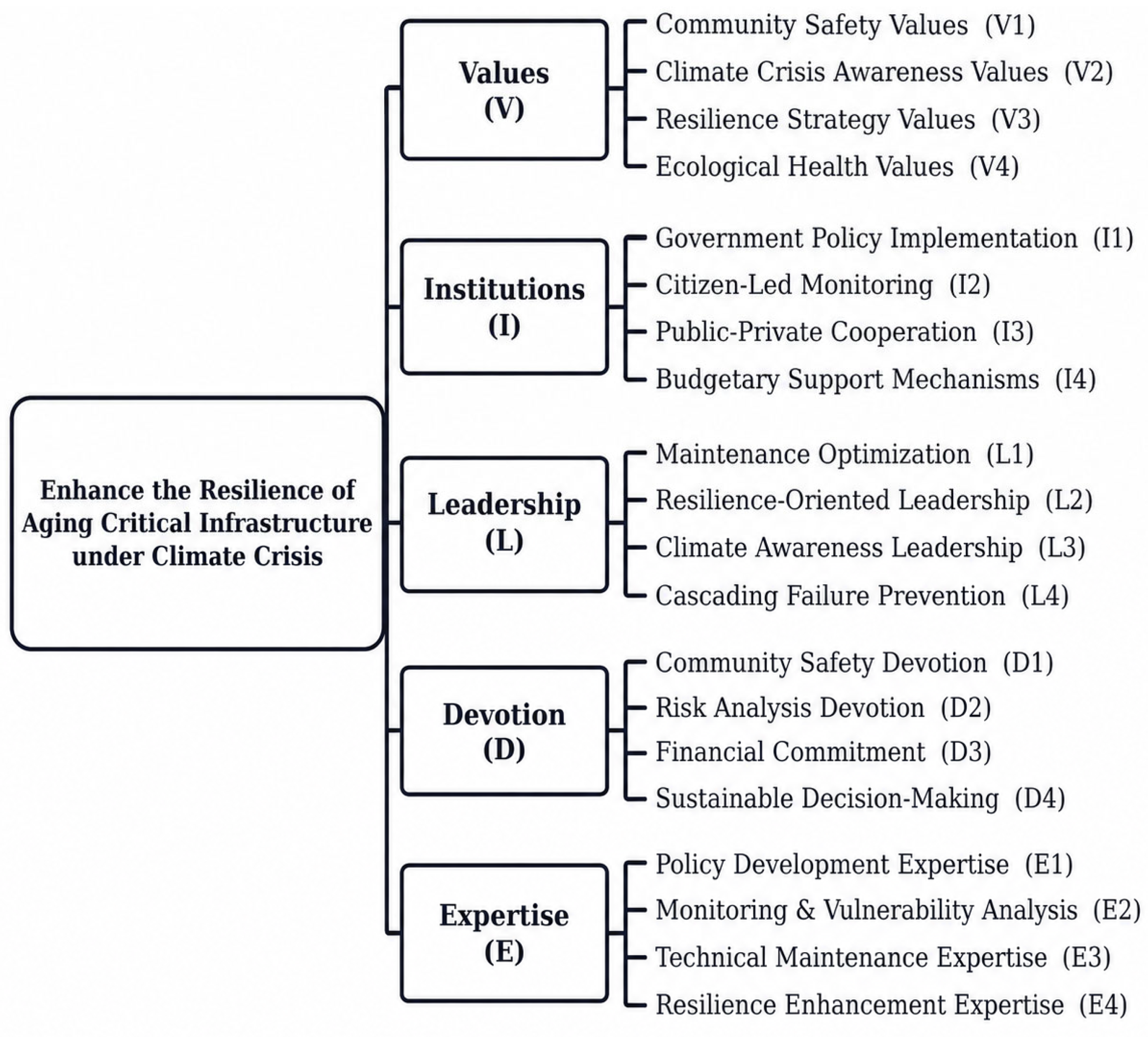
Within this operational design, the model is structured as a three-level hierarchy. Level 1 defines the overarching objective: assessing the institutional resilience capacity of aging critical infrastructure under climate crisis conditions. Level 2 comprises the five VILDE dimensions, hereafter referred to consistently as “dimensions” in their theoretical capacity and as “Level 2 criteria” in their AHP analytical function, each representing a theoretically differentiated governance domain. Level 3 elaborates each dimension into four operational sub-criteria, yielding 20 indicators in total. Each sub-criterion satisfies three requirements: measurability through expert elicitation, conceptual differentiation from other sub-criteria within the same dimension, and direct relevance to aging CI under climate stress. Figure 1 illustrates the complete hierarchical structure, and Table 1 presents the full set of sub-criteria with supporting references.
Classical AHP was retained as a transparent baseline method because it provides interpretable priority weights and an explicit consistency check. Nevertheless, crisp AHP may be affected by rank reversal, ambiguity in the interpretation of Saaty’s 1–9 scale, and limited representation of uncertainty and interdependence. Fuzzy AHP could better accommodate linguistic uncertainty, the Best–Worst Method could reduce the number of required comparisons, and ANP could represent interactions among governance dimensions. In addition, distance- and outranking-based multi-criteria methods such as TOPSIS and PROMETHEE could serve as complementary approaches for testing the robustness of the intervention rankings derived from the AHP weight structure. These alternatives are treated as methodological extensions rather than implemented in the present exploratory analysis.

3.2. Expert Panel Composition

AHP (Analytic Hierarchy Process) differs fundamentally from conventional statistical analyses that rely on large sample sizes to achieve population representativeness and statistical generalization. In traditional statistical research, increasing the sample size is important because the main objective is to infer the characteristics of an entire population from survey data.
However, AHP follows a different methodological logic. AHP is not designed to estimate population characteristics through large-scale surveys. Instead, it is a decision-making methodology that systematically evaluates and quantifies expert judgments through pairwise comparisons. Therefore, in AHP studies, the number of respondents is generally considered less important than the expertise of the participants, the quality of their judgments, and the consistency of their responses.
Schmidt et al. [61] stated that “there is general consensus that the AHP does not require a particularly large sample,” emphasizing that large sample sizes are not a necessary condition for AHP analysis. They further explained that AHP is not primarily intended to produce statistically representative results for an entire population, but rather to support structured decision-making based on informed expert judgments.
Similarly, Saaty [26], the developer of AHP, described the method as both a “measurement theory” and a “pairwise comparison-based expert judgment methodology.” From this perspective, the central purpose of AHP is to systematically transform expert knowledge and judgments into quantitative priorities. Accordingly, the reliability of AHP results depends more on whether the participating experts possess sufficient professional knowledge and whether their judgments satisfy acceptable consistency standards than on the absolute number of respondents.
AHP derives structured priority weights from the depth of specialist knowledge brought to pairwise comparisons, not from statistical sampling representativeness [26,27,28]. Methodological rigour is accordingly achieved through two mechanisms: purposive selection of domain-qualified experts, and internal consistency verification via CR < 0.10. For this reason, AHP studies place greater emphasis on the selection of qualified experts and the verification of judgment consistency through the Consistency Ratio (CR) rather than on securing large statistical samples. In line with this methodological approach, the present study employed a panel of experts with substantial professional experience in the relevant field and conducted consistency tests based on Saaty’s recommended criteria to support the consistency and transparency of the analysis. A panel of 20 domain specialists is consistent with established AHP practice, which recommends 10–30 experts to balance judgment diversity with panel coherence [28,61,62,63].
The VILDE framework, while theoretically grounded in Korean disaster governance analysis [21] and previously applied in SDG governance and pandemic governance studies [22,23], is operationalized here through a Chinese expert panel for two reasons. First, China provides a governance context characterized by intensive aging CI investment alongside documented institutional resilience deficits, making it an analytically appropriate site for eliciting CI-specific governance priority weights. Second, the Zhengzhou 2021 case, selected as the illustrative diagnostic application, is a Chinese infrastructure failure, ensuring consistency between the governance context used for expert elicitation and the context selected for the illustrative application. The resulting weight structure is accordingly treated as context-specific rather than universally generalizable, as noted in Section 3.4.
Expert data were collected through a structured AHP survey administered to 20 purposively selected specialists in infrastructure management, disaster governance, and public administration in China. Three eligibility criteria were applied: (1) a minimum of ten years of professional experience in disaster management, civil engineering, infrastructure policy, or public administration; (2) direct involvement in resilience planning or climate adaptation policy; and (3) active affiliation with a recognized government agency, research institution, or professional engineering body. Candidates were identified through institutional networks in the infrastructure and emergency management sectors, with additional panellists recruited via snowball referral. The final panel comprised 12 male and 8 female experts, all holding graduate-level qualifications, spanning academic and practitioner roles across structural engineering, disaster policy, urban planning, and environmental governance. Table 2 summarises panel demographics.

3.3. Survey Protocol and Data Aggregation

After defining the panel, the survey protocol was designed to convert expert judgments into comparable matrices. The survey instrument presented pairwise comparison matrices at both the dimension level (5 × 5) and sub-criterion level (4 × 4 per dimension), using Saaty’s 1–9 intensity scale. A detailed definitional guideline for each governance dimension and its sub-criteria was provided to all participants prior to completion. A pilot test with three domain experts confirmed item clarity and structural coherence, and anonymous administration was used to mitigate social desirability bias.
Individual judgment matrices were screened for internal consistency using Saaty’s criterion of CR < 0.10. Matrices initially exceeding the acceptable CR threshold of 0.10 were returned to the respective experts for reconsideration before final aggregation. In the final dataset, all 120 individual judgment matrices—comprising one dimension-level matrix and five sub-criterion matrices for each of the 20 experts—satisfied the CR < 0.10 criterion. As reported in Table 3, the mean individual CR values ranged from 0.0501 to 0.0716 across the six matrix types, and the maximum observed individual CR was 0.0999. Thus, the near-threshold CR values of several aggregated matrices were not attributable to the inclusion of individually unacceptable judgments.
After consistency screening, the 20 validated individual judgment matrices for each comparison set were combined using the AIJ approach based on the element-wise weighted geometric mean. The detailed aggregation procedure is presented in Section 3.4.

3.4. AHP Calculation Procedure

After the Analytic Hierarchy Process (AHP) questionnaires were completed, the pairwise comparison data were first organized into judgment matrices. These matrices provided the basis for estimating the relative weights of the VILDE dimensions and their sub-criteria. For clarity, this section takes the Values dimension from one expert’s response as an example. The same procedure was then used for the other dimensions, sub-criteria, and expert responses.
step 1. Construct the judgment matrix:
For indicators located at the same level of the hierarchy, the judgment matrix can be written in the following general form:
A = ( a i j ) n × n
In this matrix, aij denotes the relative importance of indicator i over indicator j, while n refers to the number of indicators included in the comparison.
Based on one expert’s questionnaire response, the pairwise comparison values for V1, V2, V3, and V4 under the values dimension are: V1/V2 = 1/3, V1/V3 = 1/7, V1/V4 = 1, V2/V3 = 1/3, V2/V4 = 3, and V3/V4 = 5. The corresponding judgment matrix is therefore constructed as follows:
A = [ 1 1 3 1 7 1 3 1 1 3 3 7 3 1 5 1 1 3 1 5 1 ]
step 2. Calculation of column sums:
a i 1 = 1 + 3 + 7 + 1 = 12
a i 2 = 0.3333 + 1 + 3 + 0.3333 = 4.6666
a i 3 = 0.1429 + 0.3333 + 1 + 0.2000 = 1.6762
a i 4 = 1 + 3 + 1 + 5 = 10
step 3. Column normalization of the judgment matrix:
The original judgment matrix was then normalized by column. Specifically, each element was divided by the total of the column to which it belongs. The normalization formula is shown below:
a ¯ i j = a i j i = 1 n a i j
After this column-wise normalization, the following standardized matrix was obtained:
B = [ 0.0833 0.0714 0.0852 0.1000 0.2500 0.2143 0.1989 0.3000 0.5833 0.6429 0.5966 0.5000 0.0833 0.0714 0.1193 0.1000 ]
step 4. Calculation of indicator weights:
The weight of each indicator was obtained by averaging the normalized values in the corresponding row. The general calculation formula is as follows:
w i = j = 1 n a ¯ i j n
Taking the average of each row gives the following weight vector:
W = (0.0850, 0.2408, 0.5807, 0.0935)
This arithmetic row averaging was used only to derive the priority vector from an individual normalized judgment matrix. It should be distinguished from the element-wise geometric-mean procedure subsequently used to aggregate judgments across the 20 experts.
step 5. Consistency check:
After the priority weights were calculated, a consistency test was carried out to examine whether the expert’s judgments were logically acceptable. First, the original judgment matrix A was multiplied by the weight vector W, producing AW:
(AW)1 = 0.0850 + 0.0803 + 0.0830 + 0.0935 = 0.3418
(AW)2 = 0.2550 + 0.2408 + 0.1936 + 0.2805 = 0.9699
(AW)3 = 0.5950 + 0.7224 + 0.5807 + 0.4675 = 2.3656
(AW)4 = 0.0850 + 0.0803 + 0.1161 + 0.0935 = 0.3749
Thus:
AW = (0.3418, 0.9699, 2.3656, 0.3749)
step 6. Calculate the maximum eigenvalue λmax:
The maximum eigenvalue was estimated by dividing each element of AW by the corresponding element of the weight vector and then averaging the resulting values:
λ m a x = 1 n i = 1 n ( A W ) i w i
Accordingly, the maximum eigenvalue is:
λmax = 4.0331
step 7. Calculate CI:
The consistency index (CI) was calculated using the following formula:
C I = λ m a x n n 1
Since n = 4 in this case, the calculation is as follows:
C I = 4.0331 4 4 1 = 0.0110
step 8. Calculate CR:
According to Table 4, the RI value for a fourth-order judgment matrix is:
RI = 0.90
Therefore, the consistency ratio is:
C R = C I R I
CR = 0.0122 < 0.10
Because CR = 0.0122 is below the commonly accepted threshold of 0.10, this judgment matrix passes the consistency test. This means that the expert’s pairwise comparisons are sufficiently consistent for use in the subsequent aggregation and analysis.
The final individual judgment matrices were aggregated using the Aggregation of Individual Judgments (AIJ) approach based on the element-wise weighted geometric mean [64]. For each pairwise comparison, the corresponding judgments of the 20 experts were combined as follows:
a i j G = k = 1 20 ( a i j ( k ) ) w k
where a i j ( k ) denotes the pairwise judgment provided by expert k ,   w k denotes the weight assigned to that expert, and k = 1 20 w k = 1 . Because all experts were assigned equal importance in the present study, w k = 0.05 for each expert. The resulting reciprocal group judgment matrices were subsequently used to derive the aggregated priority weights and were subjected to consistency verification at each level of the hierarchy.

4. Results

4.1. AHP Priority Weight Analysis

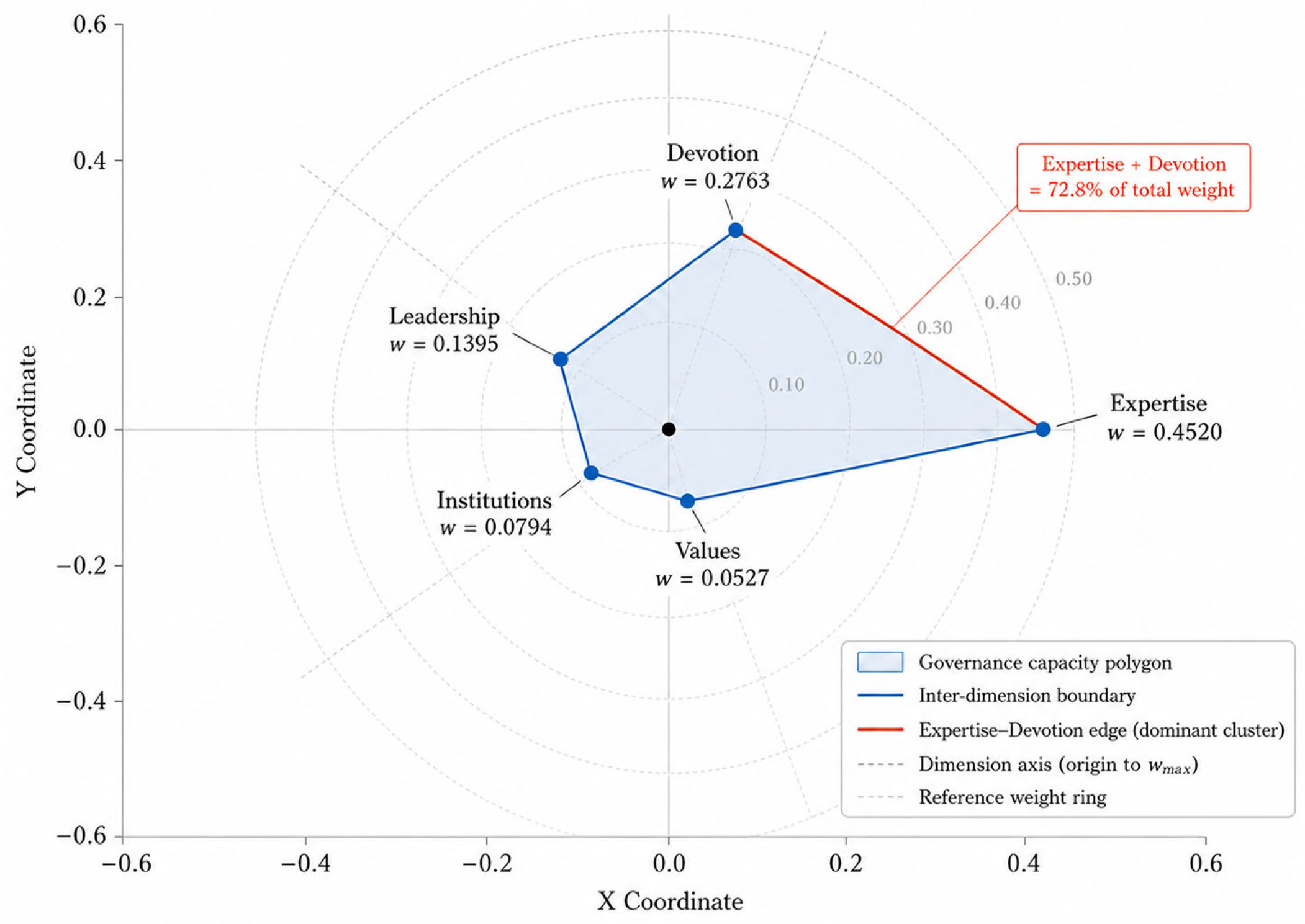
The preceding procedure produced the following priority structure. Expert pairwise judgments yielded a clear and consistent priority structure across the five VILDE governance dimensions. Expertise (E) emerged as the dominant dimension (w = 0.452, 45.2%), followed by Devotion (D) at w = 0.276 (27.6%). Together, these two dimensions account for 72.8% of total governance weight, indicating a substantial concentration of institutional resilience capacity in the technical execution and long-term commitment domains. Leadership (L), Institutions (I), and Values (V) contributed 14.0%, 7.9%, and 5.3%, respectively. The aggregate Consistency Ratio (CR = 0.098) satisfied Saaty’s [26] CR < 0.10 threshold, indicating acceptable consistency of the aggregated expert judgments. Table 5 presents the full dimension-level weight distribution.
The same concentration appears more clearly at the sub-criterion level. At the sub-criterion level, E4 (Resilience Enhancement Expertise, w = 0.198) and D3 (Financial Commitment, w = 0.136) recorded the two highest global weights. Within each dimension, expert consensus was most concentrated in Leadership: L4 (Cascading Failure Prevention) accounted for 51.9% of intra-group weight, reflecting strong agreement on systemic risk containment as the primary leadership priority. Similarly, I4 (Budgetary Support Mechanisms) dominated within Institutions at 52.8%, and D3 led within Devotion at 49.2%, suggesting that the participating experts regarded financial continuity as the operational core of governance-based resilience across multiple dimensions. Detailed sub-criterion weight matrices are presented in Table 6, Table 7, Table 8, Table 9 and Table 10.
To make this weight distribution more visually interpretable, Figure 2 presents a Cartesian projection of the five VILDE dimension weights. The figure shows a pronounced asymmetry in the priority structure: Expertise and Devotion occupy the most prominent positions in the governance-priority space, whereas Values and Institutions remain relatively peripheral. This pattern suggests that the participating experts assigned comparatively greater priority to functional capacity and sustained institutional commitment than to normative orientation or formal regulatory arrangements. In this sense, the figure provides a visual summary of the weight structure and may offer useful implications for the sequencing of institutional reform priorities.

4.2. Sensitivity Analysis

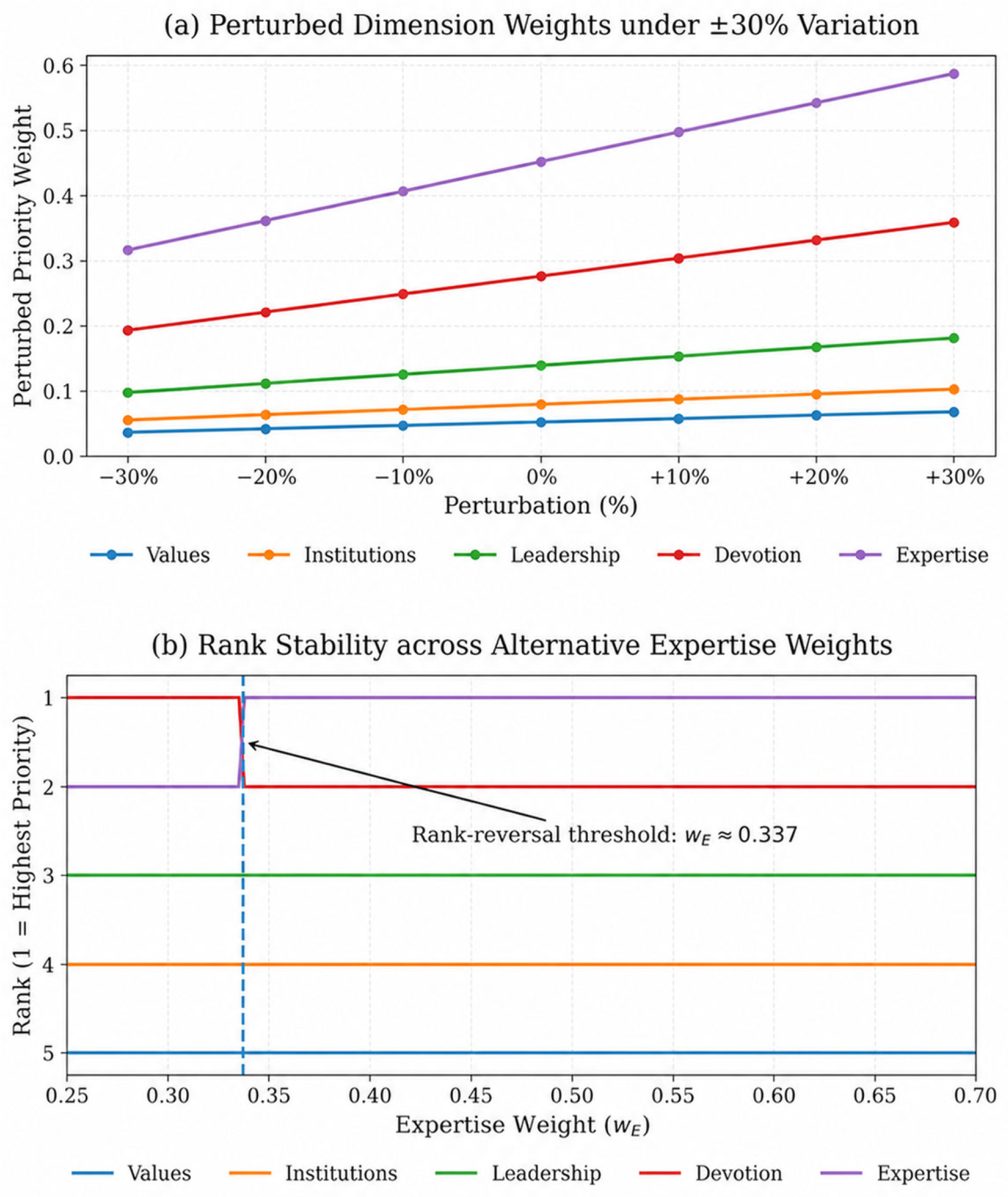
Having established the baseline ranking, to assess the robustness of the priority structure, a weight perturbation analysis was conducted in which each dimension’s weight was independently varied by ±10%, ±20%, and ±30%. The ranking order remained stable under all perturbations applied to Values, Institutions, Leadership, and Devotion, indicating that their relative positions were insensitive to the tested ranges of weight variation.
Only the Expertise dimension altered this stable pattern. A critical threshold was identified for Expertise: a weight decline exceeding 25% (from w = 0.452 to approximately w = 0.337) inverts the Expertise–Devotion rank order (Figure 3). This threshold carries an analytically derived implication: were governance contexts to experience substantial technical capacity reduction, through budget cuts, workforce attrition, or policy deprioritization, such that the relative priority of Expertise falls below this level, the diagnostic structure would indicate a shift in the binding constraint of resilience governance from technical execution to institutional commitment. Under such conditions, compensatory investment in the Devotion dimension becomes strategically necessary to maintain overall governance capacity.

5. Discussion

5.1. Governance Implications of the Priority Structure

These results shift the discussion from measurement to interpretation. The higher priority assigned to Expertise and Devotion offers an alternative perspective to the normative-institutional primacy embedded in major international resilience frameworks, including the Sendai Framework and the IPCC’s Climate Resilient Development model, both of which foreground regulatory architecture and stakeholder engagement over technical capacity and sustained commitment. The present findings redirect theoretical attention toward the operational dimensions of governance that determine whether resilience investments actually materialize under stress—consistent with Tierney’s [35] governance-outcome thesis and Ansell and Boin’s [15] argument that transformative resilience requires deliberate, sustained institutional investment. Korean AHP-based governance prioritizing studies consistently identify human-resource and commitment dimensions as the binding constraints on disaster resilience [62], a convergence that provides additional conceptual support of the Expertise–Devotion dominance finding.
Although Expertise and Devotion account for 72.8% of the aggregated weight, this concentration does not necessarily justify reducing VILDE to a two-dimension model. A more parsimonious structure would simplify prioritization but would omit normative orientation, formal institutional authority, and crisis coordination functions captured by Values, Institutions, and Leadership. The five-dimension structure is therefore retained for diagnostic completeness, while future construct-validation studies should examine whether a more parsimonious configuration is empirically supported.
This interpretation also requires caution in reading the low-ranked dimensions. The relatively low weight of Values (w = 0.053) does not imply that normative orientation is inconsequential. Rather, it reflects expert judgment that under conditions of acute climate stress and resource constraint, actionable and technically measurable dimensions constitute the binding constraints within the Chinese expert context on resilience. Normative values may be prerequisite for political will, but they do not substitute for technical execution capacity or funding continuity. Comparative consideration of FEMA’s Community Lifelines Toolkit, Japan’s Basic Act for National Resilience, and the EU Critical Entities Resilience Directive suggests that the VILDE framework encompasses governance dimensions broadly comparable to those emphasized in existing international resilience frameworks, while providing a context-specific prioritization derived from the present expert panel.

5.2. Scenario-Based Strategic Implications

The policy relevance of the priority structure becomes clearer when the weights are translated into reform scenarios. The AHP priority structure supports three governance reform scenarios that translate the diagnostic weight distribution into institutional pathways adaptable across governance contexts and infrastructure types. Table 10 presents these scenarios alongside a Policy Inertia baseline, representing the absence of reform, to anchor the comparative assessment of expected outcomes, policy risks, and implementation conditions.
Scenario 1: Devotion-Oriented Planning prioritizes long-term institutional commitment as the foundation of resilience. Concretely, this would involve legislating a five-year resilience planning cycle requiring all CI sectors to submit integrated risk and adaptation plans, subject to centralized audit and linked to performance-based budgeting. Stakeholder participation from local governments and infrastructure operators is embedded to ensure contextual accountability.
Scenario 2: Expertise-Centered Capacity Building addresses technical proficiency as the primary governance constraint. This scenario proposes a tiered certification system for infrastructure professionals, encompassing domain-specific training in climate risk diagnostics, adaptive design, and crisis management. National and regional resilience academies would anchor capacity building, particularly in high-vulnerability provinces, with career advancement pathways to support knowledge retention.
Scenario 3: Devotion–Expertise Synergy combines the preceding dimensions through interagency Resilience Integration Taskforces charged with aligning sustained policy commitment with expert-led implementation. These taskforces would co-develop scenario-based protection strategies using simulation and predictive risk modeling, institutionalising dynamic governance adaptation to evolving climate threats.
Together, these scenarios illustrate how the AHP-derived weight structure may be translated into alternative governance reform pathways, subject to contextual adaptation and feasibility assessment. Table 11 presents a comparative summary of expected outcomes, policy risks, and implementation conditions for each scenario.
A practical extension could therefore map each sub-criterion’s AHP-derived governance impact against a context-specific cost or ease-of-implementation score. Such a two-axis assessment would allow policymakers to distinguish high-impact, low-feasibility structural reforms from potential ‘quick wins’ that combine relatively high governance impact with comparatively low implementation cost.

5.3. Documentary-Based Illustrative Application: Reconstructing Pre-Event Governance Capacity in the Zhengzhou July 2021 Infrastructure Failure

The scenario logic is further illustrated through a documentary-based case application. To demonstrate how the VILDE-AHP framework can be operationalized in a real disaster context, this section applies the AHP-derived weight structure to the Zhengzhou extreme rainfall event of July 2021, one of the most comprehensively documented climate-induced urban infrastructure failures in recent Chinese history. This application should not be interpreted as an independent empirical validation of the framework. Rather, it reconstructs pre-event governance capacity using secondary documentary evidence, including the State Council Investigation Report [65] and prior peer-reviewed assessments of the same event [66,67], instead of an independent survey or direct elicitation from practitioners involved in the disaster response. Because the 20 sub-criterion scores were assigned by the authors on the basis of these documentary sources, the resulting VILDE-GCI should be understood as an illustrative diagnostic reconstruction rather than as a surveyed or independently validated institutional measurement. Documentary-based applications are consistent with established approaches to demonstrating the operational use of diagnostic governance models [13,15], and comparable secondary-evidence procedures have also been used in previous critical infrastructure governance assessments [63,68].
The July 2021 event resulted in 380 fatalities, direct economic losses of approximately RMB 40.9 billion, and severe disruptions across urban drainage, metro, power, and telecommunications systems within a short period, representing a major cascading infrastructure failure [65]. The State Council investigation documented institutional and operational deficiencies relevant to all five VILDE dimensions. In addition, Zhai and Lee [66], using a related AHP-based assessment with 19 domain experts, reported quantitative evaluations of 14 disaster-preparedness indicators that were used as supplementary scoring anchors for the present reconstruction. However, because these assessments are connected to the same broader research tradition, they are treated as supporting documentary evidence rather than as an independent source of external validation.
Each of the 20 VILDE sub-criteria was scored on a five-point scale (1 = severely absent; 5 = well-established) using documented institutional conditions as evidence (Table 12).
The composite Governance Capacity Index is defined as:
VILDE-GCI = Σ (global weight_i × score_i)/5
The pre-event VILDE-GCI for Zhengzhou is 0.414. The primary benchmark of 0.60 corresponds mathematically to a weighted average score of 3.0 on the five-point diagnostic scale (i.e., Σ(global weight_i × 3)/5 = 0.60). The value of 3 represents a condition in which governance arrangements are functionally present but retain significant operational gaps. The benchmark was discussed during the pilot phase as an interpretable reference point; however, it is not derived from the three pilot experts as a statistically validated universal threshold. Accordingly, 0.60 is used solely as an operational diagnostic benchmark rather than as a deterministic tipping point separating resilient and non-resilient institutions.
Against this benchmark, governance deficiencies are concentrated in the two highest-weighted dimensions (Table 13). Expertise (w = 0.452) averaged 2.25/5, with E3 (Technical Maintenance Expertise) and E4 (Resilience Enhancement Expertise) both scoring 2, consistent with Zhai and Lee [66], who identified operational exercises (B13 = 2.58/5) as the weakest preparedness indicator among the 14 evaluated items. Devotion (w = 0.276) also averaged 2.25/5, with D3 (Financial Commitment) scoring 2, reflecting chronic budgetary shortfalls and reservoir infrastructure that had lost 54.4% of its designed storage capacity through unmonitored encroachment [65]. Leadership (w = 0.140) recorded the lowest average score (1.75/5), with L4 (Cascading Failure Prevention) receiving the minimum score of 1, reflecting the absence of inter-system cut-off mechanisms during the simultaneous collapse of drainage, metro, power, and telecommunications systems.
Beyond diagnosing baseline weakness, the VILDE weight structure further supports simulation of governance improvement trajectories under resource constraints. For analytical tractability, the simulation adopts a uniform resource unit metric in which each point of score improvement per sub-criterion represents one resource unit, abstracting from real-world cost heterogeneity to isolate the effect of the AHP-derived weight structure on diagnostic GCI gains. Three investment scenarios were compared (Table 14):
Scenario A: Weight-Guided Targeted Investment: Improvement of the three highest-weighted sub-criteria (E4, E3, D3) by two score points each, requiring six resource units. Post-intervention VILDE-GCI = 0.607, exceeding the primary diagnostic benchmark, with a diagnostic GCI gain of 0.032 per assumed resource unit.
Scenario B: Uniform Improvement: A one-point improvement distributed across all 20 sub-criteria, requiring 20 resource units. Post-intervention VILDE-GCI = 0.614, slightly exceeding the primary diagnostic benchmark, with a diagnostic GCI gain of 0.010 per assumed resource unit.
Scenario C: Low-Weight Priority Investment: Two-point improvement across the eight Values and Institutions sub-criteria—the dimensions most visible in policy discourse but carrying the lowest combined empirical weight (w = 0.132), requiring 16 resource units. Post-intervention VILDE-GCI = 0.467, remaining below the primary diagnostic benchmark, with a diagnostic GCI gain of 0.003 per assumed resource unit.
Under the simplified equal-resource assumption, Scenario A produces approximately 3.2 times the diagnostic GCI gain per assumed resource unit of Scenario B and approximately 10.7 times that of Scenario C. These ratios are analytical comparisons rather than estimates of real-world cost-effectiveness. The results illustrate how the AHP-derived weights affect the sequencing of interventions when cost differences are temporarily held constant.
To examine whether the interpretation of governance capacity depends excessively on the selected benchmark value, a benchmark sensitivity analysis was conducted using three reference values (0.55, 0.60, and 0.65), representing a moderate variation (±0.05) around the primary diagnostic benchmark. As shown in Table 15, the Zhengzhou baseline remained below all three benchmark values, indicating that the qualitative diagnosis of pre-event governance insufficiency is robust to moderate benchmark variation. Although Scenarios A and B exceeded the primary benchmark of 0.60, neither reached the more conservative benchmark of 0.65. This finding indicates that the relative prioritization of governance interventions is robust, whereas the absolute classification of governance sufficiency is moderately sensitive to benchmark selection. Accordingly, the 0.60 benchmark should be interpreted as an operational diagnostic reference rather than as a rigid institutional pass/fail boundary. Thus, a score of 0.59 should not be interpreted as qualitatively different from a score of 0.61; both lie near the operational benchmark and should be regarded as borderline cases requiring contextual interpretation.

5.4. Theoretical Contributions, Limitations, and Future Directions

Taken together, the weighting results, sensitivity analyses, and Zhengzhou application support four contributions to crisis governance and infrastructure-resilience research. First, the study operationalizes governance capacity as a context-specific, expert-weighted priority structure for identifying institutional constraints within a defined governance setting [13,14]. Second, integrating VILDE with AHP provides a theoretically interpretable method for comparing governance dimensions and sub-criteria, although the resulting weights reflect the priorities of the participating Chinese expert panel rather than a universal governance hierarchy. Third, the weight-perturbation and benchmark-sensitivity analyses distinguish the stability of relative priorities from the benchmark-dependent classification of governance sufficiency. Fourth, the Zhengzhou application illustrates how documentary evidence may be used to operationalize the VILDE-GCI when direct practitioner elicitation is unavailable.
These contributions should be interpreted in light of several limitations. The expert panel was drawn exclusively from Chinese institutional contexts, and its disciplinary composition may have contributed to the relatively high priority assigned to Expertise. In addition, unequal AHP weights indicate differences in perceived priority but do not establish the discriminant validity of the five VILDE dimensions. Conventional crisp AHP also simplifies uncertainty and interdependence in expert judgment and may be affected by the interpretation of Saaty’s scale and possible rank reversal.
The Zhengzhou application is further limited by its reliance on author-assigned scores derived from secondary documentary sources, some of which originate from the same broader research tradition as the VILDE framework. The resulting VILDE-GCI should therefore be interpreted as a documentary-based diagnostic reconstruction rather than an independent empirical validation. The cross-sectional design also cannot capture temporal changes or nonlinear interactions among governance dimensions during cascading infrastructure failures.
Finally, the scenario analysis assumes that a one-point improvement in any sub-criterion requires an identical resource unit. This assumption isolates the analytical effect of the AHP-derived weights but does not reflect differences in financial cost, administrative complexity, political feasibility, or implementation time. The reported gains per resource unit should therefore not be interpreted as real-world cost-effectiveness estimates. Future research should use independent expert panels and practitioner surveys, compare disciplinary and national contexts, incorporate differentiated cost and feasibility assessments, and examine dynamic and uncertain governance interactions through methods such as Fuzzy AHP, ANP, System Dynamics, or Agent-Based Modeling. Emerging issues including digital governance, social equity, and market-based resilience mechanisms may also be examined as future extensions of the VILDE framework. Such dynamic extensions could also test whether the relative importance of VILDE dimensions varies across crisis phases—for example, whether Leadership becomes more influential during the impact and acute-response phases, while Devotion plays a stronger role in preparedness and long-term recovery.
In particular, behavioral and cognitive influences on crisis decision-making—such as normalcy bias, confirmation bias, and groupthink—represent an important refinement of the Leadership dimension; because these constructs were not included in the original expert survey, they are proposed here as future extensions rather than as components of the present index.
Future research could also conduct a post-recovery reassessment of Zhengzhou to examine institutional learning. Digital-governance extensions should consider data governance, interoperability, cybersecurity, and the allocation of institutional responsibility for digital-twin implementation. Market-based resilience mechanisms—including insurance instruments, resilience financing, resilience-linked bonds, and private-sector incentives—also merit examination as complements to public governance capacity, particularly in jurisdictions where critical infrastructure is privately owned or operated.
Social equity—including the equitable distribution of resilience benefits and the needs of vulnerable and marginalized populations—could likewise be incorporated as a future extension under the Values and Institutions dimensions; formally introducing equity as a new sub-criterion would, however, require renewed expert elicitation and re-estimation of the AHP hierarchy.

6. Conclusions

This study developed and operationalized the VILDE framework as an exploratory governance-based diagnostic model for assessing institutional resilience in aging critical infrastructure systems under climate stress. Using Analytic Hierarchy Process (AHP) judgments from 20 purposively selected Chinese domain specialists, the study derived a context-specific priority structure across five theoretically specified governance dimensions: Values, Institutions, Leadership, Devotion, and Expertise. Expertise (w = 0.452) and Devotion (w = 0.276) received the highest priority weights, together accounting for 72.8% of the aggregated governance weight. These results indicate that the participating expert panel assigned comparatively greater priority to technical execution capacity and sustained institutional commitment than to the other governance dimensions. They should not, however, be interpreted as establishing a universal hierarchy of institutional resilience or as empirical evidence that the five dimensions are constructively independent.
The documentary-based illustrative application to the Zhengzhou July 2021 urban infrastructure failure produced a pre-event Governance Capacity Index (VILDE-GCI) of 0.414. This result indicates substantial governance deficiencies, particularly in technical maintenance expertise, resilience enhancement expertise, financial commitment, and cascading-failure prevention. Because the sub-criterion scores were assigned by the authors using secondary documentary evidence, the Zhengzhou application should be understood as an illustrative diagnostic reconstruction rather than an independent empirical validation or a directly surveyed institutional measurement. The benchmark sensitivity analysis further showed that the Zhengzhou baseline remained below alternative diagnostic benchmarks of 0.55, 0.60, and 0.65. Thus, the diagnosis of substantial pre-event governance deficiencies is robust to moderate benchmark variation. By contrast, Scenarios A and B exceeded the primary benchmark of 0.60 but did not reach the more conservative benchmark of 0.65, indicating minimum diagnostic sufficiency rather than robust institutional resilience.
Under the simplified equal-resource assumption, the scenario analysis suggests that directing resources toward high-weight governance deficits may generate greater diagnostic improvement per assumed resource unit than uniform allocation or interventions concentrated in lower-weight dimensions. However, these results should not be interpreted as estimates of real-world cost-effectiveness. Governance interventions differ substantially in financial cost, administrative burden, implementation time, technical requirements, and political feasibility. The simulation therefore illustrates the prioritization logic of the AHP-derived weight structure rather than providing a comprehensive cost–benefit assessment.
This study contributes to crisis governance and infrastructure-resilience research in four respects. First, it reconceptualizes infrastructure resilience as an institutional governance-capacity problem that complements, rather than replaces, engineering-based resilience assessment. Second, it integrates a theoretically specified governance typology with AHP-based expert prioritization, providing a structured diagnostic approach for identifying governance constraints within a defined institutional context. Third, the weight-perturbation and benchmark-sensitivity analyses improve methodological transparency by distinguishing the relative stability of governance priorities from the benchmark sensitivity of absolute sufficiency classifications. Fourth, the Zhengzhou application illustrates how documentary evidence may be used to operationalize the VILDE-GCI when direct practitioner elicitation is unavailable, while also clarifying the limitations of such an approach.
Several limitations qualify these contributions. The expert panel was drawn exclusively from Chinese institutional contexts, and its disciplinary composition may have contributed to the relatively high priority assigned to Expertise. The resulting weights should therefore be treated as context-specific rather than universally generalizable. The Zhengzhou scores were author-assigned from secondary evidence, some of which originated within the same broader research tradition as the VILDE framework, thereby limiting validation independence and increasing the possibility of interpretive convergence. In addition, conventional AHP represents expert judgments as precise pairwise comparisons and does not test the psychometric discriminant validity of the five dimensions. The cross-sectional design also cannot capture temporal changes, interdependence among governance dimensions, or the nonlinear evolution of cascading infrastructure failures. Finally, the equal-resource assumption abstracts from the heterogeneous costs and feasibility constraints associated with different governance reforms.
Future research should evaluate the VILDE framework through independent expert panels, direct practitioner surveys, Delphi-based scoring, and external coding teams. Comparative studies involving experts from different regulatory and administrative traditions should examine whether the observed priority structure is specific to the present panel or is reproduced in other governance contexts. Disciplinary subgroup comparisons, such as comparisons between engineering specialists and public-administration experts, would further clarify the influence of panel composition. Methodologically, future studies could employ Fuzzy AHP, the Best–Worst Method, or the Analytic Network Process to represent uncertainty, reduce comparison burden, and model interdependence among governance dimensions. Integrating the VILDE framework with System Dynamics or Agent-Based Modeling could also capture changes across preparedness, impact, response, recovery, and adaptation phases. Finally, combining governance weights with differentiated cost, feasibility, equity, and implementation assessments would strengthen the framework’s practical value for infrastructure-resilience planning under escalating climate risk.

Author Contributions

Conceptualization, Y.Q. and J.E.L.; methodology, Y.Q. and J.E.L.; software, Y.Q.; formal analysis, Y.Q.; investigation, Y.Q.; data curation, Y.Q.; visualization, Y.Q.; writing—original draft preparation, Y.Q.; writing—review and editing, J.E.L., J.H.L., A.C., S.A.K., Z.J., B.T., L.D. and L.Z.; supervision, J.E.L.; project administration, J.E.L.; funding acquisition, J.E.L. All authors have read and agreed to the published version of the manuscript.

Funding

This research was funded by the Ministry of Education of the Republic of Korea and the National Research Foundation of Korea, grant number NRF-2023S1A5C2A02095270.

Institutional Review Board Statement

Ethical review and approval were not required for this study in accordance with the applicable institutional guidelines, as the study involved a non-interventional expert survey for AHP analysis, collected no personally identifiable or sensitive information, and posed no more than minimal risk to the participants.

Informed Consent Statement

Informed consent was obtained from all participants prior to their participation in the survey. Participants were informed of the purpose and procedures of the study, and participation was entirely voluntary.

Data Availability Statement

The data presented in this study are available from the corresponding author upon reasonable request. The data are not publicly available due to privacy and ethical considerations.

Acknowledgments

This work was supported by the Ministry of Education of the Republic of Korea and the National Research Foundation of Korea (NRF-2023S1A5C2A02095270).

Conflicts of Interest

The authors declare no conflicts of interest. The funders had no role in the design of the study; in the collection, analysis, or interpretation of the data; in the writing of the manuscript; or in the decision to publish the results.

References

  1. Boin, A.; McConnell, A. Preparing for critical infrastructure breakdowns: The limits of crisis management and the need for resilience. J. Contingencies Crisis Manag. 2007, 15, 50–59. [Google Scholar] [CrossRef] [Scilit]
  2. Comfort, L.K.; Boin, A.; Demchak, C.C. (Eds.) Designing Resilience: Preparing for Extreme Events; University of Pittsburgh Press: Pittsburgh, PA, USA, 2010. [Google Scholar]
  3. Linkov, I.; Bridges, T.; Creutzig, F.; Decker, J.; Fox-Lent, C.; Kröger, W.; Lambert, J.H.; Levermann, A.; Montreuil, B.; Nathwani, J.; et al. Changing the resilience paradigm. Nat. Clim. Change 2014, 4, 407–409. [Google Scholar] [CrossRef] [Scilit]
  4. American Society of Civil Engineers. 2021 Report Card for America’s Infrastructure; American Society of Civil Engineers: Reston, VA, USA, 2021. [Google Scholar]
  5. Rinaldi, S.M.; Peerenboom, J.P.; Kelly, T.K. Identifying, understanding, and analyzing critical infrastructure interdependencies. IEEE Control Syst. Mag. 2001, 21, 11–25. [Google Scholar] [CrossRef] [Scilit]
  6. Panteli, M.; Mancarella, P. Modeling and evaluating the resilience of critical electrical power infrastructure to extreme weather events. IEEE Syst. J. 2015, 11, 1733–1742. [Google Scholar] [CrossRef] [Scilit]
  7. Panteli, M.; Mancarella, P. The grid: Stronger, bigger, smarter? Presenting a conceptual framework of power system resilience. IEEE Power Energy Mag. 2015, 13, 58–66. [Google Scholar] [CrossRef] [Scilit]
  8. Ouyang, M. Review on modeling and simulation of interdependent critical infrastructure systems. Reliab. Eng. Syst. Saf. 2014, 121, 43–60. [Google Scholar] [CrossRef] [Scilit]
  9. Lu, M.; Lee, J.-E. Protecting critical electric power infrastructure from natural disasters: Vulnerability analysis and strategic resilience measures in the climate crisis era. Crisisonomy 2026, 22, 417–444. [Google Scholar] [CrossRef] [Scilit]
  10. Meerow, S.; Newell, J.P.; Stults, M. Defining urban resilience: A review. Landsc. Urban Plan. 2016, 147, 38–49. [Google Scholar] [CrossRef] [Scilit]
  11. Bruneau, M.; Chang, S.E.; Eguchi, R.T.; Lee, G.C.; O’Rourke, T.D.; Reinhorn, A.M.; Shinozuka, M.; Tierney, K.; Wallace, W.A.; von Winterfeldt, D. A framework to quantitatively assess and enhance the seismic resilience of communities. Earthq. Spectra 2003, 19, 733–752. [Google Scholar] [CrossRef] [Scilit]
  12. Cutter, S.L.; Burton, C.G.; Emrich, C.T. Disaster resilience indicators for benchmarking baseline conditions. J. Homel. Secur. Emerg. Manag. 2010, 7, 51. [Google Scholar] [CrossRef] [Scilit]
  13. Drennan, L.T.; McConnell, A.; Stark, A. Risk and Crisis Management in the Public Sector, 2nd ed.; Routledge: London, UK, 2015. [Google Scholar] [CrossRef] [Scilit]
  14. Boin, A.; Lodge, M. Designing resilient institutions for transboundary crisis management: A time for public administration. Public Adm. 2016, 94, 289–298. [Google Scholar] [CrossRef] [Scilit]
  15. Ansell, C.; Boin, A. Taming deep uncertainty: The potential of pragmatist principles for understanding and improving strategic crisis management. Adm. Soc. 2019, 51, 1079–1112. [Google Scholar] [CrossRef] [Scilit]
  16. Jiménez, A.; Saikia, P.; Giné, R.; Avello, P.; Leten, J.; Lymer, B.L.; Schneider, K.; Ward, R. Unpacking water governance: A framework for practitioners. Water 2020, 12, 827. [Google Scholar] [CrossRef] [Scilit]
  17. Ketchoua, G.S.; Arogundade, S.; Bila, S.; Nkosi, N.P. Infrastructure and the path to sustainability: How governance shapes development outcomes in Africa. Sustain. Dev. 2026, 34, 1020–1042. [Google Scholar] [CrossRef] [Scilit]
  18. Kulakowski, K. Understanding the Analytic Hierarchy Process, 1st ed.; Chapman and Hall/CRC: Boca Raton, FL, USA, 2020. [Google Scholar] [CrossRef] [Scilit]
  19. Cajot, S.; Mirakyan, A.; Koch, A.; Maréchal, F. Multicriteria decisions in urban energy system planning: A review. Front. Energy Res. 2017, 5, 10. [Google Scholar] [CrossRef] [Scilit]
  20. Babar, A.H.K.; Ali, Y. Framework construction for augmentation of resilience in critical infrastructure: Developing countries a case in point. Technol. Soc. 2022, 68, 101809. [Google Scholar] [CrossRef] [Scilit]
  21. Lee, J.E. Exploring the core system of national crisis and emergency management in Korea: The case of the Sewol disaster management. Korean Rev. Crisis Emerg. Manag. 2015, 11, 1–18. Available online: https://journal.kci.go.kr/cemtp/archive/articleView?artiId=ART002028101 (accessed on 8 June 2026). [CrossRef] [Scilit]
  22. Lee, J.E.; Kwon, S.A.; Yim, D.K.; Yoo, J.S.; Ban, Y.W.; Yoo, H.J.; Maeng, S.J.; You, S.; Lee, H.-J.; Choi, J.-K.; et al. A transdisciplinary approach of Crisisonomy for implementing SDGs in global society: Using the core system model and disaster resilience concept. Crisisonomy 2019, 15, 89–104. [Google Scholar] [CrossRef] [Scilit]
  23. Jo, Y.S.; Lee, J.E. A core system approach to improving local community disaster resilience: Focusing on the COVID-19 pandemic. Crisisonomy 2021, 17, 1–27. [Google Scholar] [CrossRef] [Scilit]
  24. Aitsi-Selmi, A.; Egawa, S.; Sasaki, H.; Wannous, C.; Murray, V. The Sendai Framework for Disaster Risk Reduction: Renewing the global commitment to people’s resilience, health and well-being. Int. J. Disaster Risk Sci. 2015, 6, 164–176. [Google Scholar] [CrossRef] [Scilit]
  25. United Nations Office for Disaster Risk Reduction. 2022 Global Natural Disaster Assessment Report; UNDRR: Geneva, Switzerland, 2023. [Google Scholar]
  26. Saaty, T.L. The Analytic Hierarchy Process: Planning, Priority Setting, Resource Allocation; McGraw-Hill: New York, NY, USA, 1980. [Google Scholar]
  27. Cerić, A.; Ivić, I. Application of analytic hierarchy process (AHP) in earthquake risk assessment. In Proceedings of the 2nd Croatian Conference on Earthquake Engineering—2CroCEE, Zagreb, Croatia, 22–24 March 2023; pp. 964–974. [Google Scholar] [CrossRef] [Scilit]
  28. İlhan, M.; Baran, M.; Aykal, F.D. Determining applicable facade design decisions in the architectural environment using the AHP method after an earthquake. Online J. Art Des. 2025, 13, 72–89. [Google Scholar] [CrossRef] [Scilit]
  29. Helbing, D. Globally networked risks and how to respond. Nature 2013, 497, 51–59. [Google Scholar] [CrossRef] [Scilit] [PubMed]
  30. Lee, J.H. Exploratory study on the US NIPP establishment process for strengthening national critical infrastructure protection system in Korea. J. Saf. Crisis Manag. 2023, 13, 1–9. [Google Scholar] [CrossRef] [Scilit]
  31. Intergovernmental Panel on Climate Change. Climate Change 2022: Impacts, Adaptation and Vulnerability. Contribution of Working Group II to the Sixth Assessment Report of the Intergovernmental Panel on Climate Change; Cambridge University Press: Cambridge, UK; New York, NY, USA, 2022. [Google Scholar]
  32. Cimellaro, G.P.; Reinhorn, A.M.; Bruneau, M. Framework for analytical quantification of disaster resilience. Eng. Struct. 2010, 32, 3639–3649. [Google Scholar] [CrossRef] [Scilit]
  33. Blanchard, B.S.; Fabrycky, W.J. Systems Engineering and Analysis, 5th ed.; Prentice Hall: Upper Saddle River, NJ, USA, 2010. [Google Scholar]
  34. Alexander, D.E. Resilience and disaster risk reduction: An etymological journey. Nat. Hazards Earth Syst. Sci. 2013, 13, 2707–2716. [Google Scholar] [CrossRef] [Scilit]
  35. Tierney, K. Foreshadowing Katrina: Recent sociological contributions to vulnerability science. Contemp. Sociol. 2006, 35, 207–212. [Google Scholar] [CrossRef] [Scilit]
  36. Federal Emergency Management Agency. Community Lifelines Toolkit 2.0; U.S. Department of Homeland Security: Washington, DC, USA, 2020. Available online: https://www.fema.gov/sites/default/files/2020-05/CommunityLifelinesToolkit2.0v2.pdf (accessed on 8 June 2026).
  37. Cabinet Secretariat. Basic Act for National Resilience (Act No. 95 of December 11, 2013) [Unofficial English Translation]; Cabinet Secretariat: Tokyo, Japan, 2013. Available online: https://faolex.fao.org/docs/pdf/jap158113.pdf (accessed on 8 June 2026).
  38. Fields, B.; Renne, J.L. Adaptation Urbanism and Resilient Communities: Transforming Streets to Address Climate Change; Routledge: London, UK, 2021. [Google Scholar] [CrossRef] [Scilit]
  39. Reichstein, M.; Benson, V.; Blunk, J.; Camps-Valls, G.; Creutzig, F.; Fearnley, C.J.; Han, B.; Kornhuber, K.; Rahaman, N.; Schölkopf, B.; et al. Early warning of complex climate risk with integrated artificial intelligence. Nat. Commun. 2025, 16, 2564. [Google Scholar] [CrossRef] [Scilit] [PubMed]
  40. Berkeley, A.R.; Wallace, M.; Coo, C. A Framework for Establishing Critical Infrastructure Resilience Goals: Final Report and Recommendations by the Council; National Infrastructure Advisory Council: Washington, DC, USA, 2010. Available online: https://www.cisa.gov/sites/default/files/publications/niac-framework-establishing-resilience-goals-final-report-10-19-10-508.pdf (accessed on 8 June 2026).
  41. Thomé, A.M.T.; Ceryno, P.S.; Scavarda, A.; Remmen, A. Sustainable infrastructure: A review and a research agenda. J. Environ. Manag. 2016, 184, 143–156. [Google Scholar] [CrossRef] [Scilit] [PubMed]
  42. Chen, D.; Xiang, P.; Jia, F.; Zhang, J.; Liu, Z. An indicator system for evaluating operation and maintenance management of mega infrastructure projects in China. Int. J. Environ. Res. Public Health 2020, 17, 9589. [Google Scholar] [CrossRef] [Scilit] [PubMed]
  43. Jiang, N.; Jiang, W. How does regional integration policy affect urban resilience? Evidence from urban agglomeration in China. Environ. Impact Assess. Rev. 2024, 104, 107298. [Google Scholar] [CrossRef] [Scilit]
  44. Giordano, P.F.; Quqa, S.; Limongelli, M.P. The value of monitoring a structural health monitoring system. Struct. Saf. 2023, 100, 102280. [Google Scholar] [CrossRef] [Scilit]
  45. OECD. Good Practices for Performance Budgeting; OECD Publishing: Paris, France, 2019. [Google Scholar] [CrossRef] [Scilit]
  46. Luskova, M.; Leitner, B. Ensuring critical infrastructure operational continuity. In Economic and Social Development: 52nd International Scientific Conference on Economic and Social Development—Book of Proceedings, Porto, Portugal, 16–17 April 2020; da Silva, A.L., Tomic, D., Grilec, A., Eds.; Varazdin Development and Entrepreneurship Agency: Varazdin, Croatia, 2020; pp. 636–644. [Google Scholar]
  47. Oriol, L.E.; Jorns, J.; Channell, K.; Rood, R.B. Scenario planning for climate adaptation and management: A high-level synthesis and standardization of methodology. Front. Clim. 2024, 6, 1415070. [Google Scholar] [CrossRef] [Scilit]
  48. Açıkalın, Ş.N.; Sarı, E.; Erçetin, Ş.Ş. Role of education in awareness on climate change. Curr. Perspect. Soc. Sci. 2024, 28, 56–63. [Google Scholar] [CrossRef] [Scilit]
  49. Henriksen, H.J.; Roberts, M.J.; van der Keur, P.; Harjanne, A.; Egilson, D.; Alfonso, L. Participatory early warning and monitoring systems: A Nordic framework for web-based flood risk management. Int. J. Disaster Risk Reduct. 2018, 31, 1295–1306. [Google Scholar] [CrossRef] [Scilit]
  50. Almaleh, A. Measuring resilience in smart infrastructures: A comprehensive review of metrics and methods. Appl. Sci. 2023, 13, 6452. [Google Scholar] [CrossRef] [Scilit]
  51. Adger, W.N.; Brown, K.; Nelson, D.R.; Berkes, F.; Eakin, H.; Folke, C.; Galvin, K.; Gunderson, L.; Goulden, M.; O’Brien, K.; et al. Resilience implications of policy responses to climate change. Wiley Interdiscip. Rev. Clim. Change 2011, 2, 757–766. [Google Scholar] [CrossRef] [Scilit]
  52. Peters, B.G.; Jordan, A.; Tosun, J. Over-reaction and under-reaction in climate policy: An institutional analysis. J. Environ. Policy Plan. 2017, 19, 612–624. [Google Scholar] [CrossRef] [Scilit]
  53. Beckers, F.; Chiara, N.; Flesch, A.; Maly, J.; Silva, E.; Stegemann, U. A risk-management approach to a successful infrastructure project. McKinsey Work. Pap. Risk 2013, 52, 18. Available online: https://www.mckinsey.com/~/media/McKinsey/Industries/Capital%20Projects%20and%20Infrastructure/Our%20Insights/A%20risk%20management%20approach%20to%20a%20successful%20infrastructure%20project/A_risk_management_approach_to_a_successful_infrastructure_project_PDF.pdf (accessed on 8 June 2026).
  54. Guo, Z.; Haimes, Y.Y. Risk assessment of infrastructure system of systems with precursor analysis. Risk Anal. 2016, 36, 1630–1643. [Google Scholar] [CrossRef] [Scilit] [PubMed]
  55. Arif, F.; Bayraktar, M.E.; Chowdhury, A.G. Decision support framework for infrastructure maintenance investment decision making. J. Manag. Eng. 2016, 32, 04015030. [Google Scholar] [CrossRef] [Scilit]
  56. Ojo, B. Strategies for the optimization of critical infrastructure projects to enhance urban resilience to climate change. J. Sci. Eng. Res. 2024, 11, 107–123. [Google Scholar] [CrossRef] [Scilit]
  57. Vallejo, L.; Mullan, M. Climate-Resilient Infrastructure: Getting the Policies Right; OECD Environment Working Papers No. 121; OECD Publishing: Paris, France, 2017. [Google Scholar] [CrossRef]
  58. Wang, M.; Yin, X. Construction and maintenance of urban underground infrastructure with digital technologies. Autom. Constr. 2022, 141, 104464. [Google Scholar] [CrossRef] [Scilit]
  59. Sánchez-Silva, M.; Frangopol, D.M.; Padgett, J.; Soliman, M. Maintenance and operation of infrastructure systems. J. Struct. Eng. 2016, 142, F4016004. [Google Scholar] [CrossRef] [Scilit]
  60. United Nations Office for Disaster Risk Reduction. Principles for Resilient Infrastructure; UNDRR: Geneva, Switzerland, 2022. [Google Scholar]
  61. Schmidt, K.; Aumann, I.; Hollander, I.; Rogowski, W.; von der Schulenburg, J.M.G. Applying the analytic hierarchy process in healthcare research: A systematic literature review and evaluation of reporting. BMC Med. Inform. Decis. Mak. 2015, 15, 112. [Google Scholar] [CrossRef] [Scilit] [PubMed]
  62. Hwang, C.-H. Government’s priorities and policy directions for disaster safety in Korea. Crisisonomy 2019, 15, 63–81. [Google Scholar] [CrossRef] [Scilit]
  63. Byun, S.S.; Cho, S.; Na, J.I.; Lee, J.E. Prioritizing disaster management measures for effective management of earthquakes. Crisisonomy 2018, 14, 43–56. [Google Scholar] [CrossRef] [Scilit]
  64. Forman, E.; Peniwati, K. Aggregating individual judgments and priorities with the analytic hierarchy process. Eur. J. Oper. Res. 1998, 108, 165–169. [Google Scholar] [CrossRef] [Scilit]
  65. State Council Investigation Team. Investigation Report on the “7·20” Extreme Rainfall Disaster in Zhengzhou, Henan Province; State Council of the People’s Republic of China: Beijing, China, 2022. Available online: https://www.mem.gov.cn/gk/sgcc/tbzdsgdcbg/202201/P020220121639049697767.pdf (accessed on 8 June 2026).
  66. Zhai, L.; Lee, J.E. Analyzing the disaster preparedness capability of local government using AHP: Zhengzhou 7.20 rainstorm disaster. Int. J. Environ. Res. Public Health 2023, 20, 952. [Google Scholar] [CrossRef] [Scilit] [PubMed]
  67. Zhai, L.; Lee, J.E. Harnessing ICT resources to enhance community disaster resilience: A case study of employing social media to Zhengzhou 7.20 Rainstorm, China. Water 2023, 15, 3516. [Google Scholar] [CrossRef] [Scilit]
  68. Kwon, S.-A.; Lee, J.-E.; Park, H.-S.; Ho, B. An integrated approach to UNDRR’s Making Cities Resilient 2030 (MCR2030) and critical infrastructure system in the era of climate crisis: The case of Cheongju City. J. Saf. Crisis Manag. 2024, 14, 37–47. [Google Scholar] [CrossRef] [Scilit]
Figure 1. AHP Hierarchy for Governance-Based Infrastructure Resilience Evaluation (VILDE Framework).
Applsci 16 07682 g001
Figure 2. Cartesian Projection of AHP-Derived VILDE Dimension Weights.
Applsci 16 07682 g002
Figure 3. Sensitivity analysis of VILDE dimension weights and rank stability. (a) Perturbed dimension weights under ±30% variation around the aggregated AHP weights. (b) Rank stability across alternative Expertise weights, with the rank-reversal threshold between Expertise and Devotion occurring at approximately wE = 0.337.
Applsci 16 07682 g003
Table 1. VILDE Framework: Sub-criteria and References.
CriteriaSub-CriteriaDescriptionReference(s)
ValuesV1. Community Safety ValuesPromote livable and climate-resilient communities.[38]
V2. Climate Crisis Awareness ValuesHighlight the importance of real-time institutional risk detection.[39]
V3. Resilience Strategy ValuesAdvocate for adaptive investments to mitigate cascading failures.[40]
V4. Ecological Health ValuesEmphasize integration with environmentally sustainable systems.[41]
InstitutionsI1. Government Policy ImplementationAlign national policies with local infrastructure needs.[42]
I2. Citizen-Led MonitoringEncourage participatory governance and early risk reporting.[43]
I3. Public–Private CooperationSupport collaborative risk monitoring and SHM systems.[44]
I4. Budgetary Support MechanismsPromote strategic budgeting for preventive resilience.[45]
LeadershipL1. Maintenance Optimization LeadershipPromote lifecycle-based upgrades and maintenance.[46]
L2. Resilience-Oriented LeadershipApply scenario-based planning for climate risk.[47]
L3. Climate Awareness LeadershipEnhance public education and engagement.[48]
L4. Cascading Failure Prevention LeadershipImplement early warning for interdependent failures.[49,50]
DevotionD1. Community Safety DevotionUpdate safety policies based on emerging climate risks.[51,52]
D2. Risk Analysis DevotionUse real-time tools for threat identification.[53,54]
D3. Financial Commitment DevotionSecure pre-disaster funding for continuity.[55]
D4. Sustainable Decision-Making DevotionInstitutionalize long-term learning and feedback.[56]
ExpertiseE1. Policy Development ExpertiseBridge climate science with regulatory action.[57]
E2. Monitoring and Vulnerability Analysis ExpertiseEnable early diagnostics and risk analysis.[58]
E3. Technical Maintenance ExpertiseEnsure infrastructure reliability through maintenance.[59]
E4. Resilience Enhancement ExpertiseCoordinate system-level adaptation and standards.[60]
Table 2. Demographic Characteristics of the Expert Panel.
Characteristics FrequencyCharacteristicsFrequency
GenderMale: 12OccupationMaster’s Degree: 16
Female: 8Doctor of Philosophy: 4
Age~30: 2Number of years of work experience~10 years5
30~40: 510~206
40~50: 8
50~: 520 years~9
Table 3. Distribution of Individual Consistency Ratios across AHP Judgment Matrices.
MatrixnMean CRMedian CRSDMinimumMaximum CR < 0.080.08 ≤ CR < 0.10CR ≥ 0.10
Dimension level200.06630.07820.0310.0059 0.0983 1370
Values200.07020.08220.030400.09939110
Institutions200.07160.07710.0275 0.01160.099910100
Leadership200.05010.04280.039500.09931280
Devotion200.06310.0650.033200.09961280
Expertise200.06490.07740.0379 00.099810100
Table 4. RI Random Consistency Index Table.
IndicatorsThe Order of the Matrix
12345678910
RI000.580.901.121.241.321.411.451.49
Table 5. Aggregated Geometric-Mean Pairwise Comparison Matrix and Priority Weights for the Primary Governance Dimensions (CR = 0.0977).
Governance DimensionsValuesInstitutionsLeadershipDevotionExpertiseWeightsCR
Values1.00000.33330.32160.25630.20330.05270.0977
Institutions3.00001.00000.32750.25900.17030.0794
Leadership3.10923.05301.00000.24660.31960.1395
Devotion3.90183.86034.05491.00000.32750.2763
Expertise4.91825.87133.12903.05361.00000.4520
Table 6. Weight Analysis within the Values Dimension.
ValuesV1V2V3V4WeightsCR
V11.00000.34560.32190.32190.09090.0985
V22.89391.00000.25680.47480.1656
V33.10613.89391.00000.52800.3481
V43.10612.10611.89391.00000.3954
Table 7. Weight Analysis within the Institutions Dimension.
InstitutionsI1I2I3I4WeightsCR
I11.00000.20000.25000.20000.06160.0888
I25.00001.00000.50000.25000.1727
I34.00002.00001.00000.33330.2373
I45.00004.00003.00001.00000.5284
Table 8. Weight Analysis within the Leadership Dimension.
LeadershipL1L2L3L4WeightsCR
L11.00000.33330.20000.20000.06260.0944
L23.00001.00000.25000.25000.1205
L35.00004.00001.00000.33330.2977
L45.00004.00003.00001.00000.5191
Table 9. Weight Analysis within the Devotion Dimension.
DevotionD1D2D3D4WeightsCR
D11.00000.33330.20000.33330.07670.0579
D23.00001.00000.20000.33330.1354
D35.00005.00001.00001.66670.4924
D43.00003.00000.60001.00000.2954
Table 10. Weight Analysis within the Expertise Dimension.
ExpertiseE1E2E3E4WeightsCR
E11.00000.29650.21620.27570.07330.0991
E23.37301.00000.29650.42100.1619
E34.62483.37301.00000.42160.3276
E43.62692.37552.37171.00000.4372
Table 11. Comparative Analysis of Governance-Based Policy Scenarios.
ScenarioKey FeaturesExpected OutcomesPolicy RisksImplementation Conditions
Baseline: Policy InertiaMaintains existing systems without reformShort-term stability preservedContinued decline in resilience capacityRisk-averse institutional environment
Scenario 1: Devotion-Oriented PlanningFive-year legislative resilience cycle; performance-based budgeting; centralized audit mechanismSustained policy commitment; structural innovation potentialHigh resource demands; political resistance across administrative cyclesRequires strong cross-party political will and stakeholder buy-in
Scenario 2: Expertise-Centered Capacity BuildingTiered certification system; national resilience academies; career-linked knowledge retentionEnhanced technical proficiency; reduced capability gaps in high-vulnerability regionsInstitutional inertia in professional certification reformNeeds dedicated funding streams and interagency training coordination
Scenario 3: Devotion–Expertise SynergyInteragency Resilience Integration Taskforces; scenario-based simulation; predictive risk modelingEnhanced systemic resilience through coordinated planning and executionCoordination costs across agencies; risk of taskforce mandate diffusionRequires collaborative governance framework and sustained leadership commitment
Table 12. Five-Point Scoring Scale.
ScoreDescriptorOperational Definition
1Severely AbsentNo institutional arrangement exists, or the relevant mechanism has completely failed
2InsufficientA framework exists but implementation is critically deficient
3PartialFunctional arrangements are present but with significant operational gaps
4AdequateLargely functional with only minor deficiencies
5Well-EstablishedSystemically sound and evidenced in documented practice
Table 13. VILDE Governance Capacity Diagnosis: Zhengzhou Urban CI, Pre-Event Assessment (July 2021).
Sub-CriterionDim.
Weight
Global
Weight
Score
(1–5)
Weighted
Score
Evidence Basis
V1 Community Safety Values0.0530.00530.014Zhai and Lee [67]: public safety awareness present but limited
V2 Climate Crisis Awareness0.0530.00930.026Zhai and Lee [67]: ICT-mediated awareness present; weak institutional response
V3 Resilience Strategy Values0.0530.01820.037State Council [65]: no adaptive investment planning in urban development
V4 Ecological Health Values0.0530.02120.042State Council [65]: spillway illegally encroached; reservoir capacity −54.4%
I1 Government Policy Implementation0.0790.00530.015Zhai and Lee [66]: legal framework score 4.00/5; implementation gap
I2 Citizen-Led Monitoring0.0790.01430.041Zhai and Lee [67]: social media monitoring active but unstructured
I3 Public–Private Cooperation0.0790.01920.038State Council [65]: no joint emergency protocol between metro operator and city
I4 Budgetary Support Mechanisms0.0790.04220.084Zhai and Lee [66]: B9 disaster funding score 3.00/5 (lowest among all indicators)
L1 Maintenance Optimization0.1400.00920.017State Council [65]: aging drainage system upgrade not prioritized
L2 Resilience-Oriented Leadership0.1400.01720.034State Council [65]: no climate scenario planning in annual governance
L3 Climate Awareness Leadership0.1400.04220.083Zhai and Lee [66]: leaders lacked sensitivity to major hazard signals
L4 Cascading Failure Prevention0.1400.07210.072State Council [65]: simultaneous collapse of drainage, metro, power, telecoms; no cut-off mechanism
D1 Community Safety Devotion0.2760.02120.042State Council [65]: dual-level accountability not implemented prior to disaster
D2 Risk Analysis Devotion0.2760.03730.112Zhai and Lee [66]: B1 risk assessment 3.93/5; tools present but not integrated
D3 Financial Commitment0.2760.13620.272State Council [65]: chronic budgetary shortfalls; reservoir infrastructure lost 54.4% of designed storage capacity through unmonitored encroachment
D4 Sustainable Decision-Making0.2760.08220.163Zhai and Lee [66]: qualitative > quantitative scores on all 14 indicators (systemic implementation gap)
E1 Policy Development Expertise0.4520.03320.066State Council [65]: warning-operations disconnect; plan revision capacity weak
E2 Monitoring and Vulnerability Analysis0.4520.07330.220State Council [65]: hydrological monitoring existed but not integrated with CI alerts
E3 Technical Maintenance Expertise0.4520.14820.296State Council [65]: metro design non-compliant (unreported modification); pump capacity = 1/3 of actual rainfall intensity
E4 Resilience Enhancement Expertise0.4520.19820.395Zhai and Lee [66]: B12 training 2.88/5; B13 exercise 2.58/5; no system-level adaptation coordination
TOTAL/VILDE-GCIΣ = 1.0002.070/5
= 0.414
Below sufficiency threshold (0.60)
Note: Scores are assigned on a five-point ordinal scale: 1 = severely absent (no institutional arrangement or complete failure); 2 = insufficient (framework exists but implementation critically deficient); 3 = partial (functional but with significant gaps); 4 = adequate (largely functional, minor deficiencies); 5 = well-established (systemically sound, documented in practice). Scores are derived from State Council Investigation Team [65] and Zhai and Lee [66,67]; not from an independent survey. Highlighted rows (bold) denote sub-criteria with global weight ≥ 0.07. VILDE-GCI = Σ(global weight_i × score_i)/5 = 2.070/5 = 0.414.
Table 14. Resource Allocation Scenarios and Projected VILDE-GCI Outcomes.
ScenarioInvestment
Focus
Sub-Criteria
Targeted
Resource
Units
Post-
Intervention
GCI
Relative to Primary Diagnostic Benchmark (0.60)GCI Gain
per Resource
Unit
A: Weight-Guided
Targeted Investment
E4, E3, D3
(3 highest global-weight sub-criteria)
36
(3 indicators × 2-point improvement)
0.607Above primary benchmark0.032
B: Uniform
Improvement
All 20 sub-criteria
(+1 point each)
2020
(20 indicators × 1-point improvement)
0.614Above primary benchmark0.010
C: Low-Weight Priority
(Politically Visible)
Values + Institutions
(8 sub-criteria, +2 points each)
816
(8 indicators × 2-point improvement)
0.467Below primary benchmark0.003
Note: Baseline VILDE-GCI (pre-intervention) = 0.414. Resource units = number of sub-criteria improved × magnitude of score improvement (points). Primary diagnostic benchmark of 0.60 = minimum weighted-average score of 3.0 across all sub-criteria (i.e., Σ(global weight_i × 3)/5 = 0.60). GCI gain per resource unit = (post-intervention GCI—baseline GCI)/resource units. Under the equal-resource assumption, Scenario A produces 3.2 times the diagnostic GCI gain per assumed resource unit of Scenario B and 10.7 times that of Scenario C. These ratios are analytical comparisons and should not be interpreted as real-world cost-effectiveness estimates. Analytical assumption note: The resource unit metric treats each unit of score improvement as equivalent in cost across all sub-criteria. This equal-cost assumption is adopted solely to isolate the analytical effect of weight-guided prioritization from cost heterogeneity, and does not reflect real-world implementation conditions, in which improvement costs will vary substantially across sub-criteria depending on institutional capacity, regulatory complexity, and resource availability. Score improvements are likewise modeled as linear increments for simulation purposes. Practitioners applying the VILDE-GCI framework should calibrate resource unit costs to their specific institutional context prior to deriving investment sequencing recommendations.
Table 15. Benchmark Sensitivity Analysis of VILDE-GCI Interpretation.
Diagnostic BenchmarkZhengzhou Baseline 0.414Scenario A 0.607Scenario B 0.614Scenario C 0.467Interpretation
0.55BelowAboveAboveBelowLenient benchmark
0.60BelowAboveAboveBelowMain diagnostic benchmark
0.65BelowBelowBelowBelowConservative benchmark
Note: Benchmark values of 0.55 and 0.65 were introduced to examine the sensitivity of governance-capacity interpretation to moderate variation around the primary diagnostic benchmark (0.60). No additional AHP calculations were required because the analysis evaluates interpretation rather than the underlying priority weights.
Disclaimer/Publisher’s Note: The statements, opinions and data contained in all publications are solely those of the individual author(s) and contributor(s) and not of MDPI and/or the editor(s). MDPI and/or the editor(s) disclaim responsibility for any injury to people or property resulting from any ideas, methods, instructions or products referred to in the content.