Diagnosing Institutional Resilience in Aging Critical Infrastructure: The VILDE Framework and AHP-Based Governance Priority Structure Under Climate Stress

 ,
,  ,
, 
 , , , and
Abstract
1. Introduction
2. Theoretical Background
2.1. From Climate Hazard to Governance Failure
2.2. Aging CI and the Limits of Engineering-Centric Resilience
2.3. Governance Dimensions as Analytical Constructs: The VILDE Framework
3. Research Design and Methods
3.1. AHP Model Design and Hierarchical Structure
3.2. Expert Panel Composition
3.3. Survey Protocol and Data Aggregation
3.4. AHP Calculation Procedure
4. Results
4.1. AHP Priority Weight Analysis
4.2. Sensitivity Analysis
5. Discussion
5.1. Governance Implications of the Priority Structure
5.2. Scenario-Based Strategic Implications
5.3. Documentary-Based Illustrative Application: Reconstructing Pre-Event Governance Capacity in the Zhengzhou July 2021 Infrastructure Failure
5.4. Theoretical Contributions, Limitations, and Future Directions
6. Conclusions
Author Contributions
Funding
Institutional Review Board Statement
Informed Consent Statement
Data Availability Statement
Acknowledgments
Conflicts of Interest
References
- Boin, A.; McConnell, A. Preparing for critical infrastructure breakdowns: The limits of crisis management and the need for resilience. J. Contingencies Crisis Manag. 2007, 15, 50–59. [Google Scholar] [CrossRef] [Scilit]
- Comfort, L.K.; Boin, A.; Demchak, C.C. (Eds.) Designing Resilience: Preparing for Extreme Events; University of Pittsburgh Press: Pittsburgh, PA, USA, 2010. [Google Scholar]
- Linkov, I.; Bridges, T.; Creutzig, F.; Decker, J.; Fox-Lent, C.; Kröger, W.; Lambert, J.H.; Levermann, A.; Montreuil, B.; Nathwani, J.; et al. Changing the resilience paradigm. Nat. Clim. Change 2014, 4, 407–409. [Google Scholar] [CrossRef] [Scilit]
- American Society of Civil Engineers. 2021 Report Card for America’s Infrastructure; American Society of Civil Engineers: Reston, VA, USA, 2021. [Google Scholar]
- Rinaldi, S.M.; Peerenboom, J.P.; Kelly, T.K. Identifying, understanding, and analyzing critical infrastructure interdependencies. IEEE Control Syst. Mag. 2001, 21, 11–25. [Google Scholar] [CrossRef] [Scilit]
- Panteli, M.; Mancarella, P. Modeling and evaluating the resilience of critical electrical power infrastructure to extreme weather events. IEEE Syst. J. 2015, 11, 1733–1742. [Google Scholar] [CrossRef] [Scilit]
- Panteli, M.; Mancarella, P. The grid: Stronger, bigger, smarter? Presenting a conceptual framework of power system resilience. IEEE Power Energy Mag. 2015, 13, 58–66. [Google Scholar] [CrossRef] [Scilit]
- Ouyang, M. Review on modeling and simulation of interdependent critical infrastructure systems. Reliab. Eng. Syst. Saf. 2014, 121, 43–60. [Google Scholar] [CrossRef] [Scilit]
- Lu, M.; Lee, J.-E. Protecting critical electric power infrastructure from natural disasters: Vulnerability analysis and strategic resilience measures in the climate crisis era. Crisisonomy 2026, 22, 417–444. [Google Scholar] [CrossRef] [Scilit]
- Meerow, S.; Newell, J.P.; Stults, M. Defining urban resilience: A review. Landsc. Urban Plan. 2016, 147, 38–49. [Google Scholar] [CrossRef] [Scilit]
- Bruneau, M.; Chang, S.E.; Eguchi, R.T.; Lee, G.C.; O’Rourke, T.D.; Reinhorn, A.M.; Shinozuka, M.; Tierney, K.; Wallace, W.A.; von Winterfeldt, D. A framework to quantitatively assess and enhance the seismic resilience of communities. Earthq. Spectra 2003, 19, 733–752. [Google Scholar] [CrossRef] [Scilit]
- Cutter, S.L.; Burton, C.G.; Emrich, C.T. Disaster resilience indicators for benchmarking baseline conditions. J. Homel. Secur. Emerg. Manag. 2010, 7, 51. [Google Scholar] [CrossRef] [Scilit]
- Drennan, L.T.; McConnell, A.; Stark, A. Risk and Crisis Management in the Public Sector, 2nd ed.; Routledge: London, UK, 2015. [Google Scholar] [CrossRef] [Scilit]
- Boin, A.; Lodge, M. Designing resilient institutions for transboundary crisis management: A time for public administration. Public Adm. 2016, 94, 289–298. [Google Scholar] [CrossRef] [Scilit]
- Ansell, C.; Boin, A. Taming deep uncertainty: The potential of pragmatist principles for understanding and improving strategic crisis management. Adm. Soc. 2019, 51, 1079–1112. [Google Scholar] [CrossRef] [Scilit]
- Jiménez, A.; Saikia, P.; Giné, R.; Avello, P.; Leten, J.; Lymer, B.L.; Schneider, K.; Ward, R. Unpacking water governance: A framework for practitioners. Water 2020, 12, 827. [Google Scholar] [CrossRef] [Scilit]
- Ketchoua, G.S.; Arogundade, S.; Bila, S.; Nkosi, N.P. Infrastructure and the path to sustainability: How governance shapes development outcomes in Africa. Sustain. Dev. 2026, 34, 1020–1042. [Google Scholar] [CrossRef] [Scilit]
- Kulakowski, K. Understanding the Analytic Hierarchy Process, 1st ed.; Chapman and Hall/CRC: Boca Raton, FL, USA, 2020. [Google Scholar] [CrossRef] [Scilit]
- Cajot, S.; Mirakyan, A.; Koch, A.; Maréchal, F. Multicriteria decisions in urban energy system planning: A review. Front. Energy Res. 2017, 5, 10. [Google Scholar] [CrossRef] [Scilit]
- Babar, A.H.K.; Ali, Y. Framework construction for augmentation of resilience in critical infrastructure: Developing countries a case in point. Technol. Soc. 2022, 68, 101809. [Google Scholar] [CrossRef] [Scilit]
- Lee, J.E. Exploring the core system of national crisis and emergency management in Korea: The case of the Sewol disaster management. Korean Rev. Crisis Emerg. Manag. 2015, 11, 1–18. Available online: https://journal.kci.go.kr/cemtp/archive/articleView?artiId=ART002028101 (accessed on 8 June 2026). [CrossRef] [Scilit]
- Lee, J.E.; Kwon, S.A.; Yim, D.K.; Yoo, J.S.; Ban, Y.W.; Yoo, H.J.; Maeng, S.J.; You, S.; Lee, H.-J.; Choi, J.-K.; et al. A transdisciplinary approach of Crisisonomy for implementing SDGs in global society: Using the core system model and disaster resilience concept. Crisisonomy 2019, 15, 89–104. [Google Scholar] [CrossRef] [Scilit]
- Jo, Y.S.; Lee, J.E. A core system approach to improving local community disaster resilience: Focusing on the COVID-19 pandemic. Crisisonomy 2021, 17, 1–27. [Google Scholar] [CrossRef] [Scilit]
- Aitsi-Selmi, A.; Egawa, S.; Sasaki, H.; Wannous, C.; Murray, V. The Sendai Framework for Disaster Risk Reduction: Renewing the global commitment to people’s resilience, health and well-being. Int. J. Disaster Risk Sci. 2015, 6, 164–176. [Google Scholar] [CrossRef] [Scilit]
- United Nations Office for Disaster Risk Reduction. 2022 Global Natural Disaster Assessment Report; UNDRR: Geneva, Switzerland, 2023. [Google Scholar]
- Saaty, T.L. The Analytic Hierarchy Process: Planning, Priority Setting, Resource Allocation; McGraw-Hill: New York, NY, USA, 1980. [Google Scholar]
- Cerić, A.; Ivić, I. Application of analytic hierarchy process (AHP) in earthquake risk assessment. In Proceedings of the 2nd Croatian Conference on Earthquake Engineering—2CroCEE, Zagreb, Croatia, 22–24 March 2023; pp. 964–974. [Google Scholar] [CrossRef] [Scilit]
- İlhan, M.; Baran, M.; Aykal, F.D. Determining applicable facade design decisions in the architectural environment using the AHP method after an earthquake. Online J. Art Des. 2025, 13, 72–89. [Google Scholar] [CrossRef] [Scilit]
- Helbing, D. Globally networked risks and how to respond. Nature 2013, 497, 51–59. [Google Scholar] [CrossRef] [Scilit] [PubMed]
- Lee, J.H. Exploratory study on the US NIPP establishment process for strengthening national critical infrastructure protection system in Korea. J. Saf. Crisis Manag. 2023, 13, 1–9. [Google Scholar] [CrossRef] [Scilit]
- Intergovernmental Panel on Climate Change. Climate Change 2022: Impacts, Adaptation and Vulnerability. Contribution of Working Group II to the Sixth Assessment Report of the Intergovernmental Panel on Climate Change; Cambridge University Press: Cambridge, UK; New York, NY, USA, 2022. [Google Scholar]
- Cimellaro, G.P.; Reinhorn, A.M.; Bruneau, M. Framework for analytical quantification of disaster resilience. Eng. Struct. 2010, 32, 3639–3649. [Google Scholar] [CrossRef] [Scilit]
- Blanchard, B.S.; Fabrycky, W.J. Systems Engineering and Analysis, 5th ed.; Prentice Hall: Upper Saddle River, NJ, USA, 2010. [Google Scholar]
- Alexander, D.E. Resilience and disaster risk reduction: An etymological journey. Nat. Hazards Earth Syst. Sci. 2013, 13, 2707–2716. [Google Scholar] [CrossRef] [Scilit]
- Tierney, K. Foreshadowing Katrina: Recent sociological contributions to vulnerability science. Contemp. Sociol. 2006, 35, 207–212. [Google Scholar] [CrossRef] [Scilit]
- Federal Emergency Management Agency. Community Lifelines Toolkit 2.0; U.S. Department of Homeland Security: Washington, DC, USA, 2020. Available online: https://www.fema.gov/sites/default/files/2020-05/CommunityLifelinesToolkit2.0v2.pdf (accessed on 8 June 2026).
- Cabinet Secretariat. Basic Act for National Resilience (Act No. 95 of December 11, 2013) [Unofficial English Translation]; Cabinet Secretariat: Tokyo, Japan, 2013. Available online: https://faolex.fao.org/docs/pdf/jap158113.pdf (accessed on 8 June 2026).
- Fields, B.; Renne, J.L. Adaptation Urbanism and Resilient Communities: Transforming Streets to Address Climate Change; Routledge: London, UK, 2021. [Google Scholar] [CrossRef] [Scilit]
- Reichstein, M.; Benson, V.; Blunk, J.; Camps-Valls, G.; Creutzig, F.; Fearnley, C.J.; Han, B.; Kornhuber, K.; Rahaman, N.; Schölkopf, B.; et al. Early warning of complex climate risk with integrated artificial intelligence. Nat. Commun. 2025, 16, 2564. [Google Scholar] [CrossRef] [Scilit] [PubMed]
- Berkeley, A.R.; Wallace, M.; Coo, C. A Framework for Establishing Critical Infrastructure Resilience Goals: Final Report and Recommendations by the Council; National Infrastructure Advisory Council: Washington, DC, USA, 2010. Available online: https://www.cisa.gov/sites/default/files/publications/niac-framework-establishing-resilience-goals-final-report-10-19-10-508.pdf (accessed on 8 June 2026).
- Thomé, A.M.T.; Ceryno, P.S.; Scavarda, A.; Remmen, A. Sustainable infrastructure: A review and a research agenda. J. Environ. Manag. 2016, 184, 143–156. [Google Scholar] [CrossRef] [Scilit] [PubMed]
- Chen, D.; Xiang, P.; Jia, F.; Zhang, J.; Liu, Z. An indicator system for evaluating operation and maintenance management of mega infrastructure projects in China. Int. J. Environ. Res. Public Health 2020, 17, 9589. [Google Scholar] [CrossRef] [Scilit] [PubMed]
- Jiang, N.; Jiang, W. How does regional integration policy affect urban resilience? Evidence from urban agglomeration in China. Environ. Impact Assess. Rev. 2024, 104, 107298. [Google Scholar] [CrossRef] [Scilit]
- Giordano, P.F.; Quqa, S.; Limongelli, M.P. The value of monitoring a structural health monitoring system. Struct. Saf. 2023, 100, 102280. [Google Scholar] [CrossRef] [Scilit]
- OECD. Good Practices for Performance Budgeting; OECD Publishing: Paris, France, 2019. [Google Scholar] [CrossRef] [Scilit]
- Luskova, M.; Leitner, B. Ensuring critical infrastructure operational continuity. In Economic and Social Development: 52nd International Scientific Conference on Economic and Social Development—Book of Proceedings, Porto, Portugal, 16–17 April 2020; da Silva, A.L., Tomic, D., Grilec, A., Eds.; Varazdin Development and Entrepreneurship Agency: Varazdin, Croatia, 2020; pp. 636–644. [Google Scholar]
- Oriol, L.E.; Jorns, J.; Channell, K.; Rood, R.B. Scenario planning for climate adaptation and management: A high-level synthesis and standardization of methodology. Front. Clim. 2024, 6, 1415070. [Google Scholar] [CrossRef] [Scilit]
- Açıkalın, Ş.N.; Sarı, E.; Erçetin, Ş.Ş. Role of education in awareness on climate change. Curr. Perspect. Soc. Sci. 2024, 28, 56–63. [Google Scholar] [CrossRef] [Scilit]
- Henriksen, H.J.; Roberts, M.J.; van der Keur, P.; Harjanne, A.; Egilson, D.; Alfonso, L. Participatory early warning and monitoring systems: A Nordic framework for web-based flood risk management. Int. J. Disaster Risk Reduct. 2018, 31, 1295–1306. [Google Scholar] [CrossRef] [Scilit]
- Almaleh, A. Measuring resilience in smart infrastructures: A comprehensive review of metrics and methods. Appl. Sci. 2023, 13, 6452. [Google Scholar] [CrossRef] [Scilit]
- Adger, W.N.; Brown, K.; Nelson, D.R.; Berkes, F.; Eakin, H.; Folke, C.; Galvin, K.; Gunderson, L.; Goulden, M.; O’Brien, K.; et al. Resilience implications of policy responses to climate change. Wiley Interdiscip. Rev. Clim. Change 2011, 2, 757–766. [Google Scholar] [CrossRef] [Scilit]
- Peters, B.G.; Jordan, A.; Tosun, J. Over-reaction and under-reaction in climate policy: An institutional analysis. J. Environ. Policy Plan. 2017, 19, 612–624. [Google Scholar] [CrossRef] [Scilit]
- Beckers, F.; Chiara, N.; Flesch, A.; Maly, J.; Silva, E.; Stegemann, U. A risk-management approach to a successful infrastructure project. McKinsey Work. Pap. Risk 2013, 52, 18. Available online: https://www.mckinsey.com/~/media/McKinsey/Industries/Capital%20Projects%20and%20Infrastructure/Our%20Insights/A%20risk%20management%20approach%20to%20a%20successful%20infrastructure%20project/A_risk_management_approach_to_a_successful_infrastructure_project_PDF.pdf (accessed on 8 June 2026).
- Guo, Z.; Haimes, Y.Y. Risk assessment of infrastructure system of systems with precursor analysis. Risk Anal. 2016, 36, 1630–1643. [Google Scholar] [CrossRef] [Scilit] [PubMed]
- Arif, F.; Bayraktar, M.E.; Chowdhury, A.G. Decision support framework for infrastructure maintenance investment decision making. J. Manag. Eng. 2016, 32, 04015030. [Google Scholar] [CrossRef] [Scilit]
- Ojo, B. Strategies for the optimization of critical infrastructure projects to enhance urban resilience to climate change. J. Sci. Eng. Res. 2024, 11, 107–123. [Google Scholar] [CrossRef] [Scilit]
- Vallejo, L.; Mullan, M. Climate-Resilient Infrastructure: Getting the Policies Right; OECD Environment Working Papers No. 121; OECD Publishing: Paris, France, 2017. [Google Scholar] [CrossRef]
- Wang, M.; Yin, X. Construction and maintenance of urban underground infrastructure with digital technologies. Autom. Constr. 2022, 141, 104464. [Google Scholar] [CrossRef] [Scilit]
- Sánchez-Silva, M.; Frangopol, D.M.; Padgett, J.; Soliman, M. Maintenance and operation of infrastructure systems. J. Struct. Eng. 2016, 142, F4016004. [Google Scholar] [CrossRef] [Scilit]
- United Nations Office for Disaster Risk Reduction. Principles for Resilient Infrastructure; UNDRR: Geneva, Switzerland, 2022. [Google Scholar]
- Schmidt, K.; Aumann, I.; Hollander, I.; Rogowski, W.; von der Schulenburg, J.M.G. Applying the analytic hierarchy process in healthcare research: A systematic literature review and evaluation of reporting. BMC Med. Inform. Decis. Mak. 2015, 15, 112. [Google Scholar] [CrossRef] [Scilit] [PubMed]
- Hwang, C.-H. Government’s priorities and policy directions for disaster safety in Korea. Crisisonomy 2019, 15, 63–81. [Google Scholar] [CrossRef] [Scilit]
- Byun, S.S.; Cho, S.; Na, J.I.; Lee, J.E. Prioritizing disaster management measures for effective management of earthquakes. Crisisonomy 2018, 14, 43–56. [Google Scholar] [CrossRef] [Scilit]
- Forman, E.; Peniwati, K. Aggregating individual judgments and priorities with the analytic hierarchy process. Eur. J. Oper. Res. 1998, 108, 165–169. [Google Scholar] [CrossRef] [Scilit]
- State Council Investigation Team. Investigation Report on the “7·20” Extreme Rainfall Disaster in Zhengzhou, Henan Province; State Council of the People’s Republic of China: Beijing, China, 2022. Available online: https://www.mem.gov.cn/gk/sgcc/tbzdsgdcbg/202201/P020220121639049697767.pdf (accessed on 8 June 2026).
- Zhai, L.; Lee, J.E. Analyzing the disaster preparedness capability of local government using AHP: Zhengzhou 7.20 rainstorm disaster. Int. J. Environ. Res. Public Health 2023, 20, 952. [Google Scholar] [CrossRef] [Scilit] [PubMed]
- Zhai, L.; Lee, J.E. Harnessing ICT resources to enhance community disaster resilience: A case study of employing social media to Zhengzhou 7.20 Rainstorm, China. Water 2023, 15, 3516. [Google Scholar] [CrossRef] [Scilit]
- Kwon, S.-A.; Lee, J.-E.; Park, H.-S.; Ho, B. An integrated approach to UNDRR’s Making Cities Resilient 2030 (MCR2030) and critical infrastructure system in the era of climate crisis: The case of Cheongju City. J. Saf. Crisis Manag. 2024, 14, 37–47. [Google Scholar] [CrossRef] [Scilit]



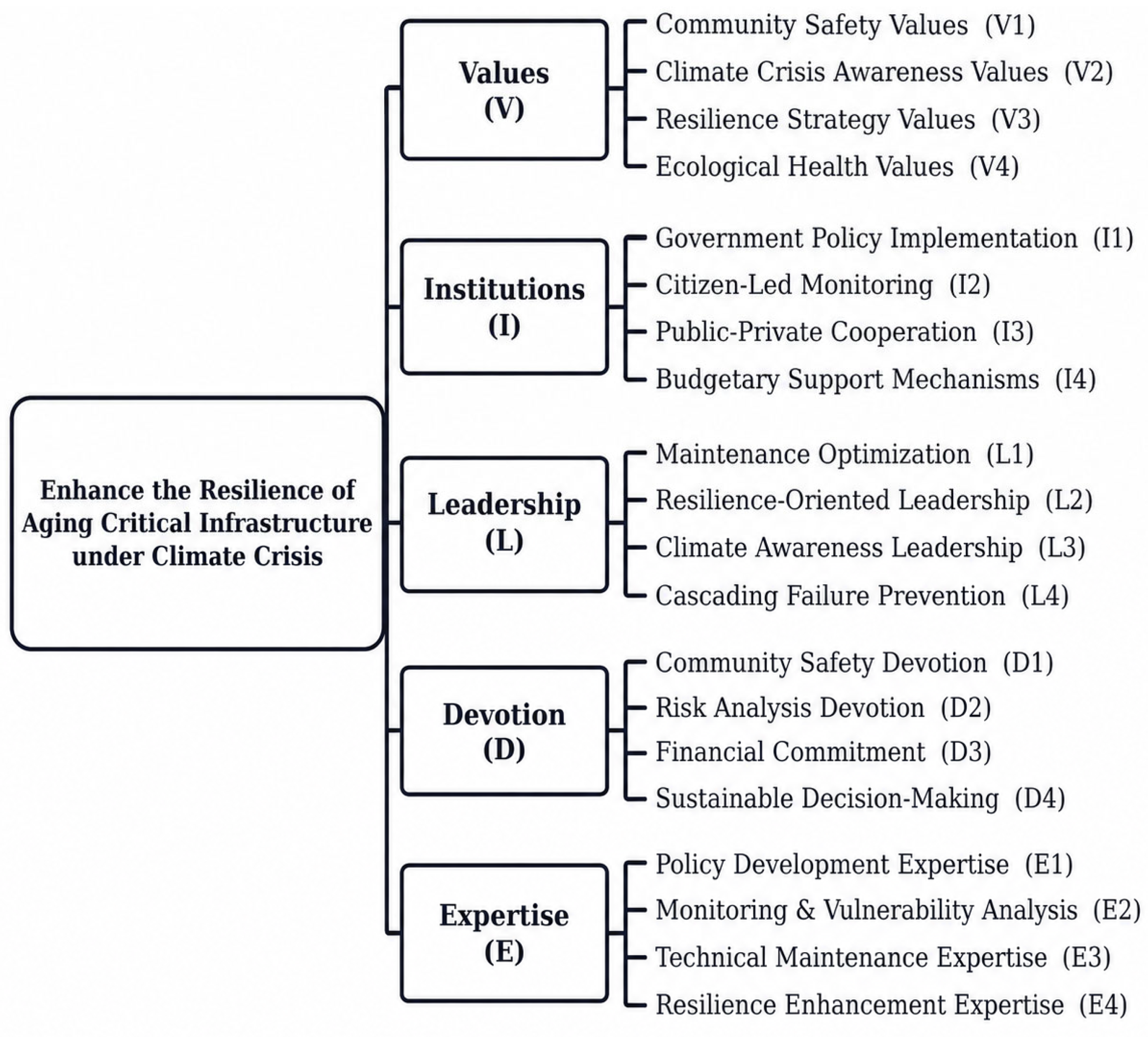
| Criteria | Sub-Criteria | Description | Reference(s) |
|---|---|---|---|
| Values | V1. Community Safety Values | Promote livable and climate-resilient communities. | [38] |
| V2. Climate Crisis Awareness Values | Highlight the importance of real-time institutional risk detection. | [39] | |
| V3. Resilience Strategy Values | Advocate for adaptive investments to mitigate cascading failures. | [40] | |
| V4. Ecological Health Values | Emphasize integration with environmentally sustainable systems. | [41] | |
| Institutions | I1. Government Policy Implementation | Align national policies with local infrastructure needs. | [42] |
| I2. Citizen-Led Monitoring | Encourage participatory governance and early risk reporting. | [43] | |
| I3. Public–Private Cooperation | Support collaborative risk monitoring and SHM systems. | [44] | |
| I4. Budgetary Support Mechanisms | Promote strategic budgeting for preventive resilience. | [45] | |
| Leadership | L1. Maintenance Optimization Leadership | Promote lifecycle-based upgrades and maintenance. | [46] |
| L2. Resilience-Oriented Leadership | Apply scenario-based planning for climate risk. | [47] | |
| L3. Climate Awareness Leadership | Enhance public education and engagement. | [48] | |
| L4. Cascading Failure Prevention Leadership | Implement early warning for interdependent failures. | [49,50] | |
| Devotion | D1. Community Safety Devotion | Update safety policies based on emerging climate risks. | [51,52] |
| D2. Risk Analysis Devotion | Use real-time tools for threat identification. | [53,54] | |
| D3. Financial Commitment Devotion | Secure pre-disaster funding for continuity. | [55] | |
| D4. Sustainable Decision-Making Devotion | Institutionalize long-term learning and feedback. | [56] | |
| Expertise | E1. Policy Development Expertise | Bridge climate science with regulatory action. | [57] |
| E2. Monitoring and Vulnerability Analysis Expertise | Enable early diagnostics and risk analysis. | [58] | |
| E3. Technical Maintenance Expertise | Ensure infrastructure reliability through maintenance. | [59] | |
| E4. Resilience Enhancement Expertise | Coordinate system-level adaptation and standards. | [60] |
| Characteristics | Frequency | Characteristics | Frequency | |
|---|---|---|---|---|
| Gender | Male: 12 | Occupation | Master’s Degree: 16 | |
| Female: 8 | Doctor of Philosophy: 4 | |||
| Age | ~30: 2 | Number of years of work experience | ~10 years | 5 |
| 30~40: 5 | 10~20 | 6 | ||
| 40~50: 8 | ||||
| 50~: 5 | 20 years~ | 9 | ||
| Matrix | n | Mean CR | Median CR | SD | Minimum | Maximum | CR < 0.08 | 0.08 ≤ CR < 0.10 | CR ≥ 0.10 |
|---|---|---|---|---|---|---|---|---|---|
| Dimension level | 20 | 0.0663 | 0.0782 | 0.031 | 0.0059 | 0.0983 | 13 | 7 | 0 |
| Values | 20 | 0.0702 | 0.0822 | 0.0304 | 0 | 0.0993 | 9 | 11 | 0 |
| Institutions | 20 | 0.0716 | 0.0771 | 0.0275 | 0.0116 | 0.0999 | 10 | 10 | 0 |
| Leadership | 20 | 0.0501 | 0.0428 | 0.0395 | 0 | 0.0993 | 12 | 8 | 0 |
| Devotion | 20 | 0.0631 | 0.065 | 0.0332 | 0 | 0.0996 | 12 | 8 | 0 |
| Expertise | 20 | 0.0649 | 0.0774 | 0.0379 | 0 | 0.0998 | 10 | 10 | 0 |
| Indicators | The Order of the Matrix | |||||||||
|---|---|---|---|---|---|---|---|---|---|---|
| 1 | 2 | 3 | 4 | 5 | 6 | 7 | 8 | 9 | 10 | |
| RI | 0 | 0 | 0.58 | 0.90 | 1.12 | 1.24 | 1.32 | 1.41 | 1.45 | 1.49 |
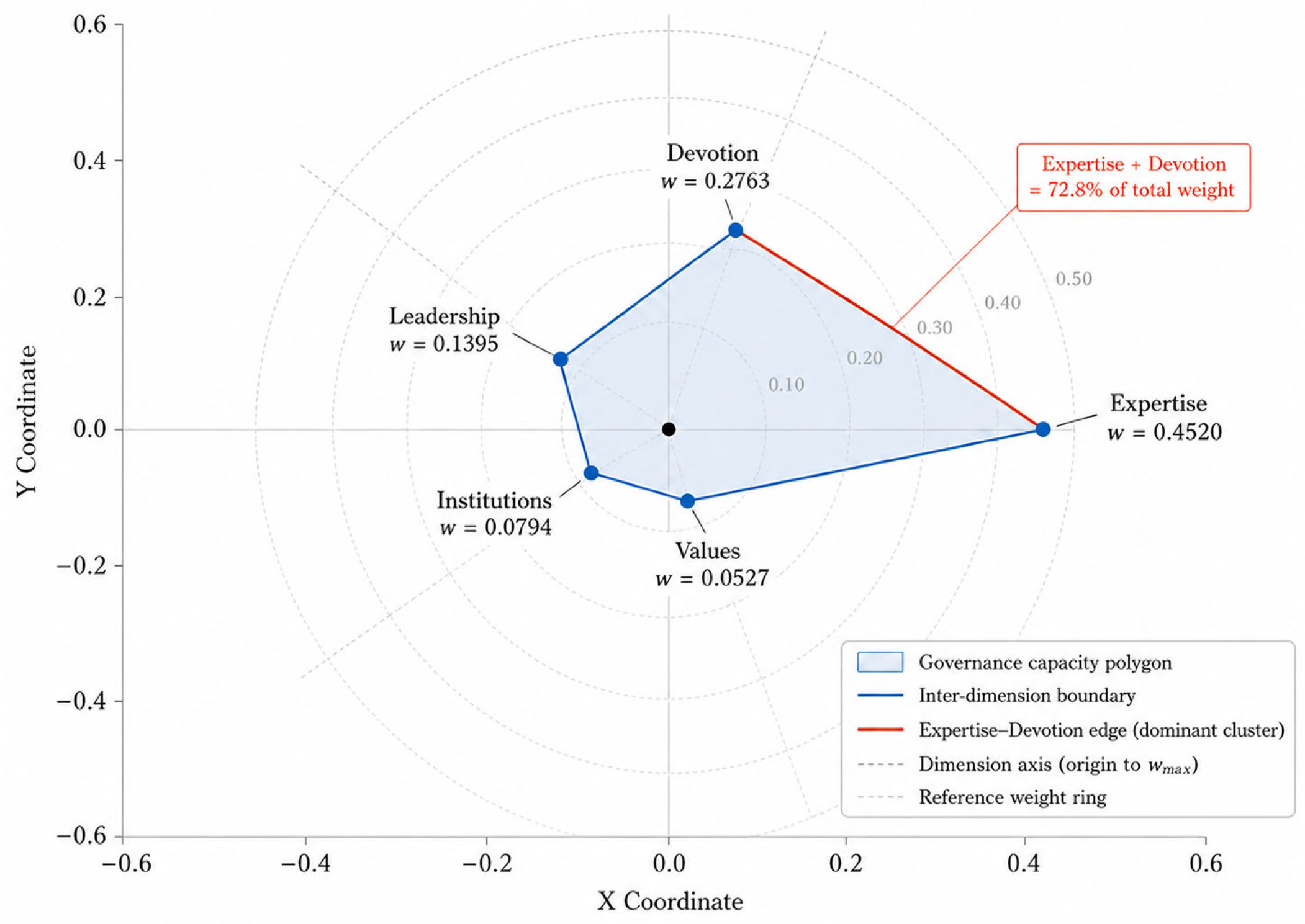
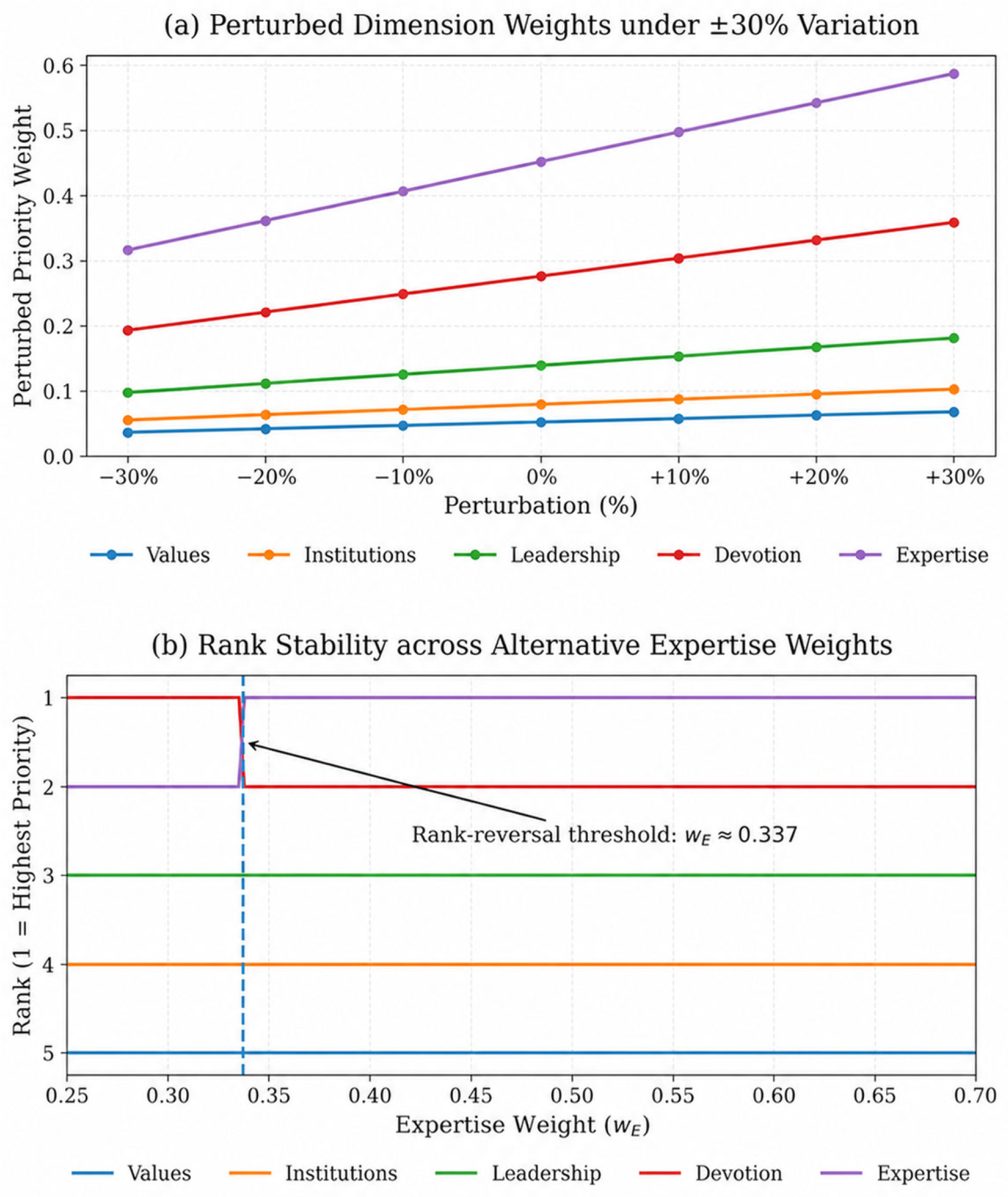
| Governance Dimensions | Values | Institutions | Leadership | Devotion | Expertise | Weights | CR |
|---|---|---|---|---|---|---|---|
| Values | 1.0000 | 0.3333 | 0.3216 | 0.2563 | 0.2033 | 0.0527 | 0.0977 |
| Institutions | 3.0000 | 1.0000 | 0.3275 | 0.2590 | 0.1703 | 0.0794 | |
| Leadership | 3.1092 | 3.0530 | 1.0000 | 0.2466 | 0.3196 | 0.1395 | |
| Devotion | 3.9018 | 3.8603 | 4.0549 | 1.0000 | 0.3275 | 0.2763 | |
| Expertise | 4.9182 | 5.8713 | 3.1290 | 3.0536 | 1.0000 | 0.4520 |
| Values | V1 | V2 | V3 | V4 | Weights | CR |
|---|---|---|---|---|---|---|
| V1 | 1.0000 | 0.3456 | 0.3219 | 0.3219 | 0.0909 | 0.0985 |
| V2 | 2.8939 | 1.0000 | 0.2568 | 0.4748 | 0.1656 | |
| V3 | 3.1061 | 3.8939 | 1.0000 | 0.5280 | 0.3481 | |
| V4 | 3.1061 | 2.1061 | 1.8939 | 1.0000 | 0.3954 |
| Institutions | I1 | I2 | I3 | I4 | Weights | CR |
|---|---|---|---|---|---|---|
| I1 | 1.0000 | 0.2000 | 0.2500 | 0.2000 | 0.0616 | 0.0888 |
| I2 | 5.0000 | 1.0000 | 0.5000 | 0.2500 | 0.1727 | |
| I3 | 4.0000 | 2.0000 | 1.0000 | 0.3333 | 0.2373 | |
| I4 | 5.0000 | 4.0000 | 3.0000 | 1.0000 | 0.5284 |
| Leadership | L1 | L2 | L3 | L4 | Weights | CR |
|---|---|---|---|---|---|---|
| L1 | 1.0000 | 0.3333 | 0.2000 | 0.2000 | 0.0626 | 0.0944 |
| L2 | 3.0000 | 1.0000 | 0.2500 | 0.2500 | 0.1205 | |
| L3 | 5.0000 | 4.0000 | 1.0000 | 0.3333 | 0.2977 | |
| L4 | 5.0000 | 4.0000 | 3.0000 | 1.0000 | 0.5191 |
| Devotion | D1 | D2 | D3 | D4 | Weights | CR |
|---|---|---|---|---|---|---|
| D1 | 1.0000 | 0.3333 | 0.2000 | 0.3333 | 0.0767 | 0.0579 |
| D2 | 3.0000 | 1.0000 | 0.2000 | 0.3333 | 0.1354 | |
| D3 | 5.0000 | 5.0000 | 1.0000 | 1.6667 | 0.4924 | |
| D4 | 3.0000 | 3.0000 | 0.6000 | 1.0000 | 0.2954 |
| Expertise | E1 | E2 | E3 | E4 | Weights | CR |
|---|---|---|---|---|---|---|
| E1 | 1.0000 | 0.2965 | 0.2162 | 0.2757 | 0.0733 | 0.0991 |
| E2 | 3.3730 | 1.0000 | 0.2965 | 0.4210 | 0.1619 | |
| E3 | 4.6248 | 3.3730 | 1.0000 | 0.4216 | 0.3276 | |
| E4 | 3.6269 | 2.3755 | 2.3717 | 1.0000 | 0.4372 |
| Scenario | Key Features | Expected Outcomes | Policy Risks | Implementation Conditions |
|---|---|---|---|---|
| Baseline: Policy Inertia | Maintains existing systems without reform | Short-term stability preserved | Continued decline in resilience capacity | Risk-averse institutional environment |
| Scenario 1: Devotion-Oriented Planning | Five-year legislative resilience cycle; performance-based budgeting; centralized audit mechanism | Sustained policy commitment; structural innovation potential | High resource demands; political resistance across administrative cycles | Requires strong cross-party political will and stakeholder buy-in |
| Scenario 2: Expertise-Centered Capacity Building | Tiered certification system; national resilience academies; career-linked knowledge retention | Enhanced technical proficiency; reduced capability gaps in high-vulnerability regions | Institutional inertia in professional certification reform | Needs dedicated funding streams and interagency training coordination |
| Scenario 3: Devotion–Expertise Synergy | Interagency Resilience Integration Taskforces; scenario-based simulation; predictive risk modeling | Enhanced systemic resilience through coordinated planning and execution | Coordination costs across agencies; risk of taskforce mandate diffusion | Requires collaborative governance framework and sustained leadership commitment |
| Score | Descriptor | Operational Definition |
|---|---|---|
| 1 | Severely Absent | No institutional arrangement exists, or the relevant mechanism has completely failed |
| 2 | Insufficient | A framework exists but implementation is critically deficient |
| 3 | Partial | Functional arrangements are present but with significant operational gaps |
| 4 | Adequate | Largely functional with only minor deficiencies |
| 5 | Well-Established | Systemically sound and evidenced in documented practice |
| Sub-Criterion | Dim. Weight | Global Weight | Score (1–5) | Weighted Score | Evidence Basis |
|---|---|---|---|---|---|
| V1 Community Safety Values | 0.053 | 0.005 | 3 | 0.014 | Zhai and Lee [67]: public safety awareness present but limited |
| V2 Climate Crisis Awareness | 0.053 | 0.009 | 3 | 0.026 | Zhai and Lee [67]: ICT-mediated awareness present; weak institutional response |
| V3 Resilience Strategy Values | 0.053 | 0.018 | 2 | 0.037 | State Council [65]: no adaptive investment planning in urban development |
| V4 Ecological Health Values | 0.053 | 0.021 | 2 | 0.042 | State Council [65]: spillway illegally encroached; reservoir capacity −54.4% |
| I1 Government Policy Implementation | 0.079 | 0.005 | 3 | 0.015 | Zhai and Lee [66]: legal framework score 4.00/5; implementation gap |
| I2 Citizen-Led Monitoring | 0.079 | 0.014 | 3 | 0.041 | Zhai and Lee [67]: social media monitoring active but unstructured |
| I3 Public–Private Cooperation | 0.079 | 0.019 | 2 | 0.038 | State Council [65]: no joint emergency protocol between metro operator and city |
| I4 Budgetary Support Mechanisms | 0.079 | 0.042 | 2 | 0.084 | Zhai and Lee [66]: B9 disaster funding score 3.00/5 (lowest among all indicators) |
| L1 Maintenance Optimization | 0.140 | 0.009 | 2 | 0.017 | State Council [65]: aging drainage system upgrade not prioritized |
| L2 Resilience-Oriented Leadership | 0.140 | 0.017 | 2 | 0.034 | State Council [65]: no climate scenario planning in annual governance |
| L3 Climate Awareness Leadership | 0.140 | 0.042 | 2 | 0.083 | Zhai and Lee [66]: leaders lacked sensitivity to major hazard signals |
| L4 Cascading Failure Prevention | 0.140 | 0.072 | 1 | 0.072 | State Council [65]: simultaneous collapse of drainage, metro, power, telecoms; no cut-off mechanism |
| D1 Community Safety Devotion | 0.276 | 0.021 | 2 | 0.042 | State Council [65]: dual-level accountability not implemented prior to disaster |
| D2 Risk Analysis Devotion | 0.276 | 0.037 | 3 | 0.112 | Zhai and Lee [66]: B1 risk assessment 3.93/5; tools present but not integrated |
| D3 Financial Commitment | 0.276 | 0.136 | 2 | 0.272 | State Council [65]: chronic budgetary shortfalls; reservoir infrastructure lost 54.4% of designed storage capacity through unmonitored encroachment |
| D4 Sustainable Decision-Making | 0.276 | 0.082 | 2 | 0.163 | Zhai and Lee [66]: qualitative > quantitative scores on all 14 indicators (systemic implementation gap) |
| E1 Policy Development Expertise | 0.452 | 0.033 | 2 | 0.066 | State Council [65]: warning-operations disconnect; plan revision capacity weak |
| E2 Monitoring and Vulnerability Analysis | 0.452 | 0.073 | 3 | 0.220 | State Council [65]: hydrological monitoring existed but not integrated with CI alerts |
| E3 Technical Maintenance Expertise | 0.452 | 0.148 | 2 | 0.296 | State Council [65]: metro design non-compliant (unreported modification); pump capacity = 1/3 of actual rainfall intensity |
| E4 Resilience Enhancement Expertise | 0.452 | 0.198 | 2 | 0.395 | Zhai and Lee [66]: B12 training 2.88/5; B13 exercise 2.58/5; no system-level adaptation coordination |
| TOTAL/VILDE-GCI | — | Σ = 1.000 | — | 2.070/5 = 0.414 | Below sufficiency threshold (0.60) |
| Scenario | Investment Focus | Sub-Criteria Targeted | Resource Units | Post- Intervention GCI | Relative to Primary Diagnostic Benchmark (0.60) | GCI Gain per Resource Unit |
|---|---|---|---|---|---|---|
| A: Weight-Guided Targeted Investment | E4, E3, D3 (3 highest global-weight sub-criteria) | 3 | 6 (3 indicators × 2-point improvement) | 0.607 | Above primary benchmark | 0.032 |
| B: Uniform Improvement | All 20 sub-criteria (+1 point each) | 20 | 20 (20 indicators × 1-point improvement) | 0.614 | Above primary benchmark | 0.010 |
| C: Low-Weight Priority (Politically Visible) | Values + Institutions (8 sub-criteria, +2 points each) | 8 | 16 (8 indicators × 2-point improvement) | 0.467 | Below primary benchmark | 0.003 |
| Diagnostic Benchmark | Zhengzhou Baseline 0.414 | Scenario A 0.607 | Scenario B 0.614 | Scenario C 0.467 | Interpretation |
|---|---|---|---|---|---|
| 0.55 | Below | Above | Above | Below | Lenient benchmark |
| 0.60 | Below | Above | Above | Below | Main diagnostic benchmark |
| 0.65 | Below | Below | Below | Below | Conservative benchmark |
Disclaimer/Publisher’s Note: The statements, opinions and data contained in all publications are solely those of the individual author(s) and contributor(s) and not of MDPI and/or the editor(s). MDPI and/or the editor(s) disclaim responsibility for any injury to people or property resulting from any ideas, methods, instructions or products referred to in the content. |
© 2026 by the authors. Licensee MDPI, Basel, Switzerland. This article is an open access article distributed under the terms and conditions of the Creative Commons Attribution (CC BY) license.
Share and Cite
Qin, Y.; Lee, J.E.; Chen, A.; Kwon, S.A.; Lee, J.H.; Jin, Z.; Tibbie, B.; Dong, L.; Zhang, L. Diagnosing Institutional Resilience in Aging Critical Infrastructure: The VILDE Framework and AHP-Based Governance Priority Structure Under Climate Stress. Appl. Sci. 2026, 16, 7682. https://doi.org/10.3390/app16157682
Qin Y, Lee JE, Chen A, Kwon SA, Lee JH, Jin Z, Tibbie B, Dong L, Zhang L. Diagnosing Institutional Resilience in Aging Critical Infrastructure: The VILDE Framework and AHP-Based Governance Priority Structure Under Climate Stress. Applied Sciences. 2026; 16(15):7682. https://doi.org/10.3390/app16157682
Chicago/Turabian StyleQin, Yuzhuo, Jae Eun Lee, An Chen, Seol A. Kwon, Ju Ho Lee, Zhenyun Jin, Benjamin Tibbie, Lin Dong, and Lixin Zhang. 2026. "Diagnosing Institutional Resilience in Aging Critical Infrastructure: The VILDE Framework and AHP-Based Governance Priority Structure Under Climate Stress" Applied Sciences 16, no. 15: 7682. https://doi.org/10.3390/app16157682
APA StyleQin, Y., Lee, J. E., Chen, A., Kwon, S. A., Lee, J. H., Jin, Z., Tibbie, B., Dong, L., & Zhang, L. (2026). Diagnosing Institutional Resilience in Aging Critical Infrastructure: The VILDE Framework and AHP-Based Governance Priority Structure Under Climate Stress. Applied Sciences, 16(15), 7682. https://doi.org/10.3390/app16157682