Review

From Field to Market: Evolution of Strawberry-Harvesting Techniques and Research Progress in Intelligent Robotic Systems


School of Agricultural Engineering, Jiangsu University, Zhenjiang 212013, China
*
Author to whom correspondence should be addressed.
Appl. Sci. 2026, 16(15), 7522; https://doi.org/10.3390/app16157522
Submission received: 19 June 2026 / Revised: 15 July 2026 / Accepted: 24 July 2026 / Published: 28 July 2026

Abstract

Strawberry production is economically important but remains highly dependent on labour-intensive harvesting. The delicate texture, irregular distribution, and non-uniform maturity of strawberry fruit create substantial challenges for mechanised and robotic operations. This review examines the development of strawberry-harvesting technologies from the broader perspectives of crop value, cultivation management, harvesting methods, robotic systems, post-harvest handling, and sustainable production. The nutritional and economic significance of strawberries is first outlined, followed by an analysis of cultivation environments, production patterns, and crop-management practices that influence fruit accessibility and robotic operation. The historical transition from manual harvesting to mechanised and intelligent harvesting is then reviewed. Particular attention is given to the principal technologies of strawberry-harvesting robots, including mobile platforms, robotic manipulators, path planning and obstacle avoidance, end-effectors, visual recognition, multispectral sensing, and software control. Robotic systems designed for elevated and ridge-based cultivation are also compared to clarify the influence of cultivation layout on platform configuration and harvesting strategy. In addition, the integration of harvesting with fruit transfer, post-harvest handling, and sustainable cultivation is discussed. The reviewed studies indicate that effective robotic harvesting depends on the coordinated design of cultivation systems, perception, motion planning, compliant manipulation, and system control. Future research should prioritise robust perception under occlusion, low-damage harvesting, improved operational speed, scenario adaptability, cost reduction, and closer integration between agronomic practices and robotic design.

1. Introduction

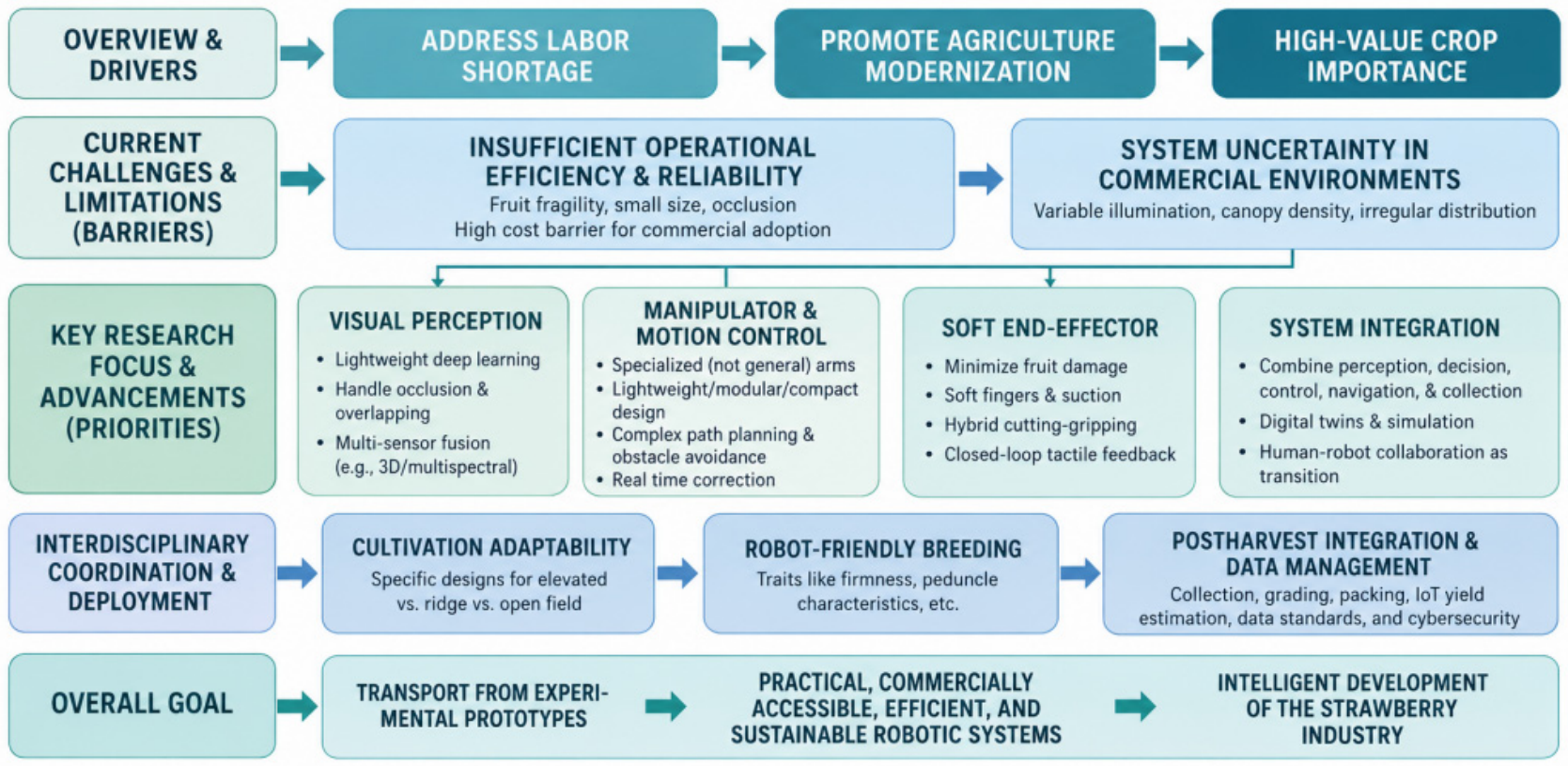
Strawberries are high-value horticultural crops with considerable nutritional, economic, and commercial importance. The production of high-quality fruit depends on the coordinated management of cultivation environments, soil or substrate conditions, water and nutrient supply, pest and disease control, harvesting, and post-harvest handling. With the transition of modern agriculture towards intelligent, automated, and precision-based production, strawberry cultivation is increasingly incorporating protected production systems, environmental monitoring, precision management, mechanised equipment, and data-driven decision-making [1,2,3,4,5]. Among these production stages, harvesting remains particularly challenging because strawberries are delicate, unevenly distributed, and highly susceptible to bruising, compression, abrasion, and stem damage. Although manual harvesting provides flexibility and selectivity, it is increasingly constrained by rising labour costs, seasonal worker shortages, variable efficiency, and inconsistent harvesting quality. Mechanised and robotic harvesting therefore represents an important component of the broader modernisation of strawberry production. By integrating mobile platforms, machine vision, environmental perception, manipulators, compliant end-effectors, and path-planning technologies, intelligent harvesting systems can support fruit detection, maturity assessment, low-damage picking, and coordinated handling. However, their development should be considered within the wider production chain, including cultivation-system design, crop management, post-harvest operations, and sustainable production [6,7,8,9,10].
Strawberries possess substantial nutritional and economic value and are widely cultivated and consumed worldwide [11,12,13,14,15]. Nutritionally, they are rich in vitamin C, anthocyanins, folate, potassium, dietary fibre, and other bioactive compounds associated with antioxidant activity and potential health benefits. Economically, strawberries are regarded as a high-value horticultural crop because of their strong market demand, relatively short production cycle, and considerable commercial potential. China is among the world’s major strawberry-producing countries and has established an extensive industrial chain encompassing cultivar breeding, cultivation, harvesting, processing, distribution, and marketing. The development of this industry contributes to improving agricultural productivity, increasing growers’ income, and promoting the economic development of horticultural production areas. Strawberry production involves a range of agronomic practices, including soil and substrate regulation, cultivation-system selection, water and fertiliser management, and integrated pest and disease control. Strawberries generally require loose, well-aerated growing media with high organic-matter content and are sensitive to variations in temperature, light, humidity, and water availability. Depending on regional conditions and production objectives, they may be cultivated in open fields, greenhouses, plastic tunnels, elevated substrate systems, or hydroponic facilities. These cultivation modes differ considerably in planting height, row spacing, canopy structure, illumination, background complexity, and fruit accessibility. Consequently, they directly affect the mobility, perception, target localisation, collision avoidance, and harvesting performance of robotic systems. Moreover, the clustered distribution of fruit, irregular peduncle orientations, leaf and stem occlusion, and the coexistence of fruit at different maturity stages further increase the difficulty of selective robotic harvesting. Appropriate cultivar selection, precise water and nutrient management, and integrated pest-management practices are therefore important not only for maintaining yield and fruit quality but also for establishing a structured and robot-compatible harvesting environment [16,17,18].
Strawberry-harvesting technology has evolved from labour-intensive manual picking towards mechanised assistance and, more recently, intelligent robotic harvesting. Manual harvesting offers considerable flexibility and selectivity; however, it is characterised by low operational efficiency, high labour intensity, and strong dependence on the availability and experience of seasonal workers. These limitations have become increasingly prominent owing to persistent labour shortages and rising employment costs. Mechanised harvesting and auxiliary harvesting devices can improve productivity to some extent, but their application to strawberries remains constrained by the fruit’s soft texture, susceptibility to bruising, non-uniform maturity, irregular spatial distribution, and the complexity of different cultivation environments. Intelligent robotic harvesting represents a further stage of technological development, integrating machine vision, robotic manipulators, specialised end-effectors, motion and path planning, and obstacle-avoidance control. Through the coordinated operation of these components, robotic systems can detect and localise strawberries, assess fruit maturity, plan feasible approach trajectories, perform low-damage fruit detachment, and operate with a degree of autonomy [19,20,21,22,23,24]. In particular, deep-learning-based visual perception methods, including the YOLO family of object-detection models, have been widely investigated for strawberry detection, maturity classification, and spatial localisation under conditions of occlusion, variable illumination, and complex backgrounds. In parallel, the development of compliant grippers, soft fingers, suction-based devices, and hybrid end-effectors has improved adaptability to variations in fruit size, pose, and accessibility while helping to reduce contact pressure and harvest-induced damage.
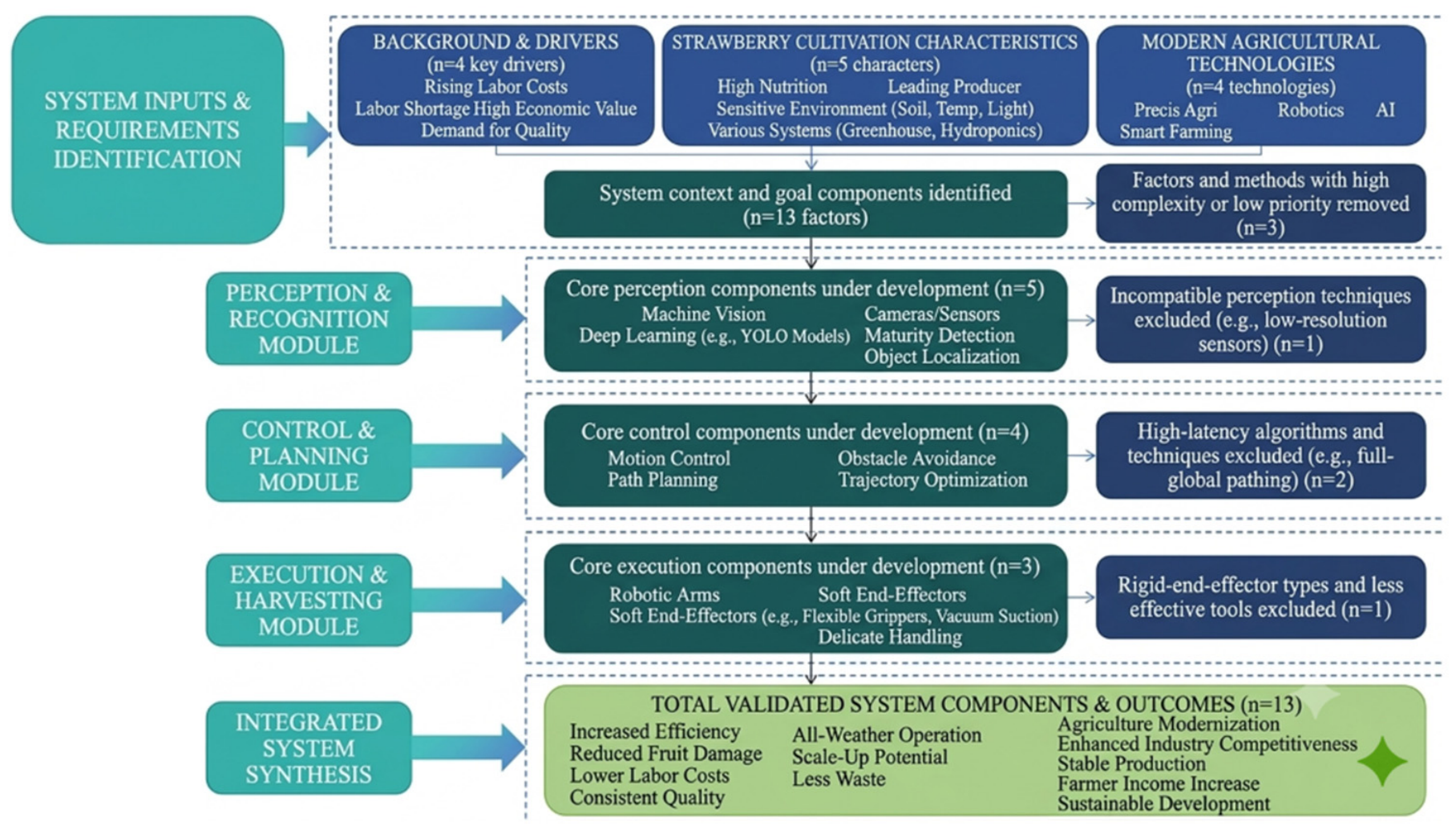
The significance of intelligent strawberry-harvesting technology extends beyond alleviating labour shortages, reducing labour costs, and improving harvesting efficiency and quality consistency. More importantly, it provides an important technological pathway towards the precision, automation, and modernisation of strawberry production [25,26,27]. By integrating perception, decision-making, manipulation, and autonomous operation, intelligent harvesting robots can support more standardised production processes, improve resource-use efficiency, and enhance the stability of harvesting operations. Nevertheless, their large-scale application remains constrained by challenges related to environmental adaptability, fruit occlusion, recognition accuracy, harvesting speed, damage control, system reliability, and economic viability. Therefore, accelerating research into the key technologies and practical deployment of intelligent strawberry-harvesting robots is essential for improving the competitiveness and sustainability of the strawberry industry. A systematic review of existing technological advances, current limitations, and future research directions is also necessary to support the development of reliable, efficient, and commercially viable robotic harvesting systems. As illustrated in Figure 1, relevant research on intelligent strawberry-harvesting robots is divided into five modules: system input identification, perception and recognition, control and planning, harvesting execution, and integrated system synthesis.
Data were extracted and classified according to five interconnected technical domains: cultivation scenarios and harvesting requirements; mobile platforms and operating mechanisms; perception and recognition technologies; robotic manipulators and end-effectors; and system integration and intelligent decision-making. For each study, information concerning the cultivation environment, sensing method, recognition model, robotic configuration, end-effector principle, motion-planning strategy, experimental conditions, harvesting success rate, cycle time, and fruit-damage performance was recorded where available. The selected studies were subsequently compared and critically analysed to identify major technological advances, methodological differences, performance limitations, and research gaps.
The overall technical architecture was further interpreted using a three-layer framework comprising perception, decision-making, and execution. The perception layer includes environmental sensing, fruit detection, maturity assessment, segmentation, and spatial localisation. The decision-making layer covers target selection, task allocation, path planning, obstacle avoidance, and harvesting-strategy optimisation. The execution layer comprises mobile-platform control, manipulator coordination, compliant grasping, fruit detachment, and post-harvest handling. Through this systematic framework, the review clarifies the technical relationships among the principal components of intelligent strawberry-harvesting systems and identifies current bottlenecks and future research priorities.
This review does not aim to provide an exhaustive account of the entire strawberry production chain. Instead, it examines the field-to-market chain insofar as cultivation systems, plant architecture, fruit characteristics, harvesting requirements, and postharvest operations impose specific constraints on the design and commercial deployment of strawberry-harvesting robots. Accordingly, the technical core of this review focuses on robotic perception, fruit localisation, manipulator design, end-effectors, motion planning, mobile platforms, and system integration.

2. Materials and Methods

This study adopted a systematic literature review method combining structured retrieval, study screening, quality assessment, data extraction, and thematic technical analysis. The review was conducted to identify and synthesise research concerning the evolution of strawberry-harvesting technologies, with particular emphasis on intelligent robotic systems and their principal components. The methodological framework covered the complete technological chain from cultivation scenarios and environmental perception to decision-making, robotic execution, fruit handling, and post-harvest information linkage.
The literature was primarily retrieved from the Web of Science Core Collection and the China National Knowledge Infrastructure (CNKI). Peer-reviewed studies published between 1957 and 2026 were considered in the core analysis of intelligent strawberry-harvesting technologies. Where necessary, earlier publications concerning the historical development of manual and mechanised strawberry harvesting were also consulted to trace the evolution of harvesting practices. However, these earlier studies were used solely to provide historical context and were not included in the core dataset used for the systematic analysis of robotic harvesting technologies.
The literature identification, screening, eligibility assessment, and final inclusion procedure was conducted with reference to the Preferred Reporting Items for Systematic Reviews and Meta-Analyses framework. The selected studies were subsequently classified according to five interconnected technological domains: cultivation scenarios and harvesting requirements; mobile platforms and operating mechanisms; perception and recognition technologies; robotic manipulators and end-effectors; and system integration and intelligent decision-making.

2.1. Retrieval Strategy

The keyword groups were combined using both AND and OR to maximize the systematicity and coverage of the literature retrieval. Within each group, synonymous terms were connected using OR, while different thematic groups were connected using AND. English databases were searched using English keywords, whereas CNKI was searched using the corresponding Chinese keywords.
The search terms were organised into the following thematic groups.
Group One—research object: “strawberry-harvesting robot”, “strawberry-picking robot”, “robotic strawberry harvesting”, “robotic strawberry picking”, “automatic strawberry harvesting”, and “selective strawberry harvesting”.
Group Two—cultivation scenarios and harvesting requirements: “strawberry cultivation system”, “greenhouse strawberry”, “elevated cultivation”, “ridge cultivation”, “substrate cultivation”, “fruit maturity”, “fruit quality”, “harvesting damage”, and “robot-oriented cultivation”.
Group Three—perception and recognition: “machine vision”, “computer vision”, “RGB image”, “RGB-D camera”, “depth sensing”, “stereo vision”, “multispectral imaging”, “fruit detection”, “fruit segmentation”, “maturity assessment”, “three-dimensional localisation”, “deep learning”, and “YOLO”.
Group Four—robotic execution and mobility: “robotic manipulator”, “robotic arm”, “end-effector”, “soft gripper”, “compliant gripper”, “vacuum suction”, “fruit detachment”, “mobile platform”, “autonomous navigation”, “obstacle avoidance”, “motion planning”, and “path planning”.
Group Five—system integration and intelligent operation: “multi-sensor fusion”, “harvesting decision-making”, “human–robot collaboration”, “reinforcement learning”, “digital twin”, “edge computing”, “multi-robot harvesting”, “post-harvest handling”, “fruit traceability”, and “harvesting information system”.
For the Web of Science Core Collection, the principal search expression was structured as follows:
TS = (“strawberry harvest* robot*” OR “strawberry pick* robot*” OR “robotic strawberry harvest*” OR “robotic strawberry pick*” OR “automatic strawberry harvest*”) AND TS = (“machine vision” OR “computer vision” OR “fruit detection” OR “fruit segmentation” OR “maturity assessment” OR “depth sensing” OR “RGB-D” OR “deep learning” OR “YOLO” OR “robotic manipulator*” OR “robotic arm*” OR “end-effector*” OR “soft gripper*” OR “compliant grasp*” OR “vacuum suction” OR “fruit detachment” OR “mobile platform*” OR “autonomous navigation” OR “path planning” OR “obstacle avoidance” OR “multi-sensor fusion” OR “system integration”).
Supplementary searches were conducted separately for each of the five technical domains to avoid excluding studies that focused on only one subsystem. For example, publications dealing specifically with strawberry maturity recognition, end-effector design, or greenhouse navigation were retrieved using the research-object terms in combination with the corresponding technical keyword group.

2.2. Inclusion Criteria

Studies were considered eligible when they met the following requirements.
Regarding the research subject, studies were included if they investigated strawberry harvesting, strawberry-picking robots, robotic fruit detection, strawberry maturity assessment, robotic manipulation, fruit detachment, harvesting navigation, or the integration of multiple subsystems for automated strawberry harvesting. Studies of general fruit-harvesting robots were included only when they contained experiments, system designs, or technical conclusions directly applicable to strawberries.
Regarding the research content, eligible studies addressed at least one of the five technical domains defined in this review. These included cultivation systems and harvesting constraints; mobile-platform design and navigation; visual or multi-sensor perception; manipulator and end-effector design; motion planning and obstacle avoidance; compliant grasping and fruit detachment; system integration; human–robot collaboration; and post-harvest handling or information management.
To support the analysis of harvesting scenarios, studies concerning strawberry cultivation modes, maturity characteristics, biomechanical properties, fruit-damage mechanisms, and quality requirements were also included when they provided information directly relevant to robotic system design. These supporting studies were distinguished from the core robotic studies during data extraction and synthesis.
Regarding the publication type, peer-reviewed journal articles, full-length international conference papers, and doctoral dissertations containing sufficient technical or experimental information were considered. Publications written in English or Chinese were eligible. When both conference and journal versions of the same work were available, the more complete journal version was retained unless the conference paper contained distinct experimental information.

2.3. Exclusion Criteria

Non-academic publications, including patent specifications, commercial advertisements, product manuals, news reports, non-peer-reviewed web pages, and promotional technical reports, were excluded from the core evidence base.
Studies focusing exclusively on crops other than strawberries were excluded unless they presented a technology that was explicitly validated on strawberries or was directly compared with strawberry-harvesting applications. Publications concerning general agricultural robots without a clear relationship to harvesting were also excluded.
Agronomic studies that addressed fertilisation, irrigation, disease management, or cultivar selection without providing information relevant to robotic harvesting scenarios, fruit accessibility, maturity assessment, mechanical properties, or harvesting quality were not included.
Studies dealing only with post-harvest processing, packaging, or transportation were excluded unless they were linked to robotic harvesting, fruit transfer, quality inspection, traceability, or closed-loop production management.
Duplicate records were removed. When multiple publications reported substantially the same robotic platform, dataset, or experiment, the most complete version was retained, while additional publications were included only when they reported meaningful improvements, new experimental conditions, or independent results.
Studies were also excluded when the full text was unavailable, the experimental procedure was insufficiently described, the reported data could not be interpreted, or the publication lacked sufficient technical relevance to the analytical framework of this review.

2.4. Literature Screening Procedure

All records retrieved from the Web of Science Core Collection and CNKI were exported to EndNote for reference management. The database results were merged, and duplicate records were identified using automatic matching of titles, authors, publication years, and digital object identifiers, followed by manual verification.
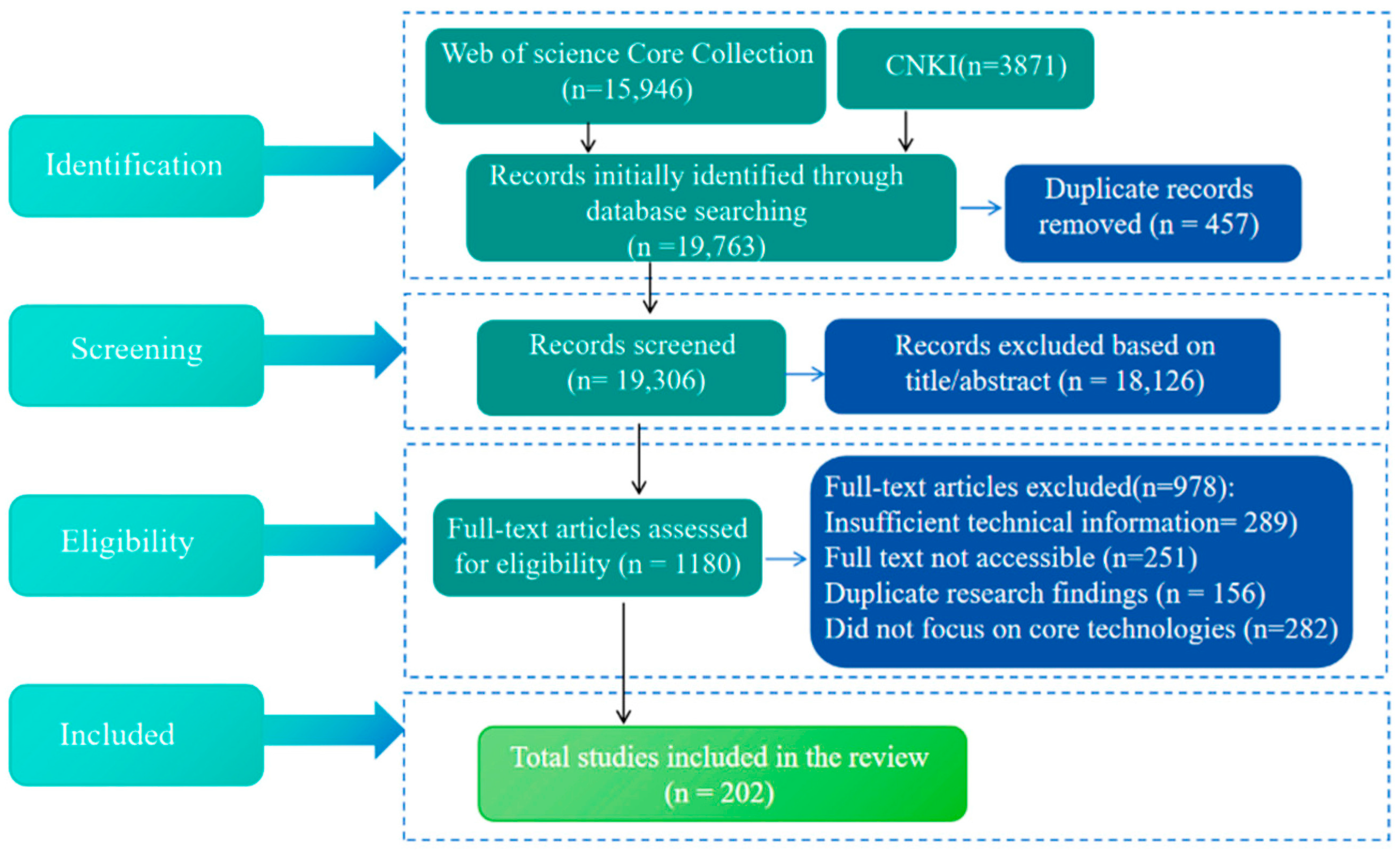
The screening procedure consisted of four stages: identification, duplicate removal, title and abstract screening, and full-text eligibility assessment. As shown in Figure 2, a total of 19,763 records were initially identified from Web of Science and CNKI. After removing 457 duplicate records, 19,306 records remained for title and abstract screening. Through this initial screening, 18,126 records that were irrelevant to the topic were excluded. The remaining 1180 articles underwent full-text assessment. Subsequently, 978 full-text articles were excluded for the following reasons: insufficient technical information (n = 289), lack of full-text access (n = 251), duplicate research findings (n = 156), and not focusing on core technologies (n = 282). Ultimately, 202 studies were included in the final qualitative review. The detailed screening process is presented in Figure 2.
The screening process was conducted independently by two of the authors (T.C. and Y.D.). Disagreements regarding study inclusion were resolved through discussion with a third author (Z.T.). For the quality assessment of included studies, we adopted a predefined set of criteria based on the study design (field experiments vs. modeling studies), sample size and replication, duration of the experiment, and clarity of reported methods and results. Studies that failed to meet at least three of these criteria were excluded from the final synthesis.

2.5. Data Extraction and Thematic Analysis

A standardised data-extraction form was developed before the final synthesis. For each included publication, bibliographic information, publication year, country or region, study type, cultivation environment, research objective, robotic subsystem, experimental design, performance indicators, principal findings, and reported limitations were recorded.
Through this procedure, the review examined not only the performance of individual components but also the technological dependencies among cultivation scenarios, perception and decision-making, motion control, compliant harvesting, and post-harvest information management. The resulting framework was used to identify major technical advances, methodological limitations, research gaps, and priorities for the future development and commercial deployment of intelligent strawberry-harvesting robots.

3. The Nutritional and Economic Value of Strawberries

3.1. Nutritional Value

Strawberries are nutrient-dense fruits characterized by a high-water content and appreciable amounts of calcium, phosphorus, iron, and vitamin C, and are therefore sometimes referred to as the “queen of berries” [28]. Fresh strawberries contain approximately 50 mg of vitamin C per 100 g, which is higher than the level reported for many citrus fruits. Accordingly, the consumption of approximately 10–14 medium-sized strawberries may provide a substantial proportion of the recommended daily vitamin C intake for adults, thereby supporting normal collagen synthesis and immune function [29]. Strawberries are also an important source of bioactive compounds, including anthocyanins, ellagic acid, and other polyphenols. These compounds exhibit antioxidant and anti-inflammatory activities and may contribute to protection against oxidative stress, the maintenance of cognitive function, and skin health [30]. In addition, strawberries contain folate, which plays an important role in cardiovascular health and is particularly relevant during pregnancy because of its involvement in normal fetal development. Their relatively high potassium and low sodium contents may support blood-pressure regulation, whilst their dietary fibre and pectin contents may promote intestinal motility and contribute to the maintenance of normal metabolic function [31,32].

3.2. Economic Value

Owing to their attractive flavour, juiciness, and distinctive texture, strawberries are highly valued by consumers and command strong market demand and relatively high prices, particularly within the premium fruit sector. Market premiums vary according to cultivar, quality grade, and geographical origin. In addition to being consumed fresh, strawberries can be processed into a wide range of products, including juices, jams, pastries, and ice cream. The development of these value-added products broadens the range of strawberry applications, extends the associated value chain, and enhances the overall economic value of strawberry production.
Strawberry cultivation commonly relies on advanced greenhouse technologies, efficient irrigation systems, and integrated pest and disease management. The adoption of these technologies has contributed to advances in agricultural production and has stimulated the development of associated sectors, including agricultural machinery manufacturing and agricultural-input production. Moreover, the relatively high economic returns from strawberry cultivation have attracted increased capital investment and encouraged the adoption of advanced technologies, thereby supporting the modernisation of agricultural production. Strawberry cultivation and processing are also labour-intensive, particularly during the harvesting season, and therefore generate considerable employment opportunities in rural areas, with potential benefits for household incomes and local livelihoods.
As an important high-value cash crop in China, strawberry production has ranked first worldwide since 1994 [33]. In 2023, the strawberry cultivation area in China reached 2.3447 million mu, equivalent to approximately 156,300 ha and accounting for 36% of the global cultivation area. National production exceeded 4 million tonnes, representing approximately 40% of global output and substantially surpassing that of traditional strawberry-producing regions, including the United States and the European Union. Driven by increasingly diversified consumer demand and continuous improvements in cultivation technologies, the Chinese strawberry industry has gradually developed into an integrated value-chain system encompassing cultivar breeding, standardised cultivation, post-harvest handling, and intensive processing.

3.3. Current Status of Strawberry Cultivation and Consumption in China and Worldwide

In 2023, the global strawberry cultivation area was estimated at approximately 600,000 ha, with North America, Europe, and Asia accounting for approximately 30%, 25%, and 20%, respectively. Strawberry cultivation expanded between 2018 and 2023 in response to increasing demand for fresh fruit, particularly in North America and Asia [34,35,36]. The global cultivation area is projected to reach approximately 750,000 ha by 2028, with China continuing to be a major contributor to this expansion. However, rising labour costs, limited land availability, and increasing input prices are placing growing pressure on production systems, thereby increasing the demand for precision agriculture and automated harvesting technologies [37,38,39]. China remained the world’s largest strawberry-producing country, with approximately 150,000 ha under cultivation in 2023 and an estimated 40% share of global production [40].
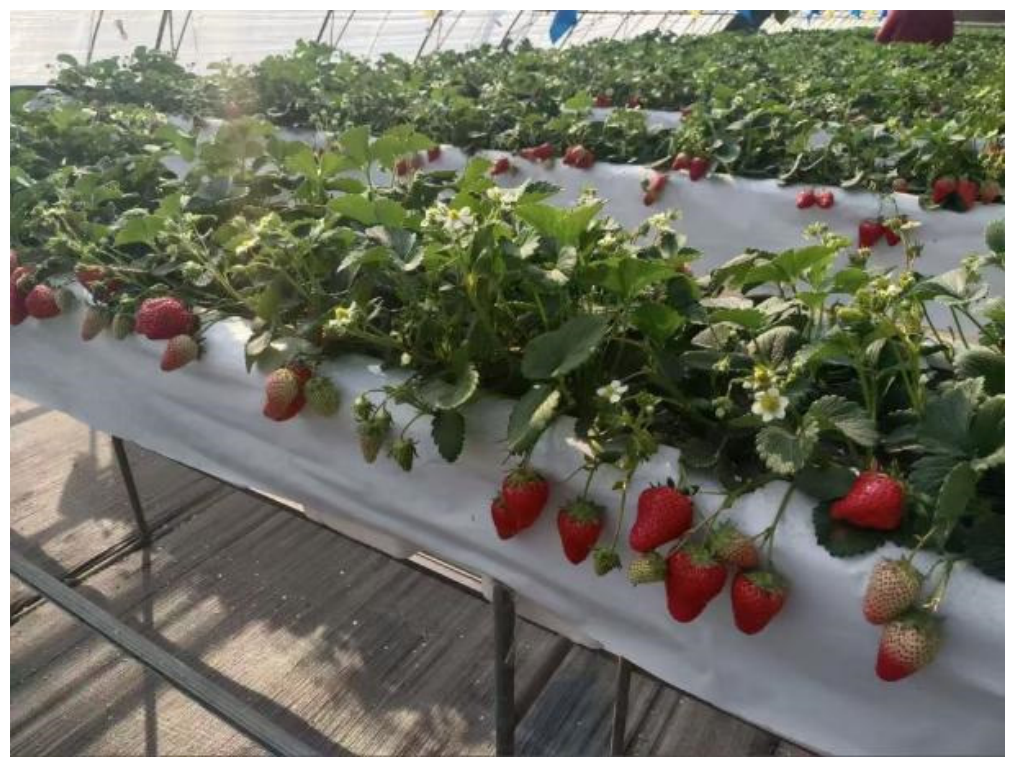
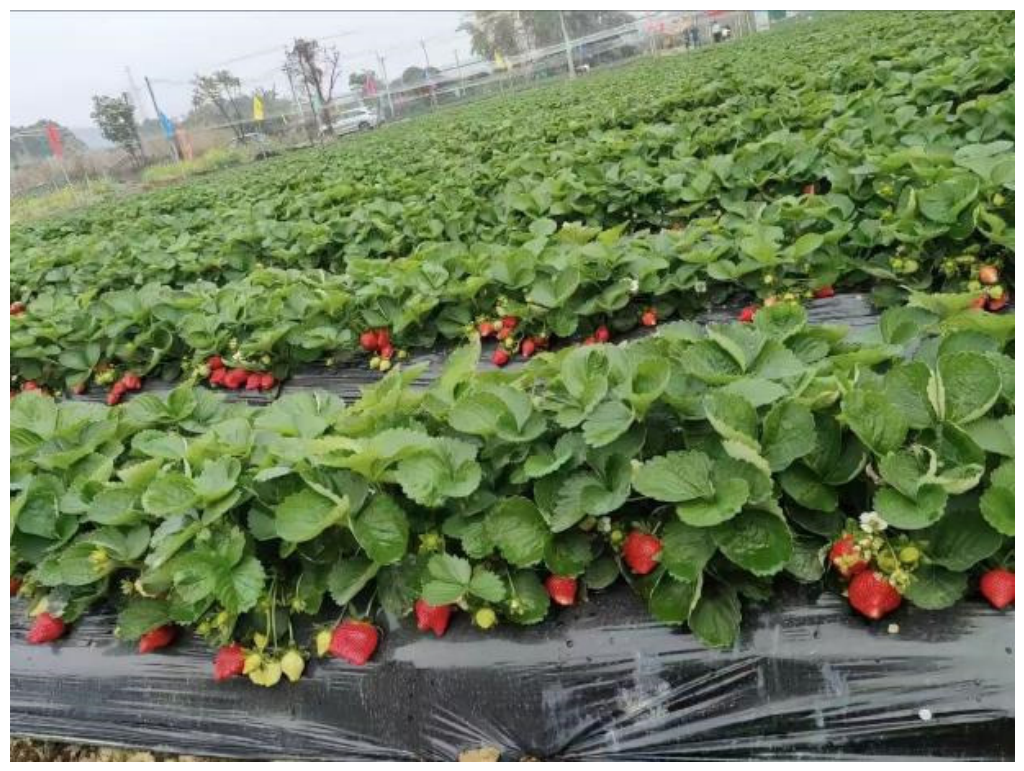
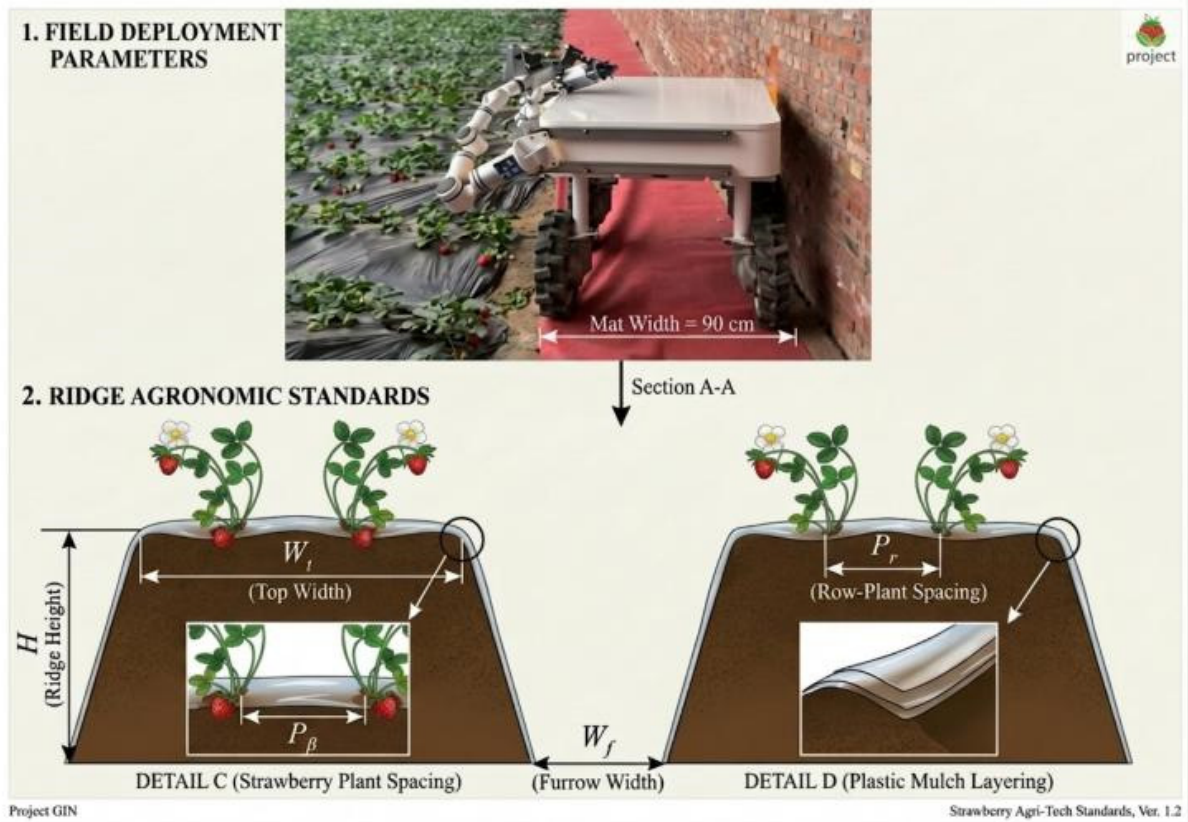
China’s strawberry production systems can be broadly divided into open-field cultivation and protected cultivation. The difference between ridge planting and elevated planting is presented in Figure 3 and Figure 4. Open-field systems are mainly used for processing strawberries and generally involve lower infrastructure costs and larger planting. Strawberry production in China is geographically concentrated in eastern, central–southern, southwestern, and northeastern regions. Jiangsu, Shandong, Anhui, and Liaoning are among the principal producing provinces. These regions have developed differentiated production and marketing systems. Shandong specialises in processing and frozen-strawberry exports and has established relatively mature processing and cold-chain infrastructure [41]. Dandong in Liaoning is recognised for high-quality fresh strawberries and strong regional branding [42], whereas Changfeng County in Anhui is a major winter strawberry production base, with approximately 14,000 ha under cultivation and annual output exceeding 360,000 tonnes. Such regional concentration creates favourable conditions for the commercial deployment of harvesting robots because large production clusters can support equipment sharing, technical services, and standardised operational procedures [43,44,45].

4. Strawberry Cultivation and Management Techniques

4.1. Soil and Environmental Conditions

Strawberry plants are sensitive to soil and climatic conditions, which directly influence root development, nutrient uptake, plant growth, yield, and fruit quality. Loose, well-drained, and well-aerated soils with a high organic-matter content are generally preferred, while a slightly acidic-to-neutral pH of approximately 6.0–7.0 supports nutrient availability and normal crop development [46,47,48]. Heavy clay soils, poor drainage, and low soil fertility may restrict root growth and increase the risk of physiological disorders and disease.
Soil improvement commonly involves the incorporation of well-decomposed compost, leaf mould, and other organic amendments to enhance soil structure, porosity, water retention, and nutrient supply. Microbial inoculants may also improve nutrient cycling and suppress certain soil-borne diseases, although their effectiveness depends on soil properties, microbial strains, and application conditions [49]. Deep tillage, soil loosening, raised-bed cultivation, and crop rotation can reduce compaction, improve drainage, and limit the accumulation of pathogens. Fertiliser application should be based on soil testing and crop demand, with balanced supplies of nitrogen, phosphorus, potassium, and micronutrients. Excessive fertilisation should be avoided because it may increase soil salinity, disturb nutrient balance, and reduce fruit quality [50].
These soil-management practices also affect the operation of strawberry robots. Loose or wet soil may reduce wheel traction and chassis stability, particularly in open-field cultivation, whereas raised beds and standardised aisles provide more predictable conditions for autonomous navigation. Soil moisture, salinity, and nutrient sensors can be integrated with mobile robots or Internet of Things systems to support variable-rate irrigation and fertilisation. However, sensor readings may vary with soil heterogeneity and require regular calibration. From a robotic-design perspective, standardised bed height, row spacing, and aisle width are as important as soil quality because they determine platform dimensions, manipulator reach, and accessibility to the fruit.
Strawberry growth is also strongly influenced by temperature, solar radiation, water availability, and atmospheric humidity. Moderate and relatively stable temperatures generally favour vegetative growth, flower-bud initiation, flowering, and fruit development, although precise requirements vary among cultivars and production systems [51,52]. Adequate solar radiation supports photosynthesis and fruit quality, while excessive radiation combined with high temperature can cause leaf scorching, fruit damage, and reduced photosynthetic efficiency. Shading, ventilation, and evaporative cooling may therefore be required under hot conditions.
Because strawberries have shallow root systems, they are sensitive to both drought and waterlogging. Irrigation demand depends on local climate, soil conditions, crop stage, and cultivation method. Dry regions require supplementary irrigation, whereas high-rainfall areas require efficient drainage and humidity management to reduce root damage and fungal disease. Frost, flooding, heat stress, and abrupt temperature fluctuations can also impair flowering, fruit set, and fruit quality [53,54].
Intelligent robots can support environmental management by collecting spatial data on temperature, humidity, light intensity, soil moisture, and crop status. Mobile monitoring platforms can identify water stress, nutrient deficiency, and disease symptoms before visible damage becomes severe. These data may be linked to greenhouse control systems, precision irrigation, and fertiliser management. Compared with fixed sensors, mobile robots provide wider spatial coverage and can detect local environmental variation, but their measurements may be affected by platform motion, sensor height, and changing illumination. A combined system using fixed sensors for continuous monitoring and robots for targeted inspection is therefore more reliable.
Regional cultivation systems impose different requirements on robotic operations. In Shandong and Liaoning, strawberries are commonly cultivated in plastic tunnels and solar greenhouses, where temperature and humidity can be controlled during winter. These protected systems offer relatively regular rows and reduced weather interference, making them favourable for robotic monitoring and harvesting. Nevertheless, narrow passages, dense foliage, uneven lighting, and high humidity may restrict robot movement and reduce camera or depth-sensor performance.
In Yunnan and Sichuan, mild climatic conditions allow greater use of natural light and lower heating inputs. However, stronger variations in sunlight and terrain may require robots to possess more robust visual perception and chassis adaptability. In colder regions, insulation, mulching, and greenhouse heating are frequently combined with cold-tolerant cultivars. Robots operating in such environments must tolerate low temperatures, condensation, and rapid changes between indoor and outdoor conditions.
Overall, soil and climate management should be considered jointly with robotic system design. Structured raised beds, stable pathways, and controlled greenhouse environments can improve navigation, fruit visibility, and manipulator accessibility, while intelligent robots can contribute to environmental monitoring, precision input management, and crop inspection. Greater coordination between cultivation-system standardisation and robotic development is therefore essential for improving the reliability and economic feasibility of intelligent strawberry production.

4.2. Cultivation Patterns

Strawberry production includes open-field, protected, raised-ridge, soilless, hydroponic, and vertical cultivation systems. These systems differ not only in agronomic performance and production cost but also in their suitability for intelligent robotic operations. From a robotic perspective, the cultivation system determines background complexity, fruit visibility, aisle accessibility, platform stability, manipulator workspace, and the degree of environmental standardisation. Consequently, cultivation-system selection and robot design should be considered jointly rather than as independent decisions.
For visual perception and fruit localisation, open-field cultivation presents the greatest environmental uncertainty. Variable sunlight, shadows, wind-induced plant movement, rainfall, weeds, and irregular backgrounds can reduce the reliability of maturity recognition, fruit segmentation, and three-dimensional localisation. Robots intended for open-field production therefore require illumination-robust vision, stronger sensor fusion, and greater environmental adaptability. Greenhouses and plastic tunnels reduce direct weather interference and generally provide more regular planting rows, making visual detection and localisation comparatively easier. However, protected environments are not necessarily visually simple: high humidity may cause sensor condensation, plastic films can produce reflections, and uneven natural or supplementary lighting can generate strong local brightness differences.
Raised-ridge cultivation, which is widely used in Chinese strawberry production [55], provides relatively clear row boundaries and improves drainage, crop management, and fruit accessibility. Nevertheless, fruit commonly develops close to the ridge surface and remains partially occluded by leaves, stems, and neighbouring berries. This low and cluttered fruit distribution requires compact cameras, close-range depth sensing, and accurate separation of individual fruit and peduncles. Elevated substrate or table-top cultivation generally offers better fruit visibility and places the crop within a more accessible robotic workspace. It can therefore reduce manipulator reach, improve camera viewpoints and decrease the need for complex chassis positioning. Its automation advantages, however, are obtained through additional investment in supporting structures, irrigation equipment, and facility reconstruction.
Substrate and hydroponic systems offer more precise control of water and nutrient delivery. Electrical conductivity, pH, nutrient concentration, irrigation frequency, drainage, and solution temperature can be monitored continuously, allowing fertigation to be adjusted according to crop stage and environmental conditions [56,57,58]. These systems are particularly compatible with digital control because production variables can be measured and regulated through fixed sensors and automated dosing equipment. However, they are also highly dependent on pumps, sensors, and control systems; equipment failure or inappropriate nutrient settings can rapidly affect the entire crop. For high-frequency control of nutrient solutions, fixed sensors and embedded controllers are generally more reliable than mobile robots. Robots are more valuable for inspecting spatial variation, detecting plant responses, and identifying local equipment or irrigation failures.
The relative suitability of different systems also depends on mobile-platform navigation. Open-field robots must tolerate uneven terrain, loose or wet soil, and changing ground conditions, which increase the requirements for traction, suspension, and localisation robustness. Greenhouses and tunnels provide more predictable paths but often contain narrow aisles, supporting columns, irrigation pipes and workers, thereby limiting robot width, and turning space. Raised-ridge systems offer identifiable navigation corridors, although inconsistent ridge dimensions between farms reduce the transferability of a fixed robot design. Standardisation of aisle width, ridge height and row spacing would therefore improve both autonomous navigation and manipulator accessibility.
Vertical cultivation can greatly increase planting density and land-use efficiency, particularly in urban agriculture and plant factories. It also creates a more structured production environment in which fruit positions may be constrained to defined layers. However, a robot must reach multiple heights and operate under differences in illumination, temperature, and airflow between layers. A single fixed manipulator may have insufficient workspace, whereas lifting mechanisms or multiple robotic arms increase system weight, control complexity, and cost. Thus, vertical cultivation is highly compatible with automation in principle, but only when the crop-support structure, lighting system, and robotic workspace are designed as an integrated system.
Intercropping may improve land-use efficiency, diversify farm income, and influence pest or beneficial-insect activity [59], but it is generally less favourable for robotic harvesting. Additional crop species increase visual background diversity, obstruct navigation, and create competition for manipulator workspace. A perception model trained in strawberry monoculture may not reliably distinguish strawberry leaves, companion crops, and weeds, while mixed canopy structures complicate collision avoidance. Intercropping therefore provides potential agronomic benefits but reduces environmental standardisation and increases the sensing and planning burden placed on robots.
Manipulator motion planning is particularly affected by fruit presentation and plant architecture. In raised-ridge production, orienting the convex or arched side of the crown towards the furrow can encourage inflorescences and fruit clusters to develop along the ridge slope. This fan-shaped distribution reduces mutual occlusion and places more fruit within the camera and manipulator workspace. Compared with improving recognition algorithms alone, such crop-orientation practices represent a low-cost method of increasing robotic harvesting success. They demonstrate that robot-friendly cultivation should include the deliberate management of plant orientation, leaf density, fruit load, and cluster distribution.
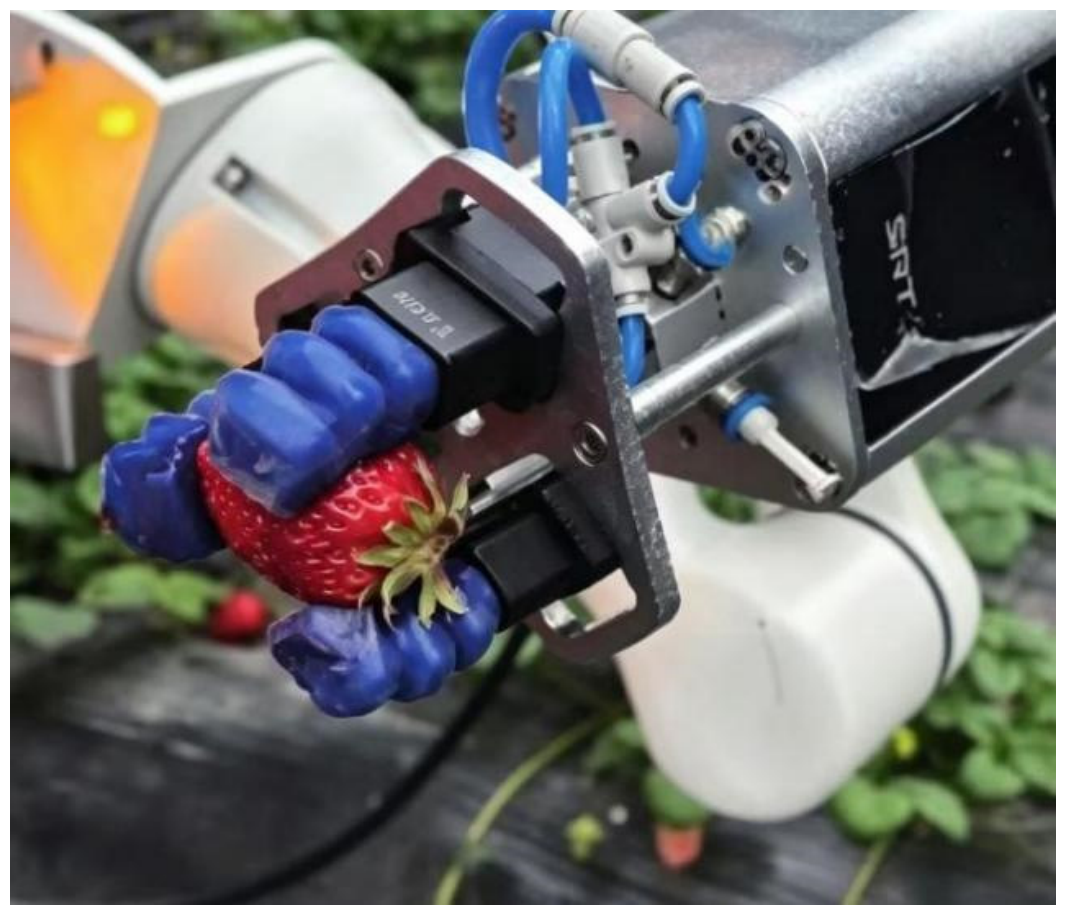
The end-effector must accommodate the mechanical sensitivity of the strawberry–peduncle system. Direct gripping can bruise the soft fruit, whereas uncontrolled pulling or twisting may damage the calyx, receptacle, peduncle, or neighbouring tissues. Cutting-based end-effectors can achieve predictable separation when the peduncle is visible, but their performance decreases under occlusion or when the cutter cannot approach at a suitable angle. Suction devices reduce lateral contact but may be unreliable on irregular, wet, or damaged fruit surfaces. Soft grippers provide greater tolerance to localisation errors, although excessive enclosure may disturb adjacent unripe fruit.
An enclose-and-lift strategy offers an alternative when reliable peduncle cutting is difficult. By supporting the fruit before applying a controlled lifting or bending action, the end-effector may reduce local surface pressure and limit bruising. However, this method cannot be assumed to be universally superior to cutting. Its success depends on cultivar-specific detachment force, maturity, peduncle orientation, and the mechanical properties of the fruit–peduncle connection. Inconsistent detachment forces may cause either failed picking or tissue damage. A practical robot may therefore require interchangeable or hybrid end-effectors that select cutting, supportive lifting, or soft grasping according to fruit accessibility and peduncle visibility.
Cultivation systems also determine the appropriate form of intelligent nutrient and environmental management. Strawberry growth and fruit quality depend on balanced supplies of nitrogen, phosphorus, potassium, and other nutrients [60,61]. Excessive nitrogen can promote excessive vegetative growth, delay ripening, and increase canopy density, thereby worsening fruit occlusion and making robotic harvesting more difficult. Nutrient management thus affects robots indirectly by changing plant architecture, fruit distribution, and maturity uniformity.
In soil-based production, organic amendments improve soil structure and long-term fertility, while mineral fertilisers provide nutrients in readily available forms [62]. Fertiliser rates should be adjusted according to soil analysis, cultivar, yield target, and developmental stage rather than applying a constant ratio throughout the crop cycle [63,64]. Mobile robots equipped with imaging or spectral sensors may identify spatial differences in canopy vigour, nutrient stress, and fruit load and can support variable-rate fertilisation. Nevertheless, visual symptoms are often not specific to a single nutrient deficiency and may also be caused by water stress, disease, or root damage. Robotic diagnosis should therefore complement, rather than replace, soil, leaf, or petiole analysis.
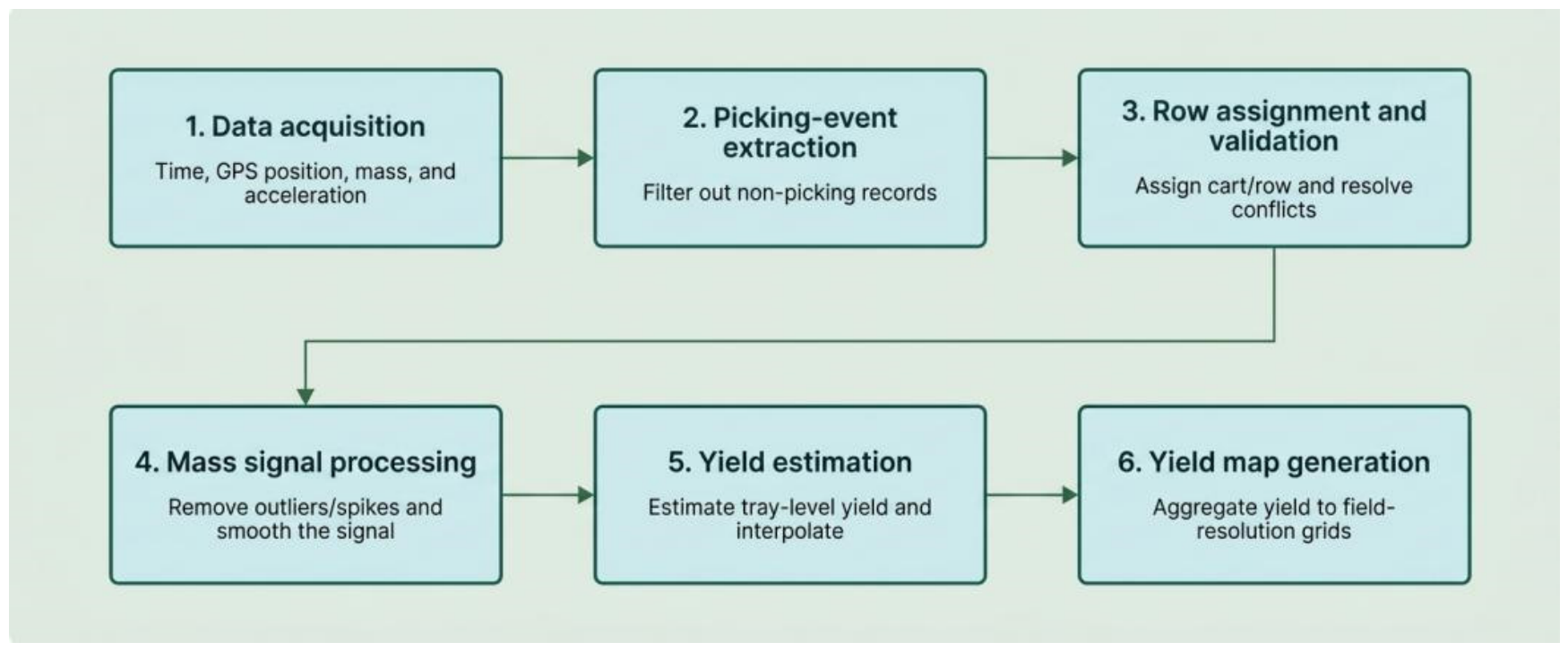
From an economic perspective, no cultivation system is universally optimal for strawberry robots [65,66]. Open-field production has low infrastructure costs and can provide large operating areas, but it requires highly robust and potentially expensive robotic platforms. Fully controlled greenhouses offer stable production and facilitate year-round operation, yet their construction and energy costs may make the additional investment in robots difficult to justify on smaller farms. Plastic tunnels represent an intermediate option with lower facility costs, although their environmental conditions and structural dimensions are less consistent. Raised-ridge cultivation is commercially widespread and therefore has a large potential market for robots, but its low fruit position and labour-intensive management remain major challenges. Elevated soilless systems provide the most accessible fruit arrangement for robotic harvesting, whereas vertical systems offer high spatial productivity but require the greatest integration of cultivation structures, sensing and manipulation. As shown in Figure 5, the data processing workflow of automated strawberry harvesting and yield mapping consists of six sequential steps from raw data acquisition to final yield map generation.
Overall, the suitability of a strawberry cultivation system for robotic operation depends on the balance between environmental standardisation and investment cost. Open-field and intercropping systems offer lower infrastructure requirements but impose greater demands on perception, mobility, and robustness. Protected, raised-bed, and elevated systems simplify navigation and manipulation but require facility investment and consistent structural design. Future development should therefore shift from adapting robots to highly heterogeneous farms towards the co-design of cultivars, plant orientation, bed dimensions, environmental control, and robotic equipment. Such integration can reduce fruit occlusion, simplify target localisation, shorten manipulator trajectories, and improve harvesting efficiency more effectively than improving individual robotic algorithms in isolation.

4.3. Pest and Disease Control

Agronomic control provides the foundation of integrated pest and disease management in greenhouse strawberry production. Resistant or tolerant cultivars should be selected according to local pathogen pressure, climate, cultivation system, and market requirements. Although cultivar resistance can reduce disease severity and pesticide use, it is rarely complete and must be combined with other measures [67,68]. Crop rotation with suitable non-host vegetables, cereals, or green-manure crops can reduce soil-borne pathogens, nematodes, and soil degradation while improving soil structure and fertility [69]. However, rotation effectiveness depends on pathogen persistence and host range; therefore, a fixed 2–3-year interval may be insufficient for long-surviving pathogens.
Coloured sticky traps are inexpensive tools for monitoring and partially suppressing flying pests. Yellow traps are commonly used for aphids, whiteflies, and fungus gnats, whereas blue traps are more suitable for thrips [70,71]. Trap height, density, and replacement frequency should be adjusted according to canopy development, greenhouse area, and pest pressure. Nevertheless, sticky traps cannot provide complete control and may capture parasitoids or pollinators, requiring careful placement when beneficial organisms are present [72]. Vision-equipped mobile robots can automatically inspect traps, identify and count captured insects, and map pest distribution. Compared with manual inspection, automated monitoring improves spatial and temporal coverage, although recognition accuracy may be affected by overlapping insects, debris, and changing illumination.
Biological control involves predators, parasitoids, predatory mites, and entomopathogenic microorganisms. Ladybirds and lacewings suppress aphids, parasitoid wasps target aphids or whiteflies, and predatory mites are effective against spider mites and some thrips. Banker plants and flowering companion plants may support natural enemies, but they can also harbour pests or pathogens. Pesticide compatibility must therefore be considered, as broad-spectrum products may disrupt biological-control populations.
Microbial pesticides and biological fungicides, including Bacillus thuringiensis, Beauveria bassiana, Bacillus spp., and Trichoderma spp., can complement natural-enemy-based control. Their effectiveness depends strongly on strain, formulation, application timing, and environmental conditions. They may reduce pesticide residues and environmental impacts but should not be regarded as universally non-toxic or consistently effective. Intelligent robots can support targeted application by using visual recognition to locate pest clusters or diseased tissues and applying biological products only to affected areas, thereby reducing product consumption. However, visual symptoms of diseases, nutrient deficiencies, and environmental stress may be similar; robotic diagnosis should therefore be combined with expert identification or sensor-based confirmation.
Sanitation and environmental regulation remain essential for disease suppression. Diseased leaves, flowers, and fruit should be removed, while appropriate spacing, canopy management, ventilation, drip irrigation, and humidity control can reduce tissue wetness and conditions favourable to grey mould and powdery mildew. Healthy planting materials, clean tools, disinfected facilities, and properly managed substrates further limit pathogen introduction and spread. Monitoring robots equipped with RGB, depth, or spectral cameras may detect colour, texture, and morphological changes associated with disease, estimate canopy density, and identify overripe or infected fruit. They can also support selective removal or precision spraying, although severe leaf occlusion and early asymptomatic infections remain important limitations.
Effective management therefore requires resistant cultivars, balanced fertilisation, sanitation, environmental control, and regular monitoring as the agronomic basis [73,74,75]. Physical, biological, and selective chemical measures should then be coordinated according to pest identification, population density, and intervention thresholds. Strawberry robots should function as components of this integrated system rather than as stand-alone control tools. By combining visual pest and disease recognition, sticky-trap inspection, environmental sensing, and precision treatment, intelligent robots can improve monitoring frequency and reduce unnecessary pesticide applications. Future developments in disease forecasting, automated visual diagnosis, and variable-rate application are expected to further enhance the efficiency and sustainability of greenhouse strawberry production.

5. Strawberry-Harvesting Technology

5.1. Development History

Until the early 20th century, strawberry harvesting relied almost entirely on manual labour. Ripe fruits were selectively picked by hand, a process that was labour-intensive, time-consuming, and highly dependent on the availability of seasonal workers. Harvesting operations were also affected by weather conditions and the narrow maturity window of strawberry fruit, which limited production efficiency and increased the risk of quality deterioration or crop losses.
During the 1960s and 1970s, research into mechanical and semi-mechanised strawberry harvesting began to emerge. Early harvesting equipment was developed primarily to reduce labour requirements and improve operational efficiency. However, the delicate texture, irregular spatial distribution, and non-uniform ripening of strawberry fruit presented considerable challenges for mechanisation. Mechanical systems were therefore more readily applied to strawberries intended for processing, for which minor surface damage and reduced selectivity were generally more acceptable than in the fresh-fruit market.
The development of strawberry-harvesting technology has subsequently progressed from manual picking and mechanical assistance towards automated and intelligent harvesting systems. Recent research has increasingly focused on integrating machine vision, artificial intelligence, robotic manipulators, and specialised end-effectors to detect fruit, assess ripeness, plan collision-free picking paths, and detach strawberries with minimal damage. These technologies have the potential to improve harvesting efficiency, reduce dependence on manual labour, and enhance the consistency of harvesting operations. Nevertheless, their practical performance remains influenced by fruit occlusion, variations in maturity and orientation, complex canopy structures, localisation accuracy, picking speed, and system cost.
With continued advances in sensing, robotic control, artificial intelligence, and agricultural engineering, strawberry-harvesting systems are expected to become more accurate, efficient, and adaptable to commercial production environments. Further improvements in perception, end-effector design, human–robot collaboration, and system affordability will be essential for promoting large-scale adoption and supporting the modernisation and sustainable development of strawberry production [76,77].

5.2. Traditional Harvesting Methods

Traditional strawberry harvesting relies heavily on manual labour because ripe fruits must be selectively identified, carefully detached, and handled individually. This dependence is particularly pronounced in regions where the adoption of mechanised or automated harvesting technologies remains limited [77]. Compared with mechanised operations, manual harvesting is relatively slow and may be unable to meet the operational requirements of large-scale production, especially during periods of concentrated fruit ripening. Harvesting performance also varies with workers’ experience and fatigue. Inappropriate grasping, excessive pressure, or accidental collisions during picking and handling may cause bruising, compression damage, or surface abrasion, thereby reducing the visual quality, marketability, and post-harvest storage life of the fruit.
Accelerating urbanisation and demographic changes have contributed to a decline in the availability of agricultural labour in many rural areas. The resulting shortage of seasonal workers is particularly problematic during the relatively short strawberry-harvesting period, when large quantities of ripe fruit must be collected promptly to prevent overripening and quality deterioration. Increasing labour costs and difficulties in recruiting experienced pickers have consequently imposed substantial economic and operational pressures on strawberry producers. These constraints have created a strong demand for mechanised and robotic harvesting systems capable of reducing dependence on manual labour whilst maintaining harvesting selectivity and minimising fruit damage.

5.3. Mechanized Harvesting Technology

With continued global population growth and increasing demand for agricultural products, modern agriculture faces mounting pressure to improve productivity, reduce production costs, and ensure a stable food supply. Agricultural mechanisation has consequently become an important means of enhancing operational efficiency and alleviating dependence on manual labour. Strawberries are high-value horticultural crops cultivated extensively worldwide; however, their harvesting remains highly labour-intensive because ripe fruits must be selectively identified and handled carefully to avoid mechanical damage. This reliance on manual harvesting increases production costs, constrains the expansion of commercial cultivation, and makes production particularly vulnerable to seasonal labour shortages. The development of efficient, reliable, and low-damage strawberry-harvesting robots is therefore of considerable practical importance for reducing labour requirements, improving harvesting efficiency, and supporting the modernisation of strawberry production [78].

5.3.1. Advantages of Mechanized Harvesting

Mechanised and robotic harvesting systems have the potential to operate for extended periods with limited interruption, thereby increasing harvesting capacity and reducing the time required to complete large-scale operations [79,80]. Compared with manual harvesting, automated systems may process larger production areas within a shorter period, particularly when supported by appropriate scheduling, maintenance, and logistics. Some advanced strawberry-harvesting platforms can also integrate additional sensing and monitoring functions, including environmental-data acquisition, crop-status assessment, and the detection of visible symptoms associated with pests or diseases. The integration of these functions may enable a single robotic platform to support multiple crop-management operations and improve overall resource-use and operational efficiency.
Mechanised harvesting may also reduce dependence on seasonal labour and alleviate production pressures in regions characterised by labour shortages and high wage costs. Although the acquisition, maintenance, and operation of robotic systems involve substantial expenditure, their long-term use may reduce labour-related costs and improve the predictability of harvesting operations. Consistent robotic control may additionally reduce losses associated with inappropriate grasping, excessive compression, fruit dropping, or collision during manual handling. However, the extent of any cost advantage depends on machine utilisation, harvesting success rate, operating speed, maintenance requirements, farm scale, and the cost of local labour.
With regard to fruit quality, harvesting robots can apply predefined criteria based on colour, size, shape, or other measurable characteristics to identify fruits that have reached the required maturity stage. Such selective harvesting may improve the uniformity of harvested produce and reduce variability caused by differences in workers’ experience or judgement. Carefully designed end-effectors and motion-control strategies may also reduce direct fruit contact and mechanical damage. Nevertheless, fruit quality remains dependent on the accuracy of maturity assessment, localisation performance, grasping force, detachment method, and post-harvest handling.
Robotic harvesting may further reduce direct human contact with the fruit and thereby lower certain hygiene risks associated with repeated manual handling. However, this benefit depends on effective cleaning and disinfection of the robot, end-effector, collection containers, and other fruit-contact surfaces. Mechanisation should therefore be regarded as a component of hygienic production management rather than as an inherently contamination-free harvesting method. Its contribution to environmentally sustainable agriculture similarly depends on factors such as energy consumption, equipment durability, production efficiency, and the integration of harvesting with other precision-management operations.
Robotic harvesting systems may offer operational advantages under environmental conditions that are uncomfortable or potentially hazardous for workers [81]. Greenhouse strawberry production may expose labourers to high temperatures, high relative humidity, prolonged repetitive movement, and contact with crop-protection products or contaminated plant material. Appropriately protected robots can undertake some harvesting tasks under these conditions, reducing workers’ exposure and supporting occupational health and safety [82]. Furthermore, extended operating periods may allow ripe strawberries to be harvested within a relatively narrow maturity window, thereby limiting overripening and post-harvest quality deterioration.
Nevertheless, the environmental adaptability of harvesting robots should not be overstated. High humidity, condensation, low temperatures, poor illumination, dust, and water exposure may interfere with cameras, sensors, electronic components, and mechanical systems. Reliable operation therefore requires suitable waterproofing, thermal management, illumination control, sensor calibration, and fault-detection mechanisms. Improving robustness under variable greenhouse and field conditions remains an important requirement for the commercial application of strawberry-harvesting robots.

5.3.2. Research Progress on Strawberry-Harvesting Machinery in China and Abroad

Japan is among the nations with the most advanced levels of agricultural mechanisation worldwide. In the domain of strawberry-harvesting robotics, Japanese corporations, including Kubota Corporation, have engineered harvesting robots integrated with high-precision visual recognition systems and flexible manipulators, which have been deployed in practical applications across select agricultural establishments. European countries have likewise attained substantial advancements in the research and development of strawberry-harvesting machinery. For instance, Wageningen University & Research in the Netherlands [83] has devised a visual recognition system founded on deep-learning algorithms, capable of efficiently detecting mature strawberries and facilitating precise harvesting operations.
In the United States, research endeavours have predominantly concentrated on enhancing the autonomy and intellectualisation of robotic systems. As an illustration, strawberry-harvesting robots developed by John Deere incorporate global positioning system (GPS) localisation and path-planning technologies, enabling autonomous navigation and the completion of harvesting assignments within large-scale plantation environments [84]. Within academic research institutions in China, Tsinghua University and China Agricultural University have carried out extensive investigations into strawberry-harvesting machinery. Notably, Tsinghua University has developed a visual recognition system based on the YOLOv8 model, which achieves rapid localisation and identification of ripe strawberries. Concurrently, numerous agricultural technology enterprises, such as XAG (Guangzhou, China), have commenced the application of robotic technologies in strawberry harvesting. The strawberry-harvesting robot developed by XAG integrates multispectral imaging technology with a flexible manipulator design and has undergone field testing in several experimental plots.
Looking forward, harvesting robots are projected to evolve towards greater intelligence and autonomy. Strawberry-harvesting robots are required to exhibit enhanced autonomy and adaptability to execute operational tasks in complex natural environments. To satisfy the operational demands of small- and medium-sized farms, the development of cost-effective robots with stable performance has emerged as a critical research orientation. Multi-crop adaptability constitutes another pivotal focus; exploring the applicability of robotic systems across diverse crop species can improve equipment versatility and utilisation efficiency. Owing to its merits of high efficiency, low operational cost, and superior precision, mechanised harvesting demonstrates substantial potential in strawberry production.
Considerable breakthroughs have been achieved in international research, whilst relevant technologies in China are also progressing at a rapid pace. With continuous advancements in artificial intelligence, visual recognition, and robotic engineering, future strawberry-harvesting robots are anticipated to possess heightened intelligence and autonomy, as well as adaptability to more intricate cultivation environments [85]. A comparative analysis of domestic and international research reveals that, although China still maintains a certain gap relative to the world’s advanced level in strawberry-harvesting machinery, augmented research investment and technological innovation may facilitate China in accomplishing technological catch-up in the foreseeable future, thereby fostering the advancement of modernised agriculture.

5.4. Key Technologies of Strawberry-Harvesting Robots

5.4.1. Research Status of Locomotion Mechanisms

Wheeled agricultural robots are widely investigated by robotics researchers owing to their straightforward structure, flexible manoeuvrability, and diverse steering modes. At present, they also represent one of the most intensively studied categories of agricultural robotic platforms. Their principal merits include low weight, compact dimensions, high load-carrying capacity, simplified driving and control mechanisms, rapid locomotion speed, and elevated operational efficiency [86,87]. Nevertheless, their obstacle-crossing performance is constrained. For instance, terrain conditions directly influence their operational stability, and precise trajectory tracking control is particularly essential for deployment in unstructured farmland environments. The wheel configuration of wheeled agricultural robots is typically determined by practical operational requirements, and research attention has primarily been directed towards steering control strategies [88]. Based on mechanical architecture, the steering modes of such robots are generally categorised into three types: articulated steering, differential steering, and wheel steering. Wheel steering further encompasses four control schemes: two-wheel steering, four-wheel steering, crab steering, and in situ rotation [89].
Tracked agricultural robots exhibit diverse structural configurations and are commonly classified into two categories: tracked units with track arms and those without track arms. Robots integrated with track arms are also denoted as track–legged hybrid robots [90,91,92]. In general, tracked robots can be divided by structural layout into single-section dual-track, double-section four-track, and multi-section multi-track types [93]. During field operations, tracked agricultural robots can adjust the elevation of track arms in response to terrain variations, thereby realising smooth obstacle traversal. Their advantages comprise a compact structure and high load-bearing capacity. Benefiting from a large ground contact area and low sinkage, they are well suited to operations on soft or waterlogged farmland. Since tracked robots typically employ differential steering, they can achieve zero-radius turning, thus minimising spatial requirements [94]. Furthermore, tracked robots possess exceptional off-road performance and can effectively surmount ridge-crossing and obstacle-negotiation challenges [95]. However, tracked agricultural robots also present notable drawbacks, including low locomotion speed, high energy consumption, susceptibility to wear of the travelling mechanism, and stringent demands concerning track materials and structural design. In addition, their substantial body mass generates excessive frictional resistance with the terrain. Consequently, turning operations on soft soil may induce avoidable disturbance to levelled farmland and even cause crop damage.
In comparison with wheeled or tracked agricultural robots, the most prominent characteristic of legged agricultural robots is that their locomotion trajectory consists of a sequence of discrete contact points [96]. This attribute enables adaptation to highly irregular terrain with reduced reliance on surface flatness, conferring particular advantages for ditch crossing, ridge negotiation, and operation on terraced fields. Moreover, owing to their point-to-point ground contact, legged robots impose relatively mild disturbance on farmland soil. Nevertheless, their inherent limitations are equally evident. First, legged robots exhibit high energy consumption and low operational efficiency. Second, the high degree of freedom of leg joints renders inter-leg coordination challenging to regulate; accordingly, control algorithms exert a critical influence on operational stability [97]. Furthermore, legged agricultural robots generally possess relatively low load-bearing capacity and are unsuitable for mounting heavy sensors or operational implements [98,99]. Constrained by these limitations, investigations focusing on purely legged agricultural robots remain relatively scarce. Instead, researchers have increasingly explored hybrid robotic systems, such as wheel–legged and track–legged robots, which can preserve the merits of legged robots while alleviating control complexity, enhancing operational stability and improving terrain adaptability.
Hybrid robots encompass wheel–track, wheel–legged, track–legged, and wheel–track–legged configurations [100]. Agricultural hybrid robots are usually adapted from general-purpose platforms designed for unstructured operational environments. Relevant studies have been documented in references [101,102,103,104], which respectively introduce an obstacle-crossing control method for a wheel–track agricultural robot, a multifunctional wheel–legged hybrid robot suitable for unstructured environments and a novel six-wheel–legged robot developed by the University of Science and Technology of China. Hybrid agricultural robots can overcome certain limitations of single-structure locomotion systems, and suitable hybrid configurations can be selected according to specific farmland terrain requirements [105]. A track–legged hybrid structure may be adopted for robots operating in complex farmland environments with relatively low demands for speed and efficiency. A wheel–track hybrid structure is appropriate for soft farmland requiring relatively high speed and efficiency. A wheel–legged hybrid structure can be considered for terrain featuring numerous ditches and ridges, or for operations on terraced fields while retaining high efficiency. For extremely complex terrain requiring adaptation to diverse challenging environments, a wheel–track–legged hybrid structure may be evaluated. However, this configuration is excessively complicated, and current research progress in this domain remains limited. The advantage of hybrid agricultural robots resides in their comprehensive consideration of variable terrain conditions, enabling compliance with more rigorous operational requirements. Nonetheless, their disadvantages are also pronounced: the mechanical structure is relatively intricate, numerous factors must be integrated into locomotion control, and the design of control algorithms for selecting appropriate travelling modes under complex terrain conditions is highly challenging.
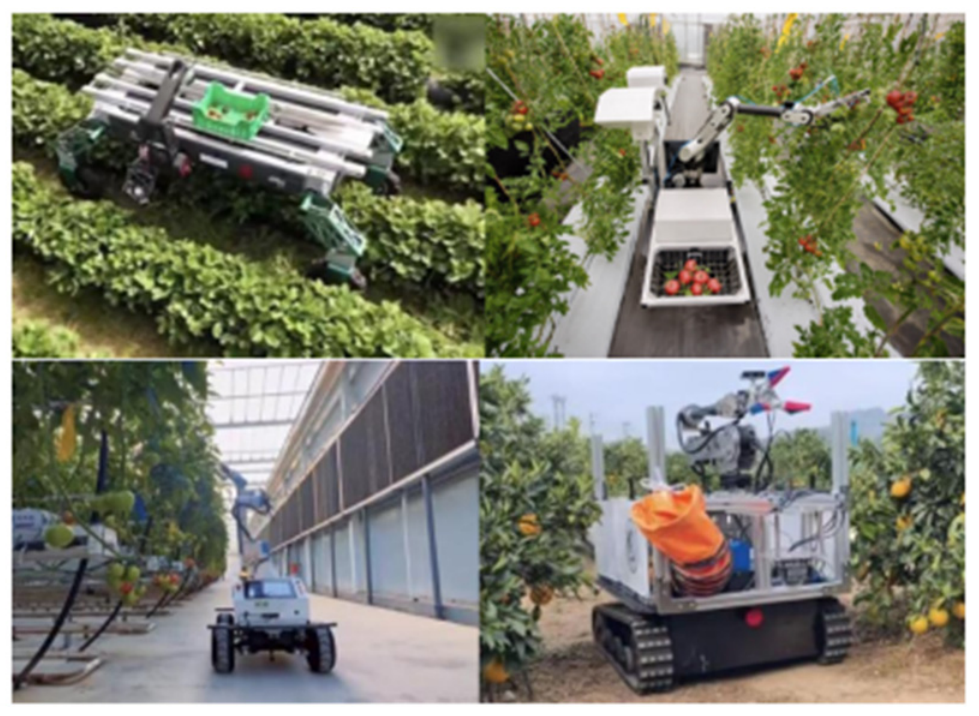
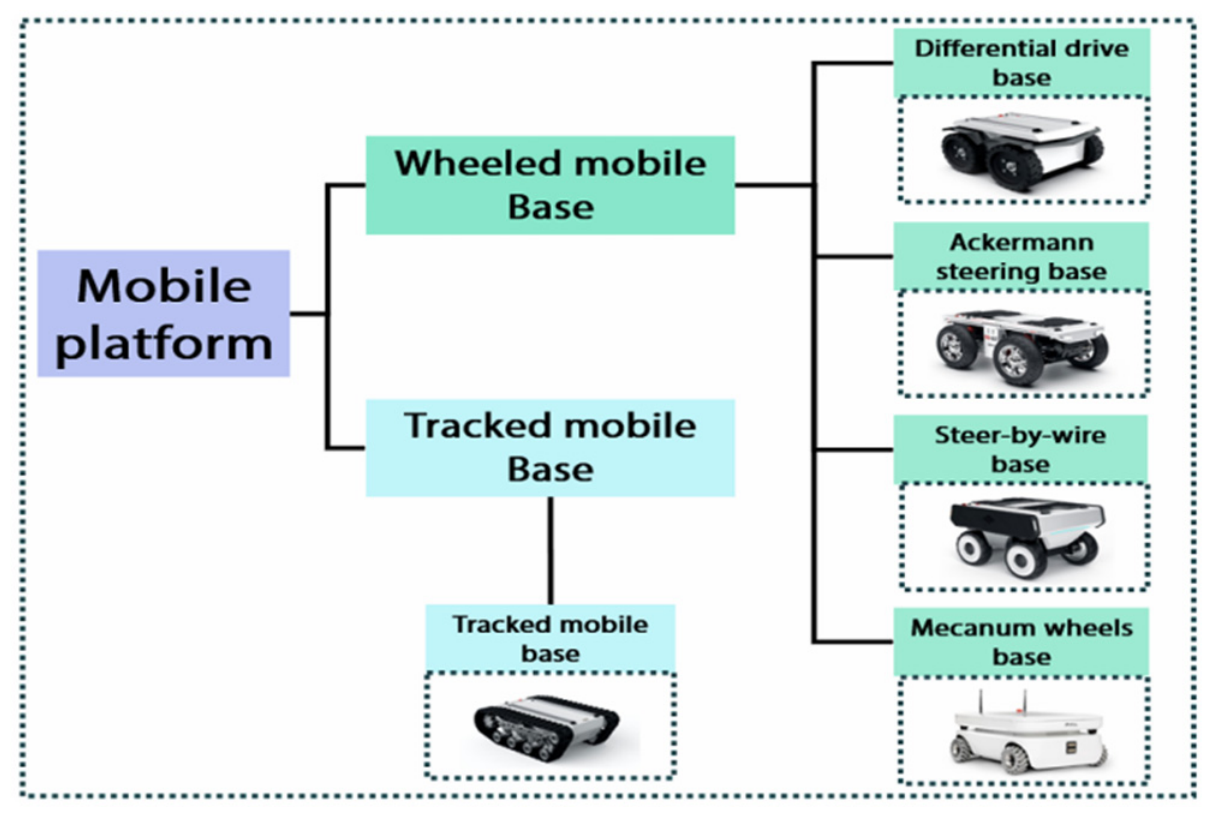
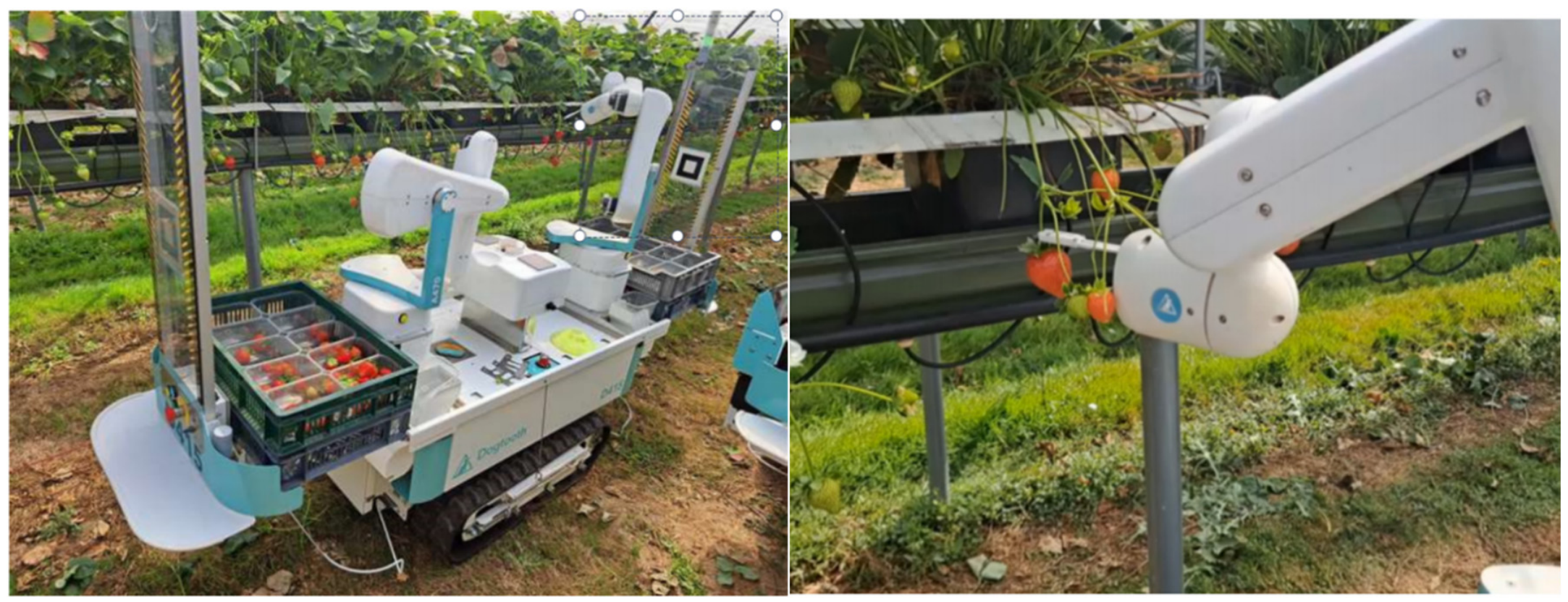
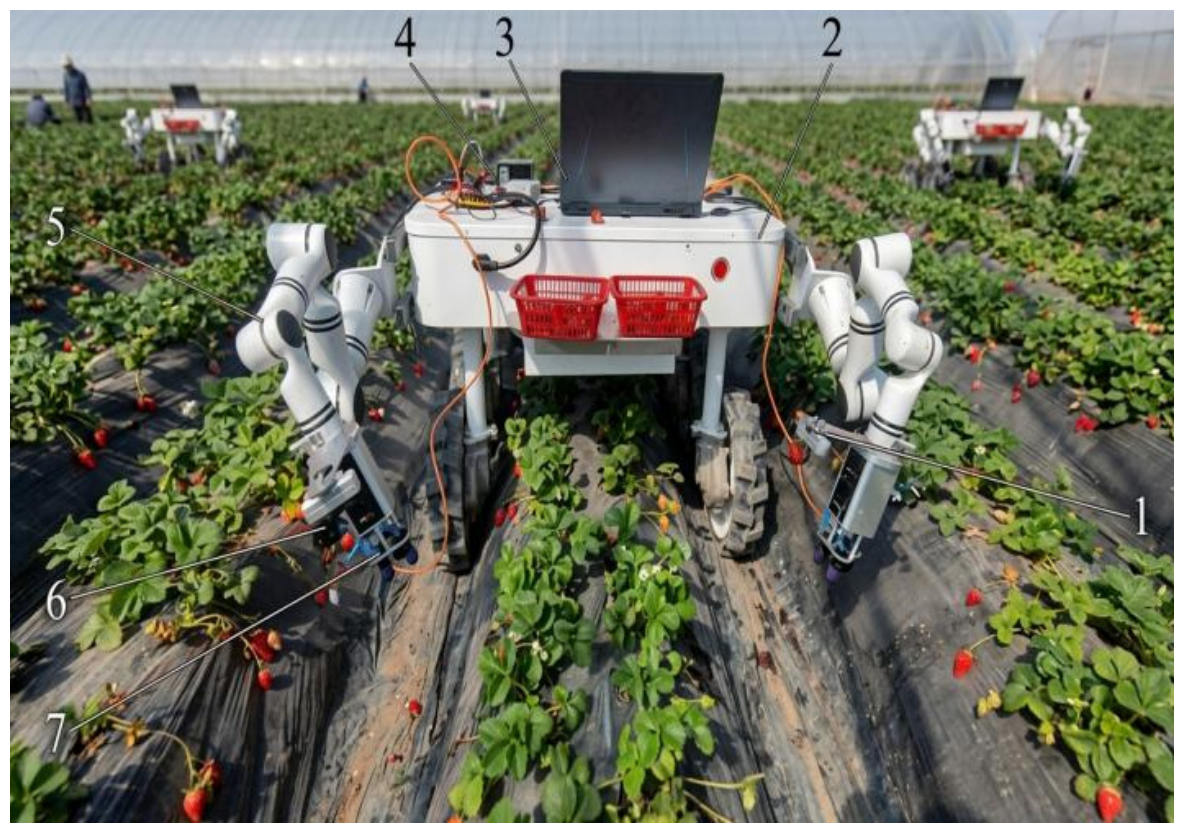
As listed in Table 1, mobile harvesting platforms can be divided into four categories according to walking modes, each with distinct terrain adaptability and harvesting application ranges. These robotic platforms, summarised in Figure 6 and Figure 7, represent a range of technical solutions designed to balance locomotion performance, crop compatibility, and terrain adaptability. Although significant progress has been made toward semi-commercial systems with advanced steering and locomotion capabilities, further research is needed to systematically evaluate and compare the suitability of different platform architectures across a wide range of agricultural operating conditions.

5.4.2. Robotic Arm Design

Strawberry-harvesting robots commonly adopt either parallel or serial manipulator architectures [107,108]. Parallel manipulators are distinguished by their compact structure and high rigidity, rendering them suitable for high-precision operations. Conversely, serial manipulators demonstrate enhanced flexibility and are better adapted to complex operational environments.
Parallel manipulators exhibit superior performance in strawberry harvesting by virtue of their high rigidity and precise motion control capabilities [109]. Their design is frequently integrated with lightweight materials to enhance operational efficiency. A parallel manipulator comprises multiple independent joint systems operating synchronously, wherein the position and posture of the end-effector are regulated via the coordinated actuation of multiple drive units. This configuration typically delivers elevated rigidity and stability. The primary advantages include high structural rigidity and stability, enabling the manipulator to maintain a robust configuration during operation and rendering it suitable for tasks demanding precise manipulation. Furthermore, its compact design facilitates efficient operation within confined workspaces. Parallel manipulators also possess a high load-carrying capacity and can withstand relatively substantial payloads, making them appropriate for picking strawberries of greater mass or volume [110,111]. Nevertheless, parallel manipulators exhibit certain limitations. Their flexibility is comparatively low, and their workspace is relatively restricted, resulting in reduced adaptability to diverse environmental conditions. Moreover, their mechanical design is relatively complex, requiring sophisticated control systems to synchronise the motion of multiple actuators, thereby increasing design and manufacturing complexity. The associated cost is also relatively high owing to the requirement for intricate structures and high-precision components. A research team from Wageningen University [112] in the Netherlands developed a strawberry-harvesting robot utilising a parallel manipulator. This system demonstrated favourable performance in elevated cultivation scenarios, achieving efficient strawberry harvesting while maintaining a fruit damage rate below 3%, which approaches the performance of manual labour.
Serial manipulators possess high flexibility and are adaptable to varied terrains and planting layouts, despite their relatively high system complexity. A serial manipulator is a mechanical system consisting of multiple joints and links connected in a sequential chain. Each joint governs motion along a specific axis, and precise manipulation of the end-effector—such as a gripper or suction cup—is achieved through the coordinated movement of all joints. Serial manipulators offer high flexibility and can cover a comparatively large operational workspace, making them suitable for deployment in complex cultivation environments [113]. They also exhibit strong adaptability and can be readily reconfigured to accommodate diverse harvesting tasks and environmental layouts. Compared with parallel manipulators, serial manipulators feature a relatively straightforward structure and are easier to fabricate and maintain. However, they also present several drawbacks. Their structural rigidity is comparatively deficient, and the flexibility inherent to the serial configuration may compromise stability during high-precision operations. Additionally, the coordinated control of multiple joints increases system complexity and maintenance requirements. Serial manipulators are also more vulnerable to functional failure, as a fault in any individual joint may disrupt the operation of the entire manipulator. In Japan, the strawberry-harvesting robot developed by Kubota Corporation employs a serial manipulator design. Experimental results indicate that the system possesses high flexibility and adaptability, enabling it to complete harvesting operations across varied terrains and planting layouts, with a harvesting efficiency approximately 40% higher than that of manual picking [114].
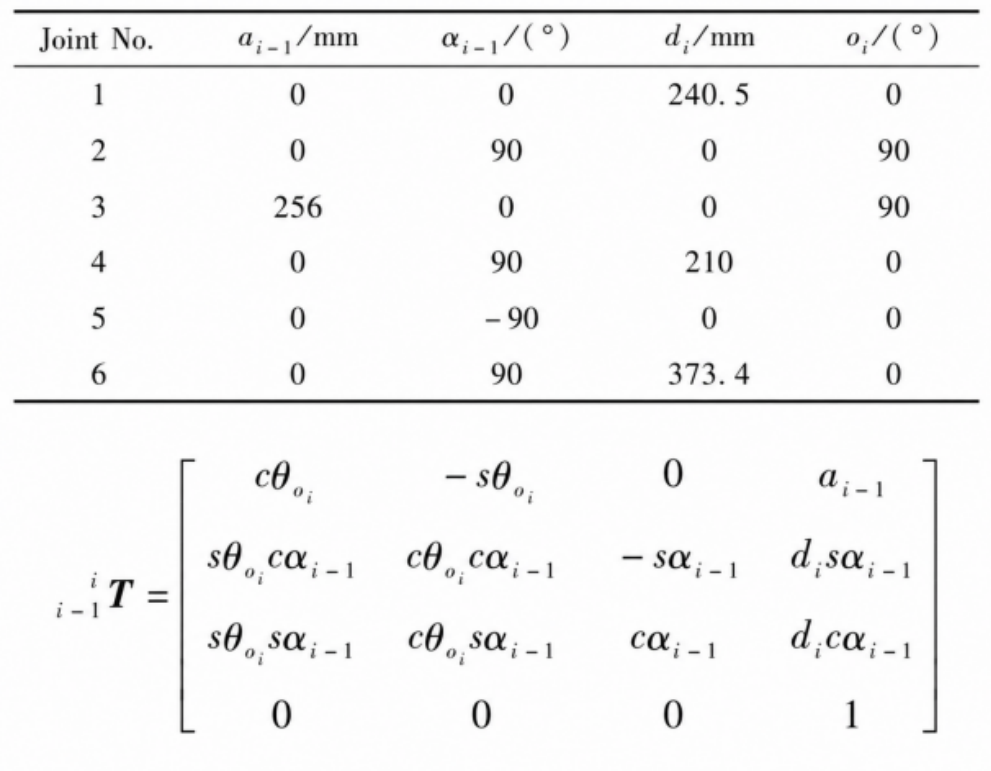
The Denavit-Hartenberg (DH) parameterisation method [115] represents a standardised technique in robotics for characterising the kinematic relationships between the joints and links of a manipulator. By establishing a series of coordinate frames and applying geometric transformations, the DH method enables the calculation of the end-effector position and orientation relative to the base frame. Joint types are generally categorised as revolute (R) or prismatic (P), with the DH method primarily applied to revolute joints. Each link is assigned a local coordinate system that describes its position and orientation relative to the preceding link. For each link, a local coordinate system, defined by the x, y, and z axes, is established. The primary reference point is typically situated at the proximal end of the link, while the secondary reference point is positioned at the distal end. Homogeneous transformation matrices are employed to characterise the position and orientation of each link relative to its predecessor. These matrices integrate translational and rotational operations. By computing the product of the homogeneous transformation matrices for all joints, the position and orientation of the end-effector relative to the base can be determined [116,117]. In industrial robotics, the DH parameterisation method is extensively utilised for the precise control of manipulator trajectories and postures. Through the definition of explicit coordinate systems and parameters, it facilitates the interpretation and analysis of manipulator motion and provides a unified mathematical framework for path planning and motion control. With the advancement of robotic technology, the DH parameterisation method remains a foundational approach in manipulator kinematics. Furthermore, in conjunction with modern technologies such as deep learning and reinforcement learning, the DH method is undergoing continuous refinement and development.
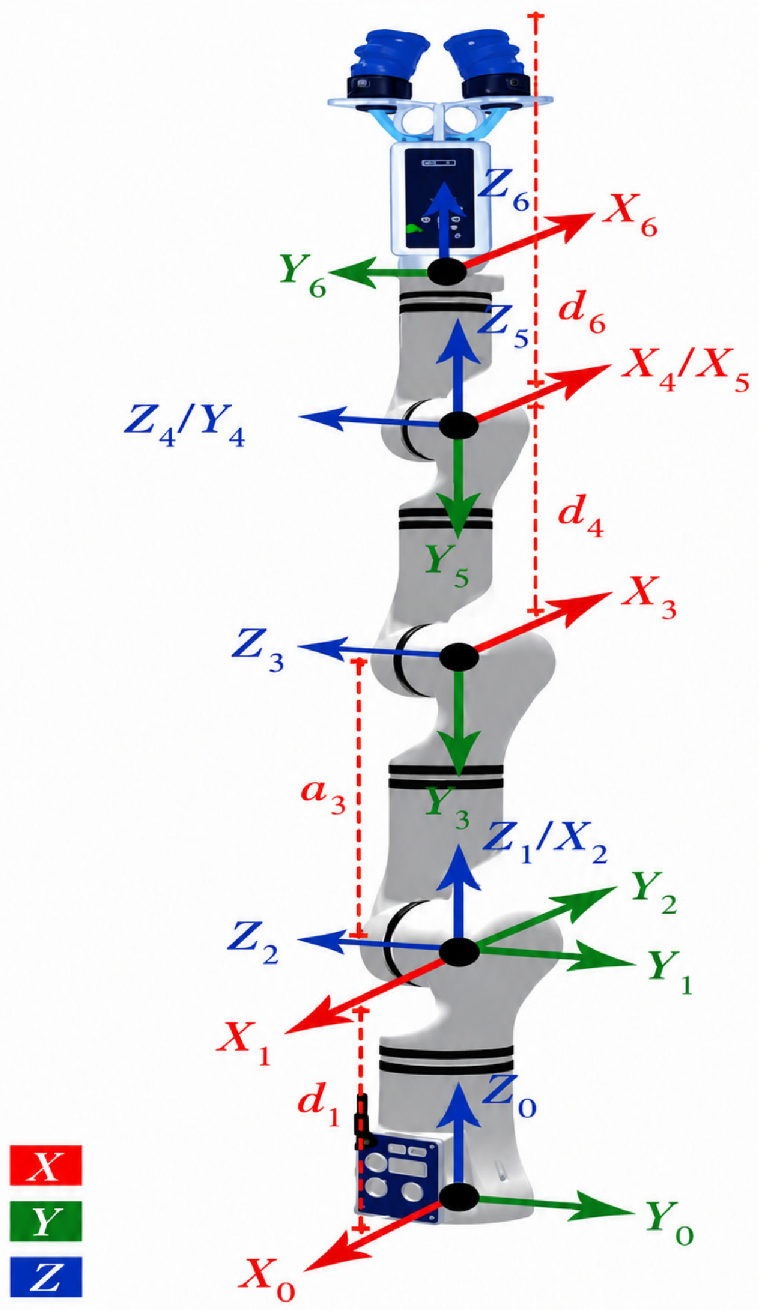
The inverse kinematic model of a manipulator based on the modified DH parameterisation method is employed to resolve the joint rotation angles corresponding to a desired end-effector pose. Transformation matrices and algebraic solution techniques are utilised to derive the inverse kinematic solutions of the manipulator. As inverse kinematic analysis may yield multiple feasible solutions, numerous joint configurations can correspond to an identical end-effector pose. Accordingly, during computational analysis, the solution associated with minimal actuation energy and the smallest joint rotation displacement is selected as the optimal solution. The modified DH parameters of the RM65B robotic arm are listed in Figure 8. And the coordinate system of the modified DH model for the RM65B manipulator is shown in Figure 9.

5.4.3. Research Status of Robotic Arm Path Planning

Trajectory planning for robotic manipulators constitutes a core module in automated harvesting operations. Its principal objective is to generate an optimal or sub-optimal path for the end-effector of an agricultural harvesting manipulator from an initial configuration to a target pose whilst guaranteeing collision avoidance, trajectory continuity, smoothness, and compliance with kinematic and dynamic constraints. Efficient trajectory planning algorithms can elevate the degree of automation and operational efficiency of the harvesting process, enhance overall system performance, and ensure undisturbed manipulator motion, thereby sustaining high harvesting precision [118,119,120]. Algorithms for manipulator path planning are generally categorised into global path planning and local path planning.
Global path planning algorithms rely on complete environmental information of the operational workspace and generate an optimal path from the start point to the target point via specific computational strategies. This represents a high-level planning paradigm focused on identifying a globally reasonable and feasible route, rather than detailed local motion execution. Nevertheless, it exhibits drawbacks, including intensive computational resource consumption and limited adaptability to dynamic environments. By contrast, local path planning algorithms utilise on-board sensors to perceive the working environment of the intelligent agent in real time and acquire the positional and geometric properties of obstacles, thereby enabling efficient obstacle avoidance and dynamic path replanning for the robotic manipulator. Such approaches prioritise the real-time generation of safe and efficient motion trajectories based on instantaneous local environmental data and are distinguished by high real-time performance and strong generalisation capability.
Deep Reinforcement Learning (DRL) [121] integrates the representational capacity of deep learning with the autonomous decision-making ability of reinforcement learning, with the aim of addressing complex sequential decision-making problems. Within this context, the fusion of DRL with manipulator path-planning algorithms presents substantial advantages. DRL enables robotic manipulators to conduct autonomous learning within dynamic or unknown environments, reducing reliance on manual intervention whilst efficiently processing high-dimensional state spaces and complex constraints. Through iterative trial-and-error learning and reward-based optimisation, DRL models continuously refine their control policies, improve execution efficiency and task completion quality, and enhance robustness under noisy or uncertain conditions. Accordingly, this study focuses on the application of DRL to manipulator path planning, with the goal of exploring an efficient algorithmic framework and providing a novel solution for manipulator trajectory generation in unstructured agricultural scenarios.
Global path-planning algorithms are constructed upon pre-existing global map information. Using a known environmental model and predefined task objectives, these algorithms generate an optimal or sub-optimal path for an intelligent agent from the start position to the target position while satisfying relevant constraints. Conventional global path-planning approaches are classified into three categories: greedy-based algorithms, heuristic search algorithms, and graph-based traversal algorithms. In 1956, Edsger proposed Dijkstra’s algorithm, which derives the shortest path to all other nodes via iterative computation. However, when an intelligent agent operates within a complex workspace map containing a large number of nodes, the time complexity of Dijkstra’s algorithm becomes prohibitively high. Furthermore, as a static planning method, it exhibits poor generalisation when the operational workspace undergoes changes.
As a heuristic search algorithm, the A* algorithm [122] combines the global optimality of Dijkstra’s algorithm with the computational efficiency of greedy strategies. Its core advantage resides in the introduction of a heuristic function, which reduces exploratory search time and improves search efficiency while guaranteeing the derivation of an optimal path. During path exploration, the A* algorithm constructs a composite cost function by integrating the actual path cost from the start node to the current node and the heuristic estimated cost from the current node to the target node. This approach not only accounts for accumulated path cost but also incorporates a rational prediction of future travel, effectively guiding the search direction, reducing redundant node expansion, and significantly improving search efficiency. This dual-cost evaluation mechanism enables the algorithm to ensure optimal path planning while reducing the temporal and spatial complexity of the exploration process.
In 1992, Marco Dorigo et al. [123] proposed the Ant Colony Optimisation (ACO) algorithm [124]. This approach demonstrates strong adaptability and robustness, as well as favourable compatibility, and it can be hybridised with other path planning or optimisation algorithms to leverage their respective merits. The Rapidly exploring Random Tree (RRT) algorithm is a sampling-based path planning method. Within the workspace, the algorithm iteratively generates random nodes and connects each new node to the existing tree structure, gradually constructing a random exploration tree. During this procedure, the tree expands outwards from the start point until reaching the target node, ultimately generating a feasible path. Due to its adoption of random sampling, the algorithm can handle high-dimensional states and complex constraints, exhibiting strong adaptability to high-dimensional spaces and complicated environments. However, it may suffer from local optima during the training phase. Global path-planning algorithms depend heavily on complete global map information. In large-scale workspaces, the complexity of global map construction increases substantially, requiring not only multi-sensor data processing but also temporal synchronisation and spatial alignment. These operations result in high computational resource consumption, prolonged processing latency, and reduced planning efficiency, thereby impairing the real-time performance of manipulator path planning.
Compared with global path-planning algorithms, local path-planning methods do not rely on complete map information. Instead, they perform path generation via real-time perception of the surrounding environment, thus displaying stronger adaptability and flexibility in complex and dynamic settings. Representative local path-planning algorithms include the Artificial Potential Field (APF) method and the Dynamic Window Approach (DWA). Wang, H.-C. et al. [125] introduced the artificial potential field algorithm. This method can respond to environmental changes in real time and is suitable for obstacle avoidance in dynamic scenarios. Its advantage lies in relatively simple computation, as it avoids complex search procedures and can rapidly generate local paths. Nevertheless, the algorithm also presents evident limitations. First, the model is prone to becoming trapped in local optima, leading to path-planning failure. Second, in complex environments, the construction of the potential field and parameter tuning are relatively challenging, particularly the precise balancing of attractive and repulsive forces, which restricts its practical performance in complicated scenarios.
In 1997, Dieter Fox, Wolfram Burgard, and Sebastian Thrun proposed the Dynamic Window Approach. Distinct from other path-planning algorithms, DWA originates directly from the dynamic constraints of the agent and is typically employed to handle scenarios where the velocity and acceleration of the robot are bounded [126]. The algorithm mainly comprises two components: the generation of a valid search space and the selection of an optimal solution within that space. Regarding search space constraints, the velocity and acceleration limits of the robot are considered, restricting the search space to a set of trajectories that can be safely attained within a short time window without collision. The optimisation objective is to select a velocity and heading that enable the agent to avoid obstacles while approaching the target with maximum clearance. This algorithm offers high real-time performance and fully accounts for dynamic constraints, thus preventing damage to the manipulator caused by excessive velocity or acceleration and avoiding trajectories that exceed the physical capabilities of the robotic system.
The application of deep reinforcement learning to path planning for agricultural harvesting manipulators has exhibited strong potential within complex unstructured environments. By integrating the perceptual capacity of deep learning with the decision-making ability of reinforcement learning, DRL enables robotic manipulators to autonomously generate optimal paths, avoid obstacles, and efficiently accomplish harvesting tasks in unstructured agricultural settings. Feng et al. [127] addressed the real-time path-planning problem of a citrus-harvesting robot in dynamic unstructured environments. They employed binocular stereo vision to acquire three-dimensional information of citrus fruits and obstacles, virtually reconstructed the harvesting workspace, and proposed an SBL-PRM algorithm combining single-query planning, bidirectional sampling, delayed collision detection, and the Probabilistic Roadmap Method. This algorithm demonstrated high feasibility and efficacy for manipulator path planning in dynamic unstructured agricultural environments.
In 2021, Ye et al. [118] tackled the problem of potential collisions between harvesting robots and tree branches. They proposed an improved adaptive weighted particle-swarm-optimisation algorithm to solve the inverse kinematics of the manipulator. To overcome the randomness and slow convergence of the Bi-RRT algorithm in high-dimensional spaces, they introduced the concept of target gravity and an adaptive coefficient adjustment strategy, thereby improving the grasping success rate of the end-effector. In 2025, Ochoa et al. [128] focused on the complex harvesting environment, intensive training burden, and poor stability caused by the irregular distribution of green walnuts, branches, and other obstacles. Yamamoto et al. [129] developed a harvesting end-effector for elevated-cultivation strawberries that approaches the target fruit from below. Inspired by manual harvesting, the device separates the fruit by combining tilting and pulling motions. Experimental results showed an approach success rate of over 97% and a fruit-detachment success rate of over 92%. However, approximately 30% of the harvested fruits were damaged, and 23% of the harvesting attempts resulted in the simultaneous removal of non-target fruits. These findings indicate that further improvements are needed in compliant contact, force control, and the selective harvesting of clustered fruits. In 2015, Juang et al. [130] proposed an algorithm combining Long Short-Term Memory (LSTM) networks with Proximal Policy Optimisation (PPO), termed the LSTM-PPO algorithm. The algorithm was validated in both static and dynamic environments, and the results revealed significant improvements in task completion time and manipulator grasping efficiency [131].

5.4.4. End-Effector

The end-effector represents a critical component that enables strawberry-harvesting robots to execute picking operations, and its design directly influences harvesting efficiency, fruit damage rate, and overall system performance [132]. Driven by the rapid advancement of agricultural mechanisation and intelligent technologies, researchers have continuously explored innovative end-effector designs to satisfy the specialised requirements of strawberry harvesting.
Considering the biological and physical characteristics of strawberries, several key criteria must be fulfilled in the design of a high-performance harvesting end-effector [133,134,135,136]. First, gentle manipulation must be ensured, since strawberry fruits are highly fragile and susceptible to mechanical damage; surface bruising must be minimised during harvesting. Second, the end-effector should demonstrate strong adaptability to grasp strawberries of varying sizes, shapes, and masses. Third, high precision is required to enable accurate positioning and picking within complex cultivation environments. Finally, durability is essential, as the end-effector must operate reliably over extended periods in dusty and humid agricultural conditions. Currently, end-effectors deployed in strawberry harvesting can be primarily categorised into bionic gripper-type, vacuum suction-type, pneumatic grasping mechanisms, press–suction hybrid end-effectors, and modular multifunctional end-effectors.
The bionic gripper-type end-effector is inspired by the dexterous manipulation capability of the human hand. It mimics the articulation of human digits and grasps strawberries via the opening and closing of multiple flexible or rigid fingers [137]. This configuration enables precise fruit grasping and prevents surface damage through adjustable gripping force. Simultaneously, variable aperture control facilitates adaptation to strawberries of diverse dimensions and geometries. However, this category of end-effector requires coordinated control of multiple joints, resulting in relatively high cost and operational complexity.
A research team from China Agricultural University developed a dual-arm strawberry-harvesting robotic system for ridge cultivation. Considering the low resistance of the tissue junction between the strawberry calyx and peduncle to tangential torque, as well as the fragility of the fruit flesh, the end-effector employs a flexible three-finger gripper actuated by a pneumatic pump. The device comprises a pneumatic actuation unit, three silicone soft fingers, finger sleeves, finger mounts, a base flange, and a three-way pneumatic circuit. The pneumatic pump delivers positive or negative pressure to each flexible finger via the three-way tube, inducing controllable deformation and enabling compliant enveloping or release of the fruit. Through precise pressure regulation, controlled separation at the calyx–peduncle junction is achieved while preserving fruit integrity, thereby realising nondestructive harvesting [138,139].
In collaboration with Jiangsu University, China Agricultural University proposed an innovative nondestructive strawberry-harvesting end-effector designed primarily for rapid peduncle cutting and retention. The mechanical architecture of the end-effector is illustrated in Figure 10. The primary load-bearing components, including the base and motor mount, are manufactured from aluminium alloy, whereas the fingertips, spatial cam, and manipulator connectors are fabricated from nylon via 3D printing.
The end-effector incorporates three principal innovations.
First, it utilises hand–eye servo control to enable target approach and cutting. A USB camera (Jieruiweitong DF500, Jieruiweitong Inc., Shenzhen, China; resolution: 640 × 480) mounted at the palm section detects and aligns with the target strawberry, guiding the end-effector via closed-loop servo control. A pair of laser through-beam sensors is integrated into the fingertips, with one emitter and one receiver. Surgical blades are mounted on the fingertips, and peduncle cutting is executed upon fingertip closure.
Second, mechanical energy storage is employed to actuate fingertip opening and closing. A micro-DC brushed motor (Lingkong, Shanghai, China) drives the rotation of the spatial cam. A pair of metal strikers and contact plates form a simple and reliable position-sensing mechanism, regulating the maximum opening stroke. When the spatial cam rotates to its extreme position, the controller GPIO detects a high-level signal and halts rotation. At this stage, the dual spring steel plates remain in a deformed, energy-stored state. When the peduncle interrupts the fingertip laser sensor, the spatial cam rotates, and its profile retracts, allowing the spring steel plates to rapidly close the fingertips.
Third, the fingertips are equipped with a collision protection mechanism. During forward extension to grasp fruit, the end-effector may collide with ridge walls due to visual localisation errors or joint control deviations. Accordingly, a collision protection system was implemented to prevent impact damage. When an external force is applied to the fingertip front, the slider retracts and triggers a collision signal, providing instantaneous feedback of impact loads.
Vacuum suction cup-type end-effectors grasp strawberry fruits by generating negative pressure via pneumatic or electric vacuum pumps. This category of end-effector presents several advantages: vacuum suction does not induce mechanical damage to the strawberry epidermis, and its design and manufacturing processes are relatively simple, facilitating ease of maintenance. Furthermore, it offers high operational efficiency and can execute grasping actions rapidly, rendering it suitable for large-scale harvesting operations. Nevertheless, such end-effectors are highly dependent on the surface characteristics of strawberries. They are primarily applicable to fruits with smooth and relatively flat surfaces and encounter difficulties when grasping strawberries of irregular morphology or rough texture. They are also susceptible to environmental interference; under dusty or humid conditions, the effectiveness of vacuum adsorption may decline. The German Aerospace Center (DLR) developed a vacuum suction cup-based strawberry-harvesting end-effector, known as the DLR Flexible Agricultural Harvesting End-Effector. It mainly comprises a central vacuum suction cup for adsorbing the strawberry fruit, peripheral flexible grippers for auxiliary positioning and peduncle stabilisation, and a micro-cutter for peduncle severance. This system exhibited favourable performance in elevated cultivation environments, achieving a harvesting efficiency of 1500 strawberries per hour while maintaining a damage rate below 2% [140]. Figure 11 presents the three-dimensional assembly drawing and partial cross-sectional views of the novel non-destructive harvesting end-effector for strawberries.
Pneumatic grasping mechanisms exploit the characteristics of pneumatic actuation and employ pneumatic actuators, such as cylinders or air bladders, to grasp strawberries. Such devices can respond rapidly and accomplish harvesting motions efficiently. Pneumatic actuation is distinguished by fast response and high-frequency operation. Pneumatic components are generally lightweight and well suited to mobile robotic platforms, and pneumatic systems maintain relatively high reliability during prolonged operation. However, pneumatic grasping mechanisms require dedicated pneumatic control systems, which increase overall system complexity and cost. Moreover, pneumatic actuation necessitates a compressed air supply, resulting in relatively elevated energy consumption. A research team from Wageningen University in the Netherlands developed a strawberry-harvesting robot utilising a pneumatic grasping mechanism. Experimental results indicated that the system achieved comparatively high harvesting efficiency, reaching 1200 strawberries per hour, and could perform precise operations under complex illumination conditions.
Press-and-suction hybrid end-effectors combine mechanical pressing and vacuum suction. Specifically, the robotic arm initially applies gentle pressure to stabilise the strawberry, after which the vacuum suction cup completes the grasping operation. By integrating pressing and suction functions, this type of end-effector can ensure fruit stability during harvesting and is adaptable to strawberries of varying sizes and shapes. Through precise force control, fruit damage can be effectively reduced.
Modular multifunctional end-effectors achieve diverse strawberry-harvesting strategies by replacing or combining different functional modules, such as grippers and suction cups. This design can adapt to various harvesting requirements and enhance robotic flexibility. Through modular architecture, it can be deployed across a range of harvesting tasks. In the event of individual module failure, rapid replacement is feasible without disrupting the entire system. In addition, the system offers strong expandability, as new functional modules can be integrated according to practical requirements to improve robotic performance. However, the overall system cost may correspondingly increase. In this context, a research team from the University of California, Berkeley developed a strawberry-harvesting robot based on a modular multifunctional end-effector. By exchanging different grasping modules, the system was capable of completing harvesting tasks for multiple fruit types and demonstrated high efficiency and flexibility in experimental trials [141,142].

5.4.5. Visual Recognition Technology

Visual recognition represents a core technology that enables strawberry-harvesting robots to conduct precise manipulation, and a wide range of visual recognition techniques have been developed accordingly.
Image processing based on RGB cameras employs colour imaging devices to capture strawberry images and extracts positional and morphological features using image processing algorithms, including edge detection and threshold segmentation. This approach offers the merits of low cost and straightforward implementation; however, it is heavily influenced by illumination conditions and struggles to deliver accurate recognition under complex backgrounds. Three-dimensional vision based on depth cameras acquires spatial information of strawberries and fuses it with RGB imagery to achieve more accurate localisation and dimension measurement. This method provides rich depth data and improves positioning precision, yet the equipment cost is relatively high, and it still imposes certain requirements on ambient lighting. Multispectral imaging technology obtains multi-dimensional image information of strawberries using light sources of different wavelengths, such as visible and infrared light, and analyses the colour, shape, and maturity level via dedicated algorithms. This method can supply richer feature information and enhance recognition accuracy, although the system is complex and costly. LiDAR-based point-cloud processing scans the strawberry surroundings by emitting laser beams, acquires high-precision three-dimensional point-cloud data, and applies point-cloud processing algorithms for strawberry localisation and recognition. This method delivers high spatial resolution and can accurately capture the three-dimensional structure of strawberries; nevertheless, the equipment is expensive and sensitive to environmental conditions [143,144,145].
Among visual recognition algorithms, traditional image processing algorithms generally commence with edge detection, in which strawberry contours are extracted using Sobel filters or the Canny edge-detection algorithm. Threshold segmentation is then performed based on colour features, for instance, in the HSV colour space, to separate the target region. Finally, morphological operations, including erosion and dilation, are applied to remove noise and optimise the shape features of strawberries.
Deep-learning-based object-detection algorithms have also been widely deployed. YOLO (You Only Look Once) exhibits high real-time performance and is suitable for application scenarios demanding rapid response. Faster R-CNN provides relatively high detection accuracy and is appropriate for tasks with stringent recognition precision requirements. Mask R-CNN can not only detect target positions but also perform instance segmentation, thereby obtaining the precise contours of strawberries.
The YOLOv10 model was proposed by a research team from Tsinghua University in May 2024. In preceding YOLO-series algorithms, Task-Aligned Learning (TAL) was commonly used to assign multiple positive samples to each instance, thus achieving higher detection accuracy. However, this approach requires Non-Maximum Suppression (NMS) as a post-processing step, which slows down inference. The Tsinghua University team optimised the model post-processing pipeline. The authors of YOLOv10 introduced dual label assignment: the one-to-many assignment branch retains NMS, whereas the one-to-one assignment branch may yield relatively weak supervision. Accordingly, a one-to-one detection head was added to YOLO. This head preserves the same structure and optimisation objective as the original one-to-many branch but adopts one-to-one matching for label assignment. During training, both heads are jointly optimised with the model. During inference, only one-to-one predictions are used. This allows YOLO to operate without an NMS module, thereby maximising inference speed.
To reduce computational cost and parameter count, the authors proposed Spatial–Channel Decoupled Downsampling (SCDown), which decouples spatial reduction and channel expansion to realise more efficient downsampling [146]. Specifically, a 1 × 1 pointwise convolution is first used to adjust the number of channels, followed by a 3 × 3 depthwise convolution for spatial downsampling, thus minimising computational overhead while retaining information to the greatest extent. In addition, the C2fCIB structure was introduced, in which the bottleneck modules in the YOLOv8 C2f module are replaced by Compact Inverted Blocks (CIBs). The CIB replaces standard convolution in the bottleneck with depthwise convolution and pointwise convolution.The hybrid network modules constructed by CIB and MHSA-FEV attention are shown in Figure 12. The dual label matching strategy adopted by the improved YOLOv10 detection model is presented in Figure 13.
The authors also proposed an efficient Partial Self-Attention (PSA) module. In the 1 × 1 convolution, features are evenly divided into two parts along the channel dimension. Only one part is fed into a module comprising a Multi-Head Self-Attention (MHSA) module and a Feed-Forward Network (FFN). The two parts are then concatenated and fused via another 1 × 1 convolution. Furthermore, the authors set the dimensions of the query and key to half of the value dimension in MHSA and replaced LayerNorm with BatchNorm to accelerate inference. In addition, PSA is placed only after the fourth stage with the lowest resolution to avoid high computational complexity caused by repeated self-attention operations.
Region-based segmentation algorithms used in strawberry-harvesting robots include region tree-based methods, U-Net, and their extended variants. Region tree-based approaches, which can be implemented within deep-learning frameworks such as Caffe, segment images by constructing hierarchical decision structures according to regional similarity, boundary information, and contextual features. These methods are suitable for distinguishing strawberries from complex backgrounds containing leaves, stems, soil, support structures, and neighbouring fruits. Their hierarchical representation can preserve regional consistency and reduce fragmented segmentation results. However, region tree construction often involves relatively complex feature engineering and iterative computation, which may restrict real-time performance when the harvesting robot is moving or when multiple fruits must be processed simultaneously. In addition, their performance may deteriorate when the colour and texture contrast between strawberries and the surrounding foliage is weak.
U-Net, originally developed for medical image segmentation, has also been widely adapted for pixel-level strawberry segmentation because its encoder–decoder architecture combines high-level semantic information with low-level spatial details through skip connections [147,148,149]. This characteristic is particularly valuable for strawberry-harvesting robots, as accurate fruit boundaries are required to estimate fruit size, determine graspable regions, and avoid contact with adjacent unripe fruit or leaves. Compared with region tree-based methods, U-Net generally provides stronger feature-learning capability and greater robustness to complex illumination, irregular fruit shapes, and partial occlusion. Nevertheless, standard U-Net may have difficulty distinguishing densely overlapping strawberries or accurately segmenting thin peduncles because repeated downsampling can remove fine structural information. Its computational and memory requirements are also higher than those of conventional image-processing methods, which may limit deployment on resource-constrained onboard processors. Lightweight encoders, attention modules, or edge-aware loss functions can alleviate these limitations, but they further increase model-design and training complexity.
Classification algorithms based on colour and shape features primarily include colour histogram matching and geometric shape analysis. Colour histogram-matching estimates strawberry maturity by statistically analysing the distribution of pixel values in different colour spaces. In practical harvesting systems, this information can be used to distinguish ripe red strawberries from immature green or partially coloured fruit and to prevent premature picking. Compared with deep-learning approaches, colour-based methods are computationally inexpensive, transparent, and straightforward to implement on embedded platforms. However, their reliability is strongly influenced by sunlight variation, greenhouse reflections, shadows, camera exposure, and cultivar-specific colour differences. A threshold calibrated under one cultivation condition may therefore perform poorly in another environment.
Shape analysis uses geometric descriptors, including circularity, area, aspect ratio, and contour characteristics, to support the identification of strawberry position, orientation, and morphology. Such features can assist the robot in excluding irregular objects and estimating appropriate grasping points. Shape-based methods are also relatively efficient and require limited training data. Nevertheless, strawberries exhibit substantial natural variation in size and form, while occlusion by leaves or neighbouring fruit can distort their visible contours. Consequently, shape descriptors are more suitable as complementary cues than as independent recognition criteria. In comparison with colour-only or shape-only approaches, the joint use of colour, texture, and geometry can improve recognition robustness, although handcrafted features remain less adaptable than learned representations when environmental conditions change substantially.
Deep-learning object-detection algorithms, such as YOLO and Faster R-CNN, provide an alternative to conventional feature-based recognition. YOLO performs object localisation and classification in a single-stage framework and is therefore well suited to the real-time requirements of strawberry-harvesting robots. Its high inference speed enables continuous fruit detection during chassis motion, robotic-arm positioning and visual-servoing operations. However, YOLO may be less accurate for small, heavily occluded, or densely clustered strawberries, especially when the fruit occupies only a limited number of pixels. Faster R-CNN employs a two-stage detection strategy and generally provides higher localisation accuracy and stronger performance for small targets. This makes it useful for precise fruit detection and offline performance evaluation. Its lower inference speed and greater computational demand, however, may restrict its use in real-time onboard systems. Thus, YOLO is more appropriate when harvesting speed is prioritised, whereas Faster R-CNN may be advantageous when localisation accuracy is more important than processing latency.
It should also be noted that bounding-box detection alone is often insufficient for autonomous harvesting. A rectangular detection result cannot accurately represent the irregular visible contour of a strawberry or distinguish the fruit from overlapping leaves within the same box. Instance-segmentation methods, such as Mask R-CNN, can provide both fruit-level localisation and pixel-level masks, making them more suitable for estimating grasping regions and avoiding collisions. Nevertheless, they require more computational resources and more labour-intensive pixel-level annotations. Semantic segmentation methods such as U-Net are efficient for separating strawberry pixels from the background, but they may merge adjacent fruits into a single region. Instance segmentation offers better separation of individual fruits, although at the cost of increased model complexity. The selection between object detection, semantic segmentation, and instance segmentation should therefore depend on the required manipulation precision and available computing resources.
Algorithms based on multimodal data fusion have been developed to address the limitations of single-sensor visual recognition. By integrating RGB images with depth, spectral, thermal, or force-related information, these approaches can obtain complementary cues regarding fruit appearance, three-dimensional position and maturity. For example, RGB data provide colour and texture information, whereas depth data enable the harvesting robot to estimate the distance between the camera, fruit, and surrounding obstacles. Multitask learning can simultaneously perform fruit detection, maturity classification, segmentation, and peduncle localisation, thereby sharing visual features across related tasks and improving overall recognition efficiency. Attention mechanisms can further enhance model performance by adaptively emphasising strawberry regions and suppressing irrelevant background features, thereby improving the extraction of fine-grained characteristics.
Compared with single-task networks, multitask models reduce repeated feature computation and may improve generalisation by learning complementary representations. However, the optimisation objectives of different tasks may conflict. A feature representation beneficial for maturity classification may not necessarily be optimal for precise boundary segmentation or peduncle detection. Improper weighting of task losses can therefore reduce the performance of one or more subtasks. Similarly, attention mechanisms can improve recognition under foliage occlusion and background clutter, but they do not guarantee correct feature selection. When the training dataset contains biased backgrounds or insufficient occlusion examples, the attention module may emphasise irrelevant regions. Moreover, multimodal fusion increases sensor cost, calibration requirements, and data-synchronisation complexity. Depth cameras, for instance, may produce missing or noisy measurements on reflective fruit surfaces or under strong outdoor illumination. Multimodal systems are consequently more robust in principle, but their practical benefit depends on accurate cross-sensor calibration and reliable field operation.
The visual-recognition workflow of a strawberry-harvesting robot generally begins with image acquisition. RGB cameras, depth cameras, or multispectral imaging devices are used to capture fruit appearance and spatial information. RGB cameras are inexpensive and provide high-resolution texture and colour data, making them suitable for fruit detection and maturity assessment. However, they cannot directly recover absolute depth and are sensitive to illumination variation. Stereo or RGB-D cameras provide three-dimensional information required for robotic-arm trajectory planning, but their depth accuracy may decline at close range, under sunlight, or in scenes with weak texture. Multispectral imaging can improve maturity and disease assessment by capturing information beyond visible wavelengths, although such devices are more expensive and generally have lower spatial resolution and slower acquisition rates. Therefore, RGB-D sensing provides a practical compromise for many strawberry-harvesting systems, whereas multispectral imaging is more appropriate when detailed quality assessment is required.
After acquisition, preprocessing operations such as denoising, brightness adjustment, colour correction, and image registration are performed to improve data quality. Conventional preprocessing can reduce sensor noise and compensate for moderate illumination changes, but excessive filtering may remove fruit boundaries, peduncles, or other fine structures required for harvesting. Moreover, manually designed enhancement parameters may not generalise across greenhouses, open fields, and different times of day. Learning-based enhancement methods can adapt more effectively to complex conditions, but they introduce additional computational costs and may generate artificial visual features that negatively affect downstream recognition. For this reason, preprocessing should be limited to operations that improve image stability without altering biologically meaningful characteristics.
Feature extraction is subsequently conducted through edge detection, colour segmentation, handcrafted descriptors, or deep neural networks. Edge detection and colour thresholding offer high processing speed and clear interpretability, making them appropriate for controlled greenhouse environments with stable lighting and simple backgrounds. However, they are highly vulnerable to weak contrast, shadowing, and occlusion. Deep neural networks automatically learn more discriminative features and generally achieve superior robustness under variable field conditions. Their disadvantages include dependence on large labelled datasets, high computational requirements, and limited interpretability. In commercial harvesting systems, lightweight deep networks combined with simple colour or geometric constraints may provide a more balanced solution than either purely conventional or fully data-driven methods.
Target localisation and recognition are then performed to determine the position, maturity, and pickability of individual strawberries. Object detection algorithms such as YOLO or Faster R-CNN can locate candidate fruit, while segmentation networks refine fruit boundaries and depth information is used to recover three-dimensional coordinates. Pickability assessment should not rely solely on fruit maturity; it should also consider occlusion level, peduncle visibility, neighbouring obstacles, and robotic-arm accessibility. A visually ripe strawberry may still be unsuitable for immediate harvesting if its peduncle is hidden or if the approach path is blocked. Therefore, perception outputs should be linked to task-planning criteria rather than treated as independent classification results.
Finally, the recognised fruit position and structural information are transformed from the camera coordinate system into the robot coordinate system to support robotic-arm trajectory planning [150,151,152]. The robot must select an accessible target, determine a collision-free approach direction, and coordinate the end-effector with the estimated fruit or peduncle position. Open-loop motion based on a single visual measurement is computationally simple but is vulnerable to calibration errors, chassis vibration, leaf movement, and fruit displacement. In contrast, closed-loop visual serving continuously updates the target position during manipulator motion and can improve harvesting accuracy. However, it requires higher image-processing speed and low communication latency. For strawberry-harvesting robots operating in unstructured environments, a hybrid strategy is preferable: initial three-dimensional detection is used for global approach planning, while close-range visual feedback is used to correct the final grasping or cutting pose.
Overall, no individual recognition method is universally optimal for strawberry-harvesting robots. Traditional colour and shape methods are efficient and interpretable but lack robustness under variable field conditions. Region tree-based segmentation preserves regional consistency but may be computationally inefficient. U-Net provides accurate pixel-level segmentation but may merge touching fruit and impose considerable processing demands. YOLO supports high-speed detection, whereas Faster R-CNN generally offers higher accuracy at the expense of inference speed. Instance segmentation provides more detailed manipulation information but requires substantial computational resources and annotation effort. Multimodal fusion and attention mechanisms can improve robustness, although they increase system complexity, cost, and calibration requirements. A practical visual system should therefore combine lightweight deep-learning detection, precise local segmentation, depth-based three-dimensional localization, and closed-loop visual correction. Such a hybrid architecture offers a more effective balance among recognition accuracy, processing speed, hardware cost, and operational reliability in autonomous strawberry harvesting.

5.4.6. Multispectral Imaging Technology

Integrating multispectral information can enhance the evaluation of strawberry ripeness and physiological condition, thereby optimising harvesting strategies [153,154]. A multispectral imaging system is employed to capture strawberry image data. Following the acquisition of RGB images, morphological feature datasets are extracted, including area, length, width, aspect ratio, compactness/roundness, and shape parameters such as BetaShape, colour parameters, saturation, and hue. Subsequently, spectral feature datasets are exported from the “Statistic” module, comprising the mean reflectance values across 19 spectral bands calculated from strawberry image pixels.
In the construction of spectral data models, research trends are gradually shifting from traditional machine-learning methods, including partial least-squares regression (PLSR) and support vector machines (SVMs), towards deep-learning approaches. Machine-learning methods exhibit strong performance in modelling linear and weakly nonlinear relationships and possess a well-established theoretical foundation. By contrast, deep-learning models can autonomously learn deep abstract features when processing spectral imagery and complex nonlinear problems. They can effectively fuse spectral and spatial information and have demonstrated distinctive advantages in hyperspectral data processing [155]. The application of transfer learning has also significantly accelerated the development of task-specific deep-learning models. Quality-evaluation tasks, such as strawberry ripeness assessment, can be effectively supported by such frameworks.
Since near-infrared spectral data, particularly hyperspectral data, are characterised by high dimensionality, information redundancy, and multicollinearity, and they are readily influenced by physical effects, including light scattering and baseline drift, efficient data preprocessing and modelling are indispensable. Feature wavelength selection is critical for reducing model complexity, improving computational efficiency, and enhancing model robustness. It is also highly significant for the development of low-cost, high-efficiency multispectral imaging inspection systems. Common feature-selection strategies include competitive adaptive reweighted sampling (CARS), successive projections algorithm (SPA), and uninformative variable elimination (UVE). These methods have been successfully applied to the quality assessment of diverse agricultural commodities [156,157,158].

5.4.7. Path Planning and Obstacle Avoidance Algorithms

Path-planning and obstacle-avoidance algorithms underpin the efficient and reliable operation of agricultural robots in complex field environments. Numerous studies have explored path-planning strategies for intelligent agricultural robotic systems [159]. Existing comparative experiments demonstrate that coverage path planning exhibits lower operational efficiency than point-to-point navigation in precision farming contexts, where point-to-point navigation achieves superior task accuracy and minimises redundant path travelling.
Indoor greenhouse environments feature narrow inter-row crop passages and limited turning space, creating substantial safety challenges for robotic movement. In outdoor field scenarios, complex terrain and irregular crop distributions further complicate robot navigation. Such diverse agricultural environments hinder accurate discrimination between traversable and impassable areas, thereby demanding sophisticated path planning and dynamic obstacle avoidance functions to avoid collisions with crops and farming facilities. This study adopts a dynamic genetic algorithm–ant colony optimisation (DGA-ACO) framework to address the obstacle-avoidance difficulties of agricultural robots in confined indoor and outdoor agricultural scenarios [160,161]. The proposed method supports dynamic obstacle prediction during global path searching and delivers effective global avoidance performance. Meanwhile, the optimised paths generated by the DGA-ACO algorithm are characterised by shorter distance, smoother trajectories, and lower energy consumption.
The overall workflow of the proposed DGA-ACO algorithm is presented in Figure 14, which comprises three key procedures: refined environment modelling tailored to agricultural scenarios, targeted improvement of the original GA-ACO algorithm for agricultural navigation tasks, and post-processing correction of unsafe nodes on the planned paths.
Path planning describes the process of generating a continuous collision-free trajectory for a robot from a start point to a target point within known or unknown environments. For strawberry-harvesting robots, path planning aims to generate an efficient and safe travelling route that allows the robot to accurately reach fruit positions and complete harvesting operations. Figure 15 shows the strawberry harvesting robot moving inside the greenhouse operating environment.
Traditional path-planning approaches can be categorised into four mainstream types. Firstly, grid-map-based methods discretise the working environment into uniform grid units, where each grid cell is defined as either traversable or non-traversable. Classical search algorithms, including A* and Dijkstra’s algorithms, are utilised to explore the optimal shortest path within the grid space. Such methods feature simple implementation and excellent adaptability to static scenarios; nevertheless, they exhibit limited performance in dynamic environments and rely heavily on the accuracy of pre-established maps. Secondly, free-space-based methods model the environment as continuous free regions and obstacle regions, adopting geometric strategies such as Voronoi diagrams and configuration space theory for path generation. These approaches adapt well to complex and dynamic surroundings but suffer from high computational complexity and relatively low practicability in real-time deployment. Thirdly, sampling-based algorithms, represented by the rapidly exploring random tree (RRT) and its improved variants (RRT*, BIT*), construct tree-based topological structures through random sampling to iteratively explore feasible space and obtain collision-free paths [162,163]. Such methods are applicable to high-dimensional and complex environments and possess favourable compatibility with dynamic obstacle avoidance. Fourthly, deep-learning-based methods adopt convolutional neural networks (CNNs) and other deep-learning architectures to extract environmental features and predict optimal trajectories end-to-end. These methods demonstrate superior performance in unstructured, complex, and dynamically changing scenarios.
Obstacle-avoidance algorithms act as a real-time supplementary module to global path planning, enabling robots to detect unexpected obstacles and dynamically adjust their moving direction and velocity during operation, which is essential for reliable navigation in dynamic agricultural environments.
Obstacle-avoidance techniques can also be classified into four categories. Sensor-based methods rely on real-time data collected from LiDAR, ultrasonic sensors, and infrared sensors to perceive surrounding obstacles and adjust robot motion states. These methods deliver high real-time responsiveness for dynamic scenarios but are restricted by sensor precision and detection coverage. Vision-based methods acquire environmental images via cameras and implement obstacle detection and avoidance trajectory planning through object detection and depth-estimation algorithms [164], providing abundant scene information for complex agricultural environments. Kinematic-model-based methods predict potential collision risks according to the robot’s kinematic constraints, including velocity and acceleration limitations, and adjust motion parameters in advance. Such methods achieve high computational efficiency and perform stably in known environments. Reinforcement-learning-based methods train robots to acquire adaptive obstacle avoidance strategies via deep-reinforcement-learning frameworks, enabling autonomous decision-making in unknown environments. However, these approaches require substantial training datasets and computational resources, resulting in time-consuming training procedures.
Aiming at the navigation requirements of ridge-cultivated strawberry-harvesting scenarios, the dual-arm harvesting robot developed by China Agricultural University adopts a hybrid path-planning strategy combining the RRT* algorithm with B-spline interpolation. The proposed method optimises key path nodes, suppresses robotic vibration during movement, and achieves smooth and continuous trajectory connection for harvesting operations.

5.4.8. Software System Control

Advanced software control solutions, including modular system design, edge computing, and multi-robot collaboration, can substantially improve the intelligence, reliability, and operational efficiency of strawberry-harvesting robots. Compared with the harvesting of larger and mechanically more robust fruits, strawberry harvesting places stricter demands on perception accuracy, manipulation precision, and system response speed. Strawberries are typically distributed close to the ground and are frequently occluded by leaves, stems, and neighbouring fruits. Their soft and easily bruised surfaces, together with the small and deformable peduncles, require the robot to coordinate visual perception, manipulator motion, and end-effector operation with low latency and high precision. Therefore, the software architecture must not only support functional integration but also accommodate rapid algorithm updates, sensor replacement, and adaptation to different cultivation systems.
Modular design enables each functional unit to operate and be maintained independently, facilitating system diagnosis, iterative upgrading, and component replacement while improving overall reliability and environmental adaptability. The strawberry-harvesting robot adopted in this study employs fully modular architecture comprising four core functional subsystems: the mobile chassis platform, robotic arm, end-effector, and vision perception system. Standardised mechanical interfaces, unified electrical buses, and hierarchical control-logic-support efficient module decoupling and rapid system integration. For example, the vision module can be upgraded from conventional RGB sensing to RGB-D or multispectral sensing without substantially modifying the manipulator controller, while different end-effectors can be installed to accommodate cutting, suction, or soft-grasping strategies. This flexibility is particularly important for strawberry harvesting because differences in cultivar, fruit maturity, planting density, and cultivation mode may require frequent adjustment of the perception and picking mechanisms.
Compared with a highly integrated or monolithic design, the modular architecture provides greater maintainability, scalability, and fault isolation. A failure in the end-effector or perception module can be diagnosed and repaired without redesigning the complete robotic system. However, modularity also introduces additional communication interfaces, coordinate transformations, and synchronisation requirements. Excessive module decoupling may increase system latency and integration complexity, particularly when high-frequency visual feedback is required during peduncle localisation and collision avoidance. Monolithic control systems may achieve lower communication overhead and more deterministic execution, but they are generally less flexible and more difficult to upgrade. Consequently, a modular architecture is more suitable for experimental and multi-scenario strawberry-harvesting platforms, whereas tightly integrated controllers may remain advantageous for mature, single-purpose commercial machines operating under highly standardised conditions.
The entire control architecture is established on the Robot Operating System (ROS) using a hierarchical control structure, in which each functional module operates as an independent ROS node. Data interaction and coordinated manipulation among nodes are realised through standard publish–subscribe mechanisms, service interfaces, and action protocols. Specifically, the vision node continuously publishes strawberry detection results, maturity information, peduncle positions, and three-dimensional spatial coordinates. The robotic-arm control node subscribes to this environmental perception information, performs target selection, inverse-kinematics calculation, and smooth trajectory planning, and, subsequently, it outputs joint commands to the underlying drive node. During close-range picking, updated visual information can also be used to compensate for localisation errors caused by leaf movement, chassis vibration, or fruit displacement.
The end-effector node receives grasping, peduncle-cutting, and release commands through ROS service or action interfaces and returns execution feedback after completing each operation. Such feedback may include gripper status, cutting completion, force information, and fruit-presence detection. Meanwhile, the mobile-platform node subscribes to navigation and motion-control topics to achieve precise chassis positioning, stable path tracking, and alignment with strawberry cultivation rows [165,166,167]. All modules exchange data through standardised ROS message formats, thereby improving information consistency, software reusability, and system integration efficiency.
ROS offers significant advantages for strawberry-harvesting research because of its open-source ecosystem, extensive hardware support, and abundant libraries for perception, motion planning, and navigation. It also enables rapid prototyping and convenient replacement of algorithms. Nevertheless, conventional ROS communication does not inherently guarantee hard real-time performance. Network congestion, node scheduling delays, or message loss may adversely affect time-sensitive operations, such as visual serving and end-effector closure. In contrast, dedicated real-time controllers or programmable logic controller-based systems provide more deterministic timing and stronger industrial robustness, but they offer lower algorithmic flexibility and typically require greater development effort. A practical solution is therefore to combine ROS-based high-level task planning and perception with real-time embedded control at the actuator level. In this hybrid architecture, ROS manages target recognition, task scheduling, and trajectory generation, whereas motor control, force regulation, and emergency protection are executed locally at high frequency.
Edge–cloud collaborative computing represents a system-level optimisation approach for balancing real-time response requirements and onboard computational capacity; however, it cannot be universally applied to all strawberry-harvesting scenarios [168]. High-resolution fruit detection, instance segmentation, peduncle recognition, and three-dimensional reconstruction may impose substantial computational loads on onboard processors. By offloading selected perception or optimisation tasks to nearby edge servers, a robot can employ more complex deep-learning models without carrying high-power computing hardware. Zahedi developed the E5SH system integrated with a dedicated 5G private network and edge-server clusters. The system increased the device-processing frame rate from 0.46 fps to 8.6 fps, and its network architecture is illustrated in Figure 16 [169].
Despite these improvements, edge–cloud collaboration has several limitations in strawberry production environments. Its deployment requires additional communication infrastructure, edge servers, and network-maintenance resources, resulting in high initial and operational costs. Wireless communication may also be affected by greenhouse structures, dense foliage, terrain variations, and interference from agricultural equipment. Network delays or temporary disconnection can interrupt target localisation and motion planning, thereby reducing harvesting stability. This limitation is especially critical during the final approach to a strawberry, when delays of even a short duration may cause the end-effector to miss the peduncle or collide with the fruit.
Compared with cloud-only computing, edge computing provides lower latency, reduced bandwidth consumption, and improved data privacy because information is processed closer to the robot. However, edge servers still create dependence on external infrastructure. Fully onboard computing offers the highest level of operational autonomy and is more appropriate for remote fields or poorly connected greenhouses, although its computational performance is constrained by power consumption, heat dissipation, payload, and cost. Therefore, safety-critical functions, including obstacle avoidance, emergency stopping, final fruit localization, and end-effector control, should remain onboard. Computationally intensive but non-critical functions, such as model updating, global task optimization, and long-term yield analysis, may be assigned to edge or cloud platforms. Such selective task allocation is more robust than the complete offloading of perception and control processes.
Multi-robot collaboration can further improve the harvesting capacity of large-scale strawberry farms. Multiple robots may share maps, fruit-distribution information, and task progress, enabling coordinated row allocation and reducing repeated detection or harvesting. A collaborative system may also include heterogeneous robots, such as harvesting robots, transport platforms, and inspection robots. For example, a harvesting robot may transfer filled fruit trays to an autonomous transport vehicle, thereby reducing non-productive travelling time. Compared with a single-robot system, multi-robot operation offers greater scalability, fault tolerance, and overall throughput. However, these benefits depend on reliable communication, accurate localization, and effective task-allocation algorithms. Poor coordination may result in path conflicts, communication congestion, duplicated harvesting attempts, and unequal workload distribution.
Centralised multi-robot control can generate globally optimised task assignments, but it creates a single point of failure and may become computationally inefficient as the fleet size increases. Decentralised control provides stronger scalability and resilience, allowing individual strawberry-harvesting robots to make local decisions based on shared information. Nevertheless, decentralised strategies may produce suboptimal global behaviour and require more sophisticated conflict-resolution mechanisms. A hierarchical collaborative framework is therefore more appropriate: an edge server or supervisory computer performs global row allocation and production scheduling, while each robot independently executes local navigation, fruit selection, and picking operations. When communication is unavailable, the robots should retain sufficient autonomy to complete their current harvesting tasks safely.
Overall, no single control technology is optimal for all strawberry-harvesting conditions. Modular design and ROS-based integration provide flexibility and facilitate research-oriented development, but they must be combined with real-time embedded control to guarantee reliable manipulation. Edge–cloud collaboration can improve computational performance, but its value depends on network availability, infrastructure cost, and the latency sensitivity of the assigned task. Multi-robot collaboration can substantially increase harvesting throughput, although it also introduces coordination and communication challenges. For practical strawberry-harvesting applications, a hybrid architecture combining modular hardware, ROS-based high-level control, onboard real-time processing, selective edge-assisted computation, and hierarchical multi-robot coordination offers a more balanced compromise among flexibility, real-time performance, reliability, and deployment cost.

5.5. Selection of Strawberry-Harvesting Robots

According to different cultivation patterns, selecting appropriate harvesting machines can not only improve operational efficiency but also ensure strawberry-harvesting quality. Therefore, the following section focuses on the selection of suitable harvesting machines for different strawberry cultivation systems, particularly elevated cultivation and ridge cultivation, and it further analyzes the application of intelligent technologies in these systems.

5.5.1. Harvesting Robots for Elevated Cultivation Systems

Elevated cultivation represents an innovative modern planting pattern in which strawberries are grown on height-raised supporting structures [171]. Typically constructed from wooden or plastic frames, these structures elevate strawberry plants above the ground, thereby improving field ventilation, light interception, and soil water regulation. Elevated cultivation offers distinct advantages in agricultural management efficiency. The raised planting layout simplifies routine cultivation operations, allowing growers to observe and maintain crops without frequent bending and substantially improving operational convenience. Furthermore, elevated planting effectively suppresses surface weed growth, reduces weed interference, and lowers manual weeding workload. In addition, this cultivation mode optimises the growth microenvironment by enhancing soil drainage, mitigating soil-borne pests and diseases, improving light utilisation, and ultimately promoting strawberry fruit quality [172].
Robotic harvesting platforms applied to elevated cultivation systems require specialised structural and functional adaptability to suit raised planting layouts. Several key criteria should be considered in the design and selection of elevated-planting strawberry-harvesting robots [173,174]. Firstly, the robot should integrate a flexible lifting mechanism to adapt to variable fruit heights and ensure continuous and stable harvesting operations. Secondly, overall operational flexibility and stability are indispensable. The chassis structure must guarantee stable locomotion in elevated planting scenarios and avoid tipping or mechanical failure caused by unbalanced movement. In terms of harvesting implementation, the vision perception system adopts high-definition cameras combined with deep-learning algorithms to monitor fruit ripeness in real time and determine the optimal harvesting moment. The grasping module integrates robotic manipulators with multi-sensor feedback to achieve precise, low-damage fruit grasping. Meanwhile, the robot is required to possess high mobility to realise flexible and agile movement among elevated strawberry rows [174,175,176]. Figure 17 shows the strawberry harvesting robot developed by Dogtooth Technologies for elevated strawberry cultivation environments.

5.5.2. Harvesting Robots for Ridge Cultivation Systems

Ridge cultivation is a conventional strawberry planting mode widely implemented on flat or furrowed farmland [177]. This cultivation pattern presents distinctive agricultural advantages. Firstly, it requires minimal infrastructural investment with low facility dependence, making it cost-effective and particularly suitable for small-scale and novice growers. Secondly, furrow structures effectively preserve soil moisture and sustain favourable water conditions for strawberry growth. Furthermore, ridge cultivation adapts to diverse soil types, offering high flexibility for practical agricultural production. Despite being a traditional planting method, optimised ridge cultivation techniques are continuously explored and promoted alongside the development of modern precision agriculture.
The agronomic parameters of ridge-cultivated strawberries are illustrated in the corresponding figure. A 90 cm-wide working aisle is reserved on the northern side of the greenhouse to facilitate manual operation and equipment passage. Standardised ridge dimensions are specified as follows: ridge-top width (Wt) of 40–50 cm, ridge-base width (Wβ) of 60–70 cm, ridge height (H) of 30–50 cm, furrow width (Wf) of 30–35 cm, plant spacing (Ps) of 20–25 cm, and row spacing (Pr) of 15–20 cm. These agronomic specifications provide critical design references for the robot’s wheel track, ground clearance, and manipulator working range. Additionally, the black plastic mulch covering the ridge surface maintains stable soil temperature and moisture. It also creates a high-contrast background for fruit segmentation, significantly enhancing the robustness of visual recognition algorithms [178,179].
The dual-arm strawberry-harvesting robot developed by China Agricultural University comprises a four-wheel drive mobile platform and bilateral picking modules, as depicted in the figure. The platform adopts four independently driven wheels and supports automatic switching between longitudinal and lateral driving modes via embedded programming, enabling flexible cross-ridge traversal, and aisle-based movement within greenhouse environments. Each picking module integrates an RM65B six-degree-of-freedom robotic arm, an Intel RealSense D435i depth camera, an air-driven flexible three-finger gripper, and a low-pressure brushless ducted blower. The robotic arms are vertically installed on the front bilateral sides of the mobile platform. The end-effector’s active air pump regulates the internal pressure of the flexible gripper to achieve wrapping and releasing actions for nondestructive strawberry harvesting. The silicone-made gripper fingers effectively avoid mechanical damage to fruit surfaces. The low-pressure blower removes sheltering leaves above target fruits, while the D435i depth camera performs real-time fruit classification and pose estimation for autonomous picking [180,181].
The design of harvesting machines for ridge cultivation is relatively simple, but it still needs to meet specific technical requirements. In terms of machine characteristics, the robot should have strong ground mobility, enabling it to move smoothly over uneven terrain while maintaining sufficient traction to prevent slipping. Modern harvesting machines should also be capable of performing multiple functions, such as weeding and fertilization, thereby improving overall utilization efficiency. An autonomous navigation system can be developed by integrating BeiDou navigation technology with multiple sensors, ensuring autonomous movement and path selection of the machine in the field. Through a specialized chassis design, the robot can adapt to different soil conditions and maintain flexibility in ridge-cultivation environments. Finally, maturity assessment technology should be developed to enable real-time monitoring and accurate harvesting decisions based on fruit ripeness. Figure 18 illustrates the standardized agronomic layout parameters of ridge-cultivated strawberries. The dual-arm strawberry harvesting robot applied in ridge cultivation is shown in Figure 19.

6. Strawberry Postharvest Handling Technology

Strawberries generally reach physiological maturity within 2–3 months after transplantation, requiring continuous monitoring of fruit colour, shape, and surface condition. Mature fruit typically exhibits bright red pigmentation, a glossy surface, and firm but tender texture. During harvesting, the fruit should be handled gently, and the peduncle should be rapidly cut to avoid pulling damage, bruising, and secondary injury to adjacent fruit or plant tissues [182,183,184]. These requirements make strawberry harvesting particularly suitable for intelligent robotic systems equipped with machine vision, soft grippers, force sensing, and precision cutting mechanisms. Such robots can identify fruit maturity, estimate peduncle position, and regulate contact force, thereby improving picking consistency and reducing mechanical damage.
Because strawberry ripening is relatively concentrated, harvesting is normally conducted every 1–2 days to prevent over-ripening, decay, and pest infestation. Early-morning or evening harvesting is preferable because lower temperatures reduce water loss and improve postharvest quality. For harvesting robots, this short picking interval requires high operational efficiency, reliable night-time or low-light perception, and continuous task scheduling. Multi-robot coordination may be particularly valuable during peak ripening periods, allowing several machines to divide cultivation rows, share fruit-position data, and complete harvesting within a limited time window.
Freshly harvested strawberries should be cooled rapidly and stored at approximately 0–4 °C. Field management after the first inflorescence harvest includes the removal of diseased leaves, senescent foliage, and residual stalks, while 3–5 fruits are generally retained on each subsequent inflorescence [185,186]. In addition to harvesting, intelligent agricultural robots may support crop monitoring, diseased-leaf detection, pruning, and fruit-load estimation. Integrating these functions into a common robotic platform can improve labour utilisation, although the manipulation requirements of pruning and harvesting differ and may require interchangeable end-effectors.
Postharvest handling involves cleaning, disinfection, grading, packaging, cold-chain storage, and processing [187]. Freshwater rinsing is inexpensive and easy to implement but may not completely remove microorganisms or pesticide residues and can cause cross-contamination. Ozonated water provides effective sterilisation without toxic residues, although it requires greater equipment investment and careful control of treatment time. Ultrasonic cleaning and ultraviolet irradiation can also reduce microbial contamination, but excessive treatment may damage the fruit surface or reduce nutritional quality. Therefore, disinfection intensity and duration must be precisely regulated.
Compared with fixed processing equipment, intelligent sorting and handling robots can adapt cleaning and disinfection procedures according to fruit maturity, contamination level, and surface damage. Vision systems can detect bruising, mould, deformity, and colour differences, while robotic manipulators can separate fruit into fresh-market, processing, and rejected categories. However, automated handling must minimise repeated contact because strawberries are highly susceptible to compression and impact damage. Soft conveyors, compliant grippers, and non-contact sensing are therefore preferable to rigid, high-speed mechanisms.
Modified-atmosphere packaging, biodegradable films, and breathable packaging materials can delay ripening and maintain fruit quality. Cold-chain storage further inhibits microbial growth, enzymatic browning, and water loss, while humidity and in-package gas composition must be carefully controlled [188]. Autonomous mobile robots may connect harvesting, field collection, precooling, and packaging operations, reducing the delay between picking and refrigeration. This is especially important because the benefits of precise robotic harvesting can be lost if fruit remains at high temperature for an extended period. Coordinated scheduling between harvesting robots, transport robots, and packing lines can therefore improve the efficiency of the entire harvest-to-cold-chain process.
Fresh strawberries may also be processed into jam, jelly, juice, and preserved products, creating higher-value products and supporting processing, logistics, and retail industries [189]. Fruit unsuitable for the fresh market because of shape or minor surface defects can be automatically redirected to processing lines, reducing waste and increasing economic returns. In rural tourism and pick-your-own production systems, robots may undertake repetitive monitoring and commercial harvesting while visitors continue to perform experiential picking in designated areas.
Future development should focus on integrating intelligent robots with digital cultivation management, automated grading, cold-chain logistics, and traceability systems. Harvesting robots should not be treated as isolated machines but as components of a coordinated production system. By linking maturity detection, selective harvesting, quality assessment, autonomous transport, and postharvest processing, intelligent robotic technologies can reduce labour dependence, limit fruit damage, shorten handling time, and improve the sustainability and economic efficiency of the strawberry industry.

7. Sustainable Cultivation and Harvesting

Sustainable strawberry production requires the coordinated optimisation of cultivation, harvesting, and postharvest operations rather than the isolated adoption of individual “green” technologies [190,191]. Intelligent robots can contribute through four principal functions: environmental monitoring and resource regulation, pest and disease diagnosis, selective harvesting, and harvest-to-postharvest coordination. However, their environmental benefits depend on energy consumption, infrastructure requirements, equipment utilization, and compatibility with the cultivation system [192].
For environmental monitoring, mobile robots equipped with soil-moisture, temperature, humidity, and crop-status sensors can map spatial variation within greenhouses and support site-specific irrigation and fertilisation [193]. Precision irrigation dynamically adjusts water delivery according to soil or substrate moisture and crop demand, thereby improving water-use efficiency compared with flood irrigation or fixed-schedule irrigation [194,195,196]. Nevertheless, mobile sensing cannot completely replace fixed Internet of Things systems. Fixed sensors provide continuous, low-latency measurements and are more appropriate for closed-loop control of irrigation and greenhouse climate, whereas robots provide wider spatial coverage and can identify local anomalies that sparse stationary sensors may overlook. A hybrid architecture is therefore preferable: fixed sensors perform continuous regulation, while robots conduct targeted inspection, sensor verification, and local intervention.
Renewable-energy systems, intelligent temperature control, drip irrigation, rainwater harvesting, and diversified planting can further reduce energy use, water consumption, and ecological disturbance. Harvesting and monitoring robots may be powered partly by greenhouse photovoltaic systems, but robotic operation should not automatically be regarded as low carbon. Batteries, processors, sensors, and mechanical components introduce manufacturing and replacement impacts, while high-performance perception models may consume substantial electricity. Environmental gains are therefore most likely when robots operate at high utilisation rates, replace repeated labour-intensive operations, and are integrated with energy-efficient greenhouse systems rather than deployed as underused stand-alone machines.
Accurate pest and disease diagnosis is another important robotic function. Conventional prediction based mainly on meteorological variables cannot reliably distinguish infection from water, temperature, or nutrient stress because these conditions may produce similar visible symptoms. RGB images are inexpensive and suitable for detecting colour and texture changes, but their performance declines under shadows, foliage occlusion, and variable illumination. Thermal and spectral sensors provide complementary physiological information and may identify stress before severe visual symptoms develop, although they increase hardware cost, calibration requirements, and computational demand. Multimodal fusion of RGB, thermal, spectral, and environmental data can consequently improve diagnostic robustness, but only when sensor registration and temporal synchronisation remain reliable. Figure 20 illustrates the multimodal fusion architecture for crop disease detection combining agro-meteorological data and leaf image features.
An improved YOLOv8 model can provide rapid detection of visible strawberry diseases and support comparison with other state-of-the-art algorithms [197,198]. Its inference speed is advantageous for mobile inspection robots, whereas segmentation-based models generally provide more precise lesion boundaries for severity estimation and selective treatment. However, image-recognition accuracy under experimental conditions does not necessarily translate into reliable field diagnosis. Similar symptoms, early asymptomatic infections, limited training data, and cultivar-specific appearance may cause false identification. Figure 20 therefore represents a useful multimodal diagnostic architecture, but visual outputs should be combined with environmental records, temporal observations, or confirmatory sensing before treatment decisions are made. Robots should support, rather than independently replace, agronomic diagnosis.
The complete training and testing pipeline of the improved D-YOLO disease detection model is summarized in Figure 21.
Disease-detection results can guide variable-rate spraying, removal of infected fruit, and sanitation operations. Compared with uniform pesticide application, robotic spot treatment may reduce chemical use and exposure of non-target organisms. Nevertheless, selective spraying is beneficial only when localisation accuracy is sufficient and treatment thresholds are scientifically defined. False positives waste biological or chemical products, whereas false negatives allow infection to spread. Moreover, extensive robotic movement or indiscriminate removal of suspected tissues may disturb plants and beneficial organisms. Diagnostic confidence, disease severity, and expected treatment benefit should therefore be incorporated into robotic task planning.
At the harvesting stage, intelligent robots combine maturity recognition, three-dimensional localisation, motion planning, and compliant manipulation. Their principal sustainability contribution is not simply the replacement of labour but the reduction of missed fruit, over-ripening, and mechanical damage. Timely selective harvesting can limit decay and improve the proportion of fruit suitable for the fresh market. However, high recognition accuracy alone does not guarantee successful picking. Fruit may be visually detectable but inaccessible because of leaf occlusion, hidden peduncles, or neighbouring unripe berries. The robot must therefore evaluate pickability, approach direction, and collision risk in addition to maturity.
Cutting, suction, and soft-grasping end-effectors involve different compromises. Cutting provides controlled separation but depends on reliable peduncle detection. Suction reduces lateral compression but may fail on wet, irregular, or damaged fruit. Soft grippers tolerate localisation errors but can bruise fruit or interfere with adjacent clusters when enclosure is excessive. Closed-loop visual and force feedback can improve manipulation reliability, although it increases sensing and control complexity. Robot-friendly cultivation, including elevated beds, consistent row spacing, and deliberate fruit presentation, may consequently improve performance more effectively than continually increasing algorithmic complexity.
Unmanned aerial vehicles can rapidly survey large areas, whereas ground robots provide closer imaging and can perform physical interventions. UAVs are therefore more suitable for broad crop mapping and hotspot identification, while mobile ground robots are better suited to detailed diagnosis, harvesting, and targeted treatment. In greenhouse strawberry production, restricted space and canopy proximity often limit UAV operation, making compact ground platforms more practical. Multi-robot systems may further increase harvesting capacity by coordinating inspection, picking, and tray transport, but communication, task allocation, and fleet cost can offset these gains on small farms.
Postharvest coordination is essential because the benefits of low-damage robotic picking may be lost if fruit remains unrefrigerated or is handled repeatedly. Autonomous transport platforms can transfer harvested trays directly to grading, precooling, and packaging stations, reducing field delay and unnecessary contact. Vision-based sorting robots may classify fruit for fresh consumption, processing, or rejection, while stems and residual plant materials can be composted and returned as organic amendments [199]. Fruit unsuitable for the fresh market can be redirected to jam, juice, or other processed products, improving resource utilisation and reducing waste.

8. Conclusions and Prospects

Strawberry production is a complex agricultural system involving cultivar selection, soil and environmental management, cultivation practices, pest and disease control, harvesting, postharvest handling, and market circulation. Owing to their high nutritional value, distinctive flavour, and considerable economic potential, strawberries have become an important high-value horticultural crop worldwide. In recent years, advances in protected cultivation, precision irrigation and fertilisation, biological pest control, intelligent sensing, mechanised harvesting, and postharvest preservation have improved strawberry yield, fruit quality, and production efficiency. In particular, the integration of artificial intelligence, the Internet of Things (IoT), unmanned aerial vehicles (UAVs), machine vision, and automated equipment has promoted the transition of strawberry production from labour-intensive cultivation towards precision, digital, and intelligent management.
Although improvements in cultivation patterns, environmental management, pest and disease control, and postharvest handling have supported the development of the strawberry industry, harvesting remains one of the most labour-intensive, time-sensitive, and technically challenging stages of the production process. Therefore, the development of intelligent strawberry-harvesting robots is becoming an important direction for improving production efficiency, reducing dependence on seasonal labour, and promoting the modernisation of the strawberry industry. Figure 22 systematically illustrates the full roadmap from fundamental technical research to commercial mass production of intelligent strawberry picking robots.
This review summarises the development of strawberry-harvesting technologies from traditional manual harvesting and mechanised harvesting equipment to intelligent robotic systems. Manual harvesting remains dominant because human workers can rapidly identify mature fruit and adapt their movements to complex canopy environments. However, it is associated with high labour costs, variable harvesting efficiency, and increasing difficulties in recruiting experienced workers. Conventional mechanised harvesting can improve operational efficiency but often lacks the selectivity and handling precision required for fresh-market strawberries. In comparison, robotic harvesting provides the potential to integrate fruit detection, maturity assessment, spatial localisation, path planning, robotic manipulation, and nondestructive picking within a unified automated system.
Despite substantial research progress, current strawberry-harvesting robots remain limited by insufficient operational efficiency, environmental adaptability, and system reliability. Strawberry fruits are generally small, fragile, and easily occluded by leaves, stems, and neighbouring fruits. Their irregular spatial distribution and short peduncles further increase the difficulty of accurate localisation and robotic manipulation. In practical cultivation environments, changes in illumination, fruit posture, canopy density, background colour, and cultivar characteristics can considerably affect recognition and localisation performance. Consequently, detection accuracy obtained under controlled experimental conditions may not be maintained in commercial production environments.
Visual perception is one of the most important technical foundations of strawberry-harvesting robots. Deep-learning-based detection and segmentation algorithms have significantly improved the identification of mature strawberries, particularly under relatively structured conditions. Future studies should focus on lightweight and robust visual models capable of recognising fruits under occlusion, overlapping, low illumination, reflective surfaces, and complex backgrounds. In addition to detecting the fruit itself, perception systems should simultaneously identify the peduncle, calyx, obstacles, and suitable picking points. Three-dimensional vision, depth cameras, multispectral imaging, and multi-sensor fusion may further improve maturity assessment, spatial localization, and plant-health monitoring. However, these technologies should be evaluated not only according to recognition accuracy, but also according to inference speed, hardware cost, energy consumption, and real-time performance.
Robotic arm design and motion control also require further improvement. Existing strawberry-harvesting robots commonly face a trade-off between positioning accuracy, operating speed, workspace, and structural complexity. Future manipulators should be designed according to the spatial characteristics of strawberry cultivation systems rather than directly adapting general industrial robotic arms. Lightweight, modular, and compact manipulators may be more suitable for narrow planting rows and dense crop canopies. Redundant or flexible robotic structures could improve obstacle avoidance and enable the manipulator to approach fruits from different directions. At the same time, motion-planning algorithms should account for leaves, stems, support structures, neighbouring fruits, and the movement of the mobile platform. The integration of global path planning, local obstacle avoidance, and real-time trajectory correction will be necessary to improve harvesting continuity and reduce collision risks.
The end-effector is another key factor determining harvesting success and fruit quality. Because strawberries are highly susceptible to bruising, compression, and surface damage, the end-effector must provide sufficient gripping stability while minimising contact force. Future research should prioritise soft grippers, flexible fingers, suction-assisted devices, and hybrid cutting–gripping mechanisms. Force, tactile, and proximity sensors can be incorporated to provide closed-loop control of contact pressure and fruit detachment. End-effectors should also be capable of adapting to differences in fruit size, orientation, peduncle length, and maturity. In addition to the fruit detachment success rate, their performance should be evaluated using indicators such as mechanical damage rate, gripping stability, cycle time, cleaning requirements, and compatibility with commercial food-safety standards.
Different strawberry-cultivation patterns require different robotic configurations. Elevated cultivation systems provide relatively structured fruit distribution and convenient access for robotic manipulators, making them suitable for rail-guided or mobile harvesting robots. In contrast, ridge and field cultivation systems involve more variable terrain, stronger canopy interference, and greater differences in fruit height and orientation. Robots designed for these environments require improved mobile-platform stability, terrain adaptability and manipulator workspace. Therefore, the future development of strawberry-harvesting robots should not rely on a single universal configuration. Specialised robotic systems should be developed for elevated cultivation, ridge cultivation, greenhouse production, and open-field environments. The coordination of crop architecture, planting density, row spacing, and robotic workspace should also be considered during cultivation-system design.
Improving individual components alone may not be sufficient to achieve commercially viable harvesting. Future research should place greater emphasis on system-level integration involving perception, decision-making, motion planning, end-effector control, mobile-platform navigation, and fruit collection. Software control architectures should support real-time communication, fault diagnosis, operational monitoring, and rapid adjustment of harvesting parameters. Digital twins, simulation environments, and standardised datasets may reduce development costs and improve the comparability of different robotic systems. Human–robot collaboration and semi-automated harvesting also deserve greater attention, as they may provide more practical transitional solutions than fully autonomous harvesting in complex commercial environments.
The development of harvesting robots should also be coordinated with other stages of the strawberry production chain. Cultivation management can influence canopy structure, fruit visibility, and robotic accessibility. Breeding programmes may consider fruit firmness, peduncle characteristics, fruit distribution, and suitability for robotic harvesting, in addition to yield and flavour. After fruit detachment, robotic systems should be integrated with collection, transport, automated grading, precooling, and packaging processes to minimise secondary mechanical damage and quality deterioration. Data obtained during robotic harvesting may also be used to estimate yield, evaluate maturity distribution, and support subsequent production decisions through IoT-based management platforms.
High equipment cost remains a major barrier to the commercial adoption of strawberry-harvesting robots, particularly for small- and medium-sized growers [200]. Future research should therefore include economic evaluation alongside technical development. Reducing the number of expensive sensors, developing interchangeable modules, and simplifying maintenance could improve system affordability. Shared-equipment services, cooperative ownership, and harvesting-as-a-service models may provide alternative pathways for commercial deployment. In addition, unified evaluation methods are needed to compare harvesting success rate, fruit damage rate, cycle time, recognition accuracy, energy consumption, labour substitution, and economic returns under realistic production conditions.
Data management and network security will become increasingly important as harvesting robots are integrated with IoT platforms, cloud computing, and farm-management systems [201]. Standardised data formats and communication protocols could improve interoperability among sensors, robots, and production platforms. Meanwhile, data privacy, system reliability, and cybersecurity should be incorporated into the design of intelligent harvesting systems. The integration of ground robots, UAVs, and distributed sensing systems may further support crop monitoring, yield prediction, and harvesting scheduling through the fusion of multi-source data [202].
Overall, strawberry-harvesting robots have considerable potential to address labour shortages and improve the precision and efficiency of strawberry harvesting. Nevertheless, their future development should move beyond laboratory-level improvements in recognition accuracy or individual picking success. Greater attention should be paid to operation under complex canopy conditions, nondestructive handling, harvesting speed, system reliability, cultivation adaptability, and economic feasibility. At the industrial level, coordinated advances in cultivation design, robot-friendly breeding, postharvest handling, technical standards, and service models will provide essential support for robotic harvesting. With continued innovation in artificial intelligence, machine vision, multispectral sensing, robotic manipulation, and system integration, strawberry-harvesting robots are expected to progress from experimental prototypes towards practical and commercially accessible equipment, thereby contributing to the intelligent and sustainable development of the strawberry industry.

Author Contributions

T.C. conceived the project, consulted the literature and collected the data, wrote the manuscript, and prepared the figures. T.C., Y.D., R.Z., Y.W., Y.Z., X.L. and Z.T. revised the manuscript. All authors have read and agreed to the published version of the manuscript.

Funding

This research was funded by Jiangsu University College Student Innovation Training Program (project number: X202610299801) and the 25th batch of college student scientific research project funding project of Jiangsu University (project number: 25B004).

Institutional Review Board Statement

Not applicable.

Informed Consent Statement

Not applicable.

Data Availability Statement

No new data were created or analyzed in this study. Data sharing is not applicable to this article.

Acknowledgments

The authors express their sincere gratitude for the valuable technical support and resources that contributed to this research.

Conflicts of Interest

The authors declare no conflicts of interest.

References

  1. Hayashi, S.; Shigematsu, K.; Yamamoto, S.; Kobayashi, K.; Kohno, Y.; Kamata, J.; Kurita, M. Evaluation of a strawberry-harvesting robot in a field test. Biosyst. Eng. 2010, 105, 160–171. [Google Scholar] [CrossRef]
  2. He, Z.; Liu, Z.; Zhou, Z.; Karkee, M.; Zhang, Q. Improving picking efficiency under occlusion: Design, development, and field evaluation of an innovative robotic strawberry harvester. Comput. Electron. Agric. 2025, 237, 110684. [Google Scholar] [CrossRef]
  3. Parsa, S.; Debnath, B.; Khan, M.A.; E, A.G. Modular autonomous strawberry picking robotic system. J. Field Robot. 2024, 41, 2226–2246. [Google Scholar]
  4. Xie, H.; Zhang, Z.; Zhang, K.; Yang, L.; Zhang, D.; Yu, Y. Research on the visual location method for strawberry picking points under complex conditions based on composite models. J. Sci. Food Agric. 2024, 104, 8566–8579. [Google Scholar] [CrossRef] [PubMed]
  5. Zhang, Y.; Zhang, K.; Yang, L.; Zhang, D.; Cui, T.; Yu, Y.; Liu, H. Design and simulation experiment of ridge planting strawberry picking manipulator. Comput. Electron. Agric. 2023, 208, 107690. [Google Scholar] [CrossRef]
  6. Akimov, M.; Zhbanova, E.; Makarov, V.; Perova, I.; Shevyakova, L.; Vrzhesinskaya, O.; Beketova, N.; Kosheleva, O.; Bogachuk, M.; Rylina, E. Nutrient value of fruit in promising strawberry varieties. Vopr. Pitan. 2019, 88, 64–72. [Google Scholar] [PubMed]
  7. Bao, Y.; Zhang, J. A Review of Strawberry Picking Patents. Recent Pat. Eng. 2024, 19, E18722121306773. [Google Scholar]
  8. Khort, D.; Kutyrev, A.; Filippov, R.; Vershinin, R. Device for robotic picking of strawberries. E3S Web Conf. 2020, 193, 01045. [Google Scholar] [CrossRef]
  9. Pan, X.; Luo, C.; Zheng, Y.; Hou, Z.; Ma, A. Research and Design of an Intelligent Strawberry Picking Robot Based on STM32 and Color Sensor Technology. In Proceedings of the 2024 4th International Conference on Robotics, Automation and Intelligent Control (ICRAIC), Changsha, China, 6–9 December 2024; pp. 99–102. [Google Scholar]
  10. Wang, L.; Zhang, L.; Duan, Y.; Zhang, T. Fruit localization for strawberry harvesting robot based on visual servoing. Trans. Chin. Soc. Agric. Eng. 2015, 31, 25–31. [Google Scholar]
  11. Keutgen, A.J.; Pawelzik, E. Quality and nutritional value of strawberry fruit under long term salt stress. Food Chem. 2008, 107, 1413–1420. [Google Scholar] [CrossRef]
  12. Choi, J.W.; Yue, C.; Luby, J.; Zhao, S.; Gallardo, K.; McCracken, V.; McFerson, J. Estimating strawberry attributes’ market equilibrium values. HortScience 2017, 52, 742–748. [Google Scholar] [CrossRef]
  13. Simpson, D. The economic importance of strawberry crops. In The Genomes of Rosaceous Berries and Their Wild Relatives; Springer: Cham, Switzerland, 2018; pp. 1–7. [Google Scholar]
  14. Yu, Y.; Xie, H.; Zhang, K.; Wang, Y.; Li, Y.; Zhou, J.; Xu, L. Design, Development, Integration, and Field Evaluation of a Ridge-Planting Strawberry Harvesting Robot. Agriculture 2024, 14, 2126. [Google Scholar] [CrossRef]
  15. Liu, J.; Zhao, S.; Li, N.; Faheem, M.; Zhou, T.; Cai, W.; Zhao, M.; Zhu, X.; Li, P. Development and field test of an autonomous strawberry plug seeding transplanter for use in elevated cultivation. Appl. Eng. Agric. 2019, 35, 1067–1078. [Google Scholar] [CrossRef]
  16. Giampieri, F.; Tulipani, S.; Alvarez-Suarez, J.M.; Quiles, J.L.; Mezzetti, B.; Battino, M. The strawberry: Composition, nutritional quality, and impact on human health. Nutrition 2012, 28, 9–19. [Google Scholar] [CrossRef] [PubMed]
  17. Zhang, Y.; Li, N.; Zhang, L.; Lin, J.; Gao, X.; Chen, G. A review on the recent developments in vision-based apple-harvesting robots for recognizing fruit and picking pose. Comput. Electron. Agric. 2025, 231, 109968. [Google Scholar] [CrossRef]
  18. Jiang, L.; Wang, Y.; Wu, C.; Wu, H. Fruit Distribution Density Estimation in YOLO-Detected Strawberry Images: A Kernel Density and Nearest Neighbor Analysis Approach. Agriculture 2024, 14, 1848. [Google Scholar] [CrossRef]
  19. Anjom, F.K.; Vougioukas, S.G.; Slaughter, D.C. Development and application of a strawberry yield-monitoring picking cart. Comput. Electron. Agric. 2018, 155, 400–411. [Google Scholar] [CrossRef]
  20. Hu, H.; Kaizu, Y.; Zhang, H.; Xu, Y.; Imou, K.; Li, M.; Huang, J.; Dai, S. Recognition and localization of strawberries from 3D binocular cameras for a strawberry picking robot using coupled YOLO/Mask R-CNN. Int. J. Agric. Biol. Eng. 2022, 15, 175–179. [Google Scholar] [CrossRef]
  21. Khoshnevisan, B.; Rafiee, S.; Mousazadeh, H. Environmental impact assessment of open field and greenhouse strawberry production. Eur. J. Agron. 2013, 50, 29–37. [Google Scholar] [CrossRef]
  22. Navarro-Hortal, M.; Romero-Márquez, J.; Esteban-Muñoz, A.; Sánchez-González, C.; Rivas-García, L.; Llopis, J.; Cianciosi, D.; Giampieri, F.; Sumalla-Cano, S.; Battino, M.; et al. Strawberry (Fragaria × ananassa cv. Romina) methanolic extract attenuates Alzheimer’s beta amyloid production and oxidative stress by SKN-1/NRF and DAF-16/FOXO mediated mechanisms in C. elegans. Food Chem. 2022, 372, 131272. [Google Scholar] [CrossRef] [PubMed]
  23. Zhao, L.; Zhou, Y.; Liang, L.; Godana, E.; Zhang, X.; Yang, X.; Wu, M.; Song, Y.; Zhang, H. Changes in quality and microbiome composition of strawberry fruits following postharvest application of Debaryomyces hansenii, a yeast biocontrol agent. Postharvest Biol. Technol. 2023, 202, 112379. [Google Scholar] [CrossRef]
  24. Hernández-Martínez, N.R.; Blanchard, C.; Wells, D.; Salazar-Gutiérrez, M.R. Current state and future perspectives of commercial strawberry production: A review. Sci. Hortic. 2023, 312, 111893. [Google Scholar] [CrossRef]
  25. Huang, Z.; Wane, S.; Parsons, S. Towards automated strawberry harvesting: Identifying the picking point. In Proceedings of the Conference Towards Autonomous Robotic Systems, Guildford, UK, 19–21 July 2017; pp. 222–236. [Google Scholar]
  26. Mazzoni, L.; Balducci, F.; Marcellini, M.; Pergolotti, V.; Capocasa, F.; Mezzetti, B. Evaluation of strawberry nutritional quality. In Proceedings of the VI International Symposium on Applications of Modelling as an Innovative Technology in the Horticultural Supply Chain Model-IT 1311, Molfetta, Italy, 9–12 June 2019; pp. 47–54. [Google Scholar]
  27. Ao, J.; Ji, W.; Yu, X.; Ruan, C.; Xu, B. End-Effectors for Fruit and Vegetable Harvesting Robots: A Review of Key Technologies, Challenges, and Future Prospects. Agronomy 2025, 15, 2650. [Google Scholar] [CrossRef]
  28. Banaś, A.; Korus, A. The nutritional value of strawberries and cherries and their use in nutrition. Med. Rodz. 2016, 2016, 158–162. [Google Scholar]
  29. Pergola, M.; Maffia, A.; Carlucci, G.; Persiani, A.; Palese, A.M.; Zaccardelli, M.; Altieri, G.; Celano, G. An environmental and economic analysis of strawberry production in southern Italy. Agriculture 2023, 13, 1705. [Google Scholar] [CrossRef]
  30. Rizal, A.; Sachoemar, S.I.; Aliah, R.S.; Subandar, A.; Andri, S.; Makosim, S. Economic Valuation and the Determinants of Demand Factors of Bandung Strawberry Agrotourism, West Java, Indonesia. Geoj. Tour. Geosites 2022, 43, 1081–1090. [Google Scholar] [CrossRef]
  31. Bandara, S.J.H. Understanding the economic sustainability of strawberry farming in North Carolina. Int. J. Food Agric. Econ. (IJFAEC) 2021, 9, 191–202. [Google Scholar]
  32. Zhang, Y.; Wang, G.; Chang, L.; Dong, J.; Zhong, C.; Wang, L. Current status of strawberry production and research in China. Acta Hortic 2014, 1049, 67–71. [Google Scholar] [CrossRef]
  33. Ali, A.; Ghafoor, A.; Usman, M.; Bashir, M.K.; Javed, M.I.; Arsalan, M. Valuation of cost and returns of strawberry in Punjab, Pakistan. Pak. J. Agric. Sci. 2021, 58, 283–290. [Google Scholar] [CrossRef]
  34. Samtani, J.B.; Rom, C.R.; Friedrich, H.; Fennimore, S.A.; Finn, C.E.; Petran, A.; Wallace, R.W.; Pritts, M.P.; Fernandez, G.; Chase, C.A. The status and future of the strawberry industry in the United States. HortTechnology 2019, 29, 11–24. [Google Scholar] [CrossRef]
  35. Mezzetti, B.; Giampieri, F.; Zhang, Y.-t.; Zhong, C.-f. Status of strawberry breeding programs and cultivation systems in Europe and the rest of the world. J. Berry Res. 2018, 8, 205–221. [Google Scholar] [CrossRef]
  36. Cayambe, J.; Heredia-R, M.; Torres, E.; Puhl, L.; Torres, B.; Barreto, D.; Heredia, B.; Vaca-Lucero, A.; Diaz-Ambrona, C. Evaluation of sustainability in strawberry crops production under greenhouse and open-field systems in the Andes. Int. J. Agric. Sustain. 2023, 21, 2255449. [Google Scholar] [CrossRef]
  37. Tahir, H.; Zou, X.; Shi, J.; Mahunu, G.; Zhai, X.; Mariod, A. Quality and postharvest-shelf life of cold-stored strawberry fruit as affected by gum arabic (Acacia senegal) edible coating. J. Food Biochem. 2018, 42, e12527. [Google Scholar] [CrossRef]
  38. Ranasingha, R.; Perera, A.; Tabugbo, K.; Vasilev, V. Enhancing Plant Growth and Yield Under Reduced Water and Nutrient Conditions: The Role of Biostimulants in Improving Irrigation Efficiency and Drought Resilience in Soilless Strawberry Cultivation Under Glasshouse Conditions. J. Sustain. Agric. Environ. 2025, 4, e70082. [Google Scholar] [CrossRef]
  39. Larson, K.D. Strawberry. In Handbook of Environmental Physiology of Fruit Crops; CRC Press: Boca Raton, FL, USA, 2018; pp. 271–297. [Google Scholar]
  40. Yao, S.; Guldan, S.; Flynn, R.; Ochoa, C. Challenges of strawberry production in high-pH soil at high elevation in the southwestern United States. HortScience 2015, 50, 254–258. [Google Scholar] [CrossRef]
  41. Sim, H.S.; Kim, D.S.; Ahn, M.G.; Ahn, S.R.; Kim, S.K. Prediction of strawberry growth and fruit yield based on environmental and growth data in a greenhouse for soil cultivation with applied autonomous facilities. Hortic. Sci. Technol. 2020, 38, 840–849. [Google Scholar] [CrossRef]
  42. Demirsoy, L.; Demirsoy, H.; Balci, G. Different growing conditions affect nutrient content, fruit yield and growth in strawberry. Pak. J. Bot. 2012, 44, 125–129. [Google Scholar]
  43. Shahini, E.; Berxolli, A.; Kovalenko, O.; Markova, N.; Zadorozhnii, Y. Features of growing garden strawberries in open ground conditions. Sci. Horiz. 2023, 26, 106–117. [Google Scholar] [CrossRef]
  44. Feng, M.; Chitrakar, B.; Chen, J.; Islam, M.; Wei, B.; Wang, B.; Zhou, C.; Ma, H.; Xu, B. Effect of Multi-Mode Thermosonication on the Microbial Inhibition and Quality Retention of Strawberry Clear Juice during Storage at Varied Temperatures. Foods 2022, 11, 2593. [Google Scholar] [CrossRef] [PubMed]
  45. Rashid, A.; Qayum, A.; Liang, Q.; Kang, L.; Raza, H.; Chi, Z.; Chi, R.; Ren, X.; Ma, H. Preparation and characterization of ultrasound-assisted essential oil-loaded nanoemulsions stimulated pullulan-based bioactive film for strawberry fruit preservation. Food Chem. 2023, 422, 136254. [Google Scholar] [CrossRef] [PubMed]
  46. Nascimento, D.A.; Gomes, G.C.; de Oliveira, L.V.B.; de Paula Gomes, G.F.; Ivamoto-Suzuki, S.T.; Ziest, A.R.; Mariguele, K.H.; Roberto, S.R.; de Resende, J.T.V. Adaptability and stability analyses of improved strawberry genotypes for tropical climate. Horticulturae 2023, 9, 643. [Google Scholar] [CrossRef]
  47. Lakhiar, I.; Yan, H.; Syed, T.; Zhang, C.; Shaikh, S.; Rakibuzzaman, M.; Vistro, R. Soilless Agricultural Systems: Opportunities, Challenges, and Applications for Enhancing Horticultural Resilience to Climate Change and Urbanization. Horticulturae 2025, 11, 568. [Google Scholar] [CrossRef]
  48. Edo, G.S.; Godana, E.A.; Ngolong Ngea, G.L.; Wang, K.; Yang, Q.; Zhang, H. Improving biocontrol potential of antagonistic yeasts against fungal pathogen in postharvest fruits and vegetables through application of organic enhancing agents. Foods 2025, 14, 3075. [Google Scholar] [CrossRef] [PubMed]
  49. Li, K.; Shi, J.; Hu, C.; Xue, W. The Intelligentization Process of Agricultural Greenhouse: A Review of Control Strategies and Modeling Techniques. Agriculture 2025, 15, 2135. [Google Scholar] [CrossRef]
  50. Lee, H.; Cui, M.; Lee, B.; Hwang, H.; Chun, C. Optimization of the pot volume and substrate for strawberry cultivation in a hydroponic system. Hortic. Sci. Technol. 2023, 41, 634–644. [Google Scholar] [CrossRef]
  51. Pinto, J.P.; da Cunha, F.F.; da Silva Adão, A.; de Paula, L.B.; Ribeiro, M.C.; Costa Neto, J.R.R. Strawberry production with different mulches and wetted areas. Horticulturae 2022, 8, 930. [Google Scholar] [CrossRef]
  52. Teshita, A.; Khan, W.; Ullah, A.; Iqbal, B.; Ahmad, N. Soil Nematodes in Agroecosystems: Linking Cropping System’s Rhizosphere Ecology to Nematode Structure and Function. J. Soil Sci. Plant Nutr. 2024, 24, 6467–6482. [Google Scholar] [CrossRef]
  53. Herman, R.; Ayepa, E.; Fometu, S.; Shittu, S.; Davids, J.; Wang, J. Mulberry fruit post-harvest management: Techniques, composition and influence on quality traits-A review. Food Control 2022, 140, 109126. [Google Scholar] [CrossRef]
  54. Ma, J.; Li, M.; Fan, W.; Liu, J. State-of-the-Art Techniques for Fruit Maturity Detection. Agronomy 2024, 14, 2783. [Google Scholar] [CrossRef]
  55. Mohamed, T.M.K.; Gao, J.; Abuarab, M.E.; Kassem, M.; Wasef, E.; El-Ssawy, W. Applying different magnetic water densities as irrigation for aeroponically and hydroponically grown strawberries. Agriculture 2022, 12, 819. [Google Scholar] [CrossRef]
  56. Shabbir, A.; Mao, H.; Ullah, I.; Buttar, N.A.; Ajmal, M.; Solangi, K.A. Improving water use efficiency by optimizing the root distribution patterns under varying drip emitter density and drought stress for cherry tomato. Agronomy 2020, 11, 3. [Google Scholar] [CrossRef]
  57. Taherkhani, M.; Rahmani, D. Specialization of Cultivation Pattern and Its Role in Rural Development Case Stady: Strawberry Cultivation in JAVARUD Region of Marivan Mehdi Taherkhani. J. Spat. Plan. Geomat. 2006, 10, 81–102. [Google Scholar]
  58. Soppelsa, S.; Gasser, M.; Zago, M. Optimizing planting density in Alpine Mountain strawberry cultivation in Martell Valley, Italy. Agronomy 2023, 13, 1422. [Google Scholar] [CrossRef]
  59. Hakala, M.; Lapveteläinen, A.; Huopalahti, R.; Kallio, H.; Tahvonen, R. Effects of varieties and cultivation conditions on the composition of strawberries. J. Food Compos. Anal. 2003, 16, 67–80. [Google Scholar] [CrossRef]
  60. Aldrighetti, A.; Pertot, I. Epidemiology and control of strawberry powdery mildew: A review. Phytopathol. Mediterr. 2023, 62, 427–453. [Google Scholar] [CrossRef]
  61. Chen, R.; Chen, X.; Wang, J.; Guo, X.; Li, H. Regulation of soil nitrogen spatiotemporal variation by sprinkler irrigation patterns under surface fertilizer application. Agric. Water Manag. 2025, 317, 109654. [Google Scholar] [CrossRef]
  62. Lahiri, S.; Smith, H.A.; Gireesh, M.; Kaur, G.; Montemayor, J.D. Arthropod pest management in strawberry. Insects 2022, 13, 475. [Google Scholar] [CrossRef] [PubMed]
  63. Maas, J. Strawberry diseases and pests-progress and problems. In Proceedings of the VII International Strawberry Symposium 1049, Beijing, China, 18–22 February 2012; pp. 133–142. [Google Scholar]
  64. Wang, L.; Gao, J.; Qureshi, W. Evolution and Application of Precision Fertilizer: A Review. Agronomy 2025, 15, 1939. [Google Scholar] [CrossRef]
  65. Takeda, F.; Janisiewicz, W.; Smith, B.; Nichols, B. A new approach for strawberry disease control. Eur. J. Hortic. Sci. 2019, 84, 3–13. [Google Scholar] [CrossRef]
  66. Maas, J.L. Strawberry disease management. In Diseases of Fruits and Vegetables: Volume II: Diagnosis and Management; Springer: Dordrecht, The Netherlands, 2004; pp. 441–483. [Google Scholar]
  67. Onyekwelu, J.; Okunlola, F.A.I. Control and Management of Pests and Diseases in Agricultural Nursery. In Agricultural Risk Management in Africa; ANAFE: Nairobi, Kenya, 2017; p. 48. [Google Scholar]
  68. Godana, E.; Yang, Q.; Wang, K.; Zhang, H.; Zhang, X.; Zhao, L.; Abdelhai, M.; Legrand, N. Bio-control activity of Pichia anomala supplemented with chitosan against Penicillium expansum in postharvest grapes and its possible inhibition mechanism. LWT-Food Sci. Technol. 2020, 124, 109188. [Google Scholar] [CrossRef]
  69. Hegde, S.S.; Sangamesh, L.G. 17. Maturity Indices and Harvesting of Strawberry. In Production, Protection, marketing, and technology of Strawberry; Research Floor Publications: Srinagar, India, 2024; p. 189. [Google Scholar]
  70. Nagata, M.; Hiyoshi, K.; Cao, Q.; Muta, S.; Ootsu, K. Basic Study on Strawberry Harvesting Robot (Part II): Design and Development of Harvesting Mechanism. IFAC Proc. Vol. 2000, 33, 55–59. [Google Scholar] [CrossRef]
  71. Apaliya, M.; Zhang, H.; Zheng, X.; Yang, Q.; Mahunu, G.; Kwaw, E. Exogenous trehalose enhanced the biocontrol efficacy of Hanseniaspora uvarum against grape berry rots caused by Aspergillus tubingensis and Penicillium commune. J. Sci. Food Agric. 2018, 98, 4665–4672. [Google Scholar] [CrossRef] [PubMed]
  72. Zhang, Z.; Sun, H.; Zhang, M.; Rui, Z.; Li, X. Research progress on fruit harvesting using finite element analysis. Trans. Chin. Soc. Agric. Eng. 2026, 42, 107–119. [Google Scholar]
  73. Xia, X.; Jia, L.; Zhang, S.; Gong, Q.; Lyu, J.; Shen, C.; Zhang, J.; Liang, M. Current research status and development trends of fruit and vegetable harvesting robots. Trans. Chin. Soc. Agric. Eng. 2026, 42, 14–28. [Google Scholar]
  74. Ren, X.; Dai, F.; Zhao, W.; Shi, R.; Chen, J.; Chang, L. Progress in mechanized harvesting technologies and equipment for minor cereals: A review. Agriculture 2025, 15, 1576. [Google Scholar] [CrossRef]
  75. Zhou, Y.; Zhao, L.; Chen, Y.; Dhanasekaran, S.; Chen, X.; Zhang, X.; Yang, X.; Wu, M.; Song, Y.; Zhang, H. Study on the control effect and physiological mechanism of Wickerhamomyces anomalus on primary postharvest diseases of peach fruit. Int. J. Food Microbiol. 2024, 413, 110575. [Google Scholar] [CrossRef] [PubMed]
  76. Yoshida, Y. Strawberry production in Japan: History and progress in production technology and cultivar development. Int. J. Fruit Sci. 2013, 13, 103–113. [Google Scholar] [CrossRef]
  77. Hummer, K.E.; Hancock, J. Strawberry genomics: Botanical history, cultivation, traditional breeding, and new technologies. In Genetics and genomics of Rosaceae; Springer: New York, NY, USA, 2009; pp. 413–435. [Google Scholar]
  78. Lei, J.; Jiang, S.; Ma, R.; Xue, L.; Zhao, J.; Dai, H. Current status of strawberry industry in China. In Proceedings of the IX International Strawberry Symposium 1309, Rimini, Italy, 1–5 May 2021; pp. 349–352. [Google Scholar]
  79. Cordeiro, L.d.S.; Nääs, I.d.A.; Okano, M.T. Smart Postharvest Management of Strawberries: YOLOv8-Driven Detection of Defects, Diseases, and Maturity. AgriEngineering 2025, 7, 246. [Google Scholar] [CrossRef]
  80. Han, D.; Wang, C.; Zhang, H.; Pang, H.; Wang, X.; Chen, X.; Wen, X. Advances in mechanized harvesting technologies and equipment for chili peppers. Agriculture 2025, 15, 1129. [Google Scholar] [CrossRef]
  81. Defterli, S.G. Review of robotic technology for strawberry production. Appl. Eng. Agric. 2016, 32, 301–318. [Google Scholar] [CrossRef]
  82. Zhu, L.; Chen, J. A review of wheeled mobile robots. Mach. Tool Hydraul. 2009, 37, 242–247. [Google Scholar]
  83. Verhoeff, K.; Mollema, C.; Rabbinge, R. Agricultural science in the Netherlands. In Agricultural Research Management; Springer: Dordrecht, The Netherlands, 2007; pp. 331–355. [Google Scholar]
  84. Spiertz, J.; Kropff, M. Adaptation of knowledge systems to changes in agriculture and society: The case of the Netherlands. NJAS-Wagening. J. Life Sci. 2011, 58, 1–10. [Google Scholar] [CrossRef]
  85. Feng, Q.; Wang, X.; Zheng, W.; Qiu, Q.; Jiang, K. New strawberry harvesting robot for elevated-trough culture. Int. J. Agric. Biol. Eng. 2012, 5, 1–8. [Google Scholar]
  86. Chen, S.Y.; Chen, W. Review of tracked mobile robots. Mech. Electr. Eng. Mag. 2007, 12, 109–112. [Google Scholar]
  87. Zhao, J.; Fan, S.; Zhang, B.; Wang, A.; Zhang, L.; Zhu, Q. Research Status and Development Trends of Deep Reinforcement Learning in the Intelligent Transformation of Agricultural Machinery. Agriculture 2025, 15, 1223. [Google Scholar] [CrossRef]
  88. Wu, S.; Liu, J.; Lei, X.; Zhao, S.; Lu, J.; Jiang, Y.; Xie, B.; Wang, M. Research Progress on Efficient Pollination Technology of Crops. Agronomy 2022, 12, 2872. [Google Scholar] [CrossRef]
  89. Ji, Y.; Huo, G. Research status of track-type mobile robots. For. Mach. Woodwork. Equip. 2012, 40, 7–10. [Google Scholar]
  90. Lu, Y.; Xu, W.; Leng, J.; Liu, X.; Xu, H.; Ding, H.; Zhou, J.; Cui, L. Review and Research Prospects on Additive Manufacturing Technology for Agricultural Manufacturing. Agriculture 2024, 14, 1207. [Google Scholar] [CrossRef]
  91. Qin, X.; Zhang, X.; Tan, X. Review of mammal like legged robots. China Mech. Eng. 2013, 24, 841–851. [Google Scholar] [CrossRef]
  92. Liu, C.J.; Wang, D.W.; Chen, Q.J. Locomotion control of quadruped robots based on workspace trajectory modulations. Int. J. Robot. Autom. 2012, 27, 345. [Google Scholar] [CrossRef]
  93. Sayyad, A.; Seth, B.; Seshu, P. Single-legged hopping robotics research—A review. Robotica 2007, 25, 587–613. [Google Scholar] [CrossRef]
  94. Gu, Z.; Li, J.; Shen, W.; Yu, W.; Xie, Z.; McCrory, S.; Cheng, X.; Shamsah, A.; Griffin, R.; Liu, C.K. Humanoid locomotion and manipulation: Current progress and challenges in control, planning, and learning. IEEE/ASME Trans. Mechatron. 2026, 31, 2300–2330. [Google Scholar] [CrossRef]
  95. Fayek, N.M.; Xiao, J.; Farag, M.A. A multifunctional study of naturally occurring pyrazines in biological systems; formation mechanisms, metabolism, food applications and functional properties. Crit. Rev. Food Sci. Nutr. 2023, 63, 5322–5338. [Google Scholar] [PubMed]
  96. Xu, Z.; Liu, J.; Wang, J.; Cai, L.; Jin, Y.; Zhao, S.; Xie, B. Realtime Picking Point Decision Algorithm of Trellis Grape for High-Speed Robotic Cut-and-Catch Harvesting. Agronomy 2023, 13, 1618. [Google Scholar] [CrossRef]
  97. Fan, M.; Wu, Y.; Xu, M.; Du, H.; Yang, J. Kinematic analysis and path control for a high mobility obstacle crossing robot. Opt. Precis. Eng. 2004, 12, 194–197. [Google Scholar]
  98. Liu, J.; Liang, J.; Zhao, S.; Jiang, Y.; Wang, J.; Jin, Y. Design of a Virtual Multi-Interaction Operation System for Hand-Eye Coordination of Grape Harvesting Robots. Agronomy 2023, 13, 829. [Google Scholar] [CrossRef]
  99. Lim, S.H.; Teo, J. Recent advances on locomotion mechanisms of hybrid mobile robots. WSEAS Trans. Syst. 2015, 14, 11–25. [Google Scholar]
  100. Kruthika, K.; Kumar, B.K.; Lakshminarayanan, S. Design and development of a robotic arm. In Proceedings of the 2016 International Conference on Circuits, Controls, Communications and Computing (I4C), Bangalore, India, 4–6 October 2016; pp. 1–4. [Google Scholar]
  101. Megalingam, R.K.; Vivek, G.V.; Bandyopadhyay, S.; Rahi, M.J. Robotic arm design, development and control for agriculture applications. In Proceedings of the 2017 4th International Conference on Advanced Computing and Communication Systems (ICACCS), Coimbatore, India, 6–7 January 2017; pp. 1–7. [Google Scholar]
  102. Moran, M.E. Evolution of robotic arms. J. Robot. Surg. 2007, 1, 103–111. [Google Scholar] [CrossRef] [PubMed]
  103. Roshanianfard, A.; Noguchi, N.; Kamata, T. Design and performance of a robotic arm for farm use. Int. J. Agric. Biol. Eng. 2019, 12, 146–158. [Google Scholar] [CrossRef]
  104. Zhu, Z.; Zeng, L.; Chen, L.; Zou, R.; Cai, Y. Fuzzy adaptive energy management strategy for a hybrid agricultural tractor equipped with HMCVT. Agriculture 2022, 12, 1986. [Google Scholar] [CrossRef]
  105. Mohammed Ali, H.; Hashim, Y.; AL-Sakkal, G.A. Design and implementation of Arduino based robotic arm. Int. J. Electr. Comput. Eng. 2022, 12, 1411–1418. [Google Scholar] [CrossRef]
  106. Wang, C.; Pan, W.; Zou, T.; Li, C.; Han, Q.; Wang, H.; Yang, J.; Zou, X. A Review of Perception Technologies for Berry Fruit-Picking Robots: Advantages, Disadvantages, Challenges, and Prospects. Agriculture 2024, 14, 1346. [Google Scholar] [CrossRef]
  107. Mao, H.; Han, L.; Hu, J.; Kumi, F. Development of a pincette-type pick-up device for automatic transplanting of greenhouse seedlings. Appl. Eng. Agric. 2014, 30, 547–556. [Google Scholar]
  108. Yin, J.; Wang, Z.; Zhou, M.; Wu, L.; Zhang, Y. Optimized design and experiment of the three-arm transplanting mechanism for rice potted seedlings. Int. J. Agric. Biol. Eng. 2021, 14, 56–62. [Google Scholar] [CrossRef]
  109. Liu, Z.; Wang, E.; Mao, H.; Zuo, Z.; Peng, H.; Zhao, M.; Yu, Y.; Li, Z. Design and Testing of an Electric Side-Mounted Cabbage Harvester. Agriculture 2024, 14, 1741. [Google Scholar] [CrossRef]
  110. Liu, X.; Cui, H.; Ma, Y.; Yang, S.; Song, Z. Design and Experiment of Dual-arm Picking Robot System for Strawberries on Ridge. Nongye Jixie Xuebao/Trans. Chin. Soc. Agric. Mach. 2026, 57, 71–81. [Google Scholar]
  111. Wang, S.; Li, B.; Chen, S.; Tang, Z.; Zhou, W.; Guo, X. Design and Performance Test of Soybean Profiling Header Suitable for Harvesting Bottom Pods on Film. Agriculture 2024, 14, 1058. [Google Scholar] [CrossRef]
  112. de Haan, H. Wageningen, centre of agricultural science in the Netherlands. Neth. J. Agric. Sci. 1957, 5, 127–132. [Google Scholar] [CrossRef]
  113. Faheem, M.; Liu, J.; Chang, G.; Ahmad, I.; Peng, Y. Hanging force analysis for realizing low vibration of grape clusters during speedy robotic post-harvest handling. Int. J. Agric. Biol. Eng. 2021, 14, 62–71. [Google Scholar] [CrossRef]
  114. Fox, D.; Burgard, W.; Thrun, S. The dynamic window approach to collision avoidance. IEEE Robot. Autom. Mag. 1997, 4, 23–33. [Google Scholar] [CrossRef]
  115. Corke, P.I. A simple and systematic approach to assigning Denavit–Hartenberg parameters. IEEE Trans. Robot. 2007, 23, 590–594. [Google Scholar] [CrossRef]
  116. Faria, C.; Vilaça, J.L.; Monteiro, S.; Erlhagen, W.; Bicho, E. Automatic Denavit-Hartenberg parameter identification for serial manipulators. In Proceedings of the IECON 2019-45th Annual Conference of the IEEE Industrial Electronics Society, Lisbon, Portugal, 14–17 October 2019; pp. 610–617. [Google Scholar]
  117. Fang, W.; Wang, X.; Han, D.; Chen, X. Review of Material Parameter Calibration Method. Agriculture 2022, 12, 706. [Google Scholar] [CrossRef]
  118. Ye, L.; Duan, J.; Yang, Z.; Zou, X.; Chen, M.; Zhang, S. Collision-free motion planning for the litchi-picking robot. Comput. Electron. Agric. 2021, 185, 106151. [Google Scholar] [CrossRef]
  119. Xie, F.; Guo, Z.; Li, T.; Feng, Q.; Zhao, C. Dynamic Task Planning for Multi-Arm Harvesting Robots Under Multiple Constraints Using Deep Reinforcement Learning. Horticulturae 2025, 11, 88. [Google Scholar] [CrossRef]
  120. Yang, T.; Du, X.; Zhang, B.; Wang, X.; Zhang, Z.; Wu, C. Coverage Path Planning Based on Region Segmentation and Path Orientation Optimization. Agriculture 2025, 15, 1479. [Google Scholar] [CrossRef]
  121. Li, Y. Deep reinforcement learning: An overview. arXiv 2017, arXiv:1701.07274. [Google Scholar]
  122. Zhang, B.; Cai, X.; Li, G.; Li, X.; Peng, M.; Yang, M. A modified A* algorithm for path planning in the radioactive environment of nuclear facilities. Ann. Nucl. Energy 2025, 214, 111233. [Google Scholar] [CrossRef]
  123. Dorigo, M.; Birattari, M.; Stutzle, T. Ant colony optimization. IEEE Comput. Intell. Mag. 2006, 1, 28–39. [Google Scholar] [CrossRef]
  124. Dorigo, M. Ant colony optimization. Scholarpedia 2007, 2, 1461. [Google Scholar] [CrossRef]
  125. Wang, H.-C.; Korlam, S.S.V.P.; Reddy, M.; Prasad, H.R. MIG-Assisted Kernel-Enabled Robot (MAKER) Arm for Seamless Automobile Maintenance and Service. Int. J. Robot. Autom. Technol. 2023, 10, 110–123. [Google Scholar]
  126. Guo, Z.; Fu, H.; Wu, J.; Han, W.; Huang, W.; Zheng, W.; Li, T. Dynamic Task Planning for Multi-Arm Apple-Harvesting Robots Using LSTM-PPO Reinforcement Learning Algorithm. Agriculture 2025, 15, 588. [Google Scholar] [CrossRef]
  127. Feng, Q. End-effector technologies. In Fundamentals of Agricultural and Field Robotics; Springer: Cham, Switzerland, 2021; pp. 191–212. [Google Scholar]
  128. Ochoa, E.; Mo, C. Design and field evaluation of an end effector for robotic strawberry harvesting. Actuators 2025, 14, 42. [Google Scholar] [CrossRef]
  129. Yamamoto, S.; Hayashi, S.; Yoshida, H.; Kobayashi, K.; Shigematsu, K. Development of an end effector for a strawberry-harvesting robot. In Proceedings of the International Symposium on High Technology for Greenhouse System Management: Greensys 2007, Naples, Italy, 4–6 October 2007; pp. 565–572. [Google Scholar]
  130. Juang, J.-G.; Tsai, Y.-J.; Fan, Y.-W. Visual recognition and its application to robot arm control. Appl. Sci. 2015, 5, 851–880. [Google Scholar] [CrossRef]
  131. Chen, W.; Yang, J.; Zhang, S.; Wei, X.; Liu, C.; Zhou, X.; Sun, L.; Wang, F.; Wang, A. Variable scale operational path planning for land levelling based on the improved ant colony optimization algorithm. Sci. Rep. 2025, 15, 9854. [Google Scholar] [CrossRef] [PubMed]
  132. Gao, W.; Liu, J.; Deng, J.; Jiang, Y.; Jin, Y. Research Status and Trends in Universal Robotic Picking End-Effectors for Various Fruits. Agronomy 2025, 15, 2283. [Google Scholar] [CrossRef]
  133. Hashimoto, M.; Domae, Y.; Kaneko, S.i. Current status and future trends on robot vision technology. J. Robot. Mechatron. 2017, 29, 275–286. [Google Scholar] [CrossRef]
  134. Ji, W.; Qian, Z.; Xu, B.; Tang, W.; Li, J.; Zhao, D. Grasping damage analysis of apple by end-effector in harvesting robot. J. Food Process Eng. 2017, 40, e12589. [Google Scholar] [CrossRef]
  135. Zhou, K.; Xia, L.; Liu, J.; Qian, M.; Pi, J. Design of a flexible end-effector based on characteristics of tomatoes. Int. J. Agric. Biol. Eng. 2022, 15, 13–24. [Google Scholar] [CrossRef]
  136. Zhang, F.; Chen, Z.; Wang, Y.; Bao, R.; Chen, X.; Fu, S.; Tian, M.; Zhang, Y. Research on Flexible End-Effectors with Humanoid Grasp Function for Small Spherical Fruit Picking. Agriculture 2023, 13, 123. [Google Scholar] [CrossRef]
  137. Parsa, S.; Parsons, S.; Ghalamzan, A. Peduncle gripping and cutting force for strawberry harvesting robotic end-effector design. In Proceedings of the 2022 4th International Conference on Control and Robotics (ICCR), Guangzhou, China, 2–4 December 2022; pp. 59–64. [Google Scholar]
  138. Chin, R.T.; Dyer, C.R. Model-based recognition in robot vision. ACM Comput. Surv. (CSUR) 1986, 18, 67–108. [Google Scholar] [CrossRef]
  139. Ji, W.; He, G.; Xu, B.; Zhang, H.; Yu, X. A New Picking Pattern of a Flexible Three-Fingered End-Effector for Apple Harvesting Robot. Agriculture 2024, 14, 102. [Google Scholar] [CrossRef]
  140. He, Y. Image recognition technology based on neural network in robot vision system. Int. J. Grid Util. Comput. 2021, 12, 415–424. [Google Scholar] [CrossRef]
  141. Meng, Z.; Du, X.; Sapkota, R.; Ma, Z.; Cheng, H. YOLOv10-pose and YOLOv9-pose: Real-time strawberry stalk pose detection models. Comput. Ind. 2025, 165, 104231. [Google Scholar] [CrossRef]
  142. Zhang, H.; Ji, W.; Xu, B.; Yu, X. Optimizing Contact Force on an Apple Picking Robot End-Effector. Agriculture 2024, 14, 996. [Google Scholar] [CrossRef]
  143. Boelt, B.; Shrestha, S.; Salimi, Z.; Jorgensen, J.; Nicolaisen, M.; Carstensen, J. Multispectral imaging—A new tool in seed quality assessment? Seed Sci. Res. 2018, 28, 222–228. [Google Scholar] [CrossRef]
  144. Levenson, R.M.; Mansfield, J.R. Multispectral imaging in biology and medicine: Slices of life. Cytom. Part A J. Int. Soc. Anal. Cytol. 2006, 69, 748–758. [Google Scholar] [CrossRef]
  145. Zhou, X.; Sun, J.; Mao, H.; Wu, X.; Zhang, X.; Yang, N. Visualization research of moisture content in leaf lettuce leaves based on WT-PLSR and hyperspectral imaging technology. J. Food Process Eng. 2018, 41, e12647. [Google Scholar] [CrossRef]
  146. Huynh, P.; Le, M.; Tan, T.; Huynh-The, T. SD-YOLO: A lightweight and high-performance deep model for small and dense object detection. Signal Image Video Process. 2025, 19, 1346. [Google Scholar] [CrossRef]
  147. Wala’a, N.J.; Mohammed, R.J. A survey on segmentation techniques for image processing. Iraqi J. Electr. Electron. Eng. 2021, 17, 73–93. [Google Scholar] [CrossRef]
  148. Ji, W.; Pan, Y.; Xu, B.; Wang, J. A Real-Time Apple Targets Detection Method for Picking Robot Based on ShufflenetV2-YOLOX. Agriculture 2022, 12, 856. [Google Scholar] [CrossRef]
  149. Zhuang, X.; Li, Y. Segmentation and Angle Calculation of Rice Lodging during Harvesting by a Combine Harvester. Agriculture 2023, 13, 1425. [Google Scholar] [CrossRef]
  150. Tsoulias, N.; Zhao, M.; Paraforos, D.S.; Argyropoulos, D. Hyper-and multi-spectral imaging technologies. In Encyclopedia of Digital Agricultural Technologies; Springer: Cham, Switzerland, 2023; pp. 629–640. [Google Scholar]
  151. Zhou, X.; Chen, W.; Wei, X. Improved Field Obstacle Detection Algorithm Based on YOLOv8. Agriculture 2024, 14, 2263. [Google Scholar] [CrossRef]
  152. Sun, J.; He, X.; Ge, X.; Wu, X.; Shen, J.; Song, Y. Detection of Key Organs in Tomato Based on Deep Migration Learning in a Complex Background. Agriculture 2018, 8, 196. [Google Scholar] [CrossRef]
  153. Shrestha, R.; Hardeberg, J.Y. Evaluation and comparison of multispectral imaging systems. In Proceedings of the Color and Imaging Conference, Boston, MA, USA, 3–7 November 2014; pp. 107–112. [Google Scholar]
  154. Yao, K.; Sun, J.; Tang, N.; Xu, M.; Cao, Y.; Fu, L.; Zhou, X.; Wu, X. Nondestructive detection for Panax notoginseng powder grades based on hyperspectral imaging technology combined with CARS-PCA and MPA-LSSVM. J. Food Process Eng. 2021, 44, e13718. [Google Scholar] [CrossRef]
  155. Zhang, Z.; Li, P.; Chai, S.; Cui, Y.; Tian, Y. DGA-ACO: Enhanced Dynamic Genetic Algorithm-Ant Colony Optimization Path Planning for Agribots. Agriculture 2025, 15, 1321. [Google Scholar] [CrossRef]
  156. Sun, J.; Nirere, A.; Dusabe, K.; Zhong, Y.; Adrien, G. Rapid and nondestructive watermelon (Citrullus lanatus) seed viability detection based on visible near-infrared hyperspectral imaging technology and machine learning algorithms. J. Food Sci. 2024, 89, 4403–4418. [Google Scholar] [CrossRef] [PubMed]
  157. Sun, J.; Lu, X.; Mao, H.; Wu, X.; Gao, H. Quantitative Determination of Rice Moisture Based on Hyperspectral Imaging Technology and BCC-LS-SVR Algorithm. J. Food Process Eng. 2017, 40, e12446. [Google Scholar] [CrossRef]
  158. Fu, L.; Sun, J.; Wang, S.; Xu, M.; Yao, K.; Cao, Y.; Tang, N. Identification of maize seed varieties based on stacked sparse autoencoder and near-infrared hyperspectral imaging technology. J. Food Process Eng. 2022, 45, e14120. [Google Scholar] [CrossRef]
  159. Chen, Z.; Yin, J.; Farhan, S.M.; Liu, L.; Zhang, D.; Zhou, M.; Cheng, J. A comprehensive review of obstacle avoidance for autonomous agricultural machinery in multi-operational environment. Artif. Intell. Agric. 2026, 16, 139–163. [Google Scholar] [CrossRef]
  160. Chu, J.; Cui, G.; Liu, Y.; Xu, T.; Ruan, X.; Cai, Q.; Tan, Y. A Method for Measuring Surface Color Based on Spectral Tunable LED Light Source and Multispectral Imaging Technology. Acta Opt. Sin. 2018, 38, 0833001. [Google Scholar] [CrossRef]
  161. Ahmed, S.; Qiu, B.; Ahmad, F.; Kong, C.-W.; Xin, H. A state-of-the-art analysis of obstacle avoidance methods from the perspective of an agricultural sprayer UAV’s operation scenario. Agronomy 2021, 11, 1069. [Google Scholar] [CrossRef]
  162. Wang, M.; Zhou, Z.; Wang, Y.; Xu, J.; Cui, Y. Design and experiment of facility elevated planting strawberry continuous picking manipulator. Comput. Electron. Agric. 2025, 228, 109703. [Google Scholar] [CrossRef]
  163. Jiang, Q.; Shen, Y.; Liu, H.; Khan, Z.; Sun, H.; Huang, Y. A Hybrid Path Planning Algorithm for Orchard Robots Based on an Improved D* Lite Algorithm. Agriculture 2025, 15, 1698. [Google Scholar] [CrossRef]
  164. Ahmed, S.; Qiu, B.; Kong, C.; Xin, H.; Ahmad, F.; Lin, J. A Data-Driven Dynamic Obstacle Avoidance Method for Liquid-Carrying Plant Protection UAVs. Agronomy 2022, 12, 873. [Google Scholar] [CrossRef]
  165. Wang, Z.; Xun, Y.; Wang, Y.; Yang, Q. Review of smart robots for fruit and vegetable picking in agriculture. Int. J. Agric. Biol. Eng. 2022, 15, 33–54. [Google Scholar] [CrossRef]
  166. Jin, Y.; Liu, J.; Xu, Z.; Yuan, S.; Li, P.; Wang, J. Development status and trend of agricultural robot technology. Int. J. Agric. Biol. Eng. 2021, 14, 1–19. [Google Scholar] [CrossRef]
  167. Ge, C.; Zhang, G.; Wang, Y.; Shao, D.; Song, X.; Wang, Z. Research Status and Development Trends of Artificial Intelligence in Smart Agriculture. Agriculture 2025, 15, 2247. [Google Scholar] [CrossRef]
  168. Xiong, Y.; Ge, Y.; Grimstad, L.; From, P.J. An autonomous strawberry-harvesting robot: Design, development, integration, and field evaluation. J. Field Robot. 2020, 37, 202–224. [Google Scholar]
  169. Taha, M.F.; Mao, H.; Zhang, Z.; Elmasry, G.; Awad, M.A.; Abdalla, A.; Mousa, S.; Elwakeel, A.E.; Elsherbiny, O. Emerging technologies for precision crop management towards agriculture 5.0: A comprehensive overview. Agriculture 2025, 15, 582. [Google Scholar] [CrossRef]
  170. Zahidi, U.A.; Khan, A.; Zhivkov, T.; Dichtl, J.; Li, D.; Parsa, S.; Hanheide, M.; Cielniak, G.; Sklar, E.I.; Pearson, S. Optimising robotic operation speed with edge computing via 5G network: Insights from selective harvesting robots. J. Field Robot. 2024, 41, 2771–2789. [Google Scholar] [CrossRef]
  171. Zhang, Z.; Xing, Z.; Zhao, M.; Xu, P.; Guo, Q.; Zeng, C.; Shi, R.; Wang, Y. Development of a rotary push-cut-type negative-pressure-airflow end-effector for harvesting safflower filaments. Int. J. Agric. Biol. Eng. 2025, 18, 82–96. [Google Scholar] [CrossRef]
  172. Bac, C.W.; Van Henten, E.J.; Hemming, J.; Edan, Y. Harvesting robots for high-value crops: State-of-the-art review and challenges ahead. J. Field Robot. 2014, 31, 888–911. [Google Scholar] [CrossRef]
  173. Xie, H.; Zhang, D.; Yang, L.; Cui, T.; He, X.; Zhang, K.; Zhang, Z. Development, Integration, and Field Evaluation of a Dual-Arm Ridge Cultivation Strawberry Autonomous Harvesting Robot. J. Field Robot. 2025, 42, 1783–1798. [Google Scholar]
  174. Lei, X.; Liu, J.; Jiang, H.; Xu, B.; Jin, Y.; Gao, J. Design and Testing of a Four-Arm Multi-Joint Apple Harvesting Robot Based on Singularity Analysis. Agronomy 2025, 15, 1446. [Google Scholar] [CrossRef]
  175. Yu, Y.; Zhang, K.; Liu, H.; Yang, L.; Zhang, D. Real-Time Visual Localization of the Picking Points for a Ridge-Planting Strawberry Harvesting Robot. IEEE Access 2020, 8, 116556–116568. [Google Scholar] [CrossRef]
  176. Zhang, Y.; Zhang, D.; Yang, L.; Lu, Z.; Cui, T.; He, X.; Zhang, K. Design and experimental study of ridge-grown strawberry automatic harvesting robot. Comput. Electron. Agric. 2026, 240, 111112. [Google Scholar] [CrossRef]
  177. Parvez, S.; Wani, I.A. Postharvest biology and technology of strawberry. In Postharvest Biology and Technology of Temperate Fruits; Springer: Cham, Switzerland, 2018; pp. 331–348. [Google Scholar]
  178. Quarshi, H.Q.; Ahmed, W.; Azmant, R.; Chendouh-Brahmi, N.; Quyyum, A.; Abbas, A. Post-harvest problems of strawberry and their solutions. In Recent Studies on Strawberries; IntechOpen: London, UK, 2023. [Google Scholar]
  179. Priyadarshi, R.; Jayakumar, A.; de Souza, C.K.; Rhim, J.W.; Kim, J.T. Advances in strawberry postharvest preservation and packaging: A comprehensive review. Compr. Rev. Food Sci. Food Saf. 2024, 23, e13417. [Google Scholar] [CrossRef] [PubMed]
  180. Hikawa-Endo, M. Improvement in the shelf-life of Japanese strawberry fruits by breeding and post-harvest techniques. Hortic. J. 2020, 89, 115–123. [Google Scholar] [CrossRef]
  181. Misran, A. Evaluation of Post Harvest Technologies for Improving Strawberry Fruit Quality. Ph.D. Thesis, University of Guelph, Guelph, ON, Canada, 2013. [Google Scholar]
  182. Kuchi, V.S.; Sharavani, C.S.R. Fruit physiology and postharvest management of strawberry. In Strawberry-Pre- and Post-Harvest Management Techniques for Higher Fruit Quality; IntechOpen: London, UK, 2019. [Google Scholar]
  183. Azam, M.; Ejaz, S.; Rehman, R.N.U.; Khan, M.; Qadri, R. Postharvest quality management of strawberries. In Strawberry-Pre- and Post-Harvest Management Techniques for Higher Fruit Quality; IntechOpen: London, UK, 2019. [Google Scholar]
  184. Ramirez, R.; Restrepo, L.; Perez, C.; Jimenez, A. Physical, Chemical and Processing Postharvest Technologies in. In Strawberry-Pre- and Post-Harvest Management Techniques for Higher Fruit Quality; IntechOpen: London, UK, 2019. [Google Scholar]
  185. Haffner, K. Postharvest quality and processing of strawberries. In Proceedings of the IV International Strawberry Symposium 567, Tampere, Finland, 9–14 July 2000; pp. 715–722. [Google Scholar]
  186. Oğuz, İ.; Oğuz, H.İ.; Kafkas, N.E.; Oğuz, İ.; Oğuz, H.; Kafkas, N. Strawberry cultivation techniques. In Recent Studies on Strawberries; IntechOpen: London, UK, 2022. [Google Scholar]
  187. Stevens, M.D.; Black, B.L.; Lea-Cox, J.D.; Feuz, D. Horticultural and economic considerations in the sustainability of three cold-climate strawberry production systems. HortScience 2011, 46, 445–451. [Google Scholar] [CrossRef]
  188. Patil, R.; Mujawar, R.; Gaikwad, S. Knowledge level of sustainable cultivation practices followed by strawberry growers. Int. J. Trop. Agric. 2016, 34, 2127–2136. [Google Scholar]
  189. Vandecasteele, B.; Debode, J.; Willekens, K.; Van Delm, T. Recycling of P and K in circular horticulture through compost application in sustainable growing media for fertigated strawberry cultivation. Eur. J. Agron. 2018, 96, 131–145. [Google Scholar] [CrossRef]
  190. Romero-Gámez, M.; Suárez-Rey, E.M. Environmental footprint of cultivating strawberry in Spain. Int. J. Life Cycle Assess. 2020, 25, 719–732. [Google Scholar] [CrossRef]
  191. Song, Z.; Ma, Z.; Wang, S. Research progress on the key technologies and equipment for mechanized potato harvesting. Int. J. Agric. Biol. Eng. 2025, 18, 1–14. [Google Scholar] [CrossRef]
  192. Chamorro, F.; Carpena, M.; Fraga-Corral, M.; Echave, J.; Rajoka, M.S.R.; Barba, F.J.; Cao, H.; Xiao, J.; Prieto, M.; Simal-Gandara, J. Valorization of kiwi agricultural waste and industry by-products by recovering bioactive compounds and applications as food additives: A circular economy model. Food Chem. 2022, 370, 131315. [Google Scholar] [CrossRef] [PubMed]
  193. Tunio, M.; Gao, J.; Qureshi, W.; Sheikh, S.; Chen, J.; Chandio, F.; Lakhiar, I.; Solangi, K. Effects of droplet size and spray interval on root-to-shoot ratio, photosynthesis efficiency, and nutritional quality of aeroponically grown butterhead lettuce. Int. J. Agric. Biol. Eng. 2022, 15, 79–88. [Google Scholar] [CrossRef]
  194. Liu, X.; Liang, L.; Chen, P.; Peng, W.; Guo, K.; Huang, X.; Qin, C.; Luo, Z.; Ouyang, K.; Jiang, C. Effects of electrostatic field and CO2 interaction on growth and physiological metabolism in asparagus. Agriculture 2025, 15, 1416. [Google Scholar] [CrossRef]
  195. Claire, D.; Watters, N.; Gendron, L.; Boily, C.; Pépin, S.; Caron, J. High productivity of soilless strawberry cultivation under rain shelters. Sci. Hortic. 2018, 232, 127–138. [Google Scholar] [CrossRef]
  196. Alavi, S.M.; Hashemi Garmdareh, S.E.; Selahvarzi, Y.; Varavipour, M. Enhancing Hydroponic Strawberry Cultivation: Optimizing Water Consumption for Sustainable Yield, Quality and Resource Efficiency. Irrig. Drain. 2025, 74, 1935–1951. [Google Scholar] [CrossRef]
  197. Duan, Y.; Han, W.; Guo, P.; Wei, X. YOLOv8-GDCI: Research on the Phytophthora Blight Detection Method of Different Parts of Chili Based on Improved YOLOv8 Model. Agronomy 2024, 14, 2734. [Google Scholar] [CrossRef]
  198. Lv, R.; Hu, J.; Zhang, T.; Chen, X.; Liu, W. Crop-Free-Ridge Navigation Line Recognition Based on the Lightweight Structure Improvement of YOLOv8. Agriculture 2025, 15, 942. [Google Scholar] [CrossRef]
  199. Chen, Y.; Chen, L.; Wang, R.; Xu, X.; Shen, Y.; Liu, Y. Modeling and test on height adjustment system of electrically-controlled air suspension for agricultural vehicles. Int. J. Agric. Biol. Eng. 2016, 9, 40–47. [Google Scholar] [CrossRef]
  200. Ma, Z.; Wang, X.; Chen, X.; Hu, B.; Li, J. Advances in Crop Row Detection for Agricultural Robots: Methods, Performance Indicators, and Scene Adaptability. Agriculture 2025, 15, 2151. [Google Scholar] [CrossRef]
  201. Ding, R.; Qi, X.; Meng, X.; Chen, X.; Zhang, L.; Mei, Y.; Li, A.; Ye, Q. A Review on the Chassis Configurations and Key Technologies of Agricultural Robots. Agriculture 2025, 15, 2379. [Google Scholar] [CrossRef]
  202. Li, W.; Zhang, C.; Ma, T.; Li, W. Estimation of summer maize biomass based on a crop growth model. Emir. J. Food Agric. 2021, 33, 742–750. [Google Scholar] [CrossRef]
Figure 1. The development and implementation of intelligent strawberry-harvesting robots.
Applsci 16 07522 g001
Figure 2. Literature screening flowchart.
Applsci 16 07522 g002
Figure 3. Elevated Strawberry Cultivation.
Applsci 16 07522 g003
Figure 4. Ridge-cultivated strawberry planting.
Applsci 16 07522 g004
Figure 5. Data processing workflow for automated harvesting and yield mapping.
Applsci 16 07522 g005
Figure 6. Agricultural robot mobile platform.
Applsci 16 07522 g006
Figure 7. Classification of mobile platforms for berry fruit-picking robots [106].
Applsci 16 07522 g007
Figure 8. Modified DH parameters of the RM65B robotic arm.
Applsci 16 07522 g008
Figure 9. Modified DH model coordinate system of the RM65B robotic arm.
Applsci 16 07522 g009
Figure 10. Flexible three-finger gripper non-destructive envelopment strategy.
Applsci 16 07522 g010
Figure 11. Novel non-destructive strawberry-harvesting end-effector.
Applsci 16 07522 g011
Figure 12. Hybrid model architecture based on CIB and attention mechanisms. (a) Structure of the CIB module; (b) Structure of the MHSA-FEV attention module.
Applsci 16 07522 g012
Figure 13. Dual label assignment strategy of YOLOv10.
Applsci 16 07522 g013
Figure 14. The DGA-ACO algorithm workflow.
Applsci 16 07522 g014
Figure 15. Harvesting robot traveling in the operating environment.
Applsci 16 07522 g015
Figure 16. E5SH System Workflow [170].
Applsci 16 07522 g016
Figure 17. Strawberry-picking robot developed by Dogtooth Technologies.
Applsci 16 07522 g017
Figure 18. Agronomic standards for ridge-planted strawberries.
Applsci 16 07522 g018
Figure 19. Dual-arm strawberry-harvesting robot. 1. Intel RealSense D435i depth camera; 2. four-wheel-drive mobile platform; 3. portable computer; 4. ransformer; 5. RM65B robotic arm; 6. low-voltage brushless ducted blower; and 7. flexible three-finger gripper.
Applsci 16 07522 g019
Figure 20. Architecture diagram of crop disease detection.
Applsci 16 07522 g020
Figure 21. Overview of the D-YOLO model workflow.
Applsci 16 07522 g021
Figure 22. Roadmap from Technical Research to Commercial Industrialization of Intelligent Strawberry-Harvest Robots.
Applsci 16 07522 g022
Table 1. Abstract Overview of Mobile Platforms.
Mobile Platform TypeCharacteristicsApplications
Four-wheel platform with two- or four-wheel drive and two- or four-wheel steeringLightweight, flexible frame, and suitable for wet conditions without damaging the soil structure.Cotton harvesting, pumpkin and watermelon harvesting, apple harvesting
Tracked platform or six-wheel drivesMinimize physical effect on soil, suitable for various environmental situations.Energy sorghum phenotyping, apple harvesting
Railed vehicle robot platformGuided rail system for greenhouse harvesting.Tomato harvesting, cherry tomato harvesting, strawberry harvesting, sweet pepper harvesting
Independent steering devicesFinest mobility in sloped or irregular terrain.Strawberry picking, tomato harvesting, sugar snap pea harvesting, kiwi harvesting
Disclaimer/Publisher’s Note: The statements, opinions and data contained in all publications are solely those of the individual author(s) and contributor(s) and not of MDPI and/or the editor(s). MDPI and/or the editor(s) disclaim responsibility for any injury to people or property resulting from any ideas, methods, instructions or products referred to in the content.