Article

A Molecular Dynamics Study on the Effect of Interfacial Layer Composition on the Tensile Mechanical Behavior of Al/Mg Layered Composites


by
Xiaoqiong Wang
1,
Guangyu Li
1,*,
Yongtao Lyu
2,
Haonan Huang
1,
Xinyi Huang
1,
Teng Meng
2,
Xing Kang
1,
Qiantong Zeng
1,
Haytham Elgazzar
3,
Jianyu Li
4,
Xiuru Fan
5 and
Wenming Jiang
6,*
1
School of Materials Science and Engineering, Dalian University of Technology, Dalian 116024, China
2
Department of Engineering Mechanics, School of Mechanics and Aerospace Engineering, Dalian University of Technology, Dalian 116024, China
3
The Advanced Digital Manufacturing Department, Central Metallurgical Research and Development Institute (CMRDI), Cairo 11421, Egypt
4
State Key Laboratory of Advanced Design and Manufacturing Technology for Vehicle, College of Mechanical and Vehicle Engineering, Hunan University, Changsha 410082, China
5
School of Mechanical Engineering and Automation, Dalian Polytechnic University, Dalian 146034, China
6
State Key Laboratory of Materials Processing and Die & Mould Technology, School of Materials Science and Engineering, Huazhong University of Science and Technology, Wuhan 430074, China
*
Authors to whom correspondence should be addressed.
Appl. Sci. 2026, 16(15), 7426; https://doi.org/10.3390/app16157426
Submission received: 23 June 2026 / Revised: 21 July 2026 / Accepted: 22 July 2026 / Published: 24 July 2026
(This article belongs to the Special Issue Advanced Alloys for Engineering Structures: Design and Performance)

Abstract

Four interfacial configurations were constructed via molecular dynamics simulations: an interface-free model, a single Mg2Al3 layer, a single Mg17Al12 layer, and a Mg17Al12/Mg2Al3 composite bilayer. This study aimed to clarify how interfacial phase compositions govern the tensile properties and failure mechanisms of Al/Mg layered composites under in-plane interfacial tension. The results show that the Mg17Al12 monolayer model exhibits the best performance, with a tensile strength of 1.702 GPa, representing a 31% improvement compared to the model without an interfacial layer. The composite bilayer model yields a 14% improvement, whereas the Mg2Al3 monolayer model shows a slight decrease in strength. Failure analysis revealed crack initiation at the matrix grain boundaries in the interface-free and Mg2Al3 monolayer models, but within the interfacial region in the Mg17Al12 monolayer and composite bilayer models. This study reveals the differences in the deformation mechanisms between composite and single interfacial layers, providing a theoretical reference for interface optimization design.

1. Introduction

The urgent demand for lightweight structural materials in aerospace, automotive, and emerging fields has driven the research and development of advanced composite materials [1,2]. Among them, Al/Mg layered composites have attracted considerable attention because of their excellent comprehensive properties. Specifically, magnesium alloys are well known for their low density and outstanding electromagnetic shielding performance; however, their plasticity and wear resistance are relatively poor [3,4,5]. In contrast, although aluminum alloys have a slightly higher density, they possess excellent plasticity and favorable wear resistance, which can effectively compensate for the deficiencies of magnesium alloys [6,7]. The complementary advantages of the two materials endow Al/Mg layered composites with unique value in terms of weight reduction, efficiency improvement, and functional integration.
Currently, the preparation methods for Al/Mg layered composites are mainly divided into two categories: solid/solid and solid/liquid composite techniques [8,9]. Solid–solid compounding methods such as roll bonding [10], explosive welding [11], extrusion bonding [12], and diffusion bonding [13] are commonly utilized. Solid–liquid preparation methods include compound casting [14], lost foam casting [15], etc. During the preparation of Al/Mg bimetals, two intermetallic compounds, Mg17Al12 and Mg2Al3, are primarily formed through diffusion processes [16,17]. Since fractures in the Al/Mg bimetallic model mostly occur in the intermetallic compounds, the effects of the two intermetallic compounds on the interfacial behavior of Al/Mg remain poorly understood. Owing to the significant differences in the material properties of Al and Mg, the complex microstructural evolution and formation of intermetallic compounds during their bonding process make it difficult to accurately predict the interfacial behavior using conventional experimental methods [18].
Molecular dynamics (MD) simulations based on classical Newtonian mechanics can model and simulate systems ranging from a few particles to systems with millions or even billions of particles, enabling the capture of atomic dynamic behaviors [19]. Therefore, MD holds significant advantages in studying the interfacial behavior of layered materials and has become the primary means of simulating such behaviors. Previous studies have conducted a series of investigations on Al/Mg layered composites using MD simulations. For instance, Li Y et al. [20] studied the yielding mechanisms of amorphous Mg2Al3 and Mg17Al12 interfacial layers in single-crystal Al/Mg layered composites and found notable differences between them: the yielding of the Mg2Al3 interfacial composite structure initiates in the Mg matrix and fractures within the Mg matrix after undergoing a dislocation-twin transformation, whereas the yielding of the Mg17Al12 interfacial composite structure begins with twinning, with deformation concentrated near the interface and ultimate fracture occurring at the interface close to the Mg side. Li Z et al. [21] analyzed the effects of grain size, strain rate, and intermetallic compound (IMC) layer thickness on plastic deformation behavior in nanocrystalline structures. The results indicated that the influence of grain size on deformation behavior is strain rate-dependent; specifically, at low strain rates, the yield stress decreases with increasing grain size, while at high strain rates, the tensile strength increases with increasing grain size. The study also identified an optimal thickness for the IMC interfacial layer to achieve strengthening effects. Notably, the aforementioned studies primarily focused on amorphous interfacial layers with a single composition, whereas the roles of crystalline and multi-component composite interfacial layers in the coordinated deformation behavior of Al/Mg layered composites have not been thoroughly explored. A systematic analysis of the influence of interfacial structures on the deformation coordination mechanisms between Al and Mg layers is lacking.
Based on this, in this study, nanocrystalline Mg and Al matrices were constructed, and three types of interface layers were designed: a single Mg2Al3 layer, a single Mg17Al12 layer, and a Mg17Al12/Mg2Al3 composite bilayer interface. These were combined to obtain four layered composite models. The cooperative deformation behavior of Al/Mg layered composites with different interface structures under tension parallel to the interface was systematically analyzed by comparing them with a model without an interface layer. This study introduces, for the first time, a composite interface layer structure and reveals the essential differences in the deformation mechanisms between the composite and single-crystalline interface layers. By simulating the tensile deformation process along the direction parallel to the interface (X-direction), the influence mechanisms of different interface structures on the cooperative deformation behavior of Al/Mg layered composites are systematically compared and analyzed, providing a new theoretical basis for the optimal design of interfaces in layered composites.

2. Experimental Details and Molecular Dynamics Modeling

2.1. Experimental Details

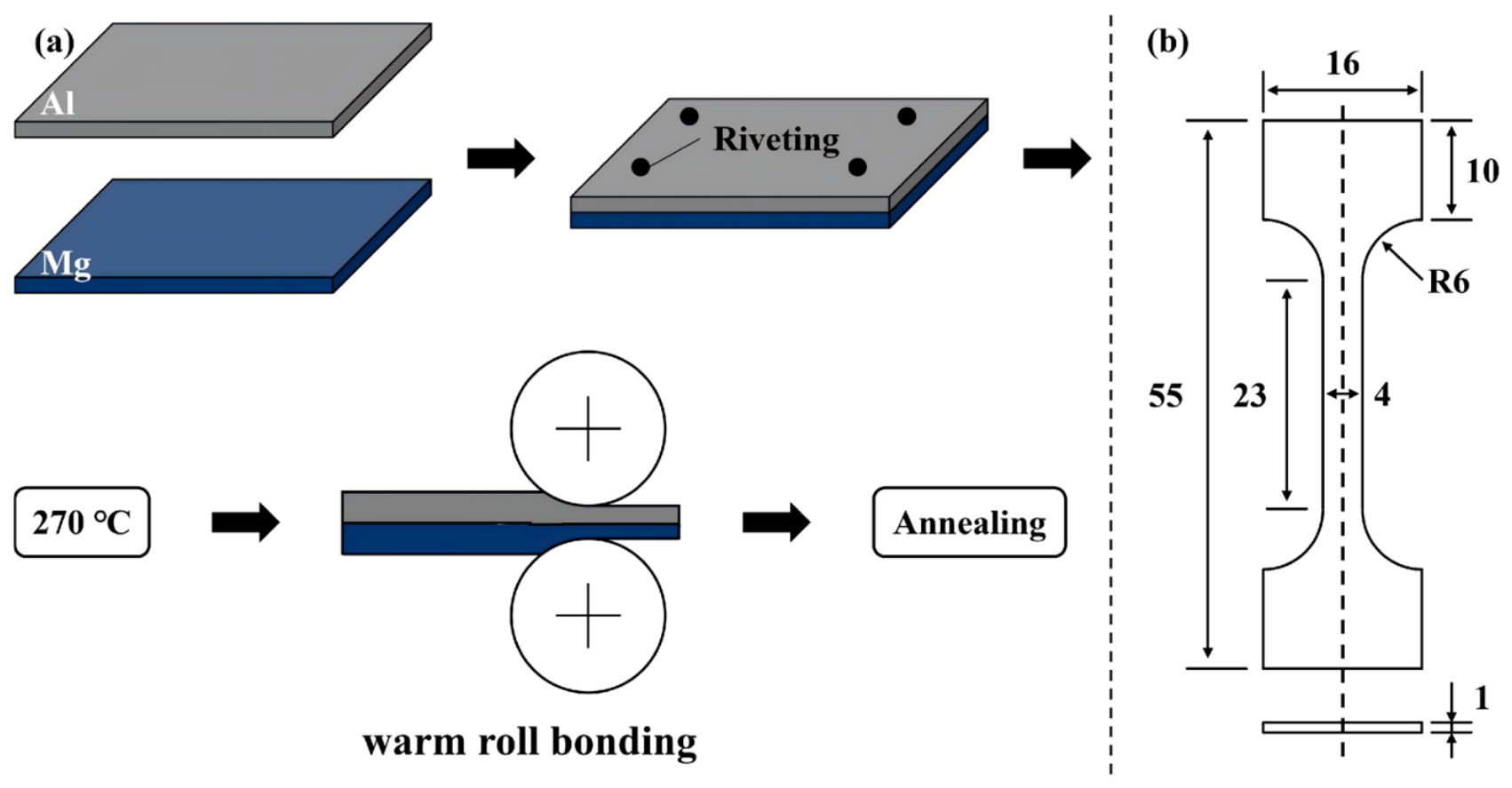
In this study, Al/Mg bimetals were fabricated by using the rolling method, using pure Al and pure Mg as the base materials with dimensions of 200 mm × 100 mm × 1 mm. Figure 1a illustrates the entire rolling process, which is described below. After removing oxides and contaminants from the sheet surfaces by grinding, a single-pass warm rolling process with a large thickness reduction of 50% was employed for bonding the sheets. Prior to rolling, the materials were held in a furnace at 200 °C for 5 min. And the rolls were preheated to 270 °C before rolling. The roll-bonded sheets were subsequently subjected to heat treatment at 400 °C for 60 min. Samples were then taken along the RD-ND direction for observation and analysis. The microstructure and chemical composition of the Al/Mg bimetallic composites were analyzed using a JSM IT800 scanning electron microscope (SEM, JSM-IT800, JEOL, Tokyo, Japan) equipped with energy-dispersive X-ray spectroscopy (EDS).
In this study, six test specimens were cut from the rolled plate and divided into two groups for tensile property testing. Among them, three specimens were directly subjected to tensile testing, while the remaining three specimens were heat-treated at 400 °C for 60 min and furnace-cooled before tensile testing, aiming to promote the formation of IMCs. All tensile specimens were extracted from the middle region of the plate using wire electrical discharge machining. The tensile strength of Al/Mg bimetals was measured using a universal testing machine (Instron 100 kN, Instron, Norwood, MA, USA) with a loading rate of 1.0 mm/min, and the tensile testing speciemens is exhibited in Figure 1b. The average value of the test results from the three parallel specimens was adopted as the final tensile strength for each testing condition. After the completion of the tensile tests, key mechanical parameters, including the ultimate tensile strength and elongation at fracture of each specimen, were obtained.

2.2. Molecular Dynamics Modeling

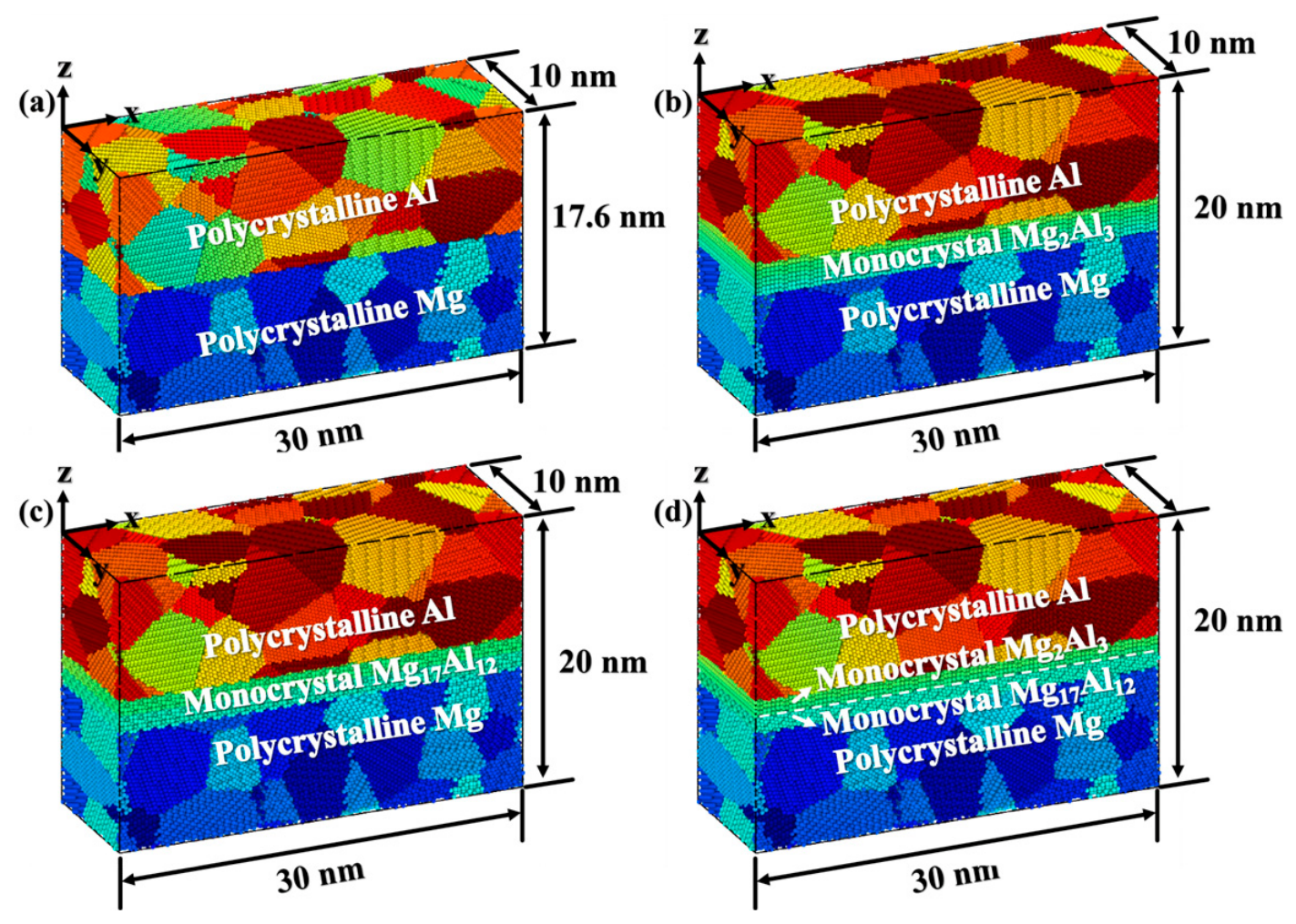
The initial atomic structural models were constructed using the open-source software Atomsk (version Beta 0.13.1) [22,23], and the overall structure is depicted in Figure 2. First, nanocrystalline Al and Mg matrices were created, each with model dimensions of 300 Å (X) × 100 Å (Y) × 88 Å (Z). Based on the average grain size formula proposed by Schiøtz et al. [24], the calculated average grain sizes (D) for nanocrystalline Mg and nanocrystalline Al were 6.024 nm and 6.316 nm, respectively. To ensure the random orientation of the polycrystalline grains, all matrices were constructed using the Voronoi tesselation method. Subsequently, three single-crystal interfacial layer models with different compositions were constructed, each with dimensions of 300 Å (X) × 100 Å (Y) × 24 Å (Z), corresponding to Mg2Al3, Mg17Al12, and a composite layer of Mg17Al12/Mg2Al3. In the composite interfacial layer model, Mg17Al12 and Mg2Al3 were stacked along the Z-axis, with each layer having a thickness of 12 Å. By stacking the aforementioned matrices and interfacial layers along the Z-axis, four layered composite material models were assembled: an Mg/Al model without an interfacial layer and Mg/Mg2Al3/Al, Mg/Mg17Al12/Al, and Mg/Mg17Al12/Mg2Al3/Al models with different interfacial layers.
In this study, the Large-scale Atomic/Molecular Massively Parallel Simulator (LAMMPS) was employed for molecular dynamics simulations [25,26]. In MD simulations of polycrystalline metal systems, the Embedded Atom Method (EAM) is widely adopted. We selected the Finnis–Sinclair-type potential developed by Mendelev et al. [27], which accurately captures the stacking fault energy of edge dislocations in Mg and the related properties along the (110) crystallographic direction in Al, thus enabling precise modeling of the interfacial interactions between Al and Mg [28]. To verify the reliability of this potential, we computed the lattice constants and elastic moduli of both Al and Mg using the potential. Table 1 summarizes the calculated lattice constants and elastic moduli of Al, Mg and IMCs using the selected potential. The obtained results agreed well with the DFT-calculated values, confirming the reliability and predictive capability of the potential. After constructing the initial model, we performed energy minimization using a conjugate gradient algorithm. Subsequently, periodic boundary conditions were applied in all three directions of the models. The system was relaxed under an NPT ensemble at 300 K for 100 ps to achieve the lowest energy equilibrium configuration. All atomic velocities were initialized according to the Maxwell distribution, and the Newtonian equations of motion were integrated using the velocity Verlet algorithm with a time step of 1 fs. Subsequently, tensile loading was applied at a strain rate of 109 s−1 along the direction parallel to the heterointerface for the four distinct models under NPT ensemble conditions at 300 K, with a simulation duration of 500 ps. The tensile direction was set as a free boundary, whereas the other two directions were periodic. After completing the MD simulations of the sample deformation behavior, we utilized the Open Visualization Tool (OVITO) for visualization, dislocation analysis, atomic strain analysis, common neighbor analysis, and calculation of the centrosymmetry parameter [29,30].
In this study, experiments and MD simulations were employed in a complementary manner. The experiments provided macroscopic mechanical responses and microstructural characterizations of the roll-bonded Al/Mg composites. The MD simulations, despite the inherent length-scale limitations, serve as a computational microscope to reveal the underlying atomistic deformation mechanisms—such as dislocation nucleation and propagation, interfacial failure modes, and the role of intermetallic phases—that govern the macroscopic behavior observed in experiments. This multiscale approach is widely accepted in computational materials science, and the combination of experimental validation and mechanistic insights from simulations strengthens the overall conclusions.

3. Results and Discussion

3.1. Experimental Results

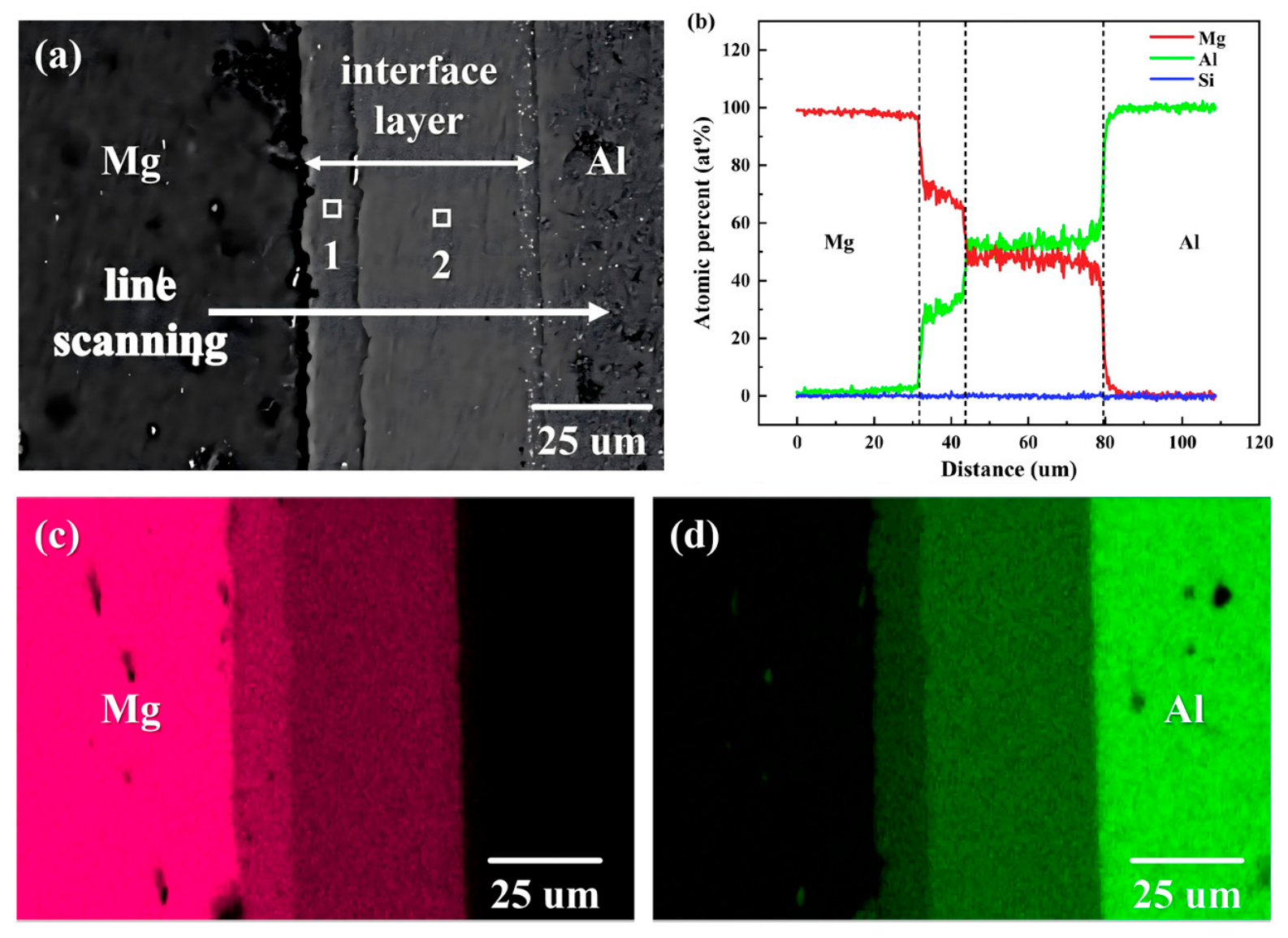
Figure 3 presents the microstructure and EDS analysis results of the interface region for Al/Mg specimen. Figure 3a reveals a distinct metallurgical reaction layer between pure Al and pure Mg, where two different intermetallic compounds may be formed based on the contrast difference. The rectangular markers numbered 1 and 2 in Figure 3a correspond to the positions of the Mg17Al12 and Mg2Al3 intermetallic phases, respectively. The vertical dashed lines in Figure 3b mark the boundaries separating the Mg substrate, Mg17Al12 layer, Mg2Al3 layer, and Al substrate along the EDS line scanning path, consistent with the phase distribution marked in Figure 3a. Based on EDS line scanning and mapping results, the metallurgical reaction layer exhibits heterogeneity, revealing two distinct subregions: a Mg-rich region adjacent to pure Mg and an Al-rich region adjacent to pure Al, as illustrated in Figure 3c,d. According to the Al-Mg binary phase diagram and EDS analysis, the compound layer in Figure 3a consists mainly of Mg17Al12 (point 1) and Mg2Al3 (point 2). In most rolling processes, these two intermetallic compounds are formed. MD simulation was used to study the influence of Mg17Al12 and Mg2Al3 on the interfacial behavior of Al/Mg bimetals. The relevant simulation parameters and results are as follows.
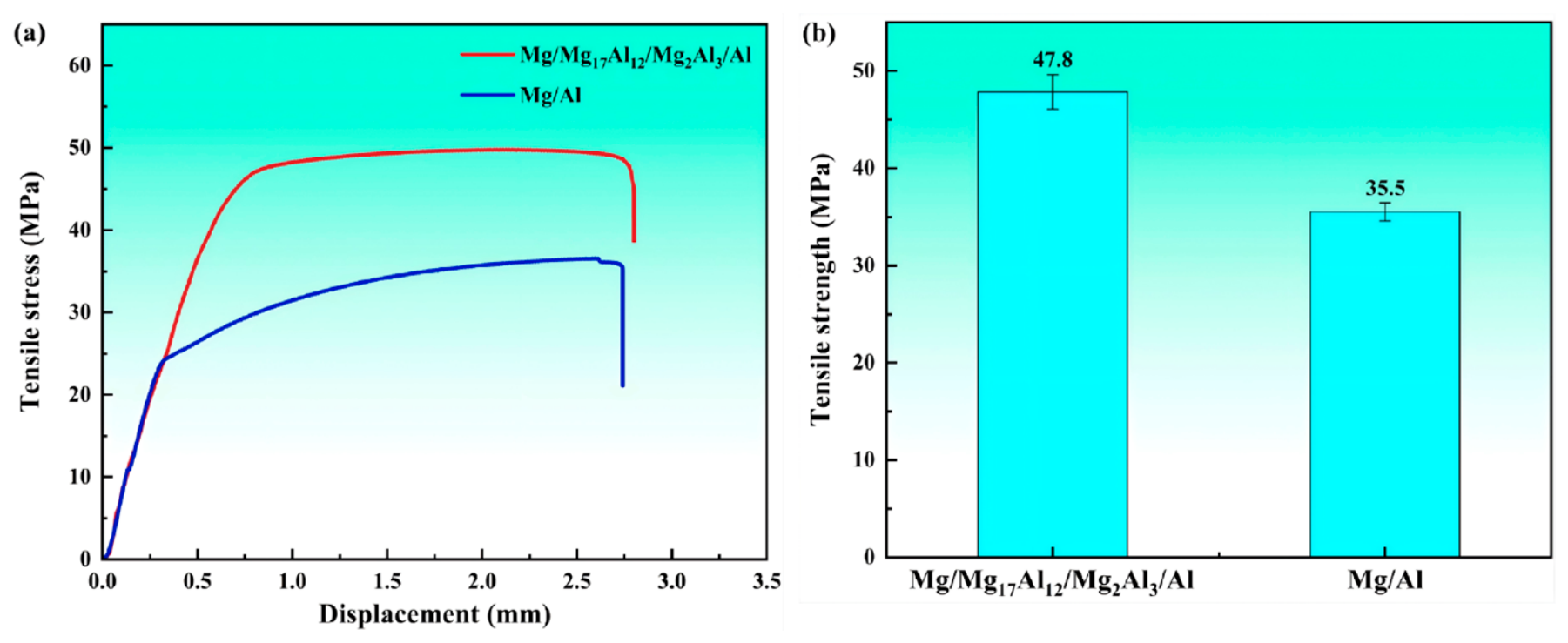
Figure 4 shows the tensile strength test results of Al/Mg bimetals. Specimens containing IMCs exhibited an average tensile strength of 47.8 MPa. Specimens without the IMC exhibited an ultimate tensile strength of 35.5 MPa, respectively, representing reduction of 34.6% compared to IMC specimens. It can be observed that, compared to the Mg/Al bimetal, the Mg/Mg17Al12/Mg2Al3/Al exhibited higher tensile strength during the tensile process.

3.2. Simulation Results

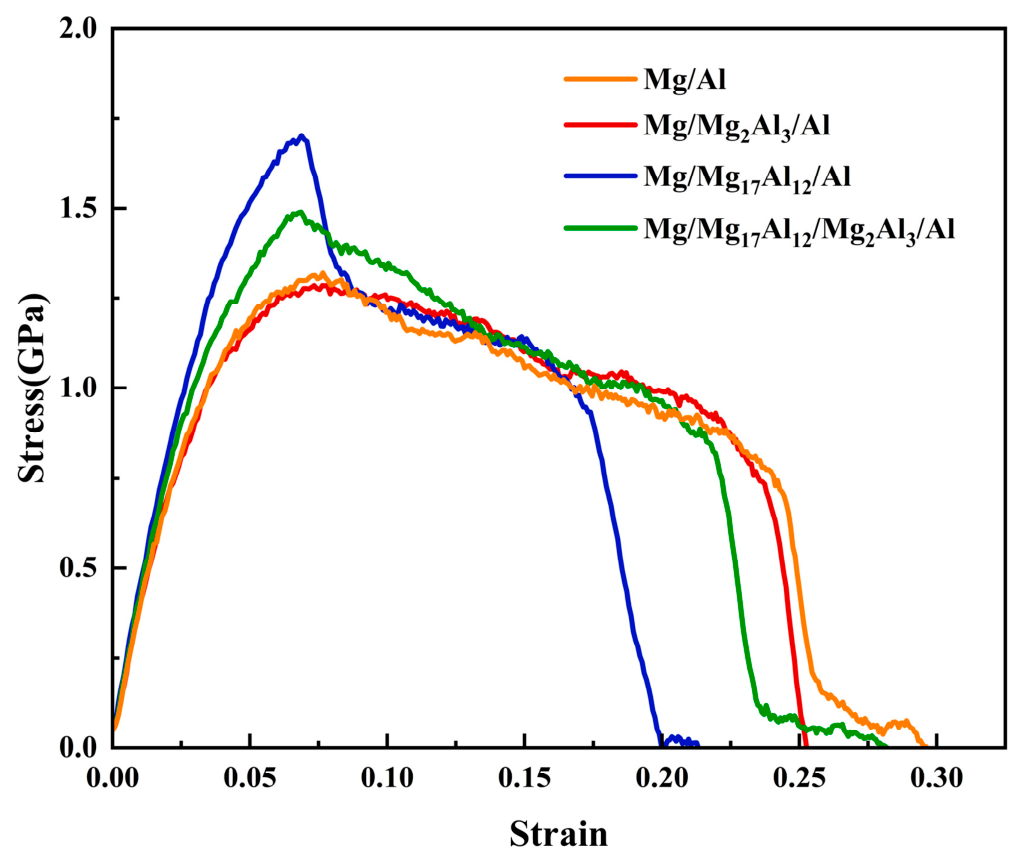
Figure 5 shows the stress–strain curves of Al/Mg layered composites with different interface structures at a strain rate of 109 s−1. The results indicate that the type of interface layer plays a decisive role in the tensile strength of composites. Taking the Mg/Al model without an interface layer as the benchmark (with a tensile strength of 1.302 GPa), the model containing a single Mg17Al12 interface layer exhibited the highest tensile strength, reaching 1.702 GPa, which was approximately 31% higher than that of the benchmark model. In contrast, the model with a composite interface layer (Mg17Al12/Mg2Al3) exhibited a tensile strength of 1.490 GPa, corresponding to an improvement of approximately 14%. This suggests that the strengthening effect of the composite interface layer was lower than that of the single Mg17Al12 interface layer. Notably, the model containing a single Mg2Al3 interface layer has a tensile strength of 1.285 GPa, which is lower than the benchmark value and exhibits a slight decrease of approximately 1.3%. This indicates that the interfacial bonding between Mg2Al3 and the matrix is relatively weak, leading to a modest reduction in the overall load-bearing capacity of the composite.
The strength trend was consistent between the experimental tests and numerical simulations. However, an obvious divergence exists in fracture elongation: the two specimens show comparable fracture elongations in experiments, whereas the Mg/Al bimetal exhibits a larger elongation to failure in simulations. The underlying mechanisms responsible for this discrepancy are analyzed as follows: simulations construct perfect bonding interfaces free of oxides and microvoids; thus, the IMC-free Mg/Al bimetal undergoes sufficient homogeneous plastic deformation and delivers higher elongation. Nevertheless, numerous interfacial flaws generated during rolling triggered early crack propagation in the Mg/Al bimetal in physical tests, balancing its fracture elongation with that of the Mg/Mg17Al12/Mg2Al3/Al composite.
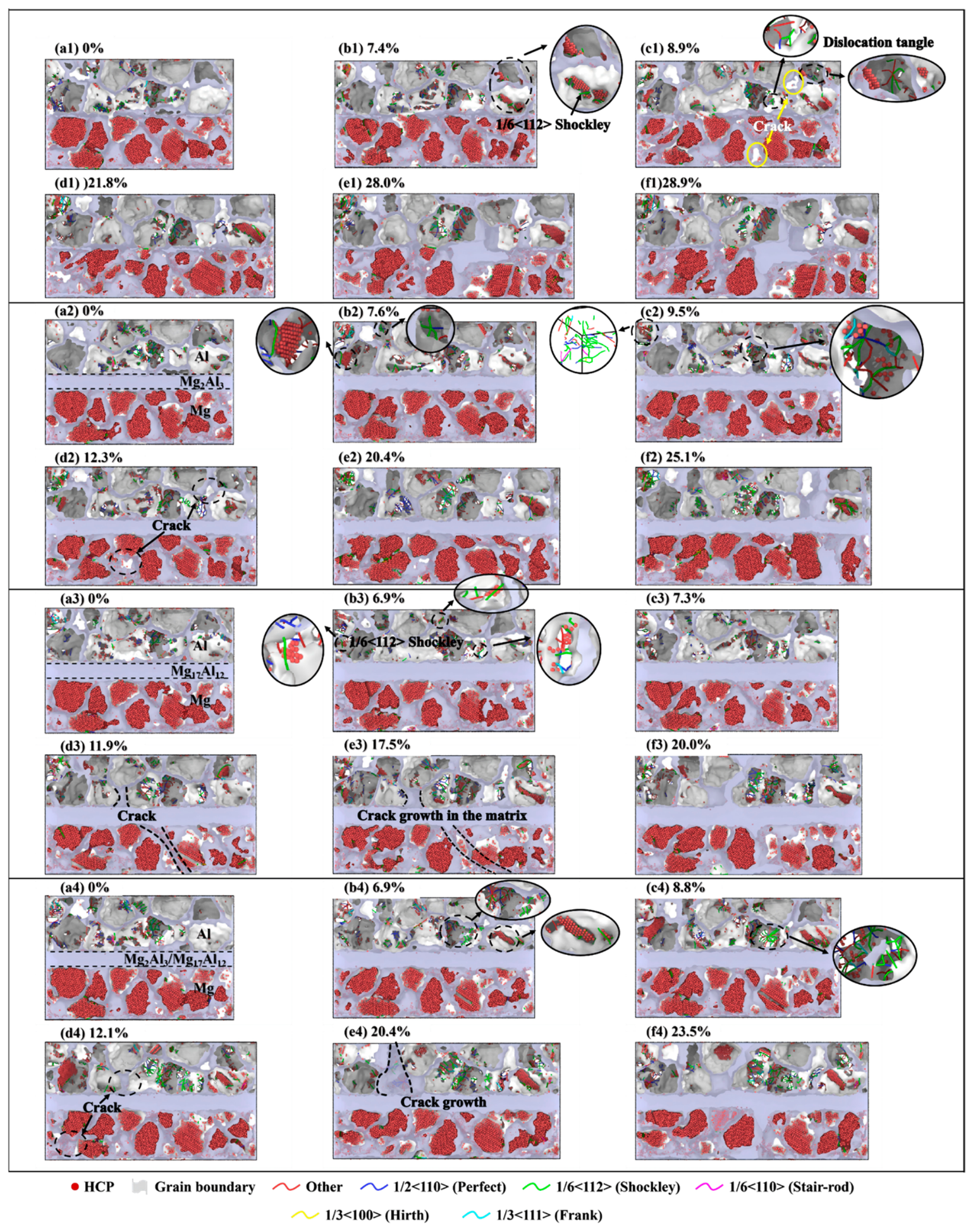
Figure 6 illustrates the dislocation distributions in different interfacial structures under the corresponding strains using the Dislocation Analysis (DXA) method. Figure 6(a1–f1) depict the microstructural evolution of nanocrystalline Al/Mg at tensile strains of 0%, 7.4%, 8.9%, 21.8%, 28.0%, and 28.9%, with dislocation lines and defective atoms marked in different colors. The results indicate that as the strain increased, the number of 1/2<110> dislocations within the nanocrystalline Al grains decreased significantly. Under tensile loading, in addition to the formation of typical 1/6<112> Shockley dislocations within the nanocrystalline Al grains, a small number of other types of dislocations, such as 1/6<110> stair-rod dislocations, were generated.
Based on the dislocation analysis, Figure 6(a2–f2) illustrate the microstructural evolution of an Al/Mg2Al3/Mg layered composite with an interfacial layer thickness of 2.4 nm during tensile deformation. As observed from Figure 6(a2–f2), with increasing tensile strain, the types of dislocations within the nanocrystalline Al grains undergo a significant transformation: the number of 1/2<110> dislocations gradually decreases, while the number of 1/6<112> Shockley partial dislocations at grain boundaries increases substantially. Additionally, a small number of other types of dislocations were generated at the grain boundaries, as shown in Figure 6(b2). However, in nanocrystalline Al, the space for dislocation slip is extremely limited. Although the number of dislocations at the grain boundaries increased, these dislocations were primarily pinned at the grain boundaries with extremely short slip distances, preventing the formation of long-range slip. Consequently, the overall deformation behavior of nanocrystalline Al is still dominated by the grain boundary motion. The increase in the number of 1/6<112> Shockley dislocations at the grain boundaries was mainly induced by local stress concentrations during grain boundary motion. These dislocations contribute to stress transfer to a limited degree, but they do not act as the dominant deformation mechanism. Under sustained tensile loading, microvoids formed at the grain boundaries of the matrix, as presented in Figure 6(d2,e2), followed by rapid crack propagation along the grain boundaries until material fracture occurred. Dislocations in nanocrystalline Mg are primarily distributed at the grain boundaries, with relatively limited dislocation activity within the grains, and its deformation behavior is dominated by grain boundary motion.
Figure 6(a3–f3) show the dislocation distribution in the Al/Mg17Al12/Mg layered composite with an interface thickness of 2.4 nm during tensile deformation. During the deformation of nanocrystalline Al, dislocation slip is difficult because of the large number of grain boundaries. Both ends of the 1/6<112> Shockley partial dislocations were pinned at the grain boundaries, as exhibited in Figure 6(c3). Although slip occurred with increasing strain, the slip amplitude was too small to cause a significant increase in the number of defect atoms. Therefore, the deformation behavior of nanocrystalline Al is primarily dominated by the grain boundary motion. Similarly, the deformation behavior of nanocrystalline Mg is governed by grain boundary motion. The Mg17Al12 interface layer introduced a local stress concentration, inducing the generation of 1/6<112> Shockley partial dislocations and a small number of 1/6<110> stair-rod dislocations near the grain boundaries adjacent to the interface. These dislocations primarily transfer stress to the interface layer, thereby promoting the nucleation and growth of microvoids. The microvoids dissipate deformation energy and delay crack penetration, resulting in the highest tensile strength for this model.
Figure 6(a4–f4) present an in-depth analysis of the microstructural evolution characteristics of the Al/Mg2Al3/Mg17Al12/Mg layered composite with an interface thickness of 2.4 nm during tensile deformation. Dislocation analysis indicated that the trend of dislocation evolution in this model was consistent with that of the Al/Mg17Al12/Mg model, which was also characterized by preferential cracking of the interface layer. However, owing to the deformation incompatibility between the two intermetallic compounds (Mg2Al3 and Mg17Al12), its tensile strength is slightly lower than that of the model containing a single Mg17Al12 interface layer.
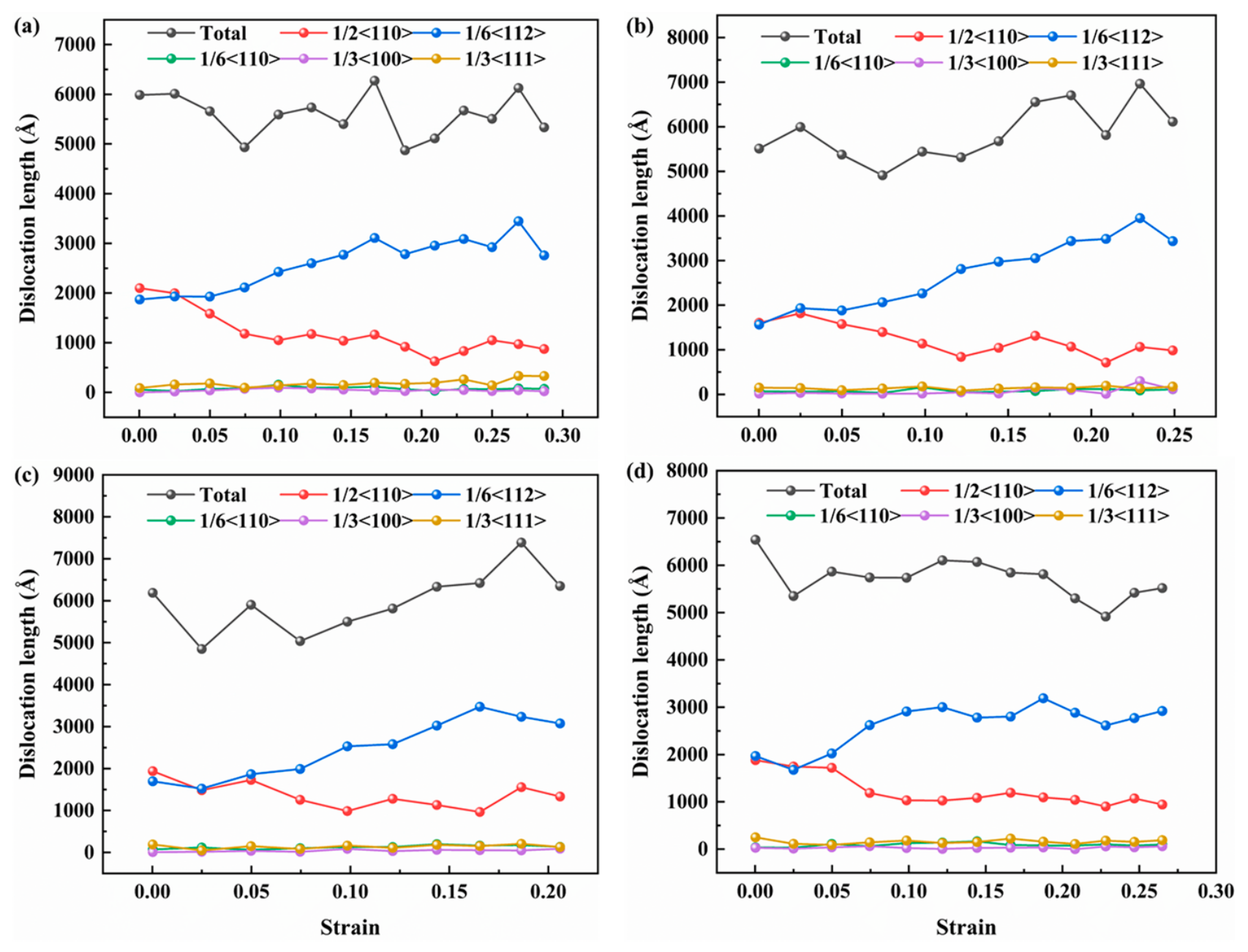
To further analyze the influence of interfacial layer composition on dislocation evolution, Figure 7 compares the dislocation length distributions of the four Al/Mg layered composite models during tensile deformation. In the Mg/Al model without an interfacial layer (Figure 7a), the overall dislocation length was relatively low, and the distribution was uniform. Owing to the deformation incompatibility between the Al and Mg matrices, dislocations nucleated only sparsely at the grain boundaries, resulting in severe localization of plastic deformation. This is consistent with the lowest tensile strength (1.302 GPa) obtained for this model.
In the model containing the Mg2Al3 interfacial layer (Figure 7b), the total dislocation length increased slightly, but the increase remained limited. In terms of the dislocation-type distribution, the proportion of 1/6<112> Shockley partial dislocations at the grain boundaries of the Al matrix increased markedly, which is consistent with the previously observed evolution behavior, namely the reduction in 1/2<110> dislocations inside Al grains and the significant increase in partial dislocations at grain boundaries. Notably, dislocations mainly piled up at the grain boundaries of the matrices on both sides, rather than nucleating extensively within the Mg2Al3 interfacial layer. This phenomenon indicates that although the Mg2Al3 interfacial layer can hinder dislocation transmission to a certain extent, its relatively weak interfacial bonding with the matrices prevents it from effectively suppressing dislocation nucleation and pile-up at matrix grain boundaries. Consequently, cracks still preferentially initiated at the Al/Mg matrix grain boundaries rather than within the interfacial layer, ultimately leading to a tensile strength of only 1.285 GPa for this model.
The model containing an Mg17Al12 interfacial layer (Figure 7c) exhibited distinctly different characteristics: its total dislocation length was significantly higher than that of the other three groups. The Mg17Al12 interfacial layer causes a local stress concentration, thereby inducing the proliferation of 1/6<112> Shockley partial dislocations and 1/6<110> stair-rod dislocations at the grain boundaries in the Al matrix. Accordingly, the peak dislocation length is prominent, and the distribution is concentrated.
In the model containing a composite interfacial layer (Mg17Al12/Mg2Al3) (Figure 7d), the variation trend of the total dislocation length lies between those of the two single-interfacial-layer models: in the early stage of strain, the evolution of dislocation length is similar to that of the Mg17Al12 model, whereas in the late stage of strain, it gradually approaches that of the Mg2Al3 model. This transition originates from the bilayer architecture of the composite interfacial layer. In the early stage, the Mg17Al12 layer dominates the stress response and induces dislocation multiplication. In the late stage, the growth in dislocation length is constrained because the Mg2Al3 layer undergoes interfacial weakening and cleavage fracture. Correspondingly, the tensile strength and failure mode of this model also fell between those of the two single-interfacial-layer models.
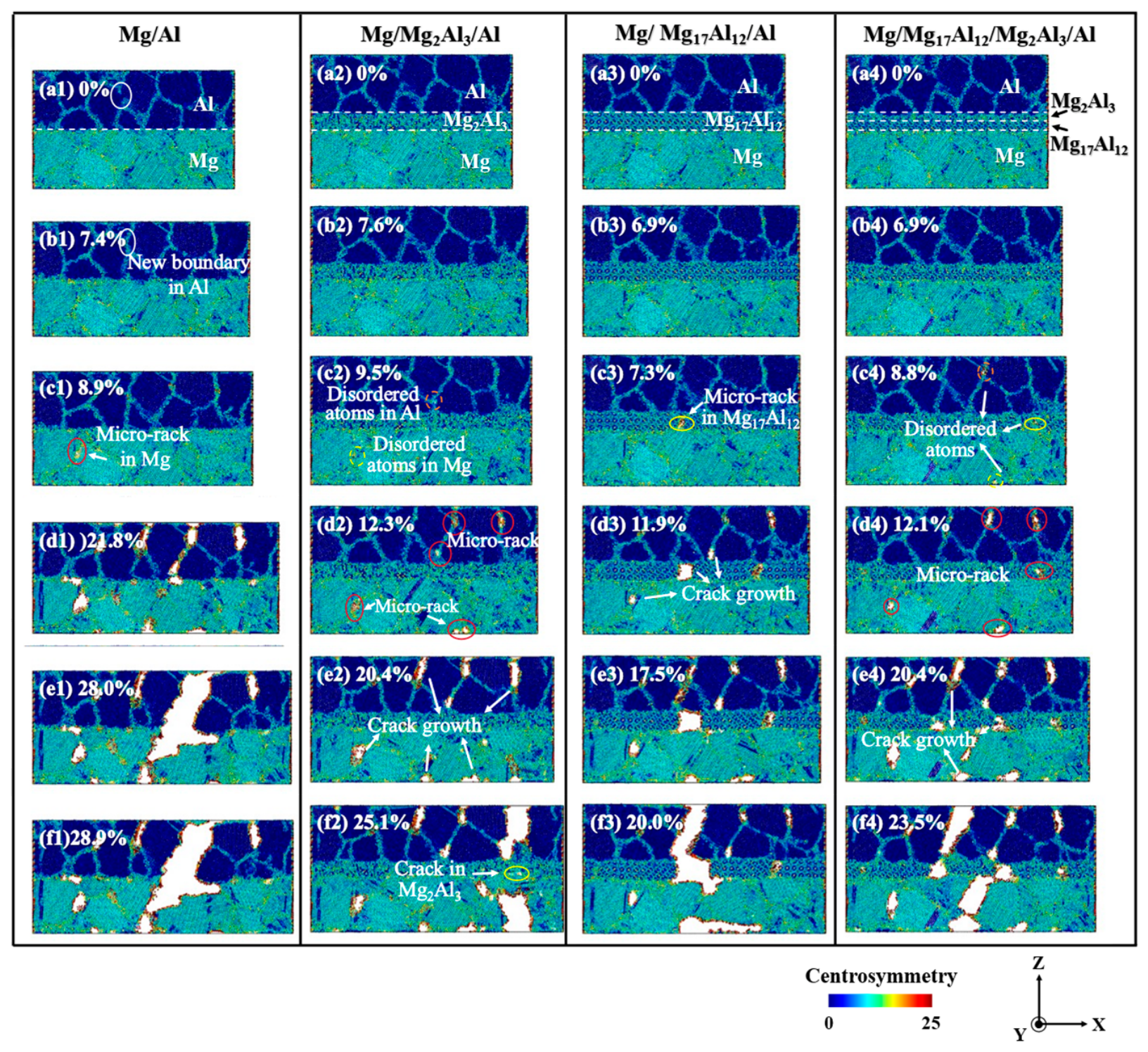
To clearly present the atomic structure information, all atoms were color-coded according to their centrosymmetry parameter (centrosymmetry parameter, CSP), as observed in Figure 8. The results for the Al/Mg model are shown in Figure 8(a1–f1). The white circle in (a1) indicates the embryonic grain boundary site within the Al matrix at ε = 0, which evolves into mature grain boundaries under increasing strain. With increasing strain, lattice distortion at the grain boundaries accumulates directly, and the number of disordered atoms increases markedly. When the strain reached 8.9%, cracks formed almost simultaneously within the grain boundaries of the nanopolycrystalline Al and Mg layers, as reflected by the strength drop in the stress–strain curve. When the strain was further increased to 21.8%, the cracks propagated rapidly and penetrated the entire matrix.
The color mapping results for the Al/Mg2Al3/Mg model are displayed in Figure 8(a2–f2). As illustrated in Figure 8(c2,d2), with increasing strain, disordered atoms increase at the grain boundaries of the Al and Mg matrices and microvoids form; subsequently, cracks initiate at the grain boundaries of the Al and Mg matrices. When the strain continued to increase to 25.1% under the sustained action of the tensile load, the cracks propagated continuously until they penetrated the Mg2Al3 interfacial layer, leading to fracture. This is consistent with the tensile fracture mechanism of nanopolycrystalline Al/Mg composites: in Al/Mg2Al3/Mg layered composites, the interfacial layer cannot impede crack propagation. This is because Mg2Al3 exhibits typical cleavage brittleness and has relatively weak interfacial bonding with the matrices. Specifically, nanoindentation measurements have shown that the hardness of the β-Mg2Al3 phase can reach as high as 6.5 GPa, significantly exceeding that of the γ-Mg17Al12 phase (3.4 GPa), and it exhibits a typical pop-in phenomenon characteristic of brittle behavior [35]. Furthermore, the intrinsically low interfacial decohesion energy of the α-Al/β′-Mg2Al3 interface further corroborates the weak bonding between the Mg2Al3 intermetallic layer and the adjacent Al matrix [36]. After microcracks were initiated at the matrix grain boundaries, the stress concentration was transferred to the Mg2Al3 layer. Because the critical stress for the cleavage fracture of Mg2Al3 is lower than the stress required for void nucleation and the weak interface is prone to debonding, the cracks cannot be blunted or deflected. Instead, they directly penetrate the brittle Mg2Al3 interfacial layer, resulting in an overall rapid fracture.
The results of atomic color mapping for the Al/Mg17Al12/Mg model are shown in Figure 8(a3–f3). With a continuous increase in strain, nanopolycrystalline Mg primarily undergoes grain deformation, and the number of disordered atoms at the grain boundaries increases. In contrast, nanopolycrystalline Al mainly undergoes dislocation nucleation, propagation, and annihilation. As can be seen in Figure 8(c3), when the tensile strain reached 7.3%, microvoids nucleated predominantly at the Mg17Al12 interfacial layer. When the strain reached a fracture strain of 11.9%, the microvoids at the interfacial layer further grew, while microcracks appeared at the grain boundaries of both nanopolycrystalline Al and nanopolycrystalline Mg, as indicated in Figure 8(d2). As depicted in Figure 8(e2,f2), under the sustained action of the tensile load, cracks at the grain boundaries in nanopolycrystalline Al propagate rapidly, and the crack propagation rate is much higher than that in nanopolycrystalline Mg. This is mainly attributed to the close-packed hexagonal structure of the Mg layer. At room temperature, the available slip systems are limited, and dislocation activity is constrained such that deformation relies primarily on grain boundary motion; consequently, crack propagation is relatively slow.
The centrosymmetry analysis method was further employed to investigate the microstructure of this layered composite, and the resulting analysis mutually corroborated the DXA results. During tension, a local stress concentration is generated in the Mg17Al12 interfacial layer, promoting vacancy aggregation and forming nanoscale microvoids. The nucleation and growth of these microvoids consume part of the deformation energy and delay crack penetration; therefore, the model containing an Mg17Al12 interfacial layer exhibited the highest tensile strength. The dislocation evolution characteristics in nanopolycrystalline Al are mainly manifested as follows: the number of 1/6<112> Shockley partial dislocations at the grain boundaries increases markedly, whereas a small number of non-glissile dislocations, such as 1/6<110> stair-rod dislocations, are generated. These dislocations pile up and interact at the grain boundaries, triggering local stress concentrations and weakening the grain boundary structure. This stress concentration was further transferred to the Mg17Al12 interfacial layer, promoting the nucleation and growth of microvoids. With increasing strain, the microvoids gradually coalesced, ultimately causing fracture of the interfacial layer.
The results of atomic color mapping for the Al/Mg2Al3/Mg17Al12/Mg model are shown in Figure 8(a4–f4). As demonstrated in Figure 8(c4), when the tensile strain reached 8.8%, the two IMCs in the composite interfacial layer may have generated an additional stress concentration at the interface, causing the interfacial layer to crack first. As presented in Figure 8(d2–f2), with the continuous increase in strain, the microvoids at the interfacial layer gradually grow into microcracks, while microcracks also appear successively at grain boundaries in both nanopolycrystalline Al and nanopolycrystalline Mg. Notably, in the Al/Mg2Al3/Mg17Al12/Mg layered composite, the Mg2Al3 and Mg17Al12 layers exhibited different mechanical responses. The Mg17Al12 interfacial layer dissipates deformation energy through microvoid nucleation and growth, delays crack penetration, and exhibits relatively high crack resistance. In contrast, the Mg2Al3 layer, owing to its intrinsic cleavage brittleness and weak interfacial bonding, is more prone to direct through-thickness fracture. Compared with layered composites with a single interfacial layer, Al/Mg2Al3/Mg and Al/Mg17Al12/Mg, this composite interfacial architecture exhibits the characteristic of interfacial-layer-first cracking, and its strength lies between that of the model containing an Mg17Al12 interfacial layer and that of the model containing an Mg2Al3 interfacial layer, thereby verifying the decisive influence of interfacial type on the mechanical performance of layered composites.
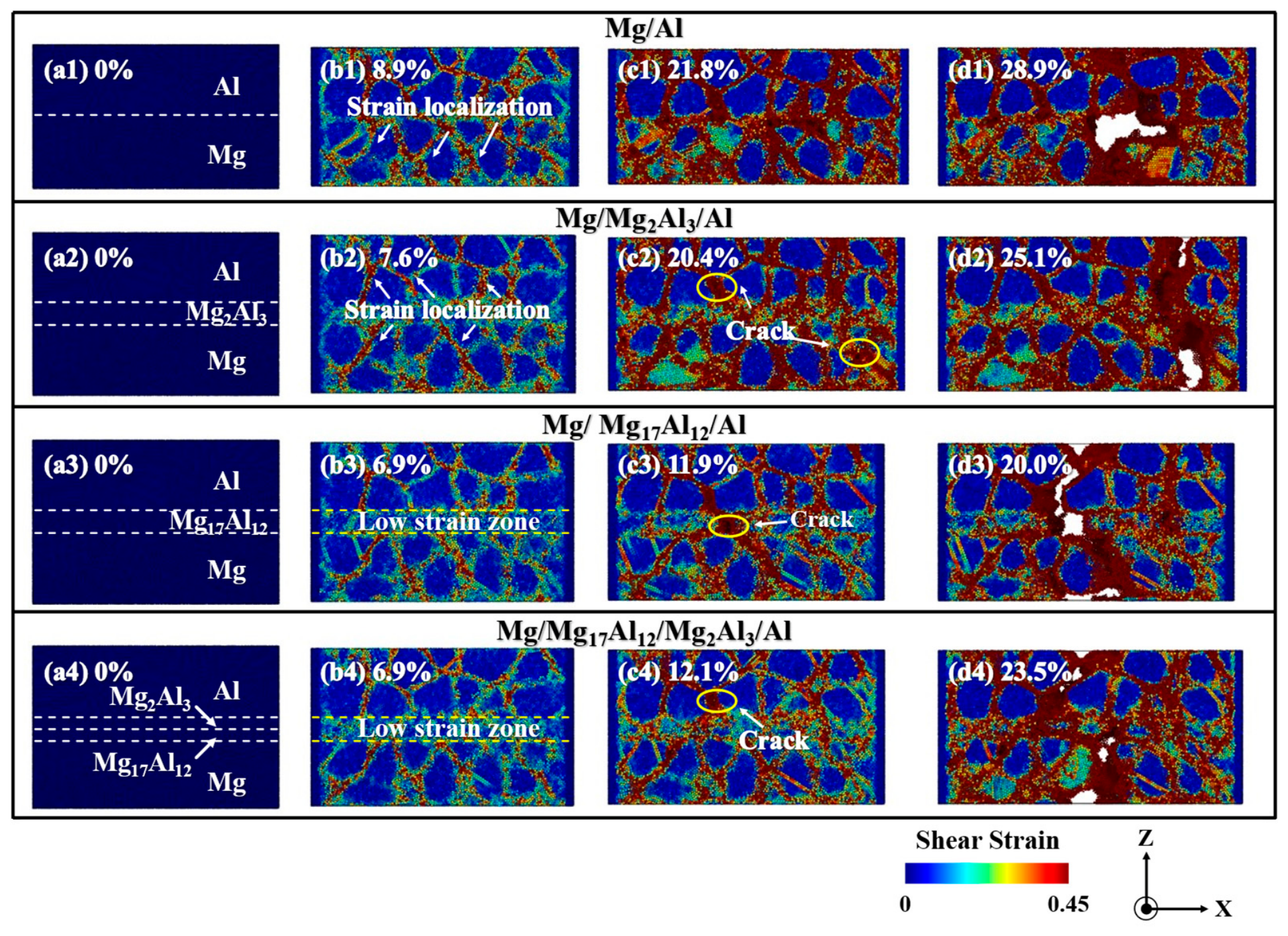
To further analyze the influence of different interfacial structures on the tensile deformation behavior of Al/Mg layered composites, the atomic strain method was employed to calculate the local strain distribution during tensile testing. Figure 9 presents the strain distribution contour maps on the lateral surface of the composites with different interfacial structures, where colors ranging from blue to red indicate increasing local atomic strain (blue: low strain/elastic region; red: high strain/localized region). The strain in the Al/Mg layered composites was higher at the grain boundaries of the matrix and at the phase interfaces, whereas it was lower within the grain interiors.
As observed in Figure 9(a1–d1), in the Al/Mg model (without an interlayer), the significant differences in the crystal structure and mechanical properties of the two metals on either side of the interface make it difficult to achieve deformation compatibility under tensile loading parallel to the interface. This leads to stress concentration within the two matrix phases, promoting independent crack initiation and propagation in the Al and Mg matrices, respectively.
For the Mg/Mg2Al3/Al model, the strain distribution indicated that cracks preferentially initiated in the Al and Mg matrices. Although the Mg2Al3 interlayer was introduced as a brittle intermetallic compound, it could transfer the load during the early stage of deformation. However, due to its limited crystallographic compatibility with adjacent matrices, it fails to effectively alleviate stress concentrations within matrices. Therefore, crack initiation sites remained in the two matrices, similar to the model without an interlayer.
For the Mg/Mg17Al12/Al model, the strain contour maps revealed a distinct crack initiation characteristic: cracks first appeared within the Mg17Al12 interlayer. This indicates that, under this interfacial architecture, the presence of Mg17Al12 alleviates the stress concentration in the matrices.
For the Mg/Mg17Al12/Mg2Al3/Al model (with a double-layer composite interlayer), the strain distribution indicated that cracks also preferentially initiated in the interlayer region. Compared with the single Mg17Al12 interlayer, the double-layer composite structure consists of two different crystalline intermetallic compounds stacked together, creating new stress concentration sources at the internal interface between the two layers. During tensile loading, the mechanical property mismatch between the two layers hinders deformation compatibility, leading to stress accumulation within the composite interlayer and eventually inducing crack initiation preferentially within the interlayer region.

4. Conclusions

MD simulations were performed to investigate the interfacial behavior of Al/Mg layered composites with distinct interface layer configurations. The investigation concentrated on stress–strain responses, dislocation activities, centrosymmetry parameters, and atomic strain during uniaxial tension. The main conclusions are summarized as follows:
  • Owing to the effects of local strain concentration in the Mg and Al matrices, nanopolycrystalline Al/Mg with direct bonding and no interfacial layer cannot achieve cooperative deformation, and tensile deformation in both nanopolycrystalline Al and nanopolycrystalline Mg is dominated primarily by grain boundary sliding.
  • The model containing an Mg2Al3 interfacial layer exhibited the lowest tensile strength (1.285 GPa), which was slightly lower than that of the baseline model because the interfacial bonding between Mg2Al3 and the matrices was relatively weak, resulting in a limited load-bearing capacity. Cracks also preferentially initiated in the Al and Mg matrices and rapidly penetrated the brittle interfacial layer.
  • The model containing an Mg17Al12 interfacial layer demonstrated the most favorable mechanical response, with a tensile strength of 1.702 GPa, representing a marked increase of approximately 31% relative to the baseline model without an interfacial layer. However, this strength increase was accompanied by a change in the failure mechanism, wherein cracks preferentially initiated within the brittle Mg17Al12 interfacial layer.
  • The model containing a composite interfacial layer (Mg17Al12/Mg2Al3) exhibited an intermediate tensile strength (1.490 GPa). The composite interfacial layer modified the crack propagation path to some extent, but its strengthening effect remained weaker than that of the single Mg17Al12 interfacial layer. The failure mode of this model was characterized by interfacial-layer-first cracking.

5. Limitations of This Research

The MD simulations performed in this work were subject to several inherent limitations associated with atomistic modeling and computational resources. These limitations should be considered when interpreting the results, as outlined below.
Material representation: The simulations used defect-free polycrystalline Al and Mg to isolate intrinsic interfacial mechanisms. Industrial alloys typically contain solute elements, precipitates, and impurities that influence dislocation motion and interfacial reactions. Consequently, the reported results capture fundamental trends but not the full complexity of commercial alloy systems.
Scale and geometry idealization: The MD simulations are limited to the nanoscale with idealized equal-thickness bilayer geometries, whereas experimental samples exhibit micron-scale grain sizes and asymmetric layer thicknesses. This simplification, which is necessary for computational feasibility, ensures that the simulations provide mechanistic insights rather than quantitative predictions. Future multiscale modeling could further bridge this gap.
Strain rate scaling: The simulated strain rate (109 s−1) was several orders of magnitude higher than that in experiments (<103 s−1). Such scaling is necessary to generate measurable plastic deformation within nanosecond timescales but may lead to an overestimation of tensile strength compared with experimental conditions.

Author Contributions

X.W.: Methodology, Investigation, Formal analysis, Software, Validation, Writing—original and final draft. G.L.: Methodology, Writing—review and editing, Supervision, Project administration, Funding acquisition. W.J.: Writing—review and editing, Supervision. Y.L., J.L. and X.F.: Investigation. H.H., X.H., T.M., X.K. and Q.Z.: Visualization, Data curation and Formal analysis. H.E.: Writing—review and editing, Supervision. All authors have read and agreed to the published version of the manuscript.

Funding

This research was funded by the National Natural Science Foundation of China (No. 52205359, No. 52075198, No. 52271102, No. 52205364), the Fundamental Research Funds for the Central Universities (No. DUT26RC(4)082), the Open Research Project of the State Key Laboratory of Advanced Design and Manufacturing for Vehicle Body (No. 32615008), and the Fund of State Key Laboratory of Advanced Design and Manufacturing for Vehicle Body (No. 734215242).

Institutional Review Board Statement

Not applicable.

Informed Consent Statement

Not applicable.

Data Availability Statement

The original contributions presented in this study are included in the article. Further inquiries can be directed to the corresponding authors.

Conflicts of Interest

The authors declare no conflicts of interest.

Abbreviations

The following abbreviations are used in this manuscript:
MDMolecular Dynamics
IMCIntermetallic compound
SEMscanning electron microscope
EDSenergy-dispersive X-ray spectroscopy
EAMEmbedded Atom Method
DXADislocation Analysis
CSPCentrosymmetry parameter

References

  1. Xu, Y.; Ke, L.M.; Mao, Y.Q.; Sun, J.F.; Duan, Y.X.; Yu, L.M. An innovative joint interface design for reducing intermetallic compounds and improving joint strength of thick plate friction stir welded Al/Mg joints. J. Magn. Alloys 2023, 11, 3151–3160. [Google Scholar] [CrossRef]
  2. Soyama, H. Improvement of fatigue strength by using cavitating jets in air and water. J. Mater. Sci. 2007, 42, 6638–6641. [Google Scholar] [CrossRef]
  3. Fu, L.; Wang, X.B.; Gou, P.L.; Le, Q.C.; Jia, W.T.; Tang, Y. Microstructures and Tensile Properties of AZ91 Magnesium Alloys with Ca, Sm, and La Elements Additions. Adv. Eng. Mater. 2017, 19, 1700230. [Google Scholar] [CrossRef]
  4. Li, J.; Feng, B.; Feng, X.W.; Yan, C.J.; Xia, Z.J.; Chen, X.H.; Zheng, K.H.; Pan, F.S.; Jiang, X.Q. Effect of pure Cu foil interlayer on the microstructure and mechanical behavior of Mg/Al composite sheet. J. Alloys Compd. 2025, 1010, 177630. [Google Scholar] [CrossRef]
  5. Chen, H.C.; Sun, J.L.; Yang, S.L.; Zhang, Y.; Tang, K.; Zhang, C.; Lu, Y.F.; Luo, Q.; Li, Q. Thermodynamics and kinetics of isothermal precipitation in magnesium alloys. Mater. Genome Eng. Adv. 2025, 3, e86. [Google Scholar] [CrossRef]
  6. Patel, V.K.; Bhole, S.D.; Chen, D.L. Ultrasonic spot welded AZ31 magnesium alloy: Microstructure, texture, and lap shear strength. Mater. Sci. Eng. A 2013, 569, 78–85. [Google Scholar] [CrossRef]
  7. Fu, X.S.; Chen, K.; Zhang, Q.S.; Chen, N.N.; Wang, M.; Hu, X.M. Interfacial intermetallic compound layer in friction stir welded Mg/Al joints: Relationship between thickness and the welding temperature history. J. Magn. Alloys 2025, 13, 2540–2553. [Google Scholar] [CrossRef]
  8. Liu, C.L.; Xing, P.F.; Zheng, H.; Gao, Q.; Wu, M.W. Interfacial microstructure and mechanical properties of A356/6061 bimetal fabricated by liquid-solid compound casting. China Foundry 2025, 22, 654–663. [Google Scholar] [CrossRef]
  9. Li, Q.Q.; Xu, Y.C.; Niu, Y.Q.; Fan, Z.T.; Yu, L.H.; Jiang, W.M. Development of Al/Mg bimetal prepared by ultrasonic vibration-assisted compound casting: Effects of interface treatment temperatures. Mater. Sci. Eng. A 2024, 890, 145911. [Google Scholar] [CrossRef]
  10. Tayyebi, M.; Adhami, M.; Karimi, A.; Rahmatabadi, D.; Alizadeh, M.; Hashemi, R. Effects of strain accumulation and annealing on interfacial microstructure and grain structure (Mg and Al3Mg2 layers) of Al/Cu/Mg multilayered composite fabricated by ARB process. J. Mater. Res. Technol. 2021, 14, 392–406. [Google Scholar] [CrossRef]
  11. Zhang, W.; Hu, H.J.; Hu, G.; Sun, Z.W.; Yuan, T.; Ou, Z.W. A direct extrusion-shear deformation composite process that significantly improved the metallurgical bonding and texture regulation grain refinement and mechanical properties of hot-extruded AZ31/AA6063 composite tubes. Mater. Sci. Eng. A 2023, 880, 145090. [Google Scholar] [CrossRef]
  12. Feng, B.; Xin, Y.C.; Guo, F.L.; Yu, H.H.; Wu, Y.; Liu, Q. Compressive mechanical behavior of Al/Mg composite rods with different types of Al sleeve. Acta Mater. 2016, 120, 379–390. [Google Scholar] [CrossRef]
  13. Zhang, J.; Luo, G.Q.; Wang, Y.Y.; Shen, Q.; Zhang, L.M. An investigation on diffusion bonding of aluminum and magnesium using a Ni interlayer. Mater. Lett. 2012, 83, 189–191. [Google Scholar] [CrossRef]
  14. Wang, X.Q.; Cheng, J.F.; Li, G.Y.; Jiang, W.M.; Song, Y.P.; Huang, H.N.; Huang, X.Y.; Meng, T.; Kang, X.; Zeng, Q.T.; et al. Diffusion Behavior and Fracture Mechanism at Solid-Liquid Interface of Polycrystalline Al/Mg Bimetallic System: A Molecular Dynamics Simulation. Materials 2026, 19, 836. [Google Scholar] [CrossRef] [PubMed]
  15. Guan, F.; Jiang, W.M.; Wang, J.L.; Li, G.Y.; Zhang, Z.; Fan, Z.T. Development of high strength Mg/Al bimetal by a novel ultrasonic vibration aided compound casting process. J. Mater. Process. Technol. 2022, 300, 117441. [Google Scholar] [CrossRef]
  16. Hajjari, E.; Divandari, M.; Razavi, S.H.; Emami, S.M.; Homma, T.; Kamado, S. Dissimilar joining of Al/Mg light metals by compound casting process. J. Mater. Sci. 2011, 46, 6491–6499. [Google Scholar] [CrossRef]
  17. Konieczny, M. Mechanical properties and wear characterization of Al-Mg composites synthesized at different temperatures. AIMS Mater. Sci. 2024, 11, 309–322. [Google Scholar] [CrossRef]
  18. Peng, W.L.; Zhao, J.H.; Gu, C.; Wang, Y.J. Numerical simulation study on the mold strength of magnetic mold casting based on a coupled electromagnetic-structural method. China Foundry 2024, 21, 577–587. [Google Scholar] [CrossRef]
  19. Li, X.H.; Wang, Y.Q.; Jiao, T.Y.; Liu, Z.X.; Yang, C.L.; He, R.; Si, L. Finite-temperature properties of NbO2 from a deep-learning interatomic potential. Mater. Genome Eng. Adv. 2025, 3, e70011. [Google Scholar] [CrossRef]
  20. Li, Y.; Lv, X.Q.; Li, X.Y. Diverse yielding regimes of two Mg-Al composite structures predicted by molecular dynamics simulations. Mater. Today Commun. 2024, 39, 109298. [Google Scholar] [CrossRef]
  21. Li, Z.; Shen, T.; Hu, X.; Zhang, L.; Jia, X.S.; Li, J.Q.; Zhang, C. The Plastic Deformation Mechanism in Nano-Polycrystalline Al/Mg Layered Composites: A Molecular Dynamics Study. Nanomaterials 2024, 14, 114. [Google Scholar] [CrossRef] [PubMed]
  22. Rajput, A.; Paul, S.K. Effect of soft and hard inclusions in tensile deformation and damage mechanism of Aluminum: A molecular dynamics study. J. Alloys Compd. 2021, 869, 159213. [Google Scholar] [CrossRef]
  23. Yang, C.S.; Zhang, S.H. Investigation of dislocation and twinning behavior in HMX under high-velocity impact employing molecular dynamics simulations. J. Mol. Model. 2024, 30, 50. [Google Scholar] [CrossRef] [PubMed]
  24. Schiøtz, J.; Di Tolla, F.D.; Jacobsen, K.W. Softening of nanocrystalline metals at very small grain sizes. Nature 1998, 391, 561–563. [Google Scholar] [CrossRef]
  25. Feng, C.Y.; Hou, H.; Li, Z.Q.; Li, M.X.; Guo, Q.W.; Zhao, Y.H. Anti-penetration performance of Ti/Al3Ti/Al laminated composites with graphene nanoplatelets. J. Mater. Res. Technol. 2025, 36, 2863–2873. [Google Scholar] [CrossRef]
  26. Li, J.; Lu, W.N.; Liu, L.; Huang, S.; Ji, M.; Zhao, Y.J. Molecular dynamics simulation of microstructural evolution and mechanical behavior of titanium alloy subjected to laser shock peening. Opt. Laser Technol. 2024, 175, 110748. [Google Scholar] [CrossRef]
  27. Mendelev, M.I.; Asta, M.; Rahman, M.J.; Hoyt, J.J. Development of interatomic potentials appropriate for simulation of solid–liquid interface properties in Al–Mg alloys. Philos. Mag. 2009, 89, 3269–3285. [Google Scholar] [CrossRef]
  28. Goel, S.; Karrar, G.; Zlatanovic, D.L.; Alsayegh, R.; Bergmann, J.P.; Balos, S. Molecular dynamics simulation of dissimilar friction stir spot welding: Al Al and Al Mg joints. J. Manuf. Process. 2025, 155, 996–1010. [Google Scholar] [CrossRef]
  29. Klomp, A.J.; Stukowski, A.; Müller, R.; Albe, K.; Diewald, F. Influence of surface stress on the mechanical response of nanoporous metals studied by an atomistically informed continuum model. Acta Mater. 2021, 221, 117373. [Google Scholar] [CrossRef]
  30. Chowdhury, N.E.E.K.; Jawad, A.; Rahman, A.; Khan, M.J.A. Multi-fidelity neural network–based prediction of tensile strength of high-entropy alloy (FeNiCoCrCu) using molecular dynamics data. J. Mol. Model. 2025, 31, 214. [Google Scholar] [CrossRef] [PubMed]
  31. Zhu, W.; Chen, Y.; Mao, A.; Du, J.; Jiang, G. First Principles Study of the Elastic and Thermodynamic Properties of Mg-Al Alloys. Comput. Mater. Sci. 2020, 177, 109587. [Google Scholar] [CrossRef]
  32. Ouyang, Y.; Tao, X.; Zeng, F.; Chen, H.; Du, Y.; Feng, Y.; He, Y. First-Principles Calculations of Elastic and Thermo-Physical Properties of Al, Mg and Rare Earth Lanthanide Elements. Phys. B 2009, 404, 2299–2304. [Google Scholar] [CrossRef]
  33. Zhong, Y.; Yang, M.; Liu, Z.-K. Contribution of First-Principles Energetics to Al–Mg Thermodynamic Modeling. Calphad 2005, 29, 303–311. [Google Scholar] [CrossRef]
  34. Zheng, B.; Zhao, L.; Hu, X.B.; Dong, S.J.; Li, H. First-Principles Studies of Mg17Al12,Mg2Al3,Mg2Sn,MgZn2,Mg2Ni and Al3Ni Phases. Phys. B 2019, 560, 255–260. [Google Scholar] [CrossRef]
  35. Pu, J.F.; Bondarev, S.G.; Wang, H.F.; Liu, S.R.; Song, W.W.; Jiang, D.; Ge, X.L.; Cao, S.Z.; Dong, Q. Analysis of Microstructure and Mechanical Properties of AZ31B Thick Plate Magnesium Alloy Stir Friction Welded Joints. Integr. Ferroelectr. 2023, 236, 70–84. [Google Scholar] [CrossRef]
  36. Bernstein, N.; Goswami, R.; Holtz, R.L. Surface and Interface Energies of Complex Crystal Structure Aluminum Magnesium Alloys. Metall. Mater. Trans. 2012, 43, 2166–2176. [Google Scholar] [CrossRef]
Figure 1. Schematic diagram: (a) warm roll bonding of Al/Mg composite plates; (b) tensile testing of specimens.
Applsci 16 07426 g001
Figure 2. Al/Mg models with different atomic configurations: (a) Mg/Al, (b) Mg/Mg2Al3/Al, (c) Mg/Mg17Al12/Al, and (d) Mg/Mg17Al12/Mg2Al3/Al.
Applsci 16 07426 g002
Figure 3. SEM image and EDS analysis results of the interface region: (a) SEM image of the whole interface region; (b) line scanning corresponding to the position indicated by the white straight line in (a); (c,d) the map scanning results of Al and Mg, respectively, corresponding to the whole region of (a).
Applsci 16 07426 g003
Figure 4. Results of tensile strength testing: (a) stress–displacement curves; (b) average tensile strength.
Applsci 16 07426 g004
Figure 5. Stress–strain curves of Al/Mg layered composites with different interfacial structures.
Applsci 16 07426 g005
Figure 6. Dislocation analysis under different interface structures: (a1f1) Mg/Al, (a2f2) Mg/Mg2Al3/Al, (a3f3) Mg/Mg17Al12/Al, and (a4f4) Mg/Mg17Al12/Mg2Al3/Al.
Applsci 16 07426 g006
Figure 7. Dislocation length distribution under different interface structures: (a) Mg/Al, (b) Mg/Mg2Al3/Al, (c) Mg/Mg17Al12/Al, and (d) Mg/Mg17Al12/Mg2Al3/Al.
Applsci 16 07426 g007
Figure 8. Analysis of centrosymmetry parameter for different interface structures: (a1f1) Mg/Al, (a2f2) Mg/Mg2Al3/Al, (a3f3) Mg/Mg17Al12/Al, and (a4f4) Mg/Mg17Al12/Mg2Al3/Al.
Applsci 16 07426 g008
Figure 9. Strain distribution in Al/Mg laminated composites with different interface structures under tensile deformation: (a1d1) Mg/Al, (a2d2) Mg/Mg2Al3/Al, (a3d3) Mg/Mg17Al12/Al, and (a4d4) Mg/Mg17Al12/Mg2Al3/Al.
Applsci 16 07426 g009
Table 1. The structural properties of Al, Mg, Mg17Al12 and Mg2Al3.
Structure a = b (Å)c (Å)C11 (GPa)C12 (GPa)C13 (GPa)C33 (GPa)C44 (GPa)∆Ef (kJ/mol)
AlCalc.4.054.05110.2061.40--32.60-
Refs. [31,32]4.0444.04410862.0--28.3-
MgCalc.3.185.18468.7826.0915.9969.5212.75-
Refs. [31,32,33]3.1775.17267.5224.7624.1072.3816.30-
Mg17Al12Calc.10.5410.54138.2346.65--28.15−1.6034
Refs. [33,34]10.55810.55897.1427.18--29.33−1.820
Mg2Al3Calc.6.2919.1887.9649.4238.9791.915.32−3.497
Refs. [33,34]6.4419.2282.6938.5642.0579.949.19−3.423
Disclaimer/Publisher’s Note: The statements, opinions and data contained in all publications are solely those of the individual author(s) and contributor(s) and not of MDPI and/or the editor(s). MDPI and/or the editor(s) disclaim responsibility for any injury to people or property resulting from any ideas, methods, instructions or products referred to in the content.