Validation of Clinical Prediction Models with Repeated-Measures Predictors: A Methodological Framework for Neonatal Digital Twins in IoT Environments


Featured Application
Abstract
1. Introduction
2. The NICU as a DT-IoT Use Case: Data Landscape and Clinical Requirements
2.1. The Physical Twin Substrate: IoT Data Streams in the NICU
2.2. Clinical Outcomes of Interest and Their Statistical Implications
2.3. What a Clinically Useful NICU DT Must Do
3. Supervised Learning Approaches for DT Construction
3.1. Framing the Prediction Problem
3.2. Feature Selection Under High Dimensionality and Small Effective N
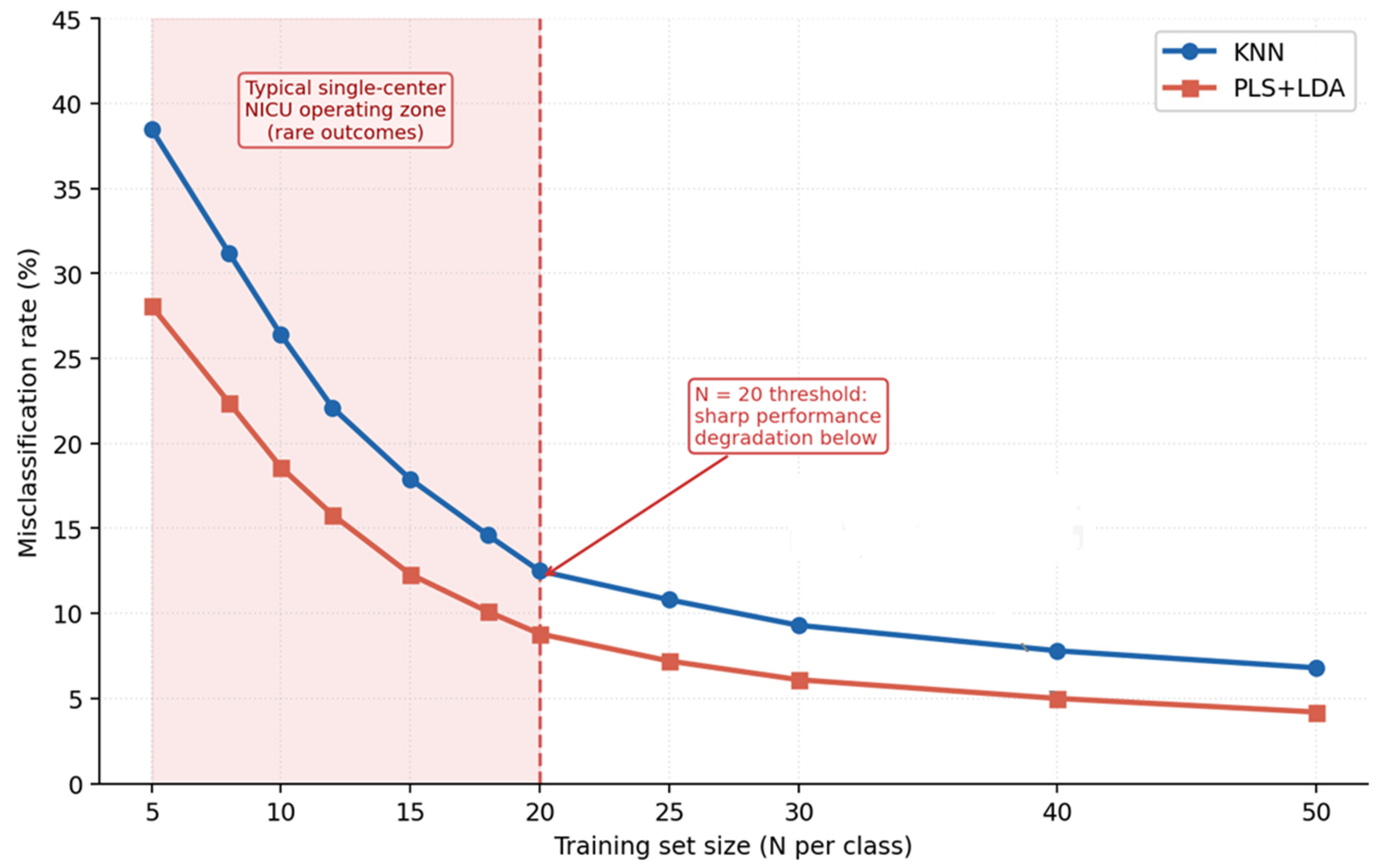
3.3. Choice of Learning Algorithm for Sparse, High-Dimensional NICU Data
3.4. Handling Temporal Dependence and Class Imbalance
4. Cross-Validation and Model Evaluation in the NICU DT Context
4.1. Why Standard Cross-Validation Fails for NICU Data
4.2. Appropriate Strategies for NICU DT Validation
4.3. Performance Metrics Beyond Discrimination
4.4. From Prediction to Action: Decision Thresholds and Clinical Deployment
4.5. The Relation to Clinical Prediction Model Standards
5. Synthetic Data and the Simulated DT: A Note on Scope
6. Privacy, Security, and IoT Architecture Considerations
7. Ethical and Regulatory Considerations
8. A Proposed Framework and Research Agenda
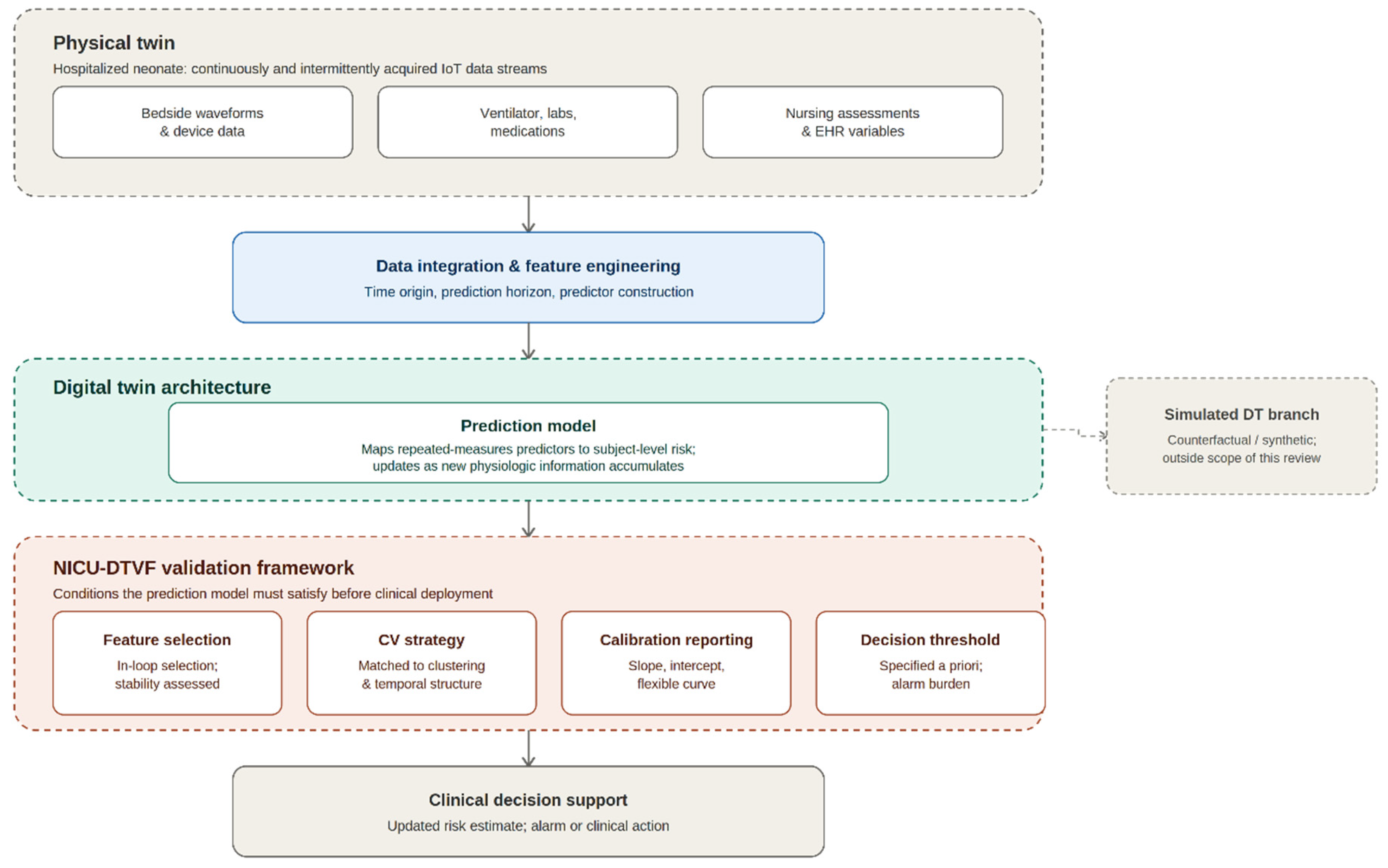
8.1. The NICU DT Validation Framework (NICU-DTVF)
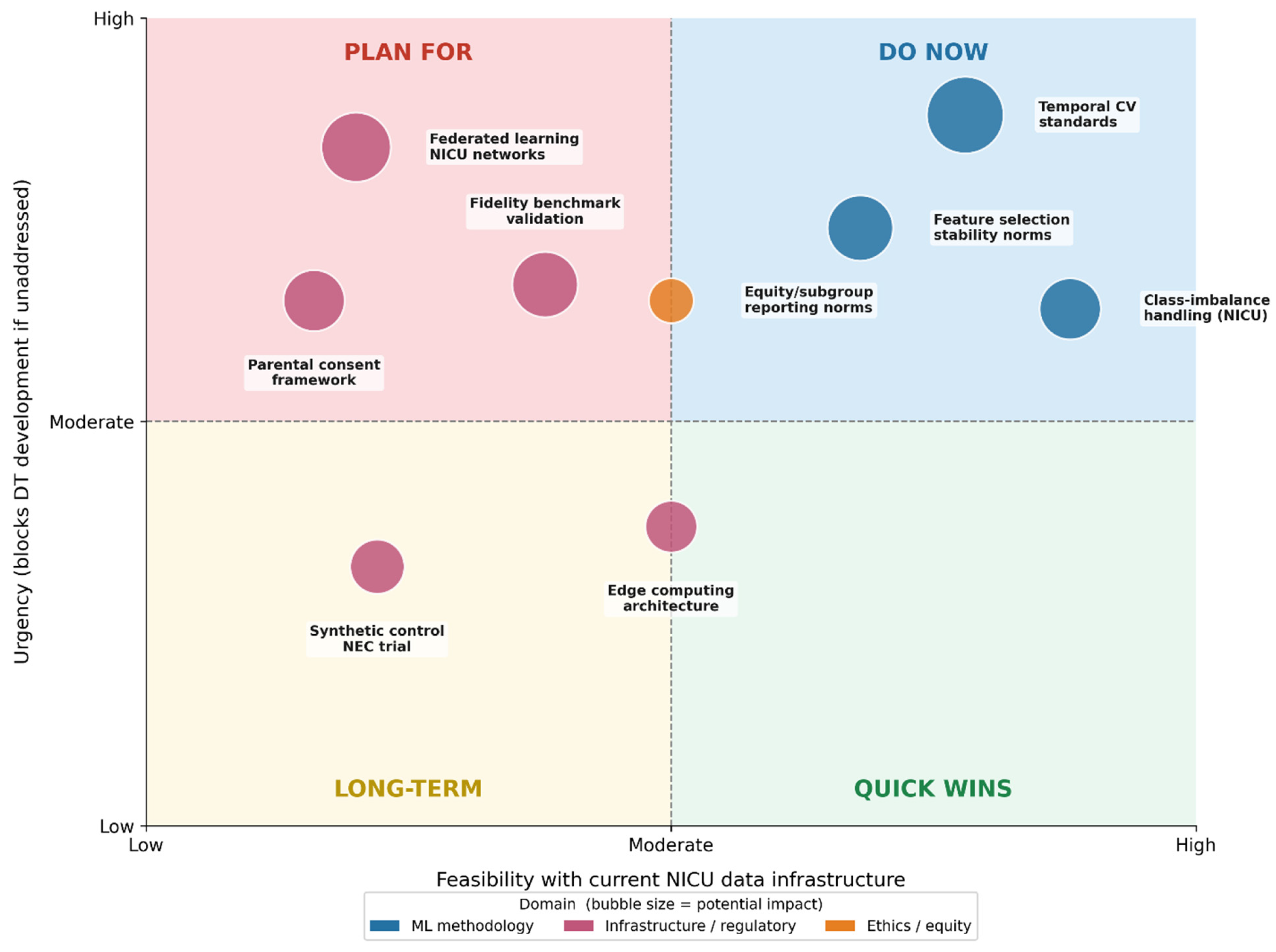
8.2. Prioritized Research Agenda
8.3. A Coherent Methodological Program for Repeated-Measures Validation in Clinical Prediction
8.4. Limitations
9. Conclusions
Funding
Institutional Review Board Statement
Informed Consent Statement
Data Availability Statement
Acknowledgments
Conflicts of Interest
Abbreviations
| AI | artificial intelligence |
| AUC | area under the receiver operating characteristic curve |
| AUPRC | area under the precision-recall curve |
| BPD | bronchopulmonary dysplasia |
| CV | cross-validation |
| DCA | decision curve analysis |
| DT | digital twin |
| EHR | electronic health record |
| FDA | US Food and Drug Administration |
| FHIR | Fast Healthcare Interoperability Resources |
| HIPAA | Health Insurance Portability and Accountability Act |
| HL7 | Health Level Seven |
| IoT | Internet of Things |
| IVH | intraventricular hemorrhage |
| KNN | k-nearest neighbors |
| LASSO | least absolute shrinkage and selection operator |
| LOCO-CV | leave-one-center-out cross-validation |
| LOOCV | leave-one-out cross-validation |
| ML | machine learning |
| NEC | necrotizing enterocolitis |
| NICHD | Eunice Kennedy Shriver National Institute of Child Health and Human Development |
| NICU | neonatal intensive care unit |
| PHI | protected health information |
| PLS+LDA | partial least squares with linear discriminant analysis |
| RNN | recurrent neural network |
| ROP | retinopathy of prematurity |
| SaMD | Software as a Medical Device |
| TRIPOD | Transparent Reporting of a multivariable prediction model for Individual Prognosis Or Diagnosis |
| SHAP | SHapley Additive exPlanations |
| SMOTE | Synthetic Minority Over-Sampling Technique |
| VLBW | very low birthweight |
References
- Grieves, M.; Vickers, J. Digital twin: Mitigating unpredictable, undesirable emergent behavior in complex systems. In Transdisciplinary Perspectives on Complex Systems; Kahlen, F.-J., Flumerfelt, S., Alves, A., Eds.; Springer: Cham, Switzerland, 2017; pp. 85–113. [Google Scholar]
- Tao, F.; Zhang, H.; Liu, A.; Nee, A.Y.C. Digital twin in industry: State-of-the-art. IEEE Trans. Ind. Inform. 2019, 15, 2405–2415. [Google Scholar] [CrossRef]
- Fuller, A.; Fan, Z.; Day, C.; Barlow, C. Digital twin: Enabling technologies, challenges and open research. IEEE Access 2020, 8, 108952–108971. [Google Scholar] [CrossRef]
- Björnsson, B.; Borrebaeck, C.; Elander, N.; Gasslander, T.; Gawel, D.R.; Gustafsson, M.; Jörnsten, R.; Lee, E.J.; Li, X.; Lilja, S.; et al. Digital twins to personalize medicine. Genome Med. 2020, 12, 4. [Google Scholar] [CrossRef] [PubMed]
- Corral-Acero, J.; Margara, F.; Marciniak, M.; Rodero, C.; Loncaric, F.; Feng, Y.; Gilbert, A.; Fernandes, J.F.; Bukhari, H.A.; Wajdan, A.; et al. The ‘DT’ to enable the vision of precision cardiology. Eur. Heart J. 2020, 41, 4556–4564. [Google Scholar] [CrossRef] [PubMed]
- Pammi, M.; Shah, P.S.; Yang, L.; Hagan, J.; Aghaeepour, N.; Neu, J. Digital twins and synthetic patient data: Can they empower clinical trials in children? Lancet Digit. Health 2025, 7, 100851. [Google Scholar] [CrossRef] [PubMed]
- Drummond, C.; Gonsard, M. Definitions and characteristics of patient digital twins being developed for clinical use: Scoping review. J. Med. Internet Res. 2024, 26, e58504. [Google Scholar] [CrossRef] [PubMed]
- Moorman, J.R.; Carlo, W.A.; Kattwinkel, J.; Schelonka, R.L.; Porcelli, P.J.; Navarrete, C.T.; Bancalari, E.; Aschner, J.L.; Walker, M.W.; Perez, J.A.; et al. Mortality reduction by heart rate characteristic monitoring in very low birth weight neonates: A randomized trial. J. Pediatr. 2011, 159, 900–906.e1. [Google Scholar] [CrossRef] [PubMed]
- Ambroise, C.; McLachlan, G.J. Selection bias in gene extraction on the basis of microarray gene-expression data. Proc. Natl. Acad. Sci. USA 2002, 99, 6562–6566. [Google Scholar] [CrossRef] [PubMed]
- Hastie, T.; Tibshirani, R.; Friedman, J. The Elements of Statistical Learning: Data Mining, Inference and Prediction, 2nd ed.; Springer: New York, NY, USA, 2009. [Google Scholar]
- Hagan, J.L. Comparison of Supervised Learning Methods for Classification of Microarray Data. Doctoral Dissertation, Department of Biostatistics, Tulane University, New Orleans, LA, USA, 2012. [Google Scholar]
- Van Calster, B.; McLernon, D.J.; van Smeden, M.; Wynants, L.; Steyerberg, E.W.; on behalf of the Topic Group ‘Evaluating diagnostic tests and prediction models’ of the STRATOS initiative. Calibration: The Achilles heel of predictive analytics. BMC Med. 2019, 17, 230. [Google Scholar] [CrossRef] [PubMed]
- Lee, Y.-H.; Nam, T.; Cho, D.-S.; Kim, W.-T. LLM-Based Adaptive Control Code Generation Framework with Digital Twin-Integrated Verification for Heterogeneous Robot Systems. Appl. Sci. 2026, 16, 3883. [Google Scholar] [CrossRef]
- di Benedetto, M.; Randazzo, V.; Lidozzi, A.; Accetta, A.; Ghione, G.; Solero, L.; Cirrincione, G.; Pasero, E.G.A. Enhanced Neural Real-Time Digital Twin for Electrical Drives. Appl. Sci. 2026, 16, 3955. [Google Scholar] [CrossRef]
- National Academies of Sciences, Engineering, and Medicine. Foundational Research Gaps and Future Directions for Digital Twins; National Academies Press: Washington, DC, USA, 2024. [Google Scholar] [CrossRef] [PubMed]
- Riley, R.D.; Ensor, J.; Snell, K.I.E.; Harrell, F.E.; Martin, G.P.; Reitsma, J.B.; Moons, K.G.M.; Collins, G.; van Smeden, M. Calculating the sample size required for developing a clinical prediction model. BMJ 2020, 368, m441. [Google Scholar] [CrossRef] [PubMed]
- Steyerberg, E.W. Clinical Prediction Models: A Practical Approach to Development, Validation, and Updating, 2nd ed.; Springer: New York, NY, USA, 2019. [Google Scholar]
- Hagan, J.L. Quantifying the Optimism of Naive Cross-Validation for Binary Outcome Prediction with Repeated-Measures Predictors: A Simulation Study and Clinical Illustration. medRxiv 2026. [Google Scholar] [CrossRef]
- Collins, G.S.; Moons, K.G.M.; Dhiman, P.; Riley, R.D.; Beam, A.L.; Van Calster, B.; Ghassemi, M.; Liu, X.; Reitsma, J.B.; van Smeden, M.; et al. TRIPOD+AI statement: Updated guidance for reporting clinical prediction models that use regression or machine learning methods. BMJ 2024, 385, e078378. [Google Scholar] [CrossRef] [PubMed]
- Laubenbacher, R.; Sluka, J.P.; Glazier, J.A. Using digital twins in viral infection. Science 2021, 371, 1105–1106. [Google Scholar] [CrossRef] [PubMed]
- Khoshfekr Rudsari, H.; Tseng, B.; Zhu, H.; Song, L.; Gu, C.; Roy, A.; Irajizad, E.; Butner, J.; Long, J.; Do, K.-A. Digital twins in healthcare: A comprehensive review and future directions. Front. Digit. Health 2025, 7, 1633539. [Google Scholar] [CrossRef] [PubMed]
- Soul, J.S.; E Hammer, P.; Tsuji, M.; Saul, J.P.; Bassan, H.; Limperopoulos, C.; Disalvo, D.N.; Moore, M.; Akins, P.; Ringer, S.; et al. Fluctuating pressure-passivity is common in the cerebral circulation of sick premature infants. Pediatr. Res. 2007, 61, 467–473. [Google Scholar] [CrossRef] [PubMed]
- Sward-Comunelli, S.L.; Mabry, S.M.; Thibeault, D.W.; Truog, W.E. Ventilator support after surfactant therapy for respiratory distress syndrome: Patterns of use. J. Perinatol. 1997, 17, 296–302. [Google Scholar]
- Bell, E.F.; Hintz, S.R.; Hansen, N.I.; Bann, C.M.; Wyckoff, M.H.; DeMauro, S.B.; Walsh, M.C.; Vohr, B.R.; Stoll, B.J.; Carlo, W.A.; et al. Mortality, in-hospital morbidity, care practices, and 2-year outcomes for extremely preterm infants in the US, 2013–2018. JAMA 2022, 327, 248–263. [Google Scholar] [CrossRef] [PubMed]
- Higgins, R.D.; Jobe, A.H.; Koso-Thomas, M.; Bancalari, E.; Viscardi, R.M.; Hartert, T.V.; Ryan, R.M.; Kallapur, S.G.; Steinhorn, R.H.; Konduri, G.G.; et al. Bronchopulmonary dysplasia: Executive summary of a workshop. J. Pediatr. 2018, 197, 300–308. [Google Scholar] [CrossRef] [PubMed]
- Hagan, J.L.; Srivastav, S.K. Performance of Partial Least Squares + Linear Discriminant Analysis versus k-Nearest Neighbors for Validation Set Classification of Cancer DNA Microarray Data. Biostat. Biom. Open Access J. 2019, 9, 555752. [Google Scholar] [CrossRef]
- Boyer, C.B.; Dahabreh, I.J.; Steingrimsson, J.A. Estimating and evaluating counterfactual prediction models. Stat. Med. 2025, 44, e70287. [Google Scholar] [CrossRef] [PubMed]
- Meinshausen, N.; Bühlmann, P. Stability selection. J. R. Stat. Soc. Ser. B Stat. Methodol. 2010, 72, 417–473. [Google Scholar] [CrossRef]
- Tibshirani, R. Regression shrinkage and selection via the lasso. J. R. Stat. Soc. Ser. B Stat. Methodol. 1996, 58, 267–288. [Google Scholar] [CrossRef]
- Pavlou, M.; Ambler, G.; Seaman, S.; De Iorio, M.; Omar, R.Z. Review and evaluation of penalised regression methods for risk prediction in low-dimensional data with few events. Stat. Med. 2016, 35, 1159–1177. [Google Scholar] [PubMed]
- Van Calster, B.; van Smeden, M.; van Amsterdam, W.; Coemans, M.; Wynants, L.; Steyerberg, E.W. The enemies of reliable and useful clinical prediction models. Annu. Rev. Stat. Appl. 2026, 13, 465–492. [Google Scholar] [CrossRef]
- Shah, R.D.; Samworth, R.J. Variable selection with error control: Another look at stability selection. J. R. Stat. Soc. Ser. B Stat. Methodol. 2013, 75, 55–80. [Google Scholar] [CrossRef]
- Christodoulou, E.; Ma, J.; Collins, G.S.; Steyerberg, E.W.; Verbakel, J.Y.; Van Calster, B. A systematic review shows no performance benefit of machine learning over logistic regression for clinical prediction models. J. Clin. Epidemiol. 2019, 110, 12–22. [Google Scholar] [CrossRef] [PubMed]
- US Food and Drug Administration. Artificial Intelligence and Machine Learning (AI/ML)-Enabled Medical Devices; FDA: Silver Spring, MD, USA, 2022. [Google Scholar]
- Rajpurkar, P.; Chen, E.; Banerjee, O.; Topol, E.J. AI in health and medicine. Nat. Med. 2022, 28, 31–38. [Google Scholar] [CrossRef] [PubMed]
- Pellegrini, C.; Navab, N.; Kazi, A. Unsupervised pre-training of graph transformers on patient population graphs. Med. Image Anal. 2023, 89, 102895. [Google Scholar] [CrossRef] [PubMed]
- Mataraso, S.J.; Espinosa, C.A.; Seong, D.; Reincke, S.M.; Berson, E.; Reiss, J.D.; Kim, Y.; Ghanem, M.; Shu, C.-H.; James, T.; et al. A machine learning approach to leveraging electronic health records for enhanced omics analysis. Nat. Mach. Intell. 2025, 7, 293–306. [Google Scholar] [CrossRef] [PubMed]
- Harutyunyan, H.; Khachatrian, H.; Kale, D.C.; Steeg, G.V.; Galstyan, A. Multitask learning and benchmarking with clinical time series data. Sci. Data 2019, 6, 96. [Google Scholar] [CrossRef] [PubMed]
- Jagd, K.N.; DeVries, R.; Winther, O. Towards Self-Supervised Foundation Models for Critical Care Time Series. arXiv 2025, arXiv:2509.19885. [Google Scholar] [CrossRef]
- Burger, M.; Chopard, D.; Londschien, M.; Sergeev, F.; Yeche, H.; Kuznetsova, R.; Faltys, M.; Gerdes, E.; Leshetkina, P.; Buhlmann, P.; et al. A Foundation Model for Intensive Care: Unlocking Generalization across Tasks and Domains at Scale. medRxiv 2025. [Google Scholar] [CrossRef]
- Durbin, J.; Koopman, S.J. Time Series Analysis by State Space Methods, 2nd ed.; Oxford University Press: Oxford, UK, 2012. [Google Scholar]
- Guo, H.; Li, Y.; Shang, J.; Gu, M.; Huang, Y.; Gong, B. Learning from class-imbalanced data: Review of methods and applications. Expert Syst. Appl. 2017, 73, 220–239. [Google Scholar] [CrossRef]
- Bergmeir, C.; Benítez, J.M. On the use of cross-validation for time series predictor evaluation. Inf. Sci. 2012, 191, 192–213. [Google Scholar] [CrossRef]
- Sullivan, B.A.; Moreira, A.G.; McAdams, R.M.; Knake, L.A.; Husain, A.; Qiu, J.; Mudireddy, A.; Majeedi, A.; Shalish, W.; Lake, D.E.; et al. Comparing machine learning techniques for neonatal mortality prediction: Insights from a modeling competition. Pediatr. Res. 2025, 98, 405–411. [Google Scholar] [PubMed]
- Niestroy, J.C.; Moorman, J.R.; Levinson, M.A.; Manir, S.A.; Clark, T.W.; Fairchild, K.D.; Lake, D.E. Discovery of signatures of fatal neonatal illness in vital signs using highly comparative time-series analysis. npj Digit. Med. 2022, 5, 6. [Google Scholar] [CrossRef] [PubMed]
- Song, W.; Jung, S.Y.; Baek, H.; Choi, C.W.; Jung, Y.H.; Yoo, S. A predictive model based on machine learning for the early detection of late-onset neonatal sepsis: Development and observational study. JMIR Med. Inform. 2020, 8, e15965. [Google Scholar] [CrossRef] [PubMed]
- Vavekanand, R.; Kumar, T.; Kumar, S.; Kumar, G.; Laghari, A.A. Multimodal Machine Learning Approaches in Predictive Healthcare Analytics: A Comprehensive Survey. Arch. Comput. Methods Eng. 2026, 33, 7667–7691. [Google Scholar] [CrossRef]
- Hagan, J.L. cawCV: Cluster-Aware Cross-Validation for Repeated-Measures Predictors with Binary Outcomes [Software]. Zenodo 2026. [Google Scholar] [CrossRef]
- Saito, T.; Rehmsmeier, M. The precision-recall plot is more informative than the ROC plot when evaluating binary classifiers on imbalanced datasets. PLoS ONE 2015, 10, e0118432. [Google Scholar] [CrossRef] [PubMed]
- Esteban, C.; Hyland, S.L.; Rätsch, G. Real-valued (medical) time series generation with recurrent conditional GANs. arXiv 2017, arXiv:1706.02633. [Google Scholar]
- US Department of Health and Human Services. HIPAA Security Rule. 45 CFR Parts 160 and 164. Fed. Regist. 2003, 68, 8334–8381. [Google Scholar]
- Sweeney, L. k-anonymity: A model for protecting privacy. Int. J. Uncertain. Fuzziness Knowl. Based Syst. 2002, 10, 557–570. [Google Scholar] [CrossRef]
- El Emam, K.; Jonker, E.; Arbuckle, L.; Malin, B. A systematic review of re-identification attacks on health data. PLoS ONE 2011, 6, e28071. [Google Scholar] [CrossRef] [PubMed]
- McMahan, H.B.; Moore, E.; Ramage, D.; Hampson, S.; Agüera y Arcas, B. Communication-efficient learning of deep networks from decentralized data. Proc. Mach. Learn. Res. 2017, 54, 1273–1282. [Google Scholar]
- Horbar, J.D.; Soll, R.F.; Edwards, W.H. The Vermont Oxford Network: A community of practice. Clin. Perinatol. 2010, 37, 29–47. [Google Scholar] [CrossRef] [PubMed]
- Bell, E.F.; Stoll, B.J.; Hansen, N.I.; Wyckoff, M.H.; Walsh, M.C.; Sánchez, P.J.; Rysavy, M.A.; Gabrio, J.H.; Archer, S.W.; Das, A.; et al. Contributions of the NICHD Neonatal Research Network’s Generic Database to documenting and advancing the outcomes of extremely preterm infants. Semin Perinatol. 2022, 46, 151635. [Google Scholar] [CrossRef] [PubMed]
- Li, T.; Sahu, A.K.; Zaheer, M.; Sanjabi, M.; Smola, A.; Smith, V. Federated optimization in heterogeneous networks. Proc. Mach. Learn. Res. 2020, 2, 429–450. [Google Scholar]
- Akbarialiabad, H.; Pasdar, A.; Murrell, D.F.; Mostafavi, M.; Shakil, F.; Safaee, E.; Leachman, S.A.; Haghighi, A.; Tarbox, M.; Bunick, C.G.; et al. Enhancing randomized clinical trials with digital twins. npj Syst. Biol. Appl. 2025, 11, 110. [Google Scholar] [CrossRef] [PubMed]
- Debray, T.P.A.; Collins, G.S.; Riley, R.D.; Snell, K.I.E.; Van Calster, B.; Reitsma, J.B.; Moons, K.G.M. Transparent reporting of multivariable prediction models developed or validated using clustered data: TRIPOD-Cluster checklist. BMJ 2023, 380, e071018. [Google Scholar] [CrossRef] [PubMed]



| Outcome | Approx. Rate | Prediction Target | Data Source | Primary Validation Challenge |
|---|---|---|---|---|
| Necrotizing enterocolitis | ~9% | Binary, subject-level | EHR, clinical diagnosis | Rare-event small effective N |
| Late-onset sepsis | ~20% | Binary, subject-level | EHR, physiologic monitoring | Repeated-measures cluster leakage |
| Severe IVH (grade III–IV) | ~14% | Binary, subject-level | Cranial ultrasound, EHR | Rare-event small effective N |
| Bronchopulmonary dysplasia | ≥40% (definition-dependent) | Binary or severity-graded, subject-level | Respiratory support data, EHR | Outcome definition heterogeneity |
| Mortality before discharge | ~22% overall; steep gestational-age gradient | Binary, subject-level | EHR | Between-subject heterogeneity in baseline risk |
| CV Strategy | Temporal Autocorr. | Infant Clustering | Center Transport. | NICU DT Recommendation |
|---|---|---|---|---|
| Standard k-fold CV | N | N | N | Hyperparameter tuning only; do not use for final performance |
| Leave-one-out CV (LOOCV) | N | N | N | Optimistically biased in small samples; avoid for final reporting |
| Subject-level k-fold CV | ~ | Y | N | Minimum cluster-aware standard for repeated-measures predictors |
| Blocked time-series CV | Y | ~ | N | Preferred for single-center longitudinal models |
| Bootstrap time-series CV | Y | ~ | N | Preferred for rare outcomes (reduces variance) |
| Leave-one-center-out CV (LOCO-CV) | Y | Y | Y | Gold standard for multi-site deployment |
| Principle | Requirement | Evidentiary/Implementation Status |
|---|---|---|
| 1. Feature selection stability | Perform selection within the CV loop; report stability metrics across bootstrap resamples | Conceptual recommendation, grounded in the broader clinical prediction model literature |
| 2. CV strategy matched to data structure | Subject-level k-fold as minimum standard; blocked or bootstrap time-series CV for temporal autocorrelation; LOCO-CV for multi-site deployment | Implemented in cawCV; supported by simulation and empirical evidence [18] |
| 3. Calibration-inclusive performance reporting | Report calibration slope, calibration-in-the-large, and a flexible calibration curve, not discrimination alone | Conceptual recommendation, aligned with TRIPOD+AI [19] |
| 4. A priori decision-threshold specification | Specify decision thresholds and alarm burden before deployment; evaluate prospectively | Conceptual recommendation; not yet empirically evaluated in a NICU DT application |
Disclaimer/Publisher’s Note: The statements, opinions and data contained in all publications are solely those of the individual author(s) and contributor(s) and not of MDPI and/or the editor(s). MDPI and/or the editor(s) disclaim responsibility for any injury to people or property resulting from any ideas, methods, instructions or products referred to in the content. |
© 2026 by the author. Licensee MDPI, Basel, Switzerland. This article is an open access article distributed under the terms and conditions of the Creative Commons Attribution (CC BY) license.
Share and Cite
Hagan, J.L. Validation of Clinical Prediction Models with Repeated-Measures Predictors: A Methodological Framework for Neonatal Digital Twins in IoT Environments. Appl. Sci. 2026, 16, 7171. https://doi.org/10.3390/app16147171
Hagan JL. Validation of Clinical Prediction Models with Repeated-Measures Predictors: A Methodological Framework for Neonatal Digital Twins in IoT Environments. Applied Sciences. 2026; 16(14):7171. https://doi.org/10.3390/app16147171
Chicago/Turabian StyleHagan, Joseph L. 2026. "Validation of Clinical Prediction Models with Repeated-Measures Predictors: A Methodological Framework for Neonatal Digital Twins in IoT Environments" Applied Sciences 16, no. 14: 7171. https://doi.org/10.3390/app16147171
APA StyleHagan, J. L. (2026). Validation of Clinical Prediction Models with Repeated-Measures Predictors: A Methodological Framework for Neonatal Digital Twins in IoT Environments. Applied Sciences, 16(14), 7171. https://doi.org/10.3390/app16147171