Article

Methodology and Preliminary Testing of Rocks Under Volumetric Compression Using the MDS-450 and MTS-815 ServoHydraulic Systems


by
Vladimir Leonidovich Trushko
and
Oleg Igorevich Kolosov
*
Department of Constructing Mining Enterprises and Underground Structures, Empress Catherine II St. Petersburg Mining University, 2 21st Line, St. Petersburg 199106, Russia
*
Author to whom correspondence should be addressed.
Appl. Sci. 2026, 16(14), 7163; https://doi.org/10.3390/app16147163
Submission received: 2 May 2026 / Revised: 10 June 2026 / Accepted: 14 July 2026 / Published: 17 July 2026
(This article belongs to the Topic Failure Characteristics of Deep Rocks, 3rd Edition)

Abstract

This methodological paper describes the development and preliminary validation of an experimental procedure for testing rock specimens under volumetric compression using the MDS-450 and MTS-815 servo-hydraulic systems. The apparatus allows the simultaneous application of axial load, confining pressure, pore pressure, and temperature to simulate thermobaric conditions corresponding to depths of about 10–12 km. In this study, the system was used only under room-temperature conditions in order to verify the loading path and data acquisition scheme. The procedure provides stepwise reproduction of reservoir conditions and is designed to record triaxial compressive strength, deformation moduli, dilatancy, and acoustic and ultrasonic responses. Results from preliminary tests on sedimentary rock specimens at confining pressures of 90 and 120 MPa and room temperature demonstrate typical stages of volumetric compression and confirm the stability of the experimental method. To support the verification of the methodology, additional tests were also performed at a confining pressure of 50 MPa, incorporating the temperature factor and acoustic emission monitoring.

1. Introduction

When preparing and implementing hydrocarbon field projects at great depths, an important aspect is examining deformation and failure processes in rocks (limestones, sandstones, and dolomites) in order to identify structural changes and dilatancy zones [1,2,3]. Under such conditions, the stress–strain state of the rock mass is determined by the combined influence of stresses, natural temperature fields, and the pore pressure [4,5,6].
There are two main methodological approaches to rock testing that consider the influence of temperature: preliminary specimen heating followed by testing and specimen heating during loading [7,8,9].
Most experiments involve the preliminary heating of specimens and their subsequent testing. In the works by Sheng-Qi Yang, P.G. Ranjith, Hong-Wen Jing, and others [10], after thermal treatment in the range of 200–800 °C and subsequent uniaxial tests with acoustic emission and optical monitoring, granite showed a non-monotonic pattern of property changes: at 300 °C, the strength and modulus increased, whereas with further heating they decreased, and failure became more ductile. M.A. Idris utilized a similar approach for limestone and marble [11], heating them to 900 °C, and demonstrated an increase in porosity and a decrease in density and strength. For calcarenite [12], V. Brotóns, R. Tomás, S. Ivorra, and J.C. Alarcón supplemented this method with ultrasonic monitoring.
Compared with uniaxial schemes, the volumetric loading methodology more accurately reflects the spatial nature of the stress state, as shown in research by Fan Xiao, Deyi Jiang, Fei Wu, and others, where sandstone was preliminarily heated in an SX2-10-12A furnace to 900 °C [13,14].
For the reproduction of thermobaric conditions at great depths, a different method is applied using servo-controlled triaxial complexes. In one study [1], Peng Zhang, Brijes Mishra, and Keith A. Heasley tested sandstones on a specialized Ultra-Deep Drilling Simulator (UDS) at temperatures of 25–180 °C and a confining pressure of up to 200 MPa. A similar approach was implemented by Mingwei Kong et al. [15], who tested specimens on a GCTS RTR-2000 system at 150 °C with a confining pressure of 110 MPa and a pore pressure of 80 MPa, which enabled them to model a confining compression of about 30 MPa and record the transition to closed shear cracks.
At the Empress Catherine II Saint Petersburg Mining University [16,17], studies were carried out on an MTS 815 system with an acoustic emission system, providing confining and pore pressures of up to 80 MPa and an axial load of up to 4.6 MN.
Another testing method involves expanding the range of parameters recorded. Tobias Orlander, Katrine Andreassen, and Ida Fabricius [18] studied sandstones in a temperature-controlled triaxial cell at temperatures from room temperature to 170 °C and with pressures up to 15 MPa, recording P- and S-wave velocities and determining dynamic and static moduli. They demonstrated that for some specimens, stiffness increased with rising temperatures. Zaobao Liu, Chuan Wang, Mingshan Zhang, and others [19] performed volumetric thermomechanical tests on granite in the range of 20–240 °C with additional 3D scanning and microstructural analysis, establishing a decrease in strength by more than 20%, the smoothing of the failure surface, and a reduction in brittleness. A similar approach was implemented by Yingjie Xia, Yusheng Wang, Hai Yang, and others [20] using a triaxial press with 36 electric heaters that raise the temperature of the specimen to 600 °C. In shale experiments, temperature thresholds of 120–160 °C were identified, at which point the strength, deformation modulus, anisotropy, and failure mechanism changed significantly.
A comparison of the above-mentioned studies demonstrates that differences in testing systems not only determine the ranges of temperatures and pressures but also the physical consequences of the results obtained. “Furnace” schemes with preliminary heating protocols are useful for identifying thermal damage, degradation thresholds, and the role of the cooling regime; however, they mainly record the already formed thermal disturbance of the structure [21,22,23].
In contrast, servo-controlled triaxial complexes with heating protocols during loading make it possible to study temperature as an active environmental parameter and thereby reproduce the conditions of great depths during rock testing more effectively.
Thus, for reservoir rocks, the greatest scientific value is provided by comparable experiments on systems that allow for the simultaneous control of the temperature, confining pressure, and pore pressure as well as the recording of deformation and structure-sensitive responses [24,25]. It is precisely this methodology that makes it possible to move from the description of thermal damage to the construction of geomechanical models that consider the temperature factor in rock failure mechanisms under volumetric compression [26,27]. For the practical implementation of this promising methodology, a new Russian MDS-450 servo-hydraulic system has been developed and applied at Mining University, allowing for the reproduction of thermobaric conditions characteristic of depths of up to 10–12 km.
Despite this system’s ability to control the temperature and pore pressure, the present paper focuses on validating the experimental procedure and equipment at room temperature. Experiments involving controlled heating and pore pressure will be reported in subsequent studies.

2. Methodology and Research Method

This study is based on the laboratory-based physical modeling of the behavior of sedimentary rocks under a volumetric stress state that approximates high thermobaric conditions. This method enables the stepwise reproduction of the combined action of the axial load, confining pressure, pore pressure, and temperature, followed by the recording of the ultimate strength, deformation moduli, transverse strain coefficient, acoustic emission parameters, dilatancy, and ultrasonic parameters of the specimen. In contrast to standard tests that focus mainly on determining ultimate strength, this approach enables us to trace changes in the roBck state at all loading stages, including compaction, the development of inelastic strains, dilatancy manifestations, and the transition to failure [28]. The methodological basis of this approach corresponds to schemes in which the modeling of great depths is regarded as a means of better aligning laboratory experiments with the real-world conditions in rock masses [29]. This is especially relevant for identifying fractured zones occurring at great depths [30]. In the preliminary validation tests reported here, the heating and pore pressure modules were not activated, and specimens were tested at room temperature under dry conditions.
The comparison (Table 1) demonstrates that the MDS-450 system should not only be positioned through a single maximum parameter, since several modern triaxial and true-triaxial systems can also achieve high pressure or high temperature ranges. Its methodological value lies in the combination of capabilities available within one experimental platform. In contrast to UDS-type studies, where the main emphasis is placed on the HPHT (high temperature and high pressure) mechanical response under high confining pressures, the MDS-450 system combines a high axial loading capacity and confining pressure, pore pressure, and temperature control with an expanded set of internal monitoring channels. In comparison to the GCTS RTR-2000, the MDS-450 system provides a wider specified pressure range for both confining and pore pressures and enables the testing of larger cylindrical core specimens. Compared with true-triaxial high-temperature systems, the MDS-450 does not provide independent control of σ2 and σ3, but it is more directly oriented toward reservoir-type effective stress conditions, where the pore pressure, confining pressure, temperature, and deformation response must be controlled simultaneously.
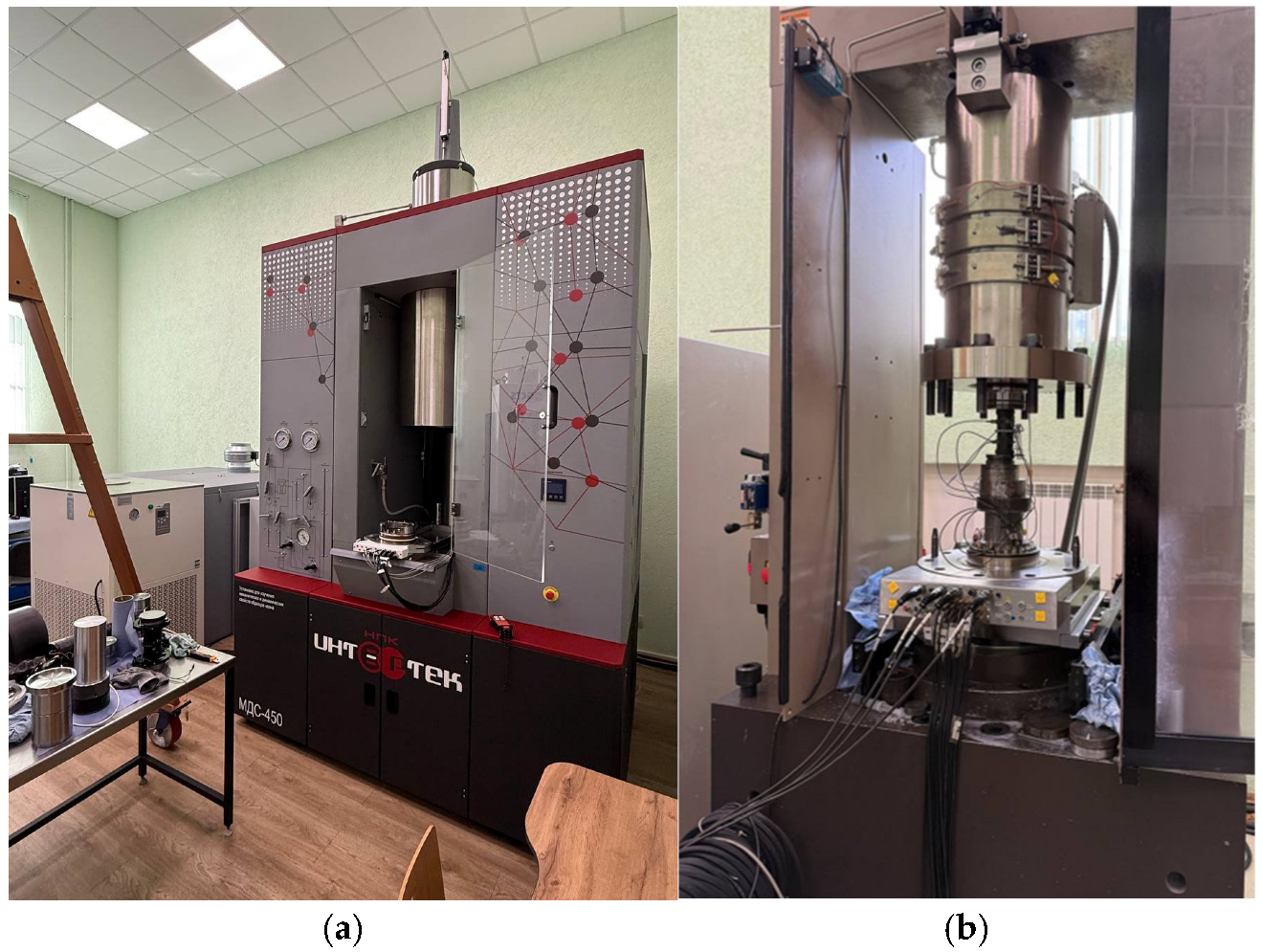
Thus, the novelty of the MDS-450 system is not its achievement of a single record pressure or temperature value. Rather, it is the integrated reproduction of deep reservoir thermobaric conditions on core-scale specimens, including axial loading up to 4.5 MN; confining and pore pressures up to 210 MPa; temperature control up to 200 °C; and multi-channel registration of mechanical, deformation, acoustic, and ultrasonic responses. This combination makes the system suitable for future studies of temperature-dependent rock failure under volumetric compression and for the development of geomechanical models that account for the coupled influence of the stress state, pore pressure, and temperature. The MTS-815 system provides testing capabilities under a maximum confining pressure of 80 MPa and a maximum operating temperature of 200 °C and can also be used for preliminary testing of the improved experimental methodology (Figure 1).
When developing the testing program, differences in porosity, fracturing, bedding, the degree of water saturation, and the structural anisotropy of the specimens are taken into account, since these factors significantly affect the failure mechanism under the combined action of pressure and temperature [31,32,33]. Similarly to the different methodological approaches [16,17], this study is not only aimed at recording limiting characteristics but also at identifying structural rearrangement patterns of rocks during loading.
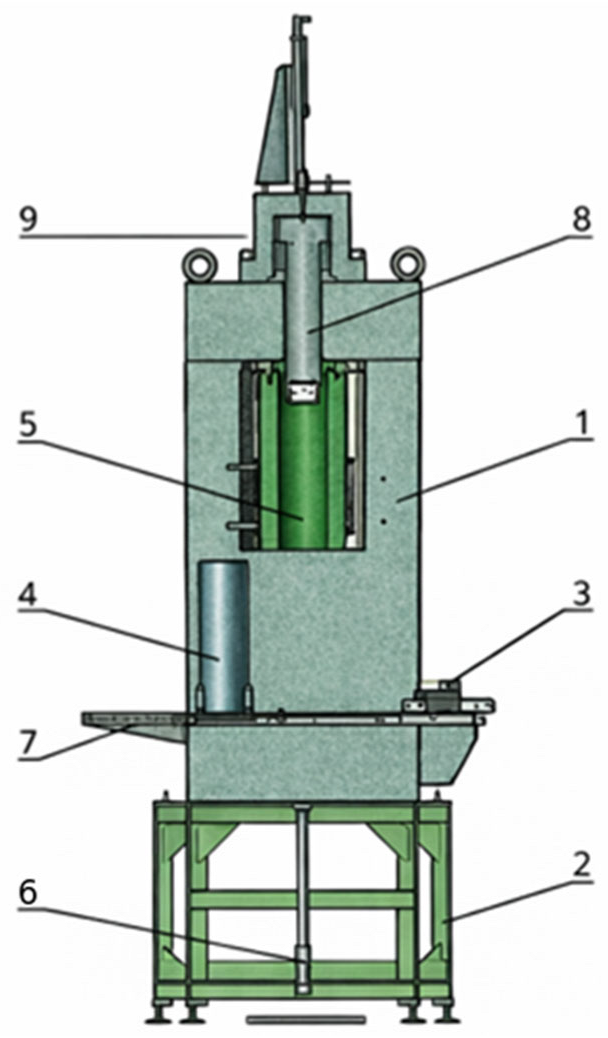
In order to study the mechanical and dynamic properties of core specimens under thermobaric conditions of great depths, tests are performed on the MDS-450 system. The system includes a portal load frame, a hydraulic pumping station, and a stabilometer (Figure 2). The load frame provides a maximum compression load of 4.5 MN, a tensile load of 2 MN, a hydraulic cylinder stroke of 100 mm, a stiffness of 10 MN/mm, a maximum cyclic testing frequency of 10 Hz, and a loading rate of up to 350 mm/min. The hydraulic station has a capacity of 57 L/min at a nominal working pressure of 21 MPa and is equipped with a pressure control system, a remote control, and pressure and temperature sensors for the working fluid, as well as a built-in pressure accumulator for smoothing pulsations.
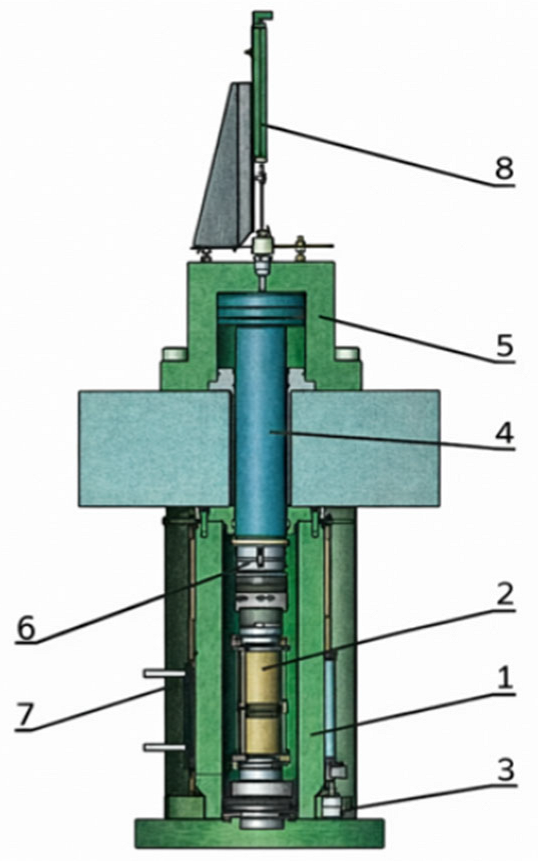
The main unit that ensures the modeling of reservoir conditions is the stabilometer (Figure 3), which is composed of stainless steel and is equipped with an automatic mechanism for opening and closing the dome and a loading piston with a spherical support. According to the technical specification table in the passport, the stabilometer has two ports for supplying and discharging fluid when creating confining pressure and two ports for forming pore pressure, as well as 17 sealed feedthroughs for connecting built-in sensors, including force sensors, axial and circumferential extensometers, ultrasonic sensors, and other measuring elements. The pressure range is from 0 to 210 MPa, while the pore pressure range is from 0 to 210 MPa; the operating temperature in the test chamber varies from −15 to 200 °C. This design allows specimens with a diameter of up to 100 mm and a height of up to 250 mm to be placed in the chamber. It also incorporates thermal insulation, which reduces heat transfer to the system components.
To record the mechanical response, built-in force and deformation sensors are used. These sensors operate within a range of up to 2.5 MN with a nonlinearity of 0.25% and remain functional under the temperature and pressure conditions generated inside the testing system. The deformation measurement system includes three sensors with an operating range of −2.5 to 2.5 mm and a nonlinearity of 0.25%. Two types of special embedded mounting devices are provided for sensor installation: one for specimens with diameters from 25 to 54 mm and the other for specimens with diameters from 54 to 100 mm. These units make it possible to record axial and circumferential deformations under confined pressure and heating, which increases the informational value of the experiment compared with the simplified testing schemes considered above.
The specimen preparation involves manufacturing cylindrical samples from full-size rock cores with a geometry corresponding to the capabilities of the testing system and the objectives of a particular experimental series. The end surfaces of the specimens are ground to ensure parallelism and close contact with the loading platens, after which the confining surface of the specimens is sealed with an impermeable sleeve. Depending on the specimen diameter, two sets of platens are used: 63 mm diameter platens for smaller specimens and 100 mm diameter platens for larger specimens. Both sets are equipped with a spherical seat and channels for generating pore pressure. This approach ensures correct load transfer to the specimen, system tightness, and the reproducibility of filtration conditions.
After the specimen is installed in the testing system and the measuring sensors are connected, the boundary conditions of the experiment are formed. The required values of the confining pressure, pore pressure, and temperature are then set sequentially, after which the specimen is held until the sensor readings stabilize. First, the confining pressure is created; then the pore pressure is formed. In the present study, this heating stage is not implemented: the system is maintained at room temperature for the entire test. After the stabilization of the sensor readings, axial loading is performed at a rod displacement rate of 1 mm/min until specimen failure.
The main stage of the test consists of the axial loading of the specimen at constant or program-controlled values for temperature, confining pressure, and pore pressure. Due to the maximum axial loading capacity of the load frame and the possibility of creating confining and pore pressures of up to 210 MPa, this system enables the modeling of a wide range of thermobaric states characteristic of deep horizons [35].
The processing of the results involves constructing complete deformation diagrams and determining the compressive strength under volumetric compression, deformation moduli, the transverse strain coefficient, acoustic emission parameters, dilatancy, and characteristics of post-failure deformation [36,37,38]. When additional built-in channels and sensors are used, the monitoring of ultrasonic parameters can be achieved, which makes it possible to relate changes in the mechanical response to the evolution of the internal structure of the specimen [39,40,41]. As a result, this methodology provides a comprehensive assessment of the failure of sedimentary rocks under various thermobaric conditions and enables a comparison of the behavior of dolomites, limestones, sandstones, and shales within a unified experimental system [42].
In the present study, the complete thermobaric potential of the MDS-450 system was not used. The experiments were performed as preliminary validation tests at room temperature and under dry conditions. The heating and pore pressure modules were not activated. The purpose of this stage was to verify the mechanical loading path, the stability of the confining pressure, the operation of deformation channels, and the possibility of recording a complete stress–strain response up to and beyond peak strength. In addition, to assess the applicability of the methodology, supplementary preliminary tests were conducted using the MTS-815 system under temperature-controlled conditions with acoustic emission monitoring.
During the validation tests, the specimen was first subjected to the target confining pressure. After the stabilization of the pressure and sensor readings, axial loading was applied at a constant displacement rate of 1 mm/min until failure. The confining pressure was kept constant during axial loading. The recorded parameters included the axial load, confining pressure, axial deformation, transverse deformation and temperature in the chamber. The obtained curves made it possible to distinguish the main stages of triaxial deformation: initial nonlinear compaction, hardening, peak strength, and post-peak softening. The stability of the confining pressure during the experiment confirms that the observed changes in the mechanical response are associated mainly with specimen deformation and failure, rather than with the instability of the boundary conditions.

3. Results

Experiments involving the volumetric loading of rock specimens were carried out at room temperature on the MDS-450 and MTS-815 systems (Table 2). The adopted confining pressures of 90 MPa and 120 MPa are characteristic of depths of 5–6 km.
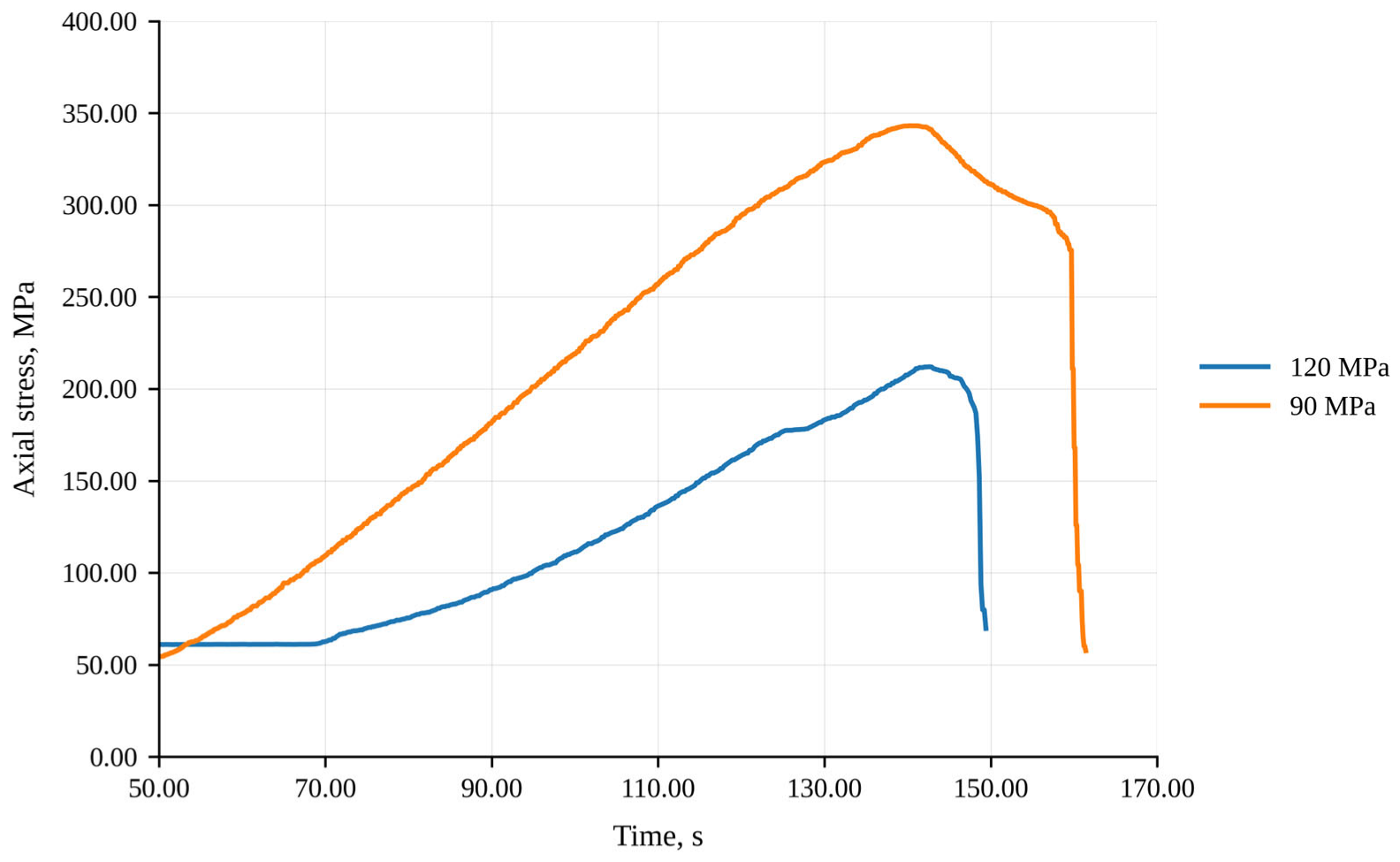
The experiments were performed at a stationary confining pressure. The temperature in the cell remained unchanged at 24.7 °C. The maximum axial load was reached at approximately the same recording times: 140.3 and 142.7 s. After the peak was reached, both curves demonstrated a pronounced decrease in bearing capacity: the residual load was about 51.8 MPa at a confining pressure of 90 MPa and was 67 MPa at 120 MPa.
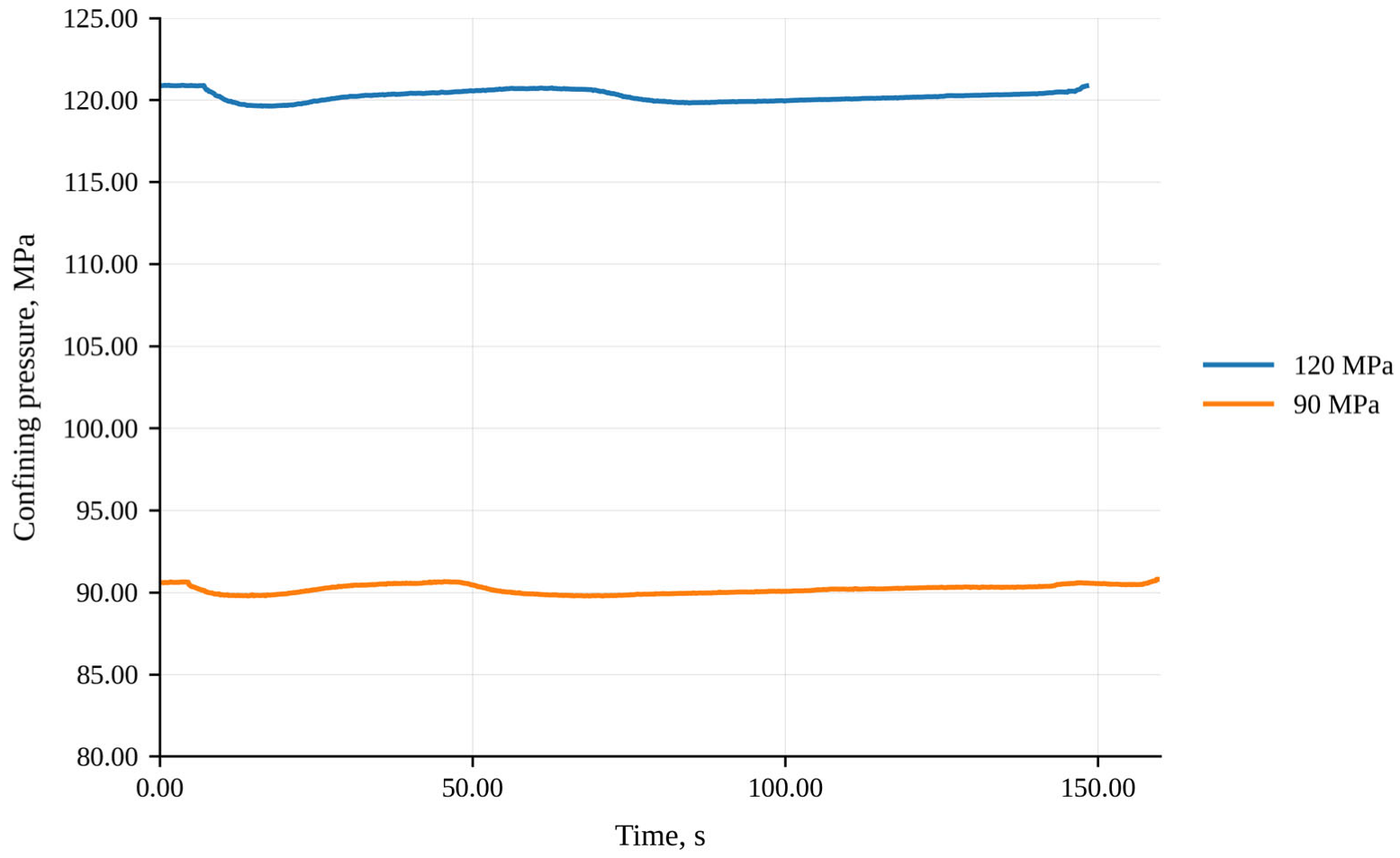
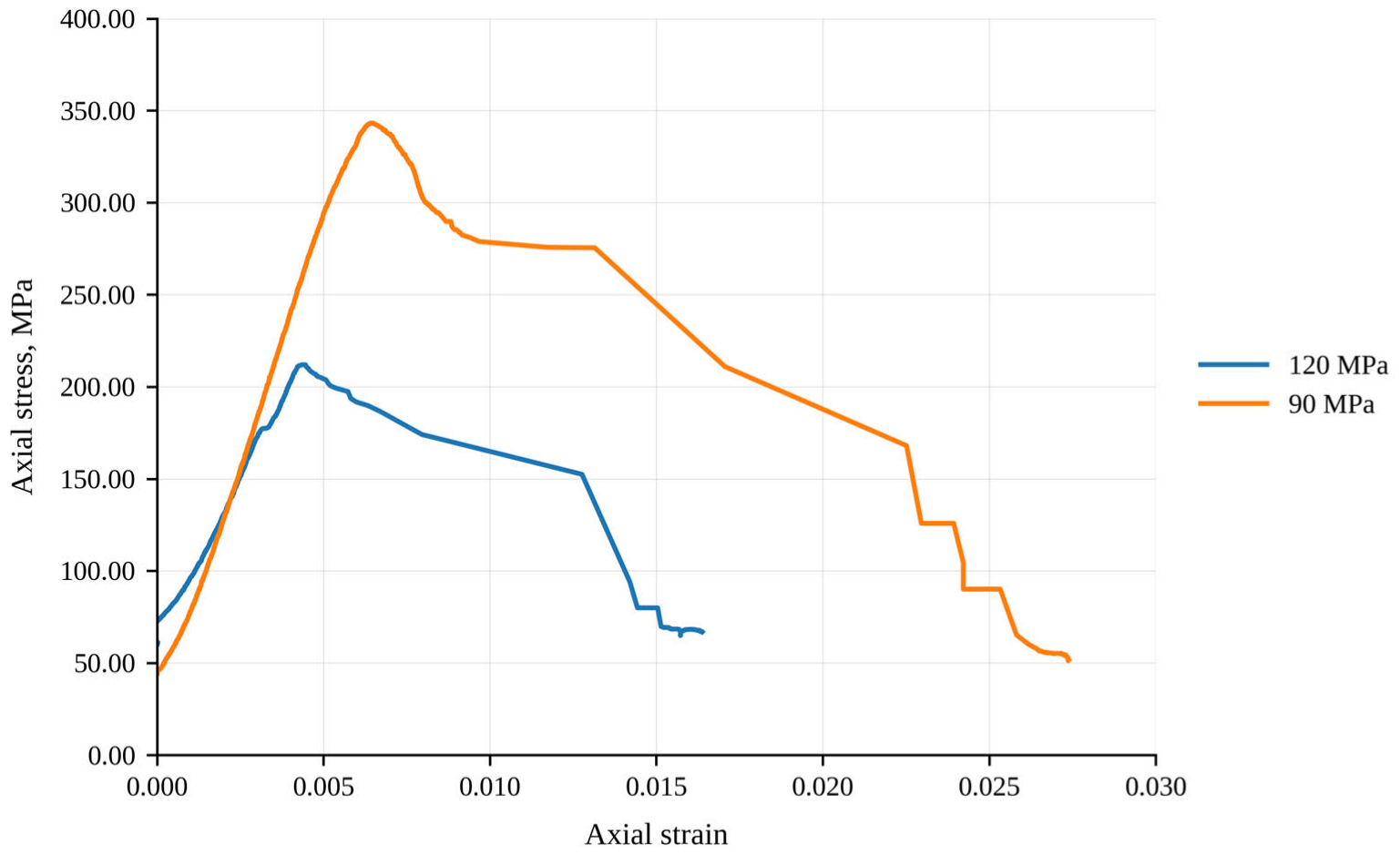
The diagram in Figure 4 demonstrates that, in both experiments, the sequence of stages typical of triaxial compression can be distinguished: an initial nonlinear segment, a hardening segment, peak attainment, and subsequent post-peak softening. Figure 5 presents the dependences of the confining pressure on time, from which it follows that, in both experiments, the confining regime was maintained steadily and without significant fluctuations. This indicates the correct operation of the pressure control system and makes it possible to regard subsequent changes in the mechanical response of the specimens as being caused primarily by the process of axial deformation and failure, rather than by the instability of the boundary conditions.
Although the peak axial stress measured at a confining pressure of 120 MPa is lower than that measured at 90 MPa, this result should not be interpreted as a systematic effect of confining pressure. With conventional triaxial compression, increasing the confining pressure generally increases the compressive strength of a rock specimen when the lithology, geometry, moisture conditions, and preparation procedure are identical. In the present preliminary verification tests, however, only single specimens with different physical properties were tested. Therefore, Figure 6 is used primarily to demonstrate the stability of the loading path and the possibility of recording complete stress–strain curves, including post-peak behavior. Replicate tests on specimens of the same lithology and geometry are required to quantify the effect of the confining pressure.
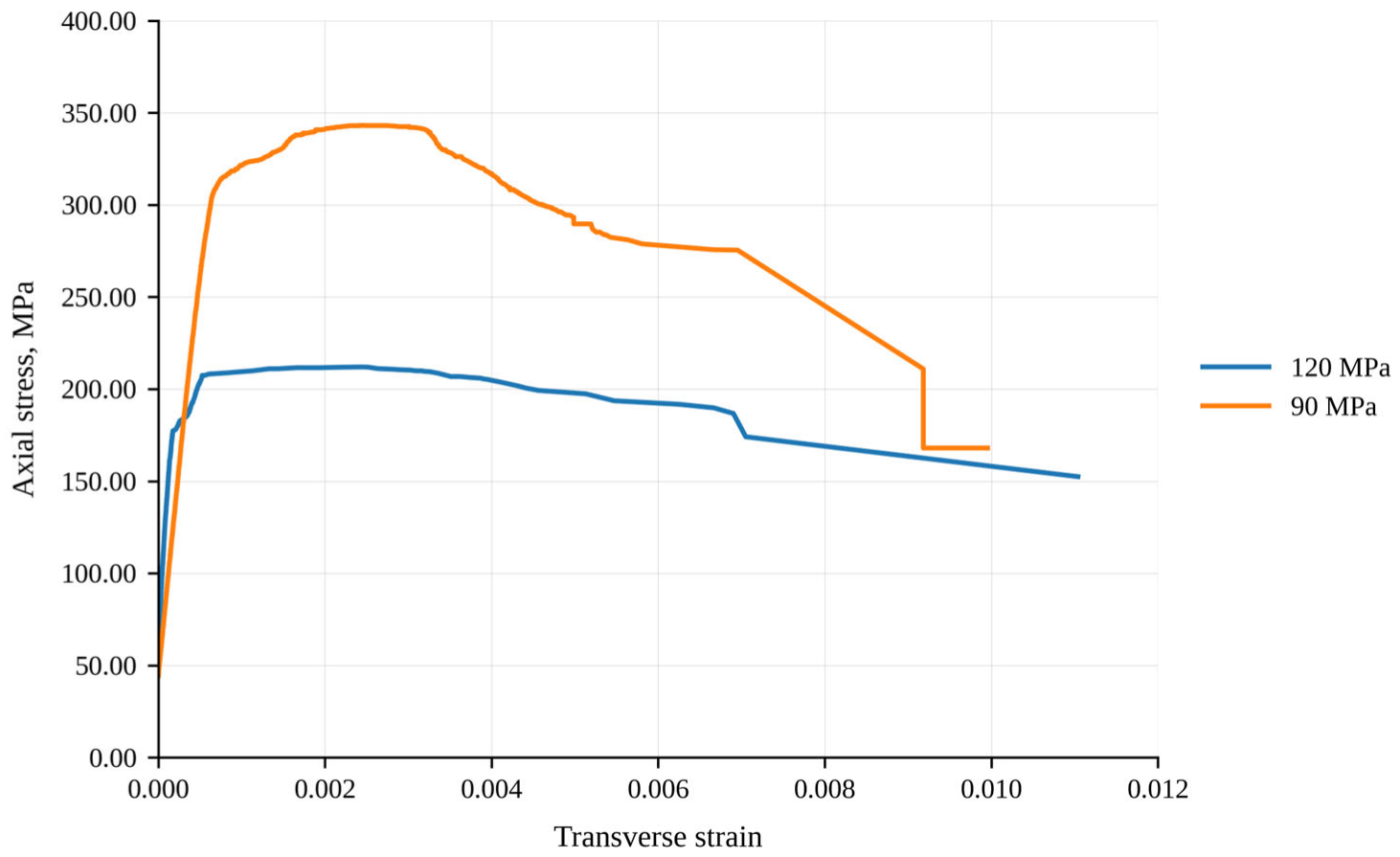
Figure 7 reveals that when the peak axial stress is reached, the transverse strain increases in a relatively ordered manner, which corresponds to the compaction and hardening stage of the material. After the peak stress has finished, the character of the curves changes: increased transverse strain is observed with a simultaneous decrease in axial stress, which indicates the structural loosening of the rock and failure development.
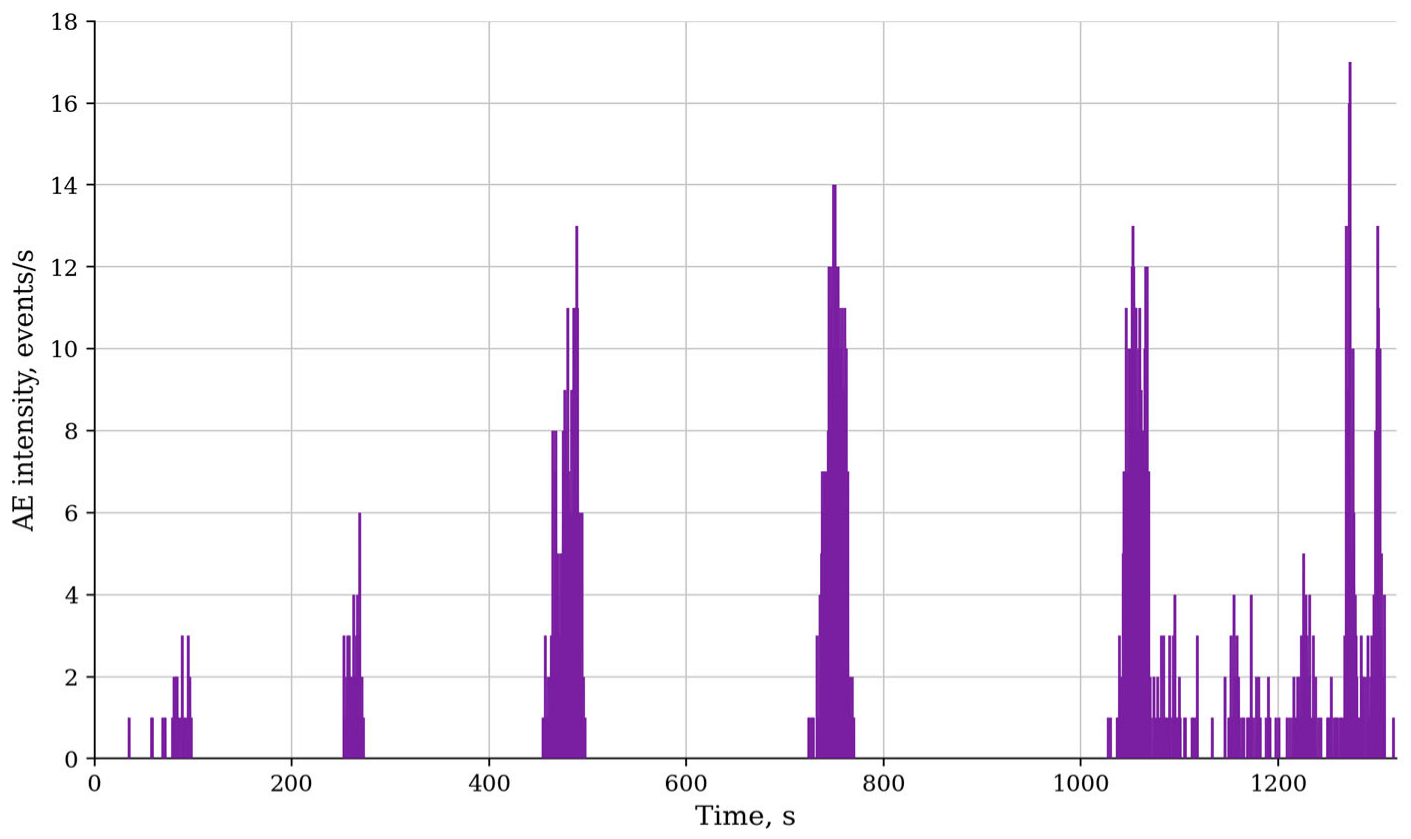
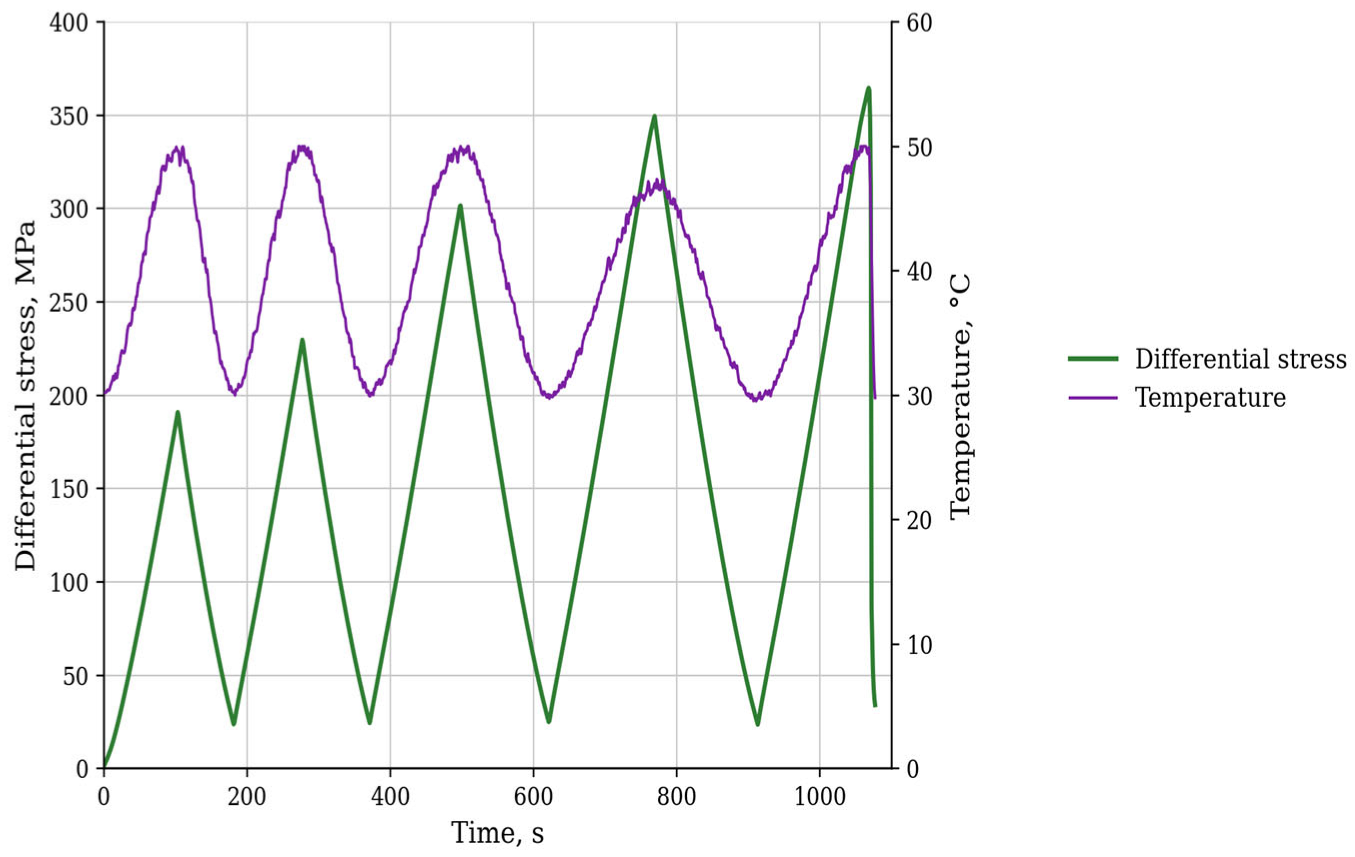
The methodology was additionally tested using the MTS-815 system. For the specimen listed in Table 2, acoustic emission data were obtained, and the operation of the heating modules was verified under temperature-controlled loading conditions. The temperature–time curve demonstrates that the heating system provided repeated thermal cycles within the range of approximately 30–50 °C, while the differential stress increased cyclically during successive loading stages (Figure 8). This confirms the possibility of combining mechanical loading with controlled thermal exposure during the preliminary verification of the experimental procedure. The acoustic emission data show that AE activity was relatively limited during the initial loading stages and increased markedly near the higher stress levels (Figure 9). The most intensive AE response was observed during the final stages of loading, when the differential stress approached its peak values. This behaviour indicates progressive damage accumulation in the specimen and demonstrates that the adopted monitoring configuration is capable of recording acoustic emission activity associated with the development of microcracking under combined mechanical and thermal loading.

4. Discussion

The present study should be interpreted as a methodological and equipment verification stage rather than a complete comparative experimental program aimed at determining statistically reliable strength parameters of rocks. The main purpose of the preliminary tests was to verify the ability of the MDS-450 servo-hydraulic system to reproduce a prescribed volumetric compression loading path, maintain high confining pressure during axial loading, and record the mechanical response of rock specimens up to and beyond the peak state.
The results obtained confirm that the confining pressure was maintained at the target levels of 90 and 120 MPa during the tests. The pressure–time curves exhibit no significant fluctuations that could affect the interpretation of the axial loading stage. Therefore, the tests demonstrate the stable operation of the pressure control system under high-pressure room temperature conditions. This result is important for the methodological assessment of the system because stable boundary conditions are a necessary prerequisite for subsequent controlled experiments under more complex thermobaric regimes.
The axial stress–time and axial stress–axial deformation curves demonstrate that both specimens passed through deformation stages typical of triaxial compression: initial nonlinear compaction, hardening, attainment of peak resistance, and post-peak softening. The possibility of recording both the pre-peak and post-peak aspects of the deformation curve confirms the suitability of the data acquisition scheme for monitoring the complete mechanical response of a specimen during volumetric compression.
At the same time, the difference in the peak axial stress between the tests at 90 and 120 MPa should not be interpreted as a systematic dependence of rock strength on the confining pressure. In conventional triaxial compression schemes, an increase in confining pressure generally leads to an increase in compressive strength when specimens of the same lithology, geometry, moisture state, and preparation quality are compared. In the present study, however, only one specimen was tested at each confining pressure. In addition, the specimens differed in their physical properties and may have differed in their internal structure, texture, defectiveness, and preparation conditions. Therefore, the lower peak stress obtained in the test at 120 MPa does not represent an anomalous pressure-dependent law but rather reflects the limitations of the preliminary test series.
The post-peak behavior also differs between the two tests. At 90 MPa, the decrease in the axial stress after the peak is sharper, whereas at 120 MPa the post-peak branch is more gradual and the residual part of the curve is more clearly expressed. Since the specimens were not identical and no repeated tests were performed, it is not possible to separate the effects of the confining pressure from specimen-specific factors. Consequently, the presented results cannot be used to quantify the influence of the confining pressure on the brittleness, residual strength, or deformation modulus.
The transverse deformation curves provide an additional confirmation that the measurement system is capable of recording the confining response of the specimen during loading. The increase in transverse deformation after the peak stress corresponds to the transition from compaction and hardening to structural loosening and failure development. However, in this study, this observation is qualitative. The quantitative determination of dilatancy onset, volumetric strain evolution, and deformation parameters requires a controlled series of repeated tests with identical specimen geometry, lithology, and loading conditions.
To support the verification of the proposed methodology, supplementary preliminary tests were conducted using the MTS-815 system, which enables controlled specimen heating and acoustic emission monitoring. For the specimen listed in Table 2, cyclic temperature variation was applied, and acoustic emission data were recorded during mechanical loading. The temperature–time curve demonstrates repeated heating cycles within approximately 30–50 °C, while the differential stress increased cyclically during successive loading stages. These results indicate the feasibility of combining mechanical loading, controlled thermal exposure, and acoustic emission registration within the preliminary methodological verification procedure.
The acoustic emission response remained relatively limited during the initial loading stages and increased as the differential stress reached higher levels. The most pronounced AE activity was observed during the final loading stages, which may indicate progressive damage accumulation and microcrack development in the specimen. Therefore, the MTS-815 tests provide additional evidence that the proposed methodology can be used to record both thermal and acoustic responses during thermomechanical loading.

5. Conclusions

Based on the preliminary experimental data, the following conclusions can be drawn.
  • The MDS-450 system maintained the prescribed confining pressure during axial loading. The pressure–time curves confirm the stability of the confining-pressure control system at high pressure levels under the tested conditions.
  • The system recorded complete axial stress–strain curves, including the pre-peak stage, peak strength, and post-peak softening. This confirms that the loading and measurement procedure can be used to register the full mechanical response of a rock specimen during volumetric compression.
  • Both specimens demonstrated deformation stages typical of triaxial compression: initial compaction, hardening, peak stress, and subsequent post-peak deformation. The transverse strain curves also indicate a transition from compaction-dominated behavior to structural loosening after the peak state.
  • The results should not be interpreted as a statistically reliable comparison of rock strength at confining pressures of 90 and 120 MPa. Only one specimen was tested at each pressure level, and the specimens differed in their physical properties and preparation conditions. Therefore, the observed difference in peak stress cannot be attributed solely to the effect of confining pressure.
  • Supplementary preliminary tests performed using the MTS-815 system confirmed the applicability of the proposed methodology under temperature-controlled loading conditions with acoustic emission monitoring. The recorded temperature cycles and AE response demonstrate that the methodology can be used to capture both thermal effects and damage-related acoustic activity during thermomechanical loading of rock specimens.
Future research will focus on the experimental verification of the proposed methodology for deep rocks under elevated-temperature conditions.

Author Contributions

Conceptualization, V.L.T. and O.I.K.; methodology, V.L.T. and O.I.K.; software, O.I.K.; validation, O.I.K.; formal analysis, V.L.T.; investigation, O.I.K.; resources, V.L.T.; data curation, O.I.K.; writing—original draft preparation, O.I.K.; writing—review and editing, O.I.K.; visualization, O.I.K.; supervision, V.L.T.; project administration, V.L.T. All authors have read and agreed to the published version of the manuscript.

Funding

This research received no external funding.

Institutional Review Board Statement

Not applicable.

Informed Consent Statement

Not applicable.

Data Availability Statement

Data are contained within the article.

Conflicts of Interest

NPK Intertek LLC granted permission to use materials from the operation and maintenance documentation of the MDS-450 system, including materials used for Figure 2 and Figure 3. The company had no role in the design of the study; in the collection, analysis, or interpretation of data; in the writing of the manuscript; or in the decision to publish the results. The authors declare no other conflicts of interest.

References

  1. Zhang, P.; Mishra, B.; Heasley, K.A. Experimental Investigation on the Influence of High Pressure and High Temperature on the Mechanical Properties of Deep Reservoir Rocks. Rock Mech. Rock Eng. 2015, 48, 2197–2211. [Google Scholar] [CrossRef]
  2. Liu, T.; Lu, Y.; Hou, P.; Xue, C.; Chi, M.; Yu, J.; Gao, H.; Xu, X.; Li, H.; Qian, K. Evaluation and Application of Wellbore Stability of Deep Oil Wells in the Southern Margin of Junggar Basin Research Progress and Key Issues of Ultra-Deep Oil and Gas Exploration in China. Processes 2024, 12, 2145. [Google Scholar] [CrossRef]
  3. He, D.; Jia, C.; Zhao, W.; Xu, F.; Luo, X.; Liu, W.; Tang, Y.; Gao, S.; Zheng, X.; Li, D.; et al. Research progress and key issues of ultra-deep oil and gas exploration in China. Pet. Explor. Dev. 2023, 50, 1333–1344. [Google Scholar] [CrossRef]
  4. Hoang, S.K.; Nguyen, S.T.; Khuc, G.H.; Abousleiman, Y.N. Overcoming Wellbore Instability Challenges in HPHT Field with Fully Coupled Poro-Thermo-Elastic Modeling: A Case Study in Hai Thach Field Offshore Vietnam. In Proceedings of the Offshore Technology Conference Asia, Kuala Lumpur, Malaysia, 22–25 March 2016. [Google Scholar] [CrossRef]
  5. Litvinenko, V.S.; Vasiliev, N.I.; Lipenkov, V.Y.; Dmitriev, A.N.; Podoliak, A.V. Special Aspects of Ice Drilling and Results of 5G Hole Drilling at Vostok Station, Antarctica. Ann. Glaciol. 2014, 55, 173–178. [Google Scholar] [CrossRef]
  6. Sun, C.; Nie, H.; Su, H.; Du, W.; Lu, T.; Chen, Y.; Liu, M.; Li, J. Porosity, Permeability and Rock Mechanics of Lower Silurian Longmaxi Formation Deep Shale under Temperature-Pressure Coupling in the Sichuan Basin, SW China. Pet. Explor. Dev. 2023, 50, 85–98. [Google Scholar] [CrossRef]
  7. Tang, Q.; Akosah, S.; Gratchev, I.; Doh, J.-H. Evaluating the Impact of Elevated Temperatures on Engineering Properties of Sedimentary Rocks: Insights and Current Trends. GeoHazards 2026, 7, 19. [Google Scholar] [CrossRef]
  8. Seredin, V.V.; Khrulev, A.S. Variations of Temperature in Specimens of Rocks and Geomaterials under Failure. J. Min. Sci. 2016, 52, 683–688. [Google Scholar] [CrossRef]
  9. Wang, S.; Wang, L.; Ren, B.; Ding, K.; Jiang, C.; Guo, J. Study of the Mechanical Characteristics of Coal-Serial Sandstone after High Temperature Treatment under True Triaxial Loading. Sci. Rep. 2023, 13, 13036. [Google Scholar] [CrossRef] [PubMed]
  10. Yang, S.-Q.; Ranjith, P.G.; Jing, H.-W.; Tian, W.-L.; Ju, Y. An Experimental Investigation on Thermal Damage and Failure Mechanical Behavior of Granite after Exposure to Different High Temperature Treatments. Geothermics 2017, 65, 180–197. [Google Scholar] [CrossRef]
  11. Idris, M.A. Effects of Elevated Temperature on Physical and Mechanical Properties of Carbonate Rocks in South-Southern Nigeria. Min. Miner. Depos. 2018, 12, 20–27. [Google Scholar] [CrossRef]
  12. Brotóns, V.; Tomás, R.; Ivorra, S.; Alarcón, J.C. Temperature Influence on the Physical and Mechanical Properties of a Porous Rock: San Julian’s Calcarenite. Eng. Geol. 2013, 167, 117–127. [Google Scholar] [CrossRef]
  13. Xiao, F.; Jiang, D.; Wu, F.; Zou, Q.; Chen, J.; Chen, B.; Sun, Z. Effects of High Temperature on the Mechanical Behaviors of Sandstone under True-Triaxial Unloading Conditions. Bull. Eng. Geol. Environ. 2021, 80, 4587–4601. [Google Scholar] [CrossRef]
  14. Iftikhar, C.M.A.; Khan, A.S.; Nambori, V. The Effect of Temperature on the Mechanical Behavior of Berea Sandstone under Confining Pressure: Experiments. Int. J. Geo-Eng. 2023, 14, 18. [Google Scholar] [CrossRef]
  15. Kong, M.; Zhang, Z.; Zhao, C.; Chen, H.; Ma, X.; Zou, Y. Rock Mechanical Properties and Breakdown Pressure of High-Temperature and High-Pressure Reservoirs in the Southern Margin of Junggar Basin. Geofluids 2021, 2021, 1116136. [Google Scholar] [CrossRef]
  16. Trushko, V.L.; Rozanov, A.O.; Saitgaleev, M.M.; Petrov, D.N.; Ilinov, M.D.; Karmanskii, D.A.; Selikhov, A.A. Acoustic Emission Criteria for Analyzing the Process of Rock Destruction and Evaluating the Formation of Fractured Reservoirs at Great Depths. J. Min. Inst. 2024, 269, 848–858. [Google Scholar]
  17. Ilyinov, M.D.; Petrov, D.N.; Karmanskii, D.A.; Selikhov, A.A. Physical Simulation Aspects of Structural Changes in Rock Samples under Thermobaric Conditions at Great Depths. Min. Sci. Technol. 2023, 8, 290–302. (In Russian) [Google Scholar] [CrossRef]
  18. Orlander, T.; Andreassen, K.A.; Fabricius, I.L. Effect of Temperature on Stiffness of Sandstones from the Deep North Sea Basin. Rock. Mech. Rock. Eng. 2021, 54, 255–288. [Google Scholar] [CrossRef]
  19. Liu, Z.; Wang, C.; Zhang, M.; Shao, J.-F. Cracking Property and Brittleness Evaluation of Granite under High-Temperature True Triaxial Compression in Geothermal Systems. Geomech. Geophys. Geo-Energy Geo-Resour. 2023, 9, 99. [Google Scholar] [CrossRef]
  20. Xia, Y.; Wang, Y.; Yang, H.; Zhao, D.; Yin, Z.; Tang, C.; Chen, J. Studies on Mechanical Properties and Failure Characteristics of Anisotropic Shale under True Triaxial Loading at Real-Time High Temperature. Rock. Mech. Rock. Eng. 2025, 58, 7203–7234. [Google Scholar] [CrossRef]
  21. Gónzalez-Gómez, W.S.; May-Crespo, J.; Quintana, P.; May-Pat, A.; Avilés, F.; Alvarado-Gil, J.J.; Ortega, B.O. Thermal Effects on the Physical Properties of Limestone from the Yucatan Peninsula. MRS Online Proc. Libr. 2014, 1611, 171–176. [Google Scholar] [CrossRef]
  22. Vagnon, F.; Colombero, C.; Colombo, F.; Comina, C.; Ferrero, A.M.; Mandrone, G.; Vinciguerra, S.C. Effects of Thermal Treatment on Physical and Mechanical Properties of Valdieri Marble—NW Italy. Int. J. Rock Mech. Min. Sci. 2019, 116, 75–86. [Google Scholar] [CrossRef]
  23. Chaki, S.; Takarli, M.; Agbodjan, W.P. Influence of Thermal Damage on Physical Properties of a Granite Rock: Porosity, Permeability and Ultrasonic Wave Evolutions. Constr. Build. Mater. 2008, 22, 1456–1461. [Google Scholar] [CrossRef]
  24. Ge, Z.; Sun, Q. Acoustic Emission (AE) Characteristics of Granite after Heating and Cooling Cycles. Eng. Fract. Mech. 2018, 200, 418–429. [Google Scholar] [CrossRef]
  25. Kazlouski, J.J.; Zhuravkov, M.A.; Bogdan, S.I. On the Need to Refine Triaxial Testing Methods for Investigating the Mechanical Behaviour of Salt Rocks and Salt-Based Geomaterials. J. Min. Inst. 2025, 276, 157–169. [Google Scholar]
  26. Verbilo, P.E.; Iovlev, G.A.; Belyakov, N.A. Parameter Selection for the Hoek-Brown Model with Softening of Rock Mass Based on Laboratory Experiments on Rock Samples and Discrete Numerical Simulations of Jointed Rock Mass. MIAB. Min. Inf. Anal. Bull. 2025, 2, 57–77. [Google Scholar] [CrossRef]
  27. Karasev, M.A.; Petrushin, V.V.; Rysin, A.I. The Hybrid Finite/Discrete Element Method in Description of Macrostructural Behavior of Salt Rocks. MIAB. Min. Inf. Anal. Bull. 2023, 4, 48–66. [Google Scholar] [CrossRef]
  28. Protosenya, A.G.; Karasev, M.A.; Belyakov, N.A.; Tulin, P.K. Prediction of the Limit State and Dilatancy of Rocks around Mine Workings. J. Min. Inst. 2025, 276, 107–122. [Google Scholar]
  29. Protosenya, A.G.; Veselova, A.V. Assessment of the Influence of Karst Voids on the Stability of the Ore Rock Mass during the Development of Deposits in Western Yakutia. MIAB. Min. Inf. Anal. Bull. 2025, 1, 33–46. (In Russian). Available online: https://giab-online.ru/en/catalog/ocenka-vliyaniya-karstovoy-polosti-na-ustoychivost-rudnogo-massi (accessed on 13 July 2026).
  30. He, R.; He, L.; Guan, B.; Yuan, C.M.; Xie, J.; Ren, L. Mechanical Properties of a Typical Jurassic Shaximiao Sandstone under Subzero and Deep In Situ Temperature Conditions. Front. Earth Sci. 2021, 9, 770272. [Google Scholar] [CrossRef]
  31. Protosenya, A.; Kumov, V. Geomechanical Substantiation of Soil Stability during Tunnel Construction by Shield Tunneling Complexes in Layered Massifs. Eng 2026, 7, 108. [Google Scholar] [CrossRef]
  32. Wang, X.; Wang, L.; Zhao, B.; Wu, Y.; Yang, J.; Sun, J. Experimental Study on Mechanical Properties of Gas Storage Sandstone and Its Damage under Temperature and Pressure. Front. Earth Sci. 2022, 10, 905642. [Google Scholar] [CrossRef]
  33. Li, P.; Zhang, H.; Wu, Y. Study on the Evolution of Mechanical Properties of Hot Dry Rocks after Supercritical CO2 Injection. Geotherm. Energy 2024, 12, 27. [Google Scholar] [CrossRef]
  34. Operation and Maintenance Manual. MDS-450 Apparatus for Studying the Mechanical and Dynamic Properties of Core Samples. Upgrade Package for the RTR-1500 System to Increase the Loading Capacity of the System and to Test Samples Under Thermobaric Conditions: RX4500 or Equivalent; RPC Intertech: Novosibirsk, Russia, 2025. (In Russian) [Google Scholar]
  35. Sinegubov, V.Y. Development of a Comprehensive Approach for Predicting the Stress State of the Rock Mass and Its Testing at the Oleniy Ruchey Deposit. Bull. Kuzbass State Tech. Univ. 2025, 2, 68–79. [Google Scholar] [CrossRef]
  36. Motra, H.B.; Mager, J.; Ismail, A.; Wuttke, F.; Rabbel, W.; Köhn, D.; Thorwart, M.; Simonetta, C.; Costantino, N. Determining the Influence of Pressure and Temperature on the Elastic Constants of Anisotropic Rock Samples Using Ultrasonic Wave Techniques. J. Appl. Geophys. 2018, 159, 715–730. [Google Scholar] [CrossRef]
  37. Lei, X.; Ohuchi, T.; Kitamura, M.; Li, X.; Li, Q. An Effective Method for Laboratory Acoustic Emission Detection and Location Using Template Matching. J. Rock. Mech. Geotech. Eng. 2022, 14, 1642–1651. [Google Scholar] [CrossRef]
  38. Harbord, C.; Brantut, N.; David, E.C.; Mitchell, T.M. A High Pressure, High Temperature Gas Medium Apparatus to Measure Acoustic Velocities during Deformation of Rock. Rev. Sci. Instrum. 2022, 93, 053908. [Google Scholar] [CrossRef] [PubMed]
  39. Petrov, D.N.; Abashin, V.I.; Karasev, M.A.; Selikhov, A.A. Non-Destructive Testing Applicability in Rock Mass Strength Estimation in Underground Mine at the Gremyachinsk Deposit. MIAB. Min. Inf. Anal. Bull. 2024, 12, 227–244. (In Russian). Available online: https://giab-online.ru/en/catalog/issledovanie-vozmozhnosti-primeneniya-metodov-nerazrushayushcheg (accessed on 13 July 2026).
  40. Nasseri, M.H.B.; Goodfellow, S.D.; Lombos, L.; Young, R.P. 3-D Transport and Acoustic Properties of Fontainebleau Sandstone during True-Triaxial Deformation Experiments. Int. J. Rock Mech. Min. Sci. 2014, 69, 1–18. [Google Scholar] [CrossRef]
  41. Feng, X.-T.; Haimson, B.; Li, X.; Chang, C.; Ma, X.; Zhang, X.; Ingraham, M.D.; Suzuki, K. ISRM Suggested Method: Determining Deformation and Failure Characteristics of Rocks Subjected to True Triaxial Compression. Rock. Mech. Rock. Eng. 2019, 52, 2011–2020. [Google Scholar] [CrossRef]
  42. Gospodarikov, A.P.; Revin, I.E.; Morozov, K.V. Composite Model of Seismic Monitoring Data Analysis during Mining Operations on the Example of the Kukisvumchorrskoye Deposit of AO Apatit. J. Min. Inst. 2023, 262, 571–580. [Google Scholar] [CrossRef]
Figure 1. Servo-Hydraulic Systems: (a) MDS-450; (b) MTS-815.
Applsci 16 07163 g001
Figure 2. Load-bearing part of the system: (1) load frame; (2) pedestal; (3) base with a carriage for movement; (4) support; (5) chamber bell; (6) stabilometer lifting hydraulic cylinders; (7) support movement hydraulic cylinder; (8) rod; (9) power hydraulic cylinder [34].
Applsci 16 07163 g002
Figure 3. Stabilometer design: (1) chamber bell; (2) assembled core; (3) base; (4) rod; (5) power cylinder; (6) hinge; (7) thermowell; (8) system for measuring linear displacement of the rod [34].
Applsci 16 07163 g003
Figure 4. Axial stress–time curves obtained during preliminary verification tests.
Applsci 16 07163 g004
Figure 5. Confining pressure–time curves obtained during preliminary verification tests.
Applsci 16 07163 g005
Figure 6. Axial stress–axial strain curves obtained during preliminary verification tests.
Applsci 16 07163 g006
Figure 7. Axial stress–transverse strain curves obtained during preliminary verification tests.
Applsci 16 07163 g007
Figure 8. Differential stress– and temperature–time curves obtained during preliminary verification tests.
Applsci 16 07163 g008
Figure 9. Acoustic emission–time curves obtained during preliminary verification tests.
Applsci 16 07163 g009
Table 1. Comparison of the MDS-450 system with selected rock-testing systems.
ParameterLoading SchemeTemperature RangePressure RangeApproximate In Situ
Depth Equivalent
MDS-450Volumetric compression; simultaneous control of axial load, confining pressure, pore pressure and temperature−15 to 200 °CConfining pressure up to 210 MPa;
pore pressure up to 210 MPa
Pressure: up to 10–12 km;
pore pressure: up to 21 km;
temperature: up to 6–7 km.
Ultra-Deep Drilling Simulator (UDS) [1]HPHT triaxial compression25–180 °CConfining pressure up to 200 MPaPressure: up to 9–11 km;
temperature: up to 6 km.
GCTS RTR-2000 [15]Triaxial compression under high temperature, confining pressure and pore pressure150 °CConfining pressure up to 110 MPa;
pore pressure up to 80 MPa
Confining pressure: up to 5 km;
pore pressure: up to 8 km;
temperature: up to 5 km.
MTS 815 [16,17]Conventional triaxial compression with acoustic emission monitoring-Confining and pore pressures up to 80 MPaConfining pressure: up to 4 km;
pore pressure: up to 8 km;
temperature: not estimated.
Temperature-controlled triaxial cell [18]Hydrostatic and triaxial testing150–170 °CLow-stress regime up to 15 MPaPressure: up to 1 km;
temperature: up to 6 km.
High-temperature true-triaxial system [19]True triaxial compression20–240 °CConfining pressure up to 75 MPaPressure: up to 3 km;
temperature:
up to 9 km.
Real-time high-temperature true-triaxial shale system [20]True triaxial testing20–200 °CConfining pressure up to 80 MPaPressure: up to 3 km;
temperature: up to 7 km.
Table 2. Physical properties of the specimens used in the preliminary tests.
ParameterUnitSpecimen 1Specimen 2Specimen 3
Lithology-LimestoneSandstoneUrtite
Confining pressureMPa9012050
Diametermm616248
Heightmm12513096
Densityg/cm32.652.202.82
Porosity-0.080.150.02
Moisture condition-DryDryDry
Disclaimer/Publisher’s Note: The statements, opinions and data contained in all publications are solely those of the individual author(s) and contributor(s) and not of MDPI and/or the editor(s). MDPI and/or the editor(s) disclaim responsibility for any injury to people or property resulting from any ideas, methods, instructions or products referred to in the content.