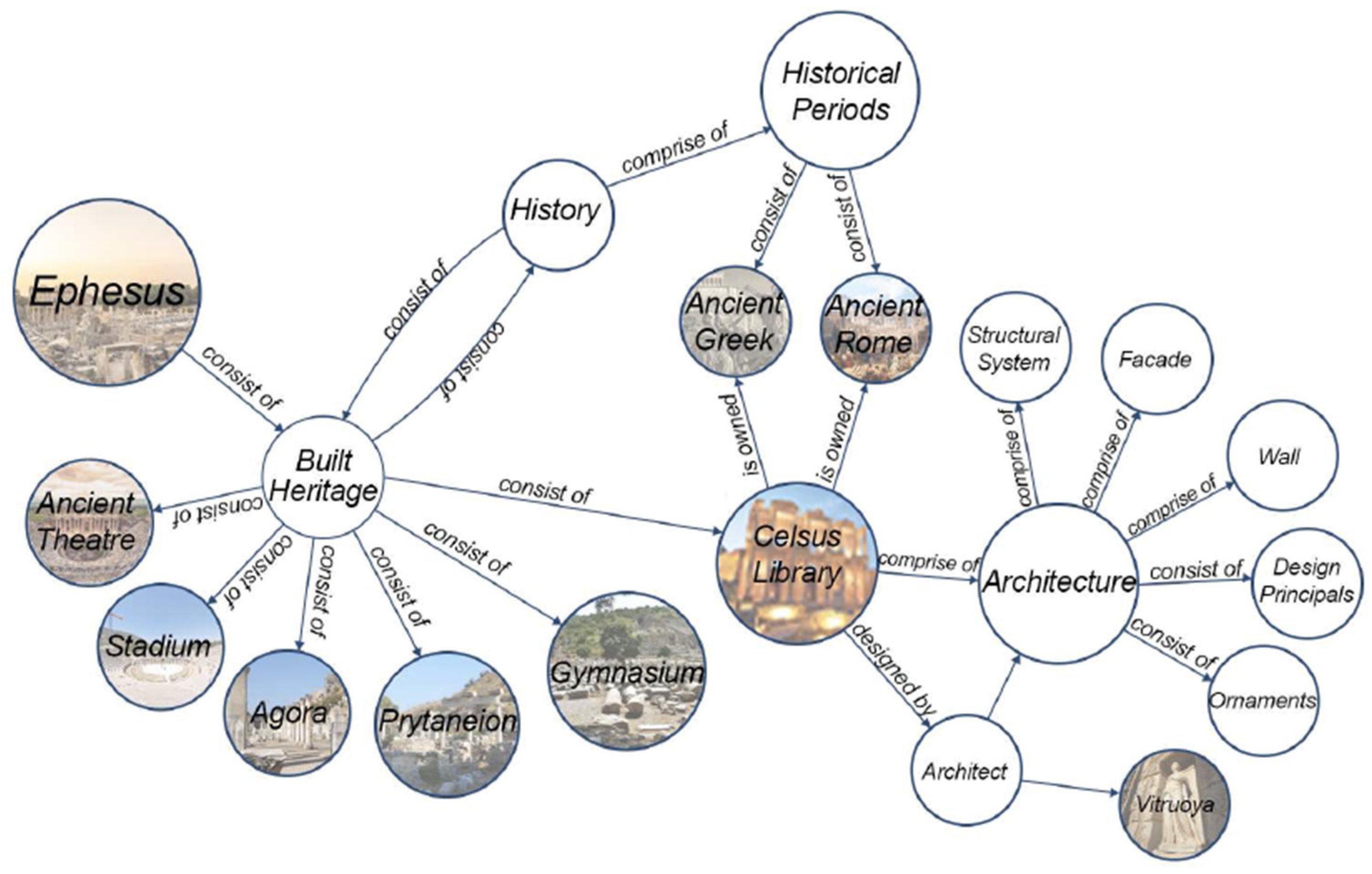
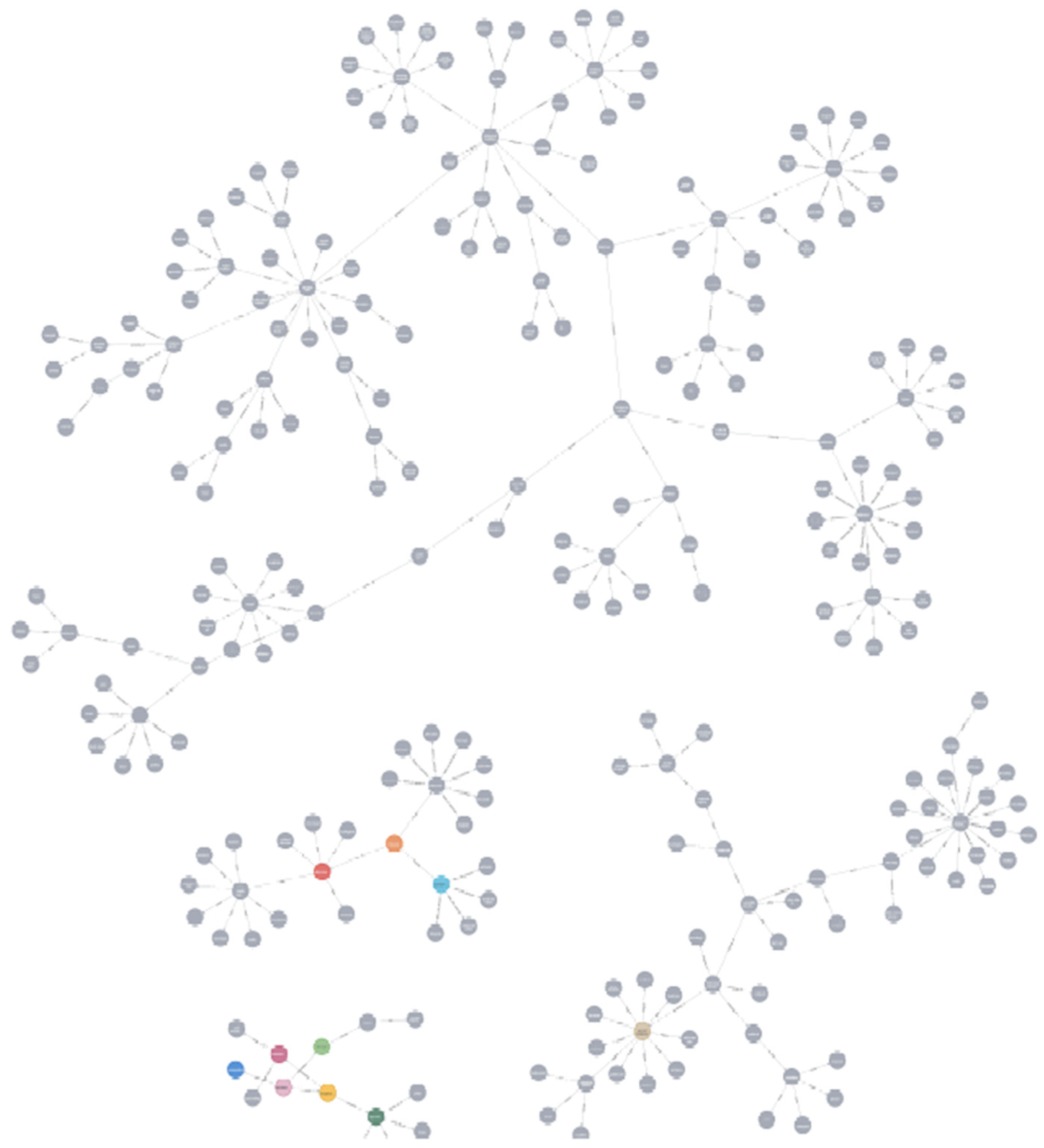
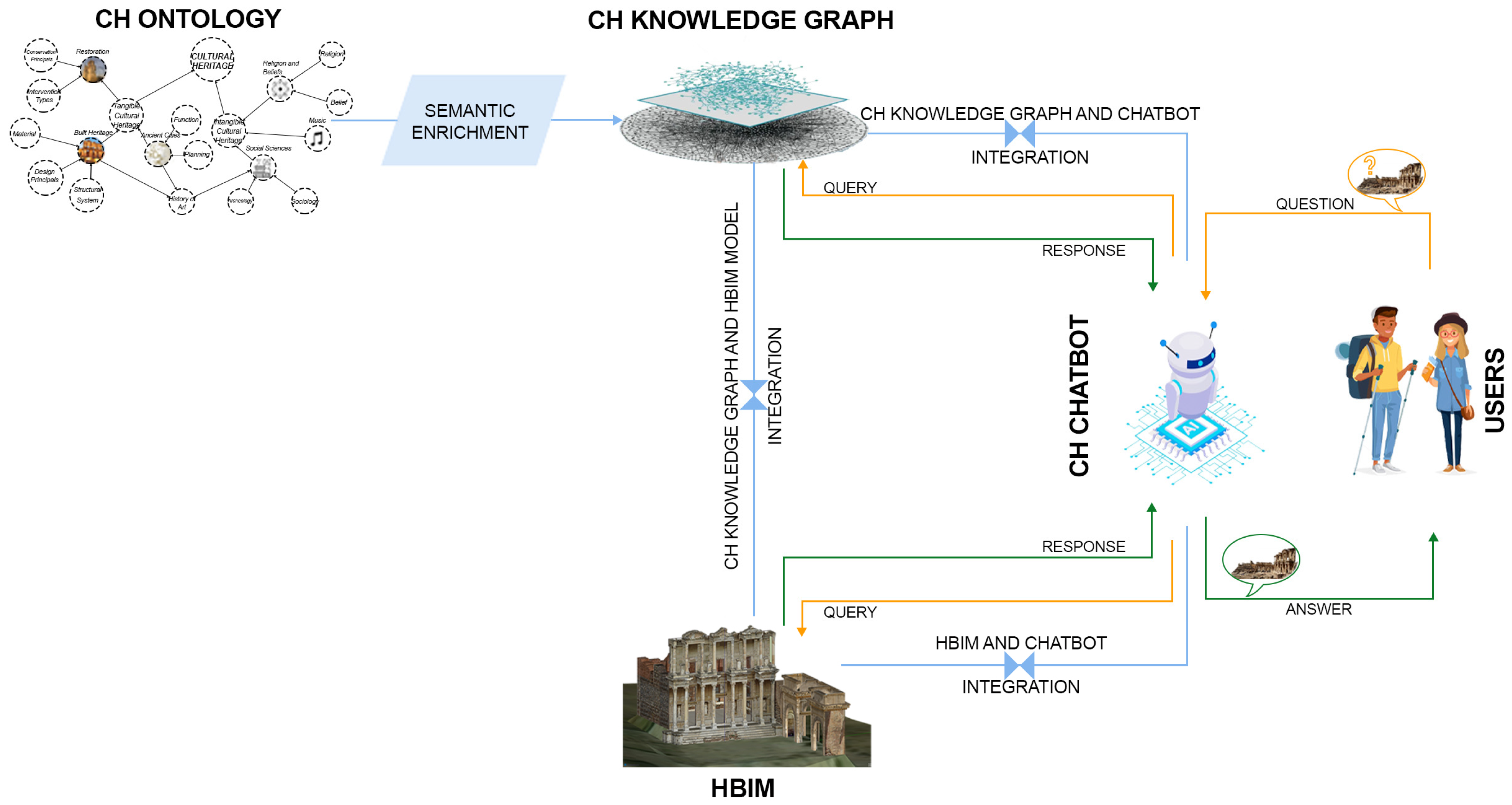
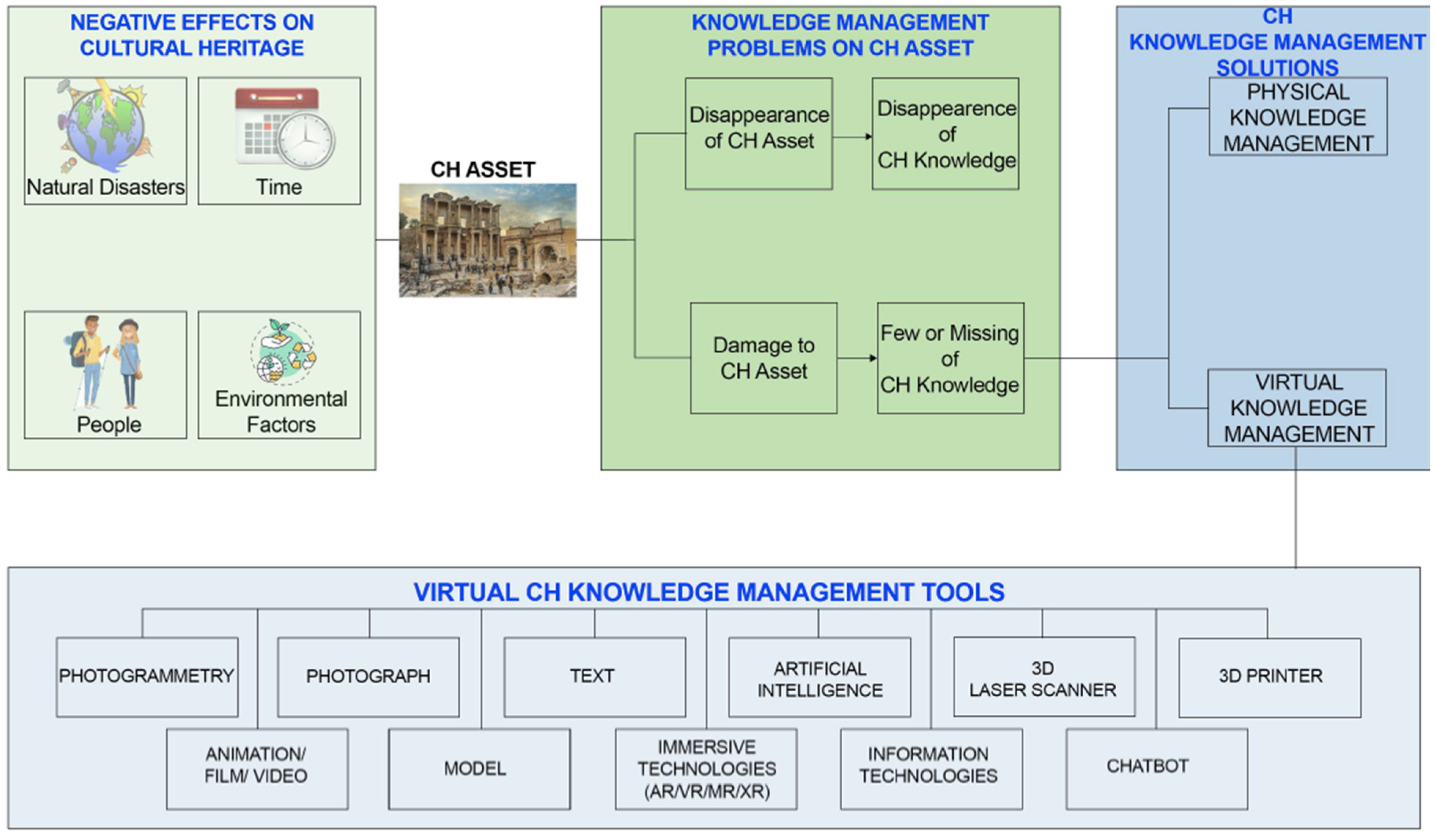
A Semantic Backbone for Heritage Digital Twins: Ontology Development and Knowledge Graph Generation



Abstract
1. Introduction
2. Related Works
2.1. Cultural Heritage Ontologies
2.2. Knowledge Graphs in Cultural Heritage
2.3. Semantic Enrichment Approaches
2.4. Digital Twins in Cultural Heritage
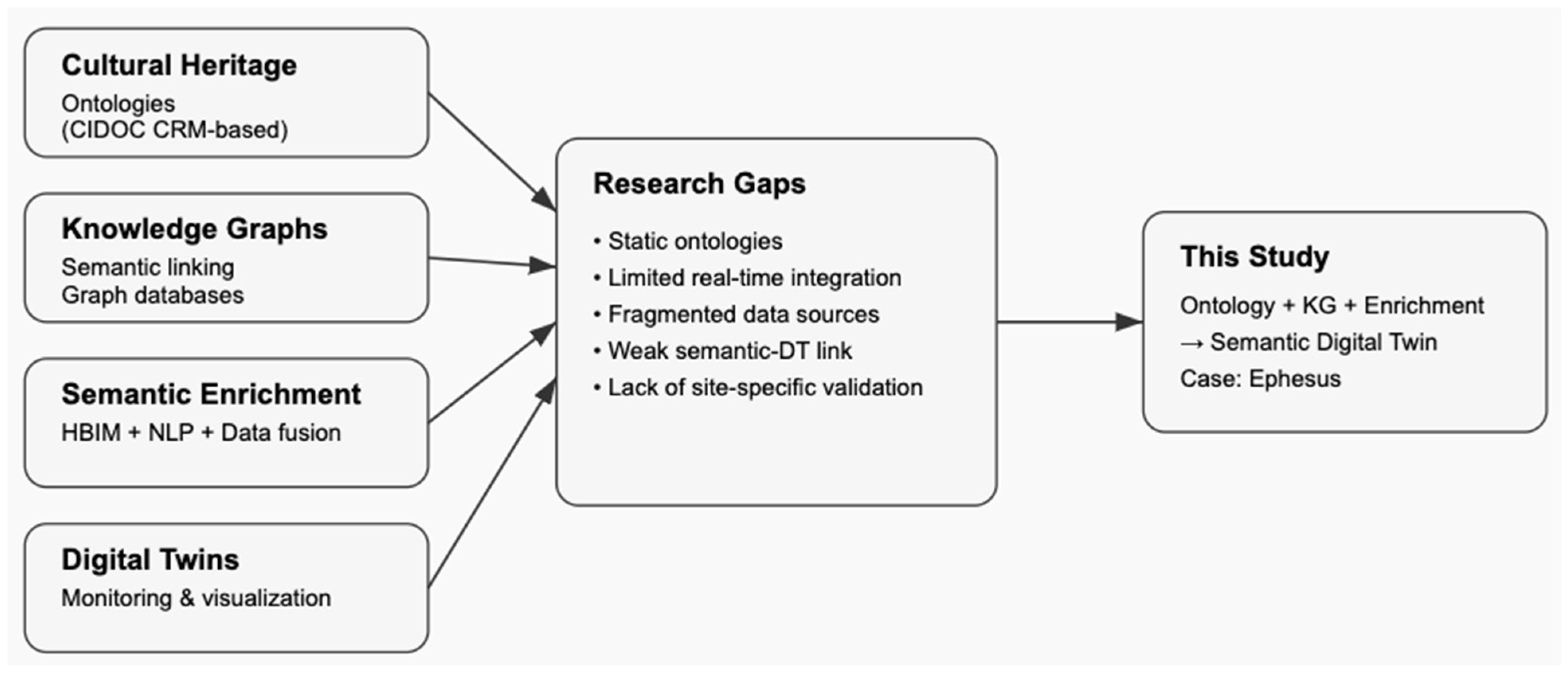
2.5. Research Gaps and Positioning
- It develops an Cultural Heritage Ontology that brings together knowledge from multiple domains;
- It introduces a semantic enrichment pipeline that integrates structured and unstructured data;
- It constructs a Cultural Heritage Knowledge Graph (CHKG) populated from this enriched data, that aims to support interoperability and enhance knowledge sharing through a structured semantic approach;
- It positions the ontology–KG framework as a semantic foundation for Heritage Digital Twins.
3. Methodology
3.1. Overall Framework
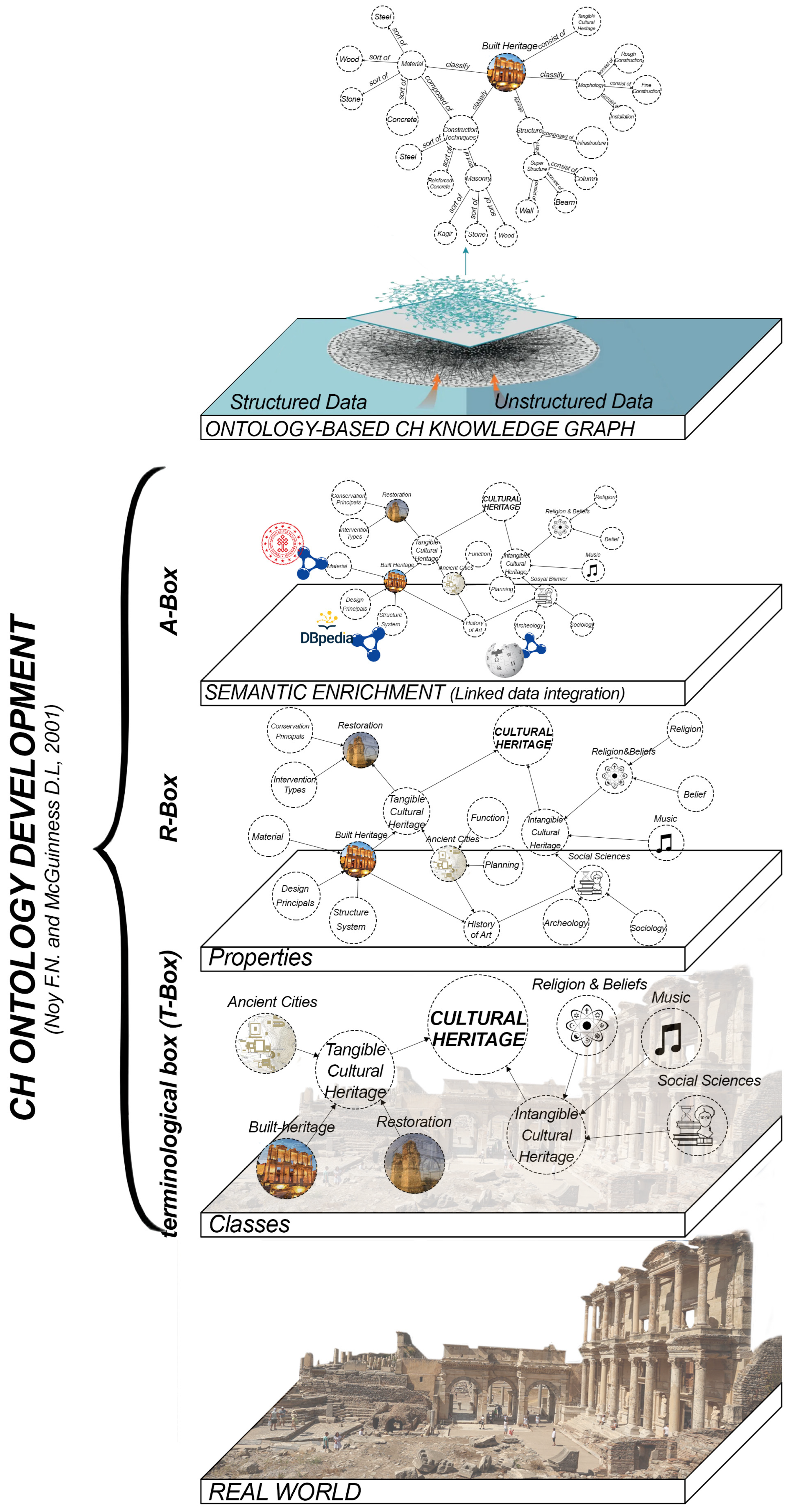
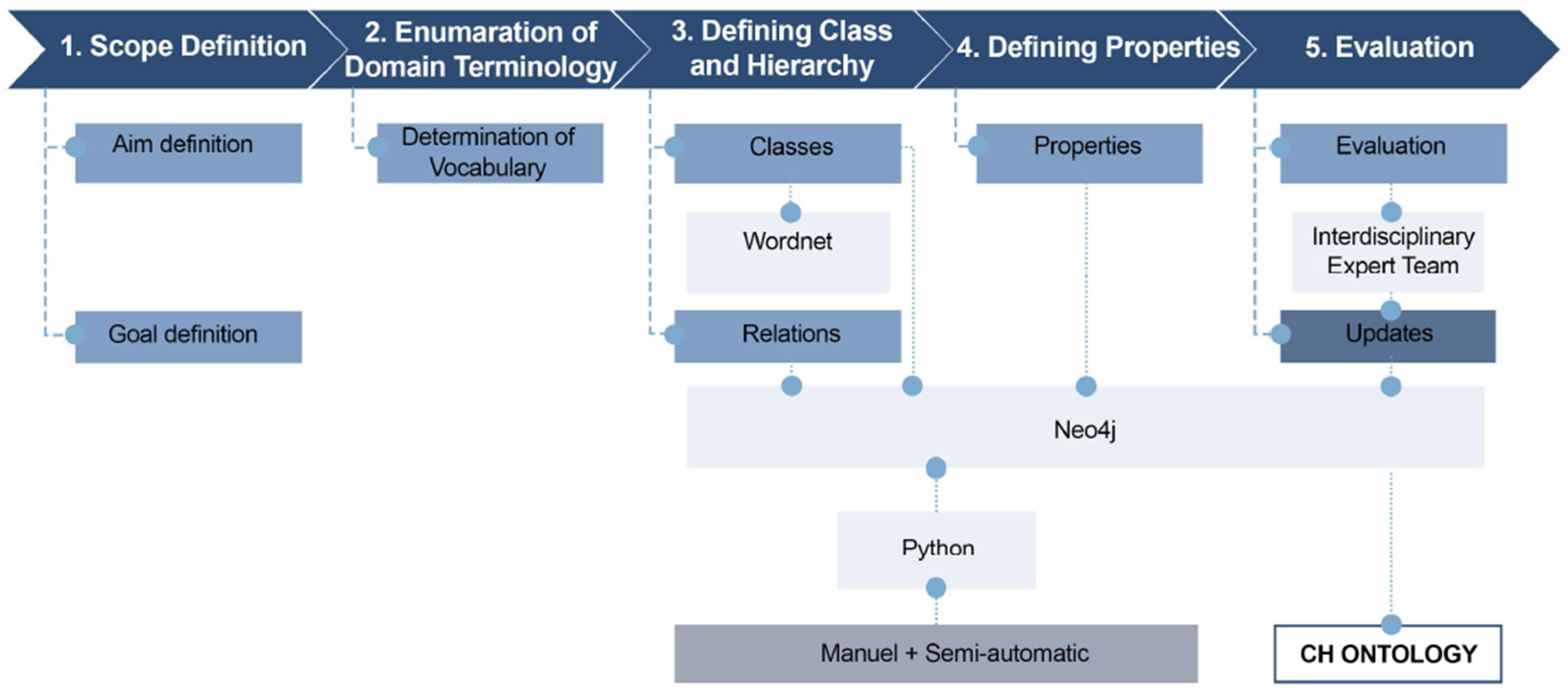
3.2. Cultural Heritage Ontology Development
3.2.1. Scope Definition
3.2.2. Domain Knowledge Acquisition
3.2.3. Class and Hierarchy Design
3.2.4. Property Definition
3.2.5. Mapping with CIDOC CRM
3.2.6. Implementation
3.3. Ontology Evaluation
3.4. Semantic Enrichment Pipeline and Knowledge Graph Population
4. Results
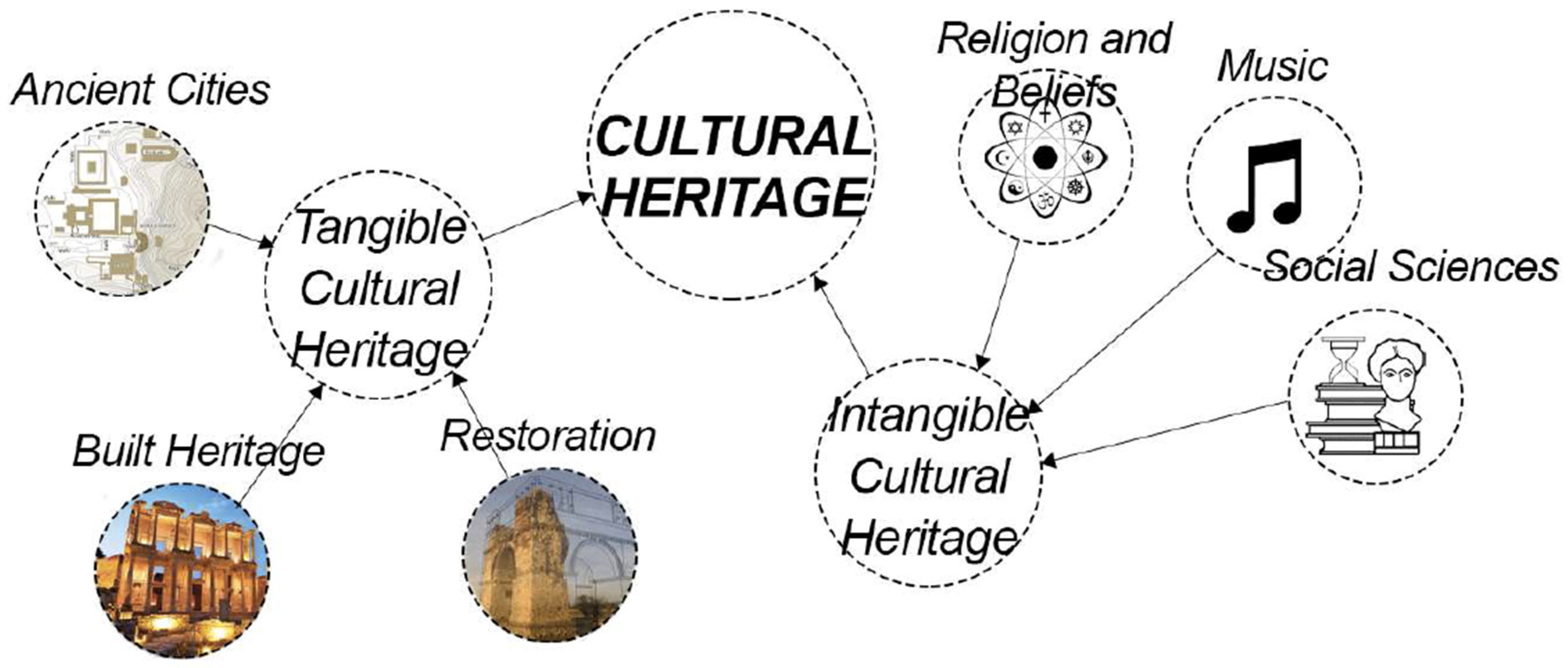
4.1. Developed Cultural Heritage Ontology
4.2. Semantic Enrichment Results
4.3. Cultural Heritage Knowledge Graph
4.4. Competency-Based Ontology Evaluation
5. Discussion
5.1. Key Findings
5.2. Scientific Contribution
5.3. Comparison with Literature
5.4. Implications for Heritage Digital Twins
5.5. Conceptual Framework
5.6. Limitations
5.7. Future Research
6. Conclusions
Author Contributions
Funding
Institutional Review Board Statement
Informed Consent Statement
Data Availability Statement
Conflicts of Interest
References
- Strlič, M. Heritage Science: A Future-Oriented Cross-Disciplinary Field. Angew. Chem. Int. Ed. 2018, 57, 7260–7261. [Google Scholar] [CrossRef] [Scilit] [PubMed]
- Tibaut, A.; de Oliveira, S.G. A Framework for the Evaluation of the Cultural Heritage Information Ontology. Appl. Sci. 2022, 12, 795. [Google Scholar] [CrossRef] [Scilit]
- European Commission. Commission Recommendation of 10/11/21 on a Common European Data Space for Cultural Heritage. 2021. Available online: https://eur-lex.europa.eu/legal-content/EN/TXT/PDF/?uri=CELEX:32021H1970&from=EN (accessed on 9 July 2026).
- Ozturk, G.B.; Brilakis, I.; Ozen, B.; Soygazi, F. Ontology Research Fields in the Cultural Heritage Domain. In Proceedings of the 8th International Project and Construction Management Conference (IPCMC2024), Istanbul, Turkey, 2–4 October 2024. [Google Scholar] [CrossRef]
- Niccolucci, F.; Felicetti, A.; Hermon, S. Populating the Data Space for Cultural Heritage with Heritage Digital Twins. Data 2022, 7, 105. [Google Scholar] [CrossRef] [Scilit]
- Previtali, M.; Brumana, R.; Stanga, C.; Banfi, F. An ontology-based representation of vaulted system for HBIM. Appl. Sci. 2020, 10, 1377. [Google Scholar] [CrossRef] [Scilit]
- Gruber, T.R. A translation approach to portable ontology specifications. Knowl. Acquis. 1993, 5, 199–220. [Google Scholar] [CrossRef] [Scilit]
- Noy, N.F.; McGuinness, D.L. Ontology Development 101: A Guide to Creating Your First Ontology; Stanford Knowledge Systems Laboratory: Stanford, CA, USA, 2001; p. 25. [Google Scholar]
- Doerr, M. Ontologies for Cultural Heritage. In Handbook on Ontologies; Staab, S., Studer, R., Eds.; International Handbooks on Information Systems; Springer: Berlin/Heidelberg, Germany, 2009. [Google Scholar] [CrossRef] [Scilit]
- Messaoudi, T.; Véron, P.; Halin, G.; De Luca, L. An ontological model for the reality-based 3D annotation of heritage building conservation state. J. Cult. Herit. 2018, 29, 100–112. [Google Scholar] [CrossRef] [Scilit]
- Elleuch, I.; Gargouri, B.; Hamadou, A.B. Lexical data mining-based approach for the self-enrichment of LMF standardised dictionaries: Case of the syntactico-semantic knowledge. Concurr. Comput. Pract. Exp. 2021, 33, e6312. [Google Scholar] [CrossRef] [Scilit]
- Cursi, S.; Martinelli, L.; Paraciani, N.; Calcerano, F.; Gigliarelli, E. Linking external knowledge to heritage BIM. Autom. Constr. 2022, 141, 104444. [Google Scholar] [CrossRef] [Scilit]
- Qi, Q.; Tao, F.; Zuo, Y.; Zhao, D. Digital twin service towards smart manufacturing. Procedia CIRP 2018, 72, 237–242. [Google Scholar] [CrossRef] [Scilit]
- Lucchi, E. Digital twins for the automation of the heritage construction sector. Autom. Constr. 2023, 156, 105073. [Google Scholar] [CrossRef] [Scilit]
- Liu, Z.; Wang, J. Protection and Utilization of Historical Sites Using Digital Twins. Buildings 2024, 14, 1019. [Google Scholar] [CrossRef] [Scilit]
- Crognale, M.; De Iuliis, M.; Gattulli, V. A Framework for the Definition of Built Heritage Digital Twins. In Handbook of Digital Twins; CRC Press: Boca Raton, FL, USA, 2024; pp. 647–661. [Google Scholar] [CrossRef] [Scilit]
- Simeone, D.; Cursi, S.; Acierno, M. BIM semantic-enrichment for built heritage representation. Autom. Constr. 2019, 97, 122–137. [Google Scholar] [CrossRef] [Scilit]
- Bloch, T. Connecting research on semantic enrichment of BIM—Review of approaches, methods, and possible applications. J. Inf. Technol. Constr. 2022, 27, 416–440. [Google Scholar] [CrossRef] [Scilit]
- Wang, J.; Mu, L.; Zhang, J.; Zhou, X.; Li, J. On intelligent fire drawings review based on building information modelling and knowledge graph. In Construction Research Congress 2020: Computer Applications; American Society of Civil Engineers (ASCE): Reston, VA, USA, 2020; pp. 812–820. [Google Scholar] [CrossRef] [Scilit]
- Benabdellah, A.C.; Zekhnini, K.; Cherrafi, A.; Garza-Reyes, J.A.; Kumar, A. Design for the environment: An ontology-based knowledge management model for green product development. Bus. Strategy Environ. 2021, 30, 4037–4053. [Google Scholar] [CrossRef] [Scilit]
- Hermon, S.; Niccolucci, F.; Bakirtzis, N.; Gasanova, S. A Heritage Digital Twin ontology-based description of Giovanni Baronzio’s “Crucifixion of Christ” analytical investigation. J. Cult. Herit. 2024, 66, 48–58. [Google Scholar] [CrossRef] [Scilit]
- Hyvönen, E. Publishing and using cultural heritage linked data: Current trends and future directions. Data Intell. 2025, 7, 1–25. [Google Scholar] [CrossRef] [Scilit]
- Desul, S.; Mahapatra, R.K.; Patra, R.K.; Sethy, M.; Pandey, N. Semantic technology for cultural heritage: A bibliometric-based review. Glob. Knowl. Mem. Commun. 2025, 74, 1356–1380. [Google Scholar] [CrossRef] [Scilit]
- Syed, R.A.B.; Agliata, R.; Mecca, I.; Mollo, L. Semantic web technologies in construction facility management: A bibliometric analysis and future directions. Buildings 2025, 15, 3845. [Google Scholar] [CrossRef] [Scilit]
- İnan, E.; Yönyül, B.; Tekbacak, F. A domain specific entity linking approach consuming multistore environment. Akıllı Sist. Uygulamaları Derg. 2018, 1, 46–52. [Google Scholar] [CrossRef] [Scilit]
- Ozturk, G.B.; Ozen, B. Artificial Intelligence Enhanced Cognitive Digital Twins for Dynamic Building Knowledge Management. In Handbook of Digital Twins; CRC Press: Boca Raton, FL, USA, 2024; pp. 354–369. [Google Scholar] [CrossRef] [Scilit]
- Ozturk, G.B.; Ozen, B.; Soygazi, F. Novel Technology Use for Digital Transformation of Cultural Heritage. J. Constr. Eng. Manag. Innov. 2024, 7, 172–188. [Google Scholar] [CrossRef] [Scilit]
- Opoku, D.G.J.; Perera, S.; Osei-Kyei, R.; Rashidi, M. Digital twin application in the construction industry: A literature review. J. Build. Eng. 2021, 40, 102726. [Google Scholar] [CrossRef] [Scilit]
- Boje, C.; Guerriero, A.; Kubicki, S.; Rezgui, Y. Towards a semantic Construction Digital Twin: Directions for future research. Autom. Constr. 2020, 114, 103179. [Google Scholar] [CrossRef] [Scilit]
- Felicetti, A.; Niccolucci, F. Artificial Intelligence and Ontologies for the Management of Heritage Digital Twins Data. Data 2025, 10, 1. [Google Scholar] [CrossRef] [Scilit]
- Huggett, J. Archaeological Practice and Digital Automation. In Digital Heritage and Archaeology in Practice; Watrall, E., Goldstein, L., Eds.; University Press of Florida: Gainesville, FL, USA, 2022; pp. 275–303. ISBN 9780813069302. [Google Scholar]
- Heath, S. Narrating Transitions and Transformation in Cultural Heritage Digital Workflows Using a JSON-Encoded Dataset of Roman Amphitheaters. In Digital Heritage and Archaeology in Practice; Watrall, E., Goldstein, L., Eds.; University Press of Florida: Gainesville, FL, USA, 2022; pp. 71–79. [Google Scholar] [CrossRef] [Scilit]
- Alharbi, R.; Tamma, V.; Payne, T.R.; de Berardinis, J. A Comparative Study of Competency Question Elicitation Methods from Ontology Requirements. arXiv 2025, arXiv:2507.02989. [Google Scholar] [CrossRef] [Scilit]
- ISO 21127:2023; Information and Documentation—A reference Ontology for the Interchange of Cultural Heritage Information. International Organization for Standardization: Geneva, Switzerland, 2023. Available online: https://www.iso.org/obp/ui/en/#iso:std:iso:21127:ed-3:v1:en (accessed on 9 July 2026).
- Rao, Z.; Wang, G. Smart Data-Enabled Conservation and Knowledge Generation for Architectural Heritage System. Buildings 2025, 15, 2122. [Google Scholar] [CrossRef] [Scilit]
- Bratanic, T. Extract Knowledge from Text: End-to-End Information Extraction Pipeline with spaCy and Neo4j. Towards Data Science (Medium). 2021. Available online: https://medium.com/data-science/extract-knowledge-from-text-end-to-end-information-extraction-pipeline-with-spacy-and-neo4j-502b2b1e0754 (accessed on 9 July 2026).
- Çiftçi, O.; Soygazi, F.; Tekir, S. Enrichment of Turkish Question Answering Systems Using Knowledge Graphs. Turk. J. Electr. Eng. Comput. Sci. 2024, 32, 516–533. [Google Scholar] [CrossRef] [Scilit]
- Kertkeidkachorn, N.; Ichise, R. T2kg: An end-to-end system for creating knowledge graph from unstructured text. In Proceedings of the Thirty-First AAAI Conference on Artificial Intelligence (AAAI-17), San Francisco, CA, USA, 4–9 February 2017; AAAI Press: Palo Alto, CA, USA, 2017. [Google Scholar]
- Bilgic, E.; Karacan, E. Clinical Safety and Reliability of Large Language Models in Answering Hemorrhoid-Related Patient Questions: A Comparative Study of ChatGPT, Gemini, and DeepSeek. Healthcare 2026, 14, 1909. [Google Scholar] [CrossRef] [Scilit] [PubMed]
- Yeh, J.; Lin, S.; Lai, S.; Huang, Y.; Chen, Y.; Lee, Y.; Berkes, F. Taiwanese indigenous cultural heritage and revitalization: Community practices and local development. Sustainability 2021, 13, 1799. [Google Scholar] [CrossRef] [Scilit]
- Collado, A.; Mora-Navarro, G.; Heras, V.; Lerma, J. A web-based geoinformation system for heritage management and geovisualisation in Cantón Nabón (Ecuador). ISPRS Int. J. Geo-Inf. 2021, 11, 4. [Google Scholar] [CrossRef] [Scilit]
- Pellegrino, M.; Scarano, V.; Spagnuolo, C. Move cultural heritage knowledge graphs in everyone’s pocket. Semant. Web 2022, 14, 323–359. [Google Scholar] [CrossRef] [Scilit]
- Oprea, R.L.; Badea, A.C.; Badea, G. Multi-source 3D documentation for preserving cultural heritage. Appl. Sci. 2026, 16, 1834. [Google Scholar] [CrossRef] [Scilit]
- Cheng, Y.; Mao, H.; Ho, P.; Wu, Y.; Zhang, C.; Xiao, T. A fusion framework to bridge expert and public perception gaps in cultural heritage conservation. npj Herit. Sci. 2026, 14, 46. [Google Scholar] [CrossRef] [Scilit]
- Ozturk, G.B.; Soygazi, F. Generative AI Use in the Construction Industry. In Applications of Generative AI; Springer: Cham, Switzerland, 2024. [Google Scholar] [CrossRef] [Scilit]





| Ontology Class | CIDOC CRM Mapping | Mapping Rationale |
|---|---|---|
| heritage_asset | E18 Physical Thing | Uncontested general superclass covering any tangible entity; parents cultural_heritage and its subtypes. |
| building | E22 Human-Made Object | Per CIDOC CRM’s own reference examples (the Colosseum, the Forth Railway Bridge), large immovable structures with discrete physical boundaries are classified as E22. |
| architectural_component | E22 Human-Made Object | A structural part of a building (wall, roof, superstructure/substructure) is itself a discrete human-made physical object. |
| artifact | E22 Human-Made Object | Direct correspondence to E22’s scope notes for movable human-made objects. |
| material | E57 Material | Dedicated, one-to-one CIDOC CRM class for material types. |
| historical_event | E5 Event | Matches E5’s general, non-agentive spatiotemporal occurrence scope. |
| conservation_activity | E11 Modification | E11’s scope notes explicitly names “the preventive treatment or restoration of an object for conservation.” |
| excavation_activity | E7 Activity | Excavation is an intentional action carried out by an actor, matching E7’s general definition. |
| historical_period | E4 Period | E4 is defined precisely as a set of phenomena limited in space and time exhibiting common characteristics—the standard CIDOC CRM class for historical eras. |
| place | E53 Place | Direct correspondence to E53’s definition as an extent in space. |
| spatial_region | E53 Place | Maps to the same CIDOC CRM class as Place; internally modeled as a physiographic sub-extent (e.g., coastal, valley, upland type) related to Place via a part-whole relationship, since CIDOC CRM does not subdivide E53 further. |
| person | E21 Person | One-to-one correspondence for real-world individuals. |
| archaeologist | E21 Person, role-typed via E55 Type | A professional role, not a distinct actor class; the individual is E21 Person, the role is an E55 Type qualifier. |
| organization | E74 Group | Museums, universities, and heritage authorities are social groupings, matching E74’s scope exactly. |
| inscription | E34 Inscription | Dedicated, purpose-built CIDOC CRM class for textual inscriptions. |
| documentation | E31 Document | Reports, excavation records, and publications fall directly within E31’s scope. |
| digital_model | E73 Information Object | Standard practice in digital heritage literature for representing digital/informational content objects (including HBIM models). |
| image | E38 Image | Dedicated, purpose-built CIDOC CRM class for visual documentation. |
| condition_state | E3 Condition State | Dedicated, purpose-built CIDOC CRM class; no ambiguity. |
| time_span | E52 Time-Span | Dedicated, purpose-built CIDOC CRM class for temporal extents. |
| Pipeline Stage | Input Scale | Manual/Automated Validation Outcome |
|---|---|---|
| Coreference Resolution | 39 verified source documents | ----- |
| Named Entity Linking | 1723 candidate entity mentions | Entity resolution reduced 1423 candidate entities to 1356 unique (67 duplicates; 4.71% pre-dedup redundancy). |
| Relationship Extraction | 11,392 candidate triples | Relevance filter retained 590 of 1423 candidates as relevant to the Ephesus case study (833 discarded as tangential to the target site or period); consolidated graph contains 1623 triples across 471 instances and 21 classes. |
| Competency Question | Query Description | Cypher Query | Ontology Elements Used | Expected Output | Result Type |
|---|---|---|---|---|---|
| CQ1. Which buildings were constructed during the Roman Period, and what materials were used? | Retrieves buildings associated with the Roman Period together with their construction materials. | cypher MATCH (structure:building)-[:CONSTRUCTED_DURING]->(:historical_period {title:”Roman Period”}) MATCH (structure)-[:HAS_MATERIAL]->(material:material) RETURN structure.title AS Building, material.title AS Material; | Classes: Building, Historical Period, Material Relationships: CONSTRUCTED_DURING, HAS_MATERIAL | List of Roman-period buildings and the materials used in their construction. | Building, Material |
| CQ2. Which conservation activities have been applied to the Library of Celsus, and who executed them? | Retrieves conservation activities associated with the Library of Celsus and the responsible organization or actor. | cypher MATCH (activity:conservation_activity)-[:APPLIED_TO]->(building:building {title:”Library of Celsus”}) MATCH (activity)-[:EXECUTED_BY]->(actor) RETURN activity.title AS ConservationActivity, actor.title AS Actor; | Classes: Conservation Activity, Building, Organization/Person Relationships: APPLIED_TO, EXECUTED_BY | Conservation activities performed on the Library of Celsus and their executors. | Activity, Actor |
| CQ3. Which artifacts were discovered in the State Agora, what materials are they made of, and from which historical period do they originate? | Retrieves artifacts excavated from the State Agora together with their material and associated historical period. | cypher MATCH (artifact:artifact)-[:FOUND_IN]->(:place {title:”State Agora”}) MATCH (artifact)-[:HAS_MATERIAL]->(material:material) MATCH (artifact)-[:CONSTRUCTED_DURING]->(period:historical_period) RETURN artifact.title AS Artifact, material.title AS Material, period.title AS HistoricalPeriod; | Classes: Artifact, Place, Material, Historical Period Relationships: FOUND_IN, HAS_MATERIAL, CONSTRUCTED_DURING | Artifacts found in the State Agora, their materials, and their historical periods. | Artifact, Material, Historical Period |
| CQ4. Which places are located in a given region, and during which historical period were they occupied? | Retrieves places within a region together with their associated historical periods. | cypher MATCH (place:place)-[:LOCATED_IN]->(region:region) MATCH (place)-[:HAS_TIME_SPAN]->(timespan:time_span) MATCH (timespan)-[:FALLS_WITHIN]->(period:historical_period) RETURN place.title AS Place, region.title AS Region, period.title AS HistoricalPeriod; | Classes: Place, Region, Time Span, Historical Period Relationships: LOCATED_IN, HAS_TIME_SPAN, FALLS_WITHIN | Places grouped by region and their corresponding historical periods. | Place, Region, Historical Period |
| CQ5. Which historical events are associated with heritage entities, and when did they occur? | Retrieves historical events together with related heritage entities and their corresponding time spans. | cypher MATCH (event:historical_event)-[:HAS_TIME_SPAN]->(timespan:time_span) MATCH (event)-[:RELATED_TO]->(entity) RETURN event.title AS HistoricalEvent, entity.title AS RelatedEntity, timespan.title AS TimeSpan; | Classes: Historical Event, Heritage Entity, Time Span Relationships: HAS_TIME_SPAN, RELATED_TO | Historical events, related heritage entities, and their associated time spans. | Historical Event, Heritage Entity, Time Span |
Disclaimer/Publisher’s Note: The statements, opinions and data contained in all publications are solely those of the individual author(s) and contributor(s) and not of MDPI and/or the editor(s). MDPI and/or the editor(s) disclaim responsibility for any injury to people or property resulting from any ideas, methods, instructions or products referred to in the content. |
© 2026 by the authors. Licensee MDPI, Basel, Switzerland. This article is an open access article distributed under the terms and conditions of the Creative Commons Attribution (CC BY) license.
Share and Cite
Ozturk, G.B.; Soygazi, F.; Ozen, B. A Semantic Backbone for Heritage Digital Twins: Ontology Development and Knowledge Graph Generation. Appl. Sci. 2026, 16, 7158. https://doi.org/10.3390/app16147158
Ozturk GB, Soygazi F, Ozen B. A Semantic Backbone for Heritage Digital Twins: Ontology Development and Knowledge Graph Generation. Applied Sciences. 2026; 16(14):7158. https://doi.org/10.3390/app16147158
Chicago/Turabian StyleOzturk, Gozde Basak, Fatih Soygazi, and Busra Ozen. 2026. "A Semantic Backbone for Heritage Digital Twins: Ontology Development and Knowledge Graph Generation" Applied Sciences 16, no. 14: 7158. https://doi.org/10.3390/app16147158
APA StyleOzturk, G. B., Soygazi, F., & Ozen, B. (2026). A Semantic Backbone for Heritage Digital Twins: Ontology Development and Knowledge Graph Generation. Applied Sciences, 16(14), 7158. https://doi.org/10.3390/app16147158