Discovering Potential Taxonomic Biomarkers of Gastrointestinal Cancers from Various Human Microbiota via G-S-M Machine Learning Approach



Abstract
1. Introduction
2. Materials and Methods
2.1. Dataset
2.2. Data Manipulation
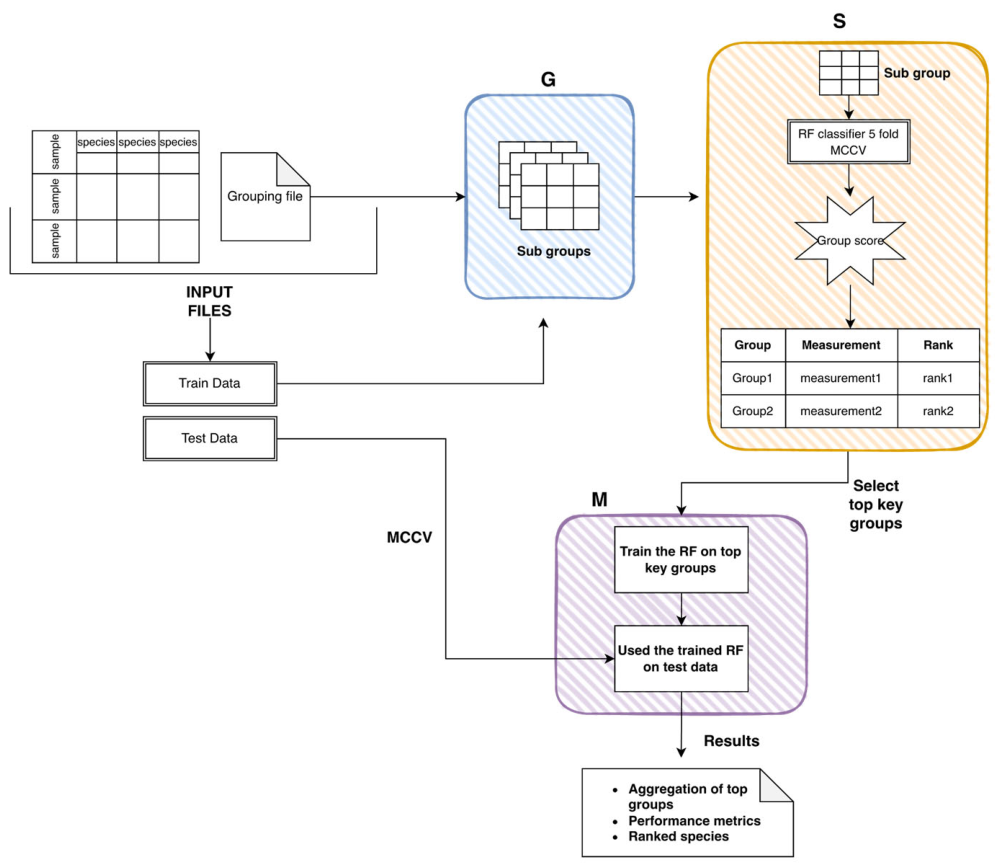
2.3. MicrobiomeGSM
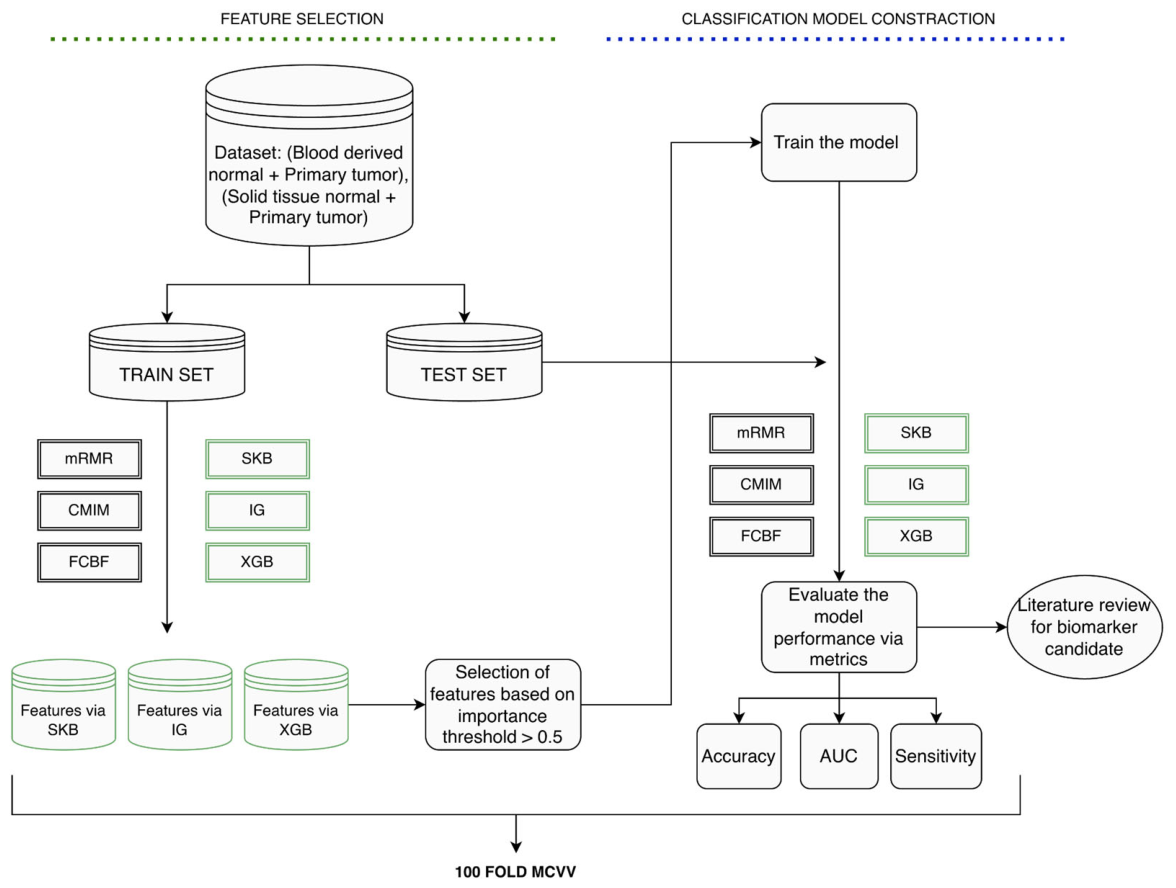
2.4. Traditional Feature Selection Approaches
2.5. Random Forest Algorithm
2.6. Classification Model Construction
2.7. Model Performance Evaluation
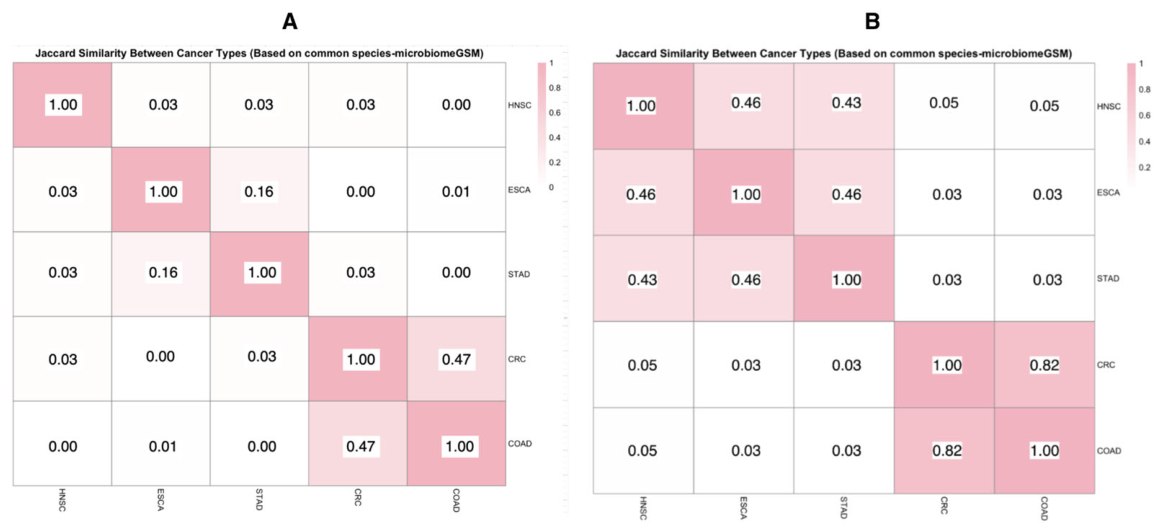
2.8. Jaccard Similarity Index Between Species of Cancer Types
3. Results
3.1. MicrobiomeGSM Results
3.2. Traditional Feature Selection Results
3.3. Random Forest Performance Results
4. Discussion
4.1. Model Performance Results of MicrobiomeGSM
4.2. Biological Validation of Obtained Biomarkers Across Different Approaches
5. Conclusions
Author Contributions
Funding
Institutional Review Board Statement
Informed Consent Statement
Data Availability Statement
Conflicts of Interest
Abbreviations
| CMIM | Conditional Mutual Information Maximization |
| COAD | Colon adenoma |
| CRC | Colorectal cancer |
| ESCA | Esophageal Cancer |
| FCBF | Fast Correlation-Based Filter |
| GI | Gastrointestinal Cancers |
| IG | Information Gain |
| HNSC | Head and Neck Cancer |
| MRMR | Maximum Likelihood and Minimum Redundancy |
| READ | Rectum Cancer |
| RF | Random Forest |
| SEN/SN | Sensitivity |
| SKB | Select K Best |
| SPE/SP | Specificity |
| STAD/GC | Stomach Cancer |
| TCGA | The Cancer Genome Atlas |
| TCMA | The Cancer Microbiome Atlas |
| XGB | Extreme Gradient Boosting |
References
- Arnold, M.; Abnet, C.C.; Neale, R.E.; Vignat, J.; Giovannucci, E.L.; McGlynn, K.A.; Bray, F. Global Burden of 5 Major Types of Gastrointestinal Cancer. Gastroenterology 2020, 159, 335–349.E15. [Google Scholar] [CrossRef]
- Kayali, S.; Marabotto, E.; Giannini, E. Gastrointestinal Tract Cancers, an Increasing Burden of the Modern Era: Epidemiology and Prevention. Cancers 2023, 15, 4634. [Google Scholar] [CrossRef] [PubMed]
- Wu, N.; Yang, X.; Zhang, R.; Li, J.; Xiao, X.; Hu, Y.; Chen, Y.; Yang, F.; Lu, N.; Wang, Z.; et al. Dysbiosis Signature of Fecal Microbiota in Colorectal Cancer Patients. Microb. Ecol. 2013, 66, 462–470. [Google Scholar] [CrossRef] [PubMed]
- Zhang, J.; He, Y.; Xia, L.; Yi, J.; Wang, Z.; Zhao, Y.; Song, X.; Li, J.; Liu, H.; Liang, X.; et al. Expansion of Colorectal Cancer Biomarkers Based on Gut Bacteria and Viruses. Cancers 2022, 14, 4662. [Google Scholar] [CrossRef] [PubMed]
- Zhou, Z.; Ge, S.; Li, Y.; Ma, W.; Liu, Y.; Hu, S.; Zhang, R.; Ma, Y.; Du, K.; Syed, A.; et al. Human Gut Microbiome-Based Knowledgebase as a Biomarker Screening Tool to Improve the Predicted Probability for Colorectal Cancer. Front. Microbiol. 2020, 11, 596027. [Google Scholar] [CrossRef] [PubMed]
- Zhang, H.; Chang, Y.; Zheng, Q.; Zhang, R.; Hu, C.; Jia, W. Altered Intestinal Microbiota Associated with Colorectal Cancer. Front. Med. 2019, 13, 461–470. [Google Scholar] [CrossRef] [PubMed]
- Chen, F.; Dai, X.; Zhou, C.-C.; Li, K.; Zhang, Y.; Lou, X.-Y.; Zhu, Y.-M.; Sun, Y.-L.; Peng, B.-X.; Cui, W. Integrated Analysis of the Faecal Metagenome and Serum Metabolome Reveals the Role of Gut Microbiome-Associated Metabolites in the Detection of Colorectal Cancer and Adenoma. Gut 2022, 71, 1315–1325. [Google Scholar] [CrossRef] [PubMed]
- Zhu, W.; Wang, J.-Z.; Liu, Z.; Wei, J.-F. The Bacteria inside Human Cancer Cells: Mainly as Cancer Promoters. Front. Oncol. 2022, 12, 897330. [Google Scholar] [CrossRef] [PubMed]
- Bakir-Gungor, B.; Temiz, M.; Jabeer, A.; Wu, D.; Yousef, M. microBiomeGSM: The Identification of Taxonomic Biomarkers from Metagenomic Data Using Grouping, Scoring and Modeling (G-S-M) Approach. Front. Microbiol. 2023, 14, 1264941. [Google Scholar] [CrossRef] [PubMed]
- Jabeer, A.; KoÇak, A.; Akkaş, H.; Yenisert, F.; Nalbantoğlu, Ö.U.; Yousef, M.; Bakir GÜngÖr, B. Identifying Taxonomic Biomarkers of Colorectal Cancer in Human Intestinal Microbiota Using Multiple Feature Selection Methods. In Proceedings of the 2022 Innovations in Intelligent Systems and Applications Conference (ASYU), Antalya, Turkey, 7–9 September 2022; pp. 1–6. [Google Scholar]
- Zhang, C.; Hu, A.; Li, J.; Zhang, F.; Zhong, P.; Li, Y.; Li, Y. Combined Non-Invasive Prediction and New Biomarkers of Oral and Fecal Microbiota in Patients with Gastric and Colorectal Cancer. Front. Cell. Infect. Microbiol. 2022, 12, 830684. [Google Scholar] [CrossRef] [PubMed]
- Freitas, P.; Silva, F.; Sousa, J.V.; Ferreira, R.M.; Figueiredo, C.; Pereira, T.; Oliveira, H.P. Machine Learning-Based Approaches for Cancer Prediction Using Microbiome Data. Sci. Rep. 2023, 13, 11821. [Google Scholar] [CrossRef] [PubMed]
- Wu, Y.; Jiao, N.; Zhu, R.; Zhang, Y.; Wu, D.; Wang, A.-J.; Fang, S.; Tao, L.; Li, Y.; Cheng, S.; et al. Identification of Microbial Markers across Populations in Early Detection of Colorectal Cancer. Nat. Commun. 2021, 12, 3063. [Google Scholar] [CrossRef] [PubMed]
- Li, M.-X.; Sun, X.-M.; Cheng, W.-G.; Ruan, H.-J.; Liu, K.; Chen, P.; Xu, H.-J.; Gao, S.-G.; Feng, X.-S.; Qi, Y.-J. Using a Machine Learning Approach to Identify Key Prognostic Molecules for Esophageal Squamous Cell Carcinoma. BMC Cancer 2021, 21, 906. [Google Scholar] [CrossRef] [PubMed]
- Marcos-Zambrano, L.J.; Karaduzovic-Hadziabdic, K.; Turukalo, T.L.; Przymus, P.; Trajkovik, V.; Aasmets, O.; Berland, M.; Gruca, A.; Hasic, J.; Hron, K.; et al. Applications of Machine Learning in Human Microbiome Studies: A Review on Feature Selection, Biomarker Identification, Disease Prediction and Treatment. Front. Microbiol. 2021, 12, 634511. [Google Scholar] [CrossRef] [PubMed]
- Teixeira, M.; Silva, F.; Ferreira, R.M.; Pereira, T.; Figueiredo, C.; Oliveira, H.P. A Review of Machine Learning Methods for Cancer Characterization from Microbiome Data. npj Precis. Oncol. 2024, 8, 123. [Google Scholar] [CrossRef] [PubMed]
- The Cancer Genome Atlas Program (TCGA)—NCI. Available online: https://www.cancer.gov/ccg/research/genome-sequencing/tcga (accessed on 3 September 2024).
- Dohlman, A.B.; Mendoza, D.A.; Ding, S.; Gao, M.; Dressman, H.; Iliev, I.D.; Lipkin, S.M.; Shen, X. The Cancer Microbiome Atlas: A Pan-Cancer Comparative Analysis to Distinguish Tissue-Resident Microbiota from Contaminants. Cell Host Microbe 2021, 29, 281–298.E5. [Google Scholar] [CrossRef] [PubMed]
- Kolde, R.; Laur, S.; Adler, P.; Vilo, J. Robust Rank Aggregation for Gene List Integration and Meta-Analysis. Bioinformatics 2012, 28, 573–580. [Google Scholar] [CrossRef] [PubMed]
- Yousef, M.; Allmer, J.; İnal, Y.; Gungor, B.B. G-S-M: A Comprehensive Framework for Integrative Feature Selection in Omics Data Analysis and Beyond. BioRxiv 2024. BioRxiv:2024.03.30.585514. [Google Scholar] [CrossRef]
- Yousef, M.; Abdallah, L.; Allmer, J. maTE: Discovering Expressed Interactions between microRNAs and Their Targets. Bioinformatics 2019, 35, 4020–4028. [Google Scholar] [CrossRef] [PubMed]
- Yousef, M.; Ozdemir, F.; Jaber, A.; Allmer, J.; Bakir-Gungor, B. PriPath: Identifying Dysregulated Pathways from Differential Gene Expression via Grouping, Scoring, and Modeling with an Embedded Feature Selection Approach. BMC Bioinform. 2023, 24, 60. [Google Scholar] [CrossRef] [PubMed]
- Qumsiyeh, E.; Showe, L.; Yousef, M. GediNET for Discovering Gene Associations across Diseases Using Knowledge Based Machine Learning Approach. Sci. Rep. 2022, 12, 19955. [Google Scholar] [CrossRef] [PubMed]
- Yousef, M.; Goy, G.; Mitra, R.; Eischen, C.M.; Jabeer, A.; Bakir-Gungor, B. miRcorrNet: Machine Learning-Based Integration of miRNA and mRNA Expression Profiles, Combined with Feature Grouping and Ranking. PeerJ 2021, 9, e11458. [Google Scholar] [CrossRef] [PubMed]
- Unlu Yazici, M.; Marron, J.S.; Bakir-Gungor, B.; Zou, F.; Yousef, M. Invention of 3Mint for Feature Grouping and Scoring in Multi-Omics. Front. Genet. 2023, 14, 1093326. [Google Scholar] [CrossRef] [PubMed]
- Ersoz, N.S.; Bakir-Gungor, B.; Yousef, M. GeNetOntology: Identifying Affected Gene Ontology Terms via Grouping, Scoring, and Modeling of Gene Expression Data Utilizing Biological Knowledge-Based Machine Learning. Front. Genet. 2023, 14. [Google Scholar] [CrossRef] [PubMed]
- Voskergian, D.; Bakir-Gungor, B.; Yousef, M. TextNetTopics Pro, a Topic Model-Based Text Classification for Short Text by Integration of Semantic and Document-Topic Distribution Information. Front. Genet. 2023, 14. [Google Scholar] [CrossRef] [PubMed]
- Qumsiyeh, E.; Salah, Z.; Yousef, M. miRGediNET: A Comprehensive Examination of Common Genes in miRNA-Target Interactions and Disease Associations: Insights from a Grouping-Scoring-Modeling Approach. Heliyon 2023, 9, e22666. [Google Scholar] [CrossRef] [PubMed]
- Jabeer, A.; Temiz, M.; Bakir-Gungor, B.; Yousef, M. miRdisNET: Discovering microRNA Biomarkers That Are Associated with Diseases Utilizing Biological Knowledge-Based Machine Learning. Front. Genet. 2023, 13, 1076554. [Google Scholar] [CrossRef] [PubMed]
- Yousef, M.; Goy, G.; Bakir-Gungor, B. miRModuleNet: Detecting miRNA-mRNA Regulatory Modules. Front. Genet. 2022, 13, 767455. [Google Scholar] [CrossRef] [PubMed]
- Yousef, M.; Ülgen, E.; Sezerman, O.U. CogNet: Classification of Gene Expression Data Based on Ranked Active-Subnetwork-Oriented KEGG Pathway Enrichment Analysis. PeerJ Comput. Sci. 2021, 7, e336. [Google Scholar] [CrossRef] [PubMed]
- Söylemez, Ü.G.; Yousef, M.; Bakir-Gungor, B. AMP-GSM: Prediction of Antimicrobial Peptides via a Grouping–Scoring–Modeling Approach. Appl. Sci. 2023, 13, 5106. [Google Scholar] [CrossRef]
- Ding, C.; Peng, H. Minimum Redundancy Feature Selection from Microarray Gene Expression Data. J. Bioinform. Comput. Biol. 2005, 03, 185–205. [Google Scholar] [CrossRef] [PubMed]
- Brown, G.; Pocock, A.; Zhao, M.-J.; Luján, M. Conditional Likelihood Maximisation: A Unifying Framework for Information Theoretic Feature Selection. J. Mach. Learn. Res. 2012, 13, 27–66. [Google Scholar]
- Fleuret, F. François Fleuret Fast Binary Feature Selection with Conditional Mutu-al Information. J. Mach. Learn. Res. 2004, 5, 1531–1555. [Google Scholar]
- Senliol, B.; Gulgezen, G.; Yu, L.; Cataltepe, Z. Fast Correlation Based Filter (FCBF) with a Different Search Strategy. In Proceedings of the 2008 23rd International Symposium on Computer and Information Sciences, Istanbul, Turkey, 27–29 October 2008; pp. 1–4. [Google Scholar]
- Pedregosa, F.; Varoquaux, G.; Gramfort, A.; Michel, V.; Thirion, B.; Grisel, O.; Blondel, M.; Prettenhofer, P.; Weiss, R.; Dubourg, V.; et al. Scikit-Learn: Machine Learning in Python. J. Mach. Learn. Res. 2011, 12, 2825–2830. [Google Scholar]
- Bakir-Gungor, B.; Hacılar, H.; Jabeer, A.; Nalbantoglu, O.U.; Aran, O.; Yousef, M. Inflammatory Bowel Disease Biomarkers of Human Gut Microbiota Selected via Different Feature Selection Methods. PeerJ 2022, 10, e13205. [Google Scholar] [CrossRef] [PubMed]
- D’Elia, D.; Truu, J.; Lahti, L.; Berland, M.; Papoutsoglou, G.; Ceci, M.; Zomer, A.; Lopes, M.B.; Ibrahimi, E.; Gruca, A.; et al. Advancing Microbiome Research with Machine Learning: Key Findings from the ML4Microbiome COST Action. Front. Microbiol. 2023, 14, 1257002. [Google Scholar] [CrossRef] [PubMed]
- Xu, Q.-S.; Liang, Y.-Z. Monte Carlo Cross Validation. Chemom. Intell. Lab. Syst. 2001, 56, 1–11. [Google Scholar] [CrossRef]
- Berthold, M.R.; Cebron, N.; Dill, F.; Gabriel, T.R.; Kötter, T.; Meinl, T.; Ohl, P.; Sieb, C.; Thiel, K.; Wiswedel, B. KNIME: The Konstanz Information Miner. In Proceedings of the Data Analysis, Machine Learning and Applications; Preisach, C., Burkhardt, H., Schmidt-Thieme, L., Decker, R., Eds.; Springer: Berlin/Heidelberg, Germany, 2008; pp. 319–326. [Google Scholar]
- Madhikermi, M.; Kubler, S.; Robert, J.; Buda, A.; Främling, K. Data Quality Assessment of Maintenance Reporting Procedures. Expert Syst. Appl. 2016, 63, 145–164. [Google Scholar] [CrossRef]
- Rizwan, I.; Haque, I.; Neubert, J. Deep Learning Approaches to Biomedical Image Segmentation. Inform. Med. Unlocked 2020, 18, 100297. [Google Scholar] [CrossRef]
- Yang, F.; Sun, S.; Yang, F. Prognostic and Predicted Significance of FENDRR in Colon and Rectum Adenocarcinoma. Front. Oncol. 2021, 11, 668595. [Google Scholar] [CrossRef] [PubMed]
- Ivleva, E.A.; Grivennikov, S.I. Microbiota-Driven Mechanisms at Different Stages of Cancer Development. Neoplasia 2022, 32, 100829. [Google Scholar] [CrossRef] [PubMed]
- Bang, S.; Yoo, D.; Kim, S.-J.; Jhang, S.; Cho, S.; Kim, H. Establishment and Evaluation of Prediction Model for Multiple Disease Classification Based on Gut Microbial Data. Sci. Rep. 2019, 9, 10189. [Google Scholar] [CrossRef] [PubMed]
- Bahrambanan, F.; Alizamir, M.; Moradveisi, K.; Heddam, S.; Kim, S.; Kim, S.; Soleimani, M.; Afshar, S.; Taherkhani, A. The Development of an Efficient Artificial Intelligence-Based Classification Approach for Colorectal Cancer Response to Radiochemotherapy: Deep Learning vs. Machine Learning. Sci. Rep. 2025, 15, 62. [Google Scholar] [CrossRef] [PubMed]
- Karwowska, Z.; Aasmets, O.; Metspalu, M.; Metspalu, A.; Milani, L.; Esko, T.; Kosciolek, T.; Org, E.; Estonian Biobank Research Team. Effects of Data Transformation and Model Selection on Feature Importance in Microbiome Classification Data. Microbiome 2025, 13, 2. [Google Scholar] [CrossRef] [PubMed]
- Park, G.; Oh, S.; Kim, M.; Jeong, Y.; Kim, G. Common Microbial Signatures in Blood and Their Amplification in Clinical Disorders. Gut Microbes Rep. 2025, 2, 2473450. [Google Scholar] [CrossRef] [PubMed]
- Wu, Y.; Xu, J.; Rong, X.; Wang, F.; Wang, H.; Zhao, C. Gut Microbiota Alterations and Health Status in Aging Adults: From Correlation to Causation. Aging Med. 2021, 4, 206–213. [Google Scholar] [CrossRef] [PubMed]
- Liang, W.; Zhou, Z.; Gao, Q.; Zhu, Z.; Zhu, J.; Lin, J.; Wen, Y.; Qian, F.; Wang, L.; Zhai, Y.; et al. Tumor-derived Prevotella Intermedia Aggravates Gastric Cancer by Enhancing Perilipin 3 Expression. Cancer Sci. 2024, 115, 1141. [Google Scholar] [CrossRef] [PubMed]
- Xia, R.; Jiang, Z.; Zhou, Y.; Pan, L.; Wang, Y.; Ma, Y.; Fan, L.; Yuan, L.; Cheng, X. Oral Microbiota and Gastric Cancer: Recent Highlights and Knowledge Gaps. J. Oral Microbiol. 2024, 16, 2391640. [Google Scholar] [CrossRef] [PubMed]
- Castañeda-Corzo, G.-J.; Infante-Rodríguez, L.-F.; Villamil-Poveda, J.-C.; Bustillo, J.; Cid-Arregui, A.; García-Robayo, D.-A. Association of Prevotella Intermedia with Oropharyngeal Cancer: A Patient-Control Study. Heliyon 2023, 9, e14293. [Google Scholar] [CrossRef] [PubMed]
- Moreira, C.; Figueiredo, C.; Ferreira, R.M. The Role of the Microbiota in Esophageal Cancer. Cancers 2023, 15, 2576. [Google Scholar] [CrossRef] [PubMed]
- Könönen, E.; Fteita, D.; Gursoy, U.K.; Gursoy, M. Prevotella Species as Oral Residents and Infectious Agents with Potential Impact on Systemic Conditions. J. Oral Microbiol. 2022, 14, 2079814. [Google Scholar] [CrossRef] [PubMed]
- Qin, Y.; Tong, X.; Mei, W.-J.; Cheng, Y.; Zou, Y.; Han, K.; Yu, J.; Jie, Z.; Zhang, T.; Zhu, S.; et al. Consistent Signatures in the Human Gut Microbiome of Old- and Young-Onset Colorectal Cancer. Nat. Commun. 2024, 15, 3396. [Google Scholar] [CrossRef] [PubMed]
- Yu, J.; Feng, L.; Luo, Z.; Yang, J.; Zhang, Q.; Liu, C.; Liang, D.; Xie, Y.; Li, H.; Gong, J.; et al. Interleukin-10 Deficiency Suppresses Colorectal Cancer Metastasis by Enriching Gut Parabacteroides Distasonis. J. Adv. Res. 2024. [Google Scholar] [CrossRef] [PubMed]
- Liu, J.; Huang, X.; Chen, C.; Wang, Z.; Huang, Z.; Qin, M.; He, F.; Tang, B.; Long, C.; Hu, H.; et al. Identification of Colorectal Cancer Progression-Associated Intestinal Microbiome and Predictive Signature Construction. J. Transl. Med. 2023, 21, 373. [Google Scholar] [CrossRef] [PubMed]
- Hsieh, Y.-Y.; Tung, S.-Y.; Pan, H.-Y.; Yen, C.-W.; Xu, H.-W.; Lin, Y.-J.; Deng, Y.-F.; Hsu, W.-T.; Wu, C.-S.; Li, C. Increased Abundance of Clostridium and Fusobacterium in Gastric Microbiota of Patients with Gastric Cancer in Taiwan. Sci. Rep. 2018, 8, 158. [Google Scholar] [CrossRef] [PubMed]
- Bronzato, J.D.; Bomfim, R.A.; Edwards, D.H.; Crouch, D.; Hector, M.P.; Gomes, B.P.F.A. Detection of Fusobacterium in Oral and Head and Neck Cancer Samples: A Systematic Review and Meta-Analysis. Arch. Oral Biol. 2020, 112, 104669. [Google Scholar] [CrossRef] [PubMed]
- Cao, Y.; Shang, F.; Jin, M.; Deng, S.; Gu, J.; Mao, F.; Qin, L.; Wang, J.; Xue, Y.; Jiang, Z.; et al. Changes in Bacteroides and the Microbiota in Patients with Obstructed Colorectal Cancer: Retrospective Cohort Study. BJS Open 2023, 7, zrad105. [Google Scholar] [CrossRef] [PubMed]
- Cheng, W.T.; Kantilal, H.K.; Davamani, F. The Mechanism of Bacteroides Fragilis Toxin Contributes to Colon Cancer Formation. Malays. J. Med. Sci. MJMS 2020, 27, 9–21. [Google Scholar] [CrossRef] [PubMed]
- Matsumiya, Y.; Suenaga, M.; Ishikawa, T.; Kudo, T.; Nakagawa, T.; Okamoto, K.; Tokunaga, M.; Hurtado, C.; Yamada, Y.; Oka, K.; et al. Clinical Significance of Bacteroides Fragilis as a Potential Prognostic Factor in Colorectal Cancer. Anaerobe 2023, 84, 102784. [Google Scholar] [CrossRef] [PubMed]
- Chen, X.; Winckler, B.; Lu, M.; Cheng, H.; Yuan, Z.; Yang, Y.; Jin, L.; Ye, W. Oral Microbiota and Risk for Esophageal Squamous Cell Carcinoma in a High-Risk Area of China. PLoS ONE 2015, 10, e0143603. [Google Scholar] [CrossRef] [PubMed]
- Elliott, D.R.F.; Walker, A.W.; O’Donovan, M.; Parkhill, J.; Fitzgerald, R.C. A Non-Endoscopic Device to Sample the Oesophageal Microbiota: A Case-Control Study. Lancet Gastroenterol. Hepatol. 2017, 2, 32–42. [Google Scholar] [CrossRef] [PubMed]
- Liang, W.; Yang, Y.; Wang, H.; Wang, H.; Yu, X.; Lu, Y.; Shen, S.; Teng, L. Gut Microbiota Shifts in Patients with Gastric Cancer in Perioperative Period. Medicine 2019, 98, e16626. [Google Scholar] [CrossRef] [PubMed]
- Yang, C.-Y.; Yeh, Y.-M.; Yu, H.-Y.; Chin, C.-Y.; Hsu, C.-W.; Liu, H.; Huang, P.-J.; Hu, S.-N.; Liao, C.-T.; Chang, K.-P.; et al. Oral Microbiota Community Dynamics Associated with Oral Squamous Cell Carcinoma Staging. Front. Microbiol. 2018, 9, 862. [Google Scholar] [CrossRef] [PubMed]
- Yost, S.; Stashenko, P.; Choi, Y.; Kukuruzinska, M.; Genco, C.A.; Salama, A.; Weinberg, E.O.; Kramer, C.D.; Frias-Lopez, J. Increased Virulence of the Oral Microbiome in Oral Squamous Cell Carcinoma Revealed by Metatranscriptome Analyses. Int. J. Oral Sci. 2018, 10, 32. [Google Scholar] [CrossRef] [PubMed]
- Yu, S.; Wang, X.; Li, Z.; Jin, D.; Yu, M.; Li, J.; Li, Y.; Liu, X.; Zhang, Q.; Liu, Y.; et al. Solobacterium moorei Promotes the Progression of Adenomatous Polyps by Causing Inflammation and Disrupting the Intestinal Barrier. J. Transl. Med. 2024, 22, 169. [Google Scholar] [CrossRef] [PubMed]
- Chen, Y.; Qin, Y.; Fan, T.; Qiu, C.; Zhang, Y.; Dai, M.; Zhou, Y.; Sun, Q.; Guo, Y.; Hao, Y.; et al. Solobacterium moorei Promotes Tumor Progression via the Integrin A2/Β1-PI3K-AKT-mTOR-C-Myc Signaling Pathway in Colorectal Cancer. Int. J. Biol. Sci. 2025, 21, 1497–1512. [Google Scholar] [CrossRef] [PubMed]
- Barrak, I.; Stájer, A.; Gajdács, M.; Urbán, E. Small, but Smelly: The Importance of Solobacterium moorei in Halitosis and Other Human Infections. Heliyon 2020, 6, e05371. [Google Scholar] [CrossRef] [PubMed]
- Ferreira, R.M.; Pereira-Marques, J.; Pinto-Ribeiro, I.; Costa, J.L.; Carneiro, F.; Machado, J.C.; Figueiredo, C. Gastric Microbial Community Profiling Reveals a Dysbiotic Cancer-Associated Microbiota. Gut 2018, 67, 226–236. [Google Scholar] [CrossRef] [PubMed]
- Alauzet, C.; Aujoulat, F.; Lozniewski, A.; Ben Brahim, S.; Domenjod, C.; Enault, C.; Lavigne, J.-P.; Marchandin, H. A New Look at the Genus Solobacterium: A Retrospective Analysis of Twenty-Seven Cases of Infection Involving S. moorei and a Review of Sequence Databases and the Literature. Microorganisms 2021, 9, 1229. [Google Scholar] [CrossRef] [PubMed]
- Peters, B.A.; Wu, J.; Pei, Z.; Yang, L.; Purdue, M.P.; Freedman, N.D.; Jacobs, E.J.; Gapstur, S.M.; Hayes, R.B.; Ahn, J. Oral Microbiome Composition Reflects Prospective Risk for Esophageal Cancers. Cancer Res. 2017, 77, 6777–6787. [Google Scholar] [CrossRef] [PubMed]
- Sárvári, K.P.; Sántha, D.; Kovács, R.; Körmöndi, S.; Pető, Z.; Vereb, T.; Sztanó, B. Six Cases of Solobacterium moorei Isolated Alone or in Mixed Culture in Hungary and Comparison with Previously Published Cases. Anaerobe 2020, 65, 102241. [Google Scholar] [CrossRef] [PubMed]
- Fujiwara-Tani, R.; Fujii, K.; Mori, S.; Kishi, S.; Sasaki, T.; Ohmori, H.; Nakashima, C.; Kawahara, I.; Nishiguchi, Y.; Mori, T.; et al. Role of Clostridium Perfringens Enterotoxin on YAP Activation in Colonic Sessile Serrated Adenoma/Polyps with Dysplasia. Int. J. Mol. Sci. 2020, 21, 3840. [Google Scholar] [CrossRef] [PubMed]
- Liang, Z.-Y.; Kang, X.; Chen, H.; Wang, M.; Guan, W.-X. Effect of Clostridium Perfringens Enterotoxin on Gastric Cancer Cells SGC7901 Which Highly Expressed Claudin-4 Protein. World J. Gastrointest. Oncol. 2017, 9, 153–159. [Google Scholar] [CrossRef] [PubMed]
- Xia, K.; Zhou, Y.; Wang, W.; Cai, Y. Streptococcus anginosus: The Potential Role in the Progression of Gastric Cancer. J. Cancer Res. Clin. Oncol. 2025, 151, 143. [Google Scholar] [CrossRef] [PubMed]
- Morita, E.; Narikiyo, M.; Yokoyama, A.; Yano, A.; Kamoi, K.; Yoshikawa, E.; Yamaguchi, T.; Igaki, H.; Tachimori, Y.; Kato, H.; et al. Predominant Presence of Streptococcus anginosus in the Saliva of Alcoholics. Oral Microbiol. Immunol. 2005, 20, 362–365. [Google Scholar] [CrossRef] [PubMed]
- Narikiyo, M.; Tanabe, C.; Yamada, Y.; Igaki, H.; Tachimori, Y.; Kato, H.; Muto, M.; Montesano, R.; Sakamoto, H.; Nakajima, Y.; et al. Frequent and Preferential Infection of Treponema denticola, Streptococcus mitis, and Streptococcus anginosus in Esophageal Cancers. Cancer Sci. 2004, 95, 569–574. [Google Scholar] [CrossRef] [PubMed]
- Isakov, V. Autoimmune Gastritis Studies and Gastric Cancer: True Renaissance or Bibliometric Illusion. World J. Gastroenterol. 2024, 30, 3783–3790. [Google Scholar] [CrossRef] [PubMed]
- Peixoto Vieira Viseu Ferreira, C.M.; Souaf, S.; Martínez Monzonís, A.; El-Diasty, M.M.; Fernandez, A.L. Purulent Pericarditis as the First Manifestation of Esophageal Carcinoma. Port. J. Card. Thorac. Vasc. Surg. 2024, 31, 59–62. [Google Scholar] [CrossRef] [PubMed]
- Shu, J.; Yu, H.; Ren, X.; Wang, Y.; Zhang, K.; Tang, Z.; Dang, L.; Chen, W.; Li, B.; Xie, H.; et al. Role of Salivary Glycopatterns for Oral Microbiota Associated with Gastric Cancer. Int. J. Biol. Macromol. 2022, 209, 1368–1378. [Google Scholar] [CrossRef] [PubMed]
- Kageyama, S.; Takeshita, T.; Takeuchi, K.; Asakawa, M.; Matsumi, R.; Furuta, M.; Shibata, Y.; Nagai, K.; Ikebe, M.; Morita, M.; et al. Characteristics of the Salivary Microbiota in Patients with Various Digestive Tract Cancers. Front. Microbiol. 2019, 10, 1780. [Google Scholar] [CrossRef] [PubMed]



| Cancer Types | Number of Samples of Blood (Negative) | Number of Samples of Solid (Negatives) | Number of Positives |
|---|---|---|---|
| Colon adenoma cancer | 99 | 21 | 125 |
| Colon cancer-rectum cancer (CRC) colorectal cancer | 140 | 25 | 170 |
| Esophageal cancer | 42 | 22 | 62 |
| Head and neck cancer | 130 | 21 | 157 |
| Stomach cancer | 89 | 39 | 128 |
| Clusters | Species | Accuracy | Sensitivity | Specificity | F1 | AUC | Precision |
|---|---|---|---|---|---|---|---|
| 10 | 191.7 | 0.95 + −0.03 | 0.94 + −0.08 | 0.96 + −0.05 | 0.95 + −0.04 | 0.99 + −0.01 | 0.96 + −0.05 |
| 9 | 185.1 | 0.95 + −0.03 | 0.94 + −0.08 | 0.96 + −0.05 | 0.95 + −0.04 | 0.99 +−0.01 | 0.96 + −0.05 |
| 8 | 177.4 | 0.95 + −0.04 | 0.93 + −0.08 | 0.96 + −0.05 | 0.94 + −0.04 | 0.98 + −0.02 | 0.96 + −0.05 |
| 7 | 165.8 | 0.95 + −0.03 | 0.93 + −0.08 | 0.96 + −0.05 | 0.95 + −0.03 | 0.99 + −0.02 | 0.96 +−0.05 |
| 6 | 157.8 | 0.96 + −0.03 | 0.95 + −0.07 | 0.96 + −0.05 | 0.95 + −0.03 | 0.99 + −0.02 | 0.96 + −0.05 |
| 5 | 144 | 0.95 + −0.02 | 0.94 + −0.07 | 0.96 + −0.05 | 0.95 + −0.03 | 0.98 + −0.02 | 0.96 + −0.05 |
| 4 | 127.2 | 0.95 + −0.03 | 0.93 + −0.08 | 0.96 + −0.04 | 0.94 + −0.03 | 0.98 + −0.01 | 0.96 + −0.05 |
| 3 | 109.7 | 0.95 + −0.03 | 0.93 + −0.06 | 0.96 + −0.05 | 0.94 + −0.03 | 0.98 + −0.03 | 0.96 +−0.05 |
| 2 | 81.4 | 0.94 + −0.04 | 0.91 + −0.07 | 0.96 + −0.05 | 0.93 + −0.04 | 0.98 + −0.04 | 0.96 + −0.05 |
| 1 | 43.2 | 0.92 + −0.05 | 0.87 + −0.1 | 0.97 + −0.05 | 0.91 + −0.06 | 0.95 + −0.04 | 0.97 + −0.05 |
| Clusters | Species | Accuracy | Sensitivity | Specificity | F1 | AUC | Precision |
|---|---|---|---|---|---|---|---|
| 10 | 260 | 0.94 + −0.03 | 0.92 + −0.06 | 0.95 + −0.07 | 0.93 + −0.07 | 0.9 +−0.04 | 0.95 + −0.06 |
| 9 | 257.1 | 0.94 + −0.03 | 0.92 + −0.06 | 0.95 + −0.07 | 0.93 + −0.03 | 0.95 + −0.04 | 0.95 + −0.06 |
| 8 | 254.2 | 0.93 + −0.04 | 0.91 + −0.04 | 0.94 + −0.10 | 0.92 + −0.04 | 0.94 + −0.04 | 0.95 + −0.08 |
| 7 | 248.6 | 0.94 + −0.03 | 0.92 + −0.06 | 0.95 + −0.07 | 0.93 + −0.03 | 0.94 + −0.05 | 0.95 + −0.06 |
| 6 | 242.1 | 0.93 + −0.04 | 0.92 + −0.06 | 0.93 + −0.09 | 0.93 + −0.04 | 0.95 + −0.04 | 0.94 + −0.08 |
| 5 | 235.6 | 0.92 + −0.05 | 0.90 + −0.08 | 0.93 + −0.09 | 0.91 + −0.05 | 0.95 + −0.04 | 0.94 + −0.08 |
| 4 | 230.5 | 0.92 + −0.04 | 0.91 + −0.07 | 0.93 + −0.04 | 0.92 + −0.05 | 0.95 + −0.04 | 0.94 + −0.08 |
| 3 | 216.2 | 0.92 + −0.04 | 0.90 + −0.07 | 0.94 + −0.10 | 0.92 + −0.04 | 0.95 + −0.04 | 0.95 + −0.08 |
| 2 | 198 | 0.91 + −0.05 | 0.89 + −0.07 | 0.93 + −0.09 | 0.91 + −0.05 | 0.95 + −0.04 | 0.94 + −0.08 |
| 1 | 112.8 | 0.90 + −0.05 | 0.88 + −0.08 | 0.92 + −0.08 | 0.90 + −0.05 | 0.94 + −0.04 | 0.92 + −0.07 |
| Clusters | Species | Accuracy | Sensitivity | Specificity | F1 | AUC | Precision |
|---|---|---|---|---|---|---|---|
| 10 | 88.9 | 0.92 + −0.05 | 0.86 + −0.10 | 0.98 + −0.04 | 0.91 + −0.05 | 0.97 + −0.04 | 0.98 + −0.04 |
| 9 | 77.3 | 0.94 + −0.05 | 0.88 + −0.10 | 0.99 + −0.03 | 0.93 + −0.05 | 0.97 + −0.04 | 0.99 + −0.03 |
| 8 | 73.4 | 0.94 + −0.05 | 0.88 + −0.10 | 0.99 + −0.03 | 0.93 + −0.05 | 0.97 + −0.04 | 0.99 + −0.03 |
| 7 | 69.6 | 0.93 + −0.05 | 0.88 + −0.10 | 0.98 + −0.04 | 0.92 + −0.06 | 0.97 + −0.04 | 0.98 + −0.04 |
| 6 | 62.4 | 0.93 + −0.05 | 0.88 + −0.10 | 0.98 + −0.04 | 0.92 + −0.06 | 0.97 + −0.04 | 0.98 + −0.04 |
| 5 | 57.1 | 0.91 + −0.06 | 0.85 + −0.11 | 0.97 + −0.05 | 0.90 + −0.07 | 0.97 + −0.04 | 0.97 + −0.05 |
| 4 | 54 | 0.93 + −0.05 | 0.87 + −0.10 | 0.98 + −0.04 | 0.92 + −0.06 | 0.97 + −0.04 | 0.98 + −0.04 |
| 3 | 47.1 | 0.93 + −0.05 | 0.80 + −0.10 | 0.99 + −0.03 | 0.92 + −0.06 | 0.97 + −0.04 | 0.99 + −0.03 |
| 2 | 41.3 | 0.92 +−0.06 | 0.87 + −0.11 | 0.97 + −0.05 | 0.91 + −0.06 | 0.97 + −0.04 | 0.97 + −0.05 |
| 1 | 30 | 0.92 +−0.07 | 0.87 +−0.13 | 0.97 + −0.05 | 0.91 + −0.08 | 0.97 + −0.06 | 0.97 + −0.05 |
| Approaches | Species | Accuracy | SN | SP | F1 | AUC | Precision |
|---|---|---|---|---|---|---|---|
| MicrobiomeGSM-genus | 30 | 0.92 | 0.87 | 0.97 | 0.91 | 0.97 | 0.97 |
| TFSA-IG-XGB- (2. Run) | 23 | 0.96 | 0.97 | 0.94 | 0.96 | 0.98 | 0.95 |
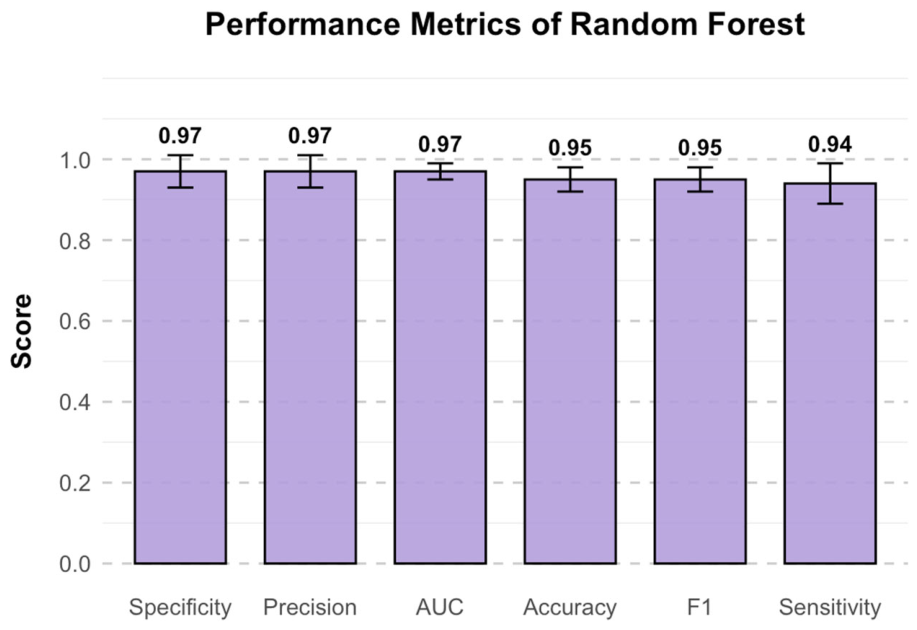
| RF | 682 | 0.95 | 0.94 | 0.97 | 0.95 | 0.97 | 0.97 |
Disclaimer/Publisher’s Note: The statements, opinions and data contained in all publications are solely those of the individual author(s) and contributor(s) and not of MDPI and/or the editor(s). MDPI and/or the editor(s) disclaim responsibility for any injury to people or property resulting from any ideas, methods, instructions or products referred to in the content. |
© 2026 by the authors. Licensee MDPI, Basel, Switzerland. This article is an open access article distributed under the terms and conditions of the Creative Commons Attribution (CC BY) license.
Share and Cite
Canakcimaksutoglu, B.; Ersoz, N.S.; Bakir-Gungor, B.; Yousef, M. Discovering Potential Taxonomic Biomarkers of Gastrointestinal Cancers from Various Human Microbiota via G-S-M Machine Learning Approach. Appl. Sci. 2026, 16, 6879. https://doi.org/10.3390/app16146879
Canakcimaksutoglu B, Ersoz NS, Bakir-Gungor B, Yousef M. Discovering Potential Taxonomic Biomarkers of Gastrointestinal Cancers from Various Human Microbiota via G-S-M Machine Learning Approach. Applied Sciences. 2026; 16(14):6879. https://doi.org/10.3390/app16146879
Chicago/Turabian StyleCanakcimaksutoglu, Beyza, Nur Sebnem Ersoz, Burcu Bakir-Gungor, and Malik Yousef. 2026. "Discovering Potential Taxonomic Biomarkers of Gastrointestinal Cancers from Various Human Microbiota via G-S-M Machine Learning Approach" Applied Sciences 16, no. 14: 6879. https://doi.org/10.3390/app16146879
APA StyleCanakcimaksutoglu, B., Ersoz, N. S., Bakir-Gungor, B., & Yousef, M. (2026). Discovering Potential Taxonomic Biomarkers of Gastrointestinal Cancers from Various Human Microbiota via G-S-M Machine Learning Approach. Applied Sciences, 16(14), 6879. https://doi.org/10.3390/app16146879