Article

Ventilation Effectiveness Measurements in Clean and Dry Rooms Based on Tracer Gas Techniques—A Preliminary Measurement Development

Fraunhofer Institute for Solar Energy Systems (ISE), 79110 Freiburg, Germany
*
Authors to whom correspondence should be addressed.
Appl. Sci. 2026, 16(13), 6732; https://doi.org/10.3390/app16136732 (registering DOI)
Submission received: 6 May 2026 / Revised: 15 June 2026 / Accepted: 17 June 2026 / Published: 5 July 2026

Abstract

Battery cell manufacturing is highly energy intensive, with clean and dry rooms being among the largest consumers of electricity and thermal energy. Due to the moisture sensitivity of most advanced cathode materials (e.g., NMC 811) and sulfide-based solid-state materials, production environments must operate at extremely low humidity, requiring energy-intensive HVAC systems to remove moisture introduced mainly by workers and infiltration. To reduce energy consumption, a detailed understanding of the airflow patterns in the room is essential. Because of complex flow patterns (exhaust air demands, energy dissipation), tracer gas techniques using CO2 as a marker provide an operation-integrated method for determining local air age. The studies presented in this paper apply tracer gas techniques for the first time to a room in which air is almost completely recirculated at high air change rates of approximately 27 h−1, with the supply air being conditioned by removing all process-relevant contaminants such as moisture and particles. Measurements in a separate flow box show successful air age calculations that agree with simplified CFD simulations. For the clean and dry room, the empirical variable relative exposure (REX) was introduced. The measurements indicate an inhomogeneous air distribution inside the room, accompanied with short-circuit flows, partial displacement flow, and mixing, and therefore have the potential to provide a cost-effective first-hand insight into the prevailing airflow patterns. Nevertheless, the presented measurement technique must be further optimized and validated for rooms with air recirculation and high air change rates.

1. Introduction

In battery cell manufacturing, the indoor environment parameters of moisture, temperature, and particles must be strictly controlled. Ineligible moisture contents in the production environment parameters can lead to degradation of the active materials, decomposition of the electrolyte and thus a reduction of cell performance, reproducibility, and lifetime [1,2,3,4]. Particles can lead to defects, higher rejection rates and even safety issues [5]. In state-of-the-art battery production, the machinery of cell assembly and electrode production is operated in clean and dry rooms [6]. For Ni-rich NMC cathodes and sulfidic solid-state batteries, moisture contents as low as DPT = −40 °C (dewpoint temperature) and lower, until even ≤−60 °C (<0.045% r.h. at 21 °C, 101.325 kPa) might be necessary [7,8]. Regarding particle concentration, cleanroom classes 7 or 8 (ISO 14644-1 [9]) are typically found in manufacturing environments. The energy turnover of HVAC (heating, ventilation and air conditioning) systems for clean and dry rooms accounts for 20% to 60% of the energy demand in cell production, a considerable demand of which a major share is being used for dehumidification [8,10,11]. As typically natural gas, steam, or electricity are applied as heat sources for the regeneration of the desiccant, lowering the overall energy consumption is necessary, not only to lower the operating expenses, but also to lower the CO2 emissions of manufacturing plants. The dimensioning of dehumidification systems depends mainly on the intake of contamination (here: moisture) into the dry room. Being the major contaminant, people emit approximately 110 g water vapor per hour into the environment, depending on their degree of activity [12,13]. Hence, the maximum number of workers in the dry room is used for dimensioning the dehumidification system, oftentimes using ideal mixed environment as the assumed flow principle. On the other hand, the formation of a low-turbulence displacement flow would ensure a much more efficient removal of contaminants. In practice, a significant proportion of space is occupied by machinery, affecting the airflow by space usage and thermal loads. Additionally, both the moisture sources in the dry room are defined—considering, e.g., defined operation places of the personal—and the points of interest inside the dry room are defined as well—e.g., battery material and manufacturing plants. By gathering information over the actual airflow patterns and local ventilation effectiveness inside the dry room, airflow can be optimized, and local moisture accumulation can be avoided. A more effective moisture removal could be feasible as the supply air volume flow and hereby the energy demand could be reduced, lowering operating expenses, especially in the field of battery manufacturing.
One difficulty is to determine the airflow, as CFD (computational fluid dynamics) simulations can be highly complex in large clean and dry rooms, containing equipment, local heat sources, exhaust air, and supply air streams, also taking into consideration the effects of multicomponent mixtures as the diffusion of components. Considerable computation costs are required, while at the same time the various partially unknown effects and poorly defined boundary conditions lead to high uncertainties in the simulation results. In this study, a clean and dry room with a flow plenum covering almost the whole ceiling was investigated, making it complex and costly to define the boundary condition of the room inlet with acceptable accuracy. To detect the airflow and to enable measures for flow optimization, measurements inside existing dry rooms are needed. The objective of this paper is to describe a hands-on approach of a measurement technique, based on tracer gas injection, to characterize the airflow patterns and ventilation efficiency inside an industrial, existing clean and dry room not specifically designed for air change efficiency evaluations.

2. Methodology

2.1. Air Change Efficiency Based on Air Age

The purpose of the ventilation system is to extract airborne pollutants, by efficiently exchanging indoor room air. Additionally, and specifically in the context of clean and dry rooms, such systems cover air conditioning in terms of temperature- and moisture-level control. The main cost driver is the air volume flow conveyed, as this increases the fan power as well as the energy requirements of air conditioning systems.
To describe the air exchange in a room, one approach is to describe the residence time t and air age α of the air in a room. At a point P at coordinate x P in the room with one supply air terminal and one extract air terminal, the air age at point P is α P the time the air needs from the supply air terminal to P, and the remaining lifetime λ P is the time the air needs from P to the extract air terminal. This relationship can be expressed by Equation (1). Considering that there are infinite paths to reach any P, these times can be described by statistical distributions. These local distributions are characterized by statistical moments, where the mean values are called local mean air age α ¯ x P = α ¯ P and local mean residual lifetime λ ¯ x P = λ ¯ P [14,15].
t P   = α P + λ P .
One often used system parameter is the nominal air change rate n. For the reference condition of a room with ideally mixed air, we can define n as the supply volume flow V ˙ divided by the room volume V, n = V ˙ /V. The nominal time constant τ n is the inverse of the nominal air change rate, and hence the mean residence time in the room [14,16].
How efficient the ventilation system supplies young air—colloquially “fresh air”—can be described by the air change efficiency (ACE) ε a according to (2). Here t ¯ and α ¯ are the spatially and stochastically averaged residence time and air age of the indoor space [15]. Another commonly used concept is the contaminant removal effectiveness (CRE) ε c following (3), which quantifies a system’s ability to extract a specific airborne contaminant from a ventilated indoor space. C ex , C sup and C P being the contaminant concentrations in the extract, in the supply and at point P in the room [14,15,16]. In case the considered airborne pollutant has similar diffusion characteristics as air and is evenly distributed throughout the room, ε c and ε a can assumed to be directly proportional according to (4) [15,17,18].
ε a = τ n t ¯ = τ n 2   ·   α ¯
ε c = C ex C sup C P C sup
ε a     2   ·   ε c
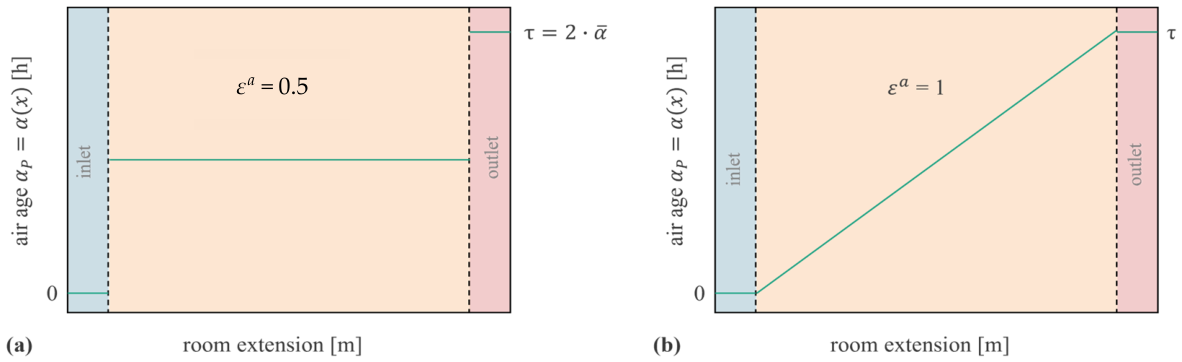
The existing two reference models of the flow are ideally mixed flow and plug flow. These are theoretical systems that cannot be met in practice. In an ideally mixed environment, all fluid elements have the same properties, so the air age distribution inside the environment is perfectly homogeneous as depicted in Figure 1a. This condition of ε a   =   0.5 can only be reached as an average over the whole space considered, but not in the sense of a homogeneous distribution. In a plug flow—also called piston or ideal displacement flow—the fluid elements are led through the environment in the most direct path but cover the whole indoor space as well. All elements have the same residence time t P   , but over their traveling path x, the air age α P linearly increases (Figure 1b) [15].
The highest air change efficiency ε a   =   1 can be reached with plug flow. In case the considered contaminant or air fraction is airborne and similarly soluble—equal Schmidt-numbers—as the tracer chosen, in such circumstances contaminant removal ε c can be translated into air change efficiency ε a applying (4). In practice, recirculation air patterns inside the room and short-circuit currents can occur, reducing both ε a and ε c . Typically, for real ventilation systems, several interacting zones with various average air age levels α ¯ can be identified, which is why it can be beneficial to evaluate local air change efficiencies as well ([15], p. 57).

2.2. Tracer Gas Techniques

First mentioned in the 1960s, tracer gas techniques have been widely used to measure the air change and airflow rate in rooms and buildings [17]. By carefully controlling the injection of tracer gas, the tracer concentration response can be observed and used to calculate the air change efficiency. An ideal tracer gas should be safe (non-flammable and non-toxic), non-reactive, unique (one should be able to detect and differentiate it), measurable, and insensible but similarly soluble as the relevant air fraction [18]. The last feature implies that the fluid molecules of the tracer gas should behave like the molecules of air regarding mass transport by impulse and diffusion. This has been checked by Auerswald [15] for several common gases with moist air, where it has been found that the Schmidt-number for a mixture of moist air and CO2 results in similar values ( Sc CO 2 ,   air   =   1.00   ±   0.22 ) as for air into air ( Sc air ,   air   =   0.82   ±   0.18 ). As a result, (4) is valid for CO2 as a tracer gas for air-to-air diffusion, which moreover complies with all other criteria as well, and is thus used in this study.
However, it must be considered that CO2 has a background concentration of approximately 400 ppm, which can vary depending on the location (industrial area, proximity to roads) and must therefore be recorded [15]. Emissions in the room must also be avoided during the measurements.
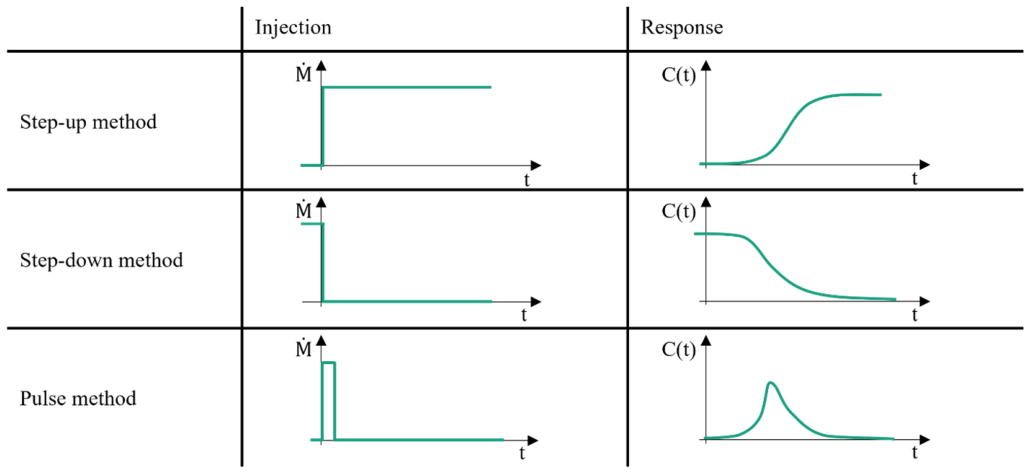
There are three commonly used injection methods. For the step-up method, the tracer gas is introduced continuously and with a constant flow rate in the supply air or the room. The concentration is measured from the beginning of the injection until the concentration at the measuring points reaches a steady state. For the step-down method, the room is flooded with tracer gas and from the start of the measurement, it is supplied with fresh air. The concentration decay is being measured. In contrast to that, for the pulse method, an amount of tracer gas is injected in the supply duct or in the room in a short period of time. The measured concentration describes a time delayed peak and decays to the initial concentration. The methods are schematically depicted in Figure 2 [14,19].

2.3. Applying Tracer Gas Techniques to Clean and Dry Rooms

In contrast to the measurements applied by Sandberg and Sjöberg [19], Sherman [18] or Auerswald [15], the mean residence time of the air in the clean and dry rooms is significantly lower. With a total volume of approximately 380 m3 and a supply volume flow of 10.500 m 3 · h 1 , the nominal time constant of the room is only 130 s and so more than ten times lower than in the experiment conducted by Sandberg and Sjöberg [19]. Moreover, a major fraction of the extracted air is being recirculated over the dehumidification unit and supplied again into the dry room as fresh air. The tracer gas will hence re-enter the dry room after each cycle. Therefore, the only suitable tracer gas method is the pulse method under the condition that the amount of tracer CO2 is low in comparison to the naturally present amount of CO2 in the air. Ideally, the CO2 peak traveling through the room can be recorded with a clear natural concentration level before it. After the peak, the concentration should be only negligibly higher than the recorded natural concentration. After some time, it is expected that the CO2 is nearly homogeneously mixed with the rest of the air. The calculation formula for the local air age was adopted from Han et al. [14], based on the works of Sandberg and Sjöberg [19], and is presented in (5) below.
α P = 0 t   ·   C P t d t 0 C P t d t
Additionally, the relative exposure (REX) is defined in (6). This formula is adapted from the ERM parameter introduced by Singer and Zhao et al. [20] and modified to suit the present study.
REX P = t start t end C P t d t t start t end 1 n i = 1 n C i ( t ) d t
The empirical parameter REX P is a dimensionless ratio defined as the integrated tracer concentration at location P compared to the average concentration in the room at the measurement time— t start to t end . As a result, REX P   >   1 indicates the location P tends to be more effectively exposed to the air fraction marked by the tracer, while locations with REX P   <   1 have lower exposure within the evaluated measurement interval. In case of a perfectly sealed indoor space, all REX P values are expected to approach 1 after an infinite period with 100% recirculation. It must be emphasized that the parameter REX does not assess the effectiveness of the ventilation system to exchange the air inside a room or to remove contaminants, as can be done using derived parameters such as the air change efficiency ε a and contaminant removal effectiveness ε c . In contrast, REX P serves solely for the subjective comparison of different measurement locations within a room and within a measurement campaign and is not directly comparable to established indices such as local air exchange efficiency.

2.4. Implementing Air Age in CFD Simulations

CFD simulations were conducted, using COMSOL Multiphysics 6.1. For the calculation of air age, a user-defined arbitrary variable was implemented and solved in the convection–diffusion transport equation, based on [21]. As for this simulation case, steady-state conditions were sufficient, and the simplified transport Equation (7) can be used, including ρ as fluid density ( kg · m 3 ) , v as velocity ( m · s 1 ) , τ P as age of air (s), Γ i as the transport coefficient and S τ P   as the source term for τ P [21]. The diffusion term Γ τ P (8) was used with μ eff as the effective viscosity of air, as shown in [21].
  ·   ( ρ   v   τ P Γ i     τ P ) = S τ P  
Γ τ P = 2.88 · 10 5   ·   ρ   + μ eff 0.7
For the implementation in COMSOL Multiphysics (v6.2), the PDE Module (https://www.comsol.com/support/learning-center/course/modeling-with-partial-differential-equations-in-comsol-multiphysics-142/modeling-with-pdes-multiphysics-systems-of-equations-46781, accessed on 15 February 2024) was used, as this allows a simple implementation of partial difference equations [22]. A validation case was conducted, based on literature data of tracer gas measurements from Sandberg and Sjöberg [19] in a 2.4 m × 1.8 m × 1.8 m test chamber. The setup of the test chamber for the validation case is shown in Figure 3. Steady-state method showed a low computation error of the simulated air age of less than 11% at all five measuring points (see Sandberg, Sjöberg [19], p. 192).

3. Measurement Setup

The measurements are conducted in an industrial clean and dry room with 125 m2 of production space, a supply air dewpoint temperature of −60 °C (mixing ratio w   <   0.01   g H 2 O k g da 1 ) and cleanliness class 7 (ISO 14644 [9], p. 11). The air is supplied into a plenum and enters the room via a perforated ceiling. Due to the large area of plenum, the mean air velocity of the supply air is 0.029 m · s 1 , which is too low to be recorded with an acceptable measurement uncertainty and must therefore be estimated. About 96.7% of the air is recirculated to the dehumidification system via four extract air outlets at a height of 0.84 m. At the time when the measurements were conducted, the clean and dry room was empty.

3.1. Tracer Gas Preparation and Measurement Equipment

The tracer gas preparation consists of two 20 kg gas bottles containing liquified CO2, a two-stage pressure reduction system, a heating coil and a mass flow meter (SUTO iTEC GmbH (Heitersheim, Germany) S421 for CO2, accuracy: ±(0.49 kg/h + 1.5% of reading)). This enables the mass of the injected CO2 to be recorded and ensures an injection temperature of approximately 21 °C. The CO2 concentration was measured at different positions in the room, using battery-powered, high-frequency non-dispersive infrared (NDIR) CO2 dataloggers with a measurement interval of 1 s (Onset Computer Corporation MX1102A; accuracy: ±(50 ppm + 5% of reading); response time: t90 = 60 s). As these sensors exhibit significant drift, a calibration was performed every five days at approximately 400 ppm, 2000 ppm, and 3000 ppm. One high-precision sensor (Vaisala Oyj GMP 343; accuracy: ±(5 ppm + 2% of reading); response time: t90 = 75 s, measurement interval: 2 s) was used to test the responses of the different sensors.

3.2. Tracer Gas Measurements in a Separate Flow Box

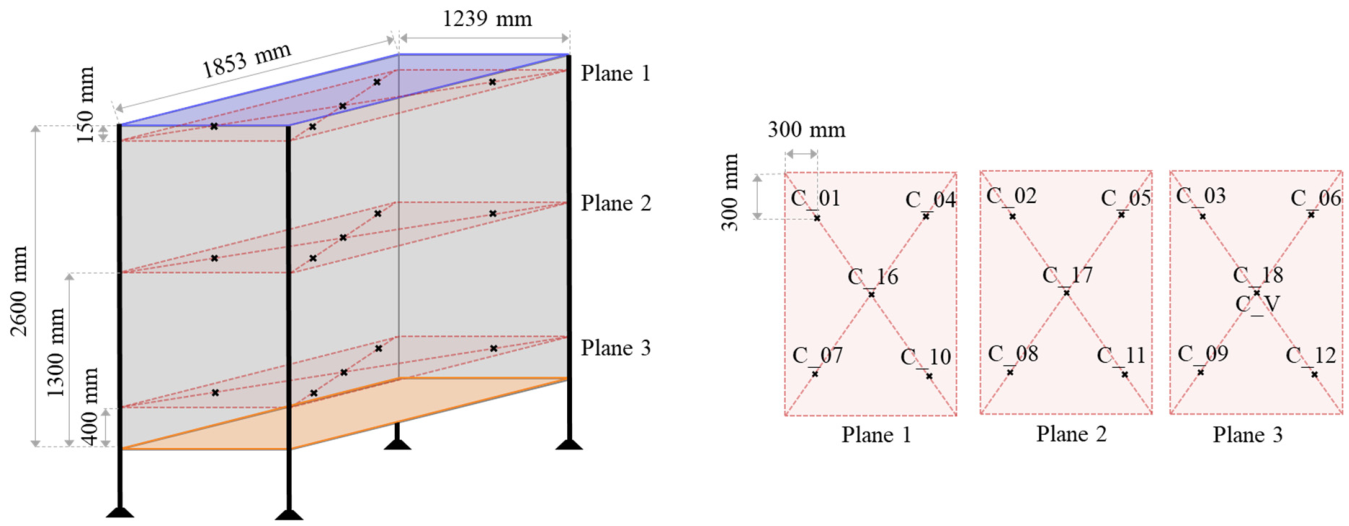
Due to the large volume and complex flow conditions of the clean and dry room, a flow box was installed within the room to validate both the measurement technique and the CFD simulation using a simplified model. The flow box is integrated flush with the ceiling and measures approximately 1.850 mm by 1.240 mm. Air enters the flow box through the ceiling and exits via the open bottom. A sensor matrix consisting of 15 CO2 sensors (MX1102A) is installed inside the flow box, shown in Figure 4. The sensors are arranged in three planes at different heights; for example, sensors C_01, C_04, C_07, C_10 and C_16 are positioned at the same height beneath the ceiling. Additionally, a high-precision sensor C_V (GMP 343) was placed next to sensor C_18.
After heating and measuring the mass flow, the tracer gas CO2 is divided into 24 gas streams using a flow splitter and distributed via piping. The injection points are located at the top of the flow box, directly beneath the ceiling, with horizontal outflow. Injection mass flows are approximately 2 ,   5 ,   10 ,   20   and   30   kg h 1 and injection times are 2, 5 and 10 s.

3.3. Analysis of the Flow Distribution Beneath the Plenum

To characterize the homogeneity of the supply airflow, which enters the room through the perforated plates of the ceiling, measurements beneath the ceiling were conducted. For this purpose, a sensor matrix was installed consisting of 14 sensors distributed below the ceiling (see Figure 5). Additionally, one sensor was placed in the supply duct, and two in the recirculation duct.
Unlike the experiments involving the separate flow box described in Section 3.2, the tracer gas was injected directly into the supply duct. To ensure effective mixing of the tracer gas with the supply air, the injection was carried out at multiple locations within the duct cross-section, approximately 10 m before its entry into the plenum. Measurements were conducted at different mass flow rates, ranging from 50   kg h 1 to 80   kg h 1 and injection times of 10 s, 30 s and one minute.

3.4. Tracer Gas Measurements Inside the Clean and Dry Room

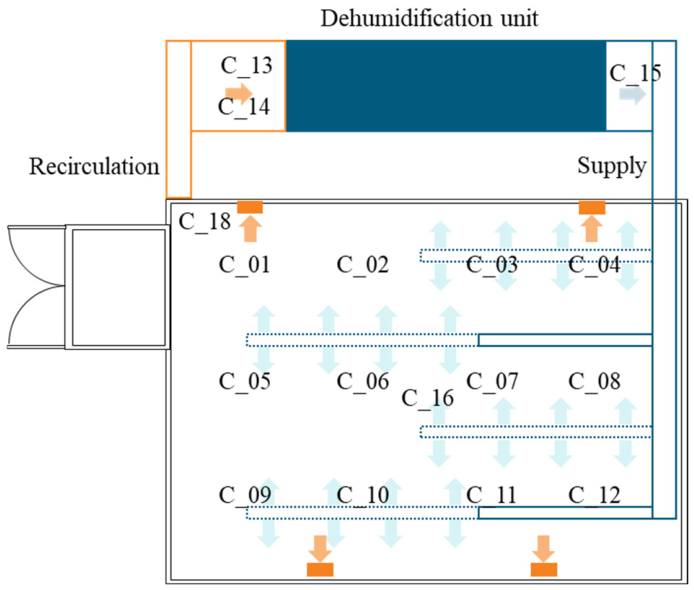
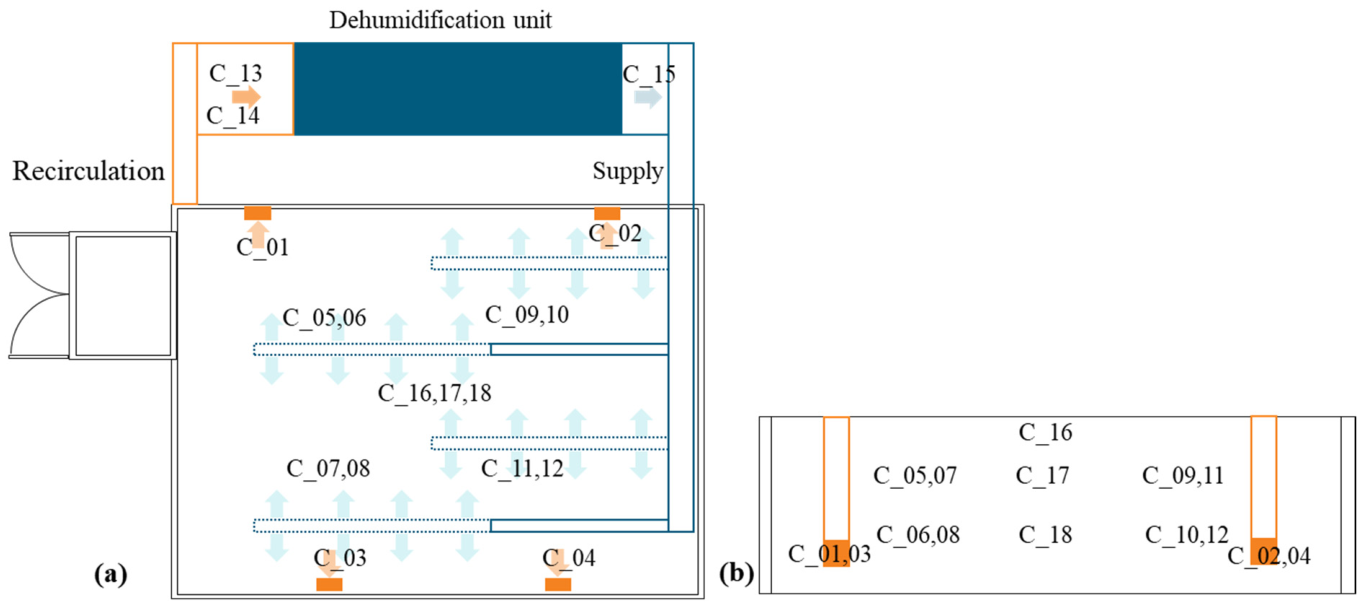
To evaluate the airflow inside the room, a sensor matrix comprising a total of 15 sensors was installed. Of these, 11 sensors were distributed in the room volume and four sensors were placed at the extract ducts. Sensors C_05, C_07, C_09, C_11 and C_17 are positioned at a uniform height of two meters, and sensors C_06, C_08, C_10, C_12 and C_18 are positioned at a height of 0.9 m. Sensor C_16 is located directly beneath the ceiling. One additional sensor was placed in the supply duct, and two in the recirculation duct. The sensor positions are shown in Figure 6. Measurements were conducted with a mass flow rate of 7 0   kg h 1 and injection times of 10 s, 30 s and one minute.

3.5. Boundary Conditions of the CFD Simulations

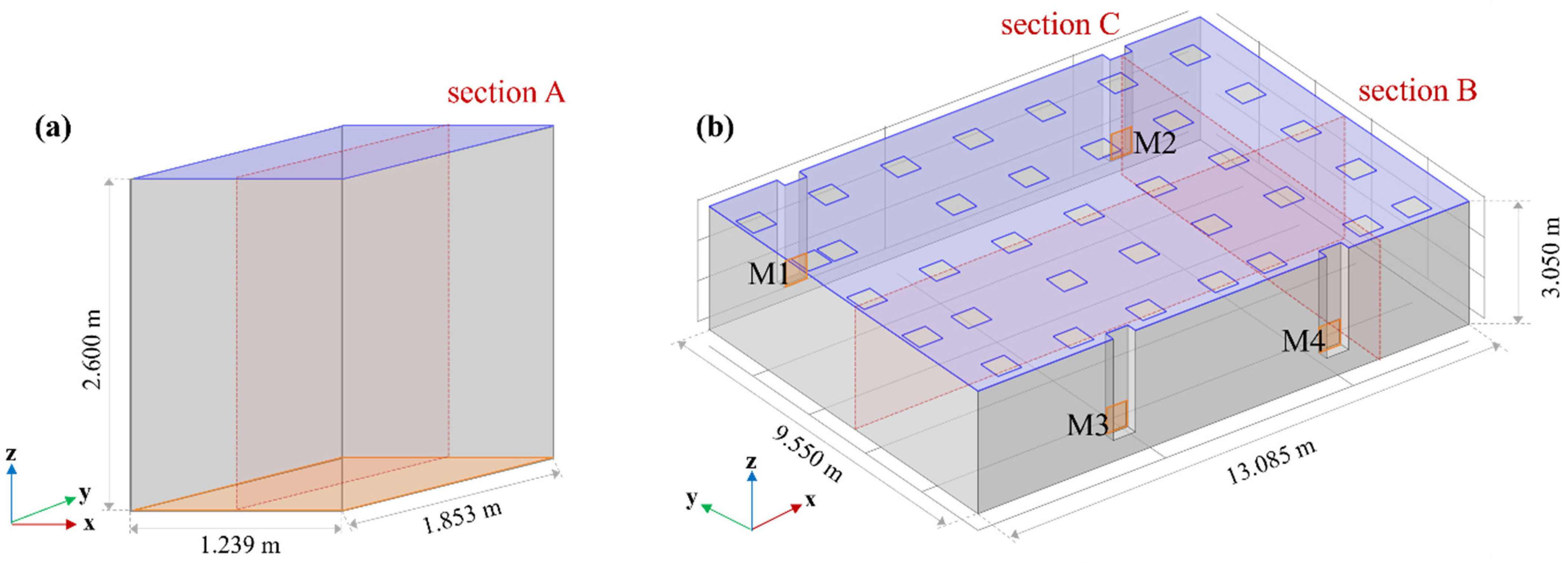
Figure 7 shows the schematics of the CFD simulations of (a) the flow box and (b) the clean and dry room. The boundary conditions in the CFD were deliberately simplified to emulate a cost-effective, industry-ready approach. The blue, orange and grey areas represent the velocity inlet, constant pressure outlet (0 Pa) and a no-slip wall, respectively. For the flow box, two different options were set for the inlet boundary condition: homogeneous distributed flow and a fully developed flow profile. For the clean and dry room, the inlet is set as homogeneous distributed flow with a velocity of 0.026   m · s 1 . In the flow box, the average velocity in both cases is assumed to be 0.029   m · s 1 , due to the absence of flow obstacles at the location of the flow box. For the simulation of the air age of the dry room, a simplified model of the dry room was created, considering the space in the ceiling occupied by lighting and the positioning of the recirculation ducts (see Figure 7b). The exhaust ventilation and leakages were neglected, as these account for approximately 3.3 % of the supply air. For all simulations, the SST turbulence model was used, and a Dirichlet boundary condition was set at the inlet for the air age calculation [23].

4. Results

4.1. Measurements in a Separate Flow Box

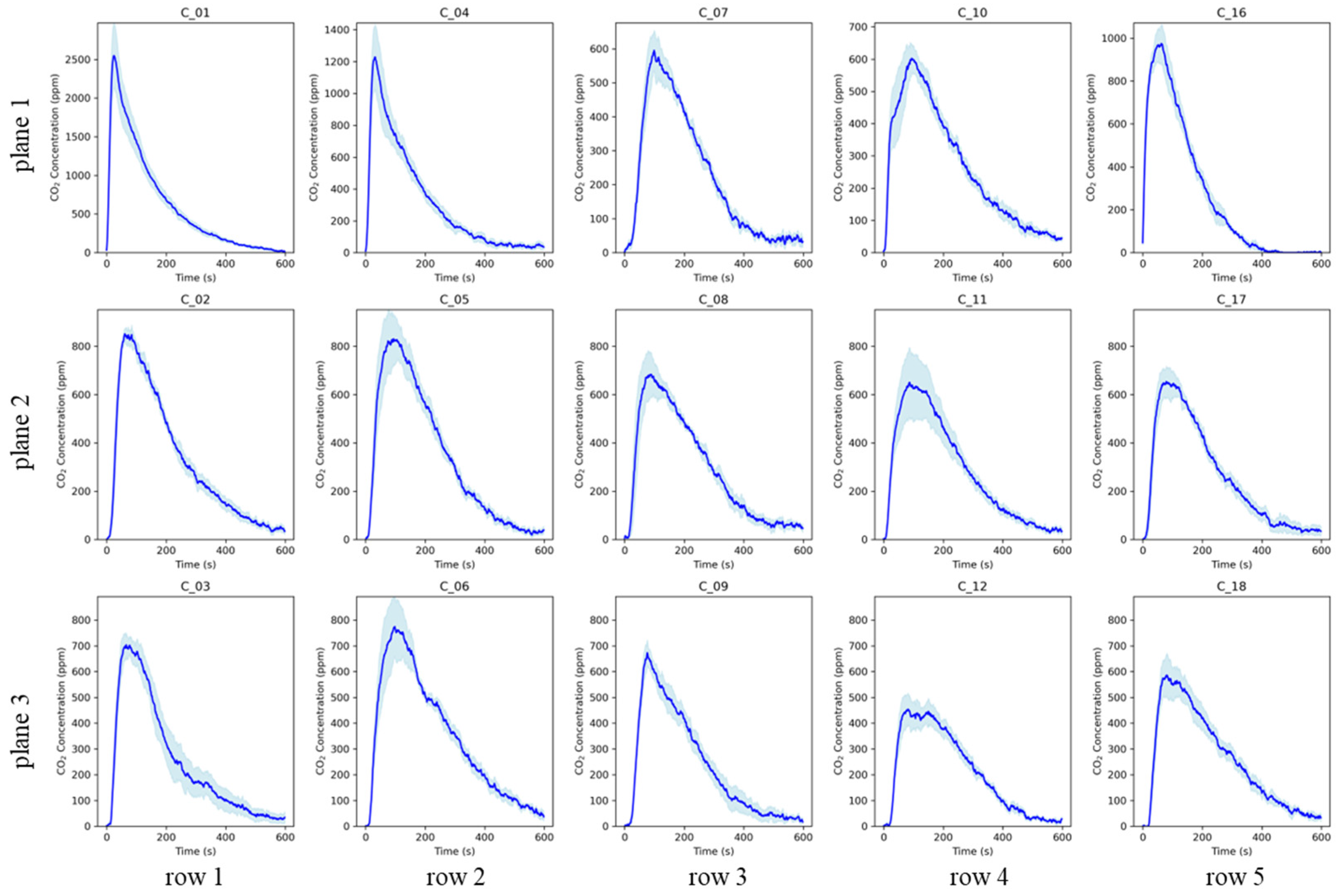
The sensor response of the tracer gas measurements in the flow box exhibited clear pulse responses. An injection time of 5 s at a 20   kg h 1 CO2 mass flowrate yielded reliable results. The tracer gas measurements with these settings were performed four times, and the average concentrations are shown in Figure 8.
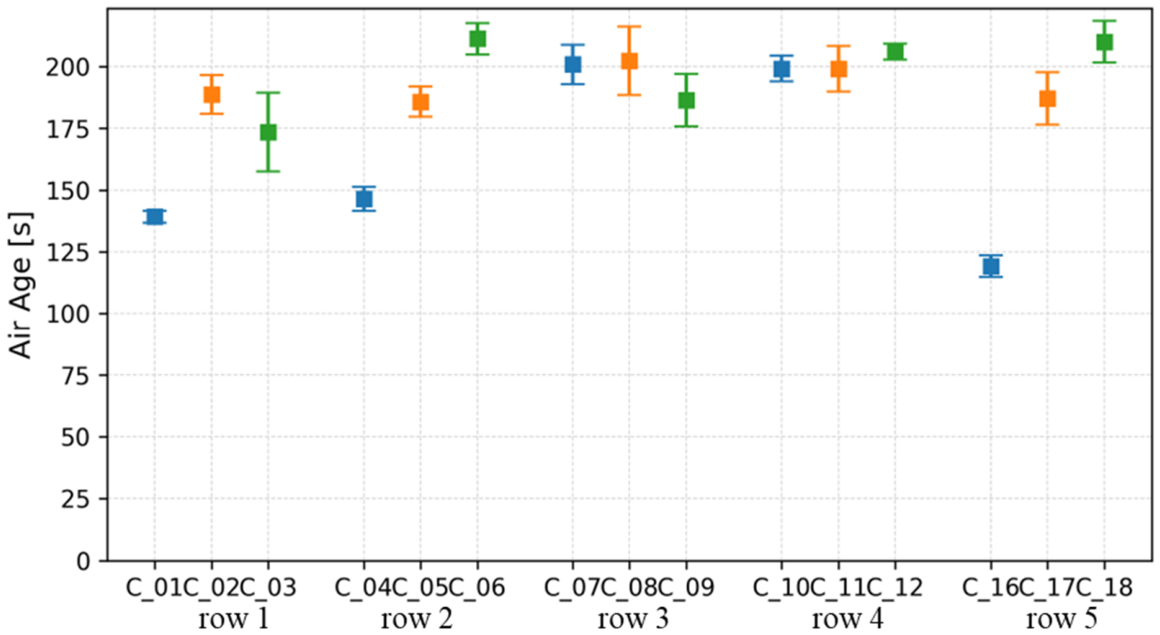
The concentration response was corrected for the background concentration, which was determined for each sensor as the average concentration measured during the 10 min preceding the start of each experiment. The air age was calculated by (5), with a measurement duration of 10 min considered. Results are shown in Figure 9; the measurement values are provided in Appendix A in Table A1.
No homogeneous flow pattern could be detected across all the sensor rows. Only sensors C_04 to C_06 and C_16 to C_18 showed an increase in air age, consistent with expectations for an environment characterized by displacement flow.
Sensor C_03 exhibited a significant standard error, which suggests differences between the four measurements conducted and indicates poor reproducibility of the measurements in this sensor position. Therefore, in row 1, no clear trend can be identified. Meanwhile, sensors C_07 to C_09 and C_10 to C_12 recorded similar air ages, suggesting a flow condition comparable to an ideally mixed environment. Sensors C_08 and C_09 both show high standard errors, indicating poor reproducibility, which also leads to the assumption of a turbulent, non-unidirectional airflow.
Furthermore, the sensors in the first plane (C_01, C_04, C_07, C_10, and C_16) exhibited higher air ages than expected. Despite the calculated air ages being lower than those observed at levels 2 and 3, even lower air ages were anticipated due to their proximity to the tracer gas injection points. This phenomenon suggests a high systematic measurement error caused by the measurement setup, which will be discussed further in comparison with the simulation results.
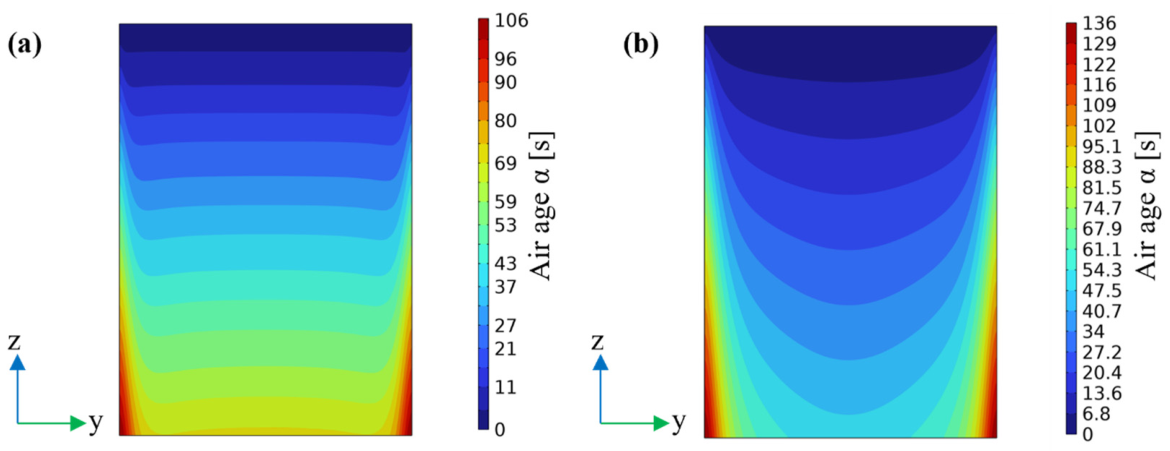
For the CFD simulation, two distinct boundary conditions were established for the flow inlet: (a) a homogeneous flow profile across the entire ceiling, and (b) a fully developed flow profile. Based on the dimensions of the flow box (see Figure 4) and the average flow velocity of 0.029 m/s, the Reynolds number at an air temperature of 21 °C is approximately 2843, which indicates a transitional flow between laminar and turbulent flow.
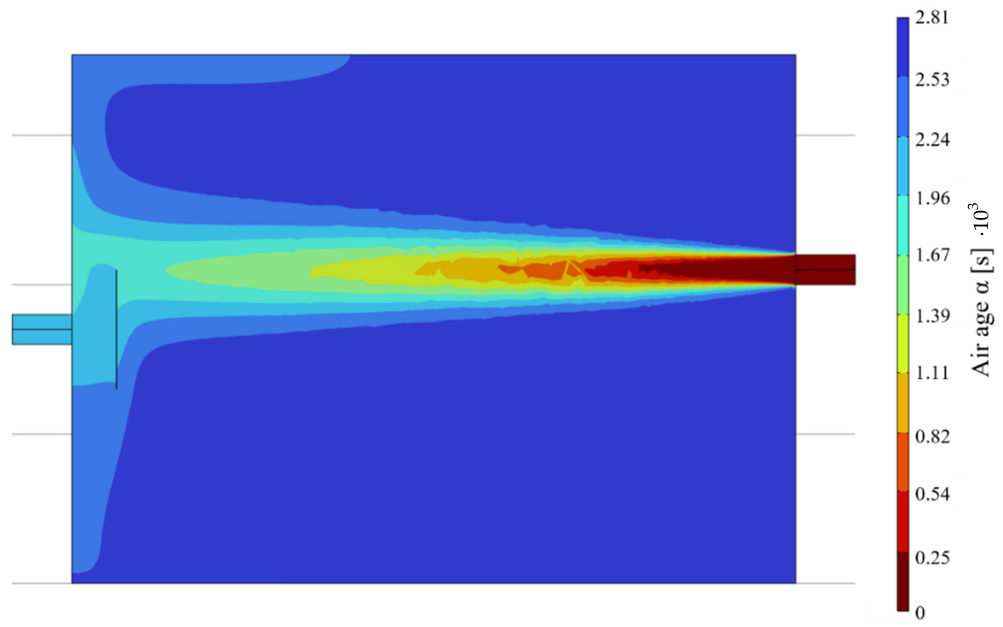
As illustrated in Figure 10, the specification of the flow profile as the ceiling boundary condition significantly affects the simulated air age patterns in this simplified model. The homogeneous flow pattern (a) resulted in a mean air age of 39 s, while the fully developed flow (b) resulted in 45 s, corresponding to mean residence times in the flow box of 78 s and 90 s, respectively (where 〈 t ¯ 〉 = 2·〈 α ¯ 〉, see (2)). The simulated air ages at the ceiling are zero due to the imposed boundary condition, whereas the calculated air ages from the sensor responses are significantly higher, indicating a systematic error in the measurement. This error most likely arises from the sensor’s 90% response time, which is 35% shorter than the simulated mean air age. To address this, air age differences between plane one and plane three were calculated, yielding 65 ± 5 s and 91 ± 10 s for sensor rows two and five, respectively. Considering the sensor measuring positions (150 mm from the ceiling and 400 mm from the flow outlet), the simulation results indicate an air age difference of approx. 62 and 71 s at these heights. Conversely, the measured air ages in rows three and four suggest that the flow inside the flow box is ideally mixed, contrary to simulation predictions. Due to the inability to measure flow speed at the inlet, definitive conclusions cannot be drawn. Consequently, the uncertainties in the measurements limit the comparability with CFD simulations, as further discussed in Section 5.

4.2. Measurement Equipment

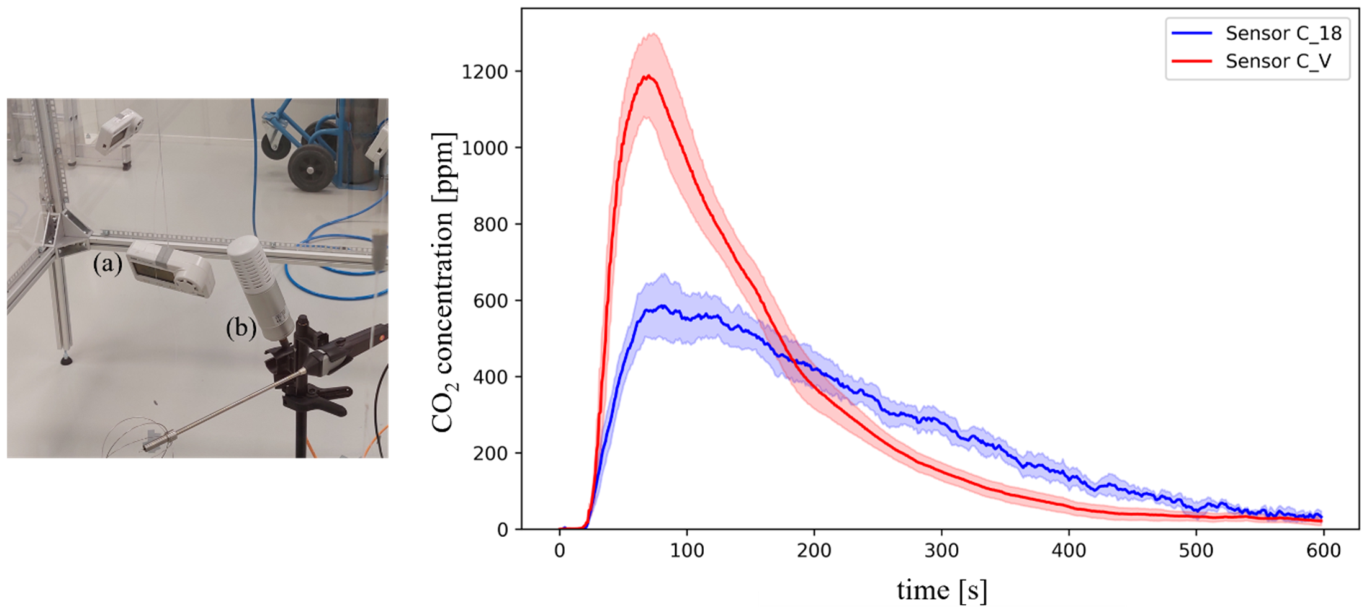
The purpose of this test is to evaluate the influence of the measurement equipment on the calculation of air age. As detailed in Section 3.2, a high-precision sensor C_V was installed adjacent to sensor C_18 within the flow box. Figure 11 shows the concentration curves for sensors C_18 and C_V, averaged over three measurements and normalized to the background concentration. Notably, the high-precision sensor displayed significantly different response behavior, despite C_18 being calibrated prior to the experiments. The calculated air ages for C_V and C_18 were 153 ± 8 s and 210 ± 8 s, respectively. This disparity is likely due to differences in the design of the sensor heads and elements; C_V features a larger sensor head and element, which likely reduces diffusion barriers at low flow velocities. The findings indicate that the measurement equipment significantly affects the results. It is assumed that sensors of the same type introduce comparable systematic errors; therefore, calculating air age differences between sensors of the same type may help mitigate this error.

4.3. Measurements Beneath the Ceiling and Inside the Dry Room Volume

In contrast to the measurements inside the flow box, no clear peak in CO2 concentration was observable at most sensors in this measurement. Furthermore, a mass flow rate of approximately 70   kg · h 1 with an injection time of 60 s had to be used to measure a response. This is not ideal considering the nominal air change rate of 120 s for this room. Additionally, the recirculation rate of about 96.7% makes it impossible to conduct air age measurements with the available setup. Instead, the empirical parameter REX (6) was used to compare the concentration responses at the measurement locations in the room. Due to the aspects mentioned, the measured concentration experiences significant damping (an increase in background concentration) and does not show a characteristic response resembling a normal distribution. After approximately 10 min, the measured concentration at all locations reaches equilibrium. Figure 12 shows the results of three measurements beneath the ceiling. The corresponding measurement data are listed in Table A1.
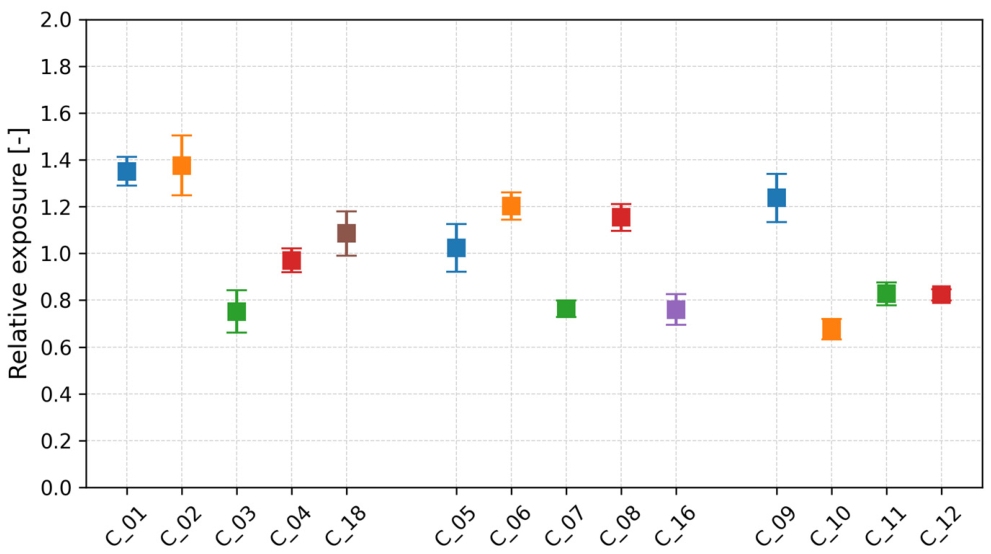
The relative exposure of the sensors varies significantly across the area beneath the plenum. At positions C_01, C_02, C_06, and C_09 (left and mid-left positions in Figure 5), higher concentrations with REX ≥ 1.4 are observed relative to the mean. Lower concentrations with REX ≤ 0.8 are measured at positions C_03, C_07, C_10, and C_16 (mid and mid-right positions).
The reproducibility of the measurements varies significantly between the measurement points. In particular, C_02, C_05, C_09, and C_18 show large deviations. These may be caused by sensor noise, inconsistent CO2 injection, or inconsistent airflow in the room due to external influences. The systematic measurement error, as described in Section 4.1 regarding measurements in the flow box, is compensated for by calculating the empirical parameter REX.
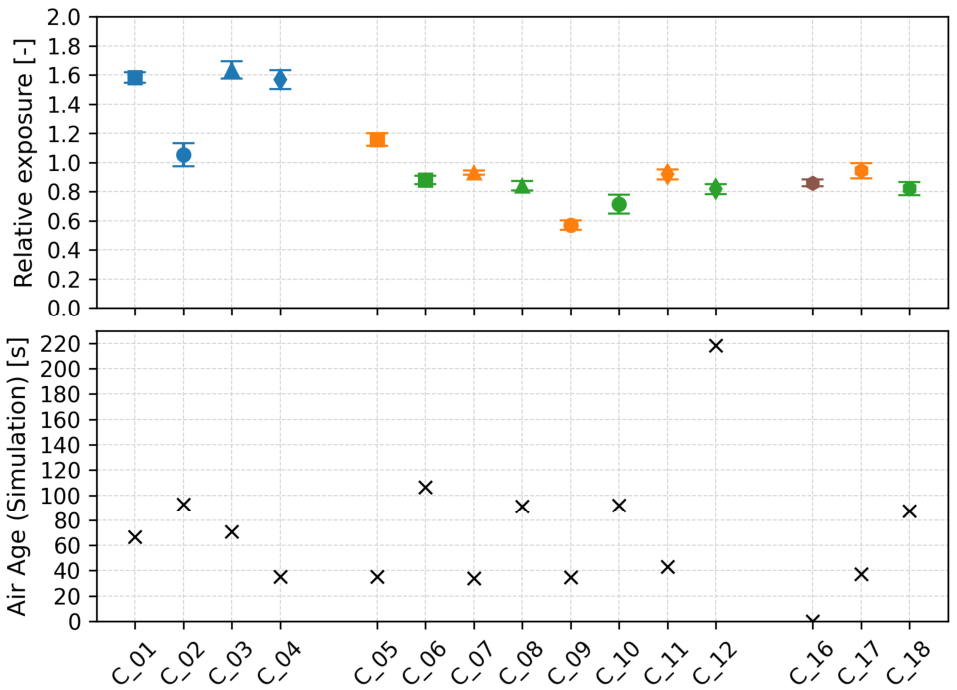
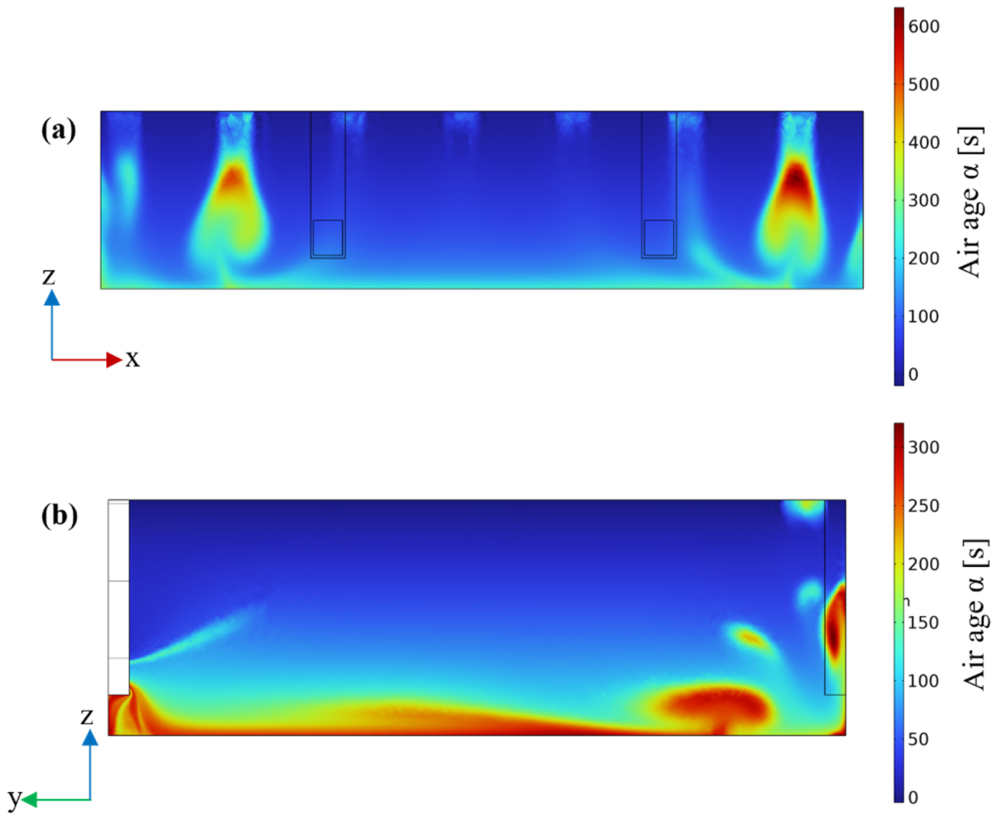
The results within the clean and dry room volume are presented in Figure 13. The calculated REX values are shown as colored marks at the left axis. The air ages calculated from the CFD simulation are shown as black ‘x’ marks on the right axis and are calculated for a discrete volume at the positions of the measurement sensors to facilitate a comparison. However, it is important to emphasize that the results of the measurements and simulations can only be compared qualitatively, as the definitions of the observed variables differ. The results of the CFD simulation in two sections are displayed in Figure 14.
The relative exposures at the positions C_01, C_03, and C_04 are significantly higher than the mean, with REX ≥ 1.2, while notably lower REX values are observed at positions C_09 and C_10. It is noteworthy that, except for C_02, particularly high REX values are recorded at the recirculation air outlets. When considering the two sensor levels in the room, it becomes apparent that the higher positions generally exhibit greater REX values compared to the positions directly below them (e.g., C_05 → C_06, C_07 → C_08, C_11 → C_12, C_17 → C_18). Exceptions to this trend are positions C_09 and C_10, which both yield particularly low values. This trend is consistent with the expected predominant airflow pattern and is also clearly visible in the simulation results. The higher measurement points show a significantly lower air age (C_05, C_07, C_09, C_11, and C_17 with α 2 m =   37   ±   2   s ) compared to the lower measurement points (C_06, C_08, C_10, C_12, and C_18 with α 0.9 m =   119   ±   22   s ). Outliers include C_12, which shows a significantly higher air age, and C_04, which exhibits a very low air age. Pronounced inhomogeneities are observed at the positions located in the upper-right area compared to the rest of the room. The calculated REX values at positions C_02, C_09, and C_10 are significantly lower than at comparable locations, suggesting reduced ventilation effectiveness in these regions. For C_02, this trend is reproduced in the simulation results; C_02 exhibits a higher air age than C_01, C_03, and C_04, yet it must be mentioned that the measurement error of C_02 is significantly higher compared to that of the other measurements. Nevertheless, the air ages at positions C_09 and C_10 do not deviate significantly from the mean value of their respective sensor levels within the simulations.

5. Discussion

By the tracer gas measurements with pulse injection in the flow box, the air age and the prevailing flow scheme can be estimated. The measured concentration curves exhibit a distinct peak resembling a normal distribution, and the air age can be calculated according to (5). However, a uniform displacement flow pattern, as simulated in the CFD, cannot be seen. First, the air ages based on the measurements are too high due to the insufficient sensor response time. Second, although the upper plane tends to have lower air ages than the other two planes, there is no clear difference between the middle and bottom planes. This could potentially indicate that there is a rather developed flow regime, where there is no clear separation of air ages at different heights, as depicted in Figure 10. Given this, it would also be plausible that the actual flow distribution entering the flow box is more diverse, which would affect the air age distribution as well. Overall, the evaluation of the measurements and CFD simulation show that the calculated air ages of the measurements exhibit a significant systematic error, which can be reduced by calculating air age differences between sensors at different positions. With this procedure, measurement data and simulation data can be compared, as shown at the area within the flow box at sensor row 5 and row 2. A slow response time of the installed sensors—including the mass transport inside the sensor head—and an inhomogeneous distribution of CO2 may have influenced the measurements and require further investigation. Nevertheless, the comparison of the results of the CFD simulation is possible to a limited extent.
By conducting tracer gas measurements inside the clean and dry room, general tendencies regarding the prevailing airflow patterns can be inferred. Calculation of the local air age is not feasible, as the sensor signals do not display the typical shape of a normal distribution. Instead, the merely empirical parameter relative exposure (REX) was introduced to allow a subjective comparison of the concentrations measured by the respective sensors within the room. In the clean and dry room, about 96.7% of the extract air is being recirculated, so once tracer gas that has left the room is reintroduced, the background concentration increases, leading to significant damping. Under ideal displacement ventilation, the mean residence time in the examined room would be approximately 2.7 min. However, measurements show that concentrations at the exhaust positions already begin to rise significantly after 62 ± 5 s (defined as a 10% increase compared to the measured base concentration), which is even earlier than for the sensors distributed inside the room (average 75 ± 4 s). Thus, significant damping occurs before a substantial increase in concentration is detected at the measurement positions inside the room. Consequently, the calculation of the air age described by Sandberg and Sjöberg, as well as air exchange efficiency and contaminant removal efficiency, is not appropriate. As described in (2), for the calculation of ε P a , the residence time at a point P in the room must be assessed. As marked air is being recirculated and reintroduced to the room, the residence time cannot be calculated based on the sensor signal. Also, the parameter ε P c , will not characterize the removal of the contaminant “water” in a recirculated room with a dehumidification unit. As shown in (3), the concentration of contaminants (here emulated by the tracer CO2) in the supply air, the exhaust air, and at a point P are assessed. The recirculation of the tracer through the HVAC system causes the emulated contaminant to be reintroduced into the room. However, since the contaminants (water, particles) are almost completely removed by the HVAC system, calculating ε P c would result in an underestimation of the ventilation system’s contaminant removal efficiency. Nonetheless, by calculating the empirical parameter relative exposure (REX), meaningful insights can still be gained—locations in the room experiencing higher airflow will necessarily show both an earlier increase and a higher maximum measured concentration and hence a higher value REX. Singer and Zhao et al. [20] introduce the parameter “exposure relative to perfectly mixed” (ERM) to evaluate the local residence time of contaminants. In their experiments, CO2 was used as a tracer gas and injected at various positions in the room to determine the contamination removal efficiency. The ERM parameter enables the assessment of local exposure even with a high recirculation rate of approximately 80% in the HVAC system. In addition to the different target values used in the calculation by Singer and Zhao al. [20], the measurements differ significantly in that airborne contaminants (CO2, particles, VOCs, odors) are not necessarily removed in a conventional ventilation system operating in recirculation mode. Recirculated air does not necessarily qualify as fresh air and therefore can be marked with tracer gas. In this study, however, the air conditioning system removes all process-relevant contaminants (humidity, particles) to a defined acceptable value. Recirculated air must thus be treated as “fresh air”. Recirculated tracer gas therefore significantly falsifies the measurements of air age and contaminant removal.
A non-uniform distribution of air, local short-circuit currents and a partial presence of displacement flow can be observed. The measurement results inside the room indicate a partial presence of displacement flow, which can be assumed by the observation that sensors positioned higher in the room tend to exhibit greater values of relative exposure (REX) than those located below. This tendency is also shown in the calculated local air ages from the CFD simulations. Additionally, local short-circuit flows were identified. These can be recognized from the significantly higher REX values measured at the air outlets compared to those within the room volume. Therefore, a diverse flow profile, consisting of displacement flow, local short-circuit flows and mixed flow patterns is expected in the room. The discrepancy between CFD predictions based on the simplified boundary conditions used in this study and the experimental data would likely increase under more realistic operating conditions, e.g., in a fully equipped room with local exhaust ventilation and heat sources. For simplicity, the present investigation examined an empty room. Adding disturbances would further emphasize the need for detailed measurement strategies.
The plenum does not distribute air homogeneously, as indicated by the spatial differences in REX values measured beneath the ceiling of the room. A gradient is observed, with well-ventilated areas on the left and middle-left, and poorly ventilated areas in the center and middle-right of the room which could be caused by the flow distribution in the plenum (Figure 6). Measurements at distributed positions within the room volume revealed significantly poorer ventilation in the upper right corner, as indicated by low REX values at both the measurement positions (C_09, C_10) and the exhaust outlet (C_02). This indicates a dead zone in the top right-hand corner. Possible causes could be the inhomogeneous distribution of the plenum and the design of the air ducts for the recirculation outlets. Local variations in air age are also observed in the CFD simulations. At measurement position C_02, higher air ages are calculated compared to the other three exhaust outlets, which stands in agreement with the measurements.
It can therefore be concluded that the simplified boundary conditions assumed in the CFD simulations—such as homogeneous distribution of inlet velocity in the plenum and the air volume flows at the four exhaust outlets—do not match the experimental setup. Further measurements of flow velocity, together with an optimized experimental setup (e.g., employing faster-responding sensors or complementary smoke studies), would be required to make a reliable assessment and to refine the boundary conditions for future CFD simulations. In rooms with air recirculation and high air change rates, air age measurements show significant hurdles and must be optimized. The main optimization is to select suitable sensors that meet the high requirements of the measurement setup. By reducing the response time and increasing the sensitivity of the sensors, the amount of injected tracer can be reduced significantly, leading to shorter injection times and thus a reduced damping effect. In the observed clean and dry room, the injection time for the pulse method should be reduced to below 5 s. This could be achieved by replacing the NDIR CO2 sensors with “Cavity Ring-Down Spectroscopy” (CRDS) or “Photoacoustic Spectroscopy” (PAS) with 90% response times below one second and a sampling frequency above 1 Hz. In addition, the response behavior of the sensors under various environmental conditions should be investigated. Alternatively, using fast-response NDIR CO2 sensors with reduced diffusion resistance may also be feasible. Faster response times could also be achieved using alternative tracer gases, as demonstrated by Um and Delp et al. [24] with the use of ethanol. However, the diffusion properties of the tracer gas–air pair should not differ too much to ensure similar behavior of the tracer gas in the mixture. Other optimizations of the measurement setup include placing the injection closer to the room inlet to reduce air mixing in the direction of flow and hence enable a sharp demarcation of the fresh air. Additionally, measuring the CO2 concentration inside the plenum—directly before the fresh air enters the room—could enable a more precise calculation of air age differences.
An alternative way to reduce the damping effect would be to use a tracer that is actively removed by the HVAC system. For clean and dry rooms, only water vapor and airborne particles would be suitable, but both pose challenges regarding injection and measurement within a sensor network. Water has similar diffusion properties to air ( Sc water ,   air   =   0.63   ±   0.14 ;   Sc air ,   air   =   0.82   ±   0.18 ) , but sensors for relevant humidity ranges are costly and have significantly longer response times of several minutes.
Based on the measurements in the existing dry room, the following engineering strategies are recommended to reduce the room’s energy consumption while maintaining process safety:
  • Optimize plenum distribution by adjusting diffuser geometry and increasing the pressure differential across the plenum. This could promote a cleaner, more uniform supply pattern and could reduce the formation of low-flow zones, detected by the measurements inside the room.
  • Reduce the airflow. The airflow is a key parameter for reducing energy consumption. Preliminary measurements show a 22% energy reduction by reducing the supply air volume flow by approximately 42% at a room dew point temperature of −50 °C. Consequently, the humidity differential between the inlet and exhaust increases, underscoring the importance of controlled air distribution.
  • Point-of-use ventilation. An alternative to a homogeneous flow pattern inside the room is a flow pattern tailored to specific needs. For example, increase the supply airflow rate locally at locations where materials are stored and processed. This can be achieved by replacing selected panels with higher-porosity panels, thereby increasing the supply airflow locally. This requires a risk assessment of material sensitivity and continuous monitoring (e.g., dew-point transmitters) to ensure that the parameters stay within the specified limits. To test and adapt the new flow pattern experimentally, tracer gas measurements could be a straightforward, cost-effective approach.
These measures combine global airflow optimization with targeted local control, offering a practical route to lower energy usage without compromising air-quality or process integrity.


6. Conclusions

Tracer gas measurements for local air age calculation using pulse injection of CO2 were conducted in a clean and dry room with air recirculation, as well as in a separate flow box inside the room.
  • In the separate flow box, local air age could be calculated at various measurement positions. Due to slow sensor response times, a systematic error was observed, which could be addressed by calculating air age differences between measurement positions. The measurement results were compared with CFD simulations using two sets of boundary conditions and indicate a prevailing fully developed flow profile rather than a homogeneous distributed flow. However, a definitive statement cannot be made.
  • In the clean and dry room, measurements were carried out both below the plenum which serves as air inlet and within the room volume. Due to a high share of air recirculation of about 96.7%, significant damping of the measured local concentrations occurred, making calculation of local air age impossible. Instead, the empirical parameter “relative exposure” (REX) was introduced to compare local air exchange at a measurement position to the room average. The parameter REX is not intended to replace conventional ventilation efficiency indices; rather, it enables a qualitative comparison for inexpensive tracer gas measurements in high-recirculation environments, as demonstrated in this work. It could be demonstrated that the presented approach can reveal tendencies regarding the prevailing flow situation.
  • The measurements beneath the plenum show that the supply air is not uniformly distributed; distinct zones of higher and lower air exchange are present. This insight is particularly valuable, as it could not be obtained by flow velocity measurements due to the low air velocities. It also shows that the boundary conditions for the CFD simulations cannot be assumed to be that simplified and must be refined to reflect the observed non-uniform distribution.
  • The results from measurements within the room volume indicate a diverse flow profile consisting of displacement flow, local short-circuit flows and mixing. CFD simulations of the room could not be validated due to the inability to calculate air age from the measurements, though similar tendencies were observed.
  • To reduce measurement uncertainties and determine the local air age in the room, potential optimizations were discussed. Primarily, alternative sensor technologies with shorter response times at low air velocities and a higher sensitivity should be used to reduce the amount of tracer gas required, thereby reducing the injection duration to below 5 s and decreasing the damping effect.

Limitations

Several limitations should be noted. First, the measurement setup consisted of a relatively small number of sensors, which could be increased to improve validity. Second, the parameter relative exposure (REX) is an empirical parameter that serves only for subjective comparison between different sensors within a measurement. Third, the effect of sensor response time on air age calculations should be examined in detail, and the measurement concept should be optimized. If technically feasible, future measurement setups should include the option for up to 100% exhaust air operation or, alternatively, use a tracer that is actively removed by the HVAC system.
Author Contributions

Conceptualization and methodology, S.L., S.A. and M.K.; investigation, X.Z. and Z.L.; data curation, X.Z., Z.L. and S.L.; writing—original draft preparation, S.L.; validation, S.A.; writing—review and editing, S.A. and M.K. All authors have read and agreed to the published version of the manuscript.

Funding

This research received no external funding.

Institutional Review Board Statement

Not applicable.

Informed Consent Statement

Not applicable.

Data Availability Statement

The raw data supporting the conclusions of this article will be made available by the authors on request.

Conflicts of Interest

The authors declare no conflicts of interest.

Abbreviations

The following abbreviations are used in this manuscript:
HVACheating, ventilation and air conditioning
CFDcomputational fluid dynamics
DPTdewpoint temperature
wmixing ratio
tresidence time
αair age
x P coordinate at point P in the room
λ P remaining lifetime at point P
Nnominal air change rate
τ n nominal time constant
Vroom volume
V ˙ volume flow
εaair change efficiency (ACE)
εccontaminant removal effectiveness (CRE)
REXrelative exposure
Ccontaminant concentration
Scx, ySchmidt number of component x in y
M ˙ mass flow
ρfluid density
v velocity
Γ i transport coefficient
S τ P   source term for τP
μ e f f effective viscosity of air
Subscripts
dadry air
Ppoint P in the room
exextract air
supsupply air

Appendix A. Measurement Data

The calculated air age and the relative exposures from the measurements shown in Figure 9, Figure 12 and Figure 13 are displayed in Table A1. Sensor placement is shown in Figure 4, Figure 5 and Figure 6.
Table A1. Calculated air age and relative exposures (REX) of the measurements inside the flow box, beneath the ceiling and inside the clean and dry room. The uncertainty is the standard error of the mean.
SensorAir Age Inside the Flow Box [s]REX Beneath the Ceiling
of the Room
REX Inside the Room and the Extract Ducts
C_01139.2 ± 2.41.35 ± 0.061.58 ± 0.04
C_02188.7 ± 7.91.38 ± 0.131.05 ± 0.08
C_03173.4 ± 160.75 ± 0.091.63 ± 0.06
C_04146.4 ± 4.90.97 ± 0.051.57 ± 0.06
C_05185.7 ± 6.21.02 ± 0.101.16 ± 0.04
C_06211.2 ± 6.41.2 ± 0.060.88 ± 0.03
C_07200.8 ± 7.90.76 ± 0.040.93 ± 0.01
C_08202.3 ± 13.81.15 ± 0.060.84 ± 0.03
C_09186.4 ± 10.61.24 ± 0.100.57 ± 0.03
C_10199.1 ± 5.30.68 ± 0.040.71 ± 0.07
C_11199 ± 9.20.83 ± 0.050.92 ± 0.03
C_12205.9 ± 3.20.82 ± 0.020.82 ± 0.03
C_16119.2 ± 4.40.76 ± 0.060.86 ± 0.02
C_17187 ± 10.7-0.94 ± 0.05
C_18209.9 ± 8.41.09 ± 0.090.82 ± 0.04

References

  1. Huttner, F.; Diener, A.; Kwade, A.; Beverborg, F. The Influence of Calendering on the Moisture Sorption Behavior of Electrodes for Lithium-Ion Batteries. ECS Meet. Abstr. 2022, MA2022-01, 284. [Google Scholar] [CrossRef]
  2. Mayer, J.K.; Huttner, F.; Heck, C.A.; Steckermeier, D.; von Horstig, M.-W.; Kwade, A. Investigation of Moisture Content, Structural and Electrochemical Properties of Nickel-Rich NCM Based Cathodes Processed at Ambient Atmosphere. J. Electrochem. Soc. 2022, 169, 60512. [Google Scholar] [CrossRef]
  3. Busà, C.; Belekoukia, M.; Loveridge, M.J. The effects of ambient storage conditions on the structural and electrochemical properties of NMC-811 cathodes for Li-ion batteries. Electrochim. Acta 2021, 366, 137358. [Google Scholar] [CrossRef]
  4. Schuer, A.R.; Kuenzel, M.; Yang, S.; Kosfeld, M.; Mueller, F.; Passerini, S.; Bresser, D. Diagnosis tools for humidity-born surface contaminants on Li[Ni0.8Mn0.1Co0.1]O2 cathode materials for lithium batteries. J. Power Sources 2022, 525, 231111. [Google Scholar] [CrossRef]
  5. Lorenz, P.; Marius, H.; Benedict, I.; Hasibe, T.; Matthias, B.; Sarah, W.; Achim, K.; Marc, K. Mini-Environments in Lithium-Ion Battery Cell Production A Survey on Current State Challenges and Trends. In Proceedings of the Conference on Production Systems and Logistics: CPSL 2023—2; Publish-Ing.: Hannover, Germany, 2023. [Google Scholar] [CrossRef] [PubMed]
  6. Michaelis, S.; Schütrumpf, J.; Zienow, J.; Persichetti, A. Roadmap Battery Production Equipment 2030: Update 2023; VDMA Battery Production: Frankfurt am Main, Germany, 2023. [Google Scholar]
  7. Kreher, T.; Jäger, P.; Heim, F.; Birke, K. Investigating the Production Atmosphere for Sulfide-Based Electrolyte Layers Regarding Occupational Health and Safety. Batteries 2023, 9, 472. [Google Scholar] [CrossRef]
  8. Degen, F.; Winter, M.; Bendig, D.; Tübke, J. Energy consumption of current and future production of lithium-ion and post lithium-ion battery cells. Nat. Energy 2023, 8, 1284–1295. [Google Scholar] [CrossRef]
  9. ISO 14644-1:2015; Cleanrooms and Associated Controlled Environments—Part 1: Classification of Air Cleanliness by Particle Concentration. Deutsches Institut für Normung e.V. (DIN): Berlin, Germany; European Committee for Standardization (CEN): Brussels, Belgium; International Organization for Standardization (ISO): Berlin, Germany, 2015.
  10. Jinasena, A.; Burheim, O.S.; Strømman, A.H. A Flexible Model for Benchmarking the Energy Usage of Automotive Lithium-Ion Battery Cell Manufacturing. Batteries 2021, 7, 14. [Google Scholar] [CrossRef]
  11. Thomitzek, M.; von Drachenfels, N.; Cerdas, F.; Herrmann, C.; Thiede, S. Simulation-based assessment of the energy demand in battery cell manufacturing. Procedia CIRP 2019, 80, 126–131. [Google Scholar] [CrossRef]
  12. Heller, M.; Hasibe, T.; Niels, H.; Matthias, M. Energieeffiziente und Qualitätsorientierte Anlagenkonzepte für die Batteriezellfertigung; Fraunhofer-Gesellschaft: Munich, Germany, 2023. [Google Scholar]
  13. VDI 2078; Berechnung der Thermischen Lasten und Raumtemperaturen (Auslegung Kühllast und Jahressimulation). Verein Deutscher Ingenieure e.V.: Düsseldorf, Germany, 2015.
  14. Han, H. Ventilation Effectiveness Measurements Using Tracer Gas Technique. In Fluid Dynamics Computational Modeling and Applications; IntechOpen: Rijeka, Croatia, 2012; pp. 41–66. [Google Scholar]
  15. Auerswald, S. Dezentrale Fassaden-Integrierte Wohnungslüftungsgeräte: Kombinierte Bewertung des Erzielten Luftaustausches und der Energieeffizienz. Ph.D. Dissertation, Albert-Ludwigs-Universität Freiburg, Freiburg im Breisgau, Germany, 2023. [Google Scholar]
  16. Sandberg, M. What is ventilation efficiency? Build. Environ. 1981, 16, 123–135. [Google Scholar] [CrossRef]
  17. Lidwell, O.M.; Williams, R.E.O. The Ventilation of Operating-Theatres. J. Hyg. 1960, 58, 449–464. [Google Scholar] [CrossRef] [PubMed]
  18. Sherman, M.H. Tracer-gas techniques for measuring ventilation in a single zone. Build. Environ. 1990, 25, 365–374. [Google Scholar] [CrossRef]
  19. Sandberg, M.; Sjöberg, M. The use of moments for assessing air quality in ventilated rooms. Build. Environ. 1983, 18, 181–197. [Google Scholar] [CrossRef]
  20. Singer, B.C.; Zhao, H.; Preble, C.V.; Delp, W.W.; Pantelic, J.; Sohn, M.D.; Kirchstetter, T.W. Measured influence of overhead HVAC on exposure to airborne contaminants from simulated speaking in a meeting and a classroom. Indoor Air 2022, 32, e12917. [Google Scholar] [CrossRef] [PubMed]
  21. Chanteloup, V.; Mirade, P.-S. Computational fluid dynamics (CFD) modelling of local mean age of air distribution in forced-ventilation food plants. J. Food Eng. 2009, 90, 90–103. [Google Scholar] [CrossRef]
  22. Oh, G.; Hyun, Y.; Choi, J.-I.; Lee, J.; Kim, M.-K.; Jung, H. Computational fluid dynamics modeling of contaminant transport with adsorption filtration inside planar-shaped air-purifying respirator canister. Chem. Eng. Res. Des. 2023, 196, 171–183. [Google Scholar] [CrossRef]
  23. Menter, F.R. Two-equation eddy-viscosity turbulence models for engineering applications. AIAA J. 1994, 32, 1598–1605. [Google Scholar] [CrossRef] [PubMed]
  24. Um, C.Y.; Delp, W.W.; Blacklock, R.C.; Singer, B.C. Demonstration of a novel tracer gas method to investigate indoor air mixing and movement. Indoor Environ. 2025, 2, 100081. [Google Scholar] [CrossRef]
Figure 1. Schematics of an environment with ideal mixed flow (a) and plug flow (b) ([15], p. 36).
Applsci 16 06732 g001
Figure 2. Concentration response curves for the three injection methods based on [14].
Applsci 16 06732 g002
Figure 3. Validation case of the CFD Simulations including air age calculation, based on measurements in [19].
Applsci 16 06732 g003
Figure 4. Sensor placement and schematics of the flow box. (Left) Perspective view: The flow box consists of a construction of aluminium profiles and polycarbonate panes. The inlet (blue) and outlet (orange) are open. A total of 15 sensors is placed in three planes, resulting in five rows. (Right) Top view: Three planes with sensor indicators.
Applsci 16 06732 g004
Figure 5. Sensor placement beneath the ceiling of the clean and dry room to estimate the homogeneity of the airflow. All sensors are placed at one height, approximately 400 mm beneath the ceiling. The blue arrows mark the airflow of the supply air. The orange arrows mark the return air. Dashed lines the air terminal sections of the supply ducts in the plenum.
Applsci 16 06732 g005
Figure 6. Sensor placement inside the clean and dry room from top view (a) and side view (b). The blue arrows mark the airflow of the supply air. The orange arrows mark the return air. Dashed lines the air terminal sections of the supply ducts in the plenum.
Applsci 16 06732 g006
Figure 7. Model setup of the CFD simulation of (a) the flow box and (b) the clean and dry room. The blue areas are set as the velocity inlet; the orange area is the constant pressure outlet with 0 Pa. Sections of the 2D CFD simulations are displayed in red (sections A, B and C).
Applsci 16 06732 g007
Figure 8. Measurement results of the second and third plane in the flow box with an injection mass flow of 20   kg · h 1 . Sensor positions are shown in Figure 4. The displayed concentration values are averaged over four measurements. Colored areas represent the standard error of the mean.
Applsci 16 06732 g008
Figure 9. Calculated air age for all sensors inside the flow box at a CO2 mass flow of 20   kg · h 1 and an injection duration of 5 s, averaged over four measurements. Marker colors: blue = Plane 1 (top), orange = Plane 2 (middle), green = Plane 3 (bottom). The error bars indicate the standard error of the mean.
Applsci 16 06732 g009
Figure 10. Simulated air age in the flow box at section A (Figure 7) with different boundary conditions of the flow inlet with (a) homogeneous distributed flow and (b) fully developed flow profile. Calculated mean air ages are 39 s at (a) and 46 s at (b).
Applsci 16 06732 g010
Figure 11. Left: different sensors in the flow box with (a) CO2 datalogger C_18 and (b) high-precision sensor C_V. Right: averaged and standardized CO2 concentration of four measurements with sensors C_18 and C_V in the flow box. The colored areas indicate the standard error. The injection time is 5 s at a CO2 mass flow rate of 20   kg · h 1 .
Applsci 16 06732 g011
Figure 12. Relative exposure (REX) of the sensors beneath the ceiling of the clean and dry room. The concentration response was corrected for the background concentration measured at each sensor. The marker colors indicate the sensor positions: blue = left, orange = middle left, green = middle right, red = right, purple = center, brown = top left corner. The error bars indicate the standard error of the mean.
Applsci 16 06732 g012
Figure 13. Relative exposure (REX) of the sensors inside the clean and dry room volume (colored marks) and simulated air ages at the positions of the sensors by the conducted CFD simulation (‘x’ marks). The air age at the outlets of the exhaust air was averaged over their surface area. The marker colors indicate the sensor positions: blue = outlets, orange = upper level, green = lower level, brown = beneath the ceiling. The error bars indicate the standard error of the mean.
Applsci 16 06732 g013
Figure 14. Simulated air age in the clean and dry room at section B (a) and section C (b), displayed in Figure 7.
Applsci 16 06732 g014
Disclaimer/Publisher’s Note: The statements, opinions and data contained in all publications are solely those of the individual author(s) and contributor(s) and not of MDPI and/or the editor(s). MDPI and/or the editor(s) disclaim responsibility for any injury to people or property resulting from any ideas, methods, instructions or products referred to in the content.