Article

A Comprehensive Evaluation Method for Dam Operation Safety Behavior with Spatiotemporal Coupling of Multiple Monitoring Points

1
State Key Laboratory of Hydraulics and Mountain River Engineering, Sichuan University, Chengdu 610065, China
2
Guangdong South China High-Tech Co., Ltd., Guangzhou 510611, China
*
Author to whom correspondence should be addressed.
Appl. Sci. 2026, 16(13), 6712; https://doi.org/10.3390/app16136712 (registering DOI)
Submission received: 22 May 2026 / Revised: 23 June 2026 / Accepted: 26 June 2026 / Published: 4 July 2026
(This article belongs to the Section Civil Engineering)

Abstract

The long-term stable and efficient operation of dams is crucial. How to accurately assess overall dam safety behavior from discrete monitoring data is the key to realizing real-time monitoring and diagnosis of dam safety. Existing real-time dam safety evaluation methods do not fully consider the temporal similarity and spatial aggregation among anomalies of multiple types of monitoring points, resulting in an insufficiently comprehensive judgment of the overall safety state. This study integrates spatial clustering, temporal similarity analysis, and a spatial influence degree algorithm based on topological correlations among multiple abnormal groups. It converts discrete abnormal points into continuous influence zones and quantifies their spatiotemporal correlations. A comprehensive evaluation method is then proposed for dam operation safety behavior, with spatiotemporal coupling of multiple monitoring points. This method extends dam safety evaluation from single-point judgment to multi-point spatiotemporal collaborative judgment. A case study on a typical engineering case shows that the method achieves a comprehensive score of 96.43, reasonably constructs continuous influence zones of multi-point anomalies, and yields evaluation conclusions consistent with engineering practice. It also exhibits robustness and moderate sensitivity to structural anomaly evolution, providing a feasible way to extend dam safety evaluation from a single point to the entire space.

1. Introduction

Dam operation safety directly affects downstream life, property, and engineering benefits [1,2,3]. How to accurately assess overall dam safety behavior from discrete monitoring data is a core challenge in realizing real-time monitoring and diagnosis of dam safety [4]. Traditional dam operation safety monitoring is mostly based on single monitoring points, achieving single-point warning through high-precision monitoring models and threshold judgment. It reflects only local conditions, making it difficult to capture spatial correlations among monitoring points and overall response patterns [5,6], which easily leads to an insufficiently comprehensive judgment of the overall safety state, affecting the accuracy of early warning and the timeliness of decision-making. Therefore, promoting the development of dam safety monitoring from a single-point local warning to multi-point spatial collaboration and comprehensive analysis of overall behavior has become an important direction that urgently needs to be addressed [7].
The research methods used in recent years for the spatiotemporal correlation analysis of multiple monitoring points of dams can be generally divided into three categories: statistical modeling, data-driven modeling, and mechanism-integrated modeling [8,9,10]. Statistical modeling methods mainly determine the correlation among monitoring points through correlation analysis, regression analysis, or information derived from monitoring sequences [11,12]. These methods are simple to implement and highly interpretable but have limited capability in representing complex nonlinear spatiotemporal coupling characteristics, making it difficult to accurately reflect the structural response mechanism of dams [13,14,15]. Data-driven modeling methods use machine learning and deep learning models to learn complex nonlinear spatiotemporal relationships. Graph convolutional networks (GCNs) [16], graph attention networks (GATs) [17,18], and spatiotemporal graph models [19], among others, are used to extract spatial correlation features among monitoring points, and long short-term memory networks (LSTMs) [20] and temporal convolutional networks (TCNs) [21], among others, are used to characterize the temporal response characteristics of monitoring quantities. These methods have achieved good results, but they strongly depend on sample size and training quality, the fusion evaluation of multiple types of monitoring points is relatively insufficient, and the model interpretability needs improvement [7,22]. Mechanism-integrated methods enhance interpretability by explicitly integrating physical knowledge, structural mechanisms, or prior knowledge into correlation analysis [23]. These methods have advantages in improving the physical interpretability and extrapolation robustness of models but face problems such as difficulties in multi-scale matching between physical models and measured data, poor model generalization ability, and poor computational timeliness, which limit their promotion and application in real-time dam safety evaluation [24].
Overall, existing multi-point spatiotemporal analysis methods have promoted dam safety monitoring from a single-point analysis to an overall analysis. However, they still have two major limitations: First, few methods can effectively capture the spatiotemporal correlation between different types of anomalies, such as deformation and seepage. As a result, it is difficult to quantify the risk amplification effect when multiple types of anomalies coexist [25]. Second, there is no geometric quantification for the influence range of a single-point anomaly. This makes it difficult to extend dam safety evaluation from a single point to the entire space, leading to insufficient physical interpretability of the results [26].
To address these limitations, this study proposes a comprehensive evaluation method for dam operation safety with spatiotemporal coupling of multiple monitoring points. First, all monitoring points are grouped into clusters based on the characteristics of dam structure, monitoring point types, and spatial distribution, and combines single-point warning information to form different types of abnormal monitoring point groups. The dynamic time warping (DTW) algorithm is used to analyze the temporal similarity among these abnormal points. The spatial aggregation of different types of abnormal points, such as deformation and seepage, is also taken into account to construct a spatiotemporal correlation network among abnormal monitoring points. Finally, the concept of spatial influence aggregation degree is introduced to develop a spatial influence zone algorithm based on topological correlations among multiple abnormal groups. A comprehensive dam operation behavior score is then calculated to reflect the nonlinear sensitivity of the overall structural safety state to the accumulation of local anomalies.
Compared with existing studies, the core contribution of this paper is twofold: it addresses the inability of current methods to quantify the spatial influence range of abnormal points, and it overcomes the lack of physical interpretability in scoring models. This method converts discrete abnormal points into continuous influence zones, comprehensively considers the spatiotemporal collaborative quantification of multiple types of monitoring point anomalies, and constructs a comprehensive evaluation method for dam safety behavior with physical interpretability, thereby extending the evaluation from single-point anomaly warning to overall spatial graded warning. This also provides a reference framework for multi-point comprehensive evaluation of other complex engineering structures.

2. Proposed Method

2.1. Spatial Clustering and Anomaly Correlation Network Construction

Grouping discrete monitoring points by structural function and spatial location is the basis for multi-point comprehensive evaluation. This study adopts a hierarchical clustering strategy that integrates structural units and spatial influence units. At the first level, all monitoring points are grouped into several structural units based on the functional zoning of the dam, ensuring consistency in load transfer paths and deformation response patterns within each unit. At the second level, the k-means clustering algorithm is applied to spatially subdivide larger structural units with widely distributed monitoring points [27]. Taking the three-dimensional coordinates   x i = X i , Y i , Z i of each monitoring point as the feature vector, the dataset X = x 1 , x 2 , , x n is divided into k clusters C = C 1 , C 2 , , C k . The centroid of each cluster C k is μ k , and the minimization of the within-cluster sum of squared errors (SSE) is calculated as shown in Equation (1).
S S E = k = 1 k x i ϵ C k x i μ k 2
The algorithm randomly selects k samples as initial centroids, assigns each sample to the cluster of the nearest centroid, and then recalculates the centroids as the within-cluster means according to Equation (2). This process is repeated until the centroid displacement falls below a predefined threshold or the maximum number of iterations is reached.
μ k = 1 C k x i ϵ C k x i
where C k denotes the number of samples in cluster C k .
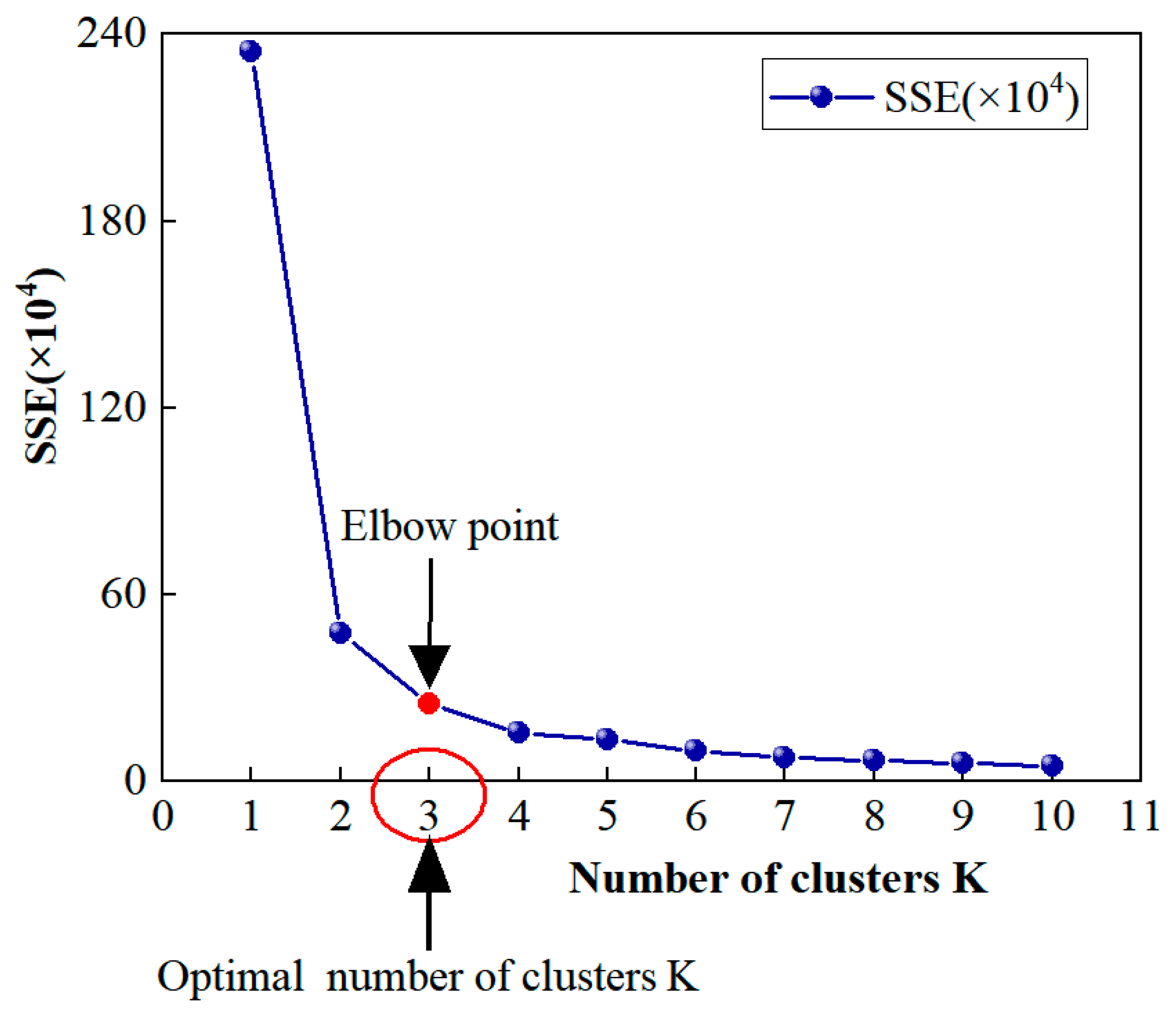
The value of the clustering number k directly affects the rationality of the grouping structure, and its optimal value can be determined using the elbow criterion. The elbow criterion is based on the monotonic decreasing law of the SSE as k increases. When k is less than the true number of clusters, the SSE decreases significantly; when k exceeds the true number of clusters, the decreasing rate of SSE obviously slows down. Therefore, the SSE-k curve presents an “elbow” shape at a certain inflection point, and the k corresponding to this inflection point is the optimal clustering number [28]. In specific calculations, the upper limit of k is first set, k-means clustering is performed for different k values and the corresponding SSE is calculated, the SSE-k curve is drawn, and the inflection point where the decreasing rate significantly slows down is taken as the optimal clustering number, as shown in Figure 1.
Under the action of operating loads such as water level and temperature, the structural response characteristics of the dam exhibit consistency and synchronism. Anomalies in dam structural behavior must manifest as anomalies in the measured values of multiple monitoring points of the same type and at the same location, i.e., synchronism and correlation in time series and space. After clustering is completed, abnormal monitoring points are marked by combining single-point warning information, and are divided into heterogeneous abnormal groups of deformation, seepage, stress–strain, etc., according to different physical quantity types. On this basis, from the two aspects of the temporal similarity of homogeneous anomalies and the spatial aggregation characteristics of heterogeneous anomalies, a correlation network among abnormal groups is constructed.
For temporal similarity analysis, the dynamic time warping (DTW) algorithm [29] is applied to quantify the similarity among monitoring sequences of the same abnormal monitoring point type. DTW nonlinearly aligns time series of different lengths, effectively measuring the morphological similarity between sequences. This makes it suitable for dam monitoring data, which often have variations in rate and sampling duration. The calculation is given in Equations (3) and (4). When the DTW similarity between two monitoring points reaches 0.65 or above, a temporal similarity relationship is identified, indicating significant synchronous response characteristics. This threshold is widely adopted in engineering practice.
After the pairwise similarity relationships are established, the similarity coefficients for abnormal points of the same type are determined. Similarity is evaluated in two cases: intra-group and inter-group. The temporal similarity coefficients are denoted as α 1 for intra-group, α 2 for adjacent inter-group, and α 3 for non-adjacent inter-group, and their value rules are given in Table 1.
D i , j = x i y i + m i n D i 1 , j , D i , j 1 , D i 1 , j 1
D T W s i m i l a r i t y X , Y = 1 1 + D n , m
where D i , j is the minimum cumulative distance from the i -th point of sequence X to the j -th point of sequence Y; D n , m represents the minimum cumulative distance from the end of sequence X to the end of sequence Y, i.e., the final DTW distance; and D T W s i m i l a r i t y X , Y is the DTW similarity.
Deformation and seepage are two core physical quantities characterizing dam safety behavior, and they are closely coupled: when deformation anomalies occur in the dam body or foundation, the anti-seepage system is often damaged, and the seepage field changes. Therefore, the spatial aggregation of different types of anomalous points, such as deformation and seepage, at the same location is mainly characterized by the spatial aggregation coefficient of heterogeneous data β , with values given in Table 2.

2.2. Quantification of Spatial Influence Zone

To extend dam safety evaluation from point to space, discrete abnormal monitoring points must be converted into continuous influence zones, and a quantification mechanism that conforms to the evolution law of dam safety behavior must be established.
Traditional methods insufficiently quantify the spatial aggregation degree of abnormal points. This paper introduces the concept of spatial influence aggregation degree and adopts the minimum bounding ellipsoid volume algorithm [30] for geometric characterization. The method is based on two engineering assumptions: the influence superposition assumption holds that the influence zone of an abnormal point can be approximately regarded as a spherical region centered at the point with radius r , and the spatial influence aggregation degrees of multiple abnormal points are superposed in space; the minimum bounding principle holds that the potential risk region formed by the whole abnormal point group can be characterized by the minimum circumscribed ellipsoid that completely encloses all individual influence spheres.
The influence radius r is a key parameter connecting discrete monitoring points and the continuous influence zone. Its value needs to consider both the spatial density of monitoring points and the physical attenuation characteristics of structural response. Its calculation formula is shown in Equation (5).
r = δ R
where δ is an empirical coefficient, generally ranging from 0.1 δ 0.25 ; R is the characteristic distance of the spatial distribution of monitoring points. For uniformly distributed points with small spacing, the average spacing is taken as R to ensure that the influence radius matches the typical attenuation scale of structural physical response. When the distribution is sparse and spacing varies greatly, the statistical characteristic value of the nearest neighbor distance is taken as R to ensure that the typical spacing of the local region is reflected, making it insensitive to abnormal distribution and providing better statistical robustness.
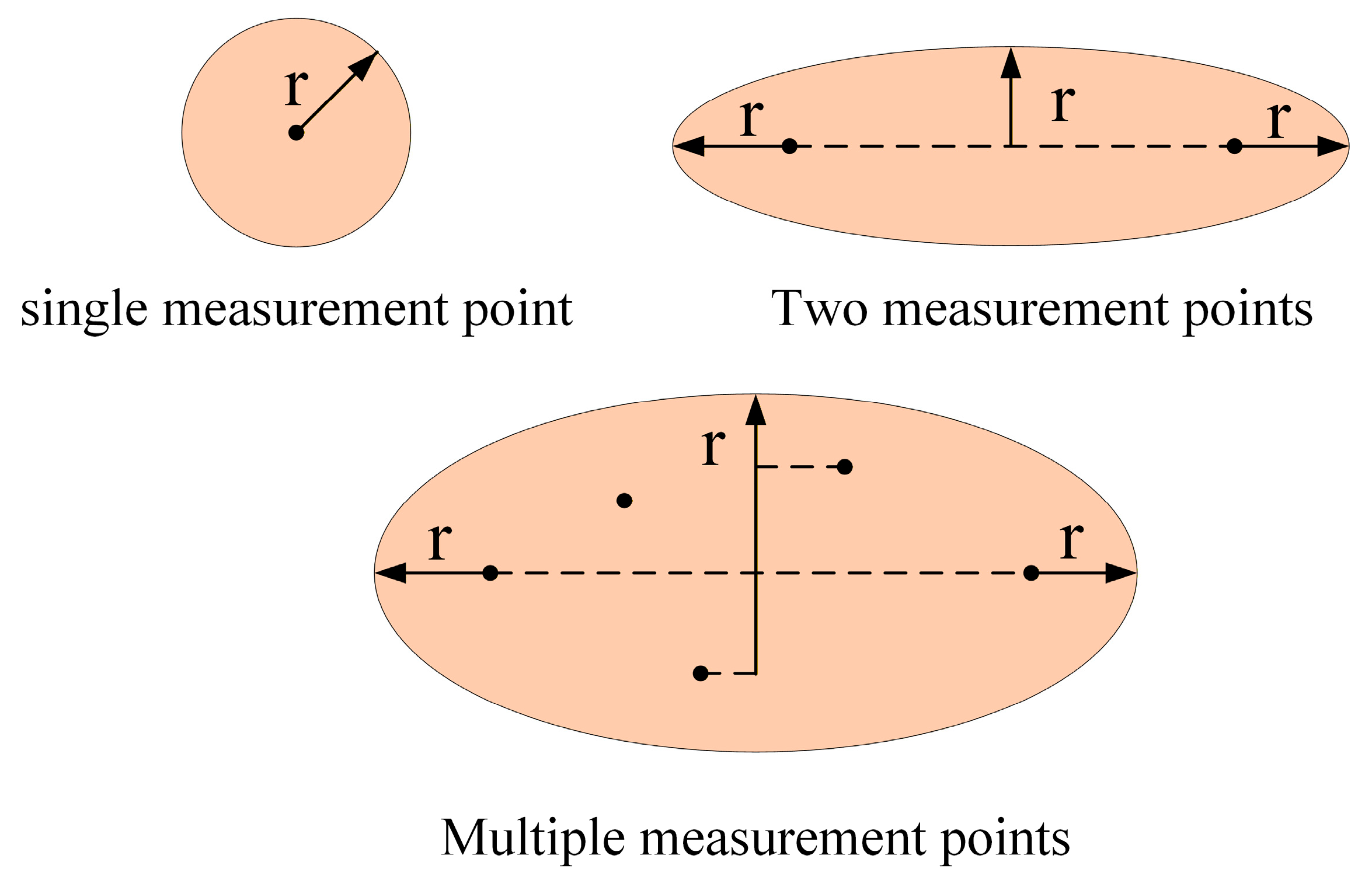
According to the number n of monitoring points in the abnormal monitoring point group, the spatial influence aggregation degree of abnormal monitoring point groups with different numbers of points is calculated based on the minimum bounding ellipsoid volume, as shown in Figure 2. The calculations of the spatial influence aggregation degree D for a single-point group n = 1 , two-point group n = 2 , three-point group n = 3 , and multi-point group n 4 are shown in Equations (6)–(9), respectively.
D = 4 3 π r 3
D = 2 3 π r 2 L + 2 r
D = 1 3 π r L 1 + 2 r L 2 + 2 r
D = 1 6 π L 1 + 2 r L 2 + 2 r L 3 + 2 r
where L is the distance between the two abnormal points in the two-point group; in the three-point group, L 1 is the distance between the two farthest points within the group, L 1 + 2 r is the major axis, L 2 is twice the distance from the third point to this major axis, and L 2 + 2 r is the intermediate axis; in the multi-point group, based on the extension range of the point cloud in the three principal directions, L 1 is the length in the first principal direction (major axis), L 2 is the length in the second principal direction (intermediate axis), and L 3 is the length in the third principal direction (minor axis).
The spatial influence zone A of each abnormal monitoring point group is determined by the data anomaly similarity coefficient, the spatial influence aggregation degree, the number of abnormal monitoring points, and the anomaly scores, as shown in Equation (10).
A = α 1 α 2 α 3 D 1 n i = 1 n g i
where α 1 , α 2 , and α 3 are the similarity coefficients for homogeneous abnormal monitoring points within the same group, between adjacent groups, and between non-adjacent groups, respectively, with their values determined as described in Section 2.1; n is the number of abnormal monitoring points in the abnormal monitoring point group; g i is the anomaly score of the i -th abnormal monitoring point. Referring to the relevant specifications for dam safety monitoring regarding the degree of anomaly of measured values and warning thresholds, the abnormal state of a monitoring point is classified into four levels: normal, slight anomaly, general anomaly, and severe anomaly. To facilitate subsequent quantitative calculation and analysis, the equal-interval assignment method is used to digitally represent the above states. The anomaly scores corresponding to the four anomaly levels are set as 0, 1, 2, and 3 points, respectively, with a higher score indicating a more severe degree of anomaly at the monitoring point [31].

2.3. Comprehensive Evaluation of Dam Safety Behavior

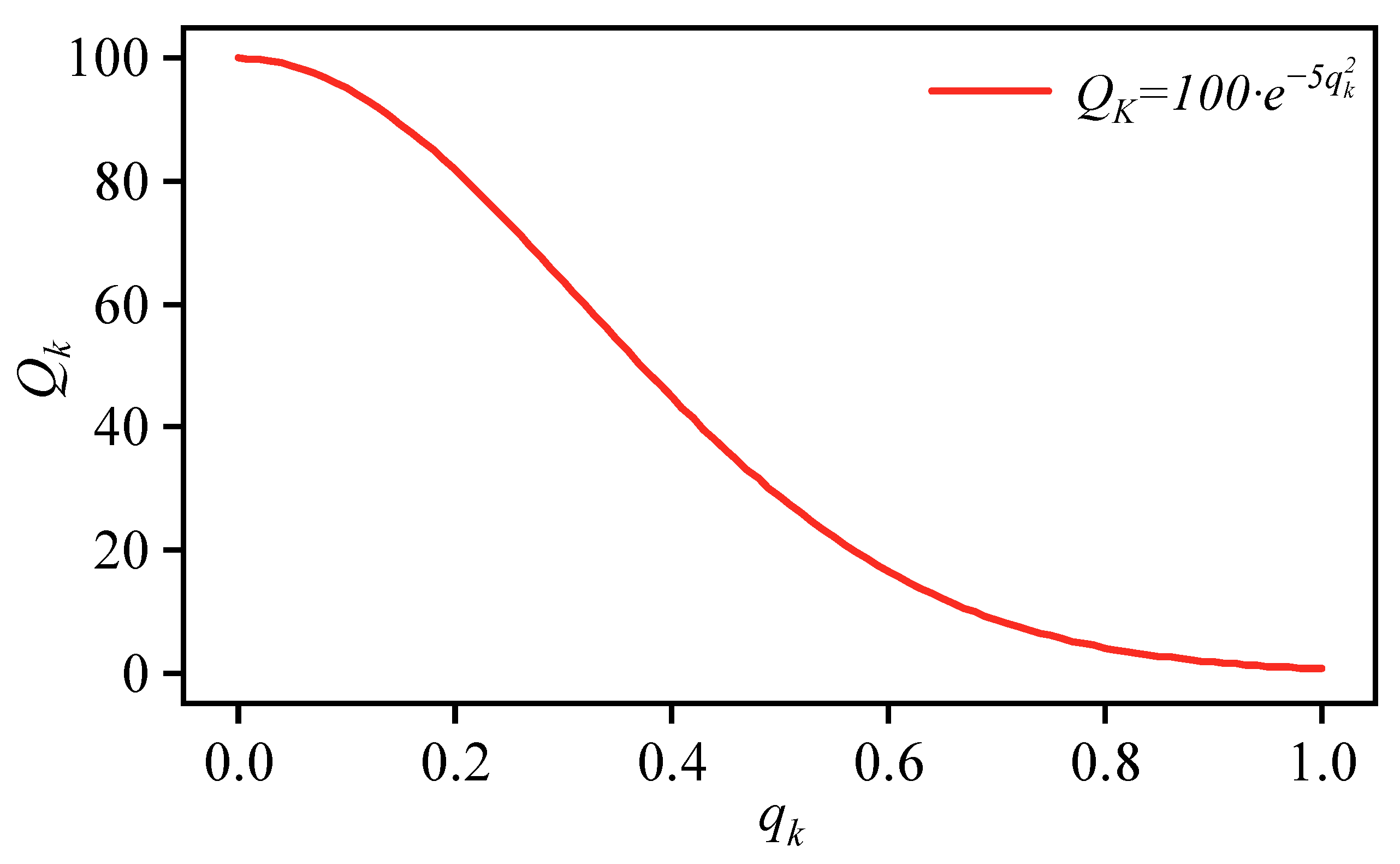
Based on the quantified spatial influence zone of each abnormal monitoring point group, the anomaly degree for each monitoring item is first calculated. Specifically, it is the ratio of the spatial influence zone of each abnormal monitoring point group to the theoretical maximum spatial influence zone, where all monitoring points of the same type are assumed to reach severe anomaly. This ratio characterizes the proportion of the current anomaly range to the theoretical worst-case scenario, as shown in Equation (11). Considering the nonlinear characteristics of dam safety behavior evolution, a power-exponential function is first used to quantitatively score the safety behavior of different types of monitoring items, such as deformation, seepage, and stress–strain, as shown in Figure 3 and Equation (12). Then, considering the spatial aggregation of anomalies of different types of monitoring items and the importance of each monitoring item in dam safety evaluation, a comprehensive evaluation of dam safety behavior is achieved, as shown in Equation (13).
q k = i = 1 m k A i A k , t o t a l , k deformation , seepage , stress strain
Q k = 100 × e 5 q k 2
Q = β i = 1 n t i Q k
where k is the type of monitoring item; q k is the ratio of the spatial influence zone for the k -th monitoring item; m k is the number of abnormal monitoring point groups for the k -th monitoring item; A k , t o t a l is the spatial influence zone when all monitoring points of the k -th monitoring item are abnormal, i.e., all monitoring points under the same monitoring item take the anomaly score g i = 3 (severe anomaly);   Q k is the behavior score of the k -th monitoring item; the coefficient 5 controls the decay rate of the power-exponential function and is determined by engineering trial calculations; Q is the dam operation behavior score, ranging from 0 to 100; t i is the weight coefficient of different monitoring items such as deformation, seepage, and stress–strain. Generally, deformation and seepage are the most direct and sensitive indicators in dam safety monitoring. Stress–strain is often used as an auxiliary indicator due to its relatively poor stability, so its weight can be appropriately reduced. In practical applications, the weight should be determined by comprehensively considering factors such as dam type, operation history, and water level operation mode. β is the spatial aggregation coefficient of heterogeneous data for different monitoring items such as deformation, seepage, and stress–strain, determined according to the value rules in Section 2.1.
Referring to the safety grade standards for dam failure risk in the “Safety Evaluation Guidelines for Hydropower Station Dam Operation” (DL/T5313—2014), the classification evaluation criteria for dam operation behavior evaluation are set as shown in Table 3, achieving the transition from single-point anomaly warning to overall spatial graded warning.

2.4. Method Implementation Process

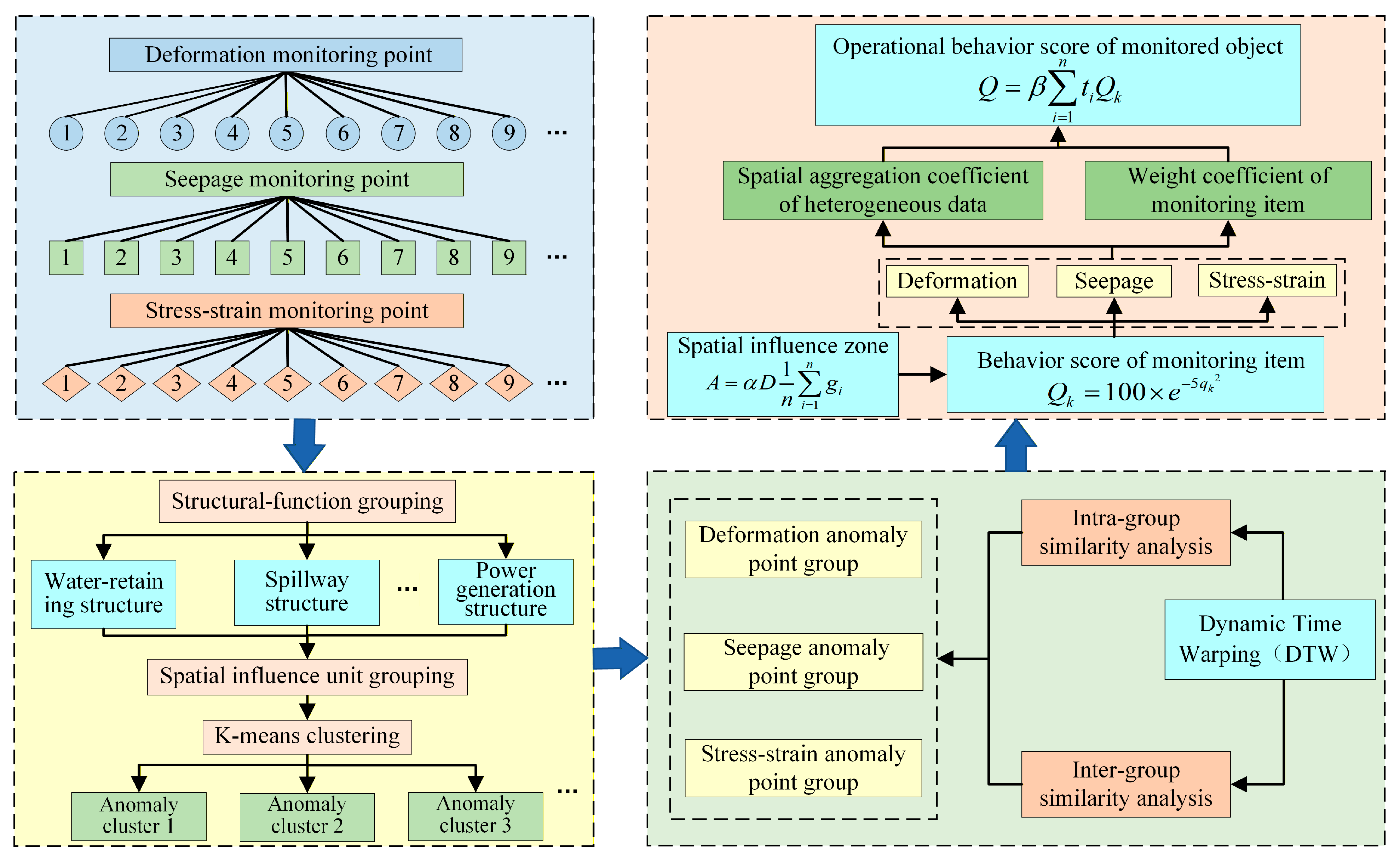
The overall architecture of the comprehensive evaluation method for dam safety behavior with spatiotemporal coupling of multiple monitoring points is shown in Figure 4. Based on single-point warning information, this study proposes a comprehensive evaluation method that integrates spatial clustering, temporal similarity analysis, and the spatial influence aggregation degree of topological correlations among multiple abnormal groups. It quantifies the spatiotemporal influence range of heterogeneous anomalies from multi-point anomaly information and provides a physically interpretable basis for extending the evaluation from single-point anomaly warning to the overall spatial structure level. The specific implementation process is as follows:
First, all monitoring points are divided into several structural units based on the functional zoning of the dam. For large-scale structural units, k-means clustering is performed using the three-dimensional coordinates of each monitoring point as the feature vector, and the elbow criterion is applied to determine the optimal number of clusters. As a result, monitoring points with similar spatial positions are grouped together. Based on single-point warning information, abnormal monitoring points are identified and further divided into different abnormal groups (deformation, seepage, stress–strain, etc.) according to the type of monitored physical quantity.
On this basis, the DTW algorithm is used to calculate the similarity of monitoring sequences within and between each abnormal group. A similarity relationship between monitoring point pairs is established when the similarity is not less than 0.65. The proportion of similar monitoring point pairs within and between groups is then calculated to determine the temporal similarity coefficients for each abnormal group. Meanwhile, taking the dam section as the basic unit, the spatial aggregation coefficient of heterogeneous data is determined by the number of anomaly types that appear simultaneously in the same section.
Subsequently, the influence radius is determined according to the spatial distribution characteristics of the monitoring points. For each abnormal group, the spatial influence aggregation degree is calculated according to the number of abnormal monitoring points contained, and the spatial influence zone of each abnormal group is obtained by considering the data anomaly similarity coefficient, the number of abnormal monitoring points, and the anomaly scores.
Finally, the ratio of the current anomaly influence zone to the theoretical maximum influence zone for each monitoring item is calculated, and the behavior score of each item is obtained through nonlinear mapping by a piecewise power-exponential function. The spatial aggregation coefficient of heterogeneous data and the weight of each item are introduced, the overall dam operation behavior score is calculated, and the operation behavior level is determined according to the classification criteria, thus achieving the transition from single-point anomaly warning to overall spatial graded warning.

3. Engineering Case Analysis

3.1. Engineering Overview

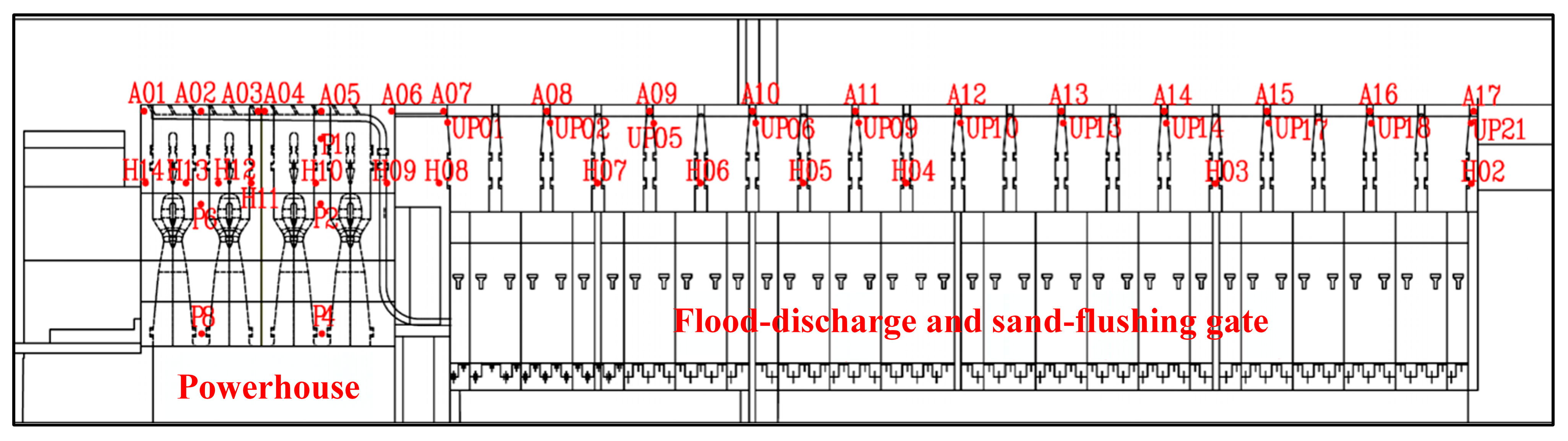
The JX Navigation-Power Junction is located in the middle reaches of the Jialing River. It is a multipurpose project combining navigation and power generation. The normal water level of the reservoir is 310.00 m. The maximum height of the concrete gate dam is 47.1 m. The total installed capacity of the power station is 150 MW (4 × 37.5 MW). The reservoir has a designed total storage of 4.439 × 10⁸ m3. The project is classified as second-class, large type II. The monitoring program of the JX Navigation-Power Junction mainly includes environmental quantity monitoring, deformation monitoring, and seepage monitoring. Environmental quantity monitoring adopts automated monitoring, while both deformation monitoring and seepage monitoring adopt manual monitoring. The gate dam of the JX Navigation-Power Junction includes the flood-discharge and sand-flushing gate dam section and the powerhouse dam section. Its length in the upstream–downstream direction (X-coordinate) is 58 m, its length in the cross-river direction (Y-coordinate) is 495 m, and its length in the vertical direction (Z-coordinate) is 52 m. The current normal operation safety monitoring items include deformation monitoring at the dam crest and gallery and dam foundation seepage monitoring, with a total of 50 monitoring points established, as shown in Table 4 and Figure 5.
The online operation safety monitoring of the JX Navigation-Power Junction gate dam shows that on 17 July 2024, a total of nine abnormal monitoring points appeared in the gate dam section. Among them, one point exhibited a moderate anomaly, and eight points exhibited slight anomalies. The statistics of the abnormal monitoring points are presented in Table 5.

3.2. Spatial Clustering and Anomaly Group Identification

According to the functional zoning and structural characteristics of the JX Navigation-Power Junction gate dam, the monitoring points were first divided into the flood-discharge and sand-flushing gate dam section and the powerhouse dam section. Since the flood-discharge and sand-flushing gate extends over a large cross-river extent with a wide distribution of monitoring points, the K-means clustering method was then used to subdivide it into spatial influence units.
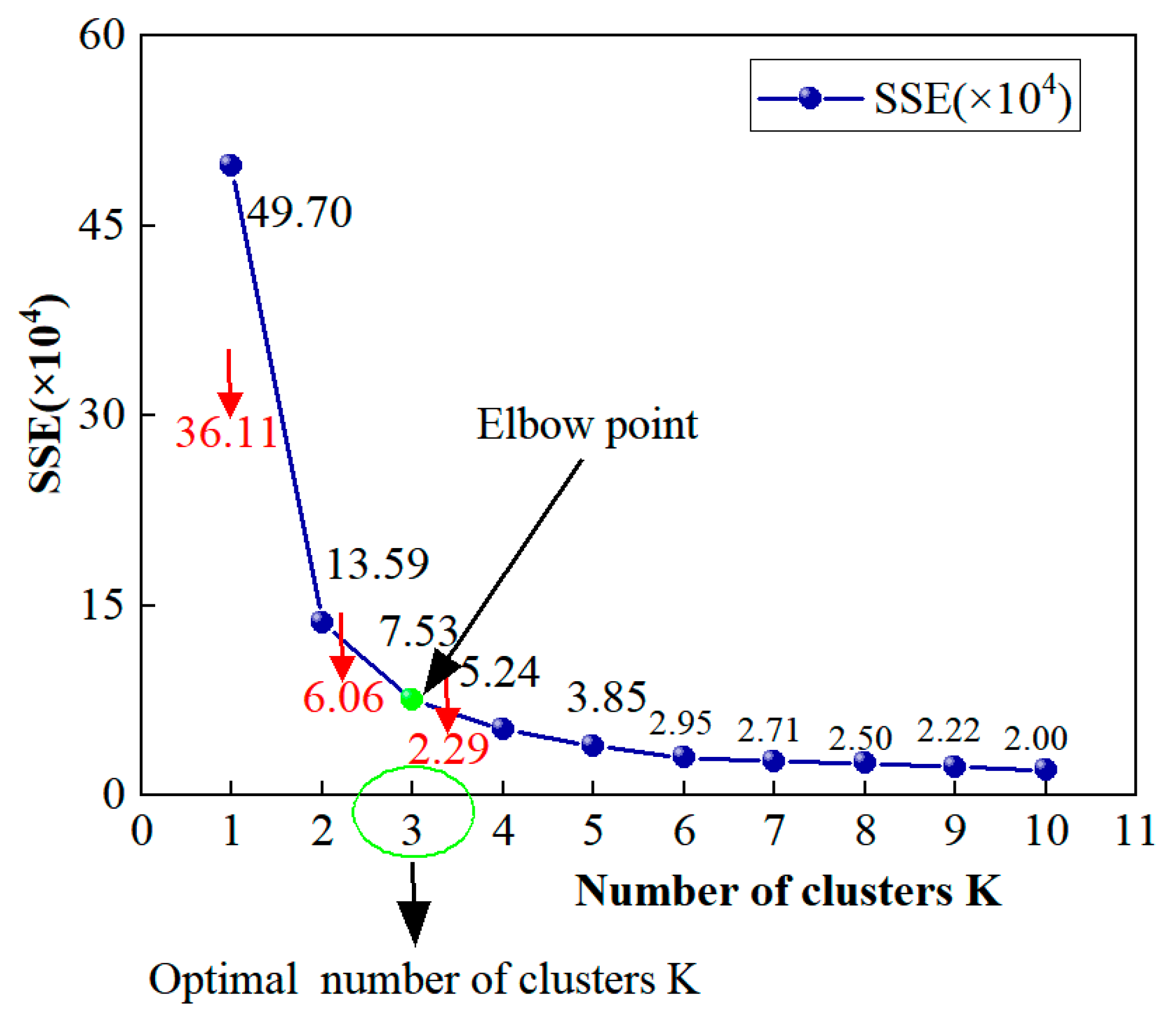
To avoid the subjectivity of manually setting the cluster number k , the elbow method was used to determine the optimal cluster number k . The within-cluster sum of squared errors (SSE) corresponding to the cluster number k increasing from 1 to a preset maximum of 10 was calculated, and the k-SSE curve was plotted as shown in Figure 6. It can be seen from the figure that the within-cluster sum of squared errors SSE decreases monotonically as the cluster number k increases. After k = 3 , the decreasing rate significantly slows down, showing an obvious elbow feature. By comprehensively considering the magnitude of SSE decrease, engineering interpretability, and the reasonableness of the spatial distribution of cluster centers, the optimal cluster number k = 3 was determined.
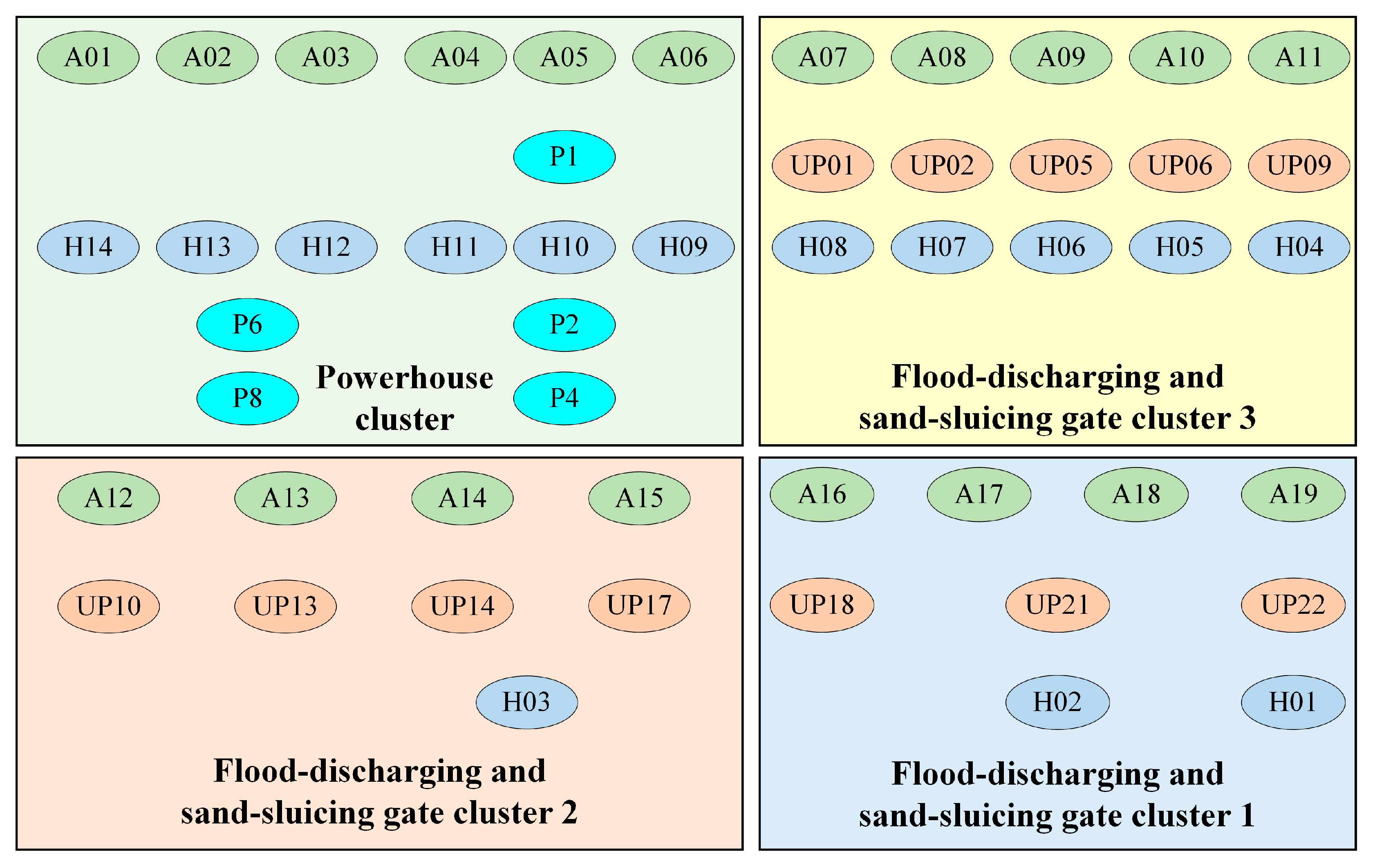
Through cluster analysis, the flood-discharge and sand-flushing gate was divided into three spatial influence clusters. The center coordinates of each cluster are as follows: Cluster 1 (7.02, 62.93, 26.98), Cluster 2 (6.33, 204.32, 24.28), and Cluster 3 (8.41, 343.06, 26.81). The center coordinate of the powerhouse cluster is (21.12, 456.33, 23.86). The spatial partitions of the clusters are clear and can effectively reflect the relative spatial position relationships among different sections of the flood-discharge and sand-flushing gate and the powerhouse dam section. Based on the layout of each monitoring point, the clustering grouping results of the deformation and seepage monitoring points within the spatial influence units are shown in Figure 7.
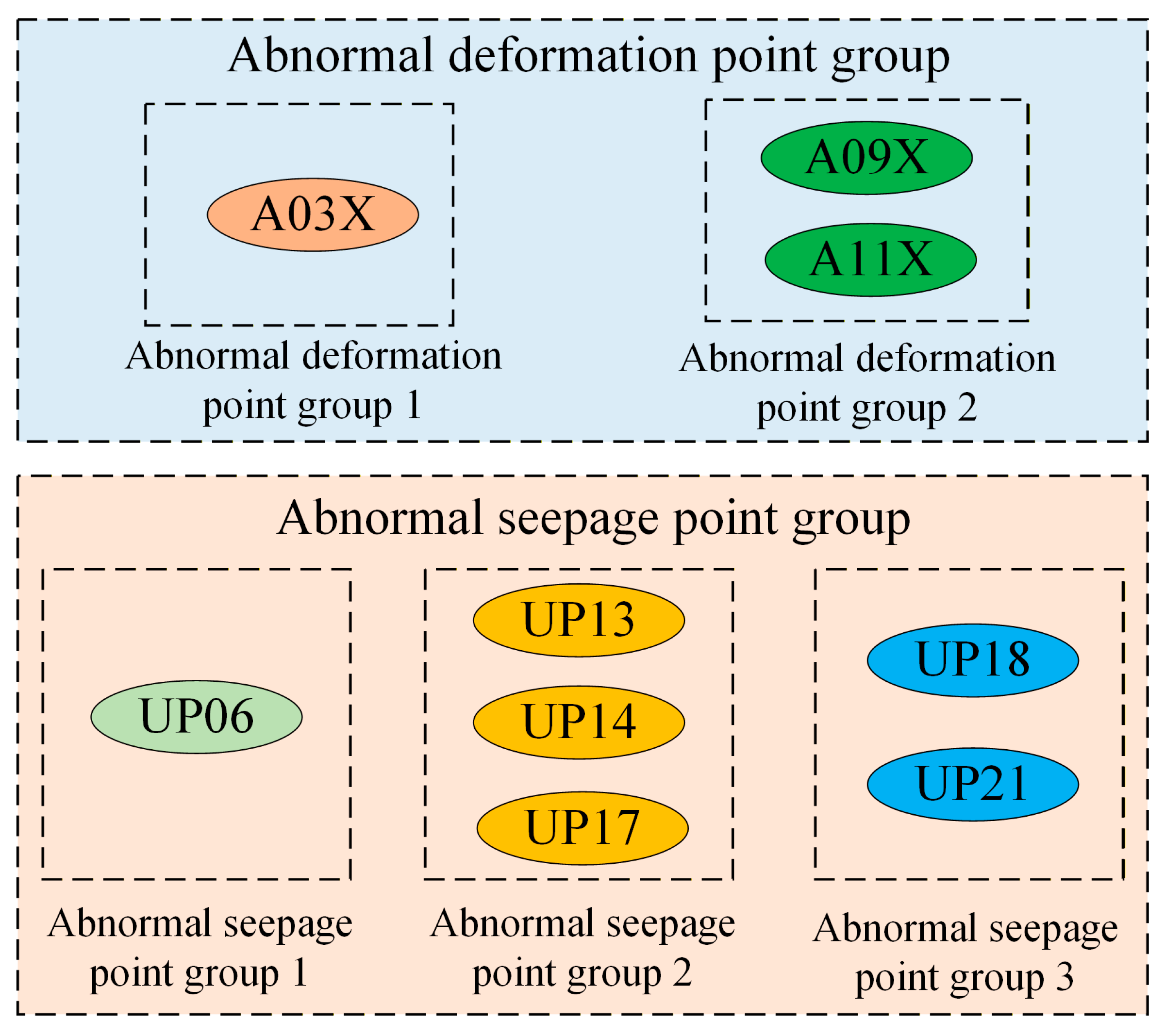
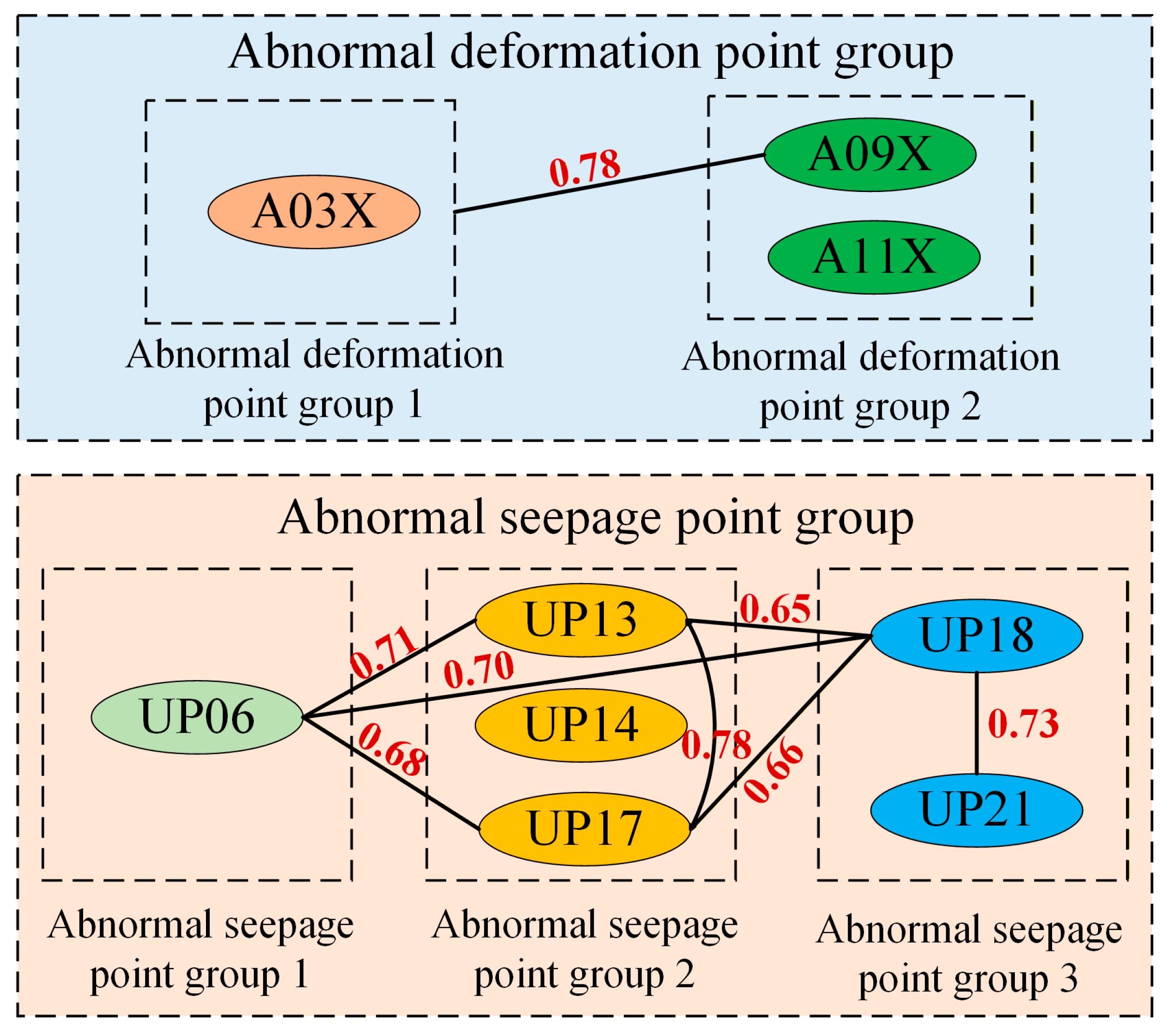
Based on the single-point warning information for each monitoring point, the spatial influence cluster affiliations of the nine abnormal monitoring points are as follows: A03X belongs to the powerhouse cluster; A09X, A11X, and UP06 belong to Cluster 3; UP13, UP14, and UP17 belong to Cluster 2; UP18 and UP21 belong to Cluster 1. Further grouping was performed by monitoring item types such as deformation and seepage, and the grouping results are shown in Figure 8.

3.3. Time Series Similarity Analysis of Similar Abnormal Monitoring Point Groups

For the abnormal deformation and seepage monitoring points, historical monitoring sequences covering multiple complete water level operation cycles were extracted. The DTW algorithm was used to calculate the similarity between each pair of monitoring points. The calculation results are shown in Table 6, and the similarity analysis results among the abnormal monitoring point groups are shown in Figure 9. Based on the similarity judgment results of each monitoring point pair, the intra-group similarity coefficient, the inter-group similarity coefficient between adjacent groups, and the inter-group similarity coefficient between non-adjacent groups of the abnormal monitoring point groups were determined, as shown in Table 7.

3.4. Comprehensive Evaluation and Analysis of Dam Operation Behavior

(1)
Calculation of spatial influence area
Given that this navigation-power junction project is relatively small in scale, the monitoring layout is relatively simple and the distribution of monitoring points is relatively sparse. Therefore, the statistical characteristic value of the nearest neighbor distance of monitoring points is adopted as the characteristic distance R of the spatial distribution of monitoring points. In this paper, the average nearest neighbor distance is adopted as the characteristic distance R of the spatial distribution of monitoring points, i.e., 16.67 m. The empirical range of the spatial influence radius of monitoring points is 0.1 R , 0.25 R . In this paper, r = 0.22 R is adopted as the spatial influence radius of monitoring points for this navigation-power junction, i.e., r = 3.67   m . Based on the similarity analysis results of abnormal data sequences, the spatial influence areas of the deformation and seepage monitoring items were calculated.
(2)
Calculation of comprehensive safety behavior score
Based on the calculation results of the spatial influence areas of the two monitoring items, i.e., deformation and seepage, their safety behavior scores were calculated. Based on the analysis of the project’s operation history, structural characteristics, and monitoring data, both deformation and seepage are considered core indicators for evaluating overall safety, and no single indicator is found to dominate the safety state. Therefore, in this case study, the two are regarded as equally important, with both t 1 and t 2 set to 0.5. The flood-discharge and sand-flushing gate dam section and the powerhouse dam section of this navigation-power junction include a total of 24 dam sections, among which dam sections 1 to 4 belong to the powerhouse dam section, and dam sections 5 to 24 belong to the flood-discharge and sand-flushing gate dam section. Different types of abnormal monitoring point groups did not appear in the same dam section; therefore, the spatial aggregation coefficient of heterogeneous data β is taken as 1.0 for all cases, as shown in Table 8. After calculation, the operation behavior score of the JX gate dam is 96.43, which is in a normal state. The detailed calculation results are shown in Table 9.
Table 7 shows that, for the seepage monitoring item, due to its larger number of abnormal monitoring points and wider spatial distribution, the total value of the spatial influence area is greater than that of the deformation item. After mapping with a piecewise power function, its score is slightly lower than that of the deformation item, which is consistent with the actual situation in this engineering case where the influence range of seepage anomalies is larger. In this engineering case, the abnormal monitoring points are mostly slight anomalies, and the deformation and seepage anomalies belong to different dam sections, without forming a heterogeneous relationship within the same dam section. The overall structural safety behavior is good, and the comprehensive score falls within the normal state range, which is consistent with the actual engineering condition. Compared with the traditional single-point threshold early warning method, the method in this study integrates the early warning information of nine discrete abnormal monitoring points into a comprehensive behavior evaluation result through spatial clustering, time series similarity analysis, and heterogeneous aggregation judgment, thereby avoiding excessive early warning triggered by individual slight anomalies.

3.5. Stability Analysis of Evaluation Conclusions

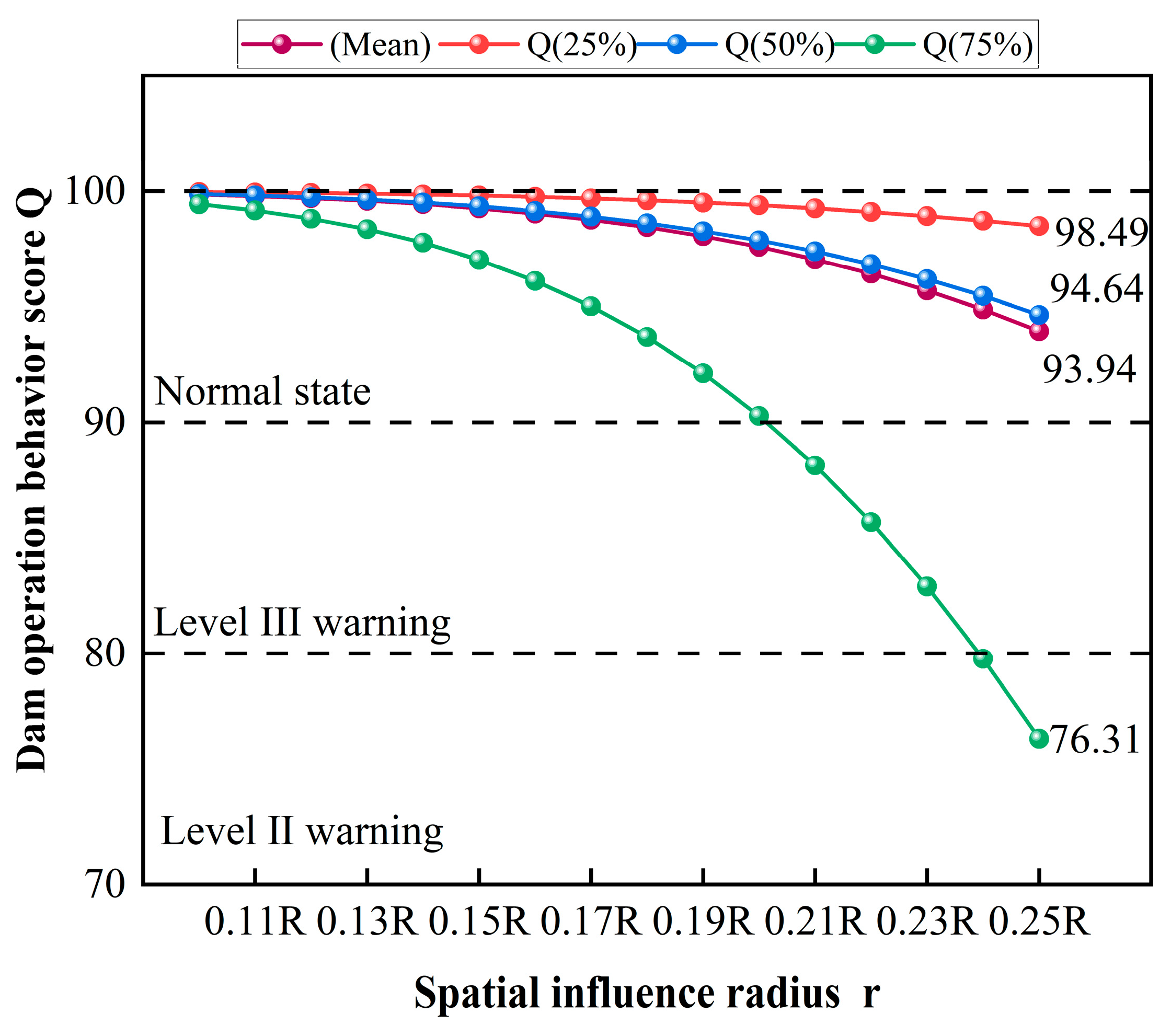
From an engineering application perspective, the evaluation method should maintain a stable conclusion when parameters vary, while remaining moderately sensitive to the expansion of anomaly ranges to identify risks in a timely manner. The main influencing parameters of the evaluation score of this method are the characteristic distance R and the spatial influence radius r. To deeply analyze their impact on the evaluation conclusions, this study selected four statistical characteristic values as the characteristic distance R, namely, the mean distance between monitoring points (16.67 m), the 25% quantile (11.9 m), the 50% quantile (16.18 m), and the 75% quantile (23.37 m). Within the interval 0.1 R , 0.25 R , the spatial influence radius r was discretized with a step size of 0.01R, and the operation behavior scores of the JX Navigation-Power Junction gate dam section under different parameter combinations were calculated. The results are shown in Figure 10.
It can be seen from the figure that as r increases, the dam operation behavior score Q shows a monotonically decreasing trend, but the curves corresponding to different characteristic distances differ significantly in terms of decreasing rate, stability, and conclusion uniqueness.
When the 75% quantile is used as the characteristic distance R, the score decreases most sharply, and as r varies, the evaluation conclusion changes significantly, lacking conclusion uniqueness. The reason for this is that the 75% quantile reflects the spacing in sparse monitoring point areas, and its value is relatively large, which can easily lead to excessive correlation of abnormal points, making the overall evaluation conservative and prone to frequent false alarms. When the 25% quantile is used as the characteristic distance R, although the evaluation conclusion has uniqueness, the score is relatively insensitive to changes in r. The reason for this is that the 25% quantile reflects the typical spacing in dense monitoring point areas, and its value is relatively small, which limits the correlation range of abnormal points, making the evaluation conclusion overly optimistic and potentially unable to identify potential risks in a timely manner. When the mean value or the 50% quantile is used as the characteristic distance R, the evaluation conclusion possesses both robustness and uniqueness, indicating that this value synthesizes the spatial characteristics of both dense and sparse areas and describes the actual distribution of monitoring points in a relatively balanced manner.
Overall, using the mean value or the 50% quantile as the characteristic distance R can satisfactorily meet the above requirements. When r is small, the score decreases gently, which is consistent with the engineering reality that local anomalies have limited impact on overall safety. When r is large, the score decreases at an accelerating rate, reflecting the gradual accumulation of risk as the anomaly range expands.

3.6. Sensitivity Analysis of Anomaly Severity

To evaluate the response of the proposed method to higher risk states and its ability to distinguish different anomaly severity levels, a sensitivity analysis of anomaly severity is conducted based on the same engineering case. While keeping monitoring point spatial distribution, clustering groups, and temporal similarity coefficients unchanged, five progressively increasing anomaly risk scenarios are designed by gradually raising the anomaly scores g i of abnormal monitoring points, as shown in Table 10. The actual monitoring state of the project on 17 July 2024, is taken as the baseline. Scenario 2 examines the coupling effect of simultaneous severe deformation and seepage within the same spatial influence cluster. Scenario 3 further investigates the impact of cross-cluster risk superposition on safety levels. Scenario 5 simulates an extreme anomaly state across the whole region to evaluate the method’s extreme response capability. The resulting dam operation behavior scores for each scenario are presented in Table 11.
As shown in Table 9, as the anomaly severity gradually increases, the individual scores of deformation and seepage, as well as the comprehensive score, show a decreasing trend. The decrease in the deformation score is relatively moderate, while the decrease in the seepage score is more significant, indicating that seepage anomalies have higher sensitivity to the overall evaluation. From the perspective of the comprehensive score, the baseline scenario to Scenario 2 are all in the normal state. Although the anomaly intensity increases in Scenarios 1 and 2, the comprehensive score remains within the normal range because the abnormal points are distributed in different dam sections and do not form risk superposition at the same location. In Scenario 3, multiple seepage abnormal points with severe anomalies from another spatial cluster are added, significantly expanding the number of abnormal points and the spatial influence range. The seepage score drops sharply from 94.70 to 77.46, and the comprehensive score drops to 83.81, reaching a Level III warning. This indicates that the proposed method can effectively identify the increase in the number of abnormal points and the risk superposition effect in different regions, avoiding local anomalies from being masked by aggregation. In Scenarios 4 and 5, as the anomaly degrees of the remaining monitoring points gradually escalate, the comprehensive scores drop to 80.83 and 77.72, reaching a Level III warning and a Level II warning, respectively, further verifying the sensitivity of the method to the overall risk increase.
Further analysis shows that the similarity coefficient and spatial aggregation coefficient have limited influence on the comprehensive score, and the core influencing factor of the score is the anomaly degree of individual monitoring points. When anomalies of the same type exhibit temporal similarity, or when multiple types of anomalies form spatial coupling, the comprehensive score decreases accordingly, thus reflecting the influence of the correlation between individual abnormal points in the scoring results. This maintains the stability of the evaluation conclusion while moderately responding to changes in the anomaly distribution state.
Based on the above analysis, the proposed method can reasonably map warning levels according to changes in anomaly intensity and spatial aggregation range, possesses the ability to distinguish different risk states, and responds well to local severe anomalies and multi-regional risk coupling.

4. Conclusions

The main contribution of this study is the proposal of a comprehensive evaluation method for dam operation safety behavior based on spatiotemporal coupling of multiple monitoring points. This method compensates for the shortcomings of traditional single-point monitoring evaluation methods from two dimensions: spatiotemporal correlation of multiple monitoring point anomalies and geometric quantification scoring of continuous influence domains, effectively overcoming the limitations of existing methods in the quantification of spatial coupling of heterogeneous anomalies, geometric characterization of influence ranges, and physical interpretability of scoring models. Through method design and engineering validation, the main conclusions are as follows:
(1)
A spatiotemporal correlation network and influence quantification method for abnormal groups of multiple types of monitoring points is constructed. From the two aspects of temporal similarity of similar anomalies and spatial aggregation characteristics of heterogeneous anomalies, quantitative mechanisms for intra-group temporal similarity, inter-group temporal similarity, and spatial aggregation of heterogeneous data are established. Through the spatial aggregation coefficient of heterogeneous data, the method achieves spatiotemporal quantification of the influence of anomalies from multiple types of monitoring physical quantities.
(2)
A comprehensive evaluation model for dam safety behavior based on spatial influence aggregation degree is developed. The concept of spatial influence aggregation degree is introduced, and the minimum bounding ellipsoid volume algorithm is used to convert discrete abnormal monitoring points into a continuous influence domain, thereby intuitively reflecting the spatial expansion and aggregation degree of anomalies. On this basis, and considering the nonlinear characteristics of dam safety behavior evolution, a dam safety behavior scoring model is established, enabling it to reflect the nonlinear sensitivity of the overall structural safety state to local anomaly evolution, which significantly improves the physical interpretability of the evaluation results.
(3)
The application to an engineering case shows that the proposed method integrates the temporal similarity of similar monitoring point anomalies, the spatial aggregation of heterogeneous monitoring point anomalies, and the spatial influence aggregation degree of multiple monitoring point anomalies, achieving an overall evaluation of dam operation safety behavior driven by spatiotemporal fusion of multiple monitoring points. Taking the single monitoring point monitoring and early warning of the JX Navigation-Power Junction gate dam section on 17 July 2024, as an example, the calculated real-time operation behavior score is 96.43, corresponding to normal operation behavior. The evaluation conclusion is objective and stable, consistent with the engineering reality.
The proposed method extends dam safety evaluation from single-point anomaly warning to multi-point spatiotemporal collaborative judgment. However, the empirical coefficients used in this study lack rigorous theoretical calibration, and the engineering validation is based on only a single case. Future work will systematically calibrate these coefficients using more engineering data and explore the integration of numerical models to generate theoretical anomaly zones for validating and calibrating the spatial influence zones. This will further enhance the physical interpretability and reliability of the evaluation model, and ultimately establish a standardized spatiotemporal coupling evaluation method applicable to different dam types.

Author Contributions

J.L.: writing—original draft, visualization, methodology, data curation, conceptualization. Y.G.: writing—review and editing, supervision, methodology, conceptualization. R.N.: supervision, methodology, conceptualization. Y.L.: supervision, methodology, conceptualization. All authors have read and agreed to the published version of the manuscript.

Funding

This research is supported by the Natural Science Foundation of Sichuan Province (No. 2025ZNSFSC0414) and the National Natural Science Foundation of China (No. 52309162).

Institutional Review Board Statement

Not applicable.

Informed Consent Statement

Not applicable.

Data Availability Statement

The data presented in this study are available on request from the corresponding author. The data are not publicly available due to [the confidential nature of the dam safety monitoring data].

Conflicts of Interest

Authors Yueming Gao and Ruichuan Nan were employed by the company Guangdong South China High-Tech Co., Ltd. The remaining authors declare that the research was conducted in the absence of any commercial or financial relationships that could be construed as a potential conflict of interest.

References

  1. Badr, A.; Li, Z.; El-Dakhakhni, W. Dam System and Reservoir Operational Safety: A Meta-Research. Water 2023, 15, 3427. [Google Scholar] [CrossRef]
  2. Chen, X.; Sun, W.; Liu, Y.; Fan, X.; Gu, C.; Guo, J.; Li, B.; Hu, S. Considering Integrated Information on Environmental Features and Neighborhood Deformation: A Missing Value Filling Framework for Arch Dam Deformation Sequence. Adv. Eng. Inform. 2025, 63, 102959. [Google Scholar] [CrossRef]
  3. Deng, Z.; Gao, Q.; Huang, M.; Wan, N.; Zhang, J.; He, Z. From Data Processing to Behavior Monitoring: A Comprehensive Overview of Dam Health Monitoring Technology. Structures 2025, 71, 108094. [Google Scholar] [CrossRef]
  4. Tian, J.; Chen, C.; Zhang, L.; Chen, J.; Huang, H.; Zhang, P. A Digital Twin Method for Real-Time Analysis of Structural Deformation and Failure for High Arch Dams. Eng. Struct. 2025, 345, 121426. [Google Scholar] [CrossRef]
  5. Gu, C.; Zhu, M.; Wu, Y.; Chen, B.; Zhou, F.; Chen, W. Multi-Output Displacement Health Monitoring Model for Concrete Gravity Dam in Severely Cold Region Based on Clustering of Measured Dam Temperature Field. Struct. Health Monit. 2023, 22, 3416–3436. [Google Scholar] [CrossRef]
  6. Su, H.; Wen, Z.; Ren, J. A Kernel Principal Component Analysis-Based Approach for Determining the Spatial Warning Domain of Dam Safety. Soft Comput. 2020, 24, 14921–14931. [Google Scholar] [CrossRef]
  7. Tian, J.; Li, Y.; Luo, Y.; Zhang, H.; Lu, X. Multisource Information Fusion Model for Deformation Safety Monitoring of Earth and Rock Dams Based on Deep Graph Feature Fusion. Struct. Health Monit. 2025, 24, 925–940. [Google Scholar] [CrossRef]
  8. Liu, X.; Li, Z.; Sun, L.; Khailah, E.Y.; Wang, J.; Lu, W. A Critical Review of Statistical Model of Dam Monitoring Data. J. Build. Eng. 2023, 80, 108106. [Google Scholar] [CrossRef]
  9. Wang, S.; Gu, C.; Liu, Y.; Gu, H.; Xu, B.; Wu, B. Displacement Observation Data-Based Structural Health Monitoring of Concrete Dams: A State-of-Art Review. Structures 2024, 68, 107072. [Google Scholar] [CrossRef]
  10. Zhou, Y.; Bao, T.; Shu, X.; Li, Y.; Li, Y. BIM and Ontology-Based Knowledge Management for Dam Safety Monitoring. Autom. Constr. 2023, 145, 104649. [Google Scholar] [CrossRef]
  11. Shi, Z.; Li, J.; Wang, Y.; Gu, C.; Jia, H.; Xu, N.; Zhai, J.; Pan, W. Characterization Model Research on Deformation of Arch Dam Based on Correlation Analysis Using Monitoring Data. Mathematics 2024, 12, 3110. [Google Scholar] [CrossRef]
  12. Li, H.; Li, Z.; Ma, F.; Liu, C. Similarity Analysis of Dam Behavior Characterized by Multi-Monitoring Points Based on Cloud Model. Int. J. Distrib. Sens. Netw. 2020, 16, 1550147720920226. [Google Scholar] [CrossRef]
  13. Zhu, Y.; Xie, M.; Zhang, K.; Li, Z. A Dam Deformation Residual Correction Method for High Arch Dams Using Phase Space Reconstruction and an Optimized Long Short-Term Memory Network. Mathematics 2023, 11, 2010. [Google Scholar] [CrossRef]
  14. Pi, L.; Yue, C.; Shi, J. A Multi-Point Correlation Model to Predict and Impute Earth-Rock Dam Displacement Data for Deformation Monitoring. Buildings 2024, 14, 3780. [Google Scholar] [CrossRef]
  15. Chen, Z.; Xu, B.; Sun, L.; Wang, X.; Song, D.; Lu, W.; Li, Y. Displacement Interval Prediction Method for Arch Dam with Cracks: Integrated STL, MF-DFA and Bootstrap. Water 2024, 16, 2755. [Google Scholar] [CrossRef]
  16. Ma, Y.; Bao, T.; Li, Y.; Wu, Z.; Zhao, M.; Liu, X. GCN-Former-BiLSTM: An Enhanced LSTM Model Using Transformer and Multiscale Spatio-Temporal Graph Neural Network for High Arch Dam Displacement Prediction. Eng. Struct. 2025, 344, 121395. [Google Scholar] [CrossRef]
  17. Lu, W.; Wu, D.; Liang, J.; Zhang, G.; Wu, Z.; Xia, N. A Multi-Graph Attention Fusion Network for Dam Deformation Prediction Under Data Missing Conditions. Electronics 2026, 15, 1457. [Google Scholar] [CrossRef]
  18. Tian, J.; Yu, R.; Chen, C.; Li, Y.; Huang, H.; Chen, J. Cross-Domain Adaptive Digital Twin Modelling for Dam Structures Using Graph Attention Networks. Adv. Eng. Inform. 2026, 70, 104209. [Google Scholar] [CrossRef]
  19. Lu, T.; Gu, H.; Gu, C.; Shao, C.; Yuan, D. A Multi-Point Dam Deformation Prediction Model Based on Spatiotemporal Graph Convolutional Network. Eng. Appl. Artif. Intell. 2025, 149, 110483. [Google Scholar] [CrossRef]
  20. Wei, H.; Liu, X.; Wang, F.; Ai, X. An Integrated Deep Learning Model for Predicting Concrete Dam Deformation with Multi-Point Spatiotemporal Correlation. Measurement 2025, 256, 118546. [Google Scholar] [CrossRef]
  21. Wang, Y.; Liu, G. MLA-TCN: Multioutput Prediction of Dam Displacement Based on Temporal Convolutional Network with Attention Mechanism. Struct. Control Health Monit. 2023, 2023, 2189912. [Google Scholar] [CrossRef]
  22. Lee, E.; Kam, J. Deciphering the Black Box of Deep Learning for Multi-Purpose Dam Operation Modeling via Explainable Scenarios. J. Hydrol. 2023, 626, 130177. [Google Scholar] [CrossRef]
  23. Baudrit, C.; Taillandier, F.; Curt, C.; Hoang, Q.A.; Sbartai, Z.-M.; Breysse, D. Graph Based Knowledge Models for Capitalizing, Predicting and Learning: A Proof of Concept Applied to the Dam Systems. Adv. Eng. Inform. 2022, 52, 101551. [Google Scholar] [CrossRef]
  24. Zhang, Y.; Ma, G.; Qu, T.; Wang, Z.; Xiong, K.; Zhou, W. MoE-D2AN: A Mixture-of-Experts Surrogate and Dual-Branch Data Assimilation Network for Spatiotemporal Dam Deformation Modeling. Adv. Eng. Inform. 2026, 69, 104122. [Google Scholar] [CrossRef]
  25. Luo, S.; Yuan, D.; Wei, B.; Hu, Y.; Xu, F. Dam Multi-Source Heterogeneous Monitoring Data Fusion and Synchronization Method Based on Time Series Analysis. Eng. Struct. 2025, 338, 120623. [Google Scholar] [CrossRef]
  26. Chen, H.; Mao, Y.; Wang, L.; Qi, H. Spatial-Temporal Features Based Sensor Network Partition in Dam Safety Monitoring System. Sensors 2020, 20, 2517. [Google Scholar] [CrossRef] [PubMed]
  27. Ou, B.; Chi, H.; Qian, X.; Fu, S.; Miao, Z.; Zhao, D. Multipoint Deformation Prediction Model Based on Clustering Partition of Extra High-Arch Dams. CMES-Comp. Model. Eng. Sci. 2026, 146, 17. [Google Scholar] [CrossRef]
  28. Onumanyi, A.J.; Molokomme, D.N.; Isaac, S.J.; Abu-Mahfouz, A.M. AutoElbow: An Automatic Elbow Detection Method for Estimating the Number of Clusters in a Dataset. Appl. Sci. 2022, 12, 7515. [Google Scholar] [CrossRef]
  29. Chen, H.; Chen, X.; Guan, J.; Zhang, X.; Guo, J.; Yang, G.; Xu, B. A Combination Model for Evaluating Deformation Regional Characteristics of Arch Dams Using Time Series Clustering and Residual Correction. Mech. Syst. Signal Process. 2022, 179, 109397. [Google Scholar] [CrossRef]
  30. Dervilis, N.; Cross, E.J.; Barthorpe, R.J.; Worden, K. Robust Methods of Inclusive Outlier Analysis for Structural Health Monitoring. J. Sound Vibr. 2014, 333, 5181–5195. [Google Scholar] [CrossRef]
  31. He, J.; Chen, J.C.; Li, K.J. Research of Risk Fore Warning Indicators for Operation Safety Management of Three Gorges Project. Water Resour. Dev. Res. 2023, 23, 45–51. [Google Scholar]
Figure 1. Schematic diagram of the elbow criterion.
Applsci 16 06712 g001
Figure 2. Spatial influence aggregation degree of abnormal measurement point groups under different numbers of measurement points.
Applsci 16 06712 g002
Figure 3. Power-exponential function.
Applsci 16 06712 g003
Figure 4. Framework diagram of the dam operation safety assessment method based on spatiotemporal coupling of multiple monitoring points.
Applsci 16 06712 g004
Figure 5. Distribution of monitoring points in the flood-discharging and sand-sluicing gate and powerhouse dam section. A/H/P/UP denote different types of monitoring points: A—crest displacement, H—gallery vertical displacement, P—dam foundation seepage pressure, UP—uplift pressure.
Applsci 16 06712 g005
Figure 6. Relationship curve between the number of clusters and the within-cluster sum of squared errors. The red numbers denote the SSE differences between adjacent clusters; arrows indicate the trend from the previous cluster to the next (downward means decreasing).
Applsci 16 06712 g006
Figure 7. Clustering results of deformation and seepage monitoring points in the flood-discharging and sand-sluicing gate and powerhouse dam section.
Applsci 16 06712 g007
Figure 8. Spatial distribution of abnormal monitoring point groups.
Applsci 16 06712 g008
Figure 9. Similarity analysis results of each abnormal monitoring point group.
Applsci 16 06712 g009
Figure 10. Trend in Q with r under different statistical characteristic values.
Applsci 16 06712 g010
Table 1. Similarity coefficient values under different conditions.
Similarity TypeDescriptionSimilarity Coefficient
Intra-group similarityProportion of monitoring points with similarity within an abnormal group > 50% α 1 = 1.3
Adjacent inter-group similarityProportion of monitoring point pairs with similarity between adjacent abnormal groups > 50% α 1 = 1.2
Non-adjacent inter-group similarityProportion of monitoring point pairs with similarity between non-adjacent abnormal groups > 50% α 1 = 1.1
No group similarityNo intra-group or inter-group similarity α 1 = 1.0
Table 2. Values of the spatial aggregation coefficient of heterogeneous data.
Anomaly TypeGeneral Description β
Two or more typesMore than two types of monitoring item anomalies occur in the same dam section1.2
Two typesTwo types of monitoring item anomalies occur in the same dam section1.1
One typeOnly one type of monitoring item anomaly occurs in the same dam section1.0
Table 3. Classification and evaluation criteria for dam operation behavior.
Safety StatusScore RangeStatus Description
Normal stateQ ≥ 90The operational behavior of all parts of the dam is normal
Level III warning80 ≤ Q < 90Abnormal phenomena exist,
requiring enhanced monitoring of risk sources
Level II warning70 ≤ Q < 80Potential safety hazards may exist;
timely inspection and maintenance should be carried out
Level I warningQ < 70Potential failure risk may exist;
emergency response should be initiated as appropriate.
Table 4. Summary of monitoring points for the flood-discharge and sand-flushing gate and the powerhouse dam section.
Monitoring ObjectMonitoring ItemMonitoring Point
Flood-discharge and sand-flushing gateDeformationCrest horizontal displacementPoints A07–A19 on upstream side of dam crest
Crest vertical displacement
Gallery vertical displacementPoints H01–H14 on gallery floor
SeepageUplift pressure at dam foundationFirst row of piezometers behind curtain for typical dam sections: UP1–UP2, UP5–UP6, UP9–UP10, UP13–UP14, UP17–UP18, UP21–UP22
PowerhouseDeformationHorizontal displacementPoints A01–A05 on upstream side of dam crest
Vertical displacement
SeepageFoundation seepage pressurePoints P1–P2, P4 at section 0 + 023.00 m and points P6, P8 at section 0 + 058 m
Table 5. Summary of abnormal monitoring points.
Point NameMonitoring LocationMonitoring ItemAnomaly Level
A03XPowerhouseHorizontal displacementSlight anomaly
A09XFlood-discharging and
sand-sluicing gate
Horizontal displacementModerate anomaly
A11XFlood-discharging and
sand-sluicing gate
Horizontal displacementSlight anomaly
UP06Flood-discharging and
sand-sluicing gate
Uplift pressure at
dam foundation
Slight anomaly
UP13Flood-discharging and
sand-sluicing gate
Uplift pressure at
dam foundation
Slight anomaly
UP14Flood-discharging and
sand-sluicing gate
Uplift pressure at
dam foundation
Slight anomaly
UP17Flood-discharging and
sand-sluicing gate
Uplift pressure at
dam foundation
Slight anomaly
UP18Flood-discharging and
sand-sluicing gate
Uplift pressure at
dam foundation
Slight anomaly
UP21Flood-discharging and
sand-sluicing gate
Uplift pressure at
dam foundation
Slight anomaly
Table 6. DTW similarity calculation results for each pair of abnormal monitoring points.
Physical Quantity TypeMonitoring Point PairDTW SimilarityRelationship TypeSimilarity Judgment
Deformation(A03X,A09X)0.78Between adjacent groupsDissimilar
(A03X,A11X)0.57Between adjacent groupsDissimilar
(A09X,A11X)0.58Within a groupDissimilar
Seepage(UP06,UP13)0.71Between adjacent groupsSimilar
(UP06,UP14)0.60Between adjacent groupsDissimilar
(UP06,UP17)0.68Between adjacent groupsSimilar
(UP06,UP18)0.70Between non-adjacent groupsSimilar
(UP06,UP21)0.64Between non-adjacent groupsDissimilar
(UP13,UP14)0.62Within a groupDissimilar
(UP13,UP17)0.78Within a groupSimilar
(UP13,UP18)0.65Between adjacent groupsSimilar
(UP13,UP21)0.63Between adjacent groupsDissimilar
(UP14,UP17)0.63Within a groupDissimilar
(UP14,UP18)0.53Between adjacent groupsDissimilar
(UP14,UP21)0.49Between adjacent groupsDissimilar
(UP17,UP18)0.66Between adjacent groupsSimilar
(UP17,UP21)0.64Between adjacent groupsDissimilar
(UP18,UP21)0.73Within a groupSimilar
Table 7. Data anomaly similarity coefficient values for each abnormal monitoring point group.
Similarity CoefficientAbnormal Deformation Point GroupAbnormal Seepage Point Group
12123
Intra-group similarity coefficient   α 1 /1.0/1.31.3
Inter-group similarity coefficientAdjacent   α 2 1.21.21.21.21.2
Non-adjacent   α 3 //1.1/1.1
Similarity coefficient of data anomaly1.21.21.321.561.716
Table 8. Distribution of dam sections for monitoring points in each abnormal group and values of the spatial aggregation coefficient of heterogeneous data.
Anomaly TypePoint GroupMonitoring PointDam Section β
DeformationAbnormal deformation point group 1A03XDam section 21.0
Abnormal deformation point group 2A09XDam section 81.0
A11XDam section 12
SeepageAbnormal seepage point group 1UP06Dam section 101.0
Abnormal seepage point group 2UP13Dam section 161.0
UP14Dam section 18
UP17Dam section 20
Abnormal seepage point group 3UP18Dam section 221.0
UP21Dam section 24
Table 9. Calculation table of dam operation behavior score when r = 0.22 R .
Anomaly TypePoint GroupNumberD [m3] 1 n i = 1 n g i α A [m3] β A k , t o t a l Q k Q
DeformationA03X1206.5211.2247.731.051,438.4197.2896.43
A09X
A11X
21986.271.51.23575.291.0
SeepageUP061206.5211.32272.611.060,532.1895.58
UP13
UP14
UP17
32364.9511.563689.321.0
UP18
UP21
21047.1111.7161796.831.0
Table 10. Design of abnormal risk scenarios.
Abnormal Risk ScenarioSpecific Description
Baseline scenarioModerate anomaly: A09X;
the other 8 monitoring points show slight anomalies
Scenario 1Severe anomaly: A09X;
the other 8 monitoring points show slight anomalies
Scenario 2Severe anomalies: A09X, A11X, UP06;
slight anomalies: A03X, UP13, UP14, UP17, UP18, UP21
Scenario 3Severe anomalies: A09X, A11X, UP06, UP13, UP14, UP17;
slight anomalies: A03X, UP18, UP21
Scenario 4Severe anomalies: A09X, A11X, UP06, UP13, UP14, UP17;
moderate anomalies: A03X, UP18, UP21
Scenario 5All 9 monitoring points show severe anomalies
Table 11. Calculated dam operation behavior scores for each scenario.
Abnormal Risk ScenarioDeformation Q k Seepage Q k Q Safety Level
Baseline scenario97.2895.5896.43Normal state
Scenario 195.3695.5895.47Normal state
Scenario 290.1794.7092.45Normal state
Scenario 390.1777.4683.81Level III warning
Scenario 489.5472.1180.83Level III warning
Scenario 588.8966.5577.72Level II warning
Disclaimer/Publisher’s Note: The statements, opinions and data contained in all publications are solely those of the individual author(s) and contributor(s) and not of MDPI and/or the editor(s). MDPI and/or the editor(s) disclaim responsibility for any injury to people or property resulting from any ideas, methods, instructions or products referred to in the content.