1. Introduction
The ongoing transformation of electric power systems, driven by the large-scale integration of distributed energy resources (DERs) and flexible demand, is fundamentally reshaping traditional tariff structures and operational paradigms [
1,
2,
3,
4]. Conventional pricing schemes, such as static tariffs, are increasingly inadequate to capture the temporal and spatial variability of modern power systems. As a result, dynamic pricing mechanisms, such as time-of-use tariffs and real-time pricing, have emerged as key enablers for improving system efficiency, reducing peak demand, and incentivizing consumer participation [
5,
6,
7]. In this context, transactive energy systems (TESs) have emerged as a promising decentralized coordination paradigm, enabling multiple agents, including prosumers, aggregators, and system operators, to interact through market-based mechanisms [
8,
9,
10]. Early works on transactive control and distributed coordination have focused on price-based demand response and decentralized dispatch, demonstrating scalability and flexibility in managing distributed resources [
11,
12]. More recent approaches incorporate advanced market designs and peer-to-peer trading mechanisms, allowing agents to exchange energy based on localized marginal costs and preferences [
10,
13,
14,
15].
A common modeling framework for TES is bilevel optimization, which captures the hierarchical interaction between distributed agents and system operators. In such formulations, an upper-level coordinator (e.g., a system operator or aggregator) anticipates the optimal response of distributed agents such as prosumers and flexible loads, while the lower-level models network-constrained economic dispatch and price formation [
16,
17]. Several works have successfully applied bilevel programming to energy markets and transactive systems, highlighting its ability to represent strategic interactions and enforce system-level constraints [
18,
19,
20,
21,
22]. More recent contributions extend this paradigm to multi-agent and integrated energy systems, where one-leader multi-follower Stackelberg games are formulated as nonlinear or mixed-integer bilevel programs to capture discrete decisions and network-coupled constraints [
23,
24]. Despite these advances, most existing transactive control and bilevel optimization approaches rely on the assumption that price signals are perfectly implemented and accurately received by agents. In practice, however, this assumption is often violated due to communication delays, packet losses, measurement errors, and local disturbances in cyber-physical energy systems [
25,
26,
27]. These factors introduce uncertainty at the implementation layer, leading to discrepancies between announced and executed prices, which may significantly affect agent decisions and overall system performance.
To address uncertainty in power systems, robust and stochastic optimization techniques have been widely studied [
28]. For stochastic bilevel problems and Stackelberg models, several formulations have been proposed relying on scenario-based optimization or chance constraints to provide probabilistic guarantees on feasibility and performance [
29]. In parallel, robust and risk-averse approaches have been introduced, leveraging techniques such as conditional value-at-risk (CVaR) and robust optimization to hedge against worst-case realizations and enhance system resilience [
30]. Despite these advances, most existing methods rely on centralized reformulations, which can be computationally demanding and limit scalability in large-scale systems [
31]. Consequently, there is a growing need for distributed and dynamically implementable bilevel optimization methods that explicitly account for uncertainty while preserving the hierarchical structure of transactive energy systems. In particular, distributionally robust optimization (DRO) has gained increasing attention due to its ability to provide performance guarantees under ambiguity in probability distributions [
32,
33]. Wasserstein-based DRO (WDRO) formulations have been successfully applied to data-driven optimization problems, offering tractable reformulations and strong theoretical guarantees [
34]. Applications in power systems include look-ahead economic dispatch, chance-constrained energy management, voltage-regulation incentive design, and real-time scheduling of renewable-dominated energy systems [
35,
36,
37,
38,
39]. In parallel, hierarchical decision-making architectures based on bilevel optimization and Stackelberg games that account for uncertainty have become increasingly important for transactive energy systems and distributed energy resource coordination. Recent studies have explored robust and learning-based mechanisms for coordinating distributed resources under uncertainty, demonstrating the effectiveness of combining optimization, market design, and robustness considerations [
37]. However, existing DRO-based approaches typically model uncertainty in exogenous parameters, while assuming that control signals such as prices or local market costs are implemented without distortion.
Despite these advances, most existing WDRO formulations in power systems model uncertainty as an exogenous phenomenon affecting renewable generation, load forecasts, market conditions, or operational constraints. By contrast, the framework proposed in this paper considers uncertainty in the implementation of the coordination signal itself. Specifically, ambiguity affects the realized transactive price communicated to distributed agents rather than only external disturbances. Consequently, the resulting ambiguity set becomes directly coupled with the economic coordination mechanism, leading to a decision-dependent distributionally robust Stackelberg formulation. In
Table 1, a comparison with representative recent literature is presented. To the best of the authors’ knowledge, explicit treatment of price-signal uncertainty within a WDRO-based transactive energy framework has received limited attention in the existing literature and constitutes the primary novelty of the proposed approach.
In this paper, we explicitly model the uncertainty in the implementation of price signals. Unlike prior works that focus on uncertainty in system inputs [
26], we consider uncertainty in the economic coordination mechanism itself. This perspective is particularly relevant in decentralized and cyber-physical energy systems, where communication and execution layers play a critical role in system behavior. The proposed framework formulates the problem as a bilevel Stackelberg game [
19], where distributed agents optimize their decisions under distributionally robust price signals, and the system operator ensures network feasibility through constrained dispatch. A tractable dual reformulation based on Wasserstein ambiguity sets is derived, enabling efficient computation of the resulting problem. Furthermore, we introduce a continuous-time dynamic coupling between the economic and physical layers using predictive sensitivity analysis, building on recent advances in distributed saddle-flow dynamics [
40].
The main contributions of this paper are summarized as follows: First, we introduce a novel distributionally robust formulation of transactive control that explicitly captures implementation-layer uncertainty in price signals. We model uncertainty in the implemented price signals using a Wasserstein ambiguity set, leading to a decision-dependent distributionally robust Stackelberg formulation. Second, to avoid the computational burden of classical reformulations, we derive a single-timescale primal-dual dynamic algorithm that incorporates predictive sensitivity analysis, enabling real-time tracking of the lower-level optimal response without nested optimization. This yields a scalable and distributed solution method that preserves the hierarchical structure of the problem. Third, we establish stability and robustness properties of the proposed dynamics. Finally, we illustrate, through numerical simulations, how the Wasserstein radius induces a fundamental trade-off between robustness to uncertainty and coordination efficiency.
The remainder of the paper is organized as follows:
Section 2 presents the problem formulation.
Section 3 develops the distributionally robust reformulation.
Section 4 presents simulation experiments, and
Section 5 concludes the paper.
Preliminaries: Distributionally Robust Optimization with Wasserstein Ambiguity Sets
DRO provides a framework for decision-making under uncertainty when the underlying probability distribution is not known exactly but is assumed to lie within an ambiguity set. Instead of optimizing with respect to a single nominal distribution, DRO considers the worst-case expected value over a family of plausible distributions, thus offering robustness against model misspecification. We focus on Wasserstein DRO, where the ambiguity set is defined using the Wasserstein distance. Let
denote a random variable with unknown distribution
. Given an empirical distribution
constructed from available samples, the ambiguity set is defined as
where
denotes the set of probability measures supported on
,
is the Wasserstein distance, and
is a radius parameter controlling the level of conservativeness.
Given a decision variable
and a loss function
, the WDRO problem is formulated as
This formulation seeks decisions that perform well under the worst-case distribution within the Wasserstein ball. A key advantage of WDRO is that, under mild conditions on ℓ, the inner supremum admits a tractable dual reformulation, which transforms the infinite-dimensional optimization over probability measures into a finite-dimensional convex problem. In the context of this work, uncertainty enters through perturbations in the price signal, and the loss function will be linear in . This structure enables an explicit characterization of the robust counterpart, which will be derived in the next section.
2. Problem Statement
We consider a transactive energy system composed of the set of agents
, interconnected through a distribution network operated by a system operator. Here,
represents the vector of power injections, where
for generators and
for consumers;
is the vector of nominal prices; and
denotes the network state variables (e.g., voltage angles). The feasible set
is assumed to be convex and closed. The lower-level feasible set is defined by
which is assumed to be non-empty. Each agent represents a prosumer capable of consuming or producing energy, and coordination is achieved through price signals
determined at the system level. In practical implementations, however, the price signal
is not perfectly received by the agents. Instead, each agent observes a perturbed version of the price, modeled as
where
represents uncertainty arising from communication imperfections, delays, or local disturbances. Unlike standard approaches that assume a known probability distribution for
, we consider an ambiguity set (
1),
, of possible distributions. We define individual objective functions to model production costs based on the implemented price signal as
where
is the quadratic production cost,
is the linear operational cost, and
represents the revenue from selling energy at price
. Consumption utilities are represented as follows:
where
models the convex utility of consumption,
is a linear incentive for consuming more energy, and
represents the payment for consuming energy at price
. This function corresponds to the negative of the consumer’s utility, written in minimization form. Equations (
5) and (
6) describe the individual cost functions, while (
7) consolidates these terms into a total system cost function as follows
where
and
denote the sets of generators and consumers, respectively. The uncertain price vector
affects each agent differently. The total cost function
aggregates the production costs of generators and the (negative) utilities of consumers, all expressed in minimization form.
We formulate a bilevel optimization problem that captures the interaction between the system coordinator and the distributed agents under price uncertainty. In this framework, we aim to minimize the worst-case expected economic performance in response to possible deviations in the price signal, considering a statistically bounded ambiguity set such as the Wasserstein ambiguity set, which has been widely adopted due to its strong theoretical guarantees and computational tractability [
34]. The robust objective considers the worst-case expected performance within the Wasserstein ambiguity set (
1). The bilevel uncertain WDRO problem is defined as follows:
where
is the random variable representing the actual implemented prices, drawn from a distribution
;
is the ambiguity set defined as a Wasserstein ball of radius
centered at an empirical nominal distribution
;
is the total system cost function evaluated at realized prices
and optimal power decisions
; and
is the consensus constraint, where
is the Laplacian matrix of a connected communication graph. This condition enforces agreement among agents, implying
at optimality. The power
is the solution of the lower-level problem, i.e., the optimal response of agents to the implemented price
;
is the set of equality constraints representing physical system relations (e.g., power balance or network flow equations); and
is the set of inequality constraints representing operational limits (e.g., generation/consumption bounds, voltage or flow limits).
Problem (
8) models the implemented price as a random variable drawn from an uncertain distribution. We also describe the agents’ responses as optimal solutions conditioned on the realized price, and we enforce coherence among distributed signals through a consensus constraint and incorporate physical and operational constraints at the lower level. The proposed formulation differs from classical DRO settings in that uncertainty affects the control signal
itself rather than exogenous parameters. As a result, the decision variable enters both the optimization argument and the ambiguity set through
, leading to a decision-dependent distributional structure. Problem (
8) can be interpreted as a Stackelberg game, where the upper-level coordinator (leader) selects
, anticipating the optimal response
of the agents (followers) under uncertain price realization.
Assumption 1. The function is strongly convex in p, and the feasible set (3) satisfies Slater’s condition. Then, for every , the lower-level problem admits a unique optimal solution , and the solution mapping is continuously differentiable. Assumption 1 is consistent with standard economic dispatch and transactive energy formulations. Generator production costs are commonly represented by quadratic heat-rate models, while consumer utility functions are often approximated by concave quadratic functions. Consequently, the aggregate economic objective possesses a positive-definite Hessian with respect to power injections, yielding strong convexity and guaranteeing uniqueness of the lower-level optimal response.
The proposed formulation preserves the hierarchical structure of classical transactive control, but extends it by incorporating distributional robustness directly into the leader’s objective, while maintaining a parametric dependence of the follower’s response on the uncertain signal.
3. Robust Bilevel Formulation
In this section, we develop the proposed methodological framework to address uncertainty in the price signal within transactive control systems involving multiple agents. Inspired by previous work on timescale unification and predictive sensitivity, we propose a dynamic and distributed architecture that allows us to solve the power allocation problem jointly and determine the equilibrium price. We construct the approach using a bilevel formulation, preserving the functional hierarchy between consumption-production decisions and pricing mechanisms but eliminating temporal staggering by coupling both levels into a single continuous dynamic system. Furthermore, we strengthen the system’s response against deviations in the price signal by incorporating a distributionally robust optimization perspective based on ambiguity sets defined through the Wasserstein distance.
3.1. Robust Reformulation of the Bilevel Problem
Following the WDRO approach, we reformulate the bilevel problem to explicitly incorporate the ambiguity associated with the price signal. In this model, we consider that the effectively implemented prices may differ from the nominal value defined by the coordinator, remaining within a statistically bounded neighborhood defined by a Wasserstein ball. By applying duality results from convex optimization theory, we express the original problem as a minimization problem with structured constraints, protecting the system against the worst-case expected economic performance.
For notational simplicity, define the value function
Then, the upper-level problem can be written as
We consider the dual structure proposed in [
28] to derive a tractable representation of the robust problem, which we present in (
11) and use as the foundation for developing the distributed dynamics described later. The dual formulation is then obtained as
where
is the dual variable associated with the Wasserstein ball constraint,
is the
j-th empirical sample from the nominal distribution
of implemented prices, and
is the candidate realization of the adversarial price in the inner minimization. To guarantee the existence and uniqueness of the solution of Problem (
11), we assume the following Lipschitz condition.
Assumption 2. Assume that the function is Lipschitz continuous with constant . Then, the inner supremum admits a finite value for .
In practical transactive energy systems, prices are constrained within admissible operational ranges, and power injections remain bounded by generation and demand limits. Under these conditions, the optimal-response mapping remains bounded and locally Lipschitz continuous. Consequently, the value function inherits Lipschitz continuity, which is a standard property of parametric convex optimization problems satisfying Slater’s condition.
Once the robust reformulation of the problem has been established, we proceed to describe how it can be solved through a distributed dynamic architecture based on predictive sensitivity in the next section.
3.2. Saddle-Point Reformulation of the Robust Problem
The dual reformulation in (
11) expresses the distributionally robust objective as a finite-dimensional minimization problem involving the nominal price
and the Wasserstein dual variable
. This reformulation enables a saddle-point interpretation by introducing dual variables associated with the consensus constraint. Specifically, the robust coordination problem can be written as
where
is the Lagrange multiplier associated with the consensus constraint
, and the augmented Lagrangian
is defined as
Under convexity of the robust objective in and linearity of the constraint , the problem admits a saddle-point structure. This allows the use of primal–dual gradient dynamics to compute the solution. This saddle-point formulation provides the foundation for the dynamic system introduced in the next section. In particular, the evolution of and corresponds to gradient descent on , while evolves according to gradient ascent, enforcing the consensus constraint. The Wasserstein dual variable plays the role of a robustness regularization parameter, penalizing sensitivity of the objective to deviations in the implemented price signal. Larger values of correspond to more conservative coordination strategies.
3.3. Augmented Lagrangians and Predictive Sensitivity
While the saddle-point formulation above characterizes the upper-level dynamics, the lower-level problem remains implicitly defined through the optimal response
. To avoid nested optimization, we introduce a predictive sensitivity framework that captures how the lower-level optimal solution varies with respect to
, enabling a unified dynamic system. This construction preserves the bilevel structure while embedding both levels into a single continuous-time saddle-flow system. Hence, we define the Lagrangian function for the lower-level problem as follows:
where
is the Lagrange multiplier associated with the equality constraints
,
is the barrier parameter used in the logarithmic penalization of inequality constraints, and
is the element-wise logarithmic barrier applied to enforce
. The barrier formulation enforces
and ensures smoothness of the lower-level problem.
represents the lower-level Lagrangian, which includes system costs, equality constraints, and a logarithmic penalization for inequality constraints, which facilitates a continuous and differentiable formulation. These expressions allow us to dynamically couple the two decision levels through a predictive sensitivity matrix, which forms the foundation of the proposed distributed approach. First, we assume a property for the Hessian of
.
Assumption 3. The Hessian is positive definite for all feasible z. This guarantees that the predictive sensitivity matrix is well-defined.
The positive-definiteness requirement stated in Assumption 3 should be interpreted locally around the operating point. In practical distribution systems, dispatch decisions are performed near a nominal equilibrium satisfying operational limits. The combination of quadratic economic costs and logarithmic barrier terms introduces positive curvature in the optimization landscape, resulting in a nonsingular KKT matrix and a well-defined predictive-sensitivity operator.
To dynamically couple the upper-level decisions with the optimal response of the lower level, we introduce the predictive sensitivity matrix . This matrix captures how the optimal solution of the power allocation problem varies in response to changes in the nominal price signal by using second-order derivatives of the lower-level Lagrangian function. We construct this matrix by inverting the Hessian with respect to the lower-level variables and combining it with cross-derivatives with respect to the price, thus enabling efficient anticipation of the impact of the coordinator’s decisions on the system’s response. The predictive sensitivity matrix captures the system’s anticipated response to changes in prices by analyzing second-order derivatives of the lower-level Lagrangian function.
The predictive sensitivity term plays a central role in the proposed formulation, since it enables both decision levels to be embedded into a unified continuous-time dynamic system. Instead of solving the lower-level problem independently at each upper-level iteration, the sensitivity matrix anticipates the effect of price changes on the agent responses and incorporates that effect directly into the coupled dynamics. This construction preserves the hierarchical structure of the original bilevel problem while avoiding explicit nested optimization loops during dynamic implementation. First, we define a vector
z to stack all the variables involved in the lower-level problem as follows:
The predictive-sensitivity matrix
is defined as
where
is the lower-level Lagrangian function,
is the Hessian matrix of the lower-level Lagrangian with respect to
z, and
is the cross-derivative matrix of the lower-level Lagrangian with respect to
z and
.
captures how the optimal lower-level solution
z changes in response to variations in
. Optimality of the lower-level problem can be characterized through the Karush–Kuhn–Tucker (KKT) conditions. At the optimum
, the following conditions hold
Under the barrier formulation adopted in (
14), the inequality constraints are incorporated into the objective, and the optimality condition reduces to
Recall that the upper-level objective can be expressed as
where
is implicitly defined by the KKT conditions of the lower-level problem. The gradient of
with respect to
can be characterized using the implicit function theorem. Differentiating the KKT condition
with respect to
yields
Solving for the sensitivity, we obtain
This expression coincides with the predictive sensitivity matrix defined in (
16), i.e.,
Using the chain rule, the gradient of
is given by
Substituting the sensitivity expression, we obtain
At optimality, the stationarity condition implies
Thus, the gradient
incorporates both direct price effects and indirect effects through the equilibrium constraints. This characterization shows that the gradient of the upper-level objective accounts for the implicit response of the lower-level problem, which is precisely captured by the predictive sensitivity matrix used in the proposed dynamics. The characterization of
derived above directly determines the structure of the upper-level dynamics. In particular, the gradient appearing in the saddle-point system is not computed explicitly through nested optimization, but instead approximated using the predictive sensitivity matrix
, which encodes the implicit dependence of the lower-level solution on
. Specifically, the gradient
can be written as
At optimality,
, and the sensitivity term captures first-order variations away from equilibrium. Substituting this expression into the gradient flow of the upper-level Lagrangian, the price dynamics can be interpreted as
where the term
implicitly includes the sensitivity correction through
. Similarly, the lower-level dynamics
can be interpreted as a correction of the standard primal–dual dynamics, where the second term anticipates the effect of price updates on the optimal solution
. Therefore, both levels of the bilevel problem are coupled through the same sensitivity operator
, ensuring that the gradient used in the upper-level dynamics is consistent with the implicit dependence of the lower-level solution. This guarantees that the overall system follows a coherent saddle-flow trajectory associated with the robust bilevel formulation.
3.4. Continuous Distributed Predictive-Sensitivity Wasserstein Dynamics
In this section, we introduce the proposed predictive-sensitivity Wasserstein joint dynamic system that describes the temporal evolution of all variables in the system. This continuous dynamic system allows us to solve the robust bilevel problem without explicit temporal hierarchies. The differential equations govern the update of the nominal price vector
, the dual variable
associated with the Wasserstein ambiguity set, and the multiplier
enforcing price consensus. Additionally, the evolution of the lower-level state vector
incorporates a coupling term provided by the predictive sensitivity matrix
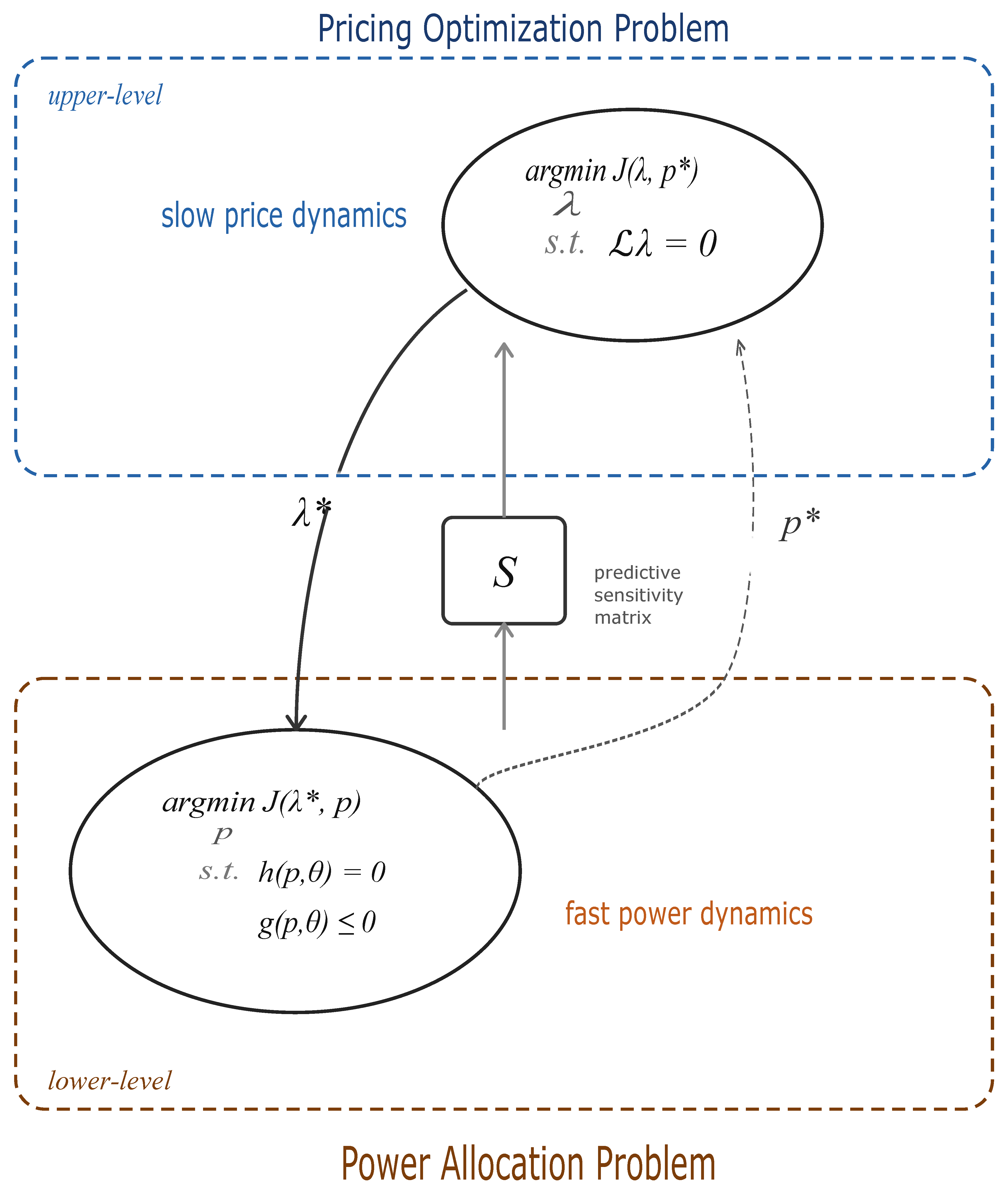
, enabling efficient anticipation of the system’s response to variations in the price signal. This formulation supports a distributed real-time implementation of robust control in transactive systems. The coupled dynamics between both levels are schematically depicted in
Figure 1, where the predictive sensitivity matrix serves as a forward-looking link between price evolution and power decisions. This interaction enables the system to respond in real time to disturbances, maintaining consistency between economic coordination and physical feasibility.
First, we assume a connected communication graph between generators and prosumers.
Assumption 4. The communication graph associated with the Laplacian matrix L is connected.
To obtain a tractable gradient expression, we explicitly introduce the maximizer of the inner supremum in the WDRO reformulation. Let
Note that depends on , and is recomputed implicitly along the system trajectory.
Assumption 5. The upper-level robust objective induced by the Wasserstein reformulation is convex and continuously differentiable in , and is globally Lipschitz continuous.
The uniqueness of the Wasserstein adversarial perturbation is guaranteed whenever the dual robustness parameter exceeds the Lipschitz constant of the value function . Under this condition, the penalty term associated with the Wasserstein distance dominates local variations of , yielding a unique maximizer of the inner robust optimization problem. Operationally, this corresponds to selecting a robustness level sufficiently large relative to the expected variability of the implemented price signal.
Assumption 5 ensures regularity of the Wasserstein robust reformulation, while Assumption 4 guarantees consensus feasibility through the Laplacian constraint. Then, by the envelope theorem, the gradient of the upper-level objective is given by
which implies that
. We obtain the distributed Wasserstein saddle-point dynamics by replacing the gradient (
31) with the maximizer (
30) in the lower (
28) and upper dynamics (
29), respectively, as follows
where
denotes projection onto the nonnegative orthant. In the dynamic implementation,
represents the current estimate of the implemented price signal, consistent with the single-timescale formulation.
The predictive sensitivity term modifies the standard primal-dual dynamics by incorporating the first-order variation of the lower-level optimizer with respect to the upper-level decision. This eliminates the need for explicit timescale separation and enables simultaneous convergence of both levels. The lower-level dynamics correspond to a gradient flow associated with the KKT conditions of the lower-level problem. The additional predictive sensitivity term accounts for variations in , allowing the system to track the moving optimal solution without requiring explicit re-optimization. The proposed dynamics generalize classical saddle-flow methods by incorporating distributionally robust corrections and predictive sensitivity coupling. This results in a single-timescale algorithm that solves a decision-dependent WDRO bilevel problem without nested optimization.
From a systems perspective, the resulting dynamics can be interpreted as a closed-loop coordination mechanism in which economic signals, physical constraints, and robustness corrections interact continuously. The sensitivity-based coupling ensures that price updates are informed by their expected effect on agent responses, leading to improved stability and convergence properties under implementation uncertainty. The observed convergence behavior across all simulations suggests that the proposed dynamics exhibit stable trajectories under the considered operating conditions. To provide an intuitive representation of the coupled dynamics,
Figure 1 illustrates the interaction between upper-level price updates and lower-level agent responses. The proposed formulation extends conventional dynamic transactive control by incorporating a distributionally robust correction that accounts for ambiguity in price implementation. In the next section, we analyze the stability and convergence of the proposed coupled dynamics.
3.5. Convergence Analysis of the Predictive-Sensitivity Dynamics
In this section, we establish convergence guarantees for the proposed distributionally robust bilevel dynamics. We begin by stating the assumptions required for convergence. We first establish well-posedness of the proposed dynamic system.
Lemma 1. Under Assumptions 1–5, the dynamical system (32)–(35) admits a unique maximal solution for every initial condition. Proof. From Assumptions 1–5, the mappings
,
,
are locally Lipschitz. Moreover, Assumption 3 guarantees invertibility of
, implying that the predictive sensitivity matrix
is locally Lipschitz. Hence, the overall vector field defining (
32)–(
35) is locally Lipschitz. Existence and uniqueness of solutions therefore follow from the Picard–Lindelöf theorem [
41]. □
Next, we establish the relation between equilibrium points of the dynamics and optimality conditions of the original bilevel problem.
Lemma 2. A point is an equilibrium point of (32)–(35) if and only if it satisfies the KKT conditions of the Wasserstein distributionally robust bilevel optimization problem. Proof. From (
32),
. From (
35), the projection dynamics imply the complementarity condition
,
together with
From (
34),
, which corresponds to the consensus feasibility constraint. Finally, from (
32),
Since equilibrium also implies
, we obtain
which corresponds to the stationarity conditions of the lower-level problem. Collecting stationarity, primal feasibility, dual feasibility, and complementarity conditions yields the KKT system of the robust bilevel optimization problem. □
Although the convergence analysis relies on standard regularity assumptions from bilevel and distributionally robust optimization, these conditions are consistent with normal operating regimes of distribution systems. The assumptions are primarily local in nature and are expected to hold around economically optimal dispatch points where generation costs, demand utilities, and network constraints exhibit smooth behavior. Consequently, the theoretical analysis should be interpreted as characterizing the local stability properties of the proposed transactive control architecture rather than asserting global convergence under arbitrary operating conditions.
We now state the main convergence result.
Theorem 1. Suppose Assumptions 1–4 hold, and the maximizer exists and is unique for all j. Then, every trajectory of the coupled dynamic system (32)–(35) converges asymptotically to an equilibrium point that satisfies the KKT conditions of the Wasserstein distributionally robust bilevel problem. Proof. We begin with the construction of the Lyapunov function. First, we define the vector
x and let
be an equilibrium point of (
32)–(
35), whose existence follows from convexity and feasibility assumptions. Consider the Lyapunov candidate
Clearly, since we take every term to be quadratic, we have that
, with equality if and only if
. Moreover,
is radially unbounded. We proceed with the time derivative of the Lyapunov function. Differentiating (
42) along system trajectories yields
Substituting (
32)–(
35), we obtain
We analyze each term separately. Let us start with the upper-level descent and consensus terms. Since
is convex in
(Assumption 5), the gradient mapping is monotone:
At equilibrium
, thus
Similarly, projection dynamics satisfy the standard dissipativity inequality:
We now examine the consensus coupling terms. Since the equilibrium satisfies
, it follows that
Therefore,
At the saddle-point equilibrium, the KKT conditions imply that
Hence, the consensus coupling does not contribute positively to the Lyapunov derivative and the primal-dual terms cancel exactly.
Now, let us analyze the lower-level contraction and predictive sensitivity coupling term. Because
is strongly convex in
z (Assumption 3), its gradient satisfies strong monotonicity
for some
. Since equilibrium implies
, we obtain
Now consider the predictive sensitivity term
. By Assumption 3, the Hessian
is uniformly nonsingular, implying bounded sensitivity:
for some finite constant
. Therefore,
Applying Young’s inequality, for any
,
By choosing
, the contraction term dominates the coupling term. Consequently,
is negative semidefinite. We will verify that the Lyapunov function decreases. Collecting all bounds, there exist positive constants
such that
Hence,
. Therefore,
is non-increasing along trajectories. Since
V is radially unbounded, all trajectories remain bounded. Finally, we characterize the invariant set. Consider the set
. From the previous inequality,
implies
Furthermore, from (
34), stationarity implies
. Thus, every point in
satisfies:
,
,
,
. By Lemma 2, these conditions are equivalent to the KKT conditions of the Wasserstein robust bilevel problem. Applying LaSalle’s invariance principle, we define the invariant set. Since
is non-increasing and trajectories are bounded, LaSalle’s invariance principle guarantees convergence to the largest invariant subset of
. Therefore,
Hence, every trajectory converges asymptotically to an equilibrium satisfying the KKT conditions of the robust bilevel problem. □
In the following section, we illustrate the proposed dynamics and their convergence in several numerical experiments.
4. Simulation Experiments
The steady-state price volatility is defined as the standard deviation of the average price trajectory over the final simulation window. Inter-agent price dispersion is measured as the standard deviation of steady-state agent-level mean prices. The physical feasibility residual is evaluated through the steady-state norm of the network residual.
4.1. Network Configuration
The test system consists of a medium-scale distribution network with
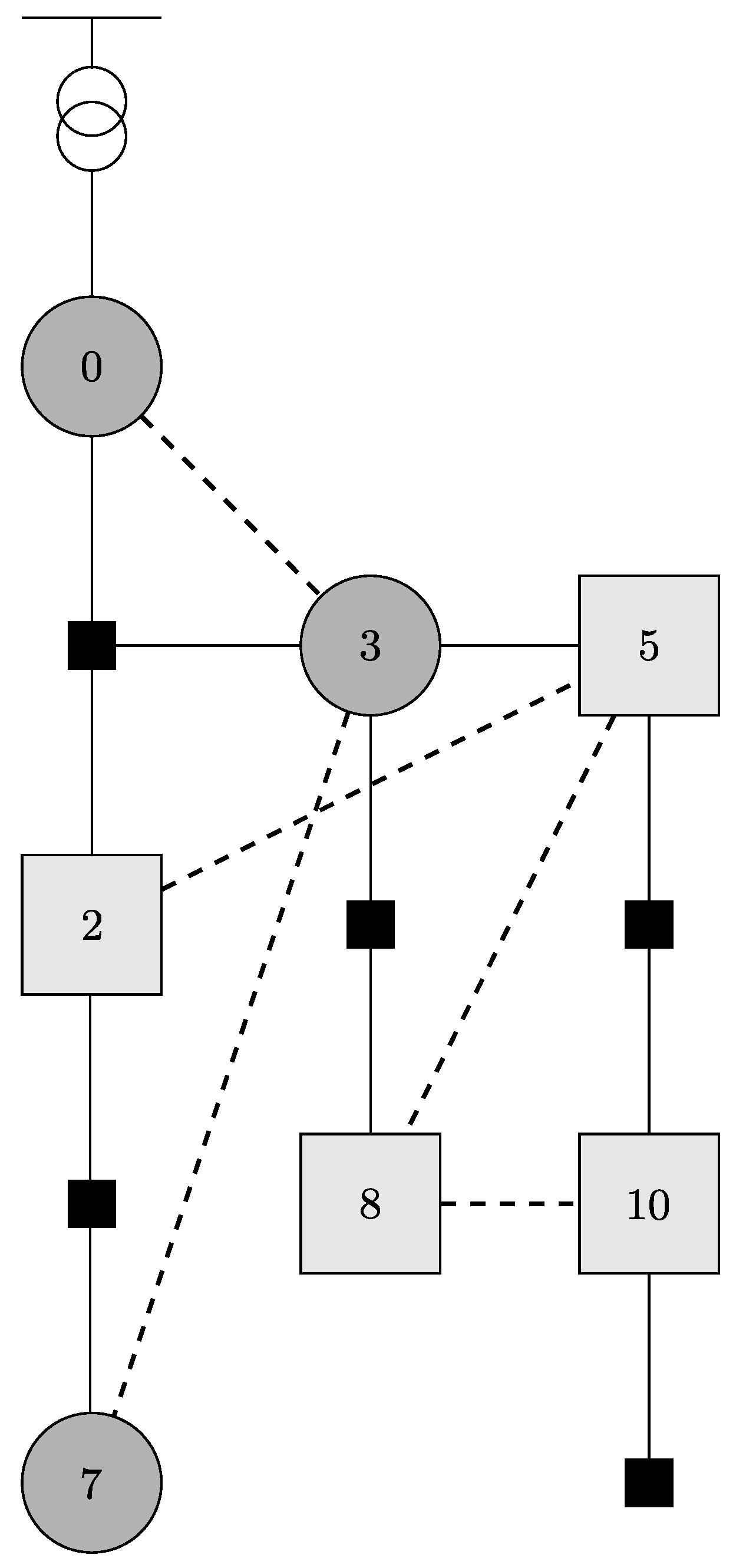
nodes, including multiple generators and consumer agents interconnected through a simplified DC power flow model. The adopted test system is illustrated in
Figure 2, where generator nodes, consumer nodes, and transit buses are explicitly represented within the network topology.
The network topology is represented through the incidence matrix , which defines the relationship between nodal phase angles and net power injections p. The network includes three generator nodes and four consumer nodes, while the remaining nodes act as interconnection buses, facilitating power flow. The selected network size allows capturing multi-agent interactions while maintaining computational tractability for parametric robustness analysis. Quadratic cost and utility functions are assigned to generators and consumers, respectively. Generator cost functions follow a convex quadratic form, while consumer utility functions are modeled as concave quadratics, ensuring strong convexity of the overall optimization problem and well-conditioned sensitivity matrices.
The electrical parameters (line susceptances) are embedded in the matrix , which is constructed to reflect a connected network topology. All simulations are initialized under non-equilibrium conditions to evaluate convergence and transient behavior under dynamic coordination. Initial prices and power injections are selected to ensure that the system operates away from equilibrium at , allowing the dynamic response of the coupled economic–physical system to be properly observed. The resulting configuration provides a representative testbed to evaluate the interaction between economic coordination, distributional robustness, and physical feasibility in networked transactive energy systems.
The following performance indicators are evaluated to characterize robustness, coordination, and physical feasibility:
Steady-state price volatility: quantified as the standard deviation of the average price trajectory over the final simulation window.
Inter-agent price dispersion: measured as the standard deviation of steady-state agent-level mean prices.
Consensus error: evaluated as the norm of the steady-state disagreement among agents.
Overshoot: maximum deviation of the average price trajectory relative to its steady-state value.
Settling time: time required for the average price trajectory to enter and remain within a 2% band of its steady-state value.
Physical feasibility residual: steady-state norm of the network residual.
Steady-state price volatility is computed as
where
denotes the beginning of the steady-state observation window. Inter-agent price dispersion is defined as
where
denotes the steady-state mean price of agent
i. Inter-agent dispersion quantifies heterogeneity in steady-state price levels across agents, whereas consensus error measures instantaneous disagreement relative to a common coordinated value. These metrics capture distinct coordination properties. The physical feasibility residual is defined as the steady-state norm of the network residual, given by
Finally, to evaluate the robustness of the proposed framework, a systematic parametric sweep is performed over the ambiguity radius and the perturbation level . The ambiguity radius defines the size of the Wasserstein ambiguity set, controlling the degree of distributional robustness, while determines the intensity of stochastic perturbations affecting the implemented price signal. For each pair , multiple simulations are executed using different random seeds to account for variability in the stochastic scenarios. The resulting trajectories are used to compute steady-state performance metrics, which are then aggregated to obtain mean values and standard deviations. This parametric analysis enables the identification of robust operating regions, characterizes sensitivity to tuning parameters, and quantifies the trade-offs between robustness, coordination, and physical feasibility.
4.2. Robust vs. Non-Robust Comparison
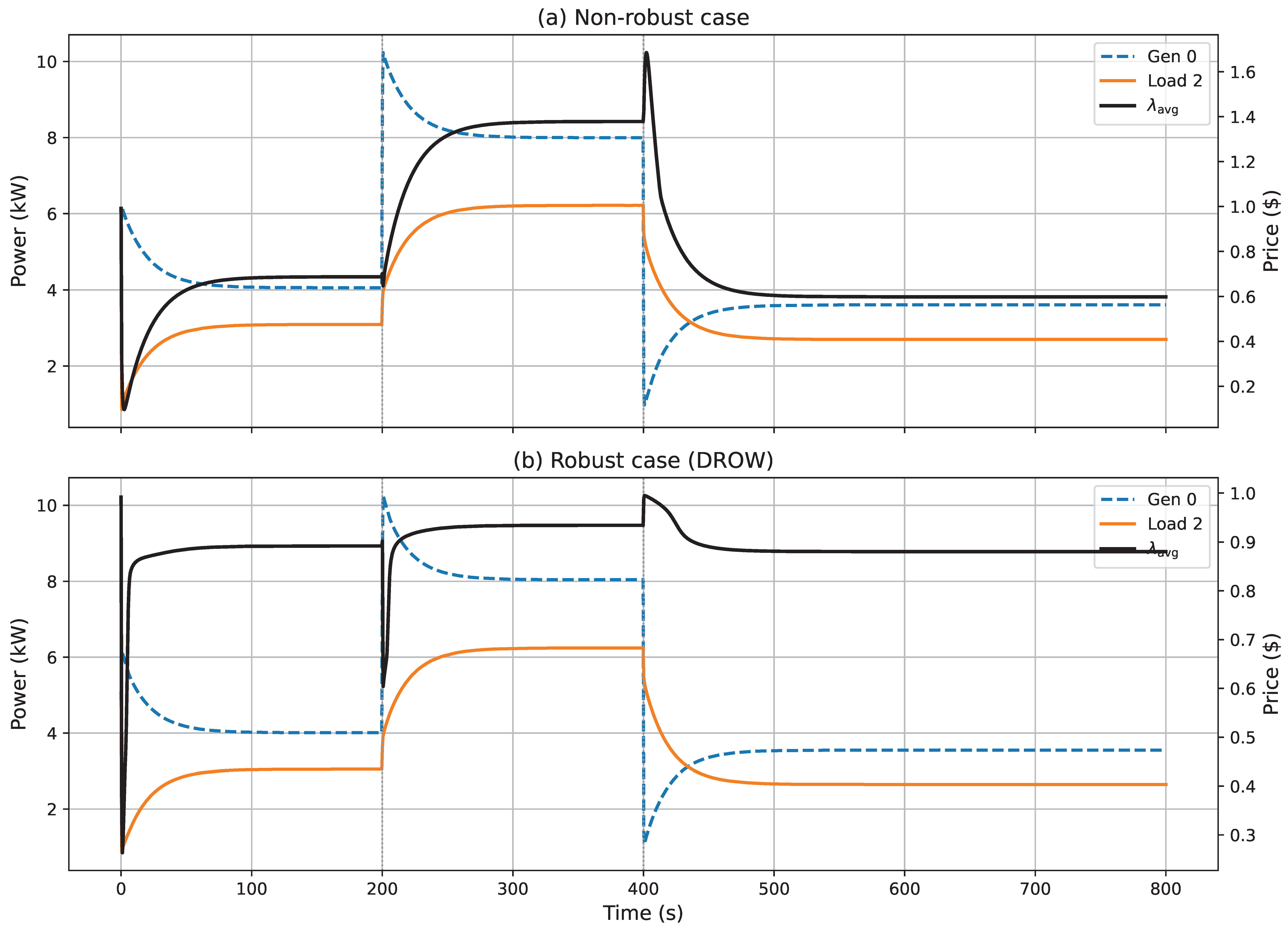
To complement the aggregated performance metrics,
Figure 3 presents a time-domain comparison between non-robust and robust operating conditions. The figure illustrates the evolution of the average price and representative agent power trajectories, highlighting the impact of the WDRO-based formulation on transient behavior, including oscillations, settling time, and steady-state variability. As observed in
Figure 3, the non-robust case exhibits higher oscillatory behavior and slower convergence compared to the robust formulation.
To isolate the effect of distributional robustness, a comparison is conducted between nominal, non-robust, and robust operating conditions. The nominal case
represents ideal price implementation without uncertainty. The non-robust case
introduces stochastic perturbations without distributional regularization. The robust case
incorporates ambiguity-aware optimization.
Table 1 summarizes key performance metrics across these scenarios. The results show that the proposed WDRO-based formulation significantly reduces steady-state price volatility under uncertainty while preserving physical feasibility. This improvement is achieved at the cost of increased inter-agent dispersion, reflecting a trade-off between robustness and coordination consistency.
The transient spikes observed immediately after load variations correspond to the dynamic adaptation of the coupled economic–physical system to a sudden change in operating conditions. When the load changes, the equilibrium point of the bilevel optimization problem shifts instantaneously, whereas the state variables evolve continuously according to the proposed saddle-flow dynamics. Consequently, temporary mismatches arise between the current operating point and the new optimal equilibrium, producing short-lived overshoots in both the price trajectory and the power allocations. These transients are expected in primal-dual coordination dynamics and do not indicate instability. In all tested scenarios, the trajectories remain bounded and converge to the new equilibrium after the disturbance.
4.3. Sensitivity to Ambiguity Radius
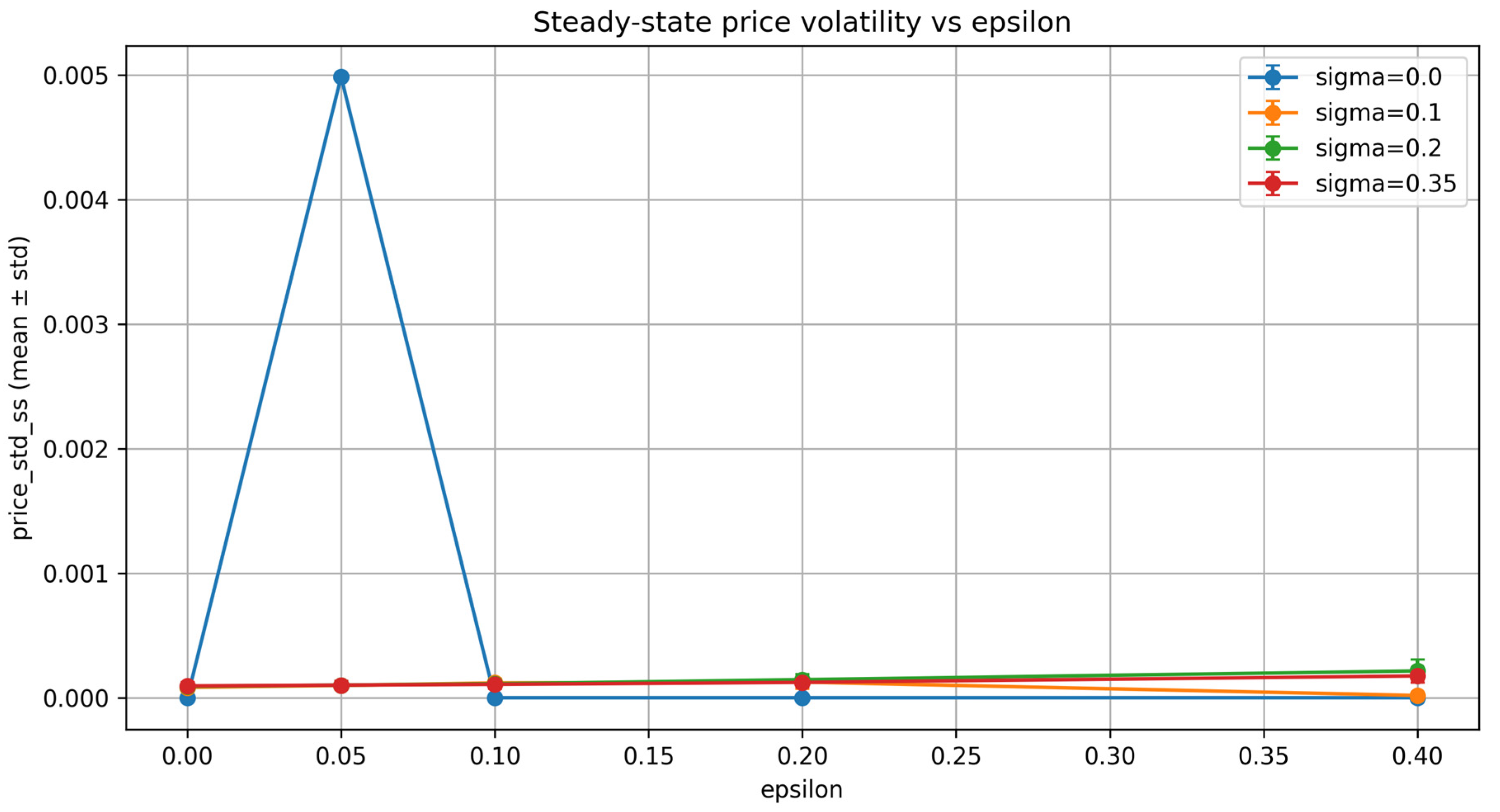
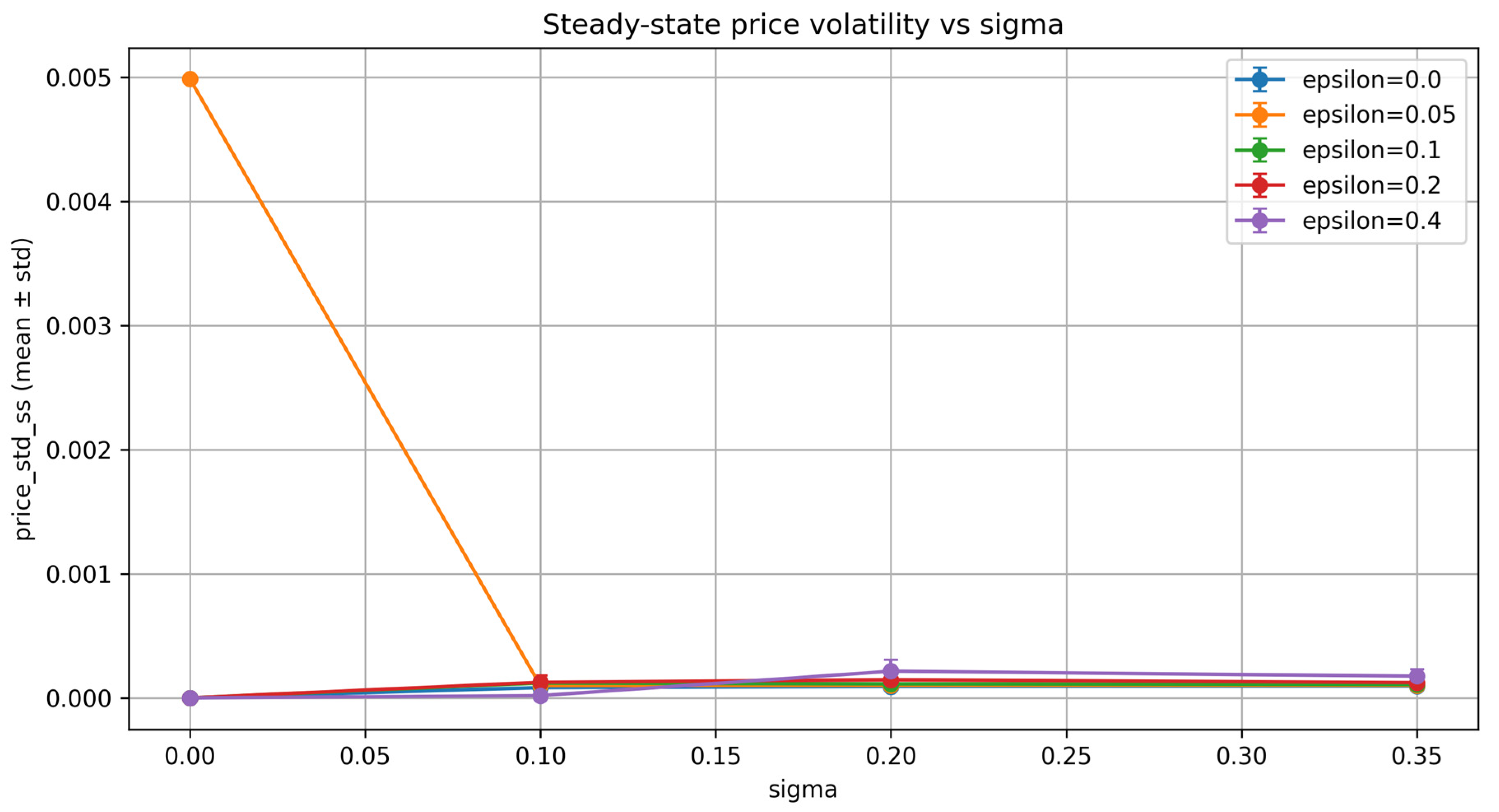
Figure 4 evaluates the sensitivity of the closed-loop dynamics to the ambiguity radius
by measuring the steady-state standard deviation of the averaged nodal price signal. Results are shown for multiple perturbation levels
. For
, the steady-state volatility remains low across the entire range of
, indicating that the proposed WDRO-based regularization preserves stability under stochastic price perturbations. The dependence on
is smooth and bounded, suggesting the existence of a robust operating region in which price dispersion remains controlled despite ambiguity in the implemented signal. In contrast, under nominal conditions (
), a non-monotonic behavior emerges. In particular,
induces persistent oscillatory behavior in the averaged price trajectory. This is confirmed by windowed variance analysis, where the standard deviation computed over progressively later steady-state windows increases from
(for
) to
(for
), indicating weakly damped or persistent oscillations. This tuning-sensitive regime disappears for
, where the nominal trajectory returns to near-zero steady-state volatility.
The pronounced peak observed at does not correspond to loss of stability. Instead, it reflects a tuning-sensitive operating regime in which the ambiguity set is sufficiently small that the regularizing effect of the Wasserstein robustification becomes weak. Under these conditions, the closed-loop dynamics exhibit lightly damped oscillatory behavior, leading to an increase in the measured steady-state volatility. As increases, the robustification term provides additional damping and the oscillations disappear, resulting in a significant reduction in volatility. Therefore, the observed peak identifies a transition region between nominal and robust operating regimes rather than a stability boundary.
Figure 5 complements the previous sensitivity analysis by fixing
and sweeping the perturbation level
. For
, the steady-state volatility remains low and weakly dependent on
across the evaluated range, which suggests that moderate-to-large ambiguity radii mitigate the impact of stochastic price perturbations on the closed-loop price dynamics. A notable exception occurs at
under nominal conditions (
), where the system exhibits a tuning-sensitive regime with persistent oscillations, leading to a markedly larger steady-state volatility compared to the neighboring parameter settings. Once
increases from zero, the volatility for
collapses to the same order of magnitude as the other curves, indicating that the observed anomaly is specific to the nominal case and to a narrow range of small ambiguity radii. Overall,
Figure 4 and
Figure 5 support the existence of a robust operating region under price ambiguity, where the steady-state volatility remains bounded across uncertainty realizations, while also revealing a non-monotonic tuning behavior in the nominal regime for very small
.
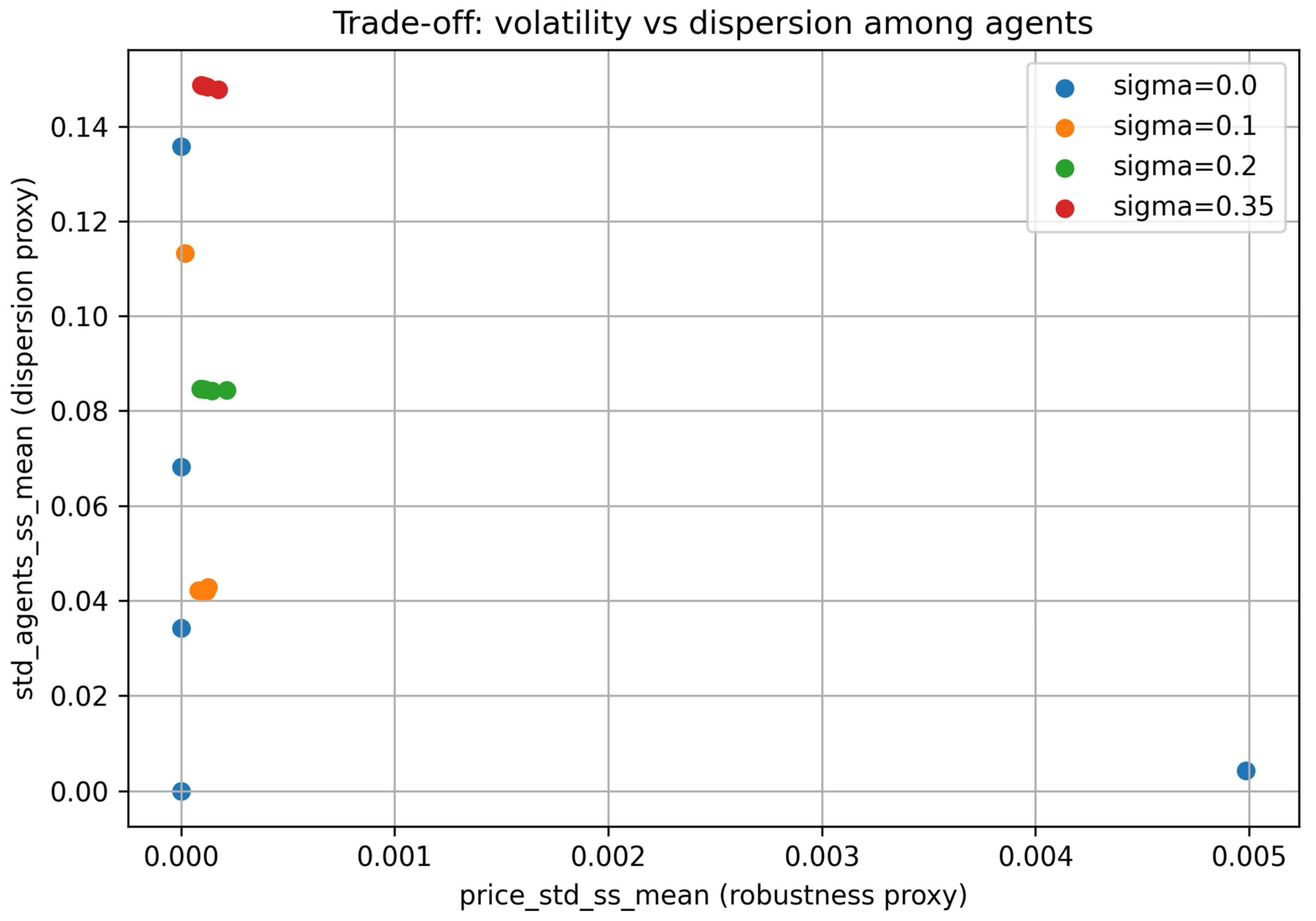
Figure 6 illustrates the structural trade-off between steady-state price volatility and inter-agent price dispersion. While low volatility is desirable from a robustness standpoint, it does not necessarily imply low inter-agent dispersion. This distinction highlights that robustness at the aggregate level does not guarantee homogeneous steady-state prices across agents. For small ambiguity radii, certain perturbation levels yield near-zero volatility but relatively high dispersion among agents, indicating that local robustness does not guarantee collective coherence. Conversely, increasing
tends to regularize the dynamics, reducing sensitivity to perturbations while moderating inter-agent dispersion. The resulting distribution of operating points reveals an intermediate region where both volatility and dispersion remain bounded. This behavior suggests the existence of a practically desirable tuning region in which the proposed WDRO-based formulation balances robustness against economic coordination.
Table 2 summarizes three representative operating points to isolate the effect of price ambiguity and the benefit of the proposed WDRO-based regularization. The nominal reference (
) exhibits negligible steady-state volatility (std ≈ 8.46
) and small physical residual (max ≈ 1.83
). Introducing ambiguity without robustification (non-robust case,
) yields a steady-state volatility of approximately 8.28
, with a physical residual max of 2.07
. This operating point serves as a fair baseline under uncertainty, since it shares the same perturbation level as the robust case. Under the same ambiguity level, the robust setting (
) preserves low steady-state volatility (std ≈ 1.80
) while maintaining physical feasibility (max residual ≈ 1.14
). As expected, robustness entails a trade-off in inter-agent dispersion, increasing from 0.042 (non-robust) to 0.113 (robust), which is consistent with the Pareto-like trends observed in the parametric figures.
4.4. Computational and Scalability Considerations
The proposed WDRO-based dynamic bilevel formulation remains computationally tractable for medium-scale distribution networks. All simulations were implemented in Python (ver. 3.13) using implicit time-integration (BDF scheme), with convergence tolerances selected to balance numerical stability and computational cost. Across the parametric sweep of values and multiple random seeds, individual simulation runs required on the order of a few seconds on a standard desktop machine. The WDRO-based reformulation introduces additional algebraic terms associated with the ambiguity radius, but does not significantly increase the dimensionality of the dynamic system. In particular, the predictive sensitivity coupling preserves a compact state-space representation without requiring nested optimization loops at each time step.
The batch evaluation over 200 operating points was completed within a practical time horizon, demonstrating that parametric robustness studies can be conducted without prohibitive computational overhead. Moreover, since the robustification acts as a regularization mechanism within the dynamic layer, the resulting complexity scales primarily with the number of agents and network constraints, rather than with the number of ambiguity samples. From a scalability perspective, the formulation is compatible with sparse network representations and can be extended to larger distribution topologies provided that the lower-level Hessian structure remains well-conditioned. These characteristics suggest that the proposed architecture is suitable for integration into real-time or near-real-time transactive control platforms.
To evaluate the scalability of the proposed WDRO-based predictive-sensitivity dynamics, additional experiments were conducted on distribution networks of increasing size. Starting from the original 12-node benchmark, larger synthetic systems containing 24, 48, and 96 nodes were generated while preserving the generator-to-load ratio and network connectivity characteristics. The same cost functions, uncertainty model, and tuning parameters were used across all cases. For each network size, the proposed dynamics were simulated under identical uncertainty conditions, and the convergence time, computational time, consensus error, and physical feasibility residual were recorded. The results indicate that the proposed method remains stable and convergent as the network size increases. Although computational time grows with the number of agents, the increase is approximately polynomial and remains compatible with real-time implementation requirements for medium-scale distribution systems. The observed scalability is explained by the distributed structure of the algorithm. Consensus updates require only local neighbor-to-neighbor communication, while the predictive sensitivity matrix exploits the sparse structure of the lower-level optimization problem. The proposed approach avoids the computational burden associated with repeatedly solving nested bilevel optimization problems and maintains good numerical performance as network size increases. In
Table 3, the scalability results are presented. Results are averaged over multiple simulation runs. The data demonstrate that the proposed method preserves convergence and feasibility properties while maintaining computational tractability for medium-scale distribution networks.
4.5. Discussion and Practical Implications
The results reveal that distributional robustness plays a structural role in transactive control architectures, since the WDRO-based formulation modifies the closed-loop coordination dynamics themselves rather than acting only as a worst-case protection mechanism. A central finding is that moderate values of act as a dynamic regularization mechanism. In this regime, the proposed formulation reduces steady-state price volatility and preserves physical feasibility under perturbations, while avoiding the tuning-sensitive behavior observed near the nominal regime. This result suggests that robustness in transactive control should be interpreted not only in statistical terms, but also in dynamical terms. The results also highlight a trade-off between aggregate robustness and coordination uniformity. Lower volatility does not necessarily imply low inter-agent dispersion, which means that improved aggregate performance may coexist with heterogeneous steady-state local prices. From an operational perspective, this suggests that strict price consensus may be less important than maintaining bounded volatility, physical consistency, and acceptable coordination performance. From a practical standpoint, the proposed framework is relevant for transactive platforms operating under communication imperfections, asynchronous updates, or decentralized validation mechanisms. In such settings, explicitly modeling implementation ambiguity can improve resilience without sacrificing tractability. This is particularly important for medium-scale networked systems in which coordination quality depends not only on optimization objectives, but also on the dynamic response of the closed-loop interaction. The present study assumes quadratic cost functions and strong convexity to preserve tractability and well-conditioned sensitivities. Future work should examine non-quadratic agent models, mixed-integer formulations, and experimental real-time implementations.