Article

Effects of Square Step Exercise on Muscle Function and Cognitive Function in Pre-Frail Older Women

1
Department of Sports Medicine, Dongshin University, Dongshindae-gil, Naju 58245, Republic of Korea
2
College of General Education, Kookmin University, Jeongneung-ro, Seongbuk-gu, Seoul 02707, Republic of Korea
3
Waseda Institute for Sport Sciences, Waseda University, Saitama 341-0018, Japan
*
Authors to whom correspondence should be addressed.
Appl. Sci. 2026, 16(13), 6670; https://doi.org/10.3390/app16136670
Submission received: 6 June 2026 / Revised: 19 June 2026 / Accepted: 26 June 2026 / Published: 3 July 2026

Abstract

This study investigated the effects of an 8-week Square-Stepping Exercise (SSE) program on lower-extremity muscle function and cognitive function in pre-frail older women. Sixty pre-frail older women aged 65 years and older were assigned to either an exercise group (n = 30) or a control group (n = 30). The SSE program was performed twice weekly for 60 min over 8 weeks. Functional mobility was assessed using the Time Up and Go (TUG) test, balance using the Berg Balance Scale (BBS), lower-extremity muscle strength using the 30 s Chair Stand Test, and cognitive function using the Mini-Mental State Examination (MMSE). Measurements were obtained at baseline, week 4, and week 8. Significant group × time interactions were observed for TUG (p < 0.001), lower-extremity muscle strength (p < 0.05), and MMSE (p < 0.001). The exercise group showed significant improvements in TUG, BBS, muscle strength, and MMSE values, whereas the control group showed no significant changes except for a slight change in TUG. TUG was significantly correlated with balance, muscle strength, and cognitive function. These findings suggest that an 8-week SSE program may improve selected physical function measures and global cognitive status, as assessed by the MMSE, in pre-frail older women.

1. Introduction

As China’s population continues to age at an accelerating pace, the country was classed as possessing an aging society in 2022. According to statistics, the proportion of the population aged 65 and older in China reached 12.6% in 2019, the elderly population increased to 248 million in 2020, and it is projected to reach 300 million by 2025, marking China’s transition into a super-aged society [1]. Consequently, the accelerated pace of aging has made the decline in physical and cognitive function among the elderly a significant public health issue. From a physiological perspective, aging leads to the deterioration of physical functions, resulting in a decline in balance, reduced muscle strength, lack of muscular endurance, and decreased bone density. From this perspective, one of the most common problems arising from the weakening of physical function in the elderly is falls. In China, as the population ages, falls have become a leading cause of injury-related deaths among older adults aged 65 and older [2]. Between 12% and 42% of older adults who experience a fall sustain injuries, which primarily include soft tissue injuries, joint dislocations, fractures, and head injuries. It is reported that 50% of older adults who have experienced a fall are at high risk of re-injury.
Frailty is defined as a clinically identifiable state of vulnerability that may reflect the heterogeneity of health status among older adults [3,4]. It is primarily used to describe chronic health problems in older adults aged 65 and older, specifically referring to a clinical syndrome resulting from increased individual vulnerability and a reduced ability to maintain homeostatic balance. This syndrome increases the risk of falls, cognitive impairment, hospitalization, disability, and death, and can lead to a decline in quality of life, limitations in activities of daily living, and economic and healthcare burdens on the patient’s family and society [5]. In particular, the pre-frail stage is a reversible state between health and frailty; if appropriate interventions are implemented during this period, the progression to functional decline and frailty can be effectively prevented [6]. According to previous studies, older adults in the pre-frail stage are at high risk of reduced lower limb muscle strength, balance, and mobility, as well as cognitive decline, which are reported to be major factors contributing to an increased risk of falls and functional dependence [5]. From a cognitive perspective, a decline in cognitive function and a gradual reduction in attention and memory are observed in older adults, which increases the likelihood of developing conditions such as senile dementia. The Chinese Geriatrics Society has recommended defining the pre-elderly as those aged 45–59 and the elderly as those aged 60 and older, based on China’s specific circumstances [7]. Therefore, sufficient attention must be paid to the health issues of the elderly. Recent evidence suggests that appropriately prescribed exercise interventions are among the most effective non-pharmacological strategies for improving frailty status and physical function in older adults. Exercise programs incorporating balance, strength, mobility, and multicomponent training have been shown to attenuate frailty progression and improve functional capacity in older populations, supporting exercise as a key intervention during the pre-frail stage when functional decline remains potentially reversible [8]. Furthermore, growing evidence indicates that exercise interventions may also benefit cognitive health across different levels of cognitive impairment, potentially through improvements in executive function, attention, and neuroplasticity-related mechanisms [9]. These findings support the use of exercise interventions that simultaneously target physical and cognitive domains in vulnerable older populations.
In contrast, square-stepping exercise (SSE) involves moving the feet in various directions and sequences on a fixed grid pattern. As a form of complex exercise that simultaneously stimulates not only lower-body muscle function and balance but also cognitive functions such as attention and memory [10], it is considered suitable for older adults because it is relatively easy to adapt to. A review of previous studies indicates that SSE is effective in preventing falls and improving balance in older adults; however, there are limited studies that have simultaneously examined muscle function and cognitive function in pre-frail older women.
Therefore, this study aimed to investigate the effects of the square step exercise on muscle and cognitive function in pre-frail older women and to examine the relationships between lower limb muscle function (TUG, BBS, and lower-extremity muscle strength) and cognitive function (MMSE). The findings may provide a scientific basis for developing intervention programs to prevent or delay declines in both physical and cognitive function in this population.

2. Methods

2.1. Participation

The data used in this study were obtained from anonymized records provided by Nursing Home in Beijing, China, involving older women who had participated in a nursing-home-based exercise program. A total of 60 women aged 65 years or older who were classified as pre-frail according to the Fried Frailty Scale were included in the dataset (exercise group, n = 30; control group, n = 30). Participants were assigned to either the exercise group or the control group according to nursing home program procedures.
Prior to being provided to the researchers, all personal identifiers were removed by the nursing home, and de-identified linkage codes were used in place of identifiable information. Consequently, the researchers had no access to personal identifiable information at any stage of the study. Because this study involved a secondary analysis of de-identified data, informed consent for the use of personal information was not applicable. Approval for the use of de-identified nursing home records was obtained from the administration of Nursing Home A prior to data access. All study procedures were conducted in accordance with the ethical principles of the Declaration of Helsinki.
Table 1 lists the physical characteristics of participants.

2.2. Procedures

After signing the informed consent form, the study participants underwent body composition measurements to assess their physical characteristics. The selected participants were divided into odd and even groups based on their order of participation and randomly assigned to the experimental group (30 participants) and the control group (30 participants), respectively. Subsequently, a pre-test cognitive function assessment was conducted, followed by measurements of lower limb muscle strength and balance ability. The square step program, which focuses on strengthening lower-body muscle strength, balance, and walking ability in older adults, was conducted twice a week for 60 min per session over an 8-week period. Following the completion of sessions in weeks 4 and 8, mid-term and post-test assessments of cognitive function, lower-body muscle function, and balance ability were conducted in both groups, using the same procedures as the pre-test.

2.3. Body Composition

Height and weight were measured using an automatic height and weight measuring device (GL-150P, G-Tech, Uijeongbu, Republic of Korea). To calculate body mass index (BMI), participants’ height (cm) and weight (kg) were measured while they were wearing a T-shirt and shorts, and BMI was then calculated using the formula weight (kg)/height2 (m2). In addition, to minimize measurement errors, participants were instructed to refrain from eating, drinking, and engaging in vigorous physical activity for two hours prior to the measurement.

2.4. The Frail Scale

The Frail Scale is a self-reporting screening tool proposed by the International Association of Nutrition, Health, and Aging (IANA) in 2008 [11] and later applied and validated in older Chinese adults [12]. The specific items of the scale are as follows. (1) Have you felt tired most of the time during the past month? (2) Have you lost more than 5% of your body weight within the past year? (3) Are you unable to climb or descend 10 steps (approximately one flight of stairs) independently? (4) Do you have difficulty walking 100 m independently? (5) Do you have five or more chronic conditions (e.g., hypertension, diabetes, malignant tumors, heart failure, asthma, arthritis, chronic obstructive pulmonary disease, kidney disease, angina, etc.)? [13].
A score of 1 is assigned for each “Yes” answer, with a total score ranging from 0 to 5. A score of 0 indicates normal health, 1–2 indicates pre-frailty, and 3 or higher indicates frailty [11].

2.5. Time Up and Go (TUG)

The TUG test was administered to assess functional mobility. Participants began the test while seated, with their backs against a chair with a backrest (approximately 46 cm high) and armrests (approximately 65 cm high), wearing flat-soled shoes. Upon hearing the signal “Go”, the subject stood up without using the armrests, walked at a normal pace to a marker 3 m ahead, turned around, and walked back to the chair to sit down. The test ended the moment the subject’s back touched the chair’s backrest, and the time taken was recorded using a stopwatch. Each subject performed one practice trial followed by three official measurements, and dynamic balance ability was assessed based on the time taken (in seconds) [14].

2.6. Berg Balance Scale (BBS)

The BBS test was administered to assess balance and walking ability [15]. This scale consists of a total of 14 items related to activities of daily living, including (1) rising from a seated position, (2) standing independently, (3) sitting down independently, (4) sitting down from a standing position, (5) moving from a bed to a chair, (6) standing with eyes closed, (7) standing with feet together, (8) reaching forward with arms while standing, (9) picking up an object while standing, (10) turning around, (11) turning 360 degrees, (12) stepping up and down on a step with alternating feet, (13) standing facing forward and backward, (14) standing on one leg, etc. Each item was scored on a scale of 0 to 4 points. The total score is 56 points; a score of 0–20 indicates poor balance function, suggesting the patient requires a wheelchair, while a score of 21–40 indicates that the patient has a certain level of balance ability and can walk with assistance. A score of 41–56 indicates excellent balance function, meaning the patient is capable of walking independently. A BBS score below 45 suggests a risk of falling.

2.7. Lower Limb Muscle Strength

The 30 s chair stand test was administered to assess lower limb muscle strength. A metal chair without armrests was used; the chair measured 42 × 41 cm2 and was 44 cm high. Participants repeatedly stood up and sat down with their hands crossed over their chest for 30 s, and only repetitions in which they stood completely upright before sitting back down were counted as valid. The number of repetitions was used as an indicator of lower limb muscle strength; a higher number of repetitions indicates greater lower limb muscle strength [16].

2.8. Cognitive Function

Cognitive ability was measured using the Mini-Mental State Examination (MMSE) developed by Folstein [17]. This scale consists of a total of 19 items and assesses temporal orientation, spatial orientation, immediate memory, attention and calculation skills, short-term memory, object naming, verbal repetition, reading comprehension, verbal comprehension, verbal expression, and figure drawing. Considering the educational level of the elderly, some items were applied in a modified format according to Ren et al. [6]. The total score is 30 points, and a higher score indicates better cognitive function.

2.9. Square Step Exercise (SSE) Program

Considering that the participants were elderly, the square step exercise program was designed in two phases based on the American College of Sports Medicine’s (ACSM) Guidelines for Exercise Testing and Prescription, 11th Edition [18]. Phase 1 was conducted from weeks 1 to 4 at an exercise intensity of 9–11 on the perceived exertion scale, and Phase 2 was conducted from weeks 5 to 8 weeks at an intensity of 11–13 on the same scale. Blood pressure and pulse were checked before starting. The square step exercise was implemented to improve lower limb strength and balance. In each phase, warm-up (5–10 min) and cool-down (5–10 min) consisted of walking and stretching at an exercise intensity of 9–11 on the RPE scale. The exercise program was divided into beginner and advanced levels and performed to rhythmic music preferred by the elderly; the specific programs are shown in Table 2.

2.10. Statistical Analysis

All results were reported as the mean ± standard deviation and analyzed using SPSS version 25.0 (SPSS Inc., Chicago, IL, USA). Means and standard deviations were computed for all variables. We used an independent-samples t-test to group differences in the baseline variables. Prior to conducting parametric statistical analyses, the assumptions underlying the tests were examined. First, the normality of the data distribution was assessed using the Shapiro–Wilk test. Second, homogeneity of variances between groups was evaluated using Levene’s test. Third, for the repeated-measures factor included in the two-way mixed ANOVA, the assumption of sphericity was assessed using Mauchly’s test. When the assumption of sphericity was violated, the Greenhouse–Geisser correction was applied. A two-way ANOVA was conducted to test for group and measurement time effects on lower limb muscle function and cognitive function (Mini-Mental State Examination), and the Bonferroni method was applied for post hoc comparisons. The relationships among TUG, BBS, lower limb muscle strength, and MMSE scores were examined using Pearson correlation coefficients based on post-intervention data collected after completion of the 8-week exercise program. The statistical significance level for all analyses in this study was set at α = 0.05.

3. Results

3.1. Changes in the TUG Score After 8 Weeks

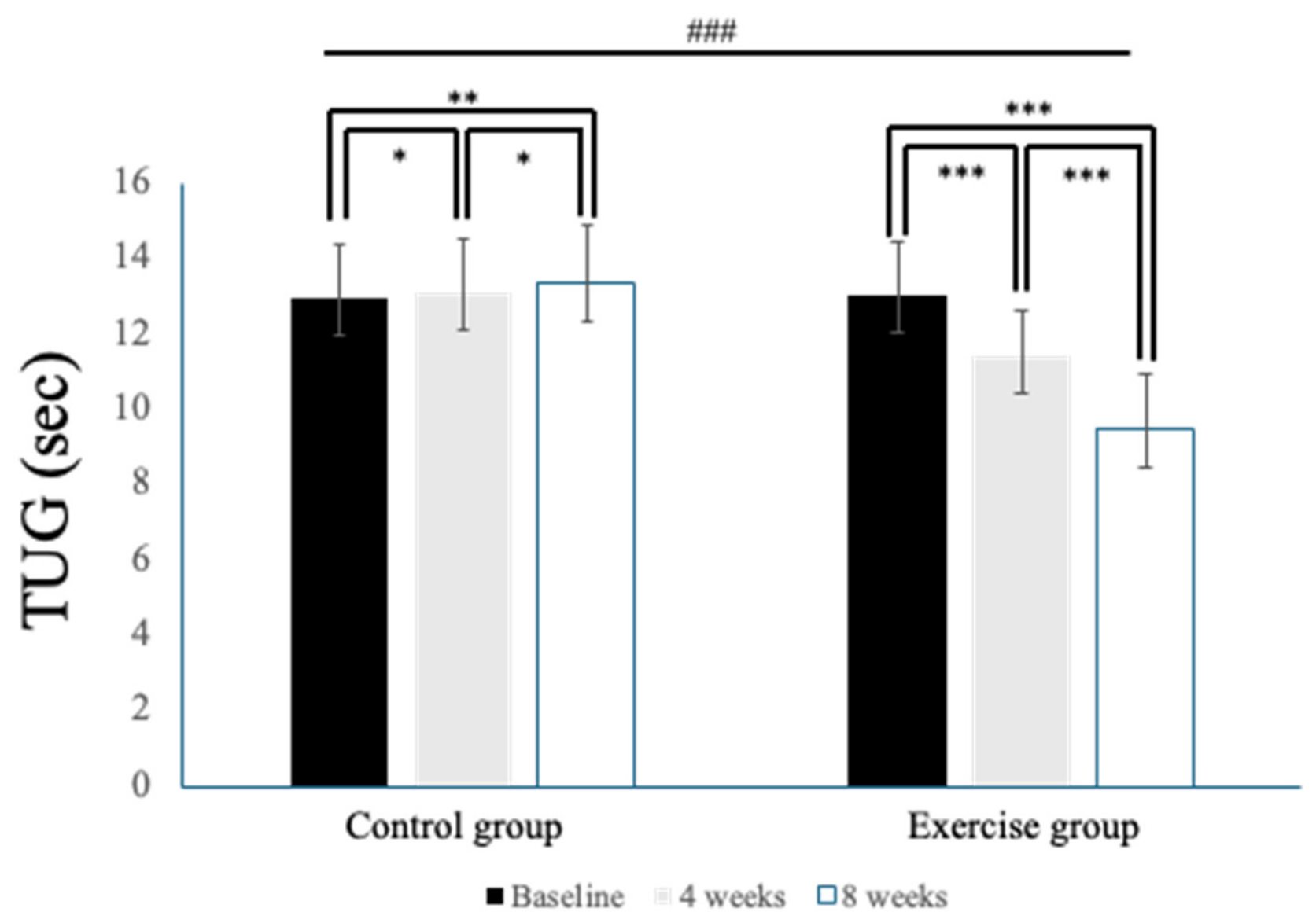
In the TUG test, the group × time interaction effect was found to be significant (p < 0.001). In the experimental group, scores decreased significantly at baseline, between weeks 4 (p < 0.001) and 8 (p < 0.001), and between week 4 and week 8 (p < 0.001), while the control group showed a significant increase at baseline, between weeks 4 (p < 0.05) and 8 (p < 0.01), and between week 4 and week 8 (p < 0.05) (Figure 1).

3.2. Changes in the BBS Score After 8 Weeks

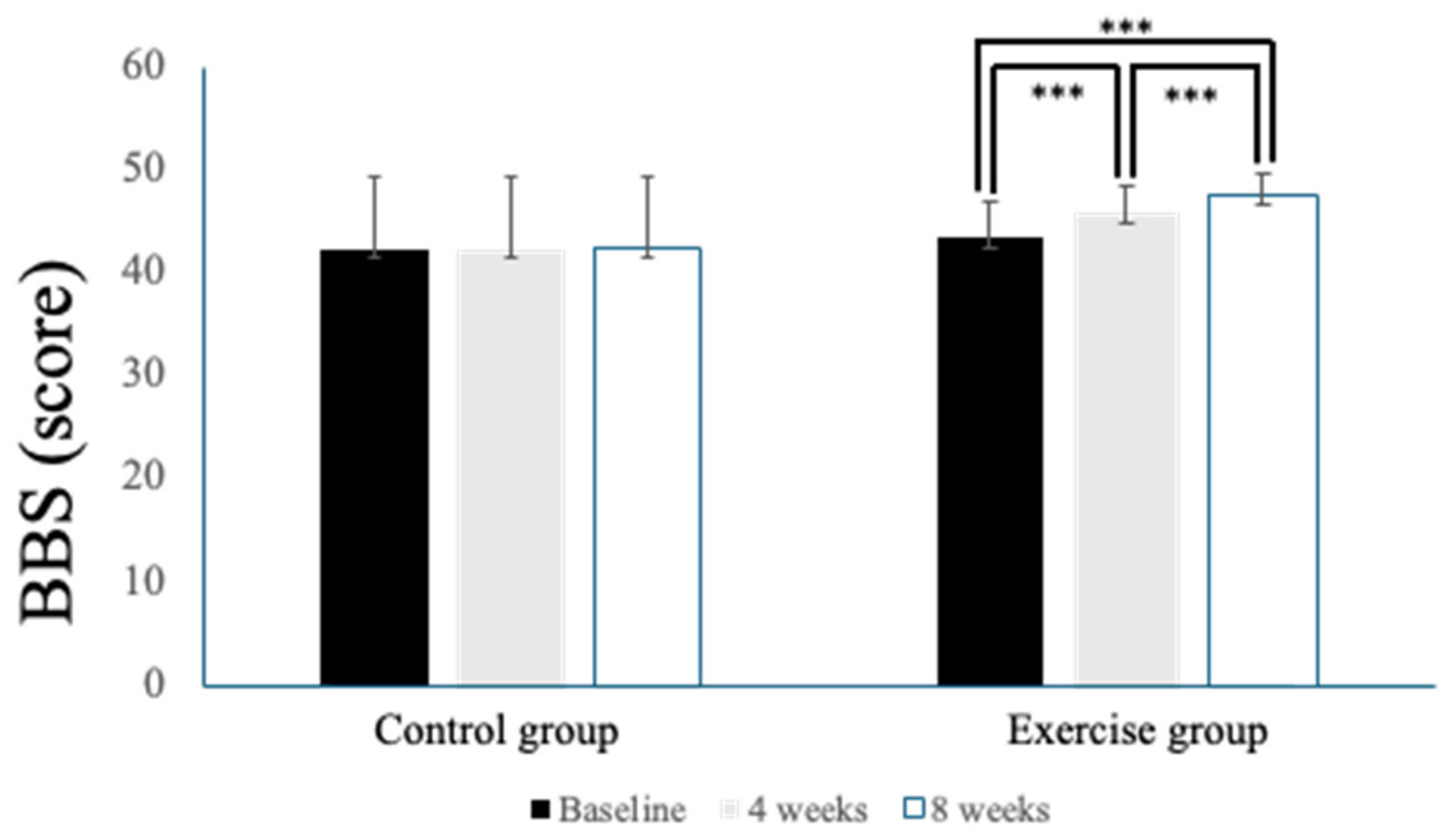
There was no group × time interaction effect observed in the Berg Balance Scale values. In the experimental group, scores increased significantly at baseline, between weeks 4 (p < 0.001) and 8 (p < 0.001), and between week 4 and week 8 (p < 0.001), whereas no changes were observed in the control group (Figure 2).

3.3. Changes in Lower Limb Muscle Strength After 8 Weeks

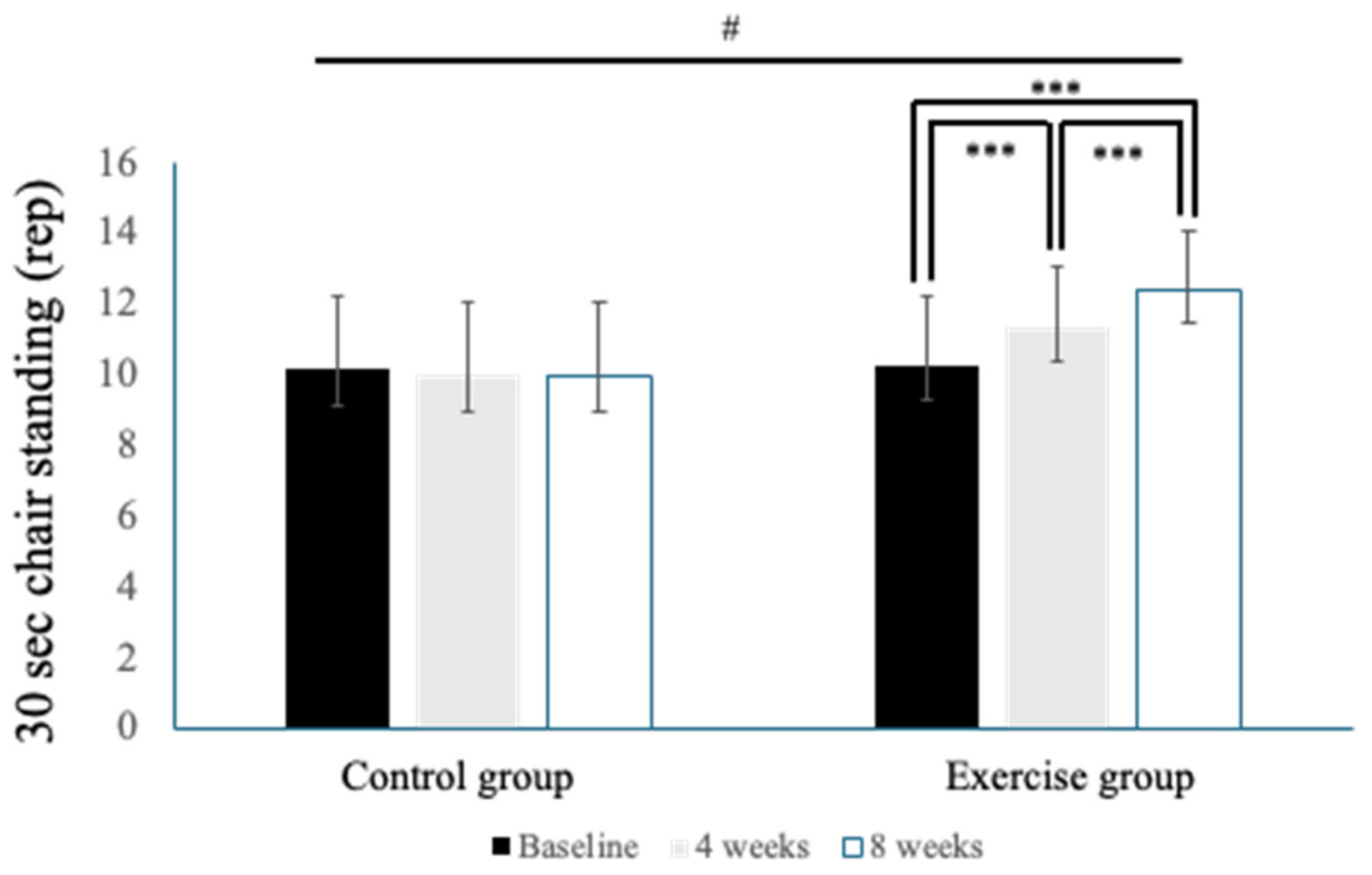
In the lower limb muscle strength test, the group × time interaction effect was found to be significant (p < 0.05). In the experimental group, scores increased significantly at baseline, between weeks 4 (p < 0.001) and 8 (p < 0.001), and between week 4 and week 8 (p < 0.001), whereas no changes were observed in the control group (Figure 3).

3.4. Changes in the MMSE Score After 8 Weeks

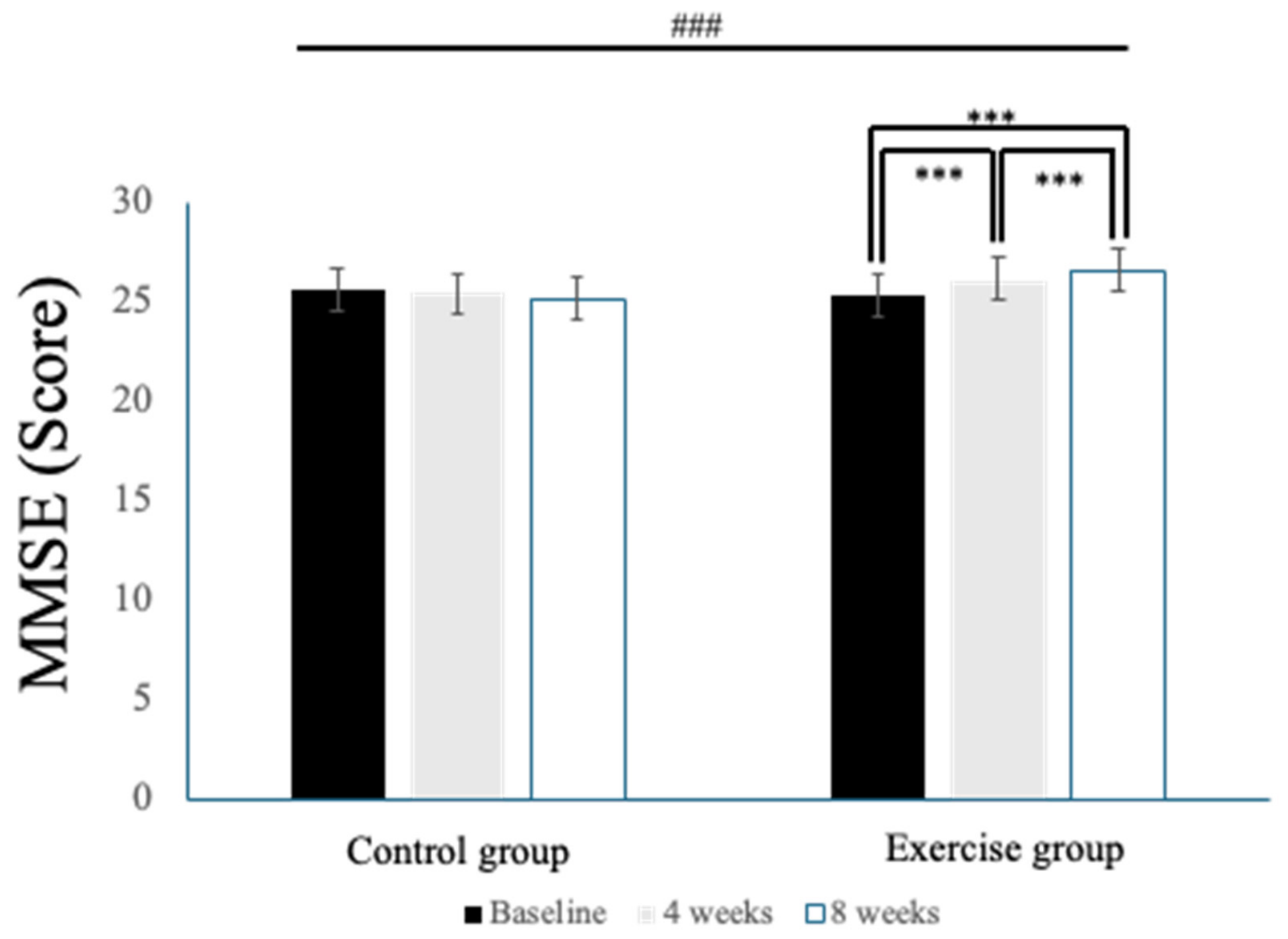
In the MMSE test, the group × time interaction effect was found to be significant (p < 0.001). In the experimental group, scores increased significantly at baseline, between weeks 4 (p < 0.001) and 8 (p < 0.001), and between week 4 and week 8 (p < 0.001), whereas no changes were observed in the control group (Figure 4).

3.5. Correlation Coefficients

Table 3 presents the Pearson correlation coefficients among the TUG, BBS, lower limb muscle strength, and MMSE values of the study participants.
The TUG time showed significant negative correlations with BBS score (r = −0.357, p < 0.05), lower limb muscle strength (r = −0.530, p < 0.001), and MMSE score (r = −0.430, p < 0.001). BBS scores were positively correlated with lower limb muscle strength (r = 0.537, p < 0.001). In contrast, the association between BBS and MMSE scores was not statistically significant (r = 0.116, p > 0.05). MMSE scores were positively correlated with lower limb muscle strength (r = 0.302, p < 0.05).

4. Discussion

This study aimed to investigate the effects of square-stepping exercise (SSE) on lower limb muscle strength and MMSE scores in pre-frail older women. This study found that SSE led to significant improvements in functional mobility (TUG), lower limb muscle strength, and MMSE scores, and also demonstrated a positive trend in balance ability (Berg Balance Scale). In particular, a group × time interaction effect was observed for TUG, lower limb muscle strength, and MMSE scores, confirming that SSE is an effective intervention for addressing functional changes over time.
In pre-frail older women, functional mobility, balance capacity, lower-extremity function, and cognitive performance constitute a tightly interconnected set of physiological and neurocognitive domains that collectively determine vulnerability to adverse health outcomes [3]. Rather than operating as isolated constructs, these domains interact synergistically to influence fall risk, functional independence, and the trajectory toward frailty and disability [19]. Functional mobility, commonly operationalized through the Time Up and Go (TUG) test, represents an integrative marker of neuromuscular coordination, gait efficiency, and dynamic postural control [14]. Balance function, frequently assessed using the Berg Balance Scale (BBS), is fundamental to maintaining postural stability under both static and dynamic conditions [15]. Lower-extremity function, particularly muscle strength, is a primary determinant of mobility and postural control. Sarcopenia, a hallmark of aging, is highly prevalent in pre-frail populations and is strongly associated with reduced gait speed, impaired balance, and increased risk of disability [20]. Importantly, these domains exhibit substantial bidirectional interactions. Reduced lower-extremity strength negatively impacts mobility and balance [21]. In this study, a group × time interaction was observed in the TUG, lower-body muscle strength, and MMSE scores of frail older women following an 8-week SSE program. While the exercise group showed significant improvements in TUG, BBS, and lower-body muscle strength scores, the control group exhibited a significant improvement in TUG score but no changes in the BBS score or lower-body muscle strength. The improvements observed in this study may be explained by the task-specific and cognitively engaging nature of SSE, which requires rapid weight shifting, directional changes, and continuous motor planning. SSE challenges these systems through multidirectional stepping patterns and anticipatory postural adjustments, which may enhance postural stability over time. The repetitive sit-to-stand-like movements, weight-bearing demands, and continuous stepping inherent in SSE likely promote both muscular strength and endurance. Consistent with our findings, Shigematsu et al. demonstrated that SSE significantly improved TUG performance and reduced fall risk in older adults, supporting its role as an effective intervention for mobility enhancement [22]. The relatively stable BBS scores in the control group further support the notion that, in the absence of targeted intervention, balance capacity tends to be maintained or decline slowly in pre-frail populations. Furthermore, the progressive increase in exercise intensity across the 8-week intervention may have facilitated neuromuscular adaptation and hypertrophic responses. Previous studies have similarly reported that multicomponent exercise programs incorporating stepping and balance tasks can significantly improve lower limb strength in older adults [23]. These characteristics likely enhance motor unit recruitment efficiency and sensorimotor integration.
Frailty in older women is increasingly recognized as a multidimensional geriatric syndrome that extends beyond physical vulnerability to encompass significant cognitive decline. Accumulating evidence indicates that pre-frail and frail older adults exhibit impairments across multiple cognitive domains, including executive function, attention, and memory, with effect sizes reaching moderate to large magnitudes [24]. Importantly, frailty is not merely coexistent with cognitive impairment but may actively accelerate cognitive deterioration, as longitudinal studies have demonstrated steeper declines in global cognition among pre-frail individuals compared to their robust counterparts [25]. Furthermore, the relationship between frailty and cognition is likely bidirectional and mediated by behavioral and psychosocial factors such as physical inactivity, depressive symptoms, and sleep disturbances, which collectively exacerbate functional decline [26]. Importantly, the present study also demonstrated significant improvements in MMSE scores in the intervention group, with a significant group × time interaction effect.
The improvements in TUG score likely reflect enhanced efficiency of fronto-subcortical networks that regulate both gait and cognition [27]. The significant correlation between TUG and MMSE observed in this study further supports the notion that mobility decline is partially driven by cognitive deterioration, particularly in executive domains [28,29]. Muscle strength is a key determinant of mobility and balance [5], but it also indirectly supports cognitive health by enabling greater participation in physical and cognitively stimulating activities [30]. Additionally, resistance and functional training have been shown to induce neuroplastic changes in the aging brain, particularly in regions associated with executive function and memory [31]. These findings provide a biological basis for the observed interrelationships between strength, mobility, and cognition. SSE appears to uniquely target these interconnected systems through its dual-task characteristics. By requiring participants to memorize step sequences, perform multidirectional stepping, and adapt to progressively complex movement patterns, SSE simultaneously challenges executive function, working memory, and motor coordination [32]. Dual-task training paradigms have been shown to enhance neural efficiency and connectivity across distributed brain networks, including prefrontal and parietal regions [33,34]. Such integrative stimulation likely underpins the concurrent improvements in both cognitive and motor domains observed in this study. From a clinical perspective, these findings highlight TUG as a sensitive and integrative functional marker that captures both physical and cognitive changes in pre-frail older adults [14,27]. The dissociation between BBS and MMSE further suggests that incorporating dynamic, cognitively demanding mobility assessments may provide a more comprehensive evaluation of functional health than static balance measures alone. SSE effectively enhances this integrated system by simultaneously targeting neuromuscular and cognitive processes, thereby offering a promising intervention strategy to attenuate both physical frailty and cognitive decline [21].
The present study acknowledges some limitations. This study was conducted on older women in a specific region, which limits the generalizability of the results. Additionally, the intervention period was relatively short, at 8 weeks, making it impossible to confirm long-term effects. Furthermore, cognitive function was assessed using MMSE scores alone, do not adequately reflect various cognitive domains. Future research should include studies with diverse participant groups, long-term follow-up studies, and additional validation using multidimensional cognitive assessment tools.

5. Conclusions

This study examined the effects of an 8-week square-step exercise (SSE) program on pre-frail older women. The findings suggest that SSE may improve lower limb physical function, including functional mobility, muscle strength, balance, and walking ability, as well as global cognitive status, as assessed by the MMSE. These results indicate that SSE may be a beneficial exercise intervention for enhancing selected physical and cognitive outcomes in pre-frail older women. However, because frailty progression, fall incidence, and long-term outcomes were not directly assessed in the present study, further well-designed studies with longer follow-up periods and comprehensive cognitive assessments are needed to confirm the broader clinical effects of SSE.

Author Contributions

Conceptualization, W.-S.W., J.-H.C. and S.-T.L.; Formal analysis, W.-S.W., J.-H.C. and S.-T.L.; Investigation, W.-S.W., J.-H.C. and S.-T.L.; Methodology, W.-S.W., J.-H.C. and S.-T.L.; Writing—original draft, W.-S.W., J.-H.C. and S.-T.L. All authors have read and agreed to the published version of the manuscript.

Funding

The authors received no financial support for the research, authorship, and publication of this article.

Institutional Review Board Statement

The study was conducted in accordance with the Declaration of Helsinki, and approved by the Institutional Review Board at Kookmin University (protocol code: KMU-202412-HR-451, the date of approval: 10 March 2025).

Informed Consent Statement

Informed consent was obtained from all subjects involved in the study.

Data Availability Statement

Derived data supporting the findings of this study are available from the corresponding author upon request.

Conflicts of Interest

The authors declare no conflicts of interest.

References

  1. China Industry Research Report Network. 2019–2025 China Population Aging Market Analysis and Development Trend Research Report; China Industry Research Report Network: Beijing, China, 2018. [Google Scholar]
  2. Deng, R.; Li, B.; Qin, M.; Yu, X.; Sun, J.; Jiao, F.; Huang, Y. The characteristics and risk factors of fatal falls among adults aged 60 and above in Southwest China. Sci. Rep. 2024, 14, 7020. [Google Scholar] [CrossRef] [PubMed]
  3. Gijón-Conde, T.; Graciani, A.; López-García, E.; García-Esquinas, E.; Laclaustra, M.; Ruilope, L.M.; Rodríguez-Artalejo, F.; Banegas, J.R. Frailty, Disability, and Ambulatory Blood Pressure in Older Adults. J. Am. Med. Dir. Assoc. 2018, 19, 433–438. [Google Scholar] [CrossRef] [PubMed]
  4. Brummel, N.E.; Bell, S.P.; Girard, T.D.; Pandharipande, P.P.; Jackson, J.C.; Morandi, A.; Thompson, J.L.; Chandrasekhar, R.; Bernard, G.R.; Dittus, R.S.; et al. Frailty and Subsequent Disability and Mortality among Patients with Critical Illness. Am. J. Respir. Crit. Care Med. 2017, 196, 64–72. [Google Scholar] [CrossRef] [PubMed]
  5. Fried, L.P.; Tangen, C.M.; Walston, J.; Newman, A.B.; Hirsch, C.; Gottdiener, J.; Seeman, T.; Tracy, R.; Kop, W.J.; Burke, G.; et al. Frailty in older adults: Evidence for a phenotype. J. Gerontol. Ser. A Biol. Sci. Med. Sci. 2001, 56, M146–M156. [Google Scholar] [CrossRef]
  6. Ren, D.M.; Wang, J.; Li, Y. Investigation of cognitive dysfunction and influencing factors among community elderly using the MMSE scale. Chin. Foreign Med. Res. 2020, 18, 7–11. [Google Scholar]
  7. Yu, P.; Wang, J.; Hu, J.; Liu, S.; Han, B.; He, Y.; Du, P.; Zhang, C.; Ma, J.; Gao, S. Drafting Group of the Standard for Healthy Chinese Older Adults. The standard for healthy Chinese older adults. Aging Med. 2022, 5, 244–245. [Google Scholar]
  8. Zang, W.; Fang, M.; Meng, L.; Kong, L.; Xiao, N.; Xue, J.; Liu, Z.; Wu, J.; Zhang, Y.; Wei, X.; et al. Exercise prescription prescriptions for frailty improvement in older adults: An evidence-based approach based on the 2024 older adult compendium. Arch. Gerontol. Geriatr. 2025, 130, 105717. [Google Scholar] [PubMed]
  9. Zang, W.; Fang, M.; Xiao, N.; Wu, J.; Zhang, Q.; Mao, X. Exercise prescriptions for older adults with different degrees of cognitive impairment: A dose-response network meta-analysis. Clin. Rehabil. 2026, 40, 154–170. [Google Scholar] [PubMed]
  10. Langlois, F.; Vu, T.T.; Chassé, K.; Dupuis, G.; Kergoat, M.J.; Bherer, L. Benefits of physical exercise training on cognition and quality of life in frail older adults. J. Gerontol. Ser. B Psychol. Sci. Soc. Sci. 2013, 68, 400–404. [Google Scholar]
  11. Abellan van Kan, G.; Rolland, Y.M.; Morley, J.E.; Vellas, B. Frailty: Toward a clinical definition. J. Am. Med. Dir. Assoc. 2008, 9, 71–72. [Google Scholar] [CrossRef] [PubMed]
  12. Dong, L.; Qiao, X.; Tian, X.; Liu, N.; Jin, Y.; Si, H.; Wang, C. Cross-Cultural Adaptation and Validation of the FRAIL Scale in Chinese Community-Dwelling Older Adults. J. Am. Med. Dir. Assoc. 2018, 19, 12–17. [Google Scholar] [PubMed]
  13. Li, Y.M. Prediction of Postoperative Complications After Joint Replacement in Older Adults Using the Frail Scale Combined with ASA Classification. Master’s Thesis, Chongqing Medical University, Chongqing, China, 2024. [Google Scholar]
  14. Podsiadlo, D.; Richardson, S. The timed “Up & Go”: A test of basic functional mobility for frail elderly persons. J. Am. Geriatr. Soc. 1991, 39, 142–148. [Google Scholar] [CrossRef] [PubMed]
  15. Berg, K.O.; Wood-Dauphinee, S.L.; Williams, J.I.; Maki, B. Measuring balance in the elderly: Validation of an instrument. Can. J. Public Health 1992, 83, S7–S11. [Google Scholar] [PubMed]
  16. Jones, C.J.; Rikli, R.E.; Beam, W.C. A 30-s chair-stand test as a measure of lower body strength in community-residing older adults. Res. Q. Exerc. Sport 1999, 70, 113–119. [Google Scholar] [CrossRef] [PubMed]
  17. Folstein, M.F.; Folstein, S.E.; McHugh, P.R. “Mini-mental state”. A practical method for grading the cognitive state of patients for the clinician. J. Psychiatr. Res. 1975, 12, 189–198. [Google Scholar] [CrossRef] [PubMed]
  18. American College of Sports Medicine. ACSM’s Guidelines for Exercise Testing and Prescription, 11st ed; Lippincott Williams & Wilkins: Philadelphia, PA, USA, 2022. [Google Scholar]
  19. Clegg, A.; Young, J.; Iliffe, S.; Rikkert, M.O.; Rockwood, K. Frailty in elderly people. Lancet 2013, 381, 752–762. [Google Scholar] [CrossRef] [PubMed]
  20. Cruz-Jentoft, A.J.; Bahat, G.; Bauer, J.; Boirie, Y.; Bruyère, O.; Cederholm, T.; Cooper, C.; Landi, F.; Rolland, Y.; Sayer, A.A.; et al. Sarcopenia: Revised European consensus on definition and diagnosis. Age Ageing 2019, 48, 16–31. [Google Scholar] [CrossRef] [PubMed]
  21. Northey, J.M.; Cherbuin, N.; Pumpa, K.L.; Smee, D.J.; Rattray, B. Exercise interventions for cognitive function in adults older than 50: A meta-analysis. Br. J. Sports Med. 2018, 52, 154–160. [Google Scholar] [PubMed]
  22. Shigematsu, R.; Okura, T.; Sakai, T.; Rantanen, T.; Nakamura, Y. Square-stepping exercise and fall risk factors in older adults: A single-blind, randomized controlled trial. J. Gerontol. Ser. A Biol. Sci. Med. Sci. 2008, 63, 76–82. [Google Scholar]
  23. Cadore, E.L.; Rodríguez-Mañas, L.; Sinclair, A.; Izquierdo, M. Effects of different exercise interventions on risk of falls, gait ability, and balance in physically frail older adults: A systematic review. Rejuvenation Res. 2013, 16, 105–114. [Google Scholar] [CrossRef] [PubMed]
  24. Robinson, T.L.; Gogniat, M.A.; Miller, L.S. Frailty and cognitive function in older adults: A systematic review and meta-analysis. Neuropsychol. Rev. 2022, 32, 274–293. [Google Scholar] [PubMed]
  25. Li, C.; Ge, S.; Yin, Y.; Tian, C. Frailty is associated with worse cognitive functioning in older adults. Front. Psychiatry 2023, 14, 1108902. [Google Scholar] [CrossRef] [PubMed]
  26. Yin, T.; Song, Y.; Ji, H.; Yin, H.; Zhu, Y.; Tian, M.; Chen, Y.; Xu, G.; Bai, Y. Association of frailty with cognitive functioning in older adults: The Chain-mediated effects of sleep and mood regulation and the moderating role of activities of daily living. Geriatr. Nurs. 2026, 69, 103964. [Google Scholar] [CrossRef]
  27. Montero-Odasso, M.; Verghese, J.; Beauchet, O.; Hausdorff, J.M. Gait and cognition: A complementary approach to understanding brain function and the risk of falling. J. Am. Geriatr. Soc. 2012, 60, 2127–2136. [Google Scholar] [CrossRef] [PubMed]
  28. Buracchio, T.J.; Dodge, H.H.; Howieson, D.B.; Wasserman, D.; Kaye, J.A. The trajectory of gait speed preceding mild cognitive impairment. Arch. Neurol. 2010, 67, 980–986. [Google Scholar] [CrossRef] [PubMed]
  29. Holtzer, R.; Verghese, J.; Xue, X.; Lipton, R.B. Cognitive processes related to gait velocity: Results from the Einstein Aging Study. Neuropsychology 2006, 20, 215–223. [Google Scholar] [CrossRef] [PubMed]
  30. Colcombe, S.; Kramer, A.F. Fitness effects on the cognitive function of older adults: A meta-analytic study. Psychol. Sci. 2003, 14, 125–130. [Google Scholar] [PubMed]
  31. Liu-Ambrose, T.; Nagamatsu, L.S.; Voss, M.W.; Khan, K.M.; Handy, T.C. Resistance training and functional plasticity of the aging brain: A 12-month randomized controlled trial. Neurobiol. Aging 2012, 33, 1690–1698. [Google Scholar] [CrossRef] [PubMed]
  32. Shigematsu, R.; Okura, T. A novel exercise for improving lower-extremity functional fitness in the elderly. Aging Clin. Exp. Res. 2006, 18, 242–248. [Google Scholar] [CrossRef] [PubMed]
  33. Hausdorff, J.M.; Schweiger, A.; Herman, T.; Yogev-Seligmann, G.; Giladi, N. Dual-task decrements in gait: Contributing factors among healthy older adults. J. Gerontol. Ser. A Biol. Sci. Med. Sci. 2008, 63, 1335–1343. [Google Scholar] [CrossRef]
  34. Yogev-Seligmann, G.; Hausdorff, J.M.; Giladi, N. The role of executive function and attention in gait. Mov. Disord. 2008, 23, 329–342. [Google Scholar] [PubMed]
Figure 1. Time up and go differences after 8 weeks. TUG: time up and go. ### p < 0.001: group and time interaction (df: 2, F-value: 29.644, eta2: 0.170). * p < 0.05, ** p < 0.01, *** p < 0.001: p-value was analyzed post hoc.
Applsci 16 06670 g001
Figure 2. Berg Balance Scale differences after 8 weeks. BBS: Berg Balance Scale. *** p < 0.001: p-value was analyzed post hoc.
Applsci 16 06670 g002
Figure 3. Differences in lower limb muscle strength after 8 weeks. # p < 0.05: group and time interaction (df: 2, F-value: 5.498, eta2: 0.052). *** p < 0.001: p-value was analyzed post hoc.
Applsci 16 06670 g003
Figure 4. Mini-Mental State Examination differences after 8 weeks. MMSE: Mini-Mental Status Examination. ### p < 0.001: group and time interaction (df: 2, F-value: 8.025, eta2: 0.078). *** p < 0.001: p-value was analyzed post hoc.
Applsci 16 06670 g004
Table 1. The characteristics of the subjects.
VariableGroups
Exercise Group (n = 30)Control Group (n = 30)p-Value
Age (years)66.73 ± 1.6466.13 ± 2.270.245
Height (cm)155.7 ± 2.73157.2 ± 2.640.125
Weight (kg)56.7 ± 3.3957.6 ± 3.240.297
BMI (kg/m2)23.39 ± 1.2223.33 ± 1.510.543
MMSE (score)25.53 ± 1.1425.27 ± 1.140.369
Values are means ± SD; BMI: body mass index. p-value was analyzed by independent-samples t-test.
Table 2. Square Step Exercise (SSE) Program.
1~4 weeks
Program 1 Program 2
Left RightLeft Right
2 2 12 21
1 1 12 21
2 2 12 21
1 1 12 21
2 2 12 21
1 1 12 21
2 2 12 21
1 1 12 21
2 2 12 21
1 1 12 21
1~4 weeks
Program 3 Program 4
Left RightLeft Right
1 2 2 131244213
1 2 2 131244213
1 2 2 131244213
1 2 2 131244213
1 2 2 131244213
1 2 2 131244213
1 2 2 131244213
1 2 2 131244213
1 2 2 131244213
1 2 2 131244213
5~8 weeks
Program 1 Program 2
Left RightLeft Right
546 645564 465
312 213132 231
546 645564 465
312 213132 231
546 645564 465
312 213132 231
546 645564 465
312 213132 231
546 645564 465
312 213132 231
5~8 weeks
Program 3 Program 4
Left RightLeft Right
57866875 564465
31244213132 231
57866875 564465
31244213132 231
57866875 564465
31244213132 231
57866875 564465
31244213132 231
57866875 564465
31244213132 231
Table 3. Pearson’s correlation coefficients.
VariableTUGBBSChair StandMMSE
TUG-
BBS−0.357 *-
Chair stand−0.530 ***0.537 ***-
MMSE−0.430 ***0.1160.302 *-
TUG: time up and go, BBS: Berg Balance Scale, MMSE: Mini-Mental Status Examination. * p < 0.05, *** p < 0.001.
Disclaimer/Publisher’s Note: The statements, opinions and data contained in all publications are solely those of the individual author(s) and contributor(s) and not of MDPI and/or the editor(s). MDPI and/or the editor(s) disclaim responsibility for any injury to people or property resulting from any ideas, methods, instructions or products referred to in the content.