Article

A Study on Effect of Coastal Seawater on Strength Degradation and Microstructural Transformation of Cement Mortars


by
Aravindh Karthikeyan
and
Shanmugasundaram Muthusamy
*
School of Civil Engineering, Vellore Institute of Technology Chennai, Chennai 600127, Tamil Nadu, India
*
Author to whom correspondence should be addressed.
Appl. Sci. 2026, 16(13), 6619; https://doi.org/10.3390/app16136619
Submission received: 30 May 2026 / Revised: 20 June 2026 / Accepted: 23 June 2026 / Published: 2 July 2026
(This article belongs to the Section Civil Engineering)

Abstract

Freshwater scarcity is driving the construction industry to seek alternative mixing waters, and seawater is an abundant resource; however, its suitability is commonly judged by total salinity, which overlooks the fact that coastal seawater chemistry varies hugely between locations and may govern long-term strength performance in varying locations. To address this problem, this study investigates the long-term strength performance and its microstructural and phase transformation of cement mortars mixed with seawater, with the aim of establishing a technical understanding between region-specific seawater chemistry and mortar strength. Seawater was collected from four coastal locations in Tamil Nadu, India, and characterized for chloride, sulfate, magnesium, organic solids, and related parameters. The cement mortar cubes were cast with each seawater, and compressive strength was measured from 3 to 360 days; the microstructural and phase changes underlying the strength behavior were examined at 360 days using Scanning Electron Microscopy (SEM) and X-ray Diffraction (XRD). All samples showed accelerated early-age strength gain from the catalytic effect of chloride and sulfate ions, followed by strength loss at later ages caused by the same ionic environment, with a critical strength loss between 28 and 56 days. The Chennai sample, with the highest chloride and sulfate concentrations, suffered the most severe degradation of 11.5% loss of peak strength, which is attributed to ettringite and gypsum formation together with magnesium attack that consumed Portlandite to form non-cementitious brucite and secondary Calcite. In contrast, the Rameshwaram sample, with exceptionally low sulfate, exhibited superior stability with 3.5% loss, while Puducherry and Tuticorin showed intermediate degradation of 3.9% and 7.8% respectively, with the Puducherry sample further compromised by high organic solids. The results identify the chloride to sulfate ratio, rather than total salinity, as the key predictor of long-term strength performance. The main takeaway for the cement industry is that the suitability of seawater as mixing water is highly site-specific, and a detailed chemical analysis quantifying sulfate and magnesium content is an indispensable prerequisite for strength assessment and material selection before seawater is adopted in marine and coastal construction.

1. Introduction

The construction industry is the largest consumer of natural resources worldwide, with concrete being the most widely used construction material. The production of concrete requires vast quantities of fresh water for mixing and curing processes. However, the global scarcity of fresh water has become a critical environmental challenge, driven by population growth, urbanization, and climate change. As the demand for fresh water intensifies, the construction sector is under increasing pressure to explore alternative water sources to ensure sustainable development. In this context, the potential utilization of seawater in the preparation of cement mortar and concrete has garnered significant attention from researchers and engineers. The abundance of seawater, which covers approximately 71% of the Earth’s surface, presents a promising solution to mitigate the consumption of scarce freshwater resources in the construction industry. A growing body of literature has investigated the feasibility, performance, and durability of cementitious materials prepared with seawater. Historically, the use of seawater in construction is not a novel concept. Research on Roman hydraulic maritime concretes has revealed that ancient structures utilized pumiceous volcanic ash, known as pulvis Puteolanus, as a pozzolan in their mortar [1]. Petrographic and mineralogical analyses of these ancient concretes have shown that high pH pozzolanic reactions produced gel-like calcium–aluminum–silica-hydrate cements, which contributed to their remarkable stability over 2000 years, even under conditions of partial to full immersion in seawater [1]. The presence of specific mineral formations, such as orthorhombic 11 Å-tobermorite in the residual cores of Portlandite clasts, highlights the potential for long-term durability in seawater-exposed materials [1]. In modern construction, the primary concerns regarding the use of seawater as mixing water revolve around its impact on the fresh and hardened properties of cement mortar. Several studies have examined the effects of seawater on the setting time and workability of cement pastes. It has been observed that seawater acts as an accelerator, significantly shortening the initial setting time of cement paste compared to fresh water. For instance, research indicates that the initial setting time of cement paste mixed with seawater can be 1.3 times faster than that mixed with tap water, and this acceleration is attributed to the presence of salts in seawater, which enhance the hydration process [2]. But most of the studies concentrated more on fresh water/potable water rather than seawater; this was the preliminary motivation behind this study.

1.1. Background and Motivation

Freshwater is a scarce resource in many regions, whereas seawater is abundantly available, which has motivated growing interest in using seawater as mixing water to conserve natural resources and reduce construction cost [3,4,5]. The practice is especially attractive for offshore and coastal projects, where transporting freshwater to a site can inflict a high cost [6], and for island and marine engineering works such as undersea tunnels, cross-seabridges, ports, seawalls, and artificial islands, where local materials must often be relied upon [7]. At the same time, ordinary Portland cement (OPC) systems have traditionally been considered poorly suited to marine service because of their limited resistance to infiltration and degradation by the abundant ions present in seawater, principally Cl, SO42−, and Mg2+ [3,7]. Synthetic seawater compositions used in laboratory studies, such as those prepared to ASTM D1141 [8], typically contain on the order of 24–25 g/L NaCl together with magnesium chloride, sodium sulfate, calcium chloride, potassium chloride, and sodium bicarbonate, giving characteristic ion concentrations of roughly Na+ ≈ 10,900 mg/L, Cl ≈ 19,800 mg/L, Mg2+ ≈ 1300 mg/L, SO42− ≈ 2800 mg/L, and Ca2+ ≈ 400 mg/L [6]. Comparisons between artificially configured seawater and actual seawater (e.g., from the South China Sea) show that the principal components are closely matched, confirming that artificial seawater is a reasonable surrogate for investigating seawater degradation in the laboratory [7,9]. Even at this modest total salinity (around 3–4 wt%, only slightly above freshwater), seawater perturbs the behavior of cementitious systems in ways disproportionate to its overall electrolyte content, and individual ions can exert effects far larger than their concentration alone would suggest.

1.2. Effects of Seawater on Fresh Properties

Seawater alters the fresh behavior of cement systems primarily through accelerated hydration. The higher chloride concentration accelerates the hydration of the calcium silicates, particularly C3S, with NaCl acting similarly to CaCl2 but at lower intensity, increasing the combined water content of the paste and forming calcium silicate hydrate more rapidly [5,10,11]. As a consequence, both initial and final setting times are reduced; studies on recycled aggregate concretes reported reductions of about 21% and 16% respectively when seawater replaced freshwater, while other authors have reported reductions as large as 25–30% [5,12,13]. This accelerating action interacts with binder type: blast-furnace slag (BFS) cements, which set more slowly than OPC in freshwater, can reach setting times comparable to conventional OPC mixes once seawater is introduced, because the chloride ions exert a stronger relative effect on the lower calcium-silicate content of slag systems [5]. Seawater also influences plastic shrinkage. The faster early development of tensile strength and a refinement of pore-size distribution that reduces capillary pore pressure both contribute to lower plastic shrinkage strains in seawater mixes, an effect that becomes more pronounced when combined with supplementary cementitious materials [5]. A further consideration is the sensitivity of chemical admixtures to seawater ions. Work on fluid-loss additives for oil-well cement demonstrated that Mg2+ present in seawater, although only about 1.3 g/L, precipitates as voluminous Mg(OH)2 under the highly alkaline conditions of cement (pH ≈ 12.5) and entraps significant amounts of polymer admixture by co-precipitation, severely degrading performance, whereas large amounts of NaCl had only a minor effect [6]. This illustrates the broader principle that relatively minor concentrations of specific ions, rather than the bulk salinity, often govern the response of cementitious systems to seawater [2,6].

1.3. Effects of Seawater on Early-Age Strength

A consistent finding across the literature is that seawater enhances early strength. The ionic activity of Cl, Na+, and Mg2+ accelerates early OPC hydration, producing a denser early-age microstructure and higher initial strength [2,14,15]. Comparative studies report that seawater-mixed concretes achieve higher compressive strength than freshwater equivalents at 7 and 28 days, attributable to a denser cement matrix and reduced porosity [5,16]. The acceleration of the hydration process by chloride input improves the microstructure at an early age, and seawater also reduces water absorption and porosity of the hardened material [5,17]. In studies combining seawater with BFS cement, densification of the binder matrix produced the lowest water absorption and the highest modulus of elasticity among the mixes examined, with the cement type often proving more influential than the water type on most properties [5,17].

1.4. Effects of Seawater on Long-Term Strength

The long-term picture is considerably less favorable and remains inconsistent across studies. While the compressive-strength advantage of seawater mixes tends to diminish at later ages and the difference between seawater and freshwater becomes less significant over time [5,15], several investigations report net long-term losses. Reviews of seawater and sea-sand concrete note that long-term (beyond 28 days) compressive strength can decline by up to roughly 20% after one year owing to progressive weakening of the microstructure through additional flaws and expansive reaction products [1,18,19], and immersion studies have observed strength increasing at 28 days but decreasing by 90 days [20]. The underlying mechanism is chemical degradation: in OPC mortar lacking secondary hydration to densify the matrix, a relatively loose structure permits diffusion of Mg2+, SO42−, and Cl into the interior, where they form Mg(OH)2, ettringite (AFt), and Friedel’s salt [7,19]. Sulfate reacts with hydration products to form expansive ettringite, generating internal stress that, once it exceeds the tensile strength of the matrix, causes cracking and accelerates further ion ingress; this has been linked to slight increases in chloride migration coefficient at later curing ages (240–300 days) in seawater mortars [4,21]. Magnesium attack is particularly damaging because the Mg(OH)2 (brucite) formed has no cementitious value, and Mg2+ can decalcify C-S-H [7,22]. Studies on blended systems show that incorporating a reactive pozzolan such as calcined coal-series kaolin substantially mitigates this degradation, reducing 300-day compressive-strength loss from about 33% for OPC to about 15% by suppressing the formation of Mg(OH)2, AFt, and Friedel’s salt [7].

1.5. Effects of Seawater on Microstructure

The microstructural transformations induced by seawater are the root cause of both the early benefits and the long-term liabilities described above. SEM observations show that freshwater mortars develop the conventional assemblage of C-S-H, calcium hydroxide (CH), and ettringite, whereas mortars exposed to chloride additionally form Friedel’s salt (3CaO·Al2O3·CaCl2·10H2O) through the binding of chloride with AFm phases via adsorption and anion-exchange mechanisms, along with smaller amounts of Kuzel’s salt and calcium oxychlorides [4,18]. This chloride binding, together with the precipitation of hydration products, gradually fills and closes the inter-pore connections that provide pathways for ion and water transport, thereby reducing the chloride migration coefficient with curing age up to a point [4,18]. Pore-structure analyses confirm that seawater mortars develop characteristic critical pore diameters governing permeability, and that the connectivity and complexity of the pore network strongly control chloride penetration resistance [4]. Where sulfate ingress generates expansive ettringite, however, the resulting microcracking reverses this densification, increasing permeability and again opening transport pathways [3,4,18]. The deposition of ettringite and chloride binding can also produce Friedel’s salt at a sufficient size to precipitate within and partly block pores, while supplementary cementitious materials promote a denser, more refined matrix that hinders the diffusion of Mg2+, SO42−, and Cl into the interior [5,7,21].

1.6. Effects of Seawater on Steel Reinforcement Corrosion

The most significant limitation of seawater-mixed and marine-exposed concrete is its effect on embedded steel. In sound concrete, a passive film forms on the steel surface, but chloride ions de-passivate this film and initiate corrosion, and the high chloride content of seawater systems markedly raises this risk, which is why several standards restrict or prohibit seawater in reinforced concrete [5,23,24]. Chloride reaches the steel by diffusion, osmosis, capillary migration, and electrochemical action [7], and the severe corrosion that follows can reduce the service life of reinforced concrete structures dramatically [25,26]. The relationship is nuanced: high concrete alkalinity can partially offset the detrimental influence of chloride on mild steel [26], localized pitting tends to initiate at air-voids at the steel–concrete interface and is small in well-compacted concrete, and chloride also contributes more diffusely by accelerating the long-term loss of alkalinity that sustains the passive film [27]. Mitigation strategies emphasized in the literature include the use of sulfate-resistant and slag-blended cements, low water–cement ratios, supplementary cementitious materials, and non-corrosive reinforcement such as fiber-reinforced polymer or stainless steel to lower permeability, reduce free-chloride content, and delay corrosion initiation [5,15,23,28,29,30].

1.7. Scope and Objectives of the Present Study

Although the individual phenomena above are increasingly well documented, their combined action under realistic coastal seawater exposure, and the link between strength degradation and the accompanying microstructural transformation in plain cement mortar, remain incompletely understood [15]. The present study is organized in such a way to investigate the effect of coastal seawater on the strength development and degradation of cement mortars together with the microstructural changes that accompany it, integrating compressive strength testing with phase and microstructural characterization. To achieve this, a compressive strength test between 7 days and 360 days is carried out and to understand the microstructural behavior, SEM analysis is carried out, followed by XRD analysis for material characterization. The aim is to clarify how the early benefits and long-term liabilities of seawater arise from the same underlying chemistry, and to inform the safe and durable use of seawater in coastal cementitious construction. This study is the first to systematically link south Indian region-specific coastal seawater chemistry, particularly the chloride to sulfate ratio, to the long-term (360-day) strength degradation and microstructural transformation of cement mortars, demonstrating through correlated compressive, SEM, and XRD analysis of four Tamil Nadu seawaters. This study is designed with the objective of showing that seawater suitability for cementitious use is governed by local sulfate and magnesium content rather than total salinity, and therefore cannot be generalized.

2. Materials and Methods

In this research, commercially available grade 53 ordinary Portland cement (OPC) with a specific gravity of 3.1 is used as the binder. The binder is mixed with standard (ennore) sand with the cement to sand ratio of 1:3 with water/binder ratio of 0.45, in a mortar mixer for a period of minimum of five minutes and placed in a cube of 70.6 mm × 70.6 mm × 70.6 mm as per Bureau of Indian standard IS4031:1996 [31]. The water used for mixing is seawater collected from four different Tamil Nadu coastal regions in India. The seawater regions are Chennai, Puducherry, Rameshwaram and Tuticorin. The seawater used in this study is taken exactly from 100 m away from the shore at a depth of 1 m, and this sampling is based on the availability of clear water, without external particles. The water collected is filtered through a pressurized filter of size 0.1 μ, ensuring no suspended solids are transferred through the water. The physical and chemical properties of the seawater are presented in Table 1. The curing process is carried out in a curing tank filled with portable water at a temperature of 20 ± 3 °C. Compressive strength of each mix proportion is determined after 3 days to 360 days with four different regional seawaters. Each age compressive strength result is based on an average of three specimens; in total, 84 cube specimens were cast and tested in this study. Out of 84 samples, 21 samples are prepared from each seawater from Chennai, Puducherry, Rameshwaram and Tuticorin, and out of these 21 samples, 3 samples are tested on 7, 14, 28, 56, 90, 180 and 360 days each. The results on compressive strength were reported as an average of all these 3 samples on each day. The compressive testing is conducted on a compression testing machine with a maximum load of 1000 kN and in accordance with Indian Standards IS 516-2021 [32]. The experimental investigation and sample preparation, along with sampling, is done by the influence of an early analytical model to ensure the right methodology [33,34]. The microstructure of the samples is tested through the scanning electron microscope and X-ray diffraction test. For SEM and EDS, the samples were cut from undisturbed mortar cubes, and for XRD, the samples from mortar cubes were powdered and sieved in 90 micron sieve and used. The SEM is used to capture and analyze the hardened samples up to 20,000× magnification. The XRD analysis is carried out through Siemens D-5000, Munich, Germany X-ray diffractometer with Cu K-beta radiation and 2 theta scanning with a step size of 0.02° and a measuring time of 10.00 Deg/minute. A voltage of 40 kV and current of 15 mA are used.

3. Results and Discussions

Seawater collected from four different south Indian, Tamil Nadu coasts (Chennai, Puducherry, Rameshwaram, Tuticorin) was used to cast OPC mortars, tested for compressive strength from 7 days up to 360 days and analyzed by SEM and XRD. All mixes gained early strength from chloride and sulfate-accelerated hydration but declined after 28 to 56 days. High sulfate Chennai degraded most with 11.5% through ettringite and magnesium attack, and low sulfate Rameshwaram retained strength best at 3.5%, confirming long-term strength is governed by the chloride to sulfate ratio. The observations of the compressive strength of mortar are presented in Figure 1, the SEM images of 360-day specimens of all mixes are presented in Figure 2, Figure 3, Figure 4 and Figure 5 and the XRD peak of the mortar samples of four regions on 360 days is presented in Figure 6, Figure 7, Figure 8, Figure 9, Figure 10 and Figure 11.

3.1. Compressive Strength of Mortars

This study presents a detailed investigation into the long-term performance of cement mortars prepared exclusively with seawater as a mixing medium sourced from four coastal locations in the southern part of India, which are Chennai, Puducherry, Rameshwaram, and Tuticorin. The primary objective is to establish a causal link between the specific chemical compositions of these waters and the observed evolution of compressive strength in the corresponding mortar samples over a 360-day period. The analysis reveals that while all seawater samples induced an accelerated early-age strength gain, a phenomenon primarily attributed to the catalytic effect of chloride ions on cement hydration, the long-term durability was influenced by a complex form of chemical attacks. The observation indicates that the mortar prepared with seawater from Chennai exhibited the most severe and progressive long-term strength degradation. This loss of structural integrity is a direct consequence of the water’s uniquely high concentrations of both chloride and sulfate ions, which instigated a synergistic chemical assault on the cement matrix. Conversely, the mortar prepared with seawater from Rameshwaram demonstrated superior long-term strength stability and the least strength degradation among the four samples. This robust performance is directly attributable to its exceptionally low sulfate content, which effectively mitigates a primary pathway for expansive chemical attack and microstructural damage. The performance of the Puducherry and Tuticorin samples was intermediate, reflecting their moderate sulfate concentrations.
The mechanical response of the cement mortars, as measured by their average compressive strength over a 360-day period, provides direct empirical evidence of the influence of the different seawater compositions. The evolution of strength is not linear but follows a distinct trajectory characterized by an initial rapid gain, a peak, and a subsequent period of decline, the severity of which varies significantly between the samples. To better visualize these trends, the data is plotted in Figure 1. This graphical representation clearly illustrates the distinct performance phases and the ultimate divergence in long-term durability among the four mortar samples.
All four samples exhibit a rapid and substantial increase in compressive strength during the first 28 days. This behavior is characteristic of cementitious systems where hydration is chemically accelerated [42]. The mortar prepared with Tuticorin seawater shows the highest 7-day strength of 36.39 MPa, suggesting the most vigorous initial hydration reaction. This universal trend of high early strength directly correlates with the high chloride concentrations present in all the water samples. The mortars continue to gain strength, reaching their maximum compressive values between 28 and 56 days. The Tuticorin and Puducherry samples achieve the highest peak strengths of 47.26 MPa and 47.11 MPa at 28 days, respectively. The Rameshwaram sample peaks slightly later at 46.48 MPa on 28 days, while the Chennai sample peaks at 45.34 MPa on 28 days. The attainment of a peak followed by a decline indicates that this time frame represents a critical turning point. After 56 days, a clear and consistent trend of strength loss is observed in all samples, but the magnitude of this degradation varies dramatically. This phase is the most telling with respect to long-term durability. Chennai sample experiences the most severe degradation, losing approximately 11.5% of its peak strength by day 360. Tuticorin sample shows a significant loss of about 7.8% from its peak. Puducherry sample loses approximately 3.9% from its peak, whereas Rameshwaram sample exhibits remarkable stability, with a minimal strength loss of only about 3.5% from its peak value. The results reveal a crucial dynamic behavior, that the beneficial effects of accelerated hydration are dominant in the early stages, leading to high initial strengths for all samples. This creates a dormant period of approximately 28 to 56 days. However, the slower-acting chemical degradation mechanisms, such as sulfate attack and other deleterious ionic interactions, are simultaneously at work. The peak strength represents the inflection point where the rate of microstructural damage caused by these attacks begins to exceed the rate of strength gain from ongoing cement hydration. The subsequent divergence in the degradation pattern is a direct proof of the varying intensity of these chemical attacks, which is governed by the specific composition of each seawater source. The performance of the Chennai mortar characterized by high early strength followed by the most severe and continuous degradation is attributed to a combined, aggressive chemical attack. The seawater from the Chennai location contained the highest concentrations of both chlorides and sulfates, and the high chloride content provided the initial boost in strength through accelerated hydration. However, the extremely high sulfate concentration initiated a powerful and continuous sulfate attack, leading to the formation of expansive gypsum and ettringite, causing internal microcracking. This damage was compounded by the aggressive magnesium sulfate attack, which chemically degraded the C-S-H binder into a weaker M-S-H phase [43]. The result was a synergistic degradation process where physical expansion and chemical decay fed into one another, leading to the most significant strength loss observed in the study, a decline of 11.5% from its peak strength. Tuticorin and Puducherry samples represent an intermediate long-term strength stability. They achieved the highest peak strengths in the study, 47.26 MPa and 47.11 MPa, respectively, likely due to a favorable balance of chloride-induced acceleration and a moderate sulfate content that had not yet caused overwhelming damage by the 28 days to 56 days of age. Their subsequent degradation was significant at a 7.8% and 3.9% loss, respectively, but less severe than that of the Chennai sample. The strength performance of specimens cast with seawater from Tuticorin and Puducherry directly reflects their lower, yet still substantial, sulfate levels through their lesser strength degradation [44,45]. The degradation of Tuticorin and Puducherry sample mortars was also driven primarily by sulfate attack, but at a slower rate and lower intensity than in the Chennai sample. The unusually high organic solids content in the Puducherry water might have had a minor retarding effect on the initial hydration reaction, but its long-term impact was clearly overshadowed by the dominant effects of the inorganic salts. The mortar prepared with Rameshwaram seawater is the superior sample in terms of long-term strength retention and lower degradation. Its performance is defined by the absence of a major aggressor, sulfates. With a sulfate concentration of only 246 mg/L, the primary mechanism for severe, expansive degradation, sulfate attack was largely inactive. While its high chloride content ensured higher early strength development comparable to the other samples, the lack of a significant sulfate attack prevented the catastrophic microcracking and internal damage observed in the others. The slow, minor degradation that it did experience, a loss of only 3.5%, can be attributed primarily to the less aggressive, long-term effects of chloride ions, such as physical salt crystallization and minor destabilization of the C-S-H gel [46]. This sample demonstrates that in the absence of high sulfate concentrations, seawater mixed mortar can exhibit considerable long-term stability and strength retention.

3.2. Microstructural and Morphological Characterization

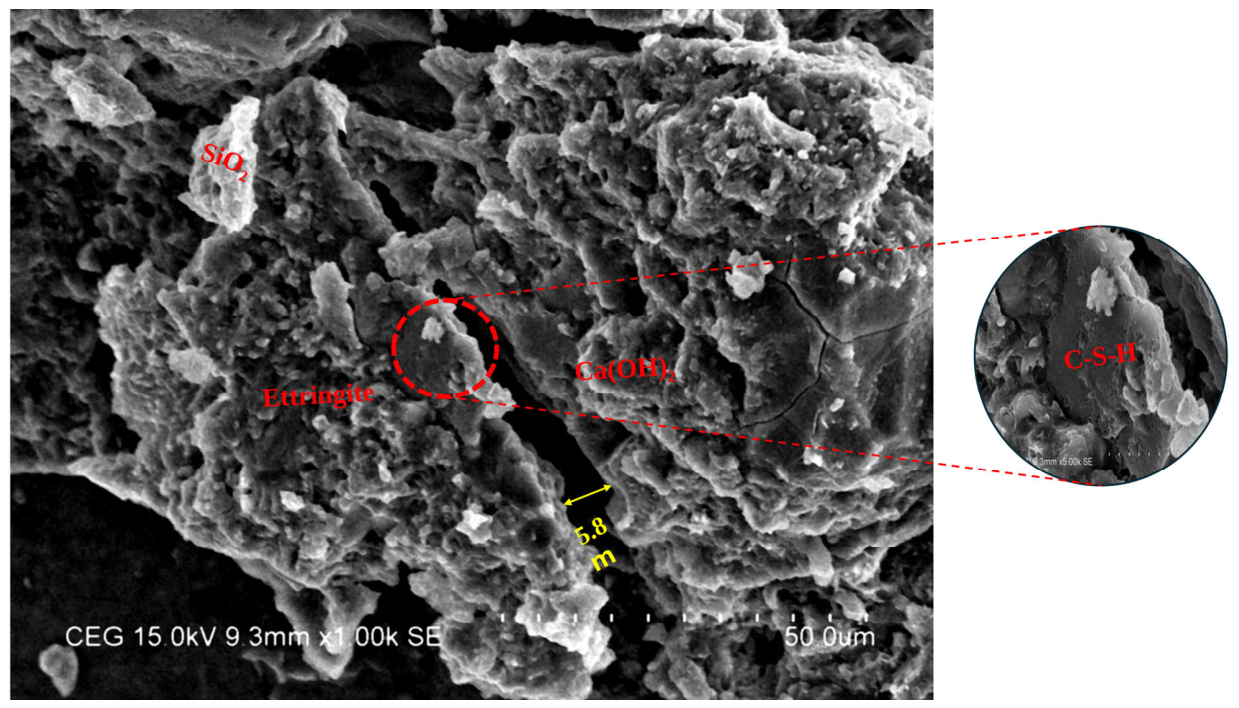
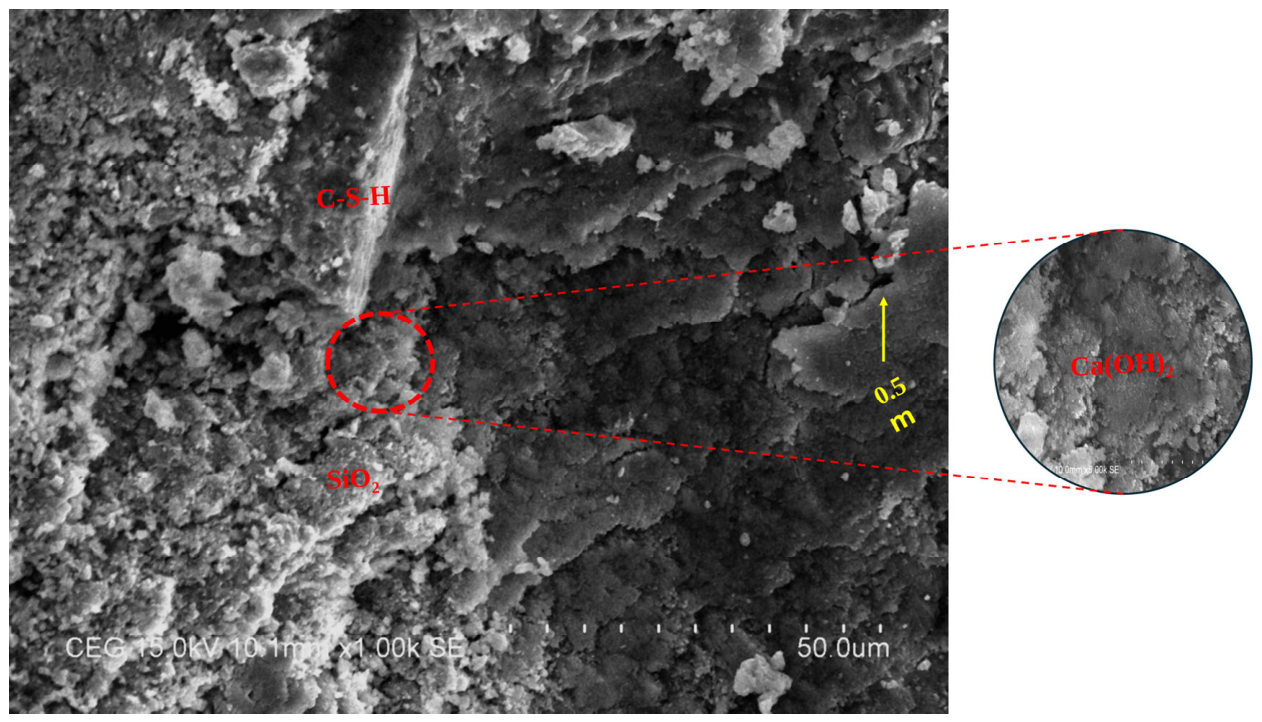
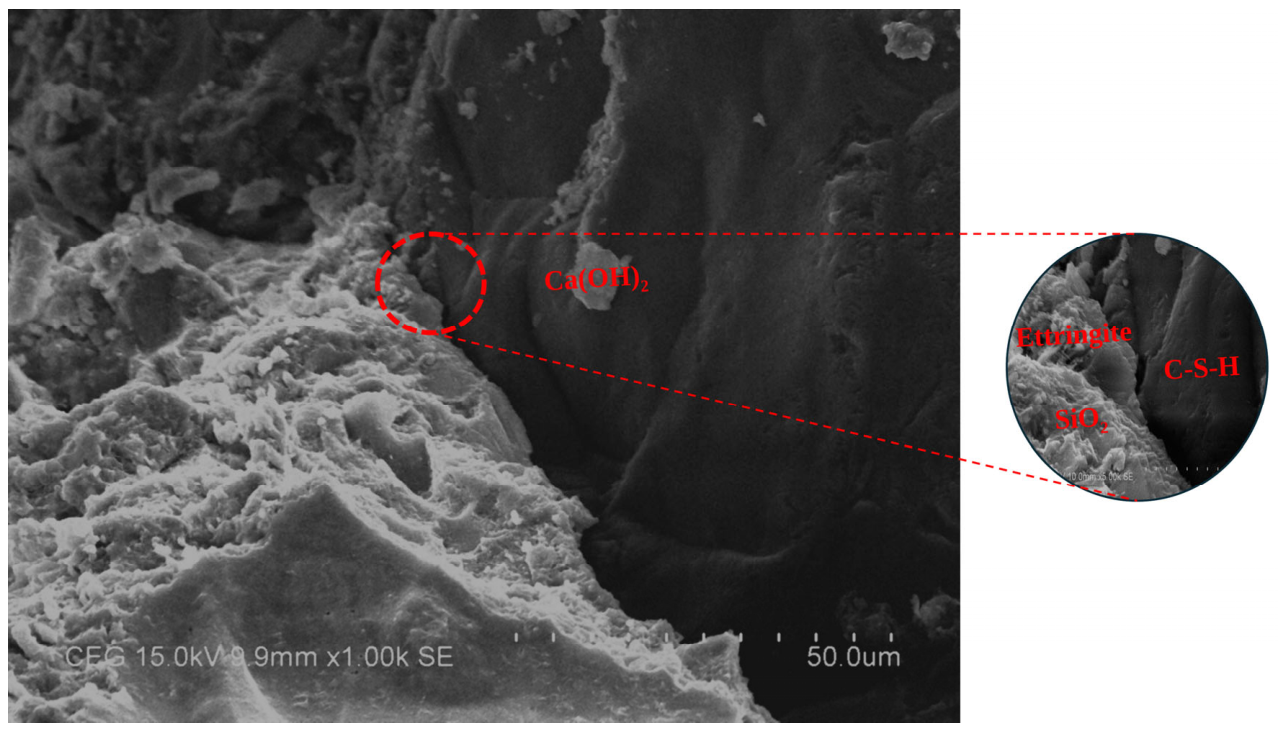
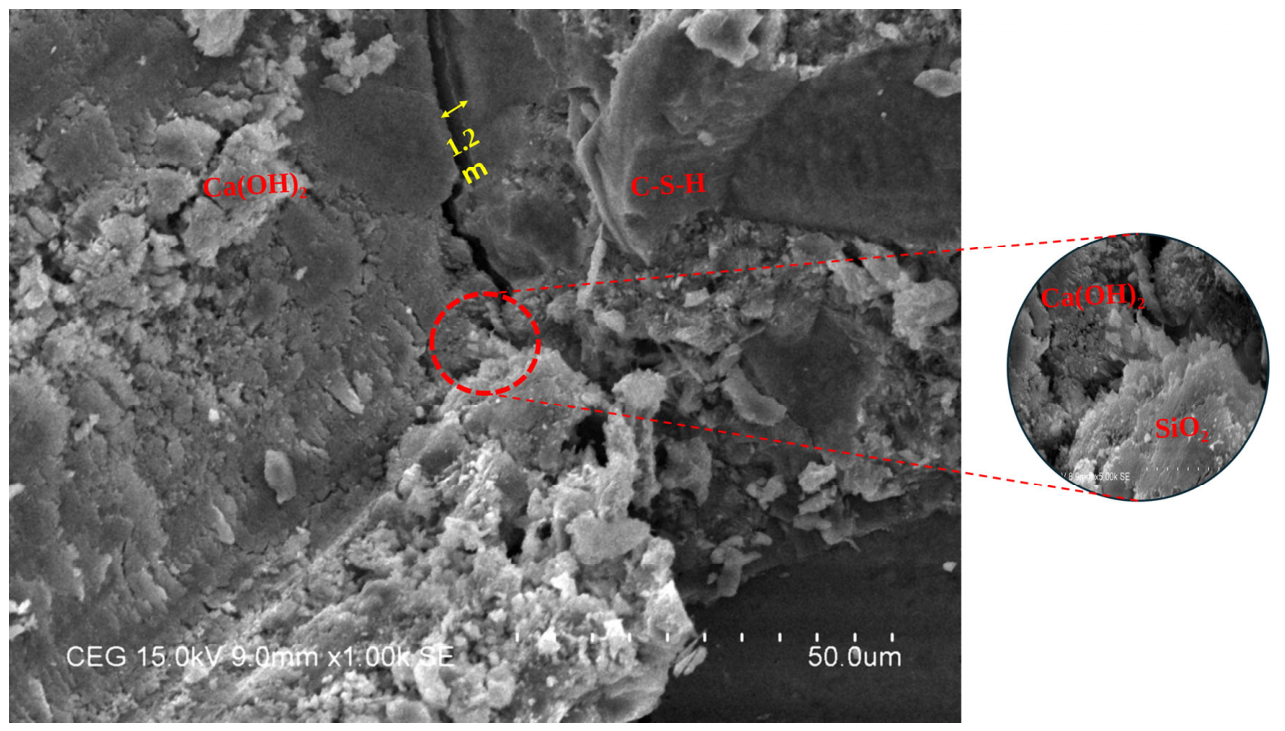
The study on morphology lies in the direct comparison of the predicted microstructural outcomes, based on seawater chemistry, with the actual morphological evidence captured in the Scanning Electron Microscopy (SEM) and presented in Figure 2, Figure 3 and Figure 4. The SEM micrographs at 1000× magnification reveal the impact of these chemical variations on the hydration products, specifically calcium silicate hydrate (C-S-H), Portlandite (Ca(OH)2), and unreacted silica (SiO2). The micrograph for the Chennai sample shown in Figure 2 displays a notably porous and fractured matrix. A prominent crack with a width of approximately 5.8 microns is visible. The high sulfate content likely contributed to this distress. The matrix shows fragmented hydration products, suggesting that the accelerated hydration caused by high chlorides led to a more heterogeneous and less dense microstructure. The Puducherry sample shown in Figure 3 reveals a relatively dense matrix but with localized microcracks of 0.5 microns. Despite high chlorides, the lower sulfate levels compared to Chennai seem to have reduced major cracking. However, the high suspended matter and organic solids might be responsible for the less uniform distribution of C-S-H gels seen in the inset of Figure 2. The Rameshwaram sample shown in Figure 4 exhibits a more compact and stable morphology. This correlates with it having the lowest chloride and sulfate levels among the four sites. The inset of Figure 4 highlights the presence of needle-like ettringite crystals alongside C-S-H. In this environment, the lower sulfate concentration likely allows for controlled ettringite formation without the expansive pressure that causes the macrocracking and enlarged pores as seen in the Chennai sample. The Tuticorin sample shown in Figure 5 shows an intermediate level of microstructural distress, with a microcrack measured at 1.2 m. With moderate sulfate levels, the matrix shows a blend of well-developed Ca(OH)2 crystals and C-S-H clusters [47]. The presence of the crack suggests that even moderate seawater salinity introduces enough internal stress to compromise the monolithic nature of the mortar.
The observation for Chennai sample, based on its highest sulfate content and lowest Cl/SO4 ratio, was the prolific formation of ettringite. Ettringite is known to form as acicular, needle-like crystals [48]. Figure 2 showing Chennai sample clearly displays a dense network of fine, needle-like crystals blanketing the surfaces of the hydration products. This morphology is the best example of visual signature of advanced ettringite formation. The observation for Rameshwaram sample, with its negligible sulfate content and extremely high Cl/SO4 ratio, was the development of a relatively dense and stable microstructure dominated by C-S-H gel and pore filling by chlorinated calcium aluminate hydrate. Figure 4, representing Rameshwaram sample, shows a comparatively massive and solid structure. The underlying matrix appears dense and amorphous, with less apparent porosity than the other images. This aligns well with the expected outcome of a chloride-dominated, low sulfate environment. The observation of Tuticorin sample in Figure 5 and Puducherry sample in Figure 3 showed degradation from chloride and sulfate attacks. The internal stresses from expansive phase formation are known to cause microcracking [49,50]. Figure 5 showing Tuticorin and Figure 4 showing Rameshwaram samples are defined by a prominent microcrack, a clear sign of structural disruption due to internal tensile forces. This is the expected result of the competing reactions in the Rameshwaram sample. In contrast, Tuticorin sample reveals a highly porous, fine-grained, and flocculent or spongy matrix, which suggests a failure of the hydration products to form a coherent, dense structure. This poor formation is a plausible outcome for the Tuticorin sample, where the chemical attack from highly reactive salts was likely compounded by the retarding effect of the highest concentration of organic solids.
The microstructure of Chennai sample, as shown in Figure 2, is characterized by the pervasive and dense growth of fine, acicular crystals across all visible surfaces of the hydrated cement paste. These needle-like structures, which are observed in several micrometers in length, almost completely obscure the underlying amorphous C-S-H gel that typically forms the binding matrix. The texture is open and porous, indicating a significant alteration from the dense structure expected in a well-hydrated paste. This observed morphology is unequivocally identified as ettringite [48]. Its prolific and widespread formation is a direct consequence of the unique chemical composition of the Chennai seawater, which contains the highest concentration of sulfates among all four samples. Despite also having the highest chloride concentration, the low Cl/SO42− ratio of 7.73 created a chemical environment where the sulfate attack mechanism was able to dominate the competitive reaction for the available aluminate phases in the cement. According to the microstructure captured in Figure 2, Chennai sample represents a sample of external sulfate attack. Sulfate ions from the seawater diffused into the mortar pore structure, where they reacted with calcium hydroxide and hydrated calcium aluminates to precipitate expansive ettringite crystals [51,52]. The image likely shows an advanced stage of this process, where the continuous growth of these ettringite needles has filled the initial pore space and exerted significant crystallization pressure. This pressure disrupts the integrity of the primary C-S-H binder, leading to an increase in overall porosity and a significant weakening of the material structural framework [53]. The microstructure of Rameshwaram sample in Figure 4 presents a morphology completely contrary to that of Chennai sample. The dominant feature is a relatively dense, massive, and more amorphous-looking hydration product, which is characteristic of the calcium silicate hydrate (C-S-H) gel that provides the cohesive strength in cement paste. While some smaller, lumpy or potentially plate-like crystalline deposits are visible on the surface, the overall structure lacks the extensive porosity, interconnected void network, and pervasive needle-like crystals seen in Rameshwaram sample in Figure 4. The underlying matrix appears more solid and coherent. This comparatively robust and dense microstructure is directly attributed to the unique chemistry of the Rameshwaram seawater. This water source is characterized by the lowest concentration of inorganic solids and, most critically, very low sulfates. The resulting extremely high Cl/SO42− ratio of 71.42 in Rameshwaram sample ensured that sulfate attack was not a significant degradation mechanism. In the absence of a potent sulfate threat, the dominant chemical interactions were driven by chloride ions. The chlorides likely accelerated the early hydration of the cement, contributing to the formation of a well-developed C-S-H matrix. Concurrently, the reaction of chlorides with the aluminate phases led to the formation of chlorinated calcium aluminate hydrate [17]. The known plate-like morphology of chlorinated calcium aluminate hydrate is consistent with some of the finer surface features observed in the micrograph [48]. The precipitation of these solid reaction products within the capillary pores would contribute to pore refinement and an overall densification of the matrix, a phenomenon that has been reported to enhance durability by reducing permeability [17]. This microstructure exemplifies the potentially beneficial structural role of chlorides when they are not forced to compete with high concentrations of sulfates. The defining feature of the microstructure of Tuticorin, shown in Figure 5, is the distinct crack running through the center of the micrograph. This feature represents a clear mechanical failure at the micro level, separating a rough, hydrated matrix on the left from a smoother surface on the right, which could be an unhydrated cement grain or an interface with a sand particle. The hydrated matrix itself appears coarser and somewhat porous. This unambiguous evidence of mechanical disruption is a direct result of the generation of significant internal tensile stresses within the hardening paste. Such stresses are the source of the formation of expansive crystalline phases within a confined space [54,55,56]. The chemical composition of the Tuticorin seawater, with its high chloride content and moderate sulfate content, created an ideal environment for competing reactions. In this instance, both chlorinated calcium aluminate hydrate and ettringite could form simultaneously. This microstructure is a powerful illustration of the destructive potential of a combined chloride sulfate attack. The simultaneous and competing formation of different solid phases, each with its own distinct volume and crystal habit, likely created localized, differential stresses within the paste. While the high chloride concentration would have promoted the formation of chlorinated calcium, the moderate sulfate concentration was still sufficient to drive the formation of some expansive ettringite. Even if the overall ettringite formation was partially suppressed by the chlorides, the amount that did form was enough to generate internal stresses that exceeded the local tensile capacity of the hardening paste, initiating the observed microcrack. Such a crack would then act as a preferential conduit for the further ingress of aggressive ions, creating a feedback loop that accelerates the degradation of the material [57,58]. The morphology of Puducherry sample, presented in Figure 3, is morphologically different from the other samples. The microstructure is characterized by a fine-grained, highly porous, and flocculent appearance. There is a conspicuous lack of well-defined, large crystalline structures, neither the needles of ettringite nor the distinct plates of chlorinated calcium aluminate, that are readily apparent. Furthermore, the dense, massive C-S-H gel characteristic of a well-hydrated paste is absent. The overall impression is one of a poorly formed and structurally incoherent matrix. This severely degraded structural formation is attributed to a unique and synergistic combination of factors present in the Puducherry seawater, which have high chloride and sulfate concentrations, like the Tuticorin sample, but compounded by the highest concentration of organic solids and suspended matter among all four samples. The resulting microstructure is likely the product of a two-pronged attack. Firstly, as with the Tuticorin sample, the high levels of both chlorides and sulfates would have induced competing reactions and internal chemical stresses. However, this chemical attack was acting upon a matrix that was simultaneously being compromised by a second, physical mechanism. Organic compounds present in mixing water are well known as retarders in cement chemistry. They tend to adsorb onto the surfaces of unhydrated cement grains and nascent hydration products. This surface adsorption physically hinders the dissolution of the cement particles and disrupts the orderly precipitation and growth of the crystalline hydration products that form the structural backbone of the paste, such as C-S-H gel. The combined effect is a synergistic degradation, which includes chemical stresses from salt reactions that are exerted on a matrix, which is already intrinsically weak and poorly developed due to the retarding effects of organic matter. The outcome is the observed porous, spongy microstructure, which represents a fundamental failure to develop a coherent, load-bearing C-S-H network. These distinct microstructures have profound and direct implications for the long-term strength and service life of concrete structures. The samples from Chennai and Tuticorin, which exhibit prolific ettringite formation and distinct microcracking, respectively, are highly susceptible to continued degradation. Their porous and cracked structures possess high permeability, which will allow for the rapid and deep ingress of more aggressive ions from the environment. This will not only accelerate the deterioration of the concrete matrix itself but will also provide easy access for chlorides to reach and initiate corrosion of any embedded steel reinforcement, which is often the ultimate failure cause for marine and coastal structures [59,60]. The sample of Puducherry, with its poorly formed and incoherent matrix, likely possesses low intrinsic strength and high permeability from the very beginning of its service life, rendering it extremely vulnerable to all forms of chemical and physical attack. In contrast, the dense microstructure observed in the Rameshwaram sample suggests lower permeability and thus higher intrinsic resistance to ion ingress. While the high chloride content of the seawater still poses a significant long-term risk for steel corrosion, the integrity of the concrete cover itself is far superior to that of the other samples, affording better protection to the reinforcement.

3.3. X-Ray Diffraction Analysis

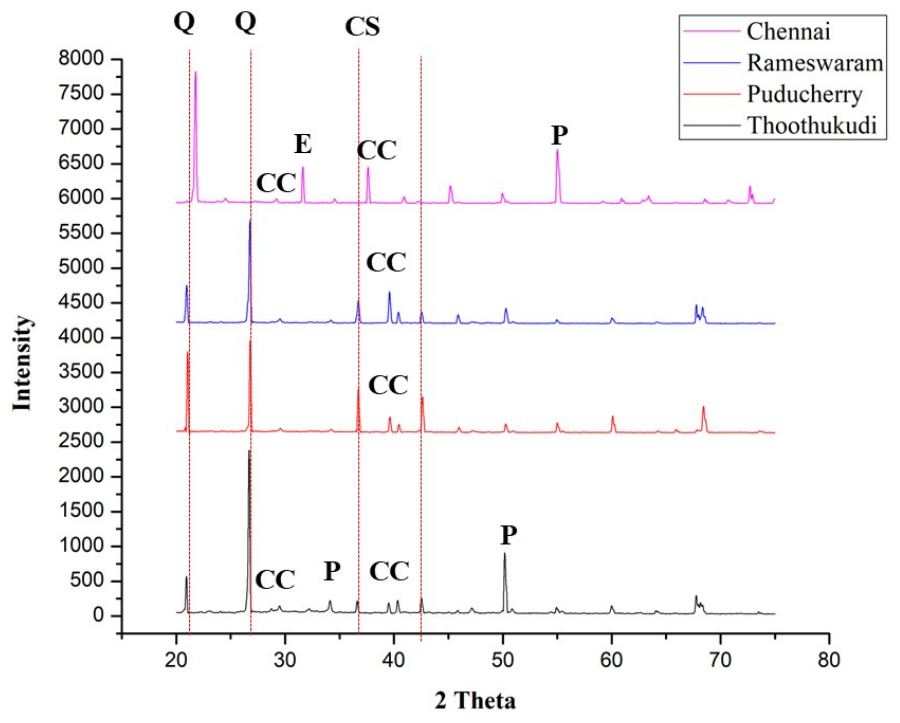
Figure 6 shows the XRD peaks of mortar samples prepared with various seawaters. The provided XRD graph displays four stacked diffractograms, one for each mortar sample, plotted against intensity and 2 theta scale. This technique identifies the crystalline and amorphous phases present in the mortar by their unique diffraction patterns.
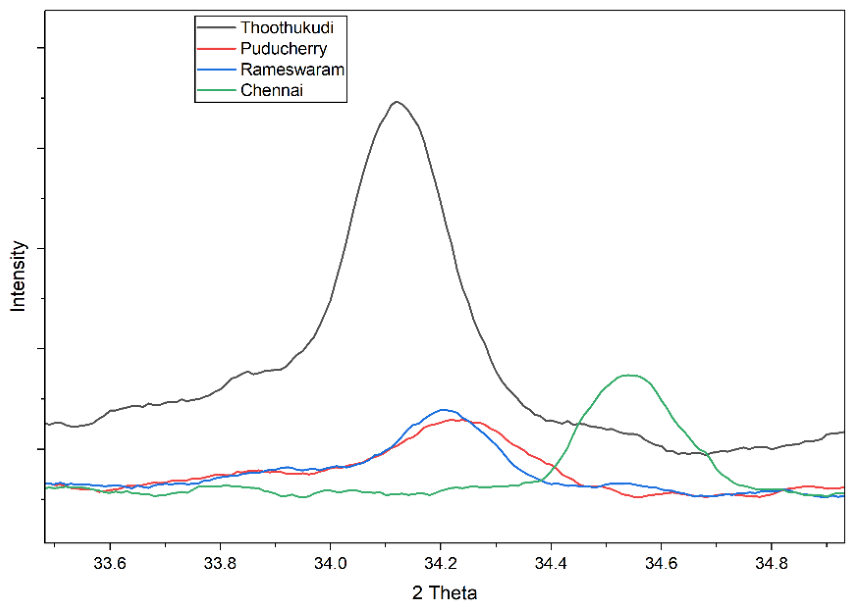
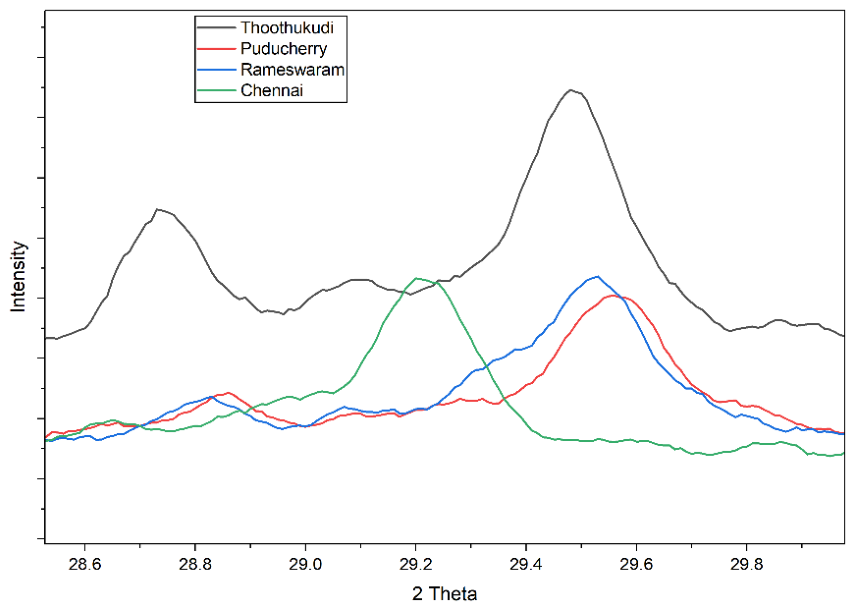
The interpretation of the XRD peak is analyzed in the range of 20° to 75° of 2 theta, which shows the consumption of hydration products and the formation of other secondary degradation products. Analysis of the XRD graph reveals several key phases common to all regional samples. The SiO2 (Q) is the most dominant crystalline phase, originating from the fine aggregate. It is identified by numerous sharp peaks, including those at approximately 20.8°, 27.5°, a very strong peak, most prominent in the Tuticorin sample, 36.5°, 39.5°, 42.5°, 50.2°, 59.9°, and 68.2°. These peaks, which align with database patterns for Quartz [61], serve as a stable internal reference, as the sand aggregate is chemically inert. The Ca (OH)2 (P) is the product of healthy OPC hydration, formed alongside the C-S-H gel. It is clearly identified in all four samples by its sharp, diagnostic peak at approximately 34.1°. The relative intensity of this peak is a critical indicator of the performance and stability of the cement paste. The CaCO3 (CC) with a distinct peak is present in all four samples at approximately 29.4° [42]; while Calcite can be a minor aggregate impurity or a product of simple atmospheric carbonation, its high intensity in this context, especially in the seawater mixed samples, is indicative of a degradation reaction, as noted in studies on seawater’s effect on cement [62,63]. By comparing the relative intensities of the diagnostic peaks within each sample’s diffractogram, a clear correlation to the strength loss emerges. The diffractogram for the Chennai sample, which suffered the 11.5% strength loss, is the evidence that the seawater had consumed the maximum amount of hydration products. The Chennai sample has at least the intensity of the Portlandite peak at 34.1°, especially when compared to its own primary compound (Q) peak at 27.5°. When compared to the other three samples, Chennai sample appears to be the most depleted phase. Conversely, the Calcite peak at 29.4° is exceptionally strong, appearing to be of a relative intensity that is higher than its own Portlandite peak. The combination of low Portlandite and high Calcite is the classic mineralogical signature of advanced magnesium attack. The seawater is rich in magnesium ions Mg2+, and this highly aggressive ion attacks the solid, strength-contributing Portlandite (P) in the paste [63]. The magnesium attack consumes the crystalline Portlandite, which is essential for the paste’s strength and for buffering its high alkalinity, and this is directly explained by the low Portlandite peak at 34.1°. It replaces Portlandite with Mg (OH)2, a soft, amorphous, non-cementitious product with no binding properties [17,62,63]. This leads directly to a loss of strength and an increase in porosity. The secondary Calcite formation (Ca2+) ions released into the pore solution from the calcium hydroxide leaching reaction then react with carbonate (CO3) and bicarbonate (HCO3) ions, which are abundant in seawater. This reaction precipitates new, secondary Calcite [62]; therefore, the high Calcite peak at 29.4° is not a sign of strength, but instead, it is a byproduct of degradation. The low Portlandite and high CaCO3 signature in the Chennai sample is the definitive chemical evidence explaining its catastrophic 11.5% strength loss. A similar analysis of the other three diffractograms shows they are in a “healthier” state relative to the Chennai sample. In the Tuticorin, Rameswaram, and Puducherry traces, the Portlandite (CH) peak at 34.1° in 2 theta is visibly more prominent and of a higher relative intensity than its corresponding Calcite CaCO3 peak at 29.4° in 2 theta. This suggests that while the same Mg2+degradation reaction is undoubtedly occurring, it is in a far less advanced stage. The strong Portlandite phase has not been as severely consumed as in the Chennai sample. This mineralogical evidence perfectly aligns with the mechanical strength data. The less advanced degradation attributed to a higher Portlandite peak in these samples correlates directly with their superior strength retention of 3.5% to 7.8% strength loss compared to the catastrophic failure of 11.5% strength loss of the Chennai sample, which shows the most advanced paste degradation through the lowest relative calcium hydroxide peak.
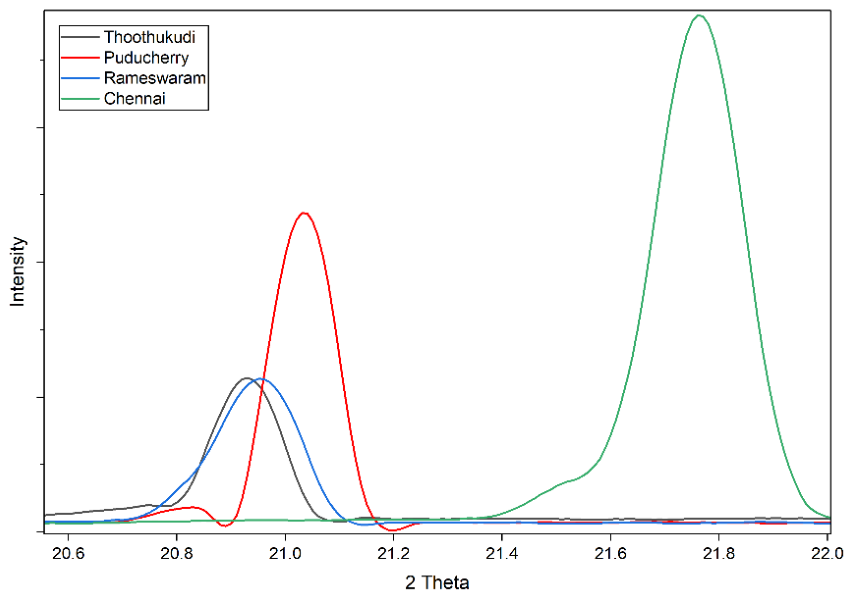
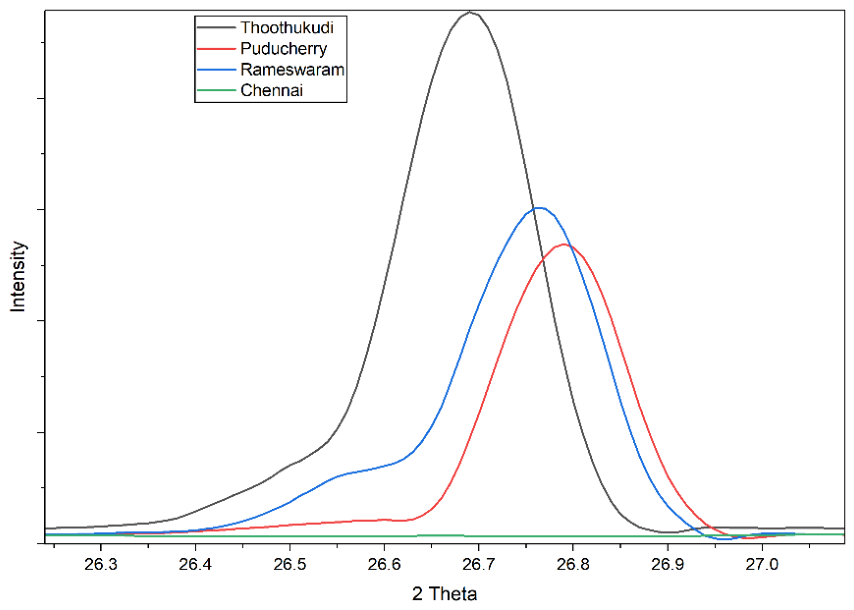
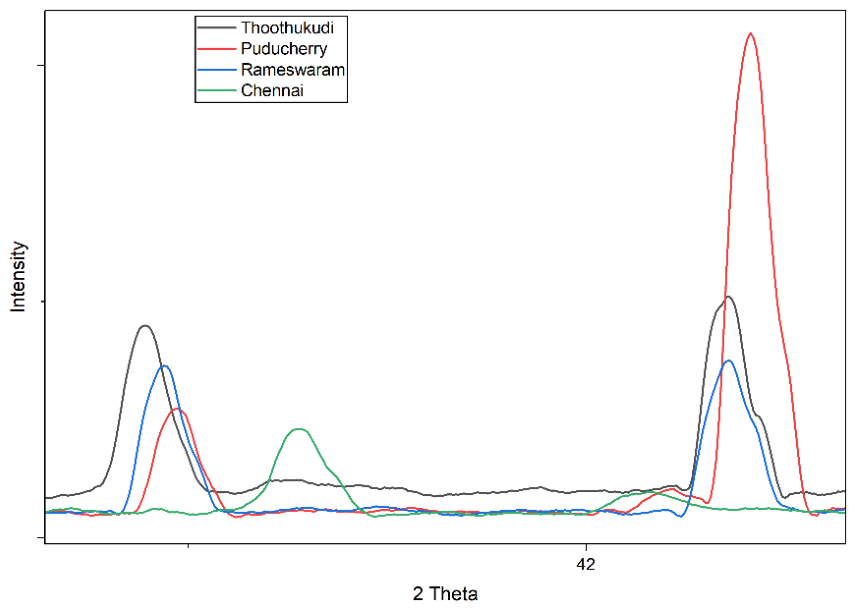
Figure 7, Figure 8, Figure 9 and Figure 10 show the insight of peaks of Quartz, Portlandite, Calcite and C-S-H respectively. The insight diffractograms shown in Figure 7 and Figure 8 at 20.8° and 27.5° confirm Quartz as the dominant crystalline phase, originating from the chemically inert fine aggregate. The sharp, high-intensity peaks at approximately 20.8° and 27.5° serve as a stable internal reference for comparing the relative intensities of hydration products. The peak at 27.5° is most prominent in the Thoothukudi sample, indicating a higher crystalline Quartz content in the local aggregate used. Because Quartz is inert, the stability of these peaks highlights that changes in other phases are due to chemical reactions within the cement paste, not aggregate degradation. The insight peaks shown in Figure 9, Figure 10 and Figure 11 for Portlandite (Ca(OH)2) at 34.1° and calcium silicate hydrate (C-S-H) around 42°, respectively, provide definitive evidence of paste leaching. The Chennai sample exhibits the most severe depletion of Portlandite, appearing as the most depleted phase compared to the other three regional samples. Conversely, the Thoothukudi, Rameshwaram, and Puducherry traces show visibly more prominent peaks at 34.1°, indicating a positive hydration state with higher relative intensity. The insight expanded 42° region highlights the consumption of hydration products. The reduction in peak intensity in the Chennai sample correlates with the increase in porosity and the replacement of cementitious binders with non-binding products. The insight analysis of the 29.4° peak is critical for identifying the mineralogical characterization of magnesium and sulfate attack from seawater. The peak at 29.4° is exceptionally strong in the Chennai sample, appearing higher in relative intensity than its own Portlandite peak. High levels of Chlorides and Sulfates in Chennai seawater facilitate magnesium attack. Magnesium ions consume calcium hydroxide, replacing it with Brucite, while the released Ca2+ ions react with seawater carbonates to precipitate secondary Calcite, as shown in Figure 10. These high Calcite and low Portlandite traces provide the definitive chemical explanation for the catastrophic 11.5% strength loss observed in Chennai samples, compared to the 3.5% to 7.8% loss in the other regions. The high-resolution peak analysis confirms that while all samples undergo some degree of magnesium-driven degradation, the severity is non-uniform across coastal regions. These in-depth insights validate that the specific chemical profile of the mixing water, particularly the sulfate and magnesium concentrations, dictates the long-term phase stability of the mortar.

3.4. Summary

The summary of the results from this study is given in Table 2. All four seawater mortars gained strength rapidly up to a peak at 28 to 56 days from 45 to 47 MPa, by chloride and sulfate-based accelerated hydration, and then declined as slower chemical attack took over. Degradation severity tracked sulfate content in Chennai samples with the highest sulfate, losing 11.5% of peak strength through ettringite and magnesium attack, which is observed by SEM cracking and low Portlandite/high Calcite in XRD analysis, while low sulfate Rameshwaram sample lost only 3.5% with a dense, stable matrix. Puducherry and Tuticorin were intermediate with 3.9% and 7.8% respectively, confirming the chloride to sulfate ratio governs long-term strength.

4. Conclusions

Based on the investigation of samples of mortars prepared with seawater from four regions of Tamil Nadu, the conclusions were made through the experiments conducted on the mechanical strength and microstructural characterization. The suitability of seawater as a mixing agent in cementitious systems is highly site-specific and cannot be generalized based on total salinity or geographic proximity. Performance is fundamentally governed by the precise ionic concentration of the local source, particularly sulfate and chloride levels. The mechanical strength attainment of seawater mixed mortars follows a nonlinear trajectory. All samples exhibited rapid 28-day strength gain ranging from approximately 33 MPa to 47 MPa, driven by the catalytic effect of chloride ions on cement hydration. A critical inflection point occurs between 28 and 56 days, where the rate of microstructural damage from chemical attack begins to exceed the rate of hydration-driven strength gain. The Cl/SO42− ratio is a primary predictor of long-term stability. Waters with high sulfate concentrations (Chennai at 2682.9 mg/L) induce severe degradation (11.5% strength loss) through the formation of expansive ettringite and gypsum. Samples with low sulfate content (Rameshwaram at 246 mg/L) demonstrate superior durability with minimal strength loss (3.5%), proving that chlorides alone are less detrimental to the C-S-H matrix in the absence of sulfate competition. The sulfate attack in Chennai samples is characterized by a dense network of ettringite crystals that increase porosity and disrupt the C-S-H binder. In all samples, through XRD, it is identified as the consumption of Portlandite and the subsequent precipitation of non-binding Brucite and secondary Calcite. High concentrations of organic solids, as seen in the Puducherry sample, physically hinder hydration, leading to a structurally incoherent, flocculent, or spongy matrix. The presence of microcracks and increased porosity in high sulfate seawater mortars creates preferential conduits for ion ingress. This not only compromises the concrete matrix but also significantly elevates the risk of reinforcement corrosion due to high internal chloride levels, necessitating rigorous chemical analysis of local seawater before industrial application. The conclusion of this investigation is that the suitability of seawater as mixing water is highly site-specific and cannot be generalized from total salinity or geographic proximity, since all four sources had comparable chloride contents (17,570–20,744 mg/L) yet differed in long-term strength loss by more than threefold (3.5% to 11.5%). The strength development of seawater mixed mortars followed a nonlinear trajectory. All samples gained strength rapidly, reaching peak values of 45.34 to 47.26 MPa at 28 days, driven by sulfate and chloride-induced hydration. A critical strength reduction occurred between 28 and 56 days, beyond which microstructural damage from chemical attack exceeded the rate of hydration-driven strength gain. The chloride to sulfate ratio was the primary predictor of long-term stability apart from total salinity. The high sulfate Chennai source (SO3 = 2682.9 mg/L; Cl/SO42− ≈ 7.7) suffered the most severe strength degradation, losing 11.5% of its peak strength through expansive ettringite and gypsum formation. Microstructural and mineralogical evidence is in correlation with the strength data. SEM revealed a porous, fractured matrix with a 5.8 µm crack in the Chennai sample, against a dense, compact matrix in the Rameshwaram sample, with intermediate microcracks of 1.2 µm in Tuticorin and 0.5 µm in Puducherry samples. XRD confirmed advanced magnesium-driven degradation in the Chennai sample, showing the lowest Portlandite and highest secondary Calcite intensity, which is the signature of Portlandite conversion to non-cementitious brucite, whereas the other three retained more prominent Portlandite peaks consistent with their lower strength loss. The increased porosity and microcracking in high-sulfate seawater mortars create preferential integrated pores, which forms as capillary for ion ingress, elevating the risk of reinforcement corrosion. Therefore, a detailed chemical analysis quantifying chloride and, most critically, sulfate and magnesium concentrations is an indispensable prerequisite for durability assessment and material selection before coastal seawater is adopted in cementitious construction.

5. Future Recommendations

Future studies can be extended beyond compressive strength to include other mechanical tests, including flexural and split tensile strength, modulus of elasticity, and bond strength, to fully characterize structural behavior under seawater exposure. Reinforced specimens should be investigated to quantify chloride-induced steel corrosion (half-cell potential, polarization resistance, accelerated corrosion testing), alongside the performance of non-corrosive FRP and stainless-steel reinforcement. Durability can be assessed through RCPT, chloride diffusion, sorptivity, and porosity (MIP) tests, supported by TGA and EDS, to quantify Portlandite consumption and ettringite/brucite formation. Finally, longer durations beyond 360 days under realistic wetting–drying and tidal exposure, additional coastal sources, and a Cl/SO42−-based threshold criterion should be explored to inform region-specific guidelines and codes such as IS 456.

Author Contributions

Conceptualization, A.K. and S.M.; methodology, A.K. and S.M.; software, A.K.; validation, A.K. and S.M.; formal analysis, A.K. and S.M.; investigation, A.K. and S.M.; resources, A.K.; data curation, A.K. and S.M.; writing—original draft preparation, A.K.; writing—review and editing, A.K. and S.M.; visualization, A.K.; supervision, S.M.; project administration, S.M.; funding acquisition, A.K. and S.M. All authors have read and agreed to the published version of the manuscript.

Funding

This research received no external funding.

Institutional Review Board Statement

Not applicable.

Informed Consent Statement

Not applicable.

Data Availability Statement

The original contributions presented in this study are included in the article. Further inquiries can be directed to the corresponding author.

Acknowledgments

The authors would like to thank VIT Chennai management for its support in conducting the research; the authors also wish to thank Hi-Tech Concrete Solution Pvt. Ltd., Chennai, for providing the resources and support for this research.

Conflicts of Interest

The authors declare no conflict of interest.

References

  1. Jackson, M.D.; Vola, G.; Všianský, D.; Oleson, J.P.; Scheetz, B.E.; Brandon, C.; Hohlfelder, R.L. Cement Microstructures and Durability in Ancient Roman Seawater Concretes. In Historic Mortars; RILEM Bookseries; Springer: Dordrecht, The Netherlands, 2012; Volume 7, pp. 49–76. [Google Scholar] [CrossRef]
  2. Li, W.; Jiang, Z.; Lu, M.; Long, W.; Xing, F.; Liu, J. Effects of Seawater, NaCl, and Na2SO4 Solution Mixing on Hydration Process of Cement Paste. J. Mater. Civ. Eng. 2021, 33, 04021057. [Google Scholar] [CrossRef]
  3. Sikora, P.; Cendrowski, K.; Abd Elrahman, M.; Chung, S.Y.; Mijowska, E.; Stephan, D. The Effects of Seawater on the Hydration, Microstructure and Strength Development of Portland Cement Pastes Incorporating Colloidal Silica. Appl. Nanosci. 2019, 10, 2627–2638. [Google Scholar] [CrossRef]
  4. Li, Y.; Li, W.; Tan, K.H.; Sheng, J.; Yu, M. Characterization of Permeability of Seawater Iron Tailings Mortar Based on Inter-Pore Connection. Constr. Build. Mater. 2023, 409, 134135. [Google Scholar] [CrossRef]
  5. Etxeberria, M.; Gonzalez-Corominas, A.; Pardo, P. Influence of Seawater and Blast Furnace Cement Employment on Recycled Aggregate Concretes’ Properties. Constr. Build. Mater. 2016, 115, 496–505. [Google Scholar] [CrossRef]
  6. Salami, O.T.; Plank, J. Influence of Electrolytes on the Performance of a Graft Copolymer Used as Fluid Loss Additive in Oil Well Cement. J. Pet. Sci. Eng. 2016, 143, 86–94. [Google Scholar] [CrossRef]
  7. Ma, Q.; Li, Y.; Li, Y.; Liu, Y.; Lei, S. Enhanced Mortar Strength and Resistance to Seawater Degradation in the Presence of Calcined Coal-Series Kaolin. Constr. Build. Mater. 2023, 403, 132986. [Google Scholar] [CrossRef]
  8. ASTM D1141; Standard Practice for Preparation of Substitute Ocean Water. ASTM: West Conshohocken, PA, USA, 2021.
  9. Younis, A.; Ebead, U.; Suraneni, P.; Nanni, A. Microstructure Investigation of Seawater vs. Freshwater Cement Pastes. In Proceedings of International Structural Engineering and Construction, Chicago, IL, USA, 20–25 May 2019; ISEC Press: Fargo, ND, USA, 2019. [Google Scholar] [CrossRef]
  10. Juenger, M.C.G.; Siddique, R. Recent Advances in Understanding the Role of Supplementary Cementitious Materials in Concrete. Cem. Concr. Res. 2015, 78, 71–80. [Google Scholar] [CrossRef]
  11. Wen, S.; Cao, M.; Liu, G.; Yin, H. Phase Assemblages of Seawater-Mixed Model Cement Modified by in-Situ Polymerization. Cem. Concr. Res. 2025, 197, 107974. [Google Scholar] [CrossRef]
  12. Ghorab, H.Y.; Hilal, M.S.; Kishar, E.A. Effect of Mixing and Curing Waters on the Behaviour of Cement Pastes and Concrete Part I: Microstructure of Cement Pastes. Cem. Concr. Res. 1989, 19, 868–878. [Google Scholar]
  13. Kaushik, S.K.; Islam, S. Suitability of Sea Water for Mixing Structural Concrete Exposed to a Marine Environment. Cem. Concr. Compos. 1995, 17, 177–185. [Google Scholar] [CrossRef]
  14. Mohammed, T.U.; Hamada, H.; Yamaji, T. Performance of Seawater-Mixed Concrete in the Tidal Environment. Cem. Concr. Res. 2004, 34, 593–601. [Google Scholar] [CrossRef]
  15. Aghajanzadeh, I.; Khodadadi, N.; Suraneni, P.; Nanni, A. Seawater-Mixed Concrete—A Review with Focus on Durability Properties. Appl. Ocean. Res. 2026, 166, 104878. [Google Scholar] [CrossRef]
  16. Otsuki, N.; Saito, T.; Tadokoro, Y. Possibility of Sea Water as Mixing Water in Concrete; David Publishing Company: Wilmington, DE, USA, 2012; Volume 6. [Google Scholar]
  17. Saxena, S.; Baghban, M.H. Assessment of Cement Paste Properties Using Seawater: Early-Age Behavior, Mechanical and Microstructural Analysis. Clean. Waste Syst. 2025, 12, 100407. [Google Scholar] [CrossRef]
  18. Alzahrani, A.; Achintha, M. Chemical and Microstructural Investigation of Concrete with Seawater and Sea Sand Towards Understanding Long-Term Performance: A Review. Constr. Mater. 2026, 6, 32. [Google Scholar] [CrossRef]
  19. Seleem, H.H.; Rashad, A.M.; El-Sabbagh, B.A. Performance of Blended Cement Concrete against Seawater Attack. Adv. Sci. Technol. 2010, 64, 19–24. [Google Scholar] [CrossRef]
  20. Cai, Y.; Xuan, D.; Hou, P.; Shi, J.; Poon, C.S. Effect of Seawater as Mixing Water on the Hydration Behaviour of Tricalcium Aluminate. Cem. Concr. Res. 2021, 149, 106565. [Google Scholar] [CrossRef]
  21. Chandralega, V.; Shanmugasundaram, M.; Stone, D. Enhancing the Performance of Iron-Based Binders with Seawater and CO2 Sequestration. Case Stud. Constr. Mater. 2025, 22, e04367. [Google Scholar] [CrossRef]
  22. Li, P.; Li, W.; Sun, Z.; Shen, L.; Sheng, D. Development of Sustainable Concrete Incorporating Seawater: A Critical Review on Cement Hydration, Microstructure and Mechanical Strength. Cem. Concr. Compos. 2021, 121, 104100. [Google Scholar] [CrossRef]
  23. Lee, T.; Lee, J.; Jeong, J.; Jeong, J. Improving Marine Concrete Performance Based on Multiple Criteria Using Early Portland Cement and Chemical Superplasticizer Admixture. Materials 2021, 14, 4903. [Google Scholar] [CrossRef] [PubMed]
  24. Guo, B.; Qiao, G.; Niu, D.; Ou, J. Electrochemical Corrosion Control for Reinforced Concrete Structures—A Review. Int. J. Electrochem. Sci. 2020, 15, 5723–5740. [Google Scholar] [CrossRef]
  25. Dai, G.; Wu, Q.; Lu, K.; Ma, S.; Wang, W.; Zhou, H.; Cai, C.; Han, Z.; Chen, J. Study of Chloride Ion Diffusion in Coral Aggregate Seawater Concrete with Different Water–Cement Ratios under Load. Materials 2023, 16, 869. [Google Scholar] [CrossRef] [PubMed]
  26. Yu, X.; Al-Saadi, S.; Zhao, X.L.; Raman, R.K.S. Electrochemical Investigations of Steels in Seawater Sea Sand Concrete Environments. Materials 2021, 14, 5713. [Google Scholar] [CrossRef] [PubMed]
  27. Melchers, R.E. Long-Term Durability of Marine Reinforced Concrete Structures. J. Mar. Sci. Eng. 2020, 8, 290. [Google Scholar] [CrossRef]
  28. Shi, C.; Stegemann, J.A. Acid Corrosion Resistance of Different Cementing Materials. Cem. Concr. Res. 2000, 30, 803–808. [Google Scholar] [CrossRef]
  29. Kumar, M.P.; Mini, K.M.; Rangarajan, M. Ultrafine GGBS and Calcium Nitrate as Concrete Admixtures for Improved Mechanical Properties and Corrosion Resistance. Constr. Build. Mater. 2018, 182, 249–257. [Google Scholar] [CrossRef]
  30. Jiang, K.; Wang, X.; Ding, L.; Ben, Q.; Chen, Z.; Ding, J.; Liu, X.; Wu, Z. Investigation and Evaluation on Early-Age Crack Resistance of Ultra-High Performance Seawater Sea-Sand Concrete with Non-Metallic Fiber. Cem. Concr. Res. 2025, 195, 107906. [Google Scholar] [CrossRef]
  31. IS4031:1996; Methods of Physical Tests for Hydraulic Cement, Part 1: Determination of Fineness by Dry Sieving. Bureau of Indian Standards (BIS): New Delhi, India, 1996.
  32. IS 516-2021; Hardened Concrete Methods of Test Part 1 Testing of Strength of Hardened Concrete Section 1 Compressive, Flexucal and Split Tensile Strength (First Revision). Bureau of Indian Standards (BIS): New Delhi, India, 2021.
  33. Xue, Y.; Wang, L.; Liu, Y.; Ranjith, P.G.; Cao, Z.; Shi, X.; Gao, F.; Kong, H. Brittleness Evaluation of Gas-Bearing Coal Based on Statistical Damage Constitution Model and Energy Evolution Mechanism. J. Cent. South Univ. 2025, 32, 566–581. [Google Scholar] [CrossRef]
  34. Cao, Z.; Miao, C.; Du, F.; Zhu, D.; Teng, T.; Xue, Y. A Bifurcation Dynamical Analysis of a Non-Darcy Seepage System in Post-Failure Rock Based on a Novel Truncated Spectral Method. Processes 2026, 14, 1468. [Google Scholar] [CrossRef]
  35. IS 3025 (Part 32): 2022; Method of Sampling and Test (Physical and Chemical) for Water and Wastewater—Part 32: Chloride (First Revision). Bureau of Indian Standards (BIS): New Delhi, India, 2022.
  36. IS 3025 (Part 24): 2022; Methods of Sampling and Test (Physical and Chemical) for Water and Waste Water—Part 24 Sulphates Section 1 Gravimetric and Turbidity Methods. Bureau of Indian Standards (BIS): New Delhi, India, 2022.
  37. IS 3025 (Part 18): 2022; Method of Sampling and Test (Physical and Chemical) for Water and Wastewater—Part 18: Volatile and Fixed Residue (Total, Filterable and Non-Filterable) (First Revision). Bureau of Indian Standards (BIS): New Delhi, India, 2022.
  38. IS 3025 (Part 17): 2022; Methods of Sampling and Test (Physical and Chemical) for Water and Wastewater—Part 17: Non-Filterable Residue (Total Suspended Solids). Bureau of Indian Standards (BIS): New Delhi, India, 2022.
  39. IS 3025 (Part 23): 2023; Methods of Sampling and Test Physical and Chemical for Water and Wastewater—Part 23 Alkalinity. Bureau of Indian Standards (BIS): New Delhi, India, 2023.
  40. IS 3025 (Part 22): 2024; Method of Sampling and Test (Physical and Chemical) for Water and Wastewater—Part 22: Acidity (First Revision). Bureau of Indian Standards (BIS): New Delhi, India, 2024.
  41. IS 3025 (Part 11): 2022; Method of Sampling and Test (Physical and Chemical) for Water and Wastewater—Part 11: pH Value (First Revision). Bureau of Indian Standards (BIS): New Delhi, India, 2022.
  42. Li, P.; Li, W.; Yu, T.; Qu, F.; Tam, V.W.Y. Investigation on Early-Age Hydration, Mechanical Properties and Microstructure of Seawater Sea Sand Cement Mortar. Constr. Build. Mater. 2020, 249, 118776. [Google Scholar] [CrossRef]
  43. Qu, F.; Li, W.; Wang, K.; Tam, V.W.Y.; Zhang, S. Effects of Seawater and Undesalted Sea Sand on the Hydration Products, Mechanical Properties and Microstructures of Cement Mortar. Constr. Build. Mater. 2021, 310, 125229. [Google Scholar] [CrossRef]
  44. Aydoğan, O.G.; Akca, A.H.; Bilici, S.; Öztürk, H.; Dilber, A.A.; Özyurt, N. Microstructural Examination of Black Seawater Mixed Sulfate-Resistant Cement Concrete. J. Mater. Civ. Eng. 2024, 36, 04023502. [Google Scholar] [CrossRef]
  45. Mohamed, A.M.; Tayeh, B.A.; Majeed, S.S.; Aisheh, Y.I.A.; Salih, M.N.A. Fresh, Hardened, Durability and Microstructure Properties of Seawater Concrete: A Systematic Review. J. CO2 Util. 2024, 83, 102815. [Google Scholar] [CrossRef]
  46. Zhang, M.; Yao, Z.; Gao, M.; Wang, H. The Effect of Chloride Ions Morphology on the Properties of Concrete Under Dry and Wet Conditions. Sustainability 2025, 17, 2884. [Google Scholar] [CrossRef]
  47. Borno, I.B.; Haque, M.I.; Ashraf, W. Crystallization of C-S-H and C-A-S-H in Artificial Seawater at Ambient Temperature. Cem. Concr. Res. 2023, 173, 107292. [Google Scholar] [CrossRef]
  48. Fang, Z.; Zhang, S.; Qi, W.; Fan, Y.; Shah, S.P.; Zheng, J. Study on the Binding Behavior of Chloride Ion and Ettringite in Nano-Metakaolin Cement by Seawater Mixing and Curing Temperatures. Materials 2024, 17, 3943. [Google Scholar] [CrossRef] [PubMed]
  49. Laquai, R.; Gouraud, F.; Müller, B.R.; Huger, M.; Chotard, T.; Antou, G.; Bruno, G. Evolution of Thermal Microcracking in Refractory ZrO2-SiO2 after Application of External Loads at High Temperatures. Materials 2019, 12, 1017. [Google Scholar] [CrossRef] [PubMed]
  50. Yao, J.; Chen, J.; Lu, C. Fractal Cracking Patterns in Concretes Exposed to Sulfate Attack. Materials 2019, 12, 2338. [Google Scholar] [CrossRef] [PubMed]
  51. Shenbagam, V.K.; Chaunsali, P. Influence of Calcium Hydroxide and Calcium Sulfate on Early-Age Properties of Non-Expansive Calcium Sulfoaluminate Belite Cement. Cem. Concr. Compos. 2022, 128, 104444. [Google Scholar] [CrossRef]
  52. Tadesse, D.M.; Jeon, J.; Kim, S.; Park, S. The Effect of Seawater on the Phase Assemblage of Hydrated Cement Paste: A Study on PC, CAC and CSA. Dev. Built Environ. 2023, 15, 100183. [Google Scholar] [CrossRef]
  53. Amiri, M.; Tanideh, P. Microstructural Assessment of the Effect of Sulfate Environments on the Mechanical Properties of Concrete. Modares Civ. Eng. J. 2019, 19, 1–14. [Google Scholar]
  54. Wyrzykowski, M.; Gajewicz-Jaromin, A.M.; McDonald, P.J.; Dunstan, D.J.; Scrivener, K.L.; Lura, P. Water Redistribution–Microdiffusion in Cement Paste under Mechanical Loading Evidenced by 1H NMR. J. Phys. Chem. C 2019, 123, 16153–16163. [Google Scholar] [CrossRef]
  55. Liang, M.; Zhang, Y.; He, S.; Chen, Y.; Schlangen, E.; Šavija, B. On the Chemo-Mechanical Evolution Process of High-Volume Slag Cement Paste. Constr. Build. Mater. 2023, 400, 132891. [Google Scholar] [CrossRef]
  56. Sakai, Y.; Sakai, Y. Surface Properties of Cement Paste Evaluated by Scanning Probe Microscopy. Open J. Civ. Eng. 2016, 6, 643–652. [Google Scholar] [CrossRef]
  57. Pouya, J.; Neji, M.; De Windt, L.; Péralès, F.; Socié, A.; Corvisier, J. Investigating Chemical and Cracking Processes in Cement Paste Exposed to a Low External Sulfate Attack with Emphasis on the Contribution of Gypsum. Constr. Build. Mater. 2024, 413, 134845. [Google Scholar] [CrossRef]
  58. Li, X.; Gu, X.; Xia, X.; Madenci, E.; Chen, A.; Zhang, Q. Peridynamic Simulation of Micro-Internal Damage and Macro-Mechanical Properties of Cement Paste under Freeze-Thaw Cycles. J. Build. Eng. 2024, 93, 109759. [Google Scholar] [CrossRef]
  59. Sanjeewa, H.V.A.N.; Asamoto, S. A Review of Mechanical Properties of Deteriorated Concrete Due to Delayed Ettringite Formation and Its Influence on the Structural Behavior of Reinforced Concrete Members. Constr. Build. Mater. 2024, 422, 135795. [Google Scholar] [CrossRef]
  60. Karthikeyan, A.; Muthusamy, S. Performance of Zinc Sacrificial Anode in Reinforced Cement Concrete Members under Chloride Intrusion and Marine Environment Exposure. Matéria 2024, 29, e20240561. [Google Scholar] [CrossRef]
  61. Shakouri, M.; Exstrom, C.L.; Piccini, G.D. Chloride Binding and Desorption Properties of the Concrete Containing Corn Stover Ash. J. Sustain. Cem. Based Mater. 2022, 11, 62–82. [Google Scholar] [CrossRef]
  62. Gonçalves, B.; Exposito, C.; Toshimi Ishikawa, T.; Yuuki Koga, G. X-Ray Diffraction Study of the Early Hydration of Portland Cements Containing Calcium Carbonate by in-Situ and Ex-Situ Approaches. Constr. Build. Mater. 2023, 365, 129947. [Google Scholar] [CrossRef]
  63. Putra Jaya, R.; Hainin, R.; Haziman, M.; Ibrahim, W.; Nazri, F.M.; Arshad, M.F.; Muthusamy, K. Physical and Chemical Properties of Rice Husk Ash Concrete Under Seawater. Int. J. Integr. Eng. 2018, 10, 165–168. [Google Scholar] [CrossRef]
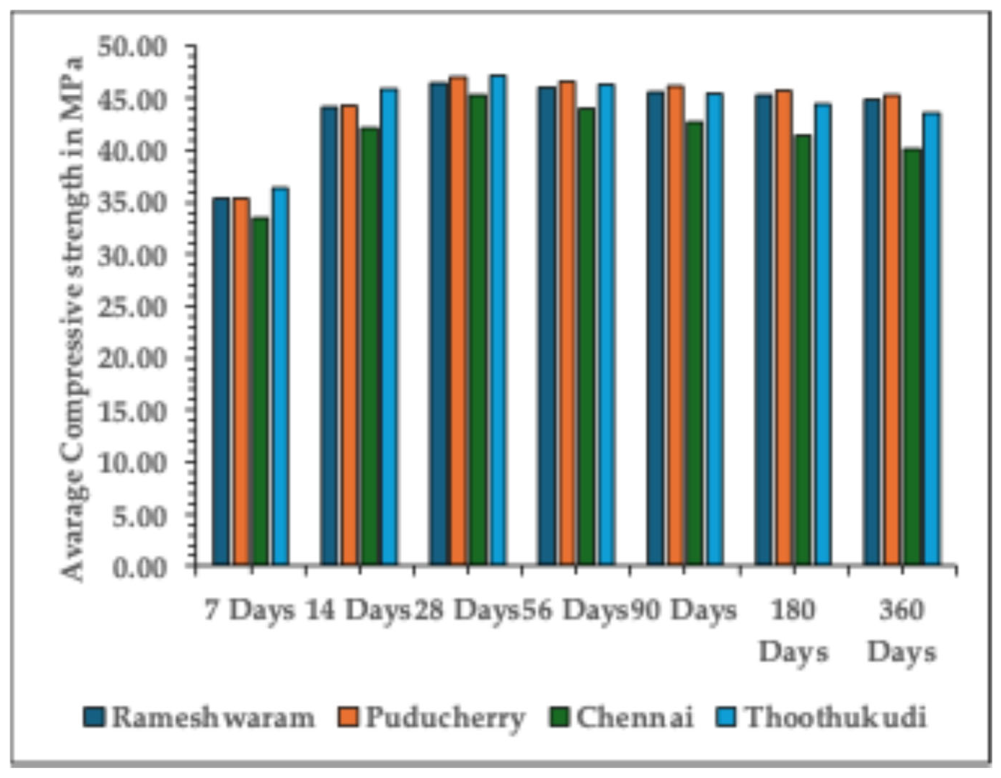
Figure 1. Compressive Strength of Mortars Prepared with Different Seawater Sources.
Applsci 16 06619 g001
Figure 2. SEM image of cement mortar prepared with seawater from Chennai.
Applsci 16 06619 g002
Figure 3. SEM image of cement mortar prepared with seawater from Puducherry.
Applsci 16 06619 g003
Figure 4. SEM image of cement mortar prepared with seawater from Rameshwaram.
Applsci 16 06619 g004
Figure 5. SEM image of cement mortar prepared with seawater from Tuticorin.
Applsci 16 06619 g005
Figure 6. X-Ray Diffraction analysis graph of mortar sample.
Applsci 16 06619 g006
Figure 7. Insight peaks intensity of Quartz at 20° to 22°.
Applsci 16 06619 g007
Figure 8. Insight peaks intensity of Quartz at 26° to 27°.
Applsci 16 06619 g008
Figure 9. Insight peaks intensity of Ca(OH)2.
Applsci 16 06619 g009
Figure 10. Insight peaks intensity of CaCO3.
Applsci 16 06619 g010
Figure 11. Insight peaks intensity of C-S-H.
Applsci 16 06619 g011
Table 1. Physical and Chemical Properties of Seawater from the coastal regions of Tamil Nadu, India.
Test ParametersChennaiPuducherryRameshwaramTuticorin
Chlorides as Cl (IS 3025 (Part 32): 2022) [35]20,743.5019,419.0017,569.5018,945.00
Sulfates as SO3 (IS 3025 (Part 24): 2022) [36]2682.901934.40246.001784.00
Organic Solids (IS 3025 (Part 18): 2022) [37]38,918.0042,028.0038,900.0039,211.00
Inorganic Solids (IS 3025 (Part 18): 2022)29,676.0031,244.0023,920.0027,554.00
Suspended matter (IS 3025 (Part 17): 2023) [38]21.20147.00124.00131.00
Quantity of 0.02 N H2SO4 required to neutralize 100 mL of water sample using mixed indicator (IS 3025 (Part 23): 2023) [39]11.7011.205.4010.60
Quantity of 0.02 N NaOH required to neutralize 100 mL of water sample Phenolphthalein indicator (IS 3025 (Part 22): 2024) [40]Nil0.20NilNil
pH Value (IS 3025 (Part 11): 2022) [41]8.047.698.208.10
Table 2. Summary of the results from the experiments in this study.
ParameterChennaiPuducherryRameshwaramTuticorin
Peak strength, at 28 days (MPa)45.3447.1146.4847.26 (highest)
Strength loss from peak at 360 days (%)11.5 (most severe)3.93.5 (least)7.8
Dominant degradation mechanismCombined sulfate + magnesium attackSulfate attack + organic-solids retardationMinor chloride effects onlyCombined chloride–sulfate attack
Key SEM observationPorous, fractured matrix; ~5.8 µm crack; dense ettringite needlesIncoherent, flocculent/spongy matrix; ~0.5 µm microcracksDense, compact, stable C-S-H matrixIntermediate distress; ~1.2 µm microcrack
Key XRD observationLowest Portlandite, highest Calcite (advanced Mg attack → brucite + secondary calcite)Healthier; Portlandite > CalciteHealthiest; strong Portlandite, dense C-S-HHealthier; Portlandite > Calcite
Overall long-term durabilityPoorestIntermediate (vulnerable)BestIntermediate
Disclaimer/Publisher’s Note: The statements, opinions and data contained in all publications are solely those of the individual author(s) and contributor(s) and not of MDPI and/or the editor(s). MDPI and/or the editor(s) disclaim responsibility for any injury to people or property resulting from any ideas, methods, instructions or products referred to in the content.