Review

Crop Rotation for Sustainable Agriculture: Mechanisms, Technologies, and Regional Recommendations


1
School of Agricultural Engineering, Jiangsu University, Zhenjiang 212013, China
2
School of Electrical Information Engineering, Jiangsu University, Zhenjiang 212013, China
3
Suzhou Agricultural Machinery Technology Promotion Station, Suzhou 215128, China
*
Author to whom correspondence should be addressed.
Appl. Sci. 2026, 16(13), 6511; https://doi.org/10.3390/app16136511
Submission received: 23 May 2026 / Revised: 22 June 2026 / Accepted: 25 June 2026 / Published: 30 June 2026
(This article belongs to the Section Agricultural Science and Technology)

Abstract

Crop rotation is a key practice for improving soil health, reducing chemical inputs, and ensuring sustainable agricultural productivity. This review synthesizes research from major agricultural regions worldwide, including North America, Europe, South America, South Asia, and Africa, with additional case studies from China to illustrate regional applications. This study presents a streamlined framework that integrates climate adaptability, crop combinations, yield-enhancing mechanisms, technological support, and regional optimization. By analyzing plant–soil–microbe interactions—including improvements in soil physical structure, nutrient cycling, microbial processes, and suppression of pests and diseases—we elucidate how rotation systems enhance the yield of subsequent crops. Precision agriculture technologies, such as variable-rate fertilization and remote sensing, have been shown to improve resource use efficiency and reduce labor input in certain cropping systems. Diversified crop rotations can substantially offset direct greenhouse gas emissions through enhanced soil carbon sequestration. The design of region-specific recommended rotation patterns should follow the principles of resource matching, stable yield and efficiency enhancement, and sustainability. This framework provides a practical reference for designing region-specific rotation systems and advancing sustainable agricultural development.

1. Introduction

Continuous monocropping is a common feature of intensive agriculture. However, long-term practice has shown that this pattern leads to soil degradation, nutrient imbalance, and increased disease incidence—problems that pose a serious challenge to the sustainable development of global agriculture [1,2]. As a long-standing agricultural practice, annual rotation of different crops—through the orderly planting of different crops across seasons or years—is considered a key measure for balancing agricultural productivity and environmental sustainability [3,4,5,6,7].
Research on annual crop rotation has become a core issue in agricultural science because it plays multiple and irreplaceable roles in improving soil health, protecting the ecological environment, optimizing resource use, and addressing climate change [8,9]. As a core agronomic practice, rotation, through the alternating effects of root activities and residue inputs of different crops, can significantly improve soil physical structure, promote nutrient cycling, enhance soil microbial activity, and thus become the foundation for maintaining long-term soil productivity [10,11,12,13,14,15,16,17,18,19,20,21,22,23,24].
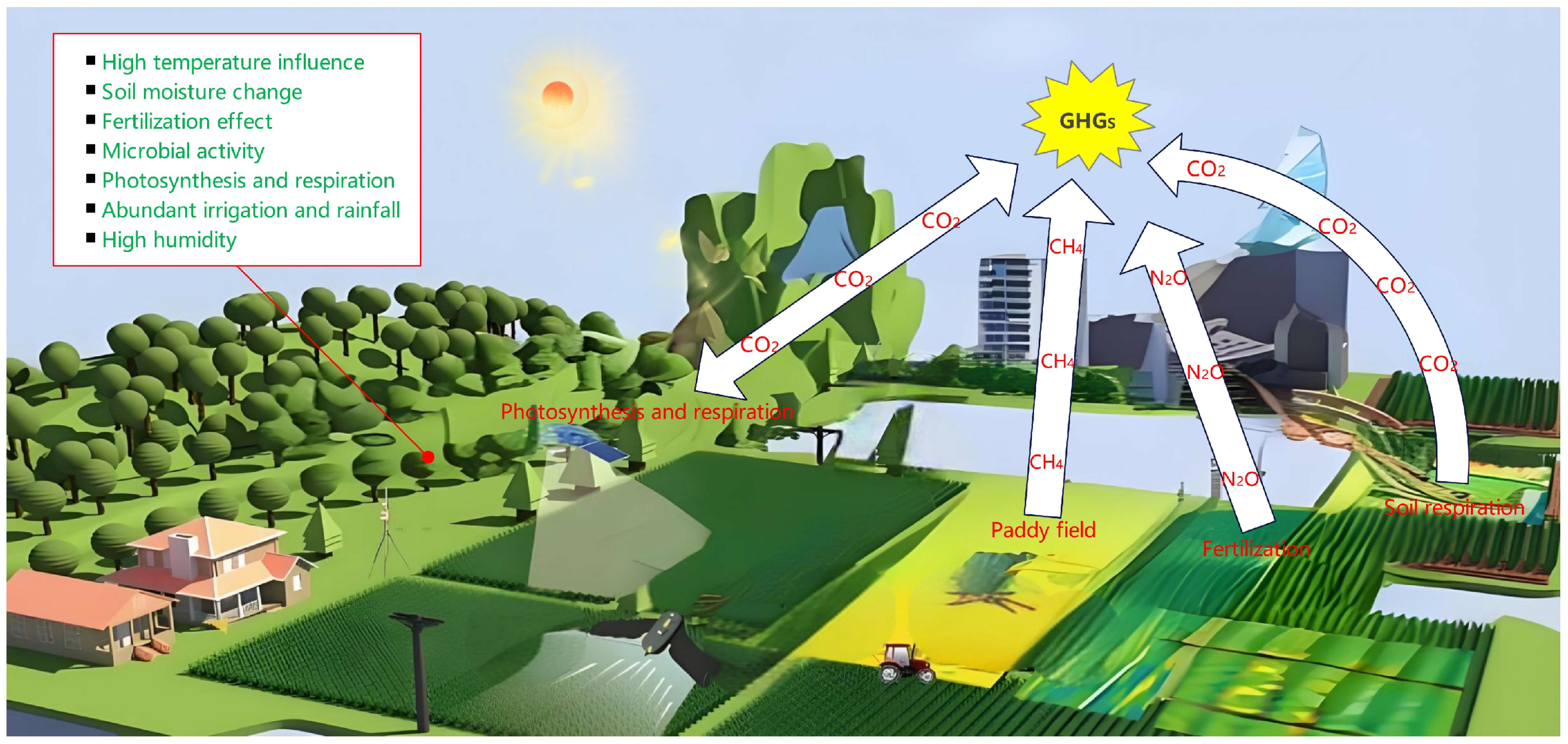
Research on annual grain rotation started early and has been extensively studied. In recent years, it has shown a trend of shifting from phenomenon description to mechanism exploration, and from single effects to system integration. In terms of research content, the focus is mainly on frontier areas such as the synergistic effects of conservation agriculture and rotation, the regulatory mechanisms of rotation on soil microecology, and the carbon footprint and greenhouse gas emission reduction of rotation systems [25,26,27,28,29,30,31,32,33,34,35,36,37,38,39,40,41,42,43] (Figure 1).
In terms of deepening research on traditional rotation patterns, particularly abundant research outcomes have been achieved for rice–wheat rotation and maize–soybean rotation. Research has focused on straw return and nutrient management, clarifying the role of straw return in enhancing the soil carbon pool and its impact on subsequent crop yields. Studies have shown that long-term straw return in wheat–maize rotation systems can significantly increase soil organic matter, total nitrogen, alkali-hydrolyzable nitrogen, and total potassium content, among which the increase in available phosphorus and available potassium can reach 30% to 40% [43,44]. At the same time, the migration and transformation patterns of nitrogen and phosphorus in the soil–crop–water continuum within the rice-wheat rotation system have been systematically revealed [45,46,47,48].
In terms of innovative exploration of high-efficiency ecological rotation patterns, research on emerging rotation patterns such as maize–garlic and rice–morchella has been increasing in recent years. Taking maize–garlic rotation as an example, studies have found that garlic root exudates have significant antibacterial effects, which can effectively improve soil microecology and promote soil nutrient cycling [49]. At the same time, garlic, as a high-value cash crop, can significantly achieve a win-win situation of “efficiency enhancement” and “soil improvement”. Studies have shown that under the maize–garlic rotation pattern, the full return of garlic straw to the field after harvest can provide abundant organic matter for the subsequent maize crop, while the inhibitory effect of garlic root exudates on pathogens reduces the use of chemical pesticides.
In terms of technical support and regional optimization, some scholars have conducted extensive research on technologies combining conservation tillage and rotation, targeting the climatic conditions and production realities of different regions. In Northeast China, researchers have proposed technical solutions such as maize straw incorporation and return, subsoiling with stubble breaking and land preparation, which have effectively solved the problems of stubble coordination and straw management in soybean-maize rotation [48]. Research on these innovative patterns and technologies directly responds to the urgent demand in China’s agricultural production for “yield, efficiency, and ecology simultaneously,” and provides an important reference for the optimal selection of regional rotation patterns. In rice-rapeseed rotation, the application of full mechanization technology has become a new research hotspot [50,51,52].
In summary, research on rotation has made considerable progress in both theoretical exploration and practical application. However, existing studies still have certain limitations. Most studies either focus on the agronomic effects of a single rotation pattern or emphasize the climate adaptability analysis of specific regions. They lack a full-chain analytical framework that systematically integrates “climate adaptability, rotation combinations, yield effects, technical support, and regional recommendation.” Climatic conditions are the basis for determining the cropping intensity and pattern selection of rotations. The combination of different crops directly affects the yield performance and ecological functions of the system. Meanwhile, the development of agricultural mechanization and intelligent technologies provides key guarantees for the efficient implementation of rotation patterns. Incorporating these elements into a unified analytical framework helps to achieve a more comprehensive and in-depth understanding of the internal operating mechanisms of rotation systems, and provides a scientific basis for the optimal selection of rotation patterns in different regions.
Based on this, this paper aims to systematically integrate the latest research findings from both domestic and international sources, and to construct a full-chain analytical framework covering the above five elements. First, from the perspective of climate drivers, this paper will analyze the spatial differentiation characteristics of rotation patterns in different cropping intensity zones and their responses to climate change. Second, it will focus on typical patterns of synergistic rotation between grain crops and cash crops (e.g., maize–garlic, rice–morchella, maize–soybean), and elaborate on their regulatory mechanisms regarding soil physicochemical properties, nutrient cycling, and microbial communities. Third, it will systematically review the effects of rotation on crop yields and the mechanisms underlying yield increase. Fourth, it will discuss the current application status and prospects of agricultural machinery and intelligent technologies in rotation patterns. Finally, based on the above analysis, it will propose recommended rotation schemes and policy recommendations for different regions. Through this systematic integration, this paper aims to provide a scientific basis for the optimal selection of regional rotation patterns, and to contribute theoretical support and practical reference for promoting green, efficient, and sustainable agricultural development in China.
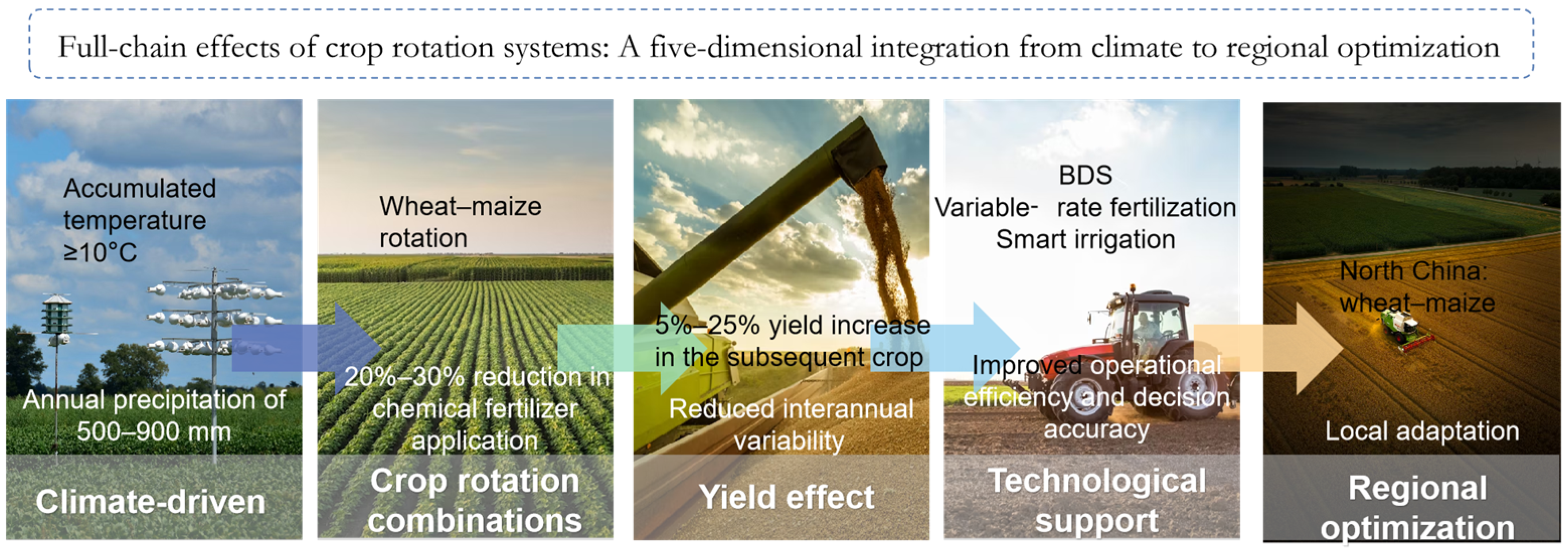
To make the above research framework clearer and more intuitive, this paper presents the full-chain analytical framework diagram for rotation research, as shown in Figure 2. Climatic conditions are the fundamental driver of cropping intensity, determining the rotation combinations in different regions. Rotation combinations directly produce yield effects and impose specific requirements on agricultural technologies. Agricultural mechanization and intelligent technologies provide key guarantees for the implementation of rotation patterns. Regional recommendation, based on the integration of the previous four components, proposes locally tailored optimal solutions and in turn provides feedback to climate adaptability and combination selection. This framework runs through the entire paper and serves as a structural guide for the analyses in each chapter. It is important to note that while this review draws on research findings and case studies from China to illustrate regional optimization strategies, the analytical framework and conclusions are intended to have global applicability. International examples from North America (e.g., long-term corn-soybean rotation trials in the U.S. Midwest), Europe (e.g., diversified rotations with legumes for carbon sequestration), South America (e.g., no-till soybean–maize rotations in Brazil), and South Asia (e.g., rice–wheat and rice–rapeseed rotations in the Indo-Gangetic Plain) are incorporated to highlight comparative insights.
The proposed framework differs from previous reviews in three ways: (1) it integrates agronomic, soil, and engineering perspectives into a coherent cross-disciplinary chain from climate drivers to field implementation; (2) it balances global generality with local specificity by incorporating case studies from multiple continents while using China as a detailed regional example; and (3) it explicitly includes agricultural mechanization and intelligent technologies as enabling factors, reflecting the current transition toward digital and precision agriculture.

2. Materials and Methods

This study adopts a literature review method that combines systematic retrieval with thematic analysis. The literature was mainly sourced from the Web of Science Core Collection and the China National Knowledge Infrastructure (CNKI) database. The search scope was limited to publications from 2000 to 2026, with a focus on research related to crop rotation mechanisms, soil health, greenhouse gas emissions, agricultural technologies, and regional optimization.

2.1. Retrieval Strategy

The keyword groups were combined using both AND and OR to maximize the systematicity and coverage of the literature retrieval. Within each group, synonymous terms were connected using OR, while different thematic groups were connected using AND. English databases were searched using English keywords, whereas CNKI was searched using the corresponding Chinese keywords.
Group One (research objects): crop rotation, cropping system, rotation pattern;
Group Two (mechanisms and effects): soil health, soil fertility, nutrient cycling, greenhouse gas, microbial community, soil carbon, soil aggregate, yield;
Group Three (technologies and applications): precision agriculture, remote sensing, variable rate, intelligent agriculture, automation, no-till, conservation agriculture.
The literature search was performed on April 2026. The detailed Boolean search strings used in Web of Science were as follows:
TS = (“crop rotation” OR “cropping system” OR “rotation pattern”) AND TS = (“soil health” OR “soil fertility” OR “nutrient cycling” OR “greenhouse gas” OR “microbial community” OR “soil carbon” OR “soil aggregate” OR “yield”) AND TS = (“precision agriculture” OR “remote sensing” OR “variable rate” OR “intelligent agriculture” OR “automation” OR “no-till” OR “conservation agriculture”)
The search was limited to publications from 2000 to 2026. For the CNKI database, the corresponding Chinese keywords were used with the same Boolean logic.

2.2. Inclusion Criteria

Research subjects: Studies on crop rotation systems, including grain-crop rotations (e.g., wheat–maize, maize–soybean) and grain–cash crop rotations (e.g., maize–garlic, rice–morchella);
Research content: Focus on crop rotation effects on soil physical, chemical, and biological properties; yield increase mechanisms; greenhouse gas emissions; agricultural mechanization; intelligent technologies; and regional optimization strategies;
Literature type: Peer-reviewed journal articles, high-quality international conference papers, and doctoral dissertations.

2.3. Exclusion Criteria

Non-academic publications: Including patent specifications, news reports, product manuals, technical white papers, and online resources that have not undergone peer review;
Irrelevant studies: Studies mainly focusing on intercropping or cover cropping without explicit rotation sequences, or studies on continuous monocropping without rotation comparison;
Duplicate publications: When the same study appeared in both conference and journal versions, only the most complete and informative version was retained;
Insufficient-information literature: Studies lacking full-text availability, providing unclear descriptions of rotation practices, or failing to support qualitative or quantitative analysis.

2.4. Literature Screening Procedure

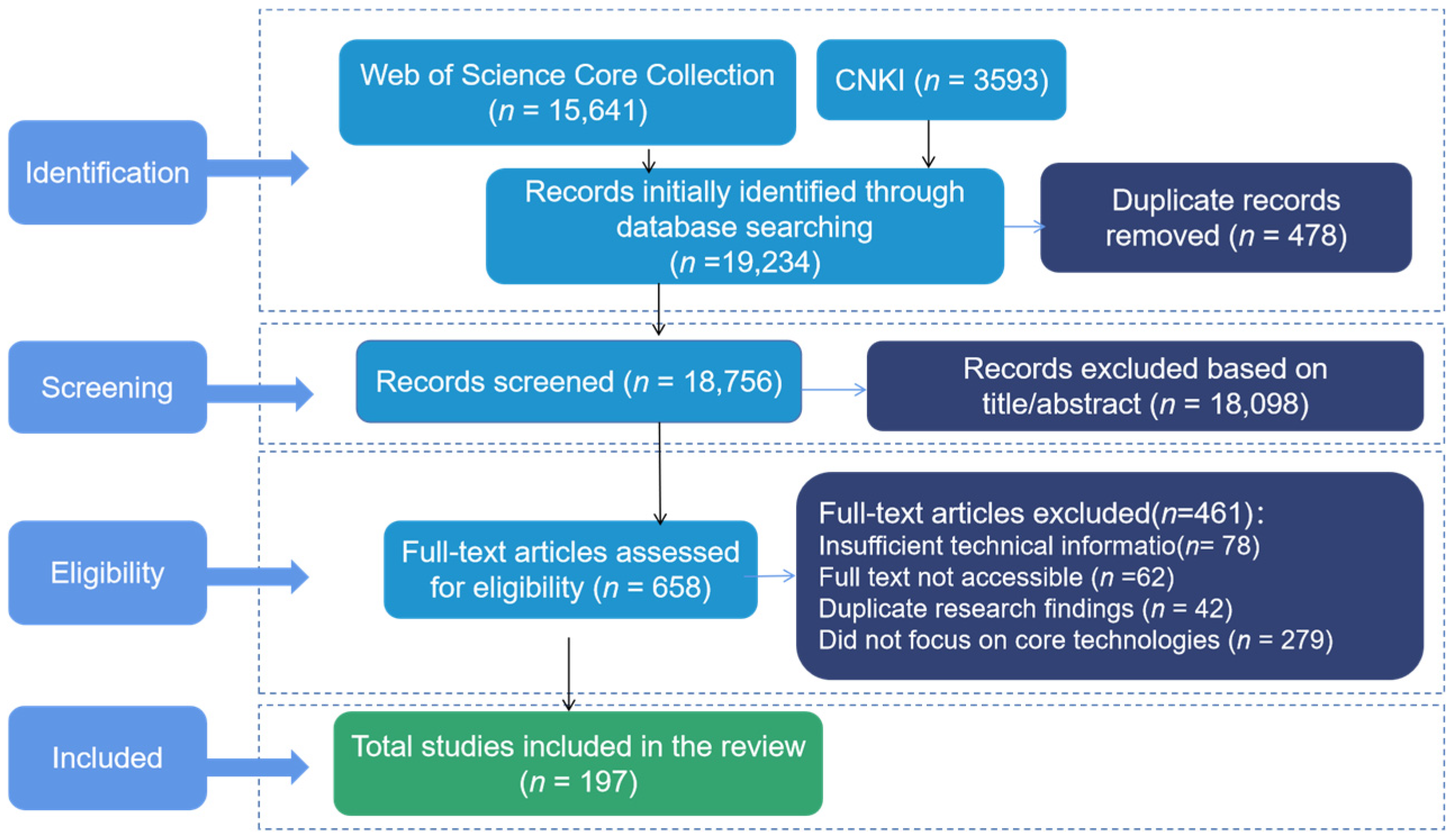
The literature search was conducted in the Web of Science Core Collection and CNKI, and all retrieved records were exported to EndNote for management. After merging the search results from the two databases, duplicate records were identified and removed using a combination of EndNote automatic deduplication and manual verification before subsequent screening was carried out. As shown in Figure 3, a total of 19,234 records were initially identified from Web of Science and CNKI. After removing 478 duplicate records, 18,756 records remained for title and abstract screening. Through this initial screening, 18,098 records that were irrelevant to the topic were excluded. The remaining 658 articles underwent full-text assessment. Subsequently, 461 full-text articles were excluded for the following reasons: insufficient technical information (n = 78), lack of full-text access (n = 62), duplicate research findings (n = 42), and not focusing on core technologies (n = 279). Ultimately, 197 studies were included in the final qualitative review. The detailed screening process is presented in Figure 3.
The screening process was conducted independently by two of the authors (Q.S. and Y.W.). Disagreements regarding study inclusion were resolved through discussion with a third author (Z.T.). For the quality assessment of included studies, we adopted a predefined set of criteria based on the study design (field experiments vs. modeling studies), sample size and replication, duration of the experiment, and clarity of reported methods and results. Studies that failed to meet at least three of these criteria were excluded from the final synthesis.

2.5. Data Extraction and Thematic Analysis

For the finally included studies, information such as publication year, crop rotation type, main research focus, key findings, experimental conditions (e.g., location, duration, soil type), and research limitations was extracted. On this basis, the literature was classified and organized according to research themes, thereby supporting the comparative analysis conducted in this review.
Based on the research objectives and the full-chain analytical framework proposed in this review (climate adaptability → rotation combinations → yield mechanisms → technological support → regional optimization), the selected literature was classified into five major themes. This thematic classification constitutes the analytical framework of Section 3, Section 4, Section 5, Section 6, Section 7 and Section 8 of this review.

3. Spatial Differentiation of Cropping Intensity Driven by Climate

3.1. Cropping Intensity Zoning in China

Annual cropping intensity refers to the number of crop growing seasons per year in a given region, and its spatial differentiation is primarily driven and influenced by climatic conditions. Accumulated temperature ≥ 10 °C, annual precipitation, and frost-free period are the key climatic factors determining cropping intensity (single cropping, double cropping, or triple cropping per year). Based on these indicators, China’s major agricultural regions can be divided into three cropping intensity zones. The single cropping zone is mainly distributed in Northeast China, Northwest China, and the Qinghai–Tibet Plateau. This region has insufficient thermal resources, low accumulated temperature ≥ 10 °C, and a short frost-free period. The main representative pattern is maize–soybean rotation, with maize continuous cropping or wheat–soybean rotation practiced in some areas. The double cropping zone is mainly distributed in the North China Plain and the Huang-Huai-Hai Plain. In this region, the accumulated temperature ≥ 10 °C ranges from 4000 to 5000 °C, and annual precipitation ranges from 500 to 900 mm. Typical patterns include winter wheat–summer maize rotation, as well as combinations such as wheat–peanut and wheat–soybean. The triple cropping zone is mainly distributed in the Yangtze River Basin and South China. In this region, the accumulated temperature ≥ 10 °C is above 5000 °C, annual precipitation is abundant, and the frost-free period is long. Patterns include rice-rice-rapeseed/vegetable, as well as rice-vegetable-vegetable, among others. It is worth noting that in the Yangtze River Basin and areas to the south, rice–wheat rotation is also an important double cropping pattern. In South China, where water and heat conditions are more favorable, triple cropping of double rice plus a winter crop is more common.

3.2. Impact of Climate Change on Cropping Intensity

Global warming has had a significant impact on the boundaries of cropping intensity. In temperate regions, climate warming has led to a northward shift of cropping intensity boundaries. For example, the wheat-growing belt in Europe has expanded northward, and the Corn Belt in the United States has shifted northward [6]. Observational data from China over the past 50 years also show that the northern boundary of rice cultivation in Northeast China has shifted significantly northward. Areas that previously could only support single cropping can now grow rice varieties requiring more heat. In North China, the northern boundary of the winter wheat-summer maize double cropping zone has also shown a northward trend [53,54].
Climate change has not only increased thermal resources but also raised the frequency of extreme weather events (e.g., drought, flooding, and heatwaves), which poses a serious threat to the stability of rotation systems [1]. If continuous rain or drought occurs, it can severely affect sowing quality and seedling emergence. In the southern rice-growing regions, an increase in extreme precipitation events may lead to intensified nutrient runoff loss from paddy fields [55]. To address climate warming, it is necessary to dynamically adjust rotation combinations, introduce drought-tolerant and heat-tolerant varieties, and optimize sowing timing in order to maintain system productivity. For example, in the Huang-Huai-Hai region, under the maize–garlic rotation pattern, the coordination between garlic harvest time and maize sowing time needs to be flexibly adjusted according to the climatic conditions of the given year [56,57]. In rice–morchella rotation, morchella is extremely sensitive to temperature (optimal range 8–16 °C). Rapid warming in early spring often causes devastating effects, thus requiring precise temperature control and cultivation management [50]. These studies indicate that climate adaptability is the primary consideration in the design and optimization of rotation patterns [58].
Climate change not only affects the boundaries of cropping intensity but also significantly alters the greenhouse gas emission patterns of rotation systems, with different rotation systems responding differently to climate change. For example, conventional tillage systems typically emit more carbon dioxide (CO2) and nitrous oxide (N2O) than no-till or reduced-till systems [59,60]. In contrast, rotation systems that include leguminous crops, by reducing the demand for synthetic nitrogen fertilizer through biological nitrogen fixation, show greater emission reduction potential in the context of climate change [61,62]. Therefore, the design of future rotation patterns must take greenhouse gas emission reduction as a core objective. However, most current adaptation strategies rely on historical climate data rather than dynamic future scenarios. Moreover, quantitative projections of climate change impacts on specific rotation systems remain scarce, limiting the robustness of long-term planning.

4. Typical Rotation Combinations: Synergistic Patterns of Grain Crops and Cash Crops

4.1. In-Depth Analysis of Major Rotation Combinations

Crop rotation combinations that provide both ecological and economic benefits have been widely studied across agricultural regions worldwide. This section first reviews representative rotation systems from major global regions, followed by a detailed analysis of four typical combinations from China as illustrative cases [63,64,65].

4.1.1. Global Perspectives on Crop Rotation

South Asia. Rice–wheat and rice–rapeseed rotations dominate the Indo-Gangetic Plain. A study from eastern Nepal reported that a rice–pulses–spring rice rotation achieved an energy-use efficiency of 3.37 and a global warming potential of approximately 721 kg CO2-eq/ha, highlighting that regional rotation design must consider energy balance, mechanization level, and profitability alongside yield and soil benefits [66].
North America. Corn–soybean rotation is the predominant system in the U.S. Midwest. Long-term experiments at the Kellogg Biological Station have demonstrated that corn–soybean rotations consistently outperform continuous monoculture in terms of yield stability and soil health indicators [66,67,68]. A global meta-analysis synthesizing 3663 paired field-trial yield observations (1980–2024) confirmed that, worldwide, crop rotation increases subsequent crop yield, with legume pre-crops outperforming non-legume pre-crops (23% vs. 16% average increases). Considering the full rotation sequence, rotations increased total yields, dietary energy, protein, and revenue by 14–27% relative to continuous monoculture, with win–win synergies among yield, nutrition, and revenue reaching 33–54% [69].
Europe. Diversified rotations incorporating legumes and cover crops have shown significant benefits for soil organic carbon (SOC) sequestration. An analysis of 30 mid-term and long-term field experiments across Europe found that increasing the proportion of forage legumes in rotations led to SOC accrual of up to 13.25 Mg ha−1 (0.44 Mg ha−1 yr−1). Forage legumes achieved the largest SOC gains at sites with the smallest initial SOC stocks, while grain legumes generally led to SOC losses unless the rotation period was sufficiently extended [70].
South America. No-till soybean–maize rotations have been widely adopted, particularly in Brazil. A 16-year field experiment in subtropical Brazil found that continuous no-till cropping systems increased SOC stocks by 25.8 Mg C ha−1 in the 0–40 cm layer compared to conventional tillage. Importantly, an increase of 1 Mg C ha−1 in SOC corresponded to an 11 kg ha−1 increase in soybean yield, demonstrating a positive feedback loop between carbon sequestration and agronomic productivity [71].
Africa. Maize–soybean rotation has shown considerable promise in sub-Saharan Africa, where continuous maize monocropping has led to severe soil degradation. Studies have reported that introducing soybean–maize rotation can supply 17–170 kg N ha−1 to subsequent maize crops through biological nitrogen fixation, increasing maize yield by more than 0.49 t ha−1 [72]. Moreover, root exudates from soybean can induce “suicidal germination” of the parasitic weed Striga, thereby effectively controlling this major constraint to maize production.
The following section presents a detailed analysis of four typical rotation combinations from China, which serve as representative cases to illustrate how region-specific rotation systems can be designed and optimized based on local climate, crop characteristics, and economic objectives.

4.1.2. Representative Rotation Patterns in China

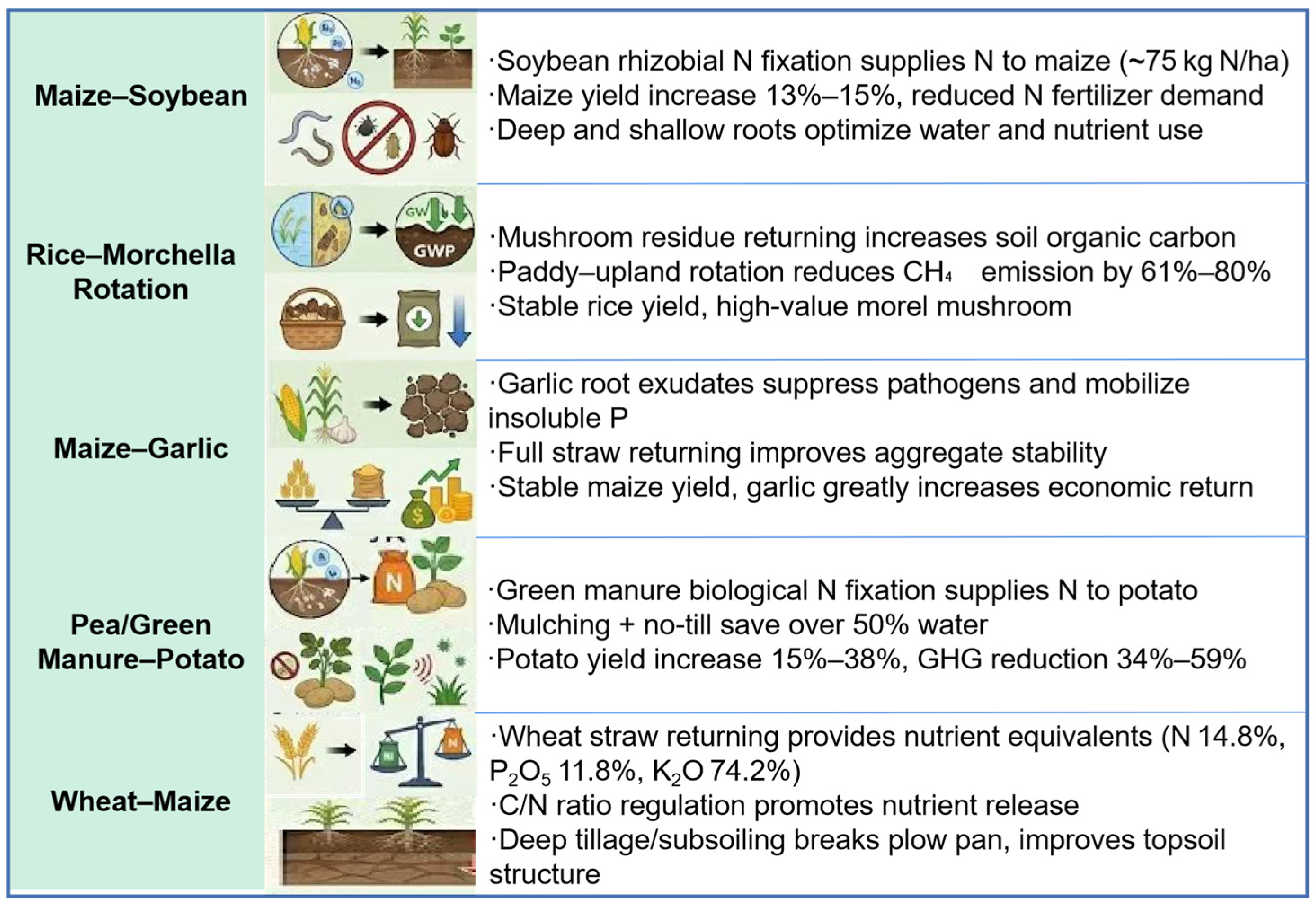
(1) Maize–garlic rotation is mainly distributed in the Huang-Huai-Hai region and Southwest China. In terms of yield performance, maize yields are stable while garlic yields are medium to high. The economic benefit is high due to the high added value of garlic. Ecologically, garlic root exudates inhibit pathogens, promote soil nutrient cycling, and improve soil fertility. Key influencing factors include the coordination between garlic harvest and maize sowing, as well as green pest and disease control [49,72].
(2) Rice–morchella rotation is found in the Yangtze River Basin and areas south of the Yangtze River. Rice yields are stable, and morchella yields are high, leading to very high economic benefits because of the high economic value of morchella. The ecological effects are notable: paddy–upland rotation prevents soil compaction and secondary gleization; mushroom residue return increases soil organic matter; and methane (CH4) emissions during the rice season are reduced. However, morchella is environmentally sensitive and requires detailed management, including strain selection and control of the amount of mushroom residue returned to the field [73].
(3) Wheat–maize rotation is common in North China and the Huang-Huai-Hai region. It achieves high yields for both crops, with stable economic returns. Straw return is the core ecological practice, as it supplements soil nutrients, but the carbon-to-nitrogen (C/N) ratio must be regulated. Key challenges include long-term continuous cropping, which depletes soil fertility and thus requires deep tillage and organic fertilizer application, as well as a tight stubble window between crops [60].
(4) Maize–soybean rotation is typical in Northeast China and the Huang-Huai-Hai region. Maize yields are high, and soybean yields are medium, with relatively high economic benefits due to soybean subsidies. Ecologically, soybean nodule nitrogen fixation improves soil nitrogen balance, and the combination of deep (maize) and shallow (soybean) root systems optimizes water and nutrient use. Important influencing factors are the determination of the rotation cycle (e.g., two-year or three-year rotations) and tillage techniques such as straw management and subsoiling [74].
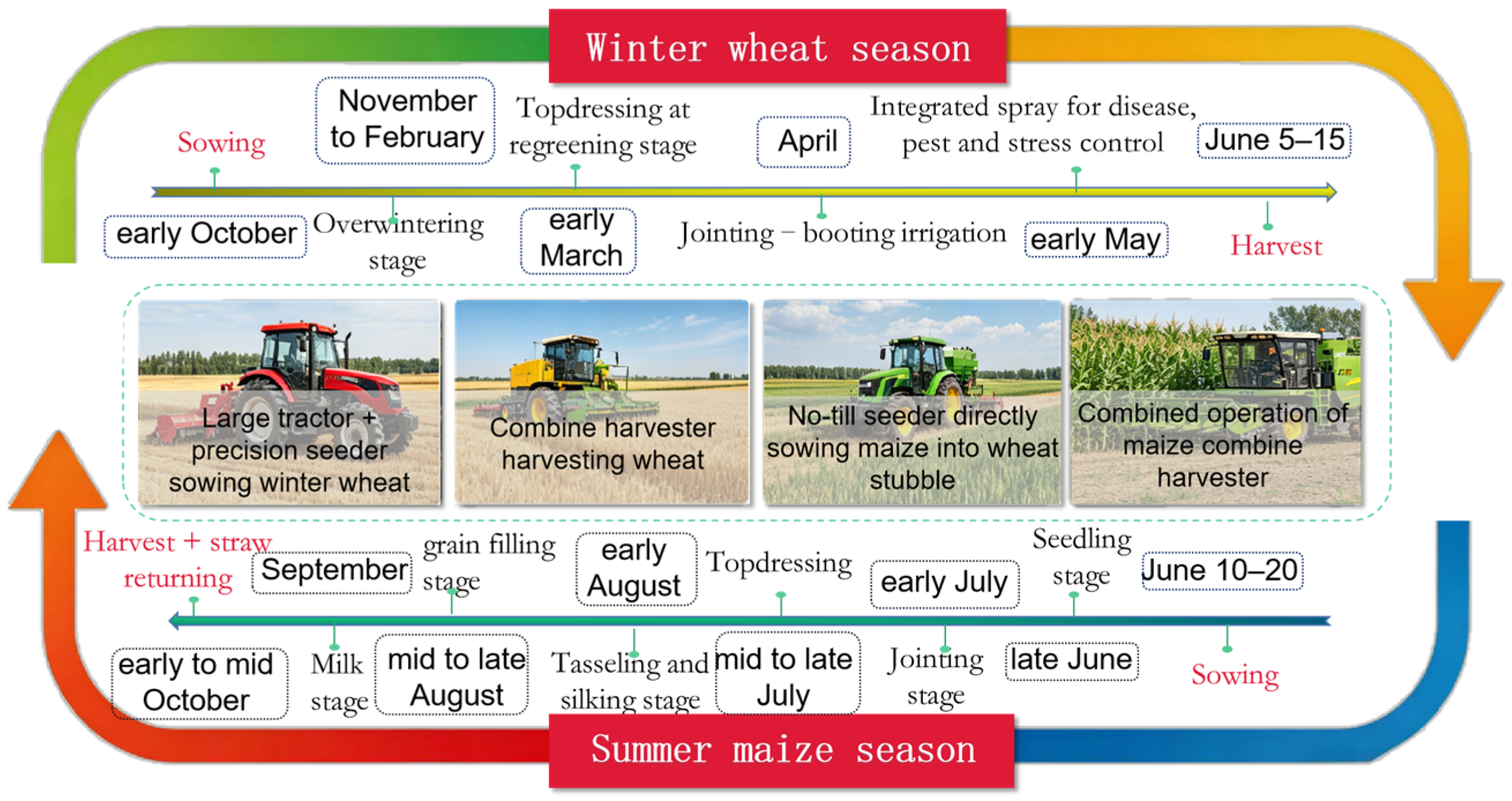
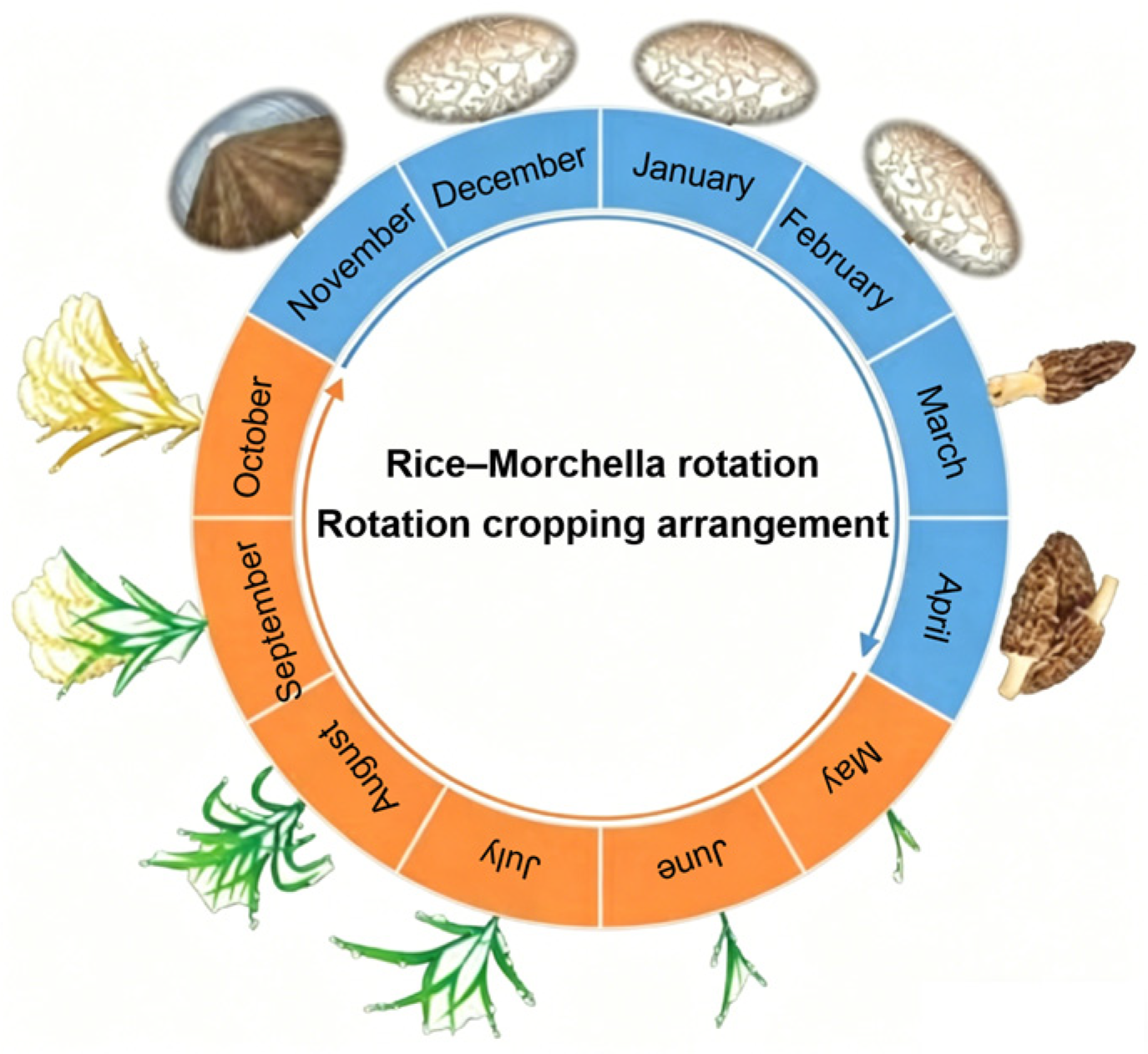
In summary, different rotation combinations each have their own advantages in terms of yield, economic returns, and ecological effects. Maize–garlic and rice–morchella rotations, owing to their high economic benefits and positive ecological effects (pathogen inhibition, carbon sequestration, and emission reduction), have become hotspots for research and promotion in recent years. In contrast, wheat–maize and maize–soybean rotations, as traditional grain crop rotation patterns, still occupy a dominant position in ensuring national food security. However, they also face challenges such as soil fertility depletion and a tight stubble window. Figure 4 and Figure 5 show the cropping schedule timelines for the wheat–maize and rice–morchella rotation patterns, respectively. Notably, the quantitative data on these rotation combinations are heavily concentrated in China, and comparative studies across different agro-ecological zones using consistent methodologies are still lacking, limiting the generalizability of current findings [50].
Notably, soybean–maize rotation, as one of the most widely adopted rotation patterns globally, has shown great potential in sub-Saharan Africa. In this region, maize is a staple food, but continuous monocropping has led to severe soil degradation [75]. Studies have shown that introducing soybean–maize rotation can supply 17–170 kg N·ha−1 to the subsequent maize crop through biological nitrogen fixation, increasing maize yield by more than 0.49 t·ha−1, while root exudates can induce “suicidal germination” of the parasitic weed Striga, thereby effectively controlling this major threat to maize production [12].

4.2. Ecological Effects of Rotation Combinations

Rotation patterns with different crop combinations not only alter the species composition and cropping sequence of farmland systems but also, through the interactions between aboveground communities and belowground soil environments, trigger a series of systemic chain reactions involving soil physicochemical properties, biological characteristics, and greenhouse gas emissions [76].
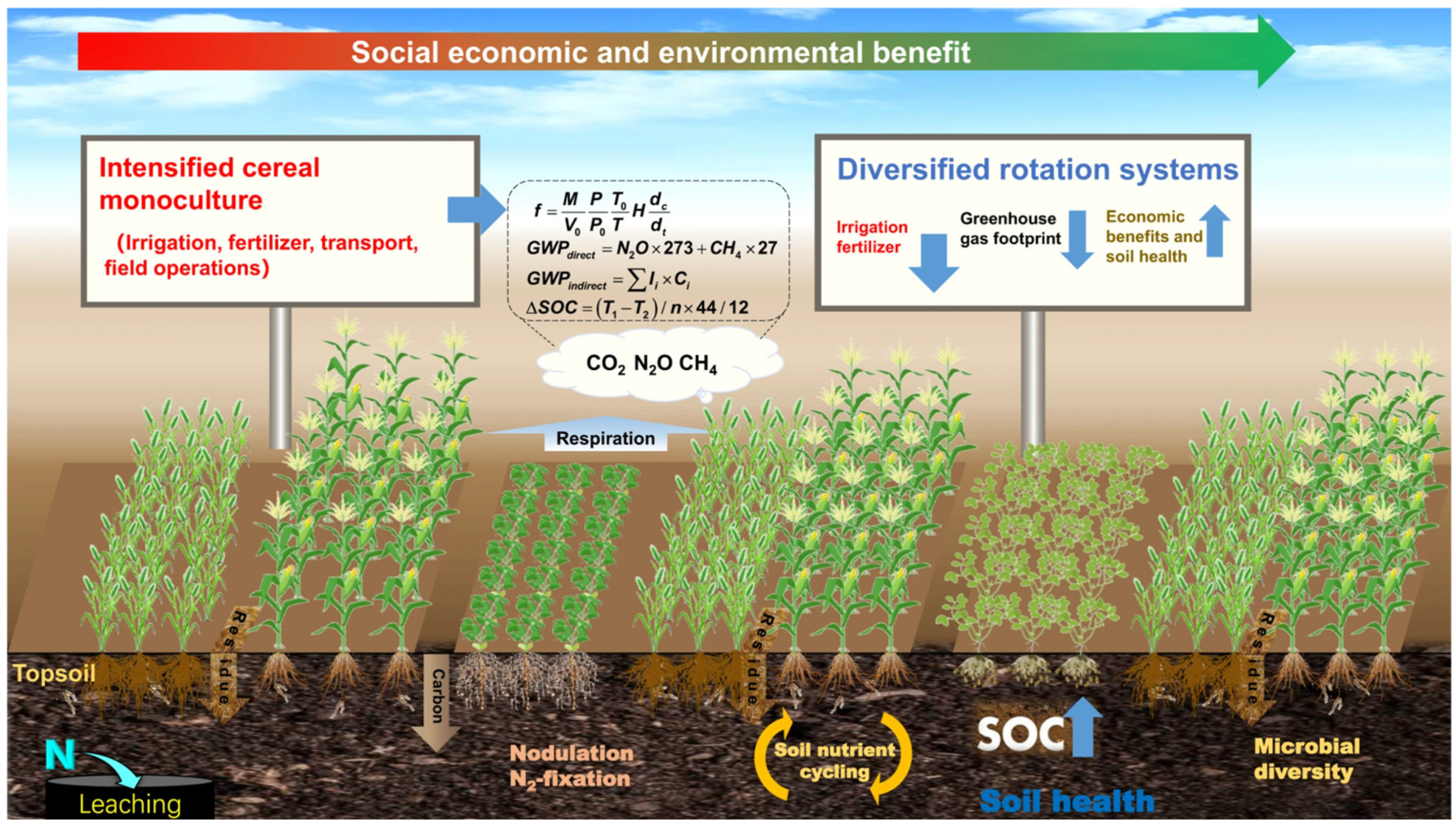
Compared with continuous monocropping, diversified rotation systems construct a more stable and healthy soil ecological foundation by regulating carbon and nitrogen cycles, improving soil physicochemical properties, and modulating microbial community structure. These processes together form the core support for the comprehensive benefits of rotation systems. To intuitively reveal the intrinsic mechanism of action from cropping pattern adjustment to soil health improvement and environmental benefit enhancement in rotation combinations, Figure 6 systematically illustrates the synergistic enhancement mechanisms of soil nutrient cycling, soil organic carbon sequestration, and microbial diversity during the transition from intensive monocropping to diversified rotation [12].

4.2.1. Improvement of Soil Physical Structure

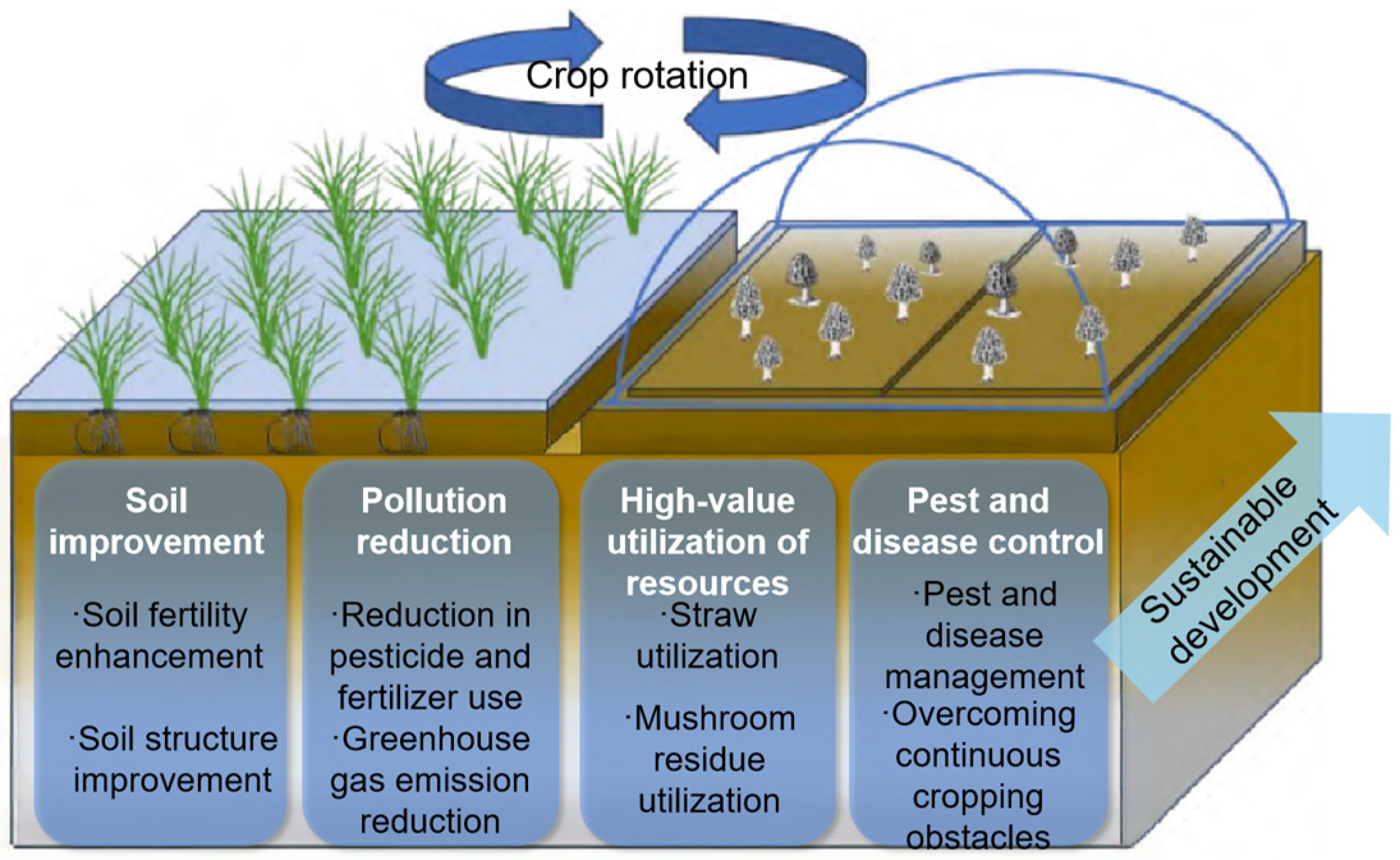
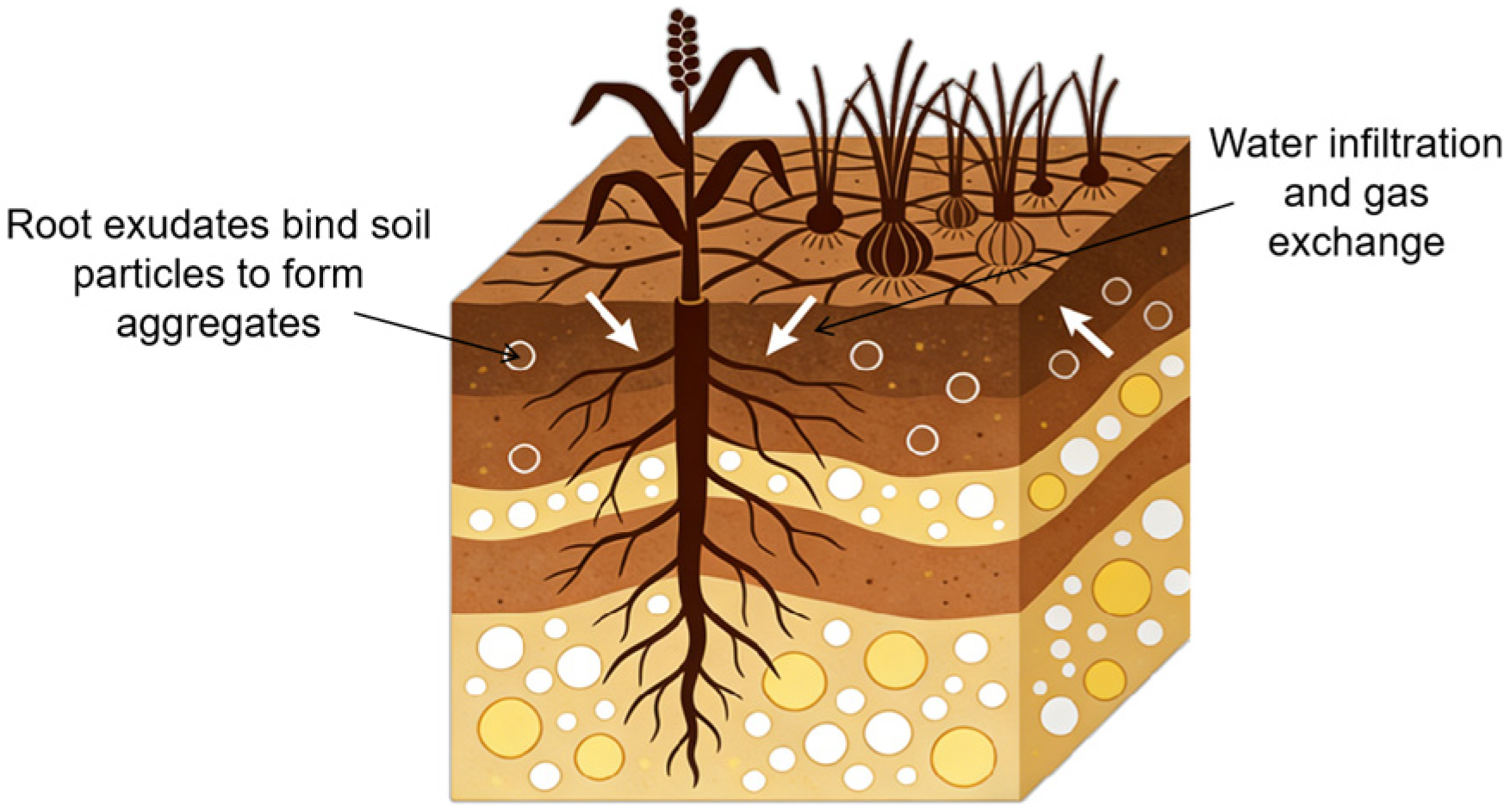
The alternation of root systems of different crops is a key mechanism for improving soil physical structure. Deep-rooted crops such as maize can penetrate the plow pan, increase deep soil porosity, and improve gas exchange efficiency and water infiltration capacity [77]; shallow-rooted crops such as garlic, through the secretion of organic acids and colloidal substances, promote the binding of surface soil particles and enhance aggregate stability [78]. Paddy–upland rotation (e.g., rice–morchella) effectively prevents soil compaction and secondary gleization through alternating wet and dry conditions [50]. Figure 7 presents a schematic diagram for sustainable development of the rice–morchella rotation pattern. Furthermore, crop residues (e.g., maize straw, garlic roots) are transformed into humus under microbial action, binding fine particles to form stable aggregate structures, thereby improving soil water retention and aeration, and making the physical properties of soils at different depths more uniform and stable [50,79]. Figure 8 illustrates the mechanism by which crop rotation improves soil physical structure.

4.2.2. Improvement of Soil Chemical Properties

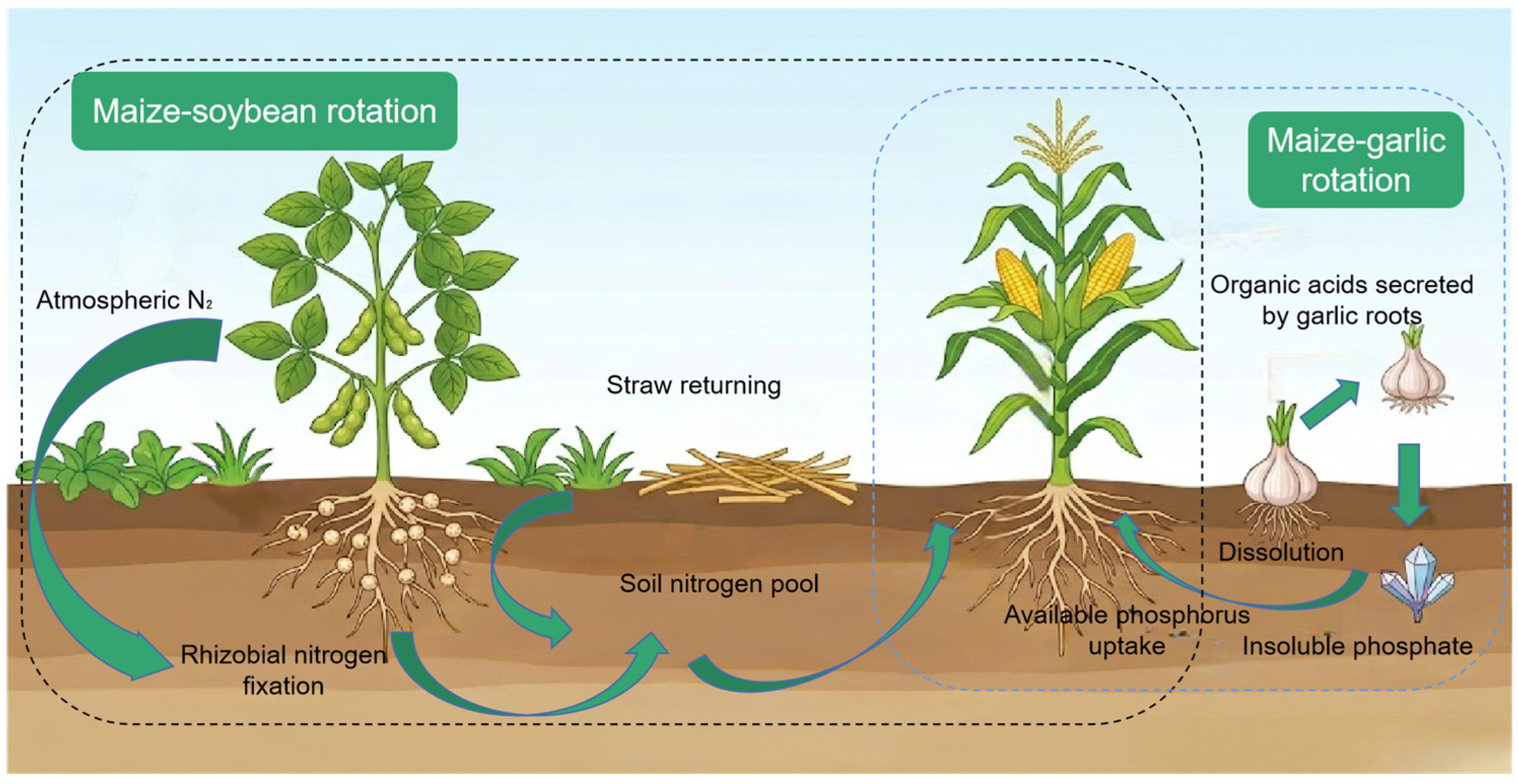
In addition to improving soil physical structure, crop rotation significantly optimizes soil chemical properties through multi-level biochemical processes. Crop rotation also plays a key role in enhancing soil carbon sequestration. Studies have demonstrated that, in comparison to long-term continuous cropping, rotations of highland barley with rapeseed and highland barley with wheat enhanced the soil quality index by 21% and 11%, respectively, while also increasing yields by 12% and 17% [80]. This improvement is mainly attributed to the increase in soil microbial biomass carbon and nitrogen and the decrease in soil pH under rotation. This further demonstrates that rational rotation patterns are an effective approach for restoring degraded soil and enhancing soil fertility. Leguminous crops (e.g., soybean) fix nitrogen symbiotically with rhizobia, converting atmospheric nitrogen into plant-available forms, thereby supplying nitrogen to subsequent crops and reducing the demand for chemical fertilizers [81,82]. In the maize–garlic rotation, maize roots absorb nitrogen from deeper soil layers, while garlic roots activate readily available nutrients in the surface soil through root exudates, forming a nutrient cycling pattern that combines deep and shallow layers and effectively improving nitrogen use efficiency [49]. Organic acids secreted by garlic roots can dissolve insoluble phosphates in the soil and convert them into available phosphorus; the decomposition products of maize straw after incorporation further activate the soil phosphorus pool, forming a continuously replenished phosphorus cycle. Meanwhile, ion uptake and organic acid secretion by the root systems of different crops dynamically regulate soil pH: maize roots absorb cations, increasing local pH; garlic roots release organic acids, locally optimizing acidic conditions. Through this alternation, a soil pH buffering system is formed, stabilizing the overall pH. Figure 9 illustrates two representative nutrient cycling pathways in crop rotation systems. In legume-including rotations such as maize–soybean (left panel), biological nitrogen fixation by soybean nodules provides a nitrogen source for the soil, reducing the demand for synthetic fertilizers. In non-legume rotations such as maize–garlic (right panel), organic acids secreted by garlic roots dissolve insoluble phosphates into plant-available forms. In both systems, straw incorporation further activates soil nutrient pools, contributing to efficient and sustainable nutrient cycling [45]. Nevertheless, most of these mechanistic insights have been derived from controlled experiments with limited validation across diverse field conditions, and the translation of such findings into practical management guidelines remains incomplete.

4.2.3. Regulation of Soil Biological Properties

Compared with continuous monocropping, diversified crop rotation increases the abundance of functional microbial groups, including nitrogen-fixing bacteria, phosphate-solubilizing bacteria, and cellulose-decomposing microorganisms [83]. Soil enzyme activities related to carbon, nitrogen, and phosphorus cycling (e.g., cellulase, urease, phosphatase) are also significantly enhanced under rotation, accelerating organic matter decomposition and nutrient mineralization [84].
Quantitative studies have reported that crop rotation increases soil microbial biomass carbon (MBC) by 13.43% and microbial biomass nitrogen (MBN) by 15.84% compared with continuous monoculture. The increase in MBC and MBN is more pronounced under conditions such as reduced tillage, rotation containing legumes, and mean annual temperature > 8 °C [85]. Rotation also improves soil aggregate stability (mean weight diameter) by 15–25% and increases soil organic carbon content by 8–18% [85]. These improvements contribute to higher soil health indices and provide a foundation for stable crop yields.
Recent advances in high-throughput sequencing and metagenomics have deepened understanding of the microbiological mechanisms underlying rotation benefits. Metagenomic analyses reveal that rotation systems enrich functional genes involved in carbon degradation, nitrogen fixation, and phosphorus solubilization, thereby enhancing soil multifunctionality [84,86]. For example, a 12-year field experiment showed that wheat–soybean rotation significantly increased soil total nitrogen content by 9.1–19.4% compared with wheat–maize or wheat–cotton rotations. Network analysis identified that keystone genes such as nifH (nitrogen fixation) and nxrB (nitrite oxidation) were significantly enriched in wheat–soybean rotation soils, primarily through promoting the proliferation of Bradyrhizobium and Actinobacteria [33]. Similarly, an 8-year long-term study in Northeast China demonstrated that crop rotation increased soil microbial biomass carbon and nitrogen by 13.4% and 16.6%, respectively, and significantly enhanced the abundance of functional microbial groups [84].
The rhizosphere microbiome plays a critical role in mediating rotation effects. Crop rotation alters the composition and activity of rhizosphere microbial communities, including beneficial taxa such as Pseudomonas, Bacillus, and arbuscular mycorrhizal fungi (AMF), which promote plant growth and suppress soil-borne pathogens [49,52]. Metabolomic profiling has further identified that root exudate compounds such as organic acids recruit beneficial microbes and suppress pathogenic populations in rotation systems [49,87]. Research has also shown that maize–garlic rotation maintains a stable garlic rhizosphere microecology by balancing the metabolites originating from a variety of plant and microbial sources, which enriches beneficial bacteria and lowers fungal species diversity in the maize rhizosphere [49]. Additionally, long-term garlic–maize rotation has been shown to maintain stable garlic rhizosphere microecology and improve soil fertility [49]. Metagenomic sequencing of cotton–peanut rotation systems revealed that rotation increased the diversity and richness of root-zone soil microbial communities, enhanced the activity of carbohydrate-active enzymes, and increased the abundance of nitrogen-related functional genes [87].
Despite these insights, several knowledge gaps remain. Most studies have focused on short-term (<5 years) rotations, leaving the long-term succession dynamics of soil microbial communities under continuous rotation poorly understood. The causal relationships between specific microbial taxa and observed yield increases are often inferred from correlations rather than experimentally validated. Furthermore, integrated multi-omics analyses combining metagenomics, metatranscriptomics, and metabolomics are still scarce in rotation research. Future research should prioritize long-term field experiments combined with multi-omics approaches to unravel the mechanisms by which rotation shapes soil microbiomes and to develop microbiome-based indicators for rotation system design [52].
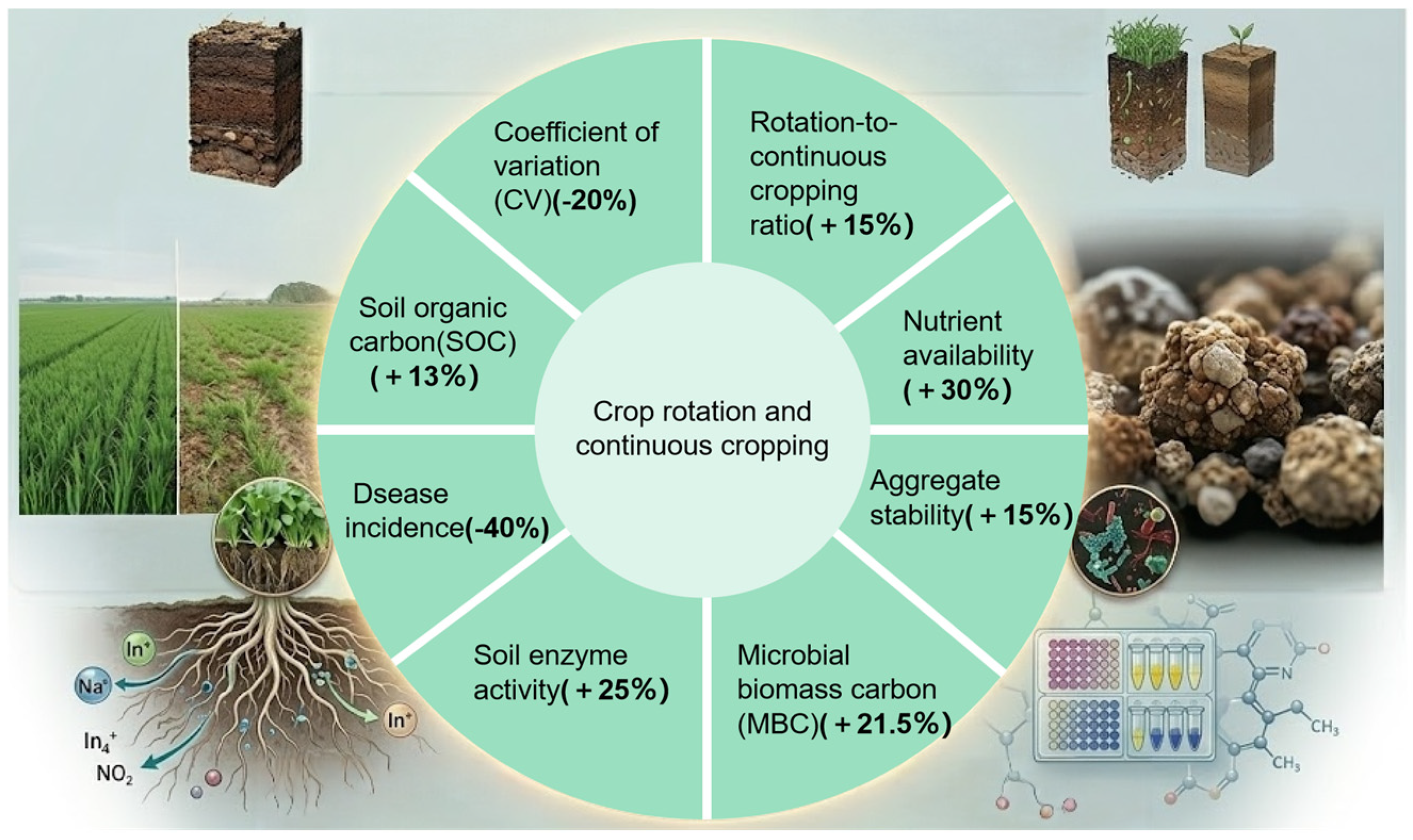
In terms of pest and disease control, rotation reduces the incidence of soil-borne diseases (e.g., soybean cyst nematode, wheat take-all) by breaking the annual life cycles of specific pathogens and pests [88,89]. Rotation also suppresses certain weed populations by altering field micro-environments, reducing reliance on chemical herbicides [90]. Figure 10 compares rotation and continuous cropping systems across soil health indicators, including organic carbon, aggregate stability, microbial biomass, enzyme activity, pathogen suppression, nutrient availability, and yield stability [39,48].

4.2.4. Regulation of Greenhouse Gas Emissions by Crop Rotation

Rotation patterns have significant effects on the emission fluxes of greenhouse gases (GHGs) from farmland, particularly nitrous oxide (N2O) and carbon dioxide (CO2) [91,92]. In a six-year field experiment in the North China Plain, Yang et al. found that diversifying the traditional wheat–maize continuous cropping by introducing cash crops and leguminous crops such as peanut, soybean, or sweet potato reduced N2O emissions by 30–49% compared with traditional continuous cropping [93]. This is mainly because diversified rotation reduces nitrogen fertilizer application (through substitution by biological nitrogen fixation of legumes) and improves nitrogen use efficiency [52,94]. Meanwhile, diversified rotation systems significantly increased soil organic carbon storage (in the 0–90 cm soil layer), with a soil carbon sequestration rate as high as 1.44–2.03 t C ha−1 yr−1, thereby offsetting 75–89% of direct greenhouse gas emissions and reducing net greenhouse gas emissions by 83–92% compared with traditional continuous cropping [95].
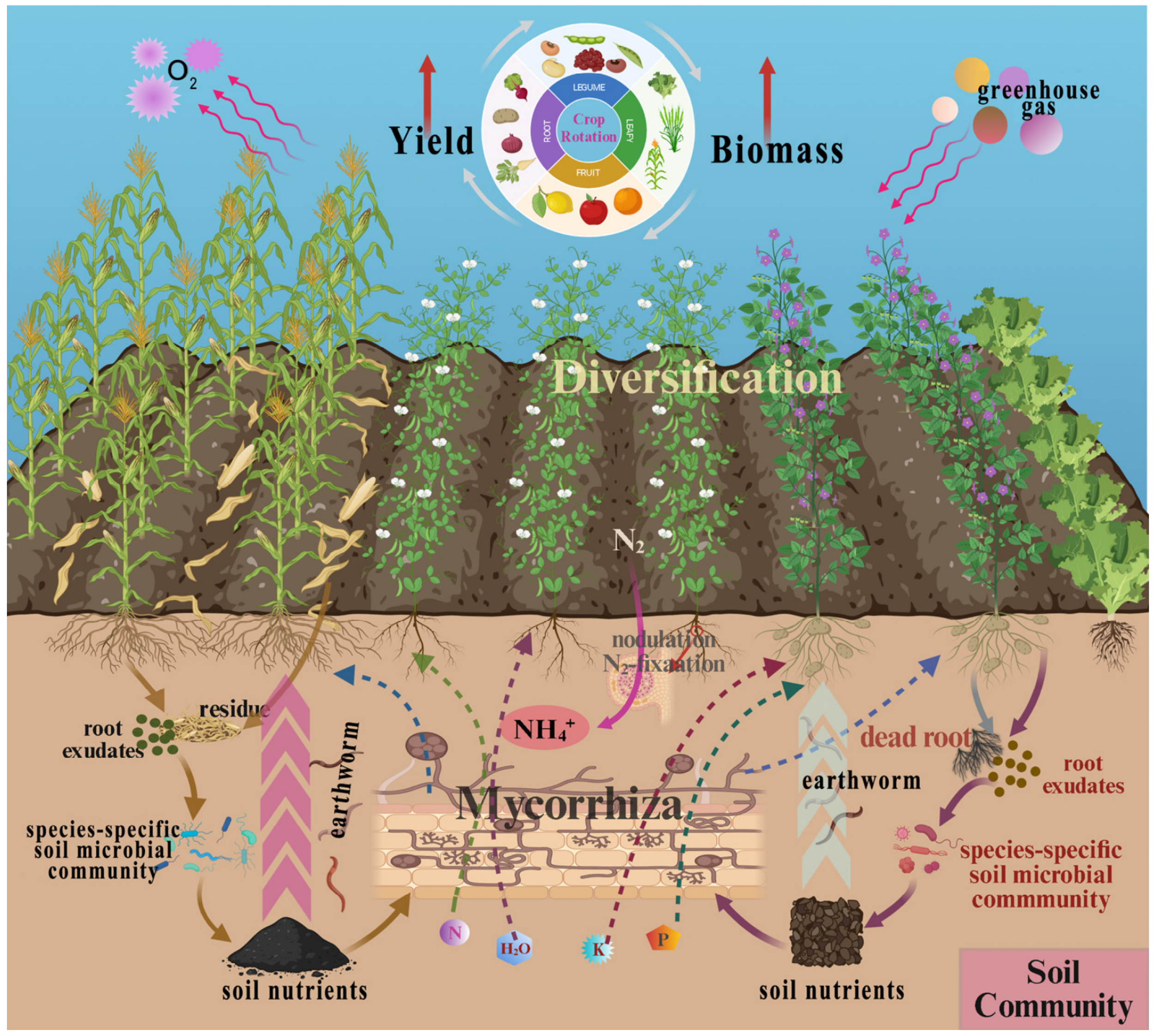
However, the effects of rotation on GHG emissions are not always positive. For example, in wheat–maize rotation, although straw return increases soil organic carbon, it can also significantly increase CO2 and CH4 emissions and accelerate the mineralization loss of soil organic carbon [96,97]. An appropriate amount of straw return is key to regulation. Studies have shown that in rice–wheat rotation systems, returning 1500–4500 kg·hm−2 of wheat straw during the rice season and 2250–6750 kg·hm−2 of rice straw during the wheat season is most conducive to increasing soil organic carbon content and crop yield [48,98]. In addition, irrigation methods also play a regulatory role: deficit irrigation (e.g., reducing water application during non-sensitive crop stages) can significantly reduce total CO2 emissions, while biochar application, although it increases soil water content and organic carbon, may increase CO2 emissions in the short term [99,100]. Therefore, the optimization of rotation patterns must comprehensively consider both the positive effects on soil carbon fixation and the negative stimuli on greenhouse gas emissions, seeking the optimal “carbon balance” management strategy [101]. The overarching role of crop rotation and diversification (CRD) in driving agricultural sustainability through soil carbon enhancement and greenhouse gas mitigation is conceptually summarized in Figure 11.

5. Yield Effects and Mechanisms of Rotation Patterns

5.1. Effects of Rotation on Crop Yields

5.1.1. Yield-Increasing Effects

Rotation has a significant yield-increasing effect compared with continuous monocropping, a conclusion that has been validated across multiple crop systems and ecological regions worldwide. Global studies have shown that legume-based rotation can increase the yield of subsequent crops (e.g., maize, wheat) by 5–25% [102]. A meta-analysis in China indicated that compared with continuous cropping, rotation can increase maize yield by 13–15% [48]. Specifically, in the U.S. Midwest Corn Belt, maize–soybean rotation increases yield by 13–15% compared with continuous maize; in a 20-year field experiment in Kansas, maize–soybean rotation increased maize yield by approximately 0.4 t·ha−1 compared with continuous maize, and soybean-maize rotation increased soybean yield by approximately 0.7 t·ha−1 compared with continuous soybean [95]. In tropical Brazil, soybean-maize rotation combined with no-till technology not only maintains high yield levels but also reduces soil erosion [67]. In the North China Plain, wheat–maize rotation is a typical high-yield pattern; long-term continuous cropping leads to soil fertility depletion, and rotation combined with straw return is key to maintaining yield [67]. In maize–garlic rotation, maize yield is comparable to or slightly higher than that under continuous cropping, while garlic achieves medium to high yield, balancing food security and economic benefits. In rice–morchella rotation, rice yield is stable, and morchella yield reaches approximately 220 kg per mu (equivalent to about 3.3 t·ha−1), achieving “stable grain production with enhanced efficiency” [50]. To visually compare the yield-increasing effects of different rotation patterns relative to continuous cropping, Figure 12 summarizes the yield benefits of typical rotation combinations reported in the literature. It can be seen that rotations involving legumes (e.g., maize–soybean, pea/green manure-potato) generally have a significant yield advantage, and the responses of different crops to rotation vary [48,50,103].
The yield-increasing effect of rotation has significant long-term accumulation. In a six-year study in the Cerrado region of Brazil, Pacheco et al. found that compared with a conventional tillage plus fallow continuous cropping system, diversified rotation systems implemented under no-till conditions (e.g., rotation of soybean with maize, brachiaria, crotalaria, etc.) not only achieved higher yields but also showed a continuous increasing trend in yield over time [104]. This indicates that the benefits of rotation systems are not a short-term phenomenon but rather form a positive cycle of “increasing fertility with continuous cultivation” through years of consecutive straw input, improved soil structure, and optimized microbial communities. In contrast, the yield of continuous cropping systems exhibited instability and fluctuation.

5.1.2. Yield Stability

Rotation systems not only increase crop yields but also effectively reduce inter-annual yield variability, enhance resistance to adverse climatic conditions (e.g., drought, high temperature), and improve system resilience. Studies have shown that diversified rotation systems experience significantly lower yield losses under abnormal climate years (e.g., drought, high temperature) compared with continuous cropping systems [7]. For example, in a drought year, maize in a rotation system can produce 1000 kg·ha−1 more than that in a continuous cropping system [105]. In a long-term field experiment in North America, a maize–soybean rotation system that included wheat exhibited higher yield stability than a two-year maize–soybean rotation, particularly under unfavorable climatic conditions [106,107]. This stability is mainly attributed to the improvement of soil structure and water retention capacity by rotation, which enhances the crop’s buffering capacity against water stress. However, long-term (>20 years) field data on yield stability under diversified rotations remain limited, and most existing evidence comes from temperate regions, leaving tropical and subtropical systems under-represented in the literature.

5.2. Mechanisms of Yield Increase by Rotation

Rotation-induced yield increase is the result of synergistic effects of multiple mechanisms, including physical improvement, chemical enhancement, biological driving, and pest and disease reduction.
The alternation of root systems of different crops improves soil aggregate structure, increases total porosity, and enhances soil water and nutrient retention capacity. Deep-rooted crops (e.g., maize, sunflower) can penetrate the plow pan, increase deep soil porosity, promote water infiltration and deep water utilization; shallow-rooted crops (e.g., garlic, wheat) consolidate surface soil through their root networks, reducing runoff and erosion [48]. Rotation combined with straw return can significantly reduce soil bulk density, increase total soil porosity, and improve soil permeability [108]. These improvements in soil physical properties directly promote root growth and development as well as the uptake of water and nutrients.
Rotation promotes the cycling and balance of soil nutrients. Biological nitrogen fixation by leguminous crops is one of the core chemical mechanisms underlying yield increase by rotation. Leguminous crops such as soybean and pea fix nitrogen symbiotically with rhizobia, fixing 75–148 kg N per hectare, thereby providing nitrogen nutrition for subsequent cereal crops and reducing the demand for chemical fertilizers [67]. In the maize–garlic rotation, nitrogen is efficiently utilized across different soil layers: maize absorbs nitrogen from deeper layers, while garlic utilizes readily available nitrogen in the surface layer, reducing nutrient deposition [49]. Organic acids secreted by garlic roots can dissolve insoluble phosphates in the soil, and the decomposition products of maize straw after incorporation further activate the phosphorus pool, forming a continuous phosphorus cycle [87]. In addition, rotation creates a soil pH buffering system through the alternating release of cations and organic acids by different crops, thereby optimizing nutrient bioavailability [9,109].
Rotation optimizes the microbial community structure, significantly increasing the activity of functional microbial groups (nitrogen-fixing bacteria, phosphate-solubilizing bacteria, and potassium-solubilizing bacteria), and accelerating the decomposition of organic matter and nutrient release [83]. Studies have shown that soil microbial biomass carbon and nitrogen in rotation systems are 13.4% and 16.6% higher, respectively, than those in continuous cropping systems [84]. Soil enzyme activities (e.g., urease, phosphatase, cellulase) are also significantly enhanced, promoting the mineralization of organic matter and nutrient cycling. Furthermore, by altering the composition of root exudates, rotation recruits beneficial microorganisms and suppresses pathogens, forming a healthy rhizosphere microecology [84,86,90].
Rotation reduces crop yield losses caused by pests and diseases by lowering the population of pathogens and pests. Continuous monocropping allows specific pathogens (e.g., soybean cyst nematode, wheat take-all disease) and pests (e.g., western corn rootworm) to accumulate in the soil, whereas rotation interrupts their annual life cycle, depriving them of suitable hosts and leading to their decline [48]. For example, maize–soybean rotation can effectively control the occurrence of soybean cyst nematode, resulting in significantly higher soybean yields than continuous cropping. In cotton–peanut rotation, the incidence of diseases is significantly reduced, decreasing the use of fungicides. Rotation combined with cover crops (e.g., rye, mustard) can also suppress weeds through allelopathy, reducing reliance on herbicides [15,110,111]. The integrated effects of these mechanisms enable rotation systems to achieve the dual goals of increasing yield and stabilizing production while reducing chemical inputs [69].
The four mechanisms described above do not act independently but are interrelated and progressively reinforcing. Physical improvement provides a favorable environment for root growth and microbial activity; chemical enhancement directly increases nutrient supply; biological driving accelerates material transformation; and pest and disease reduction alleviates abiotic stress [112]. Together, these four mechanisms form a positive feedback loop: better soil structure promotes greater root exudation of organic compounds, which in turn nourishes microorganisms; microorganisms further release nutrients and suppress diseases, ultimately achieving sustained crop yield increases [113].
This synergistic effect explains why the yield increase achieved by rotation systems is generally higher than that of single practices (e.g., sole application of organic fertilizer or a single deep tillage) [114,115,116].

6. Agricultural Machinery and Intelligent Technologies in Rotation Patterns

6.1. Requirements of Rotation for Agricultural Machinery and Equipment

The implementation of rotation patterns places higher demands on agricultural machinery and equipment. Different rotation combinations involve the alternating cultivation of multiple crops, requiring that the matching machinery for tillage, sowing, management, and harvesting can switch efficiently and adapt to the agronomic requirements of different crops. In double-cropping regions (e.g., the North China Plain), the harvest-sowing window for wheat–maize rotation is only 7–10 days, imposing extremely high requirements on the efficiency and scheduling capacity of agricultural machinery [117]. Delays in any step may affect the sowing quality and seedling emergence of the subsequent crop.
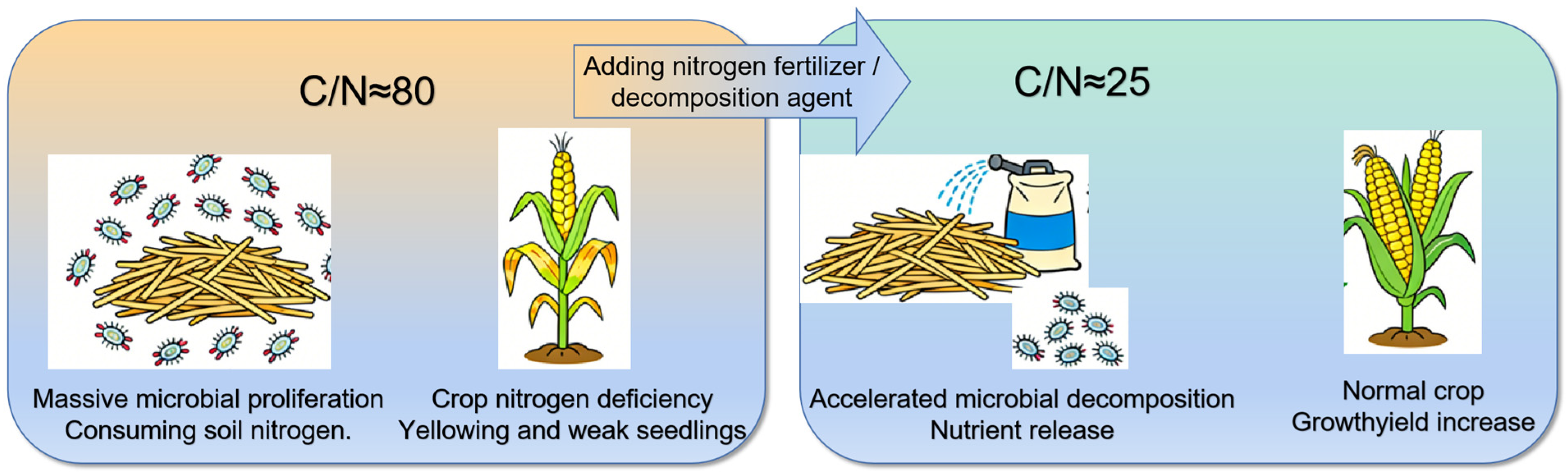
In rotation systems, the management of straw from the preceding crop is critical for seedbed preparation. In wheat–maize rotation, full straw return of wheat straw can supply chemical nutrients equivalent to 14.8% of pure nitrogen, 11.8% of P2O5, and 74.2% of K2O to the subsequent maize crop. However, uneven straw crushing or excessive straw incorporation can lead to problems such as sowing blockage and reduced emergence rate [6,118]. In maize–garlic rotation, it is essential to return garlic straw to the field after harvest to enhance soil organic matter. However, the carbon-to-nitrogen (C/N) ratio during straw decomposition is relatively high. This necessitates the application of nitrogen fertilizer and decomposition accelerators to adjust the C/N ratio, thereby increasing the precision required for mechanized operations [119,120]. Figure 13 provides a schematic overview of the critical carbon-to-nitrogen (C/N) ratio regulation mechanisms that underpin effective straw management in rotation systems. In maize–soybean rotation, the method of maize straw disposal (incorporation by plowing, mulching, or off-field utilization) directly affects the quality of seedbed preparation and sowing performance in the soybean season [67].
To address these challenges, researchers have proposed various technical models integrating agricultural machinery with agronomic practices. In rice–wheat rotation regions, straw return techniques have developed multiple modes, including straw crushing and rotary tillage incorporation, mulching return, plowing and incorporation, and reverse stubble breaking, along with the supporting development of straw crushing and returning machines, deep tillage and returning machines, no-till mulching seeders, and multifunctional combined implements [1]. Typical machinery-agronomy integration models include “straw crushing and return + no-till seeding”, “straw crushing + subsoiling preparation + wide-narrow row planting”, “partial return + straw fertilization utilization”, and “straw return + formula fertilization + integrated pest, disease and weed control” [1]. The promotion and application of these models have effectively alleviated the challenges of stubble coordination and straw management in rotation systems.

6.2. Application of Intelligent Technologies in Rotation Systems

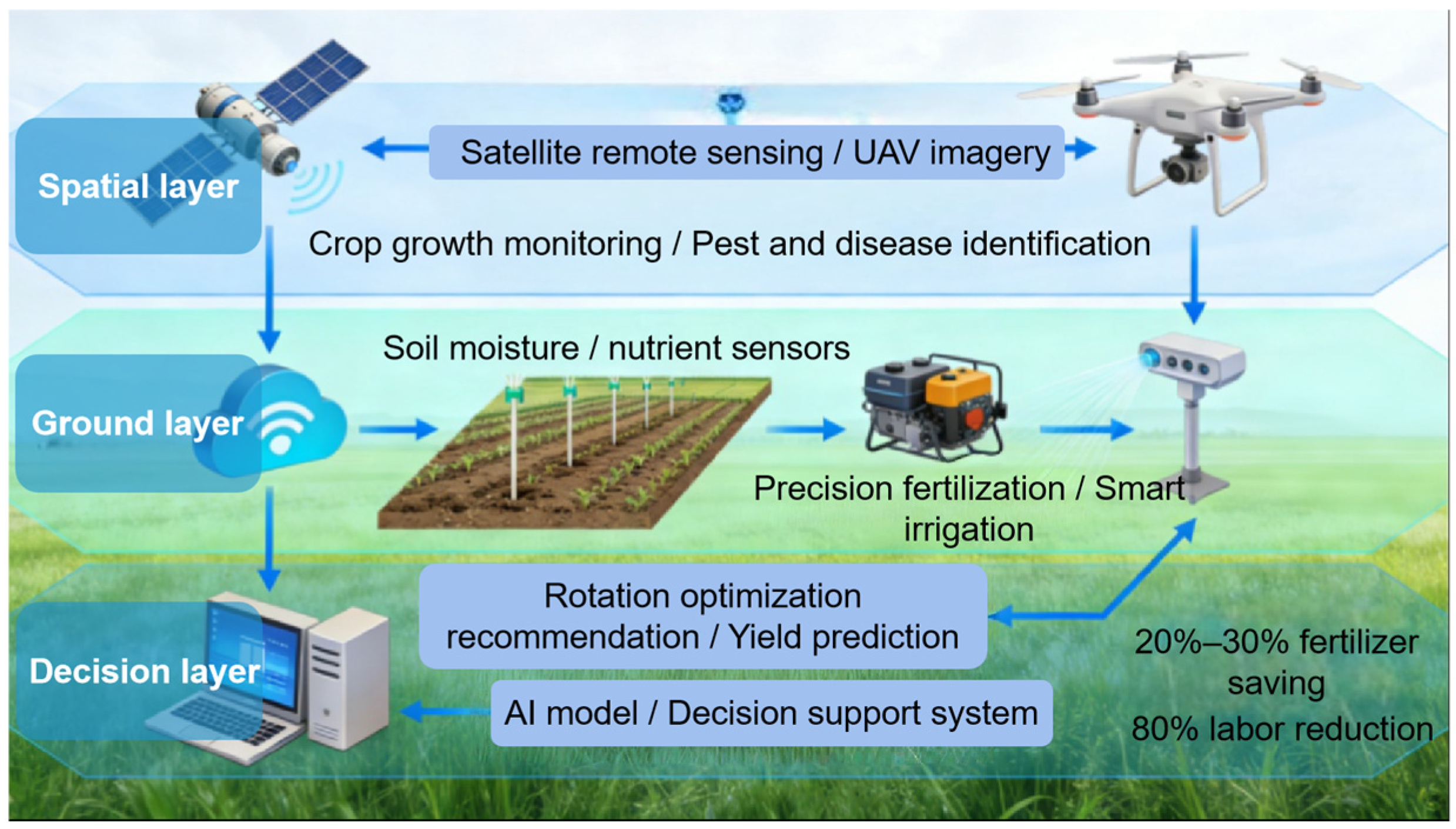
With the rapid advancement of information and communication technologies, intelligent systems have been increasingly integrated into crop rotation management. These systems provide new pathways to enhance resource use efficiency, reduce environmental footprints, and improve overall system sustainability. Key technologies currently applied in rotation systems include precision seeding and variable-rate fertilization, smart irrigation, remote sensing monitoring, intelligent path planning and automatic navigation, as well as unmanned and autonomous operations. Rather than being used in isolation, these technologies can be integrated into a complete digital agricultural management system that enables refined management of the entire rotation cycle through a closed-loop process of “perception–decision–execution”. This section reviews recent advances in each of these technology domains, with an emphasis on how they have been adapted to different rotation systems and agro-ecological regions worldwide [121,122,123].

6.2.1. Precision Seeding and Fertilization

Precision seeding and variable-rate fertilization address one of the most fundamental challenges in crop rotation: the mismatch between uniform input application and spatially variable soil fertility and crop requirements. In continuous monoculture, soil properties may become relatively homogeneous over time due to repeated similar rooting patterns and fertilization practices. However, in rotation systems, the alternation of crops with different root architectures, nutrient uptake patterns, and residue quality creates pronounced spatial and temporal heterogeneity. For example, a deep-rooted crop such as maize may exploit subsoil nutrients, while a subsequent shallow-rooted crop such as wheat relies more on topsoil fertility. Without precision management, farmers tend to over-apply fertilizers to ensure adequate supply for the most demanding crop in the rotation, leading to low nutrient use efficiency, high input costs, and environmental pollution from runoff and leaching [124,125].
Variable-rate technology (VRT) overcomes this limitation by using georeferenced soil maps, real-time sensors, or crop growth models to adjust seeding rates and fertilizer doses on the go. In practice, this involves delineating management zones based on soil apparent electrical conductivity, historical yield maps, or remote sensing imagery, and then applying different rates to each zone. The benefits have been demonstrated across diverse rotation systems worldwide [126]. In the U.S. Midwest Corn Belt, where maize–soybean rotation is the dominant system, Guan et al. [127] simulated continuous corn versus soybean-corn rotation under different nitrogen rates across ten Illinois sites. Their results showed that soybean residues contribute 36% less carbon but 47% more nitrogen than corn residues, which boosts soil nitrogen availability for the following corn crop. At low nitrogen rates (50 kg N/ha), the soybean-corn rotation provided $1133 per hectare higher returns than continuous corn, highlighting the importance of adjusting fertilizer rates to account for the rotational effect [127,128]. In the North China Plain, where winter wheat-summer maize rotation is practiced on millions of hectares, an eight-season field study demonstrated that optimized nitrogen management—based on soil testing and crop demand—increased maize yield by 6.2% and wheat yield by 3.2% on average, while significantly reducing hydrological nitrogen losses [129,130,131,132,133,134].
Despite these demonstrated benefits, the adoption of precision seeding and variable-rate fertilization faces several barriers. High equipment costs, the need for technical expertise to interpret soil maps and sensor data, and the lack of affordable soil sensing technologies for smallholder farmers remain significant challenges. Nevertheless, as sensor costs decline and decision-support software becomes more user-friendly, these technologies are expected to become increasingly accessible, particularly in large-scale commercial farming regions [135].

6.2.2. Smart Irrigation

Water scarcity is a growing constraint for crop production in many regions, and rotation systems often involve crops with contrasting water requirements. Smart irrigation technologies address this challenge by integrating real-time soil moisture monitoring, weather forecasting, and automated control systems to deliver water precisely when and where crops need it [136]. Unlike traditional irrigation, which applies water at fixed intervals or according to a predetermined schedule, smart irrigation adjusts application timing and volume based on actual crop water demand, soil water status, and predicted evapotranspiration [137]. This approach is particularly valuable in double-cropping rotations, where the stubble window between crops is short and water must be managed carefully to avoid both water stress and waterlogging [138,139].
In practice, smart irrigation systems typically consist of three components: (i) a sensing network (soil moisture sensors, weather stations, or remote sensing data) that provides real-time information on crop water status; (ii) a decision-support algorithm that translates sensor readings into irrigation recommendations; and (iii) an actuation system (automated valves, pumps, or drip lines) that executes the recommended irrigation. The most common sensing technologies include capacitance probes, tensiometers, and time-domain reflectometry (TDR) sensors, which measure volumetric water content or matric potential at various soil depths [140].
Field evaluations of smart irrigation have shown substantial benefits across different rotation systems. In a rice-wheat double-cropping system in South Korea, Song et al. [141] compared three irrigation strategies over three seasons: conventional rainfed, soil moisture-based irrigation triggered at 55% available soil water (SIA), and irrigation triggered at 55% saturation (SIS). The SIA treatment increased grain yield by 20–27%, water use efficiency by 10–22%, and leaf area index by up to 16% compared to rainfed, demonstrating that maintaining soil moisture within a specific range (available water between jointing and grain filling) optimizes both growth and resource use [141]. In Northwest India, where groundwater depletion is a major concern in the maize–wheat rotation belt, Kakraliya et al. [142] coupled subsurface drip irrigation with conservation agriculture practices (no-till, residue retention, and recommended nutrient management). Over three years, this integrated bundle saved approximately 70% of irrigation water in rice and 45% in wheat compared to conventional farmer practices, while significantly enhancing water, nutrient, and energy use efficiency. The authors concluded that such integrated approaches are essential for sustaining intensive cereal cropping systems under increasing water scarcity [142].
In China’s North China Plain, where winter wheat–summer maize rotation has caused severe groundwater overdraft, researchers have explored various strategies to reduce irrigation water use without compromising yield. Wang et al. [143] developed a multi-objective nonlinear programming model based on field irrigation experiments and dynamic water cycle simulations. The recommended irrigation scheme increased crop yield by 4.02%, improved irrigation water productivity by 5.84%, reduced costs by 7.17%, and cut annual irrigation volume by 15.69% compared to conventional schedules [143,144,145,146,147,148].
Despite these advances, the adoption of smart irrigation remains limited by the high cost of sensor networks, the need for reliable internet connectivity in rural areas, and the complexity of integrating multiple data streams into actionable decisions. However, the rapid development of low-cost wireless sensor networks and cloud-based decision support systems is gradually lowering these barriers [148].

6.2.3. Remote Sensing Monitoring and Decision-Making

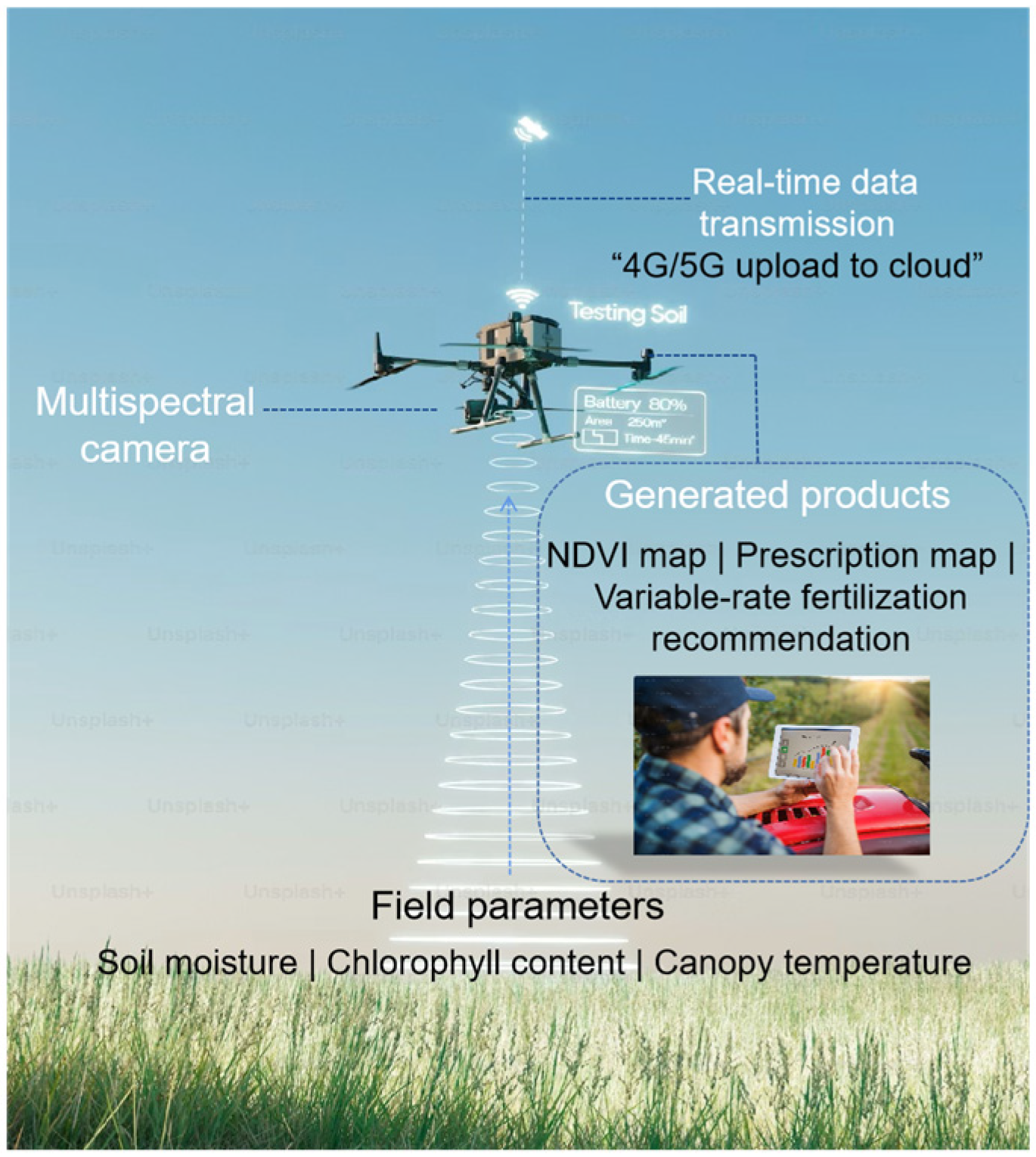
Remote sensing technologies, including satellite imagery and unmanned aerial vehicle (UAV)-based multispectral and hyperspectral imaging, have revolutionized the way crop growth and field conditions are monitored in rotation systems. Unlike ground-based measurements, which are labor-intensive and limited in spatial coverage, remote sensing provides synoptic, repeatable, and non-destructive observations across entire fields or regions. This capability is particularly valuable for rotation systems, where different crops at different growth stages require timely assessment of canopy health, nutrient status, water stress, and pest or disease incidence [148,149].
The most widely used remote sensing metric in agricultural applications is the Normalized Difference Vegetation Index (NDVI), which exploits the differential reflectance of vegetation in the red and near-infrared bands. NDVI is strongly correlated with green biomass, leaf area index, and canopy chlorophyll content, making it a reliable proxy for crop vigor and productivity. More advanced indices, such as the Red Edge Chlorophyll Index and the Photochemical Reflectance Index, provide additional information on plant physiological status. When acquired repeatedly over the growing season, these indices can reveal spatial and temporal patterns of crop growth, identify areas of stress, and guide variable-rate applications of nitrogen, water, and other inputs [150,151].
In Lithuania, Dorelis et al. [152] conducted a three-year field experiment comparing winter rye grown in continuous monoculture (with and without fertilizer/herbicide inputs) with five diversified rotation treatments that included manure, forage, or cover crop phases. Using UAV multispectral imaging to monitor NDVI at three key developmental stages (flowering to ripening), they found that diversified rotations consistently achieved higher NDVI values than monoculture, indicating more robust crop growth. Notably, the most intensive and row-crop rotations had the highest canopy vigor, whereas continuous monocultures had the lowest. An anomalous weather year (2024) temporarily reduced NDVI differences, but rotation benefits re-emerged in 2025, demonstrating that UAV-based NDVI effectively captures rotation-induced differences in crop canopy vigor even under variable climatic conditions. The study also reported that more diverse rotations increased grain yields by approximately 28% on average and significantly reduced yield losses during drought years (by 14–90%) compared with monocultures [152,153].
In Austria, Medel-Jiménez et al. [154] performed a life cycle assessment of a conventional five-year rotation (spring barley, soy, winter wheat, rapeseed, winter barley) with and without precision agriculture technologies, including automatic steering, automatic section control, proximal sensors, and prescription maps derived from remote sensing. The sensor-based scheme achieved the highest reduction in climate change impact (−17.0%), followed by prescription maps (−8.9%) and automatic section control (−6.4%). This study highlighted that remote sensing-guided management can significantly reduce the environmental footprint of crop rotations, but that the magnitude of benefit depends on site-specific factors such as field variability and the precision of the sensor data [154,155,156,157].
The integration of remote sensing with crop growth models and decision support systems represents the next frontier. By assimilating remote sensing data into models such as APSIM, DSSAT, or STICS, it becomes possible to forecast yield, optimize irrigation and fertilization schedules, and assess the long-term sustainability of different rotation strategies. However, challenges remain in data processing, model calibration, and the translation of remote sensing information into actionable agronomic recommendations, particularly for smallholder farmers with limited access to technology.

6.2.4. Intelligent Path Planning and Automatic Navigation

High-precision automatic navigation is the foundation for all autonomous agricultural machinery operations. In rotation systems, where different crops may have different row spacing, planting patterns, and harvesting requirements, path planning must adapt to crop-specific agronomic rules while minimizing soil compaction, overlaps, and input waste. Traditional manual driving inevitably results in overlaps (where the same area is covered twice) and skips (where areas are missed), leading to wasted seeds, fertilizers, and fuel, as well as yield losses. Automatic navigation systems, typically based on real-time kinematic (RTK)-GPS or other global navigation satellite systems (GNSS), can achieve centimeter-level accuracy, reducing overlaps and skips to less than 2–3% of field area [158].
The core of an automatic navigation system consists of three functional modules: (i) a positioning module that determines the machine’s precise location and orientation; (ii) a path planning module that generates an suitable route covering the entire field with minimal non-working travel; and (iii) a control module that computes steering commands to keep the machine on the planned path. Advanced systems also incorporate sensor fusion, combining GNSS with inertial measurement units (IMUs), LiDAR, and cameras to maintain accuracy under conditions where satellite signals are weak or obstructed (e.g., under tree canopies or near tall crops).
The economic benefits of automatic navigation extend beyond fuel and input savings. By enabling precise row following, autonomous systems allow narrower headlands (the turning areas at field edges), thereby increasing the effective cropping area. They also reduce operator fatigue and allow longer working hours, which is particularly valuable during the narrow planting and harvest windows typical of double-cropping rotations. Nevertheless, the high cost of RTK-GPS base stations and the need for reliable correction signals remain barriers for smallholder farmers, though the increasing availability of satellite-based augmentation systems (SBAS) and network RTK services is gradually reducing these costs.

6.2.5. Unmanned and Automated Operations

Unmanned farm technologies represent the highest level of integration, automating the entire cropping cycle—including tillage, seeding, crop protection, and harvesting—without direct human intervention on the machinery. While individual autonomous machines (e.g., autonomous tractors, self-driving combines) have been available for several years, the concept of a fully unmanned farm requires not only autonomous field operations but also coordinated fleet management, remote monitoring, and decision-making that integrates data from multiple sources (soil sensors, weather stations, drones, and satellite imagery). This level of integration is particularly challenging in rotation systems, where different crops require different machinery configurations, operating parameters, and scheduling constraints [159].
In China, while comprehensive peer-reviewed studies on fully unmanned rotation farms are still emerging, the component technologies described in previous sections (precision fertilization, smart irrigation, remote sensing, and automatic navigation) have been increasingly deployed. Field-scale implementations of autonomous machinery in wheat–maize and rice–wheat rotations have been reported in Chinese academic journals [160].
The transition to unmanned operations is not without challenges. Beyond the high capital costs, issues of system reliability, safety, and liability remain unresolved. Unmanned machinery must be able to detect and avoid obstacles (including humans, animals, and equipment), operate in variable weather conditions, and recover from errors without human intervention. Nevertheless, as these challenges are addressed and costs continue to decline, unmanned operations are expected to become increasingly common in large-scale commercial rotations, with smaller farms likely to benefit from shared autonomous machinery services rather than owning their own fleets [161,162]. The integration of these core intelligent components—spanning precision input application, automated navigation, and data-driven decision-making—is depicted in Figure 14. Complementarily, Figure 15 illustrates the workflow of a UAV-based remote sensing system designed to support real-time monitoring and precision management decisions in rotational fields.
As described in Section 7.2, precision seeding, variable-rate fertilization, smart irrigation, remote sensing, automatic navigation, and unmanned operations have been increasingly deployed in crop rotation systems worldwide. However, the practical implementation of these technologies in rotations faces additional challenges beyond those encountered in continuous monoculture. These include: (1) extremely narrow harvest-sowing windows in double-cropping regions (e.g., 7–10 days for wheat–maize), which demand rapid machinery reconfiguration and seamless stubble management; (2) variable residue characteristics (C/N ratio, quantity, decomposability) from preceding crops, affecting no-till seeding quality; (3) compatibility of the same machinery fleet with different crop row spacings, plant heights, and harvest indices; (4) crop-specific fertilizer timing—for example, maize requires high N at jointing, while soybean fixes its own N; and (5) affordability and accessibility for smallholder farmers, who manage most of the world’s diversified rotations. The following section integrates these technologies into region-specific rotation recommendations, explicitly linking each technology to a documented bottleneck. Yet, the economic feasibility and scalability of these intelligent technologies for smallholder farmers remain insufficiently evaluated, and most demonstration projects have been conducted on large-scale farms under favorable conditions—raising questions about their applicability to diverse farming systems and resource-constrained settings.

7. Recommended Rotation Patterns for Major Agricultural Regions

7.1. Guiding Principles for Region-Specific Rotation Design

The design of regional suitable rotation patterns should follow the following three basic principles to ensure their scientific soundness, feasibility, and sustainability.
Principle of resource matching. Rotation patterns should match the regional endowments of light, temperature, water, and soil resources. Climatic conditions (accumulated temperature ≥ 10 °C, annual precipitation, and frost-free period) are the basis for determining cropping intensity. Northeast China, with a single-cropping zone, is suitable for maize–soybean rotation; the North China, with a double-cropping zone, is suitable for winter wheat–summer maize rotation; and South China, with superior water and heat conditions, can implement a triple-cropping system of double rice followed by a winter crop. In the dryland farming regions of Northwest China, water shortage is the main limiting factor, and rotation design should take efficient water use as the core. Studies have shown that pea/green manure–potato rotation can reduce water consumption by 11.2–26.1% compared with continuous potato cropping [48,163].
Principle of stable yield and efficiency enhancement. Under the premise of ensuring the yield of staple crops (e.g., wheat, maize, rice), the economic benefit per unit area is increased by introducing cash crops (e.g., garlic, morchella, potato). For example, in maize–garlic rotation, maize yield is comparable to that under continuous cropping, while the high added value of garlic significantly improves economic returns; in rice–morchella rotation, rice yield is stable and morchella yield reaches approximately 220 kg per mu (equivalent to about 3.3 t·ha−1), achieving “stable grain production with enhanced efficiency”. In the dryland regions of Northwest China, pea/green manure–potato rotation increases yield by 15.0–38.2% and net economic benefit by 30.6–41.9% compared with continuous potato cropping [48].
Principle of sustainability. Priority should be given to combinations that improve soil health and reduce environmental footprints. Rotation can significantly increase soil organic matter content, improve soil structure, and reduce chemical fertilizer and pesticide inputs through mechanisms such as biological nitrogen fixation by legumes, regulation of root exudates, and straw/mushroom residue incorporation. In terms of carbon emission reduction, appropriate rotation patterns can reduce greenhouse gas emissions by 33.6–59.3%. In the paddy–upland rotation region of the middle and lower reaches of the Yangtze River, rice–rapeseed rotation is more beneficial than rice–wheat rotation for improving soil nitrogen bioavailability, with carbon and nitrogen contents in particulate organic matter increasing by 38.7% and 56.2%, respectively [164].

7.2. Recommended Rotation Combinations for Different Regions

The following table focuses on the four major agricultural regions in China analyzed in detail in Section 7.2.1, Section 7.2.2, Section 7.2.3 and Section 7.2.4 (Table 1). Global perspectives and international comparisons for each region are provided in the respective “International context” subsections within each regional recommendation.
For each major agricultural region, the following subsections present a two-part recommendation. The first part describes the international context: climatically and agronomically similar regions around the world, along with the rotation bottlenecks and technology solutions that have been validated through peer-reviewed studies in those areas. The second part provides a region-specific rotation recommendation for China, explicitly identifying rotation-specific technical bottlenecks and linking each bottleneck to available technology solutions (from Section 6), while distinguishing established empirical evidence from emerging research or demonstration projects.

7.2.1. Northeast China

The temperate continental climate of Northeast China (40–50° N, effective accumulated temperature 2600–3000 °C, annual precipitation 450–600 mm) closely resembles the U.S. Midwest Corn Belt (e.g., Illinois, Iowa). In this region, maize–soybean rotation is the dominant system, accounting for over 75% of the cropped area in states like Illinois. Using an agroecosystem model calibrated with long-term field data from 10 Illinois sites, Guan et al. [115] simulated continuous corn versus soybean–corn rotation under different nitrogen (N) rates. Their results showed that under normal N rates (151 kg N/ha), soybean residues contributed 36% less carbon but 47% more N than corn residues, boosting corn yields in the rotation by an average of 3.7–13.6% compared with continuous corn. Economically, the rotation provided $1133/ha higher returns at low N rates (50 kg N/ha) under typical market conditions, although this advantage diminished at higher N rates. The study also identified trade-offs: soybean–corn rotation reduced soil organic carbon relative to continuous corn due to faster decomposition of soybean residues, but mitigated N2O and NH3 emissions. These findings provide quantitative benchmarks for optimizing rotation length (2-year vs. 3-year) and calibrating N fertilizer rates in similar agroecosystems [115].
The recommended pattern is maize–soybean–maize, implemented as a two-year (maize–soybean–maize–soybean) or three-year (maize–maize–soybean–maize–maize–soybean) system. Three rotation-specific technical bottlenecks must be addressed [61].
(i) Narrow spring planting window. The interval between maize harvest and soybean sowing is typically 10–14 days. RTK-GNSS automatic navigation can reduce headland turning time and operational overlap, thereby alleviating time pressure. No-till seeding equipment compatible with high maize straw residue volumes is essential; field trials across Northeast China have shown that straw crushing followed by no-till seeding reduces stubble blockage and improves emergence uniformity.
(ii) Residue management. Full maize straw return is recommended, but the high C/N ratio (60–80:1) can immobilize N and mechanically block no-till soybean seeders. Variable-rate fertilization (Section 6.2.1) that adjusts N rate based on straw C/N mapping is technically feasible but not yet widely commercialized. Current practice relies on uniform N supplementation (additional 30–40 kg N ha−1) and mechanical stubble crushing.
(iii) Fertilizer timing divergence. Soybean meets most of its N demand via biological fixation, requiring little to no side-dressed N, whereas subsequent maize requires high N at jointing. Field studies from the region have shown that optimized N management in maize–soybean rotations—based on soil testing and crop demand—can maintain or increase yield while reducing total N application by 15–20% relative to continuous maize systems. Controlled-release N fertilizers have been explored to synchronize nutrient release with crop demand, though large-scale adoption remains limited.
The recommended patterns are winter wheat–summer maize, winter wheat–summer peanut, and a three-year wheat–maize–soybean rotation. The conventional winter wheat–summer maize double-cropping system faces severe ecological pressure: long-term reliance on this pattern has led to high resource consumption and significant groundwater depletion. Three rotation-specific technical bottlenecks must be addressed.

7.2.2. North China Plain

The warm temperate semi-humid monsoon climate of the North China Plain (NCP)—annual precipitation 500–900 mm, frost-free period 180–220 days, and a pronounced mismatch between rainfall patterns and crop water demand—has driven decades of groundwater over-extraction. This climatic setting is shared with the Mediterranean basin (e.g., southern Spain, Italy, Turkey) where winter cereals are similarly followed by summer crops under limited irrigation. In the Mediterranean, long-term experiments have shown that diversified rotations (e.g., wheat–faba bean) improve productivity and reduce economic risk relative to continuous wheat, while the adoption of deficit irrigation and drought-tolerant wheat varieties has become standard practice to cope with water scarcity. A parallel situation exists in the U.S. central Great Plains, where no-till rotations of winter wheat–maize–summer fallow have increased total annualized grain yield by 75% compared to traditional wheat–fallow systems, while reducing soil erosion and improving soil physical properties. These international experiences provide reference points for the NCP’s ongoing search for water-saving and yield-stabilizing strategies in double-cropping systems.
(i) Extremely narrow harvest-sowing window (7–10 days). The short interval between wheat harvest and maize sowing directly affects yield through reduced solar radiation capture during grain filling. RTK-GNSS automatic navigation (Section 6.2.4) can reduce headland turning time and operational overlap, gaining 0.5–1.0 effective day per field. Integrated solutions—combining narrow-wide strip planting, satellite-guided precision planting, and shallow subsurface drip irrigation—have been field-demonstrated to increase wheat yield by 9–17% and maize yield by 12–14% while saving water by 450–750 m3 ha−1, fertilizer by 20%, and labor cost by 2250–3000 yuan ha−1 [165].
(ii) Residue management and seeding quality. No-till planting after wheat harvest often results in poor maize seeding quality due to uneven straw distribution. The high C/N ratio of wheat straw (typically 60–100:1) can immobilize nitrogen and mechanically interfere with seeders. Variable-rate fertilization (Section 6.2.1) that adjusts N rate based on straw C/N mapping remains technically feasible but not yet commercially integrated. However, long-term field experiments (18-year) in northern China have shown that no-tillage with straw mulching (NT) and deep scarification with straw mulching (DS) increase soil organic carbon by 9.3–16.4% and total N by 10.8–25.8% compared to conventional tillage with straw removal, demonstrating that conservation tillage combined with full straw return is agronomically viable [166].
(iii) Water scarcity and irrigation timing. Groundwater over-extraction in the NCP is severe: winter wheat alone consumes three to four times more groundwater annually than maize [80]. Multi-season field studies have demonstrated that subsurface drip irrigation can reduce evapotranspiration by 26% compared to flood irrigation and by 15% compared to surface drip irrigation, while maintaining or increasing grain yield. A multi-objective optimization model based on field experiments found that optimized water allocation increased crop yield by 4.02%, improved irrigation water productivity by 5.84%, reduced costs by 7.17%, and cut annual irrigation volume by 15.69%. Deficit irrigation meta-analyses for northern China report that, on average, deficit irrigation reduces wheat yield by 7.10% and maize yield by 18.71%, but increases water use efficiency by 9.25% for wheat and 6.38% for maize—trade-offs that must be balanced against groundwater conservation goals [77,171].

7.2.3. Middle and Lower Reaches of the Yangtze River

The subtropical monsoon climate of the Yangtze Basin (annual precipitation >1000 mm) is shared with the Indo-Gangetic Plain and the Mekong Delta, where paddy–upland rotations have been shown to reduce methane emissions by 23–68% compared with continuous flooded rice, while improving soil organic carbon and system productivity. These international experiences support the Yangtze region’s shift toward diversified paddy–upland rotations [167].
The recommended patterns are rice–rapeseed, rice–Chinese milk vetch (green manure), and rice–morchella rotations. Two rotation-specific technical bottlenecks must be addressed.
(i) Methane emission control. Continuous flooding generates substantial CH4. Paddy–upland rotations disrupt methanogenesis through aerobic phases. Alternate wetting and drying (AWD) irrigation can reduce water use by 13–29% while lowering CH4 emissions. Smart irrigation systems (Section 6.2.2) with water-level sensors and automated drainage are being trialed; sensor cost (¥1500–2000/unit) remains a barrier for smallholders [168,172].
(ii) Residue and mushroom waste management. Returning high-C/N rice straw to flooded paddies stimulates CH4 production. Conversely, returning low-C/N crop straw or mushroom residue can reduce CH4 emissions and supply nitrogen. In rice–morchella rotation, mushroom waste incorporation after harvest reduces synthetic N fertilizer demand. Remote sensing (Section 6.2.3) using UAV multispectral imagery for lodging monitoring is operational.

7.2.4. Dryland Regions of Northwest China

The semi-arid to arid climate of Northwest China (annual precipitation 200–400 mm, high inter-annual variability) is shared with the North American Great Plains (e.g., Montana, Nebraska, Saskatchewan), the Australian wheat belt (e.g., Western Australia, New South Wales), and the Mediterranean drylands of North Africa. In the U.S. northern Great Plains, a long-term no-till spring wheat–pea rotation reduced greenhouse gas emissions, enhanced soil carbon sequestration, and sustained crop yields compared with conventional wheat-fallow systems [173]. In Colorado, adopting a no-till rotation of winter wheat–maize–fallow increased total annualized grain yield by 75% compared with traditional winter wheat-summer fallow [136,174]. In Western Australia, a six-year survey of 184 paddocks spanning 14 million hectares found that wheat after a break crop (canola or lupins) achieved a water use efficiency of 12.5 kg grain ha−1 mm−1, while continuous wheat declined to 8.4 kg ha−1 mm−1 by the third successive year [169]. These international experiences highlight that diversifying cereal-based rotations with pulses or oilseeds can improve water use efficiency, increase soil carbon, and sustain yields—providing transferable benchmarks for Northwest China‘s dryland regions.
The recommended patterns are pea/green manure-potato or wheat/green manure-potato rotation. Three rotation-specific technical bottlenecks must be addressed.
(i) Severe water stress and precipitation variability. Annual precipitation of 200–400 mm with high inter-annual variability is the overriding constraint. A 6-year rotating cropping experiment on the Loess Plateau (wheat–maize–potato rotation under plastic mulching) improved water storage in the 0–300 cm soil profile by 65.8 mm, while continuous maize depleted deep soil moisture. Total dry matter in the rotating system was greater by 23.9% and 79.3% compared with continuous wheat and continuous maize, respectively, in a drought year [169,175,176,177]. Smart irrigation (Section 6.2.2) using low-cost capacitance sensors and mobile-based decision support has been trialed locally; however, calibration across different soil types remains a challenge for adoption.
(ii) Plastic film mulching and soil health trade-offs. Plastic film mulching is widely adopted to reduce evaporation and increase yield, but its long-term effects on soil organic carbon and microplastic accumulation remain understudied. On the Loess Plateau, rotating cropping under plastic mulching increased SOC concentration at 20–30 cm depth by 36.0% compared with continuous wheat, and by 28.0% compared with continuous maize, while the SOC sequestration rate at this depth was higher by 3.2–3.8 Mg ha−1 [178,179,180,181,182]. However, alternative residue-based mulching systems (straw retention) have been shown to increase SOC in some circumstances (by up to 1.5 Mg C ha−1, or 8%) but require legume N inputs and elimination of fallow to achieve reliable gains [170,183].
(iii) Smallholder access to monitoring technology. Low-cost soil moisture sensors (typically ¥500–1000 per unit) and mobile-based decision support are becoming available, but calibration difficulties and limited technical support constrain adoption. Remote sensing (Section 6.2.3) for soil moisture mapping using Sentinel-2 and Landsat has 70–80% accuracy at 30 m resolution, which is insufficient for field-scale decisions in fragmented smallholder landscapes. Shared machinery services and government subsidies (Section 6.1) are more practical than individual ownership for this region.

8. Conclusions and Prospects

8.1. Main Conclusions

This study systematically integrates the latest advances in crop rotation research from both domestic and international sources, and constructs a full-chain analytical framework covering “climate adaptability, rotation combinations, yield effects, technical support, and regional recommendation”. The main conclusions are as follows.
(1) The selection of rotation patterns is driven by climatic conditions and exhibits significant regional differentiation. Accumulated temperature ≥ 10 °C, annual precipitation, and frost-free period are the key climatic factors determining cropping intensity. Climate warming has led to a northward shift of cropping intensity boundaries, such as the northward expansion of rice cultivation in Northeast China and the northward movement of the northern boundary of the double-cropping zone in North China. However, the increasing frequency of extreme weather events also poses a threat to the stability of rotation systems.
(2) Grain-cash crop rotation is an effective pattern that balances food security and economic benefits. In maize–garlic rotation, garlic root exudates inhibit soil pathogens, straw return increases organic matter, and the high added value of garlic significantly enhances economic returns. Rice–morchella rotation, through mushroom residue return and paddy–upland alternation, not only increases soil organic matter but also reduces global warming potential. Maize–soybean rotation utilizes biological nitrogen fixation by soybean (approximately 75 kg N·ha−1) to improve soil nitrogen balance and increase yield by 13–15% [12,56]. These patterns provide a feasible pathway for achieving “stable grain production with enhanced efficiency”.
(3) Rotation achieves yield increase and yield stability through multiple mechanisms, including improving soil structure, optimizing nutrient cycling, regulating microbial communities, and reducing pests and diseases. Rotation can increase the yield of subsequent crops, with maize showing notable yield gains [48]. The alternation of deep-rooted and shallow-rooted crops improves soil porosity and aggregate stability; biological nitrogen fixation by legumes and activation of nutrients by root exudates form an efficient nutrient cycle. Rotation increases soil microbial biomass carbon and nitrogen by 13.4% and 16.6%, respectively, and significantly increases the abundance of functional microbial groups. Rotation breaks the annual life cycle of pathogens and pests, reducing the incidence of soil-borne diseases [3]. The synergistic effects of these mechanisms enable rotation systems to achieve yield increase and stability while reducing chemical inputs [184].
(4) Agricultural mechanization guarantees the implementation of rotation patterns, and intelligent technologies will further improve resource use efficiency and environmental benefits. In double-cropping regions, the harvest-sowing window for wheat–maize rotation is only 7–10 days, imposing extremely high demands on the efficiency of agricultural machinery. Field evidence from maize–soybean rotations indicates that variable-rate fertilization guided by soil nutrient mapping and crop monitoring via remote sensing can meaningfully reduce fertilizer inputs [67], while smart irrigation combined with unmanned operations has substantially lowered labor for water and fertilizer management in large-scale systems [48].
(5) Regional suitable rotation patterns should be designed following the principles of “adaptation to local conditions, stable yield and efficiency enhancement, and sustainability”. In Northeast China, maize–soybean rotation under a two-year or three-year system is recommended, coupled with straw incorporation by plowing and conservation tillage [12]. In the North China Plain, winter wheat–summer maize rotation combined with subsoiling, rotary tillage, and integrated organic and inorganic fertilization is recommended. In the middle and lower reaches of the Yangtze River, rice–rapeseed, rice–Chinese milk vetch, or rice–morchella rotation improves soil and reduces emissions through paddy–upland alternation and mushroom residue return. In the dryland regions of Northwest China, pea/green manure--potato rotation can significantly increase the soil health index and reduce GHG emissions under optimized conditions [67,185].

8.2. Research Prospects

Despite significant progress, critical knowledge gaps remain. A global meta-analysis of 2406 paired observations found that crop rotation increases bacterial Shannon diversity by 4.28% and fungal richness by 25.35%, and leads to more complex microbial networks [186]. However, the same meta-analysis acknowledged that most studies are concentrated in East Asia and North America, while Africa, Central and South Asia, and Oceania are under-represented [186]. This geographic imbalance limits the generalizability of current findings. Furthermore, the majority of studies are short-term (<5 years), lacking the temporal resolution to capture long-term soil carbon dynamics or microbial succession.
Future research should prioritize the following directions.
1. Mechanistic understanding of plant–soil–microbe interactions. While correlation between rotation and microbial community shifts is well established, causal mechanisms remain unclear. Policy interventions may influence adoption but do not directly explain microbiological causality [187]. Metagenomic analysis of a 12-year wheat–soybean rotation identified enrichment of carbon degradation genes and carbon fixation genes [188]. Soil microbial community composition is also strongly influenced by crop type; pH and available potassium are the primary drivers of community variation [189]. Synthetic microbial communities (SynComs) combined with gene editing offer a pathway to establish causality between specific root exudates and functional microbial recruitment.
2. Integration of multi-omics and long-term field experiments. Extending metagenomic analyses to metatranscriptomics and metabolomics across >15-year field trials is urgently needed. The 12-year wheat–soybean rotation study demonstrated that rotation significantly increased SOC content, microbially available carbon, and microbial biomass carbon [188]. Such multi-omics data are also essential for parameterizing and validating process-based models of soil organic carbon and greenhouse gas emissions.
3. Climate-smart rotation design. Crop rotation increased maize productivity by 5–10%, and water-efficient irrigation improved water use efficiency by 5–35% [190]. Adaptive rotations based on soil moisture, predicted precipitation, and market information can improve farm resilience [191]. Integration of climate projections (e.g., CMIP6) with crop models (APSIM, DSSAT) is required to identify robust rotation combinations under future climate scenarios.
4. Artificial intelligence and digital agriculture for rotation optimization. A lightweight Random Forest-based crop yield prediction model achieved 90.1% accuracy, outperforming deep learning architectures [192]. Integrating such models with UAV/remote sensing data can enable real-time rotation management. Explainable AI (XAI) remains underdeveloped for complex rotation decision-making, despite recent reviews highlighting its potential for evaluating crop yields under abnormal climate conditions [193].
5. Multi-objective optimization and trade-off analysis. A 12-year field study on the Loess Plateau compared plowing/no-tillage rotation (CN) with continuous no-till and continuous plowing. CN increased grain yield by 10.3%, reduced carbon footprint from 5799 to 3477 kg CO2-eq ha−1, and achieved the highest comprehensive evaluation index [194]. Multi-criteria decision analysis (MCDA) and life cycle assessment (LCA) methods need to be more widely applied to rotation systems to address trade-offs among yield, profit, soil health, water use, and greenhouse gas emissions.
6. Adoption barriers and policy. Structural barriers to diversification include social pressures, market access, and crop insurance policy [195]. A global meta-analysis of 154 peer-reviewed studies found that knowledge access and social capital surpass financial capital as adoption enablers [196]. Policy measures such as non-agricultural subsidies and low-interest loans can sometimes reduce rather than promote diversification, indicating the need for careful policy design [187]. Future research should include socio-economic analyses and policy evaluations to design effective incentives and extension programs.
By addressing these gaps, crop rotation research can move beyond empirical generalizations to provide evidence-based, region-specific recommendations that simultaneously enhance productivity, environmental sustainability, and climate resilience.

Author Contributions

Q.S. conceived the project, consulted the literature and collected the data, wrote the manuscript, and prepared the figures. Y.W., Y.D., Z.D., W.Z., T.Y., X.L. and Z.T. revised the manuscript. All authors have read and agreed to the published version of the manuscript.

Funding

This research was funded by the Modern Agricultural Machinery Equipment and Technology Promotion Project of Jiangsu Province (NJ2025-16), the National College Student Innovation Training Program (Project No.: 4321064), the 25th batch of college student scientific research project funding project of Jiangsu University (project number: 25A005) and the Innovation Practice Fund for College Students of the School of Artificial Intelligence and Intelligent Manufacturing, Jiangsu University (Project No.: ZXJG2023008).

Data Availability Statement

The data and the related conclusions presented in this article were all derived from the Web of Science database and “CNKI” (China National Knowledge Infrastructure).

Acknowledgments

The authors express their sincere gratitude for the valuable technical support and resources that contributed to this research.

Conflicts of Interest

The authors declare no conflicts of interest.

References

  1. Wang, B.; Liu, J.; Liu, Q.; Sun, J.; Zhao, Y.; Liu, J.; Gao, W.; Chen, Y.; Sui, P. Knowledge domain and research progress in the field of crop rotation from 2000 to 2020: A scientometric review. Environ. Sci. Pollut. Res. 2023, 30, 86598–86617. [Google Scholar] [CrossRef]
  2. Yu, T.; Hou, X.; Fang, X.; Razavi, B.; Zang, H.; Zeng, Z.; Yang, Y. Short-term continuous monocropping reduces peanut yield mainly via altering soil enzyme activity and fungal community. Environ. Res. 2024, 245, 117977. [Google Scholar] [PubMed]
  3. Kim, D.-H.; Wade, T.; Brym, Z.; Ogisma, L.; Bhattarai, R.; Bai, X.; Bhadha, J.; Her, Y. Assessing the agricultural, environmental, and economic effects of crop diversity management: A comprehensive review on crop rotation and cover crop practices. J. Environ. Manag. 2025, 387, 125833. [Google Scholar] [CrossRef]
  4. Liang, Z.; Xu, Z.; Cheng, J.; Ma, B.; Cong, W.-F.; Zhang, C.; Zhang, F.; van der Werf, W.; Groot, J.C.J. Designing diversified crop rotations to advance sustainability: A method and an application. Sustain. Prod. Consum. 2023, 40, 532–544. [Google Scholar] [CrossRef]
  5. Zhu, X. Effect of riser height on rotation uniformity and application rate of the dynamic fluidic sprinkler. In Dynamic Fluidic Sprinkler and Intelligent Sprinkler Irrigation Technologies; Smart Agriculture; Springer: Singapore, 2023; Volume 3. [Google Scholar]
  6. Hoffman, A.L.; Kemanian, A.R.; Forest, C.E. The response of maize, sorghum, and soybean yield to growing-phase climate revealed with machine learning. Environ. Res. Lett. 2020, 15, 094013. [Google Scholar] [CrossRef]
  7. Costa, A.; Bommarco, R.; Smith, M.E.; Bowles, T.; Gaudin, A.C.M. Crop rotational diversity can mitigate climate-induced grain yield losses. Glob. Change Biol. 2024, 30, e17298. [Google Scholar] [CrossRef]
  8. Liu, X.; Peñuelas, J.; Sardans, J.; Fang, Y.; Wiesmeier, M.; Wu, L.; Chen, X.; Chen, Y.; Jin, Q.; Wang, W. Response of soil nutrient concentrations and stoichiometry, and greenhouse gas carbon emissions linked to change in land-use of paddy fields in China. Catena 2021, 203, 105326. [Google Scholar] [CrossRef]
  9. Chen, S.; Yao, F.; Mi, G.; Wang, L.; Wu, H.; Wang, Y. Crop rotation increases root biomass and promotes the correlation of soil dissolved carbon with the microbial community in the rhizosphere. Front. Bioeng. Biotechnol. 2022, 10, 1081647. [Google Scholar] [CrossRef] [PubMed]
  10. Cotrufo, F.M.; Haddix, M.L.; Mullen, J.L.; Zhang, Y.; McKay, J.K. Deepening root inputs: Potential soil carbon accrual from breeding for deeper rooted maize. Glob. Change Biol. 2024, 30, e17591. [Google Scholar] [CrossRef]
  11. Zhang, Y.; Zhang, H.; Tao, T.; Chen, J.; Li, P.; Wang, Y.; Liu, P.; Zhu, Y.; Routledge, M.N.; Yang, C.; et al. Investigation and insights into the technical strategies for reducing agrochemical inputs in rice farming to enhance agroecosystem resilience and food safety, A case study in China. J. Environ. Manag. 2025, 392, 126619. [Google Scholar] [CrossRef]
  12. Yang, X.; Xiong, J.; Du, T.; Ju, X.; Gan, Y.; Li, S.; Xia, L.; Shen, Y.; Pacenka, S.; Steenhuis, T.S.; et al. Diversifying crop rotation increases food production, reduces net greenhouse gas emissions and improves soil health. Nat. Commun. 2024, 15, 198. [Google Scholar] [CrossRef] [PubMed]
  13. Guo, K.; Yang, J.; Yu, N.; Luo, L.; Wang, E. Biological nitrogen fixation in cereal crops: Progress, strategies, and perspectives. Plant Commun. 2022, 4, 100499. [Google Scholar] [CrossRef] [PubMed]
  14. Qiu, X.; Xu, C.; Yan, D.; Li, W.; Wang, J.; Yang, Z.; Yuan, J.; Ji, C.; Wang, J.; Zhang, Y. Diversified cropping combined with biochar application enhances soil fertility, biodiversity, and crop productivity in a coastal saline-alkali. Agriculture 2025, 15, 2492. [Google Scholar] [CrossRef]
  15. Wu, H.; Liu, E.; Jin, T.; Liu, B.; Gopalakrishnan, S.; Zhou, J.; Shao, G.; Mei, X.; Delaplace, P.; De Clerck, C. Crop rotation increases Tibetan barley yield and soil quality on the Tibetan Plateau. Nat. Food 2025, 6, 176–184. [Google Scholar] [CrossRef]
  16. Zhou, Z.; Wang, Y.; An, Z.; Li, R.; Xu, Y.; Zhang, P.; Yang, Y.; Wang, T. Deep root information “hidden in the dark”: A case study on the 21-m soil profile of Robinia pseudoacacia in the critical zone of the Chinese loess Plateau. Catena 2022, 213, 106121. [Google Scholar] [CrossRef]
  17. Ballew, M.T.; Thomas-Walters, L.; Goldberg, M.H.; Verner, M.; Lu, J.; Marshall, J.; Rosenthal, S.A.; Leiserowitz, A. Climate change messages can promote support for climate action globally. Glob. Glob. Environ. Change 2025, 90, 102951. [Google Scholar] [CrossRef]
  18. Lugato, E.; Leip, A.; Jones, A. Mitigation potential of soil carbon management overestimated by neglecting N2O emissions. Nat. Clim. Change 2018, 8, 219–223. [Google Scholar] [CrossRef]
  19. You, X.; Wang, S.; Du, L.; Chen, Y.; Wang, T.; Bo, X. Metagenomics reveals the variations in functional metabolism associated with greenhouse gas emissions during legume-vegetable rotation process. Ecotoxicol. Environ. Saf. 2024, 275, 116268. [Google Scholar] [CrossRef] [PubMed]
  20. Desjardins, R.L.; Smith, W.; Grant, B.; Campbell, C.; Riznek, R. Management Strategies to Sequester Carbon in Agricultural Soils and to Mitigate Greenhouse Gas Emissions. Clim. Change 2005, 70, 283–297. [Google Scholar] [CrossRef]
  21. Zhao, Y.; Guo, S.; Zhu, X.; Zhang, L.; Long, Y.; Wan, X.; Wei, X. How maize-legume intercropping and rotation contribute to food security and environmental sustainability. J. Clean. Prod. 2024, 434, 140150. [Google Scholar] [CrossRef]
  22. Hu, Z.; Wang, Y.; Fang, Z.; Shi, G.; Lou, L.; Ren, K.; Cai, Q. Italian ryegrass–rice rotation system for biomass production and cadmium removal from contaminated paddy fields. J. Soils Sediments 2020, 20, 874–882. [Google Scholar]
  23. Taha, M.F.; Mao, H.; Zhang, Z.; Elmasry, G.; Awad, M.A.; Abdalla, A.; Mousa, S.; Elwakeel, A.E.; Elsherbiny, O. Emerging technologies for precision crop management towards agriculture 5.0: A comprehensive overview. Agriculture 2025, 15, 582. [Google Scholar] [CrossRef]
  24. Zheng, Z.; Hoogenboom, G.; Cai, H.; Wang, Z. Winter wheat production on the Guanzhong Plain of Northwest China under projected future climate with SimCLIM. Agric. Water Manag. 2020, 239, 106233. [Google Scholar] [CrossRef]
  25. Bybee-Finley, K.A.; Muller, K.E.; White, K.E.; Bowles, T.M.; Cavigelli, M.A.; Han, E.; Schomberg, H.H.; Snapp, S.S.; Viens, F. Deriving general principles of agroecosystem multifunctionality with the Diverse Rotations Improve Valuable Ecosystem Services (DRIVES) network. Agron. J. 2024, 116, 2934–2951. [Google Scholar] [CrossRef]
  26. Wu, Y.; Davis, E.C.; Sohngen, B.L. Crop rotation and the impact on soil carbon in the U.S. Corn Belt. Carbon Balance Manag. 2025, 20, 6. [Google Scholar] [CrossRef] [PubMed]
  27. Gentry, L.E.; Mitchell, C.A.; Green, M.J. A diverse rotation of corn-soybean-winter wheat/double crop soybean with cereal rye after corn reduces tile nitrate loss. Front. Environ. Sci. 2025, 13, 1506113. [Google Scholar] [CrossRef]
  28. Topa, D.; Cara, I.G.; Jităreanu, G. Long term impact of different tillage systems on carbon pools and stocks, soil bulk density, aggregation and nutrients: A field meta-analysis. Catena 2021, 199, 105102. [Google Scholar] [CrossRef]
  29. Wang, T.; Jin, H.; Fan, Y.; Obembe, O.; Li, D. Farmers’ adoption and perceived benefits of diversified crop rotations in the margins of U.S. Corn Belt. J. Environ. Manag. 2021, 293, 112903. [Google Scholar] [CrossRef]
  30. Wang, B.; Gao, L.; Yu, W.; Wei, X.; Li, J.; Li, S.; Song, X.; Liang, G.; Cai, D.; Wu, X. Distribution of soil aggregates and organic carbon in deep soil under long-term conservation tillage with residual retention in dryland. J. Arid Land 2019, 11, 241–254. [Google Scholar] [CrossRef]
  31. Luo, B.; Zhou, J.; Yao, W.; Wang, Y.; Guillaume, T.; Yuan, M.; Han, D.; Bilyera, N.; Wang, L.; Zhao, L.; et al. Maize and soybean rotation benefits soil quality and organic carbon stock. J. Environ. Manag. 2024, 372, 123352. [Google Scholar] [CrossRef]
  32. Oliveira Filho, J.S.; Diniz, R.S.N.; da Silva, R.C.; Moreira, V.O.G.; Vieira, J.M.; Barreto, M.M.S.; de Souza Carvalho, M.S.B.; Tritsch, I.; Scopel, E. Carbon and nitrogen stocks in Lithic soils: Environmental drivers and land-use implication in Brazilian dry ecosystems. J. Soils Sediments 2024, 24, 1476–1488. [Google Scholar] [CrossRef]
  33. Huang, X.; Yuan, J.; Chen, Y.; Yang, X.; Lu, W.; Ding, S.; Jiang, Y.; Zhou, X.; Mi, G.; Xu, J.; et al. Long-term cropping rotation with soybean enhances soil health as evidenced by improved nutrient cycles through keystone phylotypes interaction. Soil Ecol. Lett. 2024, 6, 240251. [Google Scholar] [CrossRef]
  34. He, Q.; Liu, D.L.; Wang, B.; Wang, Z.; Cowie, A.; Simmons, A.; Xu, Z.; Li, L.; Shi, Y.; Liu, K.; et al. A food-energy-water-carbon nexus framework informs region-specific optimal strategies for agricultural sustainability. Resour. Conserv. Recycl. 2024, 203, 107428. [Google Scholar]
  35. Zou, Y.; Saddique, Q.; Ali, A.; Xu, J.; Khan, M.I.; Qing, M.; Azmat, M.; Cai, H.; Siddique, K.H.M. Deficit irrigation improves maize yield and water use efficiency in a semi-arid environment. Agric. Water Manag. 2021, 243, 106483. [Google Scholar] [CrossRef]
  36. Kumar, T.S.; Virdia, H.M.; Patel, K.G.; Chowdhury, M.; Satya, M.S.S.C.; Mahmoud, S.F.; Elbeltagi, A.; Salem, A.; Elwakeel, A.E.; El-Shinawy, D.M. Residual effect of summer legumes incorporation on soil nutrient status and nutrient use efficiency of kharif rice. Front. Sustain. Food Syst. 2025, 9, 1535162. [Google Scholar] [CrossRef]
  37. Ali, A.B.; Elshaikh, N.A.; Hong, L.; Adam, A.B.; Haofang, Y. Conservation tillage as an approach to enhance crops water use efficiency. Acta Agric. Scand. Sect. B Soil Plant Sci. 2017, 67, 252–262. [Google Scholar]
  38. Kaur, S.; Sidana, B.K.; Kaur, S.; Biswas, A. Carbon footprint reduction in Punjab agriculture: Analyzing impacts and strategies in major crop rotations. Energy Nexus 2025, 18, 100424. [Google Scholar] [CrossRef]
  39. Zou, Y.; Liu, Z.; Chen, Y.; Wang, Y.; Feng, S. Crop rotation and diversification in China: Enhancing sustainable agriculture and resilience. Agriculture 2024, 14, 1465. [Google Scholar] [CrossRef]
  40. Sainju, U.M.; Ghimire, R.; Dangi, S. Soil carbon dioxide and methane emissions and carbon balance with crop rotation and nitrogen fertilization. Sci. Total Environ. 2021, 775, 145902. [Google Scholar] [CrossRef]
  41. Zhang, X.; Bi, J.; Sun, H.; Zhang, J.; Zhou, S. Greenhouse gas mitigation potential under different rice-crop rotation systems: From site experiment to model evaluation. Clean. Technol. Environ. Policy 2019, 21, 1587–1601. [Google Scholar] [CrossRef]
  42. Junaid, N.M.; Li, G.; Mudassir, N.M.; Faisal, Z.; Siddique, K.H.M.; Babar, I.; Du, D. Harnessing soil carbon sequestration to address climate change challenges in agriculture. Soil Tillage Res. 2024, 237, 105959. [Google Scholar] [CrossRef]
  43. Xing, Y.; Wang, X. Impact of agricultural activities on climate change: A review of greenhouse gas emission patterns in field crop systems. Plants 2024, 13, 2285. [Google Scholar] [CrossRef] [PubMed]
  44. Costa, M.P.; Chadwick, D.R.; Saget, S.; Rees, R.M.; Williams, M.; Styles, D. Representing crop rotations in life cycle assessment: A review of legume LCA studies. Int. J. Life Cycle Assess. 2020, 25, 1941–1956. [Google Scholar] [CrossRef]
  45. Chen, M.; Shen, Y.; Wang, H.; Cheng, X.; Luo, Y. Analysis of the rainfall pattern and rainfall utilization efficiency during the growth period of paddy rice. Agronomy 2024, 14, 1332. [Google Scholar] [CrossRef]
  46. Xiao, L.; Chen, G.; Wang, H.; Li, Y.; Li, C.; Cheng, L.; Wu, W.; Xiao, X.; Zhu, Y. Improvement of P use efficiency and P balance of rice-wheat rotation system according to the long-term field experiments in the Taihu Lake Basin. Front. Environ. Sci. 2022, 10, 932833. [Google Scholar]
  47. Dwomoh, F.A.; Zhu, X.; Fordjour, A.; Liu, J.; Yuan, S.; Li, H. Structural design and performance characteristics of the fluidic sprinkler application technology for saving irrigation water: A review. J. Agric. Eng. 2023, 54, 1452. [Google Scholar] [CrossRef]
  48. Pacheco, L.P.; Kappes, C.; Côrt, A.S.D.; da Silva, R.G.; de Souza, E.D.; Guedes, T.R.M.; Silva, L.S.; Ratke, R.F.; Petter, F.A.; Ferreira, J.H.S.; et al. Crop rotation and succession in soybean production systems: Cover crop biomass, grain yield and revenue. Plant Soil 2025, 517, 525–542. [Google Scholar] [CrossRef]
  49. He, S.; Lv, M.; Wang, R.; Li, N.; Wang, T.; Shi, W.; Gao, Z. Long-term garlic–maize rotation maintains the stable garlic rhizosphere microecology. Environ. Microbiome 2024, 19, 90. [Google Scholar] [CrossRef] [PubMed]
  50. Jin, M.J.; Wang, H.H.; Lyu, Z.W. A review on the ecological benefits of rice-morel rotation. Mod. Agric. Res. 2024, 12, 29–33. [Google Scholar]
  51. Yang, M.; Zhao, Y.; Yang, H.; Shen, Y.; Zhang, X. Suppression of weeds and weed seeds in the soil by stubbles and no-tillage in an arid maize-winter wheat-common vetch rotation on the Loess Plateau of China. J. Arid Land 2018, 10, 809–820. [Google Scholar]
  52. Zhang, K.; Maltais-Landry, G.; Liao, H.-L. How soil biota regulate C cycling and soil C pools in diversifed crop rotations. Soil Biol. Biochem. 2021, 156, 108219. [Google Scholar] [CrossRef]
  53. Yan, H.; Liu, F.; Qin, Y.; Niu, Z.; Doughty, R.; Xiao, X. Tracking the spatio-temporal change of cropping intensity in China during 2000–2015. Environ. Res. Lett. 2019, 14, 035008. [Google Scholar] [CrossRef]
  54. Ceglar, A.; Zampieri, M.; Toreti, A.; Dentener, F. Observed northward migration of agro-climate zones in Europe will further accelerate under climate change. Earth’s Future 2019, 7, 1088–1101. [Google Scholar] [CrossRef]
  55. Li, Q.; Liu, Y.; Luo, L.; Wang, Y.; Wang, Q.; Ma, M. Spatiotemporal drought characteristics during growing seasons of the winter wheat and summer maize in the North China Plain. Front. Earth Sci. 2024, 11, 1358987. [Google Scholar] [CrossRef]
  56. Lv, Z.; Li, F.; Lu, G. Adjusting sowing date and cultivar shift improve maize adaption to climate change in China. Mitig. Adapt. Strateg. Glob. Change 2020, 25, 87–106. [Google Scholar]
  57. Trnka, M.; Rötter, R.P.; Ruiz-Ramos, M.; Kersebaum, K.C.; Olesen, J.E.; Žalud, Z.; Semenov, M.A. Adverse weather conditions for European wheat production under climate change. Nat. Clim. Change 2014, 4, 637–643. [Google Scholar] [CrossRef]
  58. Clarke, B.; Otto, F.; Stuart-Smith, R.; Harrington, L. Extreme weather impacts of climate change: An attribution perspective. Environ. Res. Clim. 2022, 1, 012001. [Google Scholar] [CrossRef]
  59. Bregaglio, S.; Mongiano, G.; Ferrara, R.M.; Ginaldi, F.; Lagomarsino, A.; Rana, G. Which are the most favourable conditions for reducing soil CO2 emissions with no-tillage? Results from a meta-analysis. Int. Soil Water Conserv. Res. 2022, 10, 497–506. [Google Scholar] [CrossRef]
  60. Peng, H.; Xiong, J.; Zhang, J.; Zhu, L.; Wang, G.; Pacenka, S.; Yang, X. Water requirements and comprehensive benefit evaluation of diversified crop rotations in the Huang-Huai Plain. Sustainability 2023, 15, 10229. [Google Scholar] [CrossRef]
  61. Acevedo-Siaca, L.; Goldsmith, P.D. Soybean-Maize Rotation in Sub-Saharan Africa: A Literature Review. Int. J. Agron. 2020, 2020, 8833872. [Google Scholar] [CrossRef]
  62. Dabessa, A.; Debala, C. Long-term soybean–maize rotation experiments in cereal-based farming systems at Bako, Western Ethiopia. Food Energy Secur. 2023, 12, e496. [Google Scholar] [CrossRef]
  63. Senbayram, M.; Wenthe, C.; Lingner, A.; Isselstein, J.; Steinmann, H.; Kaya, C.; Köbke, S. Legume-based mixed intercropping systems may lower agricultural born N2O emissions. Energy Sustain. Soc. 2015, 6, 2. [Google Scholar] [CrossRef]
  64. Teshita, A.; Khan, W.; Ullah, A.; Iqbal, B.; Ahmad, N. Soil nematodes in agroecosystems: Linking cropping system’s rhizosphere ecology to nematode structure and function. J. Soil Sci. Plant Nutr. 2024, 24, 6467–6482. [Google Scholar] [CrossRef]
  65. Jalli, M.; Huusela, E.; Jalli, H.; Kauppi, K.; Niemi, M.; Himanen, S.; Jauhiainen, L. Effects of crop rotation on spring wheat yield and pest occurrence in different tillage systems: A multi-year experiment in Finnish growing conditions. Front. Sustain. Food Syst. 2021, 5, 647335. [Google Scholar] [CrossRef]
  66. Paudel, P.P.; Pokhrel, D.R.; Koirala, S.; Baitha, L.; Kim, D.H.; Kafle, S. How profitable and energy-efficient is Nepal’s crop production? A case study of spring rice production in Jhapa District. J. Biosyst. Eng. 2021, 46, 26–35. [Google Scholar] [CrossRef]
  67. Al-Musawi, Z.K.; Vona, V.; Kulmany, I.M. Utilizing different crop rotation systems for agricultural and environmental sustainability: A review. Agronomy 2025, 15, 1966. [Google Scholar] [CrossRef]
  68. Shah, K.K.; Modi, B.; Pandey, H.P.; Subedi, A.; Aryal, G.; Pandey, M.; Shrestha, J. Diversified crop rotation: An approach for sustainable agriculture production. Adv. Agric. 2021, 2021, 8924087. [Google Scholar] [CrossRef]
  69. Mudare, S.; Jing, J.; Makowski, D.; He, X.; Liang, Z.; Sims, Z.; Wanger, T.C.; Tilman, D.; Zhang, F.; Cong, W.-F. Crop rotations synergize yield, nutrition, and revenue: A meta-analysis. Nat. Commun. 2025, 16, 9552. [Google Scholar] [CrossRef] [PubMed]
  70. Panagea, I.S.; Quataert, P.; Alonso-Ayuso, M.; Bárcena, T.G.; De Boever, M.; Diacono, M.; Jacobs, A.; Jensen, J.L.; Seidel, F.; Seitz, D.; et al. Forage vs. grain legumes: Contrasting effects on soil organic carbon stocks—Evidence from 30 European field experiments. Eur. J. Soil Sci. 2025, 76, e70000. [Google Scholar] [CrossRef]
  71. Sá, J.C.M.; Tivet, F.; Lal, R.; Briedis, C.; Hartman, D.C.; dos Santos, J.Z.; dos Santos, J.B. Long-term tillage systems impacts on soil C dynamics, soil resilience and agronomic productivity of a Brazilian Oxisol. Soil Tillage Res. 2020, 136, 38–50. [Google Scholar]
  72. Vanlauwe, B.; Hungria, M.; Kanampiu, F.; Giller, K.E. The role of legumes in the sustainable intensification of African smallholder agriculture: Lessons learnt and challenges for the future. Field Crops Res. 2019, 255, 107793. [Google Scholar]
  73. Jiang, M.; Xu, P.; Wu, L.; Zhao, J.; Wu, H.; Lin, S.; Yang, T.; Tu, J.; Hu, R. Methane emission, methanogenic and methanotrophic communities during rice-growing seasons differ in diversified rice rotation systems. Sci. Total Environ. 2022, 842, 156781. [Google Scholar] [CrossRef] [PubMed]
  74. Zhang, H. Effects of soybean—corn rotation on crop yield, economic benefits, and water productivity in the Corn Belt of Northeast China. Sustainability 2023, 15, 11362. [Google Scholar] [CrossRef]
  75. Santpoort, R. The drivers of maize area expansion in sub-Saharan Africa. How policies to boost maize production overlook the interests of smallholder farmers. Land 2020, 9, 68. [Google Scholar] [CrossRef]
  76. Ren, G.; Meng, T.; Ma, Y. Sugars altered fungal community composition and caused high network complexity in a Fusarium wilt pathogen-infested soil. Biol. Fertil. Soils 2020, 56, 395–409. [Google Scholar] [CrossRef]
  77. Li, Q.; Chen, Y.; Sun, S.K.; Zhu, M.Y.; Xue, J.; Gao, Z.H.; Zhao, J.F.; Tang, Y.H. Research on crop irrigation schedules under deficit irrigation—A meta-analysis. Water Resour. Manag. 2022, 36, 4799–4817. [Google Scholar] [CrossRef]
  78. Ma, W.; Tang, S.; Dengzeng, Z.; Zhang, D.; Zhang, T.; Ma, X. Root exudates contribute to belowground ecosystem hotspots: A review. Front. Microbiol. 2022, 13, 937940. [Google Scholar] [CrossRef] [PubMed]
  79. Zhang, X.; Zhang, X.; Li, X.; Zhu, Y.; Lv, H.; Zhou, W. Microbial mechanism of crop residues addition in nitrogen leaching loss retention and soil ecosystem stability maintenance. Environ. Technol. Innov. 2023, 31, 103194. [Google Scholar] [CrossRef]
  80. Zhao, Z.Z.; Wang, J.W.; Ning, J.N.; Ti, J.S. Spatiotemporal dynamics of crop water use and groundwater depletion under the winter wheat–summer maize rotation system in Henan Province, China. Front. Plant Sci. 2025, 16, 1728535. [Google Scholar] [CrossRef] [PubMed]
  81. Jiang, Y.; Zhang, J.; Manuel, D.B.; Op de Beeck, M.; Shahbaz, M.; Chen, Y.; Deng, X.; Xu, Z.; Li, J.; Liu, Z. Rotation cropping and organic fertilizer jointly promote soil health and crop production. J. Environ. Manag. 2022, 315, 115190. [Google Scholar] [CrossRef]
  82. Sun, Y.; Chen, X.; Yang, J.; Luo, Y.; Yao, R.; Wang, X.; Xie, W.; Zhang, X. Biochar effects coastal saline soil and improves crop yields in a maize-barley rotation system in the tidal flat reclamation zone, China. Water 2022, 14, 3204. [Google Scholar] [CrossRef]
  83. Telles, T.S.; Nogueira, M.A.; Hungria, M. Economic value of biological nitrogen fixation in soybean crops in Brazil. Environ. Technol. Innov. 2024, 31, 103158. [Google Scholar]
  84. Li, N.; Li, X.; Li, S.; Guo, S.; Wan, Z.; Huang, G.; Xu, H. Impacts of Rotation-Fallow Practices on Bacterial Community Structure in Paddy Fields. Microbiol. Spectr. 2022, 10, e0022722. [Google Scholar] [CrossRef] [PubMed]
  85. Liu, Q.; Zhao, Y.; Li, T.; Chen, L.; Chen, Y.; Sui, P. Changes in soil microbial biomass, diversity, and activity with crop rotation in cropping systems: A global synthesis. Appl. Soil Ecol. 2023, 186, 104815. [Google Scholar] [CrossRef]
  86. Wang, L.; Zhang, H.; Wang, J.; Wang, J.; Zhang, Y. Long-term fertilization with high nitrogen rates decreased diversity and stability of diazotroph communities in soils of sweet potato. Appl. Soil Ecol. 2022, 170, 104266. [Google Scholar] [CrossRef]
  87. Zhi, L.; Zheng, B.-X.; Xu, Y.; Xu, J.; Peñuelas, J.; Sardans, J.; Chang, Y.; Jin, S.; Ying, H.; Ding, K. Organic fertilizers shape the bacterial communities harboring pqqC and phoD genes by altering organic acids, leading to improved phosphorus utilization. Soil Ecol. Lett. 2025, 7, 250296. [Google Scholar] [CrossRef]
  88. Della Chiesa, T.; Northrup, D.; Miguez, F.E.; Archontoulis, S.V.; Baum, M.E.; Venterea, R.T.; Emmett, B.D.; Malone, R.W.; Iqbal, J.; Necpalova, M.; et al. Reducing greenhouse gas emissions from North American soybean production. Nat. Sustain. 2024, 7, 1608. [Google Scholar] [CrossRef]
  89. Basheer, S.; Wang, X.; Farooque, A.A.; Nawaz, R.A.; Pang, T.; Neokye, E.O. A review of greenhouse gas emissions from agricultural soil. Sustainability 2024, 16, 4789. [Google Scholar] [CrossRef]
  90. Sharma, G.; Shrestha, S.; Kunwar, S.; Tseng, T.M. Crop diversification for improved weed management: A review. Agriculture 2021, 11, 461. [Google Scholar] [CrossRef]
  91. Song, T.; Liu, Y.; Kolton, M.; Wilson, R.M.; Keller, J.K.; Rolando, J.L.; Chanton, J.P.; Kostka, J.E. Porewater constituents inhibit microbially mediated greenhouse gas production (GHG) and regulate the response of soil organic matter decomposition to warming in anoxic peat from a Sphagnum-dominated bog. FEMS Microbiol. Ecol. 2023, 99, fiad060. [Google Scholar] [CrossRef] [PubMed]
  92. Dusenge, M.E.; Duarte, A.G.; Way, D.A. Plant Carbon Metabolism and Climate Change: Elevated CO2 and Temperature Impacts on Photosynthesis, Photorespiration and Respiration. New Phytol. 2019, 221, 32–49. [Google Scholar] [PubMed]
  93. Yang, X.; Li, S.; Du, T.; Kang, S.; Siddique, K.H.M.; Butterbach-Bahl, K. Greenhouse gas emissions and crop-specific emission factors of eight upland crops based on a six-year field experiment in the North China Plain. Sustain. Prod. Consum. 2024, 50, 416–430. [Google Scholar] [CrossRef]
  94. Liu, C.; Wang, J.; Wang, Y.; Li, L.; Feng, Z.; Xian, Y.; Jiang, Y.; Yu, J.; Tong, T.; Li, X.; et al. Crop rotation and fertilization shape the microbiomes of maize rhizosphere soil with distinct mechanisms. Plant Soil 2025, 507, 89–108. [Google Scholar]
  95. Gou, X.; Reich, P.B.; Qiu, L.; Shao, M.; Wei, G.; Wang, J.; Wei, X. Leguminous plants significantly increase soil nitrogen cycling across global climates and ecosystem types. Glob. Change Biol. 2023, 29, 4028. [Google Scholar] [CrossRef]
  96. Jin, Z.; Shah, T.; Zhang, L.; Liu, H.; Peng, S.; Nie, L. Effect of straw returning on soil organic carbon in rice-wheat rotation system: A review. Food Energy Secur. 2020, 9, e200. [Google Scholar] [CrossRef]
  97. Chauhdary, J.N.; Li, H.; Pan, X.; Zaman, M.; Anjum, S.A.; Yang, F.; Akbar, N.; Azamat, U. Modeling effects of climate change on crop phenology and yield of wheat-maize cropping system and exploring sustainable solutions. J. Sci. Food Agric. 2025, 105, 3679–3700. [Google Scholar] [CrossRef] [PubMed]
  98. Maraseni, T.N.; Deo, R.C.; Qu, J.; Gentle, P.; Neupane, P.R. An international comparison of rice consumption behaviours and greenhouse gas emissions from rice production. J.Clean. Prod. 2018, 172, 2288–2300. [Google Scholar] [CrossRef]
  99. Ning, D.; Zhang, Y.; Qin, A.; Gao, Y.; Duan, A.; Zhang, J.; Liu, Z.; Zhao, B.; Liu, Z. Interactive effects of irrigation system and level on grain yield, crop water use, and greenhouse gas emissions of summer maize in North China Plain. Sci. Total Environ. 2022, 864, 161165. [Google Scholar] [CrossRef] [PubMed]
  100. Xue, R.; Jiang, Y.; Li, H.; Shi, B. Review of advancements and challenges in delayed irrigation: Enhancing crop water productivity and sustainable crop production. Agric. Water Manag. 2025, 318, 109739. [Google Scholar] [CrossRef]
  101. Liu, X.; Chen, Y.; Liu, Y.; Wang, S.; Jin, J.; Zhao, Y.; Yu, D. A framework combining CENTURY modeling and chronosequences sampling to estimate soil organic carbon stock in an agricultural region with large land use change. Agronomy 2023, 13, 1055. [Google Scholar] [CrossRef]
  102. Muniz, M.P.; Costa, K.A.P.; Severiano, E.C.; Bilego, U.O.; Almeida, D.P.; Neto, A.E.F.; Vilela, L.; Lana, M.; Leandro, W.M.; Dias, M.B.C. Soybean yield in integrated crop-livestock system in comparison to soybean-maize succession system. J. Agric. Sci. 2019, 159, 188–198. [Google Scholar]
  103. Sprague, S.J.; Kirkegaard, J.A.; Bell, L.W.; Seymour, M.; Graham, J.M.; Ryan, M. Dual-Purpose Cereals Offer Increased Productivity across Diverse Regions of Australia’s High Rainfall Zone. Field Crops Res. 2018, 227, 119–131. [Google Scholar] [CrossRef]
  104. Silva, B.O.; Santos, G.A.A.; Gomes, M.; Morais Filho, L.F.F.; Faria, R. Simulating crop yield, soil nitrogen, and organic carbon in no-tillage crop sequences in a subtropical climate in Brazil. Eng. Agríc. 2020, 40, 536–544. [Google Scholar] [CrossRef]
  105. Musokwa, M.; Mafongoya, P.L.; Chirwa, P.W. Monitoring of Soil Water Content in Maize Rotated with Pigeonpea Fallows in South Africa. Water 2020, 12, 2761. [Google Scholar] [CrossRef]
  106. Wu, P.; Zhao, G.; Liu, F.; Ahmad, S.; Fan, T.; Li, S.; Zhang, J.; Dang, Y.; Wang, L.; Wang, S.; et al. Agronomic system for stabilizing wheat yields and enhancing the sustainable utilization of soil: A 12-year in-situ rotation study in a semi-arid agro-ecosystem. J. Clean. Prod. 2021, 329, 129768. [Google Scholar] [CrossRef]
  107. Tang, L.; Shaikh, I.A.; Tunio, A.; Junejo, A.R.; Hao, L.; Dahri, J.; Mangrio, M.A.; Soothar, R.K.; Khan, Z.A. Effect of Raised Flat Bed and Ridge Planting on Wheat Crop Growth and Yield under Varying Soil Moisture Depletions. Agronomy 2024, 14, 1404. [Google Scholar] [CrossRef]
  108. Xia, Y.; Chen, J.; Jiang, D.; Lin, J.; Xiao, Y.; Yan, Y.; Mou, T.C.; Shu, Y.; Elsayed, N.S.; Chen, Y.; et al. Microbial carbon use efficiency and necromass turnover drive persistent carbon formation in paddy soils under straw-returned complex rotation. Soil Tillage Res. 2026, 261, 107199. [Google Scholar] [CrossRef]
  109. Wu, H.; Li, X.; Lu, H.; Tong, L.; Kang, S. Crop acreage planning for economy-resource-efficiency coordination: Grey information entropy based uncertain model. Agric. Water Manag. 2023, 289, 108557. [Google Scholar]
  110. Li, J.; Wang, S.; Shi, Y.; Zhang, L.; Wu, Z. Do fallow season cover crops increase N2O or CH4 emission from paddy soils in the mono-rice cropping system? Agronomy 2021, 11, 199. [Google Scholar]
  111. Memon, M.S.; Chen, S.; Niu, Y.; Zhou, W.; Elsherbiny, O.; Liang, R.; Guo, X. Evaluating the efficacy of Sentinel-2B and Landsat-8 for estimating and mapping wheat straw cover in rice–wheat fields. Agronomy 2023, 13, 2691. [Google Scholar] [CrossRef]
  112. Bo, Q.; Ma, T.; Wei, X.; Chen, J.; Zhang, Z.; Li, Y.; Tang, A.; Gao, J.; Zhang, J.; Wei, Y.; et al. Improvement of maize post-silking agronomic traits contributes to high grain yield under N-efficient cultivars. Field Crops Res. 2024, 313, 109417. [Google Scholar]
  113. Chen, X.X.; Tang, Y.L.; Duan, Q.F.; Hu, J.P. Phenotypic quantification of root spatial distribution along circumferential direction for field paddy-wheat. PLoS ONE 2023, 18, e0279353. [Google Scholar] [CrossRef] [PubMed]
  114. Duhan, L.; Pasrija, R. Unveiling exogenous potential of phytohormones as sustainable arsenals against plant pathogens: Molecular signaling and crosstalk insights. Mol. Biol. Rep. 2025, 52, 98. [Google Scholar] [CrossRef] [PubMed]
  115. Li, Z.; Guan, K.; Zhou, W.; Peng, B.; Nafziger, E.D.; Grant, R.F.; Jin, Z.; Tang, J.; Margenot, A.J.; Lee, D.; et al. Comparing continuous-corn and soybean-corn rotation cropping systems in the U.S. central Midwest: Trade-offs among crop yield, nutrient losses, and change in soil organic carbon. Agric. Ecosyst. Environ. 2025, 393, 109739. [Google Scholar]
  116. Yu, T.; Nie, J.; Zang, H.; Zeng, Z.; Yang, Y. Peanut-based Rotation Stabilized Diazotrophic Communities and Increased Subsequent Wheat Yield. Microb. Ecol. 2023, 86, 2447–2460. [Google Scholar] [CrossRef] [PubMed]
  117. Sun, H.; Zhang, X.; Chen, S.; Pei, D.; Liu, C. Effects of harvest and sowing time on the performance of the rotation of winter wheat–summer maize in the North China Plain. Ind. Crops Prod. 2006, 25, 239–247. [Google Scholar]
  118. Bankole, O.O.; Danso, F.; Zhang, N.; Zhang, J.; Zhang, K.; Dong, W.; Lu, C.; Zhang, X.; Li, G.; Raheem, A.; et al. Integrated Effects of Straw Incorporation and N Application on Rice Yield and Greenhouse Gas Emissions in Three Rice-Based Cropping Systems. Agronomy 2024, 14, 490. [Google Scholar] [CrossRef]
  119. Hu, Y.; Li, D.; Wu, Y.; Liu, S.; Li, L.; Chen, W.; Wu, S.; Meng, Q.; Feng, H.; Siddique, K.H. Mitigating greenhouse gas emissions by replacing inorganic fertilizer with organic fertilizer in wheat-maize rotation systems in China. J. Environ. Manag. 2023, 344, 118494. [Google Scholar] [CrossRef]
  120. Li, J.; Yang, X.; Hou, R.; Ma, Y.; Wang, Y.; Ma, Y.; Zhen, W.; Huang, Y.; Fu, X.; Peng, Z.; et al. Effects of nitrogen fertilizer basal-to-top-dressing ratios on maize straw decomposition, soil carbon and nitrogen, and bacterial community structure in different soil textures on the north china plain. Front. Microbiol. 2025, 16, 1506155. [Google Scholar] [PubMed]
  121. Zhou, Y.; Ji, Y.; Zhang, M.; Xu, Y.; Li, Z.; Tu, D.; Wu, W. Exploring a sustainable rice-cropping system to balance grain yield, environmental footprint and economic benefits in the middle and lower reaches of the Yangtze River in China. J. Clean. Prod. 2023, 404, 136988. [Google Scholar] [CrossRef]
  122. Cong, Z.; Gu, J.; Li, C.; Li, F.; Li, F. Enhancing soil conditions and maize yield efficiency through rational conservation tillage in aeolian semi-arid regions: A TOPSIS analysis. Water 2024, 16, 2228. [Google Scholar] [CrossRef]
  123. Li, H.; Chen, L.; Zhang, Z. A study on the utilization rate and influencing factors of small agricultural machinery: Evidence from 10 hilly and mountainous provinces in China. Agriculture 2022, 13, 51. [Google Scholar] [CrossRef]
  124. Zhang, H.; Li, X.; Zhou, J.; Wang, J.; Wang, L.; Yuan, J.; Xu, C.; Dong, Y.; Chen, Y.; Ai, Y.; et al. Combined application of chemical fertilizer and organic amendment improved soil quality in a wheat-sweet potato rotation system. Agronomy 2024, 14, 2160. [Google Scholar]
  125. Ahmad, F.; Adeel, M.; Qui, B.; Ma, J.; Shoaib, M.; Shakoor, A.; Chandio, F.A. Sowing uniformity of bed-type pneumatic maize planter at various seedbed preparation levels and machine travel speeds. Int. J. Agric. Biol. Eng. 2021, 14, 165–171. [Google Scholar] [CrossRef]
  126. Arnó, J.; Escolà, A.; Sandonís, L.; Martínez-Casasnovas, J.A. On-farm experimentation of precision agriculture for differential seed and fertilizer management in semi-arid rainfed zones. Precis. Agric. 2024, 25, 3048–3069. [Google Scholar]
  127. Wu, J.; Li, M.; Jia, Z.; Li, B. Subsurface drip irrigation reduces evapotranspiration and increases yield in the North China Plain. Chin. J. Ecol. 2024, 43, 243–249. [Google Scholar]
  128. Chauhdary, J.N.; Li, H.; Akbar, N.; Javaid, M.; Rizwan, M.; Akhlaq, M. Evaluating corn production under different plant spacings through integrated modeling approach and simulating its future response under climate change scenarios. Agric. Water Manag. 2024, 293, 108691. [Google Scholar] [CrossRef]
  129. Wang, L.; Ma, L.; Li, Y.; Geilfus, C.-M.; Wei, J.; Zheng, F.; Liu, Z.; Tan, D. Managing nitrogen for sustainable crop production with reduced hydrological nitrogen losses under a winter wheat–summer maize rotation system: An eight-season field study. Front. Plant Sci. 2023, 14, 1274943. [Google Scholar] [PubMed]
  130. Hou, P.; Yuan, W.; Li, G.; Petropoulos, E.; Xue, L.; Feng, Y.; Xue, L.; Yang, L.; Ding, Y. Deep fertilization with controlled-release fertilizer for higher cereal yield and N utilization in paddies: The optimal fertilization depth. Agron. J. 2021, 113, 5027–5039. [Google Scholar]
  131. Zhang, D.; Shen, S.; Bai, Z.; Harrison, M.T.; Liu, K.; Rees, R.M.; Topp, C.F.E.; Zou, J.; Yang, Y.; Song, Z.; et al. Optimizing N rate in wheat-maize rotation to match long-term and inter-seasonal N turnover for high yield and sustainability using STICS. Eur. J. Agron. 2025, 164, 109718. [Google Scholar]
  132. Qi, W.; Zhang, L.; Sa, Q.; Xu, W.; Lv, Y.; Lan, S.; Yao, F.; Wang, Y. Response of maize yield and nitrogen use efficiency to integrated cover crop rotation and nitrogen management practices. Plants 2026, 15, 877. [Google Scholar] [CrossRef] [PubMed]
  133. Ding, L.; Wang, K.; Yuan, Y.; Li, Y.; Chen, H.; Zhang, Z.; Wang, Q.; Yu, C.; Li, H. Design and experiment of the variable rate fertilization system for soybean and maize strip compound planting. Int. J. Agric. Biol. Eng. 2025, 18, 122–134. [Google Scholar] [CrossRef]
  134. Fan, X.; Schütze, N. Optimizing deficit irrigation for climate resilience in the wheat–maize rotation of North China Plain. Agric. Water Manag. 2026, 323, 110038. [Google Scholar] [CrossRef]
  135. Wang, X.; Wang, G.; Turner, N.C.; Xing, Y.; Li, M.; Guo, T. Determining optimal mulching, planting density, and nitrogen application to increase maize grain yield and nitrogen translocation efficiency in Northwest China. BMC Plant Biol. 2020, 20, 282. [Google Scholar] [CrossRef] [PubMed]
  136. Hansen, N.C.; Allen, B.L.; Baumhardt, R.L.; Lyon, D.J. Research achievements and adoption of no-till, dryland cropping in the semi-arid U.S. Great Plains. Field Crops Res. 2012, 132, 196–203. [Google Scholar] [CrossRef]
  137. Chauhdary, J.N.; Li, H.; Jiang, Y.; Pan, X.; Hussain, Z.; Javaid, M.; Rizwan, M. Advances in sprinkler irrigation: A review in the context of precision irrigation for crop production. Agronomy 2023, 14, 47. [Google Scholar] [CrossRef]
  138. Rasool, G.; Guo, X.; Wang, Z.; Ullah, I.; Chen, S. Effect of two types of irrigation on growth, yield and water productivity of maize under different irrigation treatments in an arid environment. Irrig. Drain. 2020, 69, 732–742. [Google Scholar] [CrossRef]
  139. Chen, Y.; Yu, Z.; Han, Z.; Sun, W.; He, L. A Decision-Making System for Cotton Irrigation Based on Reinforcement Learning Strategy. Agronomy 2024, 14, 11. [Google Scholar]
  140. Pan, X.; Jiang, Y.; Li, H.; Zhou, X. Hydraulic performance of the rotational damping sprinkler: Analysis of the force acting on diffuser tooth I. Irrig. Drain. 2023, 73, 29–49. [Google Scholar] [CrossRef]
  141. Cheng, L.; Her, Y.; Park, C.S.; Kim, D.-H.; Jang, T. Improving winter wheat yield and water use efficiency using soil moisture sensor-driven precision furrow irrigation. Eur. J. Agron. 2026, 174, 127958. [Google Scholar]
  142. Kakraliya, M.; Jat, H.S.; Kumar, S.; Kakraliya, S.K.; Gora, M.K.; Poonia, T.; Kumar, S.; Choudhary, M.; Gathala, M.K.; Sharma, P.C.; et al. Bundling subsurface drip irrigation with no-till provides a window to integrate mung bean with intensive cereal systems for improving resource use efficiency. Front. Sustain. Food Syst. 2024, 8, 1292284. [Google Scholar] [CrossRef]
  143. Wang, L.; He, L.; Sun, W.; Gao, C.; Han, Z.; Lin, M. Precise irrigation of dryland cotton under canal irrigation system constraints based on the CERES-CROPGRO-Cotton model. Agric. Water Manag. 2025, 317, 109624. [Google Scholar]
  144. Zhou, Y.; Bao, R.; Yan, H.; Zhang, C.; Zheng, H.; Wu, Z.; Zhang, J.; Wang, G.; Tian, D.; Xue, R.; et al. Optimization of shallow buried drip irrigation and nitrogen management for spring maize in the sandy land of Northwest China. Field Crops Res. 2025, 333, 110056. [Google Scholar] [CrossRef]
  145. Wan, K.; Yu, Y. Optimizing the irrigation schedule for winter wheat-summer maize using APEX model. Trans. Chin. Soc. Agric. Eng. 2025, 41, 118–126. [Google Scholar]
  146. Zhao, L.; Han, C.; Li, Y.; Zhang, B.; Zheng, Y.; Cai, J. Coordinated regulation of water use-efficiency-cost in a winter wheat-summer maize rotation system and optimization of water allocation strategies. Agric. Water Manag. 2025, 318, 109718. [Google Scholar]
  147. Raheem, A.; Bankole, O.O.; Danso, F.; Musa, M.O.; Adegbite, T.A.; Simpson, V.B. Physical management strategies for enhancing soil resilience to climate change: Insights from Africa. Eur. J. Soil Sci. 2025, 76, e70030. [Google Scholar] [CrossRef]
  148. Li, W.; Zhang, C.; Ma, T.; Li, W. Estimation of summer maize biomass based on a crop growth model. Emir. J. Food Agric. 2021, 33, 742–750. [Google Scholar] [CrossRef]
  149. Wan, L.; Li, H.; Li, C.; Wang, A.; Yang, Y.; Wang, P. Hyperspectral sensing of plant diseases: Principle and methods. Agronomy 2022, 12, 1451. [Google Scholar] [CrossRef]
  150. Ning, P.; Feng, X.J.; Hao, Z.H.; Ye, S.L.; Cai, D.Y.; Zhang, K.Y.; Niu, X.S.; Zhang, W.F. Pathways for sustainable production to approach the potential yield of winter wheat and summer maize on the North China Plain. Front. Agric. Sci. Eng. 2025, 12, 545–558. [Google Scholar]
  151. Xu, S.; Xu, X.; Zhu, Q.; Meng, Y.; Yang, G.; Feng, H.; Wang, B. Monitoring leaf nitrogen content in rice based on information fusion of multi-sensor imagery from UAV. Precis. Agric. 2023, 24, 2327–2349. [Google Scholar] [CrossRef]
  152. Dorelis, M.; Vaštakaitė-Kairienė, V.; Bogužas, V. UAV multispectral imaging for multi-year assessment of crop rotation effects on winter rye. Appl. Sci. 2025, 15, 11491. [Google Scholar] [CrossRef]
  153. Cui, X.; Han, W.; Zhang, H.; Dong, Y.; Ma, W.; Zhai, X.; Li, G. Estimating and mapping the dynamics of soil salinity under different crop types using Sentinel-2 satellite imagery. Geoderma 2023, 440, 116738. [Google Scholar] [CrossRef]
  154. Medel-Jiménez, F.; Krexner, T.; Gronauer, A.; Kral, I. Life cycle assessment of four different precision agriculture technologies and comparison with a conventional scheme. J. Clean. Prod. 2024, 434, 140198. [Google Scholar]
  155. Yang, N.; Chang, K.; Dong, S.; Tang, J.; Wang, A.; Huang, R.; Jia, Y. Rapid image detection and recognition of rice false smut based on mobile smart devices with anti-light features from cloud database. Biosyst. Eng. 2022, 218, 229–244. [Google Scholar] [CrossRef]
  156. Li, Z.; Cheng, Q.; Chen, L.; Yang, J.; Zhai, W. Novel spectral indices and transfer learning model in estimating moisture status across winter wheat and summer maize. Comput. Electron. Agric. 2025, 229, 109762. [Google Scholar]
  157. Zhao, Y.; Wang, H.; Wu, W.; Sun, Y.; Wang, Y.; Zhang, W.; Wang, J.; Wu, F.; Maes, W.H. Evaluating the performance of winter wheat under late sowing using UAV multispectral data. Agronomy 2025, 15, 2384. [Google Scholar] [CrossRef]
  158. Liu, W.; Hu, J.-P.; Liu, J.; Yue, R.; Zhang, T.; Yao, M.; Li, J. Method for the navigation line recognition of the ridge without crops via machine vision. Int. J. Agric. Biol. Eng. 2024, 17, 230–239. [Google Scholar] [CrossRef]
  159. Strine, J.; Fiechter, C.; Lowenberg-DeBoer, J. The economics of US row crop production with large-scale autonomous machines. Smart Agric. Technol. 2025, 12, 100830. [Google Scholar] [CrossRef]
  160. Wei, L.; Yang, H.; Niu, Y.; Zhang, Y.; Xu, L.; Chai, X. Wheat biomass, yield, and straw-grain ratio estimation from multi-temporal UAV-based RGB and multispectral images. Biosyst. Eng. 2023, 234, 187–205. [Google Scholar] [CrossRef]
  161. Li, W.; Luo, Y.; Jiang, P.; Dong, X.; Tang, K.; Liang, Z.; Shi, Y. A sustainable crop protection through integrated technologies: UAV-based detection, real-time pesticide mixing, and adaptive spraying. Sci. Rep. 2025, 15, 35748. [Google Scholar] [PubMed]
  162. Zhu, Q.; Zhu, Z.; Zhang, H.; Gao, Y.; Chen, L. Design of an electronically controlled fertilization system for an air-assisted side-deep fertilization machine. Agriculture 2023, 13, 2210. [Google Scholar]
  163. Gao, J.; Qi, H. Soil throwing experiments for reverse rotary tillage at various depths, travel speeds, and rotational speeds. Trans. ASABE 2017, 60, 1113–1121. [Google Scholar] [CrossRef]
  164. Xu, Y.; Ma, Y.; Cayuela, M.L.; Sánchez-Monedero, M.Á.; Wang, Q.-J. Compost biochemical quality mediates nitrogen leaching loss in a greenhouse soil under vegetable cultivation. Geoderma 2020, 358, 113984. [Google Scholar] [CrossRef]
  165. Hao, Z.H.; Ye, S.L.; Cai, D.Y.; Zhang, L.J.; Mi, G.H. Green water-fertilizer-pesticide synchronizing technology characterized of ‘four to one narrow-wide strip planting’ plus shallow subsoil drip fertigation for winter wheat-summer maize cropping system. Chin. Agric. Sci. Bull. 2024, 40, 59–65. [Google Scholar]
  166. Ren, Z.J.; Han, X.J.; Han, Z.D.; Tian, W.Z.; Li, J.H.; Lv, J.J.; Shen, Y.X.; Xie, Y.X.; Ma, G.; Li, G.Z.; et al. Long-term minimum tillage and straw retention promote macroaggregate formation, carbon and nitrogen sequestration under wheat-maize rotation in northern China. Agriculture 2024, 14, 1659. [Google Scholar]
  167. Yin, X.; Li, Q.; Zhang, X.; Wang, Z.; Li, Q.; Wei, L.; Huang, T.; Gao, M. Paddy–upland rotation improves rice growth and reduces greenhouse gas emissions in winter paddy fields. Agronomy 2025, 15, 349. [Google Scholar] [CrossRef]
  168. Zhang, Q.; Zhuang, Y.; Zhang, L.; Zhai, L.; Liu, H.; Du, Y. Multi-objective water management strengthens synergistic control of nitrogen and phosphorus losses and CH4 emissions in paddies in the Yangtze River Basin. J. Environ. Manag. 2025, 394, 127443. [Google Scholar] [CrossRef]
  169. Zhang, X.; Hou, H.; Yin, J.; Fang, Y.; Yu, X.; Wang, H.; Ma, Y.; Lei, K. Crop rotation with plastic mulching increased soil organic carbon and water sustainability: A field trial on the Loess Plateau. Soil Use Manag. 2023, 39, 717–728. [Google Scholar] [CrossRef]
  170. Korres, N.E.; Singh, A.; Prasad, S. Agricultural Residues Management: Life Cycle Assessment Implications for Sustainable Agricultural Practices and Reduction of Greenhouse Gases Emissions. Adv. Agron. 2023, 180, 197–226. [Google Scholar] [CrossRef]
  171. Xie, H.; Wang, W.; He, P.; Ding, W.; Xu, X.; Tan, X.; Liu, X. Rotation reshapes sustainable potato production in dryland by reducing environmental footprints synergistically enhancing soil health. Resour. Environ. Sustain. 2025, 21, 100247. [Google Scholar] [CrossRef]
  172. Bwambale, E.; Abagale, F.K.; Anornu, G.K. Smart irrigation monitoring and control strategies for improving water use efficiency in precision agriculture: A review. Agric. Water Manag. 2022, 260, 107324. [Google Scholar] [CrossRef]
  173. Behnke, G.D.; Zuber, S.M.; Pittelkow, C.M.; Nafziger, E.D.; Villamil, M.B. Long-term crop rotation and tillage effects on soil greenhouse gas emissions and crop production in Illinois, USA. Agric. Ecosyst. Environ. 2018, 261, 62–70. [Google Scholar] [CrossRef]
  174. Kumar, R.; Karmakar, S.; Minz, A.; Singh, J.; Kumar, A.; Kumar, A. Assessment of Greenhouse Gases Emission in Maize-Wheat Cropping System Under Varied N Fertilizer Application Using Cool Farm Tool. Front. Environ. Sci. 2021, 9, 710108. [Google Scholar] [CrossRef]
  175. Chauhdary, J.N.; Li, H.; Ragab, R.; Hussain, Z.; Anjum, S.A.; Mustafoyev, K.I. Modeling wheat growth to determine economic feasibility under deficit irrigation and nitrogen management strategies. Agric. Water Manag. 2025, 319, 109740. [Google Scholar] [CrossRef]
  176. Ørum, J.E.; Tamirat, T.W.; Pedersen, S.M.; Stratton, A.D.H.; Veldhuisen, B.; Hilbrands, H. Optimal use of agricultural robot in arable crop rotation: A case study from the Netherlands. Smart Agric. Technol. 2023, 5, 100261. [Google Scholar] [CrossRef]
  177. Liu, Y.; Yan, H.; Zhang, C.; Zhang, J.; Wang, G.; Zhang, D.; Bao, R.; Han, Y. Application of irrigation decision-making methods for smart irrigation systems: A review. Irrig. Drain. 2026, early view. [Google Scholar]
  178. Robertson, F.; Armstrong, R.; Partington, D.; Perris, R.; Oliver, I.; Aumann, C.; Crawford, D.; Rees, D. Effect of cropping practices on soil organic carbon: Evidence from long-term field experiments in Victoria, Australia. Soil Res. 2013, 53, 636–646. [Google Scholar]
  179. Debiasi, H.; Franchini, J.C.; Coelho, A.E.; Balbinot Junior, A.A. Cover crops increase the yield and profitability of soybean-wheat cropping systems in southern Brazil. Int. J. Plant Prod. 2025, 19, 183–195. [Google Scholar] [CrossRef]
  180. Yu, Q.; Kang, S.; Wu, H.; Song, J.; Wang, H.; Parsons, D. Optimizing regional irrigation management in arid saline areas using a process-based hydro-salt-crop model and fallow strategy. Agric. Water Manag. 2025, 320, 109832. [Google Scholar]
  181. Hussain, S.; Hussain, S.; Aslam, Z.; Rafiq, M.; Abbas, A.; Saqib, M.; ElEsawi, M.A. Impact of different water management regimes on the growth, productivity, and resource use efficiency of dry direct seeded rice in Central Punjab-Pakistan. Agronomy 2021, 11, 1151. [Google Scholar] [CrossRef]
  182. Rotich, E.; Kisinya, P. Influence of cropping system and residue management on selected soil chemical properties. Adv. Res. 2018, 13, 1–8. [Google Scholar] [CrossRef]
  183. Crespo, C.; Wyngaard, N.; Rozas, H.S.; Studdert, G.A.; Barraco, M.; Gudelj, V.; Barbagelata, P.A.; Barbieri, P. Effect of intensified cropping sequences on soil physical properties in contrasting environments. Catena 2021, 200, 105690. [Google Scholar]
  184. Zhang, Z.; Sun, J.; Wang, D.; Lin, T.; Yin, Y.; Wang, W.; Wang, Y.; Wang, Z.; Fan, L.; Jiao, X. Effects of rotation corn on potato yield, quality, and soil microbial communities. Front. Microbiol. 2025, 16, 1493333. [Google Scholar] [CrossRef] [PubMed]
  185. Espolov, T.; Espolov, A.; Satanbekov, N.; Tireuov, K.; Mukash, J.; Suleimenov, Z. Economic trend in developing sustainable agriculture and organic farming. Int. J. Sustain. Dev. Plan. 2023, 18, 1057–1062. [Google Scholar] [CrossRef]
  186. Li, C.; Shi, L.; Wang, K.; Liu, B.; Liao, J.; An, Z.; Chang, S.X. Crop rotation differentially increases soil bacterial and fungal diversities in global croplands: A meta-analysis. Nat. Commun. 2025, 16, 11686. [Google Scholar] [CrossRef] [PubMed]
  187. Zhang, Y.; Zhang, Y.; Wu, Y.; He, X.; Zhang, P.; Ming, Y.; Yan, J. Policy measures mitigate the adoption of crop diversification strategies by farmers: Insights from the Tibetan Plateau. Environ. Dev. Sustain. 2024, 28, 3307–3336. [Google Scholar] [CrossRef]
  188. Zhang, Y.; Chen, J.; Du, M.; Ruan, Y.; Wang, Y.; Guo, J.; Yang, Q.; Wang, H. Metagenomic insights into microbial variation and carbon cycling function in crop rotation systems. Sci. Total Environ. 2024, 947, 174529. [Google Scholar] [CrossRef] [PubMed]
  189. Zong, D.; Zhou, Y.; Zhou, J.; Zhao, Y.; Hu, X.; Wang, T. Soil microbial community composition by crop type under rotation diversification. BMC Microbiol. 2024, 24, 435. [Google Scholar] [CrossRef] [PubMed]
  190. Regmi, S.; Paudel, B. Climate-smart agriculture: A review of sustainability, resilience, and food security. Arch. Agric. Environ. Sci. 2024, 9, 832–839. [Google Scholar] [CrossRef]
  191. Francis, C.A.; Blanco-Canqui, H.; Creech, C.F. Adaptive rotations for improving soil productivity and profits. CABI Rev. 2024, 19, 1–12. [Google Scholar]
  192. Dhanaraj, R.K.; Maragatharajan, M.; Sureshkumar, A.; Balakannan, S.P. On-device AI for climate-resilient farming with intelligent crop yield prediction using lightweight models on smart agricultural devices. Sci. Rep. 2025, 15, 31195. [Google Scholar] [PubMed]
  193. Choi, J.W.; Hidayat, M.S.; Cho, S.B.; Hwang, W.-H.; Lee, H.; Cho, B.-K.; Kim, M.S.; Baek, I.; Kim, G. Recent trends in machine learning, deep learning, ensemble learning, and explainable artificial intelligence techniques for evaluating crop yields under abnormal climate conditions. Plants 2025, 14, 2841. [Google Scholar] [CrossRef] [PubMed]
  194. Guo, X.; Wang, S.; Wang, H.; Ahmad, N.; Wang, X.; Li, J.; Wang, R. Integrated assessment reveals plowing/no-tillage rotation as the trade-off considering crop yield and environmental performance in the Loess Plateau. Agric. Syst. 2025, 226, 104546. [Google Scholar]
  195. Traldi, R.; Asprooth, L.; Usher, E.M.; Floress, K.; Arbuckle, J.G.; Baskerville, M.; Church, S.P.; Genskow, K.; Harden, S.; Maynard, E.T.; et al. “Safer to plant corn and beans”? Navigating the challenges and opportunities of agricultural diversification in the U.S. Corn Belt. Agric. Hum. Values 2024, 41, 1511–1530. [Google Scholar] [CrossRef]
  196. Sanchez Bogado, A.C.; Estrada-Carmona, N.; Beillouin, D.; Cheron-Bessou, C.; Rapidel, B.; Jones, S.K. Farming for the future: Understanding factors enabling the adoption of diversified farming systems. Glob. Food Secur. 2024, 43, 100820. [Google Scholar] [CrossRef]
Figure 1. Greenhouse gas flux in summer field crop system [43].
Applsci 16 06511 g001
Figure 2. Full-chain analysis framework of crop rotation research.
Applsci 16 06511 g002
Figure 3. Literature screening flowchart.
Applsci 16 06511 g003
Figure 4. Timeline of crop succession in wheat–maize rotation.
Applsci 16 06511 g004
Figure 5. Cropping schedule of rice–morchella rotatio.
Applsci 16 06511 g005
Figure 6. Schematic illustration of system integration from issues to outcomes [12].
Applsci 16 06511 g006
Figure 7. Rice–morchella rotation: a schematic diagram for sustainable development.
Applsci 16 06511 g007
Figure 8. Schematic diagram of soil physical structure improvement by crop rotation.
Applsci 16 06511 g008
Figure 9. Schematic diagram of nitrogen and phosphorus cycling in diversified crop rotation systems. (The left panel illustrates biological nitrogen fixation via soybean nodules in a maize–soybean rotation; the right panel illustrates phosphate solubilization via organic acids from garlic roots in a maize–garlic rotation. Straw incorporation further activates soil nutrient pools in both systems).
Applsci 16 06511 g009
Figure 10. Comparison of soil health indicators between crop rotation and continuous cropping systems.
Applsci 16 06511 g010
Figure 11. Schematic illustration of crop rotation and diversification (CRD) for enhancing sustainable agriculture [39].
Applsci 16 06511 g011
Figure 12. Core benefits of five typical crop rotation systems.
Applsci 16 06511 g012
Figure 13. Schematic diagram of the regulation of carbon-to-nitrogen (C/N) ratio in straw return.
Applsci 16 06511 g013
Figure 14. Schematic diagram of the application of intelligent technologies in rotation systems.
Applsci 16 06511 g014
Figure 15. Schematic diagram of a rotation system monitoring and decision-making system based on UAV multispectral remote sensing.
Applsci 16 06511 g015
Table 1. Comparison of recommended rotation systems for the four major agricultural regions in China analyzed in this review. (Note: Evidence strength: High = multiple long-term trials or meta-analyses; Medium-High = field trials with limited sites; Medium = single or limited multi-year studies. For detailed quantitative data, see Section 7.2.1, Section 7.2.2, Section 7.2.3 and Section 7.2.4).
AspectNortheast ChinaNorth China PlainMiddle and Lower YangtzeNorthwest Dryland
Crop SequenceMaize–soybean–maize (2-year or 3-year)Wheat–maize; wheat–peanut; wheat–maize–soybean (3-year)Rice–rapeseed; rice–green manure; rice–morchellaPea/green manure–potato
Main Ecological BenefitImproves SOC; reduces soil-borne diseases; enhances N fixationIncreases SOC and total N; reduces N leaching; improves water productivityReduces CH4 emissions; increases SOC; improves N bioavailabilityIncreases soil health index;
reduces GHG emissions; improves water storage
Economic EffectStable yield; reduces N fertilizerYield target 22.5 t·ha−1; reduces cost; cuts irrigation and fertilizerStable rice yield; high morchella value; reduces N fertilizerPotato yield and net profit increased; improves N use efficiency
Recommended TechnologiesRTK-GNSS; no-till seeder; variable-rate NSubsurface drip irrigation; RTK-GNSS; UAV-based monitoringSmart irrigation; UAV lodging monitoring; AWD; waste managementLow-cost sensors;
mobile-based DSS; plastic film; shared services
LimitationNarrow planting window; high C/N residue managementTight sowing window; groundwater depletionSensor cost; AWD adoption; species sensitivitySensor calibration;
film residue; technical support
Evidence StrengthHighHighMedium-HighMedium
Key References[48,86][77,80,129,165,166][167,168][169,170]
Disclaimer/Publisher’s Note: The statements, opinions and data contained in all publications are solely those of the individual author(s) and contributor(s) and not of MDPI and/or the editor(s). MDPI and/or the editor(s) disclaim responsibility for any injury to people or property resulting from any ideas, methods, instructions or products referred to in the content.