1. Introduction
The EPC general contracting model originated in the 1950s to 1960s and was first adopted for privately funded projects in Europe and North America [
1]. As an integrated delivery method encompassing engineering design, procurement, and construction, its standardized operational model is derived from the FIDIC (Fédération Internationale des Ingénieurs-Conseils) 1999 Conditions of Contract for EPC/Turnkey Projects [
2]. Under this model, owners package all project lifecycle—design, procurement, and construction—and entrust a single general contractor with full project implementation through a formal contract. Owners maintain only business and contractual relationships with the general contractor [
3].
The EPC model consists of three parts. Design covers comprehensive engineering work, including schematic design, conceptual design, architectural design, and construction drawing design [
4]. Procurement involves all activities related to acquiring equipment, materials, and services required for project execution. Construction includes on-site construction, installation, and commissioning operations. The EPC model enables deep integration of design, procurement, and construction resources, effectively addressing the mutual restrictions among these phases under traditional delivery methods. This seamless integration enables precise control of the project schedule, cost, and quality within the contractual scope [
5].
As the global mainstream model for large-scale and complex engineering projects, the EPC model is often referred to as a “turnkey” project. During implementation, owners appoint on-site representatives or engage professional project management teams to oversee EPC project execution [
6]. These representatives’ primary responsibility is to ensure that the general contractor strictly fulfills contractual obligations and adheres to the specified work scope and technical standards. Numerous well-known international enterprises have successfully delivered thousands of EPC projects worldwide, fully verifying the model’s feasibility and effectiveness [
7].
EPC project cost control refers to systematic management activities that analyze cost components across the entire project lifecycle—design, procurement, and construction—and implement planning, organization, control, coordination, and analysis to optimize cost objectives and ensure project economic benefits [
8]. Its core is to adopt scientific management methods to minimize total project cost while guaranteeing quality, schedule, and safety, thereby enhancing project profitability and competitiveness [
9]. Extensive research has been conducted globally on EPC project cost control, aligning with the evolving frontiers of project management science. Key research is synthesized below [
10].
Qiu (2022) emphasized the critical importance of effective cost control for general contractors undertaking municipal EPC projects [
11]. Such projects face challenges including volatile material costs, stringent quality requirements, and uncontrollable indirect costs, with design changes, construction duration, and capital costs identified as primary control factors [
11]. Suo (2022) proposed advancing cost control to the design stage and strengthening construction organization management, stressing that securing design leadership and establishing effective communication with all stakeholders provides a foundation for cost optimization [
12]. Yu (2023) described EPC project cost control as a process of inspecting and rectifying cost plan implementation [
13]. The basis for cost control includes contractual documents and cost plans, while procedures cover system establishment, review, assessment, and supervision [
13]. Cha et al. (2024) argued that cost control should be implemented separately across phases: optimizing economic indicators and construction methods in design, selecting appropriate supply modes and formulating procurement plans in procurement, and optimizing construction deployment and material management in construction to fully leverage the advantages of the EPC model [
14]. Wang et al. (2026) identified pervasive problems in EPC project cost control, including vague subcontract boundary provisions leading to frequent claims, frequent design changes increasing costs, insufficiently refined cost control making regulations difficult to implement, high procurement costs and material waste, and poor application of digital technology [
15]. They proposed countermeasures such as refining contract clauses, strictly controlling design changes, clarifying the subjects of management responsibility, strengthening material management, and improving the application of digital information to enhance overall cost control [
15]. Heng et al. (2024) pointed out that traditional EPC cost control suffers from heavy workloads, poor data integration, and numerous uncontrollable factors [
16]. BIM5D technology offers significant advantages in EPC cost control by improving quantity calculation and pricing efficiency, supporting cross-phase collaboration, and reducing the impact of uncontrollable factors. Its practical applications in design, preparation, and construction stages enable scheme optimization, equipment and material control, and whole-process construction supervision, effectively reducing project costs. International scholars have also made important contributions [
16]. Jung et al. (2015) proposed an integrated cost and schedule control system that integrates multi-dimensional project information [
17]. By defining a Project Numbering System (PNS) and optimizing Control Account (CA) quantity and attributes, they achieved effective cost and schedule monitoring. Sangroungrai et al. (2018) found that in lump-sum contract projects, increasing activity complexity raises management difficulty, and effective project scheduling is critical for reducing cost and time overruns [
17,
18]. Ogunde et al. (2018) conducted research in Iran and Nigeria [
19]. They identified factors such as poor communication, inadequate planning and scheduling, design changes, and insufficient material supply as leading causes of cost escalation. They recommended applying the PDCA cycle, Lean Construction (LC), and Total Quality Management (TQM) to optimize processes, reduce waste, and improve efficiency [
19]. Kabirifar and Mojtahedi (2019) focused on large-scale residential construction projects in Iran and found that engineering design, project planning, and control are the most critical factors affecting project performance [
20]. Accurate design and planning in the engineering phase can prevent cost overruns at the source, while inadequate work in this phase often leads to project failure and additional cost growth [
20].
In summary, current research on cost control in EPC projects faces limitations in several areas. In terms of management processes, coordination between the design, procurement, and construction phases is poor, data silos are a significant issue, and traditional manual management models result in delayed dynamic responses. In terms of technology application, digital tools such as BIM are mostly used for modeling rather than deeply integrated into cost forecasting. Furthermore, the industry lacks standardized tools, making it difficult to reuse data across projects. Regarding management systems, the responsibilities of various parties are unclear, incentive mechanisms are poorly aligned with cost savings, and participation at the operational level is insufficient. Research on special scenarios, such as prefabricated construction and overseas projects, remains underdeveloped. This study aims to reveal the strategic interaction mechanisms and evolutionary patterns among the government, owners, and general contractors in the intelligent cost control of EPC projects; identify the conditions for achieving a stable equilibrium in the system; quantify the extent to which key factors influence the strategic choices of the three parties; and ultimately propose an actionable collaborative mechanism for intelligent cost control. This will provide a theoretical basis and decision-making reference for the government in formulating industrial policies and for enterprises in implementing digital transformation.
2. Tripartite Evolutionary Game Model Development and Analysis
2.1. Theoretical Foundation and Modeling Logic
The collaborative mechanism for intelligent cost control in EPC projects is not merely a matter of adopting technology; rather, it is a multi-stakeholder strategic interaction shaped by principal-agent relationships, institutional pressures, transaction costs, profit distribution, and public oversight. From the perspective of principal-agent theory, there are objective differences and information asymmetries between the owner and the EPC general contractor. Since it is difficult to fully observe whether the general contractor is making genuine collaborative efforts, it is necessary to mitigate agency risks through intelligent platforms, contractual constraints, and regulatory penalties. From the perspective of transaction cost economics, intelligent cost control systems can reduce coordination costs arising from design changes, procurement deviations, schedule-related cost overruns, and claim disputes; however, platform development, data governance, and collaborative management also entail additional expenditures. Consequently, the owner’s decision to invest depends on a comparison between the costs of intelligent systems and the potential benefits, while the general contractor’s willingness to actively collaborate depends on a trade-off between coordination costs, penalty constraints, and profit sharing.
From the perspectives of institutional theory and regulatory economics, government regulatory agencies are not entities seeking to maximize fine revenues; their objective is to drive the digital transformation of the construction industry, improve cost governance efficiency, and optimize market order through institutional pressure, policy incentives, and regulatory constraints. Fines should be understood in the model as institutional tools to correct opportunistic behavior and increase the cost of non-compliance, rather than as the ultimate revenue sought by the government. From a cooperative game theory perspective, the owner’s investment and the general contractor’s collaboration can jointly generate excess returns ΔR from intelligent cost control. These returns are not generated independently by either party but are allocated between them based on contractual arrangements, input contributions, risk-bearing, and bargaining power.
2.2. Model Assumptions
To develop the game model and analyze stakeholders’ strategic choices, equilibrium point stability, and the impacts of key influencing factors, the following assumptions are made [
21]:
Assumption 1. Intelligent cost control in EPC projects involves three key stakeholders: government regulatory authorities, project owners, and EPC general contractors. The project owner can choose to “invest in an intelligent cost control system” or “not invest,” with probabilities of x and 1 − x, respectively; the general contractor can choose to “actively cooperate in control” or “passively cooperate/not cooperate,” with probabilities of y and 1 − y, respectively; the government can choose to “regulate and incentivize” or “not engage in direct regulation and incentivization,” with probabilities of z and 1 − z, respectively. All three parties are bounded rational actors, and their strategies evolve gradually through learning, imitation, and comparison of returns [22,23]. Assumption 2. The objective of government regulatory authorities is not to maximize revenue from fines, but rather to enhance cost governance efficiency, the level of digital transformation, public investment performance, and market order in the construction industry. When the government adopts a regulatory and incentive strategy, it incurs regulatory costs Cg; When the project owner invests and the general contractor cooperates actively, smart cost control generates public governance benefits G, and the government provides a subsidy Io to the project owner; when the project owner does not invest, the government imposes a penalty Fo on the project owner; when the general contractor cooperates passively, the government imposes a penalty Fc on the general contractor. Fines in the model represent compliance constraints and deterrence benefits; they do not imply that the government treats fines as an end in themselves.
Assumption 3. When the owner invests in a smart cost control system, they must bear the costs of system construction, maintenance, training, and data governance, denoted as So. If the general contractor cooperates actively, the smart cost control system generates excess cost savings ΔR, and the owner receives αΔR in proportion to α; if the government regulates and the subsidy conditions are met, the owner receives Io. If the owner does not invest, they do not bear any costs but may be subject to a penalty under government regulation; when the owner does not invest, and the general contractor cooperates passively, the project incurs losses L, such as cost overruns, schedule delays, or increased disputes, and the owner bears αL.
Assumption 4. To actively coordinate control, the general contractor must bear the costs Cc associated with data sharing, cost information consolidation, collaborative optimization, and process reengineering. If the owner invests and the general contractor actively cooperates, the general contractor receives a share of the cooperative benefits (1 − α)ΔR; if the general contractor passively cooperates, it may face a penalty Fc under government regulation; when the owner does not invest and the general contractor passively cooperates, (1 − α)L of the project loss L is borne by the general contractor. If the owner does not invest but the general contractor cooperates actively, the general contractor incurs Cc but, due to the lack of an owner platform and supporting institutional mechanisms, cannot obtain ΔR.
Assumption 5. ΔR represents the incremental full-lifecycle cost savings jointly generated by the intelligent cost control system and the general contractor’s collaborative management, including comprehensive benefits derived from design optimization, reduced procurement variances, reduced change order claims, integrated schedule-cost control, and data reuse. α represents the owner’s share of the benefits, and 1 − α represents the general contractor’s share of the benefits. These proportions may be determined by profit-sharing clauses in the EPC contract, input contributions, risk allocation, bargaining power, or cooperative game theory allocation rules.
Assumption 6. When the owner does not invest and the general contractor cooperates passively, the project’s intelligent cost control coordination mechanism cannot be established, potentially leading to issues such as cost overruns, schedule delays, material waste, increased change orders, and data distortion, resulting in a total loss L. To keep the model simple, this paper assumes that this loss is shared in the same proportion as the profit sharing, i.e., the owner bears αL, and the general contractor bears (1 − α) L.
The parameter settings are as shown in
Table 1 below.
Based on these assumptions, the payoff matrix of the tripartite game is presented in
Table 2.
2.3. Model Solution and Stability Analysis
2.3.1. Owner’s Strategic Stability Analysis
Let U
1 and U
2 denote the expected payoffs for the owner choosing investment and non-investment strategies, respectively, and let
denote the average expected payoff. Then
The replicator dynamic equation governing the owner’s strategy evolution is derived as
The first-order derivative of F(x) with respect to x and the defined parameter M are
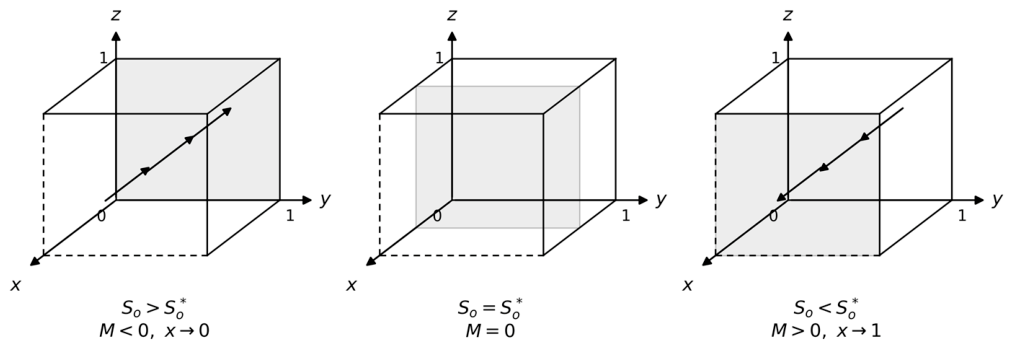
when M > 0, x = 1 is a locally stable strategy, and the owner tends to invest; when M < 0, x = 0 is a locally stable strategy, and the owner tends not to invest; when M = 0, the owner has no preference between the two strategies. To further characterize the critical conditions for the owner’s strategy shift, let S
o* = yαΔR + zyI
o + zF
o + (1 − y)(1 − z)αL, representing the critical cost for the owner to invest in the intelligent cost control system. If S
o > S
o*, then M < 0, F(x) < 0, the owner’s investment probability x converges to 0, and the system tends toward “non-investment”; If S
o = S
o*, then M = 0 and F(x) = 0, and the owner is in a state of indifference between investing and not investing; if S
o < S
o*, then M > 0 and F(x) > 0, and the owner’s investment probability x converges to 1, with the system tending toward “investment.” Therefore, reducing the intelligent investment cost So, or increasing the collaborative excess return ΔR, government subsidy I
o, owner’s non-investment penalty F
o, and non-collaborative loss L, will all increase S
o*, expand the region where M > 0, and thereby strengthen the owner’s willingness to invest.
Figure 1 shows the phase diagram of the owner’s strategy evolution.
2.3.2. General Contractor’s Strategic Stability Analysis
Let V
1 and V
2 denote the expected payoffs for the general contractor choosing active collaboration and passive non-collaboration, respectively, and let
denote the average expected payoff. Then
The replicator dynamic equation governing the general contractor’s strategy evolution is
The first-order derivative of F(y) with respect to y and the defined parameter N are
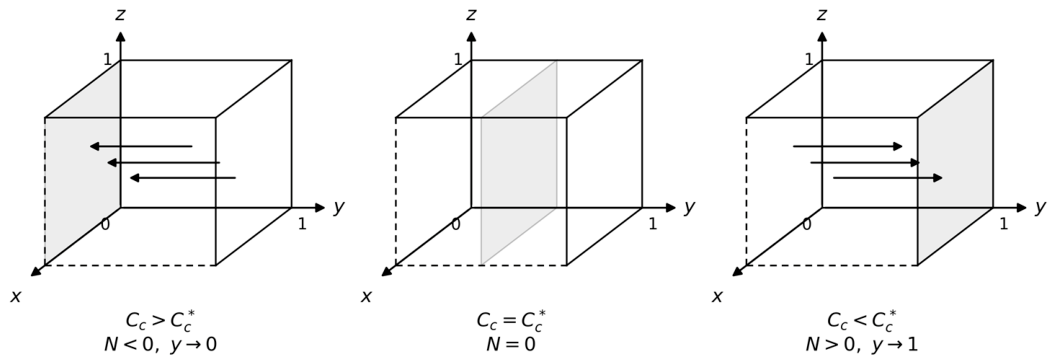
when N > 0, y = 1 is a locally stable strategy, and the general contractor tends toward positive coordination; when N < 0, y = 0 is a locally stable strategy, and the general contractor tends toward negative coordination. To further characterize the critical conditions for the general contractor’s strategy shift, let C
c* = x(1 − α)ΔR + zF
c + (1 − x)(1 − z)(1 − α)L, representing the critical cost of the general contractor’s positive coordination control. If C
c > C
c*, then N < 0, F(y) < 0, and the probability y of the general contractor engaging in positive coordination evolves toward 0, with the system tending toward “negative coordination”; If C
c = C
c*, then N = 0 and F(y) = 0, and the general contractor is in a critical indifference state between positive and negative coordination; If C
c < C
c*, then N > 0 and F(y) > 0, and the probability of positive coordination y evolves toward 1, with the system tending toward “positive coordination.” Therefore, the higher the owner’s investment level x, the general contractor’s available profit share (1 − α)ΔR, the government’s penalty for negative coordination Fc, and the gains from avoiding non-coordination losses, the more favorable it is for increasing C
c*, thereby expanding the region where N > 0.
Figure 2 shows the phase diagram of the general contractor’s strategy evolution.
2.3.3. Government’s Strategic Stability Analysis
Let W
1 and W
2 denote the expected payoffs for the government choosing supervision and incentive and non-supervision and non-incentive, respectively, and let W
z. denote the average expected payoff. Then
The replicator dynamic equation governing the government’s strategy evolution is
The first-order derivative of F(z) with respect to z and the defined parameter K are
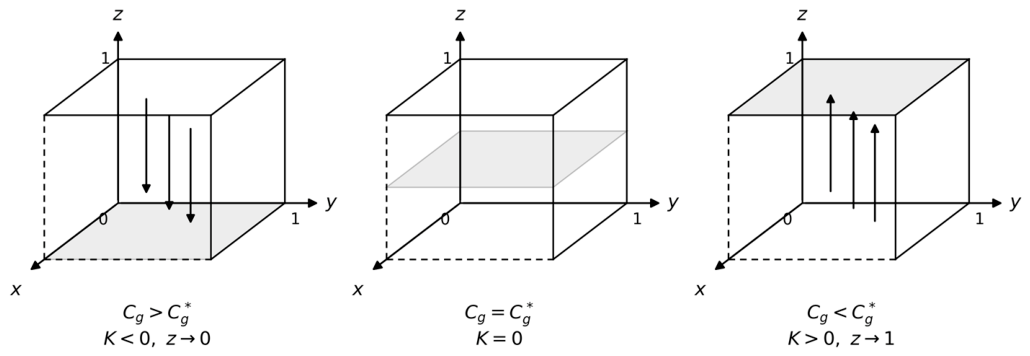
when K > 0, z = 1 is a locally stable strategy, and the government tends to regulate and provide incentives; when K < 0, z = 0 is a locally stable strategy, and the government tends to withdraw from direct regulation. To further characterize the critical conditions for the government’s policy shift, let C
g* = F
c(1 − y) + F
o(1 − x) + xy[(1 − ρ)G − I
o], representing the critical cost or marginal acceptable cost of direct government regulation. If C
g > C
g*, then K < 0 and F(z) < 0; the probability of government regulation z converges to 0, and the government tends to withdraw from direct regulation. If C
g = C
g*, then K = 0 and F(z) = 0; the government is in a critical indifference state between regulation and non-regulation. If C
g < C
g*, then K > 0 and F(z) > 0; the probability of government regulation z converges to 1, and the government tends to implement regulation and incentives. Here, Fc(1 − y) and Fo(1 − x) represent the compliance constraint utility for negative coordination and non-investment behavior, respectively, while xy[(1 − ρ)G − I
o] denotes the net effect of the incremental public governance benefits generated by government direct regulation relative to market-driven coordination, after deducting subsidy costs. Therefore, government regulatory behavior is not about maximizing fine revenue, but rather a trade-off between regulatory costs, compliance constraints, public governance benefits, and subsidy expenditures.
Figure 3 shows the phase diagram of government strategy evolution.
2.3.4. System Equilibrium Point Stability Analysis
By solving F(x) = 0, F(y) = 0, and F(z) = 0, eight pure-strategy equilibrium points are obtained: E
1(0,0,0), E
2(0,0,1), E
3(0,1,0), E
4(0,1,1), E
5(1,0,0), E
6(1,0,1), E
7(1,1,0), and E
8(1,1,1).Based on the replicator dynamic equations, the Jacobian matrix J of the system is constructed as
According to Lyapunov’s first method, an equilibrium point is asymptotically stable if all eigenvalues of the Jacobian matrix have negative real parts; it is unstable if at least one eigenvalue has a positive real part; and it is in a critical state if eigenvalues with zero real parts exist while all others have negative real parts [
24]. The stability analysis of each equilibrium point is presented in
Table 3.
Corollary 1. When αL < So, (1 − α)L < Cc, and Fo + Fc < Cg, the system is stable at E1(0,0,0), i.e., the owner does not invest, the general contractor engages in passive coordination, and the government does not regulate. This state indicates that if the costs of smart investment and coordination exceed the losses from non-cooperation, and the government’s regulatory costs exceed the utility of the penalty constraint, market participants will lack the incentive for spontaneous coordination, and the system is prone to falling into an inefficient equilibrium.
Corollary 2. When So < αΔR, Cc < (1 − α)ΔR, and (1 − ρ)G < Io + Cg, the system is stable at E7(1,1,0), where the owner actively invests, the general contractor actively cooperates, and the government withdraws from direct regulation. This state indicates that when the benefits of coordination can cover the costs incurred by market participants, and when spontaneous market coordination can achieve higher public governance benefits, the government can shift from direct regulation to standard provision, data infrastructure development, and the maintenance of market order.
2.3.5. Discussion on Internal/Hybrid Strategy Equilibrium
The preceding section primarily discusses the long-term evolutionary outcomes of the system based on eight pure strategy equilibria. However, within the framework of a three-party evolutionary game, x, y, and z can be interpreted not only as the probabilities of individual agents choosing a particular strategy, but also as the proportions of the property owner group, the EPC contractor group, and the government regulatory agency that adopt corresponding strategies during the long-term process of learning and imitation. Therefore, analyzing only the boundary pure strategy equilibria is insufficient to fully reveal the dynamic structure of the system. To further address the issues of internal equilibria and mixed-strategy equilibria, this paper builds upon the analysis of pure-strategy equilibria to discuss perfect internal equilibria, boundary mixed-strategy equilibria, and their economic implications [
25].
Let M(y,z), N(x,z), and K(x,y) denote the expected profit differentials for the landowner (“invest—do not invest”), the general contractor (“active coordination—passive coordination”), and the government (“regulation and incentives—no direct regulation and incentives”), respectively. Based on the payoff matrix and the replicating dynamic equations presented earlier, we have
The point of complete internal equilibrium is denoted by E*(x*, y*, z*), where x*, y*, and z* ∈ (0, 1). Since x*, y*, and z* are all interior points, the necessary condition for the dynamic equations F(x*) = F(y*) = F(z*) = 0 to hold is that the three types of agents are in a state of indifference between the two strategies, i.e., M(y*, z*) = 0, N(x*, z*) = 0, and K(x*, y*) = 0. Hence, we obtain
Equations (25) and (26) have clear economic implications. Equation (25) indicates that the marginal benefit to the owner of investing in a smart cost control system is exactly equal to the costs of system construction, maintenance, training, and data governance; Equation (26) indicates that the sum of the profit-sharing gains from active coordination, the gains from avoiding penalties, and the gains from avoiding non-coordination losses obtained by the general contractor is exactly equal to its coordination costs; Equation (27) indicates that the utility from compliance constraints and the incremental public governance benefits obtained by the government through direct regulation are exactly equal to the regulatory costs. At this point, no single entity can achieve a higher expected profit by changing its strategy alone; therefore, the internal equilibrium can be interpreted as a critical state of the three-party strategy selection.
The internal equilibrium does not exist under arbitrary parameter conditions. Let β = 1 − α and A = (1 − ρ)G − Io. For a given z ∈ (0,1), the indifference curves for the owner and the general contractor can be obtained from M = 0 and N = 0, respectively.
Substituting Equations (28) and (29) into K(x,y) = 0 reduces the solution for the complete internal equilibrium to the single equation H(z) = 0
If there exists a z* ∈ (0,1) such that Equation (30) holds, and simultaneously x(z*) ∈ (0,1) and y(z*) ∈ (0,1), and the denominators of Equations (28) and (29) are not zero, then the system has a complete internal equilibrium E*(x*,y*,z*). If there exist z_a and z_b ∈ (0,1) in a given continuous interval such that H(z_a)H(z_b) < 0, then based on the existence of zeros of continuous functions, it can be concluded that there exists at least one internal equilibrium point within that interval. This approach avoids the complexity of directly solving a system of three-variable nonlinear equations and facilitates the identification of internal equilibrium locations in numerical simulations.
The stability of the internal equilibrium must be further determined using the Jacobian matrix. At E*, since M = N = K = 0, the diagonal entries of the Jacobian matrix are all zero, and it can be written as
In particular, J
12 = x*(1 − x*)My, J
13 = x*(1 − x*)Mz, J
21 = y*(1 − y*)Nx, J
23 = y*(1 − y*)Nz, J
31 = z*(1 − z*)Kx, J
32 = z*(1 − z*)Ky, and:
Since tr[J(E*)] = 0, this internal equilibrium point generally does not constitute an asymptotically stable evolutionary stable strategy in the linearized sense. In other words, under the parameter settings and replicative dynamics of this paper, internal/mixed-strategy equilibria manifest more as critical thresholds, saddle points, or neutral stable points rather than final states to which the system converges in the long run. If the Jacobian matrix contains eigenvalues with positive real parts, then E* is an unstable point or a saddle point, whose primary role is to demarcate the attractors of the inefficient equilibrium E1(0,0,0) and the benign equilibrium E7(1,1,0); if the eigenvalues are purely imaginary or have zero real parts, the system may exhibit critical oscillations near this point, requiring further analysis through phase diagrams and multi-initial-value simulations.
In addition to pure internal equilibria, the system may also exhibit boundary mixed equilibria. For example, when x = 0 or x = 1, if both N = 0 and K = 0 hold simultaneously, the general contractor and the government may form a mixed-strategy state at the boundary; when y = 0 or y = 1, if both M = 0 and K = 0 hold simultaneously, the owner and the government may form a mixed-strategy state at the boundary; when z = 0 or z = 1, if both M = 0 and N = 0 hold simultaneously, the client and the general contractor may form a boundary mixed-strategy equilibrium. Such equilibria typically rely on strict parametric equality conditions and are prone to transforming into a pure-strategy equilibrium following parameter perturbations. Therefore, this paper does not elaborate on all boundary mixed-strategy equilibria individually but discusses them as threshold boundaries between pure-strategy equilibria.
From a management perspective, the internal/hybrid strategy equilibrium reveals the “critical threshold” of the intelligent cost control coordination mechanism in EPC projects. When the initial state or policy adjustments result in M > 0 and N > 0, and the marginal necessity of direct government regulation decreases, the system is more likely to cross the internal threshold and evolve toward a virtuous equilibrium characterized by “owner investment-active coordination by the general contractor-government withdrawal from direct regulation”; Conversely, when So and Cc are high, ΔR is low, and policy tools such as Fo, Fc, and Io are insufficient to alter the comparative returns for market participants, the system will slide toward an inefficient equilibrium characterized by “no investment—passive coordination—no regulation.” Increasing the collaborative savings benefit ΔR, reducing the smart investment cost So and the coordination cost Cc, optimizing the revenue-sharing ratio α, and strengthening constraints on non-investment and passive coordination behaviors can all shift the internal equilibrium threshold toward a state that encourages active coordination among market participants.
Conclusion 3: The internal/mixed-strategy equilibrium is not the primary long-term stable objective in this model.
3. Numerical Simulation Analysis
3.1. Source of Parameters and Standardization Notes
To strengthen the practical foundation of numerical simulation, this paper uses the “Left Bank Avenue EPC Project” as a case study for parameter setting. This project employs an EPC organizational model and involves multi-stage collaborative tasks such as design, procurement, construction, and dynamic cost control, effectively reflecting the strategic interactions among the client, the EPC general contractor, and government regulatory authorities in intelligent cost control. Parameter calibration is primarily based on project contract documents, cost control ledgers, investments in the construction and operation of intelligent platforms, the workload associated with data sharing and collaborative management, performance evaluation constraints, and local regulatory incentive requirements. Given the confidentiality of the project’s commercial information and contract data, this paper does not directly disclose original amounts but instead converts relevant revenues, costs, penalties, and regulatory utilities into standardized utility values under a single unit of measurement.
Parameter standardization follows the following principles: First, using the contract cost control targets, room for improvement in settlement variances, and investment in intelligent management of the “Left Bank Avenue EPC Project” as benchmarks, monetary costs, management hours, credit ratings, and regulatory incentives—which are expressed in different units—are converted into comparable utility values; Second, the economic meanings of the parameters are kept consistent, meaning that the owner’s investment cost (S
o), the general contractor’s collaboration cost (C
c), the collaboration benefit (ΔR), and the potential loss (L) should all be on the same benefit–cost scale; Third, construct two scenarios—“inefficient equilibrium” and “positive equilibrium”—to simulate the different evolutionary outcomes that may arise from the project’s intelligent cost control mechanism during the initial construction phase and the mature collaboration stage; Fourth, use parameter interaction and random sampling to test whether the conclusions depend on a specific set of parameters. It should be noted that R
o and R
c are the base benefit constants for the owner and the general contractor, respectively, and offset each other in the difference in strategic benefits; therefore, they are not treated as key parameters in the numerical simulation.
Table 4 below shows the parameter settings and sensitivity analysis settings.
3.2. Inefficient Equilibrium Scenarios and Multi-Parameter Impact Analysis
The low-efficiency equilibrium scenario is used to characterize a policy environment where smart cost control mechanisms are in the early stages of implementation and collaborative incentives are insufficient. Under this scenario, building owners must bear high costs for platform construction, O&M training, and data governance; general contractors must bear additional costs for data organization, interface modifications, and collaborative management; and government subsidies and penalties are not yet sufficient to significantly alter the cost–benefit analysis for market participants. The baseline parameters are set as follows: ΔR = 50, α = 0.70, So = 60, Cc = 35, Cg = 18, Io = 2, Fc = 2, Fo = 3, L = 70, G = 20, ρ = 0.70. In this case, αL = 49 < So = 60, (1 − α)L = 21 < Cc = 35, and Fo + Fc = 5 < Cg = 18, satisfying the stability conditions of E1(0,0,0).
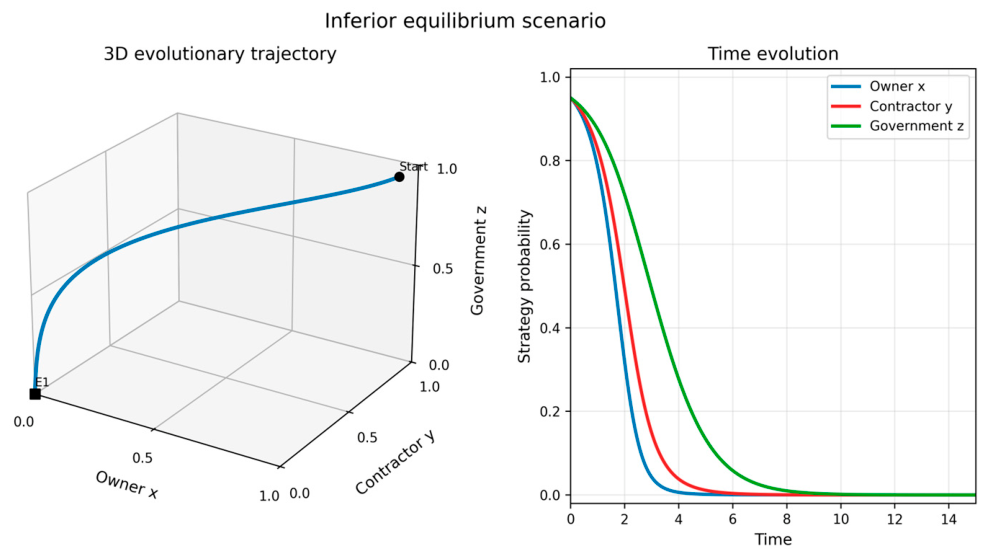
Figure 4 shows that the system gradually converges from an initial state of near-perfect cooperation to E
1(0,0,0). The three-dimensional trajectories reveal the dynamic process of synchronous decreases in the probabilities of the three parties’ strategies, while the two-dimensional time curves further demonstrate that the probability of owner investment (x), the probability of active coordination by the general contractor (y), and the probability of government regulation (z) all exhibit a sustained downward trend. The owner’s strategy declines first, indicating that when the costs of platform construction and data governance exceed expected returns, the investment strategy lacks sufficient economic justification; the general contractor’s strategy declines subsequently, suggesting that its collaborative behavior is significantly constrained by the owner’s investment and profit-sharing conditions; the probability of government regulation ultimately approaches zero, indicating that when the utility of penalty constraints is insufficient to cover regulatory costs, direct regulation struggles to form a long-term stable strategy.
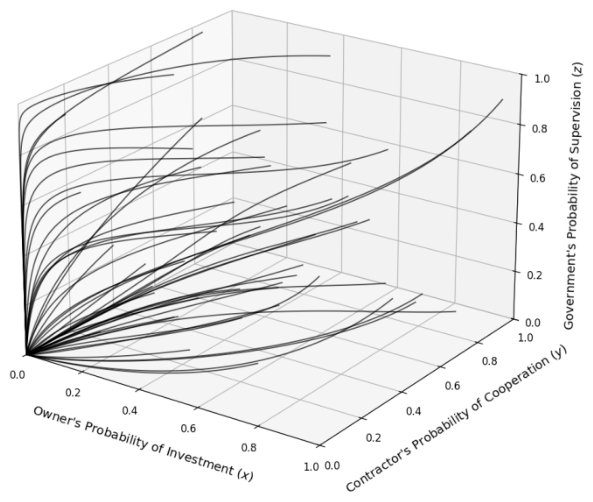
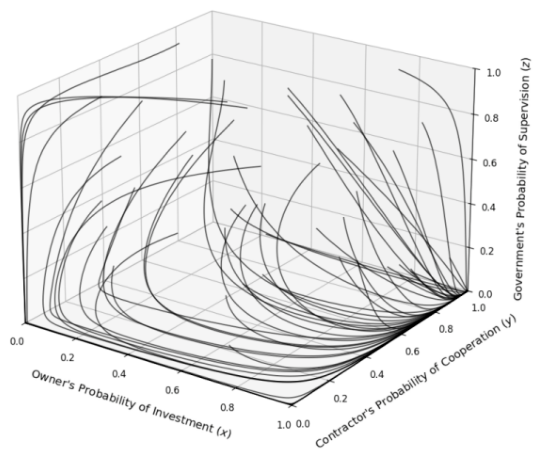
Figure 5 shows the results of 50 iterations.
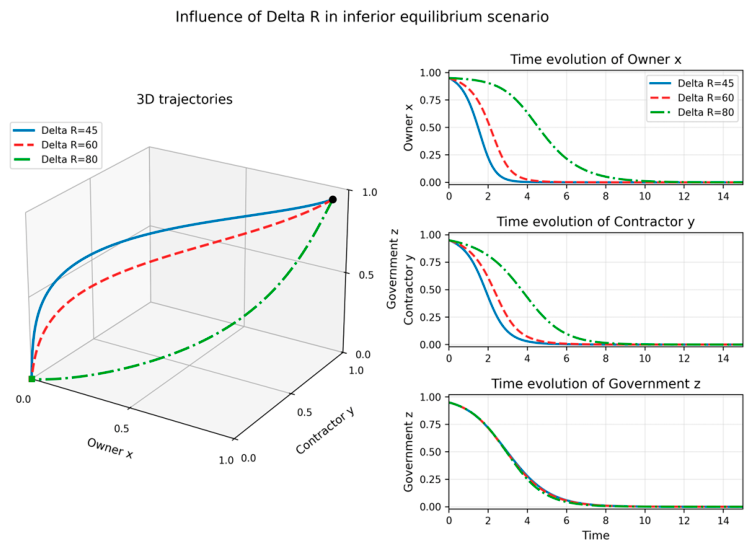
Based on the parameters of the inefficient equilibrium benchmark, the cooperative payoff ΔR is set to 45, 60, and 80 to identify the impact of changes in the cooperative payoff on the strategic evolution paths of the three parties.
Figure 6 simultaneously displays the three-dimensional strategy trajectories and the time evolution curves of x, y, and z.
Figure 6 shows that increasing ΔR can significantly delay the decline in the owner’s investment probability x and the general contractor’s active coordination probability y. This result is consistent with the structure of the profit-sharing function: ΔR is included in both the owner’s profit-sharing M and the general contractor’s profit-sharing N, with the owner receiving a profit-sharing of αΔR and the general contractor receiving (1 − α)ΔR. As ΔR increases, the profit basis for market participants to maintain investment and coordination is strengthened. The probability of government regulation z is primarily affected indirectly through changes in x and y. When a higher ΔR enables market participants to maintain cooperation over a longer period, a new trade-off emerges between the necessity of direct government regulation, subsidy expenditures, and public governance benefits. Overall, ΔR is the key market-driven variable determining whether an inefficient equilibrium can be overcome; however, when So and Cc remain above the profit threshold, increasing ΔR alone is more likely to delay the convergence to inefficiency rather than necessarily alter the final equilibrium.
The owner’s smart system investment cost (S
o) and the general contractor’s coordination cost (C
c) represent the primary cost inputs for system construction and coordinated operation, respectively. To distinguish the mechanisms underlying these two cost parameters, this paper plots the evolutionary results under varying values of S
o and C
c, as shown in
Figure 7 and
Figure 8.
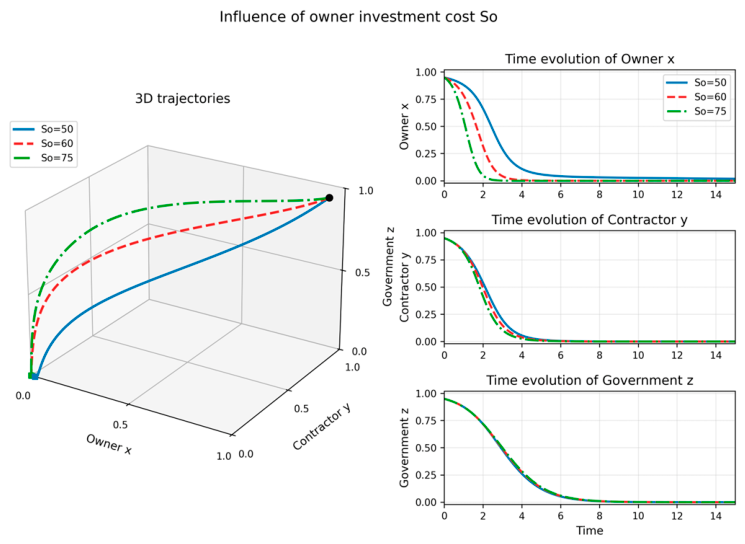
Figure 7 shows that as S
o increases, the probability of the owner investing (x) decreases more rapidly, which in turn further suppresses the probability of the general contractor engaging in active collaboration (y). This is because So directly reduces the net benefit of the owner’s investment strategy, causing M to decrease; when the owner’s willingness to invest declines, the collaborative benefits available to the general contractor and the foundation for data collaboration weaken simultaneously, leading to a decrease in N. Changes in the probability of government regulation z are primarily reflected through the indirect effects of x and y on K. This result indicates that reducing the owner’s initial platform investment, data governance, and personnel training costs is a key condition for smart cost control to transition from the introduction phase to the stable operation phase.
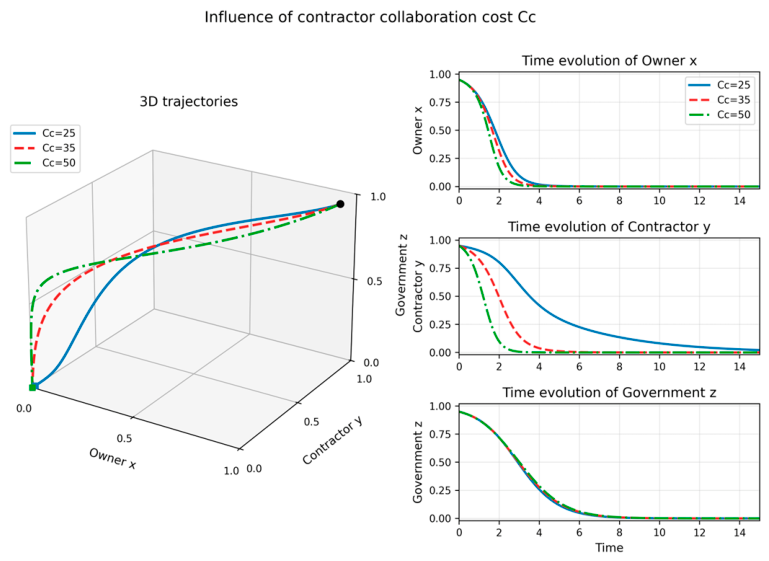
Figure 8 shows that as C
c increases, the probability of active collaboration by the EPC contractor (y) decreases more rapidly, and strategic interactions weaken the owner’s probability of investing (x). Collaboration costs not only determine the EPC contractor’s own strategic choices but also influence the owner’s expectations regarding the effectiveness of smart investment. When the general contractor fails to engage in active coordination, the owner will struggle to fully realize ΔR even if a smart cost control system is implemented. Therefore, reducing the costs associated with data organization, interface modifications, supply chain cost data sharing, and coordination processes is key to enhancing the EPC general contractor’s willingness to engage in sustained coordination.
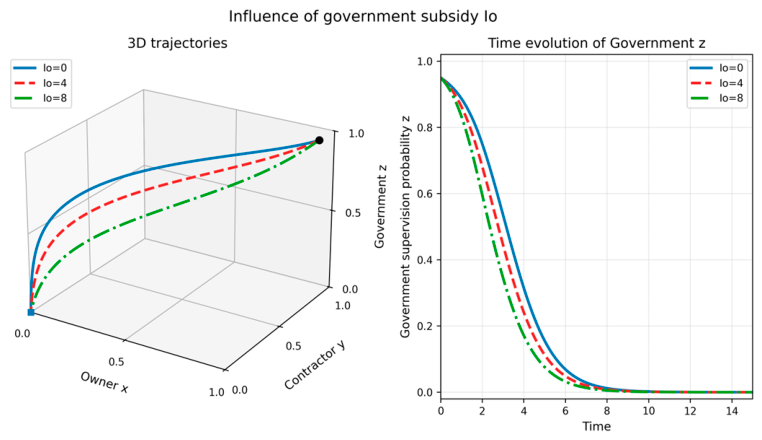
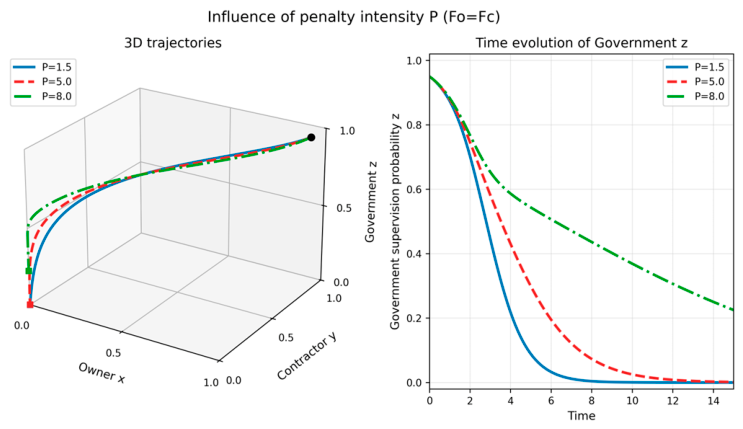
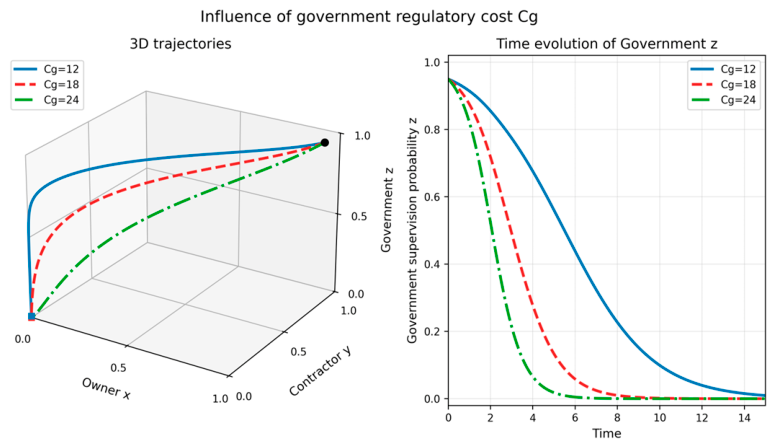
Government-related parameters primarily influence the evolution of z through subsidy expenditures, the deterrent effect of penalties, and regulatory costs. To better distinguish the effects of different policy parameters, this paper conducts simulation analyses of Io, penalty intensity P, and Cg separately. The left side displays three-dimensional strategy trajectories, while the right side highlights the temporal evolution of the government’s regulatory probability z.
Figure 9 shows that a moderate increase in I
o can enhance the attractiveness of owners’ investment strategies in the early stages, but it has a dual effect on the probability of government regulation, z. On the one hand, subsidies indirectly improve the basis for coordination by increasing x; on the other hand, Io manifests as policy expenditure in the government’s revenue differential K, and excessively high subsidies reduce the net revenue from sustained direct government regulation. Therefore, in inefficient scenarios, I
o is better suited as a phased incentive tool during the introduction phase and should be configured in conjunction with revenue-sharing mechanisms and penalty constraints.
Figure 10 sets both the owner’s non-investment penalty F
o and the general contractor’s passive coordination penalty F
c to P. The results show that increasing the penalty intensity slows the decline in the probability of government regulation z and delays the convergence of x and y to 0. When the penalty intensity is increased, the opportunity costs of non-investment and passive coordination rise, and the utility of the compliance constraint imposed by government regulation consequently strengthens. However, when the penalty intensity is insufficient to offset high investment costs and high coordination costs, the system may still exhibit a reduction in the convergence speed toward an inefficient equilibrium rather than a fundamental transition to a non-equilibrium state.
Figure 11 shows that as C
g increases, the probability of government regulation, z, decreases more rapidly; when C
g is low, the government has a stronger incentive to maintain direct regulation and incentive-based constraints. This result indicates that the digitization, platformization, and data sharing of regulatory mechanisms can reduce regulatory costs, thereby enhancing the sustainability of policy tools. For EPC projects, if regulation relies primarily on manual inspections and ex post accountability, a high C
g will undermine regulatory effectiveness; if C
g is reduced through unified data interfaces, electronic performance evaluations, and dynamic cost alerts, regulatory and incentive mechanisms are more likely to play a stabilizing role during the implementation phase.
3.3. Benign Equilibrium Scenarios and Parameter Impact Analysis
The benign equilibrium scenario describes the operational state achieved after the intelligent cost control platform is gradually integrated into the design, procurement, construction, and settlement management processes. Under this scenario, the accumulation of project data and the standardization of processes enhance collaborative cost savings; the marginal cost of the owner’s platform investment decreases; the costs associated with data collaboration and cost warning responses for the general contractor are reduced; and the marginal necessity of direct government oversight diminishes as market-based collaborative mechanisms mature. The baseline parameters are set as follows: ΔR = 100, α = 0.70, So = 50, Cc = 25, Cg = 18, Io = 2, Fc = 2, Fo = 3, L = 80, G = 40, ρ = 0.70. In this case, So = 50 < αΔR = 70, Cc = 25 < (1 − α)ΔR = 30, and (1 − ρ)G = 12 < Io + Cg = 20, satisfying the stability conditions of E7(1,1,0).
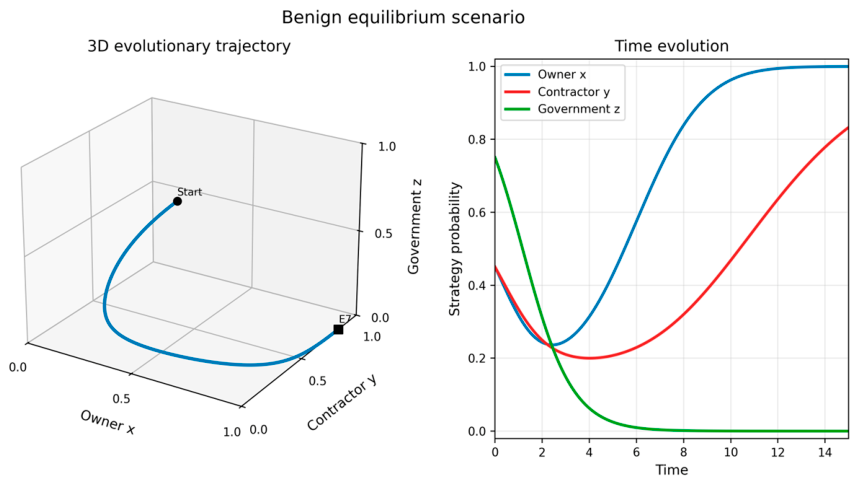
Figure 12 shows that, under conditions where the benefits of collaboration can cover the owner’s investment costs and the general contractor’s collaboration costs, the probability of owner investment (x) continues to rise and approaches 1; the probability of active collaboration by the general contractor (y) gradually increases after a brief adjustment; and the probability of direct government regulation (z) gradually decreases and approaches 0. The three-dimensional trajectories indicate that the system moves from a state of moderate cooperation toward the vicinity of E
7(1,1,0); the two-dimensional curves further illustrate that there is a positive, mutually reinforcing relationship between the owner’s investment and the general contractor’s coordination. Once market participants have established stable, spontaneous coordination, the government is in a position to shift from high-frequency direct regulation to indirect governance.
Figure 13 shows the results of 50 iterations.
In a benign equilibrium scenario, the system already has the foundation to converge to E
7, but changes in parameters can still affect the convergence rate. This paper examines the effects of ΔR, S
o, and C
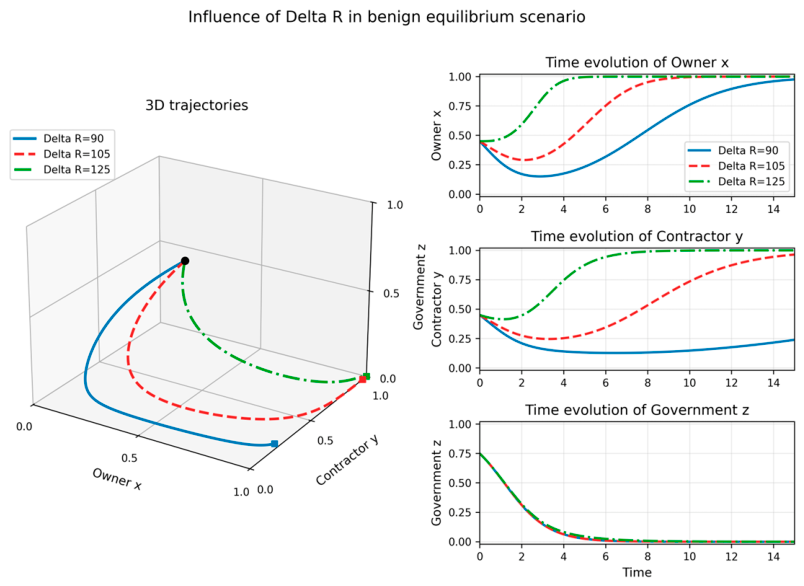
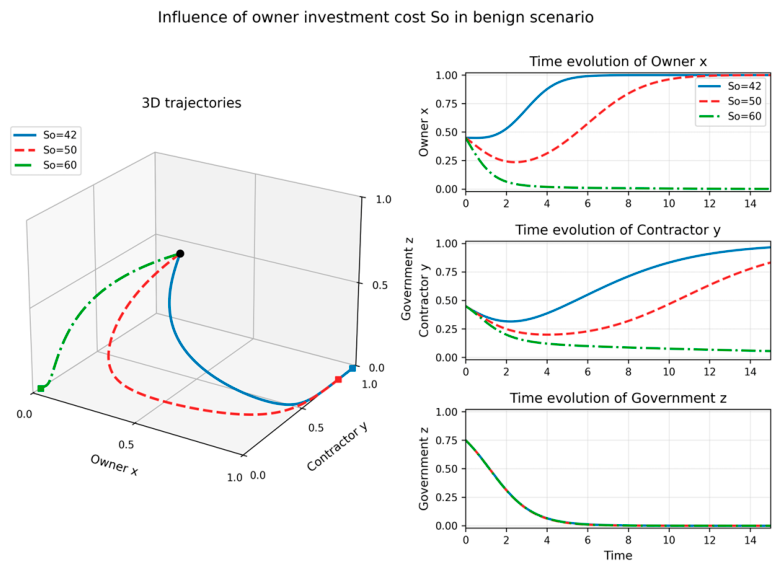
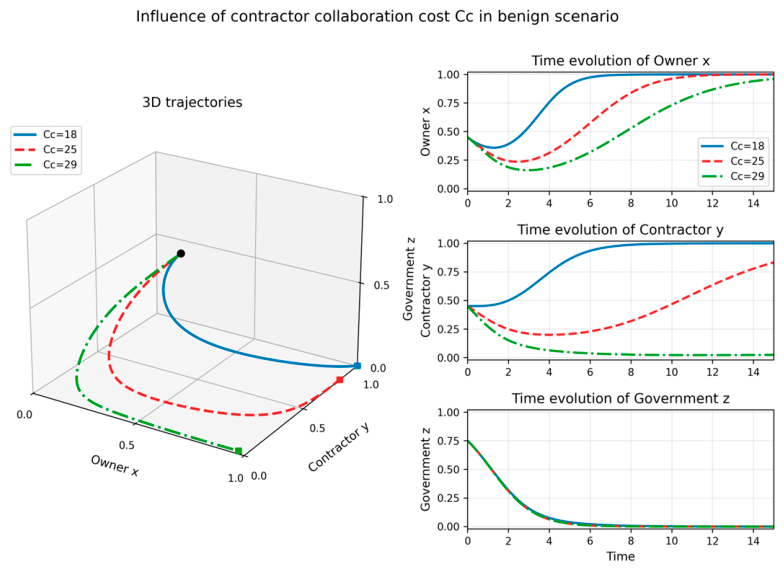
c separately; the results are shown in
Figure 14,
Figure 15 and
Figure 16.
Figure 14 shows that as ΔR increases, the probability of the owner investing (x) and the probability of the general contractor actively cooperating (y) rise more rapidly to higher levels. For the general contractor, a higher ΔR increases its share of the benefits (1 − α)ΔR, thereby shortening the time it takes to shift from a wait-and-see attitude or a brief decline to active cooperation. The probability of government regulation z gradually decreases as the cooperation probabilities of market participants increase, indicating that expanding collaborative benefits will accelerate the transition of governance from direct regulation to market-based collaboration and indirect governance.
Figure 15 shows that even if the system eventually reaches a positive equilibrium, a high So will still delay the increase in the owner’s investment probability x and indirectly slow the rate of improvement for the general contractor y. This indicates that lowering the threshold for the owner’s initial investment remains crucial. In practice, S
o can be reduced through measures such as phased platform development, demonstration subsidies, modular software procurement, reuse of training resources, and standardized data governance, thereby shortening the time it takes for the system to reach a positive equilibrium.
Figure 16 shows that the higher the value of C
c, the more likely it is that the probability of active collaboration by the general contractor, y, will decline or recover slowly in the early stages; however, when C
c remains below the critical threshold of (1 − α)ΔR, y will eventually converge to 1 as the probability of owner investment, x, increases and the benefits of collaboration are gradually realized. This result indicates that a positive equilibrium depends not only on the owner’s investment but also on improvements in the general contractor’s internal cost database, supply chain data interfaces, and the standardization of collaboration processes.
3.4. Parameter Interaction and Robustness Analysis
The Combined Effect of Subsidies and Fines
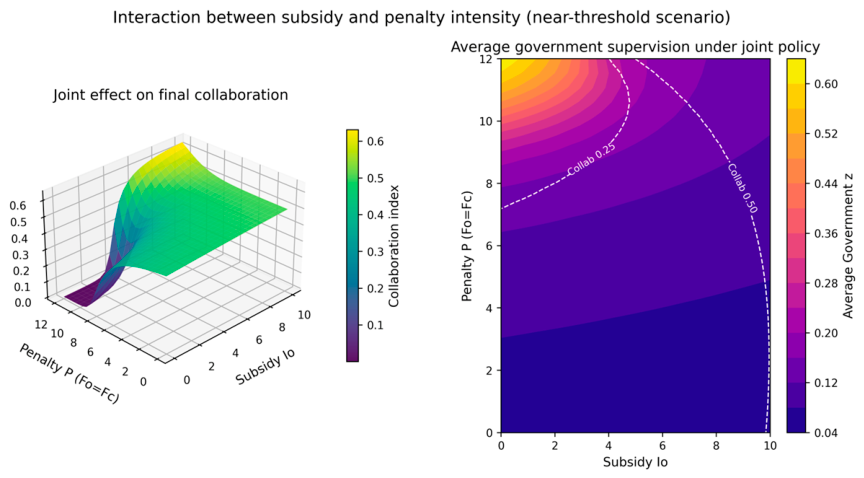
Single-factor sensitivity analysis can identify the marginal impact of changes in a single parameter on the evolutionary path, but it struggles to reveal the complementary, substitutive, and threshold effects among policy instruments. Based on this, this paper further examines the combined effects of the subsidy Io and the penalty intensity P. Given that high values of So and Cc in a strictly inefficient baseline scenario may obscure the marginal effects of policy instruments, the interaction scenario is set near the critical point of the transition from inefficiency to efficiency: ΔR = 80, So = 50, Cc = 25, L = 75, G = 35, with initial conditions of (0.55, 0.55, 0.65), where Fo = Fc = P, and examines the combined effects of Io ∈ [0, 10] and P ∈ [0, 12].
The left-hand side of
Figure 17 shows that when both I
o and P increase simultaneously, the final coordination index—defined as the average of the owner’s investment probability and the general contractor’s positive coordination generally follows an upward trend; however, the effects of these two factors do not simply add up linearly. Under low-penalty conditions, increasing subsidies alone has a limited effect on improving the level of coordination, as the opportunity cost of not investing or engaging in negative coordination remains low; under higher-penalty conditions, moderate subsidies can reduce the pressure on owners to make upfront investments, making it easier for market participants to cross the profit threshold. The contour plot on the right indicates that a higher P can raise the average level of government regulation, while an excessively high Io increases government fiscal or policy costs, thereby reducing the net benefits of sustained regulation. It is evident that subsidies and penalties have a conditional complementary relationship; an optimal policy mix should involve lowering investment barriers during the introduction phase, constraining opportunistic behavior during the operational phase, and gradually reducing the intensity of direct regulation during the maturity phase.
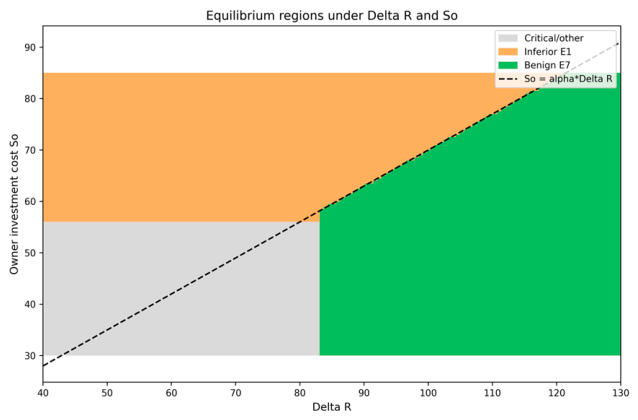
To examine the sensitivity of the test results to variations in parameter combinations, this paper further conducts robustness analysis from two perspectives: two-dimensional parameter combinations and random parameter sampling. First, using the benign scenario as a baseline, we alter the relationship between ΔR and S
o to examine changes in the system’s stable region; the results are shown in
Figure 18.
Figure 18 shows that there is a clear threshold relationship between ΔR and S
o. When S
o is lower than αΔR and the synergy benefits available to the general contractor can cover C
c, the system is more likely to enter the efficient equilibrium E
7; when So is higher than the available synergy benefits and the non-synergy losses are insufficient to offset the input costs, the system is more likely to fall into the inefficient equilibrium E1; The region near the threshold may manifest as a critical state, a state of continuous regulation, or a transitional state dependent on the initial strategy level. Therefore, promoting intelligent cost control in EPC projects should not only emphasize platform development but also simultaneously increase digital synergy benefits while reducing the owner’s investment costs and the general contractor’s synergy costs.
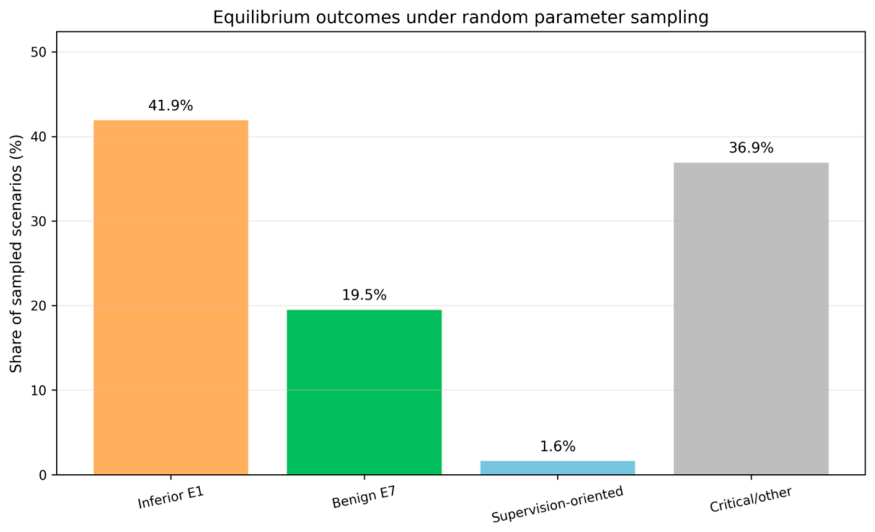
Second, a random perturbation range was established around the benchmark parameters, and random samples were taken for α, ΔR, S
o, C
c, C
g, I
o, F
o, F
c, L, G, and ρ to calculate the proportion of different parameter combinations that satisfy various equilibrium conditions. This analysis does not estimate the actual probability of occurrence of various equilibria in specific projects or across the industry as a whole, but rather serves to verify whether the model’s conclusions depend on a single parameter combination. The sampling results are shown in
Figure 19.
Figure 19 shows that under parameter perturbations, inefficient equilibria, benign equilibria, sustained regulatory states, and critical/other states may all occur, indicating that the long-term evolutionary outcome of intelligent cost control in EPC projects depends on the interplay among coordination benefits, investment costs, coordination costs, regulatory costs, and the maturity of spontaneous market coordination. A comprehensive analysis of
Figure 4,
Figure 5,
Figure 6,
Figure 7,
Figure 8,
Figure 9,
Figure 10,
Figure 11,
Figure 12,
Figure 13,
Figure 14,
Figure 15,
Figure 16,
Figure 17,
Figure 18 and
Figure 19 reveals that ΔR, S
o, and C
c are the core parameters determining the long-term evolutionary direction of the system; The roles of I
o, F
o, and F
c are conditional; when market participants’ cost–benefit structures approach a threshold, subsidies and penalties exert a greater policy leverage effect; the explicit definition of L enhances participants’ perception of non-cooperative risks; and an increase in ρ provides a market foundation for the government to withdraw from direct regulation.
In summary, the effective advancement of intelligent cost control in EPC projects relies on the synergistic interaction of market incentive mechanisms, cost reduction mechanisms, and regulatory constraint mechanisms. In practice, ΔR should be expanded through the accumulation of full-process cost data, collaborative optimization of design-procurement-construction, contract profit-sharing, and standardization of data interfaces; So and Cc should be reduced through modular platform development, training reuse, and process standardization; and the threshold-triggering effect of policy tools should be enhanced through phased subsidies, credit evaluations, and liability for breach of contract. Under the combined influence of these conditions, the system is more likely to shift from an inefficient equilibrium characterized by “no investment by the owner—passive collaboration by the general contractor—no government oversight” to a virtuous equilibrium characterized by “investment by the owner—active collaboration by the general contractor—government withdrawal from direct oversight.”
4. Discussion
The main findings of this study indicate that the effectiveness of implementing smart cost control in EPC projects does not depend solely on digital tools themselves, but rather on whether an incentive-compatible relationship is established among synergy benefits, input costs, benefit allocation, and government governance. Existing research on EPC cost control typically emphasizes management measures such as design integration, procurement optimization, construction organization, contract boundaries, and dynamic feedback. Consistent with these conclusions, this study argues that collaboration throughout the entire process is a crucial foundation for reducing cost deviations. What sets this study apart is that it further explains why these measures may not automatically take effect in practice: when the cost of intelligent investment (So) and the general contractor’s collaboration cost (Cc) exceed the achievable benefits, the owner and general contractor may still opt for low investment or passive collaboration—even if management processes and technological tools possess potential value—causing the system to converge toward an inefficient equilibrium.
Existing research on BIM5D, integrated cost-schedule control, and digital cost management has shown that digital technologies can enhance quantity takeoff, cost forecasting, information integration, and the ability to link schedule and cost. The results of this study align with this assessment of technological effectiveness: when intelligent cost control generates significant excess cost savings ΔR, the probability of both the owner’s investment and the general contractor’s active collaboration increases. However, the contribution of this paper lies in advancing the notion of “digital technology effectiveness” to “under what incentive conditions digital technology is effective.” The model shows that a digital platform will only transform from an information processing tool into a stable collaborative governance mechanism when its construction costs, data governance costs, and cross-organizational collaboration costs can be covered by a profit-sharing mechanism. Thus, this paper addresses the insufficient attention paid to stakeholder incentives, cost-bearing, and profit distribution in existing research on digital transformation.
Research on project performance and cost overruns generally identifies inadequate planning, poor communication, design changes, unstable material supply, and weak phase management as key causes of cost escalation in EPC projects. This study does not deny these influencing factors but rather incorporates them into a behavioral explanatory framework based on evolutionary game theory. The non-collaborative loss L in the model can be understood as a comprehensive reflection of risks such as cost overruns, schedule delays, change claims, and data distortion; its impact is manifested not only in increased project losses but also in altering the comparison of returns on investment and collaboration between the owner and the general contractor. Therefore, this paper expands upon the risk factors identified in existing research—from static causes to mechanism variables influencing strategy evolution—explaining why some EPC projects struggle to establish stable coordination in a timely manner even after identifying cost risks.
Compared to general studies on stakeholder coordination, this research places greater emphasis on the role of benefit sharing in long-term strategic stability. The results indicate that ΔR is key to driving the formation of spontaneous coordination between the owner and the general contractor; however, the presence of ΔR does not necessarily lead to coordination; only when αΔR is sufficient to cover the owner’s smart technology investment costs, and (1 − α)ΔR is sufficient to cover the general contractor’s coordination costs, does the collaboration between the two parties possess a stable economic foundation. This finding aligns with the perspectives on benefit balancing in stakeholder theory and cooperative game theory, but further provides threshold conditions that explain the transition from inefficient equilibria to benign equilibria. In other words, the profit-sharing ratio α is not merely a distribution parameter in the contract; it is also a key governance variable that influences the strategic choices of actors and the stability of the system during dynamic evolution.
Therefore, the novelty of this paper does not lie in proving once again that digital technologies aid in cost control, nor in merely verifying that government policies influence corporate behavior, but rather in integrating technology application, contractual profit-sharing, the coordination costs of actors, and phased government governance into a single evolutionary analytical framework. This framework reveals the conditions under which intelligent cost control in EPC projects shifts from an inefficient equilibrium to a virtuous equilibrium: collaboration benefits must be measurable, verifiable, and shareable; platform investments and collaboration costs must remain within an affordable range; and policy tools must be capable of curbing opportunism and stabilizing agents’ expectations. Consequently, this paper provides a behavioral mechanism to explain the implementation barriers to digital cost governance in EPC projects and offers a theoretical basis for optimizing contract design, platform development, and policy mixes.
5. Limitations of the Study and Directions for Future Research
Although this paper constructs a three-party evolutionary game model for intelligent cost control in EPC projects and reveals the impact of key parameters on system evolution through scenario simulations and robustness analysis, the study still has several limitations that require attention when interpreting the conclusions and generalizing the findings.
First, this paper focuses on government regulatory agencies, project owners, and EPC general contractors as the core actors, without incorporating entities such as design firms, material suppliers, supervision agencies, digital platform service providers, financial institutions, and end users into the model. In reality, the cost control chain in EPC projects is longer, and data flows, capital flows, and chains of responsibility are more complex, with potential networked collaborative relationships among multiple actors. Future research could develop multi-group evolutionary game or network evolutionary game models to more comprehensively characterize the collaborative governance structure across the entire life cycle of EPC projects.
Second, this study primarily uses standardized utility values for scenario analysis, with parameter settings based on actual EPC project data; however, empirical estimates derived from large-sample project data have not yet been established. Therefore, the numerical simulation results should be interpreted as mechanism testing and scenario simulations, rather than causal identification in a statistical sense or estimates of overall industry parameters. Future research could conduct empirical calibration of parameters such as So, Cc, ΔR, α, Io, Fo, and Fc through multi-project case studies, questionnaire surveys, expert interviews, contract text analysis, and platform operational data.
Third, the model assumes that key parameters remain relatively stable over time, but EPC projects exhibit distinct phased characteristics. Investment costs, coordination costs, risk exposure, and regulatory intensity during the design, procurement, construction, and settlement phases may vary over time. Future research could introduce dynamic parameters and multi-stage game structures to analyze strategy shifts and combinations of policy tools across different project phases.
Fourth, this paper simplifies the treatment of profit-sharing and loss-sharing by treating α as an exogenously given profit-sharing ratio and assuming that non-synergy losses are shared between the owner and the general contractor according to the same logic. In real-world EPC contracts, profit sharing may be jointly influenced by bargaining power, risk-bearing arrangements, contract type, performance history, and project uncertainty. Future research could combine cooperative game theory, mechanism design, or contract theory to further analyze the endogenous formation process of α and optimal contractual arrangements.
6. Conclusions
This paper focuses on the issue of multi-party coordination in intelligent cost control for EPC projects. It constructs a three-party evolutionary game model comprising government regulatory authorities, project owners, and EPC general contractors, and analyzes the stability of each party’s strategy selection, the conditions for system equilibrium, and the impact of key parameters on evolutionary trajectories. The study indicates that the formation of an intelligent cost control mechanism depends not only on digital technology itself but also on the alignment between profit sharing, investment costs, coordination costs, and government policy tools.
First, the coordination benefit ΔR is the core variable driving the project owner’s investment and the general contractor’s active coordination. When αΔR is sufficient to cover the project owner’s smart investment cost So, and (1 − α)ΔR is sufficient to cover the general contractor’s coordination cost Cc, market participants possess the endogenous motivation to form spontaneous coordination. Conversely, when investment costs and coordination costs exceed expected benefits and regulatory constraints are insufficient, the system is prone to falling into an inefficient equilibrium characterized by “no investment—passive coordination—no regulation.”
Second, government subsidies, penalties, and regulations play distinct roles at different stages. In the early stages of promoting smart cost control, moderate subsidies and penalties can raise market participants’ expected returns from collaboration and increase the opportunity cost of non-collaboration; once the owner and the general contractor establish stable collaboration through a profit-sharing mechanism, the marginal benefit of direct government regulation declines, and the focus of governance should gradually shift to standard-setting, public data infrastructure development, credit evaluation, and the maintenance of market order.
Third, the profit-sharing ratio α affects not only the equitable distribution of collaboration benefits but also the direction of the system’s evolution. An α that is too high or too low may weaken one party’s incentive to collaborate; therefore, EPC contracts should integrate the recognition of smart cost-saving benefits, data-sharing obligations, collaboration performance evaluations, and risk-sharing mechanisms into a unified design.
Fourth, parameter interaction analysis indicates that there are distinct threshold effects between subsidies and fines, collaborative benefits and investment costs, and collaborative costs and the market’s spontaneous collaborative capacity. A single policy tool is unlikely to reliably drive the system beyond an inefficient equilibrium; only when cost reduction, benefit sharing, and policy constraints act in concert is the system more likely to evolve toward a virtuous equilibrium characterized by “owner investment—active collaboration by the general contractor—government withdrawal from direct regulation.”
Therefore, the implementation of intelligent cost control in EPC projects should follow a comprehensive approach consisting of “technology platform development—benefit-sharing incentives—coordination accountability—phased government governance.” The research findings provide a theoretical basis and management insights for the digital transformation of EPC projects, the design of intelligent cost control mechanisms, and the formulation of government policy tool combinations.