Article

Adaptive Fuzzy Sliding Mode Trajectory Tracking Control of a 7-DOF Redundant Hydraulic Manipulator

1
College of Mechanical Engineering, Shenyang University of Technology, Shenyang 110870, China
2
School of Chemical Engineering and Machinery, Liaodong University, Dandong 118001, China
*
Author to whom correspondence should be addressed.
Appl. Sci. 2026, 16(13), 6373; https://doi.org/10.3390/app16136373 (registering DOI)
Submission received: 7 April 2026 / Revised: 28 May 2026 / Accepted: 8 June 2026 / Published: 25 June 2026

Abstract

For the trajectory tracking control problem of a 7-DOF redundant hydraulic manipulator, an adaptive fuzzy sliding mode control method based on a novel fast reaching law is proposed. Based on the kinematic analysis of the manipulator, its dynamic equation is constructed using the Lagrange dynamic equation. A trajectory planning method for the manipulator, integrating seventh-order polynomial interpolation and genetic algorithm optimization, is proposed. Taking the planned trajectory as the expected trajectory, a sliding mode controller is designed to achieve trajectory tracking control of the manipulator. A sliding mode disturbance observer is used to observe the system uncertainties, and an adaptive fuzzy logic system is designed to estimate the observation error of the disturbance observer. The sliding mode control law is deduced based on the fast reaching law, which can achieve global fast convergence of the sliding mode function while reducing the chattering of the controller. The simulation results show that the proposed control method has good tracking performance and strong robustness.

1. Introduction

The 7-DOF redundant hydraulic manipulator adopts hydraulic transmission, which offers the advantages of high strength and high rigidity, and features simple operation and fast movement. This manipulator can operate stably under complex working conditions, thereby effectively enhancing production efficiency and alleviating labor intensity. However, as a complex, nonlinear and coupled system, this kind of manipulator is subject to external disturbances and unmodeled dynamics during actual operation, which increases the difficulty of its precise control. To address this problem, many scholars have proposed control methods such as PID control [1], fuzzy control [2], sliding mode control [3], and adaptive control [4]. However, in the face of complex external disturbances and unmodeled dynamics, using the aforementioned methods alone can hardly meet the control requirements of interference suppression capability, and cannot meet the stringent performance standards of modern industry for manipulator trajectory tracking control.
A. De Luca et al. proposed a PD control method incorporating online gravity estimation compensation to address the stability issue in flexible manipulator control, effectively enhancing the dynamic response performance [5]. Z. Song et al. integrated computed torque control with fuzzy control to approximate unmodeled uncertainties and verified the stability of the closed-loop system and desired tracking accuracy via Lyapunov theory [6]. M. Zhihong et al. proposed a terminal sliding mode controller, which achieved accurate trajectory tracking within finite time for the second-order system of multi-joint manipulators and exhibited strong anti-interference ability [7]. M. I. Azeez et al. proposed a PID controller that improved trajectory tracking performance and robustness by leveraging Lyapunov stability theory and Golden Jackal optimization algorithm [8]. D. T. Tran et al. combined a terminal sliding mode controller with a linear extended state observer, and achieved control efficiency improvement and chattering suppression via uncertainty estimation [9]. L. Yang et al. designed a non-singular fast terminal sliding mode controller, which met the high-performance control requirements for manipulator trajectory tracking and effectively suppressed system disturbances [10]. K. Gou et al. proposed a novel sliding mode control strategy based on a nonlinear observer, which effectively improved the anti-interference capability of the system [11].
In the present studies, a disturbance observer or fuzzy logic approximator is used to suppress the adverse effect of manipulator system uncertainties by approximating the system uncertainties. However, when a disturbance observer or fuzzy logic approximator is used alone, there exist estimation errors between the approximated values and the actual values of the system uncertainties, which reduces the tracking control accuracy of the manipulator control system. Therefore, it is necessary to compensate for the approximation error to achieve higher trajectory tracking control accuracy of the manipulator. For the trajectory tracking control of a manipulator under the influence of uncertainties, it is required that the control system has good robustness to handle the uncertainties of the system. The manipulator control system using the sliding mode control method has good robustness, but it also has the disadvantages of limited convergence speed of the sliding surface and chattering of the control input. The reaching law is an effective tool to treat these phenomena, and proper design of the reaching law can accelerate the convergence speed of the system’s sliding surface and effectively suppress the chattering of the controller.
Based on the above analysis, in order to achieve accurate trajectory tracking control of a 7-DOF redundant hydraulic manipulator, this paper proposes an adaptive fuzzy sliding mode control method based on a novel fast reaching law. This paper is structured as follows: In Section 2, the kinematics analysis of the 7-DOF redundant hydraulic manipulator is conducted, including the forward kinematics, inverse kinematics and Jacobian matrix derivation of the manipulator. In Section 3, the dynamic model of the manipulator is established via the Lagrange method on the basis of kinematics modeling, and the relationship between the output force of hydraulic cylinders and joint torque of the manipulator is analyzed. In Section 4, a trajectory planning method for the manipulator that integrates seventh-order polynomial interpolation and genetic algorithm optimization is proposed. In Section 5, an adaptive fuzzy sliding mode control method is proposed for trajectory tracking control of the manipulator, which mainly includes the design of a sliding mode disturbance observer, a fuzzy logic system and a fast reaching law. By the use of the sliding mode disturbance observer and the fuzzy logic system, the adverse effect of the system uncertainties is better compensated. The control method proposed in this paper is compared with existing control methods, and the simulation results show that the proposed control method exhibits superior control performance.

2. Kinematics Analysis of a 7-DOF Redundant Hydraulic Manipulator

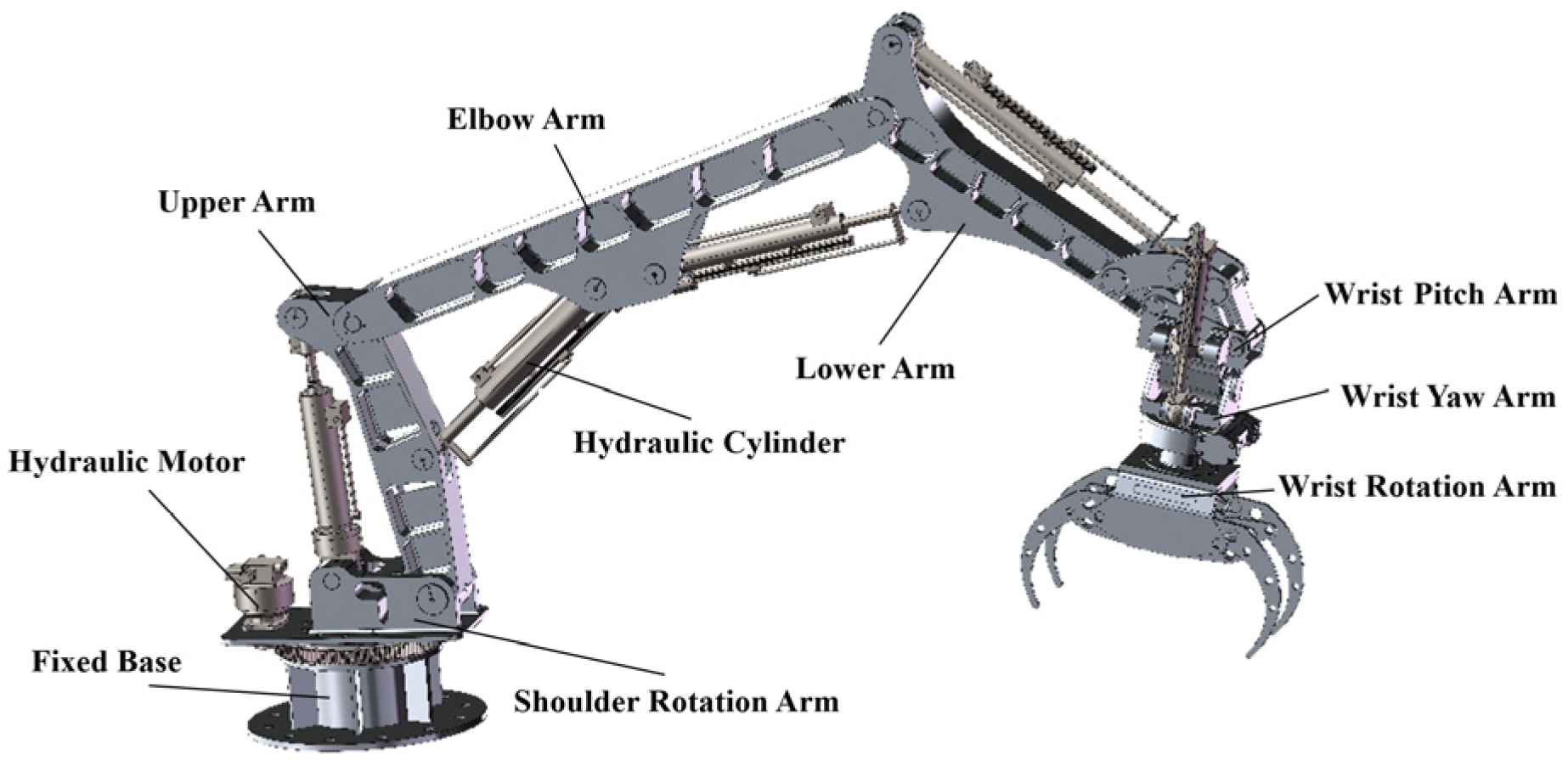
The basic structure of the 7-DOF redundant hydraulic manipulator is shown in Figure 1. This manipulator primarily consists of a fixed base, a shoulder rotation arm, an upper arm, an elbow arm, a lower arm, a wrist pitch arm, a wrist yaw arm, and a wrist rotation arm. The first to the seventh joints correspond sequentially to the rotary joints from the rotary base to the rotary end-effector. The first and seventh joints are driven by hydraulic motors, while the second to the sixth joints are driven by hydraulic cylinders. The first joint controls the end-effector orientation. The second to the fourth joints enable manipulator extension or retraction as well as end-effector lifting, lowering and distance adjustment relative to the target position. The fifth to the seventh joints adjust the end-effector pose to reach the target point.

2.1. Forward Kinematics Analysis of the Manipulator

For the forward kinematics analysis of the manipulator, the modified D-H method is employed [12]. Compared to the standard D-H method, this approach features clearer coordinate system definitions and avoids coordinate ambiguity. Meanwhile, it renders the coordinate transformation matrix between adjacent links dependent on the current joint parameters, thus being more suitable for modeling manipulators with complex configurations.
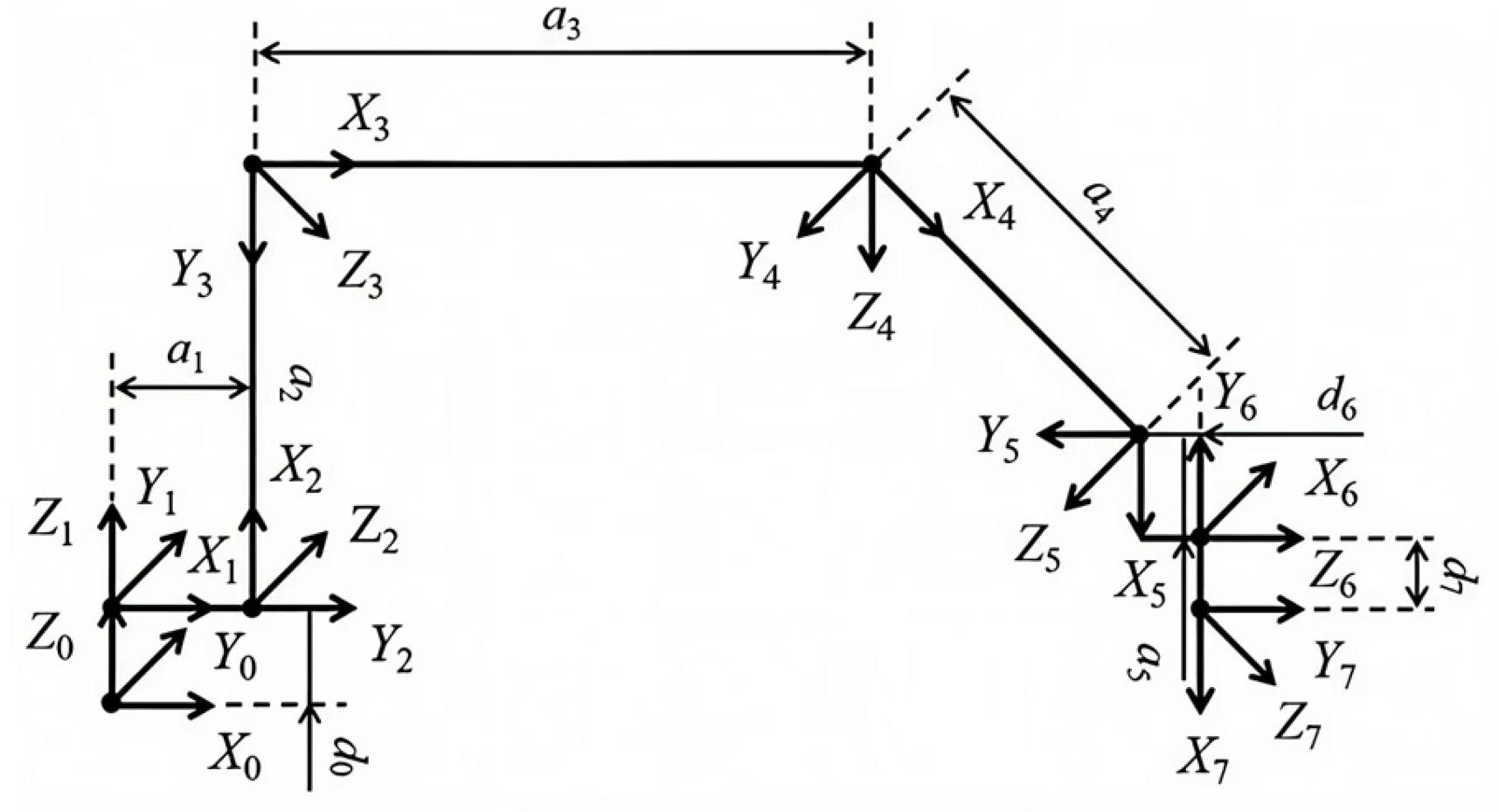
A simplified model is first established according to the basic structure of the manipulator, followed by the construction of its link coordinate system via the improved D-H method. The link coordinate system of the manipulator is shown in Figure 2. The origin of the base coordinate system {0} is located at the center of the base bottom surface, with Z0 pointing vertically upward. For the link coordinate systems {i} (I = 1,2,···,6), the origin is set at the centers of the i-th joints, Zi is aligned with the joint axes, Xi is the common normal of Zi and Zi+1, and Yi is determined by the right-hand rule. The origin of the tool coordinate system {7} is located at the tool center, with the direction of the axes shown in Figure 2.
After establishing the link coordinate systems of the manipulator, the D-H parameters can be obtained according to the manipulator’s configuration and are shown in Table 1. In Table 1, the four parameters—link twist α i 1 , link length a i 1 , joint angle q i , and link offset di—collectively describe the relative position and attitude relationship between adjacent link coordinate systems. The link twist α i 1 represents the rotation angle between the Zi−1 and Zi axes around the Xi−1 axis, and the link length a i 1 is the absolute distance between the Zi−1 and Zi axes along the Xi−1 axis. The joint angle q i is the rotation angle between the Xi−1 and Xi axes around the Zi axis, and the link offset di is the distance between the Xi−1 and Xi axes along the Zi axis.
The coordinate transformation matrix from link coordinate system {i} to {i−1}, denoted as A i i 1 (i = 1, 2, …, 7), is defined as
A i i 1 = c q i s q i 0 a i 1 s q i c α i 1 c q i c α i 1 s α i 1 s α i 1 d i s q i s α i 1 c q i s α i 1 c α i 1 c α i 1 d i 0 0 0 1
where c q i denotes cos q i , c α i denotes cos α i , s q i denotes sin q i , and s α i denotes sin α i .
Using (1), the transformation matrix A 7 0 of the manipulator coordinate system {7} relative to the base coordinate system {0} can be derived as
A 7 0 = A 1 0 A 2 1 A 3 2 A 4 3 A 5 4 A 6 5 A 7 6 = n x o x a x p x n y o y a y p y n z o z a z p z 0 0 0 1
where
n x = c q 1 c q 2345 c q 6 s q 1 s q 6 c q 7 + c q 1 s q 2345 s q 7
n y = s q 1 c q 2345 c q 6 + c q 1 s q 6 c q 7 + s q 1 s q 2345 s q 7
n z = s q 2345 c q 6 c q 7 c q 2345 s q 7
o x = c q 1 c q 2345 c q 6 s q 1 s q 6 s q 7 + c q 1 s q 2345 c q 7
o y = s q 1 c q 2345 c q 6 + c q 1 s q 6 s q 7 + s q 1 s q 2345 c q 7
o z = c q 2345 c q 7 s q 2345 c q 6 s q 7 ,   a x = s q 1 c q 6 c q 1 c q 2345 s q 6
a y = s q 1 c q 2345 s q 6 + c q 1 c q 6 ,   a z = s q 2345 s q 6
p x = c q 1 a 1 + a 2 c q 2 + a 3 c q 23 + a 4 c q 234 + a 5 c q 2345 d 6 s q 2345 p y = s q 1 a 1 + a 2 c q 2 + a 3 c q 23 + a 4 c q 234 + a 5 c q 2345 d 6 s q 2345 p z = d 1 + d 6 c q 2345 + a 2 s q 2 + a 3 s q 23 + a 4 s q 234 + a 5 s q 2345
where c q 23 , s q 23 , c q 234 , s q 234 , c q 2345 , and s q 2345 respectively represent cos ( q 2 + q 3 ) , sin q 2 + q 3 , cos q 2 + q 3 + q 4 , sin ( q 2 + q 3 + q 4 ) , cos q 2 + q 3 + q 4 + q 5 , and sin ( q 2 + q 3 + q 4 + q 5 ) .

2.2. Inverse Kinematic Analysis of the Manipulator

Notice that the axes of the second, third joint, and fourth joints of the manipulator are parallel. The manipulator has three parallel adjacent joint axes and satisfies the Peiper criterion, thus admitting a closed-form inverse kinematics solution [13]. Based on this criterion, an analytical algorithm with a dynamic pose constraint matrix is adopted. By fixing the DOF of the second joint (i.e., seting the joint angle as a constant), the redundant manipulator is reduced to a 6-DOF manipulator for solving inverse kinematics.
The dynamic pose matrix A i 7 1 is obtained by left-multiplying (2) by matrix A 1 1 0 . The dynamic pose matrix A f 7 1 can be derived from the end-effector pose. By matching each corresponding element in matrix A i 7 1 with matrix A f 7 1 , the joint angles q 1 , q 6 , and q 7 , as well as angles q 23 , q 234 and angle q 2345 , can be calculated as
q 1 = atan p y d 7 a y / p x d 7 a x q 6 = acos s 1 a x c 1 a y q 7 = atan s 1 o x c 1 o y / c 1 n y s 1 n x q 23 = asin O 2 + U 2 + a 3 2 a 4 2 / 2 a 3 O 2 + U 2 φ q 23 = π asin O 2 + U 2 + a 3 2 a 4 2 / 2 a 3 O 2 + U 2 φ q 234 = atan O + a 3 s q 23 / a 4 / U a 3 c q 23 / a 4 q 2345 = atan o z s 7 / c 6 n z c 7 / c 6 / o z c 7 + n z s 7 cos q 6 0 q 2345 = atan a z / s 6 / o z c 7 + n z s 7 cos q 6 = 0
where q 23 , q 234 , and q 2345 respectively represent q 2 + q 3 , q 2 + q 3 + q 4 , and q 2 + q 3 + q 4 + q 5 , and
O = p z a 2 s 2 a 5 s 2345 d 1 d 6 c 2345
U = c 1 p x + s 1 p y a 1 a 2 c 2 a 5 c 2345 + d 6 s 2345   φ = arctan O / U
The second joint serves as the constrained joint, and its angle is held as a constant. Using (3), the joint angle q 3 can be obtained as
q 3 = q 23 q 2
The joint angles q 4 and q 5 are obtained by
q 4 = q 234 q 23 q 5 = q 2345 q 2 q 3 q 4
The kinematic inverse solution analysis yields four sets of inverse solutions for the manipulator, which need to be selected according to the joint angle limits. If any joint angle exceeds the limit, the solution is defined as invalid, and feasible solutions can be obtained by adjusting the angle of the redundant joint. When multiple solutions exist, the one with the shortest path and lowest energy consumption is selected [14].

2.3. Jacobian Matrix of the Manipulator

When the manipulator operates at a desired velocity in Cartesian space, it is prone to singular configurations that cause joint velocities to tend to infinity. The Jacobian matrix, establishing the mapping relationship between the end effector velocity and joint velocities, provides a core basis for solving this problem. The Jacobian matrix of the 7-DOF redundant hydraulic manipulator is a 6 × 7 non-invertible matrix, and direct derivation according to the definition is complex. Thus, the vector product method is adopted for derivation [15].
For the i-th joint of the manipulator, the following relationship holds:
υ i ω i = Z i × P 7 0 i Z i q ˙ i
where υ i denotes the linear velocity component of the end-effector due to the i-th joint motion, ω i denotes the angular velocity component of the end-effector due to the i-th joint motion, Zi represents of the unit vector of the Z-axis of coordinate system {i} in the base coordinate system {0}, which can be obtained from the matrix A i 0 . P 7 0 i = R i 0 P 7 i , and P 7 0 i denotes the representation of the position vector of the origin of the tool coordinate system relative to coordinate system {i} expressed in the base coordinate system {0}. R i 0 denotes the attitude transformation matrix of coordinate system {i} relative to the base coordinate system {0}, which can be obtained from the matrix A i 0 . P 7 i denotes the position vector of the origin of the tool coordinate system relative to the coordinate system {i}, which can be calculated from the matrix A i 0 . q ˙ i denotes the angular velocity of the i-th joint.
Using (6), one can obtain
υ i ω i = J q ˙ i i J i = Z i × R i 0 P 7 i Z i
where J i is the i-th column of the Jacobian matrix. The Jacobian matrix of the manipulator can be expressed as
J = J 1 , J 2 , , J 7
The singularity analysis of the Jacobian matrix based on the vector product method provides a crucial theoretical basis for avoiding singular configurations and preventing joint velocities from approaching infinity in manipulator trajectory planning.

3. Dynamic Analysis of the 7-DOF Redundant Hydraulic Manipulator

3.1. Dynamic Model of the Manipulator

Based on the kinematic analysis, the dynamic analysis of the manipulator is performed using the Lagrange method from an energy perspective [16]. The total kinetic energy of the manipulator can be expressed as
K = 1 2 j = 1 7 k = 1 7 i = max j , k 7 t r A i 0 q j I i A i 0 T q k q ˙ j q ˙ k = 1 2 q ˙ T H q q ˙
where q ˙ j denotes the angular velocity of the j-th joint, and Ii is the pseudo-inertia matrix of the i-th link. The pseudo-inertia matrices of each link are shown in Appendix A. The element in the j-th row and k-th column of the inertia matrix H q is expressed as
h j k = i = max j , k 7 t r A i 0 q j I i A i 0 T q k
The total potential energy of the manipulator can be expressed as
V = i = 1 7 m i g ¯ T A i 0 r ˜ C i i
where mi denotes the mass of the i-th link of the manipulator, and the mass of each link is shown in Appendix A. g ¯ = 0 , 0 , g , 0 T represents the vector for gravitational acceleration in the coordinate system {0}, and g is the acceleration due to gravity. r ˜ C i i = x C i i , y C i i , z C i i , 1 T is the homogeneous coordinate of the centroid of the i-th link in the coordinate system {i}, and the coordinates of the centroid of each link are shown in Appendix A. In Appendix A, the unit of mass is kg, the unit of center of mass is m, and the unit of moment of inertia is kg·m2.
The Lagrange function of the manipulator is L = K V , and the manipulator dynamic equation can be established by substituting the Lagrange function into the Lagrange equations of motion:
t L q ˙ j L q j = τ j
where τ j is the driving torque of the j-th joint.
The motion of the actual manipulator is affected by system uncertainties such as unmodeled joint friction, external disturbance, and parameter variation. The actual dynamic model of the manipulator considering system uncertainties can be expressed as
D ( q ) q ¨ + H ( q , q ˙ ) q ˙ + G ( q ) + F ( q , q ˙ ) = T
where C q , q ˙ R 7 × 7 is the centrifugal force and Coriolis force matrix, G q R 7 × 1 is the gravitational force term, T = τ 1 , τ 2 , , τ 7 T is the joint driving torque vector, F ( q , q ˙ ) R 7 × 1 represents bounded system uncertainties including unmodeled joint friction, etc.
The j-th row and k-th column element of the centrifugal force and the Coriolis force matrix C q , q ˙ is expressed as
c j k = k = 1 7 1 2 h j k q i + h i j q k h i k q j q ˙ i
Similarly, the j-th element of the gravity term G q is expressed as
g j = k = 1 7 m k g ¯ T A k 0 q j r ˜ C k k

3.2. Relation Between Cylinder Force and Joint Torque

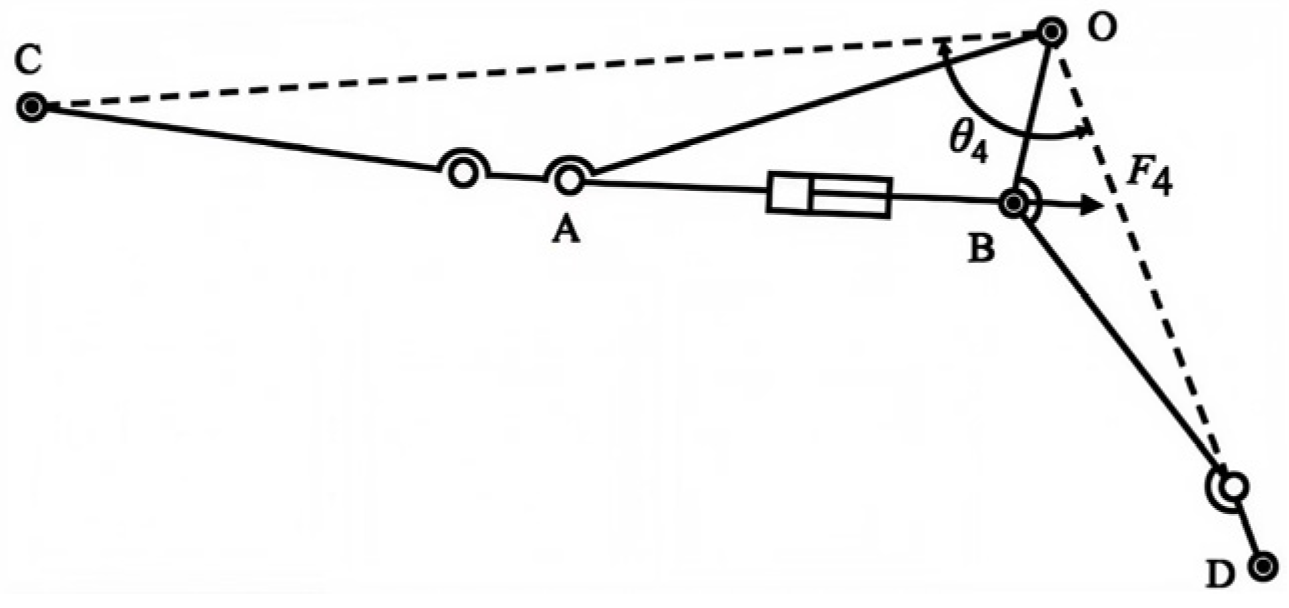
Hydraulic cylinders output force along their own axes, while the dynamic equation requires joint torque as input. Since the second to the sixth joints of the manipulator are driven by hydraulic cylinders, it is necessary to establish the relationship between the hydraulic cylinder output force and joint torque.
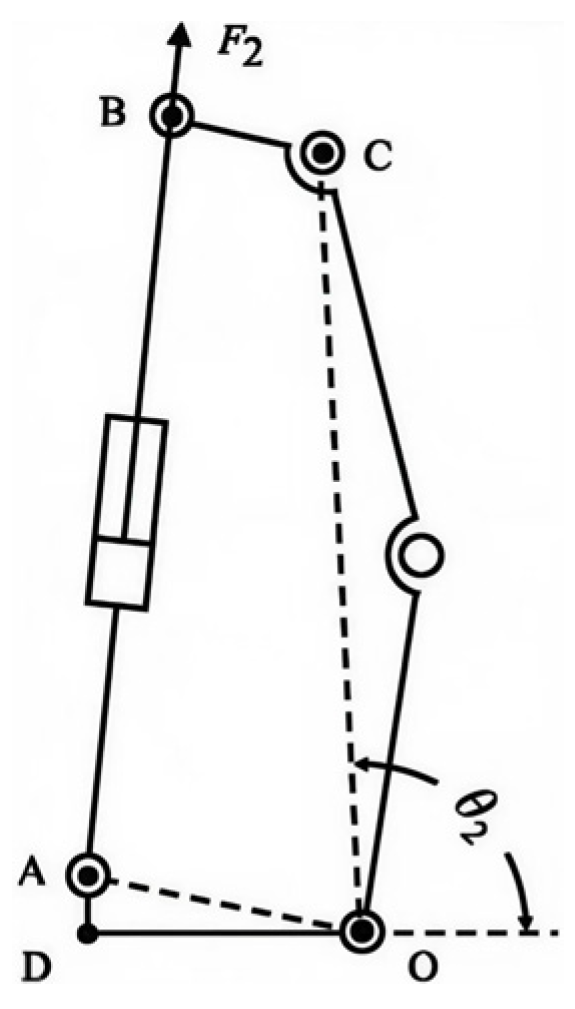
The structural schematic of the second joint is shown in Figure 3. The upper arm hydraulic cylinder force generates the torque at the second joint:
τ 2 = r O B × F 2
where r O B = P B P O denotes the force arm of the upper arm actuated by the upper arm hydraulic cylinder, and is defined in the link coordinate system {2}. PB denotes the position vector of connection point B between the end of the hydraulic cylinder piston rod and the upper arm, defined in the link coordinate system {2}. Po denotes the position vector of the rotation center of the second joint, defined in the link coordinate system {2}. F 2 = F 2 P B P A denotes the force vector generated by the upper arm hydraulic cylinder in the link coordinate system {2}. PA denotes the position vector of connection point A between the end of the hydraulic cylinder and the rotary base in the link coordinate system {2}.
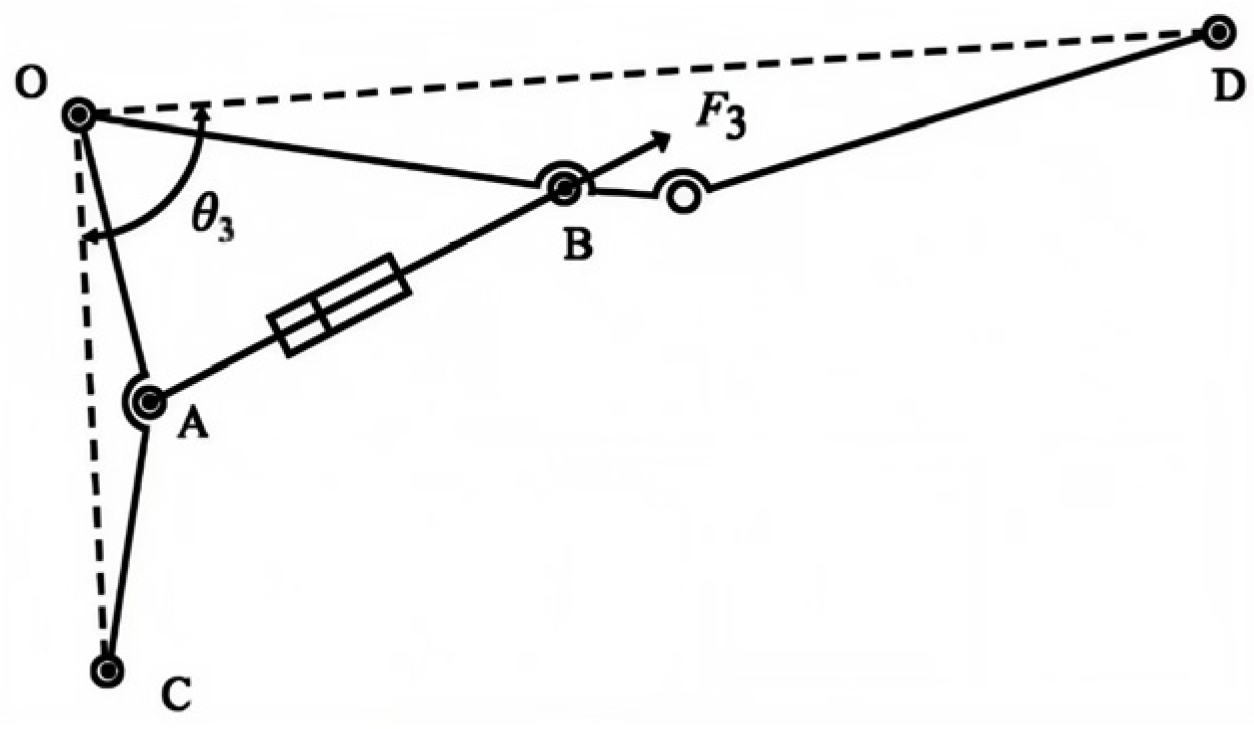
The structural schematic of the third joint is shown in Figure 4. The elbow arm hydraulic cylinder force generates the torque at the third joint:
τ 3 = r O B × F 3
The structural schematic of the fourth joint is shown in Figure 5. The lower arm hydraulic cylinder force generates the torque at the fourth joint:
τ 4 = r O B × F 4
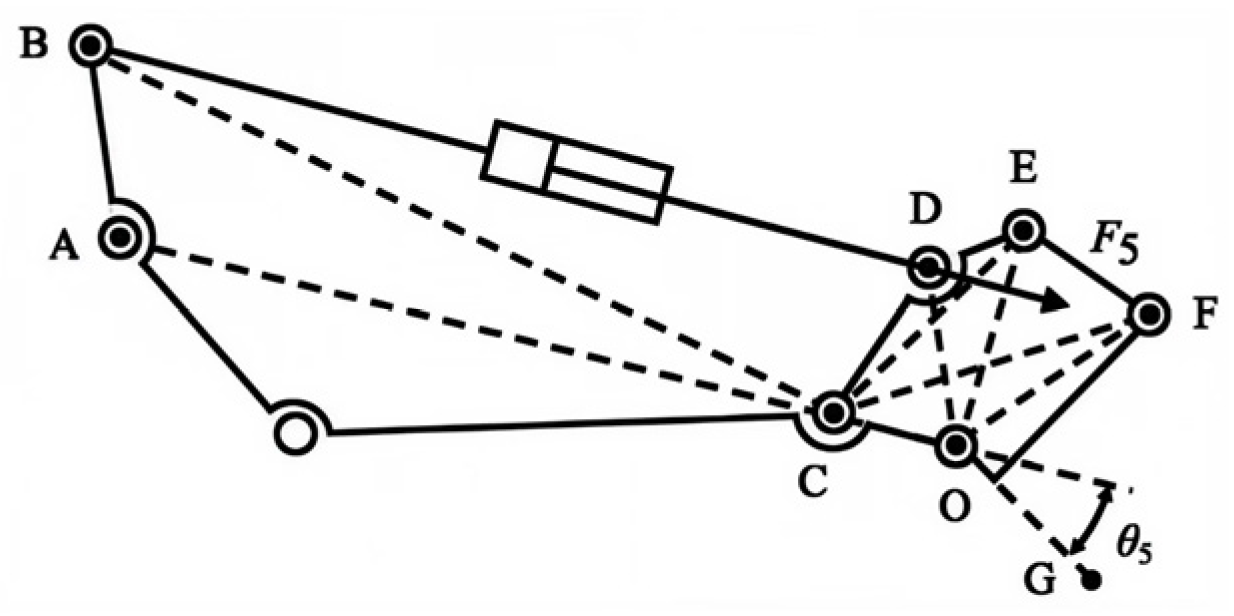
The structural schematic of the fifth joint is shown in Figure 6. The wrist pitch arm hydraulic cylinder force generates the torque at the fifth joint:
τ 5 = r O D × F 5
where r O D = P D P O denotes the force arm of the wrist pitch arm actuated by the wrist pitch arm hydraulic cylinder, defined in the link coordinate system {5}. PD denotes the position vector of connection point D between the end of the hydraulic cylinder piston rod and the wrist pitch arm, defined in the link coordinate system {5}.
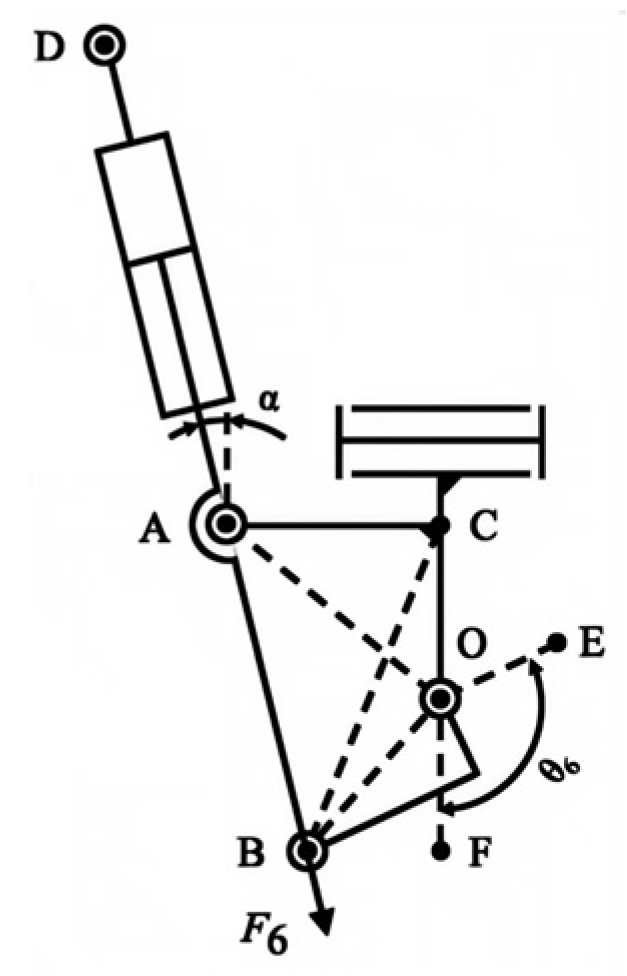
The structural schematic of the sixth joint is shown in Figure 7. The wrist yaw arm hydraulic cylinder force generates the torque at the sixth joint:
τ 6 = r O B × F 6

4. Trajectory Planning of the 7-DOF Redundant Hydraulic Manipulator

4.1. Seventh-Order Polynomial Trajectory Planning

Polynomial interpolation is a commonly used method for manipulator joint space trajectory planning [17]. It employs polynomial functions to describe the manipulator motion process from the start point to the end point. Among the commonly used 3rd-order, 5th-order and 7th-order polynomial interpolations, the 7th-order polynomial can satisfy higher-order derivative continuity conditions (e.g., jerk continuity), and thus exhibits superior trajectory stability and motion performance to the 3rd-order and 5th-order polynomials. Therefore, the 7th-order polynomial is adopted for joint trajectory planning, and its expression for one joint is defined as follows:
θ ( t ) = a 0 + a 1 t + a 2 t 2 + a 3 t 3 + a 4 t 4 + a 5 t 5 + a 6 t 6 + a 7 t 7
where a 0 , a 1 , , a 7 denotes the coefficients of the seventh-order polynomial, and t denotes time.
Taking the derivative of (20) gives the joint angular velocity
θ ˙ ( t ) = a 1 + 2 a 2 t + 3 a 3 t 2 + 4 a 4 t 3 + 5 a 5 t 4 + 6 a 6 t 5 + 7 a 7 t 6
Taking the derivative of (21) gives the joint angular acceleration
θ ¨ ( t ) = 2 a 2 + 6 a 3 t + 12 a 4 t 2 + 20 a 5 t 3 + 30 a 6 t 4 + 42 a 7 t 5
Taking the derivative of (22) gives the joint jerk
θ ( t ) = 6 a 3 + 24 a 4 t + 60 a 5 t 2 + 120 a 6 t 3 + 210 a 7 t 4
At the initial time t0, the joint angle is denoted by θ 0 . At the final time tf, the joint angle is denoted by θ f . The seventh-order polynomial must satisfy the constraints for the joint angle, angular velocity, angular acceleration, and angular jerk at the start and end points:
θ 0 = a 0 θ f = a 0 + a 1 t f + a 2 t f 2 + a 3 t f 3 + a 4 t f 4 + a 5 t f 5 + a 6 t f 6 + a 7 t f 7 θ ˙ 0 = a 1 θ ˙ f = a 1 + 2 a 2 t f + 3 a 3 t f 2 + 4 a 4 t f 3 + 5 a 5 t f 4 + 6 a 6 t f 5 + 7 a 7 t f 6 θ ¨ 0 = 2 a 2 θ ¨ f = 2 a 2 + 6 a 3 t f + 12 a 4 t f 2 + 20 a 5 t f 3 + 30 a 6 t f 4 + 42 a 7 t f 5 θ 0 = 6 a 3 θ f = 6 a 3 + 24 a 4 t f + 60 a 5 t f 2 + 120 a 6 t f 3 + 210 a 7 t f 4
where θ ˙ 0 and θ ˙ f denote the joint angular velocity at the initial time and final time of the path segment, respectively. θ ¨ 0 and θ ¨ f denote the joint angular acceleration at the initial time and final time of the path segment, respectively. θ 0 and θ f denote the joint jerk at the initial time and final time of the path segment, respectively.
Using (24), the coefficients of the 7th-order polynomial function can be obtained as
a 0 = θ 0 a 1 = θ ˙ 0 a 2 = θ ¨ 0 / 2 a 3 = θ 0 / 6 a 4 = 210 θ f 210 θ 0 90 θ ˙ f + 120 θ ˙ 0 t f + 15 θ ¨ f 30 θ ¨ 0 t f 2 θ f + 4 θ 0 t f 3 6 t f 4 a 5 = 168 θ f 168 θ 0 + 78 θ ˙ f + 90 θ ˙ 0 t f 14 θ ¨ f 20 θ ¨ 0 t f 2 + θ f + 2 θ 0 t f 3 2 t f 5 a 6 = 420 θ f 420 θ 0 204 θ ˙ f + 216 θ ˙ 0 t f + 39 θ ¨ f 45 θ ¨ 0 t f 2 3 θ f + 4 θ 0 t f 3 6 t f 6 a 7 = 210 θ f 210 θ 0 + 60 θ ˙ f + 60 θ ˙ 0 t f 12 θ ¨ f 12 θ ¨ 0 t f 2 + θ f + θ 0 t f 3 6 t f 7

4.2. Genetic Algorithm Trajectory Optimization

To improve the manipulator’s working efficiency, ensure the smoothness of the entire trajectory, minimize motion energy consumption, and avoid singular configurations during movement, the total operation time, trajectory smoothness, energy consumption, and singularity avoidance are taken as the core optimization objectives. The objective function for total operation time S1, the objective function for trajectory smoothness S2, and the objective function for energy consumption S3 are defined respectively as
S 1 = k = 1 7 t k S 2 = k = 1 7 0 k = 1 7 t k θ i k ( t ) d t k = 1 7 t k S 3 = k = 1 7 0 k = 1 7 t k θ ¨ i k ( t ) d t k = 1 7 t k
where tk denotes the time of the k-th path segment, θ i k t denotes the jerk of the i-th joint in the k-th path segment, and θ ¨ i k t denotes the angular acceleration of the i-th joint in the k-th path segment.
The singularity avoidance objective function reflects the average singularity of the entire trajectory, which enables the manipulator to operate in a relatively stable state. The singularity avoidance objective function S4 is defined as
S 4 = 1 max { u = 0.01 , 1 k = 1 7 t k 0 k = 1 7 t k J q J T q d t }
where u denotes the threshold constant for singularity detection, and J(q) represents the Jacobian matrix of the manipulator as shown in (8). Selecting the time of the k-th path segment tk (k = 1,2, …, 7) as the optimizing parameters and using (25), one can obtain the manipulator trajectory of each path segment. Further using (26) and (27), the objective functions S1, S2, S3 and S4 can be computed.
To balance the above four objective functions, a weighted sum method is adopted to construct the total objective function, where different weight coefficients are assigned to each objective to balance their importance. The total objective function is expressed as
f = w 1 S 1 + w 2 S 2 + w 3 S 3 + w 4 S 4
where w1, w2, w3, and w4 denote the normalized weights of the total operation time S1, trajectory smoothness S2, energy consumption S3, and singularity avoidance S4, respectively. The weights reflect the importance of each performance indicator in the total objective function. The larger the value of a corresponding weight, the better the optimization effect obtained by the relevant performance indicator. The weights can be selected as required.
The motion of the manipulator is constrained by its physical structure, and the constraints imposed on the joint angles, angular velocities, angular accelerations, and angular jerks of each joint are expressed as
q ˙ i t q ˙ i max q ¨ i t q ¨ i max q i t q i max
where q ˙ i max , q ¨ i max and q ¨ i max denote the maximum angular velocity, maximum angular acceleration, and maximum joint jerk of the i-th joint, respectively.
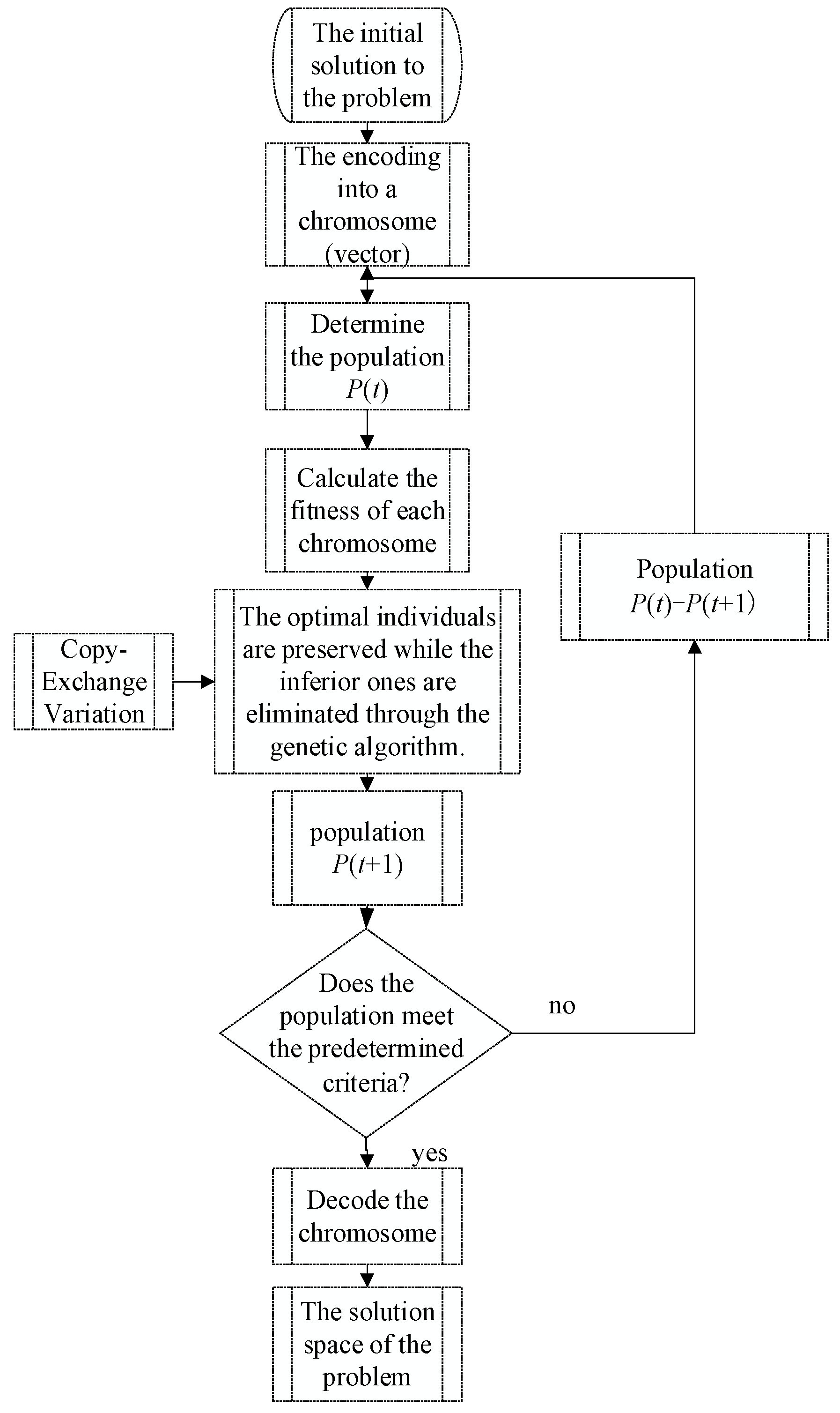
Proposed by John Holland, and based on the laws of natural evolution, the genetic algorithm is an optimal solution search algorithm that simulates the process of natural selection and genetic variation [18]. Evolving iteratively via three core operations (selection, crossover, and mutation), it features gradient-free search, high efficiency in exploring complex solution spaces, excellent robustness, and global optimization capability, making it widely applicable to multi-constraint and nonlinear engineering optimization scenarios. Therefore, this paper applies GA to the trajectory optimization of the manipulator. By selecting the time of the k-th path segment tk (k = 1,2, …, 7) as the optimizing parameters and encoding the optimizing parameters tk, designing fitness function f, and implementing genetic operations, it achieves multi-objective collaborative optimization of total operation time, trajectory smoothness, energy consumption, and singularity avoidance. The flow steps of the genetic algorithm are shown in Figure 8.

4.3. Simulation Verification

In the simulation, the trajectory of the manipulator consists of 8 waypoints, forming 7 path segments. The angular velocity qi, angular acceleration q ˙ i , and angular acceleration q ¨ i at each waypoint are constrained to zero. The joint angle range, angular velocities, angular accelerations, and angular jerk for each joint are specified as constraints in Table 2. The positions Xj, Yj, Zj and orientations δ j , β j , δ j of the manipulator end-effector at the 8 waypoints are detailed in Table 3 and Table 4.
In Table 2, the unit of joint angle range is rad, the unit of maximum velocity is rad/s, the unit of maximum acceleration is rad/s2, and the unit of maximum jerk is rad/s3.
In Table 2 and Table 4, Xj, Yj, and Zj represent the coordinates of the origin of the tool coordinate system relative to the base coordinate system at the j-th waypoint, with units in mm. α j , β j , and δ j represent the roll angle, pitch angle, and yaw angle of the manipulator at the j-th waypoint, respectively, with units in rad.
Inverse kinematics solutions are derived based on the manipulator end-effector pose at each waypoint. Firstly, the redundant joint angle is selected via the genetic algorithm, then substituted into the inverse kinematics solving process, and the corresponding joint angles for each waypoint are finally obtained, as shown in Table 5 and Table 6. In Table 5 and Table 6, the unit of the joint angle is rad.
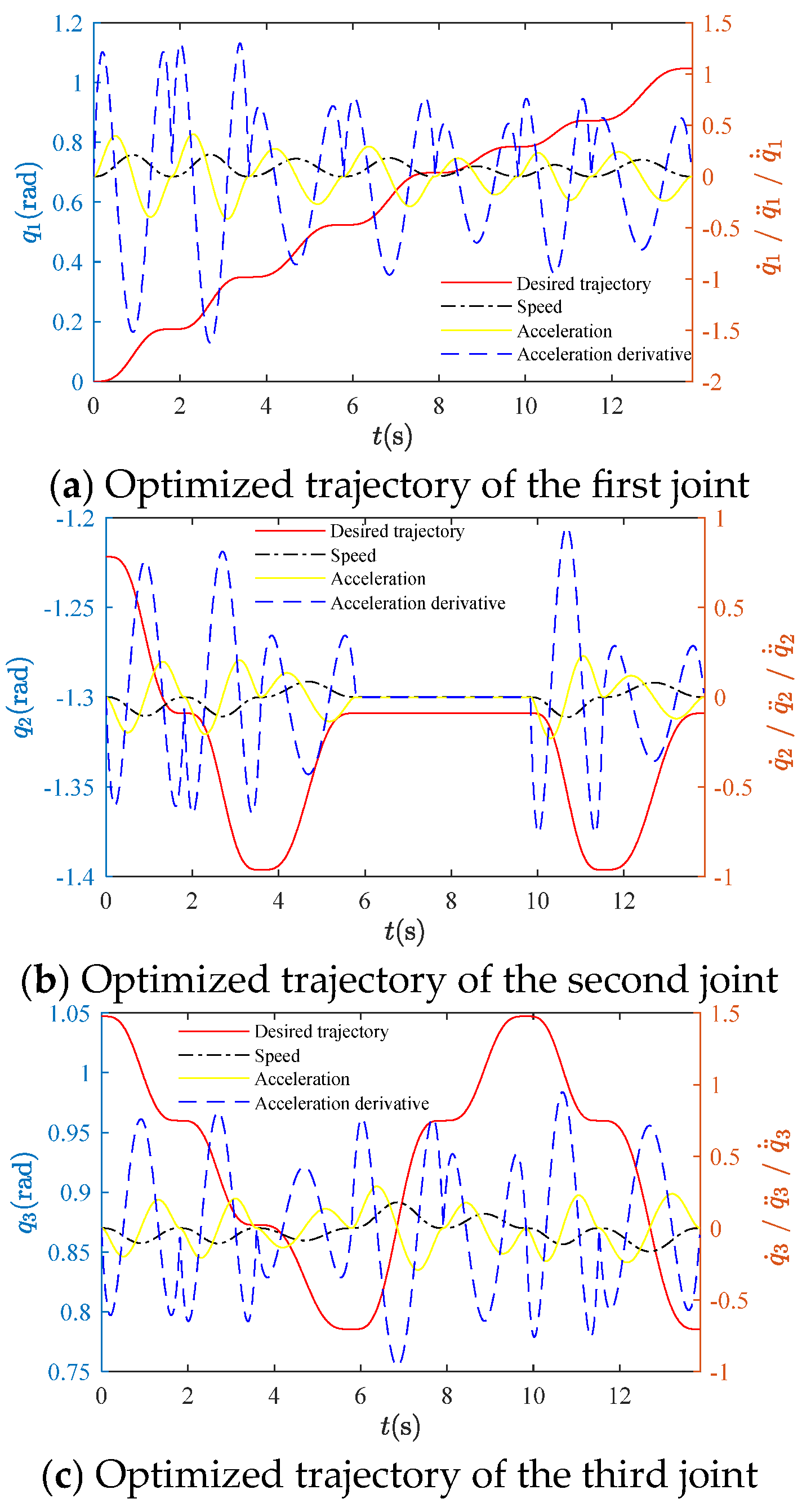
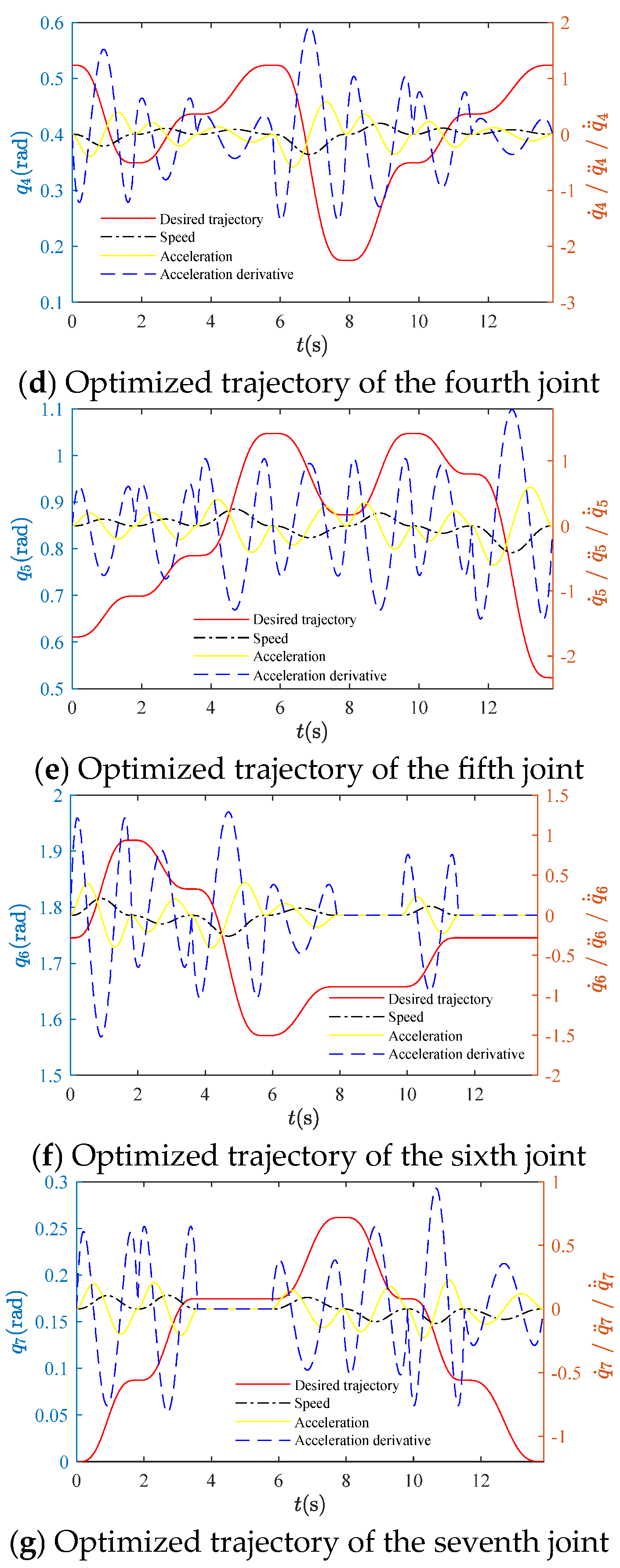
In the simulation, the number of iterations of the genetic algorithm is set to 500. Real-number encoding is adopted, with a crossover operation probability Pc = 0.9 and a mutation operation probability Pm = 0.1. The objective function is set as the fitness function with coefficients w1 = 0.3, w2 = 0.2, w3 = 0.2 and w4 = 0.2. The objective functions and fitness function optimized by the genetic algorithm are S1 = 13.87, S2 = 3.0977, S3 = 10.4797, S4 = 1.2761, and f = 7.1317 respectively. The optimized travel times for each path segment are t1 = 1.82 s, t2 = 1.78 s, t3 = 2.20 s, t4 = 2.12 s, t5 = 1.92 s, t6 = 1.69 s and t7 = 2.34 s. By substituting the time duration of each path segment into (25), the coefficients of the seventh-order polynomial can be obtained. These coefficients are then substituted into (20) to yield the optimized seventh-order polynomial interpolation trajectory. The optimized 7th-order polynomial interpolation trajectory is shown in Figure 9. In Figure 9, the units of angular velocity, angular acceleration, and angular jerk (acceleration derivative) are rad/s, rad/s2 and rad/s3 respectively.
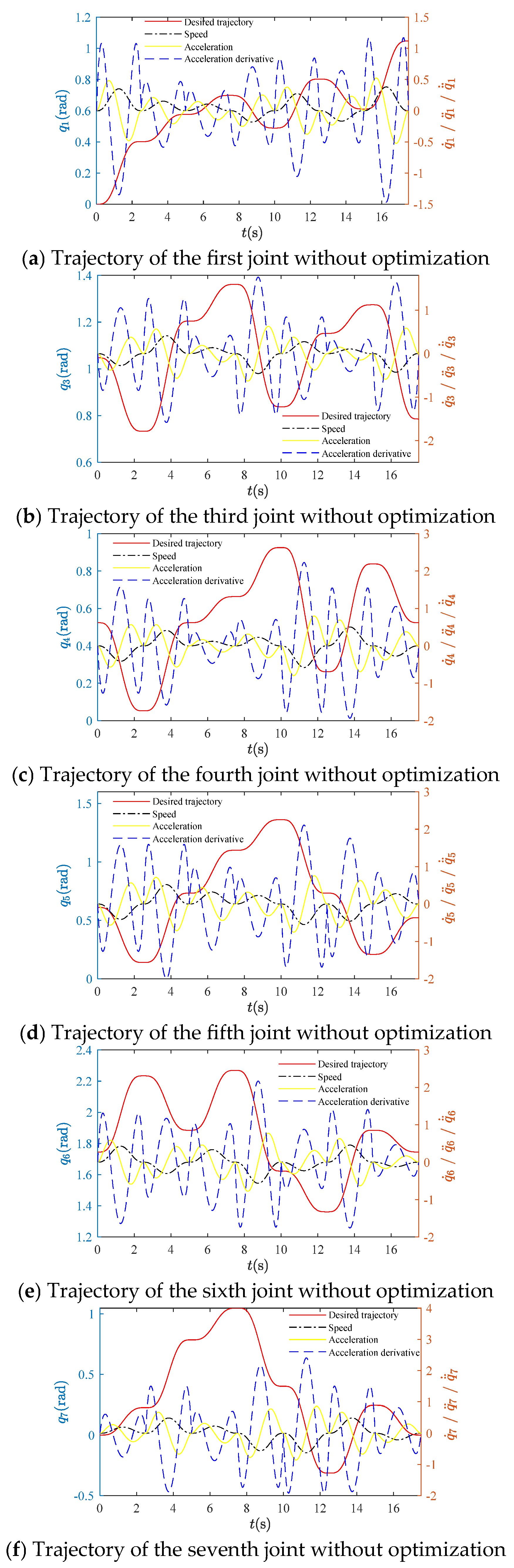
To demonstrate the superiority of the proposed trajectory planning method, a comparative analysis is conducted with the manipulator trajectory without optimization. In the manipulator trajectory without optimization, a fixed time interval of 2.5 s is used between each path segment. The trajectories for each joint are obtained by (20) and (25). The redundant joint angle q2 is set to −1.2217 rad. The constraint conditions are consistent with those in the optimized manipulator trajectory. For the seventh-order polynomial trajectories without optimization, the objective functions are S1 = 21, S2 = 6.6975, S3 = 23.2836, S4 = 9.3051. The trajectory of the seventh-order polynomial interpolation without optimization for each joint is shown in Figure 10.
The comparison using Figure 9 and Figure 10 shows that the 7th-order polynomial joint trajectory curves optimized by the genetic algorithm are smoother than the trajectory curves without optimization, and the impact (i.e., joint jerk) is also reduced to a certain extent. Compared with the objective functions of the trajectory without optimization, the total operation time S1, trajectory smoothness S2, energy consumption S3 and singularity avoidance S4 all decrease significantly through optimization. In summary, the optimized 7th-order polynomial interpolation trajectory enables the manipulator to achieve shorter operation time, smoother motion, lower energy consumption, and more reasonable joint postures, thus verifying the superiority of the proposed trajectory planning method.

5. Design of Manipulator Trajectory Tracking Controller

In this section, an adaptive fuzzy sliding mode control method is proposed for trajectory tracking control of the manipulator, which mainly includes the design of a sliding mode disturbance observer, a fuzzy logic system and a fast reaching law. The sliding mode disturbance observer is the main component to treat the system uncertainties, the adaptive fuzzy estimator serves as an enhancement to the sliding mode observer to realize trajectory tracking error reduction, and the sliding mode controller provides robustness and fast convergence for the control system.
For the 7-DOF hydraulic redundant manipulator described in (12), the trajectory tracking error of each joint is defined as
q ˜ i ( t ) = q i ( t ) q i d ( t )
where q i d t is the expected trajectory of each joint, i = 1,2, …, 7. In this paper, the expected trajectory of each joint is consistent with the optimized planned trajectory obtained in Section 6.
The trajectory tracking control objective is to rationally design the control inputs τ i i = 1 , 2 , , 7 in the presence of the system uncertainties such that the angles of each joint q i t converge to their desired trajectories q i d t , thereby minimizing the trajectory tracking error q ˜ i t of each joint to zero.
Define the sliding mode vector of the manipulator system as
s = q ˜ ˙ + C q ˜ = q ˙ q ˙ d + C q ˜
where C is a 7th-order positive definite diagonal matrix and
s = [ s 1 , s 2 , s 3 , s 4 , s 5 , s 6 , s 7 ] T   q ˙ = [ q ˙ 1 , q ˙ 2 , q ˙ 3 , q ˙ 4 , q ˙ 5 , q ˙ 6 , q ˙ 7 ] T q ˙ d = [ q ˙ 1 d , q ˙ 2 d , q ˙ 3 d , q ˙ 4 d , q ˙ 5 d , q ˙ 6 d , q ˙ 7 d ] T
Considering the system uncertainties, such as joint friction, existing in the actual manipulator system, to ensure that the proposed trajectory tracking controller has high control accuracy, a sliding mode disturbance observer is first designed to estimate the system uncertainties. Meanwhile, an adaptive fuzzy logic system, which works as an enhancement to the sliding mode observer, is used to design a compensation system for the estimation error of the disturbance observer.

5.1. Design of Sliding Mode Disturbance Observer and Adaptive Fuzzy System

The sliding function (31) is rewritten as s = q ˙ q ˙ r by defining q ˙ r = q ˙ d C q ˜ . Note that the inertia matrix D ( q ) is invertible. Taking the derivative of s and using (12) yields
s ˙ = q ¨ q ¨ r = D 1 H q ˙ + G q ¨ r + D 1 T D 1 F
(32) can be expressed as
s ˙ i = n i q ¨ i r + τ ˜ i + f i i = 1 , 2 , , 7
where n i , q ¨ i r and τ ˜ i represent the i-th element of vectors D 1 H q ˙ + G + F , q ¨ r and D 1 T respectively, and f i is the i-th element of the system uncertainties vector D 1 F . f i is assumed to be bounded by f i D i , where D i is a positive constant.
Define the auxiliary sliding variable σ i t as [19]
σ i t = s i t + z i t z ˙ i t = q ¨ i r n i τ ˜ i u i
where (i = 1,2, …, 7), zi is the internal variable of the i-th sliding mode disturbance observer, and u i is the injection term of the i-th sliding mode disturbance observer.
The injection term u i t for the i-th sliding mode disturbance observer is defined as u i t = ε i sign σ i , where ε i is a positive constant satisfying ε i > D i .
Using (33) and (34), one can obtain σ ˙ i t = s ˙ i + z ˙ i = f i u i . Then, one can further derive that σ i σ ˙ i σ i f i ε i < 0 . This means that the auxiliary sliding variable σ i t can converge to zero within a finite time.
According to the principle of equivalent control, the equivalent control of the sliding mode disturbance observer injection term can accurately estimate the unknown disturbance f i t . The equivalent control u e q , i t can be calculated as the first-order low-pass filtered average of the disturbance observer injection term u i t :
γ i u ˙ e q , i t + u e q , i t = u i t
where γ i is a small filter time constant.
Therefore, the sliding mode disturbance observer F ^ for the system uncertainties F ( q , q ˙ ) can be expressed as
F ^ = D U e q
where
F ^ = [ F ^ 1 , F ^ 2 , , F ^ 7 ] T , .   U e q = u e q , 1 , u e q , 2 , , u e q , 7 T
Due to observation errors of the dynamic system uncertainties F ¯ ( q , q ˙ ) = F ( q , q ˙ ) F ^ during the operation of the disturbance observer, an adaptive fuzzy logic system is employed to design an observation error estimator to realize tracking error reduction and suppress the adverse effect of observation error in the disturbance observer on the trajectory tracking control accuracy of the manipulator.
The fuzzy logic system F ¯ ^ i x i | η ^ i i = 1 , 2 , 3 , , 7 and adaptive law of parameter column vector η ^ i T are designed as
F ¯ ^ i x i | η ^ i = η ^ i T ξ i x i ,   η ^ ˙ i = 1 ρ i s i ξ i x i
where x i = [ q i , q ˙ i ] is the input of the fuzzy logic system, ξ i x i = ξ i 1 x i , ξ i 2 x i , , ξ i l x i T is the fuzzy basis vector, and ρ i is a positive constant.
The l-th element in the fuzzy basis vector ξ i x i is
ξ l x i = i = 1 n μ A i j i x i l j 1 = 1 N 1 j 2 = 1 N 2 j n = 1 N n i = 1 n μ A i j i x i l
where n represents the element number of the input x i , μ A i j i represents the membership function, A i j i j i = 1 , 2 , , N i represents the fuzzy set, N i is the number of fuzzy rules, and x i l denotes the l-th element of the input x i . The input x i l is fuzzyfied using Gaussian membership function
μ A l j l x i l = exp ( ( x i l c i j l / 2 σ i j l ) 2 )
where σ i j l is a positive constant, c i j l is used to determine the center of the Gaussian membership function, and j l = 1 , 2 , , N , where N denotes the number of fuzzy rules. At this time, the parameter vectors are σ i l = σ i 1 , σ i 2 , , σ i j l , , σ i N , c i l = c i 1 , c i 2 , , c i j l , , c i N .

5.2. Design of Sliding Mode Controller

Considering the advantages of the double power reaching law [20] in terms of fast sliding variable convergence and control input chattering elimination, a novel fast reaching law based on the double power reaching law is proposed to achieve globally faster convergence of the sliding variable while reducing the chattering of the controller
s ˙ i = k 1 i s i λ 1 i   s i g n ( s i ) k 2 i s i μ 1 i   s i g n ( s i ) k 3 i s i , s i 1 k 1 i s i λ 2 i s i g n ( s i ) k 2 i s i μ 2 i   s i g n ( s i ) k 3 i s i , s i < 1
where k 1 i , k 2 i and k 3 i are positive constants, and k 1 i > k 2 i , λ 1 i > μ 1 i > 1 , and 0 < λ 2 i < μ 2 i < 1 .
The proposed fast reaching law consists of the reaching term k 1 i s i λ 1 i   s i g n ( s i ) or k 1 i s i λ 2 i   s i g n ( s i ) and the reaching term k 2 i s i μ 1 i   s i g n ( s i ) or k 2 i s i μ 2 i   s i g n ( s i ) . When the sliding variable s i is far away from the sliding surface (i.e., s i 1 ), the reaching speed of the sliding variable is primarily determined by the reaching term k 1 i s i λ 1 i s i g n ( s i ) . Since λ 1 i > μ 1 i > 1 , the sliding variable can achieve greater convergence effects when it is far away from the sliding surface. As the sliding variable is near the sliding surface (i.e., s i < 1 ), its reaching speed is primarily determined by the reaching term k 1 i s i λ 2 i s i g n ( s i ) . Since 0 < λ 2 i < μ 2 i < 1 , the sliding function can also achieve significant reaching effects when it is near the sliding surface. Moreover, the reaching term k 3 i s i plays a role in accelerating the reaching phase.
It can be easily seen from (40) that, compared with the double power reaching law, the proposed fast reaching law can provide faster reaching speed whether the system state is near the sliding surface or the system state is far away from the sliding surface. From (40), one can see that the sliding mode controller is free from chattering in the sliding mode state s i = 0 . Based on the reaching law (40), the sliding mode disturbance observer (36) and the adaptive fuzzy system (37) that function together to estimate the uncertainty, the sliding mode controller can be obtained as
T = D q ¨ r + H q ˙ r + G + F ^ + F ¯ ^ ( q , q ˙ | η ^ ) + F R L
where
F ^ = [ F ^ 1 , F ^ 2 , , F ^ 7 ] T ,   F R L = [ r l 1 , r l 2 , r l 3 , , r l 7 ] T
F ¯ ^ ( q , q ˙ | η ^ ) = [ F ¯ ^ 1 , F ¯ ^ 2 , , F ¯ ^ 7 ] T = [ η ^ 1 T ξ 1 ( q 1 , q ˙ 1 ) , η ^ 2 T ξ 2 ( q 2 , q ˙ 2 ) , , η ^ 7 T ξ 7 ( q 7 , q ˙ 7 ) ] r l i = k 1 i s i λ 1 i   s i g n ( s i ) k 2 i s i μ 1 i   s i g n ( s i ) k 3 i s i , s i 1 k 1 i s i λ 2 i   s i g n ( s i ) k 2 i s i μ 2 i   s i g n ( s i ) k 3 i s i , s i < 1
Theorem 1.
For the manipulator system (12), if the sliding mode controller (41) is adopted, with the sliding function designed in (31), the sliding mode disturbance observer designed in (36), and the adaptive fuzzy system designed in (37), then the sliding function can converge to zero in finite time.
Proof. 
The Lyapunov function is defined as
V = 1 2 s T D s + 1 2 i = 1 7 η ˜ i T ρ i η ˜ i
where η ˜ i = η i η ^ i , η i is the ideal parameter vector.
When s i 1 ( i = 1 , 2 , , 7 ) , the derivative of the Lyapunov function V can be obtained by using (32):
V ˙ = s T D s ˙ + 1 2 s T D ˙ s + i = 2 7 η ˜ i T ρ i η ˜ ˙ i = s T ( T H q ˙ r G F D q ¨ r ) s T H s + 1 2 s T D ˙ s + i = 1 7 η ˜ i T ρ i η ˜ ˙ i
Substituting the control law (41) into (43), and using the fact s T ( D ˙ 2 H ) s = 0 , one can obtain
V ˙ = s T ( F ¯ ^ ( q , q ˙ | η ^ ) F ¯ K 1 Λ λ 1 sign ( s ) K 2 Λ μ 1 sign ( s ) K 3 s ) + i = 1 7 η ˜ i T ρ i η ˜ ˙ i
where
Λ λ 1 = diag ( s 1 λ 11 , s 2 λ 12 , , s 7 λ 17 ) ,   Λ μ 1 = diag ( s 1 μ 11 , s 2 μ 12 , , s 7 μ 17 )
K 1 = diag ( k 11 , k 12 , , k 17 ) ,   K 2 = diag ( k 21 , k 22 , , k 27 )
K 3 = diag ( k 31 , k 32 , , k 37 )
The fuzzy approximation error is defined as ς = F ¯ ( q , q ˙ | η ) F ¯ ( q , q ˙ ) . Substituting the adaptive law (37) into (44), one can obtain
V ˙ = s T ( F ( q , q ˙ ) F ^ ( q , q ˙ | η ^ ) + F ( q , q ˙ | η ) F ( q , q ˙ | η ) + K 1 Λ λ 1 sign ( s ) + K 2 Λ μ 1 sign ( s ) K 3 s ) + i = 2 7 η ˜ i T ρ i η ˜ ˙ i = s T K 1 s λ 1 s T K 2 s μ 1 s T K 3 s + s T ς s T K 2 s μ 1 s T ( K 1 s λ 1 ς )
where
s λ 1 = [ s 1 λ 11 , s 2 λ 12 , , s 7 λ 17 ] T   s μ 1 = [ s 1 μ 11 , s 2 μ 12 , , s 7 μ 17 ] T
s = [ s 1 , s 2 , , s 7 ] T ,   ς = [ ς 1 , ς 2 , , ς 7 ] T
Here, ς i is the i-th element of ς .
One can see from (46) that if K 1 s λ 1 ς , then V ˙ s T K 2 s μ 1 s T ( K 1 s λ 1 ς ) < 0 . By selecting k 1 i to satisfy k 1 i ς i , K 1 s λ 1 ς is satisfied. This indicates that by appropriately selecting k 1 i the sliding function can be reduced to s i 1 within a finite time.
When s i < 1 , the derivative of the Lyapunov function V can be similarly obtained:
L ˙ = s T K 1 Λ λ 2 sign ( s ) s T K 2 Λ μ 2 sign ( s ) s T K 3 s + s T ς = s T K 1 s λ 2 s T K 2 s μ 2 s T K 3 s + s T ς s T K 2 s μ 2 s T ( K 1 s λ 2 ς )
where
Λ λ 2 = diag ( s 1 λ 21 , s 2 λ 22 , , s 7 λ 27 )
Λ μ 2 = diag ( s 1 μ 21 , s 2 μ 22 , , s 7 μ 27 )
s λ 2 = [ s 1 λ 22 , s 2 λ 23 , , s 7 λ 27 ] T
s μ 2 = [ s 1 μ 21 , s 2 μ 22 , , s 7 μ 27 ] T
One can infer from (46) that if K 1 s λ 2 ς , then V ˙ s T K 2 s μ 2 s T ( K 1 s λ 2 ς ) < 0 . This indicates that the sliding function s i can converge to the zero neighborhood s i ς i / k 1 i 1 / λ 2 i within a finite time. It should be noted that since 0 < λ 2 i < 1 , when the estimation error ς i of the fuzzy logic system is sufficiently small, ς i / k 1 i 1 / λ 2 i can be approximated to be zero. In summary, L ˙ < 0 can be ensured by selecting sufficiently large values of K 1 . According to Lyapunov stability theorem, the sliding function s i can converge to zero within finite time. □
It can be seen from the above derivation that the smaller the estimation error ς i , the higher the tracking control accuracy one can obtain. To achieve favorable trajectory tracking control accuracy for the manipulator, it is necessary to fully tune and adjust the parameters of the fuzzy logic system to effectively compensate for the observation errors of the sliding mode observer.

5.3. Analysis of Simulation Experiments

To verify the effectiveness of the proposed trajectory tracking control algorithm, a trajectory tracking control simulation for the manipulator was conducted in the MATLAB R2024b simulation environment. The physical parameters of the manipulator have been presented in Section 2, Section 3 and Section 4. In addition, the gravitational acceleration is taken as g = 9.8   m / s 2 . It is assumed that the manipulator is initially located at the first path point of the planned trajectory, and the initial joint angles of the manipulator are listed in the second column of Table 5, while the initial angular velocity of each joint is zero.
To verify that the proposed method possesses good robustness, friction torque is applied to each joint of the manipulator. Ref. [21] proposed a nonlinear friction model that combines Coulomb, viscous, and Stribeck friction characteristics, which can eliminate the adverse effects caused by the discontinuity of the traditional friction model. This joint friction model is expressed as
F f ( q ˙ i ) = α ˜ 1 [ tanh ( β ˜ 1 q ˙ i ) tanh ( β ˜ 2 q ˙ i ) ] + α ˜ 2 tanh ( β ˜ 3 q ˙ i ) + α ˜ 3 q ˙ i
where q ˙ i is the velocity of the i-th joint. α ˜ 1 , α ˜ 2 , and α ˜ 3 represent different degrees of friction, which are positive constants. β ˜ 1 , β ˜ 2 , and β ˜ 3 denote various shape coefficients used to approximate different friction effects, and are also positive constants.
The values of the parameters in the friction model for each joint of the manipulator are shown in Table 7 and Table 8.
For the friction model shown in (47), the friction torque of each joint is a function of the angular velocity of each joint. Therefore, the input to the adaptive fuzzy logic system should be determined by the joint angular velocities. Given that the joint friction (47) is only related to the joint angular velocity q ˙ i , the input to the fuzzy logic system can be simplified to x i = [ q ˙ i ] , and six fuzzy sets are designed for each input of the fuzzy logic system. To effectively compensate for the influence of observation errors of the sliding mode observer, it is necessary to fully tune the parameters c i j l and σ i j l of the fuzzy logic system. The parameters c i j l is reasonably chosen and uniformly set according to the variation of the input to the fuzzy logic system x i , and all elements of the vector η ^ i are initialized to zero.
Furthermore, to demonstrate the superiority of the control method proposed in this paper, a comparative simulation with a traditional control method and an existing method is conducted in the aforementioned simulation environment. In the traditional control method, the sliding mode disturbance observer designed in the proposed method is still used. However, the traditional method does not employ the adaptive fuzzy logic system to compensate for the approximation error of the disturbance observer. In addition, the controller of the traditional control method is derived using the exponential reaching law [22]. Meanwhile, to avoid chattering in the traditional controller, the saturation function is used to replace the sign function in the control law to process the continuity of the control input [22]. For the existing control method, the control method proposed in [9] is used for comparison.
The output torque of the manipulator’s first joint is limited by τ 1 9000   N m , the output torque of the second joint is limited by τ 2 8000   N m , the output torque of the third joint is limited by τ 3 7000   N m , the output torque of the fourth joint is limited by τ 4 3000   N m , the output torque of the fifth joint is limited by τ 5 800   N m , the output torque of the sixth joint is limited by τ 6 100   N m , and the output torque of the seventh joint is limited by τ 7 50   N m .
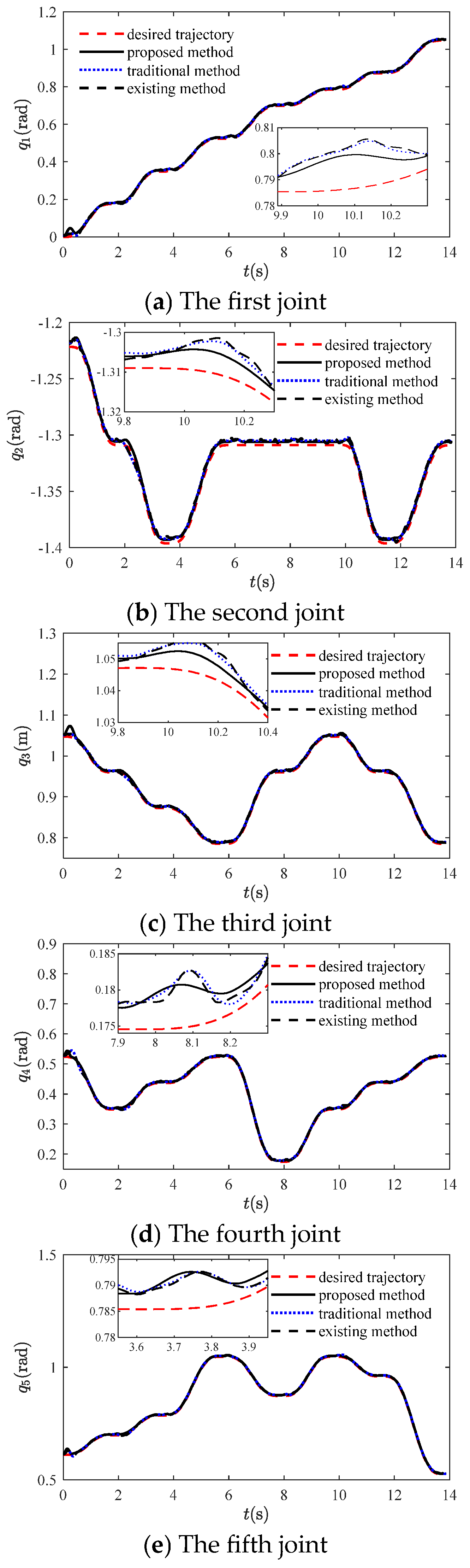
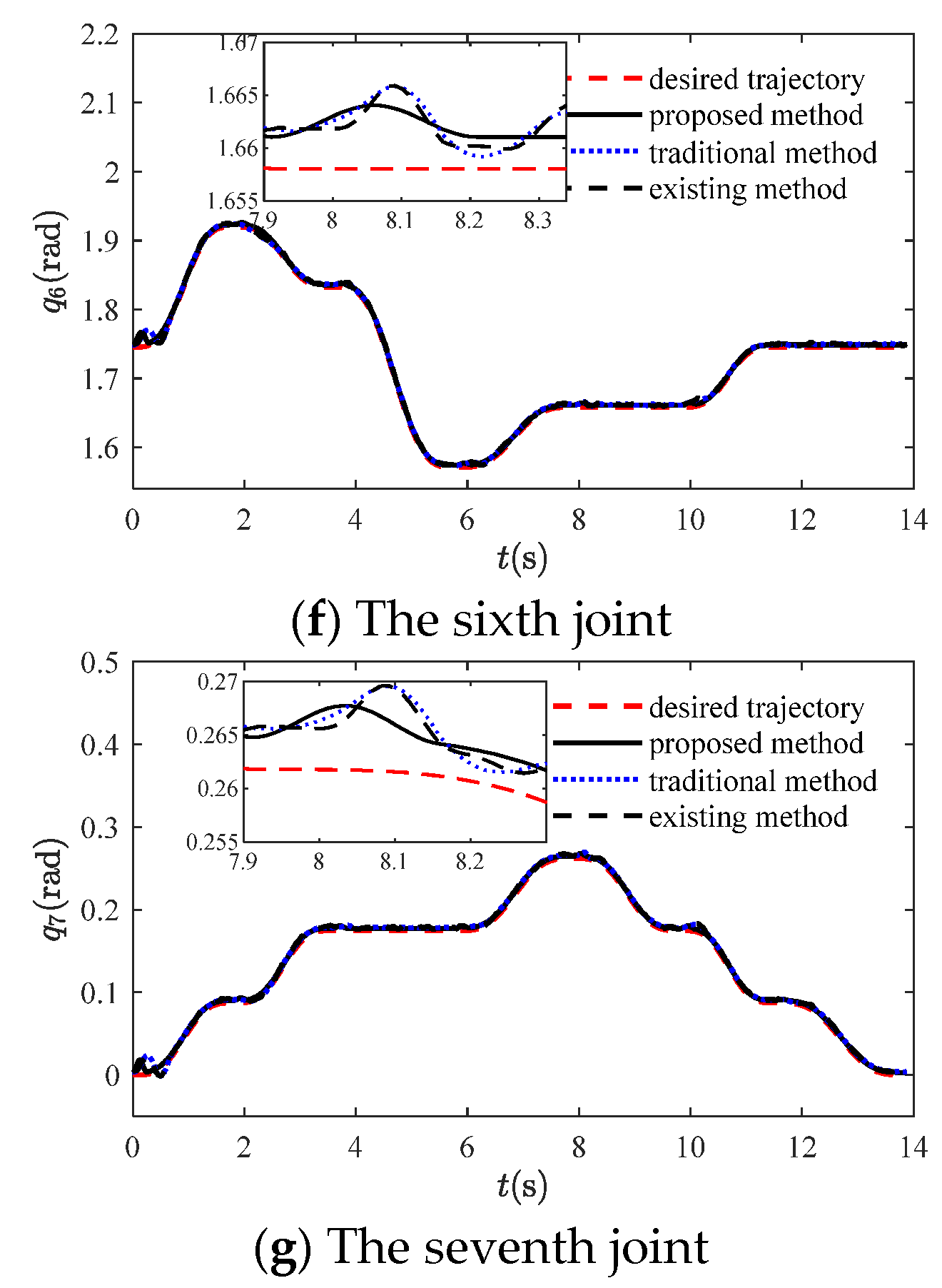
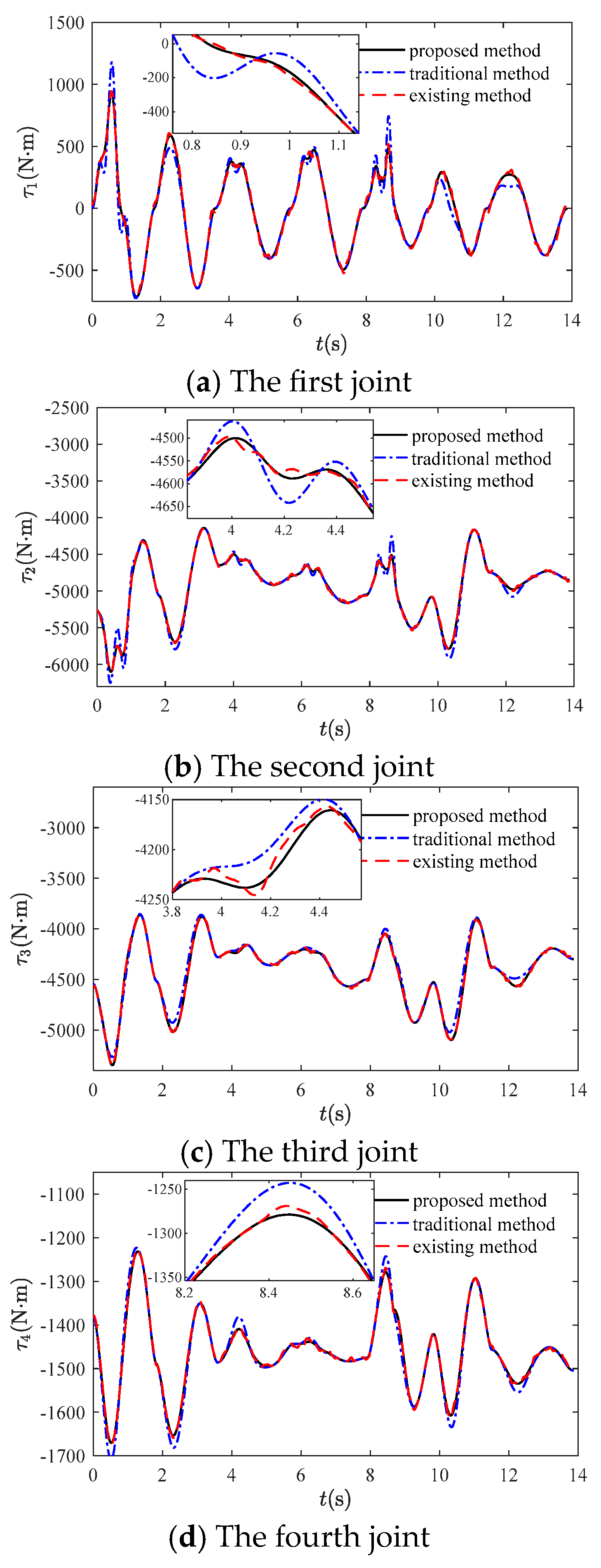
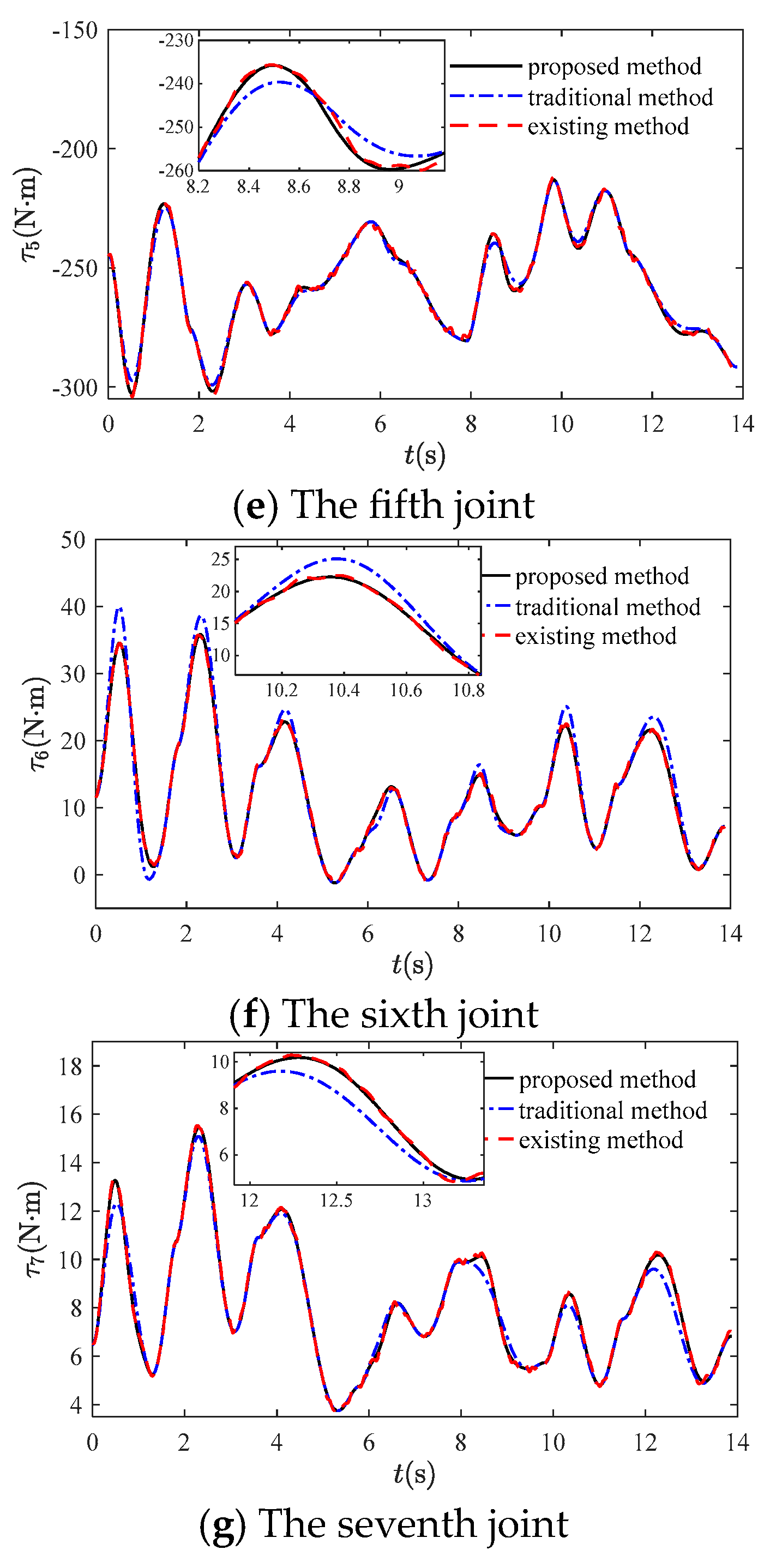
Figure 11 and Figure 12 respectively present the curves of the joint angles and joint torques variations of the manipulator under the effect of the two control methods. It can be seen from Figure 10 that under the action of the controller proposed in this paper, even in the presence of unmodeled friction torques in the manipulator joints, the manipulator can still accurately and quickly track the desired trajectory after starting from the initial position of each joint, and maintain stable and accurate tracking throughout the subsequent simulation period. Between two adjacent path segments, due to changes in the planned trajectory, there is a short transition process near the starting position of the subsequent path segment. The simulation results indicate that the control method proposed in this paper possesses strong robustness with respect to system uncertainties. From Figure 11, it can be seen that due to the adoption of the chattering-free fast reaching law, the output of the controller designed in this paper is relatively smooth, with no obvious chattering in the control input.
To better compare the dynamic control performance of the three control algorithms, two performance metrics, E and U , are used to quantitatively evaluate the dynamic control performance of the algorithms in the engineering sense of providing control accuracy and saving control energy. The definitions of the comprehensive error E and the energy consumption U are as follows:
C E = j = 1 n i = 1 7 w ˜ i q ˜ i t ˜ j E C = j = 1 n k = 1 7 ϖ k τ k t ˜ j
where n is the number of sampling points, t ˜ j is the j-th sampling instant, and the weights are w ˜ i = 1 / 7 and ϖ k = 1 / 7 .
It can be computed from the simulation data in Figure 10 that the comprehensive error of the control method proposed in this paper is C E 1 = 5.3573 rad, the comprehensive error of the traditional control method is C E 2 = 6.2037 rad, and the comprehensive error of the existing control method is C E 3 = 5.6341 rad. From the simulation data in Figure 11, it can be observed that the energy consumption of the control method in this paper is E C 1 = 2.2522 × 10 6 N·m, while the energy consumption of the traditional control algorithm is E C 2 = 2.2497 × 10 6 N·m, and the energy consumption of the existing control algorithm is E C 3 = 2.2342 × 10 6 N·m. Thus, it is evident that the performance metrics of the control method proposed in this paper are superior to those of the traditional control method and the existing control method. The comparison results indicate that the control algorithm proposed in this paper can provide better control performance compared to the traditional control algorithm and the existing control method.
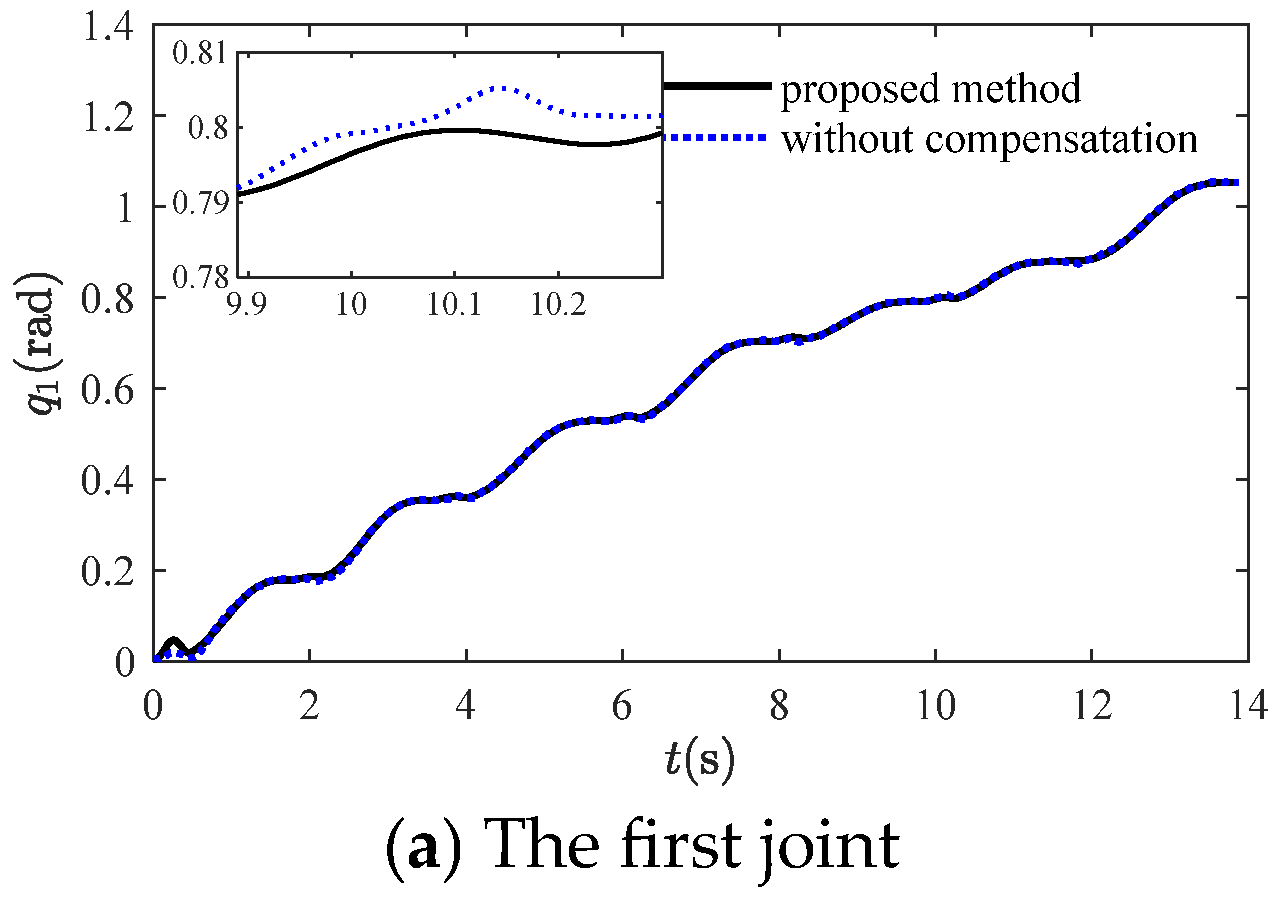
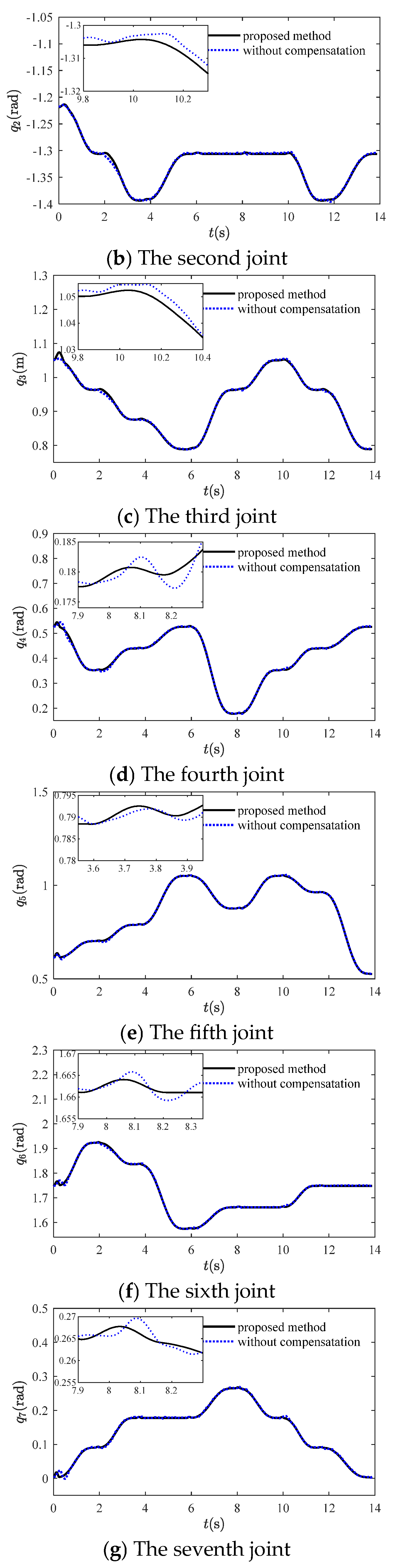
To fully illustrate the function of the fuzzy logic system in the proposed method, this method is compared and analyzed with the control scheme without fuzzy logic-based compensation for observer errors. The comparison results of the proposed method and the control scheme without fuzzy logic-based compensation are shown in Figure 13. It can be computed from the simulation data in Figure 13 that the comprehensive error of the control method proposed in this paper is C E 1 = 5.3573 rad, and the comprehensive error of the control method without fuzzy compensation is C E 4 = 6.0872 rad. By comparing the performance indices, it can be seen that the proposed method with fuzzy compensation significantly improves the trajectory tracking control accuracy of the manipulator control system.

6. Conclusions

For the trajectory tracking control problem of a 7-DOF redundant hydraulic manipulator, an adaptive fuzzy sliding mode control method based on a novel fast reaching law is proposed in this paper. The forward kinematics equation of the manipulator is established using the improved D-H method, and the inverse kinematic solution is obtained via the explicit equation method. Based on the forward kinematics analysis of the manipulator, the velocity Jacobian matrix is derived using the vector product method, and the dynamics model of the manipulator is established via the Lagrange method. Based on the inverse kinematics of the manipulator, a trajectory planning method is proposed that integrates 7th-order polynomial interpolation with genetic algorithm optimization. On this basis, a trajectory tracking controller is designed based on a sliding mode disturbance observer and an adaptive fuzzy estimator. A first-order sliding mode disturbance observer is employed to observe the system uncertainties in the manipulator system, while an adaptive fuzzy logic system is designed to estimate the observation error. A fast reaching law that dynamically adapts to the changes of the sliding variable is proposed, and the sliding mode control law for the manipulator trajectory tracking is designed based on this fast reaching law. The stability of the closed-loop control system is analyzed using the Lyapunov function method, and comparison results demonstrate that the proposed control method exhibits better control performance both in tracking accuracy and energy saving property.
The main contribution of the control method proposed in this paper is to provide high manipulator trajectory tracking accuracy and good dynamic performance with fast convergence in sliding mode control. The fuzzy logic system works as an enhancement to the sliding mode disturbance observer to realize exact system uncertainties estimation, and to this end the proposed method requires sufficient parameter tuning of the fuzzy logic system to treat the manipulator system uncertainties under different working conditions, which is the drawback of the method presented in this paper. Compared with traditional sliding mode control, fractional-order sliding mode control exhibits superior robustness and control accuracy. Adopting fractional-order sliding mode control to replace the traditional sliding mode control in the method proposed in this paper for achieving higher trajectory tracking control accuracy is the future research direction.

Author Contributions

Conceptualization, Z.W. and D.S.; methodology, Z.W. and Z.L.; software, Z.W.; validation, Z.W. and Z.L.; formal analysis, Z.W.; investigation, Z.L.; resources, D.S.; data curation, Z.W.; writing—original draft preparation, Z.W.; writing—review and editing, D.S.; visualization, Z.W. and Z.L.; supervision, D.S.; project administration, D.S.; funding acquisition, D.S. All authors have read and agreed to the published version of the manuscript.

Funding

This work was supported by the Science and Technology Plan Joint Program of Liaoning Province (Natural Science Foundation-Surface Project) (Grant No. 2024-MSLH-179) and the Basic Scientific Research Program of Liaoning Provincial Department of Education for Universities (Grant No. LJ212511779001).

Data Availability Statement

The original contributions presented in this study are included in the article. Further inquiries can be directed to the corresponding author.

Conflicts of Interest

The authors declare no competing interests.

Appendix A

Table A1. Center of mass and inertia parameters of each link.
LinkMassCentroid CoordinatesInertia Tensor
Shoulder Rotation Armm1 = 158.026 x c 1 1 = 0.037
y c 1 1 = 0.000
z c 1 1 = 0.070
I 1 x x = 10.000 I 1 x y = 0.001 I 1 x z = 0.788 I 1 y x = 0.001 I 1 y y = 12.755 I 1 y z = 0.010 I 1 z x = 0.788 I 1 z y = 0.010 I 1 z z = 7.157
Upper Armm2 = 60.595 x 2 c 2 = 0.132
y 2 c 2 = 0.542
z 2 c 2 = 0.001
I 2 x x = 4.984 I 2 x y = 1.266 I 2 x z = 0.003 I 2 y x = 1.266 I 2 y y = 2.182 I 2 y z = 0.007 I 2 z x = 0.003 I 2 z y = 0.007 I 2 z z = 6.940
Elbow Armm3 = 84.995 x c 3 3 = 0.884
y c 3 3 = 0.114
z c 3 3 = 0.000
I 3 x x = 1.679 I 3 x y = 0.804 I 3 x z = 0.011 I 3 y x = 0.804 I 3 y y = 17.312 I 3 y z = 0.004 I 3 z x = 0.011 I 3 z y = 0.004 I 3 z z = 18.492
Lower Armm4 = 68.303 x c 4 4 = 0.332
y c 4 4 = 0.017
z c 4 4 = 0.002
I 4 x x = 2.076 I 4 x y = 0.050 I 4 x z = 0.009 I 4 y x = 0.050 I 4 y y = 8.495 I 4 y z = 0.001 I 4 z x = 0.009 I 4 z y = 0.001 I 4 z z = 10.322
Wrist Pitch Armm5 = 44.202 x c 5 5 = 0.062
y c 5 5 = 0.187
z c 5 5 = 0.061
I 5 x x = 1.690 I 5 x y = 0.961 I 5 x z = 0.048 I 5 y x = 0.961 I 5 y y = 2.428 I 5 y z = 0.209 I 5 z x = 0.048 I 5 z y = 0.209 I 5 z z = 3.138
Wrist Yaw Armm6 = 14.487 x c 6 6 = 0.058
y c 6 6 = 0.063
z c 6 6 = 0.028
I 6 x x = 0.271 I 6 x y = 0.125 I 6 x z = 0.042 I 6 y x = 0.125 I 6 y y = 0.355 I 6 y z = 0.025 I 6 z x = 0.042 I 6 z y = 0.025 I 6 z z = 0.426
Wrist Rotation Armm7 = 28.147 x c 7 7 = 0.000
y c 7 7 = 0.000
z c 7 7 = 0.175
I 7 x x = 0.645 I 7 x y = 0.001 I 7 x z = 0.002 I 7 y x = 0.001 I 7 y y = 0.913 I 7 y z = 0.001 I 7 z x = 0.002 I 7 z y = 0.001 I 7 z z = 0.783
In Table A1 the unit of mass is kg, the unit of center of mass is m, and the unit of moment of inertia is kg·m2.

References

  1. Hasan, M.W.; Abbas, N.H. Disturbance rejection for underwater robotic vehicle based on adaptive fuzzy with nonlinear PID controller. ISA Trans. 2022, 130, 360–376. [Google Scholar] [CrossRef]
  2. Lin, L.; Wang, H.R.; Ren, H.B. Fuzzy-based variable structure control for robotic manipulators. Control Theory Appl. 2007, 24, 643–645. [Google Scholar]
  3. Zhai, J.; Xu, G. A novel non-singular terminal sliding mode trajectory tracking control for robotic manipulators. IEEE Trans. Circuits Syst. II Express Briefs 2020, 68, 391–395. [Google Scholar] [CrossRef]
  4. He, Y.Y.; Tang, D.L.; Ding, C. Research on wall turning motion slip of wall-climbing robot. China Meas. Test 2023, 49, 140–147. [Google Scholar]
  5. De Luca, A.; Siciliano, B.; Zollo, L. PD control with online gravity compensation for elastic-joint robots: Theory and experiments. Automatica 2005, 41, 1809–1819. [Google Scholar]
  6. Song, Z.; Yi, J.; Zhao, D.; Li, X. Computed torque controller for uncertain robot manipulator systems based on fuzzy method. Fuzzy Sets Syst. 2005, 154, 208–226. [Google Scholar]
  7. Zhihong, M.; Paplinski, A.P.; Wu, H.R. A robust MIMO terminal sliding mode control scheme for rigid robotic manipulators. IEEE Trans. Autom. Control 1994, 39, 2464–2469. [Google Scholar] [CrossRef]
  8. Azeez, M.I.; Atia, K.R. Modeling of PID controlled 3DOF robotic manipulator using Lyapunov function for enhancing trajectory tracking and robustness exploiting Golden Jackal algorithm. ISA Trans. 2024, 145, 190–204. [Google Scholar] [PubMed]
  9. Tran, D.T.; Tong, H.N.; Ahn, K.K. An extended state observer-based terminal sliding mode control for 6-DOF manipulator against lumped uncertainties. Int. J. Control Autom. Syst. 2025, 23, 810–823. [Google Scholar]
  10. Yang, L.; Yang, J. Nonsingular fast terminal sliding mode control for nonlinear dynamical systems. Int. J. Robust Nonlinear Control 2011, 21, 1865–1879. [Google Scholar]
  11. Guo, K.; Zhang, H.; Wei, C.; Chen, L.; Jiang, W. Novel sliding mode control of the manipulator based on a nonlinear disturbance observer. Sci. Rep. 2024, 14, 690. [Google Scholar] [CrossRef]
  12. Sun, L.X.; Gao, J.M.; Gao, C.Y.; Wei, Y.X.; Sun, J. Obstacle avoidance path planning for 7-DOF manipulators based on improved RRT* algorithm. Control Eng. China 2023, 30, 1592–1597. [Google Scholar]
  13. Peiper, D.L. The kinematics of Manipulators Under Computer Control. Ph.D. Thesis, Stanford University, Stanford, CA, USA, 1968. [Google Scholar]
  14. He, X.Y.; Gao, X.Y.; Wang, H.J.; Fu, Y.Z.; Sun, G.L. Operational stability analysis of 7-DOF dual-arm collaborative robot. J. Eng. Des. 2019, 26, 706–713. [Google Scholar]
  15. Zhang, P.C.; Zhang, T. Analysis on solution of 6D of robot jacobian matrix and singularity configuration based on vector product method. Mach. Des. Manuf. 2011, 8, 152–154. [Google Scholar]
  16. Siciliano, B.; Khatib, O.; Kröger, T. (Eds.) Springer Handbook of Robotics; Springer: Berlin, Germany, 2008; p. 200. [Google Scholar]
  17. Wang, S.L.; Zhang, B.K.; Zhou, J.; Tao, L.; Yang, J. Time-jerk optimal trajectory planning for industrial robots with coupled interpolation function selection. J. Field Robot. 2024, 41, 917–941. [Google Scholar]
  18. Holland, J.H. Adaptation in Natural and Artificial Systems; University of Michigan Press: Ann Arbor, MI, USA, 1975. [Google Scholar]
  19. Besnard, L.; Shtessel, Y.B.; Landrum, B. Quadrotor vehicle control via sliding mode controller driven by sliding mode disturbance observer. J. Frankl. Inst. 2012, 349, 658–684. [Google Scholar] [CrossRef]
  20. Zhang, P.; Wu, Q. Double power reaching law for sliding mode control with unidirectional auxiliary surfaces. In Proceedings of the 2017 Chinese Control Conference, Dalian, China, 26–28 July 2017; pp. 3798–3803. [Google Scholar]
  21. Makkar, C.; Dixon, W.E.; Sawyer, W.G.; Hu, G. A new continuously differentiable friction model for control systems design. In Proceedings of the 2005 IEEE/ASME International Conference on Advanced Intelligent Mechatronics, Monterey, CA, USA, 24–28 July 2005; pp. 600–605. [Google Scholar]
  22. Utkin, V.; Guldner, J.; Shi, J.M. Sliding Mode Control in Electro-Mechanical Systems, 2nd ed.; CRC Press: Boca Raton, FL, USA, 2009. [Google Scholar]
Figure 1. Structure diagram of the 7-DOF manipulator.
Applsci 16 06373 g001
Figure 2. Link coordinate systems of the manipulator.
Applsci 16 06373 g002
Figure 3. Structural schematic of the second joint.
Applsci 16 06373 g003
Figure 4. Structural schematic of the third joint.
Applsci 16 06373 g004
Figure 5. Structural schematic of the fourth joint.
Applsci 16 06373 g005
Figure 6. Structural schematic of the fifth joint.
Applsci 16 06373 g006
Figure 7. Structural schematic of the sixth joint.
Applsci 16 06373 g007
Figure 8. The flow steps of the genetic algorithm.
Applsci 16 06373 g008
Figure 9. Optimized 7th-order polynomial interpolation trajectories of each joint.
Applsci 16 06373 g009aApplsci 16 06373 g009b
Figure 10. The 7th-order polynomial interpolation trajectories of each manipulator joint without optimization.
Applsci 16 06373 g010
Figure 11. Trajectory tracking performance for each joint of the manipulator.
Applsci 16 06373 g011aApplsci 16 06373 g011b
Figure 12. Torque variation for each joint of the manipulator.
Applsci 16 06373 g012aApplsci 16 06373 g012b
Figure 13. Manipulator trajectory tracking performance comparison of the proposed method and the control method without fuzzy compensation.
Applsci 16 06373 g013aApplsci 16 06373 g013b
Table 1. D-H parameters of the manipulator.
iαi−1ai−1/mmqidi/mm
100q1143
2−90270q20
30870q30
401787q40
501020q50
690210q6130
7900q7760
Table 2. Joint constraints of the manipulator.
Joint IndexAngle RangeMaximum
Velocity
Maximum
Acceleration
Maximum
Jerk
1(−3.14, 3.14)2.613.523.32
2(−1.55, −0.87)2.613.523.32
3(0.69, 1.39)3.143.523.32
4(−0.08, 1.13)3.143.523.32
5(−0.24, 1.46)3.353.523.32
6(1.02, 2.41)3.353.523.32
7(−3.14, 3.14)3.353.523.32
Table 3. Manipulator end pose of each waypoint.
Waypoint
End-Effector Pose
j = 1j = 2j = 3j = 4
Xj3942.133948.443662.693231.14
Yj131.973960.1631542.431865.5
Zj211.427772.583843.161802.674
α j −96.933−114.95−114.06−112.49
β j −145.6−143.48−150.33−158.53
δ j −167.85−145.76−148.38−166.87
Table 4. Manipulator end pose of each waypoint.
Waypoint
End-Effector Pose
j = 5j = 6j = 7j = 8
Xj3087.142629.452355.021917.17
Yj2676.882723.123011.923584.58
Zj920.016229.399432.2071183.59
α j −126.76−127.51−138.99−162.75
β j −151.08−169.67−172.27−165.34
δ j −143.58−162.08−154.25−125.72
Table 5. Manipulator joint angle at each waypoint.
Waypoint
Joint
j = 1j = 2j = 3j = 4
100.17450.34910.5236
2−1.2217−1.3089−1.3963−1.3089
31.04720.95990.87270.7854
40.52360.34910.43630.5236
50.61090.69810.78541.0472
61.74531.91991.83261.5708
700.08730.17450.1745
Table 6. Manipulator joint angle at each waypoint.
Waypoint
Joint
j = 5j = 6j = 7j = 8
10.69810.78540.87271.0472
2−1.3089−1.3089−1.3963−1.3089
30.95991.04720.95990.7854
40.17450.34910.43630.5236
50.87271.04720.95990.5236
61.65811.65811.74531.7453
70.26180.17450.08730
Table 7. Parameter values α ˜ i in joint friction models.
Joint α ˜ 1 α ˜ 2 α ˜ 3
10.40.20.02
20.40.20.02
30.40.20.02
40.40.20.02
50.40.20.02
60.40.20.02
70.40.20.02
Table 8. Parameter values β ˜ i in joint friction models.
Joint β ˜ 1 β ˜ 2 β ˜ 3
120.41
2511
330.61
440.51
510.651
630.551
740.451
Disclaimer/Publisher’s Note: The statements, opinions and data contained in all publications are solely those of the individual author(s) and contributor(s) and not of MDPI and/or the editor(s). MDPI and/or the editor(s) disclaim responsibility for any injury to people or property resulting from any ideas, methods, instructions or products referred to in the content.