Mechanical Behaviour and Parametric Analysis of the Hybrid Girder Bridges Joint Between Steel-Concrete Composite Girder and Prestressed Concrete Girder


Abstract
1. Introduction
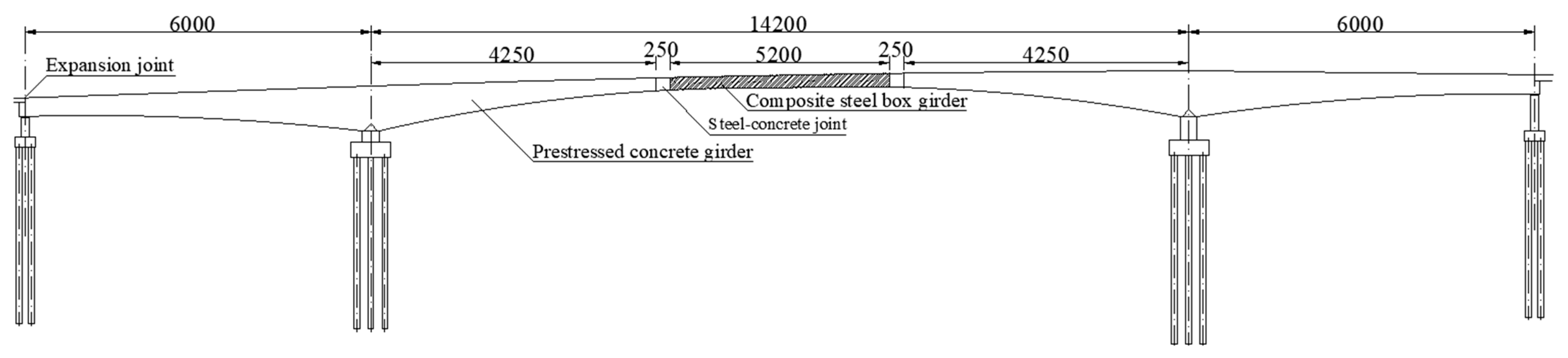
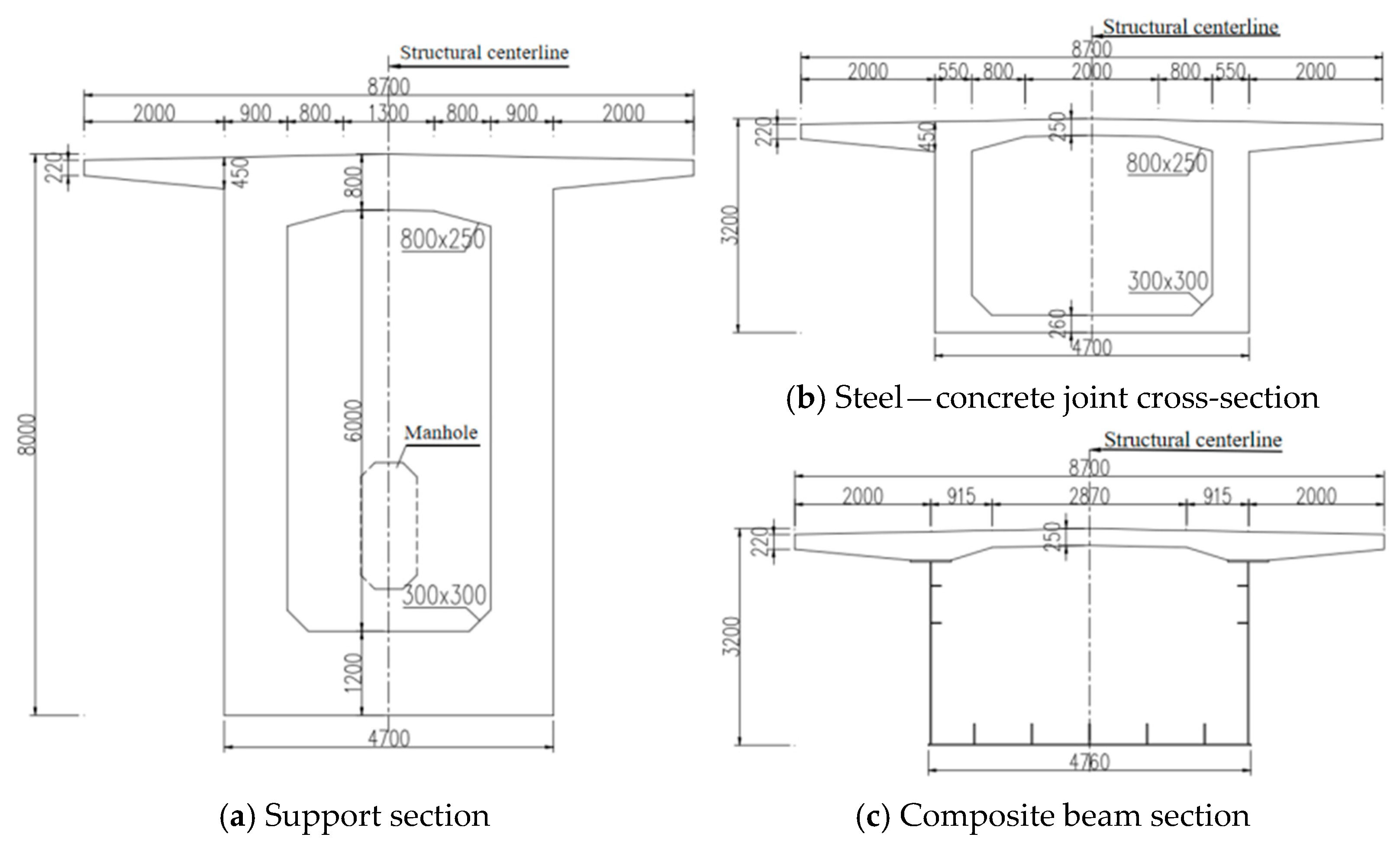
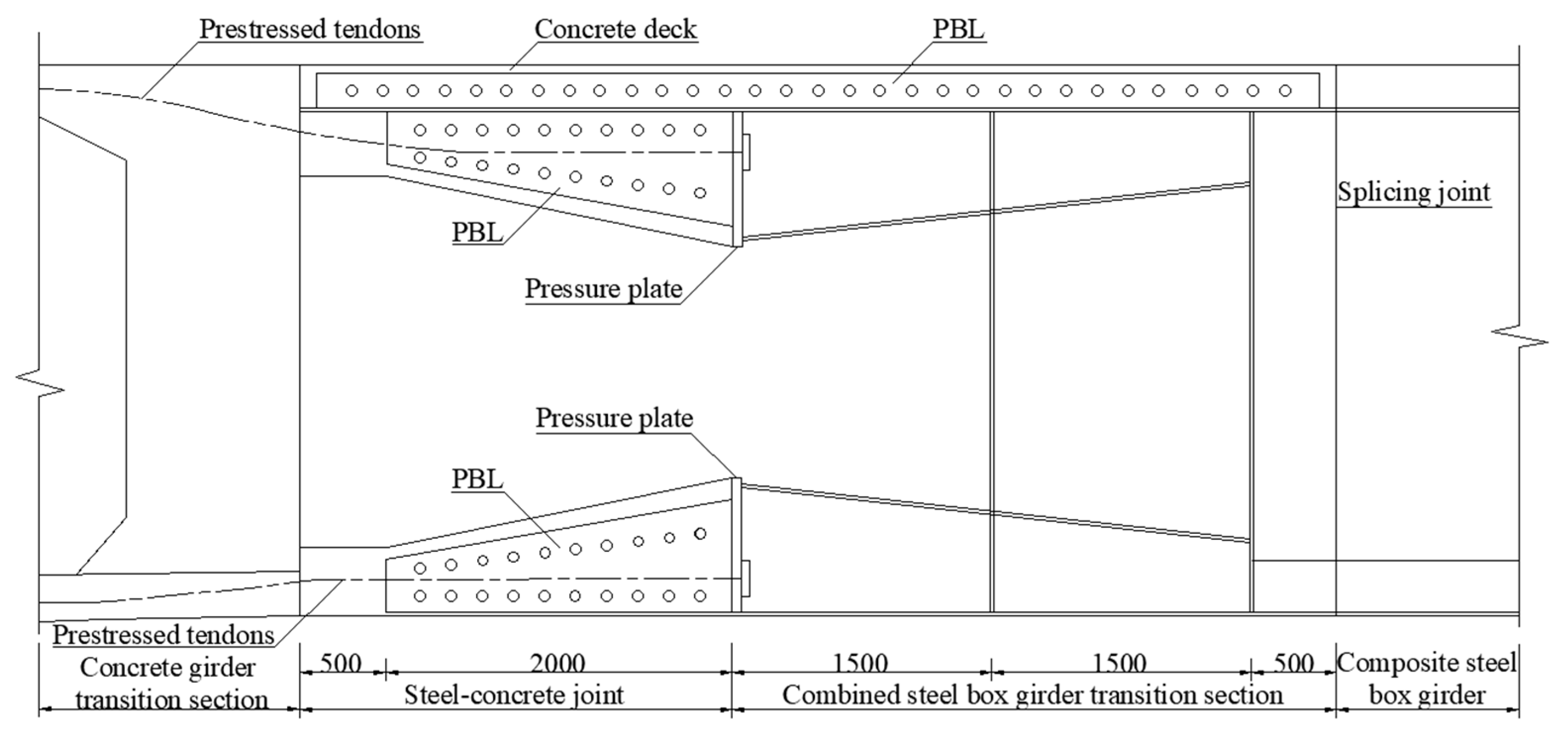
2. Project Overview
3. Finite Element Model Calculation and Analysis
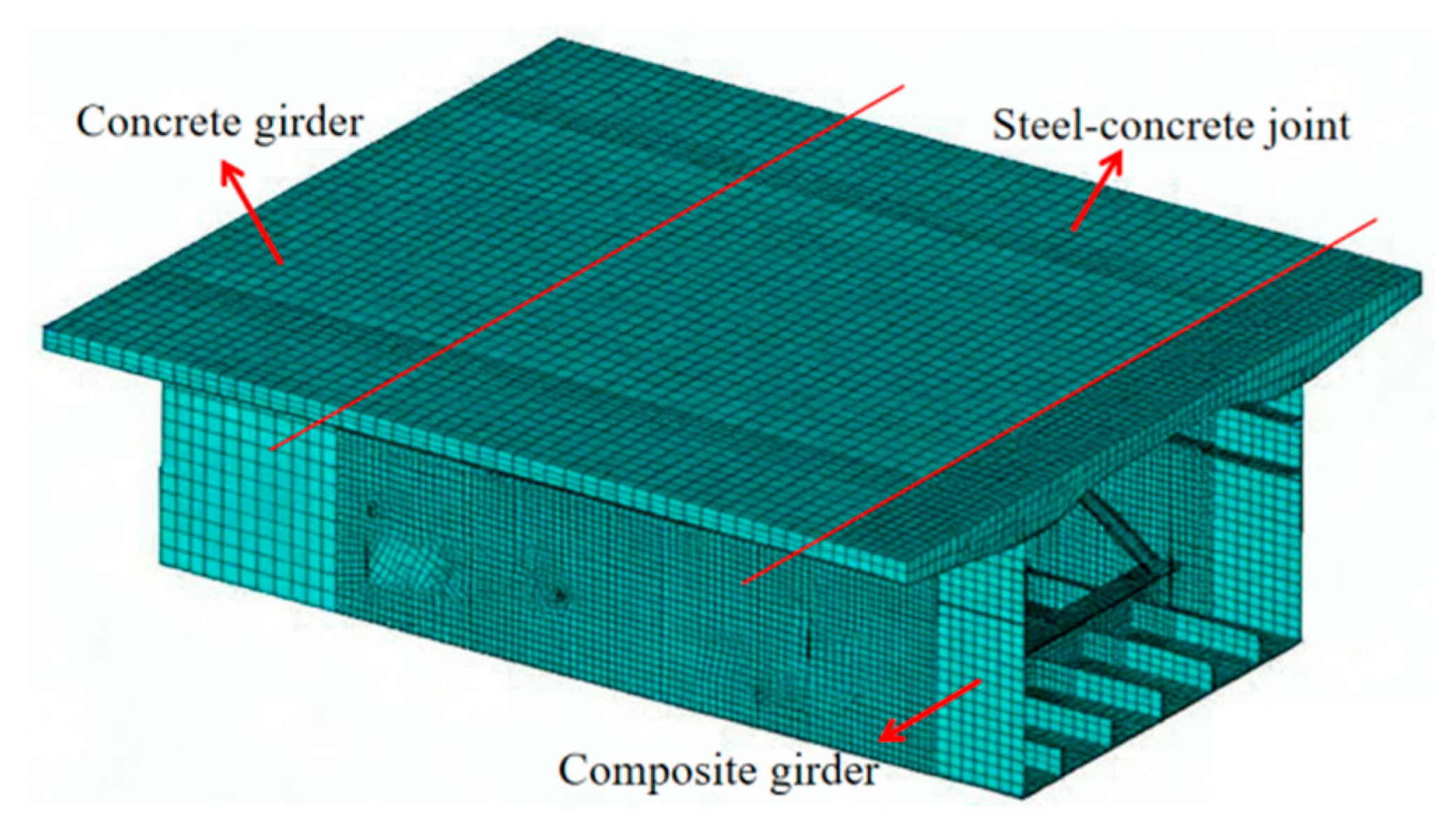
3.1. Finite Element Model
3.2. Stress Analysis of the New Steel-Concrete Joint
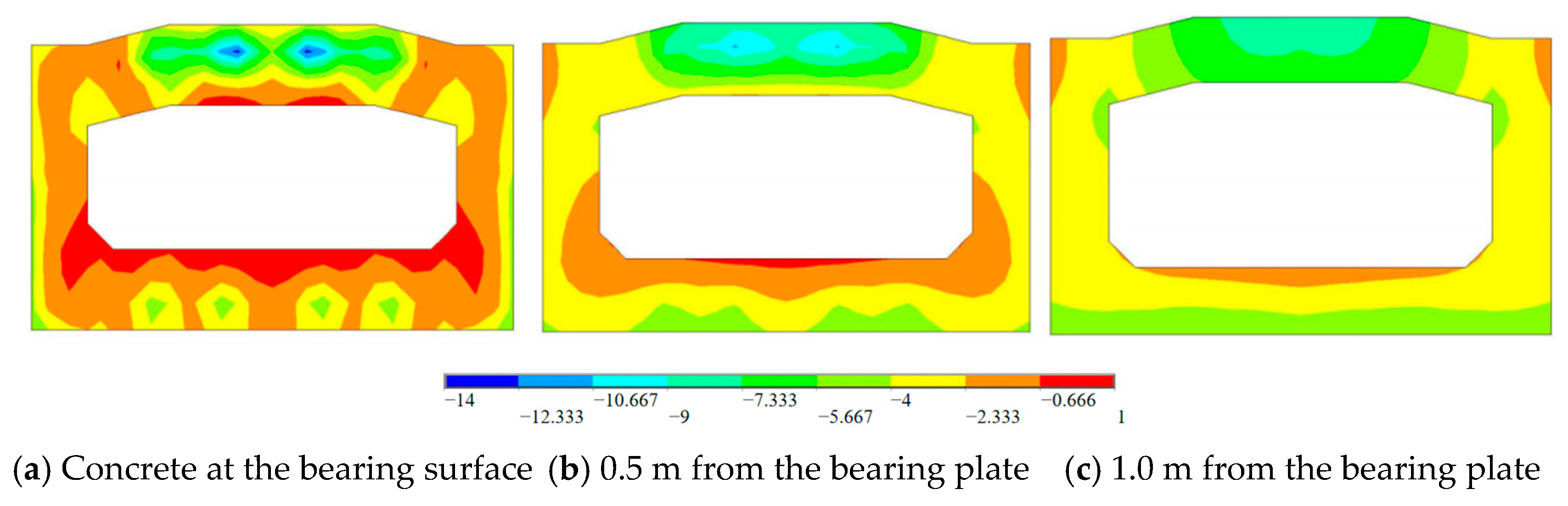
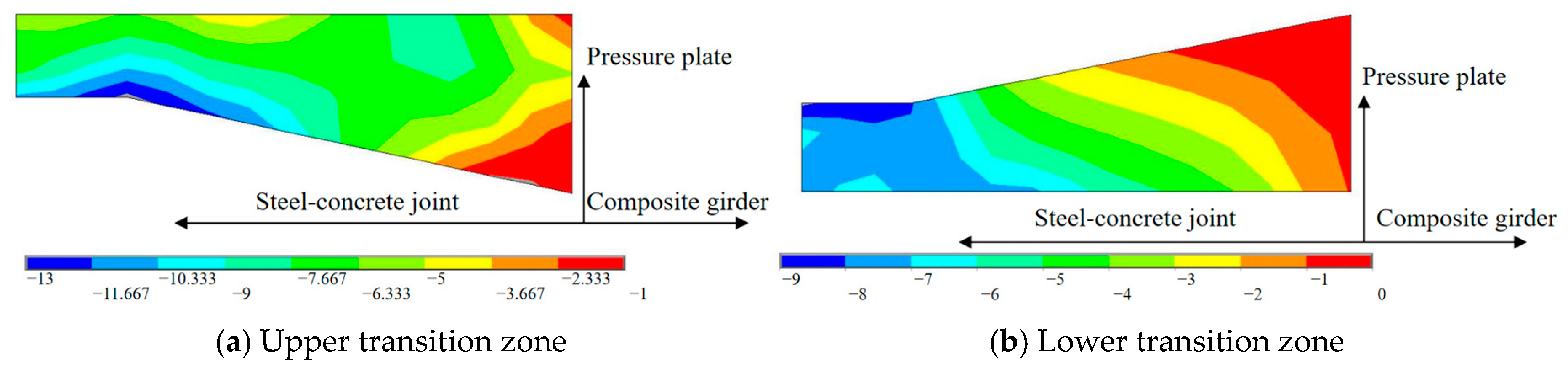
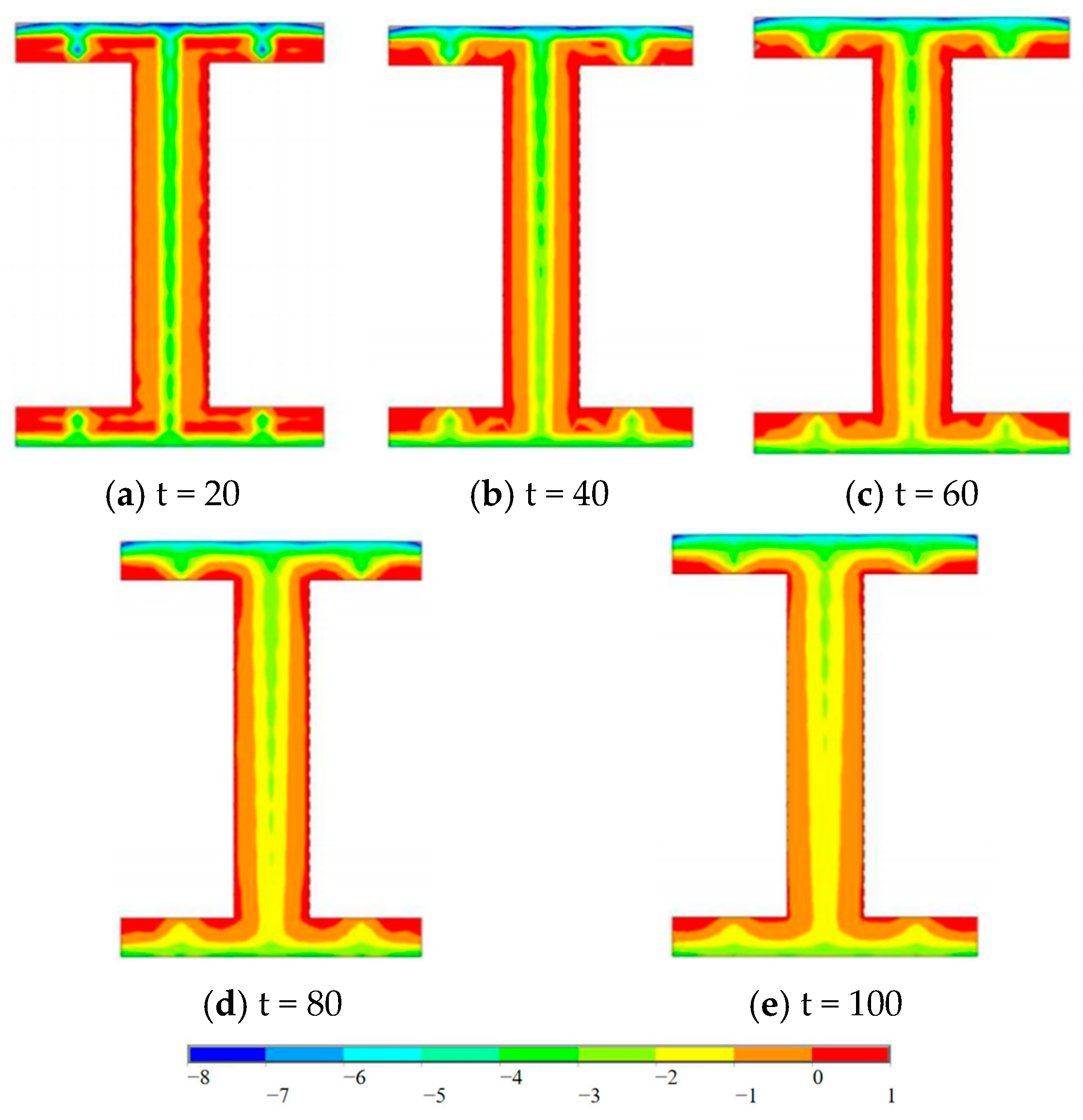
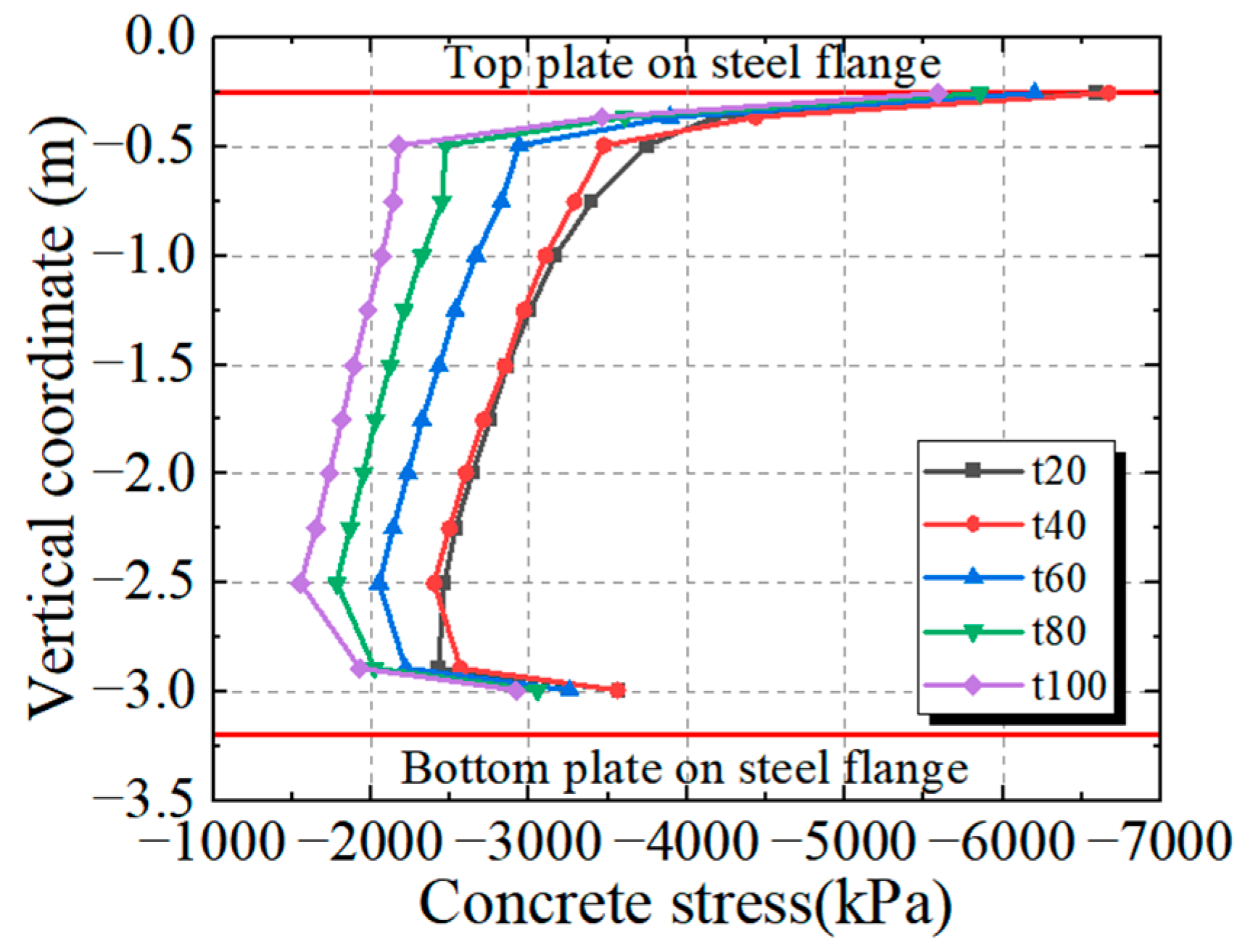
3.2.1. Concrete Stress Analysis
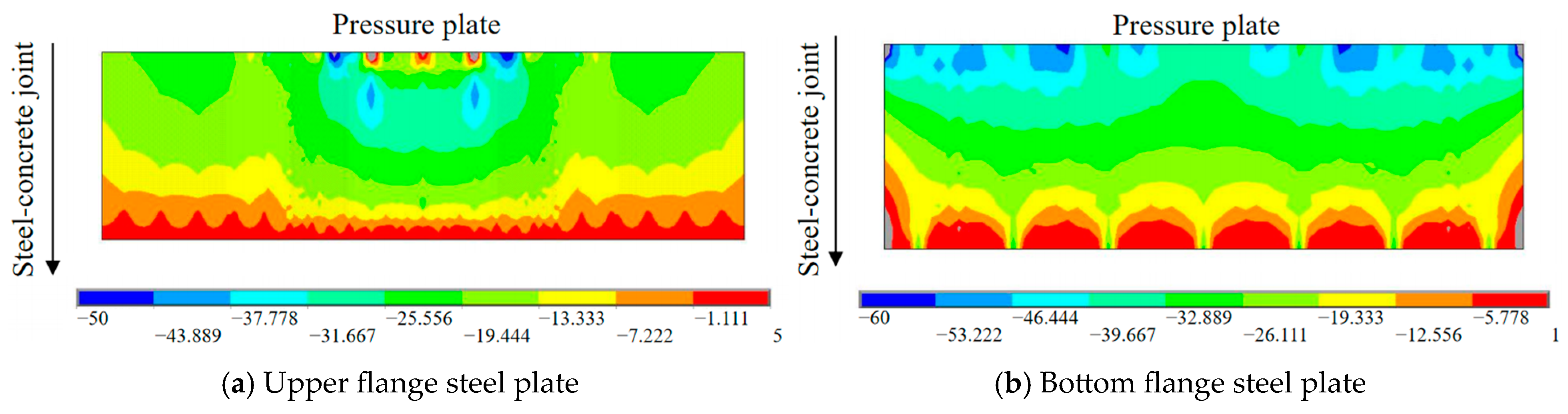
3.2.2. Steel Plate Stress Analysis
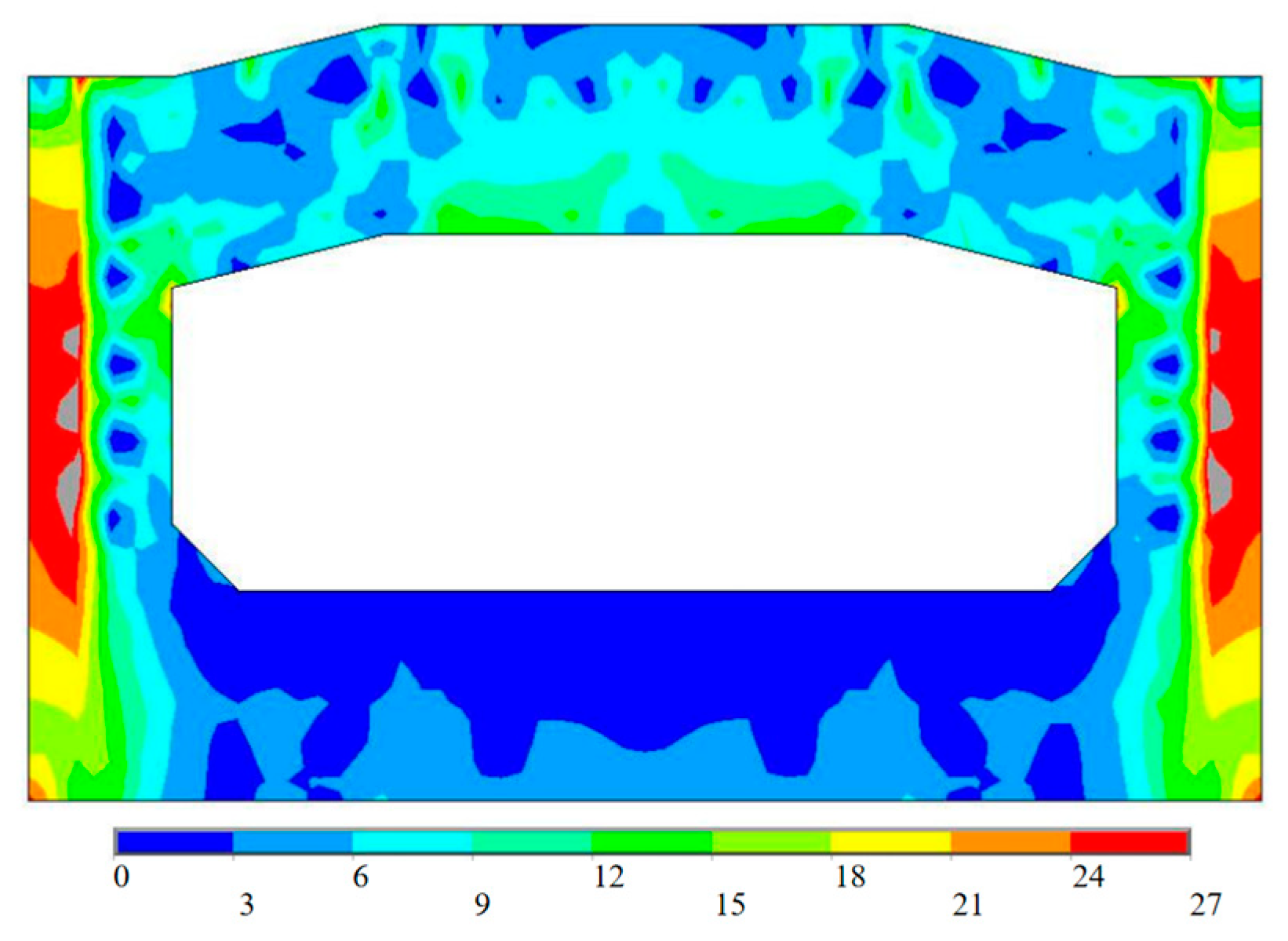
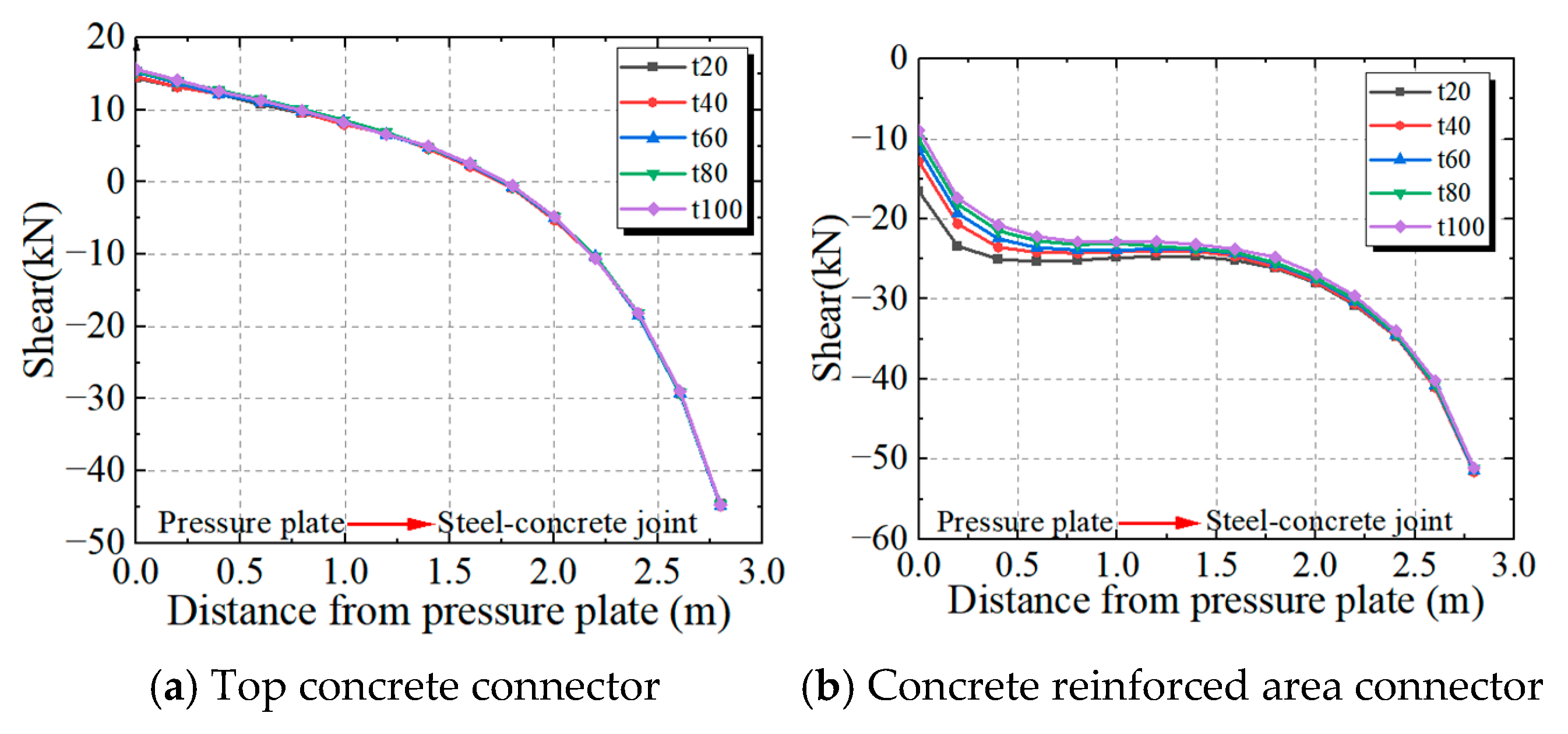
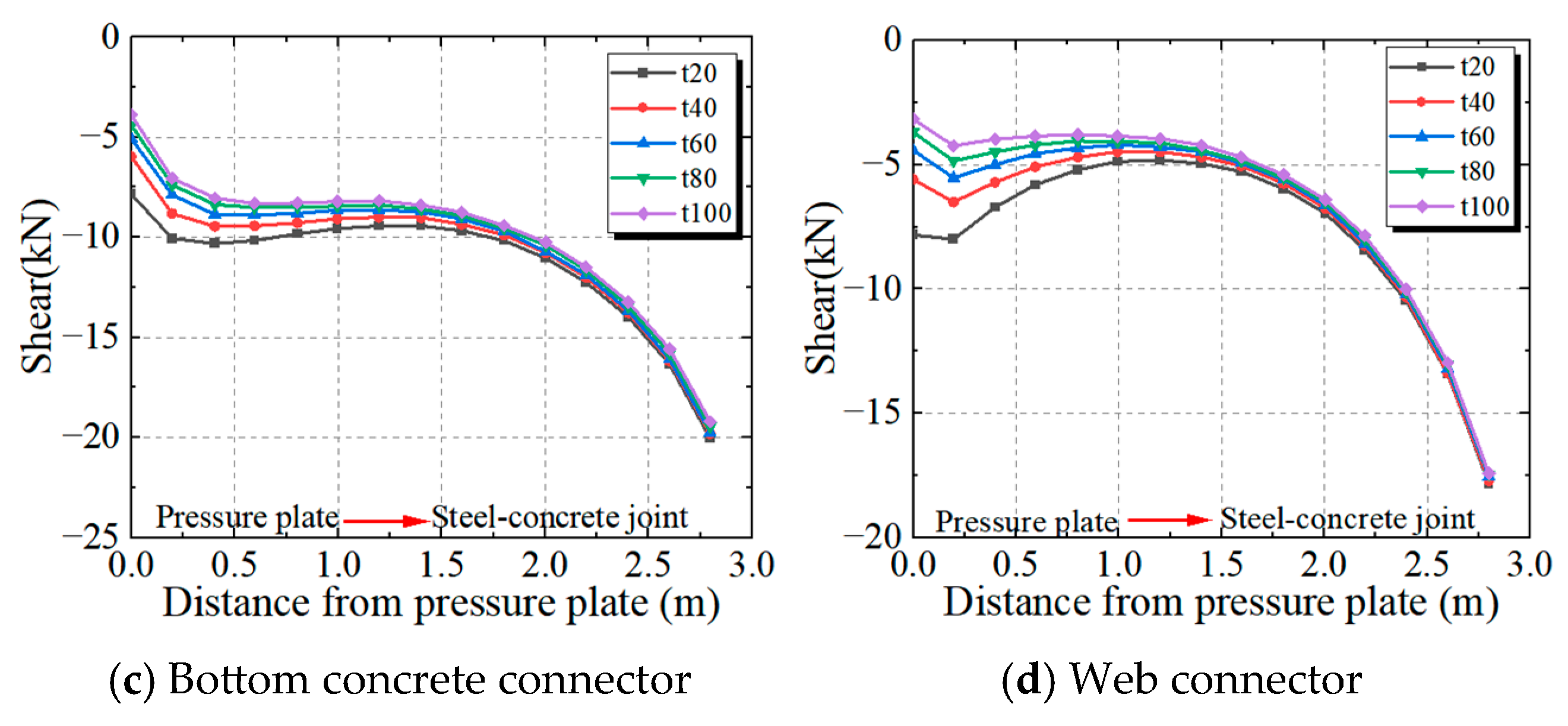
3.2.3. Connector Stress Analysis
3.3. Load Transfer Path Analysis of the New Hybrid Beam Joint
4. Parametric Analysis of the New Hybrid Beam Joint
4.1. Parametric Finite Element Model
4.2. Axial Force Analysis of the Connection
4.2.1. Concrete Stress Analysis
4.2.2. Connector Stress Analysis
- (1)
- Effect of bearing plate thickness variation
- (2)
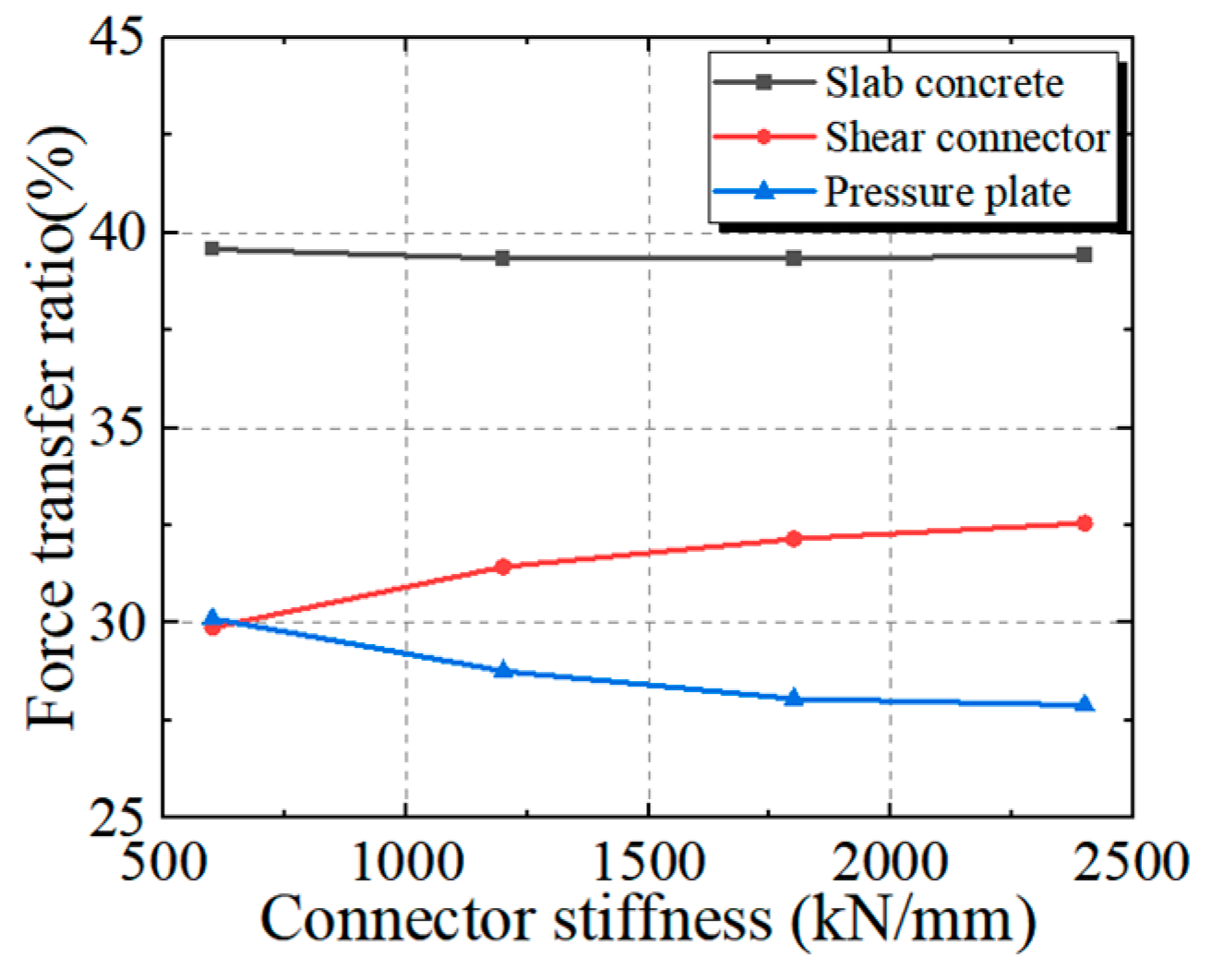
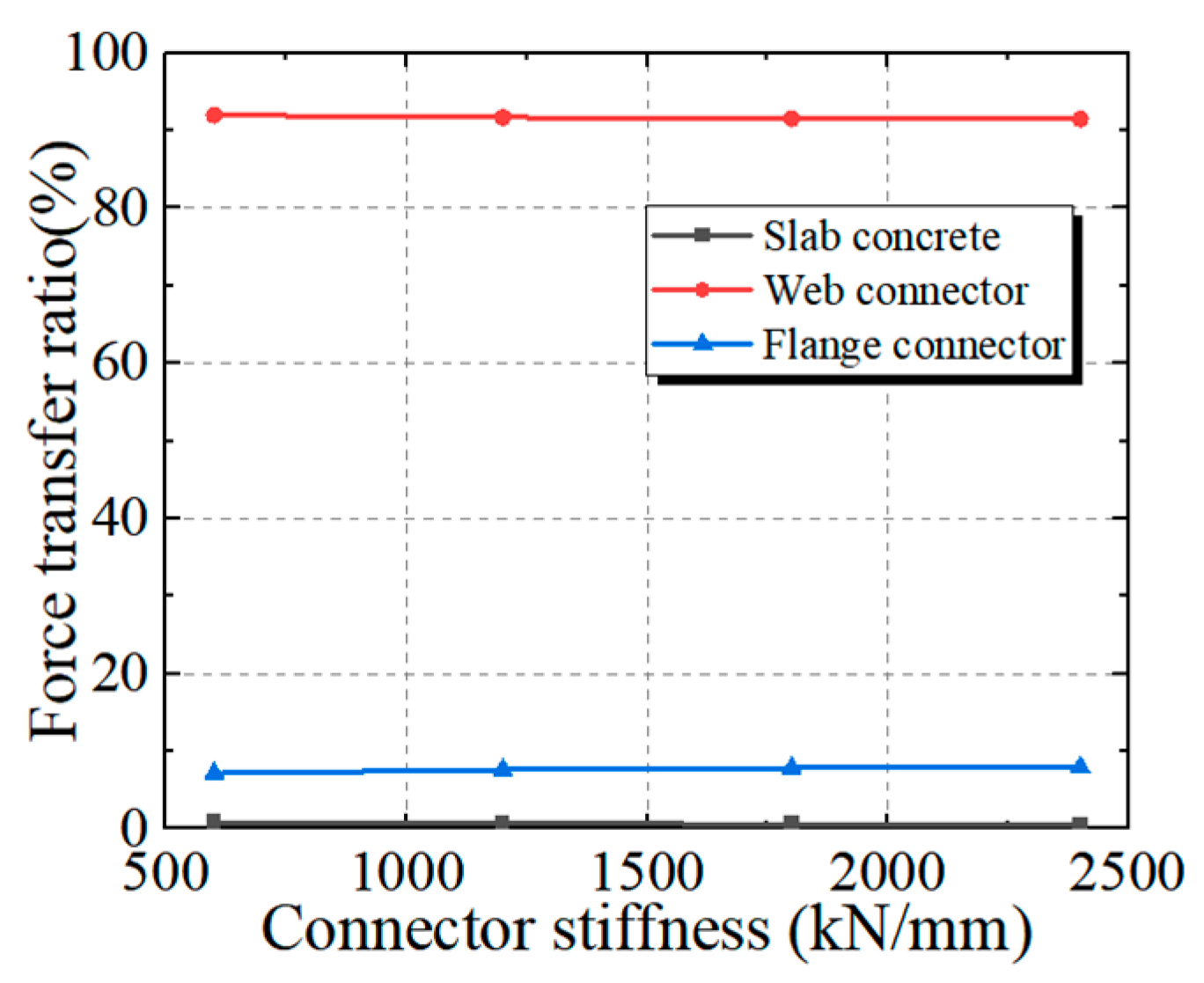
- Effect of connector stiffness variation
- (3)
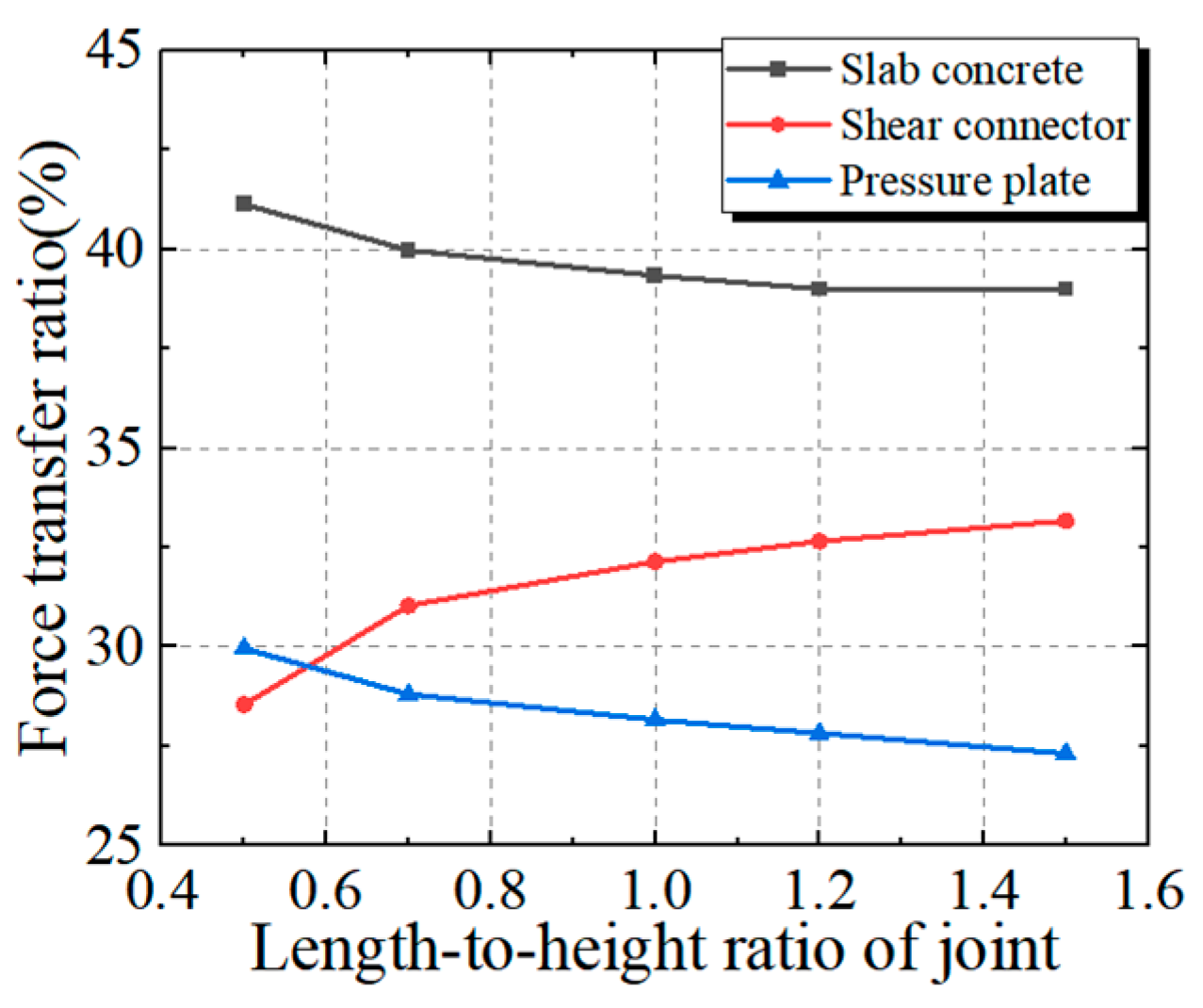
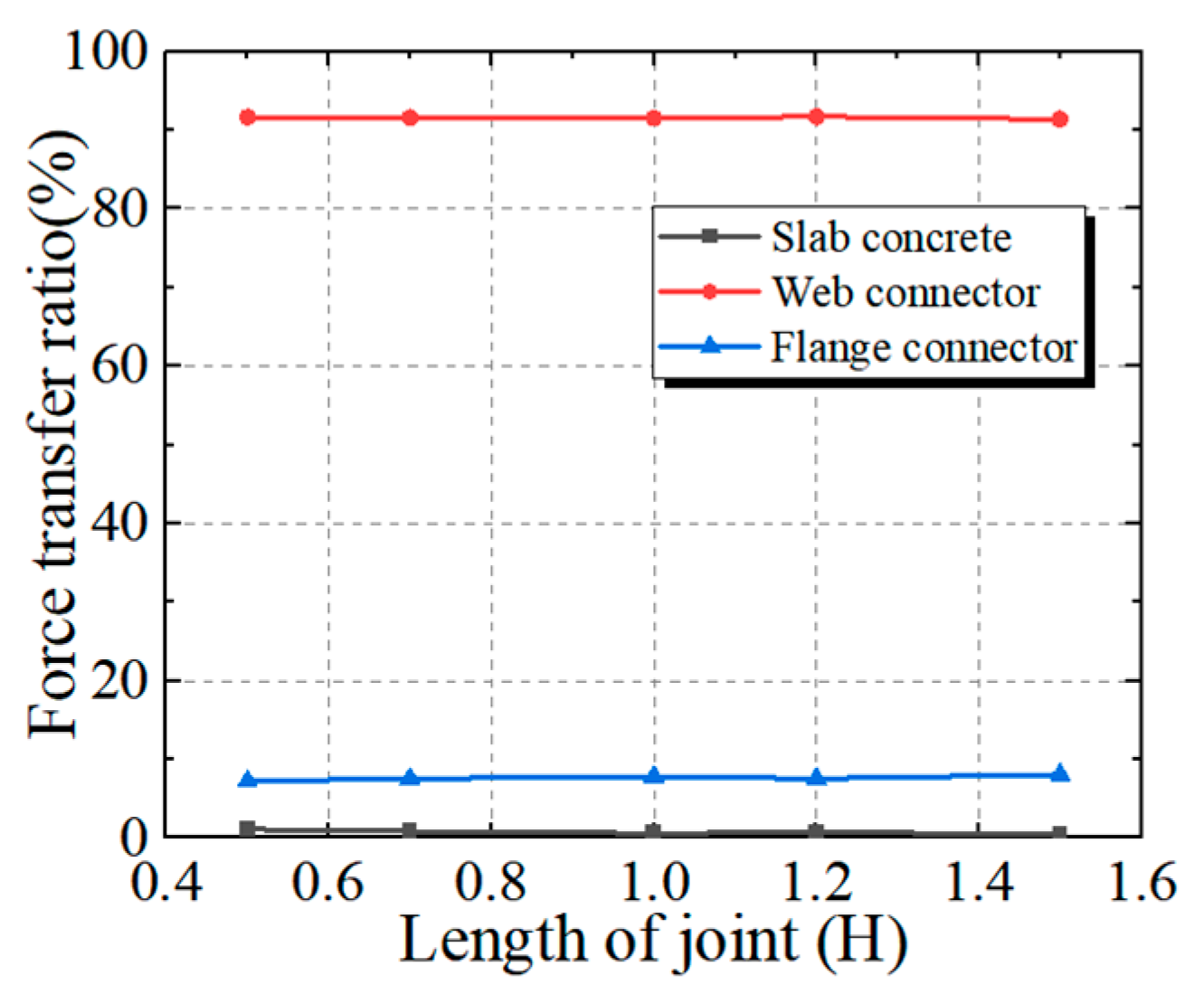
- Effect of joint Length Variation
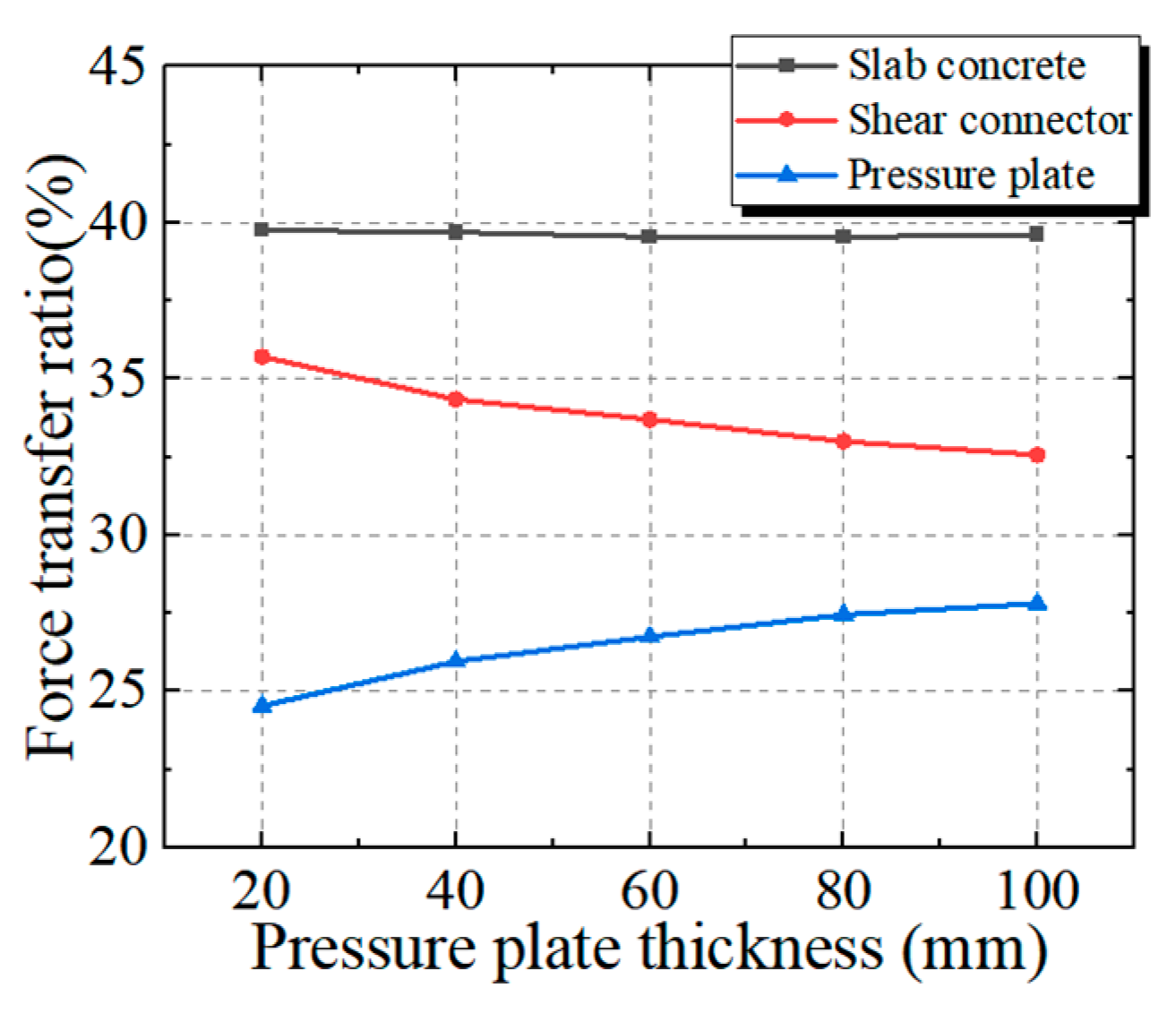
4.2.3. Bearing Load Transfer Proportion Analysis
4.3. Connector Shear Stress Analysis in the Joint
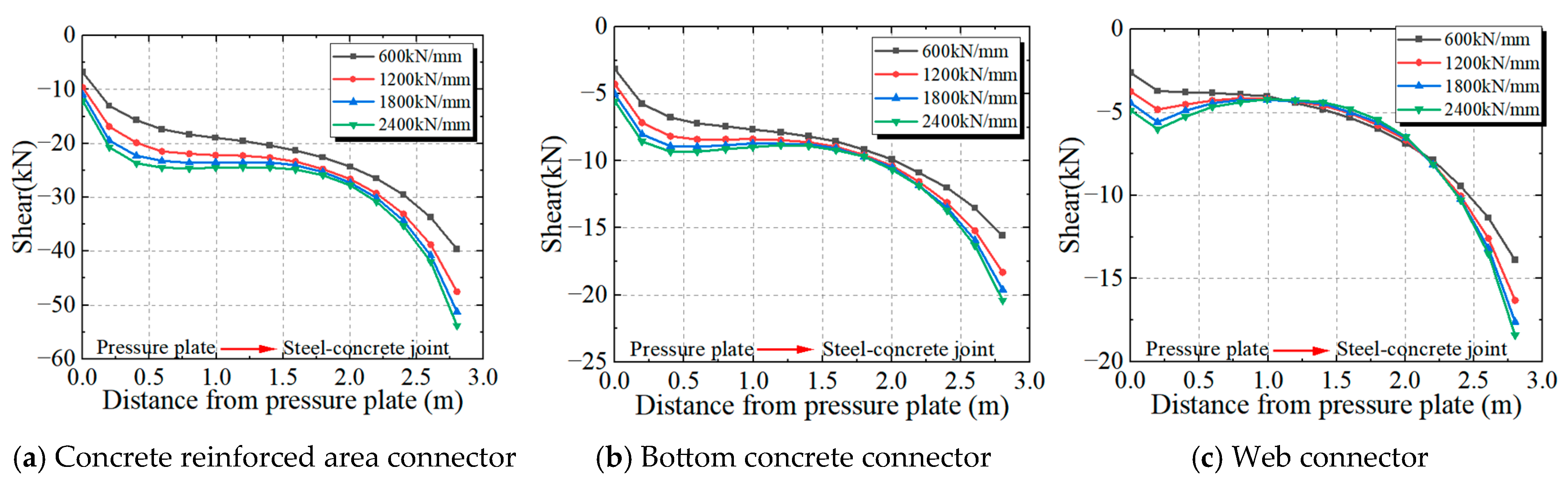
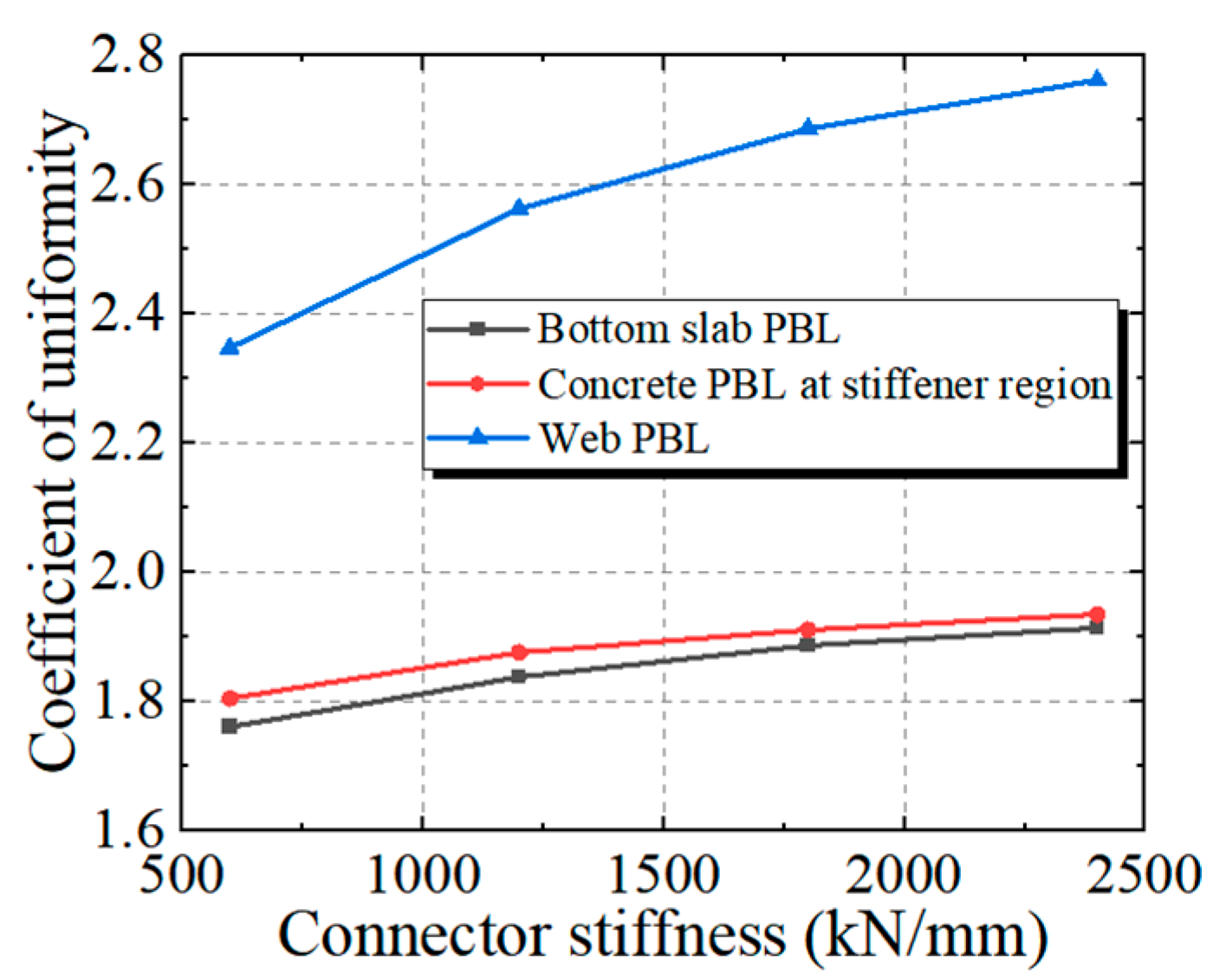
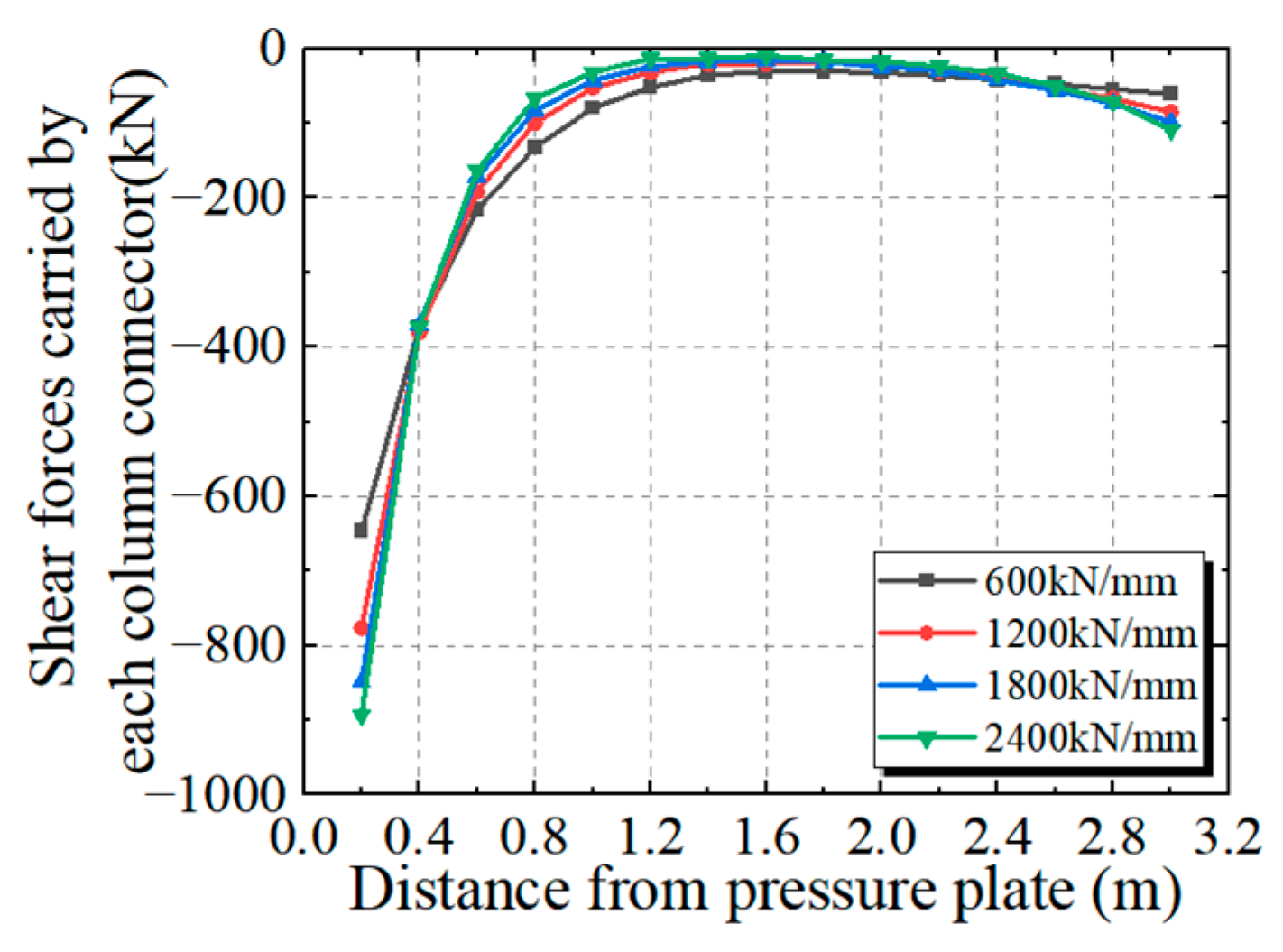
4.3.1. Effect of Connector Stiffness Variation
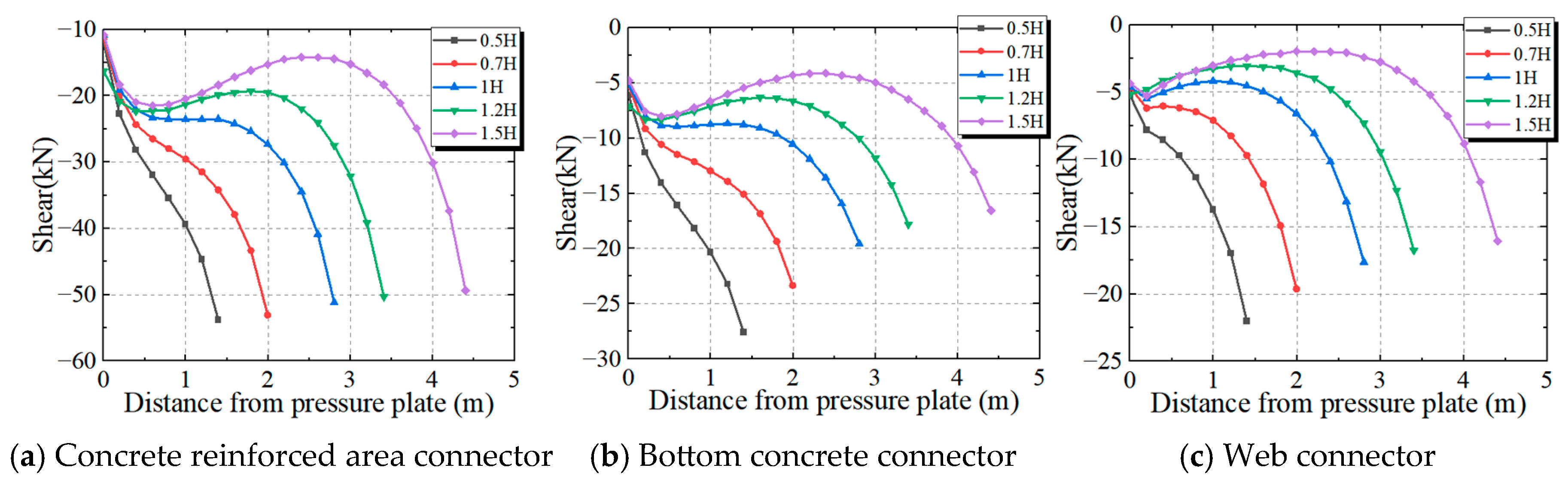
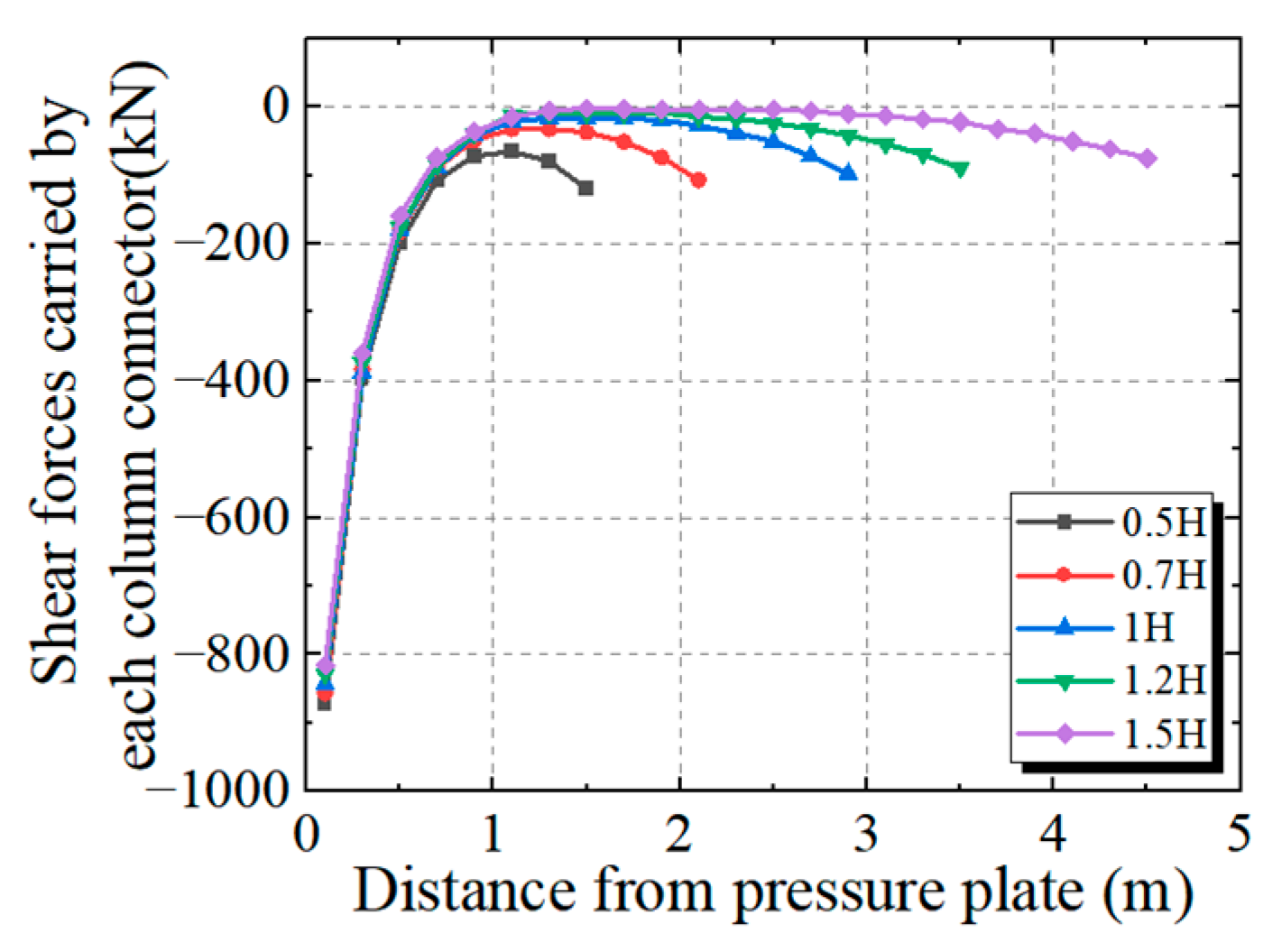
4.3.2. Effect of Joint Length Variation
4.3.3. Shear Transfer Proportion Analysis
5. Conclusions
- (1)
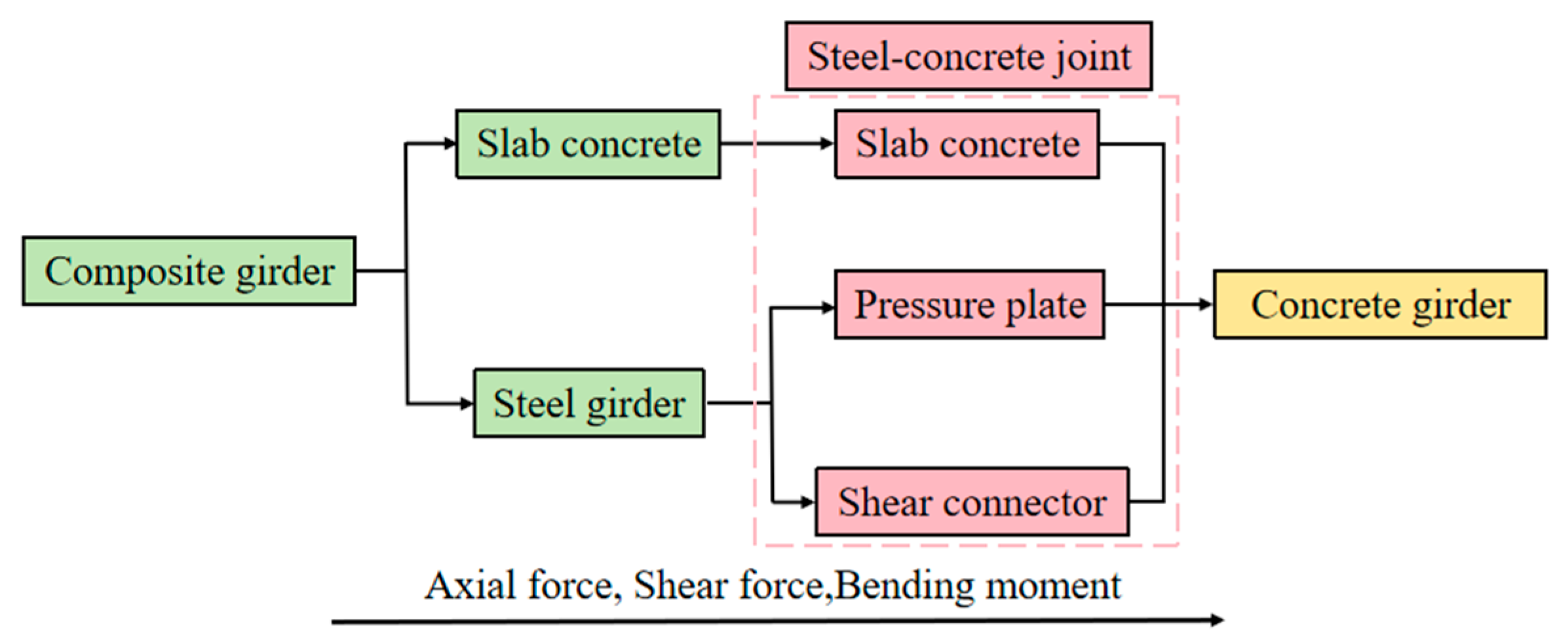
- Under loading, the novel joint exhibits a distinct “three-path load distribution” characteristic: the axial force is equitably shared by the top slab concrete (20.7%), the bearing plate (40.1%), and the shear connectors (39.2%), demonstrating a more uniform load transfer mechanism compared to conventional joints.
- (2)
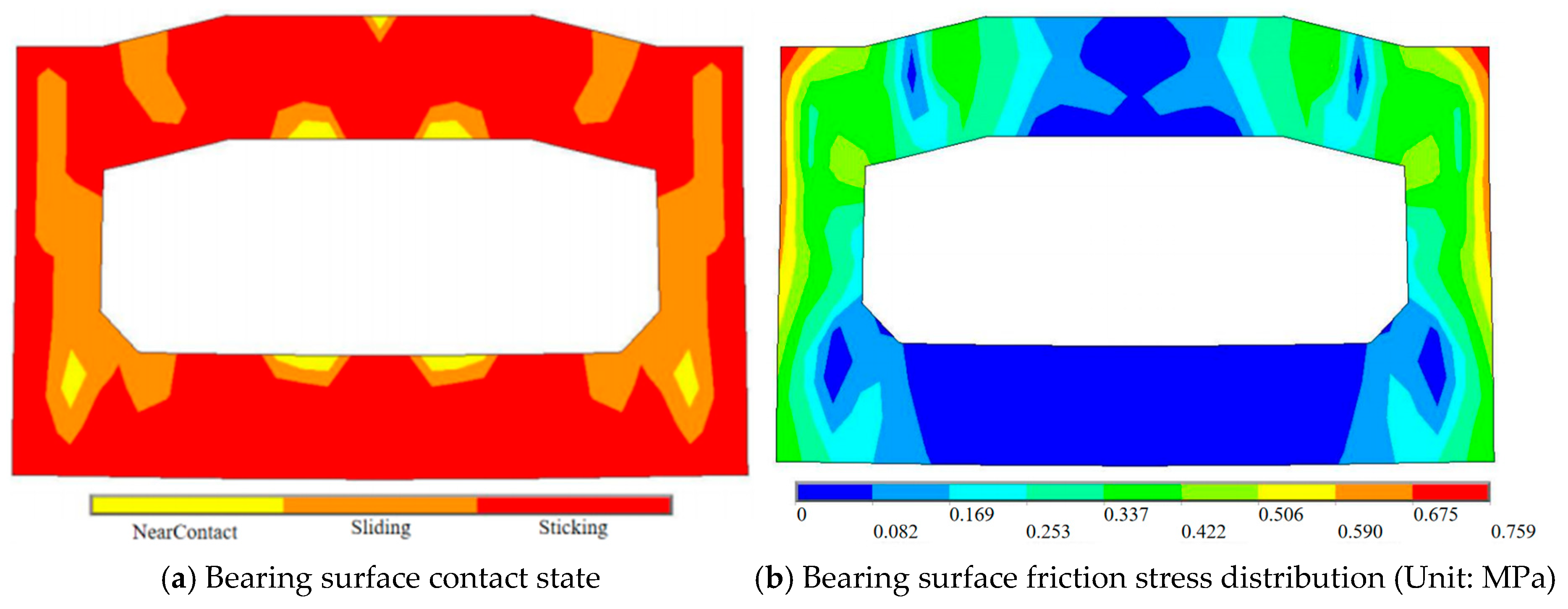
- The friction effect at the bearing surface has a significant impact on the vertical shear resistance of the joint, contributing approximately 27.1% of the vertical shear force. Given the complex and uncertain nature of the friction mechanism, it is recommended to conservatively neglect its contribution in the design to simplify calculations and ensure safety.
- (3)
- Parametric analysis reveals distinct marginal effects and critical thresholds for geometric dimensions. Increasing the bearing plate thickness from 20–100 mm results in a mere 1.0 MPa reduction in the peak concrete stress. Furthermore, excessive thickness poses risks of lamellar tearing; thus, a thickness of 50 mm is recommended to balance stiffness and constructability. A 1.0 H efficiency threshold exists for the joint length; exceeding this limit triggers an inverted N-shaped shear distribution, rendering the central connectors ineffective. Therefore, anchoring the length near 1.0 H is advised to avoid unnecessary self-weight.
- (4)
- Reducing connector stiffness effectively lowers the non-uniformity coefficient from 2.3 to below 2.0, achieving uniform load diffusion. Crucially, the first row of web PBLs carries 34.8% to 47.2% of the total shear force, with a stable non-uniformity coefficient of 1.05–1.06. Consequently, this row should serve as the primary control section for shear design, permitting simplified calculations under the assumption of uniform load distribution.
- (5)
- This study is subject to certain limitations. First, the finite element models adopted linear elastic material constitutive models, without considering nonlinear behaviors such as concrete cracking or steel yielding. Second, the findings lack experimental validation; therefore, caution should be exercised when extrapolating these conclusions to other structural contexts. Future research should integrate nonlinear finite element analysis with experimental investigations to further elucidate the mechanical performance and load-transfer mechanisms of this novel joint.
Author Contributions
Funding
Institutional Review Board Statement
Informed Consent Statement
Data Availability Statement
Conflicts of Interest
References
- Huang, W.; Pei, M.; Liu, X.; Wei, Y. Design and construction of super-long span bridges in China: Review and future perspectives. Front. Struct. Civ. Eng. 2020, 14, 803–838. [Google Scholar] [CrossRef] [Scilit]
- Zheng, J.; Wang, J. Concrete-Filled Steel Tube Arch Bridges in China. Engineering 2018, 4, 143–155. [Google Scholar] [CrossRef] [Scilit]
- Nie, J.; Wang, J.; Gou, S.; Zhu, Y.; Fan, J. Technological development and engineering applications of novel steel-concrete composite structures. Front. Struct. Civ. Eng. 2019, 13, 1–14. [Google Scholar] [CrossRef] [Scilit]
- Virlogeux, M. Recent evolution of cable-stayed bridges. Eng. Struct. 1999, 21, 737–755. [Google Scholar] [CrossRef] [Scilit]
- Dusch, K. The Kurt-Schumacher-Bridge Mannheim-Ludwigshafen (North Bridge). Bauingenieur 1998, 73, 53–64. [Google Scholar]
- Man-Chung, T.; Dai, T. Overall Design of Double-Line Bridge of Shibanpo Changjiang River Bridge in Chongqing. Bridge Constr. 2006, 6, 28–32. [Google Scholar] [CrossRef] [Scilit]
- Chen, H.; Li, D.; Sun, P.; Yu, D.; Zhang, W. Experimental investigation on the structural behavior of the steel-concrete composite segments of self-anchored suspension bridges. J. Harbin Eng. Univ. 2023, 44, 837–846,856. [Google Scholar] [CrossRef]
- Beijing Zhantianyou Foundation for Civil Engineering. Chongqing Caiyuanba Yangtse River Bridge. China Civ. Eng. J. 2010, 43, 156. [Google Scholar] [CrossRef]
- Zhang, W.; Zheng, D.; Huang, Q.; Kang, S. Experimental and simulative analysis of flexural performance in UHPC-RC hybrid beams. Constr. Build. Mater. 2024, 436, 136889. [Google Scholar] [CrossRef] [Scilit]
- Zou, Y.; Zheng, K.; Zhou, J.; Zhang, Z.; Li, X. Mechanical behavior of perfobond connector group in steel–concrete joint of hybrid bridge. Structures 2021, 30, 925–936. [Google Scholar] [CrossRef] [Scilit]
- Shi, S.; Chen, X.; Gu, L.; Ma, T. Investigated on hot mix epoxy resin used in steel bridge deck pavement affected by collaborative toughen. Case Stud. Constr. Mater. 2024, 20, e03019. [Google Scholar] [CrossRef] [Scilit]
- Duan, S.; Wu, X.; Wang, H.; Hu, J.; Luan, Y.; Ma, T. Design and evaluation of semi self-compacting cold mix polyurethane mixture for steel bridge deck pavement. Constr. Build. Mater. 2024, 419, 135490. [Google Scholar] [CrossRef] [Scilit]
- Liu, Y.; Qian, Z.; Xie, Y.; Xu, S.-Q. Investigation on materials for prefabricated bridge deck pavement and construction technology: Application to a case study of concrete box-girder bridge. Case Stud. Constr. Mater. 2024, 20, e03185. [Google Scholar] [CrossRef] [Scilit]
- Su, Q. A New Type Hybrid-beam Bridge Structural System and Its Design Parameters. J. Tongji Univ. (Nat. Sci.) 2013, 41, 799–805. [Google Scholar] [CrossRef]
- Zhang, J. Analysis of Force Transmission Characteristics and Bearing Capacity of Combined Section of Composite Hybrid Beam Cable-Stayed Bridge. Master’s Thesis, Chongqing Jiaotong University, Chongqing, China, 2023. [Google Scholar]
- Qu, J.; Wang, S. Research on Stress Performance of Steel-concrete Joint Section of Composite Hybrid Beam Cable-stayed Bridge. In Proceedings of the WTC2025, Suzhou, China, 12 June 2025. [Google Scholar] [CrossRef]
- Zhao, L.; Pu, G.; Yuan, Y.; Guo, Q.; Yu, Y. Mechanical behaviour of steel-concrete joint in hybrid girder cable-stayed bridge. Structures 2023, 57, 105239. [Google Scholar] [CrossRef] [Scilit]
- Hu, W.; Hu, K. Erection Supervision of Main Spans of Xupu Bridge. Bridge Constr. 1998, 2, 25–28. [Google Scholar]
- Liu, Z. The Development of Cable-Supported Bridges in Hong Kong. China Civ. Eng. J. 2005, 38, 59–68. [Google Scholar] [CrossRef]
- Leng, J.; Yang, J.; Zhang, Z.; Zou, Y.; Chen, J.; Zhou, J. Experimental and numerical investigations on force transfer mechanism of steel-concrete joint in hybrid girder bridges. Structures 2023, 54, 153–170. [Google Scholar] [CrossRef] [Scilit]
- Yang, S.; Zhang, Y.; Zhou, Y.; Chen, X.; Yang, H. Force-Transfer Mechanism Analysis of Steel–Concrete Joints in Railway Hybrid Girder Cable-Stayed Bridges. Int. J. Steel Struct. 2025, 25, 947–958. [Google Scholar] [CrossRef] [Scilit]
- Chen, D.; Lin, Z.; Su, Q.; Ouyang, M.; Shangguan, B. Structural Optimization and Experiment of Steel Concrete Composite Segment in Hybrid-Girder Rigid Frame Bridges. Eng. Mech. 2023, 40, 149–160. [Google Scholar] [CrossRef]
- Shangguan, B.; Su, Q.; Casas, J.R.; Su, H.; Wang, S.; Zhao, R. Modeling and Testing of a Composite Steel-Concrete Joint for Hybrid Girder Bridges. Materials 2023, 16, 3265. [Google Scholar] [CrossRef] [Scilit] [PubMed]
- Yang, S.; Shi, Z.; Pu, Q.; Jiang, X.; Zeng, M.; Liu, Z. Study on Mechanical Behaviour of Steel-Concrete Joint of High-speed Railway Hybrid Girder Cable-stayed Bridge with Twin-box Section. Tiedao Xuebao J. China Railw. Soc. 2022, 44, 150–160. [Google Scholar] [CrossRef]
- Lin, Y.T.; Li, L.H.; Su, Q.T.; Matanmi, F.O. Mechanical behavior and calculation method of the joint between the steel anchor beam and the concrete pylon wall in cable-stayed bridge pylons. Structures 2026, 88, 111879. [Google Scholar] [CrossRef] [Scilit]
- Shi, Z.; Zhang, Y.; Li, Y.; He, Z.; Shi, J. Stress Behavior and Theoretical Calculation of Steel-concrete Joint of Railway Hybrid Girder. Eng. Mech. 2024, 41, 282–291. [Google Scholar] [CrossRef]
- Wang, H.; Yang, L.; Zeng, H. Study on Static Performance of The Steel-concrete Joint in a High-speed Railway Hybrid Girder Low Tower Cable-stayed Bridge. Structures 2025, 71, 107858. [Google Scholar] [CrossRef] [Scilit]
- Shi, Z.; Li, Y.; Yang, Y.; Zhao, X.; Yu, W. Fatigue Performance of a Novel Steel-Concrete Joint of a Long-Span High-Speed Railway Hybrid Girder–Cable-Stayed Bridge. J. Bridge Eng. 2024, 29, 04023104. [Google Scholar] [CrossRef] [Scilit]
- Yao, Y.; Yan, M.; Shi, Z.; Wang, Y.; Bao, Y. Mechanical Behavior of an Innovative Steel-concrete Joint for Long-span Railway Hybrid Box Girder Cable-stayed Bridges. Eng. Struct. 2021, 239, 112358. [Google Scholar] [CrossRef] [Scilit]
- Pu, Q.; Yang, S.; Shi, Z.; Hong, Y.; Zhou, Y. Fatigue Performance of an Innovative Steel-Concrete Joint in Long-Span Railway Hybrid Box Girder Cable-Stayed Bridges. J. Bridge Eng. 2021, 26, 04020129. [Google Scholar] [CrossRef] [Scilit]
- Lin, Y.; Su, Q.; Matanmi, F.O.; Shangguan, B.; Wu, F. Flexural performance and calculation methods for steel-concrete joint in hybrid girder rigid frame bridges. Structures 2026, 88, 111885. [Google Scholar] [CrossRef] [Scilit]
- Cheng, X.; Nie, X.; Fan, J.S. Structural Performance and Strength Prediction of Steel-to-Concrete Box Girder Deck Transition Zone of Hybrid Steel-Concrete Cable-Stayed Bridges. J. Bridge Eng. 2016, 21, 1–19. [Google Scholar] [CrossRef] [Scilit]
- Carlo, P.; Virginio, Q. Comparison of Linear and Nonlinear Procedures for the Analysis of the Seismic Performance of Straight Multi-Span RC Bridges. Buildings 2024, 14, 464. [Google Scholar] [CrossRef] [Scilit]
- Lam, D.; El-Lobody, E. Behavior of Headed Stud Shear Connectors in Composite Beam. J. Struct. Eng. 2005, 131, 96–107. [Google Scholar] [CrossRef] [Scilit]



| Material Type | Test Content | Value | Test Content | Value |
|---|---|---|---|---|
| Steel (Q345) | Elastic modulus | 2.05 × 10⁵ MPa | Poisson ratio | 0.33 |
| Concrete (C50) | Elastic modulus | 3.45 × 10⁴ MPa | Poisson ratio | 0.2 |
| Stud | Shear stiffness | 420 kN/mm | Pullout stiffness | 255 kN/mm |
| PBL | Shear stiffness | 1200 kN/mm | / | / |
| Load Transfer Path | Top Plate Concrete% | Bearing Plate | Shear Connectors |
|---|---|---|---|
| Load transfer ratio | 20.7 | 40.1 | 39.2 |
| Load Transfer Path | Top Plate Concrete% | Bearing Plate | Shear Connectors | |
|---|---|---|---|---|
| Load transfer ratio | Considering friction | 6.5 | 27.1 | 66.4 |
| Not considering friction | 3.7 | / | 96.3 | |
Disclaimer/Publisher’s Note: The statements, opinions and data contained in all publications are solely those of the individual author(s) and contributor(s) and not of MDPI and/or the editor(s). MDPI and/or the editor(s) disclaim responsibility for any injury to people or property resulting from any ideas, methods, instructions or products referred to in the content. |
© 2026 by the authors. Licensee MDPI, Basel, Switzerland. This article is an open access article distributed under the terms and conditions of the Creative Commons Attribution (CC BY) license.
Share and Cite
Lin, Y.; Su, Q.; Matanmi, F.O.; Yan, X.; Gao, S. Mechanical Behaviour and Parametric Analysis of the Hybrid Girder Bridges Joint Between Steel-Concrete Composite Girder and Prestressed Concrete Girder. Appl. Sci. 2026, 16, 6322. https://doi.org/10.3390/app16136322
Lin Y, Su Q, Matanmi FO, Yan X, Gao S. Mechanical Behaviour and Parametric Analysis of the Hybrid Girder Bridges Joint Between Steel-Concrete Composite Girder and Prestressed Concrete Girder. Applied Sciences. 2026; 16(13):6322. https://doi.org/10.3390/app16136322
Chicago/Turabian StyleLin, Yiteng, Qingtian Su, Fawas. O. Matanmi, Xingfei Yan, and Shang Gao. 2026. "Mechanical Behaviour and Parametric Analysis of the Hybrid Girder Bridges Joint Between Steel-Concrete Composite Girder and Prestressed Concrete Girder" Applied Sciences 16, no. 13: 6322. https://doi.org/10.3390/app16136322
APA StyleLin, Y., Su, Q., Matanmi, F. O., Yan, X., & Gao, S. (2026). Mechanical Behaviour and Parametric Analysis of the Hybrid Girder Bridges Joint Between Steel-Concrete Composite Girder and Prestressed Concrete Girder. Applied Sciences, 16(13), 6322. https://doi.org/10.3390/app16136322