1. Introduction
Deep-bite malocclusions are among the most common orthodontic problems and are characterized by a multifactorial etiology involving both skeletal and dentoalveolar components.
One of the most frequently associated dental features is an accentuated curve of Spee (COS), particularly in the mandibular arch, which contributes significantly to excessive overbite and occlusal disharmony [
1]. The COS represents the anteroposterior curvature of the mandibular occlusal plane and plays an important role in masticatory function, force distribution, and occlusal balance. Its depth is influenced by the vertical position of anterior and posterior teeth. The assessment of the COS can be easily performed on either conventional plaster casts or digital models, and its leveling is considered a fundamental step in achieving functional occlusion, long-term stability, and proper intercuspation [
1].
Recent evidence from a systematic review and meta-analysis further confirmed that leveling the curve of Spee represents a fundamental objective of orthodontic treatment, regardless of the appliance used, as it contributes to improved occlusal relationships, functional stability, and correction of deep-bite malocclusions. Nevertheless, considerable variability remains regarding the effectiveness and predictability of the different treatment modalities available for achieving this objective [
2].
Biomechanically, leveling the COS can be achieved through different strategies such as intrusion of the anterior teeth, extrusion of the posterior teeth, or a combination of both, depending on the patient’s skeletal pattern and dentoalveolar characteristics. These movements aim to reduce excessive overbite, improve occlusal relationships, and establish a more harmonious and stable occlusal plane. Consequently, accurate evaluation and correction of the COS remain key objectives in the orthodontic management of deep-bite patients.
In recent years, clear aligner therapy has gained widespread acceptance among both clinicians and patients due to its aesthetic advantages, comfort, and improved oral hygiene maintenance. Nevertheless, despite the continuous technological advancements in aligner materials, software planning, and attachment design, the predictability of certain orthodontic movements remains a significant clinical concern. Among these, the correction of deep bite through mandibular COS leveling represents one of the most challenging treatment objectives.
Several investigations have demonstrated that clear aligners exhibit variable effectiveness in achieving planned tooth movements, suggesting that some movements are inherently less predictable than others. In particular, extrusion of posterior teeth, which often plays a crucial role in deep-bite correction, has consistently been reported as one of the least predictable movements in aligner therapy [
3,
4,
5,
6,
7,
8,
9,
10].
Such limitations may negatively affect the efficiency of treatment and increase the need for refinement stages or auxiliary mechanics.
The concept of treatment accuracy, defined as the degree of correspondence between the planned tooth movement and the clinically achieved outcome, has therefore become increasingly relevant in contemporary orthodontic research. Previous studies evaluating deep-bite correction with clear aligners have reported relatively low accuracy rates, with mean values ranging from approximately 30% to 40% when using Invisalign
® [
11,
12].
Similarly, a more recent investigation demonstrated an average correction of only 33% of the planned deep-bite improvement, emphasizing the frequent necessity for additional finishing procedures to achieve the desired clinical outcome [
13].
Recent systematic reviews have confirmed that clear aligners can effectively reduce deep overbite and level the curve of Spee; however, the predictability of these movements remains moderate, with clinically achieved outcomes frequently falling short of the digital treatment plan. Moreover, most of the currently available evidence is derived from studies investigating Invisalign
® alone, while comparative data among different aligner systems remain largely unavailable [
14].
Despite the growing body of evidence on aligner performance, the available literature remains limited regarding the specific predictability and accuracy of mandibular COS leveling [
15,
16,
17,
18].
Furthermore, the studies conducted so far have predominantly focused on a single aligner system, namely Invisalign®, thereby restricting the generalizability of their findings. Consequently, it remains unclear whether the observed limitations are attributable to aligner therapy as a treatment modality in general or whether they may be influenced by differences in aligner design, material properties, manufacturing processes, biomechanical protocols, or treatment-planning software specific to each commercial system. This represents an important gap in the current scientific literature. As the number of commercially available aligner systems continues to increase, clinicians are increasingly required to make evidence-based decisions regarding the most appropriate appliance for specific malocclusions and treatment objectives. However, comparative data evaluating the performance of different aligner brands in achieving the same orthodontic movement are still scarce.
The originality and clinical relevance of the present study lie precisely in this unexplored area. To the authors’ knowledge, no previous investigation has directly compared the accuracy of three major aligner systems in the correction of the mandibular curve of Spee within a homogeneous clinical setting. By evaluating Invisalign®, Spark™ and Angel Aligner™, this study aims not only to quantify the effectiveness of each system in leveling the mandibular COS but also to determine whether the choice of a specific aligner brand may significantly influence treatment outcomes.
Understanding potential differences among aligner systems could provide valuable information for clinical decision-making, improve treatment planning strategies, and contribute to a more realistic estimation of treatment outcomes. Ultimately, the findings of this research may help clinicians optimize deep-bite correction protocols and enhance the predictability of aligner-based orthodontic treatments.
Therefore, the aim of this study is to evaluate and compare the accuracy of Invisalign®, Spark™ and Angel Aligner™ in leveling the mandibular COS and to investigate whether the selection of a specific aligner system affects the achievement of the planned treatment objectives.
In the present study, effectiveness was defined as the actual amount of COS leveling achieved after treatment. Efficiency referred to the ability of the aligner system to accomplish the prescribed tooth movements. Accuracy (or predictability) was defined as the degree of correspondence between the achieved clinical outcome and the movement planned in the digital setup.
2. Material and Method
The present study was approved by the University of Rome Ethics Committee: reference 142.25 CET2.
2.1. Study Sample
This was a multicenter, retrospective observational study. Patients were selected, according to predefined inclusion and exclusion criteria, from three private orthodontic clinics based in Rome. The three clinics are managed within the same professional network, and patient recruitment, treatment planning, and clinical procedures were coordinated by the same lead clinician, ensuring consistency across all participating centers. All centers contributed equally to patient recruitment and data collection and followed identical treatment protocols and eligibility criteria throughout the study period.
Eligible patients were consecutively included in the overall study population. Group allocation reflected the type of aligner therapy documented in the existing clinical records.
Inclusion criteria were permanent dentition (excluding third molars), presence of deep bite, curve of Spee (COS) > 3 mm, Class I dental malocclusion, and a normodivergent skeletal pattern. Exclusion criteria included previous orthodontic treatment, periodontal disease, dental morphological anomalies, and mandibular asymmetry. All data were anonymized and standardized prior to analysis.
Patients were not prospectively allocated to a specific aligner system for the purposes of this study. Instead, they were identified from existing clinical records of subjects who had already completed treatment with one of the three aligner systems and met the eligibility criteria. The same selection criteria were applied to all groups to improve sample comparability and reduce potential selection bias.
2.2. Treatment Protocol
For deep-bite correction, a standardized protocol was performed: conventional attachments, bite ramps, aligner change every 10 days, 30 to 40 aligners per arch and overcorrection prescriptions about upper and lower incisor intrusion. No auxiliaries such as intermaxillary elastics, temporary anchorage devices (TADs), Power Ridges, or equivalent intrusive features were used. Interproximal reduction (IPR) of the teeth was performed where indicated by the operator according to the planned prescription, but nearly all cases showed a comparable amount of IPR.
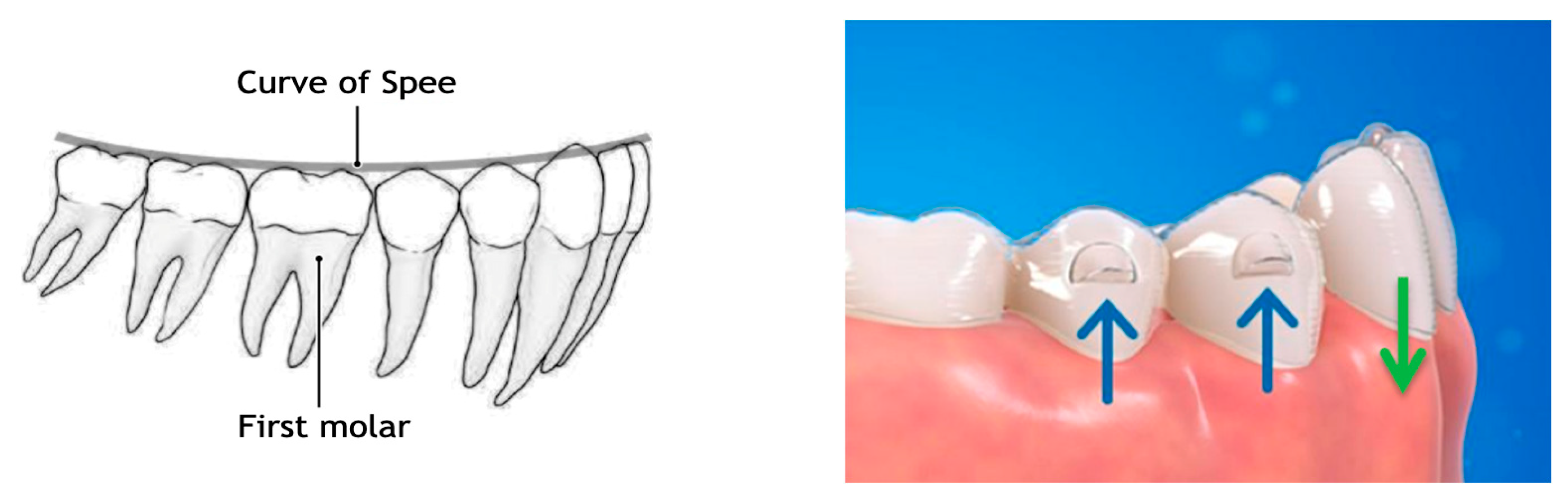
Only conventional horizontal rectangular or occlusal beveled attachments were designed from the second molar to the canine. (
Figure 1).
Recent evidence suggests that optimized attachments do not provide a clinically significant improvement over conventional attachments in the correction of deep overbite, with systematic reviews reporting inconsistent differences in treatment accuracy between the two designs [
19,
20].
Based on this evidence, conventional attachments are commonly used in routine clinical practice, and this same rationale guided their selection in the present study in order to ensure methodological consistency and sample homogeneity (
Figure 2).
2.3. Measurement Protocol
Consents for both data collection and orthodontic treatment were obtained from all patients and/or their parents/tutors.
For each patient, the following diagnostic records were collected; specifically dental models of each subject were taken at 3 time points:
Pre-treatment digital casts (.stl files);
Post-treatment digital casts (.stl files);
The final stage of planned virtual setup digital casts (.stl files).
STL files were obtained by using intraoral scanner iTero® Orthodontic Element ver. 1.13.0.900 (Align Technology Inc., Santa Clara, CA, USA) and transferred to MeshLab software (Visual Computing Lab, Italy, 2023.12 version). All digital models and all linear measurements were used exclusively within MeshLab software, without the use or integration of any additional digital measurement tools or external software. Linear measurements were carried out using the built-in distance measurement (“Ruler”) tool of MeshLab, which allows the calculation of linear distances between selected anatomical landmarks on scaled STL files in millimetric units, provided that the original digital models are correctly preserved in real-size scale.
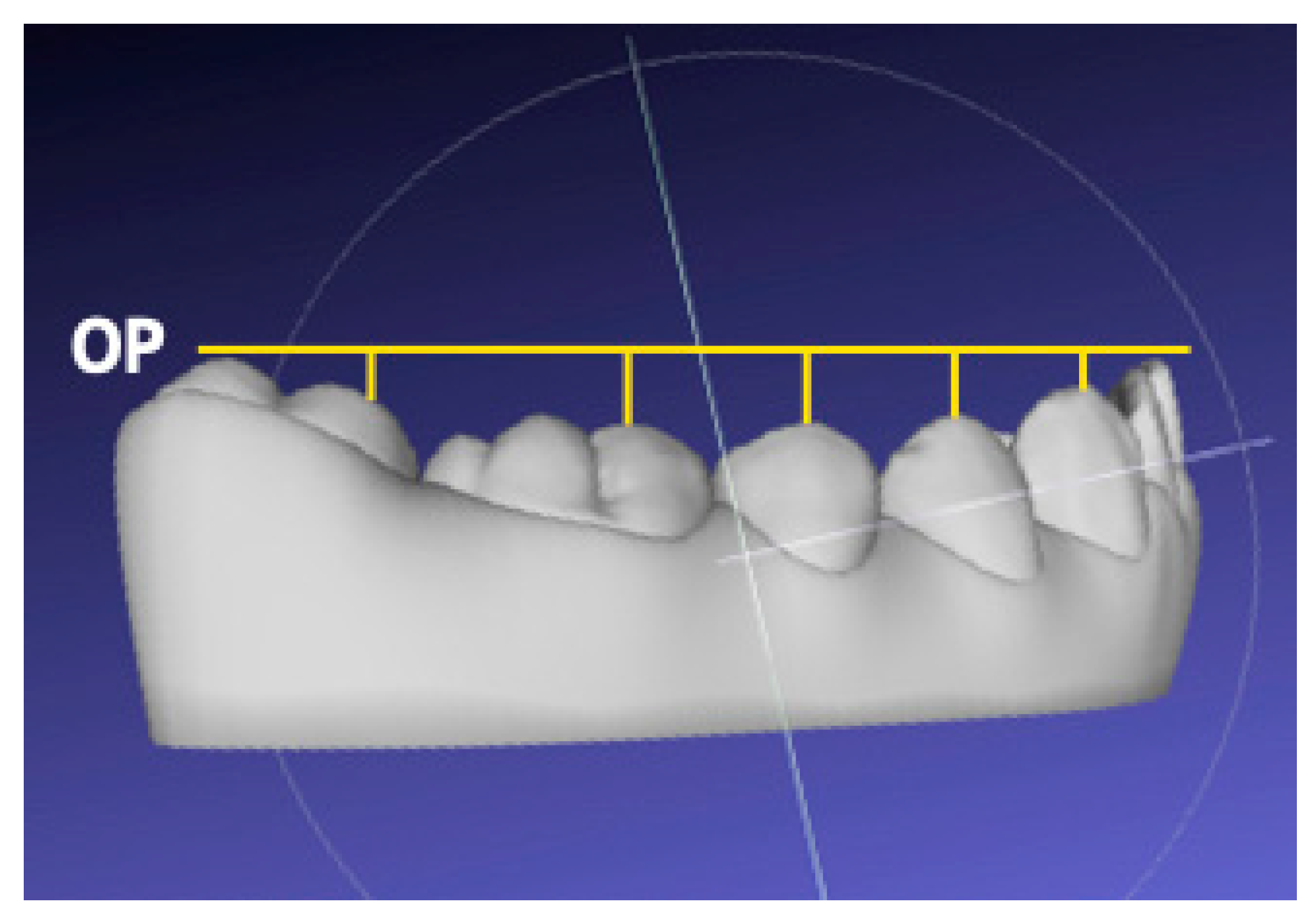
In each model the linear values were measured only of the lower arch as follows: firstly an occlusal plane (OP) of the mandibular arch was defined by drawing a line passing through three reference points, namely the distobuccal cusps of the second molars on the right and left sides and the midpoint of the central incisor edge [
21] (
Figure 3).
Perpendicular distances from the OP to the buccal and mesio-buccal cusp margins of each tooth, from the second molar to the canine on both sides, were evaluated. Measurements were obtained bilaterally by a first orthodontists and independently checked by a second orthodontists.
For each subject, the perpendicular distances correspond to three specific time points:
- -
The initial distance (ID), referring to the vertical linear measurements obtained from the pre-treatment model;
- -
The achieved change (AC), or results, representing the actual achieved outcomes, defined as all measurements performed on the post-treatment model, corresponding to the final position after the first series of aligners;
- -
The expected change (EC), or results, referring to the values derived from the virtual planned model, corresponding to the ideal post-treatment outcome.
2.4. Statistical Analysis
Concerning statistics, measurements were initially obtained by a primary orthodontist and subsequently verified by a second examiner; thus inter-examiner reliability was assessed using the intraclass correlation coefficient (ICC), based on a two-way mixed-effects model with consistency type, across all centers and teeth, showing a good reliability (ICC range = 0.79–0.87). The agreement between right- and left-side measurements was also assessed using the ICC, showing a good agreement across variables (ICC range = 0.76–0.81). Given the good agreement, bilateral measurements were averaged to obtain a single representative value for each variable included in the statistical analysis.
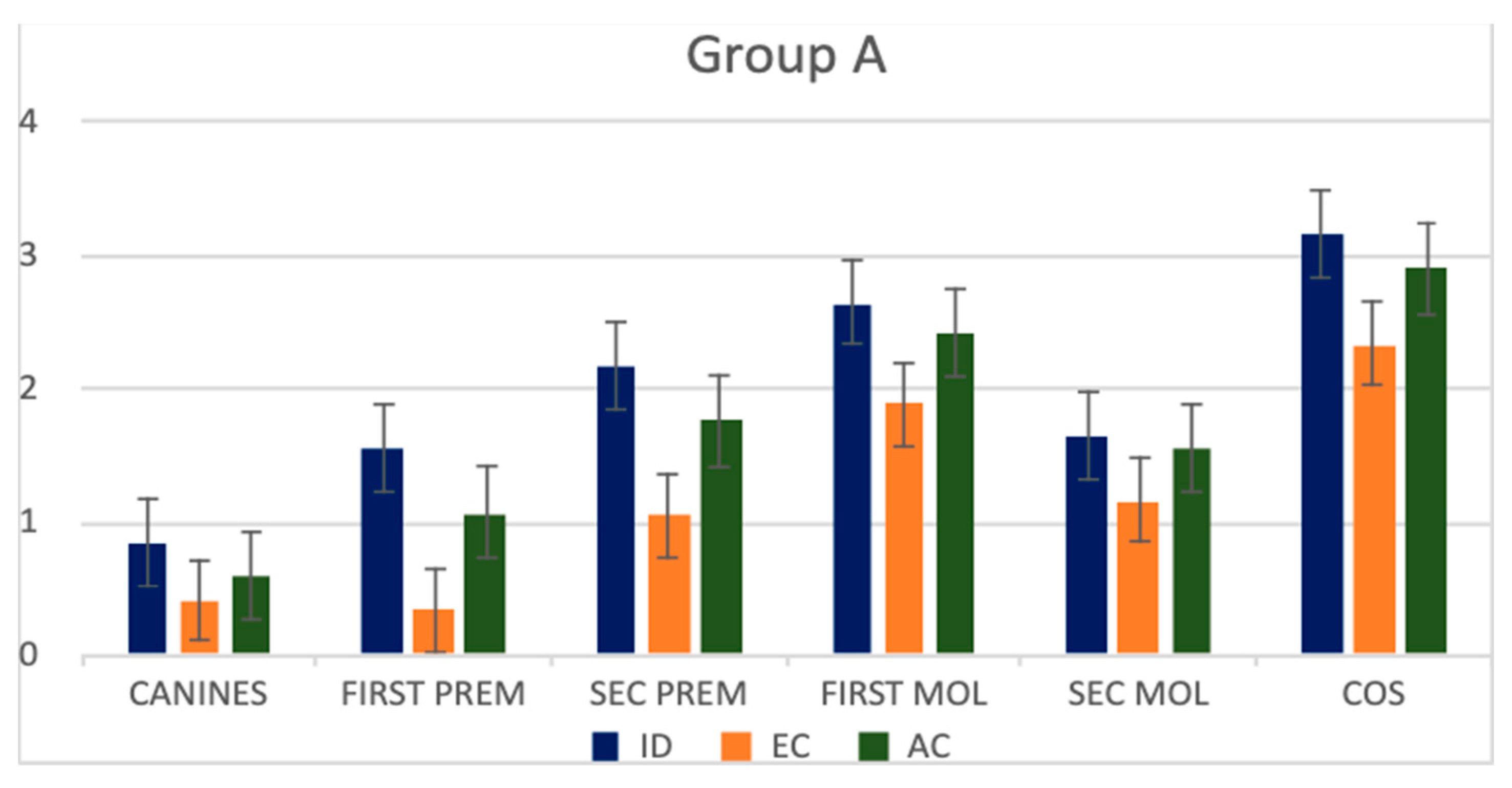
The data regarding pre-treatment (ID), post-treatment results (AC), and expected change (EC) for the three groups were graphically explored by using the mean and standard error (SD) and are summarized in
Table 1, which reports the median with the interquartile range (IQR).
Normality was assessed using graphical methods, and given the small sample size, the Shapiro–Wilk test was applied. To evaluate differences between AC and ID, and between EC and AC, a paired-samples t-test was performed. The significance level was set at 0.05, and
p-values are reported in
Table 2,
Table 3 and
Table 4. To account for multiple comparisons, a Bonferroni correction was applied; however, all results remained statistically significant after adjustment.
Differences between AC and ID, and between EC and AC, were calculated and expressed as mean values and standard deviations. To compare the three groups, one-way ANOVA was performed on the differences between AC and EC, with
p-values reported in
Table 5. Where a statistically significant difference was detected, post hoc pairwise comparisons were conducted using Tukey’s Honestly Significant Difference (HSD) test to adjust for multiple comparisons.
Data analysis was performed using Stata/IC v.15 (StataCorp, College Station, TX, USA) while graphs were constructed using Microsoft Excel v.2021.
3. Results
The study group included 69 patients (32 male and 37 female; mean age of 21y (SD = 2.6)), with 23 subjects for each type of treatment observed.
Baseline analysis showed statistically significant differences in initial severity among groups, particularly between Group A and the other groups. To account for potential confounding, baseline values were included as covariates in multivariable regression models. After adjustment, baseline was not significantly associated with the outcome, suggesting that it did not act as a major confounding factor in the observed group differences.
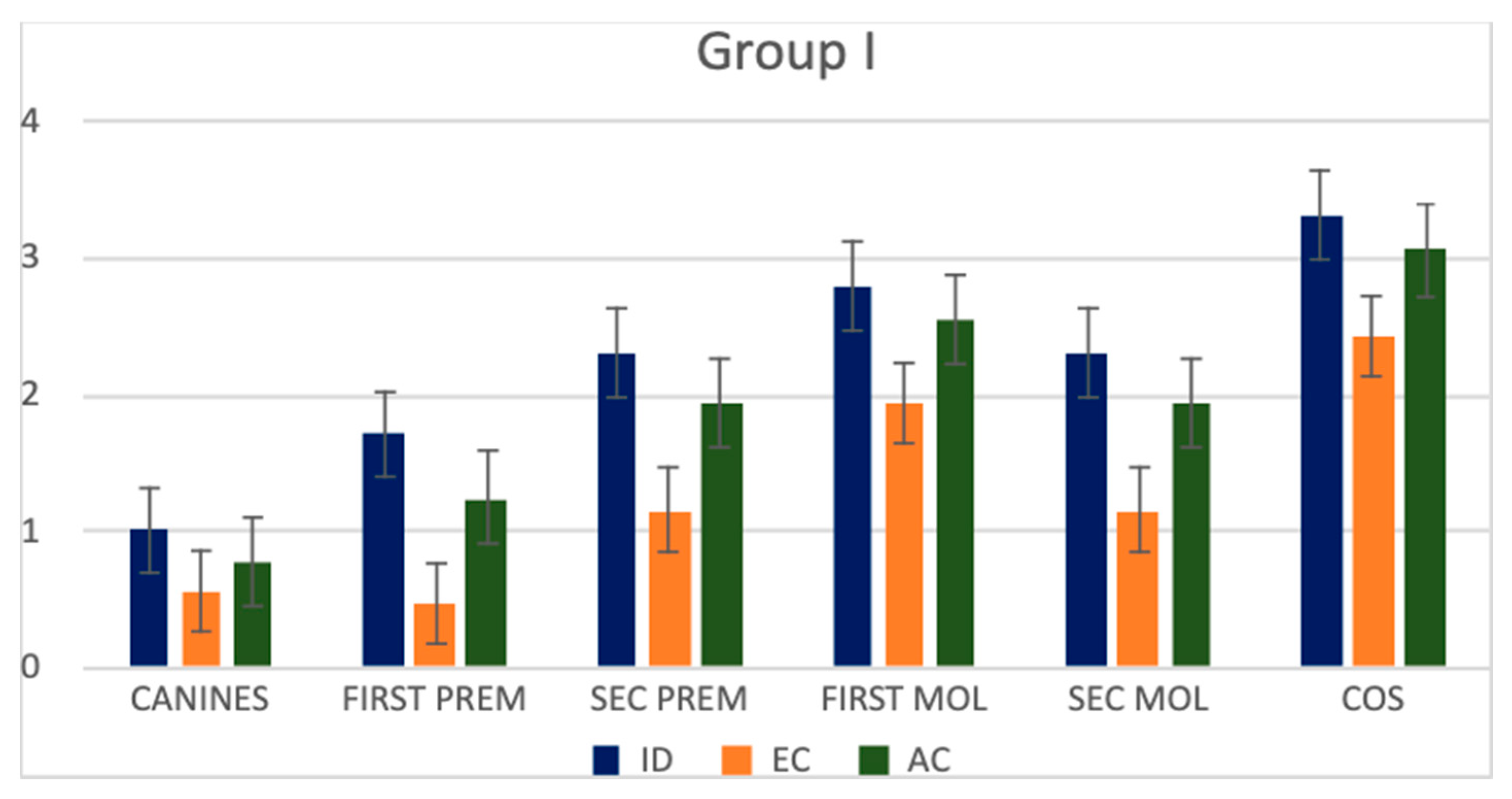
For the first group (Invisalign
®), as shown in
Table 2 and
Figure 4, the greatest depth from the occlusal plane was observed in the first molars, with a mean distance of 2.80 mm (SD = 0.17) and a median of 2.80 mm (IQR= 2.70–2.95).
The results from the comparison between post-treatment (AC) and pre-treatment (ID) showed
p-value ≤ 0.001, leading to the rejection of the null hypothesis according to which the two means were equal, showing a difference instead (
Table 2).
Similarly, the comparison between planned (EC) and achieved (AC) results for every analyzed parameter showed
p-value < 0.001, confirming that there were differences (
Table 2).
It was noted that, in terms of mm, the largest differences between the post-treatment result and the virtual plan were found for the second premolars, with a mean value of 0.79 mm (SD = 0.19).
The highest accuracy (meant as the ability to accurately predict the result compared to the virtually planned objectives) was observed for the canines (52%), while the lowest value was noticed for the second molars (17%) (
Table 6).
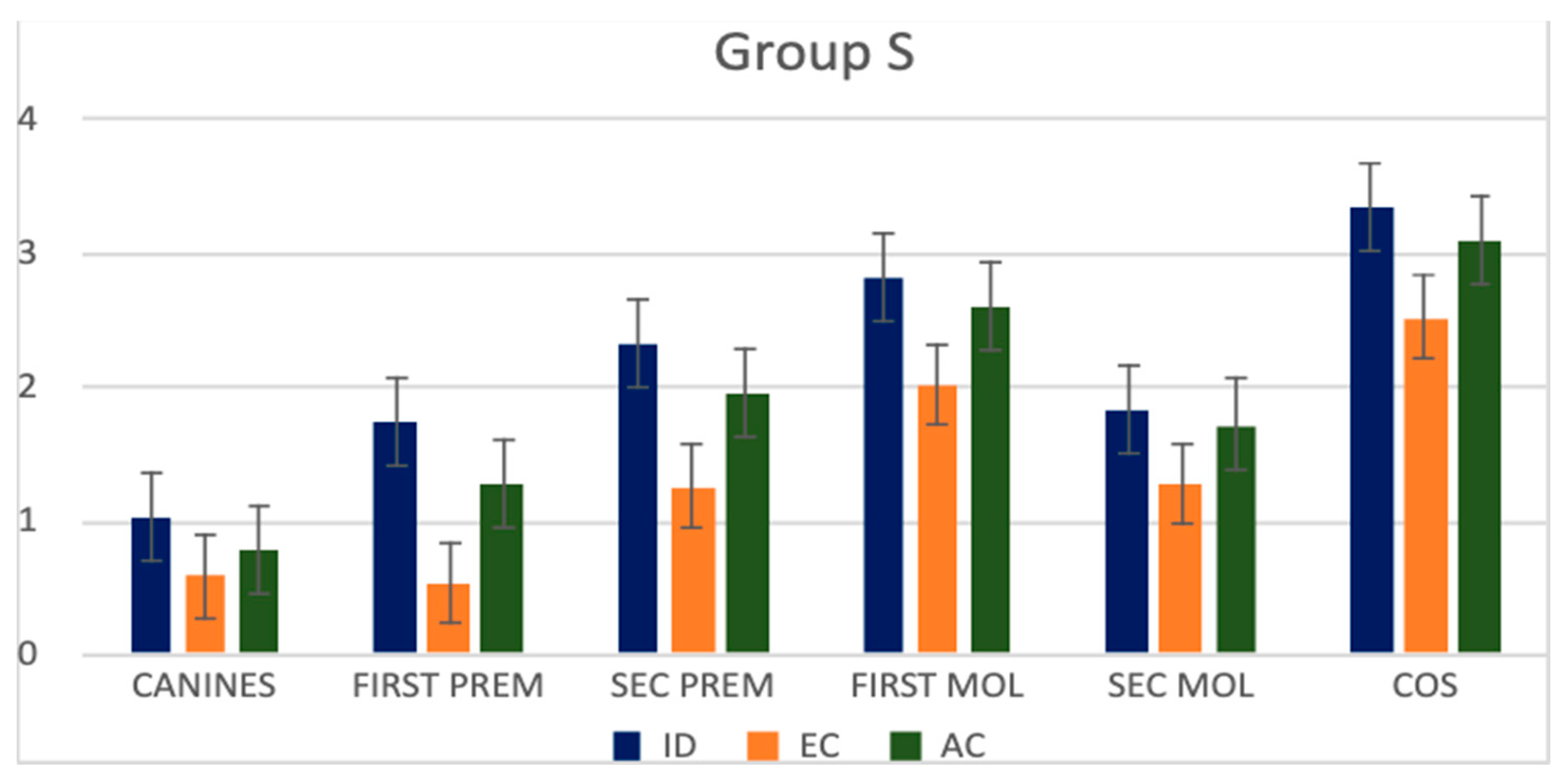
The results in Spark™ group (
Table 3 and
Figure 5) highlighted significant differences from 0 with a
p-value < 0.001. The greatest depth from the occlusal plane, as shown in
Table 1, was observed in the first molars, with a mean distance of 2.6 mm (SD = 0.19) and a median of 2.90 mm (IQR= 2.70–3.00). Specifically, the most relevant differences between AC and EC were recorded in the first premolars, with a mean value of 0.73 mm (SD = 0.11) (
Table 3).
In terms of accuracy, the lowest differences were observed in the second molars (21%), while the highest ones were in the canines accounting for 54% (
Table 6).
In the Angel Aligner™ group (
Table 4 and
Figure 6), the greatest depth from the occlusal plane was observed for the first molars, with a mean distance of 2.65 mm (SD = 0.1) and a median of 2.70 mm (IQR= 2.50–2.70).
All the results emerging from the two comparisons (AC with ID and EC with AC) showed
p-value < 0.001. The largest differences between AC and EC were observed for the first premolars, with a mean value of 0.73 mm (SD = 0.03) (
Table 4).
The lowest accuracy level was observed in the second molars (21%), while the highest one was noted in the canines at almost 58% (
Table 6).
As shown by means of the ANOVA test (
Table 5), the three groups compared by analyzing the delta between the planned and the obtained results did not present statistically significant differences.
An exception was observed for the canines, where one-way ANOVA revealed a statistically significant difference among groups (p < 0.001). Post hoc Tukey analysis demonstrated significant differences between Group A and Group S, as well as between Group A and Group I. For the first premolars, a significant difference was also detected (p = 0.020), with post hoc comparisons indicating differences between Group I and Group A, and between Group I and Group S. Finally, the first molars also showed a statistically significant difference (p = 0.047), specifically between Group I and Group A.
The study on accuracy (
Table 6) did not show a high treatment level of precision. Overall, higher values were reported for the canines, whereas lower values were shown for second molars, with an overall mean slightly above 30% across the three groups.
4. Discussion
The aim of this study was to evaluate the COS correction by using aligners. Specifically, efficiency and effectiveness of the three brands of aligners were investigated.
To date, we know that no orthodontic appliance, whether fixed or removable, achieves 100% of the prescribed movements [
22]. This limitation is particularly relevant in vertical control, where biomechanical expression is influenced by force magnitude, occlusal contacts, and anchorage balance.
In particular, COS leveling by using straight-wire technique reported 50% expression of the arches in 0.022-inch edgewise slots, strongly recommending an overcorrection strategy, such as reverse curves, to achieve higher clinical predictability [
23].
A similar consideration may also apply to clear aligner therapy, where digital staging represents an idealized force system rather than the true biological outcome. Studies on predictability are helping clinicians determine whether overcorrection adjustments are necessary to actually achieve the desired movements. In this context, evidence from systematic reviews further supports the notion that the clinical expression of planned movements is often incomplete and highly variable. Papadimitriou et al. [
24], in a systematic review on the clinical effectiveness of Invisalign
® therapy, reported a moderate level of evidence with considerable heterogeneity among available studies, highlighting that predicted tooth movements are not fully achieved in clinical reality and that treatment outcomes are influenced by multiple biological and biomechanical factors.
Actually, aligners deliver intermittent and distributed forces that are highly dependent on material properties, fit, and the complex interaction between aligner and occlusal surfaces. Therefore, the discrepancy between virtual setup and achieved outcome is an expected phenomenon rather than an exception. Studies on predictability are therefore essential to better understand the real clinical effectiveness of programmed movements and to determine whether systematic overcorrections are required.
In the present study, the difference between achieved and planned COS leveling was analyzed across three aligner systems. Three samples of young adults in permanent dentition were considered: the mean depth of COS corresponded to 3.32 mm (SD = 0.17) for the Invisalign
® group, 3.34 mm (SD = 0.18) for the Spark™ group, and 3.16 mm (SD = 0.14) for the Angel™ Group (A), while the median values were respectively 3.30 mm (IQR = 3.20–3.45), 3.40 mm (IQR = 3.20–3.50), and 3.20 mm (IQR = 3.05–3.20) (
Table 1). These baseline similarities strengthen the comparability of the three cohorts and reduce potential bias related to initial severity.
Regarding measurements, strategic reference points were selected in order to include multiple dental elements and different vertical levels of the occlusal curvature, allowing a more accurate evaluation of every single dental movement.
The analyzed data of all three groups (
Table 2,
Table 3 and
Table 4) underscored statistically significant differences between post and pre-treatment measurements (Δ AC-ID), in agreement with the previous literature, confirming that COS leveling occurs but not with full expression of the programmed movements. Specifically, the teeth that obtained a greater programmed correction across the three groups were the first premolars, whereas the molars extruded to a lesser extent, especially the second ones. These findings are consistent with the previous literature, indicating reduced predictability of vertical movements in posterior segments [
15,
25].
This reduced predictability may be explained by multiple biomechanical factors, including the inherent “bite-block effect” of aligners, high occlusal load concentration on molars, and limited vertical freedom within the aligner material [
15]. According to a recent review of 26 years of evidence on deep-bite correction with aligners, posterior extrusion remains difficult to achieve due to the aligner itself acting as an occlusal splint, generating a bite-block effect that may counteract the programmed vertical movement. This phenomenon may contribute to the reduced effectiveness of curve of Spee leveling observed in the present sample [
26].
Auxiliaries include inter-arch elastics from lower first molars or even the use of a stiffer material, with greater clearance between the inner surface of the aligner and the occlusal surface of the tooth; these are all factors that could promote a greater extrusive force vector on the tooth [
15].
In contrast, higher values of movement have been reported by Khosravi et al. [
23]. This discrepancy is likely attributable to a different methodological approach, as that study evaluated outcomes over multiple sets of additional aligners and at the end of the therapy and so there was more treatment time and a greater number of aligners to express the planned movements. Therefore, extrusion effectiveness may increase when assessed at the end of comprehensive treatment rather than only at the end of the first set of aligners, as performed in our study.
The present results also showed that the least pronounced movements were those of the second molars, in agreement with previous findings in the literature [
10]. This may be related to reduced aligner adaptation, decreased control in the most distal segments, and biomechanical dissipation of forces along the arch length.
When comparing achieved versus digitally planned movements (Δ AC-EC), statistically significant differences were again observed across all three groups, with the greatest discrepancy at the premolar level. These findings confirm that a perfect correspondence between virtual planning and clinical outcome is not achieved. The discrepancy observed between planned and achieved outcomes is consistent with previous evidence indicating that virtual treatment setups tend to overestimate the actual expression of programmed tooth movements. Grünheid et al. [
27] demonstrated that final tooth positions frequently differ from those predicted by the digital setup, emphasizing the biological and biomechanical factors that limit the complete realization of planned movements during aligner therapy.
Consequently, the larger the discrepancy between planned and obtained movement, the lower the predictability of the system. This highlights the importance of understanding not only whether a movement occurs, but also how closely it follows the digital prescription.
Overall, higher values were reported for the canines, while lower ones were recorded for the second molars. The first premolars generally performed slightly better than the second premolars, while the first molars turned out better than second ones, evidencing a difference from the previous literature reporting better performance in second molars (up to 52% accuracy) [
15]. Nevertheless, the overall trend remains consistent with the concept that posterior vertical movements are among the least predictable in aligner therapy. Haouili et al. [
9] similarly reported an average molar extrusion accuracy of approximately 40%, identifying these as one of the least predictable movements.
For the purposes of completeness, an intergroup comparison test was also performed regarding treatment predictability (
Table 6). The statistical evidence showed that there was no significant difference between the three systems used. In addition to the individual dental elements, to explain the effectiveness and predictability of the treatment more clearly, the leveling of the COS was also analyzed. Overall treatment accuracy analysis (
Table 6) revealed relatively low predictability, with an average slightly above 30%. Among the three systems, Angel Aligner™ demonstrated higher overall accuracy (36%), which may reflect differences in aligner material properties, force delivery consistency, or the interaction between staging protocols and biomechanical response. However, intergroup comparison did not reveal statistically significant differences, suggesting that despite small numerical variations, the three systems behave similarly in terms of overall predictability.
From a biomechanical perspective, it is important to emphasize that each orthodontic movement is composed of multiple components acting simultaneously in three dimensions. As previously suggested by Castroflorio et al. [
10], isolating a single movement inevitably simplifies a highly complex reality, where force vectors, occlusal contacts, and material deformation continuously interact. Moreover, the final phase of the digital setup represents an idealized endpoint that does not fully account for biological variability and intraoral environmental factors.
In this study, the overall leveling of the COS showed limited predictability in all three groups. It should be considered that the included patients presented severe deep bite with a COS > 3 mm at baseline and were treated without auxiliary devices, and outcomes were assessed at the end of the first set of aligners without refinements. These factors likely contributed to the relatively lower predictability values compared to studies including refinements or adjunctive mechanics.
The present study has several limitations that should be acknowledged. First, its retrospective design and the inherent lack of randomization may introduce selection bias; however, strict inclusion and exclusion criteria were applied to minimize heterogeneity and improve sample consistency. Although the study was conducted across three private orthodontic clinics, potential operator-related variability in clinical execution and decision-making was minimized, as the main clinician responsible for patient recruitment, treatment planning, and protocol standardization was the same across all centers. This contributed to maintaining consistency in case selection and treatment procedures throughout the study. Standardized protocols for data collection and treatment execution were additionally applied in all participating clinics to further reduce inter-operator variability. Moreover, the use of digital STL models contributed to enhancing the reproducibility and reliability of the measurement protocol, allowing standardized landmark identification and consistent assessment of treatment outcomes across all subjects.
It should also be acknowledged that alternative attachment designs, including optimized or individualized configurations, may influence force distribution and the biomechanical expression of specific tooth movements, particularly in the vertical dimension. Although conventional attachments were used in the present study to ensure methodological consistency and sample homogeneity, different attachment designs may potentially modify the efficiency of extrusion mechanics and therefore deserve further investigation to improve the predictability of complex movements such as curve of Spee leveling and deep-bite correction.
Another relevant limitation is the absence of direct monitoring of patient compliance, including actual daily aligner wear time, which remains a known confounding factor in aligner-based therapy. However, adherence was routinely assessed during monthly follow-up visits through clinical evaluation, including assessment of aligner fit, degree of wear, and overall adaptation on the dental arches. Although these methods provide a clinically useful indication of compliance, it should be acknowledged that they remain indirect and partially subjective and therefore cannot fully replace objective monitoring systems.
Finally, a potential limitation of the present study is the relatively small sample size. Despite the aforementioned limitations, the multicenter design, standardized protocols, and homogeneous sample represent strengths of the study and contribute to reducing potential bias. In addition, it should be emphasized that the inclusion of three different aligner systems within the same methodological framework represents a distinctive strength compared to previously published studies, allowing a more direct comparison of system-related performance under standardized conditions.
Overall, the present findings contribute to a more realistic understanding of the biomechanical behavior of clear aligners in the vertical dimension, particularly in the context of deep-bite correction and COS leveling. These results may assist clinicians in setting more evidence-based expectations during treatment planning, especially regarding the need for potential overcorrection strategies in complex vertical discrepancies. Further prospective studies with larger samples and inclusion of refinements or adjunctive mechanics are warranted to better refine the predictability of vertical movements in aligner therapy.