Article

Pattern Separation and Related Cognitive Functions in Combat and Contact Sports Athletes: Working Memory, Attention, and Processing Speed


by
Alessandro Santirocchi
1,*,
Clelia Rossi-Arnaud
1,
Dario Benelli
2,
Christian Barbato
3,
Antonio Minni
4,5 and
Vincenzo Cestari
1
1
Department of Psychology, Sapienza University, 00185 Rome, Italy
2
Department of Molecular Medicine, Policlinico Umberto I, Sapienza University of Rome, 00161 Rome, Italy
3
Institute of Biochemistry and Cell Biology (IBBC-CNR), Policlinico Umberto I, Sapienza University Rome, 00161 Rome, Italy
4
Division of Otolaryngology-Head and Neck Surgery, Ospedale San Camillo de Lellis, ASL Rieti-Sapienza University, 02100 Rieti, Italy
5
Interdisciplinary Department of Well-being, Health and Environmental Sustainability (BeSSA), Sapienza University of Rome, Via delle Fontanelle, 02100 Rieti, Italy
*
Author to whom correspondence should be addressed.
Appl. Sci. 2026, 16(12), 6245; https://doi.org/10.3390/app16126245 (registering DOI)
Submission received: 29 May 2026 / Revised: 16 June 2026 / Accepted: 19 June 2026 / Published: 22 June 2026

Featured Application

Combat sport athletes showed reduced pattern separation, a key process for distinguishing similar memories. Fighters performed worse than other groups in working memory, attention, and processing speed tasks. Findings support cognitive monitoring across athletes’ careers.

Abstract

Repetitive head impacts (RHIs) in combat and contact sports are associated with long-term neuropsychological consequences. The present study explores episodic memory performance, with a focus on pattern separation, a memory process associated with hippocampal function, in athletes characterized by different exposure profiles to RHIs. The study included 26 fighters (boxing, Mixed Martial Arts, Muay Thai), 20 rugby players, and 26 age-matched controls. Participants completed the Mnemonic Similarity Task (MST) and additional cognitive measures (Digit Span, Digit Symbol Substitution Test, Attentional Matrices, and N-back tasks). Group differences were assessed using ANCOVAs. Results indicated that fighters exhibited significantly poorer pattern separation performance compared to both rugby players and controls. Rugby players also performed worse than controls on the pattern separation measure, revealing a graded pattern of performance across groups. Additionally, fighters demonstrated slower reaction times during the MST and lower performance on the N-back tasks relative to both comparison groups. Overall, athletes participating in sports characterized by different exposure profiles to RHIs showed distinct patterns of cognitive performance, with the most pronounced differences observed in fighters. These findings highlight pattern separation as a potentially sensitive cognitive marker in athletes participating in combat and contact sports and underscore the need for longitudinal studies incorporating objective measures of head-impact exposure.

1. Introduction

Concerns about the short- and long-term consequences of concussions in sport have grown significantly over the past decade [1]. Accumulating longitudinal evidence [2] and systematic reviews [3,4] have linked repeated concussions to cognitive decline and neurodegenerative diseases. These conditions may predispose athletes to a range of neuropsychiatric repercussions [5] and to impairments in memory processes [6,7,8]. Both concussion [9] and subconcussion [10] events have been shown to compromise long-term cognitive functioning. Most research, however, has focused on diagnosed concussions, typically defined as biomechanical injuries to the brain that result in transient neurological symptoms [11]. Subconcussions refer to head impacts that do not meet the clinical threshold for concussion diagnosis but may still induce pathophysiological changes in the brain over time [12]. The concept of subconcussion, however, remains debated. A systematic review by Mainwaring et al. (2018) [10] highlighted the lack of a consistent definition across studies, complicating both the operationalization and interpretation of findings. Although each incident may appear benign, the cumulative burden of subconcussions has been increasingly linked to alterations in both brain function and structure [10,13]. Because this issue is particularly relevant in combat and contact sports, where athletes are exposed to repetitive head impacts (RHIs), and given the difficulty of clearly differentiating between concussion and subconcussion events in this population, the present study will use the overarching term RHIs to refer to this specific type of head trauma. Indeed, in combat sports like boxing and MMA, head strikes are frequent and often intentional, especially in boxing, where repeated blows to the head are central to the sport. Rugby, by contrast, involves unintentional but high-intensity impacts, typically occurring during tackles, rucks, and scrums. Although the nature and frequency of impacts differ, more frequent but lower-force in combat sports, less frequent but higher-force in rugby, both exposure profiles have been associated with cognitive deficits, particularly in memory, executive function, and attention [14,15]. Other potential confounding factors such as training duration, lifestyle habits, and undiagnosed concussions may also influence cognitive outcomes in athletes and are acknowledged as possible sources of individual variability. Concerning memory, a meta-analysis by Zhang et al. (2019) [16] reported that retired athletes with a history of concussions exhibit significant impairments in both verbal memory and delayed recall compared to non-concussed individuals. Similarly, a recent review by Danielli et al. (2023) [17] provided evidence of altered cerebral blood flow and reduced activity in the hippocampus following concussion, which may account for the frequent occurrence of memory-related symptoms. The neurological basis of these cognitive deficits might be linked to dysfunction in the hippocampus, particularly the dentate gyrus (DG). This subregion is critically involved in memory encoding and pattern separation, a function crucial for distinguishing similar experiences and reducing mnemonic interference. Pattern separation refers to the ability to transform similar inputs into distinct, non-overlapping representations, thereby supporting the formation of unique memories with minimal interference [18,19]. Accurate episodic memory depends on the capacity to encode details with high specificity, allowing similar experiences to be discriminated and preventing interference. Pattern separation is essential for preserving episodic memory accuracy by minimizing overlap between similar experiences. In humans, one commonly used paradigm to assess the behavioral outcome of pattern separation is the Mnemonic Similarity Task (MST). In this task, participants initially view a series of object images during an encoding phase. At test, they are presented with three types of stimuli: targets (identical to those seen at encoding), lures (similar but not identical exemplars), and foils (entirely new and dissimilar items) [20]. Successful performance requires the generation of high-resolution mnemonic representations to accurately discriminate between previously seen items and similar lures, thereby indexing pattern separation ability [20].
Pattern separation is sensitive to subtle hippocampal dysfunctions and may reveal impairments that traditional recognition memory tests might miss. Moreover, given the reported vulnerability of the DG to mechanical stress [21] and the frequency of RHIs in certain sports, pattern separation may represent a potentially informative cognitive process for investigating memory functioning in athletes exposed to RHIs. Unlike traditional recognition measures, which can often be supported by familiarity-based processes, pattern separation requires the discrimination of highly similar stimuli and may therefore be more sensitive to subtle memory alterations that remain undetected by conventional memory tasks. Supporting this, Tremblay et al. (2012) [22] found that former university-level athletes with a history of concussions exhibited significant impairments in episodic memory and semantic verbal fluency compared to controls. Similarly, Parivash et al. (2019) [23] reported that American football players showed a significant reduction in hippocampal volume over the course of one year, a pattern not observed in volleyball players. Although a growing body of research has examined memory performance in athletes exposed to RHIs, no previous study has specifically investigated pattern separation in athletes participating in combat and contact sports characterized by different exposure profiles to RHIs.
The present study therefore had two aims. (1) The primary aim was to examine pattern separation and related cognitive functions in athletes exposed to RHIs, compared with non-exposed controls. (2) As a secondary, exploratory aim, we compared sport groups with contrasting impact profiles (combat sports vs. rugby) to assess whether group membership—used here as a proxy for differing RHI exposure profiles—was associated with cognitive performance; because exposure was not quantified with a common objective metric across sports, these between-sport comparisons are treated as exploratory. Based on the differing nature and frequency of head impacts across these groups, we hypothesized that fighters would show the lowest performance in pattern separation and related cognitive measures, followed by rugby players, whereas controls would exhibit the highest performance.

2. Materials and Methods

2.1. Participant

Participants were divided in three groups: Fighters, Rugby players, Controls. In the Fighter group, twenty-six professional athlete boxers, Muay Thai, and Mixed Martial Arts (MMA) were recruited (age: M = 24.07; education: M = 15.07). Twenty rugby players were included in the second group (age: M = 25.65; education: M = 15.95) and, lastly, twenty-six age-matched controls took part in the study (age: M = 23.07; education: M = 15.15). The fighter and rugby players were professional or competitive athletes affiliated with clubs or teams training in the Lazio region of Italy, whereas the control group consisted of recreationally active, non-competitive individuals. Table 1 and Table 2 provide a detailed description of the sport-specific variables for each group. Participants were all male (see Table 3 for means). Inclusion criteria for the current study were male gender, the ability to provide informed consent independently, and normal or corrected-to-normal vision. The present study included only male participants to ensure sample homogeneity and to control for potential gender-related differences in cognitive performance following concussion. For the Fighter and Rugby player groups, participants were included if they had a history of regular engagement in contact or combat sports for at least three consecutive years. The Control group consisted of individuals who engaged in recreational physical activity but were neither professional nor competitive athletes and had no history of participation in contact or combat sports. Exclusion criteria for the Control group were (1) a history of traumatic brain injury resulting in loss of consciousness or a clinically diagnosed concussion; (2) a history of neurological or psychiatric conditions; (3) previous participation in contact or combat sports. Exclusion criteria for the Fighter and Rugby player groups were (1) a history of neurological or psychiatric conditions; (2) a history of non-sports-related brain injury (e.g., traumatic brain injury occurring outside of sports activities). The research was approved by the Institutional Review Board (IRB) of the University Sapienza of Rome (Protocol N. 0000393), and all respondents signed an informed consent before participating. The procedures adhered to the guidelines established by the Declaration of Helsinki.

2.2. Pattern Separation Task

The present study employed the Mnemonic Similarity Task (MST) [20] to assess pattern separation, aiming to investigate whether individuals who engage in contact and combat sports, and are exposed to RHIs, exhibit reduced mnemonic abilities compared to controls. The MST has been widely used for assessing pattern separation abilities across clinical and non-clinical populations, including aging individuals and patients with mild cognitive impairment [20,24]. Although no specific validation studies have been conducted in athletes exposed to RHIs, the MST’s sensitivity to subtle hippocampal activation [25] makes it a suitable tool for detecting potential cognitive alterations associated with RHIs. The MST includes two phases: an encoding phase and a retrieval phase. During encoding, participants viewed 128 images of objects on a computer screen and classified each item as used indoors or outdoors by pressing the corresponding key on the keyboard. Each image was displayed for 2 s, with an inter-stimulus interval (ISI) of 0.5 s. In the retrieval phase, 192 images were presented, comprising 64 new images, 64 identical images, and 64 images similar to those shown during encoding. Participants were asked to classify each image as new (foil), old (target), or similar (lure), based on their memory from the encoding phase. The total test duration was approximately 12 min. To evaluate pattern separation performance, we calculated the Lure Discrimination Index (LDI) by subtracting the probability of giving a “similar” response to foil items from the probability of giving a “similar” response to lure items. A higher LDI indicates better pattern separation ability and helps control for any response bias toward “similar” choices. Additionally, we calculated a Recognition Memory Score (REC) by subtracting the percentage of “old” responses to foil items from the percentage of “old” responses to target items (hits minus false alarms), where a higher score reflects better recognition accuracy. The MST’s lack of test–retest effects [20,24] ensures that performance is not substantially influenced by practice effects, making it particularly suitable for evaluating changes associated with various interventions.
Reaction times in the MST were analyzed only for correct responses; no additional outlier-removal or trimming procedure (for example, for anticipatory or extreme values) was applied, and all correct-response trials were retained in the analyses. This choice was made to avoid imposing arbitrary exclusion thresholds and to preserve all valid responses; we nonetheless acknowledge it as a minor analytical limitation, since untrimmed latencies may remain somewhat more sensitive to occasional extreme values.

2.3. Cognitive Measures

Two subtests of the WAIS-IV [26] were administered to all participants: the Digit Span (forward and backward), to assess working memory, and the Digit Symbol Substitution Test (DSST) [27] to assess processing speed, writing speed, and working memory. For the assessment of working memory, we utilized the 2-back and 3-back versions of the N-back task [28]. In this study, we specifically employed the visuo-verbal variant of the task, focusing on these two conditions, which are less susceptible to ceiling effects and are widely recognized as reliable and valid measures of working memory and executive functions. Research has shown that reaction time (RT) measures in the 2-back and 3-back conditions exhibit marginal to high reliability, while accuracy measures remain robust, particularly when simpler tasks like the 1-back are excluded, thereby minimizing ceiling effects [29]. The N-back task is therefore considered a reliable and effective tool for evaluating working memory performance [30]. To evaluate the ability of attentional selection of specific targets and the speed of visual scanning we used the Attentional Matrices [31], which have demonstrated good validity and internal reliability. Since the cognitive tasks were scored on heterogeneous scales, raw scores from the WAIS-IV subtests and the Attentional Matrices were rescaled to a 0–1 range by normalizing each score to the maximum value observed in the sample for that measure. The N-back tasks were scored as proportions of correct responses (accuracy scores ranging from 0 to 1). For all these measures, higher values indicate better performance. The MST indices (LDI and REC) were computed as described in Section 2.2. Cognitive tasks were administered using two different software tools. The N-back task was programmed and executed using custom scripts developed in MATLAB R2021b, running on a MacBook Air (2016 model) with a 13.3 (resolution: 1440 × 900 pixels). For the MST, we used the official stand-alone version available from the Stark Lab website [32]. No formal calibration procedures were performed for reaction time measurements; however, all participants completed the tasks using the same device and under identical laboratory conditions, minimizing potential variability related to hardware or software differences.

2.4. Procedure

The study was conducted at the Department of Psychology of Sapienza University of Rome. The procedure comprised several phases. Initially, all participants signed the informed consent form and underwent a medical history checklist, along with a questionnaire regarding their sport activity. For the fighters, the recorded variables included the total number of knockouts (KOs) received, the number of bouts fought without headgear, the number of bouts fought with headgear, the total number of bouts fought, the average number of training hours per day, and the average number of training sessions per week. For the rugby players, the recorded variables included the number of diagnosed concussions reported during their rugby career, the average number of training hours per day, and the average number of training sessions per week (see Table 1 and Table 2). Participants in the control group were asked whether they engaged in any form of sport or physical training and, if so, how many times per week. All participants were also asked to report any prior instances of diagnosed concussion, including the date of occurrence. For the Fighting group, athletes were additionally asked to indicate the number of knockouts (KOs) sustained throughout their sporting career. Although no upper threshold was imposed on the number of previous diagnosed concussions, participants were required to provide detailed information on the number, severity, and timing of any prior diagnosed concussions through a structured self-report questionnaire. Subsequently, participants were asked to provide details regarding their most recent training or sparring session, including whether it had taken place within the preceding 24 h. Recent training or sparring, as well as match participation, were recorded descriptively but were not used as exclusion criteria. Once the experimenter explained the procedure in detail, participants completed the battery of cognitive assessments in a randomized order: Digit Span (forward and backward), Digit Symbol Substitution Test (DSST), N-back (2-back and 3-back), Attentional Matrices. After a 5 min break, participants undertook the MST. Upon conclusion of the experimental protocol, the experimenter described the study’s objectives to the participants and addressed any inquiries or uncertainties arising during the experiment.

2.5. Statistical Analyses

All statistical analyses were conducted using JASP (version 0.19.1). Prior to inferential analyses, the ANCOVA assumptions were examined for each outcome using the Levene’s test. Group performance (Controls, Fighting, Rugby) was compared using one-way ANCOVAs controlling for age and education. For outcomes that violated the homogeneity-of-variance assumption, permutation-based ANCOVAs (R package coin) [33] were used. Specifically, permutation-based ANCOVAs were used for Digit Span backward, N-back3, and REC, whereas standard parametric ANCOVAs were used for all remaining outcomes (Digit Span forward, Digit Symbol, Attentional Matrices, N-back2, LDI, and MST reaction times).
Correction for multiple comparisons was applied using the Benjamini–Hochberg false discovery rate (FDR) procedure [34] at one level: across the post-hoc pairwise comparisons following each significant omnibus test. FDR-adjusted values are reported as q (significance at q ≤ 0.05); all omnibus effects that were significant at the uncorrected level remained significant after correction across outcomes. A sensitivity power analysis was conducted using G*Power version 3 to determine the minimum effect size detectable with the available sample. For a one-way ANOVA with three groups, a total sample of 72 participants, α = 0.05, and a target power of 0.80, the smallest detectable effect was f ≈ 0.37 (η2 ≈ 0.12). As a benchmark, a previous study comparing episodic verbal memory across three groups [35] reported large effects for delayed recall and related memory indices (η2p ≈ 0.19–0.24, corresponding to f ≈ 0.48–0.56). Because this benchmark exceeds the minimum detectable effect, the present sample provided sufficient sensitivity to detect effects comparable in magnitude to those reported in the reference study [35]. Moreover, daily training hours and training sessions per week were included as covariates to assess their potential influence on cognitive performance. However, their effects were not statistically significant (all ps > 0.05).
In addition to the omnibus and post-hoc tests, estimated marginal means adjusted for age and education, with 95% confidence intervals, are reported for the primary outcomes (LDI, N-back2, and N-back3), together with 95% confidence intervals for the pairwise group differences (Table 4). As an exploratory analysis of exposure independently of sport category, within the Fighter group we computed Spearman rank correlations between the number of fights (total, without headgear, and with headgear) and the primary cognitive outcomes, with FDR-corrected p-values (Table 5).

3. Results

Descriptive statistics related to age, education, and performance in each task for the three groups (Controls, Fighting, Rugby) are reported in Table 3. There were no significant differences between the three groups concerning age and education (all ps > 0.05). Descriptive statistics related to fight exposure variables for the Fighting and Rugby groups are reported in Table 1 and Table 2.
For the Fighting group, participants had an average of 28.57 fights (SD = 28.6), with an average of 24.15 fights conducted with headgear (SD = 25.5) and 4.42 fights without headgear (SD = 5.9). The average number of knockouts (KOs) reported was 0.38 (SD = 0.7). Fighters reported training an average of 2.08 h per day (SD = 0.6) across 5.27 sessions per week (SD = 0.8). For the Rugby group, participants reported an average of 1.50 concussions (SD = 1.7), with an average of 1.76 daily training hours (SD = 0.4) and 4.85 training sessions per week (SD = 1.4).
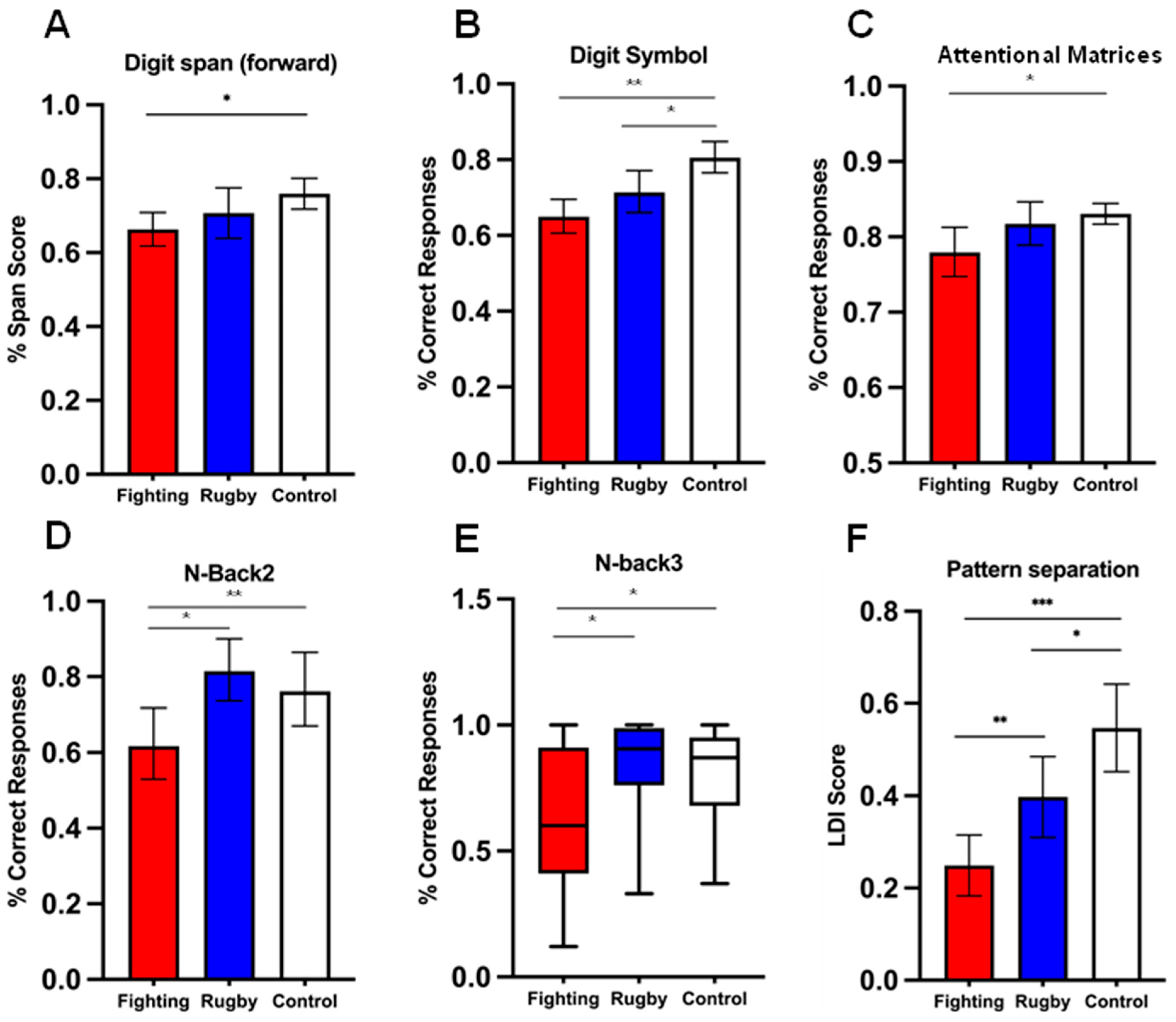
The ANCOVA performed on the Digit Span (forward) between the three groups, controlled for age and education, was significant [F(2, 67) = 3.78, p = 0.028, η2p = 0.10]. Post-hoc comparisons with FDR correction revealed that the Fighting group performed significantly worse than the Control group (q = 0.016), whereas the Rugby group did not differ from the other two (see Figure 1A). The permutation ANCOVA on the Digit Span (backward) between the three groups was not significant (F(2, 67) = 0.68 p = 0.51, η2p = 0.02). The ANCOVA performed on the Digit Symbol between the three groups was also significant [F(2, 67) = 11.4, p < 0.001, η2p = 0.25]. Post-hoc comparisons with FDR correction revealed that Control group’s performance was higher than both the Fighting (q = 0.01) and the Rugby (q = 0.03) groups; in addition, the difference between Fighting and Rugby approached the significance level (q = 0.05) (See Figure 1B). Another significant effect was found between the three groups on the ANCOVA performed on the Attentional Matrices [F(2, 67) = 4.23, p = 0.02, η2p = 0.11]. Post-hoc comparisons with FDR correction revealed that the Fighting group performed worse than the Control group (q = 0.02) and that the performance of the Rugby group did not differ from the other two (see Figure 1C). Taking into account the N-back, the results of the ANCOVA carried out on the N-back2 between the three groups were significant [F(2, 66) = 5.83, p = 0.005, η2p = 0.15]. Post-hoc comparisons with FDR correction showed that the Control and Rugby groups did not differ from each other, whereas the performance of the Fighting group was significantly worse than the performance of the Control (q = 0.01) and Rugby (q = 0.03) groups (See Figure 1D). The permutation ANCOVA on the N-back3 was also significant [F(2, 66) = 6.77, p = 0.002, η2p = 0.17]. The post-hoc comparisons using the FDR showed that the Fighting group performed significantly worse than both the Controls (q = 0.02) and the Rugby group (q = 0.05) (see Figure 1E). Concerning the data of the MST, the ANCOVA carried out on LDI score was statistically significant [F(2,67) = 15.31, p < 0.001, η2p = 0.31]. Post-hoc comparisons with FDR correction revealed a significant difference between all three groups. As shown in Figure 1F, the performance of the control group was significantly higher than both the Fighting (q < 0.001) and Rugby (q = 0.05) groups. The Fighting group also performed significantly worse than the Rugby group (q = 0.01) (See Figure 1F). In the MST, two separate ANCOVAs were conducted to compare reaction times across groups: one when participants correctly identified similar images (lures), and one when they correctly recognized previously seen images (targets). The first analysis was significant [F(2,67) = 4.27, p = 0.018, η2p = 0.11], whereas the second only approached significance [F(2,67) = 3.04, p = 0.055, η2p = 0.083]. Post-hoc comparisons with FDR correction revealed that fighters’ reaction times were significantly slower than controls’ (q = 0.01) when responding correctly to a similar image. However, when applying FDR correction, the difference between groups on the reaction times when responding correctly to an old image was not significant (q = 0.07). Finally, the permutation ANCOVA performed on the REC was not significant (F(2, 67) = 2.67, p = 0.07, η2p = 0.07).
Estimated marginal means adjusted for age and education, with 95% confidence intervals, are reported in Table 4. The corresponding adjusted mean differences (95% CIs) were, for LDI: Control versus Fighting +0.31 [0.20, 0.42], Control versus Rugby +0.15 [0.03, 0.28], and Fighting versus Rugby −0.15 [−0.27, −0.03]; for N-back2: Control versus Fighting +0.13 [0.02, 0.24] and Fighting versus Rugby −0.18 [−0.30, −0.07]; and for N-back3: Control versus Fighting +0.19 [0.07, 0.31] and Fighting versus Rugby −0.21 [−0.34, −0.08].

4. Discussion

The aim of this study was to examine group differences in cognitive performance across athletes participating in combat and contact sports characterized by different RHI exposure profiles, focusing on pattern separation, a memory process associated with hippocampal function [36]. Although prior animal research has shown that repetitive mild traumatic brain injuries can impair spatial memory and pattern separation [37,38], evidence in humans remains limited. To address this gap, we examined MST performance in fighters, rugby players, and controls. Our results showed that fighters exhibited significantly lower LDI scores than both rugby players and controls, indicating reduced pattern separation performance in athletes with higher-exposure profiles, consistent with a possible association with cumulative RHI exposure. Although lower than the scores typically reported in healthy young adults, the values observed in fighters were still higher than those seen in Mild Cognitive Impairment (MCI), suggesting subclinical deficits [24]. By contrast, recognition scores (REC) did not differ significantly between groups. This finding is consistent with previous evidence showing that traditional recognition performance remains relatively stable across aging, even in individuals with reduced memory performance but no clinical diagnosis [24]. One explanation is that recognition relies primarily on familiarity- and gist-based memory processes, rather than detailed episodic recollection, mechanisms that are less sensitive to the kind of subtle hippocampal alterations that may be associated with RHI exposure. Neselius et al. [39] found that amateur boxers did not differ from controls in recognition memory performance. Interestingly, boxers showed a higher proportion of “know” responses, indicative of familiarity-based processing, suggesting that standard recognition tasks may not be sensitive enough to detect subtle cognitive changes associated with RHIs. Taken together, these findings identify LDI as the measure on which group differences were most pronounced, particularly for fighters—a pattern that may be interpreted in light of the proposed sensitivity of hippocampally linked pattern separation to RHI exposure. Supporting this view, amnesic patients with hippocampal damage typically show preserved recognition but impaired pattern separation [40]. Nevertheless, given the behavioral nature of the present study, further neuroimaging research will be necessary to corroborate this interpretation. Moreover, although the differences in reaction times observed during the MST were significant but modest, they may still hold practical relevance. This is particularly true in fast-paced sports such as boxing, where even subtle delays in visual recognition and decision-making can affect real-time responses, potentially leading to late defensive actions, missed opportunities, and increased risk of injury [41,42]. We next examined whether working memory performance, assessed with the N-back task, also differed across groups. Fighters performed significantly worse than both rugby players and controls on the N-back2 and N-back3 conditions. These results align with previous findings [43], which showed that boxers exhibited lower accuracy and slower reaction times than controls on the N-back2 tasks, consistent with the possibility that higher RHI exposure is associated with poorer working memory performance. Interestingly, a study conducted on female boxers found no differences in performance on the 1-back [44]. While the 1-back requires a lower cognitive load compared to the 2-back and 3-back [28], this finding may reflect the limited effect of single training sessions versus the cumulative impact of long-term exposure. However, differences in study populations make direct comparisons difficult, as fighters in our sample came from boxing, MMA, and Muay Thai and were therefore exposed to diverse fighting styles and impact patterns. Given the limited sample size within each discipline, subgroup analyses were not conducted. Therefore, the present findings should be interpreted at the level of the broader combat-sport category rather than as evidence of sport-specific differences. Moreover, RHIs sustained during sparring may contribute to cumulative brain injury as much as competitive bouts [45]. Yet, it remains unclear whether the combination of training and competition produces a compounded effect on cognitive outcomes. Short-term auditory memory, assessed via the Digit Span, revealed that fighters performed significantly worse than both controls and rugby players in the forward condition, while no differences emerged in the backward version. Our findings are in line with Stewart et al. [46], who reported memory alterations in amateur boxers associated with accumulated exposure. Whether such group differences emerge only after prolonged participation, however, cannot be determined from the present cross-sectional design. Processing speed, measured with the Digit Symbol Substitution Test, showed that both the Fighting and the Rugby groups performed worse than the Control group. These difficulties in related learning, partly mediated by working memory [27], are consistent with previous studies reporting slower processing speed in athletes exposed to RHIs, including those engaged in Australian football and rugby [47,48]. Selective attention, assessed with the Attentional Matrices, further indicated that fighters scored significantly lower than controls, whereas rugby players did not differ significantly from either group. This result contrasts with findings from a study on amateur boxers, where no effect of RHIs on visuospatial attention was observed [49]. Such inconsistencies may reflect differences in exposure patterns and protective equipment across sporting disciplines. In line with this reasoning, it is important to consider the different mechanisms of RHIs characterizing the two sport types included in this study. Given that RHI exposure was captured through different, sport-specific self-report metrics rather than a common objective index, these between-sport comparisons should be interpreted as exploratory. In combat sports, athletes are exposed to frequent RHIs during both competition and especially sparring, which have been associated with microstructural brain changes [50]. In contrast, rugby players typically experience fewer but higher-force impacts, mostly during tackles, rucks, and scrums. These distinct exposure profiles, frequent RHIs in combat sports versus less frequent but higher-intensity impacts in rugby, may be accompanied by different patterns of cognitive performance. Indeed, concussion incidence varies markedly across sports, such as amateur boxing [51] and the men’s rugby union [52], underscoring the need to distinguish between impact frequency and intensity.
Several limitations should be acknowledged. First, and most importantly, RHI exposure was not quantified with an objective, individual-level metric common to all groups. Exposure relied on sport-specific self-report variables (e.g., number of bouts, KOs received, and diagnosed concussions), which are incomplete proxies of cumulative head-impact load and are not directly comparable across sports. Beyond the inclusion requirement of at least three consecutive years of contact or combat-sport practice, finer-grained exposure indices—such as years at the professional level, number of sparring sessions, time since the last bout or match, time since the last diagnosed concussion, and head impacts in the days preceding testing—were not collected, and no objective tools (e.g., impact sensors or biomarkers) were available to estimate impact severity. For this reason, the between-sport comparisons are treated as exploratory and associative rather than as evidence of a causal effect of RHIs.
Consistent with this, an exploratory within-group analysis (Table 5) did not reveal reliable associations between the available exposure proxies and cognitive performance; this should be interpreted in light of the modest subgroup size and the limited variability of these proxies, and it does not rule out associations that a larger sample or objective exposure metrics might detect.
Second, the design was cross-sectional, so no causal inferences can be drawn: poorer performance could reflect RHI exposure, pre-existing group differences, sport-selection effects, lifestyle factors, or recent training, rather than a direct effect of cumulative head impacts. Relatedly, because participants were active athletes, the sample may be subject to a survivor/selection bias in that athletes experiencing greater cognitive difficulties may be more likely to discontinue, potentially attenuating exposure–performance associations.
Third, the groups were heterogeneous. The Fighter group combined boxing, MMA, and Muay Thai athletes, who differ in striking techniques, training practices, protective equipment, and impact patterns, introducing within-group variability in head-impact exposure; the Rugby group differs further in impact mechanics and was characterized by a different exposure metric (diagnosed concussions). Because of the limited sample size within each discipline, subgroup analyses were not feasible, and the findings should therefore be interpreted at the level of the broader combat-sport category rather than as evidence of sport-specific differences.
Fourth, recent training or sparring could not be fully controlled and may have influenced performance, particularly in the fighters; this reflects a common challenge in studying active athletes, namely distinguishing chronic changes associated with long-term exposure from the influence of recent acute events. In addition, headgear type, condition, and fit were not systematically assessed, limiting any estimate of their protective role, and individual-level factors known to affect cognition, including sleep quality, nutrition, and stress [53,54], as well as genetic predispositions, were not controlled. Finally, only male participants were included, so the generalizability of the findings to female athletes remains uncertain.
Despite these limitations, consistent group differences emerged across pattern separation, working memory, processing speed, and attention, with pattern separation (LDI) showing the most pronounced differences. To our knowledge, this is the first study to examine pattern separation in athletes exposed to RHIs, and the findings suggest that this hippocampally-linked process may be a more sensitive marker of subtle, subclinical memory alterations than conventional recognition measures. Future longitudinal studies incorporating objective measures of head-impact exposure would help clarify whether, and to what extent, cumulative RHI exposure is associated with longitudinal changes in cognition, particularly in episodic memory; this is especially relevant given systematic-review evidence linking cognitive impairment to the cumulative exposure and duration of athletic careers [2,4].

Author Contributions

A.S. carried out the behavioral studies, statistical analysis, and drafted the manuscript; A.S., V.C., C.B. and C.R.-A. conceived of the study and participated in its design and coordination and helped to draft the manuscript. V.C., C.B., C.R.-A., A.M. and D.B. participated in the revision process of the manuscript. D.B. participated in the additional statistical analyses included in the revised version. All authors have read and agreed to the published version of the manuscript.

Funding

This research received no external funding.

Institutional Review Board Statement

This study was approved by the Institutional Review Board (IRB) of the University Sapienza of Rome (Protocol N. 0000393).

Informed Consent Statement

Informed consent was obtained from all subjects involved in the study.

Data Availability Statement

Data will be made available upon request.

Acknowledgments

The authors would like to thank all those who contributed to this research. We are particularly grateful to the boxing, MMA, Muay Thai (Team NKT), and rugby schools in the Lazio region (Italy) for their cooperation and for making their athletes available for the data collection phase. We would also like to thank Pietro Spataro for his support and guidance throughout the study. We would also like to thank Federica Alessi for her assistance in completing the data collection.

Conflicts of Interest

The authors declare no conflicts of interest.

References

  1. Laker, S.R. Epidemiology of concussion and mild traumatic brain injury. PMR 2011, 3, S354–S358. [Google Scholar] [CrossRef] [PubMed]
  2. Karr, J.E.; Areshenkoff, C.N.; Garcia-Barrera, M.A. The neuropsychological outcomes of concussion: A systematic review of meta-analyses on the cognitive sequelae of mild traumatic brain injury. Neuropsychology 2014, 28, 321. [Google Scholar] [CrossRef] [PubMed]
  3. Manley, G.; Gardner, A.J.; Schneider, K.J.; Guskiewicz, K.M.; Bailes, J.; Cantu, R.C.; Iverson, G.L. A systematic review of potential long-term effects of sport-related concussion. Br. J. Sports Med. 2017, 51, 969–977. [Google Scholar] [CrossRef] [PubMed]
  4. Cunningham, J.; Broglio, S.P.; O’Grady, M.; Wilson, F. History of Sport-Related Concussion and Long-Term Clinical Cognitive Health Outcomes in Retired Athletes: A Systematic Review. J. Athl. Train. 2020, 55, 132–158. [Google Scholar] [CrossRef] [PubMed]
  5. Annegers, J.F.; Coan, S.P. The risks of epilepsy after traumatic brain injury. Seizure 2000, 9, 453–457. [Google Scholar] [CrossRef] [PubMed]
  6. Kumar, S.; Rao, S.L.; Chandramouli, B.A.; Pillai, S. Reduced contribution of executive functions in impaired working memory performance in mild traumatic brain injury patients. Clin. Neurol. Neurosurg. 2013, 115, 1326–1332. [Google Scholar] [CrossRef] [PubMed]
  7. Arciniega, H.; Shires, J.; Furlong, S.; Kilgore-Gomez, A.; Cerreta, A.; Murray, N.G.; Berryhill, M.E. Impaired visual working memory and reduced connectivity in undergraduates with a history of mild traumatic brain injury. Sci. Rep. 2021, 11, 2789. [Google Scholar] [CrossRef] [PubMed]
  8. Alosco, M.L.; Barr, W.B.; Banks, S.J.; Wethe, J.V.; Miller, J.B.; Pulukuri, S.V.; Culhane, J.; Tripodis, Y.; Adler, C.H.; Balcer, L.J.; et al. Neuropsychological test performance of former American football players. Alzheimer’s Res. Ther. 2023, 15, 1. [Google Scholar] [CrossRef] [PubMed]
  9. Howlett, J.R.; Nelson, L.D.; Stein, M.B. Mental Health Consequences of Traumatic Brain Injury. Biol. Psychiatry 2022, 91, 413–420. [Google Scholar] [CrossRef] [PubMed]
  10. Mainwaring, L.; Ferdinand Pennock, K.M.; Mylabathula, S.; Alavie, B.Z. Subconcussive head impacts in sport: A systematic review of the evidence. Int. J. Psychophysiol. 2018, 132, 39–54. [Google Scholar] [CrossRef] [PubMed]
  11. McCrory, P.; Meeuwisse, W.; Dvořák, J.; Aubry, M.; Bailes, J.; Broglio, S.; Cantu, R.C.; Cassidy, D.; Echemendia, R.J.; Castellani, R.J.; et al. Consensus statement on concussion in sport—The 5th international conference on concussion in sport held in Berlin, October 2016. Br. J. Sports Med. 2017, 51, 838–847. [Google Scholar] [CrossRef] [PubMed]
  12. Johnson, B.; Neuberger, T.; Gay, M.; Hallett, M.; Slobounov, S. Effects of subconcussive head trauma on the default mode network of the brain. J. Neurotrauma 2014, 31, 1907–1913. [Google Scholar] [CrossRef] [PubMed]
  13. Bailes, J.E.; Petraglia, A.L.; Omalu, B.I.; Nauman, E.; Talavage, T. Role of subconcussion in repetitive mild traumatic brain injury. J. Neurosurg. 2013, 119, 1235–1245. [Google Scholar] [CrossRef] [PubMed]
  14. Hume, P.A.; Theadom, A.; Lewis, G.N.; Quarrie, K.L.; Brown, S.R.; Hill, R.; Marshall, S.W. A Comparison of Cognitive Function in Former Rugby Union Players Compared with Former Non-Contact-Sport Players and the Impact of Concussion History. Sports Med. 2017, 47, 1209–1220. [Google Scholar] [CrossRef] [PubMed]
  15. Barcelos, G.; Miranda de Oliveira, J.G.; Melo, R.; Norte, C.E.; Filgueiras, A. Concussion and executive functions in combat sports: A systematic review. J. Sports Sci. 2024, 42, 2402–2411. [Google Scholar] [CrossRef] [PubMed]
  16. Zhang, Y.; Ma, Y.; Chen, S.; Liu, X.; Kang, H.J.; Nelson, S.; Bell, S. Long-Term Cognitive Performance of Retired Athletes with Sport-Related Concussion: A Systematic Review and Meta-Analysis. Brain Sci. 2019, 9, 199. [Google Scholar] [CrossRef] [PubMed]
  17. Danielli, E.; Simard, N.; DeMatteo, C.A.; Kumbhare, D.; Ulmer, S.; Noseworthy, M.D. A review of brain regions and associated post-concussion symptoms. Front. Neurol. 2023, 14, 1136367. [Google Scholar] [CrossRef] [PubMed]
  18. McClelland, J.L.; McNaughton, B.L.; O’Reilly, R.C. Why there are complementary learning systems in the hippocampus and neocortex: Insights from the successes and failures of connectionist models of learning and memory. Psychol. Rev. 1995, 102, 419–457. [Google Scholar] [CrossRef] [PubMed]
  19. Norman, K.A.; O’Reilly, R.C. Modeling hippocampal and neocortical contributions to recognition memory: A complementary-learning-systems approach. Psychol. Rev. 2003, 110, 611–646. [Google Scholar] [CrossRef] [PubMed]
  20. Stark, S.M.; Kirwan, C.B.; Stark, C.E.L. Mnemonic Similarity Task: A Tool for Assessing Hippocampal Integrity. Trends Cogn. Sci. 2019, 23, 938–951. [Google Scholar] [CrossRef] [PubMed]
  21. Meier, T.B.; Savitz, J.; Singh, R.; Teague, T.K.; Bellgowan, P.S. Smaller Dentate Gyrus and CA2 and CA3 Volumes Are Associated with Kynurenine Metabolites in Collegiate Football Athletes. J. Neurotrauma 2016, 33, 1349–1357. [Google Scholar] [CrossRef] [PubMed]
  22. Tremblay, S.; De Beaumont, L.; Henry, L.C.; Boulanger, Y.; Evans, A.C.; Bourgouin, P.; Poirier, J.; Théoret, H.; Lassonde, M. Sports concussions and aging: A neuroimaging investigation. Cereb. Cortex 2013, 23, 1159–1166. [Google Scholar] [CrossRef] [PubMed]
  23. Parivash, S.N.; Goubran, M.; Mills, B.D.; Rezaii, P.; Thaler, C.; Wolman, D.; Bian, W.; Mitchell, L.A.; Boldt, B.; Douglas, D.; et al. Longitudinal Changes in Hippocampal Subfield Volume Associated with Collegiate Football. J. Neurotrauma 2019, 36, 2762–2773. [Google Scholar] [CrossRef] [PubMed]
  24. Stark, S.M.; Yassa, M.A.; Lacy, J.W.; Stark, C.E. A task to assess behavioral pattern separation (BPS) in humans: Data from healthy aging and mild cognitive impairment. Neuropsychologia 2013, 51, 2442–2449. [Google Scholar] [CrossRef] [PubMed]
  25. Bakker, A.; Kirwan, C.B.; Miller, M.; Stark, C.E. Pattern separation in the human hippocampal CA3 and dentate gyrus. Science 2008, 319, 1640–1642. [Google Scholar] [CrossRef] [PubMed]
  26. Wechsler, D. WAIS-IV: Administration and Scoring Manual; The Psychological Corporation: New York, NY, USA, 2008. [Google Scholar]
  27. Jaeger, J. Digit Symbol Substitution Test: The Case for Sensitivity Over Specificity in Neuropsychological Testing. J. Clin. Psychopharmacol. 2018, 38, 513–519. [Google Scholar] [CrossRef] [PubMed]
  28. Jaeggi, S.M.; Buschkuehl, M.; Perrig, W.J.; Meier, B. The concurrent validity of the N-back task as a working memory measure. Memory 2010, 18, 394–412. [Google Scholar] [CrossRef] [PubMed]
  29. Soveri, A.; Antfolk, J.; Karlsson, L.; Salo, B.; Laine, M. Working memory training revisited: A multi-level meta-analysis of n-back training studies. Psychon. Bull. Rev. 2017, 24, 1077–1096. [Google Scholar] [CrossRef] [PubMed]
  30. Kane, M.J.; Conway, A.R.; Miura, T.K.; Colflesh, G.J. Working memory, attention control, and the N-back task: A question of construct validity. J. Exp. Psychol. Learn. Mem. Cogn. 2007, 33, 615. [Google Scholar] [CrossRef] [PubMed]
  31. Spinnler, H.; Tognoni, G. Standardizzazione e taratura italiana di test neuropsicologici. Ital. J. Neurol. Sci. 1987, 6, 12–120. Available online: https://faculty.sites.uci.edu/starklab/mnemonic-similarity-task-mst/ (accessed on 1 April 2020).
  32. Hothorn, T.; Hornik, K.; Van De Wiel, M.A.; Zeileis, A. Implementing a class of permutation tests: The coin package. J. Stat. Softw. 2008, 28, 1–23. [Google Scholar] [CrossRef]
  33. Benjamini, Y.; Hochberg, Y. Controlling the false discovery rate: A practical and powerful approach to multiple testing. J. R. Stat. Soc. Ser. B (Methodol.) 1995, 57, 289–300. [Google Scholar] [CrossRef]
  34. Wright, M.J.; Monti, M.M.; Lutkenhoff, E.S.; Hardy, D.J.; Litvin, P.Y.; Kelly, D.F.; Guskiewicz, K.; Cantu, R.C.; Vespa, P.M.; Hovda, D.A.; et al. Memory in repeat sports-related concussive injury and single-impact traumatic brain injury. Brain Inj. 2020, 34, 1666–1673. [Google Scholar] [CrossRef] [PubMed]
  35. Yassa, M.A.; Stark, C.E. Pattern separation in the hippocampus. Trends Neurosci. 2011, 34, 515–525. [Google Scholar] [CrossRef] [PubMed]
  36. Xu, X.; Cowan, M.; Beraldo, F.; Schranz, A.; McCunn, P.; Geremia, N.; Brown, Z.; Patel, M.; Nygard, K.L.; Khazaee, R.; et al. Repetitive mild traumatic brain injury in mice triggers a slowly developing cascade of long-term and persistent behavioral deficits and pathological changes. Acta Neuropathol. Commun. 2021, 9, 60. [Google Scholar] [CrossRef] [PubMed]
  37. Correll, E.A.; Ramser, B.J.; Knott, M.V.; McCullumsmith, R.E.; McGuire, J.L.; Ngwenya, L.B. Deficits in pattern separation and dentate gyrus proliferation after rodent lateral fluid percussion injury. IBRO Neurosci. Rep. 2021, 10, 31–41. [Google Scholar] [CrossRef] [PubMed]
  38. Neselius, S.; Brisby, H.; Marcusson, J.; Zetterberg, H.; Blennow, K.; Karlsson, T. Neurological assessment and its relationship to CSF biomarkers in amateur boxers. PLoS ONE 2014, 9, e99870. [Google Scholar] [CrossRef] [PubMed]
  39. Brock Kirwan, C.; Hartshorn, A.; Stark, S.M.; Goodrich-Hunsaker, N.J.; Hopkins, R.O.; Stark, C.E. Pattern separation deficits following damage to the hippocampus. Neuropsychologia 2012, 50, 2408–2414. [Google Scholar] [CrossRef] [PubMed]
  40. Wilkerson, G.B. Neurocognitive reaction time predicts lower extremity sprains and strains. Int. J. Athl. Ther. Train. 2012, 17, 4–9. [Google Scholar] [CrossRef]
  41. Dinçer, N.; Kilinç, Z.; Ilbak, I. Comparison of visual simple reaction time performances of boxers and wrestlers. Pak. J. Med. Health Sci. 2022, 16, 467. [Google Scholar] [CrossRef]
  42. Teng, Y.; Yu, Q.; Yu, X.; Zhan, L.; Wang, K. Neuropsychological Study on the Effects of Boxing Upon Athletes’ Memory. J. Strength Cond. Res. 2022, 36, 3462–3467. [Google Scholar] [CrossRef] [PubMed]
  43. Howell, D.R.; Meehan, W.P., 3rd; Loosemore, M.P.; Cummiskey, J.; Grabner von Rosenberg, J.P.; McDonagh, D. Neurological tests improve after Olympic-style boxing bouts: A pretournament and post-tournament study in the 2016 Women’s World Boxing Championships. Br. J. Sports Med. 2017, 51, 1279–1284. [Google Scholar] [CrossRef] [PubMed]
  44. Jordan, B.D.; Matser, E.J.; Zimmerman, R.D.; Zazula, T. Sparring and cognitive function in professional boxers. Physician Sportsmed. 1996, 24, 87–98. [Google Scholar] [CrossRef]
  45. Stewart, W.F.; Gordon, B.; Selnes, O.; Bandeen-Roche, K.; Zeger, S.; Tusa, R.J.; Celentano, D.D.; Shechter, A.; Liberman, J.; Hall, C. Prospective study of central nervous system function in amateur boxers in the United States. Am. J. Epidemiol. 1994, 139, 573–588. [Google Scholar] [CrossRef] [PubMed]
  46. Makdissi, M.; Darby, D.; Maruff, P.; Ugoni, A.; Brukner, P.; McCrory, P.R. Natural history of concussion in sport: Markers of severity and implications for management. Am. J. Sports Med. 2010, 38, 464–471. [Google Scholar] [CrossRef] [PubMed]
  47. Hinton-Bayre, A.D.; Geffen, G.; McFarland, K. Mild head injury and speed of information processing: A prospective study of professional rugby league players. J. Clin. Exp. Neuropsychol. 1997, 19, 275–289. [Google Scholar] [CrossRef] [PubMed]
  48. Lesiakowski, P.; Zwierko, T.; Krzepota, J. Visuospatial attentional functioning in amateur boxers. J. Combat Sports Martial Arts 2013, 4, 141–144. [Google Scholar] [CrossRef][Green Version]
  49. Chappell, M.H.; Uluğ, A.M.; Zhang, L.; Heitger, M.H.; Jordan, B.D.; Zimmerman, R.D.; Watts, R. Distribution of microstructural damage in the brains of professional boxers: A diffusion MRI study. J. Magn. Reson. Imaging JMRI 2006, 24, 537–542. [Google Scholar] [CrossRef] [PubMed]
  50. Porter, M.; O’Brien, M. Incidence and severity of injuries resulting from amateur boxing in Ireland. Clin. J. Sport Med. 1996, 6, 97–101. [Google Scholar] [CrossRef] [PubMed]
  51. Gardner, A.J.; Iverson, G.L.; Williams, W.H.; Baker, S.; Stanwell, P. A systematic review and meta-analysis of concussion in rugby union. Sports Med. 2014, 44, 1717–1731. [Google Scholar] [CrossRef] [PubMed]
  52. Lowe, C.J.; Safati, A.; Hall, P.A. The neurocognitive consequences of sleep restriction: A meta-analytic review. Neurosci. Biobehav. Rev. 2017, 80, 586–604. [Google Scholar] [CrossRef] [PubMed]
  53. Lourida, I.; Soni, M.; Thompson-Coon, J.; Purandare, N.; Lang, I.A.; Llewellyn, D.J. Mediterranean diet, cognitive function, and dementia: A systematic review. Epidemiology 2013, 24, 479–489. [Google Scholar] [CrossRef] [PubMed]
  54. Lupien, S.J.; Maheu, F.; Tu, M.; Fiocco, A.; Schramek, T.E. The effects of stress and stress hormones on human cognition: Implications for the field of brain and cognition. Brain Cogn. 2007, 65, 209–237. [Google Scholar] [CrossRef] [PubMed]
Figure 1. Mean cognitive performance across the three groups (Fighting, Rugby, and Control) on six cognitive tasks: (A) Digit Span (forward); (B) Digit Symbol Substitution Test; (C) Attentional Matrices; (D) N-Back2; E. N-Back3; (F) Pattern Separation. For panels (AC), values represent normalized raw scores; for panels (D,E), values represent mean accuracy; for panel (F), values represent mean Lure Discrimination Index (LDI) scores. Bar graphs indicate mean values; box plots indicate median values; and error bars represent 95% confidence intervals. Asterisks denote statistically significant group differences based on post-hoc FDR-corrected comparisons (* q < 0.05; ** q < 0.01; *** q < 0.001).
Applsci 16 06245 g001
Table 1. Mean values of training and fight exposure variables.
Fighting (n = 26)Variables
0.38 (0.7)KOs Received
28.57 (28.6)Fights
24.15 (25.5)Fights with headgear
4.42 (5.9)Fights without headgear
2.08 (0.6)Daily Training Hours
5.27 (0.8)Training Sessions/Week
Table 2. Mean values of training and matches exposure variables.
Rugby
(n = 20)
Variables
1.50 (1.7)Numbers of Diagnosed Concussions
1.76 (0.4)Daily Training Hours
4.85 (1.4)Training Sessions/Week
Table 3. Mean scores and p-values for descriptive measures and cognitive measures of the different groups. Note. SDs are reported in parentheses. The Digit Span, Digit Symbol, and Attentional Matrices are reported as normalized scores (0–1 range); and N-back scores are reported as proportions of correct responses (accuracy scores); LDI and REC are the MST indices defined in Section 2.2. Reported p-values refer to omnibus tests for group differences.
p-ValueRugby
(n = 20)
Fighting (n = 26)Controls (n = 26)Measures
0.0925.65 (4.9)24.07 (3.9)23.07 (2.8)Age (Years)
0.4315.95 (2.5)15.07 (2.5)15.15 (2.4)Education (Years)
0.0280.71 (0.2)0.66 (0.1)0.75 (0.1)Digit Span (forward)
0.510.59 (0.2)0.56 (0.1)0.61 (0.2)Digit Span (backward)
<0.0010.72 (0.2)0.66 (0.2)0.81 (0.1)Digit Symbol
0.020.82 (0.1)0.78 (0.1)0.83 (0.1)Attentional Matrices
0.0050.83 (0.2)0.65 (0.2)0.79 (0.2)N-Back2
0.0020.84 (0.2)0.62 (0.3)0.80 (0.2)N-Back3
<0.0010.40 (0.2) 0.25 (0.2)0.56 (0.2)LDI score
0.070.84 (0.1)0.74 (0.3)0.83 (0.1)REC score
Table 4. Estimated marginal means (adjusted for age and education) with 95% confidence intervals. Note. The pairwise mean differences and their 95% confidence intervals reported in the Results were obtained from the fitted ANCOVA model; minor discrepancies relative to the differences between the rounded marginal means shown here reflect rounding.
Rugby, M [95% CI]Fighting, M [95% CI]Control, M [95% CI]Outcome
0.40 [0.31, 0.49]0.25 [0.17, 0.32]0.55 [0.47, 0.63]LDI
0.84 [0.75, 0.93]0.65 [0.58, 0.73]0.79 [0.71, 0.86]N-back2
0.83 [0.73, 0.93]0.62 [0.54, 0.71]0.81 [0.72, 0.90]N-back3
As an exploratory analysis of exposure independently of sport category, within the Fighter group (n = 26), we computed Spearman rank correlations between the number of fights (total, without headgear, and with headgear) and the primary cognitive outcomes (LDI, N-back2, and N-back3). After FDR correction, none of these correlations reached statistical significance (all q ≥ 0.39). The full set of coefficients is reported in Table 5.
Table 5. Spearman correlations between the number of fights and the cognitive outcomes within the fighter group (n = 26). Values are rho (FDR-corrected q).
N-back3N-back2LDIExposure Proxy
0.07 (0.89)−0.03 (0.89)0.39 (0.39)Total fights
0.30 (0.50)−0.11 (0.89)0.40 (0.39)Fights without headgear
−0.09 (0.89)−0.06 (0.89)0.33 (0.48)Fights with headgear
Disclaimer/Publisher’s Note: The statements, opinions and data contained in all publications are solely those of the individual author(s) and contributor(s) and not of MDPI and/or the editor(s). MDPI and/or the editor(s) disclaim responsibility for any injury to people or property resulting from any ideas, methods, instructions or products referred to in the content.