Review

Sustainable Energy Production and Energy Storage from Brewer’s Spent Grain (BSG): A Review on Technologies and Enhancements for Reducing Environmental Impact and Increasing Efficiency


by
Agapi Vasileiadou
1,*,
Xenophon Spiliotis
2,
Vasilios Evagelopoulos
3 and
Costas Tsioptsias
4
1
Department of Energy Systems, University of Thessaly, Gaiopolis Campus, 41500 Larissa, Greece
2
Department of Environmental Science, University of Thessaly, Gaiopolis Campus, 41500 Larissa, Greece
3
Department of Chemical Engineering, University of Western Macedonia, 50100 Kozani, Greece
4
Department of Food Science and Technology, International Hellenic University, 57400 Sindos, Greece
*
Author to whom correspondence should be addressed.
Appl. Sci. 2026, 16(12), 6223; https://doi.org/10.3390/app16126223
Submission received: 20 May 2026 / Revised: 16 June 2026 / Accepted: 17 June 2026 / Published: 20 June 2026

Abstract

Global demand for sustainability drives interest in bioenergy from sustainable feedstock. Agro-industrial waste such as brewer’s spent grains (BSG) is an important by-product of brewing. This study provides a comprehensive review of the current technologies of BSG for energy recovery and BSG-based materials for energy storage applications. The latest scientific progress, not only from conventional processes on anaerobic digestion, combustion, gasification, pyrolysis, torrefaction, and hydrothermal liquefaction but also from several integrated technologies, pretreatment methods, and additives/catalysts regarding the improvement of energy efficiency and process sustainability, was reviewed. In addition, the co-feedstock practices (co-combustion, anaerobic co-digestion, hydrothermal co-liquefaction, anaerobic co-fermentation) and co-production were examined. AD of BSG yields about 302 NL CH4/kg COD, generating roughly 0.39 kWh of electricity/kg BSG and 1.71 MJ of thermal energy/kg BSG. Ultrasonic pretreatment enhances methane production up to four times (107 L CH4/kg TVS) and reduces CO2 emissions by 0.083 t CO2eq/t BSG. Anaerobic co-digestion of BSG with other brewery waste increased the yield up to 88 mL CH4/g TVS, generated approx. 0.348 kWh/kg TVS electricity, and reduced emissions by 0.114 kg CO2eq/kg TVS. Bioethanol yields can reach 72%, while biohydrogen generation was up to 5154 mL H2/g glucose. BSG pyrolysis provides up to 71.8% bio-oil, and its calorific value is 18–25 MJ/kg. BSG-derived activated biocarbon has a notable surface area (1792 m2/g) for lithium–sulfur batteries. The assessment showed that BSG’s transformation into bioenergy and energy storage materials aligns with waste reduction and sustainable development goals. However, future research on combined alternative wastes, integrated technologies, green nanotechnology, and artificial intelligence technology could lead to optimal performance and facilitate their industrial application.

1. Introduction

Due to improper management, such as the uncontrolled burning of agricultural residues in fields, the large quantities of waste and by-products generated worldwide by the agri-food industry have an adverse effect on the ecosystem and contribute to the degradation of the natural environment. These wastes have substantial economic value and are profitable materials that might be used as new sources for bioenergy production. The growing need for sustainable development, energy security, and the reduction in greenhouse gas (GHG) emissions has strengthened the interest in the utilization of agro-industrial waste as a renewable energy source. In the context of the circular economy and sustainable development goals, the transformation of biomass residue into bioenergy is a particularly important strategy for reducing the environmental footprint and simultaneously producing value-added products.
Brewer’s spent grain (BSG) is the main by-product of the brewing industry (beer industry) with a high content of organic matter, lignocellulosic components, and nutrients, which makes it a suitable raw material for energy utilization [1]. Barley grain husks and portions of the pericarp and seed coat layer make up BSG. BSG represents 85% of the dry raw wastes of a brewing process. Despite having high protein and fiber content, its primary use is now restricted to animal feed or landfill disposal. BSG has great potential for bio-based routes that are used to produce bioenergy, biomaterials, and chemicals.
Physicochemical characterization of BSG is important as it levels the high energetic content that makes it suitable for bioenergy production through several thermochemical and biochemical routes in the context of circular economy, zero waste, and waste-to-energy for the brewery industry. Thermochemical technologies are one of the most promising categories of processes for the energy utilization of BSG, as they allow its conversion into solid, liquid, and gaseous biofuels of high energy value. In recent years, various BSG conversion technologies have been extensively studied, such as anaerobic digestion for biogas and biomethane production, bioethanol and biohydrogen production, as well as thermochemical processes such as pyrolysis, gasification, hydrothermal liquefaction, and torrefaction for bio-oil, biochar, and solid fuel production. The anaerobic digestion (AD) and anaerobic co-digestion (AcoD) of spent grain have attracted intense scientific interest [2,3] as sustainable technologies for biogas and biomethane production. Anaerobic digestion (AD) is a biological process where microorganisms break down biodegradable material in the absence of oxygen. AD is a feasible solution for energy recovery from agro-industrial by-products, contributing to reduced environmental impact from uncontrolled disposal and uncontrolled combustion in the fields. The treatment of solid waste using AD can enhance waste management. The biogas produced from the AD route can be used for thermal and electrical generation. Anaerobic co-digestion (AcoD) refers to multiple organic substrates that are simultaneously degraded by microorganisms. Due to the increased content of organic matter and biodegradable components of BSG, it can be used as a suitable substrate for energy recovery through microbial processes. At the same time, the use of pretreatments, such as ultrasonication, thermal treatment, catalysts, and co-processing techniques with other organic wastes has been shown to significantly raise the level of energy efficiency and quality of the produced fuels [4,5]. At the same time, co-digestion of BSG with other organic wastes, such as animal waste or brewery effluent, can enhance process stability and bioenergy production. In addition, BSG is a particularly promising lignocellulosic feedstock for the production of second-generation bioethanol. The efficiency of the process depends significantly on the pretreatment and hydrolysis techniques applied to break down the lignocellulosic structure and release fermentable sugars. Studies have shown that acidic pretreatment combined with enzymatic hydrolysis (e.g., with Cellic CTec2) and fermentation with Saccharomyces cerevisiae can lead to an enhanced bioethanol yield [6]. At the same time, innovative approaches such as two-stage acidic hydrolysis combined with enzymatic hydrolysis significantly improve sugar recovery and bioethanol production, highlighting the potential for developing integrated biorefineries utilizing BSG for the production of biofuels and other value-added products [7]. Gasification is a process of partial oxidation of biomass at high temperatures, through which a synthetic gas (syngas) rich in H2 and CO is produced. The produced gas can be used for heat and electricity generation or as a feedstock for the production of green hydrogen and synthetic fuels. The use of steam, catalysts, and membrane separation technologies has been shown to significantly improve the yield and purity of the hydrogen produced [8]. Pyrolysis is based on the thermal decomposition of biomass in the absence of oxygen and leads to the production of bio-oil, biochar, and gaseous fuels. The quality and yield of the products are significantly affected by temperature, residence time, humidity, and the use of catalysts. The produced bio-oil can be used as a renewable liquid fuel or as a raw material for further upgrading to high-quality biofuels, while biochar can be used as a solid fuel, as well as an adsorbent or carbon capture agent. Hydrothermal liquefaction (HTL) is an innovative technology for converting liquid biomass into biocrude under high-pressure and temperature conditions in the presence of water. This method is particularly suitable for BSG due to its high moisture content, as it reduces the need for energy-intensive drying. Through HTL, biofuels with high energy density can be produced, while the use of catalysts and pretreatments contributes to improving the quality of biocrude and reducing unwanted compounds [9]. Torrefaction is a mild thermal treatment of biomass at relatively low temperatures in the absence of oxygen, with the aim of improving its properties as a solid fuel. The process increases the calorific value, reduces moisture, and improves the energy density of BSG, making it more suitable for combustion, co-combustion, and storage [10]. The combustion and co-combustion of BSG are important thermochemical utilization technologies to produce thermal and electrical energy. BSG has a satisfactory calorific value and a relatively low ash content, which makes it suitable as a solid biofuel. Through direct combustion, part of the energy needs of breweries or local heating systems can be covered, contributing to the reduction in the use of fossil fuels and CO2 emissions [1]. Furthermore, co-firing BSG with other fuels, such as lignite or woody biomass, has been shown to improve combustion characteristics, reduce boiler scale and slag problems, and contribute to process stability. Despite these prospects, issues such as NOx emissions, ash behavior, and the need for drying the material require further investigation for optimal industrial application of the technology. These technologies present significant potential for the sustainable energy utilization of brewery waste and the strengthening of the circular economy. Furthermore, there are different approaches in the literature regarding the most appropriate utilization technology, depending on the energy efficiency, environmental impact, and sustainability of the process.
The purpose of this paper is to comprehensively review and critically evaluate modern technologies for energy utilization of spent brewing grains, with emphasis on thermochemical and biological processes (anaerobic digestion, bioethanol, biohydrogen production, combustion, pyrolysis, gasification, hydrothermal liquefaction, biochar production technologies, and torrefaction) for biofuel and bioenergy production and energy storage. Furthermore, integrated technologies, pretreatment methods, and the use of additives and catalysts are examined to evaluate their contribution to improving energy efficiency, fuel quality, process stability, and overall sustainability. In addition, the study investigates co-feedstock and synergistic practices, including co-combustion, anaerobic co-digestion, hydrothermal co-liquefaction, and anaerobic co-fermentation, aiming to assess their potential to enhance energy recovery and optimize process performance. Co-production strategies for the simultaneous generation of biofuels, bioenergy, and value-added products are also reviewed within the framework of integrated biorefineries and circular economy principles. Finally, this study aims to identify the most energy-efficient and environmentally optimal solutions for the valorization of brewer’s spent grain (BSG) by systematically comparing and evaluating the performance of the examined technologies in terms of energy recovery, process efficiency, and environmental impact. The comparison of BSG valorization technologies is based on multiple criteria according to: (i) energy yield, (ii) quality and characteristics of the produced fuel, (iii) environmental benefits and sustainability aspects reported in the literature, (iv) techno-economic considerations and industrial feasibility, where such information was available.

2. Methods

The Scopus database was used for discovering scientific articles about the sustainable utilization of BSG. To reduce duplicate records across databases and preserve consistency in the identification and selection of relevant studies, the literature search was carried out solely using the Scopus database. The following search was carried out: Search documents for ‘brewer’s spent grain to energy’ or ‘brewer’s spent grain to materials’ or ‘brewer’s spent grain to value-added products’ and refine the search using the word ‘sustainable’. ( ( TITLE-ABS-KEY ( brewer’s spent grain to energy ) OR TITLE-ABS-KEY ( brewer’s spent grain to materials ) OR TITLE-ABS-KEY ( brewer’s spent grain to value-added products ) ) AND PUBYEAR > 2020 AND PUBYEAR < 2026 ) AND ( sustainable ) AND ( LIMIT-TO ( DOCTYPE, “ar” ) OR LIMIT-TO ( DOCTYPE, “re” ) ) AND ( LIMIT-TO ( LANGUAGE, “English” ) ).
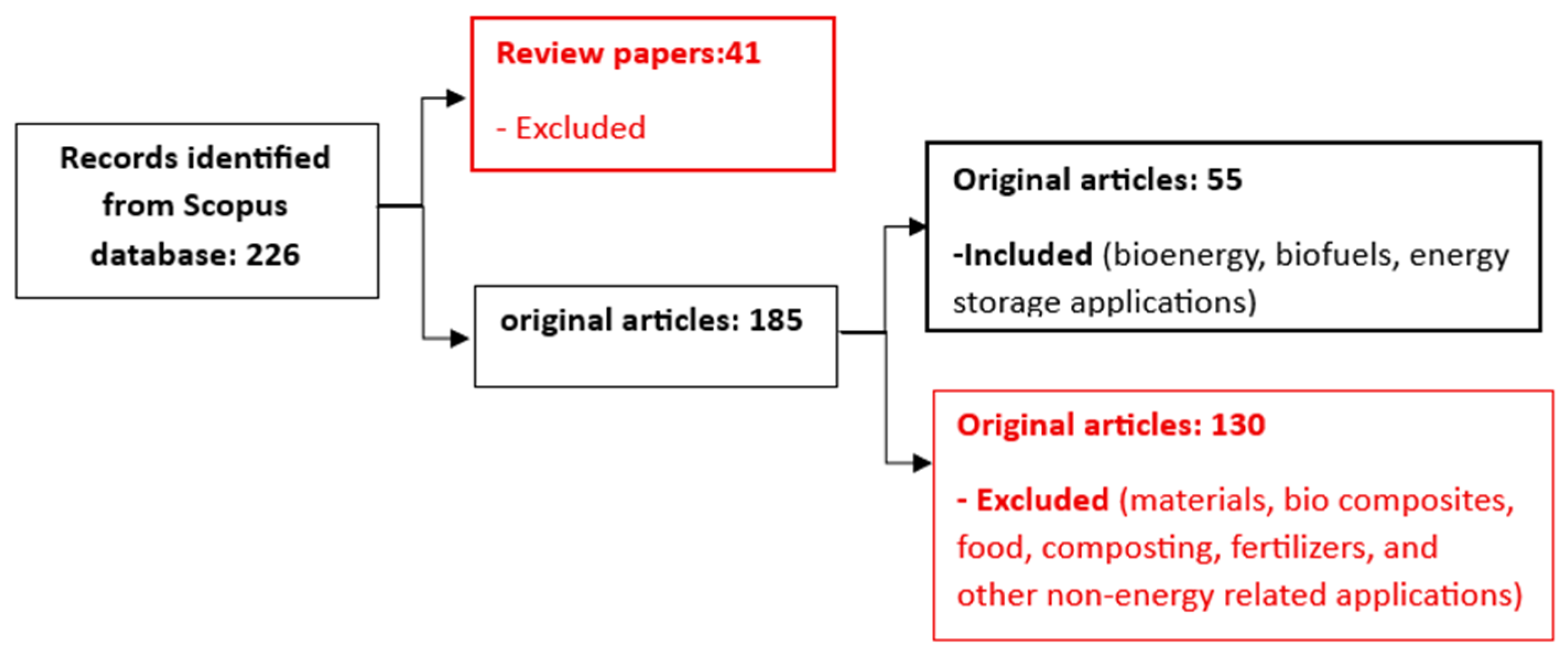
The literature search was conducted exclusively using the Scopus database, yielding 226 records. Review articles (n = 41) were excluded, and only original research articles were considered for further evaluation (n = 185). Subsequently, the original articles were manually screened based on their relevance to the scope of the review. Studies focusing on bioenergy, biofuels, and energy storage applications of the brewer’s spent grain (BSG) were retained (n = 55), while studies addressing non-energy applications, such as materials, biocomposites, food products, composting, fertilizers, and other unrelated valorization routes, were excluded (n = 130).
The current review is limited to the original literature articles published in English from 2021 to 2025 (July 2025) to capture the most recent developments and emerging trends in BSG valorization technologies. More specifically, this review examines the original (experimental) articles that are related to bioenergy, biofuels, and energy storage materials from BSG utilization (see Figure 1). From these articles, 55 articles related to biofuels, bioenergy, and energy storage materials were chosen manually and are presented in the next section. Following the initial database search, articles were manually screened based on their relevance to brewer’s spent grain valorization technologies for bioenergy. Studies were included if they addressed BSG characterization, processing, conversion pathways to biofuels, environmental impacts, or techno-economic aspects. Articles not directly related to BSG utilization for energy production and energy storage, and studies outside the scope of the review, were excluded.

3. Technologies and Enhancements/Pretreatments for Bioenergy Production from BSG

3.1. Anaerobic Digestion (AD) and Anaerobic Co-Digestion (AcoD) for Biogas (Biomethane) Production from Brewer’s Spent Grain Utilization

Anaerobic digestion and anaerobic co-digestion of BSG have gained great scientific interest as promising technologies for bioenergy recovery.
Lins et al. [11] explored CO2 recovery and biomethane production using BSG, yielding 165.1 kWh of electrical and 424.6 kWh of thermal energy. The process can produce approximately 82 m3 of biomethane and recover around 29 m3 of CO2 per ton of dry matter. Utilizing BSG can supply 76% of the CO2 needed in brewing, potentially saving $116 million in CO2 purchase costs, making it valuable for energy production and CO2 recovery.
Sganzerla et al. [12] studied BSG samples (w.b., wet basis) taken from a brewery located in Brazil. The sample was dried (8 h, 105 °C) and stored (−18 °C). In a full-scale up-flow anaerobic sludge blanket reactor (48 h, 35 °C, 50 rpm/min), soft drink wastewater (without pathogens) was treated to granular mesophilic inoculum production. The agitated tank reactor (lab scale) was used in batch mode for 40 days. Moreover, 60% of the reactor’s volume was occupied by the substrate mixture, and 40% was for the biogas production. The substrate was 25% BSG (d.b., dry basis), 45% wet inoculum, and 30% water. A mesophilic temperature and pH of about 7.5 were kept in the system. Gas chromatography equipped with a thermal conductivity detector was used for biogas determination, and kinetic analysis was also performed. The results showed enhanced methane production (11.92 L of biogas = 6.47 L of CH4). About 0.133 MWh of electricity and more than 598 MJ of thermal energy could result from 1 ton of BSG. In addition, AD for energy and heat could prevent 0.0335 tCO2-eq/ton BSG. The cone model was revealed as more appropriate for methane production kinetics compared to the first-order kinetic models and the modified Gompertz model. In another study [13], BSG (from Spain), distilled gin spent botanicals (DGSB), and both of them as co-substrates (80% BSGs-20% DGSBs, 60% BSGs-40% DGSBs, 40% BSGs-60% DGSBs) were studied as substrates in AD practice using box-type digesters (mesophilic mode, 36 to 38 °C). The results were acceptable (more than 295 CH4/kg VS, 80.6% in a biochemical methane potential (BMP) test) only when 100% BSG was used alone as the substrate.
Another study [14] evaluated one-stage (1S-TP) and two-stage (2S-TP) thermal pretreatment in an integrated biorefinery for the co-production of biogas and fermentable sugars from BSG. Two autohydrolysis conditions (C1-1S: 180 °C, 5 mLH2O/g BSG, 30 min, and C2-1S: 180 °C, 5 mLH2O/g BSG, 60 min) were assessed with and without pretreatment (80 °C, 10 min, 10 mLH2O/g BSG). The two-step pretreatment produced the maximum specific CH4 generation (302.4 NL CH4/kg COD) and enzymatic hydrolysis yield 98% using 50 FPU/g BSG, with the second stage running at 180 °C for 60 min, 5 mL H2O/g BSG. In a combined heat and power system, burning biogas from the AD of liquid fractions (hydrolysates) produced after two stages of thermal pretreatment can yield a net thermal energy of 1.71 MJ kg/BSG dry basis and electrical energy of 0.392 kWh/kg BSG dry basis.
A novel sustainable bioprocess using fed-batch pretreatment followed by semi-continuous anaerobic digestion (mesophilic mode and methanogenic conditions, 35 °C, 60% filled with the substrate—610.8 g BSG in d.b., 2124 g mesophilic inoculum, and 1.84 L water and 40% used for produced biogas) of BSG (Brazil) for biomethane and biogas production was used by da Rosa et al. [15]. The semi-continuous process, with a hydraulic retention time of 22 days and constant pH adjustment with NaOH, fed and removed 180 mL digestate daily. The results showed that biogas produced by the above-mentioned novel bioprocess could generate about 317 MJ/t heat and about 67 kWh/t electricity, avoiding 20.91 kg CO2eq/t. This innovative approach could be effective for utilizing brewery by-products for bioenergy production.
With emphasis on kinetic analysis, microbial metataxonomic analysis, metabolic function prediction, and operational performance evaluation, another study [2] examined the anaerobic co-digestion (AcoD) of brewery by-products (brewery sludge: wastewater, 1:1, v/v and BSG 2.5 to 12.5%, w/v) for biomethane and bioenergy recovery. Brewery wastewater was treated in up-flow anaerobic sludge blanket digesting reactors (mesophilic mode, 35 °C) to produce the mesophilic inoculum (granular sludge) needed for AcoD. The results showed that the highest CH4 yield (more than 88 mL CH4/g TVS) was achieved using 12.5% BSG, which was 20.7 times higher than the reactor that used sludge and wastewater (4.26 mL CH4/g TVS). Bioenergy recovery from this practice could produce heat 1556 MJ/kg TVS and electricity 0.348 kWh/kg TVS and prevent GHG emissions (0.114 kg CO2eq/kg TVS). Nganyira et al. [3] examined the biogas quality that resulted from the co-digestion of BSG with cattle dung (CD). At BSG:CD ratios of 1:3, 1:2, 1:1, 2:1, and 3:1, as well as BSG and CD control tests with substrate combinations of 4.5 kg in each setup, the digestion of two substrates was controlled at a retention period of 10 days. To facilitate the digestion process, 10 L plastic bottles were utilized as bio-digesters with substrates and water in a 1:1 ratio. The best raw biogas rich in CH4 was produced at BSG:CD ratios of 1:3 and 1:2, with total solids (TS) contents of 9.24% and 8.95%. The methane content was 54.7 ± 10.74% CH4/d and 51.9 ± 8.67% CH4/d, respectively, according to the ratios 1:3 and 1:2.
Sygula et al. [4] studied the impact of several additives (lime, iron, porous ceramic powder, in several doses 0.2, 0.6, 0.95, 1.34, 1.7, and 2.3 gTS/L) of biomethane generation from BSG (Poland) in the AD process (batch reactor, mesophilic, 30 days). The addition of lime, iron, and ceramic powder resulted in −6.7% to −3.3%, 0.8% to 9.8%, and −2.6% to 4.6% methane yield change, respectively. More specifically, iron powder (0.6 g/L) or ceramic powder (1.34 g/L) can be used to enhance biomethane production from mesophilic AD of BSG by 9.8 and 4.6%, respectively.
Several pretreatment methods of BSG can lead to increased organic content for the AD process. More specifically, Buller et al. [5] studied the AD process of BSG with and without ultrasonic pretreatment for biogas production. The AD process with ultrasonic pretreatment resulted in a 4-times higher biomethane yield (more than 107 CH4/kg TVS yield that can produce 0.23 MWh/t BSG of electricity and 1.2 × 10³ MJ/t BSG heat) compared to AD without pretreatment (26.72 L CH4/kg TVS yield that can produce 0.15 MWh/t BSG electricity and 0.79 × 10³ MJ/t BSG heat). The energy needed for ultrasonic pretreatment was 0.29 MWh/ton. This is translated into enough electrical energy production to counteract the majority of the energy it consumes and an excess heat surplus. The ultrasonic pretreatment increased the energy surplus by 50%. Environmental impact is revealed to be reduced if ultrasonic pretreatment is used in the AD process of BSG (avoid 0.083 tCO2eq/t BSG) compared to AD without pretreatment (avoid 0.056 tCO2eq/t BSG) if heat produced from biogas is used to reduce the utilization of natural gas for heating. Ultrasonic pretreatment enhanced biogas yield in BSG anaerobic digestion (56% in biomass composition). The produced bioenergy could be used for the energy needs of a brewery, and the additional energy could be used for district heating systems or as vehicle fuel.
LCA is a crucial tool for scaling up the biogas yield from pretreated biomass residue. The adoption of renewable fuels has increased due to the objective of achieving greenhouse gas neutrality. So, before suggesting the use of new technologies, it is essential to guarantee their sustainability. Cardoso Fernandes et al. [16] proposed an LCA tool in order to identify crucial hotspots in the investigation of the hydrothermal pretreatment of lignocellulosic biomass (BSG), followed by a biochemical methane potential assessment. Laboratory-scale findings were used in an attributional evaluation model where the baseline was business as usual. The two-stage (in separate reactors) co-digestion of pretreated hydrothermal BSG (and brewery wastewater) was revealed to be promising, with a decrease to 54 kg CO2-eq/ton BSG in comparison to 90 kg CO2-eq/ton BSG in the business-as-usual scenario. Both Brazil and Spain showed interest in investigating this concept, and they are among the top ten beer-producing nations in the world. Fonseca et al. [17] performed a comparative LCA using Easetech 3.4.4 for the impact assessment, with ReCiPe 2016: platform 1. biofertilizer, biogas, and proteins; platform 2. biofertilizer, proteins, and biogas; and platform 3. volatile fatty acids (VFAs), proteins, biofertilizer, and biogas. Despite having a lower carbon footprint (2.4 kg CO2-eq) than platform 3 (proteins and VFAs) (10.0 kg CO2-eq), platform 2’s sources of revenue were more constrained due to its less varied portfolio. Platform 1 revealed 12.5 kg CO2-eq. As a result, it is advised to maximize the anaerobic digestion acidification stage in order to convert at least 42% of organic carbon to VFAs. Platform 3 would thus be more competitive since its CO2 emission levels would be on par with those of Platform 2. Robust economic feasibility studies would subsequently be required to verify Platform 3’s financial viability. Sganzerla et al. [18] evaluate the techno-economic feasibility of using supercritical water hydrolysis (SWH) to produce sugars of BSG by simulated scale-up from pilot to industrial plants (3 × 10 L and 3 × 500 L, respectively) with and without sugar separation systems, followed by a biochemical methane potential (BMP) assessment. Optimal results were revealed at 160 °C, 15 MPa, and a residence time of 4.6 min (94% separation efficiency). Sugar separation: Six distinct sugars with greater economic value were isolated through the use of a five-zone simulated moving bed (SMB) technology. From pilot to industrial scale, manufacturing costs dropped by almost 80%. Positive returns were only demonstrated by the 3 × 500 L industrial plant with SMB separation (SWH-P). When compared to the industrial plant process without the SMB process, which yields a single hydrolysate fraction with low commercial value, the adoption of a separation system that recovers six sugars with high added value may be advantageous. Lastly, a possible substitute for producing various concentrated sugars in a biorefinery concept is the integrated subcritical water hydrolysis of BSG combined with a separation system. Sganzerla et al. [19] performed a techno-economic evaluation of the generation of fertilizer and bioenergy through AD of BSG from several industrial brewery scales. Simulations for five income scenarios were done by integrating thermal energy, biomethane, electricity, and fertilizer. According to the results, selling electric energy to the grid, using thermal energy for the facility’s self-consumption, and selling fertilizer for use in agriculture can recover up to 350,000 USD/y for an investment of $1 million USD for a treatment capacity of 137 t BSG/d. This scale’s economic study yielded a payback period of 3.76 years, a return on investment (ROI) of 23.68%, and a net present value (NPV) of up to 1.5 million USD. With a payback period of 3.67 years and an internal rate of return (IRR) of up to 20%, the revenue when biomethane and fertilizer were taken into account was profitable and suitable for actual use. According to the sensitivity analysis, the most significant factors influencing the project’s economic feasibility were the selling prices of heat, power, biomethane, and fertilizer. The waste management system that uses the AD of BSG to produce fertilizer and recover bioenergy is beneficial and may be sufficient for future use in breweries. Last but not least, Maqhuzu et al. [20] examined the potential for global warming and the use of BSG for food and biochar production in Africa using hydrothermal carbonization (HTC). Using a stochastic model based on 50,000 Monte Carlo simulations, BSG generation, biochar production, and energy potential for Africa were estimated through 2040. This was used in conjunction with a model to evaluate the BSG treatment’s global warming potential (GWP). In addition to a local assessment, comprehensive data was supplied at the national level. Africa is expected to generate 698,000 Mg of BSG overall in 2020 (approximately 0.52 to 0.91 million Mg/yr at a 90% confidence level). It is estimated to increase to 852,000 Mg/yr by 2040 (0.57 to 1.19 million Mg/yr at a 90% confidence level). When compared to the production of biochar, flour production is anticipated to have a lower GWP. For a 20-year time horizon, the GWP of BSG conversion to biochar is more than 1400 million CO2-eq, which is 3.90 times greater than the alternative, BSG milling to flour in one example study.
The effectiveness and characteristics of different pretreatment approaches and technologies for BSG valorization to enhance anaerobic digestion are presented in Table 1.

3.2. Technologies for Bioethanol Production from Brewer’s Spent Grain Utilization

The pretreatment of lignocellulosic biomass in biological synthesis routes is a key factor that affects bioethanol yield. Several pretreatment methods have been reported in the literature for bioethanol production of BSG. Mikulski et al. [6] studied the influence of integrated utilization of microwave radiation and selected aqueous solutions of deep eutectic solvents (DES) on alterations to lignocellulose composition and structure and their effect on enzymatic hydrolysis efficiency. For DES mixes, choline chloride is the HBA with glycerol (G), urea (U), sorbitol (S), imidazole (I), and ethylene glycol (EG) as the HBD. DES was utilized in 1:1, 1:2, and 1:4 molar ratios, with or without 0.9% v/v H2SO4 addition. Cellic CTec2 was used at pH 5.5 at 50 °C for enzymatic hydrolysis. The Mars 5 microwave generator (60 min, 600 W) was used for microwave-assisted pretreatment. BSG after pretreatment was rinsed with distilled water, dried (70 °C, 8 h), and weighed to determine the loss of mass due to pretreatment. The results showed that microwaved DES pretreatment alters the structure of BSG. BSG after microwave-assisted pretreatment with aq-DES can be utilized as a substrate in microbiological synthesis processes. Pretreatment with chosen aqueous solutions of DES also increased the efficiency of cellulose hydrolysis (94.9%, 838 mg/g) in the pretreated biomass. An aqueous solution of DES comprising choline chloride and imidazole allowed for effective delignification. Using this solvent (1:4 molar ratio, 0.54 MPa pressure) led to a 77% reduction in lignin concentration in BSG. This integrated approach of microwave radiation and aqueous solutions with a broader DES spectrum proved to be successful only for a few of the solvents employed and can be applied to second-generation bioethanol production. Castilla-Archilla et al. [21] studied BSG pretreatment to enhance the whole slurry and resuspended pellet. The study analyzed the effectiveness of hydrochloric versus sulfuric acid for lignocellulose pretreatment, concluding that hydrochloric acid is superior. Optimal conditions for this pretreatment were identified using response surface methodology, highlighting its capability to degrade lignocellulosic structures. Additional tests with hydrochloric acid were conducted using various time, temperature, and concentration combinations via a Box–Behnken design. Optimization involved four conditions: C1 (0.49% HCl, 87.7 °C, 92 min) for highest protein content, C2 (0.80% HCl, 121.0 °C, 142 min) for maximum liquid recovery, C3 (0.10% HCl, 104.0 °C, 70 min) for lowest acid concentration and solid levels, and C4 (0.20% HCl, 121.0 °C, 20 min) for minimal water retention. Conditions C1 and C4 enable direct enzymatic hydrolysis post-diluted acid thermal pretreatment without liquid fraction removal or pellet washing. These conditions demonstrate promising outcomes for biorefinery applications.
Estrada-García et al. [22] used enzymatic-ultrasonic pretreatment in an anaerobic fermentation process for bioethanol production from BSG utilization using brewer’s spent yeast (BSY) in order to study, in all stages, several rheological parameters (e.g., viscosity, performance index, density, and consistency index). BSY was used as an inoculum with CBSG to reduce environmental impact. Enzymatic-ultrasonic pretreatment was used to enhance the availability of reducing sugars via adjustments to hydrolysis duration (6, 8 h), cellulase enzyme (0.3, 0.5% w/v), and ultrasonic intensity (15, 20%). Then, alcoholic fermentation was performed with BSY at several inoculum concentrations (0.5, 0.8, 1.0% v/v). The results were compared to Saccharomyces cerevisiae S-04. With 0.5% cellulase achieved, 7.71% bioethanol production was achieved with 1% BSY (~8.7 g bioethanol per 100 g raw materials).
Kavalopoulos et al. [23] studied bioethanol, biogas, and oil from BSG. Bioethanol yield reached 45% with acid pretreatment, enzymatic hydrolysis (with CellicCTec2), and fermentation (with S. cerevisiae). Biogas of BSG raw, defatted, and stillage reached 379 ± 19, 235 ± 21, and 168 ± 39 mL biogas/g, respectively. Oil extraction was 70% efficient using the solid–liquid extraction process and hexane as the solvent. BSG might significantly contribute to the bioenergy mix since it could be transformed to ‘green’ energy in the range of 4.5 to 7.0 million MJ/year if the European BSG were fully utilized.
In another study [7], the development of an innovative fractionation of BSG for bioethanol, oligosaccharides, and sugars production was performed using two-step acidic hydrolysis and an enzymatic hydrolysis step. An increase in arabinose yield (76%) resulted from the first acidic hydrolysis (19.5 min, 90 °C, 1.85 w/w% sulfuric acid), 90% xylose yield resulted from the second acidic hydrolysis. Glucose-rich supernatant (46 g/L) resulted from enzymatic hydrolysis (0.04 g/g enzyme, 15 w/w% solids loading). Utilizing the glucose-rich fraction, bioethanol production was achieved (72% ethanol yield by commercial baker’s yeast, 6274 and 6827 MJ/dry tonnes of bioethanol and biogas production, respectively). Vičević, R. et al. [24] developed a two-stage bioprocess for the production of bioethanol from the acid hydrolysate of BSG. The aim of this study was to isolate yeasts that can efficiently produce bioethanol and value-added products from xylose and glucose in a two-stage fermentation process using BSG. Kluyveromyces marxianus and Candida krusei were examined with different initial concentrations of xylose and glucose. The results showed that both yeasts produced bioethanol from glucose but with poor efficiency with xylose, producing valuable substances like 2,3-butanediol and glycerol instead. A two-step fermentation was performed using a weak acidic hydrolysate derived from BSG. In the initial phase, glucose underwent fermentation by S. cerevisiae to produce bioethanol; in the subsequent phase, xylose was fermented by K. marxianus and C. krusei to produce additional value-added products. K. marxianus produced up to 4.546 g/L bioethanol at 50 g/L glucose, while C. krusei produced up to 3.936 g/L. BSG hydrolysates have high bioethanol production potential when pretreated with a weak acid and detoxified. The research highlights BSG hydrolysates’ potential as a sustainable bioethanol feedstock, emphasizing the need for further optimization in pentose sugar utilization and yeast inhibitor tolerance.
Ilić et al. [25] studied the exploitation of several lignocellulosic wastes (including BSG) for extracellular enzyme production by novel Basidiomycetes. More specifically, for the evaluation of the newly isolated white-rot fungal strains’ enzymatic potential for bioethanol generation. The enzymes generated by the B. adusta TMF1 isolate were used for lignocellulose hydrolysis of BSG for bioethanol synthesis. Under non-optimized conditions, 0.94 g/L of bioethanol was the result.
Ribeiro-Sanches et al. [26] studied BSG using alkaline hydrogen peroxide (AHP) processing at several concentrations, solid loads, and treatment times. They assessed the rheological behavior (flow of the suspension during processing, how “thick” or “fluid” the mixture is, and how it changes with BSG concentration, with AHP, with temperature), chemical composition, and structural characteristics in BSG suspensions. High BSG loading reduced the yield due to mass transfer processes, although AHP enhanced the removal of proteins, lignin, and extractives, raising the percentage of cellulose and hemicellulose content. FTIR confirmed the decrease in lignin/proteins and the appearance of cellulose/hemicellulose signals. Significant structural and morphological changes (cell wall thinning, particle shape change, crystallinity increase) were noted. As AHP, solids loading, and time increased, the flow resistance rose, and the flow index fell. Temperature reduced viscosity up to 50 °C, but at 60 °C, potential starch gelatinization raised the flow resistance.
Several authors studied the potential synergies of blending biomass residues to enhance bioenergy yield. In a recent study, Tadesse et al. [27] studied the optimization of bioethanol production from BSG blends with sugarcane molasses for reduced costs and enhanced efficiency. Microwave-assisted alkaline hydrogen peroxide pretreatment of BSG was used for increased fermentability (optimal conditions: microwave power 282.25 W and irradiation time 7.27 min). The response surface methodology was used for optimization of dilute phosphoric acid hydrolysis, considering molasses mixing proportion, hydrolysis duration, and acid concentration (optimal conditions: acid concentration of 3.16% v/v, hydrolysis duration 42.5 min, and molasses fraction of 38.1% w/w). The bioethanol yield was 0.28 g/g of BSG (dry). Barampouti et al. [28] studied the synergistic effect of BSG blends with spent coffee grounds (SCG) for bioethanol production on the lab and bench scale. The synthesis of bioethanol was performed by using an alkaline pretreatment of SCG, dilute acid pretreatment of BSG, solution neutralization by mixing them, enzymatic saccharification, and ethanolic fermentation. Optimum conditions were studied using cost as an optimization parameter. Reduced costs for bioethanol production were revealed in scenario 4 [SCG/BSG blends, chemical pretreatment (5 h, 0.5 N), enzymatic hydrolysis (16 h, 400 µL/g cellulose)] and 5 [SCG/BSG blends, chemical pretreatment (5 h, 0.5 N), enzymatic hydrolysis (5 h, 800 µL/g cellulose)]. BSG co-treatment with SCG seems to be efficient for enhanced bioethanol yield.
Table 2 presents an overview of pretreatment strategies and technologies used to enhance bioethanol production from BSG.

3.3. Technologies for Biohydrogen (H2) Production from BSG

Gasification and membrane separation were used by Alique et al. [8] for green H2 production from BSG utilization. A physicochemical characterization (GCV, ultimate analysis) of two BSG samples (Spain) was first performed, and then their thermal stability was examined. Thermogravimetric analysis was also performed (30 to 1000 °C, heating rates (10, 20, and 40 °C/min, N usage for pyrolysis conditions, air (50 mL/ min) for combustion conditions). The syngas composition was performed by gasification in optimized conditions (5 bar, 800 °C, GR: 0.75, air-steam mixture ratio: 25–75 vol%) for increased H2 yield. Two Pd-membranes were created via electroless pore plating (ELP-PP) and showed nearly full H2-selectivity, a good agreement with Sieverts’ law, and H2 flow rates through the membrane from 175 to 550 mol/m2·h using ideal gas feed composition conditions. Long-term stability tests (up to 75 h) showed an increased membrane performance for continuous operations, and as a result, a valuable insight into the brewing sector for sustainable and economic development of green H2 production from BSG.
Jiang et al. [29] performed computational particle fluid dynamics (CPFD) modeling of BSG using an air-steam bubbling fluidized bed gasifier to study gasification characteristics, such as temperature effect (T), steam-to-BSGs mass ratio (S/BSG), equivalence ER ratio, and fluidization velocity ug on the gasification properties. The basic volatile components released through pyrolysis were studied by thermogravimetric mass spectrometry (TG-MS). The simulation results were validated using experimental results of a bubbling fluidized-bed gasifier. According to the results, the significance of each component in relation to the H2 fractional concentration was found to be T > S/BSG > ER > ug. More specifically, when the temperature was raised (T: from 700 to 900 °C), CO and H2 mole fractions, and GCV of the produced gas were raised (CO: from 9.80 to 16%, H2: from 3.95 to 14.21%, and GCV: from 3.36 to 4.35 MJ/Nm3). When S/BSG climbed from 0.3 to 0.7, the molar fraction of H2 rose from 6.54 to 11.76%, while the CO and CH4 dropped (CO: from 13.59 to 11.37% [increase in H2/CO ratio by 114.58%], and CH4: from 3.97 to 3.84%). When ER was raised from 0.2 to 0.4, the GCV of gas and H2 fell, while the carbon conversion fraction rose (from 78.8 to 85%). As the ug rose, the molar fraction of H2 and CO increased (H2: from 8.11 to 11.63%, and CO: from 9.61 to 17.01%), but concentrations decreased above the splash zone due to the release of fluidizing gas from the gasifier’s top outlet.
Soares et al. [30] investigated H2 production from BSG hydrolysate using dark fermentation at several temperatures (35–45 °C), inoculum ratios (10–30%), and pH (5.5–7.5). The highest H2 yield (YH2), H2 production rate (RH2), and cumulative H2 production (PH2) were 5154 mL/g glucose cons, 760 mL/(L·h), and 4160 mL/L of working volume, respectively. The initial concentrations of furfural and 5-(hydroxymethyl)furfural were low (<0.0047 and <0.0220 g/L, respectively). So, for the synthesis of H2 through dark fermentation, BSG hydrolysate would provide an appropriate substrate. Compared to other BSG-based research in the literature, the H2 production was superior.
Bekbayev et al. [31] grew and produced H2 by combining Escherichia coli with raw and blended BSG, distiller’s grains (DG) waste, and sugar beet molasses (SB), and fermenting to achieve the end product. The results showed that a twofold diluted mixture of 4%BSG, 10%DG, and 10%SB was effective for increased H2 generation in comparison with raw wastes. With mixed waste, cumulative H2 generation in numerous mutants was approx. 2.7 times higher (215 mL, 11 mL H2/g mixed waste) than in the wild type (80 mL, 3.9 mL H2/g mixed waste). These agro-industrial wastes can be used for biohydrogen production.
Biotechnological production of hydrogen with Escherichia coli was also studied by [32] using BSG. The hydrolysis of BSG using a 2k complete factorial design method revealed that acid concentration and temperature are important variables that impact the extraction of proteins and decrease sugars. Optimal hydrolysis conditions were found by steepest ascent and central composite design statistical methods. The optimized hydrolysis condition (15% BSG, 150 °C, 0.047 M H2SO4, and 30 min) showed theoretical concentrations of 54.8 g RS/L and 20 g/L proteins. Among the tested conditions, hydrolyzed BSG A17 (117 °C, 20 min, and 0.1 M H2SO4) showed the highest H2 yield of 48 mmol/L. This study offers insightful information about optimizing BSG pre-treatment for biotechnological applications, which could aid in choosing the best hydrolysis conditions.
However, when BSG was utilized for H2 production, the anaerobic co-fermentation of brewery by-products (blends of BSG, sludge, and brewery wastewater) in thermophilic (55 °C) and acidogenic mode (pH 5) did not yield favorable results [33]. More specifically, the results showed increased the nitrogen (>300 mg N–NH3 L−1) in the reactor with wastewater and BSG compared to the reactor that only operates with wastewater (190 mg N–NH3 L−1). The wastewater reactor revealed the highest H2 yield. But adding BSG leads to a reduced yield (9.55 mL H2 g−1 TVS) and inhibits ammonia, which lowers hydrogen synthesis.
The various pretreatment methods and technologies employed to enhance sustainable biohydrogen production from brewer’s spent grain (BSG) are summarized in Table 3.

3.4. Technologies for Biocrude (Liquid Biofuel) and Bio-Oil Production from BSG

Biocrude and bio-oil production technologies from BSG are a promising approach to produce renewable liquid biofuels with high energy value. Processes such as hydrothermal liquefaction (HTL), co-liquefaction, and catalytic cracking allow the conversion of BSG into liquid fuels, taking advantage of the high organic content of the biomass.
Mukundan et al. [34] developed a highly active and magnetically recoverable heterogenous catalyst and investigated the hydrothermal liquefaction (HTL) of BSG into bio-oil production. Carbon extraction into the aqueous phase was enhanced using a homogenous Na2CO3 base as a catalyst and co-catalyst. The results showed that the FeOx/C catalyst enhanced by 19.7 bio-oil yield by comparing it to a non-catalyst reaction at 320 °C of HTL BSG. The carbon recovery to bio-oil and GCV revealed 82% and 37.7 MJ/kg. The FeOx/C catalyst was revealed to be an affordable (catalytic activity up to five reaction cycles), high-performance HTL catalyst, capable of scaling up for commercial applications after magnetic retrieval separation.
Kim, J.Y. et al. [35] studied BSG CO2-assisted pyrolysis to reduce CO2 emissions in the brewing industry. To reduce carbon emissions and improve energy recovery in the form of pyrolytic gas, CO2 was used in the BSG pyrolysis. Because of its poor reactivity at the temperature range where most BSG-derived volatiles were produced, CO2 reactivity was restricted in the original pyrolysis setup. This reduced the ability of CO2 to accelerate volatile thermal cracking, which had a negative impact on the synthesis of syngas. The setup was changed to include a catalytic process and supply more heat energy to overcome this restriction. A catalyst greatly increased the amount of syngas produced during catalytic pyrolysis, and significant CO2 consumption was seen in the experiments. The CO2 emissions for making 1 L of beer were lowered from 202.7 g in non-catalytic pyrolysis to 11.5 g in CO2-catalyzed pyrolysis. CO2 was captured using the biosolid produced by catalytic pyrolysis. The net CO2 emissions related to brewing were decreased by this two-pronged strategy (CO2-catalyzed pyrolysis and subsequent CO2-adsorption utilizing biosolids). The pyrolytic gases (H2, CO, and CH4) generated by this process are also adequate to provide the brewing industry’s energy needs.
HTL of BSG combined with acid hydrolysis (AH) pretreatment to biocrude production was studied in a recent study by Plata et al. [9]. Optimal pretreatment conditions (150 °C, 180 min, pH 2, 10 wt.%) were used to decrease protein and hemicellulose. HTL parameters (duration, biomass content, and temperature) were optimized (15 min, 10 wt.%, 335 °C) to boost the biocrude production. The results showed that acid pretreatment changed BSG structure (95 wt.% hemicellulose degradation and 54 wt.% less protein content) and reduced the oxygen and nitrogen content by 10% and 33%, respectively. In addition, HTL using pretreated BSG improved the biocrude yield by 9 wt.% and the heating value of biocrude by 5%. Gas chromatography analysis showed a reduction of 29% in heterocyclic compounds, which is advantageous for additional improvements. Approx. 53 wt.% of biocrude mass is the volatile fraction until 300 °C, which contains approx. 80 wt.% of the middle distillate fraction. In addition, several other value-added products (49 wt.% and 31 wt.% of saccharides and proteins, respectively) can be produced.
Pecchi et al. [36] studied the effect of solvent on chars via the hydrothermal carbonization of BSG and other food wastes. The results showed that the composition of the feedstock significantly affects the yield. Lipid-rich waste leads to high secondary char production. Carbohydrate- and protein-rich feedstocks lead to lower secondary char, while lignocellulosic materials lead to mainly primary char. There are two separate phases to hydrochar: primary char: “coal-like” qualities (more stable, carbonaceous) and secondary char: a highly reactive oily phase. Regarding the solvents, ethanol enhances the fixed carbon of primary char, enriches fuel precursor chemicals, and extracts up to around 50% of secondary char, while acetone and dichloromethane enhance combustion behavior, maximize primary char yield, and efficiently eliminate the secondary (oily) portion. Overall, the results showed that the composition of the feedstock and the solvent determines the composition of hydrochar. Proper separation can minimize combustion issues caused by reactive phases, enhance energy efficiency, and enable lipid recovery for the generation of liquid fuel.
In order to eliminate the dependency on a biomass by-product (due to availability, seasonality, etc.), several agricultural residues can be mixed and used as alternatives to feedstock in biocrude production.
Okoro et al. [37] studied experimentally and in simulation the synergies in low-temperature hydrothermal co-liquefaction (HTcL) using BSG and apple pomace (AP) for biocrude production. The Box–Behnken design methodology was used to find optimal conditions (studied ranges 15–120 min, 120–280 °C, 5–20 wt.%) to maximize biocrude yield. Optimal conditions for BSG were 201.9 °C, 15 min, and 5 wt.% solid concentration, resulting in a 23.08 wt.% biocrude yield, and the AP were 217 °C, 15 min, and 5 wt.%, resulting in a 13.58 wt.% biocrude yield. Then, HTcL of BSG and AP was performed in several blends (BSG:AP 3:1, 1:1, 1:3) under optimal modes. ASPEN Plus stimulation was used to assess the process on a large scale. The 1:1 BSG:AP blend showed an energy density of 31.2 MJ/kg for biocrude and 25.74 MJ/kg for biochar products. Emissions per kilogram of feedstock remain stable (0.38 kg CO2 eq/kg) from 250 to 1000 kg/h, then decrease (0.27 kg CO2eq/kg) as the feedstock rate is raised to 1500 kg/h. According to the results, the HTcL route can lead to several economic and environmental advantages and increased efficiency. Bassoli et al. [38] also studied hydrothermal co-liquefaction (HTcL) for evaluating the biocrude and biochar yield, but used BSG mixed with microalgae (Chlorella vulgaris), sugarcane bagasse, and paper mill sludge. The effect of separate feedstocks and their blends on biochar and biocrude yield was studied. The results showed that the highest biocrude yield (51.7%) was shown when raw microalgae were used, and the microalgae addition in the mix was only important for enhancing biocrude yield if it was more than 50%. BSG and paper mill sludge revealed the second-highest biocrude yield (29%) due to synergistic effects. The energy return on investment (ERoI) is higher than the mix with 50% microalgae, 25.8% BSG, and 24.2% paper mill sludge, showing that the net energy input in the process is less than the energy gained with the biocrude.
In addition, several researchers used catalytic pyrolysis for bio-oil production. More specifically, the catalytic microwave-assisted pyrolysis of BSG was studied [39] for bio-oil production. More specifically, the impact of the catalyst (calcium oxide) and moisture content on hydrocarbon content and product distribution in the liquid product. A high liquid yield (71.8%) was the result of the BSG moisture at 14%, but this also resulted in the quality of the hydrocarbon yield being 21.6%. An optimization study was done to increase the quality and the bio-oil yield. The results of the liquid composition in optimum conditions (570 °C and 12.17% catalyst/biomass ratio) are promising due to the presence of aromatic and organic compounds. In another study [40], catalytic (calcium oxide) and non-catalytic pyrolysis of BSG in a spouted bed reactor was studied for sustainable alternative biofuels and reduced environmental impact. The effect of BSG rate, temperature, and catalyst concentration on yield and hydrocarbon composition is evaluated in catalytic and non-catalytic experiments. Non-catalytic pyrolysis produced a 41% oil yield with 15% hydrocarbon content under the ideal conditions (550 °C, 960 g/h), while catalytic pyrolysis in ideal conditions produced a 43% oil yield with 33% hydrocarbon and reduced water content. The produced oil revealed an enhanced gross calorific value of 25.7 MJ/kg compared to 19.8 MJ/kg of dried BSG. The use of CaO catalyst boosts the gross calorific value to 28.2 MJ/kg. This study emphasizes the CaO catalyst’s efficiency in enhancing liquid biofuels of BSG for biofuel production in a spouted bed reactor.
Table 4 presents an overview of the pretreatment strategies and technologies applied for sustainable biocrude (liquid biofuel) production from BSG utilization.

3.5. Technologies for Biochar Production from BSG

Biochar production technologies from BSG are mainly based on thermochemical processes, such as slow pyrolysis, gasification, and torrefaction.
Zabaleta et al. [41] studied the effect of different temperatures (673 K, 773 K, and 873 K) of BSG slow pyrolysis on the biochar properties. The suitability of BSG biochar as an energy vector was examined, highlighting its potential as a biofuel. Bioenergy indices were calculated. The results showed that BSG biochar produced at 673 K demonstrated optimum efficiency. Another study [42] concentrated on comparing various (five) mechanical BSG grinding procedures and how they affected the biochar production during pyrolysis. The surface morphology and porosity of the biochar generated from BSG were significantly impacted by the various grinding methods. As determined by the shift in the D to G Raman band intensity ratio, the grinding technique also had an impact on the biochar’s thermal behavior and level of graphitization. Five distinct morphologies of biochar derived from the same BSG under identical pyrolysis conditions. The biochar crystallinity reflected the physical treatments applied to the biomass. That mechanical pressure influenced the biomass’s internal structure, leading to the enhanced graphitization of biochar. This study suggests an intriguing possibility for the synthesis of biochar with regulated morphology, crystallinity, degree of graphitization, and heat capacity. Evaristo et al. [43] studied BSG pyrolysis (300, 500 and 700 °C) and BSG gasification (1000 °C at the atmospheres O2/N2, O2/CO2/N2 and O2/H2O/N2) at several parameters. The results showed that BSG biochar revealed enhanced HHV (up to 83.11%), and syngas production at CO2 steam-enhanced gasification showed an increased H2 yield and increased energetic benefits.
Jackowski et al. [10] studied the synergistic effect of solid production and beer coloring agent from BSG by torrefaction (20–60 min, 180–300 °C). The results showed that using a mode of 300 °C and 60 min, the calorific value of the torrefied BSG reached 25 MJ/kg. In these conditions, modest improvement was achieved in the properties of the solid fuel. More research is needed in order to find the optimum conditions for several types of BSG.
The pretreatment methods and technologies employed for sustainable biochar production from brewer’s spent grain (BSG) are summarized in Table 5.

3.6. Combustion of BSG to Solid Biofuel

Combustion and co-combustion of BSG are effective technologies for the production of solid biofuels and energy recovery from agro-industrial waste. BSG exhibits satisfactory calorific value, high volatile matter content, and relatively low ash content, characteristics that make it suitable for thermal utilization. Its co-combustion with other fuels, such as woody biomass or lignite, can improve combustion stability, reduce slag and deposit problems, and enhance the energy efficiency of the process.
Gil-Castell et al. [44] studied the evaluation of thermo-oxidative decomposition of BSGs (pure Carafa, Crystal, Pale Ale, Aroma, Trigo, and Pilsener malt varieties) combustion for energy recovery. For this reason, a pilot spouted bed reactor was used. In addition, the energy content, the proximate analysis, and the kinetic analysis of decomposition during thermo-oxidative combustion were performed. There were two primary phases to the thermo-oxidative breakdown of hemicellulose, cellulose, lignin, and char. Stage I featured the volatilization of cellulose, hemicellulose, and partial lignin and revealed a random nucleation kinetic model (Fn). The completion of lignin and the breakdown of char formed Stage II, which was represented by a three-dimensional diffusion kinetic model (D4). The effectiveness of this process is consistent regardless of malt type or combination.
Vasileiadou [1] studied BSG combustion and BSG co-combustion with lignite with several analyses: calorific value analysis, proximate analysis, ultimate analysis, ion chromatography, thermogravimetric/derivative thermogravimetric analysis, and SEM-EDS. Kinetic modeling, thermodynamic analysis, and the potential maximum emission factor for CO2, SO2, and NO were calculated. The environmental footprint regarding secondary solid wastes (ash) expressed per produced energy was also studied. Several case studies regarding energy production using BSG in Greece and Europe were performed. The results showed high calorific value (19.05 MJ/kg), low ash content (5 wt.%), low maximum temperature with a high rate of weight loss (307 °C/5.46%/min), high Gibbs free energy value (195.6 kJ/mol), and a much reduced environmental footprint index (0.0025 kg/MJ) compared to the lignite (0.0307 kg/MJ). Cl and S levels of BSG were similar to lignite’s (0.03 and less than 1 wt.%, respectively). In addition, as the amount of BSG in the blend rose, BSG blends with lignite showed improved properties. Compared to lignite (103 gCO2/MJ, 1.6 gSO2/MJ), the BSG sample showed lower CO2 and SO2 emissions (91 gCO2/MJ, 1.0 gSO2/MJ), but greater NO maximum emissions (4.8 gNO/MJ) than lignite (1.5 gNO/MJ). BSG can be utilized as a sustainable energy source for local energy demand, e.g., for beer industries or in the district heating of villages, either by itself or in mixture with lignite. Castro et al. [45] studied BSG combustion (B1: 100%BSG) and BSG co-combustion with wood chips in different proportions (B2: 80% BSG and 20% wood chips, B3: 60% BSG and 40% wood chips, B5: 20% BSG and 80% wood chips). The results showed that BSG revealed a high energy content (17.84 MJ/kg), low ash content (0.52%), and increased volatile matter (95.9%) while blends with 80% BSG showed better fuel characteristics (17.71 MJ/kg, ash: 0.39%, volatiles: 97.35%, etc.). In addition, the co-combustion of BSG and wood chips generates ash with a low percentage of alkali metals and a high concentration of aluminosilicate species, which translates to reduced fouling and slagging problems in the boiler. Arranz et al. [46] performed a feasibility analysis of BSG and pellets of BSG for energy production. In terms of N and ash, the initial characterization revealed somewhat negative results, with values of 3.76% and 3.37% d.b., respectively. However, the pellets’ physical characteristics were very good, including a low heating value (LHV 17.65 MJ/kg, wb) and an adequate bulk density (662.96 kg/m, w.b.). A drying procedure was required prior to pelletizing because the initial BSG had extremely high moisture levels. When compared to other comparable biofuels, BSG had a higher heating value, but the nitrogen content increased. Due to the low alkaline index in the BSG’s ash analysis, issues like fouling or slagging during combustion are not expected.
Głowacki et al. [47] assess the quality characteristics (calorific value, ash, moisture, and organic matter) of three samples of BSG (BM: BSG from barley malt 100%; BM+B: BSG from BM with the addition of hulled barley (B)—unmalted ingredient up to 45%; and BM+WM: BSG from BM and wheat malt (WM)—minimum 50%) in order to be used for energy purposes. The results in all dried samples (<10%) showed a calorific value from 15.6 to 15.9 MJ/kg and a volatile matter from 77.8 to 78.7%. The wet BSG revealed approx. 1.42 to 2.01 MJ/kg, indicating the importance of drying to enhance BSG energy properties.
Pachchigar et al. [48] studied the ash transformation during the BSG combustion (lab-scale drop tube furnace at 1200 and 1450 °C) with a moderate to high percentage of P. CHN analysis. Scanning electron microscopy, energy-dispersive X-ray spectroscopy (SEM-EDS), X-ray diffraction (XRD), ion chromatography (IC), inductively coupled plasma atomic emission spectroscopy (ICP-AES), and thermodynamic equilibrium calculations (TECs) were used. BSG, a fuel rich in phosphorus-silicon (P-Si), had moderate to low levels of potassium (K), calcium (Ca), and magnesium (Mg). The interaction between fuel-inherent Si-rich particles and Ca-Mg phosphates produced from phytate probably caused most of the phosphorus (P) to be maintained within a Ca-Mg-rich phosphosilicate melt. The findings could be used to address ash-related problems and P-recovery pathways during the pulverized fuel combustion of biomass with a moderate to high P concentration.
Table 6 presents an overview of pretreatment strategies and technologies applied to sustainable solid biofuel production via BSG combustion and co-combustion with other biomass sources.

3.7. BSG-Derived Activated Biocarbon for Catalytic, Environmental, Dye-Sensitized Solar Cell and Energy Storage Applications

Boubkr et al. [49] transformed BSG into a useful biocarbon for use in environmental catalysis. For this reason, before pyrolysis at a moderate temperature (500 °C), BSG biomass powder was wet impregnated with copper (II) nitrate trihydrate and silver nitrate aqueous solution to create an economical and eco-friendly biochar support coated with in situ-generated Ag-Cu nanocrystals. Ag-Cu nanocrystal-coated BSG biochar performed exceptionally well for wastewater treatment, reaching high degradation rates for dye combinations and full mineralization of methyl orange. After three cycles, the catalyst maintained 96% removal efficiency, demonstrating good reusability. The study demonstrates that BSG-derived Biochar Ag–Cu is a promising candidate for environmental remediation applications and may contribute to the achievement of SDG 6 by facilitating efficient wastewater treatment and water quality improvement.
In addition, Tiihonen et al. [50] introduce a novel biochar based on BSG, which has good performance and stability potential for the counter electrode in dye solar cells. They investigated biocarbon as an affordable, plentiful, and eco-friendly substitute for Pt in dye solar cells. BSG-derived activated biocarbon has demonstrated potential as a substitute for costly platinum (Pt) catalysts in dye-sensitized solar cells. The biochar that was hydrothermally carbonized and KOH-activated had a remarkable surface area of 2190 m2/g, which allowed for catalytic performance that was comparable to Pt-based electrodes. Additionally, after 3000 h, long-term stability studies showed that the biocarbon electrodes retained more than 86% of their initial efficiency, indicating good durability and decreased degradation related to electrolyte loss.
Several studies use BSG for energy storage applications. More specifically, Raviolo et al. [51] illustrate the potential of agro-industrial waste as a useful resource for energy storage applications by successfully synthesizing activated biocarbons from BSG using KOH activation. Several important activation parameters, including pyrolysis temperature, washing techniques, and soaking time, were thoroughly investigated. The study analyzes activation parameters like pyrolysis temperature and activation time, using techniques like SEM, XRD, and nitrogen adsorption to assess the structural and chemical properties of activated carbons. The porosity of the resultant biocarbon was found to be considerably increased at pyrolysis temperatures higher than 700 °C. Compared to the biocarbon that was simply cleaned with water, the soaking period in KOH solution significantly improved the pore structure, and acid washing further increased surface area by unblocking micropores. In addition, the solid mixing procedure with KOH demonstrated superiority, producing a material with an impressive BET surface area of 1792 m2/g. The biocarbons with extremely competitive surface areas (up to 1792 m2/g) were produced and evaluated as hosts for sulfur impregnation. These results are remarkable when compared to other activated carbons reported in the literature. The suggested biocarbon showed proper activation characteristics and optimal surface area, demonstrating feasibility as a sulfur host in Li-S batteries (good specific capacity and coulombic efficiency) by using agro-industrial waste for energy storage practices. To increase the use of these mesoporous carbons (MBCs) as high-capacity cathode materials for lithium–sulfur batteries, more improvements are necessary. Salimi et al. [52] developed a lithium metal-free sulfur battery based on a biomass waste anode (carbonized brewer’s spent grain, CBSG, biochar anode) and a nano-sized Li2S cathode (Li2S-graphene composite cathode, Li2S70Gr30). Anodic and cathodic materials are analyzed using X-ray diffraction, electron microscopy, spectroscopy, and electrochemical tests in half-cell and full-cell configurations. The results showed an eco-friendly, cost-effective, and safe anode material as an alternative to graphite and metallic lithium in batteries. The biochar electrode shows excellent compatibility with sulfur battery electrolytes compared to graphite. The CBSG/Li2S70Gr30 full-cell achieves initial charges of 726 mAh/g and discharges of 537 mAh/g, with promising cycling performance and scalability. Raviolo et al. [53] proposed a sustainable way to store energy, BSG biocarbon—silica composites as a high-performance lithium—ion battery anode using two pyrolysis steps at low temperatures and without chemical treatment. Storage capacity is increased by a porous biocarbon structure with mixed graphitic and amorphous characteristics and silica nanoparticles. After 100 cycles, biocarbon electrodes surpass the standard anode material commonly used in conventional LIB anodes with 455 mAh/g. For scalable energy storage solutions, the CBSG/Li2S70Gr30 battery system reveals promising results. Another study [54] synthesized an anode for alkali metal-ion batteries using BSG via cost-effective pyrolysis. The result showed that this hard carbon exhibits excellent reversible capacities (334, 112, and 140 mAh/g) after 100 cycles in Li-ion, Na-ion, and K-ion batteries, showing its potential as a promising anode material for advanced energy storage applications. Arauzo et al. [55] studied using hydrothermal carbonization (HTC) pre-treatment and pyrolysis to transform wet BSG (and other biomasses such as spent coffee grains and spent sugar beets) into nitrogen-rich carbonaceous materials for energy storage applications. HTC (180 °C) followed by pyrolysis (700 °C) showed the optimum results (specific area: about 560 m2/g, accessible surface area: 96 m2/g). The results showed that using HTC followed by pyrolysis improves carbonaceous materials from food industry waste for energy storage. In order to effectively filter advanced carbon compounds from bio-based feedstock, future research should correlate characteristics like specific surface area and nitrogen concentration with material performance.
The above-mentioned studies highlight the potential of biocarbon generated from BSG as a high-value, sustainable resource for energy-related and catalytic applications.

4. Discussion

Anaerobic digestion and co-digestion of BSG yield biogas and methane, promoting renewable energy and reducing the brewing industry’s environmental impact, aligning with circular economy principles. Studies highlight BSG’s energy potential, with notable methane yields and energy recovery options. Utilizing BSG can recycle up to 76% of the required CO2 for brewing [11], significantly lowering costs and enhancing sustainability. The novel sustainable bioprocess using fed-batch pretreatment followed by semi-continuous anaerobic digestion that was prescribed could be a promising method for BSG utilization and renewable energy production. The AD process is influenced by several factors, such as feedstock composition, C/N ratio, temperature, organic loading rate, pH, inhibitory substances (ammonia, volatile fatty acids, sulfides, trace elements), microbial community, substrate quality, particle size, concentration, etc. To enhance biogas production, there should be a focus on substrate mixing ratios, compatibility, and synergistic effects [3]. Using mixed wastes can optimize the C/N ratio. BSG AcoD with cattle manure promotes methane production and process stability. Specific ratios enhance biogas quality and microbial activity. Additives play a crucial role, with precise dosages influencing methane output. Pretreatment methods, especially ultrasonic treatment, significantly increase biomethane yields and reduce environmental impact. Experiments confirm that substrate characteristics and operational parameters are essential for maximizing biogas yield, while the effects of additives vary, necessitating further optimization for improved results.
Techno-economic assessments and LCA are essential for assessing BSG value-adding processes. LCA data shows that hydrothermal pretreatment, in addition to anaerobic digestion, can greatly lower greenhouse gas emissions compared to traditional disposal techniques. Nevertheless, choosing a technology not only depends on the environmental performance but also on the economic feasibility. Reduced carbon footprints and increased revenue generation were found in comparative evaluations, especially when high-value goods like volatile fatty acids are taken into account.
Bioethanol production from BSG is significantly dependent on the efficiency of pretreatment of lignocellulosic biomass. Improving delignification and enzymatic hydrolysis improves fermentable sugars. Technologies such as microwave and deep eutectic solvent (DES) pretreatment, acid hydrolysis, ultrasonication, and alkaline hydrogen peroxide treatment have shown significant improvements in BSG structural degradation and hydrolysis efficiency. Notably, combining microwaves and aqueous solutions of deep eutectic solvents (DES) seems to be effective on BSG enzymatic decomposition, as it yields a 77% lignin reduction that leads to more efficient enzymatic hydrolysis, more fermentable sugars, and an increased bioethanol yield. Archilla et al. [21] showed that HCl is more effective than H2SO4 in acidic pretreatment. In parallel, Estrada-García et al. [22] and Kavalopoulos et al. [23] demonstrated that enzymatic and ultrasonic pretreatment can significantly increase bioethanol production. BSG blended with sugarcane molasses is used in [27] with microwave-assisted alkaline hydrogen peroxide pretreatment of BSG, showing a good value of bioethanol yield. In [28] the co-treatment of BSG and spent coffee grounds using alkaline pretreatment of SCG and diluted acid pretreatment of BSG in enzymatic saccharification and ethanolic fermentation showed an enhanced bioethanol yield. The utilization of BSG mixtures with other biomasses, such as molasses or used coffee beans, has shown synergistic effects and improved economic viability.
After comparing the analyzed thermochemical and biochemical processes and treatments for green biohydrogen production, it can be said that the gasification process [8,29] with Pd-membrane separation seems to be the most effective practice of BSG for enhancing H2 yield (175 to 552 mol/m2h) and can be used in industrial-scale applications. Key parameters affecting H2 production seem to be the gasifier temperature (an increase in temperature leads to increased H2 yield ~14%), steam-to-BSGs mass ratio (an increase in S/BSG leads to increased H2 yield ~12%), equivalence ER ratio (an increase ER leads to decreased H2), and fluidization velocity ug on the gasification properties (an increase in ug lead to increased H2 ~12%). In biological routes, the research showed that by using mixed wastes, such as BSG, distiller’s grains (DG) waste, and sugar beet molasses (SB), in H2 production by Escherichia coli anaerobic utilization [31] H2 production can be enhanced compared to H2 production resulting from the raw wastes. With mixed waste, cumulative H2 generation in numerous mutants was about 2.7 times higher than in the wild type. In biological processes, dark fermentation has shown particularly positive results. Anaerobic co-fermentation of brewery by-products (blends of BSG, sludge, and brewery wastewater) for H2 production in thermophilic and acidogenic mode was shown to have the highest H2 yield in the wastewater reactor (25.11 mL and H2 g−1 TVS), and the addition of BSG influences H2 yield negatively (9.55 mL H2 g−1 TVS) due to ammonia inhibition.
Hydrothermal liquefaction is a promising technology for the conversion of BSG into biocrude, effectively processing high-moisture biomass without extensive drying. Hydrothermal liquefaction (HTL), hydrothermal co-liquefaction (HTcL), pyrolysis, and catalytic pyrolysis of BSG can be used for biocrude and bio-oil production as sustainable processes for converting biomass into liquid biofuels with high energy value and environmental benefits. By hydrothermal liquefaction of BSG combined with acid hydrolysis pretreatment, the biocrude yield improved by 9 wt.%. The co-liquefaction of various agro-industrial residues, such as mixing BSG with paper mill sludge and apple pomace, resulted in biocrude yields of up to 29% and 23%, respectively. This approach provides economic and environmental advantages, enhancing efficiency and reducing CO2 emissions. The presence of microalgae seems to significantly improve biocrude production due to their high lipid content. At the same time, the reduction in CO2 emissions on a larger scale confirms the prospects for industrial application of the technology. By highlighting the possibility of biomass residue mixing as a feasible feedstock for the manufacture of biocrude, these findings advance the field of thermochemical co-liquefaction processes and lead to creative waste-to-energy approaches. However, due to the high nitrogen and oxygen content of BSG, HTL poses a significant challenge. For this reason, feedstock pretreatment is essential to reduce the amount of hetero-organics (as it reduces the amount of proteins and hemicellulose) in biocrude production. Researchers have focused on mixed biomass residues for biocrude production, avoiding reliance on single biomass sources that may be limited and seasonal. Techniques such as catalytic microwave-assisted pyrolysis with a calcium oxide catalyst, hydrothermal liquefaction (HTL) process (BSG was used alone and in combination with acid hydrolysis pretreatment), and hydrothermal co-liquefaction of BSG mixed with other biomass by-products (e.g., BSG with apple pomace, BSG with microalgae Chlorella vulgaris, sugarcane bagasse, and paper mill sludge) have been explored. Among these routes, the FeOx/C catalytic HTL [34] and the catalytic microwave-assisted pyrolysis with a calcium oxide catalyst [39] showed the highest liquid-yield result (82% and 71.8%, respectively). Acid hydrolysis was found to reduce protein and hemicellulose in BSG, improving biocrude’s fuel quality by lowering the nitrogen and oxygen content [9]. Furthermore, recovering additional high-value products, such as saccharides and proteins, enhances the prospect of developing integrated biorefineries.
Pyrolysis, and in particular catalytic pyrolysis, is crucial for the production of liquid biofuels from BSG. Pyrolysis using CO2 and catalysts can drastically reduce the net CO2 emissions of the brewery while at the same time producing gaseous fuels (H2, CO, and CH4) capable of covering the energy needs of the beer industry [35]. This approach merges energy production and CO2 capture, enhancing the transition to low-carbon systems. Utilizing catalysts like CaO in a spouted bed reactor enhances the quality and energy value of bio-oil, boosting yield to 43% and gas calorific value (GCV) from 19.8 MJ/kg (non-catalytic) to 28.2 MJ/kg (catalytic), improving biofuels as viable alternatives to conventional fuels [40]. The produced biochar is characterized by a high content of fixed carbon and can be used as a solid biofuel, as well as an adsorbent or carbon capture storage. One of the key elements influencing the properties of the biochar generated is the pyrolysis temperature. The pyrolysis temperature, residence time, and pretreatment methods significantly affect the physicochemical properties of biochar, such as pore structure, crystallinity, and calorific value. At the same time, mechanical pretreatments of BSG affect the morphology, pore structure, and degree of graphitization of the produced biochar, allowing for the production of materials with different characteristics and applications. In addition, the gasification of BSG can lead to the production of hydrogen-rich syngas and biochar with increased calorific value. The use of CO2 and steam in gasification processes improves energy efficiency and enhances environmental benefits.
Combustion and co-combustion of BSG are mature technological options for its energy utilization, with significant interest both for energy production and for reducing the environmental footprint. Studies showed that BSG has a satisfactory calorific value and can either be used as such or in mixtures with other fuels, such as lignite or wood biomass. Gil-Castell et al. [44] showed that the thermo-oxidative decomposition of BSG follows two main stages (volatile evaporation and lignin/char decomposition) with similar kinetic behavior regardless of the type of malt. This indicates a stable thermal behavior of the material, which facilitates its energy utilization in industrial applications. Vasileiadou [1] confirms that BSG presents competitive energy characteristics compared to lignite, with a lower environmental footprint and reduced CO2 and SO2 emissions. However, increased NO emissions are observed, which requires attention in large-scale applications. In addition, co-firing with lignite or wood improves the overall combustion behavior and reduces ash problems, such as slagging. Castro et al. [45] showed that BSG blends with wood have improved fuel properties, with low ash and high volatile matter content, while the composition of the ash reduces operational problems in boilers. Pachchigar et al. [42] highlighted the importance of ash behavior and the presence of phosphorus, showing that reactions with silicates and metal elements affect the formation of melts and therefore the functionality of combustion systems. At the same time, a perspective is given for phosphorus recovery from ash. Overall, BSG is a reliable alternative biofuel, with good energy efficiency and a lower environmental footprint than conventional fossil fuels, especially when used in co-firing or after appropriate pre-treatment.
Research on BSG is globally significant, with notable activity in Europe and Brazil. Based on the yields reported in the above-mentioned studies, Brazil exhibits the most comprehensive and frequently the highest BSG utilization results, particularly in AD, where yields of about 302 NL CH4/kg COD were attained following thermal pretreatment, a quadrupling of methane production [5] through ultrasonic pretreatment, and a significant production of electrical and thermal energy. Brazil and Spain achieved the best results in biohydrogen production by dark fermentation [30] and gasification [8] with hydrogen separation membranes, respectively. Hungary and Greece demonstrated exceptionally high yields in the bioethanol sector (72% and 45.56% ethanol yield, respectively [7,23]). Argentina [41], Brazil [40], Spain [44], and Greece [45] reported high calorific values (>18–25 MJ/kg) and favorable environmental characteristics in biochar production and combustion/co-combustion applications, while studies from Brazil, Poland, and Belgium showed the highest yields and improved energy characteristics for bio-oil production.
Several studies have shifted BSG utilization to producing advanced carbon materials for electrochemical energy storage instead of traditional energy recovery using pyrolysis and hydrothermal carbonization to generate BSG-derived carbons with structural properties like high surface area and hierarchical porosity, matching commercial electrode materials. Studies indicate that lithium-ion, lithium–sulfur, sodium-ion, and potassium-ion batteries show promising performance, particularly with KOH-activated BSG carbons achieving surface areas of 1792 m2/g. BSG-derived biocarbon-silica composites surpass conventional graphite in capacity, and carbonized BSG anodes enable stable cycling over 300 cycles in lithium metal-free sulfur batteries. These findings support BSG as a sustainable alternative for battery materials while promoting waste valorization. However, limitations include the laboratory scale of studies, limited techno-economic evaluations, reliance on costly chemical activation methods, and performance often falling short of commercial standards. Future research should focus on scaling production and optimizing synthesis.
To conclude, AD and AcoD are the most mature technologies for the utilization of BSG, offering low operating costs, high technological readiness, and simultaneous energy and environmental benefits. However, the results show significant variations between studies due to differences in the composition of BSG, operating conditions, and applied pretreatments. Thermal, ultrasonic, and enzymatic pretreatments significantly enhance biomethane yields, but often increase energy and economic costs of the process. Furthermore, the use of additives requires careful optimization, as small changes in dosage can positively or negatively affect methane production. Although they still require difficult pretreatment and hydrolysis processes, bioethanol and biohydrogen production systems are of great research interest. The expense of enzymes, chemicals, and product separation limits commercial utilization, despite reports of significant saccharification and ethanol yields. Similarly, biohydrogen production shows large variations in yields, which suggests that technology is still in an early stage of development. Thermochemical processes, such as hydrothermal liquefaction (HTL), pyrolysis, and gasification, achieve high energy recovery and production of biochar and syngas. Catalytic processes significantly improve the quality of the final products, but require high temperatures, increased energy inputs, and often the use of catalysts that increase costs. Simultaneously, using BSG-derived activated biocarbon for energy storage applications enhances the overall sustainability of biorefineries and opens up new potential for the circular economy. Finally, direct combustion and co-firing of BSG remain attractive options due to the simplicity of the technology and the high calorific value of the material after drying. However, the high moisture content of fresh BSG necessitates pre-treatment, while issues such as NOx emissions and boiler deposits (slagging/fouling) need to be considered during design.
The efficiency of biomass waste valorization pathways could be greatly increased using artificial intelligence (AI). Artificial intelligence and machine learning (ML) algorithms in all biochemical processes (such as AD, AcoD) can forecast biofuel yields and determine optimal parameters (like pH, retention time, organic loading rate, additive doses, feedstock composition, pretreatments, etc.), resulting in improved biogas quality and low experimental cost. Similarly, in bioethanol and biohydrogen production, AI can optimize key process variables (e.g., feedstock composition, pretreatment severity, enzyme loading, fermentation temperature, inoculum concentration, and residence time), thereby enhancing product yields, conversion efficiency, and costs. In addition, AI has significant potential in thermochemical conversion technologies such as biocrude production, biochar generation, and combustion. AL and ML can optimize conditions in biocrude production, enhancing fuel quality and yield. For biochar, AI identifies optimal parameters, improving physicochemical properties for targeted applications. In combustion, AI optimizes operational aspects, enhancing energy efficiency while minimizing emissions and slagging/fouling-related issues. In addition, AI can assist with the design of high-performance biocarbon materials by identifying correlations among physicochemical parameters, production parameters, and energy storage characteristics, contributing to enhanced performance and reduced energy demand, and contributing to circular economy practices. Although direct applications of AI in brewer’s spent grain (BSG) valorization remain limited, recent studies [56] demonstrate that artificial intelligence (AI) and machine learning (ML) techniques can significantly enhance biomass and bioenergy systems through accurate prediction, classification, monitoring, and process optimization, providing insights that can be extended to BSG valorization pathways. Neural networks and advanced ML models have shown high accuracy in estimating biomass properties, including higher heating value, moisture content, and fuel quality, while deep learning approaches have achieved excellent performance in waste management applications. Furthermore, fuzzy logic and ML-based optimization models have been successfully applied to emission prediction and reduction, as well as to the optimization of combustion and fluidized-bed systems. These findings highlight the potential of AI-driven tools to improve process efficiency, product quality, environmental performance, and decision-making in bioenergy and biomass valorization technologies.
Table 7 presents a comparative assessment of the main BSG valorization technologies: BSG-derived biofuels and BSG-derived carbon materials for energy storage applications. BSG is a valuable feedstock for sustainable valorization, enabling renewable energy, biofuels, and carbon materials for energy storage applications. AD and AcoD are effective for biomethane production, especially with the use of pretreatments. Bioethanol production depends on effective lignocellulosic pretreatment, with microwave-assisted DES yielding significant results. For biohydrogen, thermochemical gasification with Pd-membrane separation achieves high yields, while biological routes are less developed. Technologies such as hydrothermal liquefaction and catalytic pyrolysis produce biocrude and bio-oil, despite increased costs and increased energy consumption. Activated carbons from BSG show promise in battery applications, but challenges remain for industrial scalability and commercialization.

5. Conclusions

Brewer’s spent grains (BSG) are a highly promising agro-industrial residue with significant potential for energy and environmental utilization in the context of a circular economy and sustainable development. This review has shown that BSG can be effectively utilized through biological and thermochemical technologies for the production of various forms of bioenergy and biofuels, such as biogas, biomethane, bioethanol, biohydrogen, bio-oil, biocrude, biochar, and solid biofuels. More specifically, the treatment of solid waste through AD can be a sustainable alternative solution for agro-industrial waste management via a circular economy transition. AD and AcoD of BSG with and without pretreatment (such as ultrasonic) and additives can be a very effective and environmentally sustainable substrate for the production of biogas and biomethane, and they could cover the energy consumption of a brewery, surplus heat for other uses (e.g., district heating systems), and reduce the environmental impact within the brewing sector, leading to a low-carbon brewery. Ultrasonic pretreatment can enhance biogas production by four times. In addition, BSG is a promising lignocellulosic feedstock for second-generation bioethanol production. Advanced pretreatment and enzymatic hydrolysis technologies can significantly increase the bioethanol production yield through improved biomass degradation. More specifically, bioethanol production using microwave and deep eutectic solvents (DES) reduced lignin by 77%, enhancing enzymatic hydrolysis and ethanol yield. The combined utilization of BSG with other organic residues and the implementation of integrated biorefineries further enhance the sustainability of the process. High yields and favorable energy outcomes have been demonstrated by gasification in conjunction with membrane technology and dark fermentation. For biohydrogen, gasification with Pd membranes yielded 175–552 mol/m2·h, with higher temperatures and steam increasing H2 production by 14% and 12%. Additionally, through synergistic effects, co-processing BSG with other organic wastes and the use of catalysts can increase the H2 yield. Biological processes using waste mixtures produced 2.7 times more hydrogen. The utilization of BSG for producing bio-crude and bio-oil through thermochemical processes offers a promising avenue for renewable liquid biofuels and supports the circular economy. Techniques such as hydrothermal liquefaction, co-liquefaction, and catalytic cracking yield high bio-oil and biocrude, enhancing energy recovery from this agro-industrial by-product. For instance, hydrothermal liquefaction with acid hydrolysis raised yields by 9 wt.%, with catalytic methods further enhancing liquid product yields and gas calorific value. Torrefaction of BSG can enhance the material’s qualities as a solid fuel. The GCV increases with temperature and processing time, so BSG can be upgraded to a more energy-efficient solid fuel through torrefaction. Although there is a noticeable improvement in fuel characteristics, it is described as moderate, suggesting that this type of BSG and operating conditions have a major impact on the performance of the process. Thus, additional research is needed to optimize the process and achieve higher energy efficiency. BSG combustion, BSG co-combustion with other fuels, and pellet combustion are promising for sustainable energy production (that can be applied in situ) and the reduced waste generation of breweries. In addition, the secondary waste that is produced from the brewery’s waste combustion can be utilized effectively as value-added products in industry (e.g., cement manufacturing), promoting a circular economy and zero-waste practices. HTL, HTcL, and catalytic cracking technologies emerge as highly promising approaches to produce high-value-added biofuels from BSG, contributing both to the energy recovery of waste and to the reduction in the environmental impact of the brewing industry. BSG can be used effectively for novel activated biocarbon for counter electrode catalysts in dye solar cells, a promising alternative to Pt catalysts.
In addition, BSG is a promising feedstock for advanced carbon materials in energy storage applications. Pyrolysis and hydrothermal carbonization can create porous carbon with high surface area and excellent electrochemical properties for batteries, such as lithium-ion.
Significant challenges persist in the industrial use of certain technologies, despite positive results. Key limitations include high energy requirements, catalyst and pretreatment costs, and complexities in upgrading biochar. Additionally, the variability in the composition of BSG due to different brewing processes impacts process efficiency and stability.
Artificial Intelligence (AI) models could assist in process control of all thermochemical and biochemical routes, feedstock classification, and identifying optimum mixes among feedstocks, predict product quality, and maximize performance of the system.

Author Contributions

Conceptualization, A.V.; methodology, A.V.; investigation, A.V.; resources, A.V.; data curation, A.V.; writing—original draft preparation, A.V., C.T., and V.E.; writing—review and editing, A.V., C.T., and X.S.; visualization, A.V. All authors have read and agreed to the published version of the manuscript.

Funding

This research received no external funding.

Institutional Review Board Statement

Not applicable.

Informed Consent Statement

Not applicable.

Data Availability Statement

Data will be made available on request.

Conflicts of Interest

The authors declare no conflicts of interest.

Abbreviations

The following abbreviations were used in this manuscript:
AcoDAnaerobic co-digestion
ADAnaerobic digestion
AHAcid hydrolysis
AIArtificial intelligence
APApple pomace
BMPBiochemical methane potential test
BSG or CBSGBrewers’ spent grain or craft brewers’ spent grain
BSYBrewer’s spent yeast
CH4/day (or m3 CH4/day, L CH4/day)Methane production rate per day.
Co-HTLHydrothermal co-liquefaction
CPFDComputational particle fluid dynamics
d.b.Dry basis
DESDeep eutectic solvents
DGDistiller’s grains waste
EGEthylene glycol
ELP-PPElectroless pore plating
ER ratioER = Vg/V0, where Vg is the actual amount of air supplied for the gasification of BSGs of one kilogram (m3), and V0 is the stoichiometric amount of air for complete combustion of BSGs of one kilogram (m3).
FPU/g BSGFilter paper units per gram of Brewer’s spent grain. Filter paper unit is a measure of cellulase enzyme activity.
GCVGross calorific value
GHGGreenhouse gas emissions
GRRatio between gasifying agent and biomass (H2Ototal + O2)/biomass] (kg h−1/kg daf h−1)
GWPGlobal warming potential
IRRInternal rate of return
HTCHydrothermal carbonization
HTcLHydrothermal co-liquefaction
HTLHydrothermal liquefaction
LCALife cycle assessment
L CH4/kg TVSLiters of methane produced per kilogram of total volatile solids (TVS), 1 mL CH4/g TVS = 1 L CH4/kg TVS.
MBCsMesoporous carbons
MLMachine learning
mL CH4/g TVSMilliliters of methane produced per gram of total volatile solids (TVS).
m3 CH4/t d.m.Cubic meters of methane produced per tonne of dry matter (d.m.).
NPVNet present value
NL CH4/kg CODNormal liters of methane produced per kilogram of chemical oxygen demand.
PHAsPolyhydroxyalkanoates
PH2Cumulative H2 production
ROIReturn on investment
RH2H2 production rate
SBSugar beet molasses
S/BSGSteam-to-BSGs mass ratio
SCGSpent coffee grounds
SDGsSustainable development goals
SMBSimulated moving bed technology
TG-MSThermogravimetric mass spectrometry
TSTotal solids
w.b.Wet basis
WtEWaste to energy
YH2H2 yield
VFAsVolatile fatty acids
VSVolatile solids

References

  1. Vasileiadou, A. Energy recovery from brewers’ spent grain combustion/co-combustion with lignite. Int. J. Environ. Sci. Technol. 2024, 21, 5335–5350. [Google Scholar] [CrossRef]
  2. Sganzerla, W.G.; Tena, M.; Sillero, L.; Magrini, F.E.; Sophiatti, I.V.M.; Gaio, J.; Paesi, S.; Forster-Carneiro, T.; Solera, R.; Perez, M. Application of Anaerobic Co-digestion of Brewery by-Products for Biomethane and Bioenergy Production in a Biorefinery Concept. BioEnergy Res. 2023, 16, 2560–2573. [Google Scholar] [CrossRef]
  3. Nganyira, P.D.; Mahushi, D.J.; Balengayabo, J.G.; Shao, G.N.; Emmanuel, J.K. Quality of biogas generated through co-digestion of Brewer’s spent grain and cattle dung. Energy Rep. 2023, 10, 2330–2336. [Google Scholar] [CrossRef]
  4. Sygula, E.; Rasaq, W.A.; Swiechowski, K. Effects of Iron, Lime, and Porous Ceramic Powder Additives on Methane Production from Brewer’s Spent Grain in the Anaerobic Digestion Process. Materials 2023, 16, 5245. [Google Scholar] [CrossRef] [PubMed]
  5. Buller, L.S.; Sganzerla, W.G.; Lima, M.N.; Muenchow, K.E.; Timko, M.T.; Forster-Carneiro, T. Ultrasonic pretreatment of brewers’ spent grains for anaerobic digestion: Biogas production for a sustainable industrial development. J. Clean. Prod. 2022, 355, 131802. [Google Scholar] [CrossRef]
  6. Mikulski, D.; Kłosowski, G.; Pillai, S. Decomposition of different lignocellulosic biomasses by microwave-assisted pretreatment with various aqueous solutions of deep eutectic solvents. Ind. Crops Prod. 2025, 234, 121501. [Google Scholar] [CrossRef]
  7. Bedő, S.; Rozbach, M.; Nagy, L.; Fehér, A.; Fehér, C. Optimised Fractionation of Brewer’s Spent Grain for a Biorefinery Producing Sugars, Oligosaccharides, and Bioethanol. Processes 2021, 9, 366. [Google Scholar] [CrossRef]
  8. Alique, D.; Molina, G.; Maroño, M.; Santos-Carballés, A.J.; Sánchez-Hervás, J.M.; Ortíz, I.; Sanz, R.; Calles, J.A.; Martínez-Miguélez, A.; Navarro, C. Green hydrogen production by brewery spent grain valorization through gasification and membrane separation towards fuel-cell grade purity. Int. J. Hydrogen Energy 2025, 142, 9–25. [Google Scholar] [CrossRef]
  9. Plata, M.; Korzeniowski, Ł.; Sangam, K.; Lewandowski, M.; Maziarka, P.; Wądrzyk, M. From beer to biocrude through hydrothermal liquefaction of brewers’ spent grain enhanced with acid hydrolysis pretreatment. Fuel 2025, 391, 134710. [Google Scholar] [CrossRef]
  10. Jackowski, M.; Niedźwiecki, Ł.; Mościcki, K.; Arora, A.; Saeed, M.A.; Krochmalny, K.; Pawliczek, J.; Trusek, A.; Lech, M.; Skřínský, J.; et al. Synergetic Co-Production of Beer Colouring Agent and Solid Fuel from Brewers’ Spent Grain in the Circular Economy Perspective. Sustainability 2021, 13, 10480. [Google Scholar] [CrossRef]
  11. Lins, L.P.; Martinez, D.G.; Furtado, A.C.; Padilha, J.C. Biomethane generation and CO2 recovery through biogas production using brewers’ spent Grains. Biocatal. Agric. Biotechnol. 2023, 48, 102579. [Google Scholar] [CrossRef]
  12. Sganzerla, W.G.; Costa, J.M.; Tena-Villares, M.; Buller, L.S.; Mussatto, S.I.; Forster-Carneiro, T. Dry Anaerobic Digestion of Brewer’s Spent Grains Toward a More Sustainable Brewery: Operational Performance, Kinetic Analysis, and Bioenergy Potential. Fermentation 2022, 9, 2. [Google Scholar] [CrossRef]
  13. Montes, J.A.; Rico, C. Energetic Valorization of Solid Wastes from the Alcoholic Beverage Production Industry: Distilled Gin Spent Botanicals and Brewers’ Spent Grains. Appl. Sci. 2021, 11, 10158. [Google Scholar] [CrossRef]
  14. de Camargos, A.B.; Fonseca, Y.A.d.; Silva, N.C.S.; Barreto, E.d.S.; Adarme, O.F.H.; Paranhos, A.G.d.O.; Gurgel, L.V.A.; Baêta, B.E.L. Production of biogas and fermentable sugars from spent brewery grains: Evaluation of one- and two-stage thermal pretreatment in an integrated biorefinery. J. Environ. Chem. Eng. 2021, 9, 105960. [Google Scholar] [CrossRef]
  15. da Rosa, R.G.; Sganzerla, W.G.; Buller, L.S.; Jimenez-Castro, M.P.; Gomes, K.V.; Timko, M.T.; Forster-Carneiro, T. Sustainable Bioprocess Combining Fed-Batch Pretreatment Followed by Semi-Continuous Anaerobic Digestion of Brewer’s Spent Grains for Biomethane Production. BioEnergy Res. 2023, 17, 690–699. [Google Scholar] [CrossRef]
  16. Rosa Aon Cardoso Fernandes, A.; Eduardo Lobo Baêta, B.; Damgaard, A. Life-cycle assessment as a prospection stage for the biochemical methane potential of pretreated lignocellulosic biomass. Bioresour. Technol. 2023, 386, 129584. [Google Scholar] [CrossRef] [PubMed]
  17. Fonseca, Y.A.d.; Fernandes, A.R.A.C.; Gurgel, L.V.A.; Baêta, B.E.L. Comparative life cycle assessment of early-stage technological layouts for brewers’ spent grain upcycling: A sustainable approach for adding value to waste. J. Water Process Eng. 2024, 66, 105904. [Google Scholar] [CrossRef]
  18. Sganzerla, W.G.; Zabot, G.L.; Torres-Mayanga, P.C.; Buller, L.S.; Mussatto, S.I.; Forster-Carneiro, T. Techno-economic assessment of subcritical water hydrolysis process for sugars production from brewer’s spent grains. Ind. Crops Prod. 2021, 171, 113836. [Google Scholar] [CrossRef]
  19. Sganzerla, W.G.; Buller, L.S.; Mussatto, S.I.; Forster-Carneiro, T. Techno-economic assessment of bioenergy and fertilizer production by anaerobic digestion of brewer’s spent grains in a biorefinery concept. J. Clean. Prod. 2021, 297, 126600. [Google Scholar] [CrossRef]
  20. Maqhuzu, A.B.; Yoshikawa, K.; Takahashi, F. Prospective utilization of brewers’ spent grains (BSG) for energy and food in Africa and its global warming potential. Sustain. Prod. Consum. 2021, 26, 146–159. [Google Scholar] [CrossRef]
  21. Castilla-Archilla, J.; Cermeño, M.; Tuohy, M.G.; FitzGerald, R.J.; Lens, P.N.L. Brewers’ spent grain pretreatment optimisation to enhance enzymatic hydrolysis of whole slurry and resuspended pellet. Front. Chem. Eng. 2023, 5, 1272988. [Google Scholar] [CrossRef]
  22. Estrada-García, J.; Hernández-Aguilar, E.; Gutiérrez-Casiano, N.; Méndez-Contreras, J.M. Monitoring of rheological parameters in the anaerobic fermentation process to obtain bioethanol from craft brewer’s spent grain using brewer’s spent yeast and Saccharomyces cerevisiae S-04. Biomass Convers. Biorefin. 2024, 15, 15585–15602. [Google Scholar] [CrossRef]
  23. Kavalopoulos, M.; Stoumpou, V.; Christofi, A.; Mai, S.; Barampouti, E.M.; Moustakas, K.; Malamis, D.; Loizidou, M. Sustainable valorisation pathways mitigating environmental pollution from brewers’ spent grains. Environ. Pollut. 2021, 270, 116069. [Google Scholar] [CrossRef] [PubMed]
  24. Vičević, R.; Božinović, M.; Zekić, N.; Novak, M.; Grgić, D.K.; Šalić, A.; Zelić, B. Development of a Two-Stage Bioprocess for the Production of Bioethanol from the Acid Hydrolysate of Brewer’s Spent Grain. Energies 2024, 17, 3975. [Google Scholar] [CrossRef]
  25. Ilić, N.; Davidović, S.; Milić, M.; Rajilić-Stojanović, M.; Pecarski, D.; Ivančić-Šantek, M.; Mihajlovski, K.; Dimitrijević-Branković, S. Valorization of lignocellulosic wastes for extracellular enzyme production by novel Basidiomycetes: Screening, hydrolysis, and bioethanol production. Biomass Convers. Biorefin. 2022, 13, 17175–17186. [Google Scholar] [CrossRef]
  26. Ribeiro-Sanches, M.A.; Stochi, V.A.L.; Borges-Machado, A.L.; Augusto, P.E.D.; Polachini, T.C.; Telis-Romero, J. Valorization of brewer’s spent grains (BSG) through alkaline hydrogen peroxide processing: Effect on composition, structure and rheological properties. Food Bioprod. Process. 2024, 147, 239–250. [Google Scholar] [CrossRef]
  27. Tadesse, H.M.; Atnafu, T.; Kassahun, E.; Tessema, I.; Abewaa, M.; Tibebu, S. Optimization of bioethanol production from a brewers’ spent grain and sugarcane molasses mixture utilizing Saccharomyces cerevisiae. Biomass Convers. Biorefin. 2025, 15, 20765–20788. [Google Scholar] [CrossRef]
  28. Barampouti, E.M.; Grammatikos, C.; Stoumpou, V.; Malamis, D.; Mai, S. Emerging Synergies on the Co-Treatment of Spent Coffee Grounds and Brewer’s Spent Grains for Ethanol Production. Waste Biomass Valorization 2021, 13, 877–891. [Google Scholar] [CrossRef]
  29. Jiang, H.; Guo, H.; Li, Y.; Yang, H.; Wang, C.; Lyu, J. CPFD modeling of air-steam gasification of brewer’s spent grains in a bubbling fluidized bed. Fuel 2024, 372, 132132. [Google Scholar] [CrossRef]
  30. Soares, J.F.; Mayer, F.D.; Mazutti, M.A. Hydrogen production from Brewer’s spent grain hydrolysate by dark fermentation. Int. J. Hydrogen Energy 2024, 52, 352–363. [Google Scholar] [CrossRef]
  31. Bekbayev, K.; Mirzoyan, S.; Toleugazykyzy, A.; Tlevlessova, D.; Vassilian, A.; Poladyan, A.; Trchounian, K. Growth and hydrogen production by Escherichia coli during utilization of sole and mixture of sugar beet, alcohol, and beer production waste. Biomass Convers. Biorefin. 2022, 14, 909–919. [Google Scholar] [CrossRef]
  32. Cabrera, G.; Jaimez, J.M.; Sanchez-Oneto, J.; Bolivar, J.; Valle, A. Revalorisation of brewer’s spent grain for biotechnological production of hydrogen with Escherichia coli. Front. Bioeng. Biotechnol. 2024, 12, 1473704. [Google Scholar] [CrossRef] [PubMed]
  33. Sganzerla, W.G.; Sillero, L.; Forster-Carneiro, T.; Solera, R.; Perez, M. Determination of Anaerobic Co-Fermentation of Brewery Wastewater and Brewer’s Spent Grains for Bio-hydrogen Production. BioEnergy Res. 2022, 16, 1073–1083. [Google Scholar] [CrossRef]
  34. Mukundan, S.; Xuan, J.; Dann, S.E.; Wagner, J.L. Highly active and magnetically recoverable heterogeneous catalyst for hydrothermal liquefaction of biomass into high quality bio-oil. Bioresour. Technol. 2023, 369, 128479. [Google Scholar] [CrossRef] [PubMed]
  35. Kim, J.Y.; Kim, M.; Lee, J.; Park, J.H.; Kwon, E.E. Reducing CO2 emissions in brewing industry through sustainable valorisation of brewer’s spent grain using CO2-assisted pyrolysis. J. Anal. Appl. Pyrolysis 2025, 190, 107165. [Google Scholar] [CrossRef]
  36. Pecchi, M.; Baratieri, M.; Goldfarb, J.L.; Maag, A.R. Effect of solvent and feedstock selection on primary and secondary chars produced via hydrothermal carbonization of food wastes. Bioresour. Technol. 2022, 348, 126799. [Google Scholar] [CrossRef] [PubMed]
  37. Okoro, O.V.; Tondeur, V.; Nie, L.; Shavandi, A. Unlocking synergies in low-temperature co-liquefaction of food residues for biocrude production: Experimental and simulation insights into food waste valorisation. Chem. Eng. Res. Des. 2025, 218, 468–480. [Google Scholar] [CrossRef]
  38. Bassoli, S.C.; Sanson, A.L.; Naves, F.L.; Amaral, M.S. Hydrothermal co-liquefaction of microalgae, sugarcane bagasse, brewer’s spent grain, and sludge from a paper recycling mill: Modeling and evaluation of biocrude and biochar yield. J. Environ. Manag. 2024, 356, 120626. [Google Scholar] [CrossRef] [PubMed]
  39. Pimenta, F.; Filho, E.; Diniz, Â.; Barrozo, M.A.S. Catalytic Microwave-Assisted Pyrolysis of the Main Residue of the Brewing Industry. Catalysts 2023, 13, 1170. [Google Scholar] [CrossRef]
  40. Santos, G.E.D.S.d.; Duarte, C.R.; Hori, C.E.; Barrozo, M.A.D.S. Catalytic pyrolysis of brewer’s spent grain in spouted bed reactor using calcium oxide for upgrading oil. J. Energy Inst. 2024, 114, 101586. [Google Scholar] [CrossRef]
  41. Zabaleta, R.; Torres, E.; Sánchez, E.; Torres-Sciancalepore, R.; Fabani, P.; Mazza, G.; Rodriguez, R. Brewer’s spent grain-based biochar as a renewable energy source and agriculture substrate. J. Mater. Cycles Waste Manag. 2024, 26, 3787–3801. [Google Scholar] [CrossRef]
  42. Bhakta, A.K.; Snoussi, Y.; Garah, M.E.; Ammar, S.; Chehimi, M.M. Brewer’s Spent Grain Biochar: Grinding Method Matters. C 2022, 8, 46. [Google Scholar] [CrossRef]
  43. Evaristo, R.B.W.; Ferreira, R.; Petrocchi Rodrigues, J.; Sabino Rodrigues, J.; Ghesti, G.F.; Silveira, E.A.; Costa, M. Multiparameter-analysis of CO2/Steam-enhanced gasification and pyrolysis for syngas and biochar production from low-cost feedstock. Energy Convers. Manag. X 2021, 12, 100138. [Google Scholar] [CrossRef]
  44. Gil-Castell, O.; Mascia, N.; Primaz, C.; Vásqez-Garay, F.; Baschetti, M.G.; Ribes-Greus, A. Brewer’s spent grains as biofuels in combustion-based energy recovery processes: Evaluation of thermo-oxidative decomposition. Fuel 2022, 312, 122955. [Google Scholar] [CrossRef]
  45. Castro, L.E.N.; Sganzerla, W.G.; Matheus, L.R.; Mançano, R.R.; Ferreira, V.C.; Barroso, T.L.C.T.; da Rosa, R.G.; Colpini, L.M.S. Application of brewers’ spent grains as an alternative biomass for renewable energy generation in a boiler combustion process. Sustain. Chem. Environ. 2023, 4, 100039. [Google Scholar] [CrossRef]
  46. Arranz, J.I.; Sepúlveda, F.J.; Montero, I.; Romero, P.; Miranda, M.T. Feasibility Analysis of Brewers’ Spent Grain for Energy Use: Waste and Experimental Pellets. Appl. Sci. 2021, 11, 2740. [Google Scholar] [CrossRef]
  47. Glowacki, S.; Salamon, A.; Sojak, M.; Tulej, W.; Brys, A.; Hutsol, T.; Salamon, M.; Kukharets, S.; Janaszek-Mankowska, M. The Use of Brewer’s Spent Grain after Beer Production for Energy Purposes. Materials 2022, 15, 3703. [Google Scholar] [CrossRef]
  48. Pachchigar, S.; Hannl, T.K.; Skoglund, N.; Öhman, M. Ash Transformation during Combustion of Agricultural Biomass in Entrained Flow Conditions with a Focus on Phosphorus. Energy Fuels 2025, 39, 1384–1400. [Google Scholar] [CrossRef]
  49. Boubkr, L.; Bhakta, A.K.; Snoussi, Y.; Moreira Da Silva, C.; Michely, L.; Jouini, M.; Ammar, S.; Chehimi, M.M. Highly Active Ag-Cu Nanocrystal Catalyst-Coated Brewer’s Spent Grain Biochar for the Mineralization of Methyl Orange and Methylene Blue Dye Mixture. Catalysts 2022, 12, 1475. [Google Scholar] [CrossRef]
  50. Tiihonen, A.; Siipola, V.; Lahtinen, K.; Pajari, H.; Widsten, P.; Tamminen, T.; Kallio, T.; Miettunen, K. Biocarbon from brewery residues as a counter electrode catalyst in dye solar cells. Electrochim. Acta 2021, 368, 137583. [Google Scholar] [CrossRef]
  51. Raviolo, S.; Bracamonte, M.V.; Suarez Ramanzin, M.B.; Alburquenque, D.; Oliva, M.I.; Cometto, F.P.; Luque, G.L. Valorization of brewer’s spent grain via systematic study of KOH activation parameters and its potential application in energy storage. Biomass Bioenergy 2025, 192, 107494. [Google Scholar] [CrossRef]
  52. Salimi, P.; Venezia, E.; Taghavi, S.; Tieuli, S.; Carbone, L.; Prato, M.; Signoretto, M.; Qiu, J.; Proietti Zaccaria, R. Lithium-Metal Free Sulfur Battery Based on Waste Biomass Anode and Nano-Sized Li2S Cathode. Energy Environ. Mater. 2023, 7, e12567. [Google Scholar] [CrossRef]
  53. Raviolo, S.; Bracamonte, M.V.; Calderón, C.A.; Cometto, F.P.; Luque, G.L. A Green Solution to Energy Storage: Brewers’ Spent Grains Biocarbon–Silica Composites as High-Performance Lithium-Ion Batteries Anodes. Energy Technol. 2023, 11, 2300342. [Google Scholar] [CrossRef]
  54. Magar, S.D.; Leibing, C.; Gómez-Urbano, J.L.; Carriazo, D.; Balducci, A. Brewers’ Spent Grains-Derived Carbon as Anode for Alkali Metal-Ion Batteries. Energy Technol. 2022, 10, 2200379. [Google Scholar] [CrossRef]
  55. Arauzo, P.J.; Maziarka, P.A.; Schoder, K.A.; Pfersich, J.; Ronsse, F.; Kruse, A. Influence of sequential HTC pre-treatment and pyrolysis on wet food-industry wastes: Optimisation toward nitrogen-rich hierarchical carbonaceous materials intended for use in energy storage solutions. Sci. Total Environ. 2022, 816, 151648. [Google Scholar] [CrossRef] [PubMed]
  56. Vasileiadou, A. Advancements in waste-to-energy (WtE) combustion technologies: A review of current trends and future developments. Discov. Appl. Sci. 2025, 7, 457. [Google Scholar] [CrossRef]
Figure 1. Flow chart of the review process. The diagram details the number of records identified, excluded, and finally included in this review paper.
Applsci 16 06223 g001
Table 1. Pretreatment methods in anaerobic digestion technology for sustainable biogas (methane) production from BSG utilization.
Brewery by Products/Pretreatment MethodTechnologyResultsRefs
5 solid samples
(A, B, C, D, E) from different breweries,
Bagasse (Brazil).
Total solids, fixed solids, and volatile solids were measured, and biochemical methanogenic potential was evaluated by fermentation tests (37.0 ± 2.0 °C). Electrical 165.1 kWh and thermal energy 424.6 kWh.
Biomethane: 82 m3 CH4/t d.m., CO2 recovery: 29 m3 CO2/t d.m. CO2 cost reduction in brewing is ~76%.
[11]
BSG (Brazil):
drying for 8 h at 105 °C and stored at −18 °C.
AD (agitated tank reactor), batch mode for 40 days, substrate: 25% BSG (d.b.), 45% wet inoculum, 30% water, mesophilic temperature, pH~7.5.Enhanced CH4 production from 1 ton of BSG: 6.47 L, 0.133 MWh electricity, and more than 598 MJ thermal energy, prevented 0.0335 tCO2eq/ton BSG. [12]
BSG (Spain): distilled gin spent botanicals (DGSB), and blends as co-substrates (80% BSGs-20% DGSBs, 60 BSGs-40 DGSBs, 40% BSGs-60 % DGSBs).AD practice using box-type digesters (mesophilic mode, 36 to 38 °C).Only when 100% BSG was used as a substrate were the results acceptable, more than 295 CH4kgVS−1 (80.6% in BMP test).[13]
BSG (Brazil): oven-dried at 80 °C until moisture < 10%. One (1S-TP) and two-stage (2S-TP) thermal pretreatment for biogas and fermentable sugars from BSG co-production. Two autohydrolysis conditions (C1-1S: 180 °C, 5 mLH2O/g BSG, 30 min, and C2-1S: 180 °C, 5 mLH2O/g BSG, 60 min) were assessed with and without pretreatment (80 °C, 10 min, 10 mLH2O/g BSG),
two steps:
  • C1-2S: 1st step: 80 °C, 10 min, 10 mL H2O/g BSG, and 2nd step: 180 °C, 30 min, 5 mLH2O/g BSG).
  • C2-2S (1st step: 80 °C, 10 min, 10 mLH2O/ g BSG, and 2nd step: 180 °C, 60 min, 5 mLH2O/g BSG).
2S-TP: yields 302.4 NL CH4/kg COD and a 98% enzymatic hydrolysis yield with 50 FPU/g BSG, with the second stage at 180 °C for 60 min. and 5 mL H2O per g BSG. Biogas from AD of hydrolysates in CHP generates 1.71 MJ/kg BSG d.b. thermal energy and 0.392 kWh/kg BSG d.b. electrical energy.[14]
Wet BSG and mesophilic inoculum (sludge of brewery wastewater treatment), Brazil.
Drying for 8 h at 105 °C and stored at −18 °C, pH adjustment with NaOH, as well as fed-batch pretreatment.
Fed-batch pretreatment followed by semi-continuous AD (mesophilic and methanogenic conditions, 35 °C, 60% filled with the substrate—610.8 g BSG in d.b., 2124 g mesophilic inoculum, and 1.84 L water-and 40% used for produced biogas), 22 days, fed and removed 180 mL digestate daily.~317 MJ/t heat, and about 67 kWh/t electricity, avoiding 20.91 kg CO2eq/t.[15]
Brewery sludge: wastewater (1:1, v/v) and BSG (2.5 to 12.5%, w/v)
(Spain and Brazil).
Drying for 8 h at 105 °C and stored at −18 °C.
AcoD of brewery by-products, batch reactor 120 mL working volume, 130 mL biogas storage, up-flow anaerobic sludge blanket digesting reactors (mesophilic mode, 35 °C) to produce the mesophilic inoculum (granular sludge) needed for AcoD.Increased biomethane yield (88 mL CH4/g TVS) achieved using 12.5% BSG could produce 1556 MJ/kg TVS heat and 0.348 kWh/kg TVS electricity and avoid GHG emissions (0.114 kg CO2eq/kg TVS). [2]
BSG and cattle dung (CD), TBL-Mbeya in Tanzania.Co-digestion of BSG with cattle dung (CD) at BSG:CD ratios of 1:3, 1:2, 1:1, 2:1, and 3:1; BSG and CD control tests; substrate combinations of 4.5 kg in each setup; digestion of two substrates lasted 10 days. To enable AD to progress, substrates are mixed with water in a 1:1 ratio.Best biogas at BSG:CD ratios of 1:3 and 1:2, with total solids (TS) contents of 9.24% and 8.95%, with methane content 54.7 ± 10.74% CH4/d and 51.9 ± 8.67% CH4/d, respectively.[3]
BSG (Poland): drying at 80 °C and stored at −31 °C, several additives (lime, iron, porous ceramic powder) in several doses 0.2, 0.6, 0.95, 1.34, 1.7, and 2.3 gTS × L−1.AD process (batch reactor, mesophilic, 30 days).The addition of lime, iron, and ceramic powder revealed −6.7% to −3.3%, 0.8% to 9.8%, and −2.6% to 4.6% methane yield change, respectively.
Iron powder (0.6 g × L−1), or ceramic powder (1.34 g × L−1) can be used to enhance CH4 production by 9.8 and 4.6%, respectively.
[4]
BSG (Brazil):
Drying for 8 h at 105 °C and stored at −18 °C, and ultrasonic pretreatment.
AD at mesophilic mode (35 ± 2 °C), 65% of the reactor volume: feed initially (1.23 L BSG, 1.7 L inoculum, and 1.45 L water), leaving 35% headspace for biogas, pH 7–8 kept with NaOH. Ultrasonic pretreatment quadrupled CH4 yield (107 CH4 kg−1 TVS yield that can produce 0.23 MWh t−1 BSG of electricity and 1.2 × 10³ MJ t−1 BSG heat) compared to AD without pretreatment (26.72 L CH4 kg−1 TVS, 0.15 MWh t−1 BSG electricity, and 0.79 × 10³ MJ t−1 BSG heat), which reduced environmental impact (with pretreatment: avoid 0.083 tCO2eq t−1 BSG). Energy for pretreatment: 0.29 MWh/ton, ultrasonic pretreatment increased energy surplus by 50%.[5]
Table 2. Pretreatment methods and technologies for sustainable bioethanol production from BSG utilization.
Brewery by Products/Pretreatment MethodTechnologyResultsRefs
BSG rinsed with hot (70 °C) water to 0.2 ± 0.1% (w/w), dried (60 °C) until BSG d.b. reached 92.7 ± 0.1%, ground, and stored at 25 °C. Microwave-assisted pretreatment with various aqueous solutions of DES. Mars 5 microwave generator (60 min, 600 W) was used for microwave-assisted pretreatment.Integrated use of microwave radiation and selected aqueous solutions of deep eutectic solvents (DES), Cellic CTec2 (pH 5.5, 50 °C) for enzymatic hydrolysis. Integrated bioethanol production approach using microwave-treated BSG.
BSG is utilized as a substrate in microbiological synthesis after the microwave-assisted pretreatment of BSG with aq-DES.
DES pretreatment improved cellulose hydrolysis efficiency (94.9%, 838 mg/g). This resulted in a 77% lignin reduction in BSG.
[6]
BSG (Ireland): frozen at −20 °C and defrosted at 15 °C overnight before use.Optimizing BSG pre-treatment improves enzymatic hydrolysis with whole slurry and resuspended pellets.
Conditions:
C1: 0.49% HCl, 87.7 °C, 92 min (highest protein). C2: 0.80% HCl, 121.0 °C, 142 min (max liquid recovery).
C3: 0.10% HCl, 104.0 °C, 70 min (lowest acid, solids).
C4: 0.20% HCl, 121.0 °C, 20 min (minimal water retention). Hydrochloric acid outperformed sulfuric acid. Tests varied in time, temperature, and concentration using a Box–Behnken design.
Conditions C1 and C4 enable direct enzymatic hydrolysis post-diluted acid thermal pretreatment without liquid fraction removal or pellet washing. These conditions demonstrate promising outcomes for biorefinery.
Hydrochloric acid outperformed sulfuric acid in this process.
[21]
BSG, using brewer’s spent yeast (BSY) as inoculum. Enzymatic-ultrasonic pretreatment, hydrolysis duration (6, 8 h), cellulase enzyme (0.3, 0.5% w/v), and ultrasonic intensity (15, 20%) were carried out. Alcoholic fermentation with BSY was performed at several inoculum concentrations (0.5, 0.8, 1.0% v/v).Results compared to Saccharomyces cerevisiae S-04.
0.5% cellulase produced 7.71% bioethanol with 1% BSY (~8.7 g bioethanol per 100 g raw materials).
[22]
BSG (Greece): dried 105 °C, 14 h.Bioethanol production with acid pretreatment (0.7 N H2SO4, 50 °C, 16 h) and enzymatic hydrolysis with 600 μL CellicCTec2/g cellulose at 50 °C were performed.Ethanol yield of 45.56% from defatted BSG. [23]
BSG (Budapest, Hungary): dried at 40 °C.Innovate fractionation of BSG for bioethanol, oligosaccharides, and sugars production using two-step acidic hydrolysis and an enzymatic hydrolysis step.72% ethanol yield by commercial baker’s yeast and
6274 and 6827 MJ/dry tonnes of bioethanol and biogas were produced, respectively
[7]
BSG (Zagreb, Croatia).Bioethanol production from xylose and glucose using BSG in a two-stage fermentation. Yeasts Kluyveromyces marxianus and Candida krusei were employed.K. marxianus yielded bioethanol 4.546 g/L at 50 g/L glucose, while C. krusei reached 3.936 g/L.
BSG hydrolysates showed high bioethanol potential when pretreated with a weak acid and detoxified.
[24]
BSG (Serbia): microwave-assisted alkaline hydrogen peroxide pretreatment (optimal microwave power and irradiation time: 282.25 W and 7.27 min, respectively). Exploitation of BSG for extracellular enzyme production by novel Basidiomycetes, evaluation of isolated white-rot fungal strains’ enzymatic potential for bioethanol generation.Under non-optimized conditions, 0.94 g/L of bioethanol resulted.[25]
Dried BSG (Brazil):
(60 ± 2 °C), particle size < 595 μm, AHP pretreatment: alkaline H2O2 solutions (1–8%), pH adjusted to 11.5, combining them with BSG (2–8% solids), and treating the suspensions for 0–12 h. at 20 °C in a shaking incubator at 40 rpm.
Chemical composition, BSG structure using optical microscope, particle crystallinity using X-ray diffraction, functional groups using FTIR, and Rheology of BSG particle suspensions using a rotational rheometer. There was a minor drop in yield at high BSG. AHP improved cellulose–hemicellulose and increased the removal of protein and lignin.
FTIR confirmed structural changes (crystallinity, cell wall weakening).
Higher AHP/solids/time increased flow resistance and reduced flow index; temperature decreases viscosity up to 50 °C but raises it at 60 °C (starch gelatinization).
[26]
BSG blends with sugarcane molasses. Microwave-assisted alkaline hydrogen peroxide pretreatment of BSG (Gondar, Amhara, Ethiopia).Response surface methodology optimized diluted phosphoric acid hydrolysis considering molasses mixing proportion, hydrolysis duration, and acid concentration. Bioethanol yield: 0.28 g/gram of dry BSG, an effective method to transform waste to bioenergy.[27]
Alkaline pretreatment of SCG and diluted acid pretreatment of BSG. Neutralization of the solutions by mixing them, dried at 105 °C, 14 h. (Greece).Enzymatic saccharification and ethanolic fermentation were carried out. The optimum conditions were studied using cost as an optimization parameter. BSG co-treatment with SCG enhances bioethanol yield and reduces costs for bioethanol production, which is revealed in scenario 4 [SCG/BSG blends, chemical pretreatment (5 h, 0.5 N), enzymatic hydrolysis (16 h, 400 µL/g cellulose)] and scenario 5 [SCG/BSG blends, chemical pretreatment (5 h, 0.5 N), enzymatic hydrolysis (5 h, 800 µL/g cellulose)].[28]
Table 3. Pretreatment methods and technologies for sustainable biohydrogen production from BSG utilization.
Brewery by Products/Pretreatment MethodTechnologyResultsRefs
2 BSG samples, dried at 105 °C until constant weight (Spain).Gasification and membrane separation. Two Pd membranes were created via electroless pore plating. Syngas composition was achieved by gasification in optimized conditions (5 bar, 800 °C, GR: 0.75, air-steam mixture ratio: 25–75 vol%) for an increased H2 yield. Green H2 production, 175 to 550 mol/m2·h, using ideal gas feed composition conditions, increased membrane performance for continuous operation.[8]
BSG
(Qingdao Brewery, China).
Air-steam bubbling fluidized bed gasifier via CPFD modeling to study gasification characteristics, such as temperature effect (T), steam-to-BSGs mass ratio (S/BSG), equivalence ER ratio, and fluidization velocity ug on the gasification properties. Significance to H2 concentration: T > S/B > ER > ug. Raising T (from 700 to 900 °C) increased CO (from 9.80 to 16%), H2 (from 3.95 to 14.21%), and GCV (3.36 to 4.35 MJ/Nm3).
When S/BSG climbed from 0.3 to 0.7, raising H2 (from 6.54 to 11.76%), it decreased CO (from 13.59 to 11.37%) and CH4 (from 3.97 to 3.84%) [increase in H2/CO ratio by 114.58%].
When ER was raised (from 0.2 to 0.4), the GCV of gas and H2 fell while the carbon conversion fraction rose (from 78.8 to 85%). As the ug rose, the molar fraction of H2 and CO increased (H2: from 8.11 to 11.63%, and CO: from 9.61 to 17.01%).
[29]
BSG dried (60 °C), milled to 500 μm (±0.02)
(Brazil).
BSG hydrolysate using dark fermentation at several temperatures (35–45 °C), the inoculum ratio (10–30%), and pH (5.5–7.5).The highest H2 yield, H2 production rate, and cumulative H2 production were 5154 mL/g glucose cons, 760 mL/L.h, and 4160 mL/L of working volume, respectively. [30]
BSG, distiller’s grains (DG) waste, and sugar beet molasses (SB)
(Kazakhstan),
raw (alone) and in blends.
Acid hydrolysis with sulfuric acid was used as pretreatment in BSG, DG, or SB, with pH 7.5, with KOH for BSG and DG, but K2HPO4 was used for SB.
H2 by Escherichia coli anaerobic utilization of various carbon sources.A twofold diluted mixture of 4% BSG, 10% DG, and 10% SB is effective for increased H2 generation in comparison with raw wastes. With mixed waste, cumulative H2 generation in numerous mutants was ~2.7 times higher (215 mL, 11 mL H2/g mixed waste) than in the wild type (80 mL, 3.9 mL H2/g mixed waste).[31]
BSG (dried at 50 °C/48 h and 105 °C, ground), H2SO4 (Spain).Biotechnological production of hydrogen with Escherichia coli by BSG, a 2k complete factorial design method. Optimal hydrolysis conditions were found by the steepest ascent and central composite design statistical methods. Acid concentration and temperature influence protein extraction and sugar reduction. Hydrolyzed BSG A17 (117 °C, 20 min, and 0.1 M H2SO4) yielded 48 mmol/L H2, optimizing BSG pre-treatment for biotechnological applications. [32]
Brewery by-products (blends of BSG, sludge, and brewery wastewater), 105 °C, 8 h,
(Ambev brewery, Jaguariúna, SP, Brazil).
Anaerobic co-fermentation of brewery waste materials in an acidogenic (pH 5) and thermophilic (55 °C) mode to produce H2.The highest H2 yield (25.11 mL H2 g−1 TVS) was with the wastewater reactor, and the addition of BSG decreases the yield to 9.55 mL H2 g−1 TVS. The addition of BSG suppresses hydrogen production due to ammonia inhibition.[33]
Table 4. Pretreatment methods and technologies for sustainable biocrude (liquid biofuel) production from BSG utilization.
Brewery by Products/Pretreatment MethodTechnologyResultsRefs
FeOx/C, NiOx/C, and Na2CO3 catalyzed tests were carried out using a catalyst:draff mass ratio of 1:20.A 300 mL high-pressure Parr reactor at 300 °C, 320 °C, and 340 °C for HTL.
With an active metal loading of 7.5 wt.%, the activated carbon-supported Ni and Fe oxide catalysts (abbreviated as NiOx/C and FeOx/C) were made using a straightforward wetness impregnation technique.
FeOx/C catalyst increased bio-oil yield by 19.7% compared to the non-catalyst reaction (320 °C, HTL BSG). Carbon recovery to bio-oil and GCV revealed 82% and 37.7 MJ/kg.
FeOx/C catalyst: affordable (catalytic activity up to five reaction cycles), high-performance HTL catalyst, and capable of scaling up for commercial applications after magnetic retrieval separation.
[34]
BSG (Korea): washed with deionised water, dried overnight in an oven at 105 °C, ground to <100 μm.Conversional setup pyrolysis (100 to 700 °C, 10 °C/min, and the second furnace—heating zone—was identical to the first) and catalyzed setup pyrolysis (the second furnace was set to be isothermal at 500, 600, or 700 °C, Ni/Al2O3 catalyst). Tubular reactor: a high-purity quartz tube, two vacuum fittings, 80 vol% CO2, and 20 vol% N2 were used for CO2 pyrolysis.
Thermogravimetric analysis: 50 to 700 °C, 10 °C/min under N2 and CO2 atmospheres. Purge gases N2 and CO2: maintained at 80 mL/min.
Protective gas N2: 20 mL/min.
  • Catalyst boosted syngas production in pyrolysis.
  • CO2 emissions for 1 L of beer production decreased drastically:
    Non-catalytic pyrolysis: 202.7 g.
    CO2-catalyzed pyrolysis: 11.5 g.
  • CO2 captured using catalytic pyrolysis of biosolids.
  • Net CO2 emissions from brewing were reduced via:
    CO2-catalyzed pyrolysis.
    CO2 adsorption using biosolids.
  • Pyrolytic gases (CH4, H2, CO) can satisfy brewing energy needs (120.9 Wh for 1 L beer).
[35]
BSG (Krakow, Poland): −18 °C, dried 60 °C for 24 h to a constant mass.
Acid hydrolysis (AH) pretreatment (150 °C, 180 min, pH 2, 10 wt.%).
HTL of BSG combined with acid hydrolysis (AH) was the pretreatment for biocrude production.Acid pretreatment altered BSG structure (95 wt.% hemicellulose degradation and 54 wt.% less protein content) and reduced 10% O and N content by 33%.
HTL of pretreated BSG yields 9 wt.% more and increases the biocrude heating value by 5%.
A 29% reduction in heterocyclic compounds is advantageous for additional improvements.
Biocrude: 53 wt.%, saccharides: 49 wt.%. and proteins: 31 wt.%.
[9]
BSG, food wastes
(Ithaca, NY, USA).
HTC of waste (BSG, whey, food waste) at ~250 °C for hydrocar production.
Separation of hydrocarbons into primary (solid) and secondary (oily) fractions via extraction with six solvents.
Feedstock composition influences distribution: lipids lead to more secondary char; carbohydrates/proteins lead to less secondary char, and lignocellulosic leads to mainly primary char.
Solvent impacts separation: ethanol extracts ~50 wt.% secondary char (fuel precursors), while acetone and dichloromethane maximize primary char and reduce combustion problems.
[36]
BSG and apple pomace (AP), Belgium:
−18 °C, dried 60 °C, HTcL of BSG and AP in several blends (BSG:AP 3:1, 1:1, 1:3) under optimal modes.
Explore synergies (experimental and stimulation) in the low-temperature HTcL of BSG and AP for biocrude production. Employed the Box–Behnken design for optimal conditions (ranges 15–120 min, 120–280 °C, 5–20 wt.%), and to maximize the biocrude yield, we used an ASPEN Plus simulation for the large-scale process.Optimal conditions for BSG: 201.9 °C, 15 min, 5 wt.% solid concentration (23.08 wt.% biocrude yield), AP at 217 °C, 15 min, and 5 wt.% (13.58 wt.% biocrude yield).
BSG: AP blends: 31.2 MJ/kg biocrude and 25.74 MJ/kg biochar. Stable emissions: 0.38 kg CO2eq/kg (from 250 to 1000 kg/h), decrease (0.27 kg CO2eq/kg) at 1500 kg/h.
The HTcL route can lead to several economic and environmental advantages and increased efficiency.
[37]
Raw BSG, sugarcane bagasse, and paper mill sludge, and
BSG mixed with microalgae (Chlorella vulgaris), sugarcane bagasse, and paper mill sludge.
(Brazil)
Drying for moisture content < 5%, ground < 1.7 mm.
HTcL evaluates the biocrude yield, the high-temperature high-pressure stirred autoclave reactor (2000 mL), and the chemical composition of biocrude using GC–MS, regression, ANOVA analysis, and energy analysis.Highest biocrude yield: 51.7% from raw microalgae, which is only important if >50%. BSG and paper mill sludge: 29% biocrude yield due to synergistic effect. The energy return on investment (ERoI) > 1 with 50% microalgae, 25.8% BSG, and 24.2% paper mill sludge demonstrates net energy gained exceeds the input.[38]
Dried BSG
(Minas Gerais, Brazil).
An optimization study was done to increase the quality and the bio-oil yield by using the catalytic microwave-assisted pyrolysis of BSG for bio-oil production to work out the impact of the catalyst (CaO) and moisture content. A high liquid yield was the result (71.8%), with BSG moisture at 14%, but the quality of the hydrocarbon yield was 21.6%. The liquid composition in optimum conditions (570 °C and 12.17% catalyst/biomass ratio) is promising due to the presence of aromatic and organic compounds. [39]
Dried BSG
(80 °C, 24 h) to achieve 10% moisture, ground to 2.42 mm
(Uberlândia, Minas Gerais State, Brazil).
The catalytic (CaO) and non-catalytic pyrolysis of BSG in a spouted bed reactor to bio-oil evaluated the effect of BSG rate, temperature, and catalyst concentration on yield and hydrocarbon composition. Non-catalytic pyrolysis yields 41% oil, 15% hydrocarbon at 550 °C, 960 g/h, and catalytic pyrolysis in ideal conditions yields 43% oil, 33% hydrocarbon, and reduced water content. Enhanced GCV of produced oil 25.7 MJ/kg vs. 19.8 MJ/kg dried BSG. CaO catalyst boosts GCV to 28.2 MJ/kg. [40]
Table 5. Pretreatment methods and technologies for sustainable biochar production from BSG utilization.
Brewery by Products/Pretreatment MethodTechnologyResultsRefs
Dried BSG (Argentina), 6% moisture.Cylindrical reactor, under an inert atmosphere (N2), at 673 K, 773 K, 873 K, residence time 2 h.BSG biochar C: >62%, N < 10.52%, and HHV > 23 MJ/kg. BSG biochar showed a higher HHV than raw BSG. Optimum performance: biochar obtained at 673 K. [41]
BSG by-products of lager beer (mixture of malts: barley malt and wheat malt), washed with distilled water and then dried in an oven at 60 and 100 °C
(Calvados, Normandy, France).
Pyrolysis method: P10 KOH Free, N2 flow rate = 1 L/min, 500 °C, res. time = 1 h, ramp = 20 °C/min, cooling time = 1 h, XPS, XRD, FESEM, EDX, Raman analysis, and TGA.FESEM pictures: five distinct morphologies created from BSG under the same pyrolysis circumstances.
XRD: indicated physical treatments influenced biochar crystallinity.
Raman: showed that mechanical pressure altered the biomass’s internal structure and increased the graphitization of biochar.
DSC: showed exothermic reactions during the thermochemical transformation of the five BSG samples.
[42]
BSG (Brazil): oven dried at 105 °C and sieved through 60–80 mesh.Pyrolysis (300, 500, and 700 °C) in an alumina recrystallized tube (inner diameter 4 cm) in an electrically heated furnace (4 kW) with a water-cooled vessel and gasification (1000 °C at atmospheres O2/N2, O2/CO2/N2, and O2/H2O/N2) in a tube reactor (DTR) at 12 kW, followed by TGA, SEM, and decision analysis. Biochar: increased HHV (83.11%), decision analysis results: 700 > 300 > 500 °C.
Syngas based on CO2 steam enhanced gasification: energetic and energetic improvements against O2/N2, 32.97% LHVsyngas.
Combustion index: great potential of BSG as a solid biofuel for small-scale uses.
[43]
Dried BSG.Pilot-scale brewery (~1 hL) for BSG torrefaction (300 °C, 60 min), yielding mass and energy. Synergistic effect of solid production and beer coloring agent from BSG by torrefaction (20–60 min, 180–300 °C).Calorific value of torrefied BSG reached 25 MJ/kg at 300 °C for 60 min.
Higher temperature improves fuel quality.
In these conditions, modest enhancements were observed in solid fuel properties.
[10]
Table 6. Pretreatment methods and technologies for sustainable solid biofuel production through BSG combustion and co-combustion with other sources.
Brewery by Products/Pretreatment MethodTechnologyResultsRefs
BSG of pure Carafa, Crystal, Pale Ale, Aroma, Trigo, and Pilsener malt varieties (Spain)Pelletized BSGs combustion in a pilot spouted bed reactor. Energy content analysis, proximate analysis, ultimate analysis (900 °C, pure oxygen), TGA (25 to 800 °C in oxidative atmosphere with a flux of 50 mL/min of pure oxygen), and kinetic analysis of thermal decomposition were conducted during thermo-oxidative combustion.Pelletized BSGs serve as a renewable energy source in incineration above 500 °C. Process effectiveness remains unchanged across malt type or combination. There is a high calorific value (18 MJ/kg) and a low ash content (1.7–5.4%). The activation energy (Ea) for the two main stages, Stage I (190–200 °C) and Stage II (212 to 495 °C), was 100–150 kJ/mol.
Stage I: follows a random nucleation kinetic model (Fn) and involves the volatilization of hemicellulose and cellulose, along with partial lignin decomposition.
Stage II: follows a 3D diffusion kinetic model (D4) and completes the lignin and char decomposition.
[44]
BSG (Greece):
Air-dried, dried in oven (80 °C, 24 h), ground < 1 mm, and
100% BSG.
Blends: 70% BSG-30% lignite, 50% BSG-50% lignite, and 30% BSG-70% lignite
BSG combustion and
BSG co-combustion with lignite, calorific value analysis, proximate analysis, ultimate analysis, ion chromatography, TG/DTG, SEM-EDS, kinetic and thermodynamic analysis. The maximum emission factors (CO2, SO2, and NO), environmental footprint regarding secondary solid wastes (ash/MJ), and case studies regarding energy production using BSG were observed in Greece and Europe.
High calorific value (19.05 MJ/kg), low ash content (5 wt.%), low maximum temperature with a high rate of weight loss (307 °C/5.46%/min), high Gibbs free energy value (195.6 kJ/mol), and a much lower environmental footprint index (0.0025 kg/MJ) than lignite (0.0307 kg/MJ). Cl and S levels of BSG were similar to lignite (0.03 and less than 1 wt.%, respectively).
BSG: 91 gCO2/MJ, 1.0 gSO2/MJ (lignite: 103 gCO2/MJ, 1.6 gSO2/MJ), NO 4.8 gNO/MJ (lignite 1.5 gNO/MJ), ash ‘Type C’: low slagging and fouling problems in the boiler.
[1]
B1: 100% BSG; B2: 80% BSG and 20% wood chips; B3: 60% BSG and 40% wood chips; and B5: 20% BSG and 80% wood chips, with two different dehydration conditionsBSG combustion and BSG co-combustion with wood chips. Lower heating value: 17.84 MJ/kg, ash: 0.52%, and density: 113 kg/m3. 80% BSG blends improve fuel characteristics and reduce costs. BSG co-combustion with wood chips reduces alkali metals in ash, and high aluminosilicate concentration decreases fouling and slagging in boilers.[45]
3 BSG (Poland) samples:
BM: 100% barley malt,
BM+B: 100% barley malt with up to 45% hulled barley (unmalted), and
BM+WM: 100% barley malt with at least 50% wheat malt
Energy properties evaluated included calorific value, ash, moisture, and organic matter.
  • Dried samples: calorific value 15.6 to 15.9 MJ/kg, volatile matter 77.8% and 78.7%.
  • Wet BSG: calorific value 1.42 to 2.01 MJ/kg, drying crucial energy properties.
[47]
Pellets BSG (Sweden), milled to 1 mm, sieved 90–200 μm size fractionLab-scale drop tube furnace at 1200 and 1450 °C, SEM-EDS, XRD, IC, ICP-AES, TECs.
  • P in ash significantly affected by combustion flow at 1200 and 1450 °C.
  • A higher combustion temperature (1450 °C) increases Ca and Mg mobilization from the melting of phosphosilicate and boosts K volatilization.
  • Most phosphorus is retained in residual coarse ash fractions (>1 μm), as amorphous or crystalline K–Ca–Mg- and/or Ca–Mg-phosphosilicates.
[48]
Table 7. Comparative assessment of the main BSG valorization technologies: BSG-derived biofuels and BSG-derived carbon materials for energy storage applications.
TechnologyResults/ProductsAdvantagesLimitations/Challenges
ADBiogas, biomethane, CO2 recoveryRenewable energy production, a mature biological route, and CO2 is reused by brewing.Sensitive to temperature, inhibitors, pH, C/N ratio, and substrate composition.
Feedstock variability, pretreatment energy consumption, and process optimization.
AcoDBiogas, biomethaneEnhanced methane yield and process stability.Requires ideal substrate ratios, and feedstock combinations affect performance.
AcoD with ultrasonic pretreatmentEnhanced biomethaneUp to four times increase in biomethane, and a reduced environmental impact.Additional energy consumption and capital cost.
Bioethanol productionSecond-generation bioethanolTransforms waste into liquid fuel, synergistic effect with spent coffee grounds and sugarcane molasses.Strong dependency on enzyme prices and pretreatment effectiveness. Enzyme optimization.
Bioethanol production with microwave and deep eutectic solvent (DES) pretreatmentEnhanced bioethanol yieldEnhanced hydrolysis.Pretreatment and recovery costs of DES. Economic feasibility.
Gasification with Pd membrane separationGreen hydrogenEnhanced H2 yield and efficiency, and industrial scale potential.High operating temperatures and an expensive membrane system. Capital cost, membrane durability, process integration.
Dark fermentationGreen hydrogenCan use mixed wastes and is a sustainable practice.Reduced H2 production (biological route) compared to gasification (thermochemical route). Enhancement of yield and process stability.
HTLBiocrude oilProcesses wet BSG without drying and high liquid yields.High N and O percentage in biocrude. Fuel upgrading and catalyst cost.
Catalytic HTL (FeOx/C)High-quality biocrudeHigh liquid yield (about 82%) and enhances fuel characteristics.Catalyst cost, stability, and economic feasibility.
HTcLBiocrude oilEnhance efficiency, synergistic effect with other biomass residues.Process optimization and complicated feedstock management.
Catalytic pyrolysis (CaO)Bio oil, H2-rich gasEnhanced calorific value.Dry feedstock is required, and catalyst regeneration.
Catalytic pyrolysis (microwave-assisted)Syngas, biogasHigh liquid yield (72%) and enhances fuel quality.Energy consumption, energy cost, and catalyst cost.
Biochar production (pyrolysis)BiocharPotential for carbon capture, fuel, and adsorbent applications.Process conditions have a significant impact on product quality.
Biochar production (gasification)Syngas, biogasSimultaneous gaseous and solid biofuel generation.Complex reactor, ash management, and operational optimization.
CombustionHeat and electricityEasy to use, well-established, commercially accessible, and a high calorific value. Ash-related issues and NOx emissions may require a deNOx system.
Co-combustionHeat and electricityEnhances fuel quality properties, synergistic effect, reduces slagging problems, and reduces environmental footprint.Requires ideal mixing ratios, consistency of feedstock, and optimization of combustion.
BSG-derived carbon materials for batteries and advanced energy storage applicationsBattery electrodes and supercapacitor materialsSustainable alternative to graphite with a promising electrochemical performance.Mostly in lab-scale, activation costs, and still at the research stage.
Disclaimer/Publisher’s Note: The statements, opinions and data contained in all publications are solely those of the individual author(s) and contributor(s) and not of MDPI and/or the editor(s). MDPI and/or the editor(s) disclaim responsibility for any injury to people or property resulting from any ideas, methods, instructions or products referred to in the content.