Article

The Impact of Heel Elevation on Postural Stability During the Barbell Back Squat: An Exploratory Study


by
Hugo Villegas-López
,
Alba Herrero-Molleda
,
Marina Gil-Calvo
and
Juan García-López
*
Department of Physical Education and Sport, Faculty of Physical Activity and Sport Sciences, Universidad de León, Campus de Vegazana, s/n, 24071 León, Spain
*
Author to whom correspondence should be addressed.
These authors contributed equally to this work.
Appl. Sci. 2026, 16(12), 6168; https://doi.org/10.3390/app16126168
Submission received: 29 April 2026 / Revised: 15 June 2026 / Accepted: 16 June 2026 / Published: 18 June 2026
(This article belongs to the Section Applied Biosciences and Bioengineering)

Abstract

Heel elevation is commonly used during the barbell back squat to facilitate ankle dorsiflexion and promote a more upright trunk position. However, its effects on postural stability remain poorly understood, particularly when heel elevation is achieved using wedges rather than specialized footwear. The aim of this exploratory study was to analyze the effects of heel elevation using wedges on postural stability and ground reaction forces during the barbell back squat. Eight healthy young men (22.1 ± 1.7 years; 77.6 ± 7.5 kg; 1.80 ± 0.05 m), all with at least 1 year of resistance training experience, participated in the study. After a familiarization and load-determination session, participants performed 4 sets of 6 repetitions of the barbell back squat at 70% of one-repetition maximum under two conditions: without wedges and with 3 cm heel wedges. Biomechanical data were recorded using a wireless dual force plate system. No significant differences were observed between conditions in mean and peak ground reaction force. In contrast, wedges increased mediolateral center of pressure displacement (+8.8%) and velocity (+7.4%), with the unadjusted analysis showing a significant difference observed for mediolateral displacement. These findings suggest that 3 cm heel wedges do not enhance force output and may be associated with slight impairments in postural stability during squat execution.

1. Introduction

Strength training is widely used to improve physical performance and to promote health, which has led to a marked increase in scientific interest over recent decades [1,2]. From a biomechanical perspective, considerable effort has been devoted to optimizing the technical execution of strength exercises, with the aim of improving their effectiveness and reducing injury risk [3,4,5,6].
The barbell squat is one of the most frequently analyzed strength exercises from a biomechanical perspective because of its wide application in training, sports performance, and functional rehabilitation [7,8,9]. It is a multi-joint movement whose execution can be modified by different technical factors, such as bar position, foot stance width, trunk inclination, or ankle dorsiflexion, thereby altering load distribution and the mechanical demands placed on the hip, knee, and ankle joints [8,9].
Specifically, a greater trunk inclination during the barbell squat has been associated with an increased hip joint moment and a reduced knee joint moment, whereas greater tibial inclination, linked to increased ankle dorsiflexion, increases the mechanical demands placed on the knee extensors [9]. Thus, any strategy that modifies ankle position or tibial inclination may significantly influence the overall biomechanics of the exercise [9].
Therefore, heel elevation, whether achieved through weightlifting shoes or wedges, has commonly been used to facilitate squat execution and increase the range of motion, mainly by allowing greater ankle dorsiflexion [10]. In addition, previous studies and reviews have shown that footwear and heel-elevated conditions can influence squat kinematics, internal joint loading, muscle activity, and ground reaction forces during the barbell back squat [11,12]. In general, previous studies indicate that this modification promotes a greater anterior tibial inclination and a more upright trunk position, which could reduce the mechanical load on the lumbar region and increase the demands placed on the knee extensors [13,14,15]. Likewise, some studies have reported changes in muscle activation and in the distribution of joint work, especially when greater heel elevations are used [10,16], and more recent evidence suggests that foot-position variations may also affect postural stability during squat exercise [17].
However, these biomechanical changes do not always appear to be accompanied by improvements in functional or performance-related variables, such as force, power, or movement velocity [18,19]. More importantly, the effect of heel elevation on postural stability during the barbell squat has scarcely been examined, and the studies that have done so have mainly focused on footwear rather than wedges [20]. In this regard, a clear gap remains in the literature regarding the effect of wedges on biomechanical variables such as ground reaction forces and center of pressure (CoP) displacement during the barbell back squat.
Therefore, the aim of the present exploratory study was to analyze the effects of heel elevation using wedges on both postural stability and ground reaction forces during the barbell back squat. Based on previous evidence suggesting that heel elevation may modify squat biomechanics without necessarily improving performance, we hypothesized that heel wedges would alter CoP-derived postural stability variables, particularly in the mediolateral direction, without affecting ground reaction force variables.

2. Materials and Methods

2.1. Participants

Eight healthy young men participated voluntarily in this study (age: 22.1 ± 1.7 years; body mass: 77.6 ± 7.5 kg; height: 1.80 ± 0.05 m). All participants had at least 1 year of experience in resistance training and in performing the barbell back squat exercise, which constituted the main inclusion criterion for participation. In addition, all participants were free from musculoskeletal injuries or diseases that could interfere with testing. Prior to data collection, all participants were informed about the study procedures, objectives, benefits, and potential risks and provided written informed consent. The study was approved by the University Ethics Committee and was conducted in accordance with the Declaration of Helsinki.

2.2. Experimental Design

A repeated-measures design was used to examine the effects of heel elevation on force- and balance-related variables during the barbell back squat. The experimental protocol consisted of two sessions separated by one week. The first session was designed to familiarize participants with the squat technique and with the use of the heel wedges and to determine the load corresponding to 70% of one-repetition maximum (1RM). The second session was devoted to biomechanical testing. At the beginning of both sessions, participants completed the same standardized warm-up, consisting of joint mobility exercises, lower-limb and core muscle activation, one set of squats with an Olympic barbell, and a second set with a light load, with 3 min of passive recovery between sets. All tests were performed barefoot, with participants wearing socks, to avoid the potential influence of footwear on postural stability. The wedges used in the study were made of wood and measured 12 cm in length, 15 cm in width, and 3 cm in height, corresponding to an inclination of 14°, with two identical wedges used simultaneously, one under each foot. During the wedge condition, participants placed their heels at the posterior elevated edge of the wedges so that heel elevation was standardized at 3 cm for all participants. Because the wedge length was shorter than the full foot length in all participants, the forefoot extended beyond the anterior edge of the wedge and remained in contact with the flat surface of the force-plate setup. Therefore, the wedges were used to elevate the heels rather than to support the entire foot. This configuration reflects the common practical use of heel wedges during squat training. All sessions were performed at the same time of day in the same sports facility under similar environmental conditions.
Session 1: Familiarization and Load Determination. During the first session, participants were familiarized with the squat technique and with the use of the heel wedges, and the load corresponding to 70% of one-repetition maximum (1RM) was determined for each participant. This load was selected because it is associated with low movement variability between repetitions [10]. First, each participant’s preferred foot stance width was measured with a tape measure and recorded for subsequent testing. Squat depth was then individualized and standardized using a horizontal rope that had to be touched with the proximal posterior thigh in each repetition, corresponding to a knee angle of 90° between the femur and tibia [21]. These measurements were taken without heel elevation, and the same stance width and squat depth were later maintained in the wedge condition.
Subsequently, the load corresponding to 70% of 1RM load was estimated without heel elevation by identifying a load that allowed each participant to perform between 11 and 14 repetitions until muscular failure, defined as the inability to maintain the barbell position to complete an additional repetition [22]. More than one set was performed when necessary, with 6 min of passive recovery between attempts. The load established in this session was used in both experimental conditions during the second session. Finally, once the target load had been determined, participants performed two additional sets with the heel wedges and the estimated load in order to familiarize themselves with the experimental condition while maintaining the previously standardized squat technique and a movement tempo of 2 s during the descending phase and 1 s during the ascending phase, controlled by a metronome set at 60 beats·min−1 [21].
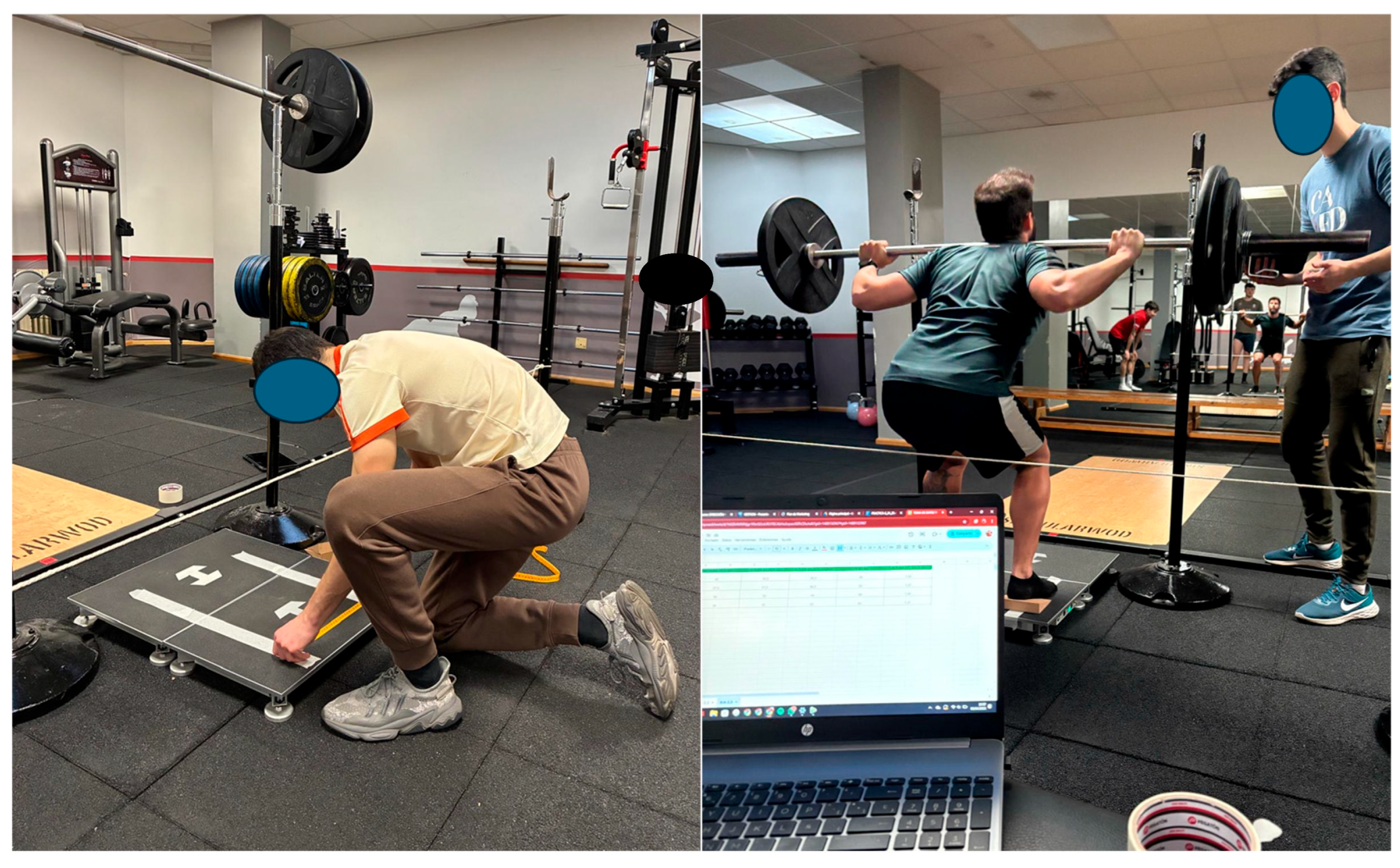
Session 2: Biomechanical Testing. During the second session, participants performed the biomechanical testing protocol under both experimental conditions (without heel elevation and with heel wedges). After completing the standardized warm-up described above, participants performed one familiarization set on the force plates at 70% of their previously estimated 1RM while maintaining the squat technique, foot stance width, and squat depth established during the first session (Figure 1). Subsequently, each participant completed 4 sets of 6 repetitions at 70% of 1RM, with 2 sets performed without heel elevation and 2 sets performed with heel wedges, in a randomized order. During the wedge condition, the distance between the wedges was individually adjusted to reproduce the foot stance width selected during Session 1, so that foot placement remained consistent across trials. The wedges were positioned so that the feet were centered mediolaterally on the wedge surfaces while preserving the previously established stance width. No additional fixation system was used to attach the wedges to the force-plate setup, as no wedge displacement was observed during testing under the vertical load applied by the participant and the static friction between the contact surfaces. Before each set, the examiner visually verified the correct positioning of both the wedges and the feet. A passive recovery period of 6 min was allowed between sets. For the primary analysis (Supplementary Materials), the mean of the two sets performed under each condition was taken as the representative value for each participant [23].
Biomechanical data were recorded during the entire duration of each set using a wireless dual force plate system (Hawkin Dynamics Wireless Dual Force Plates, Hawkin Dynamics Inc., Westbrook, ME, USA), composed of two independent portable platforms. Only one platform was used during squat execution to record vertical ground reaction force and center of pressure (CoP) variables in the present protocol, whereas the second platform served only as a stable adjacent support surface. Therefore, no bilateral integration of force-plate data was performed, and all CoP-derived variables reported in this study were obtained from the single recording platform. According to the manufacturer’s available documentation “https://www.hawkindynamics.com/blog/cop (accessed on 24 May 2026)”, CoP location is derived from the raw vertical force data recorded by the four vertical load cells of the platform, and no specific internal filtering procedure is reported.
The beginning of each recording was determined by the examiner’s start signal, whereas the end of the recording was established when the final repetition was completed. Each platform was equipped with four strain-gauge load cells located at the corners of the plate, providing a reported precision of 0.1 N and recording vertical force data at a sampling frequency of up to 1000 Hz. Previous research has supported the validity of this system for force assessment when compared with laboratory-grade platforms [24,25]. The force plates were connected to a tablet (Xiaomi Pad 5, Xiaomi Inc., Beijing, China) running the manufacturer’s software (Hawkin Capture, version 9.7.0, Hawkin Dynamics Inc., Westbrook, ME, USA), and all records were simultaneously stored in the Hawkin Dynamics Cloud Platform. The analyzed variables were mean vertical ground reaction force (Mean GRF), peak vertical ground reaction force (Peak GRF), and anteroposterior, mediolateral and total center of pressure displacement (CoP sway) and velocity (CoP velocity).

2.3. Statistical Analysis

The results are expressed as mean ± SD. Statistical analyses were conducted using SPSS statistical software (v. 26.0, IBM Corp., Armonk, New York, NY, USA). Differences in the analyzed variables between the wedge and no-wedge conditions were assessed using the Wilcoxon signed-rank test, which was selected to compare two related conditions within the same participants. Effect size magnitude was evaluated using the r coefficient for the Wilcoxon signed-rank test, calculated as r = Z / N , and interpreted according to Cohen’s criteria as small (0.10–0.29), moderate (0.30–0.49), and large (≥0.50), with values <0.10 considered trivial [26,27]. Because multiple dependent variables were analyzed, a Holm–Bonferroni correction was additionally applied to control for multiple comparisons. Values of p < 0.05 were considered statistically significant before correction.

3. Results

Table 1 shows that significant differences between conditions were only observed in mediolateral CoP sway in the unadjusted analysis, which was greater in the wedge condition than in the no-wedge condition (Wilcoxon test). However, after applying the Holm–Bonferroni correction for multiple comparisons, none of the analyzed variables remained statistically significant. In contrast, effect size analysis indicated that mediolateral CoP sway and velocity, as well as total CoP sway and velocity, were slightly higher when wedges were used, all showing small effect sizes. No differences were observed in ground reaction force variables between conditions.
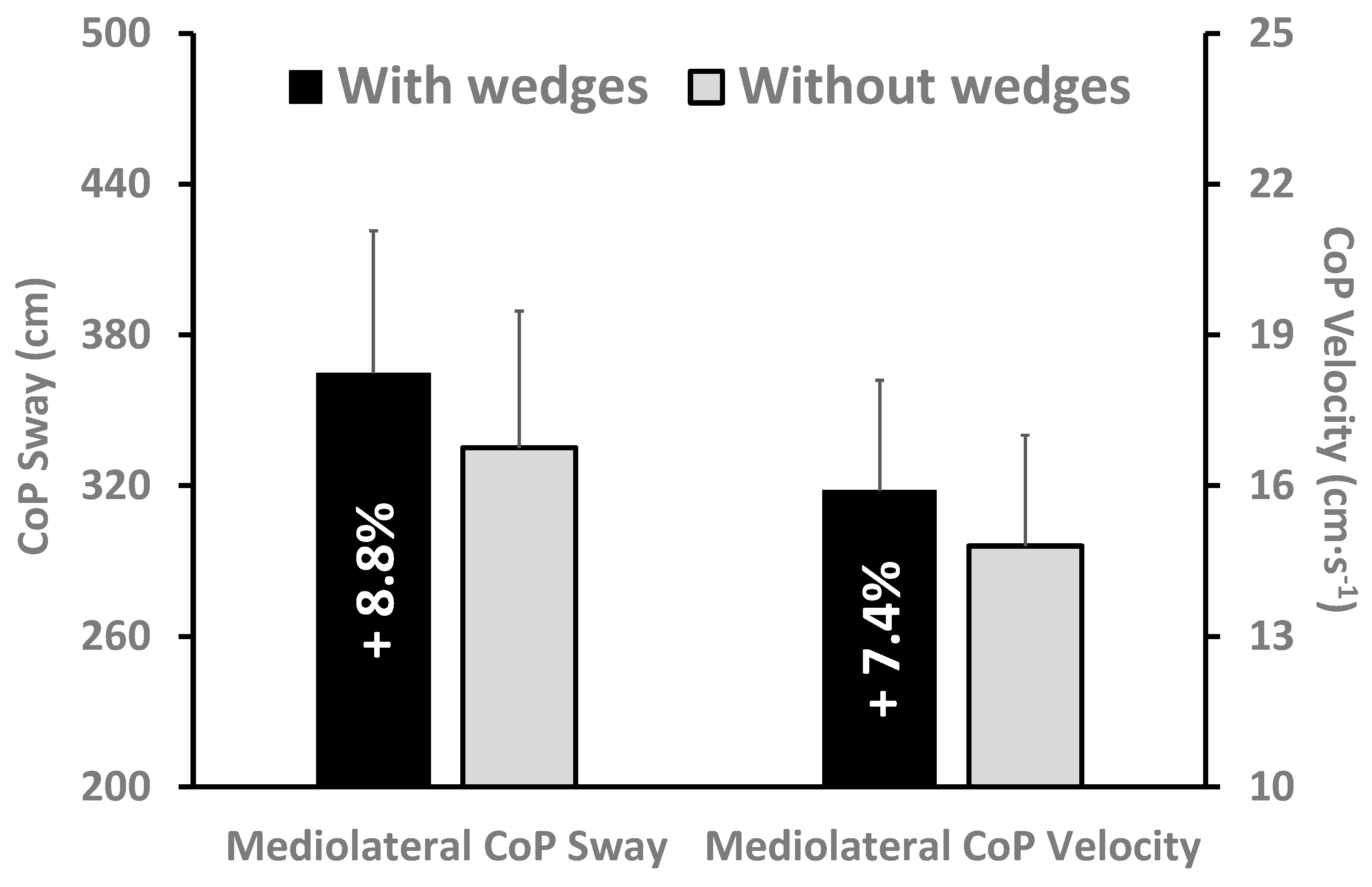
Figure 2 shows that both mediolateral CoP displacement and velocity were higher when wedges were used than when they were not. Specifically, mediolateral CoP displacement increased by 8.8%, whereas mediolateral CoP velocity increased by 7.4% in the wedge condition.

4. Discussion

The present study examined the effects of heel elevation using wedges on ground reaction forces and postural stability during the barbell back squat. The main findings indicate that wedge use did not meaningfully affect mean or peak vertical ground reaction force, but it was associated with small alterations in postural stability. Specifically, these effects were mainly restricted to mediolateral center of pressure-related variables, with higher mediolateral displacement and velocity when the exercise was performed with wedges. To the authors’ knowledge, this is one of the few studies specifically investigating the effect of heel elevation using wedges on balance-related variables during the barbell back squat.
Only limited significant differences in postural stability were observed between performing the barbell back squat with or without wedges (Table 1), which contrasts with the initial hypothesis that wedges could improve balance by facilitating a more upright squat posture, potentially through changes in ankle dorsiflexion and tibial inclination described in previous studies [13], although these mechanisms were not directly assessed in the present study. However, small differences were observed in mediolateral center of pressure displacement and velocity, both of which were higher when the squat was performed with wedges, indicating reduced CoP stability in this condition. A recent review by Duan et al. [20] examined several studies investigating the effects of heel elevation on balance during the squat, although all of them focused on heel elevation achieved through footwear rather than wedges [28,29,30,31]. This interpretation is also supported by more recent evidence suggesting that foot-position variations may influence postural stability during squat exercise [17]. Therefore, the present findings should be interpreted as preliminary and mainly indicative of a small mediolateral alteration in postural control rather than of a generalized impairment in overall postural stability.
According to Duan et al. [20], heel elevations greater than 3 cm tend to impair mediolateral stability during squat execution for several reasons. First, exceeding this height may shift the center of pressure toward the forefoot, reducing the effective support area of the foot and compromising stability, particularly in the mediolateral axis. Second, greater heel elevation may increase the plantarflexed position of the foot, which could reduce the stabilizing contribution of the muscles involved in foot and ankle control. Finally, heel elevation may also alter muscle activation patterns, potentially increasing the activity of muscles such as the quadriceps and gluteus while reducing the contribution of muscles responsible for fine ankle stabilization. These observations are broadly consistent with the findings of the present study, in which a 3 cm wedge was used and mediolateral stability was slightly reduced, although the underlying mechanisms were not directly assessed. In contrast, smaller heel elevations, typically between 1.5 and 2.5 cm through footwear, have been reported to improve balance during the squat [20]. Therefore, future studies should examine whether wedges with lower elevations than those used in the present study may produce more favorable effects on postural stability.
Although the increases in mediolateral CoP displacement and velocity observed in the present study were relatively small (7.4–8.8%; Figure 2), they may still be biomechanically relevant because mediolateral postural control is considered particularly important for balance maintenance. Previous research has shown that alterations in mediolateral CoP behavior are associated with impaired postural control in different populations, including older adults at risk of falling and individuals with low back pain or ankle instability [32,33]. Therefore, the slightly greater mediolateral sway observed with wedges may reflect a less efficient control of frontal-plane stability during the barbell back squat. Nevertheless, this interpretation should be made with caution, since the sample size of the present study was small and the magnitude of the observed differences was modest. Future studies with larger samples are needed to determine whether these mediolateral changes are consistent and whether they may have practical relevance for performance or injury prevention.
Another important finding of the present study was that neither mean nor peak ground reaction force differed significantly between the wedge and no-wedge conditions (Table 1). This is likely explained, at least in part, by the fact that both the external load and the movement tempo were standardized across conditions, thereby reducing the possibility that any differences in ground reaction force were due to changes in execution. These results are consistent with those reported by Pierce [19], who also found no improvements in force, power, or movement velocity when heel elevation was used during the barbell back squat. Similar findings were reported by Brice et al. [18], in which the use of footwear with heel elevation during the squat did not improve either peak or mean force measures. Therefore, although heel elevation may provide certain biomechanical advantages and may modify lower-limb and spine kinetics or muscle activation under some conditions [10,12], it does not appear to be an effective strategy when the aim is to improve squat performance.
Several limitations of the present study should be acknowledged. First, the sample size was small (n = 8), and only young male participants with previous resistance-training experience were included to reduce the potential influence of sex- and experience-related differences on the studied variables. This may have reduced statistical power, limited the ability to detect more consistent between-condition differences, particularly in mediolateral CoP variables, and restricted the generalizability of the findings to women, other age groups, individuals with different training backgrounds, or different loading conditions. However, effect sizes were also reported to complement null-hypothesis testing and to facilitate the interpretation of the magnitude of the observed differences. Second, a wedge height of 3 cm was selected because, at the time the study was conducted, the findings of Duan et al. [20] were not yet available. Considering that evidence, a lower heel elevation might have been a more appropriate choice, especially when the aim is to examine postural stability. Third, familiarization with the posturographic protocol was limited to a single session. Previous studies have suggested that a second familiarization session may substantially improve the reliability of posturographic measurements, mainly by reducing potential learning effects associated with this type of testing [34,35]. In addition, limited familiarization may have increased measurement variability and reduced the sensitivity to detect small between-condition differences, rather than artificially magnifying the observed effects. Fourth, postural stability was assessed only through CoP displacement and velocity variables, whereas other potentially informative dimensions, such as CoP area, power spectrum, or time-frequency characteristics, were not evaluated. Finally, the load corresponding to 70% of 1RM and the squat depth determined in the no-wedge condition were replicated in the wedge condition in order to minimize additional variability. However, future studies may consider standardizing load and squat depth independently for each condition in order to better reflect the specific mechanical demands associated with each exercise setup.

5. Conclusions

The present exploratory study suggests that 3 cm heel wedges do not meaningfully affect ground reaction force variables during the barbell back squat but may be associated with small, mainly mediolateral alterations in postural stability. Specifically, wedges were accompanied by higher mediolateral CoP displacement and velocity, which may reflect a less stable control strategy during squat execution. Given the small sample size and exploratory nature of the study, these findings should be interpreted with caution. Future studies should include larger and more diverse samples, lower wedge heights, and longer familiarization procedures to better characterize the effects of heel elevation on squat biomechanics and postural stability.

6. Practical Applications

From a practical perspective, the use of 3 cm heel wedges during the barbell back squat does not appear to improve ground reaction force output and may slightly impair mediolateral postural stability. Although heel wedges may help individuals with limited ankle dorsiflexion achieve an adequate squat position, their height should be carefully selected to avoid compromising balance control. When wedges are used in training or testing, an adequate familiarization period is recommended, particularly when postural stability is relevant for performance or safety.

Supplementary Materials

The following supporting information can be downloaded at: https://www.mdpi.com/article/10.3390/app16126168/s1.

Author Contributions

Conceptualization, H.V.-L., A.H.-M. and J.G.-L.; methodology, H.V.-L. and J.G.-L.; formal analysis, H.V.-L. and M.G.-C.; investigation, H.V.-L., A.H.-M., M.G.-C. and J.G.-L.; writing—original draft preparation, H.V.-L., A.H.-M. and J.G.-L.; writing—review and editing, H.V.-L., A.H.-M., M.G.-C. and J.G.-L.; visualization, H.V.-L., A.H.-M., M.G.-C. and J.G.-L.; supervision, H.V.-L., A.H.-M. and J.G.-L.; project administration and indexing, H.V.-L. and J.G.-L. All authors have read and agreed to the published version of the manuscript.

Funding

This research received no external funding.

Institutional Review Board Statement

The study was conducted in accordance with the Declaration of Helsinki and approved by the Ethics Committee of the Universidad de León (ETICA-ULE-026-2022; approval date: 3 November 2022).

Informed Consent Statement

Informed consent was obtained from all subjects involved in the study.

Data Availability Statement

Data are contained within the article or Supplementary Materials.

Acknowledgments

The authors would like to thank the participants for their voluntary contribution to this study. The authors also acknowledge the Faculty of Physical Activity and Sport Sciences of the University of León for providing the facilities where the study was conducted.

Conflicts of Interest

The authors declare no conflicts of interest.

References

  1. Westcott, W. Resistance training is medicine: Effects of strength training on health. Curr. Sports Med. Rep. 2012, 11, 209–216. [Google Scholar] [CrossRef] [PubMed]
  2. Korakakis, P.; Wolf, M.; Coleman, M.; Burke, R.; Piñero, A.; Nippard, J.; Schoenfeld, B.J. Optimizing resistance training technique to maximize muscle hypertrophy: A narrative review. J. Funct. Morphol. Kinesiol. 2023, 9, 9. [Google Scholar] [CrossRef] [PubMed]
  3. McMaster, D.; Cronin, J.; McGuigan, M. Forms of variable resistance training. Strength Cond. J. 2009, 31, 50–64. [Google Scholar] [CrossRef]
  4. Rodríguez-Ridao, D.; Antequera-Vique, J.; Martín-Fuentes, I.; Muyor, J. Effect of five bench inclinations on the electromyographic activity of the pectoralis major, anterior deltoid, and triceps brachii during the bench press exercise. Int. J. Environ. Res. Public Health 2020, 17, 7339. [Google Scholar] [CrossRef] [PubMed]
  5. Goller, M.; Quittmann, O.; Alt, T. How to activate the glutes best? Peak muscle activity of acceleration-specific pre-activation and traditional strength training exercises. Eur. J. Appl. Physiol. 2024, 124, 1757–1769. [Google Scholar] [CrossRef] [PubMed]
  6. Ye, B.; Liu, G.; He, Z.; Xu, J.; Pan, H.; Zhu, H. Biomechanical mechanisms of anterior cruciate ligament injury in the jerk dip phase of clean and jerk: A case study of an injury event captured on-site. Heliyon 2024, 10, e31390. [Google Scholar] [CrossRef] [PubMed]
  7. Gullett, J.; Tillman, M.; Gutierrez, G.; Chow, J. A biomechanical comparison of back and front squats in healthy trained individuals. J. Strength Cond. Res. 2009, 23, 284–292. [Google Scholar] [CrossRef] [PubMed]
  8. Glassbrook, D.; Brown, S.; Helms, E.; Duncan, S.; Storey, A. The high-bar and low-bar back-squats: A biomechanical analysis. J. Strength Cond. Res. 2019, 33, S1–S18. [Google Scholar] [CrossRef] [PubMed]
  9. Straub, R.; Powers, C. A biomechanical review of the squat exercise: Implications for clinical practice. Int. J. Sports Phys. Ther. 2024, 19, 490–501. [Google Scholar] [CrossRef] [PubMed]
  10. Lu, Z.; Li, X.; Xuan, R.; Song, Y.; Bíró, I.; Liang, M.; Gu, Y. Effect of heel lift insoles on lower extremity muscle activation and joint work during barbell squats. Bioengineering 2022, 9, 301. [Google Scholar] [CrossRef] [PubMed]
  11. Pangan, A.M.; Leineweber, M.J. Footwear and elevated heel influence on barbell back squat: A review. J. Biomech. Eng. 2021, 143, 090801. [Google Scholar] [CrossRef] [PubMed]
  12. Southwell, D.J.; Petersen, S.A.; Beach, T.A.C.; Graham, R.B. The effects of squatting footwear on three-dimensional lower limb and spine kinetics. J. Electromyogr. Kinesiol. 2016, 31, 111–118. [Google Scholar] [CrossRef] [PubMed]
  13. Sato, K.; Fortenbaugh, D.; Hydock, D. Kinematic changes using weightlifting shoes on barbell back squat. J. Strength Cond. Res. 2012, 26, 28–33. [Google Scholar] [CrossRef] [PubMed]
  14. Sayers, M.; Bachem, C.; Schütz, P.; Taylor, W.; List, R.; Lorenzetti, S.; Nasab, S. The effect of elevating the heels on spinal kinematics and kinetics during the back squat in trained and novice weight trainers. J. Sports Sci. 2020, 38, 1000–1008. [Google Scholar] [CrossRef] [PubMed]
  15. Charlton, J.; Hammond, C.; Cochrane, C.; Hatfield, G.; Hunt, M. The effects of a heel wedge on hip, pelvis and trunk biomechanics during squatting in resistance trained individuals. J. Strength Cond. Res. 2017, 31, 1678–1687. [Google Scholar] [CrossRef] [PubMed]
  16. Ghasemi, M.; Gholami-Borujeni, B.; Briem, K. Effects of various foot wedges on thigh muscle activity during squatting in healthy adults: A systematic review and meta-analysis. Appl. Sci. 2024, 14, 2091. [Google Scholar] [CrossRef]
  17. Bozkurt, Ö.; Erdağ, D.; Tinazci, C.; Burgul, N.; Bekiroğulları, H. Mechanobiological and neuromuscular responses to foot-position variations during front and back squat exercises. Front. Physiol. 2026, 16, 1727141. [Google Scholar] [CrossRef] [PubMed]
  18. Brice, S.; Doma, K.; Spratford, W. Effect of footwear on the biomechanics of loaded back squats to volitional exhaustion in skilled lifters. J. Strength Cond. Res. 2021, 36, 2676–2684. [Google Scholar] [CrossRef] [PubMed]
  19. Pierce, M. The Effects of Heel Elevation on Back Squat Performance. Master’s Thesis, William Paterson University of New Jersey, Wayne, NJ, USA, 2023. [Google Scholar]
  20. Duan, L.; Fekete, G.; Ugbolue, U.C.; Zhou, H. The influence of different heel heights on squatting stability: A systematic review and network meta-analysis. Appl. Sci. 2025, 15, 2471. [Google Scholar] [CrossRef]
  21. Svensson, F.; Aasa, U.; Strong, A. Textile electromyography electrodes reveal differences in lower limb muscle activation during loaded squats when comparing fixed and free barbell movement paths. Front. Sports Act. Living 2022, 4, 1021323. [Google Scholar] [CrossRef] [PubMed]
  22. Nuzzo, J.; Pinto, M.; Nosaka, K.; Steele, J. Maximal number of repetitions at percentages of the one repetition maximum: A meta-regression and moderator analysis of sex, age, training status, and exercise. Sports Med. 2024, 54, 303–321. [Google Scholar] [CrossRef] [PubMed]
  23. Frames, C.; Soangra, R.; Lockhart, T.E. Assessment of postural stability using inertial measurement unit on inclined surfaces in healthy adults. Biomed. Sci. Instrum. 2013, 49, 234–242. [Google Scholar] [PubMed]
  24. Badby, A.J.; Mundy, P.D.; Comfort, P.; Lake, J.P.; McMahon, J.J. The validity of Hawkin Dynamics wireless dual force plates for measuring countermovement jump and drop jump variables. Sensors 2023, 23, 4820. [Google Scholar] [CrossRef] [PubMed]
  25. Dos’ Santos, T.; Evans, D.T.; Read, D.B. Validity of the Hawkin Dynamics wireless dual force platform system against a piezoelectric laboratory grade system for vertical countermovement jump variables. J. Strength Cond. Res. 2024, 38, 1144–1148. [Google Scholar] [CrossRef] [PubMed]
  26. Cohen, J. Statistical Power Analysis for the Behavioral Sciences, 2nd ed.; Lawrence Erlbaum Associates: Hillsdale, NJ, USA, 1988. [Google Scholar]
  27. Field, A. Discovering Statistics Using IBM SPSS Statistics, 4th ed.; Sage: London, UK, 2013. [Google Scholar]
  28. Gu, Y. Lower extremity muscle morphology and plantar loading during squatting with different heel heights. J. Med. Imaging Health Inform. 2020, 10, 1210–1215. [Google Scholar] [CrossRef]
  29. Sriwarno, A.; Shimomura, Y.; Iwanaga, K.; Katsuura, T. The relation between the changes of postural achievement, lower limb muscle activities, and balance stability in three different deep-squatting postures. J. Physiol. Anthropol. 2008, 27, 11–17. [Google Scholar] [CrossRef] [PubMed]
  30. Cohen, J.; Lee, P.; Buchman-Pearle, J. The effects of footwear on squat movements. West. Undergrad. Res. J. Health Nat. Sci. 2017, 8, 30. [Google Scholar] [CrossRef][Green Version]
  31. Shorter, K.; Lake, J.; Smith, N.; Lauder, M. Influence of the foot-floor interface on squatting performance. Port. J. Sport Sci. 2011, 11, 385–388. [Google Scholar]
  32. Quijoux, F.; Vienne-Jumeau, A.; Bertin-Hugault, F.; Zawieja, P.; Lefèvre, M.; Vidal, P.P.; Ricard, D. Center of pressure displacement characteristics differentiate fall risk in older people: A systematic review with meta-analysis. Ageing Res. Rev. 2020, 62, 101117. [Google Scholar] [CrossRef] [PubMed]
  33. Sung, P.S.; Lee, D. Postural control and trunk stability on sway parameters in adults with and without chronic low back pain. Eur. Spine J. 2024, 33, 1455–1464. [Google Scholar] [CrossRef] [PubMed]
  34. Ageberg, E.; Zätterström, R.; Moritz, U. Stabilometry and one-leg hop test have high test-retest reliability. Scand. J. Med. Sci. Sports 1998, 8, 198–202. [Google Scholar] [CrossRef] [PubMed]
  35. Pineda, R.; Krampe, R.; Vanlandewijck, Y.; Van Biesen, D. Reliability of center of pressure excursion as a measure of postural control in bipedal stance of individuals with intellectual disability: A pilot study. PLoS ONE 2020, 15, e0240702. [Google Scholar] [CrossRef] [PubMed]
Figure 1. Standardization of foot position and squat depth during squat execution (left), and biomechanical testing with heel wedges on the force plates (right).
Applsci 16 06168 g001
Figure 2. Mediolateral center of pressure (CoP) displacement and velocity during the barbell back squat performed with and without wedges.
Applsci 16 06168 g002
Table 1. Descriptive analysis of ground reaction force (GRF) and center of pressure (CoP) displacement and velocity during the half squat with and without wedges.
WITH WEDGESWITHOUT WEDGESDIFFERENCES
Mean ± SDRangeMean ± SDRangep ValuesEffect Size (r)
Mean GRF (N)1387.6 ± 169.41106.2–1683.61408.4 ± 166.31121.4–1671.80.1950.06
Peak GRF (N)2132.1 ± 313.61612.5–2612.52126.6 ± 298.71619.5–2581.50.9450.01
Mediolateral CoP sway (cm)364.7 ± 56.7277.7–447.8335.1 ± 54.4232.4–385.50.0390.26
Anteroposterior CoP sway (cm)311.0 ± 30.5272.6–371.4306.5 ± 50.1230.1–382.30.7420.05
Total CoP sway (cm)551.0 ± 65.3477.1–665.4521.8 ± 76.2411.3–623.10.0780.20
Mediolateral CoP velocity (cm·s−1)15.9 ± 2.213.9–20.014.8 ± 2.211.8–18.00.1950.24
Anteroposterior CoP velocity (cm·s−1)13.6 ± 1.611.4–15.613.6 ± 2.29.7–15.60.8440.00
Total CoP velocity (cm·s−1)24.1 ± 2.721.0–28.823.1 ± 3.119.1–27.20.1950.17
Wilcoxon signed-rank test. Unadjusted p values are presented. After Holm–Bonferroni correction for multiple comparisons, none of the analyzed variables remained statistically significant. Effect sizes (r) were interpreted as trivial (<0.10), small (0.10–0.29), moderate (0.30–0.49), and large (≥0.50), according to Cohen’s criteria.
Disclaimer/Publisher’s Note: The statements, opinions and data contained in all publications are solely those of the individual author(s) and contributor(s) and not of MDPI and/or the editor(s). MDPI and/or the editor(s) disclaim responsibility for any injury to people or property resulting from any ideas, methods, instructions or products referred to in the content.