Article

Multi-Cohort Educational Process Evaluation of a Multiplatform Telemedicine System for Simulation-Based Gynecology Training

by
Leonel Vasquez-Cevallos
1,*,
Paul E. D. Soto-Rodriguez
2,
Candelaria Martín-González
3 and
Pedro A. Salazar-Carballo
4
1
Facultad de Ingenierías, Arquitectura y Ciencias de la Naturaleza, Universidad Ecotec, Km. 13.5 Samborondón, Samborondón 092302, Ecuador
2
Instituto de Estudios Avanzados IUDEA, Departamento de Física, Universidad de La Laguna, C/Astrofísico Francisco Sánchez, s/n, 38203 La Laguna, Spain
3
Medicina Interna, Hospital Universitario de Canarias, 38320 La Laguna, Spain
4
Laboratory of Sensors, Biosensors and Advanced Materials, Faculty of Health Sciences, University of La Laguna, Campus de Ofra s/n, 38071 La Laguna, Spain
*
Author to whom correspondence should be addressed.
Appl. Sci. 2026, 16(12), 6161; https://doi.org/10.3390/app16126161
Submission received: 20 May 2026 / Revised: 12 June 2026 / Accepted: 14 June 2026 / Published: 18 June 2026
(This article belongs to the Special Issue Digital Innovations in Healthcare—2nd Edition)

Abstract

Telemedicine is increasingly relevant in undergraduate medical education; however, most educational studies emphasize short-term interventions, learner satisfaction, or tele-Objective Structured Clinical Examination performance rather than evidence derived from sustained platform implementation. This multi-cohort longitudinal implementation study evaluated a multiplatform asynchronous telemedicine system integrated into simulation-based gynecology training across three consecutive academic periods at a medical simulation center in Ecuador. Platform-generated teleconsultation records were analyzed at the record level, with repeated records nested within student identifiers when students submitted more than one case. Because the expected number of submissions differed across cohorts as part of planned curricular refinements, cohort-level differences were interpreted descriptively as implementation and process indicators rather than as comparative evidence of learner performance. A total of 205 teleconsultation records from 95 student users were analyzed. Documentation quality was high for current illness documentation (98.5%), physical examination documentation (87.3%), and physiologically plausible vital signs (74.1%). Specialist responses were linked to 196/205 records (95.6%), with complete structured feedback among linked responses. Faculty expert review and learner-reported perceptions provided complementary educational evidence, including perceived usefulness of specialist feedback for gynecology learning. These findings support the feasibility of asynchronous telemedicine-supported simulation workflows and the value of platform-generated data for educational process evaluation, documentation monitoring, and feedback tracking, while not demonstrating individual competence improvement.

1. Introduction

Digital health has become a central component of healthcare transformation, requiring coordinated technological, organizational, human, and governance capacities, rather than isolated technology deployment [1]. In parallel, health professions education has evolved to incorporate digital competencies as essential components of contemporary clinical training, particularly in environments where healthcare delivery increasingly involves remote communication, digital documentation, and technology-mediated decision-making [2,3,4,5].
Telemedicine training in undergraduate medical education has expanded through curricular modules, standardized patient encounters, tele-Objective Structured Clinical Examinations (tele-OSCEs), and competency-based frameworks [6]. Broader evidence from digital education research suggests that online, mobile, and communication-based instructional approaches can support knowledge and skills acquisition. However, outcome heterogeneity and variability in instructional design continue to limit comparability across studies [7,8,9,10].
Simulation-based education provides a robust pedagogical framework for preparing learners for direct patient care. Technology-enhanced simulation has been associated with improvements in knowledge, clinical skills, behaviors, and patient-related outcomes compared with no intervention [11], while established simulation frameworks emphasize feedback, repetitive practice, curriculum integration, and outcome measurement as core educational mechanisms [12,13]. These principles are particularly relevant to telemedicine-based learning, where students must synthesize remotely acquired histories, structured clinical information, and diagnostic reasoning in digital environments [14].
Despite these advances, an important gap remains in telemedicine education research. Much of the published literature has focused on short-term curricular interventions, learner satisfaction, self-reported perceptions, or isolated tele-OSCE performance. Less evidence is available from sustained educational implementations that analyze real platform-generated activity across successive academic periods, including structured documentation quality, specialist response coverage, temporal usage patterns, diagnostic exposure, faculty expert review, and learner-reported acceptability. This limitation is particularly relevant in gynecology, where remote clinical reasoning requires careful history-taking, privacy-sensitive communication, diagnostic prioritization, and recognition of conditions that require in-person assessment.
The present study builds on, but is distinct from, previous outputs of the same institutional research program on telemedicine, simulation, and digital health education in Ecuador. Earlier publications addressed rural telemedicine deployment [15,16], initial web/mobile platform validation, mixed-reality telemedicine-assisted simulation [17], rotating-intern implementation needs [18], and sensor-integration workflows [19]. In contrast, the present manuscript focuses on the educational process evaluation of the asynchronous telemedicine workflow across three consecutive academic cohorts, using platform-generated teleconsultation records, specialist response linkage, documentation quality indicators, faculty expert review, and learner-reported perceptions as complementary sources of implementation evidence.
Accordingly, the objective of this study was to evaluate the implementation and educational process indicators of a multiplatform asynchronous telemedicine system used in simulation-based gynecology training across three consecutive academic cohorts. The analysis focused on platform activity, documentation quality, specialist response coverage, diagnostic exposure diversity, temporal usage behavior, faculty expert review, and learner-reported acceptability within an asynchronous telemedicine learning workflow.

2. Materials and Methods

2.1. Study Design and Reporting

This multi-cohort observational implementation study was conducted in a simulated medical education setting. Reporting was aligned with the Strengthening the Reporting of Observational Studies in Epidemiology (STROBE) statement and with simulation-reporting guidance extending STROBE/CONSORT principles, where applicable, to educational simulation data [20,21]. This study is best understood as a multi-cohort observational implementation study with longitudinal institutional follow-up across academic periods [22,23]. The term longitudinal refers to the sequential implementation and analysis of the same educational platform across three consecutive academic periods; it does not indicate participant-level follow-up of the same students over time. The primary unit of analysis was the platform-generated teleconsultation record, and some student users contributed more than one record during their cohort’s scheduled activity [3].

2.2. Setting, Participants, and Educational Intervention

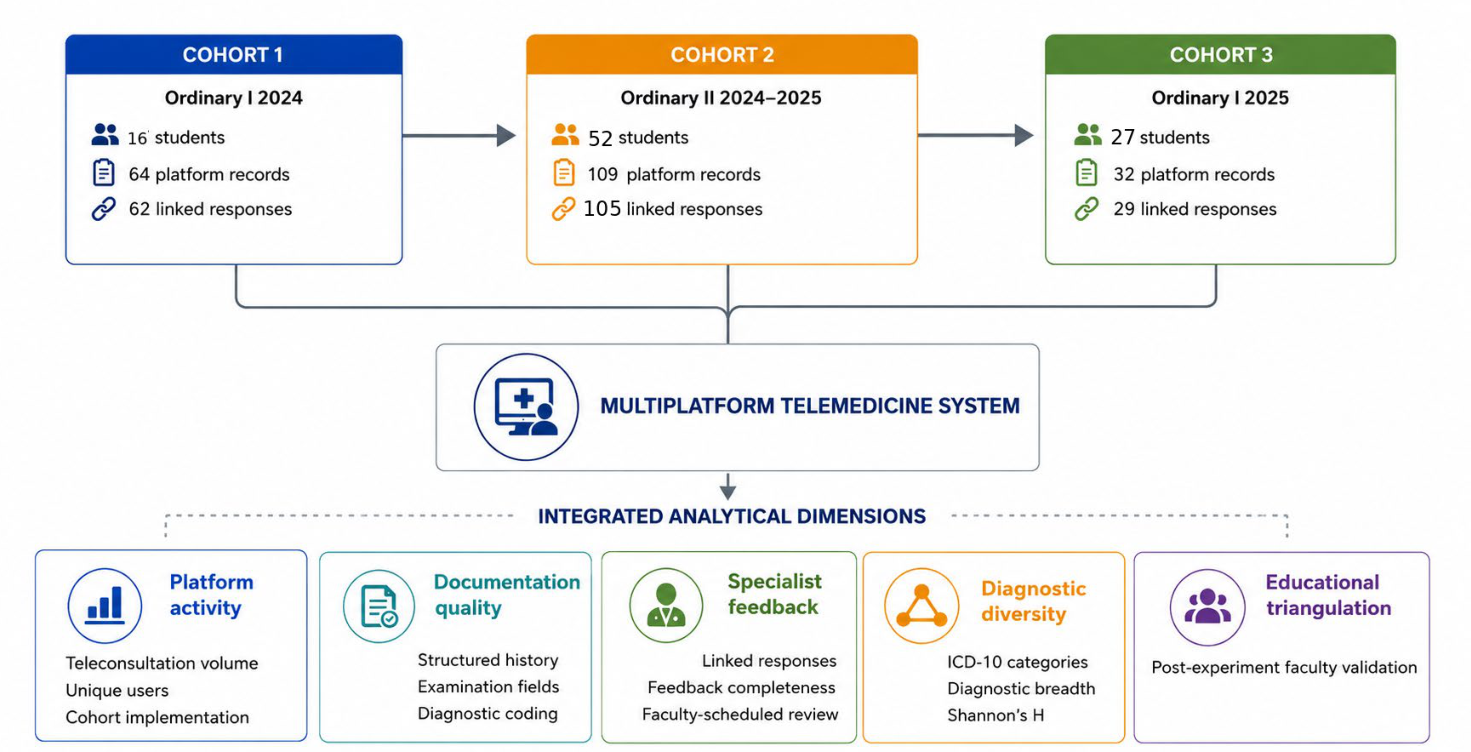
The study was conducted at a medical simulation center in Ecuador across three consecutive academic periods: Ordinario I 2024, Ordinario II 2024–2025, and Ordinario I 2025. This longitudinal implementation and analytical framework are summarized in Figure 1.
The intervention integrated asynchronous teleconsultations into simulation-based gynecology training. Students submitted structured simulated cases through the mobile platform, including clinical history, physical examination fields, vital signs, diagnostic descriptors, comments, and attachments. Faculty specialists reviewed the submissions and provided structured feedback, including diagnostic codes, presumptive and definitive diagnoses, therapeutic recommendations, and educational guidance. Unlike the rural clinical implementation of the platform, which followed a 24–72-h response protocol, this educational implementation used faculty-scheduled review cycles, with teleconsultations assessed and answered in batches before the end of each academic period.
The submission protocol was progressively refined across cohorts in response to faculty experience, curricular time constraints, and workload considerations. Cohort 1 allowed approximately four teleconsultations per student to maximize exploratory platform use; Cohort 2 reduced the expected workload to approximately two submissions per student; and Cohort 3 required one teleconsultation per student to ensure completion of the scheduled formative activity. These planned protocol differences are central to the interpretation of the findings. Therefore, differences in submission volume, records per student, diagnostic diversity, or documentation indicators across cohorts were interpreted as implementation patterns rather than as direct evidence of cohort-level educational performance.
The simulated gynecological cases were selected within the educational scope of the gynecology training activity and reviewed by faculty specialists to ensure internal clinical coherence. Clinical information, including symptoms, physical examination findings, and expected vital signs, was aligned with the simulated case context. During analysis, physiological plausibility was assessed descriptively by verifying whether the recorded vital signs were compatible with clinically reasonable ranges for the corresponding simulated scenario. This procedure evaluated documentation coherence and data quality, not real patient measurements or physical examination performance.
Physiological plausibility was operationalized as the presence of vital-sign values compatible with clinically reasonable ranges for the corresponding simulated gynecological scenario. This review was conducted as a documentation-coherence check rather than as an assessment of real patient physiology or bedside examination performance. Records were considered physiologically plausible only when the available vital-sign fields were internally coherent with the simulated case context and did not contain values that were clinically implausible for the scenario.

2.3. Multiplatform Implementation and Data Sources

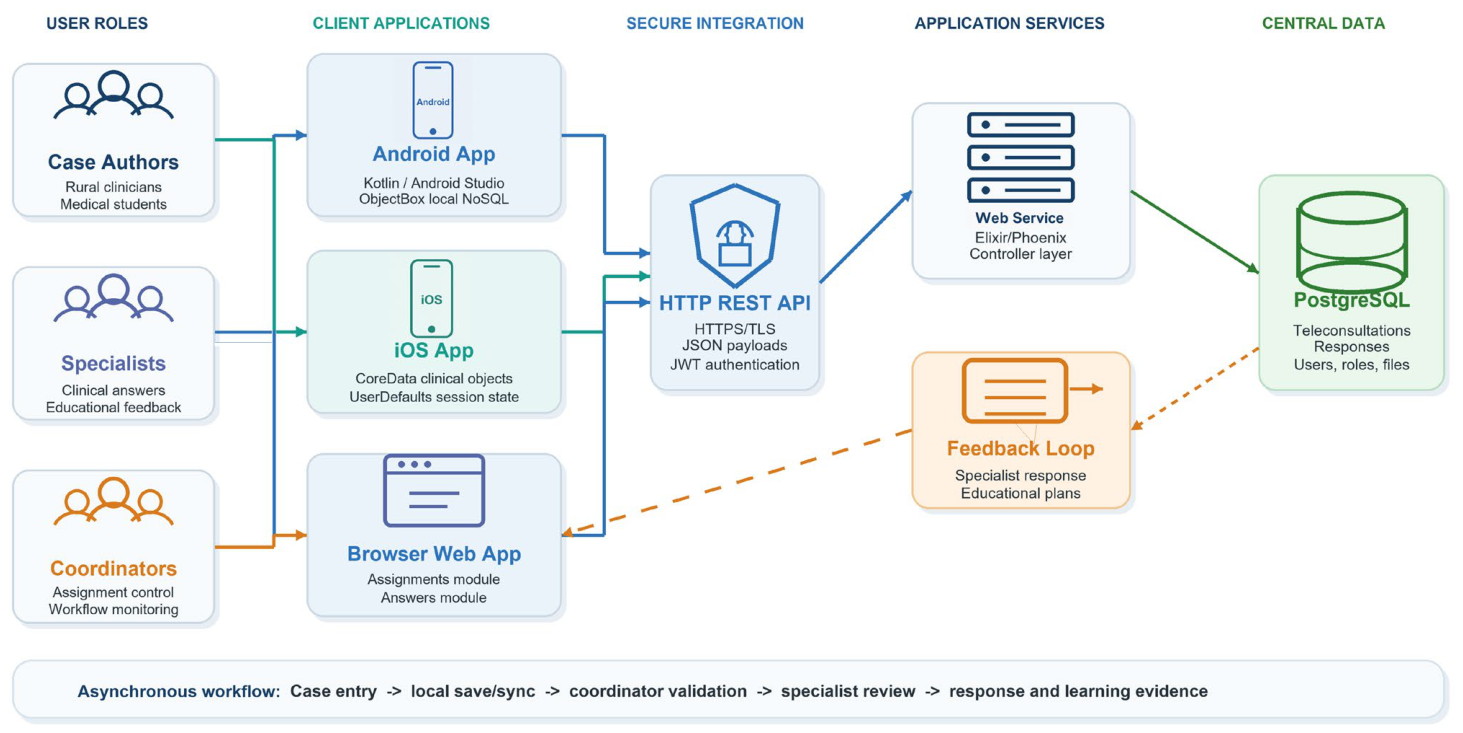
The telemedicine system consisted of a custom-developed multiplatform architecture integrating Android, iOS, and browser-based web applications through a secure RESTful API and a centralized PostgreSQL database infrastructure, as shown in Figure 2. The Android application was implemented for the Android operating system (Google LLC, Mountain View, CA, USA), the iOS extension was implemented for the iOS operating system (Apple Inc., Cupertino, CA, USA), and the browser-based web application supported assignment control, specialist response documentation, and workflow monitoring. The centralized database was implemented using PostgreSQL (PostgreSQL Global Development Group, Berkeley, CA, USA). The RESTful API was part of the custom-developed system architecture and was not a commercial software product. The architecture enabled structured case submission, local save/synchronization processes, coordinator validation, specialist review, and response documentation within a shared, asynchronous educational workflow.
The data sources included structured teleconsultation records and specialist response records from the full longitudinal implementation, an institutional study design document, learner survey exports, faculty evaluation exports, and technical documentation related to the iOS extension. The platform variables included the academic period, consultation code, user identifier, diagnostic descriptors, documentation fields, physical examination fields, vital signs, attachments, and timestamps. The specialist response variables included linkage status, comments, presumptive and definitive diagnoses, therapeutic recommendations, educational guidance, diagnostic codes, and response timestamps.

2.4. Outcomes and Statistical Analysis

Categorical variables were reported as counts and percentages, and continuous variables as means, standard deviations, medians, interquartile ranges, and ranges. The documentation and response indicators were defined as follows.
Documentation indicators were defined a priori from available platform fields. Current illness documentation was considered present when the corresponding structured field contained clinically interpretable text. History-field completeness required completion of all seven structured history fields. Physical examination documentation required at least one completed examination field. Diagnostic descriptor completeness required both primary diagnostic and subdiagnostic fields to be completed. Response linkage indicated that a specialist response record could be matched to the original teleconsultation record. Feedback completeness was calculated from the structured specialist response fields available in the platform, including diagnostic coding, presumptive and definitive diagnoses, therapeutic recommendations, and educational guidance.
Diagnostic diversity was calculated using Shannon’s diversity index, H = −Σ(pi ln pi), where pi represents the proportion of records in primary diagnostic category I [24]. In this educational implementation, Shannon’s index was included to summarize the breadth and evenness of simulated diagnostic exposure across the platform-generated case portfolio. It was interpreted only as a descriptive implementation indicator of diagnostic exposure diversity and not as a validated learner performance score, diagnostic accuracy metric, or measure of competence acquisition. Given the observational implementation design, repeated records within some student users, and planned differences in cohort submission protocols, formal between-cohort hypothesis testing was not used to support comparative educational claims. Cohort-level indicators are therefore reported descriptively to characterize implementation patterns, documentation quality, response coverage, temporal use, and simulated diagnostic exposure across academic periods.

2.5. Faculty Expert Review

Faculty evaluation exports were interpreted as a post-experiment expert review layer collected after completion of the implementation [25]. Because the available forms did not allow ratings to be attributed to specific academic periods, faculty assessments were analyzed as summative educational triangulation across the full implementation [26,27]. The two faculty specialists evaluated different submissions or participant groups rather than independently rating the same dataset [28]. Therefore, these data were reported as supporting expert opinion regarding documentation quality and were not used to estimate interrater reliability, scoring validity, or formal psychometric evidence.

2.6. Ethical Considerations

This study was conducted in accordance with the principles of the Declaration of Helsinki and the ethical standards for educational research involving human participants. It was developed within the framework of the institutional research project “Efectividad de la telemedicina como herramienta de simulación en el desarrollo de competencias de diagnóstico a distancia en estudiantes de medicina,” officially registered and approved by the institutional Research Center [29]. All participants provided written informed consent. Participation was voluntary, and students were informed that participation or withdrawal would not affect their academic performance. All records were anonymized at the time of collection, de-identified before analysis, and handled confidentially.

3. Results

3.1. Longitudinal Implementation and Platform Activity

Across the three academic periods, 205 platform records from 95 student-user identifiers were analyzed. The distribution was 64, 109, and 32 records in Cohorts 1, 2, and 3, respectively. The records per student user were 4.00, 2.10, and 1.19, respectively, reflecting the progressive reduction in the expected number of teleconsultation submissions introduced across cohorts as part of protocol refinement. These differences in records per student reflected the planned reduction in expected submissions across cohorts and were therefore interpreted as implementation characteristics rather than as indicators of student performance or engagement.
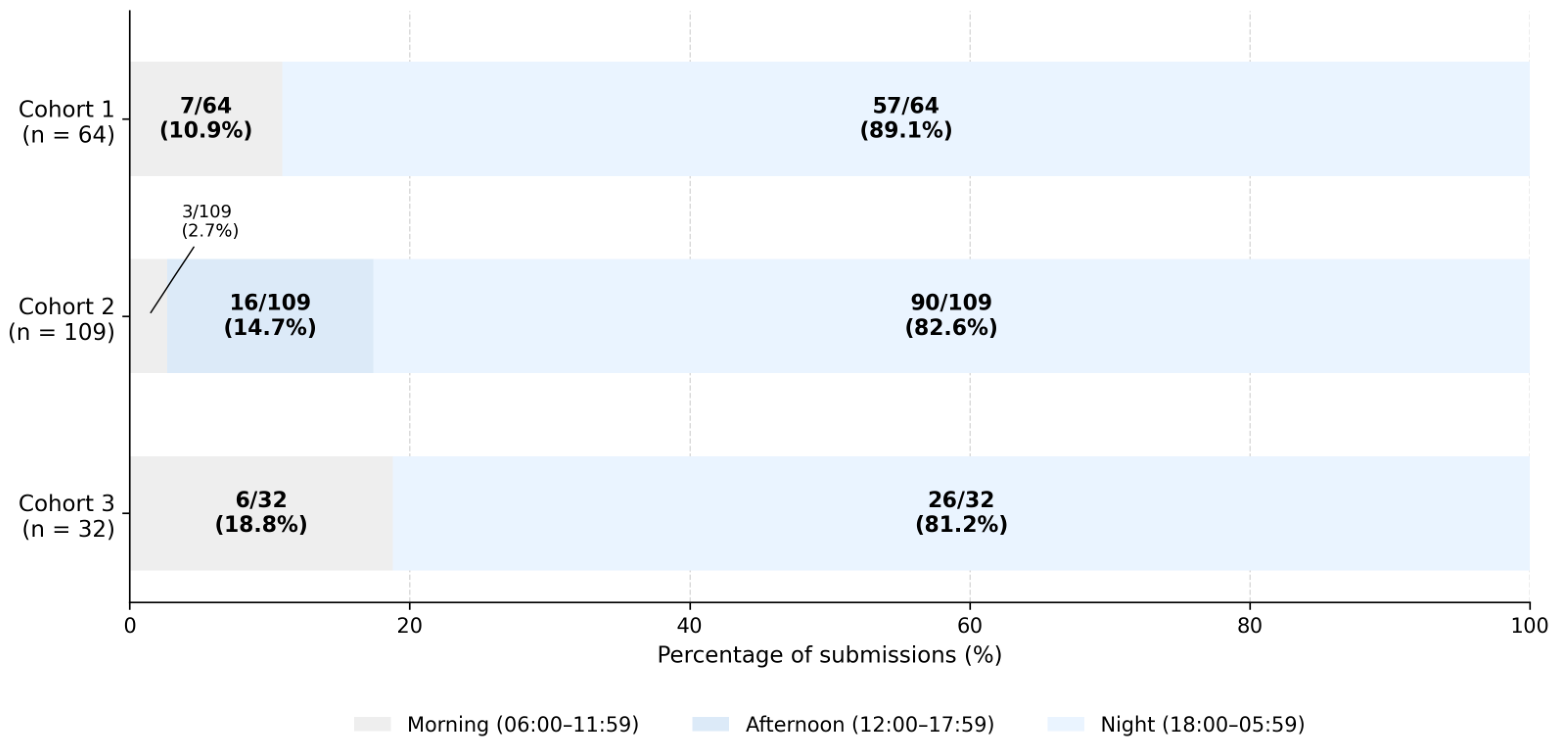
Valid ICD-10 diagnostic coding was available for 182/205 records (88.8%). Attachment use was observed in 25/205 records (12.2%), with the highest proportion in cohort 3 (10/32, 31.3%). The cohort implementation characteristics and platform activity indicators are summarized in Table 1. The temporal distribution of the submissions is shown in Figure 3.
The predominance of evening/night submissions suggests that the asynchronous workflow enabled students to complete teleconsultation activities outside conventional classroom hours. This pattern supports the flexibility of the implementation model but does not provide direct evidence of improved learning outcomes.

3.2. Documentation Quality and Diagnostic Diversity

The teleconsultation records represented a broad range of simulated gynecological cases. Diagnostic diversity varied across cohorts, with 33 primary diagnostic categories in cohort 1 (H = 3.039), 39 in cohort 2 (H = 3.342), and 11 in cohort 3 (H = 1.971), as shown in Table 1. Shannon’s index was used only as a descriptive indicator of the simulated diagnostic exposure breadth and evenness. The documentation quality indicators are summarized in Table 2. Current illness was documented in 202/205 records (98.5%), at least one physical examination field in 179/205 (87.3%), complete primary/subdiagnostic descriptors in 174/205 (84.9%), physiologically plausible vital signs in 152/205 (74.1%), and all seven history fields in 118/205 (57.6%) records. The lower diagnostic diversity observed in Cohort 3 should be interpreted in the context of the reduced expected number of submissions per student and the smaller number of total records, rather than as evidence of lower diagnostic ability.

3.3. Specialist Feedback and Faculty Expert Review

Specialist response linkage was achieved for 196/205 platform records (95.6%), with high coverage across the three academic periods studied. Structured specialist feedback was complete among linked responses, with a median completeness score of 7.0 (IQR 7.0-7.0) overall and in each academic period. Faculty expert review provided supportive opinion regarding the quality of submitted teleconsultation write-ups, with high ratings for history structure (mean 3.91, SD 0.56; ratings 4–5: 45/54, 83.3%) and medical language (mean 4.54, SD 0.88; ratings 4–5: 45/54, 83.3%). These faculty ratings were interpreted as complementary expert evidence, not as formal reliability or scoring-validity evidence.
Learner-reported outcomes showed that 88/95 respondents (92.6%) perceived specialist feedback as useful for gynecology learning, 81/95 (85.3%) perceived benefit for diagnostic/management ability, and 76/95 (80.0%) rated the platform as being easy to use. The main implementation priorities identified by learners were fewer technical problems (33/95, 34.7%), easier platform use (23/95, 24.2%), and more real-time faculty interactions (19/95, 20.0%).

4. Discussion

4.1. Principal Findings

This study provides multi-cohort educational process evidence that a multiplatform asynchronous telemedicine system can be implemented within simulation-based gynecology training across successive undergraduate cohorts. The main findings were that the platform generated a structured portfolio of student-created gynecology teleconsultation records, enabled monitoring of documentation quality and specialist response linkage, supported descriptive analysis of simulated diagnostic exposure, and provided complementary evidence from faculty expert review and learner-reported perceptions. These findings should be interpreted as process-level implementation evidence rather than as proof of individual competence gain. The platform traces how students used the system, how completely teleconsultation records were documented, and how reliably specialist feedback was linked to submissions. However, the study did not include direct observation of synchronous telemedicine encounters, linked pre/post competence assessments, or validated learner-level diagnostic accuracy measures [3,4,22,23].
The contribution of the present manuscript is not the technical development of the platform alone, which has been addressed in earlier stages of the research program, but the analysis of platform-generated educational process data across a complete multi-cohort implementation. This distinguishes the study from prior platform-development and early implementation reports by focusing on documentation quality, response linkage, diagnostic exposure diversity, temporal use, faculty expert review, and learner acceptability within an asynchronous simulation-based gynecology workflow.

4.2. Relationship to Existing Literature

These findings align with the telemedicine education literature, emphasizing the importance of structured opportunities to practice remote communication, digital documentation, technology use, data collection, and telehealth decision-making [5,6,30]. However, this study addresses a more specific gap by moving beyond single-session satisfaction, isolated tele-OSCE performance, and short-term curricular exposure. Its contribution lies in longitudinal platform-generated evidence from an authentic simulation-based educational workflow.
The results are also consistent with simulation-based education and digital education evidence showing that technology-enhanced simulation, Internet-based education, mobile learning, and virtual patient approaches can support learning when integrated with clear objectives, feedback, and structured assessment [7,8,9,10,11,12,13,14]. Simultaneously, assessment and validity literature cautions against inferring competence from a single metric, learner satisfaction alone, or unvalidated composite indicators [22,23,31,32,33,34]. For this reason, the present study used conservative language: the platform supported educational process evaluation and triangulated documentation of implementation quality rather than demonstrating individual competence improvement.
In relation to independent telehealth education literature, the present study complements telehealth competency frameworks and tele-OSCE research by examining routine platform traces generated during an educational implementation rather than a single performance assessment event. The findings, therefore, add implementation-level evidence about documentation behavior, feedback availability, and asynchronous workflow use, while still requiring future studies with validated assessment rubrics to determine whether repeated platform use translates into measurable competence improvement.

4.3. Educational and Technical Implications

For gynecological education, the platform provided a structured model for asynchronous remote diagnostic reasoning. The workflow required students to document simulated clinical histories, examination findings, vital signs, diagnostic descriptors, and supporting attachments while receiving structured specialist feedback. This aligns with telehealth competency domains related to communication, technology use, patient data collection, clinical assessment, safety, and ethical practice [5].
The temporal submission pattern suggests that the asynchronous design allowed students to complete teleconsultation activities outside conventional classroom schedules. This supports the logistical flexibility of the workflow and may be relevant for curricular implementation where faculty review occurs in scheduled batches. However, temporal submission patterns should be interpreted only as platform-use indicators and not as direct evidence of learning, motivation, or competence acquisition.
Physical examination data require separate and cautious interpretation. In this study, examination fields represented documented simulated case information rather than direct assessment of real-time remote physical examination skills. Asynchronous teleconsultation records can support evaluation of documentation and clinical reasoning processes, but they cannot replace direct assessment through tele-OSCE stations, remote examination checklists, or supervised patient-assisted examination protocols [30,34].
The iOS extension strengthened the implementation context by demonstrating the continuity of the platform model beyond Android and web components. However, because no iOS-specific usage analytics, usability testing, synchronization-error rates, or learning outcomes were available, the iOS component should be interpreted only as contextual technical evolution, not as independent evidence of educational effectiveness.

4.4. Strengths and Limitations

Several limitations should be emphasized. First, although the implementation was longitudinal at the institutional level, the study did not follow the same participants over time. Second, some students contributed repeated teleconsultation records, which limits the independence of record-level observations. Third, the expected number of submissions differed intentionally across cohorts as part of implementation refinement, limiting direct cohort comparability. Fourth, the study did not include linked pre/post assessments, validated diagnostic accuracy measures, direct observation of remote physical examination skills, or synchronous telemedicine performance assessment. Fifth, faculty ratings were provided by specialists who evaluated different submissions or participant groups, so these data should be interpreted as supporting expert opinion rather than formal interrater reliability or scoring-validity evidence.
Future studies should prospectively link platform records, student identifiers, specialist feedback, faculty ratings, and validated pre/post assessments at the individual level. Subsequent implementations should prespecify feedback windows, use fully crossed faculty ratings when expert reliability is required, and combine asynchronous teleconsultation workflows with tele-OSCEs or supervised remote examination stations. This would allow behavior-trace analytics to examine whether documentation patterns, repeated exposure, response review, or revision behavior are associated with measurable improvement in remote diagnostic reasoning.

5. Conclusions

This study showed that a multiplatform asynchronous telemedicine system can support the multi-cohort implementation of simulation-based gynecology training and generate useful platform-based evidence for educational process evaluation. Across three academic periods, the platform enabled structured teleconsultation documentation, specialist response linkage, diagnostic exposure analysis, faculty expert review, and learner-reported educational acceptability.
The findings support the use of platform-generated data for documentation monitoring, specialist feedback tracking, and implementation refinement, rather than as evidence of individual competence improvement. Future studies should prospectively link learner-level platform activity with validated telehealth assessment rubrics, direct observation of remote examination skills, structured expert ratings, and pre/post measures of diagnostic reasoning to determine whether repeated asynchronous teleconsultation practice contributes to measurable competence development.

Author Contributions

Conceptualization, L.V.-C.; methodology, L.V.-C., P.E.D.S.-R., C.M.-G. and P.A.S.-C.; software, L.V.-C. (including Android platform implementation and iOS extension development); validation, L.V.-C., P.E.D.S.-R., C.M.-G. and P.A.S.-C.; formal analysis, L.V.-C.; investigation, L.V.-C., C.M.-G., P.E.D.S.-R. and P.A.S.-C.; resources, P.E.D.S.-R., C.M.-G. and P.A.S.-C.; data curation, L.V.-C.; writing—original draft preparation, L.V.-C.; writing—review and editing, L.V.-C., P.E.D.S.-R., C.M.-G. and P.A.S.-C.; visualization, L.V.-C.; supervision, P.E.D.S.-R. and P.A.S.-C.; project administration, L.V.-C. All authors have read and agreed to the published version of the manuscript.

Funding

The original institutional research project, including the educational intervention and primary data collection, was supported by Universidad Espíritu Santo (UEES), Ecuador, under the institutional research project code UEES:2024-MED-006. Support for the secondary analysis, manuscript preparation, and publication-related activities was provided by Universidad Tecnológica ECOTEC, Ecuador; no specific funding number was assigned for this support. P.E.D.S.-R. acknowledges financial support from the Spanish Ministry of Economy through the Canary Islands Viera y Clavijo Senior Program at the University of La Laguna (Ref. 2023/00001156).

Institutional Review Board Statement

This study was conducted in accordance with the Declaration of Helsinki and ethical standards for educational research involving human participants. The study was approved by the Consejo Científico de Investigación y Publicaciones of Universidad Espíritu Santo (UEES), Ecuador, the institutional research governing body of Universidad Espíritu Santo, under the institutional research project UEES:2024-MED-006, entitled “Efectividad de la Telemedicina como Herramienta de Simulación en el Desarrollo de Competencias de Diagnóstico a Distancia en Estudiantes de Medicina.” Approval was granted by the committee meeting held on 20 February 2024. No specific approval reference number was assigned beyond the institutional project code. The present manuscript represents a secondary analysis of de-identified educational data generated within an approved institutional research project, which has since been completed. All participants provided written informed consent prior to participation, and all data were anonymized and handled confidentially throughout the study period.

Informed Consent Statement

All participants provided written informed consent in accordance with the study design.

Data Availability Statement

The dataset analyzed in this study contains de-identified educational teleconsultation records and may be made available by the corresponding author upon reasonable request, subject to institutional policies and participant consent.

Acknowledgments

The authors acknowledge the participating medical students, faculty specialists, and technical staff who were involved in the simulation-based telemedicine activities. The authors also acknowledge the institutional support provided for the implementation of the telemedicine platform in an educational setting.

Conflicts of Interest

The authors declare no conflicts of interest.

Abbreviations

AAMC, Association of American Medical Colleges; API, application programming interface; iOS, iPhone operating system; IQR, interquartile range; LA, Learning Analytics; SBE, simulation-based education; STROBE, Strengthening the Reporting of Observational Studies in Epidemiology; WHO, World Health Organization.

References

  1. World Health Organization. Global Strategy on Digital Health 2020–2027; World Health Organization: Geneva, Switzerland, 2025; Available online: https://www.who.int/publications/i/item/9789240116870 (accessed on 6 May 2026).
  2. Car, J.; Carlstedt-Duke, J.; Tudor Car, L.; Posadzki, P.; Whiting, P.; Zary, N.; Atun, R.; Majeed, A.; Campbell, J.; Digital Health Education Collaboration. Digital Education in Health Professions: The Need for Overarching Evidence Synthesis. J. Med. Internet Res. 2019, 21, e12913. [Google Scholar] [CrossRef] [Scilit] [PubMed]
  3. Bojic, I.; Mammadova, M.; Ang, C.-S.; Teo, W.L.; Diordieva, C.; Pienkowska, A.; Gašević, D.; Car, J. Empowering Health Care Education through Learning Analytics: In-Depth Scoping Review. J. Med. Internet Res. 2023, 25, e41671. [Google Scholar] [CrossRef] [Scilit] [PubMed]
  4. Tumuhimbise, W.; Theuring, S.; Atukunda, E.C.; Godfrey, M.R.; Babirye, D.; Kaggwa, F.; Rogers, M.; Gerald, K.; Nuwematsiko, R.; Wanyana, I.; et al. Enablers and Challenges of Integrating Digital Health into Medical Education Curricula: A Scoping Review. Discov. Educ. 2025, 4, 316. [Google Scholar] [CrossRef] [Scilit]
  5. Association of American Medical Colleges. Telehealth Competencies Across the Learning Continuum; AAMC: Washington, DC, USA, 2021; Available online: https://www.aamc.org/data-reports/report/telehealth-competencies (accessed on 6 May 2026).
  6. Waseh, S.; Dicker, A.P. Telemedicine Training in Undergraduate Medical Education: Mixed-Methods Review. JMIR Med. Educ. 2019, 5, e12515. [Google Scholar] [CrossRef] [Scilit] [PubMed]
  7. Cook, D.A.; Levinson, A.J.; Garside, S.; Dupras, D.M.; Erwin, P.J.; Montori, V.M. Internet-Based Learning in the Health Professions: A Meta-analysis. JAMA 2008, 300, 1181–1196. [Google Scholar] [CrossRef] [Scilit] [PubMed]
  8. Dunleavy, G.; Nikolaou, C.K.; Nifakos, S.; Atun, R.; Law, G.C.Y.; Tudor Car, L. Mobile Digital Education for Health Professions: Systematic Review and Meta-Analysis by the Digital Health Education Collaboration. J. Med. Internet Res. 2019, 21, e12937. [Google Scholar] [CrossRef] [Scilit] [PubMed]
  9. Kyaw, B.M.; Posadzki, P.; Paddock, S.; Car, J.; Campbell, J.; Tudor Car, L. Effectiveness of Digital Education on Communication Skills among Medical Students: Systematic Review and Meta-Analysis by the Digital Health Education Collaboration. J. Med. Internet Res. 2019, 21, e12967. [Google Scholar] [CrossRef] [Scilit]
  10. Bajpai, S.; Semwal, M.; Bajpai, R.; Car, J.; Ho, A.H.Y. Health Professions’ Digital Education: Review of Learning Theories in Randomized Controlled Trials by the Digital Health Education Collaboration. J. Med. Internet Res. 2019, 21, e12912. [Google Scholar] [CrossRef] [Scilit] [PubMed]
  11. Cook, D.A.; Hatala, R.; Brydges, R.; Zendejas, B.; Szostek, J.H.; Wang, A.T.; Erwin, P.J.; Hamstra, S.J. Technology-Enhanced Simulation for Health Professions Education: A Systematic Review and Meta-Analysis. JAMA 2011, 306, 978–988. [Google Scholar] [CrossRef] [Scilit] [PubMed]
  12. Issenberg, S.B.; McGaghie, W.C.; Petrusa, E.R.; Gordon, D.L.; Scalese, R.J. Features and Uses of High-Fidelity Medical Simulations That Lead to Effective Learning: A BEME Systematic Review. Med. Teach. 2005, 27, 10–28. [Google Scholar] [CrossRef] [Scilit] [PubMed]
  13. McGaghie, W.C.; Issenberg, S.B.; Cohen, E.R.; Barsuk, J.H.; Wayne, D.B. Does Simulation-Based Medical Education with Deliberate Practice Yield Better Results than Traditional Clinical Education? A Meta-Analytic Comparative Review of the Evidence. Acad. Med. 2011, 86, 706–711. [Google Scholar] [CrossRef] [Scilit] [PubMed]
  14. Kononowicz, A.A.; Woodham, L.A.; Edelbring, S.; Stathakarou, N.; Davies, D.; Saxena, N.; Tudor Car, L.; Carlstedt-Duke, J.; Car, J.; Zary, N. Virtual Patient Simulations in Health Professions Education: A Systematic Review and Meta-Analysis by the Digital Health Education Collaboration. J. Med. Internet Res. 2019, 21, e14676. [Google Scholar] [CrossRef] [Scilit] [PubMed]
  15. Vasquez-Cevallos, L.; Mingo, A.G.; De Corral-San Martin, P.; Muñoz-Hernández, S.; Herranz-Nieva, Á.; Caicedo-Quiroz, R.; Grunauer-Robalino, R.; Estrada, R. Technical Development and Effectiveness of a Telemedicine Service on Amazon Web Services (AWS) for Ecuador’s Rural Communities. In Proceedings of the 1st IFMBE Latin American Conference on Digital Health; IFMBE Proceedings; Springer: Cham, Switzerland, 2025; Volume 119, pp. 250–260. [Google Scholar] [CrossRef] [Scilit]
  16. Vasquez-Cevallos, L.; Mitchell, A.; Munoz-Hernandez, S.; Herranz-Nieva, A.; Garcia-Mingo, A.; de Corral-San Martin, P.; Castro, M.; Soto-Rodriguez, P.E.D.; Parrales-Bravo, F.; Caicedo-Quiroz, R. Educational and Clinical Applications of a Web- and Android-Based Telemedicine Platform to Expand Rural Healthcare in Ecuador. Telemed. Rep. 2025, 6, 67–75. [Google Scholar] [CrossRef] [Scilit] [PubMed]
  17. Vasquez-Cevallos, L.; Parpacen-Briones, L.; Del-Pino-Bazan, F.; Moran-Chaguay, H.; Diaz-Mora, P.; Zevallos, J.C.; Estrada, R.; Soto-Rodriguez, P.E.D.; Munoz-Hernandez, S.; Herranz, A. Evaluation of Mixed Reality Technologies in Telemedicine-Assisted Childbirth Simulations. Procedia Comput. Sci. 2024, 251, 438–445. [Google Scholar] [CrossRef] [Scilit]
  18. Quezada, C.A.I.; Perez, J.I.F.; Garcia-Mingo, A.; de Corral-San Martin, P. Evaluation of a Telemedicine Tool for the Training of Rotating Interns. In Proceedings of the 2025 IEEE Ninth Ecuador Technical Chapters Meeting (ETCM), Quito, Ecuador, 21–24 October 2025; IEEE: Piscataway, NJ, USA, 2025; pp. 1–6. [Google Scholar] [CrossRef] [Scilit]
  19. Vasquez-Cevallos, L.; Castillo, D.; Salazar-Carballo, P.A.; Soto-Rodriguez, P.E.D.; Parrales-Bravo, F.; Guarochico-Moreira, V.H.; Tolozano-Benites, R. Functional Integration of a Portable Non-Enzymatic Electrochemical Glucose Sensor in Simulation-Based Medical Education through a Teleconsultation Workflow. Sensors 2026, 26, 2787. [Google Scholar] [CrossRef] [Scilit] [PubMed]
  20. Cheng, A.; Kessler, D.; Mackinnon, R.; Chang, T.P.; Nadkarni, V.M.; Hunt, E.A.; Duval-Arnould, J.; Lin, Y.; Cook, D.A.; Pusic, M.; et al. Reporting Guidelines for Health Care Simulation Research: Extensions to the CONSORT and STROBE Statements. Simul. Healthc. 2016, 11, 238–248. [Google Scholar] [CrossRef] [Scilit] [PubMed]
  21. Von Elm, E.; Altman, D.G.; Egger, M.; Pocock, S.J.; Gotzsche, P.C.; Vandenbroucke, J.P.; STROBE Initiative. The Strengthening the Reporting of Observational Studies in Epidemiology (STROBE) Statement: Guidelines for Reporting Observational Studies. PLoS Med. 2007, 4, e296. [Google Scholar] [CrossRef] [Scilit] [PubMed]
  22. Kane, M.T. Validating the Interpretations and Uses of Test Scores. J. Educ. Meas. 2013, 50, 1–73. [Google Scholar] [CrossRef] [Scilit]
  23. Cook, D.A.; Beckman, T.J. Current Concepts in Validity and Reliability for Psychometric Instruments: Theory and Application. Am. J. Med. 2006, 119, 166.e7–166.e16. [Google Scholar] [CrossRef] [Scilit] [PubMed]
  24. McLaughlin, J.E.; McLaughlin, G.W.; McLaughlin, J.S.; White, C.Y. Using Simpson’s Diversity Index to Examine Multidimensional Models of Diversity in Health Professions Education. Int. J. Med. Educ. 2016, 7, 1–5. [Google Scholar] [CrossRef] [Scilit] [PubMed]
  25. Lesselroth, B.J.; Monkman, H.; Palmer, R.; Liew, A.; Kendrick, C.; Kollaja, L.; Ijams, S.; Homco, J.; Soo, E.; Foulks, K.; et al. Teledermatology: Simulating Hybrid Workflows for Telemedicine Education. Stud. Health Technol. Inform. 2024, 310, 1176–1180. [Google Scholar] [CrossRef] [Scilit] [PubMed]
  26. Bajra, R.; Srinivasan, M.; Torres, E.C.; Rydel, T.; Schillinger, E. Training Future Clinicians in Telehealth Competencies: Outcomes of a Telehealth Curriculum and TeleOSCEs at an Academic Medical Center. Front. Med. 2023, 10, 1222181. [Google Scholar] [CrossRef] [Scilit] [PubMed]
  27. Moeini, S.; Honarvar, M.R.; Aarabi, M.; Kabir, M.J.; Aarabi, M. Developing a Structured Telemedicine Curriculum for Medical Students: A Qualitative Study Based on Expert Interviews. BMC Med. Educ. 2026, 26, 50. [Google Scholar] [CrossRef] [Scilit]
  28. Noronha, C.; Lo, M.C.; Nikiforova, T.; Jones, D.; Nandiwada, D.R.; Leung, T.I.; Smith, J.E.; Lee, W.W.; for the Society of General Internal Medicine (SGIM) Education Committee. Telehealth Competencies in Medical Education: New Frontiers in Faculty Development and Learner Assessments. J. Gen. Intern. Med. 2022, 37, 3168–3173. [Google Scholar] [CrossRef] [Scilit] [PubMed]
  29. Vasquez-Cevallos, L. Efectividad de la Telemedicina como Herramienta de Simulación en el Desarrollo de Competencias de Diagnóstico a Distancia en Estudiantes de Medicina; Universidad Espíritu Santo (UEES): Samborondón, Ecuador, 2024; Available online: https://research.uees.edu.ec/es/projects/efectividad-de-la-telemedicina-como-herramienta-de-simulaci%C3%B3n-en-/ (accessed on 1 March 2024).
  30. Benziger, C.P.; Huffman, M.D.; Sweis, R.N.; Stone, N.J. The Telehealth Ten: A Guide for a Patient-Assisted Virtual Physical Examination. Am. J. Med. 2021, 134, 48–51. [Google Scholar] [CrossRef] [Scilit] [PubMed]
  31. Miller, G.E. The Assessment of Clinical Skills/Competence/Performance. Acad. Med. 1990, 65, S63–S67. [Google Scholar] [CrossRef] [Scilit] [PubMed]
  32. Schuwirth, L.W.T.; van der Vleuten, C.P.M. Programmatic Assessment: From Assessment of Learning to Assessment for Learning. Med. Teach. 2011, 33, 478–485. [Google Scholar] [CrossRef] [Scilit] [PubMed]
  33. Richters, C.; Stadler, M.; Radkowitsch, A.; Schmidmaier, R.; Fischer, M.R.; Fischer, F. Who Is on the Right Track? Behavior-Based Prediction of Diagnostic Success in a Collaborative Diagnostic Reasoning Simulation. Large-Scale Assess. Educ. 2023, 11, 3. [Google Scholar] [CrossRef] [Scilit]
  34. Galpin, K.; Sikka, N.; King, S.L.; Horvath, K.A.; Shipman, S.A.; AAMC Telehealth Advisory Committee. Expert Consensus: Telehealth Skills for Health Care Professionals. Telemed. e-Health 2021, 27, 820–824. [Google Scholar] [CrossRef] [Scilit] [PubMed]
Figure 1. Longitudinal study design, cohort implementation, and integrated analytical dimensions of the multi-platform telemedicine system.
Applsci 16 06161 g001
Figure 2. Multiplatform technical architecture of the Cayapas telemedicine system supporting asynchronous simulation-based gynecological training. Solid arrows indicate the primary asynchronous workflow; dashed arrows indicate the feedback loop (specialist response and educational plans).
Applsci 16 06161 g002
Figure 3. Temporal distribution of teleconsultation submissions across academic periods. Submission times were grouped as morning (06:00–11:59), afternoon (12:00–17:59), and night (18:00–05:59). The distribution describes use of the asynchronous platform and should not be interpreted as a direct measure of learning, engagement, or competence acquisition.
Applsci 16 06161 g003
Table 1. Cohort implementation and platform activity across three academic periods.
CohortStudents/SectionsResponse Linkage n/N (%)Valid Records ICD-10Records per StudentAttachment Use
n (%)
Diagnostic Diversity
Cohort 1
Ordinario I 2024
2 July 2024 to 10 August 2024
16/262/64 (96.9%)63/64 (98.4%)4.005/64 (7.8%)33; H = 3.039
Cohort 2
Ordinario II 2024–2025
10 August 2024 to 22 May 2025
52/6105/109 (96.3%)90/109 (82.6%)2.1010/109 (9.2%)39; H = 3.342
Cohort 3
Ordinario I 2025
21 May 2025 to 16 June 2025
27/429/32 (90.6%)29/32 (90.6%)1.1910/32 (31.3%)11; H = 1.971
Overall
Three academic periods
95/12196/205 (95.6%)182/205 (88.8%)2.1625/205 (12.2%)
Table 2. Documentation and data quality indicators by cohort.
IndicatorOverall n/N (%)Cohort 1 n/N (%)Cohort 2 n/N (%)Cohort 3 n/N (%)
Primary/subdiagnostic descriptors complete174/205 (84.9)60/64 (93.8)85/109 (78.0)29/32 (90.6)
Any physical examination field documented179/205 (87.3)62/64 (96.9)91/109 (83.5)26/32 (81.2)
All seven vital signs physiologically plausible152/205 (74.1)52/64 (81.2)78/109 (71.6)22/32 (68.8)
Current illness documented202/205 (98.5)63/64 (98.4)107/109 (98.2)32/32 (100.0)
All seven history fields documented118/205 (57.6)44/64 (68.8)54/109 (49.5)20/32 (62.5)
Note: Cohort-level indicators are reported descriptively. Formal between-cohort hypothesis testing was not used to support comparative educational claims because repeated teleconsultation records could be nested within student users, and the expected number of submissions differed across cohorts as part of planned implementation refinements.
Disclaimer/Publisher’s Note: The statements, opinions and data contained in all publications are solely those of the individual author(s) and contributor(s) and not of MDPI and/or the editor(s). MDPI and/or the editor(s) disclaim responsibility for any injury to people or property resulting from any ideas, methods, instructions or products referred to in the content.