Article

Decoupled Optimization of Position and Current in Electromagnet-Based Magnetic Navigation Systems for Magnetic Robot Manipulation


by
Junhyoung Kwon
,
Eunsoo Jung
,
Daehee Lee
,
Junchi Sa
and
Gunhee Jang
*
Graduate School of Mechanical Engineering, Hanyang University, Seoul 04763, Republic of Korea
*
Author to whom correspondence should be addressed.
Appl. Sci. 2026, 16(12), 6134; https://doi.org/10.3390/app16126134
Submission received: 29 May 2026 / Revised: 12 June 2026 / Accepted: 14 June 2026 / Published: 17 June 2026
(This article belongs to the Special Issue Control Systems in Mechatronics and Robotics)

Abstract

Magnetic robots actuated by magnetic navigation systems (MNSs) have been studied extensively in medical robotics. MNSs composed of multiple electromagnets (EMs) generate external magnetic fields required to apply torque and force to magnetic robots. However, the fixed EM positions in conventional MNSs hinder the generation of a strong magnetic field in the desired direction. To overcome this limitation, several MNSs have recently been proposed to mechanically control EM positions to maximize magnetic field generation. However, solving the resulting nonlinear problem with respect to EM position requires high computational cost. Here, we introduce a decoupled optimization method that first determines the optimal position of the magnetic robot in the ROI by moving the EM part and then determines the current applied to the MNS. The proposed method integrates particle swarm optimization and linear optimization to optimize the EM position and current combination, thereby maximizing both magnetic flux density and magnetic field gradient. Its effectiveness was verified by comparison with a conventional pseudoinverse method. We also experimentally validated the proposed method using an MNS with eight robotically adjustable EMs. Finally, the overall control process was evaluated through navigation experiments with a magnetic catheter and an untethered magnetic robot in various environments.

1. Introduction

Occlusive vascular disease is a major cause of mortality due to aging and unhealthy lifestyle habits that promote metabolic diseases such as diabetes and obesity [1]. Percutaneous peripheral intervention (PPI) and coronary intervention (PCI) are the most widely used methods of treating occlusive vascular disease in the heart or leg. These procedures involve injecting a contrast medium into a blood vessel under fluoroscopy and using catheters, guidewires, or stents to open blocked or narrowed arteries [2]. However, the success rates of PPI and PCI depend on the skill and experience of vascular intervention specialists, leading to significant variability in procedure time, cost, and outcomes. Moreover, such specialists are continuously exposed to high levels of radiation during the procedure, increasing the risk of radiation-induced brain tumors and cataracts [3,4,5,6]. These limitations promote the need for safe robotic intervention techniques.
Robotic endovascular intervention is typically composed of a magnetic navigation system (MNS) for generating external magnetic fields [7,8,9,10,11], a robotic feeding device for inserting surgical tools and performing therapeutic techniques such as suction and drug delivery [12,13], and magnetic robots (e.g., a magnetic catheter or untethered magnetic robot) that are remotely controlled to perform medical functions in blood vessels using magnetic fields generated by the MNS [14,15,16,17,18,19,20,21]. Among these components, the MNS is critical to the overall robotic endovascular intervention.
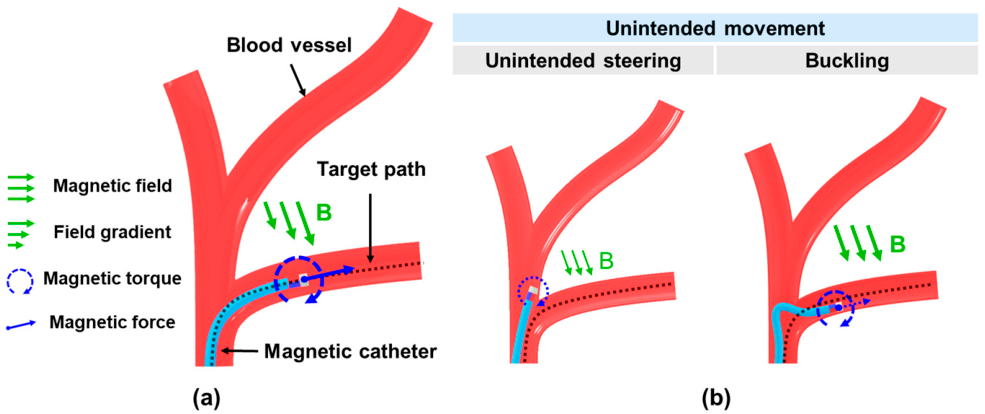
The MNSs can be categorized into two types: permanent magnet (PM)-based and electromagnet (EM)-based systems. While PM-based systems can generate strong magnetic fields, they lack the ability to rapidly adjust the magnetic field and pose safety concerns because the magnetic field cannot be deactivated. EM-based systems can overcome these limitations by controlling the current flowing in the coils of EMs. Prior EM-based systems, which used Helmholtz, Maxwell, and saddle coils, suffered from high power consumption and weak magnetic fields. To enhance their weak magnetic field, recent research efforts involved inserting magnetic cores of highly permeable materials into their MNSs [9,22,23,24,25,26]. However, most MNSs with magnetic cores have fixed structures, limiting their ability to generate sufficient magnetic flux density (which is proportional to magnetic torque) and magnetic field gradient (which is proportional to magnetic force) in specific directions. They may generate insufficient magnetic force and torque in the desired direction, depending on the position and orientation of the magnetic robot within the workspace. Such limitations hinder precise control of surgical devices, such as magnetic catheters, as shown in Figure 1. For example, insufficient magnetic torque can cause unintended steering motion, while a weak magnetic force may result in catheter buckling [27], preventing the device from reaching the target lesion. When such situations occurred in prior research, efforts were made to enhance the magnetic field by optimizing the current combination applied to the EMs [28,29]. Even though these methods can improve the magnetic torque and force, the fixed positions of the EMs in prior MNSs still hinder generation of a strong magnetic field in the desired direction. To overcome this shortcoming, recently, some MNSs were proposed to control the position of EMs for maximizing the magnetic field. However, this type of MNS requires high computational cost to solve a nonlinear problem determining the optimal position of the EMs. In addition, a method of maximizing the magnetic flux density and magnetic field gradient acting on the robot by simultaneously optimizing both the position and the applied current of the EMs in MNS has yet to be developed.
We propose a decoupled optimization method of position and current control (DOPC) of the EMs in the MNS. The major contributions of this paper are listed as follows:
(1)
The proposed DOPC method maximizes the magnetic flux density or magnetic force by determining both the optimal position of the magnetic robot in the ROI and the optimal currents applied to the EMs. The proposed method uses the robotically adjustable structure of the MNS to improve magnetic field generation capability.
(2)
The optimization problem of the DOPC is decoupled into the current optimization problem and the position optimization problem. The current optimization problem determines the optimal current solution at a given position under the rated current constraint, and the position optimization problem determines the optimal position in the ROI. This decoupling process reduces the computational cost compared with directly solving the nonlinear optimization problem with both position and current as design variables.
(3)
The proposed method is validated using the robotically adjustable magnetic navigation (RAMAN) system with eight EMs. The magnetic flux density and magnetic field gradient obtained using the DOPC are compared with those obtained using the conventional pseudoinverse method. In addition, in vitro experiments demonstrate that the DOPC enables successful navigation of a magnetic catheter and an untethered magnetic robot in cases where the conventional pseudoinverse method fails.
This paper is structured as follows. Section 2 describes the operating principle of magnetic robots and the MNS and analyzes the magnetic characteristics of the RAMAN system. In Section 3, we describe the proposed DOPC in detail. In Section 4, we compare the magnetic flux density and magnetic field gradient of the proposed DOPC with those of a conventional pseudoinverse method. To validate the proposed DOPC, measured magnetic flux densities of the RAMAN system are compared with simulated values. In addition, the overall control process is evaluated experimentally, and successful navigation of the magnetic catheter and the untethered magnetic robot along target paths in various environments is demonstrated. Conclusions are presented in Section 5.

2. Magnetic Manipulation and Magnetic Navigation System

2.1. Operating Principle of the Magnetic Robot and the MNS

A magnetic robot in the workspace of the MNS can be manipulated by controlling the external magnetic flux density. The magnetic torque and the magnetic force acting on the PM embedded in the magnetic robot can be expressed as follows:
τ = m × B
F = m · B
where τ, F, m, and B denote the magnetic torque, the magnetic force, the magnetic dipole moment of the PM, and the magnetic flux density generated by the MNS. In this analysis, the PM embedded in the magnetic robot is modeled as a magnetic dipole with a constant magnetic moment. Therefore, the magnitude of m is assumed to be constant, and the direction of m is determined by the orientation of the magnetic robot. By separating the components of the magnetic dipole moment, Equations (1) and (2) can be expressed as follows:
τ = 0 m z m y m z 0 m x m y m x 0 B x B y B z = m τ B
F = m x m y m z 0 0 0 m x 0 m y m z m z 0 m x m z m y B x / x B x / y B x / z B y / y B y / z = m F G
where {mτ}, {mF}, and G denote the torque-field correlation matrix, the force-field gradient correlation matrix, and the magnetic field gradient vector, respectively. In an MNS consisting of N-EMs, the magnetic flux density and the magnetic field gradient generated by each EM are independent and are assumed to have a linear relationship with the applied current without considering the magnetic saturation. In this study, the applied current was constrained by the rated current of the power supply, and the actuation matrix approximation model was experimentally validated by comparing the calculated and measured magnetic flux densities, as described in Section 4.1. Then, the magnetic flux density and the magnetic field gradient generated by the MNS with N-EMs can be expressed as follows:
B = b 1 ~ P b N ~ P I 1 I N = A B P I
G = g 1 ~ P g N ~ P I 1 I N = A G P I
where Ik, b k ~ , g k ~ (k = 1, 2, …, N), P, and I denote the current, the magnetic flux density per unit current, the magnetic field gradient per unit current corresponding to the k-th EM, the position of the magnetic robot in the workspace, and the current vector, respectively. In Equations (5) and (6), {AB(P)} and {AG(P)} are defined as the field actuation matrix and the field gradient actuation matrix, respectively. By combining Equations (4)–(6), the magnetic flux density and the magnetic force can be rewritten as follows:
B F = A B P m F A G P I = A B , F m , P I
where A B , F m , P denotes the total actuation matrix, which represents the correlation among the applied current, the magnetic flux density, and the magnetic force. Equation (7) shows that, once the position (P) and magnetic dipole moment (m) are given, the input current vector required to generate the desired magnetic flux density and force can be calculated.

2.2. Magnetic Anisotropy of the MNS

In an MNS consisting of EMs with fixed structures, significant magnetic anisotropy can occur at a specific position within the workspace. That is, at a given position, the magnetic field or magnetic field gradient along a specific direction can be significantly smaller compared with those in other directions. To evaluate the magnetic anisotropy of the MNS, Pourkand proposed a method of assessing the magnetic performance of the MNS using singular value decomposition (SVD) [30]. Using that analysis, the anisotropy of the magnetic field and magnetic field gradient can be evaluated by calculating the singular values of {AB(P)} and {AG(P)} at a given position in the workspace. The magnetic field anisotropy and the magnetic field gradient anisotropy can be characterized by the field condition number (KB) and the field gradient condition number (KG), respectively:
K B = σ m i n A B P / σ m a x A B P
K G = σ m i n A G P / σ m a x A G P
where σmin({AB(P)}) and σmin({AG(P)}) denote the smallest singular values of {AB(P)} and {AG(P)}, respectively, while σmax({AB(P)}) and σmax({AG(P)}) denote the largest singular values of {AB(P)} and {AG(P)}. If KB and KG are close to zero, the MNS has high magnetic anisotropy at that position.

2.3. Structure and Characteristics of the RAMAN System

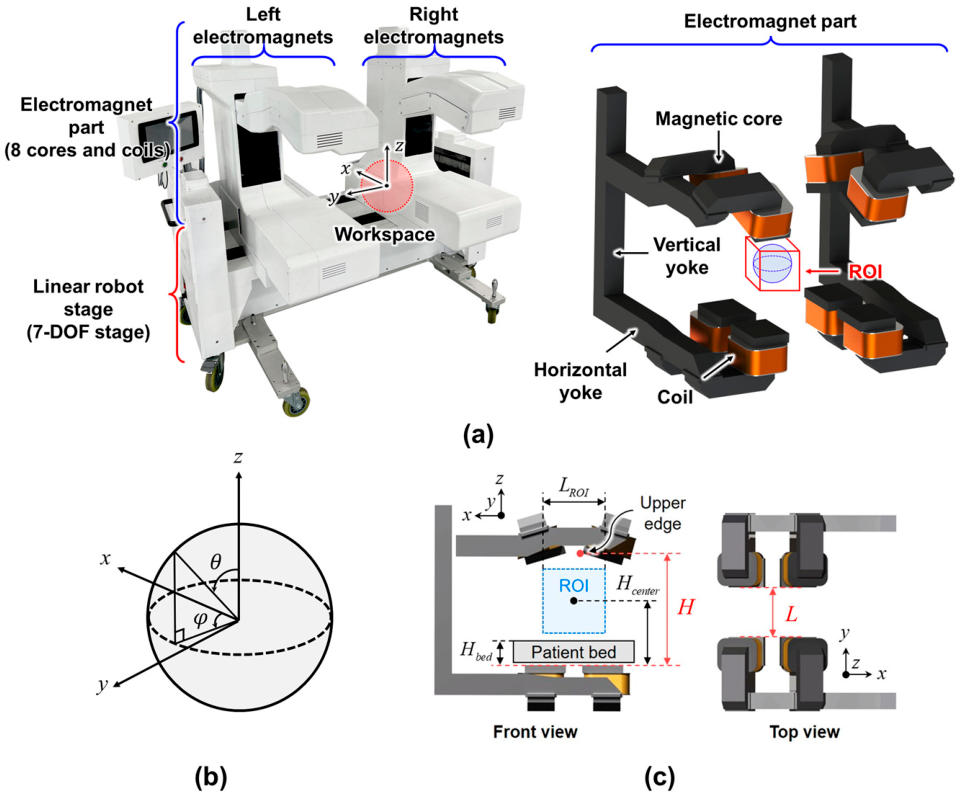
Due to magnetic anisotropy, the magnitude of the magnetic field or magnetic field gradient along the desired direction may be insufficient at a specific position within the workspace of the MNS. To mitigate magnetic anisotropy, we propose adjusting the operating position of the magnetic robot within the workspace of the MNS by moving the position of the EM part. A detailed explanation of the proposed control method is provided in Section 3. To change the operating position, we used a RAMAN system as shown in Figure 2a [28]. The RAMAN system is composed of two EM sets and one linear robot stage. Each EM set consists of four EMs, two horizontal yokes, and one vertical yoke. Two EMs are attached to each horizontal yoke, and two horizontal yokes are attached to each vertical yoke. The linear robot stage is composed of seven actuators that can generate motion in the x, y, and z directions of EM sets, which allows the workspace of the RAMAN system to move in the x, y, and z directions. The coordinate system to define the position in the workspace of the RAMAN system is shown in Figure 2b. In Figure 2c, the height (H) and distance (L) of the RAMAN system were set to 350 mm and 200 mm, respectively, which is sufficient to hold the human body. The region of interest (ROI) was defined as a cuboid with a length of 150 mm (LROI) within the workspace. The center of the ROI was set at 210 mm (Hcenter) above the lower core in consideration of the bed height of 90 mm (Hbed).
Next, an analysis in [30] was performed to investigate the characteristics of the RAMAN system. To analyze the magnetic anisotropy, we created the approximation models of {AB(P)} and {AG(P)} from magnetic flux density data measured at 1331 points within the ROI. The approximation model of {AB(P)} was designed using a polynomial regression model that expresses the magnetic flux density at each position. The pseudoinverse technique was applied to obtain the coefficients of the polynomial. The optimal approximation model was selected by determining the polynomial order n that minimized the error between the measured and calculated magnetic flux density values. For the RAMAN system, n = 6 was selected, and the magnetic flux density calculated by the approximation model with n = 6 showed an average error of 3%, as evaluated in Section 4.1.
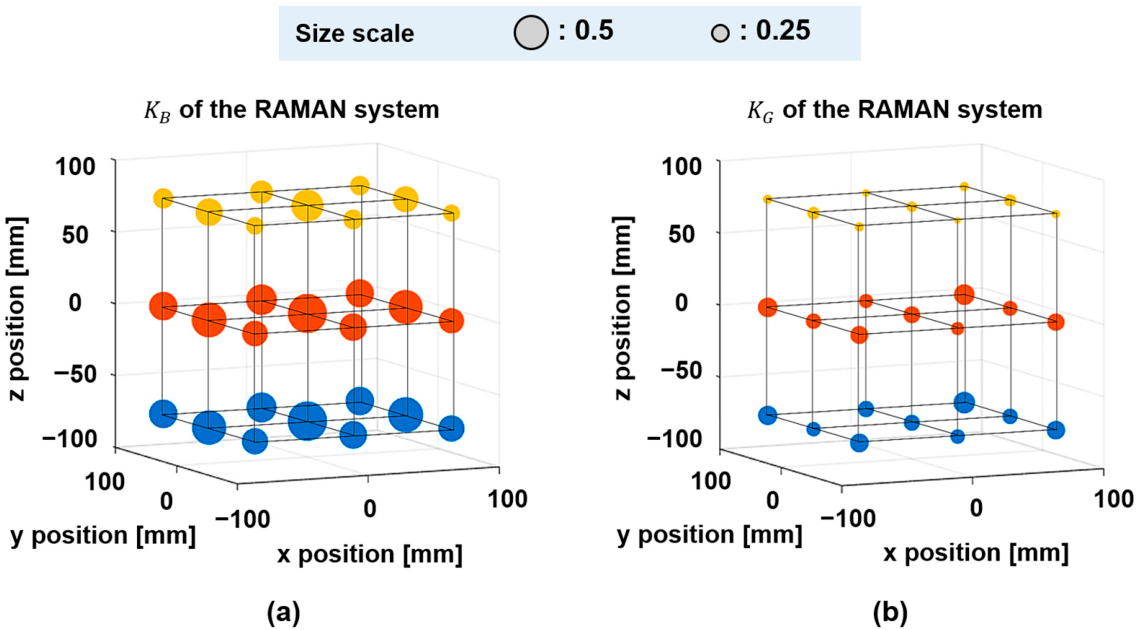
To analyze the magnetic anisotropy of the RAMAN system, the condition numbers in Equations (8) and (9) were calculated for 27 points, including the center and each vertex of the ROI, and the center of each face. Figure 3 shows the values of KB and KG calculated at the 27 points within the ROI, with the diameter of the circle representing the relative magnitude of the condition numbers. The minimum values of KB and KG calculated at the 27 points were 0.1022 and 0.0244, respectively. The values of KB and KG at the center of the ROI were 0.7624 and 0.1591, respectively. Because the ROI of the RAMAN system was set close to the upper core of the EMs in consideration of the patient bed, both the magnetic flux density and the magnetic field gradient exhibited significant anisotropy on the z = 75 mm plane. The results shown in Figure 3 indicate that the magnetic flux density and magnetic field gradient generated within the ROI in the RAMAN system have significant anisotropy, particularly on the upper plane, reducing the magnitude of the magnetic torque or force along the desired direction.

3. Decoupled Optimization of Position and Current

The proposed DOPC solves the position optimization problem using the particle swarm optimization (PSO) algorithm to maximize the magnetic flux density or magnetic force in the desired direction. The optimization problem of the DOPC can be formulated as follows:
Maximize   α B B m a x / B p i n v + α F F m a x / F p i n v subject   to   P o p t R O I , I o p t . k I m a x   ( k = 1 , , N ) design   variables :   P opt ,   I opt
where Bmax, Fmax, Bpinv, Fpinv, Popt, and Iopt denote the maximum value of the magnetic flux density, the maximum value of the magnetic force, the reference magnetic flux density, the reference magnetic force obtained using the conventional pseudoinverse method at the center of the ROI, the optimal position of the magnetic robot in the ROI, and the optimal current vector applied to EMs, respectively. In the objective function, αB and αF denote the weighting factors for the magnetic flux density and the magnetic force, respectively. For instance, when maximizing the magnetic flux density, αB = 1 and αF = 0, whereas αB = 0 and αF = 1 when maximizing the magnetic force. For the constraints in Equation (10), {ROI}, Iopt.k, and Imax denote the internal region of the ROI, the k-th component of Iopt, and the rated current of the power supply, respectively. The optimization problem in Equation (10) can be solved directly by several optimization algorithms, including a PSO algorithm. Meanwhile, the nonlinear optimization in Equation (10) consists of multiple design variables ( P o p t R 3 and I o p t R N ), resulting in a high computational cost. To solve this problem, we decoupled Equation (10) into the current optimization problem and the position optimization problem.
The current optimization problem finds an optimal current combination maximizing the objective function in Equation (10) at a given position P. In previous research, pseudoinverse methods have been used to obtain the current combination. However, under the rated current constraint of power supply, the magnetic flux density generated by a current combination is limited by the coil that requires the largest current. If the largest absolute current component exceeds the rated current, the entire current combination must be scaled down. Therefore, to maximally utilize the current output of the power supplies, the largest absolute current component should be minimized. The pseudoinverse method, however, derives a solution that minimizes the L2-norm of the current combination, rather than the largest current component. Thus, it does not necessarily provide the current combination that maximizes the magnetic flux density under the rated current constraint. Previous studies proposed current calculation algorithms that exploit the null space of the actuation matrix to more fully utilize the current output of the power supplies and maximize the magnetic flux density, using linear programming (LP) [28] or the minimum L-norm approach [29]. Meanwhile, the conventional pseudoinverse method and the methods introduced in [28,29] cannot control the magnetic force and may generate unintended magnetic force.
To overcome this problem, we considered the current solution using the basis vector and null space vector of the magnetic flux density and magnetic force, respectively. The current combination to control both magnetic flux density and magnetic force can be calculated as follows:
I o p t = B m a x B b a s i s + F m a x F b a s i s + k = 1 N 6 C k · v n u l l . k
where Ck (k = 1, …, N − 6), Bbasis, Fbasis, and vnull.k denote the free variables, the magnetic field basis vector, the magnetic force basis vector, and the k-th basis vector of null space of the A B , F m , P , respectively. Bbasis and Fbasis are calculated as follows:
B b a s i s = A B , F m , P B d e s P B d e s P 0 0 0 T
F b a s i s = A B , F m , P 0 0 0 T F d e s P F d e s P
where A B , F m , P denotes the pseudoinverse of A B , F m , P , and B d e s P and F d e s P denote the desired magnetic flux density and the desired magnetic force, respectively. From Equations (11)–(13), the current optimization problem to determine the optimal current at the given position can be rewritten as follows:
Maximize   α B B m a x / B p i n v + α F F m a x / F p i n v subject   to   I o p t . k I m a x ( k = 1 ,   ,   N ) design   variables :   C k ( k = 1 ,   ,   N 6 ) ,   B m a x ,   and   F m a x
As the optimization problem in Equation (14) is a linear programming problem, the global optimum can be found using well-known iterative methods (e.g., the dual-simplex algorithm). By substituting the global optimal solution of Equation (14) into Equation (11), the optimal current solution (Iopt) for maximizing the objective function at a given position can be obtained.
If the optimal current solution at a given position has been determined, it is sufficient to optimize only the position (Popt) to maximize the objective in Equation (10). To determine the optimal position, we considered the position optimization problem as follows:
Maximize   α B B m a x ( P o p t ) / B p i n v + α F F m a x ( P o p t ) / F p i n v subject   to   P o p t R O I design   variables :   P o p t
The optimization problem in Equation (15) can be solved using the PSO algorithm of the particleswarm solver in MATLAB R2025a (MathWorks, Natick, MA, USA). The optimal position Popt calculated from Equation (15) can be achieved by moving the EMs of the MNS (e.g., by moving the linear robot stage of the RAMAN system). Finally, the voltage information (Vopt) for each coil to generate the desired magnetic field can be calculated as follows:
V o p t = R c o i l I o p t
where {Rcoil} denotes the diagonal matrix (with an N × N size) composed of the resistances of each coil. Equation (16) assumes quasi-static current application and calculates the required voltage using only the coil resistance. Therefore, the inductive voltage component or current tracking error caused by rapid current variation is not included. This assumption is reasonable for the present navigation experiments, in which the desired magnetic field or magnetic force was changed slowly.
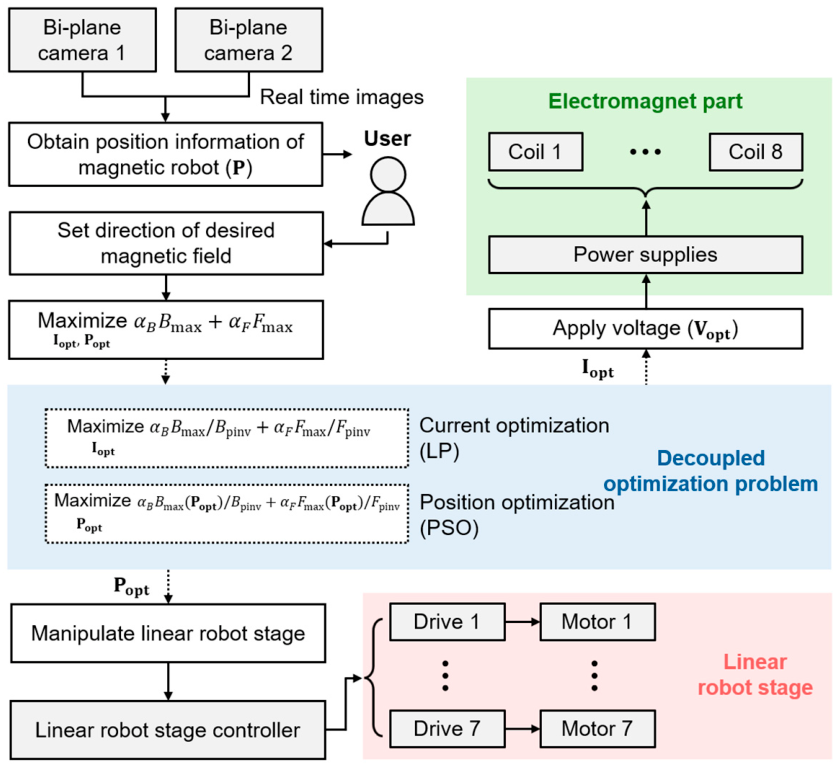
The overall control process of the DOPC using the RAMAN system is illustrated in Figure 4. First, the target path and the initial position of the magnetic robot are detected in real time using a bi-plane camera. Next, the objective function is defined based on the direction of the desired magnetic field, considering both the magnetic flux density and the magnetic force. The optimal position of the magnetic robot in the ROI (Popt) and the optimal current combination (Iopt) are calculated from the position optimization problem and the current optimization problem, respectively. The decoupling process of this optimization problem enhances computational efficiency, enabling faster calculations. Next, the linear robot stage of the RAMAN system is controlled to move the EMs and adjust the position of the magnetic robot at the calculated optimal position. Finally, the required voltage (Vopt) for each coil to apply the current solution is calculated by the voltage calculator, and the power supplies apply the voltages to the coils.

4. Results and Discussion

4.1. Verification of the DOPC Using the RAMAN System

To validate the reliability of the magnetic field calculated for DOPC, the magnetic flux densities were measured, and the accuracy of the actuation matrix approximation model was evaluated using a Gauss probe (THM1176, Metrolab, Plan-les-Ouates, Switzerland). In this experiment, the Gauss probe was fixed at the center of the ROI, and the linear robot stage of the RAMAN system was adjusted to position the probe accordingly. The experiment was conducted using a power supply (AST 9003, California Instruments, San Diego, CA, USA) with an upper current limit of 12 A. The elevation (θ) and azimuth (φ) angles of the magnetic flux density or magnetic field gradient were varied in 10° increments over the range of 0° ≤ θ ≤ 180° and 0° ≤ φ ≤ 180°, covering 361 (=19 × 19) directions. The calculated magnetic flux densities from the approximation model were compared with the measured densities obtained from the Gauss probe. The calculated magnetic flux density matched well with the measured ones, with average errors within 3%.
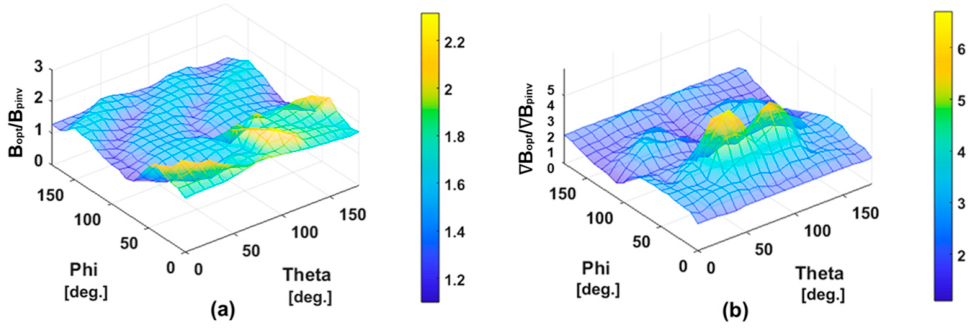
Next, to verify the efficiency of the proposed DOPC, we simulated and compared the optimized magnetic flux density and magnetic field gradient (Bopt and ∇Bopt) with those of the conventional pseudoinverse method (Bpinv and ∇Bpinv). To evaluate the efficiency of the DOPC, we first calculated the field efficiency (Bopt/Bpinv) and the field gradient efficiency (∇Bopt/∇Bpinv) at the center of the ROI in the RAMAN system. Figure 5a,b show the calculated field efficiency and field gradient efficiency using actuation matrices {AB(P)} and {AG(P)}, respectively (described in Section 2.3). The proposed DOPC increased the magnetic flux density and magnetic field gradient compared to the conventional pseudoinverse control method along all directions, with maximum increases of 2.31 times and 6.69 times, respectively, and average increases of 1.56 times and 2.54 times. These results demonstrate that the proposed DOPC improves the magnetic field generation of MNS.
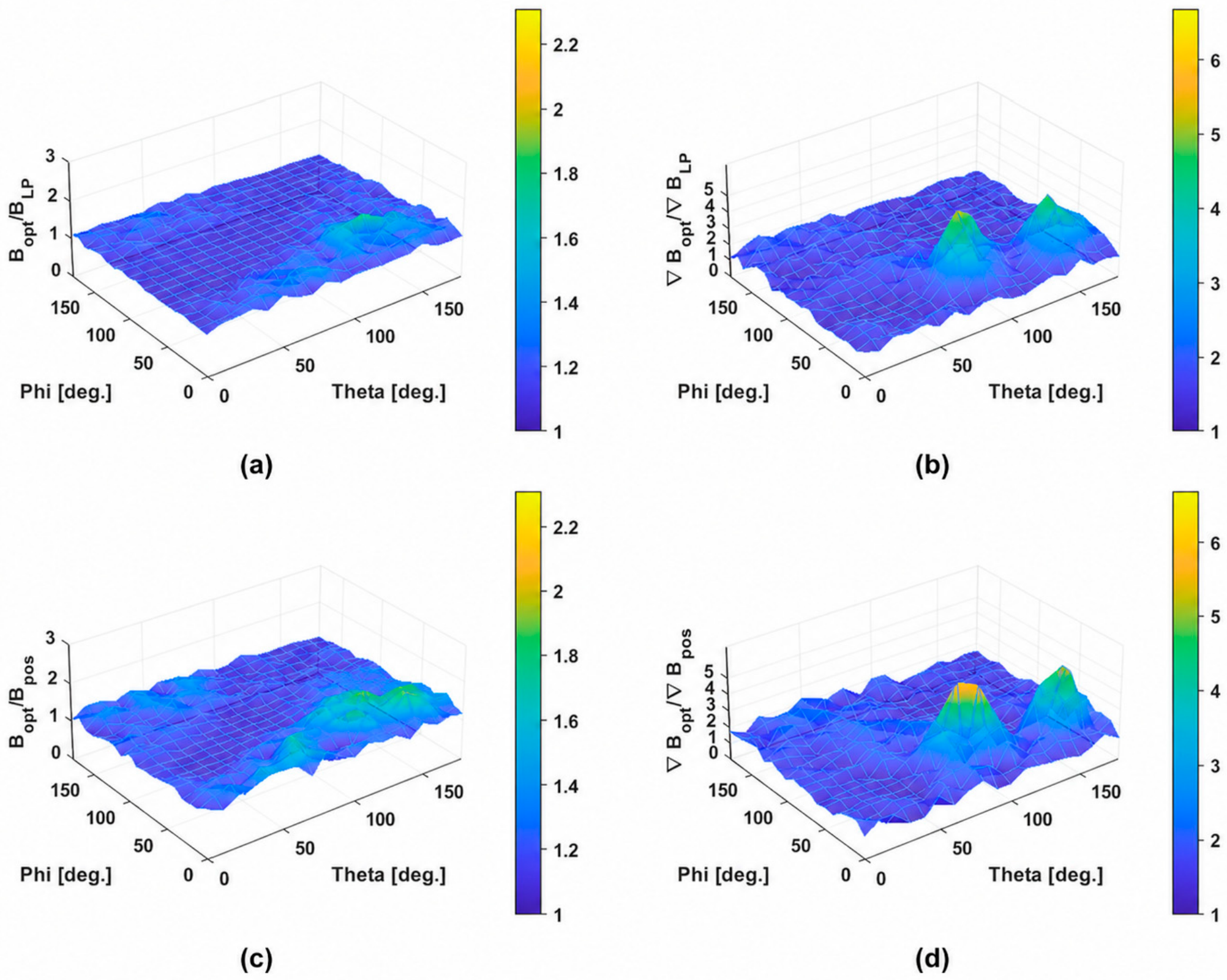
To compare the proposed DOPC with other optimization methods, we additionally simulated and compared the optimized magnetic flux density and magnetic field gradient with those of two comparison methods. In the first method, the current combination was optimized using LP at the center of the RAMAN system without changing the position of the EM part. In the second method, the position was optimized, whereas the current combination was calculated using the conventional pseudoinverse method. Here, BLP and ∇BLP denote the magnetic flux density and magnetic field gradient obtained using LP at the fixed position at the center of the ROI in the RAMAN system, respectively, and Bpos and ∇Bpos denote those obtained using position optimization with the conventional pseudoinverse method, respectively. Figure 6a,b show the calculated field efficiency (Bopt/BLP) and field gradient efficiency (∇Bopt/∇BLP), respectively. Compared with LP at the fixed position, the proposed DOPC increased the magnetic flux density and magnetic field gradient along all directions, with maximum increases of 1.80 times and 5.32 times, respectively, and average increases of 1.14 times and 1.61 times. Figure 6c,d show the calculated field efficiency (Bopt/Bpos) and field gradient efficiency (∇Bopt/∇Bpos), respectively. Compared with position optimization using the conventional pseudoinverse method, the proposed DOPC increased the magnetic flux density and magnetic field gradient along all directions, with maximum increases of 1.95 times and 5.88 times, respectively, and average increases of 1.22 times and 1.72 times. These results indicate that LP at a fixed position is insufficient to fully improve the magnetic field generation capability because it cannot mitigate the magnetic anisotropy of the RAMAN system. In addition, position optimization with the conventional pseudoinverse method is also insufficient because the current output of the power supplies cannot be fully utilized under the rated current constraint. Therefore, both the position optimization problem and the current optimization problem are required to maximize the magnetic flux density and magnetic field gradient.

4.2. Validation of Enhanced Manipulation of Magnetic Robots

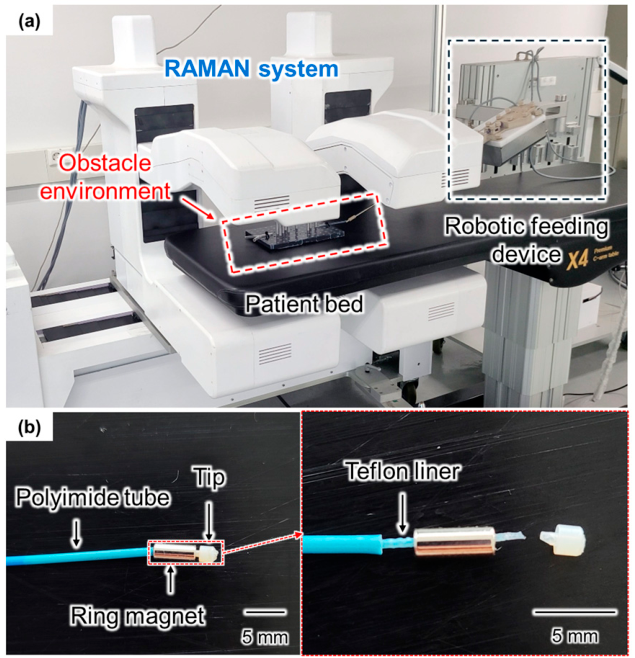
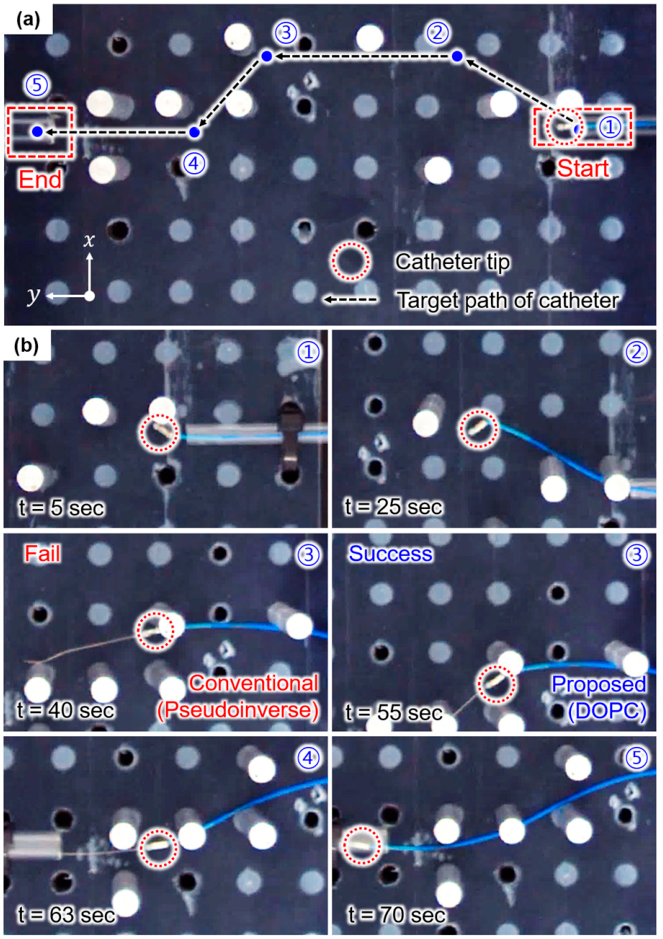
To evaluate the enhanced manipulation performance of the magnetic catheter using DOPC, an in vitro experiment was conducted to validate the steering and navigation performance of the magnetic catheter. Figure 7a shows the experimental setup consisting of an obstacle environment with regularly spaced holes and eight cylindrical obstacles (10 mm in diameter), and the RAMAN system. The obstacle environment was placed on a patient bed inside the workspace of the RAMAN system. The magnetic catheter was designed and fabricated as illustrated in Figure 7b. An axially magnetized NdFeB ring PM (N52 grade) was attached to the tip of a polyimide tube using a 3D-printed connector. The polyimide tube had an outer diameter of 1 mm, while the ring magnet had an outer diameter of 2 mm, an inner diameter of 1 mm, and a length of 5 mm. The target path of the magnetic catheter was divided into four sections, as illustrated in Figure 8a. To minimize the influence of magnetic force during the experiment, αF in Equation (10) was set to zero. The magnetic catheter was steered by an external magnetic field to navigate through each section. Next, the guidewire was passed through the catheter and advanced to the next section. Once the guidewire reached the target position, the magnetic catheter followed the guidewire to the next section. To generate magnetic flux density, we first applied the conventional pseudoinverse method at each point. With this method, the linear robot stage of the RAMAN system adjusted the position of the EM part to locate the magnetic catheter at the center of the ROI, defined as the origin of the ROI coordinate system. If the magnetic catheter failed to pass through the section, the position and current solution derived from the DOPC were subsequently applied. In this case, the linear robot stage of the RAMAN system was adjusted to locate the magnetic catheter at the optimal position (Popt) with respect to the ROI coordinate system determined by DOPC.
As shown in Figure 8b, the magnetic catheter successfully navigated from point ① to ② and from point ② to ③ using the conventional pseudoinverse method. However, from point ③ to ④, the conventional pseudoinverse method failed due to insufficient magnetic flux density (Bpinv = 11.7 mT) to change the steering angle from 90° to 150°. In contrast, when the DOPC was applied, the magnetic catheter successfully passed from point ③ to ④ with a 1.3 times higher magnetic flux density (Bopt = 15.3 mT). In this case, the linear robot stage moved the EM part to (103.3 mm, 197.6 mm, 33.8 mm) for positioning the PM of the catheter to (53.3 mm, 187.3 mm, 0 mm) corresponding to (−50.0 mm, −10.3 mm, −33.8 mm) with respect to the ROI coordinate system of the RAMAN system. The catheter then navigated from point ④ to ⑤ using the conventional pseudoinverse method. The entire navigation process, including the conventional pseudoinverse method (Pinv.) and the proposed DOPC, is summarized in Table 1.
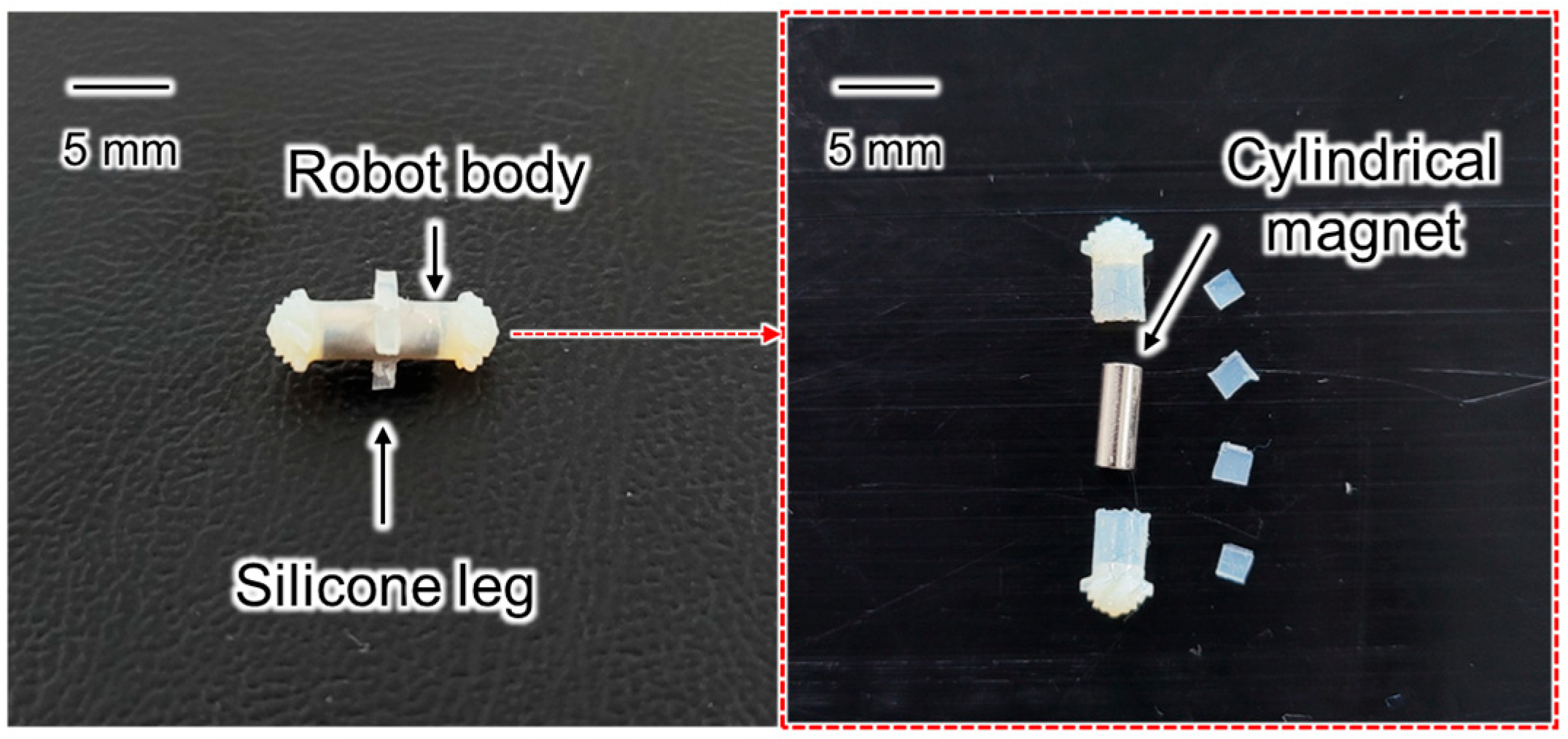
Next, an in vitro experiment was conducted to evaluate the steering and navigation performance of the untethered magnetic robot under magnetic force. The magnetic robot was designed and fabricated as shown in Figure 9. An axially magnetized NdFeB cylindrical PM (N52 grade) with a diameter of 2 mm and a length of 5 mm was embedded inside a 3D-printed robot body, which is composed of dental resin for biocompatibility. Four silicone legs were attached to the robot body to maintain its position within the inclined glass tube even when no external magnetic force was applied.
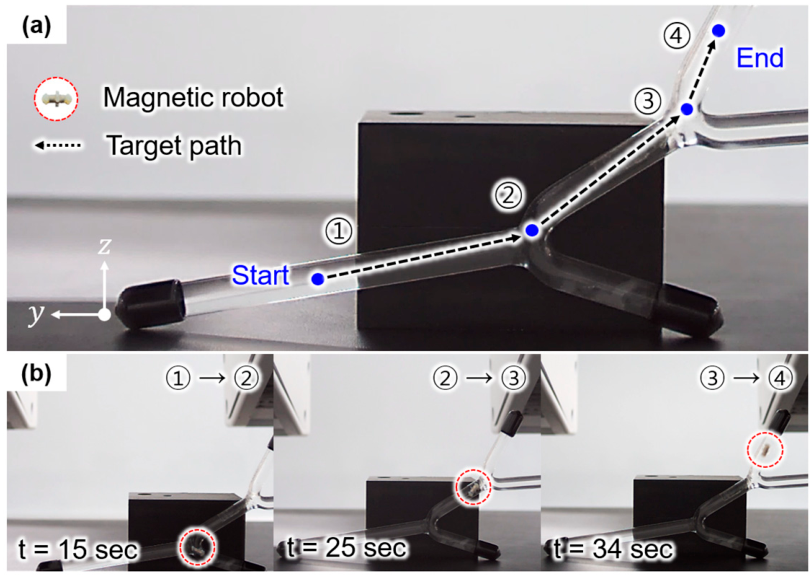
As illustrated in Figure 10a, the experimental environment consisted of an inclined glass tube with three sections filled with water. The inclination angles of the sections were 15°, 30° and 60°, and each section had a diameter of 6 mm. To generate the magnetic force, we first applied the conventional pseudoinverse method at each point. The linear stage of the RAMAN system was adjusted to position the magnetic robot at the center of the ROI, defined as the origin of the ROI coordinate system. If the magnetic robot failed to pass through the section, the optimal position and current solution obtained by the proposed DOPC were subsequently applied. In this case, the linear robot stage of the RAMAN system was adjusted to position the magnetic robot at the optimal position in the ROI coordinate system determined by DOPC.
As illustrated in Figure 10b, the magnetic robot successfully navigated from point ① to ② using the conventional pseudoinverse method. However, the magnetic robot failed to navigate from point ② to ③ using the conventional pseudoinverse method, despite a generated magnetic force of Fpinv = 2.24 mN. The position and current solution derived from the DOPC were applied to maximize the magnetic force (αB = 0) in Equation (10). Then, the magnetic robot successfully passed from point ② to ③ with a 2.2 times greater magnetic force (Fopt = 4.9 mN). In this case, the linear robot stage moved the EM part to (5.6 mm, −120.0 mm, −31.2 mm) to position the PM of the magnetic robot to (0 mm, −70.0 mm, 18.8 mm) corresponding to (−5.6 mm, 50.0 mm, 50.0 mm) with respect to the ROI coordinate system of the RAMAN system. The magnetic robot then navigated from point ③ to ④ using the conventional pseudoinverse method. The entire process, including the conventional pseudoinverse method (Pinv.) and the proposed DOPC, is summarized in Table 2.
The proposed DOPC can effectively enhance the magnetic flux density and magnetic field gradient because it searches for the optimal position at which the magnetic field generation capability of the MNS can be maximized within the workspace. However, because the proposed DOPC solves the position optimization problem using the PSO algorithm, it requires a longer computation time than the conventional pseudoinverse method. In this study, to reduce the computation time of applying DOPC at every control point, the conventional pseudoinverse method was first applied at each point. If the generated magnetic flux density or magnetic field gradient was insufficient for successful manipulation, the position and current solution derived from DOPC was subsequently applied. Therefore, further studies on computational optimization are required to apply DOPC to every control point in real time. In addition, in actual clinical environments, the allowable motion range of the linear robot stage may be restricted by mechanical constraints imposed by the patient, patient bed, imaging devices, and surrounding medical equipment. For clinical application of the proposed method, these external mechanical constraints should be further incorporated into the position optimization problem. Moreover, the proposed DOPC considers the rated current constraint of the power supplies but does not explicitly model coil heating. Coil heating can change the coil resistance and reduce the accuracy of the generated current and magnetic field during long-term operation. Therefore, temperature-dependent coil resistance and thermal constraints should be considered for long periods of time or continuous operation.

5. Conclusions

In this paper, we proposed an efficient method to enhance the magnetic flux density and magnetic force in EM-based MNSs by simultaneously optimizing the EM positions and the applied currents. We solved the optimization problem of the DOPC using a decoupling approach to improve computational efficiency, and our simulation results demonstrated that the DOPC improves the magnetic flux density and the magnetic field gradient within the ROI of the RAMAN system, despite the presence of magnetic anisotropy. Furthermore, our in vitro experiments showed that the DOPC effectively enabled the magnetic catheter and untethered magnetic robot to navigate through regions inaccessible to the conventional pseudoinverse method by maximizing magnetic flux density and magnetic force. This research will contribute to the manipulation of magnetic robots using an MNS, facilitating the practical implementation of robotic endovascular intervention.

Author Contributions

Project administration and funding acquisition, G.J.; conceptualization, J.K. and E.J.; methodology, J.K. and E.J.; software, J.K. and E.J.; validation, D.L.; formal analysis, D.L. and J.S.; investigation, J.S.; writing—original draft preparation, J.K. and E.J.; writing—review and editing, G.J. All authors have read and agreed to the published version of the manuscript.

Funding

This research was supported by a grant of the National Research Foundation of Korea funded by the Korean Government (MSIT) (No. RS-2026-25473181).

Institutional Review Board Statement

Not applicable.

Informed Consent Statement

Not applicable.

Data Availability Statement

The data presented in this study are available from the corresponding author upon request.

Conflicts of Interest

The authors declare no conflict of interest.

Abbreviations

The following abbreviations are used in this manuscript:
DOFDegree of freedom
DOPCDecoupled optimization of position and current
EMElectromagnet
LPLinear programming
MNSMagnetic navigation system
PCIPercutaneous coronary intervention
Pinv.Pseudoinverse method
PMPermanent magnet
PPIPercutaneous peripheral intervention
PSOParticle swarm optimization
RAMANRobotically adjustable magnetic navigation
ROIRegion of interest
SVDSingular value decomposition

References

  1. Tsao, C.W.; Aday, A.W.; Almarzooq, Z.I.; Anderson, C.A.M.; Arora, P.; Avery, C.L.; Baker-Smith, C.M.; Beaton, A.Z.; Boehme, A.K.; Buxton, A.E.; et al. Heart disease and stroke statistics—2023 update: A report from the American Heart Association. Circulation 2023, 147, e93–e621. [Google Scholar] [CrossRef] [PubMed]
  2. Park, Y.Y.; Joh, J.H.; Han, S.A.; Kim, S.H.; Cho, S.; Park, H.C.; Ahn, H.J. National trends for the treatment of peripheral arterial disease in Korea between 2004 and 2013. Ann. Surg. Treat. Res. 2015, 89, 319–324. [Google Scholar] [CrossRef] [PubMed]
  3. Ketteler, E.R.; Brown, K.R. Radiation exposure in endovascular procedures. J. Vasc. Surg. 2011, 53, 35S–38S. [Google Scholar] [CrossRef] [PubMed]
  4. Roguin, A.; Goldstein, J.; Bar, O. Brain tumours among interventional cardiologists: A cause for alarm? Report of four new cases from two cities and a review of the literature. EuroIntervention 2012, 7, 1081–1086. [Google Scholar] [CrossRef] [PubMed]
  5. Ho, T.-L.; Shieh, S.-H.; Lin, C.-L.; Shen, W.-C.; Kao, C.-H. Risk of cancer among cardiologists who frequently perform percutaneous coronary interventions: A population-based study. Eur. J. Clin. Investig. 2016, 46, 527–534. [Google Scholar] [CrossRef]
  6. Elmaraezy, A.; Morra, M.E.; Mohammed, A.T.; Al-Habaa, A.; Elgebaly, A.; Ghazy, A.A.; Khalil, A.M.; Huy, N.T.; Hirayama, K. Risk of cataract among interventional cardiologists and catheterization lab staff: A systematic review and meta-analysis. Catheter. Cardiovasc. Interv. 2017, 90, 1–9. [Google Scholar] [CrossRef] [PubMed]
  7. Armacost, M.P.; Adair, J.; Munger, T.; Viswanathan, R.R.; Creighton, F.M.; Curd, D.T.; Sehra, R. Accurate and reproducible target navigation with the Stereotaxis Niobe® magnetic navigation system. J. Cardiovasc. Electrophysiol. 2007, 18, S26–S31. [Google Scholar] [CrossRef]
  8. Kim, Y.; Genevriere, E.; Harker, P.; Choe, J.; Balicki, M.; Regenhardt, R.W.; Vranic, J.E.; Dmytriw, A.A.; Patel, A.B.; Zhao, X. Telerobotic neurovascular interventions with magnetic manipulation. Sci. Robot. 2022, 7, eabg9907. [Google Scholar] [CrossRef] [PubMed]
  9. Kummer, M.P.; Abbott, J.J.; Kratochvil, B.E.; Borer, R.; Sengul, A.; Nelson, B.J. OctoMag: An electromagnetic system for 5-DOF wireless micromanipulation. IEEE Trans. Robot. 2010, 26, 1006–1017. [Google Scholar] [CrossRef]
  10. Gunduz, S.; Albadawi, H.; Oklu, R. Robotic devices for minimally invasive endovascular interventions: A new dawn for interventional radiology. Adv. Intell. Syst. 2021, 3, 2000181. [Google Scholar] [CrossRef]
  11. Sikorski, J.; Denasi, A.; Bucchi, G.; Scheggi, S.; Misra, S. Vision-based 3-D control of magnetically actuated catheter using BigMag—An array of mobile electromagnetic coils. IEEE/ASME Trans. Mechatron. 2019, 24, 505–516. [Google Scholar] [CrossRef]
  12. Beyar, R.; Gruberg, L.; Deleanu, D.; Roguin, A.; Almagor, Y.; Cohen, S.; Kumar, G.; Wenderow, T. Remote-control percutaneous coronary interventions: Concept, validation, and first-in-humans pilot clinical trial. J. Am. Coll. Cardiol. 2006, 47, 296–300. [Google Scholar] [CrossRef] [PubMed]
  13. Pourdjabbar, A.; Ang, L.; Reeves, R.R.; Patel, M.P.; Mahmud, E. The development of robotic technology in cardiac and vascular interventions. Rambam Maimonides Med. J. 2017, 8, e0030. [Google Scholar] [CrossRef] [PubMed]
  14. Kim, S.H.; Ishiyama, K. Magnetic robot and manipulation for active-locomotion with targeted drug release. IEEE/ASME Trans. Mechatron. 2014, 19, 1651–1659. [Google Scholar] [CrossRef]
  15. Chautems, C.; Tonazzini, A.; Floreano, D.; Nelson, B.J. A variable stiffness catheter controlled with an external magnetic field. In Proceedings of the 2017 IEEE/RSJ International Conference on Intelligent Robots and Systems (IROS), Vancouver, BC, Canada, 24–28 September 2017; pp. 181–186. [Google Scholar] [CrossRef]
  16. Jeon, S.; Hoshiar, A.K.; Kim, S.; Lee, S.; Kim, E.; Lee, S.; Kim, K.; Lee, J.H.; Kim, J.-Y.; Choi, H. Improving guidewire-mediated steerability of a magnetically actuated flexible microrobot. Micro Nano Syst. Lett. 2018, 6, 15. [Google Scholar] [CrossRef]
  17. Wang, Q.; Du, X.; Jin, D.; Zhang, L. Real-time ultrasound Doppler tracking and autonomous navigation of a miniature helical robot for accelerating thrombolysis in dynamic blood flow. ACS Nano 2022, 16, 604–616. [Google Scholar] [CrossRef] [PubMed]
  18. Nelson, B.J.; Gervasoni, S.; Chiu, P.W.Y.; Zhang, L.; Zemmar, A. Magnetically actuated medical robots: An in vivo perspective. Proc. IEEE 2022, 110, 1028–1037. [Google Scholar] [CrossRef]
  19. Xie, A.; Huang, D.; Bu, Q.; He, S.; Li, Z.; Zhang, Y.; Dong, Y.; Shi, C.; Hu, C. Collaborative magnetic manipulation by robotically actuated permanent magnet and multiple electromagnets. IEEE Trans. Med. Robot. Bionics 2025, 7, 1525–1539. [Google Scholar] [CrossRef]
  20. Nguyen, K.T.; Kim, S.-J.; Min, H.-K.; Hoang, M.C.; Go, G.; Kang, B.; Kim, J.; Choi, E.; Hong, A.; Park, J.-O.; et al. Guide-wired helical microrobot for percutaneous revascularization in chronic total occlusion in-vivo validation. IEEE Trans. Biomed. Eng. 2021, 68, 2490–2498. [Google Scholar] [CrossRef] [PubMed]
  21. Liu, X.; Wang, L.; Xiang, Y.; Liao, F.; Li, N.; Li, J.; Wang, J.; Wu, Q.; Zhou, C.; Yang, Y.; et al. Magnetic soft microfiberbots for robotic embolization. Sci. Robot. 2024, 9, eadh2479. [Google Scholar] [CrossRef] [PubMed]
  22. Diller, E.; Sitti, M. Three-dimensional programmable assembly by untethered magnetic robotic micro-grippers. Adv. Funct. Mater. 2014, 24, 4397–4404. [Google Scholar] [CrossRef]
  23. Le, V.N.T.; Nguyen, N.H.; Alameh, K.; Weerasooriya, R. Accurate modeling and positioning of a magnetically controlled catheter tip. Med. Phys. 2016, 43, 650–663. [Google Scholar] [CrossRef] [PubMed]
  24. Li, J.; Wang, H.; Cui, J.; Shi, Q.; Zheng, Z.; Sun, T.; Huang, Q.; Fukuda, T. Magnetic micromachine using nickel nanoparticles for propelling and releasing in indirect assembly of cell-laden micromodules. Micromachines 2019, 10, 370. [Google Scholar] [CrossRef] [PubMed]
  25. Chautems, C.; Tonazzini, A.; Boehler, Q.; Jeong, S.H.; Floreano, D.; Nelson, B.J. A magnetic continuum device with variable stiffness for minimally invasive surgery. Adv. Intell. Syst. 2020, 2, 1900086. [Google Scholar] [CrossRef]
  26. Xing, Y.; Hussain, D.; Hu, C. Optimized dynamic motion performance for a 5-DoF electromagnetic manipulation. IEEE Robot. Autom. Lett. 2022, 7, 8604–8610. [Google Scholar] [CrossRef]
  27. Lee, D.; Jung, E.; Kwon, J.; Jang, G. A position control method for a robotically assisted magnetic navigation system to improve the pushability of a magnetic catheter by maximizing magnetic force. AIP Adv. 2023, 13, 035119. [Google Scholar] [CrossRef]
  28. Lee, W.; Jung, E.; Kim, N.; Lee, D.; Kim, S.; Lee, Y.; Jang, G. Robotically adjustable magnetic navigation system for medical magnetic milli/microrobots. IEEE/ASME Trans. Mechatron. 2024, 29, 3949–3959. [Google Scholar] [CrossRef]
  29. Hong, J.-S.; Lee, S.; Ha, J.-I. Control method in minimum infinity-norm approach for multicoil magnetic manipulation system. IEEE Trans. Magn. 2022, 58, 5600209. [Google Scholar] [CrossRef]
  30. Pourkand, A.; Abbott, J.J. A critical analysis of eight-electromagnet manipulation systems: The role of electromagnet configuration on strength, isotropy, and access. IEEE Robot. Autom. Lett. 2018, 3, 2957–2962. [Google Scholar] [CrossRef]
Figure 1. (a) A magnetic catheter successfully passes through the target blood vessel with sufficient magnetic torque and magnetic force. (b) A magnetic catheter enters an unintended blood vessel due to insufficient magnetic torque and buckles due to insufficient magnetic force.
Applsci 16 06134 g001
Figure 2. (a) A RAMAN system consisting of two EM sets and one linear robot stage and its EM part. (b) The coordinate system of the RAMAN system. (c) The size of the workspace and the region of interest (ROI) of the RAMAN system.
Applsci 16 06134 g002
Figure 3. The relative size of the condition number of (a) the magnetic flux density (KB) and (b) the magnetic field gradient (KG) calculated from 27 points within the ROI. The different colors indicate the z-position planes: yellow, red, and blue correspond to z = 75, 0, and −75 mm, respectively.
Applsci 16 06134 g003
Figure 4. Block diagram of the overall control process of the DOPC using the RAMAN system.
Applsci 16 06134 g004
Figure 5. Simulated (a) field efficiency (Bopt/Bpinv) and (b) field gradient efficiency (∇Bopt/∇Bpinv) with respect to the elevation (θ) and azimuth (φ) angles of the magnetic flux density or magnetic field gradient at the center of the ROI in the RAMAN system.
Applsci 16 06134 g005
Figure 6. Simulated (a) field efficiency (Bopt/BLP), (b) field gradient efficiency (∇Bopt/∇BLP), (c) field efficiency (Bopt/Bpos), and (d) field gradient efficiency (∇Bopt/∇Bpos) with respect to the elevation (θ) and azimuth (φ) angles of the magnetic flux density or magnetic field gradient. BLP and ∇BLP denote the magnetic flux density and magnetic field gradient obtained using LP at the fixed position, respectively, and Bpos and ∇Bpos denote those obtained using position optimization with the conventional pseudoinverse method, respectively.
Applsci 16 06134 g006
Figure 7. (a) In vitro experiment setup to verify the overall control process with DOPC using a magnetic catheter. (b) Structure of the prototype magnetic catheter.
Applsci 16 06134 g007
Figure 8. (a) Experimental setup for in vitro verification of the control process of DOPC using a magnetic catheter. (b) Captured images of the magnetic catheter and the target path with elapsed time. The circled numbers ①–⑤ indicate the sequential waypoints of the target path from the start point to the end point. At point ③, the magnetic catheter successfully followed the target path with DOPC but failed with the pseudoinverse method.
Applsci 16 06134 g008
Figure 9. Structure of the prototyped untethered magnetic robot.
Applsci 16 06134 g009
Figure 10. (a) Experimental setup for in vitro verification of DOPC using an untethered magnetic robot. (b) Captured images of the magnetic robot and the target path with elapsed time. The circled numbers ①–④ indicate the sequential waypoints of the target path from the start point to the end point. At point ②, the magnetic robot successfully followed the target path with DOPC but failed with the pseudoinverse method.
Applsci 16 06134 g010
Table 1. Results of the in vitro experiment illustrated in Figure 8. (X-Y-Z: global coordinates fixed to ①, x-y-z: local coordinates fixed to the center of the ROI).
Path①→②②→③③→④④→⑤
MethodPinv.Pinv.DOPCPinv.
Global PM position (mm)X053.353.30
Y077.0187.3231.0
Z0000
PM position in ROI coord
(mm)
x00−50.00
y00−10.30
z00−33.80
Global EM part position (mm)X053.3103.30
Y077.0197.6231.0
Z0033.80
Direction (°)θ90909090
φ709015090
Magnetic flux density (mT)Bpinv11.411.411.711.4
Bopt15.3
Table 2. Results of the in vitro experiment illustrated in Figure 10. (X-Y-Z: global coordinates fixed to ①, x-y-z: local coordinates fixed to the center of the ROI).
Path①→②②→③③→④
MethodPinv.DOPCPinv.
Global PM position (mm)X000
Y0−70.0−126.0
Z018.847.3
PM position in ROI coord
(mm)
x0−5.60
y050.00
z050.00
Global EM part position (mm)X05.60
Y0−120.0−126.0
Z0−31.247.3
Direction (°)θ756030
φ−90−90−90
Magnetic force (mN)Fpinv2.842.242.84
Fopt4.9
Disclaimer/Publisher’s Note: The statements, opinions and data contained in all publications are solely those of the individual author(s) and contributor(s) and not of MDPI and/or the editor(s). MDPI and/or the editor(s) disclaim responsibility for any injury to people or property resulting from any ideas, methods, instructions or products referred to in the content.