Powering the Future: A Review of PV and Wind Turbine Technologies from Component Modeling to System Coordination

 ,
,  ,
, 
Abstract
1. Introduction
2. PV Systems Models
- Monocrystalline Silicon (Mono-Si): Monocrystalline cells are fabricated from a single silicon crystal ingot, typically using the Czochralski process. These cells feature a uniform dark appearance and rounded edges. Mono-Si technology offers the highest efficiency among commercial silicon-based PV cells, typically ranging from 18% to 22%, due to the absence of grain boundaries that impede electron flow [22].
- Polycrystalline Silicon (Poly-Si): Polycrystalline cells are manufactured by melting multiple silicon fragments and casting them into ingots, resulting in a characteristic blue, speckled appearance. The presence of grain boundaries reduces efficiency compared to monocrystalline silicon, with typical values ranging from 15% to 18% [23].
- Thin-Film Technologies: Thin-film solar cells are fabricated by depositing one or more layers of photovoltaic material onto a substrate such as glass, plastic, or metal. The most common thin-film technologies include amorphous silicon (a-Si), cadmium telluride (CdTe), and copper indium gallium selenide (CIGS). Thin-film cells offer advantages in low-cost manufacturing and performance under diffuse light conditions and high temperatures, though their efficiencies are generally lower [24].
- Bifacial Panels: Bifacial solar panels capture sunlight on both the front and rear sides, utilizing reflected and diffused light from the ground and surrounding surfaces. This design can increase energy yield by 5% to 30%, depending on installation conditions [25].
- Emerging Technologies: Emerging PV technologies include perovskite solar cells and organic photovoltaics. Perovskite cells have achieved rapid efficiency gains exceeding 25% in laboratory settings, but face challenges related to long-term stability. These technologies often exhibit complex current-voltage behavior with significant hysteresis [26].
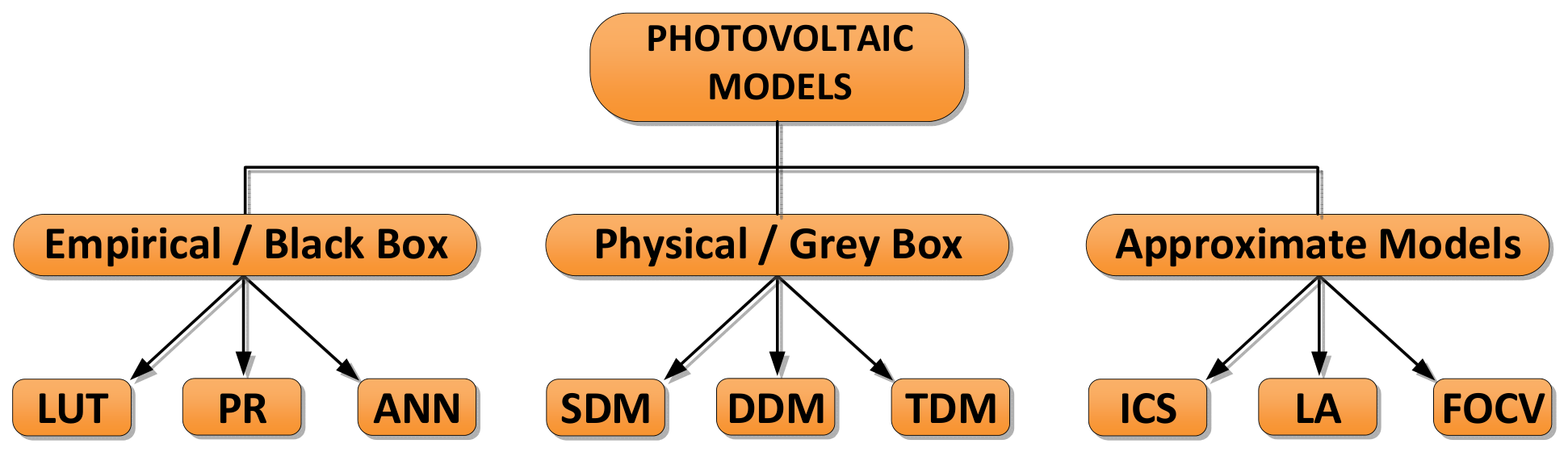
2.1. Empirical/Black-Box PV Models
2.1.1. Lookup Table (LUT) Models
2.1.2. Polynomial Regression (PR) Models
- Pout—is the output power, W,
- G—is the solar irradiance, W/m2,
- kn—are regression coefficients,
- Tamb—is the ambient temperature, °C,
- v—is the air speed at 10 m above grade, m/s.
2.1.3. Artificial Neural Networks (ANN)
2.2. Physical/Gray-Box PV Models
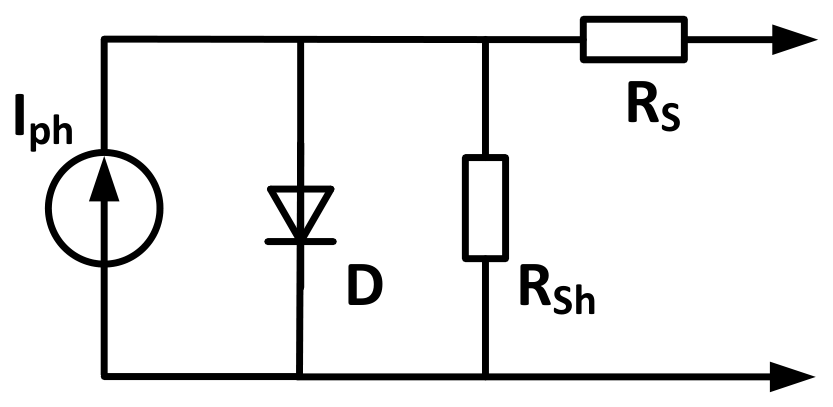
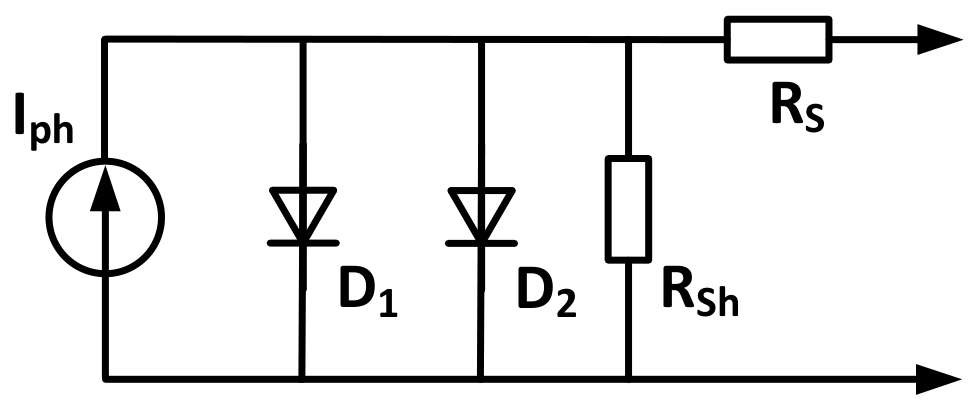
2.2.1. Single-Diode Model (SDM)
- Io—is the output current, A,
- Iph—is the light-generated current, A,
- Id—is the diode reverse saturation current, A,
- q—is the electron charge, 1.602 × 10⁻¹⁹ C,
- a—is the ideality factor,
- k—is the Boltzmann constant, 1.381 × 10⁻²³ J/K,
- Vo—is the output voltage, V,
- T—is the temperature, K,
- Rs—is the series resistance, Ω,
- Rsh—is the shunt resistance, Ω,
- ns—is the number of cells connected in series,
- np—is the number of cells connected in parallel.
2.2.2. Double-Diode Model (DDM)
2.2.3. Tripple-Diode Model (TDM)
2.3. Approximate Models
2.3.1. Ideal Current Source (ICS) Model
- ILref—is the short circuit current, A,
- α—is the current-temperature coefficient, A/°C,
- TC—is the cell temperature, °C.
2.3.2. Linear Approximation (LA) Model
2.3.3. Fractional Open-Circuit Voltage (FOCV) Model
2.4. PV Simulation Tools
2.4.1. MATLAB/Simulink for PV Systems
2.4.2. PV*SOL
2.4.3. Helioscope
2.4.4. Solarius PV
2.4.5. HOMER Pro
2.4.6. SolarGis
3. Wind Turbine Models
- Horizontal Axis Wind Turbines (HAWTs): Horizontal axis wind turbines are the most common configuration for utility-scale wind power generation, characterized by a rotor with two or three blades rotating about a horizontal axis aligned with the wind direction [58]. HAWTs require a yaw mechanism to orient the rotor into the wind and typically operate at higher tip-speed ratios, achieving power coefficients of 0.45 to 0.50.
- Vertical Axis Wind Turbines (VAWTs): Vertical axis wind turbines feature a rotor that rotates about a vertical axis, with common designs including Darrieus (lift-type) and Savonius (drag-type) configurations [59]. VAWTs are omnidirectional, requiring no yaw mechanisms, and offer advantages in urban environments and floating offshore applications due to lower center of gravity and reduced mechanical complexity. However, their aerodynamic efficiency is generally lower than that of HAWTs, and they exhibit highly unsteady loading. VAWTs are less common in large-scale hybrid systems but appear in distributed and small-scale applications.
- Doubly-Fed Induction Generators (DFIGs): DFIGs use a wound-rotor induction generator with the stator connected directly to the grid and the rotor connected via a partial-scale power converter [61]. This configuration offers variable-speed operation at reduced converter cost and size and enables independent control of active and reactive power [62]. DFIGs are sensitive to grid disturbances and require careful protection against voltage dips.
- Permanent Magnet Synchronous Generators (PMSGs): PMSGs use a full-scale power converter that decouples the generator completely from the grid, allowing variable-speed operation over a wider range [63]. The absence of slip rings and gearboxes in direct-drive configurations reduces maintenance requirements, and PMSGs offer better low-voltage ride-through capability compared to DFIGs. The full-scale converter increases initial cost but provides greater grid support capabilities, including synthetic inertia and reactive power control [64].
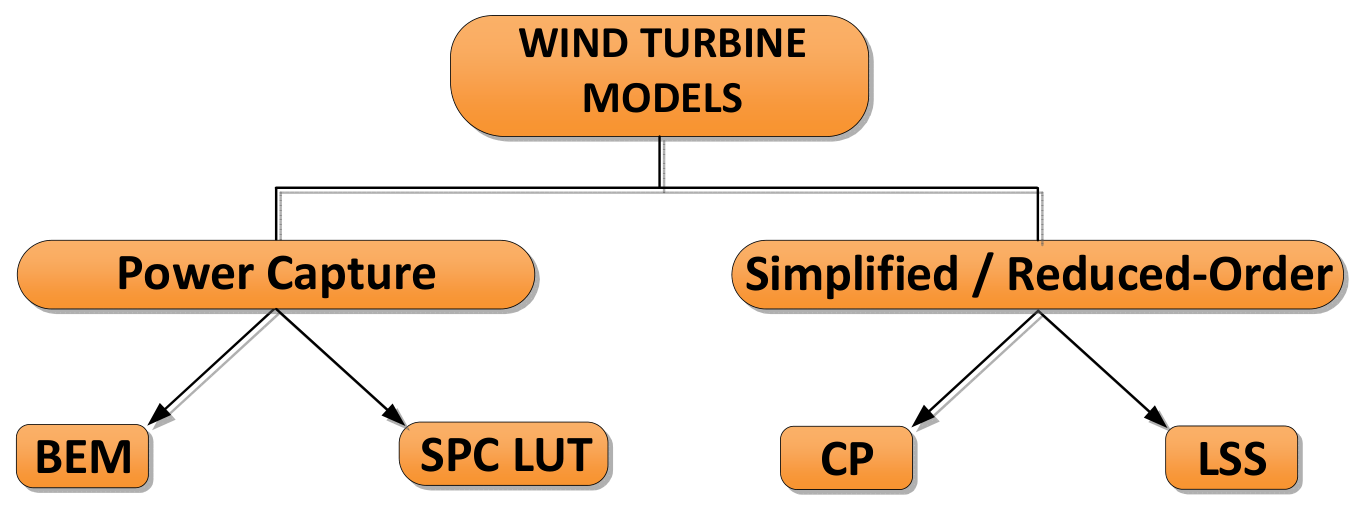
3.1. Power Capture Models
- PWT—is the wind turbine, W,
- ρ—is the air density, kg/m3,
- AWT—is the wind turbine rotor’s swept area with radius R, m2,
- V3—is the wind speed, m/s,
- CWT—is the power coefficient that represents the turbine’s aerodynamic efficiency,
- ηg—is the efficiency of a generator coupled to WT’s shaft directly or through a step-up gearbox.
3.1.1. Blade Element Momentum (BEM)
3.1.2. Simplified Power Coefficient (SPC) Lookup Table
3.2. Reduced Order Models
3.2.1. Constant Power (CP) Model
3.2.2. Linearized Small-Signal (LSS) Model
3.3. Software Tools for Wind Turbine Simulation
3.3.1. MATLAB/Simulink for Wind Turbine Systems
3.3.2. OpenFAST (FAST)
3.3.3. AMR-Wind
3.3.4. Reference Open Source Controller (ROSCO)
4. Energy Management System for Hybrid PV–WT
- Rule-based;
- Optimization-based;
- Learning-based.
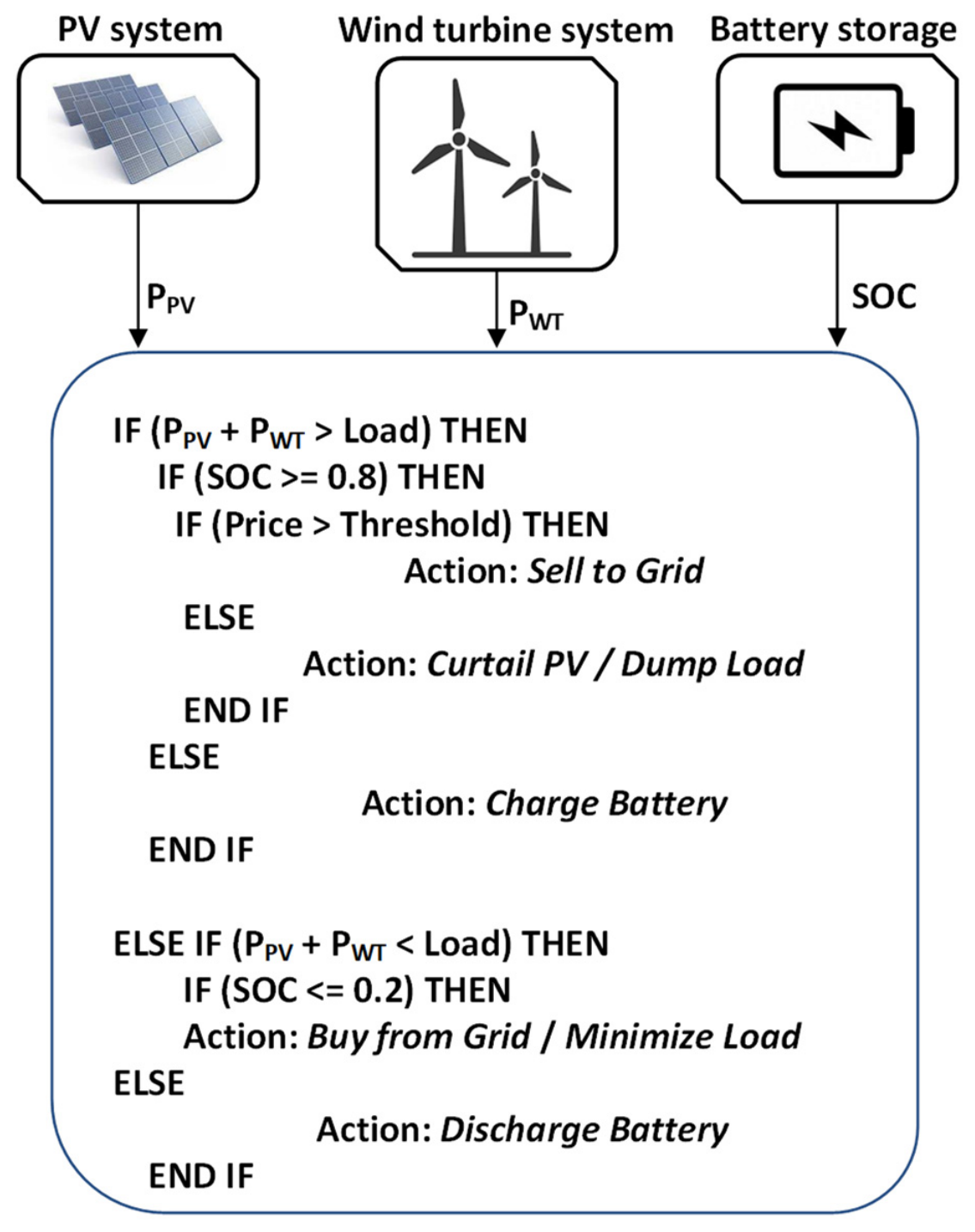
4.1. Rule-Based EMS
4.2. Optimization-Based EMS
- Linear programming (LP) EMS requires linear component models. The constant power approximation for PV and wind is ideal because power appears as a simple parameter [104]. The globally linearized PV model discussed in Section 2.3.2 can also be used if the EMS optimizes voltage setpoints, but the quadratic power function becomes a linear constraint only with additional binary variables [105];
- Quadratic programming (QP) EMS can accommodate convex quadratic cost functions, such as penalizing deviations from a dispatch schedule or modeling inverter efficiency as a quadratic function of power [106]. The piecewise linear PV model can be reformulated as a quadratic program with convex constraints. For wind, the power versus wind speed lookup table discussed in Section 3.2.2 can be approximated as a quadratic function around the nominal operating point;
- Model predictive control (MPC) EMS solves a receding-horizon optimization at each time step, requiring a dynamic model of the system [107]. For PV, the single-diode model mentioned in Section 2.2.1 can be used if simplified to an explicit form to avoid iterative solves [108]. For wind, a linearized small-signal model around the current operating point enables linear MPC formulations. However, nonlinear MPC that retains the full single-diode or blade element momentum models is rarely used in practice due to computational intractability.
4.3. Learning-Based EMS
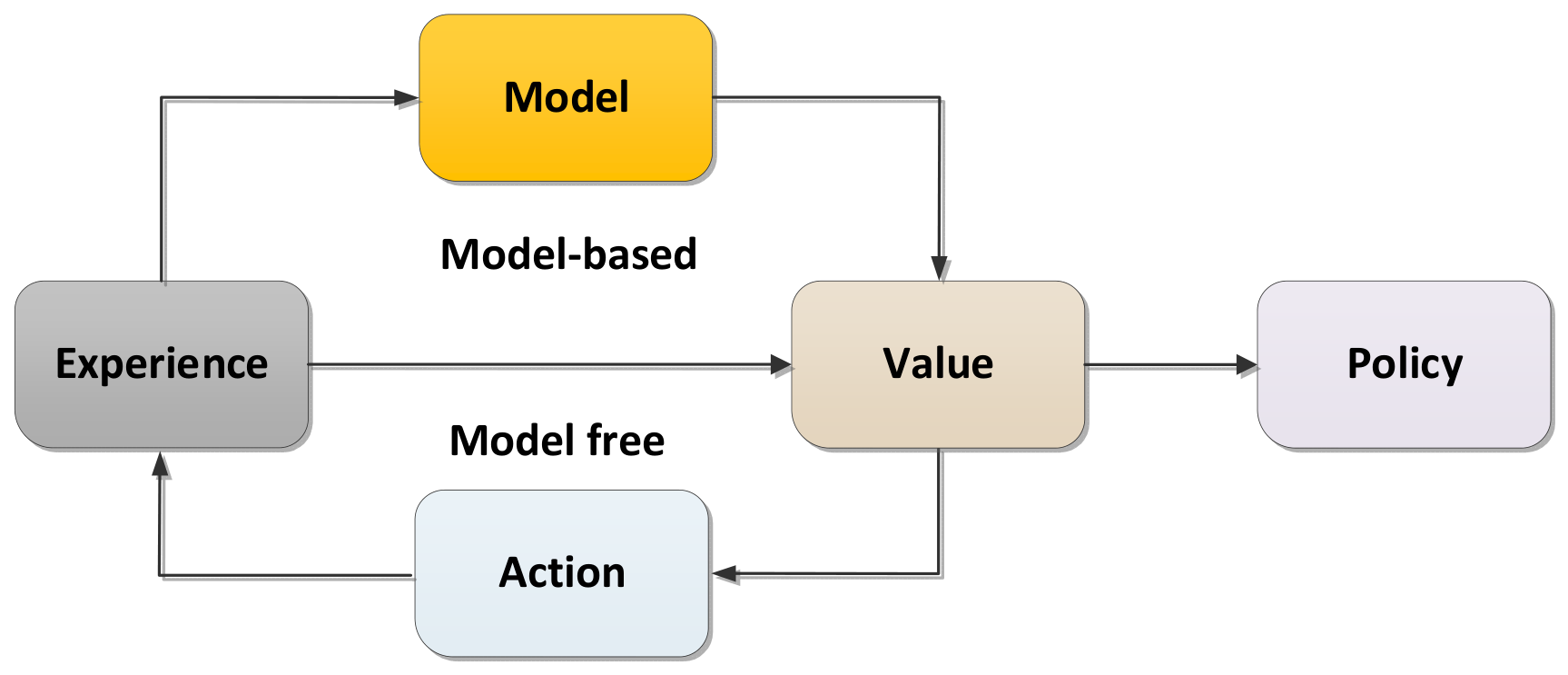
- Model-free reinforcement learning does not require explicit component models during online operation because the policy is learned offline and deployed as a neural network that outputs actions given observations. However, training requires synthetic data from a simulation environment that accurately represents PV and wind behavior. This simulation environment typically uses a constant power model for computational speed during training, because millions of training episodes must be simulated. Some studies use the power versus wind speed lookup table to capture nonlinearities without increasing the simulation significantly [115];
- Model-based reinforcement learning learns or uses an explicit model of the environment to plan actions, then interacts with the real system to refine the model. In this case, the model requirements mirror those of optimization-based EMS: the component models must be differentiable to enable gradient-based planning. The simplified single-diode PV model and linearized wind model are suitable because they are differentiable and computationally efficient [116].
4.4. Energy Storage Constraints in EMS
- State of Charge Constraints: SOC bounds represent the most fundamental storage constraint, typically expressed as minimum and maximum limits to prevent over-discharge and over-charge. In rule-based EMS, SOC thresholds trigger simple actions, such as “if SOC < 0.2, stop discharging”. In optimization-based EMS, SOC appears as linear inequality constraints that can be hard constraints (infeasible if violated) or soft constraints with penalty weights. In learning-based EMS, SOC limits are typically learned from reward functions that penalize boundary violations [128].
- Battery Degradation Costs: Cycling and calendar aging reduce battery lifetime, adding an implicit cost to each charge/discharge cycle [129]. Degradation can be modeled as a linear cost per kWh cycled, a convex function of depth of discharge, or a more complex electrochemical model. Rule-based EMS typically ignores degradation or uses simple cycle counters. Optimization-based EMS can incorporate degradation as a quadratic or linear term in the objective function [130]. Learning-based EMS can learn degradation patterns from historical data and optimize for lifetime extension.
- Charging/Discharging Efficiency: Round-trip efficiency (typically 85–95%) means that charging losses exceed discharging gains. This asymmetry creates a preference for storing energy only when necessary. In optimization-based EMS, efficiency appears as a linear transformation between charging power and stored energy. In learning-based EMS, efficiency is implicitly learned from state transition data [131].
- Multi-Time Scale Strategies: Storage operates across multiple timescales: fast regulation (seconds to minutes), load following (minutes to hours), and energy arbitrage (hours to days). Hierarchical EMS architectures separate these timescales: a day-ahead optimization schedules SOC trajectories, while a real-time EMS tracks them with adjustments. The choice of EMS architecture determines which timescales are explicitly modeled [132].
5. Discussion
- Model accuracy versus computational cost: High-fidelity models (single-diode PV, BEM wind) require iterative numerical solutions, making them mismatched with real-time EMS deadlines; simplified models (constant power, lookup tables) enable fast computation but lack voltage-based curtailment, reactive power support, and wake-aware dispatch;
- EMS complexity versus interpretability: Learning-based EMS (reinforcement learning) can outperform rule-based systems but produces black-box policies that lack certification guarantees for safety-critical operation; rule-based systems are verifiable but cannot adapt to changing conditions or optimize multiple objectives.
- Component-level detail versus system-level scalability: Per-turbine BEM and per-module single-diode models are computationally intractable for large farms, but aggregated models fail to capture inter-turbine dynamics and individual degradation. Static simplified models also do not account for aging or soiling over time.
6. Conclusions
Author Contributions
Funding
Institutional Review Board Statement
Informed Consent Statement
Data Availability Statement
Conflicts of Interest
Abbreviations
| AMR | Adaptive Mesh Refinement |
| ANN | Artificial Neural Networks |
| BEM | Blade Element Momentum |
| CIGS | Copper Indium Gallium Selenide |
| CNN | Convolutional Neural Networks |
| DDM | Double-Diode Model |
| DFIG | Doubly-Fed Induction Generators |
| DRL | Deep Reinforcement Learning |
| EMS | Energy Management System |
| ERB | Enhanced Rule-Based |
| ICS | Ideal Current Source |
| GHG | Greenhouse Gas |
| GRU | Gated Recurrent Units |
| HRES | Hybrid Renewable Energy Systems |
| HAWT | Horizontal Axis Wind Turbines |
| LA | Linear Approximation |
| LCOE | Levelized Cost of Energy |
| LP | Linear Programming |
| LPSP | Loss of Power Supply Probability |
| LSTM | Long Short-Term Memory |
| LUT | Lookup Table |
| MAE | Mean Absolute Error |
| MLP | Multilayer Perceptron |
| Mono-Si | Monocrystalline Silicon |
| MOPSO | Multi-Objective Particle Swarm Optimization |
| MPC | Model Predictive Control |
| MPPT | Maximum Power Point Tracking |
| PCM | Phase Change Materials |
| PEM | Proton Exchange Membrane |
| PGD | Proper Generalized Decomposition |
| PMSG | Permanent Magnet Synchronous Generators |
| Poly-Si | Polycrystalline Silicon |
| PR | Polynomial Regression |
| PSC | Perovskite Solar Cells |
| PSO | Particle Swarm Optimization |
| PV | Photovoltaic |
| PVT | Photovoltaic-Thermal |
| QP | Quadratic Programming |
| REF | Renewable Energy Fraction |
| RES | Renewable Energy Sources |
| RL | Reinforcement Learning |
| RMSE | Root Mean Square Error |
| RNN | Recurrent Neural Networks |
| SDM | Single-Diode Model |
| SOC | State of Charge |
| SQP | Sequential Quadratic Programming |
| SPC | Simplified Power Coefficient |
| TDM | Tripple-Diode Model |
| VAWT | Vertical Axis Wind Turbines |
| WT | Wind Turbine |
References
- IPCC. Climate Change 2022: Mitigation of Climate Change; Contribution of Working Group III to the Sixth Assessment Report of the Intergovernmental Panel on Climate Change; Shukla, P.R., Skea, J., Slade, R., Al Khourdajie, A., van Diemen, R., McCollum, D., Pathak, M., Some, S., Vyas, P., Fradera, R., et al., Eds.; Cambridge University Press: Cambridge, UK; New York, NY, USA, 2022. [Google Scholar] [CrossRef] [PubMed]
- IRENA. Renewable Capacity Statistics 2024; International Renewable Energy Agency: Masdar City, Abu Dhabi, 2024. [Google Scholar]
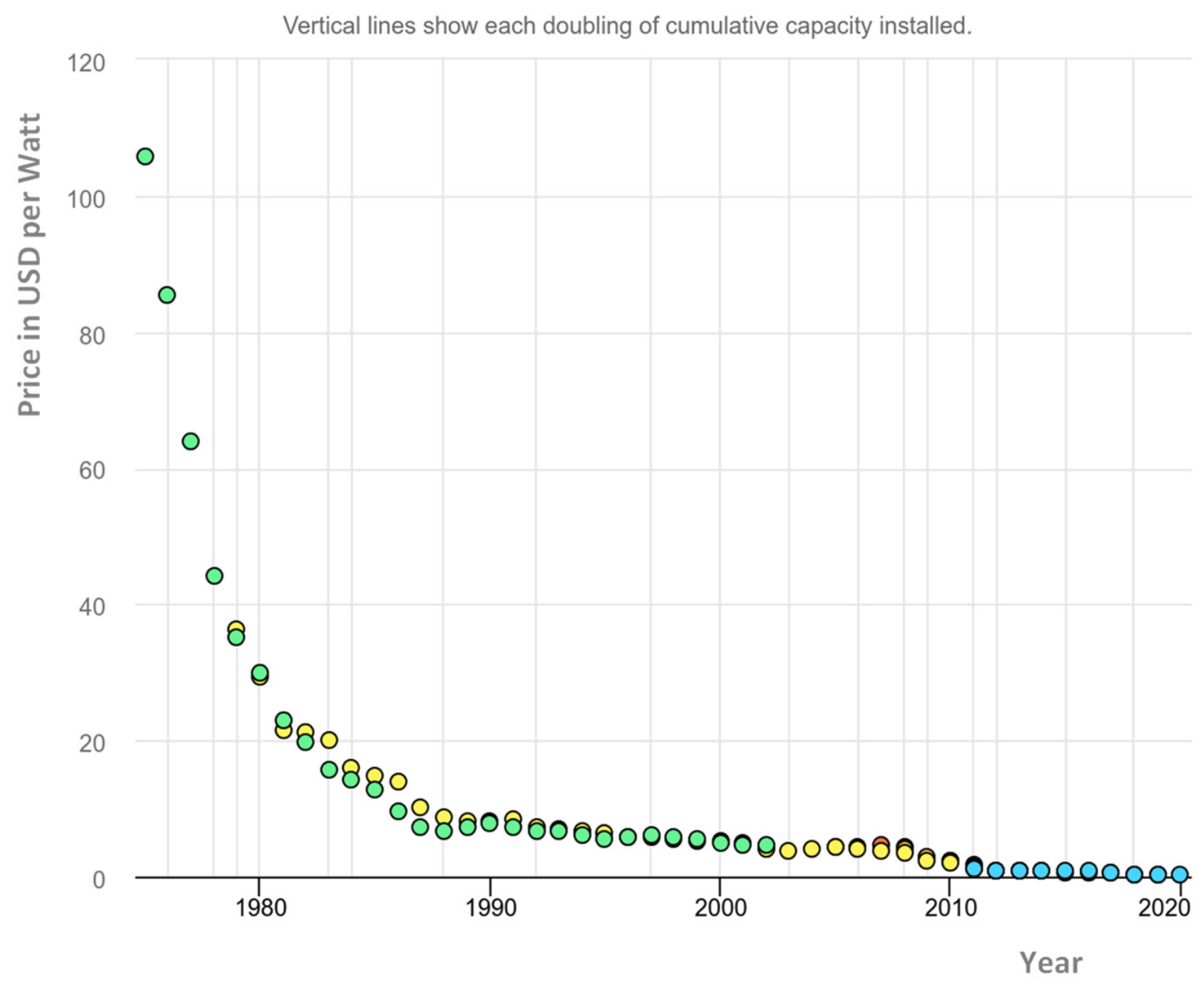
- Evolution of Solar PV Module Cost by Data Source, 1970–2020; IEA: Paris, France, 2020; Available online: https://www.iea.org/data-and-statistics/charts/evolution-of-solar-pv-module-cost-by-data-source-1970-2020 (accessed on 25 April 2026).
- Jurasz, J.; Canales, F.A.; Kies, A.; Guezgouz, M.; Beluco, A. A Review on the Complementarity of Renewable Energy Sources: Concept, Metrics, Application and Future Research Directions. Sol. Energy 2020, 195, 703–724. [Google Scholar] [CrossRef]
- Olabi, A.G.; Abdelkareem, M.A. Renewable Energy and Climate Change. Renew. Sustain. Energy Rev. 2022, 158, 112111. [Google Scholar] [CrossRef]
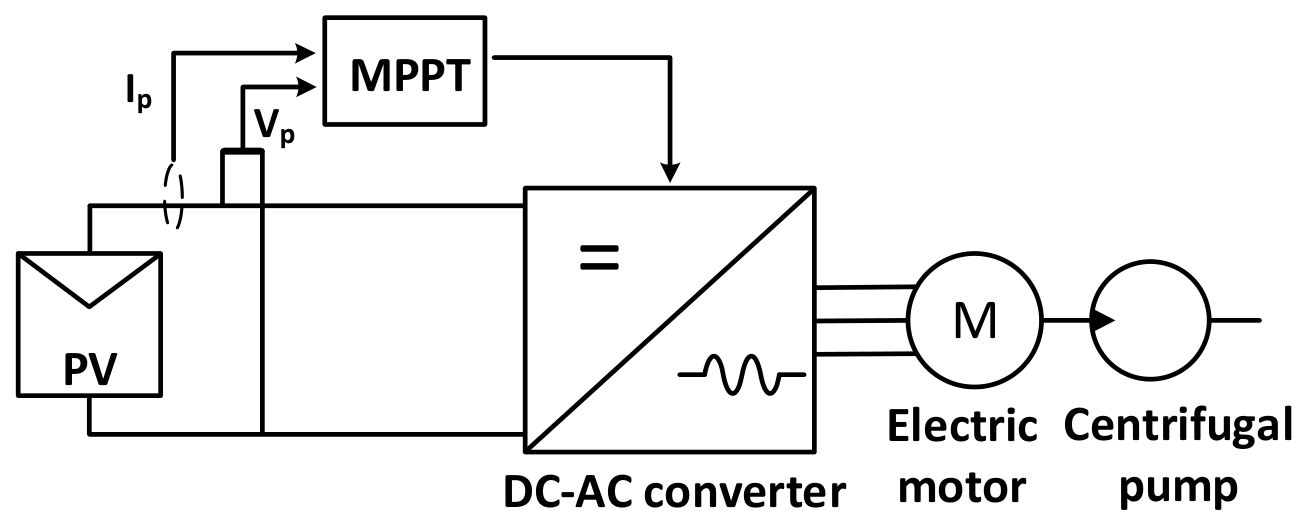
- Gevorkov, L.; Smidl, V. Simulation Model for Efficiency Estimation of Photovoltaic Water Pumping System. In Proceedings of the 19th International Symposium INFOTEH-JAHORINA (INFOTEH), East Sarajevo, Bosnia and Herzegovina, 18–20 March 2020; IEEE: New York, NY, USA, 2020; pp. 1–5. [Google Scholar]
- Gevorkov, L.; Domínguez-García, J.L.; Rassõlkin, A.; Vaimann, T. Comparative Simulation Study of Pump System Efficiency Driven by Induction and Synchronous Reluctance Motors. Energies 2022, 15, 4068. [Google Scholar] [CrossRef]
- Bakman, I.; Gevorkov, L.; Vodovozov, V. Predictive control of a variable-speed multi-pump motor drive. In Proceedings of the 2014 IEEE 23rd International Symposium on Industrial Electronics (ISIE), Istanbul, Turkey, 1–4 June 2014; IEEE: New York, NY, USA, 2014; pp. 1409–1414. [Google Scholar]
- Li, L.; Wang, X. Design and Operation of Hybrid Renewable Energy Systems: Current Status and Future Perspectives. Curr. Opin. Chem. Eng. 2021, 31, 100669. [Google Scholar] [CrossRef]
- Chin, V.J.; Salam, Z.; Ishaque, K. Cell Modelling and Model Parameters Estimation Techniques for Photovoltaic Simulator Application: A Review. Appl. Energy 2015, 154, 500–519. [Google Scholar] [CrossRef]
- Gu, Z.; Xiong, G.; Fu, X. Parameter Extraction of Solar Photovoltaic Cell and Module Models with Metaheuristic Algorithms: A Review. Sustainability 2023, 15, 3312. [Google Scholar] [CrossRef]
- Slootweg, J.G.; Polinder, H.; Kling, W.L. Representing Wind Turbine Electrical Generating Systems in Fundamental Frequency Simulations. IEEE Trans. Energy Convers. 2003, 18, 516–524. [Google Scholar] [CrossRef]
- Sartika, L.; Umemura, A.; Takahashi, R.; Tamura, J. Wind Turbines Cluster System Composed of Fixed Speed Wind Generators Controlled by Cluster Converter Based VSC-HVDC System. IEEJ Trans. Power Energy 2018, 138, 205–215. [Google Scholar] [CrossRef]
- Olatomiwa, L.; Mekhilef, S.; Ismail, M.S.; Moghavvemi, M. Energy Management Strategies in Hybrid Renewable Energy Systems: A Review. Renew. Sustain. Energy Rev. 2016, 62, 821–835. [Google Scholar] [CrossRef]
- Munir, M.S.; Shahid, U.; Nasir, U.; Hasan, M.Z.; Hussain, M.Z.; Fatima, H.; Yaqub, M.A. Machine Learning in Renewable Energy Systems. In Proceedings of the 2024 4th International Conference on Electrical, Computer, Communications and Mechatronics Engineering (ICECCME); IEEE: New York, NY, USA, 2024; pp. 1–5. [Google Scholar] [CrossRef]
- Presciutti, A.; Fagotti, L.; Martiniello, L.; Moretti, E. Simulation Tools for Renewable Energy Communities: A Comparative Multi-Scenario Analysis in Residential Contexts with High Energy Sharing Potential. Energies 2026, 19, 1490. [Google Scholar] [CrossRef]
- Zúñiga, N.; Bufanio, R.; Scarone, N.; Monte, G.; Marasco, D.; Agnello, A.; Thomas, R.; Burgos, M. Low-Power Wind Turbine Emulator for Distributed Generation Applications. Energies 2026, 19, 1543. [Google Scholar] [CrossRef]
- Ichim-Burlacu, C.; Rat, C.; Panoiu, M. A Look at Lookup Tables as PV MPPT Methods. In Proceedings of the 2024 6th Global Power, Energy and Communication Conference (GPECOM); IEEE: New York, NY, USA, 2024; pp. 51–56. [Google Scholar] [CrossRef]
- Cockcroft, R.; Thornber, B. Computational Fluid Dynamics and Digital Twins for Wind Turbines: A Review. Appl. Energy 2026, 415, 127890. [Google Scholar] [CrossRef]
- Lian, J.; Zhang, Y.; Ma, C.; Yang, Y.; Chaima, E. A Review on Recent Sizing Methodologies of Hybrid Renewable Energy Systems. Energy Convers. Manag. 2019, 199, 112027. [Google Scholar] [CrossRef]
- Ajmal, A.M. Solar PV Cell and System Technology Development and Future Trends. In Reference Module in Materials Science and Materials Engineering; Elsevier: Amsterdam, The Netherlands, 2026. [Google Scholar] [CrossRef]
- Mathew, M.; Kumar, N.M.; Koroth, R.P. Outdoor Measurement of Mono and Poly c-Si PV Modules and Array Characteristics Under Varying Load in Hot-Humid Tropical Climate. Mater. Today Proc. 2018, 5, 3456–3464. [Google Scholar] [CrossRef]
- Quansah, D.A.; Adaramola, M.S. Comparative Study of Performance Degradation in Poly- and Mono-Crystalline-Si Solar PV Modules Deployed in Different Applications. Int. J. Hydrogen Energy 2018, 43, 3092–3109. [Google Scholar] [CrossRef]
- Sevillano-Bendezú, M.Á.; Conde, L.Á.; García, M.A.; Angulo, J.R.; de la Casa, J.; Ripalda, J.M.; Töfflinger, J.A. Performance Loss Rate and Benchmarking of c-Si and Thin-Film PV Modules Considering Thermal and Spectral Effects at a Low-Latitude Site. Renew. Energy 2026, 257, 124732. [Google Scholar] [CrossRef]
- Ruan, T.; Laumert, B.; Wang, W. Techno-Economic Analysis of Urban Bifacial PV in High-Latitude Area. Renew. Energy 2026, 258, 124916. [Google Scholar] [CrossRef]
- Priya, P.; Stonier, A.A. Emerging Innovations in Solar Photovoltaic (PV) Technologies: The Perovskite Solar Cells and More. Energy Rep. 2025, 14, 216–242. [Google Scholar] [CrossRef]
- Moradi, K.; Jafari, F.; Moghaddam, F.; Shafiee, Q. Modeling of Photovoltaic-Thermal Systems Using Multivariate Polynomial Regression. IFAC-PapersOnLine 2024, 58, 136–143. [Google Scholar] [CrossRef]
- Qin, C.; Li, J.; Yang, C.; Ai, B.; Zhou, Y. Comparative Study of Parameter Extraction from a Solar Cell or a Photovoltaic Module by Combining Metaheuristic Algorithms with Different Simulation Current Calculation Methods. Energies 2024, 17, 2284. [Google Scholar] [CrossRef]
- Kroposki, B.; Emery, K.; Myers, D.; Mrig, L. A Comparison of Photovoltaic Module Performance Evaluation Methodologies for Energy Ratings. In Proceedings of the 1994 IEEE First World Conference on Photovoltaic Energy Conversion; IEEE: New York, NY, USA, 1994. [Google Scholar] [CrossRef]
- Ridha, H.M.; Hizam, H.; Mirjalili, S.; Othman, M.L.; Ya’acob, M.E.; Bin Abdul Wahab, N.I.; Ahmadipour, M. A Novel Prediction of the PV System Output Current Based on Integration of Optimized Hyperparameters of Multi-Layer Neural Networks and Polynomial Regression Models. Next Energy 2025, 8, 100256. [Google Scholar] [CrossRef]
- Bandura, A.; Batsala, Y. Use of Regression Models for Estimation of Electric Power Generation by Photovoltaic Power Plants. Environ. Res. Eng. Manag. 2025, 81, 64–77. [Google Scholar] [CrossRef]
- Asghar, R.; Fulginei, F.R.; Quercio, M.; Mahrouch, A. Artificial Neural Networks for Photovoltaic Power Forecasting: A Review of Five Promising Models. IEEE Access 2024, 12, 90461–90485. [Google Scholar] [CrossRef]
- Chetnouf, H.; El Alami, Y.; Ouerradi, F.; Bannour, Y.; Regragui, I.; Faize, A.; Benhala, B.; Elhadi, B. Review of Artificial Neural Network Applications for the Optimization of Photovoltaic-Thermal Systems Integrated with Phase Change Materials. E3S Web Conf. 2025, 680, 00149. [Google Scholar] [CrossRef]
- El-Dabah, M.A.; El-Sehiemy, R.A.; Hasanien, H.M.; Saad, B. Photovoltaic Model Parameters Identification Using an Innovative Optimization Algorithm. IET Renew. Power Gener. 2023, 17, 1783–1796. [Google Scholar] [CrossRef]
- Gevorkov, L.; Domínguez-García, J.L.; Romero, L.T. Review on Solar Photovoltaic-Powered Pumping Systems. Energies 2023, 16, 94. [Google Scholar] [CrossRef]
- Deotti, L.M.; da Silva, I.C. A Survey on the Parameter Extraction Problem of the Photovoltaic Single Diode Model from a Current–Voltage Curve. Sol. Energy 2023, 263, 111930. [Google Scholar] [CrossRef]
- Gevorkov, L.; Kirpichnikova, I. Model of Solar Photovoltaic Water Pumping System for Domestic Application. In Proceedings of the 2021 28th International Workshop on Electric Drives: Improving Reliability of Electric Drives (IWED), Moscow, Russia, 27–29 January 2021; IEEE: New York, NY, USA, 2021; pp. 1–5. [Google Scholar]
- Ali, Z.; Calasan, M.; Mostafa, M.H.; Abdel Aleem, S. Analytical Modeling of Novel Equivalent Circuits of Double Diode Solar Cell Circuits Using a Special Transcendental Function Approach. PLoS ONE 2024, 19, e0313713. [Google Scholar] [CrossRef] [PubMed]
- Moshksar, E. Two Datasheet-Based Approaches for Double-Diode PV Modeling with an Efficient Trade-Off Between Accuracy and Simplicity. Heliyon 2024, 10, e36424. [Google Scholar] [CrossRef] [PubMed]
- Khyani, H.K.; Vajpai, J. Development of Triple-Diode Based Generalized Model of Photovoltaic Module. e-Prime 2025, 12, 100964. [Google Scholar] [CrossRef]
- Halal, A.; Plesz, B. Comparative Analysis of Single, Double, and Triple Diode Models for Accurate I-V Curve Fitting of Perovskite Solar Cells. In Proceedings of the 2024 IEEE 7th International Conference and Workshop Óbuda on Electrical and Power Engineering (CANDO-EPE); IEEE: New York, NY, USA, 2024; pp. 000027–000031. [Google Scholar] [CrossRef]
- Szabo, R.; Gontean, A. Photovoltaic Cell and Module I-V Characteristic Approximation Using Bézier Curves. Appl. Sci. 2018, 8, 655. [Google Scholar] [CrossRef]
- Villalva, M.G.; Gazoli, J.R.; Filho, E.R. Comprehensive Approach to Modeling and Simulation of Photovoltaic Arrays. IEEE Trans. Power Electron. 2009, 24, 1198–1208. [Google Scholar] [CrossRef]
- Saloux, E.; Teyssedou, A.; Sorin, M. Explicit Model of Photovoltaic Panels to Determine Voltages and Currents at the Maximum Power Point. Sol. Energy 2011, 85, 713–722. [Google Scholar] [CrossRef]
- Massi Pavan, A.; Vergura, S.; Mellit, A.; Lughi, V. Explicit Empirical Model for Photovoltaic Devices. Experimental Validation. Sol. Energy 2017, 155, 647–653. [Google Scholar] [CrossRef]
- Kabbani, A.; Shaik, H. PV Cell Parameters Modeling and Temperature Effect Analysis. Int. J. Renew. Energy Dev. 2021, 10, 563–571. [Google Scholar] [CrossRef]
- Shi, N.; Lv, Y.; Zhang, Y.; Zhu, X. Linear Fitting Rule of I–V Characteristics of Thin-Film Cells Based on Bezier Function. Energy 2023, 278, 127997. [Google Scholar] [CrossRef]
- Wang, Y.-J.; Sheu, R.-L. A New Piecewise Linear Circuit Model for Photovoltaic Cells and Modules. J. Chin. Inst. Electr. Eng. 2015, 22, 181–188. [Google Scholar] [CrossRef]
- Hassan, A.; Bass, O.; Masoum, M.A.S. An Improved Genetic Algorithm Based Fractional Open Circuit Voltage MPPT for Solar PV Systems. Energy Rep. 2023, 9, 1535–1548. [Google Scholar] [CrossRef]
- Baimel, D.; Tapuchi, S.; Levron, Y.; Belikov, J. Improved Fractional Open Circuit Voltage MPPT Methods for PV Systems. Electronics 2019, 8, 321. [Google Scholar] [CrossRef]
- Deville, L.; Anderson, K.S.; Sutterlueti, J.; Chambers, T.L.; De Brabandere, K.; Perez Cicala, F.; Lopez-Lorente, J.; Mirletz, B.; Neubert, A.; Nikam, M.; et al. Feature Review of Photovoltaic Modeling Software Utilizing Blind Performance Assessment. Sol. Energy 2026, 304, 114207. [Google Scholar] [CrossRef]
- Kumar, N.M.; Chakraborty, S.; Yadav, S.K.; Singh, J.; Chopra, S.S. Advancing Simulation Tools Specific to Floating Solar Photovoltaic Systems—Comparative Analysis of Field-Measured and Simulated Energy Performance. Sustain. Energy Technol. Assess. 2022, 52, 102168. [Google Scholar] [CrossRef]
- Kaleshwarwar, A.; Bahadure, S. Validating the Credibility of Solar Simulation Tools Using a Real-World Case Study. Energy Build. 2023, 301, 113697. [Google Scholar] [CrossRef]
- Available online: https://www.helioscope.com/ (accessed on 25 April 2026).
- Milosavljevic, D.; Kevkić, T.; Jovanovic, S. Review and Validation of Photovoltaic Solar Simulation Tools/Software Based on Case Study. Open Phys. 2022, 20, 431–451. [Google Scholar] [CrossRef]
- Pérez Uc, D.A.; de León Aldaco, S.E.; Aguayo Alquicira, J. Techno-Economic and Environmental Assessment of a Hybrid Photovoltaic–Diesel–Grid System for University Facilities. Processes 2026, 14, 1185. [Google Scholar] [CrossRef]
- Alzubi, E.; Noche, B. A Multi-Objective Model to Find the Sustainable Location for Citrus Hub. Sustainability 2022, 14, 14463. [Google Scholar] [CrossRef]
- Yang, S.; Lin, K.; Zhou, A. Exploring the Performance of Horizontal Axis Wind Turbine in Yawed Turbulent Flows Through Wind Tunnel Experiments. Renew. Energy 2025, 243, 122579. [Google Scholar] [CrossRef]
- Seify Davari, M.; Seifi Davari, H.; Ntantis, E.L. A Comprehensive Review on Savonius Vertical-Axis Wind Turbines: Design Advances and Efficiency Enhancement. Energy Convers. Manag. X 2026, 30, 101830. [Google Scholar] [CrossRef]
- Errami, Y.; Obbadi, A.; Sahnoun, S.; Aoutoul, M. Control of Variable-Speed Wind Turbines. In Encyclopedia of Renewable Energy, Sustainability and the Environment, 1st ed.; Rahimpour, M.R., Ed.; Elsevier: Amsterdam, The Netherlands, 2024; pp. 491–506. [Google Scholar] [CrossRef]
- Kasbi, A.; Rahali, A. Performance Improvement of Modern Variable-Velocity Wind Turbines Technology Based on the Doubly-Fed Induction Generator (DFIG). Mater. Today Proc. 2021, 45, 5426–5432. [Google Scholar] [CrossRef]
- Shahriari, S.A.A. Modelling and Dynamic State Estimation of a Doubly Fed Induction Generator Wind Turbine. COMPEL 2020, 39, 1393–1409. [Google Scholar] [CrossRef]
- Roga, S.; Kisku, V.; Datta, S. Performance of a Vertical Wind Turbine with Permanent Magnet Synchronous Generator. Proc. Inst. Civ. Eng. Energy 2022, 175, 205–215. [Google Scholar] [CrossRef]
- Wang, P.; Zeng, X.; Luo, Y. A Novel High-Voltage Fault-Tolerant Permanent Magnet Synchronous Generator for Far Offshore Wind Turbines. Int. J. Electr. Power Energy Syst. 2025, 168, 110662. [Google Scholar] [CrossRef]
- Jiménez-Ruiz, J.; Villena-Ruiz, R.; Honrubia-Escribano, A.; Fortmann, J.; Gómez-Lázaro, E. Generic Wind Turbine Models for Power System Stability Assessment Based on IEC 61400-27: A Review. Renew. Sustain. Energy Rev. 2026, 231, 116740. [Google Scholar] [CrossRef]
- Gevorkov, L.; Saebnoori, E.; Domínguez-García, J.L.; Trilla, L. Renewable Energy-Driven Pumping Systems and Application for Desalination: A Review of Technologies and Future Directions. Appl. Sci. 2026, 16, 862. [Google Scholar] [CrossRef]
- Ledoux, J.; Riffo, S.; Salomon, J. Analysis of the Blade Element Momentum Theory. SIAM J. Appl. Math. 2021, 81, 2596–2621. [Google Scholar] [CrossRef]
- Zhao, D.; Han, N.; Goh, E.; Cater, J.; Reinecke, A. Chapter 5—Offshore Wind Turbine Aerodynamics Modelling and Measurements. In Wind Turbines and Aerodynamics Energy Harvesters; Zhao, D., Han, N., Goh, E., Cater, J., Reinecke, A., Eds.; Academic Press: Cambridge, MA, USA, 2019; pp. 373–400. [Google Scholar] [CrossRef]
- Boumezbeur, N.E.; Smaili, A. An Aerodynamic Optimization Approach for Wind Turbine Blades Using Proper Generalized Decomposition. Energies 2025, 18, 5846. [Google Scholar] [CrossRef]
- Hansen, A.D.; Michalke, G. Modelling and Control of Variable-Speed Multi-Pole Permanent Magnet Synchronous Generator Wind Turbine. Wind Energy 2008, 11, 537–554. [Google Scholar] [CrossRef]
- Ragheb, M.; Ragheb, A.M. Wind Turbines Theory—The Betz Equation and Optimal Rotor Tip Speed Ratio. In Fundamental and Advanced Topics in Wind Power; InTech: London, UK, 2011. [Google Scholar] [CrossRef] [PubMed]
- Ren, H.; Tian, Z.; Han, L.; Meng, S.; Yang, Y. Adaptive Pitch Control for Power Stabilization of Floating Offshore Wind Turbines. Renew. Energy 2026, 262, 125392. [Google Scholar] [CrossRef]
- del Pozo Gonzalez, H.; Kallinger, M.D.; Rapha, J.I.; Domínguez-García, J.L. Modern Floating Wind Energy Technologies. In Energy Systems Integration for Multi-Energy Systems; Ocampo-Martinez, C., Quijano, N., Eds.; Green Energy and Technology; Springer: Cham, Switzerland, 2025. [Google Scholar] [CrossRef]
- Trejos, A.; Guarnizo, C.; Serna-Garcés, S. Overall Description of Wind Power. Ing. Cienc. 2014, 10, 99–126. [Google Scholar] [CrossRef]
- del Pozo Gonzalez, H.; Domínguez-García, J.L.; Gomis-Bellmunt, O. Structural Motion Control of Waked Floating Offshore Wind Farms. Ocean Eng. 2024, 293, 116709. [Google Scholar] [CrossRef]
- Dave, S.; Korobenko, A. Consistent Reduced Order Modeling for Wind Turbine Wakes Using Variational Multiscale Method and Actuator Line Model. Comput. Methods Appl. Mech. Eng. 2025, 446, 118194. [Google Scholar] [CrossRef]
- Zhao, X.; Dao, M.H.; Le, Q.T. Digital Twining of an Offshore Wind Turbine on a Monopile Using Reduced-Order Modelling Approach. Renew. Energy 2023, 206, 531–551. [Google Scholar] [CrossRef]
- Qin, S.; Ngu, S.; Zeng, T. Optimal Constant Power Control of Wind Turbine Generators Based on Takagi-Sugeno Fuzzy Model. Alex. Eng. J. 2022, 61, 5977–5982. [Google Scholar] [CrossRef]
- Salih, M.; Sofiane, M.; Abdelaziz, L.; Walid, K.; Es-saadi, T. Multi-Objective Optimal Design of an Outer-Rotor Permanent-Magnet Synchronous Generator for Direct-Drive Wind Energy System. Frankl. Open 2025, 13, 100442. [Google Scholar] [CrossRef]
- Bao, X.; Zhang, L. Review of Grid Codes and Implementation for Wind Farm Frequency Regulation. E3S Web Conf. 2022, 352, 02012. [Google Scholar] [CrossRef]
- D’Amico, G.; Petroni, F.; Vergine, S. Ramp Rate Limitation of Wind Power: An Overview. Energies 2022, 15, 5850. [Google Scholar] [CrossRef]
- Krpan, M.; Kuzle, I. Linearized Model of Variable Speed Wind Turbines for Studying Power System Frequency Changes. In Proceedings of the 2017 IEEE EUROCON; IEEE: New York, NY, USA, 2017; pp. 393–398. [Google Scholar] [CrossRef]
- Jonkman, J.M.; Jonkman, B.J. FAST Modularization Framework for Wind Turbine Simulation: Full-System Linearization. J. Phys. Conf. Ser. 2016, 753, 082010. [Google Scholar] [CrossRef]
- Tsiaras, E.; Coutelieris, F.A. Future Directions of Hybrid Off-Grid Renewable Energy Systems for Remote Islands. Energies 2025, 18, 6524. [Google Scholar] [CrossRef]
- Hadj Abdallah, S.; Ben Salem, F.; Mouine, J.; Tounsi, S. Optimization Techniques for Wind Turbine Power Recovery Using Average Models and Genetic Algorithms. Electronics 2025, 14, 4630. [Google Scholar] [CrossRef]
- Hu, J.; Dong, X.; Zhang, Y.; Chen, Z.; Fang, Z.; Ren, J. Collaborative Control Strategy of Wind Farms for Frequency Support Considering the Frequency Distribution Characteristic. Electronics 2026, 15, 820. [Google Scholar] [CrossRef]
- Mulders, S.; Zaaijer, M.; Bos, R.; Van Wingerden, J. Wind Turbine Control: Open-Source Software for Control Education, Standardization and Compilation. J. Phys. Conf. Ser. 2020, 1452, 012010. [Google Scholar] [CrossRef]
- Abedi, H.; Eskilsson, C. Wind Turbine Aerodynamics Simulation Using the Spectral/hp Element Framework Nektar++. Wind 2025, 5, 6. [Google Scholar] [CrossRef]
- Kuhn, M.B.; Henry de Frahan, M.; Mohan, P.; Deskos, G.; Churchfield, M.; Cheung, L.; Almgren, A.; Ananthan, S.; Brazell, M.; Martínez Tossas, L.; et al. AMR-Wind: A Performance-Portable, High-Fidelity Flow Solver for Wind Farm Simulations. Wind Energy 2025, 28, e70010. [Google Scholar] [CrossRef]
- Liu, Y.; Wang, Y.; Wang, X. Independent Pitch Adaptive Control of Large Wind Turbines Using State Feedback and Disturbance Accommodating Control. Energies 2024, 17, 4619. [Google Scholar] [CrossRef]
- Fowler, M.; Lenfest, E.; Viselli, A.; Goupee, A.; Kimball, R.; Bergua, R.; Wang, L.; Zalkind, D.; Wright, A.; Robertson, A. Wind/Wave Testing of a 1:70-Scale Performance-Matched Model of the IEA Wind 15 MW Reference Wind Turbine with Real-Time ROSCO Control and Floating Feedback. Machines 2023, 11, 865. [Google Scholar] [CrossRef]
- Zia, M.F.; Elbouchikhi, E.; Benbouzid, M. Microgrids Energy Management Systems: A Critical Review on Methods, Solutions, and Prospects. Appl. Energy 2018, 222, 1033–1055. [Google Scholar] [CrossRef]
- Clemente, A.; Arias, P.; Gevorkov, L.; Trilla, L.; Obrador Rey, S.; Roger, X.S.; Domínguez-García, J.L.; Filbà Martínez, À. Optimizing Performance of Hybrid Electrochemical Energy Storage Systems through Effective Control: A Comprehensive Review. Electronics 2024, 13, 1258. [Google Scholar] [CrossRef]
- Modu, B.; Abdullah, M.P.; Alkassem, A.; Hamza, M.F. Optimal Rule-Based Energy Management and Sizing of a Grid-Connected Renewable Energy Microgrid with Hybrid Storage Using Levy Flight Algorithm. Energy Nexus 2024, 16, 100333. [Google Scholar] [CrossRef]
- Hussain, A.; Kim, H.-M. A Rule-Based Modular Energy Management System for AC/DC Hybrid Microgrids. Sustainability 2025, 17, 867. [Google Scholar] [CrossRef]
- Zhang, J.; Xu, D.; Wu, D.; Huang, X.; Wen, C. Impact of Rotor Size and Axial Spacing on the Aerodynamic Performance and Power Generation of Offshore Floating Dual-Rotor Wind Turbines. Ocean Eng. 2025, 341, 122820. [Google Scholar] [CrossRef]
- Udeh, G.T.; Michailos, S.; Ingham, D.; Hughes, K.J.; Ma, L.; Pourkashanian, M. A Modified Rule-Based Energy Management Scheme for Optimal Operation of a Hybrid PV-Wind-Stirling Engine Integrated Multi-Carrier Energy System. Appl. Energy 2022, 312, 118763. [Google Scholar] [CrossRef]
- Chen, Y.-K.; Wu, Y.-C.; Song, C.-C.; Chen, Y.-S. Design and Implementation of Energy Management System With Fuzzy Control for DC Microgrid Systems. IEEE Trans. Power Electron. 2013, 28, 1563–1570. [Google Scholar] [CrossRef]
- Shanmugarjah, V.; Lidula, N.W.A.; Rajapakse, A.D. A Comparative Analysis of Rule-Based and Optimization-Based Energy Management for a Campus Microgrid in Sri Lanka. In Proceedings of the 2024 International Conference on Sustainable Energy: Energy Transition and Net-Zero Climate Future (ICUE), Pattaya City, Thailand, 21–23 October 2024; IEEE: New York, NY, USA, 2024; pp. 1–6. [Google Scholar] [CrossRef]
- Wee, N.R.; Jamian, J.J.; Syed Nasir, S.N.; Zaid, N.M. Enhanced Rule-Based Energy Management System for an Islanded Microgrid. In Proceedings of the 2022 IEEE International Conference on Power and Energy (PECon), Langkawi, Kedah, Malaysia, 5–6 December 2022; IEEE: New York, NY, USA, 2022; pp. 144–148. [Google Scholar] [CrossRef]
- Roy, T.K.; Mahmud, M.A.; Than Oo, A.M. A Rule-Based Energy Management System for Remote Area Hybrid Standalone Energy Systems with Hydrogen Energy Storage Systems to Improve the Reliability. In Proceedings of the 2024 IEEE International Conference on Power Electronics, Drives and Energy Systems (PEDES), Mangalore, India, 18–21 December 2024; IEEE: New York, NY, USA, 2024; pp. 1–6. [Google Scholar] [CrossRef]
- Elkazaz, M.; Sumner, M.; Davies, R.; Pholboon, S.; Thomas, D. Optimization Based Real-Time Home Energy Management in the Presence of Renewable Energy and Battery Energy Storage. In Proceedings of the 2019 International Conference on Smart Energy Systems and Technologies (SEST), Porto, Portugal, 9–11 September 2019; IEEE: New York, NY, USA, 2019; pp. 1–6. [Google Scholar] [CrossRef]
- Ismail, M.S.; Moghavvemi, M.; Mahlia, T.M.I. Design of an Optimized Photovoltaic and Microturbine Hybrid Power System for a Remote Small Community: Case Study of Palestine. Energy Convers. Manag. 2013, 75, 271–281. [Google Scholar] [CrossRef]
- Abedi, S.; Alimardani, A.; Gharehpetian, G.B.; Riahy, G.H.; Hosseinian, S.H. A Comprehensive Method for Optimal Power Management and Design of Hybrid RES-Based Autonomous Energy Systems. Renew. Sustain. Energy Rev. 2012, 16, 1577–1587. [Google Scholar] [CrossRef]
- Ju, Z.; Guo, L.; Li, J.; Ju, Q. Energy Management and Control for Linear–Quadratic–Gaussian Systems with Imperfect Acknowledgments and Energy Constraints. Axioms 2025, 14, 791. [Google Scholar] [CrossRef]
- Killian, M.; Zauner, M.; Kozek, M. Comprehensive Smart Home Energy Management System Using Mixed-Integer Quadratic-Programming. Appl. Energy 2018, 222, 662–672. [Google Scholar] [CrossRef]
- Maleki, M.; Gorginpour, H. Model Predictive Control Based Energy Management of a Grid-Connected Microgrid with Renewable Sources and Electric Vehicles. In Proceedings of the 2025 5th International Conference on Electrical Machines and Drives (ICEMD), Tehran, Islamic Republic of Iran, 18–19 November 2025; IEEE: New York, NY, USA, 2025; pp. 1–5. [Google Scholar] [CrossRef]
- Bai, W.; Wang, J.; Muttaqi, K.M.; Sutanto, D.; Raad, R. An MPC-Based Energy Management System for Curtailing Grid Supply to Solar-Powered Water Pumping Stations with Battery Back-Up. In Proceedings of the 2025 IEEE International Conference on Energy Technologies for Future Grids (ETFG), Wollongong, Australia, 7–11 December 2025; IEEE: New York, NY, USA, 2025; pp. 1–6. [Google Scholar] [CrossRef]
- Bruni, G.; Cordiner, S.; Mulone, V.; Rocco, V.; Spagnolo, F. A Study on the Energy Management in Domestic Micro-Grids Based on Model Predictive Control Strategies. Energy Convers. Manag. 2015, 102, 50–58. [Google Scholar] [CrossRef]
- Babonneau, F.; Caramanis, M.; Haurie, A. A Linear Programming Model for Power Distribution with Demand Response and Variable Renewable Energy. Appl. Energy 2016, 181, 83–95. [Google Scholar] [CrossRef]
- Benzzine, H.; Labrim, H.; el Aouni, I.; Achour, Y.; Bajit, A.; Saad, A.; Ettahri, H.; Balli, M.; Zejli, D.; El Bouayadi, R. MATLAB-TRNSYS Simulation Framework for MPC-Based Optimization of Hybrid Renewable Energy Systems. Sci. Afr. 2025, 28, e02751. [Google Scholar] [CrossRef]
- Cadena-Zarate, C.; Tucci, I.; Della Scalla, D.; Garcia, J.; Crouzier, M.; Cambron, P.; Carreau, M.; Rousse, D.R.; Ilinca, A. Renewable Energy Optimization in Isolated Microgrids: A Python-Based Tool for Cost-Effective Solutions Using Genetic Algorithms. Energy Convers. Manag. X 2026, 30, 101709. [Google Scholar] [CrossRef]
- Deepak, K.; Reddy, G.P.R.; Raj Kumar, S.; Singh, B.J.; Kumar, J.A.; Jayanth, P. Reinforcement Learning Based Energy Management Strategy for Hybrid Renewable Micro Grid with EV Integration. In Proceedings of the 2026 International Conference on Smart Electronic Devices and Intelligent Systems (ICSEDIS), Chiramanangad, India, 13–15 April 2026; IEEE: New York, NY, USA, 2026; pp. 547–555. [Google Scholar]
- Saha, U.; Jawad, A.; Shahria, S.; Harun-Ur Rashid, A.B.M. Proximal Policy Optimization-Based Reinforcement Learning Approach for DC-DC Boost Converter Control: A Comparative Evaluation Against Traditional Control Techniques. Heliyon 2024, 10, e37823. [Google Scholar] [CrossRef] [PubMed]
- Frutos, M.; Marino-Sanchez, O.; Huergo, D.; Ferrer, E. Deep Reinforcement Learning for Multi-Objective Optimization: Enhancing Wind Turbine Energy Generation while Mitigating Noise Emissions. arXiv 2024, arXiv:2407.13320. [Google Scholar] [CrossRef]
- Alshahr, S.; Alshahir, A.; Alnuman, H.; Alanazi, M.D.; Yousef, A.; Abbas, G. Dynamic Renewable Energy Integration for EV Charging via Model-Based Reinforcement Learning. Ain Shams Eng. J. 2026, 17, 104040. [Google Scholar] [CrossRef]
- Wang, H.; Meng, Y.; Zhang, N.; Sun, S. Optimal Dispatch of Grid-Connected Microgrids Considering the Uncertainty of Renewable Energy Generation Based on Deep Reinforcement Learning. Energy Rep. 2026, 15, 109275. [Google Scholar] [CrossRef]
- Gao, Y.; Hu, Z.; Matsunami, Y.; Qu, M.; Chen, W.-A.; Liu, M. Optimizing Renewable Energy Systems with Hybrid Action Space Reinforcement Learning: A Case Study on Achieving Net Zero Energy in Japan. Renew. Energy 2026, 256, 124493. [Google Scholar] [CrossRef]
- Legrene, I.; Wong, T.; Dessaint, L.-A. Deep Reinforcement Learning Approach for Hybrid Renewable Energy Systems Optimization. Eng. Appl. Artif. Intell. 2025, 159, 111650. [Google Scholar] [CrossRef]
- Chowdhury, N.; Calais, M.; Shafiullah, G.M. Optimization Approaches for Renewable Microgrid Applications with Hydrogen and Battery Energy Storage—A Comprehensive Review. J. Energy Storage 2026, 170, 122744. [Google Scholar] [CrossRef]
- Modu, B.; Abdullah, M.P.; Bukar, A.L.; Hamza, M.F. A Systematic Review of Hybrid Renewable Energy Systems with Hydrogen Storage: Sizing, Optimization, and Energy Management Strategy. Int. J. Hydrogen Energy 2023, 48, 38354–38373. [Google Scholar] [CrossRef]
- Mohammadi, P.; Darshi, R.; Shamaghdari, S.; Siano, P. Comparative Analysis of Control Strategies for Microgrid Energy Management with a Focus on Reinforcement Learning. IEEE Access 2024, 12, 171368–171395. [Google Scholar] [CrossRef]
- Esparza, A.; Blondin, M.; Trovão, J.P.F. A Review of Optimization Strategies for Energy Management in Microgrids. Energies 2025, 18, 3245. [Google Scholar] [CrossRef]
- Khawaja, Y.; Allahham, A.; Giaouris, D.; Patsios, C.; Walker, S.; Qiqieh, I. An Integrated Framework for Sizing and Energy Management of Hybrid Energy Systems Using Finite Automata. Appl. Energy 2019, 250, 257–272. [Google Scholar] [CrossRef]
- Basnet, S.; Deschinkel, K.; Le Moyne, L.; Péra, M.C. A Review on Recent Standalone and Grid Integrated Hybrid Renewable Energy Systems: System Optimization and Energy Management Strategies. Renew. Energy Focus 2023, 46, 103–125. [Google Scholar] [CrossRef]
- Ammari, C.; Belatrache, D.; Touhami, B.; Makhloufi, S. Sizing, Optimization, Control and Energy Management of Hybrid Renewable Energy System—A Review. Energy Built Environ. 2022, 3, 399–411. [Google Scholar] [CrossRef]
- Ghoudelbourk, S.; Yousfi, R.; Benbouhenni, H. Energy Management of an Autonomous Hybrid Renewable Power System. In Proceedings of the 2025 IEEE 13th International Conference on Smart Energy Grid Engineering (SEGE), Oshawa, ON, Canada, 18–20 August 2025; IEEE: New York, NY, USA, 2025; pp. 190–194. [Google Scholar] [CrossRef]
- Yang, R.; Li, Z.; Chen, G. A Rapid State-of-Charge Estimation Method for Retired Batteries Without Initial State Constraints. In Proceedings of the IECON 2023—49th Annual Conference of the IEEE Industrial Electronics Society, Singapore, 16–19 October 2023; IEEE: New York, NY, USA, 2023; pp. 1–6. [Google Scholar] [CrossRef]
- Sarableh, A.M.; Maleki, A.; Khorsandi, A.; Hosseinian, S.H. Optimal Virtual Inertia Placement Considering Battery Degradation Cost in Microgrids. In Proceedings of the 2024 28th International Electrical Power Distribution Conference (EPDC), Zanjan, Islamic Republic of Iran, 23–25 April 2024; IEEE: New York, NY, USA, 2024; pp. 1–5. [Google Scholar] [CrossRef]
- Amer, A.; Massoud, A.; Shaban, K. Optimization of Hybrid Renewable-Diesel Power Plants Considering Operational Cost, Battery Degradation, and Emissions. Heliyon 2024, 10, e27021. [Google Scholar] [CrossRef] [PubMed]
- Peng, S.-T.; Qi, Z.-Y.; Liu, Y.-Y.; Liu, Z.-F.; Li, L.-L. Improving the Energy Efficiency and Economic Benefits of Port Integrated Energy Systems: A Multi-Objective Optimization Model for Wind-Storage-Charging-Discharging Power Stations with Green Efficiency Factors-Driven Multilateral Response Strategy. Energy 2025, 339, 138939. [Google Scholar] [CrossRef]
- Zhou, Q.; Xiao, H.; Zhou, C. Integrated Microgrid with PV, Energy Storage, Charging and Swapping: Multi-Time-Scale Coordinated Planning of Electric Heavy Truck Power Station in Remote Areas. Energy Convers. Manag. X 2026, 30, 101895. [Google Scholar] [CrossRef]
- Li, S.; Gong, W.; Gu, Q. A Comprehensive Survey on Meta-Heuristic Algorithms for Parameter Extraction of Photovoltaic Models. Renew. Sustain. Energy Rev. 2021, 141, 110828. [Google Scholar] [CrossRef]
- Haridy, A.L.; Abdelhameed, E.H.; Chen, Y.; Mohamed, E.A.; Abouheaf, M.; Mohamed, A.-A.A. Optimal Control Design for Enhancing the Maximum Power Extraction from PMSG-Based Grid Connected Wind Turbines. J. Eng. Res. 2026, in press. [CrossRef]
- Soubache, I.D.; Naga Malleswara Rao, D.S.; Susitra, D.; Saini, S. Energy Management of Hybrid Energy Storage System with Renewable Energy Sources for Electric Vehicles Based on Green Anaconda Optimization and Multi-Resolution Sinusoidal Neural Network. Energy 2026, 342, 139545. [Google Scholar] [CrossRef]
- Marić, P.; Marasović, I.; Bevanda, I.; Betti, T. Extraction of PV Module Electrical Parameters Based on the Single Diode and Double Diode Model of a PV Cell. In Proceedings of the 2022 7th International Conference on Smart and Sustainable Technologies (SpliTech), Split/Bol, Croatia, 5–8 July 2022; IEEE: New York, NY, USA, 2022; pp. 1–5. [Google Scholar] [CrossRef]
- Cui, Z.; Hu, W.; Zhang, G.; Huang, Q.; Chen, Z.; Blaabjerg, F. A Novel Data-Driven Online Model Estimation Method for Renewable Energy Integrated Power Systems With Random Time Delay. IEEE Trans. Power Syst. 2023, 38, 5930–5933. [Google Scholar] [CrossRef]
- Hu, D.; Zhao, Z.; Lin, Z.; Chen, N. Aerodynamic Characterization of a Floating Offshore Wind Turbine under Pitch Motion. In Proceedings of the 2025 4th International Conference on Green Energy and Power Systems (ICGEPS), Hangzhou, China, 11–13 April 2025; IEEE: New York, NY, USA, 2025; pp. 659–662. [Google Scholar] [CrossRef]
- Oliveira, H.A.; Gomes de Matos, J.; de Souza Ribeiro, L.A.; Ronald Saavedra, O.; Santana, C.A.; Branco, C. BEM Model Extended to Analyze the Performance of Medium and Large Size Wind Turbines. In Proceedings of the IECON 2021—47th Annual Conference of the IEEE Industrial Electronics Society, Toronto, ON, Canada, 13–16 October 2021; IEEE: New York, NY, USA, 2021; pp. 1–6. [Google Scholar] [CrossRef]
- Guo, P.; Zheng, Y.; Zou, Y.; Liu, Q.; Han, X. An Uncertain Wind Power Output Simulation Method Considering Wake Effects and the Influence of Extreme Weather. In Proceedings of the 2025 8th International Conference on Power and Energy Applications (ICPEA), Shanghai, China, 23–25 October 2025; IEEE: New York, NY, USA, 2025; pp. 639–644. [Google Scholar] [CrossRef]
- Singh, S.P.; Singh, V.P.; Benedetto, F. Rule-Based Controller Design for Frequency Control in Islanded Microgrids. In Proceedings of the 2024 IEEE International Conference on Power Electronics, Drives and Energy Systems (PEDES), Mangalore, India, 18–21 December 2024; IEEE: New York, NY, USA, 2024; pp. 1–5. [Google Scholar] [CrossRef]
- Li, H.; Zhao, L.; Yang, Z.; Liu, P.; Ming, B.; Liu, B. Mitigating Uncertainties: Robust Stochastic Optimal Operation of Inter-Regional Hydro-Wind-Solar Hybrid Systems. Renew. Energy 2026, 261, 125230. [Google Scholar] [CrossRef]





| Simulation Tool | Modeling Approach | Key Strengths |
|---|---|---|
| MATLAB/Simulink | Equation-based (custom models). | Flexibility, custom MPPT, co-simulation with other tools. |
| PV*SOL | 3D ray-tracing. | High accuracy, advanced 3D shading. |
| Helioscope | Cloud-native 3D modeling. | Web-based, rapid layout. |
| Solarius PV | 3D modeling + economic analysis. | High accuracy, integrated reporting. |
| HOMER Pro | Iterative optimization. | Multi-source optimization, energy management focus. |
| SolarGis | Satellite-derived irradiance. | High-resolution resource data, high-accuracy simulation |
| Simulation Tool | Primary Application | Key Strengths |
|---|---|---|
| MATLAB/Simulink | Control design, grid integration. | Flexibility, MPPT, education. |
| OpenFAST | Aero-hydro-servo-elastic simulation. | Industry standard, multi-physics. |
| AMR-Wind | High-fidelity CFD, wake modeling. | Blade-resolved, HPC scalability. |
| ROSCO | Controller design and tuning. | Open reference, OpenFAST compatible. |
| Feature | Rule-Based | Optimization-Based | Learning-Based |
|---|---|---|---|
| Decision Logic [120] | If-then-else rules | Mathematical programming | Neural network |
| Optimality | Suboptimal | Near optimal | Training-dependent |
| Computational Cost [121] | Very low | Medium to high | High |
| Training Required [122] | No | No | Yes |
| Handling Uncertainty [123,124] | Poor | Good | Good |
| Real-Time Feasibility [125] | Excellent | Good (if solver fast) | Excellent |
| Implementation Complexity [126] | Low | Medium to high | High |
| Typical Application [127] | Small off-grid systems | Grid-connected microgrids | Complex grid-connected microgrids |
| Component | Model Type | Example Model | Best EMS Match | Accuracy | Param. Availability | Comput. Complexity |
|---|---|---|---|---|---|---|
| PV | Empirical/Black-Box | ANN-based PV | Learning-based | High | Low (needs training) | High (train) |
| PV | Equivalent-Circuit | Single-diode | Optimization (MPC) | High | Moderate (extraction) | Medium (iterative) |
| PV | Simplified | Constant power | Rule-based, LP | Low | Very low | Very low |
| PV | Simplified | Piecewise linear | QP | Low | Low | |
| WT | Simplified | Constant power | Rule-based, LP | Moderate | Very low | Very low |
| WT | Simplified | Power vs. wind speed lookup | Optimization, LP | Moderate | Low | Very low |
Disclaimer/Publisher’s Note: The statements, opinions and data contained in all publications are solely those of the individual author(s) and contributor(s) and not of MDPI and/or the editor(s). MDPI and/or the editor(s) disclaim responsibility for any injury to people or property resulting from any ideas, methods, instructions or products referred to in the content. |
© 2026 by the authors. Licensee MDPI, Basel, Switzerland. This article is an open access article distributed under the terms and conditions of the Creative Commons Attribution (CC BY) license.
Share and Cite
Gevorkov, L.; Henríquez Alamo, D.; Domínguez-García, J.L.; Trilla, L.; Arias, P. Powering the Future: A Review of PV and Wind Turbine Technologies from Component Modeling to System Coordination. Appl. Sci. 2026, 16, 6127. https://doi.org/10.3390/app16126127
Gevorkov L, Henríquez Alamo D, Domínguez-García JL, Trilla L, Arias P. Powering the Future: A Review of PV and Wind Turbine Technologies from Component Modeling to System Coordination. Applied Sciences. 2026; 16(12):6127. https://doi.org/10.3390/app16126127
Chicago/Turabian StyleGevorkov, Levon, Daniel Henríquez Alamo, José Luis Domínguez-García, Lluis Trilla, and Paula Arias. 2026. "Powering the Future: A Review of PV and Wind Turbine Technologies from Component Modeling to System Coordination" Applied Sciences 16, no. 12: 6127. https://doi.org/10.3390/app16126127
APA StyleGevorkov, L., Henríquez Alamo, D., Domínguez-García, J. L., Trilla, L., & Arias, P. (2026). Powering the Future: A Review of PV and Wind Turbine Technologies from Component Modeling to System Coordination. Applied Sciences, 16(12), 6127. https://doi.org/10.3390/app16126127