Article

Robust Fault Diagnosis of Hydraulic Pumps Under Variable Load: A Machine Learning Approach with Signal Conditioning


1
Faculty of Mechanical Engineering and Robotics, AGH University of Krakow, 30-059 Kraków, Poland
2
Faculty of Management, AGH University of Krakow, 30-059 Kraków, Poland
*
Author to whom correspondence should be addressed.
Appl. Sci. 2026, 16(12), 6051; https://doi.org/10.3390/app16126051 (registering DOI)
Submission received: 27 April 2026 / Revised: 27 May 2026 / Accepted: 10 June 2026 / Published: 15 June 2026

Abstract

In the era of digital transformation, the operational reliability of hydraulic energy conversion systems is paramount for the overall efficiency of sustainable integrated energy infrastructures. This study evaluates the robustness of machine learning-based fault diagnosis for positive displacement pumps, which are critical components in energy-intensive industrial applications. The research addresses a key challenge: the instability of diagnostic features under varying operational regimes. Using vibration signals from units at three distinct wear levels, we evaluated multiple machine learning architectures, including SVM, KNN, and ensemble trees. Our findings reveal that traditional data-driven models suffer a performance degradation of over 21% when subjected to domain shifts caused by load variability. To mitigate this, we implemented a frequency-domain signal conditioning layer that aligns extracted descriptors with physically meaningful wear phenomena. This enhanced feature representation improved classification accuracy to 93.5% under variable load conditions. The results demonstrate that improving the robustness of diagnostic models is essential for reliable operation, maintenance planning, and energy efficiency of hydraulic energy conversion systems within modern industrial energy infrastructures.

1. Introduction

The reliability of hydraulic and process pumps is fundamental to safety, energy efficiency, and economic performance in many industries, such as oil and gas, aviation, and renewable energy [1]. In the context of sustainable integrated energy systems, the efficiency of hydraulic power conversion units is a decisive factor in reducing overall energy losses and ensuring operational stability. Positive displacement and centrifugal pumps often operate under extreme conditions, characterized by high pressure, aggressive chemical environments, and variable loads, which make them susceptible to complex failure mechanisms [2]. The most serious degradation phenomena include cavitation, excessive wear of friction pairs, rotor damage, and internal leaks, which, if left untreated, lead to catastrophic system failures [3].
The modern approach to maintenance is evolving from preventive strategies towards advanced condition monitoring (CM) systems that allow anomalies to be detected at an early stage [4]. In this context, vibration signal analysis is considered one of the most effective diagnostic methods, as mechanical vibrations directly reflect the dynamic forces and interactions inside the pump housing [5]. However, as recent literature reviews indicate, traditional physics-based methods encounter difficulties in interpreting results for systems with a high degree of non-linearity and variability in operating parameters [1].
In recent years, there has been a surge of interest in machine learning (ML) algorithms for pump diagnostics. Methods such as k-nearest neighbors (KNN), support vector machines (SVM), and fuzzy inference systems (FIS) allow for the automation of the fault identification process through the analysis of multidimensional sets of statistical features [6,7]. Nevertheless, the redundancy of diagnostic features and their sensitivity to changing operating conditions remain a significant challenge [8]. Many ML models that show near-perfect accuracy in laboratory conditions lose their effectiveness in the face of domain shift caused by changes in load or rotational speed [9].
Beyond hydraulic systems, the effectiveness of ML methods has also been demonstrated in several other engineering and environmental domains. In advanced manufacturing, ML and deep learning models applied to radio frequency signals have enabled non-invasive in-process monitoring and discharge state detection in micro-EDM, supporting more reliable process monitoring and future improvements in machining control [10]. In the energy sector, short-term wind and renewable power forecasting studies have shown that ensemble and stacking-based ML models can improve prediction accuracy and reliability compared with single learners or benchmark approaches, which is relevant for balancing and integrating variable renewable energy sources into power systems [11,12]. In environmental and transport-related applications, GPS- and vehicle-speed-based ML models have been used to predict fuel consumption and exhaust emissions, including CO2 and NOx, demonstrating the ability of data-driven models to capture nonlinear relationships in real-world operational data [13]. These cross-domain applications confirm the potential of ML methods to learn complex patterns from high-dimensional sensor and operational data, which further motivates their application to robust hydraulic pump diagnostics.
To overcome these limitations, science is turning to deep learning (DL) methods. Architectures such as convolutional neural networks (CNN) and self-encoding auto-encoders (SDAE) offer the ability to automatically extract hierarchical features that are much more resistant to external noise than traditional statistical descriptors [8,9]. Nevertheless, there is still a lack of comprehensive research in the literature on the robustness of classical classifiers in scenarios where the wear condition remains constant and only the operating parameters change, which is typical for real industrial operation.
This limitation is particularly relevant for hydraulic energy conversion systems, which constitute an important class of energy subsystems within modern industrial and electromechanical infrastructures. This article fills this research gap by focusing on the analysis of the stability of diagnostic models in variable operating regimes. The aim of the study is not to maximize accuracy under laboratory conditions, but to assess the robustness of models to changes in operating conditions with unchanged wear conditions. Using advanced signal processing techniques and feature selection methods (ANOVA, mRMR), the paper demonstrates how variable load affects the reliability of diagnosis. These results indicate the need for further research on more robust predictive diagnostic approaches for hydraulic pumps.

2. Types of Pump Damage

Pumps used in hydraulic energy conversion systems are exposed to various degradation mechanisms that affect their operational reliability and efficiency. The most relevant faults from the perspective of vibration-based diagnostics include bearing wear, internal leakage, rotor imbalance, cavitation phenomena, and wear of friction pairs [1,7,14]. These faults generate measurable changes in vibration and acoustic responses, which form the basis for condition monitoring and predictive diagnostics.
In practice, many degradation processes develop progressively during long-term operation and are strongly influenced by changing load conditions and operating regimes. This creates significant challenges for diagnostic systems based on statistical features and classical machine learning methods, particularly under variable operating conditions [1,14].

2.1. Mechanical and Hydraulic Degradation Mechanisms

Mechanical damage refers to degradation processes affecting the physical structure of the pump and the operating conditions of interacting components. These faults are typically associated with progressive wear of friction pairs and result in changes in vibration and acoustic responses [1].
One of the most frequently observed faults is bearing wear, caused by contamination, overheating, overload, or rotor imbalance [2,14]. Bearing degradation generates broadband high-frequency vibrations, making it a significant source of diagnostic symptoms [14]. Rotor imbalance and shaft misalignment also contribute to abnormal dynamic loads and increased vibration levels [14,15].
In multi-piston pumps, particular importance is attributed to the wear of valve plates, slides, and piston-cylinder pairs. These processes increase internal leakage and intensify abnormal mechanical interactions between components, which directly affect the characteristics of measured vibration signals [16,17].
Hydraulic damage is associated with disturbances in flow conditions and pressure distribution within the hydraulic circuit [1,14]. One of the most significant phenomena is cavitation, which leads to material degradation, increased vibration levels, and characteristic acoustic responses [5,14].
Additional hydraulic disturbances include pressure pulsations, recirculation, and unstable turbulent flow conditions, particularly under variable operating regimes [7,10]. These phenomena contribute to pressure instability, increased thermal loads, and changes in vibration signal characteristics, which are important from the perspective of condition monitoring and fault diagnostics [14,16].

2.2. Operational Damage and Its Symptoms

Operational damage develops during normal pump operation and is directly related to operating conditions, the quality of the working medium, and the configuration of the hydraulic system [1]. Typical operational problems include clogging of flow channels, dry running conditions, unstable inflow conditions, and increased thermal or mechanical loads [14,18]. These phenomena lead to reduced hydraulic efficiency, increased energy losses, and accelerated wear of interacting components [5,14].
The presence of gas bubbles in the medium, pressure pulsations, and unstable flow conditions may additionally contribute to hydraulic instability and irregular pump operation [17,19]. Such phenomena are often associated with incorrect inflow conditions and insufficient NPSH reserve [20].
Operational damage is typically manifested by increased vibration and noise levels, irregular acoustic responses, pressure fluctuations, reduced hydraulic efficiency, and elevated temperatures of structural components [2,5,14]. However, these symptoms are often non-unique and strongly dependent on operating conditions, which makes direct fault identification difficult in practical applications.
Due to the coexistence of multiple degradation mechanisms and the dependence of their manifestation on variable operating regimes, effective diagnostics requires the analysis and processing of measurement signals, particularly vibration signals, which form the basis for the methods discussed in the following sections.

3. Diagnosing Damage Based on Symptoms

3.1. Pump Damage Symptoms as a Basis for Diagnostics

The diagnosis of hydraulic pumps is based on the analysis of measurable symptoms generated during operation, which contain information about the current technical condition of the system and its interacting components [21]. In signal-based diagnostic approaches, the fault identification process relies on measured physical signals without the need to construct explicit input–output models describing the operation of the object [21]. Depending on the type of degradation process, diagnostic symptoms may manifest as changes in vibration, pressure, flow, temperature, acoustic emission, or electrical parameters [1,5].
Among the available diagnostic signals, vibration signals are considered one of the most useful sources of diagnostic information in rotating machinery, including pumps, gearboxes, and electric motors [17,21]. In hydraulic pumps, vibrations are generated by friction, impacts, leakage phenomena, and irregular interactions between internal components such as pistons, slides, bearings, or valve plates [16,17,22]. Because vibration signals are highly sensitive to mechanical degradation and hydraulic disturbances, they are widely used in condition monitoring and predictive diagnostics [5,16,21].
Pressure and flow signals also constitute an important source of diagnostic information in hydraulic systems, particularly in the assessment of cavitation phenomena, leakage flows, pressure pulsations, and operational instability [16,17,18,23]. Variations in discharge pressure and flow characteristics may indicate progressive degradation processes and changes in volumetric efficiency [16,17]. Electrical signals, including motor current characteristics, are additionally used to monitor load variations and indirectly assess changes in the operating condition of the pump and drive system [18,21].
In modern diagnostic systems, information obtained from multiple sensors is increasingly combined in order to improve fault detection effectiveness and reduce the ambiguity of individual symptoms [17,22,23,24]. However, the interpretation of diagnostic signals remains difficult under variable operating conditions, since changes in load, rotational speed, flow conditions, or medium properties may significantly influence the statistical and spectral characteristics of measured signals [1,8,9]. For this reason, signal processing and feature extraction methods play a critical role in the development of robust diagnostic models capable of distinguishing actual degradation symptoms from temporary operational changes.

3.2. Classical Signal Analysis Methods and Their Limitations

Traditional machine diagnostics is based on signal analysis methods in which features are extracted from measured signals and interpreted as symptoms reflecting the technical condition of the object [21]. In hydraulic pump diagnostics, both time-domain and frequency-domain analyses are commonly used to identify degradation patterns associated with mechanical wear and hydraulic disturbances [21,25].
Time-domain analysis involves the calculation of statistical indicators directly from measured signals, including RMS, variance, kurtosis, skewness, and selected shape factors [15,23,26,27]. These features are widely used in vibration-based diagnostics because they allow the detection of impulsive phenomena and changes in signal energy associated with bearing wear, cavitation, leakage, or abnormal interactions between working components [15,26,27]. However, although time-domain features are effective in detecting anomalies, their ability to unambiguously distinguish different degradation mechanisms is limited in complex systems with multiple coupled vibration sources [21].
Frequency-domain and time-frequency methods are used to identify spectral components characteristic of specific degradation processes [16,19,25,28]. FFT-based analysis enables the identification of dominant frequency components, while STFT, CWT, and EMD methods allow the analysis of non-stationary signals generated under variable operating conditions [4,16,17,19,25,29,30,31]. These approaches are particularly important in hydraulic pump diagnostics, where signal characteristics strongly depend on load variability and transient operating regimes.
Despite their widespread use, classical signal analysis methods exhibit several limitations in industrial applications. Their effectiveness is strongly affected by noise, non-stationary operating conditions, and the dependence of extracted features on load and rotational speed [19,25,28,32,33]. In addition, many methods require expert-driven parameter selection and signal interpretation, which limits the scalability and robustness of diagnostic systems operating under variable conditions [19,32,33].

3.3. Feature Extraction and Selection

Raw diagnostic signals are characterized by high dimensionality and noise, which makes direct use in diagnostic models difficult [23,26]. For this reason, signal processing typically involves feature extraction and feature selection procedures aimed at preserving diagnostically relevant information while reducing data redundancy.
In hydraulic pump diagnostics, features are commonly extracted in the time, frequency, and time-frequency domains [23,25,26]. Frequently used statistical descriptors include RMS, variance, kurtosis, skewness, and selected dimensionless factors sensitive to impulsive phenomena and degradation processes [23,26,34]. Frequency-domain features are based on spectral characteristics and energy distribution within selected frequency bands [25,26,28]. In the case of non-stationary signals, time-frequency methods such as wavelet-based analysis are additionally used to represent transient phenomena occurring under variable operating conditions [19,31,35].
Excessive numbers of features may reduce classifier effectiveness and increase computational complexity. Therefore, feature selection methods are applied to identify parameters with the highest diagnostic relevance [23,36,37]. In practical applications, statistical methods such as ANOVA and information-theoretic approaches such as mRMR are commonly used to evaluate feature discriminative ability while reducing redundancy between variables [26,36,37]. Dimensionality reduction techniques, including PCA and t-SNE, may additionally support visualization and interpretation of multidimensional diagnostic data [18,19,31,35,38].

4. Application of Machine Learning Methods in Pump Damage Diagnostics

Modern pump diagnostics increasingly employ machine learning (ML) and deep learning (DL) methods to support the analysis of multidimensional sensor data generated by hydraulic systems [2,15]. These approaches are particularly useful when classical analytical models are insufficient due to the nonlinear, non-stationary, and noisy nature of measurement signals [35,38]. In pump diagnostics, ML methods do not replace signal analysis but extend it by using diagnostic features extracted from vibration, pressure, acoustic, electrical, and auxiliary signals [6,21,36]. Their effectiveness therefore depends directly on the quality of signal preprocessing, feature extraction, and feature selection procedures.

4.1. Classical Machine Learning Methods

Classical ML methods are widely used in hydraulic pump diagnostics due to their relatively low computational complexity and ability to operate on statistical and spectral features extracted from measurement signals [6,7,21,36]. In practical applications, supervised learning algorithms are most commonly used, with classifiers trained on labelled datasets representing different technical conditions of the machine [36].
The most frequently applied methods include k-nearest neighbours (KNN), support vector machines (SVM), decision trees, random forests, and ensemble classifiers [6,7,21,23,26,36]. KNN classifiers are valued for their simplicity, while SVM methods are useful in nonlinear classification tasks because kernel functions allow complex decision boundaries to be modelled [6,21,36]. Tree-based and ensemble methods are also commonly applied because they can handle multidimensional diagnostic features and provide relatively interpretable classification results [23,26,36].
In hydraulic pump diagnostics, classical ML methods are usually combined with feature extraction and feature selection techniques to identify degradation states and classify fault conditions [7,23,26,36]. However, their performance strongly depends on the stability of extracted features under changing operating conditions [8,9,19,32]. As a result, high classification accuracy obtained under controlled laboratory conditions may not translate into robust performance under variable load, rotational speed, or non-stationary operating regimes [8,9,19,32].

4.2. Deep Learning and Hybrid Approaches

DL methods have gained increasing importance in pump diagnostics because they can learn hierarchical feature representations directly from raw or transformed measurement signals [19,32,35,38]. Compared with classical ML approaches, DL models reduce the dependence on manually designed features and may better capture nonlinear relationships in complex diagnostic data [19,35,38].
Convolutional neural networks (CNNs) are frequently used in vibration-based diagnostics, especially when signals are represented in spectral or time-frequency form, such as spectrograms or scalograms [19,35,38]. Autoencoder-based models, recurrent neural networks, and hybrid architectures combining signal processing with neural-network-based classification are also used to improve fault detection in noisy and non-stationary signals [31,32,33,35,38,39,40,41,42].
The literature reports several applications of DL and hybrid approaches in pump diagnostics. These include Vision Transformer architectures for electrohydraulic aircraft pumps using pressure and flow signals [19], WCCN-BiLSTM hybrid models for drilling pump diagnostics under noisy conditions [33], CNN-based models for wear detection in axial multi-piston pumps [35], and wavelet-based classifiers combined with SVM or MLP models for centrifugal pump monitoring in industrial environments [20,43]. These studies confirm the potential of DL and hybrid approaches, but they also indicate that model performance depends strongly on data quality, operating conditions, and the representativeness of training datasets.
Despite their advantages, DL models have important limitations. They usually require larger datasets, higher computational resources, and careful training procedures [32,35,39]. In industrial applications, where labelled fault data are often limited and operating conditions vary, their generalisation ability may still be insufficient [19,32,38].

4.3. Limitations of Existing Approaches Under Variable Operating Conditions

Reliable fault identification under variable operating conditions remains a major challenge in pump diagnostics [8,9,19,32]. Many diagnostic models are developed and validated under controlled conditions, where load, rotational speed, and environmental factors remain relatively stable [8,9]. In real operation, however, measurement signals are affected by non-stationary regimes, noise, changing load, flow variability, and differences in operating parameters [19,32,33].
These factors may significantly alter the statistical and spectral properties of diagnostic features. As a consequence, ML models may learn operating-condition-dependent patterns rather than degradation-related characteristics, which leads to reduced robustness and poor generalisation under domain shift conditions [8,9,19,32,43,44,45,46,47]. This problem is particularly relevant in vibration-based diagnostics, where changes in load and operating regime influence signal amplitude, spectral distribution, and transient behaviour [19,32,33,43,44,45,46,47].
Therefore, the key issue is not only the selection of a classifier, but also the stability of the diagnostic features used as model inputs. Signal conditioning, feature relevance assessment, and robustness-oriented evaluation are necessary to distinguish actual wear-related symptoms from temporary changes caused by operating conditions [8,9,32,43,44,45,46,47]. This provides the methodological basis for the empirical analysis presented in the following sections.

5. Experimental Data Collection and Sample Construction

The empirical research aimed to assess the possibility of identifying the wear condition of hydraulic positive displacement pumps based on mechanical vibration signals, using classical machine learning methods and analyzing the resilience of models to changes in operating conditions. The analysis was performed in the MATLAB R2023b environment using signal processing and machine diagnostics packages.

5.1. Measurement Data Collection

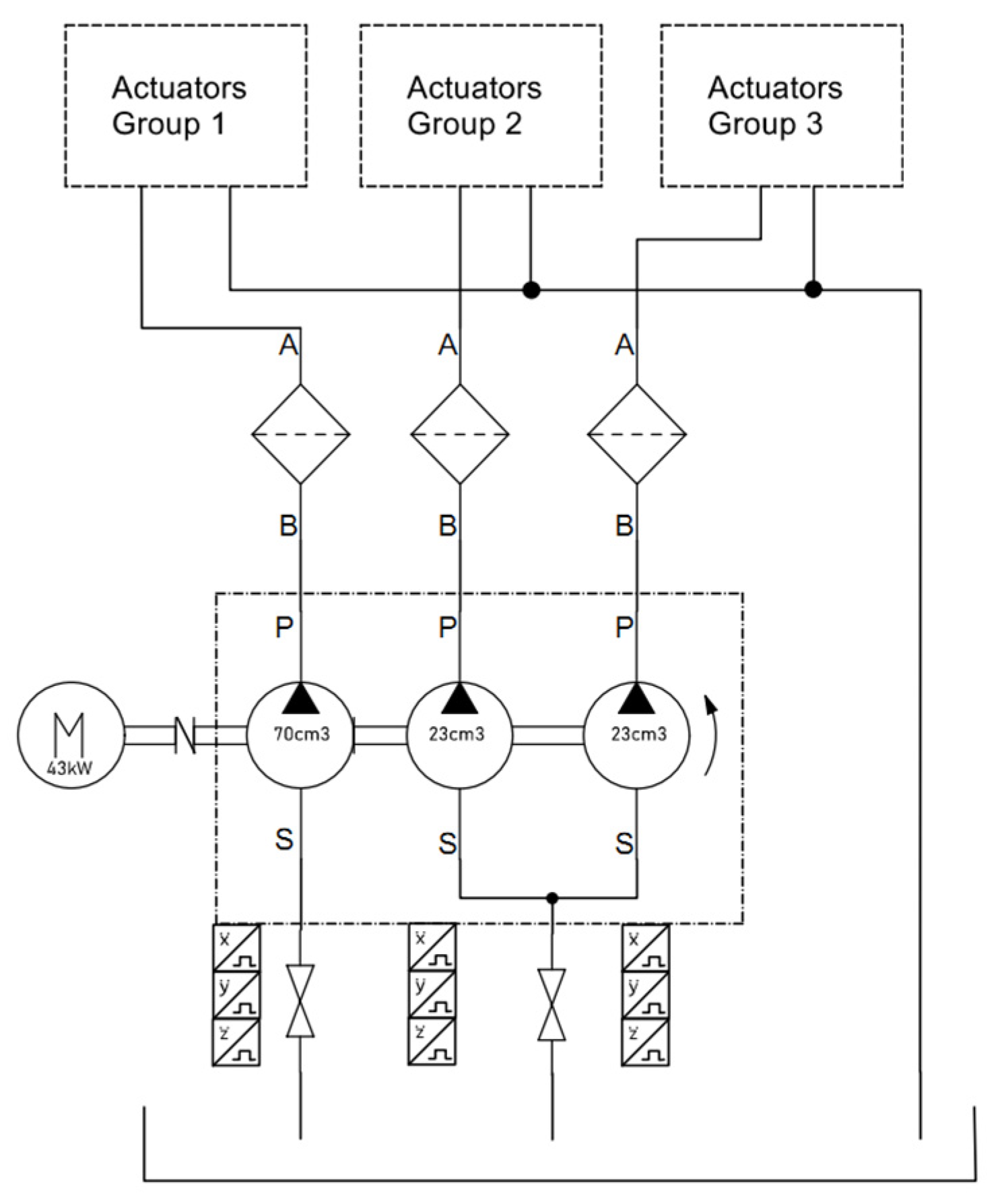
The subject of the study were three multi-section hydraulic positive displacement pumps of identical design, differing in the degree of wear and tear. Each pump had a segmented configuration of 70-23-23 cm3, as shown in Figure 1. The analysis treated the pump as a single mechanical system; the different section displacements did not affect the results because vibration measurements were taken on the common housing and all sections shared the same shaft speed. The wear condition was identical for all sections of a given pump.
The pumps operated at a constant shaft speed under steady-state operating conditions. Their maximum continuous operating pressure ranged from 245 to 275 bar. The range of permissible shaft speeds was from 500 to 3000 rpm, with a maximum input shaft torque of 960 Nm. All pumps operated with the same shaft rotation direction.
The degree of wear of individual pumps was determined on the basis of their operating time, distinguishing three classes of technical condition: a new pump after 100 h of operation, a pump with an average degree of wear after 1100 h of operation, and a worn pump after 1525 h of operation. The analysis focused on assessing the wear condition of the pumps based on mechanical vibration characteristics, without distinguishing between individual, sudden failures.
The design of the tested pumps includes a drive shaft assembly, working elements performing the displacement process, internal gears, and a bearing system enclosed in a rigid body. The modular, multi-section design is conducive to complex dynamic phenomena resulting from interactions between individual working sections and the common drive system. The pump design diagram, developed in a CAD environment, shows the layout of key components and was used to interpret vibration sources and locate measurement points.
Mechanical vibrations were recorded using three acceleration sensors, enabling the measurement of vibrations in three perpendicular axes (x, y, z). The sensors were placed on the pump body in areas relevant to the propagation of vibrations generated by rotating components and hydraulic loads (Figure 1). This approach allowed for the acquisition of multidimensional vibration signals reflecting the actual dynamics of the object’s operation. The measurements were performed at a sampling frequency of 20 kHz, which enabled the analysis of both low-frequency components related to the dynamics of the system and higher frequencies characteristic of wear processes.
Continuous vibration signals of 20 s duration were recorded for each pump (3 wear states) × each load condition (NL, WL) × each axis (x, y, z) × each pump segment. The signals were segmented into non-overlapping windows of 600 samples (exactly 0.03 s at 20 kHz), corresponding precisely to one full pump revolution at 2000 rpm.
It must be emphasized that the machine learning models were not trained on raw time-series data. Instead, a comprehensive set of temporal and spectral features was extracted from each signal window. To rigorously prevent data leakage and evaluate the models under realistic domain shifts, feature selection and model training were strictly isolated based on the operational conditions.
For the initial constant-load experiment (Section 6.1), the training dataset consisted entirely of features extracted from the No Load (NL) data, while the testing dataset comprised exclusively unseen With Load (WL) data. Crucially, the feature selection process—aimed at identifying the most relevant features via ANOVA and mRMR algorithms—was performed exclusively on the NL training subset. This rigorous isolation ensured that the statistical properties of the WL test data (e.g., p-values, feature relevance scores, or variances under physical load) had no influence on deciding which features were fed into the classifiers.
Furthermore, for the variable-load experiment (Section 6.3), the models were trained using the pre-selected features from 100% of the NL dataset and subsequently tested against the features of 100% of the unseen WL signal, ensuring a robust cross-domain evaluation.
The tests were carried out under steady-state operating conditions at a constant shaft speed for two load variants: No Load (NO) and With Load (WL) of a motor. The variation in load conditions made it possible to analyze the effect of load on vibration characteristics and to evaluate the stability of diagnostic features used to classify the wear condition of pumps.
The recorded vibration signals were pre-processed in MATLAB using the tools available in the Feature Diagnostic Designer package. Due to the periodic and repetitive nature of pump operation, the continuous signals were divided into short time windows. The length of the windows corresponded to one operating cycle at a shaft speed of 2000 rpm.
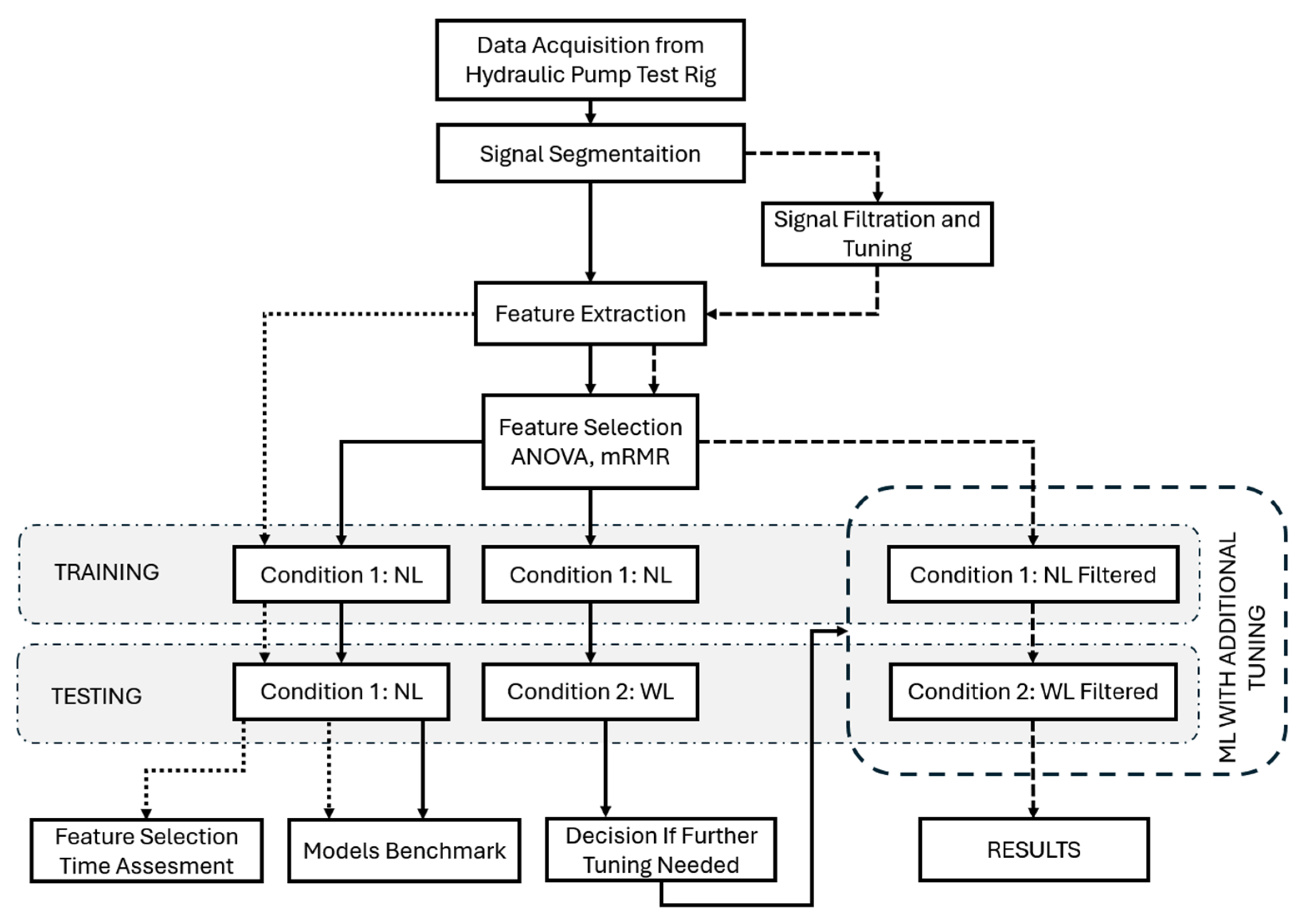
In order to systematize the stages of data processing and illustrate the flow of information between individual diagnostic modules, the following diagram (Figure 2) presents the complete structure of the proposed research methodology.
Prior to feature extraction, the raw vibration signals underwent a rigorous frame-level conditioning process designed to mitigate load-dependent amplitude variations and suppress broad-band background noise. The proposed conditioning pipeline consisted of two distinct stages.
In the first stage, statistical Z-score standardization ( f n o r m = f μ σ ) was applied individually to each signal frame. This critical preprocessing step removed the DC offset via mean subtraction (µ) and scaled the amplitude variance to unity by dividing by the standard deviation (σ). This approach effectively decoupled the diagnostic information from the physical load conditions, neutralizing the massive absolute amplitude shifts (feature distribution drift) caused by varying operational loads, and forcing the subsequent machine learning models to evaluate the intrinsic structural shape of the vibration signals.
In the second stage, wavelet-based denoising was performed to isolate the impulsive, high-frequency signatures characteristic of mechanical wear from the hydraulic flow noise. The denoising utilized the Symlets-4 (sym4) mother wavelet at a decomposition level of 5. Soft thresholding was applied to the detail coefficients using the universal threshold method (the ‘sqtwolog’ rule implemented via the MATLAB wden function).
Crucially, this standardized conditioning pipeline was applied uniformly across all data windows, regardless of the operational state or load condition. Furthermore, no supplemental low-pass or band-stop filtering was introduced. This deliberate design choice ensured the preservation of high-frequency signal components that encapsulate critical, micro-level wear mechanisms such as internal friction and abrasive wear.
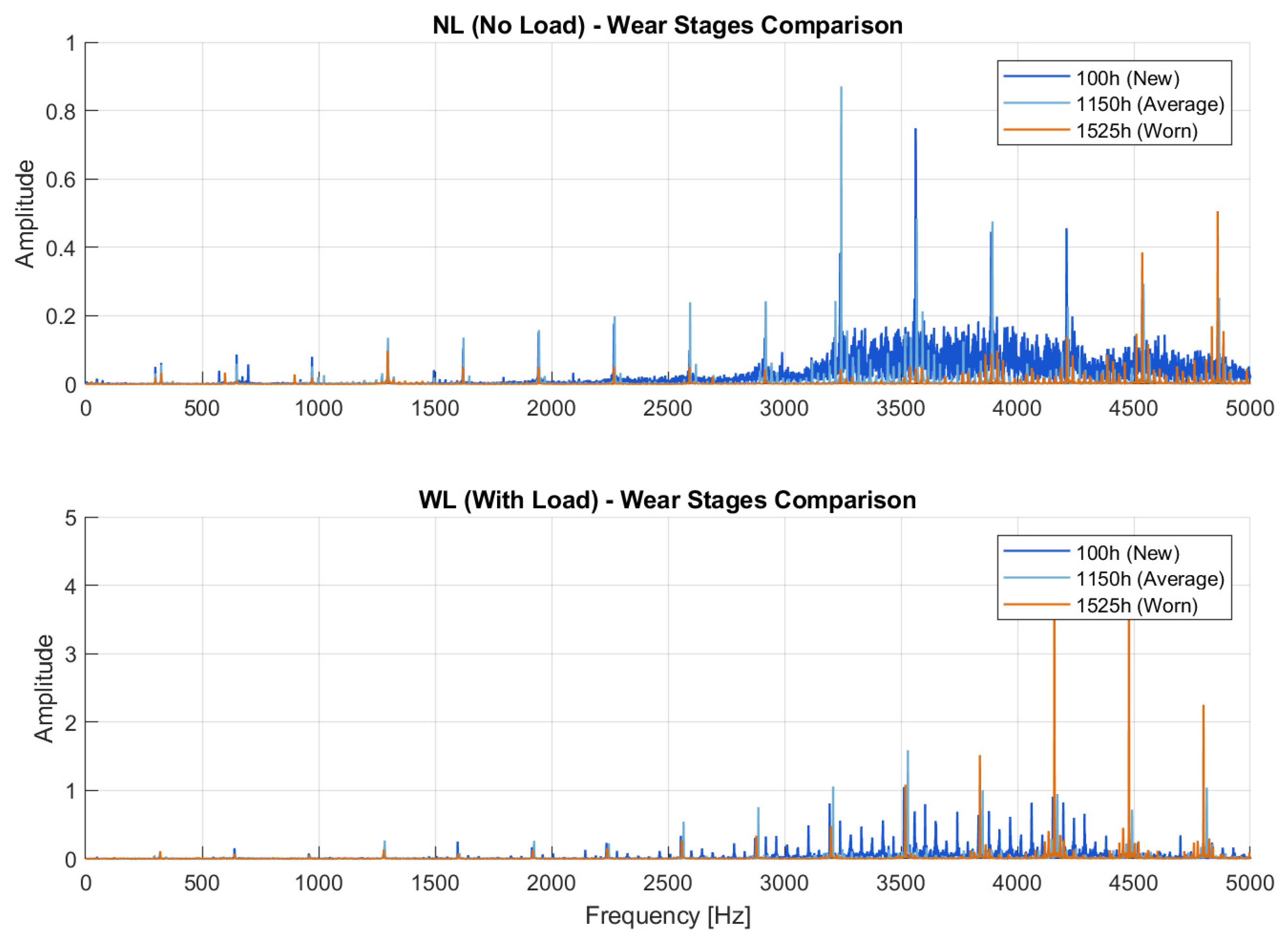
The physical necessity of applying such a robust preprocessing framework is illustrated in Figure 3. The raw frequency spectra demonstrate a massive, load-induced amplitude scaling across all frequencies in the With Load condition, providing direct evidence of the severe feature distribution drift that naturally occurs when operational parameters change.
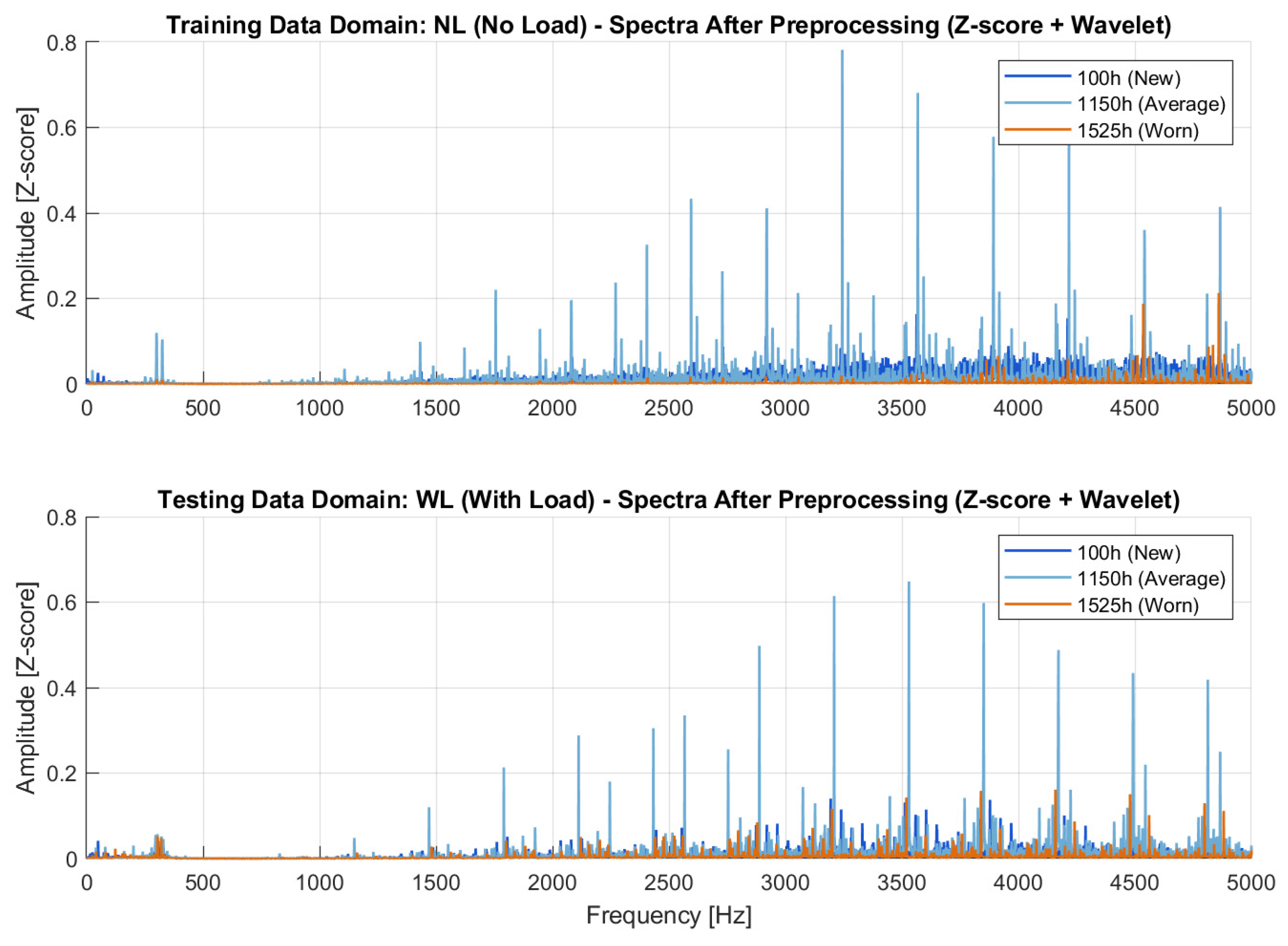
To neutralize this domain shift, the proposed Z-score standardization and wavelet denoising pipeline was applied. As demonstrated in Figure 4, this conditioning successfully normalizes the amplitude scales and suppresses broad-band hydraulic noise. Consequently, the structural comparability of the wear-related spectral peaks is fully restored, allowing the machine learning models to effectively bridge the gap between the training (No Load) and testing (With Load) domains.

5.2. Signal Feature Extraction

For each time window, a set of features describing the vibration signal in the time and frequency domains was calculated. The continuous vibration signals were segmented into fixed-length windows corresponding to one operating cycle at a shaft speed of 2000 rpm, without overlap between adjacent windows. Both classical statistical measures, such as mean, RMS, standard deviation, peak value, skewness, and kurtosis, as well as impulsivity indicators, including crest factor, impulse factor, and clearance factor, were taken into account. In addition, the signal-to-noise ratio (SNR) and signal energy measures in selected frequency bands were calculated. The SNR parameter was determined using functions available in the MATLAB Signal Processing Toolbox.
The frequency analysis included the determination of signal power in the 0–500 Hz, 500–1000 Hz, 1000–2000 Hz, and 2000–4000 Hz bands, as well as spectral features such as spectral centroid and spectral kurtosis. The selected frequency ranges were determined based on preliminary spectral analysis and the observed distribution of vibration energy. The set of features was calculated separately for each measurement axis and for each pump segment, which allowed the preservation of information about the spatial and structural distribution of vibration sources.
In order to reduce the number of input features and assess their diagnostic usefulness, two feature selection methods were used: analysis of variance (ANOVA) and the minimum redundancy and maximum relevance (mRMR) algorithm. Feature selection was performed using only training data in order to avoid information leakage between training and testing subsets. Both methods indicated that there was no clear point of rapid decline in feature significance, suggesting that a significant portion of the analyzed measures contained information about the wear condition of the pumps.
A comparison of the ANOVA and mRMR results showed high consistency in the features rated as most significant. For further analysis, 30 features with the highest rank were selected for each selection method. The number of selected features was determined experimentally as a compromise between classification performance and computational complexity. In addition, a variant using the full set of available features was considered, which allowed the assessment of the impact of dimensionality reduction on classification quality and model training time.
At the initial stage, the training time of the models and their classification effectiveness were analyzed for data obtained from pumps operating under no-load conditions. The following algorithms were used in the study: decision trees, ensembles of trees (Bagging), Boosting methods, Subspace KNN, Subspace Discriminant, SVM classifiers (linear and nonlinear), KNN, and Naive Bayes. The models were implemented and tested in the MATLAB Classification Learner environment using standard classifier settings.
The key hyperparameters of each classifier (default settings in MATLAB R2023b Classification Learner, unless specified otherwise) are listed in Table 1.
Each model was trained in three variants: using 30 features selected by the ANOVA method, 30 features selected by the mRMR method, and the full set of extracted features. The dataset was divided into training and test subsets while maintaining the representation of all wear-condition classes in both groups. Feature selection procedures were performed using only the training subset in order to avoid information leakage between the training and test data.
Limiting the number of features significantly reduced the model training time without deterioration in classification quality. The reduction in training time exceeded 70% in selected cases, which confirms the usefulness of feature selection in applications involving larger datasets.
At this stage, the Subspace Discriminant classifier was rejected due to low classification effectiveness and reduced test accuracy. In the case of nonlinear SVM classifiers trained using the full feature set, overfitting was observed, manifested by high training accuracy and substantially lower test accuracy.
In the next experiment, the classification effectiveness of the models under variable load conditions was evaluated. The models were trained using data obtained from pump operation without load together with a limited portion of signals recorded under load conditions and were subsequently tested on the remaining data obtained during loaded operation.
An additional case study was conducted in which the training and test data originated from different operating conditions while maintaining the same wear-condition classes of the pumps. The obtained results indicated a noticeable decrease in the effectiveness of classical machine learning models under changing operating conditions, confirming their sensitivity to changes in load and feature distribution.

6. Machine Learning-Based Diagnostics

6.1. Feature Extraction and Selection

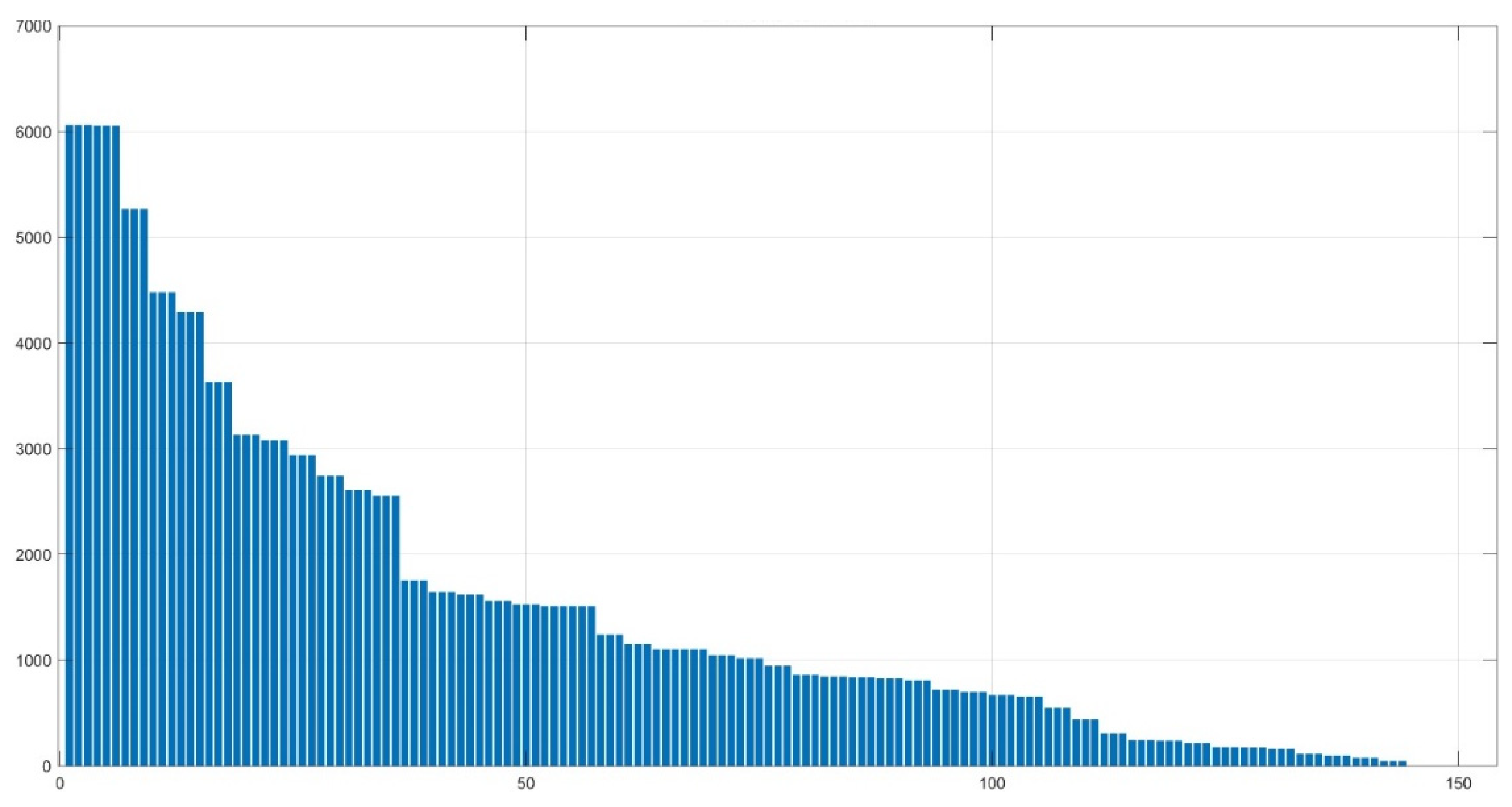
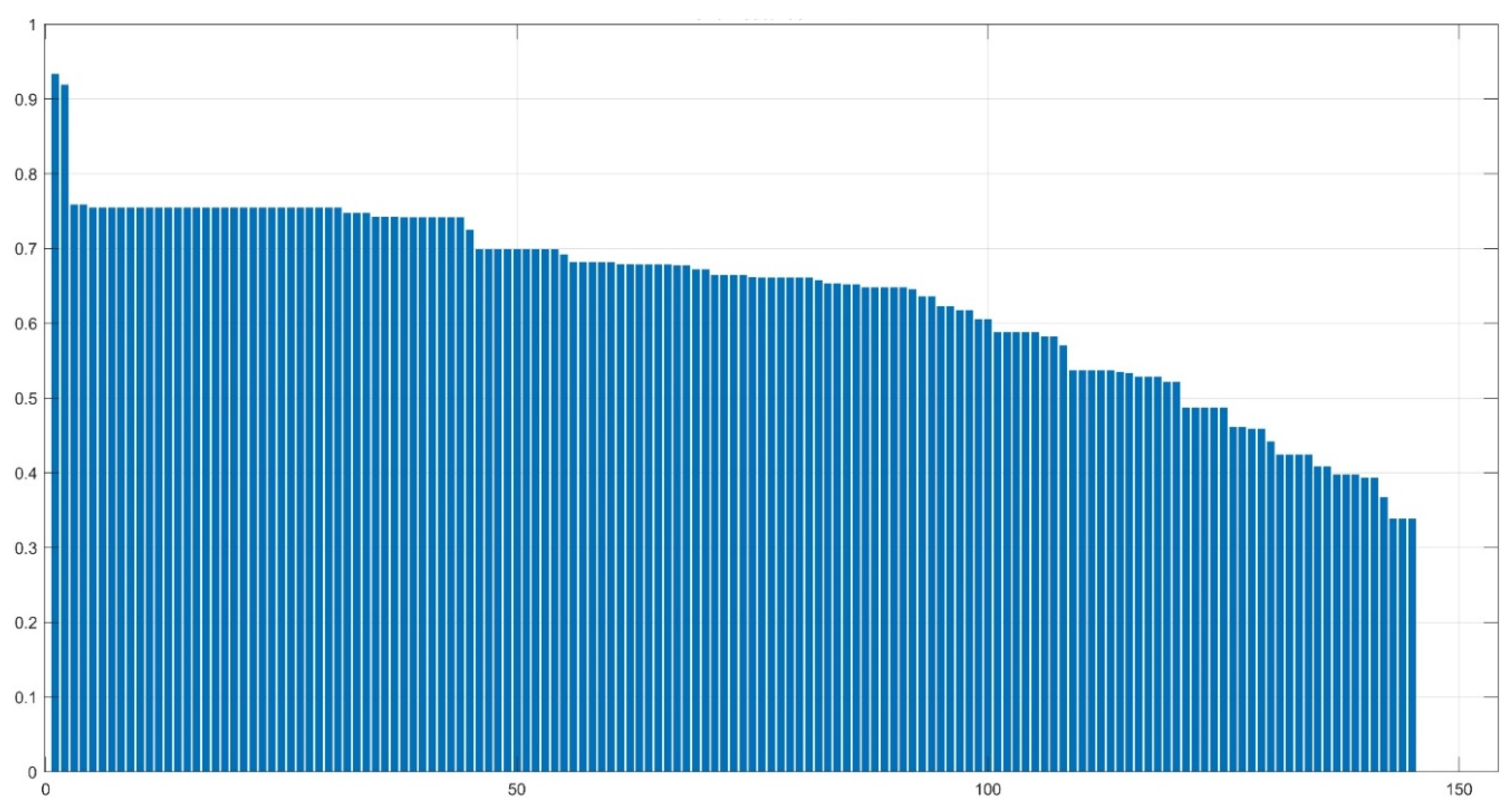
The first stage of the analysis was devoted to verifying the discriminatory power of 150 extracted signal features. The use of two different selection paradigms, statistical (ANOVA) and information-theory-based (mRMR), allowed a multifaceted assessment of the diagnostic usefulness of vibration signals. The results of both selection procedures are presented in figures showing the ranking of all extracted features together with the subsets of 30 highest-ranked parameters selected for further analysis.
In the case of the ANOVA analysis, a gradual decrease in the F-statistic values was observed without a clearly distinguishable inflection point separating significant and insignificant features. This indicates that a substantial part of the analyzed features contained information related to the wear condition of the pumps. A similar distribution was obtained for the mRMR method, where no clear boundary separating relevant and irrelevant features was observed. This suggests that the degradation process affects a broad range of vibration measures in both the time and frequency domains.
A comparison of the ANOVA (Figure 5) and mRMR (Figure 6) rankings showed high consistency with respect to the most significant features. In both cases, the dominant measures included parameters related to signal energy (RMS, bandwidth), impulsiveness (kurtosis, peak factor), and selected spectral descriptors. For further analysis, sets of the 30 highest-ranked features determined by each selection method were adopted, together with a variant based on the complete feature set. This made it possible to assess the influence of dimensionality reduction on classification effectiveness and model training time.

6.2. Classification Under Constant Operating Conditions

In the next stage, classical machine learning models were trained and tested using data obtained from pumps operating under identical no-load (NL) conditions. The analyzed algorithms included decision trees, Bagging, Boosting, Subspace KNN, Subspace Discriminant, SVM, linear SVM, KNN, and Naive Bayes classifiers. The obtained training and test accuracy values for individual classifiers and feature-selection variants are presented in Table 2.
The obtained results indicate high classification effectiveness for most analyzed models regardless of the feature-selection variant used. For the Bagging, Linear SVM, and KNN classifiers, test accuracy close to or equal to 100% was obtained. At the same time, the application of feature selection significantly reduced model training time without noticeable deterioration in classification quality.
Significant differences between classifiers were nevertheless observed. The Subspace Discriminant classifier achieved substantially lower accuracy in both training and testing phases, which indicated limited suitability for the analyzed classification task. In the case of nonlinear SVM classifiers trained using the complete feature set, overfitting effects were observed, manifested by very high training accuracy accompanied by a substantial decrease in test accuracy.
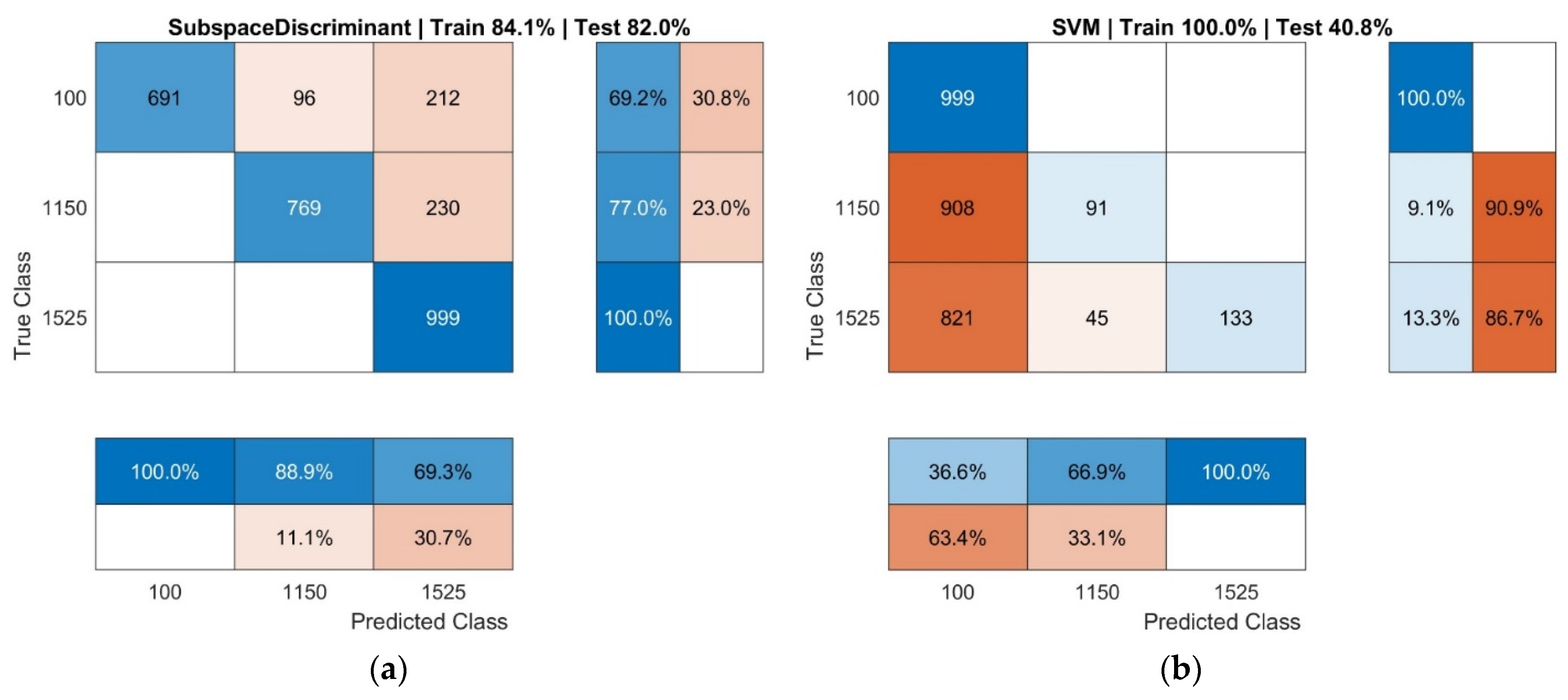
In order to better analyze classifier behavior, confusion matrices were additionally examined for selected models.
The confusion matrices indicate that under no-load operating conditions, the classification of the three analyzed wear states (new, moderately worn, worn) was generally effective. However, the observed misclassifications differed significantly depending on the classifier used. A clear tendency toward wear overestimation can be seen in the confusion matrix of the Subspace Discriminant classifier (Figure 7a), whereas a more severe underestimation of pump wear is represented by the nonlinear SVM confusion matrix (Figure 7b).
The obtained results indicate that under stable operating conditions, classical machine learning methods can effectively distinguish the analyzed wear-condition classes based on vibration features extracted from the measured signals. In addition to classification effectiveness, the influence of feature selection on model training time was also evaluated. The corresponding training times obtained for different feature-selection variants are presented in Table 3.
The reduction in training time obtained after dimensionality reduction exceeded 70% in selected cases. This confirms that feature-selection procedures may improve computational efficiency without substantially affecting classification effectiveness.

6.3. Classification Under Variable Operating Conditions

A key stage of the study was the evaluation of classifier effectiveness under variable operating conditions. The models were trained using vibration data obtained under no-load conditions together with a limited subset of signals recorded under loaded operation and subsequently tested on the remaining data obtained under load conditions. The obtained training and test accuracy values for individual classifiers are presented in Table 4.
Compared with the results obtained under constant operating conditions, a noticeable decrease in test accuracy was observed for most classifiers. In several cases, the reduction in effectiveness exceeded 20 percentage points. The largest decrease was observed for nonlinear SVM classifiers, where test accuracy decreased to approximately 33% for selected feature-selection variants.
The obtained results indicate that a substantial part of the extracted diagnostic features depended not only on the wear condition of the pumps but also on the operating regime and load conditions. Under variable load conditions, changes in signal amplitude and spectral distribution affected the stability of the feature space used during classifier training and testing. Tree-based ensemble methods and selected KNN variants showed greater resistance to changing operating conditions, although a decrease in effectiveness was also observed for these classifiers. The results suggest that models trained under stable laboratory conditions may exhibit limited effectiveness when applied to signals obtained under variable industrial operating regimes.
The drastic drop in test accuracy for the nonlinear SVM (falling to ~33.3% in the mRMR and full-feature variants, which equates to random guessing in a 3-class problem) is a textbook example of feature distribution drift combined with the mathematical limitations of specific kernel function mappings. In the baseline feature extraction process, amplitude-dependent features such as RMS, peak value, and raw band energies were included. The application of mechanical load (WL) drastically changes the overall vibration energy and baseline amplitudes.
Standard nonlinear SVM models utilize a Radial Basis Function (RBF) kernel, which maps features based on the Euclidean distance between samples in the feature space:
K ( x , x ) = e x p ( γ x x 2 )
Because the model was trained exclusively on unloaded (NL) conditions, the classifier established tight decision boundaries around the NL support vectors in a high-dimensional space (leading to 100% training accuracy). When tested on WL data, the massive amplitude scaling shifts the test data “cloud” far from these learned support vectors. Consequently, the Euclidean distance x x 2 becomes extremely large, causing the kernel mapping to approach zero (K ≈ 0). The model becomes effectively “blind” to the new data geometry, rendering it incapable of classification. Furthermore, applying mRMR only slightly improved the non-linear SVM (to 39.6%), proving that simple feature selection removes redundancy but does not resolve the massive spatial distance drift caused by the load.
By contrast, models relying on linear boundaries, such as the Linear SVM, maintained a much more robust performance (achieving 77.7% accuracy). Because the Linear SVM relies on a linear kernel (x • x′), its decision boundaries are less affected by nonlinear distribution warping and Euclidean distance shifts. Even though the points migrated in the feature space due to the physical load, they preserved their linear class separability to a much greater extent.
The analysis additionally showed that the classifiers learned, to a considerable extent, the characteristics of the operating regime rather than exclusively the symptoms associated with pump wear. This effect became particularly visible when training and testing data originated from different operating conditions despite unchanged wear classes of the pumps.

6.4. Signal Filtering and Conditioned Signal Analysis

The initial machine learning framework was based on frame-level time and frequency domain descriptors extracted directly from raw vibration signals without prior signal filtration. Feature selection was performed using ANOVA and mRMR; however, the preprocessing stage did not include spectral conditioning or the suppression of amplitude variations associated with operating load variability.
In the revised approach, signal conditioning was introduced prior to feature extraction. The vibration signals were processed using frame-level Z-score standardization to attenuate absolute amplitude shifts related to operating load, followed by Symlets-4 wavelet-based denoising to suppress background noise and enhance transient, fault-related components. The feature extraction procedure itself remained unchanged, preserving the same set of time-domain statistical descriptors and frequency-domain band energy features. As a result, the extracted descriptors were computed in a consistent manner while reflecting vibration dynamics more directly associated with structural degradation rather than operating condition variability. No architectural changes were made to the classifiers, and the same evaluation protocol and feature selection strategies were retained to isolate the effect of signal preprocessing.
Following the introduction of signal filtration prior to feature extraction, a substantial improvement in generalization under variable load conditions was observed. In contrast to the pre-filtration results, where most classifiers exhibited a pronounced decrease in test accuracy when transferring from NL to WL operating mode, the filtered configuration led to consistent gains across tree-based and discriminant ensemble methods. As Table 5 shows, the Tree classifier improved from 86.7 to 84.4 percent test accuracy to 91.8–93.5 percent, while the Bag ensemble increased from 86.9 to 78.4 percent to 92.7–92.4 percent.
The Subspace Discriminant model showed a marked increase under mRMR selection, from 72.9 percent to 86.4 percent. This indicates that the filtration stage effectively stabilized the feature space, mitigating the classifier’s previous tendency toward wear overestimation that was observed even under baseline conditions (Figure 7a). By attenuating load-dependent spectral components, the classifiers relied more strongly on structural degradation signatures rather than on operating regime characteristics.
Notably, linear models such as Linear SVM remained stable, suggesting that their decision boundaries were less influenced by load variability even in the unfiltered case. Conversely, the nonlinear SVM with a radial kernel continued to underperform (remaining at roughly 33–39 percent). This indicates a fundamental sensitivity to data geometry rather than just noise. This geometric vulnerability, which initially manifested as severe wear underestimation under stable conditions (as shown previously in Figure 7b), caused the SVM model to fail completely when confronted with cross-domain shifts, despite the applied preprocessing.
Overall, the observed improvement in the ensemble models confirms that appropriate signal conditioning enhances cross-regime robustness by reducing domain shift at the feature level and by improving the alignment between extracted descriptors and physically meaningful wear phenomena.

7. Conclusions

This study quantitatively evaluated the effectiveness of classical machine learning methods for fault diagnosis of hydraulic positive displacement pumps under variable operating conditions, focusing on how load changes affect diagnostic feature stability and classification accuracy.
Under stable operating conditions (training and testing on no-load data), most classifiers achieved near-perfect accuracy (≥99.9%). However, when models trained on no-load data were tested on data from loaded operation, several classifiers showed a performance drop exceeding 21 percentage points. The most severe degradation occurred for the nonlinear SVM with an RBF kernel, whose test accuracy fell to 33.3%—effectively random classification. This confirms that many commonly used features (RMS, kurtosis, spectral energy) are strongly influenced by load-related signal changes, not only by physical wear.
Feature selection using ANOVA and mRMR reduced training time by over 70% without noticeable loss of classification quality. However, feature selection alone did not resolve the sensitivity to load variability—the domain shift between operating regimes remained a fundamental issue.
The introduction of signal conditioning prior to feature extraction—specifically, frame-level Z-score standardization followed by Symlets-4 wavelet-based denoising—substantially improved cross-domain robustness. By neutralizing absolute amplitude shifts and suppressing hydraulic background noise, tree-based and ensemble classifiers achieved test accuracies of 91.8–93.5% under load, compared to 78.4–86.9% without conditioning. The Subspace Discriminant classifier improved from 72.9% to 86.4% under mRMR selection. Linear SVM remained stable (≈77–78%) regardless of conditioning, while the nonlinear SVM continued to underperform, confirming its fundamental sensitivity to the spatial geometry of the data distribution rather than simply overall amplitude variance.
The main contribution of this study is a quantitative benchmark of classical ML classifier degradation under load variability for hydraulic pump diagnostics (measuring a drop of >21 percentage points) and a demonstration that a robust, statistically and physically motivated signal conditioning pipeline—without changing classifier architectures—recovers most of this performance loss.
The study has several limitations. The experiments used only three pumps (one per wear level) and two load conditions (no load and full load) under steady-state laboratory operation. All measurements were performed at a constant shaft speed of 2000 rpm. The analysis focused on predefined statistical and spectral features alongside classical ML methods; deep learning architectures were not tested.
Future work should therefore include: (i) validation with a larger number of pumps and intermediate wear levels; (ii) testing under varying rotational speeds and transient operating regimes; (iii) investigating domain adaptation techniques (e.g., CORAL, adversarial alignment) to reduce the domain shift without manual signal conditioning; and (iv) comparing classical ML to deep learning approaches that learn hierarchical features directly from raw or time-frequency transformed signals.

Author Contributions

Conceptualisation, M.W. and J.S.; methodology, M.W. and J.S.; software, M.W.; validation, M.W. and J.S.; formal analysis, M.W.; investigation, M.W.; resources, M.W. and J.S.; data curation, M.W., J.S. and A.S.; writing—original draft preparation, M.W.; writing—review and editing, M.W., J.S. and A.S.; visualisation, M.W. and J.S.; supervision, J.S.; project administration, A.S.; funding acquisition, A.S. All authors have read and agreed to the published version of the manuscript.

Funding

This work was funded by subvention funds for the AGH University of Krakow and by the “Excellence Initiative—Research University” program for the AGH University of Krakow.

Institutional Review Board Statement

Not applicable.

Informed Consent Statement

Not applicable.

Data Availability Statement

The original contributions presented in this study are included in the article material. Confusion matrices, precision, recall, and F1 scores for the selected classifiers are available from the corresponding author upon reasonable request. Further enquiries can be directed to the author.

Conflicts of Interest

The authors declare that they have no conflicts of interest.

Abbreviations

The following abbreviations are used in this manuscript:
WLWith load (working condition of pump)
NLNo load (working condition of pump)
MLMachine Learning
DLDeep Learning
CNNConvolutional Neural Network
CMCondition Monitoring
KNNK-Nearest Neighbors
SVMSupport Vector Machines
FISFuzzy Inference Systems
ANOVAAnalysis Of Variance
mRMRminimum Redundancy—Maximum Relevance
FFTfast Fourier transform
STFTShort-Term Fourier Transform
CWTContinuous Wavelet Transform
EMDEmpirical Mode Decomposition
IMFIntrinsic Mode Function
MCSAMotor Current Signature Analysis
RMSRoot Mean Square
PCAPrincipal Component Analysis
t-SNEt-distributed Stochastic Neighbor Embedding
RBFRadial Basis Function
LSTMLong Short Term Memory
LIMELocal Interpretable Model-agnostic Explanations
MLPMulti-layer Perceptron
CADComputer-Aided Design
SNRSignal-to-Noise Ratio

References

  1. Li, Q.; Xu, H.; Chen, X. Physics-informed failure mechanism for hydraulic pumps: State-of-the-art review, challenges and trends. Renew. Sustain. Energy Rev. 2026, 229, 116610. [Google Scholar] [CrossRef]
  2. Lakal, N.; Shehri, A.H.; Brashler, K.W.; Wankhede, S.P.; Morse, J.; Du, X. Sensing technologies for condition monitoring of oil pump in harsh environment. Sens. Actuators A Phys. 2022, 346, 113864. [Google Scholar] [CrossRef]
  3. Ma, Z.; Shaoping, W.A.; Jian, S.H.; Tongyang, L.I.; Xingjian, W.A. Fault diagnosis of an intelligent hydraulic pump based on a nonlinear unknown input observer. Chin. J. Aeronaut. 2018, 31, 385–394. [Google Scholar] [CrossRef]
  4. Tang, S.; Zhu, Y.; Yuan, S. Intelligent fault identification of hydraulic pump using deep adaptive normalized CNN and synchrosqueezed wavelet transform. Reliab. Eng. Syst. Saf. 2022, 224, 108560. [Google Scholar] [CrossRef]
  5. Buono, D.; Siano, D.; Frosina, E.; Senatore, A. Gerotor pump cavitation monitoring and fault diagnosis using vibration analysis through the employment of auto-regressive-moving-average technique. Simul. Model. Pract. Theory 2017, 71, 61–82. [Google Scholar] [CrossRef]
  6. Tang, S.; Zhu, Y.; Yuan, S. Intelligent fault diagnosis of hydraulic piston pump based on deep learning and Bayesian optimization. ISA Trans. 2022, 129, 555–563. [Google Scholar] [CrossRef]
  7. Azadeh, A.; Ebrahimipour, V.; Bavar, P. A fuzzy inference system for pump failure diagnosis to improve maintenance process: The case of a petrochemical industry. Expert Syst. Appl. 2010, 37, 627–639. [Google Scholar] [CrossRef]
  8. Hu, K.; Sun, H.; Fan, W.; Si, Q.; Wu, Y.; Yuan, S. Coupled fault diagnosis for centrifugal pumps through Boruta-Shap feature selection and rime-enhanced stacked denoised autoencoder. Eng. Appl. Artif. Intell. 2025, 162, 112659. [Google Scholar] [CrossRef]
  9. Zhu, Y.; Zhou, T.; Tang, S.; Yuan, S. A data-driven diagnosis scheme based on deep learning toward fault identification of the hydraulic piston pump. J. Mar. Sci. Eng. 2023, 11, 1273. [Google Scholar] [CrossRef]
  10. Yao, Z.; Wu, M.; Qian, J.; Reynaerts, D. Intelligent discharge state detection in micro-EDM process with cost-effective radio frequency (RF) radiation: Integrating machine learning and interpretable AI. Expert Syst. Appl. 2025, 291, 128607. [Google Scholar] [CrossRef]
  11. Yang, Y.; Li, Y.; Cheng, L.; Yang, S. Short-Term Wind Power Prediction Based on a Modified Stacking Ensemble Learning Algorithm. Sustainability 2024, 16, 5960. [Google Scholar] [CrossRef]
  12. Piotrowski, P. Short-Term Forecasting of the Total Power Generation from Wind Farms and Solar Power Plants in the National Power System Using Advanced Ensemble Machine Learning Models. Energies 2026, 19, 930. [Google Scholar] [CrossRef]
  13. Alazemi, F.; Alazmi, A.; Alrumaidhi, M.; Molden, N. Predicting Fuel Consumption and Emissions Using GPS-Based Machine Learning Models for Gasoline and Diesel Vehicles. Sustainability 2025, 17, 2395. [Google Scholar] [CrossRef]
  14. McKee, K.K.; Forbes, G.; Mazhar, I.; Entwistle, R.; Howard, I. A review of major centrifugal pump failure modes with application to the water supply and sewerage industries. In Proceedings of the ICOMS Asset Management Conference 2011, Gold Coast, Australia, 16–20 May 2011. [Google Scholar]
  15. Ahmad, Z.; Rai, A.; Maliuk, A.S.; Kim, J.M. Discriminant feature extraction for centrifugal pump fault diagnosis. IEEE Access 2020, 8, 165512–165528. [Google Scholar] [CrossRef]
  16. Chao, Q.; Gao, H.; Tao, J.; Liu, C.; Wang, Y.; Zhou, J. Fault diagnosis of axial piston pumps with multi-sensor data and convolutional neural network. Front. Mech. Eng. 2022, 17, 36. [Google Scholar] [CrossRef]
  17. Du, J.; Wang, S.; Zhang, H. Layered clustering multi-fault diagnosis for hydraulic piston pump. Mech. Syst. Signal Process. 2013, 36, 487–504. [Google Scholar] [CrossRef]
  18. Kimera, D.; Nangolo, F.N. Predictive maintenance for ballast pumps on ship repair yards via machine learning. Transp. Eng. 2020, 2, 100020. [Google Scholar] [CrossRef]
  19. Yan, W.; Jia, Z.; Liu, Z.; Wang, S.; Zhang, W.; Wang, K. Vibration-sensor-free diagnosis for aviation piston pumps: A CWT-ViT approach with high-dimensional tensor fusion. Measurement 2026, 258, 119050. [Google Scholar] [CrossRef]
  20. Tiwari, R.; Bordoloi, D.J.; Dewangan, A. Blockage and cavitation detection in centrifugal pumps from dynamic pressure signal using deep learning algorithm. Measurement 2021, 173, 108676. [Google Scholar] [CrossRef]
  21. Gao, Z.; Cecati, C.; Ding, S.X. A survey of fault diagnosis and fault-tolerant techniques—Part I: Fault diagnosis with model-based and signal-based approaches. IEEE Trans. Ind. Electron. 2015, 62, 3757–3767. [Google Scholar] [CrossRef]
  22. Zhu, Y.; Li, G.; Tang, S.; Wang, R.; Su, H.; Wang, C. Acoustic signal-based fault detection of hydraulic piston pump using a particle swarm optimization enhancement CNN. Appl. Acoust. 2022, 192, 108718. [Google Scholar] [CrossRef]
  23. Jose, J.T.; Das, J.; Mishra, S.K.; Wrat, G. Early detection and classification of internal leakage in boom actuator of mobile hydraulic machines using SVM. Eng. Appl. Artif. Intell. 2021, 106, 104492. [Google Scholar] [CrossRef]
  24. Gao, Z.; Ding, S.X.; Cecati, C. Real-time fault diagnosis and fault-tolerant control. IEEE Trans. Ind. Electron. 2015, 62, 3752–3756. [Google Scholar] [CrossRef]
  25. Gao, Q.; Tang, H.S.; Xiang, J.W.; Zhong, Y. A multi-sensor fault detection strategy for axial piston pump using the Walsh transform method. Int. J. Distrib. Sens. Netw. 2018, 14, 1550147718772531. [Google Scholar] [CrossRef]
  26. Konieczny, J.; Łatas, W.; Stojek, J. Classification of wear state for a positive displacement pump using deep machine learning. Energies 2023, 16, 1408. [Google Scholar] [CrossRef]
  27. Tang, H.; Wang, Z.; Wu, Y. A multi-fault diagnosis method for piston pump in construction machinery based on information fusion and PSO-SVM. J. Vibroeng. 2019, 21, 1904–1916. [Google Scholar] [CrossRef]
  28. Liu, Y.; Zuo, D.W.; Wang, Y.H.; Han, J.; Yang, X.Q. Fault diagnosis of hydraulic pump based on multi-sensor data fusion. Appl. Mech. Mater. 2010, 33, 539–543. [Google Scholar] [CrossRef]
  29. Zhu, Y.; Li, G.; Wang, R.; Tang, S.; Su, H.; Cao, K. Intelligent fault diagnosis of hydraulic piston pump combining improved LeNet-5 and PSO hyperparameter optimization. Appl. Acoust. 2021, 183, 108336. [Google Scholar] [CrossRef]
  30. Biswas, S.; Al Mamun, A.; Islam, M.S.; Bappy, M.M. Interpretable CNN models for computationally efficient bearing fault diagnosis using learnable Gaussian/Sinc filters. Manuf. Lett. 2025, 44, 110–120. [Google Scholar] [CrossRef]
  31. Ding, Y.; Ma, L.; Wang, C.; Tao, L. An EWT-PCA and extreme learning machine based diagnosis approach for hydraulic pump. IFAC-PapersOnLine 2020, 53, 43–47. [Google Scholar] [CrossRef]
  32. Wang, W.; Zhao, X.; Zhang, Y.; Tan, T.; Jiang, L.; Wang, C.; Zhang, L. Fault diagnosis for pump equipment based on transfer learning: The domain generalization method. Sci. Rep. 2025, 15, 41295. [Google Scholar] [CrossRef] [PubMed]
  33. Guo, J.; Yang, Y.; Li, H.; Wang, J.; Tang, A.; Shan, D.; Huang, B. A hybrid deep learning model towards fault diagnosis of drilling pump. Appl. Energy 2024, 372, 123773. [Google Scholar] [CrossRef]
  34. Tang, S.; Zhu, Y.; Yuan, S. An adaptive deep learning model towards fault diagnosis of hydraulic piston pump using pressure signal. Eng. Fail. Anal. 2022, 138, 106300. [Google Scholar] [CrossRef]
  35. Tang, S.; Zhu, Y.; Yuan, S. A novel adaptive convolutional neural network for fault diagnosis of hydraulic piston pump with acoustic images. Adv. Eng. Inform. 2022, 52, 101554. [Google Scholar] [CrossRef]
  36. Peng, H.; Long, F.; Ding, C. Feature selection based on mutual information criteria of max-dependency, max-relevance, and min-redundancy. IEEE Trans. Pattern Anal. Mach. Intell. 2005, 27, 1226–1238. [Google Scholar] [CrossRef]
  37. Konieczny, J.; Łatas, W.; Stojek, J. Application of analysis of variance to determine important features of signals for diagnostic classifiers of displacement pumps. Sci. Rep. 2024, 14, 6098. [Google Scholar] [CrossRef] [PubMed]
  38. Li, Y.; Zhang, L.; Liu, S.; Wang, X.; Sun, C.; Liang, P.; Yuan, X. A novel interpretable semi-supervised graph learning model for intelligent fault diagnosis of hydraulic pumps. Knowl.-Based Syst. 2024, 305, 112598. [Google Scholar] [CrossRef]
  39. Ma, W.; Ma, S.; Zou, Z.; Fu, B.; Ma, J.; Liu, J.; Zhang, Q. Literature review on fault mechanism analysis and diagnosis methods for main pump systems. Machines 2025, 13, 1000. [Google Scholar] [CrossRef]
  40. Tang, S.; Zhu, Y.; Yuan, S. An improved convolutional neural network with an adaptable learning rate towards multi-signal fault diagnosis of hydraulic piston pump. Adv. Eng. Inform. 2021, 50, 101406. [Google Scholar] [CrossRef]
  41. Sun, K.H.; Huh, H.; Tama, B.A.; Lee, S.Y.; Jung, J.H.; Lee, S. Vision-based fault diagnostics using explainable deep learning with class activation maps. IEEE Access 2020, 8, 129169–129179. [Google Scholar] [CrossRef]
  42. Wang, S.; Shuai, H.; Hu, J.; Zhang, J.; Liu, S.; Yuan, X.; Liang, P. Few-shot fault diagnosis of axial piston pump based on prior knowledge-embedded meta learning vision transformer under variable operating conditions. Expert Syst. Appl. 2025, 269, 126452. [Google Scholar] [CrossRef]
  43. Orrù, P.F.; Zoccheddu, A.; Sassu, L.; Mattia, C.; Cozza, R.; Arena, S. Machine learning approach using MLP and SVM algorithms for the fault prediction of a centrifugal pump in the oil and gas industry. Sustainability 2020, 12, 4776. [Google Scholar] [CrossRef]
  44. Zhang, J.; Dong, S.; Zhang, S.; Zhang, H.; Li, H.; Dong, Q.; Feng, C. Review on fault diagnosis of electric submersible pump using machine learning. J. Phys. Conf. Ser. 2025, 3129, 012056. [Google Scholar] [CrossRef]
  45. Zhou, B.; Khosla, A.; Lapedriza, A.; Oliva, A.; Torralba, A. Learning deep features for discriminative localization. In Proceedings of the IEEE Conference on Computer Vision and Pattern Recognition (CVPR), Las Vegas, NV, USA, 27–30 June 2016; pp. 2921–2929. [Google Scholar] [CrossRef]
  46. Ribeiro, M.T.; Singh, S.; Guestrin, C. “Why should I trust you?” Explaining the predictions of any classifier. In Proceedings of the 22nd ACM SIGKDD International Conference on Knowledge Discovery and Data Mining, San Francisco, CA, USA, 13–17 August 2016; pp. 1135–1144. [Google Scholar] [CrossRef]
  47. Lee, J.; Davari, H.; Singh, J.; Pandhare, V. Industrial artificial intelligence for industry 4.0-based manufacturing systems. Manuf. Lett. 2018, 18, 20–23. [Google Scholar] [CrossRef]
Figure 1. Simplified hydraulic schematic of test setup with accelerometers location.
Applsci 16 06051 g001
Figure 2. Proposed diagnostic framework for hydraulic pumps under variable load.
Applsci 16 06051 g002
Figure 3. Raw frequency spectra comparing the three wear stages (100 h, 1150 h, 1525 h) under No Load (top) and With Load (bottom) conditions prior to preprocessing.
Applsci 16 06051 g003
Figure 4. Filtered frequency spectra of the vibration signals after the proposed frame-level conditioning pipeline (Z-score standardization and Symlets-4 wavelet denoising).
Applsci 16 06051 g004
Figure 5. Ranking of the significance of diagnostic features obtained using the ANOVA method for the full set of features.
Applsci 16 06051 g005
Figure 6. Ranking of the significance of diagnostic features obtained using the mRMR method for the full set of features.
Applsci 16 06051 g006
Figure 7. Example confusion matrices obtained for selected classifiers under no-load operating conditions: (a) Subspace Discriminant, (b) nonlinear SVM.
Applsci 16 06051 g007
Table 1. Hyperparameters of machine learning models used in the study.
ModelKey Hyperparameters
TreeSplit criterion: Gini, Maximum splits: unconstrained (default)
BagNumber of learners: 100, Method: Bag (Random Forest architecture)
Subspace KNNNumber of learners: 100, Subspace dimension: half of total features, Number of neighbors
(k): 1, Distance: Euclidean
Subspace DiscriminantNumber of learners: 100, Subspace dimension: half of total features, Discriminant type: linear
SVMKernel: RBF, Standardize data: true, Box constraint: 1, Kernel scale: 1
Linear SVMKernel: Linear, Standardize data: true, Box constraint: 1
KNNNumber of neighbors: 5, Distance: Euclidean, Distance weight: equal
Naive BayesDistribution: Normal (Gaussian)
Table 2. Training and test accuracy of classifiers for data from no-load pump operation [%].
ModelANOVA (Train/Test)mRMR (Train/Test)All Features (Train/Test)
Tree100/99.9100/99.899.9/99.8
Bag100/99.9100/100100/100
Subspace KNN100/93.3100/98.5100/99.4
Subspace Discriminant84.4/84.594.6/94.684.1/82.0
SVM100/99.8100/93.7100/40.8
Linear SVM100/100100/100100/100
KNN97.5/94.799.9/99.9100/100
Table 3. Training time of machine learning models for different feature-set variants [s].
Feature Set VariantTraining Time [s]
Full feature set8.9342
mRMR selection (30 features)6.4936
Table 4. Training and test accuracy of classifiers under loaded operating conditions [%].
ModelANOVA (Train/Test)mRMR (Train/Test)All Features (Train/Test)
Tree100/86.7100/84.499.9/67.7
Bag100/86.9100/78.4100/69.8
Subspace KNN100/65.1100/68.2100/58.0
Subspace Discriminant85.5/73.496.2/72.984.8/62.6
SVM100/66.8100/33.3100/33.3
Linear SVM100/77.6100/77.4100/77.7
KNN99.8/73.999.9/71.3100/69.7
Table 5. Training and test accuracy of classifiers on pump with load, with signal filtration [%].
ModelANOVA (Train/Test)mRMR (Train/Test)All Features (Train/Test)
Tree100/91.8100/93.5100/91.3
Bag100/92.7100/92.4100/83
Subspace KNN100/69.8100/77.8100/57.9
Subspace Discriminant98.5/73.499.9/86.495.7/67.9
SVM100/34100/39.6100/33.3
Linear SVM100/77.8100/78.3100/77.8
KNN100/67.7100/80.8100/80.9
Note: Confusion matrices, precision, recall, and F1 scores for the selected classifiers are available from the corresponding author upon reasonable request.
Disclaimer/Publisher’s Note: The statements, opinions and data contained in all publications are solely those of the individual author(s) and contributor(s) and not of MDPI and/or the editor(s). MDPI and/or the editor(s) disclaim responsibility for any injury to people or property resulting from any ideas, methods, instructions or products referred to in the content.