Article

Friction Factor Formulation for Rarefied Gas Flow in Rough Nanochannels Using Event-Driven Molecular Dynamics

1
Department of Mechanical Engineering, Gebze Technical University, Kocaeli 41400, Türkiye
2
Aeronautical Engineering Department, Gebze Technical University, Kocaeli 41400, Türkiye
3
Department of Energy Systems Engineering, Muğla Sıtkı Kocman University, Muğla 48000, Türkiye
*
Author to whom correspondence should be addressed.
Appl. Sci. 2026, 16(12), 6046; https://doi.org/10.3390/app16126046
Submission received: 12 May 2026 / Revised: 9 June 2026 / Accepted: 12 June 2026 / Published: 15 June 2026
(This article belongs to the Section Applied Physics General)

Abstract

Gas transport in rough nanochannels under rarefied conditions is of considerable interest in microscale and nanoscale flow applications. However, the influence of surface roughness on flow resistance in the transitional regime remains insufficiently understood. In this study, Event-Driven Molecular Dynamics (EDMD) simulations are used to investigate the effects of surface roughness height (k) and periodicity (Λ) on friction-factor behavior for Knudsen numbers between 0.25 and 0.35 and reported Reynolds numbers up to approximately 102. Here, Re is calculated from molecularly averaged density and mean velocity, the effective channel height, and the reduced MD-unit dynamic viscosity used in post-processing. Friction factors were evaluated from the equivalent pressure drop associated with the imposed periodic driving parameter after statistically steady conditions were reached. The results reveal variations in flow resistance with roughness geometry, enabling the development of empirical relations between the normalized friction factor and relative roughness. The resulting correlations describe the observed simulation trends within the parameter range investigated. In addition, velocity-profile and density-field analyses provide physical insight into the mechanisms governing the observed behavior. The findings suggest that classical continuum-based correlations may not fully capture roughness effects under the conditions investigated. The proposed formulation may serve as a practical tool for estimating friction-factor behavior within the investigated transitional rarefied-flow regime.

1. Introduction

Gas transport in micro and nanochannels has attracted considerable attention due to its importance in micro-scale systems, vacuum technologies, and gas-handling applications. As characteristic length scales decrease to the micron and submicron range, the molecular mean free path becomes comparable to the channel dimensions, and the flow enters the rarefied regime. Under these conditions, classical continuum-based Navier–Stokes equations, even with slip boundary conditions, may fail to provide accurate predictions, as non-equilibrium effects become significant. The transition regime, in particular, represents a region where molecular and continuum effects coexist, making traditional macroscopic descriptions inadequate [1,2,3,4].
Surface roughness introduces an additional layer of complexity to these flows. While its impact is well understood in macroscopic turbulent flows, typically described using empirical correlations such as the Colebrook–White or Haaland equations, these approaches are not directly applicable to rarefied conditions. They do not capture the role of gas–surface interactions or the influence of rarefaction, both of which are important at the nanoscale [5,6,7].
The influence of channel geometry on flow behavior has also been examined extensively in microchannel heat transfer applications. Variations in channel cross-section, wall shape, and surface features have been shown to alter pressure losses, flow distribution, and local transport characteristics. These observations further highlight the importance of geometric parameters in microscale flows and provide useful context for understanding the influence of roughness height and periodicity on flow resistance under rarefied conditions [8,9].
Surface roughness remains one of the main factors governing these interactions. Previous studies have shown that increasing the height of rectangular roughness elements can reduce local slip and introduce additional resistance mechanisms, such as localized molecular trapping and recirculation within roughness elements [3,10]. These effects enhance momentum exchange between the gas and the wall, leading to increased frictional resistance compared to smooth-wall conditions. In addition, the influence of roughness is not determined solely by its amplitude; geometric features such as spacing, periodicity, and element width also play an important role, although they have not been systematically investigated in many existing studies [11,12,13].
Due to the high surface-to-volume ratio in micro- and nanochannels, gas–surface interactions strongly influence flow behavior. Previous Molecular Dynamics (MD) studies have shown that surface characteristics can affect momentum transfer, velocity slip, and flow resistance under rarefied conditions [14]. In the present EDMD formulation, these interactions are represented through collision events between argon molecules and fixed wall molecules that define the channel geometry. The wall molecules are assigned to infinite mass and remain stationary, so the surface geometry is fixed while momentum exchange with the gas occurs through event-driven gas–wall collisions. Experimental and numerical studies have shown that gas–surface interaction characteristics, together with surface roughness, play an important role in determining transport behavior in micro- and nanoscale flows [15,16].
To capture these effects at the molecular level, computational methods such as Direct Simulation Monte Carlo (DSMC) and Molecular Dynamics (MD) are widely used. DSMC provides an efficient stochastic approach for modeling rarefied gas flows at larger scales [2,17], whereas MD directly resolves intermolecular interactions and gas–surface dynamics [18]. Despite its higher computational cost, MD is particularly well suited for studying surface-related effects, including deterministic roughness geometries [14,15,16]. Hybrid MD–DSMC approaches have also been proposed to combine the strengths of both methods [19]. Several DSMC and MD investigations have demonstrated that surface roughness can significantly modify pressure losses and flow resistance in rarefied channels [14,16,20]. However, the development of predictive friction factor correlations remains comparatively limited. Existing formulations are often restricted to specific roughness geometries, Knudsen number ranges, or numerical frameworks, making their broader application difficult. Consequently, a generalized friction factor formulation that simultaneously accounts for rarefaction effects and deterministic roughness geometry remains elusive.
While the effects of surface roughness on micro- and nanoscale flows have been widely investigated in the literature [10,11,12,13], most studies have focused on roughness characteristics individually. The combined influence of roughness height and periodicity remains less explored, particularly in rarefied nanochannel flows. In the present work, both parameters are systematically examined and used to develop a friction factor formulation.
In the present study, an Event-Driven Molecular Dynamics (EDMD) approach is employed to investigate the effect of surface roughness on the friction factor in nanochannels. Unlike classical time-driven MD methods, the EDMD framework resolves molecular motion through successive collision events, where intermolecular interactions are modeled using a hard-sphere representation. In this approach, collisions are treated as instantaneous and binary, and the system evolution is governed by deterministic collision times rather than fixed time steps [18,21]. This formulation is particularly suitable for dilute gas systems, where collision dynamics dominate the flow behavior, consistent with kinetic theory and rarefied gas flow descriptions [2,22,23].
The analysis focuses on periodically driven transitional rarefied-gas cases with reported Reynolds numbers up to approximately 160 and Knudsen numbers in the range 0.25 < K n   < 0.35 , as commonly defined in rarefied gas flow literature [24]. The Reynolds number is evaluated in the conventional form R e = ρ   U m   H e f f / μ r e f , where ρ and U m are obtained from molecularly averaged density and velocity fields, H e f f is the effective channel height, and μ r e f is the reduced MD-unit dynamic viscosity used consistently in post-processing. Thus, R e is not prescribed as an operating target; it is a posteriori nondimensional outcome of the selected periodic-driving setup. The numerical Re values should not be interpreted as direct dimensional operating Reynolds numbers for a specific argon device without an additional physical-unit viscosity mapping. Because the Mach number reaches 0.85 in some cases, the simulated conditions should be interpreted as high-speed compressible rarefied-gas flows in reduced MD units rather than as generic low-speed incompressible nanochannel heat-transfer operating conditions. A systematic parametric study is conducted by varying both the roughness height (k) and the roughness periodicity (Λ), defined as the distance between the centers of successive rectangular roughness elements [15,17]. Based on these results, a descriptive correlation is developed to relate the friction factor to the reference Reynolds number and surface geometry within the present reduced-unit data set. The proposed model provides a bounded representation of the data and offers an approach for estimating friction factors and equivalent pressure drop in rough nanochannels under the investigated rarefied-flow conditions.

2. Materials and Methods

2.1. Event-Driven Molecular Dynamics Framework

In the EDMD framework, gas molecules move freely between collision events, and the system evolves through a sequence of analytically determined particle collisions. Particle positions and velocities are updated only when a collision takes place, rather than at fixed time intervals. This event-driven formulation makes EDMD particularly efficient for dilute gas systems, where the flow behavior is governed primarily by molecular collisions [18,21]. Unlike continuum-based CFD approaches, the present method resolves molecular motion and intermolecular collisions directly and therefore does not rely on FEM- or FVM-based discretization schemes.
To improve computational efficiency, collision detection is performed using a multicell search strategy, while collision events are treated analytically within the hard-sphere framework. The present implementation is consistent with previously published EDMD studies of rarefied gas flows and follows the same computational framework reported in Refs. [25,26]. This approach substantially reduces the computational cost associated with collision detection while preserving the molecular-level description of the flow.
Intermolecular interactions are modeled using the hard-sphere (HS) approach, where collisions are treated as instantaneous and perfectly elastic, conserving both linear momentum and kinetic energy. This simplified representation is well suited for dilute gas conditions, as it captures the dominant short-range repulsive interactions while remaining computationally efficient [13,25,26].
The hard-sphere model is particularly suitable for monatomic gases, where intermolecular interactions can be approximated by short-range binary collisions. For this reason, argon was selected as the working fluid due to its simple molecular structure and its widespread use in rarefied gas flow studies. As a dilute monatomic gas, argon is well suited to the assumptions of the present EDMD framework and has been widely employed in molecular dynamics investigations of micro- and nanoscale gas transport. Its monoatomic nature allows the collision dynamics to be represented using the hard-sphere approximation without introducing additional complexities associated with polyatomic gases or liquid-phase fluids. Similar use of argon in molecular simulations of rarefied gas transport can be found in previous studies [15,27].
The computational domain consists of a three-dimensional channel in which argon flows between solid boundaries. The system is formulated in nondimensional MD units, where molecular interactions are represented using an effective hard-sphere model consistent with kinetic theory descriptions of dilute gases. When interpreted in physical terms, the channel dimensions correspond to the nanometer scale [2,4].
Periodic boundary conditions are applied in both the streamwise (x) and spanwise (z) directions to represent an infinitely extended channel and eliminate inlet–outlet effects, thereby ensuring fully developed flow conditions. Because of the streamwise periodic boundary condition, no physical inlet or outlet pressure is imposed. Instead, the periodic EDMD setup uses a streamwise driving parameter that increments gas-molecule momentum in the periodic direction and produces an equivalent pressure-gradient effect. This periodic-driving approach is commonly employed in molecular simulations of rarefied channel flows [4,21]. In the present notation, the driving parameter is represented by an equivalent pressure-gradient magnitude G , and the corresponding pressure drop over one streamwise periodic domain length, L , is defined as P e q = G   L . This equivalent pressure drop, rather than a directly measured inlet–outlet pressure difference, is used in the friction-factor calculation. The driving parameter G is prescribed in the EDMD simulations; while macroscopic flow quantities such as Reynolds number, Mach number, mean velocity, density, and friction factors are evaluated from molecularly averaged data after statistically steady conditions are reached.
At the beginning of each simulation, molecular velocities were assigned according to the prescribed system temperature. The system was then allowed to evolve until statistically steady conditions were reached before any flow statistics were collected.
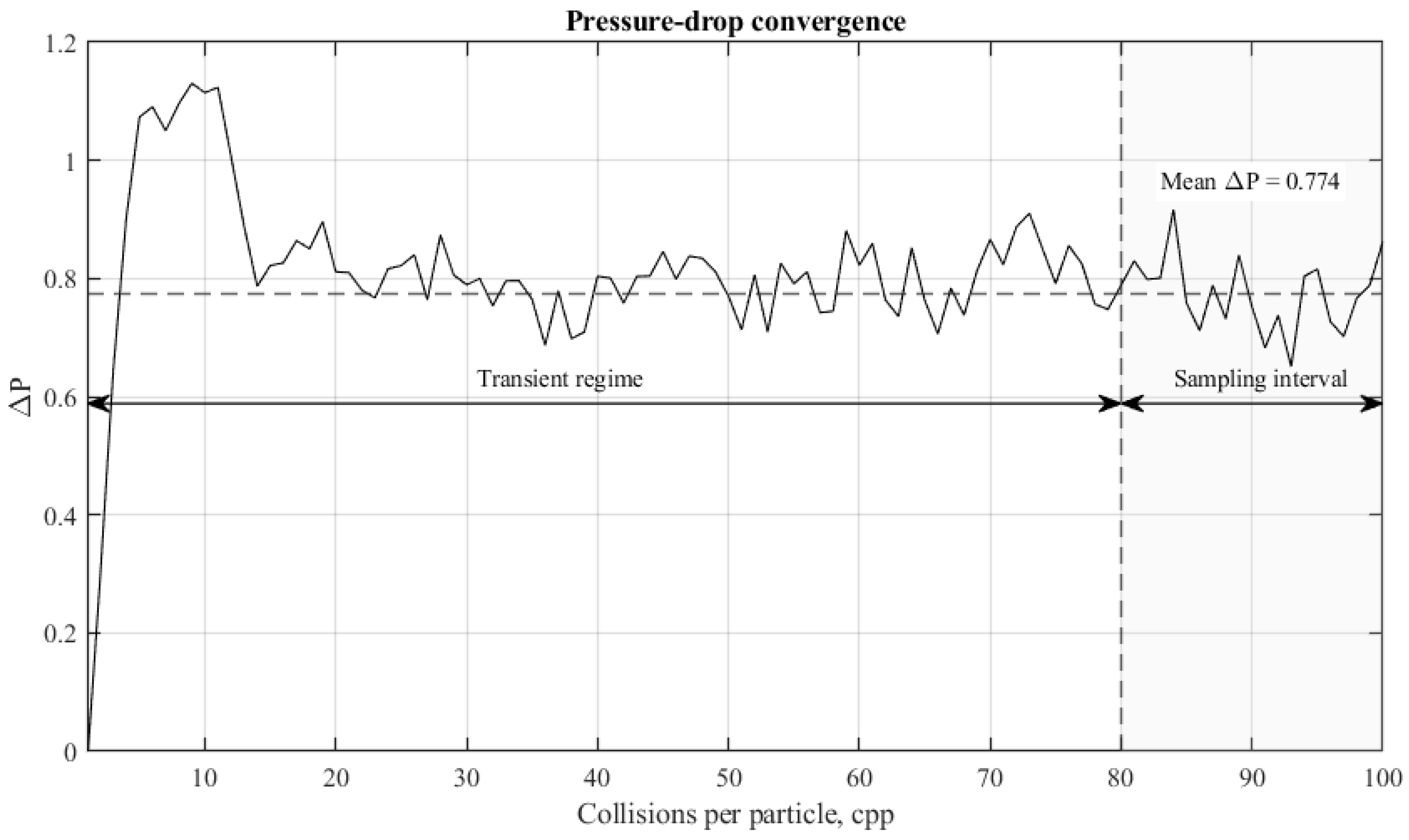
Macroscopic flow properties are obtained by averaging molecular data within sampling cells and overtime. These sampling cells are post-processing bins used to compute macroscopic quantities such as velocity and number density; they are not a CFD-type computational mesh and do not determine the molecular trajectories or collision events in the EDMD calculation. The previously stated value of approximately 25 molecules per sampling cell should therefore be interpreted only as an average bin-population criterion for reducing variance in the post-processed fields, not as a solver-grid resolution. After the flow reaches steady state, time averaging is performed over a sufficiently long sampling window, expressed in terms of collisions per particle (cpp), with about 100 cpp used in this study [18]. To assess statistical convergence with the existing simulation data, the equivalent pressure-drop signal was monitored during the averaging process. As shown in Figure 1, the transient behavior vanished before 80 cpp and the signal subsequently fluctuated around a stable mean value. Accordingly, the reported flow properties were obtained from the final 80–100 cpp interval. For all 21 argon cases, the average difference between the 50–100 cpp and 80–100 cpp averages was approximately 1.5 % , which provides a practical estimate of the residual finite-averaging-window sensitivity of the reported pressure-drop statistics. The simulations are carried out in the transitional regime, with Knudsen numbers between 0.25 and 0.35 and Mach numbers between 0.3 and 0.85 . Within this range, density variations are no longer negligible. As the Mach number approaches 0.85, compressibility effects may contribute to the observed flow behavior and should be considered when interpreting the friction-factor results [1,28].
All physical quantities are expressed in reduced MD units. Molecular diameter and molecular mass are used as reference length and mass scales, respectively, while velocity is normalized by the thermal velocity of the system. Reynolds number, Mach number, velocity and density fields, and friction factors are obtained from molecularly averaged data; they are not prescribed inputs to the EDMD trajectory calculation. Consequently, the reported Reynolds-number range should be interpreted together with the corresponding Knudsen and Mach numbers as post-processed MD-unit nondimensional data, not as an independently imposed continuum-flow condition or a direct dimensional operating range. The reported flow statistics are based on the converged sampling interval described above [18].
This averaging and convergence procedure reduces finite-sample fluctuations and provides consistent estimates of key flow parameters, particularly the equivalent pressure drops and friction factors. With the computational framework established, the following section introduces the geometric configuration of the channel and the parameterization of surface roughness.
The results of the particle-number sensitivity analysis are summarized in Table 1. The representative rough-channel configuration ( k = 16 , Λ = 128 ) was selected for this assessment. The molecular spacing, number density, roughness geometry, and flow-driving conditions were kept unchanged, while the computational domain length was varied, resulting in approximately 128,000 , 187,000 , and 257,000 gas molecules. This test therefore evaluates the influence of computational domain size and total particle number at fixed molecular density, rather than a CFD-style mesh refinement study.
The calculated equivalent pressure-drop values remained relatively stable across the investigated finite-size/particle-number range in particular, the equivalent pressure-drop difference between the baseline case ( 187,000 molecules) and the larger simulation ( 257,000 molecules) was only 0.25 % , while the corresponding friction-factor difference was approximately 2.2%. Although small variations are observed among the reported quantities, no systematic dependence on the simulated domain length or total particle number was identified within the investigated range. Together with the averaging-window comparison described above, these results support the statistical convergence of the reported macroscopic quantities obtained from the existing EDMD data.
Viscosity is not prescribed as a spatial material field in the EDMD trajectory calculation. The molecular trajectories are advanced from collision events and the periodic driving parameter, not from a continuum constitutive relation. In the present data reduction, the dynamic viscosity that appears in the Reynolds-number definition is the reduced MD-unit viscosity value used consistently for nondimensional post-processing. The reported flow fields are therefore not obtained by assuming a uniform viscosity field in a continuum solver. However, the present manuscript does not resolve or report a separate local viscosity profile near the rough walls. Possible near-wall variation in apparent transport properties is consequently treated as a limitation of the present post-processing rather than as an imposed model input.

2.2. Flow Parameters and Friction Factor Calculation

The Reynolds number, Knudsen number, and friction factor are determined from the molecularly averaged simulation data. These parameters are used throughout the study to examine how surface roughness affects flow resistance.
The Reynolds number is defined as:
R e = ρ U m H e f f μ r e f ,
where ρ is the average gas density, U m is the mean flow velocity, μ r e f is the is the reduced MD-unit dynamic viscosity used consistently in post-processing, and H e f f is the effective channel height. Thus, reported Re values are calculated from density, mean velocity, characteristic length, and viscosity in the usual nondimensional form, but the quantities are expressed in the reduced-unit EDMD convention.
The Knudsen number ( K n ) is commonly defined using the nominal channel height as the characteristic length scale, ( H ). However, in the present rough-channel configurations, part of the channel volume is occupied by roughness elements and is therefore not accessible to the gas flow. For this reason, the effective channel height ( H e f f ) was also considered to represent the actual flow-accessible region within the channel. Using the effective channel height allows the characteristic length scale to reflect the reduction in the effective flow domain caused by surface roughness. Accordingly, the Knudsen number can be written as:
K n = λ H e f f ,
where is the mean free path.
For a hard-sphere gas, the mean free path can be expressed as [18]:
λ = 1 2 π d 2 n ,
where n is the number density of gas molecules, d is the molecular diameter, and (n 1 / s 3 ) is used when the expression is written in terms of the mean intermolecular spacing s. By combining Equations (2) and (3), the mean free path can be expressed in terms of the intermolecular spacing ratio as:
K n = d 2 π H e f f s d 3 ,
The friction factor is calculated using the equivalent pressure drop associated with the imposed periodic driving parameter:
f = 2 H e f f ρ U 2 Δ P L ,
where Δ P denotes the equivalent pressure drop P e q = G   L over the periodic channel length L , and G is the imposed equivalent streamwise pressure-gradient magnitude. Thus, Δ P is not a directly imposed or measured inlet–outlet pressure difference.
For comparison purposes, a reference solution for laminar flow in smooth rectangular channels is considered. Unlike circular pipes, the friction factor in rectangular channels depends on the normalized geometric aspect ratio, defined as:
α = m i n ( H , W ) m a x ( H , W ) ,
where H and W represent the channel height and width, respectively.
For laminar flow in rectangular ducts, the Darcy friction factor ( f D ) is given by the analytical solution [29,30]:
f D = 96 R e ( 1 1.3553 α + 1.9467 α 2 1.7012 α 3 + 0.9564 α 4 0.2537 α 5 ) ,
This expression indicates that the friction factor follows an inverse relationship with Reynolds number, while the proportionality constant depends solely on the channel geometry. Therefore, the product f Re becomes a function of the normalized aspect ratio
f   R e = C ( α ) ,
For the present geometry, where α 0.083 , the theoretical value is:
f   R e   86.39 ,
Accordingly, the laminar reference relation for a smooth channel can be written as:
f   =   86.39 R e ,
This analytical expression is used only as a continuum smooth-channel baseline for comparison with the EDMD friction-factor results. Because the analytical rectangular-duct relation does not include rarefaction, wall-adjacent rarefied-flow behavior, compressibility, or deterministic wall roughness, it is not interpreted here as a direct validation of the rarefied rough-channel EDMD results.

2.3. Geometry and Roughness Definition

The computational domain is a three-dimensional nanochannel with dimensions of 256   ×   72   ×   768 in the streamwise ( x ), wall-normal ( y ), and spanwise ( z ) directions, respectively. The channel is bounded by fixed wall molecules that define the smooth or rough solid geometry, while argon molecules occupy the fluid region.
Gas–surface interactions are modeled as event-driven hard-sphere collisions between argon molecules and the fixed wall molecules. The wall molecules are assigned to infinite mass, and their positions remain unchanged during and after collision events. This representation keeps the prescribed rough-wall geometry fixed while allowing the incident gas molecules to exchange momentum with the solid surface through the same event-driven collision framework used in the gas phase [31].
No continuum wall function or accommodation-coefficient boundary model is prescribed in this formulation. The wall is explicitly represented by fixed, infinite-mass molecules that act as stationary collision partners. Therefore, the present results should be interpreted for this specific hard-sphere gas and fixed-wall-molecule interaction model; separate wall material or accommodation-model sensitivity studies are outside the scope of the present work.
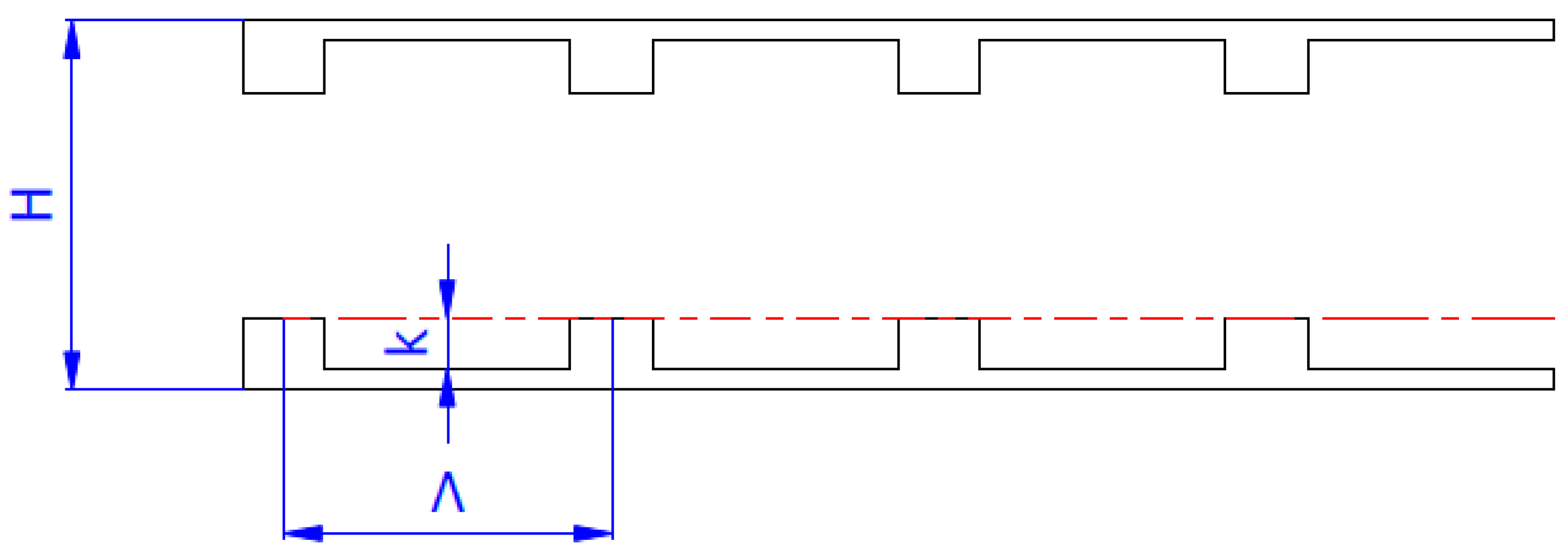
The geometric configuration of the channel, along with the definition of the roughness parameters ( H , k , and Λ), is illustrated in Figure 2.
Surface roughness is characterized not only by its amplitude but also by its spatial distribution. In this study, k represents the roughness height, H denotes the nominal channel height of the corresponding smooth channel, and Λ defines the spacing between surface features, referred to as the roughness periodicity. By systematically varying these parameters, the influence of surface geometry on flow behavior can be investigated in a controlled manner. Accordingly, different roughness configurations are generated by combining multiple roughness heights and periodicities.
The molecular arrangement differs between the fixed wall and fluid regions. Infinite-mass wall molecules are arranged with a spacing of 2 in reduced Molecular Dynamics (MD) units to define the smooth or rough solid geometry, while argon molecules occupy the fluid region with an initial intermolecular spacing of 4 in the same unit system. As a result, although the total computational volume remains constant, the number of gas molecules varies between approximately 400,000 and 550,000 depending on the roughness configuration.
According to the formulation proposed by Kandemir [18], the Knudsen number depends on both the intermolecular spacing ratio ( s / d ) and the effective channel height ( H e f f ) where s denotes the mean intermolecular spacing and d represents the molecular diameter. While variations in the number of molecules influence the spacing ratio and tend to decrease K n , the reduction in the effective channel height due to surface roughness produces an opposing effect. Consequently, the combined influence of these factors leads to only moderate variations in the Knudsen number, and all cases remain within the transitional flow regime.
To account for the reduction in the flow-accessible region caused by surface roughness, an effective channel height ( H e f f ) is introduced. The formulation used to calculate H e f f is presented in Section 2.4.

2.4. Determination of Effective Channel Height

In this study, an effective channel height ( H e f f ) is defined to account for the reduction in the flow-accessible region due to surface roughness, analogous to the hydraulic diameter concept commonly used in internal flow analyses [30].
Unlike classical formulations, H e f f is not based on nominal geometric dimensions. Instead, it is calculated directly from the volume available to the gas phase for each roughness configuration. Since the roughness elements extend into the channel, part of the nominal volume is occupied by solid atoms and is therefore not accessible to the flow.
Accordingly, the effective channel height is defined as:
H e f f = V g a s L x L z ,
where V g a s is the volume available for the gas phase, and L x and L y represent the streamwise and spanwise dimensions of the channel, respectively (see Table 2).
It is important to note that H e f f is a purely geometric parameter. It depends only on the roughness height ( k ) and the roughness periodicity ( Λ ) and is independent of flow conditions such as Reynolds or Knudsen numbers. This definition allows for a consistent comparison between different roughness configurations.

3. Results and Discussion

3.1. Friction Factor Analysis and Model Development

A systematic parametric analysis was performed using 21 rough channel configurations, obtained by combining seven different roughness heights (k) with three roughness periodicities ( Λ ), resulting in a total of 7 × 3 = 21 cases. This combination allows independent assessment of the effects of roughness height and spacing over a sufficiently broad parameter space. In addition, a smooth channel case ( k = 0 ) was included as a reference, leading to a total of 22 simulation cases.
The selected roughness heights were chosen to represent a wide range of relative roughness values while ensuring that the flow remained within the transitional regime. Similarly, the periodicity values ( Λ = 64 ,   128 and 256 ) were selected to capture the effects of closely spaced, moderately spaced, and widely spaced roughness elements.
This parametric design enables systematic investigation of both the individual and combined effects of roughness height and periodicity on friction factor and flow structure. The selected configurations ensure sufficient coverage of the parameter space while maintaining computational feasibility.
The corresponding numerical results, including roughness parameters, reported Reynolds number, friction factor, and Knudsen number, are summarized in Table 2.
The numerical values presented in Table 2 support the trends observed in Figure 3. Here, f / f 0 is normalized by the analytical smooth rectangular-duct reference, f 0 = 86.39 / R e , rather than by the simulated smooth-wall case. Therefore, values different from unity should be interpreted as deviations from the continuum smooth-channel reference under the present rarefied, wall-adjacent slip-like, and compressible-flow conditions.
It should also be noted that the Reynolds number was not independently fixed in the present simulations. The prescribed driving parameter G and the initial thermodynamic and molecular setup were kept consistent, whereas the Reynolds number, Mach number, mean velocity, and friction factor were evaluated after the statistically steady state was reached. The resulting reported Reynolds number therefore reflects the coupled response of each roughness geometry under the periodically driven EDMD setup. A strict constant–Reynolds number comparison would require iteratively adjusting G for each roughness geometry and was not part of the present design. Accordingly, the conclusions are framed for the simulated driven cases rather than as a complete constant-Reynolds-number isolation of roughness effects. The same reduced-unit viscosity convention is used for all cases, so the trends are internally comparable, but the absolute Re scale should not be interpreted as a direct dimensional argon operating condition without a separate physical-unit viscosity mapping. In particular, the higher-Re cases should be read as high-speed rarefied-gas EDMD cases, as also indicated by their Mach numbers, rather than as representative of all nanochannel operating conditions.
The numerical value of R e alone should also not be used as a sufficient criterion for vortex formation in the roughness indentations. The expectation that vortices form at R e of order 100 is generally associated with continuum, no-slip, incompressible or low-Mach channel/cavity flows and depends strongly on cavity geometry. In the present simulations, the flow lies in the transitional rarefaction regime ( K n   =   0.25 0.35 and Mach number up to approximately 0.85 ), and the wall geometry is represented by fixed molecular wall particles. Under these conditions, possible local recirculation or vortex-like behavior depends on rarefaction, compressibility, gas–wall molecular interactions, and roughness geometry, not on R e alone. Since the present work reports density and velocity profiles but does not compute vorticity fields or closed streamline topology, vortex formation is not claimed or ruled out here.
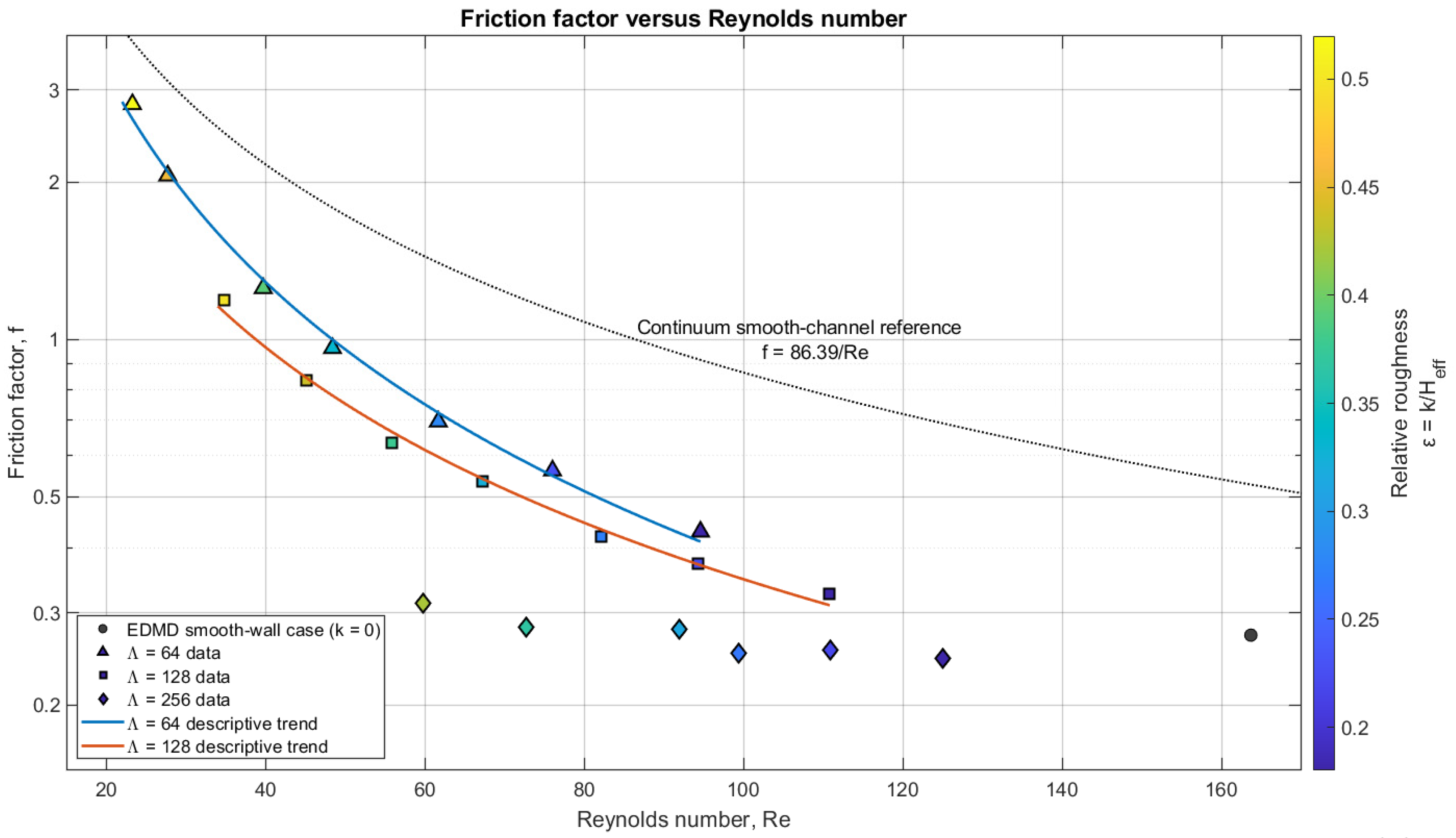
The variation in friction factors with the reported Reynolds number for different roughness configurations is presented in Figure 3. The analytical laminar reference for a smooth channel ( f 0 = 86.39 / R e ) derived from the rectangular duct solution, is included as a dashed line for comparison with the EDMD results. Descriptive trend lines are shown for Λ = 64 and Λ = 128 to indicate the observed variation within the simulated data range.
For Λ = 256 the results do not show a clear monotonic trend. At this larger roughness periodicity, the distance between neighboring roughness elements increases, allowing the flow to partially redevelop between successive surface features. As a result, the roughness effect becomes less uniform along the channel, leading to a more scattered friction-factor distribution instead of a single well-defined power-law trend.
In contrast to classical laminar flow theory, the friction factor in rough nanochannels depends on multiple parameters and can be expressed in a general form as [12]:
f = f R e ,   K n , r o u g h n e s s ,
In the present study, surface roughness is characterized by using physically meaningful geometric parameters, namely the relative roughness ( ε = k / H e f f ) and the roughness periodicity ( Λ ). Accordingly, the friction factor can be expressed in a more specific form as:
f = f R e , K n , k H e f f , Λ ,
Equation (13) reflects the combined influence of flow conditions, rarefaction effects, and surface geometry on flow resistance.
Classical rough pipe studies [32] indicate that friction factor variations can be interpreted relative to a smooth-wall reference, motivating the use of normalized forms such as f/f0. In conventional pipe flow, this effect is commonly represented through the relative roughness parameter ( k / D ), as shown in the Moody diagram [7]. In the present study, an analogous parameter based on the effective channel height, k/ H e f f , is used to describe the roughness amplitude in the non-circular nanochannel. The reference friction factor f0 is the analytical continuum smooth-channel value at the same reported Reynolds number f 0 = 86.39 / R e . The empirical relation below therefore describes departures from this analytical reference within the present EDMD dataset, rather than a universal roughness law.
f f 0 = C Λ k H e f f m Λ ,
where C Λ , and m Λ are empirical coefficients obtained from regression analysis and vary with the roughness periodicity Λ in Equation (14). Separate descriptive formulations were obtained for Λ = 64 and Λ = 128 , following the empirical power-law formulation presented in Equation (15) and Equation (16), respectively:
f f 0 = 0.915 k H e f f 0.428 , Λ = 64 ,
f f 0 = 0.480 k H e f f 0.108 , Λ = 128 ,
No empirical formulation is proposed for Λ = 256 , as the corresponding data do not exhibit a well-defined trend.
The empirical equations presented here were obtained from simulations of argon gas for roughness heights ranging from k = 10 to 22 , roughness periodicities of Λ = 64 and Λ = 128 , Knudsen numbers between 0.25 and 0.35 , and Mach numbers between 0.3 and 0.85 . Therefore, the equations should be used within these parameter ranges and flow conditions.
The obtained results indicate that roughness periodicity modifies the departure from the analytical smooth-channel baseline, but the data set combines changes in roughness, reported Reynolds number, Knudsen number, and Mach number; therefore, the empirical relations should be interpreted as descriptive fits within the investigated reduced-unit parameter range rather than as general predictive correlations.
Surface roughness leads to a noticeable increase in friction compared to the smooth channel case. This increase is attributed to enhanced gas–surface interactions, which intensify momentum exchange near the rough walls.
The effect of roughness periodicity is clearly observed. For a given roughness height, smaller periodicity values ( Λ = 64 ) result in higher friction factors, whereas larger periodicity values ( Λ = 128 ) exhibit a more moderate behavior.
For Λ = 256 , the results do not show a clear monotonic trend. At this larger roughness periodicity, the distance between neighboring roughness elements increases, allowing the flow to partially redevelop between successive surface features. Compared to the Λ = 64 and Λ = 128 cases, the roughness effect therefore becomes less uniform along the channel. Under these conditions, the friction behavior cannot be represented reliably by a single power-law trend based only on the relative roughness parameter (k/ H e f f ), resulting in a more scattered distribution of friction-factor values.
Overall, the results demonstrate that both roughness height and periodicity significantly influence flow resistance in nanochannels. More closely spaced roughness elements lead to higher friction, while larger periodicity values tend to approach smooth channel behavior.

3.2. Flow Structure Analysis

To better understand the mechanisms behind the observed friction-factor behavior, the flow structure was analyzed using the Knudsen number and particle number density distributions. All simulated cases fall within the transitional flow regime, where both molecular and continuum effects are present. Under these conditions, gas–surface interactions significantly influence the flow behavior and contribute to deviations from classical continuum predictions [29].
Although the friction factor is generally influenced by the Knudsen number, its effect is not explicitly included in the present formulation, as the simulations were conducted within a relatively narrow Kn range. Therefore, its influence is implicitly embedded in the fitted coefficients.
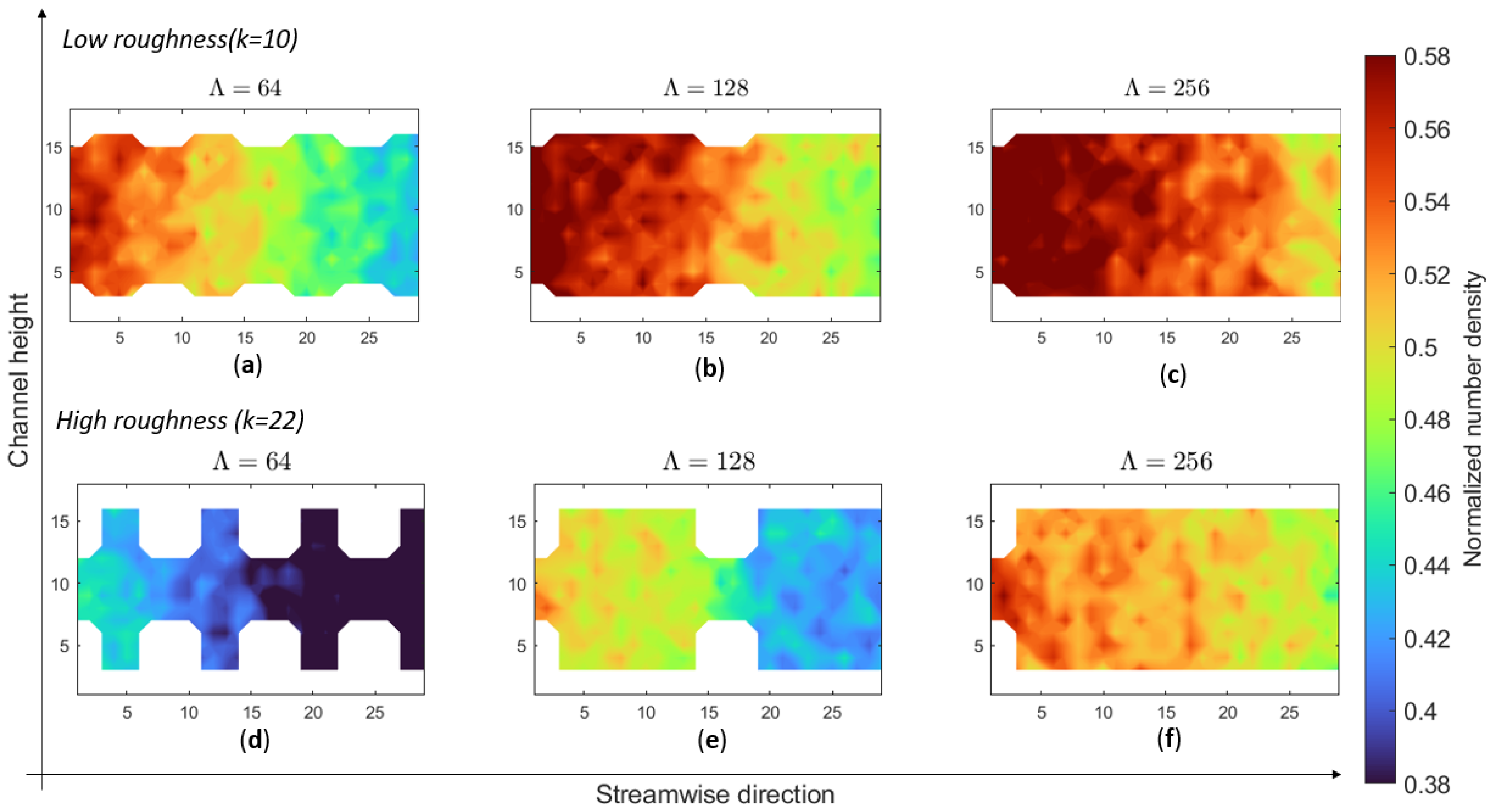
To provide further physical insight, the spatial distribution of normalized number density is presented in Figure 4 for representative low and high roughness configurations ( k = 10 and k = 22 ), each evaluated at three periodicities ( Λ = 64 , 128 and 256 ).
Figure 4 illustrates the spatial distribution of normalized number density for representative low and high roughness configurations ( k = 10 and k = 22 ) at different roughness periodicities.
For low roughness ( k = 10 ), decreasing the periodicity ( Λ = 256 64 ) leads to increasingly pronounced spatial variations in number density. Closely spaced roughness elements ( Λ = 64 ) enhance local density gradients along the channel, indicating stronger gas–surface interactions. As periodicity increases, these variations become more moderate, and the flow tends toward a more uniform distribution.
For high roughness ( k = 22 ), this effect becomes significantly more pronounced. The density field exhibits sharper gradients and stronger spatial heterogeneity, particularly for Λ = 64 , where the interaction between the flow and rough surfaces is intensified. As periodicity increases, the distribution becomes less uniform but still remains more structured compared to the low-roughness case.
These results indicate that increasing roughness height and decreasing periodicity both amplify density heterogeneity within the channel. This behavior supports the interpretation that roughness modifies near-wall momentum exchange and contributes to the observed increase in friction factor. The qualitative trend is consistent with previous molecular-dynamics and kinetic studies of rough micro- and nanochannel flows [32,33].
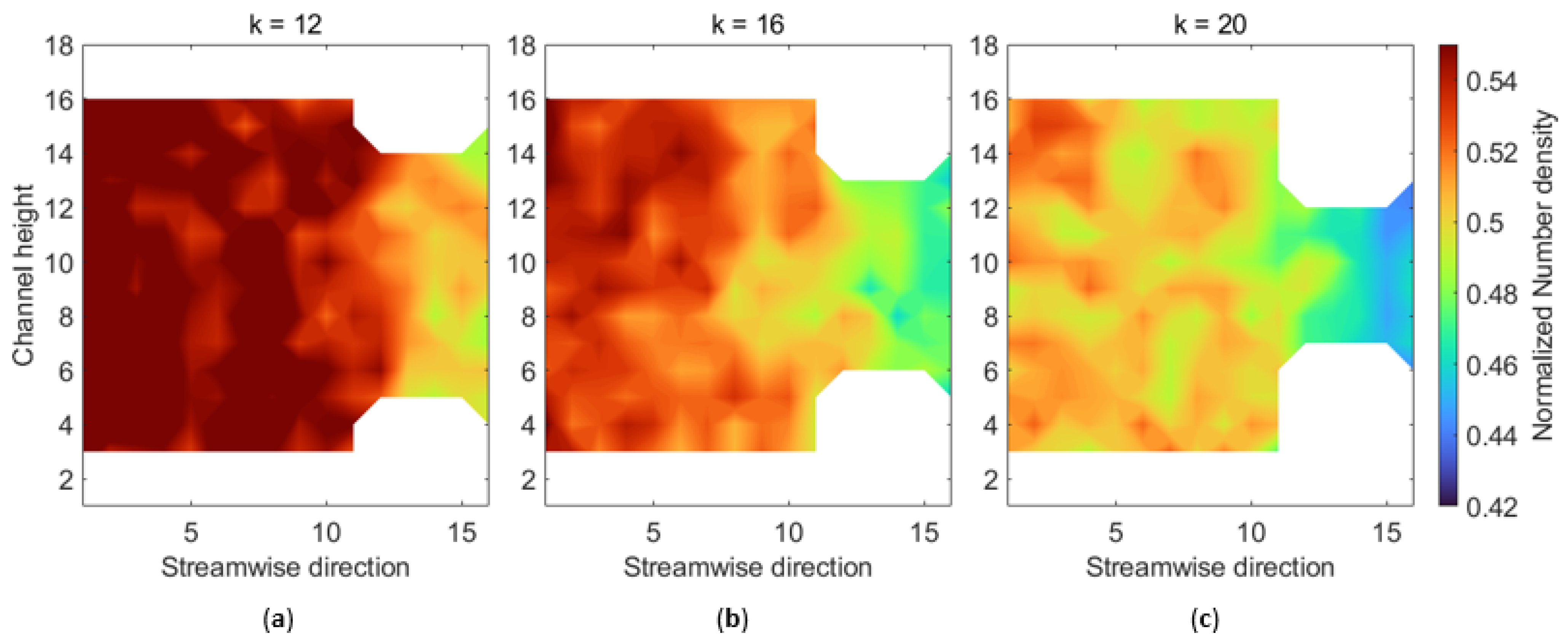
To further investigate the role of roughness height, the spatial distribution of number density is analyzed for different roughness heights (k) at a fixed periodicity of Λ = 128 , as shown in Figure 5.
Figure 5 illustrates the spatial distribution of normalized number density in a zoomed region near the rough wall for different roughness heights ( k = 12 ,   16 , and 20 ) at a fixed periodicity ( Λ = 128 ). The horizontal axis represents the streamwise direction, while the vertical axis corresponds to the channel height, and the color scale indicates the magnitude of normalized number density.
As the roughness height increases, a clear change in the density distribution is observed. The high-density region near the upstream section becomes less dominant, while lower-density regions extend further into the channel core. This indicates enhanced particle redistribution and stronger transport from the near-wall region toward the channel center.
This behavior leads to increased spatial heterogeneity and reflects intensified gas–surface interactions. As a result, larger roughness elements promote stronger momentum exchange, which contributes directly to the increase in flow resistance. These findings are consistent with previous molecular dynamics and experimental studies [10,12].
Compared to periodicity, roughness height has a more direct and dominant influence on the intensity of local flow disturbances.

3.3. Velocity Profile Analysis

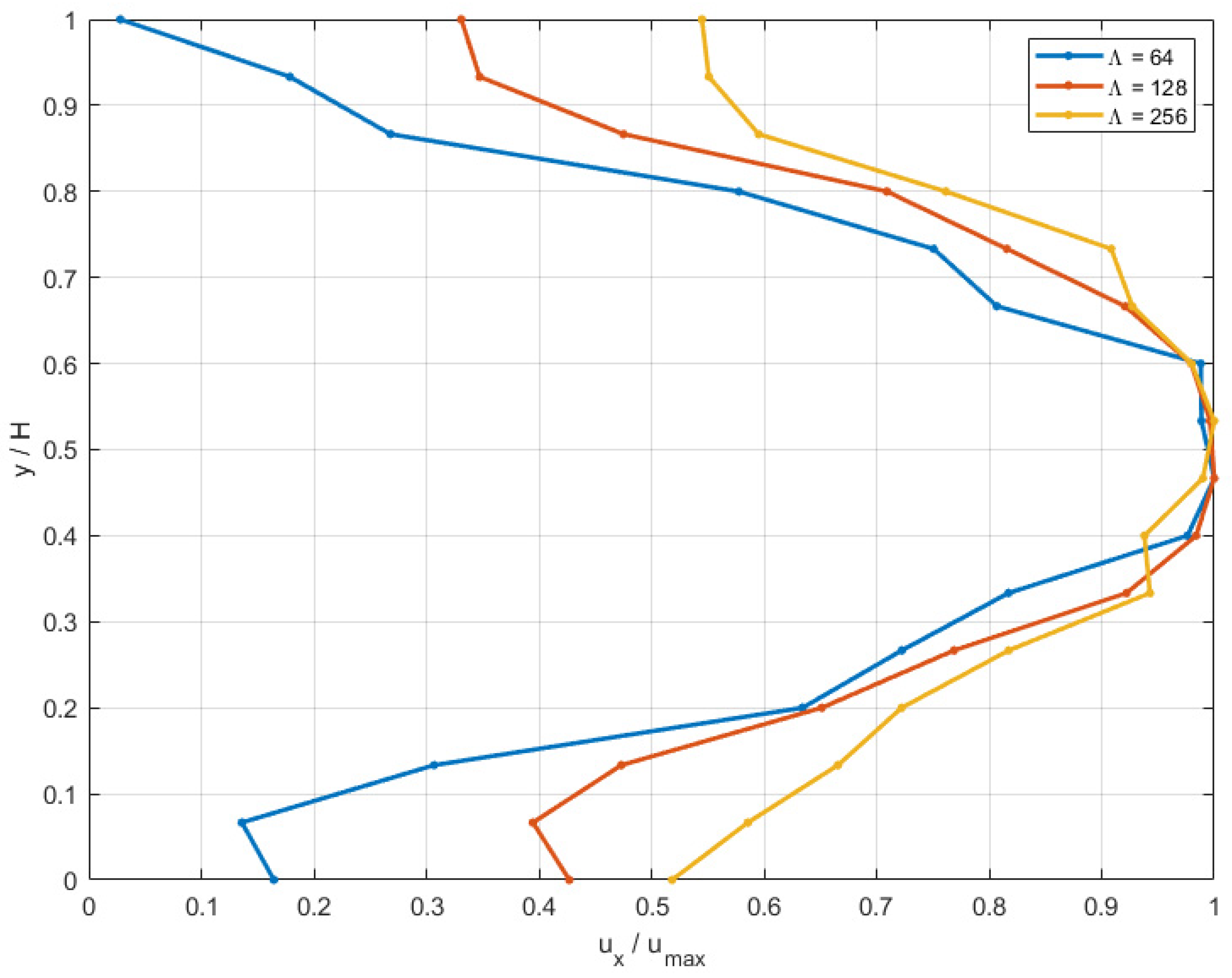
Figure 6 shows normalized streamwise velocity profiles for k = 16 at different roughness periodicities. The profiles are obtained from long-time-averaged sampling-bin data and therefore represent time-averaged streamwise velocity profiles rather than direct measurements of the velocity exactly at the solid boundary. For Λ = 64 , the normalized streamwise velocity decreases more noticeably near the wall-adjacent regions, indicating a stronger influence of closely spaced roughness elements on the flow. As the periodicity increases from Λ = 64 to Λ = 128 and 256, the profile becomes fuller and the high-velocity region extends over a larger portion of the channel. These observations follow the same trend as the friction-factor results: closely spaced roughness elements disturb the flow more strongly, whereas larger spacing allows partial flow redevelopment between successive roughness elements. Because the near-wall values are bin-averaged, the present data supports a qualitative discussion of wall-adjacent slip-like behavior but does not permit direct determination of slip velocity or slip length.
The results show that both roughness height and roughness periodicity have a clear influence on flow behavior in nanochannels operating in the transitional regime. As the roughness height increases, the friction factor also increases, which is in line with what has been observed in classical rough surface studies [7]. However, at the micro- and nanoscale, this effect is further influenced by rarefaction and gas–surface interactions [4].
The number density contours provide additional insight into this behavior. With increasing roughness height, particles tend to move away from the near-wall region toward the channel core, leading to a more uneven spatial distribution. Similar trends have been reported in molecular dynamics studies, where surface geometry plays a key role in shaping local transport processes [17].
Roughness periodicity mainly affects how these disturbances are distributed along the channel. When the roughness elements are closely spaced (small Λ), interactions become stronger and more frequent. As spacing increases, these effects weaken, and the flow begins to resemble that of a smooth channel. This observation is consistent with earlier microscale studies showing that the spacing of surface features controls interaction frequency [1,10]. These observations further suggest that wall geometry, represented by roughness height and periodicity, plays an important role in determining flow resistance under rarefied conditions.
An interesting observation is that the normalized friction factor deviates from unity even for the nominally smooth case. This highlights the limitations of applying a continuum smooth-channel reference directly to the present molecular-scale, rarefied-flow simulations. The deviation is therefore interpreted as a departure from the continuum baseline under the present EDMD conditions, rather than as evidence of an independently quantified molecular-roughness mechanism [31].
The trends should be interpreted within the coupled conditions of the present periodically driven EDMD simulations. The Knudsen number remains within a relatively narrow transitional range (Kn = 0.25–0.35), while the reported Reynolds number and Mach number are obtained a posteriori from the molecularly averaged fields rather than independently. Therefore, the effects of roughness, rarefaction, compressibility, and the resulting flow response are not fully decoupled in the present data set. A stricter isolation of individual mechanisms would require additional simulations in which the periodic driving parameter is adjusted to maintain a constant Reynolds number, a constant Mach number, or a wider controlled range of Knudsen number. Accordingly, the proposed relations should be regarded as bounded correlations for the present hard-sphere gas, fixed-wall-molecule configuration, investigated roughness range, and reduced-unit post-processing convention.
The proposed formulation was developed based on the range of roughness amplitudes, wavelengths, and flow conditions considered in the present study. Therefore, its applicability outside these conditions should be evaluated with caution. Direct validation against independent DSMC simulations or experimental data for identical rough nanochannel geometries was not possible, as comparable datasets are currently limited in the literature. The analytical smooth-channel relation used in this work serves as a continuum reference baseline rather than as validation of the rough-channel EDMD correlations. Accordingly, the proposed equations should be interpreted as bounded descriptive correlations for the present EDMD dataset, not as externally validated universal predictive models. Future work may consider different gases, gas mixtures, independent DSMC/MD comparisons, and a wider range of flow conditions to further investigate friction-factor behavior in rough nanochannels.

4. Conclusions

This study investigated rarefied gas flow in rough nanochannels using an Event-Driven Molecular Dynamics framework. The simulations were performed for a hard-sphere gas in channels whose rough and smooth boundaries were represented by fixed wall molecules with effectively infinite mass. The flow was generated using a periodic driving formulation, and the friction factor was evaluated from the corresponding equivalent pressure drop. The reported Reynolds numbers were obtained from molecularly averaged density and velocity, the effective channel height, and the reduced MD-unit viscosity used in post-processing; they should not be interpreted as independently imposed dimensional operating conditions.
The results show that surface roughness has a clear influence on flow resistance within the investigated transitional rarefied-flow range. Increasing roughness height generally increases the friction factor, while smaller roughness periodicity produces stronger near-wall disturbance and higher resistance. The normalized friction-factor trends indicate that closely spaced roughness elements intensify gas–surface momentum exchange, whereas larger roughness spacing allows partial flow redevelopment between successive roughness elements. The number-density fields and normalized velocity profiles support this interpretation by showing stronger near-wall heterogeneity and increased flow disturbance for closely spaced roughness structures.
The analytical smooth rectangular-duct relation was used only as a continuum reference baseline. Some simulated friction-factor values approach this baseline, but this does not imply that the flow is continuum-like or that rarefaction effects are absent. The investigated cases remain in the transitional Knudsen-number range, and the EDMD results exhibit flow characteristics consistent with molecular-scale transport, gas–surface interaction, and wall-adjacent slip-like behavior. Thus, the contribution of the present work is not a universal continuum roughness law, but a bounded molecular-simulation-based description of how roughness modifies friction-factor behavior under the specified rarefied-gas conditions.
The empirical relations proposed in this work are valid only within the studied parameter range, including the selected roughness heights and periodicities, Knudsen-number range, reported-Reynolds-number convention, fixed-wall-molecule interaction model, and reduced-unit post-processing procedure. The present simulations do not separately resolve local viscosity profiles, exact slip length, or independently controlled roughness effects at constant Reynolds number. Future studies should extend the analysis by adjusting the periodic driving parameter to isolate Reynolds-number and Mach-number effects, comparing against independent data for matching rough geometries, and examining different gas models, wall interactions, and broader rarefaction ranges.

Author Contributions

D.E. Formal analysis, Visualization, Investigation, and Writing; İ.K.: Methodology, Software, Visualization, Writing, and Review and Editing; V.R.A.: Formal analysis, Methodology, Review and Editing. All authors have read and agreed to the published version of the manuscript.

Funding

This research received no external funding.

Institutional Review Board Statement

Not applicable.

Informed Consent Statement

Not applicable.

Data Availability Statement

The original contributions presented in this study are included in the article. Further inquiries can be directed to the corresponding author.

Acknowledgments

AI tools were used for language editing and improving clarity. The scientific content and results are entirely the authors’ own work.

Conflicts of Interest

The authors declare no conflicts of interest.

Abbreviations

MDMolecular Dynamics
EDMDEvent-Driven Molecular Dynamics
DSMCDirect Simulation Monte Carlo
KnKnudsen Number
ReReynolds Number
MMach Number
HSHard-sphere
cppCollision per Particle

References

  1. Colin, S. Rarefaction and Compressibility Effects on Steady and Transient Gas Flows in Microchannels. Microfluid. Nanofluid. 2005, 1, 268–279. [Google Scholar] [CrossRef]
  2. Bird, G.A. Molecular Gas Dynamics and the Direct Simulation of Gas Flows; Oxford University Press: Oxford, UK, 1994. [Google Scholar]
  3. Dongari, N.; Zhang, Y.; Reese, J.M. Molecular Free Path Distribution in Rarefied Gases. J. Phys. D Appl. Phys. 2011, 44, 125502. [Google Scholar] [CrossRef]
  4. Beskok, A.; Karniadakis, G.E. Report: A Model for Flows in Channels, Pipes, and Ducts at Micro and Nano Scales. Microscale Thermophys. Eng. 1999, 3, 43–77. [Google Scholar] [CrossRef]
  5. Colebrook, C.F. Turbulent Flow in Pipes, with Particular Reference to the Transition Region Between the Smooth and Rough Pipe Laws. J. Inst. Civ. Eng. 1939, 11, 133–156. [Google Scholar] [CrossRef]
  6. Haaland, S.E. Simple and Explicit Formulas for the Friction Factor in Turbulent Pipe Flow. J. Fluids Eng. 1983, 105, 89–90. [Google Scholar] [CrossRef]
  7. Moody, L.F. Friction Factors for Pipe Flow. J. Fluids Eng. 1944, 66, 671–678. [Google Scholar] [CrossRef]
  8. Vocale, P.; Morini, G.L. Impact of Cross-Section Geometry on Microchannel Heat Sink Performance in the Presence of Slip and Temperature Jump Boundary Conditions. Int. J. Heat Mass Transf. 2025, 251, 127408. [Google Scholar] [CrossRef]
  9. Lu, H.; Xu, M.; Gong, L.; Duan, X.; Chai, J.C. Effects of Surface Roughness in Microchannel with Passive Heat Transfer Enhancement Structures. Int. J. Heat Mass Transf. 2020, 148, 119070. [Google Scholar] [CrossRef]
  10. Sofos, F.D.; Karakasidis, T.E.; Liakopoulos, A. Effects of Wall Roughness on Flow in Nanochannels. Phys. Rev. E 2009, 79, 026305. [Google Scholar] [CrossRef] [PubMed]
  11. Zhang, C.; Chen, Y.; Shi, M. Effects of Roughness Elements on Laminar Flow and Heat Transfer in Microchannels. Chem. Eng. Process. Process Intensif. 2010, 49, 1188–1192. [Google Scholar] [CrossRef]
  12. Liu, Y.; Li, J.; Smits, A.J. Roughness Effects in Laminar Channel Flow. J. Fluid Mech. 2019, 876, 1129–1145. [Google Scholar] [CrossRef]
  13. Li, Y.; Zhang, Z.; Ji, Y.; Wang, L.; Li, D. Influence of Surface Roughness on the Fluid Flow in Microchannel. J. Phys. Conf. Ser. 2024, 2740, 012059. [Google Scholar] [CrossRef]
  14. Ali Akbari, O.; Saghafian, M.; Shirani, E. Investigating the Effect of Obstacle Presence on Argon Fluid Flow Characteristics in Rough Nanochannels Using Molecular Dynamics Method. J. Mol. Liq. 2023, 386, 122462. [Google Scholar] [CrossRef]
  15. Yamaguchi, H.; Kikugawa, G. Thermal Transpiration Flow: Molecular Dynamics Study from Dense to Dilute Gas. Fluids 2023, 9, 12. [Google Scholar] [CrossRef]
  16. Karimi, R.; Marzban, A.; Toghraie, D. The Molecular Dynamics Study of the Thermal Behavior of Argon Flow in a Nanochannel with Changes in Nanochannel Cross-Section. Results Phys. 2025, 70, 108143. [Google Scholar] [CrossRef]
  17. Liou, W.W.; Fang, Y.C. Implicit Boundary Conditions for Direct Simulation Monte Carlo Method in MEMS Flow Predictions. Comput. Model. Eng. Sci. 2000, 1, 119–128. [Google Scholar]
  18. Kandemir, I. A Multicell Molecular Dynamics Method. Ph.D. Thesis, CaseWestern Reserve University, Cleveland, OH, USA, 1999. [Google Scholar]
  19. Brykina, I.G.; Rogov, B.V.; Tirskiy, G.A. Continuum Models of Rarefied Gas Flows in Problems of Hypersonic Aerothermodynamics. J. Appl. Math. Mech. 2006, 70, 888–911. [Google Scholar] [CrossRef]
  20. Brazhenko, V.; Tarasenko, T. Investigation of Cavitation Inception in Aviation Hydraulic Fluid AMG-10 in a Small-Scale Rectangular Throttle Channel. Aerospace 2026, 13, 83. [Google Scholar] [CrossRef]
  21. Akkaya, V.R.; Kandemir, I. Event-Driven Molecular Dynamics Simulation of Hard-Sphere Gas Flows in Microchannels. Math. Probl. Eng. 2015, 2015, 842837. [Google Scholar] [CrossRef]
  22. Cercignani, C. Rarefied Gas Dynamics: From Basic Concepts to Actual Calculations; Cambridge University Press: Cambridge, UK, 2000. [Google Scholar]
  23. Tantos, C.; Litovoli, F.; Teichmann, T.; Sarris, I.; Day, C. Numerical Study of Rarefied Gas Flow in Diverging Channels of Finite Length at Various Pressure Ratios. Fluids 2024, 9, 78. [Google Scholar] [CrossRef]
  24. Cercignani, C. The Boltzmann Equation and Its Applications; Applied Mathematical Sciences; Springer: New York, NY, USA, 1988; Volume 67. [Google Scholar]
  25. Koç, M.; Kandemir, İ.; Akkaya, V.R. Transition Gas Flow Between Two Parallel Plates with a Slit-Type Obstacle of Various Geometry by Event Driven Molecular Dynamics Simulation. Sak. Univ. J. Sci. 2022, 26, 720–744. [Google Scholar] [CrossRef]
  26. Pala Öngül, E.; Kandemir, İ. Examination of Couette Flow with a Pressure Gradient and Heat Conduction Using Molecular Dynamics Simulation. Appl. Sci. 2024, 14, 2313. [Google Scholar] [CrossRef]
  27. Longshaw, S.M.; Pillai, R.; Gibelli, L.; Emerson, D.R.; Lockerby, D.A. Coupling Molecular Dynamics and Direct Simulation Monte Carlo Using a General and High-Performance Code Coupling Library. Comput. Fluids 2020, 213, 104726. [Google Scholar] [CrossRef]
  28. Elgack, M.E.; Al-Souqi, K.; Hamdan, M.O.; Abdelgawad, M. Compressibility Effects in Microchannel Flows between Two-Parallel Plates at Low Reynolds and Mach Numbers: Numerical Analysis. Int. J. Thermofluids 2024, 24, 100921. [Google Scholar] [CrossRef]
  29. Cheng, N.-S. Formulas for Friction Factor in Transitional Regimes. J. Hydraul. Eng. 2008, 134, 1357–1362. [Google Scholar] [CrossRef]
  30. Spiga, M.; Morino, G.L. A Symmetric Solution for Velocity Profile in Laminar Flow through Rectangular Ducts. Int. Commun. Heat Mass Transf. 1994, 21, 469–475. [Google Scholar] [CrossRef]
  31. Sone, Y.; Ohwada, T.; Aoki, K. Temperature Jump and Knudsen Layer in a Rarefied Gas over a Plane Wall: Numerical Analysis of the Linearized Boltzmann Equation for Hard-Sphere Molecules. Phys. Fluids A Fluid Dyn. 1989, 1, 363–370. [Google Scholar] [CrossRef]
  32. Cao, B.-Y.; Chen, M.; Guo, Z.-Y. Effect of Surface Roughness on Gas Flow in Microchannels by Molecular Dynamics Simulation. Int. J. Eng. Sci. 2006, 44, 927–937. [Google Scholar] [CrossRef]
  33. Rovenskaya, O. Kinetic Analysis of Surface Roughness in a Microchannel. Comput. Fluids 2013, 77, 159–165. [Google Scholar] [CrossRef]
Figure 1. Convergence of the pressure-drop signal for a representative rough-channel configuration ( k = 12 , Λ = 128 ). Following the initial transient stage, the pressure drop reaches a statistically stable state. The reported flow statistics were therefore obtained from the final 80–100 cpp interval.
Applsci 16 06046 g001
Figure 2. Schematic representation of the rough nanochannel geometry showing the definition of the nominal channel height ( H ), roughness height ( k ), and roughness periodicity ( Λ ). The overall channel height is kept constant while k and Λ are varied parametrically in the simulations.
Applsci 16 06046 g002
Figure 3. Friction factor f plotted against the reported Reynolds number Re for rough nanochannels with different roughness periodicity ( Λ = 64 ,   128 and 256). Marker colors represent the relative roughness ε, defined as: ε = k / H e f f . Solid lines indicate descriptive power-law trends for Λ = 64 and 128 within the simulated data range. The dashed line represents the analytical smooth-channel reference ( f = 86.39 / R e ). The smooth-wall EDMD case remains below the continuum reference due to rarefaction and wall-adjacent slip-like behavior under transitional flow conditions. No fitting curve is presented for Λ = 256, since the corresponding data do not exhibit a clear monotonic trend.
Applsci 16 06046 g003
Figure 4. Spatial distribution of normalized number density for representative roughness configurations: (a) k = 10 , Λ = 64 ; (b) k = 10 , Λ = 128 ; (c) k = 10 , Λ = 256 ; (d) k = 22 , Λ = 64 ; (e) k = 22 , Λ = 128 ; and (f) k = 22 , Λ = 256 . The top row corresponds to low roughness, while the bottom row represents high roughness. The color scale represents the normalized number density.
Applsci 16 06046 g004
Figure 5. Contour plots of the time-averaged particle number density in the near-wall region for different roughness heights: (a) k = 12 , (b) k = 16 , and (c) k = 20 while Λ = 128 .
Applsci 16 06046 g005
Figure 6. Normalized streamwise velocity profiles for k = 16 at different roughness periodicities ( Λ = 64 , 128 , and 256 ). The plotted quantity is obtained from long-time-averaged sampling-bin data and normalized by the maximum streamwise value in each case.
Applsci 16 06046 g006
Table 1. Particle-number sensitivity analysis for the representative rough-channel configuration ( k = 16 , Λ = 128 ).
Number of Molecules P e q   1 f R e
128k0.7680.56964.26
187k0.7880.53567.16
257k0.7900.54766.52
1  P e q denotes the equivalent pressure drop over one periodic channel length, defined from the imposed periodic driving parameter as P e q = G   L Because the streamwise direction is periodic, no physical inlet or outlet pressure is imposed; the reported values represent P e q . f : friction factor; Re: Reynolds number calculated from molecular averages using the reduced MD-unit viscosity convention. All quantities are reported in dimensionless MD units unless otherwise specified.
Table 2. Summary of simulation results for different roughness configurations.
k Λ H e f f ε f f / f 0 P e q   1 R e K n
0064.0-0.270.521.0061640.21
106455.20.180.430.470.964950.25
1012856.20.180.330.420.8641110.24
1025657.10.180.250.350.7581250.24
126452.60.230.560.490.943760.26
1212853.80.220.370.410.824940.26
1225654.80.220.250.330.7011110.25
146450.10.280.700.500.932620.27
1412851.60.270.420.400.818820.27
1425652.80.260.250.290.628990.26
166448.00.330.960.540.924480.29
1612849.70.320.540.420.788670.28
1625651.00.310.280.300.542920.25
186445.90.391.250.580.973400.30
1812847.60.380.630.410.747560.29
1825649.10.370.280.240.473730.28
206443.80.462.060.660.917280.31
2012845.70.440.830.440.732450.30
2025647.30.420.310.220.398600.29
226442.50.522.820.761.012230.32
2212844.20.501.190.480.704350.31
2225645.60.480.190.060.324290.30
1  P e q denotes the equivalent pressure drop over one periodic channel length, defined from the imposed periodic driving parameter as P e q = G   L Because the streamwise direction is periodic, no physical inlet or outlet pressure is imposed; the reported values represent P e q . k: roughness height; Λ: roughness periodicity; H e f f : effective channel height; ε: relative roughness (ε = k/ H e f f ); f : friction factor; f 0 : smooth channel reference friction factor f 0 = 86.39 / R e ; f / f 0 : normalized friction factor relative to the analytical continuum rectangular-duct reference at the same reported Reynolds number. This parameter provides a direct measure of the relative effect of surface roughness on flow resistance; R e : Reynolds number calculated from molecular averages using the reduced MD-unit viscosity convention; K n : Knudsen number. All quantities are reported in dimensionless MD units unless otherwise specified.
Disclaimer/Publisher’s Note: The statements, opinions and data contained in all publications are solely those of the individual author(s) and contributor(s) and not of MDPI and/or the editor(s). MDPI and/or the editor(s) disclaim responsibility for any injury to people or property resulting from any ideas, methods, instructions or products referred to in the content.