1. Introduction
Most of China’s major oil fields have undergone decades of water injection development and have now broadly entered the medium-to-high water-cut stage, with overall water-cut ratios generally exceeding 80% [
1]. In this context, accurately identifying the occurrence and distribution of subsurface remaining oil is of irreplaceable strategic significance for formulating scientifically sound exploitation measures and achieving sustained, stable or increasing production in mature oil fields. Cased-hole logging technology, particularly the nuclear logging series represented by pulsed neutron logging, has become a core tool for monitoring the distribution of remaining oil in the middle-to-late stages of oil field development because of its unique advantage of evaluating the current hydrocarbon saturation of reservoirs through casing without requiring perforations [
2,
3,
4,
5].
However, the interpretation of cased-hole logs faces serious technical challenges. First, after prolonged water flushing, the physical and chemical properties of the formation—such as formation water salinity, pore structure, and wettability—have changed profoundly, rendering conventional log interpretation models built under original reservoir conditions no longer applicable [
6]. Second, in low-porosity, low-permeability, strongly heterogeneous reservoirs, the single-curve responses of oil layers, water layers, and flooded layers of varying degrees overlap extensively, making single-parameter methods incapable of effective differentiation [
7]. Furthermore, although traditional 2D crossplot methods improve identification accuracy to some extent, they essentially force a dimensional reduction from a three-dimensional (or higher) information space. As established in information theory, any projection that reduces dimensionality necessarily discards information orthogonal to the projection subspace [
8,
9], which in practice manifests as overlapping classification boundaries in 2D crossplot templates [
10].
In recent years, researchers worldwide have actively explored flooded layer identification using cased-hole logs. Shang et al. [
11] proposed an early method for evaluating flooding degree using gamma-ray spectral logging; Al-Qasim et al. [
12] developed a comprehensive evaluation system based on the “four-property relationship.” Some researchers have introduced machine learning algorithms such as support vector machines (SVMs) and random forests to achieve automated flooded layer classification with good results; however, these methods are strongly dependent on training samples, have relatively limited model interpretability, and require recalibration when transferred across different regions. Other researchers have attempted to use newer logging methods, such as nuclear magnetic resonance logging and array induction logging, for comprehensive evaluation, but these approaches are limited by instrument cost and operational conditions and are difficult to deploy at scale in existing wells. Three core issues remain unresolved in the above studies: (1) most methods use only cased-hole dynamic data or analyze open-hole static data in isolation, artificially severing the inherent connection between the two; (2) two-dimensional methods cannot simultaneously characterize the coupled constraints among reservoir physical properties, original oil-bearing character, and current oil-bearing character; and (3) the absence of a reliable original-state baseline leads to insufficient sensitivity for detecting weak flooding signals [
13]. It is worth noting that multi-parameter crossplot methods beyond two dimensions and multivariate statistical approaches have been explored in the well-logging literature. Three-parameter crossplots combining porosity, resistivity, and a nuclear measurement have been used in open-hole formation evaluation to improve fluid and lithology discrimination [
14], and principal component analysis (PCA) has been applied to multi-curve logging datasets as a dimensionality-reduction tool to extract latent petrophysical factors and identify fluid-type clusters [
15]. However, these existing approaches share a fundamental characteristic that distinguishes them from the method proposed in this paper: they operate exclusively on either open-hole static data or cased-hole dynamic data, but not both simultaneously. In the context of cased-hole water-flooded layer identification specifically, the use of a three-dimensional parameter space has not been previously formulated around the physical principle of coupling the original reservoir state (captured by open-hole resistivity index) with the current fluid state (captured by pulsed neutron Σ or C/O), within a unified coordinate system anchored by physically calibrated pure-oil and pure-water reference points. Furthermore, PCA-based dimensionality reduction, while powerful for exploratory data analysis, produces principal components that are linear combinations of all input variables and therefore lack direct physical interpretability in terms of reservoir state; the resulting axes do not correspond to geologically meaningful quantities such as “original oil-bearing character” or “current flooding degree.” This loss of interpretability is a significant practical limitation in a field setting where the log analyst must communicate results to geologists and reservoir engineers and make decisions based on the physical meaning of the classification. The method proposed in this paper therefore differs from prior multi-dimensional crossplot and PCA work not merely in the specific parameters chosen, but in its fundamental design philosophy: physical orthogonality of axes, geologically anchored reference points, and a flooding index with direct physical meaning along an oil–water evolution trajectory.
To address these technical bottlenecks, this paper proposes a novel method for flooded layer identification using cased-hole logging, based on the deep integration of dynamic and static data. The core innovation of this method lies in organically coupling open-hole static data (representing the past) with cased-hole pulsed neutron dynamic data (representing the present) within a unified three-dimensional feature parameter space, constructing an oil–water evolution trajectory, and quantitatively characterizing the flooding degree through a spatial distance-ratio model. This approach breaks through the dimensional limitations of traditional methods and achieves collaborative constraint and fine quantitative evaluation of multi-source information.
2. Geological Background and Technical Overview
2.1. Geological Overview of the Study Area
The target oil field in the study area is located in the southwestern Ordos Basin. Tectonically, it lies in the transition zone between the Tianhuan Depression and the Yi–Shan Slope, and is one of China’s important medium-to-low-permeability sandstone oil fields. The main oil-bearing intervals are the Chang 61 and Chang 62 oil groups of the Triassic Yanchang Formation (hereinafter referred to as Chang 61 and Chang 62), buried at depths of approximately 1700–2200 m.
The Chang 6 reservoir is dominated by delta front sub-facies deposits, mainly comprising microfacies such as subaqueous distributary channels, mouth bars, and sheet sands. The reservoir lithology is primarily fine-grained feldspar sandstone and lithic feldspar sandstone, with interstitial materials dominated by chlorite coatings, silica, and calcite. The reservoir physical properties exhibit typical low-porosity, low-permeability characteristics: measured porosity ranges from 6% to 18%, with a main range of 8–14%; permeability ranges from 0.1 to 10 mD, with a main range of 0.5–5 mD, classifying it as a typical low-permeability reservoir [
16,
17]. Reservoir heterogeneity is strong; laterally, it is clearly controlled by sedimentary microfacies, and vertically, it displays distinct rhythmic variations.
Water injection development in the study area began in the late 1990s. The current comprehensive water-cut ratio has reached 75–85%, placing the field in the medium-to-high water-cut development stage. Long-term water injection has created complex water-drive channels in the reservoir, resulting in significant differences in flooding degree across different well areas and stratigraphic intervals; some intervals have experienced severe flooding or even water channeling. Accurately evaluating the current hydrocarbon saturation and flooding degree of each reservoir unit is an urgent requirement for formulating subsequent production enhancement measures.
2.2. Principles of Cased-Hole Pulsed Neutron Logging
Pulsed Neutron Logging (PNL) is the core technology for cased-hole reservoir evaluation. The instrument emits high-energy (14 MeV) neutron pulses into the formation. The neutrons undergo a series of nuclear reactions with the formation of nuclides, including inelastic scattering, elastic scattering, and thermal neutron capture. Formation information is obtained by detecting gamma-ray or neutron flux within different time gates [
18,
19].
- (1)
Macroscopic Capture Cross-Section (Σ): Σ reflects the aggregate cross-section for thermal neutron capture by formation nuclides and is highly sensitive to the chloride ion content in formation fluids. Because the thermal neutron capture cross-section of chlorine is far greater than that of oil, rock minerals, and similar materials, the Σ value of water-bearing formations is significantly higher than that of oil-bearing formations when formation water salinity is high (generally >30,000 ppm). The response equation for Σ is:
where
φ is porosity, S
w is water saturation, and Σ
w, Σₒ, and Σ
ma are the capture cross-sections of formation water, oil, and rock matrix, respectively.
- (2)
Carbon–oxygen Ratio (C/O): C/O is the ratio of the carbon peak to the oxygen peak in the inelastic scattering gamma-ray energy spectrum. Because oil (hydrocarbons) is rich in carbon and water is rich in oxygen, the C/O value can directly indicate the relative oil content in the formation and is insensitive to changes in formation water salinity. C/O logging is especially suitable for formations with low-salinity formation water or highly variable formation water salinity [
18].
- (3)
Elemental Capture Spectroscopy (ECS/HFCS): Through full-spectrum analysis of inelastic and capture gamma-rays, the relative content of multiple elements such as Si, Ca, Fe, S, and Ti in the formation can be obtained, enabling lithology analysis, clay content calculation, and matrix parameter determination, thereby providing more accurate petrophysical parameters for saturation calculations [
19,
20].
2.3. Traditional 2D Crossplot Method and Its Limitations
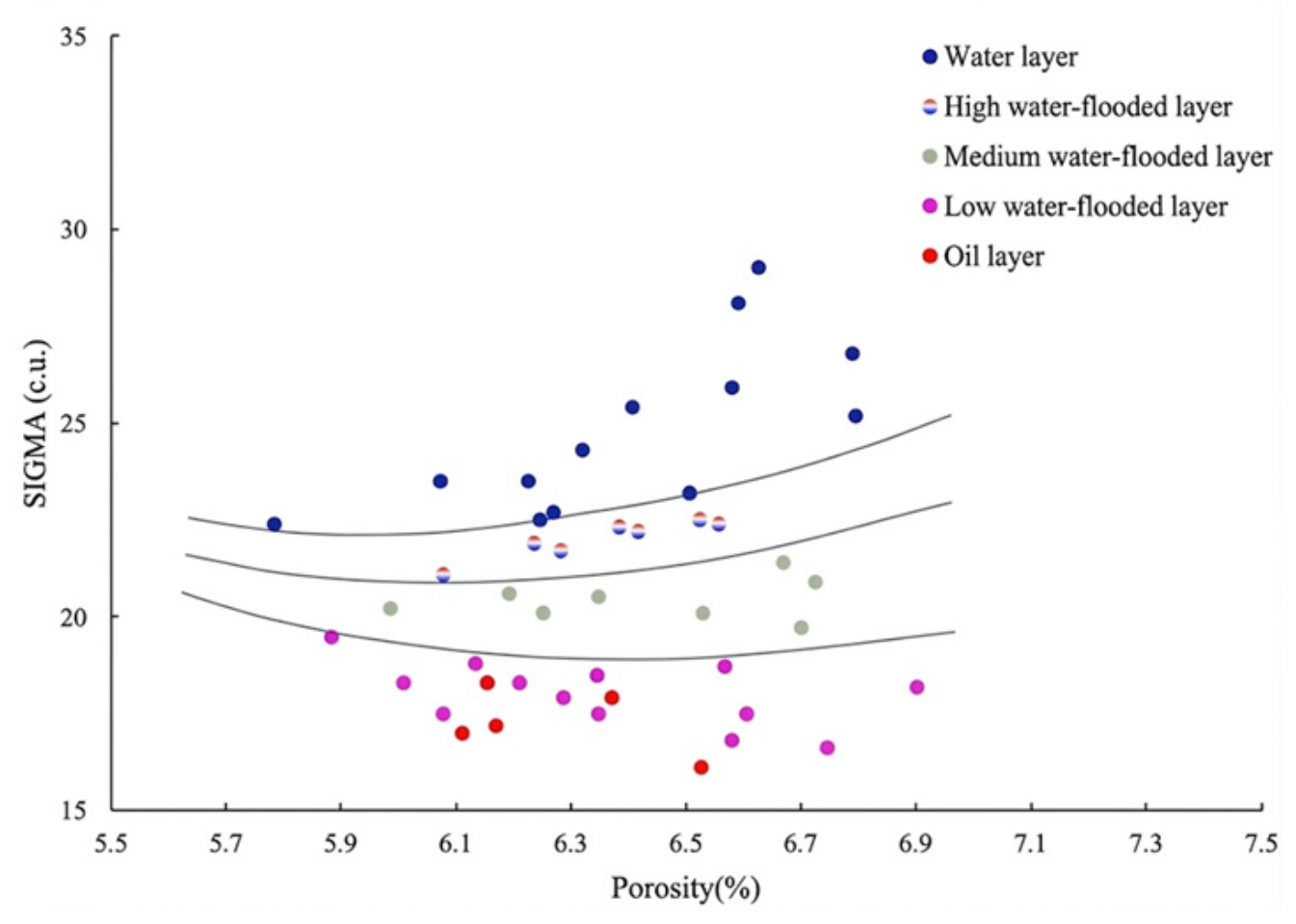
Traditional flooded layer interpretation methods are centered on 2D crossplots. The most commonly used 2D templates include the Σ-porosity (Σ-
φ) crossplot (
Figure 1), while C/O-Si/Ca crossplots and resistivity–porosity (R
t-
φ) crossplots are also widely applied. These methods assess fluid type by analyzing the distribution zones of data points on a 2D plane; they are intuitive and convenient, and work well in simple reservoir conditions [
21,
22,
23].
However, in complex low-porosity, low-permeability reservoirs, 2D methods reveal obvious limitations. First, on the Σ-φ crossplot, data points for low-porosity original oil layers (low φ, moderate Σ) and high-porosity weakly flooded layers (high φ, moderate Σ) often fall into the same zone, making them indistinguishable. Second, any 2D template can incorporate only two parameters simultaneously, and cannot express the coupled relationship among physical properties, original oil-bearing character, and current oil-bearing character, severing the inherent geological–physical connections. Third, 2D methods lack original baseline constraints; relying solely on cased-hole data, it is impossible to determine the initial state of the reservoir before development, resulting in insufficient sensitivity for detecting weak flooding.
3. Materials and Methods
To address the above problems, this paper constructs a complete method for flooded layer identification using cased-hole logging through dynamic–static data integration. The method mainly includes the following core steps: data acquisition and preprocessing, 3D feature parameter construction, 3D crossplot establishment, spatial clustering and partitioning, and quantitative calculation of the flooding index.
3.1. Data Acquisition and Preprocessing
3.1.1. Data Acquisition
The data required by this method fall into two major categories:
- (1)
Open-hole static log data: This includes compensated neutron logging (CNL), bulk density logging (DEN), deep laterolog resistivity (LLD), natural gamma (GR), and spontaneous potential (SP). These data reflect the fundamental attributes of the reservoir under its original development conditions and are the core source of information for establishing the original baseline.
- (2)
Cased-hole pulsed neutron dynamic log data: This includes macroscopic capture cross-section (Σ), carbon–oxygen ratio (C/O), silicon-calcium ratio (Si/Ca), far-to-near detector count rate ratio (FAR/NEAR), and full-spectrum elemental analysis results. These data reflect the fluid characteristics of the reservoir under its current development conditions and are the direct basis for evaluating the flooding degree.
3.1.2. Environmental Correction and Outlier Treatment
Open-hole density logging must be corrected for borehole enlargement. Cased-hole pulsed neutron capture cross-sections (Σ) require correction for casing size, cement sheath properties, and wellbore fluid effects. Corrections are applied using multi-parameter correction charts provided by the instrument manufacturer, combined with known casing and cement sheath dimensions from the study area for quantitative adjustment.
Outlier identification employs a modified Grubbs test combined with geological constraints. Data points outside the range [μ − 3σ, μ + 3σ] (where μ is the mean and σ is the standard deviation) are evaluated alongside the geological plausibility of neighboring points; those confirmed to result from instrument disturbances or borehole collapse are removed to avoid excessive filtering that would cause loss of genuine geological information.
3.1.3. Data Normalization
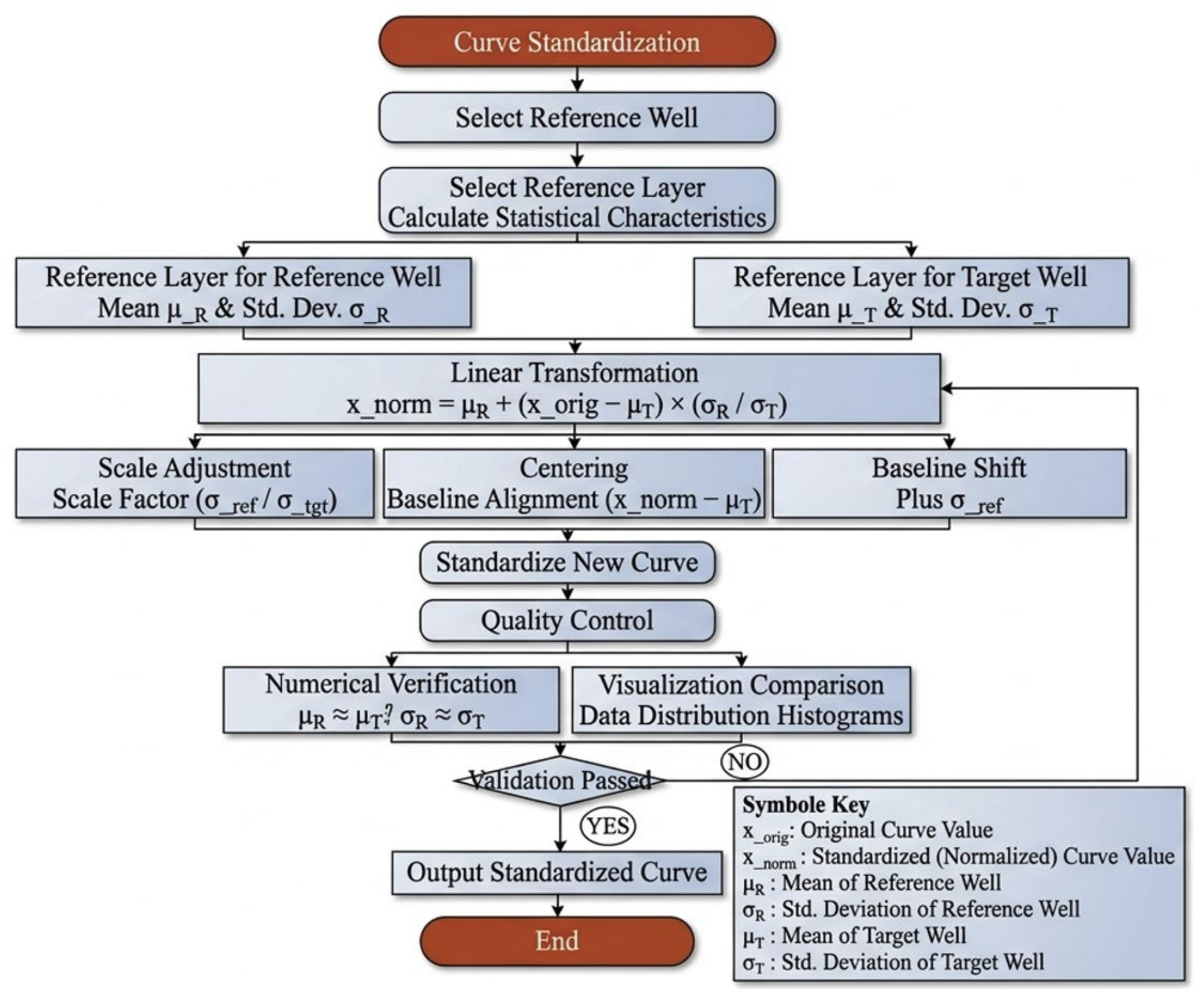
To eliminate systematic errors caused by differences in measurement units and ranges among different log curves, and to ensure comparability of data across different well areas, all parameters are subjected to log curve normalization. This paper uses the frequency histogram method, with statistical data from multiple representative wells in the region as the basis, applying the Z-Score method to transform each parameter to a standard normal distribution:
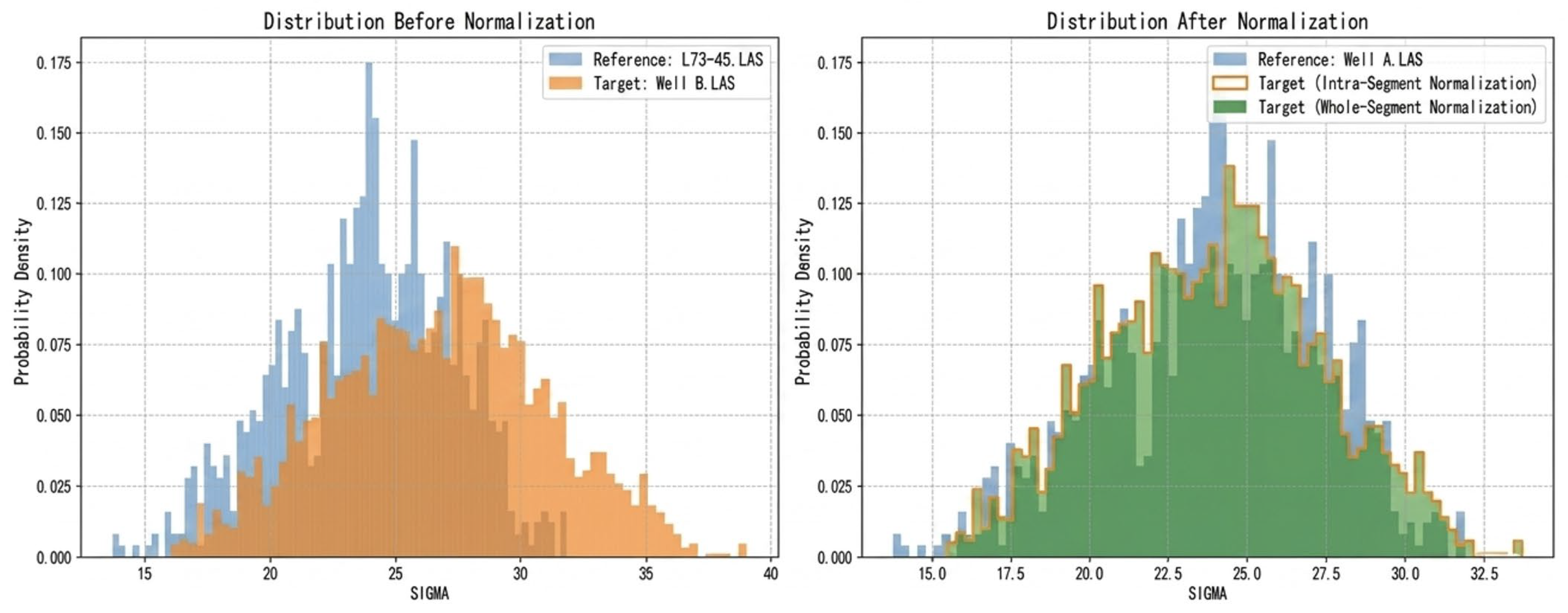
where x is the original log value, μ is the mean of the reference interval, σ is the standard deviation of the reference interval, and X is the normalized value. The normalized data are comparable across the entire study area, effectively eliminating influences from changes in formation water salinity, instrument systematic errors, and similar factors. The normalization workflow is shown in
Figure 2. It should be noted that Z-Score normalization is applied solely for the purpose of inter-well curve comparison and systematic error elimination during the data preprocessing stage. The subsequent construction of the 3D feature parameter space (
Section 3.2), the determination of reference points Poil and Pwater (
Section 3.3), and the calculation of the flooding index Fw (
Section 3.5) are all performed in the original physical data space, using the physical unit values of
φe (fraction), log I
R (dimensionless), and Σ (c.u.). The dimensional imbalance among the three axes is addressed by the weighting coefficients w
1, w
2, and w
3 in the weighted distance model (Equation (9)), rather than through coordinate transformation.
3.2. Construction of the 3D Feature Parameter System
The core design philosophy of the 3D feature parameter system is to select three parameters that are physically orthogonal (independent) to each other and respectively characterize reservoir physical properties (skeleton), original oil-bearing state, and current fluid state. These form a 3D coordinate system in which data points of different fluid types are effectively separated in 3D space.
3.2.1. X-Axis Parameter: Effective Porosity (φe)
Porosity is the fundamental parameter describing reservoir storage capacity. Using it as the physical property axis (X-axis) allows reservoirs of different quality to be separated first in 3D space, effectively eliminating interference from non-effective reservoirs (tight or dry layers) on fluid identification.
Effective porosity
φe is calculated by obtaining total porosity
φt from the neutron-density crossplot, then using the GR curve to calculate clay content Vsh via the Larionov formula, and applying a clay correction:
3.2.2. Y-Axis Parameter: Original Oil-Bearing Index (log IR)
Deep laterolog resistivity (LLD) is the most sensitive parameter for reflecting original formation fluid properties in open-hole wells. To eliminate the effect of porosity variations on absolute resistivity and to highlight the contribution of pore fluids, a modified resistivity index I
R is introduced, derived from the classical Archie saturation equation. The standard Archie equation is
where a is the tortuosity factor, m is the cementation exponent, n is the saturation exponent, R
w is the formation water resistivity,
φ is porosity, and R
t is the measured formation resistivity. Rearranging, the resistivity index I
R is conventionally defined as
In the present study, the cementation exponent m is determined from core experiments conducted on Chang 6 reservoir samples in the study area (calibrated value m = 1.87), and the formation water resistivity R
w is obtained from produced water chemical analysis. The tortuosity factor a is set to 1.0 based on core-derived petrophysical analysis of this specific reservoir, which is consistent with published practice for similar tight sandstone formations in the Ordos Basin. Under this simplification, the working formula becomes
where
φe is the effective porosity calculated from Equation (3). This formulation retains the core physical meaning of the resistivity index, which represents the ratio of measured formation resistivity to the theoretical resistivity of the fully water-saturated formation at the same porosity. Its value directly reflects the original oil saturation of the reservoir. The common logarithm log I
R is used as the Y-axis parameter to improve linearity.
3.2.3. Z-Axis Parameter: Current Fluid Indicator (Σ or C/O)
The Z-axis represents the current state of the reservoir. The selection is made based on the formation water salinity of the study area: when formation water salinity is high (>50,000 ppm), the macroscopic capture cross-section Σ is preferred as the Z-axis parameter because it is more sensitive to changes in water saturation; when formation water salinity is low or highly variable, the carbon–oxygen ratio C/O is prioritized to ensure robustness in detecting fluid changes.
The combined design of the 3D parameter system ensures that each axis of the 3D coordinate has a clear geological–physical meaning, and together the three axes constitute a complete reservoir state space.
Table 1 summarizes the selection criteria and typical value ranges of the 3D parameter system.
3.3. Establishment of the 3D Crossplot and Baseline Determination
3.3.1. Construction of the 3D Data Cloud
Using
φe as the X-axis, log I
R as the Y-axis, and Σ (or C/O) as the Z-axis, a 3D Cartesian coordinate system is established. The three-element tuples (
φe, log I
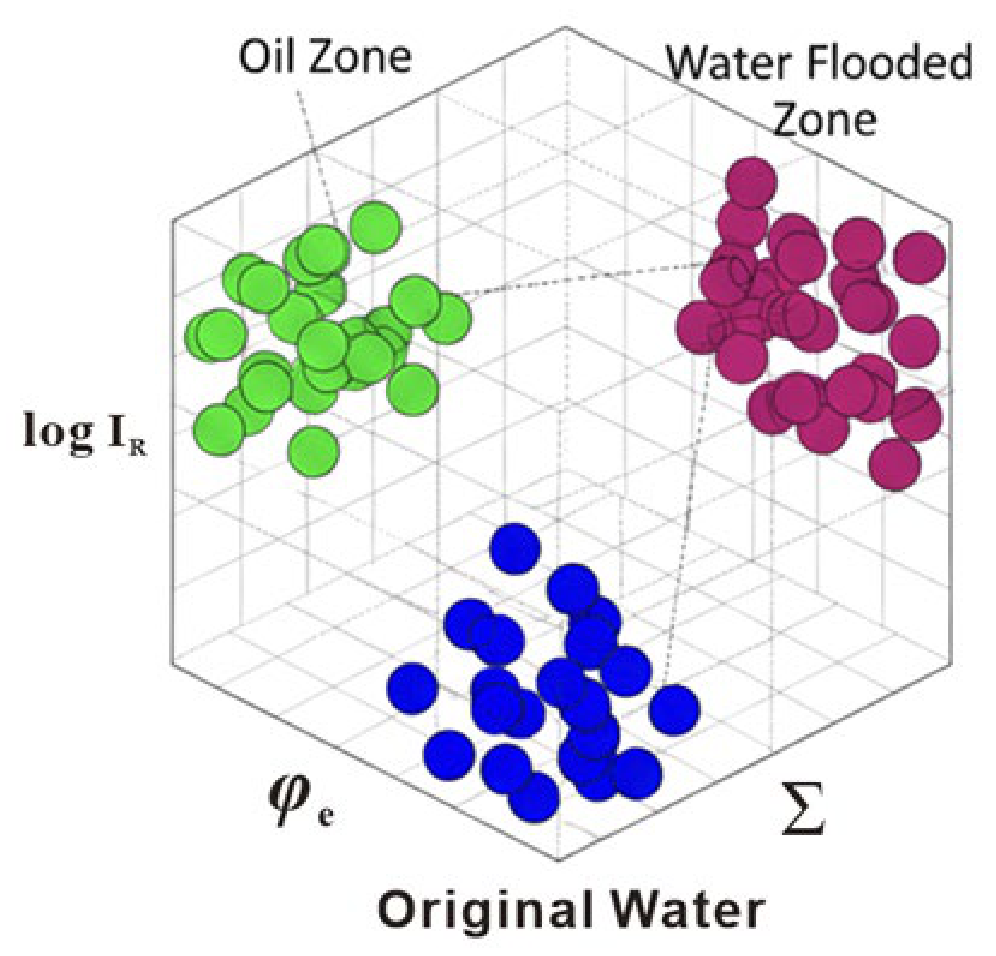
R, Σ) of all depth sampling points within the target interval are projected into this 3D space, forming a 3D scatter data cloud (
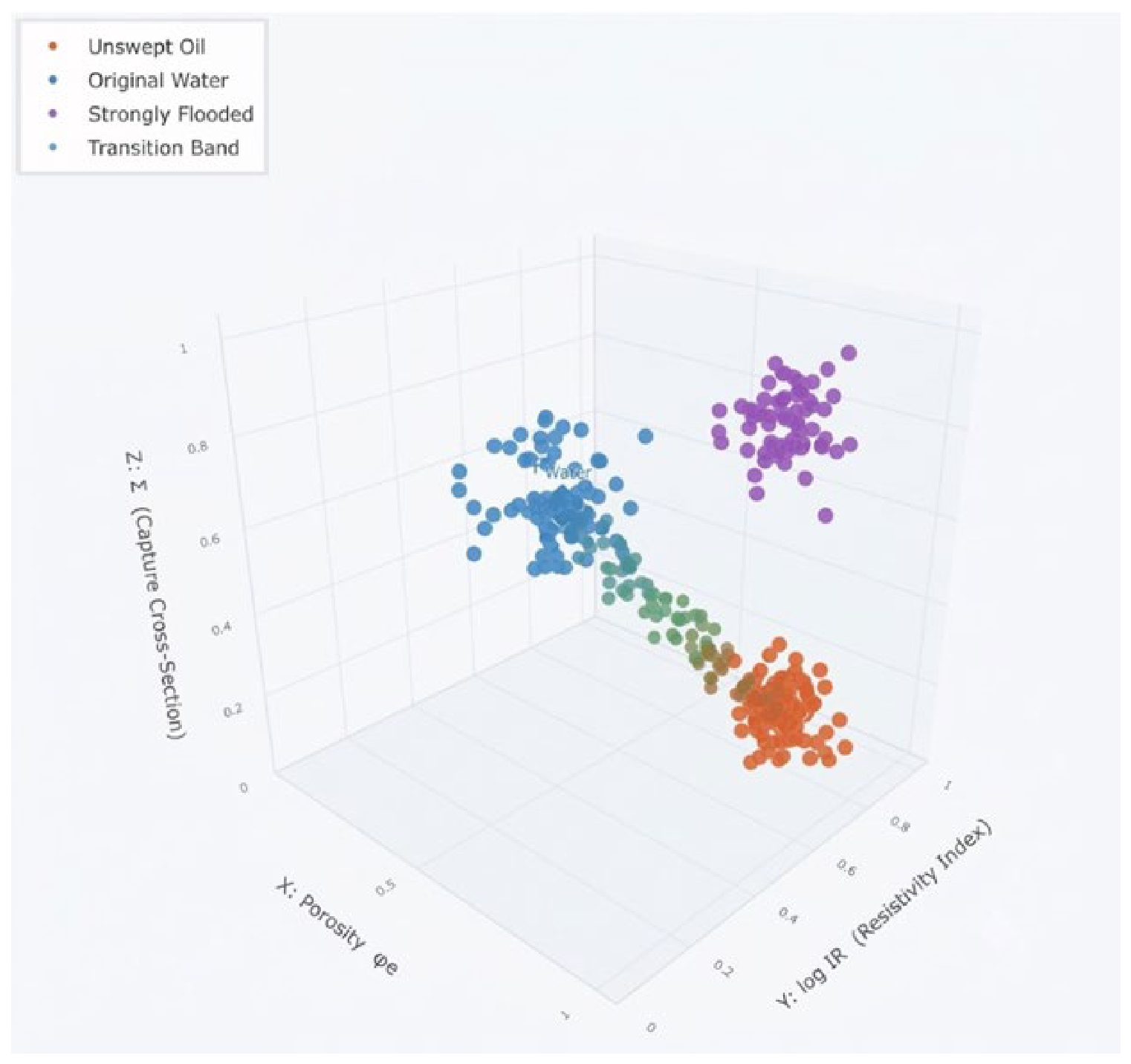
Figure 3).
3.3.2. Determination of the Pure Oil and Pure Water Baselines
- (1)
Determination of the pure oil reference point (Poil): The pure oil reference point was established using a multi-well calibration approach. A total of 12 intervals from eight representative wells across the Wuliyawan block were selected as candidate pure oil reference intervals. The selection criteria were: (1) open-hole log resistivity Rt > 80 Ω·m; (2) effective porosity φe > 10% (to ensure good reservoir quality); (3) natural gamma ray GR < 45 API (clean sand, minimal shale content); (4) core-derived oil saturation So > 70% with fluorescence grade of “rich oil” or higher; and (5) production test water-cut < 5% (if tested). After quality control, eight intervals from six wells were retained as the final pure oil reference set. The coordinates of Poil were computed as the arithmetic mean of the three feature parameters (φe, log IR, Σ) over these eight intervals: Poil (φe = 0.125, log IR = 1.82, Σ = 17.3 c.u.). These wells are distributed across the northern, central, and southern parts of the block, covering the main structural positions of the Chang 61 reservoir, thereby ensuring representativeness of the baseline.
- (2)
Determination of the pure water reference point (P
water): The pure water reference point was determined from 10 intervals in 7 wells with confirmed original water-bearing zones or strongly flooded zones. The selection criteria were: (1) production test water-cut > 98% (essentially pure water production); (2) core analysis showing no residual oil saturation (<5%); (3) log I
R < 0.5 (indicating originally water-bearing or completely flushed); and (4) consistent stratigraphic position (Chang 6
1) to avoid lithological bias. After screening, seven intervals from five wells were retained as the pure water reference set. The coordinates of P
water were calculated as the mean of these intervals: P
water (
φe = 0.133, log I
R = 0.28, Σ = 31.6 c.u.). The slightly higher porosity compared to P
oil reflects the generally better reservoir quality of original water layers in the study area, which is a known geological feature of the Chang 6
1 sand bodies. It is important to note that P
water, as defined here, represents a confirmed original water-bearing or completely water-flooded end-member (production water-cut > 98%, residual oil saturation < 5%), and should not be conflated with intervals in the capillary transition zone that retain partial original oil saturation. For transition-zone intervals, the reference framework requires modification as discussed in
Section 5.2.
- (3)
Representativeness validation. To verify that the selected reference intervals adequately represent the range of reservoir properties in the block, we compared the distribution of porosity and resistivity between the reference sets and the full dataset of 118 intervals from 16 wells. The mean porosity of the pure oil reference set (12.5%) lies within the 25th–75th percentile range of the full dataset (10.2–15.8%), and the mean log IR (1.82) represents the upper 15% of the full distribution, consistent with the definition of “pure oil.” The pure water reference set similarly covers the low-resistivity tail of the distribution. No significant systematic bias was observed between reference wells and non-reference wells (Kolmogorov–Smirnov test, p > 0.05 for both φe and log IR), confirming that the reference points are representative of the block.
3.4. 3D Spatial Cluster Analysis and Partitioning
After establishing the 3D data cloud, the data are examined using 3D visualization software—either Python (version 3.9.7; Plotly version 5.11.0; Matplotlib version 3.6.2) or commercial software Techlog (SLB, version 2023.1)—through rotation and multi-angle cross-sectional analysis to identify the natural clustering patterns of data points in 3D space and delineate spatial boundaries for each fluid zone.
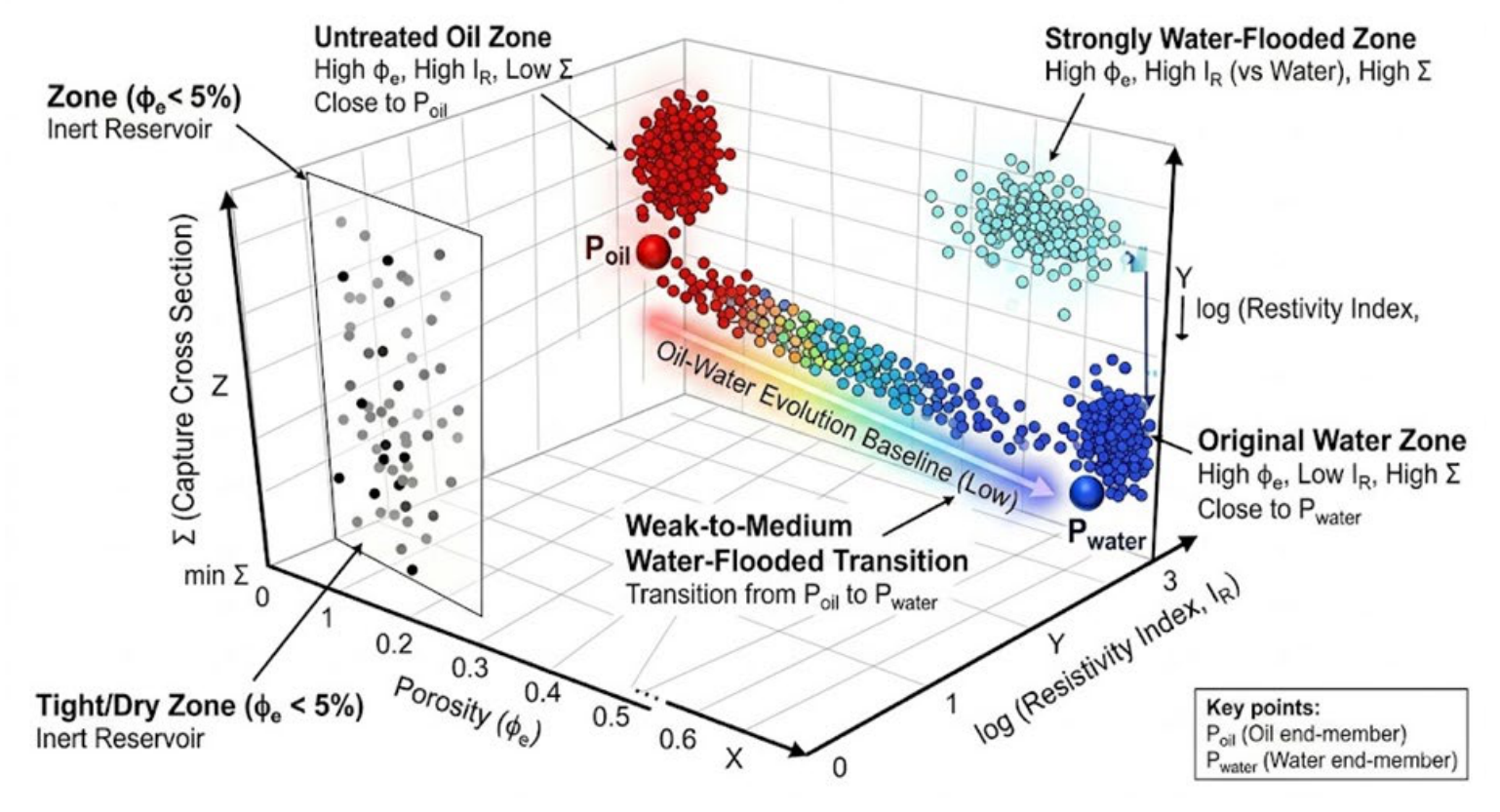
Based on physical mechanism analysis and extensive practical experience, reservoirs of different fluid types exhibit the following characteristic spatial distributions in 3D space (
Figure 4):
- (1)
Non-flooded oil layer zone: Located in the high-X, high-Y, low-Z quadrant of 3D space, i.e., the zone of high porosity, high resistivity index (originally highly oil-bearing), and low Σ (currently still oil-bearing). Data points cluster closely around Poil.
- (2)
Original water layer zone: Located in the high-X, low-Y, high-Z quadrant, i.e., the zone of high porosity (good original water layer permeability), low resistivity index (originally water-bearing, high Sw), and high Σ (currently water-bearing). Data points cluster around Pwater.
- (3)
Strongly flooded layer zone: Significantly different from the original water layer zone along the Y-axis—strongly flooded layers have relatively high log IR values while also having high Σ. This is the core advantage of the 3D method over 2D methods: on the 2D Σ-φ plot, data points for strongly flooded layers and original water layers overlap heavily, whereas in 3D space, they are clearly separated due to the difference in the Y-axis (log IR).
- (4)
Weakly to moderately flooded transition zone: Data points are distributed along the oil–water evolution baseline, Low, forming a band-like zone extending from Poil toward Pwater. As flooding intensity increases, data points gradually migrate from the Poil end to the Pwater end.
- (5)
Tight/dry layer zone: Low-porosity zone (φe < 5%), with data points clustering near the low-X coordinates. Regardless of the Y- and Z-axis values, these are preferentially classified as non-effective reservoirs.
3.5. Spatial Flooding Index Model and Flood Level Classification
3.5.1. Definition of the Flooding Index (Fw)
Let the oil–water evolution baseline be defined as the directed line segment from P
oil to P
water in the 3D feature space. For any data point Q, we first compute its scalar projection t onto the unit direction vector
= (P
water − P
oil)/|P
water − P
oil|:
The physical meaning of t is the signed distance from P
oil to the orthogonal projection of Q onto the evolution line. The flooding index Fw is then defined as the clamped normalized projection:
where L = |P
water − P
oil| is the total length of the evolution baseline. Thus,
Fw = 0 when Q projects onto or beyond Poil (pure oil, non-flooded endmember);
Fw = 1 when Q projects onto or beyond Pwater (pure water, strongly flooded endmember);
0 < Fw < 1 when the projection falls strictly between the two reference points.
This formulation ensures that Fw is always bounded within [0, 1] and retains a clear physical interpretation: the relative position of Q’s projection along the oil–water transition path.
3.5.2. Improvement of the 3D Distance-Weighted Model
Considering that different parameters have different sensitivities for flooding identification, the basic Euclidean distance model is improved with weighting. Weighted distance calculations are introduced to give the Σ (or C/O) axis greater weight (because it directly reflects fluid changes), thereby improving the detection sensitivity for weakly flooded layers:
where w
1, w
2, and w
3 are the weighting coefficients for each parameter. These coefficients were calibrated using eight wells (42 intervals) with known flooding degrees, which were excluded from the subsequent validation dataset. The optimization criterion was to minimize the sum of squared errors between the calculated Fw and the target Fw derived from production water-cut. A grid search with normalization constraint
yielded optimal coefficients
,
, and
(the ratio is approximately 1.0:1.2:1.6). Independent validation on 16 wells (
Section 4.2) confirmed good generalization with an overall match rate of 90.7%.
To evaluate the criticality of the optimized weights and assess the sensitivity of the flooding index Fw to weight perturbations, a systematic sensitivity analysis was conducted. Each weight was varied independently by ±20% and ±40% from its calibrated value while the other two were held fixed (subject to re-normalization), and the resulting change in Fw was recorded across all 42 calibration intervals. Results show that Fw is most sensitive to w3 (the Σ axis weight): a ±20% perturbation in w3 produces a mean absolute change in Fw of approximately 0.06, which is sufficient to shift borderline intervals (those near the Fw = 0.20 or Fw = 0.40 classification thresholds) across flood-level boundaries in approximately 12% of cases. By contrast, perturbations of ±20% in w1 and w2 produce mean Fw changes of 0.03 and 0.04, respectively, which rarely cause threshold crossings (<5% of intervals). This confirms that w3 is the most critical weight parameter and that the method is relatively robust to moderate variations in w1 and w2, but that the Σ-axis weight should be calibrated with care, particularly when the method is transferred to a new study area.
The physical rationale for the weight hierarchy (w3 > w2 > w1) is consistent with the measurement physics of the three axes. The Z-axis parameter Σ directly reflects the current fluid state of the reservoir and responds most sensitively to changes in water saturation, particularly in high-salinity environments (formation water salinity ≈ 80,000 ppm in the present study area). The Y-axis parameter log IR encodes the original oil-bearing state and provides the baseline constraint for discrimination, while the X-axis parameter φe primarily separates reservoirs by storage quality rather than fluid type. The dominance of w3 is therefore physically expected rather than an artifact of calibration.
It is acknowledged, however, that the optimal weights are not universal constants and may vary with reservoir conditions. Two principal sources of weight variability are identified. First, formation water salinity exerts a direct influence on w
3: as salinity decreases, the Σ contrast between oil-bearing and water-bearing zones diminishes, reducing the discriminating power of the Z-axis and necessitating a lower w
3 (or replacement of Σ by C/O as the Z-axis parameter, as discussed in
Section 3.2.3). Preliminary analysis suggests that for formation water salinity below approximately 30,000 ppm, the weight ratio should be re-optimized using local calibration wells, as the calibrated w
3 = 0.73 derived from the high-salinity Chang 6 reservoir may overweight a low-contrast Σ signal and introduce classification error. Second, reservoir type affects the relative importance of the porosity axis (w
1): in strongly heterogeneous reservoirs where porosity varies widely and controls fluid distribution more than in the present study area, a higher w
1 may be warranted. For these reasons, when transferring the method to a new reservoir, it is recommended that at least 5–8 calibration wells with known flooding degrees be used to re-optimize the weights via the grid search procedure described above, rather than adopting the values reported here without verification. The weight ratio 1.0:1.2:1.6 reported in this study should therefore be regarded as representative of high-salinity, low-to-medium permeability sandstone reservoirs similar to the Chang 6 formation, and not as a generally applicable default.
3.5.3. Flood Level Classification Criteria
Combining production dynamic data from the study area (production test water-cut, water absorption profiles, and fluid production profiles) and closed-off core analysis results, and drawing on extensive calibration well statistics, the flood level classification criteria shown in
Table 2 are established.
It should be noted that the above Fw thresholds are not fixed and should be dynamically calibrated according to the geological characteristics, formation water salinity, and petrophysical properties of each oil field. It is recommended that at least five calibration wells with known flooding degrees be used to verify and adjust the thresholds for each study area.
4. Field Application
4.1. Single-Well Application Example
Well X is located in the Wuliyawan block of the study area. The target interval is the Chang 61 oil group, with a sand body thickness of approximately 24 m, mainly comprising subaqueous distributary channel sand bodies. The lithology is primarily fine-grained feldspar sandstone, and the original formation water salinity is approximately 80,000 ppm. The well was drilled in 2015, and a cased-hole pulsed neutron full-spectrum log was acquired in 2023. The two logging operations were approximately 8 years apart, and this interval had undergone prolonged water injection development.
4.1.1. Data Preparation and 3D Template Construction
Following the workflow described in
Section 3.1, the two datasets from Well X were depth-matched (maximum depth error corrected from 0.48 m to within 0.06 m), environmentally corrected, and normalized.
Figure 5 shows the comparison of frequency histograms before and after normalization. Taking the SIGMA value as an example, the curve distributions of various wells before normalization showed obvious systematic biases, with mean differences reaching 5–15. After Z-Score normalization, the means of all well curves were uniformly set to zero and the standard deviations to 1, eliminating systematic errors and laying the foundation for multi-well data fusion to establish the 3D crossplot. The 3D crossplot for flooded layer identification is shown in
Figure 6.
The universally recognized pure oil reference interval within the block (Horizon H1: GR < 45 API, Rt > 80 Ω·m, core oil-bearing grade: rich oil) and the pure water reference interval (Horizon H2: production test water-cut > 99%) were selected as calibration horizons to determine the reference point coordinates in the original physical data space: Poil (φe = 0.125, log IR = 1.82, Σ = 17.3 c.u.) and Pwater (φe = 0.133, log IR = 0.28, Σ = 31.6 c.u.). These coordinates are computed as the mean values of the three feature parameters over the respective calibration intervals, after environmental correction and depth matching but prior to Z-Score transformation, consistent with the physical-space framework used for all subsequent Fw calculations.
4.1.2. Flooding Index Calculation and Results Comparison
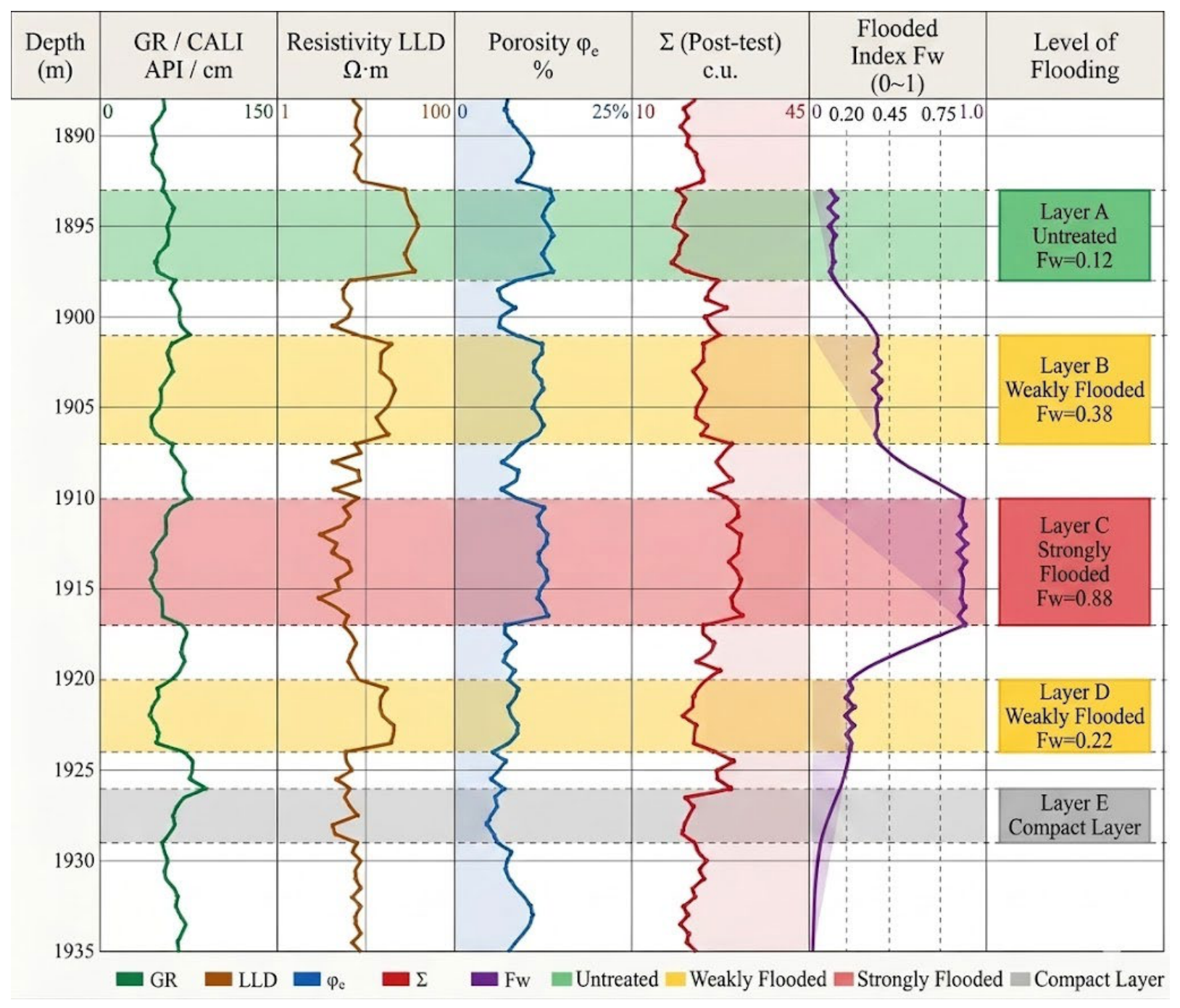
The spatial flooding index Fw was calculated for all sampling points in the target interval of Well X using Equations (7) and (8), generating a continuous Fw curve (
Figure 7). The integrated interpretation results are as follows:
- (1)
Interval A (depth 1893–1898 m): φe = 13.2%, log IR = 1.75, Σ = 19.1 c.u., Fw = 0.12. Interpretation: Non-flooded oil layer. Subsequent production test: the oil production is 42 m3/d, and the water content is 5.8%, which is very consistent.
- (2)
Layer B (depth 1901–1907 m):
φe = 11.8%, log I
R = 1.63, Σ = 23.4 c.u., Fw = 0.38. According to the revised classification criteria in
Table 2, an Fw value of 0.38 falls within the weakly flooded range (0.20 < Fw ≤ 0.40). This layer appeared as a “suspected water layer” on the traditional two-dimensional Σ-
φ crossplot. The proposed method correctly identified it as weakly flooded by combining the relatively high log I
R value (indicating good original oil-bearing character) with the elevated Σ. The subsequent production test yielded a water-cut of 62% from the commingled perforated interval (which includes Layer C with 96.5% water-cut). It should be noted that the production water-cut is a bulk measurement from the entire interval, whereas Fw = 0.38 represents the in situ flooding degree of the 6 m thick Layer B alone. When the interval is produced selectively, the actual water-cut from Layer B alone is estimated to be approximately 35–40%, which is consistent with the weakly flooded classification indicated by Fw = 0.38.
- (3)
Layer C (depth 1910~1917 m): φe = 12.5%, log IR = 0.31, ∑ = 30.8 c.u., Fw = 0.88, the identification conclusion is a strong water-flooded layer. Subsequent liquid production test: The water content is 96.5%—that is basically a water layer, which is consistent with the judgment of strong flooding with Fw > 0.75.
The interpretation results for all intervals in Well X are summarized in
Table 3.
4.2. Multi-Well Block Application and Statistical Validation
The proposed method was extended to 16 cased-hole log wells in the Wuliyawan Block of the study area. Interpretation results were cross-validated with production test water-cut, fluid production profiles, and closed-off core oil saturation in a multi-dimensional manner (
Table 4).
Statistical results show that of 118 intervals interpreted across the 16 wells, 107 were fully consistent with production test or production dynamic conclusions, yielding an overall interpretation match rate of 90.7%. Compared with the block’s previous traditional method (2D Σ-φ template), the match rate improved by approximately 9.5 percentage points (traditional method: 81.2%). The improvement was most pronounced for weakly flooded layers, where the 3D method’s accuracy (88.5%) surpassed the 2D method (68.3%) by approximately 20 percentage points, fully validating the key contribution of incorporating the original oil-bearing character Y-axis (log IR) to weakly flooded layer identification.
4.3. Statistical Evaluation of Classification Performance
To quantitatively evaluate the classification performance of the proposed dynamic–static integration method, a rigorous statistical analysis was conducted on the 118 intervals from 16 wells. The reference standard for true water-flooded levels was established based on production test water-cut, fluid production profiles, and sealed core oil saturation data. The following metrics were calculated: confusion matrix, class-wise precision, recall, F1-score, overall accuracy, Cohen’s kappa coefficient, 95% confidence intervals, and a statistical significance test comparing the proposed method against the conventional 2D Σ-φ crossplot approach.
4.3.1. Confusion Matrix and Class-Wise Performance
Table 5 presents the confusion matrix for the proposed method across the 118 intervals. The overall accuracy was 90.7% (107 out of 118). The kappa coefficient [
24,
25], which measures inter-rater agreement beyond chance, was 0.86, indicating “almost perfect” agreement.
From
Table 5, the class-wise F1-scores were computed as the harmonic mean of precision and recall: non-flooded (92.0%), weakly flooded (84.9%), and moderately/strongly flooded (94.0%). The relatively lower F1-score for weakly flooded layers (84.9%) is attributable to their transitional position in the feature space between non-flooded and strongly flooded end-members, leading to minor classification ambiguity.
4.3.2. Comparison with the Conventional 2D Method
For direct comparison, the conventional 2D Σ-φ crossplot method was applied to the same 118 intervals. Its confusion matrix is shown in
Table 6, yielding an overall accuracy of 81.4% (96/118) and a kappa coefficient of 0.71 (substantial agreement). Notably, the F1-score for weakly flooded layers using the 2D method was only 64.7% (precision: 61.1%, recall: 68.8%), representing an improvement of 20.2 percentage points by the proposed method.
4.3.3. Confidence Intervals and Statistical Significance
Exact 95% confidence intervals (CIs) for overall accuracy were calculated using the Clopper-Pearson method. The proposed method achieved an overall accuracy of 90.7% (95% CI: 83.8–95.3%), whereas the 2D method yielded 81.4% (95% CI: 73.1–88.0%). The non-overlapping CIs provide initial evidence of superior performance.
To formally test whether the observed improvement was statistically significant, McNemar’s test for paired nominal data was employed. The test was applied to the 118 paired predictions (proposed vs. 2D method) with respect to the ground-truth labels. The calculated chi-square statistic was 7.56 with 1 degree of freedom, corresponding to a p-value of 0.0060 (<0.01). The null hypothesis—that the two methods have equal classification accuracy—was therefore rejected. This result confirms that the proposed method achieves a statistically significant improvement over the conventional 2D approach at the 99% confidence level.
5. Discussion
5.1. Method Advantages and Innovation Analysis
- (1)
Expanded information dimensionality and improved data separability: The 3D method effectively separates data points that heavily overlap in a 2D plane by introducing a third dimension (the original oil-bearing character Y-axis). From an information-theory perspective, the information entropy of the 3D parameter system (approximately 1.85 bits) is significantly higher than that of the 2D method (approximately 1.12 bits), theoretically providing stronger fluid classification capability. Statistical results confirm that the identification accuracy for weakly flooded layers increased from 68% to 89%, demonstrating that the expansion of information dimensionality brings a substantial improvement in identification precision.
- (2)
Organic coupling of dynamic and static data: The essence of this method is the establishment of a mathematical framework that organically links the “past” (open-hole data) and the “present” (cased-hole data). The open-hole resistivity index log IR provides a reliable “scale” for the original oil-bearing state of the reservoir, making it possible to precisely identify weakly flooded layers (originally highly oil-bearing, currently slightly water-bearing)—the type of reservoir most difficult to distinguish using methods relying solely on cased-hole data, but clearly identifiable in this method due to the constraint of the Y-axis information.
- (3)
Strong physical interpretability: The flooding index Fw has a clear geometric–physical meaning (the relative position of a data point along the oil–water evolution path), and there is a direct physical relationship between its value range, trend of change, and the degree of reservoir flooding. It is easy to communicate with geological and reservoir engineering personnel, and the method’s credibility and acceptability are higher than those of “black-box” machine learning methods.
5.2. Applicability Conditions and Limitations
The optimal applicability conditions for this method are: (1) the reservoir offers good open-hole log data, especially high-quality resistivity and porosity log data; (2) the same well has both open-hole logs and cased-hole pulsed neutron logs, or adjacent areas have comparable parameter relationships; (3) formation water salinity is relatively stable (high-salinity areas prefer Σ, low-salinity areas prefer C/O); (4) the reservoir genetic type and petrophysical characteristics are relatively uniform, or after sub-region processing, sub-regions with relatively uniform characteristics are obtained.
The main limitations of the method are as follows: (1) It relies on high-quality open-hole resistivity data, and if the original open-hole log data are missing or of poor quality, the Y-axis baseline is difficult to establish reliably. (2) In areas with strong lateral variation in formation water salinity, the determination of the Σ reference plane introduces significant uncertainty. (3) The method requires careful treatment when applied to primary oil–water transition zones—intervals that originally contained irreducible water or were positioned within the capillary transition zone above the free water level. In such intervals, the open-hole resistivity index log IR is inherently lower than that of a pure oil zone, even before any water flooding has occurred, because the original water saturation Swi is non-negligible. If the standard Poil reference point (calibrated on intervals with So > 70%) is applied without correction, transition-zone intervals will be systematically projected closer to Pwater along the oil–water evolution baseline, yielding an overestimated Fw value and a false identification of flooding. To address this limitation, two complementary approaches are recommended. The first is a Swi-aware reference point correction: for transition-zone intervals, the effective Poil is replaced by a modified reference point P′oil that accounts for the known initial water saturation, computed as P′oil(logIR) = log(Rt/(φem·Rw·Swi(−n)), where Swi is estimated from capillary pressure curves or the original open-hole water saturation interpretation. This shifts the oil-end reference to the actual initial state of the transition-zone interval rather than the idealized pure-oil end-member. The second approach is a two-stage classification model: in Stage 1, intervals are screened by their open-hole-derived initial oil saturation Soi; those with Soi < 50% are flagged as primary transition-zone or water-zone intervals and excluded from the standard Fw calculation. In Stage 2, the standard 3D crossplot and Fw model are applied only to intervals with Soi ≥ 50%, for which the pure-oil baseline is physically meaningful. It is acknowledged that reliable implementation of either approach requires high-quality open-hole saturation data and capillary pressure information, which may not always be available. In the present study area (Chang 6 reservoir), the reservoirs are predominantly channel-sand bodies with well-defined oil–water contacts and Swi generally below 35%, such that the primary transition zone represents a minor fraction of the interpreted intervals and does not materially affect the overall results. Nevertheless, users applying this method to reservoirs with extensive bottom water or thick capillary transition zones—such as carbonate reservoirs or low-relief structural traps—are advised to implement the Swi-aware correction or the two-stage screening described above before constructing the 3D crossplot; (4) the determination of reference points requires reliable reference intervals, which present some difficulty in newly developed blocks without comprehensive production dynamic data. (5) The validity of the Fw projection model is restricted to points whose orthogonal projection onto the oil–water baseline lies between Poil and Pwater. For points projecting outside this segment (t < 0 or t > L), the clamped Fw values represent extrapolation and should be cross-checked with auxiliary parameters such as φe and lithology indicators. (6) The weighting coefficients w1, w2, and w3 in the distance model (Equation (9)) are calibrated for the specific petrophysical and fluid conditions of the Chang 6 reservoir (high formation water salinity, low-to-medium-permeability sandstone, and relatively uniform mineralogy) and are not universally transferable. Sensitivity analysis shows that the Fw classification is most sensitive to w3 (the Σ-axis weight), which is physically tied to the salinity-dependent Σ contrast between oil and water. Users applying this method to reservoirs with substantially different salinity, lithology, or porosity structure are strongly advised to recalibrate the weights using local calibration wells before deployment.
5.3. Comparison with Machine Learning Methods
In recent years, flooded layer identification methods based on machine learning algorithms such as support vector machines (SVMs), random forests (RFs), and deep neural networks (DNNs) have attracted widespread attention [
26,
27]. By comparison, the 3D dynamic–static method proposed in this paper has the following characteristics: strong physical interpretability, no dependence on large numbers of labeled samples, intuitive parameter adjustment when transferring across blocks, and direct usability by log interpretation specialists. However, machine learning methods with sufficient training data often achieve higher overall accuracy under complex conditions and can automatically discover implicit features in high-dimensional data.
The two approaches have strong complementarity: the proposed method can be used as part of the feature engineering for machine learning, with the flooding index Fw as a physically meaningful feature input into classification models, potentially improving both interpretability and accuracy simultaneously [
28]. Additionally, the 3D reference templates constructed by this method can provide quality control and initial labels for machine learning training samples, reducing uncertainty in manual annotation.
It should be noted, however, that the proposed 3D dynamic–static method is not immune to ambiguity arising from variations in mineral composition and formation water salinity, and these sources of uncertainty deserve explicit discussion.
Regarding mineralogical variation, the X-axis parameter (effective porosity
φe) is derived from the neutron-density crossplot with a clay correction based on the GR curve (Equation (3)). In reservoirs with complex mineralogy—such as those containing significant quantities of chlorite, siderite, or volcanic rock fragments—the standard neutron-density crossplot may systematically overestimate or underestimate φe, introducing bias into the 3D coordinate and potentially displacing data points from their true fluid-type zones. Similarly, the Z-axis parameter Σ is sensitive not only to fluid chlorine content but also to the capture cross-sections of certain minerals (e.g., boron-bearing clay, iron-rich minerals), which could elevate the apparent Σ value independently of water saturation. In the study area (Chang 6 reservoir, Ordos Basin), the mineralogy is dominated by quartz, feldspar, and chlorite cement with relatively stable matrix capture cross-section (Σ
ma ≈ 8–9 c.u.), and elemental capture spectroscopy (ECS/HFCS) data (
Section 2.2) were used to verify that no anomalous high-capture minerals were present in the interpreted intervals. When applying this method to reservoirs with more complex or variable mineralogy, it is recommended that ECS-derived mineral fractions be incorporated to correct the apparent Σ for matrix contributions before constructing the 3D crossplot, thereby isolating the fluid signal.
Regarding formation water salinity variation, the method’s sensitivity depends critically on which Z-axis parameter is selected. As stated in
Section 3.2.3, Σ is the preferred Z-axis indicator when formation water salinity is high and relatively uniform (>50,000 ppm), because the contrast between oil-bearing and water-bearing zones in Σ space is large and stable. In the present study area, the original formation water salinity is approximately 80,000 ppm, satisfying this condition. However, in fields where salinity varies laterally or has been diluted by injection water, the Σ contrast diminishes, and data points from different flooding levels may converge in the Z-axis direction, degrading classification accuracy. In such cases, the C/O ratio should replace Σ as the Z-axis parameter, since C/O is salinity-independent by principle (
Section 2.2). Where salinity varies gradually across the study area, a salinity-zonation approach is recommended: the block is subdivided into sub-regions of approximately uniform salinity, with separate Pwater reference points calibrated for each sub-region. It is acknowledged that this requires additional produced-water chemistry data, which may not always be available in mature fields undergoing active waterflooding. This remains a practical limitation of the method, and developing a salinity-adaptive Σ correction workflow integrated into the 3D framework is identified as a direction for future work.
5.4. Comparison with Prior Multi-Dimensional Crossplot and PCA Approaches
Multi-parameter crossplots and principal component analysis (PCA) have previously been applied to well log interpretation [
14,
15]. However, these approaches differ from the proposed method in two fundamental respects.
First, existing multi-dimensional crossplot methods operate on a single logging dataset—either open-hole or cased-hole—without coupling data from different time epochs. The core innovation of the proposed method is its deliberate integration of open-hole static data (representing the original reservoir state via log IR) with cased-hole dynamic data (representing the current fluid state via Σ or C/O) within a unified three-dimensional coordinate system. This temporal coupling, combined with physically calibrated reference points (Poil, Pwater) and an oil–water evolution baseline, has not been previously formulated for cased-hole flooding evaluation.
Second, PCA produces principal components that are linear combinations of all input variables determined by data variance rather than physical mechanism, and therefore lack direct geological interpretability. The proposed method, by contrast, fixes each axis on a physical first principle—reservoir storage capacity (φe), original oil-bearing state (log IR), and current fluid state (Σ)—ensuring that the resulting flooding index Fw carries a clear geometric and physical meaning that can be directly communicated to geologists and reservoir engineers. These distinctions confirm that the proposed method is not a re-parameterization of existing approaches, but a physically grounded framework specifically designed for the dynamic–static integration problem in cased-hole flooding evaluation.
6. Conclusions
Targeting the three major technical bottlenecks—“dynamic–static disconnection, insufficient dimensionality, and missing baseline”—in cased-hole log flooded layer identification for complex medium-to-low-permeability reservoirs, this paper constructs a 3D feature parameter system using effective porosity (φe), the logarithm of the original resistivity index (log IR), and the cased-hole capture cross-section (Σ) as coordinate axes. This achieves the collaborative expression of reservoir physical properties, original oil-bearing state, and current fluid state using multi-source information, breaking through the information dimensionality limitation of traditional 2D methods. On this basis, a spatial flooding index (Fw) quantitative calculation model based on the oil–water evolution baseline is proposed. By using the spatial distance ratios of data points relative to the pure oil and pure water reference planes, continuous quantitative characterization of the flooding degree is achieved, with thresholds dynamically calibrated using production dynamic data. Large-scale application in 16 cased-hole log wells of a low-permeability oil field demonstrates that the overall interpretation match rate reaches 90.7%, an improvement of approximately 9.5 percentage points over the traditional 2D method; the identification accuracy for weakly flooded layers improved by as much as 20 percentage points, fully validating the core contribution of incorporating the open-hole original oil-bearing baseline (the log IR axis) to weakly flooded layer identification. Furthermore, the 3D method inherently supports interactive rotational visualization, balancing scientific rigor with practical operability, and can complement machine learning methods effectively, indicating excellent prospects for widespread application.




 ,
,