CoDC: Unified Diffusion and Classification for Enhanced Class-Incremental Learning

Featured Application
Abstract
1. Introduction
- RQ1: Can a single diffusion model support both old class image generation and discriminative classification for class-incremental learning?
- RQ2: How can the classifier use noisy diffusion samples without learning noise-contaminated features?
- RQ3: Can generated samples replace real exemplar storage under a strict zero memory protocol?
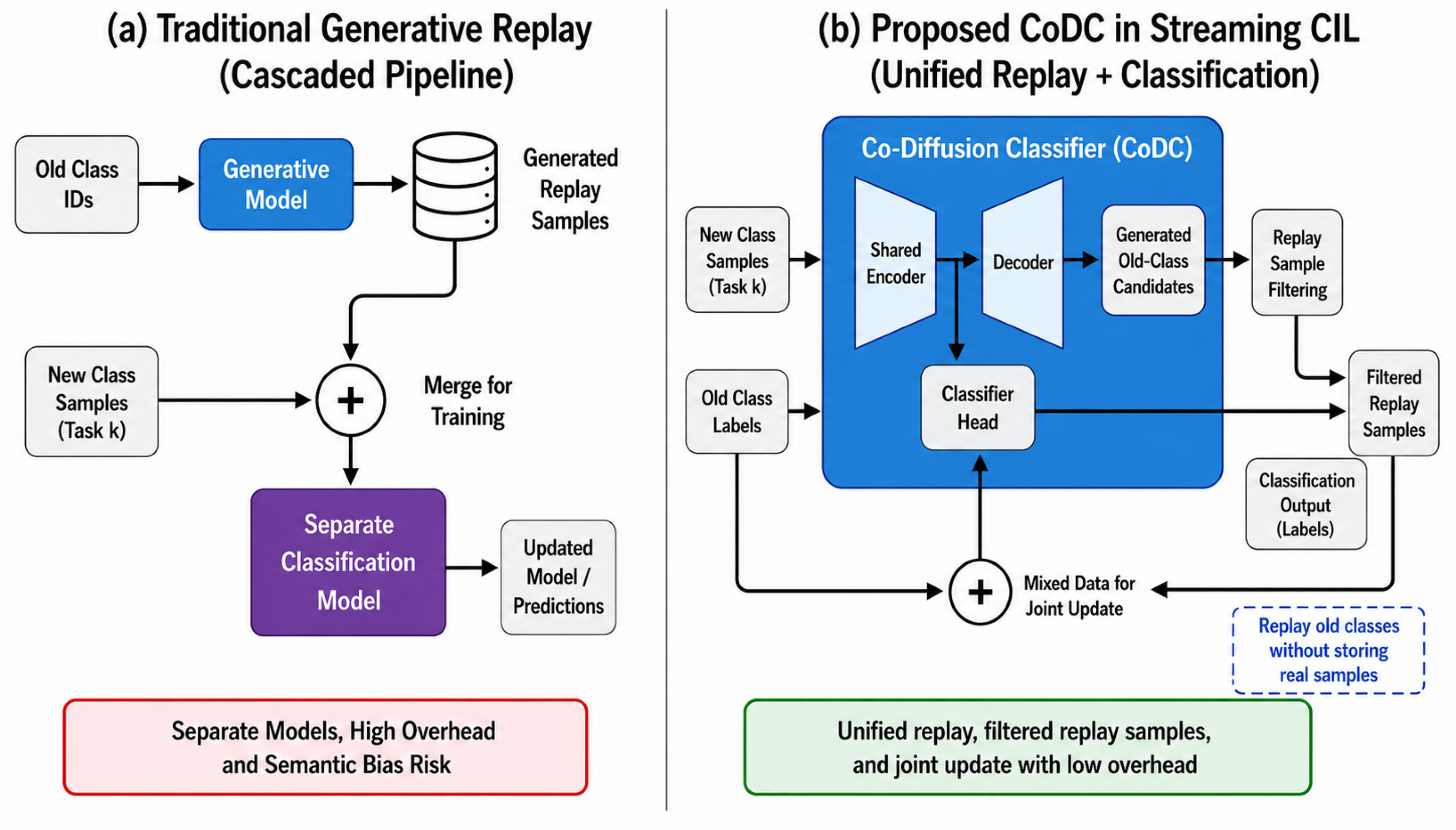
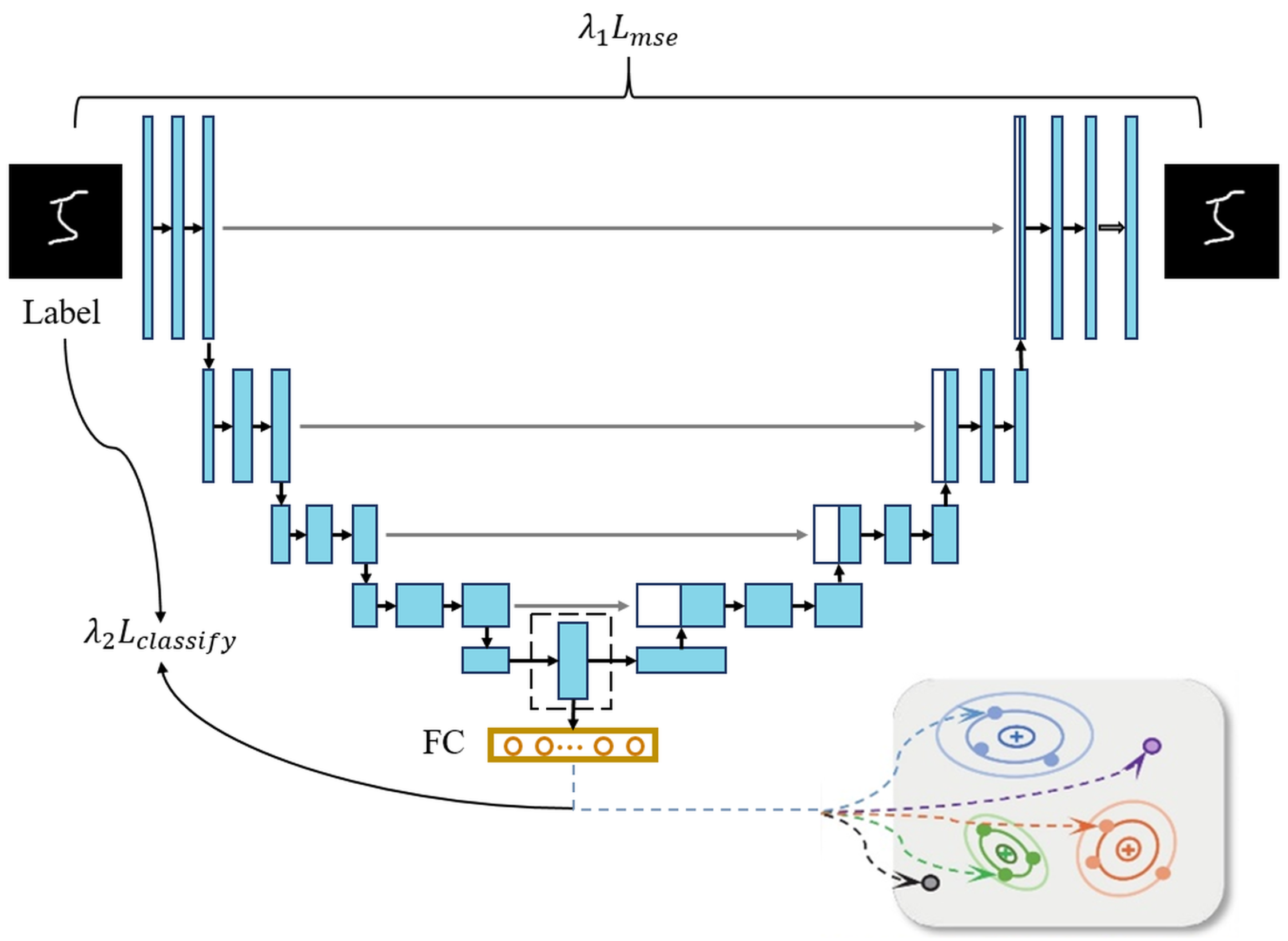
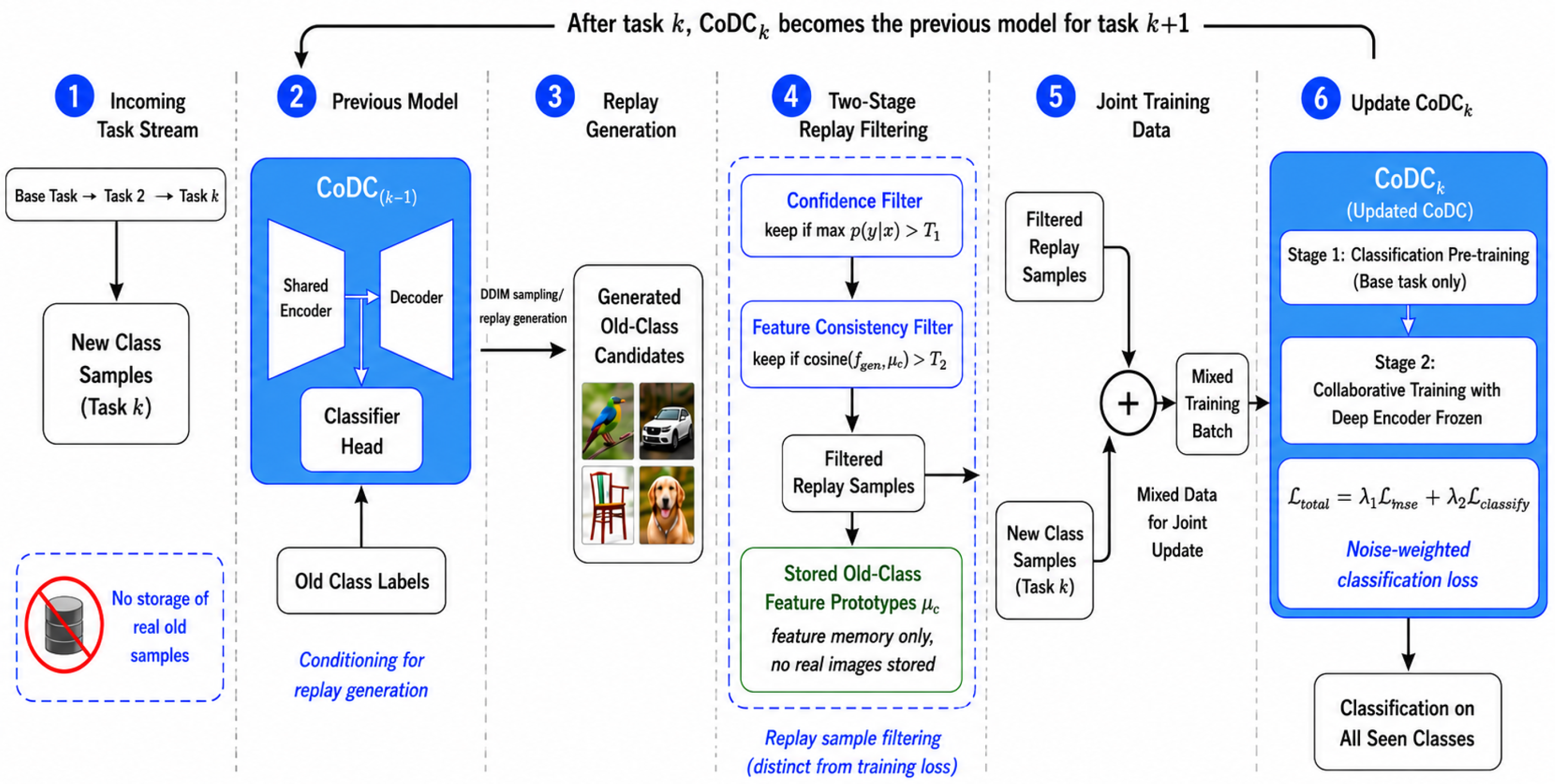
- We propose CoDC, a unified diffusion-classification architecture that attaches a classification branch to the UNet encoder and performs generation and classification within one network.
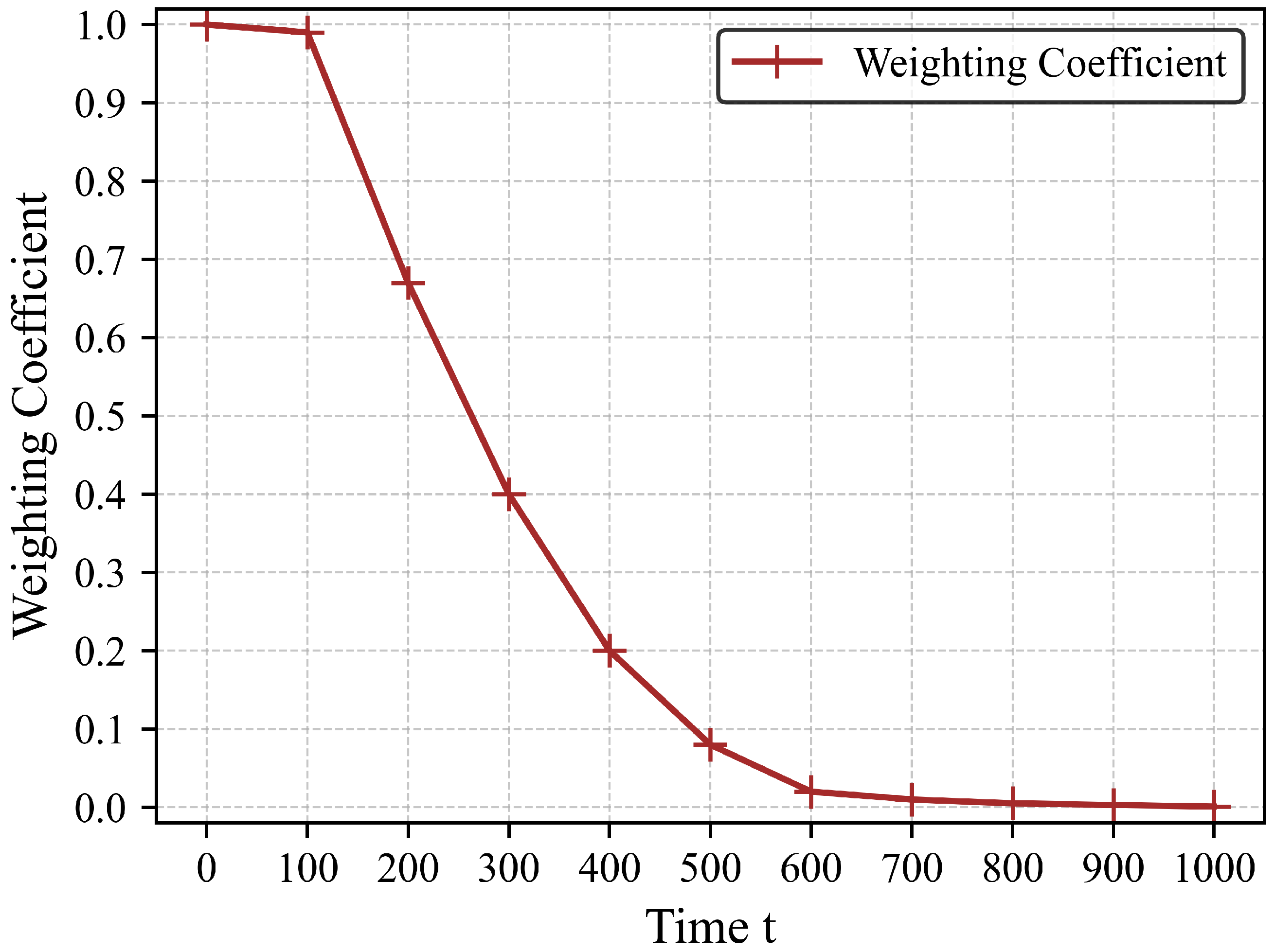
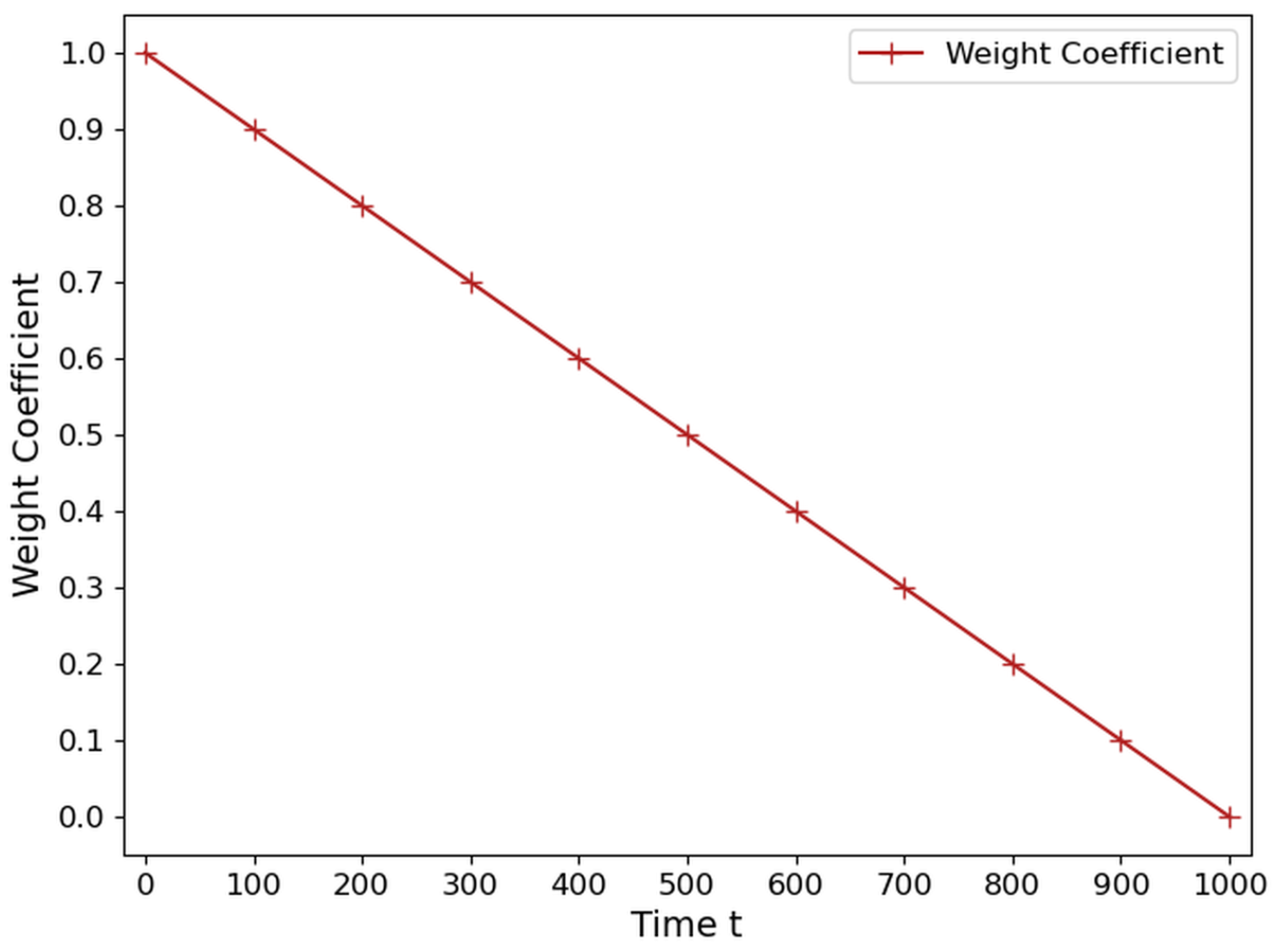
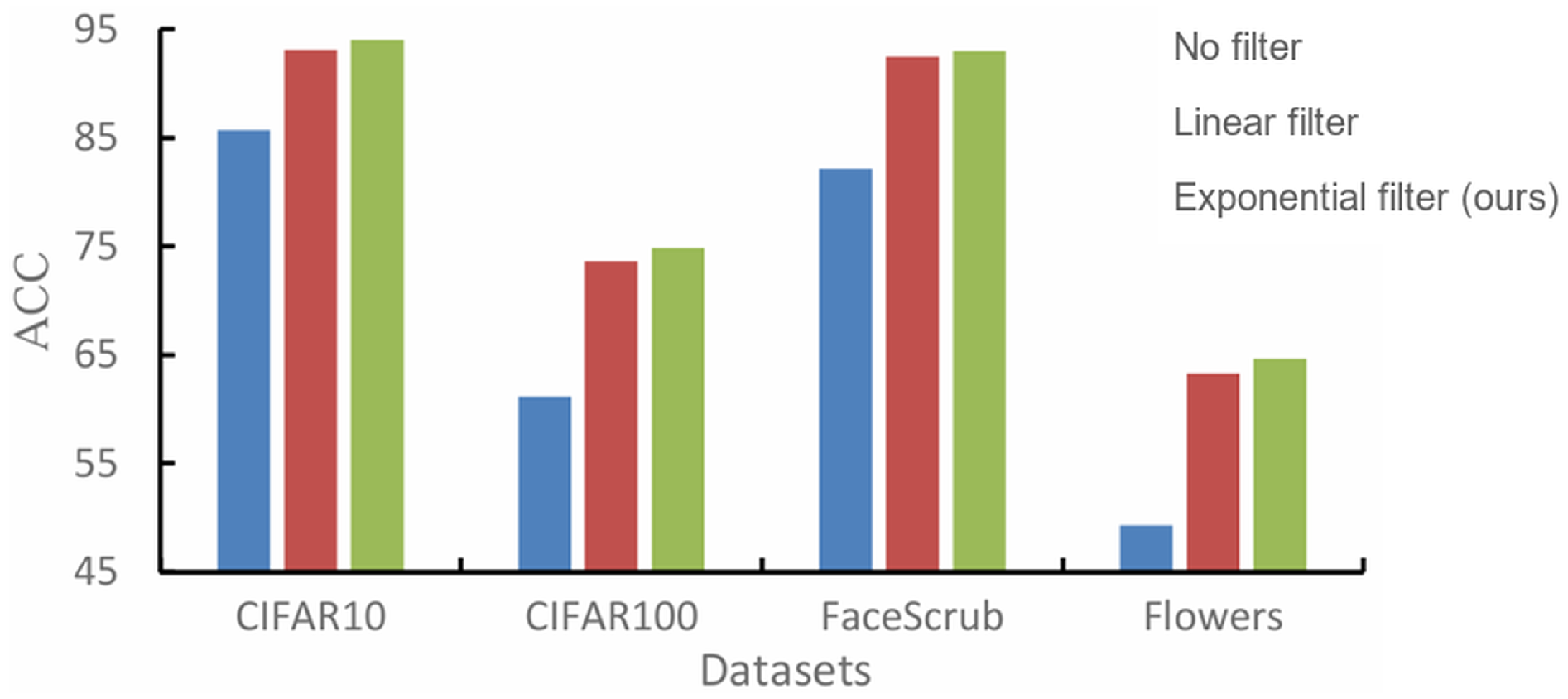
- We design an exponential noise filtering mechanism that weights the classification loss according to the diffusion timestep, reducing the impact of highly noisy samples.
- We introduce a base task classification pre-training stage followed by collaborative training with parameter freezing to reduce conflicts between noise prediction and semantic feature extraction.
- We develop a rehearsal-free generative replay procedure that selects generated old class samples using confidence and feature consistency before combining them with current new class data.
- We report comparisons under both strict zero memory and mixed memory protocols to clarify when CoDC is directly comparable with existing baselines.
2. Related Work
2.1. Class-Incremental Learning
2.2. Diffusion Models
2.3. POD Loss Function
3. Materials and Methods
3.1. Collaborative Generation and Classification Architecture
3.2. Noise Filtering Mechanism
3.3. Two-Step Training with Parameter Freezing
3.4. Rehearsal-Free Generative Replay
3.5. Experimental Protocol
- Incremental Accuracy (A): The average classification accuracy across all incremental tasks at the end of the entire learning process. Given K tasks, let be the accuracy on all seen classes after task k. The final average accuracy is:
- Average Forgetting (F): This metric quantifies the model’s ability to retain knowledge of previously learned classes. For any task , the degree of forgetting for task i after completing task k, , is the difference between the highest accuracy ever achieved for task i and the current accuracy: , where is the accuracy on task n after learning task m. The average incremental forgetting rate across the entire process is:
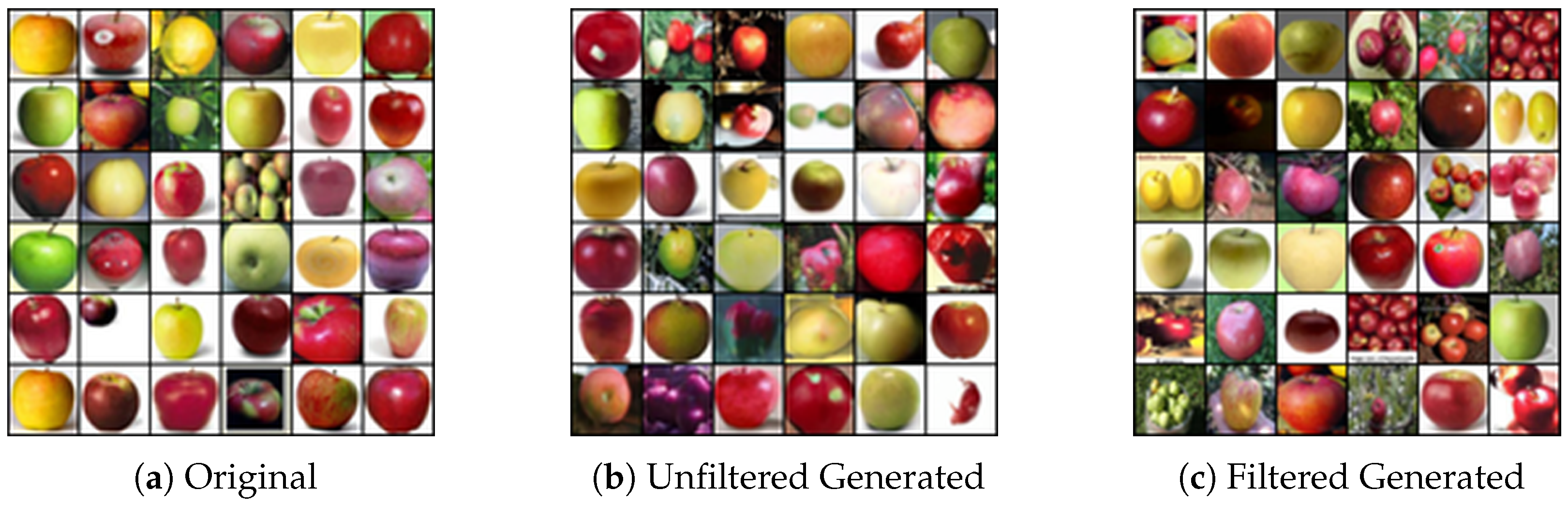
- Fréchet Inception Distance (FID) [40]: A common method for evaluating the quality of generated images. A lower FID score indicates higher quality.
4. Results
4.1. Analysis of the Collaborative Network
4.2. Comparison with Existing Methods
4.3. Data Augmentation with Generated Images
4.4. Ablation Studies
5. Discussion
6. Conclusions
Author Contributions
Funding
Institutional Review Board Statement
Informed Consent Statement
Data Availability Statement
Acknowledgments
Conflicts of Interest
Abbreviations
| CIL | Class-Incremental Learning |
| CoDC | Co-Diffusion Classifier |
| CUDA | Compute Unified Device Architecture |
| DDIM | Denoising Diffusion Implicit Models |
| DER | Dynamically Expandable Representation |
| GR | Generative Replay |
| FID | Fréchet Inception Distance |
| GAN | Generative Adversarial Network |
| GPU | Graphics Processing Unit |
| MSE | Mean Squared Error |
| PTM | Pre-Trained Model |
| UNet | U-shaped Network |
References
- Gomes, H.M.; Barddal, J.P.; Enembreck, F.; Bifet, A. A Survey on Ensemble Learning for Data Stream Classification. ACM Comput. Surv. 2017, 50, 1–36. [Google Scholar] [CrossRef] [Scilit]
- Krempl, G.; Žliobaite, I.; Brzeziński, D.; Hüllermeier, E.; Last, M.; Lemaire, V.; Stefanowski, J. Open challenges for data stream mining research. ACM SIGKDD Explor. Newsl. 2014, 166, 1–10. [Google Scholar] [CrossRef] [Scilit]
- Delange, M.; Aljundi, R.; Masana, M.; Parisot, S.; Jia, X.; Leonardis, A.; Slabaugh, G.; Tuytelaars, T. A continual learning survey: Defying forgetting in classification tasks. IEEE Trans. Pattern Anal. Mach. Intell. 2021, 44, 3366–3385. [Google Scholar] [CrossRef] [Scilit] [PubMed]
- Zhu, F.; Zhang, X.Y.; Liu, C.L. Survey and performance evaluation of class-incremental learning. Acta Autom. Sin. 2023, 49, 635–660. [Google Scholar]
- Masana, M.; Liu, X.; Twardowski, B.; Menta, M.; Bagdanov, A.D.; van de Weijer, J. Class-incremental learning: Survey and performance evaluation on image classification. IEEE Trans. Pattern Anal. Mach. Intell. 2023, 45, 5513–5533. [Google Scholar] [CrossRef] [Scilit] [PubMed]
- Wang, L.; Zhang, X.; Su, H.; Zhu, J. A comprehensive survey of continual learning: Theory, method and application. IEEE Trans. Pattern Anal. Mach. Intell. 2024, 46, 5362–5383. [Google Scholar] [CrossRef] [Scilit] [PubMed]
- van de Ven, G.M.; Tuytelaars, T.; Tolias, A.S. Three types of incremental learning. Nat. Mach. Intell. 2022, 4, 1185–1197. [Google Scholar] [CrossRef] [Scilit] [PubMed]
- McCloskey, M.; Cohen, N.J. Catastrophic interference in connectionist networks: The sequential learning problem. In Psychology of Learning and Motivation; Academic Press: New York, NY, USA, 1989; pp. 109–165. [Google Scholar]
- Parisi, G.I.; Kemker, R.; Part, J.L.; Kanan, C.; Wermter, S. Continual lifelong learning with neural networks: A review. Neural Netw. 2019, 113, 54–71. [Google Scholar] [CrossRef] [Scilit] [PubMed]
- Kirkpatrick, J.; Pascanu, R.; Rabinowitz, N.; Veness, J.; Desjardins, G.; Rusu, A.A.; Milan, K.; Quan, J.; Ramalho, T.; Grabska-Barwinska, A.; et al. Overcoming catastrophic forgetting in neural networks. Proc. Natl. Acad. Sci. USA 2017, 114, 3521–3526. [Google Scholar] [CrossRef] [Scilit] [PubMed]
- Li, Z.; Hoiem, D. Learning without forgetting. IEEE Trans. Pattern Anal. Mach. Intell. 2018, 40, 2935–2947. [Google Scholar] [CrossRef] [Scilit] [PubMed]
- Hayes, T.L.; Krishnan, G.P.; Bazhenov, M.; Siegelmann, H.T.; Sejnowski, T.J.; Kanan, C. Replay in deep learning: Current approaches and missing biological elements. Neural Comput. 2021, 33, 2908–2950. [Google Scholar] [CrossRef] [Scilit] [PubMed]
- Graffieti, L.; Maltoni, D.; Pellegrini, D.; Lomonaco, V. Generative negative replay for continual learning. Neural Netw. 2023, 162, 369–383. [Google Scholar] [CrossRef] [Scilit] [PubMed]
- Hinton, G.; Vinyals, O.; Dean, J. Distilling the knowledge in a neural network. arXiv 2015, arXiv:1503.02531. [Google Scholar] [CrossRef] [Scilit]
- Rebuffi, S.-A.; Kolesnikov, A.; Sperl, G.; Lampert, C.H. iCaRL: Incremental classifier and representation learning. In Proceedings of the IEEE/CVF Conference on Computer Vision and Pattern Recognition (CVPR), Honolulu, HI, USA, 21–26 July 2017; pp. 2001–2010. [Google Scholar]
- Rios, A.; Itti, L. Closed-loop memory GAN for continual learning. In Proceedings of the 28th International Joint Conference on Artificial Intelligence (IJCAI), Macao, China, 10–16 August 2019; pp. 3332–3338. [Google Scholar]
- Ven, G.M.v.; Siegelmann, H.T.; Tolias, A.S. Brain-inspired replay for continual learning with artificial neural networks. Nat. Commun. 2020, 11, 4069. [Google Scholar] [CrossRef] [Scilit] [PubMed]
- Meng, Z.; Zhang, J.; Yang, C.; Zhan, Z.; Zhao, P.; Wang, Y. Diffclass: Diffusion-based class incremental learning. In Proceedings of the European Conference on Computer Vision (ECCV), Milan, Italy, 29 September–4 October 2024; pp. 142–159. [Google Scholar]
- Jodelet, Q.; Liu, X.; Phua, Y.J.; Murata, T. Class-incremental learning using diffusion model for distillation and replay. In Proceedings of the IEEE/CVF International Conference on Computer Vision (ICCV), Paris, France, 2–3 October 2023; pp. 3425–3433. [Google Scholar]
- Yan, S.; Xie, J.; He, X. DER: Dynamically expandable representation for class incremental learning. In Proceedings of the IEEE/CVF Conference on Computer Vision and Pattern Recognition (CVPR), Virtual, 19–25 June 2021; pp. 3014–3023. [Google Scholar]
- Petit, G.; Popescu, A.; Schindler, H.; Picard, D.; Delezoide, B. FeTrIL: Feature translation for exemplar-free class-incremental learning. In Proceedings of the IEEE/CVF Winter Conference on Applications of Computer Vision (WACV), Waikoloa, HI, USA, 3–7 January 2023; pp. 3911–3920. [Google Scholar]
- Rypeść, G.; Cygert, S.; Khan, V.; Trzciński, T.; Zieliński, B.; Twardowski, B. Divide and not forget: Ensemble of selectively trained experts in Continual Learning. In Proceedings of the International Conference on Learning Representations (ICLR), Vienna, Austria, 7–11 May 2024. [Google Scholar]
- He, R.; Fang, D.; Xu, Y.; Cui, Y.; Li, M.; Chen, C.; Zeng, Z.; Zhuang, H. Semantic shift estimation via dual-projection and classifier reconstruction for exemplar-free class-incremental learning. In Proceedings of the 42nd International Conference on Machine Learning (ICML), PMLR, Vancouver, BC, Canada, 13–19 July 2025; Volume 267, pp. 22392–22406. [Google Scholar]
- Abbasnejad, E.; Gong, D.; McDonnell, M.D.; Parvaneh, A.; Hengel, A.V.D. RanPAC: Random projections and pre-trained models for continual learning. In Proceedings of the Advances in Neural Information Processing Systems (NeurIPS), New Orleans, LA, USA, 10–16 December 2023; Volume 36. [Google Scholar]
- Zhou, D.-W.; Zhang, Y.; Ye, H.-J.; Zhan, D.-C.; Liu, Z. Expandable subspace ensemble for pre-trained model-based class-incremental learning. In Proceedings of the IEEE/CVF Conference on Computer Vision and Pattern Recognition (CVPR), Seattle, WA, USA, 16–22 June 2024. [Google Scholar]
- Wang, Y.; Zhou, D.W.; Ye, H.J. Integrating task-specific and universal adapters for pre-trained model-based class-incremental learning. In Proceedings of the IEEE/CVF International Conference on Computer Vision (ICCV), Honolulu, HI, USA, 19–23 October 2025. [Google Scholar]
- Qiu, H.; Zhang, M.; Qiao, Z.; Guan, W.; Zhang, M.; Nie, L. SplitLoRA: Balancing stability and plasticity in continual learning through gradient space splitting. In Proceedings of the International Conference on Learning Representations (ICLR), Rio de Janeiro, Brazil, 27–28 August 2026. [Google Scholar]
- Ho, J.; Jain, A.; Abbeel, P. Denoising diffusion probabilistic models. In Proceedings of the Advances in Neural Information Processing Systems (NeurIPS), Virtual, 6–12 December 2020; pp. 6840–6851. [Google Scholar]
- Croitoru, F.-A.; Hondru, V.; Ionescu, R.T.; Shah, M. Diffusion models in vision: A survey. IEEE Trans. Pattern Anal. Mach. Intell. 2023, 45, 10850–10869. [Google Scholar] [CrossRef] [Scilit] [PubMed]
- Yang, L.; Zhang, Z.; Song, Y.; Hong, S.; Xu, R.; Zhao, Y.; Zhang, W.; Cui, B.; Yang, M.-H. Diffusion models: A comprehensive survey of methods and applications. ACM Comput. Surv. 2023, 56, 1–39. [Google Scholar] [CrossRef] [Scilit]
- Ronneberger, O.; Fischer, P.; Brox, T. U-net: Convolutional networks for biomedical image segmentation. In Proceedings of the Medical Image Computing and Computer-Assisted Intervention (MICCAI), Munich, Germany, 5–9 October 2015; pp. 234–241. [Google Scholar]
- Song, J.; Meng, C.; Ermon, S. Denoising diffusion implicit models. arXiv 2020, arXiv:2010.02502. [Google Scholar]
- Rombach, R.; Blattmann, A.; Lorenz, D.; Esser, P.; Ommer, B. High-resolution image synthesis with latent diffusion models. In Proceedings of the IEEE/CVF Conference on Computer Vision and Pattern Recognition (CVPR), New Orleans, LA, USA, 18–24 June 2022; pp. 10684–10695. [Google Scholar]
- Schneider, F. Archisound: Audio generation with diffusion. arXiv 2023, arXiv:2301.13267. [Google Scholar] [CrossRef] [Scilit]
- Poole, B.; Jain, A.; Barron, J.T.; Mildenhall, B. Dreamfusion: Text-to-3d using 2d diffusion. arXiv 2022, arXiv:2209.14988. [Google Scholar]
- Zhu, Q.; Zu, X. A softmax-free loss function based on predefined optimal-distribution of latent features for deep learning classifier. IEEE Trans. Circuits Syst. Video Technol. 2022, 33, 1386–1397. [Google Scholar] [CrossRef] [Scilit]
- Krizhevsky, A.; Hinton, G. Learning Multiple Layers of Features from Tiny Images; Technical Report; University of Toronto: Toronto, ON, Canada, 2009. [Google Scholar]
- Ng, H.W.; Winkler, S. A data-driven approach to cleaning large face datasets. In Proceedings of the 2014 IEEE International Conference on Image Processing (ICIP), Paris, France, 27–30 October 2014; pp. 343–347. [Google Scholar]
- Nilsback, M.E.; Zisserman, A. Automated flowers classification over a large number of classes. In Proceedings of the Sixth Indian Conference on Computer Vision, Graphics and Image Processing (ICVGIP), Bhubaneswar, India, 16–19 December 2008; pp. 722–729. [Google Scholar]
- Heusel, M.; Ramsauer, H.; Unterthiner, T.; Nessler, B.; Hochreiter, S. GANs trained by a two time-scale update rule converge to a local nash equilibrium. In Proceedings of the Advances in Neural Information Processing Systems (NeurIPS), Long Beach, CA, USA, 4–9 December 2017. [Google Scholar]
- Wang, F.-Y.; Zhou, D.-W.; Ye, H.-J.; Zhan, D.-C. Foster: Feature boosting and compression for class-incremental learning. In Proceedings of the European Conference on Computer Vision (ECCV), Tel Aviv, Israel, 23–27 October 2022; pp. 398–414. [Google Scholar]
- Zhou, D.W.; Wang, Q.W.; Ye, H.J.; Zhan, D.C. A model or 603 exemplars: Towards memory-efficient class-incremental learning. In Proceedings of the International Conference on Learning Representations (ICLR), Virtually, 1–5 May 2023. [Google Scholar]
- Zhu, K.; Zhai, W.; Cao, Y.; Luo, J.; Zha, Z.-J. Self-sustaining representation expansion for non-exemplar class-incremental learning. In Proceedings of the IEEE/CVF Conference on Computer Vision and Pattern Recognition (CVPR), New Orleans, LA, USA, 18–24 June 2022; pp. 9296–9305. [Google Scholar]



| Metric | Model | CIFAR-100 | FaceScrub | Flowers |
|---|---|---|---|---|
| ACC (%) | Specialist | 74.60 | 94.01 | 63.57 |
| CoDC (Ours, exponential filter) | 74.87 | 92.95 | 64.66 | |
| FID | Specialist | 5.32 | 5.27 | 24.70 |
| CoDC (Ours) | 5.48 | 5.10 | 25.10 |
| Generated Data Source | CIFAR-100 | FaceScrub | Flowers |
|---|---|---|---|
| Collaborative Network | 66.43 | 86.58 | 54.10 |
| Original Network | 67.88 | 85.43 | 55.20 |
| Method | CIFAR-100 | FaceScrub | Flowers |
|---|---|---|---|
| ICaRL(NME) [15] | 54.28 | 80.39 | 27.30 |
| Foster(CNN) [41] | 59.44 | 66.30 | 29.10 |
| DER(CNN) [20] | 63.92 | 90.43 | 34.80 |
| MEMO(CNN) [42] | 62.29 | 80.98 | 32.00 |
| CoDC (Ours, 0 memory) | 65.97 | 80.50 | 55.30 |
| Method | CIFAR-100 | FaceScrub | Flowers |
|---|---|---|---|
| ICaRL(NME) [15] | 51.57 | 79.49 | 33.10 |
| Foster(CNN) [41] | 58.77 | 76.46 | 34.50 |
| DER(NME) [20] | 63.46 | 90.20 | 46.90 |
| MEMO(NME) [42] | 58.74 | 60.65 | 28.10 |
| CoDC (Ours, 0 memory) | 65.50 | 80.16 | 53.73 |
| CIFAR-100 | FaceScrub | Flowers | ||||
|---|---|---|---|---|---|---|
| Method | Accuracy (%) | Forgetting (%) | Accuracy (%) | Forgetting (%) | Accuracy (%) | Forgetting (%) |
| ICaRL(CNN) [15] | 17.53 | 82.17 | 18.63 | 93.05 | 16.30 | 76.20 |
| DER(CNN) [20] | 15.92 | 82.25 | 19.17 | 94.67 | 16.40 | 74.53 |
| MEMO(CNN) [42] | 17.01 | 84.07 | 18.84 | 92.95 | 17.30 | 75.91 |
| LwF(CNN) [11] | 35.20 | 46.56 | 40.86 | 53.14 | 33.60 | 39.99 |
| Ours | 65.97 | 10.11 | 80.50 | 13.97 | 55.30 | 22.86 |
| CIFAR-100 | FaceScrub | Flowers | ||||
|---|---|---|---|---|---|---|
| Method | Accuracy (%) | Forgetting (%) | Accuracy (%) | Forgetting (%) | Accuracy (%) | Forgetting (%) |
| ICaRL(CNN) [15] | 8.94 | 83.18 | 9.34 | 95.45 | 7.60 | 76.40 |
| DER(CNN) [20] | 8.57 | 80.65 | 9.78 | 95.58 | 8.90 | 75.93 |
| MEMO(CNN) [42] | 8.49 | 83.25 | 9.55 | 93.16 | 8.50 | 78.81 |
| LwF(CNN) [11] | 24.12 | 37.83 | 27.57 | 39.83 | 18.40 | 34.21 |
| Ours | 65.50 | 8.78 | 80.16 | 10.02 | 53.73 | 18.58 |
| Method | Venue | Setting/Source | Backbone or Pre-Training | Avg. Acc. (%) | Final Acc. (%) |
|---|---|---|---|---|---|
| Group A: Standard methods without large external pre-training (direct comparison) | |||||
| LwF [11] | TPAMI’17 | Ours, 20-class steps | ResNet-32 | 35.20 | – |
| ABD (reported in [18]) | ICCV’21 | DiffClass, N = 5, memory = 0 | ResNet-18 | 60.78 | 44.69 |
| PASS (reported in [18]) | CVPR’21 | DiffClass, N = 5, memory = 0 | ResNet-18 | 63.31 | 49.27 |
| IL2A (reported in [18]) | NeurIPS’21 | DiffClass, N = 5, memory = 0 | ResNet-18 | 58.67 | 44.96 |
| R-DFCIL (reported in [18]) | ECCV’22 | DiffClass, N = 5, memory = 0 | ResNet-18 | 64.67 | 49.48 |
| SSRE [43] | CVPR’22 | DiffClass, N = 5, memory = 0 | ResNet-18 | 56.96 | 39.89 |
| FeTrIL [21] | WACV’23 | DiffClass, N = 5, memory = 0 | ResNet-18 | 58.68 | 42.67 |
| SEED [22] | ICLR’24 | DiffClass, N = 5, memory = 0 | ResNet-18 | 63.05 | 52.14 |
| DPCR [23] | ICML’25 | Authors’ CIFAR-100, 10 tasks | ResNet-18 | 63.21 | 50.24 |
| CoDC (Ours) | – | Ours, 20-class steps | UNet | 65.97 | 57.21 |
| Group B: Pre-trained large-model methods (reference only) | |||||
| DiffClass [18] | ECCV’24 | DiffClass, N = 5, memory = 0 | Stable Diffusion v1.5 + LoRA | 69.77 | 62.21 |
| L2P (reported in [25]) | CVPR’22 | EASE, B0 Inc5 PTM setting | ViT-B/16-IN21K | 85.94 | 79.93 |
| DualPrompt (reported in [25]) | ECCV’22 | EASE, B0 Inc5 PTM setting | ViT-B/16-IN21K | 87.87 | 81.15 |
| CODA-Prompt (reported in [25]) | CVPR’23 | EASE, B0 Inc5 PTM setting | ViT-B/16-IN21K | 89.11 | 81.96 |
| SimpleCIL (reported in [25]) | CVPR’24 | EASE, B0 Inc5 PTM setting | ViT-B/16-IN21K | 87.57 | 81.26 |
| ADAM+Adapter (reported in [25]) | CVPR’24 | EASE, B0 Inc5 PTM setting | ViT-B/16-IN21K | 90.65 | 85.15 |
| EASE [25] | CVPR’24 | EASE, B0 Inc5 PTM setting | ViT-B/16-IN21K | 91.51 | 85.80 |
| TUNA [26] | ICCV’25 | Authors’ B0 Inc5 PTM setting | ViT-B/16-IN21K | 94.44 | 90.74 |
| SplitLoRA [27] | ICLR’26 | Authors’ B0 Inc5 PTM setting | ViT-B/16-IN21K | 93.11 | 90.84 |
| Method | CIFAR10 | CIFAR100 | FaceScrub | Flowers |
|---|---|---|---|---|
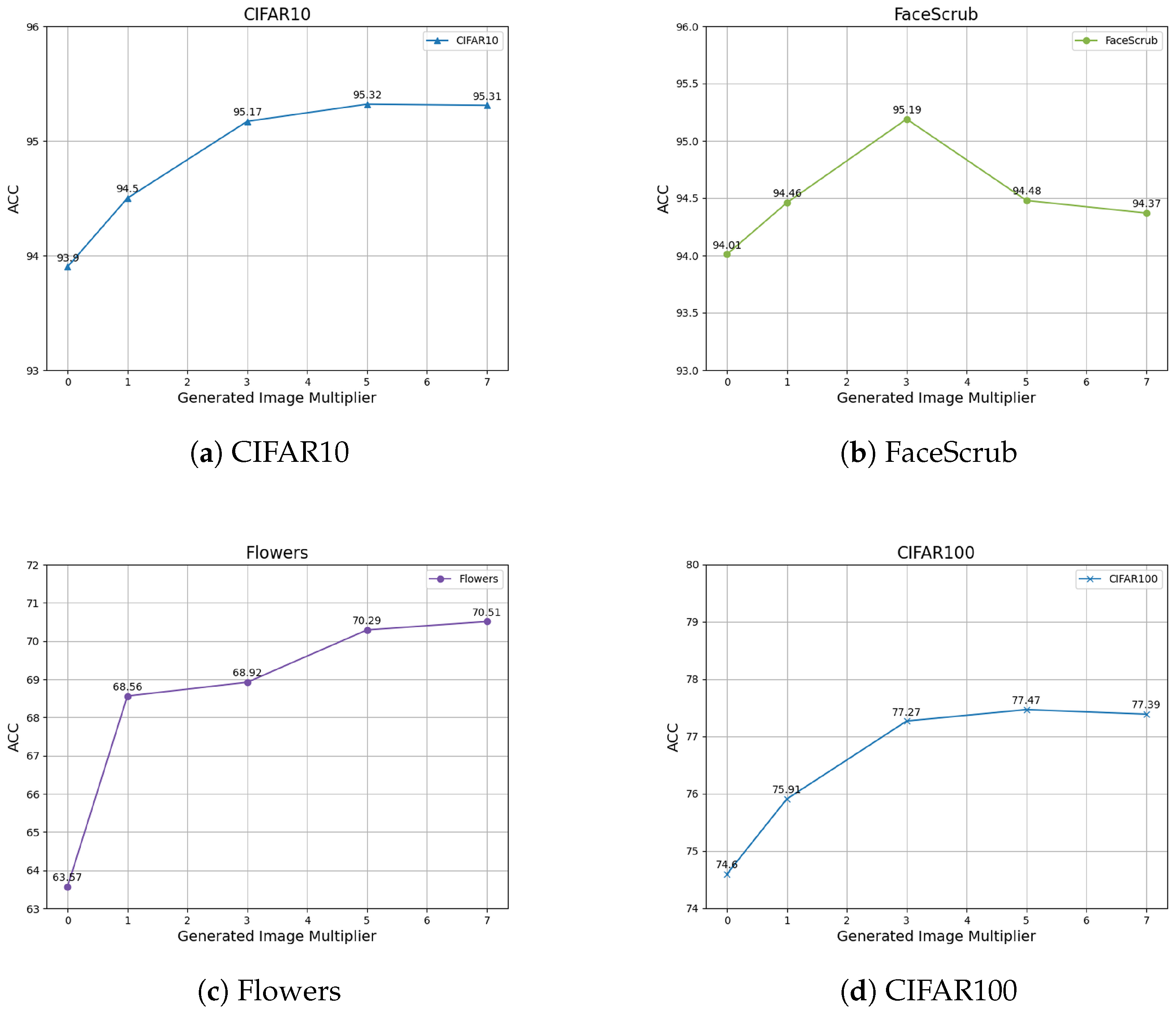
| base | 93.97 | 74.60 | 94.01 | 63.57 |
| mixup | 95.30 | 77.36 | 95.17 | 65.20 |
| ddim250 × 1 | 91.03 | 67.88 | 85.43 | 55.20 |
| ddim250 × 3 | 93.70 | 74.03 | 88.73 | 63.86 |
| ddim250 × 5 | 94.26 | 75.85 | 89.84 | 66.83 |
| base+ddim250 × 1 | 94.50 | 75.91 | 94.46 | 68.56 |
| base+ddim250 × 3 | 95.17 | 77.27 | 95.19 | 68.92 |
| base+ddim250 × 5 | 95.32 | 77.47 | 94.48 | 70.29 |
| base+ddim250 × 7 | 95.31 | 77.39 | 94.37 | 70.51 |
| Filter Type | CIFAR-100 | FaceScrub | Flowers |
|---|---|---|---|
| No Filter | 61.14 | 82.10 | 49.30 |
| Linear Filter | 73.61 | 92.47 | 63.31 |
| Exponential (Ours) | 74.87 | 92.95 | 64.66 |
| Blocks per Stage | CIFAR-100 | FaceScrub | Flowers |
|---|---|---|---|
| 2 | 74.60 | 94.01 | 63.57 |
| 3 (default) | 75.15 | 94.20 | 65.25 |
| 4 | 76.52 | 94.21 | 65.74 |
| Strategy | CIFAR-100 | FaceScrub |
|---|---|---|
| No Freezing | 65.50 | 80.16 |
| With Freezing (Ours) | 66.28 | 80.25 |
| Selection Strategy | CIFAR-100 | FaceScrub | Flowers |
|---|---|---|---|
| No Selection | 63.29 | 79.56 | 51.87 |
| Confidence Only | 65.66 | 80.29 | 54.86 |
| Confidence + Feature | 65.97 | 80.50 | 55.30 |
Disclaimer/Publisher’s Note: The statements, opinions and data contained in all publications are solely those of the individual author(s) and contributor(s) and not of MDPI and/or the editor(s). MDPI and/or the editor(s) disclaim responsibility for any injury to people or property resulting from any ideas, methods, instructions or products referred to in the content. |
© 2026 by the authors. Licensee MDPI, Basel, Switzerland. This article is an open access article distributed under the terms and conditions of the Creative Commons Attribution (CC BY) license.
Share and Cite
Chen, J.; Wen, J.; Wang, S.; Zhu, Q. CoDC: Unified Diffusion and Classification for Enhanced Class-Incremental Learning. Appl. Sci. 2026, 16, 6035. https://doi.org/10.3390/app16126035
Chen J, Wen J, Wang S, Zhu Q. CoDC: Unified Diffusion and Classification for Enhanced Class-Incremental Learning. Applied Sciences. 2026; 16(12):6035. https://doi.org/10.3390/app16126035
Chicago/Turabian StyleChen, Junli, Jianming Wen, Sijin Wang, and Qiuyu Zhu. 2026. "CoDC: Unified Diffusion and Classification for Enhanced Class-Incremental Learning" Applied Sciences 16, no. 12: 6035. https://doi.org/10.3390/app16126035
APA StyleChen, J., Wen, J., Wang, S., & Zhu, Q. (2026). CoDC: Unified Diffusion and Classification for Enhanced Class-Incremental Learning. Applied Sciences, 16(12), 6035. https://doi.org/10.3390/app16126035