Article

Improving 1H-benzotriazole Removal from Aqueous Solutions by Polymer Inclusion Membranes by the Addition of Reduced Graphene Oxide and the Application of Ultrasound


by
Gerardo León
*,
María José Cañavate
,
Beatriz Miguel
and
María Amelia Guzmán
Departamento de Ingeniería Química y Ambiental, Universidad Politécnica de Cartagena, Paseo Alfonso XIII, 30203 Cartagena, Spain
*
Author to whom correspondence should be addressed.
Appl. Sci. 2026, 16(12), 6030; https://doi.org/10.3390/app16126030 (registering DOI)
Submission received: 30 April 2026 / Revised: 1 June 2026 / Accepted: 8 June 2026 / Published: 15 June 2026
(This article belongs to the Section Surface Sciences and Technology)

Abstract

This study investigates the application of polymer inclusion membranes (PIMs) for the removal/recovery of 1H-benzotriazole from aqueous solutions, via facilitated transport mechanism, using tri-n-octylamine as a carrier and NaOH as a stripping agent. The process efficiency was analyzed using 1H-benzotriazole flux and permeability through the membrane, its recovery percentage, and the transport process kinetic constant. PIM containing 40% cellulose triacetate, 30% o-nitrophenyl octyl ether and 30% tri-n-octylamine yielded the best results for all four parameters studied due to the role of o-nitrophenyl octyl ether and tri-n-octylamine in reducing the cellulose triacetate polarity, which leads to carrier solubilization on the plasticizer, creating continuous pathways within the membrane and facilitating 1H-benzotriazole transport. Reduced graphene oxide inclusion as the fourth PIM component increases its hydrophobicity, promoting continuous pathway formation and enhancing 1H-benzotriazole transport, which leads to an increase of 10% to 20% in the values of the four parameters analyzed. Ultrasound use in membrane preparation leads to a further increase of 9% to 20% in the values of the four parameters analyzed because the cavitation effect improves the molecular mixing of membrane components and results in a less ordered configuration of cellulose triacetate molecules, thereby reducing their crystallinity degree. All of this significantly improves the interaction between the membrane components and pathway formation, enhancing 1H-benzotriazole transport through the membrane.

1. Introduction

The steady and uninterrupted growth of the world’s population over the last century, coupled with rapid technological progress, has complex and far-reaching consequences, characterized by a tension between increased productivity and the sustainability of the planet. In terms of environmental impact, some of the negative consequences of our economic development include the rise in intensive industrial and agricultural activity, which generates high levels of harmful substances to living organisms [1]. Within these substances, special attention should be paid to so-called emerging pollutants or pollutants of emerging concern, those chemicals which, although not necessarily new, have only recently been detected in the environment and whose harmful effects are only now being understood. Unlike traditional pollutants, many of these pollutants are not covered by current legislation nor do they have established maximum concentration limits [2,3]. They include a wide variety of substances such as pharmaceuticals, personal care products, consumer products, endocrine-disrupting chemicals, hormones and steroids, perfluorinated compounds, surfactants, flame retardants, plasticizers, industrial additives, nanomaterials or microplastics [4,5] and their presence has been reported in various types of aquatic environments and across a wide range of concentrations [6].
Among industrial additives, benzotriazoles are heterocyclic chemical compounds used in a variety of industrial and consumer applications including their use as corrosion inhibitors, antifreeze agents, UV stabilizers or additives in dishwater detergents [7,8]. Due to their low biodegradability, they have been detected in various water bodies in concentrations ranging from ng/L to μg/L [9,10], posing a risk to human health and the environment. Safety data sheets indicate that they cause skin irritation, serious eye damage or irritation, and specific respiratory tract toxicity. Recent studies have confirmed their neurotoxicity, hepatotoxicity, endocrine toxicity, reproductive and developmental toxicity and immunotoxicity [11], having been classified as suspected human carcinogens [12] and being also toxic to aquatic plants and invertebrates [13].
The low removal efficiencies of benzotriazoles in wastewater treatment plants makes necessary to explore other technological solutions to improve their removal, even though these advanced technologies are more costly. In recent years various technologies have been described to remove benzotriazoles from aqueous media including ozonization [14], adsorption [15,16], electrochemical process [17], biodegradation [18,19] advanced oxidation processes [20,21,22], pressure-driven membrane processes [23,24] and combined methods [25].
Membrane processes are effective and widely used for the removal of various types of pollutants due to their operational simplicity, low energy consumption, high stability under a range of operating conditions, high environmental compatibility, scalability, ease of control, and high adaptability [26].
Among these membrane processes, polymer inclusion membranes have gained greater prominence in recent years as they combine extraction and stripping processes in a single unit operation (whilst offering greater stability than supported liquid membranes), and are characterized by low energy consumption, high resistance to biofouling, continuous operation without secondary separation needs and high recovery percentages. Their use has been described in a wide variety of applications for the removal of both organic and inorganic pollutants [27,28].
A polymer inclusion membrane typically consists of a polymeric matrix, a plasticizer and a carrier agent, forming a thin, stable, flexible film that is highly versatile and highly selective [29,30]. The polymeric matrix provides mechanical strength and stability, whilst offering minimal resistance to the transport of target species across the membrane. The plasticizer imparts elasticity and flexibility to the membrane by penetrating between the polymer molecules and reducing the intermolecular forces within the polymer, which lowers the membrane’s glass transition temperature and increases the compatibility of its components. Similar to liquid membranes, the carrier facilitates the transport of the target species across the membrane, from the feed phase to the product phase.
This paper studies the application of polymer inclusion membranes for the removal of benzotriazoles from aqueous solutions, using 1H-benzortriazole as the target contaminant. It analyses the proportions of the various membrane components that result in maximum transport of 1H-benzotriazole, the effect on this transport of adding reduced graphene oxide as a membrane component (along with the dispersant nonidet), and the effects of applying ultrasound during the membrane preparation process.
To the best of our knowledge, no previous studies have been reported on 1H-benzotriazole removal/recovery by polymer inclusion membranes, and therefore neither on the presence of reduced graphene oxide as a component of the membrane nor on the application of ultrasound in polymer inclusion membrane preparation.

2. Materials and Methods

2.1. Materials

Reagents

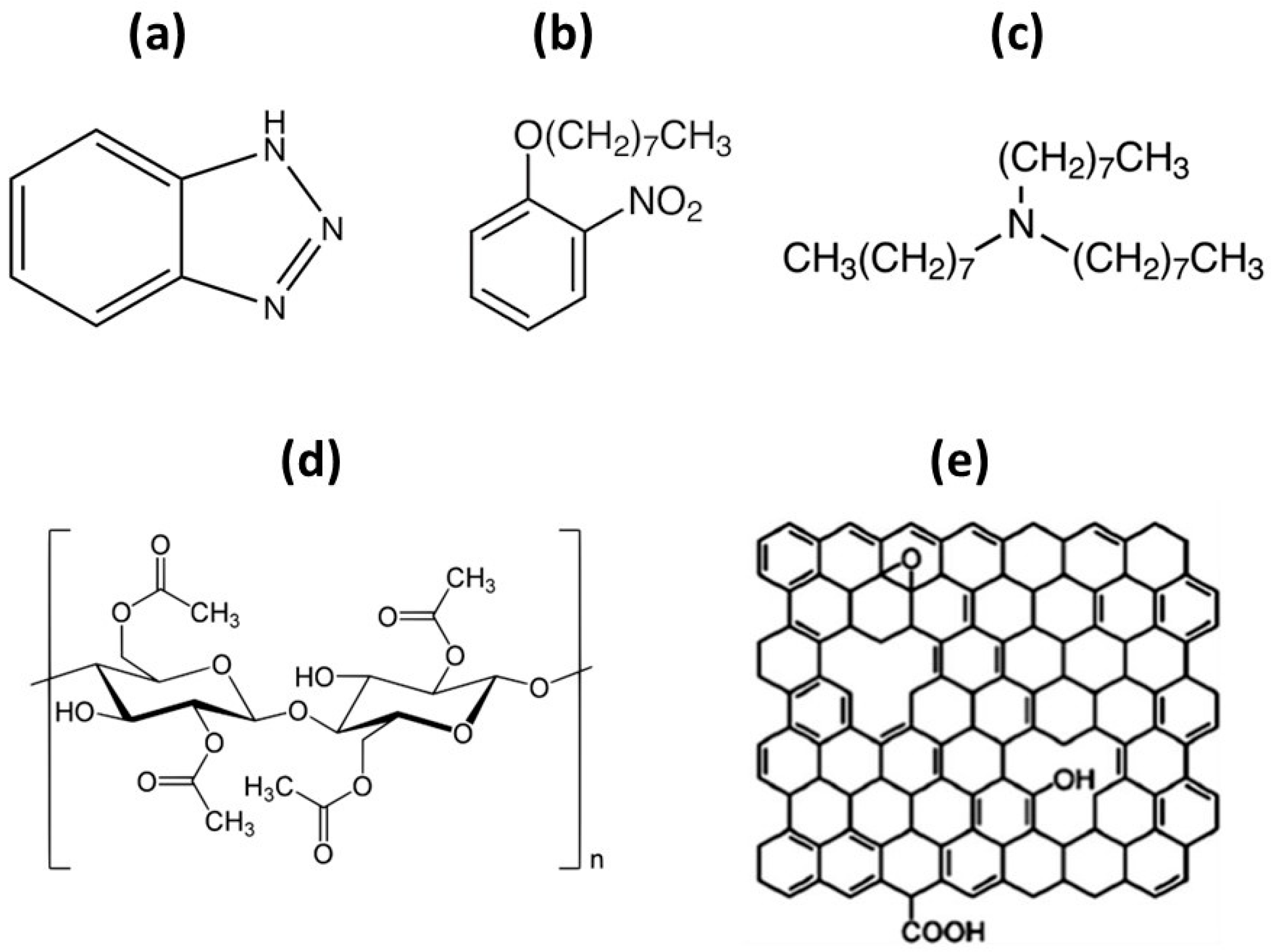
Tri-n-octyl amine (98%), 2-nitrophenyl octyl ether (99%), nonidet P-40 and chloroform (99.8%) were supplied by Sigma Aldrich (Steinheim, Germany); hydrochloric acid (37%), and sodium hydroxide were obtained from Panreac (Darmstadt, Germany); 1H-benzotriazole was supplied by Alfa Aesar (Kaslrue, Germany); reduced graphene oxide (80%) was obtained from Abalonyx (Oslo, Norway). Chemical structures of these compounds are shown in Figure 1.

2.2. Methods

2.2.1. Polymer Inclusion Membranes Preparation

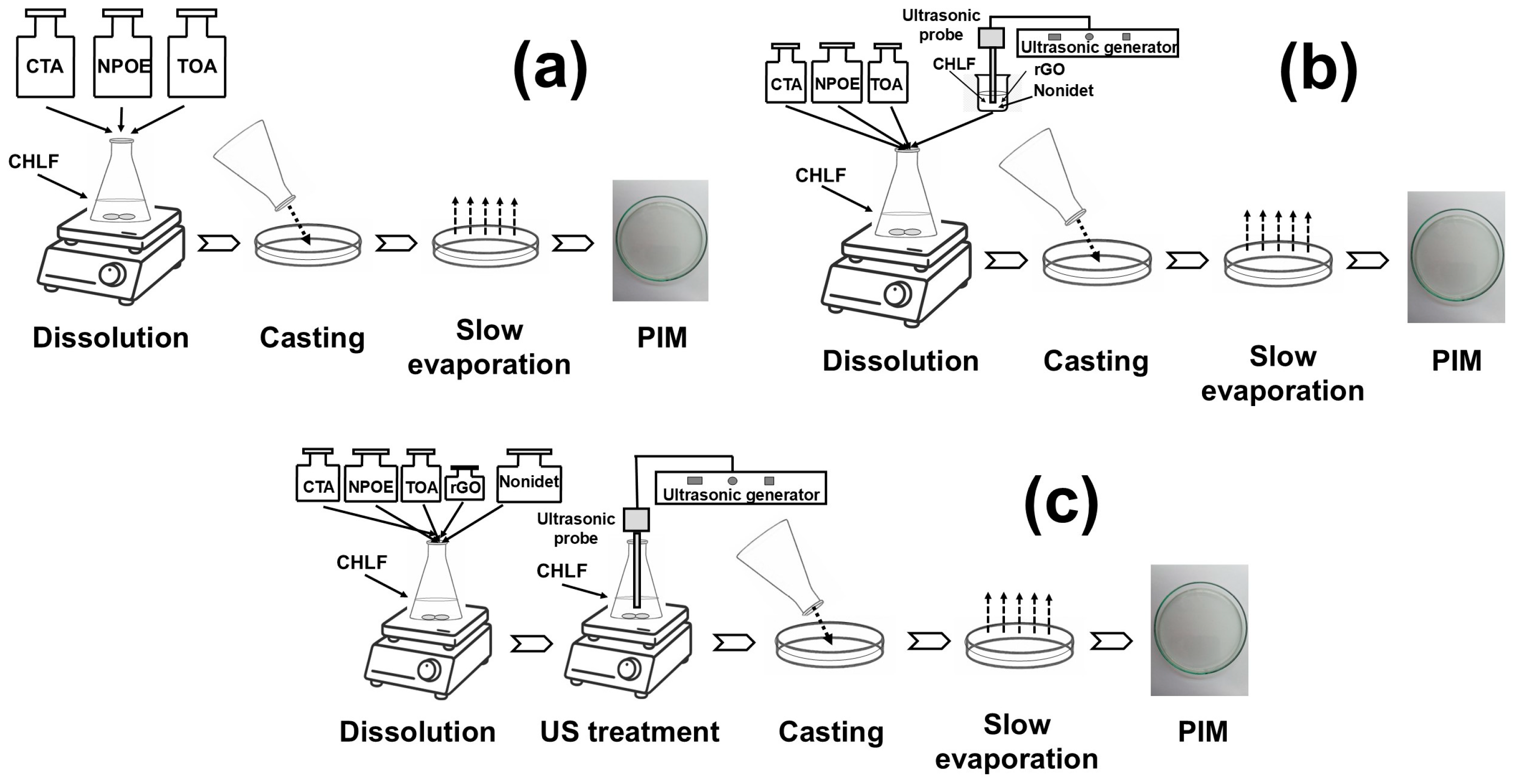
Cellulose triacetate as the polymer matrix, o-nitrophenyl octyl ether as the plasticizer, and tri-n-octylamine as the carrier were used as basic components of the PIM. The membrane was prepared [31] by dissolving the appropriate amount of CTA in 25 mL of chloroform in a magnetic stirrer during 2 h at room temperature, until the polymer was completely dissolved. Next, the appropriate amounts of NPOE and TOA were added successively, stirring the mixture for 15 min after each addition. The organic solution was poured into a 10.0 cm diameter glass Petri dish and the chloroform was allowed to evaporate overnight (Figure 2a). The resulting membrane was separated from the glass plate by immersion in distilled water and used for transport experiments. In order to optimize the composition of the polymeric inclusion membrane to achieve maximum efficiency in BZTH removal, five membranes were prepared and tested (Table 1).
To analyze the effect of reduced graphene oxide presence in the membrane on the removal process, a solution of 0.4 mg of this compound in 25 mL of chloroform, in the presence of nonidet P40 (NP40) (40 μL) as a dispersant, was prepared by sonication for 60 min (in three stages of 20 min each, with a 10 min break between each session), by using Labsonic M (Sartorius, Gotinga, Germany) ultrasound equipment (titanium probe 10 mm diameter, sound rating density 130 W/cm2, frequency 20 kHz). The resulting solution was included as the fourth component in the preparation of a PIM containing rGO (Figure 2b) by adding it to the organic solution of the three components (CTA, NPOE, TOA) described in the previous paragraph and stirring the resulting mixture for 15 min at room temperature.
Finally, to analyze the effect of ultrasound applications in the PIM preparation process, a new PIM was prepared by successively dissolving CTA (80 mg), NPOE (60 mg), TOA (60 mg) in 25 mL of chloroform, as described above, followed by the addition of rGO + NP40 (0.4 mg + 40 μL) and the application of ultrasound to the resulting solution during 60 min, in three sessions of 20 min each, with a 10 min break between each session (Figure 2c).

2.2.2. Benzotriazole Removal Process

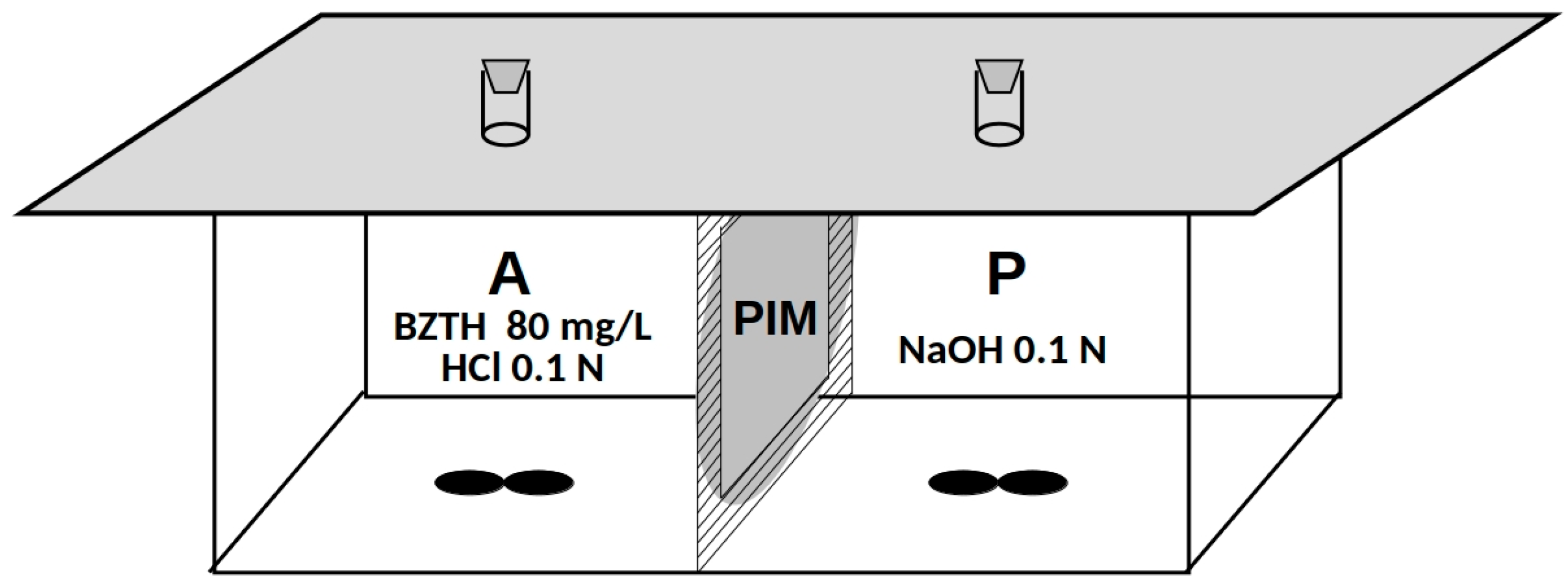
The transport studies were carried out using a two-compartment experimental cell: the feed phase, with a volume of 300 cm3, and the permeate phase, of equal volume. The two compartments were separated by a polymer inclusion membrane with an effective area of 15 cm2 (Figure 3). Both the feed phase and the permeate phase were stirred at 300 rpm at room temperature. The initial solution consisted of a BZTH solution (80 mg/L) in 0.1 N HCl, corresponding to the feed phase, and the product phase consisted of a 0.1 N NaOH solution. Both solutions were kept in motion throughout the 8 h duration of the experiment.
The separation process was monitored by taking samples of the product phase (2 mL) at regular intervals. The BTZH concentration in these samples was determined by UV spectrophotometry at a wavelength of 273 nm using a UNI CAM UV2 spectrophotometer (Unicam Limited, Cambridge, UK). To this end, at the aforementioned wavelength, a calibration curve was first established for BTZH absorbance versus concentration.
To obtain the fluxes (J) and permeabilities (P) through the membrane, Equations (1) and (2) [32,33] were used, respectively. By plotting the BZTH concentration in the product phase against time, the fluxes were obtained, and by plotting ln[Cf0/(Cf0 − Cpt)] against time, the permeabilities were obtained from the slopes of the corresponding straight lines.
The percentage of BZTH transported from the feed phase to the product phase, i.e., the BZTH recovery percentage, RP (%), was determined using Equation (3) [34]. A first-order kinetic model was used, based on Equation (4) [35], to study the kinetic behaviour of BZTH transport across the PIM, where the values of the kinetic constants can be determined from the slopes of the straight lines obtained by plotting ln(Cft/Cf0) against ‘t’.
J =   V A   dC pt dt
ln C f 0 C f 0 C pt =   A V   ·   P ·   t
RP = 100     C pt C f 0
ln C ft C f 0 = k 1   · t
In these equations Cf0 and Cft are the initial and at time “t” BZTH concentrations in the feed phase, Cpt is the BZTH concentration in product phase at time “t”, A is the effective membrane area, V is the volume of feed and product phases and k1 is the first-order kinetic constant.

3. Results and Discussion

3.1. 1H-Benzotriazole Transport Mechanism

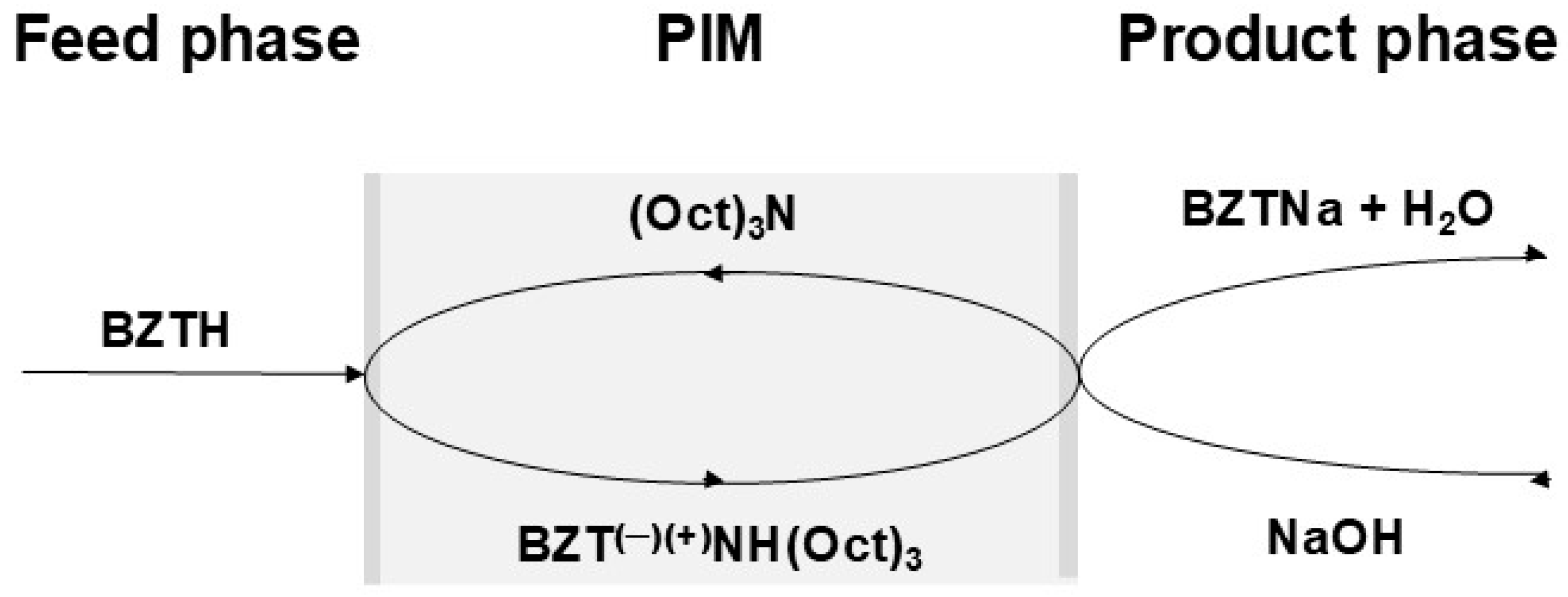
1H-benzotriazole transport through the PIM occurs via a carrier-facilitated transport mechanism [36,37] that utilizes TOA as the carrier in the membrane phase and NaOH as the stripping agent in the product phase (Figure 4). At the feed–membrane interface, BZTH reacts with TOA, via an acid–base reaction, to form BZT(−)TOAH(+). This species is transported across the membrane, from the feed/membrane interface to the membrane/product interface, where upon reaction with NaOH, it yields the sodium salt of 1H-benzotriazole (sodium benzotriazole, BZTNa), water and the regeneration of the carrier (TOA), which diffuses to the feed/membrane interface and begins a new separation cycle.

3.2. Optimization of the Polymer Inclusion Membrane Composition

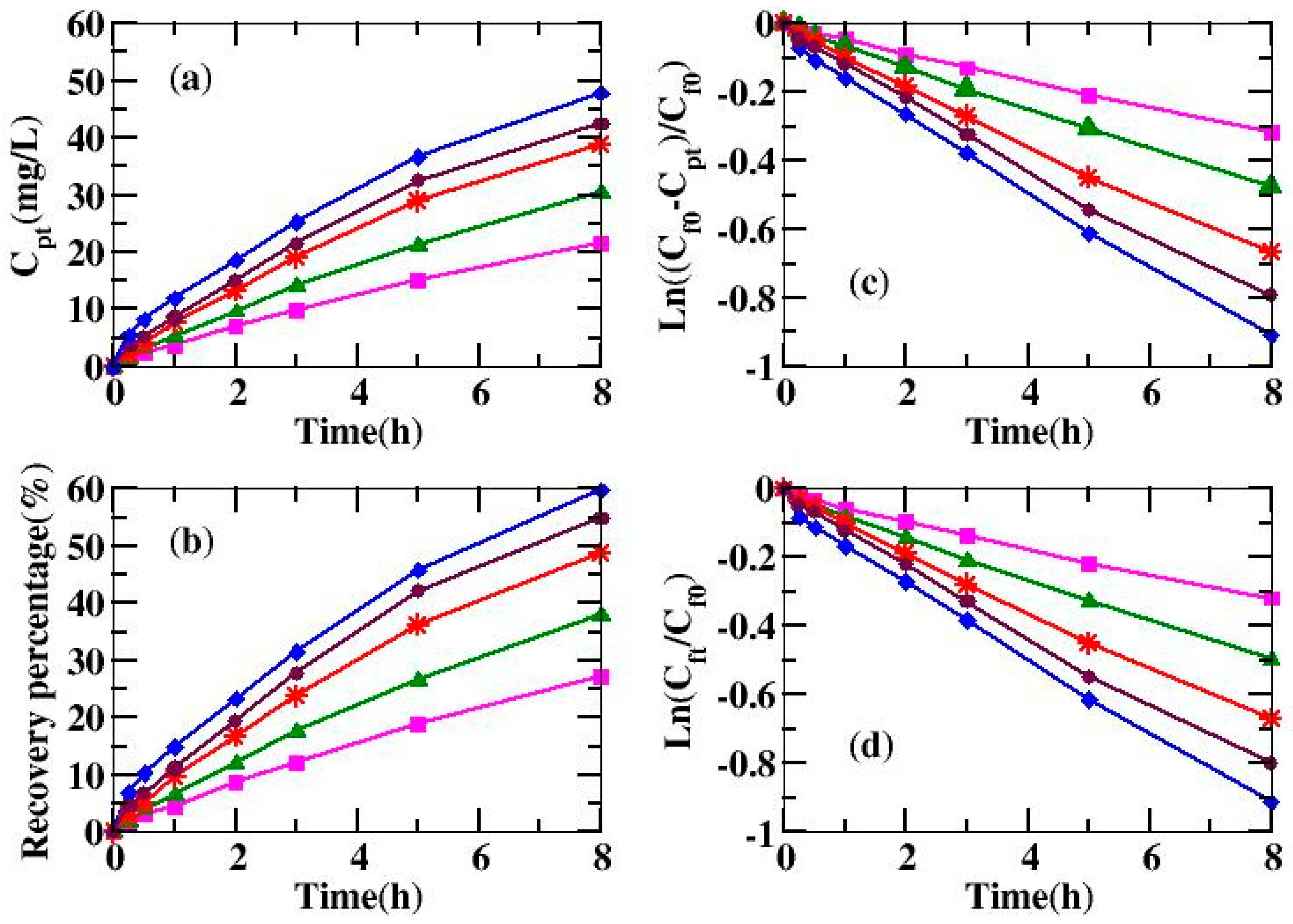
To analyze the influence of membrane composition on the efficiency of the 1H-benzotriazole transport process, the fluxes, permeabilities, recovery percentages, and kinetic constants were determined, according to Equations (1)–(4), for each of the five membranes tested (Figure 5 and Table 2).
The increase of up to 30% in the plasticizer (NPOE) and carrier (TOA) percentages in the PIM leads to an increase in 1H-benzotriazole transport, as evidenced by the increase observed in the four parameters analyzed (flux, permeability, recovery percentage and kinetic constant).
The role of the plasticizer is to reduce the polarity generated by the base polymer (CTA), by introducing hydrophobic groups into the membrane structure, and to solubilize the carrier agent, thereby promoting the interaction among the three components of the membrane [38].
The increase in both plasticizer and carrier percentages in the PIM composition favours these interactions among the three components of the membrane, allowing the solubilization of the carrier in the plasticizer, which allows their movement through the CTA chains, creating continuous pathways in the membrane phase that connect the feed and product phases and facilitating the BZT(−)(+)TOA complex transport through the membrane [39]. A decrease below 40% of the CTA percentage in the membrane phase hinders the described interactions, leading to a decrease in the 1H-benzotriazole transport. The membrane composition CTA (40.0%)/NPOE (30.0%)/TOA (30.0%) was selected for further experiments.

3.3. Effect of rGO Presence as a Membrane Component and of US Application in Membrane Preparation

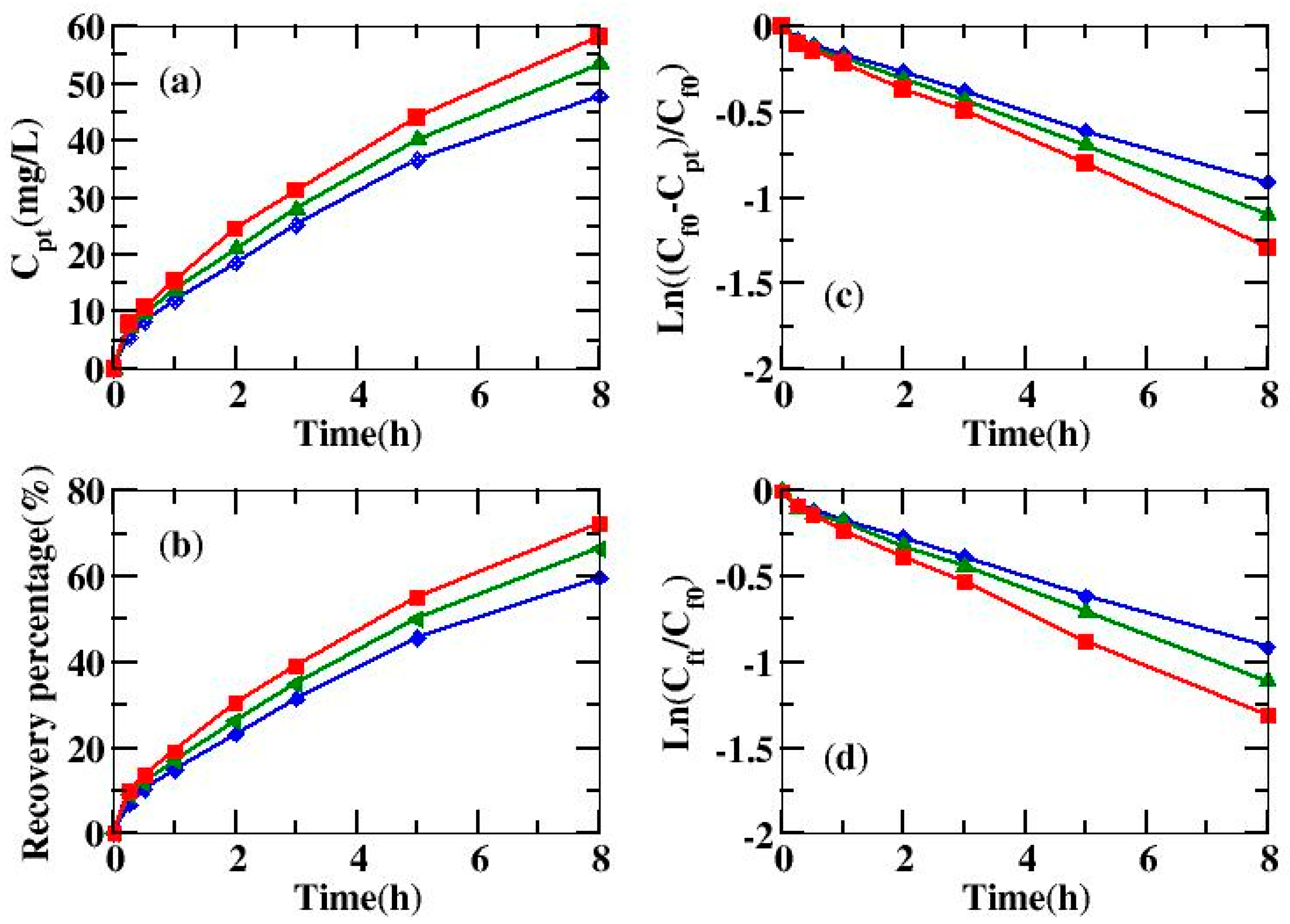
As in the case of the membrane’s composition, to analyze the efficiency of the 1H-benzotriazole transport process, the fluxes, permeabilities, recovery percentages, and kinetic constants were determined for each of the two additional prepared membranes, one incorporating rGO as an additional membrane component (rGO membrane) and the other having the same components as the former, but with the application of ultrasound to mix the components in the membrane preparation process (rGO + US membrane) (Figure 6 and Table 3).
Significant increases in benzotriazole transport were observed both in the presence of rGO as a membrane component and when ultrasound was applied in the membrane preparation process.
The chemical structure of reduced graphene oxide (Figure 1e) shows a large number of hydrophobic groups. Therefore, its inclusion as the fourth component of the membrane helps to reduce the polarity generated by the base polymer, which should facilitate interaction among the three components of the membrane and the solubilization of the carrier on the plasticizer, thereby reinforcing the existence of continuous pathways and improving BZT(−)(+)TOA complex transport through the membrane. Similar results were obtained in the study of the Cr (VI) transport through PIMs containing rGO [40].
The use of US in membrane preparation results in a membrane that significantly improves the 1H-benzotriazole transport. This improvement is due to the various effects generated by the cavitation process derived from the application of ultrasound, among which are the better mixing, at the molecular level, of the different membrane components [41], the transition to a less ordered configuration of the CTA molecules [42] and a decrease in their crystalline degree [43]. All of this should help improve the interaction between the various membrane components described above and, consequently, improves the transport of the BZT(−)(+)TOA complex from the feed–membrane interface to the membrane–product interface, resulting in recovery rates of 72.5%, which are higher than the removal rates achieved by other technologies such as activated carbon adsorption (70%), nanofiltration (55%) or the combined nanofiltration/ozone process (67%). These results pave the way for further research into the influence of graphene derivatives on the efficiency of polymeric inclusion membranes using different base polymers (including biobased polymers [44]), plasticizers and carrier agents.

4. Conclusions

This article investigates the application of PIMs for the removal and recovery of 1H-benzotriazole from aqueous solutions, via a facilitated transport mechanism that uses tri-n-octylamine as a carrier and NaOH as a stripping agent. Four parameters have been evaluated—the flux and permeability of 1H-benzotriazole through the membrane, its recovery percentage and the kinetic constant of the transport process—to analyze the efficiency of the removal/recovery process.
Five membranes were prepared to analyze the optimal ratio of the three components of the polymer inclusion membrane—CTA (base polymer), NPOE (plasticizer) and TOA (carrier)—that maximizes the transport of 1H-benzotriazole through the membrane. The best results for the four parameters studied were obtained using the polymeric inclusion membrane containing 40% CTA, 30% NPOE and 30% TOA. This is due to the role of NPOE and TOA in reducing the polarity of CTA, which leads to better solubilization of the carrier in the plasticizer, creating continuous pathways within the membrane and facilitating the transport of 1H-benzotriazole.
The presence of rGO as the fourth component of the PIM increases its hydrophobicity, which should both promote the formation of continuous pathways and improve the transport of 1H-benzotriazole, resulting in an increase of 10% to 20% in the values of the four parameters analyzed.
Finally, the use of ultrasound during the membrane preparation process leads to a further increase of 9% to 20% in the values of the four parameters analyzed, as the cavitation effect improves the molecular mixing of the membrane components and results in a less ordered arrangement of the cellulose triacetate molecules, thereby reducing their degree of crystallinity. All of this significantly improves the interaction between the membrane components and the formation of transport pathways, enhancing the transport of 1H-benzotriazole through the membrane.
The results obtained in this study highlight the potential for improving the recovery yields of polymer inclusion membranes by incorporating new components into their composition, thereby opening up new avenues for research.

Author Contributions

Conceptualization, G.L. and B.M.; methodology, G.L. and B.M.; validation, M.J.C. and M.A.G.; formal analysis, G.L., M.J.C. and M.A.G.; investigation, M.J.C. and M.A.G.; resources, G.L. and B.M.; data curation, G.L., M.J.C., B.M. and M.A.G.; writing—original draft preparation, G.L. and B.M.; writing—review and editing, G.L. and B.M.; supervision, G.L. and B.M. All authors have read and agreed to the published version of the manuscript.

Funding

This research received no external funding.

Institutional Review Board Statement

Not applicable.

Informed Consent Statement

Not applicable.

Data Availability Statement

The data presented in this study are available on request from the corresponding author. The data are not publicly available due to the fact that they are part of a much larger study that is still underway.

Conflicts of Interest

The authors declare no conflicts of interest.

Abbreviations

The following abbreviations are used in this manuscript:
PIMsPolymer inclusion membranes
BZTH1H-benzotriazole
TOATri-n-octylamine
CTACellulose triacetate
NPOEo-Nitrophenyloctylether
rGOReduced graphene oxide
USUltrasound

References

  1. Ahmad, S.; Zhang, S.; Baqar, M.; Danso-Boateng, E. Toxic Pollutants in Water: Health Risk Assessment and Removal. Water 2025, 17, 1896. [Google Scholar] [CrossRef]
  2. Barceló, D. Emerging pollutants in water analysis. Trends Anal. Chem. 2003, 22, xiv–xvi. [Google Scholar] [CrossRef]
  3. Deblondea, T.; Cossu-Leguille, C.; Hartemanna, P. Emerging pollutants in wastewater: A review of the literature. Int. J. Hyg. Environ. Health 2011, 214, 442–448. [Google Scholar] [CrossRef]
  4. Arman, N.Z.; Salmiati, S.; Aris, A.; Salim, M.R.; Nazifa, T.H.; Muhamad, M.S.; Marpongahtun, M. A Review on Emerging Pollutants in the Water Environment: Existences, Health Effects and Treatment Processes. Water 2021, 13, 3258. [Google Scholar] [CrossRef]
  5. Li, X.; Shen, X.; Jiang, W.; Xi, Y.; Li, S. Comprehensive review of emerging contaminants: Detection technologies, environmental impact, and management strategies. Ecotoxicol. Environ. Saf. 2024, 278, 116420. [Google Scholar] [CrossRef] [PubMed]
  6. Puri, M.; Gandhi, K.; Kumar, M.S. Emerging environmental contaminants: A global perspective on policies and regulations. J. Environ. Manag. 2023, 332, 117344. [Google Scholar] [CrossRef]
  7. Wang, W.; Park, S.; Choi, B.; Oh, J.E. Occurrence and removal of benzotriazole and benzothiazole in drinking water treatment plants. Environ. Pollut. 2023, 316, 120563. [Google Scholar] [CrossRef]
  8. Amey, J.; Mikkelsen, Ø. Fate of trace elements and emerging environmental pollutants (benzotriazoles and benzothiazoles) from a glacier-fed river in the mixing zone of an Arctic fjord system. Environ. Chem. Ecotoxicol. 2025, 7, 339–350. [Google Scholar] [CrossRef]
  9. Molins-Delgado, D.; Távora, J.; Silvia Díaz-Cruz, M.; Barceló, D. UV filters and benzotriazoles in urban aquatic ecosystems: The footprint of daily use products. Sci. Total Environ. 2017, 602, 975–986. [Google Scholar] [CrossRef]
  10. Wang, L.; Zhang, J.; Sun, H.; Zhou, Q. Widespread occurrence of benzotriazoles and benzothiazoles in tap water: Influencing factors and contribution to human exposure. Environ. Sci. Technol. 2016, 50, 2709–2717. [Google Scholar] [CrossRef]
  11. Ling, T.; Fang, Y.; Zong, L.; Tang, Z.; Fan, K.; Chen, D.; Jin, P.; Guan, M. Review of Environmental Occurrence and Toxicity of Benzotriazole Ultraviolet Stabilizers. Environ. Health 2025, 3, 1438–1455. [Google Scholar] [CrossRef]
  12. Asimakopoulos, A.G.; Wang, L.; Thomaidis, N.S.; Kannan, K. Benzotriazoles and benzothiazoles in human urine from several countries: A perspective on occurrence, biotransformation, and human exposure. Environ. Int. 2013, 59, 274–281. [Google Scholar] [CrossRef]
  13. Seeland, A.; Oetken, M.; Kiss, A.; Fries, E.; Oehlmann, J.; Guan, M. Acute and chronic toxicity of benzotriazoles to aquatic organisms. Environ. Sci. Pollut. Res. 2012, 19, 1781–1790. [Google Scholar] [CrossRef]
  14. Dai, Q.; Chen, W.; Luo, J.; Luo, X. Abatement kinetics of highly concentrated 1H-Benzotriazole in aqueous solution by ozonation. Sep. Purif. Technol. 2017, 183, 327–332. [Google Scholar] [CrossRef]
  15. Altmann, J.; Rehfeld, D.; Träder, K.; Sperlich, A.; Jekel, M. Combination of granular activated carbon adsorption and deep-bed filtration as a single advanced wastewater treatment step for organic micropollutant and phosphorus removal. Water Res. 2016, 92, 131–139. [Google Scholar] [CrossRef] [PubMed]
  16. Pap, S.; Paunovic, O.; Prosen, H.; Krasevec, I.; Trebse, P.; Niemi, L.; Taggart, M.A.; Sekulic, M.T. Removal of benzotriazole derivatives by biochar: Potential environmental applications. Environ. Pollut. 2023, 334, 122205. [Google Scholar] [CrossRef] [PubMed]
  17. Wang, S.; Pei, S.; Zhang, J.; Huang, J.; You, S. Flow-through electrochemical removal of benzotriazole by electroactive ceramic membrane. Water Res. 2022, 218, 118454. [Google Scholar] [CrossRef]
  18. Llorca, M.; Badia-Fabregat, M.; Rodríguez-Mozaz, S.; Caminal, G.; Vicent, T.; Barceló, D. Fungal treatment for the removal of endocrine disrupting compounds from reverse osmosis concentrate: Identification and monitoring of transformation products of benzotriazoles. Chemosphere 2017, 184, 1054–1070. [Google Scholar] [CrossRef]
  19. Markoulatou, E.; Gatidou, G.; Stasinakis, A.S.; Fountoulakis, M.S. Removal of benzotriazoles from domestic wastewater using Pleurotusostreatus fungal pellets. Can. J. Chem. Eng. 2025, 103, 5812–5818. [Google Scholar] [CrossRef]
  20. Moghadam, M.A.; Ghanbari, F.; Moradi, M. Photocatalysis assisted by peroxymonosulfate and persulfate for benzotriazole degradation: Effect of pH on sulfate and hydroxyl radicals. Water Sci. Technol. 2015, 72, 2095–2102. [Google Scholar] [CrossRef]
  21. Chen, Y.; Ye, J.; Li, C.; Zhou, P.; Liu, J.; Ou, H. Degradation of 1H-benzotriazole by UV/H2O2 and UV/TiO2: Kinetics, mechanisms, products and toxicology. Environ. Sci. Water Res. Technol. 2018, 4, 1282–1294. [Google Scholar] [CrossRef]
  22. Minella, M.; De Laurentiis, E.; Pellegrino, F.; Prozzi, M.; Dal Bello, F.; Maurino, V.; Minero, C. Photocatalytic Transformations of 1H-Benzotriazole and Benzotriazole Derivates. Nanomaterials 2020, 10, 1835. [Google Scholar] [CrossRef]
  23. Ana, M.; Gutierreza, L.; D’Haesea, A.; Tana, L.; Mad, C.; Leusd, K.; Nikiforovd, A.; De Geyterd, N.; Morentd, R.; Cornelissena, E. In-situ surface modification of a reverse osmosis membrane with acrylic polymers: Transport and retention of a small neutral organic micropollutant. J. Membr. Sci. 2024, 703, 122810. [Google Scholar] [CrossRef]
  24. Piekutin, J.; Kotowska, U.; Struk-Sokołowska, J. Removal of selected heterocyclic organic compounds from water and possibilities of system optimization. Desalin. Water Treat. 2021, 243, 44–50. [Google Scholar] [CrossRef]
  25. Acero, J.L.; Benítez, F.J.; Real, F.J.; Rodríguez, E. Elimination of Selected Emerging Contaminants by the Combination of Membrane Filtration and Chemical Oxidation Processes. Water Air Soil Pollut. 2015, 226, 139. [Google Scholar] [CrossRef]
  26. Shehata, N.; Egirani, D.; Olabi, A.G.; Inayat, A.; Abdelkareem, M.A.; Chae, K.J.; Sayed, E.T. Membrane-based water and wastewater treatment technologies: Issues, current trends, challenges, and role in achieving sustainable development goals, and circular economy. Chemosphere 2023, 320, 137993. [Google Scholar] [CrossRef]
  27. Kaczorowska, M.A. The Use of Polymer Inclusion Membranes for the Removal of Metal Ions from Aqueous Solutions—The Latest Achievements and Potential Industrial Applications: A Review. Membranes 2022, 12, 1135. [Google Scholar] [CrossRef]
  28. Kaczorowska, M.A.; Bozejewicz, D.; Witt, K. The Application of Polymer Inclusion Membranes for the Removal of Emerging Contaminants and Synthetic Dyes from Aqueous Solutions—A Mini Review. Membranes 2023, 13, 132. [Google Scholar] [CrossRef]
  29. Maiphetlho, K.; Chimuka, L.; Tutu, H.; Richards, H. Technical design and optimisation of polymer inclusion membranes (PIMs) for sample pre-treatment and passive sampling—A review. Sci. Total Environ. 2021, 779, 149483. [Google Scholar] [CrossRef]
  30. Senila, M. Polymer Inclusion Membranes (PIMs) for Metal Separation—Toward Environmentally Friendly Production and Applications. Polymers 2025, 17, 725. [Google Scholar] [CrossRef]
  31. Mourtah, I.; Ouchn, R.; Yaakouby, I.E.; Raji, Y.; Mechnou, I.; Hlaibi, M. PSU-EDTA polymer inclusion membrane for selective extraction of Cr(VI) and Cr(III) from aqueous solution. J. Polym. Res. 2026, 33, 69. [Google Scholar] [CrossRef]
  32. Muthuraman, G.; Palanivelu, K. Transport of textile dye in vegetable oils based supported liquid membrane. Dye. Pigment. 2006, 70, 99–104. [Google Scholar] [CrossRef]
  33. León, G.; Martínez, G.; Guzmán, M.A.; Moreno, J.I.; Miguel, B.; Fernández-López, J.A. Increasing stability and transport efficiency of supported liquid membranes through a novel ultrasound-assisted preparation method. Its application to cobalt (II) removal. Ultrason. Sonochem. 2013, 20, 650–654. [Google Scholar] [CrossRef] [PubMed]
  34. Güell, R.; Fontàs, C.; Anticó, E.; Salvadó, V.; Crespo, J.G.; Velizarov, S. Transport and separation of arsenate and arsenite from aqueous media by supported liquid and anion-exchange membranes. Sep. Purif. Technol. 2011, 80, 428–434. [Google Scholar] [CrossRef]
  35. Kozlowski, C.; Zawierucha, I. Polymer Inclusion Membranes Based on Sulfonic Acid Derivatives as Ion Carriers for Selective Separation of Pb(II) Ions. Membranes 2025, 15, 146. [Google Scholar] [CrossRef]
  36. Baylan, N.; Çehreli, S.; Özparlak, N. Transport and separation of carboxylic acids through bulk liquid membranes containing tributylamine. J. Dispers. Sci. Technol. 2017, 38, 895–900. [Google Scholar] [CrossRef]
  37. Xie, H.; Xia, H.; Qin, Z.; Dong, Z.; Wang, X.; Sun, L.; Liu, Y.; Zhang, Y. Role of the side chain configuration on the effective recovery of phenolic compounds using polymer inclusion membranes based on tertiary amine. React. Funct. Polym. 2024, 204, 106030. [Google Scholar] [CrossRef]
  38. Nghiem, L.D.; Mornane, P.; Potter, I.D.; Perera, J.M.; Cattrall, R.W.; Kolev, S.D. Extraction and transport of metal ions and small organic compounds using polymer inclusion membranes (PIMs). J. Membr. Sci. 2006, 281, 7–41. [Google Scholar] [CrossRef]
  39. Fontás, C.; Tayeb, R.; Dhahbi, M.; Gaudichet, E.; Thominette, F.; Roy, P.; Steenkeste, K.; Fontaine-Aupart, M.P.; Tingry, S.; Tronel-Peyroz, E.; et al. Polymer inclusion membranes: The concept of fixed sites membrane revised. J. Membr. Sci. 2007, 290, 62–72. [Google Scholar] [CrossRef]
  40. Kaya, A.; Onac, C.; Alpoguz, H.K.; Agarwal, S.; Gupta, V.K.; Atar, N.; Yilmaz, A. Reduced graphene oxide based a novel polymer inclusion membrane: Transport studies of Cr(VI). J. Mol. Liq. 2016, 219, 1124–1130. [Google Scholar] [CrossRef]
  41. Monnier, H.; Wilhelm, A.M.; Delmas, H. Influence of ultrasound on mixing on the molecular scale for water and viscous liquids. Ultrason. Sonochem. 1999, 6, 67–74. [Google Scholar] [CrossRef] [PubMed]
  42. Chen, J.; Chen, Y.; Li, H.; Lai, S.Y.; Jow, J. Physical and chemical effects of ultrasound vibration on polymer melt in extrusion. Ultrason. Sonochem. 2010, 17, 66–71. [Google Scholar] [CrossRef] [PubMed]
  43. Kang, J.; Chen, Y.; Cao, Y.; Li, H. Effects of ultrasound on the conformation and crystallization behaviour of isotactic polypropylene and b-isotactic polypropylene. Polymer 2010, 51, 249–256. [Google Scholar] [CrossRef]
  44. Senila, L.; Kovacs, E.; Senila, M. A Review of Polylactic Acid (PLA) and Poly(3-hydroxybutyrate) (PHB) as Bio-Sourced Polymers for Membrane Production Applications. Membranes 2025, 15, 210. [Google Scholar] [CrossRef]
Figure 1. Chemical structures of (a) 1H-benzotriazole (BZTH), (b) o-nitrophenyl octyl ether (NPOE), (c), tri-n-octylamine (TOA), (d) cellulose triacetate (CTA), (e) reduced graphene oxide (rGO).
Applsci 16 06030 g001
Figure 2. Schematic representation of the PIM preparation: (a) initial membrane (CTA, NPOE, TOA), (b) membrane with rGO (CTA, NPOE, TOA, rGO), (c) membrane with rGO and prepared with US (CTA, NPOE, TOA, rGO, US).
Applsci 16 06030 g002
Figure 3. A schematic representation of the experimental transport cell.
Applsci 16 06030 g003
Figure 4. A representation of the facilitated transport of BZTH through PIM using TOA as the carrier in the membrane phase and NaOH as the stripping agent in the product phase.
Applsci 16 06030 g004
Figure 5. Plots of Equations (1)–(4) used to calculate 1H-benzotriazole fluxes, J (a), permeabilities, P (b), recovery percentages, RP (c), and first-order kinetic constants, k1 (d) for the five PIMs prepared with different component ratios: 75% CTA, 12.5% NPOE and 12.5% TOA (■); 60% CTA, 30% NPOE and 20% TOA (▲); 50% CTA, 25% NPOE and 25% TOA (✸); 30% CTA, 35% NPOE and 35% TOA (●); 40% CTA, 30% NPOE and 30% TOA (◆).
Applsci 16 06030 g005
Figure 6. Plots of Equations (1)–(4) to determine 1H-benzotriazole fluxes, J (a), permeabilities, P (b), recovery percentages, RP (c), and the first-order kinetic constants, k1 (d) for membrane 4 (initial membrane: CTA 40.0%, NPOE 30.0%, TOA 30.0%) (◆), membrane 4 with the inclusion of reduced graphene oxide as an additional component (rGO membrane) (▲), and the membrane with the same components but prepared using ultrasound (rGO + US membrane) (■).
Applsci 16 06030 g006
Table 1. The composition of the different membranes used in the study of membrane optimization.
MembraneCTANPOETOA
(mg)(%)(mg)(%)(mg)(%)
Membrane 1150.075.025.012.525.012.5
Membrane 2120.060.040.020.040.020.0
Membrane 3100.050.050.025.050.025.0
Membrane 480.040.060.030.060.030.0
Membrane 560.030.070.035.070.035.0
Table 2. The BZTH fluxes, permeabilities, recovery percentages, and first-order kinetic constants obtained for each of the five membranes studied.
Membrane CompositionJ (kg/(m2·h))P (m/h)RP (%)k1 (h−1)
Membrane 1: CTA (75.0%)/NPOE (12.5%)/TOA (12.5%)0.00035680.005186727.06490.0392
Membrane 2: CTA (60.0%)/NPOE (20.0%)/TOA (20.0%)0.00050930.007933337.95510.0611
Membrane 3: CTA (50.0%)/NPOE (25.0%)/TOA (25.0%)0.00065480.011186748.71050.0842
Membrane 4: CTA (40.0%)/NPOE (30.0%)/TOA (30.0%)0.00077360.014773359.70230.1106
Membrane 5: CTA (30.0%)/NPOE (35.0%)/TOA (35.0%)0.00071000.013280054.79880.1003
Table 3. The BZTH fluxes, permeabilities, recovery percentages, and first-order kinetic constants obtained for each of the three compared membranes.
Membrane CompositionJ (kg/(m2·h))P (m/h)RP (%)k1 (h−1)
Membrane 4: CTA (40.0%)/NPOE (30.0%)/TOA (30.0%)0.00077360.014773359.70230.1106
Membrane 4 + rGO (Nonidet P40)0.00084750.01752066.58140.1328
Membrane 4 + rGO (Nonidet P40) + US0.00092050.02058772.48600.1605
Disclaimer/Publisher’s Note: The statements, opinions and data contained in all publications are solely those of the individual author(s) and contributor(s) and not of MDPI and/or the editor(s). MDPI and/or the editor(s) disclaim responsibility for any injury to people or property resulting from any ideas, methods, instructions or products referred to in the content.