Evidence of Usability and Effects of an Augmented Reality Card Game on Attitudes Toward the Regional Heritage of Maule

Abstract
1. Introduction
2. Background
2.1. Petroglyphs in the Maule Region and the Threat of Deterioration
2.2. Preservation: The Challenge
2.3. Board Games, Industry, and Their Educational Reach
2.4. Attitudes, Behavioral Intention, and the Role of Games
2.5. Game Experience: The Usability of the Board Game
3. Augmented Reality Card Game
3.1. Game Development
3.1.1. Guardians of the Petroglyph
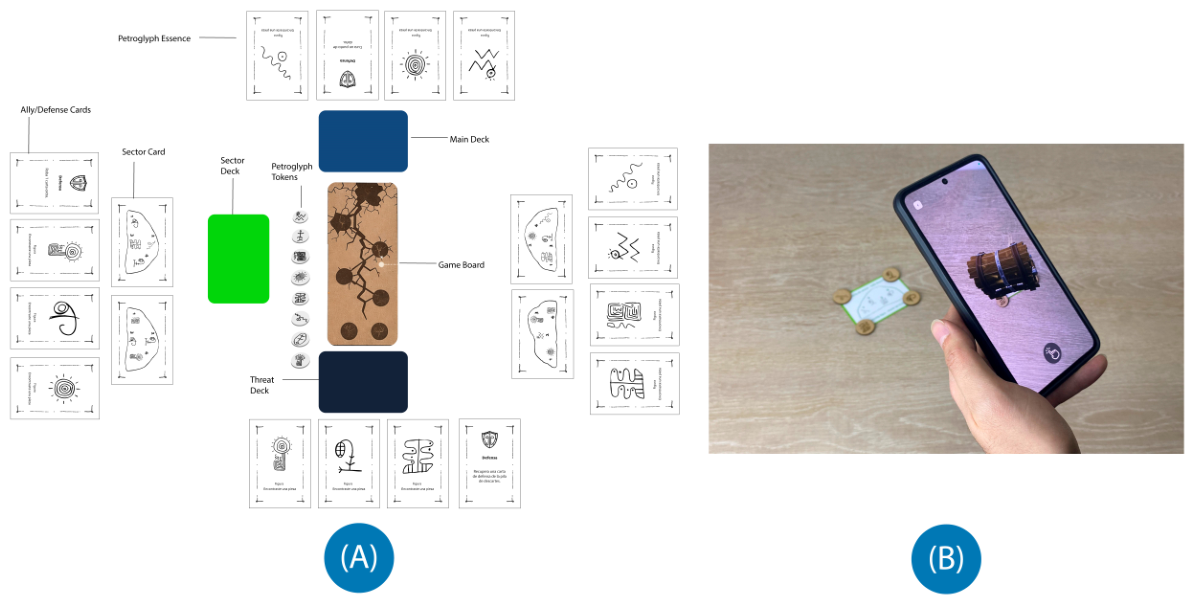
3.1.2. Game Elements
3.1.3. Setup
3.1.4. Gameplay Example and Round Structure
- 1.
- Draw phase: The player draws 2 cards from the main deck and 1 threat card.
- 2.
- Action phase: The player has 3 actions to spend. Available actions are:
- Play a symbol card onto a sector card to progress toward its completion.
- Play a symbol card onto their own or another player’s threat card to begin paying its cost.
- Play a defense card to trigger its effect.
If the player cannot complete their actions, they may instead:- Spend 2 actions to draw an additional card from the main deck.
- Spend 1 action and discard 3 identical symbol cards to treat them as any symbol of their choice, playable on a sector or threat card.
- 3.
- Threat resolution: If the active player’s threat card has not been fully paid off before the start of their next turn, it converts into damage.
3.2. Design and Development Process
3.3. Augmented Reality Application
- Defenses and Threats Module: When a player navigates to this section and scans a Defense or Threat card, the AR system triggers a virtual user interface (UI) overlay. This menu provides tactical support, displaying detailed instructions on how the card functions, its specific effects within the game, and strategic recommendations on the optimal time to deploy it.
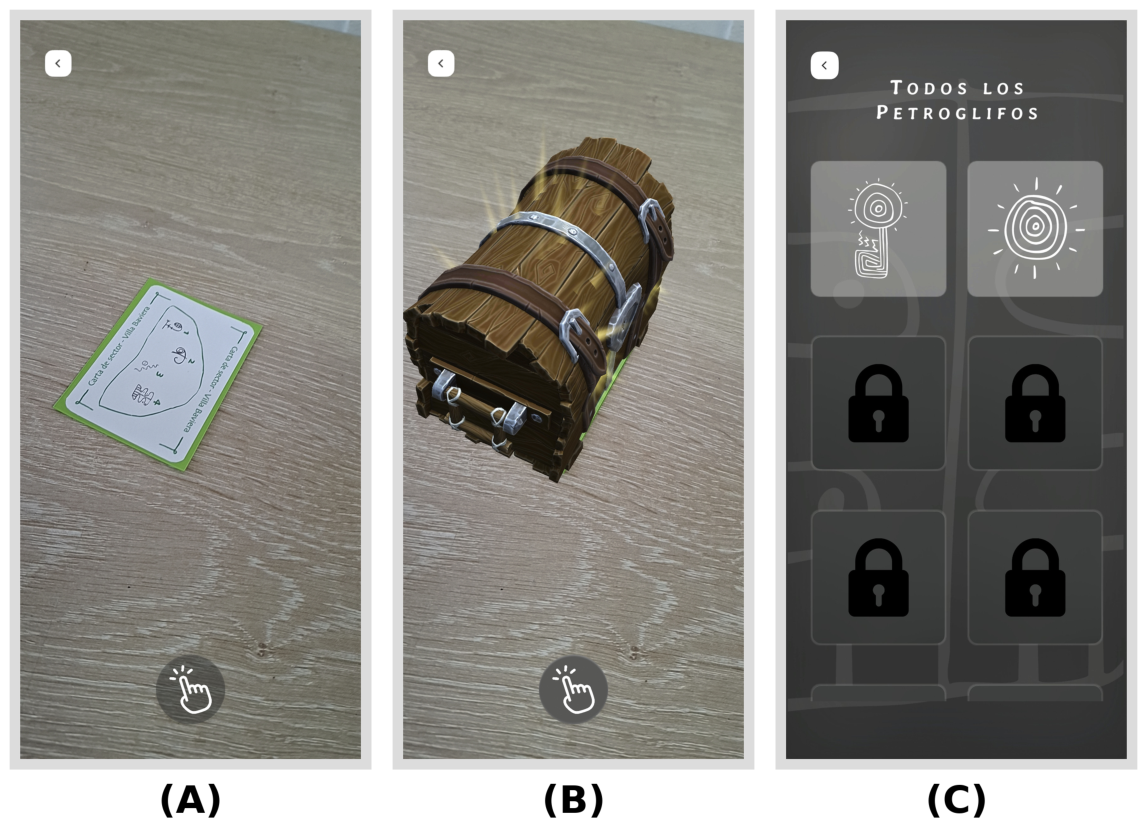
- Sectors Module: This section is dedicated to scanning the sector cards (see Figure 1B). The image recognition system is specifically trained to identify the representative artwork printed on these cards, which depicts two primary archaeological sites: Cerro Quiñe and Ex-Fundo San Manuel. Upon successfully recognizing the specific illustration of a sector card, an interactive 3D chest is instantiated in the AR space. When the user interacts with the chest to open it, a digital “scratchable” panel appears. By virtually scratching this surface, the player unlocks and reveals one of the four unique petroglyph symbols associated with that specific sector.
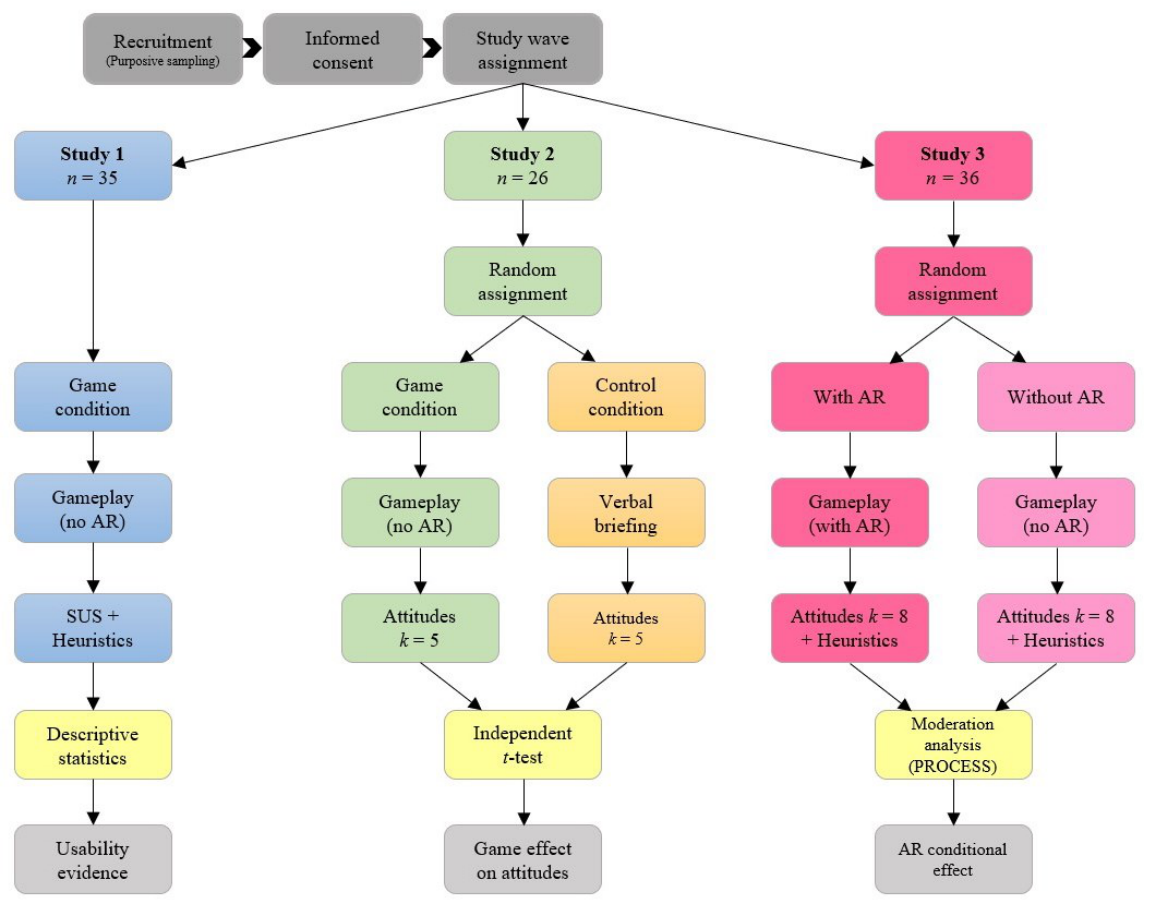
3.4. Studies Overview
4. Study 1: Usability of the Developed Game
4.1. Method
4.1.1. Participants and Sample
4.1.2. Procedure
4.1.3. Instruments
- System Usability Scale (SUS; [41]): To measure the usability of the game, an adapted version of Brooke’s System Usability Scale (SUS [41]) was used. The 10 original items were retained, with the term system replaced by game throughout (i.e., “I would like to use this game frequently”) to better reflect the board game context, using a five-point Likert response format. Following the scale author’s instructions, the total score was calculated by subtracting 1 from the score of each positively worded item, while the score of each reversed item was subtracted from 5. Formally, let denote the raw response to item i on a five-point scale, where is the set of positively worded items and is the set of negatively worded items. The SUS score is computed as:The measure showed an adequate level of reliability .
- Board Game Usability Heuristics Instrument: Board Game Usability Heuristics Instrument is a questionnaire based on the heuristics proposed by Feng [36]. This instrument aims to measure board game usability by assessing four fundamental heuristics: efficiency, satisfaction, sociability, and effectiveness. Each dimension is measured through three statements using a seven-point Likert scale. This resulted in a 12-item instrument reflecting the four dimensions proposed by the model’s author. After a preliminary analysis of the scale, items 3, 7, and 9 were removed due to low item–total correlations (<0.30). The resulting version of the scale showed an adequate level of reliability .
4.1.4. Data Analysis
4.2. Results
4.3. Discussion and Conclusion of Study 1
5. Study 2: Pilot Test of the Effect of the Developed Game
5.1. Method
5.1.1. Participants
5.1.2. Procedure
5.1.3. Independent Variable
- Guardians of the Petroglyph game vs. control condition: Participants were randomly assigned to one of the two conditions of the pilot study. In the Guardians of the Petroglyph condition, participants played version 2.1 of the cooperative game described in this research and subsequently completed the questionnaire measuring the dependent variables. In the control condition, participants received a verbal informational briefing from the recruiter explaining the petroglyphs of the Maule Region, including relevant information about their location, age, and regional importance, after which they completed the questionnaire measuring the dependent variables.
5.1.4. Dependent Variable
- Attitudes toward rock art of the Maule Region: To measure attitudes toward rock art, semantic differential items were employed, based on the literature on attitude measurement (for a review, see [45]). Participants indicated their opinion along a continuum anchored by two opposing evaluative adjectives (). Although attitudes may be expressed through cognitive, affective, and behavioral dimensions, the present measure captures the overall evaluative response toward the attitudinal object, consistent with a unidimensional evaluative conceptualization of attitudes [22,23]. The scale comprised semantic differential items (i.e., good/bad, positive/negative, like/dislike, interesting/boring, and pleasant/unpleasant), with negatively worded items reverse-coded prior to analysis. The attitude index was computed as:where denotes the response to item j on a seven-point scale, and higher values indicate more positive attitudes toward the cultural heritage.
5.1.5. Data Analysis
5.2. Results
5.3. Discussion and Conclusions of Study 2
6. Study 3: Effect of the Game with Augmented Reality on Attitudes Toward Cultural Heritage
6.1. Method
6.1.1. Participants
6.1.2. Procedure
6.1.3. Independent Variable
- Game condition (with augmented reality vs. without augmented reality): Participants were randomly assigned to one of two conditions. For the purposes of the moderation analysis, the experimental condition was effect-coded (with augmented reality = 0.5; without augmented reality = −0.5). In the augmented reality condition, participants played prototype version 2.1 of Guardians of the Petroglyph with access to the specialized augmented reality application, which provides visual and informational resources related to the petroglyphs without altering the core gameplay mechanics. In the condition without augmented reality, participants played the same version of the game without access to the application.
6.1.4. Moderator Variable
- Usability: To assess the usability of the board game, the specific measure “Board Game Usability Heuristics Instrument” [36] was used, as in Study 1 of this work, demonstrating adequate internal consistency .
6.1.5. Dependent Variable
- Attitudes toward the petroglyphs of the Maule Region: As in Study 2 of this work, a specific index of attitudes toward the petroglyphs was constructed. Semantic differential items were employed, based on the literature on attitude measurement (for a review, see [45]). Participants indicated their opinion along a continuum anchored by two opposing evaluative adjectives (). Although attitudes may be expressed through cognitive, affective, and behavioral dimensions, the present measure captures the overall evaluative response toward the attitudinal object, consistent with a unidimensional evaluative conceptualization of attitudes [22,23]. The scale comprised semantic differential items (i.e., pleasant/unpleasant, necessary/unnecessary, recommendable/not recommendable, good/bad, positive/negative, favorable/unfavorable, probable/improbable, and likeable/unlikeable), with negatively worded items reverse-coded prior to analysis. The attitude index was computed as:where denotes the response to item j on a seven-point scale, and higher values indicate more positive attitudes toward the petroglyphs.
6.1.6. Data Analysis
6.2. Results
6.2.1. Mean Differences
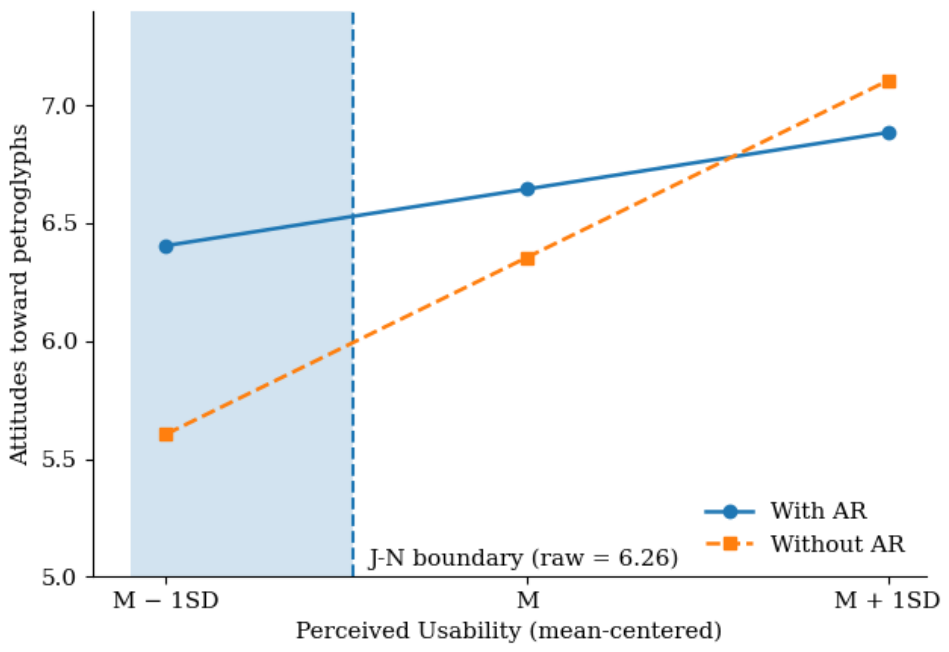
6.2.2. Moderation Analysis
6.3. Discussion and Conclusions of Study 3
7. General Discussion
7.1. Implications for the Development of Educational Board Games
7.2. Implications for Attitude Change
7.3. Limitations
7.4. Conclusions
Author Contributions
Funding
Institutional Review Board Statement
Informed Consent Statement
Data Availability Statement
Acknowledgments
Conflicts of Interest
References
- Chippindale, C.; Taçon, P.S.C. (Eds.) The Archaeology of Rock-Art; Cambridge University Press: Cambridge, UK, 1998. [Google Scholar]
- Niemeyer, F.H.; Weisner, L. Los petroglifos de la Cordillera Andina de Linares (Provincias de Talca y Linares, Chile). In Proceedings of the Actas del Sexto Congreso de Arqueología Chilena, Santiago, Chile, October 1971; pp. 405–470. [Google Scholar]
- Sanguinetti, N. Petroglifos del Cerro Quiñe; Museo de Linares: Linares, Chile, 1970. [Google Scholar]
- Fontecilla, A. Contribución al estudio de los petroglifos cordilleranos. Rev. Chil. Hist. Nat. 1936, 40, 69–72. [Google Scholar]
- Blanco, J.F.; De la Maza, M.; Peñaloza, M.Á. Memoria inscrita: Arte rupestre de contacto, integración y dominación en el centro-sur de Chile. Bol. Mus. Chil. Arte Precolomb. 2015, 20, 89–110. [Google Scholar] [CrossRef]
- Dorn, R.I.; Whitley, D.S. Threshold of Weathering Needed for Fire to Erode Rock Art: Case Study of a Hohokam Petroglyph, Central Arizona, USA. Conserv. Manag. Archaeol. Sites 2021, 23, 235–257. [Google Scholar] [CrossRef]
- Fitzner, B.; Heinrichs, K.; La Bouchardiere, D. The Bangudae Petroglyph in Ulsan, Korea: Studies on weathering damage and risk prognosis. Environ. Geol. 2004, 46, 504–526. [Google Scholar] [CrossRef]
- Smith, B.W.; Black, J.L.; Mulvaney, K.J.; Hoerlé, S. Monitoring rock art decay: Archival image analysis of petroglyphs on Murujuga, Western Australia. Conserv. Manag. Archaeol. Sites 2021, 23, 198–220. [Google Scholar] [CrossRef]
- Cooperativa.cl. PDI Indagará Destrucción de Petroglifos en la Laguna del Maule, 2021. Available online: https://cooperativa.cl/noticias/pais/region-del-maule/pdi-indagara-destruccion-de-petroglifos-en-la-laguna-del-maule/2021-06-10/122257.html (accessed on 15 January 2026).
- Jalandoni, A.; Shuker, J. Automated tracing of petroglyphs using spatial algorithms. Digit. Appl. Archaeol. Cult. Herit. 2021, 22, e00191. [Google Scholar] [CrossRef]
- Suancha, C.; Suarez, M.; González, P.; Besoain, F. Automatic Classification of Petroglyphs: Exploratory Study in the Maule Region of Chile. In Proceedings of the International Workshop on Collaboration in Knowledge Discovery and Decision Making; Springer Nature: Cham, Switzerland, 2024; pp. 58–69. [Google Scholar]
- Sanz, J.O.; Docampo, M.D.L.L.G.; Rodríguez, S.M.; Sanmartín, M.T.R.; Cameselle, G.M. A simple methodology for recording petroglyphs using low-cost digital image correlation photogrammetry and consumer-grade digital cameras. J. Archaeol. Sci. 2010, 37, 3158–3169. [Google Scholar] [CrossRef]
- Kęsik, J.; Miłosz, M.; Montusiewicz, J.; Israilova, N. Documenting archaeological petroglyph sites with the use of 3d terrestrial laser scanners—A case study of petroglyphs in Kyrgyzstan. Appl. Sci. 2022, 12, 10521. [Google Scholar] [CrossRef]
- Statista. Board Games–Worldwide|Statista Market Forecast, 2025. Available online: https://www.statista.com/outlook/cmo/toys-hobby/toys-games/board-games/worldwide (accessed on 1 January 2025).
- Taspinar, B.; Schmidt, W.; Schuhbauer, H. Gamification in education: A board game approach to knowledge acquisition. Procedia Comput. Sci. 2016, 99, 101–116. [Google Scholar] [CrossRef]
- Bochennek, K.; Wittekindt, B.; Zimmermann, S.Y.; Klingebiel, T. More than mere games: A review of card and board games for medical education. Med. Teach. 2007, 29, 941–948. [Google Scholar] [CrossRef]
- Noda, S.; Shirotsuki, K.; Nakao, M. The effectiveness of intervention with board games: A systematic review. BioPsychoSoc. Med. 2019, 13, 22. [Google Scholar] [CrossRef] [PubMed]
- Gilliam, M.; Hill, B.; Jaworski, E.; Sparrow, A.; Jones, I.; Jagoda, P. Increasing anti-tobacco industry attitudes among youth: A pilot study of a multiplayer educational board game. Games Health J. 2019, 8, 49–54. [Google Scholar] [CrossRef] [PubMed]
- Nakao, M. Special series “effects of board games on health education and promotion” board games as a promising tool for health promotion: A review of recent literature. BioPsychoSoc. Med. 2019, 13, 5. [Google Scholar] [CrossRef] [PubMed]
- Hsieh, H.; Wu, C.; Tsai, C.; Liao, Y.; Chen, P.; Tseng, H.; Chen, M. Comparing the effectiveness of board game-based and drill-based education programs in improving Taiwanese nurses’ fire safety knowledge, attitudes, and behavior: A quasi-experimental study. Nurse Educ. Today 2023, 129, 105919. [Google Scholar] [CrossRef]
- Gauthier, A.; Kato, P.; Bul, K.; Dunwell, I.; Walker-Clarke, A.; Lameras, P. Board games for health: A systematic literature review and meta-analysis. Games Health J. 2019, 8, 85–100. [Google Scholar] [CrossRef]
- Fabrigar, L.; MacDonald, T.; Wegener, D. The origins and structure of attitudes. In The Handbook of Attitudes, Volume 1: Basic Principles; Routledge: New York, NY, USA, 2018; pp. 109–157. [Google Scholar]
- Briñol, P.; Petty, R.; Stavraki, M. Structure and Function of Attitudes. In Oxford Research Encyclopedia of Psychology; Oxford University Press: Oxford, UK, 2019. [Google Scholar] [CrossRef]
- Kraus, S.J. Attitudes and the prediction of behavior: A meta-analysis of the empirical literature. Personal. Soc. Psychol. Bull. 1995, 21, 58–75. [Google Scholar] [CrossRef]
- Hainey, T.; Connolly, T.M.; Boyle, E.A.; Wilson, A.; Razak, A. A systematic literature review of games-based learning empirical evidence in primary education. Comput. Educ. 2016, 102, 202–223. [Google Scholar] [CrossRef]
- Soriano-Sánchez, J.G.; Quijano López, R.; Airado Rodríguez, D. The Impact of Game-Based Learning on Motivation, Self-Efficacy, and Academic Achievement in the Natural Sciences: A Meta-Analysis. Educ. Sci. 2026, 16, 122. [Google Scholar] [CrossRef]
- Kolek, L.; Martinková, P.; Vařejková, M.; Šisler, V.; Brom, C. Is video games’ effect on attitudes universal? Results from an empirical study comparing video games’ impact on the attitude change of players with different backgrounds. J. Comput. Assist. Learn. 2024, 40, 667–684. [Google Scholar] [CrossRef]
- Kolek, L.; Ropovik, I.; Šisler, V.; van Oostendorp, H.; Brom, C. Video games and attitude change: A meta-analysis. Contemp. Educ. Psychol. 2023, 75, 102225. [Google Scholar] [CrossRef]
- Mortara, M.; Catalano, C.E.; Bellotti, F.; Fiucci, G.; Houry-Panchetti, M.; Petridis, P. Learning cultural heritage by serious games. J. Cult. Herit. 2014, 15, 318–325. [Google Scholar] [CrossRef]
- Anderson, E.F.; McLoughlin, L.; Liarokapis, F.; Peters, C.; Petridis, P.; De Freitas, S. Developing serious games for cultural heritage: A state-of-the-art review. Virtual Real. 2010, 14, 255–275. [Google Scholar] [CrossRef]
- Montusiewicz, J.; Milosz, M. Architectural Jewels of Lublin: A Modern Computerized Board Game in Cultural Heritage Education. ACM J. Comput. Cult. Herit. 2021, 14, 1–21. [Google Scholar] [CrossRef]
- Kalmpourtzis, G.; Xi, T.; Ketsiakidis, G.; Wang, X.L.; Vrysis, L.; Dimoulas, C. Eliciting Educators’ Needs on the Design and Application of Augmented Reality Educational Board Games on Cultural Heritage: The case of CHARMap. In Proceedings of the 2021 IEEE Global Engineering Education Conference (EDUCON); IEEE: Piscataway, NJ, USA, 2021; pp. 1282–1286. [Google Scholar] [CrossRef]
- Takatalo, J.; Häkkinen, J.; Kaistinen, J.; Nyman, G. Presence, involvement, and flow in digital games. In Evaluating User Experience in Games: Concepts and Methods; Springer: Cham, Switzerland, 2009; pp. 23–46. [Google Scholar] [CrossRef]
- Calvillo-Gámez, E.H.; Cairns, P.; Cox, A.L. Assessing the core elements of the gaming experience. In Game User Experience Evaluation; Springer: Cham, Switzerland, 2015; pp. 37–62. [Google Scholar] [CrossRef]
- Jokela, T.; Iivari, N.; Matero, J.; Karukka, M. The standard of user-centered design and the standard definition of usability: Analyzing ISO 13407 against ISO 9241-11. In Proceedings of the Latin American Conference on Human-Computer Interaction, Rio de Janeiro, Brazil, 17–20 August 2003; pp. 53–60. [Google Scholar] [CrossRef]
- Feng, Z. Heuristics for Board Game Usability Testing. In Proceedings of the 2023 IEEE Conference on Games (CoG); IEEE: Piscataway, NJ, USA, 2023; pp. 1–4. [Google Scholar] [CrossRef]
- Oates, B.; Griffiths, M.; McLean, R. Researching Information Systems and Computing; SAGE Publications Limited: London, UK, 2025. [Google Scholar]
- Besoain, F.; Jego, L.; Gallardo, I. Developing a virtual museum: Experience from the design and creation process. Information 2021, 12, 244. [Google Scholar] [CrossRef]
- Fuentes, L.; González-Ortega, J.; Besoain, F.; Barriga, N. Balancing a Collaborative Card Game Using Monte Carlo Simulations. In Proceedings of the 2025 44th International Conference of the Chilean Computer Science Society (SCCC); IEEE: Piscataway, NJ, USA, 2025; pp. 1–7. [Google Scholar]
- González-Ortega, J.; Díaz, J.; Besoain, F.; Barriga, N. Evaluating the Play Quality of a Game-balancing Simulation using Monte Carlo algorithm. In Proceedings of the 2025 44th International Conference of the Chilean Computer Science Society (SCCC); IEEE: Piscataway, NJ, USA, 2025; pp. 1–4. [Google Scholar]
- Brooke, J. SUS-A quick and dirty usability scale. Usability Eval. Ind. 1996, 189, 4–7. [Google Scholar]
- Lewis, J.R.; Sauro, J. Item benchmarks for the system usability scale. J. Usability Stud. 2018, 13, 158–167. [Google Scholar]
- Petty, R.E.; Cacioppo, J.T. The elaboration likelihood model of persuasion. In Advances in Experimental Social Psychology; Elsevier: Amsterdam, The Netherlands, 1986; Volume 19, pp. 123–205. [Google Scholar] [CrossRef]
- Prislin, R.; Wood, W. 16. Social influence in attitudes and attitude change. In The Handbook of Attitudes; Lawrence Erlbaum Associates: Mahwah, NJ, USA, 2005; pp. 671–706. [Google Scholar]
- Krosnick, J.A.; Judd, C.M.; Wittenbrink, B. The measurement of attitudes. In The Handbook of Attitudes, Volume 1: Basic Principles; Routledge: London, UK, 2018; pp. 45–105. [Google Scholar]
- Hayes, A.F. Introduction to Mediation, Moderation, and Conditional Process Analysis: A Regression-Based Approach; The Guilford Press: New York, NY, USA, 2013; pp. 12–20. [Google Scholar]
- Lin, Y.; Yu, Z. A meta-analysis of the effects of augmented reality technologies in interactive learning environments (2012–2022). Comput. Appl. Eng. Educ. 2023, 31, 1111–1131. [Google Scholar] [CrossRef]
- Harmon-Jones, E.; Armstrong, J.; Olson, J.M. The influence of behavior on attitudes. In The Handbook of Attitudes, Volume 1: Basic Principles; Routledge: London, UK, 2018; pp. 404–449. [Google Scholar]
- Besoain, F.; González-Ortega, J.; Gallardo, I. An Evaluation of the Effects of a Virtual Museum on Users’ Attitudes towards Cultural Heritage. Appl. Sci. 2022, 12, 1341. [Google Scholar] [CrossRef]
- Riva, G.; Baños, R.M.; Botella, C.; Mantovani, F.; Gaggioli, A. Transforming experience: The potential of augmented reality and virtual reality for enhancing personal and clinical change. Front. Psychiatry 2016, 7, 164. [Google Scholar] [CrossRef]
- Akçayır, M.; Akçayır, G. Advantages and challenges associated with augmented reality for education: A systematic review of the literature. Educ. Res. Rev. 2017, 20, 1–11. [Google Scholar] [CrossRef]



| Element | Description | Quantity |
|---|---|---|
| Main Deck | Composed of essence and defense cards | 76 |
| Essence Cards | Petroglyphs used for exchange during the game | 64 |
| Defense Cards | Various effects that the player can use | 12 |
| Threat Cards | Constraints that slow down the game and inflict damage | 28 |
| Sector Cards | Filled with tokens to achieve victory | 8 |
| Petroglyph Tokens | Used to complete sectors and threats | 32 |
| Damage Tokens | Indicate the damage accumulated by players on the board | 8 |
| Damage Board | Displays the damage accumulated by players | 1 |
| System Usability Scale (SUS) | Avg. | St. D. | 95% CI |
|---|---|---|---|
| I would like to use this game frequently | 4.11 | 0.75 | |
| I found the game unnecessarily complex | 1.80 | 0.90 | |
| I found the game easy to use | 4.09 | 0.74 | |
| I think I would need a person with technical knowledge to use this game | 2.09 | 1.31 | |
| I found that the different functions of this game are well integrated | 4.46 | 0.70 | |
| I think the game is inconsistent | 1.51 | 0.78 | |
| I imagine that most people would learn to use this game very quickly | 4.09 | 1.01 | |
| I found the game cumbersome | 1.66 | 0.80 | |
| I felt very confident using the game throughout | 3.83 | 0.95 | |
| I had to learn many things before I could use this game | 1.60 | 0.94 | |
| Total scale average (reverse items corrected) | 4.27 | 0.49 | |
| Total scale average calculated (out of 100) | 79.7 | 14.2 | [74.8, 84.6] |
| Board Game Heuristic Testing Instrument | Avg. | St. D. | 95% CI |
| 1. I understood the rules of the game | 6.51 | 1.01 | |
| 2. I was able to successfully set up the game space | 6.63 | 0.73 | |
| 3. There were some errors that stopped the game | 2.40 | 1.80 | |
| 4. I felt confident that I could complete the tasks of the game | 6.46 | 0.66 | |
| 5. There were new things in this game that surprised me | 5.86 | 1.46 | |
| 6. I felt motivated by the game | 6.23 | 1.24 | |
| 7. The relationship between players was predictable during the game | 5.49 | 1.60 | |
| 8. Other players can teach others how to play | 6.86 | 0.36 | |
| 9. I was able to talk with other players about topics unrelated to the game | 4.46 | 2.11 | |
| 10. I understood the narrative of the game | 6.37 | 1.17 | |
| 11. I was able to follow the strategic patterns of the game | 6.31 | 0.87 | |
| 12. The cultural background of the game attracts players | 5.66 | 1.21 | |
| Overall scale average (reverse items corrected) | 6.03 | 0.63 | [5.81, 6.25] |
| Adjusted scale average (excluding items 3, 7, and 9) | 6.32 | 0.61 | [6.11, 6.53] |
Disclaimer/Publisher’s Note: The statements, opinions and data contained in all publications are solely those of the individual author(s) and contributor(s) and not of MDPI and/or the editor(s). MDPI and/or the editor(s) disclaim responsibility for any injury to people or property resulting from any ideas, methods, instructions or products referred to in the content. |
© 2026 by the authors. Licensee MDPI, Basel, Switzerland. This article is an open access article distributed under the terms and conditions of the Creative Commons Attribution (CC BY) license.
Share and Cite
González-Ortega, J.; Fuentes, L.; Gallardo, I.; Pino, F.B. Evidence of Usability and Effects of an Augmented Reality Card Game on Attitudes Toward the Regional Heritage of Maule. Appl. Sci. 2026, 16, 6007. https://doi.org/10.3390/app16126007
González-Ortega J, Fuentes L, Gallardo I, Pino FB. Evidence of Usability and Effects of an Augmented Reality Card Game on Attitudes Toward the Regional Heritage of Maule. Applied Sciences. 2026; 16(12):6007. https://doi.org/10.3390/app16126007
Chicago/Turabian StyleGonzález-Ortega, Jorge, Leonardo Fuentes, Ismael Gallardo, and Felipe Besoain Pino. 2026. "Evidence of Usability and Effects of an Augmented Reality Card Game on Attitudes Toward the Regional Heritage of Maule" Applied Sciences 16, no. 12: 6007. https://doi.org/10.3390/app16126007
APA StyleGonzález-Ortega, J., Fuentes, L., Gallardo, I., & Pino, F. B. (2026). Evidence of Usability and Effects of an Augmented Reality Card Game on Attitudes Toward the Regional Heritage of Maule. Applied Sciences, 16(12), 6007. https://doi.org/10.3390/app16126007