Article

A Physics-Informed Online Learning Framework for Landslide Displacement Prediction

1
State Key Laboratory of Geohazard Prevention and Geoenvironment Protection, Chengdu University of Technology, Chengdu 610059, China
2
College of Environmental and Civil Engineering, Chengdu University of Technology, Chengdu 610059, China
*
Author to whom correspondence should be addressed.
Appl. Sci. 2026, 16(12), 6003; https://doi.org/10.3390/app16126003 (registering DOI)
Submission received: 13 May 2026 / Revised: 6 June 2026 / Accepted: 9 June 2026 / Published: 13 June 2026

Abstract

Current landslide displacement prediction models often suffer from insufficient integration between physical mechanisms and data-driven approaches, weak model generalizability, and limited operational applicability. To address these issues, this study develops a physics-informed online learning framework for landslide displacement prediction. The core of this framework is a Physics-informed Long Short-Term Memory network (Phys-LSTM). By embedding discretized forms of the stress balance, creep constitutive, and kinematic equations as hard constraints into the LSTM’s gating mechanisms and loss function, the model ensures physically consistent predictions and enhanced interpretability throughout the learning process. Leveraging real-time data streams from the Sichuan Provincial Geological Hazard Monitoring and Warning Platform, we developed an online processing pipeline for real-time multi-source data ingestion, automated quality control, spatiotemporal alignment, and physics-informed feature engineering. A progressive three-stage learning algorithm was designed to support model cold-start, incremental training, and rolling prediction. Validation across 45 model-development landslide sites and one independent application case demonstrated the framework’s significant superiority over traditional models in displacement prediction accuracy (RMSE ≤ 1.78 mm, R2 ≥ 0.96), cross-site generalization stability, and its capability to capture accelerated deformation phases. This research indicates that deeply integrating geomechanical prior knowledge into an online learning framework can effectively improve the reliability, interpretability, and operational applicability of landslide displacement prediction models, thereby providing methodological support for subsequent landslide early warning applications.

1. Introduction

Landslide hazards, due to their sudden onset and destructive nature, cause significant casualties and economic losses globally every year [1,2], remaining a core challenge in the field of geological disaster prevention and mitigation worldwide. Achieving accurate, timely, and operationally viable landslide displacement prediction is crucial for improving subsequent warning decision-making and reducing disaster risk. In recent years, with the proliferation of monitoring technologies, data-driven methods, particularly machine learning and deep learning models, have made significant progress in landslide displacement prediction and early warning research. However, existing studies still face two prominent bottlenecks: First, most purely data-driven models act as “black boxes”; while they can fit the data, they lack constraints from physical mechanisms, leading to physically implausible predictions, weak extrapolation and generalization capabilities, and difficulties in explaining the internal deformation mechanisms [3]. Second, many advanced models have shown good performance only under offline and static validation settings based on fixed historical datasets and limited case studies. Here, “offline” means that the model is not continuously updated with newly acquired monitoring data, while “static” means that the trained parameters remain unchanged during deployment. As a result, such models often perform well in research validation but inadequately in real monitoring practice, where deformation patterns evolve over time and vary across landslide sites. This makes it difficult to meet the urgent operational needs of actual monitoring and warning services for model self-updating, self-adjustment, and continuous operation [4]. This stands in stark contrast to the urgent need of practical landslide monitoring and early warning systems for model self-updating and adaptive capabilities [5].
Specifically, current attempts to integrate physics and data mostly adopt “soft constraints” (e.g., using physical indicators as additional features) or post hoc verification, failing to deeply embed the core geomechanical principles governing landslide evolution into the model’s learning architecture itself [6]. Meanwhile, some studies have attempted to enhance predictive performance by integrating ensemble machine learning models [7], or by combining remote sensing data such as InSAR with deep learning for deformation monitoring and prediction [8]. However, these approaches still exhibit shortcomings in terms of the deep integration of physical mechanisms and online adaptive learning. Performance limitations in practical applications directly lead to severe challenges of insufficient warning accuracy, particularly manifested as persistently high false alarm rates [9].
To address these bottlenecks, this study aims not merely to propose an improved prediction algorithm, but to construct an integrated landslide displacement prediction framework that combines physical mechanisms with online adaptive learning. The core innovation of this research lies in: (1) Proposing the Physics-informed Long Short-Term Memory network (Phys-LSTM), which embeds discretized geomechanical equations as hard constraints directly into the network’s gating mechanisms and loss function, achieving directional guidance of the learning process by physical laws, and (2) Designing and implementing a complete adaptive online processing and learning framework, covering the entire workflow from real-time quality control of multi-source data and dynamic generation of physics-informed features, to progressive three-stage online training and rolling prediction of the model. Based on real operational data from the Sichuan Provincial Geological Hazard Monitoring and Warning Platform, this study validates the advantages of the framework in terms of prediction accuracy, generalization capability, and operational suitability, aiming to provide a theoretical foundation and engineering practice paradigm for intelligent and operational landslide displacement prediction, while offering technical support for subsequent research.

2. Data and Methods

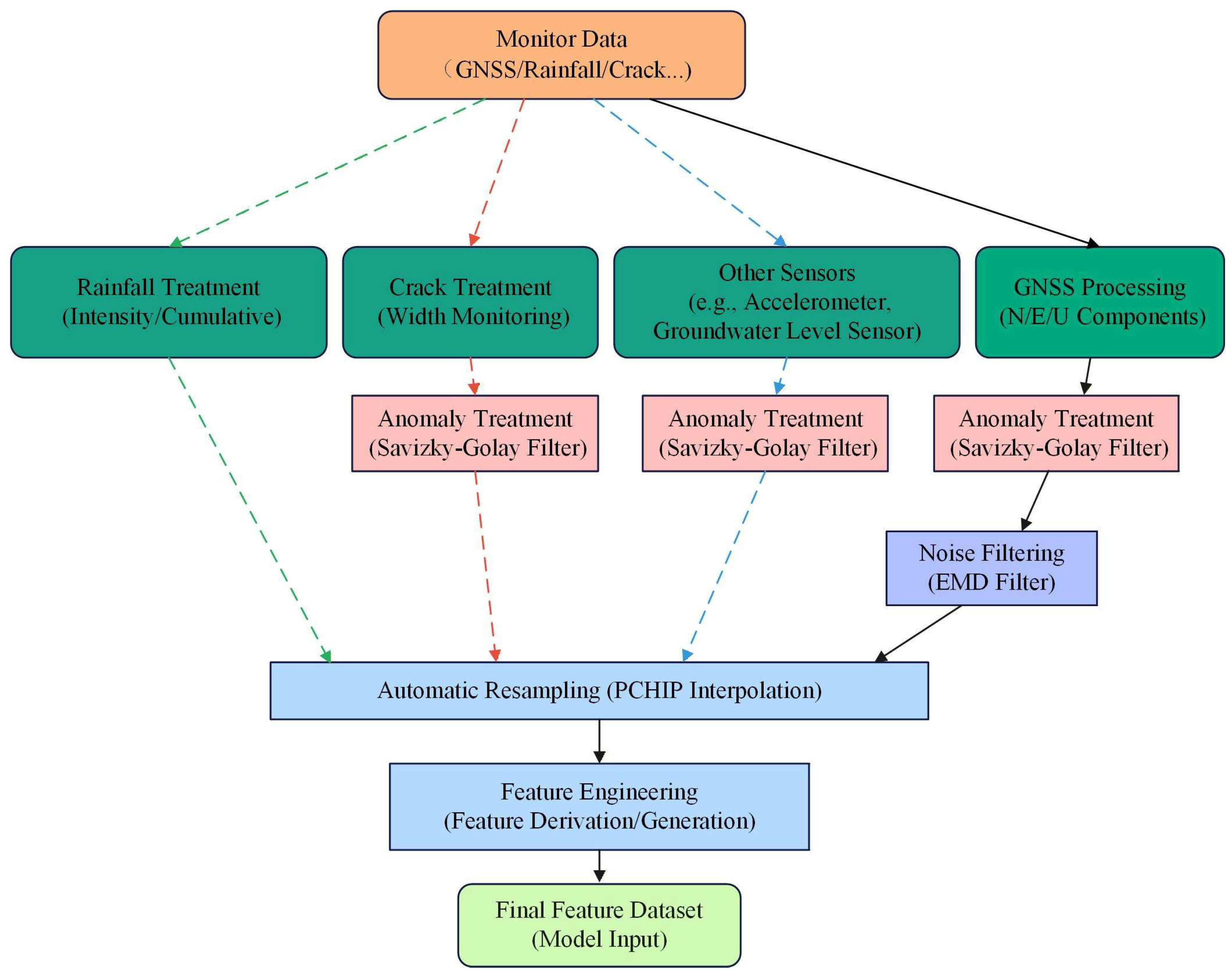
To construct a deep learning model suitable for displacement prediction warning and constrained by physical laws, a high-quality, highly reliable, and physics-informed input dataset is the primary prerequisite. However, actual landslide monitoring data inherently presents challenges such as being multi-source and heterogeneous, noisy, and non-aligned [10]. These challenges are equally pronounced in monitoring systems based on Wireless Sensor Networks (WSNs), necessitating adaptive data processing strategies [11]. To address these issues and proactively encode prior physical knowledge into the input data level, this chapter designs a systematic online data processing and feature construction pipeline, as detailed in Figure 1. The monitoring data of different sensors will be subject to abnormal interference in different ways, so differential pre-processing is required. GNSS data is easily affected by factors such as temperature and humidity changes, terrain obstacles, multipath effects, and receiver instability, which often lead to noise pollution and jump anomalies. Therefore, it is necessary to perform Savitzky–Golay filter jump detection filtering and EMD filter noise filtering on it. The continuous noise of data from crack gauges and micropiles is relatively low, but sudden jumps may occur due to human activities, construction interference, or local instantaneous interference. Therefore, Savitzky–Golay filters still require mutation detection filtering. Due to the fact that the disaster monitoring and early warning platform has already conducted quality control on rainfall data based on regional meteorological information, this study will not proceed with further anomaly handling. After exception handling and noise filtering, GNSS, Cracks, micro-pile inclinometers, and rainfall data are sent to the time alignment processing stage, and all monitoring data are resampled using PCHIP based on displacement prediction step size. Finally, first-order and second-order derivative features are created.

2.1. Data Sources and Monitoring Equipment

The data for this study were sourced from the Sichuan Provincial Geological Hazard Monitoring and Warning Platform. For model development and cross-site validation, the dataset comprised multi-source heterogeneous monitoring data from 210 monitoring points across 45 typical landslide hazards between 2017 and 2025. In addition, the Huangcaoping deformation mass was used as an independent long-term application case, giving 46 landslide sites involved in the overall study. The monitoring system adopts an integrated space–air–ground architecture and primarily incorporates five sensor types: GNSS displacement monitoring stations, micro-pile inclinometers, crack gauges, rain gauges, and water-level gauges. The database contains 697 devices and 27,153,183 raw monitoring records, including surface displacement, deep deformation, crack dynamics, rainfall, and groundwater-level observations, and the detailed information is presented in Table 1. After quality control, resampling, and sliding-window construction, these records were transformed into 30-step historical input sequences with a 5-step forecasting horizon for model training, validation, cross-site testing, and application evaluation.

2.2. Feature Selection

This study constructs a dataset based on all monitoring data from typical landslide monitoring sites within the Sichuan Provincial Geological Hazard Monitoring and Warning System. Each monitoring site must possess at least one GNSS displacement monitoring device. The time-series data it collects (including north, east, and vertical displacements, in mm/day) serves as the core output target for model training and prediction. GNSS displacement was selected as the core prediction target because it has much broader site coverage and better monitoring continuity in the provincial monitoring platform used in this study. Although crack gauges produced more records, this mainly resulted from their higher sampling frequency rather than longer or more complete monitoring periods. Compared with crack gauge data, GNSS observations provide more continuous and representative three-dimensional deformation information. Therefore, GNSS was used as the core output target, while crack gauge and other sensor data were treated as supplementary inputs. Auxiliary data originates from other devices at the monitoring site, such as additional GNSS devices, micro-piles (recording parameters like pile vibration acceleration and inclination angle, in m/s2 and °), crack gauges (recording crack width changes, in mm), and rain gauges (recording precipitation, in mm/h). These multi-source heterogeneous data collectively form the foundation of the model’s input features.
In the adaptive multi-parameter landslide displacement prediction model based on machine learning, feature selection is the key determinant of model performance and warning effectiveness. The feature selection for this model strictly adheres to three core principles: “physics-driven mechanism, data availability constraints, and prediction objective orientation.” It makes full use of the multi-source heterogeneous time-series data collected by sensors deployed at landslide monitoring points. Feature selection is based on the actual equipment deployed at the monitoring site. If multiple devices of the same type exist (e.g., three crack gauges), they are all included in the feature set to preserve spatial variability information. The common feature is constructed in Table 2.

2.3. Data Preprocessing

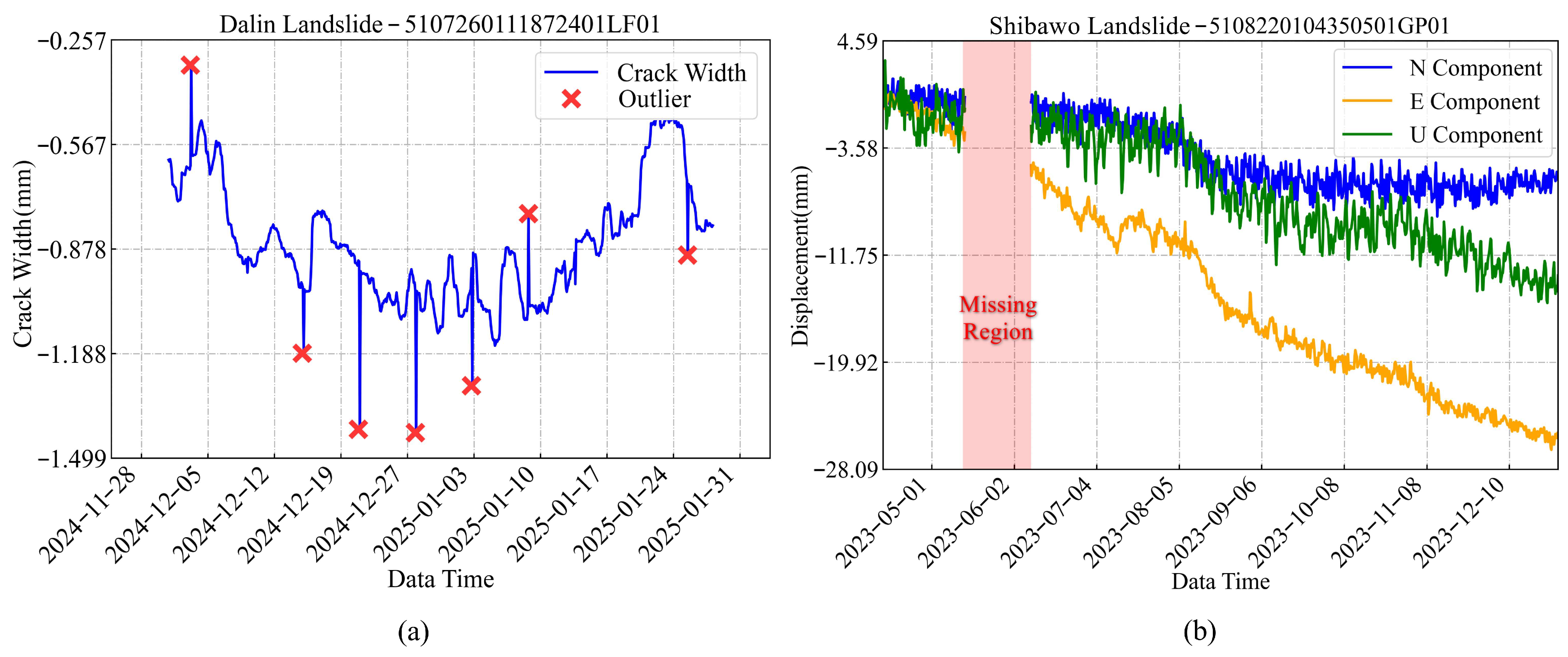
The monitoring data from devices such as GNSS, micro-piles, and crack gauges exhibit diverse anomalous features. Among these, an outlier anomaly is defined as a spike-shaped abnormal value in the process curve, where the amplitudes on both sides are approximately comparable, while the spike value deviates from the local trend by more than three standard deviations of that feature. To avoid removing possible real deformation signals, jump-anomaly pre-filtering is applied only to historical data, and the latest observation is retained for online learning and displacement prediction. Outliers in GNSS data are often caused by multipath interference, unresolved cycle slips, or receiver faults [12,13], while outliers in micro-pile or crack gauge data are commonly induced by electromagnetic interference, instantaneous overload, or nearby disturbances (as shown in Figure 2a) [14]. Data gaps frequently result from signal obstruction, adverse weather, or network issues, which severely reduce temporal resolution and compromise the quality of periodic signal analysis in the monitoring data (as shown in Figure 2b) [15]. Direct modeling with unprocessed data would introduce significant bias. Frequent jump anomalies can seriously distort the statistical characteristics of time series, mask the true signal, and cause the denoising algorithm to retain false peaks as legitimate changes. Therefore, direct denoising of the raw data was avoided. Through the comparative experiments of different processing sequences, a systematic preprocessing pipeline is finally determined and constructed, which successively performs three core steps: Anomaly detection and repair, noise filtering, and spatiotemporal alignment. Finally, physics-guided feature enhancement is applied to improve the mechanistic interpretability of the data, providing high-quality input for the Phys-LSTM model.

2.3.1. Anomaly Detection and Repair

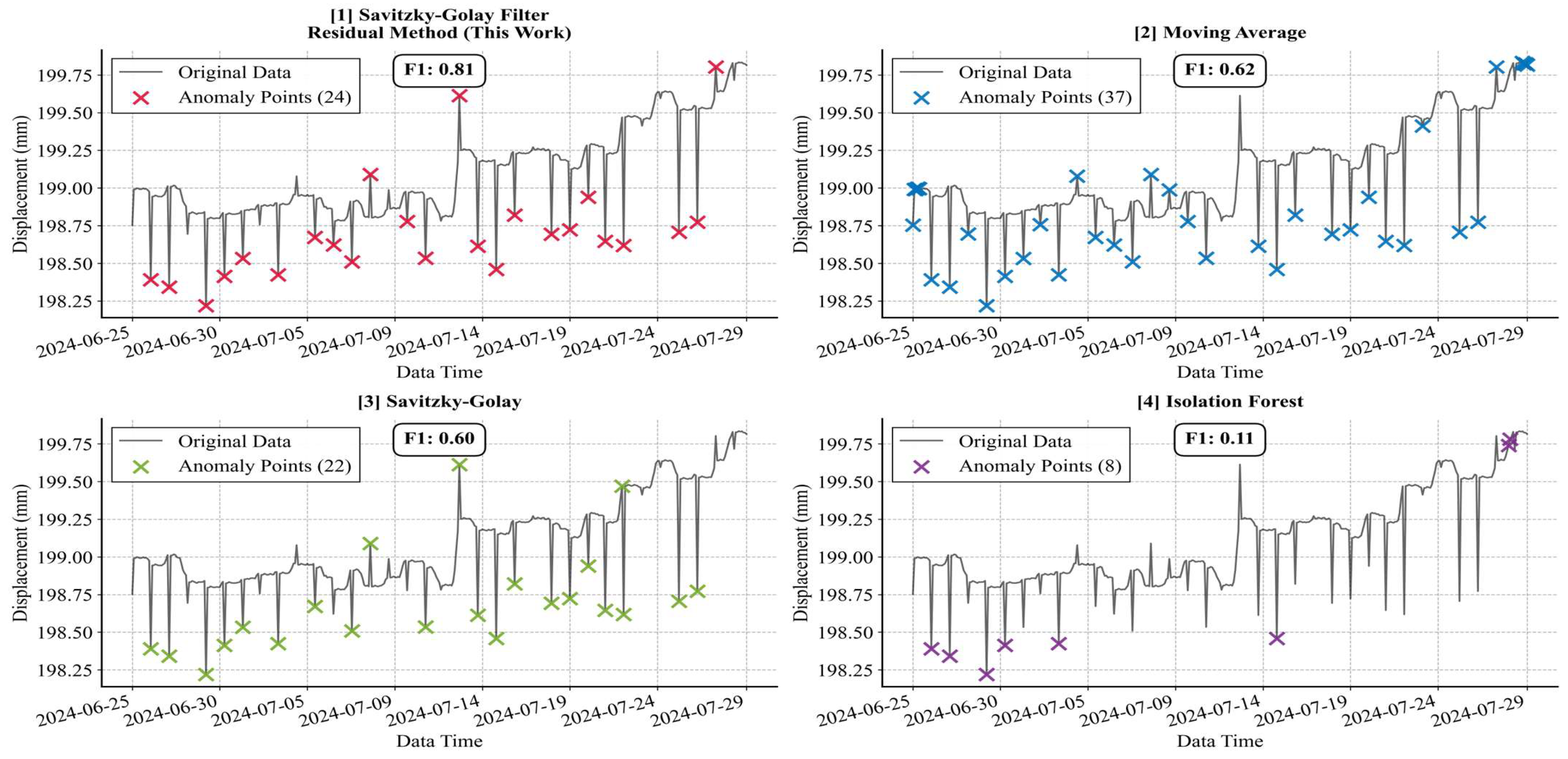
Anomaly detection was organized into three method families: statistical tests, signal-processing residual methods, and machine-learning approaches. Statistical methods such as Z-Score [16], Modified Z-Score [17], and IQR [18] are simple and efficient, but they depend strongly on distributional assumptions and are less robust for non-stationary landslide monitoring series.
Signal-processing methods identify anomalies from local trend or residual changes. Moving-average residual detection [19] is easy to implement but may introduce phase delay, whereas the Savitzky–Golay residual method [20] better preserves local peak morphology while detecting abrupt jump anomalies.
Machine-learning methods, including Gaussian Process Regression [21], Isolation Forest [22], DBSCAN, LOF, autoencoders, and LSTM-based detectors, can represent more complex data distributions, but they are more sensitive to parameter selection and training-data representativeness. Therefore, the final preprocessing pipeline favored a residual-based method that balanced detection accuracy, computational simplicity, and operational robustness.
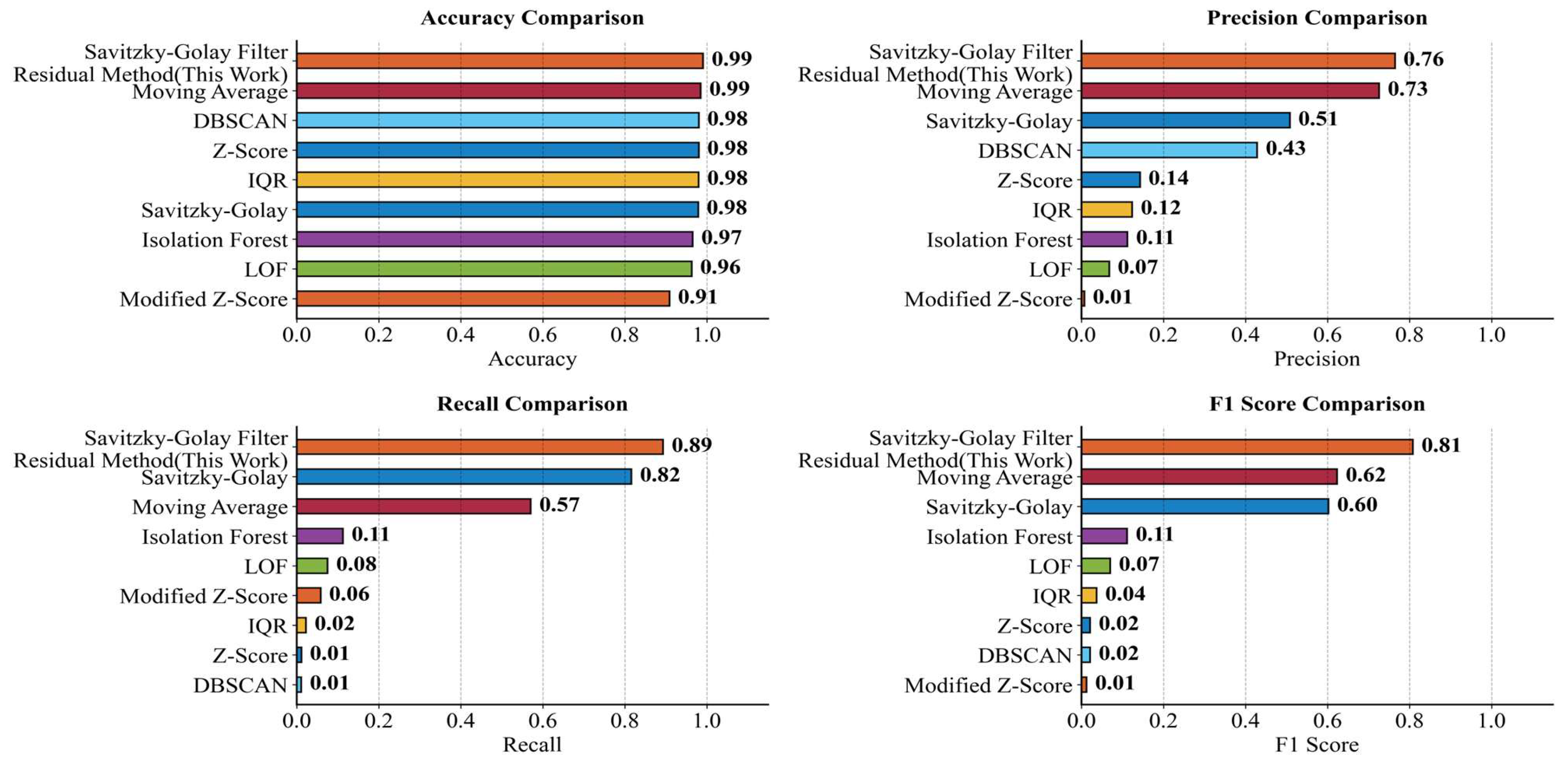
The comparative results in Figure 3 and Figure 4 show that the Savitzky–Golay residual method achieved the best overall balance between missed detections and false positives, with an F1-score of 0.81. Figure 4 further illustrates four representative detection results selected from the compared algorithms. This method was therefore adopted in the preprocessing pipeline for transient jump-anomaly detection in landslide monitoring data.

2.3.2. Noise Filtering

Noise filtering is required because GNSS, micro-pile inclinometer, and crack-gauge observations are affected by multipath effects, environmental disturbance, mechanical vibration, and sensor noise. The filtering strategy therefore prioritizes signal fidelity and deformation-trend preservation rather than excessive smoothing.
For GNSS monitoring, major noise sources include multipath effects, temperature-related atmospheric delays, and unmodeled atmospheric loads. Micro-pile inclinometer records are more often affected by mechanical vibration and local disturbance [23], while crack-gauge and other sensor records can contain high-frequency sensor noise [24].
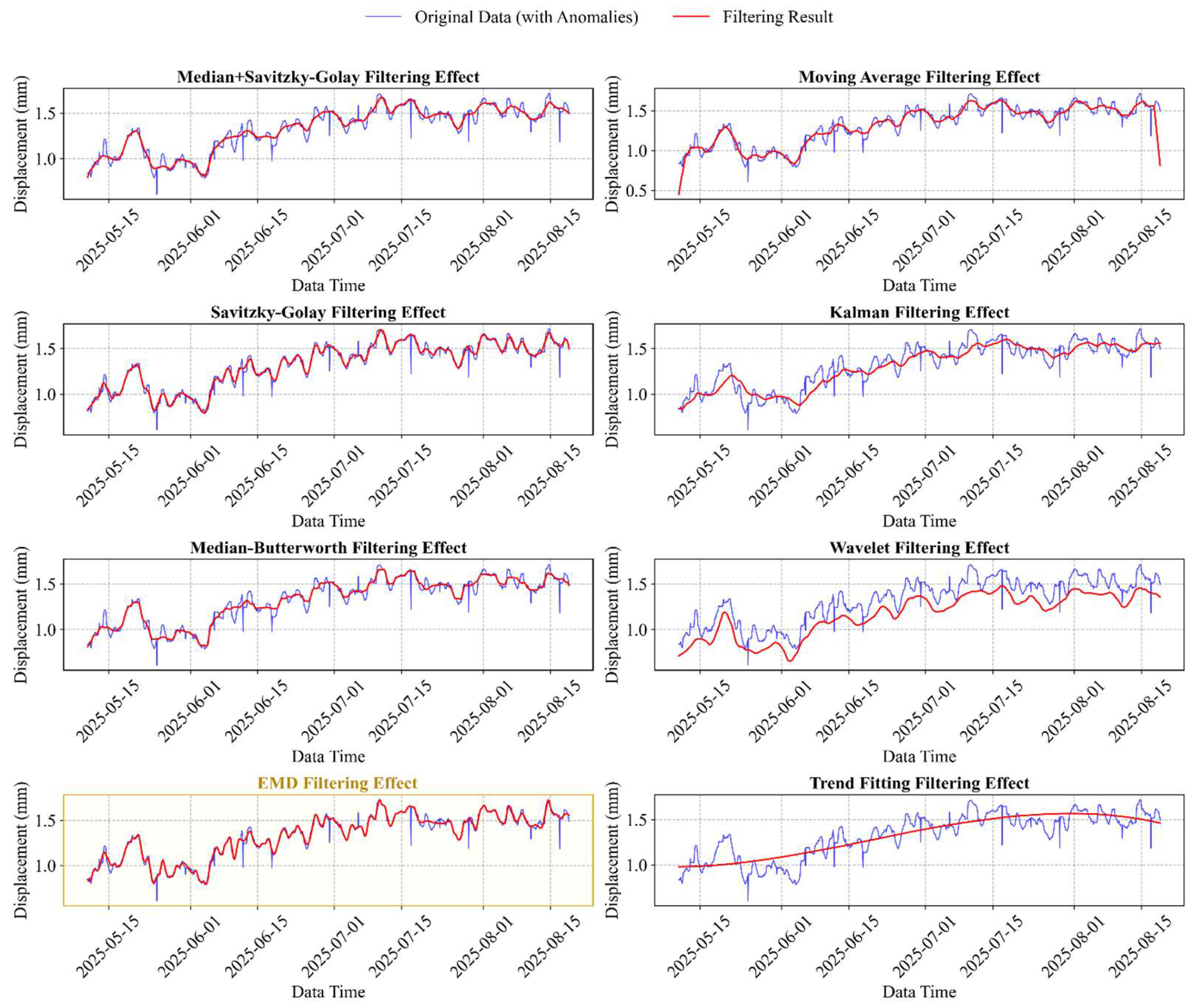
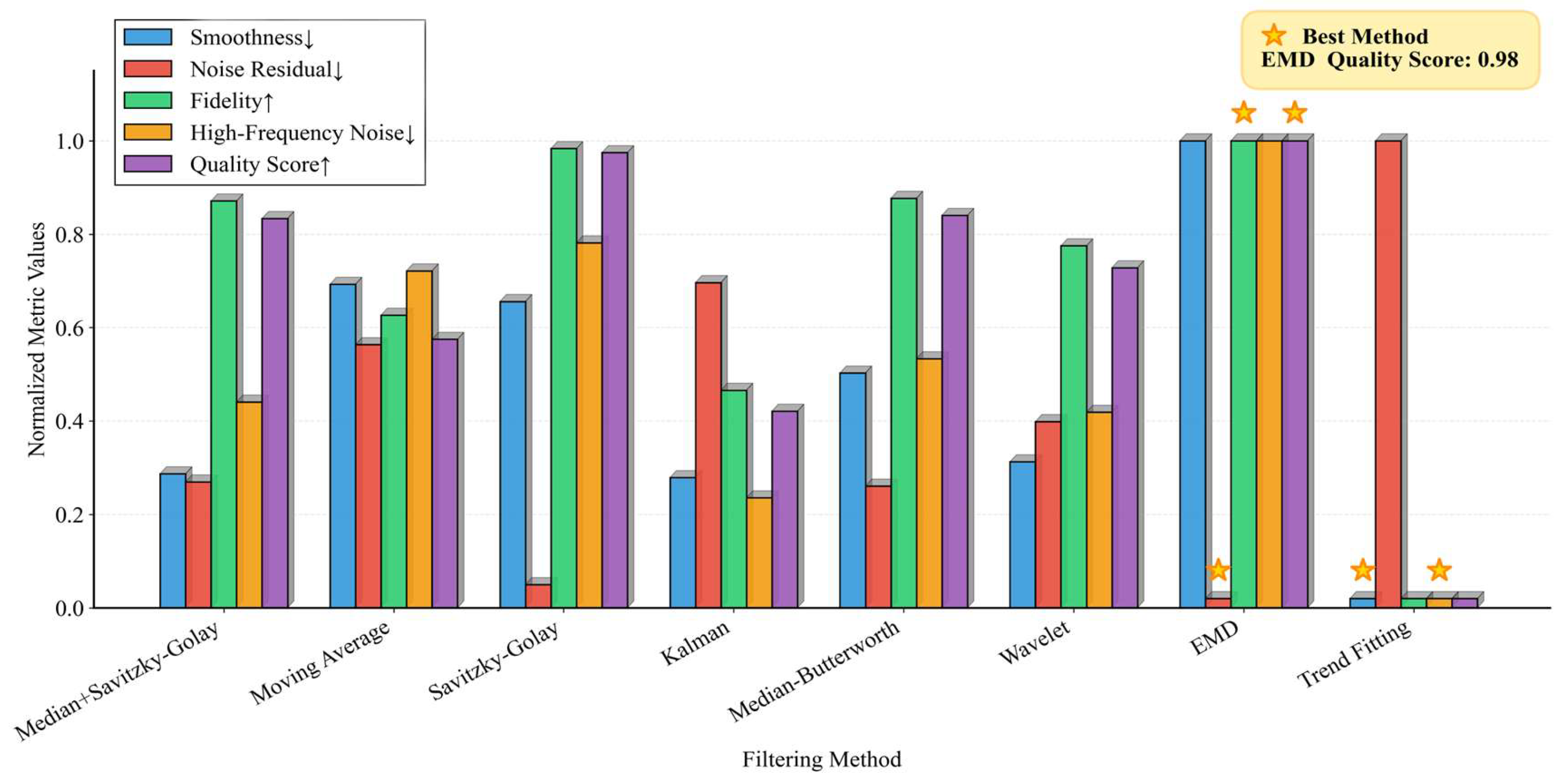
Eight filtering methods were compared, including median + Savitzky–Golay, Savitzky–Golay, moving average [25], Kalman [26,27], median-Butterworth, wavelet denoising [28], empirical mode decomposition (EMD) [29], and trend fitting. The comparison focused on whether each method could suppress high-frequency noise while preserving abrupt deformation signals and long-term displacement trends, as shown in Figure 5.
The performance evaluation of noise filtering algorithms for landslide monitoring data prioritizes fidelity as the core criterion, supplemented by appropriate penalties for noise residual, based on three guiding principles for landslide monitoring: (a) Signal fidelity takes precedence, displacement trends and periodic characteristics must be preserved; (b) Tolerance for moderate noise, GNSS data inherently contain millimeter-level noise, and excessive smoothing is unnecessary; (c) Protection of abrupt signals, key warning signals must not be obscured by smoothing-based metrics. The weighting scheme has been validated with actual data to ensure that high-fidelity algorithms achieve leading scores, while over-smoothing methods receive significantly lower scores, thereby aligning with engineering requirements. The comprehensive scoring formula is as follows:
Q = F × ( 1 α min ( p n , 1.0 ) )
where the fidelity F (Pearson correlation coefficient) holds the dominant weight (100%); the noise residual penalty term Pn (after normalization) sets an upper deduction limit of 10% (α = 0.1). Here, P n = N r σ y 0 + ε ( N r : number of residual noise samples, σ: standard deviation, ε: a minimal positive value, 10−8). The performance metrics of each algorithm derived from the above formula are shown in Figure 6.

2.4. Data Alignment and Physics-Informed Feature Construction

To address sampling-frequency discrepancies among GNSS, rainfall, crack-gauge, and other monitoring data, Piecewise Cubic Hermite Interpolating Polynomial (PCHIP) interpolation is used to resample the raw heterogeneous series to the target GNSS time series. PCHIP avoids the Runge phenomenon associated with high-order polynomial interpolation and preserves monotonic variation, making it suitable for landslide-monitoring variables. Spatially, each monitoring point is transformed into a local landslide coordinate system referenced to the main sliding direction, so displacement vectors, timestamps, and positions are aligned for cross-source coupled features such as cumulative rainfall-crack propagation rate.
To achieve deep integration of physical mechanisms with data-driven models, this section constructs a multi-dimensional feature system based on the preprocessed multi-source data. Through physics-informed feature enhancement techniques, the physical interpretability and predictive potential of the input features are significantly improved. The feature engineering framework is shown in Table 3, covering three categories of features: temporal decomposition, differential dynamics, and cross-coupling.
The STL (Seasonal-Trend decomposition using Loess) method is employed to decompose the displacement time series into three constituent components: trend, seasonality, and residual. This decomposition facilitates the separation of deformation components attributable to distinct physical causes, which in turn enhances the accuracy of landslide displacement prediction models [30,31,32,33]:
D ( t ) = T ( t ) + S ( t ) + R ( t )
where the trend component T(t) reflects the long-term creep accumulation under gravitational forces and serves as a core indicator for stability prediction, and the seasonal component S(t) captures repetitive deformation induced by periodic reservoir water level fluctuations or seasonal rainfall. This decomposition reduces the interference of high-frequency noise on trend prediction.
Differential Dynamics Features: Numerical differentiation is performed on the displacement trend component T(t) to quantify the dynamic evolution process: displacement rate υ t = d T / d t , and creep acceleration a t = d 2 T / d t 2 serves as a key indicator for identifying the accelerated creep stage. A condition where a t > 0 and continues to rise indicates that the landslide is entering a critical unstable state, providing a physical basis for early warning thresholds [34,35,36].
Physics-Informed Cross-Coupling Features: Cross-features reflecting the coupling between external triggers and internal deformation are constructed based on multi-field coupling theory:
The Rainfall-Displacement Response Ratio (RDRR) is defined as R D R R = P 3 h / v 24 h , where P 3 h is the 3-h cumulative rainfall increment (mm), and v 24 h is the 24-h displacement rate change (mm/day). This index quantifies the efficiency of rainfall infiltration in softening the slip zone, with a high RDRR value indicating strong regional sensitivity to rainfall [33,37,38,39,40].
The Crack-Displacement Synergy Coefficient ( C c d ) is calculated as:
C c d = Cov ( C r a c k , V e l o c i t y ) σ C r a c k σ V e l o c i t y
where C o v ( C r a c k , V e l o c i t y ) is the covariance between the crack width change series and the displacement rate series, σ C r a c k and σ Velocity are the standard deviations of the respective series. This coefficient links surface crack monitoring with deep-seated displacement, enhancing the understanding of the overall deformation mechanism. The value of C c d ranges from −1 to 1, with its absolute value closer to 1 indicating stronger synergy [41].
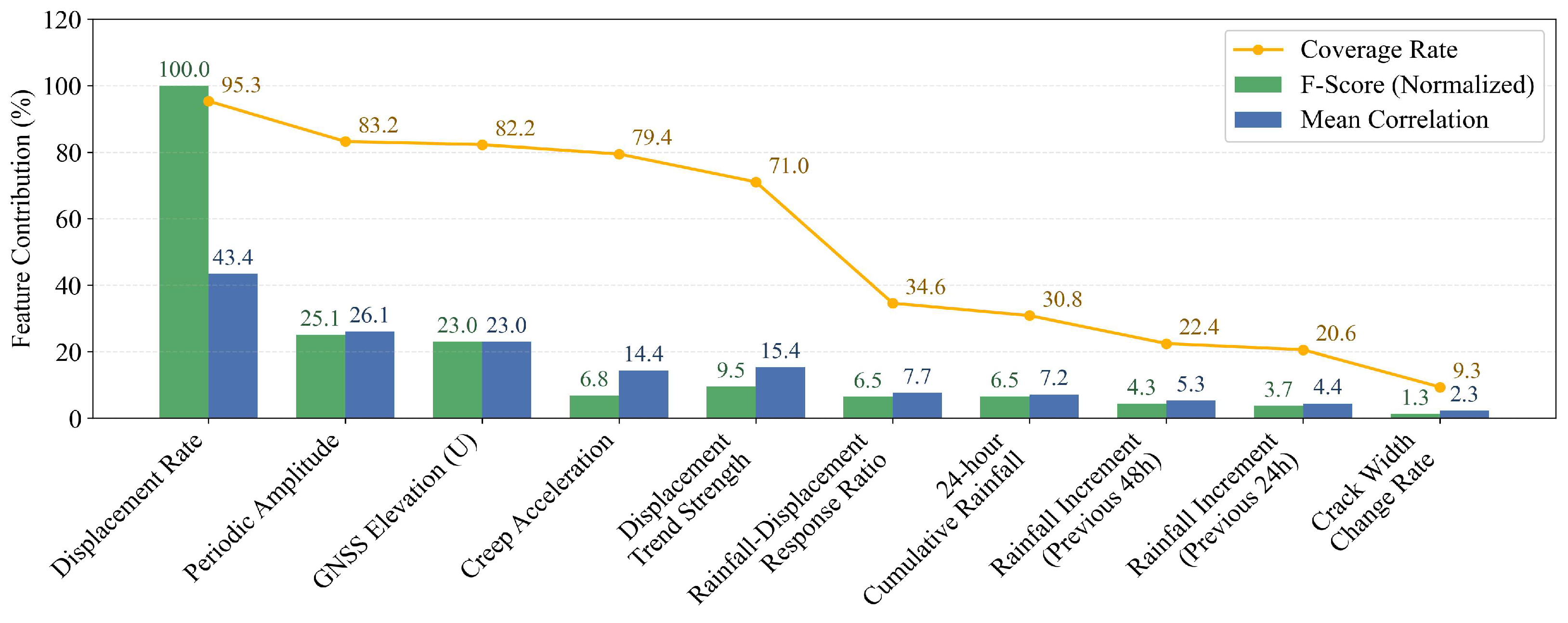
This study first employs Pearson correlation analysis to rapidly eliminate features that show no significant correlation with the displacement target variable. Subsequently, the SelectKBest (F-regression) method is used to select features with the most significant linear relationship to the target variable from the preliminarily screened set. By comparing the average correlation and normalized F-scores of each feature, the contribution of each feature to displacement prediction is evaluated. The results, as shown in Figure 7, indicate that displacement rate, periodic component amplitude, and the GNSS elevation component rank as the top three contributors. Among these, the displacement rate achieves the highest F-score with an average correlation of 43.4%, which fully confirms the effectiveness of the physics-informed features. Furthermore, although rainfall lag features and crack-related features show relatively lower coverage, they still hold certain reference value. Based on the above analysis results, ten core features are ultimately selected as input for the Phys-LSTM model, thereby avoiding the curse of dimensionality while ensuring information density. Through this feature engineering process, the principles of geomechanics and multi-field coupling effects are transformed into quantifiable feature indicators, laying a solid foundation for the model to achieve “physics-constrained data-driven” learning.

3. Design of the Phys-LSTM Model Architecture and Integration of Physical Constraints

This chapter elaborates on the overall architecture of the Phys-LSTM model. Its core innovation lies in the discretization and computationally reconstruction of key physical laws governing landslide evolution (stress equilibrium, creep laws, kinematic equations) and deeply embedding them into the gating mechanisms and loss function of the LSTM network in the form of hard constraints. This achieves a deep integration of physical mechanisms and data-driven capabilities. Specifically, this chapter first improves three fundamental physical equations to make them suitable for the deep learning framework. Subsequently, a dual-branch collaborative model architecture is designed, enabling dynamic guidance of the data-driven process by physical laws through the parallel processing and interaction of a physics-informed feature extraction branch and an LSTM temporal learning branch. Finally, a multi-task loss function incorporating physical constraints is defined to ensure the model’s predictions comply with fundamental physical laws. The overall design aims to construct an adaptive prediction framework that integrates mechanisms and data, enhancing the model’s prediction accuracy, generalization ability, and physical interpretability in complex environments.

3.1. Physical Reformulation of Landslide Dynamics

A reliable physical model provides the foundation for mechanism-guided prediction. To achieve a deep integration of physical laws and data-driven modeling, this study first systematically refines and computationally reformulates three core physical equations governing landslide evolution. Building on this basis, we propose a landslide displacement prediction architecture that integrates dynamic feature engineering with online adaptive learning. The central design philosophy of this framework is to transform stability evolution, creep accumulation, and displacement kinematic consistency into physically guided state variables and regularization principles that can be continuously updated from multi-source monitoring data through their coordinated interpretation. This reformulation is not intended to replace rigorous geotechnical analysis; rather, under conditions where only real-time monitoring data are available, it is designed to preserve, to the greatest extent possible, physically meaningful evolutionary trends and constraint relationships, thereby enabling accurate short-term and imminent prediction of landslide deformation trends.

3.1.1. Reformulation of the Factor of Safety for Online Prediction

In classical limit-equilibrium analysis, the factor of safety (FOS) is generally defined as the ratio between the total resisting force and the total driving force along a potential sliding surface, and it serves as a core indicator for evaluating slope or landslide stability. Its general form can be written as:
F O S = total   resisting   force total   driving   force
where the numerator represents the overall resistance mobilized along the potential sliding surface, whereas the denominator represents the total downslope driving action. For geotechnical slopes, the resisting term is primarily controlled by the shear strength of the sliding zone soil or weak structural surfaces, which in turn is governed by cohesion c, internal friction angle φ, normal stress conditions, and pore-water pressure. The driving term is mainly associated with slope geometry, self-weight, and the gravitational components acting in the sliding direction. In essence, the classical factor of safety reflects the mechanical competition between resisting and driving actions within the slope mass. For clarity, the stress-dependent resistance discussed below is interpreted primarily in the effective-stress sense, in which the shear-strength relation can be expressed as τ f = c + σ n tan ϕ and the available resistance depends on the effective normal stress σ n = σ n u rather than on total normal stress alone.
Although this formulation has clear engineering significance in static stability analysis, its direct application becomes problematic in a monitoring-driven online prediction framework [42]. We therefore clarify that the discussion in this study refers primarily to an effective-stress-based interpretation of slope resistance. Under a conventional total-stress or effective-stress limit-equilibrium calculation, cohesion and friction angle can be treated as constant input parameters for a specified material state, drainage condition, and stress path. In the present online framework, however, rainfall infiltration changes pore-water pressure and hence effective normal stress, while crack propagation and cumulative deformation indicate progressive damage. The time-varying quantity represented by the model is therefore not a direct variation in the intrinsic c′ and φ′ values themselves, but the evolution of mobilized shear resistance under changing effective-stress and damage conditions.
From this perspective, the temporal degradation term is governed by two observable processes. Rainfall intensity is used as a proxy for hydrological forcing because infiltration raises pore-water pressure and reduces effective normal stress, thereby lowering the mobilized frictional resistance even when c′ and φ′ are kept constant in the classical strength equation. Movement velocity is used as a proxy for progressive structural damage, crack development, and shear disturbance, which may appear as equivalent strength degradation at the monitoring scale. Their combined effect controls the temporal evolution of the stability state.
Because complete geotechnical parameters, pore-pressure fields, and sliding-surface conditions cannot be updated continuously from the monitoring data, the present study does not attempt to invert c′(t) and φ′(t) independently. Instead, their combined influence on the effective-stress-controlled mobilized resistance is absorbed into a reduced-order stability degradation term, denoted as Γ(t). This term should be interpreted as a monitoring-derived proxy for time-varying effective shear resistance and damage accumulation, rather than as a direct inversion of the fundamental strength parameters. Under this assumption, the temporal evolution of slope stability can be written as:
S I ( t ) 1 1 + Γ ( t )
where a larger value of Γ(t) indicates stronger degradation and thus lower stability. To retain physical interpretability while maintaining parameter identifiability and computational efficiency for online prediction, the composite degradation term is further approximated as a weighted combination of a rainfall-related term and a velocity-related term, namely
Γ ( t ) k r R ˜ ( t ) + k v v ˜ ( t ) 2
where R ˜ ( t ) is the normalized rainfall intensity, or more generally the rainfall-related hydrological forcing, ν ˜ ( t ) is the normalized movement velocity magnitude, and k r and k v are scaling coefficients representing the relative contributions of rainfall forcing and deformation activity to stability degradation. A quadratic form is adopted for the velocity term because the destabilizing effect of deformation activity is typically amplified in a nonlinear manner: during the low-velocity stage, the slope may remain in a stable or quasi-stable creep state, whereas a marked increase in velocity usually indicates that the system is approaching an accelerated instability stage. The use of v 2 is therefore more appropriate for characterizing this enhancement in sensitivity.
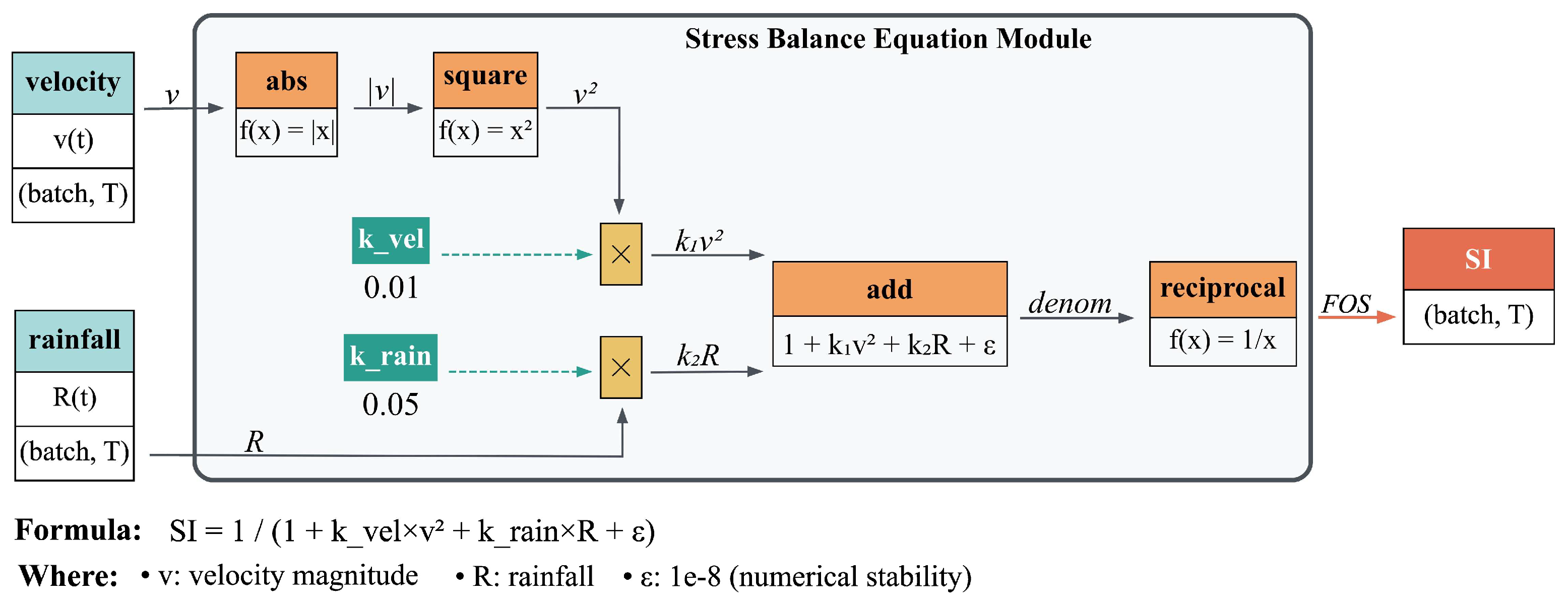
Substituting the above degradation term into the stability representation yields the dynamic stability index used in this study for online learning,
S I ( t ) = 1 1 + k r R ˜ ( t ) + k v v ˜ ( t ) 2 + ε
where SI(t) denotes the dynamic stability index at time t, k r and k v are scaling coefficients, and ε is a small positive constant introduced to avoid a zero denominator. This reciprocal formulation has several desirable properties. A larger degradation term results in a smaller index value, thereby capturing the physically meaningful trend that stronger rainfall forcing or more intense deformation activity corresponds to lower stability. The expression remains positive for all time steps, which makes it suitable for embedding into the network as a stability-related state variable. At the same time, its compact form is convenient for continuous updating under an online monitoring framework.
In this way, the stability concept governed by the competition between resisting and driving actions in classical FOS theory is reformulated into a dynamic stability index SI(t) that is suitable for monitoring-data-driven conditions. Rather than relying on the real-time updating of complete engineering geological parameters, this index provides a reduced-order description of stability degradation through rainfall forcing and deformation activity, thereby offering a computable physical characterization of the temporal evolution of slope stability. In the subsequent model, SI(t) is introduced as a monitoring-derived physical state variable into the feature representation and temporal learning process, and it further provides mechanism guidance for network optimization through gate modulation and the design of constraint terms. Through this treatment, the physical insight from classical stability analysis is embedded into the online learning framework, allowing the model to retain the adaptability of data-driven learning while achieving stronger physical consistency and interpretability. We developed the dynamic stability index evolution model shown in Figure 8. This module maps dynamic features such as displacement velocity and rainfall into a time-series stability index through learnable parameters.

3.1.2. Discretization of the Creep Constitutive Relation

The classical Burgers creep model, which describes the time-dependent deformation of geomaterials, is expressed as a continuous function:
ε ( t ) = σ E 1 + σ η 1 t + σ E 2 1 exp ( E 2 η 2 t )
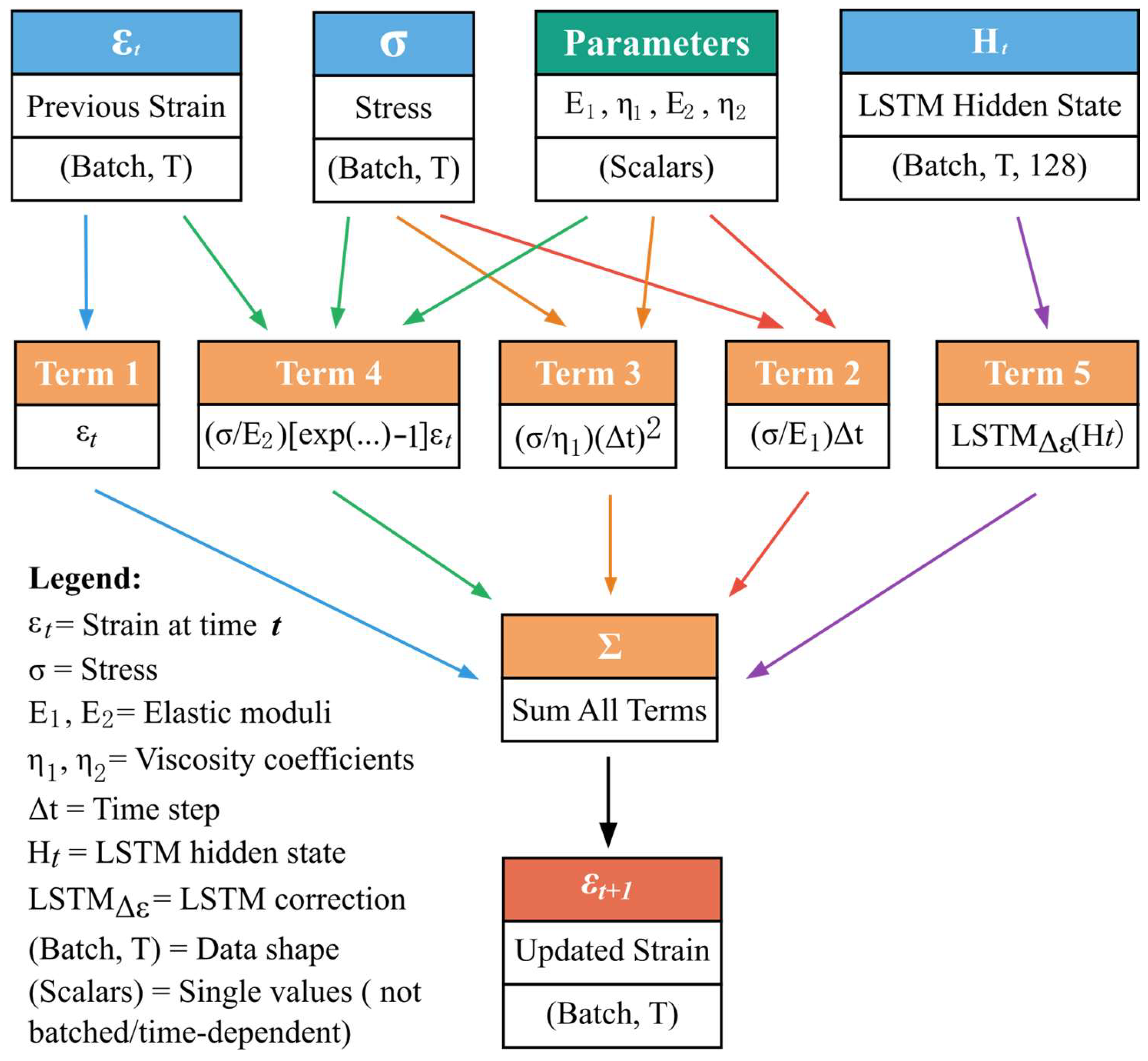
where E 1 and E 2 are elastic parameters, η 1 and η 2 are viscous parameters, and σ is the constant stress. This model simultaneously captures three deformation stages: instantaneous elastic deformation, decaying (primary) creep, and steady-state (secondary) creep. Such a constitutive description is particularly relevant for landslide deformation because monitored displacement commonly exhibits progressive accumulation, delayed response, and stage-dependent acceleration under sustained external disturbance. These characteristics make creep theory a physically meaningful basis for representing long-term deformation evolution. However, a fundamental discrepancy exists between its continuous time variable t and the input of discrete-time sequence models like LSTM, which require data at equally spaced time intervals. This paper employs the Euler method to discretize the continuous time t into a sequence with time step t . By applying a finite difference approximation to the original equation and reformulating it into a recurrence relation based on the strain at the previous time step ε t , a discrete-time framework is established. Furthermore, to account for complexities not fully captured by the discretization process or the model itself—such as non-uniform stress distribution—the hidden state H t of the LSTM network is incorporated as a corrective term to capture the unmodeled complex nonlinear creep behavior [5,43,44,45,46]. The final discrete-time creep equation is obtained as:
ε t + 1 = ε t + σ E 1 Δ t + σ η 1 ( Δ t ) 2 + σ E 2 exp ( E 2 η 2 Δ t ) 1 ε t + LSTM Δ ε ( H t )
where L S T M ε ( H t ) represents the output of the LSTM network’s correction module, which learns to model the discrepancy between the ideal physical model and observed complex system behavior. The implementation of this formula within the Phys-LSTM landslide prediction model is illustrated in Figure 9, where the physical model is naturally embedded into the stepwise computation of the temporal network. This enables the LSTM to learn residuals within the framework of physical laws, thereby enhancing the model’s interpretability and extrapolation capability.

3.1.3. Kinematic Constraint and Physics-Informed Loss

In classical uniformly accelerated linear motion, displacement results from the superposition of a uniform motion component due to initial velocity and a uniformly variable motion component due to acceleration. The kinematic relationship is expressed as:
x t + 1 = x t + x ˙ t Δ t + 1 2 α t ( Δ t ) 2
where x t + 1 is the position at time t + 1, x t is the position at time t, x t ˙ is the instantaneous velocity at time t, t is the time interval between the two moments, in seconds, and α t is the instantaneous acceleration at time t. In the context of landslide displacement prediction, this kinematic relationship provides a direct physical link among displacement, velocity, and acceleration, and is therefore well suited for constraining the temporal consistency of predicted motion. Compared with a fully coupled mechanical simulation of the sliding body, such a representation retains a clear physical basis while remaining sufficiently compact for integration into a data-driven learning framework.
In this study, quantifying the uncertainty of machine learning-based predictions is crucial for reliable early warning and risk assessment. Uncertainty is introduced by treating the acceleration as a random variable, whose distribution parameters are learned by the LSTM from the data. This enables the model to predict uncertainty ranges [33,47]. The final improved probabilistic motion equation is as follows:
x t + 1 = x t + x ˙ t Δ t + 1 2 a ˜ t ( Δ t ) 2 ,           a ˜ t ~ N ( μ a ( t ) , σ a 2 ( t ) )
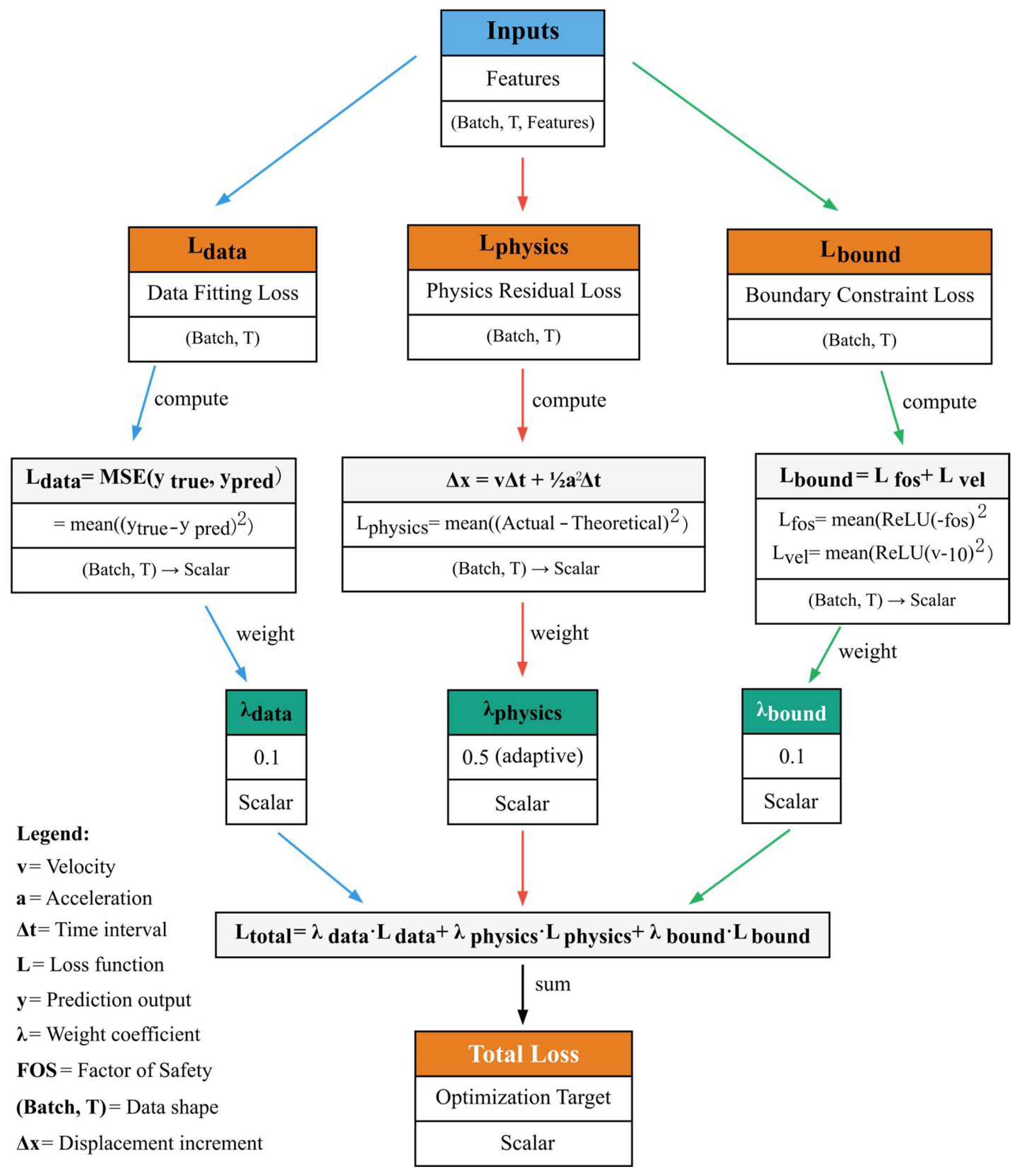
where μ a ( t ) and σ a 2 ( t ) are output by the LSTM based on the historical sequence H t . The model ultimately outputs the displacement for future time steps. To ensure that the predicted sequence remains not only numerically accurate but also physically consistent with the underlying motion state, this paper designs a multi-task loss function that integrates data fitting error and physical equation residual based on the improved discretized kinematic equation [43]. In this way, the kinematic equation is not used as a full deterministic simulation model, but as a physically grounded regularization principle that guides the network toward temporally coherent displacement prediction. The total loss function is defined as:
L total = λ data L data + λ physics L physics + λ bound L bound
where L total is the mean squared error between predicted and true values; L physics is the physical equation residual loss, based on the discretized kinematic equation, ensuring the predicted trajectory conforms to motion laws. Its expression is:
L physics = 1 T 1 t = 1 T 1 ( x t + 1 x t ) x ˙ t Δ t + 1 2 a ˜ t ( Δ t ) 2 2
L bound is the boundary constraint loss. Based on the physical meaning of the improved stress balance equation, a boundary constraint loss term is designed to ensure the predicted velocity does not exceed a maximum critical velocity and that the safety factor is non-negative and aligns with physical common sense. Its expression is as follows:
L bound = t = 1 T max ( 0 , υ max ) + max ( 0 , F O S ( t ) )
The loss weights λ employ an adaptive strategy [48]. Higher weights are assigned to the physics constraints in the early stages of training to guide the network in quickly learning the fundamental laws. As training progresses, the weight for data fitting is gradually increased, allowing the model to better fit the real observed data. Based on the total loss function in Equation (10), the corresponding loss function constraint terms are constructed. The computational flow and the derivation relationships among the various physical quantities (displacement d, velocity v, acceleration a) are detailed in Figure 10.

3.2. Phys-LSTM Architecture

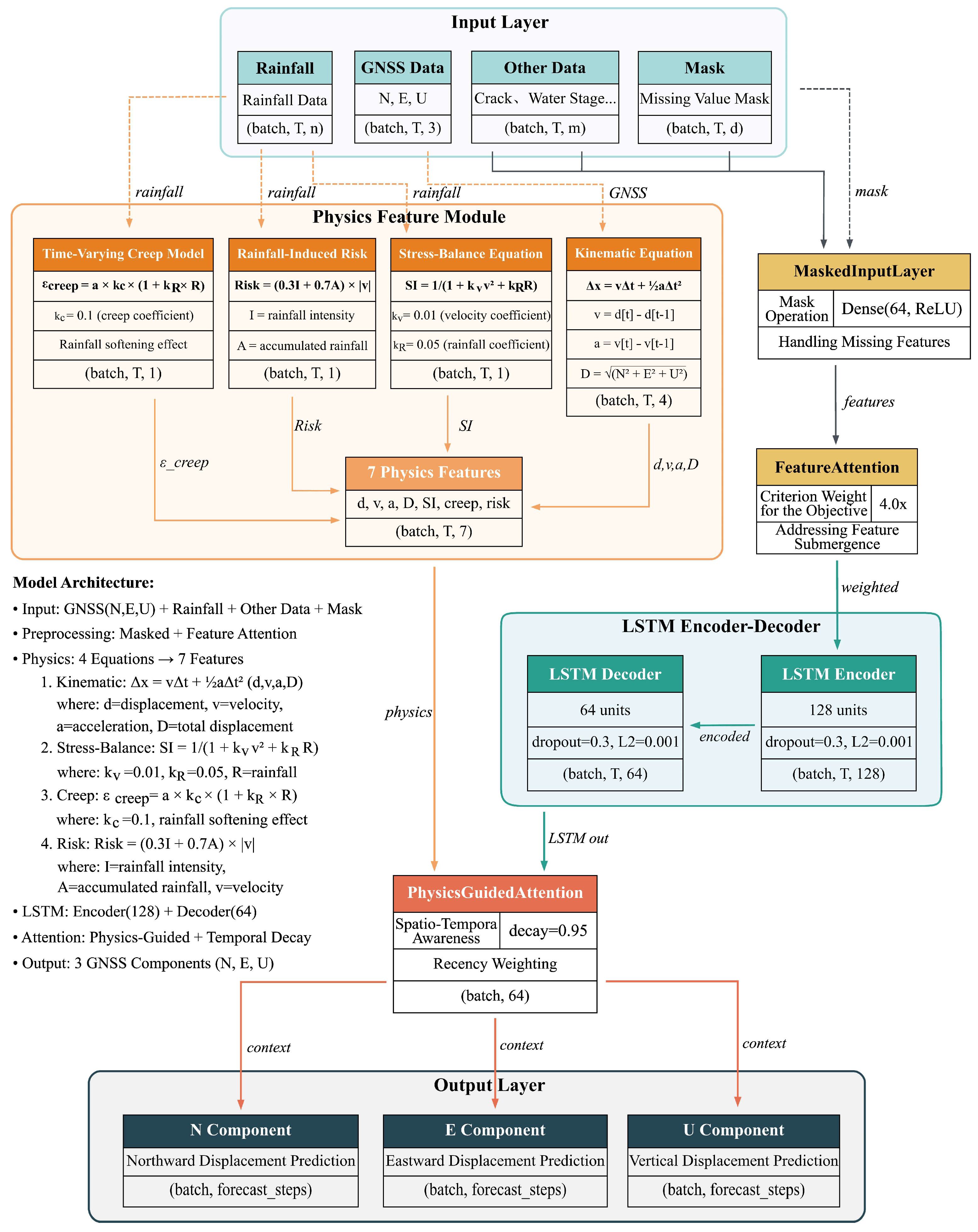
Based on the constraints of the aforementioned physical equations, this paper constructs the overall architecture of the Phys-LSTM model as shown in Figure 11. This architecture adopts a dual-branch hybrid design, achieving synergistic learning between mechanism and data through a physics-guided interaction mechanism.

3.2.1. Input Representation and Masked Feature Encoding

To accommodate the reality of potentially missing data in online monitoring scenarios, a Masked Input Layer is designed as the first layer of the model. This layer accepts the raw feature vector containing missing values, denoted as X i n p u t , along with a binary mask vector M. It identifies valid features through element-wise multiplication, X m a s k e d = X i n p u t M , thereby endowing the model with the ability to operate robustly under conditions of incomplete data. The resulting masked historical sequence is then treated as the input representation for the LSTM encoder–decoder forecasting path. The encoder aggregates the 30-step monitoring window into a latent deformation state that contains deformation trend, rainfall response, and stability information, and the decoder maps this state to the 5-step future displacement trajectory. Thus, the encoder–decoder structure supports multi-step rolling prediction rather than single-step regression, while allowing the stability index, creep increment, and kinematic residual loss to guide physically consistent future trajectories.

3.2.2. Physics Feature Module and Dynamic State Variables

The core of the model is a parallel processing structure consisting of two components: a physics-informed feature extraction branch and an LSTM temporal learning branch. The physics-informed feature extraction branch executes the discretized and reconstructed physical equations from Section 3.1 (stress balance, creep constitutive equation). Based on real-time input data, it calculates a series of physics-informed intermediate features, such as the dynamic stability index (SI(t)) and creep increment ( δ c r e e p ). The LSTM temporal learning branch is a standard multi-layer LSTM network responsible for learning complex nonlinear temporal patterns from historical monitoring sequences.

3.2.3. Physics-Guided Temporal Learning

To achieve deep integration of information from the two branches, the Phys-LSTM model implements physics-guided interaction through a gating mechanism. Building upon the standard LSTM forget gate, a physics-informed prior guidance term based on the computed stability index (SI) is incorporated. This enables the model to decide on memory retention based on the real-time stability state of the landslide. The expression is as follows:
f t = σ ( W f H t 1 , X t + b f + P f S I ( t ) )
where σ is the Sigmoid activation function (output range 0–1), with values approaching 1 indicating “complete retention” and values approaching 0 indicating “complete forgetting”; W f is the weight matrix of the forget gate, learning to extract feature patterns most relevant to memory retention from the historical state and current input; [ H t 1 , X t ] denotes the concatenation of the hidden state and the current input, where H t 1 encapsulates the summary of the historical deformation sequence, and X t contains measured data such as displacement and rainfall at the current timestep; b f   is the bias term of the forget gate, adjusting the baseline activation level; and p f is the physics-guided weight matrix, learning how the physical state influences the memory retention strategy.
The physics-guided term P f · F O S t integrates real-time stability assessment into memory control. When F O S ( t ) decreases (indicating reduced stability), the value of this term decreases, guiding the forget gate f t to tend towards retaining more historical state information. This enhances the model’s memory of precursor sequences associated with danger, thereby aiding in more accurate early-warning judgments.
The temporally sequential data, enhanced by physics-informed features, is then fed into a multi-layer LSTM network. Following the LSTM layers, an attention mechanism is introduced to construct an attention-enhanced LSTM temporal encoder. The calculation of attention weights depends not only on the hidden state H t but is also influenced by real-time physics-informed features. By directly linking the attention weight calculation to the importance of physical features characterizing landslide deformation and failure, the model is actively guided to focus on critical physical phases of the landslide, enabling earlier and more accurate warnings. Its expression is as follows:
α t = exp ( Score ( H t , P h y s i c s t ) ) i = 1 T exp ( Score ( H t , P h y s i c s t ) )
where α t is the attention weight (range 0–1), with higher weights indicating that the information at that timestep is considered more critical by the model when making decisions; H t is the temporal hidden state, encoding dynamic information from the historical sequence, representing the data-driven learning component of the model; P h y s i c s t is the physics-informed feature vector, enabling the model to actively focus on dangerous periods when the physical state undergoes abrupt changes; Score is the scoring function, comprehensively evaluating the significance of timestep t in terms of both data patterns and physical laws, defined as Score = W [ H t | P h y s i c s t + b (where ║ denotes vector concatenation).
3.3. Online Training Strategy

A core objective of the proposed framework is not only to improve prediction accuracy, but also to maintain adaptability under continuously incoming monitoring data. The training process is therefore designed as an online updating strategy rather than a one-time offline optimization procedure. This design allows the model to initialize rapidly, expand its effective learning window as more data become available, and subsequently maintain stable rolling prediction during long-term operation.

3.3.1. Three-Stage Online Learning Mechanism

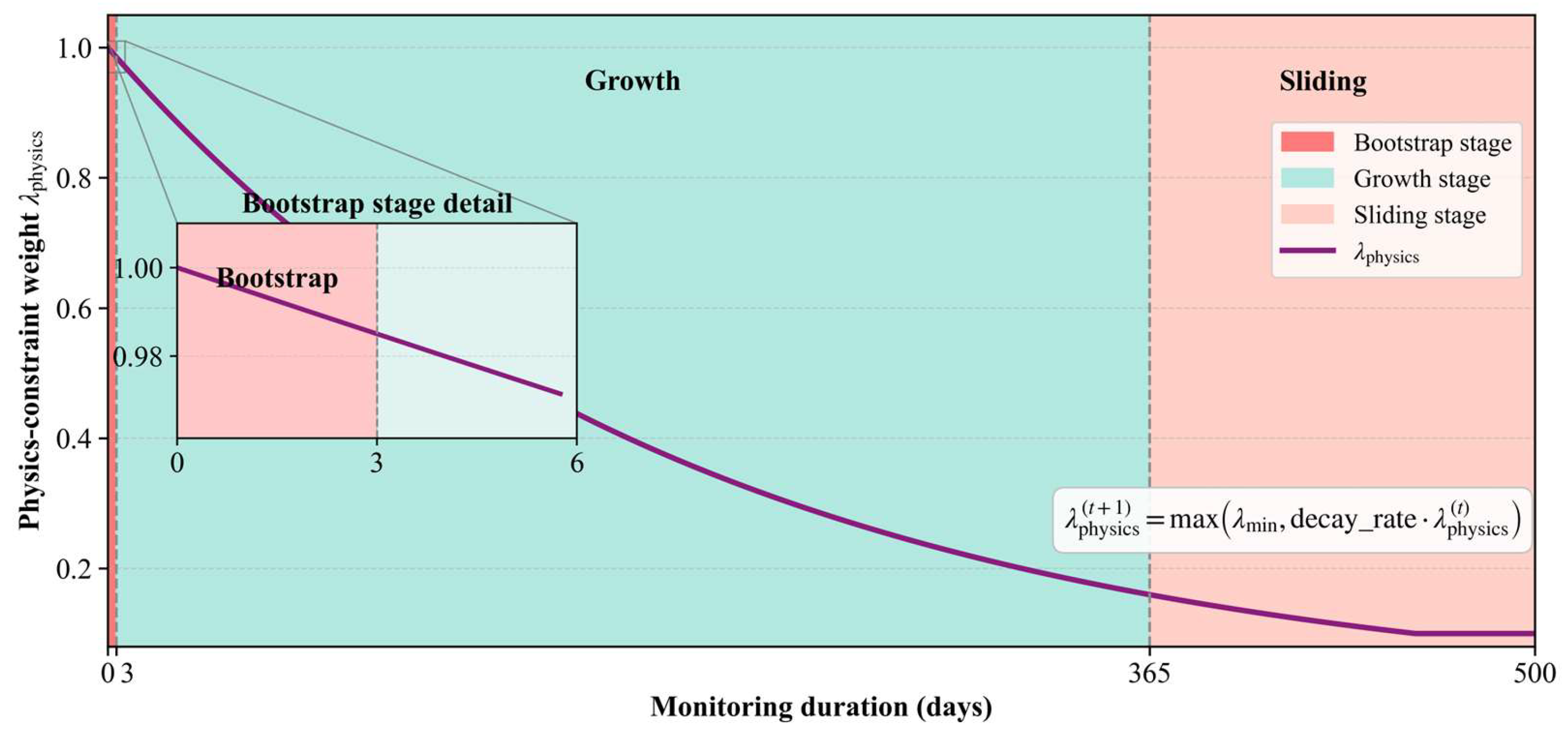
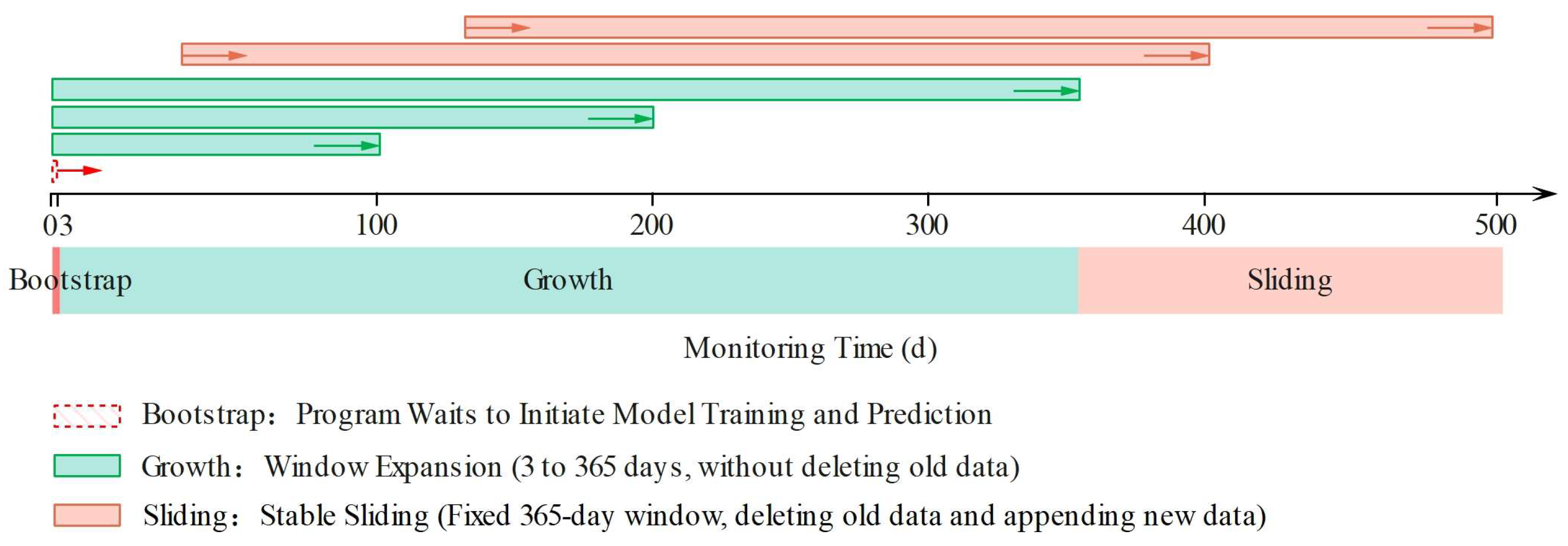
To accommodate the practical constraints of landslide monitoring and the evolving availability of time-series data, a progressive three-stage online learning mechanism is adopted in the proposed framework, as illustrated in Figure 12. During the phase 1 stage, the model is initialized with the minimum amount of data, enabling prediction to start as early as possible after monitoring begins. As additional observations accumulate, the framework enters the phase 2 stage, in which the effective learning window expands progressively and the model develops a more complete representation of site-specific temporal characteristics. Once sufficient historical information has been accumulated, the training procedure transitions to the phase 3 stage, where a fixed rolling window is maintained for continuous updating and prediction. This staged design reflects the operational reality that emergency deployment and long-term monitoring impose different demands on the prediction system: The bootstrap stage prioritizes rapid initialization under limited data support, whereas the growth and sliding stages progressively strengthen robustness, temporal completeness, and adaptability during sustained operation, thereby providing a unified strategy for balancing model timeliness at deployment and prediction stability in long-term online learning.

3.3.2. Adaptive Physics-Constraint Weighting

The role of physical guidance is not uniform throughout the training process. When the available data are limited or the model is still in the early stage of convergence, stronger physical regularization is beneficial because it stabilizes optimization and suppresses implausible fitting to local noise. As the model gradually acquires richer site-specific information, excessive reliance on the physical prior may limit its ability to adapt to the actual deformation pattern. This observation motivates the use of an adaptive weighting strategy for the physics-constraint term.
In the present framework, the physics-constraint weight is updated according to an exponential decay rule:
λ physics ( t + 1 ) = max λ min , decay _ rate λ physics ( t )
where λ physics ( t ) denotes the physics-constraint weight at training step or epoch t, decay_rate controls the decay speed, and λ min is the lower bound that prevents the physics regularization from vanishing completely. In the present implementation, the initial physics weight is set to 1.0, the decay rate is set to 0.99, and the lower bound is set to 0.1. This setting ensures stronger physical guidance in the early stage of training and a more balanced optimization between mechanism constraint and data fitting in the later stage.
The adaptive weighting strategy is consistent with the operational logic of the proposed three-stage online learning framework. During the phase 1 stage, a relatively high physics weight stabilizes model initialization under limited data support. During the phase 2 stage, the gradual reduction of λ physics allows the model to incorporate newly accumulated site-specific observations more effectively. During the phase 3 stage, the lower-bounded physics constraint continues to provide physical regularization while preserving the flexibility required for rolling prediction. To improve interpretability, the evolution curve of λ physics across the training process is presented in Figure 13, where the bootstrap, growth, and sliding stages are also indicated.

3.3.3. Rolling Updating and Prediction Workflow

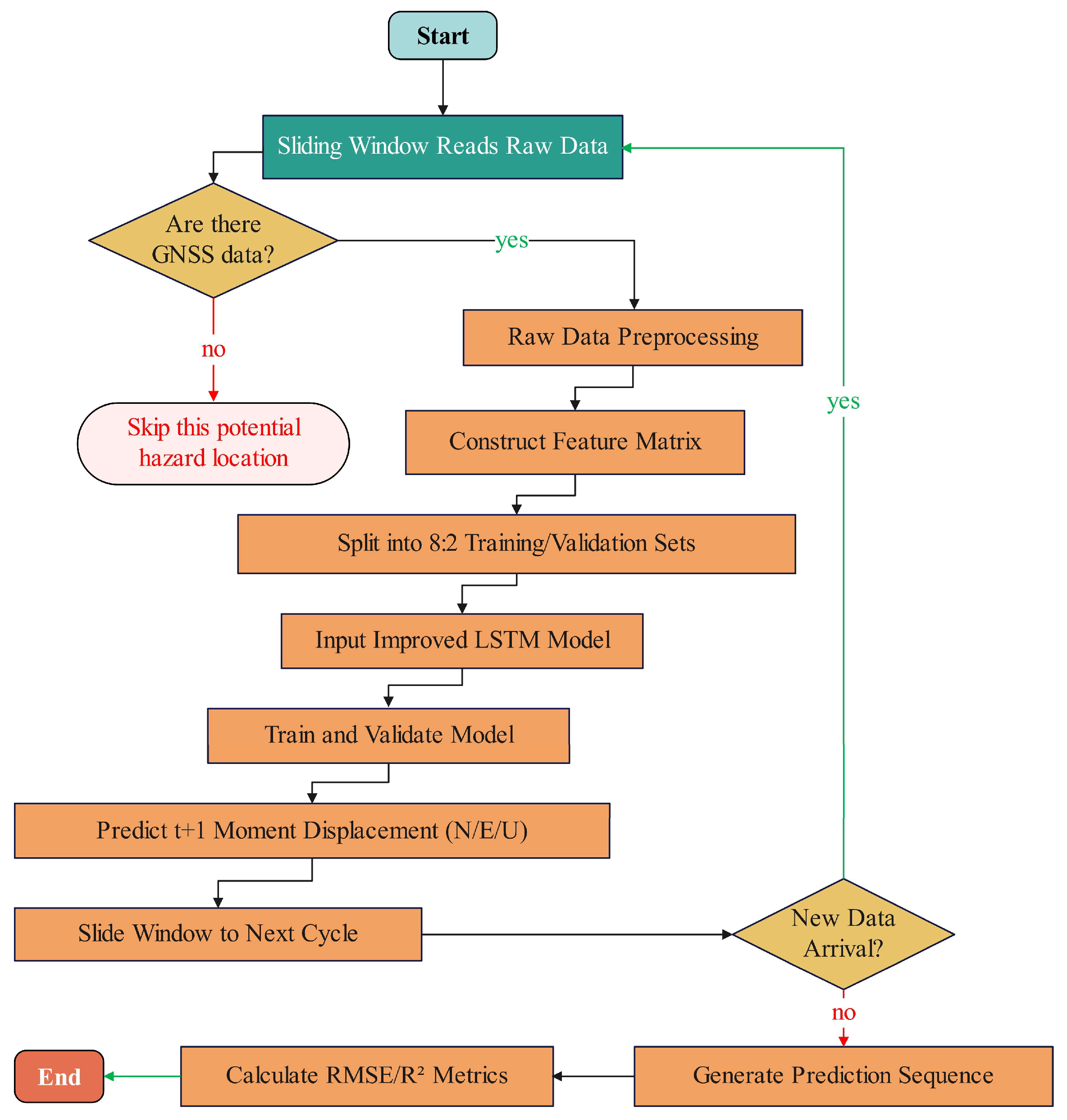
Based on the above design, the complete prediction workflow of Phys-LSTM consists of three tightly connected processes, as illustrated in Figure 14: monitoring-data ingestion and preprocessing, physics-informed representation and temporal learning, and rolling updating with continuous prediction. Incoming observations are first transformed into structured feature sequences through quality control, spatiotemporal alignment, and physics-informed feature construction. These sequences are then processed by the Phys-LSTM architecture to generate multi-component displacement predictions while preserving physically meaningful temporal consistency. Once new monitoring data arrive, the rolling window is updated and the model parameters are incrementally adjusted according to the current training stage and the adaptive weighting strategy. In this way, the proposed framework operates as an online displacement-prediction model under realistic monitoring conditions, with its significance lying not only in predictive accuracy, but also in the integration of mechanism-oriented guidance, temporal learning, and online updating into a unified operational workflow.
From an implementation perspective, the online framework consists of data ingestion, quality control, feature updating, incremental training, rolling prediction, and warning-interface output. Initial model training can be completed offline or in the background after a monitoring site has accumulated enough observations, whereas routine online operation only updates the rolling data window and performs lightweight incremental parameter adjustment. Because the forecasting horizon is five time steps and the input window is 30 time steps, single-site inference can be executed on a standard monitoring-platform server or edge node; the practical update frequency follows the incoming GNSS, rainfall, crack-gauge, and inclinometer sampling intervals.

4. Experiments and Results

To systematically evaluate the performance of the Phys-LSTM model, comprehensive experiments were conducted using real-world datasets from the Sichuan Province Geological Hazard Monitoring and Early Warning Platform. The experimental data includes core features such as complete GNSS displacement monitoring, rainfall monitoring, crack width monitoring, and water level gauge readings. The Phys-LSTM model architecture incorporates a masking layer, a physics-informed feature calculation module, a feature-level attention mechanism, an LSTM encoder–decoder (with 128 and 64 hidden units, respectively), and a physics-guided temporal attention mechanism. To enhance generalization capability, a Dropout rate of 0.3 and an L2 regularization coefficient of 0.001 were introduced. The model was trained using the Adam optimizer with an initial learning rate of 0.0005, employing a learning rate scheduling strategy that combines a 5-epoch warm-up phase followed by cosine decay. The batch size was set to 512, training epochs ranged from 100 to 300, and an early stopping mechanism was implemented to monitor validation loss. The physics-informed feature module extracts a 7-dimensional feature set, including displacement velocity, acceleration, total displacement, dynamic factor of safety, creep increment, and rainfall risk index. The feature-level attention mechanism increases the weight of GNSS target features to approximately 22%, while the temporal attention mechanism assigns higher weights to recent data through exponential decay (decay rate of 0.95).

4.1. Experimental Models and Evaluation Metrics

To ensure both the breadth and rigor of the comparative analysis, five representative baseline models were selected, as listed in Table 4, spanning classical statistical approaches to state-of-the-art deep learning methods, and their predictive performance was evaluated using four widely adopted metrics, namely Root Mean Square Error (RMSE), Mean Absolute Error (MAE), Mean Absolute Percentage Error (MAPE), and the Coefficient of Determination (R2), so as to characterize model performance from multiple perspectives, including absolute error, relative deviation, and goodness of fit. To guarantee the comparability of the reported results, all experiments in the comparative study were conducted on the same test dataset for each landslide under a unified progressive three-stage framework for training, validation, and prediction. The reported results were derived from a single complete run for each model–landslide pair rather than from the average of repeated runs. For multi-component displacement prediction, each evaluation metric was first computed separately for the N, E, and U displacement components, after which the arithmetic mean of the three directional results was used as the integrated performance indicator reported in the manuscript. For instance, the comprehensive RMSE was calculated as the mean of RMSE_N, RMSE_E, and RMSE_U, such that the reported values represent the overall predictive capability of each model across the three-dimensional displacement field rather than the performance for any single component alone.

4.2. Hyperparameter Setting and Tuning Strategy

To ensure a fair comparison, all models were evaluated under a unified validation protocol. The historical input window length and forecasting horizon were fixed at 30 and 5 time steps, respectively, and the samples were divided into training and validation sets with a ratio of 80%/20%. The architecture was not selected through an exhaustive global optimization algorithm; instead, it was determined using validation-guided empirical calibration and sensitivity comparison. The 128-64 hidden-unit configuration was retained because the 128-unit encoder provided sufficient capacity to represent nonlinear deformation memory and rainfall-lag response, while the 64-unit decoder reduced forecasting-head complexity and online computational burden. For XGBoost, the 30-step historical window was flattened into supervised learning features and used to predict the N, E, and U displacement components under a squared-error regression objective; L2 regularization was explicitly represented by reg_lambda. For LSTM, GRU, Transformer, and Phys-LSTM, validation loss and early stopping were used to control overfitting, and adaptive learning-rate reduction was applied where appropriate. The general parameters and key model-specific settings are shown in Table 5.

4.3. Overall Performance Comparison

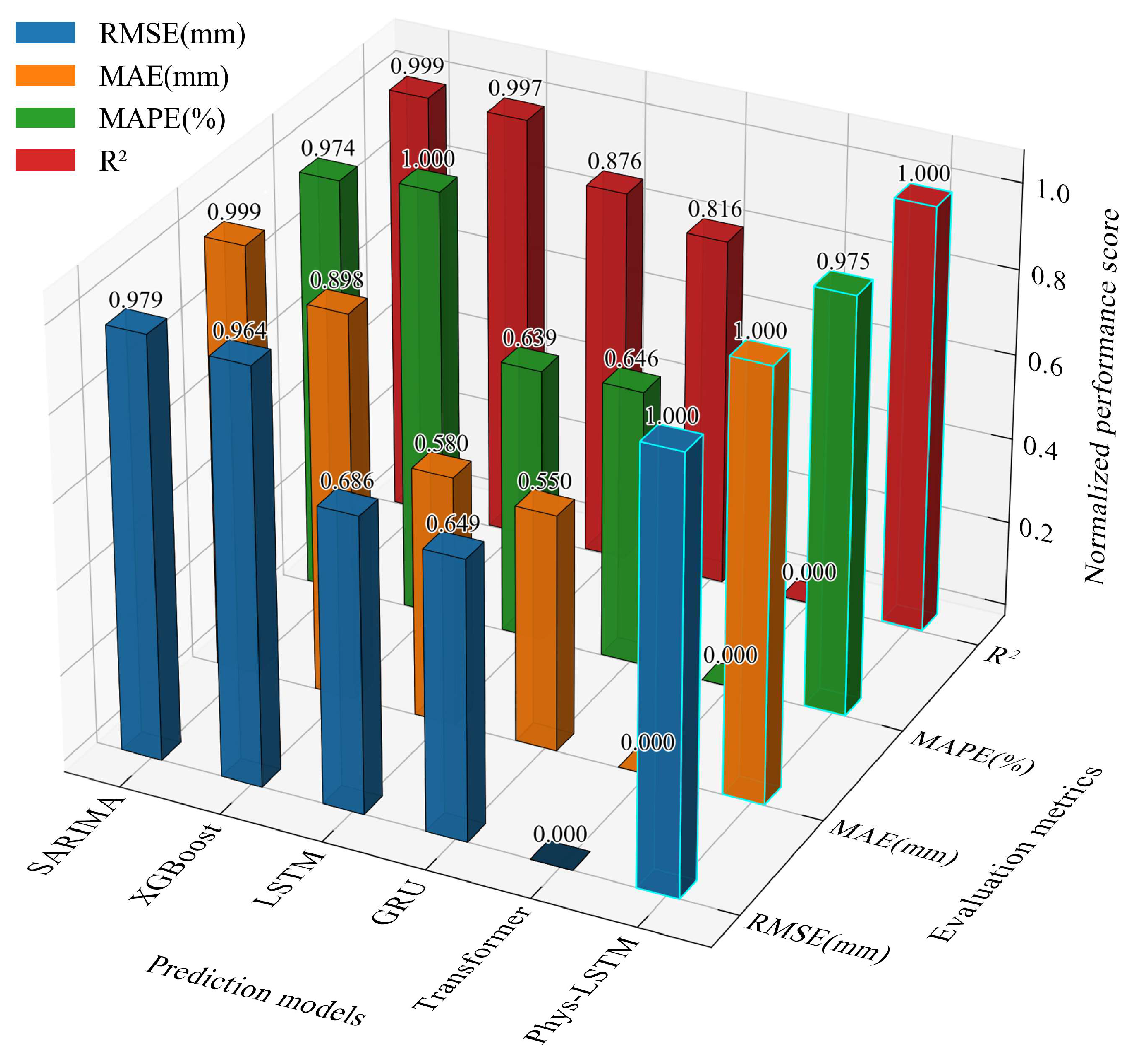
The comparative experiments were completed using the TensorFlow framework, employing the same dataset and a unified training/validation set split ratio (8:2) to ensure a fair comparison. The overall prediction performance of each model on the test set is shown in Figure 15. In this figure, both the z-axis and the bar-top labels denote relative performance scores obtained by min–max normalization of each evaluation metric across the compared models. For the error-based metrics RMSE, MAE, and MAPE, reverse min–max normalization was applied so that lower raw values correspond to higher normalized scores, whereas for R2, forward min–max normalization was adopted, such that higher raw values correspond to higher normalized scores. The Phys-LSTM model demonstrated optimal performance across all evaluation metrics.
The comparative results reveal the performance boundaries of different modeling paradigms in landslide displacement prediction. As shown in Figure 15, SARIMA and XGBoost are limited in representing nonlinear deformation memory when the monitoring sequence contains asynchronous sampling, missing observations, and abrupt local disturbances. The unconstrained Transformer baseline also showed unstable performance in the present online monitoring setting. Under the present site-specific sequence length, 30-step input window, 5-step forecasting horizon, and parameter budget, self-attention without physical priors was more easily affected by noisy or non-stationary observations. In addition, MAPE is highly sensitive during low-displacement periods, which can amplify local deviations. These findings support the need for physically constrained recurrent modeling in strongly mechanism-driven landslide forecasting tasks.
In contrast, the Phys-LSTM model, derived from a deeply integrated “physics-informed and data-driven” architectural design, demonstrated comprehensive and stable superiority (RMSE ≤ 1.78 mm, R2 ≥ 0.96). Specifically, the hard-constraint loss function based on kinematic equations provides directional guidance for model optimization that conforms to fundamental mechanical laws, ensuring the physical plausibility of the predicted trajectory. Meanwhile, the physics-guided gating mechanism, which incorporates the stability index (SI), enables the model to adaptively filter and memorize critical temporal states, thereby achieving a unification of high accuracy and high robustness within complex systems.
To further evaluate the prediction stability of the models under different geological conditions, we calculated the standard deviation of the RMSE for the aforementioned models across six different landslide mass test sets. The six landslides used in this cross-site comparison cover diverse geomorphological and geological settings, including bedding-controlled rock landslides, accumulation-layer landslides, and cover-material landslides sliding along the bedrock interface. Their slope gradients, lithological compositions, structural conditions, and deformation styles differ markedly, thereby providing a representative basis for evaluating cross-site generalization stability. The monitoring configurations of these sites include combinations of GNSS displacement monitoring, crack gauges, rain gauges, and inclinometer-type sensors, and the available monitoring data comprise three-dimensional displacement, crack-width variation, rainfall records, and related auxiliary observations. Such heterogeneity makes the six-site comparison particularly suitable for testing whether the proposed model can maintain stable performance under varying geological conditions, monitoring configurations, and data characteristics. The geological conditions, deformation characteristics, and monitoring configurations of the six landslides used in the cross-site comparison are summarized in Table 6.
The calculation results are presented in Table 7. It should be noted that the RMSE values summarized in Table 7 represent the arithmetic mean of the directional RMSE values for the N, E, and U displacement components at each site.
Based on the experimental data in Table 7, it can be observed that Phys-LSTM maintained the optimal and most stable prediction performance across six landslide masses with diverse geological conditions and deformation characteristics (with the lowest RMSE standard deviation of only 1.34). This exceptional cross-site generalization stability is inherently attributed to the advantages embedded within its physically constrained architecture. The core physical equations (such as stress equilibrium and creep constitutive laws) describe universal mechanical principles governing landslide evolution. They provide the model with a unified optimization constraint and inductive bias that does not depend on the data distribution of any specific site. This fundamentally suppresses the model’s tendency to overfit to incidental noise or local features within a single training dataset, enabling it to capture the common dynamic mechanisms underlying different landslides. In contrast, the performance of purely data-driven models (e.g., LSTM, Transformer) heavily relies on the similarity between the training and testing data distributions. The extreme error points and large performance standard deviations (up to 31.18) observed for these models on landslides with significant differences, such as Pengjiawan and Dashuzi, directly reflect their lack of physical prior knowledge and the fragility of their generalization foundation.

4.4. Generalizability and Operational Applicability

The proposed framework is most applicable to monitored landslides with progressive deformation behavior, where displacement, rainfall, deformation-rate, and auxiliary monitoring features can be continuously updated. The six-site comparison covers bedding-controlled rock landslides, accumulation-layer landslides, cover-material landslides, and soil landslides, indicating that the physics-informed constraints provide a transferable inductive bias across different geological and monitoring conditions.
Nevertheless, the framework is not intended to replace site-specific geotechnical assessment. Its transferability may be reduced for rapid failures with limited precursory displacement, earthquake-triggered failures, debris-flow processes, or sites where key hydrological or structural controls are not observed. In such cases, additional monitoring variables, recalibration, or more explicit physical modules should be introduced before operational deployment.

5. Application Case

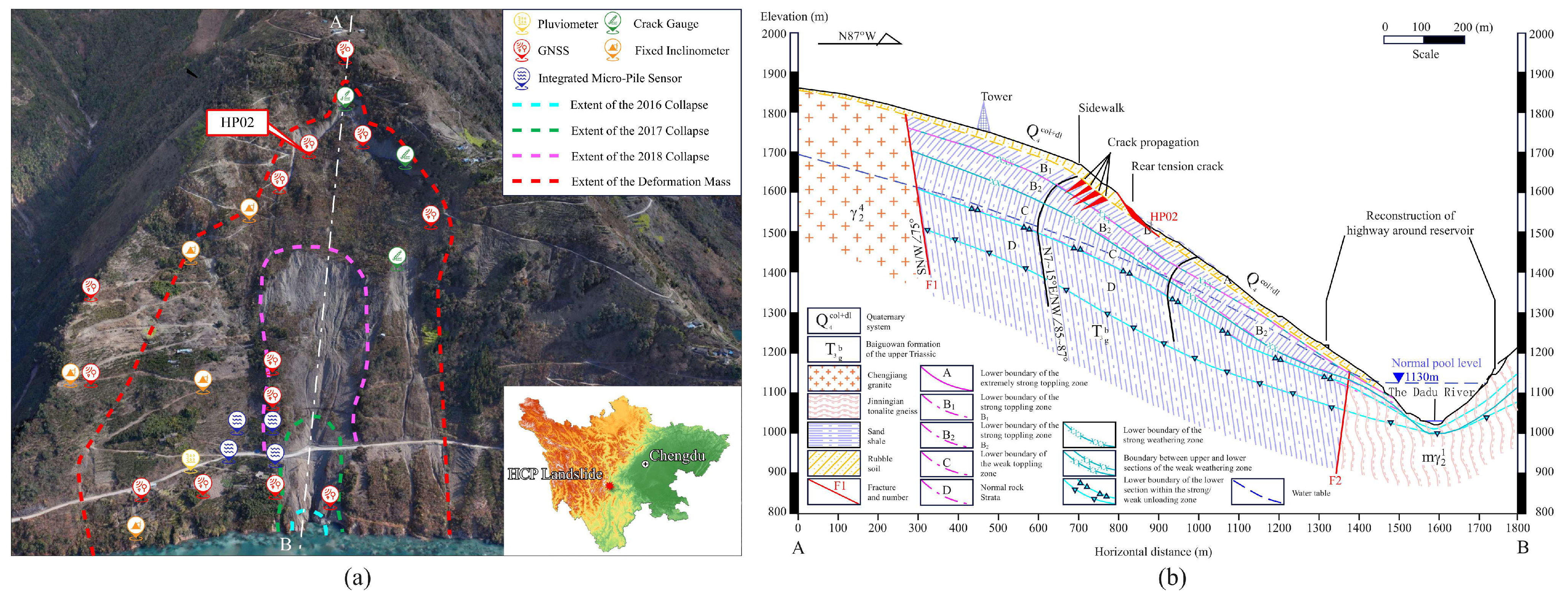
The Huangcaoping deformation mass landslide is located on the left bank of the Dadu River in Luding County, Sichuan Province, China, near Xinhua Village, Detuo Town. It lies within the reservoir area of the Dagangshan Hydropower Station, approximately 16.8 km from the dam site. The deformation mass has a toe elevation of about 1115 m and a crown elevation of about 1600 m. It extends approximately 160–250 m along the river direction and is about 660 m wide, with a total volume of roughly 1.5 million m3. Geomorphologically, the slope has an average gradient of 30–45° and is widely covered by 5–20 m thick colluvial deposits of blocky gravelly soil. The deformation mass has developed within thin-layered sandstone and shale of the Triassic Baiguowan Formation, which is sandwiched within the Dadu River fault zone. The underlying bedrock consists of toppling deformation rock mass. This landslide deformation mass has been instrumented with monitoring equipment including rain gauges, crack gauges, surface displacement monitors, and fixed inclinometers. Since October 2015, surface cracking and deformation have been observed on the slope, as shown in Figure 16. Deformation intensifies annually during the rainy season. From July to November 2017, slope deformation accelerated, with cracking at the rear crown, widespread cracking across the slope body, and localized collapses. A relatively large-scale collapse, with a volume of approximately 50,000 m3, occurred on 2 July 2018. Subsequently, brief periods of intensified deformation were observed at the rear crown cracks in August 2019 and September 2020, followed by a return to a relatively stable state. Its failure mode is a toppling-tensile cracking landslide, formed on the basis of a toppling deformation rock mass under the combined influence of reservoir impoundment, rainfall, and agricultural water use.
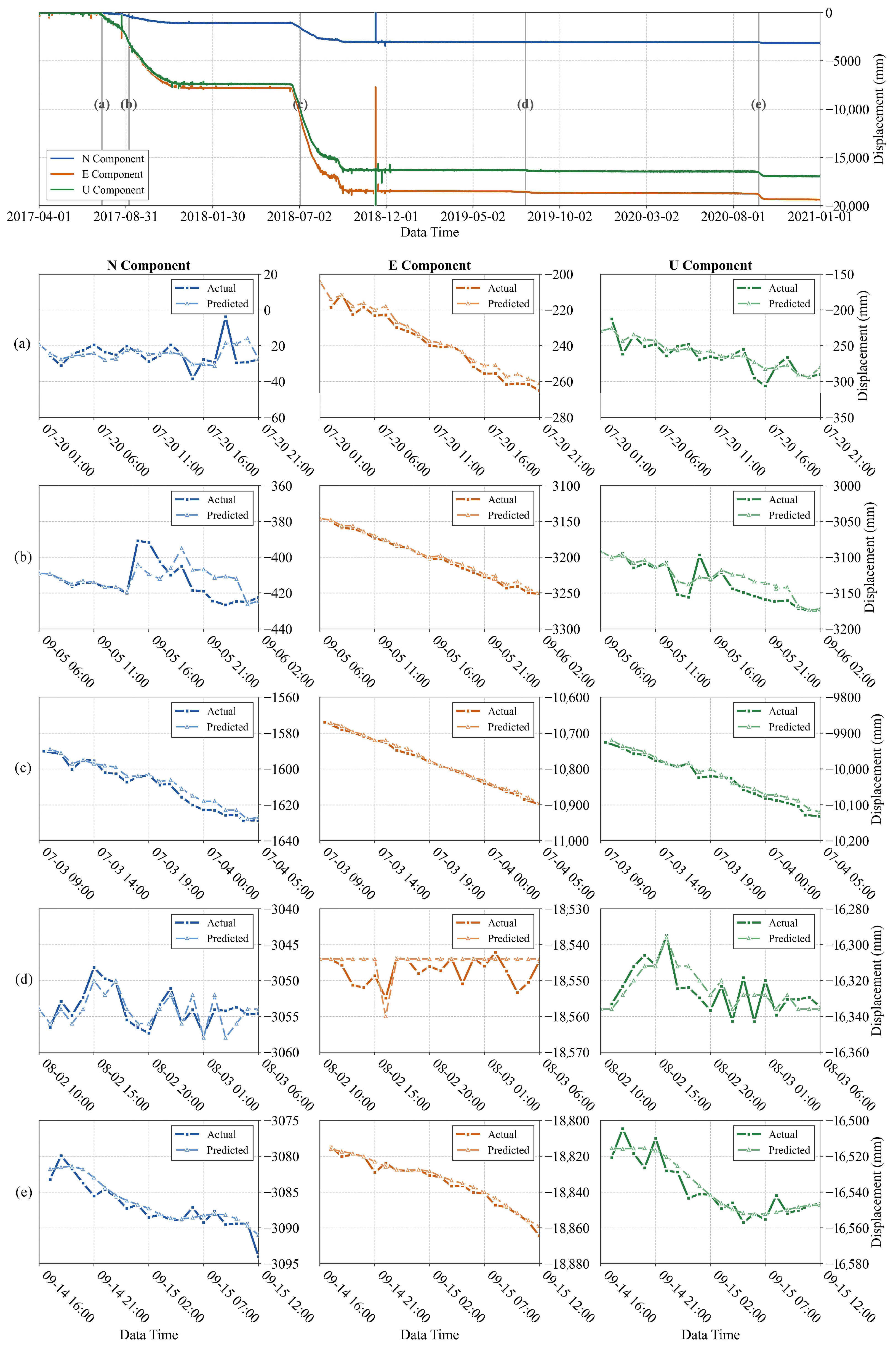
To comprehensively validate the long-term performance and practical value of Phys-LSTM in real-world operational online learning scenarios, we conducted an in-depth case study using five consecutive years of monitoring data from the Huangcaoping deformation mass landslide. The monitoring data fully covers multiple critical stages of landslide evolution, including slow creep, uniform deformation, and accelerated deformation triggered by heavy rainfall. This provides an ideal testing environment for evaluating the model’s adaptive evolution capability, continuous learning ability regarding physical mechanisms, and responsiveness to sudden external disturbances. Through continuous online learning, Phys-LSTM can not only accurately fit long-term trends but also make timely and reliable predictions at key physical inflection points. The specific results are shown in Figure 17.
During the initial phase of intensified deformation from July to November 2017, the model was in the extended learning stage. A comparison between the actual and predicted curves (Figure 17a,b) shows that the model could preliminarily identify the overall upward trend of displacement caused by rear crown crack settlement, widespread cracking, and localized collapses. However, its fitting of transient fluctuations and detailed deformation remained insufficient. During this stage, the RMSE, MAE, R2, and MAPE were 26.44 mm, 11.23 mm, 0.87, and 48.9% respectively, reflecting the model’s limited accuracy in depicting complex deformation patterns during early learning.
By July 2018, a large-scale collapse occurred at the front, and the cumulative deformation at the rear reached 10.3 m within four months. At this point, the model had entered a stable sliding phase, and its prediction results showed good agreement with the measured data in terms of trend Figure 17c. For this period, the RMSE was 11.52 mm, MAE was 10.21 mm, R2 was 0.92, and MAPE was 38.39%, indicating that the model had developed an effective capability to capture the overall displacement characteristics of intense deformation events.
In August 2019, deformation at the rear intensified again, reaching 98 mm within the month, after which the deformation rate gradually stabilized. Having been trained on two years of historical data, the model was in a stable prediction period. Although the actual sequence showed significant local fluctuations, the predicted curve consistently reflected the overall deformation trend Figure 17d. During this stage, the RMSE, MAE, R2, and MAPE were 9.64 mm, 7.50 mm, 0.94, and 4.58% respectively, confirming the model’s high predictive reliability during periods of stable deformation rates.
As shown in Figure 17e, following a heavy rainfall event in September 2020, the landslide displacement rate increased sharply (peaking at 106.03 mm/d). At this physical inflection point, the prediction curve from Phys-LSTM and the actual observations exhibited highly synchronized surge trends and evolutionary trajectories (R2 reached 0.97 for this stage). This demonstrates that the “rainfall-infiltration-softening of geotechnical material strength-accelerated deformation” coupling mechanism learned through the physics-constrained framework is effective and generalizable. It enables the model to go beyond simple fitting of historical data and genuinely achieve physical perception and reliable capture of key warning signals.

6. Conclusions

This study developed a physics-informed online learning framework for landslide displacement prediction by integrating multi-source monitoring data, geomechanical prior knowledge, and progressive online updating. The framework addresses two limitations of conventional static data-driven models: weak physical consistency and insufficient adaptability to newly arriving monitoring observations.
The proposed Phys-LSTM achieved strong prediction accuracy and stability in comparative experiments, with overall RMSE ≤ 1.78 mm and R2 ≥ 0.96. In the six-site cross-condition comparison, Phys-LSTM produced the lowest RMSE standard deviation (1.34), indicating better robustness under different geological backgrounds, deformation modes, and monitoring configurations.
The main scientific contribution lies in embedding a dynamic stability index, creep-informed deformation representation, and kinematic residual loss into an LSTM encoder–decoder architecture. Together with the three-stage online learning strategy, these components allow the model to update continuously while maintaining physically plausible displacement trajectories.
From an engineering perspective, the framework provides a practical basis for operational landslide monitoring and short-term displacement forecasting. Future work should further connect the prediction output with explicit warning thresholds, incorporate hydrological and InSAR observations where available, and validate the method under a wider range of rapidly evolving or structurally controlled landslide scenarios.

Author Contributions

Conceptualization, J.Z., N.J. and C.H.; methodology, J.Z., N.J. and C.H.; software, J.Z., N.J. and C.H.; validation, J.Z., C.H. and M.X.; investigation, M.X.; resources, J.Z., C.H. and M.X.; data curation, J.Z.; writing—original draft preparation, J.Z.; writing—review and editing, J.Z., N.J., C.H. and M.X.; visualization, J.Z. and M.X.; supervision, N.J. and C.H.; project administration, N.J.; funding acquisition, N.J. All authors have read and agreed to the published version of the manuscript.

Funding

This research was funded by the Scientific Research Project of Sichuan Provincial Department of Natural Resources, grant number KJ-2025-069, and the Contract for the Procurement of Automated Monitoring Instruments and Equipment and Related Labor Services for the Xiaojiawan Landslide during the Construction of the Hubei Section of the Newly Built Xi’an-Shiyan High-Speed Railway, contract number 80303-AH20240021.

Institutional Review Board Statement

Not applicable.

Informed Consent Statement

Not applicable.

Data Availability Statement

The raw data supporting the conclusions of this article will be made available by the authors on request.

Conflicts of Interest

The authors declare no conflicts of interest.

References

  1. Petley, D. Global Patterns of Loss of Life from Landslides. Geology 2012, 40, 927–930. [Google Scholar] [CrossRef]
  2. Dai, F.C.; Lee, C.F.; Ngai, Y.Y. Landslide Risk Assessment and Management: An Overview. Eng. Geol. 2002, 64, 65–87. [Google Scholar] [CrossRef]
  3. Zhou, C.; Yin, K.; Cao, Y.; Ahmed, B. Application of Time Series Analysis and PSO–SVM Model in Predicting the Bazimen Landslide in the Three Gorges Reservoir, China. Eng. Geol. 2016, 204, 108–120. [Google Scholar] [CrossRef]
  4. Hochreiter, S.; Schmidhuber, J. Long Short-Term Memory. Neural Comput. 1997, 9, 1735–1780. [Google Scholar] [CrossRef] [PubMed]
  5. Zhong, Z.; Hu, B.; Li, J.; Sheng, J.; Wan, C. Impact of Rainfall Dry-Wet Cycles on Slope Deformation and Landslide Prediction in Open-Pit Mines: A Case Study of Mohuandang Landslide, Emeishan, China. Results Eng. 2025, 26, 105011. [Google Scholar] [CrossRef]
  6. Zhang, J.; Tang, H.; Li, C.; Gong, W.; Zhou, B.; Zhang, Y. Deformation Stage Division and Early Warning of Landslides Based on the Statistical Characteristics of Landslide Kinematic Features. Landslides 2024, 21, 717–735. [Google Scholar] [CrossRef]
  7. Tumon, M.S.H.; Imran, H.M.; Chow, M.F.; Zahidi, I.; Ahmed, F.; Islam, M.S.; Islam, M.d.R.; Hafez, M. Integrating a Hybrid Machine Learning Model with Climate Projections for Landslide Susceptibility Assessment. Results Eng. 2025, 28, 108067. [Google Scholar] [CrossRef]
  8. Deng, Z.; Wang, W.; Luo, Y.; Zhang, S.; Xu, L.; Su, Q. Slope deformation monitoring and prediction based on InSAR and deep learning model. Results Eng. 2025, 28, 107113. [Google Scholar] [CrossRef]
  9. Froude, M.J.; Petley, D.N. Global Fatal Landslide Occurrence from 2004 to 2016. Nat. Hazards Earth Syst. Sci. 2018, 18, 2161–2181. [Google Scholar] [CrossRef]
  10. Han, N.; Miao, W.; Li, M.; Mohamad Ismail, M.A.; Hu, Q.; Duan, L.; Tang, J. Integrating Multi-Source Monitoring Data and Deep Convolutional Autoencoder Technology for Slope Failure Pattern Recognition. Front. Earth Sci. 2025, 13, 1531857. [Google Scholar] [CrossRef]
  11. Cinar, Y.G.; Mirisaee, H.; Goswami, P.; Gaussier, E.; Aït-Bachir, A. Period-Aware Content Attention RNNs for Time Series Forecasting with Missing Values. Neurocomputing 2018, 312, 177–186. [Google Scholar] [CrossRef]
  12. Dong, D.; Wang, M.; Chen, W.; Zeng, Z.; Song, L.; Zhang, Q.; Cai, M.; Cheng, Y.; Lv, J. Mitigation of Multipath Effect in GNSS Short Baseline Positioning by the Multipath Hemispherical Map. J. Geod. 2016, 90, 255–262. [Google Scholar] [CrossRef]
  13. Han, J.Q.; Huang, G.W.; Li, Z. Multipath Effect Analysis and Processing Method of GNSS Landslide Monitoring Under Complicated Environment. J. Earth Sci. Environ. 2018, 40, 355–362. [Google Scholar]
  14. Le, T.; Vu, H.C.; Ponchet-Durupt, A.; Boudaoud, N.; Cherfi-Boulanger, Z.; Nguyen-Trang, T. Unsupervised Detecting Anomalies in Multivariate Time Series by Robust Convolutional LSTM Encoder–Decoder (RCLED). Neurocomputing 2024, 592, 127791. [Google Scholar] [CrossRef]
  15. Šegina, E.; Peternel, T.; Urbančič, T.; Realini, E.; Zupan, M.; Jež, J.; Caldera, S.; Gatti, A.; Tagliaferro, G.; Consoli, A. Monitoring Surface Displacement of a Deep-Seated Landslide by a Low-Cost and near Real-Time GNSS System. Remote Sens. 2020, 12, 3375. [Google Scholar] [CrossRef]
  16. Amani, A.-M.; Sandra, K.; Frank, K. Standardization with Zlog Values Improves Exploratory Data Analysis and Machine Learning for Laboratory Data. J. Lab. Med. 2024, 48, 215–222. [Google Scholar]
  17. Yaro, A.S.; Maly, F.; Prazak, P.; Malý, K. Outlier Detection Performance of a Modified Z-Score Method in Time-Series RSS Observation with Hybrid Scale Estimators. IEEE Access 2024, 12, 12785–12796. [Google Scholar] [CrossRef]
  18. Ilyushin, B.B. On Applicability of IQR Method for Filtering of Experimental Data. J. Eng. Thermophys. 2024, 33, 1–8. [Google Scholar] [CrossRef]
  19. Vande Kamp, G.N.; Jordan, S. The Necessity of Moving Averages in Dynamic Linear Regression Models. Am. J. Polit. Sci. 2025, 69, 176–193. [Google Scholar] [CrossRef]
  20. Cai, L.; Xu, G.; Niyato, D. ASG: An Adaptive Savitzky-Golay Method for Channel Estimation in Deep-Space Communications. IEEE Trans. Aerosp. Electron. Syst. 2025, 61, 19525–19536. [Google Scholar] [CrossRef]
  21. Sanz-Alonso, D.; Yang, R. Gaussian Process Regression under Computational and Epistemic Misspecification. SIAM J. Numer. Anal. 2025, 63, 495–519. [Google Scholar] [CrossRef]
  22. Gałka, Ł. Optimized Deep Isolation Forest. Pattern Recognit. Lett. 2025, 197, 88–94. [Google Scholar] [CrossRef]
  23. Yang, H.; Wang, L.; Hao, S. Landslide Monitoring and Stabilization Process Based on Inclination Evolution. Eng. Mech. 2020, 37, 193–199. [Google Scholar]
  24. He, C. Research on Key Technology and Application of Real-Time Monitoring and Early Warning System for Landslides. Ph.D. Thesis, Chengdu University of Technology, Chengdu, China, 2020. [Google Scholar]
  25. Azami, H.; Mohammadi, K.; Bozorgtabar, B. An Improved Signal Segmentation Using Moving Average and Savitzky-Golay Filter. J. Signal Inf. Process. 2012, 3, 39–44. [Google Scholar] [CrossRef]
  26. Liu, H.; Sun, X.; Bai, S. Modified Unscented Kalman Filter Considering Maximum Point of Probability Density Function. IEEE Trans. Aerosp. Electron. Syst. 2025, 61, 4926–4944. [Google Scholar] [CrossRef]
  27. Chai, B.; Chan, S.C.; Hou, Y.H. Robust Adaptive Fading Unscented Kalman Filter for Decentralized Dynamic State Estimation in Power Systems under Unknown Inputs and Covariance Mismatches. IEEE Trans. Power Syst. 2025, 40, 4732–4745. [Google Scholar] [CrossRef]
  28. Roopa, C.K.; Harish, B.S. An Empirical Evaluation of Savitzky-Golay (SG) Filter for Denoising ST Segment. In International Conference on Cognitive Computing and Information Processing; Springer: Singapore, 2018; Volume 801, pp. 18–28. [Google Scholar]
  29. Hsu, C.-H.; Wu, Y.-N.; Hsu, C.-H.; Wu, Y.-N. Application of Empirical Mode Decomposition for Decoding Perception of Faces Using Magnetoencephalography. Sensors 2021, 21, 6235. [Google Scholar] [CrossRef] [PubMed]
  30. Xing, Y.; Yue, J.; Chen, C.; Cong, K.; Zhu, S.; Bian, Y. Dynamic Displacement Forecasting of Dashuitian Landslide in China Using Variational Mode Decomposition and Stack Long Short-Term Memory Network. Appl. Sci. 2019, 9, 2951. [Google Scholar] [CrossRef]
  31. Li, X.; Li, S. Large-Scale Landslide Displacement Rate Prediction Based on Multi-Factor Support Vector Regression Machine. Appl. Sci. 2021, 11, 1381. [Google Scholar] [CrossRef]
  32. Xu, J.; Jiang, Y.; Yang, C. Landslide Displacement Prediction during the Sliding Process Using XGBoost, SVR and RNNs. Appl. Sci. 2022, 12, 6056. [Google Scholar] [CrossRef]
  33. Sun, Y.; Liu, T.; Zhang, C.; Xi, N.; Wang, H. Spatiotemporal Prediction of Landslide Displacement Using Graph Convolutional Network-Based Models: A Case Study of the Tangjiao 1# Landslide in Chongqing, China. Appl. Sci. 2024, 14, 9288. [Google Scholar] [CrossRef]
  34. Mufundirwa, A.; Fujii, Y.; Kodama, J. A New Practical Method for Prediction of Geomechanical Failure-Time. Int. J. Rock Mech. Min. Sci. 2010, 47, 1079–1090. [Google Scholar] [CrossRef]
  35. Jiang, P.; Chen, J. Displacement Prediction of Landslide Based on Generalized Regression Neural Networks with K-Fold Cross-Validation. Neurocomputing 2016, 198, 40–47. [Google Scholar] [CrossRef]
  36. Intrieri, E.; Carlà, T.; Gigli, G. Forecasting the Time of Failure of Landslides at Slope-Scale: A Literature Review. Earth-Sci. Rev. 2019, 193, 333–349. [Google Scholar] [CrossRef]
  37. Yang, Z.; Shao, W.; Qiao, J.; Huang, D.; Tian, H.; Lei, X.; Uchimura, T. A Multi-Source Early Warning System of MEMS Based Wireless Monitoring for Rainfall-Induced Landslides. Appl. Sci. 2017, 7, 1234. [Google Scholar] [CrossRef]
  38. Xiao, T.; Zhang, L.-M. Data-Driven Landslide Forecasting: Methods, Data Completeness, and Real-Time Warning. Eng. Geol. 2023, 317, 107068. [Google Scholar] [CrossRef]
  39. Bai, D.; Lu, G.; Zhu, Z.; Zhu, X.; Tao, C.; Fang, J. A Hybrid Early Warning Method for the Landslide Acceleration Process Based on Automated Monitoring Data. Appl. Sci. 2022, 12, 6478. [Google Scholar] [CrossRef]
  40. Park, J.-Y.; Lee, S.-R.; Kim, Y.-T.; Kang, S.; Lee, D.-H. A Regional-Scale Landslide Early Warning System Based on the Sequential Evaluation Method: Development and Performance Analysis. Appl. Sci. 2020, 10, 5788. [Google Scholar] [CrossRef]
  41. Shihui, P.; Xiaoming, S.; Shanyong, W.; Liang, G.; Manchao, H.; Zhigang, T. A Multi-Parameter Monitoring System and Early Warning Model for Rainfall-Induced Landslides. Bull. Eng. Geol. Environ. 2024, 83, 312. [Google Scholar]
  42. Duncan, J.M. Fellow State of the Art: Limit Equilibrium and Finite-Element Analysis of Slopes. J. Geotech. Eng. 1996, 122, 577–596. [Google Scholar] [CrossRef]
  43. Raissi, M.; Perdikaris, P.; Karniadakis, G.E. Physics-Informed Neural Networks: A Deep Learning Framework for Solving Forward and Inverse Problems Involving Nonlinear Partial Differential Equations(Article). J. Comput. Phys. 2019, 378, 686–707. [Google Scholar] [CrossRef]
  44. Mao, Z.; Jagtap, A.D.; Karniadakis, G.E. Physics-Informed Neural Networks for High-Speed Flows. Comput. Methods Appl. Mech. Eng. 2020, 360, 112789. [Google Scholar] [CrossRef]
  45. Zhou, C.; Yin, K.; Cao, Y.; Ahmed, B.; Fu, X. A Novel Method for Landslide Displacement Prediction by Integrating Advanced Computational Intelligence Algorithms. Sci. Rep. 2018, 8, 7287. [Google Scholar] [CrossRef] [PubMed]
  46. Antonelo, E.A.; Camponogara, E.; Seman, L.O.; Jordanou, J.P.; de Souza, E.R.; Hübner, J.F. Physics-Informed Neural Nets for Control of Dynamical Systems. Neurocomputing 2024, 579, 127419. [Google Scholar] [CrossRef]
  47. Wang, B.; Li, T.; Yan, Z.; Zhang, G.; Lu, J. DeepPIPE: A Distribution-Free Uncertainty Quantification Approach for Time Series Forecasting. Neurocomputing 2020, 397, 11–19. [Google Scholar] [CrossRef]
  48. Mochiutti, E.; Antonelo, E.A.; Camponogara, E. Physics-Informed Echo State Networks for Modeling Controllable Dynamical Systems. Neurocomputing 2025, 639, 130251. [Google Scholar] [CrossRef]
Figure 1. Feature Dataset Construction Pipeline.
Applsci 16 06003 g001
Figure 2. Typical anomalies in landslide monitoring data: (a) Jump anomaly caused by nearby disturbance, manifested as an abrupt deviation of crack-width observations from the local variation trend. (b) Continuous missing data caused by equipment malfunction; the shaded region indicates the period of observation interruption.
Applsci 16 06003 g002
Figure 3. Performance comparison of outlier detection algorithms on representative landslide monitoring time series. Precision, recall, and F1-score were calculated against manually checked anomaly labels. The Savitzky–Golay residual method achieved the highest F1-score (0.81), indicating the best balance between missed detections and false positives for transient jump anomalies.
Applsci 16 06003 g003
Figure 4. Comparison of anomaly detection results obtained by the four representative methods: Cross markers denote the anomalies identified by each method. Among the four methods, the Savitzky–Golay Filter Residual Method achieved the best overall performance, identifying 24 anomaly points with an F1-score of 0.81. The Moving Average method detected 37 anomalies but produced 16 false positives, yielding an F1-score of 0.62. The Savitzky–Golay method showed relatively few false detections but missed more true anomalies, with an F1-score of 0.60. Isolation Forest exhibited both frequent missed detections and false detections, resulting in the lowest performance among the four methods (F1 = 0.11).
Applsci 16 06003 g004
Figure 5. Comparison of denoising results obtained by eight filtering methods on the same displacement time series: All methods reduce high-frequency fluctuations and local abnormal spikes to different extents, but they differ markedly in trend preservation, local fluctuation retention, and smoothing strength. Median + Savitzky–Golay, Savitzky–Golay, Median-Butterworth, and EMD maintain high consistency with the main trend of the original sequence while preserving local variations. Among them, EMD shows the highest agreement with the original curve, indicating a better balance between noise suppression and detail preservation. By contrast, Moving Average, Kalman, and Wavelet produce stronger smoothing effects, whereas Trend Fitting mainly captures the long-term evolution trend but responds less effectively to short-term fluctuations and local anomalies.
Applsci 16 06003 g005
Figure 6. Performance Comparison of Different Noise Filtering Methods.
Applsci 16 06003 g006
Figure 7. Feature contribution in displacement prediction. The bars summarize normalized F-scores and average correlations between candidate physics-informed features and the GNSS displacement target; higher values indicate stronger explanatory contribution to the displacement-prediction task.
Applsci 16 06003 g007
Figure 8. Computational flowchart of the dynamic stability index evolution model.
Applsci 16 06003 g008
Figure 9. Computational Flowchart of the Time-Dependent Parameter Creep Constitutive Model.
Applsci 16 06003 g009
Figure 10. Neural Network Architecture Diagram with Loss Function.
Applsci 16 06003 g010
Figure 11. Architecture of the Phys-LSTM model, including masked input encoding, physics-informed feature extraction, LSTM encoder–decoder forecasting, physics-guided attention, and physics-consistency loss.
Applsci 16 06003 g011
Figure 12. Three-Stage Model Training and Prediction Strategy.
Applsci 16 06003 g012
Figure 13. Evolution of the adaptive physics-constraint weight across the three-stage online learning process.
Applsci 16 06003 g013
Figure 14. Online Learning Workflow of Phys-LSTM.
Applsci 16 06003 g014
Figure 15. Comparative 3D Visualization of Multi-Metric Performance for Different Models.
Applsci 16 06003 g015
Figure 16. Huangcaoping deformation mass landslide. (a) Landslide zoning and monitoring point arrangement, with a lower-right DEM inset showing the regional position of the HCP landslide and Chengdu in Sichuan Province; (b) A–B geological profile.
Applsci 16 06003 g016
Figure 17. Comparison Chart of HP02 Landslide Displacement Prediction. (a) The July 2017 deformation event, (b) The September 2017 Deformation Event, (c) The July 2018 deformation event, (d) The deformation event in August 2019, and (e) The September 2020 Deformation Event.
Applsci 16 06003 g017
Table 1. Multi-source monitoring data details.
Data CategoryMonitoring EquipmentMonitoring Parameter (Unit)Physical SignificanceSampling FrequencyData Volume (Records)
Surface DisplacementGNSS3D Displacement (mm)Direct representation of macroscopic deformation of the landslide bodyonce per day to once per hour1,899,424
Deep DeformationMicro-pile inclinometer/inclinometerInclination Angle (°), Deep Displacement (mm)Indication of slip zone location and deep shear deformationonce per day to once per hour639,727
Crack DynamicsCrack GaugeCrack Width (mm)Quantitative indicator of surface tensile/shear deformationonce per day to once per second15,808,074
RainfallRain GaugeCumulative Rainfall (mm), Intensity (mm/h)Primary triggering factor for landslidesonce per day to once per hour8,801,127
Groundwater LevelWater Level GaugeWater Level Elevation (m), Pressure (kPa)Key parameter for seepage-stress field couplingonce per hour4831
Table 2. Common Core Characteristics.
Feature CategoryData Source EquipmentPhysical SignificanceRelevance to Landslide Evolution
Core Displacement FeaturesGNSS Displacement MonitorThree-dimensional surface displacement of landslide (N, E, U)Directly characterizes the surface deformation state of the landslide body, serving as the core target and key input for model prediction.
Surface Deformation FeaturesCrack GaugeCrack opening/closure width, dislocation amountIndicates the expansion of surface tension/shear zones, serving as a sensitive indicator of impending landslide.
Triggering Factor FeaturesRain GaugeReal-time rainfall, cumulative rainfallMain external factors triggering/accelerating landslide deformation, affecting pore water pressure and soil strength of landslide mass.
Deep Displacement FeaturesMicro-pile inclinometerInclination angle or displacement at different depths in the boreholeReflects the location of the slip zone and deep deformation mechanism, providing direct evidence of slip surface formation.
Environmental Auxiliary Features(Optional) Soil Moisture Content/Pore Water Pressure SensorSoil volumetric water content, matric suction, or pore water pressureReflects hydrological response state, closely related to rainfall infiltration and slip zone softening processes.
Table 3. Physics-Informed Feature System.
Feature CategoryFeature NameCalculation Method/FormulaPhysical MeaningData Source
Temporal Decomposition FeaturesDisplacement Trend StrengthTrend component T(t) from STL decompositionLong-term creep trend of the landslide, reflecting macroscopic deformation driven by gravityGNSS
Displacement Periodic OscillationPeriodic component S(t) from STL decompositionResponse to periodic external loads (e.g., seasonal rainfall)GNSS, Rain gauge, Water level gauge
Differential Dynamics FeaturesDisplacement Rate υ t = Δ D / Δ t (First-order differentiation)Instantaneous velocity of landslide movement, identifying the accelerated creep stageGNSS
Creep Acceleration a t = Δ 2 D / Δ t 2 (Second-order differentiation)Key indicator for accelerated creep, used for early warning and critical state judgmentGNSS
Cross-Coupling FeaturesRainfall-Displacement Response Ratio R D R R = Δ P / Δ υ (∆P: Rainfall increment)Quantifies the triggering efficiency of rainfall infiltration on displacement rateCrack gauge, GNSS
Crack-Displacement Synergy Coefficient C c d = C o r r C r a c k , V e l o c i t y Spatial correlation between surface rupture and deep-seated movementRain gauge, GNSS
Table 4. Overview of Experimental Models.
Model CategoryModel NameCore Characteristics
Classical Statistical ModelSARIMAExcels in capturing linear trends and seasonal patterns
Traditional Machine LearningXGBoostGradient boosting decision-tree regression using flattened 30-step historical windows, squared-error objective, early stopping, and L2 regularization.
Deep Learning Sequence ModelLSTMStandard Long Short-Term Memory network without physical constraints
GRUA lightweight variant of LSTM with higher computational efficiency
TransformerModern sequence model based on the self-attention mechanism
Proposed Model in This StudyPhys-LSTMHybrid LSTM model enhanced by physical equations
Table 5. Key hyperparameter settings of the compared models. Common parameters define the unified input-output protocol. For XGBoost, reg_lambda denotes the L2 regularization coefficient. For Phys-LSTM, temporal_decay_rate denotes the temporal attention decay coefficient, target_weight_ratio denotes the feature-attention emphasis assigned to GNSS target features, and L2 denotes kernel regularization.
ModelKey HyperparametersValue
CommonHistorical input window length/Forecasting horizon30/5
CommonTraining/validation split80%/20%
SARIMAOrder selectionauto_arima
XGBoostn_estimators, max_depth, learning_rate, objective, reg_lambda800, 6, 0.03, squared error, 1.0
LSTMHidden units, dropout, learning rate, training control128-64, 0.2, adaptive LR, early stopping
GRUHidden units, dropout, learning rate, training control128-64, 0.2, adaptive LR, early stopping
TransformerHeads, key dimension, dropout4, 32, 0.2
Phys-LSTMEncoder hidden units, decoder hidden units, dropout, L2, optimizer, learning rate, batch size, epochs, temporal_decay_rate, target_weight_ratio128, 64, 0.3, 0.001, Adam, 5 × 10⁻⁴ with warm-up/cosine decay, 512, 100–300 with early stopping, 0.95, 4.0
Table 6. Geological and Monitoring Background.
LandslideGeological and Geomorphological SettingDeformation/Structural TypeMonitoring Background
ShibanwoUpper-steep and lower-gentle slope; Quaternary residual/colluvial deposits over mudstone and sandstoneCover-material landslide developed above weak bedrock3 GNSS sensors, 2 acceleration sensors, 2 tiltmeters and 1 rain gauge
PengjiawanBroken-line slope; loose cover deposits over weathered phylliteShallow accumulation-layer landslide sliding along a weak cover-bedrock contact4 GNSS sensors, 1 deep-displacement sensor, 1 rain gauge and 1 soil-moisture sensor
CaiyuanziSteep bedding slope; shale, sandstone, and Quaternary colluvial gravelly soilBedding-controlled landslide with a clear slip surface along weak structural interfaces3 GNSS sensors and 1 rain gauge
GuoluojiaoGently descending slope; Quaternary loose deposits over bedrockCover-material landslide sliding along the cover-bedrock interface1 crack gauge, 6 GNSS sensors, 1 acceleration sensor, 1 tiltmeter and 2 rain gauges
HoushanRelatively straight but locally undulating slope; gravelly soil cover over phyllite bedrockLarge accumulation-layer landslide deforming along the cover-bedrock interface4 crack gauges, 2 GNSS sensors, 2 acceleration sensors, 2 tiltmeters, 1 rain gauge
DashuziMiddle-mountain slope; Holocene gravelly soil over phyllite; stepped topographySoil landslide with upper-steep and lower-gentle morphology, influenced by rainfall and human activities1 crack gauge, 5 GNSS sensors and 1 rain gauge
Table 7. Standard Deviation of RMSE for Various Models Across Different Landslide Masses.
ModelShibanwo LandslidePengjiawan LandslideCaiyuanzi LandslideGuoluojiao LandslideHoushan LandslideDashuzi LandslideStandard Deviation
SARIMA2.160.481.371.021.386.632.25
XGBoost4.163.374.234.314.4116.124.92
LSTM0.7629.020.720.901.2312.2711.49
GRU0.7832.230.570.641.2213.5312.84
Transformer1.5777.791.183.301.4734.3231.18
Phys-LSTM2.130.491.361.011.384.291.34
Disclaimer/Publisher’s Note: The statements, opinions and data contained in all publications are solely those of the individual author(s) and contributor(s) and not of MDPI and/or the editor(s). MDPI and/or the editor(s) disclaim responsibility for any injury to people or property resulting from any ideas, methods, instructions or products referred to in the content.