1. Introduction
Blasting is a critical operation in mine production, and rock fragmentation efficiency directly impacts production costs and economic benefits. The formation of a blasting crater provides a basis for investigating rock breakage mechanisms, experimentally determining rock blastability, elucidating the propagation of explosion energy within the rock mass, and optimizing blasting parameters [
1,
2,
3,
4,
5], thereby supporting blast design.
A blasting crater forms when an explosive charge detonates at a shallow depth near a free surface, as a result of the interaction between the released energy and the rock mass. Numerous factors influence the performance of a blasting crater, including explosive properties, detonation properties, borehole diameter, charge burial depth, hole spacing, charge weight, burden, and rock properties. To investigate the effects of these parameters, extensive experimental and numerical studies have been conducted [
6,
7,
8,
9,
10,
11]. For instance, He et al. [
12] addressed the problems of poor blasting performance and high boulder yield at an underground lead-zinc mine in Yunnan Province. Based on Livingston’s blasting crater theory, they conducted blasting crater tests with variable hole depths, variable hole spacings, and inclined bench blasting configurations. The optimal parameters, including hole depth, hole spacing, and burden, were determined. This study provides a scientific theoretical basis for optimizing the production blasting parameters at this mine. Wang et al. [
13] established numerical models with varied burial depths and hole spacings using LS-DYNA, elucidating the dynamic response and damage characteristics of blasting craters, thereby offering a basis for blasting parameter optimization. Zhang et al. [
14] developed pre-split blasting models with different hole spacings using ANSYS/LS-DYNA, providing a reference for the selection of blasting parameters in mines. He et al. [
15] established blasting models with different burdens and conducted field tests to determine the optimal burden, effectively improving blasting efficiency and safety. Jiang et al. [
16] addressed the issue of mixed blasting of coal and rock in open-pit mines through field blasting crater tests and numerical simulations, revealing that optimizing the charge structure can regulate the blasting crater morphology and energy distribution in different rock strata, thereby achieving separate extraction of coal and rock. Ke et al. [
17] tackled the problem of high boulder yield in fan-shaped deep hole blasting at the Sanxin Gold-Copper Mine. Through a series of field crater tests, they determined the blasting parameters and performed inversion optimization of the stope deep hole blasting parameters based on Livingston’s theory, providing a direct basis for field applications.
In summary, the selection of blasting parameters significantly influences the outcomes of blasting crater tests. Among these parameters, the borehole diameter is a key variable that controls the distribution of explosive energy and its zone of influence, thereby playing a crucial role in energy utilization efficiency and the resulting fragmentation size distribution. It is important to recognize that the borehole diameter is not an isolated variable; it is intrinsically linked to the charge mass and the powder factor. A larger diameter typically accommodates a greater charge mass, which directly alters the powder factor. Therefore, under the condition of a constant powder factor and based on the rock mass conditions of the Daye Iron Mine, this study employed ANSYS/LS-DYNA to conduct numerical simulations of single-hole blasting craters. The objective was to investigate the formation process of blasting craters under different borehole diameters and burial depths. Through analysis of the simulated crater geometry, crack propagation, and rock damage characteristics, the functional relationship between the optimum scaled depth and borehole diameter was established. Furthermore, a double-hole blasting crater model was developed to determine the optimal hole spacing, thereby enabling the optimization of blasting parameters. The results provide a theoretical basis for field blasting tests at the Daye Iron Mine, with the potential to enhance blasting efficiency and safety in similar mining operations.
2. Project Overview
2.1. Physico-Mechanical Properties of Ore-Rock
The Daye Iron Mine is located in the Tieshan District of Huangshi City, Hubei Province. With a long mining history, the mine currently employs the sublevel open stoping with subsequent cemented backfill method. The design utilizes a 90 m stage height and a 15 m sublevel height. The stopes are arranged perpendicular to the strike of the orebody. The surrounding rock mass is moderately fractured. The dominant lithology is biotite-diopside diorite, followed by medium- to fine-grained quartz-bearing diorite and its sodic-potassic feldspathized variety. The iron ore bodies occur near the contact zone between diorite and marble. The main ore mineral is magnetite, with associated hematite, limonite, and other minerals. The rock mass is weakly weathered, with a Protodyakonov firmness coefficient (
f) ranging from 12 to 16. The physical and mechanical properties of the rock mass in the stopes of the Daye Iron Mine, as determined from laboratory tests, are summarized in
Table 1.
2.2. Grading Evaluation of Ore-Rock Blastability
At the Daye Iron Mine, a fan-shaped blasthole layout is employed with a borehole diameter of 0.076 m. Considering the competent rock mass conditions and industry practice regarding the burden-to-diameter ratio, the burden was set at 1.8 m, accounting for site-specific conditions. The collar spacing (governing the toe depth distribution) ranges from 0.72 m to 1.26 m, and the row spacing is 1.6 m. Bottom-initiated millisecond delay blasting is used.
With increasing mining depth at the Daye Iron Mine, adjustments to stope structural parameters and variations in rock-mass mechanical properties have led to suboptimal blasting outcomes. These are characterized by poor fragmentation uniformity and a persistently high boulder yield at the −270 m level, which has consequently increased the workload and cost of secondary blasting. This situation highlights the necessity of optimizing the blasting parameters at the mine. To address this issue, four representative stopes at the −360 m level were selected for rock sampling and laboratory testing. The samples obtained are considered representative of the rock mass conditions in the study area, as shown in
Table 2. The resulting data provide a reliable basis for characterizing its physical and mechanical properties, as well as the structural features of the rock mass.
According to the classification evaluation criteria for ore and rock blastability zoning at the Daye Iron Mine (
Table 3), the four blasting zones were classified, as shown in
Table 4.
The classification results indicate that among the four rock mass samples, samples No. 1, No. 2, and No. 4 are classified as medium blastability, while No. 3 is classified as difficult to blast. These findings provide a basis for optimizing blasting parameters.
3. Analysis of Blasting Crater Theory
The blasting crater theory provides a fundamental framework for studying rock blasting mechanisms and optimizing blasting parameters. The crater formation process reflects the interaction between the release of explosive energy and the rock mass’s dynamic response. Based on blasting crater tests conducted on various rock types with different charge weights and burial depths, the American scholar C. W. Livingston proposed the blasting crater energy balance theory, which explains the mechanism of rock fragmentation by blasting [
18]. This theory conceptualizes the blasting process into three stages: elastic deformation, shock fragmentation, and ejection. It characterizes the relationship between blasting performance, charge burial depth, and charge weight using parameters such as the scaled depth and scaled crater volume. Moreover, the theory establishes a critical relationship between the charge weight and the critical burial depth of the explosive, expressed as follows [
19,
20]:
where,
—Critical burial depth of explosive charge, m;
—Optimum burial depth, m;
—Strain energy coefficient of rock;
—Charge weight, kg;
—Ratio of optimum burial depth to critical burial depth.
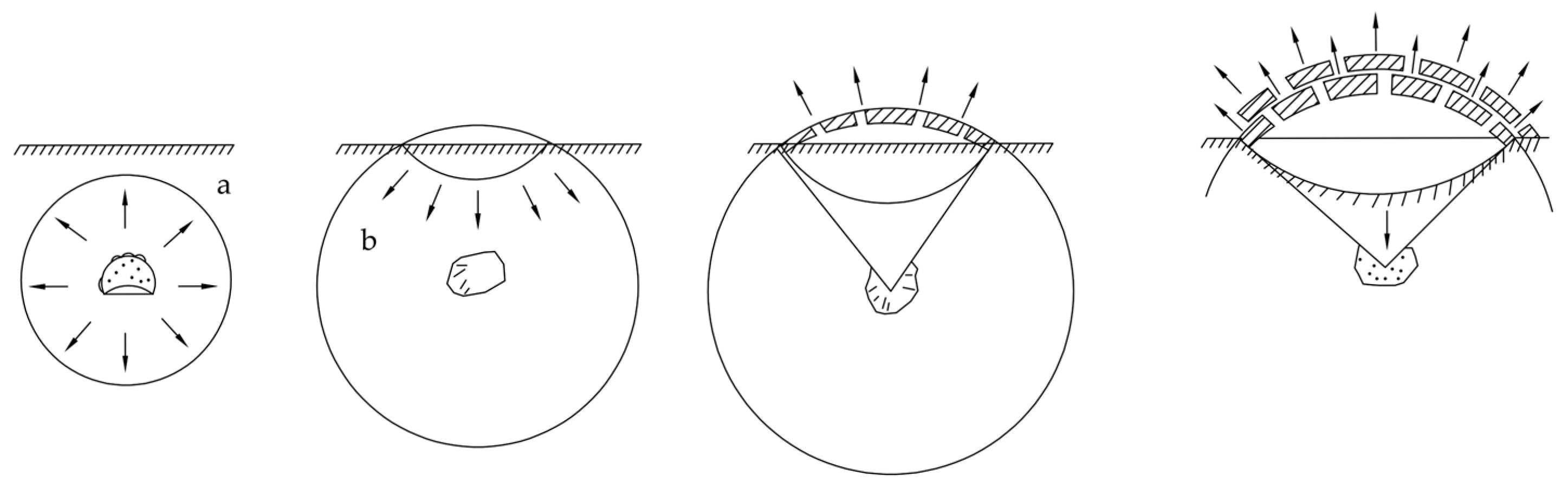
A blasting crater is primarily formed through the combined action of the stress waves and detonation gases generated by an explosion [
21,
22,
23,
24,
25,
26,
27]. During the initial detonation stage, the shock wave generated by the explosive charge creates a compressed or crushed zone around the borehole. Subsequently, the compressive stress wave propagates to the free surface and is reflected as a tensile (rarefaction) wave, which induces rock mass failure, as illustrated in
Figure 1. Following the initial shock wave phase, the detonation gases act as a high-pressure wedge, further driving crack propagation and coalescence. The formation of the blasting crater is also governed by the inherent properties of the rock mass and the in situ stress conditions. Key influencing factors include the tensile strength of the rock and the distribution of pre-existing joints and fractures, which collectively control the crack propagation paths. Simultaneously, the in situ stress field not only constrains the transmission of blasting energy but also influences the direction and extent of crack growth.
In blasting crater experiments, variations in borehole diameter and charge burial depth directly influence the energy transfer efficiency and the extent of the blast-affected zone. Theoretical studies indicate that an increase in borehole diameter generally enhances the coupling between the explosive and the borehole wall, thereby improving blasting efficiency. However, an excessively large diameter may shift the optimal burial depth [
4]. In multi-hole blasting, the hole spacing directly governs the superposition of stress waves from adjacent boreholes and the ability of detonation gases to penetrate and interconnect fractures. If the spacing is too small, energy becomes overly concentrated, leading to low utilization efficiency; if the spacing is too large, effective wave superposition is difficult to achieve, which may result in poorly floor-fragmented or the formation of discrete, unconnected craters.
Therefore, based on blasting crater numerical simulations, this study established single-hole and double-hole blasting crater models to investigate the functional relationship between borehole diameter and burial depth and to further determine the optimal hole spacing. The findings provide a theoretical basis for the design of field blasting operations.
4. Simulation Scheme and Model Construction
4.1. Simulation Scheme of the Study
To investigate the influence of borehole diameter on blasting crater formation, six numerical models with different borehole diameters were established, as detailed in
Table 5. The corresponding blasting crater volumes for each case were calculated and analyzed. Based on this analysis, a functional expression relating the optimum scaled depth to the borehole diameter was derived.
Furthermore, a series of double-hole blasting crater simulations was performed. Focusing on the 0.076 m borehole diameter, which is prevalent at the Daye Iron Mine in Hubei Province, China, six numerical models with different hole spacings (0.13, 0.26, 0.39, 0.52, 0.65, and 0.78 m) were developed to identify the optimal spacing for this specific diameter.
4.2. Material Model and Equation of State
4.2.1. Explosive Model
The explosive was modeled using the *MAT_HIGH_EXPLOSIVE_BURN (008) constitutive model from the LS-DYNA(R13) material library [
28]. This model is employed to define high explosives and accurately represent their changing states during detonation. The emulsion explosive is suitable for practical field application at the Daye Iron Mine. It was coupled with the *EOS_JWL equation of state, which is well-suited for simulating the pressure-volume relationship of detonation products under high compression. A fixed set of JWL equation of state parameters was used consistently across all simulations in this study. This approach allows the borehole diameter to be isolated as the primary factor influencing the results. The equation is expressed as follows:
where,
—Desired pressure value;
—Internal energy of detonation products;
—Relative volume of detonation products, defined as the ratio of current volume to initial volume;
—Undetermined constants.
The explosive parameters used in this simulation experiment are shown in
Table 6.
4.2.2. Rock Model
The rock mass was modeled using the *MAT_RHT (272) constitutive model from the LS-DYNA(R13) material library [
29]. This model is capable of accurately capturing the failure characteristics of rock under blast loading. The rock parameters employed in this numerical simulation were obtained through reduction based on the physical and mechanical properties of the ore and rock mass at the Daye Iron Mine, together with accumulated experimental data. These parameters are presented in
Table 7.
4.2.3. Air Model
The air was modeled using the *MAT_NULL (009) material model from the LS-DYNA(R13) library [
28], combined with the *EOS_LINEAR_POLYNOMIAL equation of state. This combination is typically employed to simulate fluid-like materials with high accuracy. The equation of state is defined as follows:
where,
—Initial internal energy per unit volume;
—Specific volume;
—Constants related to gas properties.
The air parameters used in this simulation experiment are shown in
Table 8.
4.2.4. Stemming Model
The stemming material was modeled using the *MAT_SOIL_AND_FOAM (005) constitutive model from the LS-DYNA(R13) library [
30]. This material model is capable of describing materials exhibiting soil-like behavior. The parameters for the stemming portion used in this simulation experiment are shown in
Table 9.
4.3. Construction of the Numerical Model for the Blasting Crater
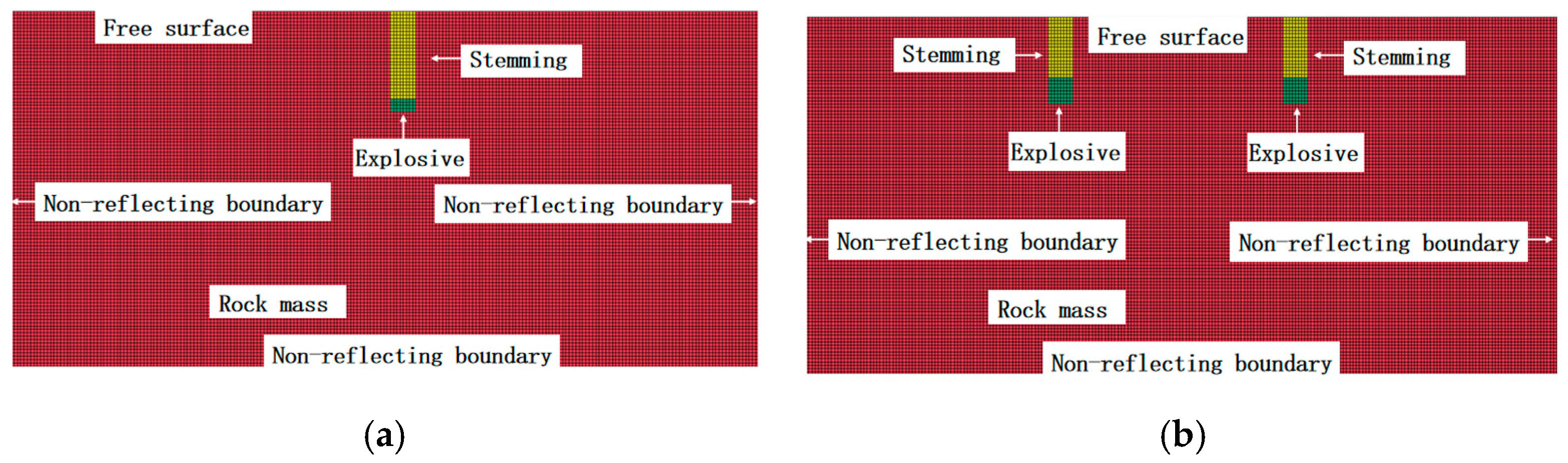
The numerical model for the blasting crater simulation, as illustrated in
Figure 2, consists of four distinct components: the rock mass, air, explosive, and stemming material. The model, with overall dimensions of 400 cm × 200 cm × 1 cm, was established in ANSYS(19.0). The mapped meshing technique was utilized to discretize the model into solid elements (3D-SOLID164) to ensure both computational accuracy and efficiency.
A bottom-center initiation point was defined in the explosive charge to simulate the typical blasting crater formation process. The fluid–structure interaction (FSI) algorithm was employed to model the interaction between media. In this framework, the air, explosive, and stemming were described using the Arbitrary Lagrangian-Eulerian (ALE) mesh formulation, whereas the rock mass was modeled using the Lagrangian algorithm, which is capable of representing its failure behavior and deformation under blast loading. Regarding boundary conditions, the top of the model was set as a free surface, and non-reflecting boundary conditions were applied to the left, right, and bottom boundaries to minimize wave reflection artifacts and to better simulate the stress-wave propagation process within the rock mass.
5. Numerical Simulation of the Blasting Crater
5.1. Analysis of the Damage Propagation Law of Single-Hole Blasting Crater
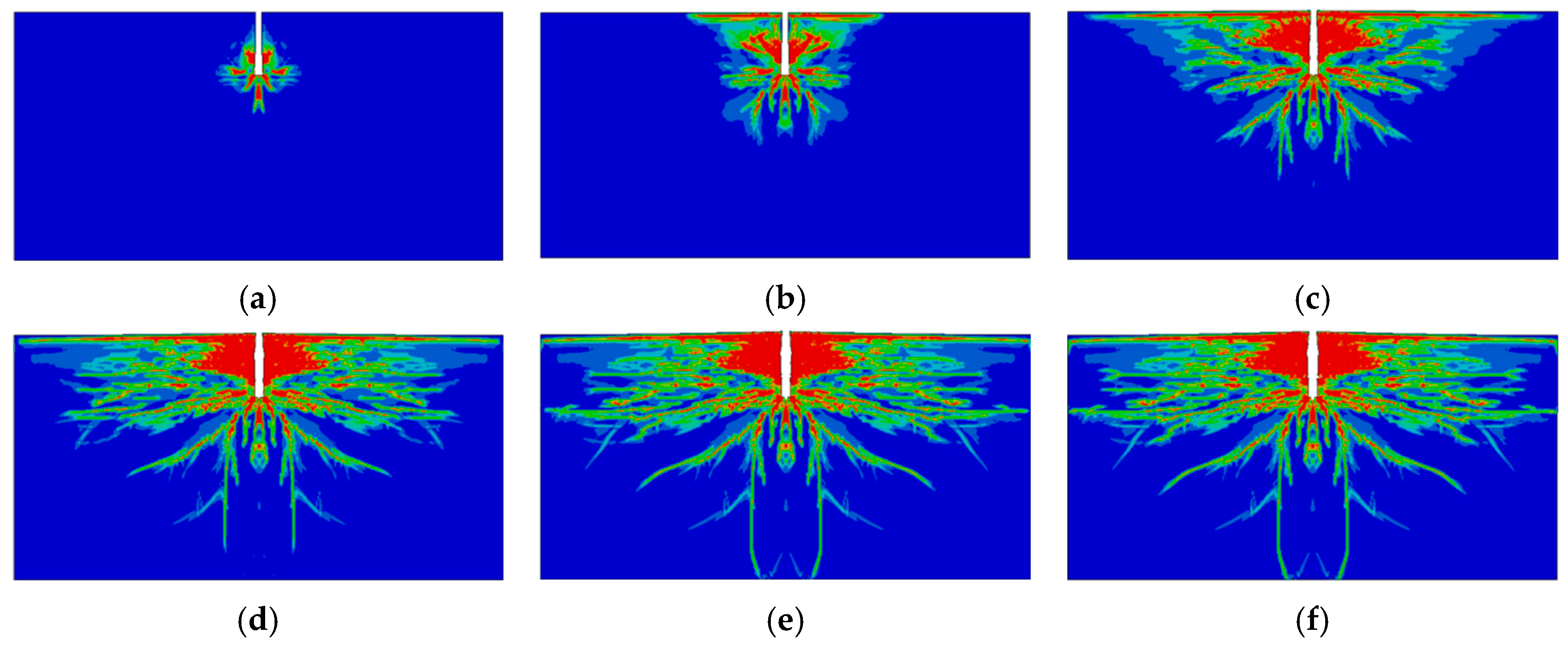
The damage evolution during the formation of a single-hole blasting crater is depicted in the sequential nephograms of
Figure 3. At 100 μs, the detonation shock wave imposes an intense dynamic load on the borehole wall, generating a compressive stress field that well exceeds the rock’s dynamic compressive strength. This leads to dynamic compressive and shear failure of the adjacent rock, forming a compaction or crushed zone, while the compressive stress wave propagates spherically toward the free surface. By 200 μs, the compressive stress wave reaches the free surface and is reflected as a tensile (rarefaction) wave. When the resulting tensile stress surpasses the rock mass’s significantly lower dynamic tensile strength, tensile cracks initiate and propagate sub-vertically from the free surface. At 400 μs, detonation gases penetrate and wedge into the initiated crack tips. Under the sustained quasi-static pressure of these gases, the cracks extend further, coalesce, and curve towards the free surface. This process induces bulking, uplift, and eventual spalling of the near-surface rock mass, while the crack network around the borehole expands and converges toward the free face. By 1000 μs, the blast energy is largely dissipated, leading to a fully developed blasting crater. Its final geometry—including the crater diameter, depth, and breakout angle—reflects the integrated response of the rock mass to the combined effects of shock-induced compression and subsequent tensile fracturing.
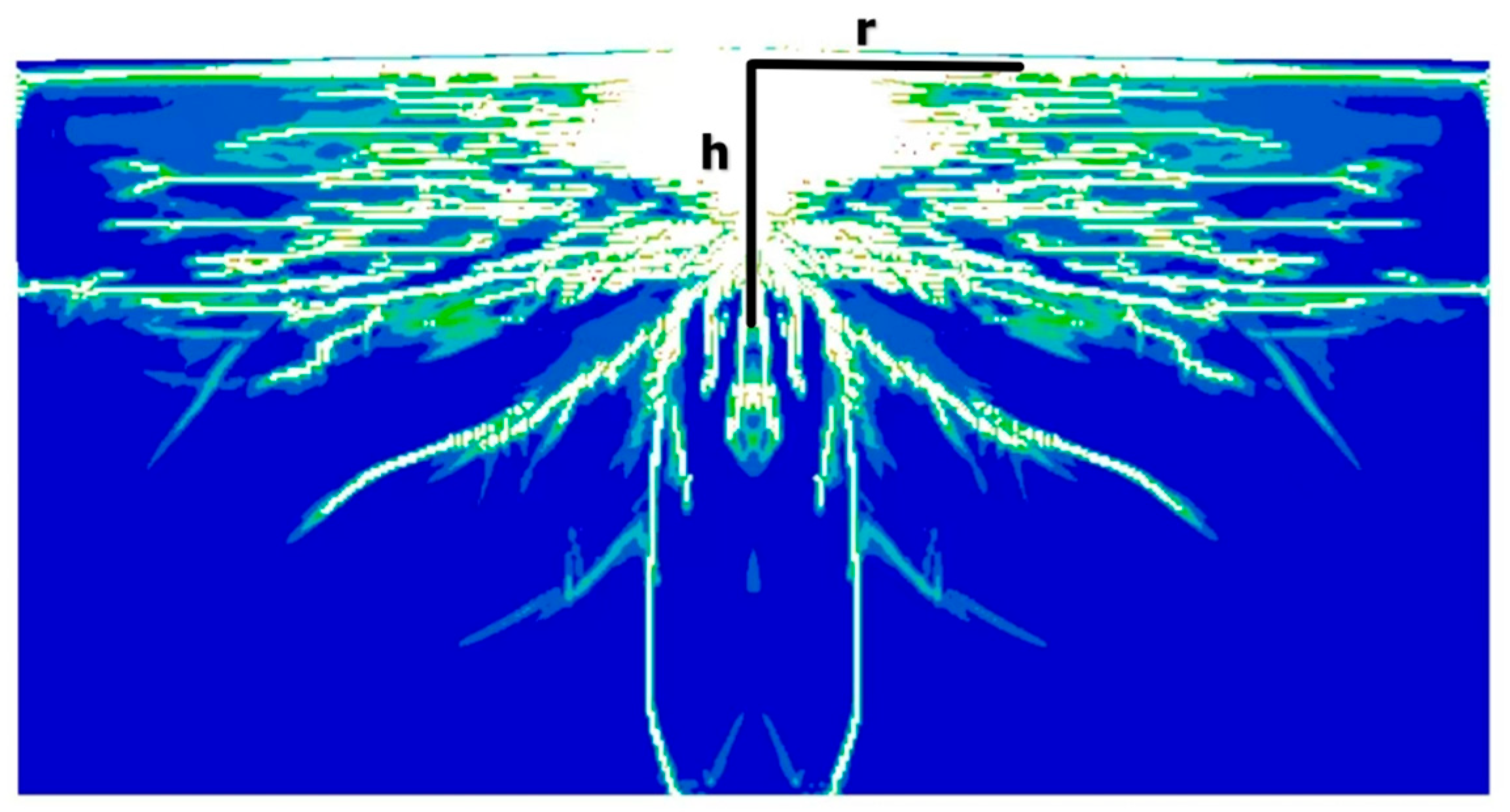
The volume of the damaged rock mass was approximated as that of a cone. The depth (
h) and radius (
r) of each blasting crater were measured, as presented in
Figure 4. All calculation results are summarized in
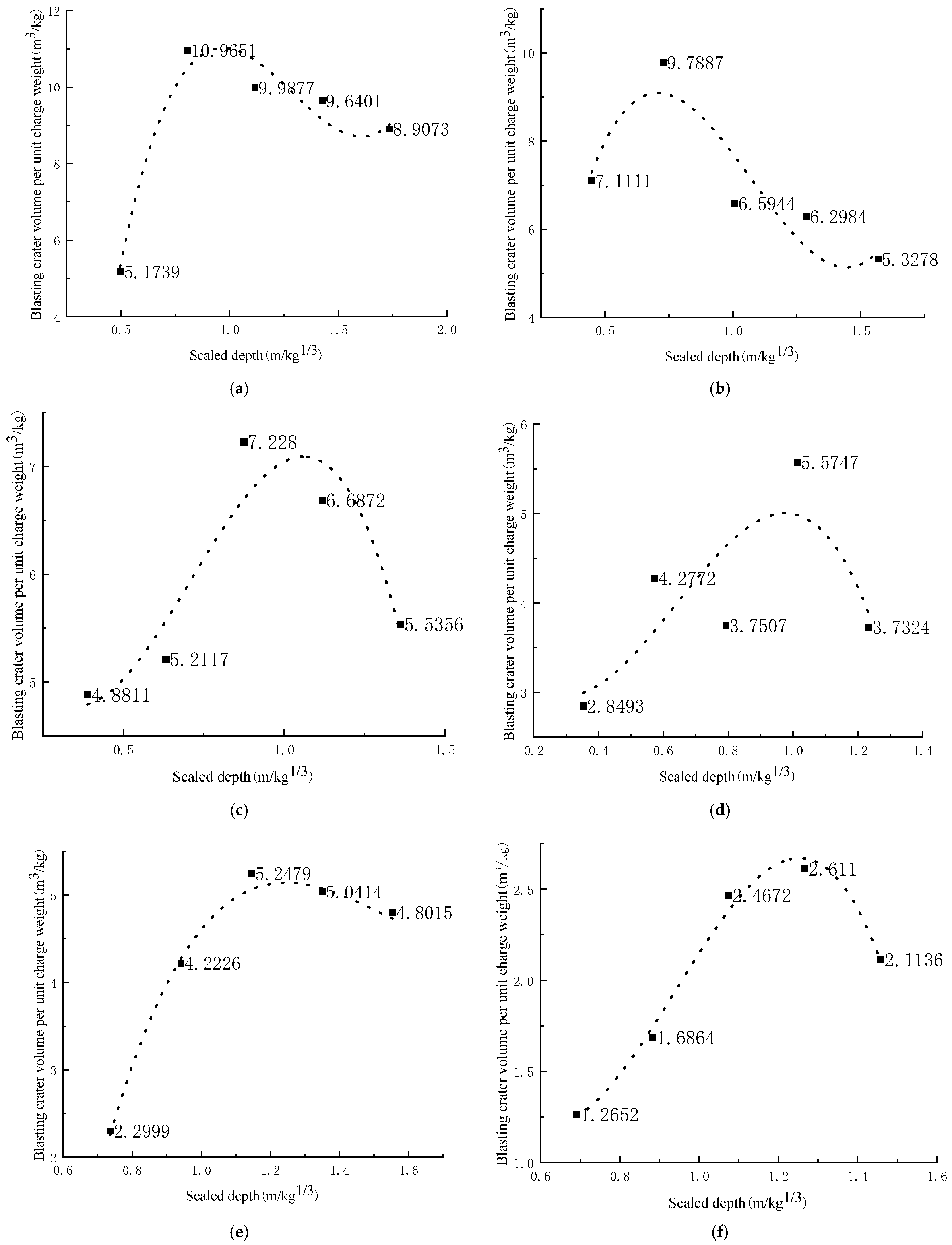
Table 10. The characteristic curve of the blasting crater was plotted with the scaled depth (defined as the ratio of charge burial depth to the cube root of charge mass) as the abscissa and the specific crater volume (crater volume per unit charge mass) as the ordinate, as shown in
Figure 5.
As shown in
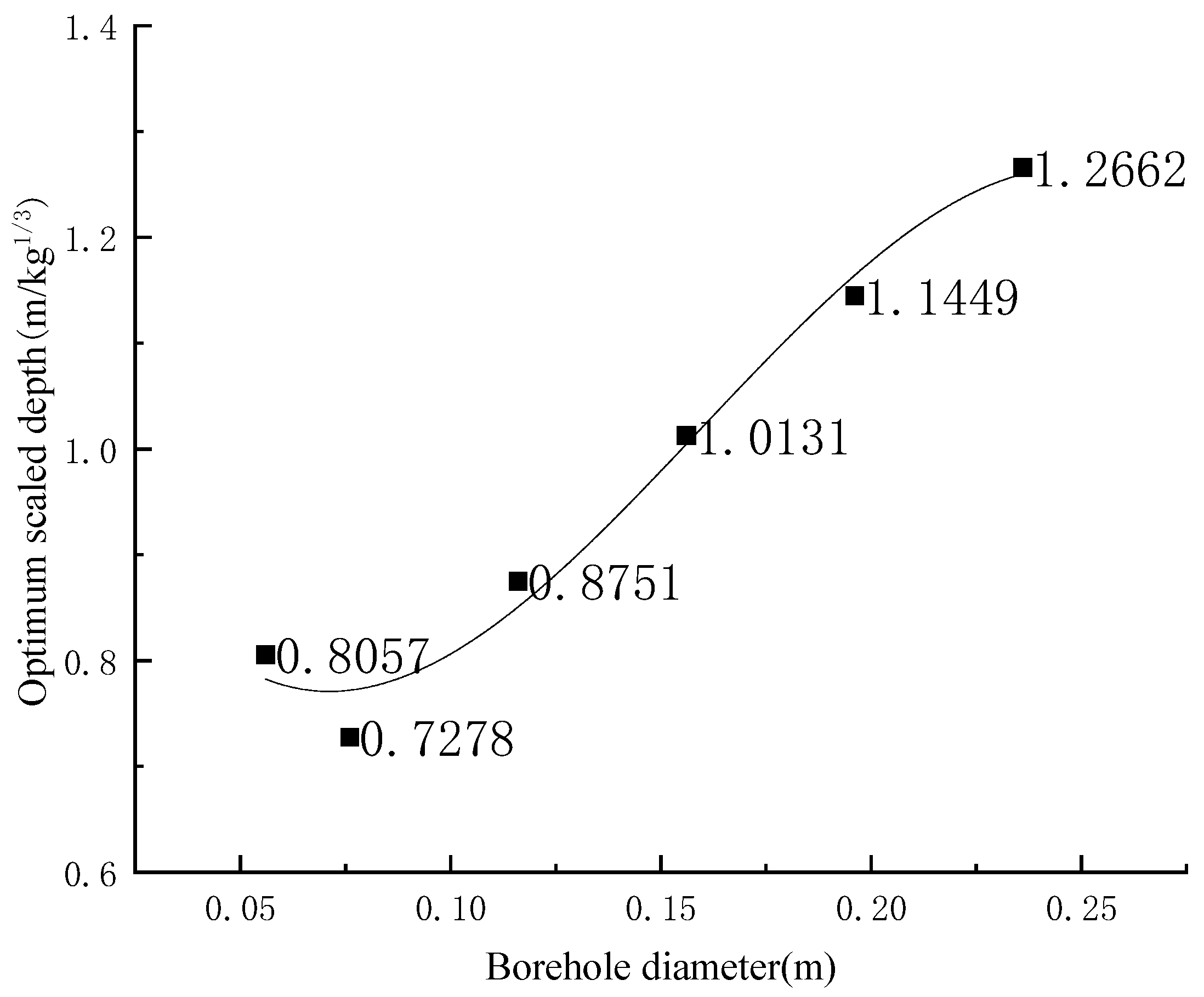
Figure 5, the blasting crater volume exhibits a consistent trend across all investigated borehole diameters: it initially increases with the scaled depth, reaches a maximum, and subsequently declines. The scaled depth corresponding to the peak crater volume indicates the point of optimal explosive energy utilization and thus defines the optimal charge burial depth. By analyzing the characteristic curves of blasting crater radii under different conditions, the relationship between the optimum scaled depth and the borehole diameter was derived and is plotted in
Figure 6. A curve-fitting analysis was performed on the data in
Figure 6 to quantify this relationship. The functional relationship between the optimum scaled depth (
y) and the borehole diameter (
x) is expressed by the following equation:
The curve-fitting yields a coefficient of determination (R2) of 0.9834, indicating that the fitted equation explains 98.34% of the data variance, which demonstrates excellent goodness of fit. The sum of squared residuals is 0.00357, and the associated root mean square error is small, both of which confirm that the fitting error is within an acceptable range. These results collectively demonstrate that the cubic polynomial model is highly reliable, statistically significant, and provides a robust description of the relationship between the optimum scaled depth and the borehole diameter.
5.2. Analysis on Damage Propagation Law of Double-Hole Blasting Crater
Based on the numerical simulation results of the single-hole blasting crater, the relationship between the blasting crater volume (V) and the charge burial depth (L) for a borehole diameter of 0.076 m was established. This relationship is expressed by the following equation:
The fitting yields a coefficient of determination (R2) of 0.9568, indicating that the regression model accounts for 95.68% of the variance in the experimental data, which signifies a high goodness of fit. This empirical relationship exhibits high reliability and statistical significance, effectively capturing the functional relationship between the blasting crater volume and the charge burial depth. The results are therefore robust and reliable.
The burial depth corresponding to the maximum blasting crater volume is defined as the optimum burial depth (
Lj) for the given borehole diameter. By calculating the maximum value of the equation, the optimum burial depth (
Lj) for a 0.076 m borehole was determined to be 0.26 m, and the critical burial depth was 0.48 m. Subsequently, based on these results, a series of double-hole blasting crater simulations was performed. A total of six simulation cases were designed, each comprising two boreholes. The hole spacings were set to 0.5
Lj, 1.0
Lj, 1.5
Lj, 2.0
Lj, 2.5
Lj, and 3.0
Lj [
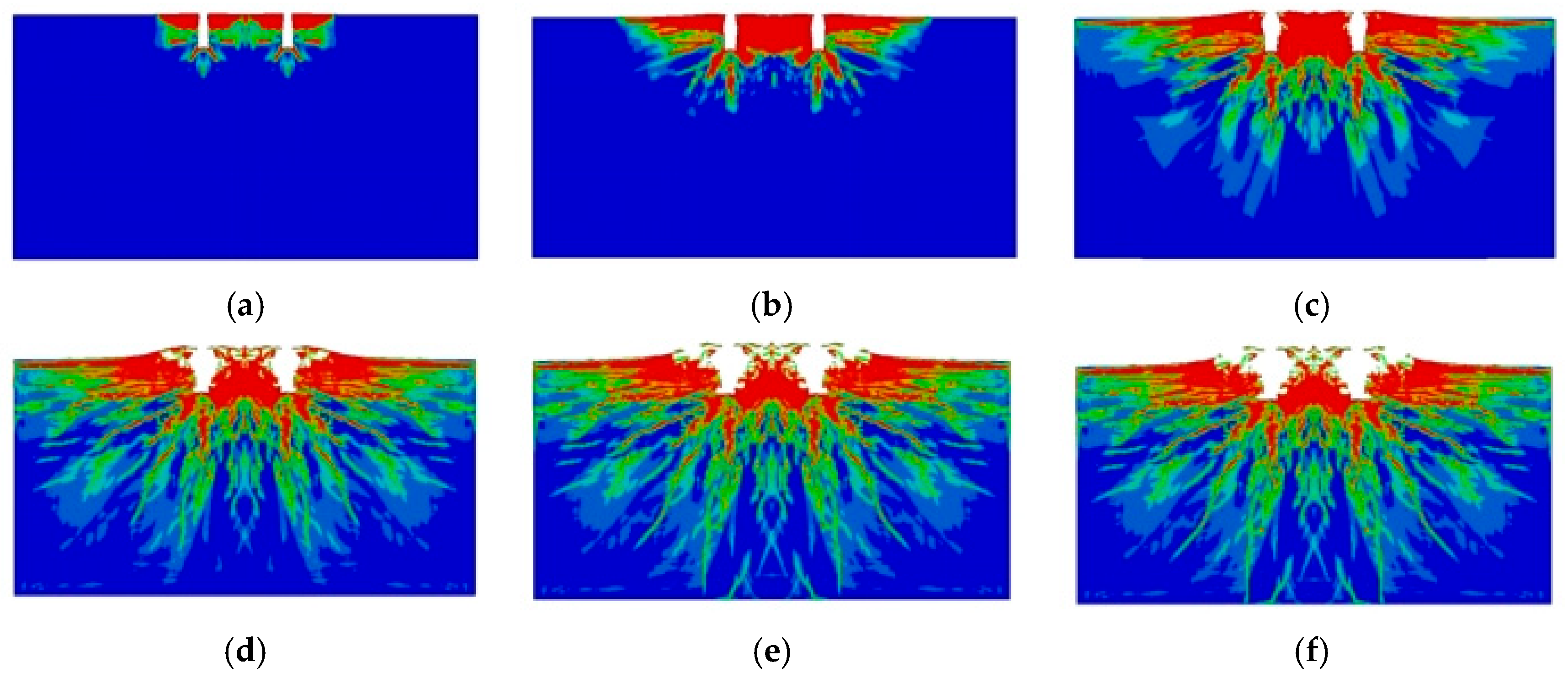
8], with a borehole diameter of 0.076 m and a hole depth of 0.26 m. The damage nephogram of a representative double-hole blasting crater is shown in
Figure 7. From the simulation results, the damaged elements were removed, and the radius (
r), depth (
h), and volume of the resulting crater were measured. The results are summarized in
Table 11.
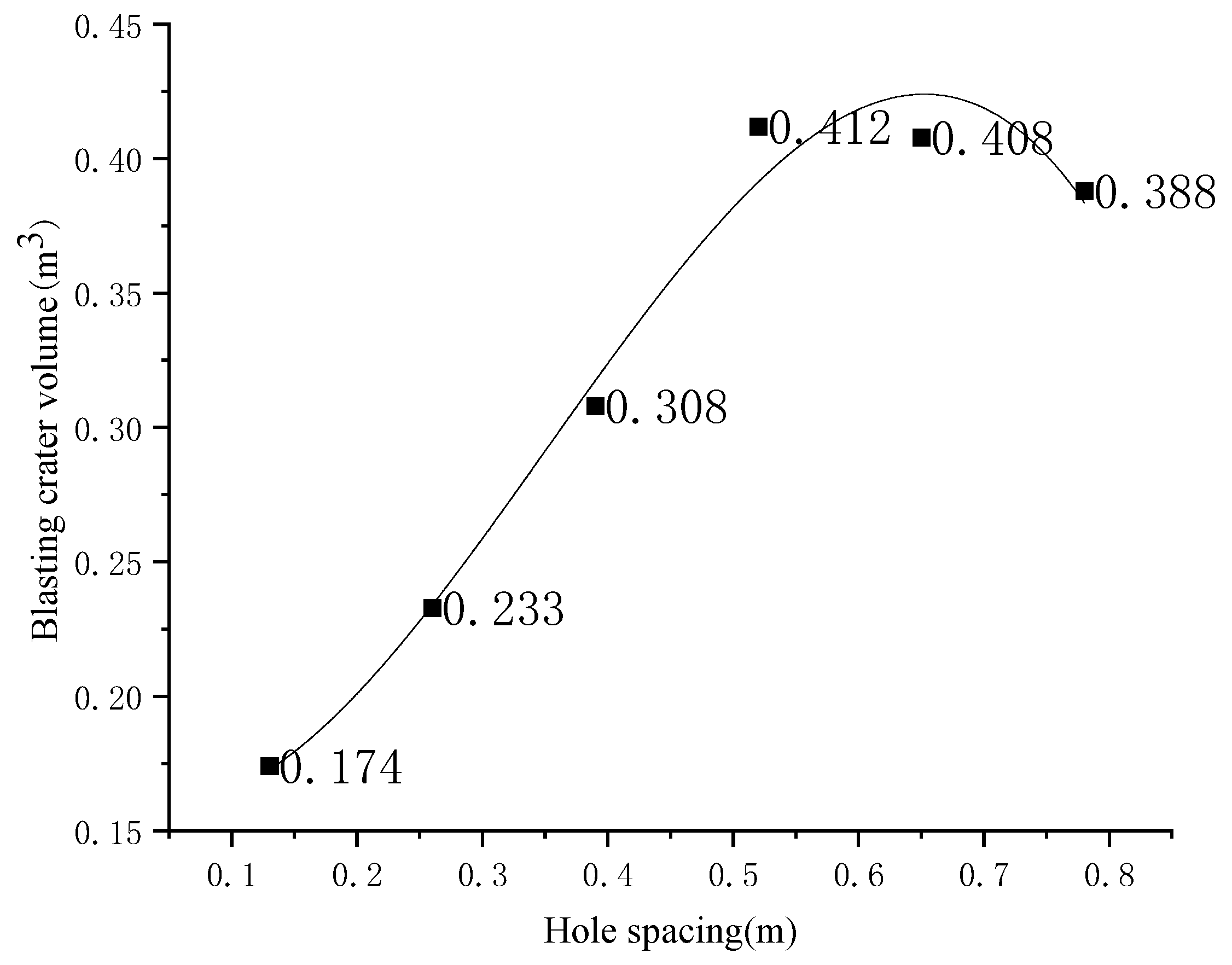
Based on the data summarized in
Table 11, the relationship between blasting crater volume and hole spacing was analyzed and is plotted in
Figure 8. The results show that the blasting crater volume reaches a maximum at a hole spacing of 0.52 m, indicating optimal blasting performance. Consequently, 0.52 m is determined to be the optimal hole spacing for the 0.076 m borehole diameter.
6. Optimization of Blasting Parameters
The blasting similarity theory [
31] states that for two geometrically similar explosive charges with identical detonation properties, detonated in the same rock medium, the resulting stress and strain fields are geometrically, temporally, and dynamically similar. This similitude implies a specific scaling relationship among the key blasting parameters, which can be expressed as follows:
where
—Optimum burial depth in the simulation experiment, m;
—Charge burial depth in the field blasting, m;
—Optimum hole spacing in the simulation experiment, m;
—Hole spacing in the field blasting, m;
—Charge weight in the simulation experiment, kg;
—Charge weight in the field blasting, kg.
Based on the simulation experiments detailed in the preceding chapter, the optimum burial depth (
Lj1) was determined to be 0.26 m, with a corresponding simulated explosive charge per meter (
Qj1) of 0.57 kg/m. The field blasting charge per meter (
Qj2) is 6.8 kg/m. Substituting these values into Equation (7) yields an optimum burial depth of 0.59 m and a critical burial depth of 1.1 m for the field charge. Using a scaling factor (
k) of 2.28 and the optimal simulated hole spacing of 0.52 m, the calculated field hole spacing is 1.18 m. Considering the layout characteristics of fan-shaped medium-length holes, the collar spacing is typically 0.6 to 0.8 times the theoretical hole spacing, i.e., 0.71 m to 0.95 m. The burden row spacing is typically 0.8 to 1.0 times the theoretical hole spacing [
31], resulting in a range of 0.95 m to 1.18 m.
Currently, the Daye Iron Mine employs a fan-shaped vertical hole layout with a burden of 1.6 m. The preceding analysis indicates that this spacing may be suboptimal. Therefore, for actual fan-shaped medium-length hole blasting, the minimum burden can be adjusted based on the calculated optimum burial depth of 0.59 m and the critical burial depth of 1.1 m, in conjunction with the specific borehole inclination and hole pattern. It is recommended to set the collar spacing between 0.71 m and 0.95 m, and to adjust the burden to a range of 0.95 m to 1.18 m.
7. Conclusions
Single-hole and double-hole blasting crater models with varied borehole diameters, burial depths, and hole spacings were constructed in ANSYS/LS-DYNA. The damage nephograms of the blasting craters were analyzed through numerical simulation to investigate the variation patterns of blasting crater volume. From the single-hole blasting simulations, a functional expression relating the scaled depth to the borehole diameter was derived, and the optimal hole spacing for the 0.076 m borehole in double-hole blasting was determined. These findings provide a reference for blasting parameter optimization.
- (1)
Based on numerical simulations of six single-hole blasting crater models with varying borehole diameters, the functional relationship between the optimum scaled depth (y) and the borehole diameter (x) was established through curve fitting: y = −180.7197x3 + 86.3754x2 − 9.5504x + 1.0782. This equation can be used to estimate the optimum scaled depth for relevant blasting crater experiments, providing a theoretical basis for blast design.
- (2)
Simulations of six double-hole blasting crater models with different hole spacings showed that, for a borehole diameter of 0.076 m, the blasting crater volume reaches a maximum at the optimal hole spacing of 0.52 m.
- (3)
Based on the blast parameter design study, the determined optimum burial depth of 0.59 m and critical burial depth of 1.1 m can serve as references for the design of field blasting parameters at the Daye Iron Mine. Adjustments should be made according to the specific borehole inclination and hole pattern. The collar spacing is recommended to be set between 0.71 m and 0.95 m, and the row spacing between 0.95 m and 1.18 m.
- (4)
This study is primarily based on the analysis of numerical simulation results. A simplified homogeneous rock mass assumption was adopted in the model, and the parameters were calibrated through a reduction procedure. However, different parameter combinations may lead to varying simulation outcomes, which is a limitation of this study. Therefore, field blasting crater tests are recommended in future work to validate the numerical findings and to further optimize the blasting parameters.
Author Contributions
Conceptualization, H.H.; methodology, Y.T.; validation, H.H.; formal analysis, H.L.; investigation, Y.T.; data curation, H.L.; writing—original draft preparation, H.L. and Y.T.; writing—review and editing, H.L. and Y.T.; visualization, Y.T.; supervision, H.H.; project administration, H.H. and Y.T.; funding acquisition, Y.T. All authors have read and agreed to the published version of the manuscript.
Funding
This research was funded by the General Program of the National Natural Science Foundation of China, “Blastability and Blasting Damage Mechanism of Freeze-Thaw Rock Mass in Open-Pit Mines in Cold Regions” (Grant No. 52374081).
Institutional Review Board Statement
Not applicable.
Informed Consent Statement
Not applicable.
Data Availability Statement
The data used to support the findings of this study are included within this article.
Conflicts of Interest
The authors declare no conflicts of interest.
References
- Zhang, T. Optimization of Deep-Hole Blasting Parameters and Blast Vibration Analysis in a Tungsten Mine. Ph.D. Thesis, Jiangxi University of Science and Technology, Ganzhou, China, 2025. [Google Scholar] [CrossRef]
- Long, Y.; Xiao, Y.; Chen, J. Study on damage zone of single-hole blasting based on blasting funnel test. Eng. Blasting 2023, 29, 68–74. [Google Scholar] [CrossRef]
- Zhao, M.; Zhou, C.; Prado, Á.; Jiang, N.; Meng, X.; Yang, Y. Quantitative classification and threshold determination of rock blasting damage based on blasting crater tests and numerical simulation. Eng. Fract. Mech. 2026, 336, 111956. [Google Scholar] [CrossRef]
- Wang, P.; Zhou, C.; Geng, X.; Jia, J. Numerical simulation of formation mechanism of multi hole and same delay time of blasting crater. Rock Soil Mech. 2010, 31, 993–997. [Google Scholar] [CrossRef]
- Fu, H.; Gao, Y. Rock-Breaking Mechanism and Application of Combined Long and Short Holes in Parallel Holes Cut in Small-Section Tunnels. Appl. Sci. 2024, 14, 11626. [Google Scholar] [CrossRef]
- Zhu, X.; Jia, M.; Geng, X. Research on Blast Parameter Optimization of Mirador Open-pit Copper Mine Based on Blasting Funnel Test. Hyundai Min. 2025, 41, 61–65. [Google Scholar] [CrossRef]
- Gu, Y.; Li, C.; Chen, N.; Zhong, G.; Tang, Z. Optimization Study on Hole Network Parameters of Fan-Shaped Medium-Deep Hole Blasting. Res. Dev. Min. Ind. 2025, 45, 96–103. [Google Scholar] [CrossRef]
- Wang, Z.L.; Konietzky, H.; Shen, R. Coupled finite element and discrete element method for underground blast in faulted rock masses. Soil Dyn. Earthq. Eng. 2009, 29, 939–945. [Google Scholar] [CrossRef]
- Huo, X.; Shi, X.; Qiu, X.; Zhou, J.; Gou, Y.; Yu, Z.; Ke, W. Rock damage control for large-diameter-hole lateral blasting excavation based on charge structure optimization. Tunn. Undergr. Space Technol. 2020, 106, 103569. [Google Scholar] [CrossRef]
- Gao, Q.; Yang, Q.; Jia, Y.; Zhou, H.; Zhao, Y.; Zhen, L. Co-simulation of rock blasting crater by finite and discrete element methods and experiment validation. Simul. Model. Pract. Theory 2026, 149, 103274. [Google Scholar] [CrossRef]
- Bai, R.; Zhang, P.; Zhang, Z.; Sun, X.; Hong, F.; Shi, B.; Hu, G.; Li, W. Optimization of blasting parameters and prediction of vibration effects in open pit mines based on deep neural networks. Alex. Eng. J. 2023, 70, 261–271. [Google Scholar] [CrossRef]
- He, L.; Sun, J.; Cheng, M.; Zhao, Y. Study on parameters of an underground lead-zinc mine based on blasting funnel test. J. Kunming Metall. Coll. 2025, 41, 30–38. [Google Scholar] [CrossRef]
- Wang, H.; Zhao, H.; Zhao, J.; Gao, S.; Shi, C. Optimization of blasting parameters based on cylindrical charge blasting craters test. Chin. Sci. Technol. 2023, 18, 913–920. [Google Scholar]
- Zhang, W.; Wang, J.; Wang, M.; Tao, J. Optimization study of pre-splitting hole spacing for continuous charging based on RHT constitutive model. J. High. Volt. Phys. 2025, 39, 111–120. [Google Scholar] [CrossRef]
- He, D.; Wang, K.; Li, Y.; Li, Z.; Zhang, Z.; Hong, Y.; Luo, Y. Blasting Crater Test Law under Different Resistance Lines Based on DEM-PBM Method. J. High. Volt. Phys. 2025, 39, 102–114. [Google Scholar] [CrossRef]
- Jiang, A.; Fei, H.; Yan, Y.; Liu, Y.; Bao, S.; Guo, J. Study on the Charge Structure Optimization for Coal–Rock Mixed Blasting and Separate Mining in Open-Pit Mine with High Benches. Appl. Sci. 2025, 15, 4521. [Google Scholar] [CrossRef]
- Ke, B.; Pan, R.; Zhang, J.; Wang, W.; Hu, Y.; Lei, G.; Chi, X.; Ren, G.; You, Y. Parameter Optimization and Fragmentation Prediction of Fan-Shaped Deep Hole Blasting in Sanxin Gold and Copper Mine. Minerals 2022, 12, 788. [Google Scholar] [CrossRef]
- Xu, W. Blasting Crater Theory. In Blasting Handbook; Metallurgical Industry Press: Beijing, China, 2011; pp. 31–35. [Google Scholar]
- Wu, C. Study on blasting crater experimental methods for underground blasting. China Min. Mag. 2017, 26, 155–158. [Google Scholar]
- Zeng, P.; Xie, L.; Wu, S.; Wu, C.; Wang, C. Experimental study on gradient bench blasting crater in a Chihong lead-zinc mine. Nonferous Met. Eng. 2018, 8, 125–127. [Google Scholar] [CrossRef]
- Yang, L.; Dong, P.; Wang, Q.; Wang, Q. Propagation behavior of two collinear mode I cracks driven by explosive gas. Int. J. Min. Sci. Technol. 2023, 8, 538–547. [Google Scholar] [CrossRef]
- Sanchidrián, J.A.; Segarra, P.; López, L.M. Energy components in rock blasting. Int. J. Rock Mech. Min. Sci. 2007, 44, 130–147. [Google Scholar] [CrossRef]
- Hagan, T.N. Rock breakage by explosives. Acta Astronaut. 1979, 6, 329–340. [Google Scholar] [CrossRef]
- Jin, X.; Lu, W. Discussion on theory of blasting funnel. Rock Soil Mech. 2002, 23, 205–208+219. [Google Scholar] [CrossRef]
- Wei, Z.; Yang, J.; Zheng, X.; Li, T.; Sun, G. Study on Pore Propagation Law of Deep-Hole Pre-Splitting Blasting in Outburst-Prone Coal Seams Under Combined Multi-Stress Action. Appl. Sci. 2026, 16, 3906. [Google Scholar] [CrossRef]
- Ouchterlony, F.; Nyberg, U.; Olsson, M.; Bergqvist, I.; Granlund, L.; Grind, H. Where does the explosive energy in rock blasting rounds go? Sci. Technol. Energ. Mater. 2004, 65, 54–63. [Google Scholar]
- Lou, X.; Liang, W.; Huo, X.; Xiao, S.; Guo, W. Analysis of Rock Mass Throwing Behavior and Energy Characteristics in Open-pit Deep-hole Bench Blasting. Min. Metall. Explor. 2025, 42, 3823–3848. [Google Scholar] [CrossRef]
- Huang, J.; Wang, L.; She, W. Study on Influence of Hole Diameter on Blasting Funnel Test. Hyundai Min. 2024, 40, 49–53. [Google Scholar] [CrossRef]
- Yang, X.; Zhang, X.; Wu, Y.; Li, Z.; Gao, W.; Wang, F.; Zhang, Y. Investigation of Stress Wave Propagation and Crack Propagation Characteristics in Intersecting-Joint Mass Under Blasting. Fractal Fract. 2025, 9, 693. [Google Scholar] [CrossRef]
- Chen, J.; Liang, J.; Lai, Z. Coupled ALE–Lagrangian Analysis of Pavement Damage Induced by Buried Natural Gas Pipeline Explosions. Infrastructures 2026, 11, 10. [Google Scholar] [CrossRef]
- Xiong, G.; Liu, T.; Yin, D.; Yang, Y.; Shi, D. Blasting Parameter Optimization of Underground Fan-shaped Medium-deep Holes based on Crater Test. Blasting 2026, 43, 9–108. [Google Scholar] [CrossRef]
Figure 1.
Reflection of Stress Wave and Failure Process of Rock Mass. a—Incident tensile wave front; b—Reflected tensile wave front.
Figure 1.
Reflection of Stress Wave and Failure Process of Rock Mass. a—Incident tensile wave front; b—Reflected tensile wave front.
Figure 2.
Blasting crater model. (a) Single-hole blasting crater model. (b) Double-hole blasting crater model.
Figure 2.
Blasting crater model. (a) Single-hole blasting crater model. (b) Double-hole blasting crater model.
Figure 3.
Damage nephogram of a single-hole blasting crater. (a) 100 μs. (b) 200 μs. (c) 400 μs. (d) 600 μs. (e) 800 μs. (f) 1000 μs.
Figure 3.
Damage nephogram of a single-hole blasting crater. (a) 100 μs. (b) 200 μs. (c) 400 μs. (d) 600 μs. (e) 800 μs. (f) 1000 μs.
Figure 4.
Schematic Diagram of Blasting Crater Model Measurement.
Figure 4.
Schematic Diagram of Blasting Crater Model Measurement.
Figure 5.
Characteristic curves of blasting craters with different borehole diameters. (a) 0.056 m. (b) 0.076. (c) 0.116. (d) 0.156. (e) 0.196. (f) 0.236.
Figure 5.
Characteristic curves of blasting craters with different borehole diameters. (a) 0.056 m. (b) 0.076. (c) 0.116. (d) 0.156. (e) 0.196. (f) 0.236.
Figure 6.
Relationship between Optimum Ratio Burial Depth and Borehole Diameter.
Figure 6.
Relationship between Optimum Ratio Burial Depth and Borehole Diameter.
Figure 7.
Damage nephogram of a double-hole blasting crater. (a)100 μs. (b) 200 μs. (c) 400 μs. (d) 600 μs. (e) 800 μs. (f) 1000 μs.
Figure 7.
Damage nephogram of a double-hole blasting crater. (a)100 μs. (b) 200 μs. (c) 400 μs. (d) 600 μs. (e) 800 μs. (f) 1000 μs.
Figure 8.
Hole spacing and characteristic curve of blasting funnel.
Figure 8.
Hole spacing and characteristic curve of blasting funnel.
Table 1.
Test Results of Rock Block Mechanical Parameters.
Table 1.
Test Results of Rock Block Mechanical Parameters.
| Lithology | Compressive Strength (MPa) | Bulk Density (t·m−3) | Elastic Modulus (×104 MPa) | Poisson’s
Ratio | Cohesion
(MPa) | Internal Friction Angle (°) |
|---|
| Diorite | 142 | 2.5 | 2.0 | 0.28 | 0.45 | 45 |
| Marble | 79 | 2.8 | 1.8 | 0.27 | 0.27 | 34 |
| Skarn | 98 | 2.7 | 2.63 | 0.26 | 0.45 | 36 |
| Iron Ore | 142 | 2.5 | 2.0 | 0.28 | 0.45 | 45 |
Table 2.
Rock Mass Parameters.
Table 2.
Rock Mass Parameters.
| Rock Mass Number | Tensile Strength
(MPa) | Compressive Strength (MPa) | Density (kg/m3) | Kv |
|---|
| 1 | 3.6 | 79 | 2800 | 0.82 |
| 2 | 3.8 | 142 | 2700 | 0.7 |
| 3 | 6 | 138 | 3850 | 0.78 |
| 4 | 3.8 | 98 | 2870 | 0.75 |
Table 3.
Evaluation Criteria of Rock Mass Explosivability Zoning.
Table 3.
Evaluation Criteria of Rock Mass Explosivability Zoning.
| Rock Blastability Class | Tensile Strength
(MPa) | Density (kg/m3) | Kv | Mean Joint Spacing (d/m) | Class |
|---|
| I | 2.0 | 2500 | 0.35 | 0.08 | Easy to Blast |
| II | 3.0 | 2950 | 0.45 | 0.26 | Relatively Easy to Blast |
| III | 5.5 | 3250 | 0.55 | 0.49 | Moderately Difficult to Blast |
| IV | 9.0 | 3850 | 0.75 | 0.68 | Relatively Difficult to Blast |
| V | 13.5 | 4000 | 0.90 | 0.80 | Difficult to Blast |
Table 4.
Grades of Explosivability of Rock Samples.
Table 4.
Grades of Explosivability of Rock Samples.
| Rock Mass Number | Evaluation Results | Class |
|---|
| 1 | III | Moderately Difficult to Blast |
| 2 | III | Moderately Difficult to Blast |
| 3 | IV | Relatively Difficult to Blast |
| 4 | III | Moderately Difficult to Blast |
Table 5.
Parameters of the simulation scheme.
Table 5.
Parameters of the simulation scheme.
| Borehole Diameter (m) | 0.056 | 0.076 | 0.116 | 0.156 | 0.196 | 0.236 |
| Burial Depth (m) | 0.56 | 0.56 | 0.56 | 0.56 | 0.76 | 0.76 |
| 0.46 | 0.46 | 0.46 | 0.46 | 0.66 | 0.66 |
| 0.36 | 0.36 | 0.36 | 0.36 | 0.56 | 0.56 |
| 0.26 | 0.26 | 0.26 | 0.26 | 0.46 | 0.46 |
| 0.16 | 0.16 | 0.16 | 0.16 | 0.36 | 0.36 |
Table 6.
Explosives model parameters.
Table 6.
Explosives model parameters.
| Density (kg/m3) | Parameter A
(MPa) | Parameter B
(MPa) | Parameter R1 | Parameter R2 | Parameter ω | Initial Specific Internal Energy of Explosive (MPa) |
|---|
| 1.5 × 10³ | 6.253 × 10³ | 0.2329 × 10³ | 5.25 | 1.6 | 0.28 | 0.0856 × 10³ |
Table 7.
RHT material model parameters.
Table 7.
RHT material model parameters.
| Parameters | Value | Parameters | Value | Parameters | Value |
|---|
| Density (kg/m3) | 2.61 × 10³ | Shear Modulus (MPa) | 0.17 × 10³ | Parameters of the Polynomial Equation of State | 1 |
| Parameters of the Polynomial Equation of State B0 | 1.22 | Parameters of the Polynomial Equation of State B1 | 1.22 | Parameters of the Polynomial Equation of State T1 | 0.4387 |
| Failure Surface Parameters A | 2.5 | Failure Surface Parameters N | 0.85 | Compressive Strength (MPa) | 1.5 |
| Relative Shear Strength | 0.07 | Relative Tensile Strength | 0.05 | Ratio of Tensile Meridian to Compressive Meridian | 0.72 |
| Lode Angle Correlation Coefficient | 0.01 | Reference Compressive Strain Rate | 3 × 10⁻¹¹ | Reference Tensile Strain Rate | 3 × 10⁻¹² |
| Fracture Compressive Strain Rate | 3 × 10¹⁹ | Fracture Tensile Strain Rate | 3 × 10¹⁹ | Compressive Strain Rate Exponent | 0.025 |
| Plastic Strain Volume Fraction | 0 | Compressive Yield Surface Parameters | 0.85 | Tensile Yield Surface Parameters | 0.4 |
| Shear Modulus Reduction Factor | 0.25 | Initial Damage Parameter | 0.025 | Damage Parameter | 1 |
| Minimum Damage Residual Strain | 0.01 | Residual Surface Parameters | 2.5 | Hugoniot Polynomial Coefficients A1 | 0.4387 |
| Hugoniot Polynomial Coefficients A2 | 0.494 | Hugoniot Polynomial Coefficients A3 | 0.1162 | Pressure at Crush | 0.00133 |
| Pressure at Compaction | 0.006 | Porosity Exponent | 3 | Initial Porosity | 1 |
| Tensile Strain Rate Exponent | 0.045 | | | | |
Table 8.
Air model parameters.
Table 8.
Air model parameters.
| Density (kg/m3) | Pressure Cutoff Value (MPa) | Gas Property Constants C4 | Gas Property Constants C5 | Initial Internal Energy Per Unit Volume (J) | Initial Relative Volume |
|---|
| 1.2 | 0 | 0.4 | 0.4 | 2.5 × 10⁻⁶ | 0 |
Table 9.
Blocking parameters.
Table 9.
Blocking parameters.
| Parameters | Value | Parameters | Value | Parameters | Value |
|---|
| Density (kg/m3) | 1.8 × 10³ | Shear Modulus (MPa) | 0.6385 | Bulk Modulus (MPa) | 0.3 × 10³ |
| Yield Function Constants A0 | 3.4 × 10⁻¹³ | Yield Function Constants A1 | 7.033 × 10⁻⁷ | Yield Function Constants A2 | 0.3 |
| Pressure Cutoff (MPa) | −6.9 × 10⁻¹⁴ | Volume Crushing Option | 0 | Pressure Hardening Option | 0 |
| Volumetric Strain Value EPS2 | −0.104 | Volumetric Strain Value EPS3 | −0.161 | Volumetric Strain Value EPS4 | −0.192 |
| Volumetric Strain Value EPS5 | −0.224 | Volumetric Strain Value EPS6 | −0.246 | Volumetric Strain Value EPS7 | −0.271 |
| Volumetric Strain Value EPS8 | −0.283 | Volumetric Strain Value EPS9 | −0.29 | Volumetric Strain Value EPS10 | −0.4 |
| Pressure Corresponding to Volumetric Strain P2 (MPa) | 2 × 10⁻⁴ | Pressure Corresponding to Volumetric Strain P3 (MPa) | 4 × 10⁻⁴ | Pressure Corresponding to Volumetric Strain P4 (MPa) | 6 × 10⁻⁴ |
| Pressure Corresponding to Volumetric Strain P5 (MPa) | 0.0012 | Pressure Corresponding to Volumetric Strain P6 (MPa) | 0.002 | Pressure Corresponding to Volumetric Strain P7 (MPa) | 0.004 |
| Pressure Corresponding to Volumetric Strain P8 (MPa) | 0.006 | Pressure Corresponding to Volumetric Strain P9 (MPa) | 0.008 | Pressure Corresponding to Volumetric Strain P10 (MPa) | 0.041 |
Table 10.
Simulation test results of a single-hole blasting funnel.
Table 10.
Simulation test results of a single-hole blasting funnel.
| Borehole Diameter (m) | Burial Depth (m) | Crater Radius (m) | Crater Depth (m) | Crater Volume (m3) | Charge Weight (kg) | Borehole Diameter (m) | Burial Depth (m) | Crater Radius (m) | Crater Depth (m) | Crater Volume (m3) | Charge Weight (kg) |
|---|
| 0.056 | 0.56 | 0.58 | 0.85 | 0.30 | 0.0336 | 0.156 | 0.56 | 0.65 | 0.79 | 0.3494 | 0.0936 |
| 0.46 | 0.69 | 0.65 | 0.32 | 0.0336 | 0.46 | 0.85 | 0.69 | 0.5218 | 0.0936 |
| 0.36 | 0.75 | 0.57 | 0.34 | 0.0336 | 0.36 | 0.66 | 0.77 | 0.3511 | 0.0936 |
| 0.26 | 0.8 | 0.55 | 0.37 | 0.0336 | 0.26 | 0.75 | 0.68 | 0.4004 | 0.0936 |
| 0.16 | 0.67 | 0.37 | 0.17 | 0.0336 | 0.16 | 0.7 | 0.52 | 0.2667 | 0.0936 |
| 0.076 | 0.56 | 0.58 | 0.69 | 0.2429 | 0.0456 | 0.196 | 0.76 | 0.79 | 0.86 | 0.5618 | 0.117 |
| 0.46 | 0.7 | 0.56 | 0.2872 | 0.0456 | 0.66 | 0.85 | 0.78 | 0.5898 | 0.117 |
| 0.36 | 0.67 | 0.64 | 0.3007 | 0.0456 | 0.56 | 0.95 | 0.65 | 0.6140 | 0.117 |
| 0.26 | 0.81 | 0.65 | 0.4464 | 0.0456 | 0.46 | 0.91 | 0.57 | 0.4940 | 0.117 |
| 0.16 | 0.68 | 0.67 | 0.3243 | 0.0456 | 0.36 | 0.71 | 0.51 | 0.2691 | 0.117 |
| 0.116 | 0.56 | 0.67 | 0.82 | 0.3853 | 0.0696 | 0.236 | 0.76 | 0.58 | 0.85 | 0.30 | 0.1416 |
| 0.46 | 0.77 | 0.75 | 0.4654 | 0.0696 | 0.66 | 0.61 | 0.92 | 0.37 | 0.1416 |
| 0.36 | 0.78 | 0.79 | 0.5031 | 0.0696 | 0.56 | 0.65 | 0.79 | 0.35 | 0.1416 |
| 0.26 | 0.76 | 0.60 | 0.3627 | 0.0696 | 0.46 | 0.65 | 0.54 | 0.24 | 0.1416 |
| 0.16 | 0.84 | 0.46 | 0.3397 | 0.0696 | 0.36 | 0.61 | 0.46 | 0.18 | 0.1416 |
Table 11.
Simulation test results of the double-hole blasting crater.
Table 11.
Simulation test results of the double-hole blasting crater.
| Borehole Diameter (m) | Hole Spacing (m) | Crater Radius (m) | Crater Depth (m) | Crater Volume (m3) |
|---|
| 0.076 | 0.13 | 0.77 | 0.28 | 0.174 |
| 0.26 | 0.81 | 0.34 | 0.233 |
| 0.39 | 0.88 | 0.38 | 0.308 |
| 0.52 | 0.98 | 0.41 | 0.412 |
| 0.65 | 1.04 | 0.32 | 0.408 |
| 0.78 | 1.08 | 0.33 | 0.388 |
| Disclaimer/Publisher’s Note: The statements, opinions and data contained in all publications are solely those of the individual author(s) and contributor(s) and not of MDPI and/or the editor(s). MDPI and/or the editor(s) disclaim responsibility for any injury to people or property resulting from any ideas, methods, instructions or products referred to in the content. |