Article

Study on the Mechanical Properties and Failure Mechanisms of Coal–Rock Composite Specimens Considering Variations in Weaker Components

1
State Key Laboratory of Intelligent Deep Metal Mining and Equipment, Northeastern University, Shenyang 110819, China
2
Institute of Disaster Rock Mechanics, Liaoning University, Shenyang 110036, China
3
Key Laboratory of Coalburst Theory and Prevention Technology, National Mine Safety Administration, Liaoning University, Shenyang 110036, China
*
Authors to whom correspondence should be addressed.
Appl. Sci. 2026, 16(12), 5939; https://doi.org/10.3390/app16125939
Submission received: 20 May 2026 / Revised: 8 June 2026 / Accepted: 10 June 2026 / Published: 12 June 2026
(This article belongs to the Topic Advances in Mining and Geotechnical Engineering)

Abstract

To clarify the influence of α (rock–coal height ratio) and λ (rock–coal strength ratio) on the mechanical properties and failure characteristics of coal–rock composite specimens, where the weaker component varies with rock properties, four sets of coal–rock composite specimens with λ values of 0.26, 0.35, 0.59, and 3.81 were subjected to uniaxial compression tests under conditions of α = 1:3, 1:1, and 3:1. The results show that: There are significant differences in the mechanical properties of coal–rock composite specimens compared to individual coal and rock specimens. Both α and λ have significant effects on the mechanical properties and failure modes of coal–rock composite specimens. The variation in uniaxial compressive strength, elastic modulus, and peak strain in coal–rock composite specimens with respect to α is significantly influenced by rock properties. These variation patterns are not entirely identical for different rock properties. For coal–rock composite specimens at different α values, the trends in uniaxial compressive strength, elastic modulus, and peak strain as a function of λ are identical. Both uniaxial compressive strength and elastic modulus exhibit a pattern of increasing rapidly at first and then more slowly with increasing λ, and both can be quantitatively described by exponential functions. Peak strain follows a pattern of rapid decrease, rapid increase, and gradual increase with increasing λ. However, for any given change in λ, the magnitude of the changes in uniaxial compressive strength, elastic modulus, and peak strain is significantly influenced by α. When λ is small or large, the weaker component in the coal–rock composite specimen is the primary source of failure. When λ falls within a certain range, both the strong and weak components undergo relatively complete failure. When λ increases beyond a critical value, only the weaker component fails, while the stronger component remains intact and does not fail. As α increases, the degree of failure in the coal–rock composite specimen gradually decreases.

1. Introduction

In recent years, with the continuous increase in coal mining depth and the intensification of mining activities, the frequency of coal bursts has gradually risen, and the resulting damage has become increasingly severe. Consequently, coal bursts have emerged as one of the primary dynamic hazards encountered in the production of deep mines [1,2,3,4,5,6,7,8,9,10]. Extensive engineering practice and theoretical research have demonstrated that dynamic disasters such as coal bursts are not attributable to the instability and failure of an isolated coal seam or rock layer; rather, they result from the overall failure and instability of the coal-roof structural system [11]. Therefore, investigating the mechanical properties and failure characteristics of coal–rock composite specimens is of clear practical significance and can provide a theoretical basis for the accurate prevention and control of coal bursts.
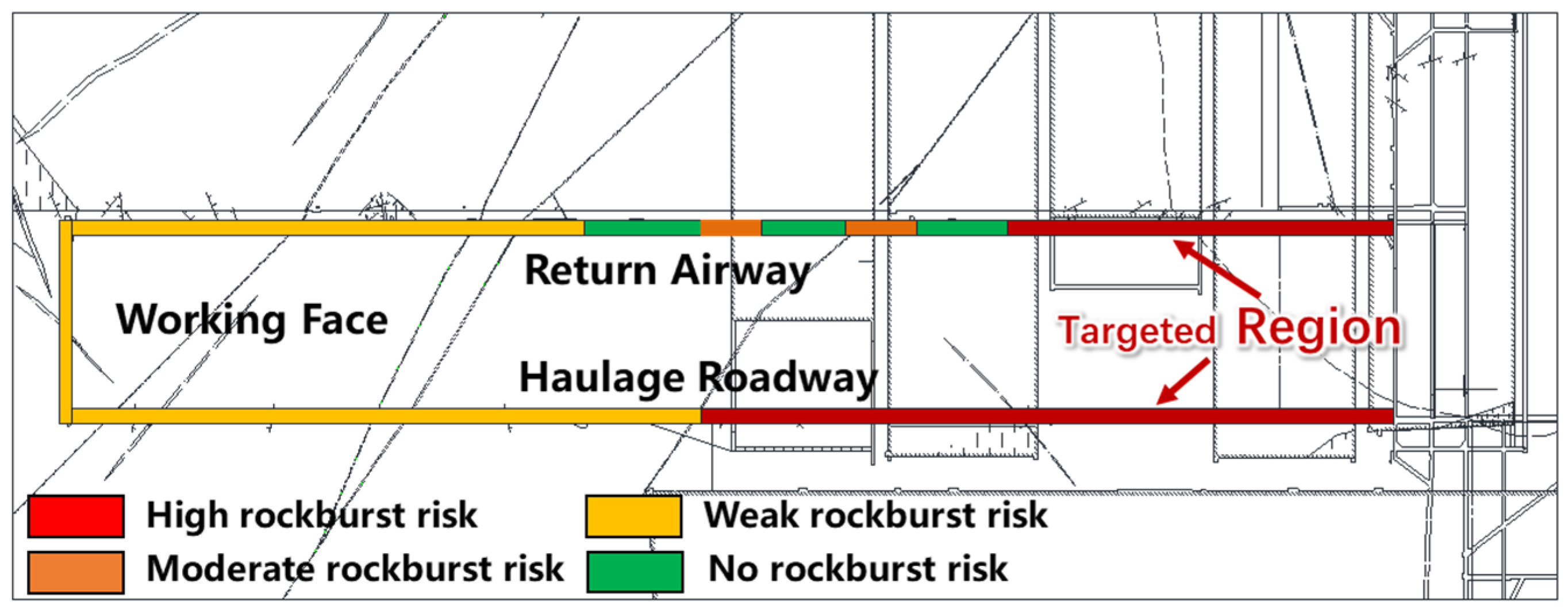
Against the backdrop of gradually depleting coal resources in central and eastern China, the state has initiated large-scale development of the Ordos coalfield. As the mining scope has progressively expanded, some mines have begun to experience coal bursts [12]. In particular, some mines are characterized by geological conditions featuring “weakly cemented overlying strata + high-strength coal seams,” with significant variations in roof lithology and thickness. Under such geological conditions, the coal-roof structural system exhibits a pattern where, in a few cases, the roof strength exceeds that of the coal seam, while in most cases, the roof strength is lower than that of the coal seam. This stands in stark contrast to the conventional geological conditions, where the coal seam strength is generally lower than that of the roof. For this geological condition, two types of coal–rock combination specimens with distinct characteristics appear against the backdrop of roof rock lithology variations. One type is a coal–rock combination specimen where the weaker component does not change with the variation in rock properties, maintaining its coal sample unchanged. The other type is a coal–rock combination specimens where the weaker component changes with the variation in rock properties, and the weaker component is composed of rock samples and coal samples with different properties. The former is consistent with the type of coal–rock combination specimen that appears under conventional stratigraphic conditions, while the latter is a unique type of coal–rock combination specimen under this geological condition. Therefore, targeting the unique types of coal–rock combination specimens under this specific geological condition, we carried out research on how λ and α influence the mechanical properties and failure characteristics of these samples, with the goal of providing a theoretical foundation for the precise prevention and control of coal bursts in such geological conditions.
To date, extensive research has been conducted on coal–rock composite specimens by scholars worldwide, yielding significant results, as shown in Table 1. Wang et al. [13] experimentally investigated the bursting liability, failure characteristics, and charge induction behavior of coal–rock composite specimens with different α values during the failure process. Chen et al. [14] performed uniaxial compression tests on five groups of roof-coal pillar structures with varying α to examine their mechanical properties and progressive failure mechanisms. Xiao et al. [15] carried out acoustic emission and charge induction monitoring tests on loaded coal–rock composite specimens under different α conditions, thereby determining the mechanical properties, the characteristics of acoustic and charge signals, and their interrelationships. Nie et al. [16] conducted numerical simulations of uniaxial compression tests on three coal–rock composite models with distinct α values, analyzing their strength, failure modes, and the deformation–failure process under compressive loading. Chen et al. [17] performed uniaxial compression tests on coal–rock composite specimens with different rock types and α values, exploring the effects of rock type and α on the mechanical properties and impact response of the composites. Zhao et al. [18] used a self-developed microseismic and charge-induced signal monitoring system to analyze the variation patterns of microseismic and charge signals during the deformation and failure of coal–rock composite specimens with different coal–rock ratios. Li et al. [19] examined the influence of coal seam thickness on the physical and mechanical characteristics of coal–rock composite specimens. Fan et al. [20] conducted uniaxial compression tests on coal specimens and coal–rock composite specimens, analyzed their anisotropy in terms of strength, elastic modulus, failure characteristics, and energy accumulation, and proposed a method for determining the bursting liability of coal–rock composite specimens. Zhao et al. [21] conducted experimental studies on the mechanical and energy characteristics of coal–rock composite specimens with varying coal thicknesses throughout the entire deformation–failure process under uniaxial loading. Zhao et al. [22] carried out uniaxial compression tests on coal–rock composites with different λ values to investigate the progressive failure characteristics of layered media under varying λ conditions. Yang et al. [23] studied the mechanical response characteristics and the evolution patterns of energy partitioning in coal–rock specimens with different λ values through numerical simulations and laboratory uniaxial compression tests. Liu et al. [24] performed uniaxial compression tests on rock–coal–rock composite specimens with varying rock strengths, analyzing the effect of rock strength on the mechanical behavior and failure modes of the composites. Chai et al. [25] conducted cyclic loading tests on coal–rock composite specimens with different roof rock types, investigating their mechanical properties and damage–failure processes.
In summary, previous studies have extensively addressed the effects of λ and α on the mechanical properties and failure characteristics of coal–rock composite specimens, with fruitful outcomes. However, when studying the influence of λ, the focus is primarily on coal–rock composite specimens where the weaker component does not change with the variation in rock properties, maintaining its coal sample unchanged. When studying the influence of α, the focus is primarily on coal–rock composite specimens with weaker components being coal samples. There are few reports focusing on coal–rock composite specimens where the weaker component varies with rock properties. In light of this, this study focuses on coal–rock composite specimens where the weaker component varies with rock properties. Four sets of coal–rock composite specimens with λ values of 0.26 (the weaker component is the rock sample), 0.35 (the weaker component is the rock sample), 0.59 (the weaker component is the rock sample), and 3.81 (the weaker component is the coal sample) were subjected to uniaxial compression tests under conditions of α = 1:3, 1:1, and 3:1. First, compare the mechanical properties of coal–rock composite specimens with those of individual coal and rock specimens. Second, analyze the similarities and differences in the effects of λ on the mechanical properties of coal–rock composite specimens at different α values, as well as the patterns of these effects at each α value. Analyze the similarities and differences in the effects of α on the mechanical properties of coal–rock composite specimens at different λ values, as well as the patterns of these effects at each λ value. Finally, the study examines the effects of λ and α on the failure characteristics of coal–rock composite specimens, with the aim of providing a theoretical foundation for the precise prevention and control of coal bursts under these geological conditions.

2. Materials and Methods

2.1. Specimen Preparation

Ideally, when conducting research on coal–rock composite specimens, specimens with a natural interface should be obtained directly from the field according to the experimental requirements, in order to minimize the influence of factors such as the interface characteristics. However, due to the complex underground conditions in coal mines and operational constraints, as well as the high demands placed on sampling equipment and procedures, it is difficult to directly obtain coal–rock composite specimens that meet the experimental requirements on site. Therefore, coal specimens were collected on site as large blocks, and rock specimens were collected on site as cores.
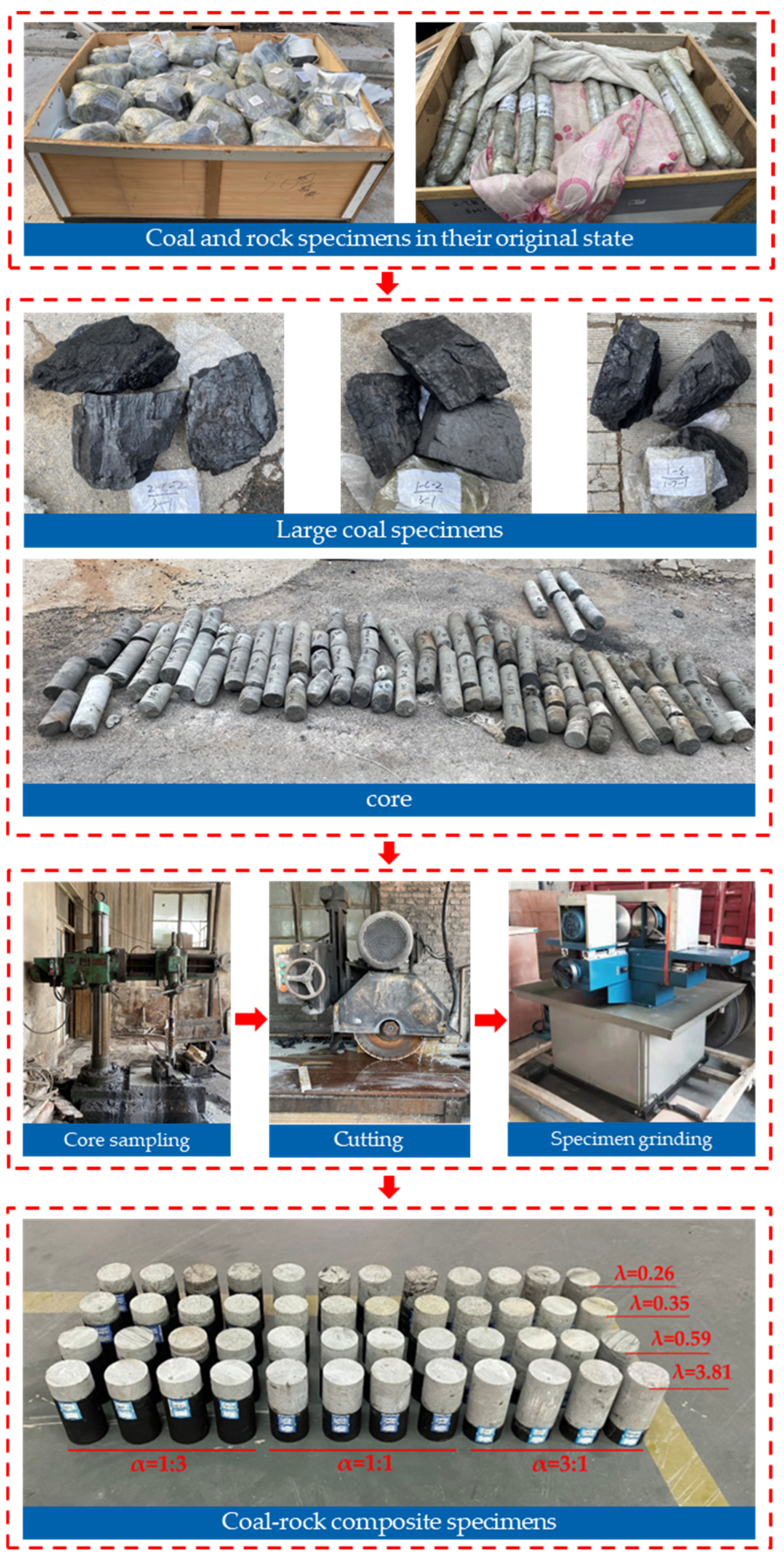
To meet the objectives of this study, the coal and rock samples used in the experiments were collected from the Hongqinghe Coal Mine in the Ordos Mining Area, China. A total of 5 drill cores and 30 large coal samples were retrieved. The rock samples consisted of weakly cemented coarse sandstone, weakly cemented medium sandstone, weakly cemented fine sandstone, and siltstone. In accordance with the experimental protocol and the requirements of “Methods for test, monitoring and prevention of rock burst-Part 3: Classification and laboratory test method on bursting liability of coal–rock combinations sample,” coal and rock samples were processed into cylindrical specimens with a diameter of 50 mm and heights of 25 mm, 50 mm, 75 mm, and 100 mm, respectively. The top and bottom surfaces were ground flat using a grinding machine to ensure that the surface flatness error at both ends was within 0.02 mm. For each rock type, four samples were prepared in each of the following sizes: φ50 × 25 mm, φ50 × 50 mm, φ50 × 75 mm, and φ50 × 100 mm. For coal samples, 16 samples were prepared in each of the following sizes: φ50 × 25 mm, φ50 × 50 mm, and φ50 × 75 mm, and four samples were prepared in the φ50 × 100 mm size. Then, in accordance with “Methods for test, monitoring and prevention of rock burst-Part 3:Classification and laboratory test method on bursting liability of coal–rock combinations sample,” the coal samples were bonded with epoxy resin AB adhesive [26,27] to rock samples of four different lithologies to form standard specimens (φ50 × 100 mm) with α ratios of 1:3, 1:1, and 3:1, as shown in Figure 1. To minimize the influence of the adhesive layer thickness at the interface, first apply the adhesive evenly to the bonding surfaces of the coal or rock samples. Then, align the bonding surfaces of the coal and rock samples, press the combined sample firmly in a vertical direction to squeeze out any excess adhesive along the edges, and wipe it clean to ensure that only a thin layer of adhesive remains at the coal–rock interface. Place the bonded coal–rock composite sample in a laboratory at a room temperature of 23 °C and let it stand for 24 h, then wrap it in plastic wrap for storage.
To compare the effects of changes in rock properties on the mechanical properties of coal–rock composite specimens where the weaker component changes with the variation in rock properties, and those where the weaker component does not change with the variation in rock properties, maintaining its coal sample unchanged, under an α ratio of 1:1, a set of tests with λ = 1.20 was added. This set of tests was included primarily for comparative analysis and does not affect the research objectives of this paper. Due to limitations on the number of samples collected from the same batch, no additional tests were conducted under α ratios of 1:3 and 3:1.

2.2. Test Equipment and Scheme

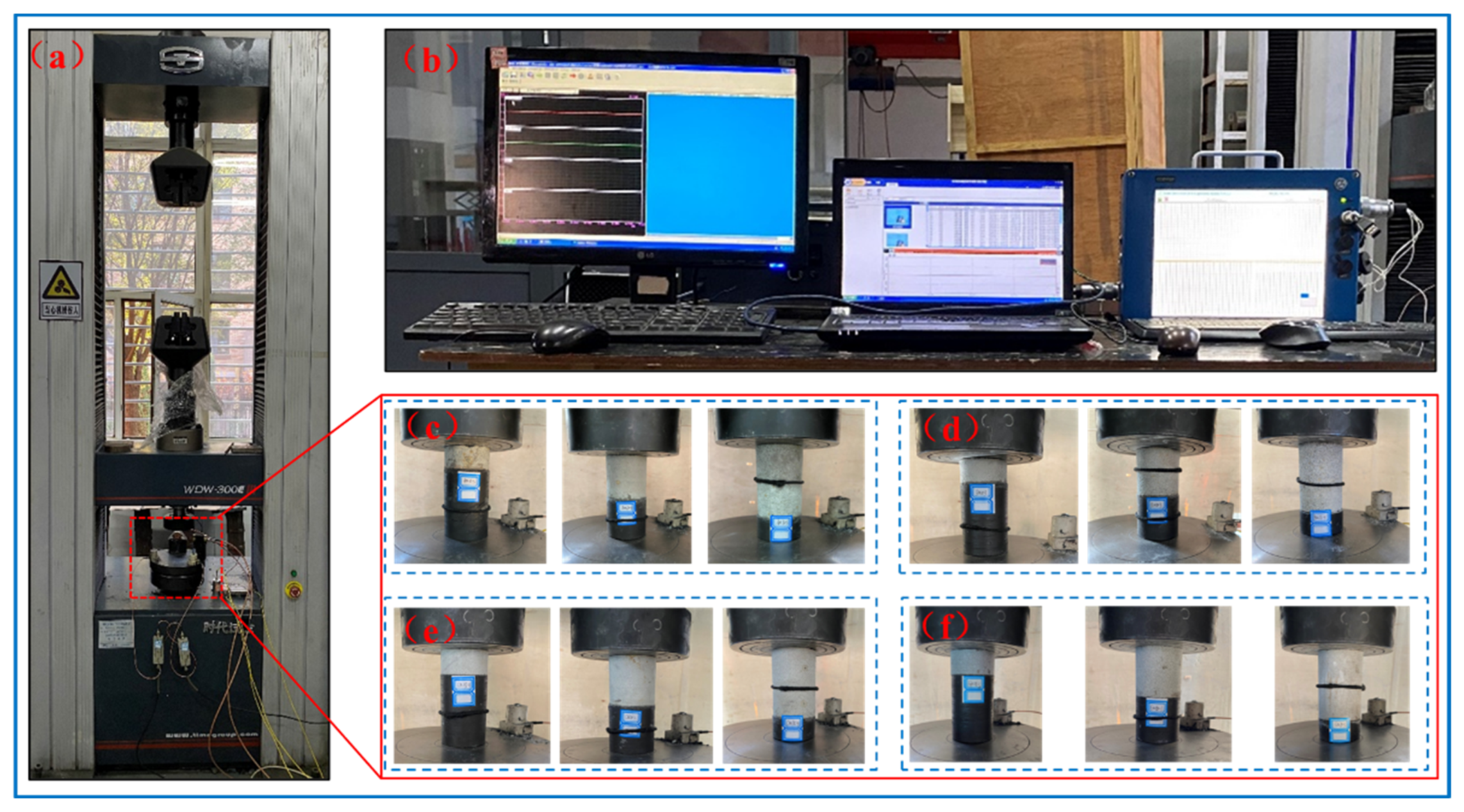
The tests were conducted using a WDW-300E microcomputer-controlled electronic universal testing machine (Shidai Shijin (Shandong) Scientific Instrument Co., Ltd., Jinan, China). A load monitoring system, a microseismic monitoring system, and an acoustic emission monitoring system were employed to monitor signals in real time throughout the loading process, as shown in Figure 2. The data collected by each monitoring system will be analyzed in a separate paper; therefore, the relevant parameters of the monitoring systems and the initial parameter settings are not detailed herein.
First, uniaxial compression tests were conducted on individual coal and rock specimens at a loading rate of 0.02 mm/s to determine their mechanical properties; the test results are presented in Table 2. Then, uniaxial compression tests were conducted on coal–rock composite specimens under various working conditions at a loading rate of 0.02 mm/s. Each test condition was repeated four times to minimize the impact of data discretization on the experimental results. The specific experimental scheme is shown in Table 3. In this study, the secant modulus at 40% to 60% of the peak stress is used as the elastic modulus for analysis [28,29,30]. Strain is calculated using the displacement monitoring system built into the testing machine.

3. Mechanical Model of Coal–Rock Composite Specimens

3.1. Theoretical Relationship Between the Elastic Modulus of Coal–Rock Composite Specimens and That of Individual Coal and Rock Samples

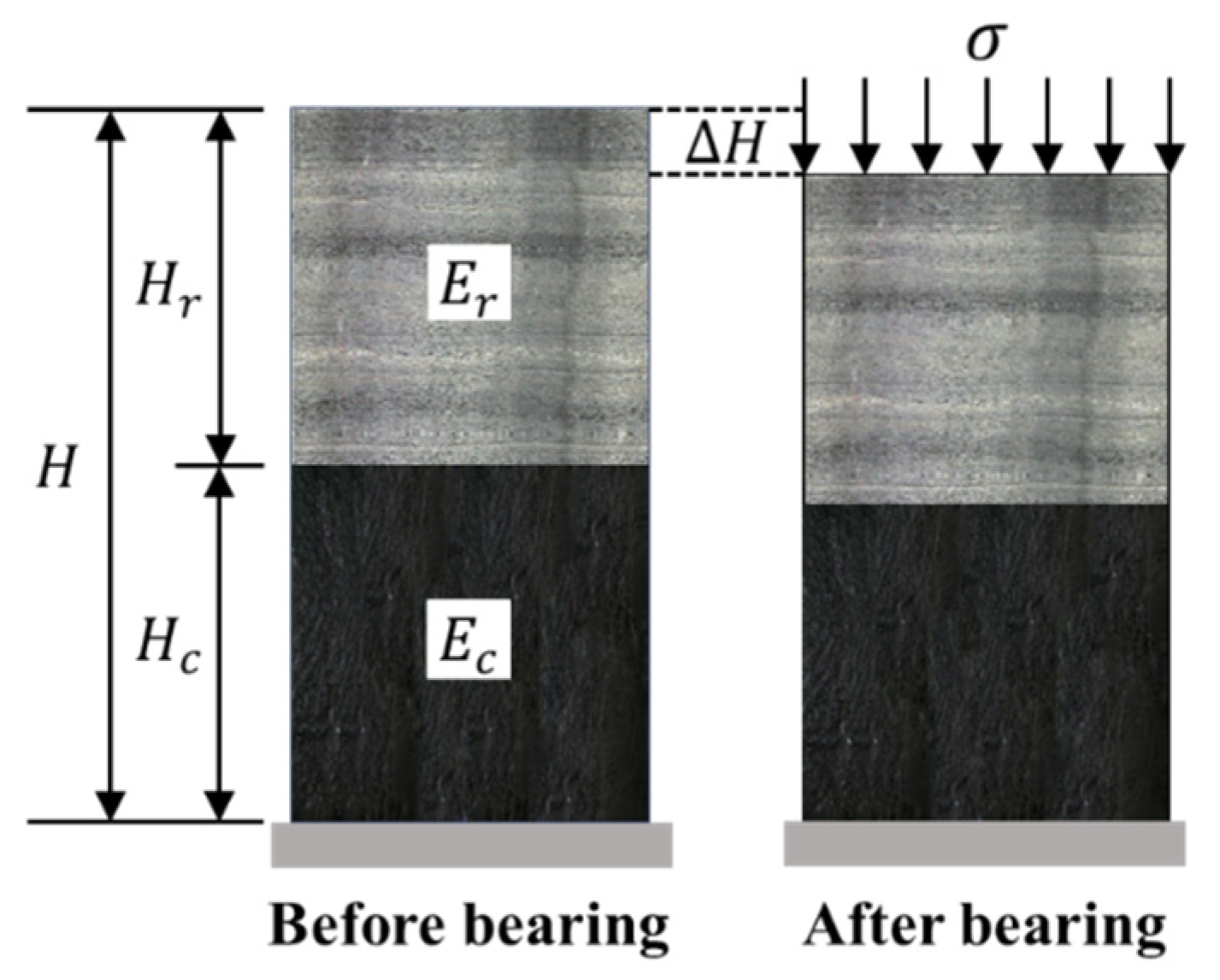
To compare the experimental results of the modulus of elasticity with theoretical calculations, the relationship between the modulus of elasticity of coal–rock composite specimens and that of individual coal and rock specimens was theoretically derived. Figure 3 illustrates the load-bearing deformation diagram of a coal–rock composite specimen with α = 1:1. The composite specimen consists of a coal specimen and a rock specimen connected in series. The elastic moduli of the composite specimen, the coal specimen, and the rock specimen are denoted by E, Ec and Er, respectively. The heights of the composite specimen, the coal specimen, and the rock specimen are denoted by H, Hc and Hr, respectively. The relationship among these three parameters is given by H = Hc + Hr. Assuming that all parts of the coal–rock composite specimen are homogeneous, continuous, and isotropic, and that they behave as ideal elastic models under axial stress, with the stress–strain relationship conforming to Hooke’s law, the axial strains of the coal–rock composite specimen, the coal specimen, and the rock specimen under axial stress σ are respectively:
ε = σ E ε c = σ c E c ε r = σ r E r
In the equation: ε, εc and εr represent the axial strains of the coal–rock composite specimen, the coal specimen, and the rock specimen, respectively; σ, σc and σr represent the axial stresses of the coal–rock composite specimen, the coal specimen, and the rock specimen, respectively.
Under axial stress σ, the deformations produced in the coal–rock composite specimen, the coal specimen, and the rock specimen are, respectively:
Δ H = ε H Δ H c = ε c H c Δ H r = ε r H r
In the equation, ΔH, ΔHc and ΔHr represent the axial deformations of the coal–rock composite specimen, the coal specimen, and the rock specimen, respectively.
For a coal–rock composite specimen subjected to axial stress σ, the following relationship holds between ΔH, ΔHc and ΔHr:
Δ H = Δ H c + Δ H r
Based on Equations (1)–(3), the following expression is obtained:
σ E H = σ c E c H c + σ r E r H r
During the loading process, after the deformation of the coal–rock composite specimen stabilizes, the axial stress satisfies the following relationship:
σ = σ c = σ r
Substituting Equation (5) into Equation (4) and rearranging yields:
E = E c E r H E c H r + E r H c
Substituting α = Hr/Hc and H = Hc + Hr into Equation (6) and rearranging gives the theoretical relationship between the elastic modulus of the coal–rock composite specimen and those of the coal and rock specimens:
E = 1 + α E c E r α E c + E r
The theoretical relationship between the elastic modulus of coal–rock composite specimens and those of coal and rock specimens is shown in Equation (7). As can be seen from Equation (7), the elastic modulus of coal–rock composite specimens is correlated with the elastic moduli of the coal and rock specimens and with the α value. Furthermore, when α is 1:1, the elastic modulus of the coal–rock composite specimens is related solely to the elastic moduli of the coal and rock specimens.

3.2. Theoretical Ranking of Elastic Moduli for Coal–Rock Composite Samples and Individual Coal and Rock Samples

The following theoretical derivation analyzes the relationship between the modulus of elasticity of coal–rock composite specimens and those of individual coal and rock specimens. By comparing E with Ec and E with Er, and substituting Equation (7) into the relationship, the following expression is obtained after simplification.
E c E = α E c + E r 1 + α E r E r E = α E c + E r 1 + α E c
Substituting β = Er/Ec into Equation (8) and simplifying yields the following expression.
E c E = 1 + α β 1 + α E r E = β + α 1 + α
According to Equation (9), for any α, the magnitude relationship among E, Ec and Er satisfies the following:
E c < E < E r β > 1 E c > E > E r β < 1
The above analysis indicates that, for any value of α, the elastic modulus of the coal–rock composite specimens lies between the elastic moduli of the coal and rock specimens.

3.3. Theoretical Relative Relationship Between the Elastic Modulus of Coal–Rock Composite Specimens and That of Individual Coal and Rock Samples

The following theoretical derivation analyzes the relative relationships among the moduli of elasticity of the coal–rock composite specimens, the coal specimens, and the rock specimens. By comparing the deviations between E and Ec and between E and Er, and based on the relative magnitudes of E, Ec, and Er, we substitute Equation (7) and simplify to obtain:
E E c E r E = α E c E r β > 1 E c E E E r = α E c E r β < 1
Substituting β = Er/Ec into Equation (11) and simplifying yields the following expression.
E E c E r E = α β β > 1 E c E E E r = α β β < 1
According to Equation (12), it follows that the relationship between E E c and E E r satisfies the following:
E E c > E E r α > β E E c = E E r α = β E E c < E E r α < β
The above analysis indicates that the relative magnitude of the elastic modulus of the coal–rock composite specimen compared to those of the coal and rock specimens primarily depends on the relationship between α and β. When α > β, the elastic modulus of the coal–rock composite specimen is relatively closer to that of the rock specimen; when α = β, the elastic modulus of the coal–rock composite specimen is the intermediate value between the elastic moduli of coal and rock specimens; when α < β, the elastic modulus of the coal–rock composite specimen is relatively closer to that of the coal specimen.

3.4. Theoretical Relationship Between Strain in Coal–Rock Composite Specimens and Strain in Individual Coal and Rock Samples

The following theoretical derivation examines the relationship between the strains generated in coal–rock composite specimens and those in individual coal and rock specimens during the loading process. By combining Equations (2) and (3) and simplifying, the following expression is obtained:
ε = ε c H c + ε r H r H
Substituting α = Hr/Hc and H = Hc + Hr into the above equation and simplifying yields the following expression:
ε = ε c + α ε r 1 + α
The theoretical relationship between the strain generated in the coal–rock composite specimen during loading and the strains generated in the coal specimen and rock specimen within the composite is given by Equation (15). As can be seen from Equation (15), the strain of coal–rock composite specimens is correlated with the strain of the coal and rock specimens and with the α value.
When α = 1:1, Equation (15) can be further simplified as follows:
ε = ε c + ε r 2
From Equation (16), when α = 1:1, the strain generated in the coal–rock composite specimen during loading is equal to half the sum of the strains generated in the coal specimen and the rock specimen within the composite.

3.5. Theoretical Ranking of Strain for Coal–Rock Composite Samples and Individual Coal and Rock Samples

The following theoretical derivation analyzes the magnitude relationship between the strain generated in the coal–rock composite specimen during loading and the strains generated in the coal and rock components of the composite. By comparing εc with ε and εr with ε and substituting Equation (1) into the relationship, the following expression is obtained after simplification:
ε c ε = E E c ε r ε = E E r
Substituting Equation (7) into Equation (17) and simplifying yields the following expression.
ε c ε = 1 + α E r α E c + E r ε r ε = 1 + α E c α E c + E r
After substituting β = Er/Ec into Equation (18) and simplifying, the following expression is obtained.
ε c ε = 1 + α 1 + α β ε r ε = 1 + α β + α
According to Equation (19), for any α, the magnitude relationship among ε, εc and εr satisfies the following:
ε c > ε > ε r β > 1 ε c < ε < ε r β < 1
The above analysis indicates that, for any value of α, the strains of the coal–rock composite specimens lies between the strain of the coal and rock specimens.

3.6. Theoretical Relative Relationship Between Strain of Coal–Rock Composite Specimens and That of Individual Coal and Rock Samples

The following theoretical derivation analyzes the relative magnitude of the strain generated in a coal–rock composite specimen during loading compared with the strains generated in the coal and rock specimens within the composite. Comparing the deviations of εc, εr, and ε, and based on the relative magnitudes of ε, εc, and εr, we substitute Equation (1) and simplify to obtain:
ε c ε ε ε r = E r E E c E c E r E β > 1 ε ε c ε r ε = E r E c E E c E E r β < 1
Substituting Equation (7) into Equation (21) and simplifying yields the following expression.
ε c ε ε ε r = α β > 1 ε ε c ε r ε = α β < 1
According to Equation (22), the relationship between ε ε c and ε ε r satisfies the following:
ε ε c > ε ε r α > 1 ε ε c = ε ε r α = 1 ε ε c < ε ε r α < 1
As can be seen from (23), the relative magnitude of the strain in a coal–rock composite specimen compared to that in coal and rock specimens depends primarily on α. When α > 1, the strain of the coal–rock composite specimen is relatively closer to that of the rock specimen; when α = 1, the strain of the coal–rock composite specimen is the intermediate value between the strain of coal and rock specimens; when α < 1, the strain of the coal–rock composite specimen is relatively closer to that of the coal specimen. In other words, the strain of the coal–rock composite specimen is closer to that of the component with the larger height proportion.

4. Test Results and Analysis

The results of the uniaxial compression tests on coal–rock composite specimens are presented in Table 4. As can be seen from Table 4, for any given value of α, the uniaxial compressive strength, elastic modulus, and peak strain of coal–rock composite specimens with different λ values are all different. Similarly, for any given value of λ, the uniaxial compressive strength, elastic modulus, and peak strain of coal–rock composite specimens with different α values are also all different. This indicates that λ and α have a significant influence on the mechanical properties of coal–rock composite specimens.

4.1. Comparative Analysis of the Mechanical Properties of Coal–Rock Composite Specimens and Individual Coal and Rock Specimens

4.1.1. Comparative Analysis of the Uniaxial Compressive Strength of Coal–Rock Composite Specimens and Individual Coal and Rock Specimens

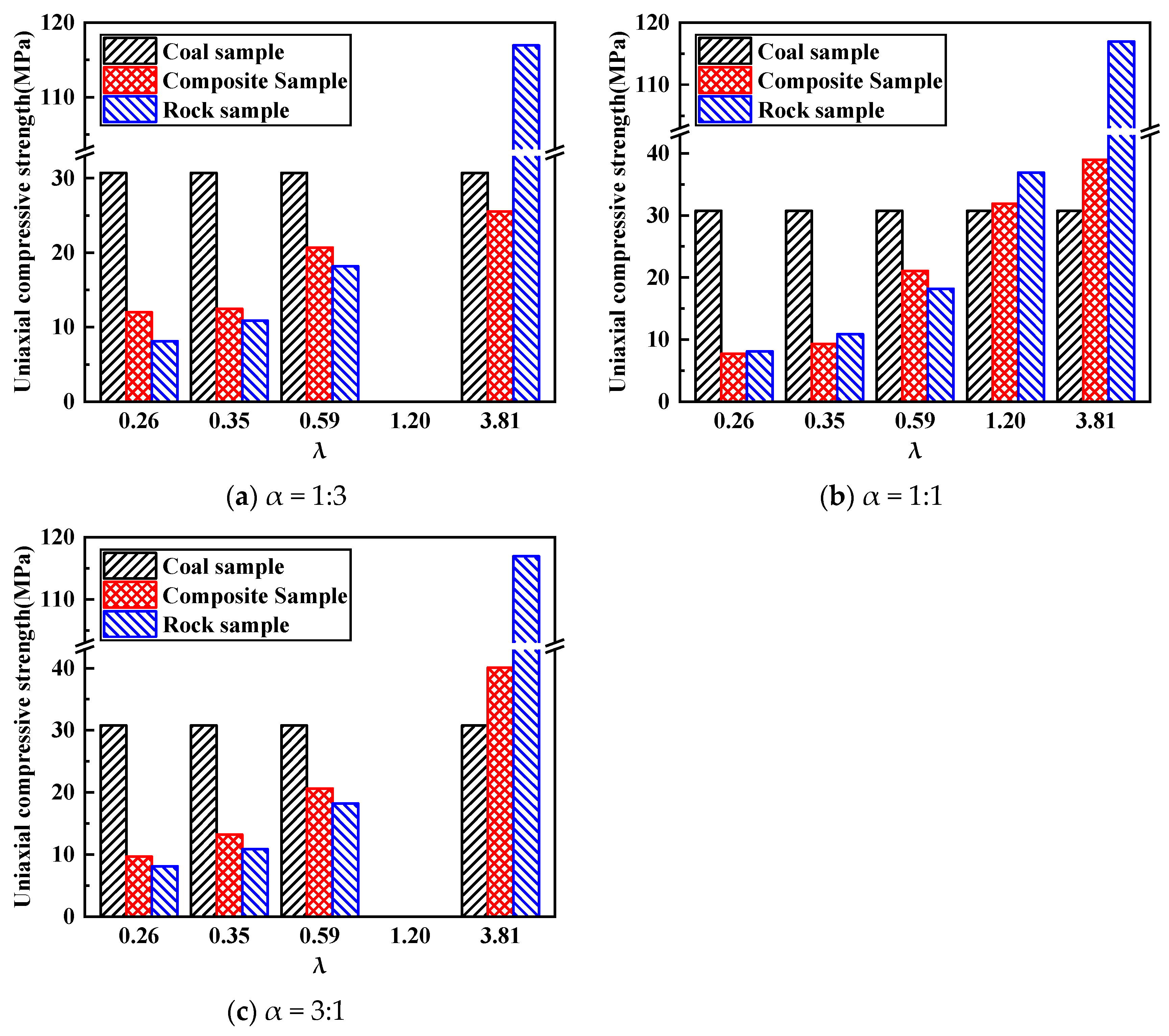
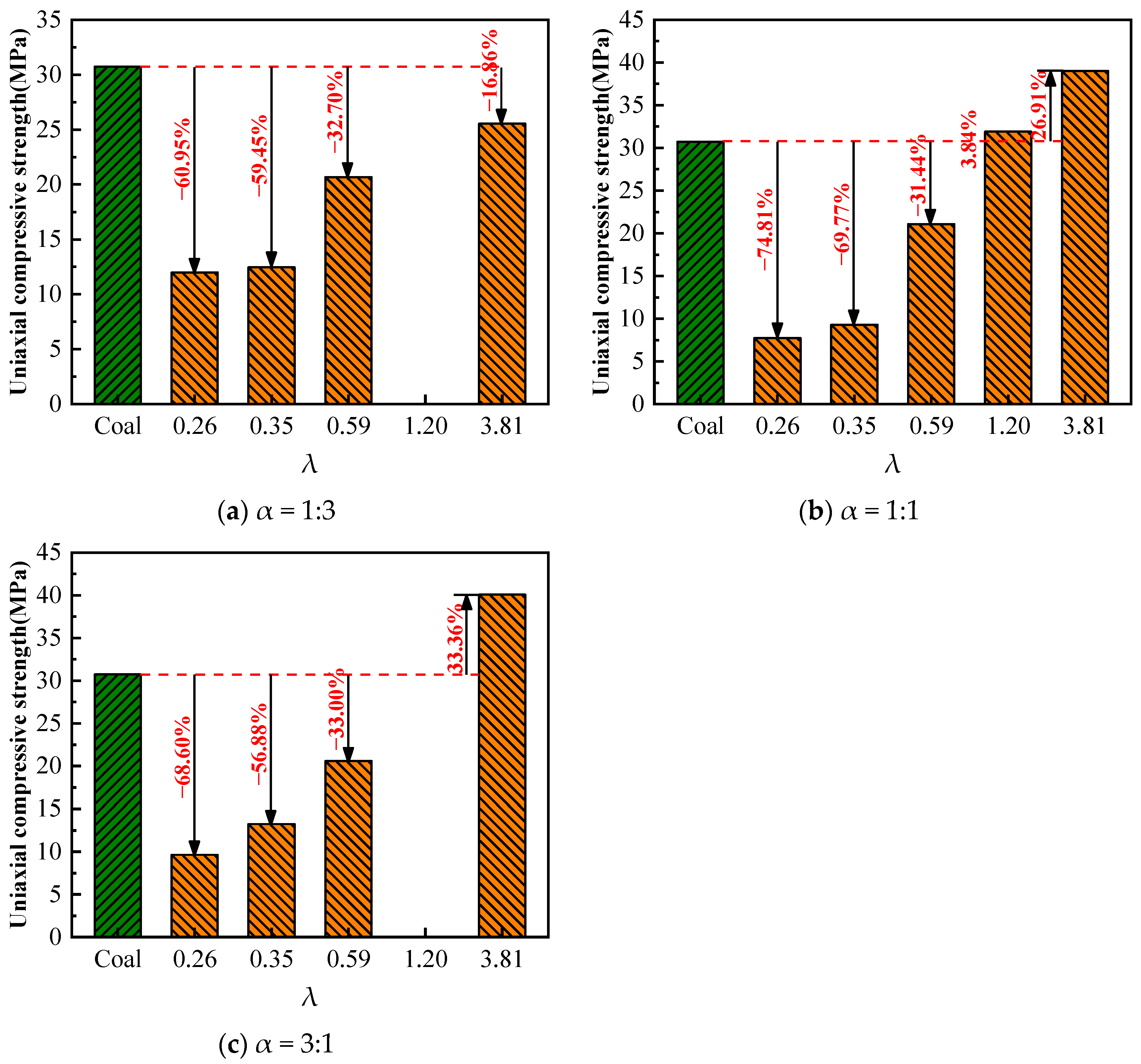
To clarify the relationship between the uniaxial compressive strengths of coal–rock composite specimens and those of individual coal and rock specimens, the uniaxial compressive strengths of the composite specimens were compared with those of the individual specimens. Under laboratory conditions, coal, rock, and coal–rock composite specimens are generally prepared as standard specimens in accordance with relevant standards when testing uniaxial compressive strength. Therefore, comparing the uniaxial compressive strength of coal–rock composite specimens with that of corresponding standard coal and rock specimens is more practical than comparing them with coal and rock specimens of heights corresponding to the actual α ratio. The comparison of uniaxial compressive strengths between coal–rock composite specimens and standard individual coal and rock specimens is shown in Figure 4.
As shown in Table 2 and Table 4 and Figure 4a, when α = 1:3, the uniaxial compressive strengths of coal–rock composite specimens with λ = 0.26, 0.35, and 0.59 fall between those of the individual coal and rock specimens and are closer to those of the rock specimens. They are 3.89 MPa, 1.59 MPa, and 2.50 MPa higher than those of the rock specimens, representing increases of 47.97%, 14.63%, and 13.75%, respectively. The uniaxial compressive strength of the coal–rock composite specimen with λ = 3.81 is lower than that of both the individual coal and rock specimens, but closer to that of the individual coal specimen. It decreased by 5.18 MPa compared to the individual coal specimen, representing a decrease of 16.86%.
As shown in Table 2 and Table 4 and Figure 4b, when α = 1:1, the uniaxial compressive strengths of coal–rock composite specimens with λ = 0.26 and 0.35 are lower than those of individual coal and rock specimens, while the uniaxial compressive strengths of coal–rock composite specimens with λ = 0.59, 1.20, and 3.81 fall between those of individual coal and rock specimens. In particular, the uniaxial compressive strengths of the coal–rock composite specimens with λ = 0.26, 0.35, and 0.59 are closer to those of the individual rock specimens, decreasing by 0.37 MPa, decreasing by 1.58 MPa, and increasing by 2.89 MPa, respectively, compared to the individual rock specimens. The corresponding percentage changes are a decrease of 4.56%, a decrease of 14.54%, and an increase of 15.90%. The uniaxial compressive strengths of coal–rock composite specimens with λ values of 1.20 and 3.81 were closer to those of the individual coal specimens, increasing by 1.18 MPa and 8.27 MPa, respectively, compared to the individual coal specimens, representing increases of 3.84% and 26.91%, respectively.
As shown in Table 2 and Table 4 and Figure 4c, when α = 3:1, the uniaxial compressive strengths of coal–rock composite specimens with λ = 0.26, 0.35, 0.59, and 3.81 all fall between those of the individual coal and rock specimens. Among these, the strengths of specimens with λ = 0.26, 0.35, and 0.59 are closer to those of the rock specimens, increasing by 1.54 MPa, 2.38 MPa, and 2.41 MPa, respectively, compared to the individual rock specimens, representing increases of 18.99%, 21.90%, and 13.26%. In contrast, the strength of the specimen with λ = 3.81 is closer to that of the individual coal specimen, increasing by 9.33 MPa, respectively, compared to the individual coal specimens, representing increases of 30.36%.
The above analysis shows that, for any value of α, the uniaxial compressive strength of coal–rock composite specimens differs from that of both individual coal and rock specimens. It is lower than the uniaxial compressive strength of the stronger component in the composite specimen, and is closer to that of the weaker component. However, the pattern of the relative magnitude between the composite specimen’s strength and that of the weaker component is unclear, and the relative deviation from the weaker component’s uniaxial compressive strength generally remains within 30%. It is evident that, for any value of α, testing the uniaxial compressive strength of individual coal or rock specimens alone will result in a certain degree of deviation compared to that of the composite specimen; this deviation is particularly significant when testing only the stronger component of the composite specimen.

4.1.2. Comparative Analysis of Elastic Modulus Test Results and Theoretical Calculations

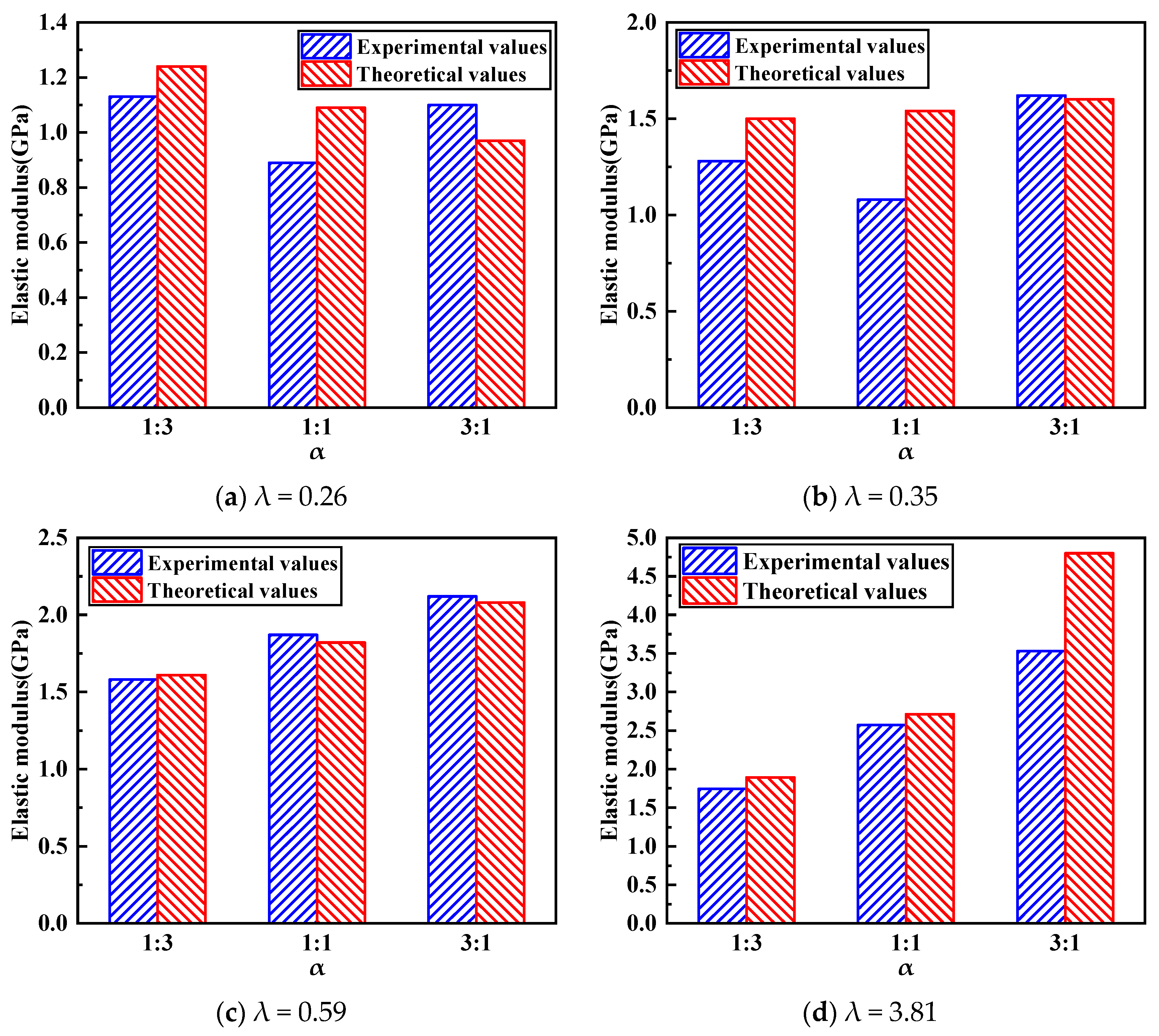
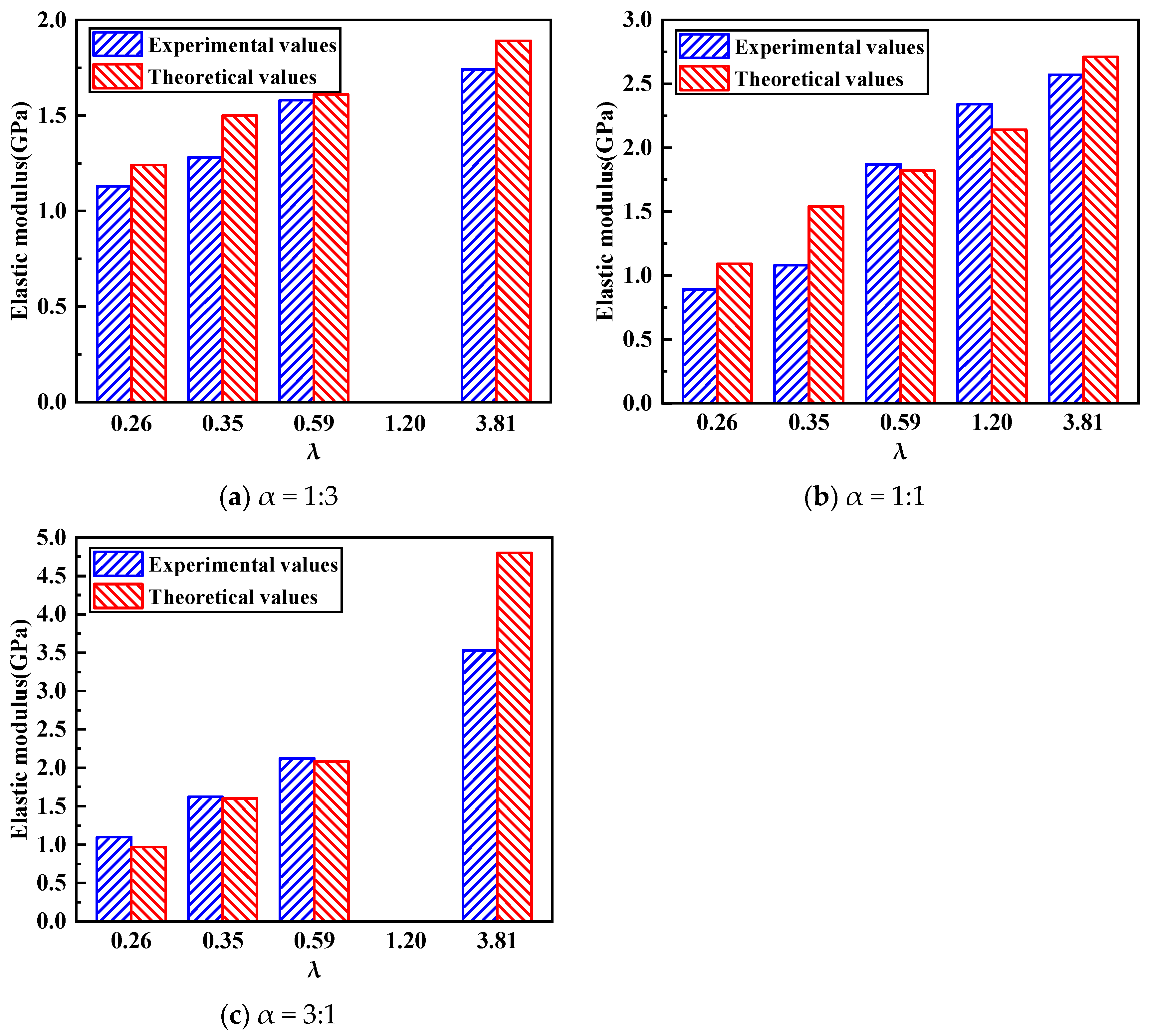
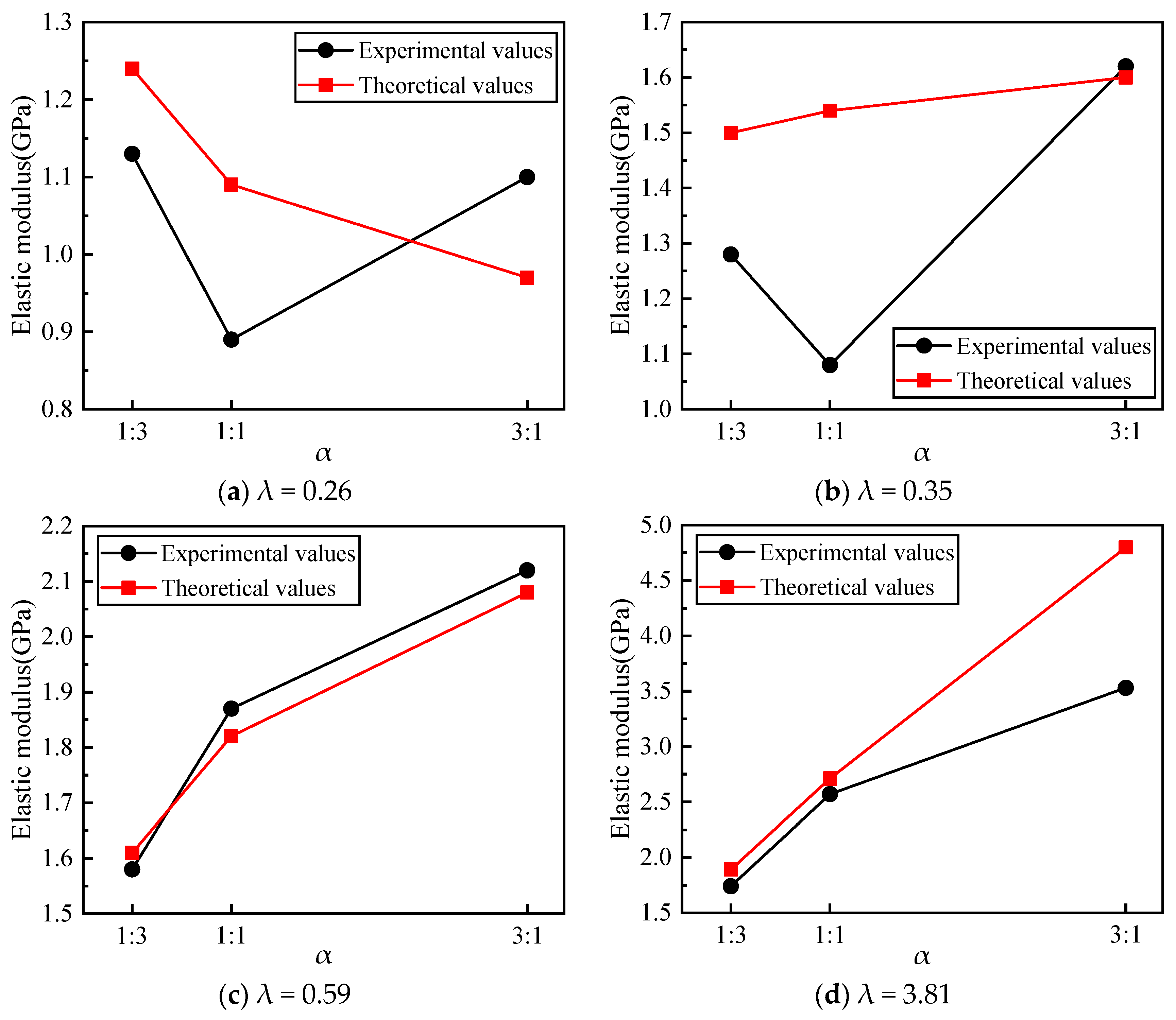
To verify the degree of agreement between the experimental elastic modulus values of coal–rock composite specimens and the theoretical calculated values, as well as the influence of λ and α on this agreement, the elastic moduli of the individual coal and rock specimens from Table 2 were substituted into Equation (7) to calculate the theoretical elastic moduli of the coal–rock composite specimens. The calculation results are presented in Table 5 (for ease of comparison, the elastic modulus test results from Table 4 are also included in this table). To clarify the influence of λ and α on the agreement between the experimental and theoretical elastic modulus values, comparison plots of the experimental and theoretical elastic moduli for coal–rock composite specimens under different λ and α conditions were prepared based on the results in Table 5, as shown in Figure 5 and Figure 6, respectively.
As shown in Table 5 and Figure 5a, when λ = 0.26, the experimental elastic moduli of coal–rock composite specimens with α = 1:3 and 1:1 were lower than the theoretical values, decreasing by 0.11 GPa and 0.20 GPa, respectively, with relative deviations of 8.87% and 18.35%. For the coal–rock composite specimens with α = 3:1, the experimental elastic modulus was greater than the theoretical value, exceeding it by 0.13 GPa, with a relative deviation of 13.40%. As shown in Table 5 and Figure 5b, when λ = 0.35, the experimental elastic moduli of coal–rock composite specimens with α = 1:3 and 1:1 were lower than the theoretical values, decreasing by 0.22 GPa and 0.46 GPa, respectively, with relative deviations of 14.67% and 29.87%. For coal–rock composite specimens with α = 3:1, the experimental elastic modulus was higher than the theoretical value, increasing by 0.02 GPa, with a relative deviation of 1.25%. As shown in Table 5 and Figure 5c, when λ = 0.59, the experimental elastic modulus of coal–rock composite specimens with α = 1:3 was lower than the theoretical value, decreasing by 0.03 GPa, with a relative deviation of 1.86%. For coal–rock composite specimens with α = 1:1 and 3:1, the experimental elastic moduli were greater than the theoretical values, increasing by 0.05 GPa and 0.04 GPa, respectively, with relative deviations of 2.75% and 1.92%. As shown in Table 5 and Figure 5d, when λ = 3.81, the experimental elastic moduli of coal–rock composite specimens with α = 1:3, 1:1, and 3:1 were all lower than the theoretical values, decreasing by 0.15 GPa, 0.14 GPa, and 1.27 GPa, respectively, with relative deviations of 7.94%, 5.17%, and 26.46%.
As shown in Table 5 and Figure 6a, when α = 1:3, the experimental elastic moduli of the coal–rock composite specimens with λ = 0.26, 0.35, 0.59, and 3.81 were all lower than the theoretical values, decreasing by 0.11 GPa, 0.22 GPa, 0.03 GPa, and 0.15 GPa, respectively, with relative deviations of 8.87%, 14.67%, 1.86%, and 7.94%. As shown in Table 5 and Figure 6b, when α = 1:1, the experimental elastic moduli of coal–rock composite specimens with λ = 0.26, 0.35, and 3.81 were lower than the theoretical values, decreasing by 0.20 GPa, 0.46 GPa, and 0.14 GPa, respectively, with relative deviations of 18.35%, 29.87%, and 5.17%. For coal–rock composite specimens with λ = 0.59 and 1.20, the experimental elastic moduli were higher than the theoretical values, exceeding the theoretical values by 0.05 GPa and 0.20 GPa, respectively, with relative deviations of 2.75% and 9.35%. As shown in Table 5 and Figure 6c, when α = 3:1, the experimental elastic moduli of the coal–rock composite specimens with λ = 0.26, 0.35, and 0.59 were greater than the theoretical values, exceeding the theoretical values by 0.13 GPa, 0.02 GPa, and 0.04 GPa, respectively, with relative deviations of 13.40%, 1.25%, and 1.92%. For the coal–rock composite specimen with λ = 3.81, the experimental elastic modulus was lower than the theoretical value, decreasing by 1.27 GPa, with a relative deviation of 26.46%.
The above analysis indicates that, for any given λ or α, the experimental elastic moduli of coal–rock composite specimens exhibit a certain deviation from the theoretically calculated values. Overall, the two values are relatively close, though the pattern governing their relative magnitude is unclear. Under most operating conditions, the deviation is small, with a relative deviation of less than 15%; under a few operating conditions, the deviation is relatively large, but the relative deviation remains within 30%. Therefore, for any given λ or α, the experimental elastic moduli of coal–rock composite specimens are in relatively good agreement with the theoretical values, with small relative deviations. This further validates the good applicability of Equation (7) for calculating the elastic modulus of coal–rock composite specimens. It can also be observed that the influence of λ and α on the degree of agreement does not exhibit a specific pattern. The deviation between experimental and theoretical values is primarily due to the fact that the theoretical elastic modulus values were calculated using the elastic modulus of standard coal and rock specimens, rather than the elastic modulus of coal and rock samples of the corresponding size under actual α conditions, resulting in a certain degree of deviation.

4.1.3. Comparative Analysis of the Modulus of Elasticity for Coal–Rock Composite Specimens and Individual Coal and Rock Specimens

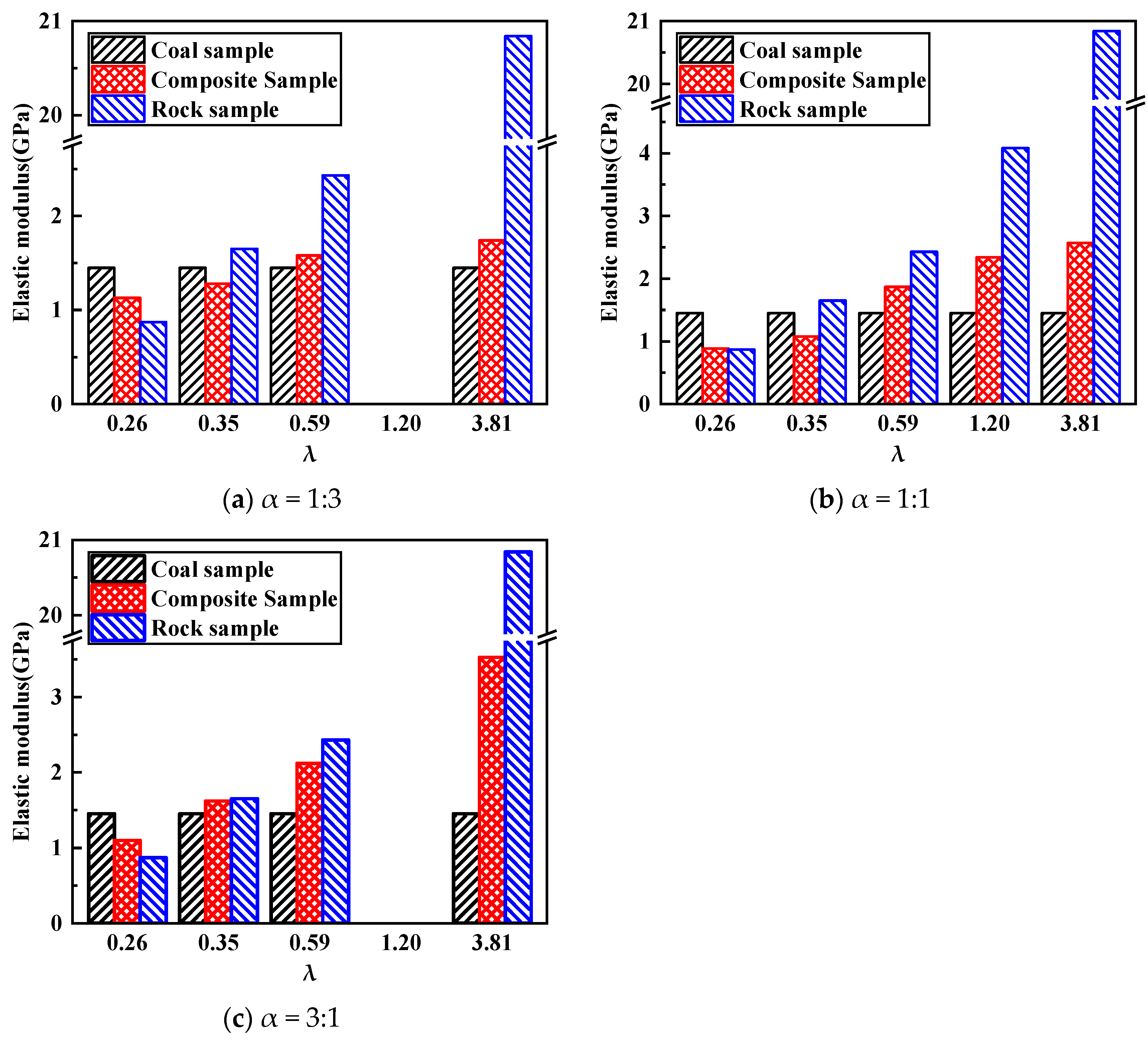
To verify whether the relationship between the elastic moduli of the coal–rock composite specimens and those of the coal and rock specimens at different α values is consistent with the theoretical relationship, the elastic moduli of the coal–rock composite specimens were compared with those of the coal and rock specimens. The comparison is shown in Figure 7.
As shown in Table 2 and Table 4 and Figure 7a, when α = 1:3, the elastic moduli of the coal–rock composite specimens with λ = 0.26, 0.59, and 3.81 all fall between those of the coal and rock specimens, consistent with the theoretical relationship. However, the elastic modulus of the coal–rock composite specimen with λ = 0.35 is lower than those of the coal and rock specimens, differing from the theoretical relationship. As shown in Table 2 and Table 4 and Figure 7b, when α = 1:1, the elastic moduli of the coal–rock composite specimens with λ = 0.26, 0.59, 1.20, and 3.81 all fall between the elastic moduli of the coal and rock specimens, and all are consistent with the theoretical relationship. For the coal–rock composite specimen with λ = 0.35, the elastic modulus is lower than that of the coal and rock specimens, differing from the theoretical relationship. As shown in Table 2 and Table 4 and Figure 7c, when α = 3:1, the elastic moduli of the coal-rock composite specimens with λ = 0.26, 0.35, 0.59, and 3.81 all fall between those of the coal and rock specimens, and all are consistent with the theoretical relationship.
The above analysis indicates that, except for the coal–rock composite specimens with α = 1:3 and 1:1 where, at λ = 0.35, the relationship between the elastic moduli of the composite specimens and those of the coal and rock specimens differs from the theoretical relationship, the results are consistent with the theoretical relationship under all other conditions. This demonstrates that the experimental relationship between the elastic moduli of the coal–rock composite specimens and those of the coal and rock specimens exhibits a high degree of agreement with the theoretical relationship. This further validates the reliability of the relationship where, for any value of α, the elastic modulus of the coal–rock composite specimen lies between those of the coal and rock specimens. Under certain operating conditions, the experimental relationship differs from the theoretical relationship. This is primarily because, when comparing the elastic moduli of coal–rock composite specimens with those of coal and rock specimens, the elastic moduli of the coal and rock specimens are those of standard coal–rock specimens, rather than the elastic moduli of coal–rock specimens of corresponding dimensions at the actual α value. Consequently, a discrepancy arises between the experimental and theoretical relationships.

4.1.4. Analysis of the Relative Magnitude Relationship Between the Elastic Modulus of Coal–Rock Composite Samples and Individual Coal and Rock Samples

Based on the above analysis, the theoretical relative relationship between the elastic moduli of the coal–rock composite specimens and those of the coal and rock specimens was first determined; the results are shown in Table 6. As shown in Table 6, when α = 1:3, for coal–rock composite specimens with λ = 0.26, 0.35, 0.59, and 3.81, the relationship is α < β, meaning that the elastic moduli of these four groups are relatively closer to those of the coal specimens. As shown in Table 6, when α = 1:1, for the specimen with λ = 0.26, the relationship is α > β, meaning that its elastic modulus is relatively closer to that of the rock specimen. For specimens with λ = 0.35, 0.59, 1.20, and 3.81, the relationship is α < β, meaning that their elastic moduli are relatively closer to those of the coal specimens. As shown in Table 6, when α = 3:1, for specimens with λ = 0.26, 0.35, and 0.59, the relationship is α > β, meaning that their elastic moduli are relatively closer to those of the rock specimens. For the specimen with λ = 3.81, the relationship is α < β, meaning that its elastic modulus is relatively closer to that of the coal specimen.
Based on the test results, the relative relationship between the elastic moduli of coal–rock composite specimens and those of coal and rock specimens are analyzed below. The values of E E c and E E r were calculated for coal–rock composite specimens under various operating conditions, and the results are shown in Table 7. As shown in Table 7, when α = 1:3, for a coal–rock composite specimen with λ = 0.26, the relationship between E E c and E E r is E E c > E E r , indicating that the elastic modulus of this composite specimen is relatively closer to that of the rock specimen. For coal–rock composite specimens with λ = 0.35, 0.59, and 3.81, the relationship is E E c < E E r , meaning that the elastic moduli of these three groups of coal–rock composite specimens are all relatively closer to those of the coal specimens. As shown in Table 7, when α = 1:1, for a coal–rock composite specimen with λ = 0.26, the relationship is E E c > E E r , meaning that the elastic modulus of this composite specimen is relatively closer to that of the rock specimen. For coal–rock composite specimens with λ = 0.35, 0.59, 1.20, and 3.81, the relationship is E E c < E E r , meaning that the elastic moduli of these four groups are all relatively closer to those of the coal specimens. As shown in Table 7, when α = 3:1, for coal–rock composite specimens with λ = 0.26, 0.35, and 0.59, the relationship is E E c > E E r , meaning that the elastic moduli of these three groups are all relatively closer to that of the rock specimen. For the coal–rock composite specimen with λ = 3.81, the relationship is E E c < E E r , meaning that the elastic modulus of this composite specimen is relatively closer to that of the coal specimen.
The above analysis indicates that, with the exception of the coal–rock composite specimen with α = 1:3, where the relative relationship between the elastic moduli of the composite specimen and those of the coal and rock specimens differed from the theoretical relative relationship at λ = 0.26, the results were consistent with the theoretical relative relationship under all other conditions. This demonstrates that the experimental relative relationship between the elastic moduli of the coal–rock composite specimens and those of the coal and rock specimens exhibits a high degree of agreement with the theoretical relative relationship. This further validates the reliability of determining the relative magnitudes of the elastic moduli based on the relationship between α and β. Under certain conditions, the experimental relative magnitude relationship differs from the theoretical one. This is primarily because, during the calculation of β in the theoretical analysis and the calculation of E E c and E E r in the experimental analysis, the elastic moduli of the coal and rock specimens were taken as those of standard coal and rock specimens rather than the elastic moduli of coal–rock specimens of corresponding dimensions at the actual α value. Consequently, discrepancies arose between the experimental and theoretical relative magnitude relationships.

4.2. Effect of α on the Mechanical Properties of Coal–Rock Composite Specimens

4.2.1. Effect of α on the Stress–Strain Curves

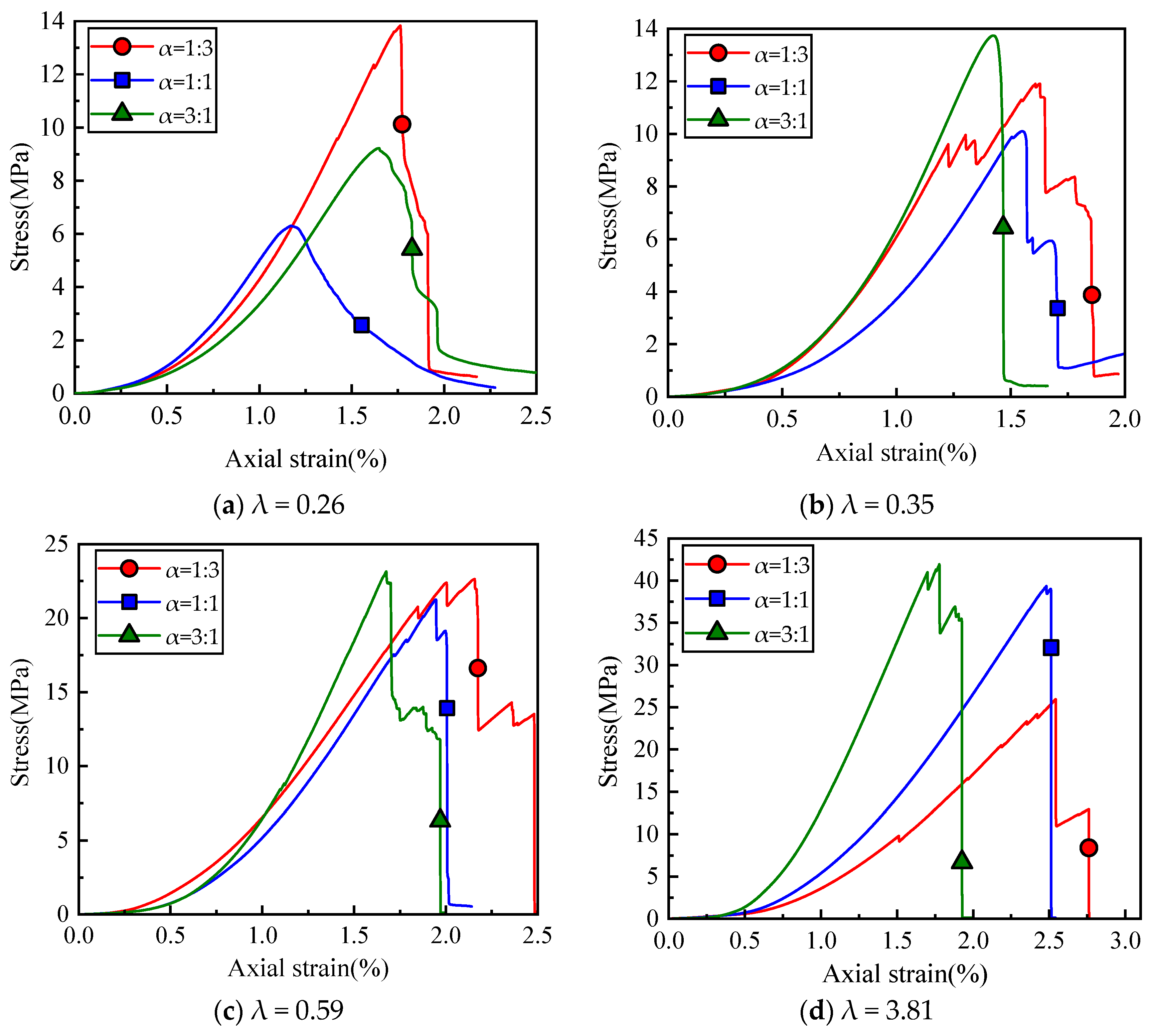
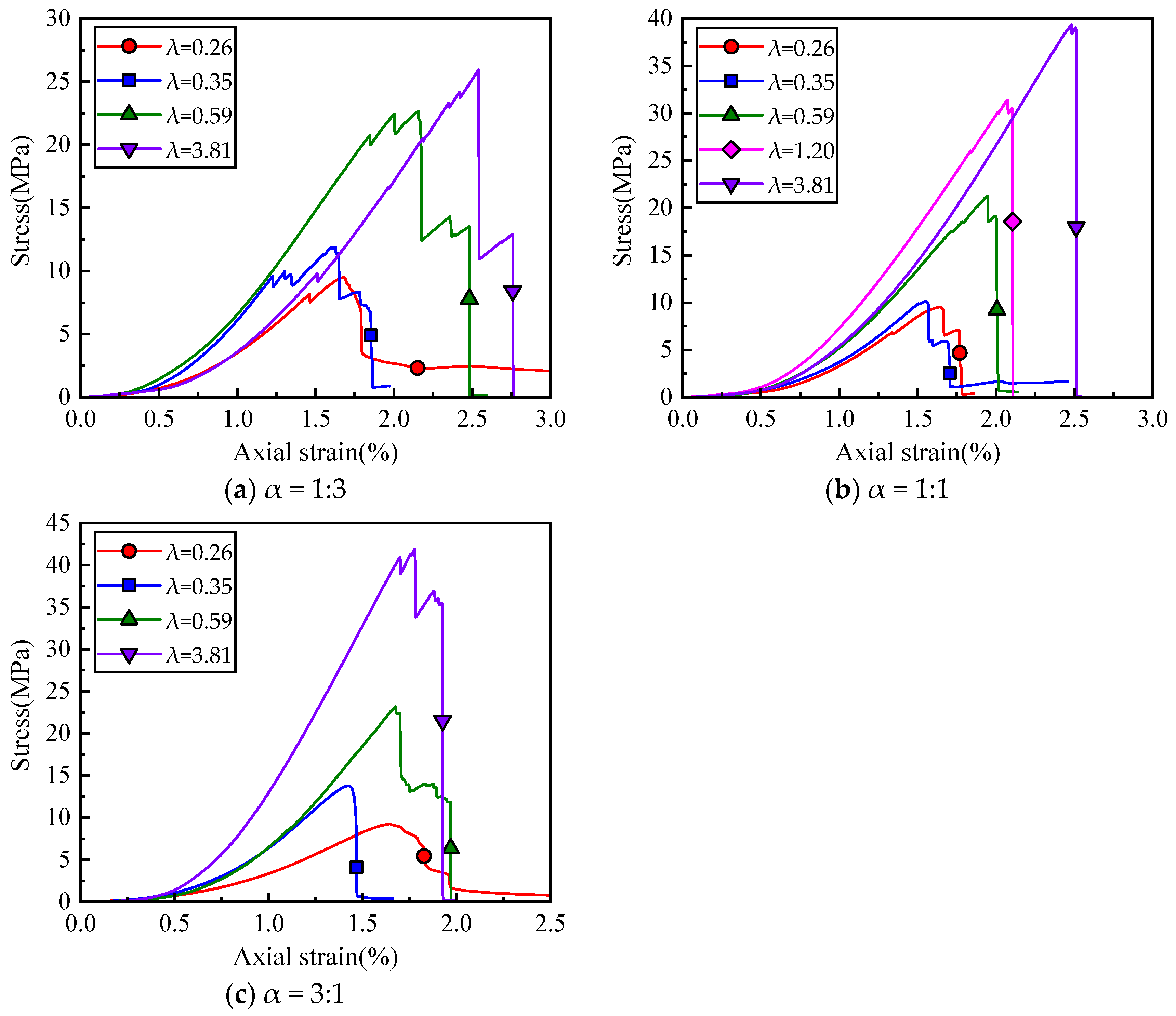
The stress–strain curves of coal–rock composite specimens under different λ values are shown in Figure 8. As shown in Figure 8, during the loading process, the stress–strain curves of the coal–rock composite specimens all undergo a compaction stage, an elastic stage, a yield stage, and a post-peak failure stage. The parameter α has a certain influence on the stress–strain curves of the coal–rock composite specimens, and this influence varies depending on the value of λ. For coal–rock composite specimens with λ = 3.81, given that the rock specimen is denser than the coal specimen, the compaction stage of the stress–strain curve shortens, the slope of the linear elastic stage increases, and the yield stage becomes less pronounced as α increases. For coal–rock composite specimens with λ = 0.59, the stress–strain curves show no significant differences between α = 1:3 and α = 1:1. However, when α increases to 3:1, the compaction stage becomes significantly shorter, the slope of the linear elastic stage increases markedly, and the yield stage becomes less distinct. For coal–rock composite specimens with λ = 0.26 and 0.35, the influence of α on the stress–strain curve is not clearly defined. However, compared with specimens with λ = 0.59 and 3.81, the post-peak brittleness is significantly reduced.

4.2.2. Effect of α on Uniaxial Compressive Strength

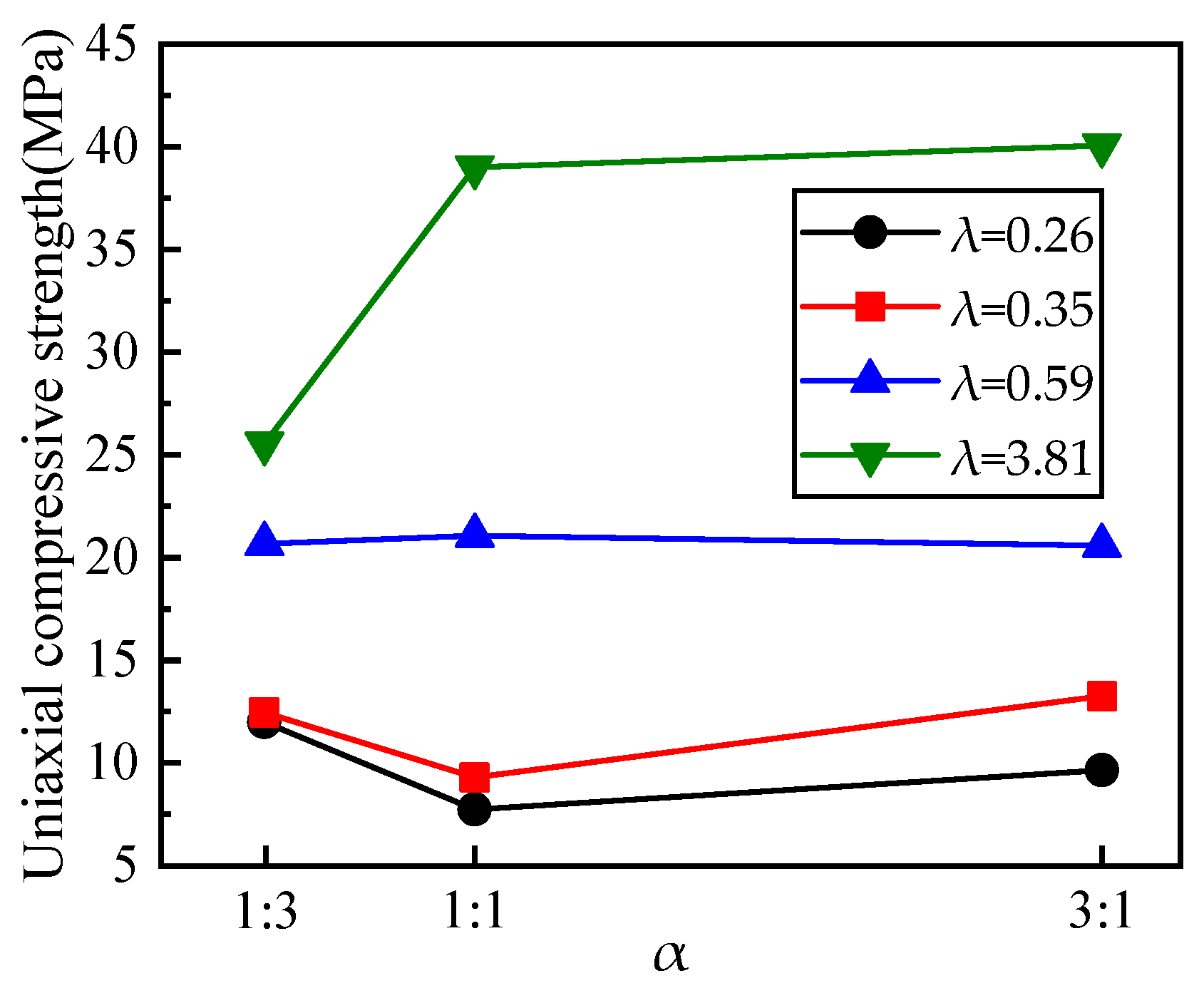
Figure 9 shows the relationship between the uniaxial compressive strength of coal–rock composite specimens and α for different values of λ. As shown in Figure 9, the variation patterns of uniaxial compressive strength of coal–rock composite specimens under different λ values with α changes are not exactly the same.
The uniaxial compressive strength of coal–rock composite specimens with λ values of 0.26 and 0.35 exhibits the same trend with respect to α; in both cases, the strength first decreases and then increases as α increases. When α increased from 1:3 to 1:1, the uniaxial compressive strengths of the two groups of composite specimens decreased from 12.00 MPa to 7.74 MPa and from 12.46 MPa to 9.29 MPa, respectively, representing decreases of 35.50% and 25.44%; when α increased from 1:1 to 3:1, the uniaxial compressive strengths of the two groups of composite specimens increased from 7.74 MPa to 9.65 MPa and from 9.29 MPa to 13.25 MPa, respectively, representing increases of 24.68% and 42.63%. It can be seen that although the patterns of change in the uniaxial compressive strength of the two groups of composite specimens with respect to α are the same, there are significant differences in the magnitude of these changes. The uniaxial compressive strength of both groups of composite specimens was lowest when α was 1:1, but the corresponding α values at which the strength was highest differed, being 1:3 and 3:1, respectively.
For coal–rock composite specimens with λ = 0.59, the uniaxial compressive strength first increased and then decreased as α increased. When α increased from 1:3 to 1:1, the uniaxial compressive strength increased from 20.68 MPa to 21.07 MPa, representing a 1.89% increase; when α increased from 1:1 to 3:1, the uniaxial compressive strength decreased from 21.07 MPa to 20.59 MPa, representing a 2.28% decrease. Overall, the uniaxial compressive strength of this group of composite specimens showed only minor changes with variations in α, indicating that the specimens in this group are less sensitive to changes in α. The uniaxial compressive strength of this group of composite specimens was lowest when α was 3:1 and maximal when α was 1:1.
For coal–rock composite specimens with λ = 3.81, the uniaxial compressive strength exhibited a trend of increasing rapidly at first and then more slowly as α increased. When α increased from 1:3 to 1:1, the uniaxial compressive strength increased from 25.55 MPa to 39.00 MPa, representing a 52.64% increase; when α increased from 1:1 to 3:1, the uniaxial compressive strength increased from 39.00 MPa to 40.06 MPa, representing an increase of only 2.72%. It can be seen that once α exceeds 1:1, the increase in uniaxial compressive strength for this group of composite specimens becomes smaller as α increases. This indicates that once α exceeds 1:1, the uniaxial compressive strength of this group of composite specimens becomes less sensitive to changes in α.

4.2.3. Theoretical Relationship Between the Modulus of Elasticity and α

The following theoretical analysis examines how the modulus of elasticity of a coal–rock composite specimen varies with α. It is assumed that the elastic moduli of the coal specimen and rock specimen within the composite do not change with α; that is, Ec and Er remain constant. The varied α is denoted as α′, and the corresponding modulus of elasticity is denoted as E′. Then, according to Equation (7), E′ can be expressed as:
E = 1 + α E c E r α E c + E r
Comparing E′ with E and simplifying yields the following expression:
E E = α E c + α E r + E r + α α E c α E r + α E c + E r + α α E c
Substituting β = Er/Ec into Equation (25) and simplifying yields the following expression.
E E = α β 1 + α + α + α α + β α β 1 + α + α + α α + β
According to Equation (26), when β > 1, the following expression is obtained:
E > E α > α E < E α < α
According to Equation (26), when β < 1, the following expression is obtained:
E < E α > α E > E α < α
The above analysis indicates that the variation in the elastic modulus of coal–rock composite specimens with respect to α is primarily determined by β. When β > 1, the elastic modulus of the coal–rock composite specimens is positively correlated with α; when β < 1, the elastic modulus is negatively correlated with α. In other words, as the proportion of the component with a higher elastic modulus increases within the coal–rock composite specimen, the elastic modulus of the composite specimen increases; conversely, it decreases.

4.2.4. Relationship Between Theoretical Elastic Modulus and α

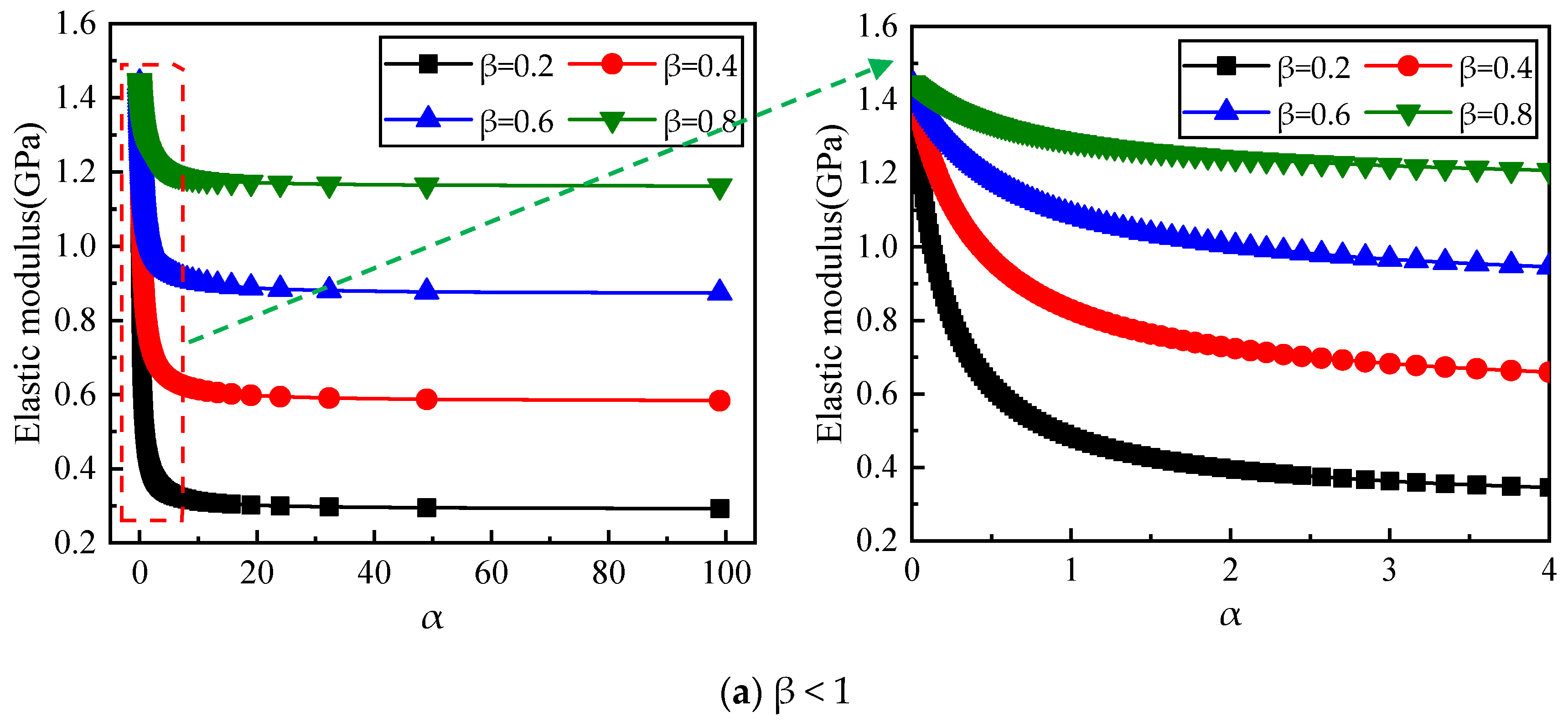
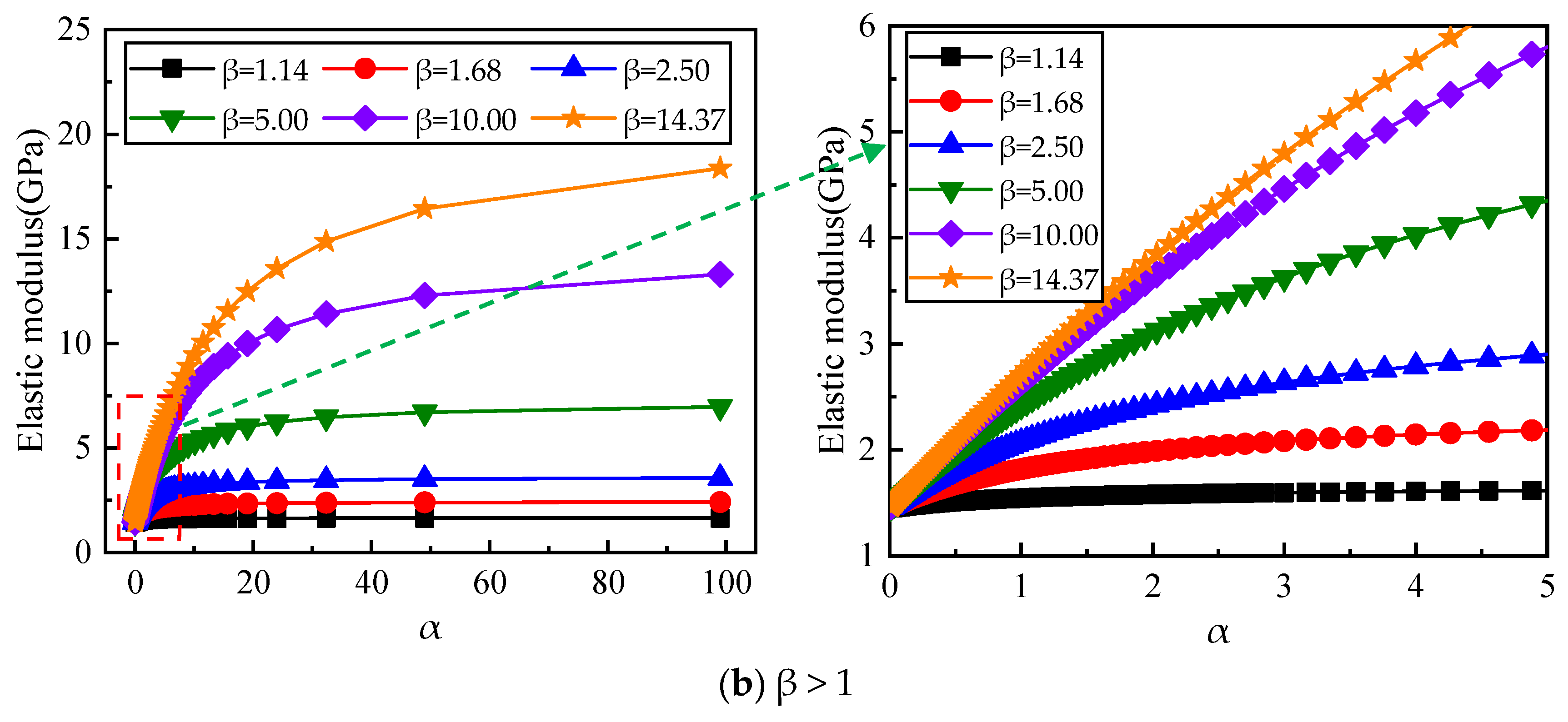
Based on the established theoretical relationship between elastic modulus and α, this study analyzes the relationship between theoretical elastic modulus and α for different β values. The objective is to clarify the magnitude of variation in theoretical elastic modulus with α under different β conditions, as well as the differences in these magnitudes across various β values. The α ratio was selected to range from 1:99 to 99:1. In the coal–rock composite specimens, the height of the coal specimen was decreased in 1 mm increments, and the height of the rock specimen was correspondingly increased in 1 mm increments. The coal specimen used in this study had a fixed elastic modulus of 1.45 GPa. The β values were selected as 0.20, 0.40, 0.60 (λ = 0.26), 0.80, 1.14 (λ = 0.35), 1.68 (λ = 0.59), 2.50, 5.00, 10.00, and 14.37 (λ = 3.81). The specific parameters for each condition were substituted into Equation (7) to calculate the theoretical elastic modulus. Based on the calculation results, a plot of the relationship between theoretical elastic modulus and α for coal–rock composite specimens under different β values was constructed, as shown in Figure 10.
As shown in Figure 10, when β < 1 or β > 1, the variation in the theoretical elastic modulus of coal–rock composite specimens with α is not affected by β; the variation patterns are the same for different β values. As shown in Figure 10a, when β < 1, the theoretical elastic modulus of coal–rock composite specimens under different β values all decrease gradually with increasing α, and the rate of decrease gradually slows down, eventually approaching Er. As shown in Figure 10b, when β > 1, the theoretical elastic modulus under different β values all increase gradually with increasing α, and the rate of increase gradually slows down, eventually approaching Er. The overall trend indicates that, for any given β, the influence of α on the theoretical elastic modulus of coal–rock composite specimens gradually weakens as α increases. When α is small, its effect on the theoretical elastic modulus is significant. When α is large, its effect tends to become less pronounced. As shown in Figure 10a, for β < 1, the smaller the β, the greater the rate of decrease in the theoretical elastic modulus with increasing α, and conversely, the larger the β, the smaller the rate of decrease. The results indicate that when β < 1, for the same magnitude of α variation, the smaller the β, the greater the influence of the α variation on the theoretical elastic modulus of the coal–rock composite specimen; conversely, the larger the β, the smaller this influence. When β > 1, the larger the β, the greater the rate at which the theoretical elastic modulus of the coal–rock composite specimen increases with increasing α; conversely, the smaller the β, the smaller this rate. This indicates that when β > 1, for the same magnitude of α variation, the larger the β, the greater the influence of the α variation on the theoretical elastic modulus of the coal–rock composite specimen, and conversely, the smaller the β, the smaller this influence. Figure 10 also shows that when β < 1, as β increases, the trend of the rate of decrease in the theoretical elastic modulus of the coal–rock composite specimen gradually weakening becomes less pronounced. When β > 1, as β increases, the trend of the theoretical elastic modulus of the coal–rock composite specimen increasing at a slowing rate gradually weakens. This indicates that as α increases, the smaller the β, the sooner the theoretical elastic modulus of the coal–rock composite specimen tends to level off; conversely, the larger the β, the later it tends to level off.

4.2.5. Effect of α on the Modulus of Elasticity

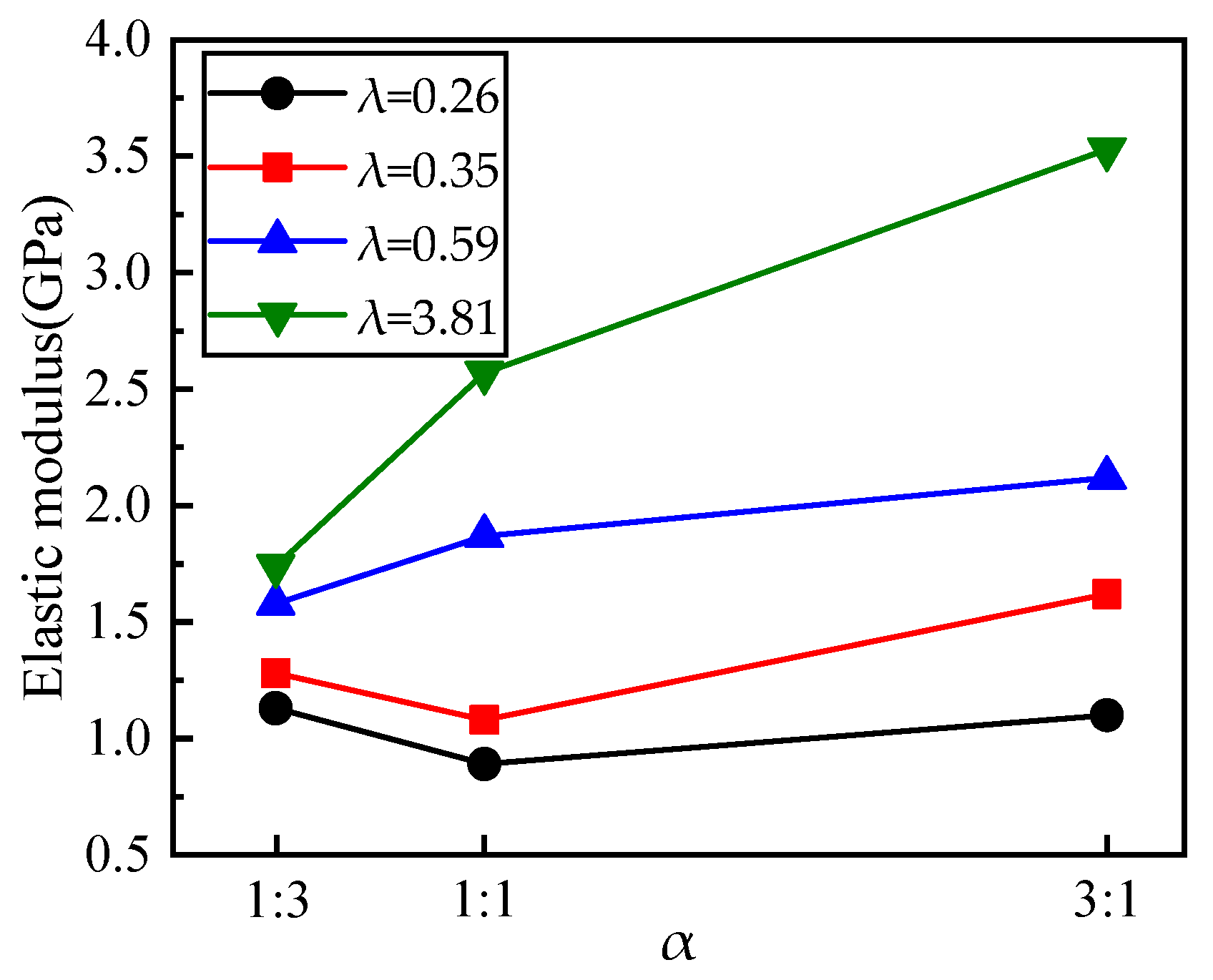
Figure 11 shows the relationship between the elastic modulus of coal–rock composite specimens and α for different values of λ. As shown in Figure 11, consistent with the uniaxial compressive strength, the variation patterns of the elastic modulus of coal–rock composite specimens under different λ values with α changes are not exactly the same.
The elastic modulus of coal–rock composite specimens with λ = 0.26 and λ = 0.35 exhibits the same trend with respect to α: in both cases, the modulus first decreases and then increases as α increases, consistent with the trend observed for uniaxial compressive strength. When α increased from 1:3 to 1:1, the elastic moduli of the two groups of composite specimens decreased from 1.13 GPa to 0.89 GPa and from 1.28 GPa to 1.08 GPa, respectively, representing decreases of 21.24% and 15.63%. When α increased from 1:1 to 3:1, the elastic moduli increased from 0.89 GPa to 1.10 GPa and from 1.08 GPa to 1.62 GPa, respectively, representing increases of 23.60% and 50.00%. It can be seen that although the patterns of change in the elastic moduli of the two groups with respect to α are the same, there are significant differences in the magnitudes of these changes. The elastic modulus of both groups was minimal when α = 1:1, but the α values at which the elastic modulus was maximal differed, being 1:3 and 3:1, respectively.
The elastic modulus of coal–rock composite specimens with λ = 0.59 and λ = 3.81 exhibits the same trend with respect to α, both showing a gradual increase as α increases. Among these, the specimens with λ = 3.81 exhibit the same trend as observed for uniaxial compressive strength. When α increased from 1:3 to 1:1, the elastic moduli increased from 1.58 GPa to 1.87 GPa and from 1.74 GPa to 2.57 GPa, respectively, representing increases of 18.35% and 47.70%. When α increased from 1:1 to 3:1, the elastic moduli increased from 1.87 GPa to 2.12 GPa and from 2.57 GPa to 3.53 GPa, respectively, with increases of 13.37% and 37.35%. It can be seen that although the variation patterns of the elastic moduli of the two groups with respect to α are the same, there are significant differences in the magnitudes of the changes.

4.2.6. Comparison of the Relationship Between Theoretical and Experimental Elastic Moduli and α

To verify the agreement between the theoretical and experimental values of the elastic modulus and the value of α, we performed a comparative analysis of the relationship between the theoretical and experimental values of the modulus of elasticity and α, based on the test results for the elastic modulus of the coal–rock composite specimens in Table 4 and the calculated theoretical values of the elastic modulus in Table 5. Figure 12 shows a comparison of the theoretical and experimental values of the modulus of elasticity in relation to α. As shown in Figure 12, the relationship between the theoretical and experimental values of the elastic modulus and α differs for coal–rock composite specimens with λ values of 0.26 and 0.35. As shown in Figure 12, the relationship between the theoretical and experimental values of the elastic modulus and α is consistent for coal–rock composite specimens with λ values of 0.59 and 3.81. The discrepancy between the theoretical and experimental values of the elastic modulus and their relationship with α is primarily due to the fact that, when calculating the theoretical values of the elastic modulus, the elastic moduli of standard coal and rock specimens are used, rather than those of coal and rock specimens of corresponding sizes at the actual α value. This results in a different relationship between the theoretical and experimental values of the elastic modulus and α.

4.2.7. Effect of α on Peak Strain

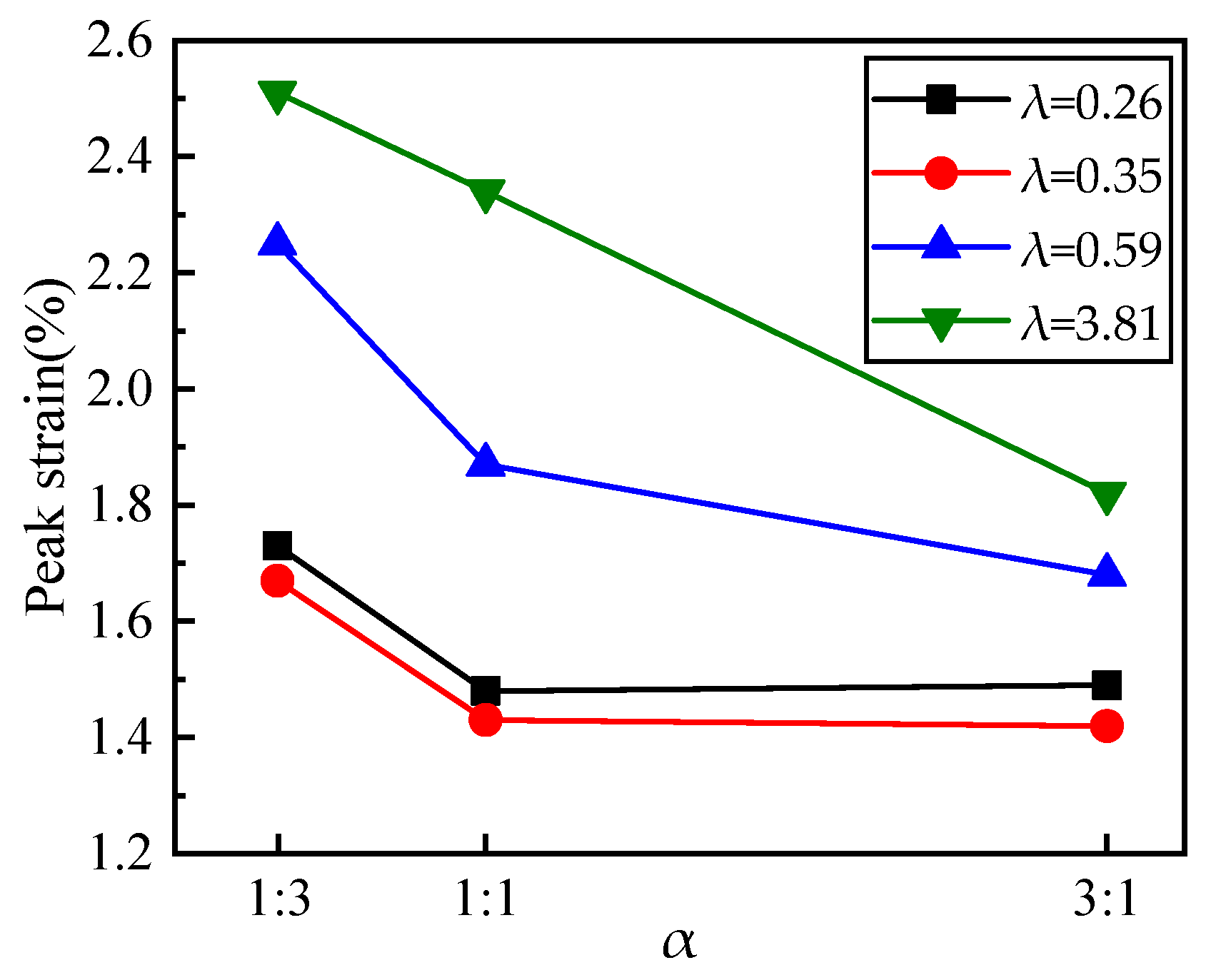
The relationship between peak strain and α for coal–rock composite specimens at different λ values is shown in Figure 13. As can be seen from Figure 13, consistent with the trends observed for uniaxial compressive strength and elastic modulus, the variation patterns of the peak strain of coal–rock composite specimens under different λ values with α changes are not exactly the same.
The peak strain of coal–rock composite specimens with λ = 0.26 and 0.35 exhibits the same trend with respect to α; in both cases, the peak strain first decreases and then tends to remain constant as α increases. When α increased from 1:3 to 1:1, the peak strain of the two groups of composite specimens decreased from 1.73% to 1.48% and from 1.67% to 1.43%, respectively, representing decreases of 14.45% and 14.37%. The rates of decrease were nearly identical. When α increased from 1:1 to 3:1, the peak strains of the two groups changed from 1.48% to 1.49% and from 1.43% to 1.42%, respectively, remaining nearly constant. This indicates that once α exceeds 1:1, the peak strains of these two groups become insensitive to changes in α and are almost unaffected by variations in α. Thus, the peak strain of these two groups not only follows the same pattern of change with α, but the magnitude of change also tends to be nearly consistent.
The peak strain of coal–rock composite specimens with λ = 0.59 and 3.81 exhibits the same variation pattern with respect to α, both showing a gradual decrease as α increases. For the specimen with λ = 0.59, the rate of decrease gradually slows down, whereas for the specimen with λ = 3.81, the decrease is almost linear. When α increased from 1:3 to 1:1, the peak strain of the two groups decreased from 2.25% to 1.87% and from 2.51% to 2.34%, respectively, representing reductions of 16.89% and 6.77%. When α increased from 1:1 to 3:1, the peak strains decreased from 1.87% to 1.68% and from 2.34% to 1.82%, respectively, corresponding to decreases of 10.16% and 22.22%. It can be seen that although the patterns of change in peak strain with respect to α were the same for both groups, there were significant differences in the magnitude of these changes.

4.2.8. Weak Component Effect Analysis of the Influence of α on the Mechanical Properties of Coal–Rock Composite Specimens

As shown in Figure 9 and the analysis in Section 4.2.2, the variation in uniaxial compressive strength with respect to α for coal–rock composite specimens with λ = 3.81 differs from that of specimens with λ = 0.26, 0.35, and 0.59. In other words, the variation in uniaxial compressive strength with respect to α for coal–rock composite specimens where the coal is the weaker component differs from that of the three types of specimens where the rock is the weaker component. From Figure 11 and Figure 13 and together with the analysis in Section 4.2.5 and Section 4.2.7, it can be seen that the trend of the elastic modulus and peak strain of the coal–rock composite specimen with λ = 3.81 as a function of α is identical to that of the specimen with λ = 0.59, but differs from those of the specimens with λ = 0.26 and 0.35. That is, the variation pattern of the elastic modulus and peak strain with respect to α for coal–rock composite specimens where the coal specimen is the weaker component is identical to that of specimens where one rock specimen is the weaker component, but differs from that of specimens where the other two rock specimens are the weaker component. Furthermore, even when the variation patterns are identical, there are significant differences in the magnitudes of the changes. This indicates that previous studies on the variation in uniaxial compressive strength, elastic modulus, and peak strain with α for coal–rock composite specimens with coal as the weaker component, conducted under conventional geological conditions, clearly do not apply to coal–rock composite specimens where the weaker component changes with the variation in rock properties.
The above analysis indicates that, for any given λ, α has a significant effect on the uniaxial compressive strength, elastic modulus, and peak strain of coal–rock composite specimens. For coal–rock composite specimens where the weaker component changes with the variation in rock properties, the variation in uniaxial compressive strength, elastic modulus, and peak strain with α is significantly influenced by rock properties. These variation patterns are not entirely identical for different rock properties. Therefore, for coal–rock composite specimens with this characteristic, it is necessary to clarify the variation patterns of uniaxial compressive strength, elastic modulus, and peak strain with respect to α for specimens under various lithological conditions. Previous studies on the variation patterns of uniaxial compressive strength, elastic modulus, and peak strain with respect to α for coal–rock composite specimens with coal as the weaker component, conducted solely under conventional geological conditions, clearly do not satisfy the requirements for coal–rock composite specimens with this characteristic.

4.3. Effect of λ on the Mechanical Properties of Coal–Rock Composite Specimens

4.3.1. Effect of λ on Stress–Strain Curves

The stress–strain curves of coal–rock composite specimens at different α values are shown in Figure 14. As shown in Figure 14, during the loading process, the stress–strain curves of the coal–rock composite specimens all undergo a compaction stage, an elastic stage, a yield stage, and a post-peak failure stage. λ has a certain influence on the stress–strain curves of the coal–rock composite specimens, and this influence is generally similar across different α values. As λ increases, the overall trend shows that the compaction stage gradually shortens, the slope of the linear elastic stage gradually increases, the yield stage becomes less pronounced, the number of stress drops after peak strength decreases, and the characteristics of brittle failure become increasingly evident.

4.3.2. Effect of λ on Uniaxial Compressive Strength

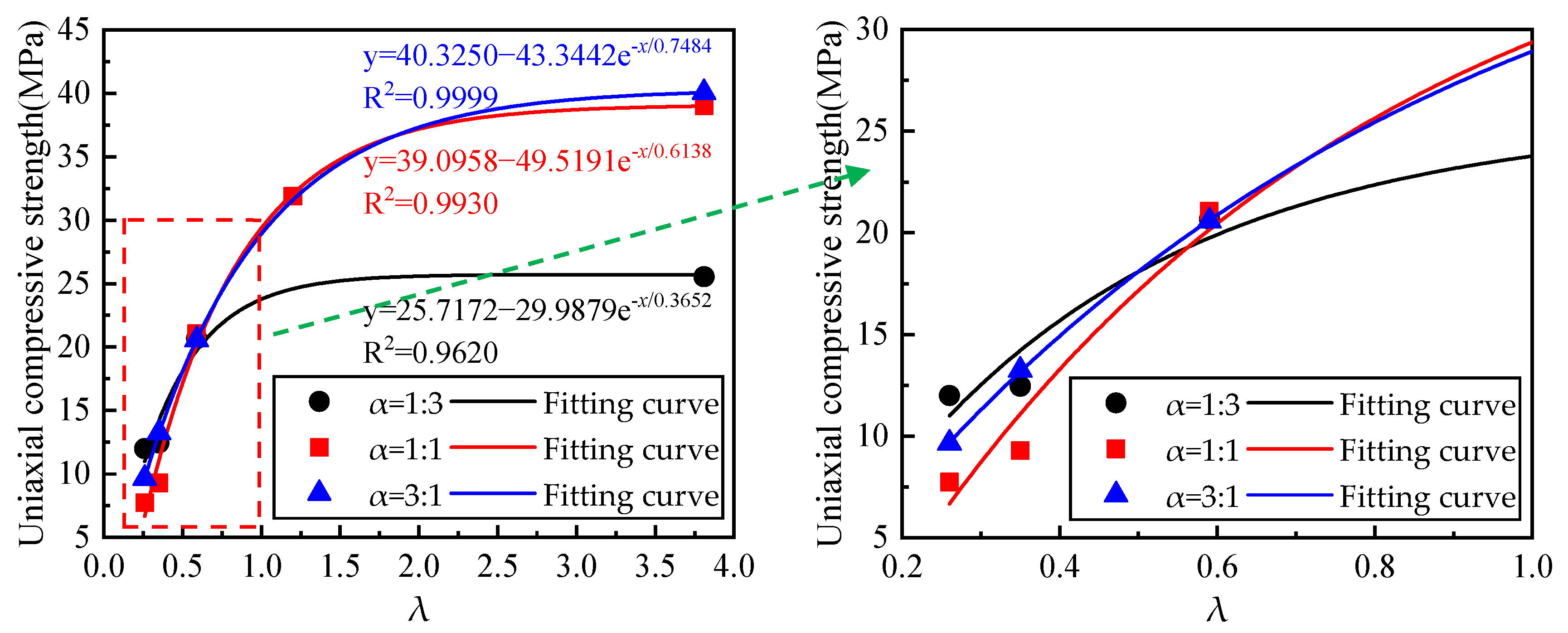
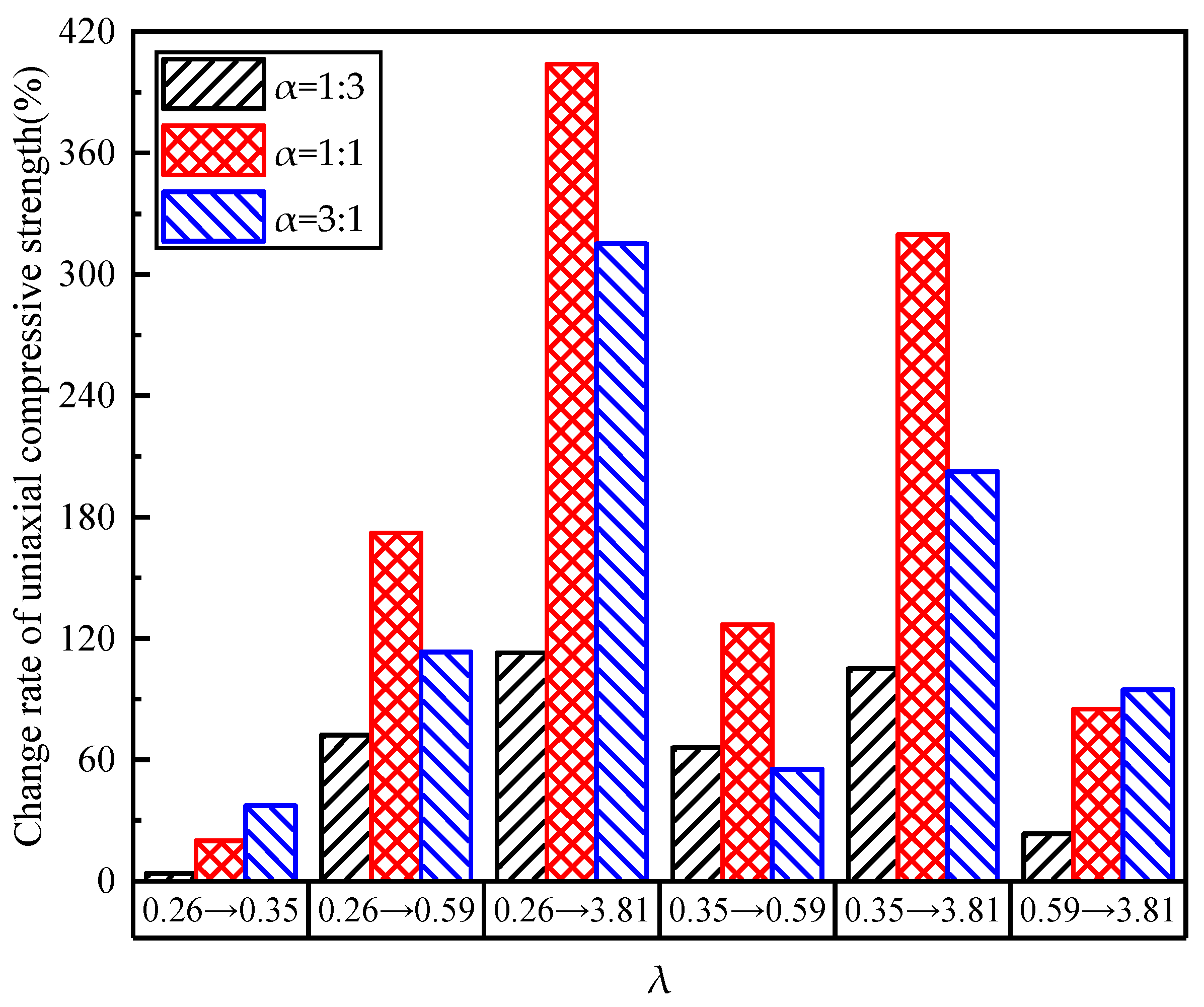
The relationship between the uniaxial compressive strength of coal–rock composite specimens and λ at different α values is shown in Figure 15. As shown in Figure 15, the relationship between the uniaxial compressive strength of coal–rock composite specimens and λ is not affected by α; under different α conditions, the relationship between the uniaxial compressive strength of coal–rock composite specimens and λ remains consistent and it exhibited a trend of increasing rapidly at first and then more slowly as λ increased. When α = 1:3, the uniaxial compressive strength of the coal–rock composite specimen with λ = 0.26 is 12.00 MPa. As λ increases to 0.35, 0.59, and 3.81, the strength increases to 12.46 MPa, 20.68 MPa, and 25.55 MPa, respectively, representing increases of 3.83%, 72.33%, and 112.92%. When α = 1:1, as λ increases from 0.26 to 0.35, 0.59, 1.20, and 3.81, the corresponding increases in uniaxial compressive strength are 20.03%, 172.22%, 312.27%, and 403.88%. When α = 3:1, as λ increases from 0.26 to 0.35, 0.59, and 3.81, the corresponding increases in uniaxial compressive strength are 37.31%, 113.37%, and 315.13%, respectively. The above analysis indicates that, for any given α, λ has a significant effect on the uniaxial compressive strength of coal–rock composite specimens.
To quantitatively investigate the intrinsic relationship between the uniaxial compressive strength of coal–rock composite specimens and λ, the relationship between the two parameters was fitted using exponential, logarithmic, and power functions for each α value. The fitting results are presented in Table 8. As shown in Table 8, the coefficient of determination (R2) for the exponential function is higher than that for the logarithmic and power functions at all α values. Therefore, the intrinsic relationship between the uniaxial compressive strength and λ of coal–rock composite specimens at all α values can be quantitatively characterized using the exponential function. Table 8 also shows that the coefficient of determination (R2) for the exponential function fit is consistently high and increases with increasing α, indicating that the correlation between the uniaxial compressive strength and λ of the coal–rock composite specimens is strong for all α values, and that the fit improves as α increases. The fitting curves and the corresponding equations are shown in Figure 15.
This can be seen from the trend in the uniaxial compressive strength of coal–rock composite specimens with an α ratio of 1:1 as λ varies. As λ increases, the rate of increase in uniaxial compressive strength for coal–rock composite specimens where the weaker component changes with the variation in rock properties is significantly higher than that for specimens where the weaker component does not change with the variation in rock properties, maintaining its coal sample unchanged. This indicates that, for the same magnitude of λ variation, increasing the strength of the weaker component in the composite specimen results in a relatively significant increase in the specimen’s uniaxial compressive strength, whereas increasing the strength of the stronger component results in a relatively small increase in the specimen’s uniaxial compressive strength. The uniaxial compressive strength of coal–rock composite specimens where the weaker component changes with the variation in rock properties is significantly more affected by changes in rock properties than that of specimens where the weaker component does not change with the variation in rock properties, maintaining its coal sample unchanged. Studies conducted by scholars on the variation in uniaxial compressive strength with respect to λ in coal–rock composite specimens—where the weaker component does not change with the variation in rock properties, maintaining its coal sample unchanged—are clearly insufficient to fully elucidate the patterns of variation under these geological conditions.

4.3.3. Effect of λ on the Modulus of Elasticity

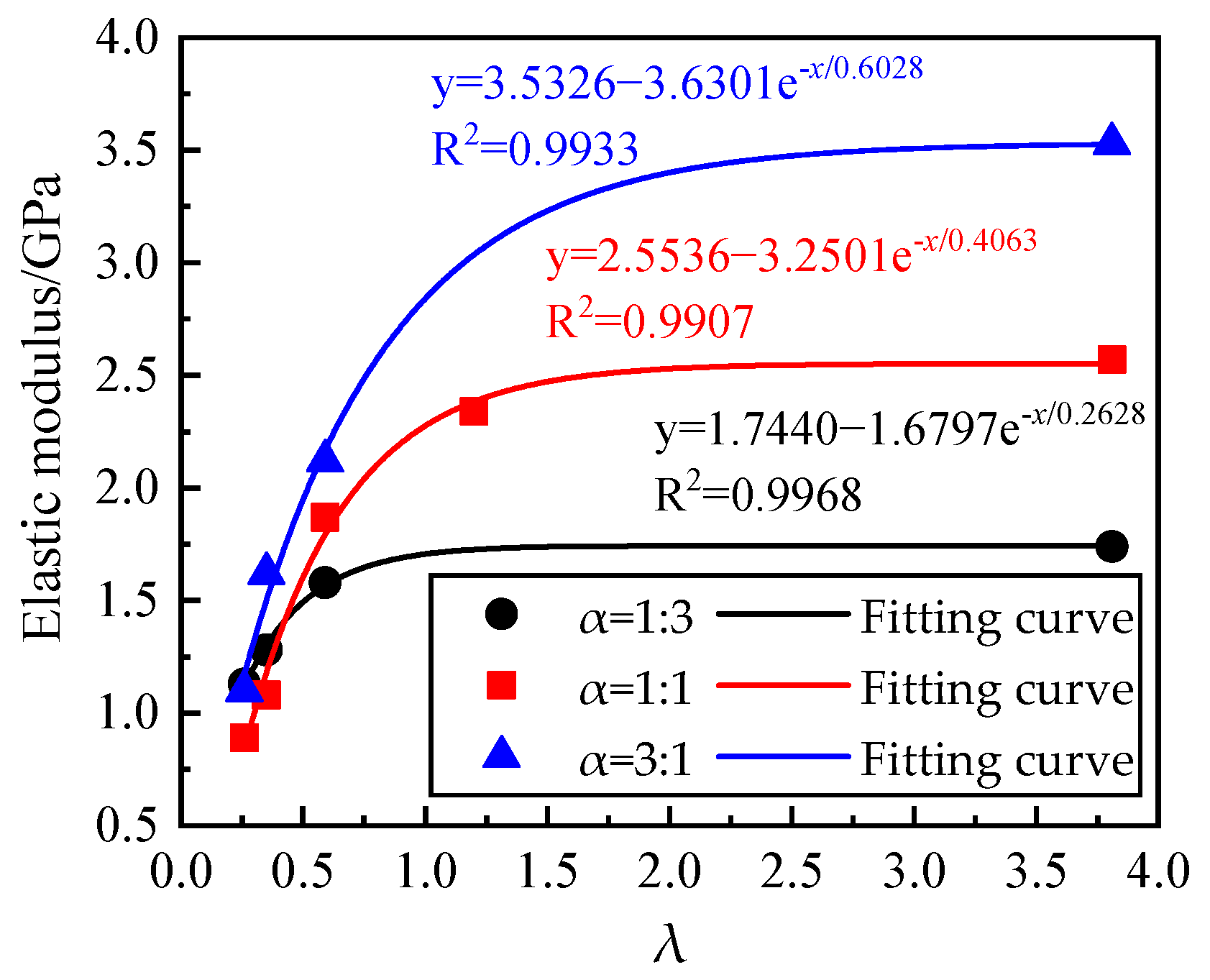
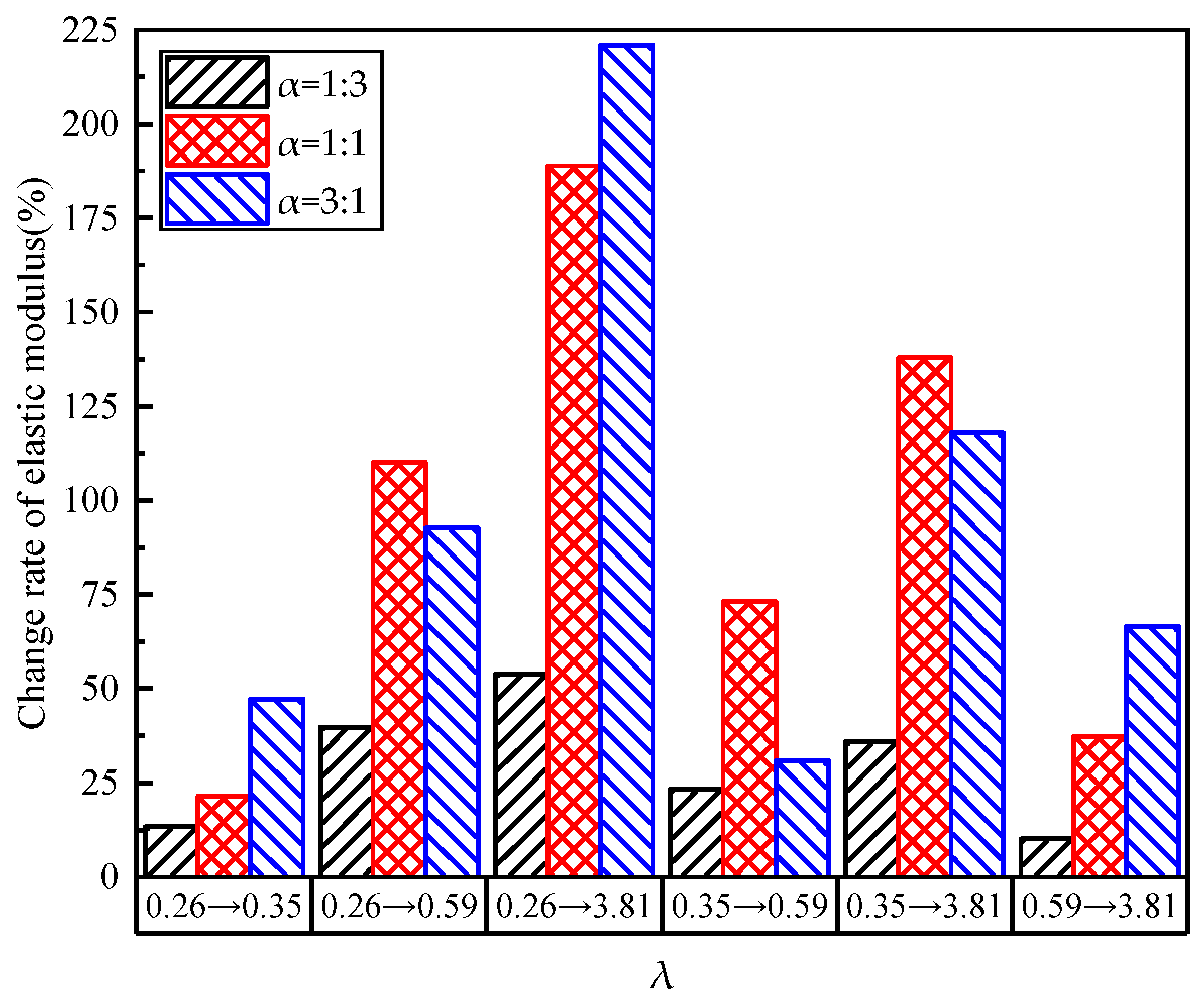
The relationship between the elastic modulus of coal–rock composite specimens and λ at different α values is shown in Figure 16. As shown in Figure 16, the relationship between the elastic modulus of coal–rock composite specimens and λ is not affected by α; under different α conditions, the relationship between the elastic modulus of coal–rock composite specimens and λ remains consistent and it exhibited a trend of increasing rapidly at first and then more slowly as λ increased, consistent with the pattern observed for uniaxial compressive strength. When α = 1:3, the elastic modulus of the coal–rock composite specimen with λ = 0.26 is 1.13 GPa. As λ increases to 0.35, 0.59, and 3.81, the elastic modulus increases to 1.28 GPa, 1.58 GPa, and 1.74 GPa, respectively, representing increases of 13.27%, 39.82%, and 53.98%. Similarly, when α = 1:1, as λ increases from 0.26 to 0.35, 0.59, 1.20, and 3.81, the increases in elastic modulus are 21.35%, 110.11%, 162.92%, and 188.76%, respectively. When α = 3:1, as λ increases from 0.26 to 0.35, 0.59, and 3.81, the increases in elastic modulus are 47.27%, 92.73%, and 220.91%, respectively. The above analysis indicates that, for any given α, λ has a significant effect on the elastic modulus of coal–rock composite specimens.
To quantitatively investigate the intrinsic relationship between the elastic modulus and λ of coal–rock composite specimens, the relationship between the two parameters was fitted using exponential, logarithmic, and power functions for various α values. The fitting results are presented in Table 9. As shown in Table 9, when α = 1:3 and 1:1, the coefficient of determination (R2) for the exponential function is significantly higher than that for the logarithmic and power functions. When α = 3:1, the coefficient of determination (R2) for the exponential function is slightly lower than that for the logarithmic and power functions. As shown in Table 9, the average coefficient of determination (R2) for the exponential function is significantly higher than the averages for the logarithmic and power functions. Therefore, the intrinsic relationship between the elastic modulus and λ of coal–rock composite specimens under various α values can be quantitatively characterized using an exponential function. Furthermore, the coefficient of determination (R2) exceeds 0.99 in all cases, indicating a strong correlation between the elastic modulus and λ of coal–rock composite specimens at different α values. The fitting curves and the corresponding equations are shown in Figure 16.

4.3.4. Comparison of the Relationship Between Theoretical and Experimental Elastic Moduli and λ

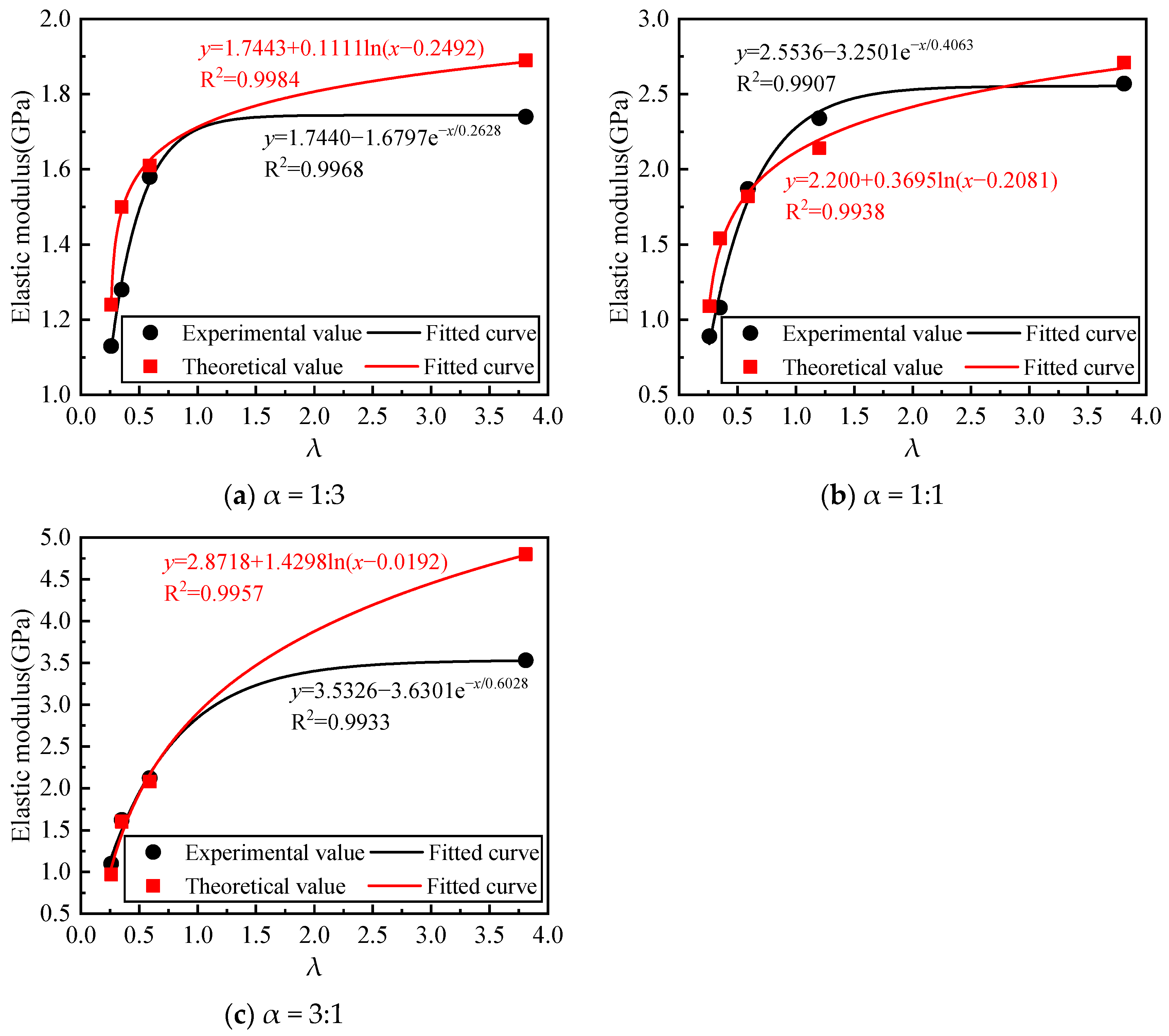
To verify the similarities and differences in the relationship between the theoretical and experimental elastic moduli and λ under different α values, we will compare and analyze the changes in the theoretical and experimental values of elastic modulus with respect to λ under different α values. Based on the experimental results for the elastic modulus of coal–rock composite specimens in Table 4 and the theoretical calculations for the elastic modulus of these specimens in Table 5, a comparison plot of the theoretical and experimental values of the elastic modulus versus λ for different values of α was plotted, as shown in Figure 17. As shown in Figure 17, for all values of α, the trends in the theoretical and experimental values of the elastic modulus as a function of λ are consistent; as λ increases, both exhibit a pattern of rapid initial increase followed by a gradual increase.
Similarly, to quantitatively investigate the intrinsic relationship between the theoretical elastic modulus of coal–rock composite specimens and λ, the relationship between the two parameters was fitted using exponential, logarithmic, and power functions for each α value. The fitting results are presented in Table 10. As shown in Table 10, the coefficient of determination (R2) for the logarithmic function is greater than that for the exponential and power functions for all α values. Therefore, the intrinsic relationship between the theoretical elastic modulus and λ for coal–rock composite specimens under different α values can be quantitatively characterized by a logarithmic function. Table 10 also shows that the R2 values for the logarithmic function are all above 0.99, indicating a strong correlation between the theoretical elastic modulus and λ for all α values. The fitting curves and corresponding equations are shown in Figure 17.
The above analysis shows that, for different values of α, the theoretical and experimental values of the elastic modulus exhibit consistent relationships with λ; however, the results of fitting these relationships differ.

4.3.5. Effect of λ on Peak Strain

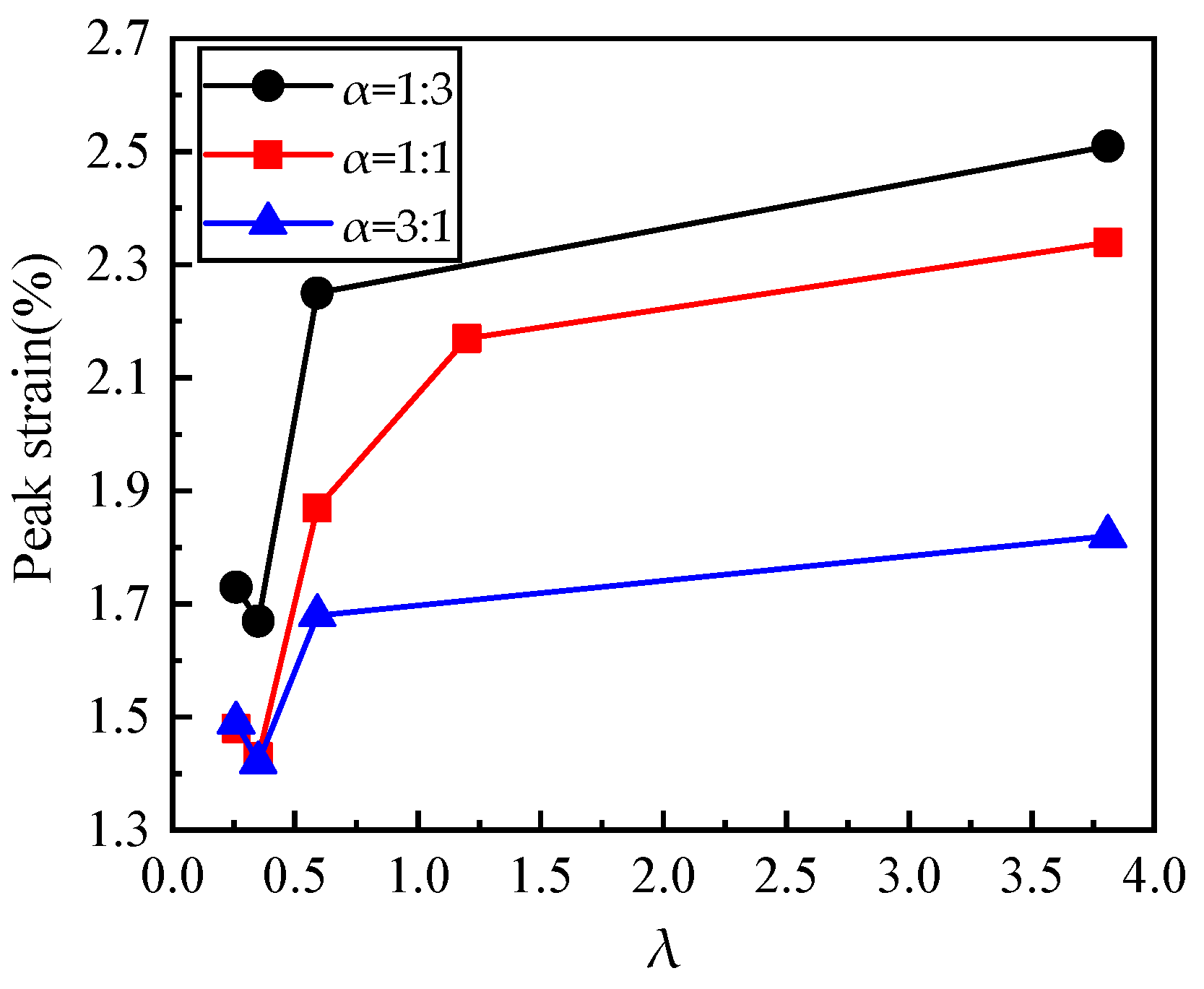
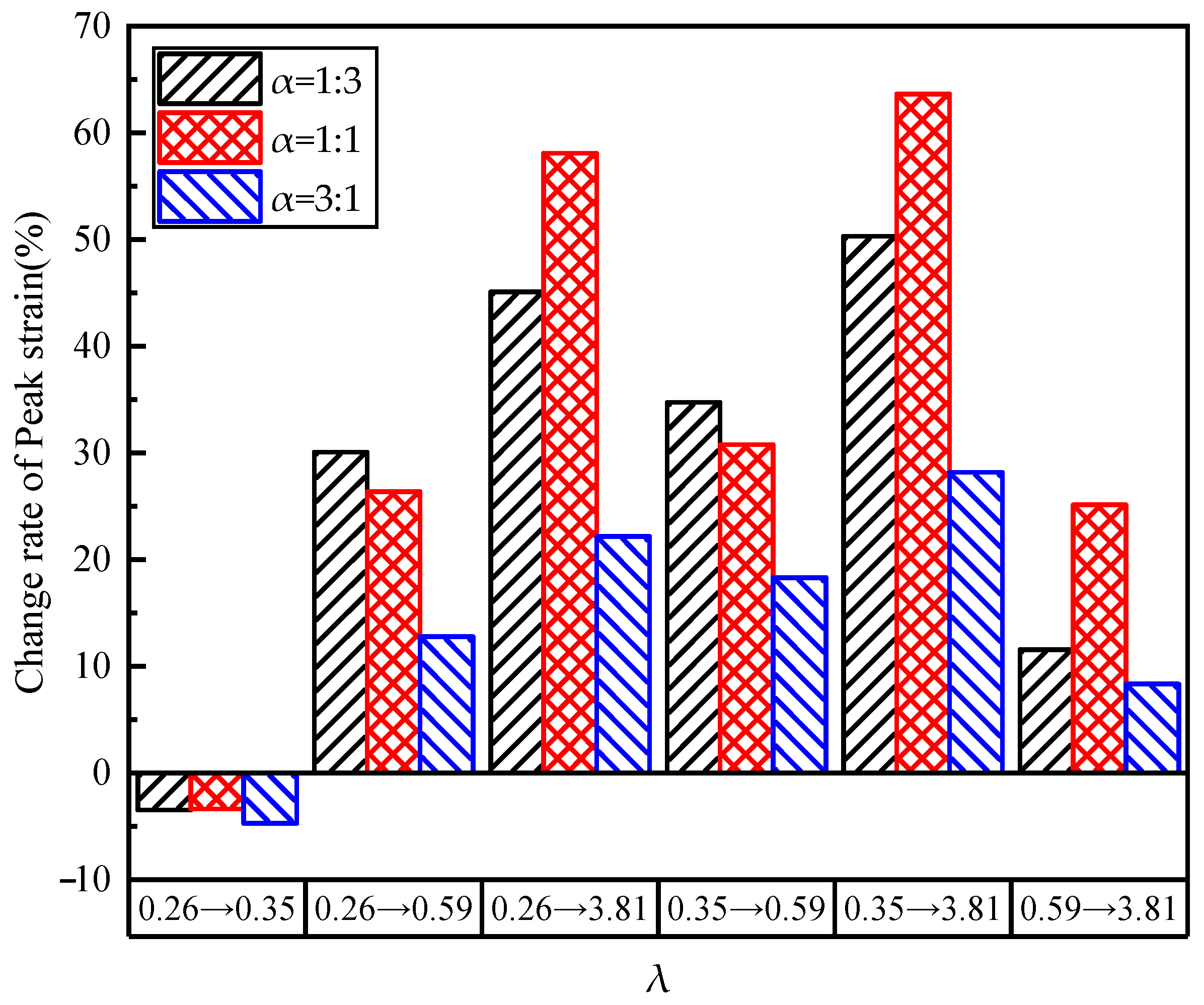
The relationship between peak strain of coal–rock composite specimens and λ at different α values is shown in Figure 18. As shown in Figure 18, the relationship between peak strain of coal–rock composite specimens and λ is not affected by α; under different α conditions, the relationship between peak strain of coal–rock composite specimens and λ remains consistent and it exhibited a trend of rapid decrease followed by a rapid increase and then a gradual increase as λ increases. As λ varied from 0.26 to 0.35, the peak strains of coal–rock composite specimens with α ratios of 1:3, 1:1, and 3:1 decreased from 1.73% to 1.67%, from 1.48% to 1.43%, and from 1.49% to 1.42%, respectively, representing decreases of 3.47%, 3.38%, and 4.70%, respectively. When α was 1:3, as λ increased from 0.35 to 0.59 and 3.81, the peak strain increased to 2.25% and 2.51%, respectively, representing increases of 34.73% and 50.30%. Similarly, when α is 1:1, as λ increases from 0.35 to 0.59, 1.20, and 3.81, the increases in peak strain are 30.77%, 51.75%, and 63.64%, respectively. When α is 3:1, as λ increases from 0.35 to 0.59 and 3.81, the increases in peak strain are 18.31% and 28.17%, respectively. The above analysis indicates that, for any given α, λ has a significant effect on peak strain of coal–rock composite specimens.

4.3.6. The Influence of α on the Amplitude of Mechanical Parameter Changes Under Different λ Variations

Based on Figure 15, Figure 16 and Figure 18 and in conjunction with the analysis in Section 4.3.2, Section 4.3.3 and Section 4.3.5, it can be observed that although the trends in uniaxial compressive strength, elastic modulus, and peak strain of coal–rock composite specimens under different α values are similar as λ varies, there are certain differences in the magnitude of these changes. Given that the lithology of the roof varies relatively randomly under actual geological conditions and does not increase or decrease continuously in accordance with its strength characteristics, we analyze the effect of α on the magnitude of changes in uniaxial compressive strength, elastic modulus, and peak strain under arbitrary variations in λ. To clarify the similarities and differences in the magnitude of changes in the uniaxial compressive strength, elastic modulus, and peak strain of coal–rock composite specimens with different α values under various λ variations, as well as the similarities and differences in the relationship between the magnitude of changes in uniaxial compressive strength, elastic modulus, and peak strain and α under different λ changes, calculate the amplitude of uniaxial compressive strength, elastic modulus, and peak strain changes for coal–rock combination specimens with different α values under various λ variations. The calculation results are shown in Table 11. The comparative relationship of the amplitude of uniaxial compressive strength, elastic modulus, and peak strain changes for coal–rock combination specimens with different α values under various λ variations is shown in Figure 19, Figure 20 and Figure 21.
As can be seen from Figure 19, Figure 20 and Figure 21 and Table 10, the amplitude of uniaxial compressive strength, elastic modulus, and peak strain variation in coal–rock combination specimens with different α under various λ variations vary from each other, and the differences are relatively significant. For example, for a change in λ from 0.26 to 0.59, the changes in uniaxial compressive strength for coal–rock composite specimens with α ratios of 1:3, 1:1, and 3:1 were 72.33%, 172.22%, and 113.37%, respectively, while the changes in elastic modulus were 39.82%, 110.11%, and 92.73%, and the changes in peak strain were 30.06%, 26.35%, and 12.75%, respectively. It can be seen that the magnitude of the change in uniaxial compressive strength, elastic modulus, and peak strain under different λ variations. is significantly influenced by α. As can be seen from Figure 19, Figure 20 and Figure 21 and Table 10, for different variations in λ, the variation pattern of the amplitude of uniaxial compressive strength, elastic modulus, and peak strain changes with α is not exactly the same. Taking uniaxial compressive strength as an example, the variation in uniaxial compressive strength generally exhibits two types of relationships with α. For the changes in λ from 0.26 to 0.35 and from 0.59 to 3.81, the magnitude of the change in uniaxial compressive strength follows a pattern of gradual increase as α increases. For the λ changes from 0.26 to 0.35 and from 0.59 to 3.81, the magnitude of the change in uniaxial compressive strength increases gradually as α increases. For the other four λ changes, the magnitude of the change in uniaxial compressive strength first increases and then decreases as α increases, and the magnitude of the change is always greatest when α is 1:1, but the corresponding α value at which the change is smallest differs. For the λ change from 0.35 to 0.59, the magnitude of the change in uniaxial compressive strength is smallest when α is 3:1, whereas for the other three λ changes, the magnitude of the change in uniaxial compressive strength is smallest when α is 1:3.
The above analysis indicates that, for any given change in λ, the magnitude of the change in uniaxial compressive strength, elastic modulus, and peak strain is significantly influenced by α. The magnitude of the change in uniaxial compressive strength, elastic modulus, and peak strain varies from each other for coal–rock composite specimens with different α values under various λ variations. The relationship between the magnitude of the change in uniaxial compressive strength, elastic modulus, and peak strain and α are not exactly the same under different λ variations. Therefore, it is necessary not only to clarify the relationship between the uniaxial compressive strength, elastic modulus, and peak strain of coal–rock composite specimens and changes in λ, but also to understand the effect of α on the magnitude of these changes in uniaxial compressive strength, elastic modulus, and peak strain.

4.4. Analysis of Failure Characteristics of Coal–Rock Composite Specimens

The typical failure behaviors of coal–rock composite specimens under uniaxial compression are shown in Table 12. As presented in Table 12, the failure modes of coal–rock composite specimens with λ = 0.26 and 0.35 are essentially similar. For these specimens with α = 1:3, 1:1, and 3:1, both the coal and rock components exhibited varying degrees of failure, with the rock component showing a greater extent of failure than the coal component, indicating that the rock component was the primary source of failure. The rock component displayed “V”-shaped shear failure, and due to the influence of this rock failure, the coal component mainly underwent tensile failure. A main crack was observed that extended through the primary failure zone of the rock component, and the crack became relatively larger closer to the interface. Overall, as α increases, the degree of failure in coal–rock composite specimens with λ = 0.26 and 0.35 gradually decreases. When λ = 0.59, both the coal and rock components in the composite specimens with α = 1:3, 1:1, and 3:1 experienced relatively complete failure. The rock component primarily underwent shear failure, while the coal component mainly exhibited splitting failure. Overall, as α increases, the degree of failure in these specimens gradually decreases. When λ = 1.20, both the coal and rock specimens in a coal–rock composite specimen with α= 1:1 ratio exhibited varying degrees of failure, with the coal specimens showing a higher degree of failure than the rock specimens, indicating that the coal specimens were the primary source of failure. The coal specimens mainly exhibited splitting failure, while the rock specimens primarily underwent tensile failure. When λ = 3.81, both the coal and rock components in the composite specimens with α = 1:3 exhibited varying degrees of failure. The extent of failure in the coal component was significantly greater than that in the rock component, indicating that the coal component was the primary source of failure. The coal component primarily exhibited single-plane shear failure or splitting failure, while the rock component mainly underwent tensile failure. In composite specimens with α = 1:1 and 3:1, failure occurred mainly in the coal specimen, indicating that the coal specimen was the primary failure component. No obvious macroscopic cracks were observed on the surface of the rock specimen, which remained largely intact, while the coal specimen primarily exhibited single-plane shear failure or splitting failure. Overall, as α increases, the severity of failure in the coal–rock composite specimens gradually decreases.
The above analysis indicates that λ and α have a significant influence on the failure mode of coal–rock composite specimens. When λ is small or large, the weaker component of the coal–rock composite specimen is the primary source of failure. When λ falls within a certain range, both the stronger and weaker components of the coal–rock composite specimen undergo relatively complete failure. Once λ reaches a certain critical value, only the weaker component of the coal–rock composite specimen fails, while the stronger component remains intact. As α increases, the degree of failure in the coal–rock composite specimens gradually decreases.

5. Discussion

5.1. Discussion on the Critical Stress for Rockburst Occurrence

Based on the coal burst prevention and control system grounded in the perturbation-response instability theory [31], working faces in coal burst-prone mines must undergo a coal burst hazard assessment using the critical stress index method prior to mining or excavation operations. This assessment determines the coal burst hazard level and the extent of the area to be mined (Figure 22 shows the results of the delineation of impact hazard zones in a working face based on the stress index method), laying the foundation for targeted coal burst prevention and control and guiding the anti-burst design of the working face. Accurate determination of the coal burst hazard level and its spatial extent is a prerequisite for precise coal burst prevention and control. The core concept of the critical stress index method is to evaluate the hazard level based on the degree of proximity between the actual stress and the critical stress. The accuracy of the critical stress determination directly affects the precision of the hazard level and extent assessment.
According to the perturbation response instability theory of coal bursts [1], the coal–rock deformation system is idealized as a typical circular roadway subjected to a uniformly distributed load at infinity, as illustrated in Figure 23. The formula for calculating the critical stress required to induce a coal burst in a circular roadway, under the assumption of no support stress, is obtained as follows [1]:
P c r = σ c 2 1 + 1 K
where K is the burst energy index.
As shown in Equation (29), when support stress is not taken into account, the critical stress for a coal burst in a circular roadway is primarily related to σc and K. Currently, when calculating the critical stress, researchers first measure the values of σc and K for individual coal specimens and then substitute these values into Equation (29) to determine the critical stress for coal burst occurrence. Moreover, in these calculations, σc and K for a given coal seam are often treated as fixed parameters, implying that the critical stress for coal burst remains constant within that same coal seam. However, coal-bearing strata typically consist of alternating layers of coal and rock with varying properties. Under actual engineering conditions, the values of σc and K for a coal seam are influenced by the layered stratigraphic context and may differ significantly from those measured on individual coal specimens. Furthermore, under the influence of geological and engineering factors, σc and K often vary dynamically in actual engineering conditions.
The analysis presented in this paper shows that, for any given α, the uniaxial compressive strength of a coal–rock composite specimen is not equal to that of an individual coal specimen or an individual rock specimen (the relative deviation in uniaxial compressive strength between individual coal samples and composite coal–rock specimens is shown in Figure 24). This indicates that substituting the uniaxial compressive strength of an individual coal specimen into Equation (29) to calculate the critical stress will introduce a certain degree of deviation. The analysis also reveals that both λ and α have a significant effect on the uniaxial compressive strength of coal–rock composite specimens, indicating that the uniaxial compressive strength varies dynamically with changes in the lithology and thickness of the coal seam roof, thereby causing the critical stress to also vary dynamically. Therefore, it is necessary to modify Equation (29) to account for these effects; specific modifications will be addressed in future research.
In summary, for geological conditions characterized by “weakly cemented overlying strata + high-strength coal seams” with significant variations in roof lithology and thickness, it is essential to clarify the influence of these variations on the critical stress and to elucidate the underlying patterns. This will enable the “dynamization” of the critical stress under such geological conditions, thereby facilitating the precise prevention and control of coal bursts based on this dynamic critical stress.

5.2. Limitations of the Study

Interface issues in coal–rock composite specimens have long been a focal point and a major challenge in research. Ideally, coal–rock composite samples with natural interfaces should be collected directly on-site as required by the test to minimize the influence of interface factors. In this study, the interface treatment of coal–rock combination specimens was primarily based on the standard “Methods for Test, Monitoring, and Prevention of Rock Bursts—Part 3: Classification and Laboratory Test Method for the Bursting Liability of Coal–Rock Combination Specimens,” and epoxy resin AB adhesive was used for bonding. Further research should, as much as possible, focus on coal–rock composite samples with native interfaces.
Due to limitations on the number of samples collected from the same batch, this study designed three α values when investigating the effect of α on the mechanical properties of coal–rock composite samples. Consequently, the number of test conditions was relatively limited. In future studies of this nature, efforts should be made to ensure a sufficient variety of test conditions.
As we all know, the coal measure strata are not composed of a single rock stratum, but a variety of different rock strata are interbedded. Several rock strata are superimposed together to form a surrounding rock system with unique mechanical properties. This study focused solely on two-component coal–rock systems; future research should be conducted based on practical engineering scenarios to explore three-component and multi-component systems in greater depth.

6. Conclusions

(1)
There are significant differences in the mechanical properties of coal–rock composite specimens compared to individual coal and rock specimens. For any value of α, the uniaxial compressive strength of the coal–rock composite specimen is lower than that of the strong component in the composite specimen, and is closer to that of the weak component in the composite specimen; however, the relationship between the uniaxial compressive strength of the composite specimen and that of the weak component is not clearly defined. Under most operating conditions, the elastic modulus of coal–rock composite specimens falls between those of the individual coal and rock samples. When α > β, the elastic modulus of the coal–rock composite specimen is relatively closer to that of the rock specimen; when α = β, the elastic modulus of the coal–rock composite specimen is the intermediate value between the elastic moduli of coal and rock specimens; when α < β, the elastic modulus of the coal–rock composite specimen is relatively closer to that of the coal specimen.
(2)
For any value of λ, α has a significant effect on the mechanical properties of coal–rock composite specimens. For coal–rock composite specimens where the weaker component varies with rock properties, the variation in uniaxial compressive strength, elastic modulus, and peak strain with α is significantly influenced by rock properties. These variation patterns are not entirely identical for different rock properties. Therefore, for coal–rock combination specimens with this characteristic, it is necessary to clarify the variation patterns of uniaxial compressive strength, elastic modulus, and peak strain with α under different rock properties.
(3)
For any value of α, λ has a significant effect on the mechanical properties of coal–rock composite specimens. For coal–rock composite specimens at different α values, the trends in uniaxial compressive strength, elastic modulus, and peak strain as a function of λ are identical. Both uniaxial compressive strength and elastic modulus exhibit a pattern of increasing rapidly at first and then more slowly with increasing λ, and both can be quantitatively described by exponential functions. Peak strain follows a pattern of rapid decrease, rapid increase, and gradual increase with increasing λ. However, for any given change in λ, the magnitude of the changes in uniaxial compressive strength, elastic modulus, and peak strain is significantly influenced by α. The magnitude of the change in uniaxial compressive strength, elastic modulus, and peak strain vary from each other for coal–rock composite specimens with different α values under various λ variations. The relationship between the magnitude of the change in uniaxial compressive strength, elastic modulus, and peak strain and α are not exactly the same under different λ variations.
(4)
For the same magnitude of λ variation, increasing the strength of the weaker component in the composite specimen results in a relatively significant increase in the specimen’s uniaxial compressive strength, whereas increasing the strength of the stronger component results in a relatively small increase in the specimen’s uniaxial compressive strength.
(5)
Both λ and α have a significant influence on the failure mode of coal–rock composite specimens. When λ is small or large, the weaker component of the coal–rock composite specimen is the primary source of failure. When λ falls within a certain range, both the stronger and weaker components of the coal–rock composite specimen undergo relatively complete failure. When λ increases beyond a critical value, only the weaker component of the coal–rock composite specimen fails, while the stronger component remains intact and does not fail. As α increases, the degree of failure in the coal–rock composite specimen gradually decreases.

Author Contributions

Conceptualization, R.C. and Y.P.; methodology, R.C.; experiment R.C. and F.L.; theoretical analysis, R.C. and Y.P.; writing—original draft preparation, R.C.; writing—review and editing, Y.P.; data curation, R.C. and F.L.; supervision, Y.P.; funding acquisition, Y.P. All authors have read and agreed to the published version of the manuscript.

Funding

This research was funded by the Research Program of National Major Research Instruments of China [Grant No. 52427805].

Institutional Review Board Statement

Not applicable.

Informed Consent Statement

Not applicable.

Data Availability Statement

The raw data supporting the conclusions of this article will be made available by the authors on request.

Acknowledgments

The first author thanks the other authors for their research contributions and thanks the editors and reviewers for their kindness and valuable opinions.

Conflicts of Interest

The authors declare no conflicts of interest.

References

  1. Pan, Y.S. Disturbance response instability theory of rockburst in coal mine. J. China Coal Soc. 2018, 43, 2091–2098. [Google Scholar]
  2. Qi, Q.X.; Gui, L.B.; Li, H.T.; Zhao, S.K.; Zheng, W.Z.; Zhang, X.F.; Wang, X.D.; Wang, S.G.; Han, J.; Ouyang, Z.H.; et al. Current situation and reflective analysis of coal-bump problems in China’s coal mines. J. China Coal Soc. 2026, 51, 255–273. [Google Scholar]
  3. Dou, L.M.; Tian, X.Y.; Cao, A.Y.; Gong, S.Y.; He, H.; He, J.; Cai, W.; Li, X.W. Present situation and problems of coal mine rock burst prevention and control in China. J. China Coal Soc. 2022, 47, 152–171. [Google Scholar]
  4. Jang, F.X.; Zhang, X.; Zhu, S.T. Discussion on key problems in prevention and control system of coal mine rock burst. Coal Sci. Technol. 2023, 51, 203–213. [Google Scholar]
  5. Jiang, Y.D.; Zhao, Y.X. State of the art: Investigation on mechanism, forecast and control of coal bumps in China. Chin. J. Rock Mech. Eng. 2015, 34, 2188–2204. [Google Scholar]
  6. Tan, Y.L.; Zhang, X.F.; Xiao, Z.Y.; Fan, D.Y.; Yin, Y.C.; Chen, Y.; Liu, X.S. Main control factors of rock burst and its disaster evolution mechanism. J. China Coal Soc. 2024, 49, 367–379. [Google Scholar]
  7. Zhang, H.W.; Zhu, F.; Han, J.; Hou, B.J.; Rong, H.; Tang, G.S. Geological dynamic conditions and forecast technology for rock bursts. J. China Coal Soc. 2016, 41, 545–551. [Google Scholar]
  8. Pan, J.F.; Xia, Y.X.; Wang, S.W.; Ma, W.T.; Zhang, C.Y.; Wang, B. Technical difficulties and emerging development directions of deep rock burst prevention in China. J. China Coal Soc. 2024, 49, 1291–1302. [Google Scholar]
  9. Patynska, R. The consequences of the rock burst hazard in the Silesian companies in Poland. Acta Geodyn. Geomater. 2013, 10, 227–235. [Google Scholar] [CrossRef]
  10. Mark, C. Coal bursts in the deep longwall mines of the United States. Int. J. Coal Sci. Technol. 2016, 3, 1–9. [Google Scholar] [CrossRef]
  11. Chen, S.J.; Li, F.X.; Yin, D.W.; Zhang, J.C. Experimental study on deformation failure characteristics of limestone-coal composite with different rock-coal height ratios. J. Cent. South Univ. (Sci. Technol.) 2023, 54, 2459–2472. [Google Scholar]
  12. Zhang, Y.; Zhao, Y.; Li, H.; Ding, X.; Han, G. Exploration on characteristics of rock bust in deep mining area of Ordos and its prevention. Coal Sci. Technol. Mag. 2021, 42, 24–29. [Google Scholar]
  13. Wang, G.; Pan, Y.S.; Xiao, X.C.; Wu, D.; Ding, X.; Zhao, X. Experimental study on charge law of coal-rock bodies rock burst tendency and failure characteristics. China Saf. Sci. J. 2016, 26, 135–140. [Google Scholar] [CrossRef]
  14. Chen, S.J.; Yin, D.W.; Zhang, B.L.; Ma, H.F.; Liu, X.Q. Mechanical characteristics and progressive failure mechanism of roof-coal pillar structure. Chin. J. Rock Mech. Eng. 2017, 36, 1588–1598. [Google Scholar]
  15. Xiao, X.C.; Fan, Y.F.; Wu, D.; Ding, X.; Wang, L. Study on relationship between mechanical properties and acoustic emission-charge signals of combined coal-rock. J. Saf. Sci. Technol. 2018, 14, 126–132. [Google Scholar]
  16. Nie, X.; Zhou, A.C. Numerical analysis on mechanical characteristics of coal-rock combination of different height ratios. Coal Technol. 2018, 37, 102–104. [Google Scholar]
  17. Chen, G.B.; Wang, E.Y.; Wang, W.C.; Li, T.; Zhang, G.H. Experimental study on the influence of lithology and rock-coal height ratio on mechanical properties and impact effect of combined body. Energy Sources. Part A Recovery Util. Environ. Eff. 2019, 46, 4257–4280. [Google Scholar] [CrossRef]
  18. Zhao, Y.F.; Li, B.; Zhang, C.; Cheng, C.J. Experimental study on charge induction and microseismic laws of coal and rock with different combination ratios. J. Saf. Sci. Technol. 2019, 15, 107–112. [Google Scholar]
  19. Li, H.G.; Wei, L.; Li, H.M. Analysis on influence law of coal thickness on physical and mechanical characteristics of coal-rock combination. Min. Saf. Environ. Prot. 2020, 47, 48–53. [Google Scholar]
  20. Fan, Y.F.; Xiao, X.C.; Xu, J.; Wu, D.; Ding, X.; Wang, L.; Lu, X.F. Mechanical properties of coal rock combinations and evaluation of impact tendency considering effects of the height portion of coal. J. China Coal Soc. 2020, 45, 649–659. [Google Scholar]
  21. Zhao, P.X.; He, Y.T.; Li, S.G.; Lin, H.F.; Jia, Y.Y.; Yang, E.H. Coal thickness effect on mechanics and energy characteristics of coal-rock combination model. J. Min. Saf. Eng. 2020, 37, 1067–1076. [Google Scholar]
  22. Zhao, P.X.; Wang, X.Y.; Li, S.G.; Jia, Y.Y.; Lin, H.F.; Yi, C.Y.; Li, S.Y. Effect of rock-coal strength ratio on acoustic emission and fracture fractal characteristics of assemblage. J. Xi’an Univ. Sci. Technol. 2024, 44, 649–659. [Google Scholar]
  23. Yang, L.; Gao, F.Q.; Wang, X.Q. Mechanical response and energy partition evolution of coal-rock combinations with different strength ratios. Chin. J. Rock Mech. Eng. 2020, 39, 3297–3305. [Google Scholar]
  24. Liu, J.; Wang, E.Y.; Song, D.Z.; Wang, S.H.; Niu, Y. Effect of rock strength on failure mode and mechanical behavior of composite samples. Arab. J. Geosci. 2015, 8, 4527–4539. [Google Scholar] [CrossRef]
  25. Chai, Y.J.; Dou, L.M.; Cai, W.; Malkowski, P.; Li, X.W.; Gong, S.Y.; Bai, J.Z.; Cao, J.R. Experimental investigation into damage and failure process of coal-rock composite structures with different roof lithologies under mining-induced stress loading. Int. J. Rock Mech. Min. Sci. 2023, 170, 105479. [Google Scholar] [CrossRef]
  26. Zuo, J.P.; Xie, H.P.; Wu, A.M.; Liu, J.F. Investigation on failure mechanisms and mechanical behaviors of deep coal-rock single body and combined body. Chin. J. Rock Mech. Eng. 2011, 30, 84–92. [Google Scholar]
  27. Guo, P.H.; Yang, K.; Li, J.Z.; Chi, X.L.; Liu, W.J.; Wu, X.H. Mechanical properties and acoustic emission responses of gas-bearing rock-coal-rock combinations with different height ratios. J. Min. Saf. Eng. 2025, 42, 960–970. [Google Scholar]
  28. Yin, D.W.; Chen, S.J.; Xing, W.B.; Hang, D.M.; Liu, X.Q. Experimental study on mechanical behavior of roof-coal pillar structure body under different loading rates. J. China Coal Soc. 2018, 43, 1249–1257. [Google Scholar]
  29. Zhang, J.W.; Zhang, S.L.; Bu, X.H.; Wang, K.; Song, Z.X.; Zhang, Y.; Dong, X.K.; Wu, S.K.; Xing, Z.R.; Li, X.; et al. Mechanical damage and progressive instability characteristics of coal-rock composite under the coal thickness effect. Coal Sci. Technol. 2025, 53, 96–116. [Google Scholar]
  30. Zheng, W.J.; Zhang, X.F.; Qi, Q.X.; Ju, W.J.; Wang, C.W.; Han, Y.Y.; Li, G.Y.; Chen, Y.; Wang, H.; Wang, S.; et al. Influencing Analysis of Bedding Quantity on Failure Behavior of Coal-rock Combination under Different Triaxial Loading Conditions. Sci. Technol. Eng. 2025, 25, 12840–12846. [Google Scholar]
  31. Wang, A.W.; Wang, G.; Dai, L.P.; Chen, J.Q.; Shi, T.W.; Lu, X.F.; Cai, R.H. Evaluation on the rock burst risks of roadway using critical stress index method. J. China Coal Soc. 2020, 45, 1626–1634. [Google Scholar]
Figure 1. Preparation of coal–rock composite specimens.
Applsci 16 05939 g001
Figure 2. Test system: (a) testing machine; (b) monitoring system; (c) loading of the λ = 0.26 specimen; (d) loading of the λ = 0.35 specimen; (e) loading of the λ = 0.59 specimen; (f) loading of the λ = 3.81 specimen.
Applsci 16 05939 g002
Figure 3. Schematic diagram of load-deformation behavior for a coal–rock composite specimen with α = 1:1.
Applsci 16 05939 g003
Figure 4. Comparison of uniaxial compressive strengths between coal–rock composite specimens and individual coal and rock specimens: (a) α = 1:3; (b) α = 1:1; (c) α = 3:1.
Applsci 16 05939 g004
Figure 5. Comparison of experimental and theoretical elastic moduli for coal–rock composite specimens at different λ values: (a) λ = 0.26; (b) λ = 0.35; (c) λ = 0.59; (d) λ = 3.81.
Applsci 16 05939 g005
Figure 6. Comparison of experimental and theoretical elastic moduli for coal–rock composite specimens at different α ratios: (a) α = 1:3; (b) α = 1:1; (c) α = 3:1.
Applsci 16 05939 g006
Figure 7. Comparison of the elastic moduli of coal–rock composite specimens and individual coal and rock specimens: (a) α = 1:3; (b) α = 1:1; (c) α = 3:1.
Applsci 16 05939 g007
Figure 8. Stress–strain curves for coal–rock composite specimens at different λ values: (a) λ = 0.26; (b) λ = 0.35; (c) λ = 0.59; (d) λ = 3.81.
Applsci 16 05939 g008
Figure 9. Relationship between uniaxial compressive strength and α for coal–rock composite specimens at different λ values.
Applsci 16 05939 g009
Figure 10. Relationship between theoretical elastic modulus and α for different β values.
Applsci 16 05939 g010aApplsci 16 05939 g010b
Figure 11. Relationship between the elastic modulus of coal–rock composite specimens and α at different λ values.
Applsci 16 05939 g011
Figure 12. Comparison of theoretical and experimental elastic modulus values with α under different λ: (a) λ = 0.26; (b) λ = 0.35; (c) λ = 0.59; (d) λ = 3.81.
Applsci 16 05939 g012
Figure 13. Relationship between peak strain and α for coal–rock composite specimens at different λ values.
Applsci 16 05939 g013
Figure 14. Stress–strain curves of coal–rock composite specimens at different α ratios: (a) α = 1:3; (b) α = 1:1; (c) α = 3:1.
Applsci 16 05939 g014
Figure 15. Relationship between uniaxial compressive strength and λ of coal–rock composite specimens at different α values.
Applsci 16 05939 g015
Figure 16. Relationship between the elastic modulus of coal–rock composite specimens and λ at different α values.
Applsci 16 05939 g016
Figure 17. Comparison of theoretical and experimental elastic modulus values with λ under different α.
Applsci 16 05939 g017
Figure 18. Relationship between peak strain and λ for coal–rock composite specimens at different α values.
Applsci 16 05939 g018
Figure 19. Comparison chart of the amplitude of uniaxial compressive strength changes under different λ variations.
Applsci 16 05939 g019
Figure 20. Comparison chart of the amplitude of elastic modulus changes under different λ variations.
Applsci 16 05939 g020
Figure 21. Comparison chart of the amplitude of peak strain changes under different λ variations.
Applsci 16 05939 g021
Figure 22. Coal burst hazard zones in a working face based on critical stress index method.
Applsci 16 05939 g022
Figure 23. Analysis model of roadway coal burst [1,31].
Applsci 16 05939 g023
Figure 24. Relative deviation in uniaxial compressive strength between individual coal samples and composite coal–rock specimens.
Applsci 16 05939 g024
Table 1. Literature review on mechanical properties of coal–rock composite specimens under uniaxial compression.
Combination ModeSize (mm)λαInterface Connection MethodTesting MethodReferences
Rock–Coal–Rock50 × 50 × 100>10.67, 1.14, 2.00Adhesive bondingUniaxialWang et al. [13]
Rock–Coalφ50 × 100>11:1, 3:2, 7:3, 4:1, 9:1Adhesive bondingUniaxialChen et al. [14]
Rock–Coalφ50 × 100>11, 0.67, 0.42Adhesive bondingUniaxialXiao et al. [15]
Rock–Coalφ50 × 100>10.5, 1.0, 1.5Adhesive bondingUniaxialNie et al. [16]
Rock–Coalφ50 × 100>13:1, 2:1, 1:1, 1:2, 1:3Adhesive bondingUniaxialChen et al. [17]
Rock–Coalφ50 × 100>12:3, 1:1, 3:2Adhesive bondingUniaxialZhao et al. [18]
Rock–Coal–Rockφ50 × 100>11:19, 1:9, 3:17, 1:4Adhesive bondingUniaxialLi et al. [19]
Rock–Coalφ50 × 100>17:3, 3:2, 1:1, 2:3, 3:7Adhesive bondingUniaxialFan et al. [20]
Rock–Coal–Rockφ50 × 100>18:1, 4:1, 2:1, 1:1, 3:5Adhesive bondingUniaxialZhao et al. [21]
Rock–Coal–Rockφ50 × 1001, 2, 3, 4, 52:1Adhesive bondingUniaxialZhao et al. [22]
Rock–Coalφ50 × 1000.72, 1.01, 1.97, 3.06, 3.911:1Natural superpositionUniaxialYang et al. [23]
Rock–Coal–Rockφ50 × 1004.64, 6.94, 7.86, 9.98, 11.343:2Natural superpositionUniaxialLiu et al. [24]
Rock–Coal–Rockφ50 × 1001.31, 1.76, 2.18, 3.99, 5.983:1Adhesive bondingUniaxialChai et al. [25]
Table 2. Test results of mechanical properties of coal and rock specimens (average values).
No.SpecimenUniaxial Compressive Strength (MPa)Modulus of Elasticity (GPa)Peak Strain (%)λβ
1coal specimen30.731.452.99--
2weakly cemented coarse sandstone8.110.871.830.260.60
3weakly cemented medium sandstone10.871.651.310.351.14
4weakly cemented medium sand-stone18.182.431.440.591.68
5fine sandstone (supplement)36.904.081.471.202.81
6siltstone116.9520.840.843.8114.37
Note: β is the ratio of the elastic moduli of rock to coal.
Table 3. Experimental scheme.
λ = 0.26λ = 0.35λ = 0.59λ = 1.20λ = 3.81
α = 1:3-
α = 1:1
α = 3:1-
Table 4. Results of uniaxial compression tests on coal–rock composite specimens (average values).
αλUniaxial Compressive Strength (MPa)Modulus of Elasticity (GPa)Peak Strain (%)
1:30.2612.001.131.73
0.3512.461.281.67
0.5920.681.582.25
3.8125.551.742.51
1:10.267.740.891.48
0.359.291.081.43
0.5921.071.871.87
1.2031.912.342.17
3.8139.002.572.34
3:10.269.651.101.49
0.3513.251.621.42
0.5920.592.121.68
3.8140.063.531.82
Table 5. Comparison of experimental and theoretical elastic modulus values.
αλExperimental Value/GPaTheoretical Value/GPaDeviation/GPaRelative Deviation/%
1:30.261.131.24−0.118.87
0.351.281.50−0.2214.67
0.591.581.61−0.031.86
3.811.741.89−0.157.94
1:10.260.891.09−0.2018.35
0.351.081.54−0.4629.87
0.591.871.820.052.75
1.202.342.140.209.35
3.812.572.71−0.145.17
3:10.261.100.970.1313.40
0.351.621.600.021.25
0.592.122.080.041.92
3.813.534.80−1.2726.46
Table 6. Judgment results of the theoretical relative size relationship of elastic modulus between coal–rock composite specimens and coal and rock specimens.
αλβRelationship Between α and βRelationship Between E E c and E E r Closer Component
1:30.260.60α < β E E c < E E r Coal specimen
0.351.14α < β E E c < E E r Coal specimen
0.591.68α < β E E c < E E r Coal specimen
3.8114.37α < β E E c < E E r Coal specimen
1:10.260.60α > β E E c > E E r Rock specimen
0.351.14α < β E E c < E E r Coal specimen
0.591.68α < β E E c < E E r Coal specimen
1.202.81α < β E E c < E E r Coal specimen
3.8114.37α < β E E c < E E r Coal specimen
3:10.260.60α > β E E c > E E r Rock specimen
0.351.14α > β E E c > E E r Rock specimen
0.591.68α > β E E c > E E r Rock specimen
3.8114.37α < β E E c < E E r Coal specimen
Table 7. Test results on the relative magnitudes of the modulus of elasticity for coal–rock composite specimens and coal and rock specimens.
αλ E E c /GPa E E r /GPaRelationship Between E E c and E E r Closer Component
1:30.260.320.26 E E c  >  E E r Rock specimen
0.350.170.37 E E c  <  E E r Coal specimen
0.590.130.85 E E c  <  E E r Coal specimen
3.810.2919.10 E E c  <  E E r Coal specimen
1:10.260.560.02 E E c  >  E E r Rock specimen
0.350.370.57 E E c  <  E E r Coal specimen
0.590.420.56 E E c  <  E E r Coal specimen
1.200.891.74 E E c  <  E E r Coal specimen
3.811.1218.27 E E c  <  E E r Coal specimen
3:10.260.350.23 E E c  >  E E r Rock specimen
0.350.170.03 E E c  >  E E r Rock specimen
0.590.670.31 E E c  >  E E r Rock specimen
3.812.0817.31 E E c  <  E E r Coal specimen
Table 8. Fitting results for the relationship between uniaxial compressive strength and λ at different α values.
Types of FunctionsαAverage
1:31:13:1
Exponential Functions0.96200.99300.99990.9850
Logarithmic Functions0.90710.96580.99930.9574
Power Functions0.89240.93840.99720.9427
Table 9. Fitting results for the relationship between elastic modulus and λ at different α values.
Types of FunctionsαAverage
1:31:13:1
Exponential Functions0.99680.99070.99330.9936
Logarithmic Functions0.94080.94450.99950.9616
Power Functions0.93330.92020.99990.9511
Table 10. Fitting results of the relationship between theoretical elastic modulus and λ for different α values.
Function Type (R2)αAverage
1:31:13:1
Exponential function0.95410.95760.99370.9685
Logarithmic function0.99840.99380.99570.9960
Power function0.85220.92800.98410.9214
Table 11. Calculation results of the amplitude of uniaxial compressive strength, elastic modulus, and peak strain change under different λ variations.
λαChange Amplitude of Uniaxial Compressive Strength (%)Change Amplitude of Elastic Modulus (%)Change Amplitude of Peak Strain (%)
0.26→0.351:33.8313.27−3.47
1:120.0321.35−3.38
3:137.3147.27−4.70
0.26→0.591:372.3339.8230.06
1:1172.22110.1126.35
3:1113.3792.7312.75
0.26→3.811:3112.9253.9845.09
1:1403.88188.7658.11
3:1315.13220.9122.15
0.35→0.591:365.9723.4434.73
1:1126.8073.1530.77
3:155.4030.8618.31
0.35→3.811:3105.0635.9450.30
1:1319.81137.9663.64
3:1202.34117.9028.17
0.59→3.811:323.5510.1311.56
1:185.1037.4325.13
3:194.5666.518.33
Table 12. Typical failure modes of coal–rock composite specimens.

α = 1:3α = 1:1α = 3:1
λ = 0.26Applsci 16 05939 i001Applsci 16 05939 i002Applsci 16 05939 i003
λ = 0.35Applsci 16 05939 i004Applsci 16 05939 i005Applsci 16 05939 i006
λ = 0.59Applsci 16 05939 i007Applsci 16 05939 i008Applsci 16 05939 i009
λ = 1.20 Applsci 16 05939 i010
λ = 3.81Applsci 16 05939 i011Applsci 16 05939 i012Applsci 16 05939 i013
Disclaimer/Publisher’s Note: The statements, opinions and data contained in all publications are solely those of the individual author(s) and contributor(s) and not of MDPI and/or the editor(s). MDPI and/or the editor(s) disclaim responsibility for any injury to people or property resulting from any ideas, methods, instructions or products referred to in the content.