Biomechanical Characteristics of Double-Arm Backstroke—A Specialist Freestyle Technique Employed by Severely Impaired Para Swimmers

Abstract
1. Introduction
2. Materials and Methods
2.1. Participants
2.2. Data Capture and Processing
2.3. Data Analysis and Definition of Variables
2.4. Statistical Analysis
3. Results
3.1. Front Crawl Versus Double-Arm Backstroke in Non-Disabled Swimmers
3.2. Non-Disabled Swimmers Versus Para Swimmers Performing Double-Arm Backstroke
4. Discussion
4.1. Front Crawl Versus Double-Arm Backstroke in Non-Disabled Swimmers
4.2. Non-Disabled Swimmers Versus Para Swimmers Performing Double-Arm Backstroke
5. Conclusions
Supplementary Materials
Author Contributions
Funding
Institutional Review Board Statement
Informed Consent Statement
Data Availability Statement
Acknowledgments
Conflicts of Interest
Abbreviations
| ηF | Froude efficiency |
| ICSF | Intra-cyclic speed fluctuation |
| CMNIs | Central motor and neuromuscular impairments |
| S | Sport class |
| σ | Standard deviation |
References
- World Para Swimming Classification Rules and Regulations. Available online: https://www.paralympic.org/swimming/rules (accessed on 2 June 2026).
- Barbosa, T.M.; Bragada, J.A.; Reis, V.M.; Marinho, D.A.; Carvalho, C.; Silva, A.J. Energetics and Biomechanics as Determining Factors of Swimming Performance: Updating the State of the Art. J. Sci. Med. Sport 2010, 13, 262–269. [Google Scholar] [CrossRef]
- Beckman, E.M.; Connick, M.J.; Tweedy, S.M. How Much Does Lower Body Strength Impact Paralympic Running Performance? Eur. J. Sport Sci. 2016, 16, 669–676. [Google Scholar] [CrossRef]
- Connick, M.J.; Beckman, E.M.; Spathis, J.; Deuble, R.; Tweedy, S.M. How Much Do Range of Movement and Coordination Affect Paralympic Sprint Performance? Med. Sci. Sports Exerc. 2015, 47, 2216–2223. [Google Scholar] [CrossRef]
- Roldán, A.; Sabido, R.; Barbado, D.; Caballero, C.; Reina, R. Manual Dexterity and Intralimb Coordination Assessment to Distinguish Different Levels of Impairment in Boccia Players with Cerebral Palsy. Front. Neurol. 2017, 8, 582. [Google Scholar] [CrossRef]
- Lee, Y.H.; O’Dowd, D.N.; Hogarth, L.; Burkett, B.; Payton, C.J. Effect of Central Motor and Neuromuscular Impairments on Front Crawl Body Roll Characteristics of Para Swimmers. Sports Med. Open 2025, 11, 88. [Google Scholar] [CrossRef]
- Payton, C.J.; Hogart, H.L.; Burkett, B.; Van De Vliet, P.; Lewis, S.; Oh, Y.T. Active Drag as a Criterion for Evidence-Based Classification in Para Swimming. Med. Sci. Sports Exerc. 2020, 52, 1576–1584. [Google Scholar] [CrossRef]
- Payton, C.J.; Bartlett, R.M.; Baltzopoulos, V.; Coombs, R. Upper Extremity Kinematics and Body Roll During Preferred-Side Breathing and Breath-Holding Front Crawl Swimming. J. Sports Sci. 1999, 17, 689–696. [Google Scholar] [CrossRef]
- Hogarth, L.; Burkett, B.; Van De Vliet, P.; Payton, C.J. Maximal Fully Tethered Swim Performance in Para Swimmers with Physical Impairment. Int. J. Sports Physiol. Perform. 2020, 15, 816–824. [Google Scholar] [CrossRef]
- Hogarth, L.; Oh, Y.-T.; Osborough, C.; Formosa, D.; Hunter, A.; Alcock, A.; Burkett, B.; Payton, C.J. Passive drag in Para swimmers with physical impairments: Implications for evidence-based classification in Para swimming. Scand. J. Med. Sci. Sports 2021, 31, 1932–1940. [Google Scholar] [CrossRef]
- Aisen, M.L.; Kerkovich, D.; Mast, J.; Mulroy, S.; Wren, T.A.; Kay, R.M.; Rethlefsen, S.A. Cerebral palsy: Clinical care and neurological rehabilitation. Lancet Neurol. 2011, 10, 844–852. [Google Scholar] [CrossRef]
- Sato, H. Postural Deformity in Children with Cerebral Palsy: Why It Occurs and How Is It Managed. Phys. Ther. Res. 2020, 23, 8–14. [Google Scholar] [CrossRef]
- Levitt, S.; Addison, A. Treatment of Cerebral Palsy and Motor Delay, 6th ed.; Wiley: Hoboken, NJ, USA, 2018. [Google Scholar]
- Shimura, K.; Koizumi, K.; Yoshizawa, T.; Aoki, T. Physique, range of motion, and gross muscle strength in hemiplegic para swimmers: A cross-sectional case series. J. Phys. Ther. Sci. 2021, 33, 832–837. [Google Scholar] [CrossRef]
- Morais, J.E.; Barbosa, T.M.; Lopes, T.; Simbaña-Escobar, D.; Marinho, D.A. Race Analysis of the Men’s 50 M Events at the 2021 Len European Championships. Sports Biomech. 2022, 24, 459–475. [Google Scholar] [CrossRef]
- Ribeiro, J.; Figueiredo, P.; Morais, S.; Alves, F.; Toussaint, H.; Vilas-Boas, J.P.; Fernandes, R.J. Biomechanics, Energetics and Coordination During Extreme Swimming Intensity: Effect of Performance Level. J. Sports Sci. 2017, 35, 1614–1621. [Google Scholar] [CrossRef]
- Alberty, M.; Sidney, M.; Huot-Marchand, F.; Hespel, J.M.; Pelayo, P. Intracyclic Velocity Variations and Arm Coordination During Exhaustive Exercise in Front Crawl Stroke. Int. J. Sports Med. 2005, 26, 471–475. [Google Scholar] [CrossRef]
- Barbosa, T.M.; Lima, F.; Portela, A.; Novais, D.; Machado, L.; Colaco, P.; Goncalves, R.F.; Keskinen, K.L.; Vilas-Boas, J.P. Relationships between Energy Cost, Swimming Velocity and Speed Fluctuation in Competitive Swimming Strokes. Port. J. Sports Sci. 2006, 6, 192–194. [Google Scholar]
- Zamparo, P.; Cortesi, M.; Gatta, G. The Energy Cost of Swimming and Its Determinants. Eur. J. Appl. Physiol. 2020, 120, 41–66. [Google Scholar] [CrossRef]
- Gonjo, T.; McCabe, C.; Sousa, A.; Ribeiro, J.; Fernandes, R.J.; Vilas-Boas, J.P.; Sanders, R. Differences in Kinematics and Energy Cost between Front Crawl and Backstroke Below the Anaerobic Threshold. Eur. J. Appl. Physiol. 2018, 118, 1107–1118. [Google Scholar] [CrossRef]
- Gonjo, T.; Narita, K.; McCabe, C.; Fernandes, R.J.; Vilas-Boas, J.P.; Takagi, H.; Sanders, R. Front Crawl Is More Efficient and Has Smaller Active Drag Than Backstroke Swimming: Kinematic and Kinetic Comparison between the Two Techniques at the Same Swimming Speeds. Front. Bioeng. Biotechnol. 2020, 8, 570657. [Google Scholar] [CrossRef]
- Gonjo, T.; Kishimoto, T.; Sanders, R.; Saito, M.; Takagi, H. Front Crawl Body Roll Characteristics in a Paralympic Medallist and National Level Swimmers with Unilateral Arm Amputation. Sports Biomech. 2019, 21, 323–339. [Google Scholar] [CrossRef]
- O’Dowd, D.N.; Hogarth, L.; Burkett, B.; Osborough, C.; Daly, D.; Sanders, R.; Payton, C.J. Froude Efficiency and Velocity Fluctuation in Forearm-Amputee Front Crawl: Implications for Para Swimming Classification. Med. Sci. Sports Exerc. 2023, 55, 1296–1306. [Google Scholar] [CrossRef]
- Puel, F.; Morlier, J.; Avalos, M.; Mesnard, M.; Cid, M.; Hellard, P. 3D Kinematic and Dynamic Analysis of the Front Crawl Tumble Turn in Elite Male Swimmers. J. Biomech. 2012, 45, 510–515. [Google Scholar] [CrossRef]
- Abdel-Aziz, Y.; Karara, H. Direct linear transformation from comparator coordinates into object space coordinates in close-range photogrammetry. Photogramm. Eng. Remote Sens. 2015, 81, 103–107. [Google Scholar] [CrossRef]
- De Leva, P. Adjustments to Zatsiorsky-Seluyanov’s segment inertia parameters. J. Biomech. 1996, 29, 1223–1230. [Google Scholar] [CrossRef]
- McCabe, C.B.; Sanders, R.H.; Psycharakis, S.G. Upper Limb Kinematic Differences between Breathing and Non-Breathing Conditions in Front Crawl Sprint Swimming. J. Biomech. 2015, 48, 3995–4001. [Google Scholar] [CrossRef]
- Figueiredo, P.; Toussaint, H.M.; Vilas-Boas, J.P.; Fernandes, R.J. Relation between Efficiency and Energy Cost with Coordination in Aquatic Locomotion. Eur. J. Appl. Physiol. 2013, 113, 651–659. [Google Scholar] [CrossRef]
- Queen, R.; Dickerson, L.; Ranganathan, S.; Schmitt, D. A Novel Method for Measuring Asymmetry in Kinematic and Kinetic Variables: The Normalized Symmetry Index. J. Biomech. 2020, 99, 109531. [Google Scholar] [CrossRef]
- Zamparo, P.; Gatta, G.; Pendergast, D.; Capelli, C. Active and Passive Drag: The Role of Trunk Incline. Eur. J. Appl. Physiol. 2009, 106, 195–205. [Google Scholar] [CrossRef]
- Kostiukevych, V.; Lazarenko, N.; Shchepotina, N.; Kulchytska, I.; Svirshchuk, N.; Vozniuk, T.; Kolomiets, A.; Konnova, M.; Asauliuk, I.; Bekas, O.; et al. Management of athletic form in athletes practicing game sports over the course of training macrocycle. J. Phys. Educ. Sport 2019, 19, 28–34. [Google Scholar]
- Pinto, M.P.; Marinho, D.A.; Neiva, H.P.; Morais, J.E. Relationship between swimming speed, intra-cycle variation of horizontal speed, and Froude efficiency during consecutive stroke cycles in adolescent swimmers. PeerJ 2023, 11, e16019. [Google Scholar] [CrossRef]
- Matsuda, Y.; Yamada, Y.; Ikuta, Y.; Nomura, T.; Oda, S. Intracyclic Velocity Variation and Arm Coordination for Different Skilled Swimmers in the Front Crawl. J. Hum. Kinet. 2014, 44, 67–74. [Google Scholar] [CrossRef][Green Version]
- Psycharakis, S.G.; Naemi, R.; Connaboy, C.; McCabe, C.; Sanders, R.H. Three-Dimensional Analysis of Intracycle Velocity Fluctuations in Frontcrawl Swimming. Scand. J. Med. Sci. Sports 2010, 20, 128–135. [Google Scholar] [CrossRef]
- Kjendlie, P.L.; Stallman, R.K.; Stray-Gundersen, J. Passive and Active Floating Torque During Swimming. Eur. J. Appl. Physiol. 2004, 93, 75–81. [Google Scholar] [CrossRef]
- Seifert, L.; Toussaint, H.M.; Alberty, M.; Schnitzler, C.; Chollet, D. Arm coordination, power, and swim efficiency in national and regional front crawl swimmers. Hum. Mov. Sci. 2010, 29, 426–439. [Google Scholar] [CrossRef]
- Choi, J.Y.; Rha, D.W.; Kim, S.A.; Park, E.S. The Dynamic Thumb-in-Palm Pattern in Children with Spastic Cerebral Palsy and Its Effects on Upper Limb Function. Children 2020, 8, 17. [Google Scholar] [CrossRef]
- Caty, V.; Aujouannet, Y.; Hintzy, F.; Bonifazi, M.; Clarys, J.P.; Rouard, A.H. Wrist Stabilisation and Forearm Muscle Coactivation During Freestyle Swimming. J. Electromyogr. Kinesiol. 2007, 17, 285–291. [Google Scholar] [CrossRef]
- Hogarth, L.; Nicholson, V.; Spathis, J.; Tweedy, S.; Beckman, E.; Connick, M.; Van De Vliet, P.; Payton, C.J.; Burkett, B. A Battery of Strength Tests for Evidence-Based Classification in Para Swimming. J. Sports Sci. 2019, 37, 404–413. [Google Scholar] [CrossRef]
- Sindou, M.; Duraffourg, M.; Georgoulis, G. Spasticity and Hypertonia in Cerebral Palsy: Mechanisms and Surgical Implications. In Neurosurgery for Spasticity: A Practical Guide for Treating Children and Adults, 2nd ed.; Springer International Publishing: Cham, Switzerland, 2022. [Google Scholar] [CrossRef]
- Bar-On, L.; Molenaers, G.; Aertbeliën, E.; Van Campenhout, A.; Feys, H.; Nuttin, B.; Desloovere, K. Spasticity and Its Contribution to Hypertonia in Cerebral Palsy. In BioMed Research International; Wiley: Hoboken, NJ, USA, 2015. [Google Scholar] [CrossRef]
- Klingels, K.; Demeyere, I.; Jaspers, E.; De Cock, P.; Molenaers, G.; Boyd, R.; Feys, H. Upper Limb Impairments and Their Impact on Activity Measures in Children with Unilateral Cerebral Palsy. Eur. J. Paediatr. Neurol. 2012, 16, 475–484. [Google Scholar] [CrossRef]
- Gonjo, T.; Fernandes, R.J.; Vilas-Boas, J.P.; Sanders, R. Differences in the rotational effect of buoyancy and trunk kinematics between front crawl and backstroke swimming. Sports Biomech. 2023, 22, 1590–1601. [Google Scholar] [CrossRef]
- Payton, C.J.; Reid, A.K. Buoyant (leg-sinking) torque in able-bodied swimmers and swimmers with impaired leg function. In Biomechanics and Medicine in Swimming XII; Mason, B., Ed.; Australian Institute of Sport: Canberra, Australia, 2014; pp. 205–210. [Google Scholar]
- Shin, J.W.; Song, G.B.; Ko, J. The Effects of Neck and Trunk Stabilization Exercises on Cerebral Palsy Children’s Static and Dynamic Trunk Balance: Case Series. J. Phys. Ther. Sci. 2017, 29, 771–774. [Google Scholar] [CrossRef]
- Van Der Linden, M.L.; Corrigan, O.; Tennant, N.; Verheul, M.H. Cluster Analysis of Impairment Measures to Inform an Evidence-Based Classification Structure in Racerunning, a New World Para Athletics Event for Athletes with Hypertonia, Ataxia or Athetosis. J. Sports Sci. 2021, 39, 159–166. [Google Scholar] [CrossRef]
- Yildiz, C.; Demirkale, I. Hip Problems in Cerebral Palsy: Screening, Diagnosis and Treatment. Curr. Opin. Pediatr. 2014, 26, 85–92. [Google Scholar] [CrossRef]
- Barnes, M.P.; Johnson, G.R. Upper Motor Neurone Syndrome and Spasticity: Clinical Management and Neurophysiology; Cambridge University Press: Cambridge, UK, 2001. [Google Scholar] [CrossRef]
- Hong, J.S. From the Normal Development Cerebral Palsy Treatment Ideas, 3rd ed.; Koonja Publishing Inc.: Seoul, Republic of Korea, 2007. [Google Scholar]
- Hadders-Algra, M. Development of Postural Control During the First 18 Months of Life. Neural Plast. 2005, 12, 99–108. [Google Scholar] [CrossRef]
- Latash, M.L.; Anson, J.G. Synergies in health and disease: Relations to adaptive changes in motor coordination. Phys. Ther. 2006, 86, 1151–1160. [Google Scholar] [CrossRef]



| Para Swimmer (n = 3) | Non-Disabled Swimmers (n = 8) | ||||
|---|---|---|---|---|---|
| A | B | C | |||
| Sex | Female | Male | Male | Female (n = 1) | Male (n = 7) |
| Age (years) | 33 | 34 | 33 | 22 | 23.3 ± 2.6 |
| Height (cm) | 147.5 | 165.0 | 166.3 | 192.5 | 186.9 ± 5.6 |
| Body mass (kg) | 48.4 | 72.0 | 65.0 | 93.5 | 84.2 ± 6.2 |
| Sport class | S4 | S3 | S4 | ||
| Non-Disabled Swimmers (n = 8) | 99.7% Confidence Interval of Non-Disabled Double-Arm Backstroke | Para Swimmer (n = 3) | ||||
|---|---|---|---|---|---|---|
| Front Crawl | Double-Arm Backstroke | A | B | C | ||
| Mean swimming speed (m∙s−1) | 1.71 ± 0.11 | 1.07 ± 0.13 a | 0.68–1.46 | 0.56 ± 0.03 b | 0.50 ± 0.01 b | 0.48 ± 0.02 b |
| Stroke frequency (stroke∙min−1) | 39.9 ± 3.5 | 32.1 ± 3.6 a | 21.3–42.9 | 40.4 ± 1.4 | 49.0 ± 2.0 b | 45.7 ± 0.8 b |
| Stroke length (m) | 2.58 ± 0.12 | 2.00 ± 0.13 a | 1.61–2.39 | 0.83 ± 0.02 b | 0.62 ± 0.02 b | 0.63 ± 0.01 b |
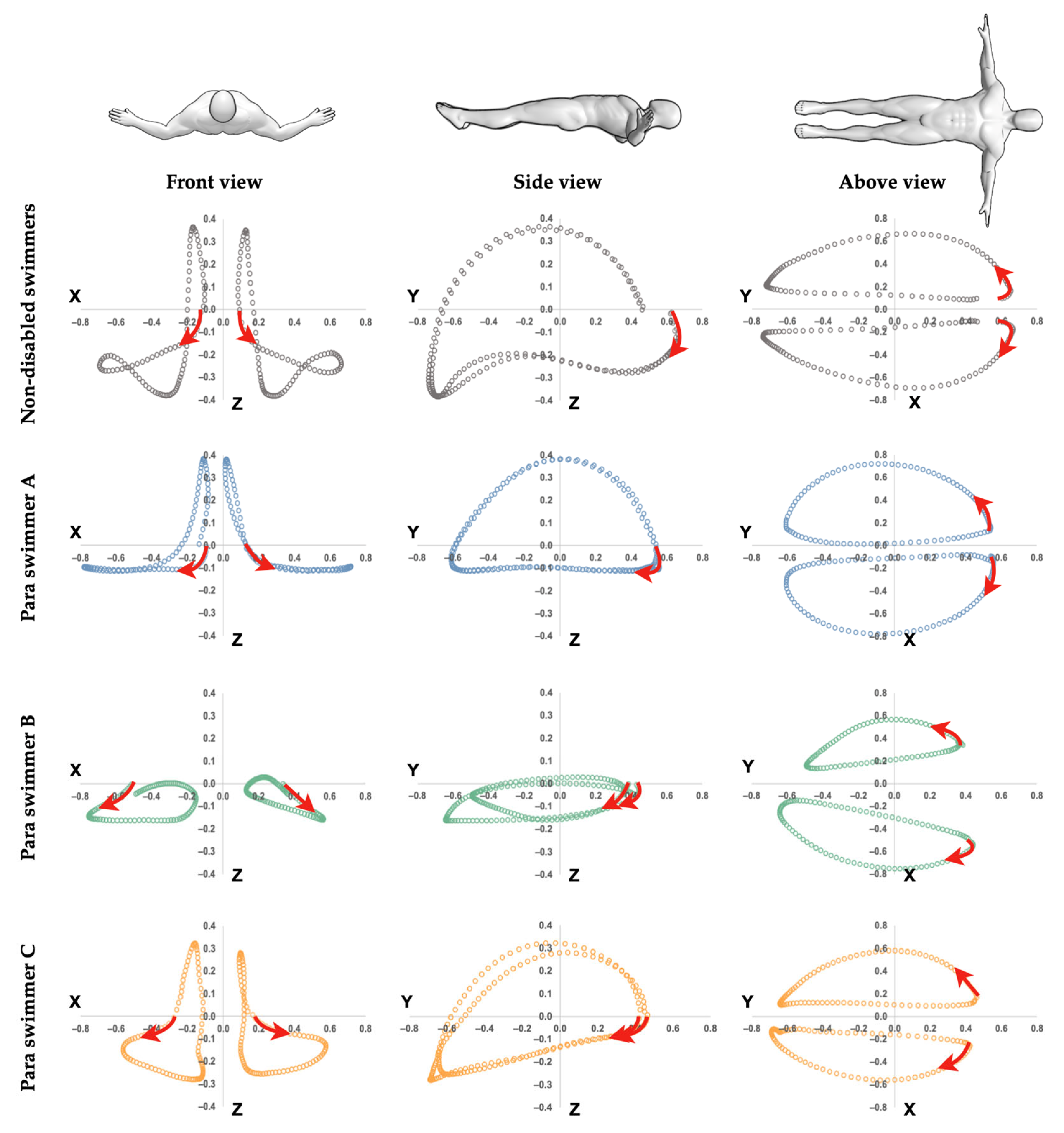
| Hand trajectory depth (m) | 0.71 ± 0.02 | 0.39 ± 0.05 a | 0.24–0.54 | 0.22 ± 0.03 b | 0.17 ± 0.04 b | 0.28 ± 0.03 |
| Hand trajectory width (m) | 0.25 ± 0.05 | 0.66 ± 0.06 a | 0.48–0.84 | 0.67 ± 0.03 | 0.53 ± 0.03 | 0.48 ± 0.04 |
| Hand trajectory length (m) | 1.49 ± 0.04 | 1.42 ± 0.05 a | 1.27–1.57 | 1.15 ± 0.04 b | 1.00 ± 0.11 b | 1.12 ± 0.02 b |
| Hand trajectory slippage (m) | 0.60 ± 0.07 | 0.74 ± 0.09 a | 0.47–1.01 | 0.74 ± 0.04 | 0.68 ± 0.13 | 0.82 ± 0.04 |
| Mean hand speed y—pull (m∙s−1) | −1.40 ± 0.15 | −1.63 ± 0.30 a | −2.53–−0.73 | −1.48 ± 0.15 | −1.39 ± 0.16 | −1.52 ± 0.29 |
| Mean hand speed y—push (m∙s−1) | −1.28 ± 0.10 | −1.37 ± 0.25 | −2.12–−0.62 | −1.05 ± 0.19 | −0.90 ± 0.29 | −1.47 ± 0.12 |
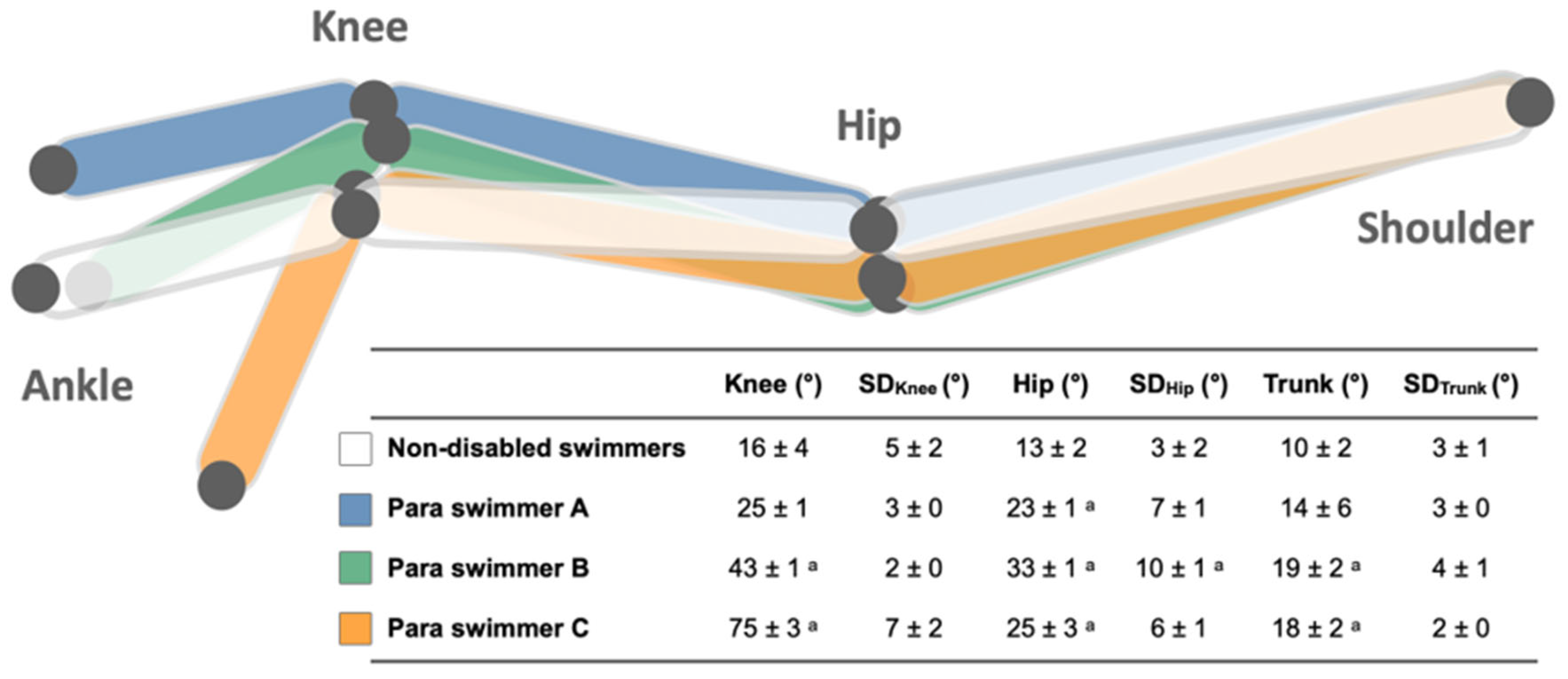
| Mean vertical foot position (m) | 0.24 ± 0.01 | 0.45 ± 0.05 a | 0.30–0.60 | 0.21 ± 0.03 b | 0.42 ± 0.08 | 0.61 ± 0.06 b |
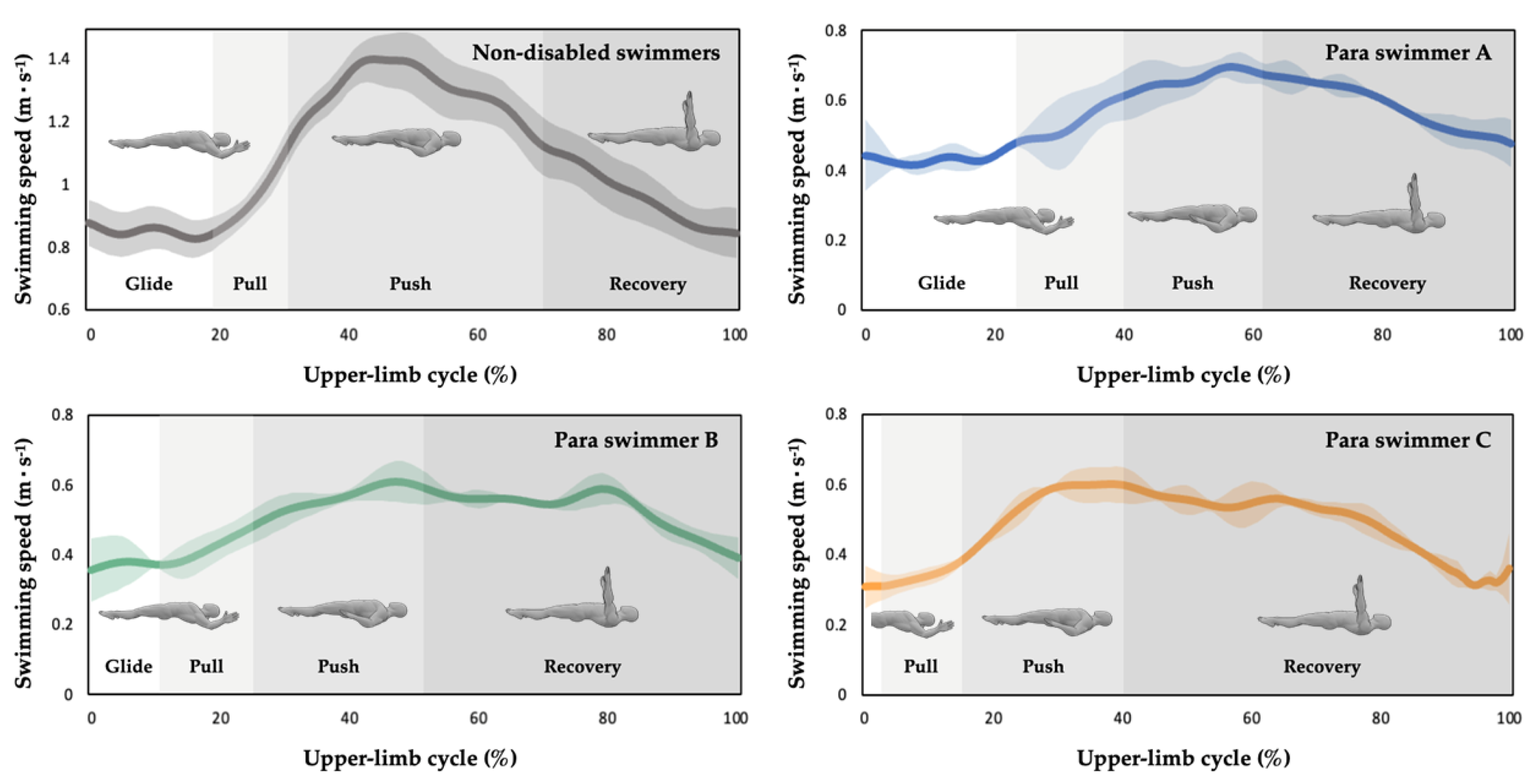
| ICSF% (%) | 21 ± 6 | 62 ± 12 a | 26–98 | 58 ± 3 | 63 ± 6 | 72 ± 10 |
| ICSFCV (%) | 5 ± 2 | 20 ± 3 a | 11–29 | 18 ± 1 | 17 ± 3 | 22 ± 2 |
| Froude efficiency | 0.46 ± 0.04 | 0.33 ± 0.02 a | 0.27–0.39 | 0.17 ± 0.01 b | 0.18 ± 0.00 b | 0.14 ± 0.01 b |
| Non-Disabled Swimmers (n = 8) | 99.7% Confidence Interval | Para Swimmers (n = 3) | |||
|---|---|---|---|---|---|
| A | B | C | |||
| Glide phase (%) | 19 ± 3 | 10–28 | 23 ± 2 | 7 ± 2 a | 2 ± 2 a |
| Pull phase (%) | 11 ± 2 | 5–17 | 17 ± 1 | 16 ± 2 | 16 ± 1 |
| Push phase (%) | 39 ± 3 | 30–48 | 21 ± 6 a | 31 ± 2 | 24 ± 2 a |
| Recovery phase (%) | 31 ± 5 | 16–46 | 39 ± 6 | 46 ± 3 | 58 ± 0 a |
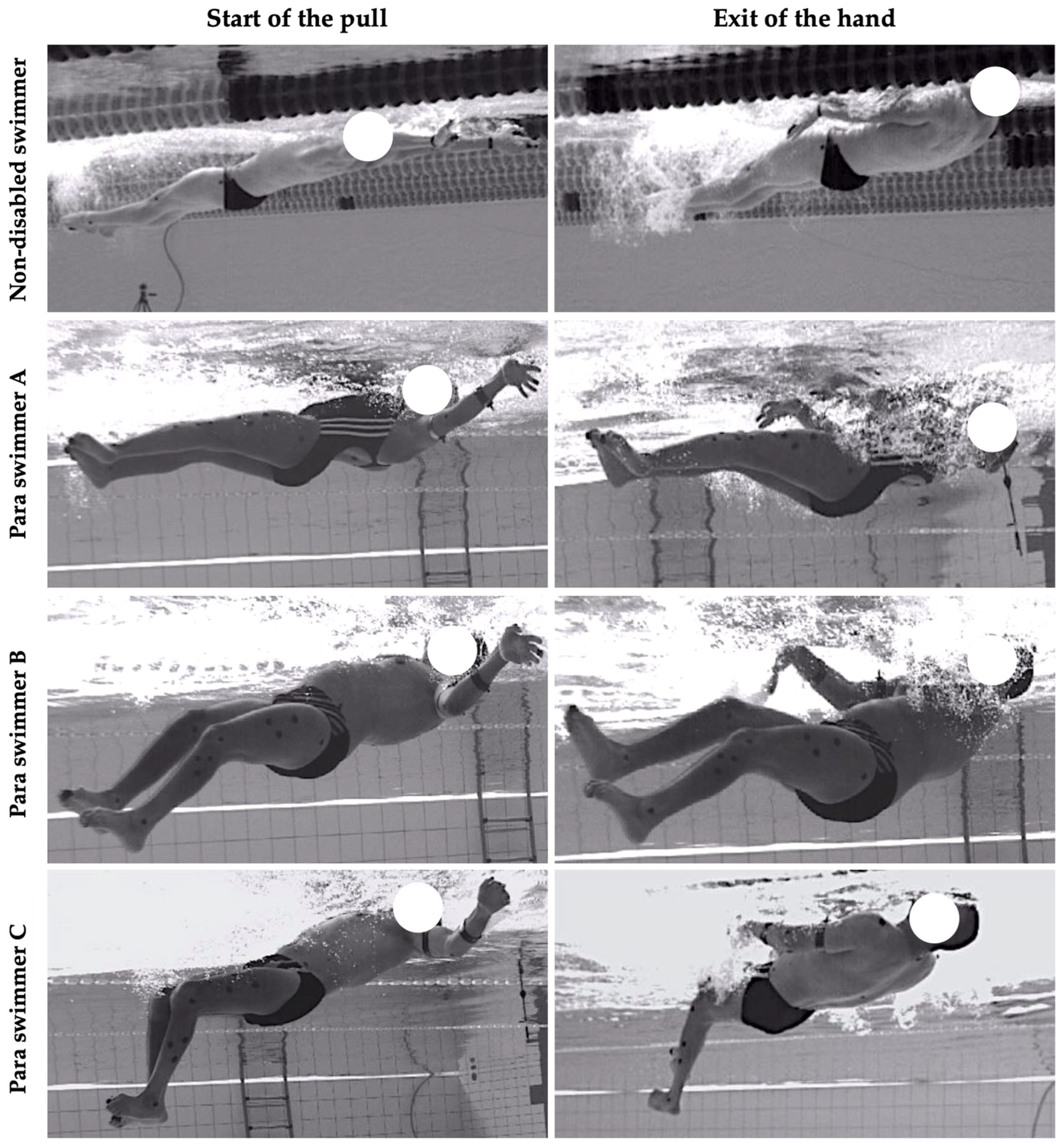
| Elbow flexion angle—hand entry (°) | 168 ± 6 | 150–186 | 135 ± 8 a | 132 ± 14 a | 154 ± 7 |
| Elbow flexion angle—start of push (°) | 120 ± 13 | 81–159 | 149 ± 7 | 123 ± 4 | 146 ± 4 |
| Elbow flexion angle—hand exit (°) | 169 ± 4 | 157–181 | 137 ± 8 a | 138 ± 18 a | 142 ± 3 a |
| Elbow peak angular velocity during push (rad∙s−1) | 6.36 ± 1.26 | 2.58–10.14 | 1.65 ± 0.85 a | 1.81 ± 0.54 a | 1.50 ± 0.40 a |
| Shoulder abduction—hand entry (°) | 166 ± 7 | 145–187 | 144 ± 12 a | 111 ± 13 a | 141 ± 11 a |
| Shoulder abduction—hand exit (°) | 23 ± 3 | 14–32 | 26 ± 4 | 32 ± 4 | 34 ± 9 a |
| Shoulder abduction range of motion (°) | 143 ± 7 | 122–164 | 118 ± 8 a | 79 ± 17 a | 107 ± 11 a |
| Non-Disabled Swimmers (n = 8) | 99.7% Confidence Interval | Para Swimmers (n = 3) | |||
|---|---|---|---|---|---|
| A | B | C | |||
| Hand trajectory depth | 10 ± 8 | −14–34 | 8 ± 6 | 36 ± 22 a | 6 ± 4 |
| Hand trajectory width | 6 ± 5 | −9–21 | 3 ± 3 | 10 ± 8 | 11 ± 11 |
| Hand trajectory length | 1 ± 1 | −2–4 | 2 ± 2 | 20 ± 5 a | 3 ± 1 |
| Hand trajectory slippage | 4 ± 5 | −11–19 | 6 ± 2 | 35 ± 5 a | 9 ± 1 |
| Mean hand speed y–pull | 12 ± 11 | −21–45 | 7 ± 6 | 15 ± 10 | 31 ± 15 |
| Mean hand speed y—push | 18 ± 13 | −21–57 | 25 ± 21 | 56 ± 23 | 10 ± 4 |
| Elbow flexion angle—hand entry | 3 ± 3 | −6–12 | 11 ± 3 | 19 ± 4 a | 5 ± 5 |
| Elbow flexion angle—start of push | 8 ± 4 | −4–20 | 3 ± 3 | 5 ± 4 | 5 ± 0 |
| Elbow flexion angle—hand exit | 5 ± 4 | −7–17 | 7 ± 7 | 23 ± 7 a | 2 ± 1 |
| Elbow peak angular velocity during push | 24 ± 18 | −30–78 | 32 ± 16 | 22 ± 20 | 10 ± 4 |
| Shoulder abduction—hand entry | 3 ± 2 | −3–9 | 12 ± 4 a | 20 ± 6 a | 7 ± 9 |
| Shoulder abduction—hand exit | 26 ± 13 | −13–65 | 27 ± 9 | 23 ± 8 | 48 ± 13 |
| Shoulder abduction range of motion | 5 ± 4 | −7–17 | 8 ± 5 | 38 ± 5 a | 14 ± 2 |
Disclaimer/Publisher’s Note: The statements, opinions and data contained in all publications are solely those of the individual author(s) and contributor(s) and not of MDPI and/or the editor(s). MDPI and/or the editor(s) disclaim responsibility for any injury to people or property resulting from any ideas, methods, instructions or products referred to in the content. |
© 2026 by the authors. Licensee MDPI, Basel, Switzerland. This article is an open access article distributed under the terms and conditions of the Creative Commons Attribution (CC BY) license.
Share and Cite
Lee, Y.-H.; O’Dowd, D.N.; Hogarth, L.; Burkett, B.; Payton, C. Biomechanical Characteristics of Double-Arm Backstroke—A Specialist Freestyle Technique Employed by Severely Impaired Para Swimmers. Appl. Sci. 2026, 16, 5881. https://doi.org/10.3390/app16125881
Lee Y-H, O’Dowd DN, Hogarth L, Burkett B, Payton C. Biomechanical Characteristics of Double-Arm Backstroke—A Specialist Freestyle Technique Employed by Severely Impaired Para Swimmers. Applied Sciences. 2026; 16(12):5881. https://doi.org/10.3390/app16125881
Chicago/Turabian StyleLee, Yu-Hsien, Dawn N. O’Dowd, Luke Hogarth, Brendan Burkett, and Carl Payton. 2026. "Biomechanical Characteristics of Double-Arm Backstroke—A Specialist Freestyle Technique Employed by Severely Impaired Para Swimmers" Applied Sciences 16, no. 12: 5881. https://doi.org/10.3390/app16125881
APA StyleLee, Y.-H., O’Dowd, D. N., Hogarth, L., Burkett, B., & Payton, C. (2026). Biomechanical Characteristics of Double-Arm Backstroke—A Specialist Freestyle Technique Employed by Severely Impaired Para Swimmers. Applied Sciences, 16(12), 5881. https://doi.org/10.3390/app16125881