Article

Biomechanical Characteristics of Double-Arm Backstroke—A Specialist Freestyle Technique Employed by Severely Impaired Para Swimmers

1
Department of Sport and Exercise Sciences, Institute of Sport, Manchester Metropolitan University, Manchester M15 6BH, UK
2
School of Health and Sport Sciences, University of the Sunshine Coast, Sippy Downs, QLD 4556, Australia
*
Author to whom correspondence should be addressed.
Appl. Sci. 2026, 16(12), 5881; https://doi.org/10.3390/app16125881
Submission received: 3 April 2026 / Revised: 2 June 2026 / Accepted: 4 June 2026 / Published: 10 June 2026
(This article belongs to the Special Issue Biomechanics and Fluid Dynamics in Swimming)

Abstract

This exploratory study compares the Froude efficiency (ηF), intra-cyclic speed fluctuation (ICSF) and other performance determinants between two freestyle swimming techniques: double-arm backstroke and front crawl, and then demonstrates how Para swimmers with hypertonia differ from non-disabled swimmers when performing double-arm backstroke. Three-dimensional motion analysis was undertaken on three Para swimmers with hypertonia (sport classes 3–4) and eight non-disabled swimmers performing a simulated double-arm backstroke with lower limbs immobile. The non-disabled group also completed front crawl trials. Swimming speed, stroke frequency, stroke length and ηF were significantly greater, and ICSF significantly lower, during front crawl than during double-arm backstroke in non-disabled swimmers. Para swimmers’ double-arm backstroke speed was 45–52% that of the non-disabled group; their stroke length was 58–69% shorter and stroke frequency 26–53% higher. Non-disabled swimmers demonstrated higher peak elbow extension velocity during the push phase than Para swimmers (6.36 ± 1.26 rad∙s−1 vs. 1.50–1.81 rad∙s−1) and their ηF was approximately double the Para swimmers’ (0.33 ± 0.02 vs. 0.14–0.18). Para swimmers displayed poorer body alignment than the non-disabled group; ICSF did not differ between groups. Double-arm backstroke is slower and less efficient than front crawl. Hypertonia may reduce the efficiency of double-arm backstroke by diminishing propulsive movements and worsening body orientation.

1. Introduction

To participate in World Para Swimming sanctioned competitions, athletes must meet minimum eligibility criteria for the sport and then be classified into an assigned sport class [1]. Para swimmers compete in backstroke, breaststroke, butterfly, freestyle, individual medley and relay events, over varying distances. In freestyle events, swimmers may employ any style, but front crawl is the most common choice as it is generally the fastest and most efficient of the competitive strokes [2]. Front crawl is performed prone with alternating cyclic movements of the lower limbs coordinated with asynchronous movements of the upper limbs. For some Para swimmers with severe impairments, however, a conventional front crawl technique is not viable, possibly due to limitations in strength [3], range of movement [4], motor coordination [5] or lower-limb function [6]. Among swimmers competing in the lower sport (S) classes, an alternative freestyle technique has emerged—double-arm backstroke. This technique is performed supine, with the upper limbs moving in cyclic, synchronous rotations while the lower limbs generally remain passive.
Despite it being unconventional, double-arm backstroke is frequently observed in elite Para swimming competitions. Across recent Paralympic Games and World Championship freestyle events, double-arm backstroke was used by 80% of male S1 100 m finalists at the 2023 World Championships, 50% of male S2 100 m finalists at the 2024 Paralympic Games, and 67% of S1 and 43% of S2 finalists in the 200 m at the 2025 World Championships. Some athletes in the S3 and S4 classes also opt for double-arm backstroke, competing against some opponents who perform more orthodox techniques such as front crawl and backstroke. There is no apparent performance advantage of using double-arm backstroke rather than front crawl, particularly as the technique lacks continuous propulsion due to its simultaneous over-water recovery phase of the upper limbs and, typically, no contribution from the lower limbs. Double-arm backstroke is predominantly used by athletes with central motor and neuromuscular impairments (CMNIs), an umbrella term encompassing health conditions such as cerebral palsy or spinal cord injury that may involve impaired muscle power, hypertonia, ataxia and athetosis [7]. Swimmers with severe CMNIs often struggle to create the body roll required for the breathing action when swimming prone [6,8], and to maintain a stable, streamlined body position in the absence of functional lower limbs [6]. These CMNI activity limitations suggest that the adoption of double-arm backstroke reflects a functional necessity rather than performance optimisation.
The double-arm backstroke technique has not yet been examined to determine the extent to which it disadvantages a swimmer when compared to conventional front crawl and backstroke, whereas previous studies have revealed the challenges experienced by CMNI swimmers when performing front crawl [6,7]. The severity of the CMNI can influence the swimmer’s body shape, body position and their ability to generate propulsion and minimise drag. A study including 24 Para swimmers with hypertonia from sport classes S3 to S10 [9] demonstrated, through tethered force measurement, that these swimmers produce lower propulsive force than swimmers with limb deficiencies, and that their propulsive force decreased with increasing severity of impairment. The relationship between propulsive force and maximal freestyle speed was significant for swimmers with hypertonia, but not as strong as for swimmers with limb deficiency, indicating that drag may be a more important determinant of performance than propulsion for swimmers with hypertonia; recent studies into the passive and active drag created by Para swimmers support this. When assessed in their most streamlined position, the normalised passive drag of 26 swimmers with a motor impairment (hypertonia, ataxia, athetosis; S3–S10) was found to correlate highly with 100 m freestyle race speed [10]. This drag–performance relationship has also been shown to exist under dynamic swimming conditions [7]. The normalised active drag of 36 swimmers with CMNIs (hypertonia, athetosis, impaired muscle power; S1–S9) during freestyle swimming showed a moderate negative association (r = −0.50, p < 0.01) with maximal swimming speed. In contrast, in the same study, swimmers with predominantly a limb deficiency impairment showed the reverse trend, with normalised active drag having a moderate, positive correlation with swimming performance, thus slower swimmers with limb deficiency created lower drag than the faster ones. These studies collectively show that the effect of central motor and neuromuscular impairments on propulsion and drag is markedly different to the effect of anthropometric impairments on these two performance determinants. There is a paucity of research examining the reasons for this difference, hence studies that examine how physical impairment affects swimmers’ body orientations and movement patterns in the water are required to address this. Hypertonia in particular is highly heterogeneous [11] and may include postural deformity, joint contractures [12] and altered muscle tone such as floppiness of the neck and trunk [13]. Swimmers with hypertonia can also display excessive lumbar lordosis and restricted shoulder flexion. These characteristics may disrupt streamlined body position [14] and restrict limb movements conducive to effective propulsion generation.
In non-disabled swimming, faster front crawl performance is associated with greater stroke length [15], higher Froude efficiency (ηF) [16], and lower intra-cyclic speed fluctuation (ICSF) [17,18]. Both ηF and ICSF are widely accepted indicators of swimming efficiency, with ICSF reflecting the positive and negative accelerations of the swimmer and ηF indicating what fraction of a swimmer’s mechanical power is utilised to overcome hydrodynamic resistance [19]. Para swimmers can and do employ backstroke in freestyle events, despite it being slower and more energy costly than front crawl due to its lower ηF [20] and greater active drag [21]. It seems likely that double-arm backstroke would be even slower and less efficient than backstroke due to the absence of body roll and non-continuous propulsion.
To date, research in Para swimming has focused almost exclusively on front crawl technique, e.g., [6,7,9,22,23] and no study has analysed in detail any of the non-conventional freestyle techniques used by swimmers in the lower sport classes. The aims of this exploratory study are twofold: (i) to compare selected upper- and lower-limb kinematic variables, ICSF and ηF between front crawl and double-arm backstroke in non-disabled swimmers, and (ii) to determine how double-arm backstroke performed by Para swimmers with hypertonia differs from that performed by non-disabled swimmers. It is hypothesised that (i) non-disabled swimmers perform double-arm backstroke with greater ICSF and lower ηF than in front crawl, and this is attributable to differences in upper- and lower-limb kinematics between the two techniques; and (ii) Para swimmers with hypertonia present different upper- and lower-limb kinematics to non-disabled swimmers in double-arm backstroke, and these differences lead to a higher ICSF and lower ηF.

2. Materials and Methods

2.1. Participants

Three nationally classified Para swimmers with hypertonia and eight highly trained non-disabled swimmers (100 m freestyle FINA points: 833 ± 65) participated in the study (Table 1). Due to the small sample size, this study is largely exploratory and the preliminary results are intended to provide some descriptive insights and direction for future large-scale studies into this under-researched area. The results should not be considered generalizable to a broader population. Inclusion of highly trained non-disabled swimmers is essential as they provide the reference norms necessary to establish the impact of physical impairment on determinants of performance—a fundamental requirement of evidence-based classification in Para sport. Ethics approval was obtained from the lead author’s institute and written informed consent was provided by all participants.

2.2. Data Capture and Processing

Data collection was conducted across two sites using 25 m indoor pools with depths of 1.8–2.0 m. Following a self-selected warmup, 25 m trials of front crawl and double-arm backstroke were performed by the non-disabled swimmers and 25 m of double-arm backstroke was performed by the Para swimmers, from a push start. Participants typically completed two trials at 100–200 m race pace and were given at least three minutes rest between trials. The non-disabled group were allowed practice trials to familiarise themselves with the technique and instructed not to use their lower limbs. Test trials were repeated if this condition was not met.
Trials were captured using four underwater full HD Ethernet cameras (Mako G-223B, Allied Vision Technologies GmbH, Stadtroda, Germany) in waterproof housings (Nautilus IP68, Autovimation GmbH, Rheinstetten, Germany) on tripods. Video data were saved on a PC hard drive using Gecko GigE video recording software (v1.9.4, Vision Experts Ltd., Epsom, UK). Additionally, above water trials were recorded by four full HD Ethernet cameras or full HD camcorders (Sony HDR-CX700, Sony Corporation, Tokyo, Japan). A calibrated performance volume [1.50 m (x) × 3.75–6.00 m (y) × 1.80 m (z)] and global right-handed Cartesian coordinate system (x—right lateral; y—swimming direction; z—vertical) was established using a floating frame with 108 control points [6,23].
Seventeen anatomical landmarks were marked on the swimmer to facilitate digitisation [24]: head; right and left acromion (shoulder); medial and lateral epicondyles of the humerus (elbow); styloid processes of the radius and ulna (wrist); right and left middle finger tip; right and left greater trochanter (hip); right and left lateral femoral condyle (knee); right and left lateral malleolus (ankle); and right and left foot tip. SIMI Motion v9.2.2 software (SIMI Reality Motion Systems GmbH, Unterschleißheim, Germany) was used to digitise the landmarks at 50 Hz and create a 14-segment swimmer model. Real-world three-dimensional coordinates were then computed via the direct linear transformation (DLT) algorithm [25] and smoothed using a 2nd order Butterworth low-pass filter with a 6 Hz cut-off [6,23]. Whole-body centre of mass location was estimated from the segmental inertia data of de Leva [26].

2.3. Data Analysis and Definition of Variables

An upper-limb cycle was defined as the period between the entry of one hand into the water and the subsequent entry of the same hand. The upper-limb cycle was divided into four phases for both sides [27]: (i) glide: from wrist entry into the water to first backward movement of the wrist (y-axis) relative to the global reference system (ii) pull: from end of glide to the wrist becoming aligned with the glenohumeral joint in the y-direction, (iii) push: from end of pull to last backward movement of the wrist (y-axis) relative to the global reference system, and (iv) recovery: from end of push to wrist re-entry into the water. Each phase duration was expressed as a percentage of the upper-limb cycle time. One complete cycle was analysed for non-disabled swimmers, and three complete cycles were analysed for Para swimmers.
The following variables were calculated for both front crawl and double-arm backstroke: (i) mean swimming speed (vMEAN): mean speed of whole-body mass centre in y-direction, (ii) stroke frequency: reciprocal of upper-limb cycle time multiplied by 60, (iii) stroke length: displacement of centre of mass in y-direction during upper-limb cycle, (iv) relative intra-cyclic speed fluctuation (ICSF%): [(vMAXvMIN)/vMEAN] × 100 where vMAX and vMIN represents the maximum and minimum instantaneous speed within the upper-limb cycle, respectively, (v) coefficient of variation of intra-cyclic speed fluctuation (ICSFCV): vSD/vMEAN × 100 where vSD is the standard deviation of the vMEAN, and (vi) Froude efficiency (ηF): vMEAN/(vWRIST_SUM) where vWRIST_SUM is the mean 3D speed of both wrists during their respective underwater phases in the cycle [28].
Right- and left-limb kinematic data were averaged to allow comparison between front crawl and double-arm backstroke. For the non-disabled group, all dependent variables are reported as mean values. For each Para swimmer, all dependent variables are reported as mean values for three upper-limb cycles. Hand trajectories during the upper-limb cycle were calculated as the displacement of the hand mass centre relative to the whole-body centre of mass in all three spatial dimensions. Underwater hand trajectories were quantified by: width (m)—displacement of the hand from most lateral to most medial location relative to the global reference system; depth (m)—maximal negative vertical displacement of the hand relative to the water surface level; length (m) superior–inferior displacement of the hand relative to local reference system fixed at the swimmer mass centre; and slippage (m)—y-axis displacement of the hand relative to global reference system between start of pull and end of push. Mean hand speed (m∙s−1) during pull and push phases were calculated in the y directions relative to the global reference system. Mean vertical foot position (m)—mean vertical displacement of the foot relative to water surface level.
Double-arm backstroke specific upper-limb kinematics and body-position variables were also calculated: elbow flexion angle (°)—angle between the shoulder–elbow and elbow–wrist vectors, recorded at hand entry, start of push, and hand exit; peak elbow extension angular velocity (rad·s−1)—maximum elbow extension velocity during the push phase; shoulder abduction angle (°)—angle between elbow–shoulder and shoulder–hip vectors, recorded at hand entry and hand exit; shoulder abduction range of motion (°)—difference between shoulder abduction angles at hand entry and hand exit. Symmetry index (%) was used to assess the differences between right and left side, defined as: [(VARIABLERIGHTVARIABLELEFT)/0.5 × (|VARIABLERIGHT| + |VARIABLELEFT|)] × 100, where 0% indicates full symmetry and 100% indicates full asymmetry [29]. Values are negative when VARIABLERIGHT < VARIABLELEFT. As such, the absolute values of the index were reported in the current study. To quantify body alignment, the following angles were each averaged over an upper-limb cycle: trunk angle (°)—angle of the mid-shoulder to mid-hip vector relative to the horizontal (xy) plane [30]; Hip flexion angle (°)—angle between shoulder–hip and hip–knee vectors; knee flexion angle (°)—angle between hip–knee and knee–ankle vectors; Alignment score (°)—sum of the trunk, hip flexion and knee flexion angles.

2.4. Statistical Analysis

Means and standard deviations (σ) for the non-disabled group are presented while individual data are reported for the Para swimmers. Paired sample t-tests were performed to compare the upper- and lower-limb kinematic variables, ICSF and ηF between front crawl and double-arm backstroke in non-disabled swimmers. Data were analysed using IBM SPSS Statistics 28 and statistical significance was set at p < 0.05. To compare individual Para swimmer variables to those of the non-disabled group in double-arm backstroke, the three-sigma rule was used to present the bounds within three standard deviations from the variable mean of the non-disabled group [31]. When a Para swimmer’s score fell outside this 99.7% confidence interval it was deemed to be different from that of the non-disabled swimmers. The three-sigma rule is considered as a tool to guide our description of the data, not as an inferential statistic.

3. Results

3.1. Front Crawl Versus Double-Arm Backstroke in Non-Disabled Swimmers

Non-disabled swimmers’ front crawl was on average 38% faster (p < 0.001, Table 2) than their double-arm backstroke due to a 20% higher stroke frequency (p = 0.001) and a 29% (0.58 m) longer stroke length (p < 0.001). Front crawl involved a significantly deeper hand path, longer superior–inferior directed underwater hand trajectory, less slippage, and a higher foot position, than double-arm backstroke (p < 0.01). Superior–inferior hand speeds were similar between the two techniques during the propulsive phases, other than during the pull phase where the front-crawl hand speed was lower than that of double-arm backstroke (p = 0.01). Both intra-cyclic speed metrics, ICSF% and ICSFCV, were 3–4 times greater in double-arm backstroke than in front crawl, whereas ηF was 28% lower in double-arm backstroke (p < 0.001, Table 2).

3.2. Non-Disabled Swimmers Versus Para Swimmers Performing Double-Arm Backstroke

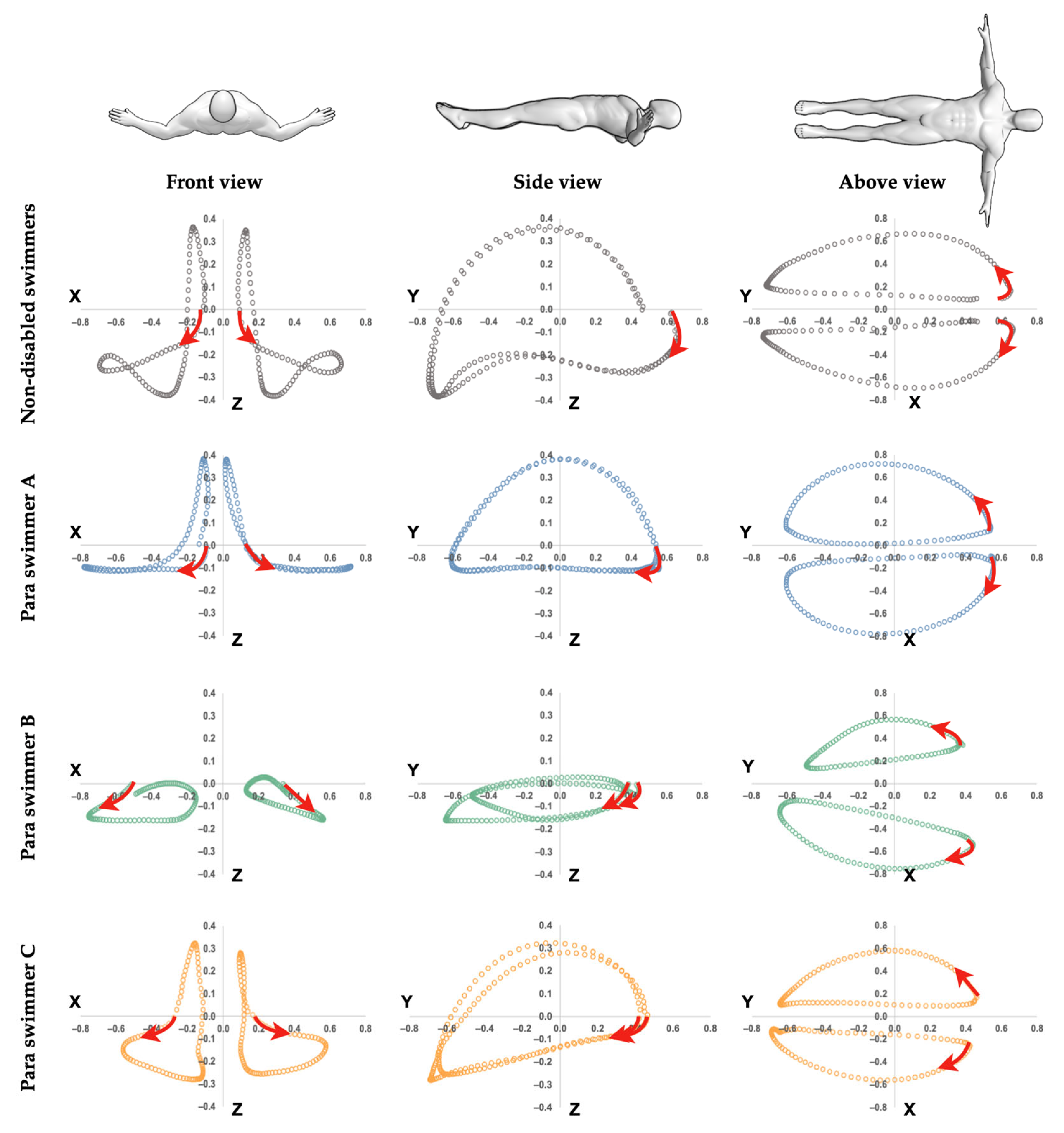
Para swimmers’ double-arm backstroke swimming speed was 45–52% that of the non-disabled group; their stroke length was 59–69% shorter while stroke frequency was 26–53% higher (Table 2). While non-disabled swimmers spent ~31% of the cycle recovering over the water and ~69% of the cycle in the water, Para swimmers’ upper limbs spent 39–58% of their cycle above the water and 42–61% in the water (Table 3). Two Para swimmers used hand trajectories that were shallower, and all three had hand trajectories that were shorter (26–42 cm) in the superior–inferior direction than the non-disabled swimmers. Hand trajectory width and slippage were similar between groups. Orthogonal views of hand trajectories, relative to the swimmer’s body, are presented in Figure 1. The Para swimmers displayed quite different hand paths to the non-disabled swimmers. Para swimmer A’s hands remained in a horizontal plane throughout the propulsive phases; Para swimmer B recovered his hands in a relatively low trajectory over the water; Para swimmers B and C commenced the cycle (water entry) with a notably greater distance between their hands than the other swimmers.
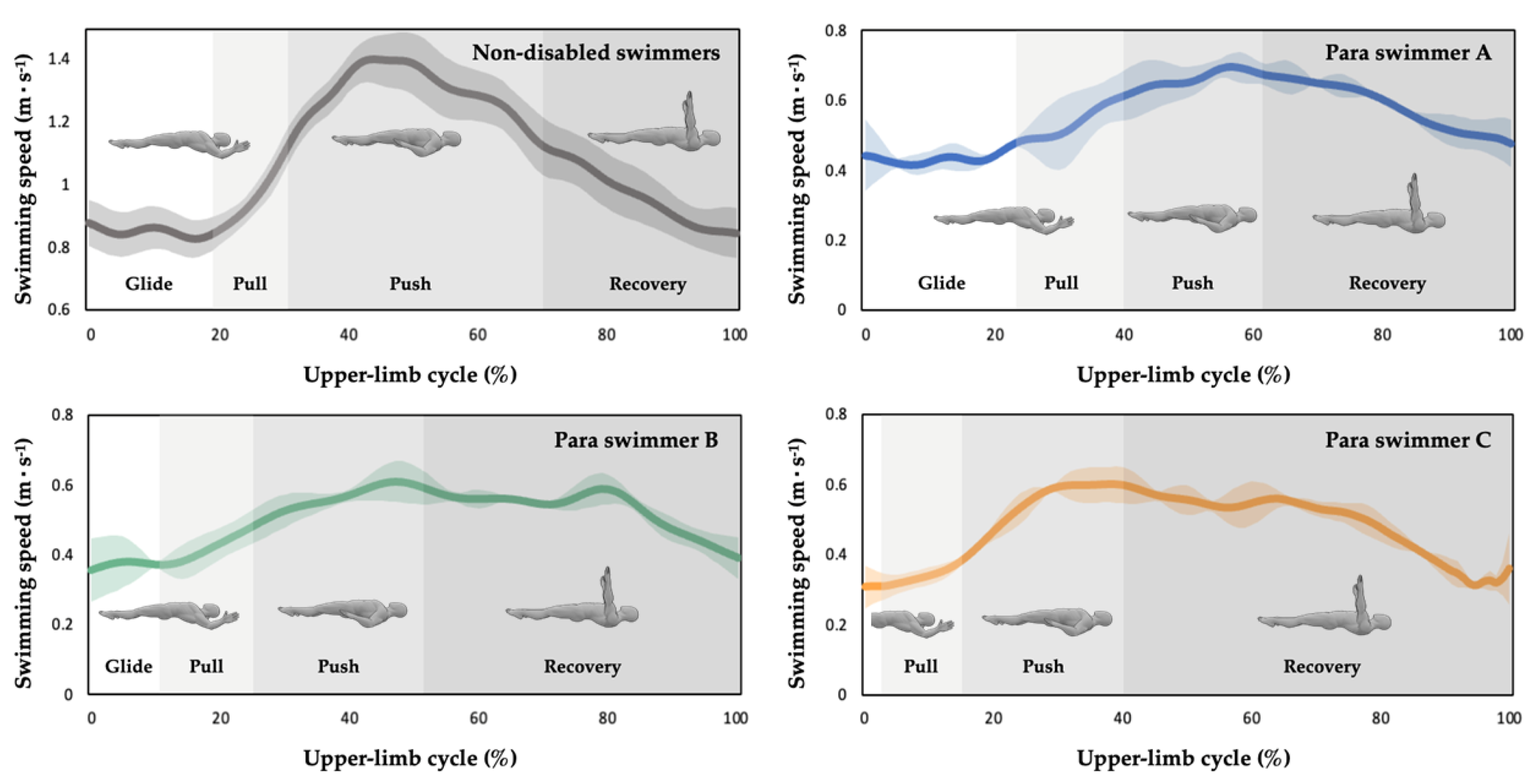
ICSF% and ICSFCV in double-arm backstroke were similar across the Para and non-disabled swimmers, but the swimming speed curves demonstrated that differences existed in the profiles (Figure 2). Non-disabled swimmers typically reached maximum speed at 45–50% of the cycle, corresponding to the middle of the push phase, whereas Para swimmers exhibited multiple small peaks, reaching maximum speed at 31% (swimmer C mid-push), 46% (swimmer B end of push), and 56% (swimmer A mid-push), of the cycle. The three Para swimmers had an ηF 33–48% lower than the mean value for the non-disabled swimmers.
Para swimmers started the upper-limb cycle with their elbows 14–36° more flexed than the non-disabled group, and at hand exit their elbows were ~30° less extended. Non-disabled swimmers’ mean peak elbow extension angular velocity during the push was higher than that of the Para swimmers by a factor of 3.5 to 4.2. Para swimmers exhibited a range of shoulder adduction 25–64° lower than the non-disabled group when performing the underwater phases, due to less shoulder abduction at hand entry, greater abduction at hand exit, or both. Individual swimmer data for each upper-limb cycle for the variables in Table 2 and Table 3 can be found in Supplementary Materials Tables S1 and S2.
Table 4 presents symmetry indices for each upper-limb kinematic variable, with lower values denoting greater bilateral symmetry. The non-disabled swimmers had mean symmetry indices ranging from 1 to 26%; the corresponding range for Para swimmers was 2–56%. With one exception, symmetry scores of Para swimmers A and C were all within the 99.7% CI of the non-disabled group mean score. In contrast, Para swimmer B exhibited greater bilateral asymmetry than the non-disabled group in over half of the upper-limb variables. In 9 of the 13 variables, his symmetry index was 20% or higher, with the largest symmetry index (56%) being for his hand speed in the push phase. Left- and right-side upper-limb data for each swimmer and for each upper-limb cycle can be found in Supplementary Materials Table S3.
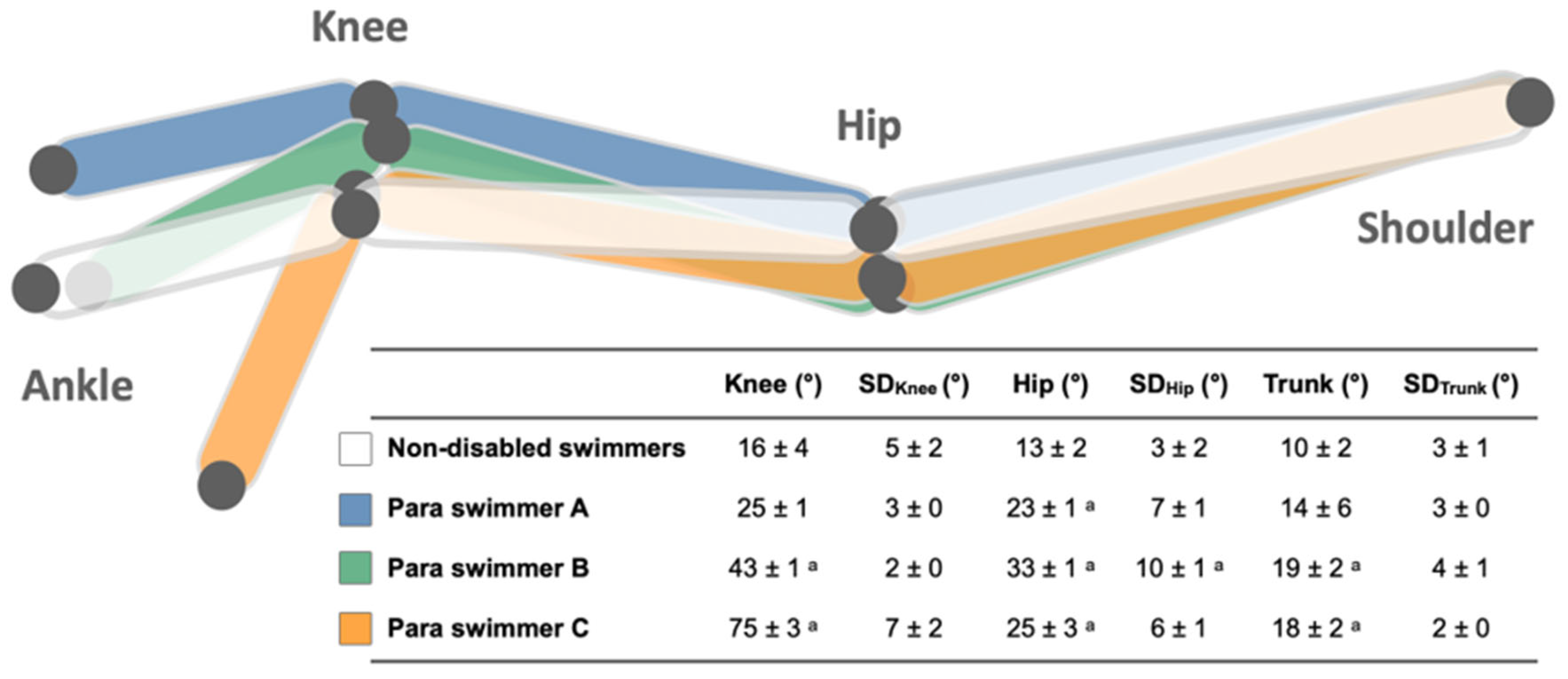
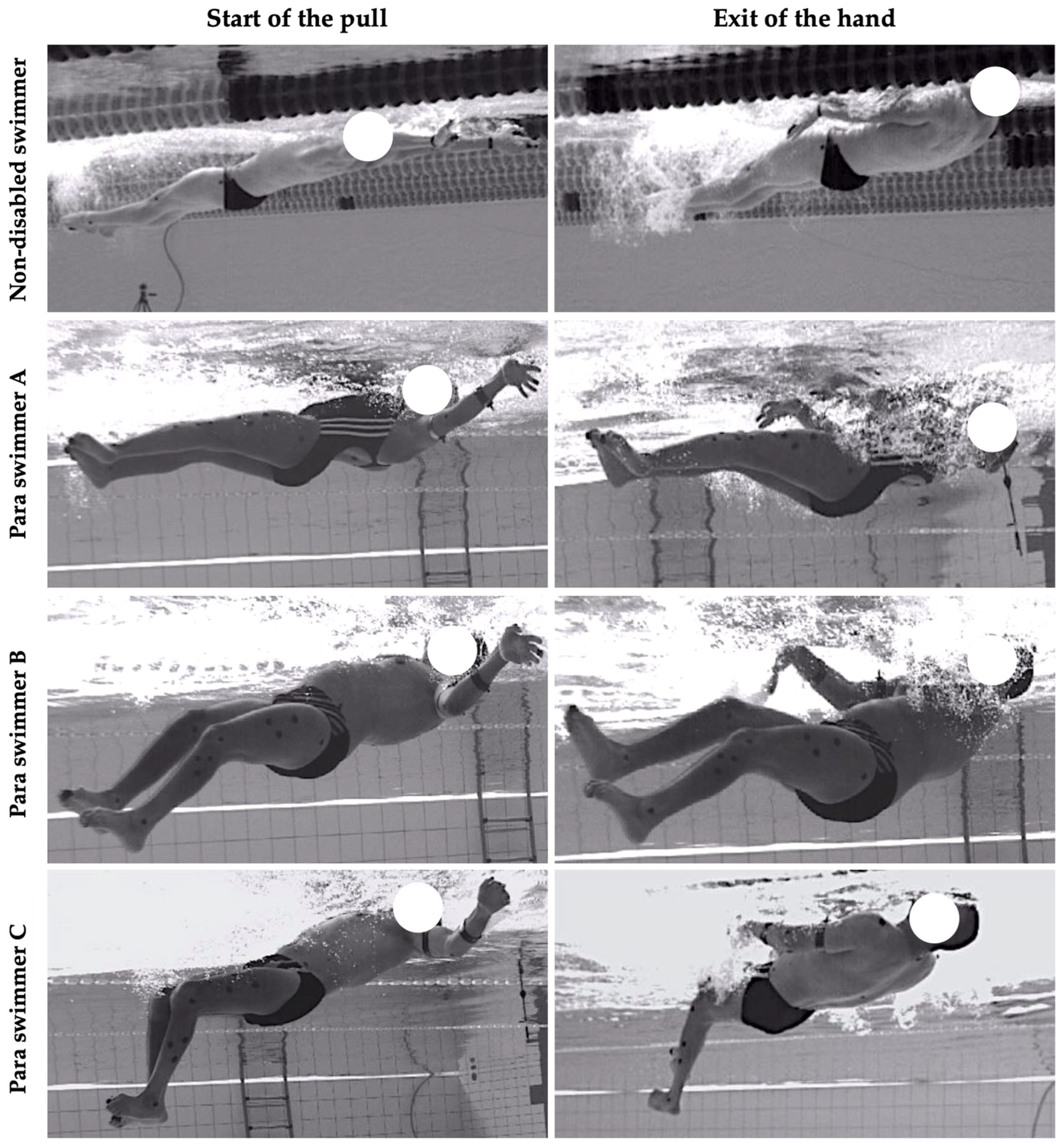
The trunk and lower limbs of the non-disabled swimmers were more horizontally aligned during double-arm backstroke than were those of the Para swimmers. Para swimmers’ knees and hips were more flexed throughout the cycle, and two of them (B and C) had trunk inclination angles almost double that of the non-disabled group mean value (Figure 3 and Figure 4). Alignment scores (sum of the trunk, hip and knee angles) of 62 ± 8°, 95 ± 1° and 118 ± 4° for Para swimmers A, B and C, respectively, were substantially higher than the mean alignment score of 39 ± 7° recorded for the non-disabled swimmers. Body segment orientation and lower-limb flexion angles for each swimmer and for each upper-limb cycle can be found in Supplementary Materials Table S4.

4. Discussion

The aim of this study was to first compare the upper- and lower-limb kinematics, ICSF and ηF between front crawl and double-arm backstroke in non-disabled swimmers and to then determine the impact of hypertonia on double-arm backstroke technique. Double-arm backstroke had significantly lower ηF and significantly higher ICSF than front crawl due to factors including reduced stroke length, lower vertical foot position and non-continuous propulsion from the upper limbs. The first hypothesis was therefore accepted. In double-arm backstroke, Para swimmers exhibited similar ICSF but lower ηF than non-disabled swimmers. The two groups displayed different upper-limb kinematics, trunk positions, and lower-limb orientations that may be explained by the effect of hypertonia. The second hypothesis was therefore partially accepted.

4.1. Front Crawl Versus Double-Arm Backstroke in Non-Disabled Swimmers

Froude efficiencies of the non-disabled group during front crawl were comparable to, or higher than, those reported previously for high-level swimmers [15,19,20,28,32] and the ICSF values were generally lower [19,28,32,33,34]. This may relate to the very high standard of the non-disabled cohort which included two Olympic champions. It is unsurprising that front crawl is faster and more efficient than double-arm backstroke given their fundamentally different mechanical characteristics, particularly the use of alternating, asynchronous upper-limb movements in the former versus simultaneous, symmetrical upper-limb actions in the latter. This study is the first to quantify the performance disadvantage of double-arm backstroke technique compared to conventional front crawl and to identify the key biomechanical determinants responsible for this performance decrement.
The absence of body rotation about the longitudinal axis limited the vertical and superior–inferior underwater displacement of the hand in double-arm backstroke, leading to shallower, shorter and more laterally directed hand movements than in the front crawl. The greater hand slippage and reduced stroke length observed in the double-arm backstroke, compared to front crawl, may be associated with these non-optimal hand trajectories but will also be related to the poorer body alignment seen in this technique. The lower limbs of the non-disabled swimmers were less horizontally aligned in double-arm backstroke than in front crawl, as evidenced by a ~88% deeper mean foot position. This would create a larger projected frontal area and a greater active drag coefficient compared to front crawl [10,35].
ICSF reflects the imbalance in the propulsive and resistive drag forces during the upper-limb cycle. In double-arm backstroke, over 30% of the cycle (the recovery phase) was entirely non-propulsive. This caused the decline in swimming speed, that began in the second half of the push phase, to be extended. In contrast, front crawl has relatively continuous propulsion throughout the cycle [36], such that the propulsion and resistive drag are better balanced than in double-arm backstroke. This is evidenced by the significantly lower ICSF observed during front crawl. ηF in this study is estimated from the ratio of the swimmer’s forward speed to the speed of their hands during their underwater phase. As ηF increases with decreasing swimming speed [20], if front crawl had been performed at the same speed as the double-arm backstroke it would likely have produced ηF values even higher than those reported. However, such a comparison would be of limited value given the mechanical differences between the two techniques. The superior swimming speed and ηF in the participants’ front crawl reflects the technique’s more streamlined body position, greater continuity of propulsion and more propulsive limb movements, relative to double-arm backstroke.

4.2. Non-Disabled Swimmers Versus Para Swimmers Performing Double-Arm Backstroke

Excessive backward slippage of the hand whilst generating propulsion in swimming is undesirable as it will compromise a swimmer’s stroke length. Para swimmers’ hands slipped approximately 64–73% the length of their hand trajectory compared to ~52% for the non-disabled group. Several upper-limb deformities associated with hypertonia, such as thumb-in-palm, swan neck, and finger/wrist flexor deformity [37], were observed in our Para swimmers. These are likely to reduce the effectiveness of the hand in generating propulsion and limit the stroke length achievable by the swimmers. A stabilised wrist is necessary to transmit the force from the hand to the body in the water [38]; the poor wrist fixation and non-optimal finger positions observed in our Para swimmers would therefore reduce hydrodynamic forces on the hand and allow it to slip more readily through the water than a hand with fingers held together and a stable wrist.
The reduced elbow and shoulder range of motion evident in the Para swimmers may also have contributed to the shorter hand trajectories observed, thereby limiting potential stroke length. These limitations are likely associated with impaired muscle strength [39], shortened muscle position [40], and impairments in neuromuscular control. The increased resistance to movement associated with hypertonia reflects both neural and non-neural mechanisms, including spasticity, impaired selective motor control, excessive co-contraction, and passive muscle stiffness associated with altered muscle properties [41]. In individuals with hypertonia, disruption of agonist–antagonist muscle coordination results in excessive co-contraction that elevates joint stiffness and restricts range of motion. This neuromuscular stiffness is both velocity- and task-dependent, meaning that rapid, multi-planar upper-limb movements required during swimming may elicit disproportionately large co-contraction. As spasticity commonly effects the shoulder external rotators, elbow, and wrist flexors, finger flexors, and elbow pronators [42], it may have contributed to the difficulty the Para swimmers experienced in pulling their hands deep in the water and fully extending the upper limbs during hand entry and exit. The substantially reduced elbow peak angular velocities during the push phase observed in our Para swimmers are consistent with the elevated joint stiffness and excessive co-contraction associated with hypertonia.
Double-arm backstroke swimmers typically do not have an active leg kick to help them counteract any tendency of the hips and lower limbs to sink during the cycle. Their horizontal alignment is influenced by two mechanisms: the torque created by the buoyant force about their transverse axis—buoyant torque—and the torque created by hydrodynamic forces about the transverse axis—hydrodynamic torque [43]. Gonjo et al. demonstrated that in non-disabled backstroke, the buoyant torque generally acts to raise the lower limbs, rather than sinking them [43]; however, this may not be the case in double-arm backstroke, as buoyant torque tends to sink the lower limbs when both arms are held by the side and when positioned above the head, whilst submerged [44]. Thus, the poor lower-body alignment of the Para swimmers may reflect an inability to generate a sufficient leg-raising hydrodynamic torque, predominantly through actions of their upper limbs, to counteract the leg-sinking buoyant torque. It is conjectured that morphological differences between the Para and non-disabled swimmers, particularly in body composition and fat distribution, may also contribute to the observed differences in body orientation. Para swimmers had higher alignment scores and therefore poorer streamlining than the non-disabled group due to the combination of a more inclined trunk and greater knee flexion. Para swimmer’s atypical body positions may be attributed to trunk instability [45], poor trunk control [46], and myostatic contractures of the hip and knee [47], which impair the ability to extend and raise the joints. The trunk plays a fundamental role in motor control, and loss of this function may lead to abnormal body posture [48], reduced head support due to impaired neck-muscle function [49], and atypical limb movements that compensate for imbalanced trunk [50]. Additionally, Para swimmers exhibited far less downward hand motion during the push phase than non-disabled swimmers, limiting the upward hydrodynamic force available to help raise their lower limbs. Together, these factors (inclined trunk, flexed knees, and reduced vertical hand motion) will create a higher drag profile [10,36] than the more horizontally aligned body position maintained by the non-disabled swimmers.
Although the shape of the swimming speed curve differed markedly between Para and non-disabled swimmers, neither intra-cyclic speed measure (ICSF%, ICSFCV) distinguished between the groups, illustrating that these metrics do not capture where in the cycle speed fluctuations occur. Non-disabled swimmers produced a single speed peak per upper-limb cycle; as they maintained a relatively stable body position, their speed fluctuations will primarily reflect changes in the propulsive force. Conversely, Para swimmers exhibited multiple speed peaks; their body segment angles changed frequently throughout the cycle causing the balance between propulsion and drag to shift continuously and more instances of acceleration and deceleration to occur. These fluctuations likely reflect impairments in intersegmental coordination commonly observed in individuals with motor control impairments [51]. These impairments are exacerbated in hypertonia by deficits in motor planning and movement organisation [51], a process that may be further compromised in the aquatic environment due to the varying hydrodynamic forces acting on the limbs. Increased joint stiffness and excessive agonist–antagonist co-contraction may also have reduced the ability of the Para swimmers to coordinate smooth transitions between movement phases, contributing to a less continuous speed profile throughout the stroke cycle [41,51]. Furthermore, the velocity-dependent hyperactive stretch reflex, characteristic of spasticity, may further contribute to the multiple small speed peaks through increased tendon jerks, occasional clonus and other signs of upper motor neuron lesion [12].
The higher ηF of the non-disabled group is attributable to them having faster swimming speeds than the Para swimmers whilst using similar three-dimensional hand speeds. The non-disabled swimmers translated their hand speeds into greater net propulsion, benefitting from the combined advantages of a more effective propelling surface; full range of motion; and a stabilised, streamlined body position. The relatively poor ηF of Para swimmers may be linked to impaired range of motion, reduced muscle strength, trunk instability, a compromised propelling surface, and shortened stroke length. Biomechanical studies concerning the effect of physical impairment on determinants of swimming performance are becoming more prevalent. However, to date, these have focused almost exclusively on the front crawl stroke. This is the first study to provide a comprehensive analysis of an alternative ‘freestyle’ stroke used by Para swimmers with relatively severe impairment, the double-arm backstroke.
The limitations of this study are as follows: (i) only three national-level Para swimmers participated, necessitating a case-study approach which limits the statistical power and generalisability of the findings. Double-arm backstroke is the preferred freestyle technique for relatively few Para swimmers globally; accessibility and availability of these athletes for research is very limited. (ii) Use of the high-threshold three-sigma rule to compare Para swimmers to the non-disabled group increases the risk of Type II errors occurring. (iii) The non-disabled swimmers were recruited to provide reference norms for the determinants of performance in double-arm backstroke. They were not matched with the Para swimmers on training status or anthropometric characteristics. Some of the observed differences between groups will therefore be due to factors unrelated to hypertonia. (iv) Non-disabled swimmers were less well-practiced in the double-arm backstroke than the Para swimmers were thus their kinematic characteristics and Froude efficiencies may not fully reflect what would have been observed with more extensive practice. (v) Front crawl trials were not assessed for the Para swimmers to compare to their competition freestyle technique—double-arm backstroke. This was due to their lack of experience in front crawl and health and safety considerations. (vi) Kinematic data for the non-disabled group were only obtained from one upper-limb cycle due to the dimensions of the calibrated volume and the high speed of the swimmers. Temporal analysis of the cycle(s) performed before and after the calibrated volume confirmed that the time of the cycle analysed did not differ markedly from those that preceded or followed it, indicating that the cycle analysed was not atypical of others performed in the trial. Finally, (vii) left and right upper-limb kinematics were presented as mean values for conciseness, but symmetry indices have been reported for both groups.
This study has evaluated some key performance determinants of double-arm backstroke swimming and generated new knowledge that may be informative for Para swimming coaches and classifiers. It also highlights the need for further larger-scale research on this freestyle technique and Para swimmers with hypertonia and other central motor and neuromuscular conditions. In particular, studies are required to establish the impact of hand position, wrist control and upper-limb range of motion on propulsion generation, and to determine the relationship between body orientation, active drag and performance.

5. Conclusions

This exploratory study demonstrates that double-arm backstroke is a significantly slower and less efficient freestyle swimming technique than front crawl, when performed without impairment, characterised by greater intra-cyclic speed fluctuation and lower Froude efficiency. Our preliminary data show that Para swimmers with hypertonia are able to perform double-arm backstroke using comparable hand speeds to non-disabled swimmers, but the condition may hinder their ability to maintain a streamlined body position, stabilise the hand and wrist, and access full shoulder and elbow range of motion. These observed deficiencies reduced stroke length, swimming speed and Froude efficiency compared to non-disabled swimmers. Due to their activity limitations, our swimmers with hypertonia compete in freestyle events using a technique that appears to be mechanically inferior to front crawl by necessity, not by choice. Further work is required to build on this exploratory study and establish whether the current classification system sufficiently accounts for the potential performance disadvantage of using double-arm backstroke in freestyle events.

Supplementary Materials

The following supporting information can be downloaded at: https://www.mdpi.com/article/10.3390/app16125881/s1, Table S1: Individual cycle and swimmer data for variables in Table 2, Table S2: Individual cycle and swimmer data for variables in Table 3, Table S3: Individual cycle and swimmer left- and right-side upper-limb data for variables in Table 4, Table S4: Individual cycle data and swimmer data for variables in Figure 3.

Author Contributions

Conceptualization, B.B., C.P. and L.H.; methodology, B.B., L.H., Y.-H.L., D.N.O. and C.P.; software, Y.-H.L. and C.P.; validation, L.H., D.N.O. and C.P.; formal analysis, Y.-H.L.; investigation, L.H., Y.-H.L., D.N.O. and C.P.; resources, C.P.; data curation, Y.-H.L.; writing—original draft preparation, Y.-H.L.; writing—review and editing, D.N.O. and C.P.; visualization, Y.-H.L.; supervision, D.N.O. and C.P.; project administration, C.P., L.H. and B.B.; funding acquisition, C.P., B.B. and L.H. All authors have read and agreed to the published version of the manuscript.

Funding

This research was supported by funding from the International Paralympic Committee and UK Sport.

Institutional Review Board Statement

The study was conducted in accordance with the Declaration of Helsinki, and approved by the Ethics Committee of Manchester Metropolitan University (protocol code 100517-ESS-HJ and date of approval 1 May 2023).

Informed Consent Statement

Informed consent was obtained from all subjects involved in the study.

Data Availability Statement

The raw data are provided in the Supplementary Materials provided.

Acknowledgments

The authors would like to thank Aquatics GB for providing access to its high-performance swimming facility for UK-based data collection, Victoria Jones and Olly Logan for their assistance during data collection, and all participants for their time and efforts.

Conflicts of Interest

The authors declare no conflicts of interest. The funders had no role in the design of the study; in the collection, analyses, or interpretation of data; in the writing of the manuscript; or in the decision to publish the results.

Abbreviations

The following abbreviations are used in this manuscript:
ηFFroude efficiency
ICSFIntra-cyclic speed fluctuation
CMNIsCentral motor and neuromuscular impairments
SSport class
σStandard deviation

References

  1. World Para Swimming Classification Rules and Regulations. Available online: https://www.paralympic.org/swimming/rules (accessed on 2 June 2026).
  2. Barbosa, T.M.; Bragada, J.A.; Reis, V.M.; Marinho, D.A.; Carvalho, C.; Silva, A.J. Energetics and Biomechanics as Determining Factors of Swimming Performance: Updating the State of the Art. J. Sci. Med. Sport 2010, 13, 262–269. [Google Scholar] [CrossRef]
  3. Beckman, E.M.; Connick, M.J.; Tweedy, S.M. How Much Does Lower Body Strength Impact Paralympic Running Performance? Eur. J. Sport Sci. 2016, 16, 669–676. [Google Scholar] [CrossRef]
  4. Connick, M.J.; Beckman, E.M.; Spathis, J.; Deuble, R.; Tweedy, S.M. How Much Do Range of Movement and Coordination Affect Paralympic Sprint Performance? Med. Sci. Sports Exerc. 2015, 47, 2216–2223. [Google Scholar] [CrossRef]
  5. Roldán, A.; Sabido, R.; Barbado, D.; Caballero, C.; Reina, R. Manual Dexterity and Intralimb Coordination Assessment to Distinguish Different Levels of Impairment in Boccia Players with Cerebral Palsy. Front. Neurol. 2017, 8, 582. [Google Scholar] [CrossRef]
  6. Lee, Y.H.; O’Dowd, D.N.; Hogarth, L.; Burkett, B.; Payton, C.J. Effect of Central Motor and Neuromuscular Impairments on Front Crawl Body Roll Characteristics of Para Swimmers. Sports Med. Open 2025, 11, 88. [Google Scholar] [CrossRef]
  7. Payton, C.J.; Hogart, H.L.; Burkett, B.; Van De Vliet, P.; Lewis, S.; Oh, Y.T. Active Drag as a Criterion for Evidence-Based Classification in Para Swimming. Med. Sci. Sports Exerc. 2020, 52, 1576–1584. [Google Scholar] [CrossRef]
  8. Payton, C.J.; Bartlett, R.M.; Baltzopoulos, V.; Coombs, R. Upper Extremity Kinematics and Body Roll During Preferred-Side Breathing and Breath-Holding Front Crawl Swimming. J. Sports Sci. 1999, 17, 689–696. [Google Scholar] [CrossRef]
  9. Hogarth, L.; Burkett, B.; Van De Vliet, P.; Payton, C.J. Maximal Fully Tethered Swim Performance in Para Swimmers with Physical Impairment. Int. J. Sports Physiol. Perform. 2020, 15, 816–824. [Google Scholar] [CrossRef]
  10. Hogarth, L.; Oh, Y.-T.; Osborough, C.; Formosa, D.; Hunter, A.; Alcock, A.; Burkett, B.; Payton, C.J. Passive drag in Para swimmers with physical impairments: Implications for evidence-based classification in Para swimming. Scand. J. Med. Sci. Sports 2021, 31, 1932–1940. [Google Scholar] [CrossRef]
  11. Aisen, M.L.; Kerkovich, D.; Mast, J.; Mulroy, S.; Wren, T.A.; Kay, R.M.; Rethlefsen, S.A. Cerebral palsy: Clinical care and neurological rehabilitation. Lancet Neurol. 2011, 10, 844–852. [Google Scholar] [CrossRef]
  12. Sato, H. Postural Deformity in Children with Cerebral Palsy: Why It Occurs and How Is It Managed. Phys. Ther. Res. 2020, 23, 8–14. [Google Scholar] [CrossRef]
  13. Levitt, S.; Addison, A. Treatment of Cerebral Palsy and Motor Delay, 6th ed.; Wiley: Hoboken, NJ, USA, 2018. [Google Scholar]
  14. Shimura, K.; Koizumi, K.; Yoshizawa, T.; Aoki, T. Physique, range of motion, and gross muscle strength in hemiplegic para swimmers: A cross-sectional case series. J. Phys. Ther. Sci. 2021, 33, 832–837. [Google Scholar] [CrossRef]
  15. Morais, J.E.; Barbosa, T.M.; Lopes, T.; Simbaña-Escobar, D.; Marinho, D.A. Race Analysis of the Men’s 50 M Events at the 2021 Len European Championships. Sports Biomech. 2022, 24, 459–475. [Google Scholar] [CrossRef]
  16. Ribeiro, J.; Figueiredo, P.; Morais, S.; Alves, F.; Toussaint, H.; Vilas-Boas, J.P.; Fernandes, R.J. Biomechanics, Energetics and Coordination During Extreme Swimming Intensity: Effect of Performance Level. J. Sports Sci. 2017, 35, 1614–1621. [Google Scholar] [CrossRef]
  17. Alberty, M.; Sidney, M.; Huot-Marchand, F.; Hespel, J.M.; Pelayo, P. Intracyclic Velocity Variations and Arm Coordination During Exhaustive Exercise in Front Crawl Stroke. Int. J. Sports Med. 2005, 26, 471–475. [Google Scholar] [CrossRef]
  18. Barbosa, T.M.; Lima, F.; Portela, A.; Novais, D.; Machado, L.; Colaco, P.; Goncalves, R.F.; Keskinen, K.L.; Vilas-Boas, J.P. Relationships between Energy Cost, Swimming Velocity and Speed Fluctuation in Competitive Swimming Strokes. Port. J. Sports Sci. 2006, 6, 192–194. [Google Scholar]
  19. Zamparo, P.; Cortesi, M.; Gatta, G. The Energy Cost of Swimming and Its Determinants. Eur. J. Appl. Physiol. 2020, 120, 41–66. [Google Scholar] [CrossRef]
  20. Gonjo, T.; McCabe, C.; Sousa, A.; Ribeiro, J.; Fernandes, R.J.; Vilas-Boas, J.P.; Sanders, R. Differences in Kinematics and Energy Cost between Front Crawl and Backstroke Below the Anaerobic Threshold. Eur. J. Appl. Physiol. 2018, 118, 1107–1118. [Google Scholar] [CrossRef]
  21. Gonjo, T.; Narita, K.; McCabe, C.; Fernandes, R.J.; Vilas-Boas, J.P.; Takagi, H.; Sanders, R. Front Crawl Is More Efficient and Has Smaller Active Drag Than Backstroke Swimming: Kinematic and Kinetic Comparison between the Two Techniques at the Same Swimming Speeds. Front. Bioeng. Biotechnol. 2020, 8, 570657. [Google Scholar] [CrossRef]
  22. Gonjo, T.; Kishimoto, T.; Sanders, R.; Saito, M.; Takagi, H. Front Crawl Body Roll Characteristics in a Paralympic Medallist and National Level Swimmers with Unilateral Arm Amputation. Sports Biomech. 2019, 21, 323–339. [Google Scholar] [CrossRef]
  23. O’Dowd, D.N.; Hogarth, L.; Burkett, B.; Osborough, C.; Daly, D.; Sanders, R.; Payton, C.J. Froude Efficiency and Velocity Fluctuation in Forearm-Amputee Front Crawl: Implications for Para Swimming Classification. Med. Sci. Sports Exerc. 2023, 55, 1296–1306. [Google Scholar] [CrossRef]
  24. Puel, F.; Morlier, J.; Avalos, M.; Mesnard, M.; Cid, M.; Hellard, P. 3D Kinematic and Dynamic Analysis of the Front Crawl Tumble Turn in Elite Male Swimmers. J. Biomech. 2012, 45, 510–515. [Google Scholar] [CrossRef]
  25. Abdel-Aziz, Y.; Karara, H. Direct linear transformation from comparator coordinates into object space coordinates in close-range photogrammetry. Photogramm. Eng. Remote Sens. 2015, 81, 103–107. [Google Scholar] [CrossRef]
  26. De Leva, P. Adjustments to Zatsiorsky-Seluyanov’s segment inertia parameters. J. Biomech. 1996, 29, 1223–1230. [Google Scholar] [CrossRef]
  27. McCabe, C.B.; Sanders, R.H.; Psycharakis, S.G. Upper Limb Kinematic Differences between Breathing and Non-Breathing Conditions in Front Crawl Sprint Swimming. J. Biomech. 2015, 48, 3995–4001. [Google Scholar] [CrossRef]
  28. Figueiredo, P.; Toussaint, H.M.; Vilas-Boas, J.P.; Fernandes, R.J. Relation between Efficiency and Energy Cost with Coordination in Aquatic Locomotion. Eur. J. Appl. Physiol. 2013, 113, 651–659. [Google Scholar] [CrossRef]
  29. Queen, R.; Dickerson, L.; Ranganathan, S.; Schmitt, D. A Novel Method for Measuring Asymmetry in Kinematic and Kinetic Variables: The Normalized Symmetry Index. J. Biomech. 2020, 99, 109531. [Google Scholar] [CrossRef]
  30. Zamparo, P.; Gatta, G.; Pendergast, D.; Capelli, C. Active and Passive Drag: The Role of Trunk Incline. Eur. J. Appl. Physiol. 2009, 106, 195–205. [Google Scholar] [CrossRef]
  31. Kostiukevych, V.; Lazarenko, N.; Shchepotina, N.; Kulchytska, I.; Svirshchuk, N.; Vozniuk, T.; Kolomiets, A.; Konnova, M.; Asauliuk, I.; Bekas, O.; et al. Management of athletic form in athletes practicing game sports over the course of training macrocycle. J. Phys. Educ. Sport 2019, 19, 28–34. [Google Scholar]
  32. Pinto, M.P.; Marinho, D.A.; Neiva, H.P.; Morais, J.E. Relationship between swimming speed, intra-cycle variation of horizontal speed, and Froude efficiency during consecutive stroke cycles in adolescent swimmers. PeerJ 2023, 11, e16019. [Google Scholar] [CrossRef]
  33. Matsuda, Y.; Yamada, Y.; Ikuta, Y.; Nomura, T.; Oda, S. Intracyclic Velocity Variation and Arm Coordination for Different Skilled Swimmers in the Front Crawl. J. Hum. Kinet. 2014, 44, 67–74. [Google Scholar] [CrossRef][Green Version]
  34. Psycharakis, S.G.; Naemi, R.; Connaboy, C.; McCabe, C.; Sanders, R.H. Three-Dimensional Analysis of Intracycle Velocity Fluctuations in Frontcrawl Swimming. Scand. J. Med. Sci. Sports 2010, 20, 128–135. [Google Scholar] [CrossRef]
  35. Kjendlie, P.L.; Stallman, R.K.; Stray-Gundersen, J. Passive and Active Floating Torque During Swimming. Eur. J. Appl. Physiol. 2004, 93, 75–81. [Google Scholar] [CrossRef]
  36. Seifert, L.; Toussaint, H.M.; Alberty, M.; Schnitzler, C.; Chollet, D. Arm coordination, power, and swim efficiency in national and regional front crawl swimmers. Hum. Mov. Sci. 2010, 29, 426–439. [Google Scholar] [CrossRef]
  37. Choi, J.Y.; Rha, D.W.; Kim, S.A.; Park, E.S. The Dynamic Thumb-in-Palm Pattern in Children with Spastic Cerebral Palsy and Its Effects on Upper Limb Function. Children 2020, 8, 17. [Google Scholar] [CrossRef]
  38. Caty, V.; Aujouannet, Y.; Hintzy, F.; Bonifazi, M.; Clarys, J.P.; Rouard, A.H. Wrist Stabilisation and Forearm Muscle Coactivation During Freestyle Swimming. J. Electromyogr. Kinesiol. 2007, 17, 285–291. [Google Scholar] [CrossRef]
  39. Hogarth, L.; Nicholson, V.; Spathis, J.; Tweedy, S.; Beckman, E.; Connick, M.; Van De Vliet, P.; Payton, C.J.; Burkett, B. A Battery of Strength Tests for Evidence-Based Classification in Para Swimming. J. Sports Sci. 2019, 37, 404–413. [Google Scholar] [CrossRef]
  40. Sindou, M.; Duraffourg, M.; Georgoulis, G. Spasticity and Hypertonia in Cerebral Palsy: Mechanisms and Surgical Implications. In Neurosurgery for Spasticity: A Practical Guide for Treating Children and Adults, 2nd ed.; Springer International Publishing: Cham, Switzerland, 2022. [Google Scholar] [CrossRef]
  41. Bar-On, L.; Molenaers, G.; Aertbeliën, E.; Van Campenhout, A.; Feys, H.; Nuttin, B.; Desloovere, K. Spasticity and Its Contribution to Hypertonia in Cerebral Palsy. In BioMed Research International; Wiley: Hoboken, NJ, USA, 2015. [Google Scholar] [CrossRef]
  42. Klingels, K.; Demeyere, I.; Jaspers, E.; De Cock, P.; Molenaers, G.; Boyd, R.; Feys, H. Upper Limb Impairments and Their Impact on Activity Measures in Children with Unilateral Cerebral Palsy. Eur. J. Paediatr. Neurol. 2012, 16, 475–484. [Google Scholar] [CrossRef]
  43. Gonjo, T.; Fernandes, R.J.; Vilas-Boas, J.P.; Sanders, R. Differences in the rotational effect of buoyancy and trunk kinematics between front crawl and backstroke swimming. Sports Biomech. 2023, 22, 1590–1601. [Google Scholar] [CrossRef]
  44. Payton, C.J.; Reid, A.K. Buoyant (leg-sinking) torque in able-bodied swimmers and swimmers with impaired leg function. In Biomechanics and Medicine in Swimming XII; Mason, B., Ed.; Australian Institute of Sport: Canberra, Australia, 2014; pp. 205–210. [Google Scholar]
  45. Shin, J.W.; Song, G.B.; Ko, J. The Effects of Neck and Trunk Stabilization Exercises on Cerebral Palsy Children’s Static and Dynamic Trunk Balance: Case Series. J. Phys. Ther. Sci. 2017, 29, 771–774. [Google Scholar] [CrossRef]
  46. Van Der Linden, M.L.; Corrigan, O.; Tennant, N.; Verheul, M.H. Cluster Analysis of Impairment Measures to Inform an Evidence-Based Classification Structure in Racerunning, a New World Para Athletics Event for Athletes with Hypertonia, Ataxia or Athetosis. J. Sports Sci. 2021, 39, 159–166. [Google Scholar] [CrossRef]
  47. Yildiz, C.; Demirkale, I. Hip Problems in Cerebral Palsy: Screening, Diagnosis and Treatment. Curr. Opin. Pediatr. 2014, 26, 85–92. [Google Scholar] [CrossRef]
  48. Barnes, M.P.; Johnson, G.R. Upper Motor Neurone Syndrome and Spasticity: Clinical Management and Neurophysiology; Cambridge University Press: Cambridge, UK, 2001. [Google Scholar] [CrossRef]
  49. Hong, J.S. From the Normal Development Cerebral Palsy Treatment Ideas, 3rd ed.; Koonja Publishing Inc.: Seoul, Republic of Korea, 2007. [Google Scholar]
  50. Hadders-Algra, M. Development of Postural Control During the First 18 Months of Life. Neural Plast. 2005, 12, 99–108. [Google Scholar] [CrossRef]
  51. Latash, M.L.; Anson, J.G. Synergies in health and disease: Relations to adaptive changes in motor coordination. Phys. Ther. 2006, 86, 1151–1160. [Google Scholar] [CrossRef]
Figure 1. Left- and right-side hand trajectories relative to a local coordinate system in double-arm backstroke. Views shown are front (y-axis), side (x-axis), and above (z-axis). Zero on the z-axis denotes water level. Black trajectories are mean curves for the non-disabled group (n = 8) over a full upper-limb cycle; Coloured trajectories are mean curves for each Para swimmer over three upper-limb cycles. Red arrows denote the start of the upper-limb cycle (hand entry) and direction of hand travel.
Applsci 16 05881 g001
Figure 2. Normalised swimming speed curves for eight non-disabled swimmers over an upper-limb cycle and for three Para swimmers over three upper-limb cycles (mean ± σ) performing double-arm backstroke.
Applsci 16 05881 g002
Figure 3. Body segment orientation and lower-limb flexion angles during double-arm backstroke for non-disabled (n = 8) and three Para swimmers. Images represent the mean segment positions for the upper-limb cycle (side view); data show the mean ± σ of the angle over one cycle for the non-disabled group and over three cycles for the Para swimmers. a indicates that the Para swimmer’s angle falls outside the 99.7% confidence interval of the non-disabled swimmers’ mean score.
Applsci 16 05881 g003
Figure 4. Body positions in double-arm backstroke at two instants: start of the pull (left) and exit of the hand (right) for three Para swimmers and one non-disabled swimmer.
Applsci 16 05881 g004
Table 1. Participant anthropometric characteristics, sex, age and sport class.
Para Swimmer (n = 3)Non-Disabled Swimmers (n = 8)
ABC
SexFemaleMaleMaleFemale (n = 1)Male (n = 7)
Age (years)3334332223.3 ± 2.6
Height (cm)147.5165.0166.3192.5186.9 ± 5.6
Body mass (kg)48.472.065.093.584.2 ± 6.2
Sport classS4S3S4
Table 2. Upper- and lower-limb kinematics, intra-cyclic speed fluctuation and Froude efficiency for non-disabled swimmers in front crawl and double-arm backstroke (mean ± σ) and for three Para swimmers with hypertonia in double-arm backstroke.
Non-Disabled Swimmers (n = 8)99.7% Confidence Interval of Non-Disabled Double-Arm BackstrokePara Swimmer (n = 3)
Front CrawlDouble-Arm Backstroke ABC
Mean swimming speed (m∙s−1)1.71 ± 0.111.07 ± 0.13 a0.68–1.460.56 ± 0.03 b0.50 ± 0.01 b0.48 ± 0.02 b
Stroke frequency (stroke∙min−1)39.9 ± 3.532.1 ± 3.6 a21.3–42.940.4 ± 1.449.0 ± 2.0 b45.7 ± 0.8 b
Stroke length (m)2.58 ± 0.122.00 ± 0.13 a1.61–2.390.83 ± 0.02 b0.62 ± 0.02 b0.63 ± 0.01 b
Hand trajectory depth (m)0.71 ± 0.020.39 ± 0.05 a0.24–0.540.22 ± 0.03 b0.17 ± 0.04 b0.28 ± 0.03
Hand trajectory width (m)0.25 ± 0.050.66 ± 0.06 a0.48–0.840.67 ± 0.030.53 ± 0.030.48 ± 0.04
Hand trajectory length (m)1.49 ± 0.041.42 ± 0.05 a1.27–1.571.15 ± 0.04 b1.00 ± 0.11 b1.12 ± 0.02 b
Hand trajectory slippage (m)0.60 ± 0.070.74 ± 0.09 a0.47–1.010.74 ± 0.040.68 ± 0.130.82 ± 0.04
Mean hand speed y—pull (m∙s−1)−1.40 ± 0.15−1.63 ± 0.30 a−2.53–−0.73−1.48 ± 0.15−1.39 ± 0.16−1.52 ± 0.29
Mean hand speed y—push (m∙s−1)−1.28 ± 0.10−1.37 ± 0.25−2.12–−0.62−1.05 ± 0.19−0.90 ± 0.29−1.47 ± 0.12
Mean vertical foot position (m)0.24 ± 0.010.45 ± 0.05 a0.30–0.600.21 ± 0.03 b0.42 ± 0.080.61 ± 0.06 b
ICSF% (%)21 ± 662 ± 12 a26–9858 ± 363 ± 672 ± 10
ICSFCV (%)5 ± 220 ± 3 a11–2918 ± 117 ± 322 ± 2
Froude efficiency0.46 ± 0.040.33 ± 0.02 a0.27–0.390.17 ± 0.01 b0.18 ± 0.00 b0.14 ± 0.01 b
a indicates a significant difference from front crawl in non-disabled swimmers; b indicates that the Para swimmer’s variable falls outside the 99.7% confidence interval of the non-disabled swimmers’ mean score.
Table 3. Upper-limb kinematics for non-disabled swimmers and Para swimmers with hypertonia (mean ± σ) performing double-arm backstroke.
Non-Disabled Swimmers
(n = 8)
99.7% Confidence IntervalPara Swimmers
(n = 3)
ABC
Glide phase (%)19 ± 310–2823 ± 27 ± 2 a2 ± 2 a
Pull phase (%)11 ± 25–1717 ± 116 ± 216 ± 1
Push phase (%)39 ± 330–4821 ± 6 a31 ± 224 ± 2 a
Recovery phase (%)31 ± 516–4639 ± 646 ± 358 ± 0 a
Elbow flexion angle—hand entry (°)168 ± 6150–186135 ± 8 a132 ± 14 a154 ± 7
Elbow flexion angle—start of push (°)120 ± 1381–159149 ± 7123 ± 4146 ± 4
Elbow flexion angle—hand exit (°)169 ± 4157–181137 ± 8 a138 ± 18 a142 ± 3 a
Elbow peak angular velocity during push (rad∙s−1)6.36 ± 1.262.58–10.141.65 ± 0.85 a1.81 ± 0.54 a1.50 ± 0.40 a
Shoulder abduction—hand entry (°)166 ± 7145–187144 ± 12 a 111 ± 13 a 141 ± 11 a
Shoulder abduction—hand exit (°)23 ± 314–3226 ± 432 ± 434 ± 9 a
Shoulder abduction range of motion (°)143 ± 7122–164118 ± 8 a79 ± 17 a107 ± 11 a
a indicates that the Para swimmer’s variable falls outside the 99.7% confidence interval of the non-disabled swimmers’ mean score.
Table 4. Upper-limb kinematics symmetry index (%) for non-disabled swimmers and Para swimmers with hypertonia (mean ± σ) performing double-arm backstroke.
Non-Disabled Swimmers (n = 8)99.7% Confidence IntervalPara Swimmers (n = 3)
ABC
Hand trajectory depth10 ± 8−14–348 ± 636 ± 22 a6 ± 4
Hand trajectory width6 ± 5−9–213 ± 310 ± 811 ± 11
Hand trajectory length1 ± 1−2–42 ± 220 ± 5 a3 ± 1
Hand trajectory slippage4 ± 5−11–196 ± 235 ± 5 a9 ± 1
Mean hand speed y–pull12 ± 11−21–457 ± 615 ± 1031 ± 15
Mean hand speed y—push18 ± 13−21–5725 ± 2156 ± 2310 ± 4
Elbow flexion angle—hand entry3 ± 3−6–1211 ± 319 ± 4 a5 ± 5
Elbow flexion angle—start of push8 ± 4−4–203 ± 35 ± 45 ± 0
Elbow flexion angle—hand exit5 ± 4−7–177 ± 723 ± 7 a2 ± 1
Elbow peak angular velocity during push24 ± 18−30–7832 ± 1622 ± 2010 ± 4
Shoulder abduction—hand entry3 ± 2−3–912 ± 4 a20 ± 6 a7 ± 9
Shoulder abduction—hand exit26 ± 13−13–6527 ± 923 ± 848 ± 13
Shoulder abduction range of motion5 ± 4−7–178 ± 538 ± 5 a14 ± 2
a indicates that the Para swimmer’s index score falls outside the 99.7% confidence interval of the non-disabled swimmers’ mean score.
Disclaimer/Publisher’s Note: The statements, opinions and data contained in all publications are solely those of the individual author(s) and contributor(s) and not of MDPI and/or the editor(s). MDPI and/or the editor(s) disclaim responsibility for any injury to people or property resulting from any ideas, methods, instructions or products referred to in the content.