Review

How Manufacturing Conditions Shape the Thermal, Physical, and Mechanical Properties of Bio-Based Insulation: A Review

Faculty of Wood Engineering and Creative Industries, University of Sopron, 4 Bajcsy Zs. Str., 9400 Sopron, Hungary
*
Author to whom correspondence should be addressed.
Appl. Sci. 2026, 16(12), 5866; https://doi.org/10.3390/app16125866
Submission received: 1 May 2026 / Revised: 2 June 2026 / Accepted: 7 June 2026 / Published: 10 June 2026
(This article belongs to the Special Issue Development and Advances in Construction and Building Materials)

Abstract

The current need for thermal insulation building materials has led to the development of new materials and technologies, which are necessary to reduce carbon emissions. Lignocellulose materials are promising options for thermal insulation materials in construction, offering appropriate mechanical and environmental properties. While recent reviews focus primarily on material properties, a critical gap remains in the technical analysis of processing parameters and the comparative evaluation of alternative fabrication methods. This study provides a semi-systematic overview of manufacturing processes for lignocellulose-based thermal insulation, highlighting key production methods at the development stage: the most common hot pressing and compression molding, as well as less used hot drying, air-laid, wet-laid, needle-punching, and biological fabrication (mycelium-based). The results show that there is no single ideal method due to a fundamental trade-off: hot pressing provides superior mechanical strength, mycelium and needle-punching provide optimal thermal insulation, while room-temperature drying and blow-molding methods are the most environmentally friendly due to their minimal energy consumption. The key factors determining material performance are the material density, size, and type of raw material, which are strictly regulated by processing parameters.

1. Introduction

The building sector is responsible for about 40% of carbon dioxide emissions [1]. According to the IEA [2], global floor area is projected to expand by 51% between 2023 and 2050, driving a 26.45% increase in material demand over the next six years alone [3]. At the same time, achieving carbon neutrality by 2050 [4] targets a building stock where at least half of the currently existing structures will still be operational. This dual challenge demands a two-sided approach: radically reducing the operational energy of existing buildings through deep renovation and strictly limiting the environmental impact of new constructions.
As buildings become highly energy-efficient or achieve net-zero operational status, the focus shifts from operational energy to embodied carbon (the emissions generated during the raw material extraction, processing, and manufacturing phases) [5]. Traditional market-leading thermal insulation poses a significant environmental barrier [6]. Fossil-fuel-based products, such as expanded polystyrene (EPS), have an unacceptably high carbon footprint [7]. Even existing natural-based materials reduce their cyclicality and low-carbon benefits due to synthetic binders (PF, UF, MDI resins), especially for the dry processes. These resins require chemical synthesis, release formaldehyde and complicate disposal, thereby violating the principles of a cyclical economy [8].
Conventional insulation materials, such as mineral wool (stone and glass fiber) and synthetic polystyrene foams, currently dominate the market due to their cost-effectiveness and established popularity compared to bio-based alternatives [9,10]. Governmental regulation is required to prioritize the environmental aspects of insulation products over market self-regulation alone. The United Nations Environment Programme (UNEP) has proposed an “avoid-shift-improve” decarbonization strategy that involves avoiding raw material extraction through a circular economy, shifting toward renewable and low-carbon biomaterials, and improving efficiency by using steel and concrete only for essential needs [11].
Scientific interest in using bio-based materials as thermal insulation has intensified significantly since 2015 [12]. Studies show that natural materials in general possess higher thermal conductivity than commercial products, typically ranging from 0.03 to 0.1 W/(m·K) [13]; however, the combination of thermal, physical, and environmental properties has identified sheep wool and wood fiber as optimal alternatives to conventional insulators, such as rock wool and polystyrene [14]. Currently, straw and sheep wool represent the most extensively studied materials in the category of bio-insulation [15]. Modern production technologies for biological insulation materials show that their properties can be comparable to those of synthetic analogues. For example, in a study by Lafond and Blanchet [16], industrially manufactured wood fiber and hemp insulation boards produced by dry and wet methods with gas injection demonstrated a thermal conductivity of 0.036 W/mK at a density below 60 kg/m3. This corresponds to the range of values for expanded polystyrene. Agro-waste insulation materials have the lowest energy consumption during heating and cooling periods and have been shown to emit fewer polluting gases during production and operation [17].
Recent review papers (2024–2025) focused primarily on thermal, acoustic, mechanical and environmental properties, leaving the manufacturing process in the background. Existing reviews critically lack a technical analysis of processing parameters, an analysis of alternative technologies, a comparison of methods based on final material property criteria, and a critical evaluation and comparison of manufacturing methods [12,13,18,19,20]. Table 1 summarizes the recent review studies on bio-based thermal insulation, identifying key gaps and limitations that have been solved in the current review.
This study focuses on fabrication methods and bridges the critical gap between materials science and real-world manufacturing. This approach introduces new insights into fabrication processes that will enable control over material structure. The investigation of production methods is essential for establishing the critical link between processing parameters and final performance characteristics, such as thermal conductivity, mechanical strength, moisture resistance, and also durability. A detailed review of pre-processing steps and forming methods is necessary to optimize material properties, provide a baseline for energy performance calculations, and conduct LCA (life cycle assessment). Current in-depth analysis of the process chain is justified by the urgent need to make natural insulation marketable.
This study answers the following central research question: what is the relationship between modern fabrication methods of lignocellulosic raw materials and the potential for creating multifunctional bio-insulation that combines low thermal conductivity with enhanced durability? By evaluating more than ten different production methods and their relationships, this review serves as a resource strategy for both academia and industry, identifying the most promising ways for expanding sustainable alternatives in construction worldwide.

2. Methodology

This study uses a semi-systematic (hybrid) review approach. Specifically, this review aims to comprehensively examine production methods for biodegradable insulation materials, summarize these technologies, and systematically assess how various processing parameters influence the final physical, thermal, and mechanical properties of the products.
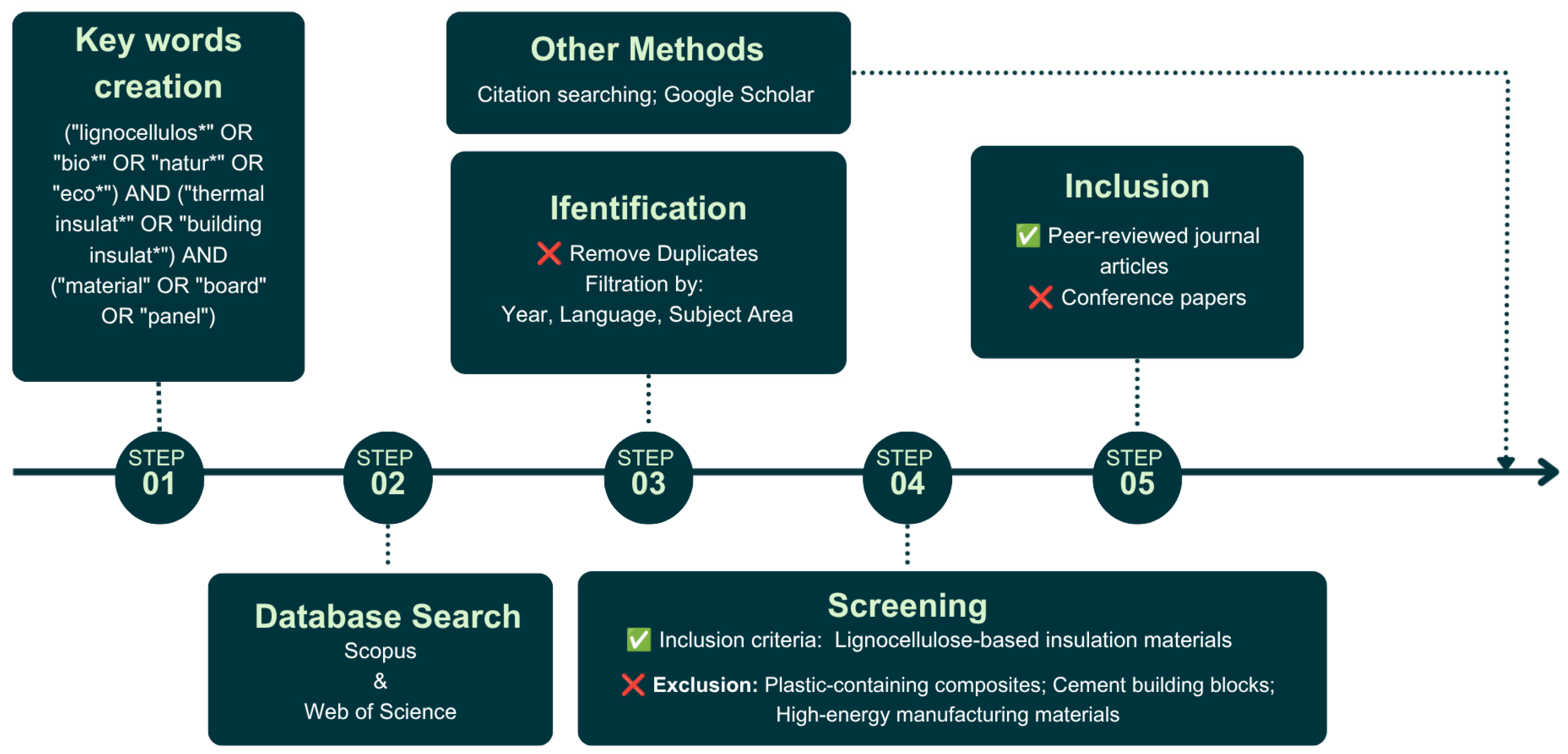
The literature search was conducted using a systematic approach to identify relevant studies on bio-based insulation materials (Figure 1). Two primary academic databases, Scopus and Web of Science (WoS) Core Collection, were utilized to ensure comprehensive coverage of the field. The search focused on Title and Keywords using a multi-step query strategy. The following Boolean query was applied: (“lignocellulos*” OR “bio*” OR “natur*” OR “eco*”) AND (“thermal insulat*” OR “building insulat*”) AND (“material” OR “board” OR “panel”). This targeted approach allowed for the identification of studies where bio-based insulation is the primary focus of the research. The initial search yielded 3152 records from Scopus and 242 from Web of Science.
The datasets were polished based on the following inclusion and exclusion criteria by (1) document type: only original research articles were retained; retracted works, conference reviews, and proceedings papers were excluded; (2) a language filter was applied for English only, and (3) the timeframe was restricted to 2006–2026 to capture modern industrial trends; (4) records belonging to irrelevant subject areas (e.g., Medicine, Arts and Humanities, or Social Sciences) were excluded, focusing on Engineering, Materials Science, Environmental Science, and Energy. Duplicate removal and preliminary bibliographic data processing were performed using the bibliometrix package for the R programming language [25].
After removing duplicates and applying the initial filters, 3204 records remained for the screening stage. These records were uploaded to the Rayyan web-based platform [26] for a rigorous title and abstract screening. During the screening process, studies were excluded if they did not directly address building materials or thermal insulation applications. Specific exclusion criteria were applied to remove articles focusing on plastic-dominated composites, traditional cement-based building blocks, or materials with high embodied energy that fell outside the “bio-based” scope. This stage resulted in a narrowed pool of 62 articles.
To ensure the technical depth of the review, particularly regarding the analysis of production methods and their influence on material properties, a secondary search strategy was employed. This involved manual searching via Google Scholar, backward and forward citation tracking (snowballing), and following specific journal recommendations. To minimize selection bias during the secondary search (Google Scholar and snowball sampling), all retrieved articles were filtered using the same inclusion criteria and database indexing checks as Scopus/WoS records. Furthermore, bias was eliminated through a rigorous technical quality check, excluding any studies that lacked an accurate description of the manufacturing process. These additional methods helped identify key papers that might have been missed by the initial database queries due to highly specialized terminology. After a final full-text eligibility assessment and technical quality check, 50 articles were selected for final inclusion and detailed analysis.
The final selection of 50 articles was systematically categorized to provide clarity on the different fabrication techniques and their impact on final material performance. To handle the wide range of presented indicators, the extracted variables were classified into three main categories: 1. Material processing and structure: type of raw material, fiber/particle size, binder content, manufacturing conditions (temperature, pressure), density; 2. Thermal and mechanical properties: thermal conductivity (λ), compressive/flexural strength, internal bond (IB); 3. Hydraulic and stability properties: water absorption and thickness swelling (after 2 h, 24 h, etc.) and thermal stability.

3. Results and Discussion

3.1. Raw Materials

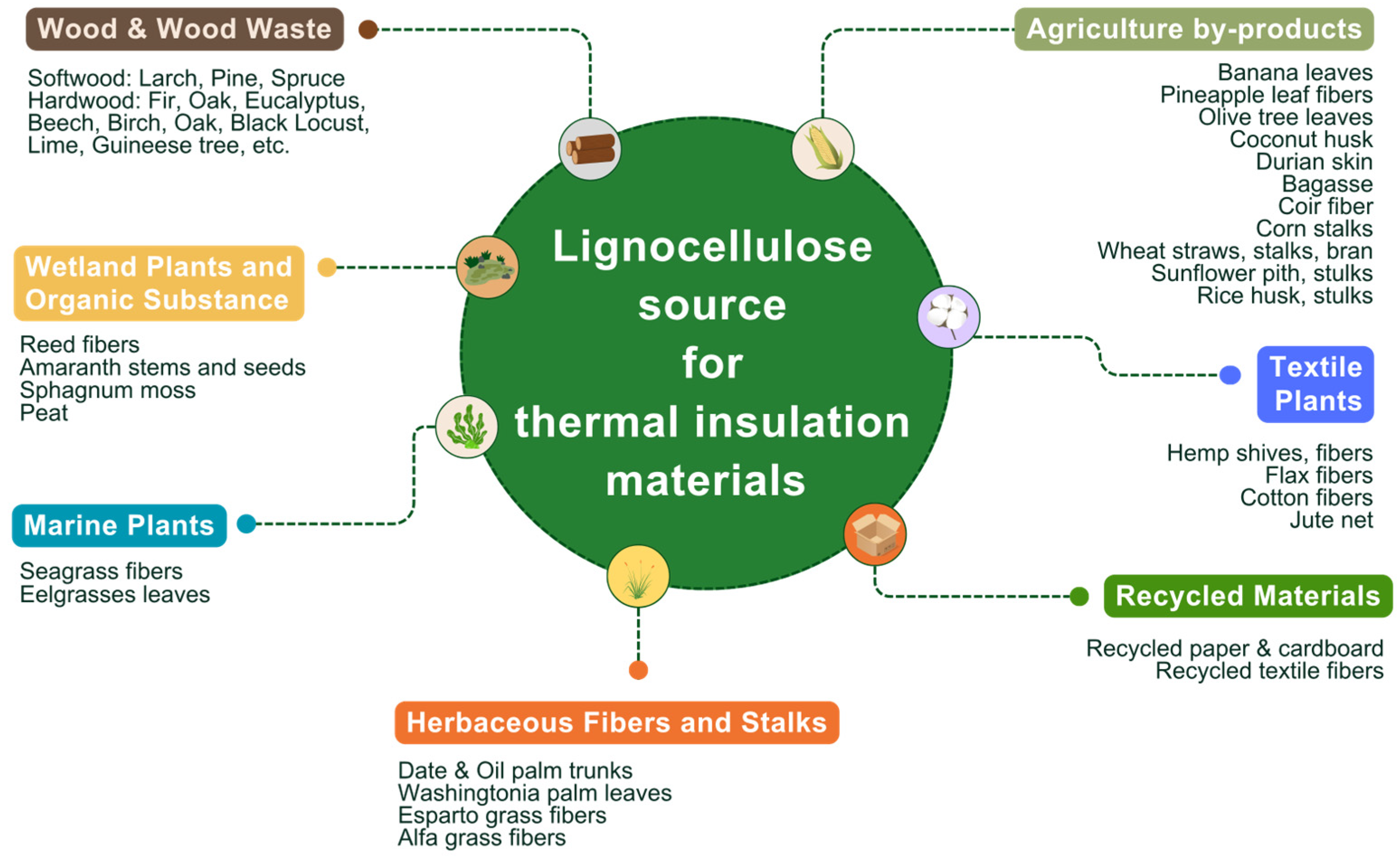
The differentiation of thermal insulation in the literature is determined by its origin: animal, plant, mycelium-based, mineral thermal insulation and categorized as organic fibrous materials [27,28,29]. A variety of lignocellulosic sources utilized for bio-based insulation production reviewed in this study are shown in Figure 2.
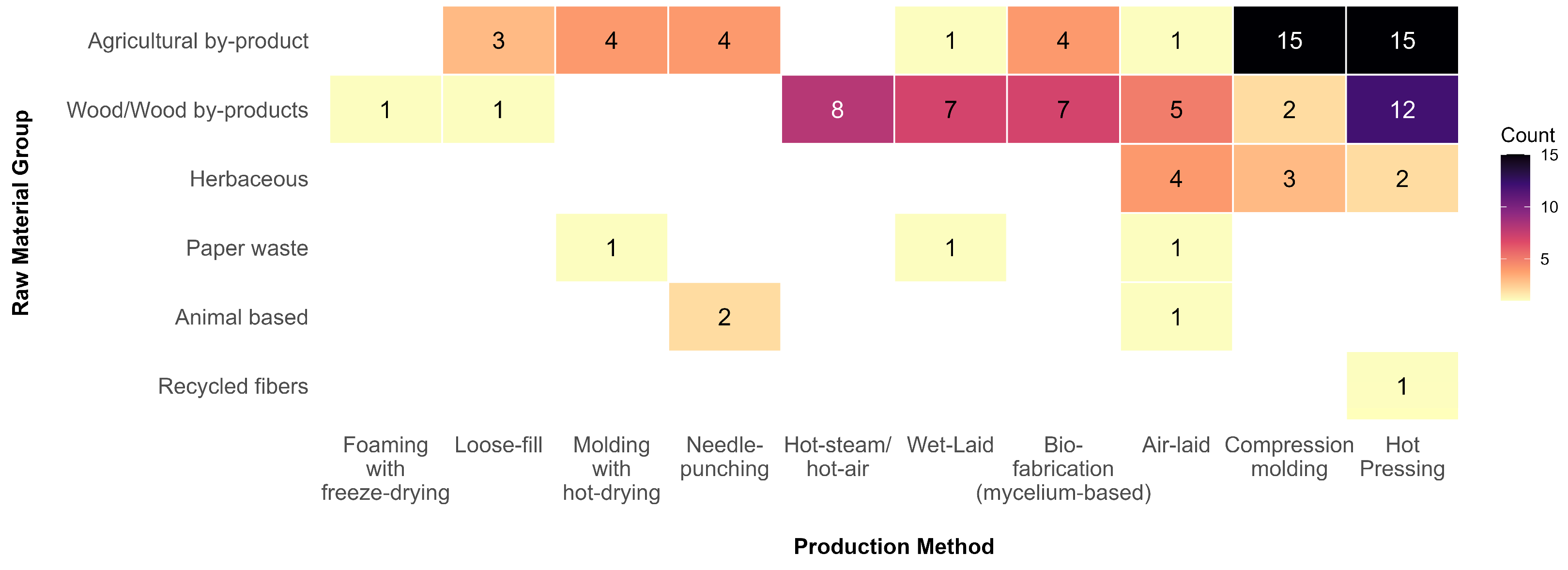
A co-occurrence analysis shows that agricultural and wood waste are the most frequently used raw materials in production cycles in recent studies due to their huge abundance, low cost, and rich structural composition (cellulose, hemicellulose, and lignin), which makes them ideal for producing high-value, sustainable materials and energy (Figure 3). Utilizing waste, for example tree bark, highlights a highly sustainable availability vector, as it exists as a direct by-product of timber debarking processes, yielding approximately 80 kg of wet bark per 1 m3 of processed roundwood [30]. Beyond its volume availability, integrating bark into insulation panels effectively resists mechanical stress while simultaneously reducing hazardous indoor formaldehyde emissions compared to conventional synthetic or standard wood-based panels [31,32].
Currently, there is a clear trend toward developing hybrid compositions, such as combining recycled paper and textile fibers with natural plant-based raw materials [33]. Despite the variety of these combinations, the dominant research approach remains the use of materials within the same morphological groups, as this enables achieving stable performance characteristics. However, the thermal performance of complex organic composites, such as a mixture of hemp husk, sheep wool and lime (0.074 W/mK) [34] or a combination of sunflower and wheat stalks with vermiculite (from 0.063 to 0.334 W/mK) [35], remains higher than that of synthetic non-renewable insulation types.
Different raw materials reach their lowest thermal conductivity (λ) at slightly different “critical” densities due to their inherent cellular structure, microporosity, and fiber diameter: wheat straw and reed at densities around 60 kg/m3; hemp and flax at the range of 60 to 85 kg/m3; wood fiber (softwood) requires higher densities to ensure structural integrity, and optimal ranges are typically between 100 and 150 kg/m3, where λ = 0.038–0.045 W/mK is achieved; for cellulose (loose filler), the optimal density values are from 30 to 60 kg/m3 [36].

3.1.1. Morphology Role in Bio-Based Thermal Insulation Production

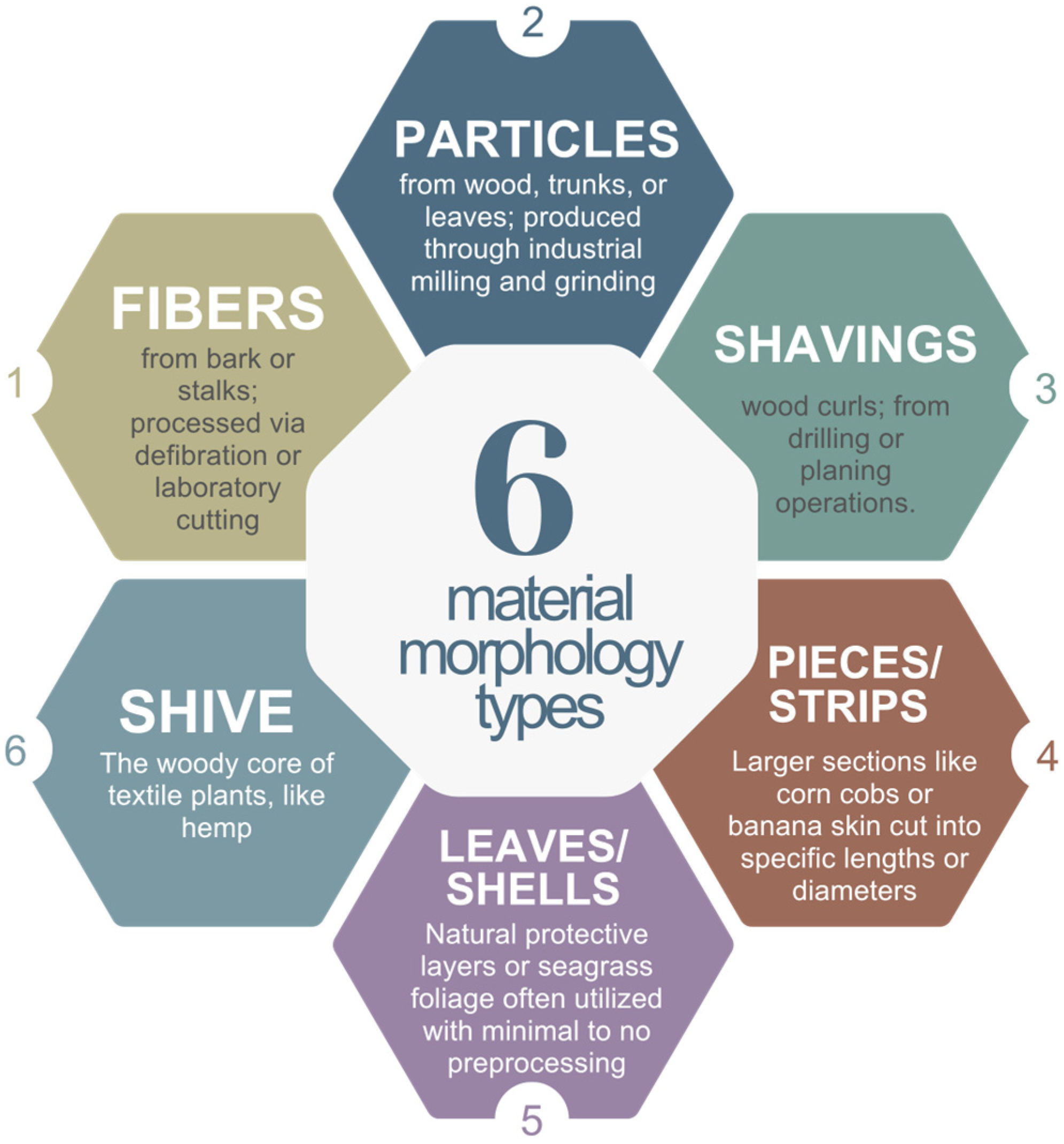
The internal and external structure of the plant (morphology) determines the form and structural category of the biomass. Six main types are used in the production of thermal insulation, as shown in Figure 4.
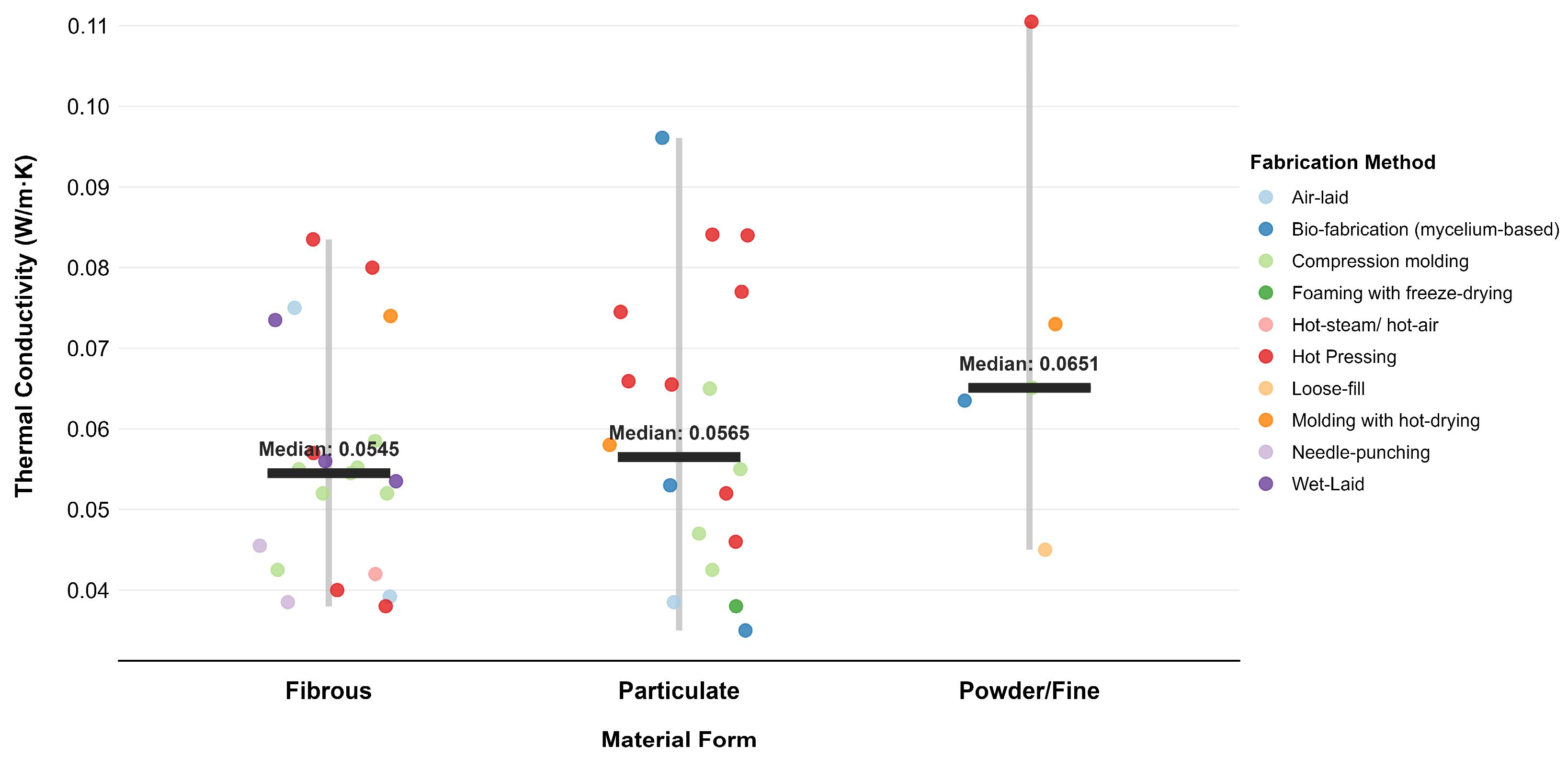
Fibrous raw material forms (red in Figure 5) are predominantly used in textile-type methods (air-laid, needle-punching or wet-laid). Particulate (blue in Figure 5) and powder (green in Figure 5) forms require bonding processes or pressing to achieve structural integrity. At the same time, there is no difference (p = 0.360) in thermal conductivity only due to the material’s form (Figure 6). Thermal conductivity in bio-insulation is governed by three primary factors: moisture content (hygrothermal behavior), density and porosity, and fiber orientation (microstructure) [24,37,38]. Through the production methods, the internal structure of the material is formed, which ensures a certain density, which will be discussed in the following paragraphs below.

3.1.2. Size Role in Bio-Based Thermal Insulation Production

The geometric characteristics of bio-based particles determine the density, porosity, and thermal properties of the final material. A high proportion of fine hemp particles (0–5 mm) increases the mechanical strength and sorption capacity of panels by increasing the specific surface area and improving compaction [39]. At the same time, removing particles smaller than 0.5 mm during the production of wood fiberboards is not economically viable [40].
Larger palm [41] and amaranth (4 mm) particles [42] provide the best thermal insulation performance. Larger particle sizes reduce the compactness of the structure, and since thermal conductivity is directly related to material density, less dense panels exhibit lower thermal conductivity [43]. However, if particles are too big, it creates larger air-filled voids, which allows heat to transfer more efficiently, increasing thermal conductivity.
To achieve specific raw material size, sorting and sieving are used as a preparation step, but some techniques use the whole corn cobs [44] or leaves [45]. The separation is important because different anatomical parts of a plant show different thermal conductivities, which can influence final properties [42].
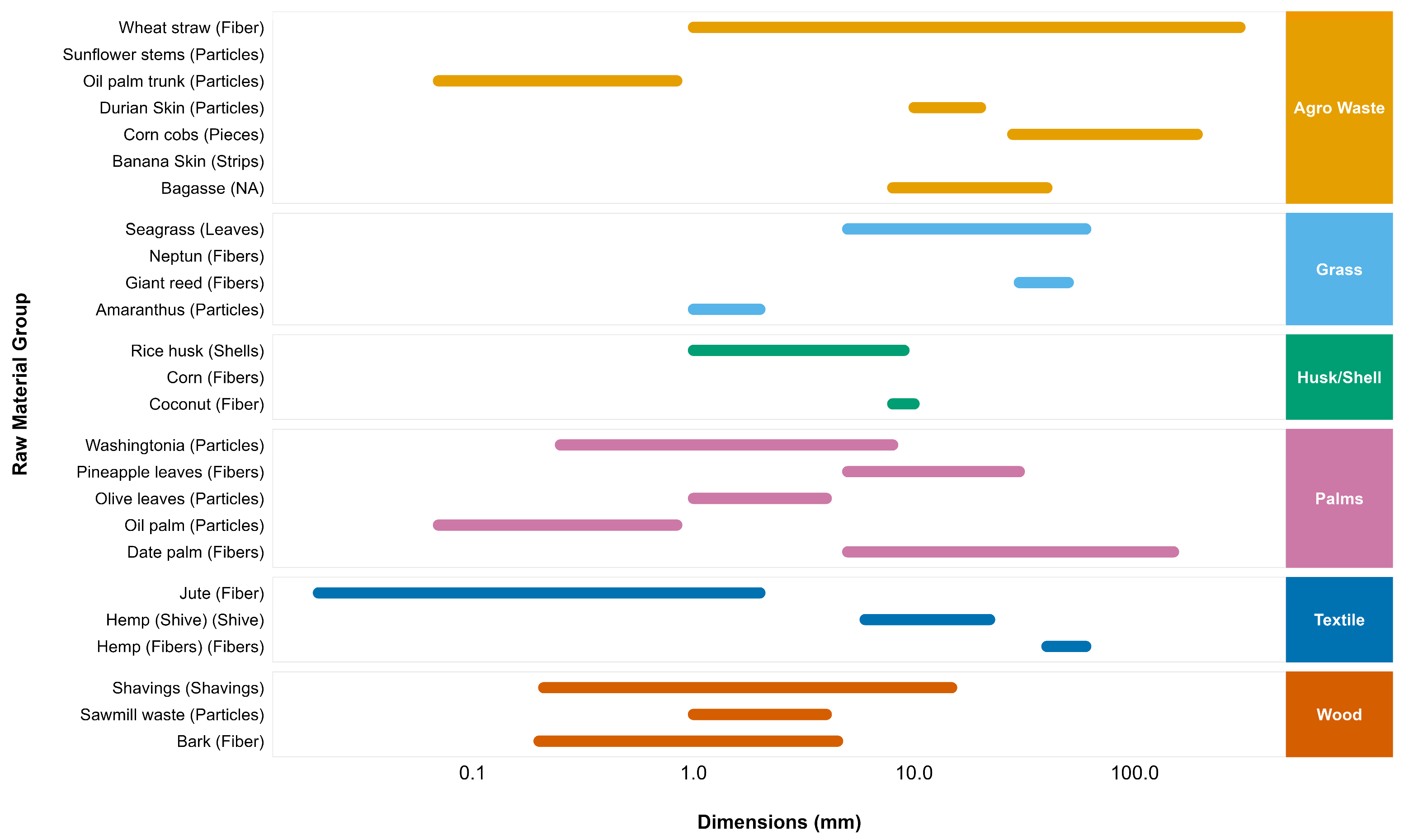
Figure 7 illustrates the dimensional ranges of various raw materials used in bio-based production, categorized by their source group. Many groups share similar dimensions from 1 mm to 10 mm. The agro-waste (yellow) group shows the highest variability: wheat straw and corn cobs are used in the largest dimensions (up to ~300 mm), while oil palm trunks are processed into much smaller particles (mostly between 0.1 and 1 mm).
The length of the fibers have a significant effect on the mechanical and thermal properties of the material. Fiber length determines how well the fibers interlock to trap air, directly influencing heat transfer through the product [40]. Short fibers tightly pack into voids, increasing the material’s density. This improves mechanical strength and workability but can increase heat transfer because there are fewer trapped air pockets. Long fibers create a complex, high-porosity matrix that traps larger amounts of air [46]. This significantly lowers thermal conductivity and creates a better thermal barrier, but it decreases mechanical bonding/strength [47].
Understanding the type of raw material and the typical size ranges utilized in the studies focusing on bio-based thermal insulation building materials is important for predicting the functional behavior of specific biomass types during both processing and application.

3.1.3. Chemical Composition

A primary concern of bio-based thermal insulation is its hydroscopic nature, which is determined by the chemical properties of lignocellulose materials [48].
The chemical composition of plant biomass is not static; it is a dynamic system shaped by the interaction of genetic, environmental, and developmental factors, which can lead to process instability and the homogeneity of the natural material [49,50].
Plant-based raw materials are natural composites of cellulose, hemicellulose, and lignin, whose structural integrity plays a central role in the functionality of bio-based materials. Table 2 summarizes the main components of biomass, with their characteristics and role in bio-thermal insulation materials.

3.1.4. Environmental Impact

Plant-based insulation materials improve sustainability by significantly reducing carbon emissions during production. They actively absorb CO2 during growth and require less energy to process. This makes their overall carbon footprint much smaller than that of traditional fossil-fuel-based alternatives [24].
Among renewable materials, cellulose and hemp have proven to be the most environmentally friendly (although they are damaged by chemical additives); however, not all “green” materials are created equal [59]. Some processes around bio-mass cultivation or producing lead to a potentially negative environmental impact. For example, cultivating agricultural crops for biomass requires fertilizers, manure, and land clearing. Nitrogen and phosphorus runoff from these fertilizers can cause severe eutrophication (algal blooms in aquatic ecosystems) and acidification in soils. Producing bio-based materials demands significant arable land and irrigation. Land-use changes, such as converting natural forests or grasslands into cropland, can drastically increase water stress and biodiversity loss, sometimes even releasing more carbon than the biomaterial saves [60].
The chemical conversion of biomass into usable materials (e.g., extracting biopolymers or natural fibers) can be highly energy-intensive. If the energy grid relies on fossil fuels, processing and freeze-drying can negate the original climate benefits [61].
The use of a demountable design strategy further reduces the environmental impact by 10–50% [62]. At the end of their life cycle, the insulation panels can be disposed of using pyrolysis, which produces useful products such as bio-char and bio-oil. However, this approach requires upgrading the production processes, especially when using slow pyrolysis at 550 °C or steam pyrogasification at 880 °C [63].
The energy costs of building operation also affect the environmental friendliness of a material. Synthetic materials are good insulators with low thermal conductivity; however, their production is energy-intensive and environmentally harmful. Moreover, they are often vapor-impermeable, which can trap moisture and degrade a building’s energy performance over time [64]. At the same time, to provide sufficient resistance (U-value), which is a more comprehensive indicator for evaluating efficiency than thermal conductivity alone, natural materials require a greater thickness [65]. Consuming a larger amount of raw materials also potentially leads to a reduction in environmental friendliness.

3.2. Comparative Analysis of Pretreatment Methods

To overcome the natural limitations of raw biomass, such as amorphous structure and hydrophilicity, various pretreatment methods, named also as fiber modification or fiber activation [66], are used. Pretreatment modifies the fiber surface to improve interfacial adhesion between the fibers and the matrix [67]. Since the amorphous regions of the original fibers are highly hydrophilic, water absorption increases, which negatively affects the performance of natural thermal insulation materials. For a comprehensive overview, in Table 3, pretreatment methods used for bio-based thermal insulation materials are grouped, summarizing the pretreatment parameters, microstructural modifications, and resulting material properties.
The criteria for selecting a pretreatment method are based on the energy demand of the process, preserving the lignocellulosic fraction, minimizing degradation products, and using inexpensive chemicals [80].
Also, not all pretreatment methods may be suitable for a specific material. The fiber composition of lignocellulose materials directly determines the choice of pretreatment method because different plant species and material types (wood vs. agricultural waste) have varying ratios of cellulose, hemicellulose, and lignin [81].
The purpose of mechanical fiber processing is to separate biomass fibers and increase the surface area [69]. During mechanical processing, a certain fiber size is formed, so the milling process should be optimized to get a proper fiber size, which determines the self-bonding and cohesion of fibers [72]. The choice of processing method will affect the final properties of the material, as short fibers generally pack together more tightly, which increases the apparent density of the composite and decreases its porosity. Because still air trapped within pores is a poor conductor of heat, reducing porosity increases thermal conductivity [82]. Too big particles increase thermal conductivity and require additional cycles of the milling run, which can lead to an increase in the process time [71].
Hydrothermal pretreatment modifies lignocellulosic biomass by breaking down hemicellulose and partially depolymerizing lignin. The advantage of this method is that no chemical components are used during this treatment, and at high temperatures, hemicellulose and cellulose breakdown products are formed (5-hydroxymethylfurfural), which, during the following hot pressing, act as a natural glue [75]. At the same time, the long duration of the process at high temperatures requires intensive energy inputs and produces a wastewater stream rich in organic pollutants. The temperature presented in the literature ranges from 60 °C to 215 °C for various types of natural fibers: softwoods, hardwoods, and non woody fibers. Treatment durations can be from 3 min to 6 h [74].
Chemical pretreatment differs from mechanical and hydrothermal pretreatment in that it involves the use of reagents (acids, alkalis) to break down the rigid natural bonds between cellulose, hemicellulose, and lignin [67]. The use of chemicals is a major impact on the environment, as well as water consumption and by-product disposal. Using alkaline solution to reduce emissions at a lower concentration (2% at room temperature for 24 h) can remove oils, waxes and contaminants from banana leaves and increase surface roughness, but lignin is not completely removed under these conditions [78]. To more effectively separate fibers and remove amorphous compounds from the fiber surface, chemical treatment is carried out at a high temperature of 60 °C for 24 h [70,73]. A combination of thermomechanical treatment with a steam explosion and alkali (4% NaOH) pretreatment improves the antifungal properties of the material, as it depletes the nutrients needed for mold growth [68].

3.3. Bonding

The choice of binder has a multifaceted impact on the physical, thermal, and biological properties of bio-based insulation materials. The primary role of a binder is to bridge the gap between distinct components (e.g., natural fibers or agricultural waste) [83]. Increasing the binder content (e.g., synthetic polymers such as PVA or styrene-acrylic acid) from 13% to 40% fills the voids between the biomass fibers. This densification creates a harder matrix that improves mechanical strength, structural integrity, and thermal stability but reduces the material’s insulating properties due to porosity reduction [84,85].
The chemical composition of the binder determines the hygrothermal and biological properties of the board. Polysaccharide-based binders (starch and dextran) act not only as mechanical adhesives but also as active moisture-regulating components, improving the moisture-buffering capacity (MBV) of the composite. However, the organic origin of the binder negatively affects the material’s biological resistance, providing a substrate for microbial growth under high-humidity environments (>80%) [39,86]. Table 4 summarizes the binders used during bio-based insulation, highlighting advantages, critical challenges and process conditions.
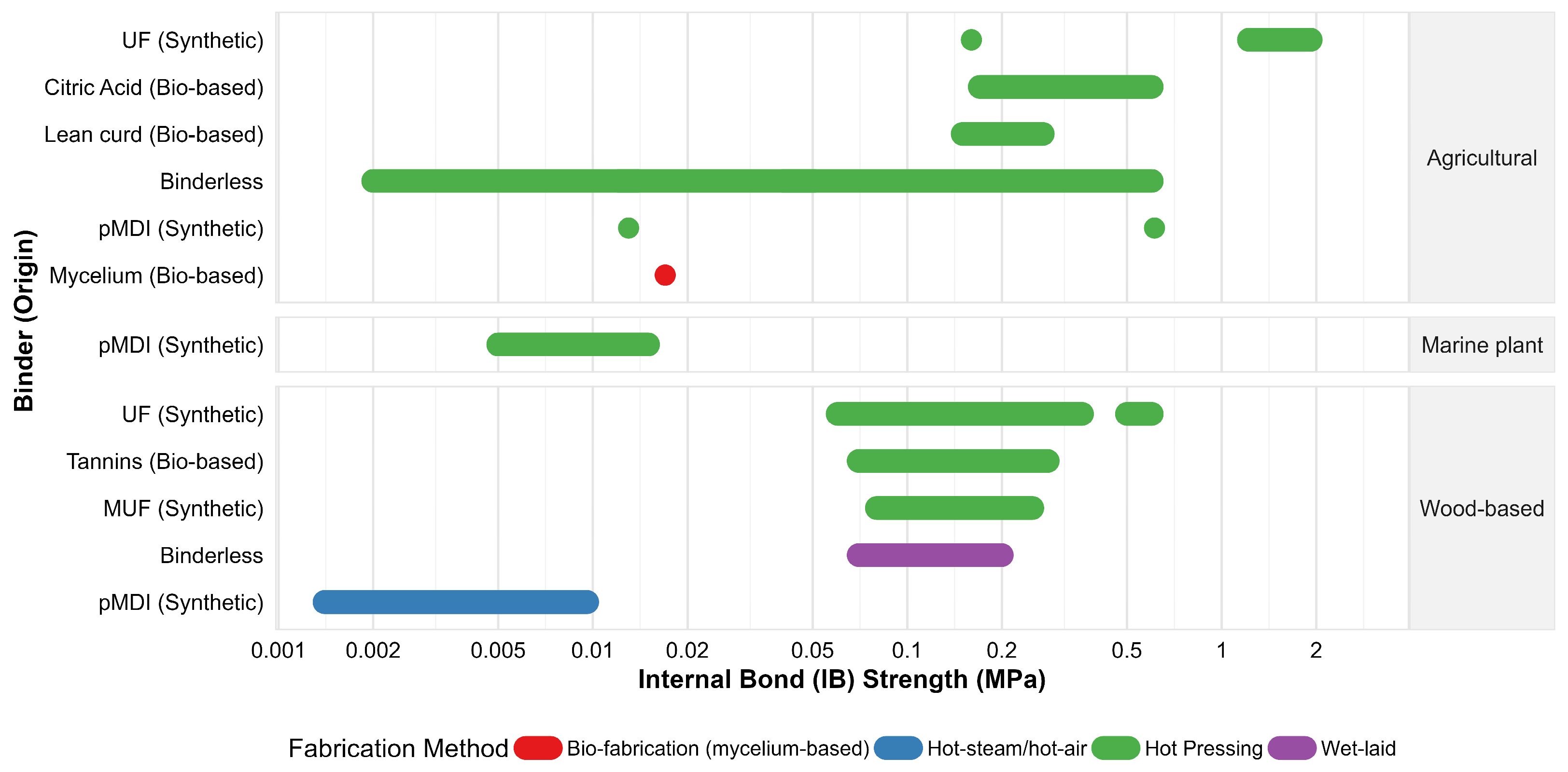
For rigid semi-structural insulation panels, where structural load transfer and high internal cohesion are required, binderless (self-adhesive) hot pressing or biochemical cross-linking (citric acid) is suitable. The binderless method of thermal insulation material production is a sustainable alternative, with the advantage of eliminating formaldehyde emissions without significantly reducing stiffness. Figure 8 presents a comparison of internal bond (IB) strengths for various binder types and manufacturing methods for biodegradable insulation materials. However, a limited number of methods were analyzed due to the lack of research data on internal bonding; most were related to the hot-pressing method production. As shown in Figure 8, binder-free boards produced by hot pressing show competitive IB (internal bonding) values ranging from 0.2 MPa to over 1.2 MPa, which corresponds to the standard for internal bond strength for non-load-bearing fiberboards. For the binderless panels made of Eucalyptus grandis, the more severe the processing conditions (higher temperature or longer time), the higher the internal bond value. Fiberboards processed at 150 °C for 8 h demonstrated a strength of approximately 0.5 MPa [74]. Internal bonding values of 0.07–0.02 Mpa are demonstrated in softwood tree bark panels produced with wet-laid technology; however, due to the lack of binding resins, the tensile strength of the boards is very low (especially for boards with long fibers of 7 mm), which limits their structural use [93].
The bond strength depends on the particle size and the target density of the boards [91]. In the case of citric acid, particle size influenced bonding, as the smaller the particles, the greater their total surface area and the stronger the ester bonds formed per unit volume [41]. In the case of tannins, if the target board density was low (less than 300 kg/m3), the bark particles were poorly pressed together in the press, leaving numerous voids, and even the highest-quality Mimosa tannin could not form a strong adhesive bond. As density (compression) increased, the bond strength increased linearly [95].
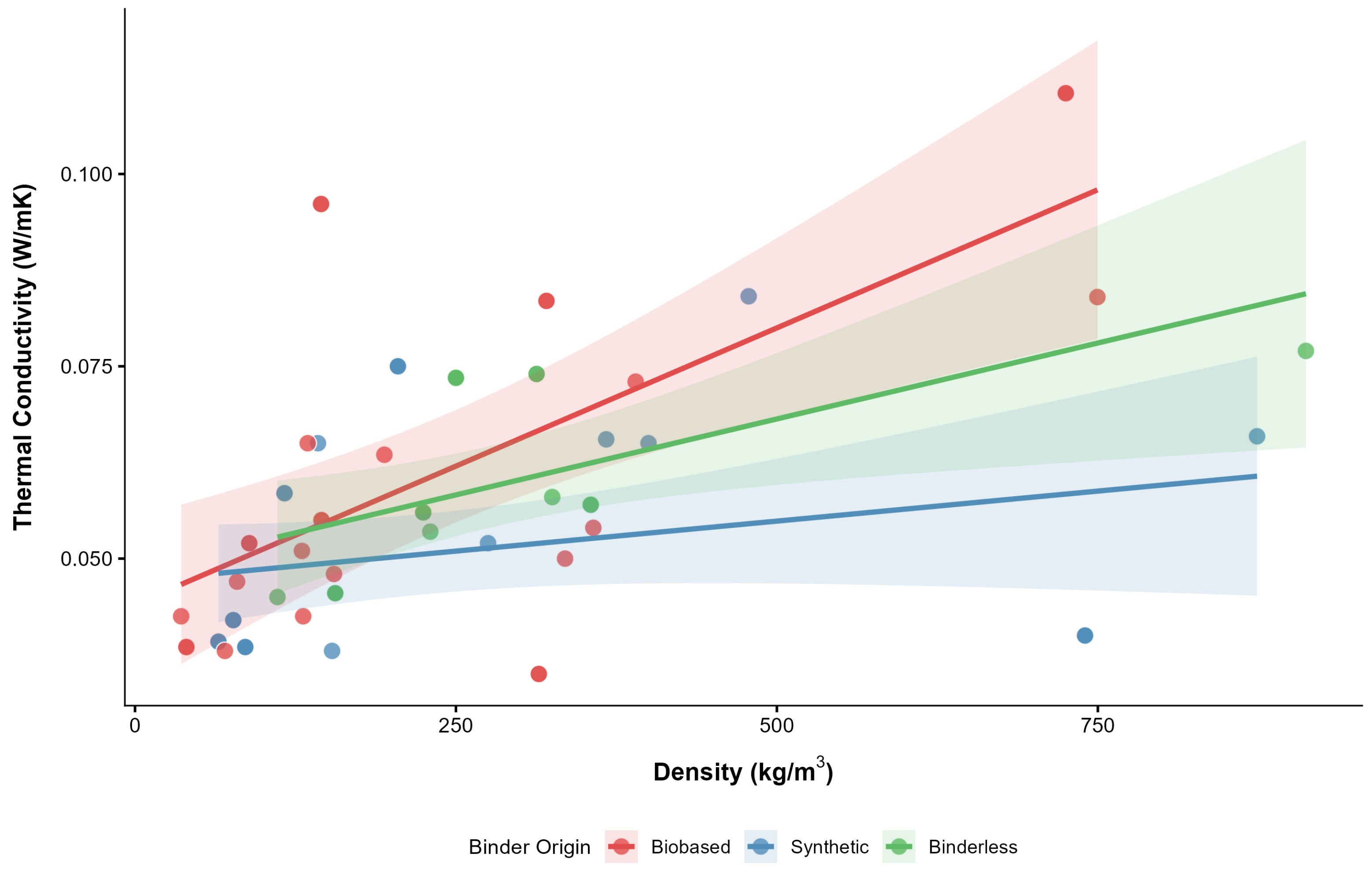
In terms of thermal conductivity, synthetic, biodegradable, and binder-free panels show similar behavior with increasing density (Figure 9). As density increases, bio-based panels (like wood fiber or hemp) can hold more capillary water, leading to higher thermal conductivity. Bio-based binders are highly hygroscopic; for example, lean curd retains more moisture from the air than classic panels [91]. Such a combination accelerates moisture absorption ability, which leads to a rapid increase in the thermal conductivity coefficient. This combination accelerates moisture absorption, resulting in a rapid increase in thermal conductivity for bio-insulation panels with bio-binders. In this regard, using synthetic binders in bio-based insulation panels is more beneficial, as it improves their moisture behavior by reducing breathability and lowering the material’s moisture buffering capacity, protecting the organic fibers from fungal growth and structural degradation [96]. Mold is a critical construction problem with bio-based materials because of their organic composition and hygroscopic nature. Due to the organic composition and high moisture absorption, wood-based materials are a perfect environment for fungi. The combination of Posidonia (or rice straw or husk) and sodium alginate proved to be the least susceptible to decay in a humid environment when used with a bio-based binder, which significantly extended the life of the material compared to xanthan gum or gum Arabic [18].
The development of bio-insulation is characterized by a critical trade-off where ecological purity often compromises durability, processing efficiency, and cost. When considering the impact of additives on the product lifecycle and its environmental properties, fossil-based (synthetic) additives and binders significantly degrade the overall lifecycle analysis of biomaterials, even if their share is small. This impact manifests itself both during panel production and disposal. For example, a polyester binder containing only 15% of the hemp insulation’s mass has a lower environmental impact than growing flax alone [97]. At the same time, transitioning to carbon-neutral alternatives, like starch or casein [91], introduces major technical and financial liabilities. Their high moisture sensitivity demands mandatory, costly integration of natural antifungal treatments to prevent early biodegradation [89], which increases the final material cost [98].

3.4. Manufacturing Methods

Depending on application and form, bio-based thermal insulation can be flexible, rigid, loose, internal or external and applied to roofs, floors and walls [99]. Thermal insulation material type is determined by the processes and techniques used in their manufacturing. Liu et al. [100] categorized manufacturing methods of bio-based insulation materials as bonding, molding, natural form, pressing, hot pressing, injection molding, foaming, and others. Lu et al. [13] additionally mentioned freeze-drying and needle-punching. Over time, hot pressing and compression molding remain the most frequently used techniques for manufacturing rigid and semi-rigid bio-insulation boards (e.g., from hemp, bamboo, flax, or agricultural waste). Bio-insulation must have a low density (to trap air) but sufficient mechanical strength to be handled and installed. Compression molding allows manufacturers to adjust the board’s density and thickness by controlling the applied pressure [71,101,102]. For more effective bonding, which is necessary to ensure structural properties, to connect the fibers and to activate the binder, increased temperature and pressure are required (hot pressing) [84,95,103,104].
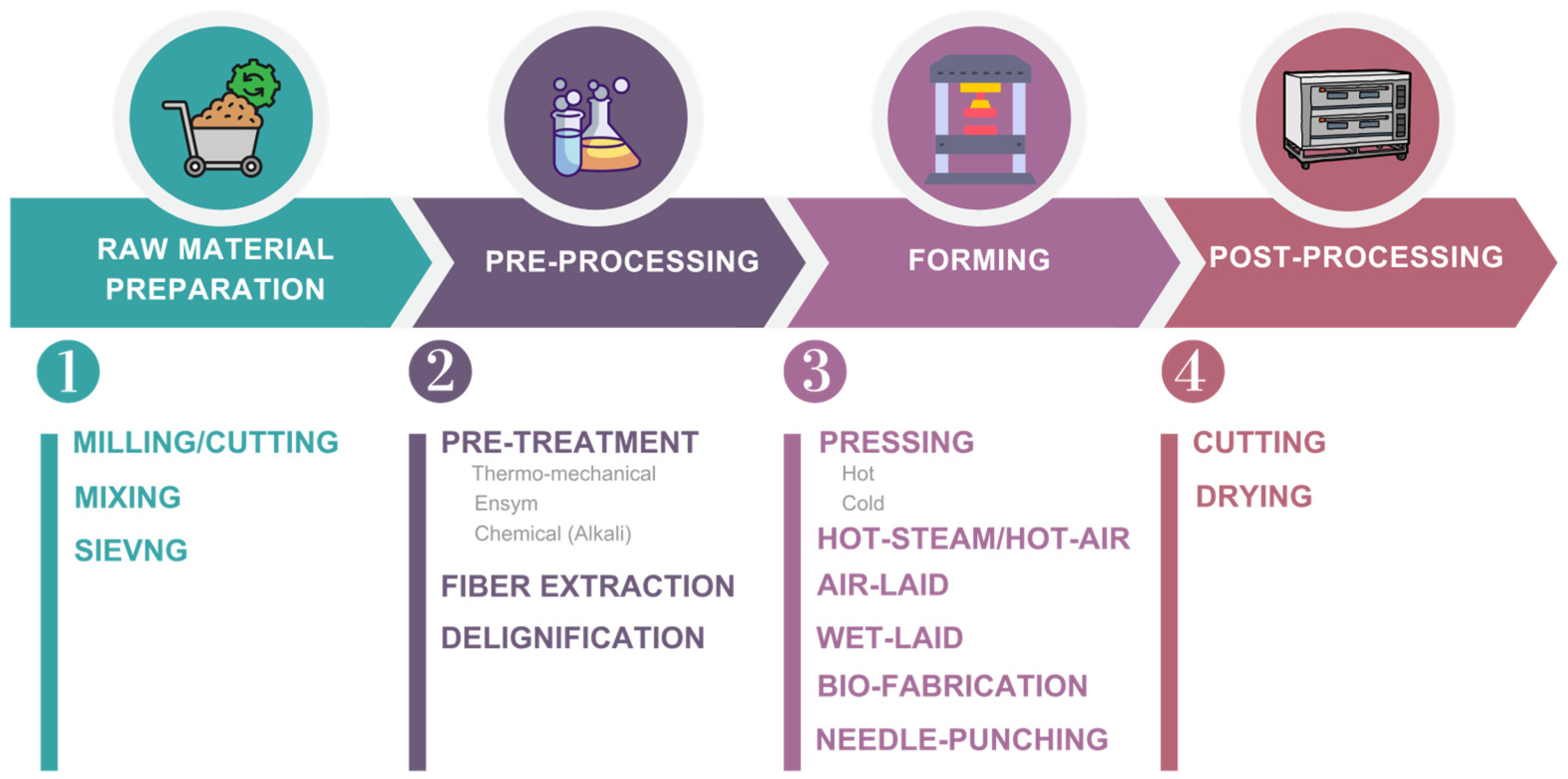
The production processes for the reviewed bio-based thermal insulation materials can be divided into four principal stages (Figure 10).
The technological matrix of the pre-fabrication step for different production methods (Table 5) serves as a potential indicator of its environmental footprint and embodied energy. While the final product is considered sustainable, the heavy thermal and electrical inputs required to process, clean up, or stabilize bio-based materials can significantly offset their natural “green” advantages [105].
Washing requires massive volumes of water for cleaning dirt and contaminants from raw materials (or cleaning equipment between batches). The environmental load stems from the electricity needed for water pumping and heating, as well as the pollution potential of chemical detergents if not bio-based [106]. In wet-laid technology, water is the main component, serving not only as a binder but also as a medium for the release of fibers during defibration [107,108,109]. The water must be recycled, reducing the concentration of substances extracted from the materials, potentially requiring the addition of chemical reagents such as defoamers.
The impact on energy demand of physical size reduction (e.g., chipping biomass, cutting, milling, grinding) is relatively low unless the equipment runs inefficiently, which generates frictional heat and wasted energy [110].
Drying [71] requires significant thermal input to remove moisture or neutralize biological activity. Evaporating moisture typically requires between 1.5 and 2.5 kWh of thermal energy per kilogram of water removed. Total manufacturing embodied energy typically ranges from 2 to 8 kWh/kg of finished insulation panel [111].
Foaming and freeze-drying [77] is the most energy-intensive stage, requiring a load that needs to drive the condensers, vacuum pumps, and sublimation heat.
Hot pressing and compression molding are characterized by intense heating above 75 °C. Although molding and hot drying [112] reach temperatures of 200 °C during the main fabrication stage, pre-drying is also needed.
Based on the pre-processing matrix shown in Table 5, the blowing technique is highlighted as the most potentially “green” option in terms of pre-processing; however, this type of insulation is not suitable for an open ceiling, and it carries the risk of settling and insufficient structural integrity [113].
The method of biological fabrication is the only technology for which the sterilization step is strictly mandatory (“Yes”). Although low thermal conductivity can be achieved when producing panels with mycelium (0.04 W/mK), this method is the most time-consuming, as it requires extensive mushroom cultivation [114,115,116]. Compression molding and hot pressing are adaptive processes, as these methods have three main stages (washing, cutting, and drying) with a “No/Yes” status. Depending on the raw materials delivered to the factory, these stages can be included or skipped. However, they do not require sterilization (“No”) [45,104,117].
The literature data analysis shows variability in technological parameters depending on fabrication method and raw material type (Table S1 [Supplementary Materials]). Table S1 summarizes the main manufacturing methods, such as hot pressing, compression molding, wet process, air-laid process, needle-punching, hot drying, freeze-drying, and bio-fabrication, including the type of raw material, processing conditions, density range and thermal conductivity range, advantages, limitations, scalability potential, and main challenges.
The comparison analysis in Table S1 shows that the most promising methods in terms of thermal insulation are biological fabrication (mycelium-based) and needle-punching. Mycelium grown on thin white ash chips yields an exceptionally low thermal conductivity range of 0.0313–0.0379 W/m K [118], outperforming traditional loose vegetable fibers. Similarly, needle-punched pure sheep wool mats achieve a competitive thermal conductivity of 0.031–0.034 W/mK [119,120].
For the structural integrity and load-bearing application, hot pressing is the most reliable method. Within high pressure applied during the process of 2.0–15.0 MPa and temperatures above 100 °C, resin curing (e.g., urea-formaldehyde or pMDI (polymeric diphenylmethane diisocyanate)), yielding high internal bond (IB) strength [117]. The mechanical properties of mycelium composites remain unsuitable for load-bearing building structures (for example, the flexural strength is only 0.063 MPa) [121].
Air-laid and hot-pressing technologies demonstrate the highest commercial scalability. Air-laid technology was originally developed for high-speed, continuous roll-to-roll texturing lines in modern nonwoven textile mills, easily handling highly porous matrices of up to 90% [69]. Hot pressing is also scalable, as it directly simulates the automated, high-throughput production lines already standard in global commercial particleboard and MDF plants [32,95]. In contrast, batch-based protocols such as lyophilization or long mycelial incubation times (7–42 days) face significant scalability challenges [116,122,123].
Room-temperature drying molding methods (using rapidly curing binders such as liquid sodium silicate left to vaporize at room temperature) avoid the energy costs associated with industrial ovens [102]. This contrasts with the high thermal inputs of freeze-drying (operating down to −83 °C) or hot pressing (up to 220 °C) [89,104,124].
The most energy-intensive and technically demanding process is hot pressing, where average temperatures reach approximately 140–190 °C, with pressures ranging from 2 to 16 MPa [41]. Wood-based by-products often require longer pressing cycles (up to 20 min or more), while agricultural by-products can be processed faster (6–12 min) [89], though sometimes requiring higher temperatures (up to 220 °C) to activate binders.
Compression molding shows polar extremes, ranging from ambient temperature (23 °C) to 200 °C [125]; however, the pressure often remains minimal or near zero, suggesting a focus on shaping rather than high-density compaction.
To identify a clear industry leader among these fabrication methods, the specific application of the final product must first be defined, as performance criteria vary significantly across different insulation types (boards, mats, or loose-fill) used in wood frames or sandwich panels [113,120]. For instance, mechanical stability is critical for rigid structural panels but irrelevant for loose-fill insulation, where low density and ease of application are prioritized. While application dictates physical needs, critical parameters such as moisture absorption, fire resistance, production cost, microbiological stability, and product life cycles remain universally essential across all methods. However, conducting a comparative evaluation for the current dataset is currently impossible due to severe data gaps in the existing literature. Most studies either exclude measures or conduct them strictly within a limited, non-standardized testing way.
Furthermore, laboratory testing conditions, including sample thickness and shape, are frequently dictated by specific testing standards rather than real-world optimization [125,126], even though material thickness directly determines the final R-value properties [127]. Real-world performance is best evaluated at the system level through climate chambers or building simulations, which reveal complex hygrothermal behaviors. For example, system-level testing shows that, while U-values can remain identical across different materials (e.g., 0.15 W/m2 K), biomaterials like hemp-lime and wood fibers show better heat storing and releasing capabilities under cyclic boundary conditions compared to mineral wool [128]. A detailed thermal performance analysis shows that differences in insulation properties are much stronger when materials are tested individually rather than when integrated into composite systems, such as External Thermal Insulation Composite Systems (ETICS) or sandwich panels [129,130].
Due to their natural ability to absorb and release moisture continuously, bio-based materials buffer indoor humidity, which helps mitigate intense shifts in room temperature during weather cycles. The long-term durability and practical success of these natural materials depend far more on external weather dynamics than on the specific type of core insulation or its standalone thermal conductivity [130,131].
Humidity is a critical parameter in mold formation. This risk is particularly serious for interior insulation, which is the most vulnerable type of insulation in terms of condensation and moisture accumulation [132]. Effective protection of biomaterials without toxic chemicals requires strict humidity control and careful management of the hygrothermal properties of walls to prevent condensation [22,132]. At a relative humidity of 90–95% and a temperature of 22 °C, mold can colonize wood within 7–14 days [133], and when the moisture content of wood reaches 25–30%, the risk of façade and roof decay becomes critical [134,135].
Traditional preservatives, such as boric acid and boron compounds, are commonly used to protect biomaterials from mold growth. However, at high humidity (>90–95% relative humidity), these water-soluble preservatives are easily washed out, leaving the material vulnerable to decay [136]. Natural, eco-friendly alternatives, such as chitosan, propolis extract, and essential oils (tea tree, thyme, clove, lemon, peppermint), show promising results but have limitations related to volatility, durability, and cost [96]. The integration of oak chips into MDF production represents an effective, natural method for increasing the strength and decay resistance of boards, demonstrating a mass loss of less than 25%, allowing them to be classified as “durable” or “very durable” [137].

3.4.1. Influence on Thermal Properties

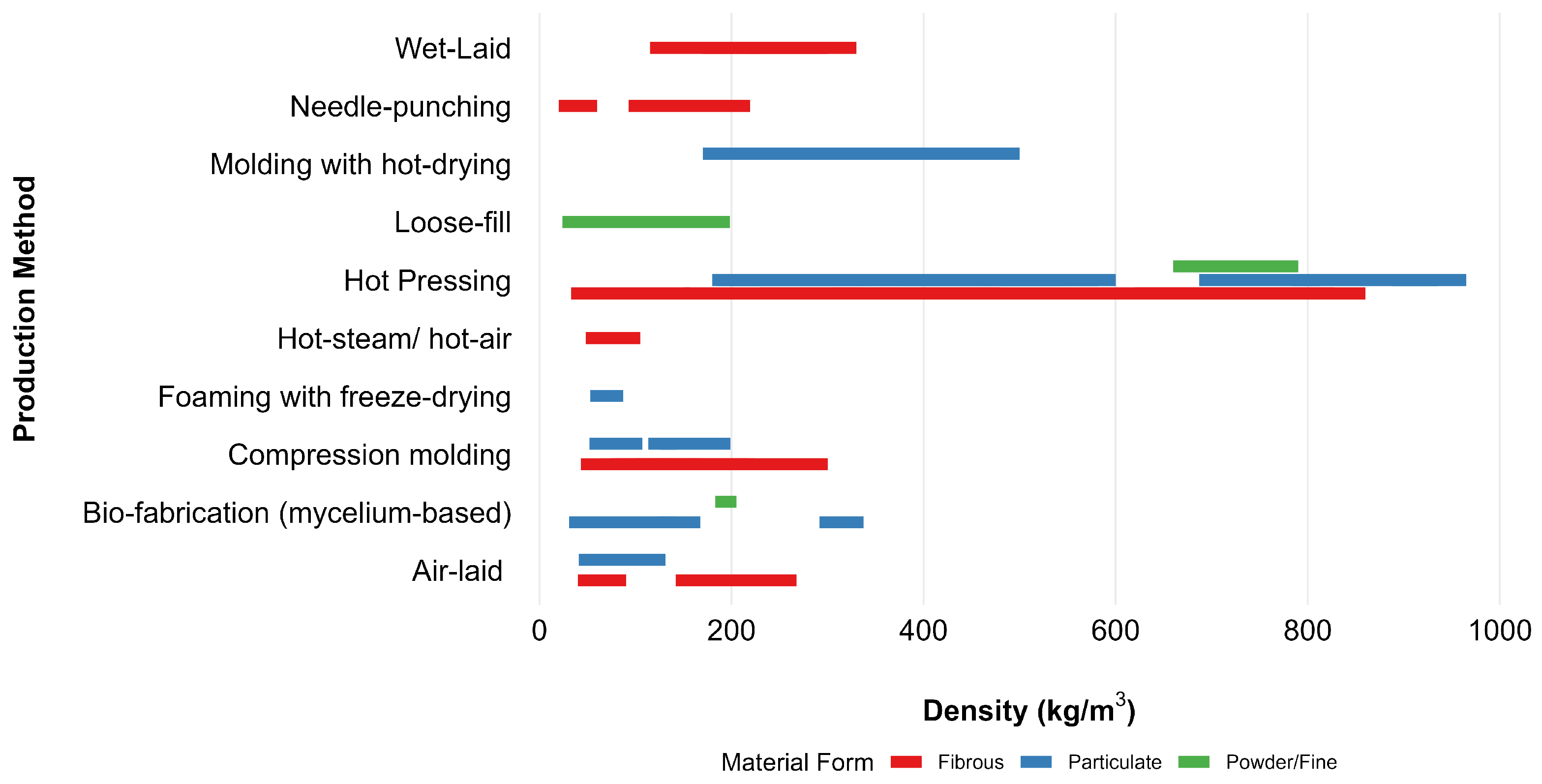
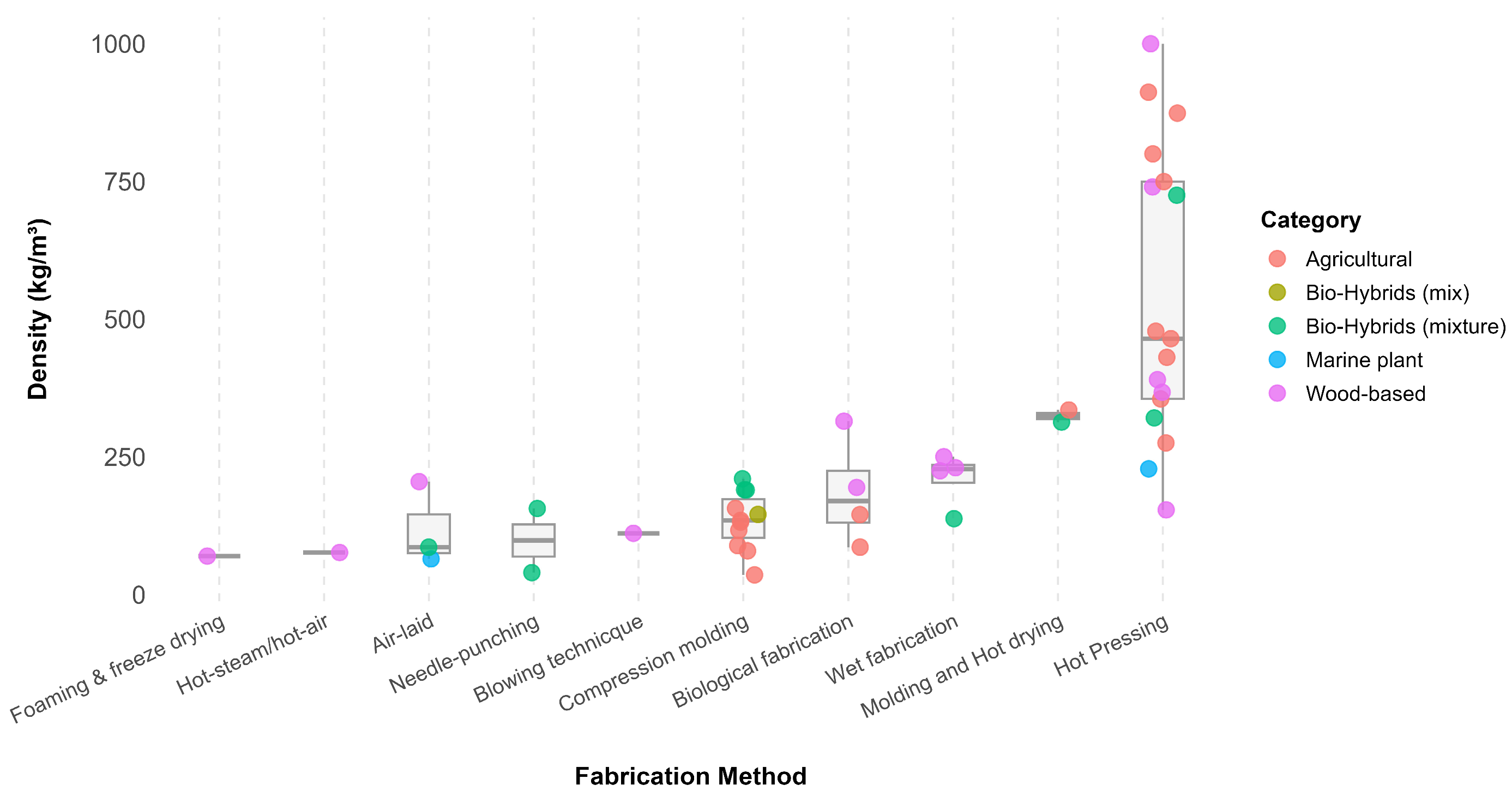
The molding method and process parameters determine the ability of biomaterials to impede heat transfer by regulating the material’s density and internal porosity. For bio-based insulation (hemp, wood fiber, straw, cellulose), thermal conductivity (λ) has a U-shaped or parabolic relationship with density [36]. In porous bio-insulation, total thermal conductivity λtotal is the sum of solid conduction, gas conduction, and radiation. In high-density boards (hot pressing), heat is transferred through the solid skeleton of the material (conduction), while in porous mats (air-laid, freeze-drying), heat transfer is reduced by immobilizing air in micropores and limiting convection. Lowering density increases porosity, but it also creates large, open air gaps that allow thermal radiation and free air convection to transfer heat. Conductivity remains high in this ultra-low-density range. At the critical point, solid matter is minimized, air pockets are small enough to prevent convection, and natural fibers optimally obstruct thermal radiation. At this stage, the thermal conductivity will be determined by the raw material [36]. The density range across the production methods is shown in Figure 11.
Methods that exclude mechanical pressing, such as foaming and freeze-drying, hot-steam/hot-air, and air-laid, produce stable, low-density structures (below 200 kg/m3). At the same time, the hot-pressing method shows an extremely wide range of density distribution (from 150 to 1000 kg/m3). This is due to the fact that the largest amount of data is available for this method. Also, varying the process pressure (2–16 MPa) and temperature directly regulates the volume of residual porosity of the material [75]. Biological fabrication (mycelium) and wet fabrication methods allow for the production of lightweight boards due to natural volume filling (mycelium growth or moisture removal through a mesh) without rigid mechanical compaction of the structure [108,109].
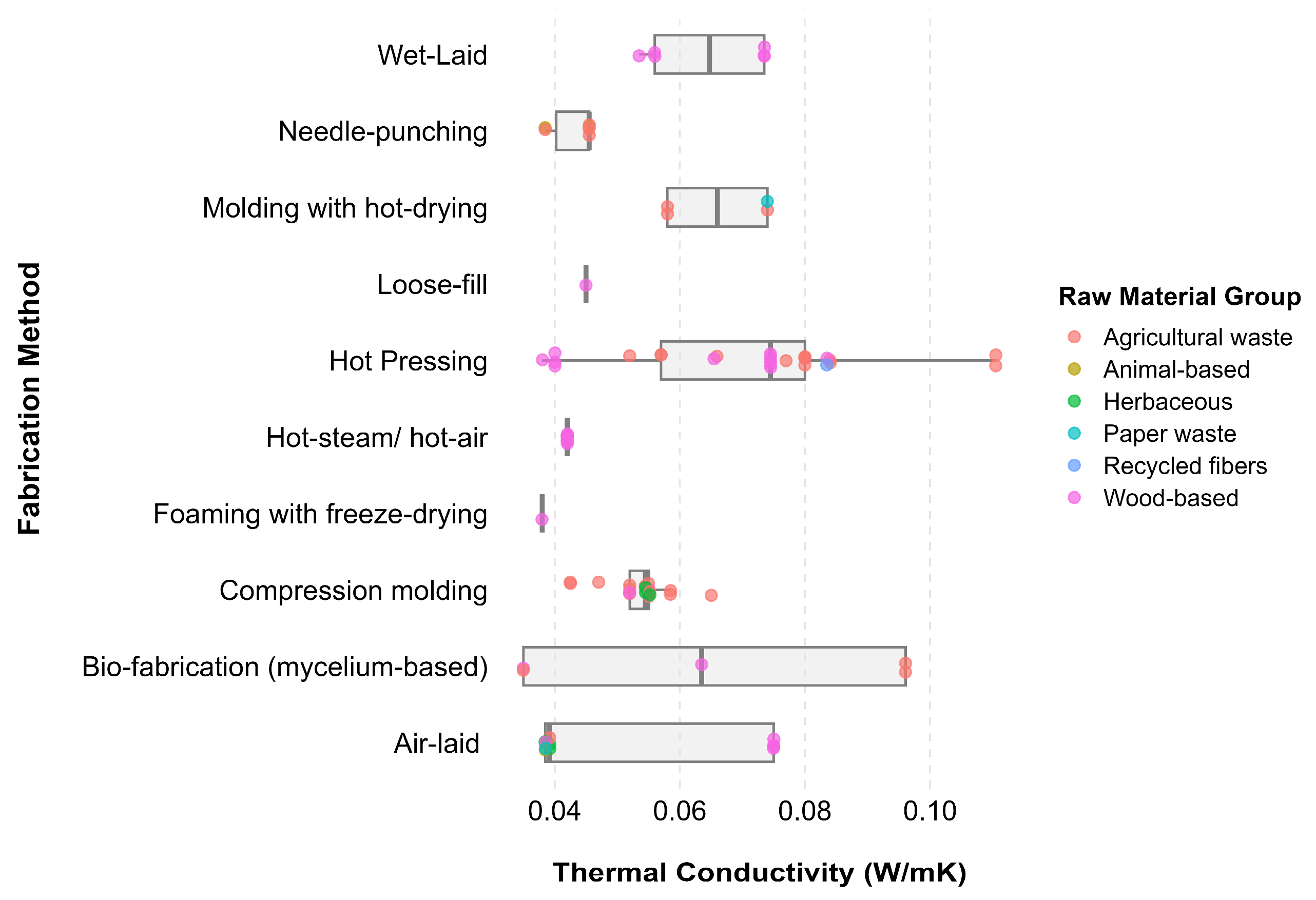
Figure 12 shows that foaming with freeze-drying and needle-punching methods exhibit the lowest and most consistent thermal conductivity values (around 0.04 W/mK) due to highly porous structures. Mycelial (bio-fabrication) materials show a wide range of values, indicating the difficulty of controlling the growth process and the heterogeneity of the resulting structure. Hot pressing contains the most data points, as it is one of the most widely used methods. This fabrication minimizes porosity and compacts the material (density up to 800 kg/m3) due to high mechanical pressure, which leads to an increase in thermal conductivity up to 0.10–0.14 W/mK [103].
In hot-pressing methods, varying the time (from 4 to 25 min) and temperature (130–200 °C) allows for the structure to be adjusted: for example, whole olive leaf slabs panels have a thermal conductivity of 0.065–0.085 W/mK [45], while coconut coir or rice husk panels show a thermal conductivity of around 0.05–0.073 W/mK [112,138]. Biofabrication allows the production of ultra-light structures (20–36 kg/m3) with competitive thermal conductivities in the range of 0.031–0.053 W/mK; however, these materials show a high dispersion of values due to the difficulty of controlling mycelial growth and structural heterogeneity [86,118].

3.4.2. Influence on Mechanical Properties

Key mechanical properties of bio-based thermal insulation presented in the literature are compressive strength, flexural strength or Modulus of Rapture (MOR), and Modulus of Elasticity (MOE).
The compressive strength of bio-insulation is determined by several key factors such as density, binder type and ratio, raw material characteristics, porosity, pretreatment, and moisture content. Higher-density materials generally show greater strength [139]. During the production process, such as pressing or wet-laid, the mat is compressed, eliminating large voids and increasing the density of the material. Pressing time and temperature affected the density of panels made from whole olive leaves with a thickness of around 6 mm [45]. However, improved mechanical properties occurred for panels made from crushed material and not for the whole leaves.
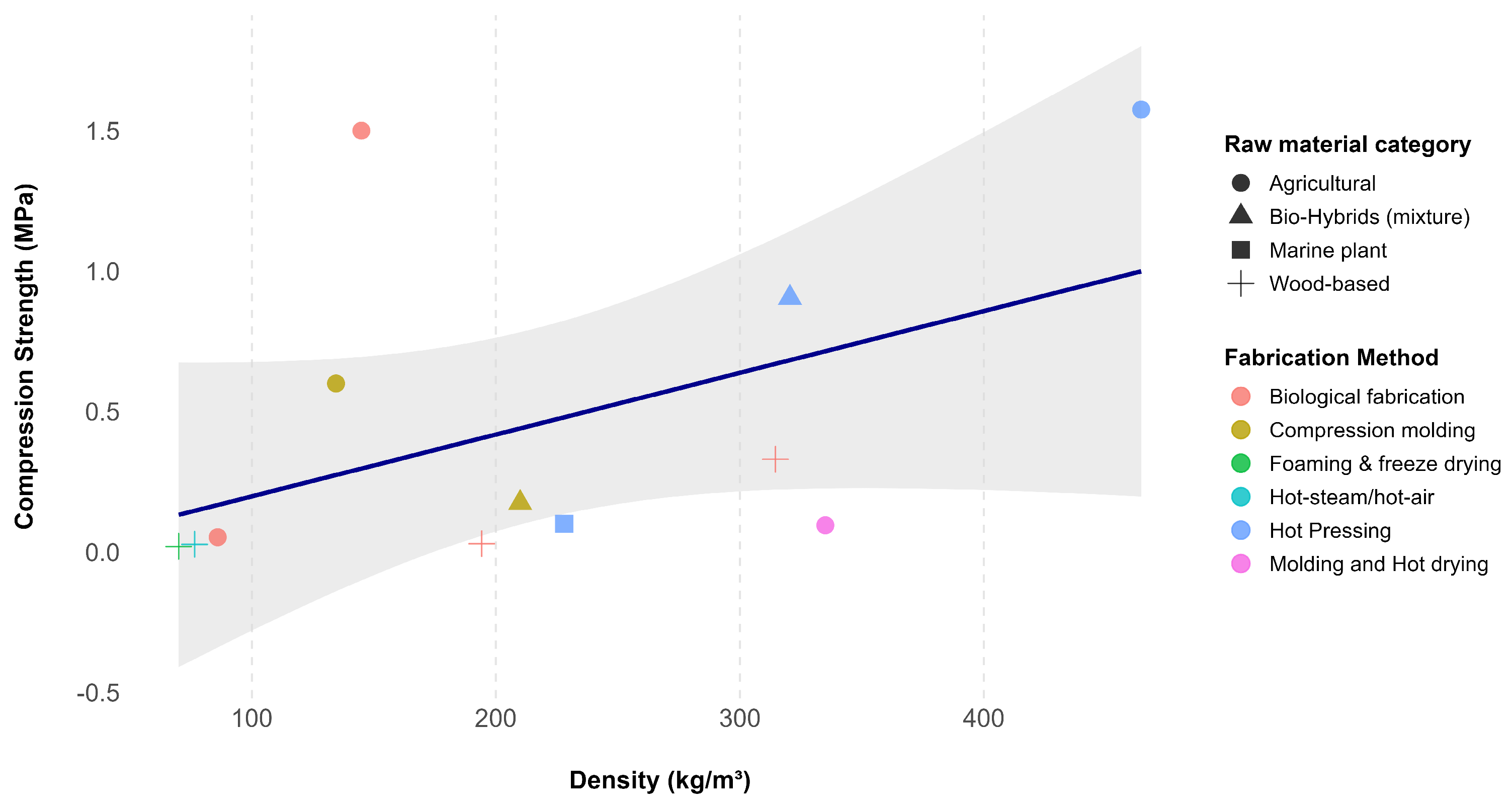
Figure 13 shows the positive correlation between compression strength and density of bio-based insulation materials across different fabrication methods and raw material categories.
The hot-pressed materials showed a wide range of values due to both their density and the addition of binders, which strengthens the material. Compressive strength values for panels made from a paper pulp and rice husk composite are 20.19–21.23 MPa [140], which is explained by the creation of a dense, rigid matrix due to the adhesive component and the interweaving of the cellulose fibers of the paper during drying. Molding with hot drying allows for moderate strength (1.2 MPa) to be achieved for wheat straw boards due to the addition of a metakaolin binder and a foaming agent [141], which form a stable porous structure. Without the introduction of such rigid matrices (e.g., for a mixture of bran and banana peel), the material behaves as a plastic damper under load, showing only 20–170 kPa at 10% deformation [142].
Panels made of sphagnum moss and straw molding with liquid glass under pressure have a slightly lower compressive strength in the range of 0.20–0.21 MPa [102] due to the lack of thermal polymerization of the binder and the elastic “rebound” of the plant fibers after the press is removed.
Bio-fabrication (mycelium-based) shows low and insufficient strength for load-bearing applications (0.013 MPa) on a substrate made of beet pulp and husks [121] because fungal hyphae create a light, spongy, airy foam that easily collapses under compression, as well as in the loss of mass from the substrate itself, which the fungus consumes during growth.
Changing heat treatment conditions directly controls the balance between density, internal bonding (IB), and flexural strength (MOR). Traditional hot pressing creates a thermal gradient, causing binder polymerization to occur unevenly across the board thickness. The use of high-frequency currents [117] solves the core heating problem, increasing IB from 0.0096 to 0.0132 MPa, but reduces MOR by 37% (from 0.89 to 0.56 MPa). A conventional press heats the board from the outside in, causing the outer layers of the material to become more compact (creating a so-called vertical density profile). The high-frequency method heats the board uniformly across its entire thickness, resulting in a lower density at the surface. Since the outermost layers bear the stress of the tension and compression during bending (MOR test), the less dense surface of the boards is lower than that of a conventional press [117]. Increasing the exposure time during classical hot pressing [138] optimizes the plasticization of the lignocellulosic matrix (change in flexural properties by 7%) but limits economic feasibility, since it unreasonably increases the cost of production [126].
Needle-punched mats and air-laid materials have tensile strengths in the range of 2.5–130 kPa, which depends on the degree of fiber interweaving and the addition of thermoplastic fibers (e.g., PLA, PE, PP) [69,143].

3.4.3. Influence on Hydrothermal Properties

Since bio-based insulation materials are of an organic nature, their physical properties are characterized by high hygroscopicity and water absorption capacity (WA), which strongly depends on the presence of hydrophobic agents and the porosity specified by the production method. Moisture absorption decreases the insulation value of bio-based materials through two main mechanisms: by replacing trapped air with water (which conducts heat much faster) and by physically altering the material’s structure over time [144].
During humidity conditioning, biomaterials mitigate temperature peaks through water sorption/desorption processes [128]. Natural materials generally exhibit a sigmoidal (S-shaped) Type II isotherm. The overall process creates a loop due to a phenomenon called sorption hysteresis. These curves are the basis of hygrothermal modeling, which predicts whether condensation will form inside walls. Materials like cork, hemp, and wood fiber rely on their ability to safely adsorb and release ambient moisture [65].
The production method reduces capillary volume (large pores) but has little effect on cell wall sorption at the micro level. When bio-based materials are immersed directly into water, porous structures without water repellents show extreme water absorption. For example, for wet-laid bark boards, water absorption ranges from 55% to 380%, and thickness swelling reaches 23% [93]. Hemp-on-lime composites, made by molding with the drying method, absorb five times more water than hemp–lime composites [145].
Manipulating thermopressing parameters (increasing temperature and time) helps reduce thickness swelling of coconut coir boards due to restructuring of the carbohydrate complex [126]. Using a combination of hot air (up to 120 °C) and hot steam for 30 s to activate the LMS and pMDI enzymatic system reduces water absorption to 0.52 kg/m2 [146]. Using the air lay-up method with heat-setting of PLA fibers (at 160 °C) ensures water absorption of mats in the range of 0.5–8.5 kg/m2 and a water vapor diffusion resistance coefficient (Sd) of 2.53–2.66 [143].
Water has a thermal conductivity of ~0.6 W/mK (which is 15 times higher than air). It should be emphasized that methods that leave the material unprotected from moisture (for example, molding without water repellents) lead to a sharp drop in thermal resistance under real-world operating conditions.

3.4.4. Environmental Aspect

The ecological footprint and operational durability of bio-insulation are determined by the balance between the energy intensity of the technological process, the origin of the binders, and the resistance of the organic raw materials to biodegradation.
On the one hand, the use of agricultural and industrial waste (rice husks, hemp husks, sawdust, straw, bark) in almost all methods increases the environmental attractiveness of the materials through the utilization of by-products (agricultural waste) [112,141]. On the other hand, methods such as hot pressing at high temperatures (140–190 °C, up to 220 °C) and long cycles (up to 20 min), as well as freeze-drying processes, are characterized by colossal energy consumption during the production stage [77,89].
Biofabrication (mycelial cultivation) is promoted as carbon-negative. However, the CO2 released by fungi during metabolism creates a carbon footprint of 0.3668 kg CO2 per kg of material, even at the laboratory stage [147]. Furthermore, during growth, fungi consume the substrate itself, causing mass loss [122,123].
A significant problem with biomaterials is their vulnerability to microbial growth during use. Studies of mold resistance show that, for the differently manufactured boards, the lowest mass loss due to decay was recorded for dry-pressed boards, which was slightly higher for wet-laid materials, and the most vulnerable were flexible porous mats [148]. Mycelial composites are even more susceptible to mold attack than pure hemp or cork [65].
Environmental friendliness depends not only on the pressing energy but also on the chemistry. The toxicity of synthetic resins (e.g., phenol formaldehyde PF or pMDI) [149] complicates subsequent recycling/composting of the material, as opposed to completely “green” methods (LMS enzymes, mycelium, or chitosan).
Environmental properties in construction include fire safety. Since bio-based feedstocks are flammable, methods requiring the addition of large amounts of borates/flame retardants (such as the addition of borax in the wet method [140]) must be assessed in terms of the environmental friendliness of their emissions.
The reviewed literature provides very limited data on the thermal stability of biomaterials (4 out of 11 manufacturing methods). A panel produced by hot pressing has the best thermal stability (stable up to above 306 °C) [43], with density 660–790 kg/m3. Higher-density bio-composites have greater thermal inertia. When exposed to extreme temperatures or fire, a denser material sustains thermal degradation longer because of larger physical mass per unit volume, capable of absorbing and dispersing heat [150].

4. Conclusions

This review provides a comprehensive technical analysis of how manufacturing conditions and processes determine the multifunctional performance of lignocellulose-based thermal insulation. Unlike previous reviews, which have primarily focused on the properties of individual raw materials or life cycle assessments, this study established a cause-and-effect relationship between pretreatment methods, binders, and structural molding parameters and the final thermal, mechanical, and hygrothermal performance of bio-based insulation.
The comparative analysis demonstrates that there is no single “ideal” manufacturing method. The choice of manufacturing method should be adapted to the intended structural application.
  • Thermal optimization. The lowest thermal conductivity (0.031–0.040 W/mK) is achieved using methods that avoid strong mechanical pressing, such as needle-punching of pure animal/plant fibers, foaming via freeze-drying, and biological (mycelium-based) manufacturing. These methods preserve maximum microporosity and immobilize air pockets, preventing convective heat transfer.
  • Mechanical integrity. For rigid semi-structural insulation boards where structural integrity is critical, hot pressing and compression molding remain the most reliable methods. Pressing at pressures of 2.0–15.0 MPa and temperatures above 100 °C ensures maximum internal bond strength (up to 1.2 MPa) and ultimate flexural strength (MOR) due to matrix compaction and uniform binder curing.
  • Environmental impact. Room-temperature molding with cold drying or loose-fill blow molding demonstrates the lowest energy consumption, avoiding the intense heat treatment (up to 220 °C) required for industrial pressing or energy-intensive vacuum freezing cycles during lyophilization.
The main technical limitations of bio-insulation materials include the hydrophilic nature of raw biomass, which leads to extremely high water absorption (55–380%), which replaces entrapped air with water and reduces thermal insulation properties. High moisture accumulation and the use of organic bio-binders (starch, casein) also lead to rapid colonization by mold or decay fungi. Furthermore, replacing formaldehyde-based synthetic resins with environmentally friendly binders significantly degrades mechanical properties and mold resistance, requiring expensive or volatile natural additives. Barriers to scalability are related to the availability of production lines. Unlike pneumatic molding and pressing lines, which correspond to standard MDF/chipboard infrastructure, biological production is limited by long incubation times (7–42 days) and mandatory substrate sterilization.
To bridge the gap between the laboratory development stage of bio-insulation and industrial application, future studies must prioritize critical areas. Future research should focus on developing moisture-resistant bio-binders derived from starch, tannin, or lignin that prevent mold growth without relying on toxic synthetic chemicals. Testing must shift from controlled laboratory environments to real-world, system-level wall assemblies to evaluate how seasonal hygrothermal behavior impacts long-term thermal conductivity. Biological fabrication methods require optimization to shorten the lengthy 7–42-day mycelium cultivation cycle and minimize the high energy consumption of substrate sterilization. Comprehensive techno-economic analyses are needed to adapt existing industrial MDF and particleboard pressing lines for the scalable production of low-density, high-porosity bio-insulation panels without sacrificing their structural integrity.

Supplementary Materials

The following supporting information can be downloaded at: https://www.mdpi.com/article/10.3390/app16125866/s1.

Author Contributions

Writing—original draft preparation, V.M.; writing—review and editing, Z.P.; visualization, V.M.; supervision, Z.P. All authors have read and agreed to the published version of the manuscript.

Funding

This research received no external funding.

Institutional Review Board Statement

Not applicable.

Informed Consent Statement

Not applicable.

Data Availability Statement

The data presented in this study are available on request from the corresponding author.

Conflicts of Interest

The authors declare no conflicts of interest.

Abbreviations

The following abbreviations are used in this manuscript:
CNBCarbon-Neutral Buildings
CpSpecific Heat Capacity
EPSExpanded Polystyrene
EUEuropean Union
FTIRFourier Transform Infrared Spectroscopy
GHGGreenhouse Gases
IBInternal Bonding
IEAInternational Energy Agency
LCALife Cycle Assessment
LMSLaccase-Mediator System
MBVMoisture Buffer Values
MDIMethylene Diphenyl Diisocyanate
MOEModulus of Elasticity
MORModulus of Rupture
MPaMegapascal
MUFMelamine Urea Formaldehyde
NaOHSodium Hydroxide
NRCNoise-Reduction Coefficient
NZEBNet Zero Energy Building
OSBOriented Strand Board
PVAPolyvinyl Acetate
PEPolyethylene Terephthalate
PET/rPETPolyethylene/Recycled Polyethylene Terephthalate
PFPhenol Formaldehyde
PLAPolylactic Acid
PUPolyurethane
pMDIPolymeric Diphenylmethane Diisocyanate
PPPolypropylene
RHRelative Humidity
R-/λ-valueThermal Resistance/Thermal Conductivity Coefficient
rpmRevolutions Per Minute
SdWater Vapor Diffusion Equivalent Air Layer Thickness
SEMScanning Electron Microscope
SIPsStructural Insulated Panels
TGAThermogravimetric Analysis
TMPThermomechanical Pulping
TSThickness Swelling
UFUrea-Formaldehyde
UVUltraviolet
U-valueThermal Transmittance
WAWater Absorption
w/wWeight by Weight (e.g., 8% w/w)

References

  1. Energy Performance of Buildings Directive. Available online: https://energy.ec.europa.eu/topics/energy-efficiency/energy-efficient-buildings/energy-performance-buildings-directive_en (accessed on 19 November 2024).
  2. World Energy Outlook 2024—Analysis-IEA. Available online: https://www.iea.org/reports/world-energy-outlook-2024 (accessed on 19 November 2024).
  3. Bio-Based Building Materials Market Size, Share. Available online: https://www.verifiedmarketreports.com/product/bio-based-building-materials-market/ (accessed on 19 November 2024).
  4. An Updated Roadmap to Net Zero Emissions by 2050–World Energy Outlook 2022–Analysis-IEA. Available online: https://www.iea.org/reports/world-energy-outlook-2022/an-updated-roadmap-to-net-zero-emissions-by-2050 (accessed on 19 November 2024).
  5. Ohene, E.; Chan, A.P.C.; Darko, A. Review of Global Research Advances towards Net-Zero Emissions Buildings. Energy Build. 2022, 266, 112142. [Google Scholar] [CrossRef]
  6. Aditya, L.; Mahlia, T.M.I.; Rismanchi, B.; Ng, H.M.; Hasan, M.H.; Metselaar, H.S.C.; Muraza, O.; Aditiya, H.B. A Review on Insulation Materials for Energy Conservation in Buildings. Renew. Sustain. Energy Rev. 2017, 73, 1352–1365. [Google Scholar] [CrossRef]
  7. Grazieschi, G.; Asdrubali, F.; Thomas, G. Embodied Energy and Carbon of Building Insulating Materials: A Critical Review. Clean. Environ. Syst. 2021, 2, 100032. [Google Scholar] [CrossRef]
  8. Łebkowska, M.; Załęska-Radziwiłł, M.; Tabernacka, A. Adhesives Based on Formaldehyde-Environmental Problems. BioTechnologia 2017, 98, 53–65. [Google Scholar] [CrossRef]
  9. Dickson, T.; Pavía, S. Energy Performance, Environmental Impact and Cost of a Range of Insulation Materials. Renew. Sustain. Energy Rev. 2021, 140, 110752. [Google Scholar] [CrossRef]
  10. Pavel, C.; Blagoeva, D. Competitive Landscape of the EU’s Insulation Materials Industry for Energy-Efficient Buildings; Publications Office of the European Union: Luxembourg, 2018. [Google Scholar] [CrossRef]
  11. United Nations Environment Programme; Yale Center for Ecosystems + Architecture. Building Materials and the Climate: Constructing a New Future. Available online: https://wedocs.unep.org/xmlui/handle/20.500.11822/43293 (accessed on 23 April 2025).
  12. Arias-Cárdenas, B.; Lacasta, A.M.; Haurie, L. Bibliometric Analysis of Research on Thermal, Acoustic, and/or Fire Behaviour Characteristics in Bio-Based Building Materials. Constr. Build. Mater. 2024, 432, 136569. [Google Scholar] [CrossRef]
  13. Lu, Z.; Hauschild, M.; Ottosen, L.M.; Ambaye, T.G.; Zerbino, P.; Aloini, D.; Lima, A.T. Climate Mitigation Potential of Biobased Insulation Materials: A Comprehensive Review and Categorization. J. Clean. Prod. 2024, 470, 143356. [Google Scholar] [CrossRef]
  14. Ulutaş, A.; Balo, F.; Topal, A. Identifying the Most Efficient Natural Fibre for Common Commercial Building Insulation Materials with an Integrated PSI, MEREC, LOPCOW and MCRAT Model. Polymers 2023, 15, 1500. [Google Scholar] [CrossRef]
  15. Cosentino, L.; Fernandes, J.; Mateus, R. A Review of Natural Bio-Based Insulation Materials. Energies 2023, 16, 4676. [Google Scholar] [CrossRef]
  16. Lafond, C.; Blanchet, P. Technical Performance Overview of Bio-Based Insulation Materials Compared to Expanded Polystyrene. Buildings 2020, 10, 81. [Google Scholar] [CrossRef]
  17. Zhao, J.; Li, S. Life Cycle Cost Assessment and Multi-Criteria Decision Analysis of Environ-ment-Friendly Building Insulation Materials - A Review. Energy Build. 2022, 254, 111582. [Google Scholar] [CrossRef]
  18. Arias-Cárdenas, B.; Lacasta, A.M.; Haurie, L.; Duarte, S.; Duarte, M.; Faria, P. Biological Colonisation in Bio-Materials and Composites with Different Bio-Binder Combinations. Constr. Build. Mater. 2025, 492, 142980. [Google Scholar] [CrossRef]
  19. Cai, S.; Deng, X.; Beiyuan, J.; Chen, X.; Liu, D.; Lv, D.; Duan, C.; Lin, L.; Cha, R.; Xie, W.; et al. Review of Synthetic Polymer-Based Thermal Insulation Materials in Construction and Building. J. Build. Eng. 2024, 97, 110846. [Google Scholar] [CrossRef]
  20. Ouda, M.; Abu Sanad, A.A.; Abdelaal, A.; Krishna, A.; Kandah, M.; Kurdi, J. A Comprehensive Review of Sustainable Thermal and Acoustic Insulation Materials from Various Waste Sources. Buildings 2025, 15, 2876. [Google Scholar] [CrossRef]
  21. Asfaw, N.T.; Absi, R.; Labouda, B.A.; Abbassi, I.E. Assessment of the Thermal and Mechanical Properties of Bio-Based Composite Materials for Thermal Insulation: A Review. J. Build. Eng. 2024, 97, 110605. [Google Scholar] [CrossRef]
  22. O’Brien, L.; Li, L.; Friess, W.; Snow, J.; Herzog, B.; O’Neill, S. Review of Bio-Based Wood Fiber Insulation for Building Envelopes: Characteristics and Performance Assessment. Energy Build. 2025, 328, 115114. [Google Scholar] [CrossRef]
  23. De Zoysa, R.N.; Kristombu Baduge, K.S.; Thilakarathna, P.S.M.; Liu, X.; Costa, S.; Gunarathne, U.; Cazacu, E.; Braunsch, T. Eco-Friendly Materials for Structural Insulated Panels: A Comprehensive Review. J. Build. Eng. 2025, 113, 114059. [Google Scholar] [CrossRef]
  24. Ye, F.; Wei, H.; Xiao, Y.; Berardi, U.; Quaranta, G.; Demartino, C. Bio-Based Insulation Materials in Sustainable Constructions: A Review of Environmental, Thermal and Acoustic Insulation, Durability, and Mechanical Performances. Renew. Sustain. Energy Rev. 2025, 223, 115872. [Google Scholar] [CrossRef]
  25. Aria, M.; Cuccurullo, C. Bibliometrix: An R-Tool for Comprehensive Science Mapping Analysis. J. Informetr. 2017, 11, 959–975. [Google Scholar] [CrossRef]
  26. Ouzzani, M.; Hammady, H.; Fedorowicz, Z.; Elmagarmid, A. Rayyan—A Web and Mobile App for Systematic Reviews. Syst. Rev. 2016, 5, 210. [Google Scholar] [CrossRef]
  27. Abu-Jdayil, B.; Mourad, A.H.; Hittini, W.; Hassan, M.; Hameedi, S. Traditional, State-of-the-Art and Renewable Thermal Building Insulation Materials: An Overview. Constr. Build. Mater. 2019, 214, 709–735. [Google Scholar] [CrossRef]
  28. Papadopoulos, A.M. State of the Art in Thermal Insulation Materials and Aims for Future Developments. Energy Build. 2005, 37, 77–86. [Google Scholar] [CrossRef]
  29. Al-Homoud, M.S. Performance Characteristics and Practical Applications of Common Building Thermal Insulation Materials. Build. Environ. 2005, 40, 353–366. [Google Scholar] [CrossRef]
  30. Forest Product Conversion Factors; FAO: Rome, Italy; ITTO: Yokohama, Japan; United Nations: New York, NY, USA, 2020. [CrossRef]
  31. Barbu, M.C.; Lohninger, Y.; Hofmann, S.; Kain, G.; Petutschnigg, A.; Tudor, E.M. Larch Bark as a Formaldehyde Scavenger in Thermal Insulation Panels. Polymers 2020, 12, 2632. [Google Scholar] [CrossRef]
  32. Pásztory, Z.; Ronyecz Mohácsiné, I.; Börcsök, Z. Investigation of Thermal Insulation Panels Made of Black Locust Tree Bark. Constr. Build. Mater. 2017, 147, 733–735. [Google Scholar] [CrossRef]
  33. Benallel, A.; Tilioua, A.; Dlimi, M. Assessment of the Thermal Performance of a New Insulation Material Based on Date Palm and Cardboard: Experimental and Numerical Study. Constr. Build. Mater. 2024, 419, 135476. [Google Scholar] [CrossRef]
  34. Kołodziej, J.; Kicińska-Jakubowska, A.; Mańkowski, J.; Grzymisławska, J. Use of Waste Raw Materials in the Form of Hemp Shives and Waste Sheep Wool to Produce Composites Dedicated to Thermal Insulation. J. Nat. Fibers 2024, 21, 2371902. [Google Scholar] [CrossRef]
  35. Binici, H.; Aksogan, O.; Dıncer, A.; Luga, E.; Eken, M.; Isikaltun, O. The Possibility of Vermiculite, Sunflower Stalk and Wheat Stalk Using for Thermal Insulation Material Production. Therm. Sci. Eng. Prog. 2020, 18, 100567. [Google Scholar] [CrossRef]
  36. Lian, X.; Tian, L.; Li, Z.; Zhao, X. Thermal Conductivity Analysis of Natural Fiber-Derived Porous Thermal Insulation Materials. Int. J. Heat Mass Transf. 2024, 220, 124941. [Google Scholar] [CrossRef]
  37. Abdou, A.; Budaiwi, I. The Variation of Thermal Conductivity of Fibrous Insulation Materials under Different Levels of Moisture Content. Constr. Build. Mater. 2013, 43, 533–544. [Google Scholar] [CrossRef]
  38. Pawłosik, D.; Cebrat, K.; Brzezicki, M. Exploring Advancements in Bio-Based Composites for Thermal Insulation: A Systematic Review. Sustainability 2025, 17, 1143. [Google Scholar] [CrossRef]
  39. Bourdot, A.; Moussa, T.; Gacoin, A.; Maalouf, C.; Vazquez, P.; Thomachot-Schneider, C.; Bliard, C.; Merabtine, A.; Lachi, M.; Douzane, O.; et al. Characterization of a Hemp-Based Agro-Material: Influence of Starch Ratio and Hemp Shive Size on Physical, Mechanical, and Hygrothermal Properties. Energy Build. 2017, 153, 501–512. [Google Scholar] [CrossRef]
  40. Imken, A.A.P.; Plinke, B.; Mai, C. Characterisation of Hardwood Fibres Used for Wood Fibre Insulation Boards (WFIB). Eur. J. Wood Wood Prod. 2021, 79, 915–924. [Google Scholar] [CrossRef]
  41. Ferrandez-Garcia, M.T.; Ferrandez-Garcia, A.; Garcia-Ortuño, T.; Ferrandez-Garcia, C.E.; Ferrandez-Villena, M. Influence of Particle Size on the Properties of Boards Made from Washingtonia Palm Rachis with Citric Acid. Sustainability 2020, 12, 4841. [Google Scholar] [CrossRef]
  42. Evon, P.; de Langalerie, G.; Labonne, L.; Merah, O.; Talou, T.; Ballas, S.; Véronèse, T. Low-density Insulation Blocks and Hardboards from Amaranth (Amaranthus Cruentus) Stems, a New Perspective for Building Applications. Coatings 2021, 11, 349. [Google Scholar] [CrossRef]
  43. Mawardi, I.; Aprilia, S.; Faisal, M.; Rizal, S. Characterization of Thermal Bio-Insulation Materials Based on Oil Palm Wood: The Effect of Hybridization and Particle Size. Polymers 2021, 13, 3287. [Google Scholar] [CrossRef]
  44. Bovo, M.; Giani, N.; Barbaresi, A.; Mazzocchetti, L.; Barbaresi, L.; Giorgini, L.; Torreggiani, D.; Tassinari, P. Contribution to Thermal and Acoustic Characterization of Corn Cob for Bio-Based Building Insulation Applications. Energy Build. 2022, 262, 111994. [Google Scholar] [CrossRef]
  45. Ferrandez-Garcia, A.; Ferrandez-Garcia, M.T.; Ortuño, T.G.; Mata-Cabrera, F.; Ferrandez-Villena, M. Analysis of the Manufacturing Variables of Binderless Panels Made of Leaves of Olive Tree (Olea Europaea L.) Pruning Waste. Agronomy 2021, 12, 93. [Google Scholar] [CrossRef]
  46. Savic, A.; Antonijevic, D.; Jelic, I.; Zakic, D. Thermomechanical Behavior of Bio-Fiber Composite Thermal Insulation Panels. Energy Build. 2020, 229, 110511. [Google Scholar] [CrossRef]
  47. Khalaf, Y.; El Hage, P.; Dimitrova Mihajlova, J.; Bergeret, A.; Lacroix, P.; El Hage, R. Influence of Agricultural Fibers Size on Mechanical and Insulating Properties of Innovative Chitosan-Based Insulators. Constr. Build. Mater. 2021, 287, 123071. [Google Scholar] [CrossRef]
  48. Hellová, K.E.; Unčík, S.; Cabanová, T. Sorption Properties of Thermal Insulation Composed of Flax or Hemp Fibers. Slovak J. Civ. Eng. 2020, 28, 47–52. [Google Scholar] [CrossRef]
  49. Wróbel, B.; Zielewicz, W.; Paszkiewicz-Jasińska, A.; Spychalski, B.; Jakubowska, Z. Effect of Harvest Date on Structural Carbohydrates and Lignin Content in Meadow Sward in Different Pluvio-Thermal Conditions. J. Water Land Dev. 2022, 55, 60–66. [Google Scholar] [CrossRef]
  50. Wan, J.Q.; Wang, Y.; Xiao, Q. Effects of Hemicellulose Removal on Cellulose Fiber Structure and Recycling Characteristics of Eucalyptus Pulp. Bioresour. Technol. 2010, 101, 4577–4583. [Google Scholar] [CrossRef] [PubMed]
  51. Adekoya, M.A.; Oluyamo, S.S.; Oludayo Oluwasina, O.; Popoola, A.I. Structural Characterization and Solid State Properties of Thermal Insulating Cellulose Materials of Different Size Classifications. Bioresources 2018, 13, 906–917. [Google Scholar] [CrossRef]
  52. Cavali, M.; Soccol, C.R.; Tavares, D.; Zevallos Torres, L.A.; Oliveira de Andrade Tanobe, V.; Zandoná Filho, A.; Woiciechowski, A.L. Effect of Sequential Acid-Alkaline Treatment on Physical and Chemical Characteristics of Lignin and Cellulose from Pine (Pinus spp.) Residual Sawdust. Bioresour. Technol. 2020, 316, 123884. [Google Scholar] [CrossRef]
  53. Vieira, T.A.S.; Arriel, T.G.; Zanuncio, A.J.V.; Carvalho, A.G.; Branco-Vieira, M.; Carabineiro, S.A.C.; Trugilho, P.F. Determination of the Chemical Composition of Eucalyptus spp. For Cellulosic Pulp Production. Forests 2021, 12, 1649. [Google Scholar] [CrossRef]
  54. Jankauskiene, Z.; Butkute, B.; Gruzdeviene, E.; Cesevičiene, J.; Fernando, A.L. Chemical Composition and Physical Properties of Dew- and Water-Retted Hemp Fibers. Ind. Crops Prod. 2015, 75, 206–211. [Google Scholar] [CrossRef]
  55. Raspolli Galletti, A.M.; D’Alessio, A.; Licursi, D.; Antonetti, C.; Valentini, G.; Galia, A.; Nassi O Di Nasso, N. Midinfrared FT-IR as a Tool for Monitoring Herbaceous Biomass Composition and Its Conversion to Furfural. J. Spectrosc. 2015, 2015, 719042. [Google Scholar] [CrossRef]
  56. Salimi, M.N.; Lim, S.E.; Yusoff, A.H.M.; Jamlos, M.F. Conversion of Rice Husk into Fermentable Sugar by Two Stage Hydrolysis. J. Phys. Conf. Ser. 2017, 908, 012056. [Google Scholar] [CrossRef]
  57. Yang, T.; Luo, D.; Wang, L.; Hu, C.; Mei, C. New Insights into the Influencing Mechanisms of Hemicellulose Removal on Dynamic Wood-Water Interactions Characterized with Low-Field NMR. Ind. Crops Prod. 2024, 219, 119139. [Google Scholar] [CrossRef]
  58. Zheng, C.; Li, D.; Ottenhall, A.; Ek, M. Cellulose Fiber Based Fungal and Water Resistant Insulation Materials. Holzforschung 2017, 71, 633–639. [Google Scholar] [CrossRef]
  59. Füchsl, S.; Rheude, F.; Röder, H. Life Cycle Assessment (LCA) of Thermal Insulation Materials: A Critical Review. Clean. Mater. 2022, 5, 100119. [Google Scholar] [CrossRef]
  60. Georgescu, I.; Băncescu, M. Land Use and Water Stress as Determinants of Ecosystem Resilience: A Panel Data Analysis of Biodiversity Loss Drivers in European Countries. Land 2025, 14, 1946. [Google Scholar] [CrossRef]
  61. Seile, A.; Spurina, E.; Sinka, M. Reducing Global Warming Potential Impact of Bio-Based Composites Based of LCA. Fibers 2022, 10, 79. [Google Scholar] [CrossRef]
  62. Keena, N.; Raugei, M.; Lokko, M.L.; Aly Etman, M.; Achnani, V.; Reck, B.K.; Dyson, A. A Life-Cycle Approach to Investigate the Potential of Novel Biobased Construction Materials toward a Circular Built Environment. Energies 2022, 15, 7239. [Google Scholar] [CrossRef]
  63. Rabbat, C.; Awad, S.; Villot, A.; Andres, Y. Towards the Production of High Added-Value Products from the Pyrolysis and Steam Pyro-Gasification of Five Biomass-Based Building Insulation Materials at End-of-Life. Waste Biomass Valorization 2023, 14, 2061–2083. [Google Scholar] [CrossRef]
  64. Frahat, N.B.; Ustaoglu, A.; Gencel, O.; Sarı, A.; Hekimoğlu, G.; Yaras, A.; del Coz Díaz, J.J. Fuel, Cost, Energy Efficiency and CO2 Emission Performance of PCM Integrated Wood Fiber Composite Phase Change Material at Different Climates. Sci. Rep. 2023, 13, 7714. [Google Scholar] [CrossRef]
  65. Koh, C.H.; Gauvin, F.; Schollbach, K.; Brouwers, H.J.H. Investigation of Material Characteristics and Hygrothermal Performances of Different Bio-Based Insulation Composites. Constr. Build. Mater. 2022, 346, 128440. [Google Scholar] [CrossRef]
  66. Ajouguim, S.; Abdelouahdi, K.; Waqif, M.; Stefanidou, M.; Saâdi, L. Modifications of Alfa Fibers by Alkali and Hydrothermal Treatment. Cellulose 2019, 26, 1503–1516. [Google Scholar] [CrossRef]
  67. Guesmi, H.; Adili, A.; Dehmani, L. Effect of Fibers Surface Treatments on the Mechanical and Thermal Properties of Composites Reinforced by Eco-Friendly Fibers. Int. J. Environ. Sci. Technol. 2023, 20, 9505–9520. [Google Scholar] [CrossRef]
  68. Tupciauskas, R.; Orlovskis, Z.; Blums, K.T.; Liepins, J.; Berzins, A.; Pavlovics, G.; Andzs, M. Mold Fungal Resistance of Loose-Fill Thermal Insulation Materials Based on Processed Wheat Straw, Corn Stalk and Reed. Polymers 2024, 16, 562. [Google Scholar] [CrossRef] [PubMed]
  69. Ayadi, M.; Segovia, C.; Baffoun, A.; Zouari, R.; Fierro, V.; Celzard, A.; Msahli, S.; Brosse, N. Influence of Anatomy, Microstructure, and Composition of Natural Fibers on the Performance of Thermal Insulation Panels. ACS Omega 2023, 8, 48673–48688. [Google Scholar] [CrossRef]
  70. Imken, A.A.P.; Bächle, L.; Brinker, S.; Kraft, R.; Plinke, B.; Aderhold, J.; Meinlschmidt, P.; Mai, C. Investigation of Various Hardwood and Softwood Fibres for the Usage in Wood-Fibre Insulation Panels. Wood Mater. Sci. Eng. 2024, 19, 1180–1191. [Google Scholar] [CrossRef]
  71. Bakatovich, A.; Gaspar, F.; Boltrushevich, N. Thermal Insulation Material Based on Reed and Straw Fibres Bonded with Sodium Silicate and Rosin. Constr. Build. Mater. 2022, 352, 129055. [Google Scholar] [CrossRef]
  72. Bossu, J.; Moreau, J.; Delisée, C.; Le Moigne, N.; Corn, S.; Sonnier, R.; Viretto, A.; Beauchêne, J.; Clair, B. Revealing the Potential of Waste Fibers from Timber Production and Clearings for the Development of Local Bio-Based Insulation Fiberboards in French Guiana. Waste Biomass Valorization 2023, 14, 4281–4295. [Google Scholar] [CrossRef]
  73. Ewanick, S.; Bura, R. Hydrothermal Pretreatment of Lignocellulosic Biomass. In Bioalcohol Production: Biochemical Conversion of Lignocellulosic Biomass; Woodhead Publishing: Sawston, UK, 2010; pp. 3–23. [Google Scholar] [CrossRef]
  74. Xiao, L.-P.; Lin, Z.; Peng, W.-X.; Yuan, T.-Q.; Xu, F.; Li, N.-C.; Tao, Q.-S.; Xiang, H.; Sun, R.-C. Unraveling the Structural Characteristics of Lignin in Hydrothermal Pretreated Fibers and Manufactured Binderless Boards from Eucalyptus Grandis. Sustain. Chem. Process. 2014, 2, 9. [Google Scholar] [CrossRef]
  75. Kurokochi, Y.; Sato, M. Steam Treatment to Enhance Rice Straw Binderless Board Focusing Hemicellulose and Cellulose Decomposition Products. J. Wood Sci. 2020, 66, 1–8. [Google Scholar] [CrossRef]
  76. Mancera, C.; Ferrando, F.; Salvadó, J. Cynara Cardunculus as Raw Material for the Production of Binderless Fiberboards: Optimization of Pretreatment and Pressing Conditions. J. Wood Chem. Technol. 2008, 28, 207–226. [Google Scholar] [CrossRef]
  77. Siciliano, A.P.; Zhao, X.; Fedderwitz, R.; Ramakrishnan, K.; Dai, J.; Gong, A.; Zhu, J.Y.; Kośny, J.; Hu, L. Sustainable Wood-Waste-Based Thermal Insulation Foam for Building Energy Efficiency. Buildings 2023, 13, 840. [Google Scholar] [CrossRef]
  78. Mohamed, G.R.; Mahmoud, R.K.; Fahim, I.S.; Shaban, M.; Abd El-Salam, H.M.; Mahmoud, H.M. Bio-Composite Thermal Insulation Materials Based on Banana Leaves Fibers and Polystyrene: Physical and Thermal Performance. J. Nat. Fibers 2022, 19, 4806–4821. [Google Scholar] [CrossRef]
  79. Thandavamoorthy, R.; Devarajan, Y.; Thanappan, S. Analysis of the Characterization of NaOH-Treated Natural Cellulose Fibre Extracted from Banyan Aerial Roots. Sci. Rep. 2023, 13, 1–8. [Google Scholar] [CrossRef]
  80. Kumar, A.K.; Sharma, S. Recent Updates on Different Methods of Pretreatment of Lignocellulosic Feedstocks: A Review. Bioresour. Bioprocess. 2017, 4, 7. [Google Scholar] [CrossRef]
  81. Sun, W.; Tajvidi, M.; Hunt, C.G.; Cole, B.J.W.; Howell, C.; Gardner, D.J.; Wang, J. Fungal and Enzymatic Pretreatments in Hot-Pressed Lignocellulosic Bio-Composites: A Critical Review. J. Clean. Prod. 2022, 353, 131659. [Google Scholar] [CrossRef]
  82. Ding, Y.; Liu, C.; Xu, G.; Xin, M.; Khan, M.A.; Wu, B.; Lv, K.; Sun, J.; Liu, C.; Yang, L.; et al. Biomass-Based Porous Materials for Thermal Insulation. Mater. Sci. Eng. Rep. 2026, 168, 101138. [Google Scholar] [CrossRef]
  83. Challoob, S.H.; Moyet, A.A.; Abbas, A.S.; Mohammed, A.H.; Resan, K.K.; Flayyih, A.M.; Abdulrehman, M.A. Bio-Composite Formulations Based on Natural Binders for Treating Hollow Palm Trunks: Mechanical, Thermal, and Microstructural Evaluation. Int. J. Des. Nat. Ecodynamics 2026, 21, 425–436. [Google Scholar] [CrossRef]
  84. Ali, M.; Al-Suhaibani, Z.; Almuzaiqer, R.; Albahbooh, A.; Al-Salem, K.; Nuhait, A. New Composites Derived from the Natural Fiber Polymers of Discarded Date Palm Surface and Pineapple Leaf Fibers for Thermal Insulation and Sound Absorption. Polymers 2024, 16, 1002. [Google Scholar] [CrossRef]
  85. Erkmen, J.; Yakut, R.; Hamamcı, B.; Aytuğ Özer, R. Production of Insulation Material Using Styrene Acrylic Resin from Animal and Agricultural Waste Part 1. Thermal Insulation and Water Absorption. Energy Build. 2024, 303, 113817. [Google Scholar] [CrossRef]
  86. Novi, V.; Labonne, L.; Ballas, S.; Véronèse, T.; Evon, P. Insulation Blocks Made from Sunflower Pith with Improved Durability Properties. Ind. Crops Prod. 2024, 210, 118161. [Google Scholar] [CrossRef]
  87. Lee, M.; Lee, S.-M.; Kang, E.-C. Changes in Characteristics of Wood Fiber Insulation According to Density. Bioresources 2019, 14, 6529–6543. [Google Scholar] [CrossRef]
  88. Park, S.-H.; Lee, M.; Seo, P.-N.; Kang, E.-C. Effect of Resin Content on the Physiochemical and Com-bustion Properties of Wood Fiber Insulation Board. Bioresources 2020, 15, 5210–5225. [Google Scholar] [CrossRef]
  89. Lacoste, C.; El Hage, R.; Bergeret, A.; Corn, S.; Lacroix, P. Sodium Alginate Adhesives as Binders in Wood Fibers/Textile Waste Fibers Biocomposites for Building Insulation. Carbohydr. Polym. 2018, 184, 1–8. [Google Scholar] [CrossRef]
  90. Segovia, F.; Blanchet, P.; Auclair, N.; Essoua, G.G.E. Thermo-Mechanical Properties of a Wood Fiber Insulation Board Using a Bio-Based Adhesive as a Binder. Buildings 2020, 10, 152. [Google Scholar] [CrossRef]
  91. Urstöger, J.; Kain, G.; Prändl, F.; Barbu, M.C.; Kristak, L. Physical-Mechanical Properties of Light Bark Boards Bound with Casein Adhesives. Sustainability 2023, 15, 13530. [Google Scholar] [CrossRef]
  92. Zhou, Y.; Trabelsi, A.; El Mankibi, M. Hygrothermal Properties of Insulation Materials from Rice Straw and Natural Binders for Buildings. Constr. Build. Mater. 2023, 372, 130770. [Google Scholar] [CrossRef]
  93. Gößwald, J.; Barbu, M.C.; Petutschnigg, A.; Tudor, E.M. Binderless Thermal Insulation Panels Made of Spruce Bark Fibres. Polymers 2021, 13, 1799. [Google Scholar] [CrossRef]
  94. Khoukhi, M.; Dar Saleh, A.; Mohammad, A.F.; Hassan, A.; Abdelbaqi, S. Thermal Performance and Statistical Analysis of a New Bio-Based Insulation Material Produced Using Grain Puffing Technique. Constr. Build. Mater. 2022, 345, 128311. [Google Scholar] [CrossRef]
  95. Kain, G.; Tudor, E.M.; Barbu, M.C. Bark Thermal Insulation Panels: An Explorative Study on the Effects of Bark Species. Polymers 2020, 12, 2140. [Google Scholar] [CrossRef]
  96. Wildman, J.; Shea, A.; Cascione, V.; Henk, D. Mould Susceptibility of Bio-Based Insulation Materials in Modern Construction. npj Mater. Degrad. 2026, 10. [Google Scholar] [CrossRef]
  97. Schulte, M.; Lewandowski, I.; Pude, R.; Wagner, M. Comparative Life Cycle Assessment of Bio-Based Insulation Materials: Environmental and Economic Performances. GCB Bioenergy 2021, 13, 979–998. [Google Scholar] [CrossRef]
  98. Zerari, S.; Franchino, R.; Pisacane, N. Industry Experts’ Perspectives on the Difficulties and Opportunities of the Integration of Bio-Based Insulation Materials in the European Construction Sector. Sustainability 2024, 16, 7314. [Google Scholar] [CrossRef]
  99. Lakatos, Á. Novel Thermal Insulation Materials for Buildings. Energies 2022, 15, 6713. [Google Scholar] [CrossRef]
  100. Liu, L.F.; Li, H.Q.; Lazzaretto, A.; Manente, G.; Tong, C.Y.; Liu, Q.B.; Li, N.P. The Development His-tory and Prospects of Biomass-Based Insulation Materials for Buildings. Renew. Sustain. Energy Rev. 2017, 69, 912–932. [Google Scholar] [CrossRef]
  101. Bakatovich, A.; Bakatovich, N.; Silva, A.; Gaspar, F. Thermal Insulation Materials Based on Eucalyptus Bark Fibres. Constr. Build. Mater. 2024, 449, 138559. [Google Scholar] [CrossRef]
  102. Bakatovich, A.; Gaspar, F. Composite Material for Thermal Insulation Based on Moss Raw Material. Constr. Build. Mater. 2019, 228, 116699. [Google Scholar] [CrossRef]
  103. Kurokochi, Y.; Sato, M. Effect of Surface Structure, Wax and Silica on the Properties of Binderless Board Made from Rice Straw. Ind. Crops Prod. 2015, 77, 949–953. [Google Scholar] [CrossRef]
  104. Brischke, C.; Humar, M.; Kuqo, A.; Mai, C. Seagrass Leaves: An Alternative Resource for the Production of Insulation Materials. Materials 2022, 15, 6933. [Google Scholar] [CrossRef]
  105. Zuiderveen, E.A.R.; Kuipers, K.J.J.; Caldeira, C.; Hanssen, S.V.; van der Hulst, M.K.; de Jonge, M.M.J.; Vlysidis, A.; van Zelm, R.; Sala, S.; Huijbregts, M.A.J. The Potential of Emerging Bio-Based Products to Reduce Environmental Impacts. Nat. Commun. 2023, 14, 8521. [Google Scholar] [CrossRef] [PubMed]
  106. Zhang, Y.; Huang, X.; Wang, B. Carbon Fiber Papers Prepared by Wet-Laid Technique Using PVB/PF Composite Fibers as the Binders. Appl. Sci. 2023, 13 13, 7304. [Google Scholar] [CrossRef]
  107. Göβwald, J.; Barbu, M.C.; Nemec, M.; Igaz, R.; Adamcik, L.; Kristak, L.; Tudor, E.M. Innovative Porous Panels Made from Alpine Tree Bark-Fibre Bundles for Enhanced Acoustic and Thermal Insulation. Wood Mater. Sci. Eng. 2026, 21, 778–789. [Google Scholar] [CrossRef]
  108. Mialeshka, V.; Pásztory, Z. Binderless Hardwood Tree Bark-Based Insulation Panels for Green Building Applications. Processes 2026, 14, 1450. [Google Scholar] [CrossRef]
  109. Mialeshka, V.; Kowaluk, G.; Pásztory, Z. Sustainable Insulation Panels Made of Tree Bark Fibers: Thermal and Fire Performance. Forests 2025, 17, 26. [Google Scholar] [CrossRef]
  110. Saint-Bois, A.; Belaud, J.P.; Ouaret, R.; Mayer-Laigle, C.; Vialle, C.; Sablayrolles, C. Analysis of Biomass Milling Literature Data and Energy-Particle Size Laws. Biomass Bioenergy 2026, 214, 109521. [Google Scholar] [CrossRef]
  111. Rabbat, C.; Awad, S.; Villot, A.; Rollet, D.; Andrès, Y. Sustainability of Biomass-Based Insulation Ma-terials in Buildings: Current Status in France, End-of-Life Projections and Energy Recovery Potentials. Renew. Sustain. Energy Rev. 2022, 156, 111962. [Google Scholar] [CrossRef]
  112. Cigarruista Solís, L.; Chen Austin, M.; Deago, E.; López, G.; Marin-Calvo, N. Rice Husk-Based Insula-tors: Manufacturing Process and Thermal Potential Assessment. Materials 2024, 17, 2589. [Google Scholar] [CrossRef]
  113. Rojas-Herrera, C.; Martínez-Soto, A.; Avendaño-Vera, C.; Cárdenas-R, J.P. Characterization and Utili-zation of Sawdust Waste Generated from Advanced Manufacture for Its Application as a Thermal Insulation in Sustainable Buildings Using the Blowing Technique. J. Build. Eng. 2024, 88, 109217. [Google Scholar] [CrossRef]
  114. Dias, P.P.; Jayasinghe, L.B.; Waldmann, D. Investigation of Mycelium-Miscanthus Composites as Building Insulation Material. Results Mater. 2021, 10, 100189. [Google Scholar] [CrossRef]
  115. Wimmers, G.; Klick, J.; Tackaberry, L.; Zwiesigk, C.; Egger, K.; Massicotte, H. Fundamental Studies for Designing Insulation Panels from Wood Shavings and Filamentous Fungi. BioResources 2019, 14, 5506–5520. [Google Scholar] [CrossRef]
  116. Schritt, H.; Vidi, S.; Pleissner, D. Spent Mushroom Substrate and Sawdust to Produce Mycelium-Based Thermal Insulation Composites. J. Clean. Prod. 2021, 313, 127910. [Google Scholar] [CrossRef]
  117. Wei, K.; Lv, C.; Chen, M.; Zhou, X.; Dai, Z.; Shen, D. Development and Performance Evaluation of a New Thermal Insulation Material from Rice Straw Using High Frequency Hot-Pressing. Energy Build. 2015, 87, 116–122. [Google Scholar] [CrossRef]
  118. Grenon, V.; Maref, W.; Ouellet-Plamondon, C.M. Multi-Property Characterization of an Experimental Material Composed of Pleurotus Ostreatus Mycelium and Ash Wood Chips Compared with Glass Wool and Hemp Wool. Constr. Build. Mater. 2023, 409, 133941. [Google Scholar] [CrossRef]
  119. Ahmed, A.; Qayoum, A.; Mir, F.Q. Investigation of the Thermal Behavior of the Natural Insulation Materials for Low Temperature Regions. J. Build. Eng. 2019, 26, 100849. [Google Scholar] [CrossRef]
  120. Kicińska-Jakubowska, A.; Broda, J.; Zimniewska, M.; Bączek, M.; Mańkowski, J. Effect of Blend Com-position on Barrier Properties of Insulating Mats Produced from Local Wool and Waste Bast Fibres. Materials 2023, 16, 459. [Google Scholar] [CrossRef]
  121. Lingam, D.; Narayan, S.; Mamun, K.; Charan, D. Engineered Mycelium-Based Composite Materials: Comprehensive Study of Various Properties and Applications. Constr. Build. Mater. 2023, 391, 131841. [Google Scholar] [CrossRef]
  122. Kuştaş, S.; Gezer, E.D. Physical and Mechanical Properties of Mycelium-Based Insulation Materials Produced from Desilicated Wheat Straws - Part A. Bioresources 2024, 19, 1330–1347. [Google Scholar] [CrossRef]
  123. Gezer, E.D.; Kuştaş, S. Acoustic and Thermal Properties of Mycelium-Based Insulation Materials Produced from Desilicated Wheat Straw-Part B. Bioresources 2024, 19, 1348–1364. [Google Scholar] [CrossRef]
  124. Zainudin, E.S.; Norizan, M.N. Development and Characterisation of Biocomposite Insulator Board from Durian Skin Fibres. Pertanika J. Sci. Technol. 2023, 31, 59–85. [Google Scholar] [CrossRef]
  125. Ali, M.; Alabdulkarem, A.; Nuhait, A.; Al-Salem, K.; Iannace, G.; Almuzaiqer, R.; Al-turki, A.; Al-Ajlan, F.; Al-Mosabi, Y.; Al-Sulaimi, A. Thermal and Acoustic Characteristics of Novel Thermal Insulating Materials Made of Eucalyptus Globulus Leaves and Wheat Straw Fibers. J. Build. Eng. 2020, 32, 101452. [Google Scholar] [CrossRef]
  126. Panyakaew, S.; Fotios, S. New Thermal Insulation Boards Made from Coconut Husk and Bagasse. Energy Build. 2011, 43, 1732–1739. [Google Scholar] [CrossRef]
  127. Duong, L.; Anh, H.; Pásztory, Z.; Chi, H.; City, M.; Ward, L.T.; District, T.D.; Nam, V. An Overview of Factors Influencing Thermal Conductivity of Building Insulation Materials. J. Build. Eng. 2021, 44, 2352–7102. [Google Scholar] [CrossRef]
  128. Latif, E.; Lawrence, R.M.H.; Shea, A.D.; Walker, P. An Experimental Investigation into the Comparative Hygrothermal Performance of Wall Panels Incorporating Wood Fibre, Mineral Wool and Hemp-Lime. Energy Build. 2018, 165, 76–91. [Google Scholar] [CrossRef]
  129. Palumbo, M.; Lacasta, A.M.; Giraldo, M.P.; Haurie, L.; Correal, E. Bio-Based Insulation Materials and Their Hygrothermal Performance in a Building Envelope System (ETICS). Energy Build. 2018, 174, 147–155. [Google Scholar] [CrossRef]
  130. Limam, A.; Zerizer, A.; Quenard, D.; Sallee, H.; Chenak, A. Experimental Thermal Characterization of Bio-Based Materials (Aleppo Pine Wood, Cork and Their Composites) for Building Insulation. Energy Build. 2016, 116, 89–95. [Google Scholar] [CrossRef]
  131. Marincioni, V.; Altamirano-Medina, H. The Behaviour of Wood Fibre Insulation Systems for Solid Wall Buildings: Lessons from a Long-Term Monitoring Study. J. Phys. Conf. Ser. 2023, 2654, 012127. [Google Scholar] [CrossRef]
  132. Zirkelbach, D.; Tanaka, E. Evaluation of Decay Resistance of Wood Fibre Insulation Based on Hygrothermal Simulation and Comparative Laboratory Tests. In Proceedings of the 1st International Conference on Moisture in Buildings (ICMB21), London, UK, 28–29 June 2021. [Google Scholar] [CrossRef]
  133. Johansson, P.; Mjörnell, K.; Arfvidsson, J. Examples of Characteristics of Wood That Affect Mould Growth: A Meta-Analysis. Eur. J. Wood Wood Prod. 2016, 75, 603–613. [Google Scholar] [CrossRef]
  134. Viitanen, H.; Toratti, T.; Makkonen, L.; Peuhkuri, R.; Ojanen, T.; Ruokolainen, L.; Räisänen, J. Towards Modelling of Decay Risk of Wooden Materials. Eur. J. Wood Wood Prod. 2010, 68, 303–313. [Google Scholar] [CrossRef]
  135. Carll, C.G.; Highley, T.L. Decay of Wood and Wood-Based Products Above Ground in Buildings. JTEVA 1999, 27, 150–158. [Google Scholar] [CrossRef]
  136. Engelund, T.; Kymäläinen, M.; Rautkari, L. Moisture in Modified Wood and Its Relevance for Fungal Decay. IForest 2018, 11, 418. [Google Scholar] [CrossRef]
  137. Kartal, S.N.; Green, F. Decay and Termite Resistance of Medium Density Fiberboard (MDF) Made from Different Wood Species. Int. Biodeterior. Biodegrad. 2003, 51, 29–35. [Google Scholar] [CrossRef]
  138. Mawardi, I.; Aprilia, S.; Faisal, M.; Ikramullah; Rizal, S. An Investigation of Thermal Conductivity and Sound Absorption from Binderless Panels Made of Oil Palm Wood as Bio-Insulation Materials. Results Eng. 2022, 13, 100319. [Google Scholar] [CrossRef]
  139. Gołębiewski, M.; Pietruszka, B.; Piątkiewicz, W.; Kubiś, M.; Oleksiienko, O. Compressive Strength, Thermal Conductivity, Vapor Permeability and Specific Heat of Hemp-Lime Composites Varying in Density for Wall, Roof and Floor Applications. Materials 2025, 18, 4958. [Google Scholar] [CrossRef] [PubMed]
  140. Marín-Calvo, N.; González-Serrud, S.; James-Rivas, A. Thermal Insulation Material Produced from Recycled Materials for Building Applications: Cellulose and Rice Husk-Based Material. Front. Built Environ. 2023, 9, 1271317. [Google Scholar] [CrossRef]
  141. Liu, L.; Zou, S.; Li, H.; Deng, L.; Bai, C.; Zhang, X.; Wang, S.; Li, N. Experimental Physical Properties of an Eco-Friendly Bio-Insulation Material Based on Wheat Straw for Buildings. Energy Build. 2019, 201, 19–36. [Google Scholar] [CrossRef]
  142. Trobiani Di Canto, J.A.; Malfait, W.J.; Wernery, J. Turning Waste into Insulation—A New Sustainable Thermal Insulation Board Based on Wheat Bran and Banana Peels. Build. Environ. 2023, 244, 110740. [Google Scholar] [CrossRef]
  143. Vėjelis, S.; Vaitkus, S.; Skulskis, V.; Kremensas, A.; Kairytė, A. Performance Evaluation of Thermal Insulation Materials from Sheep’s Wool and Hemp Fibres. Materials 2024, 17, 3339. [Google Scholar] [CrossRef]
  144. Ranefjärd, O.; Strandberg-de Bruijn, P.B.; Wadsö, L. Hygrothermal Properties and Performance of Bio-Based Insulation Materials Locally Sourced in Sweden. Materials 2024, 17, 2021. [Google Scholar] [CrossRef] [PubMed]
  145. Latif, E. Experimental Analysis of Moisture-Dependent Thermal Conductivity, and Hygric Properties of Novel Hemp–Shive Insulations with Numerical Assessment of Their In-Built Hygrothermal and Energy Performance. Materials 2024, 17, 486. [Google Scholar] [CrossRef]
  146. Kirsch, A.; Ostendorf, K.; Euring, M. Improvements in the Production of Wood Fiber Insulation Boards Using Hot-Air/Hot-Steam Process. Eur. J. Wood Wood Prod. 2018, 76, 1233–1240. [Google Scholar] [CrossRef]
  147. Volk, R.; Schröter, M.; Saeidi, N.; Steffl, S.; Javadian, A.; Hebel, D.E.; Schultmann, F. Life Cycle As-sessment of Mycelium-Based Composite Materials. Resour. Conserv. Recycl. 2024, 205, 107579. [Google Scholar] [CrossRef]
  148. Tanaka, E.; Schwerd, R.; Hofbauer, W.; Zirkelbach, D.; Tanaka, E.; Schwerd, R.; Krueger, N.; Hofbauer, W.; Zirkelbach, D. Laboratory Tests on Decay of Natural Fibre Insulation Materials Suggest a More Differentiated Evaluation and Higher RH Thresholds. In Proceedings of the 13th Nordic Symposium on Building Physics, NSB 2023, Aalborg, Danmark, 12–14 June 2023; Volume 13, p. 370. [Google Scholar] [CrossRef]
  149. Le, D.H.A.; Pásztory, Z. Experimental Study of Thermal Resistance Values of Natural Fiber Insulating Materials under Different Mean Temperatures. South-East Eur. For. 2023, 14, 93–99. [Google Scholar] [CrossRef]
  150. Affan, H.; El Haddaji, B.; Ajouguim, S.; Khadraoui, F. Comparative Analysis of Bio-Based Insulation Materials with Low-Carbon Binders: Mechanical, Hygrothermal, and Durability Performance. Case Stud. Constr. Mater. 2025, 22, e04915. [Google Scholar] [CrossRef]
Figure 1. Flow diagram illustrating steps of the identification, screening, eligibility, and inclusion of studies on bio-based thermal insulation materials from the Scopus and Web of Science databases for the current review. The asterisk (*) serves as a truncation wildcard to capture word variations during the database search. In Steps 3 and 5, green checkmarks denote the applied inclusion criteria, while red crossmarks signify the exclusion criteria.
Applsci 16 05866 g001
Figure 2. Classification of lignocellulosic sources for the bio-based thermal insulation materials development.
Applsci 16 05866 g002
Figure 3. Co-occurrence heatmap of biomass types and their combinations in bio-based thermal insulation material studies. The numbers inside the cubes represent the frequency (the exact count) of how many times a specific raw material was used with a specific production method in the dataset.
Applsci 16 05866 g003
Figure 4. Structural forms and morphology of plant-based materials used in bio-based thermal insulation materials.
Applsci 16 05866 g004
Figure 5. Density ranges of lignocellulose-based insulating materials depending on the production method and the form of the raw material (fibrous, particles, powder).
Applsci 16 05866 g005
Figure 6. Distribution of thermal conductivity across different raw material forms (fibrous, particulate and powder) and processing techniques with layered group medians.
Applsci 16 05866 g006
Figure 7. Comprehensive overview of the raw material dimensions used for panel fabrication across various lignocellulosic raw material categories.
Applsci 16 05866 g007
Figure 8. Comparison of internal bond (IB) strength across different binder types and fabrication methods for bio-based insulation materials.
Applsci 16 05866 g008
Figure 9. Scatter plot with regression lines of thermal conductivity versus density for different binder origins.
Applsci 16 05866 g009
Figure 10. Lignocellulose-based thermal insulation manufacturing processes overview. The stages are presented in sequence; some of them can sometimes be skipped. The figure describes the production in the development or design phase of bio-based thermal insulation panel development.
Applsci 16 05866 g010
Figure 11. The distribution of density values for different manufacturing methods.
Applsci 16 05866 g011
Figure 12. The distribution of thermal conductivity values for different manufacturing methods.
Applsci 16 05866 g012
Figure 13. Correlation between compression strength and density of bio-based insulation materials across different fabrication methods and raw material categories. The blue line represents the linear regression trend, and the grey shaded area indicates the 95% confidence interval.
Applsci 16 05866 g013
Table 1. Comparison of previous review articles and the current study on bio-based insulation materials regarding their research scope and identified limitations.
EntryMaterial SourceCore FocusKey ContributionNotesRef.
1Natural fibers; matrix—mineral, synthetic polymer; biodegradable bindersPhysical parameters in fiber–matrix interactions; thermal, mechanical performance Cattail-clay as optimal; alkali treatment benefitsNo detailed specific production steps, parameters; the mycelial cultivation process is not considered as a complete production method[21]
2Agro and wood waste, mycelium-based; lavender distillation wasteGlobal research landscape; scientific trends in material propertiesExponential growth since 2010; France and China leading; thermal properties dominate over acoustic and fire-safety dataLack of technical analysis, including material pretreatment, manufacturing pressure and bonding temperature[12]
3Animal-, wood-, agricultural-based; mineral, synthetic, or bio-based binders LCA; thermal benchmarking; standardized selection criteria vs. traditional materialsCellulose, straw as carbon sinks, face thermal-energy trade-offs; sustainability is binder-type-dependentLack of detailed assessment of manufacturing parameters and how they influence the properties, fungal resistance, and fire safety of bio-composites[13]
4Wood fiber (rigid, flexible, loose-fill) vs. EPS and mineral woolMaterial physical properties vs. system-level climatic performance via advanced predictive modelingCompetitive λ-values, superior moisture buffering, high thermal inertia vs. market barriers (cost, specialized labor)No discussion on the wide range of other lignocellulosic materials (e.g., straw, hemp, agricultural waste, fungal mycelium, and wool); lack of detailed production process analysis[22]
5Bio-SIPs: cores (bio-foams, mycelium, rPET), facings (agri-waste/non-wood fibers), and eco-adhesives (plant oils/lignin)Benchmarking manufacturing origins, physical performance, LCArPET and bio-PU lead in performance; hemp panels offer a viable OSB alternative. Mycelium moisture sensitivity and adhesive environmental footprintAlternative processes (needle-punching and air-laid, wet process, hot drying) are not considered, no deep technical focus on the chemical/mechanical influencing parameters[23]
6Plant-, animal-based; agricultural waste; recycled synthetics (plastics, rubber, slag)Thermal and acoustic performance against long-term durability, fire safety, and total embodied carbonSheep’s wool and hemp comparable to EPS by thermal performance; low carbon footprint, require eco-friendly treatments No detailed analysis of thermomechanical processing parameters, fiber pretreatment methods [20]
7Wood, plant fibers, agricultural by-products, recycled textile wasteCarbon storage capacity, thermal and acoustic efficiency, physical durability, predictive modelsSuperior carbon sequestration and acoustic performance but vulnerable to moisture and fire; specialized treatments and density-based predictive modeling are neededNo applied analysis of production processes; impact of specific fabrication methods on environmental impact and the possibility of mass implementation[24]
8Lignocellulose sources (wood fibers, agricultural waste, grasses, and non-wood plants)Manufacturing processes, material pretreatment, and fabrication methodsSystematic categorization of 10+ fabrication methods and their influence on final material propertiesProvides a technical explanation and the relationship between pretreatment, manufacturing parameters, binder type, density, thermal conductivity, mechanical strength, durability and industrial scalabilityThis study
Table 2. Summary of lignocellulose biomass components.
ComponentMain RoleCharacteristicsRef.
CelluloseProvides rigidity, strength, and thermal stability. Chemical treatment increases crystallinity to 60.9–64.9%. Larger particles (600–849 µm) maintain higher crystallinity because heavy grinding damages the crystal structure.Primary structural component. Ranges from 37 to 64% in wood waste (pine, eucalyptus) and up to 80% in hemp fibers. Agricultural residues contain 33–50%.[51,52,53,54,55,56]
HemicelluloseInteracts with cellulose and lignin to maintain biomass integrity. It is highly hygroscopic, significantly affecting the thermal and mechanical properties of insulating materials.Branched polysaccharide, smaller in mass than cellulose. Reaches up to 32% in agricultural residues (giant reed, rice husk).[55,56,57]
ExtractivesInfluence thermal conductivity. Hydrophobic extractives (e.g., from birch bark) improve water resistance and durability of insulation foams without degrading thermal performance.Composition varies by species, directly impacting pressing and bonding parameters during manufacturing.[58]
LigninKey determinant of processing conditions; high levels alter the required binding agents and manufacturing settings.High in wood waste (26–34%), intermediate in agricultural residues (7–25%), and low in plant fibers like hemp (below 11%).[52,53,54,55,56]
Table 3. Summary of pretreatment methods of lignocellulose biomass for thermal insulation materials production.
Pretreatment TypeRaw MaterialsKey Operational ParametersMicrostructural ImpactResulting PropertiesRef.
MechanicalHardwoods, softwoods, corn stalk, wheat straw, reed, Giant reed, tropical wood shavingsTwin-screw extrusion (water–solid ratio 4:1); single-disc refiner (1450 rpm, 20 °C); defibrator (3000 rpm, 155 °C, 550 kPa); ball/impact milling (2000 rpm)Structural definition (separating cell bundles from single cells); preservation of chemical components compared to chemical routes50% increase in flexural strength; reduced the material’s affinity for water; decreased mold growth, increased density; slow down moisture kinetics[42,68,69,70,71,72]
HydrothermalEucalyptus, rice straw, Cynara cardunculusSteam explosion, hot water extraction, hydrothermolysis
Temperature: 60–215 °C
Pressure:
up to 1.5 MPa
Duration:
3 min to 8 h
Lignin condensation; destruction of β-O-4′ and ether bonds; sub-product degradation (e.g., 5-hydroxymethylfurfural); breaking of hydrogen bondsIncrease internal bond; improved water resistance; higher density; increased bending strength and stiffness; decreased thickness swelling and water absorption[73,74,75,76]
ChemicalAlfa grass, hemp, wood chips, Posidonia oceanica, Esparto grass, banyan bark, banana leaves2–10% NaOH, 2% Acetic acid, or 3.5% NaCl
Temperature: Room temp. to 120 °C
Duration:
From 2 h to overnight boiling
Removal of amorphous phases (lignin, hemicellulose);
increased global crystallinity; enhanced surface roughness; removal of waxes
Improved thermal stability, tensile strength; fiber–matrix bonding capability[43,67,69,77,78,79]
Table 4. Summary of binders used for the production of thermal insulation materials and their characteristics.
Binder Classification/ExamplesManufacturing Process and ConditionsKey AdvantagesCritical Challenges and Material Trade-OffsRef.
Synthetic
(MUF, UF, pMDI)
Hot pressingHigh density; mechanical strength and stiffnessFormaldehyde emissions;
increases thermal conductivity; environmental effect
[87,88]
Polysaccharide-based
(Starch, dextran, cellulose derivatives)
Ambient-temperature/cold-pressing, layering, soakingHygrothermal functionality; Moisture Buffer Value (MBV); low energy consumption; natural-basedSusceptibility to microbial growth;
structural integrity and stress transfer between fibers
[39,85,86,89]
Water-based polymers
(PVA, styrene-acrylic copolymers)
Pressing at ambient temperature Low energy consumption; thermal stabilityDensification leading to reduced porosity and higher thermal conductivity[84,85]
Organic Acids
(Citric acid + glycerol)
Hot pressingEffective cross-linking; increases IB Reduces tensile strength; energy consumption; risk of thermal degradation/charring of biomass [41,90]
Protein and marine-based
(Casein/lean curd, chitosan, sodium alginate, amaranth)
Dissolution in mild acids/water at room temperature (25 °C), mechanical stirringEco-friendly matrices; effective utilizationMoisture sensitivity; vulnerability to decay; ethical concerns regarding food vs material resource competition; chemical processing required for chitosan stabilization offsets environmental benefits[42,89,91,92]
Binderless
(Self-bonding)
Grain expansion, wet-laid processes, hot pressingMechanical properties, no toxic emissions; no chemicals usedHigh fluctuation in mechanical properties depending on biomass homogeneity and process parameters[93,94]
Table 5. Technological stage matrix for raw material pre-fabrication step. Background color-coding indicates processing requirements and potential energy consumption: pink highlights mandatory steps (“Yes”), green indicates steps not required (“No”), and yellow represents variable options (“No/Yes”) depending on the manufacturing process.
Fabrication MethodRaw Material Pre-Fabrication
WashingCuttingDryingSterilization
Air-laidApplsci 16 05866 i001 No/Applsci 16 05866 i003 YesApplsci 16 05866 i004 YesApplsci 16 05866 i004 YesApplsci 16 05866 i002 No
Biological fabricationApplsci 16 05866 i002 NoApplsci 16 05866 i001 No/Applsci 16 05866 i003 YesApplsci 16 05866 i001 No/Applsci 16 05866 i003 YesApplsci 16 05866 i004 Yes
Blowing techniqueApplsci 16 05866 i002 NoApplsci 16 05866 i002 NoApplsci 16 05866 i002 NoApplsci 16 05866 i002 No
Compression moldingApplsci 16 05866 i001 No/Applsci 16 05866 i003 YesApplsci 16 05866 i001 No/Applsci 16 05866 i003 YesApplsci 16 05866 i001 No/Applsci 16 05866 i003 YesApplsci 16 05866 i002 No
Foaming and freeze-dryingApplsci 16 05866 i002 NoApplsci 16 05866 i002 NoApplsci 16 05866 i004 YesApplsci 16 05866 i002 No
Hot PressingApplsci 16 05866 i001 No/Applsci 16 05866 i003 YesApplsci 16 05866 i001 No/Applsci 16 05866 i003 YesApplsci 16 05866 i001 No/Applsci 16 05866 i003 YesApplsci 16 05866 i002 No
Hot-steam/hot-airApplsci 16 05866 i002 NoApplsci 16 05866 i004 YesApplsci 16 05866 i002 NoApplsci 16 05866 i002 No
Molding with hot dryingApplsci 16 05866 i002 NoApplsci 16 05866 i004 YesApplsci 16 05866 i001 No/Applsci 16 05866 i003 YesApplsci 16 05866 i002 No
Needle-punchingApplsci 16 05866 i004 YesApplsci 16 05866 i001 No/Applsci 16 05866 i003 YesApplsci 16 05866 i002 NoApplsci 16 05866 i002 No
Wet fabricationApplsci 16 05866 i001 No/Applsci 16 05866 i003 YesApplsci 16 05866 i004 YesApplsci 16 05866 i001 No/Applsci 16 05866 i003 YesApplsci 16 05866 i002 No
Disclaimer/Publisher’s Note: The statements, opinions and data contained in all publications are solely those of the individual author(s) and contributor(s) and not of MDPI and/or the editor(s). MDPI and/or the editor(s) disclaim responsibility for any injury to people or property resulting from any ideas, methods, instructions or products referred to in the content.