1. Introduction
Interceptive sports impose severe spatiotemporal constraints on human performance. To return a high-velocity projectile such as a tennis ball, performers must couple their actions to rapidly changing environmental information, continuously regulating racquet orientation and timing as the available time-to-contact collapses [
1,
2,
3,
4]. Unlike self-paced skills, interception is bounded by the momentary actor–environment relationship and is therefore best understood as an emergent solution under constraints rather than a pre-specified motor program [
5,
6]. Yet, much of the tennis biomechanics literature has emphasized intra-limb coordination [
7,
8] or discrete kinematic descriptors (e.g., peak value) [
1,
9,
10,
11]. While informative, such measures primarily describe how movements are produced, and often under-represent the functional target of interception: the spatiotemporal organization of the implement–object interaction.
Methodologically, this gap is notable because vector-coding approaches were developed to quantify the continuous coordination between two moving components over time [
12,
13,
14], and the derived coupling angle has traditionally been used to characterize coordination pattern and dominance relations between body segments. More recently, vector coding has also been extended to interpersonal coordination in tennis and other ball games [
15,
16], showing that the method can capture relational organization in racquet-sport contexts. This makes it a suitable candidate for examining how the racquet is organized relative to the incoming ball, rather than restricting coordination analysis to within-body segment relations alone.
From an ecological dynamics and coordination dynamics perspective, these classic frameworks provide the theoretical basis for interpreting interceptive actions as emergent solutions under interacting organism, task, and environmental constraints [
17,
18]. In baseline rally contexts, multiple functional interception solutions may be available, including returning the ball with different preparation margins relative to bounce and impact. These solutions imply different contact-timing windows and may be accompanied by systematic differences in racquet–ball kinematics and force-production demands [
19].
In this context, incoming-ball speed was treated as a continuous task constraint and an applied proxy of temporal pressure because it covaries with the time available to organize the return. In tennis, higher incoming speeds are commonly associated with greater time pressure and reduced tolerance for delayed preparation in return tasks [
11,
20,
21]. Rather than treating speed as a strict control parameter that induces discrete transitions [
22], we adopted a more conservative view in which increasing speed may shift the relative expression of different timing organizations, ranging from more proactive to more reactive preparation.
Previous tennis-specific studies have provided important descriptions of stroke mechanics, technical skill, and return timing. Forehand biomechanics has commonly been examined through joint contributions, kinetic chain variables, racquet kinematics, ball spin, and accuracy-related outcomes [
7,
8,
19,
20], whereas return task studies have considered movement initiation and swing timing under different feeding conditions [
11]. Other performance analysis studies have focused on technical execution in complex tennis situations [
9] or interpersonal coordination between players during match play [
15,
16]. These approaches are valuable, but they do not directly quantify whether racquet preparation is completed before or after ball bounce within the player’s own normalized stroke cycle. The proposed IdP addresses this gap by locating racquet set completion relative to ball bounce within the backswing-to-follow-through stroke interval. Thus, IdP complements existing kinematic, anticipation, and performance indicators by translating a coach-relevant event relation, the set-before-bounce margin, into a continuous trial-level biomechanical descriptor that can be compared across players, trials, and incoming-ball speeds.
Expertise was expected to moderate this speed sensitivity. From the present perspective, skilled performance is not defined only by faster execution, but by the ability to preserve functionally useful preparation timing as external temporal constraints increase. Skilled players may therefore be better able to preserve functionally advantageous preparation timing as incoming-ball speed increases because they can regulate racquet movement more effectively under time pressure [
23,
24,
25,
26,
27]. We therefore expected higher-skill players to show reduced speed-related shifts in preparation timing and more continuous coordination structure around the bounce-aligned phase window.
Accordingly, this study aimed to examine bounce-referenced preparation timing during tennis forehand groundstrokes under representative rally conditions. Specifically, we aimed to (1) test whether trial-level IdP was associated with incoming-ball speed and whether this association differed by skill level; (2) summarize within-participant IdP distributional structure using an operational Gaussian mixture decomposition; and (3) explore whether bounce-window ball-dominant occupancy was associated with preparation timing after accounting for speed and skill.
2. Materials and Methods
2.1. Participants
Thirty male university tennis players (age: 20 ± 3.1 years) were recruited from university teams and elective tennis courses. Skill level was classified using the USTA NTRP scale and corroborated by a certified coach using a structured checklist (serve consistency, rally tolerance, and match play performance). High-skill players (N = 15) were competitive university-level players with an NTRP rating ≥ 5.0, more than 8 years of structured tennis training, and regular competitive participation within the previous 12 months. Low-skill players (N = 15) were recreational university players with an NTRP rating of 3.5–4.5, no systematic competitive training background, and only occasional match play experience. Participants reported no upper-limb injury in the past 6 months. Handedness was recorded, and all included participants were right-handed. All participants provided written informed consent, and the study was approved by the Ningbo University Ethics Committee (Approval Number: RAGH20240920).
2.2. Experimental Design and Data Collection
After a standardized warm-up, participants completed continuous baseline forehand rallies with a certified coach. The coach delivered conventional topspin groundstroke feeds from the baseline, and slice feeds were not used in the experimental task. Participants were instructed to prioritize rally continuity and to return balls to a central midcourt target zone as a task constraint. The target zone was defined as the area between the service line and baseline within ±2.0 m of the center service line and was assessed using video-based court calibration. Trials were excluded if they involved a swing volley, clear mishit, net contact, out-of-bounds landing, unreliable event detection, or missing incoming-ball speed information.
This design was intended to preserve representative field-rally conditions rather than to isolate incoming-ball speed under fully controlled laboratory conditions. Accordingly, incoming-ball speed was interpreted as a field-based proxy of temporal demand within the retained trial set. To sample a broad range of temporal constraints while preserving representative rally conditions, rally bouts were organized into lower and higher incoming-ball speed bouts. Target speed bands were 60–90 km/h for lower-pace bouts and 90–110 km/h for higher-pace bouts, guided by SwingVision. These speed bands were used only to ensure broad sampling of incoming-ball speed; all statistical analyses treated incoming-ball speed as a continuous trial-level predictor. Bouts were repeated until each participant accumulated 15 valid trials within each target speed band, yielding 30 retained trials per participant.
Before statistical modeling, a common-support window for incoming-ball speed was objectively defined as the overlapping speed range shared by both skill groups. This window corresponded to 60–110 km/h and was applied uniformly to both groups, whose range represents the typical speed constraints used in controlled tennis studies [
28] and is below the maximal-speed benchmarks typically used for high-intensity tasks [
29]. Only trials within this common-support window were retained for analysis. Incoming-ball speed was obtained from SwingVision under standardized recording geometry and was used for speed window screening and trial-level modeling. SwingVision-derived speed was treated as a standardized field-based estimate of incoming-ball speed and as an applied proxy of temporal demand, rather than as a laboratory-grade ball speed measurement. Given the known sensitivity of app-based speed estimates to recording geometry, camera placement was kept constant across sessions: 5.5 m behind the baseline, 3.5 m height, and a −5° oblique angle using a custom fence clip [
30].
Ball trajectory and event timing were extracted from 120 Hz video recorded with an iPhone 16 Pro using a customized implementation adapted from an open-source tennis video analysis repository [
31]. Ball events included net crossing, bounce, and ball–racquet impact. IMU sensors (Xsens DOTs v2, Enschede, The Netherlands) were mounted on the racquet next to the top of the hand grip with consistent orientation and secured using tape. Orientation data were recorded at a native sampling rate of 60 Hz and exported as sensor-fusion quaternions. These quaternions were transformed into a racquet-attached coordinate system using a fixed calibration pose to align the sensor output with the primary axis of racquet motion. The extracted racquet angle series was filtered using a zero-lag fourth-order Butterworth low-pass filter with a 10 Hz cutoff. The 60 Hz racquet-mounted IMU was used to characterize racquet orientation and phase-level racquet events, rather than to resolve ball flight or fine ball–racquet collision mechanics at impact.
2.3. Data Processing and Standardization
2.3.1. Event Definition
Key events of the forehand groundstroke were defined from IMU-derived yaw angle data as the start of racquet backswing (Start), racquet set or completion of the unit turn during backswing (Set), maximum backswing of the racquet with the racquet butt pointing forward (MaxBack), ball–racquet impact (Impact), and the farthest forward racquet position during follow-through (Fwd). Key events of the incoming ball included net crossing (Net), ball bounce (Bounce), and ball–racquet impact (Impact) defined from the video and IMU impact shock signature. Impact was a shared event between ball and racquet used for synchronization.
IMU and video timelines were synchronized by aligning the IMU impact shock signature (peak in angular acceleration with threshold 5000°/s
2 and refractory period 2000 ms) to the corresponding video impact frame, yielding a per-trial time offset applied to event timestamps [
32]. Because synchronization was performed by aligning the IMU-derived impact shock peak to the corresponding video impact frame, the expected temporal uncertainty was bounded by the temporal resolution of the two systems. With 120 Hz video and 60 Hz IMU data, this corresponds approximately to one video frame to one IMU sample, i.e., 8.3–16.7 ms. Because no external hardware trigger was used, this value should be interpreted as a temporal resolution-based estimate rather than a direct synchronization validation error.
After synchronization, racquet events were detected using rule-based criteria on yaw angle
, its angular velocity
, and its angular acceleration
, with temporal ordering enforced as Start < Set < MaxBack < Impact < Fwd. To improve reproducibility, the functional meaning, signal-based rule, and analytical role of each racquet event are summarized in
Table 1.
Start was defined as the pre-impact local maximum of the yaw angle θ(t) followed by sustained negative angular velocity ω(t), marking the onset of racquet backswing. Set was defined as the pre-impact local minimum of angular velocity ω(t), marking completion of racquet preparation or unit turn and the transition into the sustained backswing phase. This event was constrained to occur after Start and before MaxBack, and to be followed by sustained negative ω(t) with θ(t) decreasing toward MaxBack. MaxBack was defined as the maximal backswing configuration, operationalized as the global pre-impact minimum of the yaw angle θ(t). This event represented the deepest backswing position of the racquet, with the racquet butt oriented forward under the present sign convention. Because the racquet changes from backswing rotation toward forward rotation around this region, MaxBack typically occurred near the transition of ω(t) from negative to positive; however, the yaw angle minimum was used as the primary signal criterion. Impact was defined as the angular acceleration shock peak α(t) and was aligned with the corresponding video impact frame for synchronization. Fwd was defined as the first post-impact zero-crossing of α(t) from positive to negative, marking the transition from forward acceleration to deceleration during the follow-through and serving as the terminal anchor for stroke-progress normalization.
All automatically detected events were visually inspected against the θ(t), ω(t), and α(t) traces. Trials with ambiguous event ordering, unclear signal features, or unreliable event detection were excluded before analysis.
Ball event detection used the vertical ball trajectory: Bounce was identified as a local minimum in vertical position, and Net was identified as the video frame at which the ball crossed a calibrated net line.
2.3.2. Index of Preparation (IdP)
To quantify macroscopic preparation timing in the interceptive action, we defined a trial-wise Index of Preparation (IdP). For participant
and trial
, IdP was defined as:
where
,
,
, and
denote start of backswing, completion of racquet preparation, ball bounce, and the farthest forward racquet position during follow-through, respectively. Positive values indicate that racquet preparation was completed before bounce, whereas negative values indicate that bounce preceded preparation completion. IdP was treated primarily as a trial-level continuous variable, whereas distributional summaries and operational mode decomposition were used secondarily to characterize within-participant timing structure. Rather than being interpreted as a point-wise timing error, IdP was treated as a state-related timing index whose continuous trial-level variation formed the basis for primary inference, with distributional topology and operational mode structure used for secondary description.
2.3.3. Stroke-Progress Normalization
Trial time was linearly normalized to a dimensionless stroke-progress coordinate from Start (0%) to Fwd (100%) and resampled to a 101-point grid using linear interpolation. Intermediate event locations (Set, MaxBack, Impact; Net, Bounce) were retained as meaningful outcome variation.
Racquet angle normalization. To reduce the influence of inter-trial and inter-individual offsets in absolute IMU-derived racquet angles, primarily arising from technique-dependent Set (unit-turn) configurations (e.g., grip style, forearm pronation or supination, and racquet-face alignment), the filtered racquet angle trajectory was normalized within each stroke using Set-centering and peak scaling.
Let θ(ψ) denote the signed angle between the ground-plane projection of the racquet long axis and the baseline. Under our sign convention, θ(ψ) = 0° indicates that the projected long axis is parallel to the baseline. θ(ψ) > 0 corresponds to the racquet head pointing forward and θ(ψ) < 0 corresponds to the racquet butt pointing forward. For each stroke, we computed a centered signal and a scale factor . The peak-normalized racquet signal was then . This normalization acts on amplitude only, preserves the original event timing on the stroke-progress axis , and shifts inference toward skill-dependent phase differences at Set, MaxBack, and Impact rather than absolute angle magnitudes.
Ball position normalization. Let
denote the tracked image-plane vertical position of the ball. Because the present monocular video pipeline was used to characterize relative ball trajectory progression rather than to reconstruct metric 3D height, y(ψ) was peak-normalized within each trial over the functional interval from Net to Impact. No metric three-dimensional ball trajectory or depth coordinate was reconstructed from the monocular video. Ball events Net, Bounce, and Impact were assigned to their trial-specific
locations, denoted
,
, and
, respectively, thereby retaining trial-specific event timing on the stroke-progress axis. To reduce the influence of absolute amplitude differences across trials while preserving the within-trial waveform morphology and event timing, the ball-height trajectory was peak normalized within each trial over the functional interval from Net to Impact:
The resulting normalized signal is dimensionless, acts on amplitude only, and preserves each trial’s event timing as well as the trial-specific , and .
Bounce-window stability. To describe the stability of Bounce location on , each participant’s bounce window was summarized by the median and IQR (25th–75th percentiles) of across trials; group summaries were computed from participant-level statistics.
2.3.4. Participant-Level Gaussian Mixture Decomposition of IdP
For each participant, one- and two-component 1D Gaussian mixture models were compared using BIC as a model-order diagnostic for the participant’s IdP distribution. Because each participant contributed 30 retained trials, the comparison was intentionally restricted to K = 1 vs. K = 2 to avoid over-parameterization, and the two-component fit was treated only as a low-dimensional descriptive approximation of within-participant IdP heterogeneity. For cross-participant comparability, components from the two-component fit were ordered by mean IdP (Mode 0 = lower-mean; Mode 1 = higher-mean), while the BIC comparison was reported to indicate the degree of support for a two-component summary. Accordingly, these operational mode labels were not used as the basis for primary inference and were not interpreted as stable participant-specific latent timing states.
2.4. Statistical Analysis
Because this was a field-based rally design, all model estimates were interpreted as associations within the retained common-support speed range rather than as isolated causal effects of incoming-ball speed. Primary inference focused on the continuous IdP measure and on marginal trial-level associations across the retained field-rally dataset. Accordingly, trial-wise IdP values were modeled as a function of incoming-ball speed, skill group, and their interaction using a population-averaged linear specification with participant-clustered robust standard errors. This approach was chosen because the focal estimands were the overall Speed and Speed × Skill associations, rather than participant-specific random intercepts or random slopes. The clustered covariance estimator was used to account for within-participant dependence among repeated trials while keeping participant-level distributional heterogeneity as a separate descriptive layer, as described in
Section 2.3.4. Incoming-ball speed was z-standardized across all retained trials within the common-support window. The primary model was specified as:
where
indexes participants and
indexes trials. This model tested whether speed-related shifts in preparation timing differed by skill group.
Participant-level Gaussian mixture modeling described in
Section 2.3.4 was used as a secondary distributional summary rather than as the basis for primary inference. For cross-participant comparability, an operational two-component solution was retained to summarize lower-mean and higher-mean IdP components, referred to as Mode 0 and Mode 1, respectively.
To link macroscopic preparation timing to bounce-window coordination structure, trial-level bounce-window ball-dominant occupancy (BDO) was modeled as a continuous outcome using the same population-averaged linear specification with participant-clustered robust standard errors. The primary linkage model included standardized speed, skill group, continuous IdP, and the Speed × Skill interaction:
This model tested whether more reactive preparation timing (lower IdP) was associated with greater bounce-centered ball-dominant organization after accounting for speed and skill. As a secondary structural comparison, BDO was also modeled as a function of operational timing mode (Mode 0 vs. Mode 1).
As a secondary representation of distributional timing structure, trial-wise Mode 1 assignment was modeled using a binomial generalized linear model with logit link. Trial labels were derived from the operational two-component GMM described in
Section 2.3.4 using maximum-posterior assignment. The model included standardized speed, skill group, and their interaction:
where
indexes participants and
indexes trials. Consistent with the primary continuous model, within-participant dependence among repeated trials was handled using participant-clustered robust standard errors, and the model was interpreted as a secondary population-averaged occupancy analysis. Because this secondary model included a Speed × Skill interaction, the skill coefficient was interpreted as the conditional group contrast at the centered reference speed rather than as an overall group difference. To aid interpretation, model-based simple contrasts were additionally examined at representative low (−1 SD), mean (0 SD), and high (+1 SD) speeds. This model was treated as a secondary occupancy analysis intended to support interpretation of the primary continuous IdP findings.
For descriptive visualization, incoming-ball speed was additionally summarized into five 10 km/h bins spanning the retained speed range (60–70, 70–80, 80–90, 90–100, and 100–110 km/h). Within-bin summaries were used to display continuous IdP distributions descriptively and to summarize operational Mode 1 occupancy across skill groups. These binned displays were descriptive only and were not used as the basis for inferential testing. Significance was set at α = 0.05 (two-tailed).
An a priori power analysis was conducted in G*Power 3.1 as a participant-level approximation for the focal Speed × Skill interaction in the primary continuous IdP model, using the fixed-model multiple regression, R2 increase option. Assuming one tested predictor, three total predictors, α = 0.05, power = 0.80, and a moderate-to-large interaction effect (f2 = 0.30), the minimum required sample size was 29 participants. The enrolled sample of 30 participants was therefore considered adequate for this design-level approximation.
2.5. Coupling Angle Analysis
Ball–racquet coordination was quantified using vector-coding coupling angles [
12,
14,
33] computed on the ψ-grid from the normalized signals defined in
Section 2.3.3. Because
and
are expressed on different operational scales, the racquet signal was linearly rescaled to [0, 1] for coupling angle computation only, denoted
to match the operational range of the normalized ball signal. For each stroke, the rescaled racquet signal was computed as:
This rescaling acts on amplitude only and preserves the original event timing on the stroke-progress axis. The instantaneous coupling angle was computed from successive samples in state space as:
where
and
denote successive differences between adjacent ψ-samples. Coupling angles were wrapped to [0°, 360°) and partitioned into eight 45° sectors (
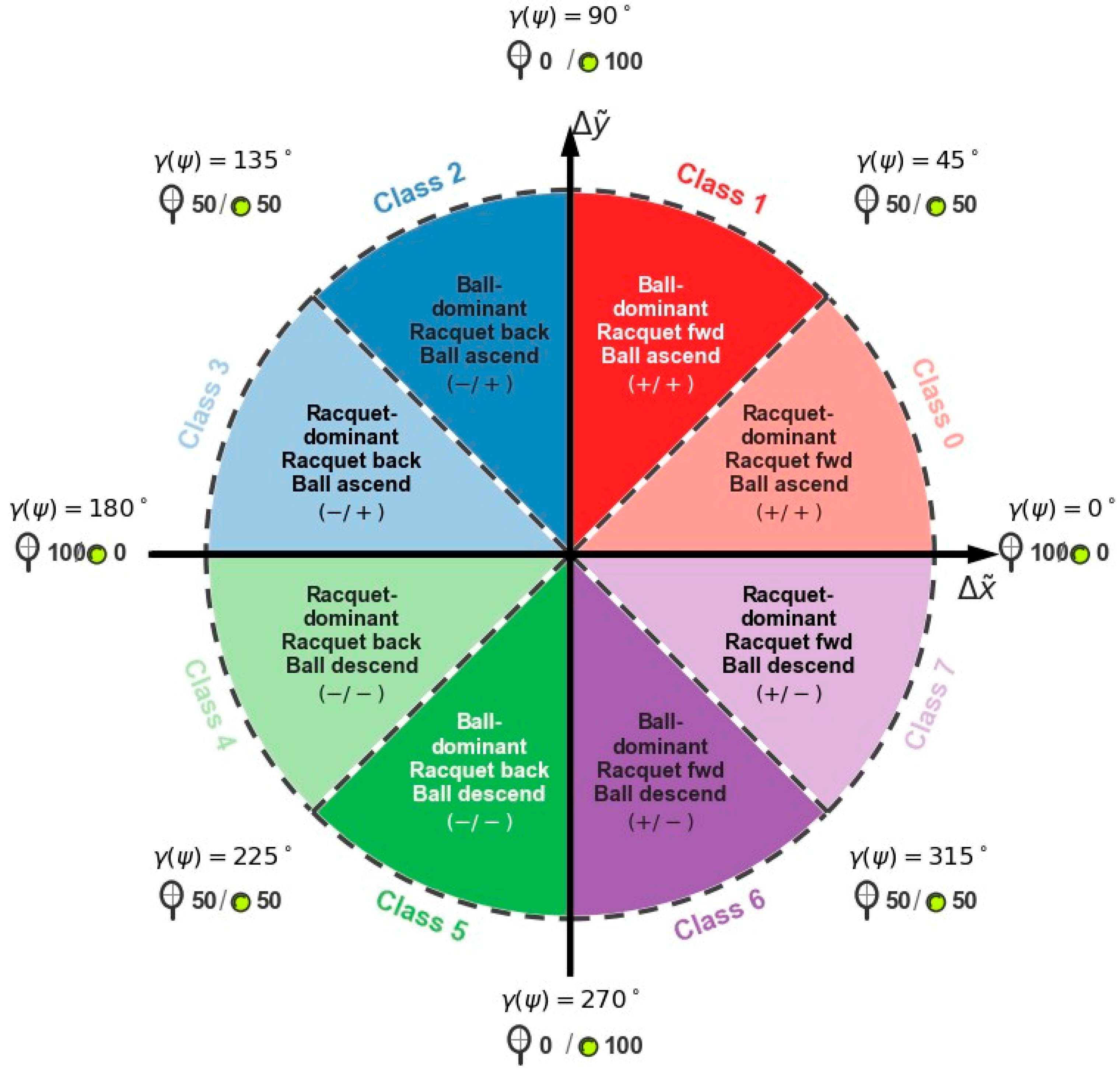
Figure 1). Under this convention, Classes 0, 3, 4, and 7 were defined as racquet-dominant, reflecting relatively greater racquet progression than ball progression between adjacent ψ-samples, whereas Classes 1, 2, 5, and 6 were defined as ball-dominant. This operational definition was used to characterize micro-structural dominance patterns in ball–racquet coordination and to relate them to macroscopic preparation timing.
To summarize local bounce-centered ball–racquet dominance structure, a bounce-window ball-dominant occupancy (BDO) index was computed for every retained trial. Let denote the Bounce location for trial i on the normalized stroke-progress axis. A trial-specific bounce window was defined as , clipped to [0, 100] where necessary. BDO was calculated as the proportion of ψ-bins within this window classified as ball-dominant in the CAM representation. Higher BDO values indicate a greater proportion of ball-dominant samples around Bounce, whereas lower BDO values indicate a greater proportion of racquet-dominant samples in the same window. These labels were used as operational descriptors of local dominance structure rather than direct measures of coaching effectiveness or stroke quality.
All inferential analyses involving BDO were conducted at the trial level, as described in
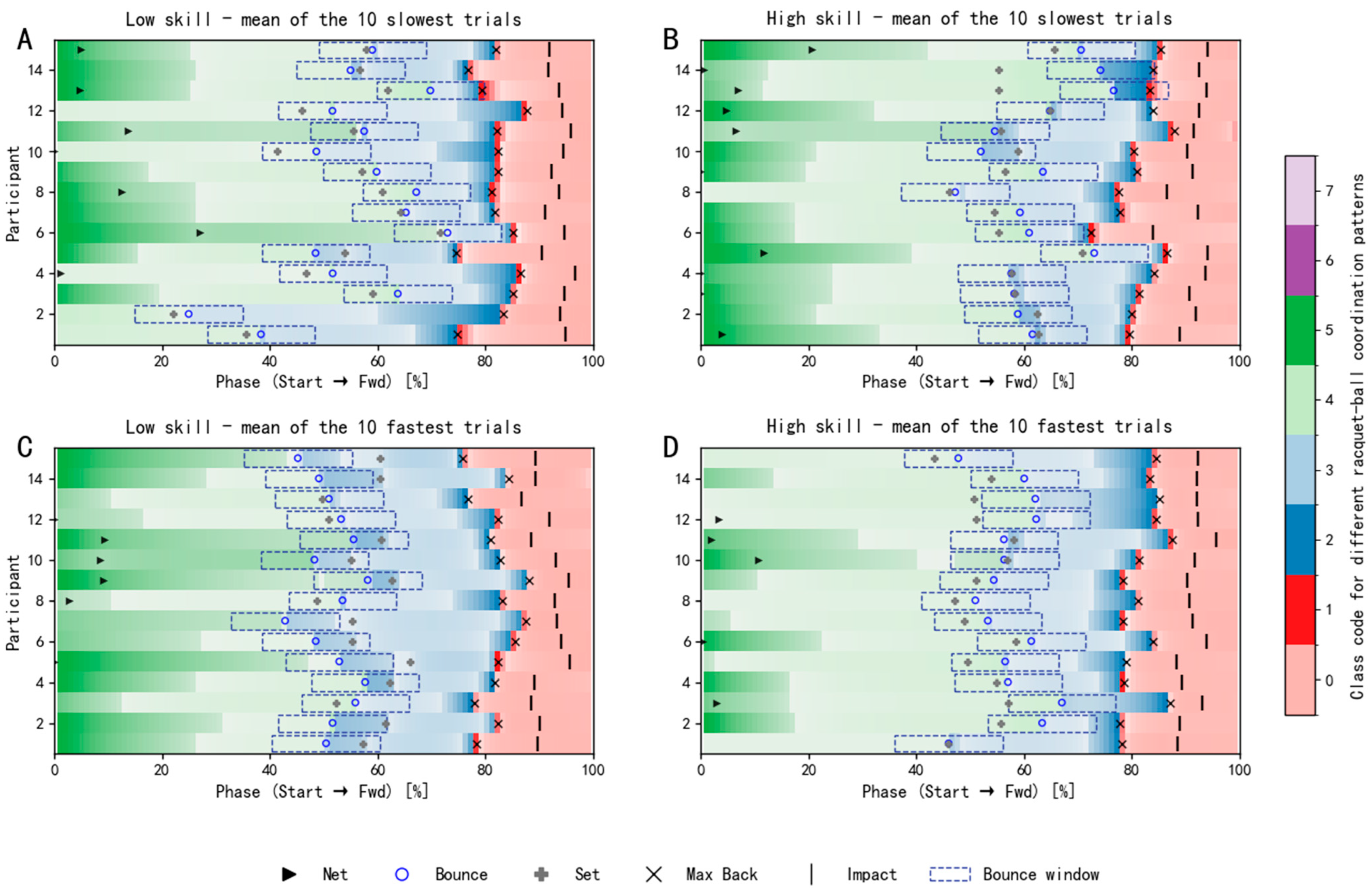
Section 2.4. In addition, for descriptive visualization only, the 10 fastest and 10 slowest retained trials were selected within each participant on the basis of raw incoming-ball speed (km/h) to illustrate representative CAM patterns in Figure 4. These participant-specific slow and fast subsets were concentrated primarily in the lower and upper portions of the retained speed window, corresponding approximately to 60–80 km/h and 90–110 km/h, respectively.
3. Results
3.1. Descriptive Distribution of Bounce-Referenced Preparation Timing
As shown in
Table 2, the low-skill group exhibited a more negative Mode 0 mean IdP, lower Mode 1 occupancy, and stronger support for a two-component structure than the high-skill group.
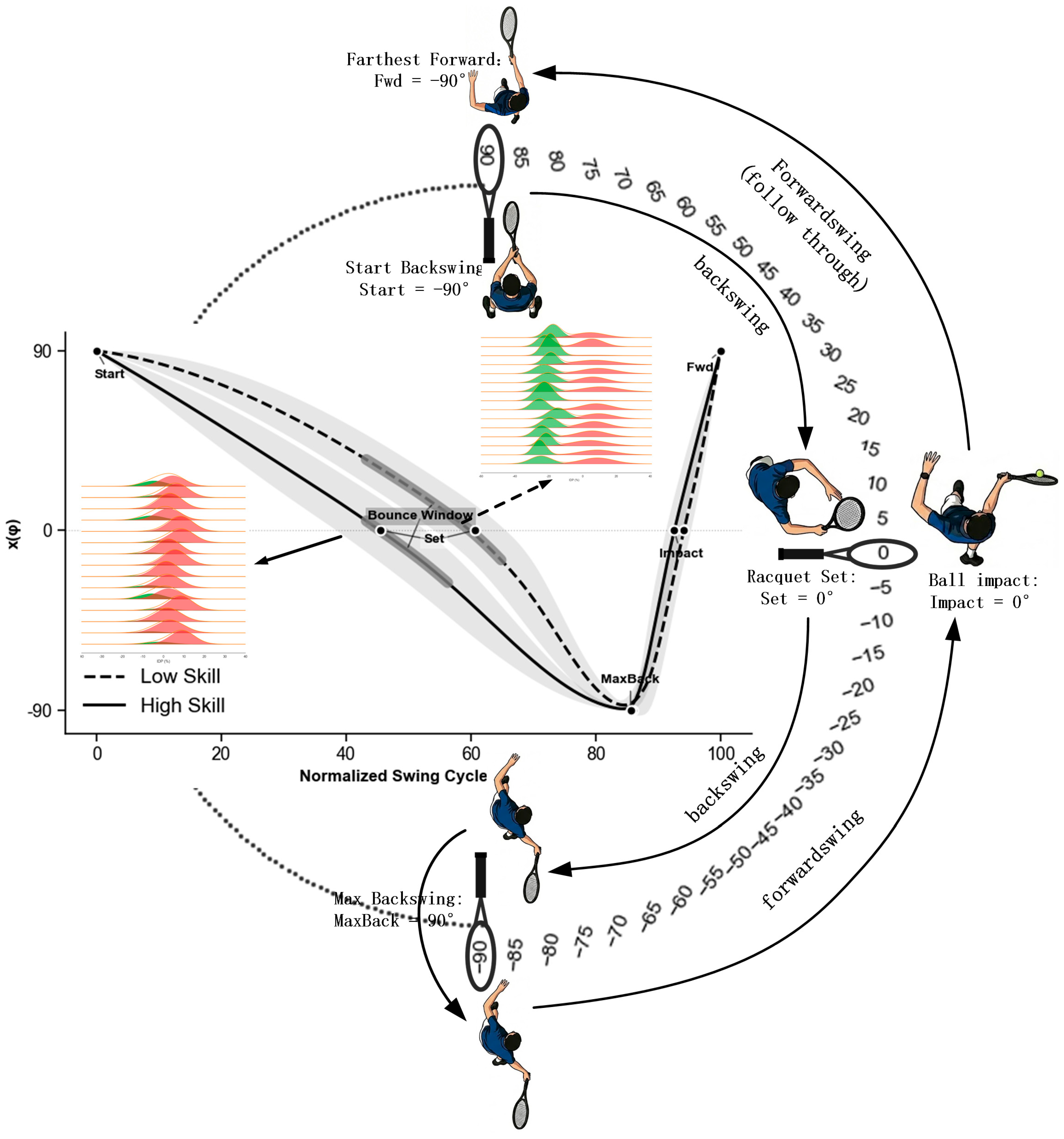
Mapping ball Bounce onto the stroke-progress axis revealed a clear skill dependence in where Bounce occurred relative to the Set (
Figure 2). In
Figure 2, the central plot presents the normalized racquet progression and functional event anchors, whereas the surrounding circular diagram is provided only as a schematic phase reference guide for interpreting the progression. In the high-skill group, Bounce was more frequently observed after Set, whereas in the low-skill group, it more often occurred before Set, indicating a reduced preparatory margin at Bounce.
The IdP distributions further revealed a marked skill dependence in Set–Bounce ordering (
Figure 2). The higher-mean component was typically located on the positive side of the IdP axis, with group means
and
, corresponding to trials in which Set preceded Bounce. The lower-mean component was typically located on the negative side, with
and
, reflecting trials in which Bounce precedes Set.
Participant-level mode occupancy also differed markedly by skill. Mode 0 occupied 14.2% of trials on average in the high-skill group and 57.8% in the low-skill group, whereas the corresponding Mode 1 occupancies were 85.8% and 42.2%, respectively. Participant-level model-order diagnostics showed the same directional pattern: the high-skill group had , with favored in 20.0% of participants, whereas the low-skill group had , with favored in 86.7%. Together, these descriptive results show skill-related differences in IdP location, mode occupancy, and support for a two-component solution.
3.2. Speed-Associated Variation in Preparation Timing
In the primary continuous analysis, within the retained field-rally dataset, incoming-ball speed was associated with lower IdP values in the low-skill group (β = −5.65, SE = 0.69, p < 0.001), indicating a reduced preparatory margin relative to Bounce under faster incoming-ball conditions. This speed-associated decrease in IdP was attenuated in the high-skill group, yielding a significant Speed × Skill interaction (β = 5.88, SE = 1.90, p = 0.002). Because incoming-ball speed was centered, the skill coefficient reflects the conditional high- vs. low-skill contrast at the mean speed rather than an overall group difference; this conditional contrast was not statistically reliable (β = −0.64, SE = 3.52, p = 0.856).
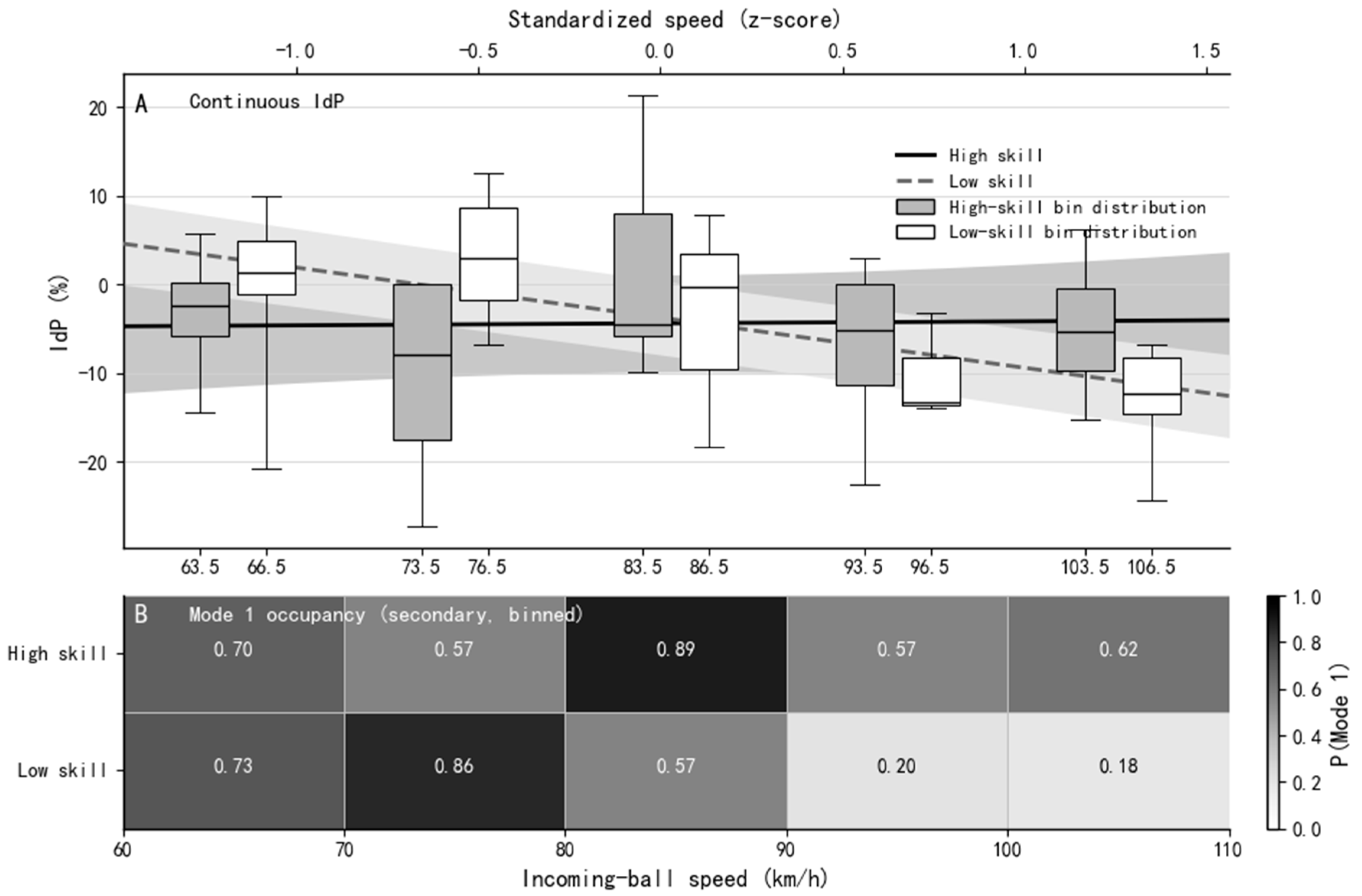
To visualize the primary continuous analysis, fitted IdP responses were plotted against incoming-ball speed, with within-bin IdP distributions shown descriptively for each skill group (
Figure 3A). The low-skill group showed a marked decrease in IdP across the retained common-support speed range, whereas the corresponding slope in the high-skill group was substantially attenuated.
As a secondary representation of this field-based timing structure, operational Mode 1 occupancy was modeled using binomial logistic regression. Standardized speed was associated with lower Mode 1 occupancy in the low-skill group, and this decline was substantially attenuated in the high-skill group, as indicated by a significant Speed × Skill interaction (β = 1.72, SE = 0.60, p = 0.004; OR = 5.60, 95% CI [1.75, 17.98]). To clarify this interaction, model-based simple contrasts were examined at representative low (−1 SD), mean (0 SD), and high (+1 SD) speeds, corresponding approximately to 67.9, 84.3, and 100.7 km/h, respectively. At −1 SD, the predicted high- vs. low-skill contrast was not statistically reliable (log-odds = −0.91, SE = 0.60, z = −1.52, p = 0.129; OR = 0.40). At the mean speed, the group contrast also remained non-significant (log-odds = 0.81, SE = 0.73, z = 1.11, p = 0.266; OR = 2.26). By contrast, at +1 SD, the high-skill group showed a significant advantage in Mode 1 occupancy (log-odds = 2.54, SE = 1.19, z = 2.13, p = 0.033; OR = 12.63). Within this field-rally dataset, this secondary model therefore indicated that the group difference in operational timing mode emerged primarily at the higher-speed end of the sampled range, rather than as a constant skill effect across all speeds.
Consistent with these model-based contrasts, the binned occupancy summary in
Figure 3B showed little or no clear high-skill advantage in the lower-speed bins, whereas clear separation emerged in the upper-speed bins. Specifically, in the 90–100 and 100–110 km/h bins, Mode 1 occupancy remained at 0.57 and 0.62 in the high-skill group but dropped to 0.20 and 0.18 in the low-skill group.
3.3. Association Between Preparation Timing and Bounce-Window Dominance Structure
To contextualize the macroscopic timing results, coupling angle mapping (CAM) rasters showed descriptive within-stroke differences in ball–racquet dominance across skill and speed conditions (
Figure 4). The most prominent divergence was localized to the bounce-centered phase region. Descriptively, fast incoming-ball trials in the low-skill group showed less continuous racquet-led (Class 3 in
Figure 1) progression than the corresponding high-skill trials around the dashed rectangle bounce-centered window.
This visual pattern was evaluated formally using trial-level bounce-window ball-dominant occupancy (BDO). In the primary linkage model, lower IdP values were associated with higher BDO after adjustment for speed and skill group (β = −0.0080, SE = 0.0031, p = 0.011), indicating that more reactive preparation timing was accompanied by greater ball-dominant organization in the bounce-centered phase window. The Speed × Skill interaction was also significant (β = 0.1347, SE = 0.0371, p < 0.001), indicating that the conditional association between incoming-ball speed and BDO differed by skill group after accounting for IdP. However, because this model included IdP as a covariate, the speed coefficients should be interpreted as conditional associations rather than as unadjusted speed-related changes in CAM structure.
A secondary model using operational timing mode did not show a reliable association with BDO (Mode 1 vs. Mode 0: β = 0.0077, SE = 0.0668,
p = 0.908), suggesting that the continuous preparation timing measure captured trial-level variation in bounce-window coordination structure more sensitively than the dichotomized mode label. Full coefficient estimates for the BDO models are reported in
Table 3.
For descriptive visualization in
Figure 4, the slow subsets were concentrated primarily in the lower portion of the retained speed window (approximately 60–80 km/h), whereas the fast subsets were concentrated in the upper portion (approximately 90–110 km/h). More detailed inspection of the CAM patterns in
Figure 4 indicated that the high-skill group’s fast trials retained a relatively continuous racquet-dominant structure from Bounce to MaxBack and ball-dominant segments tended to remain localized just before MaxBack, whereas in the low-skill group at high incoming-ball speed, ball-dominant segments extended more broadly across the bounce-aligned region.
4. Discussion
Across analyses, the main pattern was that incoming-ball speed was associated with lower IdP values in the low-skill group, whereas this association was attenuated in the high-skill group. Participant-level mixture summaries showed a similar descriptive pattern but were treated as secondary distributional summaries rather than the primary basis for inference. At the coordination-descriptor level, lower IdP values were associated with greater bounce-window ball-dominant occupancy. Together, these findings suggest that bounce-referenced preparation timing may be useful for describing how tennis players organize forehand preparation under varying incoming-ball speed, while the CAM-derived measures should be interpreted as exploratory descriptors of local ball–racquet dominance structure.
4.1. Methodological Considerations for Bounce-Referenced Preparation Timing
A methodological challenge in studying interceptive actions is that discrete timing variables can be difficult to compare across performers and trials when movement duration and event timing vary. In the present study, IdP was used as a normalized descriptor that located ball bounce relative to racquet set completion within the Start to Fwd stroke cycle, allowing preparation timing to be examined primarily through continuous trial-level variation, supplemented by distributional summaries (
Figure 2 and
Figure 3). Under this framing, the central issue is not simply whether mean timing drifts with speed, but whether temporal pressure is associated with systematic shifts in preparation timing, with distributional structure providing a secondary description of how these timing organizations are organized. At the measurement level, the use of 120 Hz mobile video represented a practical trade-off between field accessibility and laboratory-grade kinematic precision. This setup supported event identification and normalized ball progression analysis under representative rally conditions, but it does not provide the temporal or spatial resolution of high-speed optoelectronic systems used for fine ball flight or impact-level kinematic analyses. Accordingly, the present video-derived measures should be interpreted as field-based events and progression descriptors rather than as high-resolution three-dimensional ball trajectory mechanics.
A second consideration is that preparation timing results are more informative when they can be related to an interpretable coordination structure. We address this by extending coupling angle logic beyond intra-limb coordination to the ball–racquet system, treating the ball as an external constraint and the racquet as the task relevant effector. CAM rasters provide a dominance-sensitive micro-structural signature of where and how coordination continuity is maintained or disrupted, for example, through bounce-locked fragmentation vs. localized pre-impact adjustment patterns (
Figure 4). This connection helps move preparation timing organization beyond a purely statistical description toward a process-level interpretation of coordination under speed pressure.
Finally, because switching thresholds are likely to be individualized, pooled Gaussian mixture decomposition can obscure the distinction between within-participant timing structure and between-participant baseline differences. For this reason, our scale-of-inference choice was made to preserve interpretability rather than for procedural convenience. Accordingly, IdP distributional structure was summarized at the participant level for descriptive characterization, whereas primary inference was conducted on continuous trial-wise IdP using participant-clustered robust covariance. This specification treated the repeated trials as the source of marginal speed- and skill-related associations while accounting for within-participant dependence, rather than estimating participant-specific random effects that were not the inferential target of the present study. In addition, because coupling angle estimation depends on relative scaling, heterogeneous signals were amplitude-normalized to a common range so that dominance patterns reflected proportional coordination rather than unit magnitude differences [
34].
4.2. Speed-Related Changes in Bounce-Referenced Preparation Timing
The present findings extend a purely linear account of interceptive skill in which performance is described only as a continuous reduction in timing or spatial error. Instead, the distributional structure of the Index of Preparation (IdP) is consistent with the possibility that forehand interception may involve within-participant heterogeneity in preparation timing under the same rally constraints [
17,
35]. In the present data, this structure was expressed most clearly in the lower-skill group, which showed stronger support for a two-component IdP distribution and lower occupancy of the more proactive timing organization. Importantly, these modes should be interpreted as operational timing organizations within the current analytical framework rather than as evidence that all participants expressed two naturally discrete latent states.
Under the present analytic framework, the primary continuous analysis showed that increasing incoming-ball speed was associated with lower IdP values in the lower-skill group within the retained field-rally dataset, whereas this speed-related decrease was substantially attenuated in the higher-skill group. Thus, expertise was expressed less as a constant timing advantage across all incoming-ball speeds and more as reduced sensitivity of preparation timing to increasing temporal pressure, with the clearest group separation emerging toward the higher-speed end of the sampled range. The secondary occupancy results refine this interpretation by showing that the group difference was not expressed uniformly across the sampled speed range. Rather, little or no clear high-skill advantage was evident at the lower-speed end, whereas a clear separation emerged at the higher-speed end, where Mode 1 occupancy remained relatively stable in the high-skill group but declined sharply in the low-skill group.
Taken together, these findings indicate a skill-dependent redistribution of preparation timing with increasing incoming-ball speed. Applied to the present tennis task, the higher-skill group’s timing organization appeared more resistant to speed-related deterioration, particularly in the upper-speed portion of the sampled range, whereas the lower-skill group showed a sharper loss of proactive timing organization as incoming-ball speed increased. The stronger two-component structure in the lower-skill group may therefore reflect a less consolidated organization that is more sensitive to the incoming-ball constraint.
From a motor-learning perspective, this pattern may indicate a less stabilized, or more metastable, preparation timing organization, in which lower-skill players may alternate between a more proactive set-before-bounce solution and a more reactive bounce-before-set solution. Such bimodality is compatible with a transitional organization during skill acquisition. However, because the present data are cross-sectional and the GMM was used descriptively, we cannot determine whether this pattern reflects a developmental transition, a less stable attractor landscape, or task-dependent variability under temporal pressure. We therefore interpret the two-component structure conservatively as evidence of less consolidated timing organization, rather than as definitive evidence of stable discrete attractor states. In this sense, stability should not be understood as rigidity, but as the ability to preserve functional timing organization across changing task demands, which is consistent with work emphasizing adaptive coordination and functional variability in skilled performance [
36].
A useful comparative reference also comes from front-crawl coordination under systematic speed changes. Previous swimming studies have shown that increasing task demand can be accompanied by within-cycle coordination reorganization [
37,
38,
39,
40,
41,
42]. Used here as a comparative framework rather than a direct one-to-one mapping, these findings from swimming help situate the present findings as a speed-related redistribution of timing organization across repeated trials, rather than a uniform mean shift.
Overall, these findings support a conservative interpretation of skill-dependent redistribution in preparation timing under increasing incoming-ball speed [
3,
4,
5]. The secondary mode summaries were useful for describing distributional structure, but they should not be interpreted as definitive evidence for universally discrete timing states. Future studies using systematic velocity manipulations will be needed to test stronger claims about non-linear switching, stability boundaries, or hysteresis.
4.3. Micro-Structural Coordination Correlates of Preparation Timing
An additional contribution of the present study is that bounce-centered coordination structure was linked directly to preparation timing at the trial level rather than being treated only as a parallel visualization. Across retained trials, lower IdP values were associated with higher bounce-window ball-dominant occupancy after adjustment for speed and skill, indicating that a smaller preparatory margin was accompanied by greater ball-dominant organization around ball bounce. The significant Speed × Skill effect in the BDO model further indicated that the relation between incoming-ball speed and bounce-window coordination structure differed by skill group, with the separation becoming more evident under the more demanding portion of the sampled speed range. By contrast, the secondary comparison based on operational timing mode did not show a reliable BDO difference between Mode 0 and Mode 1, suggesting that dichotomizing preparation timing did not retain the trial-level variability most relevant to bounce-window coordination.
This linkage helps clarify the functional meaning of the preparation timing results. IdP did not merely distinguish earlier vs. later preparation in an abstract temporal sense; it was systematically related to where coordination continuity was better preserved or became less continuous within the stroke. Within the present analysis, the bounce-centered region emerged as the key phase window because it was there that the preparation timing difference was most clearly reflected in local coordination structure, especially as the incoming-ball constraint became more demanding.
Importantly, speed-related redistribution in coordination dynamics may be expressed not only in preparation timing, but also in how coordination structure is distributed within the movement cycle. In front-crawl swimming, increases in task demand have been associated with within-cycle coordination reorganization [
41]. Used here as a comparative framework rather than a direct one-to-one mapping, this logic helps interpret the present tennis findings: descriptively, lower-skill performance showed broader ball-dominant interruption around bounce, whereas higher-skill performance preserved greater continuity through the same phase window.
A plausible account for the lower-skill pattern, consistent with prior work on online control and predictive regulation in interceptive actions, is greater reliance on late information updating around Bounce, making coordination more sensitive to the bounce-related constraint [
43,
44]. By contrast, the localized late pre-impact ball-dominant segments visible in the high-skill group need not indicate instability. Instead, they may be broadly consistent with a functional racquet-lag pattern in the forehand kinetic chain: the racquet temporarily lags relative to ball progression in the final approach to impact, which may facilitate proximal-to-distal energy transfer while overall task-relevant organization is preserved [
45,
46]. However, the present data do not directly establish this mechanism, and this interpretation should therefore be treated as provisional.
At a broader level, the present CAM findings suggest that expertise in interception is expressed not simply as faster execution, but as greater preservation of bounce-centered coordination organization as temporal demands increase. In this sense, the micro-structural analysis refines the macroscopic IdP findings by showing where within the stroke the skill-related divergence became most apparent, namely in the bounce-centered window and most clearly under the more demanding portion of the sampled speed range.
The relative maturity of these descriptors should therefore be distinguished. IdP represents the primary and more directly interpretable contribution of the present study because it captures a coach-relevant timing relation: whether racquet preparation is completed before or after ball bounce. By contrast, BDO and CAM-derived dominance measures should be regarded as exploratory coordination descriptors. They help localize where ball–racquet dominance patterns differ within the stroke, but their applied meaning still requires validation against simpler coaching indicators and direct performance outcomes, such as return success, shot depth, accuracy, contact quality, and rally outcome.
4.4. Practical Interpretation for Performance Analysis and Coaching
The practical value of IdP lies less in providing a stand-alone technical score than in reframing preparation timing as an observable stability problem under temporal pressure. For routine coaching, the most transferable implication is not the direct use of GMM-derived mode occupancy or CAM-derived BDO, but the simpler observation of whether racquet preparation is completed before ball bounce as incoming-ball speed increases. This set-before-bounce relation can be approximated from ordinary video and used as a progressive constraint-based marker of preparation stability.
For example, a positive IdP indicates that racquet preparation was completed before ball bounce. In applied terms, this suggests that the player has organized the racquet early enough to enter the post-bounce phase with a preparatory margin still available. If positive IdP values are preserved as incoming-ball speed increases, coaches may interpret this as evidence that the player is maintaining preparation timing under greater temporal pressure. By contrast, a negative IdP indicates that ball bounce occurred before racquet preparation was completed. This pattern may suggest that the player is being pushed into a more reactive organization, in which racquet preparation is still unfolding as the available time to impact is already compressed. A practical coaching response would not be to treat negative IdP as an error in isolation, but to adjust the task constraint: reduce feed speed or complexity, emphasize earlier unit turn or racquet set, and then progressively increase incoming-ball speed while monitoring whether the player can preserve preparation-before-bounce timing.
Another example concerns how task constraints may be manipulated within a constraints-led approach to train preparation timing. Coaches could progressively increase incoming-ball speed, reduce the available preparation time, narrow the available backswing space, or use verbal or visual cues to encourage an earlier unit turn and racquet set-before-bounce. In this context, IdP could be used as a monitoring descriptor to determine whether the player maintains a positive set-before-bounce margin as temporal pressure increases. Adjusting these constraints allows incremental reinforcement of proactive preparation, helping players develop a more stable set-before-bounce organization under increasing temporal pressure.
For research-level performance analysis, IdP provides a standardized way to compare how the same external event relation is organized across players, trials, and speed constraints. In this context, BDO and CAM should be treated as complementary exploratory descriptors that help localize where ball–racquet dominance patterns are concentrated within the stroke. Their value is therefore interpretive rather than diagnostic at this stage. They may help explain why a lower IdP is accompanied by altered bounce-window organization, but their value is interpretive rather than diagnostic at this stage, and they should not be treated as replacements for simpler coaching indicators or direct performance outcomes such as return success, shot depth, accuracy, contact quality, or rally outcome.
Looking ahead, IdP may be particularly suitable for integration into applied wearable-technology workflows. A racquet-mounted IMU can support the detection of racquet preparation events such as Set, but a complete IdP estimate also requires synchronized identification of the ball Bounce event. Future systems could therefore combine racquet-mounted IMUs with mobile video, court-side tracking, radar, or other ball event detection methods to provide feedback on the proportion of strokes in which preparation is completed before bounce under progressively faster incoming-ball conditions. Such feedback may help translate the set-before-bounce relation into a simple monitoring target for coaches and players, although real-time implementation and individualized thresholds would require further validation against shot quality, return success, and other performance outcomes.
From a training perspective, the present findings support the practical value of exposing players to progressively faster incoming balls while monitoring whether preparation timing remains organized before bounce. However, the current data do not establish an intervention effect. Future applied studies should test whether training tasks that emphasize earlier racquet set and stable preparation-before-bounce timing lead to improvements in return quality or rally performance.
4.5. Limitations and Future Work
Several limitations should be considered when interpreting these field-based associations. First, the proposed information-use account remains interpretive because gaze behavior and information availability were not manipulated or measured directly [
47,
48]. Future research should integrate mobile eye-tracking with information perturbation paradigms to empirically test whether expert timing corresponds to more stable visual sampling windows and real-time adjustment strategies.
A further limitation is that incoming-ball speed may have covaried with ball landing depth and, therefore, with the spatial and temporal location of bounce. Although trials were restricted to a common-support speed window and a standardized return zone, landing depth was not modeled explicitly in the present analyses. In addition, incoming-ball speed was obtained from SwingVision and should be interpreted as a standardized field-based estimate rather than as a laboratory-grade ball speed measurement. Although camera placement was kept constant across sessions to reduce geometry-related variability, residual error associated with app-based speed estimation cannot be ruled out. The present results should therefore be interpreted as speed-associated changes under representative rally constraints rather than as effects of speed in isolation.
Although the rally task was restricted to coach-delivered topspin groundstroke feeds and slice feeds were not used, ball spin rate was not directly measured. Therefore, the present study controlled spin type at the task-design level but could not examine whether variations in topspin magnitude influenced preparation timing or bounce-window ball–racquet coordination. Future studies using direct spin-rate measurement should determine whether IdP and BDO are sensitive to differences in topspin magnitude.
Another limitation is that the present analysis did not directly compare the predictive value of IdP and BDO with simpler coaching indicators such as raw set–bounce timing, return success, shot depth, or contact quality. Therefore, the proposed metrics should be viewed as analytical descriptors that require further validation before they can be recommended for routine applied monitoring.
Several measurement-related limitations should also be acknowledged. The 60 Hz racquet-mounted IMU was suitable for characterizing racquet orientation and phase-level racquet events, but it was not intended to resolve ball flight, impact-level collision mechanics, or high-frequency racquet vibration characteristics. Therefore, the present system should not be interpreted as providing impact-level collision mechanics or high-frequency racquet vibration information. In addition, the monocular video pipeline was used to identify key ball events and to characterize normalized image-plane ball progression, rather than to reconstruct a metric three-dimensional ball trajectory. The lack of direct Z-axis measurement may have introduced residual uncertainty in depth-related trajectory characteristics, such as landing depth and post-bounce spatial path.
The mode-based occupancy analysis was operational and secondary to the primary continuous IdP model. Although the two-component decomposition was useful for summarizing participant-level timing heterogeneity, each participant contributed only 30 retained trials; therefore, the fitted two-component solution should be considered a compact descriptive approximation whose stability is limited, particularly for participants with weak BIC support for K = 2. The absence of a reliable Mode 0 vs. Mode 1 effect in the secondary BDO model further indicates that these discrete labels did not preserve the trial-level variability most relevant to bounce-window coordination. Accordingly, the mode-based results should be interpreted as descriptive summaries rather than as definitive evidence for discrete latent timing states, stable participant-specific regimes, or transition dynamics. Future studies using larger trial sets and systematic velocity ramps, including both increasing and decreasing trajectories, will be needed to test stronger claims about non-linear switching, stability boundaries, or hysteresis [
49].
Finally, the sample was relatively small and homogeneous, consisting of male university players. The findings should therefore not be generalized directly to junior players, female players, professional players, older recreational players, or players with substantially different competitive backgrounds without further testing. The cross-sectional design also precludes conclusions regarding how these timing and coordination characteristics are acquired or stabilized through practice. It remains unclear whether the greater preservation of proactive timing and bounce-centered coordination observed in the high-skill group reflects long-term training history, selective adaptation to representative rally constraints, or both. Future work should therefore adopt longitudinal or intervention-based designs and include broader samples across the tennis expertise continuum to test whether these timing and coordination patterns are preserved across different ages, sexes, and competitive levels.