Article

Automated Cataract Grading from Smartphone-Acquired External Eye Photographs Using Deep Learning


by
Shriharshinii Ragothaman
1,
Janarthanam Jothi Balaji
2,* and
Vasudevan Lakshminarayanan
3,*
1
Department of Instrumentation and Control Engineering, National Institute of Technology, Tiruchirappalli 620015, TN, India
2
Department of Optometry, Medical Research Foundation, Nungambakkam, Chennai 600006, TN, India
3
Theoretical and Experimental Epistemology Lab, School of Optometry and Vision Science, University of Waterloo, Waterloo, ON N2L 3G1, Canada
*
Authors to whom correspondence should be addressed.
Appl. Sci. 2026, 16(12), 5844; https://doi.org/10.3390/app16125844 (registering DOI)
Submission received: 18 March 2026 / Revised: 1 June 2026 / Accepted: 3 June 2026 / Published: 10 June 2026

Abstract

Background: Cataract diagnosis and management pose a significant global health challenge, contributing to 17 million cases of blindness and over 83 million cases of vision impairment worldwide in 2020. This issue is particularly acute in regions lacking adequate ophthalmological services, where a shortage of eye care clinicians and specialized equipment like slit-lamp cameras leads to late diagnoses. To address this accessibility gap, we developed a computer-assisted cataract grading system using smartphone-acquired external eye photographs. This approach utilizes image processing and deep learning on a standard, hardware-free smartphone, offering a low-cost and portable alternative to traditional equipment. Methods: The study introduces a new advanced algorithm to stratify cataract severity into three distinct stages: normal, pre-mature, and mature. The methodology was developed using a combined dataset of 799 images sourced from the Cataract v01 Computer Vision Project and the Indian Institute of Technology, Delhi. A key step is isolating the iris and lens using a region of interest (ROI) extraction procedure powered by the open-source MediaPipe framework. Key to the algorithm’s efficacy is the use of transfer learning, adapting four customized ResNet architectures (ResNet-18, ResNet-34, ResNet-50, and ResNet-101) to address medical image analysis intricacies. These models were fine-tuned with specific modifications, including dropout layers and the Adam optimizer, for analyzing the digital periocular images. Results: Evaluation of the models shows varied performance across the various architectures when classifying cataract stages. While the simpler ResNet-18 model exhibited the lowest performance, the deeper models showed significant improvement. The ResNet-50 architecture achieved the highest accuracy of 94%. This model also demonstrated excellent precision (94%), recall (95%), and an F1-score of 95% in multi-class classification, outperforming the other tested models. Its depth enables precise cataract classification, positioning it as a robust and reliable tool for potential medical diagnostic deployment. Conclusions: Deep learning-based analysis of smartphone-acquired external eye images demonstrated feasibility for cataract detection in this study. This method could be a scalable and easy-to-use addition to screening, especially in places where resources are limited. Further work is needed to expand the dataset and to validate the algorithm against established clinical grading systems before broader clinical implementation.

1. Introduction

Cataracts are an age-related eye condition and a leading ophthalmic public health problem in developed and developing countries. In 2020, an estimated 43.3 million people were blind, and 295 million had moderate-to-severe vision impairment. Cataract was found to be responsible for 17.0 million (39.6%) people who were blind, and 83.5 million (28.3%) had mild to severe vision impairment due to cataract [1]. Cataracts have a profound impact on global health, with the number of disability-adjusted life years due to cataracts increasing from 3,492,604 in 1990 to 6,676,281 in 2019, representing a significant rise in disease burden [2]. The age-standardized prevalence rate of visual impairment due to cataracts also increased by 58.5%, from 791.4 per 100,000 population in 1990 to 1253.9 per 100,000 in 2019. Despite a decrease in age-standardized death rates from 93.17 to 82.94 during the same period, the overall prevalence and associated disability remain high [2]. Lack of adequate numbers of eye care clinicians and slit lamp cameras in poor and rural areas of developing countries, as well as underserved areas in developed nations, are the main causes for the late diagnosis of cataracts [3]. Recent research indicates that it is possible to screen cataracts using deep learning techniques [3]. Smartphones can simplify ophthalmic diagnosis and offer low-cost alternatives to expensive medical equipment for use in ophthalmology, especially in areas with limited access to medical professionals and equipment [4]. These devices have become powerful tools for diagnostics due to their processing capabilities and portability. In addition to simplifying the cataract screening process, such applications have the potential to reduce misdiagnosis rates and improve treatment accessibility. More than 100,000 therapeutic and medical applications are currently installed and used in smartphones, along with external devices, such as an attachment that simulates a clinical slit-lamp [5].
Various imaging modalities have been used to grade cataracts, e.g., slit-lamp, retro-illumination, retinal, digital/optical eye, and ultrasonic Nakagami images [6]. Table 1 highlights recent advancements in imaging modalities for automated cataract detection and grading, detailing their applications, strengths, and limitations, emphasizing their potential to improve diagnostic precision and accessibility in ophthalmology. As smartphones become universal in most urban areas, cataract self-screening with smartphones removes limitations such as cataract screening cost and travel/time burdens for patients, as well as the lack of an adequate number of trained professionals. The results could be used in conjunction with tele-ophthalmology [3]. Table 2 highlights recent advancements in smartphone-based cataract detection technologies, detailing their results, advantages, and limitations. This showcases the potential of smartphones in enhancing accessibility and accuracy in ophthalmic diagnostics. Smartphone imaging has emerged as a practical tool for expanding access to eye care, particularly in resource-limited settings. However, evidence supporting its use for cataract assessment remains limited, especially with respect to diagnostic accuracy using external eye photographs. In this study, we developed and evaluated a computer-assisted system for grading cataract based on smartphone-acquired external eye images.
In the present study, we propose a smartphone-based automated cataract grading framework using deep learning and transfer learning techniques. The proposed system classifies cataracts into three stages—normal, premature, and mature—using periocular images captured under real-world conditions. A key component of the framework is the use of MediaPipe-based iris extraction to isolate the region of interest before classification, thereby reducing irrelevant image information and improving computational efficiency. In addition, multiple customized ResNet architectures were comparatively evaluated to identify the most suitable model for cataract grading. Unlike many previous smartphone-based studies that relied on external attachments or focused only on cataract detection, the present work demonstrates a grading framework that operates using standard smartphone images without additional hardware. This combination of iris-focused preprocessing, transfer learning-based grading, and smartphone compatibility represents the principal innovation and clinical relevance of the current study.

2. Methods

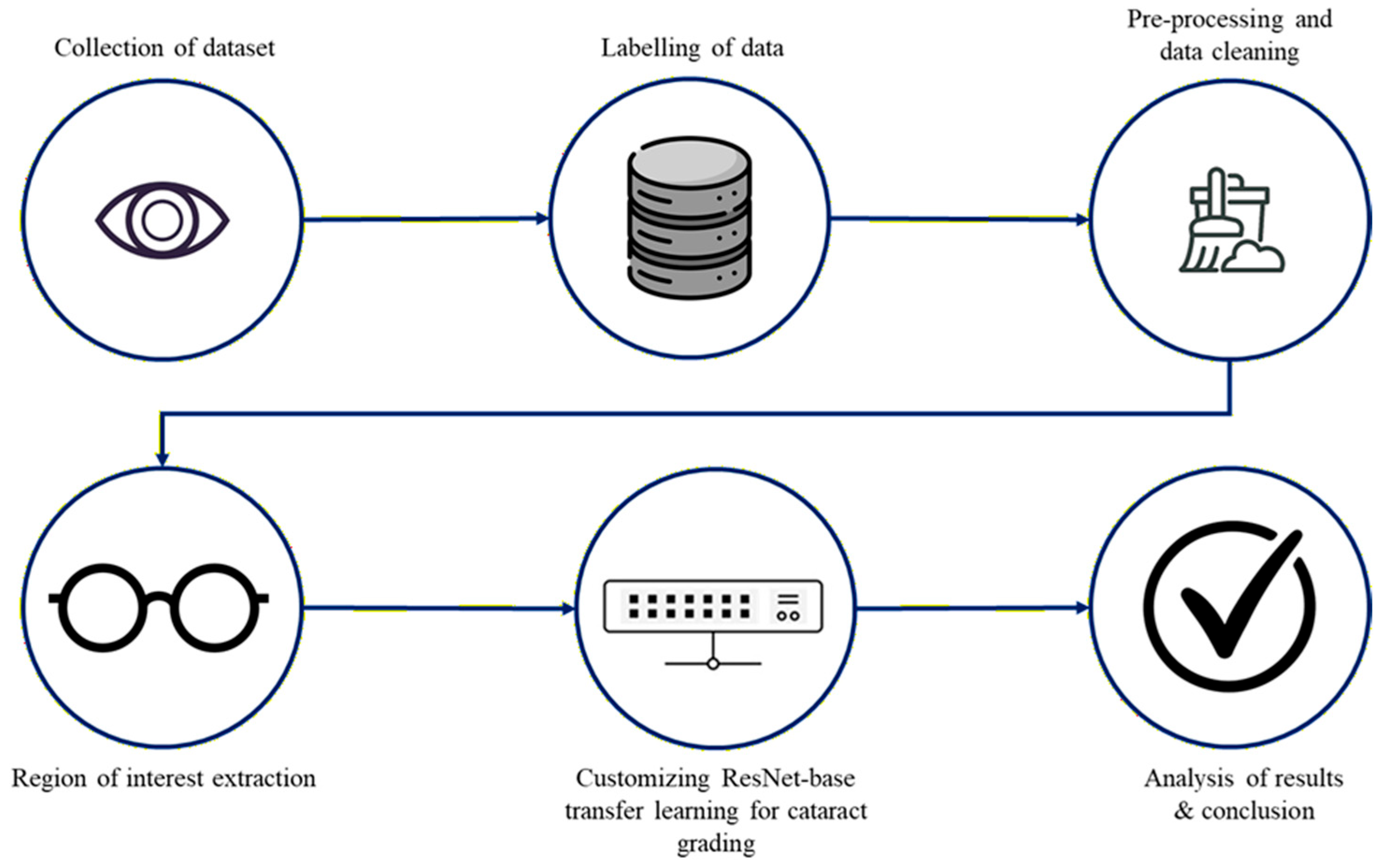
Figure 1 presents the workflow of the proposed cataract grading system. After data acquisition and image preprocessing, the region of interest is extracted and passed to the deep learning model, which classifies the input images into normal and various cataract stages.

2.1. Dataset

In this study, we utilized a combined dataset comprising two key sources of eye images. The first dataset, Cataract v01 Computer Vision Project [15], has 299 images. The second source was the Indian Institute of Technology, Delhi, dataset, from which 500 images were randomly selected [16]. To establish a ground truth for training and validation, a clinically experienced author (JJB) manually graded 250 of the selected images. The final combined dataset of 799 images was distributed across the four categories to ensure representative learning for each severity stage. Specifically, the dataset included approximately 200 images for ‘clear lens’ (normal), 210 for ‘mild cataract’, 195 for ‘moderate cataract’, and 194 for ‘total cataract’. This distribution reflects a relatively balanced dataset, which was intentional to prevent the deep learning models from developing a bias toward any single class. These datasets were combined to serve as the repository for both cataractous and normal eye images in the current study. The dataset comprised periocular photographs capturing anatomical structures, including the eyebrow, sclera and its vasculature, iris, and pupil. Images were obtained under non-standardized conditions, with variable illumination, heterogeneous backgrounds, geometric distortion, and predominantly non-frontal gaze positions. As these were external, non-slit-lamp images, conventional LOCS grading was not applied. Instead, cataract severity was categorized into four groups: (1) clear lens, (2) mild cataract, (3) moderate cataract, and (4) total cataract.
Recent studies have increasingly utilized deep learning architectures such as DenseNet, EfficientNet, MobileNet, and ResNet for ophthalmic image classification tasks because of their strong feature extraction capabilities and robustness in medical imaging applications. Lightweight models such as MobileNet are particularly suitable for smartphone-based deployment due to their lower computational requirements, while deeper architectures such as ResNet and EfficientNet have demonstrated improved performance in complex image classification problems. In the present study, multiple ResNet architectures were comparatively evaluated to identify the most effective model for automated cataract grading using smartphone-acquired periocular images.

2.2. Region of Interest Extraction

Analyzing high-resolution images with deep learning networks poses challenges due to their high dimensionality, leading to substantial computational demands and slower processing times. In cataract grading, features like iris color, texture, and lens clarity are crucial, but full eye images often include irrelevant details such as skin and eyelashes, increasing the computational burden. Variability in lighting, angle, and background further complicates analysis. Direct use of these images prolongs training, while resizing risks losing critical details. A more efficient approach involves region of interest detection to isolate relevant regions, focusing on the iris and lens [17,18]. This reduces data volume, speeds up processing, and improves model accuracy by focusing on essential features such as iris color and texture, thereby enhancing the performance of deep learning models in cataract grading [19]. While this study focuses on the classification performance of the ResNet architectures, the MediaPipe framework was selected for ROI extraction due to its proven sub-millisecond processing capabilities and high reliability in real-time facial landmarking. In the context of this screening tool, MediaPipe demonstrated consistent qualitative success in isolating the lens across varying lighting conditions and iris colors. Although a quantitative comparison with pixel-wise segmentation models like U-Net was not performed, the framework’s ability to provide a localized, standardized input to the deep learning models is evidenced by the high classification accuracy achieved. The segmentation acted as a robust spatial filter, ensuring that the ResNet models prioritized intra-ocular features over extraneous photographic noise.

2.3. Region of Interest Extraction Using the Mediapipe Model

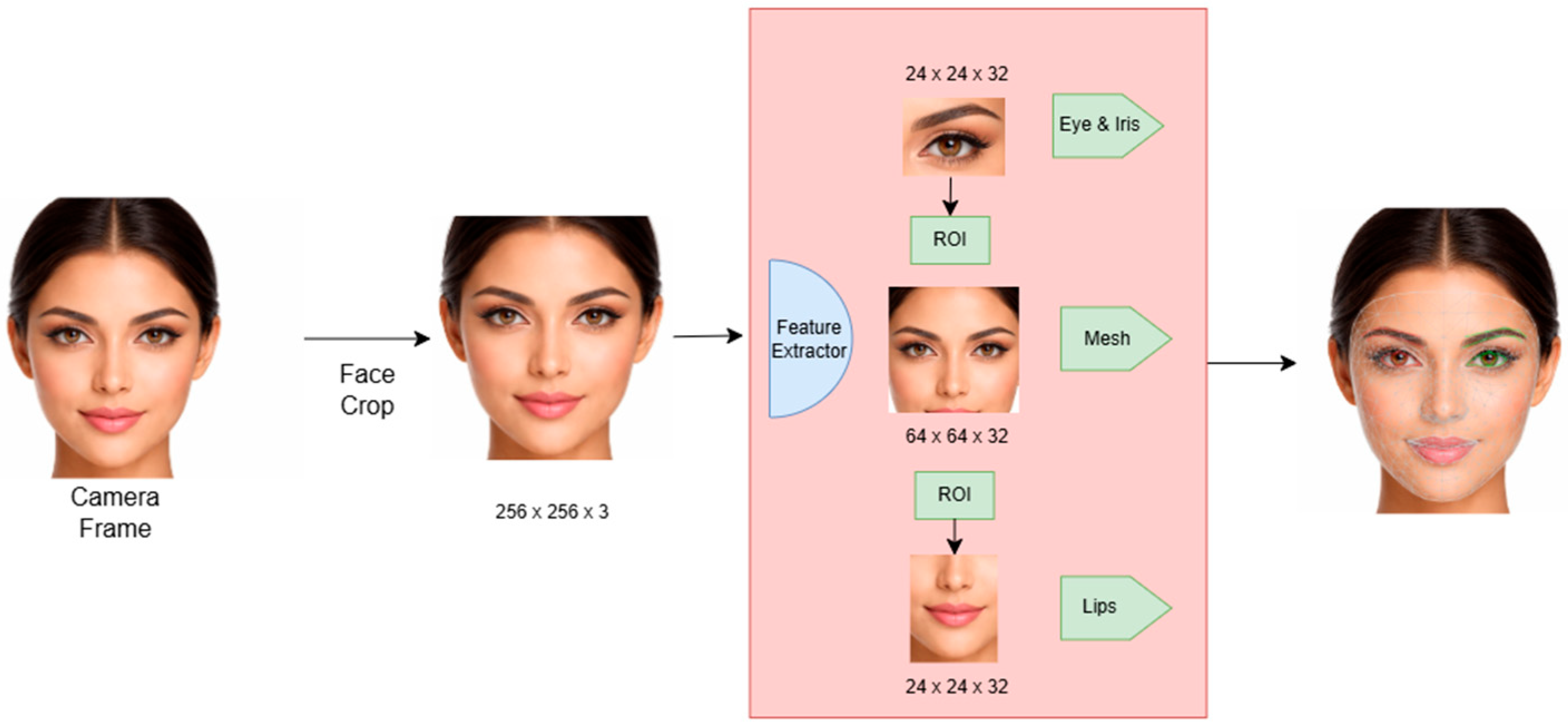
MediaPipe, an open-source, cross-platform framework, is employed in the proposed cataract grading system for its robust capabilities in computer vision, specifically for precise iris detection using a single RGB camera, eliminating the need for specialized hardware [20]. The overall MediaPipe-based iris detection and processing pipeline is illustrated in Figure 2. Utilizing MediaPipe’s modular graph architecture, the process initiates with a preprocessing step using the MediaPipe Face Mesh to delineate an approximate facial geometry [21]. This mesh, refined to isolate the ocular region, feeds into subsequent iris tracking processes [22]. The pipeline integrates multiple MediaPipe graphs: the Face Landmark subgraph, sourced from the Face Landmark module, orchestrates facial landmark detection; the Iris Landmark subgraph is specific to iris feature extraction; and a custom Render subgraph, the Iris-and-Depth Renderer, focuses on depth estimation within the eye region [23]. These combined processes yield 478 three-dimensional landmarks, of which 468 map the facial structure while the remaining 10, divided equally between the two eyes, focus specifically on iris landmarks.

2.4. Implementation of the Iris Extraction Procedure

The proposed method involves superimposing the dataset eye images onto a predefined position on a template image, which is then processed using the Mediapipe Face Mesh model. The model first detects facial landmarks to localize the eyes and then identifies the iris by analyzing its unique patterns, pigmentation, and boundaries. Finally, image processing techniques are applied to extract the segmented iris region [24,25]. The process is shown in Figure 3.

2.5. Transfer Learning

Transfer learning is an effective method for image classification, particularly with small, specialized datasets such as cataract grading, which includes approximately 550 images. This approach speeds up training, improves performance, and minimizes computational requirements by utilizing pre-trained models [26], making it well-suited for resource-constrained settings [27]. In this study, ResNet architectures (ResNet-18, ResNet-34, ResNet-50, and ResNet-101) are customized for optimized cataract grading. The variations in hyperparameter settings across the four models, as detailed in Table 3, were the result of an iterative optimization process intended to stabilize training for each specific architecture. While a unified setting might appear to offer a more direct architectural comparison, the significant differences in parameter depth—ranging from 18 to 101 layers—necessitated model-specific tuning to prevent gradient instability and ensure convergence. The higher L2 regularization values for ResNet-50 (0.01) and ResNet-101 (0.05) were specifically chosen to counteract the high risk of overfitting associated with these high-capacity models when trained on a specialized periocular dataset. By applying stricter regularization to deeper networks, we aimed to ensure that the performance improvements observed were due to the models’ ability to extract complex hierarchical features rather than a result of memorizing training noise. Consequently, these settings should be viewed as a control mechanism to maintain a level playing field across architectures of varying complexity. The selection of these specific hyperparameters and architectural modifications was based on the technical requirements of the dataset and the model depth. The Adam optimizer was chosen over Stochastic Gradient Descent (SGD) with momentum due to its adaptive learning rate mechanism, which handles the noisy gradients inherent in non-standardized smartphone photography more efficiently than SGD. Furthermore, L2 regularization was selectively applied to the deeper architectures (ResNet-50 and ResNet-101) to constrain model complexity and prevent the memorization of noise, which is a higher risk in high-capacity networks trained on specialized datasets. Additionally, dropout layers (p = 0.5) were integrated into the fully connected layers of all models to promote the learning of distributed representations, further enhancing the robustness of the classification. To ensure reproducibility and optimal convergence, the training protocol was strictly standardized across all four ResNet architectures. The models were trained for a maximum of 50 epochs using a batch size of 32. We employed a constant learning rate of 0.0001, which was empirically found to provide stable gradient updates for the transfer learning process. To prevent overfitting and ensure the model’s generalizability, 20% of the dataset was reserved for validation. Model performance was monitored at the end of each epoch, and the weights corresponding to the highest validation accuracy were preserved for final testing. All experiments were implemented using the PyTorch 2.2.1 framework on a system equipped with an NVIDIA GPU to ensure computational consistency.

3. Results

3.1. Model Evaluation Metrics

In machine learning, evaluating model performance is akin to assessing the reliability of a tool in solving real-world problems. To ensure our models perform well on unseen data, we employ various evaluation metrics, each providing unique insights into the model’s effectiveness. These include:
Accuracy (AC): This metric measures the overall correctness of the model’s predictions. It is calculated as the ratio of true predictions (true positives and true negatives) to the total number of cases examined:
Accuracy = (TP + TN)/(TP + FN + TN + FP)
Precision (P): Precision indicates the accuracy of positive predictions. It is the ratio of true positives to the sum of true positives and false positives:
Precision = TP/(TP + FP)
Recall (Sensitivity) (R): Recall measures the model’s ability to detect positive instances. It is calculated as the ratio of true positives to the sum of true positives and false negatives:
Recall = TP/(TP + FN)
F1 Score: The F1 score is the harmonic mean of precision and recall, providing a balance between the two metrics:
F1 = 2 × ((Precision × Recall)/(Precision + Recall))
ROC Curve and AUC: The ROC curve illustrates the diagnostic ability of a binary classifier system as its discrimination threshold varies. It plots the True Positive Rate (TPR) against the False Positive Rate (FPR). AUC, the Area under the curve (ROC), measures the overall predictability of the model. It is determined by the sensitivity and specificity of the test data [28,29].

3.2. Model Output

All models were run on Google Colab with an NVIDIA T4 GPU, Intel Xeon CPU, and 25 GB of RAM. The computational time varied from approximately 240 to 900 s depending on the model. Table 4 presents the performance metrics for different models (ResNet18, ResNet34, ResNet50, and ResNet101) across three cataract classes: Mature, Immature, and Normal.

3.3. Model Analysis

ResNet18: ResNet18, the simplest model in this study, achieved the lowest performance scores across all metrics. This model has a smaller number of layers and, consequently, less representational power to capture the complex features needed for accurate cataract classification, leading to lower overall performance.
ResNet34: Shows improvement over ResNet18, likely due to its deeper architecture, which allows for more complex patterns to be learned. It has a better balance between detecting positive cases and avoiding false positives.
ResNet50: This model scored the highest in all metrics, indicating its robustness and capability to handle diverse medical imaging data. The depth of this network allows it to capture intricate details necessary for high accuracy in multi-class problems like cataract classification.
ResNet101: Although it has a comparable depth to ResNet50, ResNet101 did not perform as well, possibly due to overfitting or the model being overly complex for the dataset size. It demonstrates high precision but slightly lower recall, suggesting it is conservative in predicting positive classes. This highlights the necessity for advanced data augmentation strategies, such as synthetic data generation, to properly leverage deeper networks in future iterations. The overall performance summary for all deep learning models evaluated is given in Table 5.
Across all evaluated architectures, the ‘Immature’ cataract class consistently exhibited the weakest recognition performance compared to the ‘Normal’ and ‘Mature’ stages. This can be attributed to the transitional nature of immature cataracts, which present as subtle lenticular opacities that often overlap visually with both clear lenses and advanced mature cataracts. These ambiguous features create high inter-class similarity, making it computationally challenging for the models to define a sharp decision boundary for this intermediate stage. ResNet-50 model, the achievement of a recall of 1.00 for the ‘Normal’ class (with a support of 45) signifies the architecture’s high sensitivity in identifying healthy eyes. While a perfect recall score often raises concerns of overfitting, in this context, it reflects the model’s success in distinguishing the distinct, high-contrast features of a clear lens from the textured opacities of cataractous images. To ensure this performance translates to generalizability, future studies will move beyond the current 20% validation split to incorporate completely independent, multi-center datasets for external verification.

4. Discussion

In this study, we evaluated both the diagnostic accuracy and feasibility of smartphone-based cataract detection from external eye images. The performance of the luminance-based feature extraction approach supports its potential role as a portable and screening tool. This strategy may facilitate cataract screening in bedside, outpatient, and community settings, particularly where access to slit-lamp examination is limited. The deep learning framework achieved automated and quantitative classification of cataract severity with a high level of accuracy for age-related cataracts. The ability of a deep learning framework to perform automated cataract diagnosis and grading with high accuracy and consistency means that it may have broad applications both in clinical and applied research. Clinical applications involve screening for cataracts in primary eye care, particularly in remote areas with limited facilities. This could be helpful in making timely referrals and also avoiding unnecessary referrals. Further utility could be found in surgical decision-making, including planning, case allocation, and risk prediction.
As noted previously, cataracts remain the leading cause of avoidable blindness worldwide, especially in developing countries [30,31]. Implementation of the model will enable low-cost cataract screening and shorten the examination time. Conventional machine learning methods for cataract classification and grading are reviewed in Table 6. The current study also compared ResNet18, ResNet34, ResNet50, and ResNet101. Among the tested models, ResNet-50 demonstrated the highest performance using mobile-phone photography, achieving 94% accuracy and 95% precision. These experiments were run on a desktop computer. However, there are ResNet packages suitable for implementation on smartphones. The current study has a few limitations, primarily the relatively small dataset size of 799 images. While transfer learning was employed to mitigate this constraint, the risk of overfitting remains a challenge, particularly for deeper architectures like ResNet-101. To robustly address this in future work, advanced dataset augmentation strategies must be explored. Techniques such as synthetic image generation (e.g., using Generative Adversarial Networks) and domain adaptation could significantly expand the training data’s volume and diversity, thereby enhancing the model’s generalization across heterogeneous real-world conditions. Moreover, other than normal, pre-mature, and mature cataracts, this deep-learning algorithm is not yet validated against clinical classifications such as posterior subcapsular, nucleus sclerosis, and combinations (LOCS III method). While this study focuses on the technical feasibility of cataract grading based on image clarity and ocular feature extraction, it does not currently account for varied demographics or ethnic differences in iris pigmentation. The MediaPipe-based ROI extraction was utilized to standardize inputs, focusing the ResNet architectures on pathological changes within the lens regardless of external photographic variations. Future research will aim to incorporate multi-center datasets to verify the robustness of these findings across broader population segments. Furthermore, while the MediaPipe-based ROI extraction served as an effective preprocessing stage, future iterations of this work would benefit from a quantitative evaluation of segmentation accuracy against manual ground-truth masks. Comparing the current landmark-based approach with dedicated segmentation architectures like U-Net could provide further insights into how precise boundary detection influences the grading of early-stage cataracts. Future work should include larger datasets comprising both external mobile-phone photographs and corresponding slit-lamp images for improved validation and generalizability. Although the current models were trained on desktop computing systems, the proposed framework has strong potential for smartphone deployment because image acquisition is mobile-based. Lightweight optimization techniques such as quantization, pruning, and TensorFlow Lite conversion could enable efficient real-time inference on smartphones. These findings highlight the potential of deep learning in revolutionizing cataract screening by offering a scalable solution that overcomes geographical and socioeconomic barriers. The ultimate aim of this research is to develop smartphone-based cataract screening systems that empower individuals to monitor their eye health, support teleophthalmology services, and reduce dependence on conventional clinical settings, thereby helping to alleviate the global burden of visual impairment.
In conclusion, deep learning-based analysis of smartphone-acquired external eye images demonstrated feasibility for cataract detection in this study. This approach may provide a scalable and accessible adjunct for screening, particularly in resource-limited settings. Further work is needed to expand the dataset and to validate the algorithm against established clinical grading systems before broader clinical implementation.

Author Contributions

S.R.: Methodology, investigation, application development, and drafting of the main manuscript; J.J.B.: Methodology, ground truth data generation, conception and design of the study, and project administration; V.L.: Methodology, supervision, conception and design of the study, and critical review of the manuscript. All authors have read and agreed to the published version of the manuscript.

Funding

This research received no external funding.

Institutional Review Board Statement

Not applicable.

Informed Consent Statement

Not applicable.

Data Availability Statement

The Cataract v01 Computer Vision Project dataset and the IIITD Periocular Dataset were obtained from their respective custodians. A curated subset of images used for training and evaluation, including the 250 clinician-graded images, associated labels, and annotation files generated in this study, is available from the corresponding author upon reasonable request and in accordance with applicable data-sharing and ethical requirements. Source code and trained model weights may also be shared upon request to facilitate reproducibility.

Conflicts of Interest

The authors declare no conflicts of interest.

References

  1. Vision Loss Expert Group of the Global Burden of Disease Study; Pesudovs, K.; Lansingh, V.C.; Kempen, J.H.; Tapply, I.; Fernandes, A.G.; Cicinelli, M.V.; Arrigo, A.; Leveziel, N.; Resnikoff, S.; et al. Global estimates on the number of people blind or visually impaired by cataract: A meta-analysis from 2000 to 2020. Eye 2024, 38, 2156–2172. [Google Scholar]
  2. Jiang, B.; Wu, T.; Liu, W.; Liu, G.; Lu, P. Changing trends in the global burden of cataract over the past 30 years: Retrospective data analysis of the Global Burden of Disease Study 2019. JMIR Public Health Surveill. 2023, 9, e47349. [Google Scholar] [CrossRef]
  3. Zaki, W.M.D.W.; Mutalib, H.A.; Jidesh, P.; Ramlan, L.A.; Hussain, A.; Mustapha, A. Towards a connected mobile cataract screening system: A future approach. J. Imaging 2022, 8, 41. [Google Scholar] [CrossRef]
  4. Lakshminarayanan, V.; McBride, A.C.; Zelek, J. Smartphone science in eye care and medicine. Opt. Photonics News 2015, 26, 38–45. [Google Scholar] [CrossRef]
  5. Mosa, A.S.M.; Yoo, I.; Sheets, L. A systematic review of healthcare applications for smartphones. BMC Med. Inform. Decis. Mak. 2012, 12, 67. [Google Scholar] [CrossRef] [PubMed]
  6. Shaheen, I.; Tariq, A. Survey analysis of automatic detection and grading of cataract using different imaging modalities. In Innovations in Communication and Computing; Springer: Cham, Switzerland, 2019; pp. 35–45. [Google Scholar]
  7. Harris, M.L.; Hanna, K.J.; Shun-Shin, G.A.; Holden, R.; Brown, N.A.P. Analysis of retro-illumination photographs for use in longitudinal studies of cataract. Eye 1993, 7, 572–577. [Google Scholar] [CrossRef] [PubMed]
  8. Tsui, P.H.; Huang, C.C.; Zhou, Q.; Shung, K.K. Cataract measurement by estimating the ultrasonic statistical parameter using an ultrasound needle transducer: An in vitro study. Physiol. Meas. 2011, 32, 513–524. [Google Scholar] [CrossRef]
  9. Keenan, T.D.; Chen, Q.; Agrón, E.; Tham, Y.-C.; Goh, J.H.L.; Lei, X.; Ng, Y.P.; Liu, Y.; Xu, X.; Cheng, C.-Y.; et al. DeepLensNet: Deep learning automated diagnosis and quantitative classification of cataract type and severity. Ophthalmology 2022, 129, 571–584. [Google Scholar] [CrossRef]
  10. Tham, Y.-C.; Goh, J.H.L.; Anees, A.; Lei, X.; Rim, T.H.; Chee, M.-L.; Wang, Y.X.; Jonas, J.B.; Thakur, S.; Teo, Z.L.; et al. Detecting visually significant cataract using retinal photograph-based deep learning. Nat. Aging 2022, 2, 264–271. [Google Scholar] [PubMed]
  11. Fuadah, Y.N.; Setiawan, A.W.; Mengko, T.L.R.; Budiman. Mobile cataract detection using optimal combination of statistical texture analysis. In Proceedings of the ICICI-BME, Bandung, Indonesia, 3–5 February 2015; pp. 232–236. [Google Scholar]
  12. Hu, S.; Wang, X.; Wu, H.; Luan, X.; Qi, P.; Lin, Y.; He, X.; He, W. Unified diagnosis framework for automated nuclear cataract grading based on smartphone slit-lamp images. IEEE Access 2020, 8, 174169–174178. [Google Scholar] [CrossRef]
  13. Hu, S.; Wu, H.; Luan, X.; Wang, Z.; Adu, M.; Wang, X.; Yan, C.; Li, B.; Li, K.; Zou, Y.; et al. Portable handheld slit-lamp based on a smartphone camera for cataract screening. J. Ophthalmol. 2020, 2020, 1037689. [Google Scholar] [CrossRef] [PubMed]
  14. Askarian, B.; Ho, P.; Chong, J.W. Detecting cataract using smartphones. IEEE J. Transl. Eng. Health Med. 2021, 9, 3800110. [Google Scholar] [CrossRef]
  15. Cataract Computer Vision Project V0.1. IAB Resources. 2015. Available online: https://universe.roboflow.com/cataract/cataract-v01 (accessed on 24 June 2025).
  16. Keshari, R.; Ghosh, S.; Agarwal, A.; Singh, R.; Vatsa, M. Mobile periocular matching with pre-post cataract surgery. In Proceedings of the International Conference on Image Processing (ICIP), Phoenix, AZ, USA, 25–28 September 2016; pp. 3116–3120. [Google Scholar]
  17. Rana, J.; Galib, S.M. Cataract detection using smartphone. In Proceedings of the 3rd International Conference on Electrical Information and Communication Technology (EICT), Khulna, Bangladesh, 7–9 December 2017; pp. 1–4. [Google Scholar]
  18. Li, H.; Lim, J.H.; Liu, J.; Wong, T.Y. Towards automatic grading of nuclear cataract. In Proceedings of the Annual International Conference of the IEEE Engineering in Medicine and Biology Society, Lyon, France, 22–26 August 2007; pp. 4961–4964. [Google Scholar]
  19. Li, H.; Ko, L.; Lim, J.H.; Liu, J.; Wong, D.W.K.; Wong, T.Y. Image based diagnosis of cortical cataract. In Proceedings of the 30th Annual International Conference of the IEEE Engineering in Medicine and Biology Society (EMBS), Vancouver, BC, Canada, 20–25 August 2008; pp. 3904–3907. [Google Scholar]
  20. MediaPipe Solutions Guide. Google AI for Developers. Available online: https://developers.google.com/edge/mediapipe/solutions/guide (accessed on 24 June 2025).
  21. Chen, D.Z.; Liu, C.; Wu, J.; Zhu, L.; Ooi, B.C. Prediction of Cataract Severity Using Slit Lamp Images from a Portable Smartphone Device: A Pilot Study. Sensors 2026, 26, 1954. [Google Scholar] [CrossRef]
  22. Lugaresi, C.; Tang, J.; Nash, H.; McClanahan, C.; Uboweja, E.; Hays, M.; Zhang, F.; Chang, C.-L.; Yong, M.G.; Lee, J.; et al. MediaPipe: A framework for building perception pipelines. arXiv 2019, arXiv:1906.08172. [Google Scholar] [CrossRef]
  23. Grishchenko, I.; Ablavatski, A.; Kartynnik, Y.; Raveendran, K.; Grundmann, M. Attention mesh: High-fidelity face mesh prediction in real-time. arXiv 2020, arXiv:2006.10962. [Google Scholar] [CrossRef]
  24. Fan, W.; Shen, R.; Zhang, Q.; Yang, J.J.; Li, J. Principal component analysis based cataract grading and classification. In Proceedings of the 17th International Conference on E-Health Networking, Application and Services (HealthCom), Boston, MA, USA, 14–17 October 2015; IEEE: New York, NY, USA, 2015; pp. 459–462. [Google Scholar]
  25. Caixinha, M.; Amaro, J.; Santos, M.; Perdigão, F.; Gomes, M.; Santos, J. In-vivo automatic nuclear cataract detection and classification in an animal model by ultrasounds. IEEE Trans. Biomed. Eng. 2016, 63, 2326–2335. [Google Scholar] [CrossRef]
  26. Iman, M.; Arabnia, H.R.; Rasheed, K. A review of deep transfer learning and recent advancements. Technologies 2023, 11, 40. [Google Scholar] [CrossRef]
  27. Yang, J.J.; Li, J.; Shen, R.; Zeng, Y.; He, J.; Bi, J.; Li, Y.; Zhang, Q.; Peng, L.; Wang, Q. Exploiting ensemble learning for automatic cataract detection and grading. Comput. Methods Programs Biomed. 2016, 124, 45–57. [Google Scholar] [CrossRef] [PubMed]
  28. Song, W.A.; Wang, P.; Zhang, X.D.; Wang, Q. Semi-supervised learning based on cataract classification and grading. In Proceedings of the 40th IEEE Annual Computer Software and Applications Conference (COMPSAC), Atlanta, GA, USA, 10–14 June 2016; IEEE: New York, NY, USA, 2016; pp. 641–646. [Google Scholar]
  29. Jiang, J.; Liu, X.; Zhang, K.; Long, E.; Wang, L.; Li, W.; Liu, L.; Wang, S.; Zhu, M.; Cui, J.; et al. Automatic diagnosis of imbalanced ophthalmic images using a cost-sensitive deep convolutional neural network. Biomed. Eng. Online 2017, 16, 132. [Google Scholar] [CrossRef]
  30. Zhang, K.; Liu, X.; Jiang, J.; Li, W.; Wang, S.; Liu, L.; Zhou, X.; Wang, L. Prediction of postoperative complications of pediatric cataract patients using data mining. J. Transl. Med. 2019, 17, 2. [Google Scholar] [CrossRef]
  31. Song, W.A.; Cao, Y.; Qiao, Z.Q.; Wang, Q.; Yang, J.J. An improved semi-supervised learning method on cataract fundus image classification. In Proceedings of the 43rd IEEE Annual Computer Software and Applications Conference (COMPSAC), Milwaukee, WI, USA, 15–19 July 2019; IEEE: New York, NY, USA, 2019; pp. 362–367. [Google Scholar]
  32. Li, H.Q.; Lim, J.H.; Liu, J.; Mitchell, P.; Tan, A.G.; Wang, J.J.; Wong, T.Y. A computer-aided diagnosis system of nuclear cataract. IEEE Trans. Biomed. Eng. 2010, 57, 1690–1698. [Google Scholar] [CrossRef] [PubMed]
  33. Huang, W.; Chan, K.L.; Li, H.; Lim, J.H.; Liu, J.; Wong, T.Y. A computer assisted method for nuclear cataract grading from slit-lamp images using ranking. IEEE Trans. Med. Imaging 2011, 30, 94–107. [Google Scholar] [PubMed]
  34. Chow, Y.C.; Gao, X.; Li, H.; Lim, J.H.; Sun, Y.; Wong, T.Y. Automatic detection of cortical and PSC cataracts using texture and intensity analysis on retro-illumination lens images. In Proceedings of the Annual International Conference of the IEEE Engineering in Medicine and Biology Society, Boston, MA, USA, 30 August–3 September 2011; pp. 5044–5047. [Google Scholar]
  35. Patwari, M.A.U.; Arif, M.D.; Chowdhury, M.N.; Arefin, A.; Imam, M.I. Detection, categorization, and assessment of eye cataracts using digital image processing. In Proceedings of the First International Conference on Interdisciplinary Research and Development, Bangkok, Thailand, 31 May–1 June 2011. [Google Scholar]
  36. Gao, X.; Li, H.; Lim, J.H.; Wong, T.Y. Computer-aided cataract detection using enhanced texture features on retro-illumination lens images. In Proceedings of the International Conference on Image Processing (ICIP), Brussels, Belgium, 11–14 September 2011; pp. 1565–1568. [Google Scholar]
  37. Xu, Y.; Gao, X.; Lin, S.; Wong, D.W.K.; Liu, J.; Xu, D.; Cheng, C.Y.; Cheung, C.Y.; Wong, T.Y. Automatic grading of nuclear cataracts from slit-lamp lens images using group sparsity regression. In Medical Image Computing and Computer-Assisted Intervention—MICCAI 2013, Proceedings of the 16th International Conference, Nagoya, Japan, 22–26 September 2013, Proceedings, Part II; Lecture Notes in Computer Science; Springer: Berlin/Heidelberg, Germany, 2013; Volume 8150, pp. 468–475. [Google Scholar]
  38. Jesus, D.; Velte, E.; Caixinha, M.; Santos, M.; Santos, J. Using ultrasound frequency dependent attenuation and Nakagami distribution for cataract evaluation. In Proceedings of the 3rd Portuguese Bioengineering Meeting (ENBENG), Braga, Portugal, 20–23 February 2013; IEEE: New York, NY, USA, 2013. [Google Scholar]
  39. Srivastava, R.; Gao, X.; Yin, F.; Wong, D.W.K.; Liu, J.; Cheung, C.Y.; Wong, T.Y. Automatic nuclear cataract grading using image gradients. J. Med. Imaging 2014, 1, 014502. [Google Scholar] [CrossRef]
  40. Caixinha, M.; Jesus, D.A.; Velte, E.; Santos, M.J.; Santos, J.B. Using ultrasound backscattering signals and Nakagami statistical distribution to assess regional cataract hardness. IEEE Trans. Biomed. Eng. 2014, 61, 2921–2929. [Google Scholar] [CrossRef]
  41. Caixinha, M.; Velte, E.; Santos, M.; Santos, J. New approach for objective cataract classification based on ultrasound techniques using multiclass SVM classifiers. In Proceedings of the IEEE International Ultrasonics Symposium (IUS), Chicago, IL, USA, 3–6 September 2014; IEEE: New York, NY, USA, 2014; pp. 2402–2405. [Google Scholar]
  42. Caixinha, M.; Velte, E.; Santos, M.; Perdigão, F.; Amaro, J.; Gomes, M.; Santos, J. Automatic cataract classification based on ultrasound technique using machine learning: A comparative study. Phys. Procedia 2015, 70, 1221–1224. [Google Scholar] [CrossRef]
  43. Fuadah, Y.N.; Setiawan, A.W.; Mengko, T.L.R. Performing high accuracy of the system for cataract detection using statistical texture analysis and K-nearest neighbor. In Proceedings of the International Seminar on Intelligent Technology and Its Applications (ISITIA), Surabaya, Indonesia, 20–21 May 2015; IEEE: New York, NY, USA, 2015; pp. 85–88. [Google Scholar]
  44. Guo, L.; Yang, J.J.; Peng, L.; Li, J.; Liang, Q. A computer-aided healthcare system for cataract classification and grading based on fundus image analysis. Comput. Ind. 2015, 69, 72–80. [Google Scholar] [CrossRef]
  45. Pathak, S.; Kumar, B. A robust automated cataract detection algorithm using diagnostic opinion based parameter thresholding for telemedicine application. Electronics 2016, 5, 57. [Google Scholar] [CrossRef]
  46. Wang, L.; Zhang, K.; Liu, X.; Long, E.; Jiang, J.; An, Y.; Zhang, J.; Liu, Z.; Lin, Z.; Li, X.; et al. Comparative analysis of image classification methods for automatic diagnosis of ophthalmic images. Sci. Rep. 2017, 7, 41545. [Google Scholar] [CrossRef]
  47. Cheng, J. Sparse range-constrained learning and its application for medical image grading. IEEE Trans. Med. Imaging 2018, 37, 2729–2738. [Google Scholar] [CrossRef]
  48. Khan, A.A.; Akram, M.U.; Tariq, A.; Tahir, F.; Wazir, K. Automated computer aided detection of cataract. In Advances in Intelligent Systems and Computing; Springer: Cham, Switzerland, 2018; pp. 340–349. [Google Scholar]
  49. Jagadale, A.B.; Sonavane, S.S.; Jadav, D.V. Computer aided system for early detection of nuclear cataract using circle Hough transform. In Proceedings of the International Conference on Trends in Electronics and Informatics (ICOEI), Tirunelveli, India, 23–25 April 2019; IEEE: New York, NY, USA, 2019; pp. 1009–1012. [Google Scholar]
  50. Zhang, H.; He, Z. Automatic cataract grading methods based on deep learning. Comput. Methods Programs Biomed. 2019, 182, 104978. [Google Scholar] [CrossRef] [PubMed]
  51. Huo, C.S.; Akhtar, F.; Li, P.Z. A novel grading method of cataract based on AWM. In Proceedings of the IEEE 43rd Annual Computer Software and Applications Conference (COMPSAC), Milwaukee, WI, USA, 15–19 July 2019; IEEE: New York, NY, USA, 2019; pp. 368–373. [Google Scholar]
  52. Cao, L.C.; Li, H.Q.; Zhang, Y.J.; Zhang, L.; Xu, L. Hierarchical method for cataract grading based on retinal images using improved Haar wavelet. Inf. Fusion 2020, 53, 196–208. [Google Scholar] [CrossRef]
  53. Zhang, X.Q.; Fang, J.S.; Xiao, Z.J.; Higashita, R.; Chen, W.; Yuan, J.; Liu, J. Classification algorithm of nuclear cataract based on anterior segment coherence tomography image. Comput. Sci. 2022, 49, 204–210. [Google Scholar]
Figure 1. Workflow of the Proposed Smartphone-Based Cataract Grading Pipeline.
Applsci 16 05844 g001
Figure 2. Overview of the MediaPipe iris detection and extraction pipeline, illustrated using an AI-generated image.
Applsci 16 05844 g002
Figure 3. Workflow for iris region-of-interest extraction from eye images (purple area), illustrated using an AI-generated image.
Applsci 16 05844 g003
Table 1. Imaging Modalities for Cataract Grading.
Author’s Name/Ref No.Imaging ModalityUse CaseStrengthsLimitations
Harris et al. [7]Retro-Illumination ImagesUseful for cortical and posterior subcapsular cataracts.Effective for examining opacities; enables specific feature extraction.Limited studies for automated grading; challenges in handling variations in image quality.
Tsui et al. [8]Ultrasonic Nakagami ImagesMeasures cataract hardness; used in experimental setupsProvides detailed quantitative analysis of lens properties; useful for advanced research.Requires specialized equipment; primarily tested on porcine lenses; lacks clinical validation on human subjects.
Keenan et al. [9]Slit-Lamp ImagesUsed for detailed examination of nuclear cataracts.High-resolution imaging; established grading systems (e.g., LOCS-III, Wisconsin Grading).Requires expensive equipment and trained professionals; not portable; unsuitable for remote areas.
Tham et al. [10]Retinal (Fundus) ImagesPrimarily used for other ocular diseases, but applicable to cataracts.Potential for combined disease detection; well-suited for advanced machine learning algorithms.Limited success in cataract grading; not cost-effective for cataract-specific analysis
LOCS-III: Lens Opacities Classification System III.
Table 2. Smartphone-Based Cataract Detection Methods.
Author’s Name/Ref No.Research Work and ResultAdvantagesDisadvantages
Tham et al. [10]Detecting cataract using smartphones without additional devices and in uncontrolled environments with an accuracy 96.6%, specificity 93.4% and sensitivity 93.75%.High accuracy in detecting cataracts without requiring specialized attachments; effective in real-world scenarios.Limited to detection, not grading severity.
Fuadah et al. [11]A portable and recordable slit-lamp device that could be attached to a smartphone, known as Smart Eye Camera (SEC). SEC correlated well with conventional slit-lamp microscopes for nuclear cataract grading.Results comparable to conventional slit-lamps; reliable for clinical evaluation.Expensive and requires a lens attachment, making it less practical for widespread rural use.
Hu et al. [12]iPhone X used for cataract grading and attached an external device to the camera as a flashlight with auto-focus capability and maximum resolution. Achieved 98.2% accuracy, 97.8% specificity, and 97.2% sensitivity.Portable, accurate, and effective for diagnosis.Requires external hardware (costly and less convenient).
Hu et al. [13]A micro-lens was attached to a smartphone to simulate a slit-lamp. Images taken by the smartphone were fed into a deep learning system, which resulted in real-time and effective screenings.High accuracy (98.2%); portable and user-friendly device; suitable for low-resource areasCost of attachments and reliance on smartphone compatibility.
Askarian et al. [14]Mobile-based cataract detection using statistical texture analysis applied in controlled settings for cataract detection.Effective in specific conditions with optimal parameter settings; no external attachments requiredNot designed for grading cataract severity. Effectiveness in real-world scenarios remains uncertain.
SEC: Smart Eye Camera.
Table 3. ResNet Customizations for Cataract Grading.
FeaturesResNet-18ResNet-34ResNet-50ResNet-101
Dropout rate0.50 (two layers)0.50 (one layer)0.50 (one layer)0.5 (one layer)
L2 RegularizationNoneNone0.010.05
Trainable layersLast 10 layers + custom headLast 5 layers + custom headLast 5 layers + custom headLast 5 layers + custom head
OptimizerNot specificNot specificAdam with exponential decay (le-4)Adam with exponential decay (le-4)
ResNet: Residual Network; L2: L2 Regularization; Adam: Adaptive Moment Estimation Optimizer.
Table 4. Performance Metrics of Deep Learning Models for Multi-Class Cataract Classification.
ModelCataract CategoryPrecisionRecallF1-ScoreSupport
ResNet18Normal0.900.880.8940
Immature0.820.870.8462
Mature0.930.890.9170
ResNet34Normal0.970.900.9440
Immature0.830.930.8861
Mature0.950.890.9271
ResNet50Normal0.981.000.9945
Immature0.970.890.9365
Mature0.890.950.9262
ResNet101Normal1.000.890.9435
Immature0.840.940.8967
Mature0.940.890.9170
Table 5. Performance Metrics of Deep Learning Models.
ModelClassPrecisionRecallF1-Score
ResNet1888%88%88%88%
ResNet3491%92%91%91%
ResNet5094%95%95%95%
ResNet10191%93%90%91%
Table 6. Cataract Classification and Grading Review.
Reference NumberMethodImage TypeApplicationCataract TypeResult
Current studyResNet50MobileGrading & ClassificationAll typesPrec. 94%, Rec. 95%, F1 95%
Jiang et al. [2]EF + CannyRetro-illuminationClassificationPSC86.3% grad. Acc., 7% avg. err. in opac. ar.
Zaki et al. [3]RFSlit lampClassificationPC90% Acc. in PC cataract classif.
Mosa et al. [5]KNNUltrasonicClassificationCataractF-measure ≥ 95% (healthy vs. cataract), 76% (initial vs. severe)
Tsui et al. [8]SVMSlit lampGradingNCCS-ResCNN achieved 92% Acc., 90% Sens., AUC 97%
Keenan et al. [9]ASM + SVRSlit lampGradingNC95% struct. detect. succ., grad. err. 0.36/5.0
Fuadah et al. [11]GLCM + KNNDigital cameraClassificationCataractKNN with GLCM feats. (contrast, dissimilarity, uniformity) achieved 97.5% Acc.
Hu et al. [13]PCA + RFFundusClassificationCataract79.8% Acc. (wav.), 82.8% (sketch)
Li et al. [32]ASM + SVRSlit lampGradingNCfeat. extr. succ. rate = 95%; avg. grad. err. = 0.36 (N = 5000 + images)
Huang et al. [33]ASM + RankingSlit lampGradingNC95.4% Acc. (w/in 1 Gr.), avg. grad. err. 0.34
Chow et al. [34]CannyRetroilluminationClassificationPSC42.2% w/in 2% ar. difference to human grad.
Patwari et al. [35]IMFDigital cameraClassificationCataractIMF-based mtd. achieved 94.96% Acc., 95.14% rel.
Gao et al. [36]LDARetroilluminationClassificationPSC & CC78.5% Sens., 87.8% Spec.
Xu et al. [37]BOF + GSRSlit lampGradingNC85% w/in 0.5 Gr. err., avg. err. 0.34
Jesus et al. [38]SF + SWLRSlit lampGradingNC87% w/in 0.5 Gr. err., avg. err. 0.33
Srivastava et al. [39]Bayesian networkFundusClassificationCataract88% Acc. (wav. feats.)
Caixinha et al. [40]Nakagami distribution + CRTUltrasonicClassificationCataractCRT achieved 100% Sens., 72.6% Spec. (no cataract); 78.4% Sens., 86.5% Spec. (advanced cataract)
Caixinha et al. [41]PCA + SVMUltrasonicClassificationCataract93% Ovr. Acc., 89% Prec., Sens. 89%, Spec. 94%
Caixinha et al. [42]StackingFundusClassificationCataract92% Acc. (detect.), 84.5% (grad.)
Fuadah et al. [43]GLCM + KNNDigital cameraClassificationCataractKNN with GLCM feats. achieved 94.5% average Acc.
Guo et al. [44]DWT + MDAFundusClassificationCataractDWT + MDA achieved 90.9% cataract classif. Acc., 77.1% grad. Acc.
Pathak et al. [45]K-MeansDigital cameraClassificationCataractK-Means clustering with thresholding achieved ~98% Acc. in cataract detect.
Wang et al. [46]MRFRetroilluminationClassificationPSC91.2% Sens., 90.1% Spec. for PSC detect.
Cheng et al. [47]SRCLSlit lampGradingNCSRCL achieved avg. grad. err. 0.32, >85% w/in 0.5 Gr.
Khan et al. [48]SVMDigital cameraClassificationCataractSVM-based mtd. achieved close to 98% Acc. in cataract detect.
Jagadale et al. [49]Hough circular transformSlit lampClassificationNC90.25% Acc. in nuclear cataract detect.
Zhang et al. [50]Multi-feature fusion & StackingFundusClassificationCataractMulti-feat. fusion & stacking achieved 92.66% Acc. (six-level grad.), 94.75% Acc. (four-level grad.)
Huo et al. [51]AWM + SVMFundusClassificationCataractAWM + SVM achieved 92% Acc. in cataract classif. w/fundus images
Cao et al. [52]SVMAS-OCTClassificationNC63.70% Acc., 50% Rec., 31.34% Prec., F1 38.54%
Zhang et al. [53]Haar wavelet + VotingFundusClassificationCataractImproved Haar wav. + voting achieved 94.83% Acc. (2-class), 85.98% Acc. (4-class)
Prec.: Precision; Rec.: Recall; F1: F1-score; w/in: within; err.: error; Acc.: Accuracy; avg.: mean (average); ar.: area; opac.: opacity; struct.: structure; succ.: success; feat.: feature; extr.: extraction; Spec.: Specificity; Sens.: Sensitivity; classif.: classification; detect.: detection; mtd./mtds.: method/methods; Ovr.: overall; succ. rate: success rate; wav.: wavelet; feats.: features; rel.: reliability; w/: using; ASM: Active Shape Model; SVR: Support Vector Regression; SWLR: Spatial Weighted Logistic Regression; BOF: Bag of Features; GSR: Group Sparsity Regression; SVM: Support Vector Machine; RF: Random Forest; SRCL: Sparse Range-Constrained Learning; PCA: Principal Component Analysis; DWT: Discrete Wavelet Transform; GLCM: Gray Level Co-occurrence Matrix; KNN: K-Nearest Neighbors; IMF: Intrinsic Mode Function; AWM: Adaptive Weighted Mean; AS-OCT: Anterior Segment Optical Coherence Tomography. PSC: Posterior subcapsular cataract; NC: Nuclear cataract; CC: Cortical cataract; EF: Edge Features; CRT: Classification and Regression Tree; MDA: Marginal Discriminant Analysis; MRF: Markov Random Field.
Disclaimer/Publisher’s Note: The statements, opinions and data contained in all publications are solely those of the individual author(s) and contributor(s) and not of MDPI and/or the editor(s). MDPI and/or the editor(s) disclaim responsibility for any injury to people or property resulting from any ideas, methods, instructions or products referred to in the content.