Calculation and Declaration of Greenhouse Gas Emissions from Road Transport Services: Transition from EN 16258 to ISO 14083 and Implementation Challenges in the Slovak Transport Sector


Featured Application
Abstract
1. Introduction
1.1. Literature Review

1.2. Standards for GHG Calculation
- ISO 14083: 2023
- improving environmental reputation and strengthening the brand,
- increasing market competitiveness and accessing new business opportunities,
- reducing risks and costs associated with GHG emissions,
- strengthening sustainable development in the supply chain and promoting responsible business practices,
- improving operational efficiency and optimizing logistics processes [21].
- the number and type of vehicles or the length and type (diameter) of the pipeline to be included in the TOC,
- the nature and consistency of the vehicles or pipeline operations included,
- processes related to maintaining the condition of the cargo, such as temperature control (cargo transport only),
- the nature of the cargo being transported,
- the period of activity of the vehicles or pipelines within the TOC.
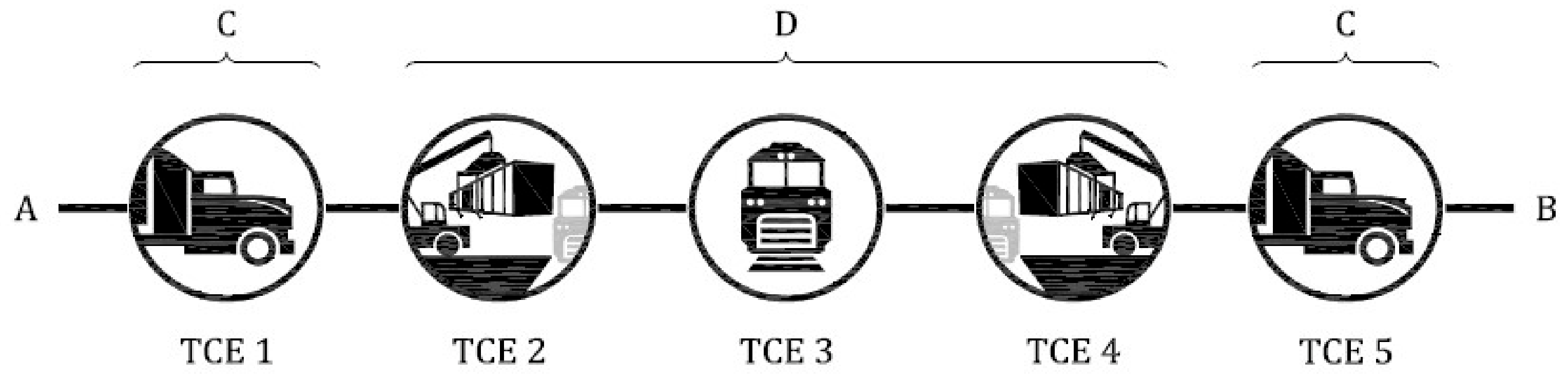
- TOC of a single vehicle for a single trip or a specific schedule,
- TOC of a single vehicle across different schedules/routes, based on network/route characteristics,
- TOC for a specific vehicle type in a single schedule,
- TOC for a specific vehicle type across different schedules/routes,
- TOC for a specific group of vehicles in a single schedule,
- TOC for a specific group of vehicles across different schedules/routes.
- storage of cargo at hubs,
- use of information and communication technology (ICT) equipment and data servers related to transport or hub operations,
- (re)packaging [19].
- STN EN 16258: 2012
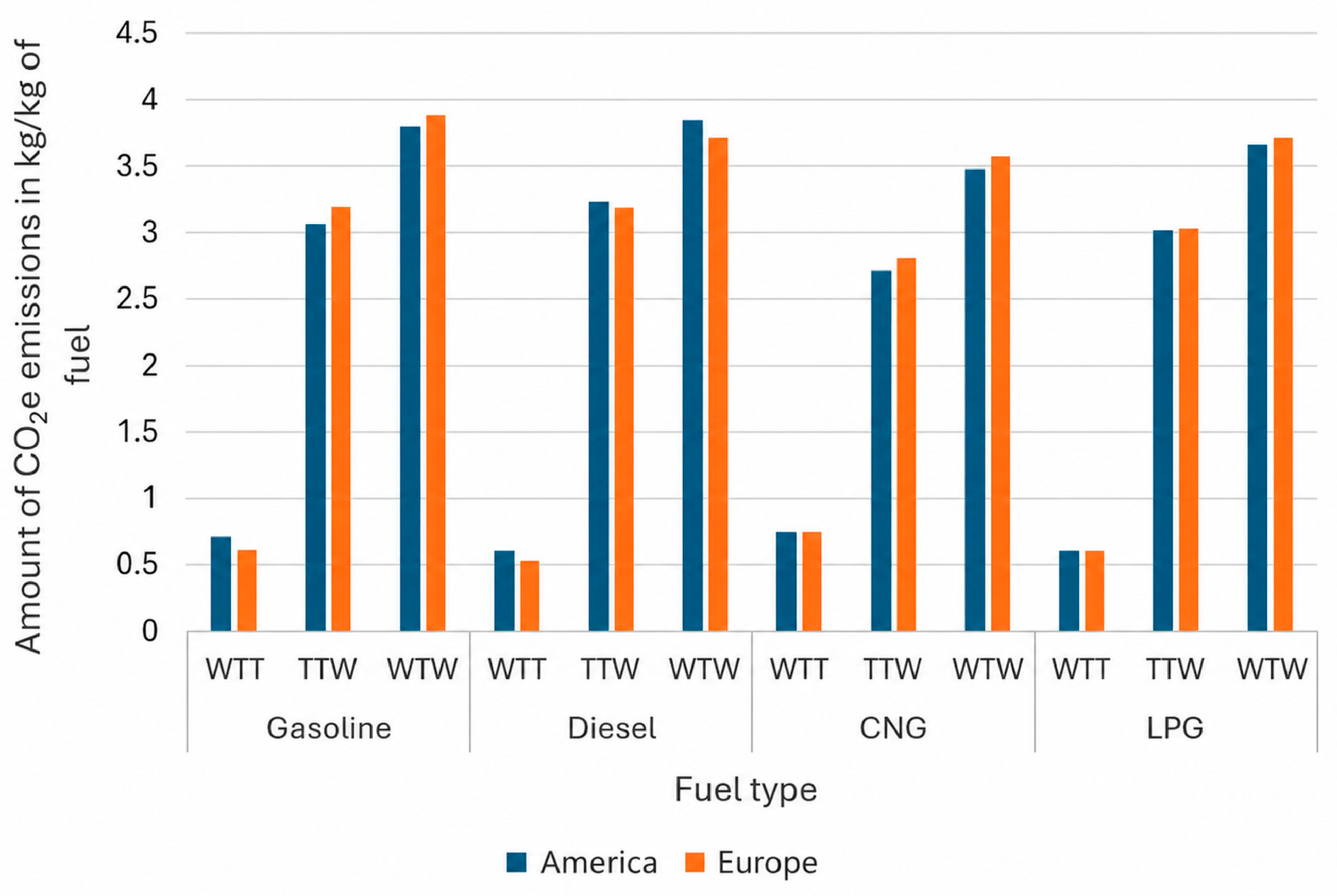
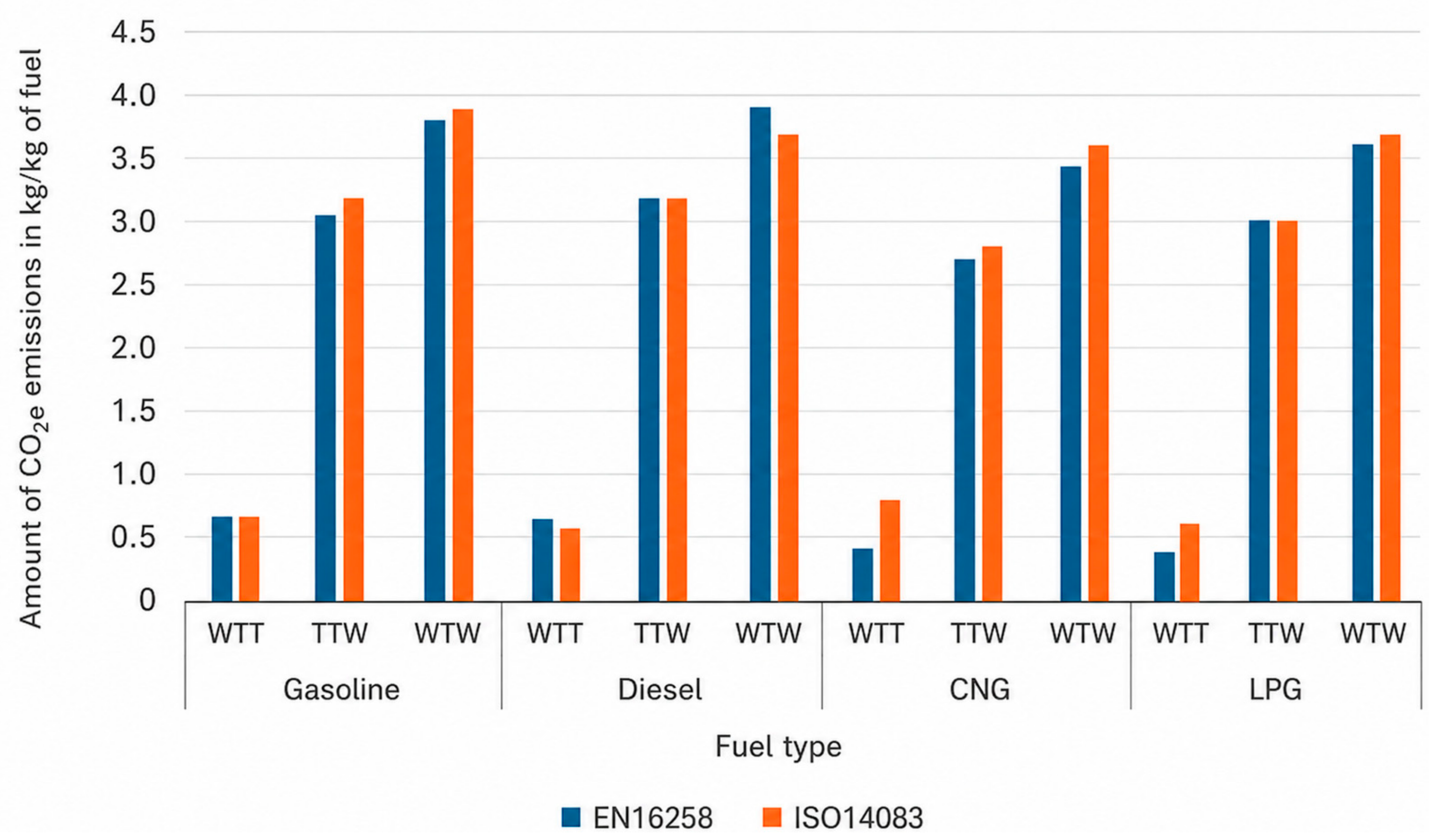
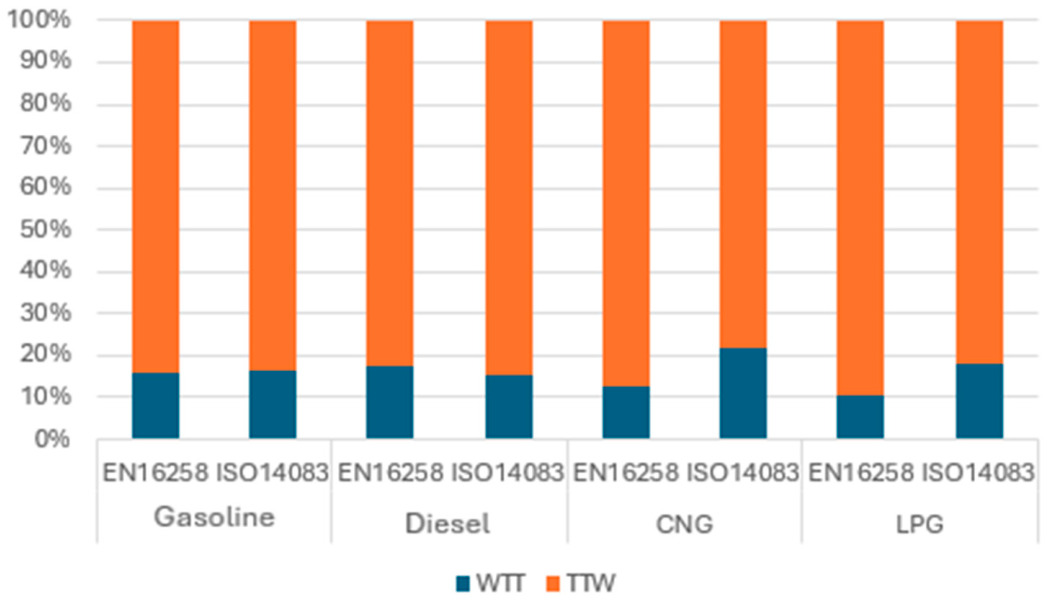
- Well-to-Tank (WtT)—energy consumption and emissions during energy production,
- Tank-to-Wheel (TtW)—energy consumption and emissions during vehicle operation.
- Emission factor databases and tools
1.3. Identification of Calculation Approaches in EN 16258 and ISO 14083
- (a)
- Scope of application
- (b)
- Greenhouse gas emissions addressed by the standards
- (c)
- Modes of transport covered by the standards
- (d)
- Terminology
1.4. Principles of Quantification
- for fuels: extraction or cultivation of primary energy, refining, transformation, transport, and distribution of energy in all stages of the production of the fuel used,
- for electricity: extraction and transport of primary energy, transformation, energy generation, and losses in electrical distribution networks [27].
- vehicle operational processes,
- hub facility operational processes,
- vehicle energy supply processes,
- hub facility energy supply processes,
- loaded and empty vehicle trips performed by the vehicle, including detour distances or off-route distances,
- starting and idling of vehicles, pipelines, and transshipment facilities,
- cleaning/flushing of pipelines,
- combustion or leakage of energy carriers at the vehicle or hub equipment level,
- leakage of refrigerants used by vehicles or transport nodes [19].
- for solid, liquid, and gaseous energy carriers: production and dismantling of energy source infrastructure, e.g., power plant construction, extraction or cultivation of primary energy, chemical processing, transport, and distribution (including via pipelines) of energy at all stages of production using the energy carrier,
- for electricity: extraction, processing, and transport of primary energy; electricity generation; infrastructure for electricity generation, e.g., manufacturing of solar panels or wind turbines; grid losses associated with the transmission and distribution of electricity [19].
- CEi—total emissions for the i-th pollutant [kg]
- EF—emission factor [kg/kg of fuel]
- S—total fuel consumption [l]
- ρ—fuel density [kg/L]
1.5. Reporting in Accordance with ISO 14083
- identification of the transport chains covered by this report,
- a reference to ISO 14083:2023,
- total greenhouse gas emissions (operational and energy supply) (GT),
- total greenhouse gas emission intensity (operational and energy supply) (gT), specifying the transport distance and type of transport activity,
- total greenhouse gas emissions (operational and energy supply) for TCE (transport chain) units for each mode of transport and for the operation of transport hubs,
- total greenhouse gas emission intensity (operational and energy supply) for TCE units, for each mode of transport, and for the operation of transport hubs. When specifying the transport distance and type of transport activity, in cases where alternative units are used for freight transport activities (e.g., number of TEU units), greenhouse gas emission intensity may be reported in these units (e.g., greenhouse gas emissions per TEU unit or per kilometer of TEU),
- supporting information,
- transport activity, specifying the type of distance used,
- hub activity,
- operational greenhouse gas emissions (GVO, T or GHEO, T),
- operational greenhouse gas emission intensity (gVO or gHEO), specifying the type of distance used for the transport activity; if alternative units are used for freight transport activity (e.g., number of items, TEU), greenhouse gas emission intensity may be reported in those units (e.g., greenhouse gas emissions per item or per TEU-kilometer),
- total greenhouse gas emissions, transport activity, and/or greenhouse gas emission intensities for each mode of transport and for hub activities, specifying the type of transport activity distance used, where applicable [19].
1.6. Implementation of ISO 14083
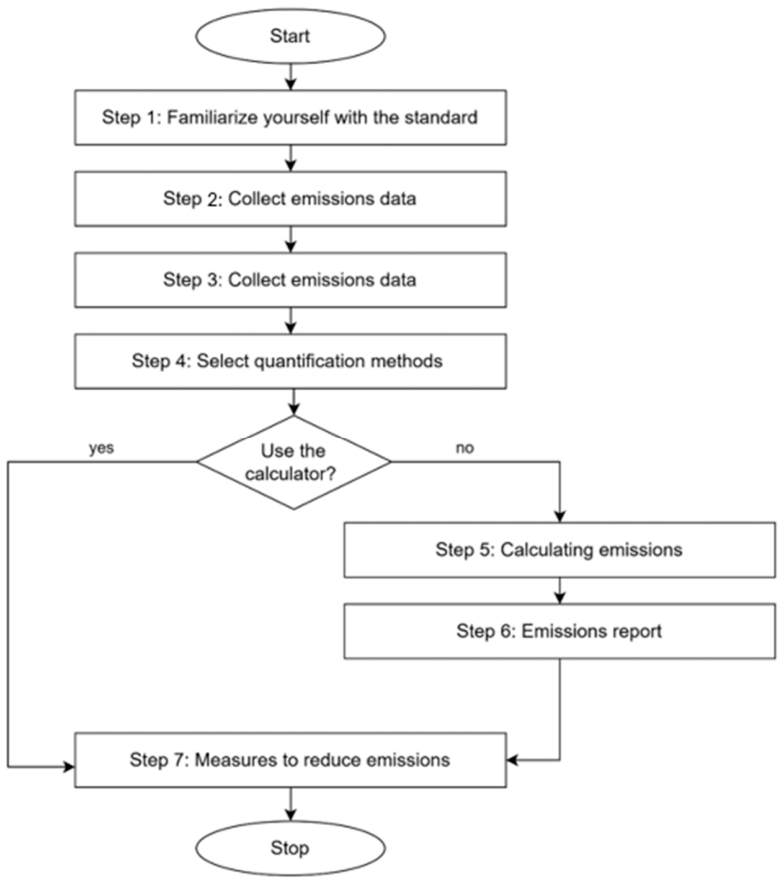
- Step 1: Familiarization with the Standard
- Step 2: Determining the Scope of Reporting
- Step 3: Collecting Relevant Emissions Data
- Step 4: Selection of Appropriate Quantification or Reporting Methods
- Step 5: Calculation of greenhouse gas emissions
- Step 6: Preparing an emissions report
- Step 7: Implementing measures to reduce emissions
1.7. The Sector’s Readiness to Implement ISO 14083
2. Materials and Methods
2.1. Input Data and Emission Factors
- operational emissions—emissions generated directly during vehicle operation (TtW equivalent),
- total emissions—total emissions including energy supply (WtW equivalent).
- operational emissions: 3.17 kgCO2e/kg of fuel
- total emissions: 3.74 kgCO2e/kg of fuel
- EN 16258: 0.83606 kg/L
- ISO 14083: 0.832 kg/L
2.2. General Calculation Procedure
- S—total fuel consumption [l]
- c—fuel consumption rate [l/100 km]
- d—transport distance [km]
- m—fuel mass [kg]
- ρ—fuel density [kg/L]
2.3. Calculation According to STN EN 16258
- Direct emissions (Tank-to-Wheel)
- E—greenhouse gas emissions [kg CO2e]
- EF—emission factor [kg CO2e/kg fuel]
- Indirect emissions (Well-to-Tank)
2.4. Calculation According to ISO 14083
- Operational emissions:
- Energy supply emissions:
- Total emissions:
2.5. Use of Emission Calculators
- Free availability: This calculator function is especially important for the average user who needs to use the calculator once or does not need to use it very often. Nevertheless, the accessible version of the calculator must be reliable and comprehensive for different user groups.
- Ease of use: Ease of use of the calculator makes the user’s work easier and speeds up the calculation process.
- Consideration of direct and indirect emissions: Given that in this work we compare two standards that take these emissions into account, this is an important functionality.
- Support for multiple modes of transport: If the calculator includes more calculation options and also includes multimodality, it becomes more interesting for the user. The EN 16258 and ISO 14083 standards include multimodal transport.
- Detailed input of transport information: The more specific data that can be entered into the calculator, the more accurate the results can be.
- Possibility of issuing a declaration: The possibility of issuing a declaration is another advantage of the calculator, which every user will appreciate due to the acceleration of the process of reporting the number of emissions produced.
- Implementation of ISO 14083: Given the topic of the work, we will also focus on the fact that the evaluated calculators can calculate according to this standard, or whether at least the calculator provider states the fact that it plans to implement the requirements and emission factors of the ISO 14083 standard.
3. Results
3.1. Results of Emission Calculations According to EN 16258
3.2. Results of Emission Calculations According to ISO 14083
3.3. Comparison of Calculation Results
- ΔE—emission difference [kg CO2e]
3.4. Results from Emission Calculators
3.4.1. Map & Guide
- Calculation results according to EN 16258:
- Calculation of emissions according to EN 16258 using HBEFA emission factors:
- Calculation results according to ISO 14083:
- Calculation of emissions according to ISO 14083 using HBEFA emission factors:
3.4.2. CarbonCare
3.4.3. EcoTransIT World
3.5. Comparison of Calculators and Standards
4. Discussion
5. Conclusions
Author Contributions
Funding
Institutional Review Board Statement
Informed Consent Statement
Data Availability Statement
Conflicts of Interest
References
- Da Fonseca-Soares, D.; Eliziário, S.A.; Galvinicio, J.D.; Ramos-Ridao, A.F. Life-cycle greenhouse gas (GHG) emissions calculation for urban rail transit systems: The case of Pernambuco Metro. Appl. Sci. 2023, 13, 8965. [Google Scholar] [CrossRef]
- Liang, X.; Song, H.; Wu, G.; Guo, Y.; Zhang, S. Complex traffic flow model for analysis and optimization of fuel consumption and emissions at large roundabouts. Sustainability 2024, 16, 9464. [Google Scholar] [CrossRef]
- Li, Z. Thermal characteristic analysis and performance optimization of a novel heating boiler using a porous media model. Appl. Therm. Eng. 2026, 289, 130035. [Google Scholar] [CrossRef]
- Dedík, M.; Kendra, M.; Senci, M.; Pribula, D.; Vojtek, M. Progressive methods for the evaluation of the harmfulness of transport in terms of emission production. Sustainability 2024, 16, 10290. [Google Scholar] [CrossRef]
- Cheng, F.; Jia, S. Improved GA-LNS algorithm for solving vehicle path problems considering carbon emissions. Appl. Sci. 2024, 14, 9956. [Google Scholar] [CrossRef]
- Borowicz, A.; Czerepko, J. Possible consequences of the corporate sustainability reporting directive on Polish transport companies. Stud. Eur.-Stud. Eur. Aff. 2023, 27, 105–119. [Google Scholar] [CrossRef]
- Micheli, G.J.; Mantella, F. Modeling an environmentally-extended inventory routing problem with demand uncertainty and a heterogeneous fleet under carbon control policies. Int. J. Prod. Econ. 2018, 204, 316–327. [Google Scholar] [CrossRef]
- Sakas, D.P.; Giannakopoulos, N.T.; Terzi, M.C.; Kanellos, N. Engineering supply chain transportation indexes through big data analytics and deep learning. Appl. Sci. 2023, 13, 9983. [Google Scholar] [CrossRef]
- ISO 14083; Normierung von Emissionsberechnungen als Basis der Nachhaltigen Effizienzsteigerung von Transportketten. ISO: Geneva, Switzerland, 2020.
- Olivari, E.; Caballini, C.; Lluch, X. How to calculate GHG emissions in freight transport? A review of the main existing online tools. Case Stud. Transp. Policy 2025, 19, 101343. [Google Scholar] [CrossRef]
- Lehman, S.; El Hassani, H.; Rabhi, L. An automated tool for freight carbon footprint estimation: Insights from an automotive case study. Future Transp. 2025, 5, 107. [Google Scholar] [CrossRef]
- WebCreators Slovakia Has a New Preliminary (Proxy) Emissions Inventory of Greenhouse Gases for 2023. Available online: https://oeab.shmu.sk/en/news/slovakia-has-a-new-preliminary-proxy-emissions-inventory-of-greenhouse-gases-for-2023.html (accessed on 1 May 2026).
- Bartuska, L.; Masek, J. Changes in road traffic caused by the declaration of a state of emergency in the Czech Republic: A case study. Transp. Res. Procedia 2021, 53, 321–328. [Google Scholar] [CrossRef]
- Bebkiewicz, K.; Szczepański, K.; Chłopek, Z. Simulation studies of pollutant emissions from road vehicles using models for inventories of pollutant emissions. Combust. Engines 2024, 198, 20–26. [Google Scholar] [CrossRef]
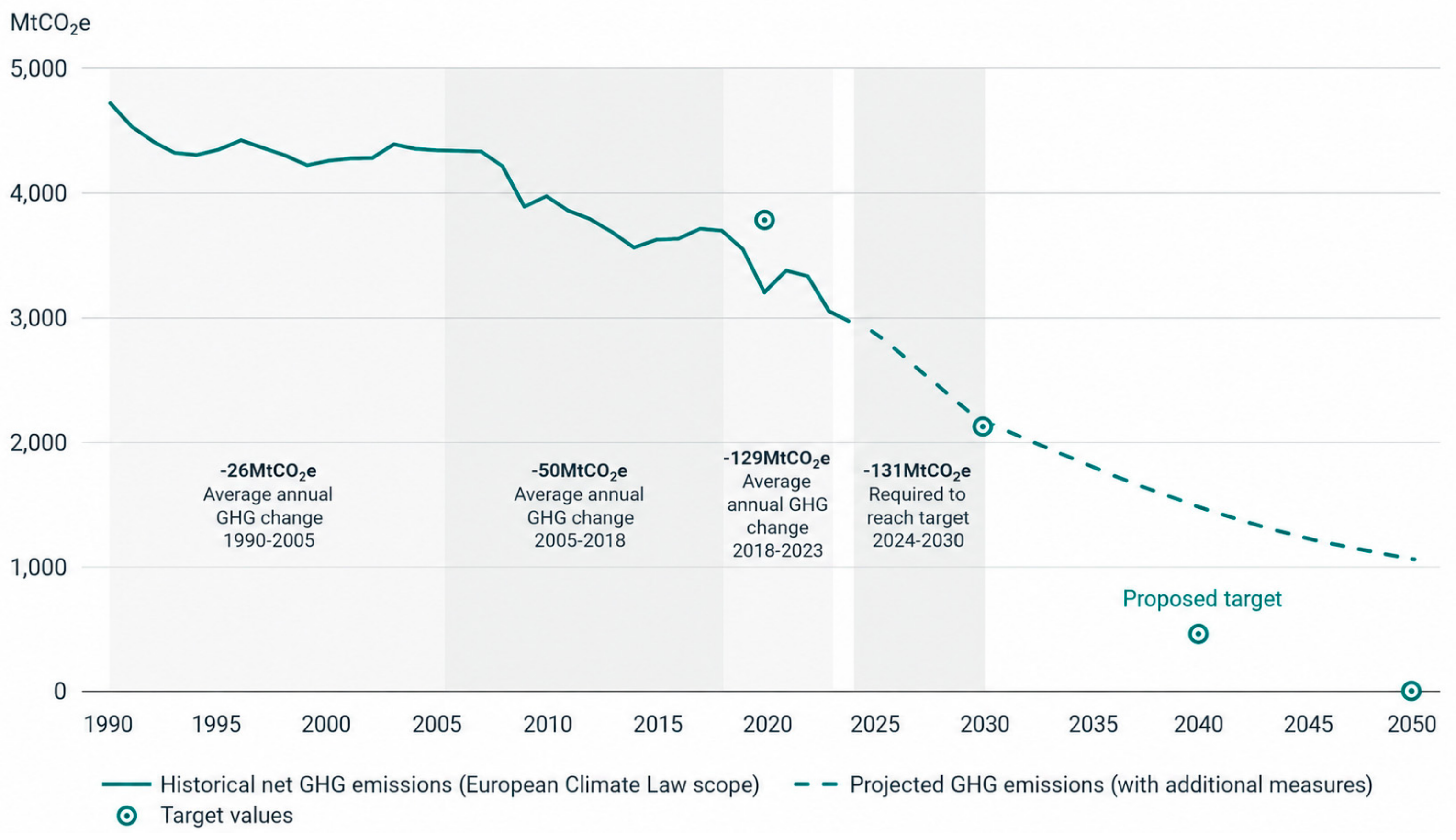
- Total Net Greenhouse Gas Emission Trends and Projections in Europe. Available online: https://www.eea.europa.eu/en/analysis/indicators/total-greenhouse-gas-emission-trends (accessed on 1 May 2026).
- Ghazal, R.M.; Akroot, A.; Abdul Wahhab, H.A.; Alhamd, A.E.J.; Hamzah, A.H.; Bdaiwi, M. The influence of gas fuel enrichment with hydrogen on the combustion characteristics of combustors: A review. Sustainability 2024, 16, 9423. [Google Scholar] [CrossRef]
- Suhara, A.; Karyadi; Herawan, S.G.; Tirta, A.; Idris, M.; Roslan, M.F.; Putra, N.R.; Hananto, A.L.; Veza, I. Biodiesel Sustainability: Review of Progress and Challenges of Biodiesel as Sustainable Biofuel. Clean Technol. 2024, 6, 886–906. [Google Scholar] [CrossRef]
- Benti, N.E.; Aneseyee, A.B.; Geffe, C.A.; Woldegiyorgis, T.A.; Gurmesa, G.S.; Bibiso, M.; Mekonnen, Y.S. Biodiesel production in Ethiopia: Current status and future prospects. Sci. Afr. 2023, 19, e01531. [Google Scholar] [CrossRef]
- ISO 14083:2023; Greenhouse Gases—Quantification and Reporting of Greenhouse Gas Emissions Arising from Transport Chain Operations. International Organization for Standardization; ISO: Geneva, Switzerland, 2023.
- Nkesah, S.K. Making Road Freight Transport More Sustainable: Insights from a Systematic Literature Review. Transp. Res. Interdiscip. Perspect. 2023, 22, 100967. [Google Scholar] [CrossRef]
- European Commission, Official Website—European Commission. Available online: https://commission.europa.eu/index_en (accessed on 1 May 2026).
- Smart Freight Centre. Global Logistics Emissions Council Framework for Logistics Emissions Accounting and Reporting; v3.0 edition, revised and updated; Smart Freight Centre: Amsterdam, The Netherlands, 2023. [Google Scholar]
- Schmied, M.; Knörr, W. Calculating GHG Emissions for Freight Forwarding and Logistics Services in Accordance with EN 16258. Available online: https://www.clecat.org/media/CLECAT_Guide_on_Calculating_GHG_emissions_for_freight_forwarding_and_logistics_services.pdf (accessed on 1 May 2026).
- Smart Freight Centre. Global Logistics Emissions Council Framework for Logistics Emissions Accounting and Reporting; v3.1 edition, revised and updated; Smart Freight Centre: Amsterdam, The Netherlands, 2024. [Google Scholar]
- Fancello, G.; Vitiello, D.M.; Serra, P. Evaluating the Environmental Sustainability of an Intermodal Freight Logistic Chain Using the GLEC Framework. In Proceedings of the Computational Science and Its Applications–ICCSA 2023 Workshops; Gervasi, O., Murgante, B., Rocha, A.M.A.C., Garau, C., Scorza, F., Karaca, Y., Torre, C.M., Eds.; Springer Nature: Cham, Switzerland, 2023; pp. 563–576. [Google Scholar]
- HBEFA Software. Available online: https://www.hbefa.net/en/software (accessed on 1 May 2026).
- EN 16258; Methodology for Calculation and Declaration of Energy Consumption and GHG Emissions of Transport Services. European Committee for Standardization: Brussels, Belgium, 2012.
- Ray, P.; Botero, D.; Lewis, A.; Ehrler, V. GHG Emissions Accounting and Reporting for Transport; International Transport Forum: Paris, France, 2024. [Google Scholar]
- Kallionpää, E.; Liimatainen, H.; Viri, R.; Vaismaa, K. Development of Logistics Emissions Reporting—Shippers’ and Logistics Service Providers’ Perspective. Transp. Res. Part D Transp. Environ. 2026, 150, 105083. [Google Scholar] [CrossRef]
- Oberhofer, P.; Dieplinger, M. Sustainability in the transport and logistics sector: Lacking environmental measures? Bus. Strategy Environ. 2014, 23, 236–253. [Google Scholar] [CrossRef]
- Volvo Trucks—SK. Available online: https://www.volvotrucks.sk/sk-sk/ (accessed on 1 May 2026).
- Products | PTV Map&Guide (EN) | PTV Logistics. Available online: https://www.ptvlogistics.com/en/products/ptv-mapandguide (accessed on 1 May 2026).
- CarbonCare – Home. Available online: https://www.carboncare.org/en (accessed on 1 May 2026).
- EcoTransIT World. 2021. Available online: https://www.ecotransit.org (accessed on 1 May 2026).
- Mark, V.D.; Patrizia, S.; Gianfranco, F. Assessing greenhouse gas emissions arising from intermodal freight transport chains using the ISO14083 standard. Transp. Res. Procedia 2025, 90, 464–471. [Google Scholar] [CrossRef]
- Schmidt, V.; Aschauer, F.; Scott, A.; Gerschberger, M. Does a detailed freight emissions calculation really matter? Transp. Res. Part D Transp. Environ. 2025, 148, 104761. [Google Scholar] [CrossRef]
- McIntosh, A.; Romero, E.L.; de Angelis, M. Interval uncertainty propagation on CO2 emission calculations in road haulage. In Proceedings of the 36th European Safety and Reliability Conference, Braga, Portugal, 14–19 June 2026. [Google Scholar]





| Technical Data | Truck | Trailer |
|---|---|---|
| Total weight of the trailer (legislative/design) | 18,000 kg/20,500 kg | 33,060 kg/39,000 kg |
| Curb weight | 7230 kg | 5490 kg |
| Technical axle load | 44,000 kg | 27,000 kg |
| Fifth wheel technical load | 7500 kg | 12,000 kg |
| Permissible rear axle load | 11,500 kg/13,000 kg | - |
| Dimensions of the loading area | - | 13,620 × 2480 × 2700 mm |
| Parameters | Unit | EN 16258 | ISO 14083 |
|---|---|---|---|
| Transport distance | km | 271.90 | 271.90 |
| Fuel consumption | L | 81.57 | 81.57 |
| Fuel density | kg/L | 0.836 | 0.832 |
| Fuel mass | kg | 68.20 | 67.87 |
| Direct emissions | kg CO2e | 202.55 | 215.15 |
| Indirect emissions | kg CO2e | 53.88 | 38.69 |
| Total emissions | kg CO2e | 256.43 | 253.84 |
| Category | Indicator | Value |
|---|---|---|
| Energy Consumption [MJ] | Tank-to-Wheel | 3512.84 |
| Well-to-Wheel | 4381.43 | |
| Emissions (CO2e) [kg] | Tank-to-Wheel | 244.45 |
| Well-to-Wheel | 309.87 | |
| Emissions (CO2e) [kg per km] | Tank-to-Wheel | 0.90 |
| Well-to-Wheel | 1.14 |
| Category | Indicator | Value |
|---|---|---|
| Energy Consumption [MJ] | Tank-to-Wheel | 2910.68 |
| Well-to-Wheel | 3630.38 | |
| Emissions (CO2e) [kg] | Tank-to-Wheel | 202.55 |
| Well-to-Wheel | 256.75 | |
| Emissions (CO2e) [kg per km] | Tank-to-Wheel | 0.74 |
| Well-to-Wheel | 0.94 |
| Category | Indicator | Value |
|---|---|---|
| Energy Consumption [MJ] | Tank-to-Wheel | 3487.07 |
| Well-to-Wheel | 4722.46 | |
| Emissions (CO2e) [kg] | Tank-to-Wheel | 241.55 |
| Well-to-Wheel | 322.68 | |
| Emissions (CO2e) [kg per km] | Tank-to-Wheel | 0.89 |
| Well-to-Wheel | 1.19 |
| Category | Indicator | Value |
|---|---|---|
| Energy Consumption [MJ] | Tank-to-Wheel | 2882.90 |
| Well-to-Wheel | 3904.25 | |
| Emissions (CO2e) [kg] | Tank-to-Wheel | 199.70 |
| Well-to-Wheel | 266.77 | |
| Emissions (CO2e) [kg per km] | Tank-to-Wheel | 0.73 |
| Well-to-Wheel | 0.98 |
| Parameter | Unit | EN 16258 | EN 16258 HBEFA | ISO 14083 | ISO 14083 HBEFA |
|---|---|---|---|---|---|
| Distance | km | 271.90 | 271.90 | 271.90 | 271.90 |
| Fuel consumption | l | 81.57 | 81.57 | 81.57 | 81.57 |
| Fuel density | kg/L | 0.836 | 0.836 | 0.832 | 0.832 |
| Category | Indicator | Value |
|---|---|---|
| Greenhouse Gases | CO2e [kg] WTW | 284.9 |
| CO2 [kg] WTW | 255.0 | |
| CO2e Intensity [g CO2e/tonne-km] | 53.09 | |
| Air Pollutants | NOx [kg] WTW | 0.232 |
| SO2 [kg] WTW | 0.168 | |
| NMHC [kg] WTW | 0.435 | |
| PM10 [kg] WTW | 0.023 | |
| External Costs | Total Costs [€] | 180.8 |
| Emission Costs [€] | 28.5 | |
| Accidental Costs [€] | 38.3 | |
| Noise Costs [€] | 107.1 | |
| Mobility | Distance [km] | 268.3 |
| Transport Activity [tonne-km] | 5366 |
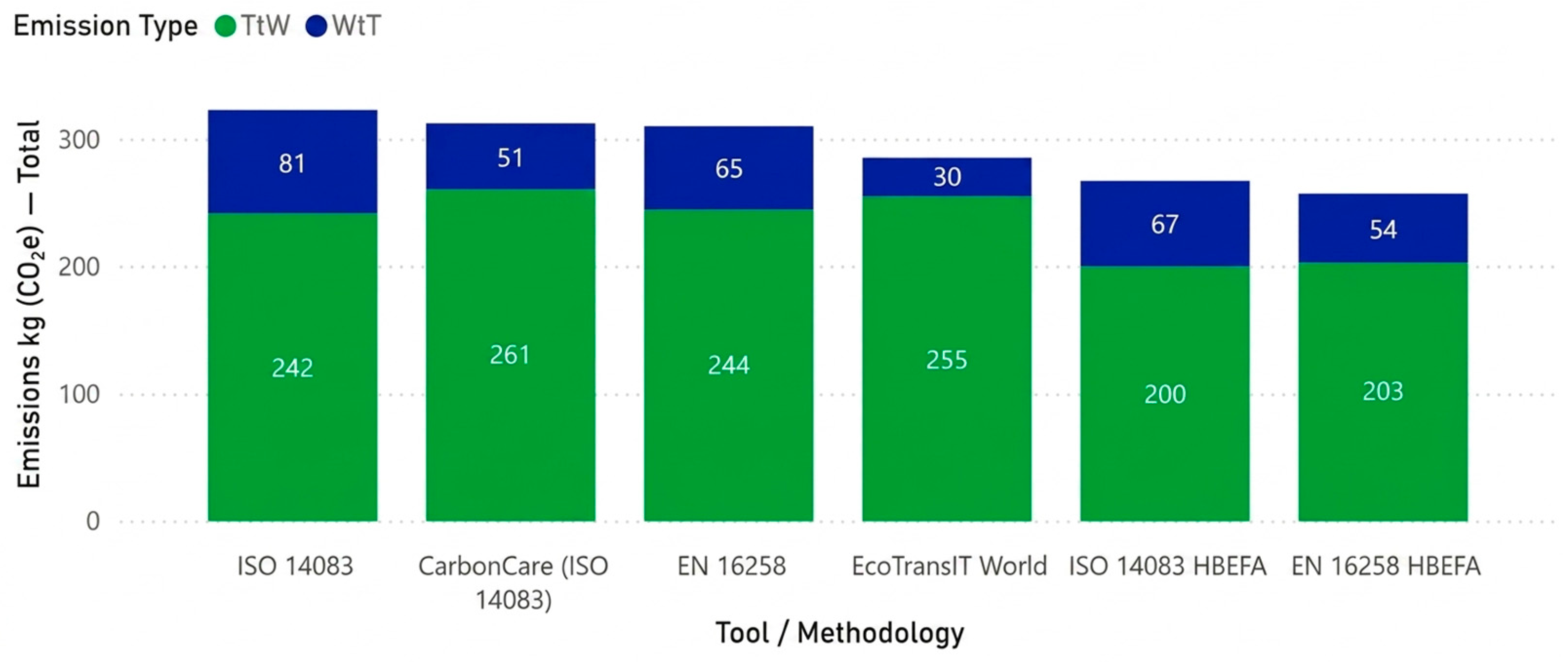
| Tool/ Methodology | WtT (kg CO2e) | TtW (kg CO2e) | WtW (kg CO2e) | Emission Intensity (kg CO2e/tkm) |
|---|---|---|---|---|
| EN 16258 | 65.42 | 244.45 | 309.87 | 0.074 |
| EN 16258 HBEFA | 54.20 | 202.55 | 256.75 | 0.061 |
| ISO 14083 | 81.13 | 241.55 | 322.68 | 0.077 |
| ISO 14083 HBEFA | 67.07 | 199.70 | 266.77 | 0.064 |
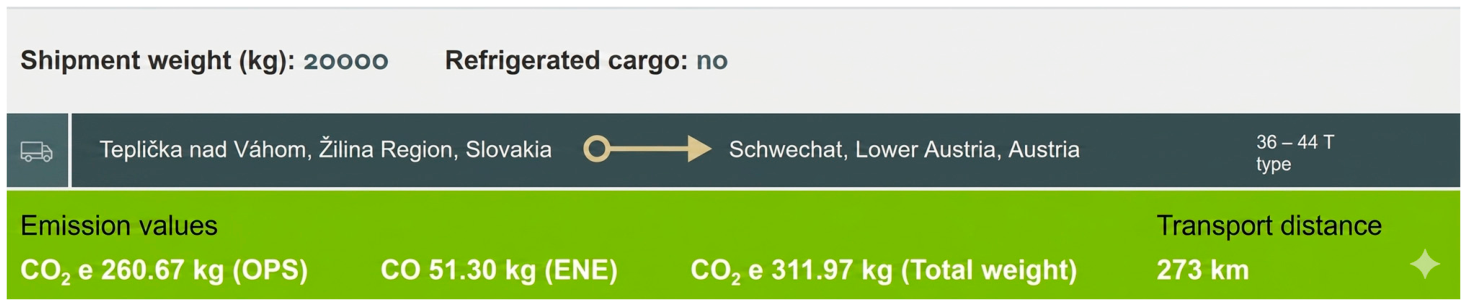
| CarbonCare | 51.30 | 260.67 | 311.97 | - |
| EcoTransIT World | 29.90 | 255.00 | 284.90 | 0.0531 |
| EcoTransIT World | CarbonCare | Map & Guide | |
|---|---|---|---|
| Availability without charge | ✓ | ✓ | X |
| Easy to use | ✓ | ✓ | ✓ |
| Considering both direct and indirect emissions | ✓ | ✓ | ✓ |
| Possibility of calculating emissions for a specific route | ✓ | ✓ | ✓ |
| Support for multiple modes of transport | ✓ | ✓ | X |
| Detailed entry of input information about the shipment | ✓ | ✓ | ✓ |
| Detailed entry of vehicle information | X | X | ✓ |
| Possibility of issuing a declaration | ✓ | X | ✓ |
| Implementation of ISO 14083 | ✓ | ✓ | ✓ |
Disclaimer/Publisher’s Note: The statements, opinions and data contained in all publications are solely those of the individual author(s) and contributor(s) and not of MDPI and/or the editor(s). MDPI and/or the editor(s) disclaim responsibility for any injury to people or property resulting from any ideas, methods, instructions or products referred to in the content. |
© 2026 by the authors. Licensee MDPI, Basel, Switzerland. This article is an open access article distributed under the terms and conditions of the Creative Commons Attribution (CC BY) license.
Share and Cite
Konečný, V.; Ujlacká, K.; Jonasíková, D. Calculation and Declaration of Greenhouse Gas Emissions from Road Transport Services: Transition from EN 16258 to ISO 14083 and Implementation Challenges in the Slovak Transport Sector. Appl. Sci. 2026, 16, 5820. https://doi.org/10.3390/app16125820
Konečný V, Ujlacká K, Jonasíková D. Calculation and Declaration of Greenhouse Gas Emissions from Road Transport Services: Transition from EN 16258 to ISO 14083 and Implementation Challenges in the Slovak Transport Sector. Applied Sciences. 2026; 16(12):5820. https://doi.org/10.3390/app16125820
Chicago/Turabian StyleKonečný, Vladimír, Karolína Ujlacká, and Dominika Jonasíková. 2026. "Calculation and Declaration of Greenhouse Gas Emissions from Road Transport Services: Transition from EN 16258 to ISO 14083 and Implementation Challenges in the Slovak Transport Sector" Applied Sciences 16, no. 12: 5820. https://doi.org/10.3390/app16125820
APA StyleKonečný, V., Ujlacká, K., & Jonasíková, D. (2026). Calculation and Declaration of Greenhouse Gas Emissions from Road Transport Services: Transition from EN 16258 to ISO 14083 and Implementation Challenges in the Slovak Transport Sector. Applied Sciences, 16(12), 5820. https://doi.org/10.3390/app16125820