Article

Calculation and Declaration of Greenhouse Gas Emissions from Road Transport Services: Transition from EN 16258 to ISO 14083 and Implementation Challenges in the Slovak Transport Sector


by
Vladimír Konečný
,
Karolína Ujlacká
* and
Dominika Jonasíková
Department of Road and Urban Transport, University of Žilina, Univerzitná 1, 01026 Žilina, Slovakia
*
Author to whom correspondence should be addressed.
Appl. Sci. 2026, 16(12), 5820; https://doi.org/10.3390/app16125820 (registering DOI)
Submission received: 13 May 2026 / Revised: 29 May 2026 / Accepted: 1 June 2026 / Published: 9 June 2026
(This article belongs to the Section Environmental Sciences)

Featured Application

This study provides practical guidance for transport and logistics companies in implementing standardized greenhouse gas emissions calculation and reporting. The comparison of EN 16258 and ISO 14083 methodologies, together with the evaluation of emission calculators, supports decision-making in selecting appropriate tools and approaches. The proposed implementation framework can be directly applied by organizations transitioning to ISO 14083, improving the transparency, comparability, and reliability of emissions reporting in line with sustainability and ESG requirements.

Abstract

Greenhouse gas (GHG) emissions from transport represent a significant environmental challenge, increasing the need for standardized calculation and reporting methodologies. This study aims to analyze and compare the approaches to GHG emissions calculation under EN 16258 and ISO 14083, for road transport services, and to discuss implementation challenges related to the transition to the new standard in the Slovak transport sector. The research is based on a case study of a model road freight transport route, in which emissions are calculated using both standards and selected emission calculators, and the results are compared. The results indicate that both methodologies yield comparable total emission values, with discrepancies arising mainly from the structure of emission factors and the inclusion of indirect emissions. ISO 14083 demonstrates a more comprehensive and detailed approach, particularly in the consideration of energy supply processes. The analysis also reveals discrepancies between emission calculators due to differences in input data, emission factor databases, and modeling approaches. The findings suggest that although awareness of ISO 14083 is increasing, its wider implementation is limited by data availability, methodological complexity, and varying levels of sector readiness.

1. Introduction

Road freight transport is a significant source of greenhouse gas emissions, and its contribution to global warming continues to rise as demand for goods transport grows [1]. This trend is closely linked to the globalization of supply chains and the intensification of logistics operations, leading to greater demand for energy resources and, at the same time, higher emissions [2].
In response to these challenges, increasing emphasis is being placed on transforming the transport sector toward greater sustainability, energy efficiency, and low-emission operational approaches [3,4]. Reducing carbon dioxide emissions in freight transport is therefore becoming a key objective in sustainable supply chain management [5].
In this context, the European Union’s legislative framework also plays an important role, particularly the requirements for reporting sustainability (ESG) information, which place increased demands on the transparency and comparability of emissions data. As noted by Borowicz and Czerepko [6], implementing these requirements may lead to differences in implementation among member states, complicating data collection and subsequent reporting, particularly for companies operating in multiple countries.
Supply chains contribute significantly to greenhouse gas emissions through activities such as manufacturing, transportation, and storage [7]. Therefore, their effective management requires implementing innovative approaches and tools that optimize processes and reduce environmental impacts [8]. Logistics, as an integral part of supply chains, plays a key role in climate neutrality and sustainable development [9].
From a practical implementation perspective, it is essential to accurately quantify these measures and identify the main sources of emissions [10]. In this context, emission calculators and computational tools play a significant role, enabling the application of methodologies under real-world transportation conditions. As noted by several authors, however, existing tools differ in their methodologies, emission factor databases, and the level of detail in their input data, leading to discrepancies in results and reducing their comparability [11].
The ISO 14083:2023 Greenhouse gases -Quantification and reporting of greenhouse gas emissions arising from transport chain operations standard addresses these shortcomings; it is the latest international standard for quantifying and declaring greenhouse gas emissions in transport and logistics chains. It aims to ensure a uniform, transparent, and globally applicable approach to emissions calculation.
Based on the above, the objective of this article is to analyze and evaluate approaches to calculating greenhouse gas emissions in accordance with EN 16258:2012 Methodology for calculation and declaration of energy consumption and GHG emissions of transport services and ISO 14083, compare their results, and identify differences between them. The study also includes an evaluation of emissions calculators as practical tools for implementing these methodologies, as well as an assessment of the transportation sector’s readiness to apply the ISO 14083 standard.

1.1. Literature Review

Greenhouse gases are closely linked to the combustion of fuels. These include carbon dioxide (CO2), methane (CH4), nitrous oxide (N2O), and fluorinated greenhouse gases, which are expressed in so-called CO2 equivalents (CO2e). Rising atmospheric emissions of these gases intensify the greenhouse effect, which, in turn, leads to climate change [1,12].
The increasing demand for transporting people and goods, coupled with the failure to achieve past emission targets, has contributed to the inability to meet planned environmental goals. A significant drop in emissions was observed during the COVID-19 pandemic, but after the pandemic ended, emissions returned to near their original levels [13].
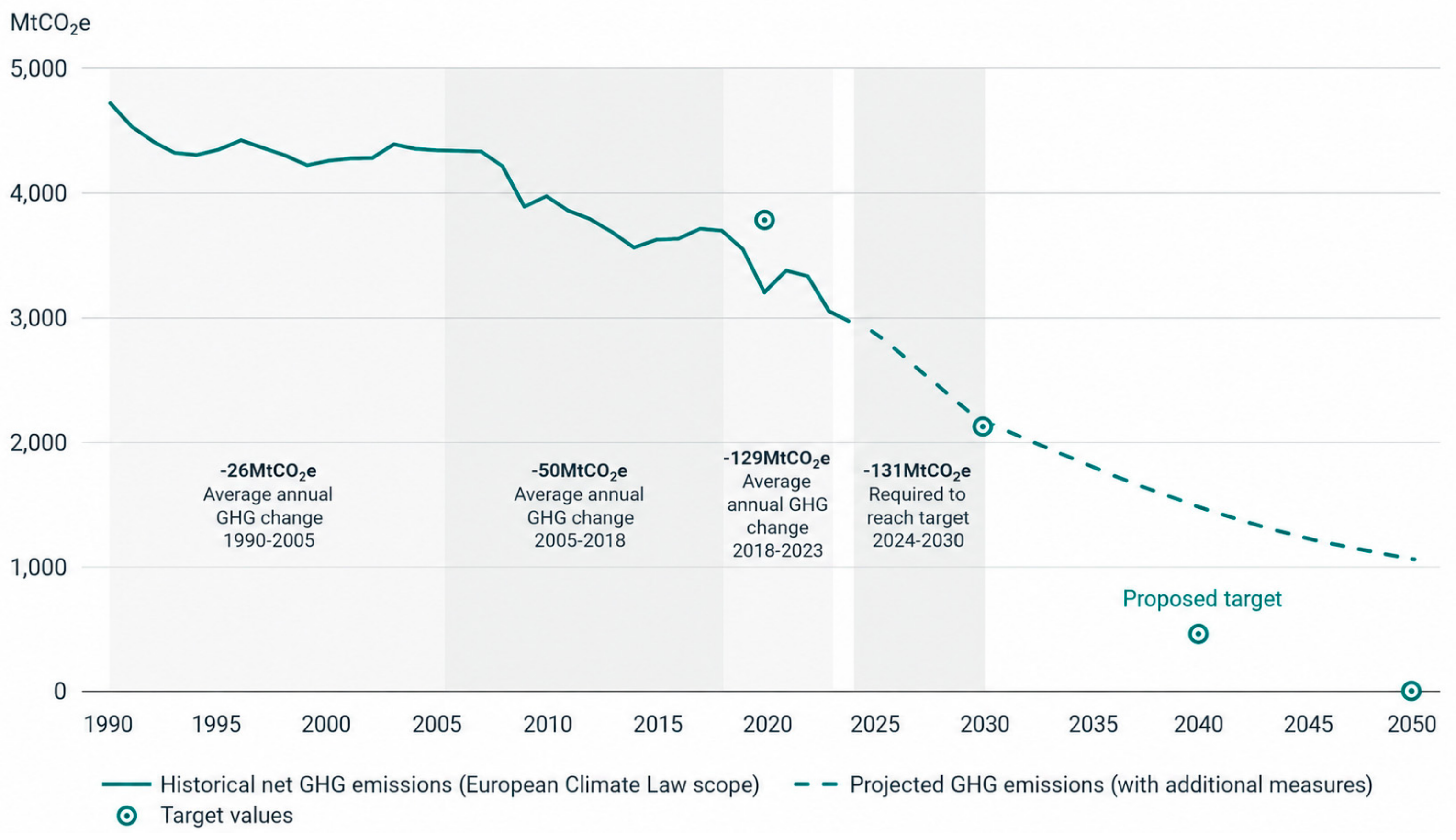
Figure 1 illustrates the development, trends, and projections of greenhouse gas emissions in the European Union from 1990 to 2050.
Despite a significant increase in road vehicle use between 2000 and 2020, total annual emissions have declined. This development is primarily due to changes in the vehicle fleet’s structure and improvements in its environmental performance [14]. The European Union has met its target for reducing greenhouse gas emissions by 2020; however, to achieve the 2030 targets and climate neutrality by 2050, it will be necessary to increase the share of renewable energy sources in the energy mix and improve energy efficiency [15].
Figure 1. EU net greenhouse gas emissions pathway (1990–2050) [15].
Applsci 16 05820 g001
Alternative fuels and low-emission energy carriers, including hydrogen and biofuel components, are increasingly considered potential measures to reduce greenhouse gas emissions in transport [16,17,18].

1.2. Standards for GHG Calculation

In quantifying and reporting greenhouse gas emissions in transportation, several international and regional standards, methodologies, and tools are available. They aim to ensure a consistent, transparent, and comparable approach to calculating emissions in transportation and logistics chains. The development of these tools has evolved gradually from regional solutions to globally harmonized standards. Despite the existence of multiple methodologies and tools, however, there is currently no unified approach to their application and mutual comparison under real-world transport conditions. This leads to discrepancies in calculation results and reduces the comparability of reported emissions across different organizations and tools.
  • ISO 14083: 2023
Currently, ISO 14083:2023 is the latest international standard for quantifying and reporting greenhouse gas emissions in transport and logistics chains. This standard establishes a common methodology for calculating emissions generated during the operation of passenger and freight transport chains. It also provides requirements and guidelines for emissions reporting across passenger and freight transport activities. It specifies how to obtain data as input for emissions calculations. At the same time, the standard recognizes that transport operations range from multinational organizations operating multiple modes of transport worldwide to small local operators providing simple service. Therefore, the standard has been designed to be widely applicable.
Emissions are quantified using the “well-to-wheel” principle, which includes emissions generated during energy production (well-to-tank) and during vehicle operation (tank-to-wheel). The standard also accounts for emissions associated with energy production and distribution, enabling consistent comparisons across different modes of transport and energy carriers.
The standard covers all modes of transport and includes operational GHG emissions from hubs where cargo or passengers are transferred between elements of the transport chain. It also accounts for empty runs required for subsequent cargo or passenger transport. The standard applies to all stages of the transport chain. ISO 14083 significantly advances the standardization of systems for quantifying and documenting greenhouse gas emissions in transport. This standard provides businesses with a comprehensive framework for accurate and consistent emissions reporting [19].
Although ISO 14083 is not legally binding, its growing relevance is mainly driven by indirect market and regulatory pressures, particularly ESG reporting requirements, supply-chain transparency demands, and alignment with frameworks such as the GLEC Framework and CSRD-related sustainability reporting practices. To avoid overstating its mandatory nature, the text was revised to better distinguish between legal obligation and increasing practical adoption within the transport and logistics sector [20,21].
The ISO 14083 standard has also been adopted into the European standardization system as EN ISO 14083 and is gradually being implemented into national technical standards systems. It provides a reference methodology for calculating greenhouse gas emissions from transport services and builds on the previous standard EN 16258:2012 and the Greenhouse Gas Protocol.
The ISO 14083:2023 standard appears to be the most relevant and suitable methodology for achieving the objectives of European transport decarbonization policies [21]. Although the standard is not mandatory, its use is gradually becoming the norm in the transport and logistics sector.
Implementing ISO 14083 can bring organizations several benefits, such as:
  • improving environmental reputation and strengthening the brand,
  • increasing market competitiveness and accessing new business opportunities,
  • reducing risks and costs associated with GHG emissions,
  • strengthening sustainable development in the supply chain and promoting responsible business practices,
  • improving operational efficiency and optimizing logistics processes [21].
In addition to direct benefits for organizations, the ISO 14083:2023 standard also has a positive impact on the environment. By increasing transparency about GHG emissions in supply chains and supporting the implementation of strategies to reduce them, this standard can help lower overall GHG emissions and combat climate change [21].
ISO14083 includes new and frequently used terms that are not addressed in EN 16258. These relate to the application of the TCE, TOC, and HOC approaches. TCE refers to a section of the transport chain within which cargo or passengers are transported by a single vehicle or pass through a single node [21].
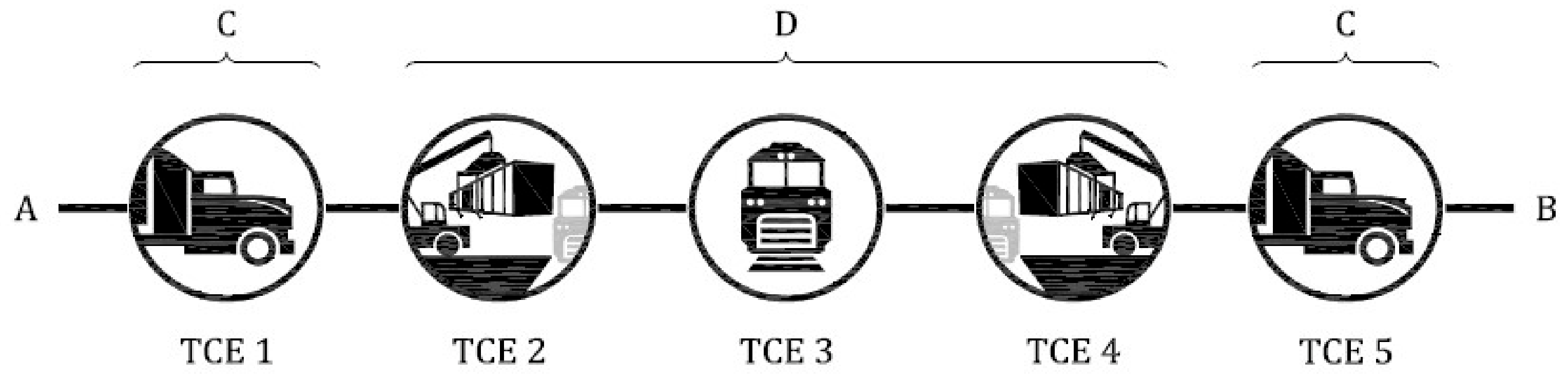
Figure 2 provides an illustrative example of a freight transport chain from the point where the freight leaves its final place of production or processing (A, shipper) to the point where the freight reaches its first non-transport-related operation (B, consignee). This figure shows five transport chain elements (TCEs), each with its own greenhouse gas emissions calculated separately. The first and last TCEs (TCE 1, TCE 5) represent road transport services (C), which include pre-transport and in-transit operations. TCE 2 through TCE 4 represent rail freight transport services (D) consisting of road/rail terminal operations (TCE 2, TCE 4) and mainline rail transport (TCE 3) [19].
A TOC is a group of transport operations that share the same characteristics. The annexes of the standard contain recommendations for the characteristics used to specify a TOC for each mode of transport.
When defining TOC characteristics, factors influencing the scope and composition of the TOC are taken into account, such as:
  • the number and type of vehicles or the length and type (diameter) of the pipeline to be included in the TOC,
  • the nature and consistency of the vehicles or pipeline operations included,
  • processes related to maintaining the condition of the cargo, such as temperature control (cargo transport only),
  • the nature of the cargo being transported,
  • the period of activity of the vehicles or pipelines within the TOC.
TOCs may have different levels, for example:
  • TOC of a single vehicle for a single trip or a specific schedule,
  • TOC of a single vehicle across different schedules/routes, based on network/route characteristics,
  • TOC for a specific vehicle type in a single schedule,
  • TOC for a specific vehicle type across different schedules/routes,
  • TOC for a specific group of vehicles in a single schedule,
  • TOC for a specific group of vehicles across different schedules/routes.
A TOC must fully encompass every transport operation, meaning it cannot be split between two TOCs, even if it involves two TCEs (e.g., a TCE for passengers and a TCE for freight) carried by the same vehicle. A single TOC may include transport operations involving vehicles with different propulsion systems [19].
An HOC is a group of node operations that share similar characteristics. The selection of HOCs should reflect the needs of the standard user, taking into account the availability of greenhouse gas activity data and its relevance to the specific transport chain under consideration. HOCs should be structured based on an appropriate combination of influencing factors [19].
Compared with EN 16258, ISO 14083 introduces several additional methodological requirements that increase the complexity of practical implementation. One of the main differences is the requirement to analyze the entire transport chain, including multimodal transport segments, terminal operations, empty runs, and supporting logistics activities [19,21].
A significant practical challenge is the correct identification and classification of Transport Chain Elements (TCEs), Transport Operation Categories (TOCs), and Hub Operation Categories (HOCs). In complex logistics networks, individual shipments may pass through multiple transport modes, terminals, warehouses, and subcontracted operations. Each activity must be correctly assigned within the transport chain structure to ensure accurate allocation of greenhouse gas emissions and transparent reporting [19].
Additional complexity arises from the inclusion of hub operations. ISO 14083 requires organizations to consider emissions not only from vehicle operation but also from cargo handling processes, terminal equipment, warehousing activities, cooling systems, and supporting infrastructure. Obtaining such detailed operational data may be difficult, especially for smaller transport operators that do not use advanced digital monitoring or data management systems [21].
Another important issue is the inclusion of empty runs and asymmetrical transport operations. Unlike EN 16258, ISO 14083 requires that these emissions be allocated within the transport chain calculation framework, thereby improving methodological transparency while increasing calculation and data collection requirements. Similar challenges were identified in studies evaluating the practical implementation of ISO 14083-compatible emissions-calculation tools and logistics-reporting systems [22].
Regarding quantification, ISO 14083 includes a specific subchapter for calculating transport activities. The subchapter covers information on passenger transport, freight transport, and their combination, as well as the calculation of node activities, which is similarly divided.
The standard specifies optional supplementary processes that can be quantified, unlike EN 16258, which does not include them. If these optional elements are calculated, this must be clearly stated:
  • storage of cargo at hubs,
  • use of information and communication technology (ICT) equipment and data servers related to transport or hub operations,
  • (re)packaging [19].
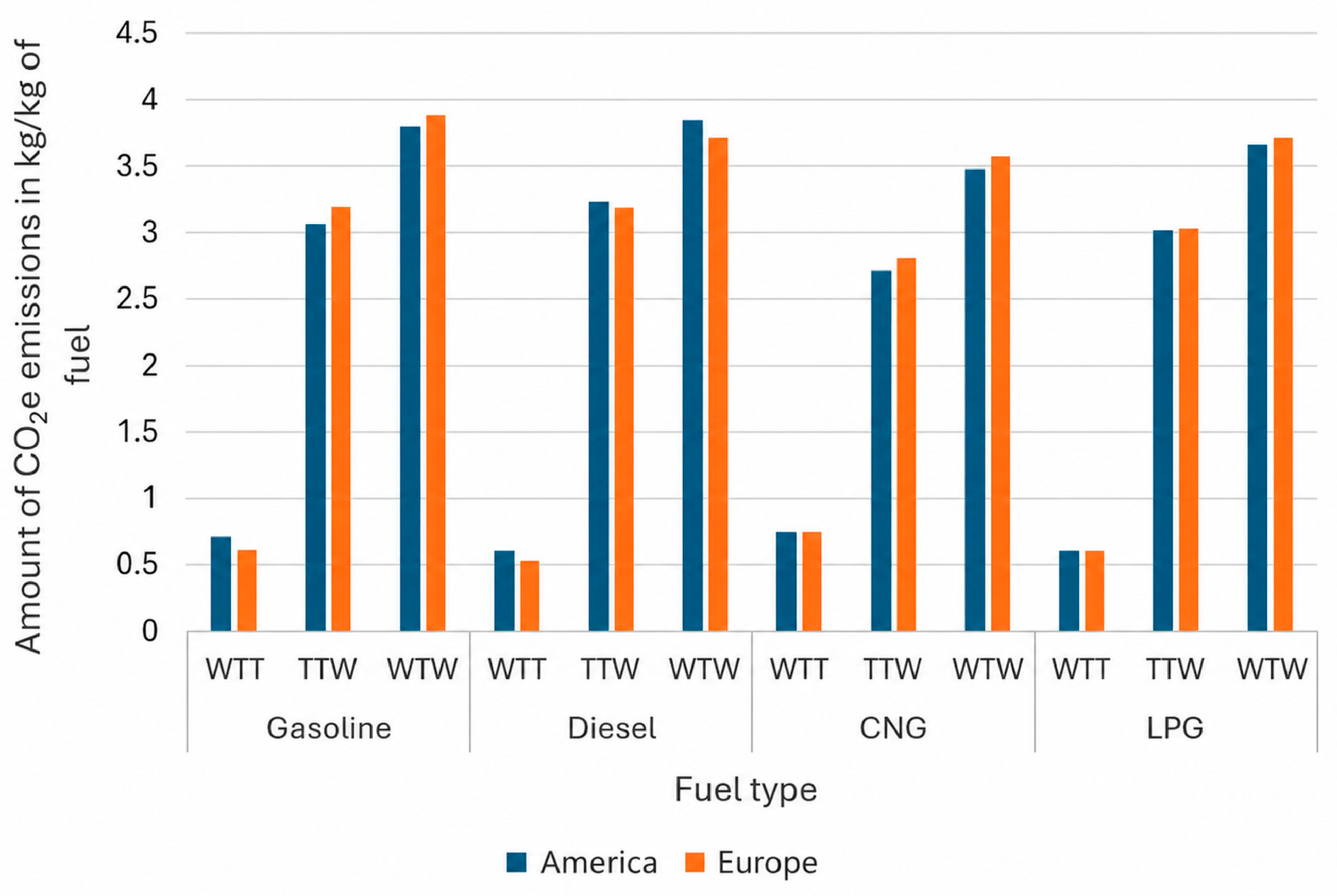
One new approach is that EN 16258 does not distinguish between approaches across sectors or regions. In contrast, ISO 14083 classifies emission factors not only by fuel type but also geographically, including separate emission factors for Europe and the Americas. Therefore, we conclude that ISO 14083 is more comprehensive and detailed. The following graph compares the individual emission factors for the most commonly used fuels—gasoline, diesel, CNG, and LPG—for Europe and the Americas, in the standard’s format. Although the standard does not directly specify direct (TtW) and indirect (WtT) emissions, we can nevertheless make this comparison using the values labeled “GHG emission (operational)” to represent direct emissions and “GHG emission (total)” to represent both direct and indirect emissions. After subtracting total emissions from direct emissions, we obtain the value of indirect emissions.
Compared to the United States, total CO2 emissions in Europe are higher for all fuel types except diesel, as shown in Figure 3. However, when broken down into direct and indirect emissions, the picture is not so clear-cut. While indirect emissions follow the same trend as total emissions, direct emissions are lower for Europe, except for LPG. In general, however, the values for both continents are very similar, with the smallest difference in LPG. In addition to differences in emission factors, terminology, and reporting scope, ISO 14083 introduces a different methodological approach to greenhouse gas emissions accounting than EN 16258. While EN 16258 primarily relies on standardized default values and emission factors provided in the standard, ISO 14083 places greater emphasis on using company-specific operational data when available. As a result, organizations are encouraged to use real transport activity data, fuel consumption records, operational information, and logistics-specific parameters to improve the accuracy and representativeness of emissions calculations.
Another important methodological difference is that ISO 14083 requires the clear definition of transport chain structures, transport operation categories, and allocation principles before emissions calculations are performed. This approach reflects the standard’s broader objective of supporting transparent and consistent emissions reporting across complex logistics systems, rather than only providing simplified transport emissions estimates.
Compared with EN 16258, ISO 14083 also expands the accounting boundaries by including multimodal transport operations, hub activities, cargo handling processes, warehousing operations, and supporting logistics services. Consequently, implementing ISO 14083 requires more detailed operational data, higher data quality, and more advanced allocation procedures, which may significantly increase methodological and reporting complexity for transport companies.
  • STN EN 16258: 2012
The European standard EN 16258 establishes a uniform methodology for calculating and reporting energy consumption and greenhouse gas emissions associated with transport services, whether freight or passenger. This standard defines principles, calculation methods, and data recommendations to support standardized, accurate, and reliable declarations of energy consumption and greenhouse gas emissions across different modes of transport. The standard defines the methodology and requirements for calculating and reporting energy consumption and greenhouse gas emissions from transport services during the operational phases of the life cycle. At the same time, it also accounts for energy consumption and emissions associated with the fuels and electricity used by vehicles, thereby ensuring an integrated “well-to-wheel” approach.
Well-to-Wheel (WtW) is an approach that tracks energy use and emissions from energy production through to final use. It consists of two parts:
  • Well-to-Tank (WtT)—energy consumption and emissions during energy production,
  • Tank-to-Wheel (TtW)—energy consumption and emissions during vehicle operation.
The EN 16258 standard was published in 2012 and represented the first standardized approach to calculating transportation emissions (EN 16258, 2012). The standard recommends using default values when data on fuel consumption, load utilization, or the proportion of empty runs are unavailable. However, these assumptions can significantly affect the result of the emissions calculation and should therefore be replaced with actual measured data when available [23].
In 2016, the first Global Logistics Emissions Council (GLEC) Framework for logistics emissions methodologies was developed by the Smart Freight Center (SFC) to serve as the leading methodology for freight transport and logistics operations. The GLEC Framework was updated in 2019 to GLEC 2.0 [24].
The latest version of the GLEC Framework (2023) has been aligned with ISO 14083, thereby extending its global reach. ISO 14083 builds on EN 16258, established industry practices, and the Greenhouse Gas Protocol, aiming to harmonize greenhouse gas emissions measurement and reporting in transportation [25].
Currently, the EN 16258 standard is being gradually replaced by ISO 14083, which provides a more detailed, globally applicable methodology. Although EN 16258 has not been formally withdrawn and may continue to be used, its practical significance is gradually declining, and the newer ISO 14083 standard is replacing it. Nevertheless, it remains an important historical foundation and is still used in some cases within existing systems and tools.
It is expected that increased transparency regarding the performance of transport services will motivate organizations to reduce greenhouse gas emissions and contribute to greater efficiency and sustainability in transport [21].
  • Emission factor databases and tools
In addition to standards and methodologies, emission factor databases and software tools that enable their practical application also play an important role in quantifying greenhouse gas emissions. These tools provide significant support for logistics planning and decision-making by enabling the analysis and comparison of greenhouse gas emissions across various transport scenarios. At the same time, they provide a framework for the systematic calculation of emissions in road freight transport, thereby contributing to their effective management and reduction [3].
The Handbook of Emission Factors for Road Transport (HBEFA), developed by INFRAS, provides regularly updated emission data for all vehicle categories. HBEFA covers a wide range of traffic conditions, technologies, and emission standards, and records road transport emission data for several European countries.
The HBEFA handbook serves as a standardized data source for emission factors. It is used for reporting greenhouse gas emissions and air pollution, conducting air quality analyses, conducting environmental impact assessments, and preparing emission inventories. In addition, it serves as input to other emission-calculation tools, such as the Map & Guide software or the EcoTransIT calculator [26].
HBEFA is used to estimate road transport emissions at various levels. It includes emission factors for gasoline- and diesel-powered vehicles that meet emission standards from EURO 0 to EURO 6. It also accounts for road gradients and various driving conditions. The model allows calculation of fuel consumption and multiple exhaust gas components (CO2, NOx, NO2, HC, CO, PM, PN) in g/km [26].
However, it is important to note that HBEFA focuses primarily on direct emissions from vehicle operation and does not account for the entire energy life cycle. For this reason, it is not fully compatible with the comprehensive approach of ISO 14083, which uses the “well-to-wheel” principle. Nevertheless, it serves as an important basis for the calculation tools and models used in practice.

1.3. Identification of Calculation Approaches in EN 16258 and ISO 14083

The EN 16258 and ISO 14083 standards address the establishment of methodologies for calculating and declaring greenhouse gas emissions in transportation. Both standards focus on both passenger and freight transport. The calculation of total energy consumption and greenhouse gas emissions in both standards is performed using direct (TtW) and indirect (WtT) CO2 emission factors. Both standards aim to harmonize the methods for calculating and reporting emissions and to contribute to the overall reduction in greenhouse gas emissions. The standards provide guidance and methods for quantifying greenhouse gas emissions, thereby enabling organizations and other stakeholders to assess and report their transportation-related environmental impact. Both standards address issues of transparency and credibility in the quantification and reporting of greenhouse gas emissions. Both standards also use carbon dioxide equivalent (CO2e) in their calculations, which serves as a unit for comparing the radiative impact of a greenhouse gas relative to carbon dioxide. The emission factors in the standards use the same units for emissions and energy consumption: kgCO2e/kg and gCO2e/MJ.
Differences:
(a)
Scope of application
EN 16258:2012: This European standard establishes a common methodology for calculating and declaring greenhouse gas (GHG) emissions and energy consumption associated with any transport service (freight, passenger, or both) [27].
ISO 14083:2023: This international standard specifies a common methodology for quantifying and reporting greenhouse gas (GHG) emissions from passenger and freight transport chains [19].
(b)
Greenhouse gas emissions addressed by the standards
EN 16258:2012: The calculation of greenhouse gas emissions includes all of the following six gases: carbon dioxide (CO2), methane (CH4), nitrous oxide (N2O), hydrofluorocarbons (HFCs), perfluorocarbons (PFCs), and sulfur hexafluoride (SF6). All other gases are excluded [27].
ISO 14083:2023: Unlike EN 16258, this standard does not list the greenhouse gases it considers; instead, it refers to the list of greenhouse gases in the latest assessment report of the Intergovernmental Panel on Climate Change (IPCC). The standard notes that water vapor and ozone are both anthropogenic and natural greenhouse gases, but they are not recognized as greenhouse gases [19].
(c)
Modes of transport covered by the standards
EN 16258:2012: The standard states that it addresses the declaration of energy consumption and greenhouse gas (GHG) emissions from transport services. The standard primarily focuses on energy consumption and greenhouse gas emissions associated with vehicles (on land, water, and in the air) during their operational phase. The standard further addresses road freight and passenger transport, rail transport, maritime transport, and air transport [27].
ISO 14083:2023: This standard covers the following modes of transport: air, cableway, inland waterway, pipeline, rail, road, and maritime. It also covers the transport of passengers by elevator, escalator, conveyor belt, and moving walkway, and, for freight transport, forklifts, pallet trucks, and other equipment included in hub operations [19].
(d)
Terminology
EN 16258: In this standard, the terms Tank to Wheels, Well to Tank, and Well to Wheels are used to express direct, indirect, and total emissions [27].
ISO 14083: In this standard, the terms previously used are replaced by “operational,” which is used to express direct emissions, and “total,” which is used to express total emissions, i.e., both direct and indirect [19].

1.4. Principles of Quantification

The processes covered are as follows:
EN 16258: The assessment of energy consumption and greenhouse gas emissions from transport services must include both vehicle operational energy-related activities occurring during the operational phase of the life cycle.
Vehicle operational processes must include the operation of all vehicle systems, including the powertrain and auxiliary services [27].
Energy processes must include:
  • for fuels: extraction or cultivation of primary energy, refining, transformation, transport, and distribution of energy in all stages of the production of the fuel used,
  • for electricity: extraction and transport of primary energy, transformation, energy generation, and losses in electrical distribution networks [27].
ISO 14083: The quantification of greenhouse gas emissions from the transport chain includes the following processes that produce greenhouse gases through combustion or leakage, regardless of which organization operates them:
  • vehicle operational processes,
  • hub facility operational processes,
  • vehicle energy supply processes,
  • hub facility energy supply processes,
  • loaded and empty vehicle trips performed by the vehicle, including detour distances or off-route distances,
  • starting and idling of vehicles, pipelines, and transshipment facilities,
  • cleaning/flushing of pipelines,
  • combustion or leakage of energy carriers at the vehicle or hub equipment level,
  • leakage of refrigerants used by vehicles or transport nodes [19].
Vehicle operational processes include the operation of all on-board vehicle systems, including the powertrain and auxiliary processes.
By using recommended or best-available (e.g., national) greenhouse gas emission factors, energy-related operational processes will include:
  • for solid, liquid, and gaseous energy carriers: production and dismantling of energy source infrastructure, e.g., power plant construction, extraction or cultivation of primary energy, chemical processing, transport, and distribution (including via pipelines) of energy at all stages of production using the energy carrier,
  • for electricity: extraction, processing, and transport of primary energy; electricity generation; infrastructure for electricity generation, e.g., manufacturing of solar panels or wind turbines; grid losses associated with the transmission and distribution of electricity [19].
The emission factors previously applied in accordance with EN 16258:2012 are compared with those in ISO 14083:2023. The comparison covers the most commonly used fuels: gasoline, diesel, CNG, and LPG.
These differences have important practical implications for greenhouse gas emissions reporting and the resulting carbon footprint declaration. In particular, the broader methodological scope of ISO 14083, including additional energy-related processes and indirect emissions, may lead to different reported emissions values compared to EN 16258. At the same time, the more detailed approach improves transparency and comparability of reported data but also increases requirements for input data quality, methodological consistency, and data availability. These factors may complicate implementation, especially for smaller transport operators with limited technical and organizational capacities.
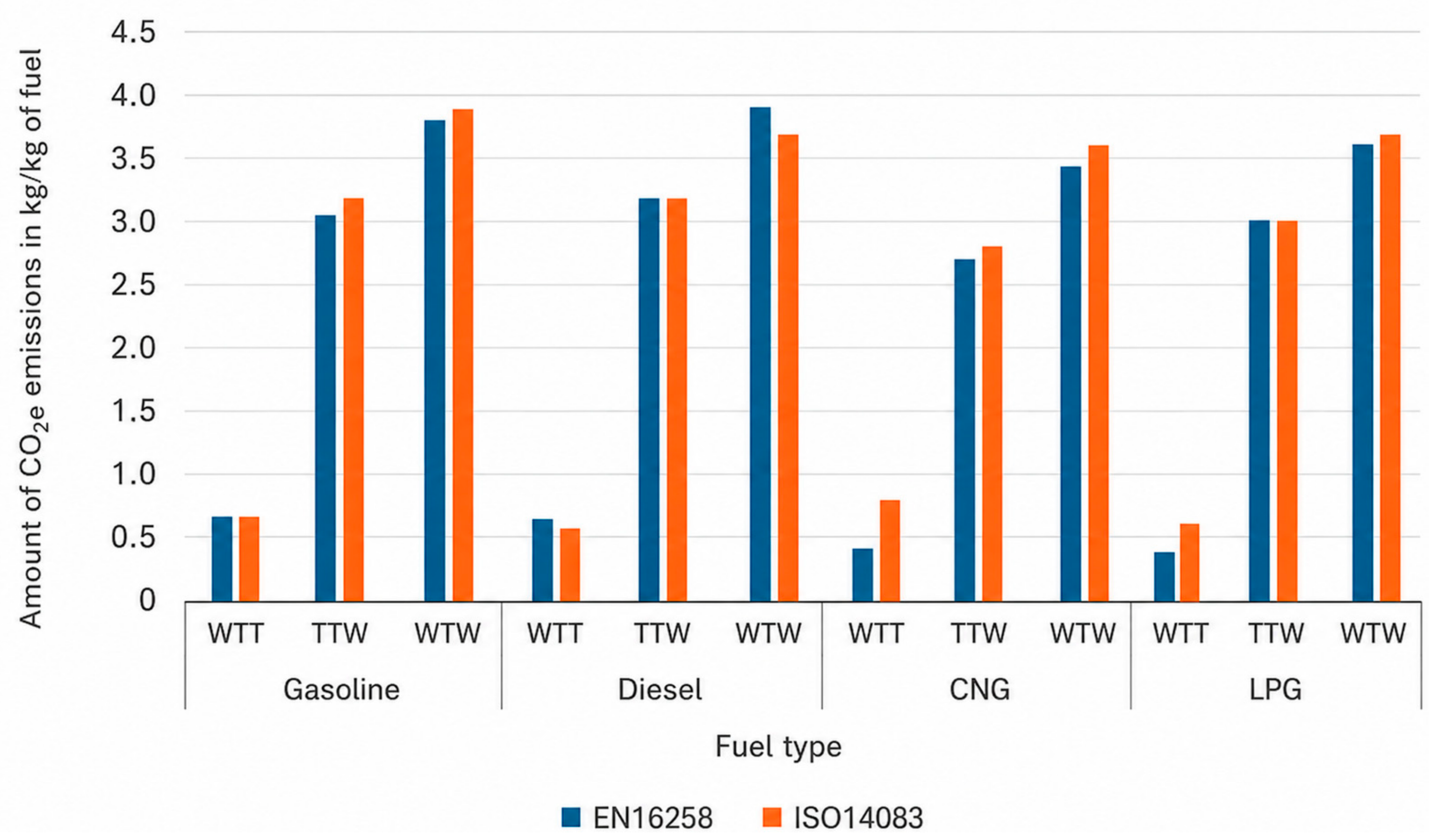
For indirect WTT emissions, the value for the new ISO 14083 standard is higher for most fuels, except for diesel. Conversely, for direct TTW emissions, the EN 16258 value is always higher, except for CNG, as shown in Figure 4. For direct emissions, the values range from 2.68 kg eCO2 per kg of CNG to 3.25 kg per kg of gasoline. Indirect emissions are lower, ranging from 0.36 kg eCO2 per 1 kg of LPG to 0.79 kg per 1 kg of CNG. The greatest difference between the standards is seen precisely for CNG and LPG and indirect emissions, where the values under the new ISO 14083 standard are roughly double. Total emissions values are higher for conventional fuels such as gasoline and diesel under EN 16258. For alternative fuels such as CNG and LPG, the values are higher under ISO 14083. This clearly illustrates the differences between individual fuel and emissions categories and the standards that define them.
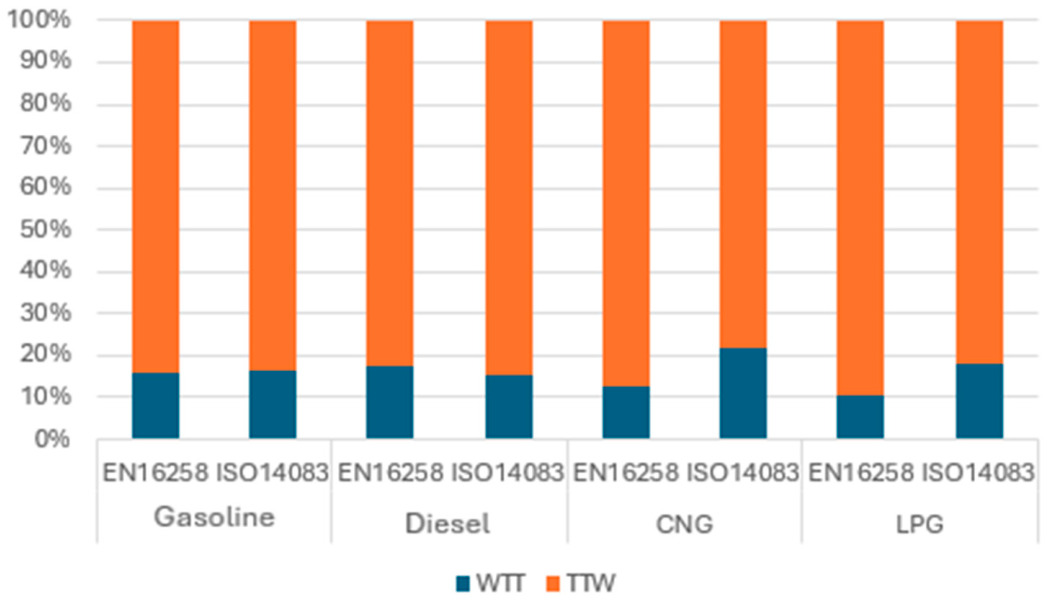
The percentage breakdown in Figure 5 clearly shows a higher proportion of direct emissions in the total figures. Their share is even higher under the EN 16258 standard, while under ISO 14083, the difference between direct and indirect emissions is approximately 3–7%. The share of indirect emissions in the total amount generally ranges between 10 and 20%.
To calculate total emissions for individual fuels, the general Equation (1) can be applied:
C E i = E F S ρ
where
  • CEi—total emissions for the i-th pollutant [kg]
  • EF—emission factor [kg/kg of fuel]
  • S—total fuel consumption [l]
  • ρ—fuel density [kg/L]
The specific emission factors differ across the standards used, and the density varies by fuel. The procedure for calculating using Equation (1) would be as follows. Based on fuel consumption in l/100 km, it is possible to determine consumption in l/km. We then multiply the route length by the consumption per kilometer to obtain the total fuel consumption for the route. Since the emission factors in ISO 14083 are given in kg, it is necessary to convert the total consumption to kg by multiplying the consumption in liters by the specific fuel’s density, thereby obtaining the resulting fuel consumption for the transport route. To calculate direct and indirect emissions along the route, we use greenhouse gas emission factors for the specified fuel type per the relevant standard.

1.5. Reporting in Accordance with ISO 14083

Implementation of ISO 14083:2023 will result in the preparation of a report. This report must be either at the organizational level (for greenhouse gas emissions from all or part of the transport chain operated or purchased by the organization) or at the level of transport or hub services (for greenhouse gas emissions from transport or hub services that the service provider reports to the service user). The declaration will take the form of either a single comprehensive report or a short report accompanied by separately provided supplementary information [19].
The declaration shall contain at least the following information:
  • identification of the transport chains covered by this report,
  • a reference to ISO 14083:2023,
  • total greenhouse gas emissions (operational and energy supply) (GT),
  • total greenhouse gas emission intensity (operational and energy supply) (gT), specifying the transport distance and type of transport activity,
  • total greenhouse gas emissions (operational and energy supply) for TCE (transport chain) units for each mode of transport and for the operation of transport hubs,
  • total greenhouse gas emission intensity (operational and energy supply) for TCE units, for each mode of transport, and for the operation of transport hubs. When specifying the transport distance and type of transport activity, in cases where alternative units are used for freight transport activities (e.g., number of TEU units), greenhouse gas emission intensity may be reported in these units (e.g., greenhouse gas emissions per TEU unit or per kilometer of TEU),
  • supporting information,
  • transport activity, specifying the type of distance used,
  • hub activity,
  • operational greenhouse gas emissions (GVO, T or GHEO, T),
  • operational greenhouse gas emission intensity (gVO or gHEO), specifying the type of distance used for the transport activity; if alternative units are used for freight transport activity (e.g., number of items, TEU), greenhouse gas emission intensity may be reported in those units (e.g., greenhouse gas emissions per item or per TEU-kilometer),
  • total greenhouse gas emissions, transport activity, and/or greenhouse gas emission intensities for each mode of transport and for hub activities, specifying the type of transport activity distance used, where applicable [19].
The reporting organization may use any media channel that provides the clearest results and a relevant basis for calculations to its service users, including websites. When transport service providers issue reports, they must be communicated effectively to transport service users.
Supporting information must ensure transparency and a clear understanding of the report by the entire group of potential users of this document. The following statement must be included: “These calculation results were determined in accordance with ISO 14083:2023.”
The report must be easily accessible, clearly structured, and transparent in its data collection and calculations. Additional specific statements may be provided for individual modes of transport [19].

1.6. Implementation of ISO 14083

Based on an analysis of the provisions of the ISO 14083 standard [19], as well as an evaluation of existing procedures for declaring greenhouse gas emissions and energy consumption in transport services, including similarities and differences between EN 16258 and ISO 14083, the authors propose the following conceptual framework for implementing ISO 14083. The framework is intended to provide general guidance for organizations transitioning toward standardized greenhouse gas emissions reporting. However, the proposed framework has not yet been empirically validated through industry interviews, surveys, or real-world case applications, which represents a limitation of the present study and an opportunity for future research.
  • Step 1: Familiarization with the Standard
The first step in implementation should be to obtain and review the ISO 14083 standard. It is then important to familiarize oneself with the standard’s basic requirements and principles. As of today, the standard is published in English and French and has been adopted into the Slovak technical standards system as STN EN ISO 14083. The Slovak translation was published in 2024. This step eliminates any potential language barrier. Another important step is to designate a responsible person within the company who will handle future calculations and reporting of greenhouse gas emissions, if the organization has not yet carried out these activities.
  • Step 2: Determining the Scope of Reporting
To begin with, it is advisable to gather information about the company and its current reporting system. Next, based on the standard’s requirements and an analysis of the current situation, the company should define which of its activities will be included in greenhouse gas emissions reporting under ISO 14083.
The scope of reporting may be influenced not only by the transport organization itself, but also by the requirements of its business partners, such as freight forwarders, manufacturers, or trading companies, which may request information on the amount of greenhouse gas emissions from specific shipments to support the creation of environmental product declarations.
  • Step 3: Collecting Relevant Emissions Data
An important part of this process is identifying all sources of greenhouse gas emissions within the defined reporting scope. This step involves gathering relevant data on the company’s emission sources, such as fuel consumption for various types of vehicles and equipment, distances traveled, types of goods transported, emission factors for different types of fuels, and more.
  • Step 4: Selection of Appropriate Quantification or Reporting Methods
Quantification methods are determined based on the company’s activities and the requirements of the standard.
  • Step 5: Calculation of greenhouse gas emissions
Based on the collected data and the selected quantification methods, greenhouse gas emissions from the company’s activities can be calculated. For this calculation, the company may choose one of the recommended calculators that is compatible with ISO 14083. If the calculator can also generate a declaration, Step 4 may be omitted.
The organization may also develop its own emission calculation procedures based on ISO 14083 requirements and emission factor values, or it may have such a calculator programmed.
  • Step 6: Preparing an emissions report
The report should include information on the scope of reporting, the quantification methods used, the calculated greenhouse gas emissions from various sources, a comparison of emissions across different periods, and conclusions and recommendations to improve environmental impact and address climate change. It is then advisable to have this report verified by an independent party to ensure its reliability.
  • Step 7: Implementing measures to reduce emissions
These measures may include using more energy-efficient vehicles and equipment, optimizing routes and transport schedules, reducing fuel consumption, using alternative fuels, and more. The measures are always tailored to the specific needs of the transport organization.
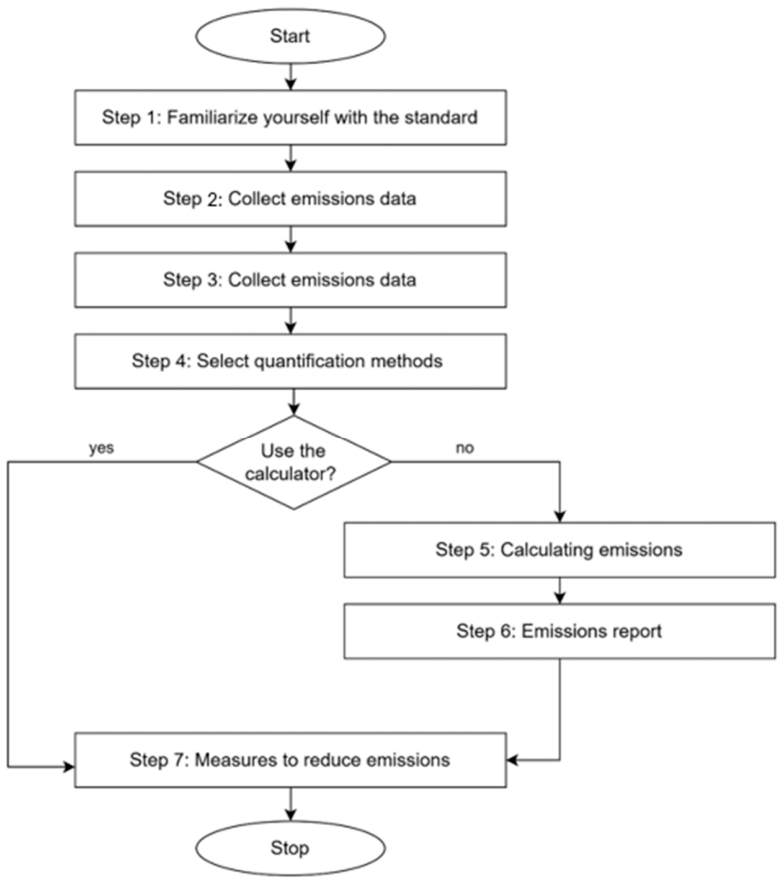
The individual steps of the ISO 14083 implementation process are presented in the flowchart shown in Figure 6.
An optional step in the ISO 14083 implementation process is integrating the standard and its requirements into an environmental management system in accordance with the ISO 14000 series of standards. Specifically, this involves incorporating them into documented information—the Environmental Management Policy and Environmental Objectives. It would also be advisable, in such a case, to implement the standard into processes and process maps by developing specific procedures for declaring greenhouse gas emissions in accordance with ISO 14083 within the organization, depending on the activities carried out, the vehicle fleet, product groups, and customers.
The above-mentioned procedure for implementing ISO 14083 is illustrated in a flowchart for better clarity and understanding of its individual steps.

1.7. The Sector’s Readiness to Implement ISO 14083

At present, we can conclude that since the publication of ISO 14083 in 2023, increasing attention has been devoted to the standard within the transport and logistics sector, as reflected in the development of professional guidance materials, the alignment of existing methodologies such as the GLEC Framework, and ongoing European initiatives related to standardized emissions reporting and CSRD-related sustainability requirements [10,22,28].
One of the persistent challenges is the availability of information and practical guidance on applying the standard. Although the standard defines basic principles and a methodological framework, its wording is often general, which can complicate its implementation at the individual company level. In this context, Supplementary Materials-such as manuals and methodological guidelines developed by professional associations (e.g., CLECAT)- are proving important, as they build on experience with previous standards, such as EN 16258. In the future, it is therefore desirable to systematically develop interpretive tools and case studies, ideally in collaboration between standard-setting bodies and international organizations such as FIATA or IRU.
The quality and availability of primary data remain frequently identified barriers to implementation. The ISO 14083 standard is based on a detailed “bottom-up” approach that requires accurate data on transport performance, energy consumption, and the characteristics of the transported cargo [25]. Studies by Kallionpää et al. [29], Lehmann et al. [11], and reports published by the International Transport Forum (ITF) and Smart Freight Centre [25] indicate that logistics companies, particularly small and medium-sized carriers, often face difficulties in systematically collecting and managing such data. These limitations may negatively affect the reliability and comparability of emissions calculations.
Another factor is the sector’s overall readiness, including organizational and technological capacities. The logistics sector is characterized by low sector integration and a relatively slow response to environmental policies, which can delay the implementation of new standards [25]. At the same time, implementing ISO 14083 requires not only technical tools but also expertise in emissions accounting, classification of transport operations, and use of emission factors, which place additional demands on small and medium-sized enterprises in particular.
On the other hand, positive developments can also be identified. Before the introduction of the ISO 14083 standard, numerous methodologies and tools (e.g., the GLEC Framework and EcoTransIT) served as the basis for its implementation. Furthermore, the 2023 update of the GLEC Framework was explicitly aligned with ISO 14083, thereby increasing the compatibility of existing tools with the new standard. This suggests that part of the sector already possesses a certain degree of readiness for the transition to a harmonized emissions calculation system.
In this context, emissions calculators also play an important role, serving as practical tools for applying these methodologies under real-world transportation conditions. As noted by Lehmam et al., the most commonly used tools in practice include EcoTransIT World, the GLEC Framework, and the GHG Protocol.
At the same time, they point to a significant problem with their use: up to 72% of logistics professionals do not take environmental factors into account when making transport decisions, primarily due to the lack of a unified, standardized tool for calculating emissions. The authors also emphasize that existing emissions calculators yield different results due to varying methodologies and emission factor databases, reducing their comparability and the reliability of the results.
From a legislative perspective, the ISO 14083 standard is gradually gaining traction in the European standardization landscape, with broader implementation expected across European and national technical standards. This development may increase pressure on companies to implement the standard in the future, while also fostering the creation of standardized tools and digital solutions for calculating and reporting emissions [19,30].
Overall, reviewed literature and current industry developments suggest the transport and logistics sector is undergoing a graduate transition toward the implementing of ISO 14083 [22,24,28,29]. Although attention devoted to the standard is increasing and the foundations for its application are being established, obstacles related to data infrastructure, methodological clarity, and companies’ technological readiness may still limit its widespread implementation in practice [25,29].

2. Materials and Methods

The subject of the analysis is a model road freight transport route. For the purpose of calculating emissions, the route between Teplička nad Váhom (Slovakia) and Schwechat (Austria), with a total length of 271.90 km, was selected. This route represents a typical example of international road transport in Central Europe, connecting a major industrial region in Slovakia with an important logistics and transport hub in Austria.
The selected route is simple enough to model yet provides a realistic basis for quantifying emissions and comparing results with other methodological approaches.
The transported cargo amounted to 20 tons, with the vehicle’s average fuel consumption set at 30 L/100 km. These input data serve as the basis for subsequent quantification of greenhouse gas emissions in accordance with the analyzed standards.

2.1. Input Data and Emission Factors

Input data based on the requirements of the analyzed standards were used to calculate greenhouse gas emissions. The key inputs include, in particular, fuel consumption, emission factors, and fuel density.
For the EN 16258 standard, emission factors for diesel fuel containing a biofuel component (B7) were used; these factors include direct emissions (Tank-to-Wheel: 2.97 kgCO2e/kg) and total emissions (Well-to-Wheel: 3.76 kgCO2e/kg), with indirect emissions (Well-to-Tank) determined as the difference between these values.
Calculations according to ISO 14083 are based on the same input data regarding the route and fuel consumption. The aim is to ensure that any difference in the results is not due to differing operating conditions, but to the methodological framework of the standard being compared. Unlike EN 16258, ISO 14083 uses different terminology and distinguishes between two main categories of emissions:
  • operational emissions—emissions generated directly during vehicle operation (TtW equivalent),
  • total emissions—total emissions including energy supply (WtW equivalent).
Indirect emissions associated with fuel production and distribution (energy supply) are determined as the difference between total and operational emissions.
For the ISO 14083 standard, emission factors for diesel under European conditions were used:
  • operational emissions: 3.17 kgCO2e/kg of fuel
  • total emissions: 3.74 kgCO2e/kg of fuel
Emissions from energy supply were determined as the difference between total and operational emissions.
Fuel density values were taken from the following standards:
  • EN 16258: 0.83606 kg/L
  • ISO 14083: 0.832 kg/L
The use of standard values ensures consistency in calculations and allows for the comparability of results across different methodological approaches.

2.2. General Calculation Procedure

The calculation of greenhouse gas emissions is based on the step-by-step determination of fuel consumption, its conversion to mass, and the subsequent application of emission factors.
First, the total fuel consumption for the route is determined by multiplying the vehicle’s fuel consumption by the distance traveled, according to Equation (2).
S = c 100 d
where:
  • S—total fuel consumption [l]
  • c—fuel consumption rate [l/100 km]
  • d—transport distance [km]
Since emission factors are expressed in units of kgCO2e/kg of fuel, it is necessary to convert the fuel volume to its mass. The conversion is performed according to Equation (3).
m = S ρ
where:
  • m—fuel mass [kg]
  • ρ—fuel density [kg/L]

2.3. Calculation According to STN EN 16258

  • Direct emissions (Tank-to-Wheel)
Direct emissions are emissions resulting from the combustion of fuel during vehicle operation.
E T t W = E F T t W × m
where:
  • E—greenhouse gas emissions [kg CO2e]
  • EF—emission factor [kg CO2e/kg fuel]
  • Indirect emissions (Well-to-Tank)
Indirect emissions include those generated during fuel production and distribution; they are calculated as the difference between total and direct emissions.
E F W t T = E F W t W E F T t W
E W t T = E F W t T × m
Total emissions according to EN 16258 are the sum of direct and indirect emissions:
E W t W = E T t W + E W t T
As a check, total emissions can also be calculated directly using the EFWtW factor:
E W t W = E F W t W × m

2.4. Calculation According to ISO 14083

ISO 14083 distinguishes between operational emissions, energy-supply emissions, and total emissions.
The calculation of fuel consumption and its conversion into mass is identical to EN 16258.
  • Operational emissions:
These emissions are greenhouse gases generated directly during vehicle operation from fuel combustion.
E o p e r a t i o n a l = E F o p e r a t i o n a l × m
  • Energy supply emissions:
This component includes emissions arising from activities outside the vehicle’s operation, mainly from oil extraction, refining, and fuel distribution.
E e n e r g y   =   E F e n e r g y   s u p p l y × m
where:
E F e n e r g y = E F t o t a l E F o p e r a t i o n a l
  • Total emissions:
Total emissions are the sum of operational emissions and energy-supply emissions.
E t o t a l = E o p e r a t i o n a l + E e n e r g y
or directly:
E t o t a l = E F t o t a l × m

2.5. Use of Emission Calculators

To compare results, several emission calculators were used to quantify greenhouse gas emissions using different methodological approaches and emission factor databases.
The calculations in the individual tools are based on common input data, such as distance, vehicle type, fuel type, and vehicle load. These input parameters were chosen to be comparable with calculations carried out in accordance with EN 16258 and ISO 14083.
For the analysis, a Volvo FH16 Euro 6 tractor (Volvo Trucks, Gothenburg, Sweden) was used in combination with a Krone SDP 27 eLB50-CS semi-trailer (Krone Commercial Vehicle Group, Werlte, Germany). The technical parameters of the vehicle and semi-trailer, which serve as input data for all used calculators, are listed in Table 1.
Using multiple emission calculators to validate the obtained results and identify methodological differences between calculation tools.
For a comparative analysis of emission calculators, a set of evaluation criteria was defined to assess their functionality and suitability for practical use in greenhouse gas emission calculation.
Seven basic functionalities were selected for the evaluation of emission calculators:
  • Free availability: This calculator function is especially important for the average user who needs to use the calculator once or does not need to use it very often. Nevertheless, the accessible version of the calculator must be reliable and comprehensive for different user groups.
  • Ease of use: Ease of use of the calculator makes the user’s work easier and speeds up the calculation process.
  • Consideration of direct and indirect emissions: Given that in this work we compare two standards that take these emissions into account, this is an important functionality.
  • Support for multiple modes of transport: If the calculator includes more calculation options and also includes multimodality, it becomes more interesting for the user. The EN 16258 and ISO 14083 standards include multimodal transport.
  • Detailed input of transport information: The more specific data that can be entered into the calculator, the more accurate the results can be.
  • Possibility of issuing a declaration: The possibility of issuing a declaration is another advantage of the calculator, which every user will appreciate due to the acceleration of the process of reporting the number of emissions produced.
  • Implementation of ISO 14083: Given the topic of the work, we will also focus on the fact that the evaluated calculators can calculate according to this standard, or whether at least the calculator provider states the fact that it plans to implement the requirements and emission factors of the ISO 14083 standard.
These criteria were then used to systematically evaluate selected emission calculators, including Map & Guide, CarbonCare, and EcoTransIT World.
Map & Guide: The Map & Guide software (online version, accessed in May 2026) was used to illustrate the emission calculation, enabling the calculation of emissions and energy consumption in accordance with the EN 16258 standard and the newer ISO 14083 standard. The software also considers the vehicle’s current weight, the communication method used during transport, and the current traffic conditions. The calculation allows the creation of environmental impact declarations for a specific transport.
CarbonCare: For further comparison, the online CarbonCare calculator was used, which focuses on calculating greenhouse gas emissions in accordance with ISO 14083. This tool represents a modern approach to quantifying emissions, using updated emission factors and a new breakdown of emissions into operational, energy, and total values.
EcotranIT World: To expand the comparison, the online calculator EcoTransIT World, which is one of the most widely used tools for assessing the environmental impacts of transport, was also used. This tool enables a more comprehensive assessment of transport by providing data on other pollutants in addition to greenhouse gas emissions.

3. Results

This chapter presents the results of the greenhouse gas emissions calculation for the transport route analyzed. The calculations were carried out using the methodology presented in the previous chapter, in accordance with EN 16258 and ISO 14083, as well as selected emission calculators.
The aim is not only to quantify total emissions but also to identify methodological differences between EN 16258, ISO 14083, and selected emission calculators, particularly regarding emission factors, terminology, and the treatment of indirect emissions. Although both standards are based on comparable “well-to-wheel” principles, these differences may affect the direct comparability and interpretation of the resulting emission values.

3.1. Results of Emission Calculations According to EN 16258

Based on the methodology presented in Section 3, greenhouse gas emissions were calculated in accordance with EN 16258.
First, the total fuel consumption on the analyzed route was determined according to Equation (2):
S = 30 100 × 271.9 = 81.57   L
Since the emission factors according to EN 16258 are also given in kgCO2e/kg for a diesel/biodiesel mixture, it is necessary to convert the fuel volume consumed to its weight subsequently. In the case of a mixture with a 7% biodiesel content, which represents the commonly used amount of biodiesel in the fuel, the fuel density according to the standard table is converted to the weight of the fuel according to Equation (3):
m = 81.57 × 0.83606 = 68.20 kg
This value represents the amount of fuel that is included in subsequent emissions calculations.
Direct emissions (Tank-to-Wheel) were calculated according to Equation (4):
ETtW = 2.97 × 68.20 = 202.55 kgCO2e
The emission factor for indirect emissions was determined as the difference between the total and direct emission factors according to Equation (5):
FWtT = 3.76 − 2.97 = 0.79
Indirect emissions (Well-to-Tank) were then calculated according to Equation (6):
EWtT = 0.79 × 68.20 = 53.88 kgCO2e
Total emissions (Well-to-Wheel) were determined as the sum of direct and indirect emissions according to Equation (7):
EWtW = 202.55 + 53.88 = 256.43 kgCO2e
The result was also verified according to relation (8) by direct calculation using the emission factor:
EWtW = 3.76 × 68.20 = 256.43 kgCO2e
Based on the above calculation, it can be stated that when applying the EN 16258 standard and using the standard factors for a diesel/biodiesel mixture with 7% biodiesel content, the total emissions along the analyzed route amount to 256.43 kg CO2e. The result is based directly on the reference values of the standard and allows for a transparent comparison with the newer ISO 14083 standard.

3.2. Results of Emission Calculations According to ISO 14083

The calculation according to ISO 14083 was carried out using the same input data, ensuring comparability with EN 16258. The fuel consumption was determined in the same way as in the EN 16258 calculation, using Equation (2).
The mass of fuel consumed was calculated according to Equation (3):
m = 81.57 × 0.832 = 67.87 kg
This value represents the amount of fuel that is included in subsequent emissions calculations.
Operational emissions were calculated according to Equation (9) and correspond to emissions arising directly during fuel combustion in the vehicle.
Eoperational = 3.17 × 67.87 = 215.15 kg CO2e
Subsequently, according to Equation (10), the emission factor for emissions from energy supply was determined as the difference between the total and operational emission factors.
EFenergy = 3.74 − 3.17 = 0.57
Emissions from energy supply, which mainly include processes associated with fuel production and distribution, were calculated according to Equation (11):
Eenergy = 0.57 × 67.87 = 38.69 kg CO2e
Total greenhouse gas emissions were subsequently determined according to Equation (12) as the sum of the individual components:
Etotal = 215.15 + 38.69 = 253.84 kg CO2e
To verify the correctness of the calculation, the result was also compared with a direct calculation using the total emission factor according to Equation (13):
Etotal = 3.74 × 67.87 = 253.84 kg CO2e
The results show that, according to ISO 14083, the dominant components of emissions are operational emissions arising from fuel combustion. A smaller part is made up of emissions associated with energy supply, which, however, affects the total value of emissions.

3.3. Comparison of Calculation Results

Based on the calculations performed, it is possible to quantify the difference between the results of both standards. The difference in total emissions can be expressed as:
Δ E = E I S O E E N
where:
  • ΔE—emission difference [kg CO2e]
The relative difference was determined according to the equation:
δ = E I S O E E N E E N × 100
δ = 2.59 256.43 × 100 1.01 %
The results show that the difference between EN 16258 and ISO 14083 is relatively small. The difference is mainly due to differences in the structure of emission factors and in the approach to including indirect emissions, especially in energy production and distribution.
An overview of the results of calculating greenhouse gas emissions under both standards is presented in Table 2.
ISO 14083 shows a higher proportion of operational emissions, while EN 16258 includes a higher proportion of indirect emissions. However, the overall differences between the standards are relatively small, indicating their methodological compatibility when applied to road freight transport.

3.4. Results from Emission Calculators

Using the same input data, greenhouse gas emissions were also calculated with selected emission calculators.
The calculations were performed using the same input parameters as in the standard calculations, in particular, transport distance, vehicle type, fuel type, and vehicle load. This ensured comparability of results between the individual approaches.
The selected calculation tools were chosen based on their availability, practical applicability to road freight transport emissions calculation, and the implementation of methodologies compatible with EN 16258 and ISO 14083. The purpose of this comparison was not to provide a comprehensive benchmarking evaluation of emissions calculation platforms, but rather to compare the practical application of the analyzed methodologies under comparable transport conditions.
The evaluated calculation tools allow different levels of parameter customization and methodological transparency. In the case of Map & Guide, detailed transport-related parameters can be specified, including vehicle category, emission class, fuel type, and biofuel share. EcoTransIT also allows the selection of vehicle category, fuel type, emission standard, and transport-related parameters, although with a lower level of detail. In contrast, the CarbonCare calculator provides more limited customization options and primarily uses basic transport information, such as transport route and cargo weight.
At the same time, emission factors, fuel density values, and some calculation procedures are internally predefined within the individual calculation platforms and cannot be directly modified by the user. As a result, although comparable transport conditions and operational parameters were applied, the final results may still differ due to differences in internal methodologies, emission databases, routing algorithms, and operational assumptions implemented by the evaluated tools.

3.4.1. Map & Guide

As a first example, the Map & Guide tool was used, which allows calculating emissions based on detailed modeling of the traffic situation and the vehicle’s technical parameters.
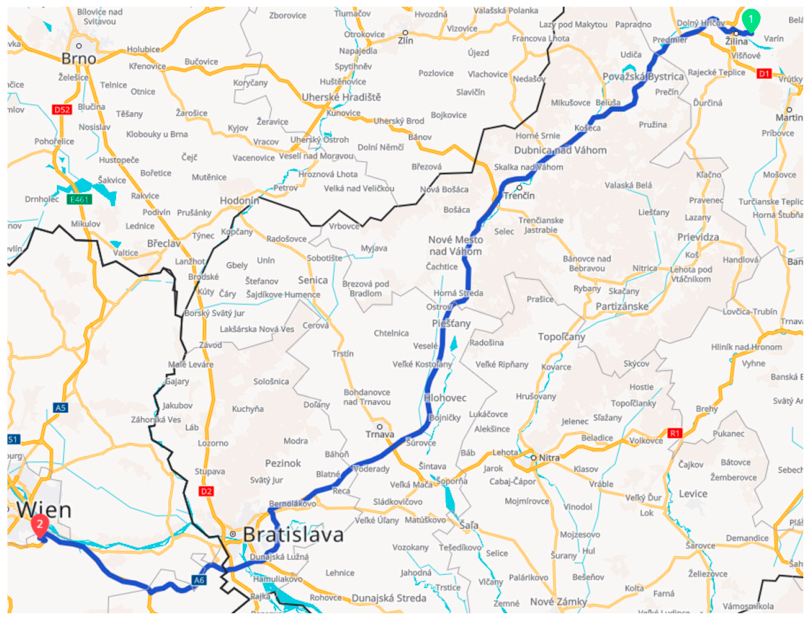
In Figure 7, we can see the route we selected, generated by the Map and Guide program. This route starts in Slovakia in Teplička nad Váhom and ends in the Austrian city of Schwechat. The total length of the route is 271.90 km according to the Map and Guide program. The total consumption per 100 km is 30 L.
  • Calculation results according to EN 16258:
Table 3 shows the energy consumption and greenhouse gas emissions for the selected route, calculated in accordance with EN 16258. The results are presented as direct, indirect, and total emissions.
  • Calculation of emissions according to EN 16258 using HBEFA emission factors:
In addition to calculating emissions based on average fuel consumption, Map & Guide also allows an alternative approach based on the emission factors in the HBEFA database.
In this case, fuel consumption is not determined as a fixed value but is calculated based on a more detailed modeling of driving conditions, such as the type of road, driving speed, traffic conditions, and the vehicle’s technical parameters. The HBEFA database provides emission factors for different vehicle categories and emission standards, thus enabling a more accurate determination of greenhouse gas emissions.
Using this approach enables a more detailed representation of different traffic and operational conditions compared to calculations based solely on average fuel consumption. On the other hand, this approach places higher demands on the input data and their quality.
The calculated energy consumption and greenhouse gas emissions based on the HBEFA emission factors in combination with EN 16258 are presented in Table 4.
  • Calculation results according to ISO 14083:
The Map & Guide program currently allows the calculation of greenhouse gas emissions according to the latest ISO 14083 standard, thereby reflecting the current development in the field of standardizing emissions calculation in transport. Implementing this functionality enhances the practical usability of the software, especially given the growing importance of ISO 14083 in the transport and logistics sector.
As with the EN 16258 standard, it is possible to calculate emissions in the program according to ISO 14083, while the input parameters remain the same. This allows a direct comparison of results between the two standards and, at the same time, provides the opportunity to assess the impact of different methodological approaches on the resulting value of greenhouse gas emissions.
Table 5 shows the energy consumption and greenhouse gas emissions for the selected route, calculated in accordance with ISO 14083.
  • Calculation of emissions according to ISO 14083 using HBEFA emission factors:
The same approach, using emission factors from the HBEFA database, was also applied when calculating emissions in accordance with ISO 14083.
The calculated energy consumption and greenhouse gas emissions based on the HBEFA emission factors in combination with ISO 14083 are presented in Table 6.
The results of the calculation of the amount of direct, indirect emissions, and total emissions expressed in kilograms of CO2e are presented in the following Table 7.
After performing the calculation and comparative analysis, it can be stated that the direct emissions (TtW) calculated according to ISO 14083 are lower than those calculated according to EN 16258. In comparison, the indirect emissions (WtT) are higher. This difference is due to ISO 14083’s different methodological approach, which considers energy production and distribution processes in greater detail.
The total greenhouse gas emissions (WtW) during transport, calculated according to ISO 14083, are higher than those calculated according to EN 16258.
When using the emission factors of the HBEFA database, lower emission values were recorded in all cases compared to calculations based on average fuel consumption, both for EN 16258 and ISO 14083. This approach allows for a more accurate reflection of real transport operating conditions.
Based on the above results, it can be concluded that the ISO 14083 standard provides a more comprehensive and detailed view of greenhouse gas emissions. In contrast, the EN 16258 standard represents a simpler approach suitable mainly for indicative calculations.

3.4.2. CarbonCare

The CarbonCare calculator was also used to calculate emissions in accordance with ISO 14083.
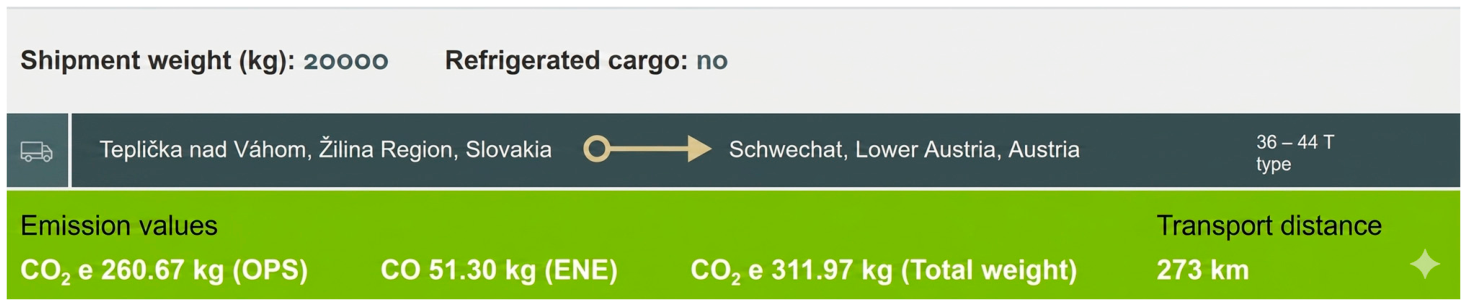
Figure 8 shows the results of calculating greenhouse gas emissions for the selected route using the online CarbonCare calculator. The calculation was performed for road freight transport in the vehicle category 36–44 t with a transport distance of 273 km.
The calculator provides a breakdown of emissions into direct emissions (Operational—OPS), which represent emissions arising during vehicle operation, and indirect emissions (Energy—ENE), which are related to the production and distribution of energy. Total emissions (Total) represent the sum of these two components.
The results show that total emissions are 311.97 kg CO2e, with direct emissions accounting for 260.67 kg CO2e and indirect emissions accounting for 51.30 kg CO2e.
Unlike the Map & Guide software, which allows emissions to be calculated using several methodologies, including EN 16258 and ISO 14083, the CarbonCare calculator is primarily based on the latest ISO 14083:2023 standard. Therefore, the results cannot be directly compared by switching between standards; instead, they are presented in accordance with the new standard, using the designations OPS (operational emissions), ENE (energy emissions), and TOTAL (total emissions), which correspond to the traditional categories TtW, WtT, and WtW. In addition to calculating emissions, the CarbonCare calculator also provides an overview of the basic principles of ISO 14083 that underpin its methodology. This overview includes, for example, adjustments to emission factors by region, a new breakdown of emissions into operational (OPS), energy (ENE), and total values, and the calculation of emission intensity in g/tkm.

3.4.3. EcoTransIT World

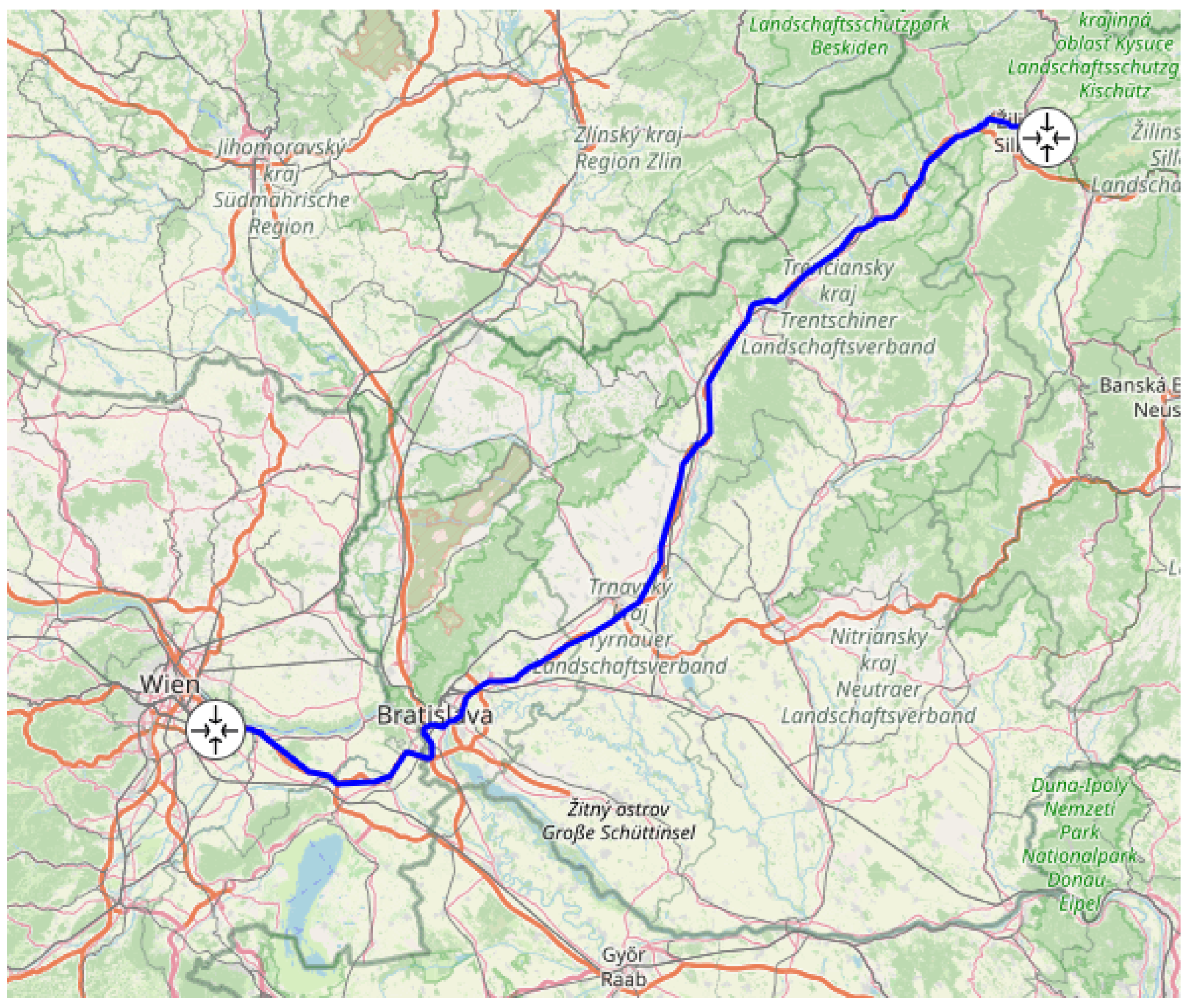
The last tool analyzed was the EcoTransIT World calculator, which calculates greenhouse gas emissions for various modes of transport, including multimodal transport. This tool also provides detailed information about the route and its individual sections. Figure 9 shows the route generated by the calculator, which served as the basis for subsequent emissions calculations.
Based on the entered route and input parameters, the EcoTransIT World calculator generated results for greenhouse gas emissions, pollutants, and transport indicators.
The results generated by the EcoTransIT World calculator for the selected transport route, including greenhouse gas emissions, air pollutant emissions, external costs, and transport activity indicators, are presented in Table 8.
The calculation results include total greenhouse gas emissions expressed as CO2 equivalent (CO2e), CO2 emissions, and transport emission intensity, all in units of g/tkm. In addition, the calculator provides data on other pollutants, such as nitrogen oxides (NOx), sulfur dioxide (SO2), non-methane volatile organic compounds (NMHC), and particulate matter (PM10), enabling a more comprehensive environmental assessment of transport.
The output also includes transport indicators such as total transport distance and transport performance expressed in tonne-kilometers. The calculator also provides information on external transport costs, including those related to emissions, accidents, and noise. This data allows for a broader assessment of the impacts of transport not only from an environmental but also from a social perspective.

3.5. Comparison of Calculators and Standards

Based on the obtained results, it is possible to perform a comprehensive comparison of the emission calculators with each other and with the standard methodologies EN 16258 and ISO 14083.
The comparison results presented in Table 9 show that the resulting greenhouse gas emission values differ between the individual approaches. Although the same transport route and basic vehicle parameters were used for all evaluated tools, complete standardization of calculation conditions was not possible due to differences in internal methodologies, emission factor databases, route modeling approaches, and default assumptions applied by individual tools. Some tools may additionally consider factors such as road gradients, traffic conditions, vehicle-specific operational characteristics, or routing algorithms, which may contribute to differences in the reported emission results.
The lowest emission intensity was recorded with the EcoTransIT World calculator (0.053 kg CO2e/tkm). In contrast, the highest value was recorded when calculating according to ISO 14083 in the Map & Guide environment (0.077 kg CO2e/tkm). The results of the CarbonCare calculator show the highest.
In the case of the CarbonCare tool, the emission values are designated as OPS (operational emissions) and ENE (energy-related emissions). These values have been interpreted as TtW and WtT emissions for comparison purposes, which are approximations due to the different methodological breakdowns.
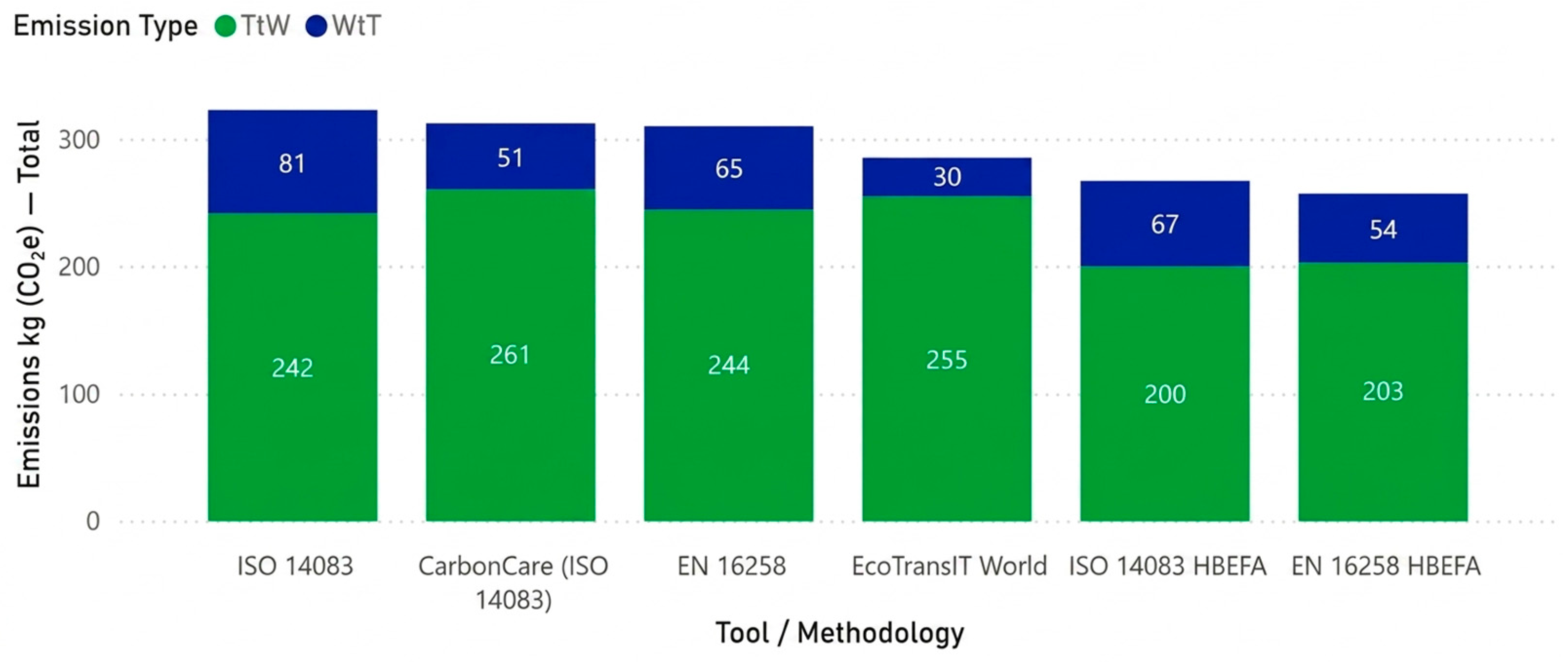
Figure 10 compares the emission structures for the individual methodologies and tools. Total emissions are divided into direct (Tank-to-Wheel, TtW) and indirect (Well-to-Tank, WtT) components.
The results show that direct emissions represent the dominant component of total emissions in all cases analyzed. The differences between the individual methodologies are mainly reflected in the share of indirect emissions.
A set of evaluation criteria defined in the Materials and Methods was used to evaluate the emission calculators systematically. The evaluation results are presented in Table 10.
Based on the evaluation, it can be stated that individual calculators differ in the scope of functionalities and the level of detail of input data. The EcoTransIT World calculator shows high accessibility and ease of use, while the Map & Guide tool allows for more detailed input of vehicle data. The CarbonCare calculator provides results in accordance with ISO 14083, but some of its functionalities could not be fully verified.

4. Discussion

The results of the work confirm that the choice of calculation methodology and the tool used has a significant impact on the resulting values of greenhouse gas emissions in transport.
A comparison of calculations according to EN 16258 and ISO 14083 showed that both methodologies yield relatively comparable results, with differences in total emissions being rather moderate. These differences are mainly due to different emission factors and the scope of the processes included. ISO 14083 standard generally shows slightly higher emission values, which are related to its more comprehensive approach and wider system boundaries.
More significant differences were observed when comparing the results obtained with emission calculators. Although tools such as Map & Guide, CarbonCare, and EcoTransIT World share similar principles, their results differ due to differences in emission factor databases, the way input data is processed, and the modeling of traffic conditions. This shows that emission calculators are not fully interchangeable, even if they claim compliance with the same standards.
The analysis also demonstrated a significant influence of the emission factor databases used, in particular the HBEFA database. Calculations using these factors generally yield lower emission values, which may reflect a more conservative approach to emission estimation.
Regarding the emission structure, it was confirmed in all cases that the dominant component is direct emissions (TtW, or operational emissions). Indirect emissions (WtT, or emissions from energy supply) generally range at around 10–20% of total emissions. This result is consistent across all methodologies used and points to the importance of optimizing vehicle operation as the main tool for reducing emissions.
The results also point to a broader problem in emission quantification: the absence of a uniform approach across standards and tools. This fact reduces the comparability of results and may complicate their use in practice, particularly in environmental reporting or decision-making.
These findings are also closely related to the current state of implementation of ISO 14083 in the transport sector. Even though the standard represents a comprehensive and internationally applicable framework, its practical use is currently limited by several factors, including the availability of high-quality input data, the lack of methodological guidelines, and varying company readiness.
A particular problem is the need for detailed data collection, as ISO 14083 is based on a “bottom-up” approach. However, many companies, especially small and medium-sized ones, lack sufficient data infrastructure, which can affect calculation accuracy.
On the other hand, there are also positive trends, especially the gradual alignment of existing tools and methodologies (e.g., the GLEC Framework) with ISO 14083. This suggests the potential for future harmonization of approaches to calculating transport emissions.
Recent studies have also highlighted the growing importance of standardized greenhouse gas emissions accounting in freight transport. Mark et al. [35] demonstrated the practical application of transport emissions accounting methodologies and highlighted the influence of methodological choices on reported emissions values. Similarly, recent research has shown that the level of detail and quality of transport data can significantly affect greenhouse gas emissions calculations, emphasizing the importance of accurate operational data collection and reporting procedures [36]. Olivari et al. [10] in a review of existing online emissions calculation tools, identified substantial differences in data sources, calculation approaches, and methodological transparency among currently available platforms. Furthermore, recent studies addressing uncertainty propagation in transport-related CO2 emissions calculations have highlighted the importance of considering input-data variability and methodological assumptions when interpreting reported emissions values [37]. These findings are consistent with the results of the present study and further support the need for harmonized methodologies such as ISO 14083.
Overall, the ISO 14083 standard represents a significant step towards standardizing emissions reporting. Still, its wider application will depend on the further development of methodological support, data availability, and practical tools.

5. Conclusions

The work aimed to analyze and compare approaches to quantifying and declaring greenhouse gas emissions in transport, focusing on the transition from EN 16258 to ISO 14083.
Based on the calculations performed, it was demonstrated that both standards provide comparable results, with differences in emission values mainly due to different emission factors, the scope of processes included, and the methodological approach. ISO 14083 generally yields slightly higher emission values, reflecting its more comprehensive approach to assessing transport activities.
Results from emission calculators also confirmed that the choice of calculation tool significantly affects the resulting emission value. The differences between the individual tools are mainly due to the emission factor databases used, the methods of modeling transport conditions, and the level of detail of the input data.
From a practical perspective, the implementation of ISO 14083 may support transport companies and logistics operators in improving the transparency and comparability of greenhouse gas emissions reporting. More detailed emissions accounting can also contribute to better transport planning, route optimization, fuel efficiency management, and the identification of emission-intensive transport activities. At the same time, the standard may support compliance with emerging European sustainability reporting requirements and transport decarbonization policies, including initiatives related to ESG reporting and the Eurovignette framework. The use of standardized emissions calculation methodologies may therefore become an important factor in supplier evaluation, transport service provider selection, and sustainable logistics management within international supply chains.
An important finding is that direct emissions are the dominant component of total emissions in all analyzed cases, underscoring the importance of optimizing vehicle operation to reduce the environmental impacts of transport.
The contribution of the work is also the proposal of a framework for implementing ISO 14083 in organizations operating in the transport and logistics sector. This procedure provides a systematic approach to calculating and reporting emissions and can serve as a practical guide for companies in implementing this standard.
Based on the analysis, it can be stated that the implementation of the ISO 14083 standard is currently limited mainly by the lack of high-quality input data, the absence of detailed methodological guidelines, and the varying levels of company readiness. These factors represent significant barriers to its wider application in practice.
Despite the above limitations, the ISO 14083 standard represents a promising tool for a uniform and comprehensive assessment of greenhouse gas emissions in transport. Its future expansion will depend mainly on the development of methodological support, the availability of appropriate tools, and the growing importance of environmental reporting.

Author Contributions

Conceptualization, V.K.; methodology, V.K.; software, K.U.; validation, V.K., K.U. and D.J.; formal analysis, V.K. and K.U.; investigation, V.K. and D.J.; resources, V.K. and D.J.; data curation, V.K. and D.J.; writing—original draft preparation, V.K., K.U. and D.J.; writing—review and editing, K.U.; visualization, V.K. and K.U.; supervision, V.K.; project administration, V.K.; funding acquisition, V.K. All authors have read and agreed to the published version of the manuscript.

Funding

The contribution was elaborated with the support of the Ministry of Education, Research, Development and Youth of the Slovak Republic: VEGA no. 1/0606/25 Konečný, V.: Research on positive externalities from road transport services in the context of quality improvement and performance evaluation.

Institutional Review Board Statement

Not applicable.

Informed Consent Statement

Not applicable.

Data Availability Statement

The original contributions presented in this study are included in the article. Further inquiries can be directed to the corresponding author.

Conflicts of Interest

The authors declare no conflicts of interest.

References

  1. Da Fonseca-Soares, D.; Eliziário, S.A.; Galvinicio, J.D.; Ramos-Ridao, A.F. Life-cycle greenhouse gas (GHG) emissions calculation for urban rail transit systems: The case of Pernambuco Metro. Appl. Sci. 2023, 13, 8965. [Google Scholar] [CrossRef]
  2. Liang, X.; Song, H.; Wu, G.; Guo, Y.; Zhang, S. Complex traffic flow model for analysis and optimization of fuel consumption and emissions at large roundabouts. Sustainability 2024, 16, 9464. [Google Scholar] [CrossRef]
  3. Li, Z. Thermal characteristic analysis and performance optimization of a novel heating boiler using a porous media model. Appl. Therm. Eng. 2026, 289, 130035. [Google Scholar] [CrossRef]
  4. Dedík, M.; Kendra, M.; Senci, M.; Pribula, D.; Vojtek, M. Progressive methods for the evaluation of the harmfulness of transport in terms of emission production. Sustainability 2024, 16, 10290. [Google Scholar] [CrossRef]
  5. Cheng, F.; Jia, S. Improved GA-LNS algorithm for solving vehicle path problems considering carbon emissions. Appl. Sci. 2024, 14, 9956. [Google Scholar] [CrossRef]
  6. Borowicz, A.; Czerepko, J. Possible consequences of the corporate sustainability reporting directive on Polish transport companies. Stud. Eur.-Stud. Eur. Aff. 2023, 27, 105–119. [Google Scholar] [CrossRef]
  7. Micheli, G.J.; Mantella, F. Modeling an environmentally-extended inventory routing problem with demand uncertainty and a heterogeneous fleet under carbon control policies. Int. J. Prod. Econ. 2018, 204, 316–327. [Google Scholar] [CrossRef]
  8. Sakas, D.P.; Giannakopoulos, N.T.; Terzi, M.C.; Kanellos, N. Engineering supply chain transportation indexes through big data analytics and deep learning. Appl. Sci. 2023, 13, 9983. [Google Scholar] [CrossRef]
  9. ISO 14083; Normierung von Emissionsberechnungen als Basis der Nachhaltigen Effizienzsteigerung von Transportketten. ISO: Geneva, Switzerland, 2020.
  10. Olivari, E.; Caballini, C.; Lluch, X. How to calculate GHG emissions in freight transport? A review of the main existing online tools. Case Stud. Transp. Policy 2025, 19, 101343. [Google Scholar] [CrossRef]
  11. Lehman, S.; El Hassani, H.; Rabhi, L. An automated tool for freight carbon footprint estimation: Insights from an automotive case study. Future Transp. 2025, 5, 107. [Google Scholar] [CrossRef]
  12. WebCreators Slovakia Has a New Preliminary (Proxy) Emissions Inventory of Greenhouse Gases for 2023. Available online: https://oeab.shmu.sk/en/news/slovakia-has-a-new-preliminary-proxy-emissions-inventory-of-greenhouse-gases-for-2023.html (accessed on 1 May 2026).
  13. Bartuska, L.; Masek, J. Changes in road traffic caused by the declaration of a state of emergency in the Czech Republic: A case study. Transp. Res. Procedia 2021, 53, 321–328. [Google Scholar] [CrossRef]
  14. Bebkiewicz, K.; Szczepański, K.; Chłopek, Z. Simulation studies of pollutant emissions from road vehicles using models for inventories of pollutant emissions. Combust. Engines 2024, 198, 20–26. [Google Scholar] [CrossRef]
  15. Total Net Greenhouse Gas Emission Trends and Projections in Europe. Available online: https://www.eea.europa.eu/en/analysis/indicators/total-greenhouse-gas-emission-trends (accessed on 1 May 2026).
  16. Ghazal, R.M.; Akroot, A.; Abdul Wahhab, H.A.; Alhamd, A.E.J.; Hamzah, A.H.; Bdaiwi, M. The influence of gas fuel enrichment with hydrogen on the combustion characteristics of combustors: A review. Sustainability 2024, 16, 9423. [Google Scholar] [CrossRef]
  17. Suhara, A.; Karyadi; Herawan, S.G.; Tirta, A.; Idris, M.; Roslan, M.F.; Putra, N.R.; Hananto, A.L.; Veza, I. Biodiesel Sustainability: Review of Progress and Challenges of Biodiesel as Sustainable Biofuel. Clean Technol. 2024, 6, 886–906. [Google Scholar] [CrossRef]
  18. Benti, N.E.; Aneseyee, A.B.; Geffe, C.A.; Woldegiyorgis, T.A.; Gurmesa, G.S.; Bibiso, M.; Mekonnen, Y.S. Biodiesel production in Ethiopia: Current status and future prospects. Sci. Afr. 2023, 19, e01531. [Google Scholar] [CrossRef]
  19. ISO 14083:2023; Greenhouse Gases—Quantification and Reporting of Greenhouse Gas Emissions Arising from Transport Chain Operations. International Organization for Standardization; ISO: Geneva, Switzerland, 2023.
  20. Nkesah, S.K. Making Road Freight Transport More Sustainable: Insights from a Systematic Literature Review. Transp. Res. Interdiscip. Perspect. 2023, 22, 100967. [Google Scholar] [CrossRef]
  21. European Commission, Official Website—European Commission. Available online: https://commission.europa.eu/index_en (accessed on 1 May 2026).
  22. Smart Freight Centre. Global Logistics Emissions Council Framework for Logistics Emissions Accounting and Reporting; v3.0 edition, revised and updated; Smart Freight Centre: Amsterdam, The Netherlands, 2023. [Google Scholar]
  23. Schmied, M.; Knörr, W. Calculating GHG Emissions for Freight Forwarding and Logistics Services in Accordance with EN 16258. Available online: https://www.clecat.org/media/CLECAT_Guide_on_Calculating_GHG_emissions_for_freight_forwarding_and_logistics_services.pdf (accessed on 1 May 2026).
  24. Smart Freight Centre. Global Logistics Emissions Council Framework for Logistics Emissions Accounting and Reporting; v3.1 edition, revised and updated; Smart Freight Centre: Amsterdam, The Netherlands, 2024. [Google Scholar]
  25. Fancello, G.; Vitiello, D.M.; Serra, P. Evaluating the Environmental Sustainability of an Intermodal Freight Logistic Chain Using the GLEC Framework. In Proceedings of the Computational Science and Its Applications–ICCSA 2023 Workshops; Gervasi, O., Murgante, B., Rocha, A.M.A.C., Garau, C., Scorza, F., Karaca, Y., Torre, C.M., Eds.; Springer Nature: Cham, Switzerland, 2023; pp. 563–576. [Google Scholar]
  26. HBEFA Software. Available online: https://www.hbefa.net/en/software (accessed on 1 May 2026).
  27. EN 16258; Methodology for Calculation and Declaration of Energy Consumption and GHG Emissions of Transport Services. European Committee for Standardization: Brussels, Belgium, 2012.
  28. Ray, P.; Botero, D.; Lewis, A.; Ehrler, V. GHG Emissions Accounting and Reporting for Transport; International Transport Forum: Paris, France, 2024. [Google Scholar]
  29. Kallionpää, E.; Liimatainen, H.; Viri, R.; Vaismaa, K. Development of Logistics Emissions Reporting—Shippers’ and Logistics Service Providers’ Perspective. Transp. Res. Part D Transp. Environ. 2026, 150, 105083. [Google Scholar] [CrossRef]
  30. Oberhofer, P.; Dieplinger, M. Sustainability in the transport and logistics sector: Lacking environmental measures? Bus. Strategy Environ. 2014, 23, 236–253. [Google Scholar] [CrossRef]
  31. Volvo Trucks—SK. Available online: https://www.volvotrucks.sk/sk-sk/ (accessed on 1 May 2026).
  32. Products | PTV Map&Guide (EN) | PTV Logistics. Available online: https://www.ptvlogistics.com/en/products/ptv-mapandguide (accessed on 1 May 2026).
  33. CarbonCare – Home. Available online: https://www.carboncare.org/en (accessed on 1 May 2026).
  34. EcoTransIT World. 2021. Available online: https://www.ecotransit.org (accessed on 1 May 2026).
  35. Mark, V.D.; Patrizia, S.; Gianfranco, F. Assessing greenhouse gas emissions arising from intermodal freight transport chains using the ISO14083 standard. Transp. Res. Procedia 2025, 90, 464–471. [Google Scholar] [CrossRef]
  36. Schmidt, V.; Aschauer, F.; Scott, A.; Gerschberger, M. Does a detailed freight emissions calculation really matter? Transp. Res. Part D Transp. Environ. 2025, 148, 104761. [Google Scholar] [CrossRef]
  37. McIntosh, A.; Romero, E.L.; de Angelis, M. Interval uncertainty propagation on CO2 emission calculations in road haulage. In Proceedings of the 36th European Safety and Reliability Conference, Braga, Portugal, 14–19 June 2026. [Google Scholar]
Figure 2. TCE Freight Transport Chain [19].
Applsci 16 05820 g002
Figure 3. Comparison of CO2e emission factors for selected fuel types in Europe and the United States.
Applsci 16 05820 g003
Figure 4. Comparison of CO2e emission factors.
Applsci 16 05820 g004
Figure 5. Comparison of the proportionality of eCO2 emission factors.
Applsci 16 05820 g005
Figure 6. Flowchart of the ISO 14083 Implementation Process.
Applsci 16 05820 g006
Figure 7. Transport route generated by Map & Guide [32].
Applsci 16 05820 g007
Figure 8. Result of calculating greenhouse gas emissions in the Carbon Care calculator for the model route [33].
Applsci 16 05820 g008
Figure 9. Transport route generated by EcotansIT World [34].
Applsci 16 05820 g009
Figure 10. Comparison of emissions structure according to calculation methodologies.
Applsci 16 05820 g010
Table 1. Technical data of the truck and trailer used.
Technical DataTruckTrailer
Total weight of the trailer (legislative/design)18,000 kg/20,500 kg33,060 kg/39,000 kg
Curb weight7230 kg5490 kg
Technical axle load44,000 kg 27,000 kg
Fifth wheel technical load7500 kg 12,000 kg
Permissible rear axle load11,500 kg/13,000 kg -
Dimensions of the loading area-13,620 × 2480 × 2700 mm
Source: Compiled by the authors based on [31].
Table 2. Results of calculating emissions according to EN 16258 and ISO 14083.
ParametersUnitEN 16258ISO 14083
Transport distancekm271.90271.90
Fuel consumptionL81.5781.57
Fuel densitykg/L0.8360.832
Fuel masskg68.2067.87
Direct emissionskg CO2e202.55215.15
Indirect emissionskg CO2e53.8838.69
Total emissionskg CO2e256.43253.84
Source: Compiled by the authors.
Table 3. Calculated emissions according to EN 16258 in Map & Guide.
CategoryIndicatorValue
Energy Consumption [MJ]Tank-to-Wheel3512.84
Well-to-Wheel4381.43
Emissions (CO2e) [kg]Tank-to-Wheel244.45
Well-to-Wheel309.87
Emissions (CO2e) [kg per km]Tank-to-Wheel0.90
Well-to-Wheel1.14
Source: Map & Guide [32].
Table 4. Calculated emissions according to the HBEFA guide in combination with EN 16258.
CategoryIndicatorValue
Energy Consumption [MJ]Tank-to-Wheel2910.68
Well-to-Wheel3630.38
Emissions (CO2e) [kg]Tank-to-Wheel202.55
Well-to-Wheel256.75
Emissions (CO2e) [kg per km]Tank-to-Wheel0.74
Well-to-Wheel0.94
Source: Map & Guide [32].
Table 5. Calculated emissions according to EN 14083 in Map & Guide.
CategoryIndicatorValue
Energy Consumption [MJ]Tank-to-Wheel3487.07
Well-to-Wheel4722.46
Emissions (CO2e) [kg]Tank-to-Wheel241.55
Well-to-Wheel322.68
Emissions (CO2e) [kg per km]Tank-to-Wheel0.89
Well-to-Wheel1.19
Source: Map & Guide [32].
Table 6. Calculated emissions according to the HBEFA guide in combination with EN 14083.
CategoryIndicatorValue
Energy Consumption [MJ]Tank-to-Wheel2882.90
Well-to-Wheel3904.25
Emissions (CO2e) [kg]Tank-to-Wheel199.70
Well-to-Wheel266.77
Emissions (CO2e) [kg per km]Tank-to-Wheel0.73
Well-to-Wheel0.98
Source: Map & Guide [32].
Table 7. Input parameters used for emission calculations according to EN 16258 and ISO 14083.
ParameterUnitEN 16258EN 16258 HBEFAISO 14083ISO 14083 HBEFA
Distancekm271.90271.90271.90271.90
Fuel consumptionl81.5781.5781.5781.57
Fuel densitykg/L0.8360.8360.8320.832
Source: Compiled by the authors.
Table 8. Result of calculation of greenhouse gas and pollutant emissions in the EcoTransIT World calculator for a model route.
CategoryIndicatorValue
Greenhouse GasesCO2e [kg] WTW284.9
CO2 [kg] WTW255.0
CO2e Intensity [g CO2e/tonne-km]53.09
Air PollutantsNOx [kg] WTW0.232
SO2 [kg] WTW0.168
NMHC [kg] WTW0.435
PM10 [kg] WTW0.023
External CostsTotal Costs [€]180.8
Emission Costs [€]28.5
Accidental Costs [€]38.3
Noise Costs [€]107.1
MobilityDistance [km]268.3
Transport Activity [tonne-km]5366
Source: Transport route generated by EcotansIT World [34].
Table 9. Comparison of greenhouse gas emission calculation results for individual tools and methodologies used.
Tool/
Methodology
WtT
(kg CO2e)
TtW
(kg CO2e)
WtW
(kg CO2e)
Emission Intensity (kg CO2e/tkm)
EN 1625865.42244.45309.870.074
EN 16258 HBEFA54.20202.55256.750.061
ISO 1408381.13241.55322.680.077
ISO 14083 HBEFA67.07199.70266.770.064
CarbonCare51.30260.67311.97-
EcoTransIT World29.90255.00284.900.0531
Source: Compiled by the authors.
Table 10. Evaluation of emission calculators.
EcoTransIT WorldCarbonCareMap & Guide
Availability without chargeX
Easy to use
Considering both direct and indirect emissions
Possibility of calculating emissions for a specific route
Support for multiple modes of transportX
Detailed entry of input information about the shipment
Detailed entry of vehicle informationXX
Possibility of issuing a declarationX
Implementation of ISO 14083
Source: Compiled by the authors. Note: ✓ indicates that the feature is supported by the calculator, while X indicates that the feature is not supported.
Disclaimer/Publisher’s Note: The statements, opinions and data contained in all publications are solely those of the individual author(s) and contributor(s) and not of MDPI and/or the editor(s). MDPI and/or the editor(s) disclaim responsibility for any injury to people or property resulting from any ideas, methods, instructions or products referred to in the content.