Optimal Planning of Renewable Microgrids for Loss-Aware Integration of Distributed Energy Resources Using the Geese V-Formation Algorithm



Abstract
1. Introduction
2. Literature Review
2.1. Advanced Techniques for Microgrid Planning and Management
2.2. Thematic Synthesis
2.3. Research Gap
2.4. Positioning of the Present Study and Its Contributions
3. Mathematical Methodology and Objective Function
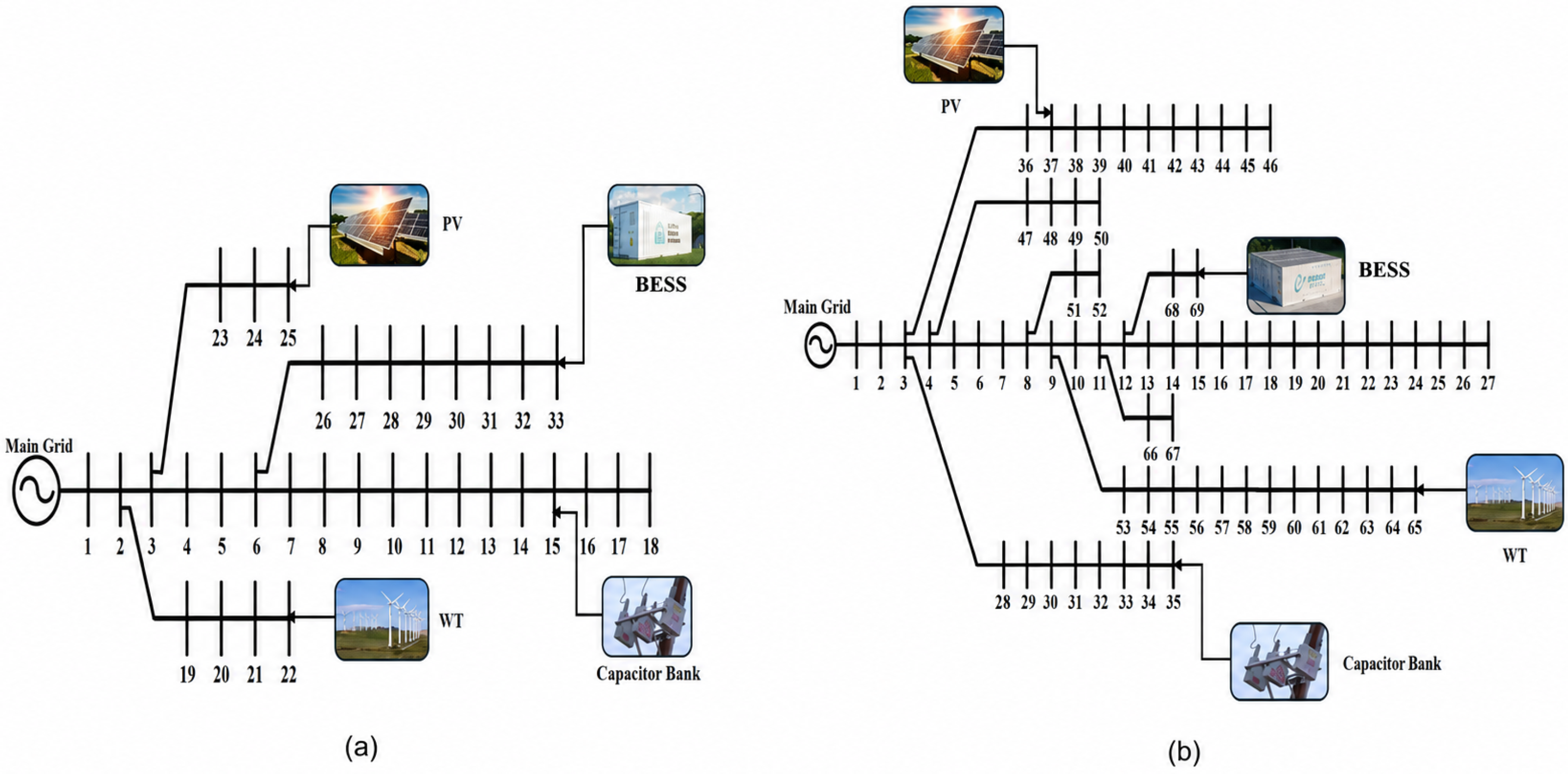
3.1. Problem Description and System Components
3.2. Optimization Problem Statement
3.3. Decision Variables and Encoding
3.4. Objective Function
3.5. Feasibility Constraints
3.5.1. Active and Reactive Power-Flow Constraints
3.5.2. Voltage Constraints
3.5.3. DER Placement Constraints
3.5.4. DER Capacity Constraints
3.5.5. Feeder Hosting-Capacity Constraint
3.6. BESS Planning and Post-Optimization Validation
3.7. Geese V-Formation Algorithm (GVFA) Mechanism
Stability, Anti-Stagnation, and Exploitation Control
- 1.
- Adaptive Gain Annealing: The search step is progressively annealed using a decreasing gain to suppress oscillations near the optimum. The update magnitude shrinks with the iteration index k:
- 2.
- Stagnation-Gated Trigger: The algorithm monitors the best-so-far fitness for improvements. A stagnation counter is activated if the fitness does not improve beyond a tolerance of . To ensure sufficient time for local search, stagnation is monitored through a non-improvement counter. In the IEEE-69 implementation, deterministic partial re-seeding is triggered after 50 consecutive non-improving iterations. In the IEEE-33 implementation, no re-seeding is applied; instead, the search terminates when the stall threshold of 150 consecutive non-improving iterations is reached.
- 3.
- Re-Seeding (Diversity Preservation): In the IEEE-69 case, when the stagnation gate is triggered, a fraction of the lower-performing candidates is re-initialized. Elite individuals are preserved to maintain monotonic improvement, while new candidates explore under-sampled regions of the distribution network.
3.8. Stepwise Repair and Penalty Handling
- Boundary Clamping: Any candidate variable representing DER sizing that exceeds its admissible penetration bounds is clamped to the search-space limits:
3.8.1. Convergence and Robust Considerations
3.8.2. Computational Complexity and Runtime Benchmarking
- Workflow of the Proposed Algorithm for IEEE-33 and IEEE-69 DER Placement and Sizing
- Step 1: Feeder and System InitializationInitialize the IEEE-33 or IEEE-69 radial distribution system using the network representation, candidate-bus set, and DER set defined in Equations (1)–(3).
- Step 2: Optimization Problem DefinitionFormulate the DER planning problem according to the compact optimization model in Equations (4)–(6).
- Step 3: Candidate Solution Encoding
- Step 4: Feasibility RepairApply the rounding-based repair mechanism and hosting-capacity repair using Equations (13)–(19). The candidate solution is also checked against the DER placement and capacity limits in Equations (28)–(38).
- Step 5: Candidate EvaluationFor each candidate solution, apply PV, WT, and BESS as active-power support and capacitor banks as reactive-power compensation. Then solve the load flow using the active and reactive power-balance equations in Equations (24)–(26).
- Step 6: Fitness Calculation
- Step 7: Leader SelectionRank all candidate solutions according to the penalized fitness value in Equation (21). The candidate with the lowest fitness value is selected as the leader, and the second-best candidate is selected as the co-leader.
- Step 8: Formation UpdateUpdate follower geese using the customized GVFA movement according to the equation below:
- Step 9: Local Exploitation and Diversity MaintenanceApply local search to elite candidate solutions. After each local modification, repeat the feasibility repair using Equations (13)–(19) and re-evaluate the candidate using Equations (20)–(27).
- Step 10: Anti-Stagnation ControlMonitor the improvement in the best fitness value. For IEEE-69, activate deterministic partial re-seeding after 50 consecutive non-improving iterations. For IEEE-33, terminate the search when the stall threshold of 150 iterations is reached.
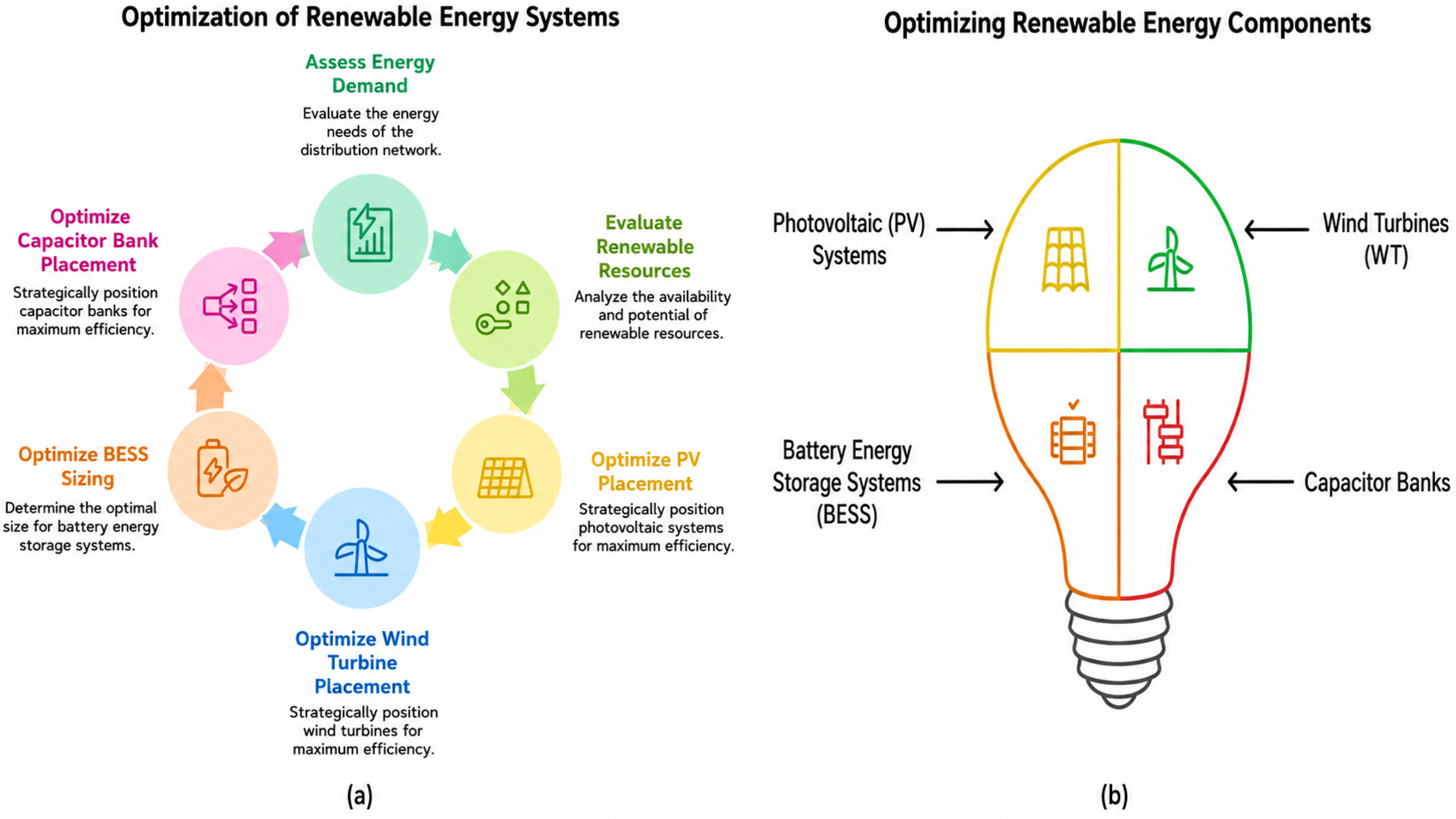
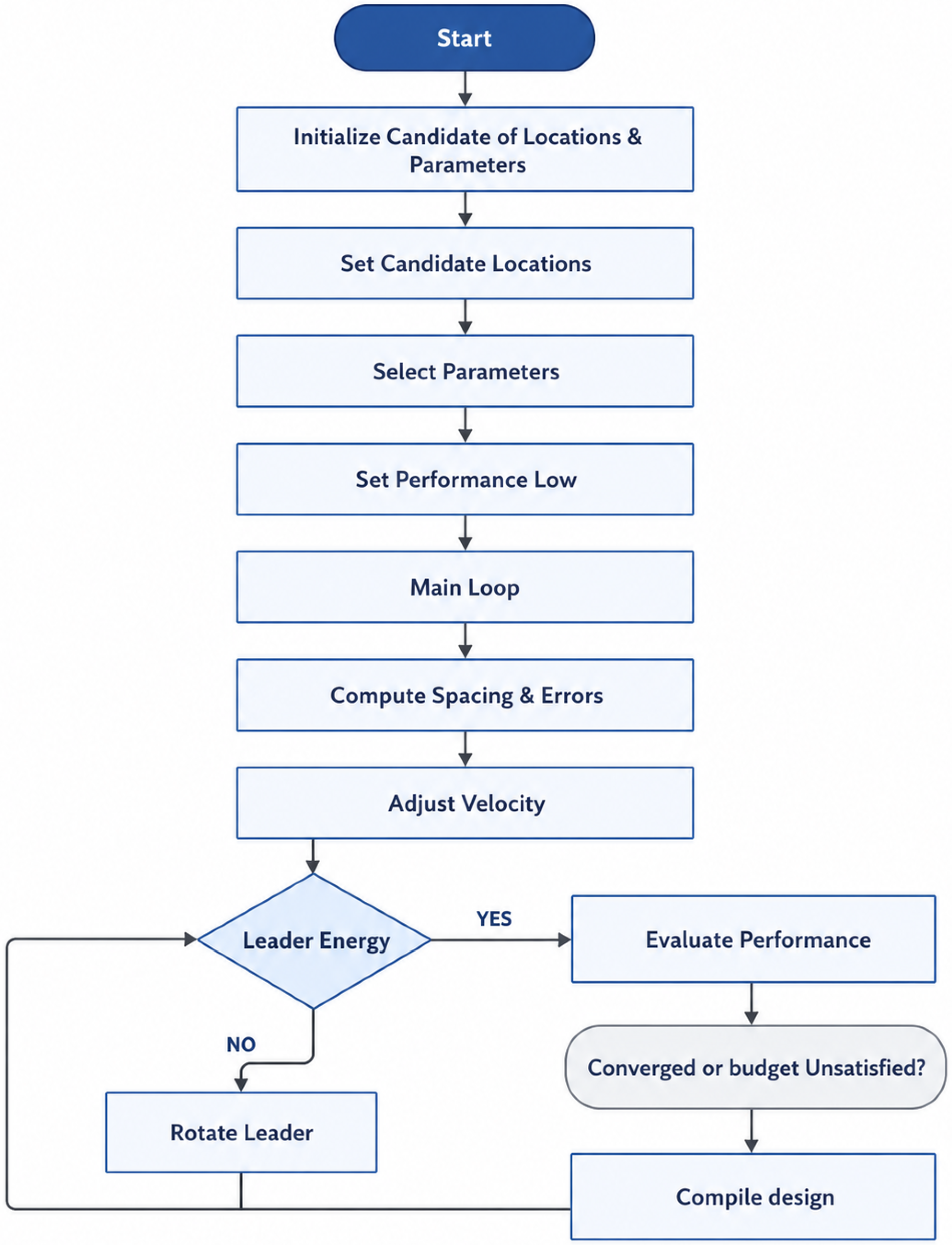
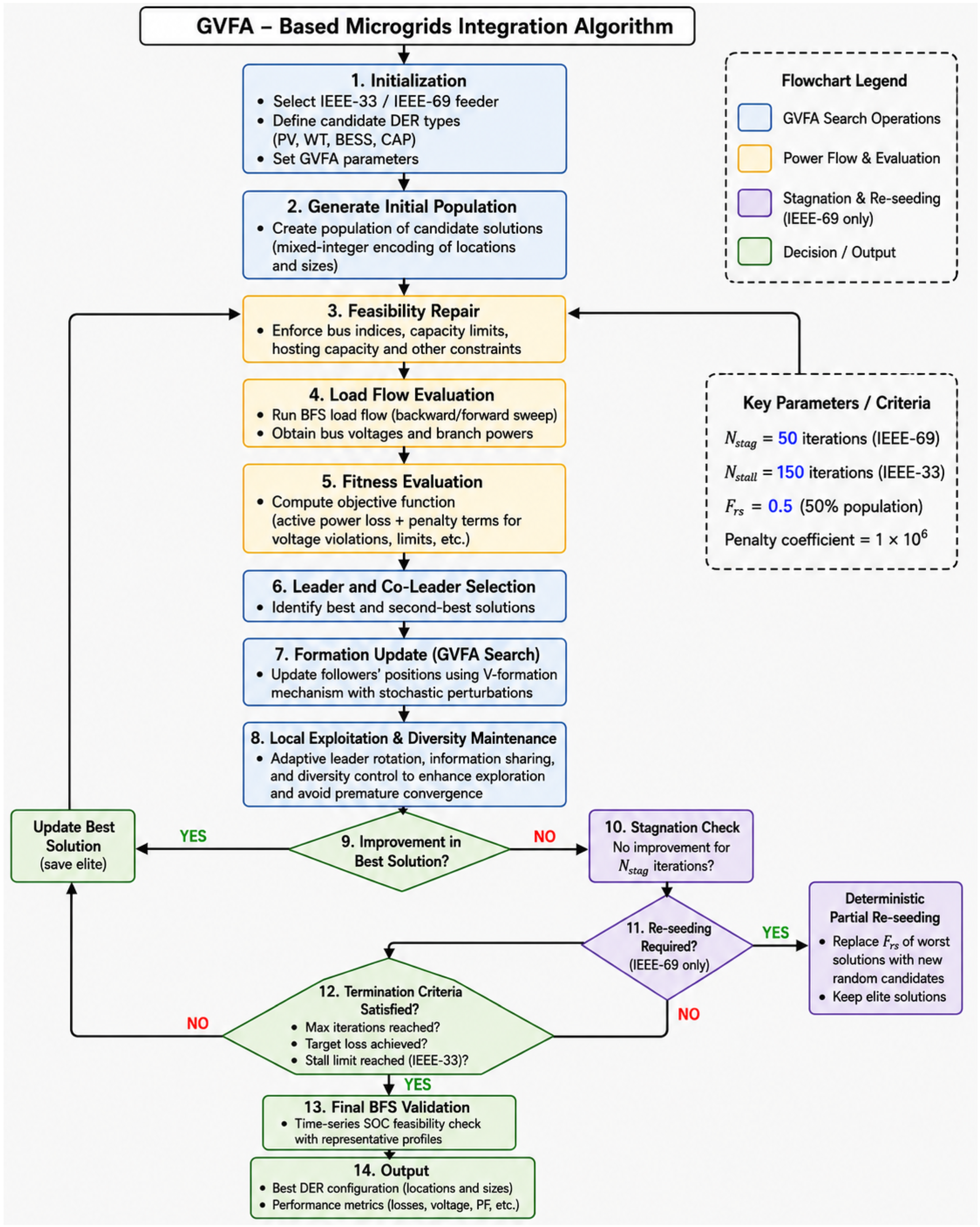
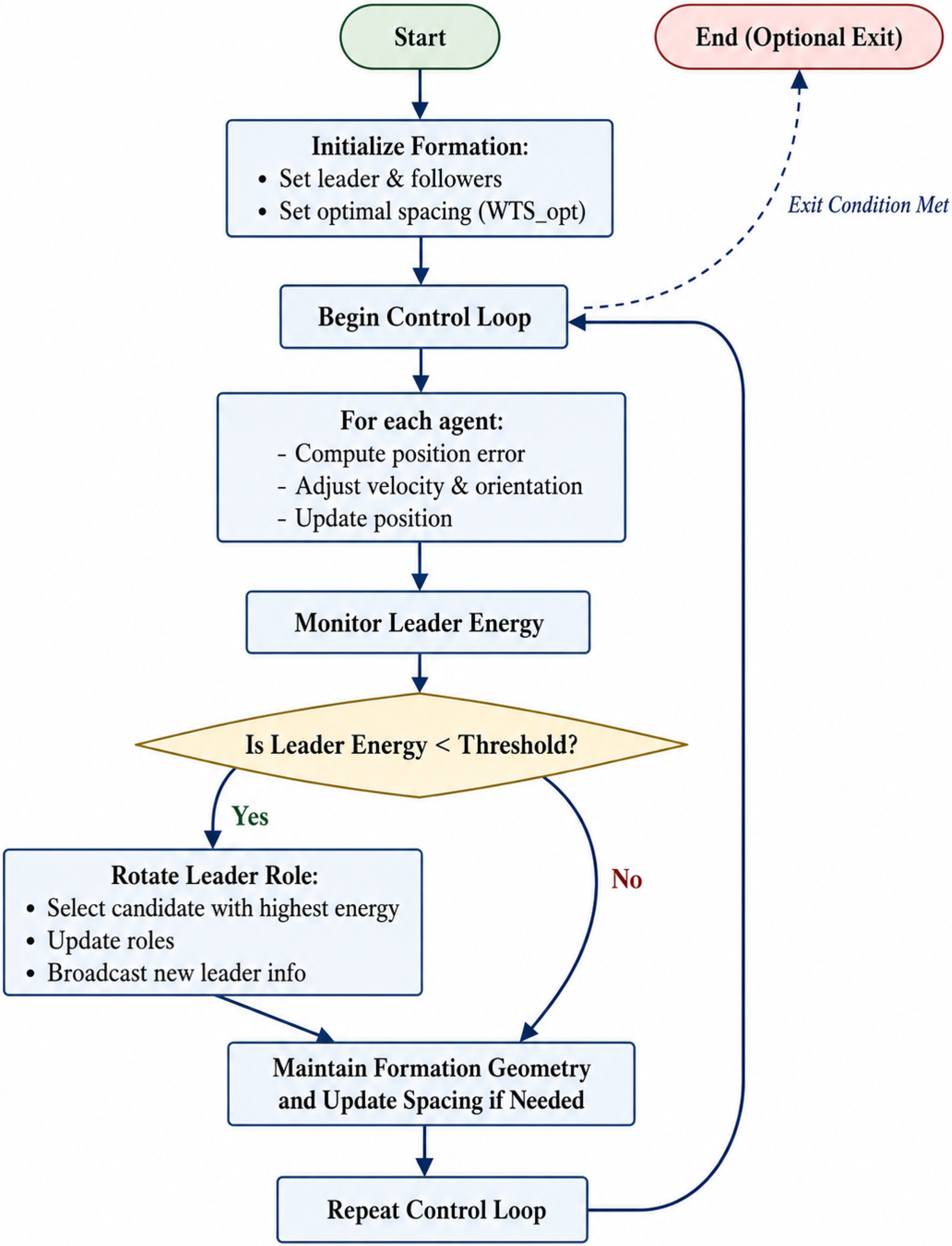
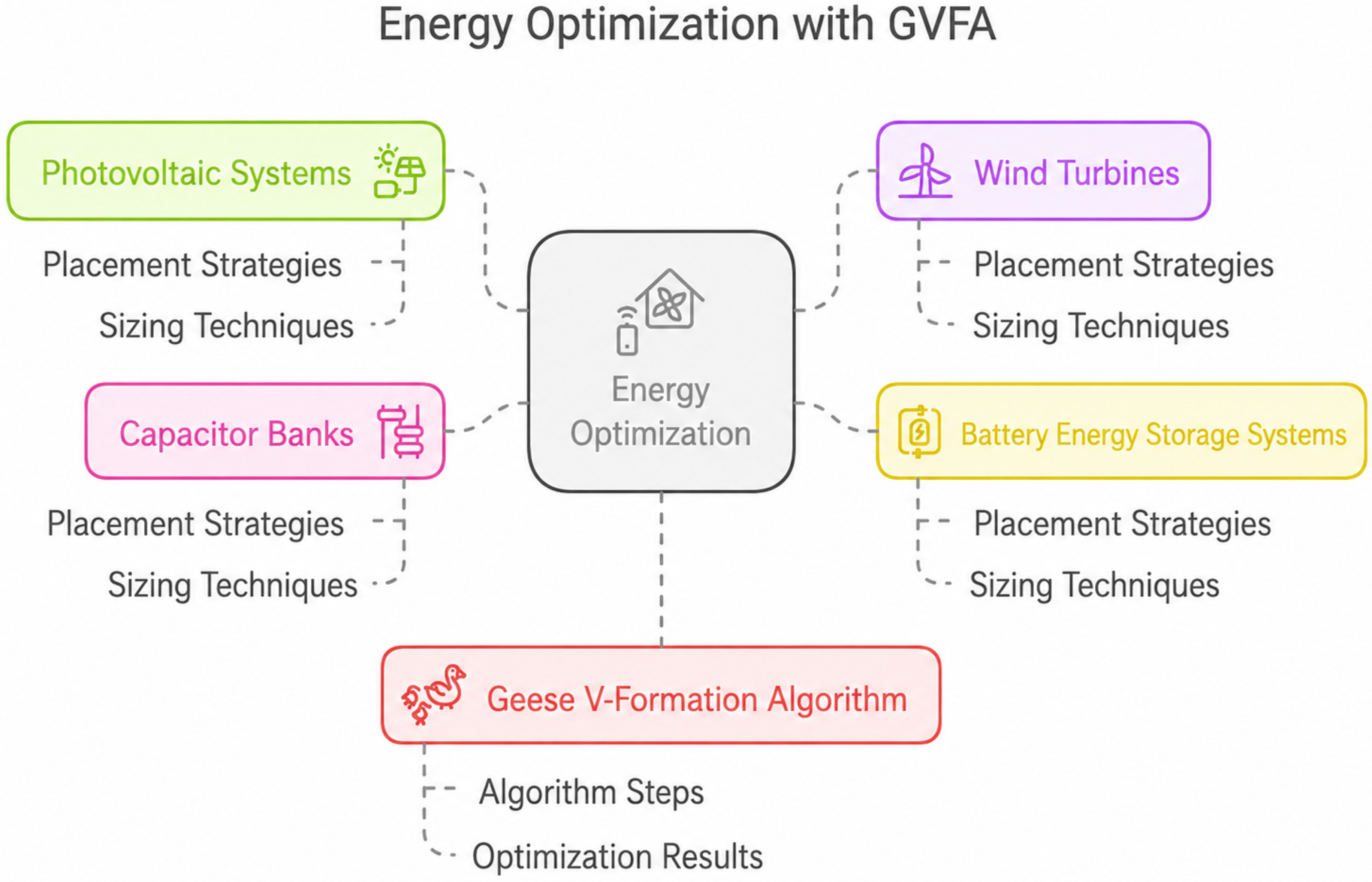
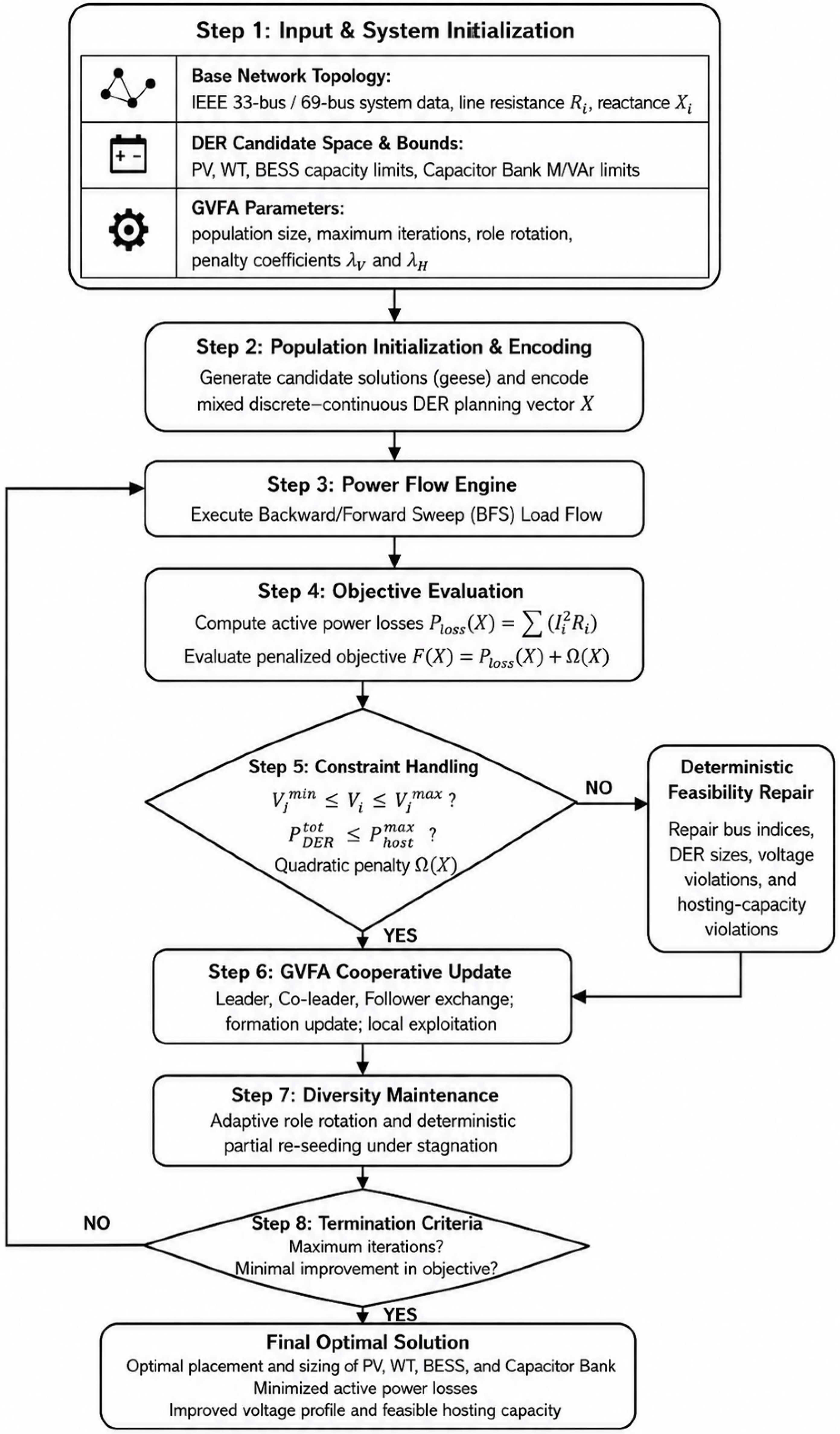
- Step 11: Termination and Final ValidationTerminate the GVFA search when the maximum iteration number, target loss-reduction level, or stall threshold is reached. The final BESS feasibility is checked using the post-optimization validation Equations (39)–(45). Figure 7 shows a conceptualization of the energy optimization framework for the integration of DER using GVFA. Finally, the detailed flowchart is shown in Figure 8.
4. Results and Discussion
4.1. Planning and Management of IEEE-33
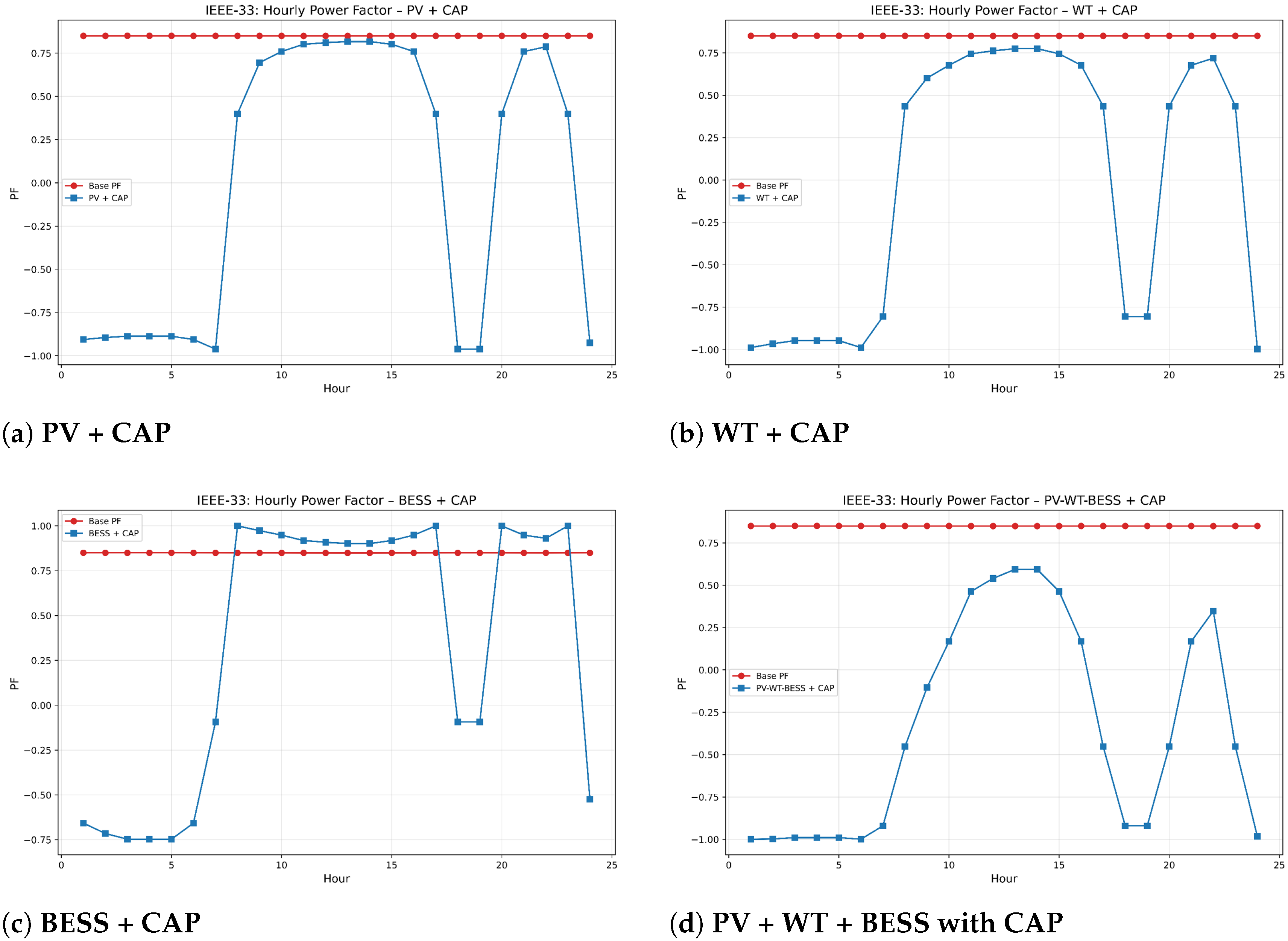
4.1.1. Temporal Adequacy and Power-Factor Behavior for IEEE-33
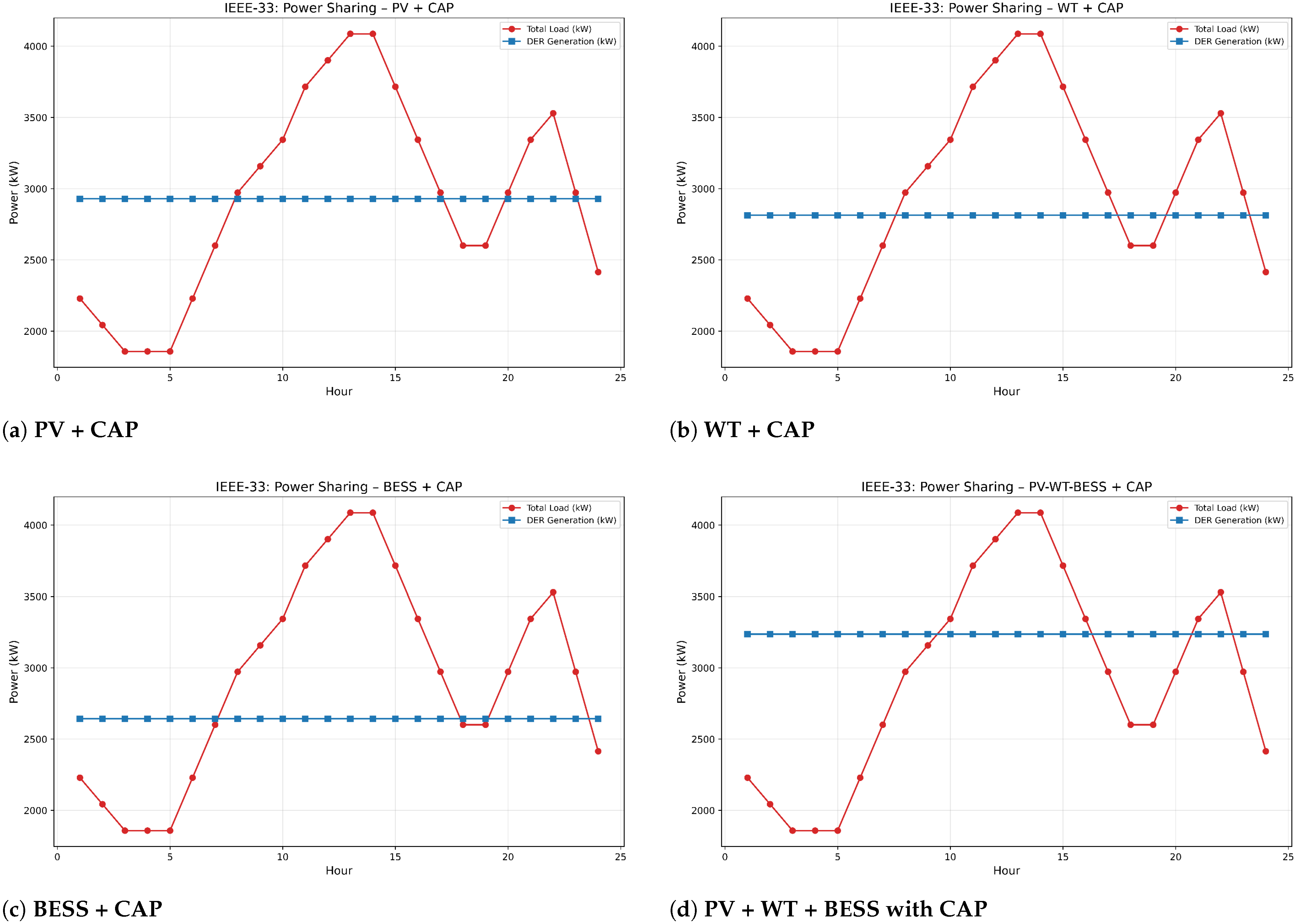
4.1.2. Power Sharing, Control Implications, and Planning Guidance
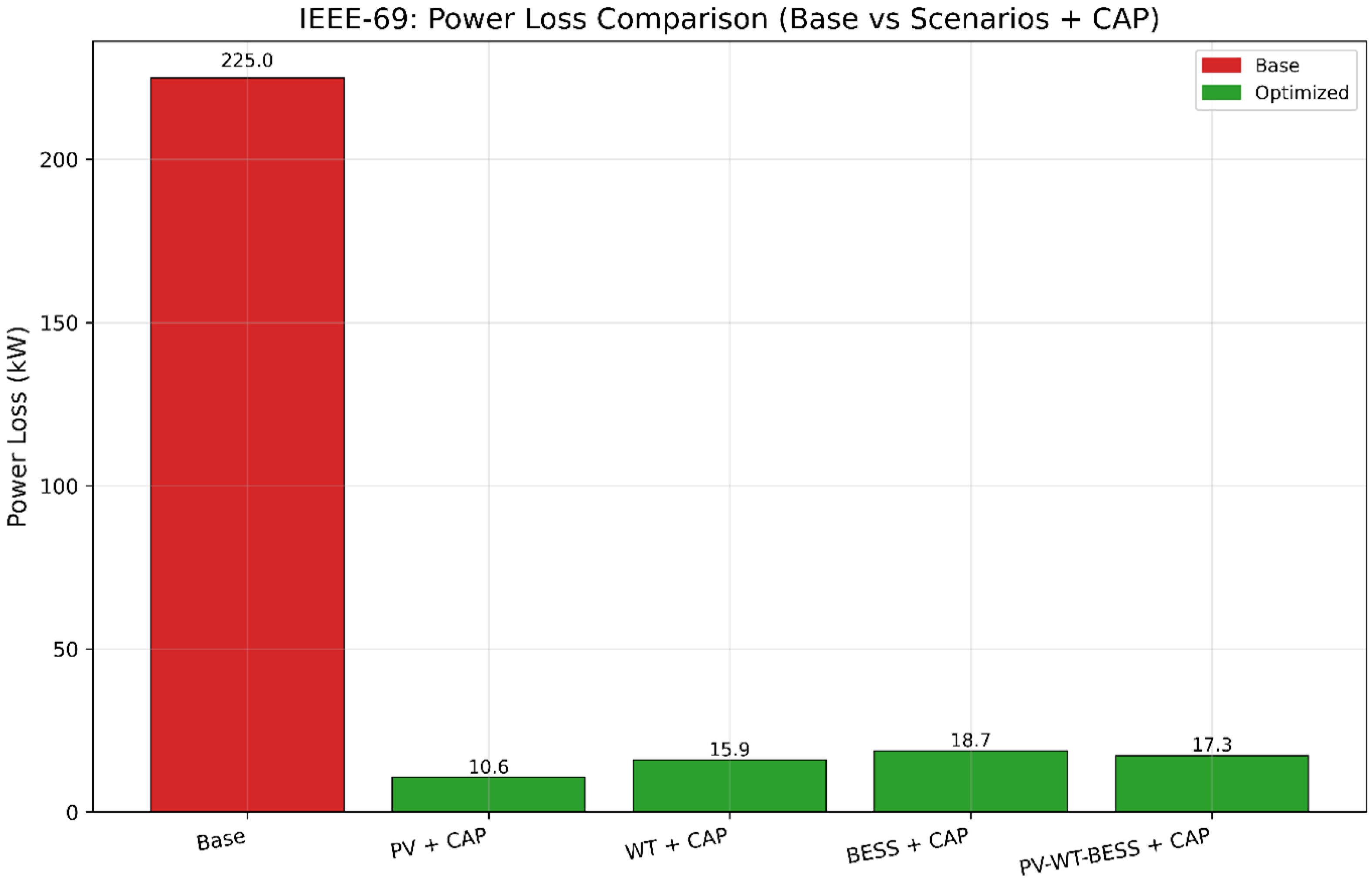
4.2. Planning and Management of IEEE-69
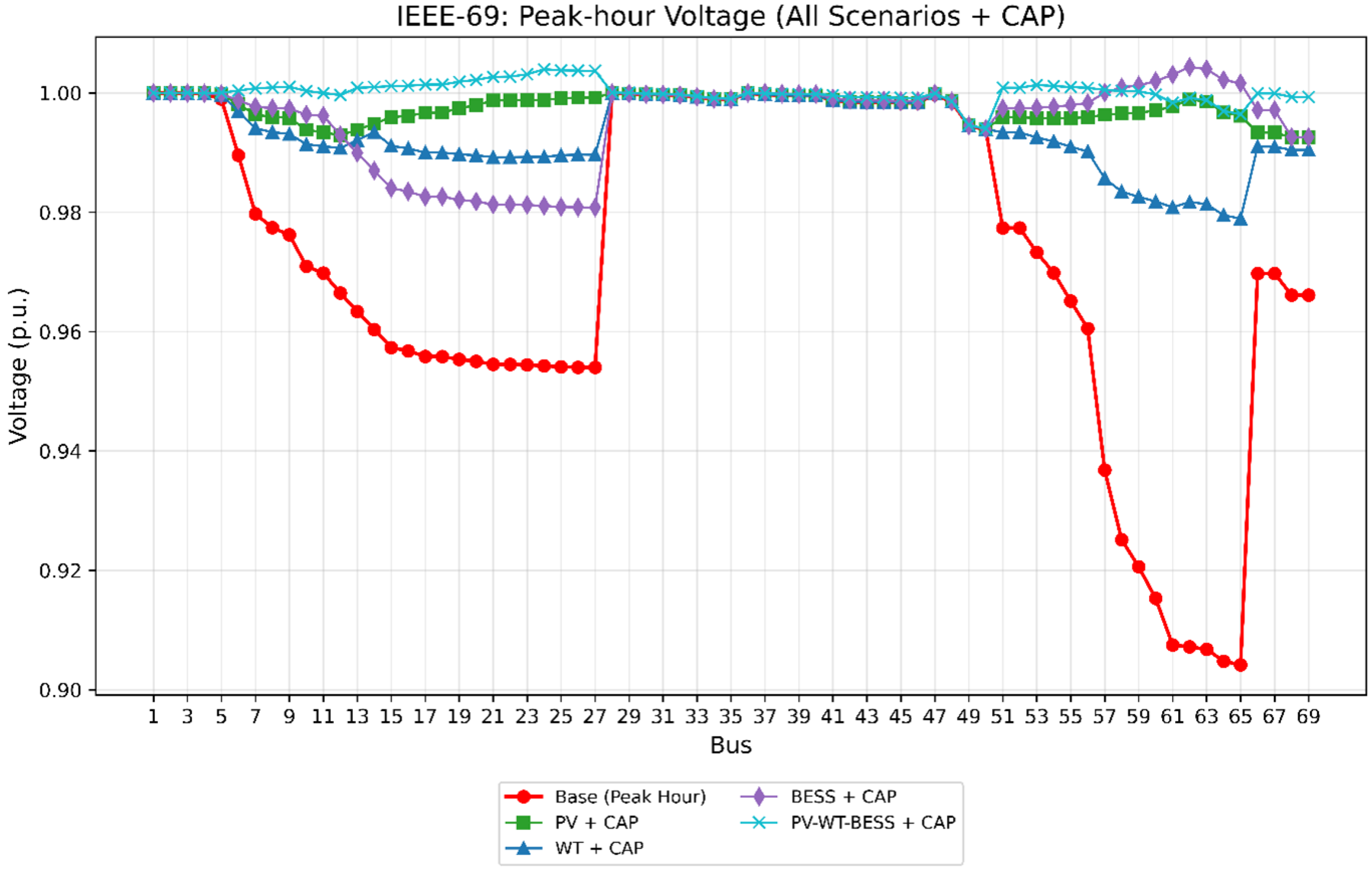
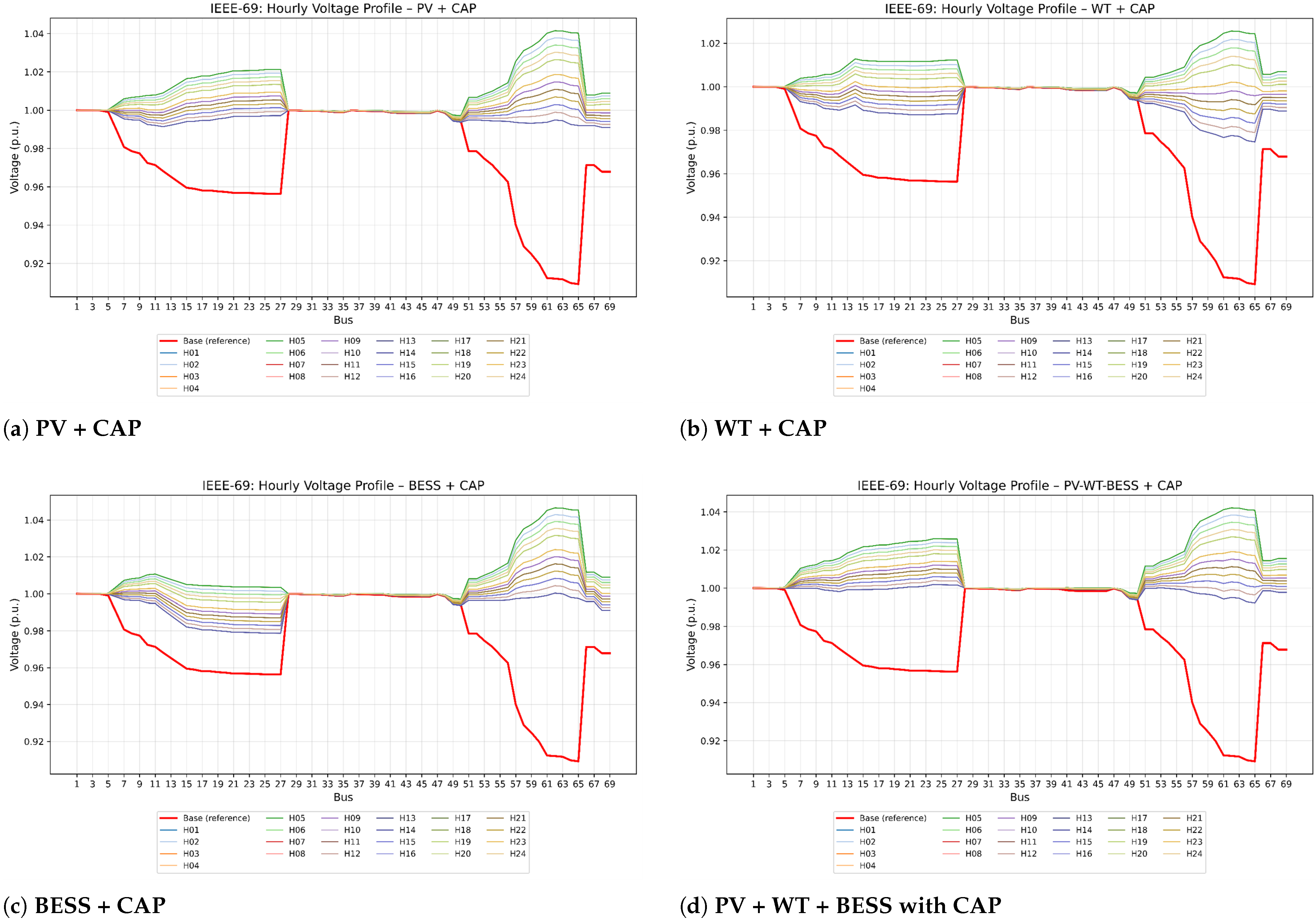
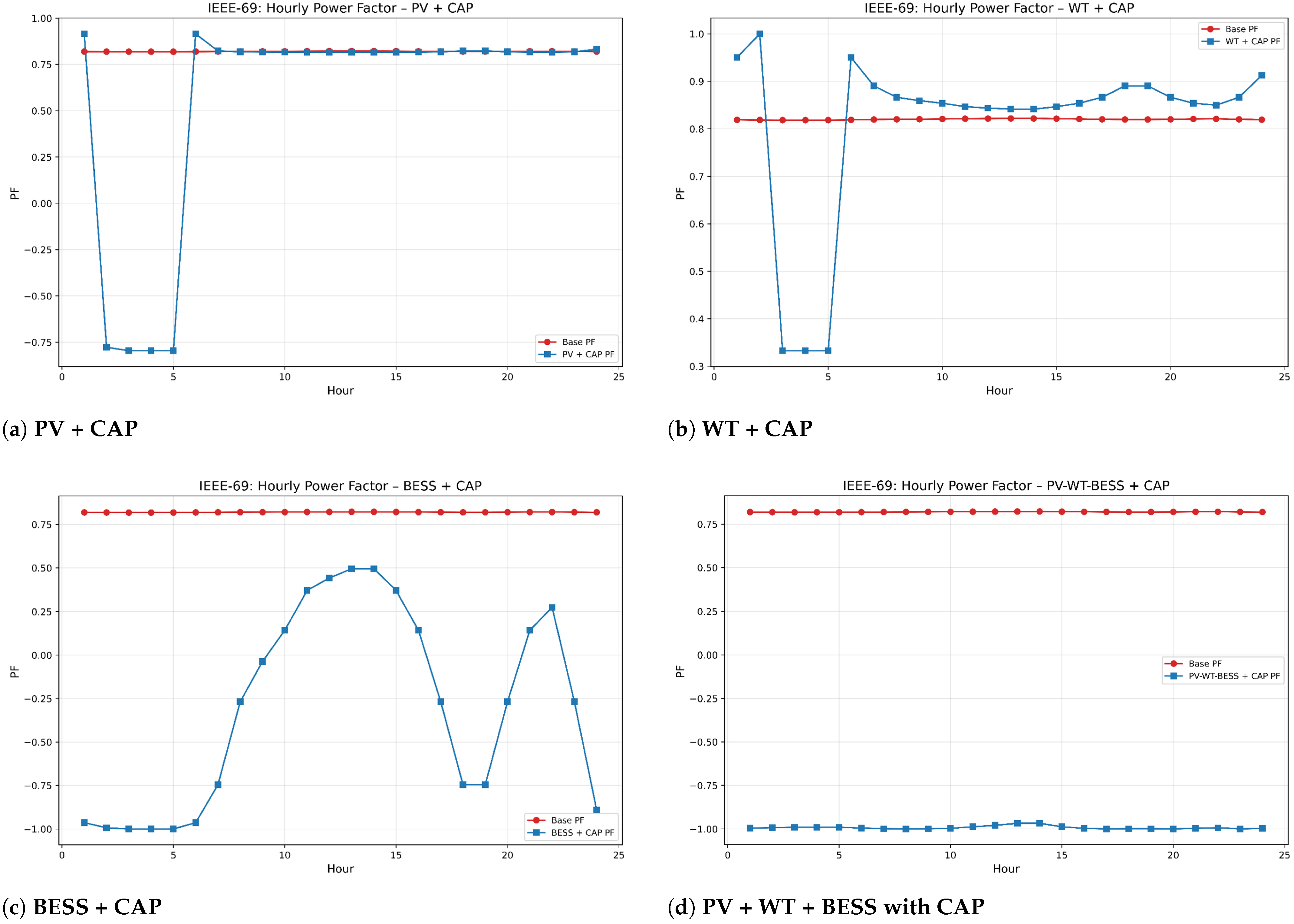
4.2.1. Temporal Adequacy and Power-Factor Behavior for IEEE-69
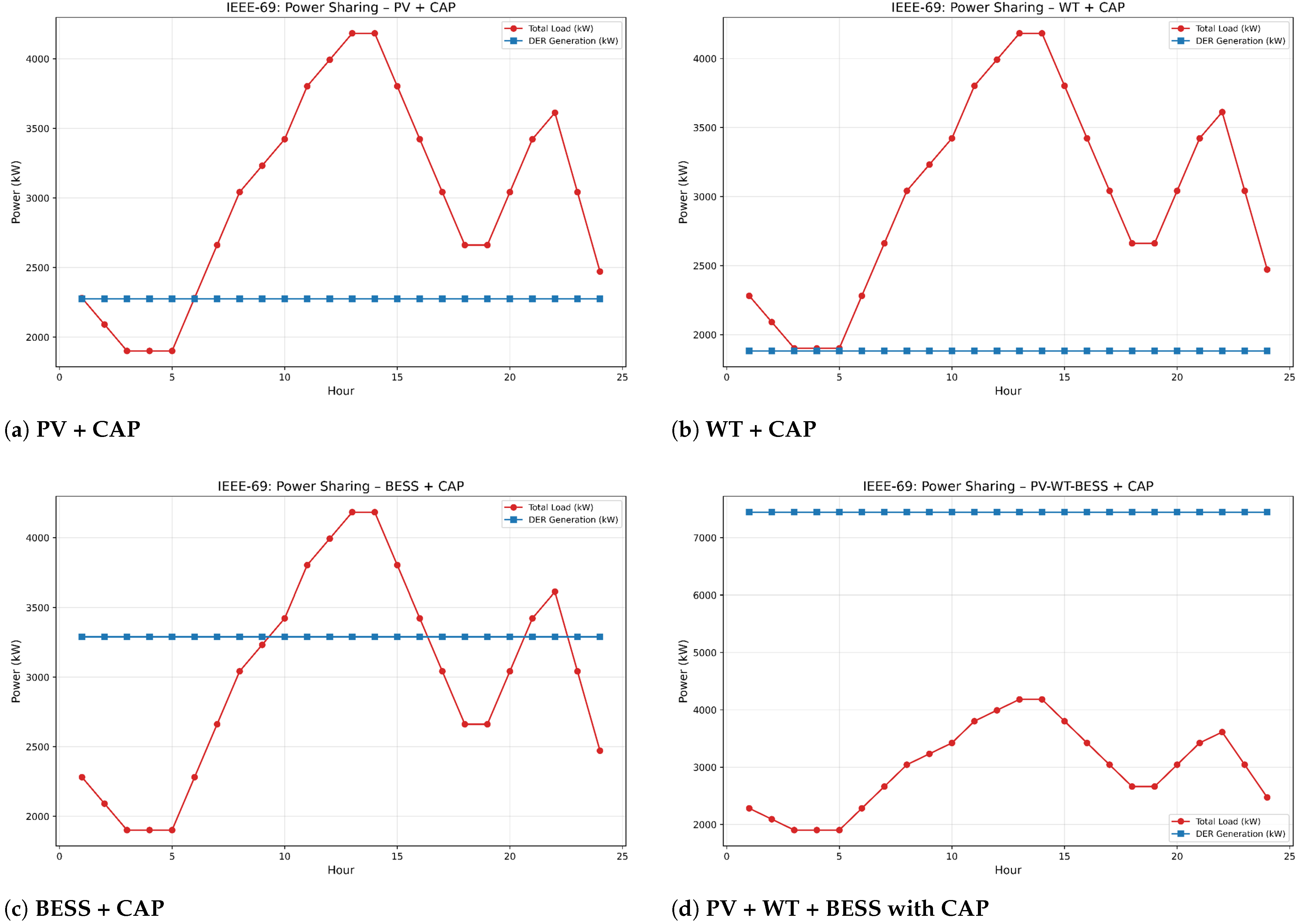
4.2.2. Power Sharing and Planning Guidance
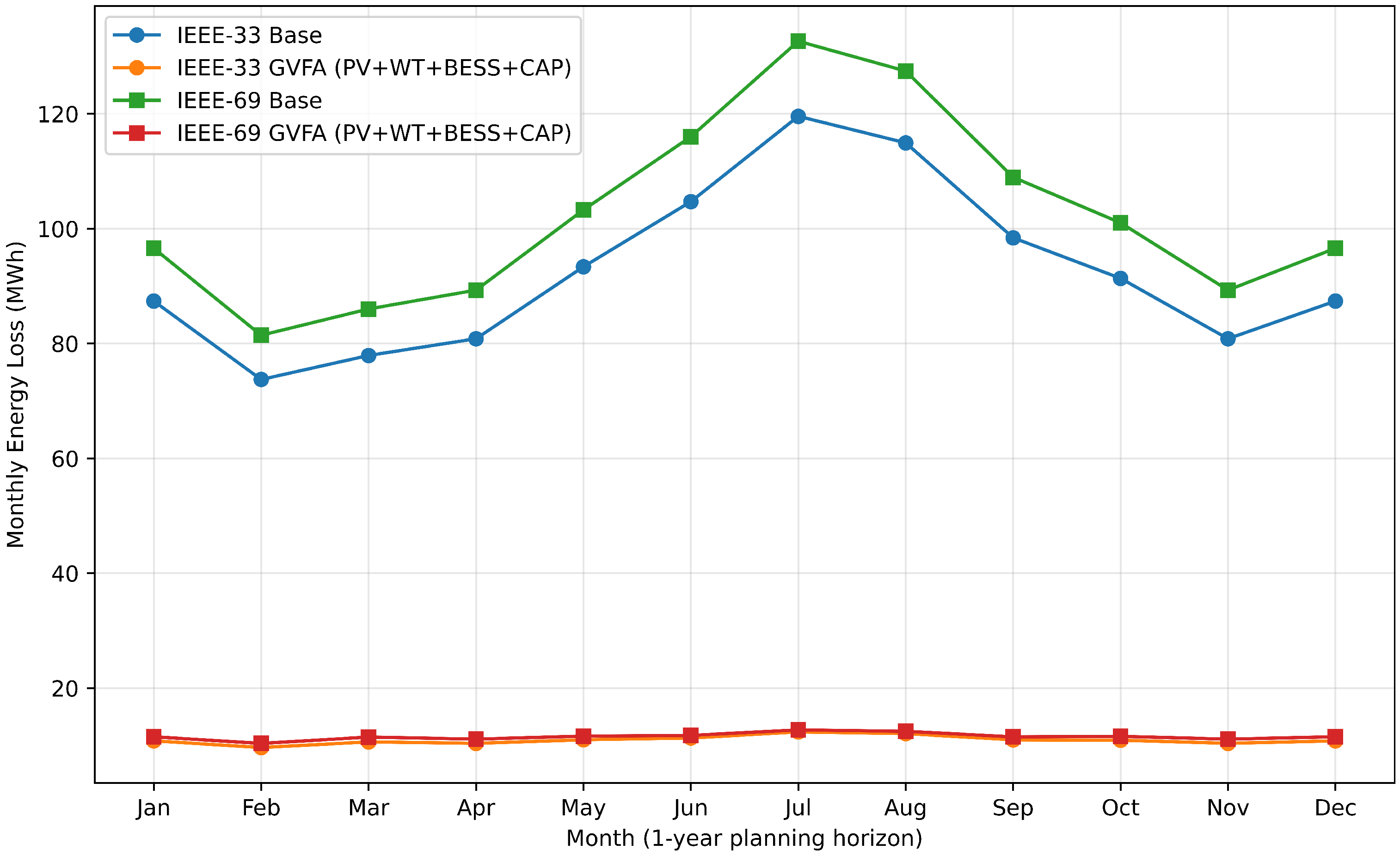
4.3. Long-Horizon and Time-Series Validation of GVFA-Based PV–WT–BESS–CAP Planning
4.4. Sensitivity Analysis
4.5. Comparative Analysis
5. Conclusions and Future Work
Future Work
- Dynamic and Real-Time Optimization: Future research should include variations in time-varying loads and incorporate real-time generated electricity from renewable resources to further improve the GVFA approach. The development of adaptive scheduling approaches should give the processes the ability to deal with rapidly changing conditions in this manner, improving the operational flexibility of the distribution network.
- Economic and Environmental Impact Analysis: Utilizing an integrated cost-benefit analysis, as well as an environmental impact assessment, could provide a more holistic assessment of GVFA performance than what was possible in WP2. Future work could quantify the trade-offs between economic performance and sustainability for various DERS, and would assist in future investment decisions.
- Stochastic Modeling and Uncertainty Management: Considering that both renewables and load demand have uncertainty, using stochastic models within the GVFA framework would allow for more effective planning. Future work may implement probabilistic methods or machine learning, as a means of forecasting the uncertainty of risk with taking into account reliability considerations.
- Scalability to Larger Networks:Although this research has primarily examined two system examples, IEEE-33 and IEEE-69, it is completely reasonable to utilize the GVFA in even larger and more complex networks. It should be considered important to evaluate the GVFA’s scalability and computational efficiency in large grid contexts. For the GVFA to be applied practically in contemporary smart grids, it will be important to understand and evaluate the algorithm scalability and computational efficiency.
Author Contributions
Funding
Institutional Review Board Statement
Informed Consent Statement
Data Availability Statement
Conflicts of Interest
References
- Ali, E.S.; Abd Elazim, S.M.; Abdelaziz, A.Y. Ant Lion Optimization Algorithm for optimal location and sizing of renewable distributed generations. Renew. Energy 2017, 101, 1311–1324. [Google Scholar] [CrossRef]
- Setiawan, A.; Qashtalani, H.; Pranadi, A.D.; Ali, C.A.F.; Setiawan, E.A. Determination of Optimal PV Locations and Capacity in Radial Distribution System to Reduce Power Losses. Energy Procedia 2019, 156, 384–390. [Google Scholar] [CrossRef]
- Zhang, C.; Zhang, Y.J. Optimal Solar Panel Placement in Microgrids. In Proceedings of the IEEE International Conference on Smart Grid Communications (SmartGridComm), Sydney, Australia, 6–8 November 2016; pp. 376–381. [Google Scholar]
- Hashem, M.; Abdel-Salam, M.; El-Mohandes, M.T.; Nayel, M.; Ebeed, M. Optimal Placement and Sizing of Wind Turbine Generators and Superconducting Magnetic Energy Storages in a Distribution System. J. Energy Storage 2021, 38, 102497. [Google Scholar] [CrossRef]
- Kayal, P.; Chanda, C.K. Optimal mix of solar and wind distributed generations considering performance improvement of electrical distribution network. Renew. Energy 2015, 75, 173–186. [Google Scholar] [CrossRef]
- Jayavarma, A.; Joseph, T. Optimal Placement of DG/Solar PV in Distribution System using Particle Swarm Optimization. In Proceedings of the International Conference on Materials for the Future, Bangkok, Thailand, 18–20 October 2013; pp. 393–394. [Google Scholar]
- Jung, J.; Villaran, M. Optimal planning and design of hybrid renewable energy systems for microgrids. Renew. Sustain. Energy Rev. 2017, 75, 180–191. [Google Scholar] [CrossRef]
- Niknam, T.; Taheri, S.I.; Aghaei, J.; Tabatabaei, S.; Nayeripour, M. A modified honey bee mating optimization algorithm for multiobjective placement of renewable energy resources. Appl. Energy 2011, 88, 4817–4830. [Google Scholar] [CrossRef]
- Lin, M.H.; Lin, J.H.; El Haj Assad, M.; Alayi, R.; Seyednouri, S.R. Optimal Location and Sizing of Wind Turbines and Photovoltaic Cells in the Grid for Load Supply Using Improved Genetic Algorithm. J. Renew. Energy Environ. 2023, 10, 9–18. [Google Scholar]
- Radosavljević, J.; Arsić, N.; Milovanović, M.; Ktena, A. Optimal Placement and Sizing of Renewable Distributed Generation Using Hybrid Metaheuristic Algorithm. J. Mod. Power Syst. Clean Energy 2020, 8, 499–510. [Google Scholar] [CrossRef]
- Rajakumar, P.; Balasubramaniam, P.M.; Aldulaimi, M.H.; M, A.; Ramesh, S.; Alam, M.M.; Al-Mdallal, Q.M. An integrated approach using active power loss sensitivity index and modified ant lion optimization algorithm for DG placement in radial power distribution network. Sci. Rep. 2025, 15, 10481. [Google Scholar] [CrossRef]
- Ali, A.; Raisz, D.; Mahmoud, K.; Lehtonen, M. Optimal Placement and Sizing of Uncertain PVs Considering Stochastic Nature of PEVs. IEEE Trans. Sustain. Energy 2020, 11, 1647–1656. [Google Scholar] [CrossRef]
- Naderipour, A.; Nowdeh, S.A.; Saftjani, P.B.; Abdul-Malek, Z.; Bin Mustafa, M.W.; Kamyab, H.; Davoudkhani, I.F. Deterministic and probabilistic multi-objective placement and sizing of wind renewable energy sources using improved spotted hyena optimizer. J. Clean. Prod. 2021, 286, 124941. [Google Scholar] [CrossRef]
- Elkadeem, M.R.; Abd Elaziz, M.; Ullah, Z.; Wang, S.; Sharshir, S.W. Optimal Planning of Renewable Energy-Integrated Distribution System Considering Uncertainties. IEEE Access 2019, 7, 164887–164907. [Google Scholar] [CrossRef]
- HassanzadehFard, H.; Jalilian, A. Optimal sizing and location of renewable energy based DG units in distribution systems considering load growth. Int. J. Electr. Power Energy Syst. 2018, 101, 356–370. [Google Scholar] [CrossRef]
- Canizes, B.; Soares, J.; Lezama, F.; Silva, C.; Vale, Z.; Corchado, J.M. Optimal expansion planning considering storage investment and seasonal effect of demand and renewable generation. Renew. Energy 2019, 138, 937–954. [Google Scholar] [CrossRef]
- Fioriti, D.; Petrelli, M.; Berizzi, A.; Poli, D. Microgrid planning by stochastic multi-objective multi-year optimization with capacity expansion and non-linear asset degradation. Sustainability 2026, 18, 3785. [Google Scholar] [CrossRef]
- Jannesar, M.R.; Sedighi, A.; Savaghebi, M.; Guerrero, J.M. Optimal placement, sizing, and daily charge/discharge of battery energy storage in low voltage distribution network with high photovoltaic penetration. Appl. Energy 2018, 226, 957–966. [Google Scholar] [CrossRef]
- Narimani, A.; Nourbakhsh, G.; Ledwich, G.F.; Walker, G.R. Storage optimum placement in distribution system including renewable energy resources. In Proceedings of the Australasian Universities Power Engineering Conference (AUPEC), Brisbane, Australia, 19 September–2 October 2016; pp. 1–5. [Google Scholar]
- Kihara, H.; Yokoyama, A.; Liyanage, K.M.; Sakuma, H. Optimal Placement and Control of BESS for a Distribution System Integrated with PV systems. J. Int. Counc. Electr. Eng. 2011, 1, 298–303. [Google Scholar] [CrossRef]
- Chedid, R.; Sawwas, A. Optimal placement and sizing of photovoltaics and battery storage in distribution networks. Energy Storage 2019, 1, e46. [Google Scholar] [CrossRef]
- Baziar, A.; Kavousi-Fard, A. Considering uncertainty in the optimal energy management of renewable micro-grids including storage devices. Renew. Energy 2013, 59, 158–166. [Google Scholar] [CrossRef]
- Yadav, R.K.; Hrisheekesha, P.N.; Bhadoria, V.S. Grey Wolf Optimization Based Demand Side Management in Solar PV Integrated Smart Grid Environment. IEEE Access 2023, 11, 11827–11833. [Google Scholar] [CrossRef]
- Wu, H.; Li, H.; Gu, X. Optimal Energy Management for Microgrids Considering Uncertainties in Renewable Energy Generation and Load Demand. Processes 2020, 8, 1086. [Google Scholar] [CrossRef]
- Moradi, H.; Esfahanian, M.; Abtahi, A.; Zilouchian, A. Optimization and energy management of a standalone hybrid microgrid in the presence of battery storage system. Energy 2018, 147, 226–238. [Google Scholar] [CrossRef]
- Kassab, F.A.; Celik, B.; Locment, F.; Sechilariu, M.; Liaquat, S.; Hansen, T.M. Optimal sizing and energy management of a microgrid: A joint MILP approach for minimization of energy cost and carbon emission. Renew. Energy 2024, 224, 120186. [Google Scholar] [CrossRef]
- Hooshmand, E.; Rabiee, A. Energy management in distribution systems, considering the impact of reconfiguration, RESs, ESSs and DR: A trade-off between cost and reliability. Renew. Energy 2019, 139, 346–358. [Google Scholar] [CrossRef]
- Roldán-Blay, C.; Roldán-Porta, C.; Dasí-Crespo, D.; Escrivá-Escrivá, G. Optimising a Biogas and Photovoltaic Hybrid System for Sustainable Power Supply in Rural Areas. Appl. Sci. 2023, 13, 2155. [Google Scholar] [CrossRef]
- Berbaoui, B.; Dehini, R.; Hatti, M. An applied methodology for optimal sizing and placement of hybrid power source in remote area of South Algeria. Renew. Energy 2020, 146, 2785–2796. [Google Scholar] [CrossRef]
- Gómez, J.; Chicaiza, W.D.; Escaño, J.M.; Bordons, C. A renewable energy optimisation approach with production planning for a real industrial process: An application of genetic algorithms. Renew. Energy 2023, 215, 118933. [Google Scholar] [CrossRef]
- Jiménez-Vargas, I.; Rey, J.M.; Osma-Pinto, G. Sizing of hybrid microgrids considering life cycle assessment. Renew. Energy 2023, 202, 554–565. [Google Scholar] [CrossRef]
- Ghanbari, A.; Karimi, H.; Jadid, S. Optimal planning and operation of multi-carrier networked microgrids considering multi-energy hubs in distribution networks. Energy 2020, 204, 117936. [Google Scholar] [CrossRef]
- Tooryan, F.; HassanzadehFard, H.; Collins, E.R.; Jin, S.; Ramezani, B. Smart integration of renewable energy resources, electrical, and thermal energy storage in microgrid applications. Energy 2020, 212, 118716. [Google Scholar] [CrossRef]
- Mohammed, N.A.; Al-Bazi, A. Management of renewable energy production and distribution planning using agent-based modelling. Renew. Energy 2021, 164, 509–520. [Google Scholar] [CrossRef]
- Ghasemi, M.; Rahimnejad, A.; Hemmati, R.; Akbari, E.; Gadsden, S.A. Wild Geese Algorithm: A novel algorithm for large scale optimization based on the natural life and death of wild geese. Array 2021, 11, 100074. [Google Scholar] [CrossRef]
- Wu, H.; Zhang, X.; Song, L.; Zhang, Y.; Gu, L.; Zhao, X. Wild Geese Migration Optimization Algorithm: A New Meta-Heuristic Algorithm for Solving Inverse Kinematics of Robot. Comput. Intell. Neurosci. 2022, 2022, 5191758. [Google Scholar] [CrossRef] [PubMed]
- Ali, I.I.; Saeed, O.Y. Optimal Reconfiguration and Distributed Generation Placement in Baghdad Distribution Sector. Eng. Technol. J. 2018, 36, 333–343. [Google Scholar] [CrossRef]
- Nammouchi, A.; Aupke, P.; D’Andreagiovanni, F.; Ghazzai, H.; Theocharis, A.; Kassler, A. Robust opportunistic optimal energy management of a mixed microgrid under asymmetrical uncertainties. Sustain. Energy Grids Netw. 2023, 36, 101184. [Google Scholar] [CrossRef]
- Yang, J.; Su, C. Robust optimization of microgrid based on renewable distributed power generation and load demand uncertainty. Energy 2021, 223, 120043. [Google Scholar] [CrossRef]
- Kumar, K.P.; Saravanan, B. Recent techniques to model uncertainties in power generation from renewable energy sources and loads in microgrids—A review. Renew. Sustain. Energy Rev. 2017, 71, 348–358. [Google Scholar] [CrossRef]
- Bertsimas, D.; Sim, M. The price of robustness. Oper. Res. 2004, 52, 35–53. [Google Scholar] [CrossRef]
- Zhang, Y.; Gatsis, N.; Giannakis, G.B. Robust energy management for microgrids with high-penetration renewables. IEEE Trans. Sustain. Energy 2013, 4, 944–953. [Google Scholar] [CrossRef]
- Xiang, Y.; Liu, J.; Liu, Y. Robust energy management of microgrid with uncertain renewable generation and load. IEEE Trans. Smart Grid 2016, 7, 1034–1043. [Google Scholar] [CrossRef]
- Zhang, B.; Li, Q.; Wang, L.; Feng, W. Robust optimization for energy transactions in multi-microgrids under uncertainty. Appl. Energy 2018, 217, 346–360. [Google Scholar] [CrossRef]
- Shaikh, M.S.; Raj, S.; Babu, R.; Kumar, S.; Sagrolikar, K. A hybrid moth–flame algorithm with particle swarm optimization with application in power transmission and distribution. Decis. Anal. J. 2023, 6, 100182. [Google Scholar] [CrossRef]
- Sultana, U.; Khairuddin, A.B.; Mokhtar, A.S.; Zareen, N.; Sultana, B. Grey wolf optimizer based placement and sizing of multiple distributed generation in the distribution system. Energy 2016, 111, 525–536. [Google Scholar] [CrossRef]
- Sanjay, R.; Jayabarathi, T.; Raghunathan, T.; Ramesh, V.; Mithulananthan, N. Optimal Allocation of Distributed Generation Using Hybrid Grey Wolf Optimizer. IEEE Access 2017, 5, 14807–14818. [Google Scholar] [CrossRef]
- Al-Ammar, E.A.; Farzana, K.; Waqar, A.; Aamir, M.; Saifullah; Haq, A.U.; Zahid, M.; Batool, M. ABC algorithm based optimal sizing and placement of DGs in distribution networks considering multiple objectives. Ain Shams Eng. J. 2021, 12, 697–708. [Google Scholar] [CrossRef]
- Chakraborty, S.; Verma, S.; Salgotra, A.; Elavarasan, R.M.; Elangovan, D.; Mihet-Popa, L. Solar-Based DG Allocation Using Harris Hawks Optimization While Considering Practical Aspects. Energies 2021, 14, 5206. [Google Scholar] [CrossRef]
- Kadir, A.F.A.; Mohamed, A.; Shareef, H.; Ibrahim, A.A.; Khatib, T.; Elmenreich, W. An improved gravitational search algorithm for optimal placement and sizing of renewable distributed generation units in a distribution system for power quality enhancement. J. Renew. Sustain. Energy 2014, 6, 033112. [Google Scholar] [CrossRef]
- Kwangkaew, A.; Javaid, S.; Charoenlarpnopparut, C.; Kaneko, M. Optimal Location and Sizing of Renewable Distributed Generators for Improving Voltage Stability and Security Considering Reactive Power Compensation. Energies 2022, 15, 2126. [Google Scholar] [CrossRef]



| Methodology Family | Typical Scope | Rep. Refs. | Strengths | Limitations/Gaps |
|---|---|---|---|---|
| Deterministic feeder-constrained siting/sizing (snapshot) | PV/DG allocation for loss reduction and voltage improvement under limited operating points | [2,3,4,5] | Captures feeder physics; clear siting guidance | Often single-period; limited uncertainty; weak linkage to SOC-feasible multi-period operation and resilience |
| Metaheuristic feeder planning (nonconvex/mixed-integer) and economic analysis | DER siting/sizing using PSO/GA/ALO variants; planning-centric objectives | [1,6,7,8,9,10,11] | Handles nonlinearity/ discrete decisions; flexible multi-objective design | Sensitive to tuning/constraint handling; frequently planning-metric benchmarking; limited EMS/SOC realism |
| Uncertainty-aware planning (probabilistic/scenario/stochastic) | Planning under uncertain PV/load/EV; probabilistic multi-objective siting/sizing | [12,13,14] | Improves robustness; more realistic inputs | Often partial uncertainty coverage; scenario-limited; may not enforce SOC-feasible multi-period dispatch and resilience recovery |
| Long-horizon planning with load growth/expansion | Investment planning with demand growth/seasonality and long-term relevance | [15,16,17] | Strategic planning relevance; investment timing insight | Operational feeder detail and short-timescale EMS/SOC coupling often simplified; resilience indices limited |
| Storage-inclusive planning with dispatch feasibility (PV–BESS dominant) | BESS siting/sizing + daily charge/discharge feasibility under feeder constraints | [18,19,20,21] | Coupled placement with dispatch feasibility and SOC constraints | Often PV–BESS focused; limited multi-DER portfolios and interconnected microgrid coordination/resilience |
| Operational EMS/ DSM-centric optimization | Multi-period dispatch, DSM scheduling, uncertainty-aware EMS; typically fixed siting | [22,23,24,25] | Operational realism; scheduling under uncertainty | Usually does not optimize feeder-constrained siting/sizing; network/resilience modeling can be simplified |
| Integrated planning–management co-optimization | Joint sizing + EMS (cost/CO2), sometimes DR/reconfiguration and reliability tradeoffs | [26,27] | Unified investment-operation view; sustainability alignment | MILP/linearization may reduce AC fidelity and discrete siting realism; resilience/SOC detail may be simplified |
| Sustainability/hybrid supply design (LCA, rural electrification, production coupling) | Hybrid supply sizing, life-cycle sustainability, coupling with production planning | [28,29,30,31] | Broad sustainability perspective beyond losses | Often outside AC feeder-constrained planning; interconnected microgrid resilience and operational constraints not central |
| Multi-energy/multi-carrier microgrids (energy hubs) | Electric/thermal/multi-carrier coordination; networked microgrids | [32,33] | High modeling richness; sector coupling | Feeder voltage/loss constraints and discrete siting in radial networks often simplified |
| Decentralized/agent-based planning | Decentralized coordination and interaction modeling | [34] | Captures decentralized behavior and coordination | Global optimality under MINLP is challenging; feeder-accurate AC feasibility and SOC-coupled scheduling often require additional layers |
| Geese-inspired optimizers/ domain transfer | Wild-geese-inspired optimizers; cross-domain demonstrations | [35,36] | Motivates leader–follower and rotation dynamics | Needs power-system-specific constraint handling (AC feasibility, discrete siting, SOC coupling) and rigorous benchmarking |
| Applied distribution-sector studies (reconfiguration/DG placement) | Practical feeder reconfiguration and DG planning case studies | [37] | Real-world context and constraints | Not necessarily integrated microgrid planning + uncertainty-aware EMS with explicit resilience metrics |
| Parameter | IEEE-33 | IEEE-69 |
|---|---|---|
| Population size | 200 | 50 |
| Max iterations | 200 | 500 |
| Re-seeding/restart | Not used | Deterministic partial re-seeding triggered after 50 non-improving iterations |
| Penalty coefficient | ||
| Stall threshold | 150 | 50 |
| Parameter | Value |
|---|---|
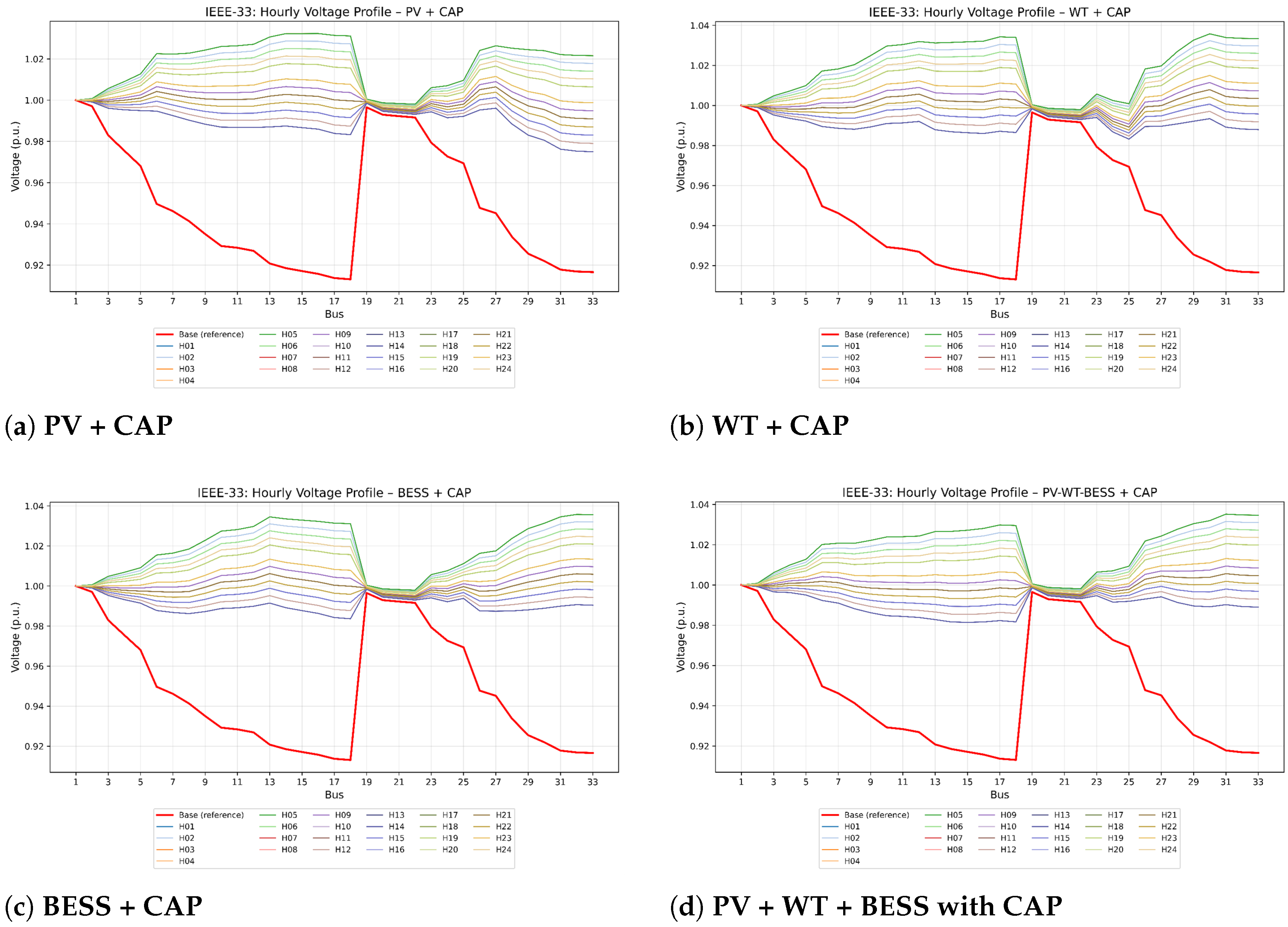
| Load level | Main optimization at p.u.; hourly assessment with 24-h multipliers in the range – |
| DG penetration limit | PV/WT/BESS: local active load; CAP: local reactive load |
| Voltage limits | – p.u. |
| Power-flow solver | Backward/Forward Sweep (BFS) |
| BFS maximum sweeps | 100 |
| Penalty coefficient |
| Scenario | Base Loss (kW) | Scenario Loss (kW) | Red. (%) | Min | Min | PV (Bus → kW) | WT (Bus → kW) | BESS (Bus → kW) | CAP (Bus → kVAR) |
|---|---|---|---|---|---|---|---|---|---|
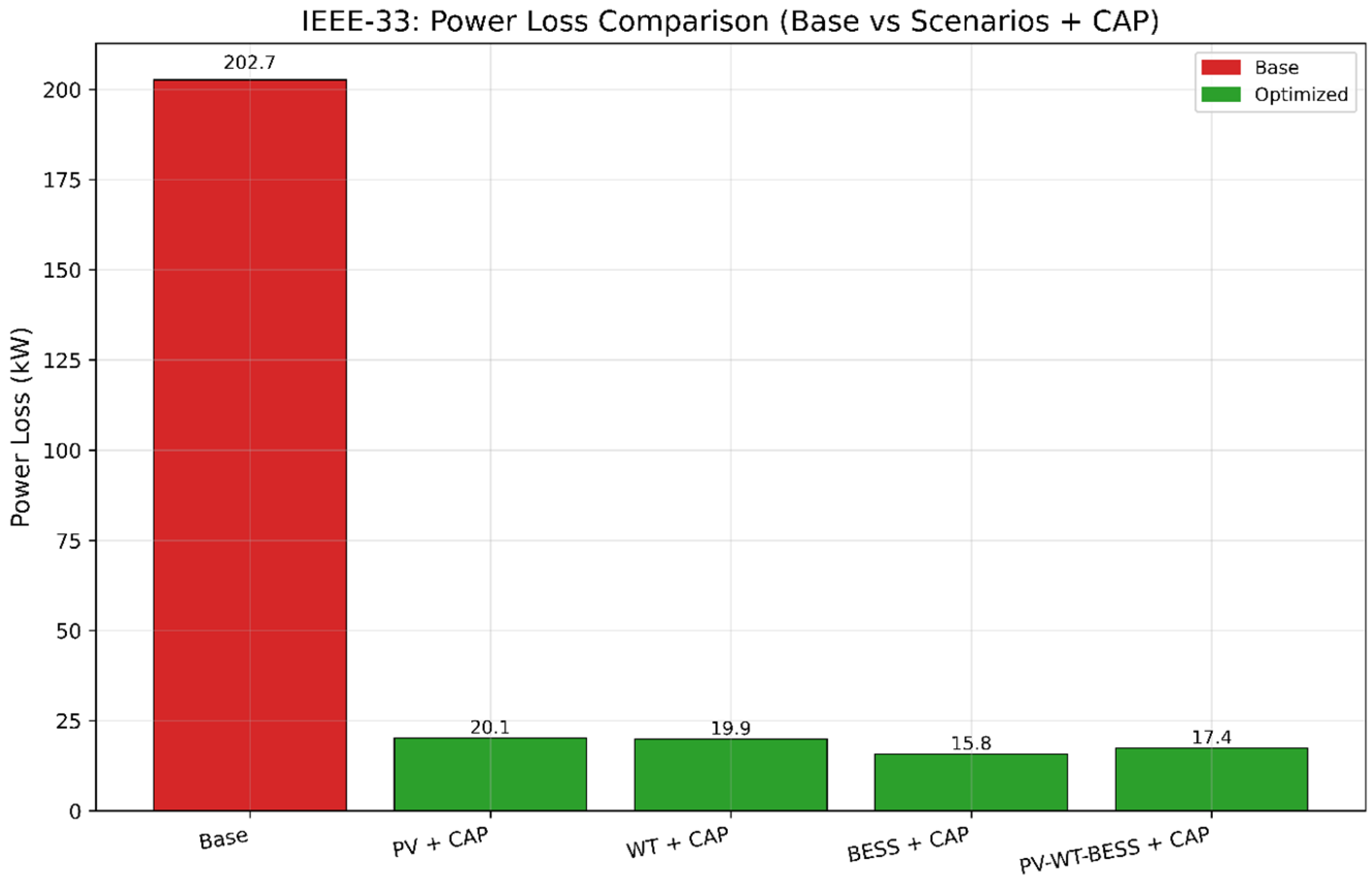
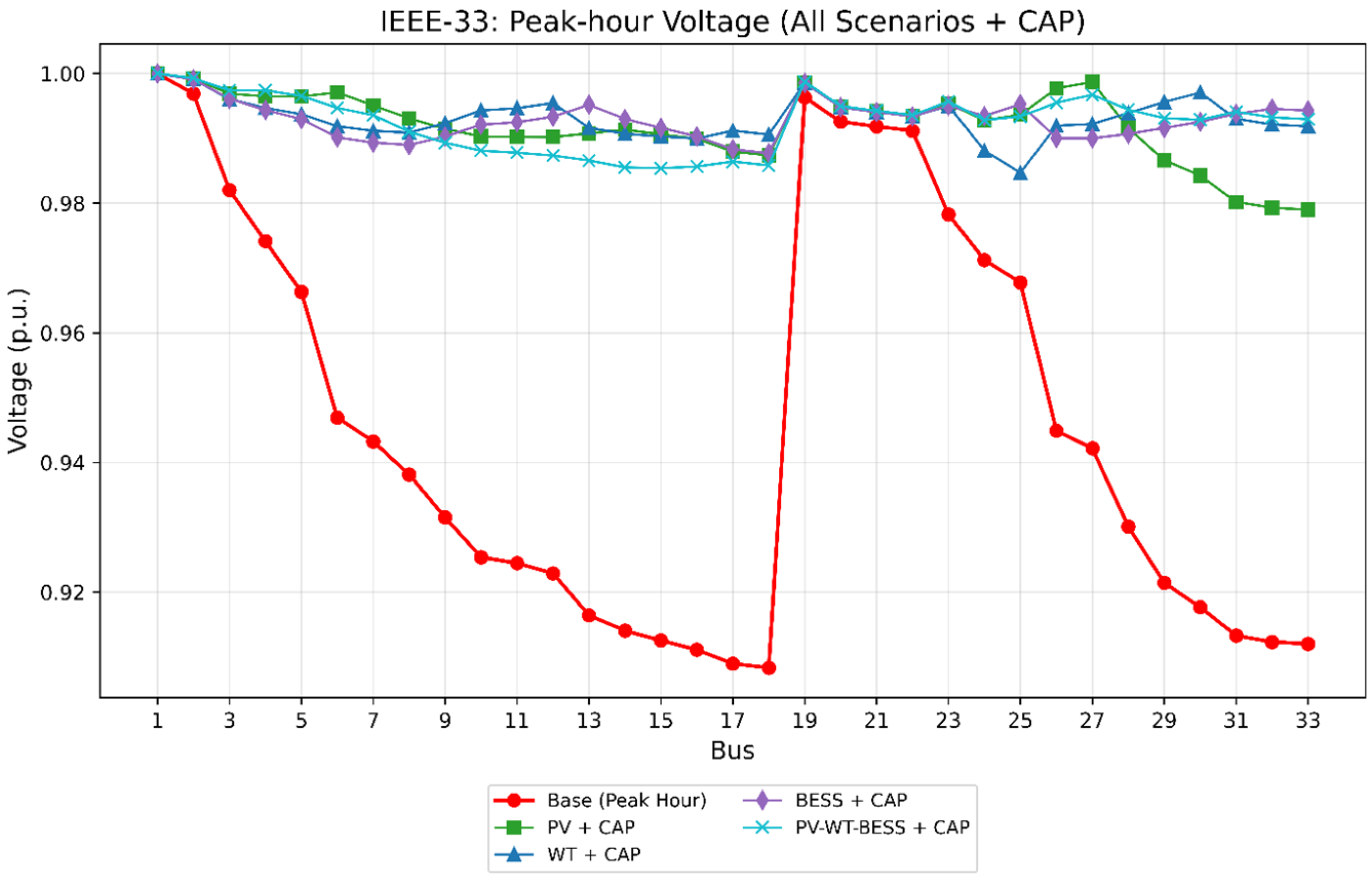
| PV + CAP | 202.68 | 20.14 | 90.06 | 0.9166 | 0.9830 | 14 → 550.15; 27 → 1620.14; 25 → 758.55 | – | – | 16 → 196.60; 6 → 815.82; 30 → 701.46 |
| WT + CAP | 202.68 | 19.86 | 90.20 | 0.9166 | 0.9936 | – | 30 → 1005.06; 23 → 942.42; 12 → 865.47 | – | 17 → 292.56; 30 → 1053.98; 10 → 140.53 |
| BESS + CAP | 202.68 | 15.77 | 92.22 | 0.9166 | 0.9917 | – | – | 25 → 932.34; 13 → 847.68; 32 → 862.60 | 30 → 1036.60; 12 → 419.19; 3 → 386.09 |
| PV + WT + BESS + CAP | 202.68 | 17.41 | 91.41 | 0.9166 | 0.9893 | 25 → 704.34; 17 → 335.69; 10 → 0.00 | 27 → 1088.52; 30 → 562.04; 27 → 0.00 | 4 → 545.68; 6 → 0.00; 26 → 0.00 | 10 → 201.25; 31 → 878.79; 13 → 284.84 |
| Scenario | Base Loss (kW) | Optimized Loss (kW) | Reduction (%) | Min V (Before, p.u.) | Min V (After, p.u.) | PV Placements (Bus: kW) | WT Placements (Bus: kW) | BESS Placements (Bus: kW) | CAP Placements (Bus: kVAR) |
|---|---|---|---|---|---|---|---|---|---|
| PV + CAP | 224.99 | 10.64 | 95.27% | 0.9092 (bus 65) | 0.9941 (min) | 18: 0.00; 62: 1768.17; 21: 507.27 | – | – | 62: 1320.06; 26: 294.49; 19: 0.00 |
| WT + CAP | 224.99 | 15.91 | 92.93% | 0.9092 (bus 65) | 0.9832 (bus 65, min) | – | 14: 568.93; 62: 1313.06; 30: 0.00 | – | 26: 264.78; 62: 1214.10; 25: 10.00 |
| BESS + CAP | 224.99 | 18.70 | 91.69% | 0.9092 (bus 65) | 0.9829 (buses 26–27, min) | – | – | 62: 1883.51; 37: 604.05; 67: 801.45 | 46: 0.00; 4: 0.00; 62: 1373.48 |
| PV + WT + BESS + CAP | 224.99 | 17.32 | 92.30% | 0.9092 (bus 65) | 0.9943 (min) | 53: 430.00; 62: 1798.77; 24: 466.45 | 59: 0.00; 10: 209.20; 41: 120.00 | 28: 2600.00; 36: 1809.26; 56: 10.00 | 59: 1014.24; 9: 568.07; 13: 550.00 |
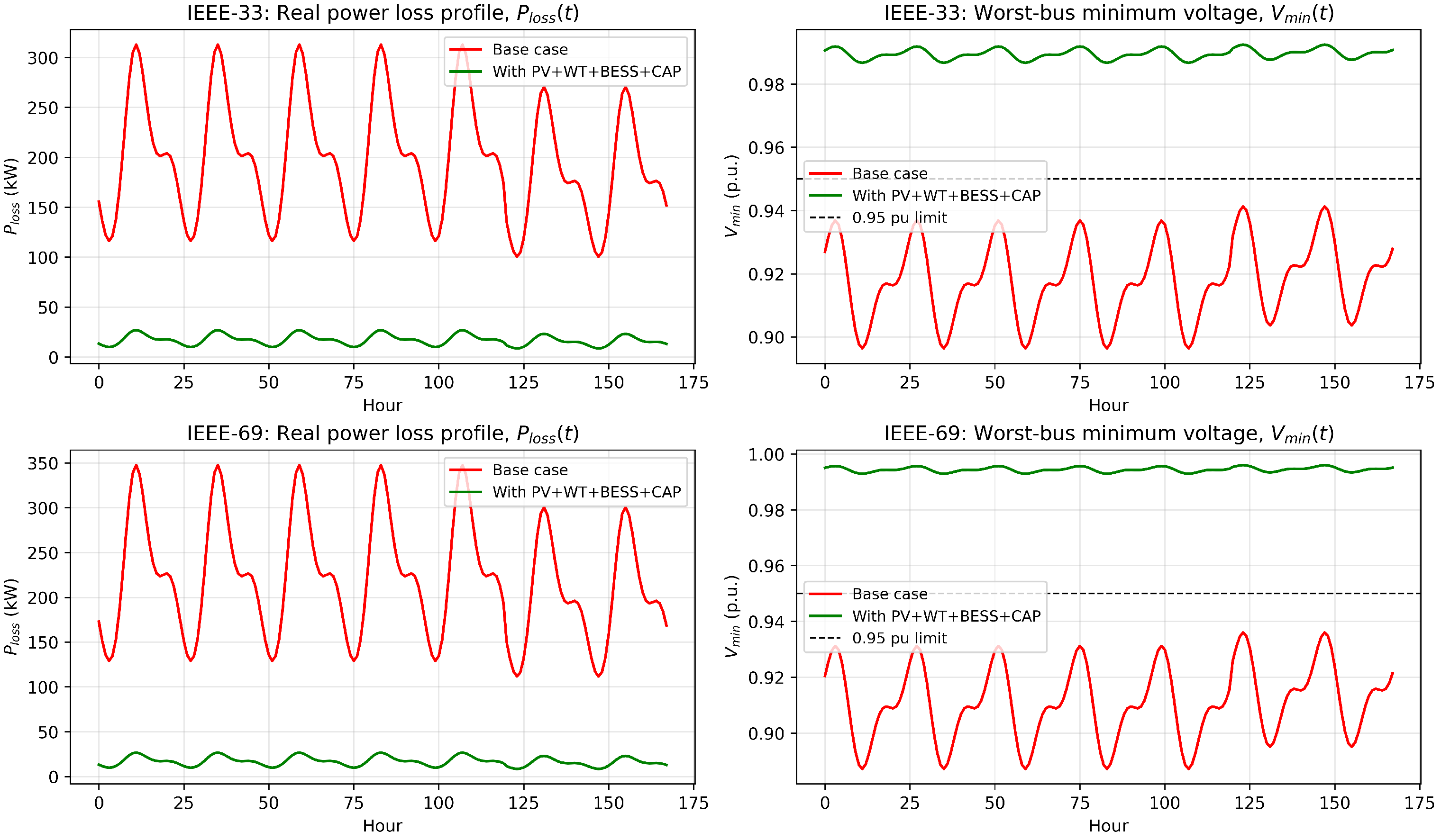
| Test System | Case | Total Energy Losses (kWh) over 1 Week | Max Loss (kW) | Mean Loss (kW) | Min Voltage (Worst-Hour, p.u.) | Mean Min Voltage (p.u.) | Voltage-Violation Hours (<0.95 pu) (%) |
|---|---|---|---|---|---|---|---|
| IEEE-33 | Base case | 33,429.9 | 312.892 | 198.987 | 0.896 | 0.918 | 100 |
| IEEE-33 | With PV + WT + BESS + CAP | 2871.594 | 26.877 | 17.092 | 0.986 | 0.989 | 0 |
| IEEE-69 | Base case | 37,109.698 | 347.333 | 220.891 | 0.887 | 0.911 | 100 |
| IEEE-69 | With PV + WT + BESS + CAP | 2856.749 | 26.738 | 17.004 | 0.992 | 0.994 | 0 |
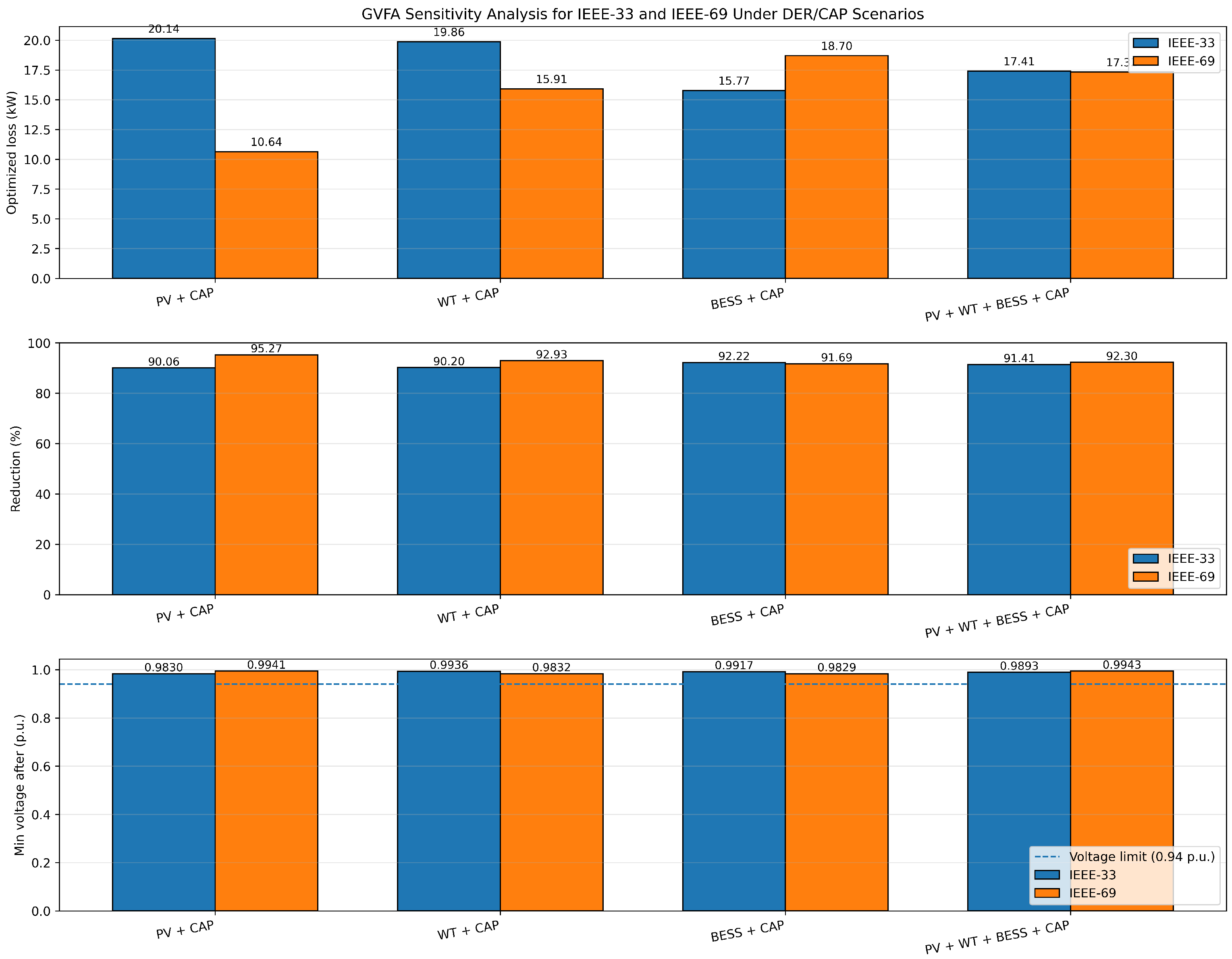
| System | Scenario | Base Loss (kW) | Optimized Loss (kW) | Reduction (%) | Min V Before (p.u.) | Min V After (p.u.) |
|---|---|---|---|---|---|---|
| IEEE-33 | PV + CAP | 202.68 | 20.14 | 90.06 | 0.9166 | 0.9830 |
| IEEE-33 | WT + CAP | 202.68 | 19.86 | 90.20 | 0.9166 | 0.9936 |
| IEEE-33 | BESS + CAP | 202.68 | 15.77 | 92.22 | 0.9166 | 0.9917 |
| IEEE-33 | PV + WT + BESS + CAP | 202.68 | 17.41 | 91.41 | 0.9166 | 0.9893 |
| IEEE-69 | PV + CAP | 224.99 | 10.64 | 95.27 | 0.9092 | 0.9941 |
| IEEE-69 | WT + CAP | 224.99 | 15.91 | 92.93 | 0.9092 | 0.9832 |
| IEEE-69 | BESS + CAP | 224.99 | 18.70 | 91.69 | 0.9092 | 0.9829 |
| IEEE-69 | PV + WT + BESS + CAP | 224.99 | 17.32 | 92.30 | 0.9092 | 0.9943 |
| Test System | Study | Assets Optimized | Base Loss | Best/Reported Loss | Reduction (%) | Min V (Before → After) (p.u.) | Optimal Placements (Bus → Size) |
|---|---|---|---|---|---|---|---|
| IEEE-33 | This work (GVFA)—PV + CAP | PV + CAP | 202.68 kW | 20.14 kW | 90.06 | 0.9166 → 0.9830 | PV: 14 → 550.15; 27 → 1620.14; 25 → 758.55 |CAP: 16 → 196.60; 6 → 815.82; 30 → 701.46 |
| IEEE-33 | This work (GVFA)—WT + CAP | WT + CAP | 202.68 kW | 19.86 kW | 90.20 | 0.9166 → 0.9936 | WT: 30 → 1005.06; 23 → 942.42; 12 → 865.47 |CAP: 17 → 292.56; 30 → 1053.98; 10 → 140.53 |
| IEEE-33 | This work (GVFA)—BESS + CAP | BESS + CAP | 202.68 kW | 15.77 kW | 92.22 | 0.9166 → 0.9917 | BESS: 25 → 932.34; 13 → 847.68; 32 → 862.60 |CAP: 30 → 1036.60; 12 → 419.19; 3 → 386.09 |
| IEEE-33 | This work (GVFA)—PV + WT + BESS + CAP | PV + WT + BESS + CAP | 202.68 kW | 17.41 kW | 91.41 | 0.9166 → 0.9893 | PV: 25 → 704.34; 17 → 335.69 |WT: 27 → 1088.52; 30 → 562.04 |BESS: 4 → 545.68 |CAP: 10 → 201.25; 31 → 878.79; 13 → 284.84 |
| IEEE-33 | Chakraborty et al. (HHO) [49] | PV-DG (unity pf) | 202.67 kW | 72.10 kW | 64.42 | NR | PV-DG: 14 → 0.813; 30 → 1.092; 24 → 1.098 (MW) |
| IEEE-33 | Kwangkaew et al. (SSA) [51] | RDG (+reactive comp.) | 202.677 kW | 72.078 kW | 64.43 | NR | RDG: 13 → 0.9774; 24 → 1.0879; 30 → 0.9772 (MW) |
| IEEE-69 | This work (GVFA)—PV + CAP | PV + CAP | 224.99 kW | 10.64 kW | 95.27 | 0.9092 → 0.9941 | PV: 62 → 1768.17; 21 → 507.27 |CAP: 62 → 1320.06; 26 → 294.49 |
| IEEE-69 | This work (GVFA)—WT + CAP | WT + CAP | 224.99 kW | 15.91 kW | 92.93 | 0.9092 → 0.9832 | WT: 14 → 568.93; 62 → 1313.06 |CAP: 26 → 264.78; 62 → 1214.10; 25 → 10.00 |
| IEEE-69 | This work (GVFA)—BESS + CAP | BESS + CAP | 224.99 kW | 18.70 kW | 91.69 | 0.9092 → 0.9829 | BESS: 62 → 1883.51; 37 → 604.05; 67 → 801.45 |CAP: 62 → 1373.48 |
| IEEE-69 | This work (GVFA)—PV + WT + BESS + CAP | PV + WT + BESS + CAP | 224.99 kW | 17.32 kW | 92.30 | 0.9092 → 0.9943 | PV: 53 → 430.00; 62 → 1798.77; 24 → 466.45 |WT: 10 → 209.20; 41 → 120.00 |BESS: 28 → 2600.00; 36 → 1809.26; 56 → 10.00 |CAP: 59 → 1014.24; 9 → 568.07; 13 → 550.00 |
| IEEE-69 | Chakraborty et al. (HHO) [49] | PV-DG (unity pf) | 224.9 kW | 71.8 kW | 68.074 | NR | PV-DG: 61 → 1.872; 17 → 0.380; 11 → 0.526 (MW) |
| IEEE-69 | Abdul Kadir et al. (IGSA) [50] | Renewable DG | 0.2298 MW | 0.0199 MW | 91.34 | NR | DG: 11 → 1.0531; 61 → 0.8638; 64 → 0.6085 (MW) |
| IEEE-69 | Radosavljević et al. (PPSO–GSA hybrid) [10] | DG (unity pf; benchmark) | 224.946 kW | 69.397 kW (3-DG best) | 69.15 | NR | Best 3-DG loss reported; bus allocations are tabulated in the paper’s IEEE-69 benchmark table. |
Disclaimer/Publisher’s Note: The statements, opinions and data contained in all publications are solely those of the individual author(s) and contributor(s) and not of MDPI and/or the editor(s). MDPI and/or the editor(s) disclaim responsibility for any injury to people or property resulting from any ideas, methods, instructions or products referred to in the content. |
© 2026 by the authors. Licensee MDPI, Basel, Switzerland. This article is an open access article distributed under the terms and conditions of the Creative Commons Attribution (CC BY) license.
Share and Cite
Saeed, O.Y.; Roldán-Blay, C.; Roldán-Porta, C. Optimal Planning of Renewable Microgrids for Loss-Aware Integration of Distributed Energy Resources Using the Geese V-Formation Algorithm. Appl. Sci. 2026, 16, 5797. https://doi.org/10.3390/app16125797
Saeed OY, Roldán-Blay C, Roldán-Porta C. Optimal Planning of Renewable Microgrids for Loss-Aware Integration of Distributed Energy Resources Using the Geese V-Formation Algorithm. Applied Sciences. 2026; 16(12):5797. https://doi.org/10.3390/app16125797
Chicago/Turabian StyleSaeed, Omar Yaseen, Carlos Roldán-Blay, and Carlos Roldán-Porta. 2026. "Optimal Planning of Renewable Microgrids for Loss-Aware Integration of Distributed Energy Resources Using the Geese V-Formation Algorithm" Applied Sciences 16, no. 12: 5797. https://doi.org/10.3390/app16125797
APA StyleSaeed, O. Y., Roldán-Blay, C., & Roldán-Porta, C. (2026). Optimal Planning of Renewable Microgrids for Loss-Aware Integration of Distributed Energy Resources Using the Geese V-Formation Algorithm. Applied Sciences, 16(12), 5797. https://doi.org/10.3390/app16125797