1. Introduction
With the rapid development of scientific computing and data-intensive applications in computational biology, climate modeling, and high-energy physics, scientific workflow scheduling has become increasingly complex. As scientific research advances, workflows in genomics, climate science, and particle physics have grown more complex, some consisting of thousands of interdependent tasks. These workflows require coordination across heterogeneous resources and distributed computing systems, creating major scheduling challenges.
Scientific workflows face several inherent scheduling challenges. Strict task dependencies lead to fixed execution sequences, while resource heterogeneity means tasks may require specific hardware or memory configurations. Data transfer between tasks also creates large overheads that reduce performance, and dynamic resource availability in heterogeneous computing systems causes uncertain resource competition. Together, these factors form a highly dynamic optimization problem with continuously changing environmental states, making it difficult for traditional scheduling methods to respond effectively.
Despite extensive research on workflow scheduling, critical limitations remain unresolved in existing methods. Most heuristic strategies such as HEFT and CPOP rely on static priority rules and lack adaptability to dynamic resource states. Meta-heuristic algorithms including Genetic Algorithms and particle swarm optimization tend to suffer from excessive computational costs and slow convergence on large-scale workflows. While reinforcement learning methods provide better adaptability, they typically ignore the topological structure of DAGs or rely on flat graph models that suffer from scalability bottlenecks when handling large task graphs. Even graph-based methods often compute attention over all node pairs, leading to unaffordable complexity and poor scalability in real-world large-scale scenarios.
To address these unresolved limitations, we propose HiGAT-AC (hierarchical graph attention with actor-critic), a novel framework that combines hierarchical graph attention networks with actor-critic reinforcement learning for scalable multi-objective workflow scheduling. Our approach employs a three-level architecture that partitions large workflows into manageable subgraphs using spectral clustering, implements sparse graph attention within each subgraph to capture local dependencies, and coordinates decisions through lightweight inter-subgraph communication. The actor-critic learning framework incorporates Chebyshev scalarization to balance makespan, cost, and energy consumption objectives.
Evaluations demonstrate that HiGAT-AC shows competitive performance against traditional scheduling methods and representative learning-based approaches. Compared with baseline methods, our model achieves competitive or improved performance in makespan, cost, and energy consumption for 1000-task workflows, while maintaining favorable scalability as workflow size increases. The hierarchical design helps alleviate the dimensional explosion problem in conventional graph-based learning methods, making our approach potentially suitable for large-scale scientific computing scenarios.
The key contributions of this paper include:
We propose a hierarchical graph attention architecture that enables scalable and efficient processing of large-scale workflow graphs through subgraph partitioning and sparse attention mechanisms.
We develop a multi-objective actor-critic learning framework with Chebyshev scalarization that effectively balances performance, cost, and energy considerations.
Extensive experimental results indicate that our approach achieves competitive or superior performance and scalability compared with baseline methods.
The remainder of this paper is organized as follows:
Section 2 reviews related work in workflow scheduling and learning-based scheduling approaches.
Section 3 describes our system model and problem formulation.
Section 4 details the HiGAT-AC architecture.
Section 5 analyzes experimental results and comparisons with baseline methods. Finally,
Section 6 concludes the paper and discusses future research directions.
2. Related Work
Workflow scheduling in distributed computing environments has been extensively studied, with research evolving from traditional heuristic methods to advanced learning-based approaches.
2.1. Conventional Methods for Workflow Scheduling
Traditional workflow scheduling methods primarily rely on heuristic and meta-heuristic strategies, which have laid the foundation for task-resource assignment in distributed systems. Heuristic algorithms, such as the Heterogeneous Earliest Finish Time (HEFT) and Critical Path On a Processor (CPOP) [
1,
2], are widely adopted for their computational efficiency and clear priority-driven logic. HEFT calculates task priorities based on upward rank values and assigns tasks to resources that minimize the earliest finish time, making it a benchmark for evaluating scheduling performance [
3,
4,
5,
6]. However, these methods lack adaptability to dynamic environments, as their decision rules are static and dependent on prior knowledge of task and resource characteristics.
Meta-heuristic algorithms, including Non-dominated Sorting Genetic Algorithm II(NSGA-II) [
7], particle swarm optimization (PSO) [
8], BAT algorithm [
9], and Artificial Bee Colony Algorithm (HABC) [
10,
11], address some limitations of heuristics by exploring larger solution spaces. Nevertheless, both heuristic and meta-heuristic methods fail to incorporate real-time environmental feedback, limiting their effectiveness in heterogeneous and dynamic computing environments.
2.2. Reinforcement Learning Methods for Workflow Scheduling
The emergence of reinforcement learning has enabled adaptive scheduling by leveraging trial-and-error learning from environmental interactions.
2.2.1. Value-Based Reinforcement Learning Methods
- (1)
Q-Learning: As a classic tabular reinforcement learning method, it learns the long-term value of state-action pairs by iteratively updating Q-values and is suitable for scheduling problems with finite state and action spaces. Researchers have applied Q-learning in various scheduling frameworks, such as dynamically selecting heuristic rules within hyper-heuristics [
12], enabling adaptive resource scaling in cloud environments [
13]. It has also been used for task clustering optimization, where agents autonomously learn to balance exploration and exploitation [
14]. Furthermore, multi-agent Q-learning frameworks have been developed to enable parallel task exploration and collaborative resource matching, aiming to maximize global rewards [
15,
16]. Some studies have also integrated Q-learning with heuristic algorithms like HEFT, combining the adaptability of reinforcement learning with the efficiency of heuristics to improve scheduling performance [
17,
18].
- (2)
Deep Q-Network (DQN) [
19]: DQN uses a deep neural network to approximate the Q-value function, incorporating experience replay and target networks to enhance training stability, making it suitable for complex state spaces in workflow scheduling. Several studies have enhanced DQN by incorporating environmental constraints like data center temperature [
20] or combining it with multi-objective evolutionary algorithms to optimize task sequences and push solutions toward the Pareto front [
21]. Advanced architectures such as Transformers have been integrated with DQN to handle long-range dependencies in large-scale tasks [
4].
- (3)
Double Deep Q-Network (DDQN) [
22]: DDQN addresses the overestimation bias in DQN by decoupling action selection from value evaluation using two separate networks. This method has been applied to fault-tolerant workflow scheduling, where it adaptively selects between replication and resubmission strategies based on execution scenarios [
23]. Enhancements such as integrating pointer networks and diversity-sensitive modules have also been proposed to improve multi-objective scheduling performance [
24].
2.2.2. Policy-Based Reinforcement Learning Methods
- (1)
Actor-Critic (AC) [
25]: The AC framework employs a dual-network architecture that jointly handles policy generation and value evaluation, making it well-suited for dynamic and multi-objective scheduling problems. To address dynamic VM performance variations in cloud environments, [
26] proposes RLWS, an actor-critic-based method that models workflow scheduling as a Markov Decision Process and employs an extended pointer network to learn optimized rescheduling policies that minimize makespan.
- (2)
Asynchronous Advantage Actor-Critic (A3C) [
27]: A3C enhances training efficiency and stability through asynchronous parallel learning across multiple agents. A3C has been combined with heuristic rules and temporal fusion networks to achieve scale-adaptive, multi-objective optimization and autonomously discover scheduling heuristics [
28,
29].
- (3)
Proximal Policy Optimization (PPO) [
30]: PPO stabilizes policy updates by clipping the objective function, preventing drastic policy changes while maintaining efficiency. It has been integrated with pre-training and fine-tuning mechanisms for multi-agent scheduling in dynamic cloud environments [
31]. PPO has also been combined with Transformers and self-critic mechanisms to balance multi-objective trade-offs [
32] and applied to microservice workflow scheduling with considerations for cognitive cost [
33].
Nevertheless, despite the considerable progress of existing reinforcement learning methods, they still face certain common constraints in practical workflow scheduling. Most approaches tend to adopt simple network structures that cannot fully capture the topological dependencies and task-resource relationships in complex workflows. In addition, many solutions focus on single-objective optimization and offer limited support for balanced trade-offs among makespan, cost, and energy consumption. Furthermore, the decision-making process of such models is usually less interpretable, which brings challenges to practical deployment and parameter tuning. Therefore, there remains a practical demand for a more expressive, scalable, and interpretable scheduling approach to better adapt to complex heterogeneous computing environments.
2.2.3. Graph Neural Network Enhanced RL Methods
Graph neural networks (GNN) serve as powerful representation learning modules for modeling task dependencies, resource topologies, and structural relationships in workflow scheduling, rather than standalone reinforcement learning algorithms. In recent years, GNNs have been widely integrated with RL frameworks to improve scheduling performance. Raith et al. proposed a heterogeneous GNN model to predict host power consumption for energy-aware container scheduling, achieving measurable energy savings while preserving application performance [
34]. Zhou et al. integrated an anisotropic GNN-derived heatmap with Monte Carlo Tree Search to guide scheduling decisions, improving solution quality and scalability on medium-scale workflows [
35]. Sharma and Kunkel presented GrapheonRL, a GNN–reinforcement learning framework embedded in Snakemake that delivers near-optimal makespan with linear scalability for large-scale HPC workflows [
36]. Hattay et al. further analyzed topology-induced distribution shifts and revealed that GNN-based RL schedulers suffer from performance degradation when test DAG topologies differ significantly from training ones [
37]. Despite these advances, existing GNN-RL methods typically rely on shallow or flat graph encoders, focus mainly on makespan or single-target optimization, and provide limited guidance for balancing performance and green computing goals. In contrast, this work introduces a hierarchical graph attention-based actor-critic approach with explicit multi-objective trade-off tuning and structured interpretability to address these limitations.
In this study, we adopt the actor-critic framework because it is well suited for dynamic workflow scheduling. Its dual-network structure can evaluate state values and optimize action policies at the same time, making it effective in dynamic environments with varying resource performance. This framework is also flexible when combined with specialized neural networks to handle structured scheduling decisions. Thus, the actor-critic method balances adaptability to dynamic environments and fine-grained policy optimization, which matches the goals of this work.
3. System Model
This section establishes the foundational system model and formal problem definition for workflow scheduling in heterogeneous computing environments.
3.1. Workflow and Task Model
3.1.1. Directed Acyclic Graph Representation
Scientific workflows are formally modeled as directed acyclic graphs (DAG) to capture their inherent computational dependencies and data flow patterns. A workflow DAG is defined as
, where
represents
the set of computational tasks, and
denotes the set of directed edges representing
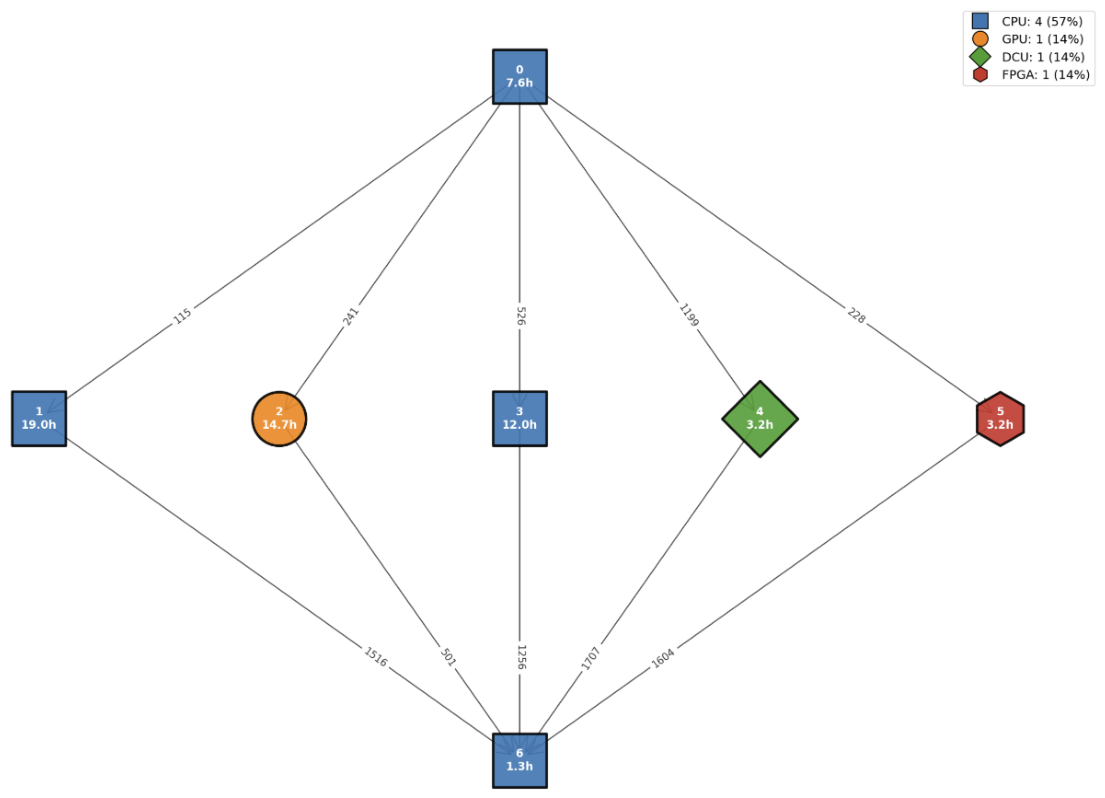
precedence constraints and data dependencies between tasks. For example, as
shown in
Figure 1, Task 2 (14.7 h) must be completed before its
dependent tasks can begin execution. Each task
is
characterized by its computational requirements, estimated execution time, and
resource type preferences. The DAG structure inherently prevents cyclic
dependencies, ensuring that workflows can be executed to completion without
deadlocks.
3.1.2. Task Characteristics and Constraints
Workflow tasks exhibit heterogeneous characteristics and impose specific constraints on scheduling decisions. The notation of the task is shown in
Table 1. Each task
has
associated metadata including its expected execution time
, resource type requirement
, and data dependencies
with
predecessor and successor tasks. The resource distribution in the provided
example (57% CPU
tasks, 14%
GPU tasks, 14% DCU
tasks, 14%
FPGA tasks) shows the different characteristics of
scientific workflows, where different computational stages require specialized
hardware accelerators. Additionally, tasks are subject to precedence
constraints:
cannot
start execution until all its predecessor tasks
have
completed and their output data has been transferred. Resource constraints
further limit task assignment because each task can only be scheduled on
resources that meet its computational needs.
3.2. Heterogeneous Computing Resource Model
The execution environment for scientific workflows consists of heterogeneous computing resources organized in a distributed architecture. Each resource is characterized by distinct computational capabilities, energy profiles, and cost structures. The notation of the resource is shown in
Table 2. The resource pool includes multiple resource types: CPU, GPU, FPGA, DCU, etc. Each resource
is defined by three key attributes: Compute Speed (CS) representing relative processing capability (normalized to a 1–10 scale), Price indicating cost per unit time of usage, and Power representing energy consumption in watts. Resources of the same type exhibit correlated performance–cost–energy relationships, where higher compute speeds generally correspond to higher prices and power consumption, though with ±20% random variation to reflect real-world market conditions. Inter-resource communication is modeled through a transfer speed matrix
that defines data transmission rates between all resource pairs in MB/s.
3.3. Multi-Objective Optimization Formulation
3.3.1. Primary Optimization Objectives
This research addresses the multi-objective optimization problem in workflow scheduling, where three conflicting objectives must be simultaneously optimized: makespan (total execution time), economic cost, and energy consumption. The optimization aims to find scheduling solutions that provide optimal trade-offs among these three dimensions, particularly important in computing environments where both performance efficiency and sustainability are critical considerations.
- (1)
Makespan Minimization
The makespan represents the total completion time of the workflow, calculated as the difference between the finish time of the last task and the start time of the first task. This objective seeks to minimize the overall execution time:
where
T is the set of all workflow tasks,
is
the actual start time of task
and
is
the actual completion time of task
.
- (2)
Economic Cost Minimization
The economic cost objective minimizes the total monetary expense of executing the workflow on computational resources. Each resource
has a price per time unit
, and the total cost accumulates as each task
executes on its assigned resource:
where
is the
resource assigned to task
.
- (3)
Energy Consumption Minimization
Service providers must account not only for server energy consumption but also for the power usage of supporting infrastructure, such as cooling and lighting systems. To accurately estimate the total energy consumption, this research adopts the Power Usage Effectiveness (PUE) metric. The energy consumption of task
executed on computing node
is calculated as follows:
where
denotes the utilization-power function of
, with
representing its resource utilization.
refers to the Power Usage Effectiveness of the data center where
is located, and
is the execution time.
3.3.2. Chebyshev Scalarization for Multi-Objective Optimization
The Chebyshev scalarization approach is a widely used method in multi-objective optimization that transforms multiple, often conflicting objectives into a single scalar objective through a weighted min-max formulation. Mathematically, given objectives
with corresponding weights
, the scalarized objective is defined as:
where
denotes the ideal value of the
i-th
objective, and normalization by (
) ensures all objectives are scaled to a
comparable range.
This formulation is particularly effective because it minimizes the maximum weighted deviation from the ideal values across all objectives. By focusing on the worst-performing objective at any given solution, it inherently promotes balanced trade-offs rather than allowing any single objective to dominate the optimization process. Unlike simple weighted-sum methods, which may fail to find solutions on non-convex parts of the Pareto front, Chebyshev scalarization guarantees Pareto-optimal solutions for any positive weight combination, enabling decision-makers to explore different regions of the Pareto front by adjusting weight preferences according to specific operational priorities.
In practice, this scalarization is efficient because it converts multi-objective problems into single-objective ones that standard optimization algorithms can solve. For the proposed reinforcement learning framework, this transformation ensures that the reward signal remains well-defined and stable during training.
To ensure the rationality and realism of the constructed resource model, all hardware-related parameter settings in this study refer to publicly available configurations of real heterogeneous computing clusters. The computational performance, power consumption characteristics, and data transmission bandwidth of each resource node are set within the common value range of practical cloud and HPC platforms. Although the experiments are conducted on a simulated scheduling platform, the resource parameter settings follow real-world physical constraints, which enhance the model applicability and ensure that the experimental results are representative of real heterogeneous scheduling scenarios.
4. Methodology
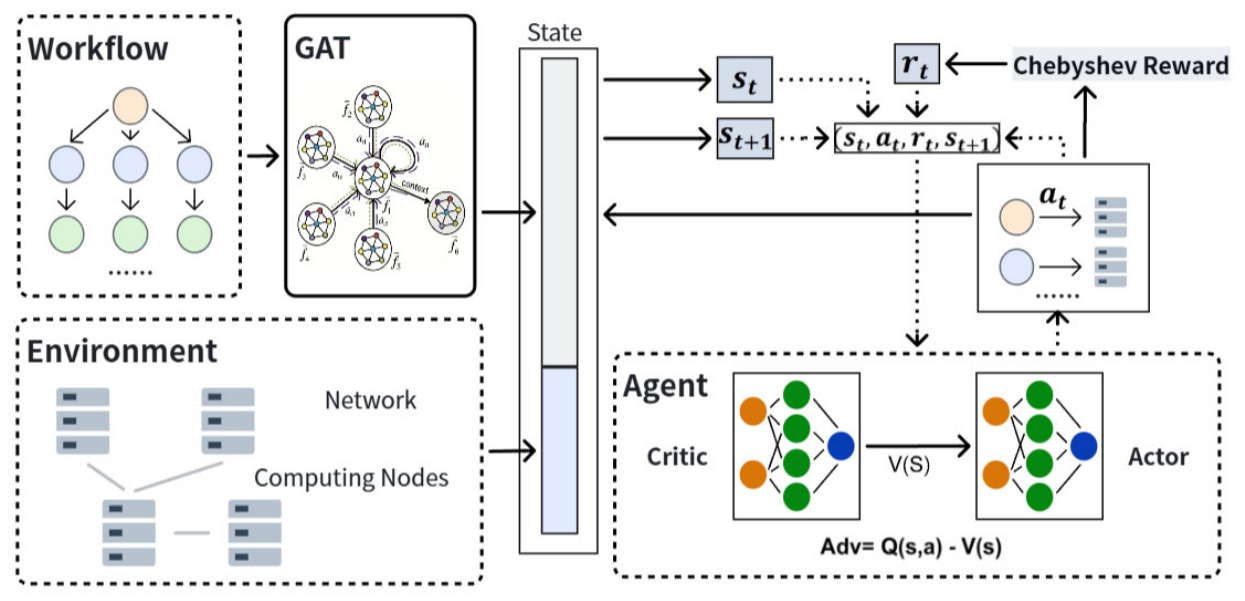
This section presents a scalable multi-objective workflow scheduling method called HiGAT-AC, which combines hierarchical graph attention and actor-critic reinforcement learning. As illustrated in
Figure 2, the framework integrates hierarchical graph attention with actor-critic reinforcement learning for scalable multi-objective workflow scheduling.
- (1)
Workflow Representation with GAT: The input workflow DAG is processed through a hierarchical graph attention network that captures task dependencies via spectral clustering-based graph partitioning, intra-subgraph sparse attention, inter-subgraph lightweight coordination, and global resource allocation.
- (2)
Environment Modeling: The heterogeneous computing environment consists of computing nodes with varying computational capabilities, energy profiles, and cost structures, interconnected by network infrastructure that models data transfer speeds between resources.
- (3)
State Formulation: At
each scheduling step, the state
encodes workflow progress, resource
availability, and task characteristics enhanced with HEFT priorities. The
transition tuple
forms the basis for experience replay and
learning.
- (4)
Agent Architecture: The actor-critic agent employs a
dual-network structure. The actor network learns a policy that maps states to
action probabilities for resource allocation. The critic network estimates the
state-value function V(s), representing expected cumulative reward. The
advantage function
quantifies the relative
benefit of taking action
compared to the average
action, guiding policy updates.
- (5)
Chebyshev-based Multi-Objective Reward: The reward function incorporates Chebyshev scalarization combined with linear weighted summation to balance three conflicting objectives—makespan minimization, economic cost reduction, and energy efficiency optimization.
The decision-making process of HiGAT-AC follows a structured multi-step reasoning pipeline. The hierarchical graph attention network first processes the workflow DAG at multiple granularities, learning sparse attention weights at the intra-subgraph level to prioritize tasks critical to local computation paths and identifying cross-partition dependencies at the inter-subgraph level that may bottleneck global progress, thereby capturing both fine-grained and coarse-grained task relationships to inform scheduling priorities. At each scheduling step, the state vector integrates workflow progress, real-time resource
availability, and task characteristics enhanced with HEFT priorities. The
critic network evaluates the long-term value of each possible state, while the
actor network maps this context-aware representation to concrete scheduling
actions. Guided by the Chebyshev scalarized reward function, the agent avoids
over-optimizing a single objective and instead learns to make balanced
trade-offs. For instance, it may select a slightly slower but more
energy-efficient resource to maintain balanced performance across makespan,
cost, and energy consumption. The advantage function further refines this
process by quantifying how much better the chosen action is than the average
policy, ensuring that policy updates consistently move the model toward more
balanced and optimal scheduling decisions. By combining dependency-aware
attention, context-rich state representation, and multi-objective reinforcement
learning, HiGAT-AC does not merely generate schedules; it actively reasons
about which tasks to prioritize, which resources to select, and how to balance
conflicting goals at each step.
4.1. Hierarchical Graph Attention Architecture
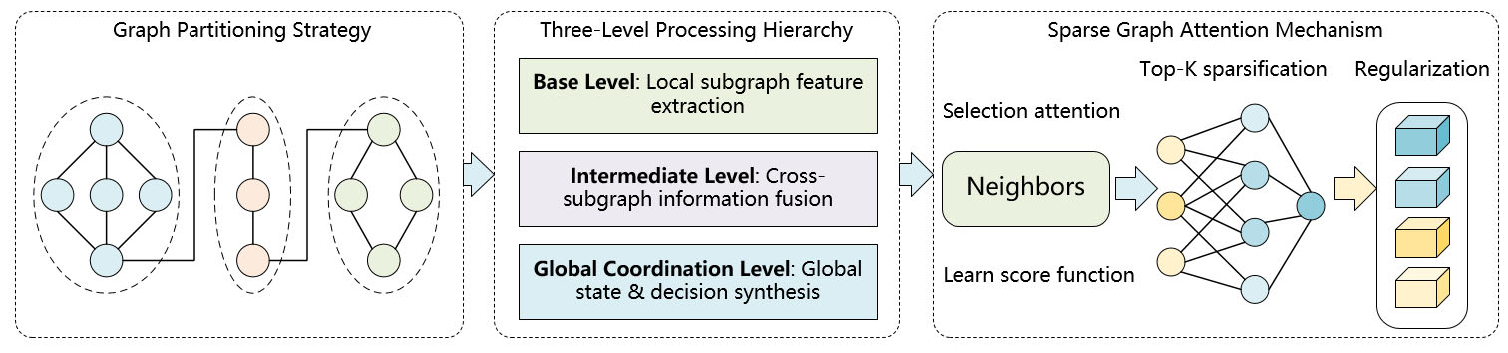
As illustrated in
Figure 3, the HiGAT-AC architecture integrates graph partitioning, a hierarchical processing pipeline, and sparse graph attention to enable scalable and efficient large-scale workflow scheduling. The detailed procedure is presented in Algorithm 1.
| Algorithm 1. HiGAT-AC scheduling procedure |
Require: DAG G, Resources M, Task features, Subgraph dependency matrix
Ensure: Optimal task-resource assignment
1: // Partition DAG into subgraphs
2: Partition G into subgraphs via spectral clustering
3: Ensure critical path tasks stay in one subgraph
4: // Local feature learning
5: for each subgraph do
6: Extract node features
7: Apply Sparse GAT (top-10 neighbors only)
8: Generate subgraph embedding via pooling
9: end for
10: // Cross-subgraph fusion
11: Build subgraph dependency graph
12: Input {} to cross-subgraph GAT
13: Output fused representations H
14: // State & policy update
15: Encode system state
16: Concatenate s and H → global feature f
17: Actor: f → softmax → resource probabilities
18: Critic: f → state value )
19: Update policy via policy gradient + MSE + entropy regularization
20: Return argmax(action probabilities) |
4.1.1. Graph Partitioning Strategy
The scalability of graph neural networks in large-scale workflow scheduling depends on effectively breaking large workflow graphs into smaller, computable parts. HiGAT-AC uses spectral clustering to divide the workflow DAG. It first builds a similarity matrix that reflects task connections and dependencies. Then it uses normalized cuts to split the DAG into subgraphs. Adaptive thresholds keep critical paths complete in each subgraph to preserve execution logic. For irregular workflows, a dynamic rebalancing mechanism adjusts task distribution across subgraphs to balance load and reduce communication costs. This partitioning turns the difficult scalability problem into a manageable hierarchical optimization task.
4.1.2. Three-Level Processing Hierarchy
HiGAT-AC’s main innovation is its three-layer structure that simplifies workflow processing at different levels. At the bottom layer, Subgraph Processors use local attention to learn task dependencies inside each subgraph. Subgraph representatives are key task nodes that represent each subgraph and connect different subgraphs. These processors turn task features into compact subgraph embeddings that capture local structure. At the middle layer, a light communication network connects these subgraph representatives. It fuses information across subgraphs, finds global workflow patterns, and removes unimportant local noise. At the top layer, a global coordinator combines subgraph representations with overall system state information. This hierarchical design reduces data complexity and avoids the curse of dimensionality, while keeping important scheduling information. The three layers work bottom-up for feature extraction and top-down for decision-making. This bidirectional information flow ensures both good local decisions and consistent global scheduling.
4.1.3. Sparse Graph Attention Mechanism
Traditional Graph Attention Network (GAT) is too computationally expensive for large workflows because it needs to compute attention between every pair of nodes. Our sparse attention mechanism only lets each task node focus on its K most important neighbors. It uses a learnable scoring function to choose these neighbors based on task dependency, time, resource fit, and data transfer needs. Attention weights are calculated with a modified additive function and LeakyReLU, then only the top-K connections are kept. In this setting, each of the N nodes computes attention weights only for its K selected neighbors, leading to a total of N × K operations. Thus, the overall time complexity is reduced from O() to O(N·K), which significantly lowers the computational overhead, especially for large-scale workflows where K remains much smaller than N. We also use multi-head attention with orthogonal initialization to learn different task relationships. The sparse structure changes during training, so the model can learn which task connections are most important for scheduling. With edge dropout for regularization, this adaptive sparse attention works well on many different workflow structures.
4.2. Actor-Critic Reinforcement Learning Framework
4.2.1. State Representation Design with HEFT-Informed Prioritization
In reinforcement learning for workflow scheduling, state design has to consider both current resource availability and each task’s importance in the dependency graph, so we add Heterogeneous Earliest Finish Time (HEFT) priorities directly into our state representation to give the agent useful heuristics that speed up training and improve scheduling results. HEFT calculates task priorities using upward rank, which considers task computation needs and data dependencies across the workflow, and integrating it has three main benefits: it provides an efficient and useful guide for early training, ensures tasks on critical paths get enough attention, and transfers knowledge from traditional scheduling methods to the deep reinforcement learning model.
The HEFT priority calculation employs a recursive upward rank formulation defined as:
where
represents the average execution time of task
across all compatible resources,
denotes the average communication cost between tasks
and
, and
is the set of immediate successor tasks of
.
Tasks are then sorted in descending order of their
values, with higher ranks indicating greater scheduling priority. In our implementation, we normalize these priorities to the [0, 1] range to ensure compatibility with other state features:
This normalized priority is embedded as a dedicated feature within our state vector, serving as an informative prior that complements the learned representations from the hierarchical graph attention mechanism. The combined state representation therefore encompasses three synergistic information streams: HEFT-based structural importance capturing global workflow criticality, resource-centric availability metrics detailing current system conditions, and task-specific characteristics including computational requirements and dependency constraints. This multi-faceted encoding enables the learning algorithm to balance immediate resource optimization against long-term workflow progression, with HEFT priorities providing particularly valuable guidance for early scheduling decisions that have cascading effects on overall workflow makespan. The state representation dynamically adjusts its dimensionality based on the number of ready tasks, employing zero-padding and masking mechanisms to handle variable-length inputs while maintaining fixed-dimensional processing within neural network layers. This adaptive representation ensures that the learning algorithm focuses computational resources on currently relevant information while retaining access to broader contextual knowledge.
4.2.2. Action Space and Policy Network
The action space of HiGAT-AC is formally defined as a discrete space, where each action corresponds to assigning one workflow task to a candidate computational resource within the heterogeneous resource pool. The dimension of the action space equals the total number of available heterogeneous resources.
The policy network takes hierarchical graph features as input and outputs a probability distribution over all feasible resource assignment actions. Residual connections and adaptive gating modules are adopted to enhance feature propagation and stabilize training. The softmax layer generates normalized assignment probabilities, considering both immediate scheduling reward and long-term cumulative performance. Entropy regularization is further introduced to balance exploration and exploitation: it maintains adequate randomness in the early training stage and gradually converges to a stable deterministic scheduling policy in later iterations.
4.2.3. Value Network and Advantage Estimation
The value estimation component of our framework provides the crucial learning signal that guides policy improvement toward long-term optimality. The value network, architecturally similar to but independent from the policy network, learns to predict the expected cumulative return from any given state under the current policy. This network receives the same state representation as the policy network but processes it through separate parameters to avoid confounding the objectives of value estimation and action selection. We employ Generalized Advantage Estimation (GAE) with λ-return blending to compute advantage values that balance bias–variance trade-offs in credit assignment. The advantage estimates capture the relative value of specific actions compared to the expected value of following the current policy, providing precisely targeted learning signals that accelerate convergence and improve final performance. The value network is trained using temporal difference learning with a clipped objective function that prevents destructive updates during periods of high variance in reward signals. This dual-network architecture, with separate but complementary learning objectives, creates a stable learning foundation that supports effective exploration of the complex, high-dimensional scheduling solution space.
4.2.4. Multi-Objective Reward Design
The reward function serves as the critical learning signal that guides the policy network toward optimal scheduling decisions in the complex multi-objective optimization landscape. Our reward effectively balances the competing objectives of makespan minimization, economic cost reduction, and energy efficiency optimization. The foundation of our approach lies in deviation-based normalization, where each objective’s performance is evaluated relative to its theoretical optimal value, providing a consistent and interpretable metric across objectives with different units and scales.
The deviation metrics for the three primary objectives are computed as:
where
and
are defined as the best possible single-objective performance achievable for the given workflow and resource set, under idealized scheduling conditions. Specifically,
is obtained by solving a single-objective scheduling problem to minimize makespan,
is obtained by solving a single-objective scheduling problem to minimize execution cost and
is obtained by solving a single-objective scheduling problem to minimize energy consumption. These values serve as normalized baselines to measure the relative deviation of multi-objective solutions. They represent practically achievable performance under the given system constraints, rather than strict theoretical lower bounds, ensuring fair and consistent scaling across different objectives. These baseline values ensure fair comparison across objectives and provide meaningful scaling that reflects actual improvement potential rather than absolute performance metrics.
To achieve effective multi-objective optimization, we implement a hybrid Chebyshev-linear aggregation approach:
The Chebyshev term () ensures Pareto optimality by focusing on the worst-performing objective, preventing solutions where dramatic improvement in one dimension comes at unacceptable deterioration in others. This component guarantees that the optimization process maintains balanced progress across all objectives. The weighting parameters , and are user-configurable coefficients that reflect the relative importance of each objective, where and for all i. Adjusting these weights directly shapes the characteristics of the final schedule. When assigning a larger weight to , the model places higher priority on computational performance, tending to allocate high-performance resources to reduce overall makespan. Increasing and shifts the optimization tendency toward green and economical scheduling, prompting the algorithm to prefer low-cost and energy-efficient resources to lower system overhead. By tuning the three weighting coefficients reasonably, users can flexibly balance performance-oriented scheduling and green computing demands, which provides clear practical guidance for model configuration under different application priorities.
The total deviation metric combines these two components:
where
is a small scaling factor that controls the relative influence of the linear term. This combination ensures that the primary optimization driver remains the Chebyshev component, maintaining Pareto optimality, while the linear term provides fine-grained guidance for incremental improvements.
The reward computation then converts the deviation metric into a positive reinforcement signal:
where
is a scaling factor and [
L,
U] are clipping bounds that stabilize training by preventing extreme reward values. These hyperparameters can be adjusted for different workflow scales and optimization objectives.
This reward function has several key advantages: it is scale-invariant, ensures Pareto optimality using the Chebyshev term, supports stable exploration with linear guidance, and remains stable during training due to bounded reward values. It allows the agent to balance makespan, cost, and energy efficiency effectively. The model learns solutions that match user preferences and works reliably across different workflows and resource settings.
5. Experiment
This section presents a comprehensive evaluation of the proposed HiGAT-AC method through a series of systematic experiments.
5.1. Experimental Dataset
To fully evaluate HiGAT-AC, we use a synthetic workflow dataset produced by our own DAG generator. The generator allows us to adjust parameters such as the number of tasks, graph density, resource heterogeneity, and communication–computation ratio. This lets us test the scheduling algorithm’s scalability and stability under different settings. We build workflows that imitate real structures. Tasks have different resource requirements (CPU/GPU/DCU/FPGA…), and their execution times follow realistic distributions used in high-performance computing.
5.2. Baseline Algorithm
To validate HiGAT-AC’s effectiveness, we conduct comparative experiments under various configurations. We compare it with three established baselines: the classical heuristic HEFT, the standard reinforcement learning method actor-critic, and a GA (Genetic Algorithm)-based scheduling approach.
Heterogeneous Earliest Finish Time (HEFT): HEFT is a classical heuristic scheduling algorithm that assigns task priorities based on upward rank calculation and schedules each task to the resource that minimizes its earliest finish time. It is widely recognized for its efficiency in handling heterogeneous environments and provides a solid baseline for makespan-oriented workflow scheduling.
Actor-Critic: AC is a fundamental reinforcement learning architecture that combines a policy network for action selection and a value network for state evaluation. In workflow scheduling, AC-based methods learn to map workflow states to resource assignments through trial and error, aiming to optimize cumulative rewards. This baseline represents a standard learning-driven approach without explicit hierarchical or multi-objective enhancements.
Genetic Algorithm (GA): GA is a classic evolutionary computation algorithm inspired by the natural selection and genetic variation mechanisms in biological evolution. It encodes scheduling solutions into “chromosomes” (e.g., task-resource assignment sequences) and iteratively evolves the population through core operations including selection, crossover, and mutation. In workflow scheduling, GA evaluates the fitness of each candidate solution based on predefined objectives (e.g., makespan, resource utilization), selects high-performance solutions for reproduction, generates new candidate solutions via crossover of parental genes, and introduces random variations through mutation to explore the solution space. As a population-based stochastic optimization method, GA does not rely on gradient information or explicit state evaluation networks and is renowned for its strong global search capability and robustness in solving complex combinatorial optimization problems.
Proximal Policy Optimization (PPO): PPO is a state-of-the-art reinforcement learning algorithm that achieves a reliable balance between exploration and exploitation by constraining policy updates within a small, stable range to avoid large, destructive gradient steps. Built on the actor-critic framework, PPO uses a clipped surrogate objective function to iteratively optimize policy and value networks, making it more stable, sample-efficient, and robust than traditional policy gradient methods. In workflow scheduling, PPO learns to assign tasks to heterogeneous resources by interacting with scheduling environments, optimizing long-term cumulative rewards related to makespan, resource utilization, or cost. As a widely adopted and practical reinforcement learning baseline, PPO effectively handles complex decision-making processes in dynamic scheduling scenarios and provides strong performance for sequential resource allocation tasks.
Graph Neural Networks (GNNs): GNN is a class of deep learning models designed to learn representations from graph-structured data by propagating and aggregating features across connected nodes and edges. Given that workflow applications are naturally modeled as directed acyclic graphs (DAGs) with task dependencies, GNNs excel at capturing topological structures, task dependencies, and resource relationships in scheduling problems. By embedding local and global graph information into low-dimensional feature vectors, GNNs enable effective feature extraction and structural understanding for scheduling decision models. When integrated with reinforcement learning or heuristic policies, GNN-based scheduling methods significantly improve the ability to model complex dependencies, leading to better task-resource assignments and enhanced performance in makespan optimization and resource efficiency.
5.3. Experimental Setup
The key hyperparameters of HiGAT-AC are configured as follows: For the sparse GAT architecture, the dropout rate is set to 0.1, the negative slope of LeakyReLU (alpha) is 0.2, each node attends to a maximum of 10 neighbors, and multi-head attention uses 4 heads with hidden/output dimensions of 16/8 for subgraph-level GAT layers. Spectral clustering for graph partitioning adopts 25 target subgraphs, with subgraph size constrained between 30 and 50 tasks. For the actor-critic framework, the learning rates for actor and critic networks are both 5 × 10⁻⁴, the reward discount factor (gamma) is 0.99, the epsilon-greedy exploration strategy initializes at 1.0, decays by 0.9995 per step, and bottoms out at 0.4. Entropy regularization (coefficient = 0.1) is applied to encourage exploration, with L2 weight decay (1 × 10⁻⁵) and gradient clipping (max norm = 0.5) to stabilize training. The state encoder uses a 3-layer MLP (64 → 32 → 8), and the global coordinator leverages a 2-layer MLP (128 → 128) to fuse subgraph embeddings and state information.
5.4. Results and Analysis
To validate the effectiveness of the proposed HiGAT-AC algorithm in achieving balanced optimization across multiple objectives, we introduce a comprehensive evaluation metric based on normalized weighted scoring. This metric synthesizes performance across all three optimization dimensions—makespan, cost, and energy consumption—into a single composite score, reflecting a specific user-defined preference (e.g., weights of 0.4, 0.3, and 0.3, respectively). The calculation proceeds in two steps: first, each objective value is normalized to a [0, 1] range relative to the best and worst performers among all baselines, with a score of 1 is assigned to the optimal value for that objective; second, the composite score is computed as the weighted sum of these normalized values. A higher composite score indicates superior overall performance in holistic multi-objective optimization under the given preference weights. The aforementioned steps can be formalized by the following equations:
where
and
are the maximum and minimum values, respectively, observed for that metric among all algorithms.
,
and
are the predefined weights.
5.4.1. Comprehensive Evaluation
We conduct comparative experiments on large-scale synthetic workflows with task counts ranging from 500 to 1000, comparing the proposed HiGAT-AC with the five aforementioned baseline algorithms.
As shown in
Table 3, the proposed HiGAT-AC method achieves consistently high composite scores across most workflow scales from 500 to 1000 tasks and shows competitive performance compared with baseline methods including HEFT, AC, GA, PPO, and GNN.
Note on composite score calculation: The composite score is computed via min-max normalization, where and are determined by the range
of performance values of all methods included in the same table. For this main
comparison table, normalization is performed against all baseline methods
(HEFT, AC, GA, PPO, GNN) plus HiGAT-AC.
Compared with the baselines, HiGAT-AC demonstrates clear advantages across multiple dimensions. Traditional heuristics such as HEFT rely on static priority rules and fail to adapt to dynamic resource conditions, leading to the lowest composite scores in most cases. Evolutionary algorithms like GA achieve moderate performance but suffer from high computational overhead and unstable convergence. Standard reinforcement learning methods, including AC and PPO, lack explicit modeling of task dependencies, resulting in suboptimal scheduling decisions for complex DAG structures. Flat GNNs capture partial topological information but use full-attention mechanisms that ignore hierarchical task structures, limiting their scalability in large-scale scenarios. In contrast, HiGAT-AC leverages hierarchical graph attention to capture both local task dependencies and global structural patterns, combined with multi-objective scalarization to balance makespan, cost, and energy consumption. This combination enables the method to maintain stable and competitive comprehensive performance under the given weighting strategy, achieving particularly strong results on 500-task and 1000-task workflows, which indicates its reliable optimization ability across different scales.
HiGAT-AC also exhibits strong scalability in large-scale scenarios. As the number of tasks increases, most baseline methods show significant performance degradation due to their limited ability to handle complex dependencies and dynamic resource states. HiGAT-AC, however, remains relatively stable across all tested scales, maintaining composite scores above 0.70 in all cases. This stability stems directly from its design: the hierarchical subgraph processing reduces the complexity of dependency modeling, while the sparse attention mechanism focuses computational resources on critical dependencies, allowing the model to scale efficiently without sacrificing performance.
Finally, HiGAT-AC consistently achieves a better balance among multiple objectives. Instead of over-optimizing a single metric, HiGAT-AC maintains reasonable performance across makespan, cost, and energy, leading to more balanced and practical scheduling results. The composite score results confirm that HiGAT-AC outperforms traditional heuristics, standard reinforcement learning methods, and flat graph neural networks in multi-objective optimization. The hierarchical structure improves scalability, while the actor-critic framework with multi-objective scalarization contributes to stable and robust performance. These results demonstrate the effectiveness and potential of HiGAT-AC for large-scale scientific workflow scheduling.
5.4.2. Ablation Study
To rigorously validate the effectiveness of each core component in HiGAT-AC, we conduct a series of ablation experiments. Analyzing the source of performance improvements is important for complex models with multiple new mechanisms, as it helps avoid redundancy and verify that each module is necessary. In this work, we focus on analyzing the hierarchical graph attention network and the Chebyshev scalarization-based reward function to evaluate their individual effects on multi-objective scheduling performance.
We design two ablated variants of our full model:
HiGAT-AC (w/o GAT): This variant replaces the hierarchical graph attention network with a standard multi-layer perceptron for state encoding. It retains the actor-critic framework and the Chebyshev-based multi-objective reward to isolate the effectiveness of the graph attention mechanism in capturing complex task dependencies.
HiGAT-AC (w/o Chebyshev): This variant removes the Chebyshev scalarization from the reward function, relying solely on a linear weighted sum of the normalized makespan, cost, and energy deviations. The hierarchical graph attention architecture is kept intact to evaluate the contribution of the Chebyshev method in achieving balanced optimization.
Table 4 presents the results of the ablation study conducted on synthetic workflows with scales from 500 to 1000 tasks, aiming to verify the contribution of each core component in the HiGAT-AC framework.
Note on composite score calculation: For the ablation study table, normalization is performed only among the three variants (HiGAT-AC, HiGAT-AC w/o GAT, and HiGAT-AC w/o Chebyshev). Since the set of methods included differs from the main comparison table, the composite scores for HiGAT-AC are naturally different, even though its raw performance values are identical.
The complete HiGAT-AC model consistently achieves the highest composite scores across all workflow scales, demonstrating the synergistic effect of its integrated components. For workflows with 500 and 1000 tasks, HiGAT-AC attains a perfect score of 1, indicating that the full model achieves the optimal balance of makespan, cost, and energy consumption under the current weighting strategy. For other workflow scales, the complete model also significantly outperforms both ablated versions, confirming that neither the graph attention mechanism nor the Chebyshev scalarization alone can replicate the performance of the integrated framework.
In contrast, removing either component leads to clear and interpretable performance degradation. HiGAT-AC (w/o GAT) suffers the most severe performance drop, with its composite score plummeting to 0.071 at the 1000-task scale. This sharp decline is directly attributable to the removal of the hierarchical graph attention mechanism, which is responsible for modeling complex task dependencies and inter-subgraph relationships. Without it, the model can no longer identify critical scheduling paths or allocate resources based on structural information, resulting in poor scalability and suboptimal decisions in large-scale scenarios.
HiGAT-AC (w/o Chebyshev) also exhibits inferior performance compared to the full model, particularly at larger scales, with a score of only 0.168 for the 1000-task workflow. This confirms the critical role of Chebyshev scalarization in balancing conflicting scheduling objectives. Without this mechanism, the agent tends to prioritize a single metric (e.g., makespan) at the expense of others (e.g., energy or cost), leading to imbalanced solutions and reduced robustness across different workflow scales.
These ablation results validate the necessity of each core component in HiGAT-AC. The graph attention mechanism provides structured dependency modeling, while the Chebyshev scalarization ensures balanced multi-objective optimization. Their integration produces a synergistic effect that significantly enhances the model’s multi-objective optimization capability, scalability, and robustness.
5.4.3. Training Time
To further evaluate the practical efficiency of HiGAT-AC, we compare the training time of HiGAT-AC with that of baseline algorithms across different workflow scales, as shown in
Table 5.
Compared with the GA method, which requires a large amount of computation time, HiGAT-AC shows significantly lower time complexity. Even for the largest 1000-task workflow, the training time remains within 147.08 s, which is much shorter than that of population-based optimization methods. This suggests that the hierarchical graph attention and actor-critic framework can learn scheduling policies with relatively acceptable computational overhead. Although heuristic methods (HEFT) and simple reinforcement learning methods (AC, PPO) have faster execution times, they lack the multi-objective optimization capability of HiGAT-AC. The training time of HiGAT-AC increases gradually with workflow size, showing relatively stable scalability, which is acceptable for most practical scheduling scenarios. Compared with the standard GNN method, HiGAT-AC requires more training time due to its three-level attention structure. However, this moderate increase in computational cost is accompanied by improved multi-objective scheduling performance. Overall, the results indicate that HiGAT-AC achieves a reasonable balance between solution quality and computational efficiency and provides a feasible option for heterogeneous workflow scheduling.
6. Conclusions and Future Work
This paper presented HiGAT-AC, a hierarchical graph attention network integrated with actor-critic reinforcement learning for scalable multi-objective workflow scheduling in heterogeneous computing environments. The proposed framework addresses the key challenges of scalability in large-scale workflows and multi-objective trade-offs among conflicting metrics through three main innovations: (1) a spectral clustering-based graph partitioning strategy that decomposes large workflows into semantically coherent subgraphs, enabling efficient hierarchical processing; (2) a three-level graph attention architecture with sparse attention mechanisms that reduce computational complexity while preserving critical dependency information; and (3) a multi-objective actor-critic learning framework that employs Chebyshev scalarization combined with linear aggregation to balance makespan, cost, and energy consumption.
Extensive experimental results show that HiGAT-AC achieves competitive and favorable composite scores across workflow scales from 500 to 1000 tasks. In particular, HiGAT-AC achieves composite scores of 0.954 for 500-task workflows and 1.000 for 1000-task workflows and maintains scores above 0.70 across all tested scales. Compared with traditional heuristic algorithms and representative learning-based scheduling methods, HiGAT-AC exhibits better overall performance in balancing makespan, cost, and energy consumption. HiGAT-AC also shows relatively stable and favorable scalability as the workflow scale increases, indicating its potential for large-scale scientific workflow scheduling in heterogeneous environments.
The current study is subject to two main limitations that should be acknowledged. First, all experiments are conducted using synthetic workflow datasets, which provide controlled conditions to evaluate scalability and multi-objective performance. However, conclusions drawn from synthetic data may not fully generalize to real-world scientific workflows with more complex dynamics and heterogeneous characteristics. Second, due to the high computational overhead training of the proposed hierarchical model and baseline methods, experiments are currently performed under fixed random seeds, without formal statistical analysis such as variance, standard deviation, or significance testing across multiple runs. While the results consistently show the relative performance advantage of HiGAT-AC, further statistical validation is needed to confirm the stability and reliability of the observed improvements.
Future work will focus on addressing these limitations. We plan to validate the proposed HiGAT-AC on real-world workflow traces collected from heterogeneous computing clusters to better assess their practical applicability. Additionally, we will conduct repeated experiments with different random seeds to provide a comprehensive statistical analysis of the results. We will also further optimize the training strategies of the hierarchical graph attention network to improve both scheduling accuracy and training efficiency and incorporate real-time factors such as network latency fluctuations and unexpected node failures into the model to enhance its adaptability and robustness in evolving computing environments.
Author Contributions
Conceptualization, C.W. and H.X.; methodology, C.W. and H.X.; software, C.W. and X.W.; validation, C.W., H.X. and Y.Z.; formal analysis, C.W., H.X. and Y.Z.; investigation, C.W.; resources, S.L. and R.H.; data curation, S.L. and R.H.; writing—original draft preparation, C.W.; writing—review and editing, C.W., S.L. and R.H.; visualization, C.W.; supervision, H.X.; project administration, H.X.; funding acquisition, H.X. All authors have read and agreed to the published version of the manuscript.
Funding
This research was supported by the National Key Research and Development Program of China (Grant No. 2023YFB3002302).
Institutional Review Board Statement
Not applicable.
Informed Consent Statement
Not applicable.
Data Availability Statement
The data presented in this study are available on request from the corresponding author.
Conflicts of Interest
The authors declare no conflicts of interest.
References
- Topcuoglu, H.; Hariri, S.; Wu, M.Y. Performance-Effective and Low-Complexity Task Scheduling for Heterogeneous Computing. IEEE Trans. Parallel Distrib. Syst. 2002, 13, 260–274. [Google Scholar] [CrossRef]
- Jie, L.; Kenli, L.; Chubo, L.; Keqin, L. Are task mappings with the highest frequency of servers so good? A case study on heterogeneous earliest finish time (HEFT) algorithm. J. Syst. Archit. 2021, 121, 102311. [Google Scholar]
- Zhi, W.; Wenhan, Z.; Hancong, D.; Geyong, M.; Hualong, H. Deep-Reinforcement -Learning-Based Continuous Workflows Scheduling in Heterogeneous Environments. IEEE Internet Things J. 2025, 12, 14036–14050. [Google Scholar]
- Ding, F.; Yuan, Y.; Lv, L.; Zhang, R.; Zhou, W. Transformer-Enhanced DQN Approach for Energy and Cost-Efficient Large-Scale Dynamic Workflow Scheduling in Heterogeneous Environment. IEEE Internet Things J. 2024, 11, 37351–37367. [Google Scholar] [CrossRef]
- Tang, X.; Liu, F.; Wang, B.; Xu, D.; Jiang, J.; Wu, Q.; Chen, C.P. Workflow scheduling based on asynchronous advantage actor–critic algorithm in multi-cloud environment. Expert Syst. Appl. 2024, 258, 125245. [Google Scholar] [CrossRef]
- Mangalampalli, S.; Hashmi, S.S.; Gupta, A.; Karri, G.R.; Rajkumar, K.V.; Chakrabarti, T. Multi Objective Prioritized Workflow Scheduling Using Deep Reinforcement Based Learning in Cloud Computing. IEEE Access 2024, 12, 5373–5392. [Google Scholar] [CrossRef]
- Li, H.; Wang, B.; Yuan, Y.; Zhou, M.; Fan, Y.; Xia, Y. Scoring and Dynamic Hierarchy-Based NSGA-II for Multiobjective Workflow Scheduling in the Cloud. IEEE Trans. Autom. Sci. Eng. 2022, 19, 982–993. [Google Scholar] [CrossRef]
- Wang, Y.; Zuo, X. An Effective Cloud Workflow Scheduling Approach Combining PSO and Idle Time Slot-Aware Rules. IEEE/CAA J. Autom. Sin. 2021, 8, 1079–1094. [Google Scholar] [CrossRef]
- Sobhanayak, S. MOHBA: Multi-objective workflow scheduling in cloud computing using hybrid BAT algorithm. Computing 2023, 105, 2119–2142. [Google Scholar] [CrossRef]
- Zeedan, M.; Attiya, G.; El-Fishawy, N. Enhanced hybrid multi-objective workflow scheduling approach based artificial bee colony in cloud computing. Computing 2023, 105, 217–247. [Google Scholar] [CrossRef]
- Kruekaew, B.; Kimpan, W. Enhancing of Artificial Bee Colony Algorithm for Virtual Machine Scheduling and Load Balancing Problem in Cloud Computing. Int. J. Comput. Intell. Syst. 2020, 13, 496–510. [Google Scholar] [CrossRef]
- Li, Y.; He, Y.; Lin, J.; Xu, Z.; Zhang, S. A Reinforcement Learning-Based Population Hyper-Heuristic for Energy-Efficient Cloud Workflow Scheduling Problem. IEEE Trans. Serv. Comput. 2025, 18, 2545–2558. [Google Scholar] [CrossRef]
- Wang, X.; Cao, J.; Buyya, R. Adaptive Cloud Bundle Provisioning and Multi-Workflow Scheduling via Coalition Reinforcement Learning. IEEE Trans. Comput. 2023, 72, 1041–1054. [Google Scholar] [CrossRef]
- Leong, C.P.; Liew, C.S.; Chan, C.S.; Rehman, M.H.U. Optimizing Workflow Task Clustering Using Reinforcement Learning. IEEE Access 2021, 9, 110614–110626. [Google Scholar] [CrossRef]
- Asghari, A.; Sohrabi, M.K.; Yaghmaee, F. A Cloud Resource Management Framework for Multiple Online Scientific Workflows Using Cooperative Reinforcement Learning Agents. Comput. Netw. 2020, 179, 107340. [Google Scholar] [CrossRef]
- Asghari, A.; Sohrabi, M.K.; Yaghmaee, F. Online Scheduling of Dependent Tasks of Cloud’s Workflows to Enhance Resource Utilization and Reduce the Makespan Using Multiple Reinforcement Learning-Based Agents. Soft Comput. 2020, 24, 16177–16199. [Google Scholar] [CrossRef]
- Kaur, A.; Singh, P.; Singh Batth, R.; Peng Lim, C. Deep-Q Learning-based Heterogeneous Earliest Finish Time Scheduling Algorithm for Scientific Workflows in Cloud. Softw. Pract. Exp. 2020, 52, 689–709. [Google Scholar] [CrossRef]
- Tong, Z.; Deng, X.; Chen, H.; Mei, J.; Liu, H. QL-HEFT: A Novel Machine Learning Scheduling Scheme Base on Cloud Computing Environment. Neural Comput. Appl. 2020, 32, 5553–5570. [Google Scholar] [CrossRef]
- Mnih, V.; Kavukcuoglu, K.; Silver, D.; Rusu, A.A.; Veness, J.; Bellemare, M.G.; Hassabis, D. Human-level control through deep reinforcement learning. Nature 2015, 518, 529–533. [Google Scholar] [CrossRef] [PubMed]
- Mangalampalli, S.S.; Karri, G.R.; Ch, P.R.; Pokkuluri, K.S.; Chakrabarti, P.; Chakrabarti, T. An Energy and Temperature Aware Deep Reinforcement Learning Workflow Scheduler in Cloud Computing. IEEE Access 2024, 12, 163424–163443. [Google Scholar] [CrossRef]
- Zhang, J.; Ning, Z.; Waqas, M.; Alasmary, H.; Tu, S.; Chen, S. Hybrid Edge-Cloud Collaborator Resource Scheduling Approach Based on Deep Reinforcement Learning and Multi-objective Optimization. IEEE Trans. Comput. 2024, 73, 192–205. [Google Scholar] [CrossRef]
- Van Hasselt, H.; Guez, A.; Silver, D. Deep Reinforcement Learning with Double Q-Learning. In Proceedings of the AAAI Conference on Artificial Intelligence, Phoenix, AZ, USA, 12–17 February 2016; pp. 2094–2100. [Google Scholar]
- Dong, T.; Xue, F.; Tang, H.; Xiao, C. Deep Reinforcement Learning for Fault-Tolerant Workflow Scheduling in Cloud Environment. Appl. Intell. 2023, 53, 9916–9932. [Google Scholar] [CrossRef]
- Li, H.; Huang, J.; Wang, B.; Fan, Y. Weighted Double Deep Q-Network Based Reinforcement Learning for Bi-Objective Multi-Workflow Scheduling in the Cloud. Clust. Comput. 2022, 25, 751–768. [Google Scholar] [CrossRef]
- Konda, V.R.; Tsitsiklis, J.N. On actor-critic algorithms. SIAM J. Control Optim. 2003, 42, 1143–1166. [Google Scholar] [CrossRef]
- Dong, T.; Xue, F.; Xiao, C.; Zhang, J. Deep Reinforcement Learning for Dynamic Workflow Scheduling in Cloud Environment. In Proceedings of the IEEE International Conference on Services Computing, Chicago, IL, USA, 5–10 September 2021; pp. 107–115. [Google Scholar]
- Mnih, V.; Badia, A.P.; Mirza, M.; Graves, A.; Lillicrap, T.; Harley, T.; Kavukcuoglu, K. Asynchronous Methods for Deep Reinforcement Learning. In Proceedings of the 33rd International Conference on International Conference on Machine Learning, New York, NY, USA, 19–24 June 2016; pp. 1928–1937. [Google Scholar]
- Baheri, B.; Tronge, J.; Fang, B.; Li, A.; Chaudhary, V.; Guan, Q. MARS: Malleable Actor-Critic Reinforcement Learning Scheduler. In Proceedings of the IEEE International Performance, Computing, and Communications Conference, Austin, TX, USA, 11–13 November 2022; pp. 217–226. [Google Scholar]
- Wang, B.; Li, H.; Lin, Z.; Xia, Y. Temporal Fusion Pointer Network-Based Reinforcement Learning Algorithm for Multi-Objective Workflow Scheduling in the Cloud. In Proceedings of the International Joint Conference on Neural Networks, Glasgow, UK, 19–24 July 2020; pp. 1–8. [Google Scholar]
- Gu, Y.; Cheng, Y.; Chen, C.P.; Wang, X. Proximal Policy Optimization with Policy Feedback. IEEE Trans. Syst. Man. Cybern. Syst. 2022, 52, 4600–4610. [Google Scholar] [CrossRef]
- Xu, D.; Li, B. PF-MPPO: Task-dependent workflow scheduling method based on deep reinforcement learning in dynamic heterogeneous cloud environments. Future Gener. Comput. Syst. 2026, 177, 108236. [Google Scholar] [CrossRef]
- Zhang, J.; Wang, T.; Cheng, L. Time-Sensitive and Resource-Aware Concurrent Workflow Scheduling for Edge Computing Platforms Based on Deep Reinforcement Learning. Appl. Sci. 2024, 13, 10689. [Google Scholar] [CrossRef]
- Yu, X.; Wu, W.; Wang, Y. Integrating Cognition Cost with Reliability QoS for Dynamic Workflow Scheduling Using Reinforcement Learning. IEEE Trans. Serv. Comput. 2023, 16, 2713–2726. [Google Scholar] [CrossRef]
- Raith, P.; Rattihalli, G.; Dhakal, A.; Chalamalasetti, S.R.; Milojicic, D.; Frachtenberg, E.; Nastic, S.; Dustdar, S. Opportunistic energy-aware scheduling for container orchestration platforms using graph neural networks. In Proceedings of the 2024 IEEE 24th International Symposium on Cluster, Cloud and Internet Computing (CCGrid); IEEE: New York, NY, USA, 2024; pp. 299–308. [Google Scholar]
- Zhou, D.; Huang, J.; Zhang, Y.; Chan, W.K. GNN-heatmap augmented Monte Carlo tree search for cloud workflow scheduling. In Proceedings of the 2025 Winter Simulation Conference (WSC); IEEE: New York, NY, USA, 2025; pp. 2443–2454. [Google Scholar]
- Sharma, A.K.; Kunkel, J. Grapheon RL: A graph neural network and reinforcement learning framework for constraint and data-aware workflow mapping and scheduling in heterogeneous HPC systems. In Proceedings of the 2025 IEEE 49th Annual Computers, Software, and Applications Conference (COMPSAC); IEEE: New York, NY, USA, 2025; pp. 489–496. [Google Scholar]
- Hattay, A.; Mboula, F.N.; Gascard, E.; Yahouni, Z. On the role of DAG topology in energy-aware cloud scheduling: A GNN-based deep reinforcement learning approach. arXiv 2026, arXiv:2604.09202. [Google Scholar]
| Disclaimer/Publisher’s Note: The statements, opinions and data contained in all publications are solely those of the individual author(s) and contributor(s) and not of MDPI and/or the editor(s). MDPI and/or the editor(s) disclaim responsibility for any injury to people or property resulting from any ideas, methods, instructions or products referred to in the content. |