1. Introduction
Intelligent cockpits evolve from interface-centered information systems into cooperative environments in which Artificial Intelligence (AI) agents perceive context, anticipate user needs, and initiate interaction without explicit commands. In this transition, the design problem is no longer limited to what the system should communicate but extends to when communication should occur. Buyukgoz et al. define proactive AI as the ability to “autonomously initiate anticipatory action based on reasoning” [
1], while recent intelligent cockpit research has emphasized context awareness, multimodal integration, and adaptive interaction as key enablers of next-generation in-vehicle experience [
2]. Yet, increased proactivity does not automatically translate into better cooperation. If system interventions are poorly timed, they can be experienced as disruptive rather than intelligent, thereby undermining trust, perceived usefulness, and the overall quality of interaction [
3].
Across human–computer interaction research, prompt timing has emerged as a consequential design variable rather than a secondary implementation detail. Prior studies on interruptions, notifications, and adaptive interventions show that the effectiveness of system prompts depends on their relationship to task structure, attentional availability, and user receptivity [
4,
5,
6]. In particular, timing frameworks based on task phases, interruptibility windows, and just-in-time support suggest that interventions are best received when they align with the user’s cognitive rhythm rather than with system convenience alone [
4,
5,
6]. This issue is especially salient in vehicle environments, where the appropriateness of an intervention depends on rapidly changing attentional demands and situational conditions [
7,
8]. However, most automotive work has focused on operator-centered scenarios such as warnings, take-over requests, and navigation support. As automated driving advances toward Level 3 and beyond, the user’s role progressively shifts from continuous vehicle control to supervision, interpretation, and experience-oriented engagement. The timing of proactive AI prompts in these more cooperative, experience-centered cockpit conditions remains insufficiently understood [
2,
8].
This gap is particularly consequential in tourism-oriented autonomous driving contexts. Unlike routine commuting, tourism travel involves frequent shifts among observation, planning, environmental interpretation, and spontaneous decision-making, creating natural fluctuations in interruptibility and cognitive readiness [
8,
9]. In such contexts, proactive prompts are not merely functional notifications; they become part of the journey experience itself. The design challenge is therefore not only to make proactive AI informative but also to make it temporally appropriate within a cooperative human–machine interaction loop. A prompt delivered too late may signal weak situational awareness; a prompt delivered during an inopportune moment may increase cognitive burden; and even useful content may be rejected if it fails to match the user’s temporal state [
3,
4,
5,
6,
7].
Against this background, this paper investigates how proactive AI prompt timing shapes user experience in an intelligent cockpit scenario for autonomous tourism driving. Rather than treating timing as a minor interface parameter, the study positions it as a core variable in cooperative interaction design. In a within-subjects experiment conducted in a Virtual Reality (VR) environment, the research compares identical prompts delivered before, during, and after salient driving events and evaluates their effects on cognitive load, trust in automation, perceived usefulness, and overall user experience. The paper’s contribution is twofold and operates on two distinct levels. Empirically, it demonstrates that prompt timing, when isolated from content and modality, produces systematic and simultaneous effects across cognitive load, trust, perceived usefulness, and overall experience in an intelligent cockpit scenario. Conceptually, it advances temporal alignment as the explanatory construct that organizes these effects, defining it as the degree to which system intervention synchronizes with the user’s cognitive rhythm. The empirical contribution establishes that timing matters and how it matters; the conceptual contribution proposes a framework through which these effects can be interpreted and translated into design logic. The two contributions are complementary rather than redundant: the empirical findings give the construct its anchor, while the construct gives the findings explanatory coherence. This contribution matters because it reframes proactive intelligence in cooperative human–machine interaction not as mere responsiveness, but as temporal sensitivity. On that basis, the paper argues that intelligent cockpit systems should move beyond fixed or event-triggered prompting toward timing-aware cooperative support, and it derives a layered design logic for anticipatory, concurrent, and reflective prompting in autonomous travel contexts.
The remainder of this paper is organized as follows.
Section 2 reviews related work and identifies the research gap this study addresses.
Section 3 introduces the conceptual framework and formulates the research hypotheses.
Section 4 describes the methodology, including the study design, experimental setup, protocol, and data analysis procedures.
Section 5 presents the results, covering both descriptive findings and inferential analyses across all measured dimensions.
Section 6 discusses the implications of the results in relation to prior work and outlines key insights. Finally,
Section 7 concludes the paper and highlights directions for future research.
2. Related Work and Research Gap
Proactive AI has been defined not simply as system initiative, but as the capacity to anticipate, reason, and act autonomously in ways that affect users and their environments [
1]. In human–computer interaction (HCI), this shift from reactive response to proactive intervention has been accompanied by a parallel shift in the design problem itself: the issue is no longer only what information a system should provide but also how initiative should be orchestrated so that it is perceived as useful rather than intrusive. Recent work on proactive AI systems and dialog strategies shows that user acceptance depends heavily on whether system behavior appears contextually appropriate, trustworthy, and well-judged in relation to ongoing activity [
3,
10]. This is especially relevant for intelligent cockpits, where AI is increasingly expected to operate as a collaborative agent rather than as a passive interface layer [
2].
Existing research offers several complementary frameworks for understanding when proactive systems should intervene. A first stream models timing in relation to task structure, distinguishing interventions that occur before, during, or after task execution and showing that interruptions are better tolerated near task boundaries than at cognitively dense moments [
4]. A second stream emphasizes interruptibility, arguing that prompts should be scheduled according to inferred attentional availability derived from contextual and behavioral cues [
6,
11]. A third stream, represented by Just-in-Time Adaptive Interventions, frames timing as a dynamic decision based on user state, receptivity, and the likely effectiveness of support at a particular moment [
5]. Across these perspectives, a consistent principle emerges: timing is not a neutral delivery parameter but a core component of interaction quality, as it mediates the relationship between system initiative and user cognitive readiness [
4,
5,
6,
11].
The consequences of prompt timing extend beyond immediate usability. Prior research has shown that temporally well-matched interventions are more likely to be interpreted as intelligent, considerate, and trustworthy, whereas poorly timed prompts are often perceived as disruptive even when their content is relevant [
3,
12]. In voice-based proactive systems, synchronization with the user’s ongoing cognitive rhythm has been linked to reduced perceived disruption and more positive evaluations of the system’s intelligence [
12]. In automotive settings, timing has likewise been treated as a determinant of interaction quality. Studies on in-vehicle auditory–verbal tasks show that opportune moments for interruption can be predicted from driving context and user state [
7], while broader reviews of automated vehicle interaction emphasize the importance of adaptive support for situation awareness and trust calibration [
8]. Taken together, these studies indicate that timing plays a constitutive role in shaping both the functional and affective dimensions of human–machine interaction.
Despite this progress, the automotive literature remains largely anchored in operator-centered problems. Much of the existing work addresses warnings, false alarms, takeover requests, and navigation support under conditions in which the user is still primarily understood as a vehicle controller [
8,
13,
14]. This line of research is indispensable, but it does not fully address the logic of interaction in increasingly autonomous, experience-oriented cockpit environments. As automation advances, the user’s role shifts from active driving toward supervision, interpretation, and experiential engagement, and the design space for AI prompts expands accordingly. Prior work has also shown that users differ in their preferences for how and when in-vehicle information should be presented [
15], reinforcing the point that timing cannot be reduced to a fixed alerting rule. Yet, empirical evidence remains limited on how proactive prompts should be timed when the interaction objective is not only operational support but also cooperative, experience-centered assistance.
The literature, therefore, leaves three unresolved issues. First, timing frameworks are well-developed in mobile, desktop, and adaptive intervention research, but they have not been sufficiently validated in intelligent cockpit contexts, where environmental rhythm, user attention, and AI initiative are tightly coupled [
4,
5,
6,
11]. Second, automotive studies have concentrated on safety-critical or task-control scenarios, leaving the experiential dimension of proactive prompting in autonomous travel underexplored [
8,
13,
14]. Third, few studies isolate timing itself while holding prompt content constant and simultaneously examining its effects across cognitive load, trust, perceived usefulness, and overall experience. This paper addresses that gap by focusing on proactive AI prompt timing in an autonomous tourism-driving scenario, where the user is positioned not as a continuous operator but as an experience-oriented participant. In doing so, it reframes timing as a core variable in cooperative human–machine interaction and develops the argument that the quality of proactive cockpit AI depends on the temporal alignment between system intervention and users’ cognitive rhythms.
5. Results
A total of 84 valid questionnaire responses were obtained from 28 participants across the three timing conditions (Before, During, After), reflecting the within-subjects structure of the study. All questionnaires were completed and retained for analysis. Scale scores were computed at the composite level after reverse coding the relevant items, including the performance dimension of the NASA-TLX and the negatively worded items in the Trust in Automation scale.
Internal consistency was satisfactory to high across all four instruments. Cronbach’s alpha was 0.86 for NASA-TLX, 0.88 for Trust in Automation, 0.89 for TAM, and 0.89 for UEQ-S, indicating acceptable reliability for inferential testing. No item removal was required for any scale.
5.1. Descriptive Results
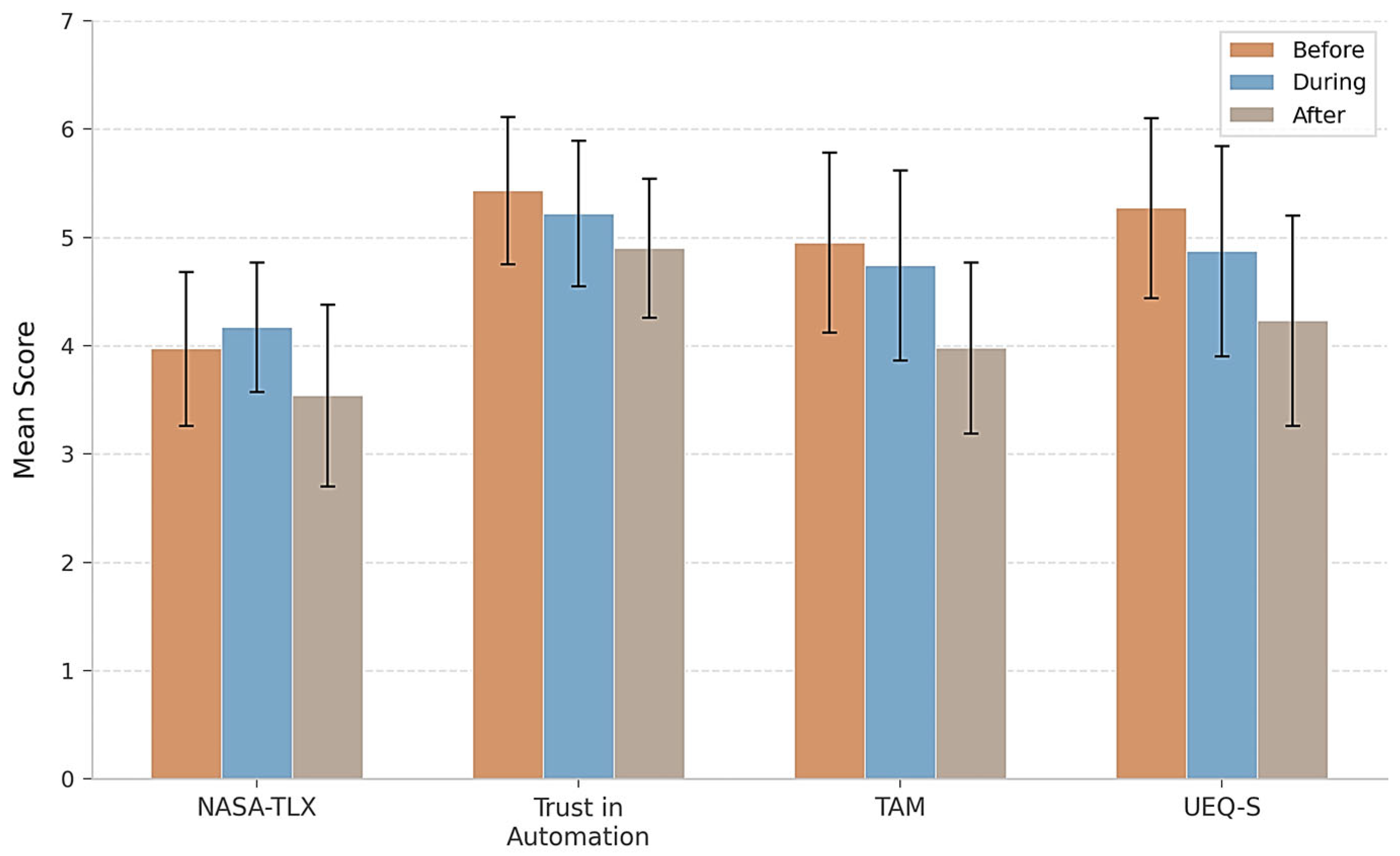
At the descriptive level, the pattern was consistent across most measures. The Before condition produced the highest scores for trust, perceived usefulness/acceptability, and overall user experience satisfaction, whereas the After condition produced the lowest scores on all three measures. By contrast, cognitive load was highest in the During condition and lowest in the After condition. This pattern suggests that anticipatory prompts were generally evaluated more positively, while concurrent prompts were more demanding, and retrospective prompts were less beneficial.
Figure 3 makes three trends visible. NASA-TLX follows an inverted-U pattern, peaking in the During condition and dropping below the Before level in the After condition, indicating that workload tracks attentional competition with the ongoing event rather than the elapsed time since the prompt. Trust in Automation, TAM, and UEQ-S all show a monotonic decline from Before to After, with the steepest drop occurring between During and After, particularly for TAM and UEQ-S. The visual contrast between the inverted-U workload curve and the monotonically decreasing evaluative curves is the first indication that prompt timing affects cognitive cost and experiential value through related yet distinct mechanisms.
Table 2 reports the means and standard deviations for each dependent variable across the three timing conditions.
Additionally, Mauchly’s test of sphericity was performed for each dependent variable prior to conducting the repeated-measures ANOVA. The assumption of sphericity was satisfied in all cases—NASA-TLX (W = 0.83, p = 0.090), Trust in Automation (W = 0.98, p = 0.715), TAM (W = 0.91, p = 0.297), and UEQ-S (W = 0.96, p = 0.595). Therefore, no corrections were applied, and unadjusted degrees of freedom were used in the main analyses.
5.1.1. Cognitive Load
Prompt timing had a significant effect on perceived cognitive load; F(2, 54) = 16.78, p < 0.001, η2p = 0.38. Bonferroni-adjusted pairwise comparisons showed that the During condition produced significantly higher workload than the After condition (mean difference = 0.63, 95% CI [0.29, 0.96], dz = 0.92, p < 0.001), and the Before condition also produced significantly higher workload than the After condition (mean difference = 0.43, 95% CI [0.17, 0.69], dz = 0.81, p < 0.001). The difference between During and Before was not statistically significant (mean difference = 0.20, 95% CI [−0.04, 0.44], dz = 0.42, p = 0.141). Thus, workload was greatest when prompts occurred during the event and lowest when prompts were delivered after the event.
5.1.2. Trust in Automation
Prompt timing also had a significant effect on trust in the system; F(2, 54) = 14.74, p < 0.001, η2p = 0.35. Pairwise comparisons indicated that trust ratings were significantly higher in the Before condition than in the After condition (mean difference = 0.52, 95% CI [0.28, 0.76], dz = 0.98, p < 0.001), and significantly higher in the During condition than in the After condition (mean difference = 0.32, 95% CI [0.05, 0.58], dz = 0.61, p = 0.016). The difference between Before and During did not reach statistical significance (mean difference = 0.21, 95% CI [−0.03, 0.44], dz = 0.44, p = 0.095). The overall pattern was Before > During > After, with the primary decline occurring for delayed prompts.
5.1.3. Perceived Usefulness and Acceptability
For TAM, the effect of prompt timing was significant and comparatively strong; F(2, 54) = 38.44, p < 0.001, η2p = 0.59. Both the Before and During conditions scored significantly higher than the After condition (Before vs. After: mean difference = 0.96, 95% CI [0.71, 1.22], dz = 1.81, p < 0.001; During vs. After: mean difference = 0.76, 95% CI [0.47, 1.05], dz = 1.31, p < 0.001). The difference between Before and During was not significant (mean difference = 0.20, 95% CI [−0.13, 0.54], dz = 0.29, p = 0.402). The results, therefore, indicate that both anticipatory and concurrent prompts were perceived as more useful and acceptable than retrospective prompts, while the difference between the two timely conditions was limited.
5.1.4. Overall User Experience Satisfaction
Prompt timing significantly affected overall user experience satisfaction as measured by UEQ-S, F(2, 54) = 33.58, p < 0.001, η2p = 0.55. In contrast to the previous measures, all pairwise differences were significant. The Before condition was rated higher than the During condition (mean difference = 0.40, 95% CI [0.10, 0.69], dz = 0.63, p = 0.006) and the After condition (mean difference = 1.04, 95% CI [0.69, 1.39], dz = 1.40, p < 0.001), while the During condition was also rated higher than the After condition (mean difference = 0.64, 95% CI [0.31, 0.98], dz = 0.93, p < 0.001). This produced a clear, ordered pattern of Before > During > After.
5.1.5. Summary
Across all four dependent variables, prompt timing yielded significant main effects with medium-to-large effect sizes. The empirical pattern was not simply that earlier prompts were always better. Rather, the results reveal a more specific contrast between timely prompts (Before and, to a lesser extent, During) and delayed prompts (After). For trust, perceived usefulness, and overall experience, the After condition consistently performed the worst. In terms of cognitive load, the During condition was the most demanding. The only measure on which Before and During differed significantly was UEQ-S, indicating that anticipatory prompting produced the strongest overall experience advantage, even where differences on trust and usefulness remained directionally rather than statistically distinct. Three patterns are worth noting beyond the headline significances. First, the experiential cost of mistiming is asymmetric: delayed prompts produce the largest decrements in trust, perceived usefulness, and overall experience (dz = 0.98, 1.81, and 1.40 relative to Before, respectively), whereas anticipatory prompts produce the smallest cognitive cost. Second, the contrast between Before and During is consistently the weakest across all four measures (|dz| ≤ 0.63), suggesting that timely prompts cluster together experientially even when they differ in cognitive demand. Third, UEQ-S is the only measure in which all three pairwise contrasts are significant, indicating that overall experience integrates both the usefulness gain from timely prompts and the workload cost of concurrent ones. Although the η
2p value for NASA-TLX (0.38) is numerically closest to that for trust (0.35), the patterns differ qualitatively: trust, TAM, and UEQ-S decline monotonically from Before to After, whereas workload peaks in the During condition and drops below the Before level in the After condition. The smaller η
2p for NASA-TLX should therefore not be read as a weaker effect of timing, but as a different shape of effect—an inverted-U profile that signals competition for attention rather than a simple decay with delay. Taken together, the results support a graded rather than binary reading of timing effects.
Table 3 summarizes the repeated-measures ANOVA results.
Table 4 reports the Bonferroni-adjusted pairwise comparisons between time points, including mean differences, Bonferroni-adjusted 95% confidence intervals, and within-subjects effect sizes calculated as Cohen’s dz.
Finally, a correlation analysis was conducted to examine possible relationships among NASA-TLX, Trust, TAM, and UEQ-S within each timing condition. Correlations were calculated separately for each timing condition to avoid collapsing repeated observations from the same participants across conditions. Spearman’s rank correlation coefficient was selected, given the relatively small sample size and the questionnaire-based nature of the measures. As reported in
Table 5, no correlation reached statistical significance at the 0.05 level. Overall, the observed associations were small to moderate in magnitude, with the largest coefficient emerging between TAM and UEQ-S in the After condition (
ρ = 0.33,
p = 0.091). Positive, although non-significant, associations were also observed between Trust and TAM in the Before and During conditions. These findings indicate that the subjective measures obtained pertain to related yet non-redundant facets of the participants’ experiences.
6. Discussion
This study examined whether the timing of proactive AI prompts influences user experience in an intelligent cockpit scenario for autonomous tourism driving. Across all four dependent variables, prompt timing produced significant main effects, with medium-to-large effect sizes. The overall pattern was consistent but not uniform. Before prompts yielded the highest scores for trust, perceived usefulness/acceptability, and overall user experience satisfaction, whereas After prompts were consistently lowest on these measures. By contrast, During prompts produced the highest cognitive load. The empirical picture is therefore not that one timing strategy dominates on every dimension, but that timing systematically restructures the balance between cognitive demand and positive evaluation. This confirms that prompt timing is not a peripheral delivery parameter; it is a core design variable in proactive cockpit interaction [
2,
3,
4,
5,
6,
7,
8]. Before turning to the specific patterns, it is important to clarify the analytical role of temporal alignment in what follows. Temporal alignment is introduced not as a directly measured psychological variable but as an explanatory lens that organizes the timing effects observed across the four dependent measures; the construct is used to interpret the empirical pattern, not to claim a separate mechanism that was independently quantified in this study.
A second important result is that the most stable contrast was not among all three conditions, but between timely and delayed prompts. For trust, TAM, and UEQ-S, both Before and During outperformed After, whereas differences between Before and During were generally smaller and statistically nonsignificant except for UEQ-S. This indicates that the principal experiential penalty emerges when the system intervenes too late to be perceived as situationally relevant. In other words, delayed prompting appears to weaken the perceived intelligence and usefulness of the system more consistently than anticipatory prompting improves it. The correlation analysis further indicates that NASA-TLX, Trust in Automation, TAM, and UEQ-S captured related but non-redundant dimensions of participants’ experience. No statistically significant correlations emerged within the individual timing conditions, suggesting that the effects of timing should not be interpreted as acting through a single subjective construct. They appear to provide complementary information about participants’ responses to the timing of the interaction. Although some positive associations were observed descriptively, particularly between TAM and UEQ-S in the After condition and between Trust in Automation and TAM in the Before and During conditions, these patterns should be interpreted carefully. Overall, the results support the view that temporal alignment may influence multiple experiential dimensions rather than a single isolated outcome.
The core theoretical contribution of this paper is the proposal of temporal alignment as the organizing concept for interpreting these results. Temporal alignment refers to the degree to which proactive system behavior is synchronized with the user’s cognitive rhythm, attentional availability, and situational readiness. The construct is grounded in prior work on interruption timing, opportune moments, and adaptive interventions [
4,
5,
6,
7,
11], but the present study extends that literature by applying it to proactive AI interaction in an intelligent cockpit and by showing that timing effects appear simultaneously across workload, trust, perceived usefulness, and overall experience.
The results support this interpretation in three ways. First, the elevated workload in the During condition suggests that prompts delivered amid ongoing perceptual or interpretive activity create stronger competition for cognitive resources. This is consistent with research on timing, which shows that interventions are more disruptive when they occur outside natural task boundaries or attentional openings [
4,
6,
7]. Second, the trust and TAM results indicate that prompts are not evaluated only on informational grounds. They are also judged as signals of system judgment. When a prompt arrives too late, users appear to infer reduced situational awareness or reduced practical value from the system, even when the content itself remains coherent. Third, the UEQ-S pattern shows that timing differences propagate beyond narrowly functional assessment into broader experiential quality. The fact that Before prompts significantly outperformed During prompts on overall experience, even where trust and TAM differences remained statistically modest, suggests that anticipatory timing contributes not only to utility, but to the felt smoothness and coherence of the interaction.
For intelligent cockpit design, the confirmation of H1 carries a direct implication that should be made explicit. Because During prompts produced the highest cognitive load (η2p = 0.38; During vs. After dz = 0.92), even modest aggregation of concurrent interventions during dense road segments could compound attentional demand and erode the workload margin that automated driving is intended to provide. In other words, the H1 result is not only consistent with general timing theory; it identifies a specific design risk for cockpit AI that defaults to real-time prompting. Anticipatory prompting therefore emerges in this study not merely as experientially preferable but also as a cockpit-design strategy with a workload-preserving function, particularly valuable in supervisory and experience-oriented automated driving where attentional reserves must be kept available for unexpected situational demands.
Although the present design did not include a direct psychophysiological or behavioral measure of temporal alignment, the construct is empirically anchored in three observable signatures of the data. First, the systematic gradient on cognitive load (During > Before > After) reflects the predicted competition for attentional resources when intervention overlaps ongoing perceptual activity. Second, the asymmetric penalty on trust, usefulness, and overall experience for After prompts maps onto the predicted breakdown of synchronization between system action and user receptivity. Third, the fact that all four measures shift in concert across the three timing conditions—rather than diverging—is consistent with a single underlying alignment dimension expressed across multiple experiential channels. Direct mechanistic validation, for example, through gaze, pupillometry, or continuous workload tracing, remains an important next step; the convergent multi-measure pattern observed here provides a defensible empirical anchor for treating temporal alignment as a useful theoretical construct rather than a purely speculative one, and motivates its use as an organizing frame in cooperative human–machine interaction for intelligent cockpits.
These findings are directly relevant to the Special Issue’s emphasis on cooperative human–machine interaction. In conventional interface logic, a prompt is often treated as a discrete unit of information: if the content is correct and relevant, the interaction is presumed to succeed. The present study points to a different conclusion. In proactive AI systems, cooperation depends not only on informational correctness but also on temporal appropriateness. A system that speaks at the wrong moment may be perceived as less intelligent, less trustworthy, and less useful, even if it provides objectively relevant information. This shifts the design problem from content optimization alone toward interaction timing as a condition of cooperation [
2,
3,
8,
10].
This shift matters because intelligent cockpits are moving beyond tool-like interaction toward systems that anticipate, recommend, and guide. In that context, prompt timing becomes part of how the AI expresses competence and social legibility. The findings align with prior work suggesting that well-timed proactive dialog is more likely to support trust and acceptance [
3,
12], while in-vehicle research has already shown that interruptibility depends on situational windows rather than on fixed rules [
7]. What this paper adds is an empirical demonstration that in an autonomous tourism-driving context, prompt timing also structures the overall experiential quality of the journey. That contribution is especially relevant for cooperative AI systems designed not only for operational assistance but also for continuous, low-friction human–machine collaboration.
A practical implication of the results is that time should be treated as a design material rather than as a hidden system parameter. The Before condition performed best overall because anticipatory prompts appear to support expectation-setting, perceived system foresight, and smoother integration into the user’s activity flow. The During condition retained comparatively high trust and usefulness, but at a higher cognitive cost. This suggests that concurrent prompts remain viable when immediacy is important but should be used selectively and with stronger justification. The After condition, by contrast, consistently underperformed on trust, TAM, and UEQ-S, indicating that retrospective prompting should not be relied upon for primary support where timely action or timely awareness is expected.
These findings support a layered timing logic for intelligent cockpit design. Anticipatory prompts are best suited to previewing upcoming options, clarifying route-relevant opportunities, or supporting lightweight planning before an event occurs. Concurrent prompts should be reserved for cases in which real-time contextual relevance outweighs the cognitive cost of interruption, such as urgent route-linked or safety-relevant information. Retrospective prompts may still be useful, but their role should be reframed toward reflection, summary, or optional follow-up rather than primary intervention. In this sense, the paper’s design contribution is not a universal claim that “earlier is always better,” but a more precise claim: different prompt timings carry different experiential functions, and delayed prompting is consistently weakest when immediate relevance is central.
More broadly, the results suggest a reframing of proactive intelligence itself. A proactive system should not be understood simply as one that acts first or acts often. It should be understood as one that acts with temporal sensitivity. This interpretation is consistent with definitions of proactive AI that emphasize anticipation and reasoning [
1], but it adds a necessary interaction-design qualification: anticipation alone is insufficient if the timing of intervention fails to align with the user’s state. In the context of intelligent cockpits, proactive intelligence therefore depends on the ability to balance initiative with restraint, and relevance with timing. From a design standpoint, this means that the question “what should the system say?” cannot be separated from the question “when should the system say it?” [
2,
3,
10].
Lastly, the discussion should be read in light of the study’s design scope. The experiment isolated timing while controlling prompt content and modality, thereby strengthening causal interpretation at the level of the manipulated variable. At the same time, the findings apply to the specific context studied here: an immersive, autonomous, tourism-driving scenario evaluated using post-condition subjective measures. The paper’s contribution is therefore deliberately bound. It establishes prompt timing as an empirically consequential variable and advances temporal alignment as the conceptual frame through which this consequence can be understood. It does not claim to resolve all timing questions for intelligent cockpits, but it does provide a defensible foundation for treating timing-aware prompting as a central problem in cooperative AI interaction design. A further boundary of the present study concerns the participant sample. The findings were obtained from a relatively small (
n = 28) and homogeneous group of university students aged 22–26, who are likely to be more familiar with VR, digital interfaces, and AI-enabled systems than the broader population of future cockpit users. Although this profile is informative for early-stage validation of cooperative AI prototypes—and the within-subjects design reduces inter-individual variance, increasing statistical sensitivity at this sample size—it limits the generalizability of the effects reported here to user groups that may differ on driving experience, familiarity with autonomous systems, age-related attentional dynamics, prior exposure to in-vehicle assistants, and cultural attitudes toward proactive AI. The timing effects reported above should therefore be interpreted as evidence that prompt timing is consequential in this context and for this kind of user, rather than as population-level estimates. Replication with more demographically diverse samples, including older drivers and users with no prior VR exposure, is identified as a priority direction for future work in
Section 7.
7. Conclusions
This paper addressed a neglected but consequential question in proactive intelligent cockpit design: when should an AI system prompt? Using a controlled within-subjects experiment in an immersive autonomous tourism-driving scenario, the study showed that prompt timing significantly affects cognitive load, trust in automation, perceived usefulness/acceptability, and overall user experience. The findings were consistent on two points. First, timing is a primary interaction variable, not a secondary delivery detail. Second, the most robust experiential divide is between timely and delayed prompts: prompts delivered before or during relevant events were evaluated more positively than those delivered after those events, while prompts delivered during them also imposed the highest cognitive load.
The paper’s main contributions, each anchored directly in the validation results reported in
Section 5, are three. First, it provides empirical evidence—convergent across four standard instruments and supported by 95% confidence intervals and within-subjects effect sizes—that prompt timing systematically restructures cognitive load, trust, perceived usefulness, and overall experience in a proactive intelligent cockpit. Second, it identifies an asymmetric experiential profile that has not previously been reported in this combination: delayed prompts carry the largest evaluative penalty (largest dz on trust, TAM, and UEQ-S), while concurrent prompts carry the largest workload cost, with anticipatory prompts dominating on integrative experience. Third, it advances temporal alignment as the conceptual frame that ties these results together and supports a layered design logic in which anticipatory, concurrent, and reflective prompts are assigned distinct cooperative functions. The discussion in
Section 6 develops the theoretical and design implications of these contributions; the conclusion records them as the validated core of the paper. In the context of proactive AI, system quality depends not only on whether information is relevant, but on whether intervention is synchronized with the user’s cognitive rhythm and situational readiness. This reframes proactive intelligence for cooperative human–machine interaction: a system is not experienced as intelligent simply because it acts autonomously, but because it acts at a moment that feels appropriate, useful, and cognitively sustainable.
From a design perspective, the study supports a layered timing logic for intelligent cockpit interaction. Before prompts are most effective for anticipatory guidance, expectation-setting, and trust-building. Prompts can provide valuable real-time support, but they should be deployed selectively because of their higher cognitive cost. After prompts appear the weakest as primary interventions and are better suited to reflective or secondary functions. The practical implication is clear: proactive AI systems in intelligent cockpits should move beyond fixed or purely event-triggered prompting toward timing-aware support strategies that treat time as a design material.
The contribution is intentionally bounded. The findings derive from a VR-based, autonomous tourism-driving context with a relatively small, homogeneous sample, and the proposed concept of temporal alignment remains an interpretive construct rather than a directly validated mechanism. Future work should extend this research through field studies with real vehicles, more diverse participant groups, and multimodal or physiological measures that can more directly trace cognitive state. Even with these limits, the present study establishes a firm basis for treating prompt timing as central to the design of cooperative AI systems in intelligent cockpits.
At its core, the paper argues for a simple but consequential design principle: in proactive human–machine interaction, knowing when to speak is part of knowing how to cooperate.