1. Introduction
In recent years, the integration of digital technologies into education has significantly transformed teaching and learning practices, opening new possibilities for the development of creative, emotional and cognitive skills [
1]. In particular, the emergence of Generative Artificial Intelligence (hereinafter GAI) has introduced tools capable of automatically generating visual, audio or textual content, presenting new opportunities and challenges for early-stage education. In this context, GAI-mediated generative art emerges as a particularly relevant space for exploring the relationship between creativity, emotion and technology [
2]. Few studies have examined how AI-mediated generative art affects the relationship between emotional expression and reflective depth in primary education contexts.
At the same time, emotional education has been recognised as a fundamental element in students’ holistic development, as it fosters the ability to identify, understand and express emotions, as well as to establish healthy interpersonal relationships [
3]. In this regard, the integration of creative tools in the classroom can be an effective means of promoting emotional expression, particularly at an early age, when verbal language is still developing. Artistic practices, and particularly those mediated by digital technologies, enable pupils to externalise internal states through visual forms, facilitating processes of self-awareness and emotional communication [
4].
However, despite the potential of these tools, the literature also warns of certain risks associated with their use in education. It has been noted that creative output facilitated by automated systems does not necessarily guarantee the development of deep understanding or the cultivation of reflective processes [
5,
6]. Furthermore, automation may encourage more immediate or superficial responses if not accompanied by appropriate pedagogical guidance [
7]. In this regard, a significant tension emerges between these technologies’ capacity to foster engagement and creativity and their potential to limit the development of reflection and critical thinking.
Despite growing interest in the integration of AIG in education, there is still limited empirical evidence regarding its specific impact on the development of emotional expression and reflection in early stages of education, particularly in contexts of artistic creation mediated by generative systems. This gap is particularly significant, given that primary education constitutes a key period for the development of emotional and creative skills.
Rather than examining creativity or emotional expression in isolation, this study specifically explores the tension between high levels of visual creative engagement and the limited depth of reflective discourse observed in AI-mediated educational contexts. In this regard, the research provides exploratory empirical evidence on how generative systems can facilitate emotional engagement without necessarily ensuring deep metacognitive or reflective processes among primary school pupils.
In this context, the research examines the implementation of an educational workshop based on generative art mediated by AI, entitled “Experiences in Programmed Emotions”, carried out with primary school pupils using a mixed-methods approach; the aim is to explore how these tools influence pupils’ active participation, creativity, emotional expression and reflection. It also aims to examine the relationship between emotional engagement and depth of reflection in this type of educational experience, thereby contributing to an understanding of the role of AI in pupils’ holistic development.
The present study aims to analyse the impact of an educational proposal based on generative art mediated by artificial intelligence on primary school pupils, with the aim of examining its influence on active participation, creativity, emotional expression and reflection. It also seeks to explore the relationship between emotional engagement and depth of reflection in this type of educational experience.
In this context, the research seeks to answer the following research questions:
- (1)
To what extent does the use of generative art mediated by artificial intelligence promote pupils’ participation, creativity and emotional expression?
- (2)
How does the reflective dimension manifest itself in this type of experience?
- (3)
What is the relationship between creativity and reflection in the learning process?
4. Results
4.1. Quantitative Analysis
The analysis of the collected data combines quantitative and qualitative evidence to provide a comprehensive view of the impact of the workshop on students. This approach makes it possible not only to identify general trends in responses but also to understand the meanings and underlying processes involved in the educational experience (see
Table 1).
Before inferential analyses, the assumptions underlying parametric testing were examined. Normality and homogeneity of variances were assessed for the main study variables. Since the assumption of homogeneity of variances was violated for the reflection variable, Welch’s ANOVA was applied for this dimension. Given the exploratory nature of the study and the relatively small subgroup sizes, statistical findings were interpreted cautiously and complemented with effect size indicators.
First, the quantitative results show high levels across most of the analyzed dimensions. Active participation reached the highest mean score (M = 3.48), followed by creativity (M = 3.39 in both cases). These values indicate that the activity promoted a high degree of student engagement, fostering both active involvement in the process and the production of creative responses. Similarly, emotional expression obtained a mean score of 3.30, suggesting that the generated environment facilitated the externalization of emotions and personal connection with the activity.
However, the reflection dimension obtained a lower mean score (
M = 2.94) and showed the greatest dispersion in responses. This result points to greater heterogeneity in students’ ability to develop reflective processes, in contrast to the homogeneity observed in active participation and creativity. The difference between these dimensions suggests that, while the activity effectively stimulated engagement and expression, deeper reflective processes did not occur uniformly. Descriptive results are presented in
Table 1.
The homogeneity of variances test showed that the variables of personal engagement, creativity, active participation, and emotional expression met the assumption of homogeneity. However, the reflection variable did not meet this assumption; consequently, a Welch ANOVA was applied (see
Table 2).
The ANOVA results (see
Table 2) indicated statistically significant group differences in active participation (F(3,50) = 4.11,
p = 0.011, η
2 = 0.198) and emotional expression (F(3,50) = 6.87,
p = 0.001, η
2 = 0.292), reflecting large effect sizes, particularly in emotional expression. No statistically significant differences were observed for personal engagement, creativity, or reflection.
Because the assumption of homogeneity of variances was violated for reflection according to Levene’s test, Welch’s ANOVA was applied for this variable. Post hoc comparisons using the Bonferroni adjustment revealed significant differences in emotional expression between Groups 1 and 3, Groups 1 and 4, Groups 2 and 3, and Groups 2 and 4. In addition, a statistically significant difference in active participation was observed between Groups 2 and 3 (p = 0.048). The relatively large effect sizes observed in active participation and emotional expression suggest meaningful group-related patterns; however, these findings should be interpreted cautiously given the exploratory nature of the study and the unequal subgroup sizes.
At the same time, given the different nature of the schools, differences between them could be expected. In this regard, the independent samples t-test showed statistically significant differences between schools in personal engagement (t(52) = 2.498, p = 0.016), active participation (t(52) = 3.562, p = 0.001), and emotional expression (t(52) = 3.998, p < 0.001), with the private all-girls school obtaining higher scores in all these variables. No significant differences were found in creativity or reflection (p > 0.05).
Since one of the schools (Groups 1 and 2) was exclusively female, a Student’s
t-test was conducted to determine the existence of gender differences. Students from the predominantly female groups showed higher scores (
M = 3.54;
SD = 0.809) compared to boys (
M = 2.62;
SD = 0.768), with a significant difference between both groups (
t = 3.618;
p = 0.001). No statistically significant differences were observed in the remaining variables—personal engagement, creativity, active participation, and reflection (
p > 0.05). These differences should be interpreted cautiously, since gender composition was closely associated with institutional context and school type. Therefore, the observed patterns may reflect a combination of sociocultural, educational, and contextual factors rather than gender alone. In other variables, such as creativity and reflection, gender differences were less pronounced, suggesting greater homogeneity in these dimensions (see
Table 3).
Relationships between the variables were analyzed through correlation analyses. The results showed that personal engagement was positively and significantly associated with active participation (r = 0.430, p < 0.01) and emotional expression (r = 0.321, p < 0.05), indicating that higher levels of engagement are related to greater active participation and emotional expression.
Creativity did not show a significant relationship with personal engagement (r = 0.011, p > 0.05), although it did present a positive correlation with emotional expression (r = 0.281, p < 0.05). In other words, students may display high levels of creativity without this necessarily implying a greater capacity for analysis or reflection on their own process. This finding reinforces the idea that creativity and metacognition, although related, require differentiated pedagogical stimuli.
Active participation, in turn, was significantly related to both emotional expression (r = 0.290, p < 0.05) and reflection (r = 0.296, p < 0.05), suggesting that greater behavioral engagement is linked to reflective and emotional processes.
Finally, emotional expression showed a moderate positive correlation with reflection (r = 0.398, p < 0.01), indicating that both variables tend to increase together.
4.2. Qualitative Results Analysis
The qualitative analysis followed an exploratory thematic approach that included the identification of units of meaning, initial coding, grouping into emerging categories, and an interpretative review of recurring patterns. Given the exploratory nature of the study and the age of the participants, the analysis focused on identifying dominant trends in emotional expression and reflective discourse rather than establishing exhaustive or fully saturated categories. Consequently, interpretations relating to reflective depth were treated with caution, recognising that brief responses may also reflect developmental or expressive limitations associated with the participants’ age.
4.2.1. Analysis of Open-Ended Questions
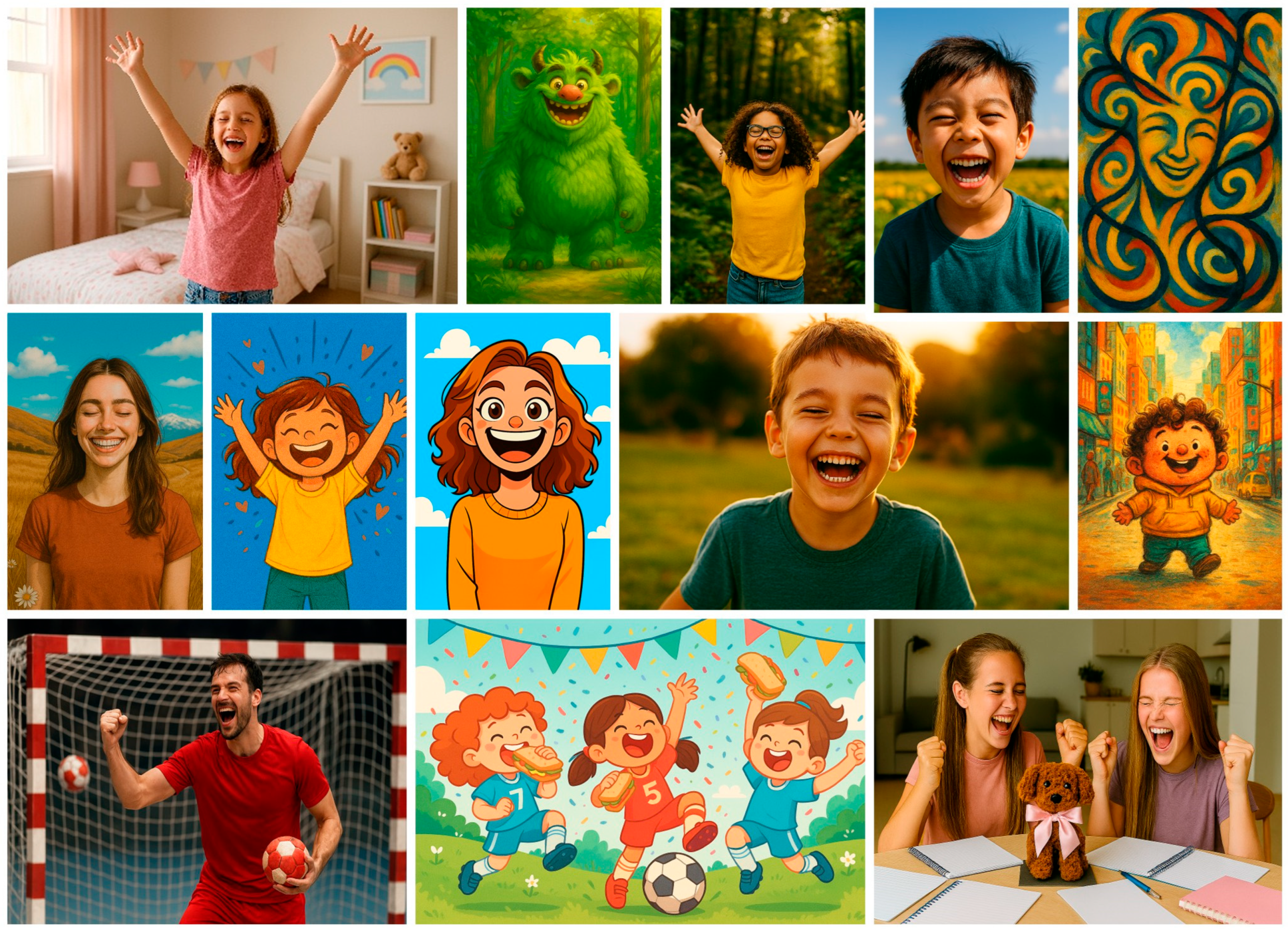
The qualitative results complement and enrich these findings. The analysis of the open-ended responses reveals a clear predominance of positive emotions, especially joy and happiness (see
Figure 2).
These emotions were repeatedly expressed through justifications such as “Because I like being happy,” “Because it makes me feel good,” or “Because it is my favorite.” In addition, these emotions were associated with meaningful everyday experiences for the students, such as sports, celebrations, or social relationships, showing a direct connection between the activity and their personal lives.
Another relevant pattern was the strong presence of personal identification discourses, in which students linked the selected emotion to their own identity or emotional state. Expressions such as “Because that’s how I am,” “Because it represents me,” or “Because it is how I feel right now” reflect a level of subjective appropriation that goes beyond a simple emotional choice, revealing processes of self-expression and self-knowledge.
4.2.2. Analysis of Artistic Productions
However, the qualitative analysis also revealed the existence of different levels of elaboration in the responses. Alongside more developed productions, brief or poorly elaborated responses appeared, such as “Because I like it” or “The first one I thought of,” highlighting significant variability in the students’ reflective depth. This heterogeneity coincides with the dispersion observed in the reflection variable in the quantitative analysis.
In addition, although to a lesser extent, unpleasant or complex emotions such as fear, frustration, or anger also emerged (see
Figure 3) (“Fear at school,” “Because I get frustrated many times,” “The anger inside”). These responses are particularly relevant because they demonstrate students’ ability to explore diverse emotional registers and not only positive emotions, thus broadening the expressive scope of the activity.
Finally, elements of personal and aspirational projection were identified, particularly linked to sports and the future (“I want to make it to the NBA,” “When I become a teenager, I won’t have as much joy anymore”). This type of discourse suggests that the activity not only facilitates present emotional expression but also acts as a space for the construction of expectations, desires, and future identities.
The overall analysis of the visual productions made it possible to identify consistent patterns in the representation of different emotions by the students, both pleasant and unpleasant. In general terms, emotions were expressed through intensified, exaggerated, intense, visible, and easily recognizable features, indicating a conceptualization centered on external expressiveness.
Thus, in representations of pleasant emotions, as shown in
Figure 2, happiness appeared associated with broad smiles, expansive body gestures (raised arms, movement, identified with triumph and victory), and bright contexts linked to play, nature, or social interaction. These productions reflect a conception of emotion as an active and shared experience. In terms of framing, most of these representations were depicted through close-up shots, with some exceptions corresponding to medium or long shots.
In contrast, representations of unpleasant emotions—as observed in
Figure 3—were characterized by facial expressions of tension (wide-open eyes, furrowed brows), defensive or aggressive postures, and environments associated with danger or threat, such as dark spaces, aggressive animals, or situations of interpersonal conflict. In this case, emotion was constructed not only through the represented figure but also through the visual context. From a framing perspective, most images relied on close-ups, extreme close-ups focused solely on the face, long shots, and full-body shots.
Despite these differences in emotional content, both sets of images tended to represent emotions in their most extreme or prototypical forms, with little representation of intermediate or nuanced emotional states. Likewise, different levels of elaboration were identified in the productions, ranging from realistic representations centered on everyday situations to more symbolic or metaphorical compositions, in which emotions were projected onto external figures such as animals, fictional characters, or imaginary environments. From the perspective of framing and photographic aesthetics—largely characterized by the simulation of technical images—the compositions in both cases focused mainly on emphasizing facial features, with close-ups and long shots being the most common framing devices, alongside the exceptions illustrated in
Figure 2 and
Figure 3.
Another aspect observed during the analysis was the recurrence of similar visual conventions in emotional representations, such as smiling faces associated with joy or exaggerated facial expressions linked to anger. This convergence may reflect both culturally shared emotional codes and biases present in AI image-generation systems. However, many students simultaneously linked these visual representations to personal experiences and subjective emotional narratives, suggesting the coexistence of algorithmically mediated visual conventions and genuine processes of emotional appropriation.
Overall, the results show that the workshop generated high levels of participation, creativity, and emotional expression, while also revealing greater variability in reflective processes. The integration of quantitative and qualitative data confirms that the experience was meaningful for students, although with differing levels of depth in the elaboration of their responses and image productions.
5. Discussion
The results we obtained position this study within current debates on creativity, emotion and reflection in educational contexts mediated by artistic and generative technologies. One of the main findings concerns the tension observed between emotional engagement and reflective depth, a phenomenon previously identified in research on creative learning [
3,
4,
5,
6,
20,
40]. Existing literature suggests that emotional participation alone does not necessarily lead to deep reflective or metacognitive processes. As Flavell [
6] and Kolb [
40] argue, meaningful learning requires conscious reflection and metacognitive regulation. Similarly, research in arts education has shown that emotional expression may emerge without deep interpretative elaboration when explicit pedagogical mediation is absent [
4].
On the one hand, the data reveal high levels of active participation, creativity, and emotional expression, consistent with studies highlighting the potential of arts-based methodologies to foster student engagement [
41]. However, these results should be interpreted with caution. In contexts of AI-mediated visual creation, positive assessments of creativity may partly reflect students’ attraction to visually appealing generated images, rather than exclusively conceptually elaborate works. Furthermore, generative systems may produce standardised visual outcomes derived from common patterns present in their training data. Consequently, the creativity scores obtained in this study should be understood primarily as indicators of perceived creative engagement and expressive participation, rather than as objective measures of artistic originality.
Eisner [
4] emphasizes that arts-based experiences promote more open, expressive, and personal forms of knowledge, which is clearly reflected in students’ responses, where references to personal experiences and meaningful emotions predominate. Likewise, studies such as those by Gardner [
42] point out that creativity and emotional expression constitute key dimensions of learning, especially in contexts that allow multiple forms of representation.
However, the lower score obtained in the reflection variable and its weak correlation with creativity suggest that emotional engagement does not automatically translate into deep metacognitive processes. This result is consistent with Flavell’s [
6] distinction between cognitive experience and metacognitive awareness, the latter requiring explicit processes of regulation and conscious reflection. In the same vein, Perkins [
5] argues that deep thinking does not emerge spontaneously but rather requires support structures that guide reflection.
The tension observed between creativity and reflection may be particularly relevant in AI-mediated artistic contexts. As Boden and Edmonds [
20] argue, creative processes in generative systems may be partially distributed between the user and the technological system itself. Consequently, visually sophisticated outputs do not necessarily imply deep cognitive elaboration or reflective understanding on the part of students. In this study, high levels of creative engagement coexisted with comparatively limited reflective depth, suggesting that generative systems may facilitate emotional participation and visual production while not automatically promoting metacognitive processes.
In this sense, the results suggest that the activity fostered creative production and emotional engagement, but not necessarily deep conceptual understanding. Previous educational research has shown that participation in creative activities alone does not automatically generate meaningful learning, particularly when reflective guidance is limited [
7,
8,
13]. Therefore, the educational value of generative artistic practices appears to depend largely on how these activities are pedagogically structured and mediated.
On the other hand, the predominance of positive and pleasant emotions, especially joy and positive emotional states, is consistent with previous findings in emotional education. Research such as that of Bisquerra [
5] indicates that students tend to express positive emotions more easily, whereas negative emotions require safer and more guided contexts for exploration. In this study, although emotions such as fear or frustration emerged—as well as terror expressed through myths such as witches’ covens—their lower frequency suggests a certain avoidance of more complex emotional registers, which may limit the depth of the reflective process.
The variability observed in students’ qualitative responses—from elaborated explanations to minimal expressions such as “Because I like it”—suggests important differences in reflective and discursive competence. From a sociocultural perspective, reflective thinking depends largely on opportunities for dialogue, interaction and guided verbalization within the educational environment [
43,
44]. Consequently, while generative technologies may facilitate emotional expression and idea generation, reflective depth appears to require explicit pedagogical mediation and structured opportunities for metacognitive dialogue.
These findings also highlight the importance of promoting critical AI literacy within educational contexts that utilise generative systems. Beyond their creative potential, AI tools can reproduce aesthetic biases, stereotypical emotional representations and simplified visual conventions derived from their training data. Consequently, pedagogical mediation is essential not only to foster reflection and emotional dialogue, but also to promote a critical understanding of how algorithmic systems shape processes of visual production and authorship. Furthermore, the ethical implications arising from children’s interaction with generative systems constitute a relevant dimension for future educational research.
Finally, the gender differences observed in emotional expression may be interpreted in line with studies on emotional socialization, which indicate differentiated patterns in emotional expression according to sociocultural variables [
45]. These differences should not be interpreted exclusively in terms of gender or socioeconomic background. Other contextual and pedagogical factors may also have influenced students’ participation and emotional expression, including classroom dynamics, teacher facilitation strategies, previous familiarity with digital tools, and differences in instructional mediation across educational settings.
The results related to the image analysis suggest that students tend to represent emotions through intense and prototypical forms, indicating a predominance of the identification and expression of basic emotions over their complex elaboration. This tendency is consistent with Bisquerra’s [
3] model of emotional education, which distinguishes between different levels of emotional competence, placing understanding and regulation at more advanced developmental stages.
Likewise, the presence of symbolic resources—such as the projection of emotions onto animals or environments—points to the role of creativity as a mediator in emotional externalization, in line with Eisner [
4], who highlights the value of art in representing internal experiences. However, as Perkins [
5] warns, creative production does not necessarily imply understanding, which is consistent with the limited reflective depth observed in this study. It should be noted that the figures included in the manuscript primarily serve an illustrative purpose. The interpretation of visual tendencies reported in this study derives from the broader thematic analysis rather than from a formal iconographic analysis of the specific images reproduced in the manuscript.
These findings should be interpreted cautiously, given that the questionnaire was developed specifically for the present exploratory study and was not subjected to a full psychometric validation process.
In this sense, the results reinforce the idea that emotional expression may develop relatively easily in creative contexts, whereas the diversification and understanding of emotions require explicit pedagogical mediation, especially in early educational stages.
The findings confirm the potential of creative practices mediated by generative technologies to foster student participation and emotional expression, in line with previous literature [
4,
13]. However, they also demonstrate that reflection requires explicit pedagogical mediation, as it does not emerge automatically from creative experience [
6,
39]. Consistent with Gardner’s [
18] perspective, the educational challenge lies not only in promoting activity, but also in ensuring that such activity leads to deep understanding. Furthermore, from the perspective of constructive alignment, meaningful learning has been shown to depend on the articulation between objectives, activities, and assessment [
46], reinforcing the need to structure these proposals appropriately.
Overall, the findings suggest that generative artistic technologies may constitute valuable tools for promoting participation and emotional expression in primary education contexts. However, creative engagement alone does not guarantee reflective depth or meaningful understanding. These processes appear to depend fundamentally on pedagogical mediation, reflective scaffolding and structured dialogue practices integrated into the learning design. Consequently, future educational interventions involving generative AI should prioritize not only creative production, but also critical reflection, emotional interpretation and metacognitive development.
6. Conclusions
The present study made it possible to analyze the impact of an educational proposal based on AI-mediated generative art with primary school students, providing relevant evidence regarding both its potential and its limitations in the development of emotional, creative, and reflective competencies.
Regarding the first research question—to what extent does the use of AI-mediated generative art foster student participation, creativity, and emotional expression?—the results show that this type of proposal generates high levels of engagement, perceived creativity, and emotional expression. The high level of student participation demonstrates the workshop’s ability to create a motivating and meaningful learning environment in which students actively engage in the process.
Likewise, students reported high levels of creative engagement and produced a variety of visual representations, suggesting that generative art tools may expand their expressive possibilities and facilitate experimentation. In this sense, technology acts as a mediator that reduces technical barriers and allows students to focus more fully on expression.
Emotional expression was also clearly enhanced, not only in terms of frequency but also in connection with students’ personal experiences. The analyzed productions and justifications show that students not only represented emotions, but also linked them to their own experiences, highlighting the potential of these methodologies as spaces for expression and identity construction. Nevertheless, a predominance of positive emotions, especially joy, was observed, suggesting the need to broaden the work toward greater emotional diversity by more explicitly incorporating complex or ambivalent emotions.
Regarding the second research question—how does the reflective dimension manifest itself in this type of experience?—the results indicate that reflection develops unevenly and is generally less consolidated than the other dimensions. Although some students elaborated complex responses and demonstrated analytical capacity, a significant proportion showed difficulties in deepening the explanation of their decisions, relying instead on brief or underdeveloped responses.
This heterogeneity demonstrates that reflection does not emerge automatically from creative activity but rather requires explicit pedagogical mediation. In this sense, students showed a willingness to explore their emotions and creative processes, but required tools that encouraged verbalization, analysis, and awareness. These findings reinforce the idea that reflection constitutes a competence that must be taught and supported, especially in early educational stages.
Regarding the third research question—what relationship is established between creativity and reflection in the learning process?—the results revealed a positive but weak relationship between both dimensions, indicating that they do not necessarily evolve in parallel. Students may engage actively in creative processes and express emotions effectively without this necessarily implying greater reflective or metacognitive capacity.
This finding is particularly relevant in the context of generative art, where creativity can be understood as a process partially distributed between the subject and the system. The ease with which visually sophisticated results can be generated may facilitate students’ creative engagement and visual expression, but it may also reduce the need for deep cognitive elaboration if not accompanied by adequate mediation. In this regard, high levels of perceived creativity and creative engagement do not always translate into deeper understanding, highlighting the need to differentiate between creative production and meaningful learning.
Furthermore, the results reveal the influence of variables such as age and gender on students’ experiences. Overall, some differences were observed across groups; however, given the exploratory nature of the study and the overlap between institutional, sociocultural, and demographic variables, these patterns should be interpreted cautiously. The study was not designed to isolate the independent effects of age, gender, or school context. Likewise, gender differences in emotional expression point to the influence of emotional socialization processes, reinforcing the need to design inclusive educational proposals that consider different styles of participation and expression.
Based on these findings, several directions for improvement in future implementations are proposed. First, it is necessary to incorporate specific reflective scaffolding strategies, such as open-ended questions, response models, or structured dialogue spaces that encourage conceptual elaboration. Second, it is recommended to promote greater emotional diversity by guiding students in the exploration of complex emotions that broaden their expressive repertoire. Third, it is advisable to maintain spaces for creative flexibility by reducing rigidity in instructions and encouraging autonomous exploration. Finally, the incorporation of collaborative and oral dynamics may contribute to enriching processes of reflection and shared meaning-making.
Overall, the results suggest that AI-mediated generative art may constitute a valuable educational tool for promoting student engagement, perceived creativity, and emotional expression. However, the findings also indicate that reflective and metacognitive processes do not emerge automatically from creative activity and require explicit pedagogical support.
In conclusion, this study contributes to understanding the potential role of generative artificial intelligence in emotional education. Its educational value appears to lie not only in supporting creative engagement and visual expression, but also in the ways these technologies are embedded within pedagogical designs that promote reflection, critical thinking, and meaningful learning. Given the exploratory nature of the study and the characteristics of the instrument employed, these findings should be interpreted cautiously and viewed as a basis for future research rather than as definitive evidence of educational effectiveness.
6.1. Limitations
This study presents several limitations that should be acknowledged. First, the sample size was relatively small and based on intentional sampling, which limits the generalizability of the findings. In addition, the participating schools differed considerably in terms of sociocultural and educational context, including variations in socioeconomic background, school type, and gender composition, which may have influenced the results. The intervention was also developed through a short-term workshop, preventing the analysis of long-term effects on creativity, emotional expression, or reflective processes. Furthermore, some responses may have been affected by social desirability bias, particularly in relation to the expression of positive emotions.
Furthermore, gender composition was closely associated with institutional context, since one of the participating schools consisted exclusively of girls. Consequently, gender-related findings cannot be interpreted independently from school type, socioeconomic background, or educational environment, and should therefore be considered exploratory.
Another limitation of the study concerns the relatively small sample size and the unequal distribution of participants across groups, including one subgroup composed of only six students. These conditions may reduce the robustness and stability of subgroup comparisons and limit the generalizability of the findings. Furthermore, the lack of homogeneity between groups in terms of gender composition, educational context, and sociocultural background may have influenced some of the observed differences. Consequently, the quantitative results should be interpreted cautiously and understood as exploratory rather than confirmatory.
An additional limitation concerns the absence of formal psychometric validation procedures for the questionnaire. Because the instrument was specifically designed for the exploratory purposes of this study, internal consistency indices and construct validation analyses were not conducted. Consequently, the quantitative findings should be interpreted as exploratory indicators rather than as measurements derived from validated scales.
In addition, the study did not systematically control other potentially relevant pedagogical variables, such as teacher facilitation styles, classroom interaction dynamics, or students’ previous familiarity with AI-based digital tools, which may also have influenced the observed differences between groups.
Finally, the absence of a longitudinal design limits the possibility of examining the stability and evolution of these processes over time.
6.2. Future Research Directions
Future research should explore longitudinal approaches to examine the sustained impact of AI-mediated generative art on emotional, creative, and reflective development. Comparative studies involving different educational stages, sociocultural contexts, and instructional models would also contribute to a deeper understanding of these practices. In addition, future work could investigate multimodal forms of reflection that combine verbal, visual, and collaborative dimensions. Further attention should also be given to the development of AI literacy and critical understanding of generative systems in educational settings. Finally, collaborative generative art experiences may provide valuable opportunities to explore shared creativity, dialogue, and collective meaning-making processes.
6.3. Practical Implications
The results suggest that generative artificial intelligence may be a valuable educational tool for fostering creativity, emotional expression and critical reflection in educational settings. However, its integration into the classroom should not be approached from a technocentric or purely instrumental perspective, but rather as a mediating tool that requires pedagogical support, didactic structuring and ethical guidance from teachers. In this regard, the study’s findings allow for the identification of various practical implications for the educational sector.
Applications for developing emotional intelligence in primary education
The recognition and verbalisation of emotions, both one’s own and those of others, form the basis of emotional intelligence (understood as a skill that can be acquired). Due to the very nature of human neurological development, metacognition regarding emotional states requires explicit teaching. In line with the classic self-report models derived from the principles of cognitive-behavioural therapy, it is necessary to structure three sets of questions: (a) the preceding situation, (b) recognition and expression of the emotion, and (c) management of the emotion.
(a) Background: this helps to identify and contextualise the events that trigger emotional changes; therefore, the questions for the educational intervention would be:
What were you doing before you felt this emotion? Were you alone or with other people? What emotion were you experiencing before?
(b) Recognition and expression of emotion: verbalising and understanding one’s own and others’ emotional states is complex during childhood and adolescence. Visual representation can help students express their emotional state and communicate it to others, explicitly working on the principles of cognitive empathy. Some questions might be: Why did you choose this emotion? Which visual elements best represent your feelings? Is there a connection between the actual emotion and the image created? How would the meaning of the image change if we altered certain symbols or colours?
(c) Emotion management: learning to detach oneself from an unpleasant emotion is a complex process that usually requires extensive experience. However, as emotional intelligence can be developed and cultivated, it is possible to begin addressing this in primary education. This is essential, as it ensures that behaviour is not driven by impulsivity, but by reasoning and metacognition. However, the emotion felt mustn’t be underestimated during this process. Some questions might be: “I understand that you felt angry when your classmate took your pencil case and broke your paints. You take very good care of all your materials and neither approve of nor engage in such behaviour. Would you like to express and tell your classmates how you felt? And now, how would you like to feel? What could you do to feel a different emotion? Would you like to calm down again? What can you do if a situation like this happens again?
This type of activity can be particularly useful during periods of developmental change, such as the transition from childhood to adolescence, or in response to new or stressful situations that have caused an emotional reaction or distress. In this way, using images, they can express their emotional state, share it with others and understand that of their peers.