1. Introduction
The dome serves as the protective structure of the telescope, and its primary function is to provide a stable working environment for the telescope [
1,
2,
3]. During observation, the dome must maintain synchronization with the telescope to ensure that the slit of the dome is always aligned with the telescope’s pointing direction without obstructing its field of view. The synchronization referred to herein constitutes a complex real-time closed-loop control system, which mainly includes position synchronization and speed synchronization [
4]. Position synchronization requires that the dome aperture remains aligned with the pointing direction of the telescope, with the deviation controlled below a preset threshold that does not affect observation, this can be achieved by real-time correction of the dome position using azimuth encoder data from the telescope. Velocity synchronization means that the dome can follow the movement of the telescope during target tracking with well-matched speeds, which consequently demands a high dynamic response from the control system [
5].
When a telescope tracks different targets, its rotational speed varies accordingly [
6]. For medium-to-high orbit or celestial targets, the telescope moves at a low speed, and the dome can follow smoothly at an extremely low speed. However, when tracking low-orbit the telescope’s speed rises rapidly. Nevertheless, as a system characterized by high inertia and significant time delay, the dome is difficult to achieve high-speed tracking. Meanwhile, higher dome speed induces greater vibration and noise during operation. Therefore, realizing high-speed synchronization between the dome and the telescope constitutes a challenging technical issue.
Researchers worldwide have therefore conducted extensive studies on dome servo and synchronization control. In geometric modeling and synchronization algorithms, Qinchang Lin et al. established a positional synchronization relationship between the telescope and dome through geometric analysis, effectively eliminating relative positioning errors [
7]. For the eccentric installation of a 3.5 m telescope, Maheswar Gopinathan et al. proposed a dual-condition geometric algorithm to compute the dome azimuth, and realized high-precision servo and closed-loop synchronization using encoders and variable-frequency drives [
8]. Xin Yang et al. systematically analyzed the influence of eccentricity on synchronization performance, and achieved high-precision follow-up control under eccentric conditions via coordinate transformation and servo compensation [
9].
In dome servo control strategies, Bei Zhang et al. designed an active disturbance rejection controller to suppress the effects of large inertia and nonlinear friction, achieving a dome positioning accuracy of 1′ [
10]. Guanjun Zhang et al. implemented automated dome control based on the ASCOM protocol and PLC [
11]. Jörg Weingrill et al. developed a dome servo system with an independent PLC and EtherCAT bus, and accomplished reliable command interaction through ADS over TCP/IP to achieve stable synchronous motion between the dome and telescope [
12]. Yun Li et al. proposed a method based on time synchronization and a multi-closed-loop servo architecture. By pre-packaging and sending target positions combined with millisecond-level clock synchronization, this method significantly improves the tracking accuracy, communication robustness, and fault tolerance of large-aperture telescope servo systems. This approach can also be applied to the synchronization control between the dome and the telescope [
13].
For ultra-large telescope domes, which are typically driven by multiple motors in parallel [
14,
15,
16,
17,
18], servo control and synchronized tracking become especially difficult. Gianluca Chiozzi et al. developed a central coordination control system for the Extremely Large Telescope (ELT), enabling high-precision, high-reliability coordination of massive structures supported by microsecond-level time synchronization [
19]. Michael Gedig et al. addressed the low-speed stick-slip issue using a lookup-table-based friction model, resolving numerical instability in low-speed control and achieving ultra-precise follow-up tracking [
20].
In the field of small automated survey telescopes, the successful operation of projects such as ROTSE I [
21], BOOTES [
22], and MASTER [
23] has fully demonstrated the scientific potential of fully open small telescope networks. For example, A. Castellón et al. adopted a Mamdani fuzzy logic model for the dome control system of such telescopes, achieving autonomous dome opening and closing under complex weather conditions [
22]. However, when the telescope aperture exceeds the one-meter level, conventional servo solutions are constrained by factors such as nonlinear friction and large inertia disturbances, necessitating new servo control strategies to meet operational requirements.
Although existing studies have greatly improved dome positioning accuracy, tracking performance, and automation, nearly all methods rely on the ideal assumption that the dome and telescope move at the same speed. They lack quantitative geometric constraints that relate telescope elevation to dome speed, and cannot solve the unobstructed synchronization problem when the maximum dome speed is lower than the telescope’s speed. This paper therefore focuses on the synchronization failure caused by insufficient dome speed during high-speed target tracking.
To address the above problems, this paper proposes a coordinated dome-telescope control method based on geometric constraints and piecewise kinematic planning. First, through geometric analysis, we derive the secant constraint relationship between the dome angular velocity and the telescope elevation angle, which provides a theoretical basis for subsequent speed planning. Second, we overcome the engineering limitation that the maximum dome speed is lower than the maximum telescope speed. Without any hardware modification, and using only trajectory planning, we achieve obstruction-free synchronization throughout the entire motion even when the maximum dome speed is less than the maximum telescope speed, significantly reducing the performance requirements for the dome drive system. Finally, through a three-phase speed planning strategy, we present a complete analytical expression for the dome speed. This analytical solution is computationally simple, real-time capable, and effective, meeting the stringent requirements of astronomical observations.
2. Tolerance of Dome Window
2.1. Initial Tolerance
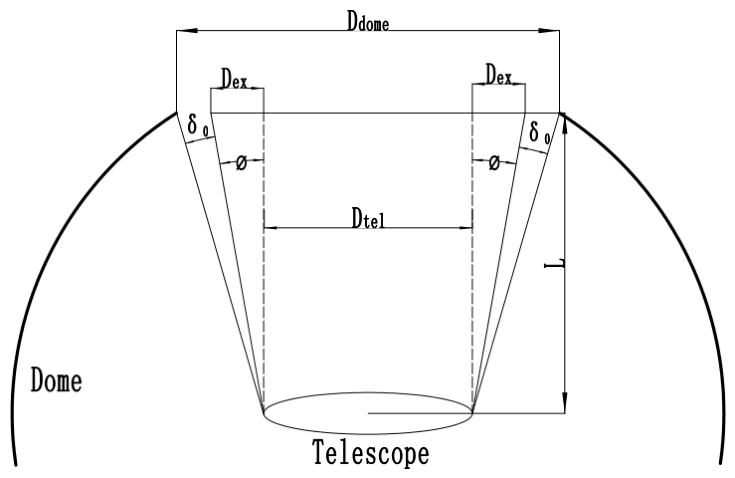
Large telescope domes typically adopt massive steel truss structures, which cause significant difficulties in rapid start-up and braking. When the control system receives the azimuth rotation signal from the telescope, the dome’s large inertia inevitably introduces a noticeable response delay. Meanwhile, factors such as potential slippage or backlash in the driving mechanism may cause the actual position of the dome to lag behind the desired position of the telescope. Therefore, in dome design, the size of the observation window is usually set larger than the minimum required by the telescope’s field of view, leaving a certain margin, as implemented in the LSST dome. This margin is referred to as the “initial tolerance” in this study, as illustrated in
Figure 1.
The initial tolerance
is:
The telescope is at an elevation angle of 0°, and its pointing direction is aligned with the center of the dome aperture. The relevant parameters are defined as follows: the aperture diameter of the telescope is , its field of view angle is 2, the width of the dome aperture is , and the distance from the telescope center to the outer edge of the dome aperture is .
2.2. Secant Variation of Tolerance
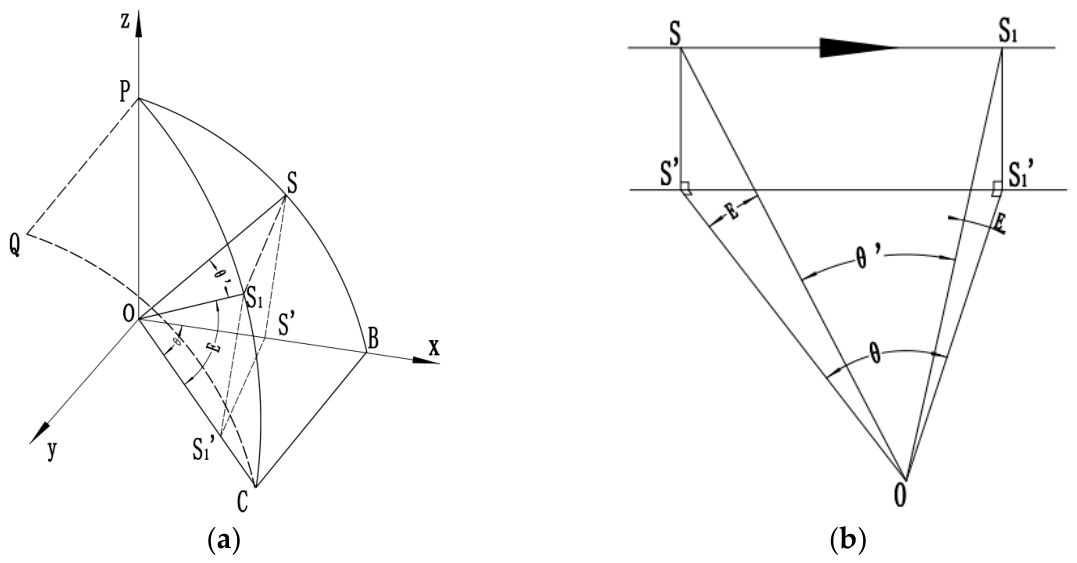
The azimuth angle of the telescope does not have a one-to-one correspondence with the spatial angle of its observed target. Instead, it exhibits a secant variation with the telescope’s elevation angle.
Figure 2a shows the target trajectory in the celestial coordinate system, while
Figure 2b shows the target’s horizontal motion trajectory in the plane coordinate system, where SS1 represents the target trajectory. In addition,
denotes its projection on the ground,
and E represent the azimuth angle and elevation angle of the telescope, respectively, and
denotes the target spatial angle.
According to the law of sines for triangles, we can obtain:
Thus, it can be obtained that:
According to the differential theorem, within an extremely short time interval:
Thus, it can be concluded that the spatial angle and the planar angle exhibit a secant relationship, so the tolerance also satisfies the secant relationship, namely:
3. Dome Trajectory Planning
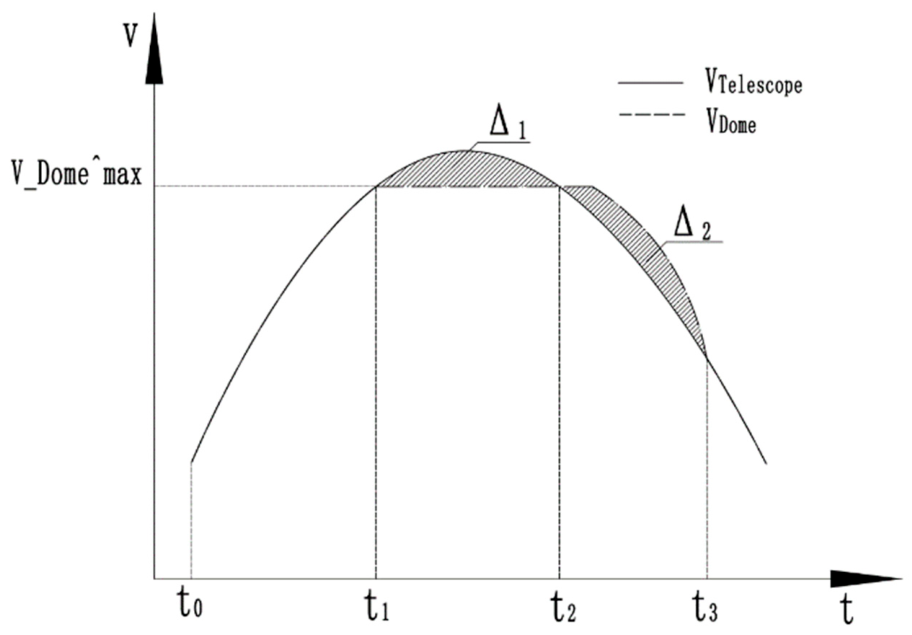
During the synchronous tracking process of the dome and the telescope, assuming that
, the telescope is aligned with the dome observing aperture at the initial moment of tracking, the entire tracking procedure can be divided into three stages, as shown in
Figure 3. The solid line represents the velocity curve of the telescope and the dashed line represents that of the dome, Δ denotes the positional deviation between them.
3.1. The First Stage
The first stage is
, during which the target trajectory ascends and the dome speed gradually increases to its maximum value. During this stage, as the target elevation angle increases, the azimuth angular velocities of both the dome and the telescope increase gradually, the dome maintains velocity synchronization with the telescope until it reaches its maximum speed, as described by Equation (6).
3.2. The Second Stage
The second stage is and their velocity relationship satisfies . During this stage, the telescope’s elevation angle first increases and then decreases as it tracks the target. Throughout the process, the telescope’s velocity remains consistently higher than the maximum velocity of the dome, leading to a continuous increase in the positional deviation between them. This stage terminates when the telescope’s velocity decreases to the maximum dome velocity during its descending phase, at which point the positional deviation reaches its maximum value. Moreover, the position error is always smaller than the allowable tolerance of the dome observing aperture.
During observation, based on known target orbit data, the azimuth and elevation angles of the telescope can be calculated. Therefore, in the second stage, the velocity relationship between the dome and the telescope is given in Equation (7):
where
is the telescope velocity,
is the dome velocity, and
denotes the velocity difference between them.
Within the travel range, their positional relationship satisfies Equation (8).
During this process, the dome runs at a constant speed, so the maximum speed of the dome is defined as Equation (9). The results show that the maximum dome speed has a minimum value. As long as the actual speed is not less than this minimum, the dome and telescope can achieve synchronization. Considering the effects of tracking errors, positioning errors, and wind disturbances, in engineering practice the dome speed is generally increased by 0.2–0.5° to ensure a sufficient margin.
3.3. The Third Stage
The third stage is and subsequent stages, during which the telescope velocity is lower than the maximum dome velocity and continues to decrease until the observation is completed. Owing to the excessive positional deviation accumulated between the two in the second stage, coupled with the fact that the tolerance decreases as the telescope’s elevation angle reduces, the dome operates in a “catch-up” mode during this stage to reduce the positional difference as rapidly as possible. Once the positional difference between them is less than the initial tolerance δ0, the dome and the telescope rotate at the same angular velocity.
At this stage, the velocity of the telescope can be determined according to the target trajectory, whereas the velocity of the dome remains unknown and must be solved using a reasonable planning strategy. This is to prevent field-of-view obstruction and satisfy the constraint given in Equation (10).
Based on the above conditions, the dome velocity is planned to ensure a continuous reduction in the positional difference between the dome and the telescope, as expressed in Equation (11).
where
denotes the telescope acceleration, and
represents the tolerance variation rate.
This section derives the velocity relationship between the telescope and the dome under the condition that the rotational speed of the telescope exceeds the maximum rotational velocity of the dome, and calculates for the dome’s rotational velocity in each of the three stages. Based on the derivation results, the rotational trajectory of the dome is replanned, which is of considerable significance for realizing high-speed synchronization between the telescope and the dome while the latter operates at a lower dome speed.
4. Simulation
This section conducts simulation verification based on the foregoing analysis and calculations to validate the feasibility and rationality of the proposed theory. The International Space Station (ISS) is selected as the simulation target: The ISS is a low-Earth-orbit satellite whose angular velocity during an overpass can exceed 10°/s, much higher than that of typical astronomical targets. This allows an extreme test of the proposed synchronization strategy under the condition where the dome speed is limited. Moreover, its orbital parameters are publicly available and accurate, facilitating simulation modeling. To simulate the high-speed tracking scenario, the position of the telescope site is randomly adjusted to ensure the target pass through the zenith at a relatively high speed. The target begins to accelerate when the telescope elevation angle reaches 82.4625°, with the elevation angle increasing gradually. When the elevation angle reaches 86.0665°, the azimuth rotational speed of the telescope reaches a peak of 14.7504°/s. Subsequently, as the target’s elevation angle descends, the telescope’s azimuth speed declines accordingly until the observation concludes. Partial trajectory data are excerpted as shown in
Table 1, and the dome velocity synchronization computation is carried out based on these orbital data.
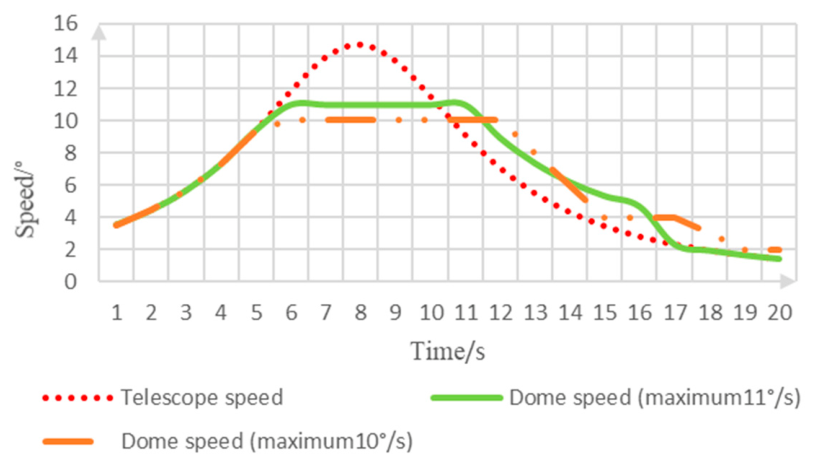
The dome velocity at each stage is solved using the enumeration method based on Equations (6)–(11). Calculations show that when , the dome can avoid obstructing the target throughout the entire tracking process by employing an appropriate control strategy. The maximum velocity of the dome is reduced by 27.5% compared with that of the telescope, which is of great significance for motion control and structural safety of large-scale telescope domes. In practical real-time tracking applications, this value is slightly increased to account for the influence of wind disturbances during operation.
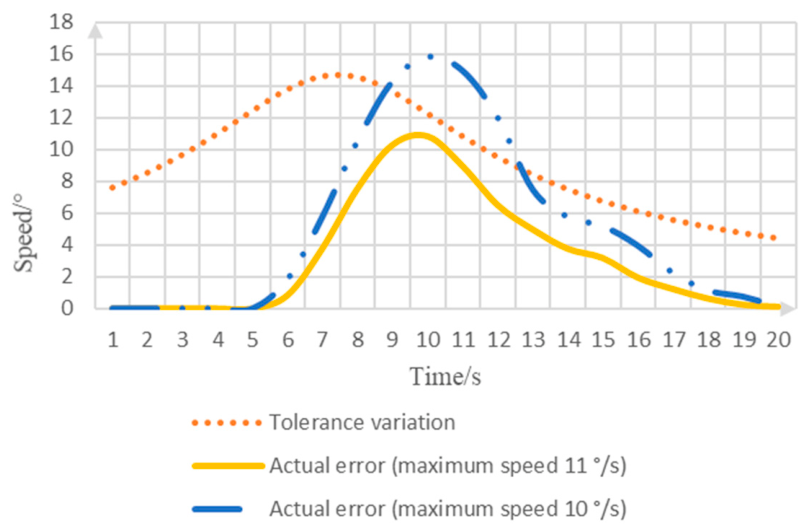
For a more intuitive comparison, the actual alignment errors of the dome at a maximum speed of 10°/s and 11°/s was analyzed and compared, as listed in
Table 1, the time unit in the table is seconds, and numerical differencing will be performed in actual operation with a sampling interval of 0.01 s. It can be observed that when the maximum speed of the dome is 10°/s, corresponding to the period from the 9th second to the 12th second in the table, the actual alignment error between the dome and the telescope exceeds the corresponding maximum tolerance at this time, resulting in obstruction to the telescope observation; In contrast, when the maximum speed of the dome is set to 11°/s, the telescope can maintain normal operation throughout the tracking process, and the maximum velocity of the dome is reduced by 25.4% compared with that of the telescope.
Figure 4 shows the velocity curves of the dome and the telescope, and
Figure 5 presents the variation curves of the pointing error between them as well as the allowable tolerance. It can be observed that when the maximum dome velocity is set to 11°/s, the pointing error remains below the corresponding tolerance at all times and always lies within the tolerance envelope. In contrast, when the maximum dome velocity is limited to 10°/s, the pointing error evidently exceeds the tolerance envelope. At this moment, the maximum telescope velocity reaches 14.7504°/s, which is significantly higher than the maximum velocity of the dome.
5. Design of Servo Control System
The dome motion described in this paper adopts a feedforward control strategy based on the desired trajectory and system model. In the actual tracking process, the dome and telescope are inevitably affected by wind loads, temperature variations, and modeling uncertainties. Meanwhile, the positioning accuracy and tracking error of the dome also influence its pointing accuracy relative to the telescope. Therefore, closed-loop position correction must be applied during operation. The servo control system is briefly introduced in the following.
5.1. Drive Scheme
In this paper, a brushless torque motor is selected as the driving motor due to its strong dynamic response capability and high positioning accuracy. Such motors feature a wide speed range, rapid dynamic response, and high positioning precision. To ensure that the dome achieves a high dynamic response performance, a synchronous drive scheme employing seven motors is adopted. The transmission system utilizes gear transmission, which offers obvious advantages: first, the fixed transmission ratio allows accurate positioning; second, the rigid contact enables the transmission of large torques. This drive scheme can match the high-speed operation of the telescope and meet the tracking and measurement requirements of high-speed targets.
5.2. Position Measurement
Two methods are used to measure the dome position: a built-in encoder integrated into the drive motor and an independently mounted grating angular encoder. The former indirectly obtains the dome rotational position from the motor speed and the gear reducer. Since the dome is driven by multiple motors, slight discrepancies exist among individual drives. Therefore, this method is mainly used to achieve synchronous speed control of multiple motors. The latter can directly measure the absolute angular position of the dome and match the telescope angle in a 1:1 manner.
During the tracking process of the dome and telescope, to reduce system fluctuations caused by external disturbances, real-time correction of the angular error between them is required. The error value should be less than the allowable angular tolerance, as expressed in Equation (12). It should be noted that the tolerance here is not a fixed value, but is related to the telescope’s pitch angle, which also serves as the core indicator for feedback control.
5.3. Servo Control Structure Servo Design Results
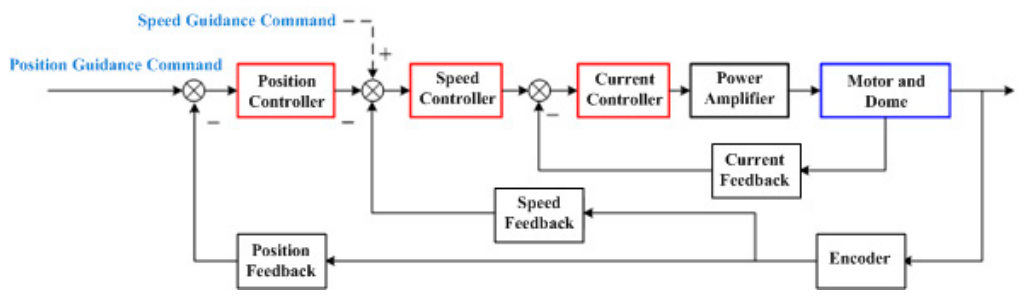
The control loop of the servo control system adopts the traditional proportional-integral-derivative (PID) control method, which consists of three closed loops: position loop, speed loop, and current loop, with their specific structure and signal transmission relationship illustrated in
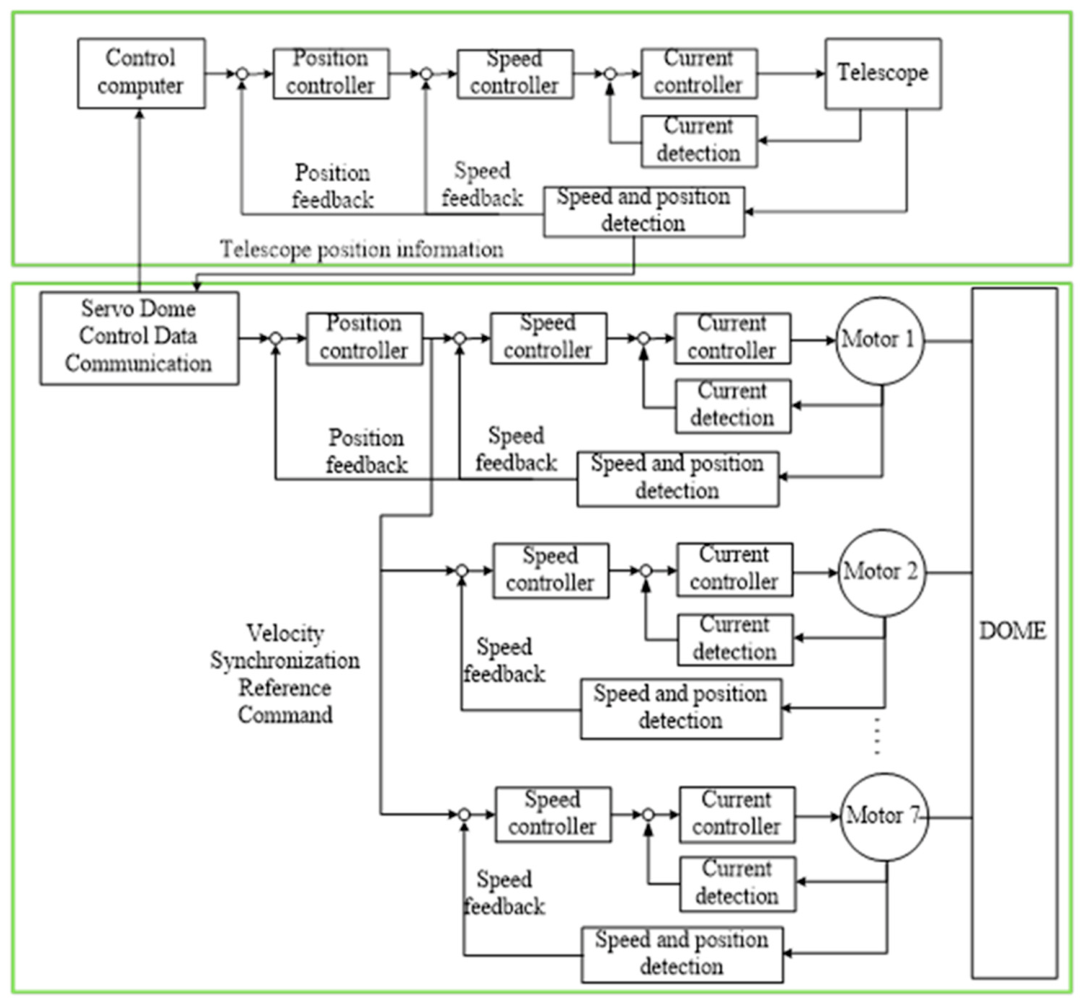
Figure 6. The three loops cooperate with each other to form a hierarchical control architecture, where the position loop is responsible for accurate positioning of the dome, the speed loop guarantees stable operation of the drive motors, and the current loop effectively suppresses current fluctuations to protect the motor and improve control responsiveness. To achieve high-precision synchronous operation of the multi-motor drive system, the tracking control system adopts a multi-motor speed synchronization control scheme, in which the seven drive motors are divided into a master-slave control structure for unified management. Specifically, one motor is designated as the master motor, which receives the speed command from the upper-level control system and serves as the reference for speed synchronization. The remaining six motors act as slave motors, which detect the output speed of the master motor in real time and adjust their own operating speed through the PID control loop to keep pace with the master motor. This master-slave synchronization control mode not only ensures the consistency of the rotational speed of all motors but also effectively reduces the influence of individual motor differences on the overall drive performance, laying a solid foundation for stable and accurate tracking of the dome.
Synchronous control strategy: The main control computer calculates the dome velocity information in advance based on the observed target orbit data and generates servo control instructions. During observation, the main control computer sends control commands for both the telescope and the dome, enabling them to run synchronously. The position information of the telescope is fed back to the dome control system to verify the position difference between the two, and perform dynamic correction. The control block diagram is shown in
Figure 7.
5.4. Servo Design Results
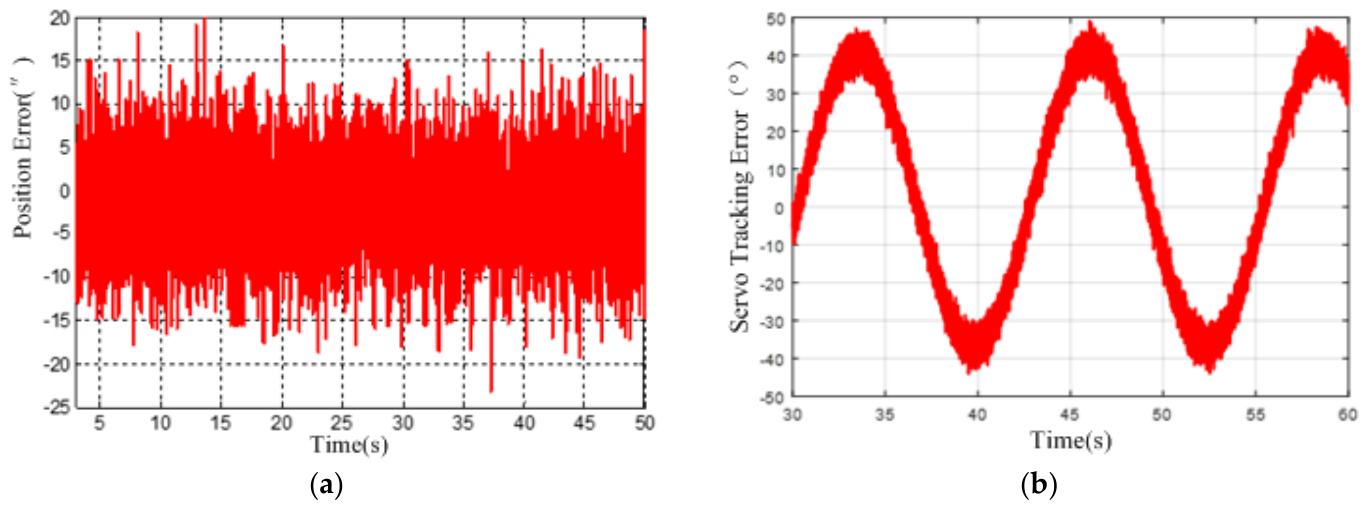
Based on the dome synchronous control system, an integrated simulation model is established to simulate its dynamic response. The positioning accuracy of the dome is within 20 arcseconds, as shown in
Figure 8a, which is considerably smaller than the initial opening tolerance
of the dome. Then, a sinusoidal position command is applied to both the dome and the telescope with a maximum velocity of 10°/s. Under this condition, the maximum tracking error between them is approximately 49.3 arcseconds, as shown in
Figure 8b. Both the positioning accuracy and tracking accuracy are smaller than the corresponding tolerance variation of the dome, ensuring that normal observation is not affected during high-speed rotation.
6. Result of Test
To verify the rationality of the above theory, a test was conducted on the dome. The dome has a rotational diameter of approximately 16 m, a height of about 12 m, and a weight of roughly 75 t. It is driven by seven sets of AC permanent magnet synchronous servo motors, with the drive system parameters listed in
Table 2. The current control system employs closed-loop control for position, speed, and current. Speed measurement is performed on the motor shaft, while the dome position information is provided by a multi-turn encoder fixed on the enclosure wall. The actual rotational speed of the dome can be calculated from the position information.
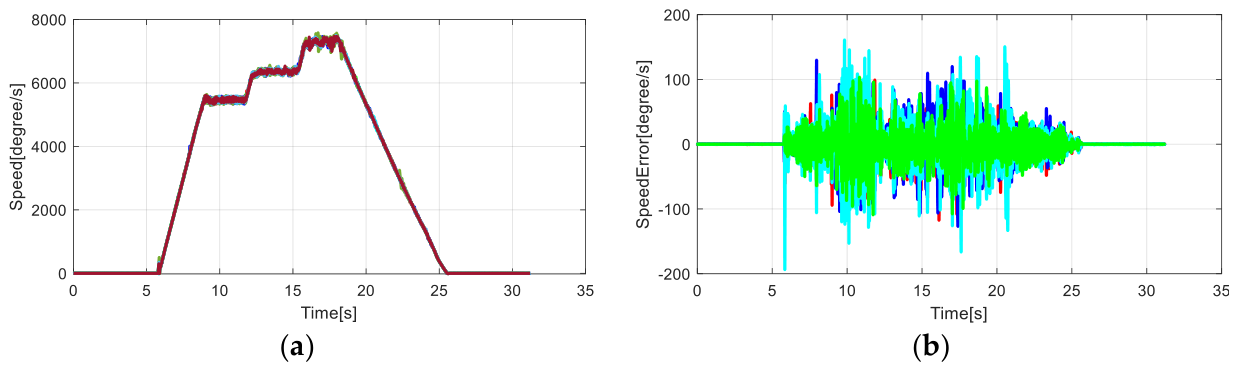
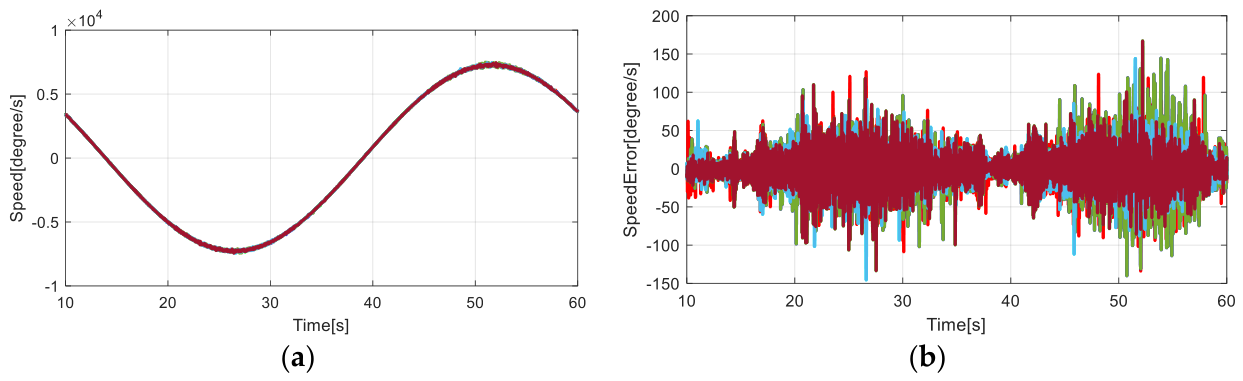
The dome is rotationally controlled by seven motors. The speed is taken as the average value of all motors, with a maximum speed of 7200°/s.
Figure 9 and
Figure 10 show the multi-motor synchronous step response and multi-motor sinusoidal tracking response, respectively. The synchronous speed error of each motor is less than 2.5%.
The dynamic error is defined as the deviation between the actual operating speed of the dome and the theoretically planned speed. The root mean square (RMS) is adopted as the quantitative indicator, and the formula is given in Equation (13):
where
is the theoretical speed value at the
i-th sampling instant, generated in real time by the dome trajectory planning algorithm proposed in
Section 3;
is the actual speed value at the same instant, obtained from the feedback of an optoelectronic encoder mounted on the dome drive shaft; and
is the total number of sampling points within the test period. The sampling frequency is 100 Hz, and the test duration covers the complete motion cycle of the dome.
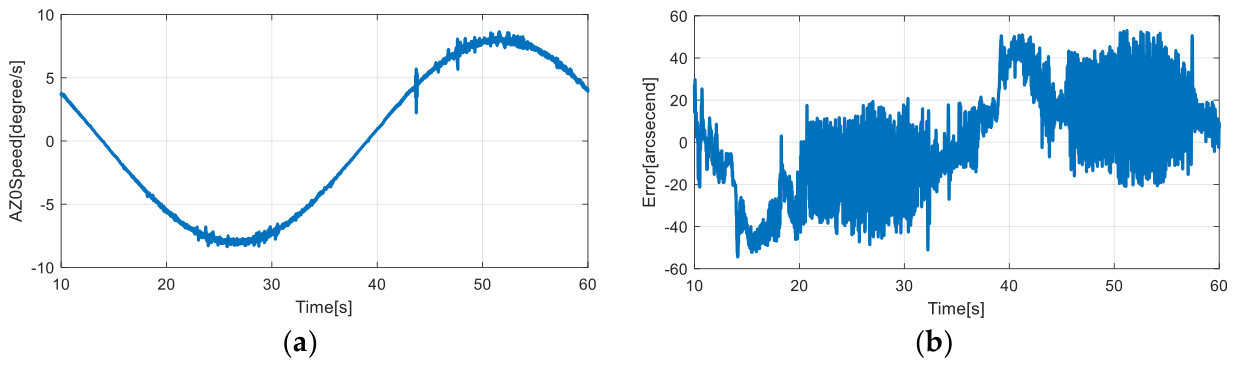
The actual speed of the dome is measured by an encoder, and a sinusoidal reference tracking scheme is adopted.
Figure 11 shows the sinusoidal tracking response of the dome, where the maximum rotational speed of the dome is 8°/s, and the maximum error during operation is less than 60 arcseconds. This value is far smaller than the initial opening tolerance of the dome, thus satisfying the synchronous control requirements between the dome and the telescope.
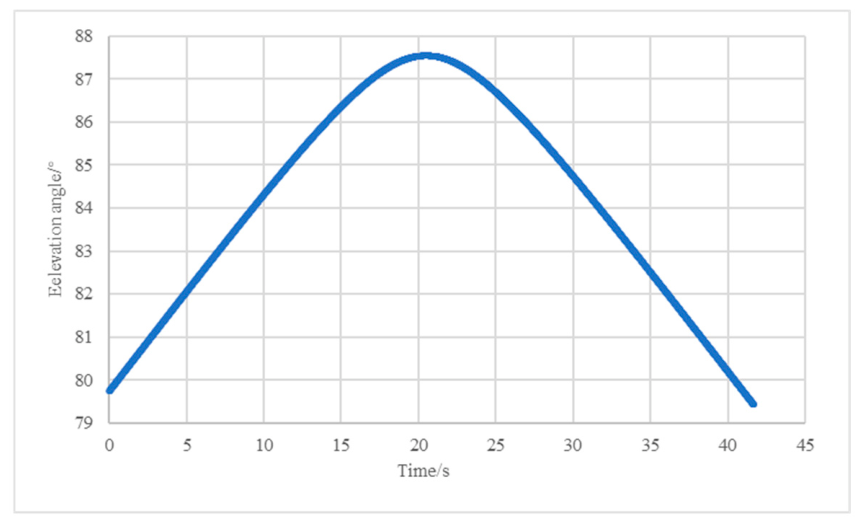
In actual observation, low-orbit targets are selected, and partial orbit data are intercepted. The variation in target elevation angle is shown in
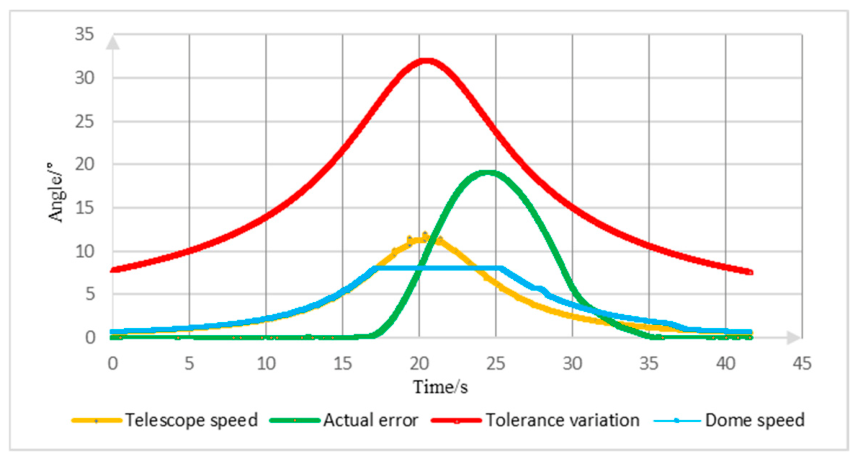
Figure 12, with a maximum elevation of 87.54° and a minimum of 79.43°. The telescope tracks the actual trajectory of the target, with a maximum speed of 12.08°/s occurs at the position of maximum elevation. According to the content in
Section 3, the maximum dome speed is calculated to be 7.5°/s along with its operating trajectory. The synchronization curve between the telescope and the dome during target tracking is shown in
Figure 13, where the maximum dome speed is 8°/s, representing a reduction of approximately 33.3% compared with that of the telescope. The position error between them lies within the tolerance envelope and has no impact on observation.
7. Discussion
The dome speed matching method proposed in this paper, based on the secant constraint and three-phase planning, derives its core advantages from the analytical modeling of geometric constraints and targeted handling of speed-limited engineering conditions. Conventional servo control typically requires the dome and telescope to operate at equal speeds, or at least that the dome speed is not lower than the telescope speed. However, for large-scale domes, factors such as drive power, moment of inertia, and speed limitations often make meeting this requirement entail high hardware costs. By establishing the secant constraint relationship between the dome angular velocity and the telescope elevation angle, and designing a three-phase speed planning strategy (constant-acceleration chase, speed matching, and deceleration adjustment), this paper fundamentally removes the engineering bottleneck that “the dome speed must not be lower than the telescope speed.” In the simulation, the maximum dome speed (11°/s) is only 74.6% of the maximum telescope speed (14.7504°/s); in the actual test, the maximum dome speed (8°/s) is 66.3% of the maximum telescope speed (12.08°/s). In both cases, obstruction-free synchronization is achieved throughout the entire motion. This demonstrates that the proposed method imposes significantly lower performance requirements on the dome drive system compared to conventional approaches.
To further evaluate the advantages of the proposed method, we compare it with three representative studies from both domestic and international sources, as shown in
Table 3.
As shown in
Table 3, most existing methods are based on the equal-speed assumption or only achieve dome opening/closing decisions. Although J. DeVries et al. performed trajectory planning for the LSST dome, their method is only applicable to long-exposure quasi-static target observations and does not systematically solve the obstruction-free synchronization problem when the maximum dome speed is lower than the maximum telescope speed [
24]. By introducing the secant constraint between the elevation angle and the dome speed, and designing a three-phase planning strategy, this paper fills this gap. In the actual test, the dome speed is reduced by approximately 33.3%. This demonstrates that the proposed method can significantly lower the performance requirements for the dome drive system, thereby reducing hardware costs, decreasing operational energy consumption, and improving mechanical operational safety.
This study not only solves the technical challenges of dome-telescope coordinated control, but also has clear scientific significance and social value. At the scientific level, the proposed high-precision tracking and fast-response strategy can support observations of high-energy transient phenomena such as gravitational wave optical counterparts and gamma-ray burst afterglows, thereby providing key technical support for research in particle physics and astroparticle physics. At the application level, the proposed control strategy can be extended to space debris monitoring and low-Earth-orbit satellite tracking, serving space security and space situational awareness, with potential for cross-disciplinary technology spillover.
The dome trajectory planning method proposed in this paper is realized based on the tolerance secant variation, and a detailed multi-motor parallel servo control system is designed. The method is simple, effective, and practical, and is feasible for any dynamic target tracking process, particularly for fast tracking. Nevertheless, it has certain limitations: the orbit of the observed target must be known in advance; otherwise, trajectory planning is difficult to perform.
As can be seen from the above discussion, the telescope is initially aligned with the center of the dome aperture. In future work, full use will be made of the left-right symmetry of the tolerance, allowing the telescope to align with the edge of the dome aperture. This will further expand the tolerance range and further reduce the maximum dome speed. However, it will also complicate trajectory planning, as the dome may experience forward and reverse rotation, frequent start-stop, and direction switching, which increases the complexity of servo control.
8. Conclusions
This paper addresses the coordinated servo control problem of an observatory dome and telescope, and proposes a method based on geometric constraints and piecewise kinematic planning. First, through geometric analysis, a secant constraint relationship between the dome angular velocity and the telescope elevation angle is established, revealing the dynamic coupling mechanism between the two beyond pure azimuth following. Second, a three-phase speed planning strategy is designed. Without increasing hardware cost, this trajectory planning strategy achieves obstruction-free synchronization under the condition that the maximum dome speed is lower than the maximum telescope speed. Third, a closed-form analytical expression for the dome speed profile is derived. This analytical solution has clear physical meaning and simple computation, making it convenient for direct implementation in control systems. Finally, validation is carried out through simulation and actual measurement. In the simulation, the telescope maximum speed is 14.7504°/s and the dome maximum speed is 11°/s, resulting in a reduction in the maximum dome speed by approximately 25.4% compared with the telescope. In the actual measurement, the telescope maximum speed is 12.08°/s and the dome maximum speed is 8°/s, giving a reduction of approximately 33.3%. The results show that even when the maximum dome speed is significantly lower than the maximum telescope speed, the proposed method effectively eliminates field-of-view obstruction and meets observation requirements. Compared with existing approaches that rely on iterative optimization or intelligent algorithms, our method is easier to deploy in engineering practice and is particularly suitable for astronomical observation scenarios that demand high real-time performance and reliability.
Author Contributions
Conceptualization, W.W. and J.W.; methodology, W.W.; software, W.W. and L.S.; validation, W.W., J.W., Z.W., M.S. and L.S.; formal analysis, W.W.; investigation, W.W.; resources, W.W.; data curation, W.W. and M.S.; writing—original draft preparation, W.W.; writing—review and editing, W.W.; visualization, W.W.; supervision, W.W.; project administration, W.W.; funding acquisition, J.W. All authors have read and agreed to the published version of the manuscript.
Funding
This research was funded by the Jilin Province Science and Technology Development Plan (NO. 20230203113SF).
Institutional Review Board Statement
Not applicable.
Informed Consent Statement
Not applicable.
Data Availability Statement
The original contributions presented in the study are included in the article material, further inquiries can be directed to the corresponding author.
Acknowledgments
Authors would like to thank the Natural Science Foundation of Jilin Province.
Conflicts of Interest
The authors declare no conflicts of interest.
References
- Wang, W.P.; Wang, J.L.; Wang, Z.C.; Fan, W.Q.; Wang, H.H. Design of steel structure for the dome of ground-based large aperture optical telescope. Opt. Precis. Eng. 2025, 33, 3383–3391. [Google Scholar] [CrossRef]
- Zhang, J.X. Structure types and design principles of ground-based telescope enclosures. Chin. Opt. 2012, 5, 126–132. [Google Scholar] [CrossRef]
- Kwok, S.H.; Tsubota, K.; Krasuski, T.; Lyke, J.; McCarney, B.; Mader, J.; McCann, K. Keck Observatory telescope control system upgrade status report. In Observatory Operations: Strategies, Processes, and Systems VII; 107040N; SPIE: Cergy-Pontoise, France, 2018; Volume 10704. [Google Scholar] [CrossRef]
- Chen, L.M.; Huang, K.Y.; Liu, Y.J.; Zeng, Y.H.; Li, Z.B.; Zhou, Y.Y.; Dong, S.L. Optimization of Cable Dome Structure Design for Progressive Collapse Resistance. Appl. Sci. 2023, 13, 2086. [Google Scholar] [CrossRef]
- Wang, S.; Deng, Y.T.; Liu, Y.; Yang, X.X.; Li, H.W.; Wang, J.L. Performance analysis of large-aperture telescope main axes servo based on multi-motor synchronous drive. Opt. Precis. Eng. 2025, 33, 3403–3418. [Google Scholar] [CrossRef]
- Dhinakaran, A.; Pillai, S.N.; Hameed, V.S.; Priya, S.B.M. Review on orbital debris mitigation: Techniques for effective tracking. Acta Astronaut. 2025, 236, 281–310. [Google Scholar] [CrossRef]
- Lin, Q.C.; Lin, Y.; Zhang, J.H. A new method for follower to control the telescope domes. Shanghai Obs. Ann. 2001, 22, 122–126. [Google Scholar]
- Gopinathan, M.; Sahu, S.; Yadava, S.; Jangid, P.; Medhi, B.J.; Rao, P.; Kumar, B.; Omar, A.; Uddin, W. Synchronization of off-centered dome and 3.6m Devasthal Optical Telescope. In Software and Cyberinfrastructure for Astronomy IV; 99134O; SPIE: Cergy-Pontoise, France, 2016; Volume 9913. [Google Scholar] [CrossRef]
- Yang, X.; Li, W.C.; Wang, X.; Yang, X.H.; An, Y.Y. Reformation of 1.05 m laser telescope base pier and correction of eccentricity of dome. J. Time Freq. 2021, 44, 222–230. [Google Scholar] [CrossRef]
- Zhang, B.; Gao, H.B. Active Disturbance Rejection Control Algorithm Research for Large Tracking Dome System. Sci. Technol. Eng. 2016, 16, 75–79. [Google Scholar]
- Zhang, G.J.; Song, T.F.; Cheng, X.M.; Wang, J.X.; Zhang, Y.G. Automatic Control of Astronomical Dome Based on ASCOM and PLC. Astron. Tech. Instrum. 2020, 17, 548–554. [Google Scholar] [CrossRef]
- Jörg, W.; Thomas, G.; Wilbert, B.; Arto, J. BMK10k: An autonomous robotic Observatory with fail-safe industrial Components. In Software and Cyberinfrastructure for Astronomy VI; SPIE: Cergy-Pontoise, France, 2020; Volume 11452. [Google Scholar] [CrossRef]
- Li, Y.; Ye, Y.; Yang, S.S.; Xu, L.Z.; Xu, J.; Wang, H.; Deng, Z.Z.; Liu, R.Q.; Gu, X.J.; Gu, B.Z. Large-aperture Telescope Tracking Control Based on Time-synchronization Strategy. Res. Astron. Astrophys. 2024, 24, 035004. [Google Scholar] [CrossRef]
- Serrano, J.; Pescador, G.R. GTC dome: Entering into manufacturing. In Telescope Structures, Enclosures, Controls, Assembly/Integration/Validation, and Commissioning; SPIE: Cergy-Pontoise, France, 2000; Volume 4004. [Google Scholar] [CrossRef]
- DeVries, J.; Neill, D.R.; Barr, J.; Lorenzi, S.D.; Marchiori, G. The LSST Dome final design. In Ground-Based and Airborne Telescopes VI; 99060N; SPIE: Cergy-Pontoise, France, 2016; Volume 9906. [Google Scholar] [CrossRef]
- Castro, N.; Bilbao, A.; Fernández, A.; Sierra, P.; Gómez, Á.; Cabezuelo, L.; Fernández, E.; Martinez, J.; Sanchez, F.J.; Martin, M.; et al. GMT enclosure detail engineering design: Facing the construction phase. In Ground-Based and Airborne Telescopes X; 1309405; SPIE: Cergy-Pontoise, France, 2024; Volume 13094. [Google Scholar] [CrossRef]
- Vogiatzis, K.; Thompson, H.; Trancho, G. Aerothermal support for TMT International Observatory enclosure and summit facilities subsystems. In Ground-Based and Airborne Telescopes X; 130940Q; SPIE: Cergy-Pontoise, France, 2024; Volume 13094. [Google Scholar] [CrossRef]
- Padovani, P.; Cirasuolo, M. The Extremely Large Telescope. Contemp. Phys. 2023, 64, 47–64. [Google Scholar] [CrossRef]
- Gianluca, C.; Mario, K.; Nick, K.; Ulrich, L.; Marcus, S. The ELT Control System. In Software and Cyberinfrastructure for Astronomy V; SPIE: Cergy-Pontoise, France, 2018; Volume 10707. [Google Scholar] [CrossRef]
- Gedig, M.; Brzezik, W.; Crofoot, L.; Hadi, A.H.; Kadivar, A.; Li, T.; Niaki, S.; Vincent, C.; Jalayer, M. Thirty Meter Telescope enclosure production readiness overview. In Ground-Based and Airborne Telescopes VIII; 114450A; SPIE: Cergy-Pontoise, France, 2020; Volume 11445. [Google Scholar] [CrossRef]
- Jin, H.; Kim, S.L.; Kwon, S.G.; Youn, J.H.; Lee, C.U.; Lee, D.J.; Kim, K.S. Multiband photometric re-classification of ROTSE-I δ Scuti type stars. Astron. Astrophys. 2003, 404, 621–629. [Google Scholar] [CrossRef]
- Castellón, A.; Larrubia, G.; Castillo, R.; Castro-Tirado, A.; Fernández-García, E.; Pérez del Pulgar, C.; Reina, A.; Castillo-Carrión, S. Dome Control with Fuzzy Logic. Front. Astron. Space Sci. 2022, 9, 924871. [Google Scholar] [CrossRef]
- Lipunov, V.M.; Kornilov, V.G.; Krylov, A.V.; Borisov, G.V.; Kuvshinov, D.A.; Belinski, A.A.; Gorbovskoy, E.S.; Antipov, G.A.; Tyurina, N.V.; Vitrischak, V.M.; et al. The Master Mobile Astronomical System. Optical Observations of Gamma-Ray Bursts. Astrophysics 2005, 48, 389–399. [Google Scholar] [CrossRef]
- Marchiori, G.; Lorenzi, S.D.; Martinez, J.; Ghedin, L.; Marchiori, T.; Battistel, C.; Manfrin; Bressan, C.; Vio, R.; Niero, L.; et al. Rubin Observatory rotating enclosure (dome) progress and status. In Ground-Based and Airborne Tele-Scopes X; 1309404; SPIE: Cergy-Pontoise, France, 2024; Volume 13094. [Google Scholar] [CrossRef]
Figure 1.
Relative positional relationship between the telescope and the dome (Elevation angle = 0°, Centered alignment).
Figure 1.
Relative positional relationship between the telescope and the dome (Elevation angle = 0°, Centered alignment).
Figure 2.
(a) Target trajectory in space; (b) Taking the horizontal flight of the target as an example.
Figure 2.
(a) Target trajectory in space; (b) Taking the horizontal flight of the target as an example.
Figure 3.
Dome and Telescope synchronization process.
Figure 3.
Dome and Telescope synchronization process.
Figure 4.
Dome and Telescope Velocity Variation Curve.
Figure 4.
Dome and Telescope Velocity Variation Curve.
Figure 5.
Actual alignment error and tolerance variation curve at different maximum speeds.
Figure 5.
Actual alignment error and tolerance variation curve at different maximum speeds.
Figure 6.
Block diagram of PID control loop.
Figure 6.
Block diagram of PID control loop.
Figure 7.
Dome-Telescope Synchronous Control Block Diagram.
Figure 7.
Dome-Telescope Synchronous Control Block Diagram.
Figure 8.
(a) Dome positioning accuracy; (b) Dome tracking accuracy.
Figure 8.
(a) Dome positioning accuracy; (b) Dome tracking accuracy.
Figure 9.
Multi-motor synchronous step response: (a) Step response; (b) Speed errors.
Figure 9.
Multi-motor synchronous step response: (a) Step response; (b) Speed errors.
Figure 10.
Multi-motor synchronous sinusoidal tracking response: (a) sinusoidal tracking response; (b) Speed errors.
Figure 10.
Multi-motor synchronous sinusoidal tracking response: (a) sinusoidal tracking response; (b) Speed errors.
Figure 11.
Dome sinusoidal tracking response: (a) Sinusoidal tracking response; (b) Tracking errors.
Figure 11.
Dome sinusoidal tracking response: (a) Sinusoidal tracking response; (b) Tracking errors.
Figure 12.
Target elevation angle curve.
Figure 12.
Target elevation angle curve.
Figure 13.
Dome-telescope synchronous performance, in red the tolerance variation, in yellow the telescope speed, in blue the dome speed, in green the actual error between dome and telescope.
Figure 13.
Dome-telescope synchronous performance, in red the tolerance variation, in yellow the telescope speed, in blue the dome speed, in green the actual error between dome and telescope.
Table 1.
Comparison of Alignment Errors Between Dome and Telescope.
Table 1.
Comparison of Alignment Errors Between Dome and Telescope.
| Initial Tolerance = 1° | Maximum Speed of Dome = 11°/s | Maximum Speed of Dome = 10°/s | Tolerance Variation |
|---|
| Time | Azimuth | Elevation | Azimuthal Velocity | Dome Speed | Actual Error | Dome Speed | Actual Error | = |
|---|
| 1 | 201.5694 | 82.4625 | 3.5179 | 3.5179 | 0 | 3.5179 | 0 | 7.6234 |
| 2 | 197.1464 | 83.2965 | 4.4230 | 4.4230 | 0 | 4.4230 | 0 | 8.5667 |
| 3 | 191.4976 | 84.0821 | 5.6488 | 5.6488 | 0 | 5.6488 | 0 | 9.6990 |
| 4 | 184.2016 | 84.7953 | 7.2960 | 7.2960 | 0 | 7.2960 | 0 | 11.0236 |
| 5 | 174.7853 | 85.4004 | 9.4163 | 9.4163 | 0 | 9.4163 | 0 | 12.4701 |
| 6 | 162.9395 | 85.8481 | 11.8458 | 11 | 0.8458 | 10 | 1.8458 | 13.8120 |
| 7 | 148.9824 | 86.0831 | 13.9571 | 11 | 3.8028 | 10 | 5.8028 | 14.6392 |
| 8 | 134.2320 | 86.0665 | 14.7504 | 11 | 7.5533 | 10 | 10.5584 | 14.5776 |
| 9 | 120.4949 | 85.8014 | 13.7371 | 11 | 10.2904 | 10 | 14.2995 | 13.6586 |
| 10 | 108.9635 | 85.3305 | 11.5314 | 11 | 10.8218 | 10 | 15.8269 | 12.2838 |
| 11 | 99.8452 | 84.7094 | 9.1183 | 11 | 8.9401 | 10 | 14.9452 | 10.8451 |
| 12 | 92.7883 | 83.9855 | 7.0569 | 8.9386 | 7.0584 | 10 | 12.0021 | 9.54379 |
| 13 | 87.3192 | 83.1930 | 5.4691 | 7.3508 | 5.1767 | 8 | 7.4712 | 8.4370 |
| 14 | 83.0288 | 82.3545 | 4.2904 | 6.1721 | 3.295 | 6 | 5.7616 | 7.5163 |
| 15 | 79.6092 | 81.4853 | 3.4196 | 5.3013 | 1.4133 | 4 | 5.1812 | 6.7539 |
| 16 | 76.8382 | 80.5955 | 2.7710 | 4.6527 | −0.4684 | 4 | 3.9522 | 6.1198 |
| 17 | 74.5572 | 79.6922 | 2.2810 | 2.281 | −0.4684 | 4 | 2.2332 | 5.5886 |
| 18 | 72.6527 | 78.7801 | 1.9045 | 1.9045 | −0.4684 | 3 | 1.1377 | 5.1394 |
| 19 | 71.0419 | 77.8631 | 1.6108 | 1.6108 | −0.4684 | 2 | 0.7486 | 4.7563 |
| 20 | 69.6640 | 76.9439 | 1.3779 | 1.3779 | −0.4684 | 2 | 0.1264 | 4.4266 |
Table 2.
Driver component parameters.
Table 2.
Driver component parameters.
| Model | Rated Speed | Rated Torque | Rated Power | Rated Current | Number of Motors |
|---|
| 31330A | 2000 r/min | 180 N·m | 38 KW | 74 A | 7 |
Table 3.
Comparison of the proposed method with representative dome control approaches.
Table 3.
Comparison of the proposed method with representative dome control approaches.
| Method Source | Technical Approach | Main Advantage | Main Limitation | Ref. |
|---|
| J. DeVries et al. (2016) | Nonequal speed
trajectory planning | Suitable for long exposure observations | Not applicable to fast dynamic targets | [15] |
| Zhang Bei et al. (2016) | ADRC + equal speed assumption | Overcomes inertia/friction, 1′ positioning accuracy | Does not address speed limited synchronization | [10] |
| Castellón et al. (2022) | Fuzzy logic control | Autonomous opening/closing, adapts to weather | Requires weather station and all sky camera | [22] |
| Proposed method | Secant compensation + three phase planning | Obstruction free synchronization under speed limited condition | Requires prior orbit data | / |
| Disclaimer/Publisher’s Note: The statements, opinions and data contained in all publications are solely those of the individual author(s) and contributor(s) and not of MDPI and/or the editor(s). MDPI and/or the editor(s) disclaim responsibility for any injury to people or property resulting from any ideas, methods, instructions or products referred to in the content. |