Article

Improved YOLOv8 for Tree Species Detection Using Bark Texture Features

1
College of Forestry, Nanjing Forestry University, Nanjing 210037, China
2
Co-Innovation Center for Sustainable Forestry in Southern China, Nanjing Forestry University, Nanjing 210037, China
*
Author to whom correspondence should be addressed.
Appl. Sci. 2026, 16(12), 5726; https://doi.org/10.3390/app16125726
Submission received: 10 April 2026 / Revised: 14 May 2026 / Accepted: 4 June 2026 / Published: 6 June 2026
(This article belongs to the Special Issue AI in Object Detection)

Abstract

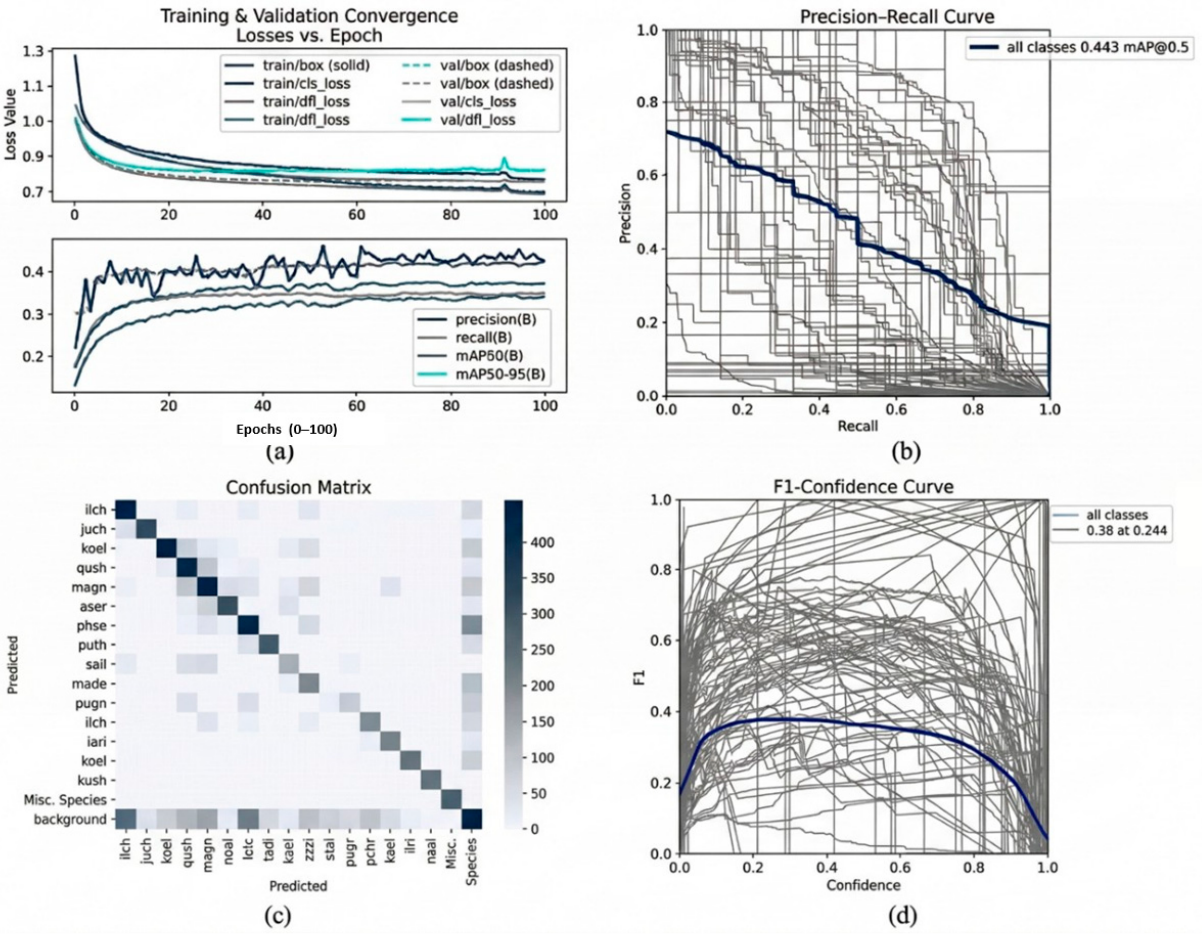
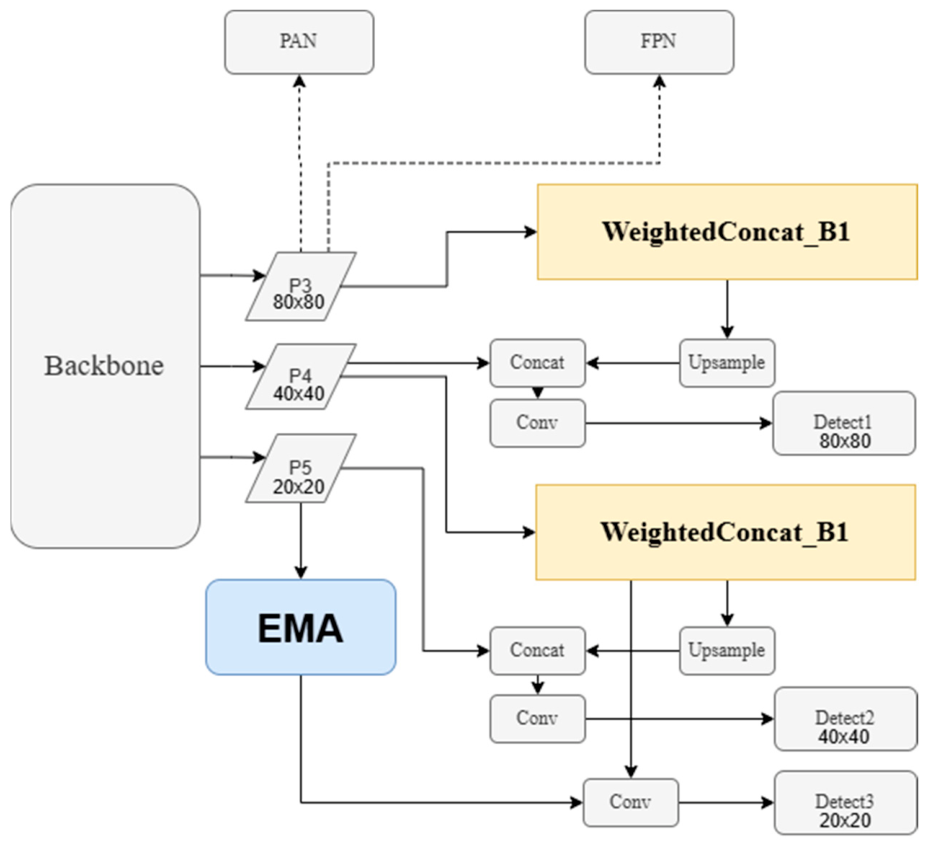
Tree bark is a relatively stable visual feature for tree species detection because it remains visible throughout the year and is less affected by seasonal changes than leaves or flowers. However, bark-texture-based tree species detection in natural scenes remains challenging because of limited dedicated datasets, subtle inter-class texture differences, complex backgrounds, and scale variation. This work evaluated whether task-oriented multi-scale feature fusion and attention-based feature enhancement can improve YOLOv8s for bark-texture-based tree species detection. To this end, the Tree_bark dataset was constructed, containing 134 annotated classes and 8216 valid images, and YOLOv8s was used as the baseline detector. Three multi-scale enhancement strategies, three lightweight attention mechanisms, and their fused configuration were systematically compared under the same data split and evaluation setting. On the validation set, the baseline YOLOv8s achieved a mAP@0.5 of 0.443, a mAP@0.5:0.95 of 0.339, and a Recall of 0.400. The final fused D1 model, combining WeightedConcat_B1 and EMA, showed the highest overall performance among the compared settings under the current experimental setting, with a mAP@0.5 of 0.485, a mAP@0.5:0.95 of 0.365, and a Recall of 0.435. Compared with the baseline, D1 improved mAP@0.5 by 0.042, mAP@0.5:0.95 by 0.026, and Recall by 0.035. These results indicate that moderate adaptive multi-scale fusion and lightweight attention enhancement can improve bark-texture-based tree species detection in complex natural scenes. The proposed framework provides a useful reference for fine-grained tree species detection based on bark texture, although further validation across broader regions and more complex field conditions is still needed.
Keywords: bark texture; tree species detection; YOLOv8; weighted feature fusion; attention mechanism bark texture; tree species detection; YOLOv8; weighted feature fusion; attention mechanism