Article

Discrete Bar-Chain Model for Aeroelastic Stability Analyses of Flexible Slender Thin Wings in Subsonic Flow at Low Speed
Pilatus Aircraft Ltd., Pilatusstrasse 1, 6371 Stans, Switzerland
Appl. Sci. 2026, 16(11), 5687; https://doi.org/10.3390/app16115687
Submission received: 25 March 2026 / Revised: 21 May 2026 / Accepted: 22 May 2026 / Published: 5 June 2026

Abstract

A novel semi-analytical computational approach is formulated and assessed for the dynamic aeroelastic stability analysis of flexible slender thin wings in incompressible flow, which can boost the preliminary airframe design and optimisation of lightweight aircraft, offering both theoretical and practical insights. Hencky’s bar-chain model is explicitly adopted as a discrete numerical implementation of the Euler–Bernoulli continuous beam idealisation for the flexible wing structure and its deformation, resulting in a linear system of coupled ordinary differential equations for its bending and torsion dynamics. Modified strip theory is employed for the unsteady sectional airload, where approximate yet effective analytical expressions are efficiently adopted for its build-up and distribution, combining two- and three-dimensional effects in subsonic potential flow. Once the natural vibration modes of the wing are obtained from its physical model, a reduced set is selected, and a modal approach is then employed to perform its aeroelastic stability analysis with either “p-k” or “p” method, depending on the aerodynamic model. Numerical results from such a reduced-order model are critically assessed for the flutter analysis of Goland’s, Loring’s, and Pazy wings and demonstrate excellent agreement with literature results for two- and three-dimensional airflow, also for the case of the swept wing.

1. Introduction

Within a renewed applied research interest for simplified yet effective multi-body [1,2,3] and lumped parameters models [4,5,6,7,8] in aircraft preliminary Multidisciplinary Design and Optimisation (MDO) [9,10,11,12,13], this study focuses on the dynamic aeroelastic stability analysis of a flexible slender thin wing in subsonic incompressible flow [14,15,16,17] and follows from recent works on its static aeroelastic stability and response [18,19] where Hencky’s bar-chain model (HBCM) [20,21,22,23,24] was first adopted in aerospace research and engineering practice. In particular, the HBCM was thereby and still is hereby employed as a discrete numerical implementation of Euler–Bernoulli’s continuous beam idealisation for the wing’s structure and its coupled deformation in bending and torsion [25,26], exploiting Hook’s law and de Saint-Venant’s theory [27,28] for airframe design and multidisciplinary analysis; yet, references to other new applications of the HBCM can be found in the literature review of many previous works [19,20,21,22,23,24], supporting a key objective of this study by demonstrating that robust legacy tools such as the HBCM can be revisited and effectively enhanced in a modern perspective (e.g., for light HALE air vehicles).
As the structural arrangements of lightweight aircraft [29,30] may favour catastrophic aeroelastic instabilities within the target operational envelope [31,32,33], computationally efficient frameworks for a robust preliminary design become crucial [34,35]; novel approaches, methods and tools are then highly sought in the form of reliable Reduced Order Models (ROMs) [36,37,38,39,40], as effective multidisciplinary optimisation does require a large design space to be explored by intelligent algorithms and strategies while performing the different analyses involved in the definition of cost functions (to be minimised) and constraints (to be satisfied) [41]. In this respect, simplified aeroelastic models may conveniently be used on solid grounds and grant sound insights [16,17,18,19]; in particular, modified strip theory (MST) [18] was found very well-suited for fast aero-structural analyses and comprehensive parametric assessments involving the fluid–structure interaction (FSI) [42,43,44] of slender structures (i.e., with length much larger than cross-section size) from small perturbations of subsonic flow [45], within a monolithic approach [46].
In aeronautical engineering research and practice, many aeroelastic solvers couple a beam-based Finite Element Method (FEM) [47,48] to model the aircraft structure and its deformation with a Doublet Lattice Method (DLM) [49,50] or Unsteady Vortex Lattice Method (UVLM) [51,52,53] to model the aircraft aerodynamics and its unsteady airload without adopting Computational Fluid Dynamics (CFD) [54] directly, within a convenient staggered or monolithic approach [55]. Although inherently linear and theoretically limited to small structural displacements and airflow perturbations [56], lower-fidelity tools may efficiently serve as ROMs within their trust region [57,58] or be effectively tuned by a metamodel-based strategy [34,35] with a few full-order results outside such a region [59,60], in order to minimise the overall complexity while maximizing accuracy and synthesis [61]; the layout of a recent work [19] is then intentionally replicated here.
As flight speed increases, in real cases [62], the overall displacement of aircraft wings remains rather small as a result of key integrity, controllability, and performance constraints in the aero-structural design [10,11,12], where aeroelastic divergence and flutter are major safety concerns [63,64,65,66,67,68,69] besides control surface effectiveness and aerodynamic efficiency [70,71,72]. This work then presents a novel computational approach for calculating the aeroelastic stability boundary of a thin flexible slender wing in a subsonic incompressible flow with a lower-order yet reliable discrete model, within an interdisciplinary framework for fast and robust aeroelastic analyses where the HBCM is monolithically coupled with MST for flutter simulations in aeronautical applications and approximate yet effective analytical expressions for the build-up and distribution of the unsteady sectional airload combine two- and three-dimensional mitigating effects (from shed and trailed counteracting circulation) within a linear formulation.
In particular, the Euler–Bernoulli’s coupled partial differential equations (PDEs) for the wing’s bending and torsion dynamics are effectively transformed into a linear system of coupled ordinary differential equations (ODEs) [73] by means of flexural and torsional springs mimicking the local flexural and torsional stiffness of the wing, respectively, whereas the local inertia is lumped at the centre of gravity of each wing segment [74,75]; the sectional airload is also applied thereby [7,19], considering incompressible potential (inviscid, irrotational, ideal) flow [76,77]. Theodorsen’s theory for thin aerofoil [78,79,80,81,82,83,84] (including two-dimensional inflow effects from a flat wake [85,86,87,88]) is adopted as generalized for thin wing [89,90] (including three-dimensional downwash effects from the tip vortices [91,92,93,94,95,96,97]), with a rational function approximation [98,99,100,101,102,103] for the transfer function of the indicial airload [104,105,106,107,108,109,110]; a simplified quasi-unsteady (SQU) aerodynamic model [111,112,113] is also employed, as particularly useful to appreciate the impact of the trailed vorticity on the flutter boundary and to detect static aeroelastic divergence [69].
In order to minimize the computational costs and maximize the numerical robustness of the derived aeroelastic HBCM, a modal approach [114,115] is employed where a reduced set of critical modes is retained (via balanced truncation [25]) and a ROM hence results in the mixed time-frequency domain; the “p-k” [116] and “p” [117] methods are then coherently adopted for the flutter analysis [118] when unsteady aerodynamics and simplified quasi-unsteady are employed, respectively, with a full mode-tracking strategy [119,120,121] which exploits the modal assurance criteria (MAC) [122] and involves sorted eigenvalues and eigenvectors [123,124]. With the bending angle approximating the local gradient of the flexural displacement along the span and with the local gradient of the torsional displacement being neglected as a higher-order camber effect [18,26], the extension of the derived aeroelastic ROM to a swept wing is straightforward and based on solid physical and mathematical grounds.
The present aeroelastic HBCM is then critically assessed and successfully validated against literature results for the flutter boundaries of three renowned benchmark wings in either two- or three-dimensional airflow: Goland’s [125,126], Loring’s [127], Pazy [128]. In particular, Goland’s homogeneous wing to investigate a classic binary flutter coupling the first bending and first torsion modes (in either the absence or the presence of sweep) [16,129,130], Loring’s homogeneous wing to investigate a quasi-ternary flutter coupling the second bending mode and first torsion mode with an essential participation of the first bending mode [13,131], Pazy heterogeneous wing with tip inertia to investigate a “hump mode” flutter coupling the second bending and first torsion mode with an essential participation of the first bending mode [132,133,134,135,136]; for the latter case, the same flutter mechanism is confirmed when geometrically nonlinear effects from the static displacement are taken into account, whereas sweeping the wing back leads to a binary flutter with strong coupling of the first two bending modes. Excellent agreement with literature results is consistently found in all investigated cases, also with respect to higher-fidelity simulations coupling FEM with either DLM or UVLM, demonstrating that the derived aeroelastic HBCM is reliable for use in preliminary design studies of flexible thin wings and offers valuable insights and practical recommendations within its trust region, due to the driving importance of linear effects.
As fundamental side products, the present aeroelastic HBCM does not require any laborious pre/post-processing or complicated implementation [42,43,44] and may be used to verify the higher-fidelity tools as full-order models on primal benchmark cases in the first place; a tuned semi-analytical model may finally combine the inexpensive robustness of a ROM with the expensive accuracy of a full-order model both inside and outside the trust region, within a convenient hybrid approach [34,35].

2. Aeroelastic Problem Formulation

For a thin wing with slender structure, Euler–Bernoulli’s beam model is suitably adopted to calculate torsion ϑ y , t (positive clockwise) and bending ζ y , t (positive upwards) displacements of its elastic axis (EA, where all applied loads are reacted) in the global reference frame x , y , z , with 0 y l from wing root to wing tip; a sketch can be found in any specialised textbook [14,15,25,26,33,62,70]. In particular, the EA is drawn by the locus of the sectional shear centres [137]; it is axially unloaded and features Young’s E y and shear G y moduli of its elastic material as well as second area moment of inertia I y and torsion factor J y of its cross-section. The spanwise y axis is aligned with the undeformed EA, whereas the chordwise x axis is orthogonal to the EA and points towards the wing’s trailing edge, with x E A y 0 for convenience; with the vertical z axis pointing upwards, the wing’s mass m y and torsion moment of inertia μ y are distributed on the inertial axis x C G y , which is drawn by the locus of the sectional centres of gravity (CG, where inertial loads are applied) [137]. Comprising both inertial and aerodynamic loads, the total torsion T y , t and bending F y , t sectional moments act on the EA and deform it according to the coupled ODEs [25,26]:
G J ϑ = T ,   E I φ = F ,   φ = tan ϕ ,
complemented by both natural and geometric boundary conditions for a clamped beam:
ϑ 0 , t = 0 ,   φ 0 , t = 0 ,   E I φ l , t = 0 ,
where the apostrophe denotes a spatial derivation along the elastic axis, and the last expression holds in the absence of wing tips or outer devices; φ y , t denotes the local rate of the bending deformation, ϕ y , t denotes the corresponding bending angle [19,20].
The unsteady subsonic airflow is reasonably considered attached and modelled as both inviscid and irrotational [76,77]; different potential-flow theories are then adopted to calculate the airload for an incompressible fluid at low speed [113]. According to thin aerofoil theory for incompressible flow [85,86,87,88], the circulatory lift and moment of each chordwise section act at its aerodynamic centre (AC), whereas the non-circulatory lift and moment act at its mid-chord (MC), and the fluid–structure interaction is enforced at its control point (CP, where the impermeability boundary condition is imposed), in all cases [51]; in particular, AC position x A C y , MC position x M C y , and the CP position x C P y fall at the first, second, and third quarters of the wing section chord c y , respectively [62]. Every isolated wing section is characterised by its lift coefficient derivative C l / α y and camber effects are disregarded (likewise gravity acceleration); with U and ρ the reference air speed and density, the steady airloads are then directly proportional to the reference dynamic pressure q and the wing area S , namely:
q = ρ 2 U 2 ,   S = l + l c d y ,   η = 4 l 2 S ,
where the wing’s aspect ratio η plays a key role in the effects of the three-dimensional downwash induced by the wing’s tips vortices, along with the “edge-velocity factor” e (interpretable as the ratio between the wing’s semi-perimeter and span, as the case for an elliptic wing [138]). In the presence of a sweep angle Λ , all effective aero-structural quantities refer to the rotated axes, with x = y ¯ sin Λ and y = y ¯ cos Λ (deemed applicable to all three axes, at least for the case of slender wings); both geometrical and structural properties being unchanged along the elastic axis y ¯ of the swept wing, the effective airspeed parallel to the rotated chord, and the related aerodynamic characteristics read [25,26]:
U ¯ = U cos Λ ,   q ¯ = q cos 2 Λ ,   V ¯ = U ¯ ϑ ζ tan Λ ζ ˙ C P ,   α ¯ = V ¯ U ¯ , c ¯ = c cos Λ ,   η ¯ = η   cos 2 Λ ,   C l / α = C ¯ l / α cos Λ ,   C l = C ¯ l cos 2 Λ ,
as the wing rotation preserves the surface but results in an effective semi-span l cos Λ , where the dot denotes the time derivation and V y , t is the total vertical speed of the airflow that drives its effective instantaneous angle of attack α y , t at the aerofoil’s control point. Adopting MST [16,17,18,19] with η > 4 and Λ < 45°, the airload scaling function κ y takes downwash effects into account while the airflow around each wing section is treated as independent and two-dimensional, whereas inflow effects from the trailed wake and vortices are then enforced by the lift-deficiency function C k in the reduced-frequency domain k (i.e., Strouhal’s number) for the corresponding indicial airload function Φ τ in the reduced-time domain τ (i.e., number of past semi-chords). Using a chord-wise approach, the spanwise distributions of unsteady aerodynamic lift Δ L y , k , t and pitching moment Δ M y , k , t at the elastic axis may then be written in both physical time t and reduced-frequency domains as [25,26]:
Δ L ¯ = π 4 ρ c ¯ 2 U ¯ ϑ ˙ ζ ˙ tan Λ ζ ¨ M C + κ 2 ρ U ¯ c ¯ C ¯ l / α C k V ¯ ,   ϕ ζ ,   Δ M ¯ = π 4 ρ c ¯ 2 c ¯ 2 ϑ ¨ 32 + U ¯ x ¯ C P ϑ ˙ x ¯ M C ζ ˙ tan Λ x ¯ M C ζ ¨ M C κ 2 ρ U ¯ x ¯ A C c ¯ C ¯ l / α C k V ¯ ,
from which the simplified quasi-unsteady model is readily obtained by first neglecting all terms involving C k ϑ ˙ and then setting C k = 1 in the resulting expressions [111] (with a significant simplification of the airload model, which retains all non-circulatory terms but neglects wake inflow: the non-penetration boundary condition is enforced at the elastic axis directly, ensuring the same effective angle of attack along the entire aerofoil’s chord and avoiding unphysical behaviour at low reduced frequency in the absence of the beneficial influence from the counter-rotating vortices of the aeorfoil’s shed wake [112,113]). With C L y and C l y the sectional lift coefficients, respectively, with and without downwash due to the steady bound circulation Γ y , the airload scaling and indicial functions read [16,17,18,19]:
κ = 2 Γ U c C l ,   κ ¯ = 1 l 0 l κ d y ,   C L = κ C l ,   Φ τ = 1 2 π + e ik τ ik C k d k ,   k c r ω 2 U ,   τ 2 U c r t ,
and may be found from any reliable source of the lift distribution and development (e.g., UVLM, DLM, CFD) as the wake travels backward with the reference airspeed, with c r the wing’s root chord; note that within a chord-wise approach, the load scaling function at any y location is obtained at the relative y cos Λ location within a stream-wise approach, whereas the definitions of both reduced frequency and reduced time are not affected by the sweep angle, and the latter has a negligible impact on the lift deficiency function, for standard wing configurations in engineering practice [52]. As the aerodynamic influence and related downwash fade quite rapidly (with the inverse of the mutual distance [51]) away from the tips’ vortices and the local wing deformations are small, the lift-deficiency and load-scaling functions remain suitable for deformed shape. For tuned strip theory (TST) [16,17,18,19], the load-scaling function degenerates into a load-scaling factor κ ¯ (i.e., a uniform downwash distribution is assumed along the entire wing span) and standard strip theory (SST) is consistently obtained in the conservative bi-dimensional limit of a wing with an infinite aspect ratio, with C ¯ l / α = 2 π from thin aerofoil theory [86]. In general, Weissinger’s line method [139,140,141] and unsteady lifting-line theory [91] may powerfully be adopted for the airload scaling and lift-deficiency functions, respectively; nevertheless, aiming at an inexpensive yet effective semi-analytical approach, the MST airload scaling function is approximated by a recent simplified lift method [17] as:
κ = η ¯ e η ¯ + 2 cos Λ 1 π η ¯ 1 2 S π l c ¯ 1 y 2 l 2 + 1 y 2 l 2 π 2 1 y l sin Λ 2 ,
while the lift deficiency and indicial-admittance functions are respectively approximated by the simplest rational parametric formulation of unsteady lifting line theory [90] as:
C k 1 j = 1 N A j k k i B j ,   Φ τ 1 j = 1 N A j e B j τ ,   A = 1 2 cos Λ e η ¯ ,   B = 1 4 e η ¯ + 2 cos Λ 2 e 1 η ¯ 2 cos Λ ,
as already derived and verified in previous works [16,17,89,90] for N = 1 [142], whereas SST features κ = 1 with A 1 = 0.165, A 2 = 0.335, B 1 = 0.0455, B 2 = 0.3 for N = 2 [92].
Having assembled the aeroelastic model, flutter conditions are found at the airspeed, making the dynamic response of the wing undamped, whereas divergence conditions are found at the airspeed, making the static response of the wing singular.

3. Continuous Aeroelastic Model

Expressing the EA deformation as a continuous function along the wing span, the coupled governing equations for the torsion and bending dynamics can be differentiated and rewritten as [25,26]:
G J ϑ = T ,   E I ζ = F ,   φ ζ ,   α ¯ < < 1 ,   T Δ M ¯ + υ ϑ ϑ ˙ x ¯ C G m ζ ¨ C G + μ ϑ ¨ ,   F Δ L ¯ υ ζ ζ ˙ m ζ ¨ C G ,
which are complemented by both natural boundary conditions for a clamped beam:
ϑ 0 , t = 0 ,   ζ 0 , t = 0 ,   ζ 0 , t = 0 ,
and geometric boundary conditions with inertia m P and μ P lumped at its tip:
G J ϑ l , t = x ¯ P m P ζ ¨ C G l , t μ P ϑ ¨ l , t ,   E I ζ l , t = 0 ,   E I ζ l , t = m P ζ ¨ C G l , t ,
where the “closely-spaced rigid diaphragm” hypothesis is adopted [28] and higher-order terms have been fairly neglected [57] (i.e., φ < < 1 ); any discontinuity in the applied load can be introduced via Dirac’s or Heaviside’s functions [18,137], while structural damping υ ζ and υ ϑ has formally been added for the sake of generality and completeness [17].
Although not the focus of this work, this continuous model was adopted in previous works [16] and literature results [129], as it offers a straightforward physical and mathematical interpretation (as well as theoretical validation) of the latter. While its standard formulation assumes an isotropic material [27], an anisotropic one would just introduce elastic coupling between bending and torsion through the applicable constitutive law, leading to a more convoluted expression of the structural stiffness but no conceptual changes in the overall formulation of the aeroelastic problem [25]. Especially for arbitrary aero-structural properties of the wing, no exact analytical solution of the PDEs is available, unfortunately [143]; thus, approximate numerical solutions are necessary [144].

Continuous Modal Approach

In the absence of an analytical solution, a semi-analytical modal approach [114,115] with assumed displacements allows a rigorous theoretical understanding and a fast estimation of core physical features and specific effects, also serving as a computationally efficient ROM (or optimal initial guess for more general models and advanced numerical solutions [73]). In such a framework, the PDEs of motion get transformed into ODEs where generalised coefficients ε i t multiply the natural vibration mode shapes χ i y (either assumed while satisfying all geometrical boundary conditions or calculated from the original PDEs in the absence of aerodynamic loads; see Appendix A), as anticipated; to this aim, the principle of virtual work would then read like [16]:
0 l E I ζ δ ζ d y + 0 l G J ϑ δ ϑ d y = δ W F , T ,   ζ = i = 1 n ζ χ i ζ ε i ζ ,   ϑ = i = 1 n ϑ χ i ϑ ε i ϑ ,
where lumped forces and moments can still be included via Dirac’s or Heaviside’s functions function centred at the applicable location, whereas the same shape functions are assumed for both physical and virtual displacements as per Ritz’s method [25,26]. Since the virtual displacement is arbitrary, note the bending and torsion virtual works separate and may be integrated by parts twice to give the linear system of coupled PDEs for the wing’s bending and torsion dynamics, consistently completed by both geometrical and natural boundary conditions [16,25].
Regardless, the aerodynamic model, the governing modal aeroelastic equations result in a linear system of n ζ + n ϑ ODEs [16]:
M s M a ε ¨ ζ ε ¨ ϑ + C s C a ε ˙ ζ ε ˙ ϑ + K s K a ε ζ ε ϑ = Q ζ Q ϑ ,
where M s , C s , K s and M a , C a , K a are, respectively, the modal structural and aerodynamic mass, damping, and stiffness matrices (also frequency dependent, when unsteady aerodynamic is adopted), whereas Q t is the modal vector of the applied loads (e.g., due to gravity, angle of attack, atmospheric gusts) [114,115]. Although not the focus of this work, this continuous approach was implemented in previous works [16,17] and several literature results later used for validation [118], as less prone to issues with the computational grid (where relatively few collocation points are typically necessary to compute the integrals) and widely considered as reliable as long as a sufficient number of modes is used to grant convergence with the desired accuracy [14,15,25,26,33,62,70].

4. Discrete Aeroelastic Model

In general cases with heterogeneous or discontinuous aero-structural properties of the wing, multi-body formulations have recently been proposed [1,2,3,4,5,6,7,8] where the beam is physically divided into n discrete rigid segments connected by springs with stiffness k i that mimic the structural flexibility. In the present case of linear flexural and torsional springs [19,20], de Saint-Venant’s theory and Euler–Bernoulli’s elastic model hold for the local deformation of the EA [27,28], and all uniform rigid elements may conveniently (yet not mandatorily) own the same small length l i , namely [24]:
k i ϑ = G i J i l i ,   k i ϕ = E i I i l i ,   l = i = 1 n l i ,
ϕ i t and ϑ i t , respectively, are the bending and torsion angles of each rigid-body segment; condensing the wing’s local characteristics, the latter owns constant structural properties and total external loads (applied at its midpoint [3,4,5]) given by:
T i = Δ M ¯ i + x ¯ i C G m i ζ ¨ i C G μ i ϑ ¨ i ,   F i = l i 2 Δ L ¯ i m i ζ ¨ i C G + l i j = i + 1 n Δ L ¯ j m j ζ ¨ j C G ,
which include the vertical reaction of the internal loads insisting on the outboard edge of the rigid-body element, where the spring of the subsequent element is located [19,20]. In this respect, HBCM may be considered as the simplest implementation of a multi-body formulation and is hereafter monolithically coupled with MST for flutter simulations in aeronautical applications, eventually resulting in a linear aeroelastic model where superposition of effects holds. All aero-structural wing properties along the span can be totally arbitrary, and any discontinuity (e.g., the weight of a lumped mass P ; see Appendix A) may locally be introduced between two adjacent rigid-body elements, which are characterised by specific structural properties (which move and rotate with the latter) and external applied loads. In particular, the equilibrium equations for the torsion and bending rotation of each rigid body and the linear kinematics of its most relevant points may explicitly be written as:
k i ϑ ϑ i ϑ i 1 k i + 1 ϑ ϑ i + 1 ϑ i = T i ,   k i ϕ ϕ i ϕ i 1 k i + 1 ϕ ϕ i + 1 ϕ i = F i
ζ i = j = 1 i 1 l j ϕ j + l i 2 ϕ i ,   ζ i J = ζ i + l i 2 ϕ i ,   ζ ¨ i C G = ζ ¨ i x ¯ i C G ϑ ¨ i ,   ζ i A C = ζ i x ¯ i A C ϑ i ,   ζ ¨ i M C = ζ ¨ i x ¯ i M C ϑ ¨ i ,   ζ ˙ i C P = ζ ˙ i x ¯ i C P ϑ ˙ i
where the “closely-spaced rigid diaphragm” model still holds between all adjacent rigid segments and the torsional displacement is independent from the bending one, whereas the bending displacement depends on the torsional one; note analogous kinematic expressions hold for the vertical displacement, velocity, and acceleration of all joints and points along Hencky’s bars chain when either inertial or aerodynamic load is lumped [19].
Regardless of the aerodynamic model, the original continuous differential problem has now been converted into an alternative discrete formulation where the governing physical aeroelastic equations result in a linear system of 2 n ODEs [24], namely:
M s * M a * ϕ ¨ ϑ ¨ + C s * C a * ϕ ˙ ϑ ˙ + K s * K a * ϕ ϑ = Q ζ * Q ϑ * ,
where M s * , C s * , K s * and M a * , C a * , K a * are the physical aero-structural mass, damping, and stiffness matrices (still also frequency dependent, when unsteady aerodynamic is adopted), whereas Q * t is the physical vector of the applied loads. Also less prone to issues with the computational grid than more complex and detailed approaches (which favours a well-behaved physical and mathematical convergence for the number of rigid beam elements and solver iterations, respectively [7,19]), the outlined aeroelastic HBCM is very general and apt for arbitrary wings with heterogeneous aero-structural properties in subsonic flow but tends to require relatively many discrete elements (i.e., degrees of freedom), even for a relatively simple configuration; yet, a modal approach [114,115] may still be adopted to derive a robust and efficient ROM for practical dynamic simulations and stability analyses of more complex configurations [8].

Discrete Modal Approach

While the final system of governing ODEs is given in the physical space, the discrete natural vibration modes may be calculated from:
M s * ω v 2 K s * χ = 0 ,   χ = 1 ,
and an effective ROM may hence conveniently be derived in the modal space (via balanced truncation [25]) where only a limited set R of n r natural vibration modes and related generalised coordinates ε r t is retained, with the relative reduced matrices given by:
M s r = R T M s * R ,   C s r = R T C s * R ,   K s r = R T K s * R ,   M a r = R T M a * R ,   C a r = R T C a * R ,   K a r = R T K a * R ;
regardless of the aerodynamic model, the governing modal aeroelastic equations then result in a reduced linear system of n r ODEs [16]:
M s r M a r ε ¨ r + C s r C a r ε ˙ r + K s r K a r ε r = Q r ,   Q r = R T Q * .

5. Aeroelastic Stability Analysis

Irrespective of the continuous or discrete approach, the governing aeroelastic equations result in a linear system of ODEs for a set of generalised coordinates ε t ; their stability boundary is then obtained from solving the related homogeneous problem [16]:
M s M a ε ¨ + C s C a ε ˙ + K s K a ε = 0 ,
in either the physical or the modal space [114,115], as long as the relevant aero-structural matrices are used. Rather than perturbing the wing and calculating its dynamic response numerically (e.g., with Newmark’s method [73]) to identify when it becomes undamped, the general solution may be found as a linear combination of the system’s normalised eigenvectors v i , where the time-varying weights are exponential functions of the system’s eigenvalues ν i as time constants; yet, on the aeroelastic stability boundary, the free response is driven by the critical unstable mode (while the contributions of all stable modes decay [25,118]) and behaves like that of a single-DoF dynamical system [69]:
ε = i = 1 n v a i v i e ν i t ,   lim U U c ε a c v c e ν c t ,
where all coefficients a i depend on the initial condition, with the subscript i c formally replaced to denote the unstable mode at the critical speed U c . Note that ν = i ω v and v = χ for the case of the natural vibration modes, as previously outlined.
The parametric aeroelastic stability of the wing may then be monitored in Laplace’s domain from the root locus of such linear equations as the reference airspeed increases in the subsonic regime, either using the “p” method [117] (where the airload is expressed in the reduced-time domain) with simplified quasi-unsteady aerodynamics:
M s M a s 2 + C s C a s + K s K a ε ˜ = 0 ,   ε = ε ˜ e s t ,
where Laplace’s complex variable s acts as a system eigenvalue ν i whereas the vector ε ˜ acts as its relative normalised eigenvector v i , or using the “p-k” method [116] (where the airload is expressed in both reduced-time and reduced-frequency domains) with unsteady aerodynamics:
M s s 2 + M a ω 2 + C s s i C a ω + K s K a ε ˜ = 0 ,   s σ + i ω ,
which holds for lightly damped modes, with s = i ω on the flutter boundary (i.e., for resonant harmonic motion whenever the real part of at least one eigenvalue becomes positive and leaves the system undamped). In particular, an available implementation of the generalized QR algorithm [145,146,147] was used to solve the linear eigen-problem of the “p” method, whereas an available implementation of the interior-reflective Newton’s method [148] with a trust-region algorithm [149] was used to solve the nonlinear eigen-problem of the “p-k” method (in the fashion of a continuation method [117], without introducing an artificial structural damping [25]); the stability of both numerical schemes is already well demonstrated in the literature. In the latter case, a quadratic Taylor’s expansion of the solution is adopted that involves gradient vector and Hessian matrix approximations [150]; leveraging on Cholesky factorisation and LU decomposition [151], each iteration involves the approximate solution of a large linear system using the method of preconditioned conjugate gradients [152], where both global (via steepest descent direction or negative curvature direction) and local (via Newton step, when it exists) convergence is achieved though error control and satisfaction of tolerance criteria on the residual [63] (with 10−6 absolute and 10−3 relative tolerances). As per previous studies [16,17,119,120], the mode-tracking strategy exploits the MAC [121] and involves both sorted eigenvalues and eigenvectors [123,124]; yet, only the “p” method is reliable for detecting aeroelastic divergence when the static response becomes singular [18], namely:
det K s K a = 0 ,
where the determinant is numerically computed with an available implementation of an algorithm which exploits Gaussian elimination via LU decomposition [151].

6. Results and Discussion

The present aeroelastic HBCM is now critically assessed and successfully validated against literature results for the flutter boundaries of three renowned benchmark wings, in either two- or three-dimensional flow: Goland’s [125,126], Loring’s [127], Pazy [128]. Goland’s homogeneous wing is characterized by a classic binary flutter coupling the first bending and first torsion modes (in either absence or presence of sweep) [16,129,130]; Table 1 shows the relative aero-structural data. Loring’s homogeneous wing is characterized by a quasi-ternary flutter, coupling the second bending and first torsion modes with an essential participation of the first bending mode [13,131]. Table 2 shows the relative aero-structural data. Pazy heterogeneous wing (assumed as flat in numerical studies [132,133,134,135,136]) with tip inertia is characterized by a “hump mode” flutter, coupling the second bending and first torsion modes with an essential participation of the first bending mode [132,133,134,135,136]. Table 3 shows the relative aero-structural properties for an equivalent uniform wing [18]. As per previous studies [7,19], about 200 rigid segments were sufficient for the convergence of the HBCM results in all cases in terms of both vibration modes and flutter boundary; the first three modes have then been retained in all aeroelastic analyses, as the subsequent modes at higher frequencies are not involved in the flutter mechanisms.
Used as a standard benchmark for a long time, Goland’s wing is a uniform rectangular plate with η = 6.667 and e = 1.088 (from which the coefficients A and B of the lift deficiency and indicial functions follow, depending on the sweep angle), the latter being used as a tuning parameter in order to grant the present lower-fidelity analytical lift distribution is tangent to the higher-fidelity one as numerically obtained in previous studies via DLM [130]. Clamped at the root of its elastic axis, the uncoupled frequencies of the first three natural vibration modes (see Appendix A) in the absence of apparent flow inertia are found by HBCM very accurately as 7.85 Hz (first bending mode), 14.9 Hz (first torsion mode) and 44.7 Hz (second torsion mode), whereas their coupled counterparts (see Appendix B) are found as 7.65 Hz, 15.2 Hz and 38.7 Hz, respectively.
Also used as a benchmark for quite a long time, Loring’s wing is a uniform rectangular plate featuring η = 13.5 and e = 1.016. Clamped at the root of its elastic axis, the uncoupled frequencies of the first three natural vibration modes in the absence of apparent flow inertia are accurately found by the HBCM as 1.21 Hz (first bending mode), 7.56 Hz (second bending mode) and 17.8 Hz (first torsion mode), whereas the coupled counterparts are found as 1.21 Hz, 7.53 Hz and 17.9 Hz, respectively.
Recently adopted as benchmark for very flexible wings undergoing large displacements, the Pazy wing is a “quasi-uniform” rectangular plate with η = 11 and e = 1.031. Clamped at the root of its elastic axis and with an equivalent mass m P = 0.029 kg and a torsion moment of inertia μ P = 0.000125 kg∙m2 lumped at its tip, the uncoupled frequencies of the first three natural vibration modes in the absence of apparent flow inertia are accurately found by HBCM as 4.24 Hz (first bending mode), 29.3 Hz (second bending mode) and 41.5 Hz (first torsion mode), respectively, which are correctly almost identical to the coupled counterparts as inertial and elastic axes nearly coincide. As for the other two wings, excellent agreement with well-established literature results [128,132,133,134,135,136] is always found for the first three natural vibration frequencies of interest (with subsequent natural vibration modes being well separated and extraneous to the flutter mechanisms).
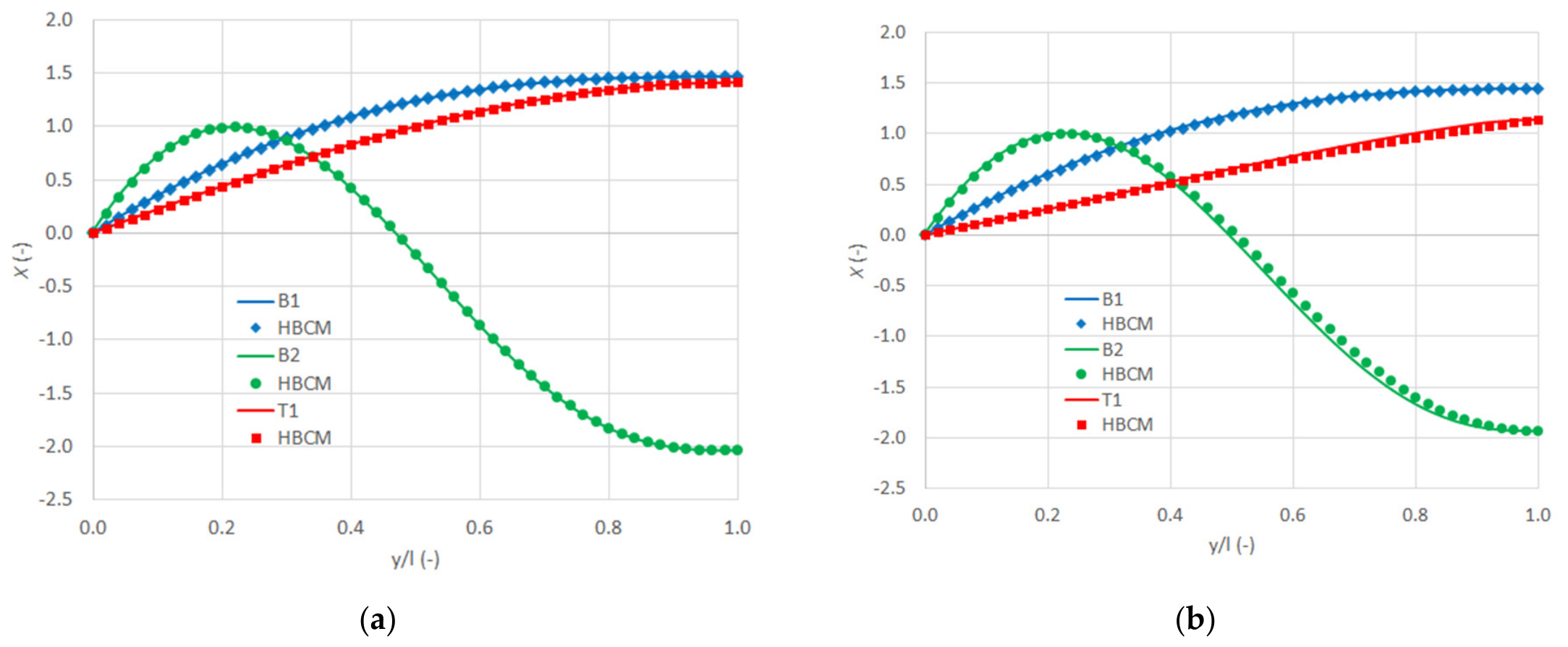
Figure 1 depicts the first two bending and the first torsion uncoupled natural vibration modes as per the exact analytical solutions for an homogeneous beam (lines) and the present HBCM (markers), showing excellent agreement; no exact agreement may be expected for the case of the Pazy wing unless enforced via tuning, which was intentionally disregarded in order to quantify and highlight both pros and cons of the semi-analytical HBCM. Since the latter features the bending angle rather than the bending displacement, the derivative of the exact solution for the natural vibration modes of the latter (see Appendix A, where convergence plots for the HBCM results are also shown) has been considered for direct comparison and validation, coherently assuming small deformations.
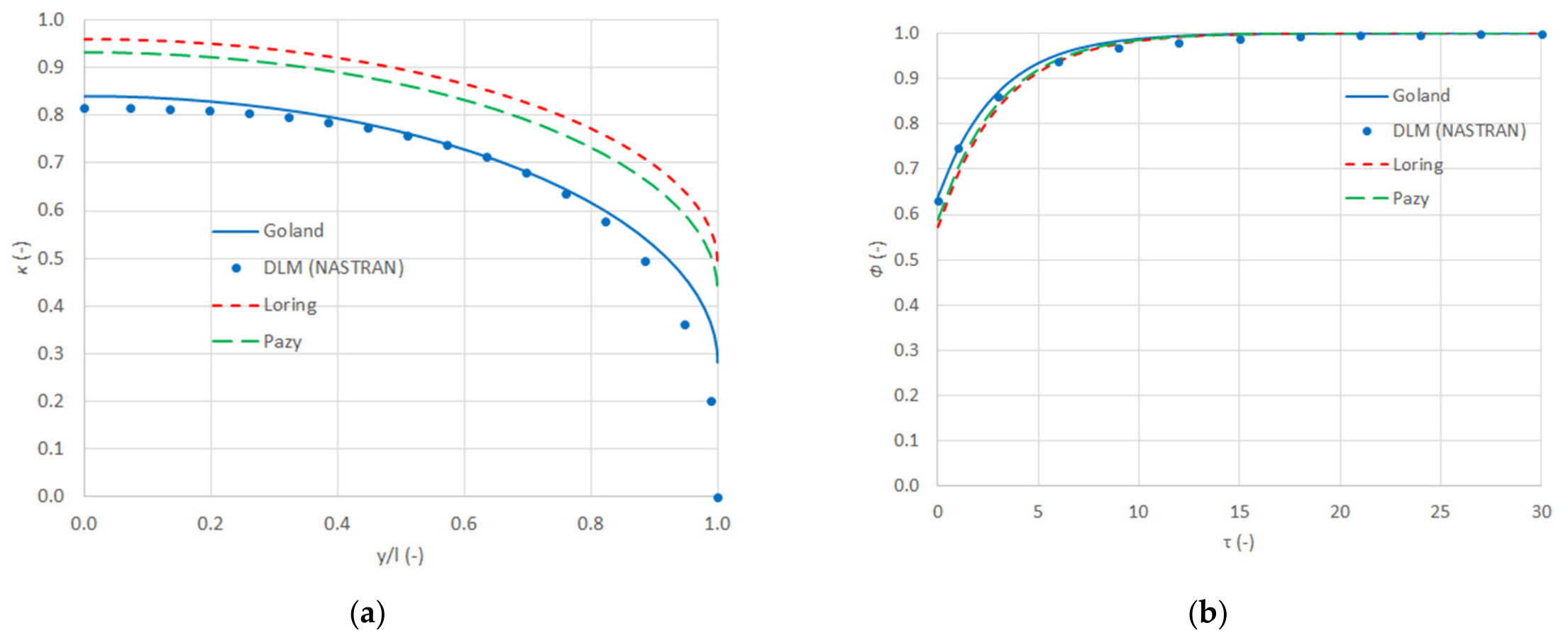
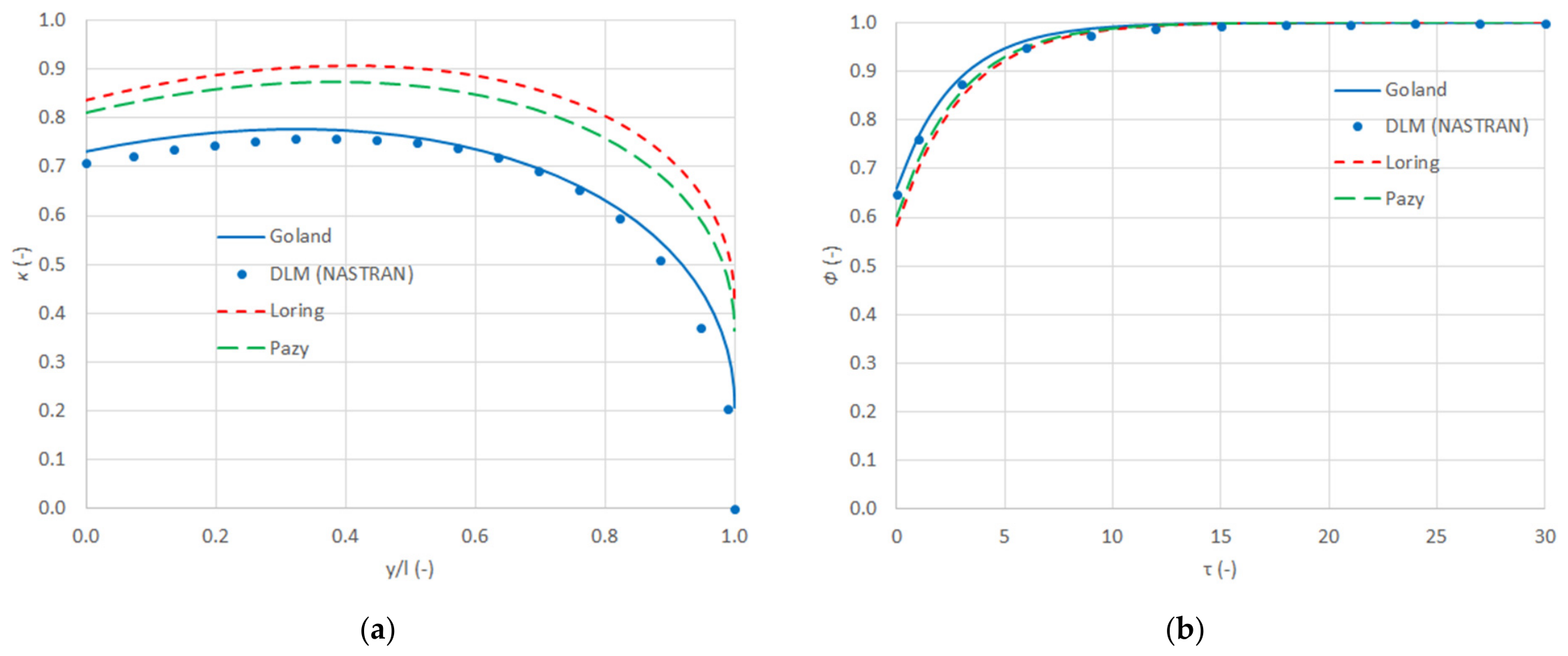
Figure 2 and Figure 3 depict the airload scaling and indicial-admittance functions for MST of the straight and swept wings (with Λ = 30 deg), respectively, showing good agreement between the present lower-fidelity analytical approximations for the aeroelastic HBCM and the higher-fidelity numerical solutions obtained in previous studies via DLM [130] (which were confirmed by mid-fidelity results obtained via Weissinger’s line method [16,17,18,19]); note that the analytical approximations does not vanish at the wing tip but the associated airload decays rapidly there and gives marginal contribution to the aeroelastic behaviour and response [18]. As previously stated, the “edge-velocity factor” [92,138] is effectively used as a tuning parameter and is hereby obtained from the special condition where the lower-fidelity lift distribution becomes tangent to the higher-fidelity one available from the literature; with this conservative choice, the former envelopes the latter.

6.1. Aeroelastic Stability Analysis of Goland’s Wing

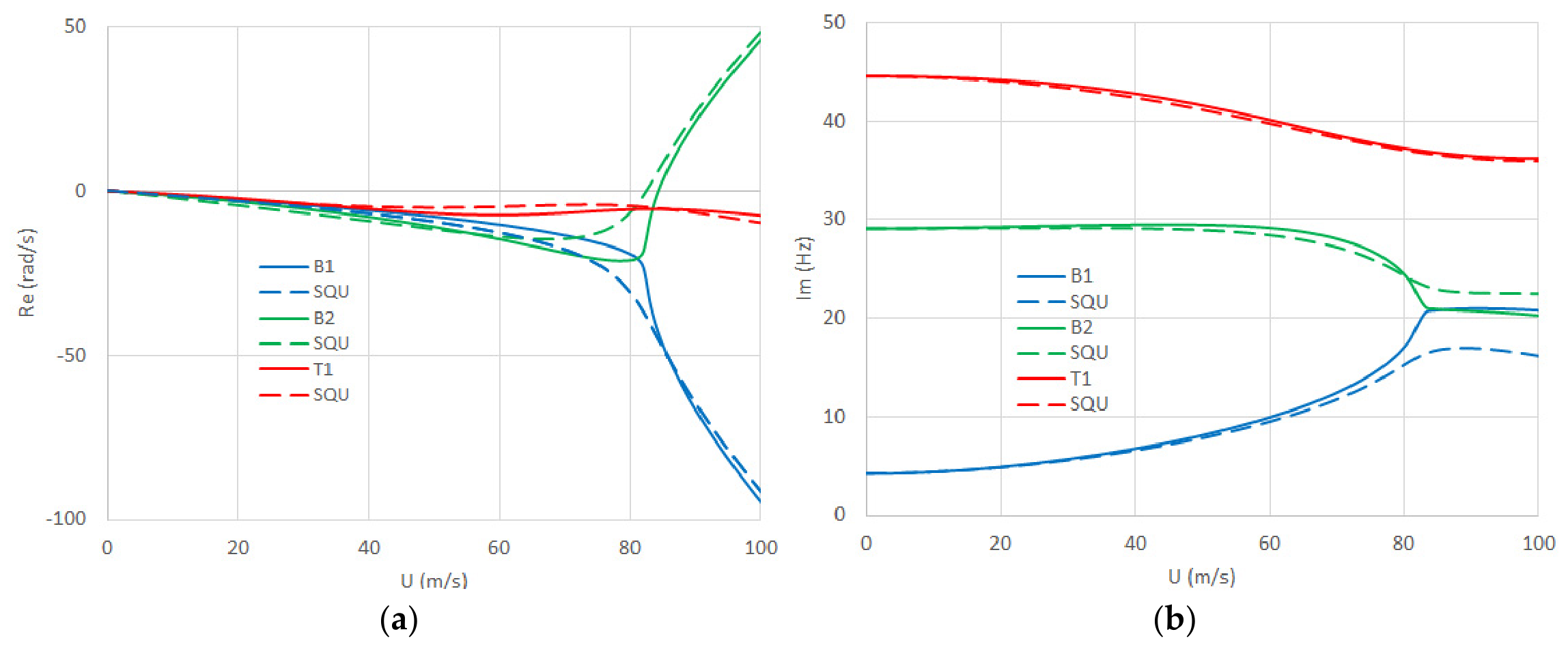
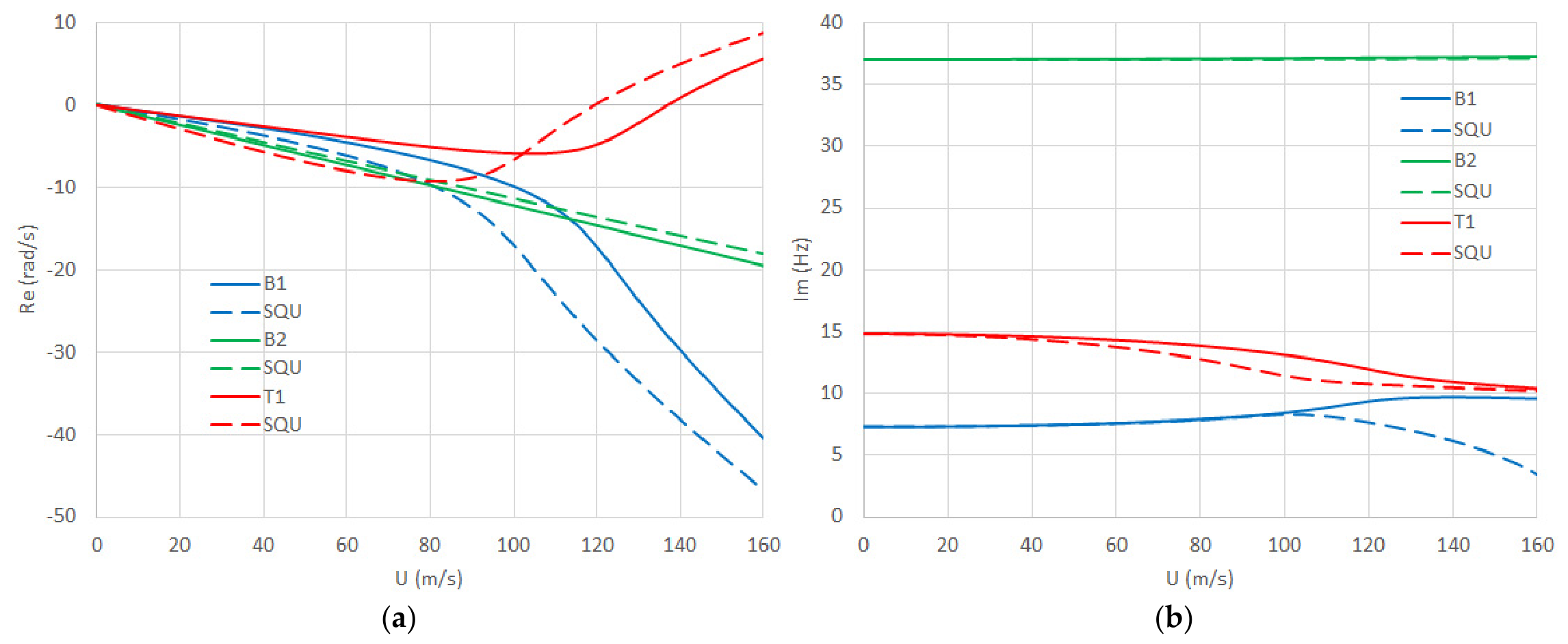
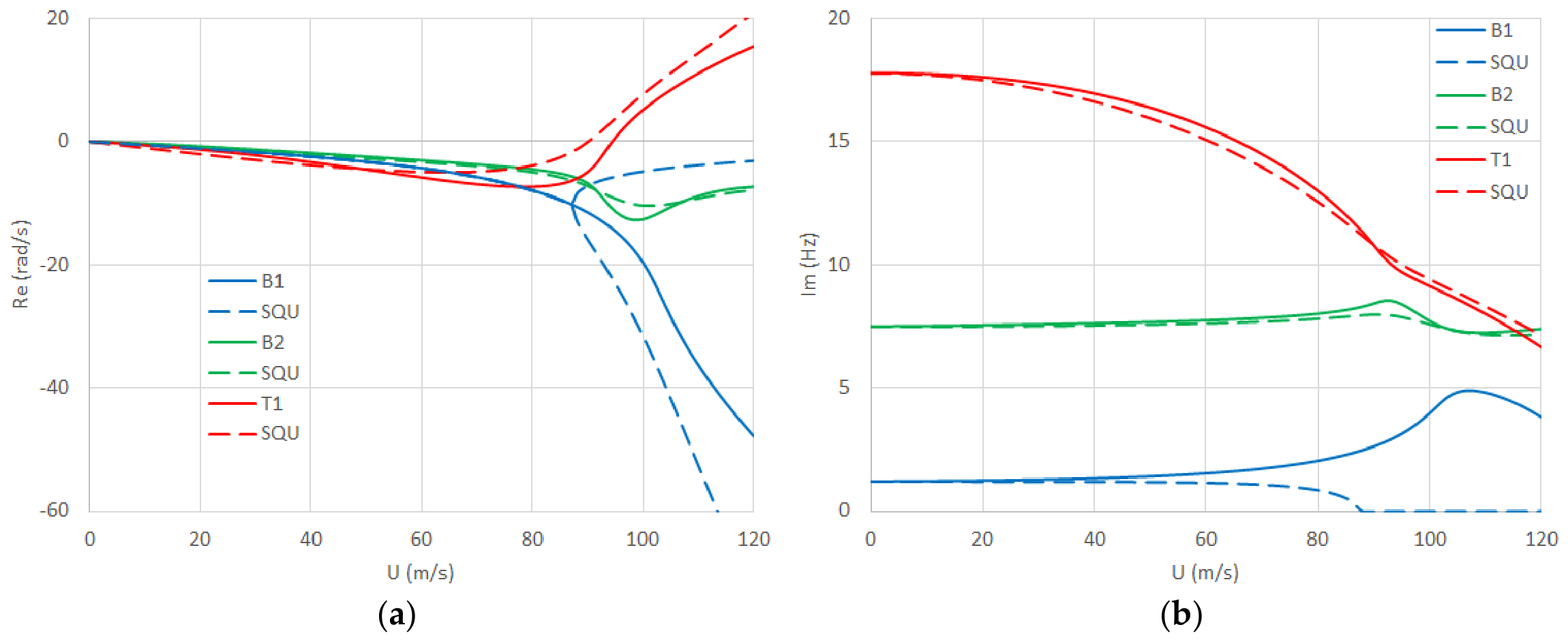
The aeroelastic stability of Goland’s wing is first analysed in two-dimensional flow; standard atmosphere at sea level is assumed (with ρ = 1.225 kg/m3 [153]). Figure 4 shows the evolution of the real and imaginary parts of the first three aeroelastic eigenvalues with increasing the reference airspeed, as tracked by the “p-k” method with unsteady airload (continuous lines) and the “p” method with SQU airload (dashed lines): while the second bending mode exhibits increasingly damped vibrations at approximately its natural frequency, the first torsion mode becomes unstable and extracts energy from the resonant coupled first bending mode and flutter with unsteady aerodynamics is found at a speed of 137.1 m/s with a frequency of 11.0 Hz (which give a reduced flutter frequency of 0.46), whereas in the absence of wake inflow flutter with SQU aerodynamics is found at a lower airspeed of 119.8 m/s with a frequency of 10.7 Hz (which give a reduced flutter frequency of 0.51). Confirming a classic binary flutter mechanism [125,129], these results from the present aeroelastic HBCM are in perfect agreement with literature results where a continuous beam model is coupled with SST [16,131]; the Typical Section approximation [154] (see Appendix B) was also demonstrated remarkably effective with simpler and quicker calculations [113,130], since the second bending mode does not participate the flutter mechanics as well separated (with a much higher eigenfrequency) from the other two modes involved. It is worth mentioning that the “p” analysis with SQU airload does find the static aeroelastic divergence at 253.9 m/s.
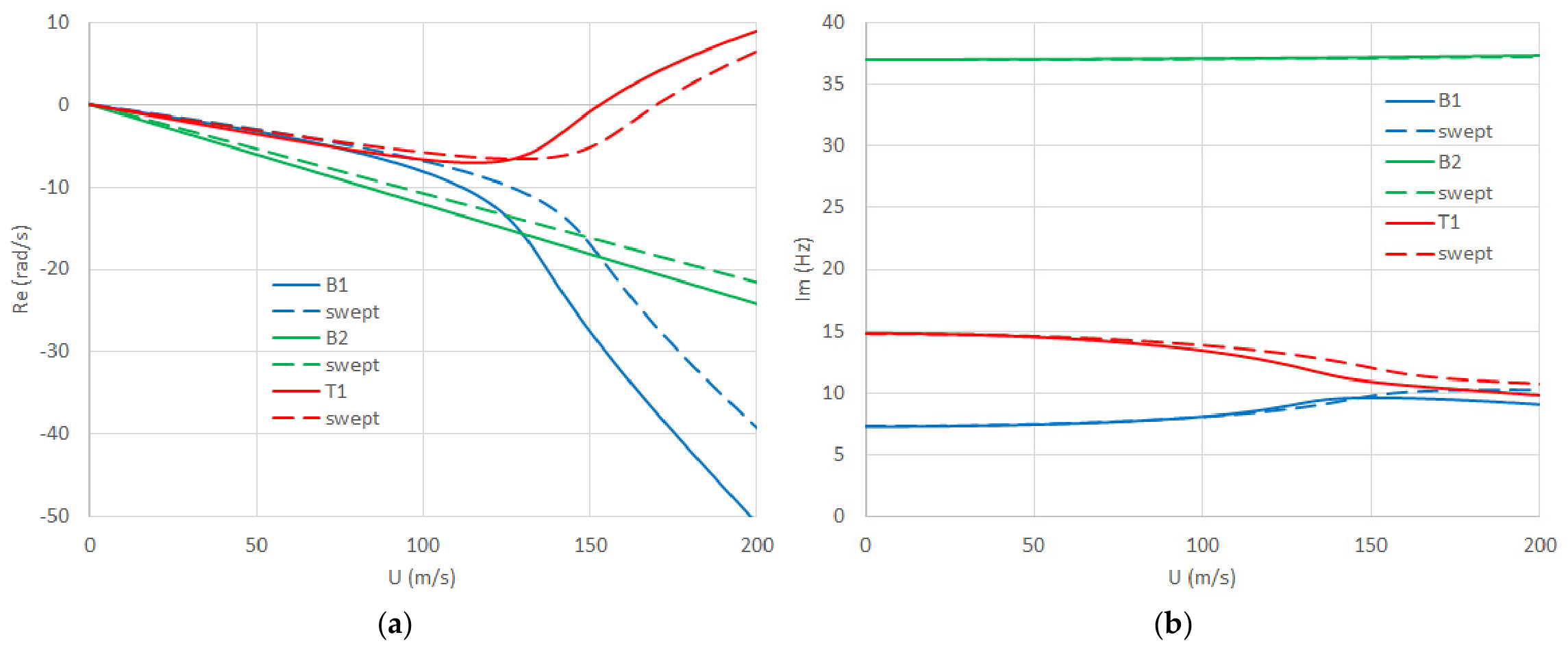
A similar aeroelastic behaviour and root locus is shown in Figure 5 when the stability boundary of Goland’s wing is assessed in three-dimensional flow using TST, also in the presence of a sweep angle Λ = 30 deg; in particular, flutter with unsteady aerodynamics is found at a higher airspeed of 170.0 m/s with a frequency of 11.3 Hz (which give a reduced flutter frequency of 0.38) in the swept case (dashed lines), whereas it is found at an airspeed of 153.0 m/s with a frequency of 10.8 Hz (which give a reduced flutter frequency of 0.41) in the straight case (continuous lines), since the effective sectional airload decreases with increasing sweep angle. Again, these results are in excellent agreement with literature ones where a structural FEM is coupled with DLM for higher-fidelity simulations [16,130], with the flutter airspeed and frequency found as 172 m/s and 11.6 Hz for the swept case, while ranging from 152 m/s to 156 m/s and from 10.5 Hz to 11.5 Hz for the straight case, respectively; the Typical Section approximation with TST was also demonstrated remarkably effective. The “p” analysis with SQU airload does find the static aeroelastic divergence of the straight wing at 303.7 m/s.

6.2. Aeroelastic Stability Analysis of the Loring’s Wing

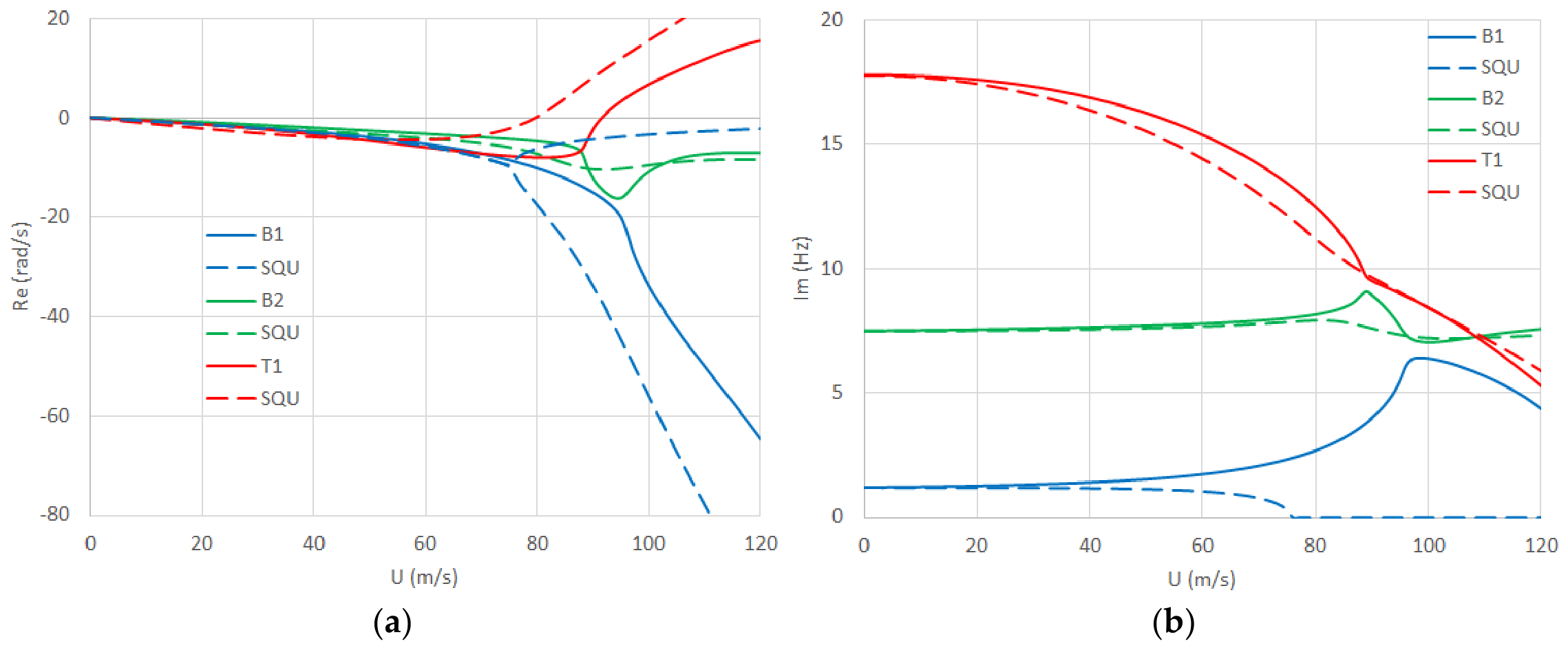
The aeroelastic stability of Loring’s wing is also first analysed in two-dimensional flow; standard atmosphere at about 3000 ft altitude is assumed (with ρ = 1.11 kg/m3 [153]). Figure 6 shows the evolution of the real and imaginary parts of the first three aeroelastic eigenvalues with increasing the reference airspeed, as tracked by the “p-k” method with unsteady airload (continuous lines) and the “p” method with SQU airload (dashed lines): the first torsion mode becomes unstable and extracts energy from the resonant coupled second bending mode and flutter with unsteady aerodynamics is found at an airspeed of 91.5 m/s with a frequency of 9.35 Hz (which give a reduced flutter frequency of 0.1), whereas in the absence of wake inflow flutter with SQU aerodynamics is found at a lower airspeed of 79.6 m/s with a frequency of 11.3 Hz (which give a reduced flutter frequency of 0.14). When unsteady aerodynamics is employed, the first bending mode becomes increasingly damped with increasing airspeed, but also impacts the flutter mechanism and boundary, as it tends to coalesce with the second bending mode post-instability [13]. Instead, similar behaviour and interaction are not observed when SQU aerodynamics is employed, as the two complex conjugate eigenvalues relative to the first bending mode rather bifurcate before flutter occurs and split into two real branches. Confirming a quasi-ternary flutter mechanism [127], the present results are in remarkable agreement with those found in the literature, where a continuous beam model is coupled with SST [131]; the Typical Section approximation was also demonstrated remarkably effective once generalised to include the second bending mode [13], as the latter affects the flutter boundary. Note that, although the natural vibration frequency of the first torsion mode is well beyond that of the first two bending modes, the “p” analysis with SQU airload still does find the static aeroelastic divergence at 196.3 m/s.
A similar aeroelastic behaviour and root locus is shown in Figure 7 when the stability boundary of Loring’s wing is assessed in three-dimensional flow using TST, especially in the light of the relatively large aspect ratio; in particular, flutter with unsteady aerodynamics is found at an airspeed of 94.4 m/s with a frequency of 9.78 Hz (which give a reduced flutter frequency of 0.1), whereas in the absence of wake inflow flutter with SQU aerodynamics is found at a lower airspeed of 90.1 m/s with a frequency of 10.8 Hz (which give a reduced flutter frequency of 0.11). Again, these results are in excellent agreement with those in the literature, where a structural FEM is coupled with DLM for higher fidelity [13], with the flutter airspeed and frequency found as 93.7 m/s and 10.1 Hz, respectively; the Typical Section approximation with TST was also demonstrated remarkably effective. The “p” analysis with SQU airload does find the static aeroelastic divergence at 217.1 m/s.
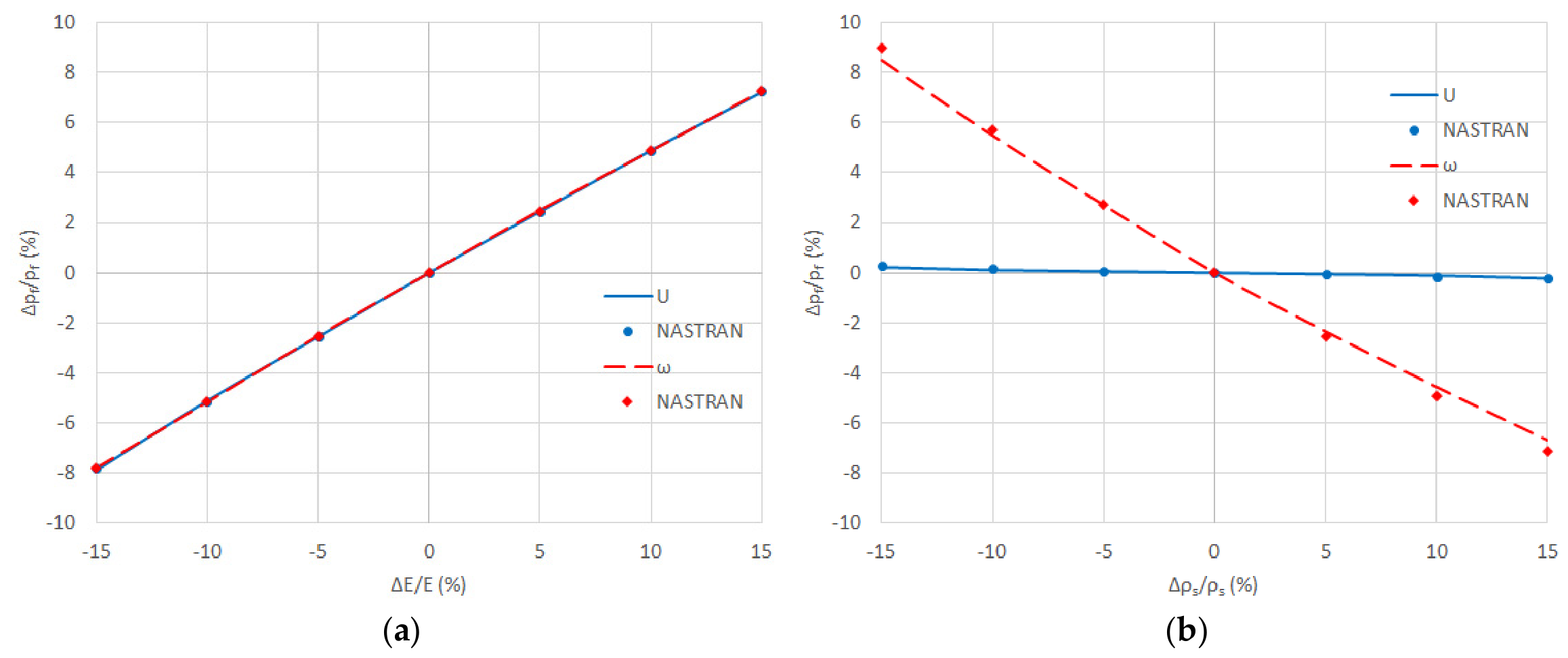
In order to demonstrate the robustness of the proposed aeroelastic model for MDO, Figure 8 shows the sensitivity analysis of the flutter boundary with respect to variation in the material density and elastic modulus; still, the results are in excellent agreement with those in the literature, where a structural FEM is coupled with DLM for higher fidelity [13].

6.3. Aeroelastic Stability Analysis of the Pazy Wing

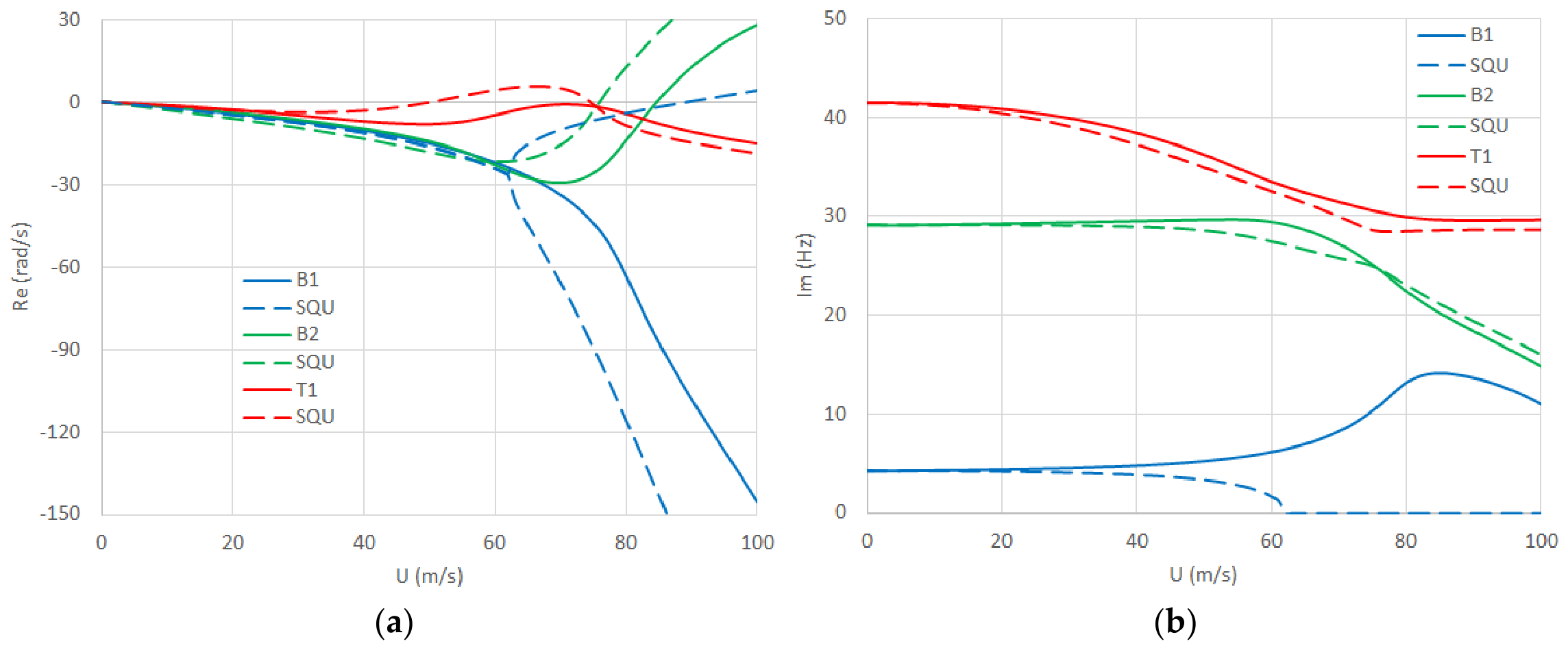
The aeroelastic stability of the Pazy wing is also first analysed in two-dimensional flow; standard atmosphere at sea level is here re-assumed. Figure 9 shows the evolution of the real and imaginary parts of the first three aeroelastic eigenvalues with increasing the reference airspeed, as tracked by the “p-k” method with unsteady airload (continuous lines) and the “p” method with SQU airload (dashed lines): with the natural vibration frequency of the second bending mode being in between those of the first bending and torsion modes but much closer to the latter, the first torsion mode exhibits a “hump mode” due to partial coupling with the second bending mode before the latter exhibits full coupling with the first bending mode; a pure-bending binary flutter with unsteady aerodynamics is then found at an airspeed of 84.7 m/s with a frequency of 20.3 Hz (which give a reduced flutter frequency of 0.08), whereas in the absence of wake inflow a torsion-driven “hump” flutter with SQU aerodynamics arises at a lower airspeed of 50.5 m/s with a higher frequency of 34.8 Hz (which give a reduced flutter frequency of 0.22). When unsteady aerodynamics is employed, the first bending mode does become increasingly damped with increasing airspeed but does not impact the weak interaction between the second bending and first torsion modes; when SQU aerodynamics is employed, instead, the two complex conjugate eigenvalues relative to the first bending mode rather bifurcate and split in two real-valued branches between the torsion-driven “hump” flutter and the pure-bending “binary” flutter occurrences. Confirming both “hump” and “hard” flutter mechanisms [128], the present results agree very well with those in the literature, where either a continuous beam model is coupled with SST or a structural FEM is coupled with DLM [132,133,134,135,136] and give the flutter speed and frequency around 83 m/s and 18 Hz, respectively. It is worth mentioning that the “p” analysis with SQU airload does find the static aeroelastic divergence at 89.6 m/s.
A similar aeroelastic behaviour and root locus is shown in Figure 10 when the stability boundary of the Pazy wing is assessed in three-dimensional flow using MST, especially in the light of the relatively large aspect ratio; yet, the instationary airload on the (highly deformable) outboard wing sections is significantly lowered by the scaling function and a torsion-driven “hump” flutter then arises with unsteady aerodynamics at an airspeed of 67.6 m/s with a frequency of 33.3 Hz (which give a reduced flutter frequency of 0.15) as well as in the absence of wake inflow with SQU aerodynamics at a lower airspeed of 60.7 m/s with a frequency of 34.6 Hz (which give a reduced flutter frequency of 0.18). Again, these results are in excellent agreement with those in the literature, where a structural FEM is coupled with DLM for higher-fidelity aeroelastic simulations [132,133,134,135,136], with the airspeed of the “hump” flutter ranging from 64 m/s to 70 m/s and its frequency being around 34 Hz, respectively (assuming small displacements, in the absence of an angle of attack of the reference airflow). The “p” analysis with SQU airload detects static aeroelastic divergence at 104.5 m/s, in perfect agreement with previous studies [19].
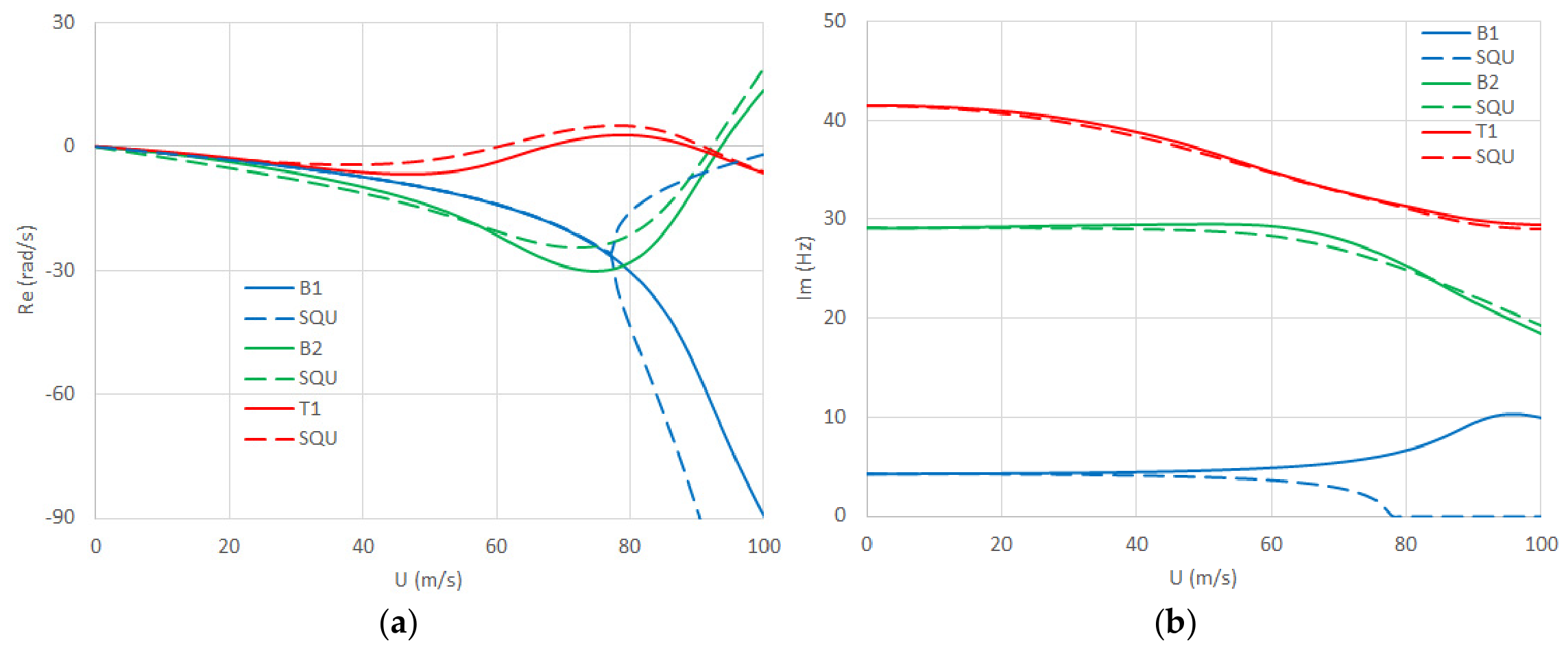
A different aeroelastic behaviour and root locus is shown in Figure 11 when the stability boundary of the Pazy wing is assessed in the presence of a sweep angle Λ = 30 deg, where (unlike the swept case of Goland’s wing) the wing’s root constraint is not considered orthogonal to the elastic axis and the effective wing length l cos Λ is then assumed for torsion along the latitudinal y axis. As confirmed by recent works [136] with a plate model, the natural vibration frequency of the first torsion mode increases away from that of the second bending mode, and the latter couples with the first bending mode directly (with their interaction and energy transfer being also favoured by their contributions to the effective angle of attack). In particular, flutter with unsteady aerodynamics is found at a higher airspeed of 84.4 m/s with a frequency of 21.0 Hz (which gives a reduced flutter frequency of 0.08), whereas in the absence of wake inflow with SQU aerodynamics at an airspeed of 82.7 m/s with a frequency of 23.4 Hz (which gives a reduced flutter frequency of 0.09), with no “hump mode”. Since based on an approximate beam model (rather than a detailed plate model), these results are still in good agreement with those in the literature [136], where a structural FEM is still coupled with DLM for higher-fidelity simulations, and the flutter airspeed and frequency are found around 85 m/s and 18.5 Hz, respectively.

Approximate Exploration of Nonlinear Effects from Static Displacement

A nonlinear analytical model is out of the scope of this proof-of-concept work and impractical with more than two wing segments, even in the absence of torsion dynamics [155,156,157]; yet, an approximate quasi-linear approach [19] is hereby adopted in order to explore key nonlinear dynamic effects resulting from the wing’s static displacement. As apparent in Figure 12 for α = 1° [135], the present aeroelastic model calculates the static aeroelastic response of the wing rather accurately in the case of small displacement at low angle of attack and away from static divergence; yet, the wing segments own an offset o y from the latitudinal y axis and the torsional inertia includes geometrically nonlinear effects. In particular, the effective torsion moment of inertia of each wing section is here approximated by the difference between the outboard moment of inertia with and without the specific wing section, resulting in an increment Δ μ i y , namely:
Δ μ i j = i + 1 n m j o i , j 2 o i + 1 , j 2 ,   o i , j k = i + 1 j 1 s k ϕ k ϕ i + s j 2 ϕ j ϕ i .
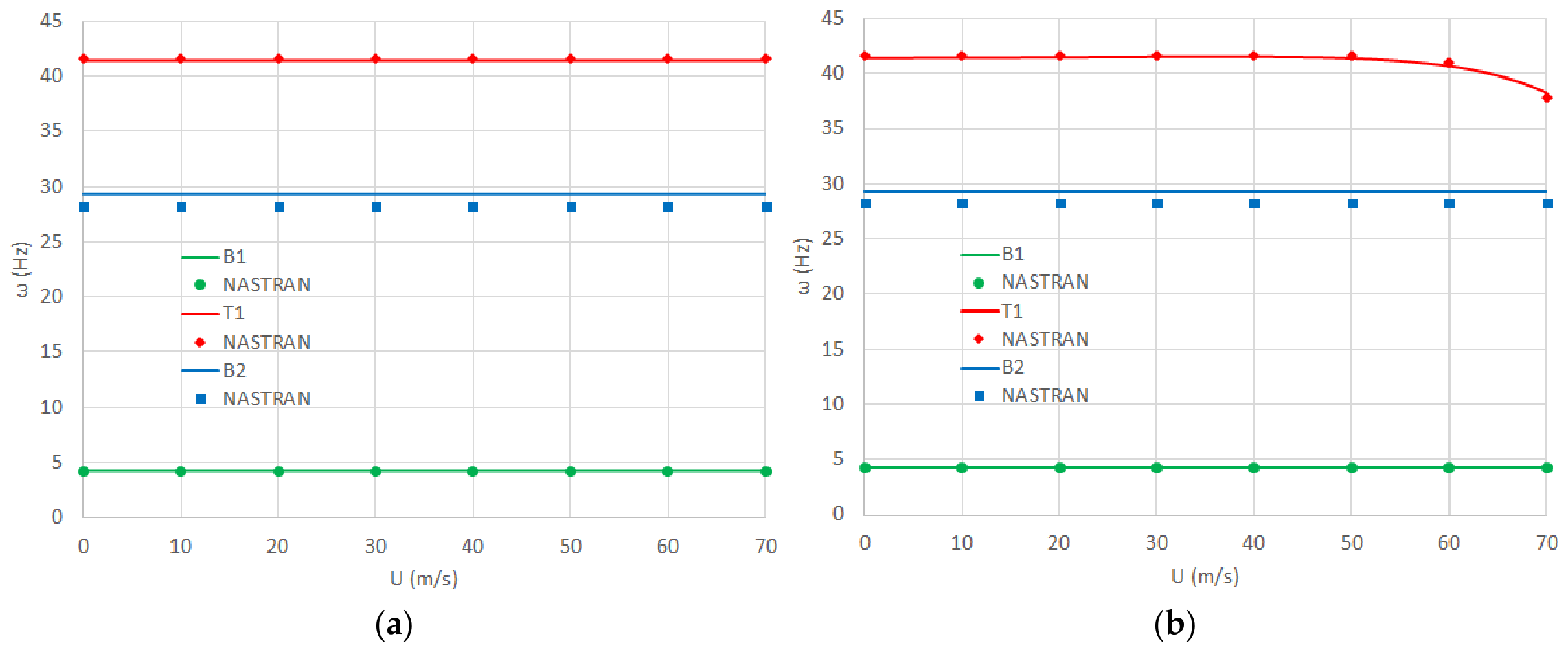
Figure 13 then shows the first three “wind-off” natural vibration frequencies as flow speed increases and the wing deforms statically with α = 0° and α = 1°, where the slight discrepancy in the second bending frequency is driven by slight differences in the original model data and configurations (here taken from the pre-Pazy wing without skin) and is in line with several results from the literature [132,133,134]. As expected and confirmed by higher-fidelity simulations [135], the resonant frequency of the torsional mode decreases significantly when the wing’s static displacement and effective torsion moment of inertia increase significantly; as the accuracy and reliability of the present linear model decreases with large deformations at higher airspeeds and angles of attack (as already visible from the static bending response in Figure 12, although at an airspeed beyond the flutter one), a full geometrically nonlinear or quasi-linear model becomes necessary in the latter cases.
Figure 14 shows the root locus from the aeroelastic stability analysis with α = 1°, including geometrically nonlinear effects from the effective torsion moment of inertia driven by the static wing displacement: since the natural vibration frequency of the first torsion mode gets closer to that of the second bending mode while the effective torsion inertia increases relative to the effective torsion damping, the “hump mode” flutter occurs at a lower speed while progressively disappearing [136] (even without in-plane higher-frequency modes); in particular, flutter with unsteady aerodynamics is found at an airspeed of 65.0 m/s with a frequency of 32.7 Hz (which give a reduced flutter frequency of 0.16), whereas in the absence of wake inflow with SQU aerodynamics it is found at an airspeed of 59.6 m/s with a frequency of 34.2 Hz (which give a reduced flutter frequency of 0.18). These approximate results are still in good agreement with those in the literature, where higher-fidelity structural FEM and DLM are fully coupled [132,133,134,135,136], with the flutter airspeed ranging from 61 m/s to 64 m/s and frequency around 33 Hz.
As for the nonlinear static aeroelastic response of the Pazy wing in previous works, rather (high) accuracy and (low) computational costs are consistently found among in all previous analyses, which run in a few seconds on a standard laptop; further investigations on the computational performance may then be explored in future works, considering more complex wing configurations (which are out of scope here). In fact, simple well-known benchmarks were intentionally selected in order to showcase the features and robustness of the present aeroelastic HBCM across all flutter mechanisms for wings of different aspect ratio, sweep angle and structural arrangement at insignificant computational costs, critically assessing all results from different physical and mathematical perspectives (note several numerical routines and tools are nowadays mature and readily available for scientific computing and engineering practice, which may be adapted to the most convenient computational environment for the desired application).

7. Conclusions

A novel semi-analytical computational approach was formulated and assessed for the dynamic aeroelastic stability analysis of flexible slender thin wings in incompressible flow. The proposed approach features an intuitive formulation and straightforward implementation, leveraging first principles and available routines, respectively, and can boost the preliminary airframe design and optimisation of lightweight aircraft, offering both theoretical and practical insights. Adopting Hencky’s bar-chain model as a discrete numerical implementation of the Euler–Bernoulli continuous beam idealisation for the flexible wing structure, coupled with modified strip theory for the unsteady sectional airload, thorough theoretical assessments and efficient computational simulations are possible with a modal-based reduced-order model. Aiming at a semi-analytical approach, approximate yet effective analytical expressions were effectively adopted for the airload build-up and distribution, which combine two- and three-dimensional effects in subsonic potential flow. Once the natural vibration modes of the wing are obtained from its physical discrete model, a coherent mathematical formulation results in a linear system of coupled ordinary differential equations for the bending and torsion dynamics and offers reliable insights and validity boundaries for robust aeroelastic stability analyses performed with either the “p-k” or the “p” method, depending on the aerodynamic theory employed. A rigorous validation and critical assessment of the proposed aeroelastic model was consistently accomplished at marginal computational costs through several flutter analyses of Goland’s, Loring’s, and Pazy wings, which demonstrated remarkable agreement with literature results for two- and three-dimensional flow, also in the presence of a significant sweep angle. In particular, Goland’s homogeneous wing exhibited a classic binary flutter coupling the first bending and first torsion modes (in either the absence or the presence of wing sweep), Loring’s homogeneous wing exhibited a quasi-ternary flutter coupling the second bending mode and first torsion mode with an essential participation of the first bending mode, Pazy heterogeneous wing with tip inertia exhibited a “hump mode” flutter coupling the second bending and first torsion mode with an essential participation of the first bending mode. Besides the key mitigating effects of both two-dimensional inflow and three-dimensional downwash on the sectional airload, mode shapes similarity and relative distance between vibration frequencies are found to play a crucial role in the type of flutter mechanism. Compared to standard higher-fidelity simulations using finite element models and the doublet lattice method or the unsteady vortex lattice method for aeronautical engineering practice, Hencky’s bar-chain model, combined with modified strip theory, effectively enabled efficient semi-analytical flutter analyses for the multidisciplinary design and optimisation of flexible slender wings in subsonic flow, as the key physical features and effects were suitably captured. While an approximate exploration of geometrically nonlinear effects from the static displacement was already successful, more complex wing configurations and flight conditions may be investigated in future works, which include very flexible structures with large deflections.

Funding

This research received no external funding.

Institutional Review Board Statement

Not applicable.

Informed Consent Statement

Not applicable.

Data Availability Statement

The original contributions presented in this study are included in the article. Further inquiries can be directed to the author.

Conflicts of Interest

Author Marco Berci was employed by the company Pilatus Aircraft Ltd. The author declare that the research was conducted in the absence of any commercial or financial relationships that could be construed as a potential conflict of interest.

Abbreviations

The following abbreviations are used in this manuscript:
CFDComputational Fluid Dynamics
DLMDoublet Lattice Method
FEMFinite Element Method
HALEHigh-Altitude Long-Endurance
HBCMHencky’s Bar Chain Model
MDOMultidisciplinary Design Optimisation
MSTModified Strip Theory
ROMReduce-Order Model
SFEStabilized Finite Elements
SQUSimplified Quasi-Unsteady
SSTStandard Strip Theory
TSTTuned Strip Theory
UVLMUnsteady Vortex Lattice Method
WLMWeissinger’s Line Method

Appendix A. Natural Harmonic Vibration Modes of a Slender Beam
In aeronautical applications, the wing deformation can be expressed as a continuous function along the span; up to moderate displacements, the relative structural vibration problem [158] may be written in the absence of airload and structural damping as [159]:
G J ϑ = μ ϑ ¨ x C G m ζ ¨ C G ,   E I ζ = m ζ ¨ C G ,
still complemented by both natural boundary conditions for a clamped beam:
ϑ 0 , t = 0 ,   ζ 0 , t = 0 ,   ζ 0 , t = 0 ,
and geometric boundary conditions with inertia m P and μ P lumped at its tip:
G J ϑ l , t = x C G m P ζ ¨ C G l , t μ P ϑ ¨ l , t ,   E I ζ l , t = 0 ,   E I ζ l , t = m P ζ ¨ C G l , t ,
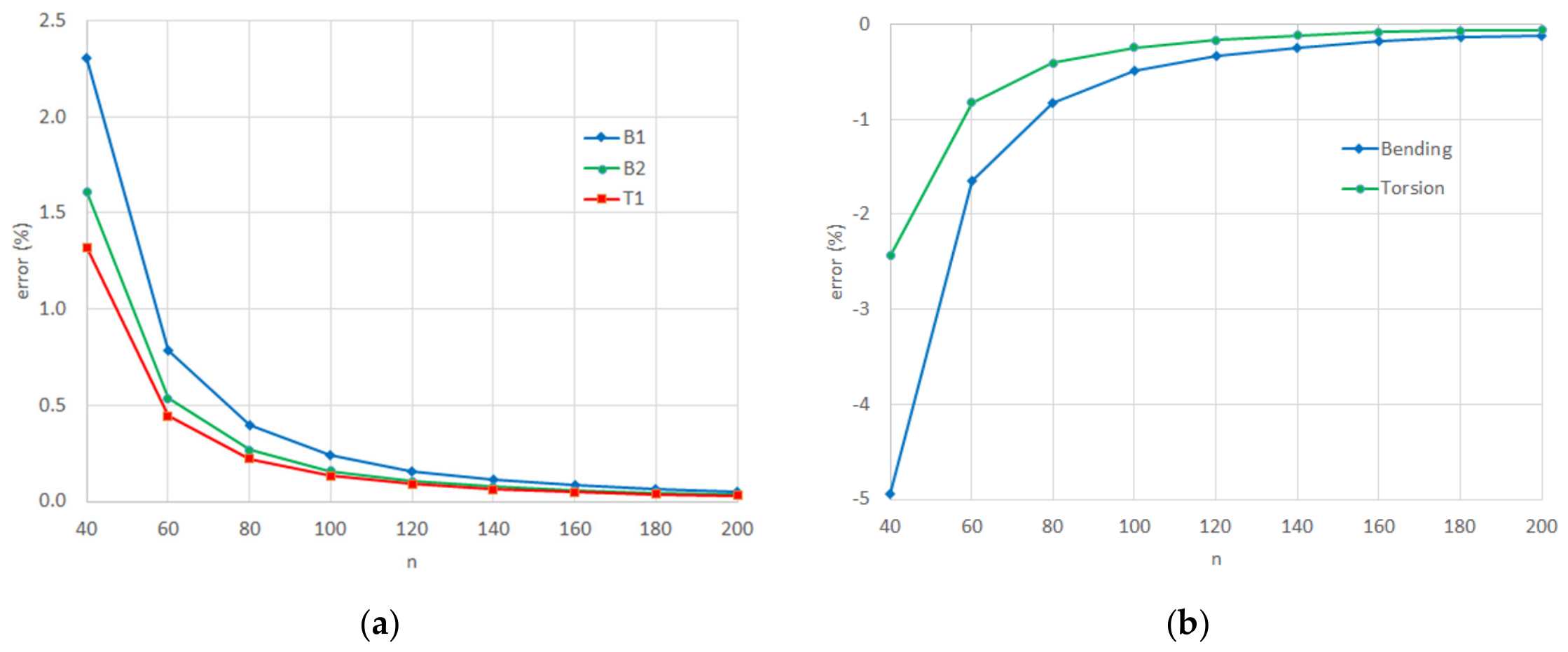
which are inertially coupled whenever x C G 0 . In this latter case, the first bending and torsion natural harmonic vibration frequencies may be estimated from the uncoupled ones using the Typical Section idealisation (see Appendix B); more generally, the HBCM can be used to obtain the natural harmonic vibration frequency of any mode. With the natural vibration modes and wing-tip displacements due to own weight characterising the dynamic and static responses, respectively, Figure A1 shows the rapid and smooth convergence of the semi-analytical HBCM results for Goland’s wing in terms of relative error when a new bar is added to the chain, confirming previous works [7,19]. In fact, about 100 elements would already grant acceptable accuracy in engineering practice. For uniform wings without inertial coupling, the exact uncoupled bending and torsion natural harmonic vibration mode shapes may also be calculated via separation of variables (i.e., assuming ζ χ ζ ε ζ and ϑ χ ϑ ε ϑ ) and are hereafter presented.
Figure A1. HBCM convergence for Goland’s wing: dynamic (a) and static (b) responses.
Applsci 16 05687 g0a1

Appendix A.1. Uniform Clamped Beam with Torsion Moment of Inertia and Lumped Tip Inertia

The uncoupled torsion natural harmonic vibration mode frequencies and shapes for a uniform clamped beam with moment of inertia both distributed and lumped at its tip read [159,160,161]:
ω ϑ = λ l G J μ ,   χ ϑ = 2 sin λ y l ,
and the underlying characteristic equation is:
μ p λ tan λ = μ l ,   μ θ = μ + m x C G x E A 2 .

Appendix A.2. Uniform Clamped Beam with Lumped Tip Mass

The uncoupled bending natural harmonic vibration mode frequencies and shapes for a uniform clamped beam without distributed moment of inertia but with a mass lumped at its tip read [159,160,161]:
ω ζ = γ l 2 E I m ,   χ ζ = cosh γ y l cos γ y l cosh γ + cos γ sinh γ + sin γ sinh γ y l sin γ y l ,
and the underlying characteristic equation is:
m l 1 + cos γ cosh γ = m p γ sin γ cosh γ cos γ sinh γ .

Appendix B. Typical Section Idealisation

The structural arrangement of the Typical Section consists of a mass-damper-spring system for the wing section, where the coupled pitch and plunge motion is restrained by vertical and angular linear springs, respectively. It is basically representative of the inertial, damping, and elastic structural properties per unit length of the wing at about 75% of its span (where the structure becomes progressively more flexible, whereas the aerodynamic load is still relatively high, even in the case of three-dimensional flow) [154]. Pitch and plunge degrees of freedom mimicking the wing torsion and bending displacements, respectively, the Typical Section can still comprise elastic coupling between the latter due to applicable constitutive laws of anisotropic materials (e.g., to investigate structural tailoring of composite wings) and also be complemented by a tab (e.g., to implement control laws for aircraft manoeuvrability or loads alleviation) [70]. Having obtained the natural vibration frequencies and mode shapes for the wing bending and torsion displacements, the relative equations of motion can be transformed into ODEs where time-varying generalised coefficients multiply the rigid-body modes [162,163], as a physical ROM for binary flutter; yet, the general concept applies to ternary flutter too, and the idealisation was successfully extended for the latter in previous works [13].
With a sweep angle, all effective aero-structural quantities refer to the rotated elastic axis; geometrical and structural properties being unchanged, the coupled ODEs for pitch and plunge motion of the rotated Typical Section then read [130]:
m ζ ¨ x ¯ C G ϑ ¨ + υ ζ ζ ˙ + k ζ ζ = Δ L ¯ ,   μ ϑ ¨ m x ¯ C G ζ ¨ x ¯ C G ϑ ¨ + υ ϑ ϑ ˙ + k ϑ ϑ = Δ M ¯ ,
where, assuming a proportional Rayleigh’s damping [25] with ratio ς , the tuned springs and dampers feature:
k ζ = m ω ζ 2 ,   k ϑ = μ ω ϑ 2 ,   υ ζ = 2 ς m ω ζ ,   υ ϑ = 2 ς μ ω ϑ ,
based on the uncoupled bending and torsion natural harmonic vibration frequencies (see Appendix A); the coupled counterparts are eventually found as [13]:
ω = 1 2 ω ϑ 2 + μ θ μ ω ζ 2 ± ω ϑ 2 + μ θ μ ω ζ 2 2 4 ω ζ 2 ω ϑ 2 ,   r ζ ϑ = 1 l 0 l χ ζ χ ϑ d y ,
with the cross-projection r ζ ϑ being unitary/zero for alike/orthogonal natural harmonic vibration modes [dew].
Accounting for the effect of the vertical motion on the airflow, the airload is [130]:
Δ L ¯ = π 4 ρ c ¯ 2 U ¯ ϑ ˙ 2 l ζ ˙ tan Λ ζ ¨ + x ¯ M C ϑ ¨ + ρ 2 U ¯ c ¯ C ¯ L / α C k V ¯ ,   C ¯ L / α = κ T S T C ¯ l / α ,   Δ M ¯ = π 4 ρ c ¯ 2 c ¯ 2 ϑ ¨ 32 + U ¯ x ¯ C P ϑ ˙ 2 l ζ ˙ x ¯ M C tan Λ x ¯ M C ζ ¨ x ¯ M C ϑ ¨ ρ 2 U ¯ x ¯ A C c ¯ C ¯ L / α C k V ¯ ,
where the flexural displacement is fairly assumed as linear away from the wing root [14] and the effective vertical airspeed at the control point is given by [130]:
V ¯ = U ¯ ϑ 2 l ζ tan Λ ζ ˙ + x ¯ C P ϑ ˙ ,   V ¯ < < U ¯ ,
with higher-order effects due to apparent camber deformation in the free-stream direction being fairly disregarded without loss of generality, MST is not applicable, since the model is purely two-dimensional and no airload-decay function can be defined along the span, but for the scaling factor provided by TST.

References

  1. Ghiringhelli, G.; Masarati, P.; Mantegazza, P. Multibody Implementation of Finite Volume C0 Beams. AIAA J. 2000, 38, 131–138. [Google Scholar] [CrossRef]
  2. Le, V.T.D.; Nguyen, A.T.; Dang, N.T. Multibody-Dynamics Approach to Study the Deformation and Aerodynamics of an Insect Wing. AIAA J. 2023, 61, 2500–2516. [Google Scholar] [CrossRef]
  3. Shizuno, Y.; Kuzuno, R.; Nagai, N.; Kawai, M.; Kawashima, S.; Kodama, Y.; Makihara, K.; Otsuka, K. Dynamic Modal Rotation Method with Inertial Nonlinearity for Large Deformation Analysis of Slender Structures. J. Sound Vib. 2025, 619, 119427. [Google Scholar] [CrossRef]
  4. Wang, Y.; Huston, R.L. A Lumped Parameter Method in the Nonlinear Analysis of Flexible Multibody Systems. Comput. Struct. 1994, 50, 421–432. [Google Scholar] [CrossRef]
  5. Rubinstein, D. Dynamics of a Flexible Beam and a System of Rigid Rods, with Fully Inverse (One-Sided) Boundary Conditions. Comput. Methods Appl. Mech. Eng. 1999, 175, 87–97. [Google Scholar] [CrossRef]
  6. Giorgio, I.; Del Vescovo, D. Non-Linear Lumped-Parameter Modeling of Planar Multi-Link Manipulators with Highly Flexible Arms. Robotics 2018, 7, 60. [Google Scholar] [CrossRef]
  7. Savu, D.C.; Higgins, A.J. Structural Stability of a Lightsail for Laser-Driven Interstellar Flight. Acta Astronaut. 2022, 201, 376–393. [Google Scholar] [CrossRef]
  8. Rempel, M.A.; Cardoso-Ribeiro, F.L.; Moreira, F.J. Lumped Element Multibody Modeling Approach for Very Flexible Aircraft; XLI CILAMCE: Parana, Brazil, 2020. [Google Scholar]
  9. Vanderplaats, G.N. Numerical Optimization Techniques for Engineering Design: With Applications; McGraw Hill: New York, NY, USA, 1984. [Google Scholar]
  10. Cavagna, L.; Ricci, S.; Travaglini, L. NeoCASS: An Integrated Tool for Structural Sizing, Aeroelastic Analysis and MDO at Conceptual Design Level. Prog. Aerosp. Sci. 2011, 47, 621–635. [Google Scholar] [CrossRef]
  11. Martins, J.R.; Lambe, A.B. Multidisciplinary Design Optimization: A Survey of Architectures. AIAA J. 2013, 51, 2049–2075. [Google Scholar] [CrossRef]
  12. Kennedy, G.; Martins, J. A Parallel Aerostructural Optimization Framework for Aircraft Design Studies. Struct. Multidiscip. Optim. 2014, 50, 1079–1101. [Google Scholar] [CrossRef]
  13. Berci, M.; Torrigiani, F. Multifidelity Sensitivity Study of Subsonic Wing Flutter for Hybrid Approaches in Aircraft Multidisciplinary Design and Optimisation. Aerospace 2020, 7, 161. [Google Scholar] [CrossRef]
  14. Weisshaar, T.A. Static and Dynamic Aeroelasticity; Wiley: Hoboken, NJ, USA, 2010. [Google Scholar]
  15. Bisplinghoff, R.L.; Ashley, H. Principles of Aeroelasticity; Dover: New York, NY, USA, 2013. [Google Scholar]
  16. Berci, M.; Cavallaro, R. A Hybrid Reduced-Order Model for the Aeroelastic Analysis of Flexible Subsonic Wings—A Parametric Assessment. Aerospace 2018, 5, 76. [Google Scholar] [CrossRef]
  17. Vindigni, C.R.; Mantegna, G.; Orlando, C.; Alaimo, A.; Berci, M. A Refined Aeroelastic Beam Finite Element for the Stability Analysis of Flexible Subsonic Wings. Comput. Struct. 2025, 307, 107618. [Google Scholar] [CrossRef]
  18. Berci, M. Semi-Analytical Static Aeroelastic Analysis and Response of Flexible Subsonic Wings. Appl. Math. Comput. 2015, 267, 148–169. [Google Scholar] [CrossRef]
  19. Berci, M. Non-Linear and Quasi-Linear Models for the Large-Amplitude Static Aeroelastic Response of Very-Flexible Slender Wings in Subsonic Flow at Low Speed. Aerospace 2025, 12, 294. [Google Scholar] [CrossRef]
  20. Hencky, H. Über die Angenäherte Lösung von Stabilitätsproblemen im Raum Mittels der Elastischen Gelenkkette. Eisenbau 1920, 11, 437–452. [Google Scholar]
  21. Turco, E. Discrete is it Enough? The Revival of Piola-Hencky Keynotes to Analyze Three-Dimensional Elastica. Contin. Mech. Thermodyn. 2018, 30, 1039–1057. [Google Scholar] [CrossRef]
  22. Turco, E.; Barchiesi, E.; Giorgio, I.; Dell’Isola, F. A Lagrangian Hencky-Type Non-Linear Model Suitable for Metamaterials Design of Shearable and Extensible Slender Deformable Bodies Alternative to Timoshenko Theory. Int. J. Non-Linear Mech. 2020, 123, 103481. [Google Scholar] [CrossRef]
  23. Giorgio, I. A Discrete Formulation of Kirchhoff Rods in Large-Motion Dynamics. Math. Mech. Solids 2020, 25, 1081–1100. [Google Scholar] [CrossRef]
  24. Wang, C.; Zhang, H.; Challamel, N.; Pan, W. Hencky Bar-Chain/Net for Structural Analysis; World Scientific Publishing: Singapore, 2020. [Google Scholar]
  25. Hodges, D.; Pierce, G. Introduction to Structural Dynamics and Aeroelasticity; Cambridge University Press: Cambridge, UK, 2002. [Google Scholar]
  26. Bisplinghoff, R.L.; Ashley, H.; Halfman, R.L. Aeroelasticity; Dover: New York, NY, USA, 1996. [Google Scholar]
  27. Young, W.C.; Budynas, R.G. Roark’s Formulas for Stress and Strain; McGraw-Hill: New York, NY, USA, 2011. [Google Scholar]
  28. Megson, T.H.G. Aircraft Structures for Engineering Students; Elsevier: Amsterdam, The Netherlands, 2007. [Google Scholar]
  29. Tang, D.; Dowell, E.H. Experimental and Theoretical Study on Aeroelastic Response of High-Aspect-Ratio Wings. AIAA J. 2001, 39, 1430–1441. [Google Scholar] [CrossRef]
  30. Sotoudeh, Z.; Hodges, D.H.; Chang, C.S. Validation Studies for Aeroelastic Trim and Stability Analysis of Highly Flexible Aircraft. J. Aircr. 2010, 47, 1240–1247. [Google Scholar] [CrossRef]
  31. Manual on Aeroelasticity; AGARD 578; AGARD: London, UK, 1971.
  32. Livne, E. The Future of Aircraft Aeroelasticity. J. Aircr. 2003, 40, 1066–1092. [Google Scholar] [CrossRef] [PubMed]
  33. Wright, J.R.; Cooper, J.E. Introduction to Aircraft Aeroelasticity and Loads; Wiley: Hoboken, NJ, USA, 2014. [Google Scholar]
  34. Berci, M.; Gaskell, P.H.; Hewson, R.W.; Toropov, V.V. Multifidelity Metamodel Building as a Route to Aeroelastic Optimization of Flexible Wings. J. Mech. Eng. Sci. (Proc. Inst. Mech. Eng. Part C) 2011, 225, 2115–2137. [Google Scholar] [CrossRef]
  35. Berci, M.; Toropov, V.V.; Hewson, R.W.; Gaskell, P.H. Multidisciplinary Multifidelity Optimisation of a Flexible Wing Aerofoil with Reference to a Small UAV. Struct. Multidiscip. Optim. 2014, 50, 683–699. [Google Scholar] [CrossRef]
  36. Qu, Z.Q. Model Order Reduction Techniques with Applications in Finite Element Analysis; Springer: Berlin/Heidelberg, Germany, 2004. [Google Scholar]
  37. Quarteroni, A.; Rozza, G. Reduced Order Methods for Modeling and Computational Reduction; Springer International Publishing: Cham, Switzerland, 2014. [Google Scholar]
  38. Fossati, M. Evaluation of Aerodynamic Loads via Reduced-Order Methodology. AIAA J. 2015, 53, 2389–2405. [Google Scholar] [CrossRef]
  39. Silva, W.A. AEROM: NASA’s Unsteady Aerodynamic and Aeroelastic Reduced-Order Modeling Software. Aerospace 2018, 5, 41. [Google Scholar] [CrossRef]
  40. Swischuk, R.; Mainini, L.; Peherstorfer, B.; Willcox, K. Projection-Based Model Reduction: Formulations for Physics-Based Machine Learning. Comput. Fluids 2019, 179, 704–717. [Google Scholar] [CrossRef]
  41. Holmes, R.B. A Course on Optimization and Best Approximation; Springer: Berlin/Heidelberg, Germany, 1972. [Google Scholar]
  42. Bungartz, H.J.; Schafer, M. Fluid-Structure Interaction: Modelling, Simulation, Optimization; Springer: Berlin/Heidelberg, Germany, 2006. [Google Scholar]
  43. Farhat, C.; Lesoinne, M.; Le Tallec, P. Load and Motion Transfer Algorithms for Fluid/Structure Interaction Problems with Non-Matching Discrete Interfaces: Momentum and Energy Conservation, Optimal Discretization and Application to Aeroelasticity. Comput. Methods Appl. Mech. Eng. 1998, 157, 95–114. [Google Scholar] [CrossRef]
  44. Harder, R.L.; Desmarais, R.N. Interpolation Using Surface Splines. J. Aircr. 1972, 9, 189–191. [Google Scholar] [CrossRef]
  45. Anderson, J.D. Fundamentals of Aerodynamics; McGraw-Hill: New York, NY, USA, 2017. [Google Scholar]
  46. Heil, M.; Hazel, A.L.; Boyle, J. Solvers for Large-Displacement Fluid–Structure Interaction Problems: Segregated Versus Monolithic Approaches. Comput. Mech. 2008, 43, 91–101. [Google Scholar] [CrossRef]
  47. Dhatt, G.; Lefrançois, E.; Touzot, G. Finite Element Method; Wiley: Hoboken, NJ, USA, 2013. [Google Scholar]
  48. Levy, R.; Spillers, W.R. Analysis of Geometrically Nonlinear Structures; Springer: Berlin/Heidelberg, Germany, 2003. [Google Scholar]
  49. Rodden, W.P. Theoretical and Computational Aeroelasticity; Crest Publishing: Birmingham, AL, USA, 2011. [Google Scholar]
  50. Demasi, L. Introduction to Unsteady Aerodynamics and Dynamic Aeroelasticity; Springer: Berlin/Heidelberg, Germany, 2024. [Google Scholar]
  51. Katz, J.; Plotkin, A. Low-Speed Aerodynamics; Cambridge University Press: Cambridge, UK, 2001. [Google Scholar]
  52. Dimitriadis, G. Unsteady Aerodynamics: Potential and Vortex Methods; Wiley: Hoboken, NJ, USA, 2023. [Google Scholar]
  53. Murua, J.; Palacios, R.; Graham, J.M.R. Applications of the unsteady vortex-lattice method in aircraft aeroelasticity and flight dynamics. Prog. Aerosp. Sci. 2012, 55, 46–72. [Google Scholar] [CrossRef]
  54. Chung, T.J. Computational Fluid Dynamics; Cambridge University Press: Cambridge, UK, 2002. [Google Scholar]
  55. Sheldon, J.P.; Miller, S.T.; Pitt, J.S. Methodology for Comparing Coupling Algorithms for Fluid-Structure Interaction Problems. World J. Mech. 2014, 4, 54–70. [Google Scholar] [CrossRef]
  56. Dowell, E.H. A Modern Course in Aeroelasticity; Springer: Berlin/Heidelberg, Germany, 2004. [Google Scholar]
  57. Parnes, R. On the Accuracy of Linear Beam Theory. AIAA J. 1979, 17, 219–220. [Google Scholar] [CrossRef] [PubMed]
  58. Riso, C.; Cesnik, C. Impact of Low-Order Modeling on Aeroelastic Predictions for Very Flexible Wings. J. Aircr. 2023, 60, 662–687. [Google Scholar] [CrossRef]
  59. Sucipto, T.; Berci, M.; Krier, J. Gust Response of a Flexible Typical Section via High- and (Tuned) Low-Fidelity Simulations. Comput. Struct. 2013, 122, 202–216. [Google Scholar] [CrossRef]
  60. Berci, M.; Mascetti, S.; Incognito, A.; Gaskell, P.H.; Toropov, V.V. Dynamic Response of Typical Section Using Variable-Fidelity Fluid Dynamics and Gust-Modeling Approaches—With Correction Methods. J. Aerosp. Eng. 2014, 27, 04014026. [Google Scholar] [CrossRef]
  61. Forrester, A.J.; Keane, A.J. Engineering Design via Surrogate Modelling: A Practical Guide; Wiley: Hoboken, NJ, USA, 2008. [Google Scholar]
  62. Fung, Y.C. An Introduction to the Theory of Aeroelasticity; Dover: New York, NY, USA, 1993. [Google Scholar]
  63. Cicala, P. Comparison of Theory with Experiment in the Phenomenon of Wing Flutter; NACA-TM-887; NACA: Washington, DC, USA, 1939. [Google Scholar]
  64. Bollay, W.; Brown, C.D. Some Experimental Results on Wing Flutter. J. Aeronaut. Sci. 1941, 8, 313–318. [Google Scholar] [CrossRef]
  65. Biot, M.A.; Arnold, L. Low-Speed Flutter and its Physical Interpretation. J. Aeronaut. Sci. 1948, 15, 232–236. [Google Scholar] [CrossRef]
  66. Dugundji, J. A Nyquist Approach to Flutter. J. Aeronaut. Sci. 1952, 19, 422–423. [Google Scholar] [CrossRef]
  67. Rheinfurth, M.; Swift, F. A New Approach to the Explanation of the Flutter Mechanism; NASA-TN-D-3125; NASA: Washington, DC, USA, 1966. [Google Scholar]
  68. Balakrishnan, A.V.; Iliff, K.W. Continuum Aeroelastic Model for Inviscid Subsonic Bending-Torsion Wing Flutter. J. Aerosp. Eng. 2007, 20, 152–164. [Google Scholar] [CrossRef]
  69. Berci, M.; Dimitriadis, G. A Combined Multiple Time Scales and Harmonic Balance Approach for the Transient and Steady-State Response of Nonlinear Aeroelastic Systems. J. Fluids Struct. 2018, 80, 132–144. [Google Scholar] [CrossRef]
  70. Dimitriadis, G. Introduction to Nonlinear Aeroelasticity; Wiley: Hoboken, NJ, USA, 2017. [Google Scholar]
  71. Pugsley, A.G. Influence of Wing Elasticity Upon the Longitudinal Stability of an Aeroplane; ARC-R&M-1548; HM Stationery Office: London, UK, 1933. [Google Scholar]
  72. Flax, A.H. The Influence of Structural Deformation on Airplane Characteristics. J. Aeronaut. Sci. 1945, 12, 94–102. [Google Scholar] [CrossRef]
  73. Quarteroni, A.; Sacco, R.; Saleri, F. Numerical Mathematics; Springer: Berlin/Heidelberg, Germany, 2000. [Google Scholar]
  74. Duncan, W.J. A Critical Examination of the Representation of Massive and Elastic Bodies by Systems of Rigid Masses Elastically Connected. Q. J. Mech. Appl. Math. 1952, 5, 97–108. [Google Scholar] [CrossRef]
  75. Leckie, F.A.; Lindberg, G.M. The Effect of Lumped Parameters on Beam Frequencies. Aeronaut. Q. 1963, 14, 224–240. [Google Scholar] [CrossRef]
  76. Karamcheti, K. Principles of Ideal-Fluid Aerodynamics; Wiley: New York, NY, USA, 1967. [Google Scholar]
  77. Newman, J.N. Marine Hydrodynamics; MIT Press: Cambridge, MA, USA, 1977. [Google Scholar]
  78. Theodorsen, T. General Theory of Aerodynamic Instability and the Mechanism of Flutter; NACA-TR-496; NACA: Washington, DC, USA, 1935. [Google Scholar]
  79. Theodorsen, T.; Garrick, L.E. Mechanism of Flutter—A Theoretical and Experimental Investigation of the Flutter Problem; NACA-TR-685; NACA: Washington, DC, USA, 1938. [Google Scholar]
  80. Kussner, H.G.; Schwartz, I. The Oscillating Wing with Aerodynamically Balanced Elevator; NACA-TM-991; NACA: Washington, DC, USA, 1941. [Google Scholar]
  81. Theodorsen, T.; Garrick, L.E. Flutter Calculations in Three Degrees of Freedom; NACA-TR-741; NACA: Washington, DC, USA, 1942. [Google Scholar]
  82. Theodorsen, T.; Garrick, L.E. Nonstationary Flow About a Wing-Aileron-Tab Combination Including Aerodynamic Balance; NACA-736; NACA: Washington, DC, USA, 1942. [Google Scholar]
  83. Zeiler, T.A. Results of Theodorsen and Garrick Revisited. J. Aircr. 2000, 37, 918–920. [Google Scholar] [CrossRef]
  84. Perry, B. Comparison of Theodorsen’s Unsteady Aerodynamic Forces with Doublet Lattice Generalized Aerodynamic Forces; NASA/TM–2017-219667; NASA: Washington, DC, USA, 2017. [Google Scholar]
  85. Jones, R.T. Classical Aerodynamic Theory; NASA-RP-1050; NASA: Washington, DC, USA, 1979. [Google Scholar]
  86. Glauert, H. The Elements of Aerofoil and Airscrew Theory; Cambridge University Press: Cambridge, UK, 1983. [Google Scholar]
  87. Peters, D.A.; Hsieh, M.C.A.; Torrero, A. A State-Space Airloads Theory for Flexible Airfoils. J. Am. Helicopter Soc. 2007, 52, 329–342. [Google Scholar] [CrossRef]
  88. Peters, D.A. Two-Dimensional Incompressible Unsteady Airfoil Theory–A Review. J. Fluids Struct. 2008, 24, 295–312. [Google Scholar] [CrossRef]
  89. Ronch, A.D.A.; Ventura, A.; Righi, M.; Franciolini, M.; Berci, M.; Kharlamov, D. Extension of analytical indicial aerodynamics to generic trapezoidal wings in subsonic flow. Chin. J. Aeronaut. 2018, 31, 617–631. [Google Scholar] [CrossRef]
  90. Righi, M.; Berci, M. On Elliptical Wings in Subsonic Flow: Indicial Lift Generation via CFD Simulations-with Parametric Analytical Approximations. ASD J. 2019, 7, 1–17. [Google Scholar]
  91. Prandtl, L. Applications of Modern Hydrodynamics to Aeronautics; NACA-TR-116; NACA: Washington, DC, USA, 1921. [Google Scholar]
  92. Jones, R.T. The Unsteady Lift of a Wing of Finite Aspect Ratio; NACA-TR-681; NACA: Washington, DC, USA, 1940. [Google Scholar]
  93. Jones, W.P. Aerodynamic Forces on Wings in Non-Uniform Motion; ARC-R&M-2117; HM Stationery Office: London, UK, 1945. [Google Scholar]
  94. Queijo, M.J.; Wells, W.R.; Keskar, D.A. Approximate Indicial Lift Function for Tapered, Swept Wings in Incompressible Flow; NASA-TP-1241; NASA: Washington, DC, USA, 1978. [Google Scholar]
  95. Berci, M. Lift-Deficiency Functions of Elliptical Wings in Incompressible Potential Flow: Jones’ Theory Revisited. J. Aircr. 2016, 53, 599–602, Erratum in J. Aircr. 2017, 54, 854–855. [Google Scholar] [CrossRef]
  96. Boutet, J.; Dimitriadis, G. Unsteady Lifting Line Theory Using the Wagner Function for the Aerodynamic and Aeroelastic Modeling of 3D Wings. Aerospace 2018, 5, 92. [Google Scholar] [CrossRef]
  97. Berci, M. On the Incipient Indicial Lift of Thin Wings in Subsonic Flow: Acoustic Wave Theory with Unsteady Three-Dimensional Effects. Acoustics 2022, 4, 26–52. [Google Scholar] [CrossRef]
  98. Sears, W.R. Operational methods in the theory of airfoils in non-uniform motion. J. Frankl. Inst. 1940, 230, 95–111. [Google Scholar] [CrossRef]
  99. Vepa, R. Finite State Modeling of Aeroelastic Systems; NASA-CR-2779; NASA: Washington, DC, USA, 1977. [Google Scholar]
  100. Roger, K. Airplane Math Modelling Methods for Active Control Design. AGARD 1977, 28, 1–11. [Google Scholar]
  101. Eversman, W.; Tewari, A. Consistent Rational-Function Approximation for Unsteady Aerodynamics. J. Aircr. 1991, 28, 545–552. [Google Scholar] [CrossRef]
  102. Leishman, J.G. Principles of Helicopter Aerodynamics; Cambridge University Press: Cambridge, UK, 2006. [Google Scholar]
  103. Berci, M.; Righi, M. An Enhanced Analytical Method for the Subsonic Indicial Lift of Two-Dimensional Aerofoils—With Numerical Cross-Validation. Aerosp. Sci. Technol. 2017, 67, 354–365. [Google Scholar] [CrossRef]
  104. Wagner, H. Uber die Entstenhung des Dynamischen Auftriebes von Tragflugeln. Z. Angew. Math. Mech. 1925, 5, 17–35. [Google Scholar] [CrossRef]
  105. Von Karman, T.; Sears, W.R. Airfoil Theory for Non-Uniform Motion. J. Aeronaut. Sci. 1938, 5, 379–390. [Google Scholar] [CrossRef]
  106. Reissner, E. On the General Theory of Thin Airfoils for Non-Uniform Motion; NACA-TN-946; NACA: Washington, DC, USA, 1944. [Google Scholar]
  107. Radok, J.R.M. The Theory of Aerofoils in Unsteady Motion. Aeronaut. Q. 1952, 3, 297–320. [Google Scholar] [CrossRef]
  108. Van De Vooren, A.I. Unsteady Aerofoil Theory. Adv. Appl. Mech. 1958, 5, 35–89. [Google Scholar]
  109. Epps, B.P.; Roesler, B.T. Vortex Sheet Strength in the Sears, Küssner, Theodorsen, and Wagner Aerodynamics Problems. AIAA J. 2018, 56, 889–904. [Google Scholar] [CrossRef]
  110. Genneretti, M. Fundamentals of Aeroelasticity; Springer Nature: Berlin/Heidelberg, Germany, 2024. [Google Scholar]
  111. Hancock, G.J.; Wright, J.R.; Simpson, A. On the Teaching of the Principles of Wing Flexure-Torsion Flutter. Aeronaut. J. 1985, 89, 285–305. [Google Scholar] [CrossRef]
  112. Gulcat, U. Fundamentals of Modern Unsteady Aerodynamics; Springer: Berlin/Heidelberg, Germany, 2011. [Google Scholar]
  113. Berci, M. On Aerodynamic Models for Flutter Analysis: A Systematic Overview and Comparative Assessment. Appl. Mech. 2021, 2, 516–541. [Google Scholar] [CrossRef]
  114. Duncan, W.J. Galerkin’s Method in Mechanics and Differential Equations; ARC-R&M-1798; HM Stationery Office: London, UK, 1937. [Google Scholar]
  115. Reddy, J.N. Energy Principles and Variational Methods in Applied Mechanics; Wiley: Hoboken, NJ, USA, 2002. [Google Scholar]
  116. Hassig, H.J. An approximate true damping solution of the flutter equation by determinant iteration. J. Aircr. 1971, 8, 885–889. [Google Scholar] [CrossRef]
  117. Mantegazza, P.; Cardani, C. Continuation and Direct Solution of the Flutter Equation. Comput. Struct. 1978, 8, 185–192. [Google Scholar] [CrossRef]
  118. Chen, P.-C. Damping Perturbation Method for Flutter Solution: The g-Method. AIAA J. 2000, 38, 1519–1524. [Google Scholar] [CrossRef]
  119. Eldred, M.S.; Venkayya, V.B.; Anderson, W.J. New Mode Tracking Methods in Aeroelastic Analysis. AIAA J. 1995, 33, 1292–1299. [Google Scholar] [CrossRef] [PubMed]
  120. Eldred, M.S.; Venkayya, V.B.; Anderson, W.J. Mode Tracking Issue in Structural Optimization. AIAA J. 1995, 33, 1926–1933. [Google Scholar] [CrossRef][Green Version]
  121. McDonnell, T.; Ning, A. Reliable Mode Tracking for Gradient-Based Optimization with Dynamic Stability Constraints. AIAA J. 2023, 61, 505–509. [Google Scholar] [CrossRef]
  122. Allemang, R. The Modal Assurance Criterion—Twenty Years of Use and Abuse. Sound Vib. 2003, 37, 14–23. [Google Scholar]
  123. van Zyl, L. Use of Eigenvectors in the Solution of the Flutter Equation. J. Aircr. 1993, 30, 553–554. [Google Scholar] [CrossRef]
  124. van Zyl, L. Aeroelastic Divergence and Aerodynamic Lag Roots. J. Aircr. 2001, 38, 586–588. [Google Scholar] [CrossRef]
  125. Goland, M. The Flutter of a Uniform Cantilever Wing. J. Appl. Mech. 1945, 12, A197–A208. [Google Scholar] [CrossRef]
  126. Goland, M.; Luke, Y.L. The Flutter of a Uniform Wing with Tip Weights. J. Appl. Mech. 1948, 15, 13–20. [Google Scholar] [CrossRef]
  127. Loring, S. Use of Generalized Coordinates in Flutter Analysis. SAE Trans. 1944, 52, 113–132. [Google Scholar]
  128. Avin, O.; Raveh, D.E.; Drachinsky, A.; Ben-Shmuel, Y.; Tur, M. Experimental Aeroelastic Benchmark of a Very Flexible Wing. AIAA J. 2022, 60, 1745–1768. [Google Scholar] [CrossRef]
  129. Goland, M.; Luke, Y.L. A Study of the Bending-Torsion Aeroelastic Modes for Aircraft Wings. J. Aeronaut. Sci. 1949, 16, 389–396. [Google Scholar] [CrossRef]
  130. Torrigiani, F.; Berci, M. Multifidelity Parametric Aeroelastic Stability Analyses of Goland’s Wing; AIAA-2021-1911; AIAA: Reston, VA, USA, 2021. [Google Scholar]
  131. Banerjee, J.R. Flutter Sensitivity Studies of High Aspect Ratio Aircraft Wings. WIT Trans. Built Environ. 1993, 2, 374–387. [Google Scholar]
  132. Drachinsky, A.; Raveh, D. Nonlinear Aeroelastic Analysis of Highly Flexible Wings Using the Modal Rotation Method. AIAA J. 2022, 60, 3122–3134. [Google Scholar] [CrossRef]
  133. Hilger, J.; Ritter, M. Nonlinear Aeroelastic Simulations and Stability Analysis of the Pazy Wing Aeroelastic Benchmark. Aerospace 2021, 8, 308. [Google Scholar] [CrossRef]
  134. Riso, C.; Cesnik, C. Geometrically Nonlinear Effects in Wing Aeroelastic Dynamics at Large Deflections. J. Fluids Struct. 2023, 120, 103897. [Google Scholar] [CrossRef]
  135. Stanford, B.K.; Jacobson, K.E.; Chwalowski, P. Aeroelastic Analysis of Highly Flexible Wings with Linearized Frequency-Domain Aerodynamics. J. Aircr. 2024, 61, 365–374. [Google Scholar] [CrossRef]
  136. Revivo, B.; Raveh, D. Flutter of Very Flexible Swept Pazy Wings. AIAA J. 2026, 64, 1–14. [Google Scholar] [CrossRef]
  137. Yang, B. Strain, Stress and Structural Dynamics; Elsevier: Amsterdam, The Netherlands, 2005. [Google Scholar]
  138. Jones, R.T. Correction of the Lifting-Line Theory for the Effect of the Chord; NACA-TN-817; NACA: Washington, DC, USA, 1941. [Google Scholar]
  139. Weissinger, J. The Lift Distribution of Swept-Back Wings; NACA-TM-1120; NACA: Washington, DC, USA, 1947. [Google Scholar]
  140. Multhopp, H. Methods for Calculating the Lift Distribution of Wings (Subsonic Lifting-Surface Theory); ARC-R&M-2884; HM Stationery Office: London, UK, 1955. [Google Scholar]
  141. Simpson, R.W. An Extension of Multhopp’s Lifting Surface Theory; Cranfield CoA Report 132; The College of Aeronautics Cranfield: Bedfordshire, UK, 1960. [Google Scholar]
  142. Drela, M. Integrated Simulation Model for Preliminary Aerodynamic, Structural, and Control-Law Design of Aircraft; AIAA-99-1394; AIAA: Reston, VA, USA, 1999. [Google Scholar]
  143. Seifert, G. A Third Order Boundary Value Problem Arising in Aeroelastic Wing Theory. Q. Appl. Math. 1951, 9, 210–218. [Google Scholar] [CrossRef]
  144. Kierzenka, J.; Shampine, L.F. A BVP Solver that Controls Residual and Error. J. Numer. Anal. Appl. Math. 2008, 3, 27–41. [Google Scholar]
  145. Moler, C.; Stewart, G. An Algorithm for Generalized Matrix Eigenvalue Problems. SIAM J. Numer. Anal. 1973, 10, 241–256. [Google Scholar] [CrossRef]
  146. Smith, B.; Boyle, J.M.; Dongarra, J.J.; Garbow, B.S.; Ikebe, Y.; Klema, V.C.; Moler, C.B. Matrix Eigensystem Routines—EISPACK Guide. Lect. Notes Comput. Sci. 1976, 6, 194–551. [Google Scholar]
  147. Garbow, B.; Boyle, J.M.; Dongarra, J.J.; Moler, C.B. Matrix Eigensystem Routines—EISPACK Guide Extension. Lect. Notes Comput. Sci. 1977, 51, 135–341. [Google Scholar]
  148. Coleman, T.F.; Li, Y. On the Convergence of Reflective Newton Methods for Large-Scale Nonlinear Minimization Subject to Bounds. Math. Program. 1994, 67, 189–224. [Google Scholar] [CrossRef]
  149. Moré, J.J.; Sorensen, D.C. Computing a Trust Region Step. SIAM J. Sci. Stat. Comput. 1983, 3, 553–572. [Google Scholar] [CrossRef]
  150. Coleman, T.F.; Li, Y. An Interior, Trust Region Approach for Nonlinear Minimization Subject to Bounds. SIAM J. Optim. 1996, 6, 418–445. [Google Scholar] [CrossRef]
  151. Gilbert, J.R.; Peierls, T. Sparse Partial Pivoting in Time Proportional to Arithmetic Operations. SIAM J. Sci. Stat. Comput. 1988, 9, 862–874. [Google Scholar] [CrossRef]
  152. Coleman, T.F.; Verma, A. A Preconditioned Conjugate Gradient Approach to Linear Equality Constrained Minimization. Comput. Optim. Appl. 2001, 20, 61–72. [Google Scholar] [CrossRef]
  153. US Standard Atmosphere; NASA-TM-X-74335; NASA: Washington, DC, USA, 1976.
  154. Dennis, S.T. Undergraduate Aeroelasticity: The Typical Section Idealization Re-Examined. Int. J. Mech. Eng. Educ. 2013, 41, 72–91. [Google Scholar] [CrossRef]
  155. Craig, J. Introduction to Robotics: Mechanics and Control; Prantice Hall: Hoboken, NJ, USA, 2004. [Google Scholar]
  156. Siciliano, B.; Sciavicco, L.; Villani, L.; Oriolo, G. Robotics: Modelling, Planning and Control; Springer Nature: Berlin/Heidelberg, Germany, 2008. [Google Scholar]
  157. Angeles, J. Fundamentals of Robotic Mechanical Systems: Theory, Methods, and Algorithms; Springer Nature: Cham, Switzerland, 2014. [Google Scholar]
  158. Amabili, M. Nonlinear Vibrations and Stability of Shells and Plates; Cambridge University Press: Cambridge, UK, 2008. [Google Scholar]
  159. Meirovitch, L. Analytical Methods in Vibrations; Macmillan: New York, NY, USA, 1967. [Google Scholar]
  160. Gürgöze, M. A Note on the Vibrations of Restrained Beams and Rods with Point Masses. J. Sound Vib. 1984, 96, 461–468. [Google Scholar] [CrossRef]
  161. Salinic, S. An Improved Variant of Hencky Bar-Chain Model for Buckling and Bending Vibration of Beams with End Masses and Springs. Mech. Syst. Signal Process. 2017, 90, 30–43. [Google Scholar] [CrossRef]
  162. Zimmerman, N.H.; Weissenburger, J.T. Prediction of Flutter Onset Speed Based on Flight Testing at Subcritical Speeds. J. Aircr. 1964, 1, 190–202. [Google Scholar] [CrossRef]
  163. Berci, M.; Gaskell, P.H.; Hewson, R.W.; Toropov, V.V. A Semi-Analytical Model for the Combined Aeroelastic Behaviour and Gust Response of a Flexible Aerofoil. J. Fluids Struct. 2013, 38, 3–21. [Google Scholar] [CrossRef]
Figure 1. Uncoupled natural vibration modes: Goland’s and Loring’s wings (a); Pazy wing (b).
Applsci 16 05687 g001
Figure 2. MST airload of the considered (straight) wings: scaling function (a); indicial function (b).
Applsci 16 05687 g002
Figure 3. MST airload of the considered (swept) wings: scaling function (a); indicial function (b).
Applsci 16 05687 g003
Figure 4. Root locus analysis with SST unsteady and simplified quasi-unsteady aerodynamics for Goland’s straight wing: eigenvalues real part (a); eigenvalues imaginary part (b).
Applsci 16 05687 g004
Figure 5. Root locus analysis with TST unsteady aerodynamics for Goland’s straight and swept wings: eigenvalues real part (a); eigenvalues imaginary part (b).
Applsci 16 05687 g005
Figure 6. Root locus analysis with SST unsteady and simplified quasi-unsteady aerodynamics for Loring’s wing: eigenvalues real part (a); eigenvalues imaginary part (b).
Applsci 16 05687 g006
Figure 7. Root locus analysis with TST unsteady and simplified quasi-unsteady aerodynamics for Loring’s wing: eigenvalues real part (a); eigenvalues imaginary part (b).
Applsci 16 05687 g007
Figure 8. Parametric sensitivity analysis of the flutter boundary for Loring’s wing with TST aerodynamics: variation of material density (a); variation of elastic modulus (b).
Applsci 16 05687 g008
Figure 9. Root locus analysis with SST unsteady and simplified quasi-unsteady aerodynamics for the Pazy wing: eigenvalues real part (a); eigenvalues imaginary part (b).
Applsci 16 05687 g009
Figure 10. Root locus analysis with MST unsteady and simplified quasi-unsteady aerodynamics for the Pazy wing: eigenvalues real part (a); eigenvalues imaginary part (b).
Applsci 16 05687 g010
Figure 11. Root locus analysis with MST unsteady and simplified quasi-unsteady aerodynamics for the swept Pazy wing: eigenvalues real part (a); eigenvalues imaginary part (b).
Applsci 16 05687 g011
Figure 12. Static aeroelastic response of the Pazy wing with MST steady aerodynamics and α = 1°: normalized bending (a) and torsion (b) displacements.
Applsci 16 05687 g012
Figure 13. Coupled “wind-off” natural vibration frequencies of the Pazy wing: α = 0° (a); α = 1° (b).
Applsci 16 05687 g013
Figure 14. Root locus analysis with MST unsteady and simplified quasi-unsteady aerodynamics for the Pazy wing with α = 1°: eigenvalues real part (a); eigenvalues imaginary part (b).
Applsci 16 05687 g014
Table 1. Aero-structural properties of Goland’s wing [125].
m [kg/m]μ [kg∙m]xCG [%]EI [N∙m2]GJ [N∙m2]xEA [%]ω1 [Hz]ω2 [Hz]ω3 [Hz]c [m]l [m]
35.727.45243.09,772,200987,60033.07.6615.238.71.8296.096
Table 2. Aero-structural properties of Loring’s wing [127].
m [kg/m]μ [kg∙m]xCG [%]EI [N∙m2]GJ [N∙m2]xEA [%]ω1 [Hz]ω2 [Hz]ω3 [Hz]c [m]l [m]
8.050.047142.3677.31018.930.01.217.5517.90.3052.057
Table 3. Aero-structural equivalent properties of the Pazy wing [19,128].
m [kg/m]μ [kg∙m]xCG [%]EI [N∙m2]GJ [N∙m2]xEA [%]ω1 [Hz]ω2 [Hz]ω3 [Hz]c [m]l [m]
0.5450.0002944.14.456.8044.04.4429.441.60.10.55
Disclaimer/Publisher’s Note: The statements, opinions and data contained in all publications are solely those of the individual author(s) and contributor(s) and not of MDPI and/or the editor(s). MDPI and/or the editor(s) disclaim responsibility for any injury to people or property resulting from any ideas, methods, instructions or products referred to in the content.