Article

Formation Mechanisms and Trap-Controlling Effects of Non-Coaxial Structures Governed by Mudstone Detachments in the Zhongqiu–Dongqiu Section, Kuqa Depression: Evidence from Seismic Interpretation and Tectonic Physical Modeling


College of Petroleum, China University of Petroleum-Beijing at Karamay, Karamay 834000, China
*
Author to whom correspondence should be addressed.
These authors contributed equally to this work.
Appl. Sci. 2026, 16(11), 5659; https://doi.org/10.3390/app16115659
Submission received: 26 April 2026 / Revised: 29 May 2026 / Accepted: 2 June 2026 / Published: 4 June 2026
(This article belongs to the Section Earth Sciences)

Abstract

To address the challenges posed by complex Cretaceous(K) deep structural deformation and the poorly understood decoupling mechanism between deep and shallow structural layers in the foreland thrust belt of the Kuqa depression, Tarim Basin, this study integrates high-precision 3D seismic interpretation with balanced cross-section restoration techniques to systematically elucidate the controlling role of rheological heterogeneity within the Shushanhe Formation (K1s) mudstone on the stress–lithology–structure coupling mechanism. Our findings demonstrate that variations in thickness and rheological properties of the Shushanhe Formation mudstone govern the structural segmentation along the Zhongqiu–Dongqiu transect. In the Dongqiu area, an exceptionally thick and highly ductile mudstone layer induces principal stress deflection and horizontal shearing, effectively absorbing vertical strain transmitted from deep-seated tectonic wedges. This results in pronounced decoupling between deep and shallow strata, giving rise to broad, gentle anticlines and ramp-flat imbricate structures at depth. Conversely, in the Zhongqiu area, the mudstone thins significantly and becomes more brittle, increasing the friction coefficient and impeding vertical stress transmission. Consequently, near-vertical stacking occurs in the proximal compressional segment, leading to the development of high-angle thrust faults and strike-slip-modified fault-bend folds. This study clarifies the genetic mechanism of non-coaxial structures controlled by the mudstone detachment layer and confirms that the plastic flow of this layer not only enhances lateral sealing capacity but also acts as an effective rheological barrier, thereby preserving the deep overpressured hydrocarbon reservoirs in the Yageliemu Formation (K1y). These insights provide a robust theoretical foundation for shifting exploration strategies from shallow structural traps to deep, subtle lithologic–structural composite plays, offering critical guidance for sweet spot prediction in ultra-deep settings.

1. Introduction

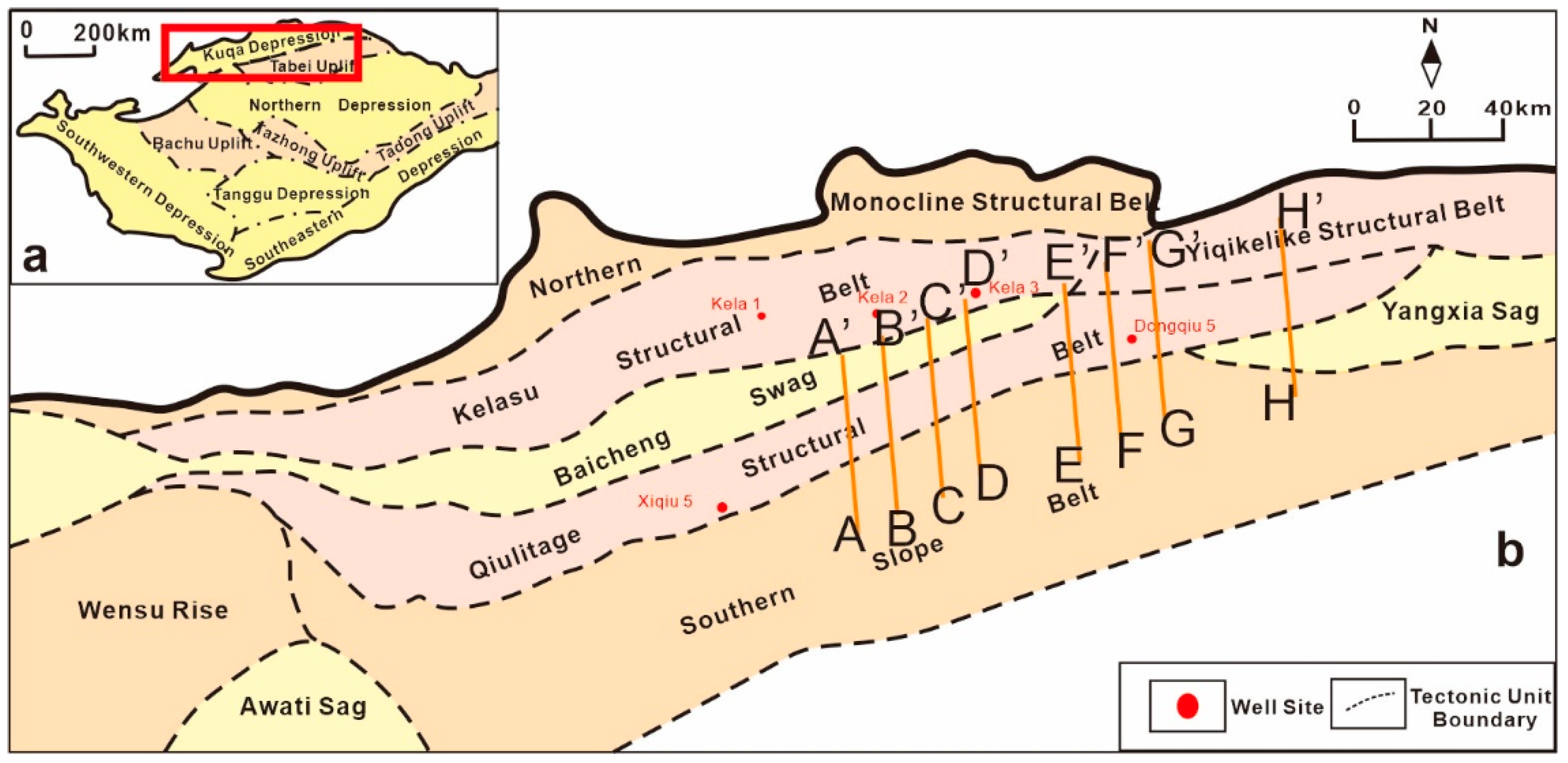
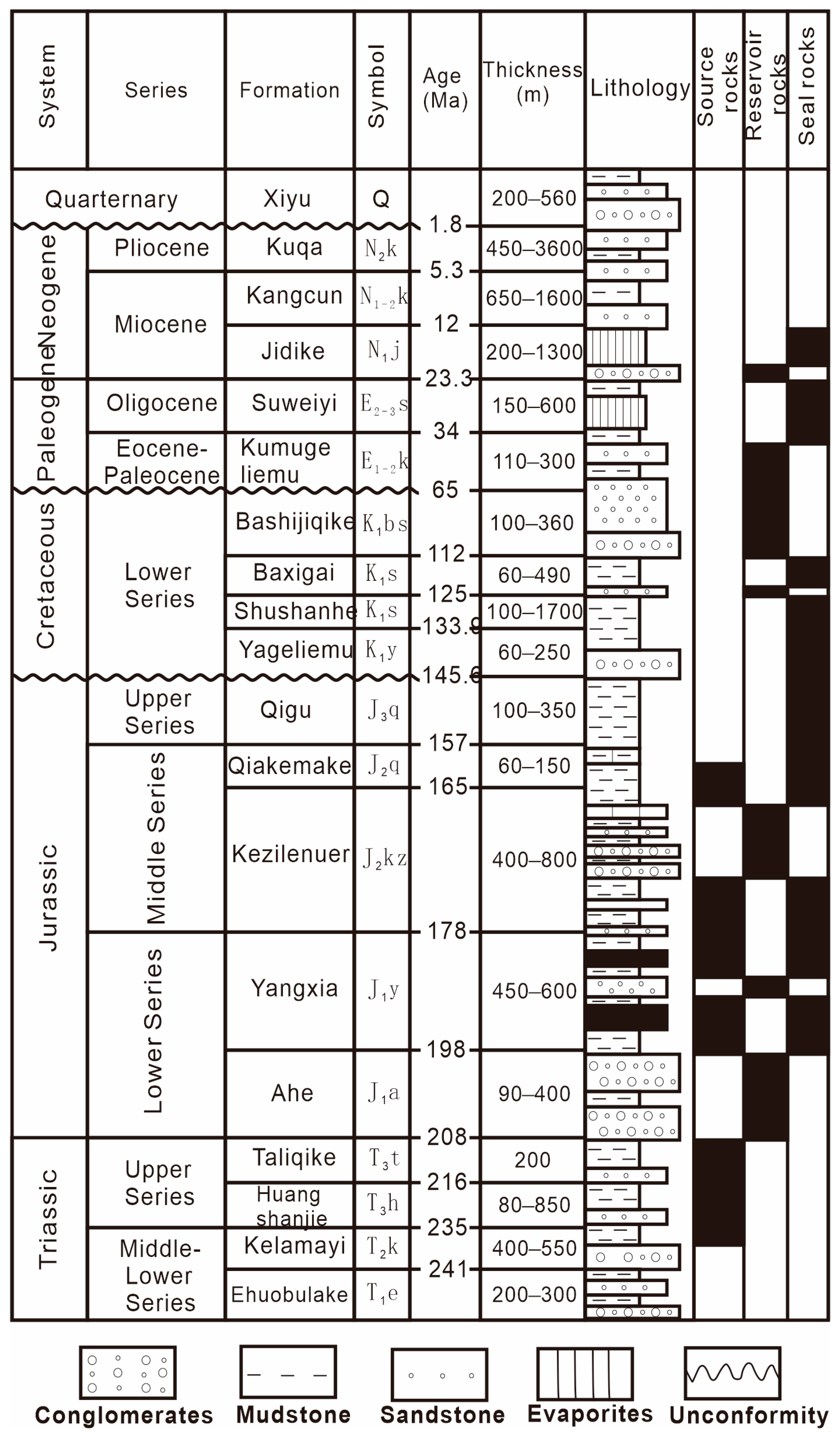
The Zhongqiu–Dongqiu area (Figure 1) lies within the core structural zone of the foreland thrust belt along the southern margin of the Tianshan Mountains [1,2]. Owing to the limited resolution of early 2D seismic data, Cretaceous exploration has historically targeted shallow sandstone reservoirs of the Bashijiqike Formation (K1bs), leaving the deeper Cretaceous strata largely unexplored and undeveloped at scale (Figure 2). Meanwhile, the Lower Cretaceous Shushanhe Formation hosts thick mudstone sequences that constitute a high-quality regional seal, directly governing the sealing efficiency and hydrocarbon accumulation potential of the underlying deep Yageliemu Formation [3]. Characterized by both high exploration risk and substantial resource potential, the Yageliemu Formation has emerged as a key target for recent ultra-deep risk exploration in the Tarim Basin [4,5].
The superposition of multi-stage tectonic events has generated a composite tectonic regime involving both compression and extension, leading to the widespread development of folds and multi-level fault systems within the Cretaceous strata of this region [7,8,9]. These structural evolutions not only control hydrocarbon trap formation [10] but may also critically influence the preservation state of the entire petroleum system. Consequently, elucidating the formation and evolutionary mechanisms of coordinated detachment structures within the Shushanhe Formation under a sustained regional compressive stress field has become the central scientific challenge constraining the deployment of ultra-deep exploration wells.
Significant progress has been made in recent years. Regionally, the structural framework of the study area has been largely clarified [11], and the macroscopic control of major thrust faults on hydrocarbon migration and accumulation has been relatively well revealed [2,3,4]. Regarding reservoir characterization, systematic studies on fracture development [12,13] and fluid evolution [14,15] in the tight sandstones of the Bashijiqike Formation have laid a solid foundation for reservoir evaluation. Nevertheless, existing research remains predominantly focused on sedimentary facies analysis [16,17,18] and sandbody prediction [19,20], with insufficient attention paid to the dynamic deformation behavior of the overlying seal. Under continuous compression, “non-coaxial structures”—such as folds and intra-formational shear zones—are prone to develop within the Shushanhe mudstone caprock. The geometry, spatial configuration, and connectivity of these structures are critical determinants of the caprock’s dynamic sealing evolution. Although preliminary investigations into the deformation response of the Shushanhe caprock under multi-stage intense compression have provided a foundational basis [21], a systematic understanding of its mechanical behavior and coupling with hydrocarbon preservation remains lacking. To meet the demands of refined exploration in structurally complex settings, quantitative characterization of caprock deformation is urgently needed.
Figure 2. Stratigraphic column of Kuqa depression [22].
Applsci 16 05659 g002
Accordingly, this study focuses on the development mechanisms of non-coaxial structures within a composite compressional–extensional stress field shaped by multi-stage tectonic transitions. As a crucial link bridging macroscopic deformation and microscopic sealing performance, unraveling the formation patterns of these structures is essential for advancing dynamic evaluation methodologies for caprock integrity. To this end, we integrate multi-scale analytical approaches with physical tectonic modeling experiments [23]. By systematically varying key parameters—including compression rate, sand–mud interbed ratio, and boundary constraints—we aim to reconstruct the structural deformation history of the Shushanhe Formation under multi-stage compression and elucidate how multiple geological factors jointly govern internal structural evolution and hydrocarbon accumulation effectiveness.
From a structural dynamics perspective, this work seeks to identify the primary controls on the complex deformation structures within the Shushanhe caprock in the Zhongqiu–Dongqiu area, thereby providing mechanistic support for the structural segmentation observed in high-resolution 2D and 3D seismic interpretations. The findings are expected to offer scientific guidance for the precise delineation of hydrocarbon preservation units and the evaluation of lateral sealing capacity along fault zones. Furthermore, this study advances theoretical understanding of the “stress–lithology–structure” coupling mechanism and provides a transferable framework for caprock assessment and exploration risk prediction in strongly compressed foreland basins worldwide.

2. Regional Overview

The Kuqa depression, situated along the northern margin of the Tarim Basin, is a Cenozoic superimposed foreland basin that has experienced intense multiphase tectonic deformation driven by the Late Cenozoic uplift of the Southern Tianshan Mountains [24,25,26]. The study area occupies a strategically important structural position within the middle to eastern segment of the Qiulitage structural belt in the Kuqa depression, lying at the intersection and transitional zone among the Kelasu thrust belt, the Baicheng Sag, and the southern slope belt. Owing to its favorable petroleum geological conditions, this region represents a key exploration target for ultra-deep hydrocarbon resources in the Kuqa depression [27,28,29].
The overall structural architecture of the study area is governed by multiple detachment horizons, which primarily comprise four components: the Paleogene (E) Kumugeliemu Group (E1–2km) gypsum–salt layer, Jurassic (J) coal-bearing strata, thick mudstone intervals, and the basement décollement [30,31]. Among them, the thickness of the Kumugeliemu Group gypsum–salt layer generally varies significantly, ranging from 110 m to 300 m (Figure 2). Due to its high ductility, it dominates the rheological behavior of the detachment system. The stress dispersion resulting from stratigraphic decoupling induces pronounced deformational partitioning between the overlying and underlying structural layers, thereby serving as a critical control on local structural styles. Furthermore, the topography of the basement paleo-uplift influenced the depositional thickness and early structural framework of the overlying strata, establishing pre-existing conditions that facilitated subsequent differential deformation [32]. Ultimately, intense north–south-directed compressional stress during the Late Himalayan orogeny shaped the current complex thrust–nappe and fold system in the study area, providing the essential tectonic setting for deep hydrocarbon accumulation [33,34].

3. Cretaceous Key Stratigraphic Series

A complete succession of continental clastic strata is developed within the Cretaceous sequence of the study area [35]. Owing to the Late Yanshanian tectonic uplift at the end of the Late Cretaceous, these strata underwent intense erosion and truncation, resulting in the widespread absence of the Upper Cretaceous and regional unconformities between the Lower Cretaceous and both the underlying Jurassic and overlying Paleogene systems. This stratigraphic architecture constitutes a key reservoir–seal assemblage in the region [36].
The Yageliemu Formation is subdivided into three members from bottom to top: a basal sandstone member, a middle mudstone member, and an upper sandstone member. The basal sandstone member serves as the primary reservoir, composed predominantly of brownish-gray to grayish-brown, thick- to massive-bedded conglomerates and medium- to coarse-grained pebbly sandstones, intercalated with minor argillaceous laminae. This lithological assemblage reflects a depositional setting transitional from braided river delta plain to delta front. Although the matrix porosity is generally low—exhibiting typical tight sandstone characteristics—intense post-depositional tectonic compression has generated pervasive structural microfractures and secondary dissolution pores, which significantly enhance permeability and render this interval a preferential pathway and enrichment horizon for deep hydrocarbon migration and accumulation [37].
The Shushanhe Formation conformably overlies the underlying strata, indicating continuous deposition. It is dominated by dark brown to grayish-green, extremely thick, massive mudstones with minor interbeds of thin silty fine sandstones, representing semi-deep to deep lacustrine subfacies deposited in a broad and gentle lake basin. This mudstone unit exhibits exceptional lateral continuity, considerable cumulative thickness, and high clay content. Acting as a regional caprock, its superior microscopic sealing capacity and macroscopic integrity form an effective fluid barrier, playing a decisive role in preserving underlying hydrocarbon reservoirs and maintaining deep overpressure systems [35].
The Baxigai Formation (K1bx), situated between the Yageliemu and Shushanhe formations, hosts a classic river-dominated shallow-water deltaic system. From bottom to top, the lower to middle parts are characterized by restricted infill deposits, while the upper member comprises widespread transgressive lacustrine shales. The main reservoir facies consist of subaqueous distributary channels and sheet sands, primarily composed of well-sorted fine sandstones with large individual sandbody thicknesses and multi-stage vertical stacking. Notably, the upper Baxigai member contains high-quality lithologic trap clusters formed by sheet sands at the top of the inner delta front and channel sands along the flanks of the outer front. Promising hydrocarbon shows have been documented during lithologic reservoir exploration on the southern slope of the Kuqa depression [38,39].
As a multi-cycle sedimentary unit capping the Lower Cretaceous, the Bashijiqike Formation records an evolutionary fill sequence transitioning from an early fan delta front to a middle–late braided river delta front. Its lithology is dominated by medium- to fine-grained sandstones. Despite pervasive diagenetic compaction and dolomitic–gypsiferous cementation that impart overall tight characteristics—low porosity and ultra-low permeability—dissolution-driven diagenesis has locally preserved effective reservoir space dominated by primary intergranular pores, establishing this formation as a critical secondary play for deep hydrocarbon accumulation [40].
Critically, a pronounced contrast in mechanical properties exists between the highly ductile Shushanhe mudstones and the more brittle overlying and underlying sandstone units. Under regional compressive stress, this rheological heterogeneity promotes differential deformation, giving rise to complex internal structures. Understanding such lithology-controlled structural partitioning lies at the heart of this study.

4. Tectonic Modeling of the Cretaceous System

During the Early Cretaceous, the Kuqa depression constituted a shrinking lacustrine basin within the South Tianshan foreland system, with its depositional extent stretching from the Wushen Depression in the west to the Yangxia Depression in the east. The deposition of the Bashijiqike Formation during the Middle Early Cretaceous represents a critical turning point in the basin’s evolution. Under sustained tectonic compression, the basin entered a regressive phase, facilitating the widespread development of braided river delta systems. From the Late Cretaceous to the Paleogene, regional tectonics stabilized, enabling extensive clastic deposition. Within this context, the Lower Cretaceous Baxigai Formation emerged as the primary target for deep hydrocarbon exploration, serving as both a high-quality source rock and an effective reservoir interval. This unit provides the essential geological foundation for ultra-deep gas accumulation and holds immense exploration potential [14]. To accurately characterize the structural framework and trap geometries of deep targets, we generated synthetic seismograms and performed fine-horizon calibration via well-seismic ties, which enabled continuous 3D horizon tracking until loop closure. Based on various seismic attributes, as well as fault identification indicators such as termination of seismic reflectors and offset of continuous reflection layers, we completed a comprehensive interpretation of the fault system across the entire study area. On the basis of these solid seismic interpretation results, this paper carries out a systematic analysis of regional structural characteristics.

4.1. Analysis of the Differences in Deformation Characteristics Between the Zhongqiu and Dongqiu Structural Belts

4.1.1. Deformation Characteristics of the Zhongqiu Structural Belt

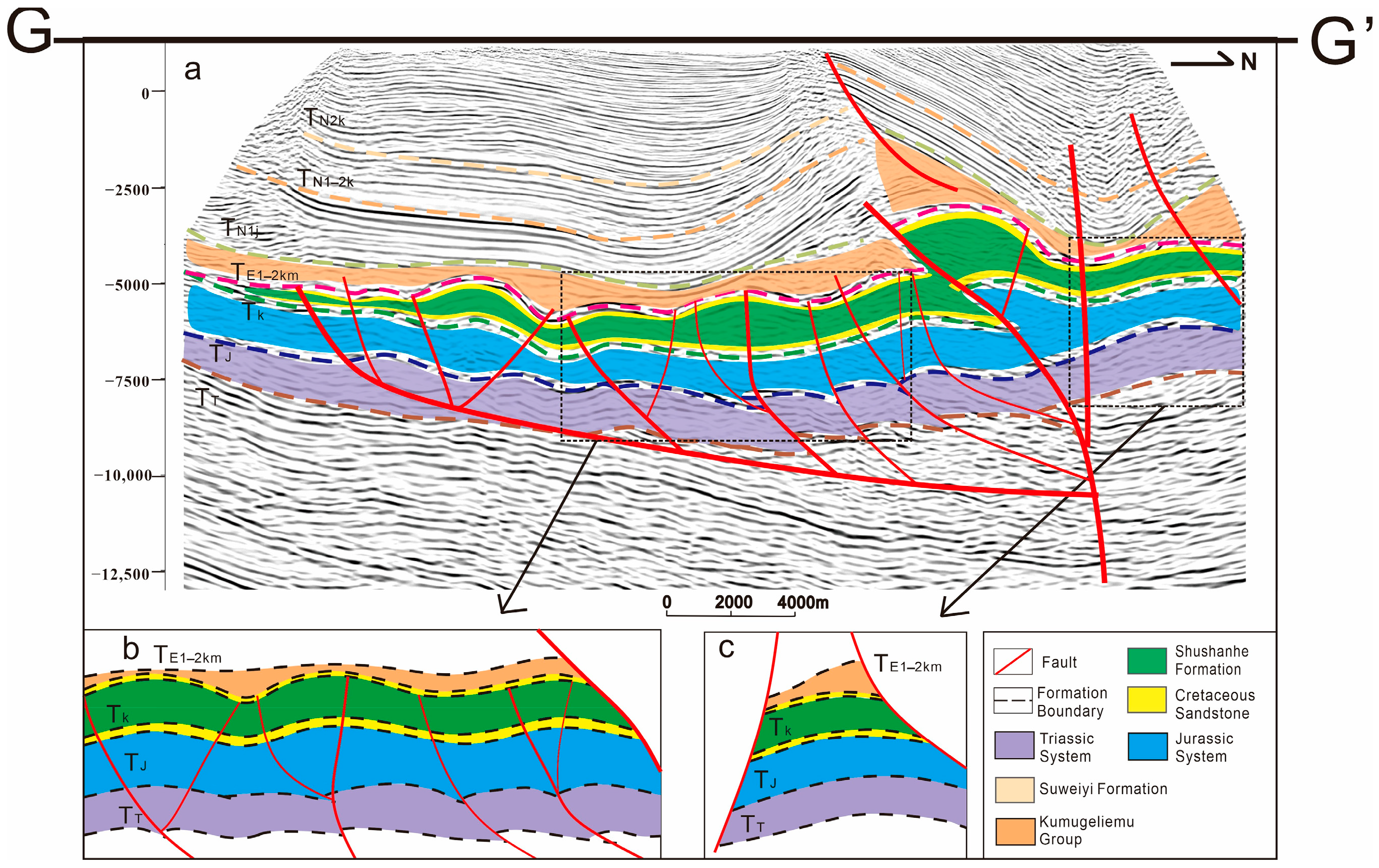
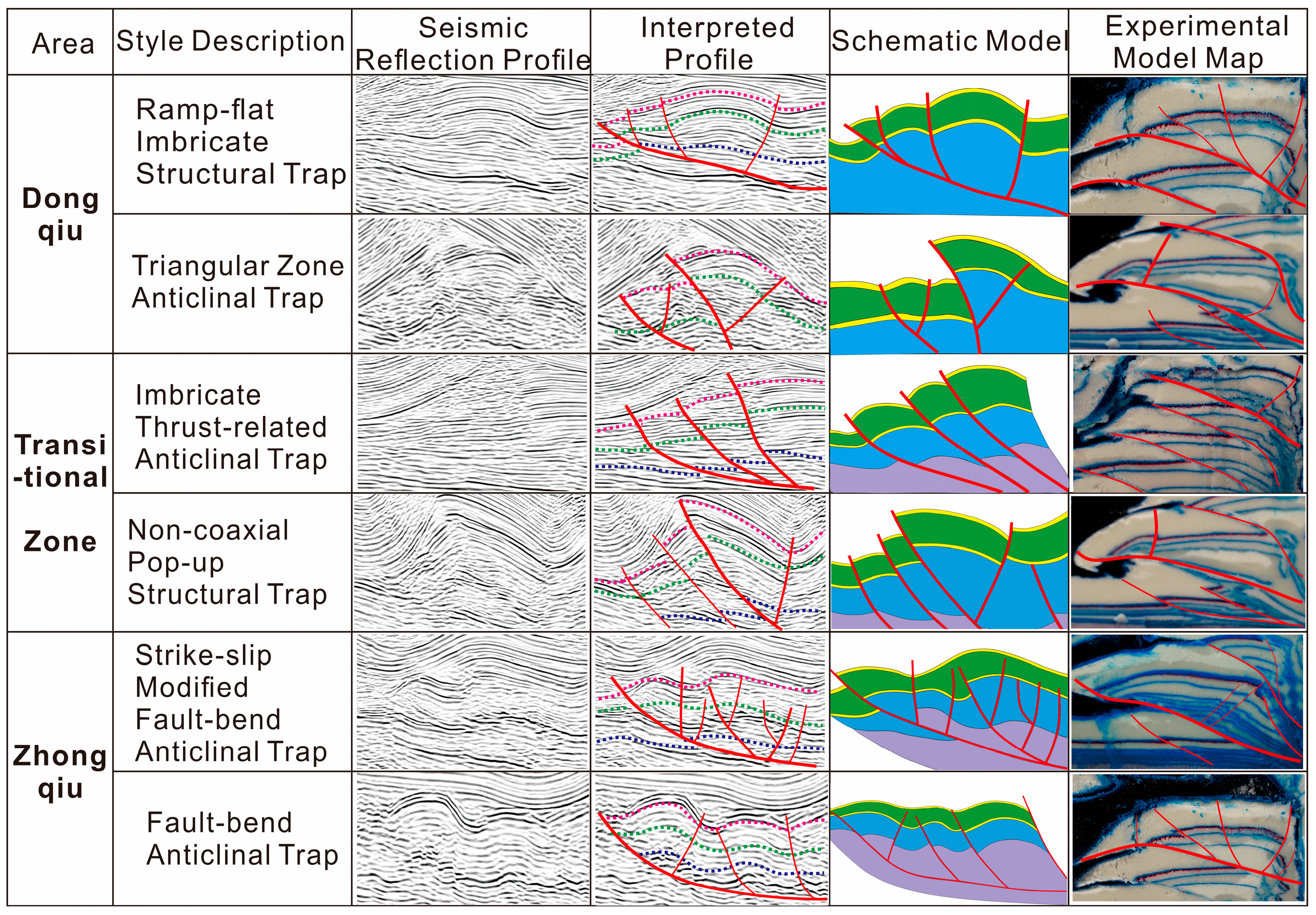
The structural wedge in the Zhongqiu belt (Figure 3) exhibits a stratified deformation pattern characterized by high-angle thrusting, multi-level imbrication, and plastic crumpling. From the proximal compressional front towards the basin interior, the structural style transitions from a basement-involved thrust belt to a low-angle caprock detachment zone. The deformation intensity in this belt is markedly higher than that in the Dongqiu belt, clearly revealing a strong coupling between intense deep-seated uplift and complex differential deformation of shallow layers under a highly compressive regime.
Driven by the uplift of underlying strata, the supra-salt structural layer is dominated by passive drag deformation, with faults typically exhibiting steep dips and locally near-vertical orientations. In the proximal orogenic zone, Quaternary (Q)–Neogene (N) strata are directly transected by a series of high-angle master thrust faults that penetrate the salt layer. Basinward, high-angle back-thrust faults propagate upward to the surface, while their dips gradually flatten with depth until detaching within the Paleogene gypsum–salt layer. The supra-salt layer hosts two characteristic structures: broad synclines bounded by opposing thrust faults and abrupt anticlines generated by fault drag. These features indicate that, to accommodate deep-seated intense compression, deformation in the shallow crust is primarily accommodated through strong folding and passive uplift.
Under the combined action of intense compressive stress and differential loading, the Paleogene gypsum–salt layer undergoes vertical plastic flow, resulting in localized thickening—a signature of incipient halokinesis, indicating the initiation of salt ridge development in this area. With progressive deformation, these salt structures swell and ultimately develop into piercement diapirs. In the core of the broad syncline, the gypsum–salt layer is drastically thinned due to the synergistic effects of enhanced syn-sedimentary tectonic loading and significant stress dissipation from long-distance slip along the basal detachment of the thrust wedge, leading to the formation of clear salt welds at multiple locations. Conversely, on the southern limb of the composite anticline, the superposition of multi-level faults creates a fault-controlled salt lake triangle zone, promoting salt accumulation and the development of salt pillow structures. The spatial variation in salt thickness indicates that, within this high-strain compressional zone, the decoupling effect of the relatively thin gypsum–salt layer on deep and shallow structures is weak; deformation is predominantly thrust-controlled. This commonly manifests as the salt layer being penetrated to form thrust nappes, which in turn profoundly influence the deformation style of the underlying sub-salt structural layer.
The sub-salt structural layer is dominated by imbricate thrust fans, locally modified into structural triangle zones due to the buttressing effect of paleo-uplifts. High, steep fault-propagation folds develop in the footwalls of large-dip, large-displacement thrusts in the proximal orogen and in the hanging walls of primary (Level I) detachment faults, dissecting the Cretaceous sequence into well-developed, arrayed imbricate stacks. Within each thrust fan, secondary (Level II) detachment faults either terminate upward as blind tips or cut through the salt layer, ultimately merging downward onto the Triassic (T) master detachment, collectively forming a large-scale wedge-shaped thrust system. As this thrust wedge propagated basinward, it encountered resistance from paleo-uplifts, which not only perturbed the regional stress field but also controlled the formation of secondary antithetic accommodation faults, thereby directly governing the sequential development and evolution of the multi-level fault network.

4.1.2. Deformation Characteristics of the Dongqiu Structural Belt

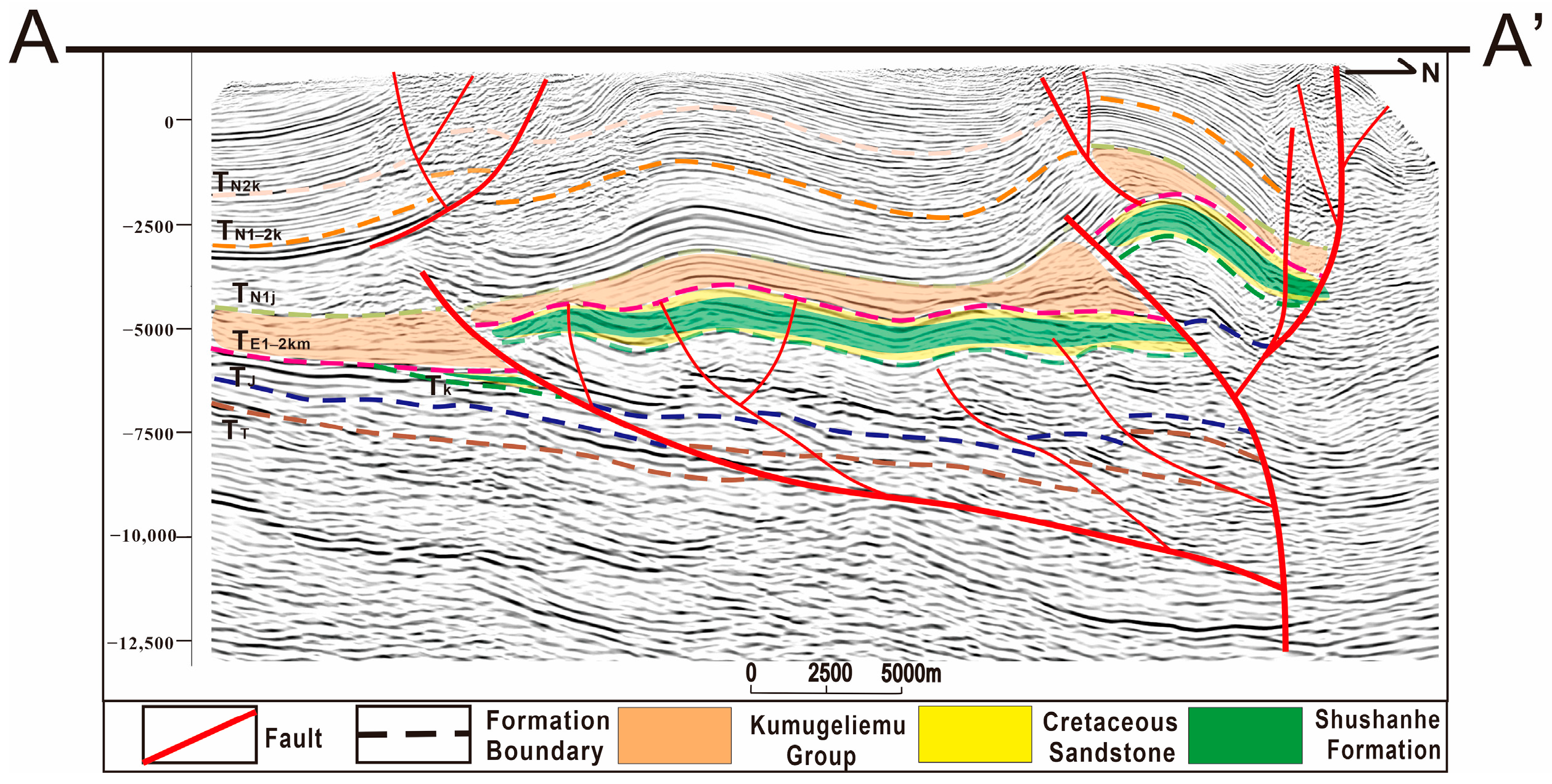
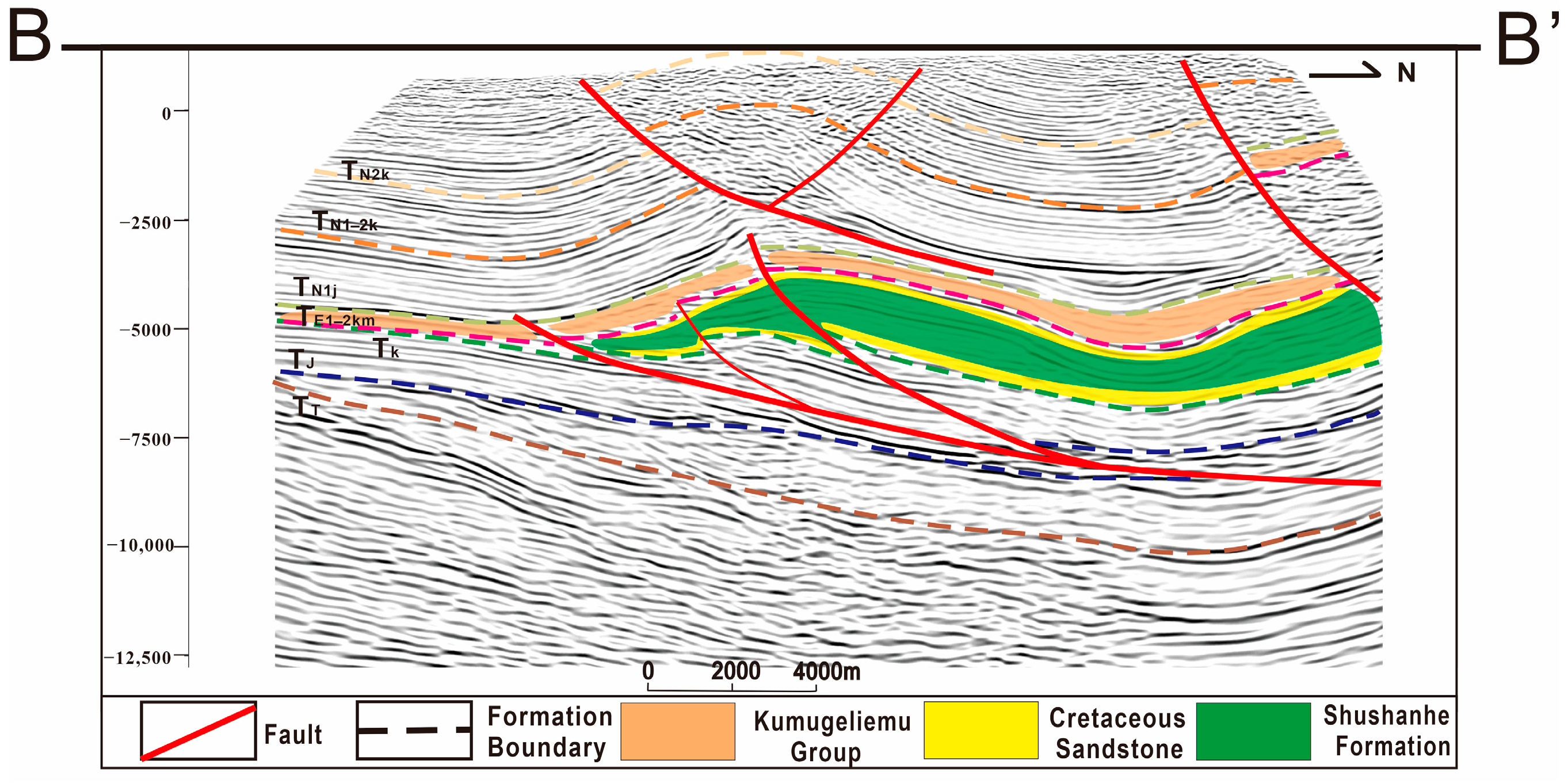
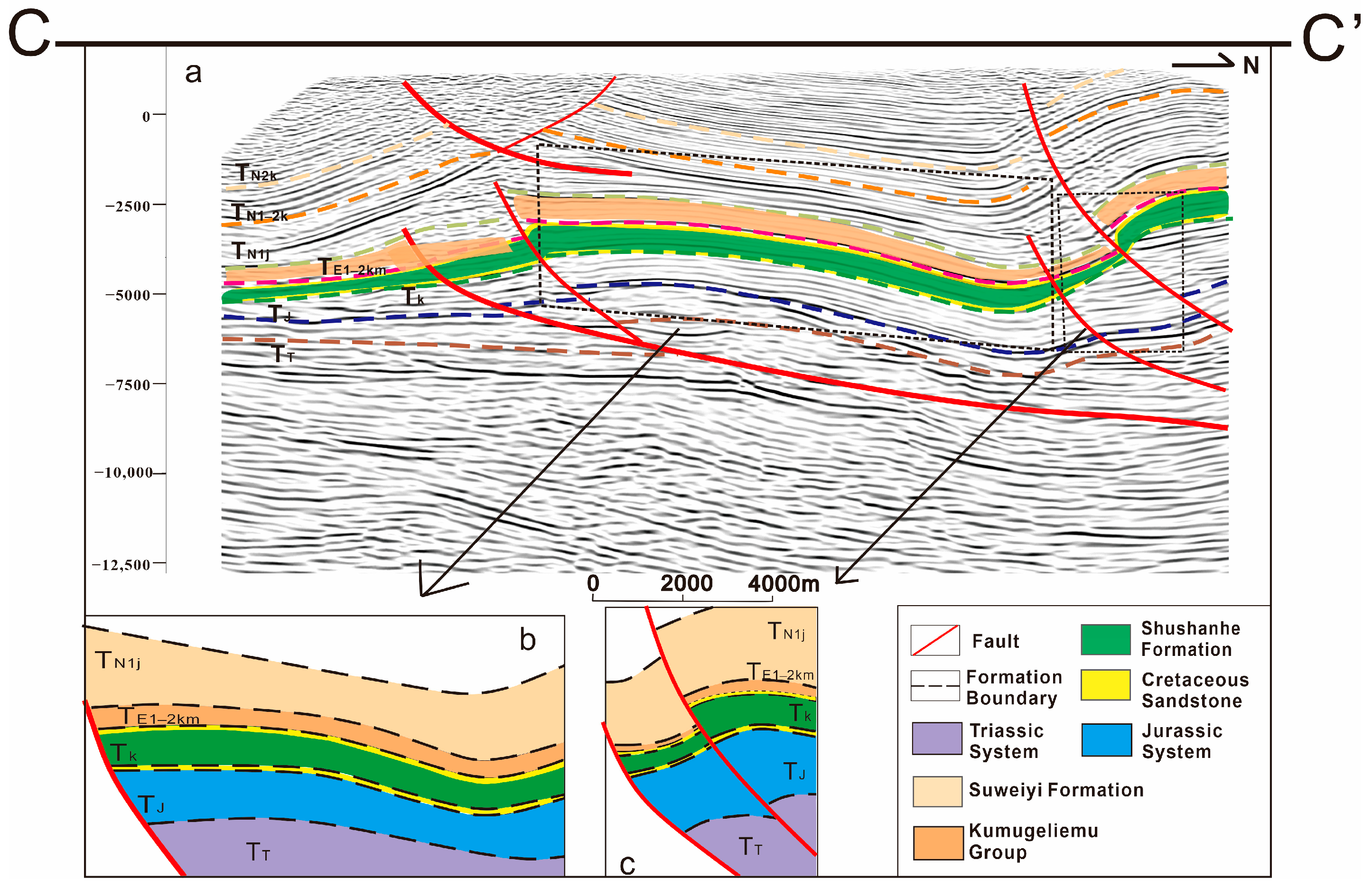
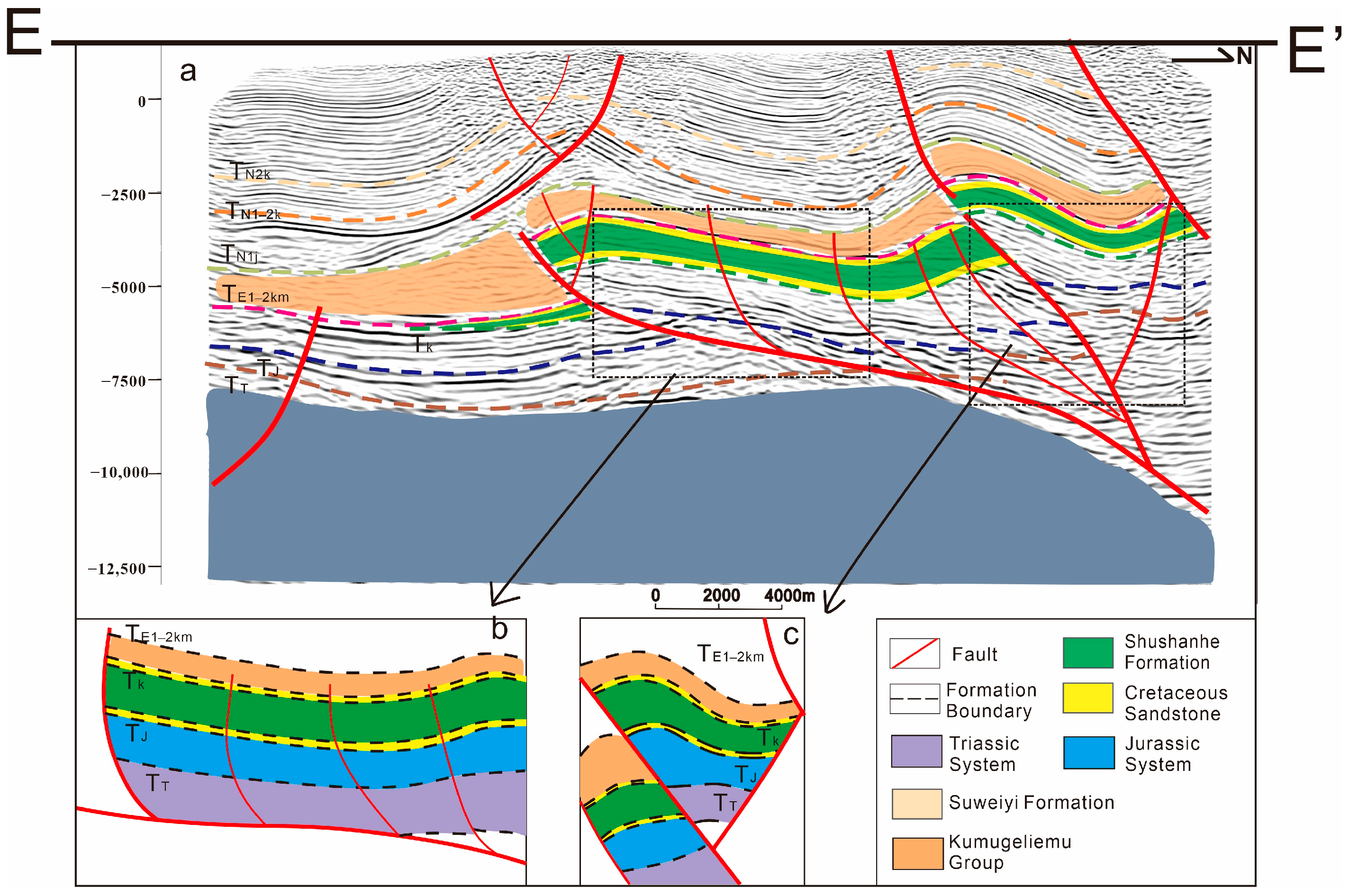
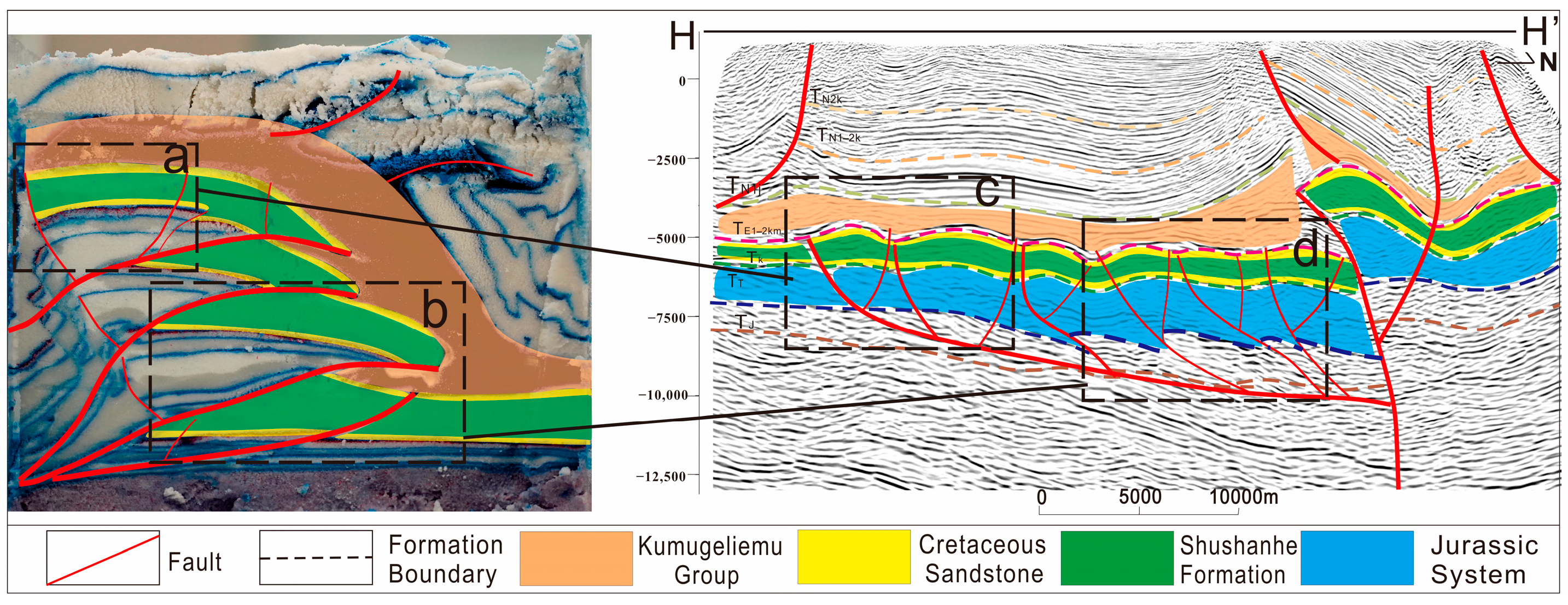
The Dongqiu structural belt (Figure 4) is characterized by vertically stratified decoupling and an overall broad, gentle structural geometry. Although deformation styles differ between the supra-salt and sub-salt layers, the variations are relatively uniform and not markedly pronounced [41].
The supra-salt structural layer generally exhibits flat, stable stratigraphic attitudes with excellent continuity. Its deformation is primarily manifested as northward-dipping gentle monoclines near the orogenic front or broad, open synclines in the distal footwalls of coaxial structures, lacking intense folding. Nevertheless, the presence of locally abrupt structures indicates that the shallow strata retain the potential for localized structural mutations above the detachment surface. Two sets of high-angle accommodation faults are developed, which cut through the overlying Neogene–Quaternary strata at steep dips. However, with increasing depth, their fault planes gradually flatten from steep to gentle, maintaining an overall listric thrust geometry before ultimately merging into the gypsum–salt detachment layer.
As a critical weak layer, the Paleogene gypsum–salt layer serves as an efficient plastic detachment and strain-accommodation horizon in the vertical profile. Despite its generally stable lateral thickness, plastic rheology was induced internally under tectonic stress, leading to salt accumulation in anticlinal cores and fold hinge zones, thereby forming plastic thickened zones that effectively absorb displacement discrepancies between the overlying and underlying structural layers. In contrast to salt-related structures such as piercement diapirs and salt pillows [42,43]—which form in the intensely compressed orogenic-proximal zones due to ample salt supply—the slight thinning of the gypsum–salt layer in the basin hinterland, where compressive stress is minimal, results in insufficient salt volume and the consequent development of salt welds. This stage clearly reveals a mechanism of flexible strain transfer.
The sub-salt structural layer is dominated by low-angle imbricate thrust fans distributed in continuous belts. Compared to the Zhongqiu belt (Figure 4), the Cretaceous system—the focal interval of this study—has experienced significantly less disruption from the sub-salt fault network, allowing its primary sedimentary framework to be better preserved. The deep-seated master fault displays a typical listric thrust character, cutting downward through the Jurassic sequence and detaching along the Triassic basement detachment surface. Notably, this master fault has not induced significant basement uplift, forming only a low-amplitude basement swell. The overlying secondary fault zones predominantly converge downward and detach within the Jurassic coal-bearing strata, spatially generating a series of local fault-propagation folds with gentle limbs. The vertical displacement associated with these secondary structures is minor and insufficient to cause large-scale folding. Consequently, due to weak reworking by multi-level faults, the Mesozoic strata as a whole maintain broad, large-scale anticlinal geometries, a configuration that not only ensures trap integrity but also provides superior structural conditions for hydrocarbon preservation.

4.2. Control of Mudstone Detachment Layer on Structural Style

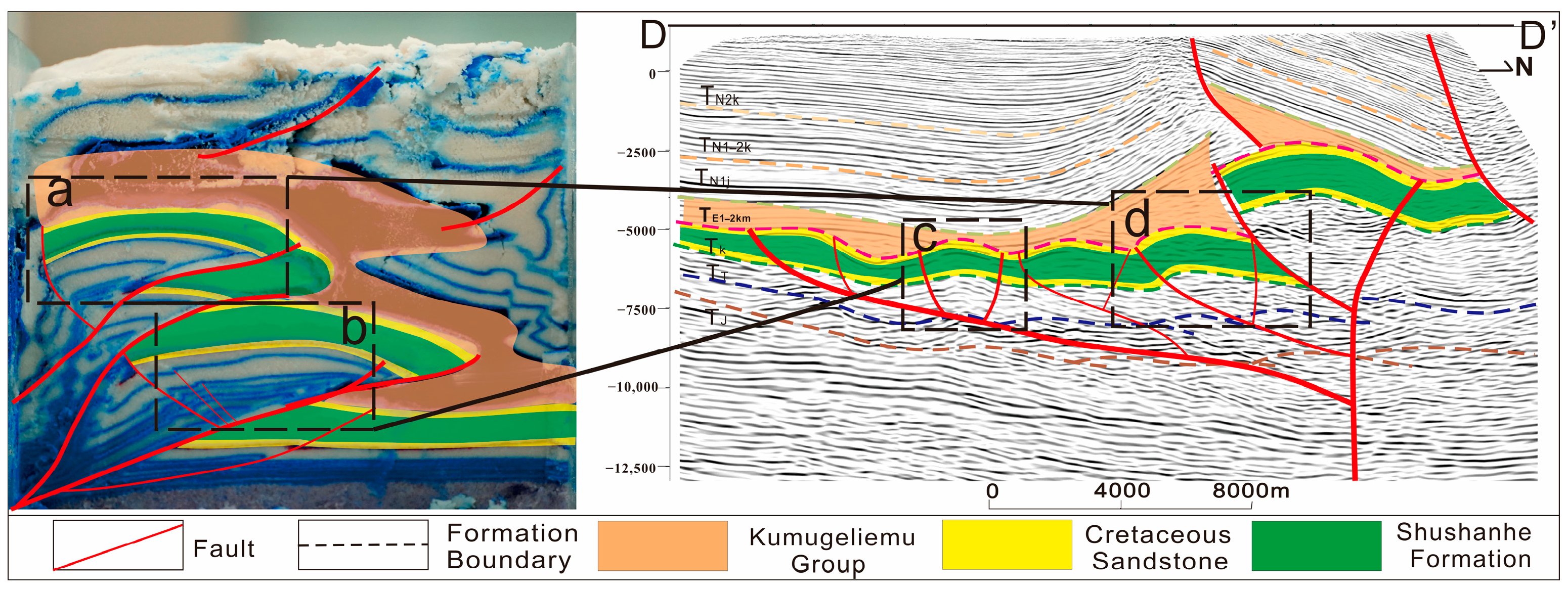
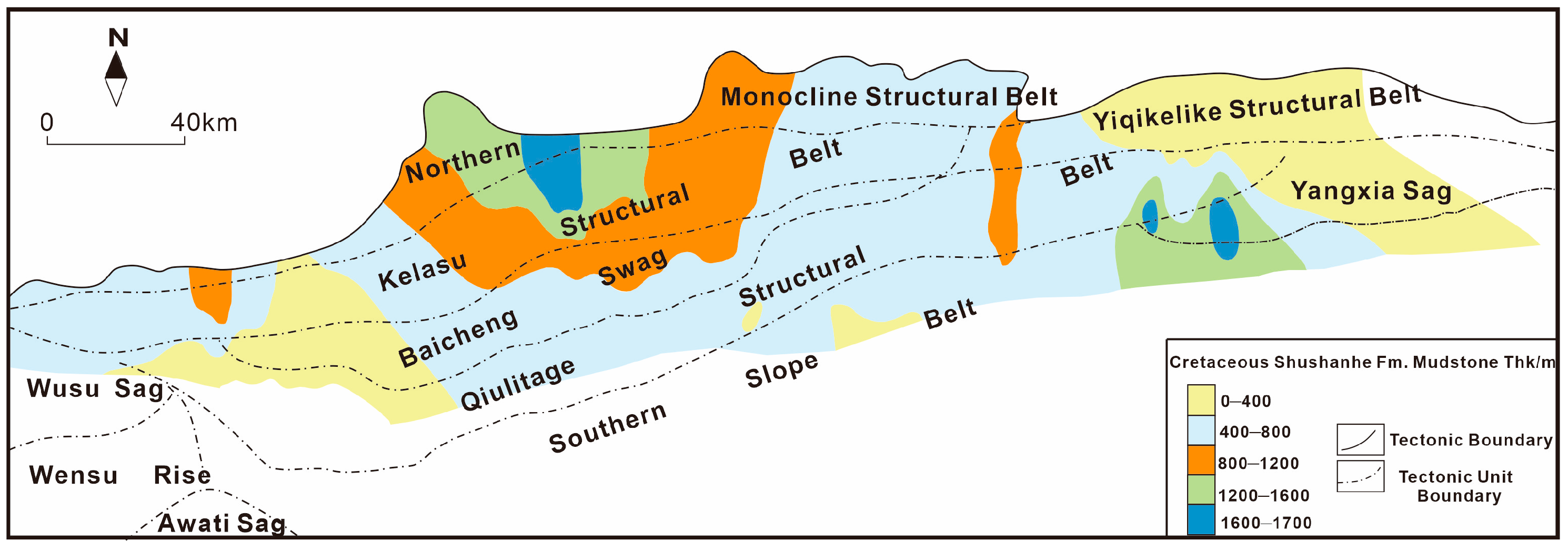
The spatial distribution of the Shushanhe Formation mudstone detachment layer and the variations in its detachment efficiency, governed by differences in argillaceous content, constitute the two pivotal factors controlling structural deformation styles in the study area (Figure 5). A significant positive correlation exists between the lateral heterogeneity of mudstone thickness and the non-coaxiality of pop-up structures: specifically, greater mudstone thickness enhances detachment efficiency, leading to more pronounced non-coaxial deformation, and vice versa.
In the Dongqiu area, the Shushanhe Formation comprises exceptionally thick, pure mudstone intervals. When the South Tianshan Orogenic Belt transmits north-to-south compressive stress into the Kuqa depression, these low-competency, thick mudstone zones act as regional weak detachment horizons. Characterized by a low internal friction angle and high pore-fluid pressure, these thick mudstone layers drastically reduce the shear strength of the underlying strata, enabling the overlying competent Cretaceous layers to undergo long-distance, distal sliding relative to the basement. Bounded by the Yageliemu Formation, the overlying Cretaceous and underlying Jurassic sequences exhibit distinct multi-level detachment deformation. Based on structural analysis of this section, the mechanism for non-coaxial deformation is preliminarily interpreted as follows: the secondary detachment adjustment capacity provided by the thick mudstone layer creates the necessary space for strain accommodation during rotation of the principal strain axis. When differential loading arises from the combined effects of syn-tectonic sedimentation, erosion, paleo-uplifts, and boundary faults, the local tectonic stress field is perturbed, driving a rotation of the principal strain axis. This process establishes an oblique relationship between fault strike and the direction of maximum compressive stress, ultimately generating a characteristic non-coaxial deformation pattern.
Transitioning towards the Zhongqiu area, the Shushanhe Formation mudstone thins significantly and its sand content increases, causing its rheological behavior to shift from plastic to brittle-ductile and resulting in markedly reduced detachment efficiency. Consequently, the interface between the Shushanhe mudstone and the Yageliemu Formation exhibits a high internal friction angle and low pore fluid pressure. The sharp increase in frictional resistance severely restricts the long-distance transmission of tectonic stress, forcing strain energy to be rapidly released near the orogenic front and shifting the deformation mode towards coaxial shortening parallel to the direction of maximum compressive stress. This is manifested by a drastic reduction in the slip distance of ramp-flat detachment systems, significantly steeper fault dips, increased displacement, and a more tightly stacked vertical arrangement of structural elements, dominated by imbricate thrust stacks and high-angle thrust faults.
In summary, variations in the thickness of the mudstone detachment layer not only act as a critical valve regulating the propagation efficiency and effective range of the regional tectonic stress field but also serve as the decisive factor governing the transition of structural deformation styles from coaxial to complex non-coaxial patterns within the study area.

5. Experimental Results and Analysis

5.1. Petrological Attributes

Building on the structural analysis of the Zhongqiu–Dongqiu area, this study identifies the Cretaceous thick-layered mudstone as the critical factor governing the development of non-coaxial structures. As illustrated in Figure 5, the thickness of these mudstone detachments varies significantly along the structural belt, being approximately 600 m in the Zhongqiu area and increasing to around 1000 m in the Dongqiu area. To further constrain the controlling influence of such lithological properties and thickness variations on structural deformation, we designed comparative tectonic sandbox experiments featuring ‘Pure Mudstone Facies’ and ‘20% Sandy Mudstone Facies’. Tectonic sandbox modeling serves as a robust approach for replicating the complete deformation history of geological bodies under controlled laboratory conditions. By adhering to principles of geometric and dynamic similarity, this method effectively reconstructs the stress regimes of geological prototypes. It provides intuitive insights into the genetic mechanisms and spatio-temporal evolutionary sequences of fault systems and fold styles, offering essential physical verification for deciphering the formation patterns of natural geological structures.

5.1.1. Experimental Setup and Similarity Ratio

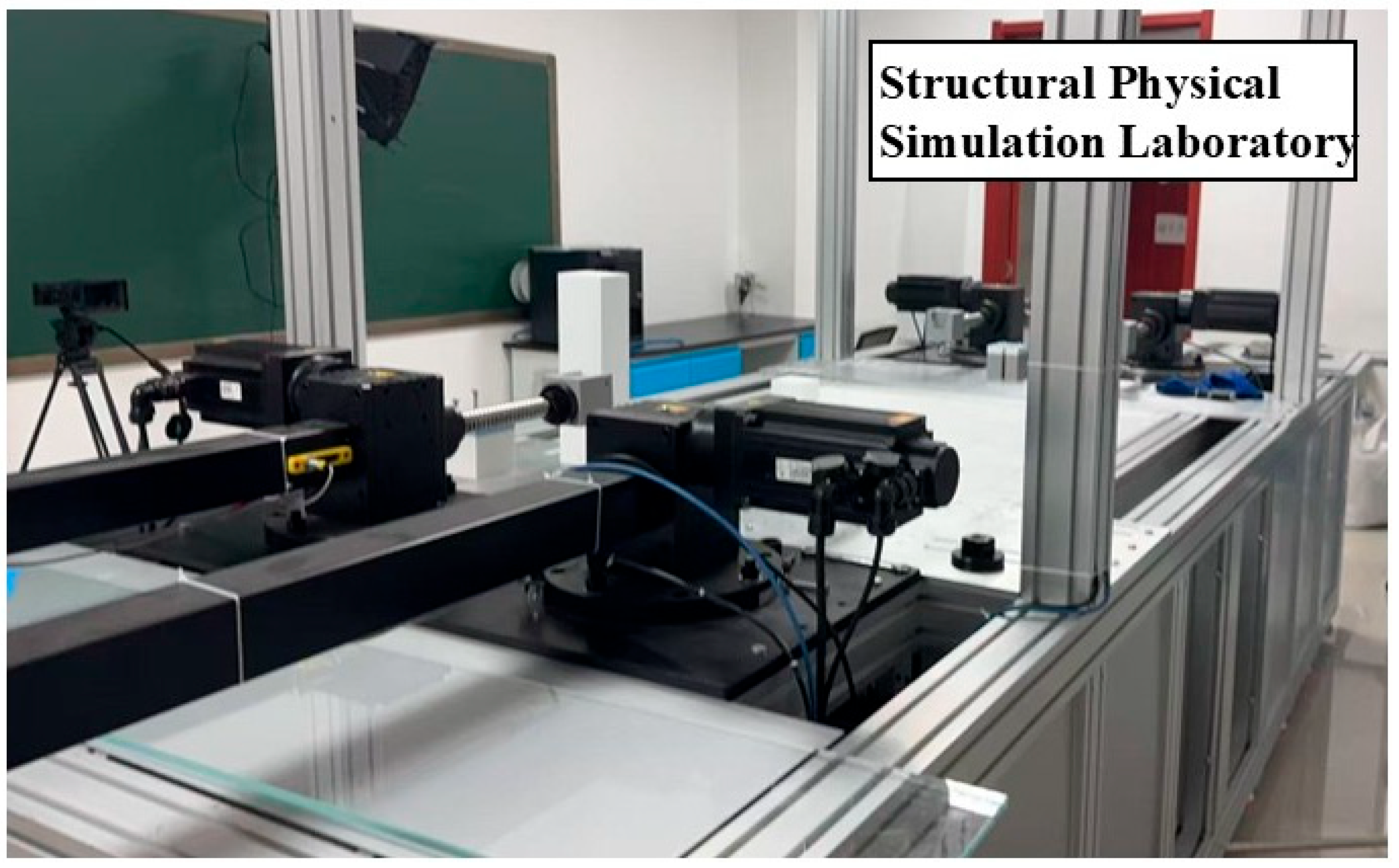
The physical modeling experiments were conducted at the Basin Tectonic Modeling Laboratory, China University of Petroleum (Beijing), Karamay Campus (Figure 6). The experimental facility was self-built by our laboratory. The apparatus consisted of a standard sandbox system measuring 500 mm × 400 mm × 200 mm, where a motor-driven movable baffle simulated unidirectional tectonic compression against a fixed boundary (Figure 7). To maintain rigorous geometric, kinematic, and dynamic similarity between the model and the geological prototype, a geometric scaling ratio of 1:100,000 was adopted, where 1 cm in the model corresponds to 1000 m in the natural section. Consequently, the stress field within the model remains fundamentally consistent with the geological reality. The experimental materials were provided by Qisheng Chemical Co., Ltd. (Guangzhou, China). The compression rate was initially set at 0.03 mm/s; however, to mimic the intensification of the regional tectonic stress field driven by the Late Himalayan orogenic uplift, the rate was accelerated to 0.05 mm/s upon reaching 30% total shortening.

5.1.2. Material Selection for Simulation

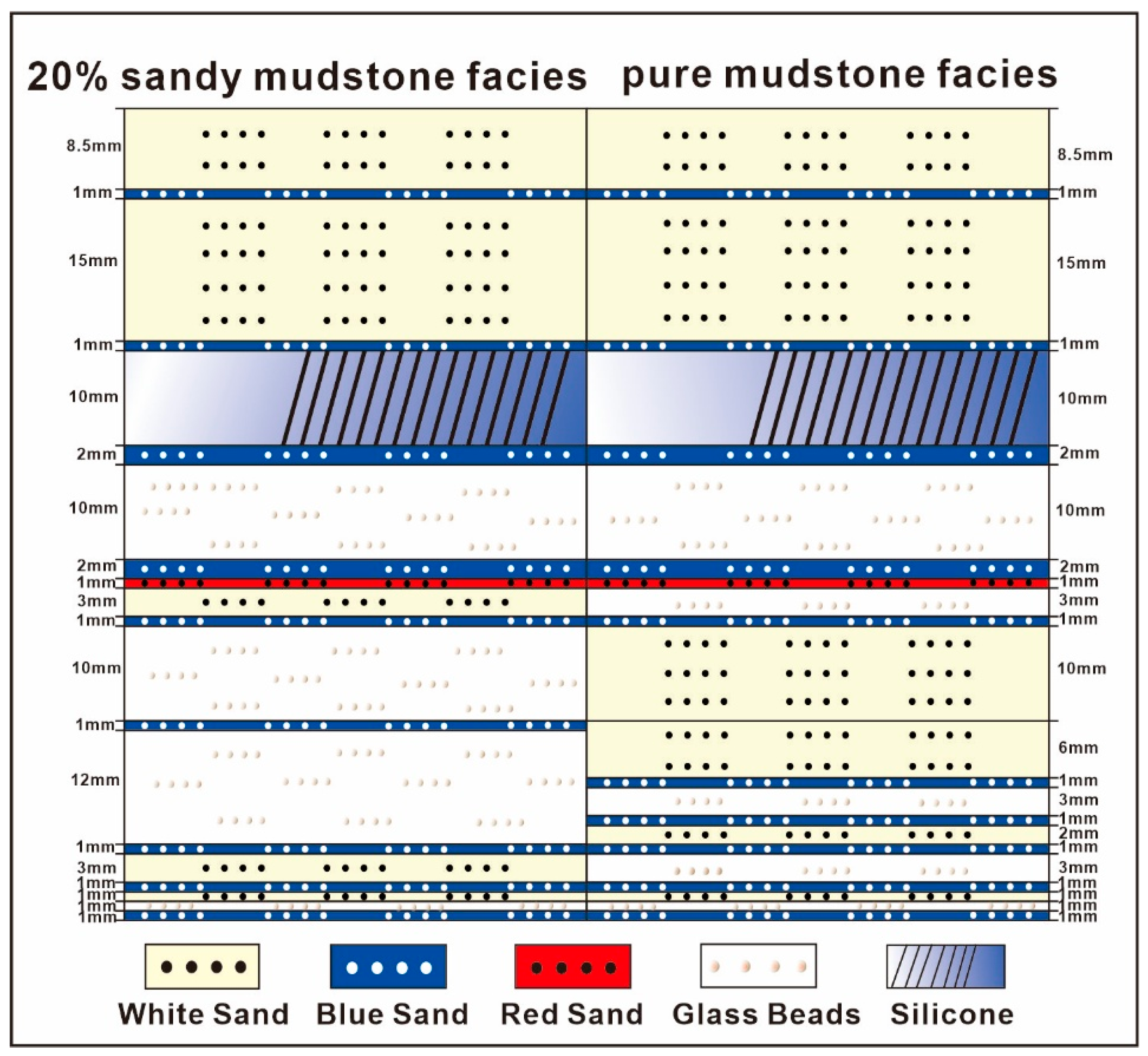
This experiment employed materials with contrasting physical properties to accurately replicate complex lithological assemblages. The material selection protocol for this tectonic physical simulation proceeded as follows (Figure 8): during model construction, all experimental materials were carefully deposited and leveled layer by layer using a scraper to ensure uniform stratigraphic thickness. Multi-colored quartz sand mixed with water was deposited to construct the basement paleo-uplift, leveraging wet sand cohesion to simulate quasi-rigid basement behavior. Sandstone strata were represented by dry white quartz sand, which adheres strictly to the Coulomb criterion. Possessing a tensile strength of nearly zero and an internal friction angle of approximately 30°—closely resembling those of natural sandstone and limestone—this competent material effectively reproduces the deformation characteristics of shallow sedimentary strata and brittle rock layers in the upper crust. To visually distinguish different stratigraphic horizons and accurately trace internal fault geometries during progressive deformation, differently colored dry quartz sands were intercalated. Furthermore, these colored sands were strictly sourced from the same operational batch as the primary white quartz sand, possessing completely identical physical and mechanical properties. Consequently, these distinct colors serve solely for visual tracking and exert no measurable impact on the properties or mechanical behavior of the materials. Additionally, micro-glass beads were utilized to simulate weak detachment layers or brittle-ductile deformation, characterized by a smooth surface and lower cohesion compared to quartz sand. These layered glass beads are highly susceptible to sliding. Evaporite layers were simulated using silicone exhibiting Newtonian fluid behavior under low-velocity conditions. As a highly transparent and high-viscosity organic Newtonian fluid, its rheological properties at low strain rates are highly consistent with those of natural gypsum-salt rocks. Therefore, it is widely used to simulate plastic deformation in the upper crust, acting as a ductile weak layer and perfectly capturing the detachment and deformation mechanisms characteristic of Paleogene gypsum-salt sequences.
To rigorously establish dynamic and kinematic similarity between the experimental model and the natural prototype, this study strictly adhered to established physical scaling principles (Table 1). The geometric scaling ratio is defined as l m / l n = 1 × 10 5 , where 1 cm in the model represents 1000 m in nature. Assuming a standard gravity ratio ( g m / g n = 1 ) and an average density ratio between the model quartz sand and the natural sedimentary rocks of ρ m / ρ n 0.54 , the resulting stress ratio can be calculated using the formula: σ m / n = ρ m / n × g m / n × l m / n 5.4 × 10 6 . To evaluate rheological similarity, we introduce a dimensionless parameter—the strain rate ratio. Given the viscosity ratio of the silicone to natural salt rocks is η m / η n 2.5 × 10 16 , the dynamic strain rate ratio is derived as: ϵ m / n ˙ = σ m / n / η m / n 2.16 × 10 10 In our simulation, a compression velocity of   V m = 0.03 mm / s ( 3 × 10 5 m / s ) was systematically applied. According to the kinematic equivalence formula: ε m / n ˙ = V m / n L m / n By ensuring that the kinematic and dynamic strain rate ratios remain within the same order of magnitude, the scaled natural deformation velocity Vn corresponds to approximately 4.4 mm/yr (1.39 × 10⁻¹⁰ m/s). This extrapolated velocity falls perfectly within the plausible range of tectonic shortening rates observed in active fold-and-thrust belts, thereby robustly validating the rationality of the selected experimental compression rate and ensuring that the model rigorously satisfies dynamic similarity requirements [44,45].
To elucidate the intrinsic relationship between the detachment efficiency of the thick Shushanhe Formation mudstone and its structural control, two distinct material compositions were designed. The first comprises 100% pure micro-glass beads; as a low-friction Coulomb material, their high sphericity and grain smoothness enable substantial flow deformation under low differential stress, making them suitable for simulating natural detachment layers with low frictional strength and high plasticity. The second consists of 80% micro-glass beads mixed with 20% white quartz sand, prepared by combining components at a 4:1 volume ratio and homogenizing thoroughly. Incorporating white quartz sand significantly elevates the inter-granular friction coefficient, allowing the mixture to approximate the mechanical behavior of brittle-ductile rocks and simulate the sand-bearing mudstones of the Shushanhe Formation with enhanced brittleness.

5.1.3. Model Setup and Experimental Procedure

During the experiment, high-definition cameras and PIV particle monitoring devices installed on both sides and the top of the model captured images at an interval of 30 s to observe and record structural deformation characteristics. This experiment elucidates the control mechanisms of syn-tectonic sedimentation on mudstone detachment styles within the study area, set against the backdrop of steady compression during the early-to-middle Late Cenozoic Himalayan orogeny. The initial model configuration incorporated a basement paleo-uplift with an 8° dip situated 25 cm from the proximal end, overlain by a thick mudstone detachment layer characterized by lateral lithological heterogeneity.
Drawing upon established physical modeling analyses regarding syn-tectonic sedimentation [46,47,48], our estimation of the overall structural shortening amount and the setting of kinematic boundaries in our model are rigorously constrained by previous profile and area balancing restorations of the Kuqa depression. Our experimental configuration was precisely designed to reflect these natural boundary conditions. To accurately reproduce the tectonic-sedimentary evolution governed by multi-phase cycles, the simulation was partitioned into three distinct dynamic stages:
Stage I: Incubation of gentle tectonic activity (0–10% shortening). Corresponding to the early South Tianshan uplift, a quasi-static compression rate of 0.03 mm/s was applied to simulate stress accumulation during initial tectonic loading, replicating the low-strain-rate environment of orogenic thrusting. Concurrently, an 8.5 mm layer of white quartz sand was deposited over the Paleogene and Neogene strata to represent early Quaternary Xiyu Formation (Q1x) sedimentation. This aimed to reproduce the stress-field distribution and the initial morphology of growth strata prior to rapid thrusting. During this phase, horizontal compressive stress primarily accumulated within the deep detachment zone, manifesting as minor folding in the suprasalt layers and compaction in the underlying strata.
Stage II: Active tectonism and syn-sedimentary shaping (10–30% shortening). As the system entered the primary deformation phase, a 12.5 mm layer of white quartz sand was added to simulate the rapid accumulation of thick Quaternary sandy conglomerates. This design introduced significant gravitational loading variations to dynamically restore the “tectonic uplift-erosion-sedimentation” cycle of the Kuqa foreland basin. Maintaining a compression rate of 0.03 mm/s, the addition of thick syn-sedimentary sequences drastically altered the vertical effective normal stress on the underlying mudstone detachment. This effectively inhibited fault propagation into suprasalt layers, reproducing the critical dynamic transition from interlayer detachment to thrust systems observed in structural belts such as the Qiulitage.
Stage III: Tectonic mutation and late-stage explosive thrusting (30–50% shortening). Late Himalayan structures were driven by far-field collision effects between the Eurasian and Indian plates, resulting in a surge of continuous wedging by the South Tianshan orogenic belt. The regional stress field was characterized by intense north-to-south compression, driving crustal shortening and vigorous uplift of the Kuqa depression [49,50,51]. To simulate the sharp increase in crustal shortening rates and strain release since the middle-to-late Quaternary, the compression rate was elevated to 0.05 mm/s. This effectively modeled rapid deformation accumulation under intense compression, reproducing the deep-seated structural styles near the proximal margin, which are dominated by high-angle thrust faults and rotated fault blocks.

5.2. Experimental Results

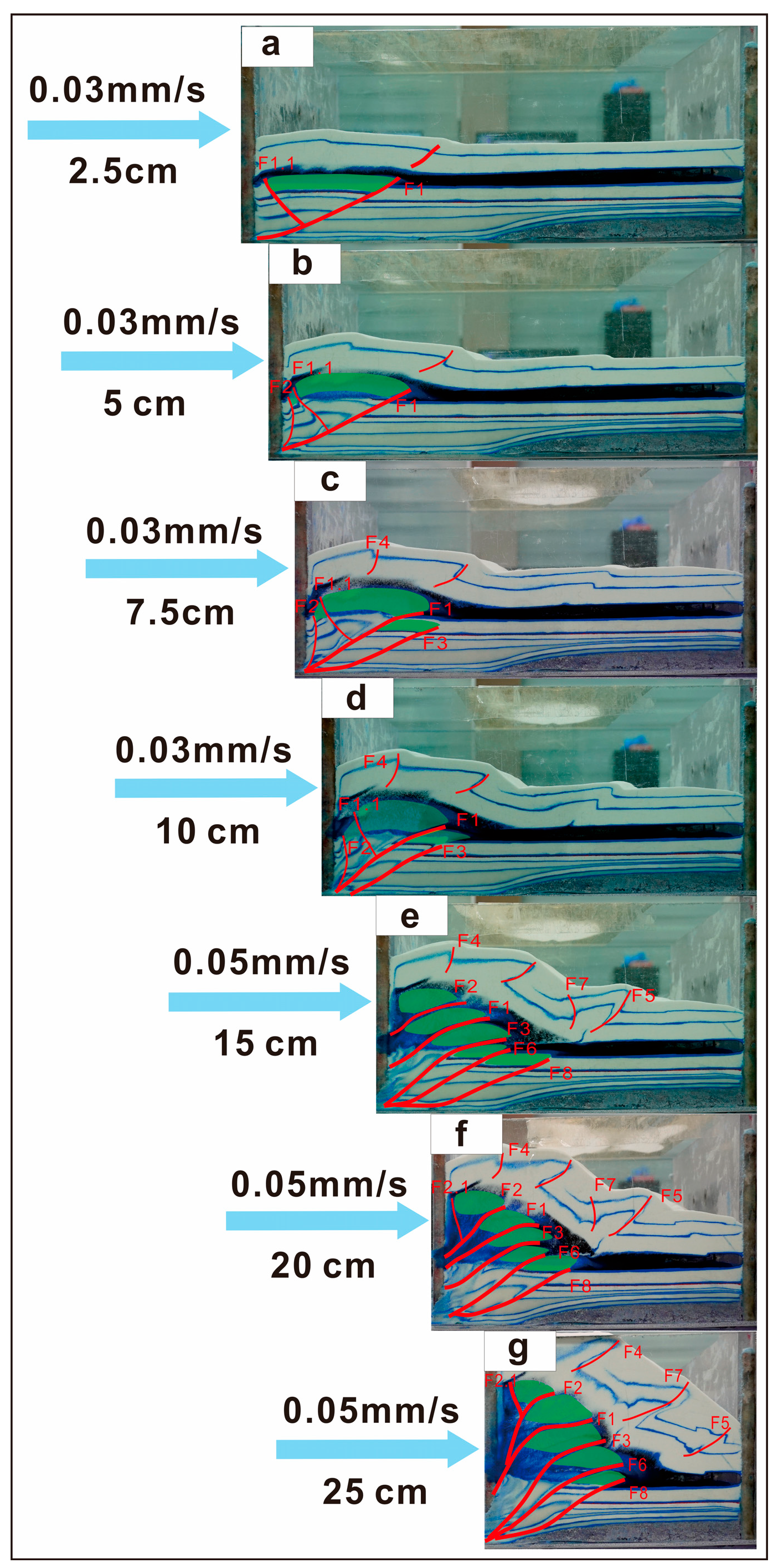
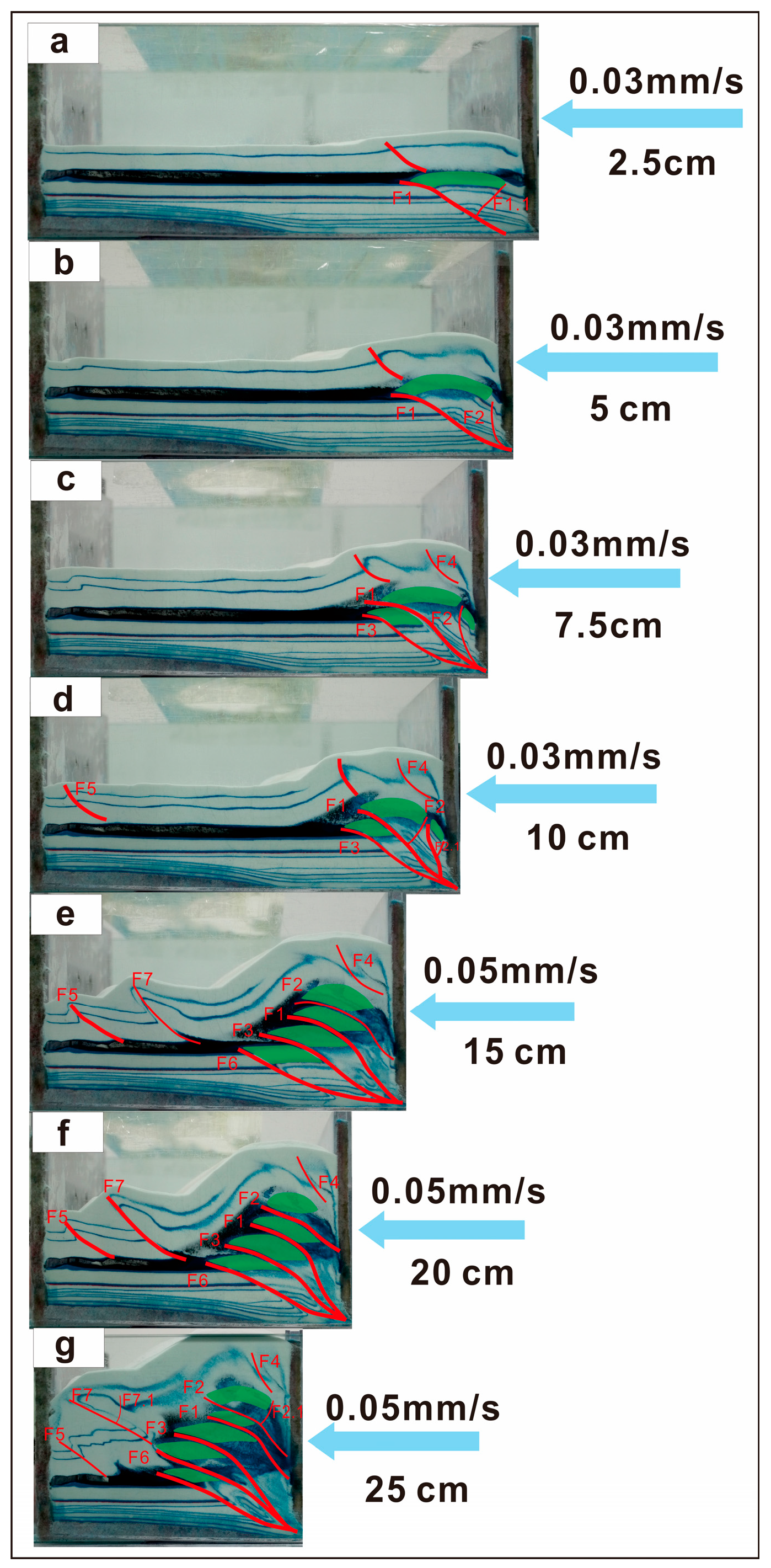
Based on the structural analysis of non-coaxial deformation mechanisms in the Zhongqiu–Dongqiu tectonic belt, comparative side-view analyses of physical simulation models—The mixed system of 80% micro-glass beads + 20% quartz sand (sandy mudstone facies shown in Figure 9) versus the system of 100% pure micro-glass beads (pure mudstone facies shown in Figure 10)—reveal that the mechanical properties of the thick Shushanhe Formation detachment layer dictate the structural styles of the overlying Cretaceous strata. The forward simulation process is categorized into three phases: initial compression and stress accumulation, syn-tectonic sedimentation and deformation, and final compression. The structural evolution of each stage is detailed below.
Initial Compression and Stress Accumulation (<15% shortening). In the pure mudstone facies model (Figure 10a–c), the Cretaceous Shushanhe Formation in the Dongqiu section functions as a highly efficient regional detachment layer. Due to its extremely low friction coefficient and quasi-non-Newtonian rheological characteristics, horizontal tectonic stress is not concentrated at the posterior movable baffle but is rapidly transmitted distally toward the foreland via interlayer shear sliding. Consequently, overlying competent layers avoid brittle failure, manifesting instead as low-amplitude stratigraphic bending without large-scale fault development. At 15% shortening, principal faults (F1–F3) and secondary faults emerge in the compression zone, accompanied by subtle uplift at the compression fringe, while the overall structural integrity remains preserved.
Conversely, in the sandy mudstone facies model (Figure 9a–c), representing the Dongqiu-to-Zhongqiu transition, increased sand content within the mudstone alters the mechanical response. The sandy framework enhances the internal friction coefficient and interlayer shear strength, generating a significant basal drag effect that dissipates horizontal compressive stress. This mechanism hinders long-distance stress transmission toward the basin interior, forcing strain energy to concentrate within a narrow zone proximal to the movable baffle. The spacing between F1 and F3 is notably shorter, exhibiting embryonic pop-up and imbricate structures. Simultaneously, overlying competent layers undergo high-angle shear failure under intense stress, forming thrust-fault precursors. This early heterogeneity in strain distribution acts as the dynamic trigger for the deflection of regional structural strikes and the generation of non-coaxial moments.
As shortening progresses to 20%, the system enters a phase of syn-tectonic sedimentation and structural deformation (20–40% compression). During this stage, geometric discrepancies between the pure and sandy mudstone facies become increasingly pronounced, revealing significant distinctions in multi-level fault evolutionary sequences and kinematic characteristics.
In the sandy mudstone facies model (Figure 9d), upon reaching 20% compression, the F1–F3 fault bundle undergoes significant kinematic locking rather than long-distance slip along the detachment layer. This behavior is attributed to the strong coupling effect of the high-friction basement. Subjected to stress concentration near the proximal end, fault dip angles are forced to steepen, inducing intense vertical stacking of the overlying Cretaceous strata within a confined space. Consequently, the anticlinal amplitude increases sharply, resulting in a structural style characterized by restricted imbricate fans. By contrast (Figure 10d), although faults F1–F3 have developed in the pure mudstone facies model, they exhibit gentle dips and significantly larger inter-fault spacing. The low-friction Shushanhe mudstone detachment effectively translates horizontal stress propagation into a holistic hanging-wall translation, driving the deformation front to extend beyond F3 into the basin interior.
As compression reaches 30% and the loading rate increases from 0.03 mm/s to 0.05 mm/s, the variation in rate further amplifies the control of rheological properties over structural styles. In the sandy mudstone model (Figure 9e), with forward detachment obstructed, the rapidly accumulating horizontal stress is released through increased fault displacement and the degree of vertical stacking. At this stage, the Cretaceous strata are dissected by faults into fragmented imbricate fans, and the structural front advances slowly. Conversely, in the pure mudstone model (Figure 10e), the elevated strain rate promotes plastic flow in the thick mudstone sequence, triggering the development of fault F6 and a significantly expanded deformation range. The Cretaceous strata maintain robust continuity, indicating that the basal structural wedge system favors long-distance overthrusting over simple localized stacking.
By 40% compression, the geometry of deep detachment faults essentially dictates the developmental trend of the structural framework. In the sandy mudstone model (Figure 9f), as proximal stacking reaches its mechanical limit, stress is forced to cut through the high-friction basement. Compared to the pure mudstone counterpart, the F8 fault in the deep strata forms earlier; the front of the entire thrust wedge becomes steep and eventually contracts at the root, with structural shortening primarily absorbed by proximal vertical aggradation. In the pure mudstone model (Figure 10f), deep faults evolve into low-angle interlayer detachment zones, marking the stabilization of the primary décollement surface within the thick Cretaceous mudstone. The overlying strata develop a series of broad, gentle synclines, and the structural wedge front migrates far from the primary stress concentration zone near the orogenic belt, achieving uniform strain distribution across a wide area and mitigating stratigraphic fragmentation caused by localized stress.
Following these distinct evolutionary paths, the two models exhibit starkly divergent geometric characteristics during the final compression stage (50%). The sandy mudstone facies model (Figure 9e) displays a distinct dynamic response in its terminal evolutionary phase, wherein the long-distance lateral expansion of the deformation front is severely inhibited. Structural deformation fails to transmit effectively into the basin interior, remaining instead confined to a narrow proximal compression zone. The stress-concentration mechanism forces energy release within a limited space, thereby shaping a structural framework characterized by steep-angled thrust wedges. Within this tectonic context, fault F8 plays a decisive kinematic role. As the primary deep-seated detachment fault, the vigorous activity of F8 accounts for the majority of horizontal shortening, evolving into a dominant boundary fault that dictates sharp thickness variations within the structural system. This directly results in intense imbricate repetition and aggradation of the overlying Cretaceous strata, while the footwall comprises strata where overall structural deformation tends toward stability. Concurrently, faults developing within the wedge exhibit typical high-angle thrust and back-thrust characteristics, ultimately forming a tight imbricate thrust system dominated by vertical thickening with limited lateral extent.
In contrast, while the pure mudstone facies model exhibits an “out-of-sequence” fault-propagation pattern similar to the sandy mudstone model, its structural expression differs significantly. In the pure mudstone model (Figure 10e), the deformation front has propagated to the distal end of the model, covering a broad extent. Structural deformation between the basement-involved zone and the cover detachment zone is dominated by thrust imbricate fans with substantial internal spacing, where the geometry of the overlying strata is primarily regulated by plastic flow within the detachment layer. Fault F8 exhibits a low dip angle and, facilitated by the lubrication mechanism of the thick mudstone, efficiently accommodates horizontal shortening, ensuring the smooth distal transmission of structural deformation. The overlying competent layers display extensive fault lengths and develop folds of moderate amplitude, devoid of pervasive high-angle faulting. Furthermore, the presence of interlayer slip within the low-friction Shushanhe pure mudstone not only dissipates stress but also preserves the integrity of primary structures. Additionally, the overlying Paleogene gypsum-salt layers provide an excellent seal. Consequently, the overall structural conditions for hydrocarbon accumulation in the Dongqiu area are superior, possessing a favorable preservation mechanism that significantly enhances the seal-reservoir effectiveness of large-scale, broad anticlinal structural traps.
A comprehensive comparative analysis of the evolutionary profiles for the pure and sandy mudstone facies demonstrates that rheological heterogeneity within the mudstone detachment layer serves as the primary control on the spatial differentiation of structural deformation. The pure mudstone facies facilitates distal stress transmission, promoting the formation of broad, gentle detachment folds in the upper structural levels. Meanwhile, deep-seated imbricate thrust structures exhibit limited vertical stacking, characterized predominantly by sub-oblique superposition. The detachment layer accommodates strain primarily through interlayer stress transfer, which enhances distal stress dissipation, thereby preserving the low-angle geometry of the tectonic system and the integrity of primary coaxial structural traps.
Conversely, the high-friction sandy mudstone facies is constrained by a high-resistance basement, where intense frictional resistance compels the tectonic system to undergo vertical thickening. This results in imbricate thrust structures with significant vertical stacking and a marked retardation in the propagation of the deformation front. This kinematic partitioning mechanism governs the overall three-dimensional structural architecture of the Dongqiu–Zhongqiu area. Consequently, this study not only identifies coaxial and non-coaxial structural traps as two critical exploration targets within the Cretaceous strata but also provides a theoretical framework for elucidating the geodynamic origins of regional non-coaxial rotational deformation.

5.3. Non-Coaxial Structures and Mechanical Properties

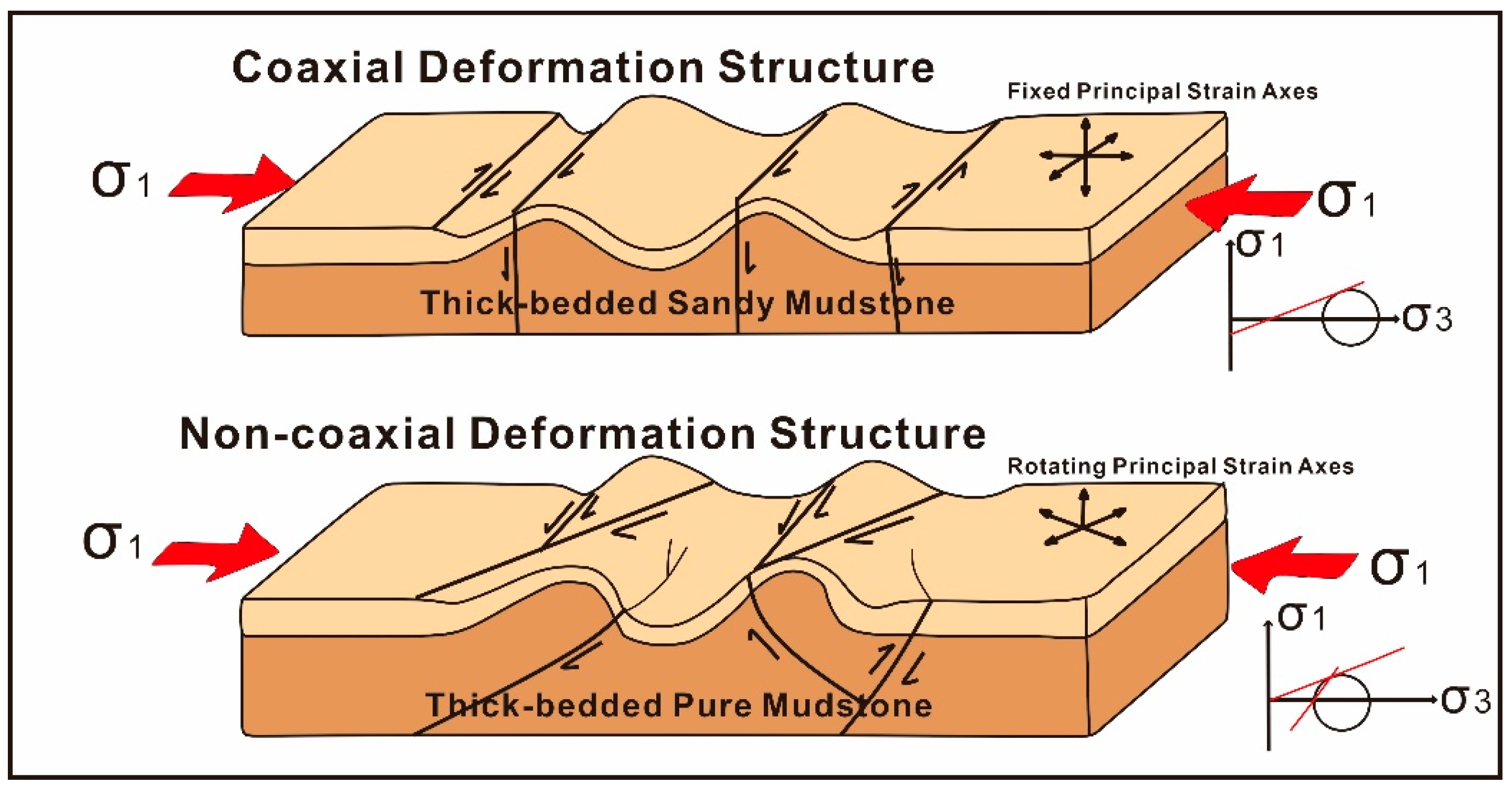
In structural geology, deformation is fundamentally categorized into coaxial and non-coaxial types based on the relationship between the orientation of principal stresses and incremental strain. In coaxial deformation, the principal axes of the strain ellipsoid consistently align with the incremental elongation directions of material lines, representing a pure shear regime. Conversely, non-coaxial deformation involves a simple shear regime characterized by the rotation of material lines relative to the principal strain axes.
Non-coaxial structures, constrained by detachment layers, are pivotal for resolving the 3D structural modeling of the Zhongqiu–Dongqiu section within the Kuqa depression foreland thrust belt (Figure 11). These structures dictate the deflection of fault strikes and the development of oblique accommodation faults, while simultaneously governing the orientation and connectivity of fracture networks, thereby exerting a profound influence on the migration and preservation of ultradeep hydrocarbon reservoirs [52,53,54]. The intense heterogeneity in stratigraphic rheology results in significant kinematic asymmetry in structural deformation across the study area, precluding a model of simple vertical stacking. Therefore, elucidating the mechanical control mechanisms of detachment-layer frictional properties on non-coaxial strain—specifically the rotation of principal strain axes—is a critical scientific imperative. Addressing this issue is essential for reconstructing regional geodynamic contexts and accurately evaluating the integrity and effectiveness of deep traps for hydrocarbon accumulation.
In the sandy mudstone facies model, the internal friction angle of the modeling material (80% glass beads + 20% quartz sand) is significantly higher than that of the pure mudstone facies, simulating the lithological characteristics of increased sand content and enhanced brittleness in the Shushanhe Formation mudstone of the Zhongqiu area. The high internal friction angle results in strong basement coupling, which effectively hinders the distal transmission of stress. Under this high-friction constraint, strain energy cannot be effectively dissipated toward the foreland and is instead forced to release through proximal vertical stacking. Consequently, the fault strikes are strictly perpendicular to the principal compression direction, forming an imbricate thrust system dominated by high-angle thrust faults. Despite localized shear rotation within fault zones, the regional principal compressive stress remains stable, and the overall deformation approximates a coaxial strain pattern dominated by vertical shortening, with no systematic rotation of the principal strain axes during the deformation process.
The pure mudstone facies model utilizes 100% pure glass beads to simulate the Shushanhe Formation detachment layer, whose extremely low internal friction angle imparts fluid-like, highly plastic characteristics to the layer. This low-friction, high-plasticity detachment layer achieves efficient stress decoupling and distal transmission, providing the necessary kinematic degrees of freedom for strain rotation. However, low-friction detachment itself is not the direct cause of non-coaxial deformation. The key factor is that when distally transmitted stress encounters non-uniform boundary conditions at the model front or lateral margins, it causes a deflection in the local principal stress direction, inducing non-coaxial plastic flow. This sustained strain field, which contains significant simple shear components, is the fundamental mechanical mechanism causing fault strikes to become oblique to the regional compression direction and promoting the development of strike-slip components and complex accommodation faults.
Experimental dynamics indicate that the non-coaxial effect is most prominent during the 30–50% compression stage, where material lines carry considerable vorticity, perfectly reproducing the geological phenomenon of structural strike deflection observed in the Dongqiu area. Furthermore, the continuous rotation of strain axes determines the geometric style of non-coaxial structures. With increasing shortening, non-uniform stress causes material to carry significant vorticity during migration, leading to clockwise or counterclockwise azimuthal shifts in the principal strain axes over time. This transformation from pure compression to simple shear and rotation causes fault strikes to become oblique to the compression direction, subsequently developing complex strike-slip and oblique accommodation faults.
In summary, this experiment reveals the fundamental mechanism controlling the differentiation of structural styles in the Zhongqiu–Dongqiu area: lithological differences determine the core mechanical parameters of the detachment layer. High friction leads to strong basement coupling, where strain is dominated by coaxial shortening and vertical stacking; conversely, low friction and high plasticity facilitate stress decoupling and distal transmission. Under specific, non-uniform boundary conditions, the distally transmitted stress field is more prone to rotation, thereby triggering non-coaxial plastic flow.

6. Discussion

Previous studies on thrust structural styles of the Qiulitage Structural Belt have mainly focused on the Paleogene gypsum-salt sequences. Traditional structural models regard the gypsum-salt layer as the major detachment layer that dominates large-scale vertical structural decoupling in the region. Controlled by this detachment mechanism, the gypsum-salt layer in the Zhongqiu–Dongqiu section features heterogeneous thickness in spatial distribution. Local compression and salt accumulation have given rise to complex salt structures such as large-scale salt diapirs, salt pillows, and salt walls. This forms a framework of differential deformation between the supra-salt and sub-salt strata. Affected by the detachment and migration of highly plastic gypsum-salt rocks, supra-salt strata are widely developed with detachment folds and present diverse structural styles. In contrast, sub-salt strata are relatively independent. Besides friction at the base of the gypsum-salt layer, they are also constrained by the paleotectonic framework and are dominated by imbricate thrust faults, showing deep structural characteristics related to basement involvement. Although this model can well explain the aforementioned macroscopic structural segmentation and interlayer decoupling features, the mechanical significance of mudstone detachment layers has long been overlooked. Accordingly, the specific role of the detachment layer within the Lower Cretaceous Shushanhe Formation remains poorly understood [2,20,28,30]. This study demonstrates that the mudstone of the Cretaceous Shushanhe Formation acts as a crucial and independent intra-formational detachment layer, which exerts dominant controlling and regulating effects on the development of non-coaxial structures and the geometry of traps. Based on high-precision 3D seismic interpretation, intense differential structural deformation occurs along the strike of the Zhongqiu–Dongqiu section. Affected by the heterogeneity and lateral thickness variation in the mudstone, the strata present distinct spatial distribution patterns across the study area.
In the Dongqiu area, the Shushanhe Formation mudstone is thick with strong plastic behavior. Its low shear strength readily induces local deflection of principal stress and intense intra-formational horizontal shearing, thus governing the transition of deformation mechanism from coaxial pure shear to non-coaxial simple shear. Under the control of the multi-detachment system, the formation of non-coaxial traps can finely modify and optimize the geometry of hydrocarbon traps, and form deep, subtle lithologic-structural composite reservoir spaces. In contrast, the Shushanhe mudstone in the Zhongqiu area is thinner and exhibits weaker plastic characteristics compared with that in the Dongqiu area. The intra-formational detachment is weakened and fails to effectively accommodate strain. Stratigraphic deformation is still dominated by conventional coaxial pure shear strain. Consequently, most traps are relatively open conventional fault-fold or anticlinal traps without significant reconstruction by late intra-formational shearing.
This study not only reveals the unique dynamic behaviors of mudstone detachment layers but also clarifies their influences on hydrocarbon traps. It provides a refined structural-prediction framework for deep complex hydrocarbon exploration in foreland thrust belts controlled by multi-detachment systems.

6.1. Analysis of Geological Controlling Factors of Non-Coaxial Structural Deformation

6.1.1. The Influence of Paleogene Salt Structures on the Non-Coaxial Deformation of Underlying Strata

In areas of thick salt accumulation (Figure 12b), the evaporite layer, benefiting from an ample salt supply, forms an exceptionally thick plastic medium that functions as a highly efficient tectonic buffer zone.
As displacement from deep-seated, basement-involved thrust faults propagates upward, its energy is not transmitted directly but is instead efficiently absorbed and dissipated through plastic flow and interlayer extension within the salt body. This process manifests morphologically as classic strong decoupling characteristics: the intense shortening strain from deep thrusting is not directly relayed to the shallow crust. Instead, it is converted into lateral extrusion and vertical diapirism of the salt, giving rise to a suite of high-amplitude salt pillows, salt walls, and salt-cored anticlines.
Under this mechanism, the overlying Cretaceous strata are effectively shielded from direct truncation by deep, high-angle faults and instead develop long-wavelength, low-amplitude, broad detachment folds. This continuous fold deformation accommodates deep shortening through the systematic rotation of stratigraphic limbs, ultimately resulting in pronounced structural disharmony between the upper and lower layers. This phenomenon is a direct reflection of the powerful shielding effect exerted by the plastic rheological layer against vertical strain transmission.
In stark contrast, in evaporite-thinned or absent zones at basin margins or along the flanks of paleo-uplifts (Figure 12c), the absence of an effective plastic medium for interlayer strain accommodation means that thin salt layers or pre-existing structural welds cannot effectively dissipate the upwardly transmitted shear displacement. The consequence is a drastic weakening or complete loss of the detachment layer’s decoupling capacity.
In this scenario, deep basement thrust faults can readily overcome the minimal rheological constraints imposed by the thin salt, directly penetrate the Paleogene detachment surface, and propagate continuously into the shallow section. This leads to the formation of high-angle, large-displacement, cross-formational thrust faults within the Cretaceous, commonly associated with tight fault-propagation folds or box-shaped pop-up structures.
The through-going nature of these faults enforces a synchronization of deep and shallow deformation, enabling the deep shortening strain to be efficiently transferred to the surface via direct fault slip. This process directly triggers a dramatic amplification of local structural relief and induces a significant steepening of Cretaceous stratigraphic dips.
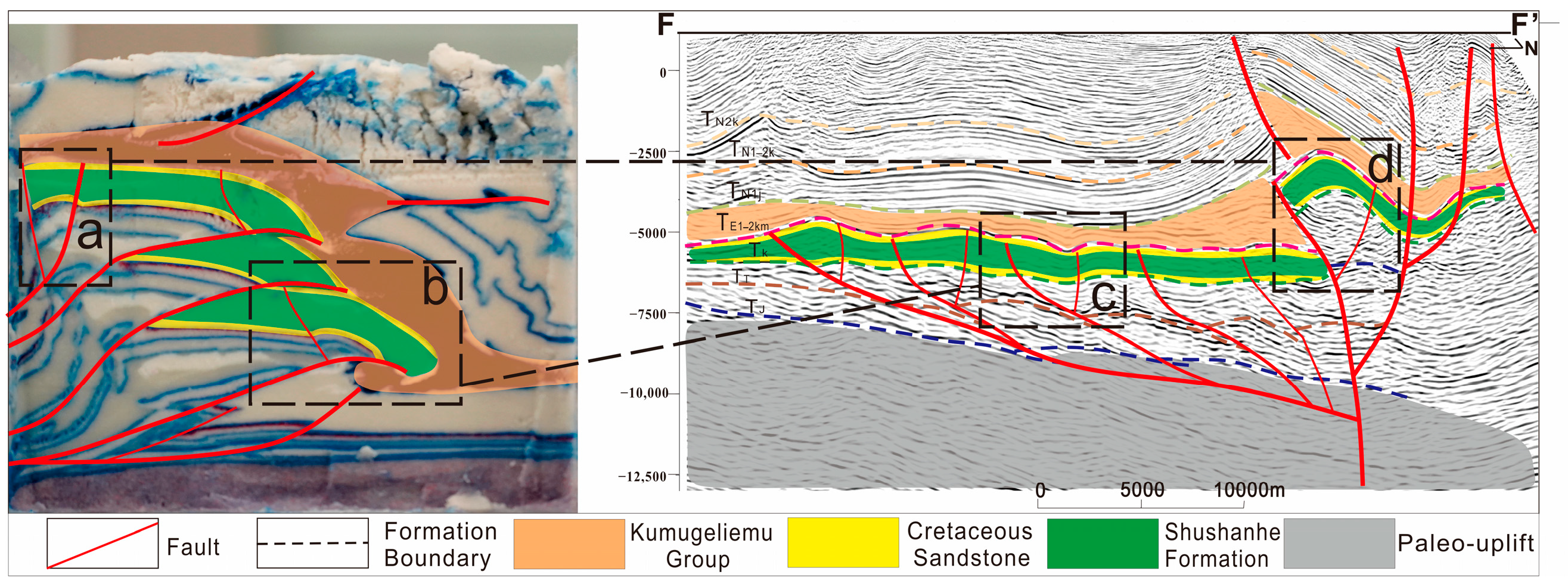
To investigate the influence of the aforementioned Paleogene evaporites on the structural styles of the underlying Cretaceous, tectonic physical simulation cross-sections (Figure 13a,b) intuitively reveal their pivotal role as a “roof boundary condition” for the underlying Cretaceous sequence.
Under this regional compressive regime, the highly plastic Paleogene evaporite layer acts as a plastic roof. Its plastic rheological accommodation capacity and decoupling effect efficiently dissipate stress concentrations at the top interface of the underlying Cretaceous mudstone, thereby promoting the development of accommodation folds and shear structures along the basal boundary of the evaporite layer. These structures clearly exhibit classic non-coaxial deformation characteristics.
Crucially, the lateral heterogeneity in evaporite thickness is the decisive factor that strictly governs the nature of deformation: as the evaporite layer thickens, interlayer decoupling is enhanced, and the non-coaxial simple shear component becomes dominant; conversely, thinning strengthens interlayer coupling, driving a transition towards coaxial pure shear deformation.
In areas of thick salt development (Figure 13a,d): The exceptionally thick evaporite layer absorbs the vast majority of the interlayer shear strain, achieving complete kinematic decoupling between the cover and the basement. Owing to the lack of effective shear resistance and vertical compaction constraints from overlying rigid strata, the top surface of the Cretaceous gains the necessary degrees of freedom for long-distance oblique translation and rotation along the bedding plane. This accommodation space, induced by top-surface detachment, causes the Cretaceous to superimpose a significant simple shear component during regional compression, which dominates the development of intense inharmonious folds and non-coaxial structures.
In areas of thin salt development (Figure 13b,c), as the evaporate layer drastically thins, its detachment effect as a roof markedly attenuates. The constraint from the overlying strata inhibits the lateral escape of the underlying Cretaceous, leading to the suppression of the lateral shear component and a shift in the stress state towards vertical compression dominance. Stratigraphic deformation here is primarily expressed as in situ vertical thickening and symmetrical folding, presenting a relatively abrupt structural style dominated by coaxial pure shear.
Notably, during the “adjustment-type” evolutionary stage illustrated in the figures, the surge in regional compressive shortening and the blocky, differential accumulation of salt lead to the reactivation of the previously suppressed lateral shear component. This causes the local stress state to exhibit a transitional trend from vertical to shear dominance. Consequently, multiple secondary faults with a banded, ordered distribution are generated within the pre-existing coaxial structures. These faults overlap, merge, and ultimately sole into the detachment base, collectively forming “adjustment-type coaxial pop-up structures.” This dynamic process effectively regulates the regional tectonic stress field towards a new mechanical equilibrium.
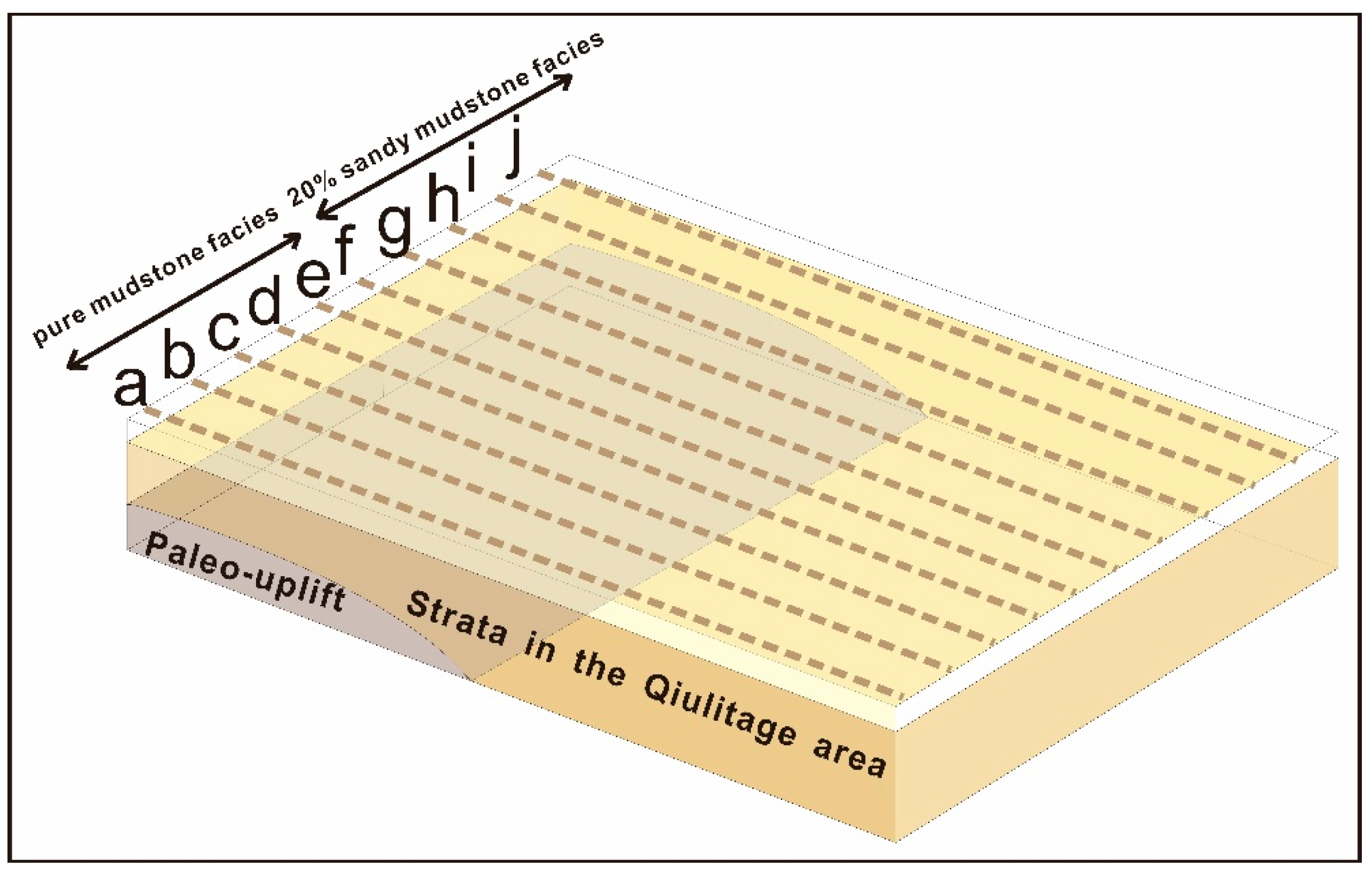
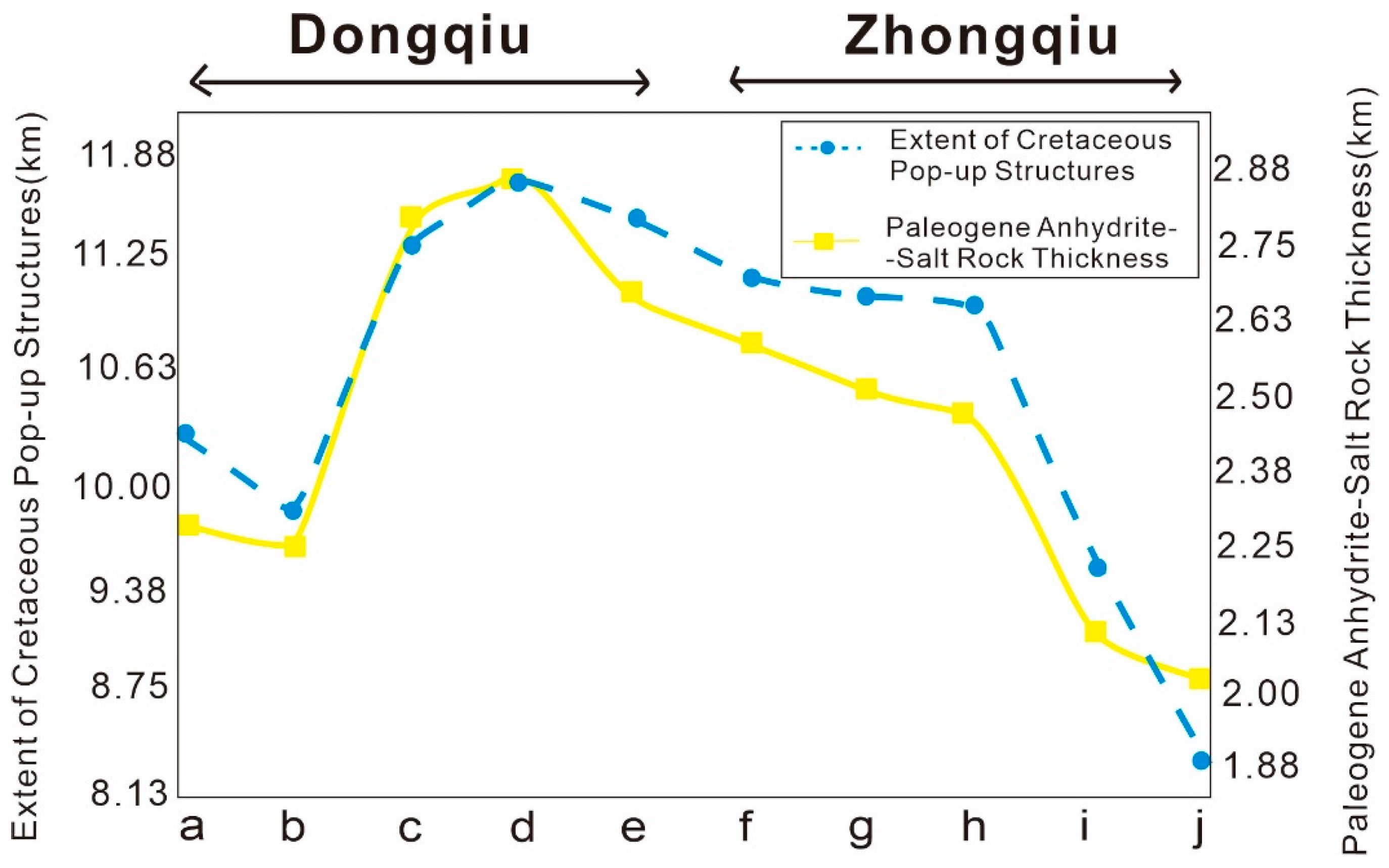
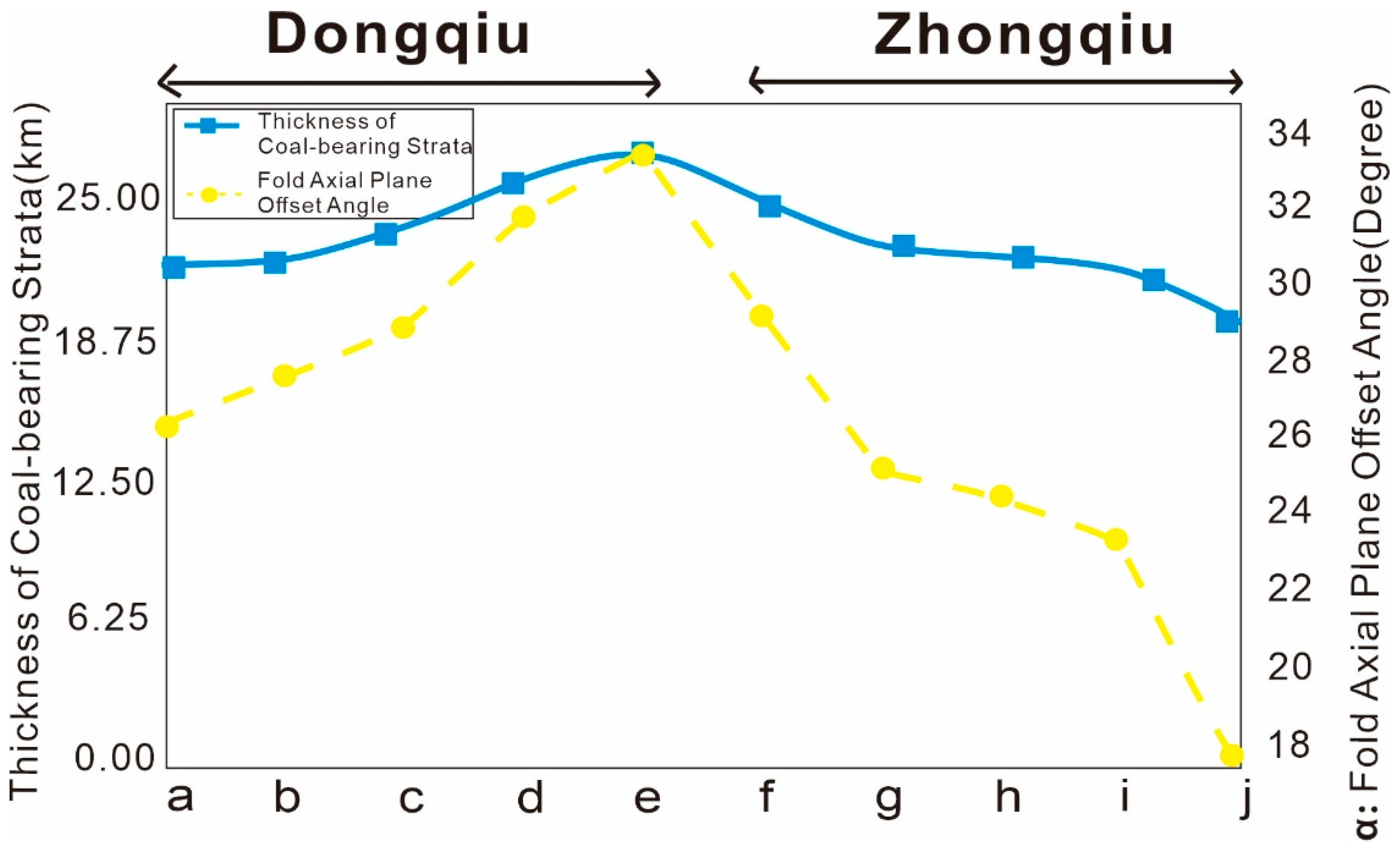
To quantitatively elucidate the control mechanism of evaporite thickness on the structural deformation of the underlying Cretaceous strata, this study conducted systematic quantitative measurements and parameter coupling analyses based on ten cross-sections from physical simulation experiments (Figure 14). The figure employs a dual-Y axis design: the left axis represents the flank extension distance of the Cretaceous pop-up structures across sections a–j, while the right axis denotes the thickness of the Paleogene evaporite layer.
Statistical analysis unequivocally reveals a significant positive correlation and strong spatial coupling between these two variables. In the physical simulations, the rigid sidewalls of the experimental box act as non-free-slip boundaries, exerting substantial frictional resistance on the high-viscosity silicone. This boundary condition inhibits the free subsidence and lateral flow of the viscous material at the model margins, forcing the fluid to converge towards the central low-potential zone during compression, ultimately resulting in the characteristic “thin-margin, thick-center” evaporite profile depicted in the figure.
At the model margins (sections a–b): Here, the evaporite layer is relatively thin (average thickness < 18 mm), and diapirism is weak due to restricted mobility. Consequently, the flank extension distance of the Cretaceous pop-up structures contracts dramatically, remaining within a low-value range below 82 cm. This phenomenon indicates that under thin-salt conditions, deep basement transpressional stress is transmitted directly upward through rigid media, localizing strain within narrow deformation zones. This induces intense, concentrated shear fracturing in the overlying strata, culminating in structural styles characterized by coaxial superposition and strong vertical connectivity.
In the central transition zone (sections c–h): As the section sequence moves towards the model center, the thickness of the Paleogene evaporites increases systematically, peaking at approximately 22.95 mm near section d. In synchronous response, the extension distance of the pop-up structures within the Cretaceous mudstone expands significantly, with the maximum width exceeding 93 cm. Here, the exceptionally thick evaporite layer acts as a highly efficient stress-dispersal horizon, substantially weakening the frictional coupling between the basement and the cover. Under high confining pressure, the thickened plastic layer absorbs the majority of the upwardly transmitted shear strain component through large-scale lateral extension, thereby compelling the overlying brittle strata to accommodate strain via interlayer sliding and broad folding over a much wider area, effectively avoiding concentrated strain release. Conversely, in sections i–j on the opposite margin, the re-thinning of the evaporite layer leads to a corresponding decrease in extension distance.
Critically, the observed phenomenon—where fault spacing widens linearly with increasing salt thickness—provides a direct quantitative measure of non-coaxial deformation intensity. The thicker the evaporite layer, the more complete the detachment and decoupling between the upper and lower structural layers. Under these conditions, the shallow fault system is no longer governed by the vertical projection of deep-seated faults; instead, it undergoes significant geometric deflection and lateral displacement, forming large-span pop-up structures in cross-section. Conversely, evaporite thinning leads to a convergent trend in fault spacing.
In summary, spatial variations in the thickness of the Paleogene evaporites constitute the pivotal “roof boundary condition” governing the structural styles of the underlying Cretaceous.
Evaporites: From a Passive Detachment Horizon to an Active “Roof Boundary Condition”
Physical modeling and geological analysis jointly confirm that the lateral thickness gradient of the evaporite layer is the fundamental factor controlling the efficiency of interlayer kinematic decoupling and the partitioning of strain.
In areas of thick salt, the highly plastic medium efficiently shields against the vertical transmission of deep-seated stress and accommodates regional shortening strain through interlayer simple shear and large-scale lateral extension. This process dominates the development of broad detachment folds characterized by pronounced non-coaxial deformation.
Conversely, in salt weld zones or thin-salt areas, the drastic thinning of the salt layer imparts a more brittle rheological character, shifting the stress transmission mode from shear-dominated to coaxial pure shear. This transition directly triggers the rapid vertical propagation of high-angle, through-going thrust faults, resulting in strong kinematic coupling between deep and shallow structural deformation.
In essence, the evaporite layer functions not merely as a passive detachment horizon; it acts as a pivotal “roof boundary condition” that critically governs two core processes: (1) the efficiency of basement stress transmission upward, and (2) the geometric response pattern of the overlying structural deformation.

6.1.2. Influence of Paleo-Uplift Dip Angle Variation on Non-Coaxial Deformation

As pre-existing quasi-rigid geological bodies formed during the evolution of orogenic foreland basins, basement paleo-uplifts and their tectono-geomorphic morphologies constitute the fundamental deep geometric framework for the development of subsequent thrust-nappe systems.
Structural analysis reveals that the slope variations in these paleo-uplifts not only define the spatial trajectory of the master detachment surface, but also serve as key kinematic boundary conditions, strictly controlling the geometric attitudes of the overlying first-order master detachment faults and the spatial differentiation of associated secondary structural styles (Figure 15a).
Steep Slope Zone (Proximal to the Orogen): In the steep slope zone at the foreland margin of the paleo-uplift, proximal to the orogenic belt, the basement topography exhibits a significantly high-angle gradient. Here, the paleo-uplift acts as a massive “rigid obstruction,” exerting a potent blocking effect on the horizontal compressive stress transmitted from the orogenic belt toward the basin interior. Constrained by this windward-slope obstruction, the deep first-order detachment faults are unable to maintain low-angle, bed-parallel slip and are forced to undergo high-angle climbing and geometric deflection along the steep basement fault ramps (Figure 15b). Consequently, high-amplitude fault-bend folds or fault-propagation folds develop. The associated thrust faults exhibit high dip angles and large displacements, and are often accompanied by complex interlayer minor folds and back-thrusts.
Gentle Slope/Platform Zone (Distal to the Orogen): Conversely, in the gentle slope zone or top platform area of the paleo-uplift, distal to the orogenic belt, the basement terrain is flat and open. Here, basement frictional resistance and geometric obstacles are significantly reduced, allowing the master detachment surface to maintain a stable, low-angle attitude during long-distance, bed-parallel propagation (Figure 15c). Due to the lack of topographic obstruction, structural deformation maintains excellent lateral continuity. The overlying rock sequences tend to develop a series of nearly parallel-arranged imbricate thrust fans or duplex structures. Secondary fault slices are dominated by low-angle thrusting, with uniformly distributed fault spacing and relatively gentle changes in stratigraphic attitudes. This manifests typical thin-skinned tectonic features, indicating that stress transmission is primarily governed by efficient lateral transport rather than vertical stacking.
To investigate the influence of the aforementioned basement paleo-uplift on Cretaceous structural styles, tectonic physical simulation cross-sections (Figure 16a,b) intuitively demonstrate how the paleo-uplift, acting as a pre-existing barrier, constrains stress transmission pathways and strain partitioning mechanisms through variations in its slope gradient, thereby leading to a pronounced spatial differentiation between coaxial and non-coaxial structural deformation.
To minimize the confounding influence of coupled geological factors on non-coaxial structural evolution and to focus specifically on the control exerted by paleo-uplift dip variations, this analysis prioritizes cross-sections from the near-pure mudstone region. This is because pure mudstone exhibits higher plasticity than sandy mudstone and is more sensitive to boundary geometry, thus providing a clearer signal of the basement paleo-uplift’s control over abrupt structures.
Steep Slope Zone: The Core Nucleation Site for Coaxial Deformation: The steep slope of the paleo-uplift constitutes an intensely quasi-rigid blocking boundary (Figure 16a,d) and serves as the core zone for inducing coaxial deformation. When the horizontal nappe body encounters the frontal obstruction of the steep paleo-uplift slope, the distal propagation of stratigraphic compression is forcibly arrested. Because the combined effect of high frictional resistance and the steep slope angle exceeds the mechanical threshold for fault slip, the overlying pure mudstone strata cannot bypass the obstacle via bed-parallel slip, instead manifesting as a passive accommodation process. At this point, the horizontal displacement component is compelled to transform into an in situ vertical movement component. This geodynamic conversion forces the strata into a state of intense bi-directional compression, caught between the advancing thrust force from the rear and the reaction force from the paleo-uplift at the front. Consequently, high-angle back-thrust faults and nearly vertical pop-up structures predominate. The strata exhibit no significant unidirectional rotation, and the deformation manifests as symmetrical folding, with stress being extremely concentrated and released at the front of the steep slope.
Gentle Slope Zone: The Domain of Non-Coaxial Deformation: Conversely, the gentle slope of the paleo-uplift governs the development of non-coaxial deformation (Figure 16b,c). In regions where the paleo-uplift slope is gentle, the blocking effect of the basement is significantly diminished, instead providing a low-angle inclined interface favorable for stratigraphic climbing. In this scenario, the nappe body maintains high lateral transmission efficiency, allowing the strata to undergo long-distance shear slip along the gentle slope. Simulation results clearly show that within the gentle slope zone, the overlying mudstone forms a series of imbricate structures, where the hanging wall strata undergo significant rotation and unidirectional displacement relative to the footwall. This bed-parallel shear movement, guided by the boundary morphology, breaks the in situ geometric harmony of the rock mass and exemplifies distinct non-coaxial rotational characteristics.
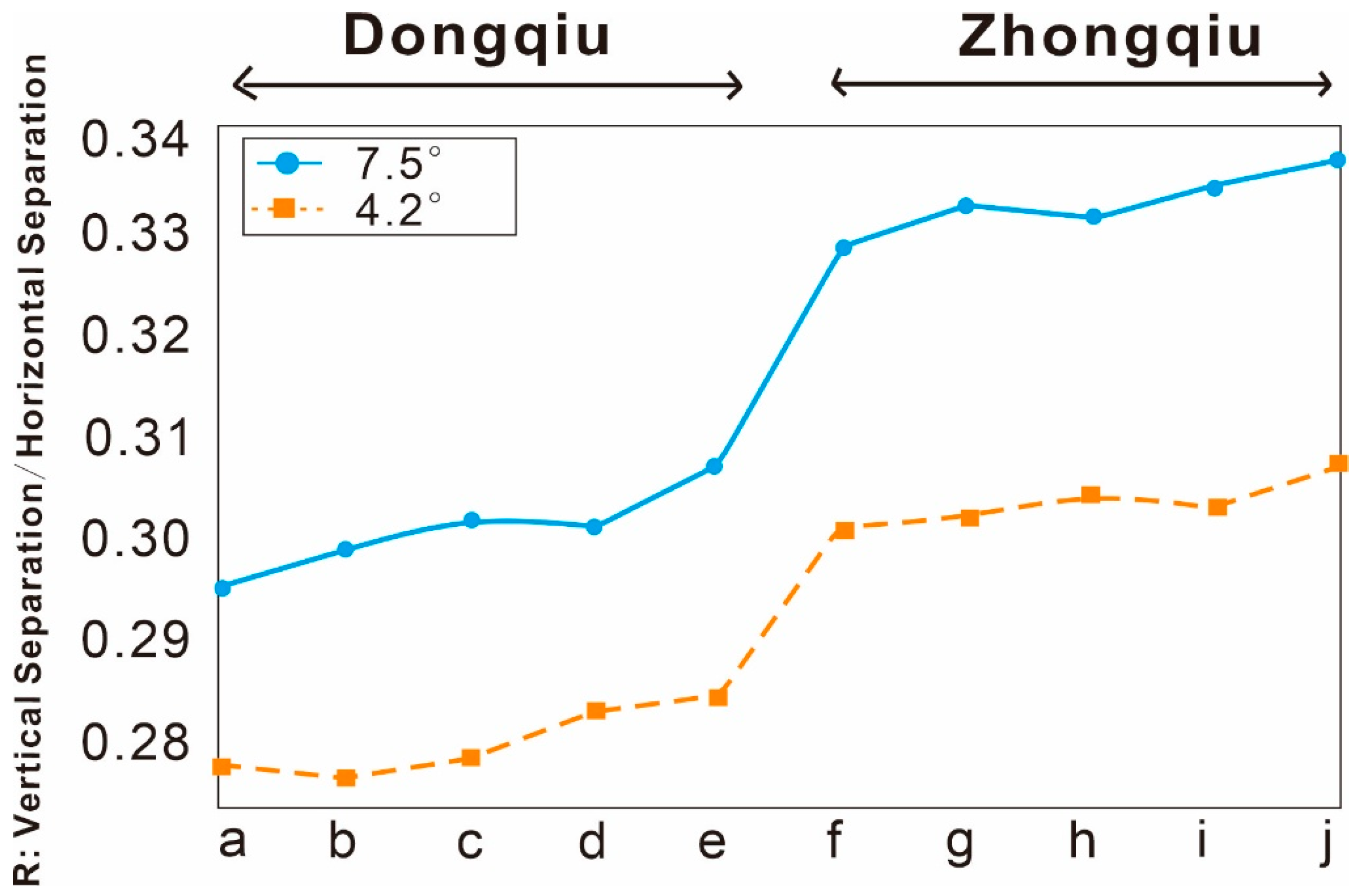
Building upon the aforementioned analysis of how paleo-uplift geometry controls structural styles, this study selected ten cross-sections (a–j) from east to west across the study area for quantitative investigation (Figure 17).
This study innovatively defines “R” as the ratio of vertical fault throw to horizontal displacement, establishing it as a core discriminant index:
A lower “R” value indicates highly efficient horizontal transmission of tectonic deformation, with strain dominated by the interlayer shear-slip component, signifying prominent non-coaxial deformation characteristics.
An increase in “R” signifies that horizontal slip is impeded, and strain is primarily converted into vertical coaxial thickening or high-angle pop-up structures.
Statistical analysis of the cross-sectional measurement data reveals a clear “dual differentiation” characteristic, wherein the “R” value is jointly controlled by the dip angle of the paleo-uplift and the lithological properties of the strata.
Control Effect of Paleo-Uplift Dip: The curve for the high-angle paleo-uplift (7.5°). The data indicate that, under similar lithological conditions, the R value for the 7.5° steep-slope interface is, on average, 0.02–0.03 higher than that of the 4.2° gentle-slope interface. This discrepancy strongly validates the regulatory role of the paleo-uplift’s quasi-rigid blocking effect on fault geometry. Specifically, the 7.5° steep interface significantly increases the frictional resistance for nappe sliding along the basement, effectively hindering the distal transmission of horizontal stress, and forcing an orthogonal decomposition of strain—resulting in steeper fault dips and a preference for vertical coaxial adjustment mechanisms. In contrast, the lower R value in the 4.2° gentle-slope model indicates that the low-angle interface provides a channel for the concentrated release of stress in a near-horizontal direction, greatly promoting the development of bed-parallel shear and non-coaxial rotational deformation.
Control Effect of Lithological Characteristics: The abrupt morphological change in the curve between sections e and f profoundly reveals the decisive influence of lithology on structural styles. The strata corresponding to sections a–e consist of pure mudstone facies, whose high plasticity and low internal friction angle facilitate plastic rheology and interlayer detachment under stress. Within this interval, the R values for both steep and gentle slopes remain consistently low, indicating that strongly plastic media universally confer excellent horizontal extensibility to the strata. However, upon transitioning to the sandy mudstone facies (corresponding to sections f–j), the rock mass exhibits significantly enhanced brittleness due to an increased internal friction angle and shaping capacity. The curve shows a step-like jump in the R value at this specific transition. This indicates that when the blocking effect of a high-angle paleo-uplift is coupled with the hindering effect of high-friction lithology, the stress transmission pathway suffers from “dual inhibition.” Consequently, non-coaxial deformation characteristics become inconspicuous, and fold symmetry is markedly enhanced. Tectonic deformation is forced to be released primarily through high-angle thrusting and vertical stacking, at which point the coaxial deformation component reaches its peak, leading to the development of typical coaxial structures.

6.1.3. Influence of Multi-Stage Jurassic Coal Seam Detachment Layers on Non-Coaxial Deformation

As the critical sub-salt detachment layer of the Mesozoic, the Jurassic coal-bearing strata play a pivotal role in controlling the formation and evolution of the sub-salt thrust-and-fold system (Figure 18a).
Although the coal-bearing sequences at the core of the Jurassic—namely, the Ahe, Yangxia, and Kezilenuer Formations—all exhibit excellent plastic rheological characteristics, their core control mechanism lies in the development of a “ramp-flat” geometric structure. However, the coal seams in the study area are not a simple continuum (Figure 18b). Instead, they are segmented into multiple discrete segments by basal thrust nappe structures.
In this context, the highly plastic coal seams act as efficient slip surfaces, providing a low-friction, near-horizontal, and long-distance slip channel for the overlying strata. This geometric configuration constructs an efficient stepped sliding system, allowing the overlying Mesozoic strata to rely on these weak coal-bearing layers as a detachment floor to undergo large-scale bedding-parallel shear and long-distance thrusting.
In stark contrast, the expression of the Jurassic strata in the area shown in (Figure 17) is markedly different from that in (Figure 18b). Here, the strata are not fragmented into discrete blocks but instead retain a high degree of continuity and integrity, developing into a morphologically complete faulted anticline. Under this structural setting, the coal measures, which originally served as a weak layer, are unable to maintain low-angle bedding-parallel shear at the limbs and core of the anticline, thereby preventing the horizontal compressive stress from being transported distally via floor slip.
This intact anticline severely disrupts the connectivity and effectiveness of the bedding-parallel detachment channels developed along the Jurassic coal-bearing strata. Critically, the large-scale basal detachment fault of this anticline has transitioned from the Jurassic coal-bearing strata-dominated detachment process (as in Figure 18b) to a basement-controlled detachment process.
In summary, the structural morphology of the deep Jurassic coal seams acts as a key regulator of stress transmission pathways. Their continuity directly dictates the deformation style of the overlying strata and specifies the precise detachment horizon that exerts the dominant structural decoupling effect, thereby ultimately controlling the overall structural framework of the foreland thrust wedge.
To investigate the influence of the aforementioned Jurassic coal seams on the structural styles of the overlying Cretaceous, physical simulation cross-sections (Figure 19a,b) clearly reveal that the presence of the Jurassic coal seams acting as a critical detachment layer significantly reshapes the upward propagation mechanism of deep-seated faults.
When basement faults propagate upward into the coal seam interface, the stress cannot directly penetrate the overlying Cretaceous strata via high-angle shearing. Instead, it tends to be converted into interlayer sliding along the coal seam interface or absorbed by the plastic rheology of the coal. This process subsequently triggers the development of structural triangle zones, induces imbricate thrusting in the underlying basement, and causes the overlying Cretaceous strata to manifest as broad-wavelength folds or regional bulk uplift, ultimately resulting in pronounced morphological differentiation between the upper and lower structural layers.
Single, Gentle Coal Seam Model (Figure 19a,c): In this model, the Jurassic coal seam is represented as a single stratigraphic unit with stable thickness and a gentle dip. Under these boundary conditions, the primary function of the detachment layer is the efficient transmission of stress, rather than driving structural rotation. Due to the absence of geometric forcing induced by fault ramps, the overlying Cretaceous strata accommodate strain primarily through intra-layer shortening and vertical thickening under lateral compression. This deformation mode kinematically trends toward a coaxial pure shear mechanism, where the orientation of the principal strain axes remains constant during deformation. Macroscopically, this results in the predominant formation of symmetrical, bidirectional pop-up structures lacking a significant rotational component.
Multi-Layered Coal Structure Model (Figure 19b,d): Conversely, in this model, the detachment architecture is complex, manifesting as a “ramp-flat” geometry composed of multiple stacked coal seams. This intricate geometry exacerbates the dynamic instability of the interlayer detachment process. As the deep-seated nappe climbs upward along the fault ramps, intense geometric forcing compels the overlying Cretaceous strata to undergo bedding-parallel shear accompanied by significant rotation. The presence of multiple coal seams not only facilitates the vertical partitioning of strain (interlayer partitioning of strain) but also greatly amplifies the interlayer shear component. This intense rotational deformation, jointly induced by “ramp-climbing” and “multi-layer sliding,” causes the principal strain axes to rotate continuously during deformation, constituting a typical non-coaxial deformation. The complex wedge structures, overturned folds, and asymmetric deformation of the frontal triangle zones, which are clearly visible in the physical simulations, are the direct products of this non-coaxial shear mechanism.
Building upon the preceding qualitative analysis of the detachment structural styles of the Jurassic coal seams, this study aims to further quantitatively characterize the control mechanism of the deep detachment layer on the kinematic features of structural deformation in the overlying Cretaceous. To this end, we innovatively introduce the total thickness of the Jurassic coal seams (T) as an evaluation index reflecting the rheological capacity of the detachment layer.
The fold axial plane deviation angle (α) is defined herein as the angle between the normal to the fold axial plane and the regional maximum principal strain axis (σ1). This parameter serves as a key geometric indicator for quantifying the intensity of non-coaxiality in structural deformation: a larger α value signifies a higher rotational component during deformation and more pronounced non-coaxial characteristics.
Systematic measurement and correlation analysis of 10 sets of physical simulation cross-sections distributed along the structural strike (Figure 20) reveal a positive correlation and coupling relationship between coal seam thickness (T). Furthermore, this coupling relationship is modulated by differences in stratigraphic competence, resulting in an asymmetrical morphology of the correlation curve.
Pure Mudstone Facies Model (Low Friction–High Plasticity): In this model, the axial plane deviation angle (α) as the coal seam thickness gradually increases from section a to section e, peaking at section e. This positive correlation clearly reflects the decoupling effect of detachment layer thickness on vertical stress transmission. A thicker coal seam provides more ample space for plastic flow, significantly weakening the frictional coupling between the basement and the cover, and thereby efficiently converting deep horizontal shear stress into bedding-parallel slip and rotational torque in the overlying strata.
Boundary Effect: Section a is located at the sandbox sidewall boundary. The high frictional constraint from the experimental box wall strongly inhibits stratal rotation, resulting in low values for both α and coal seam thickness.
Central Response: Moving towards the model center (section e), the boundary constraint weakens while the detachment layer thickens. The exceptionally high plasticity of the pure mudstone greatly amplifies its response to the activity of the underlying Jurassic detachment layer, effectively transforming minor interlayer differential movements into macroscopic structural rotation. Consequently, non-coaxial deformation peaks at section e, giving rise to characteristic asymmetric folds.
Sandy Mudstone Facies Model (High Friction–High Competence): In this model, although the coal seam thickness only slightly decreases (remaining at a significant scale), the axial plane deviation angle (α). This anomalous attenuation is attributed to the abrupt increase in sandstone content within the strata, which directly elevates the friction coefficient and cohesion, thereby significantly enhancing the overall stratigraphic competence and brittleness. This increased brittleness suppresses large-scale plastic rotation, forcing structural deformation to primarily accommodate stress through high-angle brittle shear fracturing or coaxial shortening. Therefore, even in the presence of an effective detachment layer, the increased brittleness of the overlying strata leads to a continuous decline in α. By section j, structural deformation is once again strongly locked by the rigid boundary constraint of the right sandbox sidewall, driving non-coaxiality to its lowest level.
In summary, the quantitative data robustly corroborate the dual, synergistic control exerted by detachment layer thickness and stratigraphic competence on structural styles.
The thicker, highly plastic detachment layer within the Jurassic coal seams acts as the key driver triggering non-coaxial rotational deformation in the overlying strata.
The low competence of the overlying Cretaceous strata, in turn, plays a critical role as a “lubricant,” providing the essential mechanical conditions necessary for large-scale rotational deformation.
However, once the brittleness of the overlying strata is enhanced due to lithological changes, the overall structural style undergoes a fundamental transition—even in the presence of an effective underlying Jurassic coal seam detachment layer. It evolves from strongly rotational, non-coaxial structures to coaxial structures dominated by vertical stacking.

6.2. Control of Structural Style Differences on Trap Types and Hydrocarbon Accumulation Architecture

6.2.1. Dongqiu Area

Building upon the systematic analysis of the primary controlling factors of non-coaxial deformation and integrating case studies of typical hydrocarbon traps in the Zhongqiu–Dongqiu area, this study further delves into the control mechanism of regional structural styles on hydrocarbon trap formation and enrichment (Figure 21). Within the study area, the Cretaceous strata correspond to distinctly different trap assemblages across various structural units. Specifically, in the frontal zone of the Dongqiu structural belt, the Cretaceous structural style is strongly governed by the high plasticity of the deep Jurassic coal seam basement detachment, manifesting as a typical structural triangle zone. Deep-seated thrust faults tip out along the coal seam interface without penetrating the overlying Cretaceous cover, thereby establishing significant structural decoupling between the deep and shallow structural layers.
Under this decoupled tectonic setting, the extremely thick Cretaceous mudstone interval acts as the top detachment layer of the entire deformation system. Uplifted by the underlying Jurassic tectonic wedge, this mudstone unit undergoes broad and gentle, opposed thrust-related uplift. This kinematic process ultimately forms blind-thrust anticlinal traps characterized by complete morphologies and harmonious limb attitudes.
The exceptional reservoir-forming conditions of these traps are directly attributed to the dual modification effects induced by intraformational non-coaxial deformation. First, the intense interlayer shear force significantly enhances the plastic flow capacity of the mudstone in the fault contact zone, thereby greatly improving the vertical and lateral sealing integrity of the trap and providing a highly efficient preservation environment for early-charged hydrocarbons. Second, the local rotational component accompanying tectonic compression induces the thinning and onlap of syn-tectonic strata on the limbs of the triangle zone, which ingeniously constructs highly subtle lithologic-structural composite trap spaces within the macroscopic anticlinal background. Integrating superior geometric morphology with excellent sealing conditions, the Dongqiu segment of the Qiulitage structural belt is consequently established as a strategic target area for exploring high-abundance, well-preserved, subtle hydrocarbon reservoirs.

6.2.2. Dongqiu–Zhongqiu Transition Zone

As the structural position migrates toward the paleo-uplift, governed by the weak quasi-rigid obstruction of the paleo-uplift’s frontal steep slope, the basement rigid blocking, and the increased sand content of the Cretaceous, the stress release mode shifts from bedding-parallel detachment to fault thrusting, and the structural style evolves into a typical ramp-flat imbricate fan. In this type of tectonic system, high-angle thrust faults develop large-scale horizontal detachments along the weak Jurassic coal seams and climb upward to form ramps when encountering the obstruction of the competent Cretaceous sandstone intervals; this causes geometric bending and imbricate repetitive stacking of the hanging-wall strata, subsequently forming a series of large-scale fault-bend anticlines.
Compared with the Dongqiu area, these traps offer the advantages of large amplitude and high closure height, serving as the main structural bodies for regional large-scale hydrocarbon accumulation. However, the through-going activity of high-angle fault ramps often truncates the Cretaceous interlayer caprocks, compromising preservation conditions. In addition, local structural fractures generated by imbricate thrusting not only enhance the percolation capacity of tight sandstone reservoirs but also provide preferential pathways for the upward migration of deep hydrocarbons along the fault ramps, facilitating long-distance hydrocarbon migration and accumulation.

6.2.3. Zhongqiu Area

Entering the core zone of the Zhongqiu structural belt, both physical simulation results and seismic interpretations reveal that the Cretaceous strata accommodate volumetric strain by developing back-thrust faults and high-angle thrust faults, thereby achieving structural shortening under the regional compressive stress field. This high-intensity structural deformation exerts multiple effects on hydrocarbon accumulation. On the one hand, the continuous activity and multi-stage superimposition of high-angle faults increase the risk of fault seal failure, which easily leads to the destruction and remigration of early primary reservoirs. On the other hand, intense tectonic compression induces high-density structural fracture networks within the Cretaceous tight sandstones, which greatly improve reservoir permeability and provide high-quality space for late-charged hydrocarbon reservoirs. In particular, the stacking effect in the near-compression segment not only increases the closure height of the traps but also improves the migration pathways for deep hydrocarbons via flower structure systems.
Fully considering the spatial variations in the intensity of Cretaceous non-coaxial deformation, this study establishes differentiated structural trap type model diagrams for the Dongqiu stable zone, the Dongqiu-Zhongqiu transitional zone, and the Zhongqiu strong deformation zone, respectively; the Dongqiu stable zone is dominated by ramp-flat imbricate traps, the Dongqiu-Zhongqiu transitional zone by imbricate thrust anticline traps, and the Zhongqiu strong deformation zone by fault-bend anticline traps. The establishment of this structural trap classification plate aims to provide a reference for the deployment of exploration well targets in the Qiulitage structural belt.
In summary, from Dongqiu to Zhongqiu, the evolution of structural styles profoundly controls trap effectiveness and hydrocarbon accumulation patterns. High-intensity fault activity is prone to causing the adjustment and destruction of early reservoirs; however, the resulting high-amplitude traps and fracture development zones, coupled with the advantage of deep faults connecting to source rocks, are highly conducive to the formation of late-charged structural hydrocarbon reservoirs.

7. Conclusions

(1)
The Paleogene evaporites, the Cretaceous Shushanhe Formation mudstone, and the Jurassic coal measures jointly constitute the multiple-detachment structural system in the study area, controlling the transmission and dissipation of stress from the orogenic belt to the basin hinterland within the foreland thrust belt. Under a strong compressional setting, the Zhongqiu structural belt manifests as an “imbricate thrust fan” characterized by tight coupling between deep and shallow structural layers, intense deformation dominated by high-angle thrusting, and faults that frequently penetrate the detachment layers to reach the surface. Conversely, the Dongqiu structural belt exhibits characteristics of “vertical structural decoupling,” with intact listric thrust faults developing in the deep layers and broad, gentle folds forming in the shallow layers.
(2)
As the regional caprock and a critical detachment layer, the mudstone of the Shushanhe Formation directly influences detachment efficiency and structural deformation styles through variations in its thickness and lithology. In the Dongqiu segment, the large mudstone thickness, low sand content, and small friction coefficient facilitate interlayer shear and plastic flow, forming deep-seated anticlines with broad and gentle limbs. In the Zhongqiu segment, the mudstone is thinner with increased sand content and enhanced competence, causing stress to be released predominantly through faulting and driving the structural transition toward high-angle, steep imbricate styles. The rigid obstruction of the basement paleo-uplift further exacerbates this structural differentiation.
(3)
Regarding hydrocarbon preservation, the development degree of non-coaxial structures is closely related to the preservation potential of traps. The deep structural layers of the Dongqiu segment are dominated by blind-thrust anticlines and triangle zones; influenced by local rotation induced by non-coaxial shear, the strata on the limbs undergo differential thinning and onlap, constituting an effective “lithologic-structural” composite sealing system. This type of structure facilitates stress dispersal and reduces high-angle brittle fracturing, making it easier to form traps with favorable preservation conditions compared to those under a coaxial compressional setting. Therefore, the Dongqiu segment is a favorable area for the development of non-coaxial structures and serves as an important target direction for achieving breakthroughs in ultra-deep, high-preservation hydrocarbon exploration.

Author Contributions

Y.M. conceived the idea and designed the framework. J.Z., Y.Y. and S.X. collected data and identified structural evidence; K.X. and Y.M. performed physical simulations; H.L. and J.S. analyzed seismic data. Y.C. wrote the draft, and all authors reviewed and edited the manuscript. All authors have read and agreed to the published version of the manuscript.

Funding

This research was supported by the National Science and Technology Major Project of New Oil and Gas Exploration and Development Fine Description and Evaluation Technology for Deep and Ultra-Deep Clastic Rock Traps (2025ZD1402401), National Major Science and Technology Special Project (2025ZD1400301), and the Key Research and Development Program of Xinjiang Uygur Autonomous Region (2024B01015).

Institutional Review Board Statement

Not applicable.

Informed Consent Statement

Not applicable.

Data Availability Statement

The data presented in this study are available upon request from the corresponding author. The data are not publicly available due to privacy restrictions.

Conflicts of Interest

The authors declare that they have no known competing financial interests or personal relationships that could have appeared to influence the work reported in this paper.

References

  1. Zhang, L.; Yang, X.; Huang, W.; Yang, H.; Li, S. Fold segment linkage and lateral propagation along the Qiulitage anticline, South Tianshan, NW China. Geomorphology 2021, 381, 107662. [Google Scholar] [CrossRef]
  2. Zhu, Y.; Li, C.; Zhang, Y.; Zhao, Y.; Gulifeire, T. Segmentation Differences of the Salt-Related Qiulitage Fold and Thrust Belt in the Kuqa Foreland Basin. Processes 2024, 12, 1672. [Google Scholar] [CrossRef]
  3. Jia, C.; Gu, J.; Zhang, G. Geological constraints of giant and medium-sized gas fields in Kuqa Depression. Chin. Sci. Bull. 2002, 47, 47–54. [Google Scholar] [CrossRef]
  4. Wang, Z.; Gao, Z.; Fan, T.; Zhang, H.; Yuan, Y.; Wei, D.; Qi, L.; Yun, L.; Karubandika, G.M. Architecture of strike-slip fault zones in the central Tarim Basin and implications for their control on petroleum systems. J. Pet. Sci. Eng. 2022, 213, 110432. [Google Scholar] [CrossRef]
  5. Hussain, W.; Ehsan, M.; Pan, L.; Wang, X.; Ali, M.; Din, S.U.; Hussain, H.; Jawad, A.; Chen, S.; Liang, H.; et al. Prospect Evaluation of the Cretaceous Yageliemu Clastic Reservoir Based on Geophysical Log Data: A Case Study from the Yakela Gas Condensate Field, Tarim Basin, China. Energies 2023, 16, 2721. [Google Scholar] [CrossRef]
  6. Wan, J.; Gong, Y.; Zhuo, Q.; Lu, X.; Huang, W. Fluid inclusion characteristics of the Jurassic reservoir and hydrocarbon accumulation process in the eastern Kuqa Depression, Tarim Basin. J. Pet. Explor. Prod. Technol. 2023, 13, 523–541. [Google Scholar] [CrossRef]
  7. Liu, C.; Zhang, R.; Zhang, H.; Wang, J.; Mo, T.; Wang, K.; Zhou, L. Genesis and reservoir significance of multi-scale natural fractures in Kuqa foreland thrust belt, Tarim Basin, NW China. Pet. Explor. Dev. 2017, 44, 495–504. [Google Scholar] [CrossRef]
  8. Chen, G.; Zhao, J.; Zhang, R. Research on Tectonic Evolution and Their Responses to Deposition of The Cretaceous in Kuqa Foreland Basin. Acta Geol. Sin.—Engl. Ed. 2013, 87, 203–226. [Google Scholar] [CrossRef]
  9. Li, Y.-J.; Wen, L.; Zhang, H.-A.; Huang, T.-Z.; Li, H.-L.; Shi, Y.-Y.; Meng, Q.-L.; Peng, G.-X.; Huang, S.-Y.; Zhang, Q. The Kuqa late Cenozoic fold–thrust belt on the southern flank of the Tian Shan Mountains. Int. J. Earth Sci. (Geol. Rundsch.) 2016, 105, 1417–1430. [Google Scholar] [CrossRef]
  10. Jia, K.; Yuan, W.; Liu, J.; Yang, X.; Zhang, L.; Liu, Y.; Zhou, L.; Liu, K. Hydrocarbon Generation and Accumulation in the Eastern Kuqa Depression, Northwestern China: Insights from Basin and Petroleum System Modeling. Appl. Sci. 2024, 14, 1217. [Google Scholar] [CrossRef]
  11. Su, Y.; Lai, J.; Dang, W.; Zhao, X.; Han, C.; Zhang, Y.; Wang, Z.; Wang, L.; Wang, G. Geological factors and fracture distribution in deep and ultra-deep sandstones in Kuqa Depression, Tarim Basin, China. Solid Earth 2026, 17, 643–664. [Google Scholar] [CrossRef]
  12. Wang, J.; Wang, H.; Zhang, R.; Dong, L.; Wang, K.; Zhang, Z. Improvement of reservoir quality of ultra-deep tight sandstones by tectonism and fluid: A case study of Keshen gas field in Tarim Basin, western China. Petroleum 2023, 9, 124–134. [Google Scholar] [CrossRef]
  13. Liu, Z.; Song, X.; Fu, X.; Luo, X.; Wang, H. Energy Production Potential of Ultra-Deep Reservoirs in Keshen Gas Field, Tarim Basin: From the Perspective of Prediction of Effective Reservoir Rocks. Energies 2025, 18, 2913. [Google Scholar] [CrossRef]
  14. Zhou, B.; Zeng, P.; Chi, J.; Xu, K.; Lu, H.; Xia, Y.; Jin, Y. Numerical Simulation of Wellhole Stability in Cretaceous Fractured Water-Sensitive Formation in Tarim Basin. In Proceedings of the 58th U.S. Rock Mechanics/Geomechanics Symposium, Golden, CO, USA, 23–26 June 2024; ARMA: Palo Alto, CA, USA, 2024; p. D042S058R012. [Google Scholar] [CrossRef]
  15. Han, D.; Li, M.; Li, Z.; Torabi, A. Sealing Features of Fluid-Rock System and its Control on Acidic Dissolution in Cretaceous Sandstone Reservoirs, Kuqa Subbasin. Acta Geol. Sin.—Engl. Ed. 2015, 89, 1296–1306. [Google Scholar] [CrossRef]
  16. Peng, S.; Li, Z.; Huang, B.; Liu, T.; Wang, Q. Magnetostratigraphic study of Cretaceous depositional succession in the northern Kuqa Depression, Northwest China. Chin. Sci. Bull. 2006, 51, 97–107. [Google Scholar] [CrossRef]
  17. Li, J.; Wang, R.; Qin, S.; Shi, W.; Geng, F.; Luo, F.; Li, G.; Zhang, X. Evolution of Mesozoic paleo-uplifts and differential control on sedimentation on the southern margin of Kuqa Depression, Tarim Basin. Mar. Pet. Geol. 2024, 161, 106707. [Google Scholar] [CrossRef]
  18. Qin, S.; Wang, R.; Shi, W.; Geng, F.; Luo, F.; Li, G.; Li, J.; Zhang, X.; Ostadhassan, M. Integrated controls of tectonics, diagenesis and sedimentation on sandstone densification in the Cretaceous paleo-uplift settings, north Tarim Basin. Geoenergy Sci. Eng. 2024, 233, 212561. [Google Scholar] [CrossRef]
  19. Kuang, H.; Jin, G.; Liu, Y. A Sedimentary Analysis of the Cretaceous Delta Sandbodies in the Kuqa River-Kelasu River Area, Northern Tarim Basin, Xinjiang, Northwestern China. In Proceedings of the 2017 International Conference on Advanced Materials Science and Civil Engineering (AMSCE 2017), Phuket, Thailand, 21–22 April 2017; Atlantis Press: Paris, France, 2017. [Google Scholar] [CrossRef]
  20. He, Q.; Yang, S.; He, W.; Hu, Y.; Wang, T.; Gao, X. Seismic Response Variance of Depositional Sequences: Implications for Reservoir Prediction in Lacustrine Basin. Processes 2023, 11, 2481. [Google Scholar] [CrossRef]
  21. Delcaillau, B.; Graveleau, F.; Carlier, D.S.; Rao, G.; Le Béon, M.; Charreau, J.; Nexer, M. Geomorphic analysis of active fold growth and landscape evolution in the central Qiulitage fold belt, southern Tian Shan, China. Geomorphology 2022, 398, 108063. [Google Scholar] [CrossRef]
  22. Luo, L.; Guo, J.; Hu, C.; Lin, H.; Quaye, J.A.; Zhou, X.; Han, B. Sedimentary characteristics and development model of the bedded evaporites in the Paleogene Kumugeliemu formation, Kuqa depression, Northwestern China. Carbonates Evaporites 2024, 39, 68. [Google Scholar] [CrossRef]
  23. Long, Y.; Chen, H.; Cheng, X.; Deng, H.; Lin, X. Influence of paleo-uplift on structural deformation of salt-bearing fold-and-thrust belt: Insights from physical modeling. J. Struct. Geol. 2021, 153, 104445. [Google Scholar] [CrossRef]
  24. Ju, W.; Zhong, Y.; Liang, Y.; Gong, L.; Yin, S.; Huang, P. Factors influencing fault-propagation folding in the Kuqa Depression: Insights from geomechanical models. J. Struct. Geol. 2023, 168, 104826. [Google Scholar] [CrossRef]
  25. Li, J.; Yang, X.; Dong, C.; Li, J.; Xu, Z.; Zhang, L.; Zhang, W. Characteristics of orderly hydrocarbon accumulation of deep reservoirs in Kuqa Depression and its exploration implications. Geol. J. 2023, 58, 4103–4120. [Google Scholar] [CrossRef]
  26. Yang, W.; Li, J.; Guo, Z.; Jolivet, M.; Heilbronn, G. New Apatite Fission-Track Ages of the Western Kuqa Depression: Implications for the Mesozoic–Cenozoic Tectonic Evolution of South Tianshan, Xinjiang. Acta Geol. Sin.—Engl. Ed. 2017, 91, 396–413. [Google Scholar] [CrossRef]
  27. Wang, L.-X.; Liu, T.-J.; Xiao, H.-J.; Chu, H.-X.; Yan, K.; Wang, Q.-T.; Jiang, W.-Q. Geochemical Characteristics of Carbonates and Indicative Significance of the Sedimentary Environment Based on Carbon–Oxygen Isotopes and Trace Elements: Case Study of the Lower Ordovician Qiulitage Formation in Keping Area, Tarim Basin (NW China). Appl. Sci. 2024, 14, 7885. [Google Scholar] [CrossRef]
  28. Wan, J.; Huang, W.; Gong, Y.; Zhuo, Q.; Lu, X. Hydrocarbon Accumulation Process and Mechanism in the Lower Jurassic Reservoir in the Eastern Kuqa Depression, Tarim Basin, Northwest China: A Case Study of Well Tudong 2 in the Tugerming Area. ACS Omega 2021, 6, 30344–30361. [Google Scholar] [CrossRef] [PubMed]
  29. Sha, P.; He, X.; Wang, X.; Gao, Z. Large-Scale Crustal Deformation of the Tianshan Mountains, Xinjiang, from Sentinel-1 InSAR Observations (2015–2020). Remote Sens. 2023, 15, 4901. [Google Scholar] [CrossRef]
  30. Wang, Q.; Cheng, X.; Xie, H.; Chen, H.; Wu, C.; Mo, T. Multiple Décollement Model and Its Petroleum Geological Significance in Kelasu Subsalt Structural Belt, Kuqa Depression. Earth Sci. China Univ. Geosci. 2025, 50, 97–109. [Google Scholar] [CrossRef]
  31. Ma, M.; Lin, C.; Liu, Y.; Li, H.; Yuan, W.; Liu, J.; Shi, C.; Zhang, M.; Xu, F. Depositional Evolution and Controlling Factors of the Lower–Middle Jurassic in the Kuqa Depression, Tarim Basin, Northwest China. Appl. Sci. 2025, 15, 7783. [Google Scholar] [CrossRef]
  32. Li, S.; Wang, X.; Suppe, J. Compressional salt tectonics and synkinematic strata of the western Kuqa foreland basin, southern Tian Shan, China. Basin Res. 2012, 24, 475–497. [Google Scholar] [CrossRef]
  33. Jia, C.; Li, Q. Petroleum geology of Kela-2, the most productive gas field in China. Mar. Pet. Geol. 2008, 25, 335–343. [Google Scholar] [CrossRef]
  34. Ding, X.; Gao, T.; Yang, X.; Xu, Z.; Chen, C.; Liu, K.; Zhang, X. Geochemical Characteristics and Development Model of the Coal-Measure Source Rock in the Kuqa Depression of Tarim Basin. Processes 2023, 11, 1777. [Google Scholar] [CrossRef]
  35. Zhao, H.; He, Q.; Yuan, R.; Yi, Z.; Li, B.; Yang, S.; Shi, F.; Liu, L. Sequence stratigraphic filling model of the Cretaceous in the western Tabei Uplift, Tarim Basin, NW China. Open Geosci. 2022, 14, 1137–1146. [Google Scholar] [CrossRef]
  36. Song, X.; Lv, X.; Quan, H.; Zhou, X.; Guan, Y.; Feng, X. Recovery of the Cretaceous palaeo-uplifts and its implications for hydrocarbon systems in the Kuqa Depression, Tarim Basin, western China. Geol. J. 2020, 55, 7872–7891. [Google Scholar] [CrossRef]
  37. Hussain, W.; Pan, L.; Wang, X.; Saqlain, M.; Ali, M.; Sadaf, R.; Ali, N.; Hussain, I.; Ali, S.; Hussain, M.; et al. Evaluation of unconventional hydrocarbon reserves using petrophysical analysis to characterize the Yageliemu Formation in the Yakela gas condensate field, Tarim Basin, China. Arab. J. Geosci. 2022, 15, 1635. [Google Scholar] [CrossRef]
  38. Yang, F.; Wang, C.; Zhou, K.; Song, B.; Jiang, Z.; Chen, B.; Xu, Y.; Li, Y.; Xiao, S. Reservoir Characteristics and Controlling Factors of Baxigai Formation in Bozi–Dabei Area, Kuqa Depression. Processes 2025, 13, 2729. [Google Scholar] [CrossRef]
  39. Lai, J.; Li, D.; Bai, T.; Zhao, F.; Ai, Y.; Liu, H.; Cai, D.; Wang, G.; Chen, K.; Xie, Y. Reservoir quality evaluation and prediction in ultra-deep tight sandstones in the Kuqa depression, China. J. Struct. Geol. 2023, 170, 104850. [Google Scholar] [CrossRef]
  40. Lai, J.; Wang, G.; Chai, Y.; Ran, Y.; Zhang, X. Depositional and Diagenetic Controls on Pore Structure of Tight Gas Sandstone Reservoirs: Evidence from Lower Cretaceous Bashijiqike Formation in Kelasu Thrust Belts, Kuqa Depression in Tarim Basin of West China. Resour. Geol. 2015, 65, 55–75. [Google Scholar] [CrossRef]
  41. Zhu, Y.; Li, C.; Jiang, X.; Zhao, Y.; Tulujun, G.; Zhang, B. Differential salt-related structural deformation in the Eastern segment of the Qiulitage fold and thrust belt, Kuqa Foreland Basin: Evidences from seismic interpretation and numerical simulation analysis. J. Struct. Geol. 2025, 194, 105372. [Google Scholar] [CrossRef]
  42. Wan, G.M.; Tang, L.J.; Jin, W.Z.; Yu, Y. Roles of gypsum-salt layers in structural deformation and hydrocarbon accumulation in the Qiulitage structural belt, Kuqa Depression. Chin. J. Geol. 2007, 42, 666–677. [Google Scholar]
  43. Wang, W.; Yin, H.; Jia, D.; Neng, Y.; Zhou, P.; Chen, W.; Li, C.; Wu, Z. Along-strike structural variation in a salt-influenced fold and thrust belt: Analysis of the Kuqa depression. Tectonophysics 2020, 786, 228456. [Google Scholar] [CrossRef]
  44. Wu, Z.; Zhang, Z.; Xia, F.; Deng, H.X.; Wang, W.; Wang, H.Y.; He, W.H.; Li, H.X.; Mao, K.Y.; Dong, S.C.; et al. Structural deformation and controlling factors in the middle segment of the Qiulitag structural belt, Kuqa Depression: Insights from sandbox physical modeling. J. East China Univ. Technol. (Nat. Sci. Ed.) 2025, 48, 539–549. [Google Scholar]
  45. Wang, J.; Yan, D.; Qiu, L.; Tang, X.; Yang, W.; Zhu, L. Structural style of the Laizishan dome in the Nanpanjiang Basin and sandbox modeling study. Earth Sci. Front. 2018, 25, 47–64. [Google Scholar] [CrossRef]
  46. Duan, Y.; Huang, S.; Luo, C.; Zhu, T.; Zhang, H.; Wang, Z.; Lou, H.; Yang, G.; Zhou, S.; Wang, C. Balanced restoration of salt structure deformation and related discussions in the Kuqa Depression, Tarim Basin. Nat. Gas Geosci. 2023, 34, 780–793. [Google Scholar]
  47. Zhong, Y.; Ju, W.; Zhang, H.; Xu, K.; Huang, P.M.; Xu, H.R.; Wang, S.Y. Structural deformation response characteristics of the Kuqa Depression under multi-stage Himalayan movements. Geol. Bull. China 2024, 43, 1775–1787. [Google Scholar]
  48. Xie, H.; Wu, Z.; Neng, Y.; Yin, H.; Koyi, H. Effect of syn-tectonic sedimentation rate on shortening deformation of pre-existing passive salt diapirs: Salt structure analysis and physical modeling of the Western Qiulitag structural belt, Kuqa Depression. Geol. J. China Univ. 2014, 20, 611–622. [Google Scholar] [CrossRef]
  49. Zhang, Z.; Sun, J.; Lv, L.; Tian, S.; Cao, M.; Su, B.; Li, J.; Li, Y. Late Cenozoic Clockwise Rotations in the Westernmost Part of the Arcuate Qiulitage Fold-and-Thrust Belt of Southern Tian Shan Foreland and Its Tectonic Implications. Tectonics 2019, 38, 2036–2058. [Google Scholar] [CrossRef]
  50. Delcaillau, B.; Graveleau, F.; Rao, G.; Le Béon, M.; Delcaillau, D. Fluvial styles during fold growth: An example from the eastern segment of the Qiulitage and Yakeng folds, southern Tian Shan, China. Geomorphology 2023, 443, 108933. [Google Scholar] [CrossRef]
  51. Qi, J.; Li, Y.; Xu, Z.; Yang, S.; Sun, T. A Structural Interpretation Model and Restoration of the Mesozoic Proto-basin for the Kuqa Depression, Tarim Basin. Acta Geol. Sin.—Engl. Ed. 2023, 97, 207–225. [Google Scholar] [CrossRef]
  52. Liu, Z.; Chen, D.; Gao, Z.; Wu, Y.; Zhang, Y.; Fan, K.; Chang, B.; Zhou, P.; Huang, W.; Hu, C. 3D geological modeling of deep fractured low porosity sandstone gas reservoir in the Kuqa Depression, Tarim Basin. Front. Earth Sci. 2023, 11, 1171050. [Google Scholar] [CrossRef]
  53. Liu, G.; Zeng, L.; Zhu, R.; Gong, L.; Ostadhassan, M.; Mao, Z. Effective fractures and their contribution to the reservoirs in deep tight sandstones in the Kuqa Depression, Tarim Basin, China. Mar. Pet. Geol. 2021, 124, 104824. [Google Scholar] [CrossRef]
  54. Xia, L.; Xi, K.; Yang, X.; Han, Z.; Xu, Z.; Zhou, L.; Yu, G.; Wang, D.; Wang, W. Relationship between Natural Fracture and Structural Style and its Implication for Tight Gas Enrichment: A Case Study of Deep Ahe Formation in the Dibei–Tuzi Area, Kuqa Depression. Acta Geol. Sin.—Engl. Ed. 2024, 98, 1086–1110. [Google Scholar] [CrossRef]
Figure 1. Geological overview of the Kuqa depression. (a) Tectonic location map of the Kuqa depression. (b) Structural zonation map of the Kuqa depression [6].
Applsci 16 05659 g001
Figure 3. Structural Characteristic Profile of Zhongqiu Structural Belt.
Applsci 16 05659 g003
Figure 4. Structural characteristic profile of the Dongqiu structural belt.
Applsci 16 05659 g004
Figure 5. Mudstone thickness map of the Cretaceous Shushanhe Formation.
Applsci 16 05659 g005
Figure 6. Structural physical simulation laboratory.
Applsci 16 05659 g006
Figure 7. 3D sandbox model map.
Applsci 16 05659 g007
Figure 8. Experimental material design diagram.
Applsci 16 05659 g008
Figure 9. Experimental model diagram of sandy mudstone facies. (a) Model compressed to 5%. (b) Model compressed to 10%. (c) Model compressed to 15%. (d) Model compressed to 20%. (e) Model compressed to 30%. (f) Model compressed to 40%. (g) Model compressed to 50%.
Applsci 16 05659 g009
Figure 10. Experimental model diagram of pure mudstone facies. (a) Model compressed to 5%. (b) Model compressed to 10%. (c) Model compressed to 15%. (d) Model compressed to 20%. (e) Model compressed to 30%. (f) Model compressed to 40%. (g) Model compressed to 50%.
Applsci 16 05659 g010
Figure 11. Stress analysis diagram of coaxial and non-coaxial deformation.
Applsci 16 05659 g011
Figure 12. Analysis Chart of Thickness Effect of Paleogene Gypsum-Salt Rock (a) Seismic profile characteristic map. (b) Analysis characteristic map of thick gypsum-salt layer. (c) Analysis characteristic map of thin gypsum-salt layer.
Applsci 16 05659 g012
Figure 13. Influence of gypsum-salt layer thickness on physical simulation profiles and non-coaxial deformation in structural modeling. (a) Characteristic map of thick-layer gypsum-salt in physical modeling experiments. (b) Characteristic map of thin-layer gypsum-salt in physical modeling experiment. (c) Seismic profile thin-layer gypsum-salt characteristic map. (d) Seismic profile thick-layer gypsum-salt characteristic map.
Applsci 16 05659 g013
Figure 14. Effect of anhydrite-salt thickness.
Applsci 16 05659 g014
Figure 15. Analysis diagram of the blocking effect of paleo-uplift topography. (a) Seismic profile characteristic map. (b) Characteristic map of steep paleo-uplift analysis. (c) Characteristic map of gentle paleo-uplift analysis.
Applsci 16 05659 g015
Figure 16. Influence of paleo-uplift on physical simulation profiles and non-coaxial deformation in structural modeling. (a) Characteristic map of steep paleo-uplift in physical modeling experiments. (b) Characteristic map of gentle paleo-uplift in physical modeling experiments. (c) Seismic profile gentle paleo-uplift characteristic map. (d) Seismic profile steep paleo-uplift characteristic map.
Applsci 16 05659 g016
Figure 17. Geometric morphology effect diagram of paleo-uplift.
Applsci 16 05659 g017
Figure 18. Analysis diagram of the detachment effect of jurassic coal seam. (a) Seismic profile characteristic map. (b) Characteristic map of multiple coal seam analysis. (c) Characteristic map of single coal seam analysis.
Applsci 16 05659 g018
Figure 19. Influence of multi-level Jurassic coal seam detachment layers on non-coaxial deformation formation in physical modeling sections and structural modeling. (a) Characteristic map of single coal seams in physical modeling experiments. (b) Characteristic map of a multiple coal seam in physical modeling experiments. (c) Seismic profile single coal seams characteristic map. (d) Seismic profile multiple coal seam characteristic map.
Applsci 16 05659 g019
Figure 20. Effect map of coal seam detachment layer thickness.
Applsci 16 05659 g020
Figure 21. Structural style map of the Zhongqiu–Dongqiu Traps.
Applsci 16 05659 g021
Table 1. Analog material parameters and scaling ratios in the analog experiments.
ParametersUnitNature (n)Model (m)Ratio (m/n)
Gravity (g)m/s29.819.811
Length (l)m10000.011 × 10−5
Velocity (v)m/s1.39 × 10−103 × 10−52.16 × 105
Density (Cover ρo)kg/m3240013000.54
Density (Salt/Silicone ρs)kg/m322009800.45
Friction coefficient (μ)0.60–0.850.580.8
Viscosity (η)Pa⋅s1 × 10202.5 × 1042.5 × 10−16
Stress (σ)Pa4.6 × 1072505.4 × 10−6
Strain rate (ε)s−11.39 × 10−133 × 10−32.16 × 1010
Disclaimer/Publisher’s Note: The statements, opinions and data contained in all publications are solely those of the individual author(s) and contributor(s) and not of MDPI and/or the editor(s). MDPI and/or the editor(s) disclaim responsibility for any injury to people or property resulting from any ideas, methods, instructions or products referred to in the content.