1. Introduction
Seawalls are essential infrastructure for defending against tides and waves and ensuring flood control safety in coastal areas. Their settlement characteristics during construction directly dictate the stability of the embankment and its long-term service safety [
1,
2]. Because seawalls are predominantly constructed on soft soil foundations, they are highly prone to rapid, large-scale, and spatially uneven settlement deformation during the filling and loading processes. The construction phase is a critical period for foundation deformation [
3,
4]; a lack of continuous and reliable settlement monitoring can easily lead to severe engineering risks, such as embankment cracking [
5], seepage, and even overall instability [
6]. Therefore, establishing an automated and continuous settlement monitoring system tailored for the seawall construction phase is of significant engineering importance.
Settlement monitoring is a crucial means to understand the deformation characteristics of seawall embankments [
7]. Traditional settlement monitoring methods primarily include surface leveling, settlement plate observation [
8], magnetic ring settlement gauges [
9], and hydraulic or bubble settlement systems [
10]. While these methods offer high measurement precision and rely on well-established principles, they generally suffer from drawbacks such as a high degree of manual intervention, long sampling cycles, and difficulties in achieving real-time, continuous monitoring. Furthermore, in harsh seawall construction environments, monitoring pipelines are vulnerable to disturbances from filling, rock dumping, and tidal actions. This further compromises the timeliness and reliability of data acquisition, making it difficult to meet the demands for precise monitoring during the construction phase.
Fiber-optic sensing technology has been successfully used to monitor deformations in dams and soft soil foundations by utilizing its dispersed measurement capabilities and electromagnetic interference resistance [
11,
12,
13]. However, high system costs, difficult installation processes, and extreme sensitivity to construction disruptions prevent its broad adoption during the construction phase. On the other hand, sensor arrays based on micro-electro-mechanical systems (MEMS) have emerged as a highly efficient alternative for continuous geotechnical deformation monitoring [
14,
15]. A prominent commercial implementation of this approach is the ShapeAccelArray (SAA), which leverages cascaded MEMS accelerometers to track multi-segment borehole and ground displacements with high spatial resolution [
16,
17].
To address the inherent susceptibility of low-cost MEMS sensors to environmental noises in geotechnical applications, prior researchers have extensively applied Kalman filtering (KF) frameworks to smooth sensor outputs and reconstruct structural states in real time [
18,
19]. Concurrently, to achieve full three-dimensional orientation tracking without relying on power-intensive gyroscopes, the Quaternion Estimator (QUEST) algorithm—originally developed for aerospace attitude determination—has been increasingly adopted in daily engineering posture calculation, such as ground attitude control simulation and posture reference system [
20,
21].
However, substantial obstacles remain when deploying these automated monitoring technologies in real-world seawall construction environments. First, the intense impacts and compressive forces produced by boulder backfilling are too severe for precision sensor components. Second, traditional monitoring devices usually require continuous mains power and terrestrial cellular networks, which are completely absent in remote offshore barrier zones. Lastly, high-frequency vibrations brought on by construction machinery and wave impacts readily induce severe attitude drift in inertial-based sensors, significantly reducing the precision of long-term monitoring.
Despite the advancements in monitoring technology, no existing system simultaneously addresses mechanical resilience, off-grid power supply, and dynamic noise compensation in a single integrated platform for seawall construction. To fill this critical research gap, this study proposes and develops a Multi-source Fusion Settlement Monitoring System (MF-SMS) designed specifically to overcome the unique mechanical and environmental challenges of the construction phase. This study makes three main contributions. First, it creates a movable joint structure with channel steel armor that is both internally flexible and externally rigid. This design uses internal flexible connections to handle significant deformations in soft soil while utilizing the rigidity of inexpensive steel to withstand blows from rock placement. Second, it presents an adaptive noise compensation mechanism based on the Mahalanobis distance and creates a QUEST-MEKF cascaded fusion architecture. This computational breakthrough is specifically designed to filter out temporary acceleration disturbances brought on by waves and construction equipment. Third, it overcomes the difficulties of continuous data transmission in offshore locations without traditional network coverage by integrating BeiDou short message services with a low-power design.
2. System Architecture and Hardware Design
2.1. Overall System Architecture
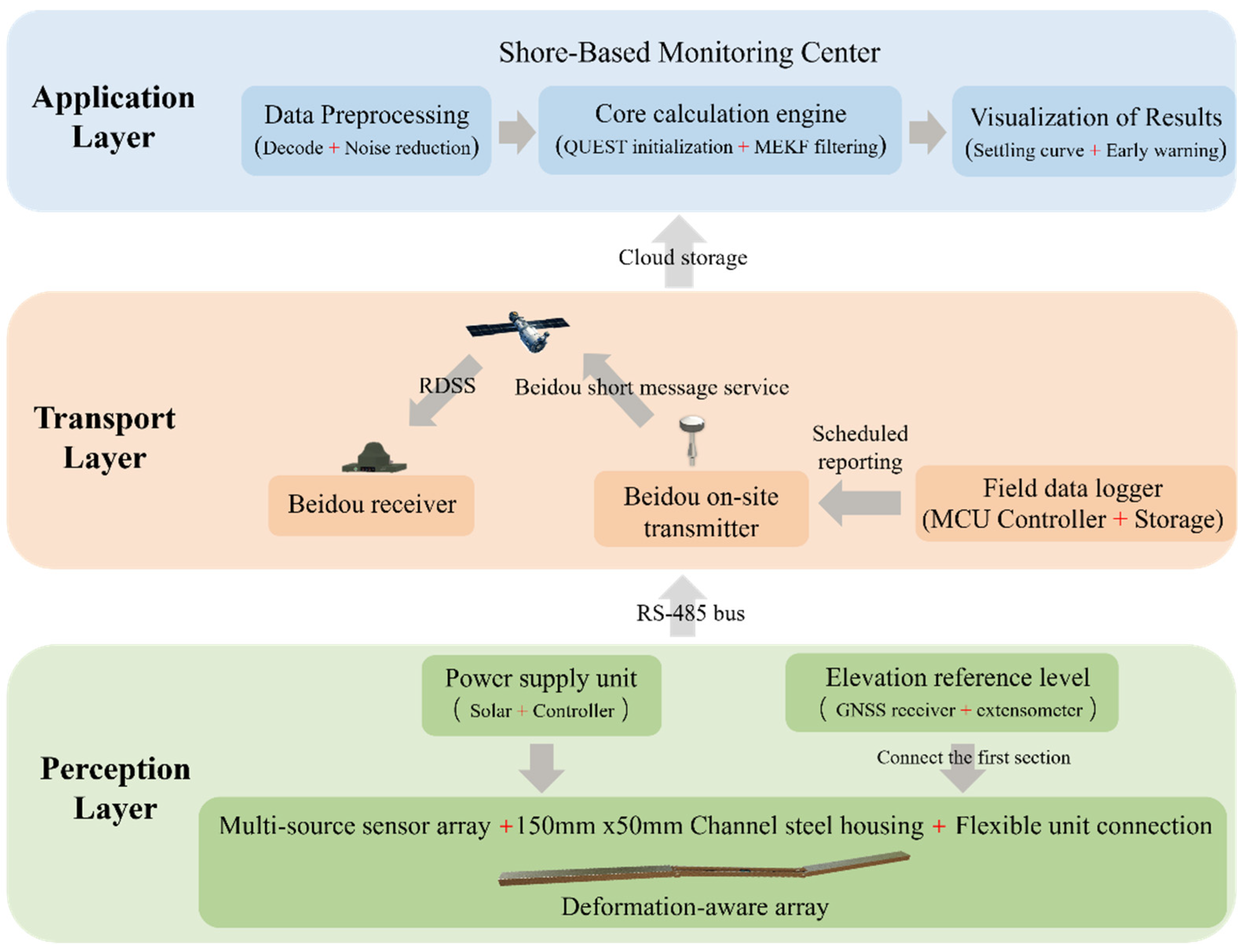
The perception layer, transmission layer, and application layer are the three logical levels that make up the system (
Figure 1). These activities are physically carried out by three separate hardware components: the deformation-sensing module for data collection, the transmission and power management unit for maintaining communication links, and the shore-based software terminal. The system is thoroughly discussed from three angles in the following sections: structural design, hardware selection, and field implementation.
2.2. Deformation-Sensing Array Structure
The deformation-sensing module functions as the primary monitoring unit of the system. This design adopts a systematic approach to address the distinctive operational conditions of seawall construction, which include extensive dense deployment, significant structural vulnerability, and passive wireless operation. It emphasizes sensor selection, structural protection, and connection mechanisms to ensure low cost and high adaptability.
To reduce expenses and complexity, the proposed design avoids conventional fiber Bragg grating (FBG) sensors and high-precision gyroscope solutions, opting instead for a cost-efficient combination of a three-axis MEMS inclinometer and a magnetoresistive sensor (
Table 1). This arrangement employs gravity and geomagnetic fields as definitive reference standards, decreasing the cost per node to only one-tenth that of FBG or gyroscope counterparts with comparable precision. Moreover, excluding power-intensive gyroscope modules significantly reduces overall system power consumption, hence improving its appropriateness for solar-powered field applications.
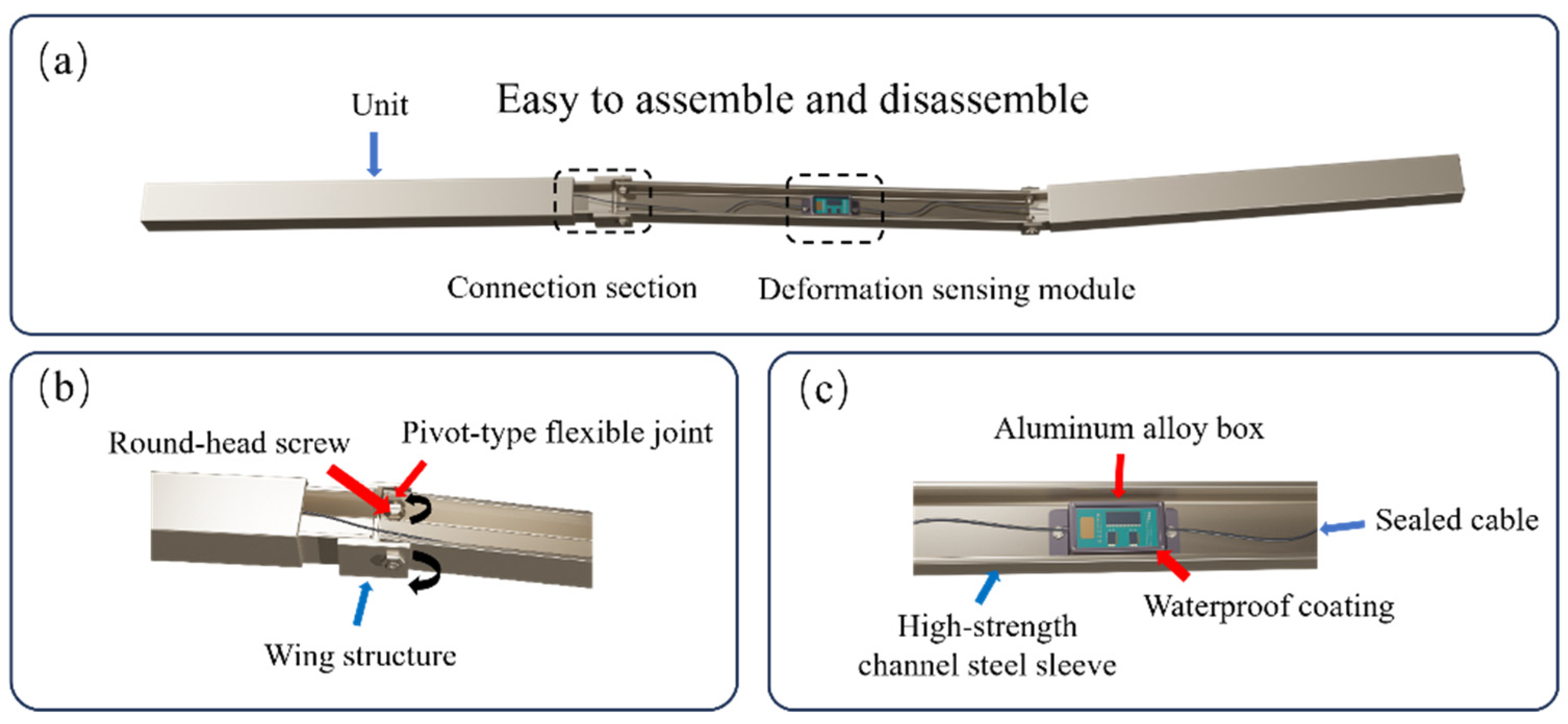
The unit’s exterior is enveloped in a robust protective sleeve constructed from 310 high-strength channel steel, featuring a cross-section of 150 mm × 50 mm, to endure the intense impact stresses produced by rock placement and dynamic compaction. Utilizing this common, commercially available profile instead of a bespoke titanium alloy housing diminishes structural hardware expenses by around 40%, while the channel steel’s elevated section modulus proficiently protects interior components from direct external compressive forces. The sensing core is encased in a robust aluminum alloy housing, which is coated with a graphene-based waterproof and thermal insulation layer. This utilizes graphene’s physical barrier characteristics to inhibit seawater penetration and chemical degradation (
Figure 2c). This composite construction, incorporating impact-resistant, economical steel on the surface and a corrosion-resistant precise coating on the interior, achieves an ideal equilibrium between stringent protection standards and technical cost efficiency.
Adjacent units are linked through clamp-type connections and pin-type articulating joints featuring lateral flanges. This connection incorporates a distinctive “circular balancing plate head” design that, alongside the pins, offers a dual-adaptation mechanism for intricate soft soil deformations (
Figure 2b). The vertical mobility afforded by the pins enables irregular settlement of the barrier. A designated clearance between the pin and the hole permits mild horizontal deflection, accommodating lateral extrusion displacements resulting from soft foundation loads. The flange construction concurrently offers essential torsional support. The low-resistance design of the circular plate head ensures that the array remains stationary around its longitudinal axis during horizontal deflection, thus affirming the physical correctness of the attitude solution.
The system employs a wire-type displacement sensor at the leading edge of the array to achieve accurate horizontal displacement boundary conditions, serving as the elevation reference point. The slip measurement from this initial unit functions as the primary correction term for subsequent coordinate interpolation. Moreover, the array has a shell-core separation architecture, enabling the independent removal and installation of internal circuit modules for efficient on-site maintenance. Multiple units can be combined flexibly to create a continuous settlement sensing array, according to the appropriate monitoring range (
Figure 2a).
Regarding the maintainability of the array in harsh marine environments, the system adopts a two-phase mitigation strategy. During the initial deployment and debugging phase, the unit-splicing characteristics and the shell-core separation architecture allow for the swift extraction and physical replacement of any malfunctioning internal sensor module. However, once the array is permanently embedded within the seawall foundation and consolidation begins, physical replacement becomes highly impractical. For this long-term operational phase, the system relies on a robust RS-485 bus architecture to ensure continuous power and data transmission, preventing single-node failures from breaking the daisy-chain communication. If an individual sensor sustains irreversible damage, the system shifts to algorithmic compensation, utilizing spatial interpolation and localized reconstruction algorithms to estimate the missing node’s attitude based on the continuous deformation constraints of adjacent functional units. Future iterations will explore more advanced extractable internal traction designs to fully resolve post-construction physical replacement challenges.
2.3. Data Transmission and Power Management
Coastal building sites sometimes experience poor cellular network coverage and restricted power supply, making conventional wired or 4G communication techniques insufficient for ongoing monitoring. The MF-SMS incorporates BeiDou short message communication technology to surmount these limitations.
The BeiDou system has advantages like bidirectional communication, worldwide coverage, and robust anti-jamming capabilities. It can accomplish data transfer and terminals without reliance on ground networks. It has since been extensively utilized in domains such as meteorology, hydrology, maritime operations, and deformation monitoring [
22,
23,
24]. The short-message communication mode (Radio Determination Satellite System, RDSS) facilitates the transmission of tens to hundreds of bytes of time-sensitive data, ensuring excellent transmission reliability and minimal power consumption, making it appropriate for low-rate monitoring applications. MF-SMS incorporates the BeiDou communication module and the embedded processing unit to facilitate a closed-loop process of data gathering, caching, and scheduled reporting. It additionally facilitates breakpoint continuation and data packet resend techniques to guarantee data integrity.
2.4. Field Installation Procedures
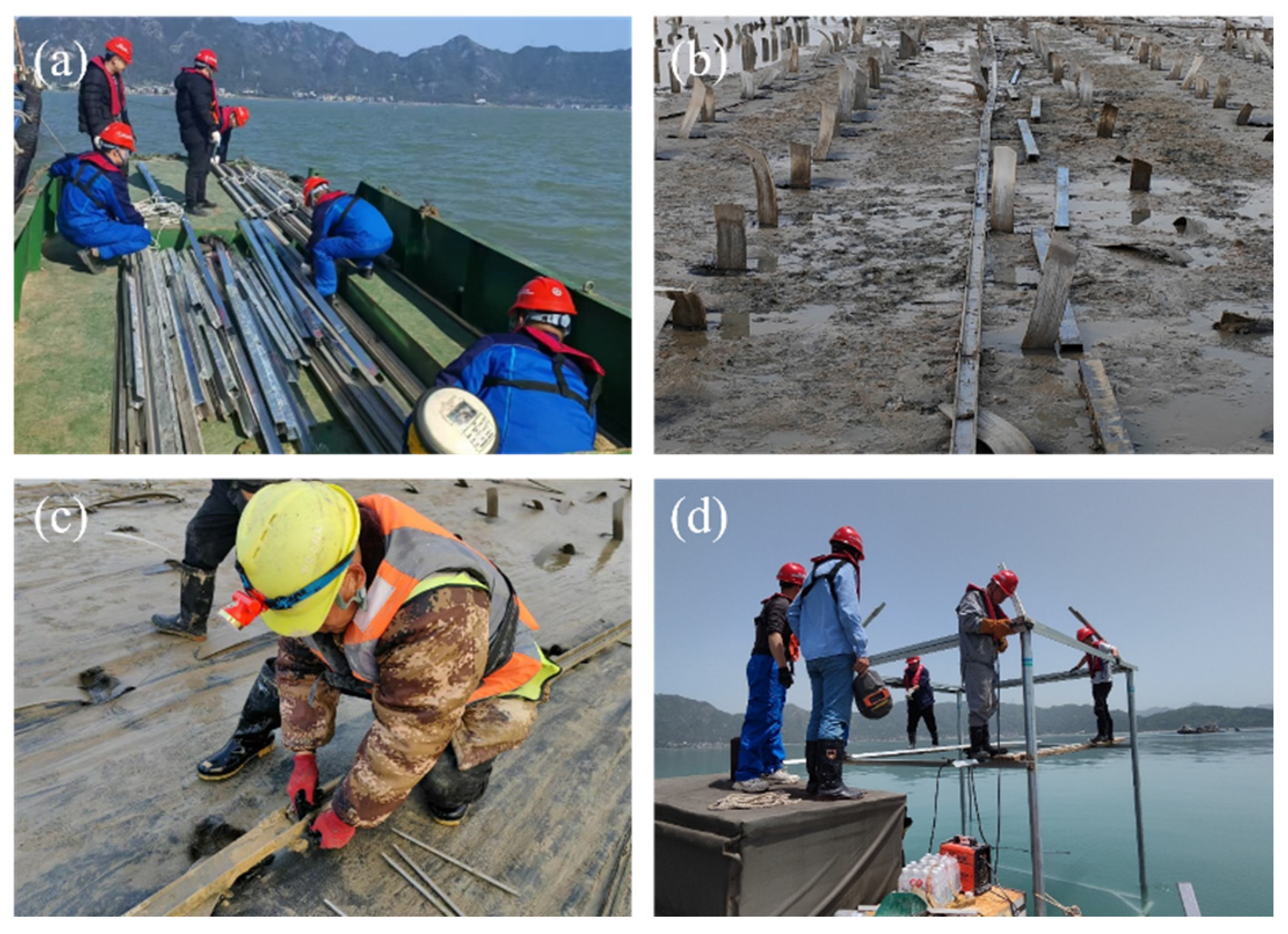
This system has built a standardized operating method to provide installation precision and system resilience on soft soil foundations and in difficult tidal environments, involving synchronized workflows and implementation across multiple tidal phases. Installation must be meticulously arranged to occur solely after the completion of foundation treatment and the settling of the sand cushion. The method consists of three distinct parts:
(1) Elevated water level: Inundation of the inflexible structure and platform assembly. Utilizing the buoyancy afforded by deep water at high tide, a workboat lowers the prefabricated rigid framework (channel steel casing) as a singular unit to its designated spot and temporarily secures it. The construction of the floating collection platform is ongoing. The platform is towed to its specified site utilizing a “floating transport + four-anchor positioning” approach, where six φ168 mm steel pipe piles are installed as permanent foundations. A sliding support system is included to facilitate future horizontal shear deformation of the embankment.
(2) Low-tide phase: Assembly of flexible array. Workers capitalize on the opportunity presented by exposed tidal flats during low tide to conduct precision tasks within the rigid frame. Construction specialists systematically install the sensing units, utilizing stainless steel clamps and flexible joints to finalize the array assembly, while concurrently creating the physical link and conducting zero-point calibration for the displacement transducer at the array’s forefront.
(3) System shutdown and comprehensive testing. Upon completion of the physical connection of the array, all circuit interfaces are subjected to multi-tier waterproof sealing, followed by electrical loop closure testing prior to the initiation of automated operation.
3. Materials and Methods
Monitoring devices are generally installed in the soft soil foundations or within the embankment during the building and operation of seawalls. The raw data produced by sensors is frequently affected by noise drift and environmental interference due to factors such as tides, loads, and temperature variations.
To guarantee the continuity and reliability of monitoring data, it is important to conduct comprehensive attitude assessment and filtering on the raw signals. The approach must tackle two primary challenges: ascertaining the distinct spatial geometric attitude solution from several non-collinear vectors and executing time-domain smoothing and prediction of attitude amidst dynamic disturbances. The Quaternion Estimator (QUEST) algorithm, utilizing the least-squares criterion, effectively converts multi-vector observations into a globally optimal quaternion solution, rendering it appropriate for generating high-confidence instantaneous attitude observations [
25,
26,
27]. Conversely, the Multiplicative Extended Kalman Filter (MEKF) algorithm proficiently models uncertainty within the quaternion multiplicative error space, facilitating continuous recursive estimation and optimal attitude determination [
28].
This research establishes an attitude fusion framework that unifies QUEST and MEKF, and additionally proposes a quaternion-based settlement calculation algorithm. This approach treats each sensor as an independent observation subsystem and solves jointly for the three-dimensional rigid-body attitude of the monitored unit.
3.1. Attitude Representation and Sensor Inputs
In multi-source monitoring systems, attitude estimation fundamentally relies on determining the rotational relationship between the monitoring unit’s body coordinate system (b-frame) and the navigation coordinate system (n-frame). This study eschews traditional Euler angle representations in favor of a unit quaternion q = [q0, q1, q2, q3]T, to parameterize the attitude. Quaternions inherently circumvent the singularity anomaly known as gimbal lock, while significantly reducing the computational time complexity and power consumption for resource-constrained microcontrollers (MCUs) deployed in the field. Physically, a quaternion describes the rotation of a rigid body by an angle “θ” about a spatial characteristic axis u, where the scalar component is q0 = cos(θ/2) and the vector component is qv = [q1, q2, q3]T = usin(θ/2). The system utilizes two primary sensor inputs for this measurement: a three-axis MEMS inclinometer provides the gravity vector to correct pitch and roll, while a three-axis magnetoresistive sensor supplies the geomagnetic vector to correct the heading angle.
Let the observation vector in the body coordinate system be
vb, and the reference vector in the geographic coordinate system be
vr; the two are related via the direction cosine matrix
R(
q) constructed from quaternions:
The direction cosine matrix corresponding to a quaternion can be expressed as follows:
The system uses two types of sensors for measurement inputs: a three-axis MEMS inclinometer provides gravity vector measurements to correct pitch and roll attitudes; a three-axis magnetoresistive sensor provides geomagnetic vector measurements to correct heading attitude.
3.2. QUEST-MEKF Cascaded Attitude Fusion Framework
Considering the characteristics of multi-source data in the seawall monitoring environment, this study proposes a cascaded attitude fusion framework. The framework is logically divided into two stages. First, the QUEST algorithm is utilized to resolve the nonlinear geometric registration of inclination and magnetoresistance vectors, enabling the construction of instantaneous attitude observations. Second, a gyro-free MEKF is adopted to optimally estimate and smooth stochastic noise in the time domain. The collaboration of these two components ensures stable and high-precision attitude determination from physical measurements.
The QUEST algorithm solves the Wahba problem [
29] to find the optimal rotation quaternion
qquest at each sampling time, such that the post-rotation alignment of the gravity and geomagnetic reference vectors with the measured vectors is maximized. Its objective function is the weighted sum of squared errors:
where
Rrb is the rotation matrix from the carrier coordinate system to the reference coordinate system, and bi is the measured sensor vector (gravity and geomagnetic);
ri is the corresponding vector in the reference coordinate system; for the sensor module in this paper (
N = 2), there are two reference vectors: the gravity vector and the magnetic field vector. The gravity reference vector can be defined as
ar = [0,0,1], while the magnetic field reference vector can be obtained by referencing the World Geomagnetic Model (WMM) and varies with geographic location;
wi represents the weight of each vector, which can be set based on the reliability or accuracy of the measurement.
By formulating the Davenport matrix K and determining its maximum eigenvalue, QUEST can immediately derive the optimal quaternion in analytical form. In this architecture, QUEST functions as a “dimension-reduction solver.” It fuses the input pitch and magnetic resistance raw vectors into a single geometric attitude quaternion qquest. This quaternion functions as the global initial state q0 upon system activation and as a virtual observation input for the MEKF filter during ongoing operations, thus streamlining the construction of the filter’s observation model.
To suppress high-frequency sensor noise and maintain the unit-norm constraint of the quaternion, a multiplicative error-based Kalman filter (MEKF) is employed in the back end. In the quasi-static monitoring mode without angular rate inputs, the system assumes that the attitude remains constant over extremely short sampling intervals. The system state vector can be simplified as:
where
δθ is a unit quaternion representing the attitude transformation from the navigation coordinate system to the aircraft coordinate system, and
b is the sensor error.
The prediction equation simplifies to an identity transformation, and the prediction covariance matrix
Pk|k−1 accumulates process noise
Q:
where
Fk−1 ≈
I (unit matrix) denotes a non-rotational evolution, and
Qk−1 is the process noise covariance, used to model uncertainty.
The system treats the instantaneous attitude
qquest calculated by QUEST as an observation. The observation error is defined as the small rotational deviation between the predicted attitude and the QUEST-observed attitude. In the quaternion multiplicative error space, the measurement equation linearizes to the following:
where
is the estimated pose.
After linearization, we obtain the observation matrix
Hk, which maps errors in the observation space back to the state space. The Kalman gain is calculated to determine the weighting between the observed and predicted values:
where
Kk is the Kalman gain, and
Hk is the observation equation.
where
Pk|k−1 is the predicted covariance at time
k.
This cascaded design provides substantial technical benefits by assigning the intricate work of nonlinear vector alignment to QUEST, which possesses an analytical solution, so enabling MEKF to focus just on the linearized attitude smoothing problem. This not only diminishes the linearization error of the filter but also markedly enhances the system’s resilience to sensor transients.
3.3. Adaptive Mechanism for Mitigating Construction Disturbances
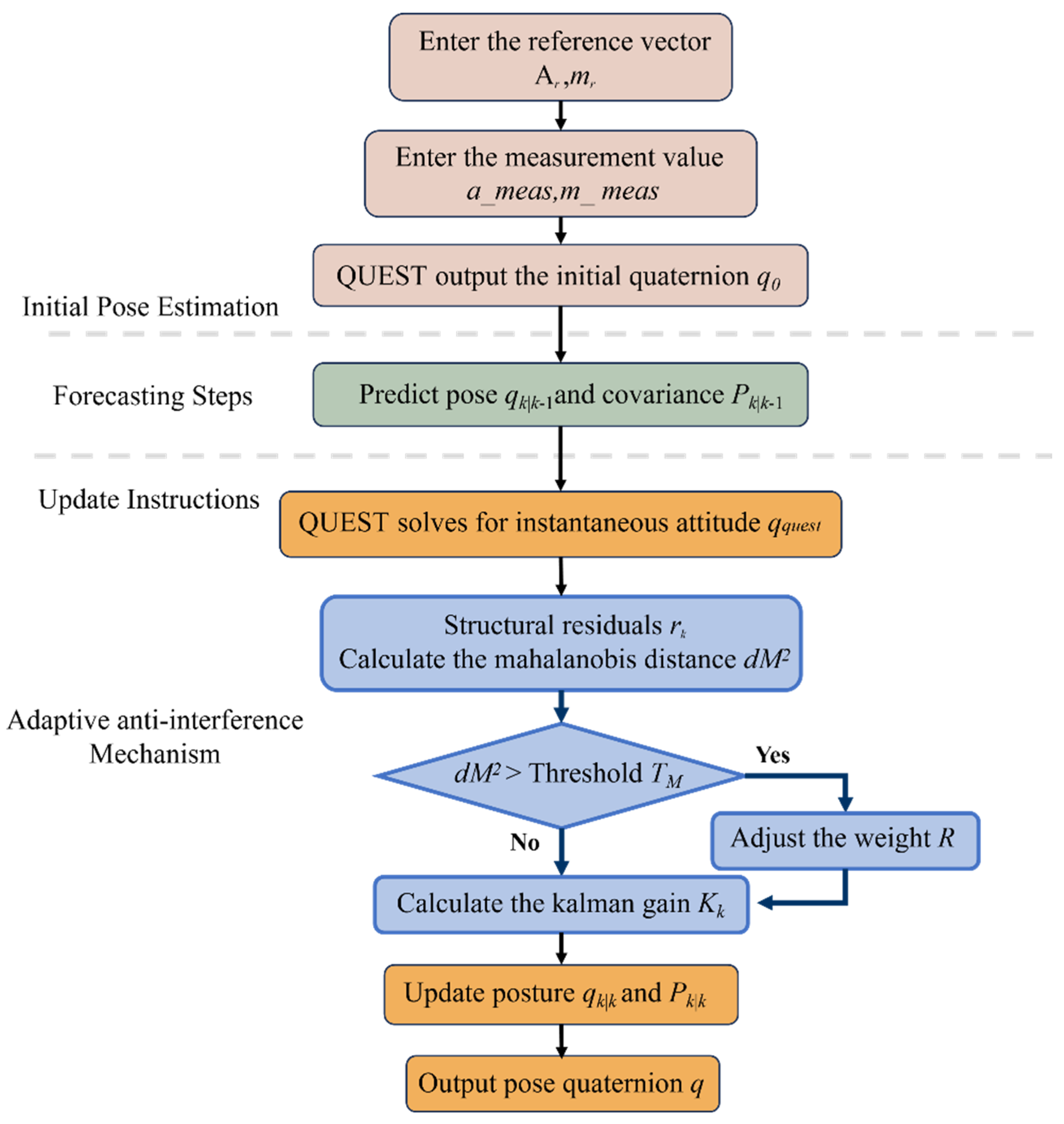
Seawall building involves backfilling, rock placement, and heavy machinery operations that generate considerable transient vibrations and non-stationary acceleration disturbances. While these disturbances mainly stem from vertical stresses, they frequently develop into three-dimensional vibration signals with random directionality as they traverse intricate soil media to the flexible monitoring array. When overlaying gravity measurements, such disruptions may induce erroneous fluctuations in the attitude solution outcomes. This study implements an adaptive observation noise suppression approach utilizing Mahalanobis distance to eliminate such anomalies, as depicted in
Figure 3.
“Observation consistency” pertains to assessing whether the current acceleration observation vector aligns with the statistical distribution principles inside the gravitational field. This work introduces Mahalanobis distance as a statistical test statistic, in contrast to existing threshold methods that solely evaluate Euclidean distance. The system obtains continuous time-series data using quasi-static sampling, and the algorithm executes recursive filtering frame-by-frame inside this sampling interval. At each time step k, the system generates a forecast state derived from the posterior estimate of the preceding time step, with the observation residual indicated as
. The Mahalanobis distance is defined using the residual covariance matrix, which reflects the uncertainty of historical predictions:
where Sk
−1 = (HPk|k−1HT + Rk)
−1 represents the residual covariance matrix. In contrast to the Euclidean distance, the Mahalanobis distance integrates the inverse of the co-variance matrix, hence executing decorrelation and standardization on the residual vector. In three-dimensional acceleration space, construction effects frequently result in highly coupled vibrations along specific axes (anisotropic distribution), and the Mahalanobis distance can effectively detect statistical anomalies on these axes. Irrespective of whether the disturbance arises from vertical impacts or lateral compression, if it leads to a substantial deviation in the distribution characteristics of the composite acceleration vector from the theoretical gravity model (i.e., dM2 > TM), the system concludes that the current observation is compromised.
When an abnormal impact is detected (blue boxes in
Figure 3), the system reduces the weight of the data at that time by amplifying the observation noise covariance matrix
R. The physical essence of this is to reduce the filter’s “confidence” in the current abnormal measurement, forcing the system to rely more heavily on the predicted state from the previous time step, thereby achieving a smooth transition in response to transient impacts. The nonlinear mapping relationship between the observation noise amplification factor α and the Mahalanobis distance
dM2 is defined as follows:
where
k and
β are fitting parameters controlling the maximum amplification amplitude and the transition steepness, respectively, and
TM is the detection threshold determined from the
χ2 distribution (
TM = 7.815, with 3 degrees of freedom at a 95% confidence level). The corrected observation noise matrix is then
R* = α(
dM2)·
R.
With this explicit formulation, the corrected observation noise matrix is updated as R* = α(dM2)·R. Here, k and β control the amplitude and rate of change, respectively; their optimal values are obtained through experimental fitting (see the experimental section below). This mechanism enables the algorithm to adapt to environmental disturbances: when dM2 is within the normal range, α ≈ 1, maintaining high-sensitivity monitoring; when dM2 increases significantly, α rises rapidly following a sigmoid trend, achieving robust suppression of abnormal observations.
It is worth noting that this transient acceleration suppression mechanism does not compromise the system’s capacity to capture real, rapid structural settlements. Physically, vibrations manifest as high-frequency, non-stationary oscillatory signals with a zero-mean distribution over localized durations. In contrast, actual geotechnical settlement is a macroscopic, monotonic, and cumulative displacement process that permanently shifts the baseline gravity vector over a longer time scale. Because the adaptive amplification factor α operates frame-by-frame at a high sampling frequency (50 Hz), its sigmoid-driven attenuation triggers exclusively during the precise windows of transient shock waves. During these brief intervals, the MEKF filter temporarily prioritizes the state prediction model projected from historical trends, which serves as an inherent remedial measure to maintain physical continuity.
3.4. Calculation of Settlement Displacement Using Quaternions
The primary objective of attitude calculation is to transform angular measurements into a spatial displacement field of the monitoring unit. The main goal of settlement displacement inversion is to determine the deformation coordination relationship between the sensing unit and the soil medium. The monitoring systems are housed in high-stiffness casings and are thoroughly embedded in the sand subgrade of the seawall. The displacement at the geometric center of the visible monitoring unit, influenced by the surrounding high-confinement-pressure soil and the overlaying load, corresponds to the macroscopic settling of the soil at that site. This study formulates a rigid-link recursive model, disregarding the unit’s negligible deformations, and reduces the continuous soil deformation to a vector summation issue with numerous rigid links.
Specifically, the local coordinate system of the
i-th sensing unit is defined with its geometric center as the origin and the sensor’s sensitive axis as the
Y-axis. In this coordinate system, the unit’s length vector is constant at
v = [0,1,0]
T. Using the calculated normalized attitude quaternion
qi, a quaternion rotation operator is constructed to map the unit vector v in the body coordinate system to the global coordinate system, yielding the actual direction vector
di of the unit in global space:
where
di represents a vector in the global coordinate system, denotes quaternion multiplication. The above equation implements the rigid-body rotation transformation of a vector from a local, moving coordinate system to a global, fixed coordinate system.
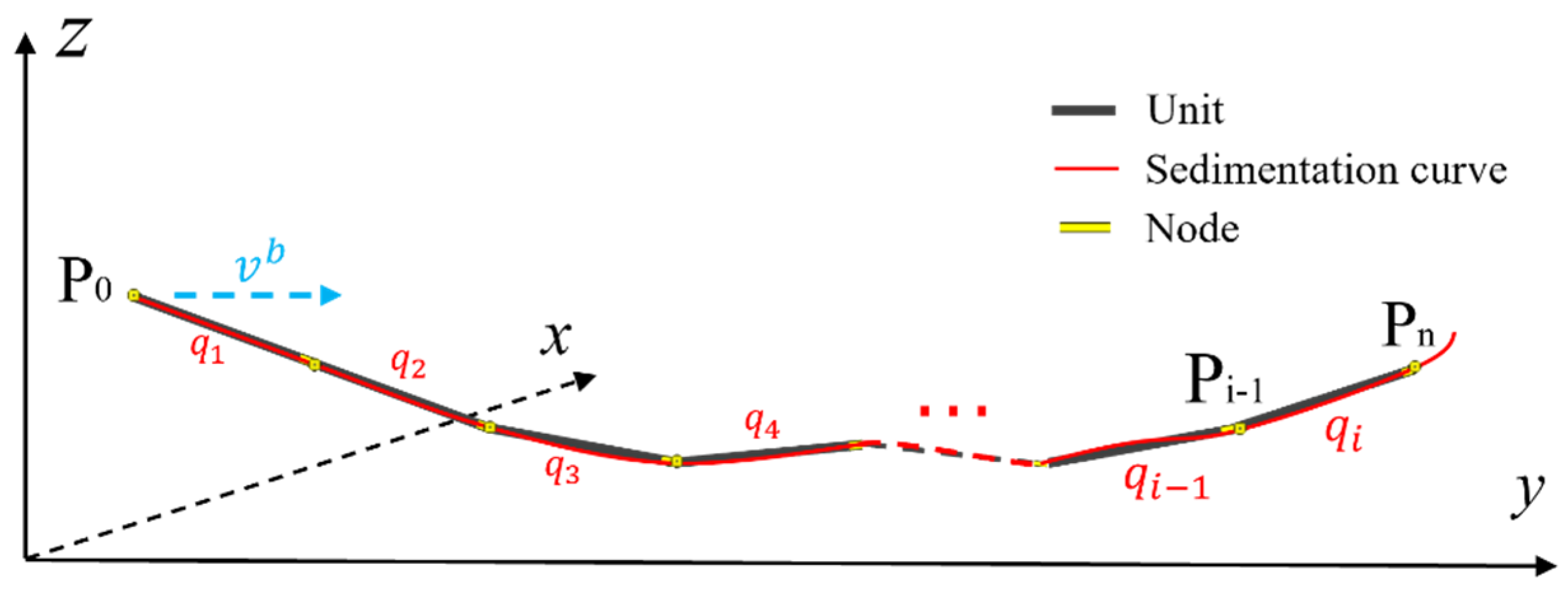
Based on the rigid link recursive model, let
Lc denote the length of the rigid link between adjacent nodes
Pi−1 and
Pi. According to the principle of vector superposition, the coordinates of the
ith node, Pi, can be obtained by recursively calculating them step by step from the coordinates of the preceding node:
By performing cumulative backward analysis starting from reference point
P0 (defined by the initial boundary conditions determined from the fixed platform coordinates and the wire-tension displacement meter) and proceeding along the direction of the array, the three-dimensional settlement curve for the entire seawall cross-section can be reconstructed (
Figure 4).
4. Laboratory Testing and Validation
4.1. Experimental Objectives and Protocol Design
To guarantee the measurement reliability of the MF-SMS system amidst the intricate dynamic conditions of seawall building, the adaptive anti-interference filtering algorithm delineated in
Section 2.3 depends on two principal control parameters: the sensitivity coefficient
k and the adjustment rate
β. This chapter seeks to acquire sensor dynamic response data under typical operating settings via laboratory simulation experiments, due to the challenges in effectively representing the nonlinear properties of construction machinery vibrations and wave effects with theoretical models. The aims of the experiments encompass two facets:
(1) Parameter identification (fitting): Utilize transient acceleration and attitude deviation data from pendulum strikes to ascertain the appropriate parameter combination (k, β) for the adaptive weighting function via nonlinear regression to establish the algorithm model;
(2) Performance verification (testing): Utilize the established parameters to process the validation set data for a quantitative assessment of the system’s attitude reconstruction correctness and disturbance rejection proficiency under dynamic situations.
Both experimental types utilize a high-precision IMU (model MPU-9250, attitude accuracy 0.001°) as the reference for attitude measurement. The experimental conditions are classified into two categories: quasi-static conditions assess sensor noise levels and zero-bias stability during prolonged operation; dynamic impact conditions employ a pendulum apparatus to replicate the transient impacts from rock placement and the periodic oscillations caused by wave slapping. The whole experimental framework consists of three phases: data collecting, QUEST–MEKF attitude estimate, and error evaluation. The error metric is based on the quaternion similarity between the reference quaternion qref and the estimated quaternion qest.
4.2. Analysis of Sensor Noise Characteristics and Parameter Initialization
In order to provide an accurate initial value of the observation noise covariance matrix R for the MEKF filtering algorithm and to verify the zero-bias stability of the system under the condition without a gyroscope, a static noise characteristic analysis experiment was first carried out.
Before testing, the magnetoresistive sensors were subjected to soft-iron calibration, and sources of magnetic interference in the experimental vicinity were removed (no soft or hard magnets within a 1.5 m radius). Three sets of sensor modules were randomly chosen and affixed to a high-precision three-axis gimbal. Six attitude configurations were established (pitch and roll ranges of −30° to 30°, with random heading angles), and raw sensor data was constantly collected for 30 s at a frequency of 50 Hz.
Through statistical analysis of the 30 s continuous static sampling data, the standard deviations of the measurement noise were determined to be = 0.00112 g for the MEMS inclinometer and = 0.0035 Gauss for the magnetoresistive sensor. These extracted parameters directly dictate the initial observation noise covariance matrix, which is constructed as a diagonal matrix R0 = diag(, , , , , ). This matrix establishes the filter’s baseline statistical confidence in the raw vector measurements prior to dynamic integration.
As shown in
Table 2, the static attitude estimation yields quaternion similarities ranging from 0.9996 to 0.9999. Mathematically governed by the relation
qref∙qest = cos(
θ/2), this translates to an absolute three-dimensional spatial angular deviation of approximately 0.8° to 1.6°. Within the domain of geotechnical instrumentation, conventional high-precision systems like the ShapeAccelArray typically maintain static angular errors below 1°. However, achieving such precision usually requires fragile optical components or energy-consuming instruments, which are completely incompatible with the offshore construction environment, far from the power grid and with high impact forces. For the proposed MF-SMS, before the filtering algorithm processing, the original geometric attitude error is completely acceptable within the range of 0.8° to 1.6°. This indicates that relying on the gravity and geomagnetic reference vectors can provide sufficient stable global initialization. This fundamental step ensures that the subsequent cascaded MEKF architecture can reliably filter dynamic noise and output high-confidence settlement curves.
4.3. Dynamic Testing and Verification of Algorithm Robustness
The aforementioned static experiments confirmed the module’s correctness and stability under steady-state conditions; however, seawall construction sites frequently encounter dynamic disturbances, including fluctuating embankment loads and wave impacts. A pendulum impact test was devised to assess the algorithm’s performance in attitude calculation in dynamic situations characterized by low-frequency pulses.
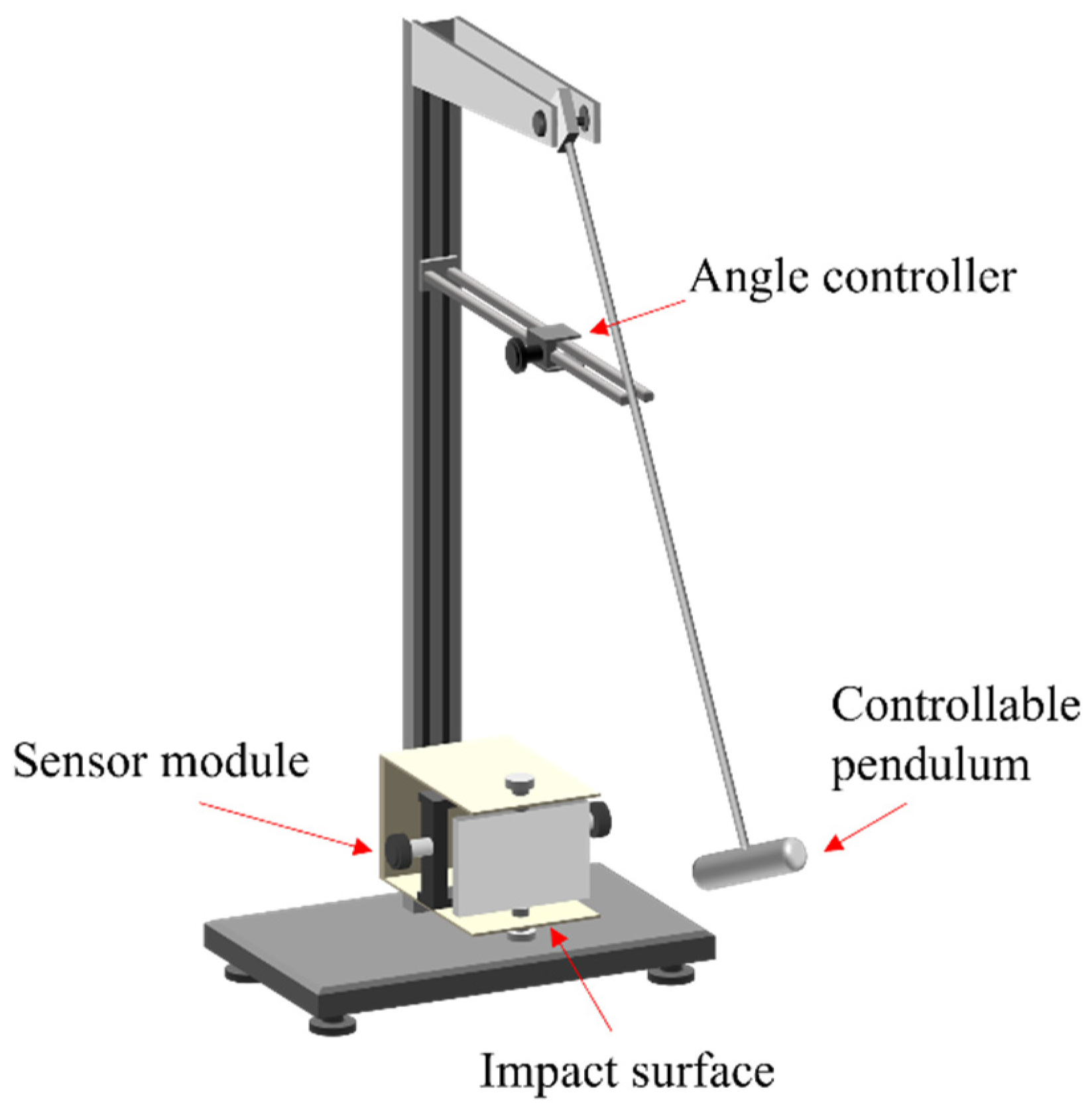
The unloading of huge dump trucks and the dropping of boulders during seawall building produce substantial low-frequency impulse vibrations. An impact simulation platform utilizing a controlled pendulum was developed to recreate these conditions (
Figure 5). This gadget may statistically replicate transitory physical impacts of varied energy levels by altering the swing angle (5–45°) and the mass of the pendulum ball (0.2–4 kg). Throughout the experiment, the module experienced intense shaking upon impact, resulting in the inclinometer’s acceleration vector deviating markedly from the gravitational direction, thus replicating the high-noise conditions of a construction site.
In the experiment, the module was designed with a sampling frequency of 50 Hz to capture the complete acceleration waveform of each impact; the pendulum length was set to 0.4 m, and 20 sets of test conditions were configured with pendulum angles of 5°, 10°, 20°, and 45° and mass blocks of 0.2 kg, 0.5 kg, 1 kg, 2 kg, and 4 kg. Each set was repeated four times, resulting in a total of 80 data sets.
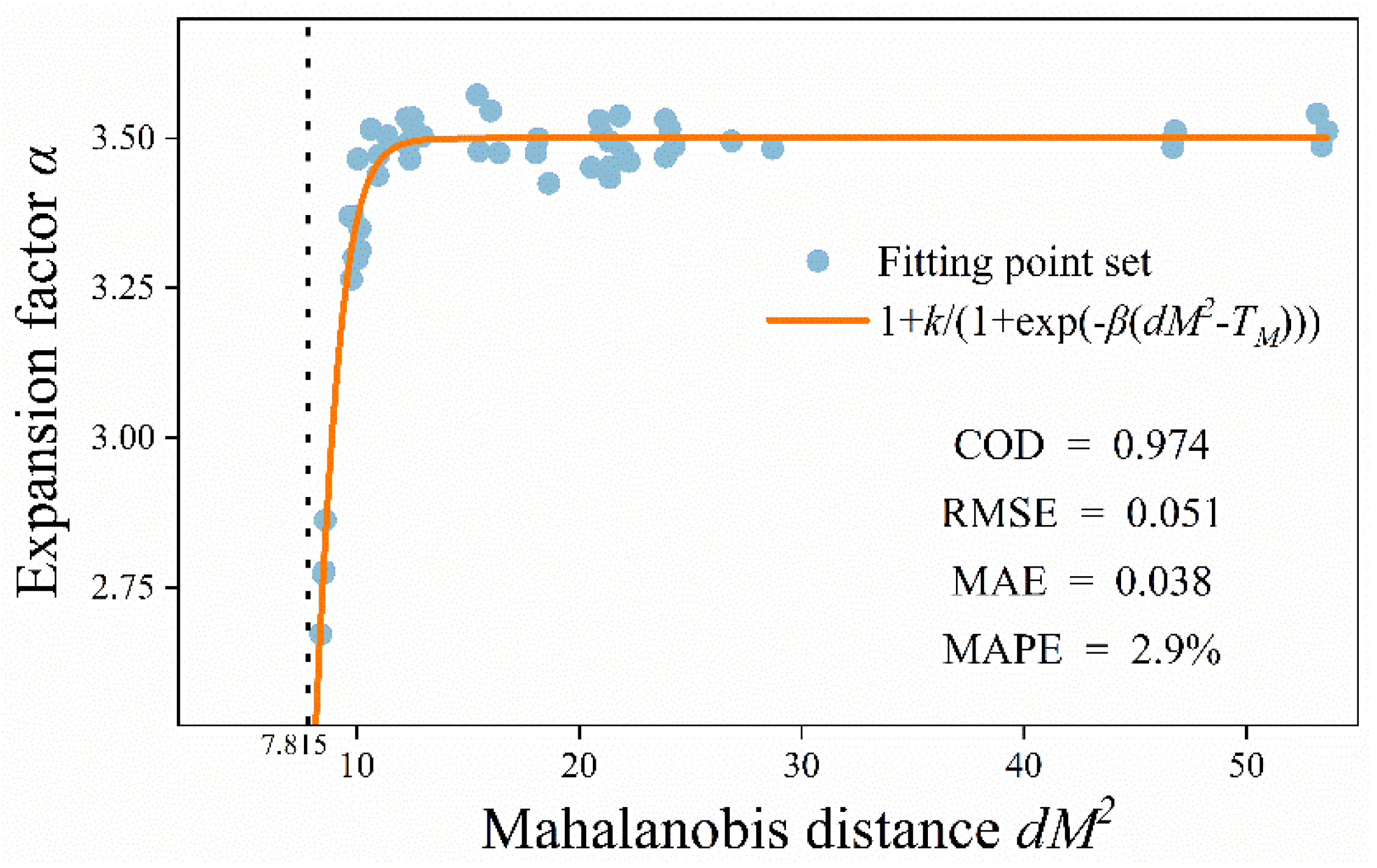
To determine the optimal parameters for the adaptive algorithm, 60% of the 80 sets of impact data were randomly selected as the training set. The Mahalanobis distance and the corresponding ideal expansion factor
αideal (i.e., the theoretical weight attenuation factor required to eliminate the current observation anomaly) were extracted for each impact. Using nonlinear least squares, the data were substituted into the sigmoid model in Equation (3) for regression analysis (
Figure 6).
The fitting results demonstrate that the model accurately characterizes the nonlinear correlation between acceleration anomaly intensity and noise weighting, achieving a goodness-of-fit of R2 = 0.974 and a mean absolute error (MAE) of merely 0.038. The identified best method parameters are: k = 2.4981 ± 0.0067 and β = 1.3018 ± 0.0460. This parameter set quantitatively delineates the sensor’s sensitivity to construction influences and will be integrated into the algorithm for future real-time attitude estimation.
4.4. Evaluation of Adaptive Algorithm Generalization
To assess the algorithm’s generalization performance, the identification parameters were utilized on the test set and compared against the baseline algorithm.
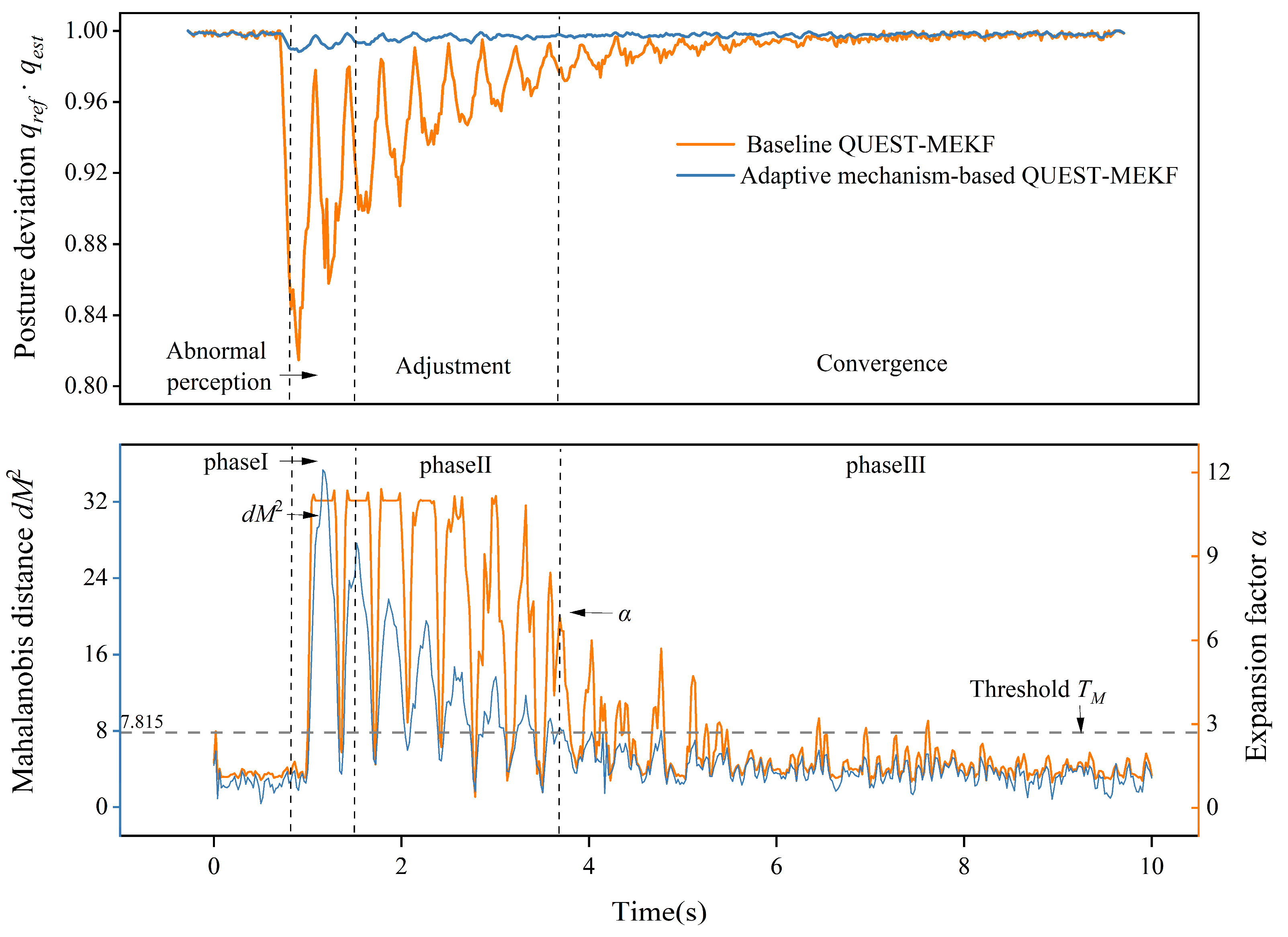
Figure 7 comprehensively depicts the disturbance-resistant mechanism of the adaptive algorithm under standard severe impact conditions (45°–1 kg): (1) Anomaly detection phase (phase I). Upon impact, the Mahalanobis distance
dM2 (blue line) reacts swiftly and consistently beyond the threshold TM, thereby identifying the presence of vibrational disturbances. Adaptive adjustment phase (phase II). The algorithm dynamically modifies the expansion factor α in real time according to variations in
dM2, automatically augmenting the weight of observation noise during the peak of the vibration to promptly eliminate erroneous observation data. Final solution outcomes (phase III). Due to the previously mentioned modifications, the adaptive algorithm (blue line) effectively separated the physical vibrations from the attitude computation, resulting in a corrected attitude deviation that stabilized within 0.1° (derived from quaternion deviation); conversely, the baseline algorithm (orange line) displayed significant oscillations in subsequent performance.
Statistics indicate that this method decreased the root mean square error (RMSE) of attitude estimate on the test set from 0.3285 to 0.0507, representing a reduction of 84.56%, hence affirming the system’s considerable robustness in non-stationary construction vibration conditions.
5. Project Case Studies
To verify the adaptability and monitoring accuracy of the MF-SMS system in complex seawall construction environments, on-site installation and long-term monitoring were conducted at a typical cross-section of a seawall.
5.1. Project Overview
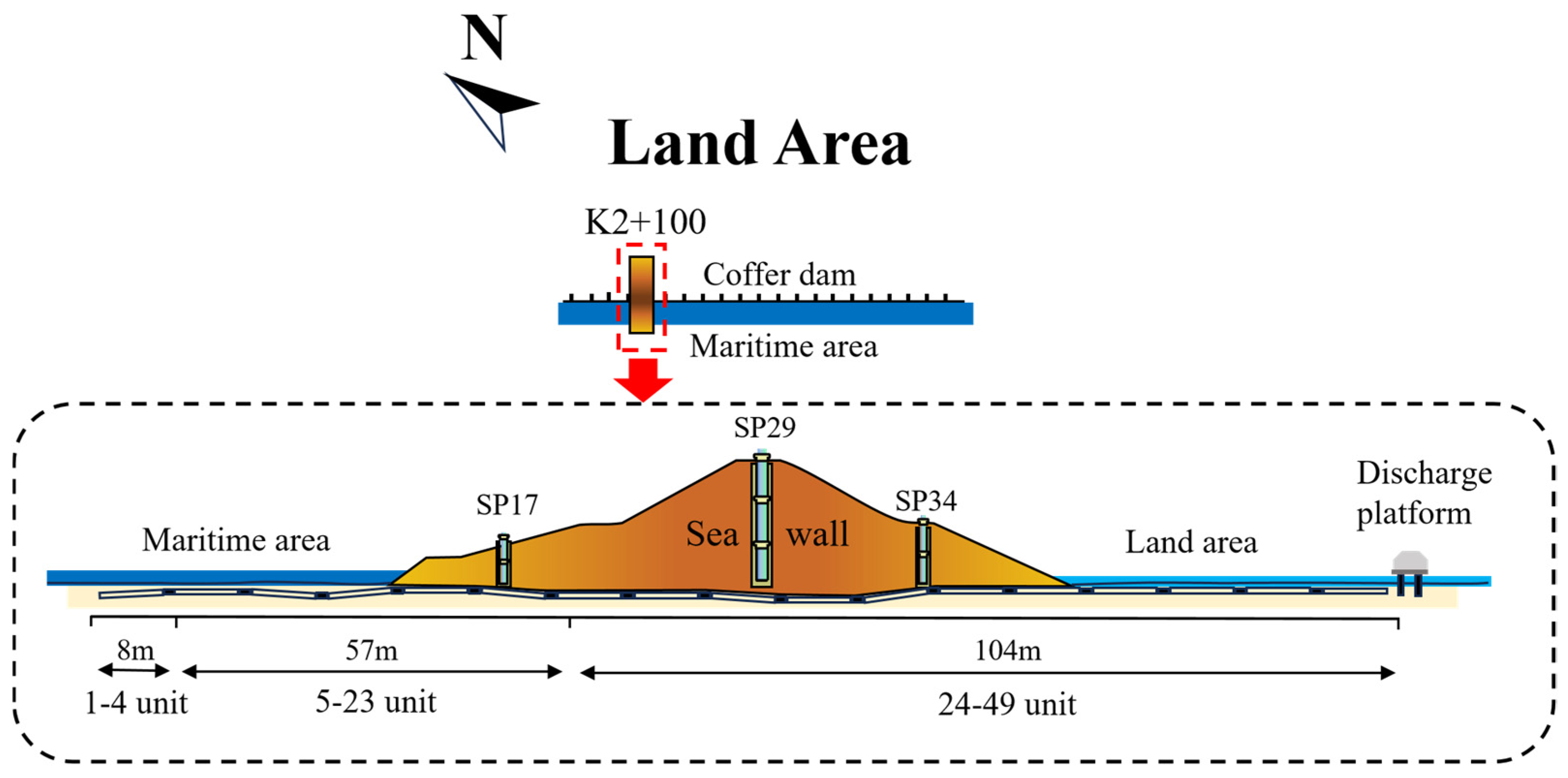
The test embankment section features a structure consisting of riprap and a sand cushion, with a foundation composed of typical deep, soft coastal soil characterized by high water content and high compressibility. To comprehensively monitor the deformation behavior of the embankment body and foundation, an MF-SMS array was installed at a typical cross-section of the cofferdam (K2 + 100). The array has a total length of 165 m and comprises 49 sensing units. The array was laid transversely along the embankment axis, spanning the seaward side, the core zone of the embankment, and the landward side (
Figure 8). Additionally, to verify measurement accuracy, three conventional settlement tubes (numbered SP-17, SP-29, and SP-34) were installed at the same cross-section to serve as reference benchmarks.
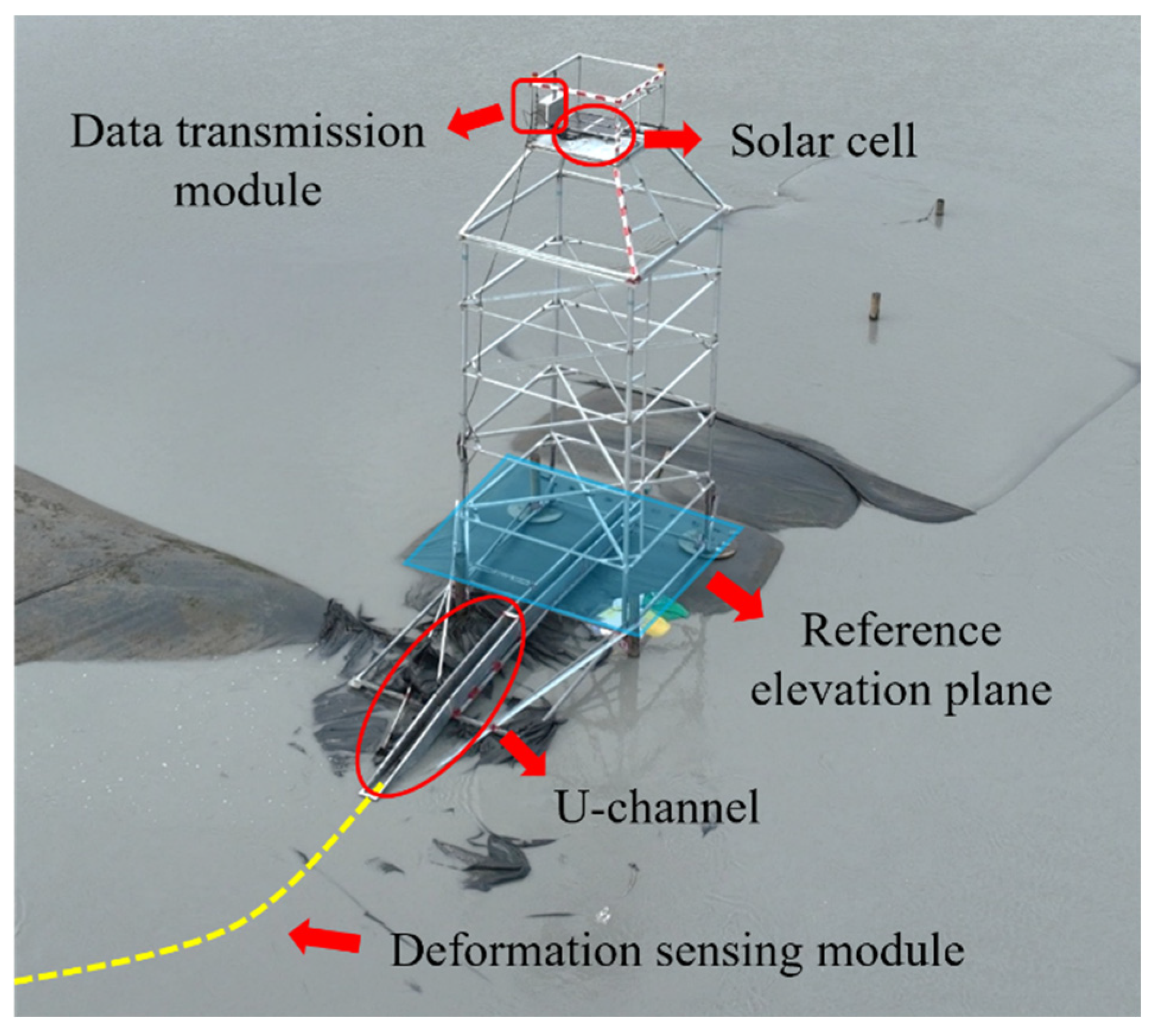
A fixed platform was erected on the landward side of the cofferdam to fulfill on-site communication and power supply requirements, serving as the system’s elevation reference point (
P0) and data aggregation hub. The platform incorporates solar power production and a BeiDou communication terminal, linked to the flexible sensor array through guide channels at its base, facilitating mobility to adjust for horizontal displacements in the array due to embankment settlement (
Figure 9). At the implementation stage, on-site deployment adhered rigorously to the previously described “tidal-segment coordination” standard procedure: activities commenced only once the installation of plastic drainage mats was finalized. The underwater deployment of the rigid skeleton and the assembly of internal sensor units at low tide were executed sequentially, utilizing tidal windows to ensure effective integration between the monitoring system and the soft soil foundation, as well as accurate positioning of the initial configuration (
Figure 10).
5.2. Monitoring Results and Stability Analysis
The monitoring data were acquired from two types of apparatus: MF-SMS and settlement tubes. The MF-SMS was programmed to do a monitoring task bi-hourly, with each session including 30 s of uninterrupted high-frequency sampling. The system employed the comprehensive waveform data from this timeframe to execute a QUEST-MEKF fusion computation, yielding a high-confidence settlement value for that particular time point. The settlement tubes were measured bi-daily, and the mean of five readings was calculated.
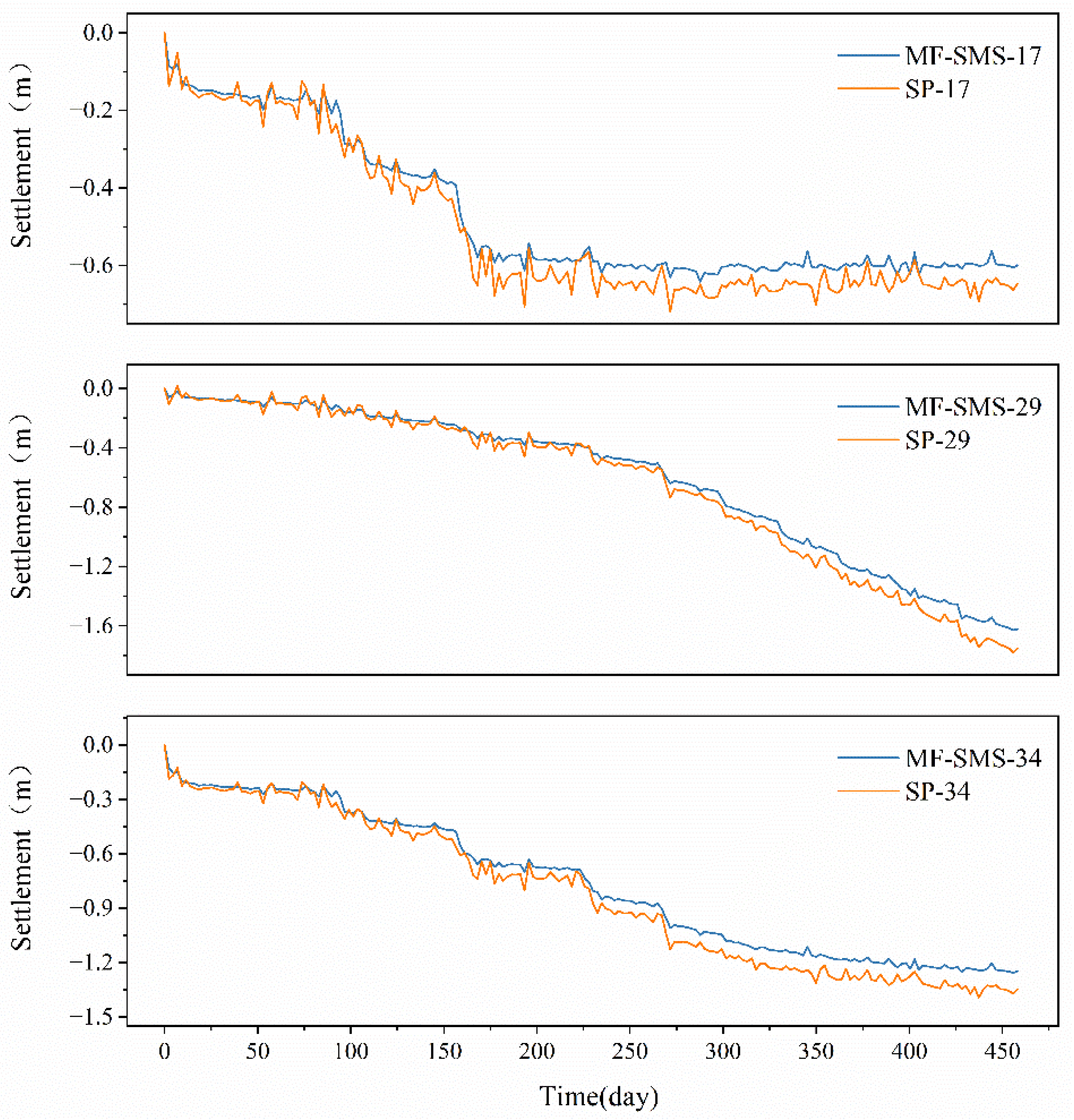
Field monitoring continued for 458 days; the outcomes from the MF-SMS and conventional settlement tubes are illustrated in
Figure 11. The monitoring results reveal that the normalized root mean square error (NRMSE) between the MF-SMS and settlement tubes fluctuates between 9.44% and 11.02%. Here, the normalization factor is the maximum cumulative settlement (Smax = 1704 mm) observed during the 458-day monitoring period at the core high-fill section. Correspondingly, the absolute RMSE ranges from approximately 160 mm to 187 mm. Analysis indicates that this discrepancy predominantly arises from physical differences in the monitoring benchmarks: the settlement tube measures single-point displacement at a designated depth, while the MF-SMS array is extensively embedded in the sand cushion and records continuous deformation in conjunction with the soil mass. Furthermore, slight horizontal displacement of the array due to localized ground disturbances from construction machinery operations is the principal factor contributing to tiny cumulative discrepancies in coordinate interpolation.
Regarding temporal trends, Node 17, positioned at the slope’s toe, demonstrates initial rapid settlement followed by subsequent stabilization; Nodes 29 and 34, located in the middle and core sections of the embankment, respectively, exhibit the most significant cumulative settlement and display distinct characteristics of staged loading. The “steep steps” in each phase represent the embankment filling loads, whilst the “platforms” denote the consolidation process. Local rebound phenomena may be associated with the secondary consolidation of cohesive soil and unloading rebound.
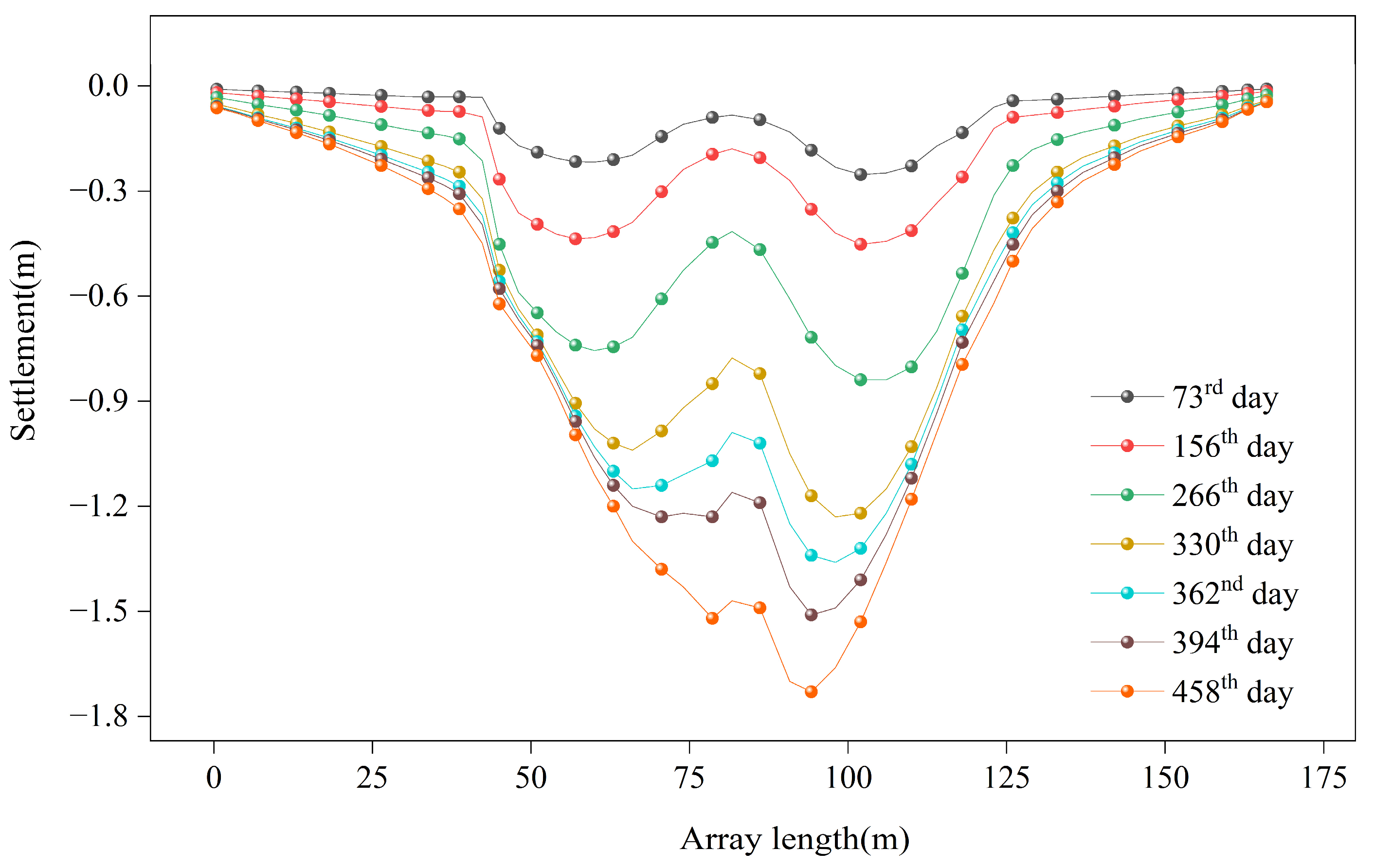
Figure 12 illustrates the spatial distribution of settlement as measured by the MF-SMS. The “array length” on the horizontal axis denotes the cumulative horizontal distance measured from the landward starting point along the monitoring profile (K2 + 100) towards the seaward direction. The spatial distribution characteristics indicate that, within approximately 80 m to 100 m from the beginning point (aligned with the core high-fill section of the seawall), the settlement peaked at 1.7 m. The cross-sectional settlement displays a characteristic “W” form, with the trough of significant settlement aligning with the drainage board-reinforced zone, while the convex region signifies the untreated foundation. As time advanced, the “W” form became increasingly distinct, signifying that disparities in consolidation rates endured.
Throughout the 458-day observation period, the system functioned reliably, with a data packet loss rate of less than 1.5%, a BeiDou communication success rate surpassing 98%, and no notable drift in sensor outputs. The system ensured dependable functionality in the marine environment, showcasing the efficacy of its protective design and power consumption management strategy.
5.3. Discussion of Results
To quantitatively examine the extent to which dynamic interfering factors affect monitoring accuracy, it is essential to evaluate the system’s performance degradation under construction disturbances and its subsequent recovery utilizing the proposed adaptive QUEST-MEKF noise reduction method. As demonstrated in the laboratory dynamic impact tests (
Section 4.3), uncompensated baseline measurements are highly susceptible to high-frequency vibrations simulating construction impacts. These interfering factors introduce severe transient attitude errors, yielding a high baseline RMSE of 0.3285, which would artificially distort settlement readings. However, the adaptive filtering successfully isolates and suppresses these shocks, reducing the RMSE to 0.0507 (an 84.56% accuracy improvement).
Extending this mechanism to the 458-day field deployment discussed in
Section 5.1, the seawall environment presented continuous, severe physical impacts such as boulder backfilling and machinery operations. By effectively stripping away this dynamic construction noise frame-by-frame, the system prevented the accumulation of false displacements. It is precisely this robust noise reduction mechanism that enabled the MF-SMS to withstand daily mechanical interference, maintain a highly consistent long-term consolidation profile, and successfully constrain the final field NRMSE within the 9.44% to 11.02% range (as presented in
Section 5.2). This confirms that without adaptive filtering, the cumulative effect of construction interference would severely degrade long-term settlement inversion.
Field validation indicates that the algorithm integrating QUEST and adaptive MEKF may consistently yield accurate attitude findings in intricate situations. In comparison to monitoring techniques like settlement tubes, the MF-SMS demonstrates enhanced temporal resolution throughout the building phase, allowing it to detect abrupt variations in settlement rates during backfilling and loading processes. This capacity is crucial for managing settlements and adjusting construction timelines during the construction process. The algorithm’s adaptive noise adjustment technique efficiently mitigates short-term disturbances from wave impacts, yielding smoother settlement curves and enhanced trend recognition.
6. Conclusions
This paper addresses the significant challenges of settlement monitoring during seawall construction by presenting an integrated monitoring solution that unifies hardware protection, algorithmic robustness, and communication autonomy within a single platform. It outlines the creation of a Multi-Source Fusion Settlement Monitoring System (MF-SMS) whose design philosophy—combining mechanical resilience with computational intelligence—offers a transferable framework for automated geotechnical monitoring in similarly harsh and remote environments.
(1) Hardware Resilience and Adaptability: A unique array construction was created, integrating rigid channel steel sleeves with flexible joints to mitigate the destructive effects of rock-filling operations and the significant deformations of soft soil. This robust framework enhances sensor durability while providing a responsive mechanical adaptation to soft-soil distortions. The expense per sensing node is diminished to only one-tenth of comparable optical fiber or gyroscope alternatives, effectively surmounting the financial and protective obstacles to extensive, dense sensor implementation in building.
(2) Algorithmic Robustness and Disturbance Resilience: The QUEST-MEKF cascaded fusion framework utilizes the analytical efficiency of the QUEST algorithm to address nonlinear vector registration. The incorporation of an adaptive noise adjustment system utilizing the Mahalanobis distance efficiently separates and mitigates transient acceleration disturbances caused by construction machinery. This adaptive mechanism ensures that the filter confidence is automatically adjusted based on real-time statistical anomaly detection, providing robust attitude estimates without requiring a priori knowledge of disturbance timing or magnitude. Dynamic impact testing confirms that this approach decreases the Root Mean Square Error (RMSE) of attitude estimate by approximately 84.56% (from 0.328 to 0.0507), thereby considerably enhancing the system’s resilience in non-stationary construction situations.
(3) Field Monitoring Efficacy and Engineering Significance: Prolonged field validation substantiates that the MF-SMS provides high-frequency, automated monitoring with a BeiDou communication success rate surpassing 98%. In contrast to conventional settlement tubes, the system effectively recorded sudden fluctuations in settlement rates during the pivotal backfilling phase and accurately delineated the “W”-shaped irregular settlement profile throughout the embankment cross-section. The normalized RMSE of 9.44–11.02% against reference settlement tubes—demonstrates that the system provides sufficient accuracy for engineering decision-making during the construction phase, including the optimization of filling rates and the timing of consolidation pauses. The 458-day continuous monitoring record further confirms that the system can serve as a reliable early-warning platform.
While this study successfully establishes the hardware resilience and attitude-inversion methodology for seawall settlement monitoring, future research will address two urgent priorities to expand the system’s capabilities.
First, performing accelerated long-term corrosion-fatigue tests on the flexible joints is a paramount priority. Although the current 458-day field deployment demonstrates short-to-medium-term durability, it does not fully capture the coupling effects of electrochemical corrosion and cyclic loading over the multi-decade service life required for permanent seawall infrastructure. Quantifying this material degradation is critical for reliable long-term lifecycle prediction and maintenance planning.
Second, conducting a deep scientific data analysis on the massive high-frequency dataset using dedicated artificial intelligence algorithms is an immediate priority to transition the framework from reactive observation to proactive analytics. Future work will specifically focus on employing advanced spatial-temporal prediction algorithms (such as Transformer-based time-series models or Graph Neural Networks) to mine long-term consolidation laws and predict non-linear dynamic responses under complex marine loads. Building upon our preliminary efforts—which have already utilized coordinate-based neural networks to reconstruct continuous three-dimensional settlement fields from sparse sensor data and initiated a foundational digital twin early-warning platform—the integration of these advanced data analysis algorithms will further enable efficient online inference and automated risk assessment.