1. Introduction
This paper presents an extension of the Elastic Patterns theoretical base through a deep study of how the parameters that compose the Elastic Pattern could be deformed. It presenting new deformation models for Elastic Patterns, modifying their behaviour in the elongation and contraction of parameters, which simulate the physical behaviour of a spring, with the aim of enabling Elastic Patterns to better adapt to different contexts, since Elastic Patterns attempt to model conceptual categories in cognitive environments.
Once the new deformation models obtained have been presented, some advanced aspects of Elastic Patterns are discussed, such as the weighted deformation of parameters, thus making each parameter contribute to the deformation energy obtained in different ways, thus enabling the model to account for parameter relevance across different contexts and adapting better to it. The hardening of springs presents a possible mechanism for Elastic Patterns to be able to learn about the context and better adapt to it, increasing or reducing the relevance of certain parameters depending on the deformation they undergo through the recognition or classification of new cases. The possibility of how the deformation of one parameter can affect others is also discussed. Instead of proposing isolated deformation formulas, this work introduces a deformation modelling framework for Elastic Patterns, where different deformation behaviours are formalised as context-dependent mechanisms governing parameter adaptation.
To clarify the workflow of the proposed approach, the overall pipeline of Elastic Patterns can be summarised as follows. First, each class is represented by an Elastic Pattern defined through a set of parameters. When a new sample is received, each parameter of the Elastic Pattern undergoes a deformation process according to a selected deformation model. The axial deformation of each parameter is then computed, and these individual contributions are aggregated to obtain the total deformation energy of the pattern. Finally, the sample is assigned to the class associated with the Elastic Pattern that minimises the deformation energy. This pipeline provides a structured and interpretable mechanism for pattern classification. In this sense, Elastic Patterns are positioned within the family of ante hoc explainable models, where interpretability is embedded directly into the model structure rather than approximated through external post hoc explanation methods. Each parameter contributes explicitly to the final decision through measurable deformation energy, enabling transparent and semantically meaningful analysis of the classification process.
In this paper, a cognitive environment can be defined as a domain in which knowledge representation and interpretation require expert understanding rather than purely structural data processing.
The remainder of this paper is organized as follows.
Section 2 introduces the core concepts of Elastic Patterns.
Section 3 presents and analyses the proposed deformation models.
Section 4 discusses advanced aspects of the Elastic Patterns, including weighted deformation, Spring Hardening, and Group Parameter Deformation.
Section 5 presents conclusions and future work for the proposed concepts presented in the paper.
2. Related Work
Because this paper is based on more advanced aspects of Elastic Patterns, which have been tested in different contexts [
1,
2], with special emphasis on the possible deformation models of the parameters that form an Elastic Pattern, which are conceptually understood as springs, and therefore generate energy to be deformed, the comparison with other possible classification methods within the field of artificial intelligence is something interesting to carry out.
An energy-based proposal, the Boltzmann Classifier [
3], is a similar proposal to Elastic Patterns, since both approaches focus on an explicit energy function to make decisions. In the Boltzmann Classifier approach, each class is associated with a prototype, and the discrepancy between an input sample and these prototypes is quantified as an energy value. Classification is then performed by prioritizing the class corresponding to the minimum energy state, often through probabilistic formulations derived from statistical mechanics. Similarly, Elastic Patterns classify using the
prototype that requires the least energy when deforming, where Elastic Patterns adapt to input samples by stretching or contracting parameters, which are understood as
springs and mimic their physical behaviour, generating a deformation energy to fit perfectly with a sample to classify.
Another classification proposal, hybrid physics-informed and data-driven models [
4], combining energy-based fatigue models with machine learning, align with Elastic Patterns in the use of physical concepts that provide meaning to the calculation of energies in classification models. This approach can also be applied to regression and prediction tasks; this proposal aims to demonstrate how energy-based functions, based on physical characteristics, can guide and improve the classification process, and therefore learning. Elastic Patterns align with this conceptualization, where energy expenditure is used to measure the similarity between prototypes and a sample to be classified, where if a sample deviates too far from a class, it would require too much energy to fit perfectly with it, a concept that is directly inherited from the deformable prototypes proposal, where restrictions are applied to the prototype so that in a state of rest, it maintains its original state and clearly represents a class.
If we look at some reviews of current proposals for machine learning models [
5], they are based on calculating the energy used as a computational metric or directly related to some type of physical resource that is being classified or imitated. While it is true that Elastic Patterns have a somewhat different concept of energy calculation, since this energy is not only a metric but also has certain semantics, both in using the concept of prototype as a central and representative element of a class, and in the deformation model they use, as will be explained later; this can be understood as a complement to the trend of using physical simulations and energy calculations in the field of machine learning and AI, so Elastic Patterns are aligned with this trend.
Prototype-based approaches such as the Learning Vector Quantisation (LVQ) method [
6], together with its subsequent extensions including Generalised LVQ [
7] and Generalised Relevance LVQ [
8], as well as fuzzy clustering techniques such as Fuzzy C-Means [
9], represent classes through prototype vectors and perform classification based on distance minimisation. More recent developments have incorporated adaptive Metric Learning [
10] and relevance weighting [
11], allowing different features to contribute unequally to the distance computation. These approaches share the common principle of representing categories through explicit prototypes; however, they are generally based on symmetric geometric distance measures and static similarity functions. In contrast, alternative approaches have explored similarity measures based on energy formulations and physically inspired interpretations, where parameters can be modelled as deformable elements. Such perspectives enable the definition of different deformation behaviours, the incorporation of adaptive mechanisms, and the modelling of interdependencies between parameters, extending classical prototype-based methods towards more semantically interpretable representations.
Energy-Based Models (EBMs) constitute a family of methods in machine learning in which inference is performed by minimising an energy function defined over the input, typically a sample to be classified. In these models, the assignment of a class is determined by reaching an internal configuration associated with a minimum energy value. This principle is well established in classical works such as Boltzmann Machines [
12] and Hopfield Networks [
13], as well as in more recent developments such as the Energy-Based Learning framework [
14,
15]. In general, the energy function is parametrised through neural network structures and learned from data, where similarity is implicitly defined in terms of the energy associated with different configurations of the model. These approaches provide a general framework for modelling similarity through energy minimisation, often relying on distributed representations and learned energy landscapes. More recent perspectives have explored the incorporation of structured or physically interpretable energy functions, enabling more transparent and semantically meaningful representations.
In addition to traditional machine learning approaches, recent works have explored safety-oriented and interpretable modelling frameworks within engineering contexts. For instance, Dantas et al. [
16] combine the Functional Resonance Analysis Method (FRAM) with fuzzy logic to identify critical functions and quantify human reliability in real-world underground operations. This approach provides a structured and interpretable analytical workflow, highlighting the importance of transparency and explainability in complex systems. Similarly, FRAM-based methodologies have been further developed to improve the formal validation and reliability of system models [
17], emphasising the need for structured and verifiable representations of complex socio-technical systems. In parallel, alternative approaches in human reliability analysis, such as hazard-based models combining fault tree and event tree techniques [
18], also underline the importance of systematic and interpretable modelling frameworks. More recent developments have explored the modelling of variability and interdependencies across human, organisational, and technological factors [
19], reinforcing the relevance of approaches capable of capturing complex interactions within structured representations. These perspectives highlight the growing importance of models that provide not only predictive capabilities but also transparent and semantically meaningful descriptions, particularly in safety-critical applications.
Such an approach is particularly relevant in application domains where expert knowledge, safety requirements, or regulatory constraints demand transparent and structured decision-making processes. In these contexts, which can be defined as cognitive environments, inherently interpretable models are often preferable to post hoc explanation techniques, as they ensure that the reasoning process is directly aligned with the model formulation. This is especially important in engineering, healthcare, and safety-critical systems, where explanations must be reliable, consistent, and grounded in the model behaviour itself.
Explainable artificial intelligence (XAI) has received significant attention in recent years, with a strong focus on post hoc explanation methods such as SHAP [
20] and LIME [
21]. These approaches aim to provide explanations for complex models by approximating their behaviour either locally or globally. However, such explanations do not necessarily reflect the internal structure of the model and may introduce inconsistencies.
In summary, Elastic Patterns align with contemporary energy-based and physics-inspired classification proposals while distinguishing themselves through their explicit mechanical interpretation of prototypes as deformable entities. This combination of prototypes from the point of view of cognitive psychology, physical simulation via energy-based, and classification by minimum deformation energy (energy to fit perfectly the Elastic Pattern with a sample to classify) positions Elastic Patterns as novel and aligned with other energy-based classification proposals.
3. Elastic Patterns
The concept of
Elastic Patterns [
1] is introduced as an advanced evolution of deformable prototypes, proposed by H.Bremermann and R. Hodges [
22],
Fuzzy Prototype, proposed by L. A. Zadeh [
23], and Fuzzy Deformable Prototypes, proposed by J. A Olivas [
24], integrating principles from cognitive psychology, the concept of the
prototype as a central element of a category [
25,
26,
27], fuzzy logic, and the physics of materials. Its primary objective is to propose a novel classification paradigm in which patterns are not static structures but elastically deformable models that adapt directly to each new case. This represents a conceptual shift from traditional approaches in pattern recognition, where data are typically forced to conform to predefined prototypes.
An Elastic Pattern is formally defined as a class representation, with a parametric representation, a set of parameters representing the attributes of a class, and its possible values. Each parameter is conceptualized as a spring that is virtually fixed to a point, allowing it to deform without spatial displacement. Unlike earlier deformable prototype models, where the entire prototype behaved as a single deformable structure, Elastic Patterns assign an independent elastic behaviour to every individual parameter. This enables a more precise and localized adaptation to recognise and classify each situation uniquely.
Elastic Patterns, being a classification method based on prototypes (not only), can be compared with other classification and/or learning methods also based on prototypes; generally, for an approach to be considered prototype-based, the following conditions are usually applied:
Each class is represented by one or more explicit representatives.
The decision is made based on proximity to those representatives.
The structure of the prototype is interpretable.
Elastic Patterns meet these three criteria since each Elastic Pattern is defined by a parametric representation, which explicitly represents a class. Classification is done by proximity, although it is through the calculation of the lowest possible energy and the structure of the Elastic Pattern; that is, the parametric representation is interpretable, since each parameter represents a characteristic of the class it is representing.
The deformation process in Elastic Patterns operates at two complementary levels. First, at the parameter level, each parameter of the parametric representation undergoes deformation quantified through the concept of axial deformation, a measure borrowed from solid mechanics. Axial deformation expresses the relative variation between the original length of the spring (the pattern parameter) and its final length after being adapted to the real case. This relative formulation ensures that identical absolute changes may have different semantic impacts depending on the initial scale of the parameter, thereby providing a more realistic assessment of the degree of deformation.
Second, at the pattern level, the individual parameter deformations are aggregated into a deformation vector, whose components correspond to the axial deformation of each parameter. The overall deformation energy of the Elastic Pattern is then computed as the sum of all the components of this vector. This deformation energy functions as a global quantitative measure of the effort required to adapt the pattern to a given real case.
The fundamental classification criterion introduced by the Elastic Patterns framework establishes that a new case must be assigned to the class represented by the Elastic Pattern that requires the minimum deformation energy to achieve a perfect fit. In this way, similarity is not defined in terms of static distances but rather as an energetic cost associated with the physical deformation of the pattern. This energy-based principle provides both an intuitive and mathematically grounded mechanism for decision-making.
In contrast to the approaches discussed in the previous section, Elastic Patterns introduce a physically inspired interpretation of similarity, where each parameter is modelled as an elastic element, by emulating the behaviour of physical springs. Rather than relying on static distance measures, similarity is defined in terms of deformation energy, allowing the model to adapt dynamically to each real case. This formulation enables the incorporation of different deformation behaviours, context-dependent parameter relevance, and interdependencies between parameters, providing a more flexible and semantically interpretable framework for pattern classification.
While Elastic Patterns share with energy-based models the fundamental principle of selecting the configuration that minimises an energy function, they differ in their interpretation and formulation. In energy-based models, energy is typically distributed across the entire model and learned through parametrised structures such as neural networks. In contrast, Elastic Patterns explicitly define energy in terms of physically inspired deformation processes, where each parameter contributes independently through its axial deformation. This formulation results in a structured and transparent energy function, in which each component has a clear semantic meaning associated with measurable deformation. As a consequence, Elastic Patterns can be understood as a physically grounded and prototype-based realisation of the energy minimisation principle.
From this perspective, Elastic Patterns can be understood as a complementary approach, where the explicit formulation of deformation energy and parameter interactions provides a structured and interpretable representation of the decision process. In contrast to traditional energy-based or reliability-oriented frameworks, the proposed approach introduces a physically grounded formulation in which each parameter contributes independently through measurable deformation. This allows the model to capture both individual parameter relevance and interdependencies in a transparent manner, aligning with recent efforts in safety-oriented modelling that emphasise structured representations and explainability. As a result, Elastic Patterns offer a flexible and interpretable framework that can be particularly suitable for complex engineering contexts requiring clear and reliable decision-making processes.
A central advantage of Elastic Patterns lies in their inherently interpretable structure, which places them within the class of ante hoc explainable models. Unlike post hoc explanation techniques, such as SHAP [
20] and LIME [
21], which approximate model behaviour after training, Elastic Patterns embed interpretability directly into the formulation of the model itself. In this framework, each parameter corresponds to a well-defined component whose behaviour is governed by physically inspired deformation processes, allowing the contribution of each element to be explicitly quantified through the associated deformation energy. As a result, the decision-making process can be directly analysed in terms of structured and semantically meaningful transformations, without the need for external explanation mechanisms. This intrinsic transparency ensures that the model behaviour is fully aligned with its explanatory representation, providing a reliable and consistent basis for interpretation. Such characteristics are particularly valuable in domains where understanding the underlying reasoning process is as important as predictive performance.
In conclusion, the Elastic Patterns approach constitutes an innovative and physically grounded approach to pattern recognition and has been used in different contexts [
1,
2]. By combining elastic deformation, energy-based similarity, and parametric prototype representations, it achieves a balance between adaptability, interpretability, and computational feasibility. Its alignment with both cognitive notions of prototypicality and physical models of elasticity positions it as a promising alternative to traditional classification techniques, particularly in contexts characterized by high variability and uncertainty.
4. Proposed Deformation Models
When applying Elastic Patterns in different contexts, both cognitive, where expert knowledge of the context is required to understand and use the necessary data, and non-cognitive, simple datasets that can be interpreted and used without expert knowledge of the domain, one of the possible questions that may arise is.
How are the parameters deformed?
In order to answer this question, a more in-depth study of the capacity for parameter deformation is carried out, with the aim of obtaining possible different models of how the deformation of the parameters that form the Elastic Patterns occurs. To this end, a case study previously used with Elastic Patterns is employed to recognize handwritten characters in the MNIST dataset. This dataset contains a set of image samples in which each pixel has a value in the range [0 (black pixel) − 255 (white pixel)].
As an initial approximation, we propose using the following formula to calculate the
axial deformation:
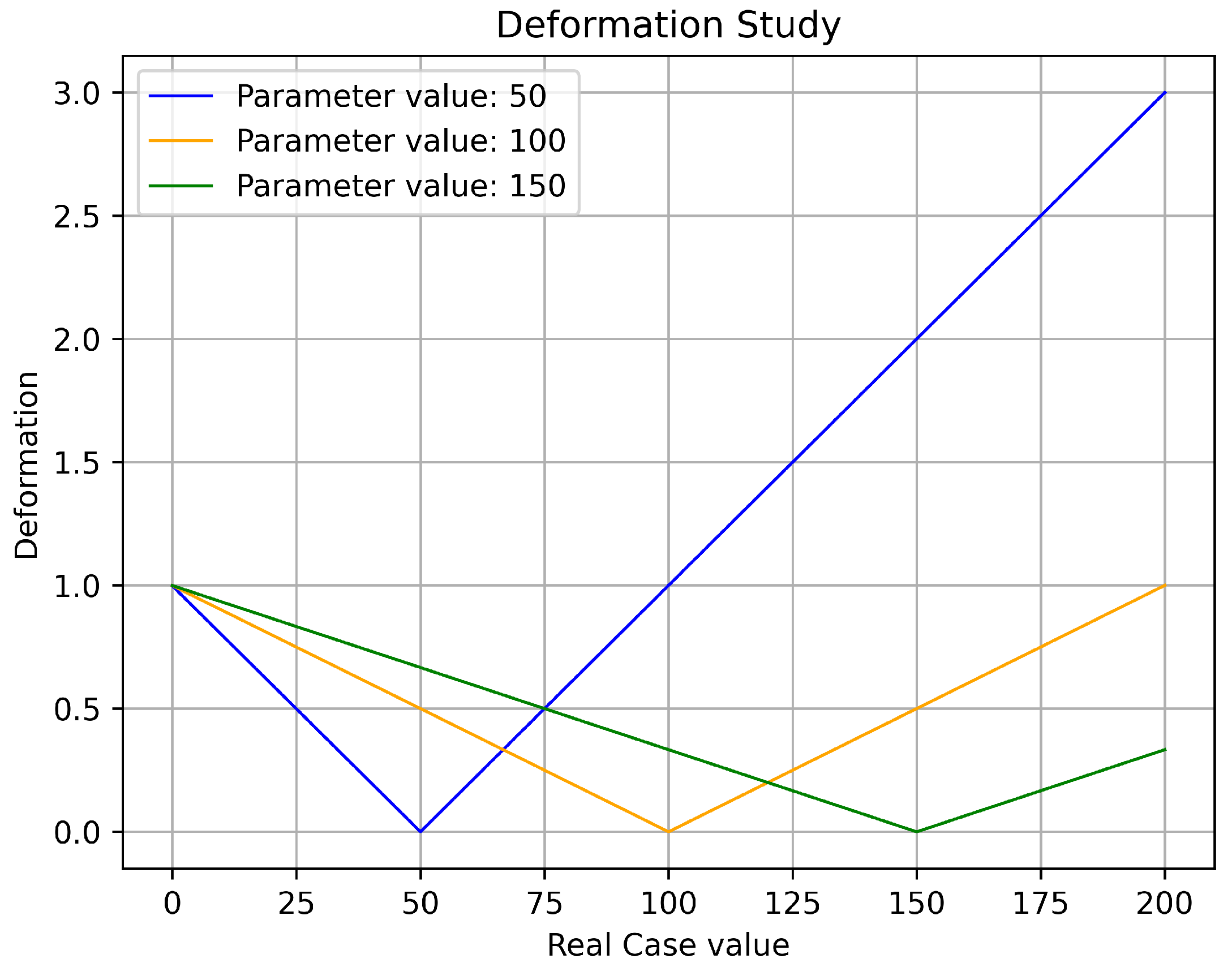
Using this approach, the deformation that would be obtained for each possible value of the parameter with each possible value of the real case is calculated.
Figure 1 shows an example of this, where for simplicity, only some possible values of the parameters (50, 100, and 150) are shown compared to all possible values of the real case, thus obtaining a first deformation model. This model consists of a
deformation curve in which each point represents the energy required to deform the parameter and make it coincide with the value of the real case.
To obtain more possible deformation models, the order of the parameters in the formula used to calculate the axial deformation proposed in the initial approximation is varied. It should be noted that in all the models obtained,
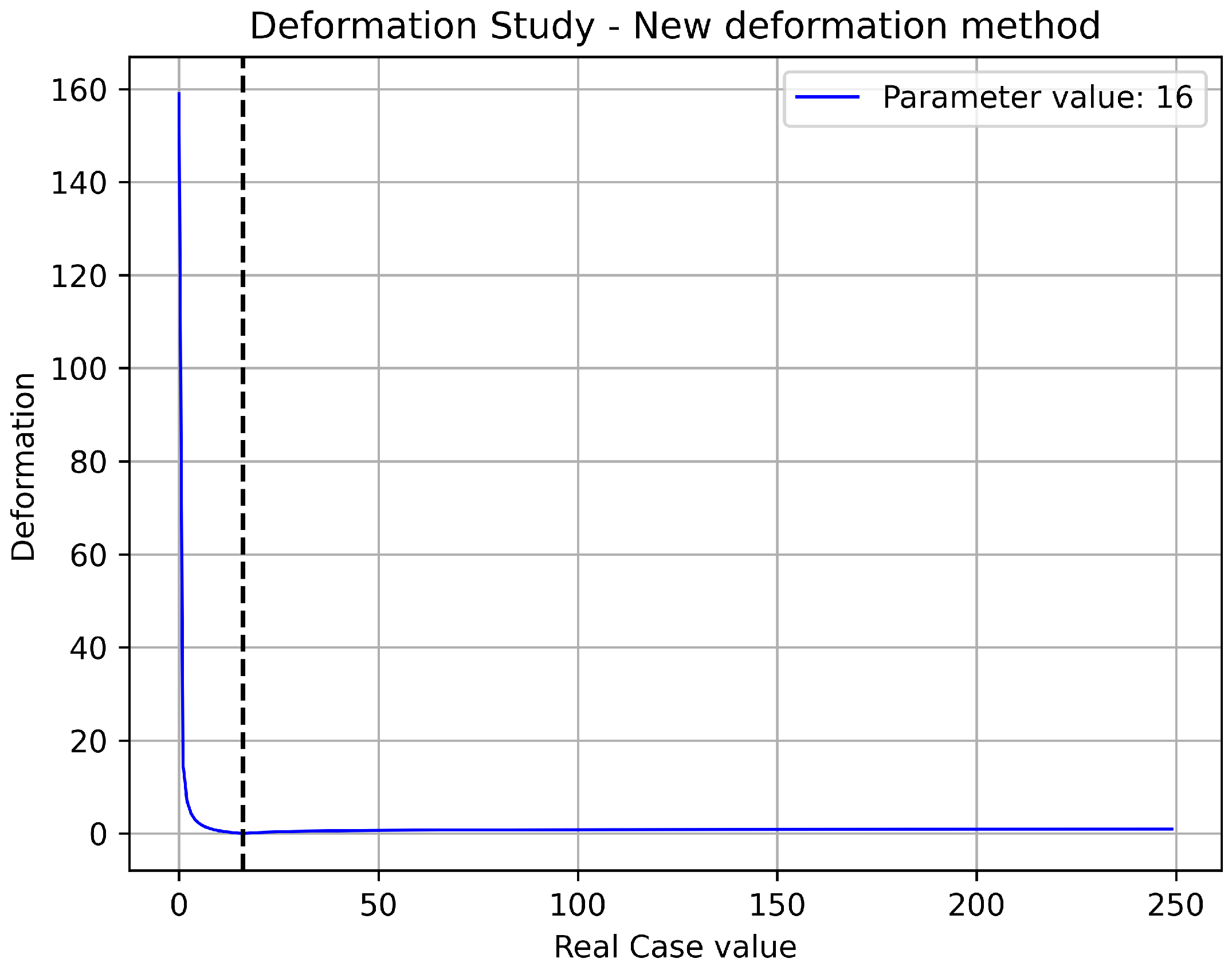
the minimum deformation value is always reached when the parameter and the real case have the same value, which could be considered the
rest state of the spring. This can be seen in
Figure 2, where all the
values of the real case on the right (the real case value is greater than the parameter value) of the vertical dotted line in the image can be understood as a
state of elongation of the spring, while the
values on the left (the real case value is less than the parameter value) of the vertical dotted line correspond to a
state of contraction of the spring.
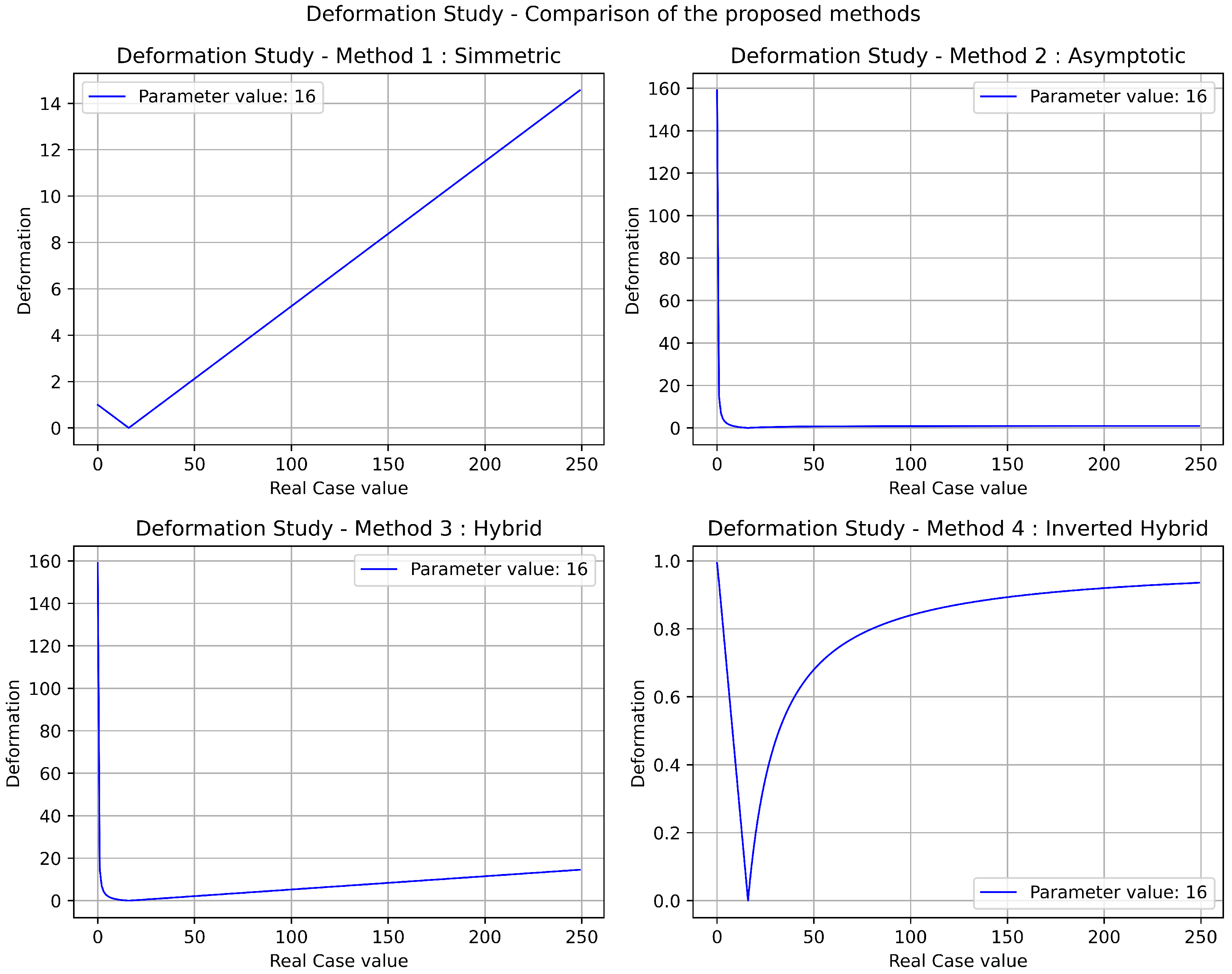
Once the possible models for parameter deformation have been obtained and studied, they are classified as shown in
Figure 3, with the following models being obtained:
Model 1—Symmetric: In this model, deformation, both in contraction and elongation, of the parameter requires the same energy. This model is a good initial approximation for data that does not have semantics; in other words, data that is not
labels of possible categories, but only numerical values such as temperature, height, cost, etc. The formula for calculating deformation according to this model is as follows:
Model 2—Asymptotic: In this model, the contraction of the parameter requires a much greater amount of energy and therefore produces a much greater deformation than elongation, which occurs very easily and tends asymptotically toward the value of 1. The formula for calculating deformation according to this model is as follows:
Model 3—Hybrid: In this model, the contraction of the parameter requires energy that grows exponentially, while the energy required for elongation grows linearly. The formula for calculating deformation according to this model is as follows:
Model 4—Inverted Hybrid: In this model, the deformation of the parameter, both in contraction and elongation, is exponential. However, in elongation, it ends up being asymptotic; that is, after a certain point, the elongation of the spring requires less energy. The formula for calculating the deformation according to this model is as follows:
These models should not be interpreted as independent alternatives, but as instances of a broader deformation design space, where each formulation encodes a different semantic assumption about parameter behaviour.
Of the models obtained, the symmetric model represents an equivalent deformation in both elongation and contraction, although this behaviour is not similar to that of a real spring, which usually has a limited contraction capacity and often requires more effort than elongation. This model can be used initially in any possible context, especially in contexts where the values of the parameters that form the Elastic Patterns are purely numerical.
While in the asymptotic model, parameter contraction requires much more energy than elongation, which grows asymptotically, this behaviour is more realistic with respect to the behaviour of a real spring. This model can be especially useful for contexts in which the parameters represent categories rather than numerical values, and low values in the parameters are undesirable or should be penalized.
On the other hand, the hybrid and inverted hybrid models are a combination of the previous two. For example, the hybrid model on the right side of the deformation curve inherits the behaviour of the symmetric model, and on the left side of the curve, it inherits the behaviour of the asymptotic model. That is, the hybrid model behaves like the symmetric model during elongation, and its deformation curve grows linearly, while during contraction, it behaves like the asymptotic model and grows exponentially. Meanwhile, the inverted hybrid model behaves inversely to the hybrid model. In other words, in elongation, it inherits the behaviour of the asymptotic model, and in contraction, it inherits the behaviour of the symmetric model.
In general, since one model or another may yield better results in each context, it is recommended to use each model as described below:
Symmetric Model: Initial exploration; parameters representing purely numerical magnitudes or values, with no preference between elongation or contraction.
Asymptotic Model: Parameters representing categories, undesirable low values, or a desire to penalize contraction, and preference for elongation over contraction.
Hybrid Model: Initial exploration; parameters representing categories, desire to penalize contraction, and preference for elongation over contraction.
Inverted Hybrid Model: Small deformation values and preference for elongation over contraction.
Elastic Patterns have been tested in various practical cases, one of which is the recognition of handwritten digits [
1]. The model that obtained the best results was the
Hybrid model. In this case, the parameters of the different Elastic Patterns represent the intensity of the pixel. In this scenario, when the value of a parameter (a pixel) contracts, i.e., the parameter is deformed to a value lower than itself, this is conceptually understood as
darkening a pixel of the Elastic Pattern to make it match the pixel of a sample to be characterized. This must cause greater deformation, and therefore require more energy to do so, than the opposite case,
lightening a pixel. This behaviour can be intuitively explained: a low value in a parameter represents a dark pixel, while a high value represents a light pixel. A dark pixel requires intentionality on the part of the user who has written in that pixel; that is, the user has consciously and intentionally written in that pixel, while a slightly dark pixel may be due to factors such as errors when writing, digitizing the sample, etc. Therefore, deforming the Elastic Pattern parameter (the pixel) towards values lower than it in the sample, where the pixel has been deliberately darkened (written), should cause greater deformation and therefore require more energy than deforming it towards values higher than it. In other words, lightening the pixel represents the unintentionality of writing in that pixel. In other words, in this case, the contraction of the parameter (spring) should require more energy than its elongation, which fits perfectly with the behaviour of the
Hybrid deformation model.
This shows that the Hybrid deformation model is useful when working in a context in which heavy penalties must be applied, that is, significantly increasing the deformation energy when certain values are reached (or, failing that, when they are to be avoided).
Once an in-depth study has been carried out on how data deformation is possible, new questions about parameter deformation arise:
Can the deformation of one parameter affect the rest?
Another question that arises after studying parameter deformation is.
Is deformation unlimited; that is, can the parameter (spring) contract or stretch without limit?
Until now, it has been assumed that the deformation capacity of parameters is unlimited. However, real springs have limits to their deformation capacity, both when contracting, which is usually quite limited and requires a significant amount of energy, and when extending, which is usually more extensive, and the energy required can vary greatly from one spring to another. Limiting the capacity to deform the parameters could be an interesting improvement, as this would prevent very high deformation values and could also save computation time.
5. Advanced Aspects of Elastic Patterns
5.1. Weighted Spring Deformation
Up to this point, the deformation of each of the springs of the parameters affected the deformation energy obtained when deforming an Elastic Pattern so that it fit perfectly with the new case. In other words, each of the parameters contributes to the total deformation energy in the same proportion; however, there may be contexts in which not all parameters are equally important.
For example, the detection of handwritten digits in a seven-segment template is proposed [
28] using proposals similar to Elastic Patterns based on the concept of
Masks [
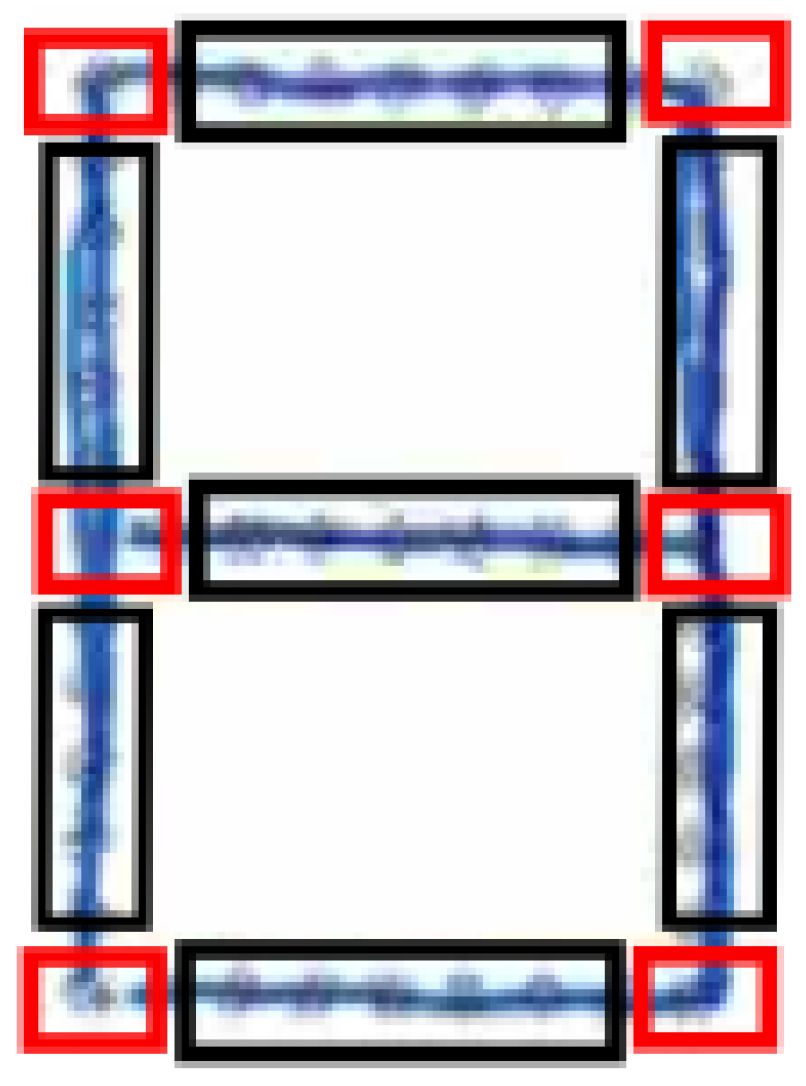
29]. However, it is pointed out that not all pixels in the image are equally important. The pixels that form the red areas in
Figure 4 not only provide little information, but also, due to writing errors or a possible excess of ink when changing the direction of the stroke, may introduce noise into the subsequent data, which could cause possible errors. It is therefore established that studying only the pixels that form the black areas would be sufficient, since a user will always write in this set of pixels if they want to fill in that segment.
Continuing with the context of handwritten digit processing, and taking any digit as an example, the pixels that form the outline of the stroke provide much more information than the pixels that form the interior of the stroke. Therefore, the deformation of the parameters representing the pixels that form the outline of the digit should have greater importance in the calculation of the deformation energy than the pixels/parameters that form the interior of the stroke.
Another example, in a different context, would be to try to classify different fruits that are similar to each other, for example, oranges and lemons, both of which are physically similar, with the main difference between them being their colour. Let us suppose that two Elastic Patterns are defined, one for oranges and another for lemons, as shown in
Table 1:
As explained above, the main difference between the two classes in the context in which we are working resides in one of the parameters, but the deformation of both contributes equally to the calculation of the
Deformation Energy. Suppose that a new sample arrives for classification, an orange, which, due to being picked prematurely, has not completed its growth. Therefore, the parametric representation of the sample to be classified is shown in
Table 2:
If the deformation of the sample parameters is calculated, the result shown in
Table 3 is obtained:
As can be seen, the most similar Elastic Pattern, in other words, the one that undergoes the least deformation, is the one representing the lemon class. However, this is an error in the characterization of the new case, since we know that this is an orange. This is due, as explained above, to the fact that all parameters contribute equally to the calculation of the Deformation Energy. However, in this case, one of the parameters, the
Colour parameter, is much more important when characterizing the new case, so the deformation of this parameter should be given greater importance when calculating the most similar Elastic Pattern. It is established that the importance of the
Colour parameter is 90%, while that of the
Diameter parameter is only 10%. This new weighting of the importance of the parameters means changing how each of them influences the Deformation Energy obtained, yielding the following results shown in
Table 4:
Due to the change in the weighting of the parameters, a correct characterization is obtained, because the parameter that is most important when classifying a fruit in this context, its colour, contributes much more than other less relevant parameters, such as its size.
This concept of weighted deformation, in which each parameter/spring contributes to the total deformation energy in different proportions, can be included or compared in the field of Metric Learning. Metric Learning is a field whose goal is to adapt distance functions to the internal structure of the data/models, rather than relying on fixed geometric metrics such as Euclidean distance. Classical approaches learn a Mahalanobis-type metric [
30], in which a positive semidefinite matrix (a matrix is positive semidefinite if it is a symmetric matrix and all its values are greater than or equal to zero) determines the relative contribution and possible interactions of different features/parameters, as defined in the first approaches of Distance Metric Learning [
10] and later extended in large-margin frameworks such as LMNN [
31]. Some studies [
32] expose how adaptive feature/parameter weighting and learned relevance matrices improve prototype-based classification methods. The concept of
Weighted Spring Deformation share the principle of modelling how each individual parameter influences the total when calculating similarity with the Metric Learning Field. However, while in the field of Metric Learning, the importance, or weight, of the characteristics/parameters/structure of the model/data is commonly interpreted as a global optimization of a loss function, the concept of
Weighted Spring Deformation in Elastic Patterns introduces the deformation of parameters, based on their importance factor, as a semantic and explicit mechanism, where each parameter/spring contributes energy to the total deformation energy according to its context-dependent importance.
5.2. Spring Hardening
If, during the use of an Elastic Pattern, it is detected that the deformation suffered in one or more of its parameters is minimal, for example, it is always below a threshold
U, it is possible to assume that this parameter or parameters are very similar to their Elastic Pattern and the class they represent, i.e., that the value chosen for this parameter or parameters is very representative of this class. This partly echoes the concept of
Prototype defined by H. Bremermann [
29], where an individual member of a class represents that class. It is therefore possible to establish that the value of that parameter is
affine for that Elastic Pattern/class, so any deformation of this parameter should be given greater importance when calculating the total deformation, since we are
deforming a value that has been proven to be affine. This concept of increasing the importance of a parameter when calculating total deformation, since it has been little deformed in the classification of previous samples, is called
Spring Hardening. It is important to note that in this concept, we are working with parameter deformation, not with the total deformation that occurs in an elastic standard, since
Spring Hardening implicitly implies that the weight of all parameters is not the same. If all parameters were to
harden to the same measure, they would all have the same importance again, thus contradicting the intention of
Spring Hardening.
Initially, it is proposed that Spring Hardening works as follows:
Each of the parameters that make up the Elastic Pattern will have an associated
hardness factor by which the result obtained when calculating the axial deformation of the parameter will be multiplied, with this deformation value ultimately contributing to the
deformation vector, according to the following formula:
The sum of the
hardness factors for each parameter must equal 1.
The initial
hardness factor for each parameter is calculated using the following formula:
The hardness factor will be modified when a parameter is found that has undergone little deformation when recognizing a series of samples, as explained above. Initially, it is proposed that hardening be carried out after each classified sample, updating only the parameters of the most similar Elastic Pattern.
Initially, it is proposed that the increase in the
hardness factor of the parameter be 5% with respect to the initial
hardness factor, applying the following formula:
Once the increase in the hardness factor has been calculated, it is updated by adding this increase to the existing hardness factor:
The rest of the parameters must reduce their
hardness factor by the amount that the parameter that has been
hardened has increased, dividing this increase among the rest of the parameters, so that their new
hardness factor is calculated using the following formula:
An example of this concept of
Spring Hardening is shown below: Suppose that a series of Elastic Patterns are available to determine which disease (category) a patient is suffering from (real cases). Part of the Elastic Patterns representing the diseases is shown in
Table 5:
After examining a series of patients who have been diagnosed with the
common cold, that is, the most closely related Elastic Pattern is the one representing the
common cold, it is observed that the deformation suffered by the parameter
hours from symptom start is minimal, and the parameter mean is 72 with a standard deviation of 2, that is, in most patients (real cases), this parameter will have a value between 70 and 74. Calculating the deformation in the extreme values, we obtain the following axial deformation values for the parameter.
Therefore, this may determine that this parameter is
related to its Elastic Pattern, thus allowing it to be
hardened and giving it greater relevance than the other parameters. Assuming that the Elastic Patterns have 20 parameters, the calculation of the new values for the
hardness factors is shown below, with the final results shown in
Table 6:
This concept of hardening comes from two different sources:
The concept of
Weighted Spring Deformation, proposed in
Section 5.1, which reflects that not all parameters have the same importance within an Elastic Pattern, which should be reflected in how they affect the final deformation obtained.
The concept of
Ordered Weighted Averaging, or OWA [
33], is a concept commonly used in the field of artificial intelligence, especially in fuzzy logic, which associates a vector of values
n with a vector of weights
w, thus giving the vector
n a semantic meaning (or importance) for each of its values. While it is true that the concept of
hardening initially arises from the concept of OWA, with the vector
w in both concepts being a weight vector that gives the values certain semantics, these two concepts differ in one key aspect:
reordering: when using an OWA, the vector
n is reordered according to a criterion; for example, the values of
n are ordered from highest to lowest (although other orders exist), while this is not possible in
hardening, since modifying the order of the vector of values
n (the different deformations that occur in each of the parameters/springs) would lead to an increase in the characterization process of the new case. In other words, the main difference between an OWA and
hardening is that in the former, each value of the weight vector
w is associated with a value of the vector
n by means of a
reordering function, while in the latter, this association is unique and has its own semantics, which will surely be defined by an expert or based on expert knowledge.
However, this hardening process is complex, as explained above, and also has a number of aspects that can be problematic:
Establishing the threshold
U to measure whether the deformation suffered by the parameter is small enough to
harden it is complex, since the values obtained in the axial deformation of each parameter can be very different, even within the same context. For example, the inverted hybrid deformation model, discussed in
Section 4, tends to obtain lower values than the other models when calculating axial deformation.
Some of these parameters may be correct, but not related, within a range; in other words, there may be a range of valid values for a parameter. Conceptually, a valid value being very close to a related value, as it is valid for representing reality. Returning to the example given above, in the common cold, the parameter hours from symptom start may have a value within the range [17, 72], which is the typical incubation period for this disease. There may also be possible anomalies, such as a genetic mutation that makes the patient particularly weak or resistant to this disease, thus further increasing the possible range of values.
If one or more parameters become very hard, the rest of the patterns will lose much of their importance, possibly becoming practically null, which raises the following questions:
- –
If the importance, and therefore the hardness factor, of a parameter reaches zero, can it be eliminated?
- –
Can the hardness factor be negative?
Initially, the answer to both questions would be no, a parameter should not be able to be removed from an Elastic Pattern, since this parameter is necessary for the parametric representation used to characterize the different Elastic Patterns and possible new cases. Furthermore, a hardness factor should never become negative, no matter how small its value may be, even if this means that this parameter has minimal importance when characterizing a new case.
If a spring undergoes excessive deformation above a threshold V, it should be able to soften and lose importance, as it is not very representative within its Elastic Pattern and is therefore not very relevant. This concept also has its own points of conflict, similar to those discussed for hardening.
This concept of Spring Hardening is conceptually similar to the previous
Section 5.1, in which parameters contribute deformation energy in different proportions, although the interpretation is different. Previously, the importance of a parameter with a semantic meaning and how much it contributes to the total deformation energy, in this case, the hardening of a spring, depend on the use of the Elastic Pattern itself in a context, adapting to it based on different iterations within it and evolving over time, which could be considered a learning process. Therefore, this concept of Spring Hardening could be considered similar to the learning metric discussed in the previous point, as each parameter contributes to the total deformation energy in different proportions.
6. Experiment and Evaluation
This section presents the experimental evaluation of the proposed Elastic Pattern framework in different contexts: the context of handwritten digit recognition using the MNIST dataset and a cognitive context, such as breast cancer detection, using the Wisconsin Breast Cancer Dataset. This study aims to assess both the feasibility and effectiveness of the approach by analysing its performance in scenarios. To this end, the experiment is structured in two main stages: first, the generation of class-representative Elastic Patterns from the training subset, and second, their application to the classification of unseen samples through deformation-based similarity measures. This experimental setup enables a comprehensive evaluation of the method’s capability to model class-specific morphological features and to generalise effectively to new instances.
Within the scope of this study, the generation of Elastic Patterns is addressed as a context-dependent process, whose formulation must be adapted to the characteristics of the dataset under analysis. In this regard, the MNIST dataset is considered as a benchmark scenario, comprising a large collection of centred, greyscale images of handwritten digits, each represented as a 28 × 28 pixel matrix with intensity values in the range [0, 255]: 0 for a white pixel, 255 for a pixel. The dataset is partitioned into a training subset, with 60.000 samples used for pattern construction, and a test subset, with 10.000 samples employed for subsequent evaluation. Within the context of the Wisconsin Breast Cancer Dataset, a widely adopted benchmark for classification tasks involving medical diagnostic data, each instance is characterised by a collection of numerical features extracted from digitised images of fine-needle aspirates of breast masses. These features describe a range of morphological properties, including radius, texture, perimeter, area, and smoothness, amongst others. Each instance is assigned a label indicating either a benign or malignant diagnosis, thereby constituting a binary classification problem of moderately high dimensionality.
In line with previous approaches based on mask representations, the proposed method conceptualises Elastic Patterns as class prototypes derived from the aggregation of training samples. This formulation enables the extraction of representative structural information from the data while maintaining consistency with existing pattern-based recognition methodologies.
6.1. Elastic Pattern Generation
The generation of Elastic Patterns constitutes a fundamental stage in the proposed classification framework, as these patterns serve as representative prototypes for each class within the dataset. In the case of the MNIST dataset, which comprises ten digit classes (0–9), one Elastic Pattern is constructed per class, resulting in a total of ten representative patterns.
Each Elastic Pattern is defined as a matrix with the same dimensions as the input images (28 × 28 pixels), where each element encodes the frequency with which a given pixel is activated across all training samples belonging to the corresponding class. Consequently, the resulting pattern captures the structural regularities of handwritten digits in a probabilistic manner, reflecting the spatial distribution of strokes.
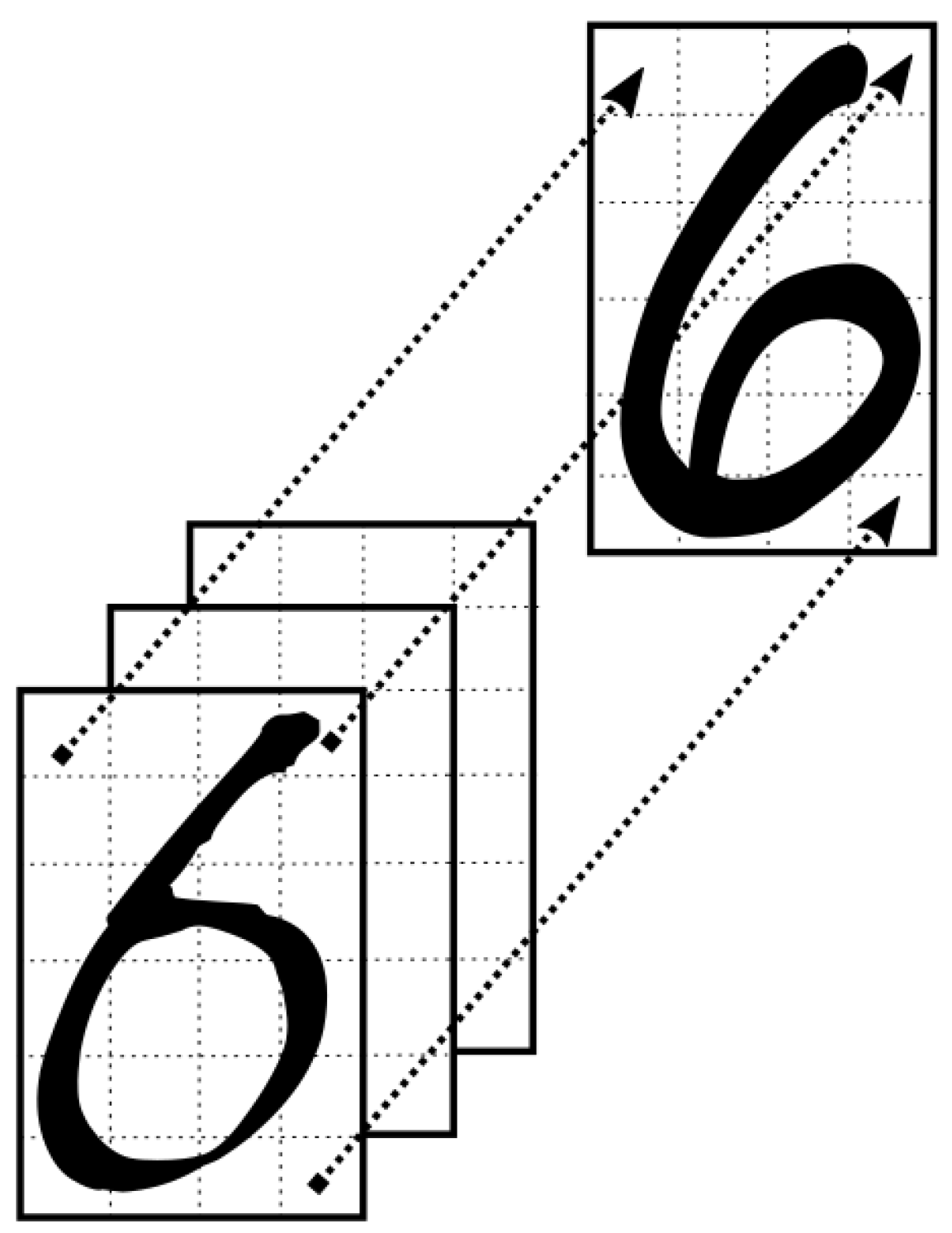
The generation process follows a systematic procedure. First, all training samples associated with a specific class are selected. Then, an initially zero-valued matrix is created to represent the Elastic Pattern. An incremental value, computed as the ratio between the maximum pixel intensity (255) and the number of training samples, is used to accumulate pixel contributions. Each sample is processed pixel by pixel, and whenever a pixel is active (i.e., non-zero), the corresponding position in the pattern matrix is incremented. Finally, the resulting matrix is discretised by rounding its values to integer intensities within the standard image range; a graphical representation of this is shown in
Figure 5.
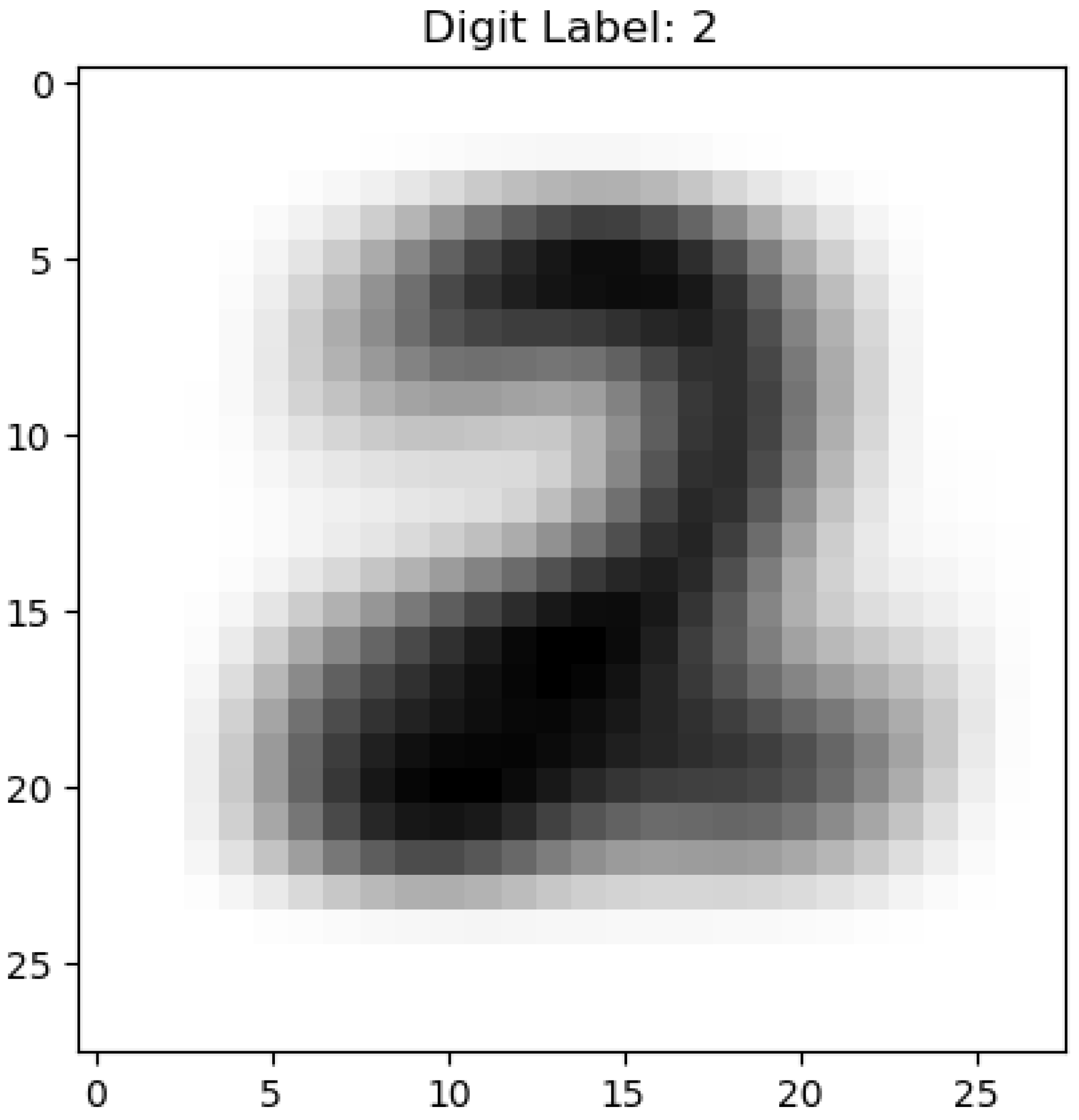
This approach produces a set of Elastic Patterns that encode the collective morphological characteristics of each digit class, enabling a subsequent comparison with new samples through deformation-based similarity measures; a graphical representation of the Elastic Pattern for digit/class 2 is shown in
Figure 6.
For the Wisconsin Breast Cancer Dataset, to construct the Elastic Patterns, the dataset is initially partitioned into two disjoint subsets: a training set and a test set. The training set is employed to generate the parametric representation of each class, whereas the test set is reserved for evaluation purposes.
The generation of the Elastic Patterns is performed through a straightforward aggregation strategy applied to the training data. For each conceptual class—namely, malignant or benign—a grouping function is used to derive a representative prototype. In the present implementation, this grouping function is defined as the arithmetic mean of the feature values across all training instances belonging to the corresponding class. Consequently, each class is represented by a vector of mean values, in which each component corresponds to a parameter of the Elastic Patterns. The simplicity of this aggregation procedure enables the effect of the deformation mechanism to be analysed in isolation, although more sophisticated approaches, such as fuzzy clustering techniques, may further improve the representational capacity of the model.
6.2. Elastic Pattern Classification
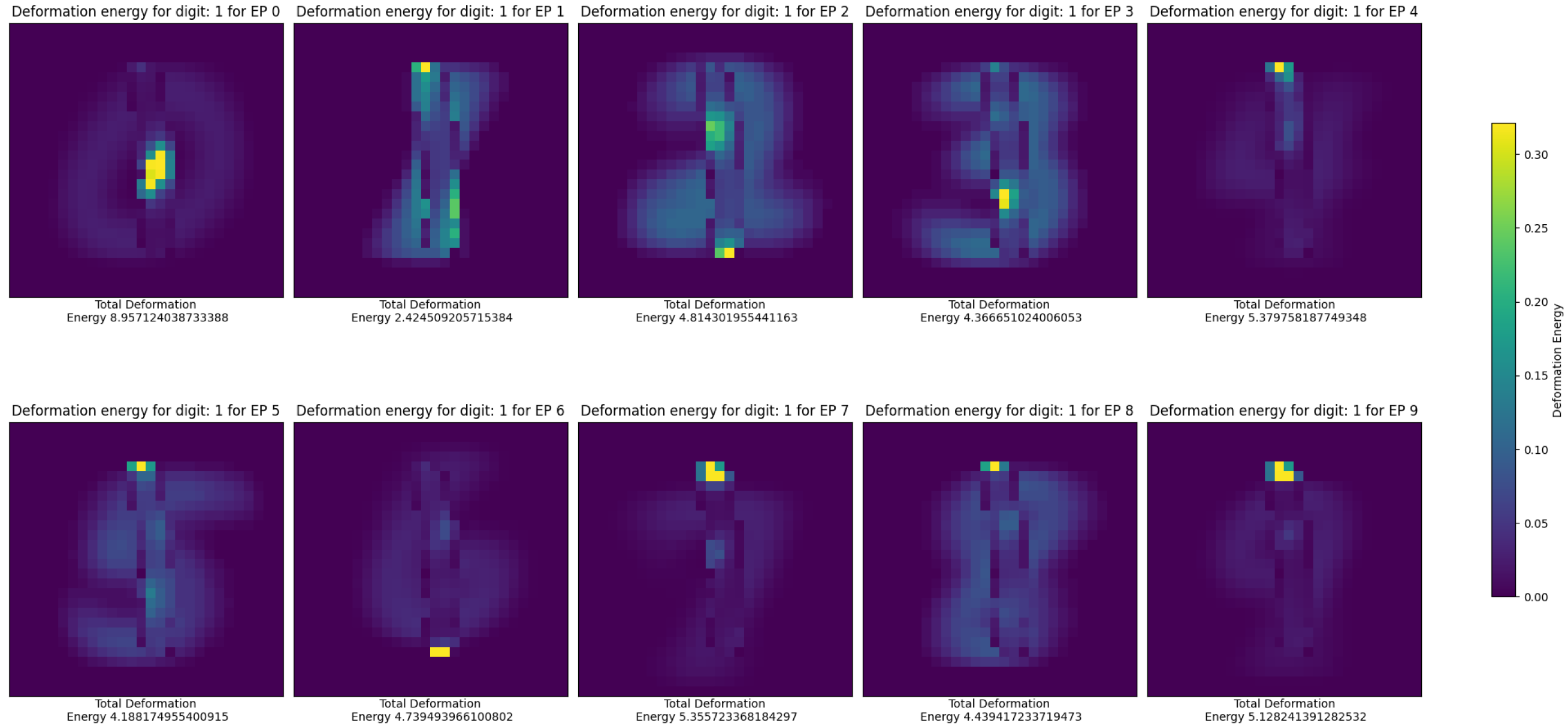
Once the Elastic Patterns have been generated, they can be employed to perform the classification of unseen samples by evaluating their similarity to each class prototype. The proposed approach follows a deformation-based framework, in which each Elastic Pattern is compared against the input sample through a parameter-wise analysis. Specifically, both the pattern and the sample are traversed parameter by parameter, and the local deformation at each position is computed, allowing the construction of a deformation vector that captures the discrepancy between them. This is, due to the design of the Elastic Patterns, an
ante hoc explainability mechanism, since Elastic Pattern are modelled as a set of independent elastic components (springs), where each component corresponds to a parameter of the underlying representation. For a new instance, the model estimates the deformation required for each parameter through axial strain and combines these values into a global deformation energy. Classification is subsequently performed by selecting the pattern that minimises this energy; an example of how this deformation energy is calculated and how it is minimised to classify an instance, is shown in
Figure 7. Moreover, the proposed framework is consistent with recent research promoting inherently interpretable models over post hoc explanation methods, in contrast to model-agnostic techniques such as LIME [
21] or SHAP [
20], which approximate the behaviour of complex models; Elastic Pattern models are interpretable by design.
Subsequently, a global measure, referred to as the deformation energy, is derived from this vector, providing a quantitative assessment of the effort required for the Elastic Pattern to adapt to the input sample. By evaluating this measure across all patterns, the classification decision is obtained by selecting the pattern associated with the minimum deformation energy, which corresponds to the most similar class representation.
An important advantage of this methodology lies in its robustness, as it reduces the required pre-processing of the input data. Unlike conventional approaches that rely on normalisation, noise reduction, or segmentation stages, Elastic Patterns inherently adapt to variations in the data through their deformation mechanism, thereby exhibiting resilience to noise, scale differences, and other distortions.
6.3. Experiment Evaluation
This section presents the evaluation of the proposed Elastic Pattern approach applied to the proposed scenarios: the MNIST dataset and Wisconsin Breast Cancer Dataset. The obtained results are analysed in terms of classification performance and accuracy under different deformation models and are further compared with those achieved by alternative classification methods. This comparative analysis provides insight into the effectiveness and robustness of the proposed framework.
The results obtained, in terms of accuracy, for each possible deformation model are shown in
Table 7.
Based on the results obtained from the various deformation methods, a number of conclusions can be made:
The method that achieves the best results in both scenarios in terms of accuracy is the Hybrid method.
The Symmetric and Asymptotic methods take approximately 20% less time—57 s on average compared to 72 s on average—because the Hybrid and Inverted Hybrid methods require an additional calculation when determining the deformation energy.
The recognition time per sample is approximately 0.0072 s.
The Hybrid method achieves better results due to the way it emulates the behaviour of a spring, where elongation is penalised much less than contraction; in other words, less energy is required to deform the Elastic Pattern to values greater than its original state than to values less than it, which fits perfectly with the context of both scenarios; that is, for the MNIST experiment, deforming the Elastic Pattern towards higher values means it is deforming towards pixels written by the user; in other words, the pixels written by the user, where there is an ‘intent’ for them to have higher values, incur a lower penalty than the white areas, which incur a much higher deformation energy, which makes sense as the black pixels are those that actually make up the digit/sample to be classified. For Wisconsin Breast Cancer, something similar happens, but adjusted to the morphology of the classified cells, higher values suggest a potentially irregular morphology, which may indicate a malignant sample.
The advance methods are evaluated to assess their impact on the performance of the Elastic Patterns framework. Specifically, Weighted Spring Deformation and Spring Hardening are analysed both individually and in combination within the Hybrid deformation model. All configurations are tested under identical conditions using the MNIST and Wisconsin Breast Cancer datasets to ensure a fair comparison; results are presented in
Table 8.
Once the best deformation method has been established, the experiments are carried out using other common classification methods and the results are compared; these are shown in
Table 9.
The comparison with other classification methods allows the performance of the proposed approach to be positioned within the context of commonly used classification techniques. Although KNN achieves superior classification accuracy, it operates as an instance-based method requiring comparisons against the entire training set during inference, limiting interpretability and increasing computational cost. In contrast, Elastic Patterns provide a compact and semantically interpretable representation, where each classification decision can be analysed through explicit deformation mechanisms and parameter contributions.
The KNN method achieves the highest accuracy, albeit at the cost of a considerably higher execution time. This is due to the fact that KNN requires comparing each sample with the entire training set. In contrast, Elastic Patterns provide a balance between accuracy, interpretability, and computational efficiency, achieving an accuracy of 81.19% while requiring the lowest execution time among the evaluated methods.
From this comparison, several conclusions can be drawn:
Elastic Patterns provide a competitive balance between computational efficiency, interpretability, and classification performance.
Random Forest and AdaBoost methods obtain lower accuracy and exhibit higher execution times.
The KNN method achieves the highest accuracy, with a substantial margin over the next best-performing method; however, its execution time increases significantly.
Although KNN achieves superior classification accuracy, its inference process requires comparisons against the entire training set, resulting in substantially higher computational and memory costs. In contrast, Elastic Patterns rely on compact class-representative structures, enabling faster and more interpretable decision-making.
7. Conclusions and Future Work
7.1. Conclusions
This work expands on the theoretical basis of Elastic Patterns, presented in other works [
1]. These are sophisticated approaches that make use of concepts from different fields such as cognitive psychology, physical characteristics of materials, and fuzzy logic.
The main contributions of this work can be summarised as follows:
The proposal of new deformation models for Elastic Patterns, including Symmetric, Asymptotic, Hybrid, and Inverted Hybrid behaviours, which broaden the adaptability of Elastic Patterns to different contexts.
The introduction of adaptive mechanisms, such as:
- –
Weighted Spring Deformation, which enhances model adaptability by dynamically adjusting the contribution of each parameter to the overall deformation energy.
- –
Spring Hardening, which would allow Elastic Patterns to learn about the context and modify the internal structure.
Together, deformation models and adaptive mechanisms define a generalised adaptive deformation framework for Elastic Patterns.
The proposed approach emphasises inherent interpretability by design, distinguishing it from post hoc explanation techniques commonly used in explainable artificial intelligence. Elastic Patterns provide an ante hoc explainable classification mechanism, where decisions are directly interpretable through explicit parameter deformations and deformation energies.
7.2. Future Work
Future work will focus mainly on continuing with the theoretical study of Elastic Patterns. The deformation of the parameters that form the Elastic Patterns has been studied, but there are still some aspects that would be interesting to explore further:
Limit deformation: Currently, the deformation capacity of the parameters attempts to simulate the elongation or contraction of a spring; however, there is no limitation on the deformation to which it can be subjected. Setting a limit on the deformation capacity could reduce the computation time required to obtain the deformation energy of the pattern and make the behaviour of the parameters more similar to that of a real spring.
Spring Hardening: An in-depth study to establish the value of the U threshold to determine when a deformation suffered by a parameter/spring is small enough to harden the spring is interesting, as this would give Elastic Patterns the ability to learn in their context. Other interesting points to study in relation to this concept would be studying the range of valid values for hardening, for example, that a hardness factor cannot be lower or higher than certain values, imitating the physical characteristics of materials; whether the hardness factor can be composed to model complex contexts; this type of context can be referred to as a cognitive environment, which is an environment where the interpretation of data requires expert knowledge.
Study of possible new deformation models: It is interesting to study new possible deformation models beyond those proposed, which are capable of adjusting to other possible contexts or penalties in the deformation.
Explainability analysis: Future work will explore visual and quantitative explainability mechanisms derived from deformation energy distributions, enabling more detailed inspection of parameter relevance and classification behaviour.